EP1540036B1 - Elektrokatalytisches verfahren und elektrokatalytische vorrichtung - Google Patents
Elektrokatalytisches verfahren und elektrokatalytische vorrichtung Download PDFInfo
- Publication number
- EP1540036B1 EP1540036B1 EP02773418.5A EP02773418A EP1540036B1 EP 1540036 B1 EP1540036 B1 EP 1540036B1 EP 02773418 A EP02773418 A EP 02773418A EP 1540036 B1 EP1540036 B1 EP 1540036B1
- Authority
- EP
- European Patent Office
- Prior art keywords
- compartment
- alkali metal
- solution
- anode
- reactor
- Prior art date
- Legal status (The legal status is an assumption and is not a legal conclusion. Google has not performed a legal analysis and makes no representation as to the accuracy of the status listed.)
- Expired - Lifetime
Links
- 238000000034 method Methods 0.000 title claims description 30
- 230000008569 process Effects 0.000 title claims description 25
- OSVXSBDYLRYLIG-UHFFFAOYSA-N dioxidochlorine(.) Chemical compound O=Cl=O OSVXSBDYLRYLIG-UHFFFAOYSA-N 0.000 claims description 118
- 239000000463 material Substances 0.000 claims description 91
- 239000004155 Chlorine dioxide Substances 0.000 claims description 59
- 235000019398 chlorine dioxide Nutrition 0.000 claims description 57
- 230000003197 catalytic effect Effects 0.000 claims description 53
- -1 hydrogen ions Chemical class 0.000 claims description 47
- 238000005341 cation exchange Methods 0.000 claims description 46
- 239000012528 membrane Substances 0.000 claims description 37
- 229910052783 alkali metal Inorganic materials 0.000 claims description 36
- 239000002253 acid Substances 0.000 claims description 31
- 229910001919 chlorite Inorganic materials 0.000 claims description 31
- 229910052619 chlorite group Inorganic materials 0.000 claims description 31
- XLYOFNOQVPJJNP-UHFFFAOYSA-N water Substances O XLYOFNOQVPJJNP-UHFFFAOYSA-N 0.000 claims description 19
- 239000002243 precursor Substances 0.000 claims description 16
- 239000001257 hydrogen Substances 0.000 claims description 13
- 229910052739 hydrogen Inorganic materials 0.000 claims description 13
- 229910000041 hydrogen chloride Inorganic materials 0.000 claims description 13
- IXCSERBJSXMMFS-UHFFFAOYSA-N hydrogen chloride Substances Cl.Cl IXCSERBJSXMMFS-UHFFFAOYSA-N 0.000 claims description 13
- VEXZGXHMUGYJMC-UHFFFAOYSA-N Hydrochloric acid Chemical compound Cl VEXZGXHMUGYJMC-UHFFFAOYSA-N 0.000 claims description 12
- 229910001413 alkali metal ion Inorganic materials 0.000 claims description 6
- 229910019142 PO4 Inorganic materials 0.000 claims description 5
- 235000021317 phosphate Nutrition 0.000 claims description 5
- 150000003013 phosphoric acid derivatives Chemical class 0.000 claims description 5
- 229910001514 alkali metal chloride Inorganic materials 0.000 claims description 4
- 238000007865 diluting Methods 0.000 claims description 3
- 150000004820 halides Chemical class 0.000 claims description 2
- 150000002823 nitrates Chemical class 0.000 claims description 2
- 150000002826 nitrites Chemical class 0.000 claims description 2
- LSNNMFCWUKXFEE-UHFFFAOYSA-L sulfite Chemical class [O-]S([O-])=O LSNNMFCWUKXFEE-UHFFFAOYSA-L 0.000 claims description 2
- 150000003467 sulfuric acid derivatives Chemical class 0.000 claims description 2
- 150000001339 alkali metal compounds Chemical class 0.000 claims 1
- 239000000243 solution Substances 0.000 description 65
- 239000003054 catalyst Substances 0.000 description 42
- 229910052751 metal Inorganic materials 0.000 description 30
- 239000002184 metal Substances 0.000 description 30
- 239000011236 particulate material Substances 0.000 description 27
- 235000002639 sodium chloride Nutrition 0.000 description 25
- QBWCMBCROVPCKQ-UHFFFAOYSA-N chlorous acid Chemical compound OCl=O QBWCMBCROVPCKQ-UHFFFAOYSA-N 0.000 description 23
- 229940077239 chlorous acid Drugs 0.000 description 18
- BASFCYQUMIYNBI-UHFFFAOYSA-N platinum Chemical compound [Pt] BASFCYQUMIYNBI-UHFFFAOYSA-N 0.000 description 18
- FAPWRFPIFSIZLT-UHFFFAOYSA-M Sodium chloride Chemical compound [Na+].[Cl-] FAPWRFPIFSIZLT-UHFFFAOYSA-M 0.000 description 15
- 239000010442 halite Substances 0.000 description 13
- UKLNMMHNWFDKNT-UHFFFAOYSA-M sodium chlorite Chemical compound [Na+].[O-]Cl=O UKLNMMHNWFDKNT-UHFFFAOYSA-M 0.000 description 13
- 229960002218 sodium chlorite Drugs 0.000 description 13
- 150000001340 alkali metals Chemical class 0.000 description 11
- 239000000919 ceramic Substances 0.000 description 11
- 238000006243 chemical reaction Methods 0.000 description 11
- 229910052500 inorganic mineral Inorganic materials 0.000 description 11
- 239000011707 mineral Substances 0.000 description 11
- 235000010755 mineral Nutrition 0.000 description 11
- 229910000039 hydrogen halide Inorganic materials 0.000 description 10
- 239000012433 hydrogen halide Substances 0.000 description 10
- 239000002245 particle Substances 0.000 description 10
- 229910001508 alkali metal halide Inorganic materials 0.000 description 9
- 150000008045 alkali metal halides Chemical class 0.000 description 9
- 239000007864 aqueous solution Substances 0.000 description 9
- 239000012527 feed solution Substances 0.000 description 9
- 229910052811 halogen oxide Inorganic materials 0.000 description 9
- 239000000203 mixture Substances 0.000 description 9
- 229910052697 platinum Inorganic materials 0.000 description 9
- 241000894007 species Species 0.000 description 9
- 150000001768 cations Chemical class 0.000 description 8
- 125000004435 hydrogen atom Chemical group [H]* 0.000 description 8
- 239000011780 sodium chloride Substances 0.000 description 8
- KFZMGEQAYNKOFK-UHFFFAOYSA-N Isopropanol Chemical compound CC(C)O KFZMGEQAYNKOFK-UHFFFAOYSA-N 0.000 description 7
- 239000000654 additive Substances 0.000 description 7
- 230000001965 increasing effect Effects 0.000 description 7
- 239000012702 metal oxide precursor Substances 0.000 description 7
- 230000003647 oxidation Effects 0.000 description 7
- 238000007254 oxidation reaction Methods 0.000 description 7
- LFQSCWFLJHTTHZ-UHFFFAOYSA-N Ethanol Chemical compound CCO LFQSCWFLJHTTHZ-UHFFFAOYSA-N 0.000 description 6
- KDLHZDBZIXYQEI-UHFFFAOYSA-N Palladium Chemical compound [Pd] KDLHZDBZIXYQEI-UHFFFAOYSA-N 0.000 description 6
- 238000005349 anion exchange Methods 0.000 description 6
- 150000002500 ions Chemical class 0.000 description 6
- 239000000047 product Substances 0.000 description 6
- 239000000126 substance Substances 0.000 description 6
- 238000004891 communication Methods 0.000 description 5
- 238000000151 deposition Methods 0.000 description 5
- 239000012530 fluid Substances 0.000 description 5
- 238000012856 packing Methods 0.000 description 5
- 150000003839 salts Chemical class 0.000 description 5
- NWUYHJFMYQTDRP-UHFFFAOYSA-N 1,2-bis(ethenyl)benzene;1-ethenyl-2-ethylbenzene;styrene Chemical compound C=CC1=CC=CC=C1.CCC1=CC=CC=C1C=C.C=CC1=CC=CC=C1C=C NWUYHJFMYQTDRP-UHFFFAOYSA-N 0.000 description 4
- XTEGARKTQYYJKE-UHFFFAOYSA-M Chlorate Chemical compound [O-]Cl(=O)=O XTEGARKTQYYJKE-UHFFFAOYSA-M 0.000 description 4
- KJTLSVCANCCWHF-UHFFFAOYSA-N Ruthenium Chemical compound [Ru] KJTLSVCANCCWHF-UHFFFAOYSA-N 0.000 description 4
- RTAQQCXQSZGOHL-UHFFFAOYSA-N Titanium Chemical compound [Ti] RTAQQCXQSZGOHL-UHFFFAOYSA-N 0.000 description 4
- 230000000996 additive effect Effects 0.000 description 4
- 239000003729 cation exchange resin Substances 0.000 description 4
- 210000004027 cell Anatomy 0.000 description 4
- 230000008021 deposition Effects 0.000 description 4
- 229910052741 iridium Inorganic materials 0.000 description 4
- GKOZUEZYRPOHIO-UHFFFAOYSA-N iridium atom Chemical compound [Ir] GKOZUEZYRPOHIO-UHFFFAOYSA-N 0.000 description 4
- 229910052707 ruthenium Inorganic materials 0.000 description 4
- 229910052719 titanium Inorganic materials 0.000 description 4
- 239000010936 titanium Substances 0.000 description 4
- OKTJSMMVPCPJKN-UHFFFAOYSA-N Carbon Chemical compound [C] OKTJSMMVPCPJKN-UHFFFAOYSA-N 0.000 description 3
- VEXZGXHMUGYJMC-UHFFFAOYSA-M Chloride anion Chemical compound [Cl-] VEXZGXHMUGYJMC-UHFFFAOYSA-M 0.000 description 3
- DGAQECJNVWCQMB-PUAWFVPOSA-M Ilexoside XXIX Chemical compound C[C@@H]1CC[C@@]2(CC[C@@]3(C(=CC[C@H]4[C@]3(CC[C@@H]5[C@@]4(CC[C@@H](C5(C)C)OS(=O)(=O)[O-])C)C)[C@@H]2[C@]1(C)O)C)C(=O)O[C@H]6[C@@H]([C@H]([C@@H]([C@H](O6)CO)O)O)O.[Na+] DGAQECJNVWCQMB-PUAWFVPOSA-M 0.000 description 3
- OKKJLVBELUTLKV-UHFFFAOYSA-N Methanol Chemical compound OC OKKJLVBELUTLKV-UHFFFAOYSA-N 0.000 description 3
- KWYUFKZDYYNOTN-UHFFFAOYSA-M Potassium hydroxide Chemical compound [OH-].[K+] KWYUFKZDYYNOTN-UHFFFAOYSA-M 0.000 description 3
- 230000002378 acidificating effect Effects 0.000 description 3
- 239000000956 alloy Substances 0.000 description 3
- 229910045601 alloy Inorganic materials 0.000 description 3
- 150000001450 anions Chemical class 0.000 description 3
- 239000011230 binding agent Substances 0.000 description 3
- 239000007844 bleaching agent Substances 0.000 description 3
- 229910052799 carbon Inorganic materials 0.000 description 3
- 229910010293 ceramic material Inorganic materials 0.000 description 3
- 230000007423 decrease Effects 0.000 description 3
- 230000018044 dehydration Effects 0.000 description 3
- 238000006297 dehydration reaction Methods 0.000 description 3
- 239000008367 deionised water Substances 0.000 description 3
- 229910021641 deionized water Inorganic materials 0.000 description 3
- 230000001419 dependent effect Effects 0.000 description 3
- 238000010304 firing Methods 0.000 description 3
- 239000007789 gas Substances 0.000 description 3
- 229910052892 hornblende Inorganic materials 0.000 description 3
- 238000005342 ion exchange Methods 0.000 description 3
- SZVJSHCCFOBDDC-UHFFFAOYSA-N iron(II,III) oxide Inorganic materials O=[Fe]O[Fe]O[Fe]=O SZVJSHCCFOBDDC-UHFFFAOYSA-N 0.000 description 3
- 150000002739 metals Chemical class 0.000 description 3
- 229910052758 niobium Inorganic materials 0.000 description 3
- 239000010955 niobium Substances 0.000 description 3
- GUCVJGMIXFAOAE-UHFFFAOYSA-N niobium atom Chemical compound [Nb] GUCVJGMIXFAOAE-UHFFFAOYSA-N 0.000 description 3
- 229910052762 osmium Inorganic materials 0.000 description 3
- SYQBFIAQOQZEGI-UHFFFAOYSA-N osmium atom Chemical compound [Os] SYQBFIAQOQZEGI-UHFFFAOYSA-N 0.000 description 3
- 230000001590 oxidative effect Effects 0.000 description 3
- 229910052763 palladium Inorganic materials 0.000 description 3
- 238000012545 processing Methods 0.000 description 3
- 229910052703 rhodium Inorganic materials 0.000 description 3
- 239000010948 rhodium Substances 0.000 description 3
- MHOVAHRLVXNVSD-UHFFFAOYSA-N rhodium atom Chemical compound [Rh] MHOVAHRLVXNVSD-UHFFFAOYSA-N 0.000 description 3
- HBMJWWWQQXIZIP-UHFFFAOYSA-N silicon carbide Chemical compound [Si+]#[C-] HBMJWWWQQXIZIP-UHFFFAOYSA-N 0.000 description 3
- 229910010271 silicon carbide Inorganic materials 0.000 description 3
- 229910052715 tantalum Inorganic materials 0.000 description 3
- GUVRBAGPIYLISA-UHFFFAOYSA-N tantalum atom Chemical compound [Ta] GUVRBAGPIYLISA-UHFFFAOYSA-N 0.000 description 3
- 229910052723 transition metal Inorganic materials 0.000 description 3
- 150000003624 transition metals Chemical class 0.000 description 3
- WFKWXMTUELFFGS-UHFFFAOYSA-N tungsten Chemical compound [W] WFKWXMTUELFFGS-UHFFFAOYSA-N 0.000 description 3
- 229910052721 tungsten Inorganic materials 0.000 description 3
- 239000010937 tungsten Substances 0.000 description 3
- VHUUQVKOLVNVRT-UHFFFAOYSA-N Ammonium hydroxide Chemical group [NH4+].[OH-] VHUUQVKOLVNVRT-UHFFFAOYSA-N 0.000 description 2
- ZAMOUSCENKQFHK-UHFFFAOYSA-N Chlorine atom Chemical compound [Cl] ZAMOUSCENKQFHK-UHFFFAOYSA-N 0.000 description 2
- UFHFLCQGNIYNRP-UHFFFAOYSA-N Hydrogen Chemical compound [H][H] UFHFLCQGNIYNRP-UHFFFAOYSA-N 0.000 description 2
- WHXSMMKQMYFTQS-UHFFFAOYSA-N Lithium Chemical compound [Li] WHXSMMKQMYFTQS-UHFFFAOYSA-N 0.000 description 2
- LRHPLDYGYMQRHN-UHFFFAOYSA-N N-Butanol Chemical compound CCCCO LRHPLDYGYMQRHN-UHFFFAOYSA-N 0.000 description 2
- CBENFWSGALASAD-UHFFFAOYSA-N Ozone Chemical compound [O-][O+]=O CBENFWSGALASAD-UHFFFAOYSA-N 0.000 description 2
- ZLMJMSJWJFRBEC-UHFFFAOYSA-N Potassium Chemical compound [K] ZLMJMSJWJFRBEC-UHFFFAOYSA-N 0.000 description 2
- ATJFFYVFTNAWJD-UHFFFAOYSA-N Tin Chemical compound [Sn] ATJFFYVFTNAWJD-UHFFFAOYSA-N 0.000 description 2
- QCWXUUIWCKQGHC-UHFFFAOYSA-N Zirconium Chemical compound [Zr] QCWXUUIWCKQGHC-UHFFFAOYSA-N 0.000 description 2
- 238000010521 absorption reaction Methods 0.000 description 2
- 238000013019 agitation Methods 0.000 description 2
- 238000007605 air drying Methods 0.000 description 2
- 150000001298 alcohols Chemical class 0.000 description 2
- 229910052784 alkaline earth metal Inorganic materials 0.000 description 2
- 229910052586 apatite Inorganic materials 0.000 description 2
- 239000012736 aqueous medium Substances 0.000 description 2
- 238000011001 backwashing Methods 0.000 description 2
- 230000008901 benefit Effects 0.000 description 2
- 230000003115 biocidal effect Effects 0.000 description 2
- 229910052626 biotite Inorganic materials 0.000 description 2
- 235000012206 bottled water Nutrition 0.000 description 2
- 239000012018 catalyst precursor Substances 0.000 description 2
- 239000003795 chemical substances by application Substances 0.000 description 2
- 239000000460 chlorine Substances 0.000 description 2
- 229910052801 chlorine Inorganic materials 0.000 description 2
- 238000001816 cooling Methods 0.000 description 2
- 238000004132 cross linking Methods 0.000 description 2
- 239000013078 crystal Substances 0.000 description 2
- 208000031513 cyst Diseases 0.000 description 2
- 238000006731 degradation reaction Methods 0.000 description 2
- 238000005137 deposition process Methods 0.000 description 2
- 239000003651 drinking water Substances 0.000 description 2
- 230000005684 electric field Effects 0.000 description 2
- 239000003792 electrolyte Substances 0.000 description 2
- 229920002313 fluoropolymer Polymers 0.000 description 2
- 239000004811 fluoropolymer Substances 0.000 description 2
- 235000013305 food Nutrition 0.000 description 2
- 229910052736 halogen Inorganic materials 0.000 description 2
- 150000002367 halogens Chemical class 0.000 description 2
- 238000010438 heat treatment Methods 0.000 description 2
- 239000003456 ion exchange resin Substances 0.000 description 2
- 229920003303 ion-exchange polymer Polymers 0.000 description 2
- 239000011133 lead Substances 0.000 description 2
- 229910052744 lithium Inorganic materials 0.000 description 2
- WPBNNNQJVZRUHP-UHFFFAOYSA-L manganese(2+);methyl n-[[2-(methoxycarbonylcarbamothioylamino)phenyl]carbamothioyl]carbamate;n-[2-(sulfidocarbothioylamino)ethyl]carbamodithioate Chemical compound [Mn+2].[S-]C(=S)NCCNC([S-])=S.COC(=O)NC(=S)NC1=CC=CC=C1NC(=S)NC(=O)OC WPBNNNQJVZRUHP-UHFFFAOYSA-L 0.000 description 2
- 238000004519 manufacturing process Methods 0.000 description 2
- 230000007246 mechanism Effects 0.000 description 2
- 229910044991 metal oxide Inorganic materials 0.000 description 2
- 150000004706 metal oxides Chemical class 0.000 description 2
- 230000003641 microbiacidal effect Effects 0.000 description 2
- 239000011259 mixed solution Substances 0.000 description 2
- 238000002156 mixing Methods 0.000 description 2
- 229910052652 orthoclase Inorganic materials 0.000 description 2
- MUMZUERVLWJKNR-UHFFFAOYSA-N oxoplatinum Chemical compound [Pt]=O MUMZUERVLWJKNR-UHFFFAOYSA-N 0.000 description 2
- VSIIXMUUUJUKCM-UHFFFAOYSA-D pentacalcium;fluoride;triphosphate Chemical compound [F-].[Ca+2].[Ca+2].[Ca+2].[Ca+2].[Ca+2].[O-]P([O-])([O-])=O.[O-]P([O-])([O-])=O.[O-]P([O-])([O-])=O VSIIXMUUUJUKCM-UHFFFAOYSA-D 0.000 description 2
- VLTRZXGMWDSKGL-UHFFFAOYSA-M perchlorate Inorganic materials [O-]Cl(=O)(=O)=O VLTRZXGMWDSKGL-UHFFFAOYSA-M 0.000 description 2
- 239000010451 perlite Substances 0.000 description 2
- 235000019362 perlite Nutrition 0.000 description 2
- 229910003446 platinum oxide Inorganic materials 0.000 description 2
- 229910052700 potassium Inorganic materials 0.000 description 2
- 239000011591 potassium Substances 0.000 description 2
- 239000000376 reactant Substances 0.000 description 2
- 230000009467 reduction Effects 0.000 description 2
- 238000006722 reduction reaction Methods 0.000 description 2
- 238000012216 screening Methods 0.000 description 2
- 239000011734 sodium Substances 0.000 description 2
- 229910052708 sodium Inorganic materials 0.000 description 2
- HEMHJVSKTPXQMS-UHFFFAOYSA-M sodium hydroxide Inorganic materials [OH-].[Na+] HEMHJVSKTPXQMS-UHFFFAOYSA-M 0.000 description 2
- 238000001179 sorption measurement Methods 0.000 description 2
- 150000004763 sulfides Chemical class 0.000 description 2
- 229910052718 tin Inorganic materials 0.000 description 2
- 239000011135 tin Substances 0.000 description 2
- 229910000314 transition metal oxide Inorganic materials 0.000 description 2
- 229910052726 zirconium Inorganic materials 0.000 description 2
- QGZKDVFQNNGYKY-UHFFFAOYSA-O Ammonium Chemical compound [NH4+] QGZKDVFQNNGYKY-UHFFFAOYSA-O 0.000 description 1
- CPELXLSAUQHCOX-UHFFFAOYSA-M Bromide Chemical compound [Br-] CPELXLSAUQHCOX-UHFFFAOYSA-M 0.000 description 1
- 229920002134 Carboxymethyl cellulose Polymers 0.000 description 1
- 239000004801 Chlorinated PVC Substances 0.000 description 1
- 241000195493 Cryptophyta Species 0.000 description 1
- 241000223935 Cryptosporidium Species 0.000 description 1
- RWSOTUBLDIXVET-UHFFFAOYSA-N Dihydrogen sulfide Chemical class S RWSOTUBLDIXVET-UHFFFAOYSA-N 0.000 description 1
- 241000224466 Giardia Species 0.000 description 1
- MHAJPDPJQMAIIY-UHFFFAOYSA-N Hydrogen peroxide Chemical compound OO MHAJPDPJQMAIIY-UHFFFAOYSA-N 0.000 description 1
- 241000589248 Legionella Species 0.000 description 1
- 208000007764 Legionnaires' Disease Diseases 0.000 description 1
- PWHULOQIROXLJO-UHFFFAOYSA-N Manganese Chemical compound [Mn] PWHULOQIROXLJO-UHFFFAOYSA-N 0.000 description 1
- 229920000557 Nafion® Polymers 0.000 description 1
- 239000004372 Polyvinyl alcohol Substances 0.000 description 1
- 241000607142 Salmonella Species 0.000 description 1
- 241000607768 Shigella Species 0.000 description 1
- 229920002472 Starch Polymers 0.000 description 1
- 229910000831 Steel Inorganic materials 0.000 description 1
- NINIDFKCEFEMDL-UHFFFAOYSA-N Sulfur Chemical compound [S] NINIDFKCEFEMDL-UHFFFAOYSA-N 0.000 description 1
- 150000007513 acids Chemical class 0.000 description 1
- 239000004676 acrylonitrile butadiene styrene Substances 0.000 description 1
- 239000003513 alkali Substances 0.000 description 1
- 150000008044 alkali metal hydroxides Chemical class 0.000 description 1
- 229910052936 alkali metal sulfate Inorganic materials 0.000 description 1
- 150000001342 alkaline earth metals Chemical class 0.000 description 1
- PNEYBMLMFCGWSK-UHFFFAOYSA-N aluminium oxide Inorganic materials [O-2].[O-2].[O-2].[Al+3].[Al+3] PNEYBMLMFCGWSK-UHFFFAOYSA-N 0.000 description 1
- JYIBXUUINYLWLR-UHFFFAOYSA-N aluminum;calcium;potassium;silicon;sodium;trihydrate Chemical compound O.O.O.[Na].[Al].[Si].[K].[Ca] JYIBXUUINYLWLR-UHFFFAOYSA-N 0.000 description 1
- DLHONNLASJQAHX-UHFFFAOYSA-N aluminum;potassium;oxygen(2-);silicon(4+) Chemical compound [O-2].[O-2].[O-2].[O-2].[O-2].[O-2].[O-2].[O-2].[Al+3].[Si+4].[Si+4].[Si+4].[K+] DLHONNLASJQAHX-UHFFFAOYSA-N 0.000 description 1
- 239000000908 ammonium hydroxide Substances 0.000 description 1
- 125000000129 anionic group Chemical group 0.000 description 1
- RHZUVFJBSILHOK-UHFFFAOYSA-N anthracen-1-ylmethanolate Chemical compound C1=CC=C2C=C3C(C[O-])=CC=CC3=CC2=C1 RHZUVFJBSILHOK-UHFFFAOYSA-N 0.000 description 1
- 239000003830 anthracite Substances 0.000 description 1
- QVGXLLKOCUKJST-UHFFFAOYSA-N atomic oxygen Chemical compound [O] QVGXLLKOCUKJST-UHFFFAOYSA-N 0.000 description 1
- 230000001580 bacterial effect Effects 0.000 description 1
- 230000004888 barrier function Effects 0.000 description 1
- 239000002585 base Substances 0.000 description 1
- PQRDTUFVDILINV-UHFFFAOYSA-N bcdmh Chemical compound CC1(C)N(Cl)C(=O)N(Br)C1=O PQRDTUFVDILINV-UHFFFAOYSA-N 0.000 description 1
- 235000015278 beef Nutrition 0.000 description 1
- 239000000440 bentonite Substances 0.000 description 1
- 229910000278 bentonite Inorganic materials 0.000 description 1
- 235000012216 bentonite Nutrition 0.000 description 1
- SVPXDRXYRYOSEX-UHFFFAOYSA-N bentoquatam Chemical compound O.O=[Si]=O.O=[Al]O[Al]=O SVPXDRXYRYOSEX-UHFFFAOYSA-N 0.000 description 1
- 235000013361 beverage Nutrition 0.000 description 1
- 230000015572 biosynthetic process Effects 0.000 description 1
- 239000006227 byproduct Substances 0.000 description 1
- NWXHSRDXUJENGJ-UHFFFAOYSA-N calcium;magnesium;dioxido(oxo)silane Chemical compound [Mg+2].[Ca+2].[O-][Si]([O-])=O.[O-][Si]([O-])=O NWXHSRDXUJENGJ-UHFFFAOYSA-N 0.000 description 1
- 238000009924 canning Methods 0.000 description 1
- 239000002775 capsule Substances 0.000 description 1
- 239000001768 carboxy methyl cellulose Substances 0.000 description 1
- 235000010948 carboxy methyl cellulose Nutrition 0.000 description 1
- 230000015556 catabolic process Effects 0.000 description 1
- 229940023913 cation exchange resins Drugs 0.000 description 1
- 210000002421 cell wall Anatomy 0.000 description 1
- 230000019522 cellular metabolic process Effects 0.000 description 1
- 150000001805 chlorine compounds Chemical class 0.000 description 1
- 229910001914 chlorine tetroxide Inorganic materials 0.000 description 1
- TVWHTOUAJSGEKT-UHFFFAOYSA-N chlorine trioxide Chemical compound [O]Cl(=O)=O TVWHTOUAJSGEKT-UHFFFAOYSA-N 0.000 description 1
- 229910001603 clinoptilolite Inorganic materials 0.000 description 1
- 238000000975 co-precipitation Methods 0.000 description 1
- 239000002131 composite material Substances 0.000 description 1
- 239000004020 conductor Substances 0.000 description 1
- 238000010924 continuous production Methods 0.000 description 1
- 210000000805 cytoplasm Anatomy 0.000 description 1
- 235000013365 dairy product Nutrition 0.000 description 1
- 230000002939 deleterious effect Effects 0.000 description 1
- 238000001514 detection method Methods 0.000 description 1
- 229910001648 diaspore Inorganic materials 0.000 description 1
- 229910052637 diopside Inorganic materials 0.000 description 1
- 238000007598 dipping method Methods 0.000 description 1
- 238000007599 discharging Methods 0.000 description 1
- 238000006073 displacement reaction Methods 0.000 description 1
- 238000001035 drying Methods 0.000 description 1
- 239000000428 dust Substances 0.000 description 1
- 230000000694 effects Effects 0.000 description 1
- 238000002848 electrochemical method Methods 0.000 description 1
- 238000003487 electrochemical reaction Methods 0.000 description 1
- 230000002708 enhancing effect Effects 0.000 description 1
- 235000020776 essential amino acid Nutrition 0.000 description 1
- 239000003797 essential amino acid Substances 0.000 description 1
- 238000004880 explosion Methods 0.000 description 1
- 239000012013 faujasite Substances 0.000 description 1
- UQSQSQZYBQSBJZ-UHFFFAOYSA-N fluorosulfonic acid Chemical compound OS(F)(=O)=O UQSQSQZYBQSBJZ-UHFFFAOYSA-N 0.000 description 1
- 239000006260 foam Substances 0.000 description 1
- 235000012055 fruits and vegetables Nutrition 0.000 description 1
- 229910052631 glauconite Inorganic materials 0.000 description 1
- 231100001261 hazardous Toxicity 0.000 description 1
- 150000004678 hydrides Chemical class 0.000 description 1
- 150000002431 hydrogen Chemical class 0.000 description 1
- 150000004679 hydroxides Chemical class 0.000 description 1
- NBZBKCUXIYYUSX-UHFFFAOYSA-N iminodiacetic acid Chemical compound OC(=O)CNCC(O)=O NBZBKCUXIYYUSX-UHFFFAOYSA-N 0.000 description 1
- 238000005470 impregnation Methods 0.000 description 1
- 238000011065 in-situ storage Methods 0.000 description 1
- 239000002440 industrial waste Substances 0.000 description 1
- 230000001788 irregular Effects 0.000 description 1
- NLYAJNPCOHFWQQ-UHFFFAOYSA-N kaolin Chemical compound O.O.O=[Al]O[Si](=O)O[Si](=O)O[Al]=O NLYAJNPCOHFWQQ-UHFFFAOYSA-N 0.000 description 1
- 229910052622 kaolinite Inorganic materials 0.000 description 1
- 239000000395 magnesium oxide Substances 0.000 description 1
- CPLXHLVBOLITMK-UHFFFAOYSA-N magnesium oxide Inorganic materials [Mg]=O CPLXHLVBOLITMK-UHFFFAOYSA-N 0.000 description 1
- AXZKOIWUVFPNLO-UHFFFAOYSA-N magnesium;oxygen(2-) Chemical compound [O-2].[Mg+2] AXZKOIWUVFPNLO-UHFFFAOYSA-N 0.000 description 1
- 238000012423 maintenance Methods 0.000 description 1
- 229910052748 manganese Inorganic materials 0.000 description 1
- 239000011572 manganese Substances 0.000 description 1
- 238000005259 measurement Methods 0.000 description 1
- 230000002906 microbiologic effect Effects 0.000 description 1
- 230000004048 modification Effects 0.000 description 1
- 238000012986 modification Methods 0.000 description 1
- 229910052680 mordenite Inorganic materials 0.000 description 1
- 229910052664 nepheline Inorganic materials 0.000 description 1
- 239000010434 nepheline Substances 0.000 description 1
- 150000002825 nitriles Chemical class 0.000 description 1
- 229910000510 noble metal Inorganic materials 0.000 description 1
- 239000003921 oil Substances 0.000 description 1
- 238000005457 optimization Methods 0.000 description 1
- 239000007800 oxidant agent Substances 0.000 description 1
- 229910052760 oxygen Inorganic materials 0.000 description 1
- 239000001301 oxygen Substances 0.000 description 1
- 239000013618 particulate matter Substances 0.000 description 1
- 238000005192 partition Methods 0.000 description 1
- 244000052769 pathogen Species 0.000 description 1
- 230000001717 pathogenic effect Effects 0.000 description 1
- 239000008188 pellet Substances 0.000 description 1
- VLTRZXGMWDSKGL-UHFFFAOYSA-N perchloric acid Chemical compound OCl(=O)(=O)=O VLTRZXGMWDSKGL-UHFFFAOYSA-N 0.000 description 1
- 230000000737 periodic effect Effects 0.000 description 1
- 150000002989 phenols Chemical class 0.000 description 1
- 230000000704 physical effect Effects 0.000 description 1
- 239000006187 pill Substances 0.000 description 1
- 229910052655 plagioclase feldspar Inorganic materials 0.000 description 1
- 229920003053 polystyrene-divinylbenzene Polymers 0.000 description 1
- 229920001343 polytetrafluoroethylene Polymers 0.000 description 1
- 239000004810 polytetrafluoroethylene Substances 0.000 description 1
- 239000011118 polyvinyl acetate Substances 0.000 description 1
- 229920002689 polyvinyl acetate Polymers 0.000 description 1
- 229920002451 polyvinyl alcohol Polymers 0.000 description 1
- 235000019422 polyvinyl alcohol Nutrition 0.000 description 1
- 239000004800 polyvinyl chloride Substances 0.000 description 1
- 229920002981 polyvinylidene fluoride Polymers 0.000 description 1
- 244000144977 poultry Species 0.000 description 1
- 238000002360 preparation method Methods 0.000 description 1
- 230000002035 prolonged effect Effects 0.000 description 1
- BDERNNFJNOPAEC-UHFFFAOYSA-N propan-1-ol Chemical compound CCCO BDERNNFJNOPAEC-UHFFFAOYSA-N 0.000 description 1
- 239000011028 pyrite Substances 0.000 description 1
- 229910052683 pyrite Inorganic materials 0.000 description 1
- NIFIFKQPDTWWGU-UHFFFAOYSA-N pyrite Chemical compound [Fe+2].[S-][S-] NIFIFKQPDTWWGU-UHFFFAOYSA-N 0.000 description 1
- 229910052611 pyroxene Inorganic materials 0.000 description 1
- 239000010453 quartz Substances 0.000 description 1
- 239000002994 raw material Substances 0.000 description 1
- 230000001172 regenerating effect Effects 0.000 description 1
- 239000012266 salt solution Substances 0.000 description 1
- 239000004065 semiconductor Substances 0.000 description 1
- 238000000926 separation method Methods 0.000 description 1
- VYPSYNLAJGMNEJ-UHFFFAOYSA-N silicon dioxide Inorganic materials O=[Si]=O VYPSYNLAJGMNEJ-UHFFFAOYSA-N 0.000 description 1
- 238000002791 soaking Methods 0.000 description 1
- SUKJFIGYRHOWBL-UHFFFAOYSA-N sodium hypochlorite Chemical compound [Na+].Cl[O-] SUKJFIGYRHOWBL-UHFFFAOYSA-N 0.000 description 1
- 229910001415 sodium ion Inorganic materials 0.000 description 1
- 229920005552 sodium lignosulfonate Polymers 0.000 description 1
- 159000000000 sodium salts Chemical class 0.000 description 1
- 238000005507 spraying Methods 0.000 description 1
- 238000004544 sputter deposition Methods 0.000 description 1
- 239000010935 stainless steel Substances 0.000 description 1
- 229910001220 stainless steel Inorganic materials 0.000 description 1
- 238000010561 standard procedure Methods 0.000 description 1
- 239000008107 starch Substances 0.000 description 1
- 235000019698 starch Nutrition 0.000 description 1
- 239000010959 steel Substances 0.000 description 1
- 230000000638 stimulation Effects 0.000 description 1
- 239000011593 sulfur Substances 0.000 description 1
- 229910052717 sulfur Inorganic materials 0.000 description 1
- 230000002277 temperature effect Effects 0.000 description 1
- 229920001897 terpolymer Polymers 0.000 description 1
- 150000004764 thiosulfuric acid derivatives Chemical class 0.000 description 1
- 229910052861 titanite Inorganic materials 0.000 description 1
- 238000012546 transfer Methods 0.000 description 1
- 238000001771 vacuum deposition Methods 0.000 description 1
- 238000001291 vacuum drying Methods 0.000 description 1
- 229910052720 vanadium Inorganic materials 0.000 description 1
- LEONUFNNVUYDNQ-UHFFFAOYSA-N vanadium atom Chemical compound [V] LEONUFNNVUYDNQ-UHFFFAOYSA-N 0.000 description 1
- 239000012808 vapor phase Substances 0.000 description 1
- 229910052902 vermiculite Inorganic materials 0.000 description 1
- 239000010455 vermiculite Substances 0.000 description 1
- 235000019354 vermiculite Nutrition 0.000 description 1
- 238000005406 washing Methods 0.000 description 1
- 239000002699 waste material Substances 0.000 description 1
- 239000010457 zeolite Substances 0.000 description 1
- 229910052845 zircon Inorganic materials 0.000 description 1
- GFQYVLUOOAAOGM-UHFFFAOYSA-N zirconium(iv) silicate Chemical compound [Zr+4].[O-][Si]([O-])([O-])[O-] GFQYVLUOOAAOGM-UHFFFAOYSA-N 0.000 description 1
Images





Classifications
-
- C—CHEMISTRY; METALLURGY
- C01—INORGANIC CHEMISTRY
- C01B—NON-METALLIC ELEMENTS; COMPOUNDS THEREOF; METALLOIDS OR COMPOUNDS THEREOF NOT COVERED BY SUBCLASS C01C
- C01B11/00—Oxides or oxyacids of halogens; Salts thereof
- C01B11/02—Oxides of chlorine
- C01B11/022—Chlorine dioxide (ClO2)
-
- C—CHEMISTRY; METALLURGY
- C25—ELECTROLYTIC OR ELECTROPHORETIC PROCESSES; APPARATUS THEREFOR
- C25B—ELECTROLYTIC OR ELECTROPHORETIC PROCESSES FOR THE PRODUCTION OF COMPOUNDS OR NON-METALS; APPARATUS THEREFOR
- C25B1/00—Electrolytic production of inorganic compounds or non-metals
- C25B1/01—Products
- C25B1/24—Halogens or compounds thereof
- C25B1/26—Chlorine; Compounds thereof
Definitions
- This disclosure relates to an electrochemical method and apparatus, more particularly, relates to a catalytic process and even more particularly, relates to an improved system and process for producing halogen oxides.
- chlorine dioxide has generated a great deal of interest for control of microbiological growth in a number of different industries, including the dairy industry, the food and beverage industry, the pulp and paper industries, the fruit and vegetable processing industries, various canning plants, the poultry industry, the beef processing industry and miscellaneous other food processing applications.
- Chlorine dioxide is also seeing increased use in municipal potable water treatment facilities, potable water pathogen control in office building and healthcare facilities, industrial cooling loops, and in industrial waste treatment facilities, because of its selectivity towards specific environmentally-objectionable waste materials, including phenols, sulfides, cyanides, thiosulfates, and mercaptans.
- chlorine dioxide is being used in the oil and gas industry for downhole applications as a well stimulation enhancement additive.
- chlorine dioxide Unlike chlorine, chlorine dioxide remains a gas when dissolved in aqueous solutions and does not ionize to form weak acids. This property is at least partly responsible for the biocidal effectiveness of chlorine dioxide over a wide pH range, and makes it a logical choice for systems that operate at alkaline pHs or that have poor pH control. Moreover, chlorine dioxide is a highly effective microbiocide at concentrations as low as 0.1 parts per million (ppm) over a wide pH range.
- the biocidal activity of chlorine dioxide is believed to be due to its ability to penetrate bacterial cell walls and react with essential amino acids within the cell cytoplasm to disrupt cell metabolism. This mechanism is more efficient than other oxidizers that "burn" on contact and is highly effective against legionella, algae and amoebal cysts, giardia cysts, coliforms, salmonella, shigella, and cryptosporidium.
- chlorine dioxide can become unstable and hazardous under certain temperature and pressure conditions. Although this is only an issue of concern for solutions of relatively high concentration, its shipment, at any concentration, is banned. It is for this reason that chlorine dioxide is always generated on-site, at the point of use, usually from a metal chlorate or metal chlorite as an aqueous solution. For example, a metal chlorite solution mixed with a strong acid can be used to generate chlorine dioxide in situ.
- Electrochemical processes provide a means for generating chlorine dioxide for point of use applications.
- U.S. Patent No. 5,419,816 to Sampson et al. describes a packed bed ion exchange electrolytic system and process for oxidizing species in dilute aqueous solutions bypassing the species through an electrolytic reactor packed with a monobed of modified cation exchange material.
- a similar electrolytic process is described in U.S. Patent No. 5,609,742 to Sampson et al. for reducing species using a monobed of modified anion exchange.
- Chlorine dioxide has also been produced from a chlorine dioxide precursor solution by contacting the precursor solution with a catalyst (e.g., catalysts containing a metal such as those catalysts described for example in U.S. Patent No. 5,008,096 ) in the absence of an electrical field or electrochemical cell.
- a catalyst e.g., catalysts containing a metal such as those catalysts described for example in U.S. Patent No. 5,008,096
- known catalytic processes have the disadvantage of becoming greatly deactivated within a matter of days.
- the support materials for the catalytic sites tend to quickly degrade due to the oxidizing nature of chlorine dioxide.
- the use of catalyst materials in packed columns or beds for generating chlorine dioxide has been found to cause a significant pressure drop across the column or form channels within the column that results in a significant decrease in conversion efficiency from the chlorine dioxide precursor to chlorine dioxide.
- catalyst materials are relatively expensive and can add significant cost to an apparatus employing these materials.
- US-A-5 106 465 discloses a process and device for electrolytically producing an aqueous solution of chlorine dioxide in an electrolytic cell having an anode compartment, a cathode compartment and a central compartment positioned between the anode and cathode compartments, wherein the central compartment comprises a cation exchange material and is separated from the cathode compartment with a membrane.
- An aqueous chlorite feed is fed to the central compartment of the electrolytic reactor.
- US-A-5 008 096 discloses a method for enhancing generation of chlorine dioxide from an aqueous medium containing a chlorine dioxide precursor which comprises contacting the aqueous medium with a catalytic amount of a catalyst selected from the group consisting of a transition metal, a transition metal oxide and mixtures thereof for a period of time effective to generate chlorine dioxide.
- a catalyst selected from the group consisting of a transition metal, a transition metal oxide and mixtures thereof for a period of time effective to generate chlorine dioxide.
- the transition metals and transition metal oxides which may be employed as the catalyst to enhance the generation of chlorine dioxide are the transition metals of Group 58, 6B, 7B and 8 of the Periodic Table of Elements.
- the present invention is directed to a process for producing chlorine dioxide from an alkali metal chloride solution according to claim 1.
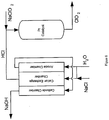
- the process comprises applying a current to an electrolytic reactor, wherein the electrolytic reactor includes an anode compartment comprising an anode, a cathode compartment comprising a cathode, and a central compartment positioned between the anode and cathode compartments, wherein the central compartment comprises a cation exchange material and is separated from the cathode compartment with a cation exchange membrane; flowing water into the anode and cathode compartments ; feeding an alkali metal chloride solution to the central compartment; exchanging the alkali metal ions with hydrogen ions to produce a hydrogen chloride effluent in the central compartment; diluting an alkali metal chlorite solution with the hydrogen chloride effluent ; feeding the diluted alkali metal chlorite and hydrogen chloride solution to a catalytic reactor; and contacting the diluted alkali metal chlorite and hydrogen chloride solution with the
- a system and process for producing halogen oxide from alkali metal halite solutions are disclosed, such as, for example, producing chlorine dioxide from an alkali metal chlorite solution.
- the system and process generally include employing an electrolytic reactor for producing an aqueous effluent containing halous acid (or hydrogen halide), which is then fed to a catalytic reactor containing a catalytic material for converting the halous acid to halogen oxide (or combined with an alkali metal chlorite solution and then fed to the catalytic reactor to produce halogen oxide).
- the alkali metal halite is an alkali metal chlorite and is employed for producing chlorine dioxide.
- the alkali metal chlorite solutions are dilute solutions.
- the term "dilute" refers to aqueous alkali metal chlorite solutions containing less than about 10,000 milligrams alkali metal chlorite per liter of solution (mg/L), preferably less than about 5,000 mg/L, and more preferably less than about 1,500 mg/L.
- the alkali metal chlorite solution is preferably in the form of a 25% aqueous solution in view of handling property, safety and the like, which can be further diluted during use.
- Suitable alkali metals include sodium, potassium, lithium, and the like, with preference given to sodium salt considering the commercial availability.
- FIG. 1 a cross-sectional view illustrating a system 10 that generally comprises an electrolytic reactor 20 including an inlet 22 and an outlet 24, wherein the outlet 24 is in fluid communication with an inlet 26 of a catalytic reactor 200.
- the system 10 can be utilized for continuously generating an aqueous effluent containing halogen oxide dioxide from an outlet 28 of the catalytic reactor 200.
- an alkali metal chlorite solution can be fed into the inlet 22 of the electrolytic reactor 20 to generate an aqueous effluent containing chlorous acid.
- the chlorous acid effluent is then fed to inlet 26 of the catalytic reactor 200, wherein the chlorous acid is reacted to form chlorine dioxide.
- a halogen oxide preferably chlorine dioxide
- a halogen oxide can be produced by feeding an acid precursor solution into the electrolytic reactor 20 to produce a protic acid effluent, which is then combined with an alkali metal halite solution and fed to the catalytic reactor 200 to produce the halogen oxide.
- a sodium chloride solution can be fed to the electrolytic reactor 20 to produce a hydrogen chloride effluent.
- the hydrogen chloride effluent can then be combined with an alkali metal chlorite solution and subsequently fed to the catalytic reactor 200 to produce the chlorine dioxide effluent.
- Suitable acid precursor solutions include alkali metal sulfates, sulfites, sulfides, nitrates, nitrites, phosphates, phosphates, halides, and the like.
- Suitable electrolytic reactors 20 for use in system 10 include a single compartment reactor 30 as shown in Figure 2 , a two-compartment reactor 50 as shown in Figure 3 , or a multi-compartment reactor, i.e., a reactor containing three or more compartments.
- An exemplary multi-compartment electrolytic reactor 70 configured with three compartments is shown in Figure 4 .
- the single compartment electrolytic reactor 30 includes an anode 32 and a cathode 34 in electrical communication with a source of direct current 36 (DC). Interposed between the anode 32 and the cathode 34 exists at least one compartment 38 containing particulate material 40. Compartment 38 further includes an inlet 42 for introducing an alkali metal chlorite feed solution to the electrolytic reactor 30 and an outlet 44 for discharging an effluent from the electrolytic reactor 30.
- DC direct current 36
- the term "particulate material” refers to a cation exchange material and/or an anion exchange material. Any cation exchange material can be used provided portions of its active sites are occupied with hydrogen, i.e., cation exchange material in the hydrogen form.
- the particulate material 40 in compartment 38 includes the cation exchange material or a mixture of the cation exchange material and the anion exchange material. In the case of mixtures of the cation and anion exchange materials, the majority of the particulate material 40 within compartment 38 is preferably the cation exchange material.
- the particulate material 40 may also include an additive or additives to achieve certain results. For example, electrically conductive particles, such as carbon and the like, can be used to affect the transfer of DC current across the electrodes. However, some additives, such as carbon, are prone to disintegration in acidic environments, thus requiring careful selection.
- the two-compartment electrolytic reactor 50 includes an anode 32, an anode compartment 52, a cathode 34, and a cathode compartment 54, wherein the anode 32 and cathode 34 are in electrical communication with a source of direct current 36 (DC).
- a membrane 56 preferably separates the anode compartment 52 from the cathode compartment 54.
- the anode compartment 52 further includes inlet 58 and outlet 60.
- the cathode compartment 54 includes inlet 62 and outlet 64.
- membrane generally refers to a sheet for separating adjacent compartments, e.g., compartments 52 and 54.
- the term “membrane” can be used interchangeably with screen, diaphragm, partition, barrier, a sheet, a foam, a sponge-like structure, a canvas, and the like.
- the membrane 56 can be chosen to be permselective, e.g., a cation exchange membrane, or can be chosen to be non-permselective, e.g., a porous membrane.
- the term “permselective” refers to a selective permeation of commonly charged ionic species through the membrane with respect to other diffusing or migrating ionic species having a different charge in a mixture.
- the term “non-permselective” generally refers to a porous structure that does not discriminate among differently charged ionic species as the species pass through the porous structure, i.e., the membrane is non-selective with respect to ionic species.
- a permselective membrane such as a cation exchange membrane
- cations can freely pass through the membrane whereas the passage of anions is prevented.
- both anions and cations can freely pass through the porous membrane.
- At least one of the compartments 52 or 54 of electrolytic reactor 50 contains the particulate material 40, and is configured to receive an aqueous alkali metal chlorite feed solution (or alkali metal halide solution). If both compartments contain particulate material 40, each compartment 52, 54 may be configured to possess its own physical properties (e.g., the particulate material 40 in the cathode compartment 54 may have different properties from the particulate material 40 disposed in the anode compartment 52) through which an aqueous solution can pass without entering adjacent compartment 52.
- the particulate material 40 in the compartment 52 and/or 54 in which the alkali metal halite feed solution or the alkali metal halide solution is fed comprises the cation exchange material in the hydrogen form or a mixture of cation exchange material and anion exchange material, wherein the majority of the particulate material 40 is the cation exchange material in the hydrogen form.
- the anode and cathode compartments 52, 54, respectively, are preferably packed with the cation exchange material, and the membrane 56 separating the anode compartment 52 from the cathode compartment 54 is a cation exchange membrane.
- the alkali metal chlorite feed solution (or alkali metal halide solution) can be fed to either or both compartments to provide an effluent containing chlorous acid (or hydrogen halide solution), which is then fed to the catalytic reactor 200.
- the three-compartment electrolytic reactor 70 generally comprises an anode compartment 72, a central compartment 74, and a cathode compartment 76.
- the central compartment 74 is interposed between the anode and cathode compartments 72, 76, respectively, and is separated therefrom by membranes 90 and 92.
- Each compartment 72, 74, and 76 preferably includes inlets 78, 80, 82, respectively, and outlets 82, 84 and 86, respectively.
- the anode compartment 72 includes anode 32 and can be optionally filled with the particulate material 40.
- the cathode compartment 76 includes cathode 34 and can be optionally filled with the particulate material 40.
- the anode 32 and cathode 34 are in electrical communication with a source of direct current 36 (DC).
- DC direct current 36
- the central compartment 74 comprises particulate material 40, wherein the particulate material 40 comprises the cation exchange material or a mixture of cation exchange material and anion exchange material, wherein the majority of the particulate material 40 is the cation exchange material in the hydrogen form.
- the electrolytic reactor membrane 90 is a cation exchange membrane.
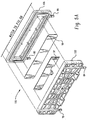
- FIG. 5A and 5B there is shown an exploded isometric view of an exemplary electrolytic reactor cassette 100 employing the three-compartment reactor configuration 70 as described in relation to Figure 4 .
- the cassette 100 is formed from stock materials that are preferably chemically inert and non-conductive. Components forming the cassette 100 may be molded for high volume production or alternatively, may be machined as described in further detail below.
- the exemplary cassette 100 is configured for producing about 5 grams per hour of chlorous acid and is fabricated from two pieces of flat stock 102 and 104, about 4 inches across by about 14 inches long by about 1 inch thick.
- the pieces 102, 104 are machined such that depressions 1/4 inch deep by 2 inches across by 12 inches long are cut in the center of each piece.
- the pieces 102, 104 are then drilled and tapped to accept the anode 32 and cathode 34.
- Each piece further includes inlets 78, 82 and outlets 84, 88, through which fluid would flow.
- the anode 32 and cathode 34 are approximately 2 inches across by 9 inches long and are inserted into the stock pieces 102 and 104.
- Membranes 90, 92 are disposed over each depression formed in stock pieces 102, 104.
- membrane 90 is a cation exchange membrane.
- Approximately 100 ml of particulate material may optionally be packed into each depression to form the anode compartment 72 and the cathode compartment 76, respectively (as shown in Figure 4 ).
- the particulate material if present in the cathode and/or anode compartments, is configured to be in direct contact with the anode 32 or cathode 34.
- a piece of flat stock 106 Interposed between the membranes 90, 92 is a piece of flat stock 106, about 4 inches across by about 14 inches long by 1 inch thick.
- the stock piece 106 is machined such that a hole about 2 inches across by 12 inches long is cut through the piece to form the central compartment 74 (as shown in Figure 4 ).
- the piece 106 is then drilled and tapped to accept two fittings that form inlet 80 and outlet 86 through which fluid would flow.
- the central compartment 74 is filled with about 150 ml of particulate material that includes the cation exchange material.
- the components of the electrolytic reactor cassette 100 are assembled and bolted together, or otherwise secured. In this configuration, the dilute aqueous alkali metal halite solution or alkali metal halide solution is preferably passed through the central compartment 74 and is not in direct contact with the anode 32 or cathode 34.
- the cassette 100 is formed from an acrylonitrile-butadiene-styrene (ABS) terpolymer.
- ABS acrylonitrile-butadiene-styrene
- suitable materials include, but are not intended to be limited to, polyvinylchloride (PVC), chlorinated PVC, polyvinylidene difluoride, polytetrafluoroethylene and other fluoropolymer materials.
- any arrangement in which a sufficient quantity of cation exchange resin or material is packed between the anode and cathode in an electrolytic reactor or in at least one of the compartments of a divided or multi-compartment electrolytic reactor can be used.
- Other embodiments include, but are not limited to, separation of the anode and cathode compartments to control intermixing of gases and solutions and provision of any number of packed-bed compartments separated by membranes placed between the anode and cathode to affect other oxidation, reduction or displacement reactions.
- the anode 32 and the cathode 34 may be made of any suitable material based primarily on the intended use of the electrolytic reactor, costs, and chemical stability.
- the anode 32 may be made of a conductive material, such as ruthenium, iridium, titanium, platinum, vanadium, tungsten, tantalum, oxides of at least one of the foregoing, combinations including at least one of the foregoing, and the like.
- the anode 32 comprises a metal oxide catalyst material disposed on a suitable support.
- the supports are typically in the form of a sheet, screen, or the like and are formed from a rigid material such as titanium, niobium, and the like.
- the cathode 34 may be made from stainless steel, steel or may be made from the same material as the anode 32.
- the permselective membranes preferably contain acidic groups so that ions with a positive charge can be attracted and selectively passed through the membrane in preference to anions.
- the permselective membranes contain strongly acidic groups, such as R-SO 3 - and are resistant to oxidation and temperature effects.
- the permselective membranes are fluoropolymers that are substantially chemically inert to halous acid (e.g., chlorous acid), hydrogen halides (e.g., hydrogen chloride) and the materials or environment used to produce the halogen dioxide (e.g., chlorine dioxide).
- suitable permselective membranes include perfluorosulfonate cation exchange membranes commercially available under the trade name NAFION commercially available from E.I. duPont de Nemours, Wilmington, DE.
- the cation exchange material is preferably an oxidizing exchanger, i.e., a cation ion exchange resin or material.
- a cation ion exchange resin or material i.e., a cation ion exchange resin or material.
- the function of the cation exchange material includes, among others, electro-actively exchanging or adsorbing alkali metal ions from the aqueous alkali metal halite solution (or alkali metal halide solution) and releasing hydrogen ions.
- the released hydrogen ions react with the halite ions to form halous acid (or react with halide ions to form hydrogen halide) and/or can regenerate the cation exchange material back to the hydrogen form thereby releasing alkali metal ions or the like that may then pass into the cathode compartment, if present.
- the use of the cation exchange material is especially useful when feeding a dilute alkali metal halite solution into the central compartment 74 of the three-compartment electrolytic reactor 70 as it helps lower the voltage within the compartment and increases conversion efficiency.
- the cation exchange material When the cation exchange material reaches its exhaustion point or is near exhaustion, it may be readily regenerated by a strong or weak acid so as to exchange the alkali or alkaline earth metal previously adsorbed by the active sites of the cation exchange material for hydrogen.
- the acid necessary for regenerating the cation exchange material may be added individually at the compartment inlet or may be generated in the anode compartment, which then diffuses across the cation exchange membrane.
- the anionic exchange material if present, may be regenerated by a strong or weak base, e.g., sodium or potassium hydroxide.
- Suitable cation exchange resins or materials include, but are not intended to be limited to, polystyrene divinylbenzene cross-linked cation exchangers (e.g., strong acid types, weak acid types, iminodiacetic acid types, chelating selective cation exchangers and the like); strong acid perfluorosulfonated cation exchangers; naturally occurring cation exchangers, such as manganese greensand; high surface area macro-reticular or microporous type ion exchange resins having sufficient ion conductivity, and the like.
- polystyrene divinylbenzene cross-linked cation exchangers e.g., strong acid types, weak acid types, iminodiacetic acid types, chelating selective cation exchangers and the like
- strong acid perfluorosulfonated cation exchangers e.g., strong acid types, weak acid types, iminodiacetic acid types, chelating selective cation exchangers and the
- the cation exchange material may be further modified, wherein a portion of the ionic sites are converted to semiconductor junctions, such as described in U.S. Patent Nos. 6,024,850 , 5,419,816 , 5,705,050 and 5,609,742 , herein incorporated by reference in their entireties.
- the use of modified cation exchange material is less preferred because of the inherent costs associated in producing the modification.
- the cation exchange materials have a cross-linking density greater than about 8 %, with greater than about 12 % more preferred and with greater than about 16 % even more preferred.
- the packing density and conductivity of the particulate material 40 disposed within a compartment can be adjusted depending on the operating parameters and desired performance for the electrolytic reactors 30, 50, 70.
- the particulate material may be shrunk before use in the electrolytic reactor, such as by dehydration or electrolyte adsorption.
- Dehydration may be by any method in which moisture is removed from the ion exchange material, for example, by vacuum drying or by using a drying oven. It has been found that dehydration prior to packing can increase the packing density by as much as 40 %.
- Electrolyte adsorption involves soaking the material in a salt solution, such as sodium chloride.
- the packing density of the material so treated can be increased by as much as 20 %.
- the increase in packing density advantageously increases the volume in which the DC current travels, thus reducing the electrical resistance in the electrolytic reactor.
- the catalytic reactor 200 has an inlet 202 and an outlet 204. Disposed within the catalytic reactor 200 is a bed containing a catalytic material 206.
- a catalytic material refers to a support and an active metal catalyst.
- the active metal catalyst is finely and discretely deposited onto the support. While not wanting to be bound by theory, it is believed that the active metal catalyst adsorbs hydrogen atoms without reacting with the hydrogen atoms, which form stable hydrides.
- the active metal catalyst does not adsorb hydrogen atoms into its crystal lattice since this will decrease its catalytic activity.
- the active metal catalyst is a noble metal.
- Suitable active metal catalysts include, but are not limited to, ruthenium, platinum, palladium, osmium, iridium, rhodium, titanium, manganese, lead, zirconium, niobium, tantalum, tungsten, tin, and composites or mixtures or alloys or oxides of at least one of the foregoing metal catalysts.
- the active metal catalyst is an oxide of a metal selected from the group consisting of ruthenium, platinum, palladium, osmium, iridium, and rhodium. More preferably, the active metal catalyst is a platinum oxide.
- the active metal catalyst is a combination of an oxide of ruthenium, platinum, palladium, osmium, iridium, rhodium or mixtures or alloys of at least one of the foregoing metals and a less active oxide of a metal including titanium, lead, manganese, zirconium, niobium, tantalum, tungsten, tin, or mixtures, or alloys of at least one of the foregoing metals.
- the molar ratio of the active metal catalyst to the less active metal catalyst is of about 0.3 : 1 to about 100 : 1. More preferably, the molar ratio of the active metal catalyst to the less active metal catalyst is about 10 : 1.
- Preparation of the catalyst material generally includes contacting the support with a catalyst precursor to form the active metal catalyst sites, for example, a catalyst precursor salt.
- a metal oxide precursor salt is dissolved in an aqueous solution including an alcohol, and the solution is coated onto the support.
- Suitable alcohols include methanol, ethanol, isopropanol, propanol, butanol, combinations including at least one of the foregoing alcohols, and the like.
- the metal oxide precursor salt is dissolved in isopropanol and deionized water solution.
- the amount of alcohol used in the solution is dependent on the solubility of the metal oxide precursor salt, wherein the volume fraction of alcohol in an aqueous solution is about 30 to about 90 % (v/v), with about 40 to about 80 % (v/v) preferred and with about 50 to about 60 % (v/v) more preferred.
- a solution of the metal oxide precursor salt may contain further additives, for example, ions that increase the solubility of the metal oxide precursor.
- Suitable ions include hydroxides, chlorides, phosphates, sulfates, ammonium, potassium, sodium, lithium or the like.
- the additive is ammonium hydroxide.
- the weight fraction of additive in the solution is about 0.1 to about 10 % (w/v), with about 0.5 to about 5 % (w/v) preferred, and with about 1 % (w/v) more preferred.
- the metal catalyst may be deposited onto the support material using other techniques such as impregnation, co-precipitation, ion exchange, dipping, spray coating, vacuum deposition, sputtering, or the like.
- the amount of metal catalyst deposited onto the support is about 0.01 to about 100 weight %, with about 0.01 to about 10 weight % more preferred, and with about 0.05 to about 2 weight % most preferred, based on the total weight of the catalyst material.
- the catalyst activity of the catalyst material is improved with multiple depositions, i.e., the metal oxide precursor solution is applied by several individual depositions.
- the number of depositions is about 2 to about 12, with the number of depositions of about 2 to about 3 more preferred.
- the metal deposited onto the support by the precursor solution is then thermally or chemically oxidized to the oxide form.
- adjusting the temperature can control the extent of oxidation.
- the support is preferably thermally stable to the oxidation temperatures employed.
- the oxidation temperatures are preferably about 200°C to about 1000°C, with about 400°C to about 800°C more preferred, and with about 500°C to about 700°C even more preferred.
- Suitable chemical oxidants include permanganate.
- the extent of oxidation may be increased when a multiple deposition process is used in contrast to a single deposition process.
- the catalyst material can be periodically regenerated by removing the catalyst material from the reactor 200 and thermally treating the catalyst material 206.
- a catalyst material comprising a ceramic support and platinum catalyst material can be regenerated by heating the material to about 550°C for about 20 minutes, cooling to about room temperature, backwashing with water, mixing with a tetramineplatinum (II) chloride solution, air drying, heating again to about 550°C for about 20 minutes, backwashing and air drying.
- the media may be regenerated by chemically treating the media.
- Suitable supports for the catalyst material include metals, zeolites, anthracite, glauconite, faujasite, mordenite, clinoptilolite, aluminas, silicas, clays, ceramics, carbon and the like. Of these supports, ceramics are most preferred.
- the catalyst materials are made from those ceramics described in U.S. Patents 4,725,390 and 4,632,876 , herein incorporated by reference in their entireties.
- Preferred ceramics are those made essentially from nonmetallic minerals (such as mineral clays) by firing at an elevated temperature. More preferred are ceramic materials commercially available under the trade name MACROLITE ® by the Kinetico Company.
- the MACROLITE ® ceramic materials are spherically shaped and characterized by having a rough texture, high surface area, and level of moisture absorption of less than about 0.5%.
- the low level of moisture absorption allows for the metal oxide precursor solution to penetrate a minimal depth into the surface of the ceramic, thereby depositing metal onto the external surface of the support, an optimum location for subsequent contact with an aqueous solution.
- the surface area of the MACROLITE ® ceramic materials is believed to be on the order of about 103 m 2 per gram.
- the process for making ceramic support materials generally includes the following steps.
- mineral particulate, binder, silicon carbide, and parting agent are mixed and spheroidized in order to form unfired spheroids.
- mineral particulates contains: 60% orthoclase, 10% nepheline, 10% hornblende, 5% diopside, 15% accessory minerals (titanite, apatite, magnetite and biotite) and trace amounts of secondary minerals (e.g., kaolinite and analcite).
- Another example contains approximately 75% plagioclase and orthoclase feldspar and 25% of the minerals pyroxene, hornblende, magnetite and quartz of which magnetite is less than 5%.
- Byproduct mineral fines of perlite (containing 2-5% chemically bound water) will also function as the mineral particulates.
- Minerals containing chemically bound water or sulfur, which are useful components of the mineral particulates, are hornblende, apatite, biotite, pyrite, vermiculite and perlite.
- Binders that may be useful as raw materials include bentonite, starch, polyvinyl alcohol, cellulose gum, polyvinyl acetate and sodium lignosulphonate.
- the amount of binder may generally comprise about 1 to about 5% by weight of the dry materials fed to the mixer and is generally sufficient to permit screening and handling of the spheroids without significant attrition or breakage.
- Suitable parting agents include magnesium oxide, zircon, diaspore and high alumina clays as well as other surface metal oxides.
- the spheroids are then dried at a temperature of about 40°C to about 200°C and typically screened.
- the ceramic spheroids are then over-fired in a kiln, which allows for the formation of the internal air cells, making the finished product less dense.
- the firing atmosphere is typically air.
- the silicon carbide in the spheroids is oxidized during firing, the SiC near the surface being more extensively oxidized than that in the core.
- the product from the kiln is screened using standard methods known to those skilled in the art. Either before, during or after the screening step, the fired spheroids may be subjected to vigorous agitation by air or some other agitation means or to a water-washing step in order to remove dust from their surfaces.
- the support material is then coated with an active metal catalyst in the manner previously described and then thermally or chemically oxidized to the oxide form.
- the size of the particulate material is generally defined by a mesh size of a sieve in which the particles are screened. For example, a 30 mesh sieve will allow particles less than about 600 micrometers to pass through the sieve, whereas particles about 600 micrometers or larger than will not pass through. Generally, sieves of varying mesh ratings are stacked and particles are separated using methods well known to those skilled in the art. The range of particles separated is defined by the mesh size of the sieves used. For example, a mesh size designation of 20/40 means that substantially all particles have a size ranging from 20 to 40 mesh (about 841 to about 420 micrometers in diameter).
- a 30/50 designation indicates that substantially all particles have a size ranging from 30 to 50 mesh (about 595 to about 297 micrometers in diameter).
- the sizes of the particulate matter are preferably smaller than 7 mesh (about 2800 micrometers in diameter), with smaller than 14 mesh (about 1400 micrometers in diameter) more preferred, and with smaller than 30 mesh (about 595 micrometers in diameter) even more preferred.
- the flow rate through the catalytic reactor is preferably about 1 to about 10 gallons per minute/square foot (gpm/ft 2 ), with about 2 to about 5 gpm/ft 2 more preferred.
- the minimum bed depth is preferably about 24 inches. The flow rate and minimum bed depth can be used to determine the dimension of the catalytic reactor and the volume of catalytic material employed.
- the particulate material 40 of the electrolytic reactor 20 and the catalytic material 206 of the catalytic reactor 200 are not intended to be limited to any particular shape. Suitable shapes include rods, extrudates, tablets, pills, irregular shaped particles, spheres, spheroids, capsules, discs, pellets or the like. In a preferred embodiment, the particulate material is spherical. More preferably, the particulate material includes a reticulated and textured surface having an increased surface area. The sizes of the particulate material 40 and catalytic materials 206 employed in system 10 are dependent on the acceptable pressure drop across the respective bed. The smaller the particulate material 40 or catalytic material 206, the greater the pressure drop.
- the exemplary system 10 is configured with the three-compartment electrolytic reactor as previously described, wherein the central compartment outlet is in fluid communication with the catalytic reactor inlet.
- the three-compartment reactor preferably comprises a cation exchange membrane separating the anode and cathode compartments from the central compartment.
- Cation exchange material is preferably disposed in the central compartment. More preferably, cation exchange material is disposed in each compartment.
- a dilute aqueous feed solution of an alkali metal chlorite solution is preferably passed through the central compartment, wherein the alkali metal ions are exchanged with hydrogen ions in the cation exchange material to produce chlorous acid within the central compartment.
- Water preferably flows through the anode and cathode compartments.
- the water is deionized.
- the anode compartment eletrolyzes the water to generate, among others, hydrogen ions
- the cathode compartment electrolyzes the water to generate, among others, hydroxyl ions.
- the hydrogen ions generated in the anode compartment can diffuse across the cation exchange membrane into the central compartment to regenerate the cation exchange resin within the central compartment and/or to acidify the chlorite ions to produce chlorous acid.
- the chlorous acid effluent from the reactor is then fed to the catalytic reactor, wherein chlorous acid is catalytically oxidized by the catalytic material to produce chlorine dioxide.
- the concentration of chlorous acid produced by the electrolytic reactor is preferably less than about 6.0 grams per liter (g/L), with less than about 3 g/L more preferred and less than about 0.65 g/L even more preferred. Also preferred is a chlorous acid concentration greater than about 0.06 g/L, with greater than about 0.3 g/L more preferred and greater than about 0.5 g/L even more preferred. At concentrations greater than about 6.0 g/L, there is an increased risk of producing chlorine dioxide in the vapor phase as the chlorous acid solution is oxidized in the catalytic reactor 200, which undesirably can cause an explosion referred to by those skilled in the art as a "puff".
- the applied current to the reactor 100 should be sufficient to reduce the pH of the resulting chlorous acid effluent solution to less than about 7. More preferably, the pH is reduced to about 1 to about 5, with a reduction of pH to about 2 to about 3 most preferred.
- the alkali metal ions from the alkali metal chlorite solution can diffuse through membrane 92 to the cathode compartment 76 and with the hydroxyl ions produce an alkali metal hydroxide effluent from the cathode compartment 76.
- a current density for the electrolytic reactors is preferably maintained at about 5 to about 100 milliAmps per square centimeter (mA/cm 2 ). More preferably, the current density is less than about 50 mA /cm 2 , with less than about 35 mA/cm 2 even more preferred. Also preferred, are current densities greater than about 10 mA/cm 2 , with greater than about 25 mA/cm 2 more preferred.
- the temperature at which the feed solutions e.g., alkali metal chlorite solution, water, and the like solutions
- the feed solutions e.g., alkali metal chlorite solution, water, and the like solutions
- the temperature is less than about 50°C, with less than about 35°C more preferred and with less than about 25°C even more preferred. Also preferred is a temperature greater than about 2°C, with greater than about 5°C more preferred, and with greater than about 10°C even more preferred. In a preferred embodiment, the process is carried out at about ambient temperature.
- the space time, of the alkali metal chlorite solution with the cation exchange material is preferably less than about 20 minutes and more preferably, less than about 2 minutes. Also preferred is a space time greater than about 1 minute, with greater than about 0.1 minute more preferred.
- the space time of the chlorous acid containing effluent with the catalytic material 206 is preferably less than about 20 minutes and more preferably, less than about 2 minutes. Also preferred is a space time greater than about 1minute, with greater than about 0.1 minute more preferred.
- the term "space time” refers to the time necessary for a fluid to pass into and out of a chamber or compartment.
- the velocity of the chlorine dioxide precursor solution through the electrolytic reactor and/or catalytic reactor is preferably less than about 100 centimeters/minute (cm/min), with less than about 70 cm/min more preferred and less than about 30 cm/min more preferred. Also preferred is a velocity greater than about 0.1 cm/min, with greater than about 10 cm/min more preferred and with greater than about 20 cm/min even more preferred.
- the pressure drop through the electrolytic reactor and/or catalytic reactor is preferably less than about 20 pounds per square inch (psi) and for most applications, with less than about 10 psi more preferred. Also preferred is a pressure drop greater than about 0.1 psi, and for most applications, with greater than about 1 psi more preferred. Further optimization for any of these process variables is well within the skill of those in the art in view of this disclosure.
- an acid precursor solution e.g., sodium chloride
- a protic acid e.g., hydrogen halide
- protic acid refers to a substance that produce hydrogen ions when added to water, e.g., a substance that dissociates or ionizes to produce hydrogen ions when added to water.
- the hydrogen halide can then be mixed with an alkali metal halite solution, such as sodium chlorite, and subsequently fed to the catalytic reactor, wherein contact of the mixed solution with the catalytic material produces chlorine dioxide.
- water is fed to the anode compartment to produce an effluent that is then fed to the cathode compartment in series.
- the effluent from the anode compartment may be fed to the alkali metal halide influent entering the central compartment or the effluent from the central compartment.
- the concentration of the hydrogen halide can be controlled as well as the current density applied to generate a particular concentration of hydrogen halide.
- Water may also be separately added to the alkali metal halide feedstream entering the central compartment so as to maintain a desired concentration level. While not wanting to be bound by theory, it is believed that upon mixing the hydrogen halide with the alkali metal halite a portion of the halite is converted to the corresponding halous acid. The halous acid and the mixed solution is then catalytically oxidized upon contact with the catalytic material to produce halogen oxide, e.g., chlorine dioxide.
- halogen oxide e.g., chlorine dioxide
- the amounts of alkali metal halide utilized can be estimated based upon the amount of hydrogen halide required for converting a known concentration of alkali metal halite to halogen oxide. In providing this estimation, it is assumed that substantially all of the alkali metal halide will be converted to hydrogen halide upon flow through the central compartment and that the reaction is assumed to follow a first-order mechanism with respect to sodium chlorite.
- the ratio of hydrogen chloride to sodium chlorite is preferably at a molar ratio of about 0.8 : 1 to about 3 : 1, and more preferably, is at a molar ratio of about 1 : 1.
- chlorine dioxide can potentially degrade to produce chloride ions. This degradation reaction can occur at a pH of less than 2.0.
- the number of moles of acid presursor e.g., sodium chloride (C NaCl ) is preferably equal to the number of moles of protic acid, e.g., hydrogen chloride (C HCl ), required for converting the halite ions to halogen dioxide.
- this value is then divided by the current efficiency ( ⁇ ), which can be experimentally determined.
- the current efficiency is a function of many variables, including, but not limited to, concentration of the hydrogen generated within the anode compartment and the amount of sodium ions displaced in the central compartment. In this particular process, the current efficiency is preferably about 0.40 to about 0.95, and more preferably, is at a current efficiency of about 0.60 to about 0.85.
- a platinum catalyst material was prepared.
- a platinum precursor solution was prepared by combining 2.6 grams tetramineplatinum (II) chloride, 44 milliliters (mls) of 91%, isopropyl alcohol, 3 mls of ammonia hydroxide, and 27 mls of deionized water.
- the platinum precursor solution 37 mls was mixed with 300 mls of ceramic spheres and then baked at a temperature of about 550°C for about 30 minutes.
- the ceramic spheres were coated in this manner a total of two times.
- the ceramic spheres were obtained from Kinetico Company under the trade name Macrolite ML 2040 that had been previously backwashed with deionized water and air dried overnight.
- the resulting catalyst material had an effective particle size of about 0.60 millimeter.
- the electrolytic reactor was configured as shown and described in Figure 4 .
- Each compartment employed a length of 25.4 centimeters (cm) with a width of 5.08 cm.
- the thickness of the central compartment was 1.27 cm and the thicknesses of the electrode compartments were 0.64 cm.
- the electrode and central compartments of the electrolytic reactor contained SK116 cation exchange resin commercially available from Mitsubishi Chemical.
- a transverse DC electric field was supplied by an external power supply to the electrodes.
- the effluent from the anode compartment was coupled to the inlet of the central compartment, thereby diluting a 25-weight percent sodium chlorite feed solution such that the final concentration of sodium chlorite was about 1,000 mg/L as it entered the central compartment.
- the temperature of the feed solution was held constant at about 20°C.
- the catalytic reactor was configured as shown in Figure 6 and had a diameter of 2.62 cm and length of 60.96 cm.
- the catalytic reactor was filled with about 300 milliliters of the platinum catalyst prepared in accordance with Example 1.
- the inlet conduit of the catalytic reactor was coupled to the central compartment outlet of the electrolytic reactor.
- the catalytic reactor was configured to receive an effluent from the electrolytic reactor containing chlorous acid.
- Softened water was passed upwardly through the cathode compartments of the electrolytic reactor at a flow rate of about 50 mL/min and upwardly through the anode compartment at a flow rate of about 150 mL/min. While passing the solutions through the compartments of the reactor, a controlled current of about 5.0 amps was applied to the anode and cathode to produce an effluent containing chlorous acid in the central compartment. The system was operated continuously for a period of 100 hours. Cell voltage, system pressure, chlorine dioxide flow rate, sodium chlorite pump rate, chlorine dioxide concentration and pH of the effluent were periodically monitored.
- TheoreticalYield ClO 2 product ⁇ NaClO 2 feed 90.5 67.5 ⁇ 100 wherein the term (90.5/67.5) is the ratio of the equivalent weight of the sodium chlorite to chlorine dioxide.
- ⁇ represents the stoichiometric ratio between the chlorine dioxide product and sodium chlorite reactant, which can vary from 0.8 to 1.0 depending on the reactants used and the stoichiometry of the reaction.
- Figure 9 graphically depicts the conversion efficiency as a function of time for the system.
- the conversion of chlorite solution to a chlorine dioxide solution was at about the maximum theoretical yield. Increased conversion efficiencies over a prolonged period of time are a significant commercial advantage since it reduces the maintenance and operating costs of these reactors significantly. It is also noted that the effluent from the electrolytic reactor was measured for chlorine dioxide and found to be below the detection limit of the spectrophotometer. This was the result of low concentration of sodium chlorite, low current density, and high velocity.
- a sodium chloride solution was passed upwardly through the central compartment of the electrolytic reactor at a flow rate of about 150 mL/min.
- Softened water was passed upwardly through the anode compartment and its effluent was then passed upwardly through the cathode compartment e.g., in-series, at a flow rate of about 50 mL/min.
- a controlled DC current of about 5.0 amps was applied to the anode and cathode.
- a 25-wt % of sodium chlorite solution was added to the HCl containing effluent discharged from the central compartment such that the final concentration of sodium chlorite was about 1,000 mg/L.
Landscapes
- Chemical & Material Sciences (AREA)
- Organic Chemistry (AREA)
- Inorganic Chemistry (AREA)
- Engineering & Computer Science (AREA)
- Chemical Kinetics & Catalysis (AREA)
- Electrochemistry (AREA)
- Materials Engineering (AREA)
- Metallurgy (AREA)
- Electrolytic Production Of Non-Metals, Compounds, Apparatuses Therefor (AREA)
Claims (3)
- Verfahren zur Herstellung von Chlordioxid aus einer AlkalimetallchloridLösung, wobei das Verfahren umfasst:Anlegen eines Stroms an einen elektrolytischen Reaktor (70), wobei der elektrolytische Reaktor (70) einschließt: eine Anodenkammer (72), umfassend eine Anode (32), eine Kathodenkammer (76), umfassend eine Kathode (34), sowie eine zentrale Kammer (74), angeordnet zwischen der Anoden- und der Kathodenkammer (72, 76), wobei die zentrale Kammer (74) ein Kationenaustauschmaterial (40) umfasst und von der Kathodenkammer (76) getrennt ist durch eine Kationenaustauschmembran (92);Einströmen von Wasser (H2O) in die Anoden- und Kathodenkammer (72, 76);Einspeisen einer Säurevorläufer-Lösung in die zentrale Kammer (74);Austauschen von Alkalimetall-Ionen aus dem Säurevorläufer durch Wasserstoff-Ionen, um einen protischen, sauren Abfluss in die zentrale Kammer (74) zu erzeugen;Verdünnen einer Alkalimetallchlorit-Lösung mit dem protischen, sauren Abfluss;Einspeisen der verdünnten Alkalimetallchlorit-Lösung in einen katalytischen Reaktor (200); undInkontaktbringen des verdünnten Alkalimetallchlorits mit einem katalytischen Material (206) im katalytischen Reaktor (200), um Chlordioxid herzustellen.
- Verfahren nach Anspruch 1, wobei die Säurevorläufer-Lösung eine Alkalimetall-Verbindung umfasst, ausgewählt aus der Gruppe bestehend aus Sulfaten, Sulfiten, Nitraten, Halogeniden, Nitriten und Phosphaten.
- Verfahren nach einem der vorhergehenden Ansprüche, wobei die Säurevorläufer-Lösung eine Alkalimetallchlorit-Lösung umfasst, und wobei der Abfluss, welcher die protische Säure enthält, Chlorwasserstoff umfasst.
Applications Claiming Priority (1)
| Application Number | Priority Date | Filing Date | Title |
|---|---|---|---|
| PCT/US2002/029418 WO2004027117A1 (en) | 2002-09-17 | 2002-09-17 | Electrocatalytic process and apparatus |
Publications (3)
| Publication Number | Publication Date |
|---|---|
| EP1540036A1 EP1540036A1 (de) | 2005-06-15 |
| EP1540036A4 EP1540036A4 (de) | 2006-02-08 |
| EP1540036B1 true EP1540036B1 (de) | 2017-08-02 |
Family
ID=32028448
Family Applications (1)
| Application Number | Title | Priority Date | Filing Date |
|---|---|---|---|
| EP02773418.5A Expired - Lifetime EP1540036B1 (de) | 2002-09-17 | 2002-09-17 | Elektrokatalytisches verfahren und elektrokatalytische vorrichtung |
Country Status (3)
| Country | Link |
|---|---|
| EP (1) | EP1540036B1 (de) |
| AU (1) | AU2002336561A1 (de) |
| WO (1) | WO2004027117A1 (de) |
Family Cites Families (4)
| Publication number | Priority date | Publication date | Assignee | Title |
|---|---|---|---|---|
| US5106465A (en) | 1989-12-20 | 1992-04-21 | Olin Corporation | Electrochemical process for producing chlorine dioxide solutions from chlorites |
| US5084148A (en) * | 1990-02-06 | 1992-01-28 | Olin Corporation | Electrochemical process for producing chloric acid - alkali metal chlorate mixtures |
| US5008096A (en) * | 1990-04-03 | 1991-04-16 | Bio-Cide International, Inc. | Catalyst enhanced generation of chlorine dioxide |
| CA2250527C (en) * | 1997-10-17 | 2010-10-05 | Sterling Pulp Chemicals, Ltd. | Electrolytic process for producing chlorine dioxide |
-
2002
- 2002-09-17 WO PCT/US2002/029418 patent/WO2004027117A1/en not_active Ceased
- 2002-09-17 EP EP02773418.5A patent/EP1540036B1/de not_active Expired - Lifetime
- 2002-09-17 AU AU2002336561A patent/AU2002336561A1/en not_active Abandoned
Non-Patent Citations (1)
| Title |
|---|
| None * |
Also Published As
| Publication number | Publication date |
|---|---|
| AU2002336561A1 (en) | 2004-04-08 |
| EP1540036A1 (de) | 2005-06-15 |
| WO2004027117A1 (en) | 2004-04-01 |
| EP1540036A4 (de) | 2006-02-08 |
Similar Documents
| Publication | Publication Date | Title |
|---|---|---|
| US6869517B2 (en) | Electrolytic process and apparatus | |
| US7179363B2 (en) | Electrolytic process for generating chlorine dioxide | |
| US6913741B2 (en) | System and process for producing halogen oxides | |
| US20050252786A1 (en) | Electrolytic process and apparatus | |
| Gao et al. | Urea catalytic oxidation for energy and environmental applications | |
| US5092970A (en) | Electrochemical process for producing chlorine dioxide solutions from chlorites | |
| EP0650929B1 (de) | Modifiziertes Ionenaustauschharz | |
| US5106465A (en) | Electrochemical process for producing chlorine dioxide solutions from chlorites | |
| EP0568389B1 (de) | Verfahren zur Entfernung von oxidierbaren, bzw. reduzierbaren Substanzen, Verbundstruktur die ein Metalloxid oder ein Metallhydroxid enthält und Verfahren zu ihrer Herstellung | |
| US4732688A (en) | Effluent treatment | |
| EP3177754B1 (de) | Verfahren zur herstellung von wasserstoffperoxid | |
| EP0514427B1 (de) | Elektrochemischer prozess zur herstellung von chlorsäure-alkali-metall-chloratmischungen | |
| EP0276044B1 (de) | Abwasserbehandlung | |
| CN101844746A (zh) | 亚氯酸和二氧化氯的制备方法 | |
| JPH10174976A (ja) | 窒素化合物含有水の処理方法 | |
| EP2035599A2 (de) | Elektrode, herstellungsverfahren dafür und verwendung davon | |
| US20110250123A1 (en) | Methods and apparatus for producing the halogen dioxide, chlorine dioxide, by ion exchange | |
| US7241435B2 (en) | System and process for producing halogen oxides | |
| Shiraishi et al. | Sunlight-driven nitrate-to-ammonia reduction with water by iron oxyhydroxide photocatalysts | |
| US7476307B2 (en) | Systems and methods for generating chlorine dioxide | |
| US20060280673A1 (en) | Processes for producing an aqueous solution containing chlorine dioxide | |
| US20050079121A1 (en) | Systems and methods for generating chlorine dioxide | |
| EP1540036A1 (de) | Elektrokatalytisches verfahren und elektrokatalytische vorrichtung | |
| AU724917B2 (en) | Electrolytic process and apparatus for the controlled oxidation or reduction of inorganic and organic species in aqueous solutions | |
| Neves et al. | Nanocatalysts Based in Zeolites for Environmental Applications |
Legal Events
| Date | Code | Title | Description |
|---|---|---|---|
| PUAI | Public reference made under article 153(3) epc to a published international application that has entered the european phase |
Free format text: ORIGINAL CODE: 0009012 |
|
| 17P | Request for examination filed |
Effective date: 20050317 |
|
| AK | Designated contracting states |
Kind code of ref document: A1 Designated state(s): AT BE BG CH CY CZ DE DK EE ES FI FR GB GR IE IT LI LU MC NL PT SE SK TR |
|
| AX | Request for extension of the european patent |
Extension state: AL LT LV MK RO SI |
|
| DAX | Request for extension of the european patent (deleted) | ||
| RBV | Designated contracting states (corrected) |
Designated state(s): DE ES FR GB IE IT |
|
| A4 | Supplementary search report drawn up and despatched |
Effective date: 20051222 |
|
| R17P | Request for examination filed (corrected) |
Effective date: 20050317 |
|
| 17Q | First examination report despatched |
Effective date: 20081015 |
|
| STAA | Information on the status of an ep patent application or granted ep patent |
Free format text: STATUS: EXAMINATION IS IN PROGRESS |
|
| GRAP | Despatch of communication of intention to grant a patent |
Free format text: ORIGINAL CODE: EPIDOSNIGR1 |
|
| STAA | Information on the status of an ep patent application or granted ep patent |
Free format text: STATUS: GRANT OF PATENT IS INTENDED |
|
| INTG | Intention to grant announced |
Effective date: 20170307 |
|
| RAP1 | Party data changed (applicant data changed or rights of an application transferred) |
Owner name: ECOLAB USA INC. |
|
| GRAS | Grant fee paid |
Free format text: ORIGINAL CODE: EPIDOSNIGR3 |
|
| GRAA | (expected) grant |
Free format text: ORIGINAL CODE: 0009210 |
|
| STAA | Information on the status of an ep patent application or granted ep patent |
Free format text: STATUS: THE PATENT HAS BEEN GRANTED |
|
| AK | Designated contracting states |
Kind code of ref document: B1 Designated state(s): DE ES FR GB IE IT |
|
| REG | Reference to a national code |
Ref country code: GB Ref legal event code: FG4D |
|
| REG | Reference to a national code |
Ref country code: IE Ref legal event code: FG4D |
|
| RAP2 | Party data changed (patent owner data changed or rights of a patent transferred) |
Owner name: ECOLAB USA INC. |
|
| REG | Reference to a national code |
Ref country code: DE Ref legal event code: R096 Ref document number: 60249002 Country of ref document: DE |
|
| PG25 | Lapsed in a contracting state [announced via postgrant information from national office to epo] |
Ref country code: ES Free format text: LAPSE BECAUSE OF FAILURE TO SUBMIT A TRANSLATION OF THE DESCRIPTION OR TO PAY THE FEE WITHIN THE PRESCRIBED TIME-LIMIT Effective date: 20170802 |
|
| REG | Reference to a national code |
Ref country code: DE Ref legal event code: R119 Ref document number: 60249002 Country of ref document: DE |
|
| PG25 | Lapsed in a contracting state [announced via postgrant information from national office to epo] |
Ref country code: IT Free format text: LAPSE BECAUSE OF FAILURE TO SUBMIT A TRANSLATION OF THE DESCRIPTION OR TO PAY THE FEE WITHIN THE PRESCRIBED TIME-LIMIT Effective date: 20170802 |
|
| PLBE | No opposition filed within time limit |
Free format text: ORIGINAL CODE: 0009261 |
|
| STAA | Information on the status of an ep patent application or granted ep patent |
Free format text: STATUS: NO OPPOSITION FILED WITHIN TIME LIMIT |
|
| REG | Reference to a national code |
Ref country code: IE Ref legal event code: MM4A |
|
| REG | Reference to a national code |
Ref country code: FR Ref legal event code: ST Effective date: 20180531 |
|
| 26N | No opposition filed |
Effective date: 20180503 |
|
| PG25 | Lapsed in a contracting state [announced via postgrant information from national office to epo] |
Ref country code: IE Free format text: LAPSE BECAUSE OF NON-PAYMENT OF DUE FEES Effective date: 20170917 Ref country code: DE Free format text: LAPSE BECAUSE OF NON-PAYMENT OF DUE FEES Effective date: 20180404 |
|
| PG25 | Lapsed in a contracting state [announced via postgrant information from national office to epo] |
Ref country code: FR Free format text: LAPSE BECAUSE OF NON-PAYMENT OF DUE FEES Effective date: 20171002 |
|
| PGFP | Annual fee paid to national office [announced via postgrant information from national office to epo] |
Ref country code: GB Payment date: 20210811 Year of fee payment: 20 |
|
| REG | Reference to a national code |
Ref country code: GB Ref legal event code: PE20 Expiry date: 20220916 |
|
| PG25 | Lapsed in a contracting state [announced via postgrant information from national office to epo] |
Ref country code: GB Free format text: LAPSE BECAUSE OF EXPIRATION OF PROTECTION Effective date: 20220916 |