EP1538865A1 - Microphone and communication interface system - Google Patents
Microphone and communication interface system Download PDFInfo
- Publication number
- EP1538865A1 EP1538865A1 EP03791441A EP03791441A EP1538865A1 EP 1538865 A1 EP1538865 A1 EP 1538865A1 EP 03791441 A EP03791441 A EP 03791441A EP 03791441 A EP03791441 A EP 03791441A EP 1538865 A1 EP1538865 A1 EP 1538865A1
- Authority
- EP
- European Patent Office
- Prior art keywords
- sound
- microphone
- audible
- speech recognition
- murmur
- Prior art date
- Legal status (The legal status is an assumption and is not a legal conclusion. Google has not performed a legal analysis and makes no representation as to the accuracy of the status listed.)
- Granted
Links
Images










Classifications
-
- H—ELECTRICITY
- H04—ELECTRIC COMMUNICATION TECHNIQUE
- H04R—LOUDSPEAKERS, MICROPHONES, GRAMOPHONE PICK-UPS OR LIKE ACOUSTIC ELECTROMECHANICAL TRANSDUCERS; ELECTRIC HEARING AIDS; PUBLIC ADDRESS SYSTEMS
- H04R1/00—Details of transducers, loudspeakers or microphones
-
- H—ELECTRICITY
- H04—ELECTRIC COMMUNICATION TECHNIQUE
- H04R—LOUDSPEAKERS, MICROPHONES, GRAMOPHONE PICK-UPS OR LIKE ACOUSTIC ELECTROMECHANICAL TRANSDUCERS; ELECTRIC HEARING AIDS; PUBLIC ADDRESS SYSTEMS
- H04R1/00—Details of transducers, loudspeakers or microphones
- H04R1/08—Mouthpieces; Microphones; Attachments therefor
- H04R1/083—Special constructions of mouthpieces
-
- G—PHYSICS
- G10—MUSICAL INSTRUMENTS; ACOUSTICS
- G10L—SPEECH ANALYSIS TECHNIQUES OR SPEECH SYNTHESIS; SPEECH RECOGNITION; SPEECH OR VOICE PROCESSING TECHNIQUES; SPEECH OR AUDIO CODING OR DECODING
- G10L15/00—Speech recognition
-
- G—PHYSICS
- G10—MUSICAL INSTRUMENTS; ACOUSTICS
- G10L—SPEECH ANALYSIS TECHNIQUES OR SPEECH SYNTHESIS; SPEECH RECOGNITION; SPEECH OR VOICE PROCESSING TECHNIQUES; SPEECH OR AUDIO CODING OR DECODING
- G10L15/00—Speech recognition
- G10L15/24—Speech recognition using non-acoustical features
-
- G—PHYSICS
- G10—MUSICAL INSTRUMENTS; ACOUSTICS
- G10L—SPEECH ANALYSIS TECHNIQUES OR SPEECH SYNTHESIS; SPEECH RECOGNITION; SPEECH OR VOICE PROCESSING TECHNIQUES; SPEECH OR AUDIO CODING OR DECODING
- G10L21/00—Speech or voice signal processing techniques to produce another audible or non-audible signal, e.g. visual or tactile, in order to modify its quality or its intelligibility
- G10L21/06—Transformation of speech into a non-audible representation, e.g. speech visualisation or speech processing for tactile aids
-
- H—ELECTRICITY
- H04—ELECTRIC COMMUNICATION TECHNIQUE
- H04R—LOUDSPEAKERS, MICROPHONES, GRAMOPHONE PICK-UPS OR LIKE ACOUSTIC ELECTROMECHANICAL TRANSDUCERS; ELECTRIC HEARING AIDS; PUBLIC ADDRESS SYSTEMS
- H04R1/00—Details of transducers, loudspeakers or microphones
- H04R1/46—Special adaptations for use as contact microphones, e.g. on musical instrument, on stethoscope
-
- G—PHYSICS
- G10—MUSICAL INSTRUMENTS; ACOUSTICS
- G10L—SPEECH ANALYSIS TECHNIQUES OR SPEECH SYNTHESIS; SPEECH RECOGNITION; SPEECH OR VOICE PROCESSING TECHNIQUES; SPEECH OR AUDIO CODING OR DECODING
- G10L21/00—Speech or voice signal processing techniques to produce another audible or non-audible signal, e.g. visual or tactile, in order to modify its quality or its intelligibility
- G10L21/04—Time compression or expansion
- G10L21/057—Time compression or expansion for improving intelligibility
- G10L2021/0575—Aids for the handicapped in speaking
-
- H—ELECTRICITY
- H04—ELECTRIC COMMUNICATION TECHNIQUE
- H04R—LOUDSPEAKERS, MICROPHONES, GRAMOPHONE PICK-UPS OR LIKE ACOUSTIC ELECTROMECHANICAL TRANSDUCERS; ELECTRIC HEARING AIDS; PUBLIC ADDRESS SYSTEMS
- H04R2499/00—Aspects covered by H04R or H04S not otherwise provided for in their subgroups
- H04R2499/10—General applications
- H04R2499/11—Transducers incorporated or for use in hand-held devices, e.g. mobile phones, PDA's, camera's
Definitions
- the present Invention relates to a microphone and a communication interface system, and in particular, to a microphone that samples a vibration sound (hereinafter referred to as a "non-audible murmur") containing a non-audible respiratory sound transmitted through internal soft tissues (this will hereinafter be referred to as "flesh conduction"), the respiratory sound being articulated by a variation in resonance filter characteristics associated with the motion of the phonatory organ, the respiratory sound not involving the regular vibration of the vocal cords, the respiratory sound being not intended to be heard by surrounding people, the respiratory sound involving a very small respiratory flow rate (expiratory flow rate and inspiratory flow rate), as well as a communication interface system using the microphone.
- a vibration sound hereinafter referred to as a "non-audible murmur”
- flesh conduction a vibration sound transmitted through internal soft tissues
- speech recognition is a technique with an about 30 years' history. Owing to large vocabulary continuous speech recognition and the like, the speech recognition now exhibits a word recognition rate of at least 90% in terms of dictations.
- the speech recognition is a method of inputting data to a personal portable information terminal such as a wearable computer or a robot which method does not require any special learning technique so that anyone can use the method. Further, the speech recognition has been expected as a method of utilizing phonetic language, which has long been familiar to people as a human culture, directly for information transmission.
- the speech recognition which analyzes an ordinary sound transmitted through the air, has a long history of development.
- Products for the speech recognition have been developed which are easy to handle. In connection not only with command recognitions but also with dictations, these products are actually accurate enough to be adequately used in practice in a silent environment. Nevertheless, in fact, these products are rarely used to input data to computers or robots; they are utilized only in some car navigation systems.
- a problem with the use of the speech recognition technique in a silent environment is that uttered voices sound like noises for surrounding people. It is difficult for many people to use the speech recognition technique in an office unless the room is partitioned into a number of pieces. In practice, the use of the speech recognition technique is difficult.
- the analysis target itself are disadvantageous in that noise may be mixed or occur in the target, that information may leak, and that corrections are difficult; with the cellular phone and speech recognition, normal speech signals transmitted through the air and sampled using an external microphone are converted into parameters for analysis.
- a method based on bone conduction is known to sample normal speech signals usingmeans other than the air conduction.
- the principle of the bone conduction is that when the vocal cords are vibrated to emit a sound, the vibration of the vocal cords is transmitted to the skull and further to the spiral snail (internal ear), where the lymph is vibrated to generate an electric signal, which is sent to the auditory nerve, so that the brains recognize the sound.
- a bone conduction speaker utilizes the principle of bone conduction that a sound is transmitted through the skull.
- the bone conduction speaker converts a sound into vibration of a vibrator and contacts the vibrator with the ear, the bone around the ear, the temple, or the mastoid to transmit the sound to the skull. Accordingly, the bone conduction speaker is utilized to allow even people having difficulty in hearing who have a disorder in the eardrum or auditory ossicles or people of advanced age to easily hear the sound in an environment with loud background noise.
- JP59-191996A discloses a technique for a listening instrument that utilizes both bone conduction and air conduction to contact a vibrator with the mastoid of the skull.
- the technique disclosed in the publication does not describe a method for sampling a human speech.
- JP50-113217A discloses a technique for an acoustic reproducing apparatus that allows a user to use earphones and a vibrator installed on the mastoid of the skull to hear a sound sampled through a microphone and a sound sampled through a microphone installed on the Adam's apple, both sounds being emitted from the mouth and transmitted through the air.
- the technique disclosed in the publication does not describe a method of sampling a human speech through a microphone installed immediately below the mastoid.
- JP4-316300A discloses an earphone type microphone and a technique for speech recognition utilizing the microphone.
- the technique disclosed in the publication samples the vibrations of a sound uttered by regularly vibrating the vocal cords or an internal sound such as a teeth gnashing sound; the vibrations are transmitted from the mouth to the external ear through the nose and via the auditory tube and the eardrum, the external ear consisting of the external auditory meatus and the conchal cavity.
- the publication assures that this technique can avoid the mixture or occurrence of noise, the leakage of information, and the difficulty in corrections and sample even a low voice such as a murmur.
- the technique disclosed in the publication does not clearly show that non-audible murmurs, which are uttered without regularly vibrating the vocal cords, can be sampled.
- JP5-333894A discloses an earphone type microphone comprising a vibration sensor that senses a sound uttered by regularly vibrating the vocal cords and a body signal such as a teeth gnashing sound, as well as speech recognition utilizing the microphone.
- the technique disclosed in the publication clearly shows the ear hole, the periphery of the ear, the surface of the head, or the surface of the face as a site to which the vibration sensor is fixed.
- the vibration of the body sampled by the vibration sensor is utilized only to sortably extract only signals obtained in a time interval in which the speaker spoke, from all the signals sampled through the microphone, and to input the signals sortably extracted to a speech recognition apparatus.
- the technique disclosed in the publication does not clearly show that the vibration of the body can be utilized as an input to the speech recognition apparatus or for a speech over the cellular phone. Neither does the technique clearly show that non-audible murmurs, uttered without regularly vibrating the vocal cords, can be utilized as inputs to the speech recognition apparatus or for a speech over the cellular phone.
- JP60-22193A discloses a technique for sorting and extracting only one of the sampled air-transmitted microphone signals which corresponds to a time interval in which a throat microphone installed on the Adam's apple or an earphone-type bone-conduction microphone detected the vibration of the body and inputting the sorted and extracted signal to a speech recognition apparatus.
- the technique disclosed in the publication does not clearly show that the vibration of the body can be utilized as an input to the speech recognition apparatus or for a speech over the cellular phone.
- the technique clearly show that non-audible murmurs, uttered without regularly vibrating the vocal cords, can be utilized as inputs to the speech recognition apparatus or for a speech over the cellular phone.
- JP2-5099A discloses a technique for determining, in connection with a microphone signal that samples normal air conduction, a time interval in which a throat microphone or vibration sensor installed on the throat detects the regular vibration of the vocal cords, to be voiced, a time interval in which the regular vibration of the vocal cords is not detected but energy is at a predetermined level or higher, to be unvoiced, and a time interval in which the energy is at the predetermined level or lower, to be soundless.
- the technique disclosed in the publication does not clearly show that the vibration of the body can be utilized as an input to the speech recognition apparatus or for a speech over the cellular phone. Neither does the technique clearly show that non-audible murmurs, uttered without regularly vibrating the vocal cords, can be utilized as inputs to the speech recognition apparatus or for a speech over the cellular phone.
- the present invention relates to the fields of a speech over a remote dialog medium such as a cellular phone, command control based on speech recognition, and inputting of information such as characters and data.
- a remote dialog medium such as a cellular phone
- the present invention uses a microphone installed on the skin on the sternocleidomastoid muscle immediately below the mastoid (a slightly projecting bone behind the ear) of the skull, that is,
- a microphone according to claim 1 of the present invention is characterized by sampling one of a non-audible murmur articulated by a variation in resonance filter characteristics associated with motion of the phonatory organ, the non-audible murmur not involving regular vibration of the vocal cords, the non-audible murmur being a vibration sound generated when an externally non-audible respiratory sound is transmitted through internal soft tissues, a whisper which is audible but is uttered without regularly vibrating the vocal cords, a sound uttered by regularly vibrating the vocal cords and including a low voice or a murmur, and various sounds such as a teeth gnashing sound and a tongue clucking sound, and by being installed on a surface of the skin on the sternocleidomastoid muscle immediately below the mastoid of the skull, that is, in the lower part of the skin behind the auricle.
- This makes it possible to sample a non-audible murmur for a speech over a cellular phone or the like or a
- Claim 2 of the present invention is the microphone according to claim 1, characterized by including a diaphragm installed on the surface of the skin and a sucker that sticks to the diaphragm. This configuration allows the diaphragm to fix the sucker and to cause echoes in a very small closed space. Further, the sucker can be installed and removed at any time simply by sticking the single diaphragm to the body surface.
- Claim 3 of the present invention is the microphone according to claim 1 or 2, characterized by being integrated with a head-installed object such as glasses, a headphone, a supra-aural earphone, a cap, or a helmet which is installed on the human head.
- the microphone can be installed so as not to appear odd by being integrated with the head-installed object.
- a communication interface system is characterized by including the microphone according to any of claims 1 to 3 and a signal processing apparatus that processes a signal sampled through the microphone and in that a result of processing by the signal processing apparatus is used for communications. It is possible to execute processing such as amplification or modulation on a signal corresponding to a non-audible murmur sampled through the microphone and then to use the processed vibration sound for communications by a portable terminal as it is or after converting the vibration sound intoparameters. If the result of processing is used for a cellular phone, then the user, surrounded by people, can make a speech without having the contents of the speech to be heard by the surrounding people.
- Claim 5 of the present invention is the communication interface system according to claim 4, characterized in that the signal processing apparatus includes an analog digital converting section that quantizes a signal sampled through the microphone, a processor section that processes a result of the quantization by the analog digital converting section, and a transmission section that transmits a result of the processing by the processor section to an external apparatus.
- the signal processing apparatus includes an analog digital converting section that quantizes a signal sampled through the microphone, a processor section that processes a result of the quantization by the analog digital converting section, and a transmission section that transmits a result of the processing by the processor section to an external apparatus.
- an apparatus in a mobile telephone network can process the processed vibration sound as it is or after converting the sound into a parameterized signal. This serves to simplify the configuration of the signal processing apparatus.
- Claim 6 of the present invention is the communication interface system according to claim 4, characterized in that the signal processing apparatus includes an analog digital converting section that quantizes a signal sampled through the microphone and a transmission section that transmits a result of the quantization by the analog digital converting section to an external apparatus and in that the external apparatus processes the result of the quantization.
- the signal processing apparatus includes an analog digital converting section that quantizes a signal sampled through the microphone and a transmission section that transmits a result of the quantization by the analog digital converting section to an external apparatus and in that the external apparatus processes the result of the quantization.
- an apparatus in a mobile telephone network can process the result of the quantization. This serves to simplify the configuration of the signal processing apparatus.
- Claim 7 of the present invention is the communication interface system according to claim 5, characterized in that the signal processing apparatus includes an analog digital converting section that quantizes a signal sampled through the microphone, a processor section that processes a result of the quantization by the analog digital converting section, and a speech recognition section that executes a speech recognition process on a result of the processing by the processor section.
- the signal processing apparatus thus configured, for a non-audible murmur, a signal for a processed vibration sound can be subjected to a speech recognition process as it is or after being converted into parameters.
- Claim 8 of the present invention is the communication interface system according to claim 7, characterized by further including a transmission section that transmits a result of the speech recognition by the speech recognition section to an external apparatus.
- the result of the speech recognition can be utilized for various processes by being transmitted to, for example, a mobile telephone network.
- Claim 9 of the present invention is the communication interface system according to claim 5, characterized in that an apparatus in a mobile telephone network executes a speech recognition process on the result of the processing by the processor section, the result being transmitted by the transmitting section.
- an apparatus in a mobile telephone network executes a speech recognition process on the result of the processing by the processor section, the result being transmitted by the transmitting section.
- Claim 10 of the present invention is the communication interface system according to claim 5, characterized in that the signal processing executed by the signal processing apparatus is a modulating process in which the process section modulates the signal into an audible sound. Such a modulating process enables a speech over the cellular phone or the like.
- Claim 11 of the present invention is the communication interface system according to claim 10, characterized in that the modulating process applies a fundamental frequency of the vocal cords to the non-audible murmur to convert the non-audible murmur into an audible sound involving the regular vibration of the vocal cords.
- a morphing process or the like enables a speech over the cellular phone.
- the fundamental frequency of the vocal cords may be calculated utilizing the well-known correlation between the formant frequency and the fundamental frequency. That is, the fundamental frequency of the vocal cords may be assumed on the basis of the formant frequency of the non-audible murmur.
- Claim 12 of the present invention is the communication interface system according to claim 10, characterized in that the modulating process converts a spectrum of the non-audible murmur not involving the regular vibration of the vocal cords into a spectrum of an audible sound uttered using the regular vibration of the vocal cords.
- the conversion into the spectrum of an audible sound enables the signal to be utilized for a speech over the cellular phone.
- Claim 13 of the present invention is the communication interface system according to claim 12, characterized in that the modulating process uses the spectrum of the non-audible murmur and a speech recognition apparatus to recognize phonetic units such as syllables, semi-syllables, phonemes, two-juncture phonemes, and three-juncture phonemes and uses a speech synthesis technique to convert the phonetic units recognized into an audible sound uttered using the regular vibration of the vocal cords. This enables a speech utilizing a synthesized sound.
- Claim 14 of the present invention is the communication interface system according to any of claims 4 to 13, characterized in that an input gain is controlled in accordance with a magnitude of a dynamic range of a sound sampled through the microphone. This enables the signal to be appropriately processed in accordance with the magnitude of the dynamic range.
- the input gain may be controlled using an analog circuit or software based on well-known automatic gain control.
- Claim 15 of the present invention is the communication interface system according to claim 7 or 8, characterized in that the speech recognition section appropriately executes speech recognition utilizing an acoustic model of at least one of the non-audible murmur, a whisper which is audible but is uttered without regularly vibrating the vocal cords, a sound uttered by regularly vibrating the vocal cords and including a low voice or a murmur, and various sounds such as a teeth gnashing sound and a tongue clucking sound.
- This enables appropriate speech recognition to be executed on audible sounds other than the non-audible murmur.
- Those skilled in the art can easily construct the acoustic model of any of these various sounds on the basis of a hidden Markov model.
- the present invention utilizes the non-audible murmur (NAM) for communications.
- NAM non-audible murmur
- the non-audible murmur is articulated by a variation in its resonance filter characteristics and transmitted through the flesh.
- the stethoscope-type microphone which utilizes echoes in a very small closed space, is installed immediately below and in tight contact with the mastoid.
- a vibration sound obtained when a non-audible murmur sampled through the microphone is transmitted through the flesh is amplified and listened to, it can be determined to be a human voice like a whisper.
- people within a radius of 1 m cannot hear this sound.
- the vibration sound obtained when the non-audible murmur sampled through the microphone is transmitted through the flesh instead of the air is analyzed and converted into parameters.
- the vibration sound resulting from the flesh transmission can be heard and understood by human beings. Consequently, the vibration sound can be used for a speech over the cellular phone as it is. Further, the sound can be used for a speech over the cellular phone by undergoing a morphing process to convert into an audible one.
- speech recognition can be carried out by utilizing the hidden Markov model (hereinafter sometimes simply referred to as HMM), conventionally used for speech recognition, to replace an acoustic model of a normal sound with an acoustic model of a vibration sound obtained when a non-audible murmur is transmitted through the flesh.
- HMM hidden Markov model
- the present invention proposes that the non-audible murmur be used as a communication interface between people or between a person and a computer.
- the non-audible murmur need not be heard by surrounding people.
- the non-audible murmur is different from a whisper intended to positively have surrounding people hear it.
- the present invention is characterized in that the non-audible murmur is sampled through a microphone utilizing flesh conduction instead of air conduction.
- Figure 1 is a schematic view showing a configuration in which a communication interface system according to the present invention is applied to a cellular phone system.
- a stethoscope-type microphone 1-1 is installed by being stuck to immediately below the mastoid 1-2.
- An earphone or speaker 1-3 is installed in the ear hole.
- the stethoscope-type microphone 1-1 and the earphone 1-3 are connected to a cellular phone 1-4 using wired or wireless communication means.
- a speaker may be used instead of the earphone 1-3.
- a wireless network 1-5 includes, for example, wireless base stations 51a and 51b, base station control apparatuses 52a and 52b, exchanges 53a and 53b, and a communication network 50.
- the cellular phone 1-4 communicates with the wireless base station 51a.
- the cellular phone 1-6 communicates with the wireless base station 51b. This enables communications between the cellular phones 1-4 and 1-6.
- a non-audible murmur uttered by a user without regularly vibrating the vocal cords is articulated by a variation in its resonance filter characteristics.
- the non-audible murmur is then transmitted through the flesh and reaches the position immediately below the mastoid 1-2.
- the stethoscope-type microphone 1-1 installed immediately below the mastoid 1-2, samples the vibration sound of the non-audible murmur 1-7 reaching the position immediately below the mastoid 1-2.
- a capacitor microphone converts the vibration sound into an electric signal.
- the wired or wireless communication means transmits the signal to the cellular phone 1-4.
- the vibration sound of the non-audible murmur transmitted to the cellular phone 1-4 is transmitted via the wireless network 1-5 to the cellular phone 1-6 carried by a person with whom a user of the cellular phone 1-4 is talking.
- the voice of the person with whom the user of the cellular phone 1-4 is talking is transmitted to the earphone or speaker 1-3 via the cellular phone 1-6, wireless network 1-5, and cellular phone 1-4 using the wired or wireless communication means.
- the earphone 1-3 is not required if the user listens to the person's voice directly over the cellular phone 1-4.
- the user can talk with the person carrying the cellular phone 1-6.
- the non-audible murmur 1-7 since the non-audible murmur 1-7 is uttered, it is not be heard by people standing, for example, within a radius of 1 m. Further, the dialog does not give trouble to the people standing within a radius of 1 m.
- the communication interface system is composed of the combination of the microphone and the cellular phone, serving as a signal processing apparatus.
- Figure 2 is a schematic view showing a configuration in which the communication interface system according to the present invention is applied to a speech recognition system.
- the stethoscope-type microphone 1-1 is installed by being stuck to immediately below the mastoid 1-2, that is, to the lower portion of a part of the body surface behind the skull.
- a non-audible murmur 1-7 obtained when the user utters "konnichiwa" is articulated by a variation in its resonance filter characteristics.
- the non-audible murmur is then transmitted through the flesh and reaches the position immediately below the mastoid 1-2.
- the stethoscope-type microphone 1-1 samples the vibration sound of the non-audible murmur "konnichiwa" 1-7 reaching the position immediately below the mastoid 1-2.
- the wired or wireless communication means then transmits the signal to a personal portable information terminal 2-3.
- a speech recognition function incorporated into the personal portable information terminal 2-3 recognizes the vibration sound of the non-audible murmur "konnichiwa" transmitted to the personal portable information terminal 2-3, as the sound "konnichiwa”.
- the string "konnichiwa”, the result of the speech recognition, is transmitted to a computer 2-5 or a robot 2-6 via a wired or wireless network 2-4.
- the computer 2-5 or the robot 2-6 generates a response corresponding to the string and composed of a sound or an image.
- the computer 2-5 or the robot 2-6 returns the response to the personal portable information terminal 2-3 via the wired or wireless network 2-4.
- the personal portable information terminal 2-3 outputs the information to the user utilizing a function for speech synthesis or image display.
- the communication interface system is composed of the combination of the microphone and the cellular phone, serving as a signal processing apparatus.
- Figures 3A and 3B are sectional views of the stethoscope-type microphone 1-1, which is the main point of the present invention.
- a microphone that is a sound collector.
- the results of experiments using a medical membrane type stethoscope indicate that a respiratory sound can be heard by applying the stethoscope to a certain site of the head.
- the results also indicate that the addition of speech motion allows the respiratory sound of the non-audible murmur to be articulated by the resonance filter characteristics of the vocal tract as in the case of a sound uttered by regularly vibrating the vocal cords; as a result, a sound like a whisper can be heard.
- the inventors consider that a method of applying echoes in a very small closed space in this membrane type stethoscope is effective.
- a configuration such as the one shown in Figures 3A and 3B. That is, a circular diaphragm 3-3 made of polyester and having an adhesive face (the diaphragm corresponds to the membrane of the stethoscope) was combined with a sucker portion 3-9 that sticks to the diaphragm 3-3.
- a synthetic resin sucker (elastomer resin) 3-2 was provided in the sucker portion 3-9. The synthetic resin sucker 3-2 sticking to a surface of the diaphragm 3-3 was used as a microphone.
- the diaphragm 3-3 plays both roles of fixing the sucker portion 3-9 and transmitting vibration and also plays both roles of fixing the sucker and causing echoes in the very small closed space. This enables the sucker portion 3-9 to be always installed or removed simply by sticking a single disposable diaphragm to the body surface.
- the capacitor microphone 3-1 was embedded in a handle portion of the sucker portion 3-9.
- the surrounding synthetic resin also provided a sound insulating function.
- the handle portion was covered with a sound insulating rubber portion 3-6 composed of special synthetic rubber for preventing the vibration of AV (Audio-Visual) equipment.
- a gap portion 3-8 was filled with an epoxy resin adhesive to improve sound insulation and closeness.
- the microphone thus configured senses a very weak vibration in the body which is free from an external direct noise. Accordingly, the microphone can always be contacted tightly with the body surface. Further, the microphone utilizes the principle of echoes in the very small closed space in the medical membrane type stethoscope. Therefore, a very small closed space can be formed using the diaphragm and sucker stuck together.
- the stethoscope-type microphone is light and inexpensive.
- the inventors conducted experiments in which they kept wearing the microphone all day long. The microphone did not come off the body surface. Further, the microphone did not make the inventors unpleasant because it covers a smaller area of the ear than a headphone of portable music instrument.
- a microphone amplifier required to drive the capacitor microphone 3-1 was produced using a commercially available monaural microphone amplifier kit.
- the inventors produced a microphone amplifier that was a separate device as small as a cigarette box. Data was input to a digital sampling sound source board of a computer through the microphone amplifier.
- These components may have reduced sizes and may be composed of chips and wirelessly operated. The components can be embedded in the gap portion 3-8 and the sound insulating rubber portion 3-6.
- a non-audible murmur can be heard by connecting an output of the microphone amplifier directly to an external input of a main amplifier of audio equipment.
- the contents of a speech can be determined and understood as a voice like a whisper.
- the inventors have also found that the microphone can be used in place of a stethoscope by being installed on the breast; a respiratory sound, a heartbeat, and a heart noise can be heard.
- a sound signal for the non-audible murmur contains vocal tract resonance filter characteristics. Accordingly, even after being compressed using a sound hybrid coding technique PSI-CELP (Pitch Synchronous Innovation-Code Excited Linear Prediction), used for the current cellular phones, the signal can be utilized by being provided with a sound source waveform at a fundamental frequency. The signal can also be converted into a voice similar to a normal sound.
- PSI-CELP Switch Synchronous Innovation-Code Excited Linear Prediction
- the stethoscope-type microphone is installed at the position shown in Figures 4 and 5. This will be described below compared to installations at other positions.
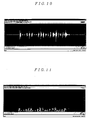
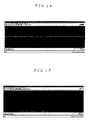
- FIGS. 6 to 21 show the waveforms and spectra of the sound "kakikukekotachitsutetopapipupepobabibubebo" uttered in the form of an inaudible murmur with the stethoscope-type microphone installed on the thyroid cartilage (Adam's apple), the bottom surface of the jaw, the parotid portion (a corner of the lower jaw bone), or the side neck portion, or immediately below the mastoid, or on the mastoid, the cheekbone (a part of the side head immediately in front of the ear), or the cheek portion (the side of the mouth).
- the thyroid cartilage Adam's apple
- the parotid portion a corner of the lower jaw bone
- the side neck portion or immediately below the mastoid, or on the mastoid
- the cheekbone a part of the side head immediately in front of the ear
- the cheek portion the side of the mouth
- Figures 6 and 7 show the waveform and spectrum, respectively, of the inaudible murmur obtained when the stethoscope-type microphone is installed on the thyroid cartilage (Adam's apple).
- the vibration sound of the inaudible murmur can be sampled with a high power.
- the consonants have too high power compared to the vowels and overflow in most cases (vertical lines in Figure 7).
- the overflowed consonants sound like explosions and cannot be heard. Reducing the gain of the microphone amplifier avoids the overflow.
- this prevents a difference in formant unique to a quintphthong from being observed in the spectrum of the vowels, and the phonemes could not be clearly recognized when concentrating on the sound (Installed on the Bottom Surface of the Jaw, the Parotid Portion, or the Side Neck Portion)
- Figures 8 and 9 show the waveform and spectrum, respectively, of the inaudible murmur obtained when the stethoscope-type microphone is installed on the bottom surface of the jaw.
- Figures 10 and 11 show the waveform and spectrum, respectively, of the inaudible murmur obtained when the stethoscope-type microphone is installed on the parotid portion (the corner of the lower jaw bone).
- Figures 12 and 13 show the waveform and spectrum, respectively, of the inaudible murmur obtained when the stethoscope-type microphone is installed on the side neck portion.
- the stethoscope-type microphone When the stethoscope-type microphone is installed on the bottom surface of the jaw, the parotid portion, or the side neck portion, the sound waveform often overflows as shown in Figures 8, 10, and 12. It is difficult to adjust the gain of the microphone amplifier so as to prevent the overflow. The amplitudes of consonants are likely to overflow. Accordingly, the gain of the microphone amplifier must be sharply reduced in order to avoid overflowing the amplitudes of all the consonants. A reduction in gain weakens the energy of fortmants of vowels, making it difficult to distinguish the vowels from one another, as shown in Figures 9, 11 and 13. When the user listens to the sound carefully, consonants the amplitudes of which overflow sound like explosions. The user can hear known sentences but not unknown ones. (Installed Immediately below the Mastoid)
- Figures 14 and 15 show the waveform and spectrum, respectively, of a sound obtained when the stethoscope-type microphone is installed immediately below the mastoid.
- Figures 16 and 17 show the waveform and spectrum, respectively, of the inaudible murmur obtained when the stethoscope-type microphone is installed on the mastoid.
- Figures 18 and 19 show the waveform and spectrum, respectively, of the inaudible murmur obtained when the stethoscope-type microphone is installed on the cheekbone portion (a part of the side head immediately in front of the ear).
- both the articulation and the power ratio of the vowels to the consonants are good as in the case of the position immediately below the mastoid.
- noise resulting from the motion of the jaw is contained in the signal. If the effect of the noise can be eased, the cheekbone portion (the part of the side head immediately in front of the ear) is the most suitable installed position next to the position immediately below the mastoid.
- Figures 20 and 21 show the waveform and spectrum, respectively, of the inaudible murmur obtained when the stethoscope-type microphone is installed on the cheek portion (the side of the mouth).
- consonants such as fricative and explosive sounds have very high power in connection with flesh conduction and often sound like explosions.
- the vowels and semivowels are distinguished from one another on the basis of a difference in the resonance structure of air in the vocal tract. Consequently, the vowels and the semivowels have low power.
- the resultant system relatively favorably recognizes the vowels, while substantially failing to distinguish the consonants from one another.
- the stethoscope-type microphone when the stethoscope-type microphone is installed on the mastoid or the cheekbone portion (the part of the side head immediately in front of the ear), the amplitudes of consonants do not overflow, but compared to flesh conduction, bone conduction generally does not transmit vibration easily. Further, the sound obtained is low, and the signal-to-noise ratio is low.
- the signal-to-noise ratio is measured for the waveform in Figure 14 sampled by installing the stethoscope-type microphone immediately below the mastoid and for the waveform in Figure 26 sampled by installing the stethoscope-type microphone on the mastoid.
- the measurement is 19 decibels for the former waveform, while it is 11 decibels for the latter waveform.
- the ratio of the peak power of the vowels to the peak power of the consonants is determined to be closest to the value "1" at the position immediately below the mastoid.
- the optimum position for the vowel-to-consonant power ratio is obtained when the center of the diaphragm of the stethoscope-type microphone 1-1 is located at a site 4-13 immediately below the mastoid 4-12 of the skull.
- Figure 5 shows the site immediately below the mastoid in a double circle, the site being optimum for installation of the stethoscope-type microphone.
- the optimum installation site has no hair, mustache, or beard. If the user has long hair, the microphone is completely hidden between the auricle and the hair. Further, compared to the other sites, the optimum installation site has thick soft tissues (flesh and the like) . At this site, the signal is not mixed with any noise that may result from the speechmotionof the articulatory organs such as the tongue, the lips, the jaw, or the soft palate. Moreover, the site is located on a gap inside the body in which no bone is present. As a result, the vibration sound of the non-audible murmur can be acquired with a high gain.
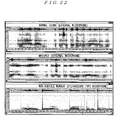
- Figure 22 shows sound signals for and the spectra of a normal sound, a whisper (both were sampled using an external microphone), and a general non-audible murmur (sampled using an original microphone contacted tightly with the body surface) sampled at an installed position different from that according to the present invention.
- the non-audible murmur us sampled by installing the microphone at the parotid site.
- Figures 23 and 24 show a sound signal for and the spectrum of a non-audible murmur sampled through the microphone installed at the optimum position shown in Figure 4.
- Figure 23 shows that the fundamental frequency F0, resulting from the regular vibration of the vocal cords, does not substantially appear in the non-audible murmur.
- the figure also shows that the formant structure of a low frequency area containing a phonemic characteristic is relatively appropriately maintained.
- a man's non-audible murmur sampled as described above was used and illustrative sentences with a phonemic balance maintained were each read aloud four times. The sounds obtained were sampled in a digital form at 16 kHz and 16 bits.
- 503 ATR (Advanced Telecommunications Research) phonemic balance sentences available from the ATR Sound Translation Communication Research Center and additional 22 sentences were used.
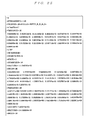
- Figure 25 shows an example of the monophone speech recognition acoustic model thus created.
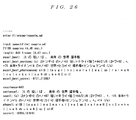
- Figure 26 shows the results of recognition of a recorded sound. Further, Figure 27 shows an example of automatic phoneme alignment. A phoneme label in the lower part of the spectrum in Figure 24 is shown on the basis of the result of the automatic alignment segmentation.
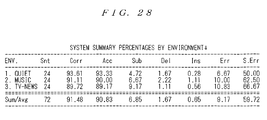
- the word recognition performance was 94%, which is comparable to that for a normal sound. Further, even with the music or a TV sound, the word recognition performance was good, 91 or 90%, respectively. This indicates that the non-audible murmur based on flesh conduction resists background noise better than the normal sound based on air conduction.
- the normal sound can be picked up at the above installed sites by sealing the hole in the sucker of the stethoscope-type microphone 1-1 or finely adjusting the volume or the like.
- a third person gives recitation or the like right next to the speaker, only the speaker's voice is recorded because the speaker's voice undergoes flesh conduction instead of air conduction.
- the non-audible murmur or normal sound picked up through the stethoscope-type microphone requires only the learning of an acoustic model of a person using the microphone.
- the stethoscope-type microphone can be used as a noiseless microphone for normal speech recognition.
- the modulation of a sound refers to a change in the auditory tonality of a sound, that is, a change in sound quality.
- the term morphing is often used to refer to the modulation.
- the term morphing is used as a general term for, for example, techniques for increasing and reducing the fundamental frequency of a sound, increasing and reducing the formant frequency, continuously changing a male voice to a female voice or a female voice to a male voice, and continuously changing one man's voice to another man's voice.
- STRAIGHT proposed by Kawahara (Kawahara et al., Shingaku Giho, EA96-28, 1996), is known as a representative method. This method is characterized in that parameters such as the fundamental frequency (F0), a spectrum envelope, and a speech speed can be independently varied by accurately separating sound source information from vocal tract information.
- the spectrum of the non-audible murmur can be calculated to determine a spectrum envelope from the spectrum obtained.
- both an audible normal sound, using the regular vibration of the vocal cords, and a non-audible murmur are recorded for the same sentence. Then, a function for a conversion into the spectrum of the normal sound is predetermined from the spectrum of the non-audible murmur. This can be carried out by those skilled in the art.
- the appropriate use of the fundamental frequency enables the non-audible murmur to be modulated into a more audible sound using a method such as STRAIGHT, previously described.
- the non-audible murmur can be subjected to speech recognition as shown in Figure 28. Consequently, on the basis of the results of the speech recognition of the non-audible murmur, phonetic units such as syllables, semi-syllables, phonemes, two-juncture phonemes, and three-juncture phonemes can be recognized. Further, on the basis of the results of the speech recognition, the non-audible murmur can be modulated into a sound that can be more easily heard, using a speech synthesis technique described in a well-known text.
- the microphone may be integrated with a head-installed object such as glasses, a headphone, a supra-aural earphone, a cap, or a helmet which is installed on the user's head.
- a head-installed object such as glasses, a headphone, a supra-aural earphone, a cap, or a helmet which is installed on the user's head.
- the microphone 1-1 may be provided at an end of a bow portion 31a of glasses 31 which is placed around the ear.
- the microphone 1-1 is provided in an earmuff portion 32a of a headphone 32.
- the microphone 1-1 may be provided at an end of a bowportion 33a of a supra-aural earphone 33 which is placed around the ear.
- a cap 34 and the microphone 1-1 may be integrated together.
- a helmet 35 and the microphone 1-1 may be integrated together.
- the microphone can be installed without appearing odd by being integrated with any of various head-installed objects. Further, the microphone can be installed immediately below the mastoid by improving the placement of the microphone.
- FIG 34 is a block diagram showing a variation in which a signal processing apparatus is provided between the microphone and a portable terminal.
- a signal processing apparatus 19-2 is composed of an analog-digital converter 19-3, a processor 19-4, and a transmitter 19-5 which are integrated together.
- the analog-digital converter 19-3 obtains and quanti zes the vibration sound of a non-audible murmur sampled through the microphone 1-1 to convert the sound into a digital signal.
- the digital signal the result of the quantization, is sent to the processor 19-4.
- the processor 19-4 executes processing such as amplification or conversion on the digital signal sent by the analog-digital converter 19-3.
- the result of the processing is sent to the transmitter 19-5.
- the transmitter 19-5 transmits the digital signal processed by the processor 19-4 to a cellular phone 19-6 by wire or wireless.
- Those skilled in the art can easily produce the signal processing apparatus 19-2.
- an apparatus in amobile telephone network canprocess the processed vibration sound as it is or process the signal converted into parameters. This serves to simplify the configuration of the signal processing apparatus.
- Figure 35 is also a block diagram showing a variation in which a signal processing apparatus is provided between the microphone and a portable terminal.
- the signal processing apparatus 19-2 is composed of the analog-digital converter 19-3 and the transmitter 19-5, which are integrated together.
- the analog-digital converter 19-3 obtains and quantizes the vibration sound of a non-audible murmur sampled through the microphone 1-1 to convert the sound into a digital signal.
- the digital signal the result of the quantization, is sent to the transmitter 19-5.
- the transmitter 19-5 transmits the digital signal obtained by the conversion by the analog-digital converter 19-3 to the cellular phone 1-4 by wire or wireless.
- This configuration enables the cellular phone or a base station for the cellular phone to process the vibration sound sampled.
- the configuration of the signal processing apparatus 19-2 can be simplified. Those skilled in the art can easily produce the signal processing apparatus 19-2.
- an apparatus in a mobile telephone network can process the result of the quantization. This serves to simplify the configuration of the signal processing apparatus.
- the analog-digital converter 19-3 obtains and quantizes the vibration sound of a non-audible murmur sampled through the microphone 1-1 to convert the sound into a digital signal.
- the digital signal the result of the quantization, is sent to the processor 19-4.
- the processor 19-4 executes processing such as amplification or conversion on the digital signal sent by the analog-digital converter 19-3.
- the speech recognition section 19-6 executes a speech recognition process on the result of the processing.
- Those skilled in the art can easily produce the signal processing apparatus 19-2. With the signal processing apparatus configured as described above, in connection with the non-audible murmur, a speech recognition process can be executed on the signal for the processed vibration sound as it is or on the signal converted into parameters.
- the transmitter 19-5 may be added to the configuration shown in Figure 36. With this configuration, the transmitter 19-5 transmits the results of the speech recognition by the speech recognition section 19-6 to external equipment. Those skilled in the art can easily produce the signal processing apparatus 19-2. By transmitting the results of the speech recognition to, for example, a mobile telephone network, it is possible to utilize the results of the speech recognition to various processes.
- the microphone according to the present invention may be built into a cellular phone or the like. In this case, by pressing the microphone portion against the surface of the skin on the sternocleidomastoid muscle immediately below the mastoid, it is possible to make a speech utilizing non-audible murmurs.
- the present invention enables the utilization of voiceless speeches over the cellular phone and a voiceless speech recognition apparatus.
- speeches can be made over the cellular phone or information can be input to a computer or a personal potable information terminal, using only the speech motion of the articulatory organs, which is inherently acquired and cultivated through the phonetic language culture, and without the need to learn new techniques.
- the present invention avoids the mixture of surrounding background noises and prevents a silent environment from being disrupted.
- the publicity of the phonetic language can be controlled. Users need not worry about the leakage of information to surrounding people.
- this sound sampling method enables a sharp reduction in the mixture of noises.
- the present invention eliminates the need to install the microphone in front of the eyes or about the lips to prevent the microphone from bothering the user.
- the present invention also eliminates the need to hold the cellular phone against the ear with one hand.
- the microphone has only to be installed on the lower part of the skin behind the auricle.
- the microphone may be hidden under hair.
- the present invention may create a new language communication culture that does not require any normal sound.
- the present invention significantly facilitates the spread of the whole speech recognition technology to actual life. Furthermore, the present invention is optimum for people from whom the vocal cords have been removed or who have difficulty in speeches using the regular vibration of the vocal cords.
Landscapes
- Engineering & Computer Science (AREA)
- Acoustics & Sound (AREA)
- Physics & Mathematics (AREA)
- Multimedia (AREA)
- Signal Processing (AREA)
- Computational Linguistics (AREA)
- Audiology, Speech & Language Pathology (AREA)
- Human Computer Interaction (AREA)
- Health & Medical Sciences (AREA)
- Data Mining & Analysis (AREA)
- Quality & Reliability (AREA)
- Telephone Function (AREA)
- Details Of Audible-Bandwidth Transducers (AREA)
- Telephone Set Structure (AREA)
- Headphones And Earphones (AREA)
- Circuit For Audible Band Transducer (AREA)
Abstract
Description
Claims (15)
- A microphone sampling one of a non-audible murmur articulated by a variation in resonance filter characteristics associated with motion of the phonatory organ, the non-audible murmur not involving regular vibration of the vocal cords, the non-audible murmur being a vibration sound generated when an externally non-audible respiratory sound is transmitted through internal soft tissues, a whisper which is audible but is uttered without regularly vibrating the vocal cords, a sound uttered by regularly vibrating the vocal cords and including a low voice or a murmur, and various sounds such as a teeth gnashing sound and a tongue clucking sound,
the microphone being installed on a surface of the skin on the sternocleidomastoid muscle immediately below the mastoid of the skull, that is, in the lower part of the skin behind the auricle. - The microphone according to claim 1, comprising a diaphragm installed on the surface of the skin and a sucker that sticks to the diaphragm.
- The microphone according to claim 1 or 2, which is integrated with a head-installed object such as glasses, a headphone, a supra-aural earphone, a cap, or a helmet which is installed on the human head.
- A communication interface system comprising the microphone according to any of claims 1 to 3 and a signal processing apparatus that processes a signal sampled through the microphone,
wherein a result of processing by the signal processing apparatus is used for communications. - The communication interface system according to claim 4, wherein the signal processing apparatus includes an analog digital converting section that quantizes a signal sampled through the microphone, a processor section that processes a result of the quantization by the analog digital converting section, and a transmission section that transmits a result of the processing by the processor section to an external apparatus.
- The communication interface system according to claim 4, wherein the signal processing apparatus includes an analog digital converting section that quantizes a signal sampled through the microphone and a transmission section that transmits a result of the quantization by the analog digital converting section to an external apparatus and in that the external apparatus processes the result of the quantization.
- The communication interface system according to claim 5, wherein the signal processing apparatus includes an analog digital converting section that quantizes a signal sampled through the microphone, a processor section that processes a result of the quantization by the analog digital converting section, and a speech recognition section that executes a speech recognition process on a result of the processing by the processor section.
- The communication interface system according to claim 7, further comprising a transmission section that transmits a result of the speech recognition by the speech recognition section to an external apparatus.
- The communication interface system according to claim 5, wherein an apparatus in a mobile telephone network executes a speech recognition process on the result of the processing by the processor section, the result being transmitted by the transmitting section.
- The communication interface system according to claim 5, wherein the signal processing executed by the signal processing apparatus is a modulating process in which the process section modulates the signal into an audible sound.
- The communication interface system according to claim 10, wherein the modulating process applies a fundamental frequency of the vocal cords to the non-audible murmur to convert the non-audible murmur into an audible sound involving the regular vibration of the vocal cords.
- The communication interface system according to claim 10, wherein the modulating process converts a spectrum of the non-audible murmur not involving the regular vibration of the vocal cords into a spectrum of an audible sound uttered using the regular vibration of the vocal cords.
- The communication interface system according to claim 12, wherein the modulating process uses the spectrum of the non-audible murmur and a speech recognition apparatus to recognize phonetic units such as syllables, semi-syllables, phonemes, two-juncture phonemes, and three-juncture phonemes and uses a speech synthesis technique to convert the phonetic units recognized into an audible sound uttered using the regular vibration of the vocal cords.
- The communication interface system according to any of claims 4 to 13, wherein an input gain is controlled in accordance with a magnitude of a dynamic range of a sound sampled through the microphone.
- The communication interface system according to claim 7 or 8, wherein the speech recognition section appropriately executes speech recognition utilizing an acoustic model of at least one of the non-audible murmur, a whisper which is audible but is uttered without regularly vibrating the vocal cords, a sound uttered by regularly vibrating the vocal cords and including a low voice or a murmur, and various sounds such as a teeth gnashing sound and a tongue clucking sound.
Applications Claiming Priority (3)
| Application Number | Priority Date | Filing Date | Title |
|---|---|---|---|
| JP2002252421 | 2002-08-30 | ||
| JP2002252421 | 2002-08-30 | ||
| PCT/JP2003/011157 WO2004021738A1 (en) | 2002-08-30 | 2003-09-01 | Microphone and communication interface system |
Publications (3)
| Publication Number | Publication Date |
|---|---|
| EP1538865A1 true EP1538865A1 (en) | 2005-06-08 |
| EP1538865A4 EP1538865A4 (en) | 2007-07-04 |
| EP1538865B1 EP1538865B1 (en) | 2010-06-30 |
Family
ID=31972742
Family Applications (1)
| Application Number | Title | Priority Date | Filing Date |
|---|---|---|---|
| EP03791441A Expired - Lifetime EP1538865B1 (en) | 2002-08-30 | 2003-09-01 | Microphone and communication interface system |
Country Status (8)
| Country | Link |
|---|---|
| US (1) | US20050244020A1 (en) |
| EP (1) | EP1538865B1 (en) |
| JP (1) | JP3760173B2 (en) |
| KR (1) | KR100619215B1 (en) |
| CN (1) | CN1679371B (en) |
| AU (1) | AU2003261871A1 (en) |
| DE (1) | DE60333200D1 (en) |
| WO (1) | WO2004021738A1 (en) |
Cited By (1)
| Publication number | Priority date | Publication date | Assignee | Title |
|---|---|---|---|---|
| EP3633496A4 (en) * | 2017-05-23 | 2020-08-05 | Sony Corporation | INFORMATION PROCESSING DEVICE AND METHOD FOR CONTROLLING THEREOF AND RECORDING MEDIUM |
Families Citing this family (54)
| Publication number | Priority date | Publication date | Assignee | Title |
|---|---|---|---|---|
| JP2005245580A (en) * | 2004-03-02 | 2005-09-15 | Azden Corp | Voice communication apparatus in MRI apparatus |
| JP2006126558A (en) * | 2004-10-29 | 2006-05-18 | Asahi Kasei Corp | Voice speaker authentication system |
| JP2009512232A (en) * | 2005-06-13 | 2009-03-19 | テクニオン リサーチ アンド デヴェロップメント リミテッド | Shielded communication converter |
| KR100692201B1 (en) * | 2005-06-21 | 2007-03-09 | 계명대학교 산학협력단 | Heart sound classification method using Hidden Markov model |
| WO2008007616A1 (en) * | 2006-07-13 | 2008-01-17 | Nec Corporation | Non-audible murmur input alarm device, method, and program |
| WO2008015800A1 (en) * | 2006-08-02 | 2008-02-07 | National University Corporation NARA Institute of Science and Technology | Speech processing method, speech processing program, and speech processing device |
| JP2008042740A (en) * | 2006-08-09 | 2008-02-21 | Nara Institute Of Science & Technology | Microphone for collecting non-audible tweets |
| JP4671290B2 (en) * | 2006-08-09 | 2011-04-13 | 国立大学法人 奈良先端科学技術大学院大学 | Microphone for collecting meat conduction sound |
| JP5160878B2 (en) * | 2007-12-21 | 2013-03-13 | 浜松ホトニクス株式会社 | Sample identification apparatus and sample identification method |
| US7983437B2 (en) * | 2008-01-04 | 2011-07-19 | Hammond Wong | Earphone set with detachable speakers or subwoofers |
| US9767817B2 (en) * | 2008-05-14 | 2017-09-19 | Sony Corporation | Adaptively filtering a microphone signal responsive to vibration sensed in a user's face while speaking |
| JP5256119B2 (en) * | 2008-05-27 | 2013-08-07 | パナソニック株式会社 | Hearing aid, hearing aid processing method and integrated circuit used for hearing aid |
| US20100131268A1 (en) * | 2008-11-26 | 2010-05-27 | Alcatel-Lucent Usa Inc. | Voice-estimation interface and communication system |
| US10115392B2 (en) * | 2010-06-03 | 2018-10-30 | Visteon Global Technologies, Inc. | Method for adjusting a voice recognition system comprising a speaker and a microphone, and voice recognition system |
| CN105141728B (en) | 2010-12-27 | 2019-07-30 | 株式会社精好 | Mobile phone |
| US9313306B2 (en) | 2010-12-27 | 2016-04-12 | Rohm Co., Ltd. | Mobile telephone cartilage conduction unit for making contact with the ear cartilage |
| JP5594152B2 (en) * | 2011-01-11 | 2014-09-24 | 富士通株式会社 | NAM conversation support system and NAM conversation support method |
| JP5783352B2 (en) | 2011-02-25 | 2015-09-24 | 株式会社ファインウェル | Conversation system, conversation system ring, mobile phone ring, ring-type mobile phone, and voice listening method |
| US8559813B2 (en) | 2011-03-31 | 2013-10-15 | Alcatel Lucent | Passband reflectometer |
| US8666738B2 (en) | 2011-05-24 | 2014-03-04 | Alcatel Lucent | Biometric-sensor assembly, such as for acoustic reflectometry of the vocal tract |
| EP2592848B1 (en) * | 2011-11-08 | 2019-06-26 | Oticon Medical A/S | Acoustic transmission method and listening device. |
| TWI660618B (en) | 2012-01-20 | 2019-05-21 | 日商精良股份有限公司 | Mobile phone |
| US20130297301A1 (en) * | 2012-05-03 | 2013-11-07 | Motorola Mobility, Inc. | Coupling an electronic skin tattoo to a mobile communication device |
| US20130294617A1 (en) * | 2012-05-03 | 2013-11-07 | Motorola Mobility Llc | Coupling an Electronic Skin Tattoo to a Mobile Communication Device |
| EP2663095B1 (en) * | 2012-05-07 | 2015-11-18 | Starkey Laboratories, Inc. | Hearing aid with distributed processing in ear piece |
| EP3407621B1 (en) | 2012-06-29 | 2021-12-22 | FINEWELL Co., Ltd. | Stereo earphone |
| US9094749B2 (en) * | 2012-07-25 | 2015-07-28 | Nokia Technologies Oy | Head-mounted sound capture device |
| US20140074480A1 (en) * | 2012-09-11 | 2014-03-13 | GM Global Technology Operations LLC | Voice stamp-driven in-vehicle functions |
| US9943712B2 (en) * | 2012-09-24 | 2018-04-17 | Dolores Speech Products Llc | Communication and speech enhancement system |
| JP2014143582A (en) * | 2013-01-24 | 2014-08-07 | Nippon Hoso Kyokai <Nhk> | Communication device |
| CN104575500B (en) * | 2013-10-24 | 2018-09-11 | 中国科学院苏州纳米技术与纳米仿生研究所 | Application, speech recognition system and method for the electronic skin in speech recognition |
| CN104123930A (en) * | 2013-04-27 | 2014-10-29 | 华为技术有限公司 | Guttural identification method and device |
| WO2015025829A1 (en) | 2013-08-23 | 2015-02-26 | ローム株式会社 | Portable telephone |
| WO2015056443A1 (en) | 2013-10-15 | 2015-04-23 | パナソニックIpマネジメント株式会社 | Microphone |
| WO2015060230A1 (en) | 2013-10-24 | 2015-04-30 | ローム株式会社 | Bracelet-type transmission/reception device and bracelet-type notification device |
| JP6551919B2 (en) | 2014-08-20 | 2019-07-31 | 株式会社ファインウェル | Watch system, watch detection device and watch notification device |
| CN104317388B (en) * | 2014-09-15 | 2018-12-14 | 联想(北京)有限公司 | A kind of exchange method and wearable electronic equipment |
| KR102110094B1 (en) | 2014-12-18 | 2020-05-12 | 파인웰 씨오., 엘티디 | Hearing device for bicycle riding and bicycle system |
| US9847093B2 (en) * | 2015-06-19 | 2017-12-19 | Samsung Electronics Co., Ltd. | Method and apparatus for processing speech signal |
| US10967521B2 (en) | 2015-07-15 | 2021-04-06 | Finewell Co., Ltd. | Robot and robot system |
| JP6551929B2 (en) | 2015-09-16 | 2019-07-31 | 株式会社ファインウェル | Watch with earpiece function |
| KR102108668B1 (en) | 2016-01-19 | 2020-05-07 | 파인웰 씨오., 엘티디 | Pen-type handset |
| CN106419954B (en) * | 2016-09-26 | 2019-05-21 | 珠海爱珂索移动医疗科技有限公司 | One kind being suitable for stethoscopic vibration restoring method |
| WO2018199846A1 (en) | 2017-04-23 | 2018-11-01 | Audio Zoom Pte Ltd | Transducer apparatus for high speech intelligibility in noisy environments |
| US10462578B2 (en) * | 2017-05-08 | 2019-10-29 | Intel Corporation | Piezoelectric contact microphone with mechanical interface |
| US11647330B2 (en) | 2018-08-13 | 2023-05-09 | Audio Zoom Pte Ltd | Transducer apparatus embodying non-audio sensors for noise-immunity |
| JP2020053948A (en) | 2018-09-28 | 2020-04-02 | 株式会社ファインウェル | Hearing device |
| JP6894081B2 (en) * | 2018-11-05 | 2021-06-23 | 幸男 中川 | Language learning device |
| JP7574589B2 (en) * | 2020-09-24 | 2024-10-29 | 株式会社Jvcケンウッド | Communication device, communication method, and computer program |
| CN112738687B (en) * | 2021-02-08 | 2023-04-07 | 江西联创电声有限公司 | Earphone set |
| EP4131256A1 (en) * | 2021-08-06 | 2023-02-08 | STMicroelectronics S.r.l. | Voice recognition system and method using accelerometers for sensing bone conduction |
| CN113810819B (en) * | 2021-09-23 | 2022-06-28 | 中国科学院软件研究所 | Method and equipment for acquiring and processing silent voice based on ear cavity vibration |
| JP2024074099A (en) * | 2022-11-18 | 2024-05-30 | 国立大学法人山口大学 | Biosound Sensor System |
| US12469488B2 (en) * | 2023-10-30 | 2025-11-11 | Reflex Technologies, Inc. | Methods for non-audible speech detection |
Family Cites Families (22)
| Publication number | Priority date | Publication date | Assignee | Title |
|---|---|---|---|---|
| JPS6068734U (en) * | 1983-10-18 | 1985-05-15 | 株式会社岩田エレクトリツク | handset |
| JPH0515290Y2 (en) * | 1985-05-31 | 1993-04-22 | ||
| JPS61288596A (en) * | 1985-06-14 | 1986-12-18 | Purimo:Kk | Microphone |
| US4777961A (en) * | 1985-10-15 | 1988-10-18 | Bruce Saltzman | High sensitivity stethoscopic system and method |
| JPH0256121A (en) * | 1987-10-14 | 1990-02-26 | Sanshin Ind Co Ltd | Ear-mount type transmitter-receiver |
| US4972468A (en) * | 1987-10-14 | 1990-11-20 | Sanshin Kogyo Kabushiki Kaisha | Transceiver for hanging on an ear |
| JPH04316300A (en) * | 1991-04-16 | 1992-11-06 | Nec Ic Microcomput Syst Ltd | Voice input unit |
| EP0519621A1 (en) * | 1991-06-03 | 1992-12-23 | Pioneer Electronic Corporation | Speech transmitter |
| JP3647499B2 (en) * | 1995-03-31 | 2005-05-11 | フオスター電機株式会社 | Voice pickup system |
| US5729694A (en) * | 1996-02-06 | 1998-03-17 | The Regents Of The University Of California | Speech coding, reconstruction and recognition using acoustics and electromagnetic waves |
| US5853005A (en) * | 1996-05-02 | 1998-12-29 | The United States Of America As Represented By The Secretary Of The Army | Acoustic monitoring system |
| JP3041176U (en) * | 1997-01-23 | 1997-09-09 | 照雄 松岡 | 2-way microphone with additional use of piezoelectric ceramic element and cartridge unit to increase high range and sound pressure of indirect vibration conduction type electret condenser microphone and dynamics microphone unit in skin contact type closed case |
| US6353671B1 (en) * | 1998-02-05 | 2002-03-05 | Bioinstco Corp. | Signal processing circuit and method for increasing speech intelligibility |
| JP3893763B2 (en) * | 1998-08-17 | 2007-03-14 | 富士ゼロックス株式会社 | Voice detection device |
| JP2000341778A (en) * | 1999-05-25 | 2000-12-08 | Temuko Japan:Kk | Handset using bone conduction speaker |
| JP2000338986A (en) * | 1999-05-28 | 2000-12-08 | Canon Inc | Voice input device, control method thereof, and storage medium |
| US7246058B2 (en) * | 2001-05-30 | 2007-07-17 | Aliph, Inc. | Detecting voiced and unvoiced speech using both acoustic and nonacoustic sensors |
| US6631197B1 (en) * | 2000-07-24 | 2003-10-07 | Gn Resound North America Corporation | Wide audio bandwidth transduction method and device |
| US6519345B1 (en) * | 2000-08-14 | 2003-02-11 | Chin-Hui Yang | Double-functioned hand-free device for cellular telephone |
| JP2002135390A (en) * | 2000-10-23 | 2002-05-10 | Zojirushi Corp | Voice input device for mobile phone |
| US6898448B2 (en) * | 2002-01-16 | 2005-05-24 | Sheng Hsin Liao | Miniature vocal transmitter device |
| WO2005067340A1 (en) * | 2004-01-09 | 2005-07-21 | Asahi Kasei Kabushiki Kaisha | Body conducted sound microphone, signal processing device, communication interface system, and sound collecting method |
-
2003
- 2003-09-01 CN CN038201674A patent/CN1679371B/en not_active Expired - Fee Related
- 2003-09-01 WO PCT/JP2003/011157 patent/WO2004021738A1/en not_active Ceased
- 2003-09-01 EP EP03791441A patent/EP1538865B1/en not_active Expired - Lifetime
- 2003-09-01 AU AU2003261871A patent/AU2003261871A1/en not_active Abandoned
- 2003-09-01 US US10/525,733 patent/US20050244020A1/en not_active Abandoned
- 2003-09-01 KR KR1020057003369A patent/KR100619215B1/en not_active Expired - Fee Related
- 2003-09-01 DE DE60333200T patent/DE60333200D1/en not_active Expired - Lifetime
- 2003-09-01 JP JP2004532784A patent/JP3760173B2/en not_active Expired - Fee Related
Cited By (1)
| Publication number | Priority date | Publication date | Assignee | Title |
|---|---|---|---|---|
| EP3633496A4 (en) * | 2017-05-23 | 2020-08-05 | Sony Corporation | INFORMATION PROCESSING DEVICE AND METHOD FOR CONTROLLING THEREOF AND RECORDING MEDIUM |
Also Published As
| Publication number | Publication date |
|---|---|
| WO2004021738A1 (en) | 2004-03-11 |
| CN1679371A (en) | 2005-10-05 |
| DE60333200D1 (en) | 2010-08-12 |
| US20050244020A1 (en) | 2005-11-03 |
| EP1538865A4 (en) | 2007-07-04 |
| JP3760173B2 (en) | 2006-03-29 |
| CN1679371B (en) | 2010-12-29 |
| KR20050057004A (en) | 2005-06-16 |
| AU2003261871A1 (en) | 2004-03-19 |
| JPWO2004021738A1 (en) | 2005-12-22 |
| KR100619215B1 (en) | 2006-09-06 |
| EP1538865B1 (en) | 2010-06-30 |
Similar Documents
| Publication | Publication Date | Title |
|---|---|---|
| EP1538865B1 (en) | Microphone and communication interface system | |
| US7778430B2 (en) | Flesh conducted sound microphone, signal processing device, communication interface system and sound sampling method | |
| Nakajima et al. | Non-audible murmur (NAM) recognition | |
| US10475467B2 (en) | Systems, methods and devices for intelligent speech recognition and processing | |
| JP4439740B2 (en) | Voice conversion apparatus and method | |
| US8082149B2 (en) | Methods and apparatuses for myoelectric-based speech processing | |
| Doi et al. | Alaryngeal speech enhancement based on one-to-many eigenvoice conversion | |
| US20100131268A1 (en) | Voice-estimation interface and communication system | |
| JP4940414B2 (en) | Audio processing method, audio processing program, and audio processing apparatus | |
| JPWO2000049834A1 (en) | Voice conversion device and method | |
| Nakagiri et al. | Improving body transmitted unvoiced speech with statistical voice conversion | |
| JP4130443B2 (en) | Microphone, signal processing device, communication interface system, voice speaker authentication system, NAM sound compatible toy device | |
| CN118355675A (en) | A synthesis-based approach to clear hearing in noisy situations | |
| KR100778143B1 (en) | Goldo headset with neck microphone using laryngeal impedance signal | |
| Nakamura et al. | Evaluation of extremely small sound source signals used in speaking-aid system with statistical voice conversion | |
| JP5052107B2 (en) | Voice reproduction device and voice reproduction method | |
| Nakamura | Speaking-aid systems using statistical voice conversion for electrolaryngeal speech | |
| CN121662073A (en) | Intelligent hearing and speaking auxiliary system and method based on audio conversion and error hearing and error correction and error speaking translation | |
| KR100533217B1 (en) | A headphone apparatus with gentle function using signal processing for prosody control of speech signals | |
| KR20030016199A (en) | A Headphone with Soft-Sound Function using Prosody Control of Speech Signals |
Legal Events
| Date | Code | Title | Description |
|---|---|---|---|
| PUAI | Public reference made under article 153(3) epc to a published international application that has entered the european phase |
Free format text: ORIGINAL CODE: 0009012 |
|
| 17P | Request for examination filed |
Effective date: 20050125 |
|
| AK | Designated contracting states |
Kind code of ref document: A1 Designated state(s): AT BE BG CH CY CZ DE DK EE ES FI FR GB GR HU IE IT LI LU MC NL PT RO SE SI SK TR |
|
| AX | Request for extension of the european patent |
Extension state: AL LT LV MK |
|
| DAX | Request for extension of the european patent (deleted) | ||
| RBV | Designated contracting states (corrected) |
Designated state(s): DE ES FR GB IT |
|
| A4 | Supplementary search report drawn up and despatched |
Effective date: 20070606 |
|
| 17Q | First examination report despatched |
Effective date: 20070808 |
|
| RAP1 | Party data changed (applicant data changed or rights of an application transferred) |
Owner name: ASAHI KASEI KABUSHIKI KAISHA |
|
| GRAP | Despatch of communication of intention to grant a patent |
Free format text: ORIGINAL CODE: EPIDOSNIGR1 |
|
| RAP1 | Party data changed (applicant data changed or rights of an application transferred) |
Owner name: NATIONAL UNIVERSITY CORPORATION NARA INSTITUTE OF |
|
| GRAS | Grant fee paid |
Free format text: ORIGINAL CODE: EPIDOSNIGR3 |
|
| GRAA | (expected) grant |
Free format text: ORIGINAL CODE: 0009210 |
|
| AK | Designated contracting states |
Kind code of ref document: B1 Designated state(s): DE ES FR GB IT |
|
| REG | Reference to a national code |
Ref country code: GB Ref legal event code: FG4D |
|
| REF | Corresponds to: |
Ref document number: 60333200 Country of ref document: DE Date of ref document: 20100812 Kind code of ref document: P |
|
| PG25 | Lapsed in a contracting state [announced via postgrant information from national office to epo] |
Ref country code: IT Free format text: LAPSE BECAUSE OF FAILURE TO SUBMIT A TRANSLATION OF THE DESCRIPTION OR TO PAY THE FEE WITHIN THE PRESCRIBED TIME-LIMIT Effective date: 20100630 |
|
| PLBE | No opposition filed within time limit |
Free format text: ORIGINAL CODE: 0009261 |
|
| STAA | Information on the status of an ep patent application or granted ep patent |
Free format text: STATUS: NO OPPOSITION FILED WITHIN TIME LIMIT |
|
| 26N | No opposition filed |
Effective date: 20110331 |
|
| PG25 | Lapsed in a contracting state [announced via postgrant information from national office to epo] |
Ref country code: ES Free format text: LAPSE BECAUSE OF FAILURE TO SUBMIT A TRANSLATION OF THE DESCRIPTION OR TO PAY THE FEE WITHIN THE PRESCRIBED TIME-LIMIT Effective date: 20101011 |
|
| REG | Reference to a national code |
Ref country code: DE Ref legal event code: R097 Ref document number: 60333200 Country of ref document: DE Effective date: 20110330 |
|
| REG | Reference to a national code |
Ref country code: FR Ref legal event code: PLFP Year of fee payment: 13 |
|
| PGFP | Annual fee paid to national office [announced via postgrant information from national office to epo] |
Ref country code: DE Payment date: 20150825 Year of fee payment: 13 Ref country code: GB Payment date: 20150826 Year of fee payment: 13 |
|
| PGFP | Annual fee paid to national office [announced via postgrant information from national office to epo] |
Ref country code: FR Payment date: 20150811 Year of fee payment: 13 |
|
| REG | Reference to a national code |
Ref country code: DE Ref legal event code: R119 Ref document number: 60333200 Country of ref document: DE |
|
| GBPC | Gb: european patent ceased through non-payment of renewal fee |
Effective date: 20160901 |
|
| REG | Reference to a national code |
Ref country code: FR Ref legal event code: ST Effective date: 20170531 |
|
| PG25 | Lapsed in a contracting state [announced via postgrant information from national office to epo] |
Ref country code: GB Free format text: LAPSE BECAUSE OF NON-PAYMENT OF DUE FEES Effective date: 20160901 Ref country code: FR Free format text: LAPSE BECAUSE OF NON-PAYMENT OF DUE FEES Effective date: 20160930 Ref country code: DE Free format text: LAPSE BECAUSE OF NON-PAYMENT OF DUE FEES Effective date: 20170401 |