EP1538858A1 - Mobile communication system - Google Patents
Mobile communication system Download PDFInfo
- Publication number
- EP1538858A1 EP1538858A1 EP02780033A EP02780033A EP1538858A1 EP 1538858 A1 EP1538858 A1 EP 1538858A1 EP 02780033 A EP02780033 A EP 02780033A EP 02780033 A EP02780033 A EP 02780033A EP 1538858 A1 EP1538858 A1 EP 1538858A1
- Authority
- EP
- European Patent Office
- Prior art keywords
- zone
- terminal
- movement
- channel
- base station
- Prior art date
- Legal status (The legal status is an assumption and is not a legal conclusion. Google has not performed a legal analysis and makes no representation as to the accuracy of the status listed.)
- Withdrawn
Links
Images




































Classifications
-
- H—ELECTRICITY
- H04—ELECTRIC COMMUNICATION TECHNIQUE
- H04W—WIRELESS COMMUNICATION NETWORKS
- H04W72/00—Local resource management
- H04W72/30—Resource management for broadcast services
Definitions
- the present invention relates to a system for providing control of the execution and stoppage of broadcasting services for each zone and for controlling changes to the type of wireless channel for supplying broadcasting services, and so forth in a mobile communication system that provides broadcasting services such as broadcast and multicast services.
- a 'multicast' is a form of broadcasting for transmitting information to all contracted terminals
- a 'broadcast' is a form of broadcasting for transmitting information to all terminals irrespective of contract.
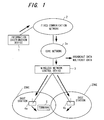
- Fig. 1 shows the constitution of broadcast services and multicast services of a conventional mobile communication network. Broadcast data and multicast data from an information distribution device 1 reaches a wireless network control device 3 via a fixed communication network 2 and a core network 2a that constitutes a switching network and is transmitted from all the base stations 4a, 4b, ... in the service area to all the mobile devices 5 in the zone via the wireless network control device 3.
- broadcasting data is transmitted unconditionally from all the base stations in the service area. Further, when the service area (referred to as cell) of the base station is converted into sectors, broadcasting data is transmitted unconditionally to the sectors. For this reason, even in a case where a terminal receiving services does not exist in the cell or sector (generally referred to as the 'zone'), transmission is performed from the base stations to an area where no terminal exists and, hence, there is the problem that wireless resources are used wastefully, the transmission power of the base station increases, and interference power increases.
- a first object of the present invention is to make it possible to use wireless resources efficiently and reduce the transmission power and interference power of the base station.
- a second object of the present invention is to perform a zone transfer in a system that uses wireless resources efficiently without problems.
- a judgment standard (whether a terminal receiving a supply of services exists or not, for example) is established for each zone and broadcast data and multicast data, and so forth, are not transmitted from the base station to zones where the standard is not fulfilled (a terminal does not exist). Accordingly, in one zone, when the standard is not fulfilled, the transmission of broadcast data and multicast data is not performed and, therefore, the wireless resources in the zone can be used efficiently.
- a network device detects the fact that the terminal receiving the supply of services exists in a region that allows services to be received from the other zone and the data is transmitted on a wireless channel from the base station of the other zone.
- a judgment standard is established for each zone and the type of wireless channel (dedicated physical channel, common physical channel, for example) is determined on the basis of the judgment result.
- the optimal wireless channel for transmitting broadcast data and multicast data can be selected in accordance with the judgment standard. Therefore, the wireless resources in the zone can be used efficiently and the transmission power and interference power of the base station can be reduced.
- a network device determines a wireless channel on the basis of this request and the data is transmitted on the wireless channel.
- the network device detects the fact that a terminal receiving the supply of services exists in a region that allows services to be received from another zone and, determines a wireless channel when the existence of terminals is detected, and transmits the data by means of the wireless channel.
- a judgment standard (whether a terminal receiving a supply of services exists or not, for example) is established for each zone and, when the standard is not fulfilled (a terminal does not exist), broadcast data and multicast data, and so forth, are not transmitted from the base station to the zone. Accordingly, in one zone, when the standard is not fulfilled, the transmission of broadcast data and multicast data is not performed. Therefore, the wireless resources in the zone can be used efficiently. For example, (1) a case where the judgment standard is the existence of terminals receiving a supply of services and (2) a case where the judgment standard is the service quality, number of services and number of terminals using the services will be described.
- Judgment standards include (1) the number of terminals receiving a supply of services, (2) the transmission power required to provide services, (3) the amount of interference produced when services are supplied, and (4) the combination of services.
- the third invention is related to intermittent reception of services in a zone transfer and appears in the forms (1) to (7) below.
- Fig. 2 is a constitutional view of a mobile communication system that implements the broadcast and multicast of the present invention and is constituted by an information distribution device 10 that distributes broadcast data or multicast data, a wireless network control device 13 that receives the broadcast data or multicast data distributed by the information distribution device via a fixed communication network 11 and a core network 12 and transmits the data to the base station on a logical channel, base stations 14 1 and 14 2 that receive broadcast data or multicast data from the wireless network control device and transmit data to the terminal on a physical channel, and a terminal 15 that receives the broadcast data or multicast data.
- the wireless network control device 13 sometimes also receives broadcast data or multicast data distributed by the information distribution device 10 from the core network 12 without the involvement of the fixed communication network 11.
- the base stations also appear with the number '14' hereinafter.
- Fig. 3 is a block constitutional view of the wireless network control device 13.
- a core network interface portion 13a receives broadcast data and multicast data from the information distribution device 11 via the core network 12 and sends the data to a data processing portion 13b.
- the data processing portion 13b maps broadcast data and multicast data that is inputted from the core network interface portion 13a and data (a terminal control signal) that is inputted from a wireless resource control portion 13c with a logical channel. Further, the data processing portion 13b fetches a data part of an interterminal control signal (control signal between terminals) that is inputted by a base station interface portion 13d and then sends the data part to the wireless resource control portion 13c. In addition, the data processing portion 13b transmits/stops transmission on the logical channel in accordance with an instruction from the wireless resource control portion 13c.
- the base station interface portion 13d transmits broadcast data and multicast data that has been sent by the data processing portion 13b, an interterminal control signal and an inter-base station control signal (control signal between base stations) that has been sent by the wireless resource control portion 13c to the base stations 14 1 and 14 2 , sends an interterminal control signal that has been sent by a base station to the data processing portion 13b and sends the inter-base-station control signal to the wireless resource control portion 13c.
- the wireless resource control portion 13c performs allocation and management, and so forth of wireless resources (the channel type, wireless channel (code in CDMA)) for communication between base stations and terminals. Further, the wireless resource control portion 13c judges the zone shift from peripheral-cell quality measurement information from the terminal and judges the transmission/stoppage of transmission of multicast (broadcast) data. In addition, the wireless resource control portion 13c performs processing to confirm the existence of terminals, processing to confirm the number of terminals, processing to calculate transmission power and processing to calculate the amount of interference.
- wireless resources the channel type, wireless channel (code in CDMA)
- the wireless resource control portion 13c judges the zone shift from peripheral-cell quality measurement information from the terminal and judges the transmission/stoppage of transmission of multicast (broadcast) data.
- the wireless resource control portion 13c performs processing to confirm the existence of terminals, processing to confirm the number of terminals, processing to calculate transmission power and processing to calculate the amount of interference.
- Fig. 4 is a block constitutional view of the base station 14.
- a wired transmission channel interface portion 14-1 sends broadcast data, multicast data and the interterminal control signal, which have been sent on a logical channel from the wireless network control device 13, to a modem portion 14-2 and sends the inter-base station control signal to a control portion 14-3. Further, the interterminal control signal inputted by the modem portion 14-2 and the inter-base station control signal inputted by the control portion 14-3 are sent to the wireless network control device 13.
- the modem portion 14-2 subjects broadcast data, multicast data and the interterminal control signal that have been sent by the wired transmission channel interface portion 14-1 to error-correction encoding processing in accordance with instructions from the control portion 14-3 and performs mapping to physical channels and modulation processing.
- the modem portion 14-2 subjects the interterminal control signal that has been sent by the terminal to demodulation and error correction in accordance with instructions from the control portion 14-3, and then inputs the processed interterminal control signal to the wired transmission channel interface portion 14-1 and inputs the control signal from the terminal to the base station to the control portion 14-3.
- the modem portion 14-2 performs transmission/transmission stoppage processing in accordance with instructions from the control portion 14-3.
- a transceiver portion and amplifier portion 14-4 receives the signal from the terminal, amplifies the signal by means of a low noise amplifier, and performs QPSK detection. Further, the modulated signal inputted from the modem portion 14-2 is rendered an RF signal and then transmitted to the terminal by means of an antenna following amplification by means of a transmission power amplifier.
- the control portion 14-3 receives the inter-base station control signal from the wired transmission channel interface portion 14-1 and then instructs the modem portion 14-2 to set the wireless resources (example: the channel type, the wireless channel (code in CDMA)). Further, the control portion 14-3 receives the inter-base station control signal from the wired transmission channel interface portion 14-1 and instructs the modem portion 14-2 to set the transmission/transmission stoppage of the physical channel.
- the control portion 14-3 receives the inter-base station control signal from the wired transmission channel interface portion 14-1 and instructs the modem portion 14-2 to set the transmission/transmission stoppage of the physical channel.
- control portion 14-3 sends and receives control signals to and from a terminal existence confirmation processing portion or terminal number confirmation processing portion 14-5, a transmission power calculation processing portion or interference amount calculation processing portion 14-6 and a data transmission/transmission stoppage judgment portion 14-7, and instructs the modem portion 14-2 to set the channel type and to set data transmission/transmission stoppage.
- the terminal existence confirmation processing portion or terminal number confirmation processing portion 14-5 performs terminal existence confirmation processing or terminal number confirmation processing in accordance with a control signal from the terminal that has been sent by the control portion 14-3 and with the wireless-resources usage status and sends the results to the control portion.
- the transmission power calculation processing portion or interference amount calculation processing portion 14-6 performs transmission power calculation processing or interference amount calculation processing in accordance with a control signal from a terminal that has been sent by the control portion 14-3 and with the wireless resources usage status and sends the results to the control portion.
- the data transmission/transmission stoppage judgment portion 14-7 performs data transmission/transmission stoppage judgment processing in accordance with the control signal from the terminal that has been sent by the control portion 14-3 and with the wireless resources usage status and sends the judgment result to the control portion.
- Fig. 5 is a block constitutional view of the terminal 15.
- a receiver portion 15a receives a signal from a base station, performs frequency conversion to render a high frequency signal a baseband signal and performs a QPSK detection.
- a demodulation portion 15b subjects the received signal to demodulation and error correction in accordance with settings from a control portion 15c, acquires broadcast data and multicast data and sends the data to a data processing portion 15d. Further, the demodulation portion 15b similarly acquires an inter-wireless network control signal (a control signal between wireless networks) and an inter-base station control signal (a control signal between base stations) that have been sent by the receiver portion and sends these signals to the control portion 15c.
- an inter-wireless network control signal a control signal between wireless networks
- an inter-base station control signal a control signal between base stations
- a reception field strength detection portion 15e detects the received signal strength (reception field strength), measures the reception power, interference power, and so forth of a reference signal (pilot signal) in the resident zone and peripheral zones, as well as the reception power, interference power, and so forth of the communication channel and sends the measurement results to the control portion 15c.
- a modulation portion 15f subjects the data sent by the data-processing portion 15d to encoding for error correction in accordance with settings from the control portion 15c and performs mapping to physical channels and modulation processing before sending the processing results to a transmission portion 15g. Further, the modulation portion 15f similarly subjects the inter-wireless network control signal and inter-base station control signal that have been inputted by the control portion 15c to encoding for error correction in accordance with settings from the control portion and performs mapping to physical channels and modulation processing before sending the processing results to the transmission portion. Further, the inter-wireless network control signal and inter-base station control signal contain the measurement results of the reception field strength detection portion 15e.
- the transmission portion 15g renders the modulated signal inputted by the modulation portion an RF signal and transmits the signal to the base station by means of an antenna after amplifying the signal by means of a transmission power amplifier.
- the data-processing portion 15d processes the broadcast data and multicast data that have been sent by the demodulation portion 15b in accordance with the data type, sends the processed data to a display portion 15h and a speaker portion 15i to produce a rendering output and speech output respectively. Further, the data processing portion 15d sends the transmission data to the modulation portion 15f.
- An operation portion 15j performs operations to request the provision of broadcast services and multicast services and to request an end to this provision before transmitting the request data to the control portion 15c.
- the control portion 15c performs the following processing:
- the first embodiment is an embodiment in which the transmission of broadcast data and multicast data is not performed when a judgment standard is not fulfilled.
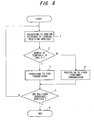
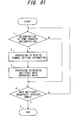
- Fig. 6 shows the process flow of the first embodiment, wherein the judgment standard is the judgment standard (i) in the earlier overview of the first invention.
- the processing may be performed by the base station 14 or may be performed by the wireless network control device 13.
- step 1 When multicast (broadcast) services have begun and the service area of the base station is divided into one or more sectors (zones), processing to confirm the existence of terminals receiving services is performed in each of these zones (step 1). Details on the terminal existence confirmation processing will be provided subsequently with reference to Fig. 9.
- step 2 It is then judged from the results of step 1 whether the number of terminals in each zone is "0" (step 2). If the number of terminals is "0", transmission stoppage processing for the wireless channel in the relevant zone is performed (step 3). Further, when the base station 14 performs transmission stoppage processing, transmission on a physical channel is stopped. Further, in cases where the wireless network control device 13 performs the transmission stoppage processing, transmission on a logical channel is stopped.
- processing to start (continue) transmission of broadcast data and multicast data on a wireless channel is performed. Further, the transmission of broadcast data and multicast data is started on a physical channel when the base station performs processing to start transmission and on a logical channel when the wireless network control device performs processing to start (continue) transmission.
- steps 1, 2, 5, and 6 may be performed by the wireless network control device 13, while steps 3 and 4 may be executed by the base station 14.
- the wireless network control device 13 performs the judgment of step 2 and then communicates the judgment results to the base station 14, whereupon the base station 14 terminates the physical channel.
- Fig. 7 shows a process flow that illustrates the operation of the terminal.
- the terminal 15 performs the following operation each time there is a call request from the base station 14 (or the wireless network control device 13). That is, terminal 15 performs reception processing in response to a call request from the base station 14 (or the wireless network control device 13) (step 1), and transmits a call response to the base station (wireless network control device) in response to a call request (step 2).
- the judgment standard is "the existence of terminals receiving a supply of services " in the first embodiment, the judgment standard may be the judgment standard (ii) in the earlier overview of the first invention.
- the judgment standard (ii) is "service quality, number of services, and number of terminals using the services (or the estimated number of terminals using services)". The lowest service quality required by each of the services is calculated and the transmission amount required to supply all the services is determined and, in cases where the transmission amount exceeds the transmission amount allocated to the multicast (broadcast), services with a small number of terminals using the services are terminated to establish a transmission amount that is equal to or below the allocated transmission amount.
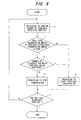
- Fig. 8 shows the process flow of the first modified example and is an example of a case where processing to confirm the number of terminals and the transmission amount required to transmit all the services is performed by the base station 14 or the wireless network control device 13.
- processing to confirm the number of terminals receiving services is performed in the zone of each sector of the base station 14 (step 1). Processing to confirm the number of terminals will be described below with reference to Fig. 10.
- step 2 It is judged whether the total transmission amount of services exceeds the total transmission amount allocated to multicast (broadcast) in a zone (step 2).
- the number of terminals for which services can be continued is judged (step 3).
- wireless-channel transmission stoppage processing is performed (step 4). Further, in cases where the base station 14 performs the transmission stoppage processing, transmission on a physical channel is terminated. Further, when the wireless network control device 13 performs the transmission stoppage processing, transmission on a logical channel is terminated.
- step 5 processing to start (continue) transmission on a wireless channel is performed (step 5).
- the transmission of broadcast data and multicast data is started on a physical channel when the base station performs processing to start transmission and on a logical channel when the wireless network control device performs processing to start (continue) transmission.
- step 6 it is judged whether multicast (broadcast) services have ended (step 6) and, when services have ended, the operation is terminated.
- steps 1, 2, 3 and 6 may be performed by the wireless network control device 13, while steps 4 and 5 may be executed by the base station 14.
- the wireless network control device 13 performs the judgment of step 2 or three and then communicates the judgment result to the base station 14, whereupon the base station 14 terminates the physical channel.
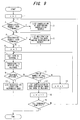
- Fig. 9 shows the process flow of terminal existence confirmation.
- the base station 14 or wireless network control device 13 sets a variable x, which indicates the reference number of the terminal in a zone existence list at 1 (step 1). Thereafter, it is judged whether there is a request to stop the supply of services from the terminal (reduction request) with respect to the zone supplying services (step 2).
- step 2 When there is a reduction request in step 2, a terminal with a reduction request is erased from the list (step 3) and the processing moves on to the processing of step 4. Thereafter, it is judged whether there has been a service supply request (registration request) from a terminal with respect to a zone supplying services (step 4). In the following three cases, it is judged that there has been a service supply request:
- step 4 When there is a registration request in step 4, a terminal for which there is a request is registered in the list and the processing moves to step 6.
- variable y which indicates the number of call repetitions in the existence processing, is set at 1 (step 6), a call from a user whose terminal reference number is x is made (step 7), response reception processing for the user with the reference number x in response to this call is performed (step 8), and it is judged whether there has been a response from the user with the reference number x (step 9).
- the terminal existence confirmation processing is stopped when a terminal exists.
- step 9 it is judged whether the call repetition number y has reached the repetition termination number (step 11). As long as the repetition termination number has not been reached, the call repetition variable y is incremented (step 12) and the processing of step 7 and subsequent steps is repeated.
- step 11 If the repetition termination number is reached in step 11, non-respondent users are erased from the list (step 13). Subsequently, the terminal reference number is incremented (step 14) and it is judged whether confirmation of the existence of all terminals has been performed (step 15). If confirmation of the existence of all terminals is not complete, the processing of step 2 and subsequent steps is repeated and, when no terminals exist when confirmation of the existence of all terminals is complete, the terminal existence confirmation processing is terminated.
- Fig. 10 shows the process flow for confirming the number of terminals.
- the processing of steps 1 to 8 is the same as the processing of steps 1 to 8 in Fig. 9.
- step 9 it is judged whether the call repetition number y has reached the repetition termination number (step 12). As long as the call termination number has not been reached, the call repetition variable y is incremented (step 13) and the processing of step 7 and subsequent steps is repeated. If the call repetition number y has reached the repetition termination number in step 12, users from which there has been no response are erased from the list (step 14).
- the second embodiment is an example in which the optimum wireless channel for transmitting broadcast data and multicast data is selected in accordance with a judgment standard.
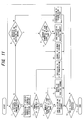
- Fig. 11 shows the process flow of the wireless network control device 13 and represents a case where the judgment standard is the judgment standard (i) of the earlier overview of the second invention (the number of terminals receiving a supply of services) and where the wireless channel selection condition is a.
- the wireless network control device 13 judges whether services are supplied on a common physical channel in the zone of each sector of the base station 14 supplying the services (step 1). If the physical channel supplying the services is a common physical channel, processing to confirm the number of terminals receiving services is performed (step 2). Subsequently, it is judged whether the number of terminals in the zone of each sector is "0" (step 3) and, if the number of terminals is not zero, it is judged whether the number of terminals in the zone is equal to or less than x1 (step 4).
- step 5 If the number of terminals is not equal to or less than x1, because there is an adequate number of terminals for supplying services on a common physical channel, the transmission on the common physical channel is continued (step 5). However, if the number of terminals is equal to or less than x1, there are an insufficient number of terminals for supplying services on a common physical channel and, therefore, a change is made to dedicated physical channels (step 6).
- step 7 transmission stoppage processing is performed (step 7).
- step 8 it is judged whether the physical channel for supplying the services is-an dedicated physical channel (step 8). If the physical channel for supplying the services is in dedicated physical channel, it is judged whether the number of terminals in the zone is equal to or more than x2 (step 9). In this case, the physical channel for supplying the services is an dedicated physical channel and the number of dedicated physical channels corresponds to the number of terminals, and, therefore, the number of terminals is found from the number of dedicated physical channels.
- step 10 If the number of terminals is equal to or more than x2, there is sufficient number of terminals for supplying services on a common physical channel and, therefore, a change is made to a common physical channel (step 10). However, if the number of terminals is not equal to or more than x2, there is inadequate number of terminals for supplying services on a common physical channel and, therefore, the supply of services on dedicated physical channels is continued (step 11).
- step 12 if the physical channel for supplying the services is not an dedicated physical channel in step 8, because all the terminals in the cell terminate services during the supply of services on dedicated physical channels, that is, because transmission stoppage is in progress, transmission stoppage is continued (step 12).
- steps 5 to 7 and 10 to 12 it is judged whether multicast (broadcast) services have ended (step 13) and, if services have not ended, the processing returns to step 1 and the processing of step 1 and subsequent steps is repeated. If services have ended, processing is terminated.
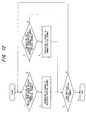
- Fig. 12 shows the process flow of a base station.
- step 1 When multicast (broadcast) services have begun, it is judged whether a change from a common physical channel to an dedicated physical channel has been instructed by the wireless network control device 13 (step 1).
- step 2 If an instruction for a change to an dedicated physical channel has been issued, processing for the change to an dedicated physical channel is performed (step 2). On the other hand, if an instruction for a change to an dedicated physical channel has not been made, it is judged whether a change from an dedicated physical channel to a common physical channel has been issued by the wireless network control device 13 (step 3).
- processing for the change to a common physical channel is performed (step 4). However, if a change to a common physical channel has not been instructed, it is considered that no instruction for a physical-channel change has been made by the wireless network control device 13.
- step 5 it is judged whether multicast (broadcast) services have ended. If services have not ended, processing returns to step 1, whereupon subsequent steps is repeated and, if services have ended, processing is terminated (step 6).
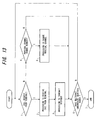
- Fig. 13 shows the process flow of the terminal.
- step 1 When multicast (broadcast) services have begun, it is judged whether a call request from the base station 14 (or the wireless network control device 13) has been made (step 1). If a call request has been made, processing to receive the call from the base station (wireless network control device) is performed (step 2) and, following reception processing, a response is transmitted to the base station (wireless network control device) (step 3).
- step 4 it is judged whether there is a physical-channel change request. If there is a physical-channel change request, processing to change the physical channel is performed (step 5).
- step 6 it is judged whether multicast (broadcast) services have ended (step 6) and, if these services have not ended, the processing returns to step 1, whereupon the processing of step 1 and subsequently steps is repeated and, if services have ended, the processing is terminated (step 7).
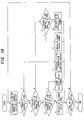
- the first modified example is a method for determining the wireless channel in a case of adopting the wireless channel selection condition b of the judgment standard (i) described in the overview of the second invention and Fig. 14 shows the process flow of the wireless network control device 13 of the first modified example.
- step 1 When multicast (broadcast) services have begun, processing to confirm the number of terminals receiving services is performed (step 1). After the processing to confirm the number of terminals receiving services has ended, it is judged whether the number of terminals in the zone of each sector is "0" (step 2). If the number of terminals is not "0", it is judged whether the logical channel for supplying the services is a common logical channel (step 3). If the logical channel for supplying the services is a common logical channel, it is judged whether the number of terminals in the zone is equal to or less than x1.
- the wireless resources can be efficiently used by supplying services on a common logical channel and, therefore, the transmission on the common logical channel is continued (step 5). However, if the number of terminals is equal to or less than x1, the wireless resources can be efficiently used by supplying services on an dedicated logical channel and, therefore, a change is made to dedicated logical channels (step 6).
- step 7 processing to stop transmission (continue stoppage) is performed (step 7). Further, if the logical channel for supplying the services is not a common logical channel in step 3, an dedicated logical channel is being used and, therefore, a judgment standard for an dedicated logical channel is used and it is judged whether the number of terminals in the zone is equal to or more than x2 (step 8).
- wireless resources can be used efficiently by supplying services on a common logical channel and, therefore, a change is made to a common logical channel (step 9).
- wireless resources can be efficiently used by supplying services on dedicated logical channels and, therefore, the supply of services on dedicated logical channels is continued (step 10).
- step 11 After the processing of steps 5 to 7 and 9 to 10, it is judged whether the multicast (broadcast) services have ended (step 11). If services have not ended, processing returns to step 1 and the processing of step 1 and subsequent steps is repeated. If services have ended, the processing is terminated.
- the second modified example is a method of determining the wireless channel in a case of adopting the judgment standard (ii) described in the overview of the second invention (the transmission power required to supply services) and Fig. 15 shows the process flow of the wireless network control device.
- step 1 processing to calculate the transmission power of all the terminals receiving services is performed.
- the processing to calculate transmission power will be described subsequently with reference to the process flow of Figs. 16 to 18.
- step 2 After the processing to calculate the transmission power has ended, it is judged whether the transmission power within the zone of each sector is 0 (step 2). If the transmission power is not 0, it is judged whether the physical channel supplying the services is a common physical channel (step 3).
- the physical channel for supplying the services is a common physical channel
- the transmission power difference within the zone that is, the common physical channel transmission power is Pc
- the dedicated physical channel transmission power is Pd
- step 7 processing to stop transmission (continue stoppage) is performed (step 7).
- step 11 it is judged whether the multicast (broadcast) services have ended. In cases where services have not ended, the processing returns to step 1 and the processing of step 1 and subsequent steps is continued. If services have ended, the processing is terminated (step 12).
- Fig. 16 shows the process flow for calculating transmission power and steps 1 to 8 are the same as those in Fig. 9.
- step 9 it is judged whether there has been a response from the terminal with the reference number x (step 9). If there has been a response from the terminal, the terminal is registered in the list and updated together with the reception power value of the reference signal of the terminal (pilot signal) (step 10). Further, the call response from the terminal includes the reported value for the reception power of the reference signal of the terminal.
- step 11 it is judged whether the call repetition number y has reached the repetition termination number. If the repetition termination number has not been reached, the call repetition variable y is incremented (step 12), and the processing returns to step 7, whereupon the processing of step 7 and subsequent steps is repeated. If the repetition termination number has been reached, users from which there has been no response are erased from the list (step 13).
- the reference number of the terminal is incremented (step 14) and it is judged whether confirmation of the existence of all terminals has been performed (step 15). If there are terminals for which the existence confirmation has not then performed, the processing returns to step 2, and the processing of step 2 and subsequent steps is repeated. If confirmation of the existence of all terminals has ended, the reception power values of the reference signals reported from the terminals are totaled to determine the transmission power when an dedicated physical channel is used (step 16). Further, the transmission power when a common physical channel is used is set beforehand.
- the third modified example is an example in which the transmission power is calculated by performing the terminal call for each group and Fig. 17 shows the process flow for calculating transmission power of the third modified example.
- the base station 14 or wireless network control device 13 performs processing to receive responses from the terminals with reference numbers x1 to x2 (step 8) and it is judged whether there has been a response from the terminals with reference numbers x1 to x2 (step 9).
- the terminal number is registered or updated in the list together with the reception power value of the reference signal of this terminal (pilot signal) (step 10). Further, the call response from the terminal includes the reception power report value of the reference signal of the terminal.
- step 11 it is judged whether there has been a response from all the terminals with reference numbers x1 to x2(step 11). If there has been a response from all the terminals x1 to x2, the processing of step 16 is performed and, if there has been no response, it is judged whether the call repetition number y has reached the repetition termination number (step 12). If the repetition termination number has not been reached, the call repetition variable y is incremented (step 13)and, among the terminals with reference numbers x1 to x2, the call data of terminals for which there has been no call response is multiplexed and transmitted to the terminals before a call is made (step 14), whereupon the processing of step 8 and subsequent steps is repeated.
- step 12 terminals from which there has been no response are erased from the list (step 15).
- grouping under reference numbers in a list was implemented above, grouping may also be implemented by means of a lower digit n for the telephone number or a lower digit n for the device number. Further, the terminal processing operation is the same as that shown in Fig. 13.
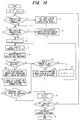
- Fig. 18 shows another process flow of the transmission power calculation processing of the third modified example. This process flow differs from the process flow in Fig. 17 in that, (1) step 14 in Fig. 17 has been removed; (2) step 21 is provided and the base station issues a reception response confirmation communication to the terminal making the call response; (3) the terminal receiving the reception response confirmation communication does not respond even when called.
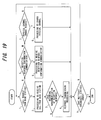
- Fig. 19 shows the process flow of the terminal of the third modified example in Fig. 18.
- step 1 When multicast (broadcast) services have begun, it is judged whether there has been a call request from the base station (step 1). If there has been a call request, processing to receive a call from the base station is performed (step 2). Subsequently, it is judged whether the received data is a call regarding the non-communication of reception response confirmation (step 3).
- a call regarding the non-communication of reception response confirmation is a call to the effect that a reception response confirmation communication has not yet been received. In the event of a call regarding the non-communication of reception response confirmation, a call response is issued to the base station (step 4).
- step 1 if there is no call request from the base station, it is judged whether there has been a reception response communication from the base station (step 5). If there has been a reception response communication, processing to receive the reception response confirmation communication is performed (step 6). However, if there has been no reception response communication, it is judged whether there has been a physical-channel change request (step 7). If there has been a physical-channel change request, processing to change the physical channel is performed (step 8).
- step 9 it is judged whether multicast (broadcast) services have ended. If the services have not ended, the processing returns a step 1 and the processing of step 1 and subsequent steps is repeated. However, if the services have ended, the processing is terminated (step 10).
- the fourth modified example is a method of determining the wireless channel in a case of adopting the judgment standard (iii) described in the overview of the second invention (the interference amount generated when services are supplied) and Fig. 20 shows the process flow of the wireless network control device.
- the terminal receiving services calculates the interference amount with respect to other communications (step 1).
- the processing to calculate the interference amount is performed by the base station or the wireless network control device 13 as detailed subsequently and the calculation results are acquired.
- step 2 After the processing to calculate the interference amount has ended, it is judged whether the number of terminals in the zone of each sector is 0 (step 2). Further, processing to confirm the number of terminals during the interference amount calculation processing is performed.
- step 3 If the number of terminals is not 0, it is judged whether the physical channel providing the services is a common physical channel (step 3).
- step 2 if the number of terminals is 0, processing to stop transmission (continue stoppage) is performed (step 7). Further, in step 3, if the physical channel for supplying the services is not a common physical channel, an dedicated physical channel is employed and, therefore, a judgment standard for an dedicated physical channel is employed and it is judged whether the interference power difference (Ic-Id) is equal to or less than -x2 (step 8).
- Ic-Id interference power difference
- step 11 After the processing of steps 5 to 7 and 9 to 10, it is judged whether the multicast (broadcast) services have ended (step 11). In cases where services have not ended, the processing returns to step 1 and the processing of step 1 and subsequent steps is continued. If services have ended, the processing is terminated.
- the processing of the base station and terminal is the same as that shown in Figs. 12 and 13.
- Fig. 21 shows the process flow of an interference amount calculation by the base station on the wireless network control device 13 and is substantially the same as the process flow for calculating the transmission power shown in Fig. 16.
- the difference lies in the fact that, in step 16, the interference power when an dedicated physical channel is employed is determined by using reception power values reported by the terminal. Further, the interference power when a common physical channel is employed is calculated by using a preset transmission power value.
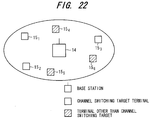
- Fig. 22 is an explanatory view of an interference power calculation.
- the items of terminals 15 4 to 15 6 which are not channel switching targets, are referenced from the list of interference power measurement values reported when all the terminals 15 1 to 15 6 communicate with the base station 14 and the interference power from the terminals 15 1 to 15 3 constituting the channel-type switching targets is calculated.
- the interference power recorded in the list is the total of (1) the interference from other cells, (2) interference from channels constituting channel-type switching targets, and (3) interference from the other channels within the cell in question.
- the interference power from other cells has a value that is dependent on the propagation loss and is determined beforehand (as the propagation loss increases, interference from the other cells increases). Further, the interference from channels constituting channel-type switching targets and the interference from the other channels within the cell in question are established by means of the ratio between the transmission powers P1 and P2 transmitted from the base station 14. Hereinabove, the interference power of channels constituting channel-type switching targets is calculated.
- the interference power recorded in the list It
- the interference power of the other cells Io
- the transmission power of channels constituting channel-type switching targets P1
- the transmission power from the other channels within the cell in question P2.
- P1 and P1' are the total of the reception power report values from reporting terminals in step 10 in Fig. 20 when the physical channel is an dedicated physical channel and are transmission power values determined beforehand by the sys tem when the physical channel is a common physical channel.
- the fifth modified example is a method of determining the wireless channel in a case of adopting the judgment standard (iv) described in the overview of the second invention (combination of services) and Fig. 23 shows the process flow of a wireless network control device.
- a list of service combinations for the common physical channel is retrieved (step 1). Subsequently, it is judged whether there is a suitable combination (step 2). For example, N broadcasting data items can be transmitted on a common physical channel and, where not all N broadcasting data items are transmitted, broadcasting data for new services can be transmitted on the common physical channel. Therefore, if there is scope in the common physical channel, it is judged that a suitable combination exists and, when there is no scope, it is judged that the combination is not a suitable combination.
- step 3 it is judged whether the physical channel supplying the services is a common physical channel (step 3). If the physical channel supplying the services is a common physical channel, the transmission on a common physical channel is continued (step 4). If the physical channel supplying the services is not a common physical channel, a change is made to a common physical channel (step 5).
- step 6 it is judged whether the number of terminals receiving new services is large or small (step 6). If the number of terminals receiving new services is large, transmission is performed on a new common physical channel (step 7). However, if the number of terminals receiving new services is small, transmission is performed on dedicated physical channels (step 8).
- step 9 it is judged whether multicast (broadcast) services have ended. If the services have not ended, the processing returns to step 1 and the processing of step 1 and subsequent steps is repeated. If the services have ended, the processing is terminated. Further, the processing of the base station and terminal is the same as that in Figs. 12 and 13.
- the third embodiment is an embodiment of a communication method in which, when a terminal receiving a supply of services has moved to a region that can be presumed to allow the terminal to receive services from another zone, the terminal issues a request to a network device to transmit broadcasting data (broadcast data or multicast data) from the other zone and the network device commences transmission on the basis of the request.
- broadcasting data broadcast data or multicast data
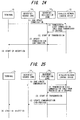
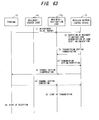
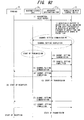
- Fig. 24 is an explanatory view of the zone-switching procedure of the third embodiment.
- Terminal 15 issues a request to start transmission by means of a zone update communication to the wireless network control device 13 via base station 14 2 of the movement-destination zone (1).
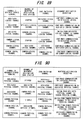
- the wireless network control device 13 issues a transmission start communication to the base station 14 2 in the movement-destination zone as shown in table 1 in accordance with the state of the movement-destination zone (only in a case where the transmission has stopped).
- the wireless network control device 13 also issues a response to a request for an update communication confirmation to terminal 15 via the movement-destination base station 14 2 ...(2).
- the base station 14 2 of the movement-destination zone starts to transmit broadcast data or multicast data in accordance with the communication from the wireless network control device 13 ... (3).
- Terminal 15 starts to receive the broadcast data or multicast data in the movement-destination zone at the time designated by the wireless network control device 13 ...(4). State of movement destination Response to terminal Communication to movement-destination zone Transmission stoppage Update communication confirmation Start of transmission Common physical channel Update communication confirmation None
- a request to start transmission by means of a zone update communication from terminal 15 is made to the wireless network control device 13 via the movement-destination base station 14 2
- a request to start transmission by means of a zone update communication can also be made to the wireless network control device 13 via the base station 14 1 of the movement-source zone as shown in Fig 25.
- Fig. 26 shows the process flow of the wireless network control device 13.
- the wireless network control device 13 judges whether there is a request for a zone update communication from the terminal 15 when multicast (broadcast) services have begun (step 1). If there is a request for a zone update communication, it is judged whether the movement-destination base station 14 2 has stopped transmission (step 2). If the movement-destination base station 14 2 has stopped transmission, the transmission start communication is transmitted to the movement-destination base station (step 3).
- step 4 Following the process of step 3 or if the movement-destination base station 14 2 has not stopped transmission in step 2 (is communicating on a common physical channel), an update communication confirmation is transmitted to terminal 15 (step 4). A short while afterward or when there is no zone update communication in step 1, it is judged whether multicast (broadcast) services have ended (step 5). If services have not ended, the processing returns to step 1 and the processing of step 1 and subsequent steps is repeated. If services have ended, the processing is terminated.
- multicast broadcast
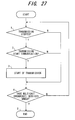
- Fig. 27 shows the process flow of the movement-destination base station.
- step 1 When multicast (broadcast) services have begun; it is judged whether transmission has stopped (step 1). If transmission has stopped, it is judged whether there is a transmission start communication from the wireless network control device 13 (step 2). If there is a transmission start communication, transmission start processing is performed (step 3).
- step 4 After the processing of step 3 has ended or in a case where transmission has not stopped in step 1 or there is no transmission start communication in step 2, it is judged whether multicast (broadcast) services have ended (step 4). If services have not ended, the processing returns to step 1 and the processing of step 1 and subsequent steps is repeated. If the services have ended, the processing is terminated.
- Fig. 28 shows the process flow of the terminal.
- step 1 When multicast (broadcast) services have begun, it is judged whether a zone update condition (described later) is fulfilled (step 1). If the zone update communication condition is fulfilled, processing to transmit a zone update communication is performed (step 2). A short while afterward, processing to receive the update communication confirmation is performed (step 3) and processing to receive multicast (broadcast) data is executed (step 4).
- a zone update condition described later
- step 5 After the processing of step 4 is complete or if the zone update communication condition is not fulfilled in step 1, it is judged were the multicast (broadcast) services have ended (step 5). If the services have not ended, the processing returns to step 1 and the processing of step 1 and subsequent steps is repeated. If the services have ended, the processing is terminated.
- the zone update communication condition is that the following two first and second conditions be fulfilled.
- the second condition is that at least one peripheral zone satisfying the following equation Qs ⁇ Qn, x(where x is one value from 1 to n) should exist continuously for a fixed time.
- the third embodiment represents a case where the wireless network control device 13 has already transmitted multicast (broadcast) data on a logical channel to each base station and the movement-destination base station 14 2 transmits the above data to the terminal in accordance with an instruction from the wireless network control device 13.
- the wireless network control device 13 has not yet transmitted multicast (broadcast) data to the movement-destination base station 14 2 and the data is transmitted to the movement-destination base station 14 2 on a logical channel in accordance with a request from the terminal and is transmitted from the base station to the terminal.
- Fig. 29 is an explanatory view of a sequence of a modified example.
- Terminal 15 issues a request to the wireless network control device 13 to start transmission by means of a zone update communication via the movement-destination base station 14 2 .
- the wireless network control device 13 receives a zone update communication, same performs processing to start transmission as shown in table 2 in accordance with the state of the movement-destination base station 14 2 . That is, if the movement-destination base station 14 2 has stopped transmission, the wireless network control device 13 issues an instruction to transmit multicast (broadcast) data to the movement-destination base station 14 2 on a logical channel and to transmit the data to the terminal. Further, the wireless network control device 13 does nothing if the movement-destination base station 14 2 is transmitting the data on a common physical channel. State of movement destination Response to terminal Communication to movement-destination zone Transmission stoppage Update communication confirmation Start of transmission Common physical channel Update communication confirmation None
- the wireless network control device 13 issues a response to the request by sending an update communication confirmation to terminal 15 via the movement-destination base station 14 2 . Thereafter, terminal 15 starts receiving broadcast data or multicast data in the movement-destination zone at the time designated by the wireless network control device 13.
- terminal 15 issues a transmission start request to the wireless network control device 13 by means of a zone update communication via the movement-destination base station 14 2 .
- a request to start transmission can also be made to the wireless network control device 13 by means of the zone update communication via the base station 14 1 of the movement-source zone.
- Fig. 31 shows the process flow of the wireless network control device of a modified example. Further, the terminal processing is the same as that of the case of the third embodiment.
- the wireless network control device 13 judges whether there is a request for a zone update communication from terminal 15 when multicast (broadcast) services have begun (step 1). If there is a request for a zone update communication, the wireless network control device 13 judges whether the movement-destination base station 14 2 has stopped transmission (step 2). If the movement-destination base station 14 2 has stopped transmission, the transmission of multicast (broadcast) data is started on the logical channel to the movement-destination base station (step 3). As a result, the movement-destination base station 14 2 maps the common logical channel to the physical channel and transmits the data on the common physical channel.
- step 4 Following the processing of step 3 or if the movement-destination base station 14 2 has not stopped transmission in step 2, an update communication confirmation message is transmitted to terminal 15 (step 4).
- step 5 A short while afterward or when there is no zone update communication in step 1, it is judged whether multicast (broadcast) services have ended (step 5). If services have not ended, the processing returns to step 1 and the processing of step 1 and subsequent steps is repeated. If services have ended, the processing is terminated.
- 'zone update communication' and 'update communication confirmation' were performed via the same base station that may also be performed via different base stations.
- a communication to the movement destination is not issued when the movement-destination base station communicates on a common wireless channel but a communication may be issued regardless of the state of the movement-destination base station.
- a common physical channel and a common logical channel were used as the channel employed in the above embodiment. However, other channels, such as dedicated physical channels, dedicated logical channels, and a common physical channel could also be employed. These modified examples are also valid for the following embodiments.
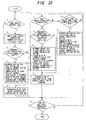
- Fig. 32 is a modified example of Figs. 25 and 30 of the third embodiment and is an embodiment in which (1) physical-channel transmission and logical-channeltransmission are both performed and in which (2) processing with respect to the movement-source zone and processing to set the user-data transmission channel are added.
- the sequence of Fig. 32 is implemented in cases where, for example, the movement-source zone 14 1 communicates on a common physical channel and a common logical channel and the movement-destination zone 14 2 does not supply services.
- this sequence can also be applied to a case where the movement-source zone 14 1 communicates on a common physical channel and a common logical channel and the movement-destination zone 14 2 also communicates on a common physical channel and a common logical channel, and to a case where the movement-destination zone communicates on a common physical channel and a common logical channel, and so forth, for example.
- terminal 15 receives setting information on the wireless channel (physical channel, logical channel) following the zone shift from the wireless network control device 13 in the form of a communication regarding zone update reservation completion via the movement-source zone 14 1 . ...(3)
- the terminal 15 sets the wireless channel on the basis of the wireless channel information that is communicated by means of the zone update reservation completion communication. ... (4), (5).
- the setting of the user-data transmission channel is completed as a result of terminal 15 setting the wireless channel, whereupon the terminal starts reception. ...(6), (7).
- terminal 15 communicates the fact that 'the logical-channel or physical-channel transmission by the v zone base station can be stopped' to the network control device 13 by means of a zone-update completion communication. ...(8), (9)
- the wireless network control device 13 which has received the communication regarding zone update completion, checks the states of the movement-source zone 14 1 and, for example, checks whether another terminal that has set the same user transmission channel as the terminal 15 performing the zone shift exists in the movement-source zone. If such a terminal does not exist, the wireless network control device issues an instruction to the movement-source base station 14 1 to stop logical-channel transmissions and physical-channel transmissions and to cancel the wireless channel....(10)
- the movement-source base station 14 1 cancels the user-data transmission channel used by the terminal 15.
- the wireless network control device 13 transmits a zone-update-completion confirmation communication, which indicates that processing for a communication regarding zone update completion of (9) is finished, to terminal 15 and terminates the serial processing. ...(12)
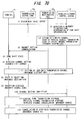
- the terminal 15 transmits a zone update reservation and, following receipt of a zone update reservation completion, in cases where terminal 15 has not moved to the reserved zone, in the following cases (i) to (iv), for example, the wireless network control device 13 cancels the reservation of multicast (broadcast) services and stops the transmission of multicast (broadcast) services of the reserved zone.
- a zone update reservation communication can also be transmitted to a plurality of movement destinations.
- a plurality of movement-destination information items is included in one message or the zone update reservation notification is transmitted dedicatedly to each of the movement destinations.
- 'zone update reservation' of (1) in Fig. 32 is communicated in cases where a plurality of zone update communications is issued, when a shift has not been made to this zone, the transmission of data of the zone to which the terminal has not moved is suspended.
- a zone update reservation is transmitted once again via the movement-destination zone 14 2 .
- the wireless network control device 13 is also able to send the zone update reservation completion of (3) to both the movement-source zone 14 1 and also the movement-destination zone 14 2 .
- the terminal receives the zone update reservation completion in the movement-source zone 14 1 prior to a zone update and in the movement-destination zone 14 2 following a zone update.
- Fig. 33 shows the process flowof the wireless network control device 13 in the sequence of Fig. 32.
- This process flow represents an embodiment in which, following the transmission of the 'zone update reservation completion', detection of the non-arrival of the terminal in the reserved zone is performed by means of a time base. When detection is unnecessary, steps 2, 6, 10, and 11 are not required and 'processing to receive a zone-update completion communication' is performed in place of step 6.
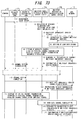
- Fig. 35 shows the process flow of terminal 15. Detection of the zone shift state can also be rendered unnecessary if the state has the same conditions as the zone update reservation conditions.
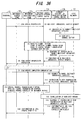
- Fig. 36 is a sequence for a case where a message is transmitted by extending a plurality of wireless network control devices 13a and 13b in the embodiment of Fig. 32.
- Fig. 37 shows the process flow for the movement-source wireless network control device 13a in the sequence of Fig. 36 and Fig. 38 shows the process flow of the movement-destination wireless network control device 13b.
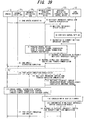
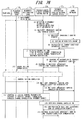
- Fig. 39 is an example of a sequence in a case where a plurality of wireless network control devices 13a and 13b is mounted in the embodiment of Fig. 32.
- Fig. 40 shows the process flow of the movement-source wireless network control device 13a of Fig. 39.
- Fig. 41 shows the process flow of the movement-destination wireless network control device 13b.
- the fourth embodiment is an embodiment in which a network device detects the fact that a terminal exists in a region that can be presumed to allow the terminal to receive services from another zone and in which the transmission of broadcast data or multicast data on a wireless channel from the other zone is started.
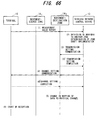
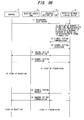
- Fig. 42 is an explanatory view of the zone-switching sequence of the fourth embodiment.
- Terminal 15 communicates a measurement value report (reception field strength and so forth) to the wireless network control device 13 via the movement-destination base station 14 2 ...(1).
- the wireless network control device 13 Upon receiving the measurement value report, the wireless network control device 13 detects the fact that the terminal has moved to another zone or is moving to another zone on the basis of the measured value from the terminal and determines zone-shift implementation ... (2). Subsequently, the wireless network control device 13 issues a communication to commence transmission to the movement-destination base station as shown in table 3 in accordance with the state of the movement-destination base station 14 2 . That is, if the movement-destination base station 14 2 has stopped transmission, the wireless network control device 13 issues an instruction to start transmission and does nothing if the movement-destination base station 14 2 is transmitting the data on a common physical channel.... (3) State of movement-destination base station Response to terminal Communication to movement-destination zone (movement-destination base station ) Transmission stoppage Channel setting communication Start of transmission Common physical channel Channel setting communication None
- the wireless network control device 13 issues a channel setting communication to terminal 15 via the movement-destination base station 14 2 ...(4).
- the movement-destination base station 14 2 commences transmission in accordance with the transmission start communication from the wireless network control device 13 ...(5).
- terminal 15 starts to receive broadcast data or multicast data in the movement-destination zone at the time designated by the wireless network control device 13 ...(6).
- a transmission start completion and channel setting completion are sent back to the wireless network control device 13 in response to the transmission start communication and channel setting communication respectively....(3)',(4)'
- a measurement value report is sent from terminal 15 to the wireless network control device 13 via the movement-destination base station 14 2 in Fig. 42
- the measurement value report can also be sent to the wireless network control device 13 via the base station 14 1 of the movement-source zone as shown in Fig. 43.
- Fig. 44 shows the process flow of the wireless network control device of the fourth embodiment.
- the wireless network control device 13 judges whether there is a measurement value report from terminal 15 when multicast (broadcast) services have begun (step 1). If there is a measurement value report, the wireless network control device 13 decides, based on the report value, whether the terminal has shifted zone and judges how the zone shift is implemented on the basis of this decision (step 2).
- step 3 it is judged whether the movement-destination base station 14 2 has stopped transmission. If the movement-destination base station has stopped transmission, a transmission start communication is transmitted to the movement-destination base station (step 4).
- step 5 Following the processing of step 4 or if the movement-destination base station has not stopped transmission in step 3 (transmission is taking place on a common physical channel), a channel setting communication is transmitted to terminal 15 (step 5).
- step 6 it is judged whether multicast (broadcast) services have ended (step 6). If services have not ended, the processing returns to step 1 and the processing of step 1 and subsequent steps is repeated. If services have ended, the processing is terminated. Further, the operation of the movement-destination base station is the same as that of the third embodiment.
- Fig. 45 shows the process flow of the terminal.
- step 1 When multicast (broadcast) services have begun, it is judged whether a measurement value report condition (described later) is fulfilled (step 1). If the measurement value report condition is fulfilled, processing to transmit a measurement value report is performed (step 2).
- step 2 receipt of a channel setting communication is awaited for a fixed time and it is judged whether the channel setting communication has been received (step 3). If a channel setting communication has been received, channel setting communication processing is performed (step 4). Subsequently, processing to receive multicast (broadcast) data in the movement-destination zone is performed (step 5).
- step 6 it is judged whether the multicast (broadcast) services have ended. If the services have not ended, the processing returns to step 1 and the processing of step 1 is and subsequent steps is repeated. If the services have ended, the processing is terminated (step 7).
- the operation of the movement-destination base station is the same as that of the third embodiment.
- Fig. 46 is an explanatory view of a measurement value report condition.
- the measurement report condition is fulfilled when the reception quality of a reference signal A in the movement-source zone deteriorates, the reception quality of a reference signal B in the movement-destination zone improves, and the reception quality in the movement-destination zone continues to be more favorable for a fixed time t or more than the reception quality in the movement-source zone.
- a measurement value report is issued to the wireless channel control device 13 via the base station 14 1 of the movement-source zone as shown in Fig. 43
- the reference-signal reception quality is raised by ⁇ x and a measurement value report can also be issued from the periphery of the region that allows multicast (broadcast) services to actually be received.
- the time required for zone switching can be extended, for example.
- the fourth embodiment represents a case where multicast (broadcast) data has already been transmitted on a logical channel to each of the base stations by the wireless network control device 13 and the movement-destination base station 14 2 transmits this data to a terminal in accordance with an instruction from the wireless network control device 13.
- the modified example represents a case where the multicast (broadcast) data has not been transmitted to the movement-destination base station 14 2 by the wireless network control device 13 and in which the data is transmitted to the movement-destination base station 14 2 on a logical channel on the basis of the measurement value report from the terminal and is then transmitted to the terminal from the base station.
- Fig. 47 is an explanatory view of a sequence of a modified example.
- Terminal 15 issues a measurement value report to the wireless network control device 13 via the movement-destination base station 14 2 ...(1).
- the wireless network control device 13 Upon receiving the measurement value report, the wireless network control device 13 detects the fact that the terminal has moved to another zone or is moving to another zone on the basis of the measurement value from terminal 15 and determines the zone shift implementation ...(2).
- the wireless network control device 13 performs processing to commence transmission as shown in table 4 in accordance with the state of the movement destination...(3). That is, if the movement-destination base station 14 2 has stopped transmission, the wireless network control device 13 issues an instruction to the base station to transmit multicast (broadcast) data to the movement-destination base station 14 2 on a logical channel and to transmit the data to the terminal. Further, the wireless network control device 13 does nothing if the movement-destination base station 14 2 is transmitting the data on the common physical channel.
- the wireless network control device 13 issues a channel setting communication to terminal 15 via the movement-destination base station 14 2 ...(4).
- terminal 15 starts reception in the movement-destination zone at the time designated by the wireless network control device 13.
- the measurement value report is transmitted from terminal 15 to the wireless network control device 13 via the movement-destination base station 14 2 in Fig. 47, the measurement value report can also be issued to the wireless network control device 13 via the base station 14 1 in the movement-source zone as shown in Fig. 48.
- Fig. 49 shows the process flow of the wireless network control device of a modified example.
- This process flow is substantially the same as the process flow of the embodiment in Fig. 44 but the difference lies in the processing of step 4.
- step 4 of the embodiment if the movement-destination base station 14 2 has stopped transmission, the wireless network control device transmits a transmission start communication to the movement-destination base station. However, in the case of the modified example, transmission to the movement-destination base station is started. That is, if the movement-destination base station 14 2 has stopped transmission, the wireless network control device issues an instruction to the base station to transmit multicast (broadcast) data to the movement-destination base station 14 2 on a logical channel and to transmit the data to the terminal.
- multicast multicast
- the fifth embodiment is an embodiment in which, when a terminal receiving a supply of services is in a region that can be presumed to allow the terminal to receive services from another zone, the terminal issues a request to a network device for a wireless channel for supplying the services from the other zone and the network device communicates by allocating a wireless channel.
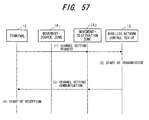
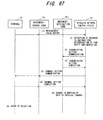
- Fig. 50 is an explanatory view of the zone-switching procedure of the fifth embodiment.
- Terminal 15 issues a request for wireless resources to the wireless network control device 13 by means of a channel setting request via the movement-destination base station 14 2 ...(1).
- the wireless network control device 13 Upon receiving the channel setting request, the wireless network control device 13 issues a channel setting communication to the movement-destination base station 14 2 as shown in table 5 in accordance with the state of the movement-destination base station...(2). Further, a response is made to the request by transmitting a channel setting communication to the terminal via the movement-destination base station...(2).
- the movement-destination base station 14 2 starts to transmit to the terminal on the channel that corresponds with the communication from the wireless network control device 13 (an dedicated physical channel or common physical channel)...(3).
- Terminal 15 starts to receive multicast data or broadcast data in the movement-destination zone at the time designated by the wireless network control device 13 ...(4).
- State of terminal State of movement destination Terminal operation Response to terminal Communication to movement-destination zone Dedicated physical channel Stopped Request to wireless network control device for wireless resources Channel setting communication Channel setting communication Dedicated physical channel Dedicated physical channel Request to wireless network control device for wireless resources Channel setting communication Channel setting communication Dedicated physical channel Common physical channel Request to wireless network control device for wireless resources Channel setting communication Channel setting communication Common physical channel Stopped Request to wireless network control device for wireless resources Channel setting communication Channel setting communication Common physical channel Dedicated physical channel Request to wireless network control device for wireless resources Channel setting communication Channel setting communication Common physical channel Common physical channel Request to wireless network control device for wireless resources Channel setting communication Channel setting communication Common physical channel Common physical channel Request to wireless network control device for wireless resources Channel setting communication Channel setting communication Channel setting communication Channel setting communication Channel setting communication
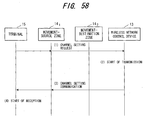
- a channel setting request is sent from terminal 15 to the wireless network control device 13 via the movement-destination base station 14 2 in Fig. 50
- the channel setting request can also be sent to the wireless network control device 13 via the base station 14 1 in the movement-source zone as shown in Fig. 51.
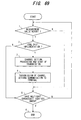
- Fig. 52 shows the process flow of the wireless network control device of the fifth embodiment.
- the wireless network control device 13 judges whether there is a channel setting request from terminal 15 when multicast (broadcast) services have begun (step 1). If there is a channel setting request, the wireless network control device 13 transmits a channel setting communication to the movement-destination base station 14 2 (step 2). As a result, the movement-destination base station 14 2 transmits multicast data or broadcast data to the terminal on the channel thus set (dedicated physical channel or common physical channel).
- the wireless network control device 13 transmits a channel setting communication to the terminal 15 (step 3).
- step 4 the processing returns to step 1 and the processing of step 1 and subsequent steps is repeated. If services have ended, the processing is terminated (step 5).
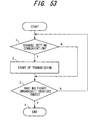
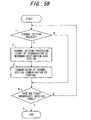
- Fig. 53 shows the process flow of the movement-destination base station.
- the movement-destination base station 14 2 judges whether there has been a channel setting communication from the wireless network control device 13 when multicast (broadcast) services have begun (step 1). If there is a channel setting communication, the movement-destination base station 14 2 performs channel setting processing and commences transmission (step 2). That is, the movement-destination base station 14 2 transmits multicast data or broadcast data to the terminal on the channel thus set (dedicated physical channel or common physical channel).
- step 3 Following the end of the processing of step 2 or when there is no channel setting communication in step 1, it is judged whether multicast (broadcast) services have ended (step 3). If services have not ended, the processing returns to step 1 and the processing of step 1 and subsequent steps is repeated. If services have ended, the processing is terminated (step 4).
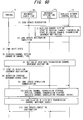
- the movement-destination base station 14 2 relays a channel setting communication to the terminal together with the channel setting request from terminal 15.
- Fig. 54 shows the process flow of the terminal.
- Terminal 15 judges whether the channel setting request condition is fulfilled when multicast (broadcast) services have begun (step 1). If the channel setting request condition is fulfilled, terminal 15 performs processing to transmit a channel setting request (step 2). Subsequently, terminal 15 performs processing to receive a channel setting communication (step 3). After receiving the channel setting communication, terminal 15 performs processing to receive multicast (broadcast) data on the channel thus set (dedicated physical channel or common physical channel) (step 4).
- step 5 the processing returns to step 1 and the processing of step 1 and subsequent steps is repeated. If services have ended, the process is terminated (step 6).
- the channel setting request condition in step 1 is the same as the 'zone update communication condition' of the third embodiment.
- Figs. 55 and 56 represent embodiments in which, in the sequences of Figs. 50 and 51 respectively, terminal 15 switches a physical channel receiving a supply of multicast (broadcast) services between physical channels of a plurality of types when a plurality of physical channels is set at the same time.
- the difference lies in the fact that, in Figs. 55 and 56, 'start of transmission' of procedure (3) in the sequences of Figs. 50 and 51 has been changed to 'change in mapping of data to physical channel'. That is, in Figs. 55 and 56, the movement-destination zone 14 2 transmits multicast (broadcast) data to terminal 15 by mapping the data to different channel types in accordance with a channel setting communication.
- the fifth embodiment represents a case where multicast (broadcast) data has already been transmitted on a logical channel to each of the base stations by the wireless network control device 13 and in which the movement-destination base station 14 2 transmits the data to the terminal in accordance with an instruction from a wireless network control device 13.
- multicast (broadcast) data is not transmitted to the movement-destination base station 14 2 by the wireless network control device 13 and the data is transmitted to the movement-destination base station 14 2 on a logical channel on the basis of the channel setting request from the terminal before being transmitted from the base station to the terminal.
- Fig. 57 is an explanatory view of the zone-switching procedure of a modified example.
- Terminal 15 issues a request for wireless resources to the wireless network control device 13 by means of a channel setting request via the movement-destination base station 14 2 ...(1).
- the wireless network control device 13 Upon receiving the channel setting request, the wireless network control device 13 sets the channel of the movement-destination base station 14 2 as shown in table 6 in accordance with the state of the movement-destination base station and performs transmission...(2). That is, if the movement-destination base station 14 2 has stopped transmission, an instruction is sent to the base station to transmit multicast (broadcast) data to the movement-destination base station 14 2 on a logical channel and to transmit the data to the terminal. The movement-destination base station 14 2 then starts to transmit to the terminal on the channel corresponding with the communication from the wireless network control device 13 (dedicated physical channel or common physical channel).
- the wireless network control device 13 sends the channel setting communication to terminal 15 as per table 6 in accordance with the state of the movement-destination base station...(3).
- Terminal 15 starts to receive broadcast data or multicast data in the movement-destination zone at the time designated by the wireless network control device 13...(4).
- State of terminal State of movement destination Terminal operation Response to terminal Settings for movement-destination zone Dedicated logical channel Stopped Request to wireless network control device for wireless resources Channel setting communication Channel setting, transmission Dedicated logical channel Dedicated logical channel Request to wireless network control device for wireless resources Channel setting communication Channel setting, transmission Dedicated logical channel Common logical channel Request to wireless network control device for wireless resources Channel setting communication None Common logical channel Stopped Request to wireless network control device for wireless resources Channel setting communication Channel setting, transmission Common logical channel Dedicated logical channel Request to wireless network control device for wireless resources Channel setting communication Channel setting, transmission Common physical channel Common physical channel Request to wireless network control device for wireless resources Channel setting communication None
- a channel setting request is sent from terminal 15 to the wireless network control device 13 via the movement-destination base station 14 2
- the channel setting request can also be sent to the wireless network control device 13 via the base station 14 1 of the movement-source zone as shown in Fig 58.
- Fig. 59 shows the process flow of the wireless network control device of a modified example.
- the wireless network control device 13 judges whether there is a channel setting request from the terminal when multicast (broadcast) services have begun (step 1). If there is a channel setting request, the wireless network control device 13 performs channel setting processing for the movement-destination base station 14 2 and commences transmission. That is, if the movement-destination base station 14 2 has stopped transmission, the wireless network control device 13 issues an instruction to the base station to transmit multicast (broadcast) data to the movement-destination base station 14 2 on a logical channel and to transmit the data to the terminal. The movement-destination base station 14 2 then starts to transmit to the terminal on the channel set by the wireless network control device 13 (dedicated logical channel or common logical channel).
- the wireless network control device 13 also transmits a channel setting communication to terminal 15 (step 3).
- step 4 it is judged whether multicast (broadcast) services have ended. If services have not ended, the processing returns to step 1 and the processing of step 1 and subsequent steps is repeated. If services have ended, the processing is terminated (step 5).
- Fig. 60 is a modified example of Figs. 51 and 58 of the fifth embodiment and represents an embodiment in which (1) physical-channel transmission and logical-channel transmission are both performed and in which (2) processing for the movement-source zone and processing to set the user-data transmission channel have been added.
- the sequence of Fig. 60 can also be applied to a case where, for example, the movement-source zone 14 1 communicates on a common physical channel and a common logical channel and the movement-destination zone 14 2 does not supply services or to a case where terminal 15 communicates on an dedicated physical channel and an dedicated logical channel at the movement destination when services are supplied on an dedicated physical channel.
- Fig. 61 shows the process flowof the wireless network control device 13 in the sequence of Fig. 60, wherein the part of step 3 in Fig. 33 has become steps 3 and 3'.
- Fig. 33 shows the operation of the wireless network control device 13 in a case where two states in which the movement-destination base station 14 1 is transmitting and not transmitting are captured. Hence, the judgment of the state of the movement-destination base station is 'whether transmission has stopped'.
- processing to judge whether services are being supplied on a wireless channel that is different from the wireless channel being used for transmission by the movement-destination base station as shown in step 3' is required and added.
- the operation of the movement-source base station 14 1 in the sequence of Fig. 60 performs the following operations in addition to the operation of the movement-source base station 14 1 in Fig. 34:
- Fig. 62 shows the process flow of terminal 15 in the sequence of Fig. 60 and differs from the process flow of Fig. 35 as a result of the addition of processing to change the channel type in step 5.
- the sequence in a case where a plurality of wireless network channels 13a and 13b is mounted in the embodiment of Fig. 60 performs a sequence that is the same as that of the third embodiment and the second modified example of (e-2-2).
- procedure (2) of Fig. 60 is executed in procedure (5) in this sequence
- procedures (4) to (8) of Fig. 60 are executed in procedure (9) in this sequence
- procedure (10) of Fig. 60 is performed in procedure (12) in this sequence.
- a sequence of a case where a plurality of wireless network channels 13a and 13b is mounted in the embodiment in Fig. 60 performs a sequence that is the same as that of the third embodiment and the third modified example of (e-2-3).
- procedure (2) of Fig. 60 is executed in procedure (4) in this sequence
- procedures (4) to (8) of Fig. 60 are executed in procedure (9) in this sequence
- procedure (10) of Fig. 60 is performed in procedure (13) in this sequence.
- the sixth embodiment is an embodiment of a mobile communication system in which a network device detects measurement results from a terminal receiving a supply of services or detects, from a report value, that the terminal exists in a region that can be presumed to allow the terminal to receive services from another zone, and sets the wireless channel to communicate on the wireless channel.
- Fig. 63 is an explanatory view of the zone-switching procedure of the sixth embodiment.
- Terminal 15 sends a measurement value report to the wireless network control device 13 via the mobile destination base station 14 2 ...(1).
- the wireless network control device 13 detects the fact that the terminal has moved to another zone or is moving to another zone on the basis of the measurement value from the terminal and determines the implementation of zone shift control ...(2).
- the wireless network control device 13 sends a channel setting communication to the movement-destination base station as shown in table 7 in accordance with the state of the movement-destination base station 14 2 ...(3).
- the wireless network control device 13 sends a channel setting communication to terminal 15 via the movement-destination base station...(4).
- the movement-destination base station 14 2 starts to transmit broadcast data or multicast data to the terminal in accordance with the channel communication from the wireless network control device 13...(5).
- Terminal 15 starts to receive the data in the movement-destination zone at the time designated by the wireless network control device 13.
- State of terminal State of movement destination Terminal operation Response to terminal Communication to movement-destination zone Dedicated physical channel Stopped Measurement value report to wireless network control device Channel setting communication Channel setting communication Dedicated physical channel Dedicated physical channel Measurement value report to wireless network control device Channel setting communication Channel setting communication Dedicated physical channel Common physical channel Measurement value report to wireless network control device Channel setting communication Channel setting communication Common physical channel Stopped Measurement value report to wireless network control device Channel setting communication Channel setting communication Common physical channel Dedicated physical channel Measurement value report to wireless network control device Channel setting communication Channel setting communication Common physical channel Common physical channel Measurement value report to wireless network control device Channel setting communication Channel setting communication Common physical channel Common physical channel Measurement value report to wireless network control device Channel setting communication Channel setting communication Channel setting communication
- a channel setting request can also be sent to the wireless network control device 13 via the base station 14 1 of the movement-source zone as shown in Fig. 64.
- Fig. 65 shows the process flow of the wireless network control device of the sixth embodiment.
- the process flow of the movement-destination base station is the same as the process flow of the fifth embodiment (Fig. 53) and the process flow of the terminal is the same as the process flow of the fourth embodiment (Fig. 45).
- the wireless network control device 13 judges whether there is a measurement value report from terminal 15 when multicast (broadcast) services have begun (step 1). If there is a measurement value report, the wireless network control device 13 judges how to implement zone shift control on the basis of the reported value (step 2).
- the measurement value report condition is the same as the condition of the fourth embodiment.
- the wireless network control device transmits a channel setting communication to the movement-destination base station 14 2 (step 3).
- the movement-destination base station 14 2 starts to transmit broadcast data or multicast data to the terminal on the channel set by the wireless network control device 13 (dedicated physical channel or common physical channel).
- the wireless network control device 13 transmits a channel setting communication to the terminal (step 4).
- terminal 15 is able to receive broadcast data or multicast data on the channel thus set (dedicated physical channel or common physical channel).
- step 5 After the processing of step 4, or if there is no measurement value report in step 1 or implementation of the zone shift is not determined in step 2, it is judged whether multicast (broadcast) services have ended (step 5). If the services have not ended, the processing returns to step 1 and the processing of step 1 and subsequent steps is repeated. If services have ended, the processing is terminated (step 6).
- Figs. 66 and 67 are embodiments in which a physical channel receiving a supply of multicast (broadcast) services is switched between physical channels of a plurality of types in the sequence of Figs. 63 and 64.
- the difference lies in the fact that, in Figs. 66 and 67, 'start of transmission' in the procedure (5) of the sequence of Figs. 63 and 64 has been changed to 'change in mapping of data to physical channel'. That is, in Figs. 66 and 67, when terminal 15 simultaneously sets a plurality of physical channels, the movement-destination zone 14 2 maps multicast (broadcast) data with different channel types in accordance with the channel setting communication before sending the data to terminal 15.
- the sixth embodiment represents a case where multicast (broadcast) data has already been transmitted on a logical channel to each of the base stations by the wireless network control device 13 and in which the movement-destination base station 14 2 transmits the data to the terminal in accordance with a channel setting communication from the wireless network control device 13.
- the wireless network control device 13 has not yet transmitted multicast (broadcast) data to the movement-destination base station 14 2 and the data is transmitted to the movement-destination base station base station 14 2 on a logical channel on the basis of the measurement value report from the terminal before being transmitted from the base station to the terminal.
- Fig. 68 is an explanatory view of the zone-switching procedure of a modified example.
- Terminal 15 transmits a measurement value report to the wireless network control device 13 via the movement-destination base station 14 2 ...(1).
- the wireless network control device 13 Upon receiving the measurement value report, the wireless network control device 13 detects the fact that the terminal has moved to another zone or is moving to another zone on the basis of the measurement value from terminal 15 and determines the implementation of the zone shift...(2).
- the wireless network control device 13 performs processing to start transmission as shown in table 8 in accordance with the state of the movement-destination base station...(3). That is, if the movement-destination base station 14 2 has stopped transmission, the wireless network control device 13 instructs the base station to transmit multicast (broadcast) data to the movement-destination base station 14 2 on a logical channel and to start transmitting the data to the terminal.
- the wireless network control device 13 issues a channel setting communication to terminal 15 via the movement-destination base station 14 2 ...(4).
- terminal 15 starts to receive data in the movement-destination zone at the time designated by the wireless network control device 13...(5).
- State of terminal State of movement destination Terminal operation Response to terminal Settings for movement-destination zone Dedicated logical channel Stopped Measurement value report to wireless network control device Channel setting communication Channel setting, transmission Dedicated logical channel Dedicated logical channel Measurement value report to wireless network control device Channel setting communication Channel setting, transmission Dedicated logical channel Common logical channel Measurement value report to wireless network control device Channel setting communication None Common logical channel Stopped Measurement value report to wireless network control device Channel setting communication Start of transmission Common logical channel Dedicated logical channel Measurement value report to wireless network control device Channel setting communication Channel setting, transmission Common logical channel Common logical channel Measurement value report to wireless network control device Channel setting communication None
- Fig. 69 shows the process flow of the wireless network control device of a modified example.
- the wireless network control device 13 judges whether there are measurement report values from terminal 15 when multicast (broadcast) services have begun (step 1). If there are measurement report values, the wireless network control device 13 judges how to implement zone shift control on the basis of the report values (step 2). When implementation of zone shift control has been determined, channel setting processing is performed and transmission is started (step 3). A short while afterward, a channel setting communication is transmitted to terminal 15 (step 4).
- step 5 it is judged whether multicast (broadcast) services have ended. If services have not ended, the processing returns to step 1 and the processing of step 1 and subsequent steps is repeated. If services have ended, the processing is terminated (step 6).
- Fig. 70 is a modified example of Figs. 64 and 68 of the sixth embodiment and is an embodiment where (1) physical-channel transmission and logical-channel transmission are both performed and in which (2) processing for the movement-source zone and processing to set the user-data transmission channel are added. Further, where logical-channel transmission is concerned, although terminal 15 sends and receives messages to and from the wireless network control device 13 via the movement-destination zone 14 2 in Fig. 68, messages are sent and received to and from the wireless network control device 13 via the movement-source zone 14 1 in the modified example.
- the sequence of Fig. 70 is implemented in a case where, for example, when the movement-source zone 14 1 communicates on an dedicated physical channel and an dedicated logical channel and the movement-destination zone 14 2 communicates on a common physical channel and a common logical channel, communication takes place on a common physical channel and a common logical channel at the movement destination. Further, this sequence can also be applied to a case where the movement-source zone 14 1 communicates on an dedicated physical channel and an dedicated logical channel and communication takes place on a common physical channel and a common logical channel at the movement destination when the movement-destination zone 14 2 does not supply services, for example.
- terminal 15 receives setting information on the wireless channel (physical channel, logical channel) following the zone shift by means of a channel setting communication from the wireless network control device 13...(4).
- Terminal 15 checks the zone shift state and confirms the fact that the movement-destination zone 14 2 has entered a state where data can be received. ...(5)
- a wireless channel that is different from the channel type of the movement source is set in accordance with wireless channel information that is communicated by means of the channel setting communication.
- terminal 15 communicates the fact that 'it is possible to stop the logical-channel and physical-channel transmission by the mobile source base station' to the network control device 13 by means of a channel setting completion communication. ...(9), (10)
- the wireless network control device 13 which has received the channel setting completion communication, checks the state of the movement-source zone 14 1 , for example, checks for the existence in the movement-source zone 14 1 of another terminal that is performing the same user transmission channel settings as the terminal 15 making the zone shift and, if no such terminal is present, stops logical-channel transmission and physical-channel transmission and cancels the wireless channel. ...(11)
- Fig. 71 shows the process flow of the wireless network control device 13 in the sequence of Fig. 70.
- the operation of the movement-source base station 14 1 in the sequence of Fig. 70 is the same as the processing of the movement-source base station in Fig. 34. However, this sequence further comprises a function to transmit the 'measurement value report' from terminal 15 to the wireless network control device 13 in procedure (1) and a function to transmit a 'channel setting communication' from the wireless network control device to terminal 15 in procedure (4).
- Fig. 73 is an example of a sequence in a case where a message is transmitted by mounting a plurality of wireless network control devices 13a and 13b in the embodiment in Fig. 70.
- an operation that is the same as the sequence of Fig. 36 is performed with the exception of the following points:
- Fig. 74 shows the process flow of the movement-source wireless network control device 13a in the sequence of Fig. 73 and Fig. 75 shows the process flow of the movement-destination wireless network control device 13b in the sequence of Fig. 73.
- Fig. 76 is an example of a sequence in a case where a message is transmitted by extending a plurality of wireless network control devices 13a and 13b in the embodiment of Fig. 70.
- an operation that is the same as the sequence of Fig. 42 with the exception of the following points is performed.
- Fig. 77 shows the process flow of the movement-source wireless network control device 13a in the sequence of Fig. 76 and Fig. 78 shows the process flow of the movement-destination wireless network control device 13b in the sequence of Fig. 76.
- the seventh embodiment is an embodiment of a mobile communication system in which, when a terminal receiving a supply of services exists in a region that can be presumed to allow the terminal to receive services from another zone, the wireless channel of the movement-destination base station captured beforehand is employed and a change is made to the wireless channel of the movement-destination base station to receive the supply of services.
- Fig. 79 is an explanatory view of the zone-switching procedure of a seventh embodiment.
- the wireless network control device 13 reports channel setting information from each zone to the terminal via each base station ...(1).
- Terminal 15 determines zone shift implementation when the zone update condition is fulfilled... (2). Subsequently, terminal 15 receives channel setting information that has been reported by the wireless network control device 13 via the movement-destination base station 14 2 ...(3).
- the channel setting information includes a predetermined common wireless channel that corresponds with table 9 from a combination of wireless channel types of the movement-source base stations 14 1 and 14 2 .
- terminal 15 commences reception in the moving destination zone in accordance with the channel setting information designated by the wireless network control device 13.
- State of terminal (movement source) State of movement destination Operation of terminal Common wireless channel (common physical channel, common logical channel)
- Common wireless channel common physical channel, common logical channel) Change to settings of common wireless channel recorded in channel setting information (common physical channel, common logical channel)
- channel setting information is reported to the terminal by the wireless network control device 13 via the movement-destination base station 14 2 in Fig. 79
- the channel setting information can also be reported via the base station 14 1 of the movement-source zone as shown in Fig. 80.
- Fig. 81 shows the process flow of the terminal of the seventh embodiment.
- Terminal 15 performs the same judgment as 'zone update communication condition' of the third embodiment, for example, and judges how to implement zone shift control (step 1).
- zone shift control processing to receive the channel setting information is performed (step 2) and processing to receive multicast (broadcast) data is performed on the basis of the wireless channel that is set by means of channel setting information (step 3).
- step 4 the processing returns to step 1 and the processing of step 1 and subsequent steps is repeated. If services have ended, the processing is terminated (step 5).
- the eighth embodiment is an embodiment of a mobile communication system in which, when a terminal receiving a supply of services move to another zone, the terminal performs the zone movement by switching the wireless channel to the channel type established by the system and, after the terminal has moved to the other zone, the terminal changes to the channel type for supplying services in the other zone.
- Fig. 82 The rules during the zone switching established by the system are shown in Fig. 82. This constitutes an example in which a terminal is always switched to an dedicated physical channel during zone switching.
- Fig. 83 rules for channel switching following zone switching are shown in Fig. 83. If the movement-destination base station has stopped, after performing the zone movement, the terminal continues to communicate with the movement-destination base station on an dedicated physical channel. Further, if the movement-destination base station is communicating on an dedicated physical channel, the terminal continues to communicate with the movement-destination base station on an dedicated physical channel after performing the zone movement. Further, if the movement-destination base station is communicating on a common physical channel, the terminal continues to communicate with the movement-destination base station on the common physical channel by switching from an dedicated physical channel to the common physical channel.
- Fig. 84 is an explanatory view of the zone-switching procedure of the eighth embodiment when the broadcast channel of the movement-source terminal is an dedicated physical channel. This procedure is similar to the procedure of the sixth embodiment.
- Terminal 15 sends a measurement value report to the wireless network control device 13 via the movement-destination base station 14 2 ...(1).
- the wireless network control device 13 detects the fact that the terminal has moved to another zone or is moving to another zone based on measurement value from the terminal and determines implementation of zone shift control and determines the implementation of zone shift control...(2). Subsequently, the wireless network control device 13 communicates the settings of the dedicated physical channel to the movement-destination base station 14 2 . Further, if the movement-destination base station 14 2 is communicating with another terminal on a predetermined channel as shown in Fig. 82, the movement-destination base station 14 2 continues to communicate with the other terminal in this state...(3).
- the wireless network control device 13 communicates the settings of the dedicated physical channel to terminal 15 as shown in Fig. 82 via the movement-destination base station...(4).
- the movement-destination base station 14 2 transmits broadcast data or multicast data to the terminal on an dedicated physical channel that is communicated by the wireless network control device 13...(5).
- Terminal 15 starts to receive the data in the movement-destination zone at the time designated by the wireless network control device 13...(6).
- the wireless network control device 13 switches the communication channel of terminal 15 to the communication channel of the movement-destination base station 14 2 as shown in Fig. 83 by sending a channel setting communication to terminal 15...(7).
- the wireless network control device 13 sets the common physical channel in terminal 15 by means of the channel setting communication and, thereafter, the movement-destination base station 14 2 transmits the data to all the terminals on the common physical channel.
- the eighth embodiment when it takes time to afford the movement-destination base station 14 2 and terminal 15 the same physical channel, communications between the movement-destination base station 14 2 and terminal 15 are first continued by connecting same by means of an dedicated physical channel and, thereafter, the time-consuming processing to render the channels the same can be performed. As a result, broadcast services are not cut off. That is, the terminal is able to perform zone switching with continued service.
- Fig. 85 is another explanatory view of the zone switching procedure of the eighth embodiment when the broadcast channel of the movement-source terminal is a common physical channel. The procedure is the same as the procedure of the fifth embodiment.
- Terminal 15 transmits a channel setting request to the wireless network control device 13 via the movement-destination base station 14 2 upon detecting zone movement...(1).
- the wireless network control device 13 Upon receiving the channel setting request, the wireless network control device 13 communicates the settings of an dedicated physical channel to the movement-destination base station 14 2 . Further, if the movement-destination base station 14 2 is communicating with another terminal on a predetermined channel as shown in Fig. 82, communications with the other terminal are continued in this state...(2). Further, the wireless network control device 13 communicates the settings of an dedicated physical channel to terminal 15 as shown in Fig. 82 via the movement-destination base station...(2).
- the movement-destination base station 14 2 transmits broadcast data or multicast data to the terminal on an dedicated physical channel that is communicated by the wireless network control device 13...(3).
- the terminal 15 starts to receive the data in the movement-destination zone at the time designated by the wireless network control device 13...(4).
- the wireless network control device 13 switches the communication channel of the terminal 15 as shown in Fig. 83 to the communication channel of the movement-destination base station 14 2 by sending a channel setting communication to terminal 15...(5).
- the wireless network control device 13 sets a common physical channel for the terminal 15 by means of the channel setting communication. Thereafter, the movement-destination base station 14 2 transmits the data to all the terminals on the common physical channel.
- the terminal when a terminal that is receiving a supply of services moves to another zone, the terminal performs the zone movement by switching the wireless channel to a channel type that is established by the system, requests the channel type for receiving a supply of services in the movement destination, communicates the wireless channel type whereby a network device supplies services to the terminal in the other zone and, after the terminal has moved to the other zone, changes to the channel type for supplying services in the other zone.
- the terminal is able to perform zone switching with continued service.
- Fig. 86 This constitutes an example in which a terminal is always switched to an dedicated logical channel. Further, rules for channel switching following zone switching are shown in Fig. 87.
- Fig. 88 This constitutes an example in which the terminal is switched to a common physical channel only when the movement-destination base station 14 2 is serviced on a common physical channel and where the terminal is otherwise switched to an dedicated physical channel.
- the channel-type switching of this modified example can be implemented by means of the same procedure as the procedure shown in the eighth embodiment.
- Fig. 89 This constitutes an example in which the terminal is switched to a common logical channel only when the movement-destination base station is serviced on a common logical channel and where the terminal is otherwise switched to an dedicated logical channel.
- Fig. 90 This constitutes an example in which zone switching is performed by means of the movement-source channel.
- the channel-type switching of this modified example can be implemented by means of the same procedure as the procedure shown in the eighth embodiment.
- Fig. 91 Rules during zone switching established by the system and rules for channel switching following zone switching are shown in Fig. 91. This constitutes an example in which the terminal performs zone switching by means of the movement-source channel.
- the eighth embodiment when it takes time to afford the movement-destination base station and the terminal the same wireless channel, communications between the movement-destination base station and the terminal are first continued by connecting same by means of a wireless channel established by the system and, thereafter, the time-consuming processing to render the channels the same can be performed. As a result, broadcast services are not cut off.
- a zone shift can be performed regardless of the type of the physical channel for supplying the services by means of the movement-source base station 14 1 and movement-destination base station 14 2 .
- a zone shift can be executed on a channel that possesses the characteristic of not being susceptible to the interruption of data in the communication system or a channel that allows wireless resources in the periphery of the zone to the used efficiently, and so forth, whereby services can be improved and the system usage efficiency can be increased.
- the procedure of (2) 'detecting movement to another zone and determining zone shift implementation' in Fig. 84 is a procedure known as (2) 'other zone periphery movement detection and channel-type change determination'.
- the 'channel setting request' of procedure (1) in Fig. 85 can also be transmitted by terminal 15 upon detection of arrival in the periphery of the other zone.
- the settings for the movement-source zone 14 1 can also be made at the same time as or prior to the channel settings for the movement-destination zone 14 2 .
- terminal 15 can also issue a 'measurement value report' that constitutes a trigger for issuing the 'channel setting communication' of procedure (7) between procedures (6) and (7) in Fig. 84.
- terminal 15 can also issue a 'measurement value report' that constitutes a trigger for issuing the 'channel setting communication' of procedure (5) between procedures (4) and (5) in Fig. 85.
- the constitution can be such that terminal 15 issues the 'channel setting request' of procedure (8) and the wireless network control device 13 issues the channel setting communication of (9) after procedure (6) of Fig. 84 and procedure (4) of Fig. 85 respectively.
- Figs. 84 and 85 are examples in which a zone shift takes place via movement-destination zone 14 2 when movement is from the movement-source zone 14 1 to movement-destination zone 14 2 but can instead take place via the movement-source zone 14 1 .
- the ninth embodiment is an embodiment a system that performs a broadcast or multicast by means of a predetermined method (the third to seventh embodiments) in accordance with the channel type, transmission state, and transmission stoppage state of the wireless channel for supplying the services of the movement destination, as well as the channel type of the wireless channel of the terminal receiving a supply of services.
- the table in Fig. 98 shows how to implement (1) the channel of communication to the terminal and (2) any of the methods of the third to seventh embodiments in correspondence with a combination of channel types of the movement source and movement destination.
- the system performs a broadcast or multicast in accordance with any of the methods of the third to seventh embodiments on the basis of the combination of channel types of the movement source and movement destination.
- the tenth embodiment is an embodiment in which the channel type, transmission state, and transmission stoppage state of the wireless channel for supplying the services of the movement destination is reported by the movement-destination base station 14 2 .
- Fig. 99 providesaconceptualview.
- Fig. 100 shows an example of the constitution of report information.
- the base station manages, for each service, (1) the transmission state (transmission in progress, transmission stopped), (2) the supply channel, (3) the wireless resources (frequency, spread code, time slot) and then creates and reports the table in Fig. 100.
- the eleventh embodiment is an example where the channel type, transmission state, and transmission stoppage state of the wireless channel supplying the services of the movement source are reported by the movement-source base station 14 1 .
- Fig. 101 provides a conceptual view.
- Fig. 102 shows an example of the constitution of report information.
- Each base station manages, for each of the services of adjacent zones, (1) the transmission state (transmission in progress, transmission stopped), (2) the supply channel, (3)the wireless resources (frequency, spread code, time slot) and then creates and reports the table in Fig. 102.
- the service area of the base station was one zone or an area established by dividing the service area into a plurality of zones constituted a zone
- a variety of zone definitions can be considered.
- the service areas of one or more base stations can be combined to establish one zone or an area established by dividing the service area into a plurality of zones can constitute a zone.
- a judgment standard (the existence of a terminal receiving a supply of services, for example) is established for one zone within a service area or for each zone divided into a plurality of zones and broadcast data or multicast data is not transmitted by the base station to a zone that does not satisfy the standard (in which a terminal is not present). Therefore, when the standard is not satisfied in one zone, broadcast data and multicast data are not transmitted, meaning that the wireless resources in the zone can be used efficiently.
- the data is transmitted on the wireless channel from the base station on the basis of the request, or it is detected that a terminal that is receiving a supply of services exists in a region that allows services to the received from another zone and the data is transmitted on the wireless channel from the base station of the other zone, whereby a zone shift in a system that makes efficient use of wireless resources can be performed without problems.
- a judgment standard is established for one zone in a service area or for each zone divided into a plurality of zones and a wireless channel type (dedicated physical channel, common physical channel, for example) is determined on the basis of the judgment result. Therefore, in one zone, the optimal wireless channel for transmitting broadcast data and multicast data can be selected in accordance with the judgment standard, whereby the wireless resources in the zone can be used efficiently and the transmission power and interference power of the base station can be reduced.
- a wireless channel type dedicated physical channel, common physical channel, for example
- the wireless channel is determined on the basis of the request and the data is transmitted on the wireless channel, or it is detected that a terminal receiving a supply of services exists in a region that allows services to be received from another zone and, when the existence of the terminal is detected, the wireless channel is determined and the data is transmitted on the wireless channel, whereby a zone shift in a system that makes efficient use of wireless resources can be performed without problems.
Landscapes
- Engineering & Computer Science (AREA)
- Computer Networks & Wireless Communication (AREA)
- Signal Processing (AREA)
- Mobile Radio Communication Systems (AREA)
Abstract
In a communication system that transmits broadcast data
from a base station, a judgment standard for determining whether
broadcast data is transmitted to each zone is held and the
transmission and transmission stoppage of the broadcast data
are controlled for each zone in accordance with the judgment
standard. Furthermore, a judgment standard for determining the
type of a wireless channel for transmitting the broadcast data
to each zone is held, and the channel type for transmitting the
broadcast data to each zone is determined in accordance with
the judgment standard.
Description
The present invention relates to a system for providing
control of the execution and stoppage of broadcasting services
for each zone and for controlling changes to the type of wireless
channel for supplying broadcasting services, and so forth in
a mobile communication system that provides broadcasting
services such as broadcast and multicast services. Here, a
'multicast' is a form of broadcasting for transmitting
information to all contracted terminals and a 'broadcast' is
a form of broadcasting for transmitting information to all
terminals irrespective of contract.
Fig. 1 shows the constitution of broadcast services and
multicast services of a conventional mobile communication
network. Broadcast data and multicast data from an information
distribution device 1 reaches a wireless network control device
3 via a fixed communication network 2 and a core network 2a that
constitutes a switching network and is transmitted from all the
base stations 4a, 4b, ... in the service area to all the mobile
devices 5 in the zone via the wireless network control device
3.
In the case of a conventional broadcasting method of this
kind, broadcasting data is transmitted unconditionally from all
the base stations in the service area. Further, when the service
area (referred to as cell) of the base station is converted into
sectors, broadcasting data is transmitted unconditionally to
the sectors. For this reason, even in a case where a terminal
receiving services does not exist in the cell or sector (generally
referred to as the 'zone'), transmission is performed from the
base stations to an area where no terminal exists and, hence,
there is the problem that wireless resources are used wastefully,
the transmission power of the base station increases, and
interference power increases.
Therefore, a first object of the present invention is to
make it possible to use wireless resources efficiently and reduce
the transmission power and interference power of the base
station.
A second object of the present invention is to perform a
zone transfer in a system that uses wireless resources
efficiently without problems.
In the case of a first mobile communication system of the
present invention, when one zone is established by combining
one or more service areas or when the service areas are divided
into a plurality of zones, a judgment standard (whether a terminal
receiving a supply of services exists or not, for example) is
established for each zone and broadcast data and multicast data,
and so forth, are not transmitted from the base station to zones
where the standard is not fulfilled (a terminal does not exist).
Accordingly, in one zone, when the standard is not fulfilled,
the transmission of broadcast data and multicast data is not
performed and, therefore, the wireless resources in the zone
can be used efficiently.
Further, when, as a result of movement by a terminal receiving
a supply of services, the terminal exists in a region that also
allows services to be received from a base station in another
zone and the terminal requests wireless-channel data
transmission from the base station, the data is transmitted on
the wireless channel from the base station on the basis of the
request. Alternatively, a network device detects the fact that
the terminal receiving the supply of services exists in a region
that allows services to be received from the other zone and the
data is transmitted on a wireless channel from the base station
of the other zone. Thus, a zone transfer in a system that uses
wireless resources efficiently can be implemented without
problems.
In a second mobile communication system of the present
invention, when one zone is established by combining one or more
service areas or when the service areas are divided into a
plurality of zones, a judgment standard is established for each
zone and the type of wireless channel (dedicated physical channel,
common physical channel, for example) is determined on the basis
of the judgment result. Thus, in one zone, the optimal wireless
channel for transmitting broadcast data and multicast data can
be selected in accordance with the judgment standard. Therefore,
the wireless resources in the zone can be used efficiently and
the transmission power and interference power of the base station
can be reduced.
Further, when, as a result of movement by a terminal receiving
a supply of services, the terminal exists in a region that also
allows services to be received from a base station of another
zone and when the terminal requests a wireless channel for the
supply of services of the base station, a network device
determines a wireless channel on the basis of this request and
the data is transmitted on the wireless channel. Alternatively,
the network device detects the fact that a terminal receiving
the supply of services exists in a region that allows services
to be received from another zone and, determines a wireless
channel when the existence of terminals is detected, and
transmits the data by means of the wireless channel. Thus, a
zone transfer in a system that uses wireless resources
efficiently can be implemented without problems.
When one zone is established by combining one or more service
areas or when the service areas are divided into a plurality
of zones, a judgment standard (whether a terminal receiving a
supply of services exists or not, for example) is established
for each zone and, when the standard is not fulfilled (a terminal
does not exist), broadcast data and multicast data, and so forth,
are not transmitted from the base station to the zone.
Accordingly, in one zone, when the standard is not fulfilled,
the transmission of broadcast data and multicast data is not
performed. Therefore, the wireless resources in the zone can
be used efficiently. For example, (1) a case where the judgment
standard is the existence of terminals receiving a supply of
services and (2) a case where the judgment standard is the service
quality, number of services and number of terminals using the
services will be described.
When one zone is established by combining one or more base
station service areas or the service areas are divided into a
plurality of zones, a judgment standard is set for each zone
and a wireless channel type (dedicated physical channel, common
physical channel, for example) is selected in accordance with
the content of the judgment. Thus, in one zone, it is possible
to select the optimal wireless channel for transmitting broadcast
data and multicast data in accordance with the judgment standard.
Therefore, the wireless resources in the zone can be used
efficiently. Judgment standards include (1) the number of
terminals receiving a supply of services, (2) the transmission
power required to provide services, (3) the amount of
interference produced when services are supplied, and (4) the
combination of services.
The third invention is related to intermittent reception
of services in a zone transfer and appears in the forms (1) to
(7) below.
Fig. 2 is a constitutional view of a mobile communication
system that implements the broadcast and multicast of the present
invention and is constituted by an information distribution
device 10 that distributes broadcast data or multicast data,
a wireless network control device 13 that receives the broadcast
data or multicast data distributed by the information
distribution device via a fixed communication network 11 and
a core network 12 and transmits the data to the base station
on a logical channel, base stations 141 and 142 that receive
broadcast data or multicast data from the wireless network
control device and transmit data to the terminal on a physical
channel, and a terminal 15 that receives the broadcast data or
multicast data. Although not illustrated, the wireless network
control device 13 sometimes also receives broadcast data or
multicast data distributed by the information distribution
device 10 from the core network 12 without the involvement of
the fixed communication network 11.
The base stations also appear with the number '14'
hereinafter.
Fig. 3 is a block constitutional view of the wireless network
control device 13.
A core network interface portion 13a receives broadcast
data and multicast data from the information distribution device
11 via the core network 12 and sends the data to a data processing
portion 13b.
The data processing portion 13b maps broadcast data and
multicast data that is inputted from the core network interface
portion 13a and data (a terminal control signal) that is inputted
from a wireless resource control portion 13c with a logical
channel. Further, the data processing portion 13b fetches a
data part of an interterminal control signal (control signal
between terminals) that is inputted by a base station interface
portion 13d and then sends the data part to the wireless resource
control portion 13c. In addition, the data processing portion
13b transmits/stops transmission on the logical channel in
accordance with an instruction from the wireless resource control
portion 13c.
The base station interface portion 13d transmits broadcast
data and multicast data that has been sent by the data processing
portion 13b, an interterminal control signal and an inter-base
station control signal (control signal between base stations)
that has been sent by the wireless resource control portion 13c
to the base stations 141 and 142, sends an interterminal control
signal that has been sent by a base station to the data processing
portion 13b and sends the inter-base-station control signal to
the wireless resource control portion 13c.
The wireless resource control portion 13c performs
allocation and management, and so forth of wireless resources
(the channel type, wireless channel (code in CDMA)) for
communication between base stations and terminals. Further,
the wireless resource control portion 13c judges the zone shift
from peripheral-cell quality measurement information from the
terminal and judges the transmission/stoppage of transmission
of multicast (broadcast) data. In addition, the wireless
resource control portion 13c performs processing to confirm the
existence of terminals, processing to confirm the number of
terminals, processing to calculate transmission power and
processing to calculate the amount of interference.
Fig. 4 is a block constitutional view of the base station
14.
A wired transmission channel interface portion 14-1 sends
broadcast data, multicast data and the interterminal control
signal, which have been sent on a logical channel from the wireless
network control device 13, to a modem portion 14-2 and sends
the inter-base station control signal to a control portion 14-3.
Further, the interterminal control signal inputted by the modem
portion 14-2 and the inter-base station control signal inputted
by the control portion 14-3 are sent to the wireless network
control device 13.
The modem portion 14-2 subjects broadcast data, multicast
data and the interterminal control signal that have been sent
by the wired transmission channel interface portion 14-1 to
error-correction encoding processing in accordance with
instructions from the control portion 14-3 and performs mapping
to physical channels and modulation processing. In addition,
the modem portion 14-2 subjects the interterminal control signal
that has been sent by the terminal to demodulation and error
correction in accordance with instructions from the control
portion 14-3, and then inputs the processed interterminal control
signal to the wired transmission channel interface portion 14-1
and inputs the control signal from the terminal to the base station
to the control portion 14-3. In addition, the modem portion
14-2 performs transmission/transmission stoppage processing in
accordance with instructions from the control portion 14-3.
A transceiver portion and amplifier portion 14-4 receives
the signal from the terminal, amplifies the signal by means of
a low noise amplifier, and performs QPSK detection. Further,
the modulated signal inputted from the modem portion 14-2 is
rendered an RF signal and then transmitted to the terminal by
means of an antenna following amplification by means of a
transmission power amplifier.
The control portion 14-3 receives the inter-base station
control signal from the wired transmission channel interface
portion 14-1 and then instructs the modem portion 14-2 to set
the wireless resources (example: the channel type, the wireless
channel (code in CDMA)). Further, the control portion 14-3
receives the inter-base station control signal from the wired
transmission channel interface portion 14-1 and instructs the
modem portion 14-2 to set the transmission/transmission stoppage
of the physical channel. In addition, the control portion 14-3
sends and receives control signals to and from a terminal
existence confirmation processing portion or terminal number
confirmation processing portion 14-5, a transmission power
calculation processing portion or interference amount
calculation processing portion 14-6 and a data
transmission/transmission stoppage judgment portion 14-7, and
instructs the modem portion 14-2 to set the channel type and
to set data transmission/transmission stoppage.
The terminal existence confirmation processing portion or
terminal number confirmation processing portion 14-5 performs
terminal existence confirmation processing or terminal number
confirmation processing in accordance with a control signal from
the terminal that has been sent by the control portion 14-3 and
with the wireless-resources usage status and sends the results
to the control portion.
The transmission power calculation processing portion or
interference amount calculation processing portion 14-6
performs transmission power calculation processing or
interference amount calculation processing in accordance with
a control signal from a terminal that has been sent by the control
portion 14-3 and with the wireless resources usage status and
sends the results to the control portion.
The data transmission/transmission stoppage judgment
portion 14-7 performs data transmission/transmission stoppage
judgment processing in accordance with the control signal from
the terminal that has been sent by the control portion 14-3 and
with the wireless resources usage status and sends the judgment
result to the control portion.
Fig. 5 is a block constitutional view of the terminal 15.
A receiver portion 15a receives a signal from a base station,
performs frequency conversion to render a high frequency signal
a baseband signal and performs a QPSK detection. A demodulation
portion 15b subjects the received signal to demodulation and
error correction in accordance with settings from a control
portion 15c, acquires broadcast data and multicast data and sends
the data to a data processing portion 15d. Further, the
demodulation portion 15b similarly acquires an inter-wireless
network control signal (a control signal between wireless
networks) and an inter-base station control signal (a control
signal between base stations) that have been sent by the receiver
portion and sends these signals to the control portion 15c.
A reception field strength detection portion 15e detects
the received signal strength (reception field strength),
measures the reception power, interference power, and so forth
of a reference signal (pilot signal) in the resident zone and
peripheral zones, as well as the reception power, interference
power, and so forth of the communication channel and sends the
measurement results to the control portion 15c.
A modulation portion 15f subjects the data sent by the
data-processing portion 15d to encoding for error correction
in accordance with settings from the control portion 15c and
performs mapping to physical channels and modulation processing
before sending the processing results to a transmission portion
15g. Further, the modulation portion 15f similarly subjects
the inter-wireless network control signal and inter-base station
control signal that have been inputted by the control portion
15c to encoding for error correction in accordance with settings
from the control portion and performs mapping to physical
channels and modulation processing before sending the processing
results to the transmission portion. Further, the
inter-wireless network control signal and inter-base station
control signal contain the measurement results of the reception
field strength detection portion 15e.
The transmission portion 15g renders the modulated signal
inputted by the modulation portion an RF signal and transmits
the signal to the base station by means of an antenna after
amplifying the signal by means of a transmission power amplifier.
The data-processing portion 15d processes the broadcast
data and multicast data that have been sent by the demodulation
portion 15b in accordance with the data type, sends the processed
data to a display portion 15h and a speaker portion 15i to produce
a rendering output and speech output respectively. Further,
the data processing portion 15d sends the transmission data to
the modulation portion 15f.
An operation portion 15j performs operations to request
the provision of broadcast services and multicast services and
to request an end to this provision before transmitting the
request data to the control portion 15c.
The control portion 15c performs the following processing:
- Receives control signals from a wireless network
control device and base station from the
demodulation portion 15a. - Transmits a control signal for the wireless network
control device and base station to the
modulation portion 15f. - Instructs the
modulation portion 15f anddemodulation portion 15b to set the wireless resources (for example, the channel type, wireless channel (code in CDMA)) by means of a control procedure that is determined by the specifications beforehand on the basis of the control signal from the wireless network control device. - Receives a call control signal from the wireless
network control device or base station and sends a
response control signal to the
modulation portion 15f. - Sends a control signal indicating a service provision
request for broadcast services and multicast services
and a request to stop this provision to the
modulation portion 15f in accordance with a request from the operation portion 15j. - Sends, when a condition designated by a control signal
from the wireless network control device or base
station is fulfilled on the basis of a measured value
from the reception field
strength detection portion 15e, the measured value to themodulation portion 15f in order to inform the wireless network control device or base station. - Sends, when a condition that is designated by a control
signal from the wireless network control device is
fulfilled on the basis of a measured value from the
reception field
strength detection portion 15e, a control signal to request a zone update communication or channel setting for the movement-destination zone to themodulation portion 15f. - Instructs, when a condition that is designated by a
control signal from the wireless network control device
is fulfilled on the basis of a measured value from
the reception field
strength detection portion 15e, thedemodulation portion 15b and themodulation portion 15f to set wireless resources communicated by the wireless network control device beforehand.
The first embodiment is an embodiment in which the
transmission of broadcast data and multicast data is not
performed when a judgment standard is not fulfilled.
Fig. 6 shows the process flow of the first embodiment, wherein
the judgment standard is the judgment standard (i) in the earlier
overview of the first invention. The processing may be performed
by the base station 14 or may be performed by the wireless network
control device 13.
When multicast (broadcast) services have begun and the
service area of the base station is divided into one or more
sectors (zones), processing to confirm the existence of terminals
receiving services is performed in each of these zones (step
1). Details on the terminal existence confirmation processing
will be provided subsequently with reference to Fig. 9.
It is then judged from the results of step 1 whether the
number of terminals in each zone is "0" (step 2). If the number
of terminals is "0", transmission stoppage processing for the
wireless channel in the relevant zone is performed (step 3).
Further, when the base station 14 performs transmission stoppage
processing, transmission on a physical channel is stopped.
Further, in cases where the wireless network control device 13
performs the transmission stoppage processing, transmission on
a logical channel is stopped.
On the other hand, if the number of terminals is not "0",
processing to start (continue) transmission of broadcast data
and multicast data on a wireless channel is performed. Further,
the transmission of broadcast data and multicast data is started
on a physical channel when the base station performs processing
to start transmission and on a logical channel when the wireless
network control device performs processing to start (continue)
transmission.
Following the processing of steps 3 and 4, it is judged
whether multicast (broadcast) services have ended (step 5).
When services have ended, the operation is terminated (step 6).
The case above was a case where all the processing is performed
by the base station 14 or the wireless network control device
13. However, steps 1, 2, 5, and 6 may be performed by the wireless
network control device 13, while steps 3 and 4 may be executed
by the base station 14. In this case, the wireless network
control device 13 performs the judgment of step 2 and then
communicates the judgment results to the base station 14,
whereupon the base station 14 terminates the physical channel.
Fig. 7 shows a process flow that illustrates the operation
of the terminal.
The terminal 15 performs the following operation each time
there is a call request from the base station 14 (or the wireless
network control device 13). That is, terminal 15 performs
reception processing in response to a call request from the base
station 14 (or the wireless network control device 13) (step
1), and transmits a call response to the base station (wireless
network control device) in response to a call request (step 2).
Although the judgment standard is "the existence of
terminals receiving a supply of services " in the first embodiment,
the judgment standard may be the judgment standard (ii) in the
earlier overview of the first invention. The judgment standard
(ii) is "service quality, number of services, and number of
terminals using the services (or the estimated number of
terminals using services)". The lowest service quality
required by each of the services is calculated and the
transmission amount required to supply all the services is
determined and, in cases where the transmission amount exceeds
the transmission amount allocated to the multicast (broadcast),
services with a small number of terminals using the services
are terminated to establish a transmission amount that is equal
to or below the allocated transmission amount.
Fig. 8 shows the process flow of the first modified example
and is an example of a case where processing to confirm the number
of terminals and the transmission amount required to transmit
all the services is performed by the base station 14 or the wireless
network control device 13.
When multicast (broadcast) services have begun, processing
to confirm the number of terminals receiving services is
performed in the zone of each sector of the base station 14 (step
1). Processing to confirm the number of terminals will be
described below with reference to Fig. 10.
It is judged whether the total transmission amount of
services exceeds the total transmission amount allocated to
multicast (broadcast) in a zone (step 2).
In cases where the total transmission amount of services
exceeds the transmission amount allocated within the zone, the
number of terminals for which services can be continued is judged
(step 3).
In cases where the number of terminals is not the number
of terminals for which services can be continued,
wireless-channel transmission stoppage processing is performed
(step 4). Further, in cases where the base station 14 performs
the transmission stoppage processing, transmission on a physical
channel is terminated. Further, when the wireless network
control device 13 performs the transmission stoppage processing,
transmission on a logical channel is terminated.
On the other hand, when the total transmission amount of
services does not exceed the transmission amount allocated within
the zone in step 2 and the number of terminals is the number
of terminals for which services can be continued in step 3,
processing to start (continue) transmission on a wireless channel
is performed (step 5). The transmission of broadcast data and
multicast data is started on a physical channel when the base
station performs processing to start transmission and on a
logical channel when the wireless network control device performs
processing to start (continue) transmission.
Following the processing of step 4 or step 5, it is judged
whether multicast (broadcast) services have ended (step 6) and,
when services have ended, the operation is terminated.
Although a case where all the processing is performed by
the base station 14 or the wireless network control device 13
was described above, steps 1, 2, 3 and 6 may be performed by
the wireless network control device 13, while steps 4 and 5 may
be executed by the base station 14. In this case, the wireless
network control device 13 performs the judgment of step 2 or
three and then communicates the judgment result to the base
station 14, whereupon the base station 14 terminates the physical
channel.
Fig. 9 shows the process flow of terminal existence
confirmation.
The base station 14 or wireless network control device 13
sets a variable x, which indicates the reference number of the
terminal in a zone existence list at 1 (step 1). Thereafter,
it is judged whether there is a request to stop the supply of
services from the terminal (reduction request) with respect to
the zone supplying services (step 2).
It is judged that there has been a service supply stoppage
request in the following two cases, when
(1) A method that performs terminal existence confirmation
processing by means of a base station. This method involves
cases where:
- a communication is sent from a terminal to a movement-source base station; and
- a communication is sent from the wireless
network control device 13 to the movement-source base station.
(2) A method that performs terminal existence confirmation
processing by means of a wireless network control device.
This method involves cases where:
- a communication is sent from terminal 15 to a wireless network control device; and
- the wireless network control device detects a terminal zone shift.
When there is a reduction request in step 2, a terminal
with a reduction request is erased from the list (step 3) and
the processing moves on to the processing of step 4. Thereafter,
it is judged whether there has been a service supply request
(registration request) from a terminal with respect to a zone
supplying services (step 4). In the following three cases, it
is judged that there has been a service supply request:
- when a terminal starts a call;
- when a terminal has moved from another zone;
- when the base station or wireless network control device seeks a response from a terminal as to whether services are required and there is a response regarding such a requirement.
The following methods exist for issuing a service supply request
when a terminal has moved. That is,
- a communication is made from a terminal to the base station;
- a communication is made from the wireless network control device to the base station.
- a communication is made from a terminal to the wireless network control device;
- a zone shift is detected by the wireless network control device.
When there is a registration request in step 4, a terminal
for which there is a request is registered in the list and the
processing moves to step 6.
Thereafter, variable y, which indicates the number of call
repetitions in the existence processing, is set at 1 (step 6),
a call from a user whose terminal reference number is x is made
(step 7), response reception processing for the user with the
reference number x in response to this call is performed (step
8), and it is judged whether there has been a response from the
user with the reference number x (step 9).
When there is a response, the user for which there is a
response is registered in the list or updated (step 10) and the
terminal existence confirmation processing is stopped when a
terminal exists.
On the other hand, if there is no response in step 9, it
is judged whether the call repetition number y has reached the
repetition termination number (step 11). As long as the
repetition termination number has not been reached, the call
repetition variable y is incremented (step 12) and the processing
of step 7 and subsequent steps is repeated.
If the repetition termination number is reached in step
11, non-respondent users are erased from the list (step 13).
Subsequently, the terminal reference number is incremented (step
14) and it is judged whether confirmation of the existence of
all terminals has been performed (step 15). If confirmation
of the existence of all terminals is not complete, the processing
of step 2 and subsequent steps is repeated and, when no terminals
exist when confirmation of the existence of all terminals is
complete, the terminal existence confirmation processing is
terminated.
Fig. 10 shows the process flow for confirming the number
of terminals. The processing of steps 1 to 8 is the same as
the processing of steps 1 to 8 in Fig. 9.
The base station 14 or wireless network control device 13
performs processing to receive responses from a user terminal
with the reference number x (step 8) and, shortly afterwards,
judges whether there has been a response from the user with the
reference number x (step 9). If there has been a response, the
user of the response is registered in the list or updated (step
10) and the number of terminal n is incremented (n=n+1, step
11).
On the other hand, if there is no response in step 9, it
is judged whether the call repetition number y has reached the
repetition termination number (step 12). As long as the call
termination number has not been reached, the call repetition
variable y is incremented (step 13) and the processing of step
7 and subsequent steps is repeated. If the call repetition number
y has reached the repetition termination number in step 12, users
from which there has been no response are erased from the list
(step 14).
Thereafter, the terminal reference number is incremented
(x=x+1, step 15) and it is judged whether confirmation of the
existence of all the terminals has been performed (step 16).
If there are terminals for which existence confirmation has not
been performed, the processing of step 2 and subsequent steps
is repeated and, when confirmation of the existence of all the
terminals is complete, processing to confirm the number of
terminals n is terminated.
The second embodiment is an example in which the optimum
wireless channel for transmitting broadcast data and multicast
data is selected in accordance with a judgment standard.
Fig. 11 shows the process flow of the wireless network control
device 13 and represents a case where the judgment standard is
the judgment standard (i) of the earlier overview of the second
invention (the number of terminals receiving a supply of
services) and where the wireless channel selection condition
is a.
When multicast (broadcast) services have begun, the wireless
network control device 13 judges whether services are supplied
on a common physical channel in the zone of each sector of the
base station 14 supplying the services (step 1). If the physical
channel supplying the services is a common physical channel,
processing to confirm the number of terminals receiving services
is performed (step 2). Subsequently, it is judged whether the
number of terminals in the zone of each sector is "0" (step 3)
and, if the number of terminals is not zero, it is judged whether
the number of terminals in the zone is equal to or less than
x1 (step 4). If the number of terminals is not equal to or less
than x1, because there is an adequate number of terminals for
supplying services on a common physical channel, the transmission
on the common physical channel is continued (step 5). However,
if the number of terminals is equal to or less than x1, there
are an insufficient number of terminals for supplying services
on a common physical channel and, therefore, a change is made
to dedicated physical channels (step 6).
On the other hand, when the number of terminals is "0" in
step 3, transmission stoppage processing is performed (step 7).
Further, when the physical channel for supplying the services
is not a common physical channel in step 1, it is judged whether
the physical channel for supplying the services is-an dedicated
physical channel (step 8). If the physical channel for supplying
the services is in dedicated physical channel, it is judged
whether the number of terminals in the zone is equal to or more
than x2 (step 9). In this case, the physical channel for
supplying the services is an dedicated physical channel and the
number of dedicated physical channels corresponds to the number
of terminals, and, therefore, the number of terminals is found
from the number of dedicated physical channels.
If the number of terminals is equal to or more than x2,
there is sufficient number of terminals for supplying services
on a common physical channel and, therefore, a change is made
to a common physical channel (step 10). However, if the number
of terminals is not equal to or more than x2, there is inadequate
number of terminals for supplying services on a common physical
channel and, therefore, the supply of services on dedicated
physical channels is continued (step 11).
On the other hand, if the physical channel for supplying
the services is not an dedicated physical channel in step 8,
because all the terminals in the cell terminate services during
the supply of services on dedicated physical channels, that is,
because transmission stoppage is in progress, transmission
stoppage is continued (step 12). Following the processing of
steps 5 to 7 and 10 to 12, it is judged whether multicast
(broadcast) services have ended (step 13) and, if services have
not ended, the processing returns to step 1 and the processing
of step 1 and subsequent steps is repeated. If services have
ended, processing is terminated.
Fig. 12 shows the process flow of a base station.
When multicast (broadcast) services have begun, it is judged
whether a change from a common physical channel to an dedicated
physical channel has been instructed by the wireless network
control device 13 (step 1).
If an instruction for a change to an dedicated physical
channel has been issued, processing for the change to an dedicated
physical channel is performed (step 2). On the other hand, if
an instruction for a change to an dedicated physical channel
has not been made, it is judged whether a change from an dedicated
physical channel to a common physical channel has been issued
by the wireless network control device 13 (step 3).
In the event of an instruction for a change to a common
physical channel, processing for the change to a common physical
channel is performed (step 4). However, if a change to a common
physical channel has not been instructed, it is considered that
no instruction for a physical-channel change has been made by
the wireless network control device 13. Following processing
to change the one or more physical channels, it is judged whether
multicast (broadcast) services have ended (step 5). If services
have not ended, processing returns to step 1, whereupon
subsequent steps is repeated and, if services have ended,
processing is terminated (step 6).
Fig. 13 shows the process flow of the terminal.
When multicast (broadcast) services have begun, it is judged
whether a call request from the base station 14 (or the wireless
network control device 13) has been made (step 1). If a call
request has been made, processing to receive the call from the
base station (wireless network control device) is performed (step
2) and, following reception processing, a response is transmitted
to the base station (wireless network control device) (step 3).
On the other hand, if there is no call request in step 1,
it is judged whether there is a physical-channel change request
(step 4). If there is a physical-channel change request,
processing to change the physical channel is performed (step
5).
After the processing above has ended, it is judged whether
multicast (broadcast) services have ended (step 6) and, if these
services have not ended, the processing returns to step 1,
whereupon the processing of step 1 and subsequently steps is
repeated and, if services have ended, the processing is
terminated (step 7).
The first modified example is a method for determining the
wireless channel in a case of adopting the wireless channel
selection condition b of the judgment standard (i) described
in the overview of the second invention and Fig. 14 shows the
process flow of the wireless network control device 13 of the
first modified example.
When multicast (broadcast) services have begun, processing
to confirm the number of terminals receiving services is
performed (step 1). After the processing to confirm the number
of terminals receiving services has ended, it is judged whether
the number of terminals in the zone of each sector is "0" (step
2). If the number of terminals is not "0", it is judged whether
the logical channel for supplying the services is a common logical
channel (step 3). If the logical channel for supplying the
services is a common logical channel, it is judged whether the
number of terminals in the zone is equal to or less than x1.
If the number of terminals is not equal to or less than
x1, the wireless resources can be efficiently used by supplying
services on a common logical channel and, therefore, the
transmission on the common logical channel is continued (step
5). However, if the number of terminals is equal to or less
than x1, the wireless resources can be efficiently used by
supplying services on an dedicated logical channel and, therefore,
a change is made to dedicated logical channels (step 6).
If the number of terminals in step 2 is "0", processing
to stop transmission (continue stoppage) is performed (step 7).
Further, if the logical channel for supplying the services is
not a common logical channel in step 3, an dedicated logical
channel is being used and, therefore, a judgment standard for
an dedicated logical channel is used and it is judged whether
the number of terminals in the zone is equal to or more than
x2 (step 8).
If the number of terminals is equal to or more than x2,
wireless resources can be used efficiently by supplying services
on a common logical channel and, therefore, a change is made
to a common logical channel (step 9). However, if the number
of terminals is not equal to or more than x2, wireless resources
can be efficiently used by supplying services on dedicated
logical channels and, therefore, the supply of services on
dedicated logical channels is continued (step 10).
After the processing of steps 5 to 7 and 9 to 10, it is
judged whether the multicast (broadcast) services have ended
(step 11). If services have not ended, processing returns to
step 1 and the processing of step 1 and subsequent steps is repeated.
If services have ended, the processing is terminated.
The second modified example is a method of determining the
wireless channel in a case of adopting the judgment standard
(ii) described in the overview of the second invention (the
transmission power required to supply services) and Fig. 15 shows
the process flow of the wireless network control device.
When multicast (broadcast) services have begun, processing
to calculate the transmission power of all the terminals
receiving services is performed (step 1). The processing to
calculate transmission power will be described subsequently with
reference to the process flow of Figs. 16 to 18.
After the processing to calculate the transmission power
has ended, it is judged whether the transmission power within
the zone of each sector is 0 (step 2). If the transmission power
is not 0, it is judged whether the physical channel supplying
the services is a common physical channel (step 3).
When the physical channel for supplying the services is
a common physical channel, when it is assumed that the
transmission power difference within the zone, that is, the
common physical channel transmission power is Pc, and the
dedicated physical channel transmission power is Pd, it is judged
whether (Pc-Pd) is equal to or more than x1 (step 4).
If the transmission power difference (Pc-Pd) is not equal
to or more than x1, that is, if Pc<Pd+x1, the transmission on
the common physical channel is continued (step 5). However,
if the transmission power difference (Pc-Pd) is equal to or more
than x1, that is, if Pc=Pd+x1, a change is made to the dedicated
physical channel (step 6).
Further, if the transmission power is 0 in step 2, processing
to stop transmission (continue stoppage) is performed (step 7).
On the other hand, if the physical channel for supplying
the services is not a common physical channel in step 3, an
dedicated physical channel is being used, and, therefore, a
judgment standard for an dedicated physical channel is employed
and it is judged whether the transmission power difference
(Pc-Pd) within the zone is equal to or less than -x2 (step 8).
In cases where the transmission power difference (Pc-Pd) is equal
to or less than -x2, that is, if Pc+x2=Pd, a change is made to
a common physical channel (step 9). On the other hand, if the
transmission power difference (Pc-Pd) is equal to or less than
-x2, that is, if Pc>Pd-x2, the supply of services on an dedicated
physical channel is continued (step 10).
After the processing of steps 5 to 7 and 9 to 10, it is
judged whether the multicast (broadcast) services have ended
(step 11). In cases where services have not ended, the processing
returns to step 1 and the processing of step 1 and subsequent
steps is continued. If services have ended, the processing is
terminated (step 12).
Fig. 16 shows the process flow for calculating transmission
power and steps 1 to 8 are the same as those in Fig. 9.
Following the processing of step 8, it is judged whether
there has been a response from the terminal with the reference
number x (step 9). If there has been a response from the terminal,
the terminal is registered in the list and updated together with
the reception power value of the reference signal of the terminal
(pilot signal) (step 10). Further, the call response from the
terminal includes the reported value for the reception power
of the reference signal of the terminal.
On the other hand, if there has been no response from the
terminal, it is judged whether the call repetition number y has
reached the repetition termination number (step 11). If the
repetition termination number has not been reached, the call
repetition variable y is incremented (step 12), and the
processing returns to step 7, whereupon the processing of step
7 and subsequent steps is repeated. If the repetition
termination number has been reached, users from which there has
been no response are erased from the list (step 13).
Subsequently, the reference number of the terminal is
incremented (step 14) and it is judged whether confirmation of
the existence of all terminals has been performed (step 15).
If there are terminals for which the existence confirmation has
not then performed, the processing returns to step 2, and the
processing of step 2 and subsequent steps is repeated. If
confirmation of the existence of all terminals has ended, the
reception power values of the reference signals reported from
the terminals are totaled to determine the transmission power
when an dedicated physical channel is used (step 16). Further,
the transmission power when a common physical channel is used
is set beforehand.
The third modified example is an example in which the
transmission power is calculated by performing the terminal call
for each group and Fig. 17 shows the process flow for calculating
transmission power of the third modified example.
The base station 14 or wireless network control device 13
sets the variables x1 and x2, which denote the reference numbers
of the terminals within the zone, at 1, and a(=2) respectively
(step 1). Subsequently, the base station 14 or wireless network
control device 13 performs the same processing as the processing
of steps 2 to 6 of Fig. 16. Following the execution of the process
of step 6, the base station 14 or wireless network control device
13 multiplexes the call data of all the terminals with reference
numbers x1 to x2 to send the data to the terminals before making
a call (step 7). Subsequently, the base station 14 or wireless
network control device 13 performs processing to receive
responses from the terminals with reference numbers x1 to x2
(step 8) and it is judged whether there has been a response from
the terminals with reference numbers x1 to x2 (step 9).
Is there has been a response from the terminal, the terminal
number is registered or updated in the list together with the
reception power value of the reference signal of this terminal
(pilot signal) (step 10). Further, the call response from the
terminal includes the reception power report value of the
reference signal of the terminal.
Subsequently, it is judged whether there has been a response
from all the terminals with reference numbers x1 to x2(step 11).
If there has been a response from all the terminals x1 to x2,
the processing of step 16 is performed and, if there has been
no response, it is judged whether the call repetition number
y has reached the repetition termination number (step 12). If
the repetition termination number has not been reached, the call
repetition variable y is incremented (step 13)and, among the
terminals with reference numbers x1 to x2, the call data of
terminals for which there has been no call response is multiplexed
and transmitted to the terminals before a call is made (step
14), whereupon the processing of step 8 and subsequent steps
is repeated.
If the repetition termination number has been reached in
step 12, terminals from which there has been no response are
erased from the list (step 15).
Following the above processing, the terminal reference
number x1 is changed to x2+1 and x2 is changed to x2+a. That
is, x1=x2+1 and x2=x2+a (step 16). Subsequently, it is judged
whether confirmation of the existence of all terminals has been
performed (step 17). If there are terminals for which existence
confirmation has not then performed, the processing returns to
step 2, whereupon the processing of step 2 and subsequent steps
is repeated. If confirmation of the existence of all the
terminals has ended, the reception power values of reported
reference signals from the terminals are totaled to determine
the transmission power when dedicated physical channels are used
(step 18). Further, the transmission power when a common
physical channel is used is set beforehand.
Although grouping under reference numbers in a list was
implemented above, grouping may also be implemented by means
of a lower digit n for the telephone number or a lower digit
n for the device number. Further, the terminal processing
operation is the same as that shown in Fig. 13.
Fig. 18 shows another process flow of the transmission power
calculation processing of the third modified example. This
process flow differs from the process flow in Fig. 17 in that,
(1) step 14 in Fig. 17 has been removed; (2) step 21 is provided
and the base station issues a reception response confirmation
communication to the terminal making the call response; (3) the
terminal receiving the reception response confirmation
communication does not respond even when called.
Fig. 19 shows the process flow of the terminal of the third
modified example in Fig. 18.
When multicast (broadcast) services have begun, it is judged
whether there has been a call request from the base station (step
1). If there has been a call request, processing to receive
a call from the base station is performed (step 2). Subsequently,
it is judged whether the received data is a call regarding the
non-communication of reception response confirmation (step 3).
A call regarding the non-communication of reception response
confirmation is a call to the effect that a reception response
confirmation communication has not yet been received. In the
event of a call regarding the non-communication of reception
response confirmation, a call response is issued to the base
station (step 4).
In step 1, if there is no call request from the base station,
it is judged whether there has been a reception response
communication from the base station (step 5). If there has been
a reception response communication, processing to receive the
reception response confirmation communication is performed
(step 6). However, if there has been no reception response
communication, it is judged whether there has been a
physical-channel change request (step 7). If there has been
a physical-channel change request, processing to change the
physical channel is performed (step 8).
Thereafter, after the processing of step 4 or 6 and 8 has
ended, when there has been no call regarding the
non-communication of reception response confirmation in step
3, or there has been no physical-channel change request in step
7, it is judged whether multicast (broadcast) services have ended
(step 9). If the services have not ended, the processing returns
a step 1 and the processing of step 1 and subsequent steps is
repeated. However, if the services have ended, the processing
is terminated (step 10).
The fourth modified example is a method of determining the
wireless channel in a case of adopting the judgment standard
(iii) described in the overview of the second invention (the
interference amount generated when services are supplied) and
Fig. 20 shows the process flow of the wireless network control
device.
When multicast (broadcast) services have begun, the terminal
receiving services calculates the interference amount with
respect to other communications (step 1). The processing to
calculate the interference amount is performed by the base
station or the wireless network control device 13 as detailed
subsequently and the calculation results are acquired.
After the processing to calculate the interference amount
has ended, it is judged whether the number of terminals in the
zone of each sector is 0 (step 2). Further, processing to confirm
the number of terminals during the interference amount
calculation processing is performed.
If the number of terminals is not 0, it is judged whether
the physical channel providing the services is a common physical
channel (step 3).
If the physical channel for supplying the services is a
common physical channel, it is judged whether the interference
power difference is equal to or more than x1. That is, when it
is assumed that the interference power of the common physical
channel is Ic and the interference power of the dedicated physical
channel is Id, it is judged whether (Ic-Id) is equal to or more
than x1 (step 4). If the interference power difference (Ic-Id)
is not equal to or more than x1, in other words, if Ic<Id+x1,
the transmission on the common physical channel is continued
(step 5). However, if the interference power difference (Ic-Id)
is equal to or more than x1, that is, if Ic=Id+x1, a change is
made to an dedicated physical channel (step 6).
In step 2, if the number of terminals is 0, processing to
stop transmission (continue stoppage) is performed (step 7).
Further, in step 3, if the physical channel for supplying the
services is not a common physical channel, an dedicated physical
channel is employed and, therefore, a judgment standard for an
dedicated physical channel is employed and it is judged whether
the interference power difference (Ic-Id) is equal to or less
than -x2 (step 8).
In cases where the interference power difference (Ic-Id)
is equal to or less than -x2, that is, if Ic+x2=Id, a change
is made to a common physical channel (step 9). However, if the
interference power difference (Ic-Id) is equal to or less than
-x2, in other words, if Ic+x2>Id, the supply of services on an
dedicated physical channel is continued (step 10).
After the processing of steps 5 to 7 and 9 to 10, it is
judged whether the multicast (broadcast) services have ended
(step 11). In cases where services have not ended, the processing
returns to step 1 and the processing of step 1 and subsequent
steps is continued. If services have ended, the processing is
terminated. The processing of the base station and terminal
is the same as that shown in Figs. 12 and 13.
Fig. 21 shows the process flow of an interference amount
calculation by the base station on the wireless network control
device 13 and is substantially the same as the process flow for
calculating the transmission power shown in Fig. 16. The
difference lies in the fact that, in step 16, the interference
power when an dedicated physical channel is employed is
determined by using reception power values reported by the
terminal. Further, the interference power when a common
physical channel is employed is calculated by using a preset
transmission power value.
Fig. 22 is an explanatory view of an interference power
calculation.
The items of terminals 154 to 156, which are not channel
switching targets, are referenced from the list of interference
power measurement values reported when all the terminals 151
to 156 communicate with the base station 14 and the interference
power from the terminals 151 to 153 constituting the channel-type
switching targets is calculated.
The interference power recorded in the list is the total
of (1) the interference from other cells, (2) interference from
channels constituting channel-type switching targets, and (3)
interference from the other channels within the cell in question.
The interference power from other cells has a value that is
dependent on the propagation loss and is determined beforehand
(as the propagation loss increases, interference from the other
cells increases). Further, the interference from channels
constituting channel-type switching targets and the
interference from the other channels within the cell in question
are established by means of the ratio between the transmission
powers P1 and P2 transmitted from the base station 14.
Hereinabove, the interference power of channels constituting
channel-type switching targets is calculated.
Suppose that the interference power recorded in the list
=It, the interference power of the other cells=Io, the
transmission power of channels constituting channel-type
switching targets = P1, and the transmission power from the other
channels within the cell in question=P2. The interference power
I1 from channels constituting channel-type switching targets
is then:
I1=(It-Io)×P1/(P1+P2) based on the transmission power ratio.
On the other hand, when the channel-type is switched, the
interference power It' for terminals 154 to 156 that do not
constitute channel switching targets is, supposing that the
transmission power when the channel type is switched is P1':
It' ={(P1'+P2)/(P1+P2)}×(It-Io)+Io.
Further, P1 and P1' are the total of the reception power
report values from reporting terminals in step 10 in Fig. 20
when the physical channel is an dedicated physical channel and
are transmission power values determined beforehand by the sys tem
when the physical channel is a common physical channel.
The fifth modified example is a method of determining the
wireless channel in a case of adopting the judgment standard
(iv) described in the overview of the second invention
(combination of services) and Fig. 23 shows the process flow
of a wireless network control device.
When new multicast (broadcast services have begun, a list
of service combinations for the common physical channel is
retrieved (step 1). Subsequently, it is judged whether there
is a suitable combination (step 2). For example, N broadcasting
data items can be transmitted on a common physical channel and,
where not all N broadcasting data items are transmitted,
broadcasting data for new services can be transmitted on the
common physical channel. Therefore, if there is scope in the
common physical channel, it is judged that a suitable combination
exists and, when there is no scope, it is judged that the
combination is not a suitable combination.
If there is a suitable combination, it is judged whether
the physical channel supplying the services is a common physical
channel (step 3). If the physical channel supplying the services
is a common physical channel, the transmission on a common
physical channel is continued (step 4). If the physical channel
supplying the services is not a common physical channel, a change
is made to a common physical channel (step 5).
On the other hand, if there is no suitable combination in
step 2, it is judged whether the number of terminals receiving
new services is large or small (step 6). If the number of
terminals receiving new services is large, transmission is
performed on a new common physical channel (step 7). However,
if the number of terminals receiving new services is small,
transmission is performed on dedicated physical channels (step
8).
Following the processing of steps 4, 5, 7, and 8, it is
judged whether multicast (broadcast) services have ended (step
9). If the services have not ended, the processing returns to
step 1 and the processing of step 1 and subsequent steps is repeated.
If the services have ended, the processing is terminated.
Further, the processing of the base station and terminal is the
same as that in Figs. 12 and 13.
The third embodiment is an embodiment of a communication
method in which, when a terminal receiving a supply of services
has moved to a region that can be presumed to allow the terminal
to receive services from another zone, the terminal issues a
request to a network device to transmit broadcasting data
(broadcast data or multicast data) from the other zone and the
network device commences transmission on the basis of the
request.
Fig. 24 is an explanatory view of the zone-switching
procedure of the third embodiment.
The wireless network control device 13 issues a transmission
start communication to the base station 142 in the
movement-destination zone as shown in table 1 in accordance with
the state of the movement-destination zone (only in a case where
the transmission has stopped). The wireless network control
device 13 also issues a response to a request for an update
communication confirmation to terminal 15 via the
movement-destination base station 142 ...(2).
The base station 142 of the movement-destination zone starts
to transmit broadcast data or multicast data in accordance with
the communication from the wireless network control device 13
... (3).
Terminal 15 starts to receive the broadcast data or multicast
data in the movement-destination zone at the time designated
by the wireless network control device 13 ...(4).
| State of movement destination | Response to terminal | Communication to movement-destination zone |
| Transmission stoppage | Update communication confirmation | Start of transmission |
| Common physical channel | Update communication confirmation | None |
Although, in Fig. 24, a request to start transmission by
means of a zone update communication from terminal 15 is made
to the wireless network control device 13 via the
movement-destination base station 142, a request to start
transmission by means of a zone update communication can also
be made to the wireless network control device 13 via the base
station 141 of the movement-source zone as shown in Fig 25.
Fig. 26 shows the process flow of the wireless network control
device 13.
The wireless network control device 13 judges whether there
is a request for a zone update communication from the terminal
15 when multicast (broadcast) services have begun (step 1). If
there is a request for a zone update communication, it is judged
whether the movement-destination base station 142 has stopped
transmission (step 2). If the movement-destination base
station 142 has stopped transmission, the transmission start
communication is transmitted to the movement-destination base
station (step 3).
Following the process of step 3 or if the
movement-destination base station 142 has not stopped
transmission in step 2 (is communicating on a common physical
channel), an update communication confirmation is transmitted
to terminal 15 (step 4). A short while afterward or when there
is no zone update communication in step 1, it is judged whether
multicast (broadcast) services have ended (step 5). If services
have not ended, the processing returns to step 1 and the processing
of step 1 and subsequent steps is repeated. If services have
ended, the processing is terminated.
Fig. 27 shows the process flow of the movement-destination
base station.
When multicast (broadcast) services have begun; it is judged
whether transmission has stopped (step 1). If transmission has
stopped, it is judged whether there is a transmission start
communication from the wireless network control device 13 (step
2). If there is a transmission start communication,
transmission start processing is performed (step 3).
After the processing of step 3 has ended or in a case where
transmission has not stopped in step 1 or there is no transmission
start communication in step 2, it is judged whether multicast
(broadcast) services have ended (step 4). If services have not
ended, the processing returns to step 1 and the processing of
step 1 and subsequent steps is repeated. If the services have
ended, the processing is terminated.
Fig. 28 shows the process flow of the terminal.
When multicast (broadcast) services have begun, it is judged
whether a zone update condition (described later) is fulfilled
(step 1). If the zone update communication condition is
fulfilled, processing to transmit a zone update communication
is performed (step 2). A short while afterward, processing to
receive the update communication confirmation is performed (step
3) and processing to receive multicast (broadcast) data is
executed (step 4).
After the processing of step 4 is complete or if the zone
update communication condition is not fulfilled in step 1, it
is judged were the multicast (broadcast) services have ended
(step 5). If the services have not ended, the processing returns
to step 1 and the processing of step 1 and subsequent steps is
repeated. If the services have ended, the processing is
terminated.
The zone update communication condition is that the
following two first and second conditions be fulfilled.
Supposing that the quality measured by means of a reference
signal (pilot) (measured quality) is Qmeas and the lowest
required quality is Qqmin, the first condition fulfils the
following equation:
Qmeas = Qqmin.
Supposing that the measured quality of the resident zone
(measured by means of the reference signal) is Qs and the measured
quality (measured by means of the reference signal) of a
peripheral zone is Qn, 1, ..., Qn, n, the second condition is that
at least one peripheral zone satisfying the following equation
Qs <Qn, x(where x is one value from 1 to n)
should exist continuously for a fixed time.
Further, as shown in Fig. 25, in cases where a request for
the start of transmission is made to the wireless network control
device 13 by means of a zone update communication via the base
station 141 of the movement-source zone, the first condition
can be:
Qmeas = Qqmin - Δ1 and the second condition can be
Qs<Qn, x-Δ2.
That is, the zone update communication condition can be a zone
update communication condition for the periphery of a region
that is actually able to receive multicast (broadcast) services.
As a result, the processing time required for zone switching
can be extended, for example.
The third embodiment represents a case where the wireless
network control device 13 has already transmitted multicast
(broadcast) data on a logical channel to each base station and
the movement-destination base station 142 transmits the above
data to the terminal in accordance with an instruction from the
wireless network control device 13. However, in the modified
example, the wireless network control device 13 has not yet
transmitted multicast (broadcast) data to the
movement-destination base station 142 and the data is transmitted
to the movement-destination base station 142 on a logical channel
in accordance with a request from the terminal and is transmitted
from the base station to the terminal.
Fig. 29 is an explanatory view of a sequence of a modified
example.
If the wireless network control device 13 receives a zone
update communication, same performs processing to start
transmission as shown in table 2 in accordance with the state
of the movement-destination base station 142. That is, if the
movement-destination base station 142 has stopped transmission,
the wireless network control device 13 issues an instruction
to transmit multicast (broadcast) data to the
movement-destination base station 142 on a logical channel and
to transmit the data to the terminal. Further, the wireless
network control device 13 does nothing if the
movement-destination base station 142 is transmitting the data
on a common physical channel.
| State of movement destination | Response to terminal | Communication to movement-destination zone |
| Transmission stoppage | Update communication confirmation | Start of transmission |
| Common physical channel | Update communication confirmation | None |
Subsequently, the wireless network control device 13 issues
a response to the request by sending an update communication
confirmation to terminal 15 via the movement-destination base
station 142. Thereafter, terminal 15 starts receiving broadcast
data or multicast data in the movement-destination zone at the
time designated by the wireless network control device 13.
In Fig. 29, terminal 15 issues a transmission start request
to the wireless network control device 13 by means of a zone
update communication via the movement-destination base station
142. However, as shown in Fig. 30, a request to start transmission
can also be made to the wireless network control device 13 by
means of the zone update communication via the base station 141
of the movement-source zone.
Fig. 31 shows the process flow of the wireless network control
device of a modified example. Further, the terminal processing
is the same as that of the case of the third embodiment.
The wireless network control device 13 judges whether there
is a request for a zone update communication from terminal 15
when multicast (broadcast) services have begun (step 1). If
there is a request for a zone update communication, the wireless
network control device 13 judges whether the
movement-destination base station 142 has stopped transmission
(step 2). If the movement-destination base station 142 has
stopped transmission, the transmission of multicast (broadcast)
data is started on the logical channel to the
movement-destination base station (step 3). As a result, the
movement-destination base station 142 maps the common logical
channel to the physical channel and transmits the data on the
common physical channel.
Following the processing of step 3 or if the
movement-destination base station 142 has not stopped
transmission in step 2, an update communication confirmation
message is transmitted to terminal 15 (step 4). A short while
afterward or when there is no zone update communication in step
1, it is judged whether multicast (broadcast) services have ended
(step 5). If services have not ended, the processing returns
to step 1 and the processing of step 1 and subsequent steps is
repeated. If services have ended, the processing is terminated.
In the above embodiment, 'zone update communication' and
'update communication confirmation' were performed via the same
base station that may also be performed via different base
stations. In addition, in the above embodiment, a communication
to the movement destination is not issued when the
movement-destination base station communicates on a common
wireless channel but a communication may be issued regardless
of the state of the movement-destination base station. Further,
a common physical channel and a common logical channel were used
as the channel employed in the above embodiment. However, other
channels, such as dedicated physical channels, dedicated logical
channels, and a common physical channel could also be employed.
These modified examples are also valid for the following
embodiments.
Fig. 32 is a modified example of Figs. 25 and 30 of the
third embodiment and is an embodiment in which (1)
physical-channel transmission and logical-channeltransmission
are both performed and in which (2) processing with respect to
the movement-source zone and processing to set the user-data
transmission channel are added. The sequence of Fig. 32 is
implemented in cases where, for example, the movement-source
zone 141 communicates on a common physical channel and a common
logical channel and the movement-destination zone 142 does not
supply services. Further, this sequence can also be applied
to a case where the movement-source zone 141 communicates on
a common physical channel and a common logical channel and the
movement-destination zone 142 also communicates on a common
physical channel and a common logical channel, and to a case
where the movement-destination zone communicates on a common
physical channel and a common logical channel, and so forth,
for example.
Although the designations 'zone update communication' and
'update communication confirmation' in Figs. 25 and 30 have been
expediently changed in Fig. 32 to 'zone update reservation' and
'zone update reservation completion' respectively, these terms
have the same meaning. Further, the 'transmission start
communication' and 'start of transmission' of Fig. 25 and 'start
of transmission' in Fig. 30 have been combined in (2) of Fig.
32 as 'wireless channel setting, start of physical channel
transmission, and start of logical channel transmission'.
Further, 'start of reception' of (4) in Figs. 25 and 30 is the
same as 'start of reception' of (7) in Fig. 32.
When the operation is described, when the processing of
(1), (2) has ended, terminal 15 receives setting information
on the wireless channel (physical channel, logical channel)
following the zone shift from the wireless network control device
13 in the form of a communication regarding zone update
reservation completion via the movement-source zone 141. ...(3)
Subsequently, if a zone shift state exists, that is, in
a state in which the data of the movement-destination zone can
be received, the terminal 15 sets the wireless channel on the
basis of the wireless channel information that is communicated
by means of the zone update reservation completion communication.
... (4), (5).
The setting of the user-data transmission channel is
completed as a result of terminal 15 setting the wireless channel,
whereupon the terminal starts reception. ...(6), (7).
Thereafter, if data reception from the movement-source zone
(movement-source zone base station) 141 is impossible or
unnecessary, terminal 15 communicates the fact that 'the
logical-channel or physical-channel transmission by the v zone
base station can be stopped' to the network control device 13
by means of a zone-update completion communication. ...(8), (9)
Further, there are also cases where the processing of (7)
and (8) is executed at the same time.
The wireless network control device 13, which has received
the communication regarding zone update completion, checks the
states of the movement-source zone 141 and, for example, checks
whether another terminal that has set the same user transmission
channel as the terminal 15 performing the zone shift exists in
the movement-source zone. If such a terminal does not exist,
the wireless network control device issues an instruction to
the movement-source base station 141 to stop logical-channel
transmissions and physical-channel transmissions and to cancel
the wireless channel....(10)
As a result, the movement-source base station 141 cancels
the user-data transmission channel used by the terminal 15. A
short while afterward, the wireless network control device 13
transmits a zone-update-completion confirmation communication,
which indicates that processing for a communication regarding
zone update completion of (9) is finished, to terminal 15 and
terminates the serial processing. ...(12)
Further, the terminal 15 transmits a zone update reservation
and, following receipt of a zone update reservation completion,
in cases where terminal 15 has not moved to the reserved zone,
in the following cases (i) to (iv), for example, the wireless
network control device 13 cancels the reservation of multicast
(broadcast) services and stops the transmission of multicast
(broadcast) services of the reserved zone.
Further, a zone update reservation communication can also
be transmitted to a plurality of movement destinations. In this
case, a plurality of movement-destination information items is
included in one message or the zone update reservation
notification is transmitted dedicatedly to each of the movement
destinations. Further, although 'zone update reservation' of
(1) in Fig. 32 is communicated in cases where a plurality of
zone update communications is issued, when a shift has not been
made to this zone, the transmission of data of the zone to which
the terminal has not moved is suspended.
Further, in a cases where the terminal 15 has not been able
to receive the zone update reservation completion of (3) even
in the zone shift state of (4), a zone update reservation is
transmitted once again via the movement-destination zone 142.
Further, the wireless network control device 13 is also able
to send the zone update reservation completion of (3) to both
the movement-source zone 141 and also the movement-destination
zone 142. In this case, the terminal receives the zone update
reservation completion in the movement-source zone 141 prior
to a zone update and in the movement-destination zone 142
following a zone update.
Fig. 33 shows the process flowof the wireless network control
device 13 in the sequence of Fig. 32. This process flow
represents an embodiment in which, following the transmission
of the 'zone update reservation completion', detection of the
non-arrival of the terminal in the reserved zone is performed
by means of a time base. When detection is unnecessary, steps
2, 6, 10, and 11 are not required and 'processing to receive
a zone-update completion communication' is performed in place
of step 6.
With the exception of the following operation, the process
flow of the movement-destination base station 142 is the same
as the processing in Fig. 27.
- 'Zone-update completion communication' from
terminal 15 is transmitted to the wirelessnetwork control device 13 in the procedure (9) in Fig. 32. - 'Zone update completion confirmation' from the wireless
network control device 13 is transmitted to terminal 15 in procedure (12) in Fig 32. - 'Zone update communication' (the name has been changed
to 'zone update reservation') from
terminal 15 is not transmitted to the wirelessnetwork control device 13. (This is because, althoughterminal 15 makes a transmission to the wirelessnetwork control device 13 via the movement-destination zone 142 in Fig. 24, in the sequence of Fig. 32, a transmission is made via the movement-source zone 141). - 'Update communication confirmation' ('the name has been
changed to 'zone update reservation completion') from the
wireless
network control device 13 is not transmitted toterminal 15. (This is because, although the wirelessnetwork control device 13 makes a transmission toterminal 15 via the movement-destination zone 142 in Fig. 24, in the sequence of Fig. 32, a transmission is made via the movement-source zone 141). - A logical channel loaded with multicast (broadcast) data
is mapped to a physical channel.
Fig. 34 shows the process flow of the movement-
source base station 141. In addition to the illustrated operations, the following operations are performed:
- An operation that transmits a 'zone update reservation'
from the terminal 15 to the wireless
network control device 13. - An operation that transmits a 'zone update reservation
completion' from the wireless
network control device 13 to the terminal 15.
Fig. 35 shows the process flow of terminal 15. Detection
of the zone shift state can also be rendered unnecessary if the
state has the same conditions as the zone update reservation
conditions.
Fig. 36 is a sequence for a case where a message is transmitted
by extending a plurality of wireless network control devices
13a and 13b in the embodiment of Fig. 32.
Fig. 37 shows the process flow for the movement-source
wireless network control device 13a in the sequence of Fig. 36
and Fig. 38 shows the process flow of the movement-destination
wireless network control device 13b.
Fig. 39 is an example of a sequence in a case where a plurality
of wireless network control devices 13a and 13b is mounted in
the embodiment of Fig. 32.
Fig. 40 shows the process flow of the movement-source
wireless network control device 13a of Fig. 39. Fig. 41 shows
the process flow of the movement-destination wireless network
control device 13b.
The fourth embodiment is an embodiment in which a network
device detects the fact that a terminal exists in a region that
can be presumed to allow the terminal to receive services from
another zone and in which the transmission of broadcast data
or multicast data on a wireless channel from the other zone is
started.
Fig. 42 is an explanatory view of the zone-switching sequence
of the fourth embodiment.
Upon receiving the measurement value report, the wireless
network control device 13 detects the fact that the terminal
has moved to another zone or is moving to another zone on the
basis of the measured value from the terminal and determines
zone-shift implementation ... (2). Subsequently, the wireless
network control device 13 issues a communication to commence
transmission to the movement-destination base station as shown
in table 3 in accordance with the state of the
movement-destination base station 142. That is, if the
movement-destination base station 142 has stopped transmission,
the wireless network control device 13 issues an instruction
to start transmission and does nothing if the
movement-destination base station 142 is transmitting the data
on a common physical channel.... (3)
| State of movement-destination base station | Response to terminal | Communication to movement-destination zone (movement-destination base station ) |
| Transmission stoppage | Channel setting communication | Start of transmission |
| Common physical channel | Channel setting communication | None |
Subsequently, the wireless network control device 13 issues
a channel setting communication to terminal 15 via the
movement-destination base station 142...(4).
A short while afterward, the movement-destination base
station 142 commences transmission in accordance with the
transmission start communication from the wireless network
control device 13 ...(5).
As described above, terminal 15 starts to receive broadcast
data or multicast data in the movement-destination zone at the
time designated by the wireless network control device 13 ...(6).
Further, a transmission start completion and channel setting
completion are sent back to the wireless network control device
13 in response to the transmission start communication and
channel setting communication respectively....(3)',(4)'
Although a measurement value report is sent from terminal
15 to the wireless network control device 13 via the
movement-destination base station 142 in Fig. 42, the measurement
value report can also be sent to the wireless network control
device 13 via the base station 141 of the movement-source zone
as shown in Fig. 43.
Fig. 44 shows the process flow of the wireless network control
device of the fourth embodiment.
The wireless network control device 13 judges whether there
is a measurement value report from terminal 15 when multicast
(broadcast) services have begun (step 1). If there is a
measurement value report, the wireless network control device
13 decides, based on the report value, whether the terminal has
shifted zone and judges how the zone shift is implemented on
the basis of this decision (step 2).
When the zone shift implementation has been determined,
it is judged whether the movement-destination base station 142
has stopped transmission (step 3). If the movement-destination
base station has stopped transmission, a transmission start
communication is transmitted to the movement-destination base
station (step 4).
Following the processing of step 4 or if the
movement-destination base station has not stopped transmission
in step 3 (transmission is taking place on a common physical
channel), a channel setting communication is transmitted to
terminal 15 (step 5).
Following the processing of step 5, or when there is no
measurement value report in step 1 or the zone shift
implementation is not determined in step 2, it is judged whether
multicast (broadcast) services have ended (step 6). If services
have not ended, the processing returns to step 1 and the processing
of step 1 and subsequent steps is repeated. If services have
ended, the processing is terminated. Further, the operation
of the movement-destination base station is the same as that
of the third embodiment.
Fig. 45 shows the process flow of the terminal.
When multicast (broadcast) services have begun, it is judged
whether a measurement value report condition (described later)
is fulfilled (step 1). If the measurement value report condition
is fulfilled, processing to transmit a measurement value report
is performed (step 2).
Following the processing of step 2, receipt of a channel
setting communication is awaited for a fixed time and it is judged
whether the channel setting communication has been received (step
3). If a channel setting communication has been received,
channel setting communication processing is performed (step 4).
Subsequently, processing to receive multicast (broadcast) data
in the movement-destination zone is performed (step 5).
Following completion of the processing of step 5 or if the
measurement value report condition is not fulfilled in step 1
or there is no channel setting report in step 3, it is judged
whether the multicast (broadcast) services have ended (step 6).
If the services have not ended, the processing returns to step
1 and the processing of step 1 is and subsequent steps is repeated.
If the services have ended, the processing is terminated (step
7).
Further, the operation of the movement-destination base
station is the same as that of the third embodiment.
Fig. 46 is an explanatory view of a measurement value report
condition. The measurement report condition is fulfilled when
the reception quality of a reference signal A in the
movement-source zone deteriorates, the reception quality of a
reference signal B in the movement-destination zone improves,
and the reception quality in the movement-destination zone
continues to be more favorable for a fixed time t or more than
the reception quality in the movement-source zone.
Further, in cases where a measurement value report is issued
to the wireless channel control device 13 via the base station
141 of the movement-source zone as shown in Fig. 43, the
reference-signal reception quality is raised by Δx and a
measurement value report can also be issued from the periphery
of the region that allows multicast (broadcast) services to
actually be received. As a result, the time required for zone
switching can be extended, for example.
The fourth embodiment represents a case where multicast
(broadcast) data has already been transmitted on a logical
channel to each of the base stations by the wireless network
control device 13 and the movement-destination base station 142
transmits this data to a terminal in accordance with an
instruction from the wireless network control device 13. The
modified example represents a case where the multicast
(broadcast) data has not been transmitted to the
movement-destination base station 142 by the wireless network
control device 13 and in which the data is transmitted to the
movement-destination base station 142 on a logical channel on
the basis of the measurement value report from the terminal and
is then transmitted to the terminal from the base station.
Fig. 47 is an explanatory view of a sequence of a modified
example.
Upon receiving the measurement value report, the wireless
network control device 13 detects the fact that the terminal
has moved to another zone or is moving to another zone on the
basis of the measurement value from terminal 15 and determines
the zone shift implementation ...(2).
Subsequently, the wireless network control device 13
performs processing to commence transmission as shown in table
4 in accordance with the state of the movement destination...(3).
That is, if the movement-destination base station 142 has stopped
transmission, the wireless network control device 13 issues an
instruction to the base station to transmit multicast (broadcast)
data to the movement-destination base station 142 on a logical
channel and to transmit the data to the terminal. Further, the
wireless network control device 13 does nothing if the
movement-destination base station 142 is transmitting the data
on the common physical channel.
Subsequently, the wireless network control device 13 issues
a channel setting communication to terminal 15 via the
movement-destination base station 142...(4).
| State of movement destination | Response to terminal | Settings for movement-destination zone (movement-destination base station) |
| Transmission stoppage | Channel setting communication | Start of transmission |
| Common logical channel | Channel setting communication | None |
Hereinabove, terminal 15 starts reception in the
movement-destination zone at the time designated by the wireless
network control device 13.
Although the measurement value report is transmitted from
terminal 15 to the wireless network control device 13 via the
movement-destination base station 142 in Fig. 47, the measurement
value report can also be issued to the wireless network control
device 13 via the base station 141 in the movement-source zone
as shown in Fig. 48.
Fig. 49 shows the process flow of the wireless network control
device of a modified example. This process flow is substantially
the same as the process flow of the embodiment in Fig. 44 but
the difference lies in the processing of step 4. In step 4 of
the embodiment, if the movement-destination base station 142
has stopped transmission, the wireless network control device
transmits a transmission start communication to the
movement-destination base station. However, in the case of the
modified example, transmission to the movement-destination base
station is started. That is, if the movement-destination base
station 142 has stopped transmission, the wireless network
control device issues an instruction to the base station to
transmit multicast (broadcast) data to the movement-destination
base station 142 on a logical channel and to transmit the data
to the terminal.
Further, the operation of the terminal is the same as that
of the fourth embodiment.
The fifth embodiment is an embodiment in which, when a
terminal receiving a supply of services is in a region that can
be presumed to allow the terminal to receive services from another
zone, the terminal issues a request to a network device for a
wireless channel for supplying the services from the other zone
and the network device communicates by allocating a wireless
channel.
Fig. 50 is an explanatory view of the zone-switching
procedure of the fifth embodiment.
Upon receiving the channel setting request, the wireless
network control device 13 issues a channel setting communication
to the movement-destination base station 142 as shown in table
5 in accordance with the state of the movement-destination base
station...(2). Further, a response is made to the request by
transmitting a channel setting communication to the terminal
via the movement-destination base station...(2).
The movement-destination base station 142 starts to transmit
to the terminal on the channel that corresponds with the
communication from the wireless network control device 13 (an
dedicated physical channel or common physical channel)...(3).
Terminal 15 starts to receive multicast data or broadcast
data in the movement-destination zone at the time designated
by the wireless network control device 13 ...(4).
| State of terminal | State of movement destination | Terminal operation | Response to terminal | Communication to movement-destination zone |
| Dedicated physical channel | Stopped | Request to wireless network control device for wireless resources | Channel setting communication | Channel setting communication |
| Dedicated physical channel | Dedicated physical channel | Request to wireless network control device for wireless resources | Channel setting communication | Channel setting communication |
| Dedicated physical channel | Common physical channel | Request to wireless network control device for wireless resources | Channel setting communication | Channel setting communication |
| Common physical channel | Stopped | Request to wireless network control device for wireless resources | Channel setting communication | Channel setting communication |
| Common physical channel | Dedicated physical channel | Request to wireless network control device for wireless resources | Channel setting communication | Channel setting communication |
| Common physical channel | Common physical channel | Request to wireless network control device for wireless resources | Channel setting communication | Channel setting communication |
Although a channel setting request is sent from terminal
15 to the wireless network control device 13 via the
movement-destination base station 142 in Fig. 50, the channel
setting request can also be sent to the wireless network control
device 13 via the base station 141 in the movement-source zone
as shown in Fig. 51.
Fig. 52 shows the process flow of the wireless network control
device of the fifth embodiment.
The wireless network control device 13 judges whether there
is a channel setting request from terminal 15 when multicast
(broadcast) services have begun (step 1). If there is a channel
setting request, the wireless network control device 13 transmits
a channel setting communication to the movement-destination base
station 142 (step 2). As a result, the movement-destination base
station 142 transmits multicast data or broadcast data to the
terminal on the channel thus set (dedicated physical channel
or common physical channel).
Subsequently, the wireless network control device 13
transmits a channel setting communication to the terminal 15
(step 3).
Following the processing of step 3 or when there is no channel
setting request in step 1, it is judged whether the multicast
(broadcast) services have ended (step 4). If services have not
ended, the processing returns to step 1 and the processing of
step 1 and subsequent steps is repeated. If services have ended,
the processing is terminated (step 5).
Fig. 53 shows the process flow of the movement-destination
base station.
The movement-destination base station 142 judges whether
there has been a channel setting communication from the wireless
network control device 13 when multicast (broadcast) services
have begun (step 1). If there is a channel setting communication,
the movement-destination base station 142 performs channel
setting processing and commences transmission (step 2). That
is, the movement-destination base station 142 transmits
multicast data or broadcast data to the terminal on the channel
thus set (dedicated physical channel or common physical channel).
Following the end of the processing of step 2 or when there
is no channel setting communication in step 1, it is judgedwhether
multicast (broadcast) services have ended (step 3). If services
have not ended, the processing returns to step 1 and the processing
of step 1 and subsequent steps is repeated. If services have
ended, the processing is terminated (step 4).
In addition to the above operation, the movement-destination
base station 142 relays a channel setting communication to the
terminal together with the channel setting request from terminal
15.
Fig. 54 shows the process flow of the terminal.
Following the end of the processing of step 4 or if the
channel setting request condition is not fulfilled in step 1,
it is judged with the multicast (broadcast) services have ended
(step 5). If services have not ended, the processing returns
to step 1 and the processing of step 1 and subsequent steps is
repeated. If services have ended, the process is terminated
(step 6).
The channel setting request condition in step 1 is the same
as the 'zone update communication condition' of the third
embodiment.
Figs. 55 and 56 represent embodiments in which, in the
sequences of Figs. 50 and 51 respectively, terminal 15 switches
a physical channel receiving a supply of multicast (broadcast)
services between physical channels of a plurality of types when
a plurality of physical channels is set at the same time. The
difference lies in the fact that, in Figs. 55 and 56, 'start
of transmission' of procedure (3) in the sequences of Figs. 50
and 51 has been changed to 'change in mapping of data to physical
channel'. That is, in Figs. 55 and 56, the movement-destination
zone 142 transmits multicast (broadcast) data to terminal 15
by mapping the data to different channel types in accordance
with a channel setting communication.
The fifth embodiment represents a case where multicast
(broadcast) data has already been transmitted on a logical
channel to each of the base stations by the wireless network
control device 13 and in which the movement-destination base
station 142 transmits the data to the terminal in accordance
with an instruction from a wireless network control device 13.
In the case of the modified example, multicast (broadcast) data
is not transmitted to the movement-destination base station 142
by the wireless network control device 13 and the data is
transmitted to the movement-destination base station 142 on a
logical channel on the basis of the channel setting request from
the terminal before being transmitted from the base station to
the terminal.
Fig. 57 is an explanatory view of the zone-switching
procedure of a modified example.
Upon receiving the channel setting request, the wireless
network control device 13 sets the channel of the
movement-destination base station 142 as shown in table 6 in
accordance with the state of the movement-destination base
station and performs transmission...(2). That is, if the
movement-destination base station 142 has stopped transmission,
an instruction is sent to the base station to transmit multicast
(broadcast) data to the movement-destination base station 142
on a logical channel and to transmit the data to the terminal.
The movement-destination base station 142 then starts to transmit
to the terminal on the channel corresponding with the
communication from the wireless network control device 13
(dedicated physical channel or common physical channel).
Further, the wireless network control device 13 sends the
channel setting communication to terminal 15 as per table 6 in
accordance with the state of the movement-destination base
station...(3).
Terminal 15 starts to receive broadcast data or multicast
data in the movement-destination zone at the time designated
by the wireless network control device 13...(4).
| State of terminal | State of movement destination | Terminal operation | Response to terminal | Settings for movement-destination zone |
| Dedicated logical channel | Stopped | Request to wireless network control device for wireless resources | Channel setting communication | Channel setting, transmission |
| Dedicated logical channel | Dedicated logical channel | Request to wireless network control device for wireless resources | Channel setting communication | Channel setting, transmission |
| Dedicated logical channel | Common logical channel | Request to wireless network control device for wireless resources | Channel setting communication | None |
| Common logical channel | Stopped | Request to wireless network control device for wireless resources | Channel setting communication | Channel setting, transmission |
| Common logical channel | Dedicated logical channel | Request to wireless network control device for wireless resources | Channel setting communication | Channel setting, transmission |
| Common physical channel | Common physical channel | Request to wireless network control device for wireless resources | Channel setting communication | None |
Although, in Fig. 57, a channel setting request is sent
from terminal 15 to the wireless network control device 13 via
the movement-destination base station 142, the channel setting
request can also be sent to the wireless network control device
13 via the base station 141 of the movement-source zone as shown
in Fig 58.
Fig. 59 shows the process flow of the wireless network control
device of a modified example.
The wireless network control device 13 judges whether there
is a channel setting request from the terminal when multicast
(broadcast) services have begun (step 1). If there is a channel
setting request, the wireless network control device 13 performs
channel setting processing for the movement-destination base
station 142 and commences transmission. That is, if the
movement-destination base station 142 has stopped transmission,
the wireless network control device 13 issues an instruction
to the base station to transmit multicast (broadcast) data to
the movement-destination base station 142 on a logical channel
and to transmit the data to the terminal. The
movement-destination base station 142 then starts to transmit
to the terminal on the channel set by the wireless network control
device 13 (dedicated logical channel or common logical channel).
Following the processing of step 2, the wireless network
control device 13 also transmits a channel setting communication
to terminal 15 (step 3).
Following the processing of step 3 or when there is no channel
setting request in step 1, it is judged whether multicast
(broadcast) services have ended (step 4). If services have not
ended, the processing returns to step 1 and the processing of
step 1 and subsequent steps is repeated. If services have ended,
the processing is terminated (step 5).
Fig. 60 is a modified example of Figs. 51 and 58 of the
fifth embodiment and represents an embodiment in which (1)
physical-channel transmission and logical-channel transmission
are both performed and in which (2) processing for the
movement-source zone and processing to set the user-data
transmission channel have been added. The sequence of Fig. 60
can also be applied to a case where, for example, the
movement-source zone 141 communicates on a common physical
channel and a common logical channel and the movement-destination
zone 142 does not supply services or to a case where terminal
15 communicates on an dedicated physical channel and an dedicated
logical channel at the movement destination when services are
supplied on an dedicated physical channel.
In the sequence of Fig. 60, the designations 'channel setting
request' and 'channel setting communication' in Figs. 51 and
58 have been expediently changed to 'zone update reservation'
and 'zone update reservation completion' respectively. Further,
the 'channel setting communication' and 'start of transmission'
of Fig. 51 and 'start of transmission' of Fig. 58 have been combined
as '(2) wireless channel setting, start of physical channel
transmission, and start of logical channel transmission'.
Further, 'start of reception' of (4) in Figs. 51 and 58 are the
same as 'start of reception' of (7) in Fig. 60. The operation
will be described below.
Fig. 61 shows the process flowof the wireless network control
device 13 in the sequence of Fig. 60, wherein the part of step
3 in Fig. 33 has become steps 3 and 3'. Fig. 33 shows the operation
of the wireless network control device 13 in a case where two
states in which the movement-destination base station 141 is
transmitting and not transmitting are captured. Hence, the
judgment of the state of the movement-destination base station
is 'whether transmission has stopped'. However, in Fig. 61,
because there is a change in the type of the wireless channel,
when the movement-destination base station is transmitting,
processing to judge whether services are being supplied on a
wireless channel that is different from the wireless channel
being used for transmission by the movement-destination base
station as shown in step 3' is required and added.
The operation of the movement-destination base station 142
in the sequence of Fig. 60 is the same as that of Fig. 53 except
that the following operations have been removed.
- In procedure (9), 'zone update completion communication'
from
terminal 15 is transmitted to the wirelessnetwork control device 13. - In procedure (12), the 'zone update completion
confirmation' from the wireless
network control device 13 is transmitted toterminal 15. - The 'channel setting request' (the name has been changed
to 'zone update reservation') from
terminal 15 is not transmitted to the wirelessnetwork control device 13. (This is because, althoughterminal 15 makes a transmission to the wirelessnetwork control device 13 via the movement-destination zone 142 in Fig. 53, in the sequence of Fig. 60, a transmission is made via the movement-source zone 141). - 'Channel setting communication' ('the name has been
changed to 'zone update reservation completion') from the
wireless
network control device 13 is not transmitted toterminal 15.
(This is because, although the wirelessnetwork control device 13 makes a transmission toterminal 15 via the movement-destination zone 142 in Fig. 53, in the sequence of Fig. 60, a transmission is made via the movement-source zone 141). - A logical channel loaded with multicast (broadcast) data is mapped to a physical channel.
The operation of the movement-source base station 141 in
the sequence of Fig. 60 performs the following operations in
addition to the operation of the movement-source base station
141 in Fig. 34:
- In procedure (1), a 'zone update reservation' (the name
has been changed from 'channel setting request') from
terminal 15 is transmitted to the wirelessnetwork control device 13. - In procedure (3), a 'zone update reservation completion'
(the name has been changed from 'channel setting
communication') from the wireless
network control device 13 is transmitted toterminal 15.
Fig. 62 shows the process flow of terminal 15 in the sequence
of Fig. 60 and differs from the process flow of Fig. 35 as a
result of the addition of processing to change the channel type
in step 5.
The sequence in a case where a plurality of wireless network
channels 13a and 13b is mounted in the embodiment of Fig. 60
performs a sequence that is the same as that of the third embodiment
and the second modified example of (e-2-2). However, procedure
(2) of Fig. 60 is executed in procedure (5) in this sequence,
procedures (4) to (8) of Fig. 60 are executed in procedure (9)
in this sequence, and procedure (10) of Fig. 60 is performed
in procedure (12) in this sequence.
A sequence of a case where a plurality of wireless network
channels 13a and 13b is mounted in the embodiment in Fig. 60
performs a sequence that is the same as that of the third embodiment
and the third modified example of (e-2-3). However, procedure
(2) of Fig. 60 is executed in procedure (4) in this sequence,
procedures (4) to (8) of Fig. 60 are executed in procedure (9)
in this sequence, and procedure (10) of Fig. 60 is performed
in procedure (13) in this sequence.
The sixth embodiment is an embodiment of a mobile
communication system in which a network device detects
measurement results from a terminal receiving a supply of
services or detects, from a report value, that the terminal exists
in a region that can be presumed to allow the terminal to receive
services from another zone, and sets the wireless channel to
communicate on the wireless channel.
Fig. 63 is an explanatory view of the zone-switching
procedure of the sixth embodiment.
The wireless network control device 13 detects the fact
that the terminal has moved to another zone or is moving to another
zone on the basis of the measurement value from the terminal
and determines the implementation of zone shift control ...(2).
Subsequently, the wireless network control device 13 sends
a channel setting communication to the movement-destination base
station as shown in table 7 in accordance with the state of the
movement-destination base station 142...(3).
Further, the wireless network control device 13 sends a
channel setting communication to terminal 15 via the
movement-destination base station...(4).
The movement-destination base station 142 starts to transmit
broadcast data or multicast data to the terminal in accordance
with the channel communication from the wireless network control
device 13...(5).
Terminal 15 starts to receive the data in the
movement-destination zone at the time designated by the wireless
network control device 13.
| State of terminal | State of movement destination | Terminal operation | Response to terminal | Communication to movement-destination zone |
| Dedicated physical channel | Stopped | Measurement value report to wireless network control device | Channel setting communication | Channel setting communication |
| Dedicated physical channel | Dedicated physical channel | Measurement value report to wireless network control device | Channel setting communication | Channel setting communication |
| Dedicated physical channel | Common physical channel | Measurement value report to wireless network control device | Channel setting communication | Channel setting communication |
| Common physical channel | Stopped | Measurement value report to wireless network control device | Channel setting communication | Channel setting communication |
| Common physical channel | Dedicated physical channel | Measurement value report to wireless network control device | Channel setting communication | Channel setting communication |
| Common physical channel | Common physical channel | Measurement value report to wireless network control device | Channel setting communication | Channel setting communication |
Although a measurement value report is sent from terminal
15 to the wireless network control device 13 via the
movement-destination base station 142 in Fig. 63, a channel
setting request can also be sent to the wireless network control
device 13 via the base station 141 of the movement-source zone
as shown in Fig. 64.
Fig. 65 shows the process flow of the wireless network control
device of the sixth embodiment. The process flow of the
movement-destination base station is the same as the process
flow of the fifth embodiment (Fig. 53) and the process flow of
the terminal is the same as the process flow of the fourth
embodiment (Fig. 45).
The wireless network control device 13 judges whether there
is a measurement value report from terminal 15 when multicast
(broadcast) services have begun (step 1). If there is a
measurement value report, the wireless network control device
13 judges how to implement zone shift control on the basis of
the reported value (step 2). The measurement value report
condition is the same as the condition of the fourth embodiment.
In cases where implementation of zone shift control is
determined in step 2, the wireless network control device
transmits a channel setting communication to the
movement-destination base station 142 (step 3). As a result,
the movement-destination base station 142 starts to transmit
broadcast data or multicast data to the terminal on the channel
set by the wireless network control device 13 (dedicated physical
channel or common physical channel).
A short while afterward, the wireless network control device
13 transmits a channel setting communication to the terminal
(step 4). As a result, terminal 15 is able to receive broadcast
data or multicast data on the channel thus set (dedicated physical
channel or common physical channel).
After the processing of step 4, or if there is no measurement
value report in step 1 or implementation of the zone shift is
not determined in step 2, it is judged whether multicast
(broadcast) services have ended (step 5). If the services have
not ended, the processing returns to step 1 and the processing
of step 1 and subsequent steps is repeated. If services have
ended, the processing is terminated (step 6).
Figs. 66 and 67 are embodiments in which a physical channel
receiving a supply of multicast (broadcast) services is switched
between physical channels of a plurality of types in the sequence
of Figs. 63 and 64. The difference lies in the fact that, in
Figs. 66 and 67, 'start of transmission' in the procedure (5)
of the sequence of Figs. 63 and 64 has been changed to 'change
in mapping of data to physical channel'. That is, in Figs. 66
and 67, when terminal 15 simultaneously sets a plurality of
physical channels, the movement-destination zone 142 maps
multicast (broadcast) data with different channel types in
accordance with the channel setting communication before sending
the data to terminal 15.
The sixth embodiment represents a case where multicast
(broadcast) data has already been transmitted on a logical
channel to each of the base stations by the wireless network
control device 13 and in which the movement-destination base
station 142 transmits the data to the terminal in accordance
with a channel setting communication from the wireless network
control device 13. In this modified example, the wireless
network control device 13 has not yet transmitted multicast
(broadcast) data to the movement-destination base station 142
and the data is transmitted to the movement-destination base
station base station 142 on a logical channel on the basis of
the measurement value report from the terminal before being
transmitted from the base station to the terminal.
Fig. 68 is an explanatory view of the zone-switching
procedure of a modified example.
Upon receiving the measurement value report, the wireless
network control device 13 detects the fact that the terminal
has moved to another zone or is moving to another zone on the
basis of the measurement value from terminal 15 and determines
the implementation of the zone shift...(2).
Subsequently, the wireless network control device 13
performs processing to start transmission as shown in table 8
in accordance with the state of the movement-destination base
station...(3). That is, if the movement-destination base station
142 has stopped transmission, the wireless network control device
13 instructs the base station to transmit multicast (broadcast)
data to the movement-destination base station 142 on a logical
channel and to start transmitting the data to the terminal.
Subsequently, the wireless network control device 13 issues
a channel setting communication to terminal 15 via the
movement-destination base station 142...(4).
Thereafter, terminal 15 starts to receive data in the
movement-destination zone at the time designated by the wireless
network control device 13...(5).
| State of terminal | State of movement destination | Terminal operation | Response to terminal | Settings for movement-destination zone |
| Dedicated logical channel | Stopped | Measurement value report to wireless network control device | Channel setting communication | Channel setting, transmission |
| Dedicated logical channel | Dedicated logical channel | Measurement value report to wireless network control device | Channel setting communication | Channel setting, transmission |
| Dedicated logical channel | Common logical channel | Measurement value report to wireless network control device | Channel setting communication | None |
| Common logical channel | Stopped | Measurement value report to wireless network control device | Channel setting communication | Start of transmission |
| Common logical channel | Dedicated logical channel | Measurement value report to wireless network control device | Channel setting communication | Channel setting, transmission |
| Common logical channel | Common logical channel | Measurement value report to wireless network control device | Channel setting communication | None |
Fig. 69 shows the process flow of the wireless network control
device of a modified example.
The wireless network control device 13 judges whether there
are measurement report values from terminal 15 when multicast
(broadcast) services have begun (step 1). If there are
measurement report values, the wireless network control device
13 judges how to implement zone shift control on the basis of
the report values (step 2). When implementation of zone shift
control has been determined, channel setting processing is
performed and transmission is started (step 3). A short while
afterward, a channel setting communication is transmitted to
terminal 15 (step 4).
Following the processing of step 4, or when there are no
measurement report values in step 1 or when zone shift
implementation is not determined in step 2, it is judged whether
multicast (broadcast) services have ended (step 5). If services
have not ended, the processing returns to step 1 and the processing
of step 1 and subsequent steps is repeated. If services have
ended, the processing is terminated (step 6).
Fig. 70 is a modified example of Figs. 64 and 68 of the
sixth embodiment and is an embodiment where (1) physical-channel
transmission and logical-channel transmission are both
performed and in which (2) processing for the movement-source
zone and processing to set the user-data transmission channel
are added. Further, where logical-channel transmission is
concerned, although terminal 15 sends and receives messages to
and from the wireless network control device 13 via the
movement-destination zone 142 in Fig. 68, messages are sent and
received to and from the wireless network control device 13 via
the movement-source zone 141 in the modified example.
The sequence of Fig. 70 is implemented in a case where,
for example, when the movement-source zone 141 communicates on
an dedicated physical channel and an dedicated logical channel
and the movement-destination zone 142 communicates on a common
physical channel and a common logical channel, communication
takes place on a common physical channel and a common logical
channel at the movement destination. Further, this sequence
can also be applied to a case where the movement-source zone
141 communicates on an dedicated physical channel and an dedicated
logical channel and communication takes place on a common
physical channel and a common logical channel at the movement
destination when the movement-destination zone 142 does not
supply services, for example.
In the sequence of Fig. 70, '(3) channel setting
communication', '(3)' channel setting completion
communication' and '(5) start of transmission' in Fig. 64 and
the '(3) start of transmission' in Fig. 68 are combined as '(3)
wireless-channel setting, start of physical-channel
transmission and start of logical-channel transmission'.
Further, (6) reception processing in Fig. 64 and (5) start of
reception in Fig. 68 are the same as (8) start of reception in
Fig. 70.
When the operation is described, following the end of the
processing of (1) to (3), terminal 15 receives setting
information on the wireless channel (physical channel, logical
channel) following the zone shift by means of a channel setting
communication from the wireless network control device 13...(4).
Subsequently, a wireless channel that is different from
the channel type of the movement source is set in accordance
with wireless channel information that is communicated by means
of the channel setting communication. ...(6)
As a result of terminal 15 setting the wireless channel,
the setting of the user-data transmission channel is completed
and the terminal starts reception. ...(7), (8)
Thereafter, if data reception from the mobile source zone
141 is impossible or unnecessary, terminal 15 communicates the
fact that 'it is possible to stop the logical-channel and
physical-channel transmission by the mobile source base station'
to the network control device 13 by means of a channel setting
completion communication. ...(9), (10)
The wireless network control device 13, which has received
the channel setting completion communication, checks the state
of the movement-source zone 141, for example, checks for the
existence in the movement-source zone 141 of another terminal
that is performing the same user transmission channel settings
as the terminal 15 making the zone shift and, if no such terminal
is present, stops logical-channel transmission and
physical-channel transmission and cancels the wireless channel.
...(11)
As a result, the movement-source zone 141 cancels the
user-data transmission channel....(12)
Fig. 71 shows the process flow of the wireless network control
device 13 in the sequence of Fig. 70.
The operation of the movement-destination base station 142
in the sequence of Fig. 70 is the same as that of Fig. 53 except
that the following operations have been removed:
- In procedure (10), 'channel setting completion' from
terminal 15 is transmitted to the wirelessnetwork control device 13. - 'Channel setting request' from
terminal 15 is not transmitted to the wirelessnetwork control device 13. This is because, althoughterminal 15 in Fig. 50 has made a transmission to the wirelessnetwork control device 13 via the movement-destination zone 142, in the sequence of Fig. 70, 'measurement value report' is transmitted via the movement-source zone 141. - 'Channel setting communication' from the wireless
network control device 13 is not transmitted toterminal 15. This is because, in Fig. 50, the wirelessnetwork control device 13 made a transmission toterminal 15 via thewireless destination zone 142, but, in the sequence of Fig. 70, a transmission is made via the movement-source zone 141. - A logical channel loaded with multicast (broadcast) data is mapped to a physical channel.
The operation of the movement-source base station 141 in
the sequence of Fig. 70 is the same as the processing of the
movement-source base station in Fig. 34. However, this sequence
further comprises a function to transmit the 'measurement value
report' from terminal 15 to the wireless network control device
13 in procedure (1) and a function to transmit a 'channel setting
communication' from the wireless network control device to
terminal 15 in procedure (4).
The operation of terminal 15 in the sequence of Fig. 70
is as shown in Fig. 72. This operation differs from the
processing in Fig. 62 as follows:
-
Steps steps network control device 13. -
Step 10 in Fig. 62 has been omitted. This is because, although 'zone update completion confirmation' is received after a 'zone update completion communication' has been transmitted in Fig. 62, 'channel setting completion' is sent by way of response to the 'channel setting communication' in Fig. 72. - 'Zone update reservation completion reception
processing' in
step 3 of Fig. 62 has been changed to 'channel setting communication reception processing' instep 3 of Fig. 72. - ' Zone update completion communication' in
step 8 of Fig. 62 has been changed to channel setting completion communication instep 8 of Fig. 72.
Fig. 73 is an example of a sequence in a case where a message
is transmitted by mounting a plurality of wireless network
control devices 13a and 13b in the embodiment in Fig. 70. In
the sequence of Fig. 73, an operation that is the same as the
sequence of Fig. 36 is performed with the exception of the
following points:
Fig. 74 shows the process flow of the movement-source
wireless network control device 13a in the sequence of Fig. 73
and Fig. 75 shows the process flow of the movement-destination
wireless network control device 13b in the sequence of Fig. 73.
Fig. 76 is an example of a sequence in a case where a message
is transmitted by extending a plurality of wireless network
control devices 13a and 13b in the embodiment of Fig. 70. In
the sequence of Fig. 76, an operation that is the same as the
sequence of Fig. 42 with the exception of the following points
is performed.
Fig. 77 shows the process flow of the movement-source
wireless network control device 13a in the sequence of Fig. 76
and Fig. 78 shows the process flow of the movement-destination
wireless network control device 13b in the sequence of Fig. 76.
Further, the operation shown in Figs. 70 to 78 can also
be applied by means of the same procedure to the fourth embodiment.
The seventh embodiment is an embodiment of a mobile
communication system in which, when a terminal receiving a supply
of services exists in a region that can be presumed to allow
the terminal to receive services from another zone, the wireless
channel of the movement-destination base station captured
beforehand is employed and a change is made to the wireless channel
of the movement-destination base station to receive the supply
of services.
Fig. 79 is an explanatory view of the zone-switching
procedure of a seventh embodiment.
The wireless network control device 13 reports channel
setting information from each zone to the terminal via each base
station ...(1).
A short while afterward, terminal 15 commences reception
in the moving destination zone in accordance with the channel
setting information designated by the wireless network control
device 13.
| State of terminal (movement source) | State of movement destination | Operation of terminal |
| Common wireless channel (common physical channel, common logical channel) | Common wireless channel (common physical channel, common logical channel) | Change to settings of common wireless channel recorded in channel setting information (common physical channel, common logical channel) |
Although channel setting information is reported to the
terminal by the wireless network control device 13 via the
movement-destination base station 142 in Fig. 79, the channel
setting information can also be reported via the base station
141 of the movement-source zone as shown in Fig. 80.
Fig. 81 shows the process flow of the terminal of the seventh
embodiment.
Following the end of the processing of step 3 or when the
condition for zone shift implementation is not fulfilled in step
1, it is judged whether the multicast (broadcast) services have
ended (step 4). If services have not ended, the processing
returns to step 1 and the processing of step 1 and subsequent
steps is repeated. If services have ended, the processing is
terminated (step 5).
The eighth embodiment is an embodiment of a mobile
communication system in which, when a terminal receiving a supply
of services move to another zone, the terminal performs the zone
movement by switching the wireless channel to the channel type
established by the system and, after the terminal has moved to
the other zone, the terminal changes to the channel type for
supplying services in the other zone.
The rules during the zone switching established by the system
are shown in Fig. 82. This constitutes an example in which a
terminal is always switched to an dedicated physical channel
during zone switching.
Further, rules for channel switching following zone
switching are shown in Fig. 83. If the movement-destination
base station has stopped, after performing the zone movement,
the terminal continues to communicate with the
movement-destination base station on an dedicated physical
channel. Further, if the movement-destination base station is
communicating on an dedicated physical channel, the terminal
continues to communicate with the movement-destination base
station on an dedicated physical channel after performing the
zone movement. Further, if the movement-destination base
station is communicating on a common physical channel, the
terminal continues to communicate with the movement-destination
base station on the common physical channel by switching from
an dedicated physical channel to the common physical channel.
Fig. 84 is an explanatory view of the zone-switching
procedure of the eighth embodiment when the broadcast channel
of the movement-source terminal is an dedicated physical channel.
This procedure is similar to the procedure of the sixth
embodiment.
A short while afterward, the wireless network control device
13 switches the communication channel of terminal 15 to the
communication channel of the movement-destination base station
142 as shown in Fig. 83 by sending a channel setting communication
to terminal 15...(7). For example, in cases where the
movement-destination base station 142 is transmitting broadcast
data or multicast data on a common physical channel, the wireless
network control device 13 sets the common physical channel in
terminal 15 by means of the channel setting communication and,
thereafter, the movement-destination base station 142 transmits
the data to all the terminals on the common physical channel.
According to the eighth embodiment, when it takes time to
afford the movement-destination base station 142 and terminal
15 the same physical channel, communications between the
movement-destination base station 142 and terminal 15 are first
continued by connecting same by means of an dedicated physical
channel and, thereafter, the time-consuming processing to render
the channels the same can be performed. As a result, broadcast
services are not cut off. That is, the terminal is able to perform
zone switching with continued service.
Fig. 85 is another explanatory view of the zone switching
procedure of the eighth embodiment when the broadcast channel
of the movement-source terminal is a common physical channel.
The procedure is the same as the procedure of the fifth embodiment.
As described earlier, the movement-destination base station
142 transmits broadcast data or multicast data to the terminal
on an dedicated physical channel that is communicated by the
wireless network control device 13...(3). The terminal 15 starts
to receive the data in the movement-destination zone at the time
designated by the wireless network control device 13...(4).
A short while afterward, the wireless network control device
13 switches the communication channel of the terminal 15 as shown
in Fig. 83 to the communication channel of the
movement-destination base station 142 by sending a channel
setting communication to terminal 15...(5). For example, in cases
where broadcast data or multicast data is transmitted by the
movement-destination base station 142 on a common physical
channel, the wireless network control device 13 sets a common
physical channel for the terminal 15 by means of the channel
setting communication. Thereafter, the movement-destination
base station 142 transmits the data to all the terminals on the
common physical channel.
As described earlier, when a terminal that is receiving
a supply of services moves to another zone, the terminal performs
the zone movement by switching the wireless channel to a channel
type that is established by the system, requests the channel
type for receiving a supply of services in the movement
destination, communicates the wireless channel type whereby a
network device supplies services to the terminal in the other
zone and, after the terminal has moved to the other zone, changes
to the channel type for supplying services in the other zone.
Thus, the terminal is able to perform zone switching with
continued service.
The rules during the zone switching established by the system
are shown in Fig. 86. This constitutes an example in which a
terminal is always switched to an dedicated logical channel.
Further, rules for channel switching following zone switching
are shown in Fig. 87.
Rules during zone switching established by the system and
rules for channel switching following zone switching are shown
in Fig. 88. This constitutes an example in which the terminal
is switched to a common physical channel only when the
movement-destination base station 142 is serviced on a common
physical channel and where the terminal is otherwise switched
to an dedicated physical channel. The channel-type switching
of this modified example can be implemented by means of the same
procedure as the procedure shown in the eighth embodiment.
Rules during zone switching established by the system and
rules for channel switching following zone switching are shown
in Fig. 89. This constitutes an example in which the terminal
is switched to a common logical channel only when the
movement-destination base station is serviced on a common logical
channel and where the terminal is otherwise switched to an
dedicated logical channel.
Rules during zone switching established by the system and
rules for channel switching following zone switching are shown
in Fig. 90. This constitutes an example in which zone switching
is performed by means of the movement-source channel. The
channel-type switching of this modified example can be
implemented by means of the same procedure as the procedure shown
in the eighth embodiment.
Rules during zone switching established by the system and
rules for channel switching following zone switching are shown
in Fig. 91. This constitutes an example in which the terminal
performs zone switching by means of the movement-source channel.
According to the eighth embodiment, when it takes time to
afford the movement-destination base station and the terminal
the same wireless channel, communications between the
movement-destination base station and the terminal are first
continued by connecting same by means of a wireless channel
established by the system and, thereafter, the time-consuming
processing to render the channels the same can be performed.
As a result, broadcast services are not cut off.
Furthermore, according to the eighth embodiment, a zone
shift can be performed regardless of the type of the physical
channel for supplying the services by means of the
movement-source base station 141 and movement-destination base
station 142. As a result, a zone shift can be executed on a
channel that possesses the characteristic of not being
susceptible to the interruption of data in the communication
system or a channel that allows wireless resources in the
periphery of the zone to the used efficiently, and so forth,
whereby services can be improved and the system usage efficiency
can be increased.
In this case, in an example where zone switching is performed
on a channel that allows wireless resources in the zone periphery
to be used efficiently, the procedure of (2) 'detecting movement
to another zone and determining zone shift implementation' in
Fig. 84 is a procedure known as (2) 'other zone periphery movement
detection and channel-type change determination'. Further, the
'channel setting request' of procedure (1) in Fig. 85 can also
be transmitted by terminal 15 upon detection of arrival in the
periphery of the other zone.
As shown in Figs. 92 and 93, through the addition of the
procedures indicated by the dotted lines to the sequences of
Figs. 84 and 85 respectively, the settings for the
movement-source zone 141 can also be made at the same time as
or prior to the channel settings for the movement-destination
zone 142.
As shown in Fig. 94, terminal 15 can also issue a 'measurement
value report' that constitutes a trigger for issuing the 'channel
setting communication' of procedure (7) between procedures (6)
and (7) in Fig. 84.
Further, as shown Fig. 95, terminal 15 can also issue a
'measurement value report' that constitutes a trigger for issuing
the 'channel setting communication' of procedure (5) between
procedures (4) and (5) in Fig. 85.
In addition, as shown in Figs. 96 and 97, the constitution
can be such that terminal 15 issues the 'channel setting request'
of procedure (8) and the wireless network control device 13 issues
the channel setting communication of (9) after procedure (6)
of Fig. 84 and procedure (4) of Fig. 85 respectively.
Further, Figs. 84 and 85 are examples in which a zone shift
takes place via movement-destination zone 142 when movement is
from the movement-source zone 141 to movement-destination zone
142 but can instead take place via the movement-source zone 141.
The ninth embodiment is an embodiment a system that performs
a broadcast or multicast by means of a predetermined method (the
third to seventh embodiments) in accordance with the channel
type, transmission state, and transmission stoppage state of
the wireless channel for supplying the services of the movement
destination, as well as the channel type of the wireless channel
of the terminal receiving a supply of services.
The table in Fig. 98 shows how to implement (1) the channel
of communication to the terminal and (2) any of the methods of
the third to seventh embodiments in correspondence with a
combination of channel types of the movement source and movement
destination.
Therefore, the system performs a broadcast or multicast
in accordance with any of the methods of the third to seventh
embodiments on the basis of the combination of channel types
of the movement source and movement destination.
The tenth embodiment is an embodiment in which the channel
type, transmission state, and transmission stoppage state of
the wireless channel for supplying the services of the movement
destination is reported by the movement-destination base station
142. Fig. 99providesaconceptualview. Further, Fig. 100 shows
an example of the constitution of report information. The base
station manages, for each service, (1) the transmission state
(transmission in progress, transmission stopped), (2) the supply
channel, (3) the wireless resources (frequency, spread code,
time slot) and then creates and reports the table in Fig. 100.
The eleventh embodiment is an example where the channel
type, transmission state, and transmission stoppage state of
the wireless channel supplying the services of the movement
source are reported by the movement-source base station 141.
Fig. 101 provides a conceptual view. Further, Fig. 102 shows
an example of the constitution of report information. Each base
station manages, for each of the services of adjacent zones,
(1) the transmission state (transmission in progress,
transmission stopped), (2) the supply channel, (3)the wireless
resources (frequency, spread code, time slot) and then creates
and reports the table in Fig. 102.
Although, in the above description, the service area of
the base station was one zone or an area established by dividing
the service area into a plurality of zones constituted a zone,
a variety of zone definitions can be considered. For example,
the service areas of one or more base stations can be combined
to establish one zone or an area established by dividing the
service area into a plurality of zones can constitute a zone.
According to the present invention above, a judgment
standard (the existence of a terminal receiving a supply of
services, for example) is established for one zone within a
service area or for each zone divided into a plurality of zones
and broadcast data or multicast data is not transmitted by the
base station to a zone that does not satisfy the standard (in
which a terminal is not present). Therefore, when the standard
is not satisfied in one zone, broadcast data and multicast data
are not transmitted, meaning that the wireless resources in the
zone can be used efficiently.
In addition, according to the present invention above, when
a terminal that is receiving a supply of services exists in a
region that allows services to be received from the base station
of another zone and the terminal requests wireless-channel data
transmission from the base station, the data is transmitted on
the wireless channel from the base station on the basis of the
request, or it is detected that a terminal that is receiving
a supply of services exists in a region that allows services
to the received from another zone and the data is transmitted
on the wireless channel from the base station of the other zone,
whereby a zone shift in a system that makes efficient use of
wireless resources can be performed without problems.
Furthermore, according to the present invention, a judgment
standard is established for one zone in a service area or for
each zone divided into a plurality of zones and a wireless channel
type (dedicated physical channel, common physical channel, for
example) is determined on the basis of the judgment result.
Therefore, in one zone, the optimal wireless channel for
transmitting broadcast data and multicast data can be selected
in accordance with the judgment standard, whereby the wireless
resources in the zone can be used efficiently and the transmission
power and interference power of the base station can be reduced.
Moreover, according to the present invention, when a
terminal that is receiving a supply of services exists in a region
that allows services to be received from the base station of
another zone and the terminal requests a wireless channel for
supplying the services of the base station, the wireless channel
is determined on the basis of the request and the data is
transmitted on the wireless channel, or it is detected that a
terminal receiving a supply of services exists in a region that
allows services to be received from another zone and, when the
existence of the terminal is detected, the wireless channel is
determined and the data is transmitted on the wireless channel,
whereby a zone shift in a system that makes efficient use of
wireless resources can be performed without problems.
Claims (40)
- A mobile communication system that transmits broadcast data or multicast data from a base station, comprising:means for holding a judgment standard for determining whether the data is transmitted to each zone in a case where the service areas of one or more base stations are combined to establish one zone or in a case where the service areas are divided into a plurality of zones; andcontrol means for controlling the transmission and transmission stoppage of the data in accordance with the judgment standard.
- The mobile communication system according to claim 1, wherein the judgment standard is a determination of whether a terminal receiving services exists in a zone and the control means stops the transmission of the data if such a terminal does not exist.
- The mobile communication system according to claim 1, comprising:means that, when a terminal receiving a supply of services exists in a region that allows services to be received from a base station of another zone and the terminal requests wireless-channel data transmission from the base station, implement control such that the data is transmitted on the wireless channel from the base station on the basis of the request.
- The mobile communication system according to claim 1, comprising:detection means for detecting the existence of a terminal receiving a supply of services in a region that allows services to be received from another zone; andmeans for implementing control such that the data is transmitted on a wireless channel from the base station of the other zone.
- The mobile communication system according to claim 4, wherein the detection means detects that a terminal has moved to a region that allows services to be received from another zone on the basis of a measurement report value received from the terminal.
- The mobile communication system according to claim 5, wherein the terminal transmits the measurement report value when a measurement value report condition is satisfied, this condition being that the reception quality in the other zone is continuously favorable for a fixed time or more.
- The mobile communication system according to claim 1, comprising:transmission control means for implementing control such that, when a terminal receiving a supply of services requests, from a movement-source base station, a wireless-channel data transmission of a movement-destination base station, a wireless channel from the movement-destination base station is determined on the basis of the request and the data is transmitted on the wireless channel.
- The mobile communication system according to claim 7, comprising:wherein the movement-destination base station establishes an user data transmission path in a movement-destination zone with respect to the terminal on the basis of the transmission instruction from said transmission control means and, after zone movement has completed, the terminal issues a request to said disconnection control means to stop data transmission by the movement-source base station via the movement-destination base station and the movement-source base station disconnects the user data transmission path in accordance with a disconnection instruction from the disconnection control means.means for controlling the disconnection of a user data transmission path of a movement-source base station in accordance with a request from the terminal,
- The mobile communication system according to claim 1, comprising:means for detecting that a terminal receiving a supply of services exists in a region that allows services to be received from a neighboring zone; andtransmission control means for implementing control such that the data is transmitted on a wireless channel from the neighboring zone on the basis of the detection result.
- The mobile communication system according to claim 9, comprising:wherein a movement-destination base station establishes the user data transmission path in the movement-destination zone with respect to the terminal on the basis of a transmission instruction from the transmission control means and, after zone movement has completed, the terminal issues a request to the disconnection control means to stop data transmission by the movement-source base station via the movement-destination base station and the movement-source base station disconnects the user data transmission path in accordance with a disconnection instruction from the disconnection control means.means for controlling the disconnection of a user data transmission path of a movement - source base station in accordance with a request from the terminal,
- The mobile communication system according to claim 1,
wherein, when a terminal makes a request for a wireless network control device of a wireless-channel data transmission of a movement-destination base station via movement-source base station upon detecting movement to a region that allows services to be received from a neighboring zone or when it is detected that the terminal exists in the region that allows services to be received from neighboring zone, the wireless network control device establishes a user data channel between its own device and core network, determines a wireless channel of the movement-destination base station, and transmits the data received from the core network to the terminal on the wireless channel. - The mobile communication system according to claim 11, wherein the wireless network control device disconnects the user data channel established between its own device and the core network in accordance with a request from the terminal following zone movement.
- A wireless network control device in a mobile communication system that transmits broadcast data or multicast data from a base station, comprising:means for holding a judgment standard for determining whether the data is transmitted to each zone in a case where the service areas of one or more base stations are combined to establish one zone or in a case where the service areas are divided into a plurality of zones; andcontrol means for controlling the transmission and transmission stoppage of the data in accordance with the judgment standard.
- A base station in a mobile communication system that transmits broadcast data or multicast data from a base station, comprising:means for holding a judgment standard for determining whether the data is transmitted to each zone in a case where the service area of the base station is one zone or in a case where the service area is divided into a plurality of zones; andcontrol means for controlling the transmission and transmission stoppage of the data in accordance with the judgment standard.
- A mobile communication system that transmits broadcast data or multicast data from a base station, comprising:means for holding a judgment standard for determining type of a wireless channel for transmitting the data to each zone in a case where the service areas of one or more base stations are combined to establish one zone or in a case where the service areas are divided into a plurality of zones; andmeans for determining the type of the wireless channel for transmitting the data in accordance with the judgment standard.
- The mobile communication system according to claim 15, wherein the judgment standard is a number of terminals receiving services that exist in a zone, or a power required to supply services, or a interference amount produced when services are supplied.
- The mobile communication system according to claim 16, comprising:means for calling terminals receiving a supply of services one by one or simultaneously in group unit and calculating the power required to supply services or the interference amount produced when services are supplied.
- The mobile communication system according to claim 15, comprising:wherein the terminal transmits the measurement report value when a measurement value report condition is satisfied, the condition being that the reception quality in the other zone is continuously favorable for a fixed time or more; and the detection means detects that the terminal has moved to the region that allows services to be received from another zone on the basis of a measurement report value received from the terminal.detection means for detecting the existence of a terminal receiving a supply of services in a region that allows services to be received from another zone; andmeans for implementing control such that the data is transmitted on a wireless channel from the base station of the other zone.
- The mobile communication system according to claim 15, comprising:means that, when a terminal receiving a supply of services exists in a region that allows services to be received from a base station in another zone and the terminal requests a wireless channel for receiving the services from the base station, determine a wireless channel on the basis of the request; andmeans for implementing control such that the data is transmitted on the wireless channel.
- The mobile communication system according to claim 15, comprising:detection means for detecting the existence of a terminal receiving a supply of services in a region that allows services to be received from other zone; andmeans for determining a wireless channel when said existence of the terminal is detected and implementing control such that the data is transmitted on the wireless channel.
- The mobile communication system according to claim 20, wherein the detection means detects, on the basis of a measurement report value received from the terminal, that the terminal has moved to the region that allows services to be received from the other zone.
- The mobile communication system according to claim 15, comprising:transmission control means for implementing control such that, when a terminal receiving a supply of services requests, from a movement-source base station, a wireless-channel data transmission of a movement-destination base station, a wireless channel from the movement-destination base station is determined on the basis of the request and the data is transmitted on the wireless channel.
- The mobile communication system according to claim 22, comprising:wherein the movement-destination base station establishes a user data transmission path and a wireless channel in a movement-destination zone with respect to the terminal on the basis of a transmission instruction from the transmission control means and, after zone movement has completed, the terminal issues a request to the disconnection control means to stop data transmission by the movement-source base station via the movement-destination base station and the movement-source base station disconnects the user data transmission path in accordance with a disconnection instruction from the disconnection control means.means for controlling the disconnection of a user data transmission channel of the movement-source base station in accordance with a request from the terminal,
- The mobile communication system according to claim 15, comprising:means for detecting that a terminal receiving a supply of services exists in a region that allows services to be received from a neighboring zone; andmeans for implementing control such that the data is transmitted on a wireless channel from the neighboring zone on the basis of the detection result.
- The mobile communication system according to claim 24, comprising:wherein a movement-destination base station establishes a user data transmission path and a wireless channel in a movement-destination zone with respect to the terminal on the basis of a transmission instruction from the transmission control means and, after zone movement has completed, the terminal issues a request to the disconnection control means to stop data transmission by the movement-source base station via the movement-destination base station and the movement-source base station disconnects a user data transmission channel in accordance with a disconnection instruction from the disconnection control means.means for controlling the disconnection of a user data transmission path of amovement-source base station in accordance with a request from the terminal,
- The mobile communication system according to claim 15,
wherein, when a terminal makes a request for a wireless control device of a wireless-channel data transmission from a movement-destination base station, via a movement-source base station upon detecting movement to a region that allows services to be received from another zone or when it is detected that the terminal exists in a region that allows services to be received from another zone, the wireless network control device establishes a user data channel between its own device and a core network, determines a wireless channel of the movement-destination base station and transmits the data received from the core network to the terminal on the wireless channel. - The mobile communication system according to claim 26, wherein the wireless network control device cancels the user data disconnects established between its own device and the core network in accordance with a request from the terminal following zone movement.
- A mobile communication system that transmits broadcast data or multicast data, comprising:a base station that transmits the data to a terminal of each zone;a wireless network control device that transmits channel setting information to the terminal of each zone via the base station; anda terminal that, upon moving to a region that allows services to be received from another zone, changes a current wireless channel to a wireless channel corresponding to said zone that is acquired from the channel setting information and receives a supply of services.
- A mobile terminal in a mobile communication system that transmits broadcast data or multicast data, comprising:wherein the terminal receives a supply of services from the wireless channel.means for receiving channel setting information that is transmitted from a wireless network control device via a base station;means for detecting movement to a region that allows services to be received from another zone; andmeans for changing a current wireless channel to a wireless channel corresponding saidanother zone that is acquired from the channel setting information in the event of movement to said region,
- The mobile terminal according to claim 29, comprising:means for requesting stoppage of data transmission by a movement-source base station via a movement-destination base station of said zone after zone movement has completed.
- A mobile communication system that transmits broadcast data or multicast data, comprising:wherein, the terminal requests anew channel type for receiving a supply of services when the terminal moves to another zone;a base station that transmits the data to a terminal of each zone;a wireless network control device that transmits channel setting information to the terminal of each zone via the base station; anda terminal for receiving the data from the base station by changing a channel type to a new channel type when the terminal moves another zone;the wireless network control device communicates the channel setting information to the terminal in response to the channel type request; andthe terminal acquires the type of the wireless channel which supplies services in said another zone from the channel setting information and receives the data from the base station in said another zone by changing the current channel-type to the new channel type thus acquired.
- A mobile terminal in a mobile communication system that transmits broadcast data or multicast data, comprising:means for detecting movement to a region that allows services to be received from another zone;means for requesting a channel type for receiving a supply of services in said another zone when the terminal moves to this zone;means for receiving the channel type communicated by a wireless network control device in response to the channel type request; andmeans for receiving the data from a base station in said another zone by changing a current channel type to the received channel type.
- The mobile terminal according to claim 32, comprising:means for performing zone movement by changing the current wireless channel to the channel type communicated by the wireless network control device.
- The mobile terminal according to claim 32, comprising:means for requesting stoppage of data transmission by a movement-source base station via the movement-destination base station in said another zone, after the zone movement has completed.
- A mobile communication system that transmits broadcast data or multicast data comprising;a terminal for performing zone movement by changing a current wireless channel to a channel type established by the system and;a network device for detecting that the terminal has moved to other zone and communicating to the terminal a type of a wireless channel which supplies services to the terminal in the other zone; wherein the terminal receives the data from the base station by changing the current wireless channel to the communicated wireless channel type.
- A mobile terminal in a mobile communication system that transmits broadcast data or multicast data, comprising:means for receiving a type of a wireless channel for supplying services in other zone that is communicated by a network device when the terminal moves to the other zone; andmeans for receiving the data from a base station by changing a current wireless channel type to the communicated wireless channel type.
- The mobile terminal according to claim 36, comprising:means for performing zone movement by changing the current wireless channel to the channel type communicated by the network device.
- The mobile terminal according to claim 36, comprising:means for requesting stoppage of data transmission by a movement-source base station via a movement-destination base station in the other zone, after the zone movement has completed.
- A wireless network control device in a mobile communication system that transmits broadcast data or multicast data from a base station, comprising:means for holding a judgment standard for determining a type of wireless channel for transmitting the data to each zone in a case where the service areas of one or more base stations are combined to establish one zone or in a case where the service areas are divided into a plurality of zones; andmeans for determining the type of the wireless channel for transmitting the data in accordance with the judgment standard.
- A base station in a mobile communication system that transmits broadcast data or multicast data, comprising:means for holding a judgment standard for determining a type of wireless channel for transmitting the data to each zone in a case where the service area of the base station is divided into a plurality of zones; andmeans for determining the type of the wireless channel for transmitting the data in accordance with the judgment standard.
Applications Claiming Priority (3)
| Application Number | Priority Date | Filing Date | Title |
|---|---|---|---|
| JP2002268185 | 2002-09-13 | ||
| JP2002268185 | 2002-09-13 | ||
| PCT/JP2002/011588 WO2004025985A1 (en) | 2002-09-13 | 2002-11-07 | Mobile communication system |
Publications (2)
| Publication Number | Publication Date |
|---|---|
| EP1538858A1 true EP1538858A1 (en) | 2005-06-08 |
| EP1538858A4 EP1538858A4 (en) | 2007-10-31 |
Family
ID=31986750
Family Applications (1)
| Application Number | Title | Priority Date | Filing Date |
|---|---|---|---|
| EP02780033A Withdrawn EP1538858A4 (en) | 2002-09-13 | 2002-11-07 | MOBILE COMMUNICATION SYSTEM |
Country Status (3)
| Country | Link |
|---|---|
| EP (1) | EP1538858A4 (en) |
| JP (2) | JPWO2004025985A1 (en) |
| WO (1) | WO2004025985A1 (en) |
Cited By (1)
| Publication number | Priority date | Publication date | Assignee | Title |
|---|---|---|---|---|
| US8583137B2 (en) | 2008-05-16 | 2013-11-12 | Qualcomm Incorporated | Dynamic coverage adjustment in a multi-carrier communication system |
Families Citing this family (5)
| Publication number | Priority date | Publication date | Assignee | Title |
|---|---|---|---|---|
| JP4549782B2 (en) * | 2004-08-30 | 2010-09-22 | エヌ・ティ・ティ・コミュニケーションズ株式会社 | Multicast control method, multicast control apparatus, and program |
| CN101267591B (en) * | 2007-03-16 | 2011-07-06 | 电信科学技术研究院 | Method and device for identifying single-frequency network domain |
| CN103220785A (en) * | 2007-04-27 | 2013-07-24 | 交互数字技术公司 | A wireless transmit / receive unit and a method for the wireless transmit / receive unit |
| US8625501B2 (en) | 2007-09-24 | 2014-01-07 | Qualcomm Incorporated | Regulating broadcast overhead messages within a wireless communications network |
| CN101426207B (en) * | 2007-10-29 | 2011-11-16 | 中国移动通信集团公司 | Uni-frequency network controlling method and uni-frequency network controlling entity |
Family Cites Families (7)
| Publication number | Priority date | Publication date | Assignee | Title |
|---|---|---|---|---|
| JP2590692B2 (en) * | 1993-07-14 | 1997-03-12 | 日本電気株式会社 | Method and system for switching channels during a call in mobile communication |
| JP2000013847A (en) * | 1998-06-19 | 2000-01-14 | Ntt Mobil Communication Network Inc | Database for distribution processing information in information distribution system for mobile communication |
| JP3022530B1 (en) * | 1998-12-07 | 2000-03-21 | 日本電気株式会社 | Multicast communication system in CDMA wireless communication system |
| JP3618065B2 (en) * | 1999-10-22 | 2005-02-09 | 株式会社エヌ・ティ・ティ・ドコモ | Mobile communication system |
| CN1243455C (en) * | 2000-04-14 | 2006-02-22 | 株式会社Ntt都科摩 | Multicast service providing system, multicast service providing method, information distributor, radio terminal, and radio base station |
| JP2002171548A (en) * | 2000-11-30 | 2002-06-14 | Ntt Docomo Inc | Multicast service providing method, wireless base station and wireless terminal |
| US6681115B1 (en) * | 2000-08-14 | 2004-01-20 | Vesuvius Inc. | Communique subscriber handoff between a narrowcast cellular communication network and a point-to-point cellular communication network |
-
2002
- 2002-11-07 EP EP02780033A patent/EP1538858A4/en not_active Withdrawn
- 2002-11-07 WO PCT/JP2002/011588 patent/WO2004025985A1/en not_active Ceased
- 2002-11-07 JP JP2004535857A patent/JPWO2004025985A1/en active Pending
-
2008
- 2008-06-02 JP JP2008144889A patent/JP2008259240A/en not_active Abandoned
Cited By (1)
| Publication number | Priority date | Publication date | Assignee | Title |
|---|---|---|---|---|
| US8583137B2 (en) | 2008-05-16 | 2013-11-12 | Qualcomm Incorporated | Dynamic coverage adjustment in a multi-carrier communication system |
Also Published As
| Publication number | Publication date |
|---|---|
| EP1538858A4 (en) | 2007-10-31 |
| JP2008259240A (en) | 2008-10-23 |
| JPWO2004025985A1 (en) | 2006-01-12 |
| WO2004025985A1 (en) | 2004-03-25 |
Similar Documents
| Publication | Publication Date | Title |
|---|---|---|
| US20070173247A1 (en) | Mobile communication system | |
| JP4271853B2 (en) | Transferring measured values between telecommunication exchanges | |
| KR100842654B1 (en) | Transmission Method Determination Method for Transmitting Multicast Multimedia Broadcasting Service in Mobile Communication System | |
| US7548759B2 (en) | Power controlling method during a soft handoff in a mobile communication system | |
| US8750190B2 (en) | Method and apparatus for interrupting a transmission of a multicast signal | |
| US8369855B2 (en) | Mobile communications system and control method thereof | |
| US8144604B2 (en) | Method and system for allocating multiple channels in a mesh network | |
| US20080057970A1 (en) | Handoff method for communication system using multiple wireless resources | |
| CN102594541A (en) | System and method for controlling a wireless device | |
| KR19980080004A (en) | Power control method in wireless network for transmitting multiple information classes | |
| CA2313843A1 (en) | Method and apparatus for distributing base addresses in a wireless network | |
| AU2002329073A1 (en) | Power controlling method during a soft handoff in a mobile communication system | |
| US20060084438A1 (en) | Method and system for controlling hard handoff in mobile network | |
| CN101198175A (en) | Handover method and system based on distributed base station system | |
| CN101374326A (en) | Switching method with switch determination participated by user terminal and implementing equipment thereof | |
| CN101374324A (en) | Method, system and node equipment for implementing district switch by mobile terminal | |
| JP4711760B2 (en) | HANDOVER CONTROL DEVICE, MOBILE COMMUNICATION SYSTEM, AND HANDOVER METHOD | |
| CN101309107B (en) | System and method for hand-over execution wimax mobile communication | |
| JP2002112302A (en) | Method and system for selecting base station in cdma system | |
| JP3846904B2 (en) | Inter-exchange transmission of parameters related to handoff | |
| EP2209278A1 (en) | A control method of a single-frequency network and a control entity of a single-frequency network | |
| JP2008259240A (en) | Mobile communication system | |
| JPWO2006134642A1 (en) | Wireless base station system | |
| JP3990016B2 (en) | CDMA soft handoff control method | |
| CN101120523B (en) | Apparatus and method for transmitting information for MBMS |
Legal Events
| Date | Code | Title | Description |
|---|---|---|---|
| PUAI | Public reference made under article 153(3) epc to a published international application that has entered the european phase |
Free format text: ORIGINAL CODE: 0009012 |
|
| 17P | Request for examination filed |
Effective date: 20050406 |
|
| AK | Designated contracting states |
Kind code of ref document: A1 Designated state(s): AT BE CH CY DE DK ES FI FR GB GR IE IT LI LU MC NL PT SE TR |
|
| RBV | Designated contracting states (corrected) |
Designated state(s): DE FR GB |
|
| A4 | Supplementary search report drawn up and despatched |
Effective date: 20071001 |
|
| STAA | Information on the status of an ep patent application or granted ep patent |
Free format text: STATUS: THE APPLICATION IS DEEMED TO BE WITHDRAWN |
|
| 18D | Application deemed to be withdrawn |
Effective date: 20110601 |