EP1538857B1 - Verfahren zur Sicherstellung von Daten eines Mobiltelefons - Google Patents
Verfahren zur Sicherstellung von Daten eines Mobiltelefons Download PDFInfo
- Publication number
- EP1538857B1 EP1538857B1 EP04300838A EP04300838A EP1538857B1 EP 1538857 B1 EP1538857 B1 EP 1538857B1 EP 04300838 A EP04300838 A EP 04300838A EP 04300838 A EP04300838 A EP 04300838A EP 1538857 B1 EP1538857 B1 EP 1538857B1
- Authority
- EP
- European Patent Office
- Prior art keywords
- data
- sim card
- telephone
- encryption
- mobile phone
- Prior art date
- Legal status (The legal status is an assumption and is not a legal conclusion. Google has not performed a legal analysis and makes no representation as to the accuracy of the status listed.)
- Ceased
Links
- 238000000034 method Methods 0.000 title claims description 38
- 230000015654 memory Effects 0.000 claims description 58
- 230000001413 cellular effect Effects 0.000 claims description 4
- 230000006854 communication Effects 0.000 description 6
- 238000004891 communication Methods 0.000 description 6
- 230000004044 response Effects 0.000 description 4
- 230000007175 bidirectional communication Effects 0.000 description 3
- 230000008859 change Effects 0.000 description 3
- 241000122141 Cryphonectria hypovirus 1 Species 0.000 description 2
- 230000006870 function Effects 0.000 description 2
- 239000002184 metal Substances 0.000 description 2
- 230000004048 modification Effects 0.000 description 2
- 238000012986 modification Methods 0.000 description 2
- 230000008520 organization Effects 0.000 description 2
- 230000008569 process Effects 0.000 description 2
- 230000005540 biological transmission Effects 0.000 description 1
- 238000004364 calculation method Methods 0.000 description 1
- 229940082150 encore Drugs 0.000 description 1
- 230000004807 localization Effects 0.000 description 1
- 230000006386 memory function Effects 0.000 description 1
- 238000011084 recovery Methods 0.000 description 1
- 239000013589 supplement Substances 0.000 description 1
Images
Classifications
-
- H—ELECTRICITY
- H04—ELECTRIC COMMUNICATION TECHNIQUE
- H04M—TELEPHONIC COMMUNICATION
- H04M1/00—Substation equipment, e.g. for use by subscribers
- H04M1/26—Devices for calling a subscriber
- H04M1/27—Devices whereby a plurality of signals may be stored simultaneously
- H04M1/274—Devices whereby a plurality of signals may be stored simultaneously with provision for storing more than one subscriber number at a time, e.g. using toothed disc
- H04M1/2745—Devices whereby a plurality of signals may be stored simultaneously with provision for storing more than one subscriber number at a time, e.g. using toothed disc using static electronic memories, e.g. chips
- H04M1/2753—Devices whereby a plurality of signals may be stored simultaneously with provision for storing more than one subscriber number at a time, e.g. using toothed disc using static electronic memories, e.g. chips providing data content
- H04M1/2757—Devices whereby a plurality of signals may be stored simultaneously with provision for storing more than one subscriber number at a time, e.g. using toothed disc using static electronic memories, e.g. chips providing data content by data transmission, e.g. downloading
-
- H—ELECTRICITY
- H04—ELECTRIC COMMUNICATION TECHNIQUE
- H04W—WIRELESS COMMUNICATION NETWORKS
- H04W12/00—Security arrangements; Authentication; Protecting privacy or anonymity
- H04W12/03—Protecting confidentiality, e.g. by encryption
- H04W12/033—Protecting confidentiality, e.g. by encryption of the user plane, e.g. user's traffic
-
- H—ELECTRICITY
- H04—ELECTRIC COMMUNICATION TECHNIQUE
- H04M—TELEPHONIC COMMUNICATION
- H04M1/00—Substation equipment, e.g. for use by subscribers
- H04M1/72—Mobile telephones; Cordless telephones, i.e. devices for establishing wireless links to base stations without route selection
- H04M1/724—User interfaces specially adapted for cordless or mobile telephones
- H04M1/72403—User interfaces specially adapted for cordless or mobile telephones with means for local support of applications that increase the functionality
- H04M1/72409—User interfaces specially adapted for cordless or mobile telephones with means for local support of applications that increase the functionality by interfacing with external accessories
-
- H—ELECTRICITY
- H04—ELECTRIC COMMUNICATION TECHNIQUE
- H04M—TELEPHONIC COMMUNICATION
- H04M2250/00—Details of telephonic subscriber devices
- H04M2250/14—Details of telephonic subscriber devices including a card reading device
Definitions
- the present invention relates to a method for backing up data of a mobile telephone. More particularly, the invention proposes a solution for recovering, in a means of storage outside a mobile phone of a user, a set of data, initially stored in the mobile phone of the user, by ensuring a On the other hand, the data stored in the external storage means are protected, and on the other hand that their recovery can only be performed by the original user, or by a third party with his agreement.
- the field of the invention is, in general, that of mobile phones.
- mobile handsets which, in addition to their primary function of communication on a cellular telecommunication network, for example the GSM network, offer a set of additional functionalities allowing users to have various options such as making of photographs, the memorization of telephone numbers, the management of a diary, the choice of a particular personal ergonomic configuration among others .... All this information must be memorized in one or more memory modules of the mobile phone .
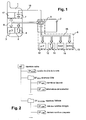
- a frequent architecture of mobile phones currently available on the market is schematically represented in the figure 1 .
- the figure 1 shows in schematic form a mobile phone 1 having a smart card 2.
- the smart card 2 is frequently called SIM card (Subscriber Identity Module in English, subscriber identity module in French).
- SIM card Subscriber Identity Module
- the telephone 1 essentially comprises a first microprocessor 3, which is in particular capable of executing a first set of applications 4 contained in a first program memory 5, a data memory 17, a first bidirectional communication bus 6 capable of conveying data. data, address and command information, in particular between the microprocessor 3, the data memory 17, the program memory 5, and a supply device 7.
- the SIM card 2 is a smart card that is capable of realizing secure functions of calculation and control of data. It is also able to perform memory functions in an internal memory.
- An evolution of traditional SIM smart cards has led to SIM cards called phase 2+, or toolkit or pro-active, which are able to send commands to a mobile phone.
- these so-called pro-active commands allow a smart card to manage human / machine dialogs between a mobile phone and a user of this mobile phone by using in particular a screen and / or a keyboard of this mobile phone as an interface. of dialogue.
- the SIM card 2 essentially comprises a micromodule 8.
- the micromodule 8 comprises a connector 9, a second microprocessor 10 controlled by a second set of applications 11 stored in a second program memory 12 of the ROM (Read Only Memory) type, for Read-only memory), a non-volatile memory 13 of EEPROM type (Electrically Erasable Read Only Memory in English, for memory read-only programmable electrically erasable), a memory 14 type RAM (Random Access Memory in English, for access memory random, but we prefer the expression volatile memory) and a second communication bus 15, capable of conveying data information, addresses and commands.
- the connector 9 allows an electrical connection, via a metal link 16 connected to a metal pin of the connector 9, between the first bus 6 of the telephone 1 and the second bus 15 of the card 2.
- the mobile phone 1 and the SIM card 2 therefore each have memory elements that can store different information.
- the SIM card 2 in particular a standardized organization of different files, as represented in FIG. figure 2 .
- the data architecture of a SIM card follows the standard hierarchical tree architecture of the operating systems.
- An MF root directory contains EF elementary files and dedicated DF directories, which may themselves contain other DF directories or EF files.
- the telephone 1 and the micromodule exchange information in accordance with a communication protocol defined in the ISO7816-3 standard.
- This standard provides that an exchange of information with the telephone 1 and the micromodule 8 is always done on the initiative of the phone 1. Thus, it defines a control message and a response message.
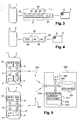
- the figure 3 shows an example of a structure of a control message sent to the micromodule 8 by the telephone 1.
- This message 20 includes a header 21 and an optional data field 22.
- the header 21 has five fields 23 to 27 of one byte each.
- Field 23 receives a value specifying a type of application.
- Field 24 receives a value specifying the instruction to be executed.
- the field 25 and the field 26 receive values making it possible to specify parameters of the instruction defined in the field 24.
- the values in the field 25 and the field 26 are optional.
- the field 27 receives a value for giving the bit length of either the message 20 or a response message that is expected.
- a bit length of the field 22 is variable, and receives a value corresponding to a datum useful to the micromodule 8 to carry out the instruction placed in the field 24.
- the micromodule 8 of the card 2 sends to the telephone 1, in the figure 4 , a response message.
- the message 28 comprises a data field 29 and an epilogue 30.
- the epilogue 30 comprises a field 31 and a field 32 of one byte each.
- a value received in the field 31 and / or 32 indicates whether the instruction sent by the message 20 ( figure 3 ) was executed correctly or not.
- a value received in the field 31 represents a correct execution or an incorrect execution of the instruction and a value received in the field 32 generally represents, during an incorrect execution of the instruction, a cause of the problem encountered.
- Field 29, like field 22, is optional.
- a communication from the telephone 1 to the micromodule 8 is always done by decomposing a message to be transmitted such as the message 20.
- a communication from the micromodule 8 to the telephone 1 is always done by decomposing a message transmitted such as the message 28.
- the memory module 17 of the mobile phone is therefore extensively used to store files whose size prohibits their storage in the SIM card, or to memorize various configurations related to the ergonomics of the mobile phone (choice of a "wallpaper" as wallpaper, memorization of different types of ringtones chosen by the user ).
- WO 03/037016 proposes a procedure for storing data, such as an address book, from a mobile phone on a storage center in a confidential and secure manner, so that the user changing the SIM card can retrieve the stored data.
- the user enters a password and the mobile phone encrypts, with this password, the data to be stored and sends to the storage center that stores the encrypted data in a memory at a position dedicated to the user.
- the stored data can thus be further decrypted using the password.
- the object of the present invention is to propose a method for backing up data contained in mobile phone memory modules, in a unit external backup to the mobile phone, by guaranteeing to a user of the mobile phone on the one hand that the data saved can not be used by a third person, and on the other hand that they can only be transferred operably to a recipient telephone that he has personally designated.
- the information is saved using as encryption key a mandatory data present in a SIM card of the user.
- the information is thus stored encrypted in the external backup unit, and they can only be decrypted using the same data of the SIM card, so that if the encrypted information is transmitted to a recipient phone that does not include the user's SIM card, the encrypted information can not be decrypted, and the original information can not be retrieved.
- the encryption / decryption key used is the serial number of the SIM card.
- the encryption and / or decryption operations are performed either within the first mobile phone or within the external backup unit; the encryption operations are possibly perfected to improve the security of the encryption, and / or to leave the possibility of recovering the original information to the first mobile phone only.
- the mobile phone 1 of the type described in FIG. figure 1 is the first telephone of a user who wishes to save a set of information present in the data memory 17, for example data relating to his diary, to his telephone directory, to a set of ringtones he
- the method according to the invention can also be implemented with information of the software application type which is stored in the program memory 5 of the first mobile telephone 1.
- a user may be interested in a backup of such data for example when he brings his mobile phone to a repairer and he wants to protect and recover his personal data before any intervention that could result in the loss of such data. It may also be interested in such a backup to be able to later transfer his personal data to another mobile phone.
- an external backup unit 500 is used.
- the external backup unit 500 notably comprises at least one memory module 501, a program memory 502 capable of holding a set of applications likely to be involved in the process according to the invention, and a microprocessor 503 which manages the operation of the unit 500.
- the program memory 502 notably comprises an application 510, called a data sending and receiving application, which makes it possible to transmit data from the external backup unit 500 to a mobile telephone or to retrieve information from the mobile telephone. to store them in the memory module 501.
- the various transmission operations between a mobile phone and the external backup unit 500 are via a link 505 which allows to connect the bus 6 of the mobile phone 1 and the bus 504 of the external backup unit.
- an application 511 called an encryption application, of the program memory 502 is transferred, by means of the sending and receiving application 510, into the memory of programs 5 of the mobile phone 1 of the user.
- the encryption application makes it possible to encrypt all the information to be saved. It is thus, in this example, implemented within the mobile phone, for example automatically as soon as it is transmitted in the program memory 5.
- the encryption application can in particular control an application, said application of dialogue with the SIM card, the program memory 5 which enables the mobile phone 1 to interact with the SIM card 2 according to the communication protocols described in FIGS. Figures 3 and 4 .
- the dialog application may optionally have the ability to modify the access levels of the data present in the SIM card.
- the encryption application 510 can thus recover a particular piece of data, of value K1, from the SIM card 2 to use it as an encryption key.
- the encryption algorithm 511 uses as encryption key data that is necessarily present in any SIM card, ie said data is stored in the SIM card by normative obligation. Some of these data were presented in the description of the figure 2 . This data may for example be the number giving the identity of the subscriber (IMSI number) or the serial number of the SIM card (ICCID number). In the invention, it will be preferred to use the ICCID number as an encryption key. Indeed, this number has the particularity of having a value attributed once and for all to a SIM card by the manufacturer of the SIM card.
- the same ICCID value can not be assigned to multiple SIM cards, and each SIM card has only one ICCID number, while the IMSI number can, depending on the desire of an operator, be reassigned to another SIM card, for example. example if a first SIM card was destroyed.
- the encryption key used is unique and definitely belongs to the user.
- the encryption operation of the information to be backed up is performed by the encryption algorithm placed in the program memory 5.
- the encrypted information to be saved is then recovered, by means of the encryption key.
- the encryption key used does not leave the mobile phone.
- the encryption algorithm 511 is not transferred to the mobile telephone 1, but that it is the encryption key, accompanied by information to be encrypted, which is extracted from the SIM card 2 to be transferred to the backup unit 500. The encryption is then performed within the backup unit 500. Only the encrypted information is stored in the memory module 501.
- a human-machine interface not shown, makes it possible to determine, within the backup unit 500, which type of telephone is concerned by the backup.
- a specific encryption algorithm is provided for each type of phone, or for several types of phone. Once the type of telephone determined, the appropriate algorithm is selected, and the method according to the invention can be implemented according to one of the modes described above.
- the encryption algorithm involves a second encryption key.
- This may be specific to the external backup unit 500, or be specific to the telephone 1 from which the data to be saved is extracted. In the latter case, one can for example use the serial number of the mobile phone 1 as encryption key.
- the information to be backed up thus undergoes double encryption, which improves the security of the data extracted from the mobile phone 1.
- the saved information can be recovered unencrypted only in the same mobile phone.
- the recipient phone comprises a general architecture similar to that of the first telephone 1, with a microprocessor 3 ', a set of applications 4' of a program memory 5 ', a data memory 17', a recipient SIM card 2 'and a bus bidirectional communication 6 '.
- An application 512 of the program memory 502, called the decryption application 512 is implemented so that the user retrieves his information.
- the decryption application 512 is transferred, by means of the sending and receiving application 510, into the memory of programs 5 'of the mobile phone recipient 1' of the user.
- the decryption application makes it possible, when it is used with an appropriate decryption key, to decrypt all the information stored in the memory module 501.
- the decryption application is thus, in this example, implemented at the same time. within the mobile phone, for example automatically as soon as it is transmitted in the program memory 5 '.
- the decryption application 512 can notably control the application of dialogue with the SIM card, the program memory 5 'which allows the mobile phone 1' to interact with the SIM card recipient 2 'according to the protocols described in Figures 3 and 4 .
- the decryption application 512 can thus recover the particular data item, necessarily present in the destination SIM card 2 ', used to encrypt the information as described previously, to use it as a decryption key.
- the decryption key has a value K2.
- the encryption and decryption applications are symmetric algorithms, that is to say that the decryption key must be identical to the previously used encryption key, to allow the information to be recovered in unencrypted manner.
- the decryption algorithm 512 not to be transferred to the recipient mobile telephone 1 ', but that it is the decryption key which is extracted from the recipient SIM card 2 'to be transferred to the backup unit 500.
- the decryption is then performed within the backup unit 500.
- the decrypted information in the the assumption that the recipient mobile phone 1 'uses the same SIM card as the first mobile phone 1, are then transferred to the recipient mobile phone 1'.
- the decryption algorithm involves a second decryption key which must be identical to the second encryption key used. If the second encryption key used was specific to the external backup unit 500, then the user will be able to recover his data only from the backup unit 500 initially used to save the data, and not from another backup device into which the encrypted information would have been transferred. If the second encryption key used was specific to the first phone 1, then the user will be able to retrieve his information, unencrypted, only in the first phone 1, and always with the condition that it is the first SIM card 2 which is used in the first telephone.
Landscapes
- Engineering & Computer Science (AREA)
- Computer Networks & Wireless Communication (AREA)
- Signal Processing (AREA)
- Computer Security & Cryptography (AREA)
- Telephone Function (AREA)
- Mobile Radio Communication Systems (AREA)
- Telephonic Communication Services (AREA)
Claims (8)
- Verfahren zum Speichern von Informationen, die zunächst in wenigstens einem Speichermodul (17) eines ersten Mobiltelephons (1) enthalten sind, das insbesondere eine erste SIM-Karte (2) verwendet, um in einem Zellenfunktelephon-Netz betrieben zu werden, dadurch gekennzeichnet, dass es die verschiedenen Schritte umfasst, die darin bestehen:- die zu speichernden Informationen mittels eines Verschlüsselungsalgorithmus (511), der einen ersten Verschlüsselungsschlüssel (K1) verwendet, zu verschlüsseln, wobei der erste Verschlüsselungsschlüssel (K1) eine normierte Dateneinheit ist, die in der ersten SIM-Karte obligatorisch vorhanden ist;- die verschlüsselten Informationen in einem Speichermodul (501) einer Speichereinheit (500) außerhalb des ersten Mobiltelephons (1) zu speichern.
- Verfahren nach dem vorhergehenden Anspruch, dadurch gekennzeichnet, dass der erste Verschlüsselungsschlüssel (K1) die Seriennummer (ICCID) der ersten SIM-Karte (2) des ersten Telephons (1) ist.
- Verfahren nach wenigstens einem der vorhergehenden Ansprüche, dadurch gekennzeichnet, dass es den zusätzlichen Schritt umfasst, der darin besteht, vor dem Verschlüsselungsschritt den Verschlüsselungsalgorithmus (501) von der externen Speichereinheit (500) mittels des ersten Verschlüsselungsschlüssels (K1) in dem ersten Mobiltelephon (1) zu einem Programmspeicher (5) des ersten Mobiltelephons (1) zu übertragen.
- Verfahren nach wenigstens einem der vorhergehenden Ansprüche, dadurch gekennzeichnet, dass es die zusätzlichen verschiedenen Schritte umfasst, die darin bestehen:- die verschlüsselten Daten von der externen Speichereinheit (500) zu einem Speichermodul (17') eines Zieltelephons (1'), das mit einer zweiten SIM-Karte, einer so genannten Ziel-SIM-Karte (2'), ausgerüstet ist, zu übertragen;- einen Entschlüsselungsalgorithmus (512) zu verwenden, der einen Entschlüsselungsschlüssel (K2) verwendet, wobei der Entschlüsselungsschlüssel (K2) eine normierte Dateneinheit ist, die in der Ziel-SIM-Karte obligatorisch vorhanden ist, um zu versuchen, die verschlüsselten Daten zu entschlüsseln;- gegebenenfalls die entschlüsselten Daten in wenigstens einem Speichermodul (17') des Zieltelephons (1') zu speichern.
- Verfahren nach dem vorhergehenden Anspruch, dadurch gekennzeichnet, dass es vor dem Schritt des Verwendens des Entschlüsselungsalgorithmus (512) einen zusätzlichen Schritt umfasst, der darin besteht, den Entschlüsselungsalgorithmus (512) von der Speichereinheit (500) zu dem Ziel-Mobiltelephon (1') zu übertragen.
- Verfahren nach wenigstens einem der vorhergehenden Ansprüche, dadurch gekennzeichnet, dass der Algorithmus (511) zum Verschlüsseln von zu speichernden Informationen vom Typ des ersten Telephons (1) abhängt, in dem die zu speichernden Informationen zunächst enthalten sind.
- Verfahren nach wenigstens einem der vorhergehenden Ansprüche, dadurch gekennzeichnet, dass der Algorithmus (511) zum Verschlüsseln von zu speichernden Informationen einen zweiten Verschlüsselungsschlüssel verwendet, wobei der zweite Verschlüsselungsschlüssel vom Typ des ersten Telephons (1) abhängt, in dem die zu speichernden Informationen zunächst enthalten sind.
- Verfahren nach dem vorhergehenden Anspruch, dadurch gekennzeichnet, dass der zweite Verschlüsselungsschlüssel die Seriennummer des ersten Mobiltelephons (1) ist.
Applications Claiming Priority (2)
| Application Number | Priority Date | Filing Date | Title |
|---|---|---|---|
| FR0350986 | 2003-12-05 | ||
| FR0350986A FR2863443B1 (fr) | 2003-12-05 | 2003-12-05 | Procede de sauvegarde des donnees d'un telephone mobile |
Publications (3)
| Publication Number | Publication Date |
|---|---|
| EP1538857A2 EP1538857A2 (de) | 2005-06-08 |
| EP1538857A3 EP1538857A3 (de) | 2005-07-06 |
| EP1538857B1 true EP1538857B1 (de) | 2011-07-13 |
Family
ID=34451772
Family Applications (1)
| Application Number | Title | Priority Date | Filing Date |
|---|---|---|---|
| EP04300838A Ceased EP1538857B1 (de) | 2003-12-05 | 2004-12-02 | Verfahren zur Sicherstellung von Daten eines Mobiltelefons |
Country Status (2)
| Country | Link |
|---|---|
| EP (1) | EP1538857B1 (de) |
| FR (1) | FR2863443B1 (de) |
Families Citing this family (6)
| Publication number | Priority date | Publication date | Assignee | Title |
|---|---|---|---|---|
| US7856249B2 (en) * | 2004-11-08 | 2010-12-21 | Sony Ericsson Mobile Communications Ab | Combined mass storage and subscriber identity module providing information security and apparatus for use therewith |
| CN100502425C (zh) * | 2005-06-27 | 2009-06-17 | 集嘉通讯股份有限公司 | 具信息隐藏功能的手持式移动通讯装置及其数据隐藏方法 |
| FR2902551B1 (fr) * | 2006-06-16 | 2008-10-10 | Oberthur Card Syst Sa | Dispositif de memorisation amovible et appareil electronique aptes a etre connectes l'un a l'autre et procede de sauvegarde de donnees d'environnement |
| CN101355740B (zh) * | 2007-07-27 | 2012-10-10 | 佛山市顺德区顺达电脑厂有限公司 | 智能卡的数据保护方法及其系统 |
| CN101909290A (zh) * | 2010-08-25 | 2010-12-08 | 中兴通讯股份有限公司 | 一种实现语音通话加密的方法及系统及移动终端 |
| CN105743912B (zh) * | 2016-03-31 | 2020-04-07 | 宇龙计算机通信科技(深圳)有限公司 | 一种语音加密方法和语音发送终端 |
Family Cites Families (7)
| Publication number | Priority date | Publication date | Assignee | Title |
|---|---|---|---|---|
| KR20010026690A (ko) | 1999-09-08 | 2001-04-06 | 서평원 | 이동단말기의 사용자용 데이터 백업 방법 |
| US20020156921A1 (en) | 2001-04-19 | 2002-10-24 | International Business Machines Corporation | Automatic backup of wireless mobile device data onto gateway server while device is idle |
| GB2377776A (en) * | 2001-07-18 | 2003-01-22 | Wizard Mobile Solutions Ltd | A combination of a portable data storage device and a wireless backup device having an out of range alert |
| WO2003009621A1 (en) * | 2001-07-18 | 2003-01-30 | Miata Limited | Protection of devices |
| GB2378854A (en) * | 2001-08-16 | 2003-02-19 | Oluwatosin Anthony Jalade | Mobile phone data backup device |
| EP1288840A1 (de) * | 2001-09-04 | 2003-03-05 | Axisoft Technologies, Inc. | Datensicherungssystem für SIM-Karten |
| ITBS20010079A1 (it) * | 2001-10-23 | 2003-04-23 | Ennio Vertemati | Procedimento di archiviazionedi informazioni alfanumeriche provenienti da un telefono cellulare in un centro di archiviazione collegato alla |
-
2003
- 2003-12-05 FR FR0350986A patent/FR2863443B1/fr not_active Expired - Fee Related
-
2004
- 2004-12-02 EP EP04300838A patent/EP1538857B1/de not_active Ceased
Also Published As
| Publication number | Publication date |
|---|---|
| EP1538857A2 (de) | 2005-06-08 |
| FR2863443B1 (fr) | 2006-03-03 |
| FR2863443A1 (fr) | 2005-06-10 |
| EP1538857A3 (de) | 2005-07-06 |
Similar Documents
| Publication | Publication Date | Title |
|---|---|---|
| EP1379094B1 (de) | Verriegelungsverfahren für ein mobiles Kommunikationsendegerät | |
| EP1203501B1 (de) | Verfahren zur datenverarbeitung und -übertragung über ein mobilfunknetz und chipkarte | |
| EP0285520B1 (de) | Verfahren zur Übertragung geheimer Schlüssel zu Sicherheitsmodulen und Benutzerkarten in einem Datenverarbeitungsnetz | |
| EP1994780B1 (de) | System für den fernzugriff auf eine massenspeichereinheit und einer sicherheitsspeichereinheit in einem tragbaren kommunikationsobjekt | |
| EP3219157B1 (de) | Euicc-karte zur speicherung kurzer nummern pro teilnehmerprofil zur benachrichtigung eines teilnahmeverwaltungsservers | |
| EP1946206B1 (de) | Verfahren und einrichtung zur verwaltung von anwendungen eines mobilen endgeräts | |
| FR3048530B1 (fr) | Systeme ouvert et securise de signature electronique et procede associe | |
| FR3034550A1 (fr) | Procede de chargement d'une cle au sein d'un terminal utilisateur et terminal utilisateur associe | |
| EP2047697B1 (de) | Anpassung eines funkkommunikationsendgeräts mit sim-karte | |
| CA2414469C (fr) | Procede de controle d`acces a un contenu et systeme pour le controle d`acces a un contenu | |
| FR2863443A1 (fr) | Procede de sauvegarde des donnees d'un telephone mobile | |
| FR2945143A1 (fr) | Procede et systeme d'activation d'applications de paiement sans contact | |
| WO2000042731A1 (fr) | Procede de chargement securise de donnees entre des modules de securite | |
| FR2821188A1 (fr) | Procede de stockage securise de donnees personnelles et de consultation, carte a puce, terminal et serveur pour la mise en oeuvre du procede | |
| WO2007144509A2 (fr) | Dispositif de memorisation amovible et appareil electronique aptes a l ' autre et procede de sauvegarde de donnees d ' environnement | |
| EP1197097A2 (de) | Verfahren und vorrichtung zum versenden von sms nachrichten | |
| EP1065633B1 (de) | Aus mehreren Chiphaltern aufgebautes mobiles Telefon | |
| CA1243738A (fr) | Procede et systeme pour chiffrer et dechiffrer des informations transmises entre un dispositif emetteur et un dispositif recepteur | |
| WO2004084525A2 (fr) | Procede de protection d’un terminal de telecommunication de type telephone mobile | |
| EP1398983B1 (de) | Fernprogrammierungsverfahren eines Mobiltelefons und System dafür | |
| EP1556833B1 (de) | Mikrochip-karten, die vorgestanzt in einem gemeinsamen plastikträger angeordnet sind und komplementäre funktionen aufweisen | |
| WO2002058019A1 (fr) | Procede pour la creation de fichiers de donnees, prives securises et carte a puce comportant un fichier prive securise | |
| FR2792479A1 (fr) | Procede de chargement securise de donnees entre des modules de securite | |
| EP0923261A1 (de) | Briefkasten für ein Kommunikationsendgerät und ein Teilnehmeridentifikationsmodul | |
| FR2888437A1 (fr) | Procede et systeme de controle d'acces a un service d'un fournisseur d'acces implemente sur un serveur multimedia, module, serveur, terminal et programmes pour ce systeme |
Legal Events
| Date | Code | Title | Description |
|---|---|---|---|
| PUAI | Public reference made under article 153(3) epc to a published international application that has entered the european phase |
Free format text: ORIGINAL CODE: 0009012 |
|
| PUAL | Search report despatched |
Free format text: ORIGINAL CODE: 0009013 |
|
| AK | Designated contracting states |
Kind code of ref document: A2 Designated state(s): AT BE BG CH CY CZ DE DK EE ES FI FR GB GR HU IE IS IT LI LT LU MC NL PL PT RO SE SI SK TR |
|
| AX | Request for extension of the european patent |
Extension state: AL BA HR LV MK YU |
|
| AK | Designated contracting states |
Kind code of ref document: A3 Designated state(s): AT BE BG CH CY CZ DE DK EE ES FI FR GB GR HU IE IS IT LI LT LU MC NL PL PT RO SE SI SK TR |
|
| AX | Request for extension of the european patent |
Extension state: AL BA HR LV MK YU |
|
| 17P | Request for examination filed |
Effective date: 20050708 |
|
| RBV | Designated contracting states (corrected) |
Designated state(s): BG CH CY CZ DE DK EE ES FI FR GB GR HU IE IS IT LI LT LU MC NL PL PT RO SE SI SK TR |
|
| RAP1 | Party data changed (applicant data changed or rights of an application transferred) |
Owner name: SAGEM COMMUNICATION |
|
| AKX | Designation fees paid |
Designated state(s): DE GB |
|
| RAP1 | Party data changed (applicant data changed or rights of an application transferred) |
Owner name: SAGEM MOBILES |
|
| GRAP | Despatch of communication of intention to grant a patent |
Free format text: ORIGINAL CODE: EPIDOSNIGR1 |
|
| RIC1 | Information provided on ipc code assigned before grant |
Ipc: H04W 12/04 20090101AFI20101203BHEP |
|
| GRAS | Grant fee paid |
Free format text: ORIGINAL CODE: EPIDOSNIGR3 |
|
| GRAA | (expected) grant |
Free format text: ORIGINAL CODE: 0009210 |
|
| AK | Designated contracting states |
Kind code of ref document: B1 Designated state(s): DE GB |
|
| REG | Reference to a national code |
Ref country code: GB Ref legal event code: FG4D Free format text: NOT ENGLISH |
|
| REG | Reference to a national code |
Ref country code: DE Ref legal event code: R096 Ref document number: 602004033438 Country of ref document: DE Effective date: 20110901 |
|
| PLBE | No opposition filed within time limit |
Free format text: ORIGINAL CODE: 0009261 |
|
| STAA | Information on the status of an ep patent application or granted ep patent |
Free format text: STATUS: NO OPPOSITION FILED WITHIN TIME LIMIT |
|
| 26N | No opposition filed |
Effective date: 20120416 |
|
| REG | Reference to a national code |
Ref country code: DE Ref legal event code: R097 Ref document number: 602004033438 Country of ref document: DE Effective date: 20120416 |
|
| REG | Reference to a national code |
Ref country code: DE Ref legal event code: R081 Ref document number: 602004033438 Country of ref document: DE Owner name: APPLE INC., US Free format text: FORMER OWNER: SAGEM S.A., PARIS, FR Effective date: 20110711 Ref country code: DE Ref legal event code: R081 Ref document number: 602004033438 Country of ref document: DE Owner name: APPLE INC., US Free format text: FORMER OWNER: SAGEM MOBILES, PARIS, FR Effective date: 20121212 Ref country code: DE Ref legal event code: R081 Ref document number: 602004033438 Country of ref document: DE Owner name: APPLE INC., CUPERTINO, US Free format text: FORMER OWNER: SAGEM MOBILES, PARIS, FR Effective date: 20121212 Ref country code: DE Ref legal event code: R081 Ref document number: 602004033438 Country of ref document: DE Owner name: APPLE INC., CUPERTINO, US Free format text: FORMER OWNER: SAGEM S.A., PARIS, FR Effective date: 20110711 |
|
| REG | Reference to a national code |
Ref country code: GB Ref legal event code: 732E Free format text: REGISTERED BETWEEN 20140306 AND 20140312 |
|
| PGFP | Annual fee paid to national office [announced via postgrant information from national office to epo] |
Ref country code: DE Payment date: 20201118 Year of fee payment: 17 Ref country code: GB Payment date: 20201126 Year of fee payment: 17 |
|
| REG | Reference to a national code |
Ref country code: DE Ref legal event code: R119 Ref document number: 602004033438 Country of ref document: DE |
|
| GBPC | Gb: european patent ceased through non-payment of renewal fee |
Effective date: 20211202 |
|
| PG25 | Lapsed in a contracting state [announced via postgrant information from national office to epo] |
Ref country code: GB Free format text: LAPSE BECAUSE OF NON-PAYMENT OF DUE FEES Effective date: 20211202 Ref country code: DE Free format text: LAPSE BECAUSE OF NON-PAYMENT OF DUE FEES Effective date: 20220701 |