EP1538778A1 - Einrichtung zur automatischen Erzeugung von Tests zur Bestätigung eines Telekommunikationsgeräts - Google Patents
Einrichtung zur automatischen Erzeugung von Tests zur Bestätigung eines Telekommunikationsgeräts Download PDFInfo
- Publication number
- EP1538778A1 EP1538778A1 EP03293047A EP03293047A EP1538778A1 EP 1538778 A1 EP1538778 A1 EP 1538778A1 EP 03293047 A EP03293047 A EP 03293047A EP 03293047 A EP03293047 A EP 03293047A EP 1538778 A1 EP1538778 A1 EP 1538778A1
- Authority
- EP
- European Patent Office
- Prior art keywords
- test
- editor
- tests
- test server
- suite
- Prior art date
- Legal status (The legal status is an assumption and is not a legal conclusion. Google has not performed a legal analysis and makes no representation as to the accuracy of the status listed.)
- Withdrawn
Links
- 238000012360 testing method Methods 0.000 title claims abstract description 242
- 238000004891 communication Methods 0.000 claims abstract description 23
- 230000010354 integration Effects 0.000 claims description 36
- 238000000034 method Methods 0.000 claims description 13
- 238000004088 simulation Methods 0.000 claims description 11
- 230000006870 function Effects 0.000 claims description 5
- 238000011161 development Methods 0.000 claims description 4
- 239000000470 constituent Substances 0.000 claims description 2
- 238000000605 extraction Methods 0.000 claims description 2
- 230000000295 complement effect Effects 0.000 claims 1
- 238000010998 test method Methods 0.000 abstract 1
- 238000010200 validation analysis Methods 0.000 description 5
- 238000010586 diagram Methods 0.000 description 4
- 230000009471 action Effects 0.000 description 3
- 230000008859 change Effects 0.000 description 3
- 230000003993 interaction Effects 0.000 description 3
- 238000004519 manufacturing process Methods 0.000 description 3
- 238000012986 modification Methods 0.000 description 3
- 230000004048 modification Effects 0.000 description 3
- 238000012545 processing Methods 0.000 description 3
- 238000004458 analytical method Methods 0.000 description 2
- 238000013459 approach Methods 0.000 description 2
- 230000008901 benefit Effects 0.000 description 2
- 238000012937 correction Methods 0.000 description 2
- 238000013461 design Methods 0.000 description 2
- 238000013508 migration Methods 0.000 description 2
- 230000005012 migration Effects 0.000 description 2
- 238000012800 visualization Methods 0.000 description 2
- 101000597193 Homo sapiens Telethonin Proteins 0.000 description 1
- 241001108995 Messa Species 0.000 description 1
- 102100026009 NF-kappa-B inhibitor zeta Human genes 0.000 description 1
- 101710115530 NF-kappa-B inhibitor zeta Proteins 0.000 description 1
- 102100035155 Telethonin Human genes 0.000 description 1
- 241001080024 Telles Species 0.000 description 1
- 230000003213 activating effect Effects 0.000 description 1
- 230000006978 adaptation Effects 0.000 description 1
- 230000005540 biological transmission Effects 0.000 description 1
- 230000001934 delay Effects 0.000 description 1
- 238000005538 encapsulation Methods 0.000 description 1
- 238000011990 functional testing Methods 0.000 description 1
- 239000000463 material Substances 0.000 description 1
- 238000013515 script Methods 0.000 description 1
- 230000011664 signaling Effects 0.000 description 1
- 238000011144 upstream manufacturing Methods 0.000 description 1
- 238000012795 verification Methods 0.000 description 1
Images

Classifications
-
- H—ELECTRICITY
- H04—ELECTRIC COMMUNICATION TECHNIQUE
- H04L—TRANSMISSION OF DIGITAL INFORMATION, e.g. TELEGRAPHIC COMMUNICATION
- H04L43/00—Arrangements for monitoring or testing data switching networks
- H04L43/50—Testing arrangements
Definitions
- the present invention relates to a generation system automatic testing to validate a telecommunication device. She finds a particularly interesting application in the field of smart networks or networks of GSM or IP type in which one wishes validate or verify the operation and / or setting of a switch for example.
- the environment of a telecommunication system involves many heterogeneous resources accessible through different means external interfaces.
- these interfaces may include telephone lines or signaling links.
- the tests performed are based on a simulation environment around one or more telecommunication devices typically a "SUT" system-subtest ("SYSTEM UNDER TEST" in English language).
- SUT system-subtest
- the purpose of these tests is to verify that the SUT meets the functional specifications or that its behavior corresponds to what was planned.
- Simulators are materials capable of representing the context around the apparatus to be tested, however, these simulators and telecommunication protocols are very complex and heterogeneous. The mastery of the test via these equipment simulation remains difficult and requires a certain period of learning, indeed, the programming languages of these simulators are generally precarious. In addition, if several tests of good functioning should be passed and non-regression checks should be realized, the total test time can be an important part of the life cycle of a product (specification, realization and test).
- the present invention aims at the realization of a system of tests user-friendly and simple to implement to limit costs and test execution times, and to improve the quality of tests.
- the invention aims to time saving.
- Another object of the present invention is to provide a system modular able to evolve.
- the test server thus consists of a binary part (product a compilation) and an interpreted part.
- the servers of the prior art comprise only applications in binary language such as C or C + +.
- binary language such as C or C + +.
- the company having drawn up the program in C + + must intervene to de-compile the program, modify the program, then recompile the program thus adapted.
- the user can himself adapt the test server because the configurable elements are contained in the non-interpreted part compiled. It is commonly accepted that the use of an interpreted language may be a disadvantage because the source code is not protected.
- the current invention goes against this prejudice in the sense that by using such language for a configurable part of the overall program, the user can make your own settings without necessarily constantly using the designer of the test server.
- the present invention has the advantage of allowing the elaboration of the test scenarios using an advanced graphical structural editor such as for example an MSC editor using the MSC language ("Message Sequence Chart ").
- MSC editor is graphic, structural, unlike a publisher in TTCN language ("Testing and Test Control Notation” in English) for example, and allows in its graphical form an intuitive representation equipment operating in distributed systems. He puts especially the focus on the messages exchanged between equipments. Thus, the edition of the test plan is simplified by this tool MSC of assistance to the capture.
- TTCN language Transmission and Test Control Notation
- An executable test suite corresponds to the association of an abstract test suite (ATS abstract test suite, in English) and a selection of messages and configuration files.
- An abstract suite of ATS tests is a continuation of multi-protocol scenarios constituting a complete test.
- the test server includes another graphical tree editor called project editor and test suites and allowing the definition of validation projects according to the test plan of the telecommunication apparatus. This publisher is powered by test cases from the MSC editor.
- NOTE is a set of data without belonging to protocol messages but allowing to associate information from type PICS and PIXIT but also any type of additional information for better define what you want to generate or test.
- the present invention presents graphical editors compiled very ergonomic associated with an application in interpreted language easily modifiable to adapt the test server to the characteristics communication devices of the telecommunication apparatus.
- the interpreted application encapsulates the data developed by the compiled application.
- the graphical structural editor MSC is associated with a graphical editor in ASN.1 format, the latter having the function of generate files constituting an executable suite of tests from data from graphical structural editor and related data to standard protocols defined in a test platform.
- the present invention thus combines a graphical edition (MSC) telecommunication-oriented structural design for scenario creation with a Tree Graphic Edition (ASN.1) for creating messages and configurations and finally a graphical tree edition for creation projects and test suites.
- MSC graphical edition
- ASN.1 Tree Graphic Edition
- An editor is said to be “oriented "when it includes features such network elements, sending and receiving messages, processing of parallel sequences, processing of alternative sequences, loops, synchronization points and delays, for example.
- the testing platform may consist of a plurality of protocol modules, each protocol module comprising at least a protocol described in ASN.1 format, a library and a first stack encoding and decoding to produce codes understandable by the telecommunication apparatus.
- the encoding and decoding stacks are defined in interpreted language.
- An encoding and decoding stack is a set of rules. In the standard of a protocol, it is described how a message should be encoded before sending it to the target device (or decoding when it is received). These rules are part of the protocol and therefore of the platform test.
- the application in interpreted language includes an integration platform consisting of a plurality of integration modules, each integration module comprising at least one initialization procedure, a library and a second stack encoding and decoding to produce mode-specific codes. communication of said telecommunication apparatus.
- Each integration module makes it possible to adapt the data of the suite test executable (scripts written in MSC language, messages and files configuration in ASN.1 format) to the specificities of each telecommunication.
- the scenarios (MSC), messages and configurations (ASN.1) are associated reusable common data standard protocols (eg TCAP, MAP, ISUP, INAP, H248, MGCP, SIP-T, BICC, etc.) and which are completely independent of the telecommunication apparatus.
- the server test can connect to telecommunication devices completely different. This is one of the key points of the system because it is possible to "adapt" the generic to the specific at a lower cost.
- the interpreted language application comprises a performance and results interpretation module allowing, by its management, the generation of order codes that will be sent to the telecommunications apparatus, via the integration platform, for the performance of the test with production of a complete report.
- the execution and interpretation module of results includes means to receive in real time during a test execution of the results from the telecommunication apparatus through the integration platform, and generate error messages that can be viewed in the sheets of the graphical structural editor.
- the interpreted language application also includes a module of performance control capable of interpreting real-time information about the test flow. This information is created and edited using the ASN.1 editor.
- the test server can thus create load simulations.
- the execution control module allows you to define simulations for perform the same test run several times with configurations different, to define the level of traces in the test report but also to generate several test runs simultaneously. For example, simulation multiple phone calls at the same time on the same device telecommunication.
- results execution and interpretation module can understand ways to generate an executable test suite file offline. We can then perform an offline test by code transmission source. In this case, the encoding and decoding stack is replaced by the set of functions allowing the generation of source code for subsequent use. In the offline test, manual intervention is necessary to "load" the generated source code directly into the telecommunication device or in a simulator directly logged.
- the system according to the invention may comprise a simulator interposed between the test server and the telecommunication apparatus.
- the codes generated by the test server are interpreted by this simulator which is responsible for controlling the telecommunication apparatus. This case can be present in both modes: online and offline. During the realization of an integration module, the presence or absence of a simulator is taken into account.
- the test platform may include means for generating simultaneously different control codes according to different protocols.
- the system according to the invention is thus multi-protocol. Several protocols can interact simultaneously during test execution.
- the MSC language it is possible to define all the instances elements connected to the telecommunication apparatus, for each element, a communication protocol is defined.
- the system according to the invention is able to interpret the scenario and to exchange, with the telecommunication apparatus, messages of several protocols simultaneously following the sequence defined in the MSC scenario and all this for each instance.
- the interpreted language application comprises a Web server for managing results or test reports. These results are transmitted by the execution and interpretation module of results.
- the report is sent to the server WEB for immediate or later analysis.
- a history balance sheets is managed to allow comparisons over time and non regression checks.
- Each assessment describes the test, the elements that intervene, configuration, warnings, errors, etc.
- the ASN.1 editor manipulates the data relating to the protocols, configuration and messages, unlike other editors such as by example the publisher in TTCN language which is not friendly, not graphic and difficult to manipulate.
- the present invention provides a configurable interpreted language making the test server "Plug & Play”.
- the interpreted language is a PERL type language ("Practical Extraction and Reporting Language").
- the test server comprises a type application API (application program interface) linking the application compiled and the application in interpreted language.
- This application type API includes ways to integrate specific outdoor modules into each user. The test server can therefore adapt to needs specific users.
- modules can be of two types: either they are existing applications that the client wants to integrate into the system (compilers, report generator, etc.); either it is a customer need for which a development is needed.
- This development as a rule, is a feature only used by this client, for example: migration of existing data, semantic analyzers, etc. and for which a general use is not possible.
- a method for to test a telecommunication apparatus by means of a test server is provided.
- an executable series of tests is developed by means of a application compiled, we adapt, by encapsulation for example, the following test executable to the communication mode of said telecommunication by means of an application in language interpreted in combination with said compiled application within the test server.
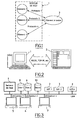
- Figure 1 shows the need for testing in a system of telecommunication.
- the elements of the system are tested one after the other. Once the item to be tested is selected, the role of the test server and to replace the context around this element by carrying out exchanges simulated information following a test plan.
- FIG. 2 shows a test server (simulation of test context) 1 connected to a telecommunications device (element to test) 2 such as, for example, a switch for which it is desired perform tests to validate its operation.
- the test server has for purpose of generating a set of control codes to the device of telecommunication and interpret the answers of this device from telecommunication to establish a test report. Order codes generated by the test server are such that the telecommunication apparatus tested has the impression of being integrated into its environment of normal running.
- the connection between the test server and the device telecommunication can be of any type, for example, connection direct RS232, TCP / IP, etc.
- test server 1 and the device of telecommunication 2 arranged in a TCP / IP network comprising several other telecommunication apparatus 3 and 4, several terminals 5 to 7 and sites 8 to 10.
- Each terminal 5, 6, or 7 corresponds to a user given.
- Sites 8, 9 and 10 are storage means for manage data about a user or a validation team (abstract and specific data).
- a user When activating the test server 1, a user must select one of the sites 8 to 10 to use. So, a user 5, 6 or 7 can access different sites 8 to 10, and several users can access the same site.
- FIG. 4 shows the components of the test server 1.
- a user platform 11 There is a user platform 11, a test platform (protocol modules) 12, the integration platform (modules 13), the MSC 20 editing module, the ASN.1 editing module 21, the module for editing projects and test suites 22, the module implementation and interpretation of the results 23, the management module of test results (web server) 24 and the execution control module 39.
- the user platform 11 is the user data set, at namely: the MSC 14 test cases, the ATS test suites 15, the messages 16, the protocol configurations 17, the configurations of the messages 18, the configurations of the integration platform 19 and the performance control configurations 40.
- the creation and editing of data is done, using the MSC 20 editing module for the scenarios of test, using the project and test suite module 22 for the suites ATS and projects and using the ASN.1 21 editing module for messages and configurations.
- the test platform 12 consists of the protocol modules. Each protocol module allows to take into account the protocol 27 defined in ASN.1 format (standard format for protocol definition, structure of the messages, constraints, ...), the libraries 28 (variables allowing the factorization in the valuation of messages) and the stack encoding and decoding 29 to produce codes understandable by the telecommunication apparatus 2.
- the libraries 28 define the structure and types of variables used to value messages.
- a variable represents a commonly used value, it is defined a times and used in several places in the messages.
- From a library several configuration files can be defined 18. When a new configuration file is created, it is developed with the default values of the library. The user can then change these values according to specific requirements.
- the encoding and decoding stack 29 is defined in interpreted language.
- the test platform thus provides total flexibility in the evolution of protocols.
- the integration platform 13 consists of modules integration module, each integration module consists of the procedure 36 of the associated library 37 (parameter configuration of the telecommunication apparatus) and the encoding and decoding stack 38 (stack defining the specific communication with the telecommunication: RS232, TCP / IP, etc.).
- the library 37 defines the structure and the types of variables used. From the library, several files of configuration 19 can be defined. When a new file of configuration is created, it is developed with the default values of the bookstore. The user can then change these values according to requirements own.
- the encoding and decoding stack 38 is defined in interpreted language, this provides total flexibility in the modification, or the eventual change, of the telecommunication apparatus 2.
- the MSC 20 editing module allows the graphic creation of test scenarios.
- the scenarios are the starting point in the creation of test suites.
- the ASN.1 editing module 21 allows the editing of messages and configurations. This editor is graphic and arborescent.
- the project creation and test suites module 22 allows the definition of validation projects according to the test plan of the equipment.
- test suites are run through an ETS 35 ("executable test suite ", in English)
- An ETS is the association of an ATS ("abstract test suite” in English) and a selection of messages and of all configuration files.
- ATS is the result of multi-protocol scenarios that constitute a complete test.
- an ETS 35 involves the use of user platforms 11 and test 12 to generate codes of orders to heterogeneous telecommunication devices across the integration platform 13.
- test may be applied to several telecommunication same time but, for the sake of terminology, all of these devices is called SUT (System Under Test in English) or simply telecommunication device.
- SUT System Under Test in English
- the communication between the server of test 1 and the telecommunication apparatus 2 may be of the flux-tension type, that is to say a generation of online code 26 or else of offline type 34.
- the codes are generated and transmitted in real time, that is to say, that the test scenario is respected in its sequence and in time in its communication with the device telecommunications (decisions, synchronizations, loops, etc.).
- the Answers from the telecommunication device are decoded and then analyzed and compared to a user-defined reference (message in reception). With this approach, it is then possible to identify the possible anomalies in the execution of the test.
- ETS 35 produces a program (list of commands) 34.
- This program is generated in the known language of the simulator or telecommunications device (normally this language is low level). The generated program must be integrated and then executed by the tester in person, in fact, in this type of connection no communication exists between the test server and the SUT, and therefore no error or test report is produced.
- the execution and interpretation module of the results 23 is a Human-Machine Interface (HMI) to run an ETS 35.
- HMI Human-Machine Interface
- Execution of an ETS allows the creation of order codes following a clearly defined sequence in the MSC scenarios of the sequel test.
- This sequence of order codes (send and answer) is sent to the telecommunication device via the integration platform (integration modules). This communication is called on-line or in-tense 26.
- the execution and interpretation module of results provides a real-time trace with a list of possible errors. Errors can be viewed directly in the scenario concerned (MSC 20 editor) by double-clicking on an item in the list errors.
- test server produces a test report.
- Test reports are managed by the management module of results 24 (this module is a WEB server).
- This module makes it possible to analyze in a specific way the test (errors, frames, configurations, scenarios used, etc.), to make comparisons between balance sheets, to check the absence of regressions, to provide a study quality, to guarantee the proper functioning of the telecommunication thanks to the documents provided, etc.
- test server can come directly to the telecommunication device tested 2 or then transit via a simulator 35. In either case, the test server considers this to be the device telecommunication.
- the existence or not of the simulator is transparent because the consideration was made during the creation of the integration module concerned in the integration platform.
- the test server allows using the execution control 39, the creation of simulations.
- a simulation consists of executing an ETS under a defined control, this control is defined in the run control configuration files (CExec) 40, the desired run control configuration file is selected before running a test. This check allows you to check if the number of predetermined executions is reached, if the execution time is completed, or if the execution must be carried out permanently.
- the module control of execution also includes means to execute several ETSs simultaneously on the same device telecommunication. This makes it possible to design load tests in associating this particularity with the particularity of creation of the simulations, finally this same module allows to define the level of detail of the information in the test report.
- the test server consists of two parts; a binary part 30 (executable produced by compiling C ++ code) and an interpreted part in the language PERL 32.
- the API 31 provided by the binary part 30 allows to integrate the interpreted part (PERL) at the heart of the server and to have access to all data.
- the choice of the PERL language for the interpreted part was due to its processing power, however, the interpreted part may also be written, for example, in JAVA, PYTON or LISP.
- the availability of the API 31 application also allows the integration of specific modules 33 (Stress tests, data migration, result analyzes, semantic controllers Certainly within the test server.
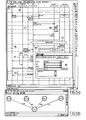
- Figure 5 shows the structural graphical editor that allows the creation of scenarios (ATC) in an advanced specification language MSC.
- ATC scenarios
- MSC advanced specification language
- the properties of each element can be displayed for modification 49.
- the properties displayed correspond to the selected item, ie, the message MessA 1.
- the MSC editor presents three external forms of the same scenario (access is via tabs on the left of the lower part of the window), Graph 5a, Architecture 5b and Textual (not shown).
- the architecture form allows to visualize the protocols used by the instances of the scenario.
- MSC editor is an OLE server (Object Link Embeded in English). This feature makes it possible to realize Specification documents (Word) with MSC scenarios included.
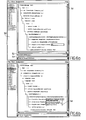
- Figure 6 shows the ASN.1 editor and more specifically the edition of a message from a given protocol. You can view the list of messages in the module 50, the selected message and its structure 51, the constraints of the selected message element 52, the online help on the selected message element 53 finally, the ease of visualization in editing a message. The configurations are edited according to the same technical.
- Each edited item (message or configuration) is designed under shape of a tree (data structures that can be completely or partially initialized).
- the ASN.1 editor allows correct interaction and ergonomic user with the different parts of each element.
- Figure 6b shows the help provided to the user in valuing the structures 54.
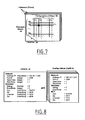
- Figure 7 are shown the possible combinations of protocol-side configuration before generation, namely: messages 16 and configuration of messages 18.
- Each configuration is carried out by instance (Peer).
- Messages and the message configuration file always belong to the same library 28.
- the configuration being instance, several protocols can intervene in the test.
- FIG. 8 shows a library of an integration module of the integration platform 13 and configuration files 19.
- the configuration files are identical in their structure but the values are different. Of the set 19, the user chooses the desired configuration file before running the test. This Same approach is used for all configuration files.
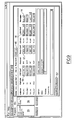
- Figure 9 illustrates a portion of the graphical interface of the test. This is the configuration of an ETS before execution.
- the configuration of the ETS selected namely and by instance (Peer): the configuration of the platform 19, the configuration of the protocol 17, the configuration of messages 18, and the message module 16.
- the configuration of the execution is global 40, in Indeed, it concerns the execution of the test in general and not an instance in particular.
- the integration module (platform), the protocol and the library by instance are defined upstream, that is to say, at the creation of the project. From a project, several ETS can be defined with different configurations.
- the present invention allows multi-protocol management.
- the server test simulates the entire environment around the device of telecommunication by simultaneously simulating all interfaces connected to this unit.
Landscapes
- Engineering & Computer Science (AREA)
- Computer Networks & Wireless Communication (AREA)
- Signal Processing (AREA)
- Debugging And Monitoring (AREA)
Priority Applications (1)
| Application Number | Priority Date | Filing Date | Title |
|---|---|---|---|
| EP03293047A EP1538778A1 (de) | 2003-12-05 | 2003-12-05 | Einrichtung zur automatischen Erzeugung von Tests zur Bestätigung eines Telekommunikationsgeräts |
Applications Claiming Priority (1)
| Application Number | Priority Date | Filing Date | Title |
|---|---|---|---|
| EP03293047A EP1538778A1 (de) | 2003-12-05 | 2003-12-05 | Einrichtung zur automatischen Erzeugung von Tests zur Bestätigung eines Telekommunikationsgeräts |
Publications (1)
| Publication Number | Publication Date |
|---|---|
| EP1538778A1 true EP1538778A1 (de) | 2005-06-08 |
Family
ID=34443122
Family Applications (1)
| Application Number | Title | Priority Date | Filing Date |
|---|---|---|---|
| EP03293047A Withdrawn EP1538778A1 (de) | 2003-12-05 | 2003-12-05 | Einrichtung zur automatischen Erzeugung von Tests zur Bestätigung eines Telekommunikationsgeräts |
Country Status (1)
| Country | Link |
|---|---|
| EP (1) | EP1538778A1 (de) |
Cited By (5)
| Publication number | Priority date | Publication date | Assignee | Title |
|---|---|---|---|---|
| CN101193154B (zh) * | 2006-11-24 | 2011-11-09 | 鸿富锦精密工业(深圳)有限公司 | 手机产品测试数据整合系统及方法 |
| CN103609086A (zh) * | 2011-05-31 | 2014-02-26 | 日本电气株式会社 | 通信控制装置 |
| CN105487966A (zh) * | 2014-09-17 | 2016-04-13 | 腾讯科技(深圳)有限公司 | 程序测试方法、装置及系统 |
| CN115695225A (zh) * | 2022-10-13 | 2023-02-03 | 北京四方继保工程技术有限公司 | 一种基于数据脚本定义的cms报文通用解码及展示方法和系统 |
| CN116470968A (zh) * | 2023-04-14 | 2023-07-21 | 上海华穗电子科技有限公司 | 一种面向航天科学系统通讯功能的地面测试方法及装置 |
Citations (5)
| Publication number | Priority date | Publication date | Assignee | Title |
|---|---|---|---|---|
| US5418793A (en) * | 1993-06-22 | 1995-05-23 | At&T Corp. | Method and apparatus for testing a complex entity |
| EP1085417A2 (de) * | 1999-09-17 | 2001-03-21 | Nortel Networks Limited | Verfahren und Vorrichtung zur Bildung von Skeletten zur Erzeugung von Überprüfungssystemen |
| US6269330B1 (en) * | 1997-10-07 | 2001-07-31 | Attune Networks Ltd. | Fault location and performance testing of communication networks |
| US6385765B1 (en) * | 1996-07-02 | 2002-05-07 | The Research Foundation | Specification and verification for concurrent systems with graphical and textual editors |
| US6405149B1 (en) * | 1999-06-23 | 2002-06-11 | Louis K. Tsai | System and method for testing a telecommunication system |
-
2003
- 2003-12-05 EP EP03293047A patent/EP1538778A1/de not_active Withdrawn
Patent Citations (5)
| Publication number | Priority date | Publication date | Assignee | Title |
|---|---|---|---|---|
| US5418793A (en) * | 1993-06-22 | 1995-05-23 | At&T Corp. | Method and apparatus for testing a complex entity |
| US6385765B1 (en) * | 1996-07-02 | 2002-05-07 | The Research Foundation | Specification and verification for concurrent systems with graphical and textual editors |
| US6269330B1 (en) * | 1997-10-07 | 2001-07-31 | Attune Networks Ltd. | Fault location and performance testing of communication networks |
| US6405149B1 (en) * | 1999-06-23 | 2002-06-11 | Louis K. Tsai | System and method for testing a telecommunication system |
| EP1085417A2 (de) * | 1999-09-17 | 2001-03-21 | Nortel Networks Limited | Verfahren und Vorrichtung zur Bildung von Skeletten zur Erzeugung von Überprüfungssystemen |
Cited By (8)
| Publication number | Priority date | Publication date | Assignee | Title |
|---|---|---|---|---|
| CN101193154B (zh) * | 2006-11-24 | 2011-11-09 | 鸿富锦精密工业(深圳)有限公司 | 手机产品测试数据整合系统及方法 |
| CN103609086A (zh) * | 2011-05-31 | 2014-02-26 | 日本电气株式会社 | 通信控制装置 |
| EP2717521A4 (de) * | 2011-05-31 | 2015-03-18 | Nec Corp | Kommunikationssteuerungsvorrichtung |
| CN103609086B (zh) * | 2011-05-31 | 2016-03-16 | 日本电气株式会社 | 通信控制装置 |
| CN105487966A (zh) * | 2014-09-17 | 2016-04-13 | 腾讯科技(深圳)有限公司 | 程序测试方法、装置及系统 |
| CN105487966B (zh) * | 2014-09-17 | 2023-07-25 | 深圳市雅阅科技有限公司 | 程序测试方法、装置及系统 |
| CN115695225A (zh) * | 2022-10-13 | 2023-02-03 | 北京四方继保工程技术有限公司 | 一种基于数据脚本定义的cms报文通用解码及展示方法和系统 |
| CN116470968A (zh) * | 2023-04-14 | 2023-07-21 | 上海华穗电子科技有限公司 | 一种面向航天科学系统通讯功能的地面测试方法及装置 |
Similar Documents
| Publication | Publication Date | Title |
|---|---|---|
| Wu et al. | Autogen: Enabling next-gen LLM applications via multi-agent conversations | |
| CN108885545B (zh) | 用于实时数据流编程语言的工具和方法 | |
| CN110244944B (zh) | 一种基于图形化编程的网络安全扫描功能实现方法 | |
| CN112394922A (zh) | 决策配置方法、业务决策方法和决策引擎系统 | |
| EP1527387A2 (de) | Rechnerprogramm zur erzeugung von anwendungssoftware und programmiersprache zur softwarebeschreibung | |
| US12340795B2 (en) | Systems and methods of implementing platforms for bot interfaces within an intelligent development platform | |
| Leonidis et al. | The AmI-Solertis system: creating user experiences in smart environments | |
| FR2838844A1 (fr) | Procede de generation d'un modele de performance a partir d'un modele fonctionnel | |
| CN114925516B (zh) | 一种自动建模并仿真的方法和装置 | |
| Stresnjak et al. | Usage of robot framework in automation of functional test regression | |
| Bandara et al. | A practical guide for designing, developing, and deploying production-grade agentic ai workflows | |
| EP1538778A1 (de) | Einrichtung zur automatischen Erzeugung von Tests zur Bestätigung eines Telekommunikationsgeräts | |
| WO2016048294A1 (en) | Infrastructure rule generation | |
| CN120528837A (zh) | 基于充电桩模拟器的模拟充电桩测试方法、系统及装置 | |
| Panchal et al. | Easily Designing and Deploying AI enabled Network and Telecom services | |
| Carroll et al. | Applying the P2P paradigm to management of large-scale distributed networks using a Model Driven Approach | |
| Berardi et al. | Extending Test-driven development to Softwarized Networks and Intent Based Networking | |
| Gunasekaran et al. | Behavioral analysis of a digital twin using logging and model learning | |
| CN117149359B (zh) | 一种面向数据链设备的软件定义仿真模拟开发平台及方法 | |
| CN120492021B (zh) | 执行环境配置方法、装置、电子设备、存储介质及产品 | |
| WO2026065288A1 (zh) | 用于可视化调试的方法、装置和设备 | |
| WO2011079463A1 (en) | Method and apparatuses for testing on-line services | |
| Ideler | Integration of Live Trace Visualization into Software Development | |
| Sun | A model-driven approach to scenario-based requirements engineering | |
| Karalis et al. | OpenRSM: a lightweight integrated open source remote management solution |
Legal Events
| Date | Code | Title | Description |
|---|---|---|---|
| PUAI | Public reference made under article 153(3) epc to a published international application that has entered the european phase |
Free format text: ORIGINAL CODE: 0009012 |
|
| AK | Designated contracting states |
Kind code of ref document: A1 Designated state(s): AT BE BG CH CY CZ DE DK EE ES FI FR GB GR HU IE IT LI LU MC NL PT RO SE SI SK TR |
|
| AX | Request for extension of the european patent |
Extension state: AL LT LV MK |
|
| AKX | Designation fees paid | ||
| REG | Reference to a national code |
Ref country code: DE Ref legal event code: 8566 |
|
| STAA | Information on the status of an ep patent application or granted ep patent |
Free format text: STATUS: THE APPLICATION IS DEEMED TO BE WITHDRAWN |
|
| 18D | Application deemed to be withdrawn |
Effective date: 20051209 |