EP1538250B1 - Process for preparing an elastic nonwoven web - Google Patents
Process for preparing an elastic nonwoven web Download PDFInfo
- Publication number
- EP1538250B1 EP1538250B1 EP20030028126 EP03028126A EP1538250B1 EP 1538250 B1 EP1538250 B1 EP 1538250B1 EP 20030028126 EP20030028126 EP 20030028126 EP 03028126 A EP03028126 A EP 03028126A EP 1538250 B1 EP1538250 B1 EP 1538250B1
- Authority
- EP
- European Patent Office
- Prior art keywords
- web
- nonwoven
- precursor
- fibers
- elastic
- Prior art date
- Legal status (The legal status is an assumption and is not a legal conclusion. Google has not performed a legal analysis and makes no representation as to the accuracy of the status listed.)
- Expired - Lifetime
Links
- 238000004519 manufacturing process Methods 0.000 title description 9
- 239000000835 fiber Substances 0.000 claims abstract description 56
- 238000000034 method Methods 0.000 claims abstract description 52
- 239000002243 precursor Substances 0.000 claims abstract description 51
- 238000011282 treatment Methods 0.000 claims abstract description 22
- 229920001169 thermoplastic Polymers 0.000 claims abstract description 19
- 239000004416 thermosoftening plastic Substances 0.000 claims abstract description 19
- 238000002844 melting Methods 0.000 claims abstract description 13
- 230000008018 melting Effects 0.000 claims abstract description 13
- 238000004804 winding Methods 0.000 claims description 26
- 238000011084 recovery Methods 0.000 claims description 25
- 238000010438 heat treatment Methods 0.000 claims description 23
- 238000012545 processing Methods 0.000 claims description 18
- 239000004743 Polypropylene Substances 0.000 claims description 14
- -1 polypropylene Polymers 0.000 claims description 14
- 229920001155 polypropylene Polymers 0.000 claims description 14
- 229940127554 medical product Drugs 0.000 claims description 7
- 230000001681 protective effect Effects 0.000 claims description 7
- 230000000930 thermomechanical effect Effects 0.000 claims description 5
- 238000001816 cooling Methods 0.000 claims description 4
- 238000010924 continuous production Methods 0.000 claims description 3
- 238000002360 preparation method Methods 0.000 claims description 3
- 239000000155 melt Substances 0.000 claims description 2
- 239000000758 substrate Substances 0.000 claims 3
- 239000000203 mixture Substances 0.000 claims 2
- 238000010276 construction Methods 0.000 claims 1
- 239000010410 layer Substances 0.000 claims 1
- 238000010297 mechanical methods and process Methods 0.000 claims 1
- 239000002356 single layer Substances 0.000 claims 1
- 239000004744 fabric Substances 0.000 description 14
- 230000009467 reduction Effects 0.000 description 14
- 229920000126 latex Polymers 0.000 description 5
- 239000004816 latex Substances 0.000 description 5
- 230000007423 decrease Effects 0.000 description 3
- 238000000151 deposition Methods 0.000 description 3
- 229920001971 elastomer Polymers 0.000 description 3
- 239000000463 material Substances 0.000 description 3
- 238000009864 tensile test Methods 0.000 description 3
- 230000002009 allergenic effect Effects 0.000 description 2
- 238000013459 approach Methods 0.000 description 2
- 230000001364 causal effect Effects 0.000 description 2
- 230000008021 deposition Effects 0.000 description 2
- 239000000806 elastomer Substances 0.000 description 2
- 239000011148 porous material Substances 0.000 description 2
- 238000012360 testing method Methods 0.000 description 2
- 230000009466 transformation Effects 0.000 description 2
- 238000009960 carding Methods 0.000 description 1
- 238000007596 consolidation process Methods 0.000 description 1
- 238000007796 conventional method Methods 0.000 description 1
- 230000007812 deficiency Effects 0.000 description 1
- 150000002013 dioxins Chemical class 0.000 description 1
- 238000009826 distribution Methods 0.000 description 1
- 230000007613 environmental effect Effects 0.000 description 1
- 238000002474 experimental method Methods 0.000 description 1
- 238000002156 mixing Methods 0.000 description 1
- 229920003052 natural elastomer Polymers 0.000 description 1
- 229920001194 natural rubber Polymers 0.000 description 1
- 239000004745 nonwoven fabric Substances 0.000 description 1
- 230000000704 physical effect Effects 0.000 description 1
- 239000005060 rubber Substances 0.000 description 1
- 238000009958 sewing Methods 0.000 description 1
- 230000000087 stabilizing effect Effects 0.000 description 1
- 238000007655 standard test method Methods 0.000 description 1
- 238000003860 storage Methods 0.000 description 1
- 229920003051 synthetic elastomer Polymers 0.000 description 1
- 239000005061 synthetic rubber Substances 0.000 description 1
- 239000012815 thermoplastic material Substances 0.000 description 1
- 239000010891 toxic waste Substances 0.000 description 1
- 238000012546 transfer Methods 0.000 description 1
- 238000004056 waste incineration Methods 0.000 description 1
Images

Classifications
-
- D—TEXTILES; PAPER
- D06—TREATMENT OF TEXTILES OR THE LIKE; LAUNDERING; FLEXIBLE MATERIALS NOT OTHERWISE PROVIDED FOR
- D06C—FINISHING, DRESSING, TENTERING OR STRETCHING TEXTILE FABRICS
- D06C3/00—Stretching, tentering or spreading textile fabrics; Producing elasticity in textile fabrics
-
- D—TEXTILES; PAPER
- D04—BRAIDING; LACE-MAKING; KNITTING; TRIMMINGS; NON-WOVEN FABRICS
- D04H—MAKING TEXTILE FABRICS, e.g. FROM FIBRES OR FILAMENTARY MATERIAL; FABRICS MADE BY SUCH PROCESSES OR APPARATUS, e.g. FELTS, NON-WOVEN FABRICS; COTTON-WOOL; WADDING ; NON-WOVEN FABRICS FROM STAPLE FIBRES, FILAMENTS OR YARNS, BONDED WITH AT LEAST ONE WEB-LIKE MATERIAL DURING THEIR CONSOLIDATION
- D04H1/00—Non-woven fabrics formed wholly or mainly of staple fibres or like relatively short fibres
- D04H1/40—Non-woven fabrics formed wholly or mainly of staple fibres or like relatively short fibres from fleeces or layers composed of fibres without existing or potential cohesive properties
- D04H1/54—Non-woven fabrics formed wholly or mainly of staple fibres or like relatively short fibres from fleeces or layers composed of fibres without existing or potential cohesive properties by welding together the fibres, e.g. by partially melting or dissolving
-
- D—TEXTILES; PAPER
- D04—BRAIDING; LACE-MAKING; KNITTING; TRIMMINGS; NON-WOVEN FABRICS
- D04H—MAKING TEXTILE FABRICS, e.g. FROM FIBRES OR FILAMENTARY MATERIAL; FABRICS MADE BY SUCH PROCESSES OR APPARATUS, e.g. FELTS, NON-WOVEN FABRICS; COTTON-WOOL; WADDING ; NON-WOVEN FABRICS FROM STAPLE FIBRES, FILAMENTS OR YARNS, BONDED WITH AT LEAST ONE WEB-LIKE MATERIAL DURING THEIR CONSOLIDATION
- D04H1/00—Non-woven fabrics formed wholly or mainly of staple fibres or like relatively short fibres
- D04H1/40—Non-woven fabrics formed wholly or mainly of staple fibres or like relatively short fibres from fleeces or layers composed of fibres without existing or potential cohesive properties
- D04H1/54—Non-woven fabrics formed wholly or mainly of staple fibres or like relatively short fibres from fleeces or layers composed of fibres without existing or potential cohesive properties by welding together the fibres, e.g. by partially melting or dissolving
- D04H1/542—Adhesive fibres
- D04H1/544—Olefin series
-
- D—TEXTILES; PAPER
- D04—BRAIDING; LACE-MAKING; KNITTING; TRIMMINGS; NON-WOVEN FABRICS
- D04H—MAKING TEXTILE FABRICS, e.g. FROM FIBRES OR FILAMENTARY MATERIAL; FABRICS MADE BY SUCH PROCESSES OR APPARATUS, e.g. FELTS, NON-WOVEN FABRICS; COTTON-WOOL; WADDING ; NON-WOVEN FABRICS FROM STAPLE FIBRES, FILAMENTS OR YARNS, BONDED WITH AT LEAST ONE WEB-LIKE MATERIAL DURING THEIR CONSOLIDATION
- D04H13/00—Other non-woven fabrics
-
- D—TEXTILES; PAPER
- D04—BRAIDING; LACE-MAKING; KNITTING; TRIMMINGS; NON-WOVEN FABRICS
- D04H—MAKING TEXTILE FABRICS, e.g. FROM FIBRES OR FILAMENTARY MATERIAL; FABRICS MADE BY SUCH PROCESSES OR APPARATUS, e.g. FELTS, NON-WOVEN FABRICS; COTTON-WOOL; WADDING ; NON-WOVEN FABRICS FROM STAPLE FIBRES, FILAMENTS OR YARNS, BONDED WITH AT LEAST ONE WEB-LIKE MATERIAL DURING THEIR CONSOLIDATION
- D04H3/00—Non-woven fabrics formed wholly or mainly of yarns or like filamentary material of substantial length
- D04H3/005—Synthetic yarns or filaments
- D04H3/007—Addition polymers
-
- D—TEXTILES; PAPER
- D04—BRAIDING; LACE-MAKING; KNITTING; TRIMMINGS; NON-WOVEN FABRICS
- D04H—MAKING TEXTILE FABRICS, e.g. FROM FIBRES OR FILAMENTARY MATERIAL; FABRICS MADE BY SUCH PROCESSES OR APPARATUS, e.g. FELTS, NON-WOVEN FABRICS; COTTON-WOOL; WADDING ; NON-WOVEN FABRICS FROM STAPLE FIBRES, FILAMENTS OR YARNS, BONDED WITH AT LEAST ONE WEB-LIKE MATERIAL DURING THEIR CONSOLIDATION
- D04H3/00—Non-woven fabrics formed wholly or mainly of yarns or like filamentary material of substantial length
- D04H3/08—Non-woven fabrics formed wholly or mainly of yarns or like filamentary material of substantial length characterised by the method of strengthening or consolidating
- D04H3/16—Non-woven fabrics formed wholly or mainly of yarns or like filamentary material of substantial length characterised by the method of strengthening or consolidating with bonds between thermoplastic filaments produced in association with filament formation, e.g. immediately following extrusion
-
- D—TEXTILES; PAPER
- D04—BRAIDING; LACE-MAKING; KNITTING; TRIMMINGS; NON-WOVEN FABRICS
- D04H—MAKING TEXTILE FABRICS, e.g. FROM FIBRES OR FILAMENTARY MATERIAL; FABRICS MADE BY SUCH PROCESSES OR APPARATUS, e.g. FELTS, NON-WOVEN FABRICS; COTTON-WOOL; WADDING ; NON-WOVEN FABRICS FROM STAPLE FIBRES, FILAMENTS OR YARNS, BONDED WITH AT LEAST ONE WEB-LIKE MATERIAL DURING THEIR CONSOLIDATION
- D04H5/00—Non woven fabrics formed of mixtures of relatively short fibres and yarns or like filamentary material of substantial length
- D04H5/04—Non woven fabrics formed of mixtures of relatively short fibres and yarns or like filamentary material of substantial length strengthened or consolidated by applying or incorporating chemical or thermo-activatable bonding agents in solid or liquid form
-
- D—TEXTILES; PAPER
- D04—BRAIDING; LACE-MAKING; KNITTING; TRIMMINGS; NON-WOVEN FABRICS
- D04H—MAKING TEXTILE FABRICS, e.g. FROM FIBRES OR FILAMENTARY MATERIAL; FABRICS MADE BY SUCH PROCESSES OR APPARATUS, e.g. FELTS, NON-WOVEN FABRICS; COTTON-WOOL; WADDING ; NON-WOVEN FABRICS FROM STAPLE FIBRES, FILAMENTS OR YARNS, BONDED WITH AT LEAST ONE WEB-LIKE MATERIAL DURING THEIR CONSOLIDATION
- D04H5/00—Non woven fabrics formed of mixtures of relatively short fibres and yarns or like filamentary material of substantial length
- D04H5/06—Non woven fabrics formed of mixtures of relatively short fibres and yarns or like filamentary material of substantial length strengthened or consolidated by welding-together thermoplastic fibres, filaments, or yarns
-
- Y—GENERAL TAGGING OF NEW TECHNOLOGICAL DEVELOPMENTS; GENERAL TAGGING OF CROSS-SECTIONAL TECHNOLOGIES SPANNING OVER SEVERAL SECTIONS OF THE IPC; TECHNICAL SUBJECTS COVERED BY FORMER USPC CROSS-REFERENCE ART COLLECTIONS [XRACs] AND DIGESTS
- Y10—TECHNICAL SUBJECTS COVERED BY FORMER USPC
- Y10T—TECHNICAL SUBJECTS COVERED BY FORMER US CLASSIFICATION
- Y10T442/00—Fabric [woven, knitted, or nonwoven textile or cloth, etc.]
- Y10T442/60—Nonwoven fabric [i.e., nonwoven strand or fiber material]
-
- Y—GENERAL TAGGING OF NEW TECHNOLOGICAL DEVELOPMENTS; GENERAL TAGGING OF CROSS-SECTIONAL TECHNOLOGIES SPANNING OVER SEVERAL SECTIONS OF THE IPC; TECHNICAL SUBJECTS COVERED BY FORMER USPC CROSS-REFERENCE ART COLLECTIONS [XRACs] AND DIGESTS
- Y10—TECHNICAL SUBJECTS COVERED BY FORMER USPC
- Y10T—TECHNICAL SUBJECTS COVERED BY FORMER US CLASSIFICATION
- Y10T442/00—Fabric [woven, knitted, or nonwoven textile or cloth, etc.]
- Y10T442/60—Nonwoven fabric [i.e., nonwoven strand or fiber material]
- Y10T442/601—Nonwoven fabric has an elastic quality
-
- Y—GENERAL TAGGING OF NEW TECHNOLOGICAL DEVELOPMENTS; GENERAL TAGGING OF CROSS-SECTIONAL TECHNOLOGIES SPANNING OVER SEVERAL SECTIONS OF THE IPC; TECHNICAL SUBJECTS COVERED BY FORMER USPC CROSS-REFERENCE ART COLLECTIONS [XRACs] AND DIGESTS
- Y10—TECHNICAL SUBJECTS COVERED BY FORMER USPC
- Y10T—TECHNICAL SUBJECTS COVERED BY FORMER US CLASSIFICATION
- Y10T442/00—Fabric [woven, knitted, or nonwoven textile or cloth, etc.]
- Y10T442/60—Nonwoven fabric [i.e., nonwoven strand or fiber material]
- Y10T442/601—Nonwoven fabric has an elastic quality
- Y10T442/602—Nonwoven fabric comprises an elastic strand or fiber material
-
- Y—GENERAL TAGGING OF NEW TECHNOLOGICAL DEVELOPMENTS; GENERAL TAGGING OF CROSS-SECTIONAL TECHNOLOGIES SPANNING OVER SEVERAL SECTIONS OF THE IPC; TECHNICAL SUBJECTS COVERED BY FORMER USPC CROSS-REFERENCE ART COLLECTIONS [XRACs] AND DIGESTS
- Y10—TECHNICAL SUBJECTS COVERED BY FORMER USPC
- Y10T—TECHNICAL SUBJECTS COVERED BY FORMER US CLASSIFICATION
- Y10T442/00—Fabric [woven, knitted, or nonwoven textile or cloth, etc.]
- Y10T442/60—Nonwoven fabric [i.e., nonwoven strand or fiber material]
- Y10T442/637—Including strand or fiber material which is a monofilament composed of two or more polymeric materials in physically distinct relationship [e.g., sheath-core, side-by-side, islands-in-sea, fibrils-in-matrix, etc.] or composed of physical blend of chemically different polymeric materials or a physical blend of a polymeric material and a filler material
-
- Y—GENERAL TAGGING OF NEW TECHNOLOGICAL DEVELOPMENTS; GENERAL TAGGING OF CROSS-SECTIONAL TECHNOLOGIES SPANNING OVER SEVERAL SECTIONS OF THE IPC; TECHNICAL SUBJECTS COVERED BY FORMER USPC CROSS-REFERENCE ART COLLECTIONS [XRACs] AND DIGESTS
- Y10—TECHNICAL SUBJECTS COVERED BY FORMER USPC
- Y10T—TECHNICAL SUBJECTS COVERED BY FORMER US CLASSIFICATION
- Y10T442/00—Fabric [woven, knitted, or nonwoven textile or cloth, etc.]
- Y10T442/60—Nonwoven fabric [i.e., nonwoven strand or fiber material]
- Y10T442/659—Including an additional nonwoven fabric
-
- Y—GENERAL TAGGING OF NEW TECHNOLOGICAL DEVELOPMENTS; GENERAL TAGGING OF CROSS-SECTIONAL TECHNOLOGIES SPANNING OVER SEVERAL SECTIONS OF THE IPC; TECHNICAL SUBJECTS COVERED BY FORMER USPC CROSS-REFERENCE ART COLLECTIONS [XRACs] AND DIGESTS
- Y10—TECHNICAL SUBJECTS COVERED BY FORMER USPC
- Y10T—TECHNICAL SUBJECTS COVERED BY FORMER US CLASSIFICATION
- Y10T442/00—Fabric [woven, knitted, or nonwoven textile or cloth, etc.]
- Y10T442/60—Nonwoven fabric [i.e., nonwoven strand or fiber material]
- Y10T442/659—Including an additional nonwoven fabric
- Y10T442/66—Additional nonwoven fabric is a spun-bonded fabric
-
- Y—GENERAL TAGGING OF NEW TECHNOLOGICAL DEVELOPMENTS; GENERAL TAGGING OF CROSS-SECTIONAL TECHNOLOGIES SPANNING OVER SEVERAL SECTIONS OF THE IPC; TECHNICAL SUBJECTS COVERED BY FORMER USPC CROSS-REFERENCE ART COLLECTIONS [XRACs] AND DIGESTS
- Y10—TECHNICAL SUBJECTS COVERED BY FORMER USPC
- Y10T—TECHNICAL SUBJECTS COVERED BY FORMER US CLASSIFICATION
- Y10T442/00—Fabric [woven, knitted, or nonwoven textile or cloth, etc.]
- Y10T442/60—Nonwoven fabric [i.e., nonwoven strand or fiber material]
- Y10T442/674—Nonwoven fabric with a preformed polymeric film or sheet
-
- Y—GENERAL TAGGING OF NEW TECHNOLOGICAL DEVELOPMENTS; GENERAL TAGGING OF CROSS-SECTIONAL TECHNOLOGIES SPANNING OVER SEVERAL SECTIONS OF THE IPC; TECHNICAL SUBJECTS COVERED BY FORMER USPC CROSS-REFERENCE ART COLLECTIONS [XRACs] AND DIGESTS
- Y10—TECHNICAL SUBJECTS COVERED BY FORMER USPC
- Y10T—TECHNICAL SUBJECTS COVERED BY FORMER US CLASSIFICATION
- Y10T442/00—Fabric [woven, knitted, or nonwoven textile or cloth, etc.]
- Y10T442/60—Nonwoven fabric [i.e., nonwoven strand or fiber material]
- Y10T442/674—Nonwoven fabric with a preformed polymeric film or sheet
- Y10T442/679—Natural or synthetic rubber sheet or film
-
- Y—GENERAL TAGGING OF NEW TECHNOLOGICAL DEVELOPMENTS; GENERAL TAGGING OF CROSS-SECTIONAL TECHNOLOGIES SPANNING OVER SEVERAL SECTIONS OF THE IPC; TECHNICAL SUBJECTS COVERED BY FORMER USPC CROSS-REFERENCE ART COLLECTIONS [XRACs] AND DIGESTS
- Y10—TECHNICAL SUBJECTS COVERED BY FORMER USPC
- Y10T—TECHNICAL SUBJECTS COVERED BY FORMER US CLASSIFICATION
- Y10T442/00—Fabric [woven, knitted, or nonwoven textile or cloth, etc.]
- Y10T442/60—Nonwoven fabric [i.e., nonwoven strand or fiber material]
- Y10T442/68—Melt-blown nonwoven fabric
-
- Y—GENERAL TAGGING OF NEW TECHNOLOGICAL DEVELOPMENTS; GENERAL TAGGING OF CROSS-SECTIONAL TECHNOLOGIES SPANNING OVER SEVERAL SECTIONS OF THE IPC; TECHNICAL SUBJECTS COVERED BY FORMER USPC CROSS-REFERENCE ART COLLECTIONS [XRACs] AND DIGESTS
- Y10—TECHNICAL SUBJECTS COVERED BY FORMER USPC
- Y10T—TECHNICAL SUBJECTS COVERED BY FORMER US CLASSIFICATION
- Y10T442/00—Fabric [woven, knitted, or nonwoven textile or cloth, etc.]
- Y10T442/60—Nonwoven fabric [i.e., nonwoven strand or fiber material]
- Y10T442/681—Spun-bonded nonwoven fabric
Definitions
- the present invention relates to a process for preparing an elastic thermally bonded nonwoven web or fiber mat and an elastic thermally bonded nonwoven web or fiber mat prepared by the process according to the invention.
- the present invention also relates to the use of the elastic thermally bonded nonwoven web or fiber mat prepared according to the invention in the manufacture of a disposable sanitary protection product, a medical product, a protective work-wear or a personal use item.
- the present invention relates to a produt containing the elastic nonwoven web or fiber mat of the invention.
- Thermally bonded nonwoven webs are well known in the art ( Wendt, Industrial and Engineering Chemistry Volume 48, No. 8 (1965) pages 1342 ; US 3,978,185 , US 3,795,571 ; 3,811,957 ). Stretching of nonwoven webs is described in U.S. 3,772,417 , US 4,048,364 , US 4,223,059 , 3,949,127 , US 4,276,336 , US 5,296,289 , US 4,443,513 and EP 0 882 147 . However, none of these disclosures relates to the causal connection of stretching of a nonwoven web and imparting elastic properties.
- Thermally bonded nonwoven webs are conventionally used for the mass production of disposable sanitary protection products such as adult and infant diapers or sanitary napkins, medical products such as masks, operating gowns, head covers or operating drapes; protective work-wear such as coveralls, head covers and masks; and personal use items such as underwear.
- a major deficiency of nonwoven webs is their lack of elasticity or stretch and conformability. Since conventional thermally bonded nonwoven webs do not have sufficient elastic properties, products containing such nonwoven webs which require elastic properties conventionally further contain latex bands for fastening and fitting. However, proper adjustment of latex straps is difficult to achieve whereby a fit is usually observed which is either too loose or too tight.
- latex straps are allergenic and irritating to the skin to some degree.
- the use of latex and rubber components in huge volume for disposable products has raised serious environmental concerns inview of toxic waste generation such as dioxins and other harmful emissions in the waste incineration process.
- nonwoven webs having elastic properties Attempts were made in the prior art to provide nonwoven webs having elastic properties.
- elastomers are incorporated into nonwoven webs as films, bands, or threads of natural or synthetic rubber whereby full-web elasticity in two directions is achieved.
- nonwoven webs based on elastomers lack dimensional stability in at least one direction whereby it is difficult to handle such webs in automated manufacturing processes.
- nonwoven webs based on elastomeric fibers are expensive. Therefore, the use of elastomeric fibers poses inherent problems which render them unsuitable for the mass production of disposable products.
- thermo-mechanical treatments for imparting elasticity to a nonwoven web are described in US 5,244,482 and EP 0 844 323 . Accordingly, a thermally bonded nonwoven precursor web is subjected to a stretching treatment at an elevated temperature in one direction (machine direction) whereby the width of the precursor web shrinks in perpendicular direction (cross direction) resulting in a certain elasticity in cross direction while maintaining non-elastic properties in machine direction.
- the anisotropic elasticity combining dimensional stability in machine direction and elastic properties in the cross direction facilitates the use of such webs in automated manufacturing processes.
- U.S. 5,244,482 disclosed a process for the preparation of a filter material, wherein very high strain rates of at least 2500%/min are used to laterally consolidate the precursor web with resultant width of less than 80% of the precursor.
- the very high strain rates are shown to change the morphology of the nonwoven web, reduce the pore size and narrow the pore size distribution.
- the elastic modulus is low (70% recovery at 50% elongation, 40% recovery at 100% elongation).
- We already learn a low draw ratio will not make a high stretchy resultant web.
- the required strain rates mean in a continuous process, that a high draw ratio with a high processing speed of from 1000 to 4000 m/min are unlikely to be achieved in practice.
- the resultant fabrics is stiff whereby mass production of disposable products based on the material of U.S. 5,244,482 is not possible.
- EP 0 844 323 discloses a process wherein a nonwoven web is stretched under low strain rates of from 350 to 950 %/min and carefully controlled thermal process conditions for creating a degree of elasticity (85% recovery at 50% elongation) within the precursor web.
- the degree of elasticity of the resultant webs turned out to be still insufficient for meeting the standards required for commercially successful applications.
- the process of EP 0 844 323 may be carried out in a continuous mode, the maximum process speed attainable is well below 100 m/min whereby mass production cannot be considered economical.
- the present invention provides a process of preparing an elastic thermally bonded nonwoven web, whereby the process is characterized by the following steps:
- the present invention is based on the recognition that control of the strain rate alone is insufficient for imparting superior elastic properties to a thermally bonded nonwoven precursor web in a thermo-mechanical treatment.
- the present invention is further based on the recognition that control of a further measure is essential for obtaining superior elastic properties.
- the present invention identifies the control of the drawing rate in combination with the control of the strain rate as essential measures for imparting superior elastic properties.
- the drawing ratio was found to be causal for shrinking the web width and for creating the stretchability and elasticity.
- a low drawing rate insufficiently reduces the width of the precursor web and imparts less stretchability and elasticity to the finished web.
- the present invention is based on the recognition that the contol of a combination of the drawing rate of from 45 to 70 %, and a strain rate within a range of from 1000 to 2400 %/min provides superior elastic properties, notably with nonwoven precursor webs containing polypropylene. Accordingly, elastic properties imparted by a thermo-mechanical treatment to a thermally bonded nonwoven precursor web may be dramatically improved whereby the nonwoven webs show an elasticity in the cross direction of at least 70% recovery from a 100% elongation, and at least 60% recovery from a 150% elongation.
- the nonwoven webs provide unidirectional elasticity wherein the ratio of elongation at break in cross direction to the elongation at break in machine direction is at least 800%.
- Thermally bonded nonwoven web having such elastic properties were unknown prior to the present invention.
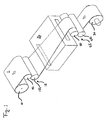
- FIG. 1 shows schematically an apparatus for carrying out the process of the invention.
- the apparatus comprises an unwinding roll (10) and a winding roll (30) provided essentially in parallel orientation for allowing transfer of a web (1) from the unwinding roll (10) to the winding roll (30).
- the winding roll (10) preferably has a width corresponding to the width (a) of the precursor web prior to the stretching treatment.
- the winding roll preferably has a width corresponding to the width (b) of the web after the drawing treatment. Since the width of the web (1) decreases during the drawing treatment, the unwinding roll (10) has a greater width than the winding roll (30).
- the unwinding roll (10) and the winding roll (30) may be rotated around their longitudinal axis.
- the rotation may be controlled independently for the unwinding roll (10) and the winding roll (30).
- the unwinding roll supports a nonwoven web (1).
- the nonwoven web extends from the unwinding roll (10) to the winding roll (30) through a heating means (20) such as an oven.
- a first S-wrap (15) comprising guiding roll (151) and guiding roll (152) is provided between the unwinding roll (10) and the heating means (30).
- a second S-wrap (25) comprising guiding roll (251) and guiding roll (252) is provided between the heating means (20) and the winding roll (30).
- the nonwoven web supported by the unwinding roll (10) corresponds to a precursor web.
- the precursor web extends from the unwinding roll (10) in machine direction optionally passing S-wrap (15) towards the entrance of the heating means (20).
- the nonwoven web enters the heating means (20) and extends through the heating means towards the exit of the heating means. Downstream from the heating means, the nonwoven web extends optionally via S-wrap (25) to the winding roll (30).
- the heating means (20) is provided for heating the nonwoven web to a temperature between the softening point of the thermoplastic fibers of the web and the melting point of the thermoplastic fibers.
- the S-wraps (15) and (25) are provided for better controlling the movement of the nonwoven web.
- an elastic thermally bonded nonwoven web is prepared by providing a thermally bonded nonwoven precursor web containing thermoplastic fibers whereby said precursor web is supported by unwinding roll (10).
- Unwinding roll (10) is rotated around its longitudinal axis whereby the precursor web leaves unwinding roll (10) in machine direction along arrow (MD) at a speed A.
- the precursor web travels via S-wrap (15) into the heating means (20), through the neating means and from the exit of the heating means via S-wrap (25) to the winding roll (30).
- Winding roll (30) is driven at a speed higher than the unwinding speed A by a factor of (1+X%).
- the factor (1+X%) determines the drawing rate of the nonwoven web in the process of the present invention.
- the precursor web is subjected to a drawing treatment in a machine direction at a drawing rate of from 45 to 70 %, and a strain rate with a range of from 1000 to 2400 %/min at a temperature between the softening point and the melting point of the fibers in order to allow a consolidation of the fiber structure and a decrease of the width of the nonwoven web.
- the width of the web decreases in the cross direction (CD).
- the machinery for carrying out the process of the invention is constructed for commercial capacity with an unwinder roll and a winding roll(s) installed in a distance of from 4 to 12 m, preferably about 6 to 10 m, specifically 8 m, and a heating device installed in between.
- the unwinder advantageously runs at commercial speed of more than 100m/min and up to 400m/min, preferably at least 150 m/min and up to 250 m/min, and a draw ratio of 45% to 70 % is created by increasing the speed of the winding roll.
- the strain rates is adjusted to 1000 to 2400 %/min, preferably 1200 to 2200%/min.
- the drawing treatment in step (i) comprises introducing the thermally bonded nonwoven web into a heating means for heating the web to a temperature between the softening point and the melting point of the fibers.
- the drawn web is preferably cooled after the drawing treatment and prior to winding on storage roll.
- the web used in the process of the invention preferably contains polypropylene fibers.
- the amount of the polypropylene fibers in the web is preferably at least 30 % by weight.
- the web may contain further fibers, such as thermoplastic fibers or cellulosic fibers.
- the web consists of polypropylene fibers.
- the nonwoven web of the present invention has anisotropic elasticity properties, preferably a ratio of elongation at break in cross direction to the elongation at break in machine direction of at least 800 %.
- the nonwoven web may be a spunbonded web, a melt blown web or a carded thermally bonded nonwoven web, or the nonwoven web may be a laminate containing two or more of the above mentionned nonwoven webs or the web may be a laminates of the above mentionned nonwoven webs and a thermoplastic film.
- thermally bonded nonwoven webs including carder, spunbond, SMS and SMMS from different producers have been processed and the resultant webs exhibit high stretchability with high recovery in the cross-direction.
- the cross-direction-only elasticity of these webs truly frees the nonwoven product converting from the need of sewing latex straps in their conventional methods, and the converted products provide sensational easy-fit and stressless comfort to wearer.
- the webs of this invention may be a multilayer laminate.
- An example of a multilayer laminate is an embodiment wherein some of the layers are spunbond and some meltblown such as a spunbond-meltblown-spunbond (SMS) laminate as disclosed in US 5,169,706 .
- SMS spunbond-meltblown-spunbond
- SMMS is the laminate of Spunbond-meltblown -meltblown- spundbond.
- Such a laminate may be made by sequentially depositing onto a moving forming belt first a spunbond fabric layer, then a meltblown fabric layer and last another spunbond layer and then bonding the laminate in a spotbinding device.
- one or more of the fabric layers may be made individually, collected in rolls, and combined in a separate bonding step.
- the web of carded or thermalbond described in this invention is obtainable by mixing and carding staple fibers for formed a mat then bonded with a spotbonding method.
- the drawing treatment in step (i) of the continuous process according to the invention may comprise unwinding the thermally bonded nonwoven web into a first variable tension means which feeds said web into a web heating means for heating the web to a temperature between the softening point and the melting point of the fibers, followed by continuously stretching the heated web lengthwise in the machine direction, cooling the web and collecting the cooled web.
- the nonwoven web containing thermoplastic fibers can be softened in the range of temperature prior to melting. In the softened states, a mechanical force can be applied to the web to change its morphology and properties. After the drawing treatment and the cooling below the softening temperature, the finished web exhibits different characteristics from its precursor.
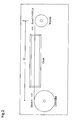
- FIG. 2 shows a schematic side view of an alternative apparatus lacking S-wraps.
- the apparatus comprises one unwinder and a winder and an oven in between to apply constant heat to a fabric that runs through.
- the transformation of the nonwoven web is carried out within the distance between the unwinder and winder (D).
- the strain rate (%/t) is generally described as a piece of fabric being drawn and extended certain (X) percentage in a period of time.
- the extension percentage can be achieved by the speed ratio of winder to unwinder, and the time period of fabric run through can be calculated by dividing D over the average of unwinder speed (A) and winder speed [(1+X%) A].
- Figure 3 illustrates shows a schematic view of a further embodiment of an apparatus for carrying out the process of the present invention.
- the apparatus includes one S-wrap (15 ) after unwinder and one S-wrap (25) before winder for stabilizing the fabric feeding through.
- the transformation of the nonwoven web is carried out within the distance (D) between these two S-wraps.
- the extension percentage can be achieved by the speed ratio of S-wrap 2 to S-wrap 1, and the time period of fabric run through can be calculated by dividing D over the average of S-wrap 1 speed (A) and S-wrap 2 speed [ (1+X%) A].
- the present invention also provides an elastic thermally bonded nonwoven web containing polypropylene fibers, which is obtained or obtainable by the process of the present invention.
- the web elasticity is defined by measuring the variations of a 5-cm wide and 10cm long strip along the longitudinal axis as follows: stretched length - recovered length / stretched length - original length .
- the elastic thermally bonded nonwoven web preferably has an elasticity in the cross direction of at least 70% recovery from a 100% elongation, and at least 60% recovery from a 150% elongation.
- the elastic thermally bonded nonwoven web is laminated on an elastomeric film.
- the present invention also provides a use of the elastic nonwoven web for the preparation of a disposable sanitary protection product, a medical product, a protective work-wear or a personal use item.
- the present invention also provides a product containing an elastic nonwoven web of the invention.
- the product may be is a disposable sanitary protection product, a medical product, a protective work-wear or and a personal use item.
- the disposable product may be an adult or infant diaper, or a sanitary napkin.
- the medical product may be a mask, an operating gown, a head cover, or an operating drape.
- the protective work-wear may be a coverall, a head cover or mask.
- the personal use item may be underwear.
- the process of the invention does not use expensive, allergenic and environmentally unsafe elastomeric fibers for imparting elasticity.
- the softening point is the temperature where a thermoplastic fiber looses its room temperature modulus and becomes soft, viscous and transformable to applied force.
- spunbond refers to the webs formed by small diameter fibers which are formed by extruding molten thermoplastic material as filaments from a plurality of fine, usually circular capillaries of a spinneret with the diameter of the extruded filaments then being rapidly reduced as by, for example, in US 4,340,563 and US 3,692,618 , US 3,802,817 , US 3,338,992 and 3,341,394 , US 3,502,763 , US 3,502,538 , and US 3,542,615 .
- Spunbond fibers are generally not tacky when they are deposited onto a collecting surface.
- Spunbond fibers are generally continuous and have average diameters (from a sample of at least ten fibers) larger than 7 microns, more particularly, between about 10 and 30 microns.
- Tensile test is a measure of breaking strength and elongation or strain of a fabric when subjected to unidirectional stress. This test is known in the art and conforms to the specifications of Method D5034 of the American Standard Test Methods. The results are expressed in kilograms to break and percent stretch before breakage. Higher numbers indicate a stronger, more stretchable fabric.
- the term "elongation” means the increase in length of a specimen during a tensile test. Values for grab tensile strength and grab elongation are obtained using a specified width of fabric, usually 3 cm, clamp width and a constant rate of extension. The sample is wider than the clamp to give results representative of effective strength of fibers in the clamped width combined with additional strength contributed by adjacent fibers in the fabric.
- 17gsm SMS nonwoven fabrics were processed over 8-meters distance between unwinder and winder to show the width reduction under different strain rates and conditions further specified in Table 1. As shown by Table 1, a draw rate over 45% was required to reduce the width by 50%. Upon increase of the speed by 10m/min, it was required to increase the draw ratio by about 1.5% to maintain the width reduction.
- Nonwoven webs of Spunbond (S), Carded (C) SMS and SMMS were treated at 200 m/min unwinding speed with 30 to 60% draw ratios. It was shown in Table 3 that the draw ratio made the length extension and the width reduction in similar pattern of 30-60% with different thermally bonded nonwoven webs and at least 45% draw ratio was required to reduce 50% of the precursor width.
- the strain rate is calculated by the percentage of increasing length within the time period of time that makes such increase.
- the percentage of increasing length is the draw ratio, which is carried out by increasing the winding speed over the unwinder.
- the time period of making such length increasing is calculated by dividing the distance between the unwinder and the wining roll with the speed of the web passing through, and that speed is an average of unwinder speed and winding speed.
- the present invention requires at least 45% draw ratio in a distance of 8 meters between unwinder and winding roll and with a minimal speed of 150m/min for unwinder, to reduce the width of the precursor web by 50% and become the elastic nonwoven web of the invention.
- the 0.04354 minutes ( 2.61 second) processing time is essential also for the web to pick up the heat and raise its temperature from 25C to 125°C for softening.
- EP 0 844 323 on the other hand describe a method of using low strain rate that between 350% and 950% per min at speed below 100m/min.
- EP 0 844 323 describes clearly that the width reduction of the precursor web was between 30-40% and the finished web has an elasticity for 85% recovery from 50% elongation. Accordingly, the draw ratio would be around 35% or less and that theoretically it should not be possible to stretch the finished web more than 66.7% (100/60) to over the width of its precursor.
- EP 0 844 323 describes the treatment with multiple sets of drawing rolls to make the accumulated strain rate typically below 950% but above 350 % per minute. In fact, the more sections of drawing rolls ae present, the lower the processing speed has to be adjusted to meet the claimed low strain rate range.
- strain rate is not appropriate to be used to describe a process without specifying the two variables, the draw ratio, and the rate of the processing (the processing distance over the processing speed), since the same strain rates can be obtained with different combinations of parameters in the equation.
- Both U.S. 5,244,482 and EP 0 844 323 use the strain rate as the only parameter for defining their methods but without clarifying the rate of the processing and so there is no way of knowing how to come up the numbers of their strain rates. Still, there is no conflict of those previous descriptions with the present invention in the strain rates.
- Hassenboehler's invention claimed their method at strain rate at least 2500% per min
- Ward's invention claimed the range between 350% to 950% per min.
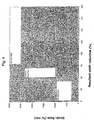
- the present invention operates in the range of 1000% to 2400% per min as shown by figure 4 .
Landscapes
- Engineering & Computer Science (AREA)
- Textile Engineering (AREA)
- Chemical & Material Sciences (AREA)
- Chemical Kinetics & Catalysis (AREA)
- General Chemical & Material Sciences (AREA)
- Nonwoven Fabrics (AREA)
- Treatment Of Fiber Materials (AREA)
- Absorbent Articles And Supports Therefor (AREA)
- Chemical Or Physical Treatment Of Fibers (AREA)
Abstract
Description
- The present invention relates to a process for preparing an elastic thermally bonded nonwoven web or fiber mat and an elastic thermally bonded nonwoven web or fiber mat prepared by the process according to the invention. The present invention also relates to the use of the elastic thermally bonded nonwoven web or fiber mat prepared according to the invention in the manufacture of a disposable sanitary protection product, a medical product, a protective work-wear or a personal use item. Finally, the present invention relates to a produt containing the elastic nonwoven web or fiber mat of the invention.
- Thermally bonded nonwoven webs are well known in the art (Wendt, Industrial and Engineering Chemistry Volume 48, No. 8 (1965) pages 1342;
US 3,978,185 ,US 3,795,571 ;3,811,957 ). Stretching of nonwoven webs is described inU.S. 3,772,417 ,US 4,048,364 ,US 4,223,059 ,3,949,127 ,US 4,276,336 ,US 5,296,289 ,US 4,443,513 andEP 0 882 147 - Thermally bonded nonwoven webs are conventionally used for the mass production of disposable sanitary protection products such as adult and infant diapers or sanitary napkins, medical products such as masks, operating gowns, head covers or operating drapes; protective work-wear such as coveralls, head covers and masks; and personal use items such as underwear. A major deficiency of nonwoven webs is their lack of elasticity or stretch and conformability. Since conventional thermally bonded nonwoven webs do not have sufficient elastic properties, products containing such nonwoven webs which require elastic properties conventionally further contain latex bands for fastening and fitting. However, proper adjustment of latex straps is difficult to achieve whereby a fit is usually observed which is either too loose or too tight. Moreover, latex straps are allergenic and irritating to the skin to some degree. Additionally, the use of latex and rubber components in huge volume for disposable products has raised serious environmental concerns inview of toxic waste generation such as dioxins and other harmful emissions in the waste incineration process.
- Attempts were made in the prior art to provide nonwoven webs having elastic properties. In one approach, elastomers are incorporated into nonwoven webs as films, bands, or threads of natural or synthetic rubber whereby full-web elasticity in two directions is achieved. However, nonwoven webs based on elastomers lack dimensional stability in at least one direction whereby it is difficult to handle such webs in automated manufacturing processes. Moreover, nonwoven webs based on elastomeric fibers are expensive. Therefore, the use of elastomeric fibers poses inherent problems which render them unsuitable for the mass production of disposable products.
- An alternative approach for imparting elasticity to a nonwoven web relates to the socalled thermo-mechanical treatments. Thermo-mechanical treatments for imparting elasticity to a nonwoven web are described in
US 5,244,482 andEP 0 844 323 -
U.S. 5,244,482 disclosed a process for the preparation of a filter material, wherein very high strain rates of at least 2500%/min are used to laterally consolidate the precursor web with resultant width of less than 80% of the precursor. The very high strain rates are shown to change the morphology of the nonwoven web, reduce the pore size and narrow the pore size distribution. Although a degree of elasticity is created, the elastic modulus is low (70% recovery at 50% elongation, 40% recovery at 100% elongation). We already learn a low draw ratio will not make a high stretchy resultant web. The required strain rates mean in a continuous process, that a high draw ratio with a high processing speed of from 1000 to 4000 m/min are unlikely to be achieved in practice. Moreover, the resultant fabrics is stiff whereby mass production of disposable products based on the material ofU.S. 5,244,482 is not possible. -
EP 0 844 323EP 0 844 323 - It is the problem of the present invention to overcome the drawbacks of the prior art and to provide a cost effective process of mass producing an elastic thermally bonded nonwoven web having elastic properties in cross direction with high stretchability and recovery.
- It is a further problem of the invention to provide a process wherein the processing speed is at least 100 m/min, preferably in a range of from 200 to 400 m/min.
- It is a further problem of the invention to provide a novel elastic nonwoven web having high stretchability in cross direction of over 100% with recovery of more than 70%. Moreover, it is a further problem of the invention to provide a novel elastic nonwoven web having high stretchability in cross direction of over 150% with recovery of more than 60%.
- It is a further problem of the present invention to provide novel products containing the elastic nonwoven web of the present invention.
- These problems are solved according to the claims. Accordingly, the present invention provides a process of preparing an elastic thermally bonded nonwoven web, whereby the process is characterized by the following steps:
- (i) providing a thermally bonded nonwoven precursor web containing thermoplastic fibers,
- (ii) subjecting the precursor web of step (i) to a drawing treatment in a machine direction at a drawing rate of from 45 to 70 %, and a strain rate within a range of from 1000 to 2400 %/min at a temperature between the softening point and the melting point of the fibers for preparing the elastic thermally bonded nonwoven web.
- The present invention is based on the recognition that control of the strain rate alone is insufficient for imparting superior elastic properties to a thermally bonded nonwoven precursor web in a thermo-mechanical treatment. The present invention is further based on the recognition that control of a further measure is essential for obtaining superior elastic properties. The present invention identifies the control of the drawing rate in combination with the control of the strain rate as essential measures for imparting superior elastic properties. The drawing ratio was found to be causal for shrinking the web width and for creating the stretchability and elasticity. A low drawing rate insufficiently reduces the width of the precursor web and imparts less stretchability and elasticity to the finished web. Finally, the present invention is based on the recognition that the contol of a combination of the drawing rate of from 45 to 70 %, and a strain rate within a range of from 1000 to 2400 %/min provides superior elastic properties, notably with nonwoven precursor webs containing polypropylene. Accordingly, elastic properties imparted by a thermo-mechanical treatment to a thermally bonded nonwoven precursor web may be dramatically improved whereby the nonwoven webs show an elasticity in the cross direction of at least 70% recovery from a 100% elongation, and at least 60% recovery from a 150% elongation. Morover, the nonwoven webs provide unidirectional elasticity wherein the ratio of elongation at break in cross direction to the elongation at break in machine direction is at least 800%.Thermally bonded nonwoven web having such elastic properties were unknown prior to the present invention.
-
-
Figure 1 shows schematically an appratus for carrying out the process of the invention. -
Figure 2 shows a schematic side view of an apparatus for carrying out the process of the invention. -
Figure 3 illustrates shows a schematic side view of a further embodiment of an apparatus for carrying out the process of the present invention. -
Figure 4 is a graph showing the relationship of the present invention toU.S. 5,244,482 andEP 0 844 323 -
Figure 1 shows schematically an apparatus for carrying out the process of the invention. The apparatus comprises an unwinding roll (10) and a winding roll (30) provided essentially in parallel orientation for allowing transfer of a web (1) from the unwinding roll (10) to the winding roll (30). The winding roll (10) preferably has a width corresponding to the width (a) of the precursor web prior to the stretching treatment. The winding roll preferably has a width corresponding to the width (b) of the web after the drawing treatment. Since the width of the web (1) decreases during the drawing treatment, the unwinding roll (10) has a greater width than the winding roll (30). The unwinding roll (10) and the winding roll (30) may be rotated around their longitudinal axis. The rotation may be controlled independently for the unwinding roll (10) and the winding roll (30). The unwinding roll supports a nonwoven web (1). The nonwoven web extends from the unwinding roll (10) to the winding roll (30) through a heating means (20) such as an oven. Preferably, a first S-wrap (15) comprising guiding roll (151) and guiding roll (152) is provided between the unwinding roll (10) and the heating means (30). Moreover, a second S-wrap (25) comprising guiding roll (251) and guiding roll (252) is provided between the heating means (20) and the winding roll (30). The nonwoven web supported by the unwinding roll (10) corresponds to a precursor web. The precursor web extends from the unwinding roll (10) in machine direction optionally passing S-wrap (15) towards the entrance of the heating means (20). The nonwoven web enters the heating means (20) and extends through the heating means towards the exit of the heating means. Downstream from the heating means, the nonwoven web extends optionally via S-wrap (25) to the winding roll (30). The heating means (20) is provided for heating the nonwoven web to a temperature between the softening point of the thermoplastic fibers of the web and the melting point of the thermoplastic fibers. The S-wraps (15) and (25) are provided for better controlling the movement of the nonwoven web. - Now, the process of the invention will be illustrated based on the apparatus shown in
Figure 1 . Accordingly, an elastic thermally bonded nonwoven web is prepared by providing a thermally bonded nonwoven precursor web containing thermoplastic fibers whereby said precursor web is supported by unwinding roll (10). Unwinding roll (10) is rotated around its longitudinal axis whereby the precursor web leaves unwinding roll (10) in machine direction along arrow (MD) at a speed A. The precursor web travels via S-wrap (15) into the heating means (20), through the neating means and from the exit of the heating means via S-wrap (25) to the winding roll (30). Winding roll (30) is driven at a speed higher than the unwinding speed A by a factor of (1+X%). The factor (1+X%) determines the drawing rate of the nonwoven web in the process of the present invention. According to the invention, the precursor web is subjected to a drawing treatment in a machine direction at a drawing rate of from 45 to 70 %, and a strain rate with a range of from 1000 to 2400 %/min at a temperature between the softening point and the melting point of the fibers in order to allow a consolidation of the fiber structure and a decrease of the width of the nonwoven web. As a result of the drawing treatment, the width of the web decreases in the cross direction (CD). Preferably, the machinery for carrying out the process of the invention is constructed for commercial capacity with an unwinder roll and a winding roll(s) installed in a distance of from 4 to 12 m, preferably about 6 to 10 m, specifically 8 m, and a heating device installed in between. The unwinder advantageously runs at commercial speed of more than 100m/min and up to 400m/min, preferably at least 150 m/min and up to 250 m/min, and a draw ratio of 45% to 70 % is created by increasing the speed of the winding roll. The strain rates is adjusted to 1000 to 2400 %/min, preferably 1200 to 2200%/min. Preferably, the drawing treatment in step (i) comprises introducing the thermally bonded nonwoven web into a heating means for heating the web to a temperature between the softening point and the melting point of the fibers. The drawn web is preferably cooled after the drawing treatment and prior to winding on storage roll. - The web used in the process of the invention preferably contains polypropylene fibers. The amount of the polypropylene fibers in the web is preferably at least 30 % by weight. The web may contain further fibers, such as thermoplastic fibers or cellulosic fibers. In a specific embodiment, the web consists of polypropylene fibers. The nonwoven web of the present invention has anisotropic elasticity properties, preferably a ratio of elongation at break in cross direction to the elongation at break in machine direction of at least 800 %. The nonwoven web may be a spunbonded web, a melt blown web or a carded thermally bonded nonwoven web, or the nonwoven web may be a laminate containing two or more of the above mentionned nonwoven webs or the web may be a laminates of the above mentionned nonwoven webs and a thermoplastic film. Several kinds of thermally bonded nonwoven webs including carder, spunbond, SMS and SMMS from different producers have been processed and the resultant webs exhibit high stretchability with high recovery in the cross-direction. The cross-direction-only elasticity of these webs truly frees the nonwoven product converting from the need of sewing latex straps in their conventional methods, and the converted products provide sensational easy-fit and stressless comfort to wearer.
- The webs of this invention may be a multilayer laminate. An example of a multilayer laminate is an embodiment wherein some of the layers are spunbond and some meltblown such as a spunbond-meltblown-spunbond (SMS) laminate as disclosed in
US 5,169,706 . SMMS is the laminate of Spunbond-meltblown -meltblown- spundbond. Such a laminate may be made by sequentially depositing onto a moving forming belt first a spunbond fabric layer, then a meltblown fabric layer and last another spunbond layer and then bonding the laminate in a spotbinding device. Alternatively, one or more of the fabric layers may be made individually, collected in rolls, and combined in a separate bonding step. - The web of carded or thermalbond described in this invention is obtainable by mixing and carding staple fibers for formed a mat then bonded with a spotbonding method.
- Preferably, the process of the invention is carried out continuously. The drawing treatment in step (i) of the continuous process according to the invention may comprise unwinding the thermally bonded nonwoven web into a first variable tension means which feeds said web into a web heating means for heating the web to a temperature between the softening point and the melting point of the fibers, followed by continuously stretching the heated web lengthwise in the machine direction, cooling the web and collecting the cooled web. The nonwoven web containing thermoplastic fibers can be softened in the range of temperature prior to melting. In the softened states, a mechanical force can be applied to the web to change its morphology and properties. After the drawing treatment and the cooling below the softening temperature, the finished web exhibits different characteristics from its precursor.
-
Figure 2 shows a schematic side view of an alternative apparatus lacking S-wraps. The apparatus comprises one unwinder and a winder and an oven in between to apply constant heat to a fabric that runs through. The transformation of the nonwoven web is carried out within the distance between the unwinder and winder (D). The strain rate (%/t) is generally described as a piece of fabric being drawn and extended certain (X) percentage in a period of time. The extension percentage can be achieved by the speed ratio of winder to unwinder, and the time period of fabric run through can be calculated by dividing D over the average of unwinder speed (A) and winder speed [(1+X%) A]. Speed A is generally expressed in m/ min as :
-
Figure 3 illustrates shows a schematic view of a further embodiment of an apparatus for carrying out the process of the present invention. The apparatus includes one S-wrap (15 ) after unwinder and one S-wrap (25) before winder for stabilizing the fabric feeding through. The transformation of the nonwoven web is carried out within the distance (D) between these two S-wraps. The extension percentage can be achieved by the speed ratio of S-wrap 2 to S-wrap 1, and the time period of fabric run through can be calculated by dividing D over the average of S-wrap 1 speed (A) and S-wrap 2 speed [ (1+X%) A]. - The present invention also provides an elastic thermally bonded nonwoven web containing polypropylene fibers, which is obtained or obtainable by the process of the present invention. The web elasticity is defined by measuring the variations of a 5-cm wide and 10cm long strip along the longitudinal axis as follows:

- The elastic thermally bonded nonwoven web preferably has an elasticity in the cross direction of at least 70% recovery from a 100% elongation, and at least 60% recovery from a 150% elongation. In a specific embodiment, the elastic thermally bonded nonwoven web is laminated on an elastomeric film.
- The present invention also provides a use of the elastic nonwoven web for the preparation of a disposable sanitary protection product, a medical product, a protective work-wear or a personal use item. The present invention also provides a product containing an elastic nonwoven web of the invention. The product may be is a disposable sanitary protection product, a medical product, a protective work-wear or and a personal use item. The disposable product may be an adult or infant diaper, or a sanitary napkin.The medical product may be a mask, an operating gown, a head cover, or an operating drape. The protective work-wear may be a coverall, a head cover or mask.The personal use item may be underwear.
- The process of the invention does not use expensive, allergenic and environmentally unsafe elastomeric fibers for imparting elasticity.
- Terminology::
- The basis weight of nonwoven webs is usually expressed in minigram of material per square meter (gsm).
- The softening point is the temperature where a thermoplastic fiber looses its room temperature modulus and becomes soft, viscous and transformable to applied force.
- As used herein the term "spunbond" refers to the webs formed by small diameter fibers which are formed by extruding molten thermoplastic material as filaments from a plurality of fine, usually circular capillaries of a spinneret with the diameter of the extruded filaments then being rapidly reduced as by, for example, in
US 4,340,563 andUS 3,692,618 ,US 3,802,817 ,US 3,338,992 and3,341,394 ,US 3,502,763 ,US 3,502,538 , andUS 3,542,615 . Spunbond fibers are generally not tacky when they are deposited onto a collecting surface. Spunbond fibers are generally continuous and have average diameters (from a sample of at least ten fibers) larger than 7 microns, more particularly, between about 10 and 30 microns. - Tensile test: The tensile test is a measure of breaking strength and elongation or strain of a fabric when subjected to unidirectional stress. This test is known in the art and conforms to the specifications of Method D5034 of the American Standard Test Methods. The results are expressed in kilograms to break and percent stretch before breakage. Higher numbers indicate a stronger, more stretchable fabric. The term "elongation" means the increase in length of a specimen during a tensile test. Values for grab tensile strength and grab elongation are obtained using a specified width of fabric, usually 3 cm, clamp width and a constant rate of extension. The sample is wider than the clamp to give results representative of effective strength of fibers in the clamped width combined with additional strength contributed by adjacent fibers in the fabric.
- 17gsm SMS nonwoven fabrics were processed over 8-meters distance between unwinder and winder to show the width reduction under different strain rates and conditions further specified in Table 1. As shown by Table 1, a draw rate over 45% was required to reduce the width by 50%. Upon increase of the speed by 10m/min, it was required to increase the draw ratio by about 1.5% to maintain the width reduction.
Table 1 Unwinding Speed Draw Ratio Winding Speed Strain Rate Width Reducing m/min % m/min % / min % 150 40 210 900 45.4 45 218 1035 52.3 50 225 1172 57.7 55 233 1317 61.5 60 240 1463 62.2 65 250 1625 63.1 200 40 280 1200 43.4 45 290 1378 51.8 50 300 1563 55.7 55 310 1753 58.5 60 320 1950 60.6 65 330 2153 61.8 250 40 350 1500 41.4 45 363 1724 50.7 50 375 1953 53.6 55 388 2193 56.3 60 400 2438 57.9 65 413 NA Broke webs - Different basic weights of SMS precursor webs were processed at unwinding speed of 200m/min and with 50 % draw rate. The results shown in Table 2 demonstrate that the draw ratio made similar width reductions to precursor webs with different basic weights.
Table 2. Precursor Basic Weight Draw Ratio Strain Rate Width Reduction Finished Basic weight g/cm2 % %/min % g/cm2 16.7 50 1563 56.8 26.4 26.6 50 1563 55.3 39.8 35.4 50 1563 57.1 51.3 52.3 50 1563 55.4 68.6 - Nonwoven webs of Spunbond (S), Carded (C) SMS and SMMS were treated at 200 m/min unwinding speed with 30 to 60% draw ratios. It was shown in Table 3 that the draw ratio made the length extension and the width reduction in similar pattern of 30-60% with different thermally bonded nonwoven webs and at least 45% draw ratio was required to reduce 50% of the precursor width.
Table 3 Precursor Basic weight Draw Ratio Strain Rate Finished Basic weight Length Extension Width Reduction g/cm2 % %/min g/cm2 % % S 12.7 30 750 15.5 1.26 34.6 12.7 40 1000 17.4 1.34 45.0 12.7 45 1125 18.1 1.37 50.6 12.7 50 1250 19.2 1.40 52.4 12.7 60 1500 21.7 1.53 59.8 S 25.6 30 750 28.3 1.28 32.3 25.6 40 1000 33.6 1.37 43.8 25.6 45 1125 34.7 1.40 50.1 25.6 50 1250 36.5 1.44 50.6 25.6 60 1500 40.8 1.56 58.1 C 22.6 30 750 31.4 1.20 38.1 22.6 40 1000 33.9 1.29 49.6 22.6 45 1125 35.2 1.32 52.2 22.6 50 1250 36.7 1.36 55.8 22.6 60 1500 41.3 1.45 61.8 C 44.3 30 750 56.9 1.21 37.0 44.3 40 1000 67.6 1.26 49.1 44.3 45 1125 69.2 1.30 52.7 44.3 50 1250 70.3 1.34 54.2 44.3 60 1500 74.9 1.44 60.9 SMS 15.2 30 750 20.9 1.18 37.7 15.2 40 1000 22.6 1.24 48.3 15.2 45 1125 23.4 1.31 51.5 15.2 50 1250 24.1 1.36 53.4 15.2 60 1500 26.3 1.46 57.8 SMS 41.7 30 750 54.4 1.15 35.5 41.7 40 1000 62.5 1.20 46.1 41.7 45 1125 65.2 1.31 52.2 41.7 50 1250 67.2 1.42 56.4 41.7 60 1500 72.6 1.51 62.3 SMMS 17.1 30 750 20.5 1.17 30.7 17.1 40 1000 23.8 1.25 42.5 17.1 45 1125 24.4 1.31 50.3 17.1 50 1250 25.6 1.37 52.2 17.1 60 1500 29.1 1.48 59.4 SMMS 50.6 30 750 58.7 1.26 32.9 50.6 40 1000 68.8 1.34 46.2 50.6 45 1125 70.4 1.38 50.1 50.6 50 1250 72.8 1.41 51.6 50.6 60 1500 78.3 1.52 58.3 - Spunbond 35gsm, Carded 45gsm and SMMS 25gsm were used as precursor for processing under different draw ratio to obtain the width reduction from 30% to 60%. The results are shown in Table 4 The elasticities were measured from 50%, 100% and 150% elongation respectively. The resultant webs with width reduction less than 40% are most unlikely be extended for more than 100% and obtained good recovery for over 50%. In contrast, the resultant webs with width reduction over 50% showed recovery more than 70% at 100% elongation and more than 60% at 150% elongation.
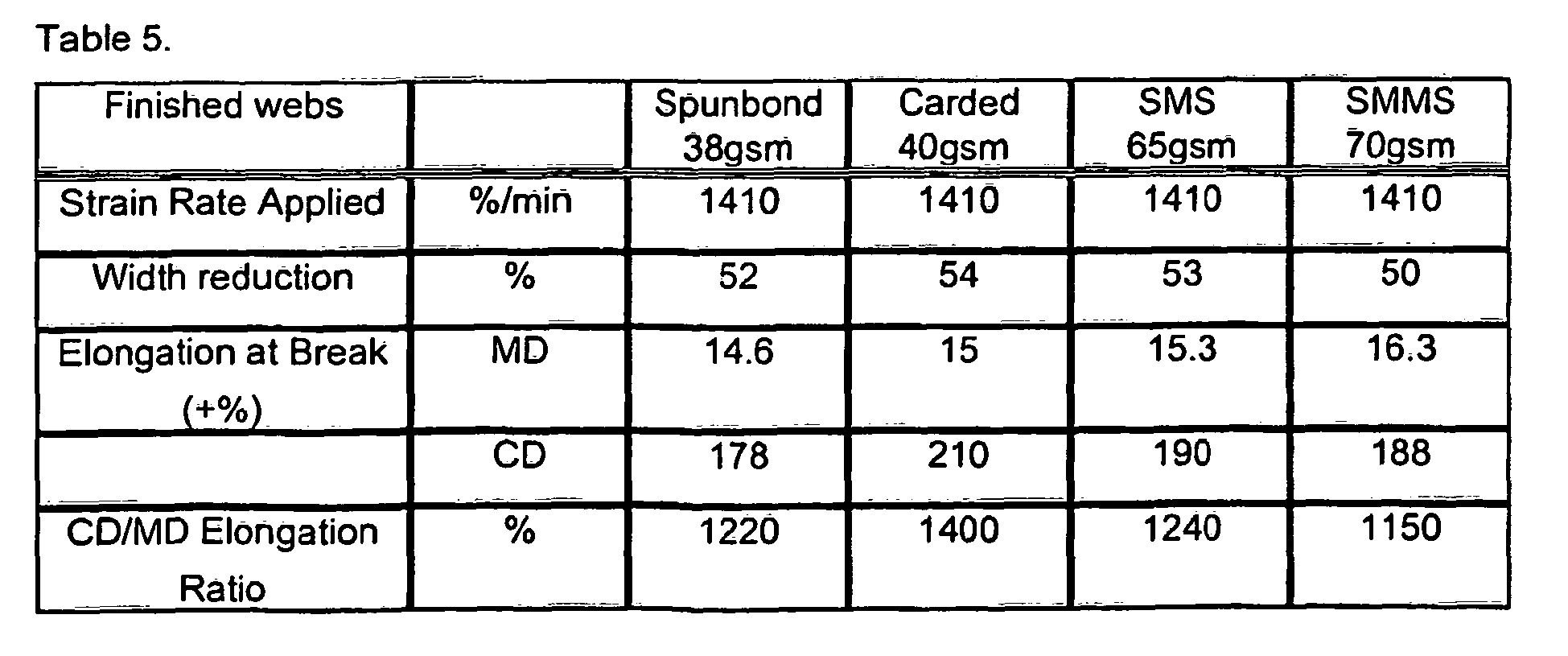
Table 4 Width Reduction Strain Rate Elongation at Break Recovery from 50% elongation Recovery from 100% elongation Recovery from 150% elongation % %/min % % % % Spunbond 43gsm 30 720 89 72 NA NA Spunbond 47gsm 40 1050 104 88 NA NA Spunbond 52gsm 50 1380 184 >95 78 63 Spunbond 62gsm 60 1710 237 >95 86 73 Carded 54gsm 30 690 104 75 NA NA Carded 60gsm 40 1020 129 90 24 NA Carded 67gsm 50 1350 203 >95 73 65 Carded 78gsm 60 1680 248 >95 80 74 SMMS 28gsm 30 780 93 76 NA NA SMMS 31gsm 40 1080 115 85 NA NA SMMS 36gsm 50 1410 197 >95 77 66 SMMS 40gsm 60 1790 226 >95 86 77 - The results shown in Table 5 further confirmed the high elastic recovery rates of the webs over five stretches for 100% (A) and 150% (B) elongations. The unique high ratio (1000 - 1400%) of CD/MD elongation at break is also shown.

- The stretchability and recovery were tested with 5-cm strips of treated SMS webs with the claimed high and low limits of strain rates. The results are shown in Table 6. The unique characteristics of cross direction (CD) width reduction, elongation at break, CD/MD elongation ratio and recovery at 100% elongation were measured.


- The strain rate is calculated by the percentage of increasing length within the time period of time that makes such increase. The percentage of increasing length is the draw ratio, which is carried out by increasing the winding speed over the unwinder. The time period of making such length increasing is calculated by dividing the distance between the unwinder and the wining roll with the speed of the web passing through, and that speed is an average of unwinder speed and winding speed.
- For example, the present invention requires at least 45% draw ratio in a distance of 8 meters between unwinder and winding roll and with a minimal speed of 150m/min for unwinder, to reduce the width of the precursor web by 50% and become the elastic nonwoven web of the invention. The strain rate in the low limit of the present invention is calculated as:

- (1) 45% is the draw ratio;
- (2) 8 m is the distance between unwinder and winding roll that the drawing being created;
- (3) 150m/min is the unwinder speed;
- (4) 150m/min x 1.45 = 217.5m/min is the winding roll speed;
- (5) [150m/min + (150m/min x 1.45) ]/ 2 = 183.75 m/min is the averaged travelling speed of the web through the drawing;
- (6) 8m/ [150m/min + (150m/min x 1.45)] / 2 = 0.04354 minute is the time that the drawing happened
- The 0.04354 minutes ( 2.61 second) processing time is essential also for the web to pick up the heat and raise its temperature from 25C to 125°C for softening.
- The higher strain rates can be obtained by processing at high speed and high draw ratio. However, tests in the 8-meter processing distance had revealed that it would be impractical and break the commonly available nonwoven web that containing thermally bonded polypropylene fibers at a draw ratio of over 70% and a winding speed over 500m/min. In the case, the strain rate was 3500 %/min and less than 1.2 second for web to be heated.
- Any higher draw ratio or higher speed for higher strain rates as the previous
US 5,244,482 inventions described is considered incredible and impossible to be achieved especially for a continuous processing with the current commercial apparatus and on polypropylene nonwoven web. A temperature very close to the melting point was probably used in combination with a very high strain, whereby the resulting web has a width reduction of 80% of the precursor web, but an elongation of only below 120%. Such a fabric would be of little commercial value due to the stiffness, low degree of elasticity (70% recovery at 60% elongation) and very narrow width (if a 420 cm maximum width of a precursor web is used, the resulting web would be only 84 cm in width or less). Additionally,U.S. 5,244,482 places many limitations on selecting the precursor webs by the physical properties as to crystallinity, thermoplastic fiber content, fiber diameter, random fiber deposition, isotropic tensile properties and low tensile elongation to break. As a matter of fact, there is no commercial application of this art since it was disclosed. - The best result is obtained according to the present invention at 50% draw rate with feeding speed of 200m/min to make the strain rate at 1600%/min. The average strain rate of the best mode claimed by
US 5,244,482 was 4750%/min, and to attain it with an apparatus as shown infigure 1 and a 50% drawing rate, the feeding speed would have to be as high as 608m/min. As tested in an apparatus according tofigure 1 with the 50% draw rate and with commercially available nonwoven webs, the feeding speed cannot be increased over 400m/min without breaking the web. As a matter of fact, the maximal feeding speed stated in the experiment ofUS 5,244,482 was only 122m/min (400f/min), then for reaching the best strain rate, the draw rate has to be as high as 250%. Accordingly,US 5,244,482 is limited to special precursor webs with strict limitations in the properties of crystallinity, fiber diameter, random fiber deposition, isotropic tensile properties, and low tensile elongation to break. -
EP 0 844 323EP 0 844 323EP 0 844 323EP 0 844 323 a


- Processing under such low speed would raise the cost and has little commercial value to meet the applications of mass quantity and low-cost disposable nonwoven products, but any higher processing speed would make the strain rate over its claimed limit. More sets of drawing rolls or lower strain rates would further lower the processing speed. Additionally, the low draw ratio would sure not consolidate the web enough to make the high elasticity as the web resulted from the present invention.
- Most importantly, the strain rate is not appropriate to be used to describe a process without specifying the two variables, the draw ratio, and the rate of the processing (the processing distance over the processing speed), since the same strain rates can be obtained with different combinations of parameters in the equation. Both
U.S. 5,244,482 andEP 0 844 323figure 4 .
Claims (32)
- A process of preparing an elastic thermally bonded nonwoven web, whereby the process is characterized by the following steps:(i) providing a thermally bonded nonwoven precursor web containing thermoplastic fibers,(ii) subjecting the precursor web of step (i) to a drawing treatment in a machine direction at a drawing rate of from 45 to 70 % at a processing speed of at least 100 m/min over a processing distance to provide a strain rate within a range of from 1000 to 2400 %/min and at a temperature between the softening point and the melting point of the fibers for preparing the elastic thermally bonded nonwoven web.
- The process according to claim 1, wherein the processing speed is in a range of from 200 to 400 m/min.
- The process according to claim 1 or 2, wherein the drawing treatment in step (i) comprises introducing the thermally bonded nonwoven precursor web into a heating means for heating the web to a temperature between the softening point and the melting point of the fibers.
- The process of any one of any one of claims 1 to 3, which further comprises the step of cooling the web after the drawing treatment.
- The process according to any one of the preceding claims, wherein the precursor web contains polypropylene fibers.
- The process according to claim 5, wherein the polypropylene fibers are contained in an amount of at least 30% by weight.
- The process, according to any one of the preceding claims, wherein the precursor web contains cellulosic fibers.
- The process according to claim 1, wherein the precursor web consists of polypropylene fibers.
- The process according to any one of the preceding claims, wherein the elastic nonwoven web has anisotropic elasticity properties.
- The process of claim 9, wherein the ratio of elongation at break in machine cross direction to the elongation at break in machine direction is at least 800%.
- The process of any one of the preceding claims, wherein said nonwoven precursor web is a spunbonded web.
- The process of any one of the preceding claims, wherein nonwoven precursor web is a melt blown web.
- The process works of any one of the preceding claims, wherein said nonwoven precursor web is a carded thermally bonded nonwoven web.
- The process of any one of the preceding claims, wherein said nonwoven web is a laminate containing two or more of the nonwoven webs according to any one of claims 11 o 13, or a laminate of the nonwoven webs according to any one of claims 11 o 13 and a thermoplastic film.
- The process according to any one of the preceding claims, wherein said thermally bonded nonwoven web is a blend of thermoplastic fibers and cellulosic fibers wherein said web contains at least 30% thermoplastic fibers.
- The process according to any one of the preceding claims, wherein the process is carried out continuously.
- The continuous process according to claim 16, wherein the drawing treatment in step (i) comprises unwinding the thermally bonded nonwoven web into a first variable tension means which feeds said web into a web heating means for heating the web to a temperature between the softening point and the melting point of the fibers, followed by continuously stretching the heated web lengthwise in the machine direction, cooling the web and collecting the cooled web.
- A thermo-mechanical method for treating a nonwoven web according to any one of the previous claims which comprises:a. providing a thermally bonded polypropylene nonwoven web of carded, spunbond, SMS and SMMS as precursor web;b. provide an unwinder roll and the winding roll in a distance of 6-10 meters.c. continuously feeding the precursor web from the unwinder roll to the winding roll at a speed in a range of from 150m/min to 400m/min;d. heating the precursor web at a temperature between the softening temperature and melting temperature of the thermoplastic polypropylene;e. drawing the heated web by increasing the speed of winding roll over the unwinder at least 45% and to 70%, to thereby reduce the width of the web by at least 50% whereby thef. strain rates are within the range of 1000% to 2400% /min.
- The process according to claim 18, wherein the unwinding roll is a pair of pin-rolls to make a S-wrap for creating the draw ratio and release the finished web to the winder.
- The process according to claim 18, wherein the precursor web is a single layer or multiple layers construction that are thermally bonded or laminated.
- A elastic thermally bonded nonwoven web containing polypropylene fibers obtained or obtainable by the process of any one of claims 1 to 20, which has an elasticity in the cross direction of
at least 70% recovery from a 100% elongation, and
at least 60% recovery from a 150% elongation. - An elastic nonwoven web according to claim 21, made from a nonwoven precursor of carded, spunbond, SMS, and SMMS comprising polypropylene thermoplastic fibers and being heated and drawn in longitudinal direction over a 6-10 meters distance at speed range of 150m/min to 400m/min to reduce 50% the width of its precursor, wherein the drawing is made by feeding the web through a heating device installed between the unwinding and winding rolls to heat up the web in the temperature between the softening temperature and melting temperature of the thermoplastic fibers and by spontaneously increasing the speed of winding roll over unwinder at least 45% to maintain the strain rate in the range of 1000% to 2400% per minute, whereby the elastic nonwoven web is characterized by the elasticity of at least 70% recovery from a 100% elongation, or 60% recovery from a 150% elongation, in the cross direction.
- The elastic nonwoven web of claim 22 wherein the precursor web is composed of co-filament fibers, or the mix of mono and co-filaments.
- The elastic nonwoven web of claim 23 wherein the core of the co-filaments is composed of different thermoplastics of sheath.
- An elastic laminate comprising:(a) the elastic nonwoven web of claim 21; and(b) a stretchable substrate bonded to the elastic nonwoven web.
- The elastic nonwoven laminate of claim 25 wherein the substrate is an elastomeric layer.
- The elastic nonwoven web of claim 25 or 26 wherein the substrate is a film.
- Use of the elastic nonwoven web according to any one of claims 21 to 27 for the preparation of a disposable sanitary protection product, a medical product, a protective work-wear or a personal use item.
- The use according to claim 28, wherein the disposable product is an adult or infant diaper, or a sanitary napkin.
- The use according to claim 28, wherein the medical product is a mask, an operating gown, a head cover, or an operating drape.
- The use according to claim 28, wherein the protective work-wear is a coverall, a head cover or mask.
- The use according to claim 28, wherein the personal use item is underwear.
Priority Applications (13)
| Application Number | Priority Date | Filing Date | Title |
|---|---|---|---|
| EP20030028126 EP1538250B1 (en) | 2003-12-05 | 2003-12-05 | Process for preparing an elastic nonwoven web |
| AT03028126T ATE455886T1 (en) | 2003-12-05 | 2003-12-05 | METHOD FOR PRODUCING AN ELASTIC NON-WOVEN FABRIC |
| DK03028126T DK1538250T3 (en) | 2003-12-05 | 2003-12-05 | Process for producing an elastic nonwoven web |
| ES03028126T ES2338107T3 (en) | 2003-12-05 | 2003-12-05 | PROCESS TO PREPARE AN ELASTIC FABRIC FABRIC. |
| EP20070023697 EP2009162A3 (en) | 2003-12-05 | 2003-12-05 | Process for preparing an elastic nonwoven web |
| DE60331079T DE60331079D1 (en) | 2003-12-05 | 2003-12-05 | METHOD FOR PRODUCING AN ELASTIC NONWOVEN FABRIC |
| US10/780,781 US7713894B2 (en) | 2003-12-05 | 2004-02-18 | Process for preparing an elastic nonwoven web |
| JP2006542800A JP4681563B2 (en) | 2003-12-05 | 2004-12-03 | Method for producing an elastic nonwoven web |
| EP04812979A EP1699961B1 (en) | 2003-12-05 | 2004-12-03 | Process for preparing an elastic nonwoven web |
| CN2004800359146A CN1961108B (en) | 2003-12-05 | 2004-12-03 | Process for preparing an elastic nonwoven web |
| HK07111770.6A HK1106561B (en) | 2003-12-05 | 2004-12-03 | Process for preparing an elastic nonwoven web |
| PCT/US2004/040569 WO2005056900A1 (en) | 2003-12-05 | 2004-12-03 | Process for preparing an elastic nonwoven web |
| US12/687,523 US8123890B2 (en) | 2003-12-05 | 2010-01-14 | Process for preparing an elastic nonwoven web |
Applications Claiming Priority (1)
| Application Number | Priority Date | Filing Date | Title |
|---|---|---|---|
| EP20030028126 EP1538250B1 (en) | 2003-12-05 | 2003-12-05 | Process for preparing an elastic nonwoven web |
Related Child Applications (1)
| Application Number | Title | Priority Date | Filing Date |
|---|---|---|---|
| EP20070023697 Division EP2009162A3 (en) | 2003-12-05 | 2003-12-05 | Process for preparing an elastic nonwoven web |
Publications (2)
| Publication Number | Publication Date |
|---|---|
| EP1538250A1 EP1538250A1 (en) | 2005-06-08 |
| EP1538250B1 true EP1538250B1 (en) | 2010-01-20 |
Family
ID=34442976
Family Applications (3)
| Application Number | Title | Priority Date | Filing Date |
|---|---|---|---|
| EP20030028126 Expired - Lifetime EP1538250B1 (en) | 2003-12-05 | 2003-12-05 | Process for preparing an elastic nonwoven web |
| EP20070023697 Withdrawn EP2009162A3 (en) | 2003-12-05 | 2003-12-05 | Process for preparing an elastic nonwoven web |
| EP04812979A Expired - Lifetime EP1699961B1 (en) | 2003-12-05 | 2004-12-03 | Process for preparing an elastic nonwoven web |
Family Applications After (2)
| Application Number | Title | Priority Date | Filing Date |
|---|---|---|---|
| EP20070023697 Withdrawn EP2009162A3 (en) | 2003-12-05 | 2003-12-05 | Process for preparing an elastic nonwoven web |
| EP04812979A Expired - Lifetime EP1699961B1 (en) | 2003-12-05 | 2004-12-03 | Process for preparing an elastic nonwoven web |
Country Status (9)
| Country | Link |
|---|---|
| US (2) | US7713894B2 (en) |
| EP (3) | EP1538250B1 (en) |
| JP (1) | JP4681563B2 (en) |
| CN (1) | CN1961108B (en) |
| AT (1) | ATE455886T1 (en) |
| DE (1) | DE60331079D1 (en) |
| DK (1) | DK1538250T3 (en) |
| ES (1) | ES2338107T3 (en) |
| WO (1) | WO2005056900A1 (en) |
Families Citing this family (23)
| Publication number | Priority date | Publication date | Assignee | Title |
|---|---|---|---|---|
| DE602005004234T2 (en) * | 2004-11-10 | 2009-01-08 | Carl Freudenberg Kg | Stretchable nonwovens |
| WO2007070624A2 (en) * | 2005-12-15 | 2007-06-21 | E. I. Du Pont De Nemours And Company | Hydroentangled elastic nonwoven sheet |
| CN101432477B (en) * | 2006-04-27 | 2013-11-20 | 因维斯塔技术有限公司 | Anisotropic extensible nonwovens |
| US7687415B2 (en) | 2006-08-09 | 2010-03-30 | E.I. Du Pont De Nemours And Company | Elastic nonwoven composite |
| CN101925459B (en) * | 2008-01-30 | 2014-06-25 | 优势创造实业有限责任公司 | Elastic laminate and method of making |
| CA2756149A1 (en) | 2009-03-24 | 2010-09-30 | James W. Cree | Embossed textured webs and method for making |
| CN102387917B (en) * | 2009-04-08 | 2016-03-09 | 宝洁公司 | Non-woven webs and elastic film can stretch laminate |
| EP2416958B1 (en) * | 2009-04-08 | 2014-07-23 | The Procter and Gamble Company | Stretchable laminates of nonwoven web(s) and elastic film |
| SG174984A1 (en) * | 2009-04-08 | 2011-11-28 | Procter & Gamble | Stretchable laminates of nonwoven web(s) and elastic film |
| AU2010234419A1 (en) * | 2009-04-08 | 2011-11-03 | The Procter & Gamble Company | Stretchable laminates of nonwoven web(s) and elastic film |
| WO2011075669A2 (en) * | 2009-12-18 | 2011-06-23 | Advantage Creation Enterprise Llc | Extrusion coated perforated nonwoven web and method for making |
| CN102230256B (en) * | 2011-06-02 | 2014-04-09 | 稳健实业(深圳)有限公司 | Elastic non-woven fabric, production method thereof and elastic product |
| ES2592530T3 (en) | 2011-06-17 | 2016-11-30 | Fiberweb, Llc | Multi-layer vapor permeable article, substantially waterproof |
| CN103747955B (en) | 2011-06-23 | 2017-03-22 | 纤维网公司 | Vapor permeable, substantially water impermeable multilayer article |
| WO2012178027A2 (en) | 2011-06-23 | 2012-12-27 | Fiberweb, Inc. | Vapor-permeable, substantially water-impermeable multilayer article |
| US9765459B2 (en) | 2011-06-24 | 2017-09-19 | Fiberweb, Llc | Vapor-permeable, substantially water-impermeable multilayer article |
| US20190299540A1 (en) * | 2018-03-28 | 2019-10-03 | Kenneth Keuchel | Stabilizing a deformable fabric |
| CN108754866B (en) * | 2018-04-03 | 2024-01-12 | 海宁纺织综合企业有限公司 | Preparation method of elastic non-woven fabric and elastic non-woven fabric |
| CN108823813A (en) * | 2018-06-25 | 2018-11-16 | 中原工学院 | A kind of combined spunlace non-woven base fabric of SMMS and preparation method thereof |
| CN112746391B (en) * | 2020-12-29 | 2022-06-10 | 晋江恒安家庭生活用纸有限公司 | Self-charging self-cleaning melt-blown non-woven fabric and mask |
| KR102488098B1 (en) * | 2021-01-28 | 2023-01-12 | 도레이첨단소재 주식회사 | Stretchable nonwoven fabric, method of preparing the stretchable nonwoven fabric, and article including the stretchable nonwoven fabric |
| CN114411339B (en) * | 2022-01-25 | 2023-04-14 | 苏州艾美医疗用品有限公司 | Production process of medical non-woven fabric with one-way elasticity and medical non-woven fabric |
| KR102862124B1 (en) * | 2024-07-23 | 2025-09-18 | 한국섬유개발연구원 | Manufacturing method of thin melt-blown non-woven fabric with improved mechanical properties |
Family Cites Families (37)
| Publication number | Priority date | Publication date | Assignee | Title |
|---|---|---|---|---|
| US3338992A (en) | 1959-12-15 | 1967-08-29 | Du Pont | Process for forming non-woven filamentary structures from fiber-forming synthetic organic polymers |
| US3502763A (en) | 1962-02-03 | 1970-03-24 | Freudenberg Carl Kg | Process of producing non-woven fabric fleece |
| US3502538A (en) | 1964-08-17 | 1970-03-24 | Du Pont | Bonded nonwoven sheets with a defined distribution of bond strengths |
| US3341394A (en) | 1966-12-21 | 1967-09-12 | Du Pont | Sheets of randomly distributed continuous filaments |
| US3542615A (en) | 1967-06-16 | 1970-11-24 | Monsanto Co | Process for producing a nylon non-woven fabric |
| US3978185A (en) | 1968-12-23 | 1976-08-31 | Exxon Research And Engineering Company | Melt blowing process |
| US3811957A (en) | 1969-07-22 | 1974-05-21 | Exxon Research Engineering Co | Battery separators made from polymeric fibers |
| DE2048006B2 (en) | 1969-10-01 | 1980-10-30 | Asahi Kasei Kogyo K.K., Osaka (Japan) | Method and device for producing a wide nonwoven web |
| DE1950669C3 (en) | 1969-10-08 | 1982-05-13 | Metallgesellschaft Ag, 6000 Frankfurt | Process for the manufacture of nonwovens |
| US3795571A (en) | 1969-10-09 | 1974-03-05 | Exxon Research Engineering Co | Laminated non-woven sheet |
| US3772417A (en) | 1970-10-28 | 1973-11-13 | C Vogt | Method for improving physical properties of spray spun fibrous sheet materials |
| US3949127A (en) | 1973-05-14 | 1976-04-06 | Kimberly-Clark Corporation | Apertured nonwoven webs |
| US4048364A (en) | 1974-12-20 | 1977-09-13 | Exxon Research And Engineering Company | Post-drawn, melt-blown webs |
| US4223059A (en) | 1975-03-31 | 1980-09-16 | Biax Fiberfilm Corporation | Process and product thereof for stretching a non-woven web of an orientable polymeric fiber |
| US4276336A (en) | 1979-04-23 | 1981-06-30 | Sabee Products, Inc. | Multi-apertured web with incremental orientation in one or more directions |
| US4340563A (en) | 1980-05-05 | 1982-07-20 | Kimberly-Clark Corporation | Method for forming nonwoven webs |
| IT1149489B (en) * | 1981-01-29 | 1986-12-03 | Akzo Nv | TWO-COMPONENT FIBER AND NON-WOVEN MATERIALS MANUFACTURED WITH THE SAME |
| US4443513A (en) | 1982-02-24 | 1984-04-17 | Kimberly-Clark Corporation | Soft thermoplastic fiber webs and method of making |
| US5169706A (en) | 1990-01-10 | 1992-12-08 | Kimberly-Clark Corporation | Low stress relaxation composite elastic material |
| US5443606A (en) * | 1992-03-26 | 1995-08-22 | The University Of Tennessee Reserch Corporation | Post-treatment of laminated nonwoven cellulosic fiber webs |
| US5244482A (en) * | 1992-03-26 | 1993-09-14 | The University Of Tennessee Research Corporation | Post-treatment of nonwoven webs |
| US5296289A (en) | 1992-04-29 | 1994-03-22 | Collins Loren M | Stretchable spun bonded nonwoven web and method |
| CA2101833A1 (en) * | 1992-12-14 | 1994-06-15 | Kimberly-Clark Worldwide, Inc. | Stretchable meltblown fabric with barrier properties |
| EP0695383B1 (en) * | 1993-03-26 | 2001-10-31 | The University Of Tennessee Research Corporation | Post-treatment of nonwoven webs |
| US5891544A (en) * | 1993-08-03 | 1999-04-06 | The Procter & Gamble Company | Web materials exhibiting elastic-like behavior |
| DK0719879T3 (en) * | 1994-12-19 | 2000-09-18 | Fibervisions L P | Process for producing fibers for high strength nonwoven materials and the resulting fibers and nonwoven fabrics |
| DE19527057C2 (en) * | 1995-07-25 | 2002-06-27 | Reifenhaeuser Masch | Process for the thermomechanical treatment of a nonwoven web made of thermoplastic and devices for carrying out the process |
| US5810954A (en) | 1996-02-20 | 1998-09-22 | Kimberly-Clark Worldwide, Inc. | Method of forming a fine fiber barrier fabric with improved drape and strength of making same |
| JP3016361B2 (en) * | 1996-03-27 | 2000-03-06 | ユニチカ株式会社 | Unidirectional elastic nonwoven fabric and method for producing the same |
| JP3657053B2 (en) * | 1996-04-24 | 2005-06-08 | 花王株式会社 | Disposable diapers |
| EP0844323A1 (en) * | 1996-11-22 | 1998-05-27 | Flexus Specialty Nonwovens L.t.d. | Thermo-mechanical modification of non-woven webs |
| US6726983B2 (en) * | 1999-08-06 | 2004-04-27 | Polymer Group | Thermocalendered non-woven elastic laminate |
| US7625829B1 (en) * | 1999-08-30 | 2009-12-01 | Tredegar Film Products Corporation | Tear resistant elastic laminate and method of forming |
| JP3535064B2 (en) * | 2000-03-07 | 2004-06-07 | カネボウ株式会社 | Method and apparatus for producing thermoplastic elastomer nonwoven fabric roll |
| JP4558924B2 (en) * | 2000-11-17 | 2010-10-06 | Jx日鉱日石エネルギー株式会社 | Stretchable composite sheet and method for producing the same |
| US6900147B2 (en) * | 2001-11-28 | 2005-05-31 | Kimberly-Clark Worldwide, Inc. | Nonwoven webs having improved necking uniformity |
| US6785937B2 (en) * | 2002-04-24 | 2004-09-07 | Kimberly-Clark Worldwide, Inc. | Slit neck spunbond process and material |
-
2003
- 2003-12-05 EP EP20030028126 patent/EP1538250B1/en not_active Expired - Lifetime
- 2003-12-05 DK DK03028126T patent/DK1538250T3/en active
- 2003-12-05 EP EP20070023697 patent/EP2009162A3/en not_active Withdrawn
- 2003-12-05 ES ES03028126T patent/ES2338107T3/en not_active Expired - Lifetime
- 2003-12-05 AT AT03028126T patent/ATE455886T1/en not_active IP Right Cessation
- 2003-12-05 DE DE60331079T patent/DE60331079D1/en not_active Expired - Lifetime
-
2004
- 2004-02-18 US US10/780,781 patent/US7713894B2/en not_active Expired - Lifetime
- 2004-12-03 WO PCT/US2004/040569 patent/WO2005056900A1/en not_active Ceased
- 2004-12-03 CN CN2004800359146A patent/CN1961108B/en not_active Expired - Lifetime
- 2004-12-03 JP JP2006542800A patent/JP4681563B2/en not_active Expired - Lifetime
- 2004-12-03 EP EP04812979A patent/EP1699961B1/en not_active Expired - Lifetime
-
2010
- 2010-01-14 US US12/687,523 patent/US8123890B2/en not_active Expired - Lifetime
Also Published As
| Publication number | Publication date |
|---|---|
| DE60331079D1 (en) | 2010-03-11 |
| CN1961108A (en) | 2007-05-09 |
| EP2009162A2 (en) | 2008-12-31 |
| WO2005056900A1 (en) | 2005-06-23 |
| HK1106561A1 (en) | 2008-03-14 |
| ES2338107T3 (en) | 2010-05-04 |
| EP1538250A1 (en) | 2005-06-08 |
| ATE455886T1 (en) | 2010-02-15 |
| US20100109193A1 (en) | 2010-05-06 |
| EP1699961B1 (en) | 2012-02-01 |
| CN1961108B (en) | 2011-03-30 |
| EP1699961A1 (en) | 2006-09-13 |
| EP2009162A3 (en) | 2009-08-19 |
| US20050124251A1 (en) | 2005-06-09 |
| US7713894B2 (en) | 2010-05-11 |
| JP2007513269A (en) | 2007-05-24 |
| US8123890B2 (en) | 2012-02-28 |
| JP4681563B2 (en) | 2011-05-11 |
| DK1538250T3 (en) | 2010-04-26 |
Similar Documents
| Publication | Publication Date | Title |
|---|---|---|
| US8123890B2 (en) | Process for preparing an elastic nonwoven web | |
| DE69332083T2 (en) | polyolefin | |
| EP0930968B1 (en) | Laminated fabric having cross-directional elasticity | |
| DE69430377T2 (en) | AFTER-TREATMENT OF LAMINATED FLEECE | |
| DE69314895T2 (en) | Process for producing a multi-component polymer nonwoven | |
| JPS6233342B2 (en) | ||
| EP1554420A2 (en) | Nonwoven material with elastic properties, related production method and device therefor | |
| EP2861791B1 (en) | Glazed nonwoven fabric and methods of manufacture | |
| EP1773582A1 (en) | Stretched elastic nonwovens | |
| EP1563133A2 (en) | High strength uniformity nonwoven laminate and process therefor | |
| DE69309314T2 (en) | ELASTIC COMPOSITE FABRIC | |
| JPH1136168A (en) | Nonwoven fabric for sanitary material and medical use | |
| WO2001009424A1 (en) | Cd extensible cloth-like nonwoven for facing and liner | |
| US9290877B2 (en) | Method of making glazed nonwoven fabric | |
| KR101112698B1 (en) | Polypropylene staple with improved hot plate Weldability, manufacturing method thereof, and nonwoven fabric prepared from the same | |
| CN1046977C (en) | Thermal and mechanical treatment of nonwoven fabric processing methods | |
| HK1106561B (en) | Process for preparing an elastic nonwoven web | |
| DE10084374B4 (en) | Polypropylene fiber and its production | |
| KR20200002323A (en) | Nonwoven Fibrous Aggregate and Method of producing the same, and Mask pack Sheet containing the same | |
| WO2023114355A1 (en) | Nonwoven webs made from multicomponent filaments and process for forming nonwoven webs | |
| JPH0978436A (en) | Nonwoven fabric and manufacturing method thereof |
Legal Events
| Date | Code | Title | Description |
|---|---|---|---|
| PUAI | Public reference made under article 153(3) epc to a published international application that has entered the european phase |
Free format text: ORIGINAL CODE: 0009012 |
|
| AK | Designated contracting states |
Kind code of ref document: A1 Designated state(s): AT BE BG CH CY CZ DE DK EE ES FI FR GB GR HU IE IT LI LU MC NL PT RO SE SI SK TR |
|
| AX | Request for extension of the european patent |
Extension state: AL LT LV MK |
|
| 17P | Request for examination filed |
Effective date: 20050523 |
|
| RAP1 | Party data changed (applicant data changed or rights of an application transferred) |
Owner name: PHOENIX INTELLECTUALS AND TECHNOLOGIES MANAGEMENT, Owner name: E.I. DU PONT DE NEMOURS AND COMPANY |
|
| AKX | Designation fees paid |
Designated state(s): AT BE BG CH CY CZ DE DK EE ES FI FR GB GR HU IE IT LI LU MC NL PT RO SE SI SK TR |
|
| 17Q | First examination report despatched |
Effective date: 20050819 |
|
| GRAP | Despatch of communication of intention to grant a patent |
Free format text: ORIGINAL CODE: EPIDOSNIGR1 |
|
| RTI1 | Title (correction) |
Free format text: PROCESS FOR PREPARING AN ELASTIC NONWOVEN WEB |
|
| GRAS | Grant fee paid |
Free format text: ORIGINAL CODE: EPIDOSNIGR3 |
|
| GRAA | (expected) grant |
Free format text: ORIGINAL CODE: 0009210 |
|
| AK | Designated contracting states |
Kind code of ref document: B1 Designated state(s): AT BE BG CH CY CZ DE DK EE ES FI FR GB GR HU IE IT LI LU MC NL PT RO SE SI SK TR |
|
| REG | Reference to a national code |
Ref country code: GB Ref legal event code: FG4D |
|
| REG | Reference to a national code |
Ref country code: CH Ref legal event code: EP Ref country code: CH Ref legal event code: NV Representative=s name: BOHEST AG |
|
| REG | Reference to a national code |
Ref country code: IE Ref legal event code: FG4D |
|
| REF | Corresponds to: |
Ref document number: 60331079 Country of ref document: DE Date of ref document: 20100311 Kind code of ref document: P |
|
| REG | Reference to a national code |
Ref country code: SE Ref legal event code: TRGR |
|
| REG | Reference to a national code |
Ref country code: DK Ref legal event code: T3 |
|
| REG | Reference to a national code |
Ref country code: ES Ref legal event code: FG2A Ref document number: 2338107 Country of ref document: ES Kind code of ref document: T3 |
|
| REG | Reference to a national code |
Ref country code: NL Ref legal event code: VDEP Effective date: 20100120 |
|
| PG25 | Lapsed in a contracting state [announced via postgrant information from national office to epo] |
Ref country code: AT Free format text: LAPSE BECAUSE OF FAILURE TO SUBMIT A TRANSLATION OF THE DESCRIPTION OR TO PAY THE FEE WITHIN THE PRESCRIBED TIME-LIMIT Effective date: 20100120 |
|
| PG25 | Lapsed in a contracting state [announced via postgrant information from national office to epo] |
Ref country code: PT Free format text: LAPSE BECAUSE OF FAILURE TO SUBMIT A TRANSLATION OF THE DESCRIPTION OR TO PAY THE FEE WITHIN THE PRESCRIBED TIME-LIMIT Effective date: 20100520 Ref country code: NL Free format text: LAPSE BECAUSE OF FAILURE TO SUBMIT A TRANSLATION OF THE DESCRIPTION OR TO PAY THE FEE WITHIN THE PRESCRIBED TIME-LIMIT Effective date: 20100120 |
|
| PG25 | Lapsed in a contracting state [announced via postgrant information from national office to epo] |
Ref country code: SI Free format text: LAPSE BECAUSE OF FAILURE TO SUBMIT A TRANSLATION OF THE DESCRIPTION OR TO PAY THE FEE WITHIN THE PRESCRIBED TIME-LIMIT Effective date: 20100120 Ref country code: FI Free format text: LAPSE BECAUSE OF FAILURE TO SUBMIT A TRANSLATION OF THE DESCRIPTION OR TO PAY THE FEE WITHIN THE PRESCRIBED TIME-LIMIT Effective date: 20100120 |
|
| PG25 | Lapsed in a contracting state [announced via postgrant information from national office to epo] |
Ref country code: RO Free format text: LAPSE BECAUSE OF FAILURE TO SUBMIT A TRANSLATION OF THE DESCRIPTION OR TO PAY THE FEE WITHIN THE PRESCRIBED TIME-LIMIT Effective date: 20100120 Ref country code: BE Free format text: LAPSE BECAUSE OF FAILURE TO SUBMIT A TRANSLATION OF THE DESCRIPTION OR TO PAY THE FEE WITHIN THE PRESCRIBED TIME-LIMIT Effective date: 20100120 Ref country code: CY Free format text: LAPSE BECAUSE OF FAILURE TO SUBMIT A TRANSLATION OF THE DESCRIPTION OR TO PAY THE FEE WITHIN THE PRESCRIBED TIME-LIMIT Effective date: 20100120 Ref country code: GR Free format text: LAPSE BECAUSE OF FAILURE TO SUBMIT A TRANSLATION OF THE DESCRIPTION OR TO PAY THE FEE WITHIN THE PRESCRIBED TIME-LIMIT Effective date: 20100421 Ref country code: EE Free format text: LAPSE BECAUSE OF FAILURE TO SUBMIT A TRANSLATION OF THE DESCRIPTION OR TO PAY THE FEE WITHIN THE PRESCRIBED TIME-LIMIT Effective date: 20100120 |
|
| PLBE | No opposition filed within time limit |
Free format text: ORIGINAL CODE: 0009261 |
|
| STAA | Information on the status of an ep patent application or granted ep patent |
Free format text: STATUS: NO OPPOSITION FILED WITHIN TIME LIMIT |
|
| PG25 | Lapsed in a contracting state [announced via postgrant information from national office to epo] |
Ref country code: BG Free format text: LAPSE BECAUSE OF FAILURE TO SUBMIT A TRANSLATION OF THE DESCRIPTION OR TO PAY THE FEE WITHIN THE PRESCRIBED TIME-LIMIT Effective date: 20100420 Ref country code: SK Free format text: LAPSE BECAUSE OF FAILURE TO SUBMIT A TRANSLATION OF THE DESCRIPTION OR TO PAY THE FEE WITHIN THE PRESCRIBED TIME-LIMIT Effective date: 20100120 Ref country code: CZ Free format text: LAPSE BECAUSE OF FAILURE TO SUBMIT A TRANSLATION OF THE DESCRIPTION OR TO PAY THE FEE WITHIN THE PRESCRIBED TIME-LIMIT Effective date: 20100120 |
|
| 26N | No opposition filed |
Effective date: 20101021 |
|
| PG25 | Lapsed in a contracting state [announced via postgrant information from national office to epo] |
Ref country code: MC Free format text: LAPSE BECAUSE OF NON-PAYMENT OF DUE FEES Effective date: 20101231 |
|
| PG25 | Lapsed in a contracting state [announced via postgrant information from national office to epo] |
Ref country code: IE Free format text: LAPSE BECAUSE OF NON-PAYMENT OF DUE FEES Effective date: 20101205 |
|
| PG25 | Lapsed in a contracting state [announced via postgrant information from national office to epo] |
Ref country code: HU Free format text: LAPSE BECAUSE OF FAILURE TO SUBMIT A TRANSLATION OF THE DESCRIPTION OR TO PAY THE FEE WITHIN THE PRESCRIBED TIME-LIMIT Effective date: 20100721 |
|
| PG25 | Lapsed in a contracting state [announced via postgrant information from national office to epo] |
Ref country code: TR Free format text: LAPSE BECAUSE OF FAILURE TO SUBMIT A TRANSLATION OF THE DESCRIPTION OR TO PAY THE FEE WITHIN THE PRESCRIBED TIME-LIMIT Effective date: 20100120 |
|
| REG | Reference to a national code |
Ref country code: CH Ref legal event code: PCAR Free format text: NEW ADDRESS: HOLBEINSTRASSE 36-38, 4051 BASEL (CH) |
|
| REG | Reference to a national code |
Ref country code: FR Ref legal event code: PLFP Year of fee payment: 13 |
|
| REG | Reference to a national code |
Ref country code: FR Ref legal event code: PLFP Year of fee payment: 14 |
|
| REG | Reference to a national code |
Ref country code: FR Ref legal event code: PLFP Year of fee payment: 15 |
|
| PGFP | Annual fee paid to national office [announced via postgrant information from national office to epo] |
Ref country code: SE Payment date: 20221221 Year of fee payment: 20 Ref country code: LU Payment date: 20221219 Year of fee payment: 20 Ref country code: GB Payment date: 20221222 Year of fee payment: 20 Ref country code: FR Payment date: 20221220 Year of fee payment: 20 Ref country code: DK Payment date: 20221221 Year of fee payment: 20 |
|
| PGFP | Annual fee paid to national office [announced via postgrant information from national office to epo] |
Ref country code: ES Payment date: 20230119 Year of fee payment: 20 Ref country code: CH Payment date: 20230103 Year of fee payment: 20 |
|
| PGFP | Annual fee paid to national office [announced via postgrant information from national office to epo] |
Ref country code: IT Payment date: 20221230 Year of fee payment: 20 Ref country code: DE Payment date: 20221228 Year of fee payment: 20 |
|
| REG | Reference to a national code |
Ref country code: DE Ref legal event code: R071 Ref document number: 60331079 Country of ref document: DE |
|
| REG | Reference to a national code |
Ref country code: DK Ref legal event code: EUP Expiry date: 20231205 |
|
| REG | Reference to a national code |
Ref country code: CH Ref legal event code: PL |
|
| REG | Reference to a national code |
Ref country code: GB Ref legal event code: PE20 Expiry date: 20231204 Ref country code: ES Ref legal event code: FD2A Effective date: 20231227 |
|
| PG25 | Lapsed in a contracting state [announced via postgrant information from national office to epo] |
Ref country code: GB Free format text: LAPSE BECAUSE OF EXPIRATION OF PROTECTION Effective date: 20231204 |
|
| PG25 | Lapsed in a contracting state [announced via postgrant information from national office to epo] |
Ref country code: ES Free format text: LAPSE BECAUSE OF EXPIRATION OF PROTECTION Effective date: 20231206 |
|
| REG | Reference to a national code |
Ref country code: SE Ref legal event code: EUG |
|
| PG25 | Lapsed in a contracting state [announced via postgrant information from national office to epo] |
Ref country code: GB Free format text: LAPSE BECAUSE OF EXPIRATION OF PROTECTION Effective date: 20231204 Ref country code: ES Free format text: LAPSE BECAUSE OF EXPIRATION OF PROTECTION Effective date: 20231206 |