EP1538144A1 - Synthesis of pentafluorosulfuranyl substituted alkanes - Google Patents
Synthesis of pentafluorosulfuranyl substituted alkanes Download PDFInfo
- Publication number
- EP1538144A1 EP1538144A1 EP04026855A EP04026855A EP1538144A1 EP 1538144 A1 EP1538144 A1 EP 1538144A1 EP 04026855 A EP04026855 A EP 04026855A EP 04026855 A EP04026855 A EP 04026855A EP 1538144 A1 EP1538144 A1 EP 1538144A1
- Authority
- EP
- European Patent Office
- Prior art keywords
- alkyl
- group
- reaction
- aryl
- substituted
- Prior art date
- Legal status (The legal status is an assumption and is not a legal conclusion. Google has not performed a legal analysis and makes no representation as to the accuracy of the status listed.)
- Withdrawn
Links
- -1 pentafluorosulfuranyl Chemical group 0.000 title claims description 34
- 230000015572 biosynthetic process Effects 0.000 title description 5
- 238000003786 synthesis reaction Methods 0.000 title description 2
- 150000001335 aliphatic alkanes Chemical class 0.000 title 1
- LHFAOGJOEFXRQH-UHFFFAOYSA-N bromo(pentafluoro)-$l^{6}-sulfane Chemical compound FS(F)(F)(F)(F)Br LHFAOGJOEFXRQH-UHFFFAOYSA-N 0.000 claims abstract description 70
- 150000001336 alkenes Chemical group 0.000 claims abstract description 69
- 238000006243 chemical reaction Methods 0.000 claims abstract description 61
- 150000003254 radicals Chemical class 0.000 claims abstract description 29
- 239000003999 initiator Substances 0.000 claims abstract description 27
- LALRXNPLTWZJIJ-UHFFFAOYSA-N triethylborane Chemical compound CCB(CC)CC LALRXNPLTWZJIJ-UHFFFAOYSA-N 0.000 claims abstract description 19
- 239000007791 liquid phase Substances 0.000 claims abstract description 18
- 238000000034 method Methods 0.000 claims description 35
- JRZJOMJEPLMPRA-UHFFFAOYSA-N olefin Natural products CCCCCCCC=C JRZJOMJEPLMPRA-UHFFFAOYSA-N 0.000 claims description 30
- 230000008569 process Effects 0.000 claims description 24
- 125000005843 halogen group Chemical group 0.000 claims description 12
- 125000003118 aryl group Chemical group 0.000 claims description 11
- 125000002619 bicyclic group Chemical group 0.000 claims description 11
- 125000000547 substituted alkyl group Chemical group 0.000 claims description 11
- 125000000217 alkyl group Chemical group 0.000 claims description 10
- 150000001875 compounds Chemical class 0.000 claims description 10
- 239000000203 mixture Substances 0.000 claims description 10
- LIKMAJRDDDTEIG-UHFFFAOYSA-N 1-hexene Chemical compound CCCCC=C LIKMAJRDDDTEIG-UHFFFAOYSA-N 0.000 claims description 8
- 150000001993 dienes Chemical class 0.000 claims description 8
- ZGEGCLOFRBLKSE-UHFFFAOYSA-N methylene hexane Natural products CCCCCC=C ZGEGCLOFRBLKSE-UHFFFAOYSA-N 0.000 claims description 8
- 239000000376 reactant Substances 0.000 claims description 8
- 125000003107 substituted aryl group Chemical group 0.000 claims description 7
- 229910052736 halogen Inorganic materials 0.000 claims description 6
- UORVGPXVDQYIDP-UHFFFAOYSA-N borane Chemical compound B UORVGPXVDQYIDP-UHFFFAOYSA-N 0.000 claims description 5
- 125000002915 carbonyl group Chemical group [*:2]C([*:1])=O 0.000 claims description 5
- JFNLZVQOOSMTJK-KNVOCYPGSA-N norbornene Chemical compound C1[C@@H]2CC[C@H]1C=C2 JFNLZVQOOSMTJK-KNVOCYPGSA-N 0.000 claims description 5
- 125000000027 (C1-C10) alkoxy group Chemical group 0.000 claims description 4
- 125000000008 (C1-C10) alkyl group Chemical group 0.000 claims description 4
- CRSBERNSMYQZNG-UHFFFAOYSA-N 1 -dodecene Natural products CCCCCCCCCCC=C CRSBERNSMYQZNG-UHFFFAOYSA-N 0.000 claims description 4
- MYRTYDVEIRVNKP-UHFFFAOYSA-N 1,2-Divinylbenzene Chemical compound C=CC1=CC=CC=C1C=C MYRTYDVEIRVNKP-UHFFFAOYSA-N 0.000 claims description 4
- KWKAKUADMBZCLK-UHFFFAOYSA-N 1-octene Chemical compound CCCCCCC=C KWKAKUADMBZCLK-UHFFFAOYSA-N 0.000 claims description 4
- SNRUBQQJIBEYMU-UHFFFAOYSA-N Dodecane Natural products CCCCCCCCCCCC SNRUBQQJIBEYMU-UHFFFAOYSA-N 0.000 claims description 4
- PPBRXRYQALVLMV-UHFFFAOYSA-N Styrene Chemical compound C=CC1=CC=CC=C1 PPBRXRYQALVLMV-UHFFFAOYSA-N 0.000 claims description 4
- 125000003342 alkenyl group Chemical group 0.000 claims description 4
- HGCIXCUEYOPUTN-UHFFFAOYSA-N cyclohexene Chemical compound C1CCC=CC1 HGCIXCUEYOPUTN-UHFFFAOYSA-N 0.000 claims description 4
- 229940069096 dodecene Drugs 0.000 claims description 4
- RTZKZFJDLAIYFH-UHFFFAOYSA-N ether Substances CCOCC RTZKZFJDLAIYFH-UHFFFAOYSA-N 0.000 claims description 4
- 150000002825 nitriles Chemical group 0.000 claims description 4
- YWAKXRMUMFPDSH-UHFFFAOYSA-N pentene Chemical compound CCCC=C YWAKXRMUMFPDSH-UHFFFAOYSA-N 0.000 claims description 4
- 125000004400 (C1-C12) alkyl group Chemical group 0.000 claims description 3
- 125000001931 aliphatic group Chemical group 0.000 claims description 3
- 125000003545 alkoxy group Chemical group 0.000 claims description 3
- 125000005907 alkyl ester group Chemical group 0.000 claims description 3
- 150000005215 alkyl ethers Chemical group 0.000 claims description 3
- 150000001491 aromatic compounds Chemical class 0.000 claims description 3
- 229910000085 borane Inorganic materials 0.000 claims description 3
- 125000004435 hydrogen atom Chemical group [H]* 0.000 claims description 3
- AFFLGGQVNFXPEV-UHFFFAOYSA-N n-decene Natural products CCCCCCCCC=C AFFLGGQVNFXPEV-UHFFFAOYSA-N 0.000 claims description 3
- FMAMSYPJXSEYSW-VOTSOKGWSA-N (4e)-hepta-1,4-diene Chemical compound CC\C=C\CC=C FMAMSYPJXSEYSW-VOTSOKGWSA-N 0.000 claims description 2
- PRBHEGAFLDMLAL-GQCTYLIASA-N (4e)-hexa-1,4-diene Chemical compound C\C=C\CC=C PRBHEGAFLDMLAL-GQCTYLIASA-N 0.000 claims description 2
- ZGXMNEKDFYUNDQ-GQCTYLIASA-N (5e)-hepta-1,5-diene Chemical compound C\C=C\CCC=C ZGXMNEKDFYUNDQ-GQCTYLIASA-N 0.000 claims description 2
- JSGPEEFAPXBVCG-UHFFFAOYSA-N 1,2,3,4,4a,4b,5,6,7,8,8a,9-dodecahydrophenanthrene Chemical compound C1CCCC2C3CCCCC3CC=C21 JSGPEEFAPXBVCG-UHFFFAOYSA-N 0.000 claims description 2
- SJXINMCGKMERBY-UHFFFAOYSA-N 1,2,3,4,4a,5,6,7,8,8a,9,9a-dodecahydroanthracene Chemical compound C1=C2CCCCC2CC2C1CCCC2 SJXINMCGKMERBY-UHFFFAOYSA-N 0.000 claims description 2
- POPHMOPNVVKGRW-UHFFFAOYSA-N 1,2,3,4,4a,5,6,7-octahydronaphthalene Chemical compound C1CCC2CCCCC2=C1 POPHMOPNVVKGRW-UHFFFAOYSA-N 0.000 claims description 2
- KEIFWROAQVVDBN-UHFFFAOYSA-N 1,2-dihydronaphthalene Chemical compound C1=CC=C2C=CCCC2=C1 KEIFWROAQVVDBN-UHFFFAOYSA-N 0.000 claims description 2
- PRBHEGAFLDMLAL-UHFFFAOYSA-N 1,5-Hexadiene Natural products CC=CCC=C PRBHEGAFLDMLAL-UHFFFAOYSA-N 0.000 claims description 2
- BBDKZWKEPDTENS-UHFFFAOYSA-N 4-Vinylcyclohexene Chemical compound C=CC1CCC=CC1 BBDKZWKEPDTENS-UHFFFAOYSA-N 0.000 claims description 2
- VQTUBCCKSQIDNK-UHFFFAOYSA-N Isobutene Chemical group CC(C)=C VQTUBCCKSQIDNK-UHFFFAOYSA-N 0.000 claims description 2
- UVJHQYIOXKWHFD-UHFFFAOYSA-N cyclohexa-1,4-diene Chemical compound C1C=CCC=C1 UVJHQYIOXKWHFD-UHFFFAOYSA-N 0.000 claims description 2
- URYYVOIYTNXXBN-UPHRSURJSA-N cyclooctene Chemical compound C1CCC\C=C/CC1 URYYVOIYTNXXBN-UPHRSURJSA-N 0.000 claims description 2
- 239000004913 cyclooctene Substances 0.000 claims description 2
- XXPBFNVKTVJZKF-UHFFFAOYSA-N dihydrophenanthrene Natural products C1=CC=C2CCC3=CC=CC=C3C2=C1 XXPBFNVKTVJZKF-UHFFFAOYSA-N 0.000 claims description 2
- GEAWFZNTIFJMHR-UHFFFAOYSA-N hepta-1,6-diene Chemical compound C=CCCCC=C GEAWFZNTIFJMHR-UHFFFAOYSA-N 0.000 claims description 2
- PYGSKMBEVAICCR-UHFFFAOYSA-N hexa-1,5-diene Chemical compound C=CCCC=C PYGSKMBEVAICCR-UHFFFAOYSA-N 0.000 claims description 2
- 150000001451 organic peroxides Chemical class 0.000 claims description 2
- QYZLKGVUSQXAMU-UHFFFAOYSA-N penta-1,4-diene Chemical compound C=CCC=C QYZLKGVUSQXAMU-UHFFFAOYSA-N 0.000 claims description 2
- QQONPFPTGQHPMA-UHFFFAOYSA-N propylene Natural products CC=C QQONPFPTGQHPMA-UHFFFAOYSA-N 0.000 claims description 2
- 125000004805 propylene group Chemical group [H]C([H])([H])C([H])([*:1])C([H])([H])[*:2] 0.000 claims description 2
- 125000003282 alkyl amino group Chemical group 0.000 claims 3
- 235000013350 formula milk Nutrition 0.000 claims 3
- 150000002894 organic compounds Chemical group 0.000 abstract description 7
- 150000001925 cycloalkenes Chemical class 0.000 abstract description 6
- 239000000047 product Substances 0.000 description 17
- 238000002290 gas chromatography-mass spectrometry Methods 0.000 description 15
- 229910052794 bromium Inorganic materials 0.000 description 10
- 229910052731 fluorine Inorganic materials 0.000 description 10
- KWYUFKZDYYNOTN-UHFFFAOYSA-M Potassium hydroxide Chemical compound [OH-].[K+] KWYUFKZDYYNOTN-UHFFFAOYSA-M 0.000 description 9
- 239000000243 solution Substances 0.000 description 8
- 238000004293 19F NMR spectroscopy Methods 0.000 description 7
- 239000002904 solvent Substances 0.000 description 7
- 229910052717 sulfur Inorganic materials 0.000 description 7
- GGQQNYXPYWCUHG-RMTFUQJTSA-N (3e,6e)-deca-3,6-diene Chemical compound CCC\C=C\C\C=C\CC GGQQNYXPYWCUHG-RMTFUQJTSA-N 0.000 description 6
- VLKZOEOYAKHREP-UHFFFAOYSA-N n-Hexane Chemical compound CCCCCC VLKZOEOYAKHREP-UHFFFAOYSA-N 0.000 description 6
- NROKBHXJSPEDAR-UHFFFAOYSA-M potassium fluoride Chemical compound [F-].[K+] NROKBHXJSPEDAR-UHFFFAOYSA-M 0.000 description 6
- 125000001424 substituent group Chemical group 0.000 description 6
- 238000012512 characterization method Methods 0.000 description 5
- GSYNTTDHMKSMFY-UHFFFAOYSA-N chloro(pentafluoro)-$l^{6}-sulfane Chemical compound FS(F)(F)(F)(F)Cl GSYNTTDHMKSMFY-UHFFFAOYSA-N 0.000 description 5
- 239000000543 intermediate Substances 0.000 description 5
- 230000007246 mechanism Effects 0.000 description 5
- 238000005160 1H NMR spectroscopy Methods 0.000 description 4
- OFBQJSOFQDEBGM-UHFFFAOYSA-N Pentane Chemical compound CCCCC OFBQJSOFQDEBGM-UHFFFAOYSA-N 0.000 description 4
- UIIMBOGNXHQVGW-UHFFFAOYSA-M Sodium bicarbonate Chemical compound [Na+].OC([O-])=O UIIMBOGNXHQVGW-UHFFFAOYSA-M 0.000 description 4
- 239000003054 catalyst Substances 0.000 description 4
- 125000005842 heteroatom Chemical group 0.000 description 4
- 229910052757 nitrogen Inorganic materials 0.000 description 4
- NINIDFKCEFEMDL-UHFFFAOYSA-N Sulfur Chemical compound [S] NINIDFKCEFEMDL-UHFFFAOYSA-N 0.000 description 3
- HAQZDUWRNKKMQY-UHFFFAOYSA-N ac1lapjb Chemical compound F[S](F)(F)(F)F HAQZDUWRNKKMQY-UHFFFAOYSA-N 0.000 description 3
- 150000001345 alkine derivatives Chemical class 0.000 description 3
- 230000008901 benefit Effects 0.000 description 3
- 239000006227 byproduct Substances 0.000 description 3
- 229910052801 chlorine Inorganic materials 0.000 description 3
- 150000002367 halogens Chemical class 0.000 description 3
- 229910052760 oxygen Inorganic materials 0.000 description 3
- 235000003270 potassium fluoride Nutrition 0.000 description 3
- 239000011698 potassium fluoride Substances 0.000 description 3
- 239000012429 reaction media Substances 0.000 description 3
- 239000011593 sulfur Substances 0.000 description 3
- 0 *C(CS(F)(F)(F)(F)F)(*=C)Br Chemical compound *C(CS(F)(F)(F)(F)F)(*=C)Br 0.000 description 2
- JVTXEHAXZQPFSV-UHFFFAOYSA-N 3-bromoheptan-4-yl(pentafluoro)-$l^{6}-sulfane Chemical compound CCCC(S(F)(F)(F)(F)F)C(Br)CC JVTXEHAXZQPFSV-UHFFFAOYSA-N 0.000 description 2
- CJQYSIQNRWRZMH-UHFFFAOYSA-N 4-bromoheptan-3-yl(pentafluoro)-$l^{6}-sulfane Chemical compound CCCC(Br)C(CC)S(F)(F)(F)(F)F CJQYSIQNRWRZMH-UHFFFAOYSA-N 0.000 description 2
- CPELXLSAUQHCOX-UHFFFAOYSA-M Bromide Chemical compound [Br-] CPELXLSAUQHCOX-UHFFFAOYSA-M 0.000 description 2
- WKBOTKDWSSQWDR-UHFFFAOYSA-N Bromine atom Chemical compound [Br] WKBOTKDWSSQWDR-UHFFFAOYSA-N 0.000 description 2
- 238000005481 NMR spectroscopy Methods 0.000 description 2
- JUPMBRMEHSUGLE-UHFFFAOYSA-N butenyl Chemical compound CCC=[CH] JUPMBRMEHSUGLE-UHFFFAOYSA-N 0.000 description 2
- 238000010790 dilution Methods 0.000 description 2
- 239000012895 dilution Substances 0.000 description 2
- 125000002147 dimethylamino group Chemical group [H]C([H])([H])N(*)C([H])([H])[H] 0.000 description 2
- BPFZRKQDXVZTFD-UHFFFAOYSA-N disulfur decafluoride Chemical compound FS(F)(F)(F)(F)S(F)(F)(F)(F)F BPFZRKQDXVZTFD-UHFFFAOYSA-N 0.000 description 2
- 230000000694 effects Effects 0.000 description 2
- 125000006575 electron-withdrawing group Chemical group 0.000 description 2
- 239000011953 free-radical catalyst Substances 0.000 description 2
- 239000012442 inert solvent Substances 0.000 description 2
- 238000004519 manufacturing process Methods 0.000 description 2
- 125000000956 methoxy group Chemical group [H]C([H])([H])O* 0.000 description 2
- 125000004433 nitrogen atom Chemical group N* 0.000 description 2
- 239000012044 organic layer Substances 0.000 description 2
- 125000004430 oxygen atom Chemical group O* 0.000 description 2
- 239000012071 phase Substances 0.000 description 2
- 229920000642 polymer Polymers 0.000 description 2
- 239000011541 reaction mixture Substances 0.000 description 2
- 235000017557 sodium bicarbonate Nutrition 0.000 description 2
- 229910000030 sodium bicarbonate Inorganic materials 0.000 description 2
- 239000000126 substance Substances 0.000 description 2
- 125000004434 sulfur atom Chemical group 0.000 description 2
- 125000002023 trifluoromethyl group Chemical group FC(F)(F)* 0.000 description 2
- UICJFCPDFRBLOZ-UHFFFAOYSA-N (2,3-dibromocyclohexyl)-pentafluoro-$l^{6}-sulfane Chemical compound FS(F)(F)(F)(F)C1CCCC(Br)C1Br UICJFCPDFRBLOZ-UHFFFAOYSA-N 0.000 description 1
- BDVKDEMRZFOGBT-UHFFFAOYSA-N (2-bromocyclohexyl)-pentafluoro-$l^{6}-sulfane Chemical compound FS(F)(F)(F)(F)C1CCCCC1Br BDVKDEMRZFOGBT-UHFFFAOYSA-N 0.000 description 1
- WIWCIUVOKPPCFE-UHFFFAOYSA-N (3-bromo-4-bicyclo[2.2.1]heptanyl)-pentafluoro-$l^{6}-sulfane Chemical compound C1CC2CC(Br)C1(S(F)(F)(F)(F)F)C2 WIWCIUVOKPPCFE-UHFFFAOYSA-N 0.000 description 1
- KOIFOEZLGGHXDB-UHFFFAOYSA-N (6-bromocyclohex-3-en-1-yl)-pentafluoro-$l^{6}-sulfane Chemical compound FS(F)(F)(F)(F)C1CC=CCC1Br KOIFOEZLGGHXDB-UHFFFAOYSA-N 0.000 description 1
- 125000004209 (C1-C8) alkyl group Chemical group 0.000 description 1
- WZHKDGJSXCTSCK-FNORWQNLSA-N (E)-Hept-3-ene Chemical compound CCC\C=C\CC WZHKDGJSXCTSCK-FNORWQNLSA-N 0.000 description 1
- IRUCBBFNLDIMIK-BQYQJAHWSA-N (e)-oct-4-ene Chemical compound CCC\C=C\CCC IRUCBBFNLDIMIK-BQYQJAHWSA-N 0.000 description 1
- WZHKDGJSXCTSCK-ALCCZGGFSA-N (z)-hept-3-ene Chemical compound CCC\C=C/CC WZHKDGJSXCTSCK-ALCCZGGFSA-N 0.000 description 1
- VXNZUUAINFGPBY-UHFFFAOYSA-N 1-Butene Chemical compound CCC=C VXNZUUAINFGPBY-UHFFFAOYSA-N 0.000 description 1
- ODIDBKSXDULWEE-UHFFFAOYSA-N 2-bromo-3-(pentafluoro-$l^{6}-sulfanyl)cyclohexan-1-one Chemical compound FS(F)(F)(F)(F)C1CCCC(=O)C1Br ODIDBKSXDULWEE-UHFFFAOYSA-N 0.000 description 1
- DJLYPZXUONJCRU-UHFFFAOYSA-N 2-bromohex-5-enyl(pentafluoro)-$l^{6}-sulfane Chemical compound FS(F)(F)(F)(F)CC(Br)CCC=C DJLYPZXUONJCRU-UHFFFAOYSA-N 0.000 description 1
- GHQUXBNMJBHNRY-UHFFFAOYSA-N 2-bromooctyl(pentafluoro)-$l^{6}-sulfane Chemical compound CCCCCCC(Br)CS(F)(F)(F)(F)F GHQUXBNMJBHNRY-UHFFFAOYSA-N 0.000 description 1
- ZUMRYLYIWKJFNK-UHFFFAOYSA-N 5-bromooctan-4-yl(pentafluoro)-$l^{6}-sulfane Chemical compound CCCC(Br)C(S(F)(F)(F)(F)F)CCC ZUMRYLYIWKJFNK-UHFFFAOYSA-N 0.000 description 1
- 239000004342 Benzoyl peroxide Substances 0.000 description 1
- OMPJBNCRMGITSC-UHFFFAOYSA-N Benzoylperoxide Chemical compound C=1C=CC=CC=1C(=O)OOC(=O)C1=CC=CC=C1 OMPJBNCRMGITSC-UHFFFAOYSA-N 0.000 description 1
- GOSSTTAFANXELL-UHFFFAOYSA-N C#C.C#C.F[S](F)(F)(F)F Chemical group C#C.C#C.F[S](F)(F)(F)F GOSSTTAFANXELL-UHFFFAOYSA-N 0.000 description 1
- OKTJSMMVPCPJKN-UHFFFAOYSA-N Carbon Chemical compound [C] OKTJSMMVPCPJKN-UHFFFAOYSA-N 0.000 description 1
- VEXZGXHMUGYJMC-UHFFFAOYSA-M Chloride anion Chemical compound [Cl-] VEXZGXHMUGYJMC-UHFFFAOYSA-M 0.000 description 1
- VGGSQFUCUMXWEO-UHFFFAOYSA-N Ethene Chemical compound C=C VGGSQFUCUMXWEO-UHFFFAOYSA-N 0.000 description 1
- 239000005977 Ethylene Substances 0.000 description 1
- MVGBMOXNOXXDKH-UHFFFAOYSA-N FC1=C(C(=C(C(=C1C1=NNC=C1)F)F)F)F.[S] Chemical class FC1=C(C(=C(C(=C1C1=NNC=C1)F)F)F)F.[S] MVGBMOXNOXXDKH-UHFFFAOYSA-N 0.000 description 1
- YCKRFDGAMUMZLT-UHFFFAOYSA-N Fluorine atom Chemical compound [F] YCKRFDGAMUMZLT-UHFFFAOYSA-N 0.000 description 1
- CPELXLSAUQHCOX-UHFFFAOYSA-N Hydrogen bromide Chemical compound Br CPELXLSAUQHCOX-UHFFFAOYSA-N 0.000 description 1
- HAVSADHATSFWHD-UHFFFAOYSA-N [S].FBr(F)(F)(F)F Chemical compound [S].FBr(F)(F)(F)F HAVSADHATSFWHD-UHFFFAOYSA-N 0.000 description 1
- 150000000475 acetylene derivatives Chemical class 0.000 description 1
- 230000004913 activation Effects 0.000 description 1
- HSFWRNGVRCDJHI-UHFFFAOYSA-N alpha-acetylene Natural products C#C HSFWRNGVRCDJHI-UHFFFAOYSA-N 0.000 description 1
- 235000019400 benzoyl peroxide Nutrition 0.000 description 1
- 238000009835 boiling Methods 0.000 description 1
- GDTBXPJZTBHREO-UHFFFAOYSA-N bromine Substances BrBr GDTBXPJZTBHREO-UHFFFAOYSA-N 0.000 description 1
- IAQRGUVFOMOMEM-UHFFFAOYSA-N butene Natural products CC=CC IAQRGUVFOMOMEM-UHFFFAOYSA-N 0.000 description 1
- 229910052799 carbon Inorganic materials 0.000 description 1
- 239000003638 chemical reducing agent Substances 0.000 description 1
- WBLIXGSTEMXDSM-UHFFFAOYSA-N chloromethane Chemical compound Cl[CH2] WBLIXGSTEMXDSM-UHFFFAOYSA-N 0.000 description 1
- 238000004587 chromatography analysis Methods 0.000 description 1
- 238000006482 condensation reaction Methods 0.000 description 1
- 238000007796 conventional method Methods 0.000 description 1
- 238000000354 decomposition reaction Methods 0.000 description 1
- 238000007269 dehydrobromination reaction Methods 0.000 description 1
- 238000006704 dehydrohalogenation reaction Methods 0.000 description 1
- 238000011161 development Methods 0.000 description 1
- GYZLOYUZLJXAJU-UHFFFAOYSA-N diglycidyl ether Chemical compound C1OC1COCC1CO1 GYZLOYUZLJXAJU-UHFFFAOYSA-N 0.000 description 1
- 238000004821 distillation Methods 0.000 description 1
- 238000007337 electrophilic addition reaction Methods 0.000 description 1
- 150000002170 ethers Chemical class 0.000 description 1
- 125000003754 ethoxycarbonyl group Chemical group C(=O)(OCC)* 0.000 description 1
- 125000002534 ethynyl group Chemical group [H]C#C* 0.000 description 1
- KUFWTXSQQKDMAI-UHFFFAOYSA-N ethynylsilicon Chemical group [Si]C#C KUFWTXSQQKDMAI-UHFFFAOYSA-N 0.000 description 1
- 238000002474 experimental method Methods 0.000 description 1
- 239000011737 fluorine Substances 0.000 description 1
- 125000000524 functional group Chemical group 0.000 description 1
- 238000007306 functionalization reaction Methods 0.000 description 1
- 238000004817 gas chromatography Methods 0.000 description 1
- 150000008282 halocarbons Chemical class 0.000 description 1
- AHAREKHAZNPPMI-UHFFFAOYSA-N hexa-1,3-diene Chemical compound CCC=CC=C AHAREKHAZNPPMI-UHFFFAOYSA-N 0.000 description 1
- 229930195733 hydrocarbon Natural products 0.000 description 1
- 150000002430 hydrocarbons Chemical class 0.000 description 1
- 229910052739 hydrogen Inorganic materials 0.000 description 1
- 230000006872 improvement Effects 0.000 description 1
- 238000010348 incorporation Methods 0.000 description 1
- 208000015181 infectious disease Diseases 0.000 description 1
- 230000000977 initiatory effect Effects 0.000 description 1
- 239000007788 liquid Substances 0.000 description 1
- 239000004973 liquid crystal related substance Substances 0.000 description 1
- 125000001181 organosilyl group Chemical group [SiH3]* 0.000 description 1
- 230000037361 pathway Effects 0.000 description 1
- 238000006116 polymerization reaction Methods 0.000 description 1
- 238000002360 preparation method Methods 0.000 description 1
- 230000009257 reactivity Effects 0.000 description 1
- 238000011084 recovery Methods 0.000 description 1
- 125000003808 silyl group Chemical group [H][Si]([H])([H])[*] 0.000 description 1
- KXCAEQNNTZANTK-UHFFFAOYSA-N stannane Chemical class [SnH4] KXCAEQNNTZANTK-UHFFFAOYSA-N 0.000 description 1
- 239000004094 surface-active agent Substances 0.000 description 1
- CIHOLLKRGTVIJN-UHFFFAOYSA-N tert‐butyl hydroperoxide Chemical compound CC(C)(C)OO CIHOLLKRGTVIJN-UHFFFAOYSA-N 0.000 description 1
- ZMPKTELQGVLZTD-UHFFFAOYSA-N tripropylborane Chemical compound CCCB(CCC)CCC ZMPKTELQGVLZTD-UHFFFAOYSA-N 0.000 description 1
Classifications
-
- C—CHEMISTRY; METALLURGY
- C07—ORGANIC CHEMISTRY
- C07C—ACYCLIC OR CARBOCYCLIC COMPOUNDS
- C07C381/00—Compounds containing carbon and sulfur and having functional groups not covered by groups C07C301/00 - C07C337/00
Definitions
- SF 5 sulfurpentafluoride or pentafluorosulfuranyl groups
- Organic compositions containing SF 5 have been used in a variety of applications.
- pentafluorosulfuranyl fluoroaliphatic compositions have been used as surfactants
- mono and bis (pentafluorosulfur)-substituted diacetylenes have been used to prepare SF 5 -containing polymers
- sulfur pentafluorophenyl pyrazoles have been suggested for the control of ecoparasitic infections
- sulfurpentafluoride derivatives have been used to prepare liquid-crystal media.
- US 4,535,011 discloses a process for producing mono (pentafluorosulfur diacetylene polymers wherein sulfur pentafluoro bromide is first reacted with acetylene at temperatures below about -70 °C, and then, the resulting intermediate debrominated. Dehydrobromination is effected by reacting the intermediate adduct with a strong base, e.g., potassium hydroxide.
- a strong base e.g., potassium hydroxide.
- US 6,479,645 discloses methods for producing sulfurpentafluoride compounds having a substituted silyl group.
- sulfur pentafluoro bromide is reacted with a trisubstituted silyl acetylene in the presence of potassium fluoride at room temperature.
- Bromine is removed from the intermediate compound by addition of powdered potassium hydroxide.
- SF 5 Pentafluoro- ⁇ 6 -Sulfanyl
- SF 5 X addition to alkenes can be moderated by working either in the gas phase, (ethylene and SF 5 Br), operating at low temperatures (-110 °C) or the reaction carried out at high dilution in an inert solvent.
- SF 5 group to organic compounds such as alkyl-substituted terminal alkenes, and effect addition of the SF 5 group to internal alkenes and cycloalkenes via reaction with SF 5 Br.
- the improvement in the addition process for reaction with a terminal olefin comprises condensing SF 5 Br in the terminal olefin and effecting the reaction of SF 5 Br with under liquid phase conditions.
- SF 5 Br is condensed in the olefin and the reaction carried out under liquid phase conditions in the presence of a free radical initiator, preferably triethyl borane.
- the invention relates to compositions incorporating the SF 5 group and Br group across the double bond of an internal or cyclic olefin.
- Processes for producing the resulting compositions have been, heretofore, unknown.
- the resulting pentafluorosulfuranyl halo substituted aliphatics can be converted to pentafluorosulfuranyl substituted aliphatics by effecting dehydrohalogenation or dehalogentation.
- Addition of an SF 5 group to an olefin allows for the production of many intermediates which are useful in organic synthesis.
- successful addition of the SF 5 group to terminal alkenes by reaction with SF 5 Br has been limited to those alkenes bearing electron withdrawing groups such as F, Cl, Br, SiR 3 and COOEt.
- Reaction of SF 5 Br with unsubstituted terminal alkenes has largely resulted in the addition of F and Br across the double bond either instead of, or in addition to, the desired addition of the SF 5 group and the Br group across the double bond.
- Reaction of SF 5 Br with internal olefins has either met with F and Br adding across the double bond or there has been no reaction.
- the improved processes for reaction with an olefin described herein employs the reactant, SF 5 Br as the means for effecting the addition of the SF 5 group to such olefinic compounds and particularly those olefinic compounds heretofore not amenable to addition of the SF 5 group and Br across the double bond.
- the reaction is carried out under liquid phase conditions and, as a second embodiment the reaction of SF 5 Br with the olefin is carried out in the presence of a free radical initiator, preferably triethyl borane.
- the olefins suited for reaction with SF 5 Br include terminal alkenes, internal olefins and cycloalkenes.
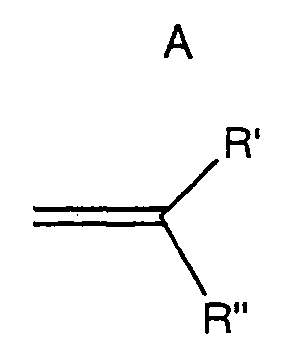
- Representative terminal olefins are represented by the structure: wherein R' and R" are separately H, C 1-20 , preferably C 3-12 alkyl or substituted alkyl, aryl or alkyl substituted aryl, C 1-10 alkoxy, C 1-10 alkyl ether, or alkenyl.
- Representative substituents on or within the alkyl group include heteroatoms such as O, S, N or halogen atoms such as Cl, Br, and F.
- Specific terminal olefins such as C 3 to C 12 alkenes, e.g., propylene, isobutylene, pentene, hexene, heptene, octene, decene, and dodecene, cyclic olefins such as 4-vinyl-1-cyclohexene, and aryl olefins such as styrene, and divinyl benzene.
- Nonconjugated dienes such as 1, 4-pentadiene, 1, 4-hexadiene, 1, 5-hexadiene and 1, 4-heptadiene, 1, 5-heptadiene, 1, 6-heptadiene can also be reacted.
- substituents on or within the internal olefin can include heteroatoms such as O, S, N or halogens, such as OCH 3 , -CH 2 OCH 2 -, SCH 3 , -CH 2 S-CH 2 -, N(CH 3 ) 2 , -CH 2 N(CH 3 )CH 2 -, -CH 2 Cl, -CH 2 CH 2 Cl, etc.
- isomers of the olefins exist, e.g., in the form of cis and trans,- forms, such olefins can be used as a reactant.
- Representative compounds include butene, pentene, hexene, heptene, octene, nonene, dodecene and the like where the olefinic bond is internal and not terminal.
- Substituted examples of internal alkenes include 2-halo-2-butene, 2,3-dihalo-2-butene, 2-alkoxy-2-butene, 2,3-dialkoxy-2-butene, 2-dialkylamino-2-butene, 2,3-(bis)dialkylamino-2-butene, 2-thioalkyl-2-butene, and 2,3-(bis)thioalkyl-2-butene etc.
- Representative cyclic olefins include: cyclohexene, cyclooctene, norbornene, dihydronaphthalene, dihydroanthracene, dihydrophenanthrene, octahydronaphthalene, dodecahydroanthracene, dodecahydrophenanthrene and the like.
- the dienes may be used as long as the olefinic bonds are not conjugated.
- dienes include: 1,4-cyclohexadiene, 1,6-hexahydronaphthalene, 9,13-tetrahydroanthracene and unconjugated dienes in other cycloaliphatic ring of ring size C 5 -C 10 .
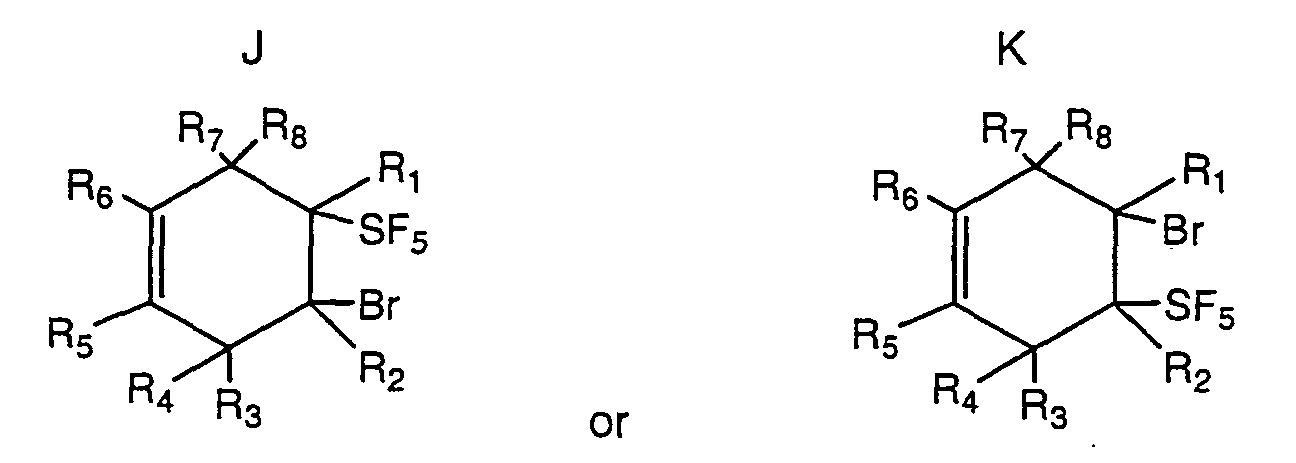
- pentafluorosulfuranyl bromo aliphatic compounds are represented by the structures:
- reaction stoichiometry involving the reaction of SF 5 Br with an olefin is generally consistent with the level of SF 5 addition desired.
- reaction stoichiometry employs an equivalent or slight excess of SF 5 Br reactant, e.g., from about 1 to 1.2 moles SF 5 Br per mole of olefin bond.
- the ability to achieve enhanced addition of the SF 5 group into internal and cyclic olefins without effecting substantial addition of Br and F across the double bond resides in effecting the reaction in the presence of a free radical initiator such as trialky boranes, e.g., tripropyl borane, and particularly triethylborane.
- a free radical initiator such as trialky boranes, e.g., tripropyl borane, and particularly triethylborane.
- Other free radical initiators include azo compounds, organic peroxides, e.g. benzoyl peroxide and t-butylhydroperoxide, and UV light. Low temperature initiation is preferred to prevent the formation of polymerization byproducts.
- the free radical initiator e.g., triethylborane is added in an amount of 1-25 mol%, preferably 5-10 mol %, per mole of the olefin to be treated.
- Triethyl borane is the preferred initiator in view of its reactivity at low temperatures, e.g., as low as -78 °C.
- the reaction can be carried out in a wide range of liquid mediums, i.e., the reaction can be carried out in the presence of olefin neat or it can be carried out in the presence of solvents.
- Representative solvents suited for carrying out the reaction include hydrocarbons, fluorocarbons, nitriles, ethers, and halocarbons. Solvent levels of from 10 to 100% by weight of the olefin can be used.
- the reaction of SF 5 Br with the olefins is carried out at temperatures below the decomposition of SF 5 Br, but above the activation temperature for the free radical initiator.
- the advantage of triethyl borane as a free radical initiator is that it is active at a low temperature, from about-90°C to the boiling point of solvent or olefin, preferably low temperatures from -80 to +50 °C, and most preferably from about -75 °C to 0 °C.
- the SF 5 Br reactant is condensed into the reaction medium, and then the reaction carried out under liquid phase conditions.
- SF 5 Br to SF 5 Cl An advantage of using SF 5 Br to SF 5 Cl is that the bromine atom facilitates removal of the halogen atom from the thus formed product. Removal can be effected by addition of a strong base, e.g., potassium hydroxide, HBr being eliminated. Br can also be replaced by H through the use of reducing agents, e.g., tin hydrides. As a result there is an easy mechanism for the production of pentafluorosulfuranyl aliphatics via SF 5 Br addition with a variety of olefins.
- SF 5 Br can be added to one or both double bonds depending upon the reaction stoichiometry and conditions.
- the alkene (2 mmole), pentane solvent (10mL) and potassium fluoride (5 mmole) were charged to an FEP tube fitted with an inlet valve and a relief valve.
- the solution was cooled to -78° C and degassed.
- SF 5 Br (2 mmole) was then condensed into the solution.
- the temperature was maintained at -78° C for one hour, and then, the solution was allowed to warm to room temperature. After 30 minutes the reactor was vented and purged with N 2 .
- the reaction mixture was slowly added to a cold sodium bicarbonate solution. The organic layer was isolated and the products were analyzed by GC, GC/MS and NMR.
- the alkene (2 mmole), pentane solvent (10mL), potassium fluoride (5 mmole) and triethylborane (0.2 mmole, 1 M in hexane) were charged to an FEP tube fitted with an inlet valve and a relief valve.
- the solution was cooled to -78° C and degassed.
- SF 5 Br (2 mmole) was then condensed into the solution.
- the temperature was maintained at -78° C for one hour, and then, the solution was allowed to warm to room temperature. After 30 minutes the reactor was vented and purged with N 2 .
- the reaction mixture was slowly added to a cold sodium bicarbonate solution. The organic layer was isolated and the products were analyzed by GC, GC/MS and NMR.
- Terminal olefins were reacted with SF 5 Br using procedure A described above.
- the GC area% results are shown in Table 1.
- Double Addition product GC/MS m/z 496, 418, 417, 289, 287, 181, 179,127, 119, 99, 89, 59
- Double addition product Mw 523.
- GC/MS m/z 315, 313, 253, 207, 205, 187, 185, 145, 127, 105, 79.
- reaction of SF 5 Br with terminal olefins can provide reasonably good yields when the reaction is carried under liquid phase conditions and SF 5 Br is condensed into the reaction medium. Low temperature conditions facilitates the condensation reaction. When the reaction is carried out in the presence of a free radical initiator, yields are increased, particularly in those cases where the terminal olefin is unsubstituted.
- Dienes can be reacted with SF 5 Br by employing a free radical initiator.
- a free radical initiator To achieve more than one SF 5 group onto the diene, it is necessary to use a free radical initiator.
Landscapes
- Chemical & Material Sciences (AREA)
- Organic Chemistry (AREA)
- Organic Low-Molecular-Weight Compounds And Preparation Thereof (AREA)
- Low-Molecular Organic Synthesis Reactions Using Catalysts (AREA)
Abstract
Description
- The development of synthetic methodologies for the introduction of sulfurpentafluoride or pentafluorosulfuranyl groups ("SF5") into organic compounds has been pursued with a considerable degree of interest. The SF5 groups impart unique properties to these organic compounds that include, inter alia, low surface energy, high chemical resistance, high thermal stability, high electronegativity, hydrophobicity, and high dielectric constant. The high electronegativity value of the SF5 group, 3.62 on the Pauling scale, and its greater electron withdrawing ability makes it an attractive alternative for the trifluoromethyl group ("CF3") found in many commercial products.
- Organic compositions containing SF5 have been used in a variety of applications. For example, pentafluorosulfuranyl fluoroaliphatic compositions have been used as surfactants, mono and bis (pentafluorosulfur)-substituted diacetylenes have been used to prepare SF5-containing polymers, sulfur pentafluorophenyl pyrazoles have been suggested for the control of ecoparasitic infections, and sulfurpentafluoride derivatives have been used to prepare liquid-crystal media. Thus, there is an interest in efficient methods for the introduction of the SF5 group into a variety of compounds.
- The following articles and patents are representative of methods for introducing SF5 groups into organic compounds.
- US 4,535,011 discloses a process for producing mono (pentafluorosulfur diacetylene polymers wherein sulfur pentafluoro bromide is first reacted with acetylene at temperatures below about -70 °C, and then, the resulting intermediate debrominated. Dehydrobromination is effected by reacting the intermediate adduct with a strong base, e.g., potassium hydroxide.
- US 6,479,645 discloses methods for producing sulfurpentafluoride compounds having a substituted silyl group. In the disclosed process, sulfur pentafluoro bromide is reacted with a trisubstituted silyl acetylene in the presence of potassium fluoride at room temperature. Bromine is removed from the intermediate compound by addition of powdered potassium hydroxide.
- The article, New and Convenient Method for Incorporation of Pentafluorosulfanyl (SF5) Substituents Into Aliphatic Organic Compounds, Samai Ayt-Mohand and W. Dolbier, Organic Letters, 2002, 4, 17, 3013 discloses the addition of the SF5-group to organic compounds by the reaction of SF5Cl with alkynes and alkenes in the presence of triethylborane and hexane solvent at temperatures from -30 °C to room temperature.
- In the article, New SF5-Long Chain Carbon Systems, R. Winter and G. L. Gard, Inorganic Chemistry, Journal of Fluorine Chemistry, 107 (2001) 23-30, sulfur pentafluoro chloride is reacted with a terminal olefin, e.g., 1-hexene and 9-decyl-1-acetate to produce an intermediate in the formation of SF5-terminated perfluoroalkyl thiols. The authors note that the reaction of sulfur pentafluoro bromine is too reactive with 1-hexene and only BrF adducts are found by GC analysis.
- In the article, The -SF5, SeF5 , and TeF5 Groups In Organic Chemistry, D. Lentz and K. Seppelt, Chemistry of Hypervalent compounds © 1999 Wiley-VCH, Inc, p. 295-325, there is disclosed the addition of the SF5 group into organic compounds by reaction with S2F10, SF5O, SF5Cl, and SF5Br. Successful addition of SF5Br to alkynes and fluoroalkenes was reported. It was reported also that SF5Br added in cases where SF5Cl failed and SF5Cl added in cases where SF5Br did not.
- The article, Functionalization of Pentafluoro-λ6-Sulfanyl (SF5) Olefins and Acetylenes, Winter and Gard, et al, American Chemical Society, ©1994128-147 discloses the preparation of SF5 derivatives of alkynes and alkenes. In one example SF5X addition to alkenes can be moderated by working either in the gas phase, (ethylene and SF5Br), operating at low temperatures (-110 °C) or the reaction carried out at high dilution in an inert solvent.
- It has been discovered that one can improve the addition of the SF5 group to organic compounds such as alkyl-substituted terminal alkenes, and effect addition of the SF5 group to internal alkenes and cycloalkenes via reaction with SF5Br. The improvement in the addition process for reaction with a terminal olefin comprises condensing SF5Br in the terminal olefin and effecting the reaction of SF5Br with under liquid phase conditions. For terminal, internal, and cyclic olefins, SF5Br is condensed in the olefin and the reaction carried out under liquid phase conditions in the presence of a free radical initiator, preferably triethyl borane. In addition, the invention relates to compositions incorporating the SF5 group and Br group across the double bond of an internal or cyclic olefin. Processes for producing the resulting compositions have been, heretofore, unknown. The resulting pentafluorosulfuranyl halo substituted aliphatics can be converted to pentafluorosulfuranyl substituted aliphatics by effecting dehydrohalogenation or dehalogentation.
- Generally, several advantages can be achieved by this process and these include:
- an ability to incorporate the SF5 group into terminal alkenes in improved yield, particularly those which do not have substituent electron withdrawing groups, in high yield; and,
- an ability to reduce byproduct formation due to BrF addition across the double bond and loss of reactant SF5Br.
-
- Addition of an SF5 group to an olefin allows for the production of many intermediates which are useful in organic synthesis. Heretofore, successful addition of the SF5 group to terminal alkenes by reaction with SF5Br has been limited to those alkenes bearing electron withdrawing groups such as F, Cl, Br, SiR3 and COOEt. Reaction of SF5Br with unsubstituted terminal alkenes has largely resulted in the addition of F and Br across the double bond either instead of, or in addition to, the desired addition of the SF5 group and the Br group across the double bond. Reaction of SF5Br with internal olefins has either met with F and Br adding across the double bond or there has been no reaction.
- The improved processes for reaction with an olefin described herein employs the reactant, SF5Br as the means for effecting the addition of the SF5 group to such olefinic compounds and particularly those olefinic compounds heretofore not amenable to addition of the SF5 group and Br across the double bond. In a first embodiment of the improved process, the reaction is carried out under liquid phase conditions and, as a second embodiment the reaction of SF5Br with the olefin is carried out in the presence of a free radical initiator, preferably triethyl borane.
- The olefins suited for reaction with SF5Br include terminal alkenes, internal olefins and cycloalkenes. Representative terminal olefins are represented by the structure:wherein R' and R" are separately H, C1-20, preferably C3-12 alkyl or substituted alkyl, aryl or alkyl substituted aryl, C1-10 alkoxy, C1-10 alkyl ether, or alkenyl. Representative substituents on or within the alkyl group include heteroatoms such as O, S, N or halogen atoms such as Cl, Br, and F. Other specific groups include OCH3, -CH2OCH2-, SCH3, -CH2S-CH2-, N(CH3)2, -CH2N(CH3)CH2-, CH2Cl, -CH2CH2Cl, etc. Specific terminal olefins such as C3 to C12 alkenes, e.g., propylene, isobutylene, pentene, hexene, heptene, octene, decene, and dodecene, cyclic olefins such as 4-vinyl-1-cyclohexene, and aryl olefins such as styrene, and divinyl benzene. Nonconjugated dienes such as 1, 4-pentadiene, 1, 4-hexadiene, 1, 5-hexadiene and 1, 4-heptadiene, 1, 5-heptadiene, 1, 6-heptadiene can also be reacted.
- The resulting pentafluorosulfuranyl bromo alkane compounds are represented by the structure:

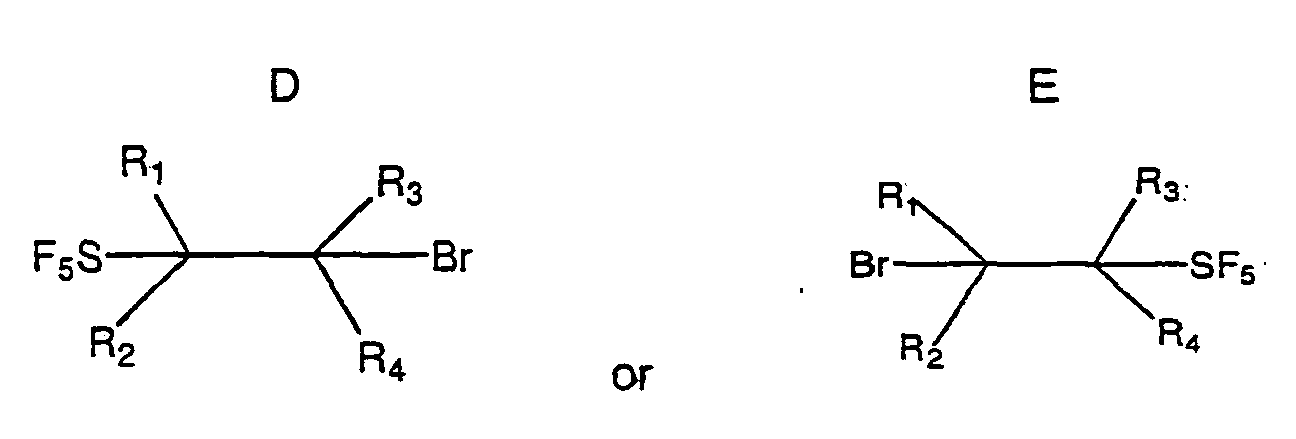
- Internal aliphatic olefins, have been the most difficult to effect addition of the SF5 group and Br across the double bond. Too often, no reaction occurs. By that it is meant only Br and F add across the double bond. By operating under liquid phase conditions and facilitating the reaction by the use of a free radical initiator, preferably one that is activated at low temperatures, e.g. below 0 °C, one can add SF5 and Br using SF5Br as the reactant. Internal olefins suited for the reaction are represented by the structure:wherein R1, R2, R3, R4 are C1-12 alkyl, preferably C1-8, or substituted alkyl, aryl or substituted aryl, alkoxy, alkyl ether, alkyl ester and nitrile, with R2 and R4 additionally being = H or halogen atoms, e.g., F, Cl and Br. Representative substituents on or within the internal olefin can include heteroatoms such as O, S, N or halogens, such as OCH3, -CH2OCH2-, SCH3, -CH2S-CH2-, N(CH3)2, -CH2N(CH3)CH2-, -CH2Cl, -CH2CH2Cl, etc. Where isomers of the olefins exist, e.g., in the form of cis and trans,- forms, such olefins can be used as a reactant. Representative compounds include butene, pentene, hexene, heptene, octene, nonene, dodecene and the like where the olefinic bond is internal and not terminal. Substituted examples of internal alkenes include 2-halo-2-butene, 2,3-dihalo-2-butene, 2-alkoxy-2-butene, 2,3-dialkoxy-2-butene, 2-dialkylamino-2-butene, 2,3-(bis)dialkylamino-2-butene, 2-thioalkyl-2-butene, and 2,3-(bis)thioalkyl-2-butene etc.

- Compounds resulting from the addition of SF5Br to an internal olefin are represented by the structures:
- Another category of olefins include the cycloaliphatic olefins represented by the formula:
 wherein R1- R10= H, halogen atoms, alkyl or substituted alkyl, aryl or substituted aryl. Substituents include heteroatoms such as O, S, N or halogens R9, R10 or R3, R4 may be a carbonyl group (=O); R9 or R10 and R4 or R3 may be linked together, i. e., bridged bicyclic compounds; R7 or R8 and R5 or R6 may be linked together as in. fused ring bicyclic or tricyclic cycloaliphatic or aromatic compounds. Representative cyclic olefins include: cyclohexene, cyclooctene, norbornene, dihydronaphthalene, dihydroanthracene, dihydrophenanthrene, octahydronaphthalene, dodecahydroanthracene, dodecahydrophenanthrene and the like.
- Compounds produced by the reaction of SF5Br with the above cycloaliphatic olefins are represented by the structures:

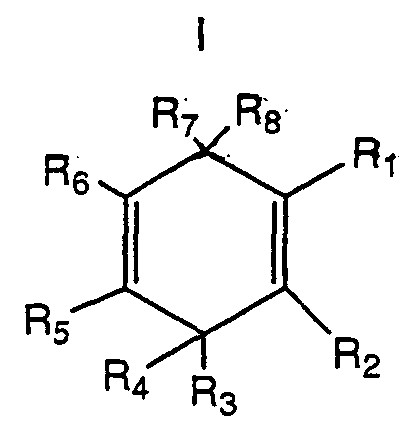
- The last class of olefinic compounds are the cycloaliphatic dienes which are represented by the formula:wherein R1- R8= H, halogen atoms, alkyl or substituted alkyl, aryl or substituted aryl. Substituents include heteroatoms such as O, S, N or halogen atoms, e.g., F, Br, and Cl; R7 or R8 and R4 or R3 may be linked together, i.e., bridged bicyclic compounds R7 or R8 and R5 or R6 may be linked together as in. fused ring bicyclic or tricyclic cycloaliphatic. The dienes may be used as long as the olefinic bonds are not conjugated. This also includes the situation where the bonding is carbonyl. Representative dienes include: 1,4-cyclohexadiene, 1,6-hexahydronaphthalene, 9,13-tetrahydroanthracene and unconjugated dienes in other cycloaliphatic ring of ring size C5-C10.
- The pentafluorosulfuranyl bromo aliphatic compounds are represented by the structures:
- The reaction stoichiometry involving the reaction of SF5Br with an olefin is generally consistent with the level of SF5 addition desired. Typically the reaction stoichiometry employs an equivalent or slight excess of SF5Br reactant, e.g., from about 1 to 1.2 moles SF5Br per mole of olefin bond.
- The ability to achieve enhanced addition of the SF5 group into internal and cyclic olefins without effecting substantial addition of Br and F across the double bond resides in effecting the reaction in the presence of a free radical initiator such as trialky boranes, e.g., tripropyl borane, and particularly triethylborane. Other free radical initiators include azo compounds, organic peroxides, e.g. benzoyl peroxide and t-butylhydroperoxide, and UV light. Low temperature initiation is preferred to prevent the formation of polymerization byproducts.
- The free radical initiator, e.g., triethylborane is added in an amount of 1-25 mol%, preferably 5-10 mol %, per mole of the olefin to be treated. Triethyl borane is the preferred initiator in view of its reactivity at low temperatures, e.g., as low as -78 °C.
- The reaction can be carried out in a wide range of liquid mediums, i.e., the reaction can be carried out in the presence of olefin neat or it can be carried out in the presence of solvents. Representative solvents suited for carrying out the reaction include hydrocarbons, fluorocarbons, nitriles, ethers, and halocarbons. Solvent levels of from 10 to 100% by weight of the olefin can be used.
- The reaction of SF5Br with the olefins is carried out at temperatures below the decomposition of SF5Br, but above the activation temperature for the free radical initiator. The advantage of triethyl borane as a free radical initiator is that it is active at a low temperature, from about-90°C to the boiling point of solvent or olefin, preferably low temperatures from -80 to +50 °C, and most preferably from about -75 °C to 0 °C. In the process, the SF5Br reactant is condensed into the reaction medium, and then the reaction carried out under liquid phase conditions.
- Recovery of the product can be accomplished by conventional methods and these include distillation and chromatography. An advantage of using SF5Br to SF5Cl is that the bromine atom facilitates removal of the halogen atom from the thus formed product. Removal can be effected by addition of a strong base, e.g., potassium hydroxide, HBr being eliminated. Br can also be replaced by H through the use of reducing agents, e.g., tin hydrides. As a result there is an easy mechanism for the production of pentafluorosulfuranyl aliphatics via SF5Br addition with a variety of olefins.
- The following reactions are representative embodiments of the described process:

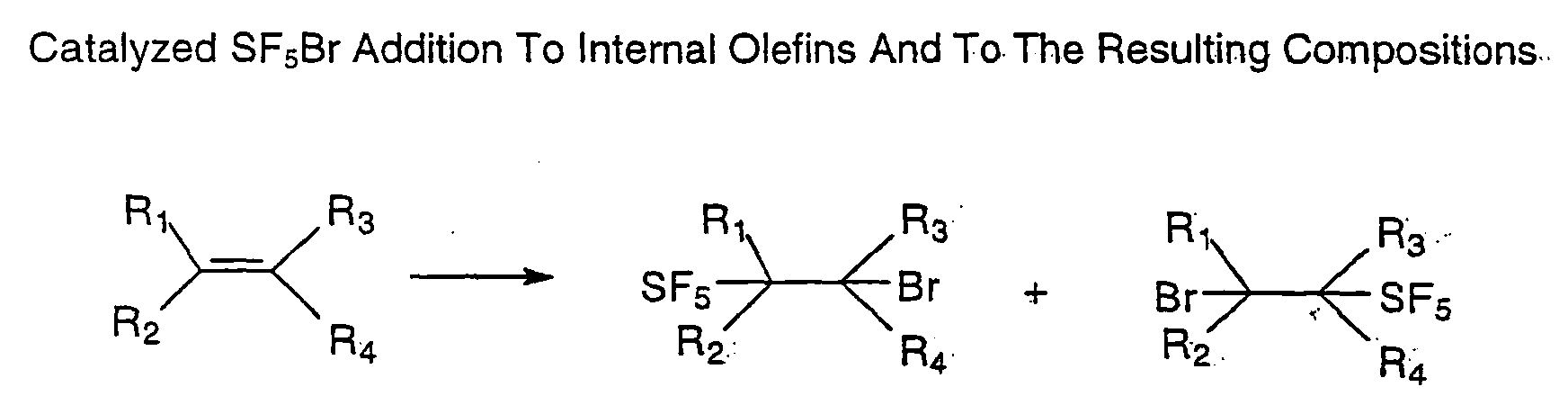
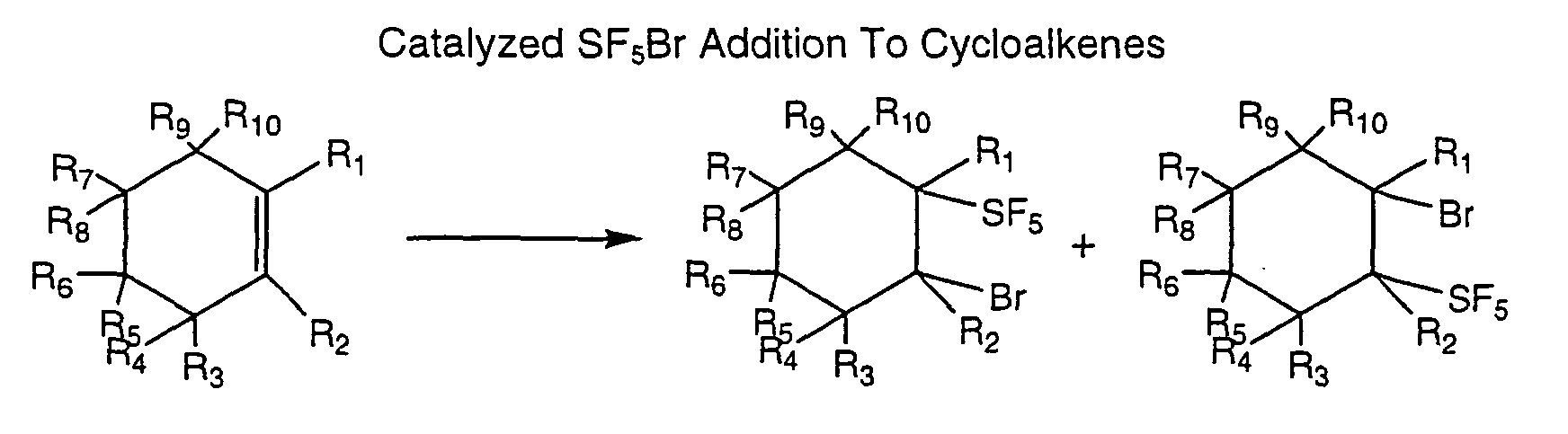

- In the above reaction with cycloalkyldienes, SF5Br can be added to one or both double bonds depending upon the reaction stoichiometry and conditions.
- The following examples are intended to represent various embodiments of the invention and are not intended to restrict the scope thereof.
- The alkene (2 mmole), pentane solvent (10mL) and potassium fluoride (5 mmole) were charged to an FEP tube fitted with an inlet valve and a relief valve. The solution was cooled to -78° C and degassed. SF5Br (2 mmole) was then condensed into the solution. The temperature was maintained at -78° C for one hour, and then, the solution was allowed to warm to room temperature. After 30 minutes the reactor was vented and purged with N2. The reaction mixture was slowly added to a cold sodium bicarbonate solution. The organic layer was isolated and the products were analyzed by GC, GC/MS and NMR.
- The alkene (2 mmole), pentane solvent (10mL), potassium fluoride (5 mmole) and triethylborane (0.2 mmole, 1 M in hexane) were charged to an FEP tube fitted with an inlet valve and a relief valve. The solution was cooled to -78° C and degassed. SF5Br (2 mmole) was then condensed into the solution. The temperature was maintained at -78° C for one hour, and then, the solution was allowed to warm to room temperature. After 30 minutes the reactor was vented and purged with N2. The reaction mixture was slowly added to a cold sodium bicarbonate solution. The organic layer was isolated and the products were analyzed by GC, GC/MS and NMR.
- Terminal olefins were reacted with SF5Br using procedure A described above. The GC area% results are shown in Table 1.

- Characterization of the SF5Br addition products:
- 1. 1-Pentafluorosulfanyl-2-bromo octane MW= 276. GC/MS m/z= 277, 275, 239, 127, 111, 89, 69,57. 1H NMR δ 0.9, (t, 3H), 1.3 (m, 6H), 1.4 (m, 1), 1.5 (m, 1 H), 1.8 (m, 1H), 2.0 (m, 1H) 4.0 (m, 1H), 4.1 (m, 1 H), 4.4 (m, 1 H) 19F NMR δ 65 d, 82 pent.
- 2 1-Pentafluorosulfanyl-2-bromo glycidyl ether MW=321. GC/MS m/z = 249, 247, 141,139,127,113, 89, 87, 57. 19F NMR δ 65 d, 82 pent.
- 3 1-Pentafluorosulfanyl-2-bromo-5- hexene. MW= 289. GC/MS m/z= 290, 288, 208, 206, 161, 163, 127, 122, 120, 89, 81. 1H NMR δ1.9, (t, 1 H), 2.1 (m, 1 H), 2.2 (m, 1), 2.3 (m, 1 H), 4.0 (m, 1 H), 4.2 (m, 1 H) 4.4 (m, 1 H), 5.1 (dd, 2H), 5.8 (m, 1 H) 19F NMR δ65 d, 82 pent.
- Double Addition product GC/MS m/z = 496, 418, 417, 289, 287, 181, 179,127, 119, 99, 89, 59
- The results in Table 1 show that the addition of the SF5 group to a terminal olefin can be effected by condensing SF5Br in the olefin and carrying out the reaction in the liquid phase. Yields can be improved in many cases where unsubstituted olefins or where the olefin has more than one double bond by the use of a free radical catalyst, e. g., triethyl borane. This is surprising in view prior art reports that SF5Br is too reactive and only Br-F adducts are formed when using SF5Br as a reactant. The prior art suggested the reactions, if they were to proceed, must be carried out either at gas phase conditions, at low temperatures (-110 °C) or at high dilution in an inert solvent. Where functional groups are present, e.g., a glycidyl ether, greater yields can be produced. However, as the results show in the case of reaction with hexadiene, SF5 adds to the first double bond but SF5 addition is dramatically reduced once addition to the terminal olefinic bond has been accomplished. Yield of SF5 can be increased across both of the double bonds by the use of a low temperature free radial initiator.
- Internal olefins were reacted with SF5Br using either procedure A and B described above. The GC area% results are shown in Table 2.
GC Area % for the Reaction of SF5Br with Internal Olefins. Alkene Temp (° C) Catalyst SF5Br Addition 4 CH3CH2CH=CH(CH2)2CH3 Cis 3-Heptene -78 Et3B 86 -78 None 0 5 CH3CH2CH=CH(CH2)2CH3 Trans 3-Heptene -78 Et3B 73 -78 None 50 6 CH3(CH2)2CH=CH(CH2)2CH3 Trans 4-Octene -78 Et3B 91 -78 None 0 - 4 3-Pentafluorosulfanyl-4-bromo heptane and 3-bromo-4-pentafluorosulfanyl heptane Mw= 305. GC/MS m/z= 177, 175, 137, 135, 127, 97, 89, 69,55. 19F NMR δ 60 t, 86 pent.
- 5 3-Pentafluorosulfanyl-4-bromo heptane and 3-bromo-4-pentafluorosulfanyl heptane Mw= 305. GC/MS m/z= 177, 175,137, 135, 127, 97, 89, 69,55. 19F NMR δ 58 t, 60 t, 86 pent.
- 6 4-Pentafluorosulfanyl-5-bromo octane, Mw= 319. GC/MS m/z= 193, 191, 127, 111, 89, 69,55.
- The results in Table 2 show that unlike the terminal olefins in Example 1, the uncatalyzed, liquid phase reaction of SF5Br with an olefin, where the olefinic bond is internal, is either ineffective in many cases or yields are low, e.g., 50%, depending upon the isomer structure. When a free radical initiator is used to catalyze the liquid phase reaction, e.g., triethyl borane, addition of the SF5 group can be, yields are increased dramatically. Byproduct formation, i.e., products where there is BrF addition across the double bond are minimized.
- Cycloalkenes were reacted with SF5Br using procedures A and B described above. The GC area% results are shown in Table 3.Characterization of the SF5Br addition products:
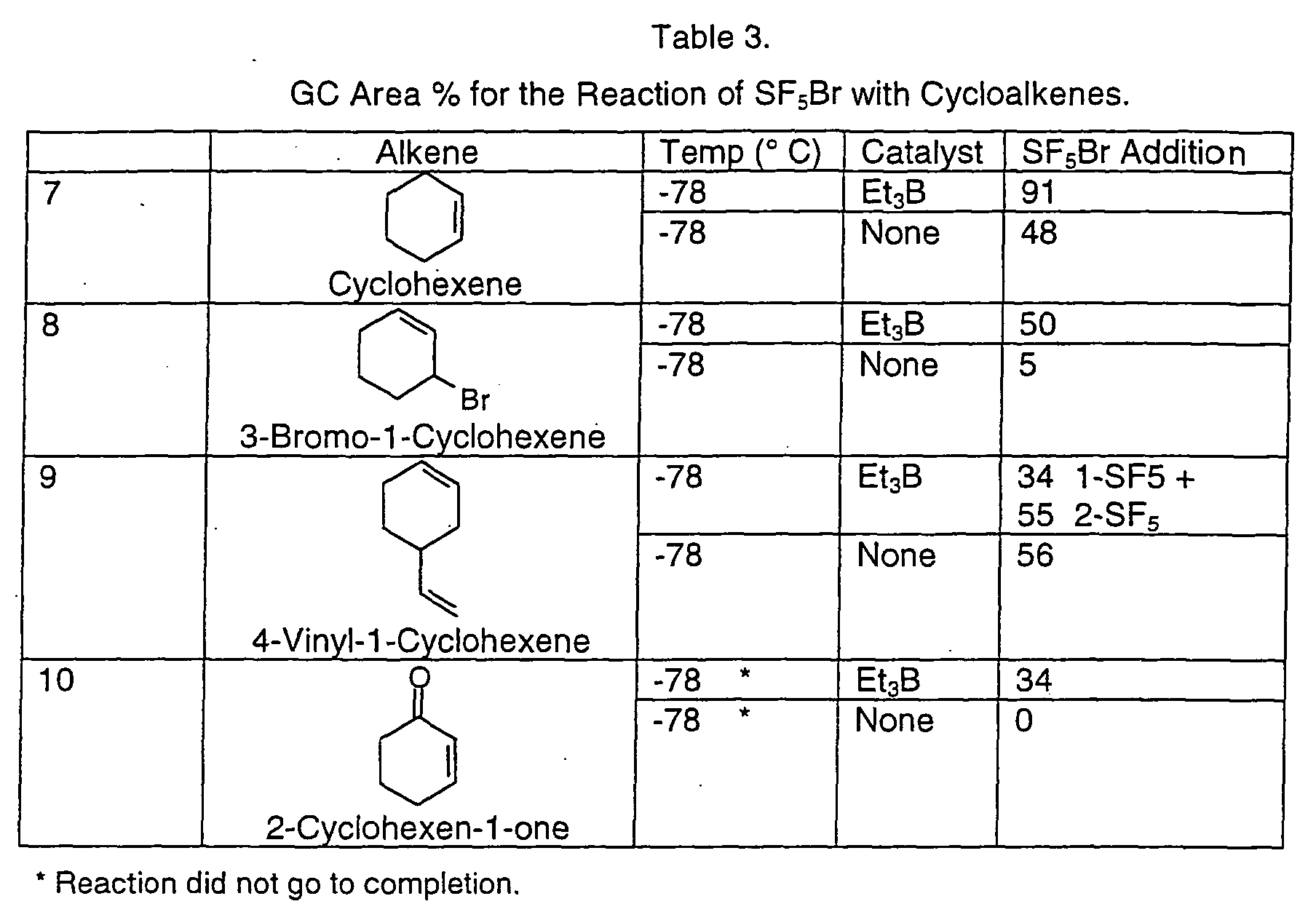
- 7 1-Pentafluorosulfanyl-2-bromo cyclohexane Mw= 289. GC/MS m/z= 290, 288, 209, 127, 101, 89, 81. 1H NMR δ 1.3, (m, 2H), 1.6 (m, 2H), 1.8 (m, 1 H), 2.1 (m, 1H), 2.2 (m,2H), 2.4 (m, 1 H) 4.3 (m, 1 H), 4.9 (d, 1 H) 19F NMR δ 57 d, 85 pent.
- 8 1-Pentafluorosulfanyl-2, 3-dibromo cyclohexane Mw=368 GC/MS m/z= 368, 288, 207, 181, 179, 161, 159, 127, 99, 89, 79.
- 9 Mw= 316 GC/Ms m/z= 316, 314, 235, 189, 187, 127, 107, 89, 79.
- Double addition product Mw= 523. GC/MS m/z= 315, 313, 253, 207, 205, 187, 185, 145, 127, 105, 79.
- 10 3-Pentafluorosulfanyl-2-bromo cyclohexanone Mw=303. GC/MS m/z= 302, 300, 177, 175, 149, 147, 127, 121, 119, 89, 67.
- The results in Table 3 show that, at best, the uncatalyzed liquid phase reaction of cycloalkenes results in a poor yield of SF5 addition product. The yield of SF5 products is increased by the addition of a radical initiator. Where there is a substituent on the cycloaliphatic ring, e.g., a halogen such as Br or a carbonyl group a free radical catalyst is necessary to achieve reaction in a significant amount.
- Cycloalkadienes were reacted with SF5Br using procedures A and B described above. The GC area% results are shown in Table 4.Characterization of the SF5Br addition products:
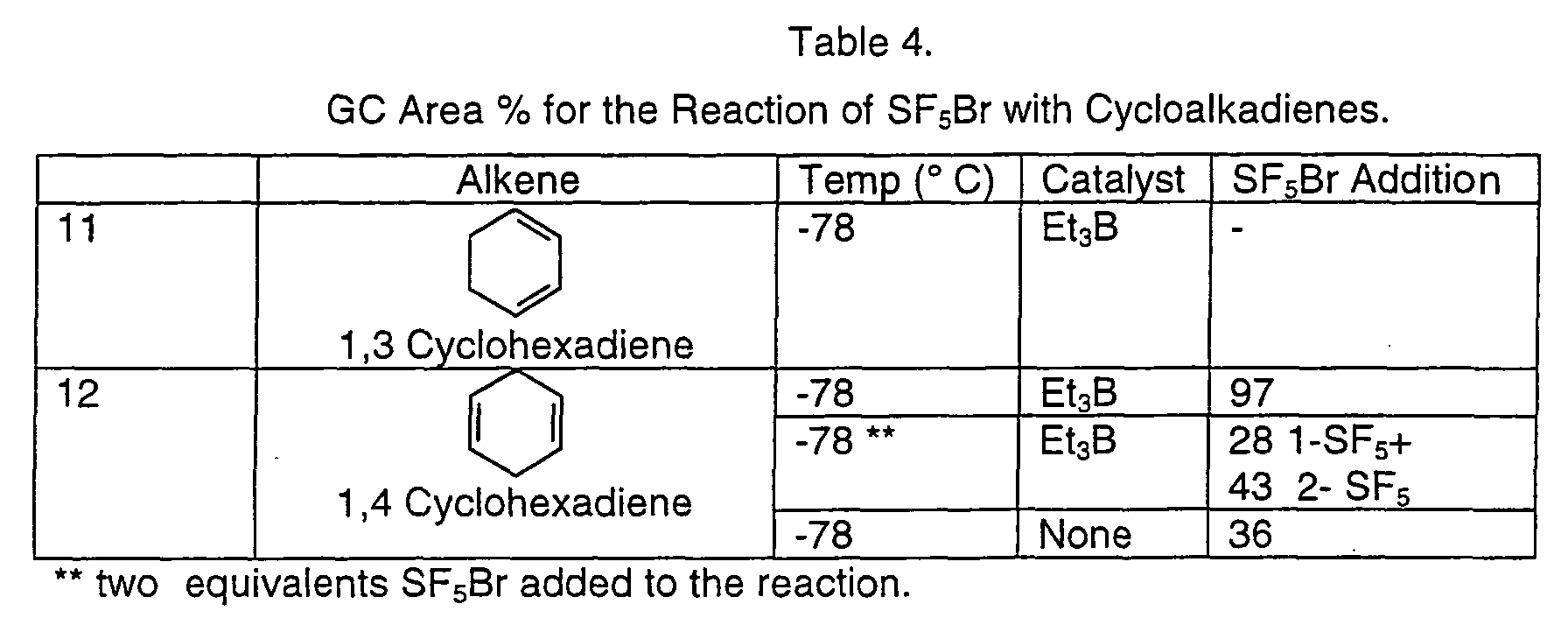
- 12 1-Pentafluorosulfanyl-2-bromo- 4-cyclohexene Mw= 287. GC/MS m/z= 288, 286, 207, 161, 159, 127, 99, 89, 79. 1H NMR δ 2.6, (d, 1 H), 3.0 (dt, 3H), 4.4 (m, 1 H), 5.0 (m,1 H), 5.7 (m,2H) 19F NMR δ 55 d, 84 pent.
- The results in Table 4 show the position of the double bond is important. When the double bond is not conjugated, high yields of SF5 addition can be achieved when a free radical initiator is employed. It the bonds are conjugated, yields of SF5 are low even when a free radical initiator is employed.
- Norbornene was reacted with SF5Br using procedures A and B described above. The GC area% results are shown in Table 5.
GC Area % for the Reaction of SF5Br with Norbomene. Alkene Temp (° C) Catalyst SF5Br Addition 13 Norbornene -78 Et3B 98 -78 None - - 13 1-Pentafluorosulfanyl-2-bromo norbornane Mw=301. GC/MS m/z= 223, 221, 175, 173, 127, 113, 93, 89, 67.
- The results in Table 5 show bicyclic molecules containing a double bond show high yields of SF5 addition when a radical catalyst is employed in the reaction with SF5Br.
- Summarizing the examples, it can be seen that reaction of SF5Br with terminal olefins can provide reasonably good yields when the reaction is carried under liquid phase conditions and SF5Br is condensed into the reaction medium. Low temperature conditions facilitates the condensation reaction. When the reaction is carried out in the presence of a free radical initiator, yields are increased, particularly in those cases where the terminal olefin is unsubstituted.
- Heretofore, there have been no reports of the successful addition of SF5 groups to Internal and cyclic olefins by reaction with SF5Br. Even when the reaction is carried out under liquid phase conditions and the SF5Br is condensed into the olefin, very poor to moderate yields of SF5Br addition are achieved. And, isomer structure is a factor as to whether the reaction proceeds. The results in Tables 2 and 3 also show that the addition of a free radical initiator to the reaction medium in an amount preferably from 5 to 10 mole % significantly enhances the yield of products containing SF5 group.
- Dienes can be reacted with SF5Br by employing a free radical initiator. To achieve more than one SF5 group onto the diene, it is necessary to use a free radical initiator.
- Although not intending to be bound by theory, it has generally been viewed that SF5Br is too reactive with olefinic molecules resulting in Br-F addition. It is surprising that the addition of a radical catalyst enhances the selectivity for SF5 addition instead of the customary BrF addition. The mechanism for SF5Br reactions is by and large believed to be free radical in nature. Some experiments, however, suggest SF5Br reacts through an electrophilic mechanism which results in Br-F addition as the major product. By adding the radical initiator it is believed that we are shifting the mechanism toward the radical pathway as opposed to electrophilic addition, thereby resulting in increased SF5 addition. Surprisingly, then, by carrying out the reaction, liquid phase, in the presence of a free radical initiator, one changes the reaction mechanism such that SF5 and Br add across the double bond rather than F and Br adding across the double bond.
Claims (21)
- A process for adding an SF5 group to a terminal alkene of the formula:to produce a compound represented by the structure:
 wherein R' and R" are separately H, C1-20, alkyl or substituted alkyl, aryl or alkyl substituted aryl, C1-10 alkoxy, C1-10 alkyl ether, alkenyl, alkyl halogen, alkyl thionyl and alkyl amino, which comprises:
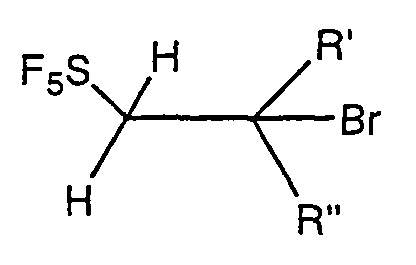 condensing SF5Br in said terminal alkene and, then,effecting reacting of said terminal alkene with SF5Br under liquid phase conditions.
 - The process of Claim 1 wherein the terminal olefin is selected from the group consisting of propylene, isobutylene, pentene, hexene, heptene, octene, decene, dodecene, 4-vinyl-1-cyclohexene, styrene, divinyl benzene and dienes selected from the group consisting of 1,4-pentadiene, 1,4-hexadiene, 1,5-hexadiene and 1,4-heptadiene, 1,5-heptadiene, and 1,6-heptadiene.
- The process of Claim 2 wherein the reaction is carried out at a temperature of from -90 to +50 °C:
- The process of Claim 3 wherein a free radical initiator is added in an amount of from 1- 25 mole % and the free radical initiator is a trialkyl borane.
- The process of Claim 4 wherein the free radical initiator is a triethyl borane and the reaction is carried out at a temperature of from -90 to 0 °C.
- A process for adding an SF5 group to an alkene having an internal olefinic bond selected from aliphatic and cycloaliphatic olefins represented by the form ulas:wherein R1, R2, R3, R4 = C1-12 alkyl or substituted alkyl, aryl or substituted aryl, alkoxy, alkyl ether, alkyl ester and nitrile, with R2 and R4 additionally being = H or halogen atoms;
 wherein R1- R10= H, halogen atoms, C1-20, alkyl or substituted alkyl, aryl or alkyl substituted aryl, C1-10 alkoxy, C1-10 alkyl ether, alkenyl, alkyl halogen, alkyl thionyl, alkyl amino, and wherein R9, R10 or R3, R4 also represent a carbonyl group; R9 or R10 and R4 or R3 also represent a bridged bicyclic compound; and wherein R7 or R8 and R5 or R6 may also represent a fused ring bicyclic or tricyclic cycloaliphatic or aromatic compound;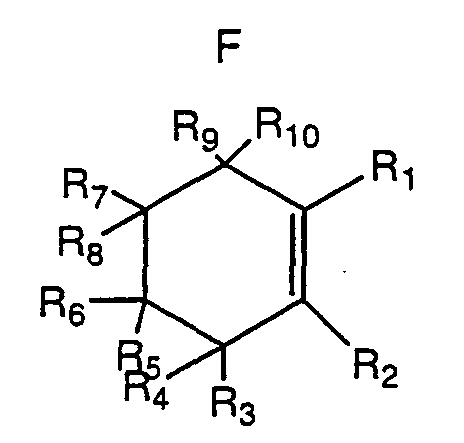
orwherein R1- R8 = H, halogen atoms, alkyl or substituted alkyl, aryl or substituted aryl or R7 or R8 and R4 or R3 may be bridged bicyclic compounds, R7 or R8 and R5 or R6 may be fused to form bicyclic or tricyclic cycloaliphatic rings: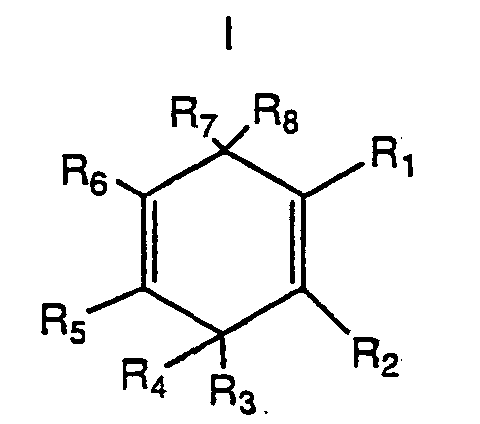
which comprises condensing SF5Br in said alkene and effecting the reaction of said alkene with SF5Br under liquid phase conditions in the presence of a free radical initiator. - The process of Claim 6 wherein said free radical initiator is selected from the group consisting of trialkyl borane, organic peroxide, organic azo, and ultraviolet light.
- The process of Claim 7 wherein the temperature of said reacting is from -90 to +50 °C.
- The process of Claim 8 wherein the free radical initiator is triethyl borane.
- The process of Claim 9 wherein the reaction stoichiometry employs a slight excess of SF5Br reactant, e.g., from 1.05 to 1.2 moles per mole of olefin bond.
- The process of Claim 10 wherein triethyl borane is employed in an amount from 1-25 mol% based upon the moles of the olefin to be treated.
- The process of Claim 11 wherein triethyl borane is employed in an amount from 5-10 mol %, based upon the moles of the olefin to be treated.
- The process of Claim 9 wherein the alkene is represented by formula A and said alkenes is selected from the group consisting of pentene, hexene, heptene, octene, decene, and dodecene.
- The process of Claim 9 wherein the alkene is represented by structure F and said cyclic olefin is selected from the group consisting of: cyclohexene, cyclooctene, norbornene, dihydronaphthalene, dihydroanthracene, dihydrophenanthrene, octahydronaphthalene, dodecahydroanthracene, dodecahydrophenanthrene.
- The process of Claim 9 wherein the alkene is represented by structure I and said cyclic olefin is selected from the group consisting of 1,4-cyclohexadiene, 1,6-hexahydronaphthalene, 9,13-tetrahydroanthracene.
- A composition represented by the structures:wherein R1- R8 = H, halogen atoms, alkyl or substituted alkyl, aryl or substituted aryl or R7 or R8 and R4 or R3 may be bridged bicyclic compounds, R7 or R8 and R5 or R6 may be fused to form bicyclic or tricyclic cycloaliphatic rings:
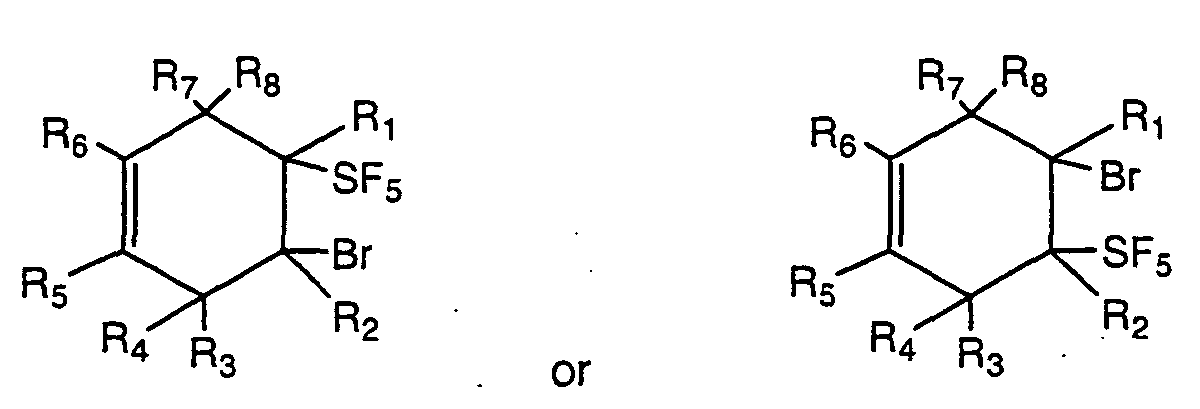
- The composition of Claim 16 wherein R1-R8 are H.
- A composition represented by the structures:wherein R1, R2, R3, R4 = C1-12 alkyl or substituted alkyl, aryl or substituted aryl, alkoxy, alkyl ether, alkyl ester and nitrile, with R2 and R4 additionally being = H or halogen atoms.
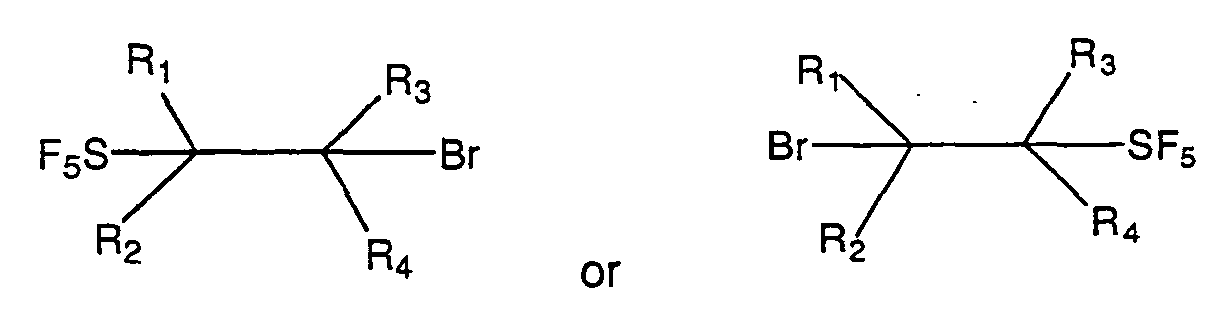
- The composition of Claim 18 wherein R2 and R-4 are C3-8 alkyl.
- A composition represented by the structure:wherein R1- R10= H, halogen atoms, C1-20, alkyl or substituted alkyl, aryl or alkyl substituted aryl, C1-10 alkoxy, C1-10 alkyl ether, alkenyl, alkyl halogen, alkyl thionyl, alkyl amino, and wherein R9, R10 or R3, R4 also represent a carbonyl group; R9 or R10 and R4 or R3 also represent a bridged bicyclic compound; and wherein R7 or R8 and R5 or R6 may also represent a fused ring bicyclic or tricyclic cycloaliphatic or aromatic compound.
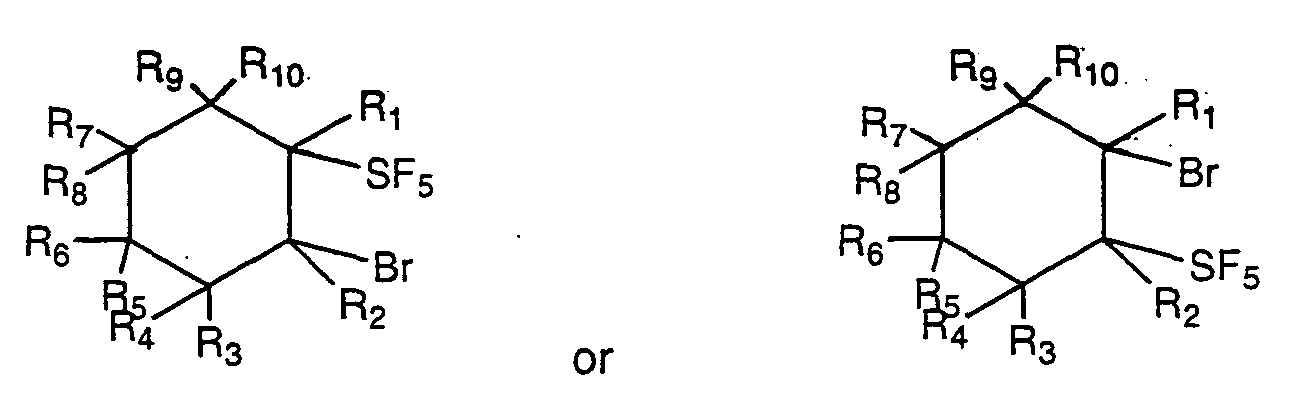
- The composition of Claim 20 wherein R1-R10 are H.
Applications Claiming Priority (2)
| Application Number | Priority Date | Filing Date | Title |
|---|---|---|---|
| US713230 | 2003-11-14 | ||
| US10/713,230 US6870068B1 (en) | 2003-11-14 | 2003-11-14 | Synthesis of pentafluorosulfuranyl substituted alkanes |
Publications (1)
| Publication Number | Publication Date |
|---|---|
| EP1538144A1 true EP1538144A1 (en) | 2005-06-08 |
Family
ID=34274840
Family Applications (1)
| Application Number | Title | Priority Date | Filing Date |
|---|---|---|---|
| EP04026855A Withdrawn EP1538144A1 (en) | 2003-11-14 | 2004-11-11 | Synthesis of pentafluorosulfuranyl substituted alkanes |
Country Status (3)
| Country | Link |
|---|---|
| US (1) | US6870068B1 (en) |
| EP (1) | EP1538144A1 (en) |
| JP (1) | JP4373317B2 (en) |
Cited By (2)
| Publication number | Priority date | Publication date | Assignee | Title |
|---|---|---|---|---|
| US7416717B1 (en) | 2007-03-20 | 2008-08-26 | Air Products And Chemicals, Inc. | Synthesis of pentahalosulfur peroxides and monoxides |
| WO2008101212A3 (en) * | 2007-02-16 | 2008-10-23 | Univ New York | Pentafluorosulfanyl containing amino acids |
Families Citing this family (3)
| Publication number | Priority date | Publication date | Assignee | Title |
|---|---|---|---|---|
| DE102005000858A1 (en) * | 2005-01-05 | 2006-07-20 | Merck Patent Gmbh | Use of trifluoromethoxy- or pentafluorosulfuranyl terminal groups as hydrophobic terminal groups in surface active compounds, which are useful as e.g. surfactants, hydrophobic agents, foam stabilizers and emulsifying agents |
| US20090093641A1 (en) * | 2006-03-13 | 2009-04-09 | University Of Florida Research Foundation, Inc. | Synthesis of Pentafluorosulfanyl (SF5)-Substituted Heterocycles and Alkynes |
| US20080312464A1 (en) * | 2007-06-12 | 2008-12-18 | Air Products And Chemicals, Inc. | Oxopentafluorosulfanyl-Substituted Alicyclic Compounds |
Family Cites Families (5)
| Publication number | Priority date | Publication date | Assignee | Title |
|---|---|---|---|---|
| US3284496A (en) * | 1962-05-16 | 1966-11-08 | Du Pont | Preparation of ethynylsulfur pentafluoride |
| US5159105A (en) | 1990-02-28 | 1992-10-27 | Minnesota Mining And Manufacturing Company | Higher pentafluorosulfanyl-fluoroaliphatic carbonyl and sulfonyl fluorides, and derivatives |
| DE19748109B4 (en) | 1997-10-31 | 2006-09-07 | Merck Patent Gmbh | Sulfur pentafluoride derivatives and liquid crystalline medium |
| US6136838A (en) | 1998-03-19 | 2000-10-24 | Merck & Co., Inc. | Sulfurpentafluorophenylpyrazoles for controlling ectoparasitic infestations |
| US6479645B1 (en) | 2002-03-22 | 2002-11-12 | Air Products And Chemicals, Inc. | Sulfurpentafluoride compounds and methods for making and using same |
-
2003
- 2003-11-14 US US10/713,230 patent/US6870068B1/en not_active Expired - Fee Related
-
2004
- 2004-11-11 EP EP04026855A patent/EP1538144A1/en not_active Withdrawn
- 2004-11-15 JP JP2004330706A patent/JP4373317B2/en not_active Expired - Fee Related
Non-Patent Citations (7)
| Title |
|---|
| D. LENTZ, K. SEPPELT: "CHEMISTRY OF HYPERVALENT COMPOUNDS", 1999, WYLEY-VCH INC, XP009046218 * |
| Q.C. MIR ET AL: "The addition of pentafluorosulfur bromide to fluoroolefins II", JOURNAL OF FLUORINE CHEMISTRY, vol. 16, 1980, pages 373 - 383, XP002324261 * |
| R. WINTER ET AL: "New pentafluorothio (SF5) esters", JOURNAL OF FLUORINE CHEMISTRY, vol. 66, 1994, pages 109 - 116, XP002324262 * |
| R. WINTER ET AL: "The addition of SF5Br to acrylic esters:pathways to gamma-SF5-propane derivatives", JOURNAL OF FLUORINE CHEMISTRY, vol. 102, 2000, pages 79 - 87, XP002324263 * |
| R.J. TERJESON: "New Pentafluorothio(SF5)fluoropolymers", JOURNAL OF FLUORINE CHEMISTRY, vol. 35, 1987, pages 653 - 662, XP002324265 * |
| R.W. WINTER ET AL: "Synthesis of SF5-benzene (SF5C6H5) by the SF5-halide method", JOURNAL OF FLUORINE CHEMISTRY, vol. 125, 2004, pages 549 - 552, XP002324264 * |
| S. AÏT-MOHAND: "New and Convenient Method for Incorporation of Pentafluorosulfanyl(SF)Substituents into aliphatic Organic Compounds", ORGANIC LETTERS, vol. 4, no. 17, 2002, pages 3013 - 3015, XP002324266 * |
Cited By (2)
| Publication number | Priority date | Publication date | Assignee | Title |
|---|---|---|---|---|
| WO2008101212A3 (en) * | 2007-02-16 | 2008-10-23 | Univ New York | Pentafluorosulfanyl containing amino acids |
| US7416717B1 (en) | 2007-03-20 | 2008-08-26 | Air Products And Chemicals, Inc. | Synthesis of pentahalosulfur peroxides and monoxides |
Also Published As
| Publication number | Publication date |
|---|---|
| JP2005162748A (en) | 2005-06-23 |
| JP4373317B2 (en) | 2009-11-25 |
| US6870068B1 (en) | 2005-03-22 |
Similar Documents
| Publication | Publication Date | Title |
|---|---|---|
| US5162594A (en) | Process for production of polyfluoroolefins | |
| JP3954608B2 (en) | Synthesis of pentafluorosulfuranyl arylene | |
| Prakash et al. | Nucleophilic difluoromethylation and difluoromethylenation using bromodifluoromethyl phenyl sulfone | |
| Truce et al. | Stereochemistry of amine additions to acetylenic and allenic sulfones and sulfoxides | |
| Kiesgen de Richter et al. | The (+)-and (-)-[2-(1, 3-dithianyl)] myrtanylborane. Solid and stable monoalkylboranes for asymmetric hydroboration | |
| US2504919A (en) | Preparation of olefinic compounds | |
| US4650913A (en) | Sulfinate-initiated addition of perfluorinated iodides to olefins | |
| US6870068B1 (en) | Synthesis of pentafluorosulfuranyl substituted alkanes | |
| JP7290962B2 (en) | Fluorine-containing alkyne compound, method for producing the same, and intermediate for production | |
| Mahadevan et al. | Synthesis via Vinyl Sulfones. 57. Facile Synthesis of Allyl,. gamma.-Iodoallyl, and Cyclopropyl Triflones via Radical-Mediated Atom-Transfer Addition of Iodomethyl Triflone to Olefins and Acetylenes | |
| Freidlina et al. | Synthesis of polychloro derivatives with various functional groups containing chlorine | |
| Lübke et al. | Regioselectivity of bromofluorination of functionalized 1-alkenes | |
| KR20160122126A (en) | Method for producing fluorinated hydrocarbon | |
| Thibaudeau et al. | Stereoselective synthesis of internal allylic fluorides | |
| US6479645B1 (en) | Sulfurpentafluoride compounds and methods for making and using same | |
| Shelton et al. | Reactions of alkenes with di-tert-butyl peroxide and tert-butyl peroxypivalate | |
| Petrov et al. | Remarkable effect of metal fluoride catalyst on reaction of hexafluoropropene, sulfur and vinyl ethers. Convenient synthesis of 2, 2-bis (trifluoromethyl)-4-R-thietanes, 3, 3-bis (trifluoromethyl)-5-R-1, 2-dithiolanes and 2, 2-bis (trifluoromethyl)-4-R-1, 3-dithiolanes | |
| US5015790A (en) | 1,1,2-trifluoro-6-iodo-1-hexene, 1,1,2-trifluoro-1,5-hexadiene, and processes therefore | |
| Olah et al. | Heterogeneous catalysis by solid superacids. 2. Reduction of 2-chloropropane and its reaction with alkanes over niobium pentafluoride on graphite | |
| Huang et al. | The reaction of perfluoroalkanesulfonyl halides VIII. A mild method for introducing BrCF2 group to organic molecules | |
| EP0288557A1 (en) | Photochemical dimerization and functionalization of alkanes, ethers, primary and secondary alcohols, phosphine oxides and silanes | |
| US5276221A (en) | Process for production of polyfluoroolefins | |
| US3360583A (en) | Preparation of polyenes via chloroether. isoprene from formaldehyde and isobutene | |
| Barlow et al. | Polyfluoroalkyl derivatives of nitrogen. Part 49. Ene reactions of trifluoronitrosomethane: formation of N-trifluoromethylhydroxylamines | |
| US5093512A (en) | Process for producing fluorinated organic compounds |
Legal Events
| Date | Code | Title | Description |
|---|---|---|---|
| PUAI | Public reference made under article 153(3) epc to a published international application that has entered the european phase |
Free format text: ORIGINAL CODE: 0009012 |
|
| AK | Designated contracting states |
Kind code of ref document: A1 Designated state(s): AT BE BG CH CY CZ DE DK EE ES FI FR GB GR HU IE IS IT LI LU MC NL PL PT RO SE SI SK TR |
|
| AX | Request for extension of the european patent |
Extension state: AL HR LT LV MK YU |
|
| 17P | Request for examination filed |
Effective date: 20050719 |
|
| AKX | Designation fees paid |
Designated state(s): AT BE BG CH CY CZ DE DK EE ES FI FR GB GR HU IE IS IT LI LU MC NL PL PT RO SE SI SK TR |
|
| 17Q | First examination report despatched |
Effective date: 20091119 |
|
| STAA | Information on the status of an ep patent application or granted ep patent |
Free format text: STATUS: THE APPLICATION IS DEEMED TO BE WITHDRAWN |
|
| 18D | Application deemed to be withdrawn |
Effective date: 20100330 |