EP1537081B1 - Dihydropyridine derivatives for use as human neutrophil elastase inhibitors - Google Patents
Dihydropyridine derivatives for use as human neutrophil elastase inhibitors Download PDFInfo
- Publication number
- EP1537081B1 EP1537081B1 EP03790905A EP03790905A EP1537081B1 EP 1537081 B1 EP1537081 B1 EP 1537081B1 EP 03790905 A EP03790905 A EP 03790905A EP 03790905 A EP03790905 A EP 03790905A EP 1537081 B1 EP1537081 B1 EP 1537081B1
- Authority
- EP
- European Patent Office
- Prior art keywords
- mmol
- cyano
- compounds
- alkyl
- mono
- Prior art date
- Legal status (The legal status is an assumption and is not a legal conclusion. Google has not performed a legal analysis and makes no representation as to the accuracy of the status listed.)
- Expired - Lifetime
Links
- 229940085304 dihydropyridine derivative selective calcium channel blockers with mainly vascular effects Drugs 0.000 title abstract description 3
- 125000004925 dihydropyridyl group Chemical class N1(CC=CC=C1)* 0.000 title abstract description 3
- 101000851058 Homo sapiens Neutrophil elastase Proteins 0.000 title description 29
- 102000052502 human ELANE Human genes 0.000 title description 25
- 239000003591 leukocyte elastase inhibitor Substances 0.000 title 1
- 238000000034 method Methods 0.000 claims abstract description 166
- 230000008569 process Effects 0.000 claims abstract description 26
- 238000002360 preparation method Methods 0.000 claims abstract description 15
- 238000011282 treatment Methods 0.000 claims abstract description 12
- 206010000891 acute myocardial infarction Diseases 0.000 claims abstract description 9
- 208000006545 Chronic Obstructive Pulmonary Disease Diseases 0.000 claims abstract description 8
- 238000011161 development Methods 0.000 claims abstract description 7
- 239000003814 drug Substances 0.000 claims abstract description 7
- 208000004476 Acute Coronary Syndrome Diseases 0.000 claims abstract description 4
- 150000001875 compounds Chemical class 0.000 claims description 133
- 239000000203 mixture Substances 0.000 claims description 85
- -1 C1-C4-alkoxycarbonyl Chemical group 0.000 claims description 79
- 229910052739 hydrogen Inorganic materials 0.000 claims description 28
- 239000001257 hydrogen Substances 0.000 claims description 28
- 125000004454 (C1-C6) alkoxycarbonyl group Chemical group 0.000 claims description 26
- 150000002431 hydrogen Chemical class 0.000 claims description 19
- 125000002887 hydroxy group Chemical group [H]O* 0.000 claims description 18
- 125000004093 cyano group Chemical group *C#N 0.000 claims description 17
- 125000001072 heteroaryl group Chemical group 0.000 claims description 15
- ORTFAQDWJHRMNX-UHFFFAOYSA-N hydroxidooxidocarbon(.) Chemical group O[C]=O ORTFAQDWJHRMNX-UHFFFAOYSA-N 0.000 claims description 14
- 125000003917 carbamoyl group Chemical group [H]N([H])C(*)=O 0.000 claims description 13
- 229910052736 halogen Inorganic materials 0.000 claims description 13
- 150000002367 halogens Chemical class 0.000 claims description 13
- 125000000623 heterocyclic group Chemical group 0.000 claims description 13
- 125000000229 (C1-C4)alkoxy group Chemical group 0.000 claims description 12
- 125000004191 (C1-C6) alkoxy group Chemical group 0.000 claims description 12
- 125000004178 (C1-C4) alkyl group Chemical group 0.000 claims description 10
- 125000005223 heteroarylcarbonyl group Chemical group 0.000 claims description 10
- 125000000449 nitro group Chemical group [O-][N+](*)=O 0.000 claims description 10
- 125000001997 phenyl group Chemical group [H]C1=C([H])C([H])=C(*)C([H])=C1[H] 0.000 claims description 10
- ZCCRTLHMKZZEPT-UHFFFAOYSA-N ethyl 6-amino-1,4-bis(4-chlorophenyl)-5-cyano-2-methyl-4h-pyridine-3-carboxylate Chemical compound CCOC(=O)C1=C(C)N(C=2C=CC(Cl)=CC=2)C(N)=C(C#N)C1C1=CC=C(Cl)C=C1 ZCCRTLHMKZZEPT-UHFFFAOYSA-N 0.000 claims description 9
- 125000002924 primary amino group Chemical group [H]N([H])* 0.000 claims description 9
- 125000004916 (C1-C6) alkylcarbonyl group Chemical group 0.000 claims description 8
- 230000001154 acute effect Effects 0.000 claims description 8
- 125000006517 heterocyclyl carbonyl group Chemical group 0.000 claims description 8
- 125000002023 trifluoromethyl group Chemical group FC(F)(F)* 0.000 claims description 8
- 125000001495 ethyl group Chemical group [H]C([H])([H])C([H])([H])* 0.000 claims description 7
- 206010019280 Heart failures Diseases 0.000 claims description 6
- 125000003118 aryl group Chemical group 0.000 claims description 5
- 230000001684 chronic effect Effects 0.000 claims description 5
- 125000004435 hydrogen atom Chemical group [H]* 0.000 claims description 5
- 230000000302 ischemic effect Effects 0.000 claims description 5
- 125000002496 methyl group Chemical group [H]C([H])([H])* 0.000 claims description 5
- 125000006700 (C1-C6) alkylthio group Chemical group 0.000 claims description 4
- 125000003830 C1- C4 alkylcarbonylamino group Chemical group 0.000 claims description 4
- UFHFLCQGNIYNRP-UHFFFAOYSA-N Hydrogen Chemical compound [H][H] UFHFLCQGNIYNRP-UHFFFAOYSA-N 0.000 claims description 4
- 230000002757 inflammatory effect Effects 0.000 claims description 4
- 125000000876 trifluoromethoxy group Chemical group FC(F)(F)O* 0.000 claims description 4
- 125000003754 ethoxycarbonyl group Chemical group C(=O)(OCC)* 0.000 claims description 3
- 125000001153 fluoro group Chemical group F* 0.000 claims description 3
- 125000001160 methoxycarbonyl group Chemical group [H]C([H])([H])OC(*)=O 0.000 claims description 3
- 125000001246 bromo group Chemical group Br* 0.000 claims description 2
- 125000001309 chloro group Chemical group Cl* 0.000 claims description 2
- 125000004433 nitrogen atom Chemical group N* 0.000 claims description 2
- 239000003085 diluting agent Substances 0.000 claims 1
- 230000002194 synthesizing effect Effects 0.000 claims 1
- 206010007556 Cardiac failure acute Diseases 0.000 abstract description 2
- LFQSCWFLJHTTHZ-UHFFFAOYSA-N Ethanol Chemical compound CCO LFQSCWFLJHTTHZ-UHFFFAOYSA-N 0.000 description 128
- IAZDPXIOMUYVGZ-WFGJKAKNSA-N Dimethyl sulfoxide Chemical compound [2H]C([2H])([2H])S(=O)C([2H])([2H])[2H] IAZDPXIOMUYVGZ-WFGJKAKNSA-N 0.000 description 114
- 238000002330 electrospray ionisation mass spectrometry Methods 0.000 description 113
- 238000004895 liquid chromatography mass spectrometry Methods 0.000 description 96
- XEKOWRVHYACXOJ-UHFFFAOYSA-N Ethyl acetate Chemical compound CCOC(C)=O XEKOWRVHYACXOJ-UHFFFAOYSA-N 0.000 description 93
- WEVYAHXRMPXWCK-UHFFFAOYSA-N Acetonitrile Chemical compound CC#N WEVYAHXRMPXWCK-UHFFFAOYSA-N 0.000 description 87
- 238000005160 1H NMR spectroscopy Methods 0.000 description 64
- NQRYJNQNLNOLGT-UHFFFAOYSA-N Piperidine Chemical compound C1CCNCC1 NQRYJNQNLNOLGT-UHFFFAOYSA-N 0.000 description 62
- YMWUJEATGCHHMB-UHFFFAOYSA-N Dichloromethane Chemical compound ClCCl YMWUJEATGCHHMB-UHFFFAOYSA-N 0.000 description 61
- 239000002904 solvent Substances 0.000 description 57
- YXFVVABEGXRONW-UHFFFAOYSA-N Toluene Chemical compound CC1=CC=CC=C1 YXFVVABEGXRONW-UHFFFAOYSA-N 0.000 description 48
- XLYOFNOQVPJJNP-UHFFFAOYSA-N water Substances O XLYOFNOQVPJJNP-UHFFFAOYSA-N 0.000 description 48
- 239000000243 solution Substances 0.000 description 47
- VYPSYNLAJGMNEJ-UHFFFAOYSA-N Silicium dioxide Chemical compound O=[Si]=O VYPSYNLAJGMNEJ-UHFFFAOYSA-N 0.000 description 45
- 239000003480 eluent Substances 0.000 description 45
- 238000004128 high performance liquid chromatography Methods 0.000 description 41
- ZMANZCXQSJIPKH-UHFFFAOYSA-N Triethylamine Chemical class CCN(CC)CC ZMANZCXQSJIPKH-UHFFFAOYSA-N 0.000 description 40
- 239000011541 reaction mixture Substances 0.000 description 40
- QTBSBXVTEAMEQO-UHFFFAOYSA-N Acetic acid Chemical compound CC(O)=O QTBSBXVTEAMEQO-UHFFFAOYSA-N 0.000 description 38
- ZMXDDKWLCZADIW-UHFFFAOYSA-N N,N-Dimethylformamide Chemical compound CN(C)C=O ZMXDDKWLCZADIW-UHFFFAOYSA-N 0.000 description 36
- OKKJLVBELUTLKV-UHFFFAOYSA-N Methanol Chemical compound OC OKKJLVBELUTLKV-UHFFFAOYSA-N 0.000 description 33
- 238000002953 preparative HPLC Methods 0.000 description 32
- 238000010992 reflux Methods 0.000 description 32
- 229940093499 ethyl acetate Drugs 0.000 description 31
- 235000019439 ethyl acetate Nutrition 0.000 description 31
- XKRFYHLGVUSROY-UHFFFAOYSA-N Argon Chemical compound [Ar] XKRFYHLGVUSROY-UHFFFAOYSA-N 0.000 description 28
- BDAGIHXWWSANSR-UHFFFAOYSA-N methanoic acid Natural products OC=O BDAGIHXWWSANSR-UHFFFAOYSA-N 0.000 description 28
- 238000002347 injection Methods 0.000 description 27
- 239000007924 injection Substances 0.000 description 27
- 239000000047 product Substances 0.000 description 26
- UHOVQNZJYSORNB-UHFFFAOYSA-N Benzene Chemical compound C1=CC=CC=C1 UHOVQNZJYSORNB-UHFFFAOYSA-N 0.000 description 24
- IAZDPXIOMUYVGZ-UHFFFAOYSA-N Dimethylsulphoxide Chemical compound CS(C)=O IAZDPXIOMUYVGZ-UHFFFAOYSA-N 0.000 description 22
- WYURNTSHIVDZCO-UHFFFAOYSA-N Tetrahydrofuran Chemical compound C1CCOC1 WYURNTSHIVDZCO-UHFFFAOYSA-N 0.000 description 22
- 238000004440 column chromatography Methods 0.000 description 20
- WZWIQYMTQZCSKI-UHFFFAOYSA-N 4-cyanobenzaldehyde Chemical compound O=CC1=CC=C(C#N)C=C1 WZWIQYMTQZCSKI-UHFFFAOYSA-N 0.000 description 19
- RTZKZFJDLAIYFH-UHFFFAOYSA-N Diethyl ether Chemical compound CCOCC RTZKZFJDLAIYFH-UHFFFAOYSA-N 0.000 description 19
- XDTMQSROBMDMFD-UHFFFAOYSA-N Cyclohexane Chemical compound C1CCCCC1 XDTMQSROBMDMFD-UHFFFAOYSA-N 0.000 description 18
- 238000006243 chemical reaction Methods 0.000 description 18
- 239000000377 silicon dioxide Substances 0.000 description 17
- 239000012074 organic phase Substances 0.000 description 15
- OSWFIVFLDKOXQC-UHFFFAOYSA-N 4-(3-methoxyphenyl)aniline Chemical compound COC1=CC=CC(C=2C=CC(N)=CC=2)=C1 OSWFIVFLDKOXQC-UHFFFAOYSA-N 0.000 description 14
- 229910052786 argon Inorganic materials 0.000 description 14
- 239000012300 argon atmosphere Substances 0.000 description 14
- 235000019253 formic acid Nutrition 0.000 description 14
- 229960000583 acetic acid Drugs 0.000 description 13
- CSCPPACGZOOCGX-UHFFFAOYSA-N Acetone Chemical compound CC(C)=O CSCPPACGZOOCGX-UHFFFAOYSA-N 0.000 description 12
- HEDRZPFGACZZDS-MICDWDOJSA-N Trichloro(2H)methane Chemical compound [2H]C(Cl)(Cl)Cl HEDRZPFGACZZDS-MICDWDOJSA-N 0.000 description 12
- 238000001816 cooling Methods 0.000 description 12
- VLKZOEOYAKHREP-UHFFFAOYSA-N n-Hexane Chemical compound CCCCCC VLKZOEOYAKHREP-UHFFFAOYSA-N 0.000 description 12
- 102000016387 Pancreatic elastase Human genes 0.000 description 11
- 108010067372 Pancreatic elastase Proteins 0.000 description 11
- 210000004027 cell Anatomy 0.000 description 11
- 210000000440 neutrophil Anatomy 0.000 description 11
- 239000003921 oil Substances 0.000 description 11
- 238000003756 stirring Methods 0.000 description 11
- 239000000725 suspension Substances 0.000 description 11
- XTHFKEDIFFGKHM-UHFFFAOYSA-N Dimethoxyethane Chemical compound COCCOC XTHFKEDIFFGKHM-UHFFFAOYSA-N 0.000 description 10
- 238000000825 ultraviolet detection Methods 0.000 description 10
- VIUDTWATMPPKEL-UHFFFAOYSA-N 3-(trifluoromethyl)aniline Chemical compound NC1=CC=CC(C(F)(F)F)=C1 VIUDTWATMPPKEL-UHFFFAOYSA-N 0.000 description 9
- HEDRZPFGACZZDS-UHFFFAOYSA-N Chloroform Chemical compound ClC(Cl)Cl HEDRZPFGACZZDS-UHFFFAOYSA-N 0.000 description 9
- 108010028275 Leukocyte Elastase Proteins 0.000 description 9
- 102000016799 Leukocyte elastase Human genes 0.000 description 9
- 238000003556 assay Methods 0.000 description 9
- ZIUSEGSNTOUIPT-UHFFFAOYSA-N ethyl 2-cyanoacetate Chemical compound CCOC(=O)CC#N ZIUSEGSNTOUIPT-UHFFFAOYSA-N 0.000 description 9
- 150000003839 salts Chemical class 0.000 description 9
- YLQBMQCUIZJEEH-UHFFFAOYSA-N tetrahydrofuran Natural products C=1C=COC=1 YLQBMQCUIZJEEH-UHFFFAOYSA-N 0.000 description 9
- GQHTUMJGOHRCHB-UHFFFAOYSA-N 2,3,4,6,7,8,9,10-octahydropyrimido[1,2-a]azepine Chemical compound C1CCCCN2CCCN=C21 GQHTUMJGOHRCHB-UHFFFAOYSA-N 0.000 description 8
- QGZKDVFQNNGYKY-UHFFFAOYSA-N Ammonia Chemical compound N QGZKDVFQNNGYKY-UHFFFAOYSA-N 0.000 description 8
- CSNNHWWHGAXBCP-UHFFFAOYSA-L Magnesium sulfate Chemical compound [Mg+2].[O-][S+2]([O-])([O-])[O-] CSNNHWWHGAXBCP-UHFFFAOYSA-L 0.000 description 8
- JGFZNNIVVJXRND-UHFFFAOYSA-N N,N-Diisopropylethylamine (DIPEA) Chemical compound CCN(C(C)C)C(C)C JGFZNNIVVJXRND-UHFFFAOYSA-N 0.000 description 8
- JUJWROOIHBZHMG-UHFFFAOYSA-N Pyridine Chemical compound C1=CC=NC=C1 JUJWROOIHBZHMG-UHFFFAOYSA-N 0.000 description 8
- 241000700159 Rattus Species 0.000 description 8
- PMZURENOXWZQFD-UHFFFAOYSA-L Sodium Sulfate Chemical compound [Na+].[Na+].[O-]S([O-])(=O)=O PMZURENOXWZQFD-UHFFFAOYSA-L 0.000 description 8
- 239000012267 brine Substances 0.000 description 8
- 230000000694 effects Effects 0.000 description 8
- 230000005764 inhibitory process Effects 0.000 description 8
- 229910052938 sodium sulfate Inorganic materials 0.000 description 8
- 235000011152 sodium sulphate Nutrition 0.000 description 8
- HPALAKNZSZLMCH-UHFFFAOYSA-M sodium;chloride;hydrate Chemical compound O.[Na+].[Cl-] HPALAKNZSZLMCH-UHFFFAOYSA-M 0.000 description 8
- 239000000758 substrate Substances 0.000 description 8
- OCKGFTQIICXDQW-ZEQRLZLVSA-N 5-[(1r)-1-hydroxy-2-[4-[(2r)-2-hydroxy-2-(4-methyl-1-oxo-3h-2-benzofuran-5-yl)ethyl]piperazin-1-yl]ethyl]-4-methyl-3h-2-benzofuran-1-one Chemical compound C1=C2C(=O)OCC2=C(C)C([C@@H](O)CN2CCN(CC2)C[C@H](O)C2=CC=C3C(=O)OCC3=C2C)=C1 OCKGFTQIICXDQW-ZEQRLZLVSA-N 0.000 description 7
- 239000000306 component Substances 0.000 description 7
- 239000012071 phase Substances 0.000 description 7
- 239000007858 starting material Substances 0.000 description 7
- 239000006228 supernatant Substances 0.000 description 7
- 239000003826 tablet Substances 0.000 description 7
- 238000012360 testing method Methods 0.000 description 7
- YNAVUWVOSKDBBP-UHFFFAOYSA-N Morpholine Chemical compound C1COCCN1 YNAVUWVOSKDBBP-UHFFFAOYSA-N 0.000 description 6
- SJRJJKPEHAURKC-UHFFFAOYSA-N N-Methylmorpholine Chemical compound CN1CCOCC1 SJRJJKPEHAURKC-UHFFFAOYSA-N 0.000 description 6
- OFBQJSOFQDEBGM-UHFFFAOYSA-N Pentane Chemical compound CCCCC OFBQJSOFQDEBGM-UHFFFAOYSA-N 0.000 description 6
- 239000002585 base Substances 0.000 description 6
- MVPPADPHJFYWMZ-UHFFFAOYSA-N chlorobenzene Chemical compound ClC1=CC=CC=C1 MVPPADPHJFYWMZ-UHFFFAOYSA-N 0.000 description 6
- 229960001701 chloroform Drugs 0.000 description 6
- 239000012043 crude product Substances 0.000 description 6
- MLIREBYILWEBDM-UHFFFAOYSA-N cyanoacetic acid Chemical compound OC(=O)CC#N MLIREBYILWEBDM-UHFFFAOYSA-N 0.000 description 6
- 238000010790 dilution Methods 0.000 description 6
- 239000012895 dilution Substances 0.000 description 6
- LOKCTEFSRHRXRJ-UHFFFAOYSA-I dipotassium trisodium dihydrogen phosphate hydrogen phosphate dichloride Chemical compound P(=O)(O)(O)[O-].[K+].P(=O)(O)([O-])[O-].[Na+].[Na+].[Cl-].[K+].[Cl-].[Na+] LOKCTEFSRHRXRJ-UHFFFAOYSA-I 0.000 description 6
- LFCFXZHKDRJMNS-UHFFFAOYSA-L magnesium;sulfate;hydrate Chemical compound O.[Mg+2].[O-]S([O-])(=O)=O LFCFXZHKDRJMNS-UHFFFAOYSA-L 0.000 description 6
- 239000002953 phosphate buffered saline Substances 0.000 description 6
- 239000000741 silica gel Substances 0.000 description 6
- 229910002027 silica gel Inorganic materials 0.000 description 6
- RYHBNJHYFVUHQT-UHFFFAOYSA-N 1,4-Dioxane Chemical compound C1COCCO1 RYHBNJHYFVUHQT-UHFFFAOYSA-N 0.000 description 5
- 102000016942 Elastin Human genes 0.000 description 5
- 108010014258 Elastin Proteins 0.000 description 5
- 239000008346 aqueous phase Substances 0.000 description 5
- 125000004432 carbon atom Chemical group C* 0.000 description 5
- 229960004132 diethyl ether Drugs 0.000 description 5
- 229920002549 elastin Polymers 0.000 description 5
- 229930195733 hydrocarbon Natural products 0.000 description 5
- 238000000338 in vitro Methods 0.000 description 5
- 238000000746 purification Methods 0.000 description 5
- 210000001519 tissue Anatomy 0.000 description 5
- VHYFNPMBLIVWCW-UHFFFAOYSA-N 4-Dimethylaminopyridine Chemical compound CN(C)C1=CC=NC=C1 VHYFNPMBLIVWCW-UHFFFAOYSA-N 0.000 description 4
- NLXLAEXVIDQMFP-UHFFFAOYSA-N Ammonia chloride Chemical class [NH4+].[Cl-] NLXLAEXVIDQMFP-UHFFFAOYSA-N 0.000 description 4
- 201000001320 Atherosclerosis Diseases 0.000 description 4
- 0 C*=C(*S)N(C(*)=C1*)C(*)=C(*)C1=C Chemical compound C*=C(*S)N(C(*)=C1*)C(*)=C(*)C1=C 0.000 description 4
- LZZYPRNAOMGNLH-UHFFFAOYSA-M Cetrimonium bromide Chemical compound [Br-].CCCCCCCCCCCCCCCC[N+](C)(C)C LZZYPRNAOMGNLH-UHFFFAOYSA-M 0.000 description 4
- 206010014561 Emphysema Diseases 0.000 description 4
- KFZMGEQAYNKOFK-UHFFFAOYSA-N Isopropanol Chemical compound CC(C)O KFZMGEQAYNKOFK-UHFFFAOYSA-N 0.000 description 4
- 241001465754 Metazoa Species 0.000 description 4
- LRHPLDYGYMQRHN-UHFFFAOYSA-N N-Butanol Chemical compound CCCCO LRHPLDYGYMQRHN-UHFFFAOYSA-N 0.000 description 4
- 102100033174 Neutrophil elastase Human genes 0.000 description 4
- DKGAVHZHDRPRBM-UHFFFAOYSA-N Tert-Butanol Chemical compound CC(C)(C)O DKGAVHZHDRPRBM-UHFFFAOYSA-N 0.000 description 4
- DTQVDTLACAAQTR-UHFFFAOYSA-N Trifluoroacetic acid Chemical compound OC(=O)C(F)(F)F DTQVDTLACAAQTR-UHFFFAOYSA-N 0.000 description 4
- 239000002253 acid Substances 0.000 description 4
- 239000012131 assay buffer Substances 0.000 description 4
- 210000004369 blood Anatomy 0.000 description 4
- 239000008280 blood Substances 0.000 description 4
- 239000013078 crystal Substances 0.000 description 4
- 201000010251 cutis laxa Diseases 0.000 description 4
- DGJMPUGMZIKDRO-UHFFFAOYSA-N cyanoacetamide Chemical compound NC(=O)CC#N DGJMPUGMZIKDRO-UHFFFAOYSA-N 0.000 description 4
- WASQWSOJHCZDFK-UHFFFAOYSA-N diketene Chemical compound C=C1CC(=O)O1 WASQWSOJHCZDFK-UHFFFAOYSA-N 0.000 description 4
- 208000037265 diseases, disorders, signs and symptoms Diseases 0.000 description 4
- 210000000224 granular leucocyte Anatomy 0.000 description 4
- 125000005842 heteroatom Chemical group 0.000 description 4
- 239000005457 ice water Substances 0.000 description 4
- 239000003112 inhibitor Substances 0.000 description 4
- 210000004072 lung Anatomy 0.000 description 4
- HQKMJHAJHXVSDF-UHFFFAOYSA-L magnesium stearate Chemical compound [Mg+2].CCCCCCCCCCCCCCCCCC([O-])=O.CCCCCCCCCCCCCCCCCC([O-])=O HQKMJHAJHXVSDF-UHFFFAOYSA-L 0.000 description 4
- 229910052943 magnesium sulfate Inorganic materials 0.000 description 4
- 235000019341 magnesium sulphate Nutrition 0.000 description 4
- 229910052757 nitrogen Inorganic materials 0.000 description 4
- YBYRMVIVWMBXKQ-UHFFFAOYSA-N phenylmethanesulfonyl fluoride Chemical compound FS(=O)(=O)CC1=CC=CC=C1 YBYRMVIVWMBXKQ-UHFFFAOYSA-N 0.000 description 4
- 229920000036 polyvinylpyrrolidone Polymers 0.000 description 4
- 235000013855 polyvinylpyrrolidone Nutrition 0.000 description 4
- 239000000843 powder Substances 0.000 description 4
- BDERNNFJNOPAEC-UHFFFAOYSA-N propan-1-ol Chemical compound CCCO BDERNNFJNOPAEC-UHFFFAOYSA-N 0.000 description 4
- UMJSCPRVCHMLSP-UHFFFAOYSA-N pyridine Natural products COC1=CC=CN=C1 UMJSCPRVCHMLSP-UHFFFAOYSA-N 0.000 description 4
- QAEDZJGFFMLHHQ-UHFFFAOYSA-N trifluoroacetic anhydride Chemical compound FC(F)(F)C(=O)OC(=O)C(F)(F)F QAEDZJGFFMLHHQ-UHFFFAOYSA-N 0.000 description 4
- SCYULBFZEHDVBN-UHFFFAOYSA-N 1,1-Dichloroethane Chemical compound CC(Cl)Cl SCYULBFZEHDVBN-UHFFFAOYSA-N 0.000 description 3
- WFDIJRYMOXRFFG-UHFFFAOYSA-N Acetic anhydride Chemical compound CC(=O)OC(C)=O WFDIJRYMOXRFFG-UHFFFAOYSA-N 0.000 description 3
- ZAFNJMIOTHYJRJ-UHFFFAOYSA-N Diisopropyl ether Chemical compound CC(C)OC(C)C ZAFNJMIOTHYJRJ-UHFFFAOYSA-N 0.000 description 3
- LYCAIKOWRPUZTN-UHFFFAOYSA-N Ethylene glycol Chemical compound OCCO LYCAIKOWRPUZTN-UHFFFAOYSA-N 0.000 description 3
- 206010061216 Infarction Diseases 0.000 description 3
- WMFOQBRAJBCJND-UHFFFAOYSA-M Lithium hydroxide Chemical compound [Li+].[OH-] WMFOQBRAJBCJND-UHFFFAOYSA-M 0.000 description 3
- AFVFQIVMOAPDHO-UHFFFAOYSA-N Methanesulfonic acid Chemical class CS(O)(=O)=O AFVFQIVMOAPDHO-UHFFFAOYSA-N 0.000 description 3
- CTQNGGLPUBDAKN-UHFFFAOYSA-N O-Xylene Chemical compound CC1=CC=CC=C1C CTQNGGLPUBDAKN-UHFFFAOYSA-N 0.000 description 3
- UIIMBOGNXHQVGW-UHFFFAOYSA-M Sodium bicarbonate Chemical class [Na+].OC([O-])=O UIIMBOGNXHQVGW-UHFFFAOYSA-M 0.000 description 3
- FAPWRFPIFSIZLT-UHFFFAOYSA-M Sodium chloride Chemical compound [Na+].[Cl-] FAPWRFPIFSIZLT-UHFFFAOYSA-M 0.000 description 3
- 208000007814 Unstable Angina Diseases 0.000 description 3
- 125000000217 alkyl group Chemical group 0.000 description 3
- BTANRVKWQNVYAZ-UHFFFAOYSA-N butan-2-ol Chemical compound CCC(C)O BTANRVKWQNVYAZ-UHFFFAOYSA-N 0.000 description 3
- 239000002775 capsule Substances 0.000 description 3
- PFKFTWBEEFSNDU-UHFFFAOYSA-N carbonyldiimidazole Chemical compound C1=CN=CN1C(=O)N1C=CN=C1 PFKFTWBEEFSNDU-UHFFFAOYSA-N 0.000 description 3
- KRKNYBCHXYNGOX-UHFFFAOYSA-N citric acid Chemical compound OC(=O)CC(O)(C(O)=O)CC(O)=O KRKNYBCHXYNGOX-UHFFFAOYSA-N 0.000 description 3
- 210000004351 coronary vessel Anatomy 0.000 description 3
- 125000004177 diethyl group Chemical group [H]C([H])([H])C([H])([H])* 0.000 description 3
- 201000010099 disease Diseases 0.000 description 3
- 238000006911 enzymatic reaction Methods 0.000 description 3
- 150000002170 ethers Chemical class 0.000 description 3
- 229940052303 ethers for general anesthesia Drugs 0.000 description 3
- 239000008187 granular material Substances 0.000 description 3
- 150000002430 hydrocarbons Chemical class 0.000 description 3
- 238000001727 in vivo Methods 0.000 description 3
- 230000007574 infarction Effects 0.000 description 3
- 230000002401 inhibitory effect Effects 0.000 description 3
- 150000007529 inorganic bases Chemical class 0.000 description 3
- 239000007788 liquid Substances 0.000 description 3
- CUONGYYJJVDODC-UHFFFAOYSA-N malononitrile Chemical compound N#CCC#N CUONGYYJJVDODC-UHFFFAOYSA-N 0.000 description 3
- 210000004379 membrane Anatomy 0.000 description 3
- 239000012528 membrane Substances 0.000 description 3
- 150000007530 organic bases Chemical class 0.000 description 3
- 239000003960 organic solvent Substances 0.000 description 3
- 229910052760 oxygen Inorganic materials 0.000 description 3
- 239000008188 pellet Substances 0.000 description 3
- 239000002244 precipitate Substances 0.000 description 3
- 206010039073 rheumatoid arthritis Diseases 0.000 description 3
- 229920006395 saturated elastomer Polymers 0.000 description 3
- 239000007787 solid Substances 0.000 description 3
- 229910052717 sulfur Inorganic materials 0.000 description 3
- 238000001356 surgical procedure Methods 0.000 description 3
- 239000012085 test solution Substances 0.000 description 3
- 239000003643 water by type Substances 0.000 description 3
- 239000008096 xylene Substances 0.000 description 3
- YNGDWRXWKFWCJY-UHFFFAOYSA-N 1,4-Dihydropyridine Chemical class C1C=CNC=C1 YNGDWRXWKFWCJY-UHFFFAOYSA-N 0.000 description 2
- PJUPKRYGDFTMTM-UHFFFAOYSA-N 1-hydroxybenzotriazole;hydrate Chemical compound O.C1=CC=C2N(O)N=NC2=C1 PJUPKRYGDFTMTM-UHFFFAOYSA-N 0.000 description 2
- YSZXBKBYXXJXMS-UHFFFAOYSA-N 2,2,2-trifluoro-n-[3-(trifluoromethyl)phenyl]acetamide Chemical compound FC(F)(F)C(=O)NC1=CC=CC(C(F)(F)F)=C1 YSZXBKBYXXJXMS-UHFFFAOYSA-N 0.000 description 2
- PKDBCJSWQUOKDO-UHFFFAOYSA-M 2,3,5-triphenyltetrazolium chloride Chemical compound [Cl-].C1=CC=CC=C1C(N=[N+]1C=2C=CC=CC=2)=NN1C1=CC=CC=C1 PKDBCJSWQUOKDO-UHFFFAOYSA-M 0.000 description 2
- HZAXFHJVJLSVMW-UHFFFAOYSA-N 2-Aminoethan-1-ol Chemical compound NCCO HZAXFHJVJLSVMW-UHFFFAOYSA-N 0.000 description 2
- MATJPVGBSAQWAC-UHFFFAOYSA-N 2-cyano-n,n-dimethylacetamide Chemical compound CN(C)C(=O)CC#N MATJPVGBSAQWAC-UHFFFAOYSA-N 0.000 description 2
- ZNGINKJHQQQORD-UHFFFAOYSA-N 2-trimethylsilylethanol Chemical compound C[Si](C)(C)CCO ZNGINKJHQQQORD-UHFFFAOYSA-N 0.000 description 2
- FPQQSJJWHUJYPU-UHFFFAOYSA-N 3-(dimethylamino)propyliminomethylidene-ethylazanium;chloride Chemical compound Cl.CCN=C=NCCCN(C)C FPQQSJJWHUJYPU-UHFFFAOYSA-N 0.000 description 2
- JHJODDDFPPFFOT-XESZBRCGSA-N 3-o-ethyl 5-o-[(2r)-1-methoxy-1-oxopropan-2-yl] 2-amino-4-(4-cyanophenyl)-6-methyl-1-[3-(trifluoromethyl)phenyl]-4h-pyridine-3,5-dicarboxylate Chemical compound CCOC(=O)C1=C(N)N(C=2C=C(C=CC=2)C(F)(F)F)C(C)=C(C(=O)O[C@H](C)C(=O)OC)C1C1=CC=C(C#N)C=C1 JHJODDDFPPFFOT-XESZBRCGSA-N 0.000 description 2
- DMDMMMFMXWZSLM-UHFFFAOYSA-N 6-formylpyridine-3-carbonitrile Chemical compound O=CC1=CC=C(C#N)C=N1 DMDMMMFMXWZSLM-UHFFFAOYSA-N 0.000 description 2
- HBAQYPYDRFILMT-UHFFFAOYSA-N 8-[3-(1-cyclopropylpyrazol-4-yl)-1H-pyrazolo[4,3-d]pyrimidin-5-yl]-3-methyl-3,8-diazabicyclo[3.2.1]octan-2-one Chemical class C1(CC1)N1N=CC(=C1)C1=NNC2=C1N=C(N=C2)N1C2C(N(CC1CC2)C)=O HBAQYPYDRFILMT-UHFFFAOYSA-N 0.000 description 2
- 206010001052 Acute respiratory distress syndrome Diseases 0.000 description 2
- CIWBSHSKHKDKBQ-JLAZNSOCSA-N Ascorbic acid Chemical compound OC[C@H](O)[C@H]1OC(=O)C(O)=C1O CIWBSHSKHKDKBQ-JLAZNSOCSA-N 0.000 description 2
- 239000004215 Carbon black (E152) Substances 0.000 description 2
- 102000008186 Collagen Human genes 0.000 description 2
- 108010035532 Collagen Proteins 0.000 description 2
- 201000003883 Cystic fibrosis Diseases 0.000 description 2
- QOSSAOTZNIDXMA-UHFFFAOYSA-N Dicylcohexylcarbodiimide Chemical compound C1CCCCC1N=C=NC1CCCCC1 QOSSAOTZNIDXMA-UHFFFAOYSA-N 0.000 description 2
- 102000004190 Enzymes Human genes 0.000 description 2
- 108090000790 Enzymes Proteins 0.000 description 2
- QUSNBJAOOMFDIB-UHFFFAOYSA-N Ethylamine Chemical compound CCN QUSNBJAOOMFDIB-UHFFFAOYSA-N 0.000 description 2
- 208000032843 Hemorrhage Diseases 0.000 description 2
- 208000019693 Lung disease Diseases 0.000 description 2
- IMNFDUFMRHMDMM-UHFFFAOYSA-N N-Heptane Chemical compound CCCCCCC IMNFDUFMRHMDMM-UHFFFAOYSA-N 0.000 description 2
- 238000005481 NMR spectroscopy Methods 0.000 description 2
- 206010035664 Pneumonia Diseases 0.000 description 2
- 208000030886 Traumatic Brain injury Diseases 0.000 description 2
- 238000010521 absorption reaction Methods 0.000 description 2
- 150000001298 alcohols Chemical class 0.000 description 2
- 125000003545 alkoxy group Chemical group 0.000 description 2
- 125000004453 alkoxycarbonyl group Chemical group 0.000 description 2
- 125000003282 alkyl amino group Chemical group 0.000 description 2
- 210000001367 artery Anatomy 0.000 description 2
- 238000002820 assay format Methods 0.000 description 2
- 125000002915 carbonyl group Chemical group [*:2]C([*:1])=O 0.000 description 2
- 230000015556 catabolic process Effects 0.000 description 2
- 230000001413 cellular effect Effects 0.000 description 2
- 229920001436 collagen Polymers 0.000 description 2
- 239000010779 crude oil Substances 0.000 description 2
- 238000006731 degradation reaction Methods 0.000 description 2
- 238000001514 detection method Methods 0.000 description 2
- VZBDURFLRGFDED-UHFFFAOYSA-N diethyl 2-amino-4-(5-cyanopyridin-2-yl)-6-methyl-1-[3-(trifluoromethyl)phenyl]-4h-pyridine-3,5-dicarboxylate Chemical compound CCOC(=O)C1=C(C)N(C=2C=C(C=CC=2)C(F)(F)F)C(N)=C(C(=O)OCC)C1C1=CC=C(C#N)C=N1 VZBDURFLRGFDED-UHFFFAOYSA-N 0.000 description 2
- IJKVHSBPTUYDLN-UHFFFAOYSA-N dihydroxy(oxo)silane Chemical compound O[Si](O)=O IJKVHSBPTUYDLN-UHFFFAOYSA-N 0.000 description 2
- 238000004821 distillation Methods 0.000 description 2
- 230000003246 elastolytic effect Effects 0.000 description 2
- 239000000839 emulsion Substances 0.000 description 2
- XYIBRDXRRQCHLP-UHFFFAOYSA-N ethyl acetoacetate Chemical compound CCOC(=O)CC(C)=O XYIBRDXRRQCHLP-UHFFFAOYSA-N 0.000 description 2
- WUDNUHPRLBTKOJ-UHFFFAOYSA-N ethyl isocyanate Chemical compound CCN=C=O WUDNUHPRLBTKOJ-UHFFFAOYSA-N 0.000 description 2
- 238000011156 evaluation Methods 0.000 description 2
- 239000000706 filtrate Substances 0.000 description 2
- 230000014509 gene expression Effects 0.000 description 2
- 125000004051 hexyl group Chemical group [H]C([H])([H])C([H])([H])C([H])([H])C([H])([H])C([H])([H])C([H])([H])* 0.000 description 2
- 150000004677 hydrates Chemical class 0.000 description 2
- 239000007943 implant Substances 0.000 description 2
- 238000001802 infusion Methods 0.000 description 2
- 150000002513 isocyanates Chemical class 0.000 description 2
- ZCSHNCUQKCANBX-UHFFFAOYSA-N lithium diisopropylamide Chemical compound [Li+].CC(C)[N-]C(C)C ZCSHNCUQKCANBX-UHFFFAOYSA-N 0.000 description 2
- 235000019359 magnesium stearate Nutrition 0.000 description 2
- 238000004949 mass spectrometry Methods 0.000 description 2
- CMEUDEVBFFPSEI-NFHWZJRKSA-N methyl 4-[[(2s)-1-[[(2s)-1-[(2s)-2-[[(2s)-3-methyl-1-[(4-methyl-2-oxochromen-7-yl)amino]-1-oxobutan-2-yl]carbamoyl]pyrrolidin-1-yl]-1-oxopropan-2-yl]amino]-1-oxopropan-2-yl]amino]-4-oxobutanoate Chemical compound COC(=O)CCC(=O)N[C@@H](C)C(=O)N[C@@H](C)C(=O)N1CCC[C@H]1C(=O)N[C@@H](C(C)C)C(=O)NC1=CC=C(C(C)=CC(=O)O2)C2=C1 CMEUDEVBFFPSEI-NFHWZJRKSA-N 0.000 description 2
- OIRDBPQYVWXNSJ-UHFFFAOYSA-N methyl trifluoromethansulfonate Chemical compound COS(=O)(=O)C(F)(F)F OIRDBPQYVWXNSJ-UHFFFAOYSA-N 0.000 description 2
- 238000002156 mixing Methods 0.000 description 2
- 125000002950 monocyclic group Chemical group 0.000 description 2
- 210000003097 mucus Anatomy 0.000 description 2
- 230000002107 myocardial effect Effects 0.000 description 2
- 231100000252 nontoxic Toxicity 0.000 description 2
- 230000003000 nontoxic effect Effects 0.000 description 2
- CTSLXHKWHWQRSH-UHFFFAOYSA-N oxalyl chloride Chemical compound ClC(=O)C(Cl)=O CTSLXHKWHWQRSH-UHFFFAOYSA-N 0.000 description 2
- VLTRZXGMWDSKGL-UHFFFAOYSA-N perchloric acid Chemical compound OCl(=O)(=O)=O VLTRZXGMWDSKGL-UHFFFAOYSA-N 0.000 description 2
- 239000000546 pharmaceutical excipient Substances 0.000 description 2
- 239000001267 polyvinylpyrrolidone Substances 0.000 description 2
- 108090000765 processed proteins & peptides Proteins 0.000 description 2
- WGYKZJWCGVVSQN-UHFFFAOYSA-N propylamine Chemical compound CCCN WGYKZJWCGVVSQN-UHFFFAOYSA-N 0.000 description 2
- 208000005069 pulmonary fibrosis Diseases 0.000 description 2
- 125000006413 ring segment Chemical group 0.000 description 2
- 230000000391 smoking effect Effects 0.000 description 2
- 239000011780 sodium chloride Substances 0.000 description 2
- GEHJYWRUCIMESM-UHFFFAOYSA-L sodium sulfite Chemical compound [Na+].[Na+].[O-]S([O-])=O GEHJYWRUCIMESM-UHFFFAOYSA-L 0.000 description 2
- 239000012453 solvate Substances 0.000 description 2
- 238000001228 spectrum Methods 0.000 description 2
- 238000010186 staining Methods 0.000 description 2
- 125000001424 substituent group Chemical group 0.000 description 2
- 208000011580 syndromic disease Diseases 0.000 description 2
- 208000037816 tissue injury Diseases 0.000 description 2
- JOXIMZWYDAKGHI-UHFFFAOYSA-N toluene-4-sulfonic acid Chemical compound CC1=CC=C(S(O)(=O)=O)C=C1 JOXIMZWYDAKGHI-UHFFFAOYSA-N 0.000 description 2
- IIHPVYJPDKJYOU-UHFFFAOYSA-N triphenylcarbethoxymethylenephosphorane Chemical compound C=1C=CC=CC=1P(C=1C=CC=CC=1)(=CC(=O)OCC)C1=CC=CC=C1 IIHPVYJPDKJYOU-UHFFFAOYSA-N 0.000 description 2
- XUMQDSVYVCQXBO-UHFFFAOYSA-N (5-cyanopyridin-2-yl)methyl acetate Chemical compound CC(=O)OCC1=CC=C(C#N)C=N1 XUMQDSVYVCQXBO-UHFFFAOYSA-N 0.000 description 1
- DELJOESCKJGFML-DUXPYHPUSA-N (e)-3-aminobut-2-enenitrile Chemical compound C\C(N)=C/C#N DELJOESCKJGFML-DUXPYHPUSA-N 0.000 description 1
- XYGVIBXOJOOCFR-BTJKTKAUSA-N (z)-but-2-enedioic acid;8-chloro-6-(2-fluorophenyl)-1-methyl-4h-imidazo[1,5-a][1,4]benzodiazepine Chemical compound OC(=O)\C=C/C(O)=O.C12=CC(Cl)=CC=C2N2C(C)=NC=C2CN=C1C1=CC=CC=C1F XYGVIBXOJOOCFR-BTJKTKAUSA-N 0.000 description 1
- UGBLISDIHDMHJX-UHFFFAOYSA-N 1-(4-fluorophenyl)-4-[4-(2-methoxyphenyl)piperazin-1-yl]butan-1-one;hydrochloride Chemical compound [Cl-].COC1=CC=CC=C1N1CC[NH+](CCCC(=O)C=2C=CC(F)=CC=2)CC1 UGBLISDIHDMHJX-UHFFFAOYSA-N 0.000 description 1
- YAXQOLYGKLGQKA-UHFFFAOYSA-N 1-morpholin-4-ylpropan-2-ol Chemical compound CC(O)CN1CCOCC1 YAXQOLYGKLGQKA-UHFFFAOYSA-N 0.000 description 1
- ODLHRVYGVAKRBJ-UHFFFAOYSA-N 1-morpholin-4-ylpropan-2-yl 3-oxobutanoate Chemical compound CC(=O)CC(=O)OC(C)CN1CCOCC1 ODLHRVYGVAKRBJ-UHFFFAOYSA-N 0.000 description 1
- XICHVFCTLULMQE-UHFFFAOYSA-N 2,2,2-trifluoro-n-[5-(trifluoromethyl)pyridin-3-yl]acetamide Chemical compound FC(F)(F)C(=O)NC1=CN=CC(C(F)(F)F)=C1 XICHVFCTLULMQE-UHFFFAOYSA-N 0.000 description 1
- YQTCQNIPQMJNTI-UHFFFAOYSA-N 2,2-dimethylpropan-1-one Chemical group CC(C)(C)[C]=O YQTCQNIPQMJNTI-UHFFFAOYSA-N 0.000 description 1
- ZMZSYUSDGRJZNT-UHFFFAOYSA-N 2-(1,3-benzothiazol-2-yl)acetonitrile Chemical compound C1=CC=C2SC(CC#N)=NC2=C1 ZMZSYUSDGRJZNT-UHFFFAOYSA-N 0.000 description 1
- MNCACXIFJKJRPI-UHFFFAOYSA-N 2-(4,4-dimethyl-5h-1,3-oxazol-2-yl)acetonitrile Chemical compound CC1(C)COC(CC#N)=N1 MNCACXIFJKJRPI-UHFFFAOYSA-N 0.000 description 1
- UPVIIQNKOJYABG-UHFFFAOYSA-N 2-amino-4-(4-cyanophenyl)-5-(imidazole-1-carbonyl)-6-methyl-1-[3-(trifluoromethyl)phenyl]-4h-pyridine-3-carboxamide Chemical compound CC1=C(C(=O)N2C=NC=C2)C(C=2C=CC(=CC=2)C#N)C(C(N)=O)=C(N)N1C1=CC=CC(C(F)(F)F)=C1 UPVIIQNKOJYABG-UHFFFAOYSA-N 0.000 description 1
- PTOCQLKIFLFLQW-TZCQPRDHSA-N 2-amino-4-(4-cyanophenyl)-5-[(2S)-1-methoxy-1-oxopropan-2-yl]-3,6-dimethyl-1-[3-(trifluoromethyl)phenyl]piperidine-3,5-dicarboxylic acid Chemical compound COC(=O)[C@@H](C)C1(C(O)=O)C(C)N(C=2C=C(C=CC=2)C(F)(F)F)C(N)C(C)(C(O)=O)C1C1=CC=C(C#N)C=C1 PTOCQLKIFLFLQW-TZCQPRDHSA-N 0.000 description 1
- KGEIOSJPZOEGPA-UHFFFAOYSA-N 2-amino-4-(4-cyanophenyl)-6-methyl-1-[3-(trifluoromethyl)phenyl]-4h-pyridine-3,5-dicarbonitrile Chemical compound CC1=C(C#N)C(C=2C=CC(=CC=2)C#N)C(C#N)=C(N)N1C1=CC=CC(C(F)(F)F)=C1 KGEIOSJPZOEGPA-UHFFFAOYSA-N 0.000 description 1
- LIKDOYZJSIWYFM-UHFFFAOYSA-N 2-amino-5-cyano-4-(4-cyanophenyl)-6-methyl-1-[3-(trifluoromethyl)phenyl]-4h-pyridine-3-carboxamide Chemical compound CC1=C(C#N)C(C=2C=CC(=CC=2)C#N)C(C(N)=O)=C(N)N1C1=CC=CC(C(F)(F)F)=C1 LIKDOYZJSIWYFM-UHFFFAOYSA-N 0.000 description 1
- ADWODNNWVUWKOM-UHFFFAOYSA-N 2-cyano-n-(2-methoxyethyl)acetamide Chemical compound COCCNC(=O)CC#N ADWODNNWVUWKOM-UHFFFAOYSA-N 0.000 description 1
- QXWFLDZVDBAJAG-UHFFFAOYSA-N 2-cyano-n-propylacetamide Chemical compound CCCNC(=O)CC#N QXWFLDZVDBAJAG-UHFFFAOYSA-N 0.000 description 1
- IJJJSNBMFDDFBC-UHFFFAOYSA-N 2-cyanoethyl acetate Chemical compound CC(=O)OCCC#N IJJJSNBMFDDFBC-UHFFFAOYSA-N 0.000 description 1
- UPHOPMSGKZNELG-UHFFFAOYSA-N 2-hydroxynaphthalene-1-carboxylic acid Chemical class C1=CC=C2C(C(=O)O)=C(O)C=CC2=C1 UPHOPMSGKZNELG-UHFFFAOYSA-N 0.000 description 1
- ASUDFOJKTJLAIK-UHFFFAOYSA-N 2-methoxyethanamine Chemical compound COCCN ASUDFOJKTJLAIK-UHFFFAOYSA-N 0.000 description 1
- HXNZRIRLCLQRTP-UHFFFAOYSA-N 2-methoxyethyl 3-[3-(trifluoromethyl)anilino]but-2-enoate Chemical compound COCCOC(=O)C=C(C)NC1=CC=CC(C(F)(F)F)=C1 HXNZRIRLCLQRTP-UHFFFAOYSA-N 0.000 description 1
- PLHCSZRZWOWUBW-UHFFFAOYSA-N 2-methoxyethyl 3-oxobutanoate Chemical compound COCCOC(=O)CC(C)=O PLHCSZRZWOWUBW-UHFFFAOYSA-N 0.000 description 1
- 125000004485 2-pyrrolidinyl group Chemical group [H]N1C([H])([H])C([H])([H])C([H])([H])C1([H])* 0.000 description 1
- NYLHFBWWPHMYHG-UHFFFAOYSA-N 2-trimethylsilylethyl 2-cyanoacetate Chemical compound C[Si](C)(C)CCOC(=O)CC#N NYLHFBWWPHMYHG-UHFFFAOYSA-N 0.000 description 1
- AGLOIMMLAZGJPC-UHFFFAOYSA-N 2-trimethylsilylethyl 3-[3-(trifluoromethyl)anilino]but-2-enoate Chemical compound C[Si](C)(C)CCOC(=O)C=C(C)NC1=CC=CC(C(F)(F)F)=C1 AGLOIMMLAZGJPC-UHFFFAOYSA-N 0.000 description 1
- BGPUVBDAKXSMKJ-UHFFFAOYSA-N 2-trimethylsilylethyl 3-oxobutanoate Chemical compound CC(=O)CC(=O)OCC[Si](C)(C)C BGPUVBDAKXSMKJ-UHFFFAOYSA-N 0.000 description 1
- MKNVYQSYRYDZIW-UHFFFAOYSA-N 3-[3-(trifluoromethyl)anilino]but-2-enenitrile Chemical compound N#CC=C(C)NC1=CC=CC(C(F)(F)F)=C1 MKNVYQSYRYDZIW-UHFFFAOYSA-N 0.000 description 1
- OMRCXTBFBBWTDL-UHFFFAOYSA-N 3-chloro-5-(trifluoromethyl)pyridine Chemical compound FC(F)(F)C1=CN=CC(Cl)=C1 OMRCXTBFBBWTDL-UHFFFAOYSA-N 0.000 description 1
- NHQDETIJWKXCTC-UHFFFAOYSA-N 3-chloroperbenzoic acid Chemical compound OOC(=O)C1=CC=CC(Cl)=C1 NHQDETIJWKXCTC-UHFFFAOYSA-N 0.000 description 1
- AUZPMUJGZZSMCP-UHFFFAOYSA-N 3-morpholin-4-yl-3-oxopropanenitrile Chemical compound N#CCC(=O)N1CCOCC1 AUZPMUJGZZSMCP-UHFFFAOYSA-N 0.000 description 1
- XVZAHAANZVOXIT-UHFFFAOYSA-N 3-o-ethyl 5-o-(2-hydroxyethyl) 2-amino-4-(4-cyanophenyl)-6-methyl-1-[3-(trifluoromethyl)phenyl]-4h-pyridine-3,5-dicarboxylate Chemical compound CCOC(=O)C1=C(N)N(C=2C=C(C=CC=2)C(F)(F)F)C(C)=C(C(=O)OCCO)C1C1=CC=C(C#N)C=C1 XVZAHAANZVOXIT-UHFFFAOYSA-N 0.000 description 1
- RPNKLFDKVKXJQU-UHFFFAOYSA-N 3-o-ethyl 5-o-(2-trimethylsilylethyl) 2-amino-4-(4-cyanophenyl)-6-methyl-1-[3-(trifluoromethyl)phenyl]-4h-pyridine-3,5-dicarboxylate Chemical compound CCOC(=O)C1=C(N)N(C=2C=C(C=CC=2)C(F)(F)F)C(C)=C(C(=O)OCC[Si](C)(C)C)C1C1=CC=C(C#N)C=C1 RPNKLFDKVKXJQU-UHFFFAOYSA-N 0.000 description 1
- JHJODDDFPPFFOT-CISYCMJJSA-N 3-o-ethyl 5-o-[(2s)-1-methoxy-1-oxopropan-2-yl] 2-amino-4-(4-cyanophenyl)-6-methyl-1-[3-(trifluoromethyl)phenyl]-4h-pyridine-3,5-dicarboxylate Chemical compound CCOC(=O)C1=C(N)N(C=2C=C(C=CC=2)C(F)(F)F)C(C)=C(C(=O)O[C@@H](C)C(=O)OC)C1C1=CC=C(C#N)C=C1 JHJODDDFPPFFOT-CISYCMJJSA-N 0.000 description 1
- 125000004575 3-pyrrolidinyl group Chemical group [H]N1C([H])([H])C([H])([H])C([H])(*)C1([H])[H] 0.000 description 1
- XLLYYNAEBQWPPK-ZROIWOOFSA-N 4-[(z)-2-(1,3-benzothiazol-2-yl)-2-cyanoethenyl]benzonitrile Chemical compound N=1C2=CC=CC=C2SC=1C(/C#N)=C\C1=CC=C(C#N)C=C1 XLLYYNAEBQWPPK-ZROIWOOFSA-N 0.000 description 1
- WTUBGIMGWPYYAX-QPEQYQDCSA-N 4-[(z)-2-cyano-2-(4,4-dimethyl-5h-1,3-oxazol-2-yl)ethenyl]benzonitrile Chemical compound CC1(C)COC(C(=C/C=2C=CC(=CC=2)C#N)\C#N)=N1 WTUBGIMGWPYYAX-QPEQYQDCSA-N 0.000 description 1
- GVWRWNKPXVHRPJ-UHFFFAOYSA-N 4-formyl-3-methylbenzonitrile Chemical compound CC1=CC(C#N)=CC=C1C=O GVWRWNKPXVHRPJ-UHFFFAOYSA-N 0.000 description 1
- RGUKYNXWOWSRET-UHFFFAOYSA-N 4-pyrrolidin-1-ylpyridine Chemical compound C1CCCN1C1=CC=NC=C1 RGUKYNXWOWSRET-UHFFFAOYSA-N 0.000 description 1
- NJFRBMFEAGFNDC-UHFFFAOYSA-N 5-(trifluoromethyl)pyridin-3-amine Chemical compound NC1=CN=CC(C(F)(F)F)=C1 NJFRBMFEAGFNDC-UHFFFAOYSA-N 0.000 description 1
- GBWUHCBECWNYSY-UHFFFAOYSA-N 5-acetyl-6-amino-4-(4-cyanophenyl)-2-methyl-1-[3-(trifluoromethyl)phenyl]-4h-pyridine-3-carbonitrile Chemical compound CC(=O)C1=C(N)N(C=2C=C(C=CC=2)C(F)(F)F)C(C)=C(C#N)C1C1=CC=C(C#N)C=C1 GBWUHCBECWNYSY-UHFFFAOYSA-N 0.000 description 1
- AGQOIYCTCOEHGR-UHFFFAOYSA-N 5-methyl-1,2-oxazole Chemical compound CC1=CC=NO1 AGQOIYCTCOEHGR-UHFFFAOYSA-N 0.000 description 1
- KMWCSNCNHSEXIF-UHFFFAOYSA-N 5-methyl-1h-imidazole-4-carbaldehyde Chemical compound CC=1N=CNC=1C=O KMWCSNCNHSEXIF-UHFFFAOYSA-N 0.000 description 1
- TVSNJHPFCKFFBE-UHFFFAOYSA-N 5-o-ethyl 3-o-(2-trimethylsilylethyl) 2-amino-4-(4-cyanophenyl)-6-methyl-1-[3-(trifluoromethyl)phenyl]-4h-pyridine-3,5-dicarboxylate Chemical compound CCOC(=O)C1=C(C)N(C=2C=C(C=CC=2)C(F)(F)F)C(N)=C(C(=O)OCC[Si](C)(C)C)C1C1=CC=C(C#N)C=C1 TVSNJHPFCKFFBE-UHFFFAOYSA-N 0.000 description 1
- KRCJWYXQNALNSP-UHFFFAOYSA-N 6-(hydroxymethyl)pyridine-3-carbonitrile Chemical compound OCC1=CC=C(C#N)C=N1 KRCJWYXQNALNSP-UHFFFAOYSA-N 0.000 description 1
- GBRQKHFEBVVEHK-UHFFFAOYSA-N 6-amino-4-(4-cyanophenyl)-5-ethoxycarbonyl-2-methyl-1-[3-(trifluoromethyl)phenyl]-4h-pyridine-3-carboxylic acid Chemical compound CCOC(=O)C1=C(N)N(C=2C=C(C=CC=2)C(F)(F)F)C(C)=C(C(O)=O)C1C1=CC=C(C#N)C=C1 GBRQKHFEBVVEHK-UHFFFAOYSA-N 0.000 description 1
- YKZWGQQLXQXLLD-UHFFFAOYSA-N 6-amino-5-carbamoyl-4-(4-cyanophenyl)-2-methyl-1-[3-(trifluoromethyl)phenyl]-4h-pyridine-3-carboxylic acid Chemical compound CC1=C(C(O)=O)C(C=2C=CC(=CC=2)C#N)C(C(N)=O)=C(N)N1C1=CC=CC(C(F)(F)F)=C1 YKZWGQQLXQXLLD-UHFFFAOYSA-N 0.000 description 1
- YMXJRWBSMGODNX-UHFFFAOYSA-N 6-methyl-1-oxidopyridin-1-ium-3-carbonitrile Chemical compound CC1=CC=C(C#N)C=[N+]1[O-] YMXJRWBSMGODNX-UHFFFAOYSA-N 0.000 description 1
- PBLOYQAQGYUPCM-UHFFFAOYSA-N 6-methylpyridine-3-carbonitrile Chemical compound CC1=CC=C(C#N)C=N1 PBLOYQAQGYUPCM-UHFFFAOYSA-N 0.000 description 1
- ZCYVEMRRCGMTRW-UHFFFAOYSA-N 7553-56-2 Chemical group [I] ZCYVEMRRCGMTRW-UHFFFAOYSA-N 0.000 description 1
- 208000030090 Acute Disease Diseases 0.000 description 1
- 108010088751 Albumins Proteins 0.000 description 1
- 102000009027 Albumins Human genes 0.000 description 1
- 206010049153 Allergic sinusitis Diseases 0.000 description 1
- WSVLPVUVIUVCRA-KPKNDVKVSA-N Alpha-lactose monohydrate Chemical compound O.O[C@@H]1[C@@H](O)[C@@H](O)[C@@H](CO)O[C@H]1O[C@@H]1[C@@H](CO)O[C@H](O)[C@H](O)[C@H]1O WSVLPVUVIUVCRA-KPKNDVKVSA-N 0.000 description 1
- VHUUQVKOLVNVRT-UHFFFAOYSA-N Ammonium hydroxide Chemical compound [NH4+].[OH-] VHUUQVKOLVNVRT-UHFFFAOYSA-N 0.000 description 1
- 206010002383 Angina Pectoris Diseases 0.000 description 1
- BSYNRYMUTXBXSQ-UHFFFAOYSA-N Aspirin Chemical compound CC(=O)OC1=CC=CC=C1C(O)=O BSYNRYMUTXBXSQ-UHFFFAOYSA-N 0.000 description 1
- 208000037260 Atherosclerotic Plaque Diseases 0.000 description 1
- 208000035143 Bacterial infection Diseases 0.000 description 1
- 208000009137 Behcet syndrome Diseases 0.000 description 1
- BVKZGUZCCUSVTD-UHFFFAOYSA-M Bicarbonate Chemical compound OC([O-])=O BVKZGUZCCUSVTD-UHFFFAOYSA-M 0.000 description 1
- 108091003079 Bovine Serum Albumin Proteins 0.000 description 1
- 208000003174 Brain Neoplasms Diseases 0.000 description 1
- WKBOTKDWSSQWDR-UHFFFAOYSA-N Bromine atom Chemical group [Br] WKBOTKDWSSQWDR-UHFFFAOYSA-N 0.000 description 1
- 206010006458 Bronchitis chronic Diseases 0.000 description 1
- QHPBPBZORHONPT-XNTDXEJSSA-N CC(C)OCCOC/C(/Nc1cc(C(F)(F)F)ccc1)=C\C(OC)=O Chemical compound CC(C)OCCOC/C(/Nc1cc(C(F)(F)F)ccc1)=C\C(OC)=O QHPBPBZORHONPT-XNTDXEJSSA-N 0.000 description 1
- ZURFXFGZRJXGDS-JLHYYAGUSA-N CC(CN1CCOCC1)OC(/C=C(\C)/Nc1cc(C(F)(F)F)ccc1)=O Chemical compound CC(CN1CCOCC1)OC(/C=C(\C)/Nc1cc(C(F)(F)F)ccc1)=O ZURFXFGZRJXGDS-JLHYYAGUSA-N 0.000 description 1
- COXVTLYNGOIATD-HVMBLDELSA-N CC1=C(C=CC(=C1)C1=CC(C)=C(C=C1)\N=N\C1=C(O)C2=C(N)C(=CC(=C2C=C1)S(O)(=O)=O)S(O)(=O)=O)\N=N\C1=CC=C2C(=CC(=C(N)C2=C1O)S(O)(=O)=O)S(O)(=O)=O Chemical compound CC1=C(C=CC(=C1)C1=CC(C)=C(C=C1)\N=N\C1=C(O)C2=C(N)C(=CC(=C2C=C1)S(O)(=O)=O)S(O)(=O)=O)\N=N\C1=CC=C2C(=CC(=C(N)C2=C1O)S(O)(=O)=O)S(O)(=O)=O COXVTLYNGOIATD-HVMBLDELSA-N 0.000 description 1
- YAOMTPBDFQYNND-ZRDIBKRKSA-N CCC/C(/Nc1cccc(C(F)(F)F)c1)=C\C(OCC)=O Chemical compound CCC/C(/Nc1cccc(C(F)(F)F)c1)=C\C(OCC)=O YAOMTPBDFQYNND-ZRDIBKRKSA-N 0.000 description 1
- BKVMYRBPZGOPFA-UHFFFAOYSA-N CCCC(N(c1cc(C(F)(F)F)ccc1)C(N)=C(C1c(cc2)ccc2C#N)C(OCC)=O)=C1C(OCC)=O Chemical compound CCCC(N(c1cc(C(F)(F)F)ccc1)C(N)=C(C1c(cc2)ccc2C#N)C(OCC)=O)=C1C(OCC)=O BKVMYRBPZGOPFA-UHFFFAOYSA-N 0.000 description 1
- BLMRXXOPUAKOCY-UHFFFAOYSA-N CCCCOC(C(C(c(cc1)ccc1C#N)C(C(OC(C)C)=O)=C1C)=C(N)N1c1cc(C(F)(F)F)ccc1)=O Chemical compound CCCCOC(C(C(c(cc1)ccc1C#N)C(C(OC(C)C)=O)=C1C)=C(N)N1c1cc(C(F)(F)F)ccc1)=O BLMRXXOPUAKOCY-UHFFFAOYSA-N 0.000 description 1
- BPODUBWJYPWVMC-OQLLNIDSSA-N CCOC(/C=C(\COCC(C)C)/Nc1cc(C(F)(F)F)ccc1)=O Chemical compound CCOC(/C=C(\COCC(C)C)/Nc1cc(C(F)(F)F)ccc1)=O BPODUBWJYPWVMC-OQLLNIDSSA-N 0.000 description 1
- JLKPEJNSCUVYHI-UHFFFAOYSA-N CCOC(C(C(c(cc1)ccc1C#N)C(C(OC(C)CN1CCOCC1)=O)=C1C)=C(N)N1c1cc(C(F)(F)F)ccc1)=O Chemical compound CCOC(C(C(c(cc1)ccc1C#N)C(C(OC(C)CN1CCOCC1)=O)=C1C)=C(N)N1c1cc(C(F)(F)F)ccc1)=O JLKPEJNSCUVYHI-UHFFFAOYSA-N 0.000 description 1
- ZNTAEXPSNZVZDN-UHFFFAOYSA-N CCOC(C(C1c(cc2)ccc2C#N)=C(C)N(c2cc(C(F)(F)F)ccc2)C(N)=C1C(NC)=O)=O Chemical compound CCOC(C(C1c(cc2)ccc2C#N)=C(C)N(c2cc(C(F)(F)F)ccc2)C(N)=C1C(NC)=O)=O ZNTAEXPSNZVZDN-UHFFFAOYSA-N 0.000 description 1
- KOFSLVCGBUXUGG-UHFFFAOYSA-N CCOC(C(C1c(cc2)ccc2C#N)=C(C)N(c2cc(C(F)(F)F)ccc2)C(N)=C1C(NC1CCCCC1)=O)=O Chemical compound CCOC(C(C1c(cc2)ccc2C#N)=C(C)N(c2cc(C(F)(F)F)ccc2)C(N)=C1C(NC1CCCCC1)=O)=O KOFSLVCGBUXUGG-UHFFFAOYSA-N 0.000 description 1
- CGYDSMFTXZTJFT-UHFFFAOYSA-N CCOC(C(C1c(cc2)ccc2C#N)=C(C)N(c2cc(C(F)(F)F)ccc2)C(N)=C1C(OC(C)C)=O)=O Chemical compound CCOC(C(C1c(cc2)ccc2C#N)=C(C)N(c2cc(C(F)(F)F)ccc2)C(N)=C1C(OC(C)C)=O)=O CGYDSMFTXZTJFT-UHFFFAOYSA-N 0.000 description 1
- HNFINVMRRIYRHV-UHFFFAOYSA-N CCOC(C(C1c(cc2)ccc2C#N)=C(CSC)N(c2cc(C(F)(F)F)ccc2)C(N)=C1C(OCC)=O)=O Chemical compound CCOC(C(C1c(cc2)ccc2C#N)=C(CSC)N(c2cc(C(F)(F)F)ccc2)C(N)=C1C(OCC)=O)=O HNFINVMRRIYRHV-UHFFFAOYSA-N 0.000 description 1
- CURIQIWCTYELFK-PCYYEKQGSA-N C[C@@H](C(OC)=O)OC(/C=C(\C)/Nc1cccc(C(F)(F)F)c1)=O Chemical compound C[C@@H](C(OC)=O)OC(/C=C(\C)/Nc1cccc(C(F)(F)F)c1)=O CURIQIWCTYELFK-PCYYEKQGSA-N 0.000 description 1
- OYPRJOBELJOOCE-UHFFFAOYSA-N Calcium Chemical compound [Ca] OYPRJOBELJOOCE-UHFFFAOYSA-N 0.000 description 1
- 241000282465 Canis Species 0.000 description 1
- 206010007559 Cardiac failure congestive Diseases 0.000 description 1
- 208000024172 Cardiovascular disease Diseases 0.000 description 1
- ZAMOUSCENKQFHK-UHFFFAOYSA-N Chlorine atom Chemical group [Cl] ZAMOUSCENKQFHK-UHFFFAOYSA-N 0.000 description 1
- 206010009900 Colitis ulcerative Diseases 0.000 description 1
- 206010056370 Congestive cardiomyopathy Diseases 0.000 description 1
- OCUCCJIRFHNWBP-IYEMJOQQSA-L Copper gluconate Chemical class [Cu+2].OC[C@@H](O)[C@@H](O)[C@H](O)[C@@H](O)C([O-])=O.OC[C@@H](O)[C@@H](O)[C@H](O)[C@@H](O)C([O-])=O OCUCCJIRFHNWBP-IYEMJOQQSA-L 0.000 description 1
- 229910021591 Copper(I) chloride Inorganic materials 0.000 description 1
- 229920002261 Corn starch Polymers 0.000 description 1
- 208000011231 Crohn disease Diseases 0.000 description 1
- 206010012438 Dermatitis atopic Diseases 0.000 description 1
- 201000010046 Dilated cardiomyopathy Diseases 0.000 description 1
- 206010015866 Extravasation Diseases 0.000 description 1
- 206010018364 Glomerulonephritis Diseases 0.000 description 1
- SXRSQZLOMIGNAQ-UHFFFAOYSA-N Glutaraldehyde Chemical compound O=CCCCC=O SXRSQZLOMIGNAQ-UHFFFAOYSA-N 0.000 description 1
- 108060003393 Granulin Proteins 0.000 description 1
- 206010019728 Hepatitis alcoholic Diseases 0.000 description 1
- 241000282412 Homo Species 0.000 description 1
- CPELXLSAUQHCOX-UHFFFAOYSA-N Hydrogen bromide Chemical class Br CPELXLSAUQHCOX-UHFFFAOYSA-N 0.000 description 1
- 206010061218 Inflammation Diseases 0.000 description 1
- 208000022559 Inflammatory bowel disease Diseases 0.000 description 1
- 102000004890 Interleukin-8 Human genes 0.000 description 1
- 108090001007 Interleukin-8 Proteins 0.000 description 1
- 208000011200 Kawasaki disease Diseases 0.000 description 1
- GUBGYTABKSRVRQ-QKKXKWKRSA-N Lactose Natural products OC[C@H]1O[C@@H](O[C@H]2[C@H](O)[C@@H](O)C(O)O[C@@H]2CO)[C@H](O)[C@@H](O)[C@H]1O GUBGYTABKSRVRQ-QKKXKWKRSA-N 0.000 description 1
- 208000005230 Leg Ulcer Diseases 0.000 description 1
- WHXSMMKQMYFTQS-UHFFFAOYSA-N Lithium Chemical compound [Li] WHXSMMKQMYFTQS-UHFFFAOYSA-N 0.000 description 1
- FYYHWMGAXLPEAU-UHFFFAOYSA-N Magnesium Chemical compound [Mg] FYYHWMGAXLPEAU-UHFFFAOYSA-N 0.000 description 1
- 235000019759 Maize starch Nutrition 0.000 description 1
- 108010006035 Metalloproteases Proteins 0.000 description 1
- 102000005741 Metalloproteases Human genes 0.000 description 1
- WRQNANDWMGAFTP-UHFFFAOYSA-N Methylacetoacetic acid Chemical compound COC(=O)CC(C)=O WRQNANDWMGAFTP-UHFFFAOYSA-N 0.000 description 1
- 229920000168 Microcrystalline cellulose Polymers 0.000 description 1
- 208000012336 Mitral valvular disease Diseases 0.000 description 1
- 241001481166 Nautilus Species 0.000 description 1
- 206010028980 Neoplasm Diseases 0.000 description 1
- 206010030113 Oedema Diseases 0.000 description 1
- 206010033081 Otitis media chronic Diseases 0.000 description 1
- 229910019142 PO4 Inorganic materials 0.000 description 1
- 206010033645 Pancreatitis Diseases 0.000 description 1
- 206010033647 Pancreatitis acute Diseases 0.000 description 1
- 229930040373 Paraformaldehyde Natural products 0.000 description 1
- 241000721454 Pemphigus Species 0.000 description 1
- QGMRQYFBGABWDR-UHFFFAOYSA-M Pentobarbital sodium Chemical compound [Na+].CCCC(C)C1(CC)C(=O)NC(=O)[N-]C1=O QGMRQYFBGABWDR-UHFFFAOYSA-M 0.000 description 1
- 102000035195 Peptidases Human genes 0.000 description 1
- 108091005804 Peptidases Proteins 0.000 description 1
- ZLMJMSJWJFRBEC-UHFFFAOYSA-N Potassium Chemical compound [K] ZLMJMSJWJFRBEC-UHFFFAOYSA-N 0.000 description 1
- 239000004365 Protease Substances 0.000 description 1
- 201000004681 Psoriasis Diseases 0.000 description 1
- 206010037394 Pulmonary haemorrhage Diseases 0.000 description 1
- 206010037597 Pyelonephritis acute Diseases 0.000 description 1
- 241000700157 Rattus norvegicus Species 0.000 description 1
- 229940124639 Selective inhibitor Drugs 0.000 description 1
- 206010040047 Sepsis Diseases 0.000 description 1
- 102000012479 Serine Proteases Human genes 0.000 description 1
- 108010022999 Serine Proteases Proteins 0.000 description 1
- DBMJMQXJHONAFJ-UHFFFAOYSA-M Sodium laurylsulphate Chemical compound [Na+].CCCCCCCCCCCCOS([O-])(=O)=O DBMJMQXJHONAFJ-UHFFFAOYSA-M 0.000 description 1
- 208000007718 Stable Angina Diseases 0.000 description 1
- 229920002472 Starch Polymers 0.000 description 1
- 208000006011 Stroke Diseases 0.000 description 1
- 239000007983 Tris buffer Substances 0.000 description 1
- YZCKVEUIGOORGS-NJFSPNSNSA-N Tritium Chemical compound [3H] YZCKVEUIGOORGS-NJFSPNSNSA-N 0.000 description 1
- 201000006704 Ulcerative Colitis Diseases 0.000 description 1
- 208000036142 Viral infection Diseases 0.000 description 1
- 208000027418 Wounds and injury Diseases 0.000 description 1
- OUPPGRPNUUAZLK-ZCFIWIBFSA-N [(2r)-1-methoxy-1-oxopropan-2-yl] 3-oxobutanoate Chemical compound COC(=O)[C@@H](C)OC(=O)CC(C)=O OUPPGRPNUUAZLK-ZCFIWIBFSA-N 0.000 description 1
- 238000002835 absorbance Methods 0.000 description 1
- 150000001242 acetic acid derivatives Chemical class 0.000 description 1
- 125000002777 acetyl group Chemical group [H]C([H])([H])C(*)=O 0.000 description 1
- 229960001138 acetylsalicylic acid Drugs 0.000 description 1
- 150000007513 acids Chemical class 0.000 description 1
- 206010069351 acute lung injury Diseases 0.000 description 1
- 201000003229 acute pancreatitis Diseases 0.000 description 1
- 230000008578 acute process Effects 0.000 description 1
- 201000001555 acute pyelonephritis Diseases 0.000 description 1
- 239000000443 aerosol Substances 0.000 description 1
- 208000002353 alcoholic hepatitis Diseases 0.000 description 1
- 229910052783 alkali metal Inorganic materials 0.000 description 1
- 229910052784 alkaline earth metal Inorganic materials 0.000 description 1
- 125000004466 alkoxycarbonylamino group Chemical group 0.000 description 1
- 125000004457 alkyl amino carbonyl group Chemical group 0.000 description 1
- 125000004448 alkyl carbonyl group Chemical group 0.000 description 1
- 125000004414 alkyl thio group Chemical group 0.000 description 1
- 238000005804 alkylation reaction Methods 0.000 description 1
- 230000000172 allergic effect Effects 0.000 description 1
- 102000015395 alpha 1-Antitrypsin Human genes 0.000 description 1
- 108010050122 alpha 1-Antitrypsin Proteins 0.000 description 1
- CBTVGIZVANVGBH-UHFFFAOYSA-N aminomethyl propanol Chemical compound CC(C)(N)CO CBTVGIZVANVGBH-UHFFFAOYSA-N 0.000 description 1
- 229910021529 ammonia Inorganic materials 0.000 description 1
- 235000019270 ammonium chloride Nutrition 0.000 description 1
- 235000011114 ammonium hydroxide Nutrition 0.000 description 1
- 230000003444 anaesthetic effect Effects 0.000 description 1
- 239000005557 antagonist Substances 0.000 description 1
- 230000000845 anti-microbial effect Effects 0.000 description 1
- 239000003963 antioxidant agent Substances 0.000 description 1
- 235000006708 antioxidants Nutrition 0.000 description 1
- 239000007900 aqueous suspension Substances 0.000 description 1
- 206010003246 arthritis Diseases 0.000 description 1
- 229960005070 ascorbic acid Drugs 0.000 description 1
- 235000010323 ascorbic acid Nutrition 0.000 description 1
- 239000011668 ascorbic acid Substances 0.000 description 1
- 201000008937 atopic dermatitis Diseases 0.000 description 1
- 208000010668 atopic eczema Diseases 0.000 description 1
- 208000013914 atrial heart septal defect Diseases 0.000 description 1
- JPNZKPRONVOMLL-UHFFFAOYSA-N azane;octadecanoic acid Chemical class [NH4+].CCCCCCCCCCCCCCCCCC([O-])=O JPNZKPRONVOMLL-UHFFFAOYSA-N 0.000 description 1
- 230000001580 bacterial effect Effects 0.000 description 1
- 208000022362 bacterial infectious disease Diseases 0.000 description 1
- 230000006399 behavior Effects 0.000 description 1
- SRSXLGNVWSONIS-UHFFFAOYSA-N benzenesulfonic acid Chemical class OS(=O)(=O)C1=CC=CC=C1 SRSXLGNVWSONIS-UHFFFAOYSA-N 0.000 description 1
- 125000000499 benzofuranyl group Chemical group O1C(=CC2=C1C=CC=C2)* 0.000 description 1
- 150000001558 benzoic acid derivatives Chemical class 0.000 description 1
- 125000004196 benzothienyl group Chemical group S1C(=CC2=C1C=CC=C2)* 0.000 description 1
- 125000002619 bicyclic group Chemical group 0.000 description 1
- 229920001222 biopolymer Polymers 0.000 description 1
- 230000015572 biosynthetic process Effects 0.000 description 1
- 230000037396 body weight Effects 0.000 description 1
- 238000009835 boiling Methods 0.000 description 1
- 150000001642 boronic acid derivatives Chemical class 0.000 description 1
- 229940098773 bovine serum albumin Drugs 0.000 description 1
- GDTBXPJZTBHREO-UHFFFAOYSA-N bromine Chemical group BrBr GDTBXPJZTBHREO-UHFFFAOYSA-N 0.000 description 1
- 229910052794 bromium Inorganic materials 0.000 description 1
- 150000001649 bromium compounds Chemical class 0.000 description 1
- GZUXJHMPEANEGY-UHFFFAOYSA-N bromomethane Chemical class BrC GZUXJHMPEANEGY-UHFFFAOYSA-N 0.000 description 1
- 201000009267 bronchiectasis Diseases 0.000 description 1
- 206010006451 bronchitis Diseases 0.000 description 1
- 239000000872 buffer Substances 0.000 description 1
- 244000309464 bull Species 0.000 description 1
- 239000006227 byproduct Substances 0.000 description 1
- 229910052791 calcium Inorganic materials 0.000 description 1
- 239000011575 calcium Substances 0.000 description 1
- 159000000007 calcium salts Chemical class 0.000 description 1
- 201000011510 cancer Diseases 0.000 description 1
- 125000001951 carbamoylamino group Chemical group C(N)(=O)N* 0.000 description 1
- 229910052799 carbon Inorganic materials 0.000 description 1
- RBHJBMIOOPYDBQ-UHFFFAOYSA-N carbon dioxide;propan-2-one Chemical compound O=C=O.CC(C)=O RBHJBMIOOPYDBQ-UHFFFAOYSA-N 0.000 description 1
- 150000004649 carbonic acid derivatives Chemical class 0.000 description 1
- 150000001735 carboxylic acids Chemical class 0.000 description 1
- 239000000969 carrier Substances 0.000 description 1
- 238000005119 centrifugation Methods 0.000 description 1
- 238000000451 chemical ionisation Methods 0.000 description 1
- 239000007795 chemical reaction product Substances 0.000 description 1
- 210000000038 chest Anatomy 0.000 description 1
- 239000000460 chlorine Chemical group 0.000 description 1
- 229910052801 chlorine Inorganic materials 0.000 description 1
- 150000001805 chlorine compounds Chemical class 0.000 description 1
- 208000007451 chronic bronchitis Diseases 0.000 description 1
- 208000037976 chronic inflammation Diseases 0.000 description 1
- 230000006020 chronic inflammation Effects 0.000 description 1
- 208000037893 chronic inflammatory disorder Diseases 0.000 description 1
- 201000010354 chronic purulent otitis media Diseases 0.000 description 1
- 208000019425 cirrhosis of liver Diseases 0.000 description 1
- 150000001860 citric acid derivatives Chemical class 0.000 description 1
- 239000003086 colorant Substances 0.000 description 1
- 210000002808 connective tissue Anatomy 0.000 description 1
- OXBLHERUFWYNTN-UHFFFAOYSA-M copper(I) chloride Chemical compound [Cu]Cl OXBLHERUFWYNTN-UHFFFAOYSA-M 0.000 description 1
- ARUVKPQLZAKDPS-UHFFFAOYSA-L copper(II) sulfate Chemical compound [Cu+2].[O-][S+2]([O-])([O-])[O-] ARUVKPQLZAKDPS-UHFFFAOYSA-L 0.000 description 1
- 238000007887 coronary angioplasty Methods 0.000 description 1
- 239000006071 cream Substances 0.000 description 1
- 125000005167 cycloalkylaminocarbonyl group Chemical group 0.000 description 1
- 230000006378 damage Effects 0.000 description 1
- 230000000593 degrading effect Effects 0.000 description 1
- 230000001419 dependent effect Effects 0.000 description 1
- GUJOJGAPFQRJSV-UHFFFAOYSA-N dialuminum;dioxosilane;oxygen(2-);hydrate Chemical compound O.[O-2].[O-2].[O-2].[Al+3].[Al+3].O=[Si]=O.O=[Si]=O.O=[Si]=O.O=[Si]=O GUJOJGAPFQRJSV-UHFFFAOYSA-N 0.000 description 1
- ZFTFAPZRGNKQPU-UHFFFAOYSA-N dicarbonic acid Chemical class OC(=O)OC(O)=O ZFTFAPZRGNKQPU-UHFFFAOYSA-N 0.000 description 1
- GJLAPWRCYYOTFV-UHFFFAOYSA-N diethyl 2-amino-4-(4-cyanophenyl)-6-(trifluoromethyl)-1-[5-(trifluoromethyl)pyridin-3-yl]-4h-pyridine-3,5-dicarboxylate Chemical compound CCOC(=O)C1=C(N)N(C=2C=C(C=NC=2)C(F)(F)F)C(C(F)(F)F)=C(C(=O)OCC)C1C1=CC=C(C#N)C=C1 GJLAPWRCYYOTFV-UHFFFAOYSA-N 0.000 description 1
- ZPGONTAINYTIJS-UHFFFAOYSA-N diethyl 2-amino-4-(4-cyanophenyl)-6-methyl-1-(3-methylphenyl)-4h-pyridine-3,5-dicarboxylate Chemical compound CCOC(=O)C1=C(C)N(C=2C=C(C)C=CC=2)C(N)=C(C(=O)OCC)C1C1=CC=C(C#N)C=C1 ZPGONTAINYTIJS-UHFFFAOYSA-N 0.000 description 1
- JCVFYEJZINIBKM-UHFFFAOYSA-N diethyl 2-amino-4-(4-cyanophenyl)-6-methyl-1-[3-(trifluoromethyl)phenyl]-4h-pyridine-3,5-dicarboxylate Chemical compound CCOC(=O)C1=C(C)N(C=2C=C(C=CC=2)C(F)(F)F)C(N)=C(C(=O)OCC)C1C1=CC=C(C#N)C=C1 JCVFYEJZINIBKM-UHFFFAOYSA-N 0.000 description 1
- YBMMAXSRVCKGKP-UHFFFAOYSA-N diethyl 4-(4-cyanophenyl)-2-(dimethylamino)-6-methyl-1-[3-(trifluoromethyl)phenyl]-4h-pyridine-3,5-dicarboxylate Chemical compound CCOC(=O)C1=C(C)N(C=2C=C(C=CC=2)C(F)(F)F)C(N(C)C)=C(C(=O)OCC)C1C1=CC=C(C#N)C=C1 YBMMAXSRVCKGKP-UHFFFAOYSA-N 0.000 description 1
- RVCRTKPDMAYNHH-UHFFFAOYSA-N diethyl 4-(4-cyanophenyl)-2-(ethylcarbamoylamino)-6-methyl-1-[3-(trifluoromethyl)phenyl]-4h-pyridine-3,5-dicarboxylate Chemical compound CCNC(=O)NC1=C(C(=O)OCC)C(C=2C=CC(=CC=2)C#N)C(C(=O)OCC)=C(C)N1C1=CC=CC(C(F)(F)F)=C1 RVCRTKPDMAYNHH-UHFFFAOYSA-N 0.000 description 1
- DCOSBDSQSAXCCJ-UHFFFAOYSA-N diethyl 4-(4-cyanophenyl)-2-methyl-6-(methylamino)-1-[3-(trifluoromethyl)phenyl]-4h-pyridine-3,5-dicarboxylate Chemical compound CCOC(=O)C1=C(C)N(C=2C=C(C=CC=2)C(F)(F)F)C(NC)=C(C(=O)OCC)C1C1=CC=C(C#N)C=C1 DCOSBDSQSAXCCJ-UHFFFAOYSA-N 0.000 description 1
- 150000004683 dihydrates Chemical class 0.000 description 1
- UXGNZZKBCMGWAZ-UHFFFAOYSA-N dimethylformamide dmf Chemical compound CN(C)C=O.CN(C)C=O UXGNZZKBCMGWAZ-UHFFFAOYSA-N 0.000 description 1
- 239000001177 diphosphate Substances 0.000 description 1
- XPPKVPWEQAFLFU-UHFFFAOYSA-J diphosphate(4-) Chemical class [O-]P([O-])(=O)OP([O-])([O-])=O XPPKVPWEQAFLFU-UHFFFAOYSA-J 0.000 description 1
- 235000011180 diphosphates Nutrition 0.000 description 1
- 208000035475 disorder Diseases 0.000 description 1
- 239000002270 dispersing agent Substances 0.000 description 1
- VFNGKCDDZUSWLR-UHFFFAOYSA-N disulfuric acid Chemical class OS(=O)(=O)OS(O)(=O)=O VFNGKCDDZUSWLR-UHFFFAOYSA-N 0.000 description 1
- CETRZFQIITUQQL-UHFFFAOYSA-N dmso dimethylsulfoxide Chemical compound CS(C)=O.CS(C)=O CETRZFQIITUQQL-UHFFFAOYSA-N 0.000 description 1
- POULHZVOKOAJMA-UHFFFAOYSA-N dodecanoic acid Chemical class CCCCCCCCCCCC(O)=O POULHZVOKOAJMA-UHFFFAOYSA-N 0.000 description 1
- 239000008298 dragée Substances 0.000 description 1
- 238000001035 drying Methods 0.000 description 1
- 238000010410 dusting Methods 0.000 description 1
- 230000004064 dysfunction Effects 0.000 description 1
- 230000002526 effect on cardiovascular system Effects 0.000 description 1
- 239000003602 elastase inhibitor Substances 0.000 description 1
- 238000001962 electrophoresis Methods 0.000 description 1
- 238000000132 electrospray ionisation Methods 0.000 description 1
- 239000003995 emulsifying agent Substances 0.000 description 1
- 210000002889 endothelial cell Anatomy 0.000 description 1
- 210000003038 endothelium Anatomy 0.000 description 1
- 239000002702 enteric coating Substances 0.000 description 1
- 238000009505 enteric coating Methods 0.000 description 1
- 238000001952 enzyme assay Methods 0.000 description 1
- WPGOUBLWFXCHND-QMMMGPOBSA-N ethyl (3s)-3-(3-oxobutanoyloxy)butanoate Chemical compound CCOC(=O)C[C@H](C)OC(=O)CC(C)=O WPGOUBLWFXCHND-QMMMGPOBSA-N 0.000 description 1
- OMSUIQOIVADKIM-YFKPBYRVSA-N ethyl (3s)-3-hydroxybutanoate Chemical compound CCOC(=O)C[C@H](C)O OMSUIQOIVADKIM-YFKPBYRVSA-N 0.000 description 1
- IQNQDXIYBRJXRS-PKNBQFBNSA-N ethyl (e)-3-(3-methylanilino)but-2-enoate Chemical compound CCOC(=O)\C=C(/C)NC1=CC=CC(C)=C1 IQNQDXIYBRJXRS-PKNBQFBNSA-N 0.000 description 1
- GDIMXMPYCIMCJN-JXMROGBWSA-N ethyl (e)-4,4,4-trifluoro-3-[3-(trifluoromethyl)anilino]but-2-enoate Chemical compound CCOC(=O)\C=C(C(F)(F)F)\NC1=CC=CC(C(F)(F)F)=C1 GDIMXMPYCIMCJN-JXMROGBWSA-N 0.000 description 1
- HBLAIWCQKLSGRM-RUDMXATFSA-N ethyl (e)-4,4,4-trifluoro-3-[[5-(trifluoromethyl)pyridin-3-yl]amino]but-2-enoate Chemical compound CCOC(=O)\C=C(C(F)(F)F)\NC1=CN=CC(C(F)(F)F)=C1 HBLAIWCQKLSGRM-RUDMXATFSA-N 0.000 description 1
- NDRZEZOQINRJMQ-GHXNOFRVSA-N ethyl (z)-2-cyano-3-(4-cyanophenyl)prop-2-enoate Chemical compound CCOC(=O)C(\C#N)=C/C1=CC=C(C#N)C=C1 NDRZEZOQINRJMQ-GHXNOFRVSA-N 0.000 description 1
- UMWJKGKRXBNXOZ-UHFFFAOYSA-N ethyl 2-amino-4-(4-cyanophenyl)-5-(2-hydroxyethylcarbamoyl)-6-methyl-1-[3-(trifluoromethyl)phenyl]-4h-pyridine-3-carboxylate Chemical compound CCOC(=O)C1=C(N)N(C=2C=C(C=CC=2)C(F)(F)F)C(C)=C(C(=O)NCCO)C1C1=CC=C(C#N)C=C1 UMWJKGKRXBNXOZ-UHFFFAOYSA-N 0.000 description 1
- FWKKSQPUEZLGED-UHFFFAOYSA-N ethyl 2-amino-4-(4-cyanophenyl)-5-(ethylcarbamoyl)-6-methyl-1-[3-(trifluoromethyl)phenyl]-4h-pyridine-3-carboxylate Chemical compound CCNC(=O)C1=C(C)N(C=2C=C(C=CC=2)C(F)(F)F)C(N)=C(C(=O)OCC)C1C1=CC=C(C#N)C=C1 FWKKSQPUEZLGED-UHFFFAOYSA-N 0.000 description 1
- JKBUPEPQARTEOX-UHFFFAOYSA-N ethyl 2-amino-4-(4-cyanophenyl)-5-(imidazole-1-carbonyl)-6-methyl-1-[3-(trifluoromethyl)phenyl]-4h-pyridine-3-carboxylate Chemical compound CCOC(=O)C1=C(N)N(C=2C=C(C=CC=2)C(F)(F)F)C(C)=C(C(=O)N2C=NC=C2)C1C1=CC=C(C#N)C=C1 JKBUPEPQARTEOX-UHFFFAOYSA-N 0.000 description 1
- YBFYEUKARKSBNK-UHFFFAOYSA-N ethyl 2-amino-5-cyano-4-(4-cyanophenyl)-6-methyl-1-[3-(trifluoromethyl)phenyl]-4h-pyridine-3-carboxylate Chemical compound CCOC(=O)C1=C(N)N(C=2C=C(C=CC=2)C(F)(F)F)C(C)=C(C#N)C1C1=CC=C(C#N)C=C1 YBFYEUKARKSBNK-UHFFFAOYSA-N 0.000 description 1
- VLDFVEFVUUOZBY-UHFFFAOYSA-N ethyl 2-cyano-3-(5-cyanopyridin-2-yl)prop-2-enoate Chemical compound CCOC(=O)C(C#N)=CC1=CC=C(C#N)C=N1 VLDFVEFVUUOZBY-UHFFFAOYSA-N 0.000 description 1
- SAUHDLZFJLGGGE-UHFFFAOYSA-N ethyl 3-[3-(trifluoromethyl)anilino]but-2-enoate Chemical compound CCOC(=O)C=C(C)NC1=CC=CC(C(F)(F)F)=C1 SAUHDLZFJLGGGE-UHFFFAOYSA-N 0.000 description 1
- KQWWVLVLVYYYDT-UHFFFAOYSA-N ethyl 3-oxohexanoate Chemical compound CCCC(=O)CC(=O)OCC KQWWVLVLVYYYDT-UHFFFAOYSA-N 0.000 description 1
- FDQADTIDJHEAJK-UHFFFAOYSA-N ethyl 4-(4-cyanophenyl)-3-(dimethylcarbamoyl)-2-imino-6-methyl-1-[3-(trifluoromethyl)phenyl]-3,4-dihydropyridine-5-carboxylate Chemical compound CCOC(=O)C1=C(C)N(C=2C=C(C=CC=2)C(F)(F)F)C(=N)C(C(=O)N(C)C)C1C1=CC=C(C#N)C=C1 FDQADTIDJHEAJK-UHFFFAOYSA-N 0.000 description 1
- BYXYIBRKPXMFKT-UHFFFAOYSA-N ethyl 6-amino-4-(4-cyanophenyl)-5-(4,4-dimethyl-5h-1,3-oxazol-2-yl)-2-methyl-1-[3-(trifluoromethyl)phenyl]-4h-pyridine-3-carboxylate Chemical compound CCOC(=O)C1=C(C)N(C=2C=C(C=CC=2)C(F)(F)F)C(N)=C(C=2OCC(C)(C)N=2)C1C1=CC=C(C#N)C=C1 BYXYIBRKPXMFKT-UHFFFAOYSA-N 0.000 description 1
- JVPMXINBKBFBBN-UHFFFAOYSA-N ethyl 6-amino-5-(1,3-benzothiazol-2-yl)-4-(4-cyanophenyl)-2-methyl-1-[3-(trifluoromethyl)phenyl]-4h-pyridine-3-carboxylate Chemical compound CCOC(=O)C1=C(C)N(C=2C=C(C=CC=2)C(F)(F)F)C(N)=C(C=2SC3=CC=CC=C3N=2)C1C1=CC=C(C#N)C=C1 JVPMXINBKBFBBN-UHFFFAOYSA-N 0.000 description 1
- WTKPXIRGLAJQSG-UHFFFAOYSA-N ethyl 6-amino-5-carbamoyl-4-(4-cyano-2-methylphenyl)-2-methyl-1-[3-(trifluoromethyl)phenyl]-4h-pyridine-3-carboxylate Chemical compound CCOC(=O)C1=C(C)N(C=2C=C(C=CC=2)C(F)(F)F)C(N)=C(C(N)=O)C1C1=CC=C(C#N)C=C1C WTKPXIRGLAJQSG-UHFFFAOYSA-N 0.000 description 1
- HPUFYWZKQJASPM-UHFFFAOYSA-N ethyl 6-amino-5-carbamoyl-4-(4-cyanophenyl)-2-methyl-1-[3-(trifluoromethyl)phenyl]-4h-pyridine-3-carboxylate Chemical compound CCOC(=O)C1=C(C)N(C=2C=C(C=CC=2)C(F)(F)F)C(N)=C(C(N)=O)C1C1=CC=C(C#N)C=C1 HPUFYWZKQJASPM-UHFFFAOYSA-N 0.000 description 1
- ITPVVSZEXIGHCY-UHFFFAOYSA-N ethyl 6-amino-5-cyano-4-(4-cyanophenyl)-2-methyl-1-[3-(trifluoromethyl)phenyl]-4h-pyridine-3-carboxylate Chemical compound CCOC(=O)C1=C(C)N(C=2C=C(C=CC=2)C(F)(F)F)C(N)=C(C#N)C1C1=CC=C(C#N)C=C1 ITPVVSZEXIGHCY-UHFFFAOYSA-N 0.000 description 1
- 125000006260 ethylaminocarbonyl group Chemical group [H]N(C(*)=O)C([H])([H])C([H])([H])[H] 0.000 description 1
- 229960003699 evans blue Drugs 0.000 description 1
- 238000001704 evaporation Methods 0.000 description 1
- 230000008020 evaporation Effects 0.000 description 1
- 230000036251 extravasation Effects 0.000 description 1
- 238000003818 flash chromatography Methods 0.000 description 1
- 239000012530 fluid Substances 0.000 description 1
- GNBHRKFJIUUOQI-UHFFFAOYSA-N fluorescein Chemical compound O1C(=O)C2=CC=CC=C2C21C1=CC=C(O)C=C1OC1=CC(O)=CC=C21 GNBHRKFJIUUOQI-UHFFFAOYSA-N 0.000 description 1
- 229910052731 fluorine Inorganic materials 0.000 description 1
- 239000011737 fluorine Substances 0.000 description 1
- 125000002485 formyl group Chemical group [H]C(*)=O 0.000 description 1
- VZCYOOQTPOCHFL-OWOJBTEDSA-L fumarate(2-) Chemical class [O-]C(=O)\C=C\C([O-])=O VZCYOOQTPOCHFL-OWOJBTEDSA-L 0.000 description 1
- 230000006870 function Effects 0.000 description 1
- 230000002538 fungal effect Effects 0.000 description 1
- 125000002541 furyl group Chemical group 0.000 description 1
- 238000007429 general method Methods 0.000 description 1
- 239000012362 glacial acetic acid Substances 0.000 description 1
- 210000004907 gland Anatomy 0.000 description 1
- 150000002306 glutamic acid derivatives Chemical class 0.000 description 1
- 239000001963 growth medium Substances 0.000 description 1
- 229940093915 gynecological organic acid Drugs 0.000 description 1
- 238000003306 harvesting Methods 0.000 description 1
- 150000003840 hydrochlorides Chemical class 0.000 description 1
- XMBWDFGMSWQBCA-UHFFFAOYSA-N hydrogen iodide Chemical compound I XMBWDFGMSWQBCA-UHFFFAOYSA-N 0.000 description 1
- 230000003301 hydrolyzing effect Effects 0.000 description 1
- 206010020718 hyperplasia Diseases 0.000 description 1
- 125000002883 imidazolyl group Chemical group 0.000 description 1
- 150000002466 imines Chemical class 0.000 description 1
- 238000011534 incubation Methods 0.000 description 1
- 125000003453 indazolyl group Chemical group N1N=C(C2=C1C=CC=C2)* 0.000 description 1
- 125000001041 indolyl group Chemical group 0.000 description 1
- 208000027866 inflammatory disease Diseases 0.000 description 1
- 230000004054 inflammatory process Effects 0.000 description 1
- 208000014674 injury Diseases 0.000 description 1
- 239000001023 inorganic pigment Substances 0.000 description 1
- 230000003601 intercostal effect Effects 0.000 description 1
- 238000010253 intravenous injection Methods 0.000 description 1
- 150000004694 iodide salts Chemical class 0.000 description 1
- 239000011630 iodine Chemical group 0.000 description 1
- 229910052740 iodine Chemical group 0.000 description 1
- UQSXHKLRYXJYBZ-UHFFFAOYSA-N iron oxide Inorganic materials [Fe]=O UQSXHKLRYXJYBZ-UHFFFAOYSA-N 0.000 description 1
- 235000013980 iron oxide Nutrition 0.000 description 1
- VBMVTYDPPZVILR-UHFFFAOYSA-N iron(2+);oxygen(2-) Chemical class [O-2].[Fe+2] VBMVTYDPPZVILR-UHFFFAOYSA-N 0.000 description 1
- 208000028867 ischemia Diseases 0.000 description 1
- 125000000959 isobutyl group Chemical group [H]C([H])([H])C([H])(C([H])([H])[H])C([H])([H])* 0.000 description 1
- 239000012948 isocyanate Substances 0.000 description 1
- 125000004491 isohexyl group Chemical group C(CCC(C)C)* 0.000 description 1
- 238000002955 isolation Methods 0.000 description 1
- 125000001972 isopentyl group Chemical group [H]C([H])([H])C([H])(C([H])([H])[H])C([H])([H])C([H])([H])* 0.000 description 1
- 125000001449 isopropyl group Chemical group [H]C([H])([H])C([H])(*)C([H])([H])[H] 0.000 description 1
- 125000005928 isopropyloxycarbonyl group Chemical group [H]C([H])([H])C([H])(OC(*)=O)C([H])([H])[H] 0.000 description 1
- 125000002183 isoquinolinyl group Chemical group C1(=NC=CC2=CC=CC=C12)* 0.000 description 1
- 150000003903 lactic acid esters Chemical class 0.000 description 1
- 239000008101 lactose Substances 0.000 description 1
- 210000003041 ligament Anatomy 0.000 description 1
- 238000004811 liquid chromatography Methods 0.000 description 1
- 239000006193 liquid solution Substances 0.000 description 1
- 229910052744 lithium Inorganic materials 0.000 description 1
- 239000006210 lotion Substances 0.000 description 1
- 231100000516 lung damage Toxicity 0.000 description 1
- 229910052749 magnesium Inorganic materials 0.000 description 1
- 239000011777 magnesium Substances 0.000 description 1
- 230000014759 maintenance of location Effects 0.000 description 1
- 150000002688 maleic acid derivatives Chemical class 0.000 description 1
- 150000004701 malic acid derivatives Chemical class 0.000 description 1
- 239000011159 matrix material Substances 0.000 description 1
- 238000005259 measurement Methods 0.000 description 1
- 229940098779 methanesulfonic acid Drugs 0.000 description 1
- LPEKGGXMPWTOCB-GSVOUGTGSA-N methyl (R)-lactate Chemical compound COC(=O)[C@@H](C)O LPEKGGXMPWTOCB-GSVOUGTGSA-N 0.000 description 1
- QXLNNZGHIRGQQH-UHFFFAOYSA-N methyl 3-[3-(trifluoromethyl)anilino]but-2-enoate Chemical compound COC(=O)C=C(C)NC1=CC=CC(C(F)(F)F)=C1 QXLNNZGHIRGQQH-UHFFFAOYSA-N 0.000 description 1
- ANGDWNBGPBMQHW-UHFFFAOYSA-N methyl cyanoacetate Chemical compound COC(=O)CC#N ANGDWNBGPBMQHW-UHFFFAOYSA-N 0.000 description 1
- LRMHVVPPGGOAJQ-UHFFFAOYSA-N methyl nitrate Chemical class CO[N+]([O-])=O LRMHVVPPGGOAJQ-UHFFFAOYSA-N 0.000 description 1
- JZMJDSHXVKJFKW-UHFFFAOYSA-N methyl sulfate Chemical class COS(O)(=O)=O JZMJDSHXVKJFKW-UHFFFAOYSA-N 0.000 description 1
- 125000004458 methylaminocarbonyl group Chemical group [H]N(C(*)=O)C([H])([H])[H] 0.000 description 1
- 235000019813 microcrystalline cellulose Nutrition 0.000 description 1
- 239000008108 microcrystalline cellulose Substances 0.000 description 1
- 229940016286 microcrystalline cellulose Drugs 0.000 description 1
- 235000013336 milk Nutrition 0.000 description 1
- 239000008267 milk Substances 0.000 description 1
- 210000004080 milk Anatomy 0.000 description 1
- 150000007522 mineralic acids Chemical class 0.000 description 1
- 150000004682 monohydrates Chemical class 0.000 description 1
- 125000002757 morpholinyl group Chemical group 0.000 description 1
- 239000012452 mother liquor Substances 0.000 description 1
- 208000001725 mucocutaneous lymph node syndrome Diseases 0.000 description 1
- 210000004400 mucous membrane Anatomy 0.000 description 1
- 230000010016 myocardial function Effects 0.000 description 1
- 208000010125 myocardial infarction Diseases 0.000 description 1
- 125000004108 n-butyl group Chemical group [H]C([H])([H])C([H])([H])C([H])([H])C([H])([H])* 0.000 description 1
- 125000001298 n-hexoxy group Chemical group [H]C([H])([H])C([H])([H])C([H])([H])C([H])([H])C([H])([H])C([H])([H])O* 0.000 description 1
- 125000003935 n-pentoxy group Chemical group [H]C([H])([H])C([H])([H])C([H])([H])C([H])([H])C([H])([H])O* 0.000 description 1
- 125000004123 n-propyl group Chemical group [H]C([H])([H])C([H])([H])C([H])([H])* 0.000 description 1
- 125000001624 naphthyl group Chemical group 0.000 description 1
- 239000007923 nasal drop Substances 0.000 description 1
- 229940100662 nasal drops Drugs 0.000 description 1
- 230000001338 necrotic effect Effects 0.000 description 1
- 239000011570 nicotinamide Substances 0.000 description 1
- 229960003966 nicotinamide Drugs 0.000 description 1
- 150000002823 nitrates Chemical class 0.000 description 1
- 239000002674 ointment Substances 0.000 description 1
- 238000003305 oral gavage Methods 0.000 description 1
- 229940100692 oral suspension Drugs 0.000 description 1
- 150000007524 organic acids Chemical class 0.000 description 1
- 235000005985 organic acids Nutrition 0.000 description 1
- 150000003891 oxalate salts Chemical class 0.000 description 1
- 125000002971 oxazolyl group Chemical group 0.000 description 1
- 150000002942 palmitic acid derivatives Chemical class 0.000 description 1
- 235000019161 pantothenic acid Nutrition 0.000 description 1
- 229920002866 paraformaldehyde Polymers 0.000 description 1
- 238000007911 parenteral administration Methods 0.000 description 1
- 239000006072 paste Substances 0.000 description 1
- 230000008506 pathogenesis Effects 0.000 description 1
- 125000001147 pentyl group Chemical group C(CCCC)* 0.000 description 1
- 239000000137 peptide hydrolase inhibitor Substances 0.000 description 1
- 210000003516 pericardium Anatomy 0.000 description 1
- 208000028169 periodontal disease Diseases 0.000 description 1
- 230000002093 peripheral effect Effects 0.000 description 1
- 239000008194 pharmaceutical composition Substances 0.000 description 1
- 239000000825 pharmaceutical preparation Substances 0.000 description 1
- 230000000144 pharmacologic effect Effects 0.000 description 1
- 125000001792 phenanthrenyl group Chemical group C1(=CC=CC=2C3=CC=CC=C3C=CC12)* 0.000 description 1
- RGCLLPNLLBQHPF-HJWRWDBZSA-N phosphamidon Chemical compound CCN(CC)C(=O)C(\Cl)=C(/C)OP(=O)(OC)OC RGCLLPNLLBQHPF-HJWRWDBZSA-N 0.000 description 1
- 235000021317 phosphate Nutrition 0.000 description 1
- 150000003013 phosphoric acid derivatives Chemical class 0.000 description 1
- 230000001766 physiological effect Effects 0.000 description 1
- 125000003386 piperidinyl group Chemical group 0.000 description 1
- 125000003367 polycyclic group Chemical group 0.000 description 1
- 229920001223 polyethylene glycol Polymers 0.000 description 1
- 239000013641 positive control Substances 0.000 description 1
- 229910052700 potassium Inorganic materials 0.000 description 1
- 239000011591 potassium Substances 0.000 description 1
- 108010088090 pro-matrix metalloproteinase 9 Proteins 0.000 description 1
- 125000001500 prolyl group Chemical group [H]N1C([H])(C(=O)[*])C([H])([H])C([H])([H])C1([H])[H] 0.000 description 1
- 230000001737 promoting effect Effects 0.000 description 1
- VIFHQOCVENHKMT-UHFFFAOYSA-N propan-2-yl 3-[3-(trifluoromethyl)anilino]but-2-enoate Chemical compound CC(C)OC(=O)C=C(C)NC1=CC=CC(C(F)(F)F)=C1 VIFHQOCVENHKMT-UHFFFAOYSA-N 0.000 description 1
- GVIIRWAJDFKJMJ-UHFFFAOYSA-N propan-2-yl 3-oxobutanoate Chemical compound CC(C)OC(=O)CC(C)=O GVIIRWAJDFKJMJ-UHFFFAOYSA-N 0.000 description 1
- 238000011321 prophylaxis Methods 0.000 description 1
- 208000002815 pulmonary hypertension Diseases 0.000 description 1
- 125000002098 pyridazinyl group Chemical group 0.000 description 1
- 125000004076 pyridyl group Chemical group 0.000 description 1
- 125000005400 pyridylcarbonyl group Chemical group N1=C(C=CC=C1)C(=O)* 0.000 description 1
- 125000000714 pyrimidinyl group Chemical group 0.000 description 1
- 125000001422 pyrrolinyl group Chemical group 0.000 description 1
- 125000000168 pyrrolyl group Chemical group 0.000 description 1
- 150000003242 quaternary ammonium salts Chemical class 0.000 description 1
- 125000002943 quinolinyl group Chemical group N1=C(C=CC2=CC=CC=C12)* 0.000 description 1
- 230000010410 reperfusion Effects 0.000 description 1
- 230000003252 repetitive effect Effects 0.000 description 1
- 150000003873 salicylate salts Chemical class 0.000 description 1
- 201000009890 sinusitis Diseases 0.000 description 1
- QDRKDTQENPPHOJ-UHFFFAOYSA-N sodium ethoxide Chemical compound [Na+].CC[O-] QDRKDTQENPPHOJ-UHFFFAOYSA-N 0.000 description 1
- 235000019333 sodium laurylsulphate Nutrition 0.000 description 1
- 159000000000 sodium salts Chemical class 0.000 description 1
- 235000010265 sodium sulphite Nutrition 0.000 description 1
- ZNJHFNUEQDVFCJ-UHFFFAOYSA-M sodium;2-[4-(2-hydroxyethyl)piperazin-1-yl]ethanesulfonic acid;hydroxide Chemical compound [OH-].[Na+].OCCN1CCN(CCS(O)(=O)=O)CC1 ZNJHFNUEQDVFCJ-UHFFFAOYSA-M 0.000 description 1
- 239000007921 spray Substances 0.000 description 1
- 239000003381 stabilizer Substances 0.000 description 1
- 239000008107 starch Substances 0.000 description 1
- 235000019698 starch Nutrition 0.000 description 1
- 239000011550 stock solution Substances 0.000 description 1
- 239000000126 substance Substances 0.000 description 1
- 150000003890 succinate salts Chemical class 0.000 description 1
- 239000007940 sugar coated tablet Substances 0.000 description 1
- 150000003460 sulfonic acids Chemical class 0.000 description 1
- 150000003467 sulfuric acid derivatives Chemical class 0.000 description 1
- 239000000829 suppository Substances 0.000 description 1
- 230000008961 swelling Effects 0.000 description 1
- 201000000596 systemic lupus erythematosus Diseases 0.000 description 1
- 150000003892 tartrate salts Chemical class 0.000 description 1
- FPGGTKZVZWFYPV-UHFFFAOYSA-M tetrabutylammonium fluoride Chemical compound [F-].CCCC[N+](CCCC)(CCCC)CCCC FPGGTKZVZWFYPV-UHFFFAOYSA-M 0.000 description 1
- WHRNULOCNSKMGB-UHFFFAOYSA-N tetrahydrofuran thf Chemical compound C1CCOC1.C1CCOC1 WHRNULOCNSKMGB-UHFFFAOYSA-N 0.000 description 1
- 125000004192 tetrahydrofuran-2-yl group Chemical group [H]C1([H])OC([H])(*)C([H])([H])C1([H])[H] 0.000 description 1
- 125000000335 thiazolyl group Chemical group 0.000 description 1
- 125000001544 thienyl group Chemical group 0.000 description 1
- 238000004809 thin layer chromatography Methods 0.000 description 1
- 238000010490 three component reaction Methods 0.000 description 1
- 125000005490 tosylate group Chemical group 0.000 description 1
- ITMCEJHCFYSIIV-UHFFFAOYSA-M triflate Chemical compound [O-]S(=O)(=O)C(F)(F)F ITMCEJHCFYSIIV-UHFFFAOYSA-M 0.000 description 1
- 229910052722 tritium Inorganic materials 0.000 description 1
- 238000001665 trituration Methods 0.000 description 1
- 230000003827 upregulation Effects 0.000 description 1
- NQPDZGIKBAWPEJ-UHFFFAOYSA-M valerate Chemical class CCCCC([O-])=O NQPDZGIKBAWPEJ-UHFFFAOYSA-M 0.000 description 1
- 230000009385 viral infection Effects 0.000 description 1
- 238000005303 weighing Methods 0.000 description 1
- 239000000230 xanthan gum Substances 0.000 description 1
- 229920001285 xanthan gum Polymers 0.000 description 1
- 235000010493 xanthan gum Nutrition 0.000 description 1
- 229940082509 xanthan gum Drugs 0.000 description 1
Classifications
-
- C—CHEMISTRY; METALLURGY
- C07—ORGANIC CHEMISTRY
- C07D—HETEROCYCLIC COMPOUNDS
- C07D401/00—Heterocyclic compounds containing two or more hetero rings, having nitrogen atoms as the only ring hetero atoms, at least one ring being a six-membered ring with only one nitrogen atom
- C07D401/02—Heterocyclic compounds containing two or more hetero rings, having nitrogen atoms as the only ring hetero atoms, at least one ring being a six-membered ring with only one nitrogen atom containing two hetero rings
- C07D401/04—Heterocyclic compounds containing two or more hetero rings, having nitrogen atoms as the only ring hetero atoms, at least one ring being a six-membered ring with only one nitrogen atom containing two hetero rings directly linked by a ring-member-to-ring-member bond
-
- A—HUMAN NECESSITIES
- A61—MEDICAL OR VETERINARY SCIENCE; HYGIENE
- A61P—SPECIFIC THERAPEUTIC ACTIVITY OF CHEMICAL COMPOUNDS OR MEDICINAL PREPARATIONS
- A61P11/00—Drugs for disorders of the respiratory system
-
- A—HUMAN NECESSITIES
- A61—MEDICAL OR VETERINARY SCIENCE; HYGIENE
- A61P—SPECIFIC THERAPEUTIC ACTIVITY OF CHEMICAL COMPOUNDS OR MEDICINAL PREPARATIONS
- A61P19/00—Drugs for skeletal disorders
-
- A—HUMAN NECESSITIES
- A61—MEDICAL OR VETERINARY SCIENCE; HYGIENE
- A61P—SPECIFIC THERAPEUTIC ACTIVITY OF CHEMICAL COMPOUNDS OR MEDICINAL PREPARATIONS
- A61P29/00—Non-central analgesic, antipyretic or antiinflammatory agents, e.g. antirheumatic agents; Non-steroidal antiinflammatory drugs [NSAID]
-
- A—HUMAN NECESSITIES
- A61—MEDICAL OR VETERINARY SCIENCE; HYGIENE
- A61P—SPECIFIC THERAPEUTIC ACTIVITY OF CHEMICAL COMPOUNDS OR MEDICINAL PREPARATIONS
- A61P43/00—Drugs for specific purposes, not provided for in groups A61P1/00-A61P41/00
-
- A—HUMAN NECESSITIES
- A61—MEDICAL OR VETERINARY SCIENCE; HYGIENE
- A61P—SPECIFIC THERAPEUTIC ACTIVITY OF CHEMICAL COMPOUNDS OR MEDICINAL PREPARATIONS
- A61P9/00—Drugs for disorders of the cardiovascular system
-
- A—HUMAN NECESSITIES
- A61—MEDICAL OR VETERINARY SCIENCE; HYGIENE
- A61P—SPECIFIC THERAPEUTIC ACTIVITY OF CHEMICAL COMPOUNDS OR MEDICINAL PREPARATIONS
- A61P9/00—Drugs for disorders of the cardiovascular system
- A61P9/10—Drugs for disorders of the cardiovascular system for treating ischaemic or atherosclerotic diseases, e.g. antianginal drugs, coronary vasodilators, drugs for myocardial infarction, retinopathy, cerebrovascula insufficiency, renal arteriosclerosis
-
- C—CHEMISTRY; METALLURGY
- C07—ORGANIC CHEMISTRY
- C07D—HETEROCYCLIC COMPOUNDS
- C07D211/00—Heterocyclic compounds containing hydrogenated pyridine rings, not condensed with other rings
- C07D211/04—Heterocyclic compounds containing hydrogenated pyridine rings, not condensed with other rings with only hydrogen or carbon atoms directly attached to the ring nitrogen atom
- C07D211/80—Heterocyclic compounds containing hydrogenated pyridine rings, not condensed with other rings with only hydrogen or carbon atoms directly attached to the ring nitrogen atom having two double bonds between ring members or between ring members and non-ring members
- C07D211/84—Heterocyclic compounds containing hydrogenated pyridine rings, not condensed with other rings with only hydrogen or carbon atoms directly attached to the ring nitrogen atom having two double bonds between ring members or between ring members and non-ring members with hetero atoms or with carbon atoms having three bonds to hetero atoms, with at the most one bond to halogen directly attached to ring carbon atoms
- C07D211/90—Carbon atoms having three bonds to hetero atoms with at the most one bond to halogen
-
- C—CHEMISTRY; METALLURGY
- C07—ORGANIC CHEMISTRY
- C07D—HETEROCYCLIC COMPOUNDS
- C07D405/00—Heterocyclic compounds containing both one or more hetero rings having oxygen atoms as the only ring hetero atoms, and one or more rings having nitrogen as the only ring hetero atom
- C07D405/02—Heterocyclic compounds containing both one or more hetero rings having oxygen atoms as the only ring hetero atoms, and one or more rings having nitrogen as the only ring hetero atom containing two hetero rings
- C07D405/04—Heterocyclic compounds containing both one or more hetero rings having oxygen atoms as the only ring hetero atoms, and one or more rings having nitrogen as the only ring hetero atom containing two hetero rings directly linked by a ring-member-to-ring-member bond
-
- C—CHEMISTRY; METALLURGY
- C07—ORGANIC CHEMISTRY
- C07D—HETEROCYCLIC COMPOUNDS
- C07D413/00—Heterocyclic compounds containing two or more hetero rings, at least one ring having nitrogen and oxygen atoms as the only ring hetero atoms
- C07D413/02—Heterocyclic compounds containing two or more hetero rings, at least one ring having nitrogen and oxygen atoms as the only ring hetero atoms containing two hetero rings
- C07D413/04—Heterocyclic compounds containing two or more hetero rings, at least one ring having nitrogen and oxygen atoms as the only ring hetero atoms containing two hetero rings directly linked by a ring-member-to-ring-member bond
-
- C—CHEMISTRY; METALLURGY
- C07—ORGANIC CHEMISTRY
- C07D—HETEROCYCLIC COMPOUNDS
- C07D417/00—Heterocyclic compounds containing two or more hetero rings, at least one ring having nitrogen and sulfur atoms as the only ring hetero atoms, not provided for by group C07D415/00
- C07D417/02—Heterocyclic compounds containing two or more hetero rings, at least one ring having nitrogen and sulfur atoms as the only ring hetero atoms, not provided for by group C07D415/00 containing two hetero rings
- C07D417/04—Heterocyclic compounds containing two or more hetero rings, at least one ring having nitrogen and sulfur atoms as the only ring hetero atoms, not provided for by group C07D415/00 containing two hetero rings directly linked by a ring-member-to-ring-member bond
Definitions
- the present invention relates to novel dihydropyridine derivatives, processes for their preparation, and their use in medicaments, especially for the treatment of chronic obstructive pulmonary diseases, acute coronary syndrome, acute myocardial infarction and heart failure development.
- the fibrous protein elastin which comprises an appreciable percentage of all protein content in some tissues, such as the arteries, some ligaments, the lungs and the heart, can be hydrolysed or otherwise destroyed by a select group of enzymes classified as elastases.
- Human leukocyte elastase HLE, EC 3.4.21.37
- HNE human neutrophil elastase
- PMN polymorphonuclear leukocytes
- HNE is capable of degrading a wide range of matrix proteins including elastin and collagen, and in addition to these actions on connective tissue HNE has a broad range of inflammatory actions including upregulation of IL-8 gene expression, oedema formation, mucus gland hyperplasia and mucus hypersecretion. It also acts as a mediator of tissue injury by hydrolysing collagen structures, e.g. in the heart after acute myocardial infarction or during the development of heart failure, thus damaging endothelial cells, promoting extravasation of neutrophils adhering to the endothelium and influencing the adhesion process itself.
- HNE Pulmonary diseases where HNE is believed to play a role include lung fibrosis, pneumonia, acute respiratory distress syndrome (ARDS), pulmonary emphysema, including smoking-induced emphysema, chronic obstructive pulmonary diseases (COPD) and cystic fibrosis.
- ARDS acute respiratory distress syndrome
- COPD chronic obstructive pulmonary diseases
- cystic fibrosis In cardiovascular diseases, HNE is involved in the enhanced generation of ischaemic tissue injury followed by myocardial dysfunction after acute myocardial infarction and in the remodelling processes occurring during the development of heart failure. HNE has also been causally implicated in rheumatoid arthritis, atherosclerosis, brain trauma, cancer and related conditions in which neutrophil participation is involved.
- inhibitors of HLE activity can be potentially useful in the treatment of a number of inflammatory diseases, especially of chronic obstructive pulmonary diseases [ R.A. Stockley, Neutrophils and protease/antiprotease imbalance, Am. J. Respir. Crit. Care 160, S49-S52 (1999 )].
- Inhibitors of HLE activity can also be potentially useful in the treatment of acute myocardial syndrome, unstable angina pectoris, acute myocardial infarction and coronary artery bypass grafts (CABG) [ C.P. Tiefenbacher et al., Inhibition of elastase improves myocardial function after repetitive ischaemia and myocardial infarction in the rat heart, Eur. J. Physiol.
- Ethyl 6-amino-1,4-bis(4-chlorophenyl)-5-cyano-2-methyl-1,4-dihydro-3-pyridinecarboxylate has been synthesized and tested for potential antimicrobial activity as described in A.W. Erian et al., Pharmazie 53 (11), 748-751 (1998 ).
- US-A-5,314,887 discloses 1,4-dihydropyridines which combine calcium argonist and alpha-antagonist activity and are useful in the treatment of congestive heart failure.
- the present invention relates to compounds of the general formula (I) wherein
- the compounds according to this invention can also be present in the form of their salts, hydrates and/or solvates.
- Physiologically acceptable salts are preferred in the context of the present invention.
- Physiologically acceptable salts according to the invention are non-toxic salts which in general are accessible by reaction of the compounds (I) with an inorganic or organic base or acid conventionally used for this purpose.
- Non-limiting examples of pharmaceutically acceptable salts of compounds (I) include the alkali metal salts, e.g.
- the alkaline earth metal salts such as magnesium and calcium salts
- the quaternary ammonium salts such as, for example, triethyl ammonium salts, acetates, benzene sulphonates, benzoates, dicarbonates, disulphates, ditartrates, borates, bromides, carbonates, chlorides, citrates, dihydrochlorides, fumarates, gluconates, glutamates, hexyl resorcinates, hydrobromides, hydrochlorides, hydroxynaphthoates, iodides, isothionates, lactates, laurates, malates, maleates, mandelates, mesylates, methylbromides, methylnitrates, methylsulphates, nitrates, oleates, oxalates, palmitates, pantothenates, phosphates, diphosphates, polygalacturonates,
- Hydrates of the compounds of the invention or their salts are stoichiometric compositions of the compounds with water, such as for example hemi-, mono-, or dihydrates.
- Solvates of the compounds of the invention or their salts are stoichiometric compositions of the compounds with solvents.
- the present invention includes both the individual enantiomers or diastereomers and the corresponding racemates or diastereomeric mixtures of the compounds according to the invention and their respective salts.
- all possible tautomeric forms of the compounds described above are included according to the present invention.
- the diastereomeric mixtures can be separated into the individual isomers by chromatographic processes.
- the racemates can be resolved into the respective enantiomers either by chromatographic processes on chiral phases or by resolution.
- CH shall also stand for a ring carbon atom, which is substituted with a substituent R 3 or R 9 .
- a * symbol next to a bond denotes the point of attachment in the molecule.
- the present invention relates to compounds of general formula (I), wherein A represents an aryl ring,
- the present invention relates to compounds according to general formula (I), wherein A is phenyl.
- the present invention relates to compounds according to general formula (I), wherein R 1 is hydrogen.
- the present invention relates to compounds according to general formula (I), wherein R 2 is cyano, especially wherein A is phenyl and R 2 is cyano located in para-position relative to the dihydropyridine ring.
- the present invention relates to compounds according to general formula (I), wherein R 3 is hydrogen.
- the present invention relates to compounds according to general formula (I), wherein R 4 is C 1 -C 6 -alkoxycarbonyl or cyano.
- the present invention relates to compounds according to general formula (I), wherein R 5 is methyl.
- the present invention relates to compounds according to general formula (I), wherein R 6 is cyano, aminocarbonyl, mono- or di-methyl- or -ethylaminocarbonyl, methoxycarbonyl or ethoxycarbonyl.
- the present invention relates to compounds according to general formula (I), wherein R 7 and/or R 8 is hydrogen.
- the present invention relates to compounds according to general formula (I), wherein R 9 is trifluoromethyl or nitro.
- the present invention relates to compounds of general formula (II) wherein R 1 , R 3 , R 4 , R 6 , R 7 and R 8 have the meaning indicated above.
- the compounds of the present invention can enolize into the corresponding imines:
- the compounds of general formula (I), wherein R 7 and R 8 represent hydrogen can be synthesized by condensing compounds of general formula (III) wherein R 3 , R 4 , R 5 , R 9 , and Y 1 to Y 5 have the meaning described above, in the presence of a base, in a three-component-reaction, with compounds of the general formulas (IV) and (V) wherein R 1 , R 2 , R 6 and A have the meaning described above.
- compounds of the general formulas (IV) and (V) can be reacted, and the resulting product is reacted with or without isolation with compounds of the general formulas (III).
- Suitable solvents for the process are generally customary organic solvents which do not change under the reaction conditions. These include ethers such as diethyl ether, diisopropyl ether, 1,2-dimethoxyethane, dioxan or tetrahydrofuran, ethylacetate, acetone, acetonitrile, dimethylsulfoxide, dimethylformamide, or alcohols such as methanol, ethanol, n-propanol, isopropanol, n-butanol or t-butanol, or hydrocarbons such as pentane, hexane, cyclohexane, benzene, toluene or xylene, or halogeno-hydrocarbons such as dichloromethane, dichloroethane, trichloromethane or chlorobenzene. It is also possible to use mixtures of the above-mentioned solvents. Preferred for the process is ethanol.
- Suitable bases for the process are generally inorganic or organic bases. These preferably include cyclic amines, such as, for example, piperidine, morpholine, N-methylmorpholine, pyridine or 4-N,N-dimethylaminopyridine, or (C 1 -C 4 )-trialkyl-amines, such as, for example, triethylamine or diisopropylethylamine. Preference is given to piperidine.
- the base is employed in an amount from 0.1 mol to 10 mol, preferably from 0.1 mol to 1 mol, relative to 1 mol of the compound of the general formula (III).
- the process is in general carried out in a temperature range from +20°C to +150°C, preferably from +60°C to +130°C.
- the process is generally carried out at normal pressure. However, it is also possible to carry it out at elevated pressure or at reduced pressure (for example in a range from 0.5 to 5 bar).
- the compounds of general formula (III) can be synthesized by reacting compounds of general formula (VI) wherein R 3 , R 9 , and Y 1 to Y 5 have the meaning described above, in the presence of an acid with compounds of the general formula (VII) wherein R 4 and R 5 have the meaning described above.
- Suitable solvents for the process are generally customary organic solvents which do not change under the reaction conditions. These include ethers such as diethyl ether, diisopropyl ether, 1,2-dimethoxyethane, dioxan or tetrahydrofuran, ethylacetate, acetone, acetonitrile, dimethylsulfoxide, dimethylformamide, or alcohols such as methanol, ethanol, n-propanol, isopropanol, n-butanol or t-butanol, or hydrocarbons such as pentane, hexane, cyclohexane, benzene, toluene or xylene, or halogeno-hydrocarbons such as dichloromethane, dichloroethane, trichloromethane or chlorobenzene.
- Suitable acids for the process are generally inorganic or organic acids. These preferably include carboxylic acids, such as, for example acetic acid or trifluoroacetic acid, or sulfonic acids, such as, for example, methanesulfonic acid or p-toluenesulfonic acid. Preference is given to acetic acid or trifluoroacetic acid.
- the acid is employed in an amount from 0.25 mol to 100 mol, relative to 1 mol of the compounds of the general formulas (VI) and (VII), respectively.
- the process is in general carried out in a temperature range from +20°C to +150°C, preferably from +60°C to +130°C.
- the process is generally carried out at normal pressure. However, it is also possible to carry it out at elevated pressure or at reduced pressure (for example in a range from 0.5 to 5 bar).
- the compounds of general formula (I), wherein R 7 and/or R 8 are alkyl can be synthesized by reacting compounds of general formula (I), wherein R 7 and R 8 are hydrogen, in the presence of a base with compounds of general formula (IX) X-R 7 or X-R 8 (IX), wherein R 7 and R 8 are alkyl and X is a leaving group such as triflate or iodide.
- Suitable solvents for the processes are generally customary organic solvents which do not change under the reaction conditions. These include ethers such as diethyl ether, diisopropyl ether, 1,2-dimethoxyethane, dioxan or tetrahydrofuran, ethylacetate, acetone, acetonitrile, dimethylsulfoxide, dimethylformamide, or hydrocarbons such as pentane, hexane, cyclohexane, benzene, toluene or xylene, or halogeno-hydrocarbons such as dichloromethane, dichloroethane, trichloromethane or chlorobenzene. It is also possible to use mixtures of the above-mentioned solvents. Preferred for the process is 1,2-dimethoxyethane or acetonitrile.
- Suitable bases for the alkylation process are generally inorganic or organic bases. These preferably include cyclic amines, such as, for example, piperidine, morpholine, N-methylmorpholine, pyridine or 4-N,N-dimethylaminopyridine, or (C 1 -C 4 )-trialkylamines, such as, for example, triethylamine or diisopropylethylamine. Preference is given to diisopropylethylamine.
- the base is employed in an amount from 0.1 mol to 10 mol, preferably from 1 mol to 3 mol, relative to 1 mol of the compound of the general formula (I).
- the processes are in general carried out in a temperature range from 0°C to +150°C, preferably from 0°C to +80°C.
- the processes are generally carried out at normal pressure. However, it is also possible to carry them out at elevated pressure or at reduced pressure (for example in a range from 0.5 to 5 bar).
- the compounds according to the invention exhibit an unforeseeable, useful pharmacological and pharmacokinetic activity spectrum. They are therefore suitable for use as medicaments for the treatment and/or prophylaxis of disorders in humans and animals.
- the compounds of the present invention show human neutrophil elastase (HNE) inhibitory activity and are therefore suitable for the preparation of medicaments for the treatment of diseases associated with HNE activity. They may thus provide an effective treatment of acute and chronic inflammatory processes, such as rheumatoid arthritis, atherosclerosis, and especially of acute and chronic pulmonary diseases, such as lung fibrosis, cystic fibrosis, .pneumonia, acute respiratory distress syndrome (ARDS), in particular pulmonary emphysema, including smoking-induced emphysema, and chronic obstructive pulmonary diseases (COPD), chronic bronchitis and bronchiectasis.
- HNE human neutrophil elastase
- the compounds of the present invention may further provide an effective treatment for cardiovascular ischaemic diseases such as acute coronary syndrome, acute myocardial infarction, unstable and stable angina pectoris, coronary artery bypass grafts (CABG) and heart failure development, for atherosclerosis, mitral valvular disease, atrial septal defects, percutaneous transluminal coronary angioplasty (PTCA), inflammation after open heart surgery and for pulmonary hypertension.
- cardiovascular ischaemic diseases such as acute coronary syndrome, acute myocardial infarction, unstable and stable angina pectoris, coronary artery bypass grafts (CABG) and heart failure development, for atherosclerosis, mitral valvular disease, atrial septal defects, percutaneous transluminal coronary angioplasty (PTCA), inflammation after open heart surgery and for pulmonary hypertension.
- rheumatoid arthritis acute inflammatory arthritis, cancer, acute pancreatitis, ulcerative colitis, periodontal disease, Chury-Strauss syndrome, acute and chronic atopic dermatitis, psoriasis, systemic lupus erythematosus, bullous pemphigus, sepsis, alcoholic hepatitis, liver fibrosis, Behcet's disease, allergic fungal sinusitis, allergic sinusitis, Crohn's disease, Kawasaki disease, glomerulonephritis, acute pyelonephritis, colorectal diseases, chronic suppurative otitis media, chronic venous leg ulcers, inflammatory bowel disease, bacterial and viral infections, brain trauma, stroke and other conditions in which neutrophil participation is involved.
- the present invention further provides medicaments containing at least one compound according to the invention, preferably together with one or more pharmacologically safe excipient or carrier substances, and also their use for the abovementioned purposes.
- the active component can act systemically and/or locally.
- it can be applied in a suitable manner, for example orally, parenterally, pulmonally, nasally, sublingually, lingually, buccally, rectally, transdermally, conjunctivally, otically or as an implant.
- the active component can be administered in suitable application forms.
- Useful oral application forms include application forms which release the active component rapidly and/or in modified form, such as for example tablets (non-coated and coated tablets, for example with an enteric coating), capsules, sugar-coated tablets, granules, pellets, powders, emulsions, suspensions, solutions and aerosols.
- Parenteral application can be carried out with avoidance of an absorption step (intravenously, intraarterially, intracardially, intraspinally or intralumbarly) or with inclusion of an absorption (intramuscularly, subcutaneously, intracutaneously, percutaneously or intraperitoneally).
- Useful parenteral application forms include injection and infusion preparations in the form of solutions, suspensions, emulsions, lyophilisates and sterile powders.
- Forms suitable for other application routes include for example inhalatory pharmaceutical forms (including powder inhalers, nebulizers), nasal drops/solutions, sprays; tablets or capsules to be administered lingually, sublingually or buccally, suppositories, ear and eye preparations, vaginal capsules, aqueous suspensions (lotions, shake mixtures), lipophilic suspensions, ointments, creams, milk, pastes, dusting powders or implants.
- inhalatory pharmaceutical forms including powder inhalers, nebulizers
- nasal drops/solutions, sprays including lingually, sublingually or buccally, suppositories, ear and eye preparations, vaginal capsules, aqueous suspensions (lotions, shake mixtures), lipophilic suspensions, ointments, creams, milk, pastes, dusting powders or implants.
- the active components can be converted into the recited application forms in a manner known per se. This is carried out using inert non-toxic, pharmaceutically suitable excipients.
- inert non-toxic, pharmaceutically suitable excipients include inter alia carriers (for example microcrystalline cellulose), solvents (for example liquid polyethylene glycols), emulsifiers (for example sodium dodecyl sulphate), dispersing agents (for example polyvinylpyrrolidone), synthetic and natural biopolymers (for example albumin), stabilizers (for example antioxidants such as ascorbic acid), colorants (for example inorganic pigments such as iron oxides) or taste and/or odor corrigents.
- carriers for example microcrystalline cellulose
- solvents for example liquid polyethylene glycols
- emulsifiers for example sodium dodecyl sulphate
- dispersing agents for example polyvinylpyrrolidone
- synthetic and natural biopolymers for example albumin
- stabilizers for example antioxidant
- oral administration in the case of oral administration, it is recommendable to administer doses of from 0.001 to 50 mg/kg, preferably of 0.01 mg/kg to 20 mg/kg.
- parenteral administration such as, for example, intravenously or via mucous membranes nasally, buccally or inhalationally, it is recommendable to use doses of 0.001 mg/kg to 0.5 mg/kg.
- HNE human neutrophil elastase
- the elastase substrate MeOSuc-Ala-Ala-Pro-Val-AMC (#324740, Calbiochem-Novabiochem Corporation, Merck KGaA, Darmstadt, Germany) is used.
- the test solution is prepared by mixing 10 ⁇ l of test compound dilution, 20 ⁇ l of HNE enzyme dilution (final concentration 8 - 0.4 ⁇ U/ml, routinely 2.1 ⁇ U/ml) and 20 ⁇ l of substrate dilution (final concentration 1 mM - 1 ⁇ M, routinely 20 ⁇ M), respectively.
- the solution is incubated for 0 - 2 hrs at 37°C (routinely one hour).
- the fluorescence of the liberated AMC due to the enzymatic reaction is measured at 37°C (TECAN spectra fluor plus plate reader).
- the rate of increase of the fluorescence (ex. 395 nm, em. 460 nm) is proportional to elastase activity.
- IC 50 values are determined by RFU-versus-[I] plots.
- K m and K m(app.) values are determined by Lineweaver-Burk plots and converted to K i values by Dixon plots.
- the preparation examples had IC 50 values within the range of 5 nM - 5 ⁇ M in this assay. Representative data are given in Table 1: Table 1 Example No. IC 50 [nM] 2 30 4 27 12 90 25 40 43 800 44 130 47 500 50 10
- the elastase substrate elastin-fluorescein (#100620, ICN Biomedicals GmbH, Eschwege, Germany) is used.
- the test solution is prepared by mixing 3 ⁇ l of test compound dilution, 77 ⁇ l of HNE enzyme dilution (final concentration 0.22 U/ml - 2.2 mU/ml, routinely 21.7 ⁇ U/ml) and 80 ⁇ l substrate suspension (final concentration 2 mg/ml).
- the suspension is incubated for 0 - 16 hrs at 37°C (routinely four hours) under slightly shaking conditions.
- 160 ⁇ l of 0.1 M acetic acid are added to the test solution (final concentration 50 mM).
- the polymeric elastin-fluorescein is pulled down by centrifugation (Eppendorf 5804 centrifuge, 3.000 rpm, 10 min). The supernatant is transferred into a new MTP and the fluorescence of the liberated peptide fluorescein due to the enzymatic reaction is measured (BMG Fluostar plate reader). The rate of fluorescence (ex. 490 nm, em. 520 nm) is proportional to elastase activity. IC 50 values are determined by RFU-versus-[I] plots.
- This assay is used to determine the elastolytic potential of human polymorphonuclear cells (PMNs) and assess the proportion of degradation due to neutrophil elastase [cf. Z.W. She et al., Am. J. Respir. Cell. Mol. Biol. 9, 386-392 (1993 )].
- Tritiated elastin, in suspension, is coated on to a 96 well plate at 10 ⁇ g per well.
- Test and reference [ZD-0892 ( J. Med. Chem. 40, 1876-1885, 3173-3181 (1997 ), WO 95/21855 ) and ⁇ 1 protease inhibitor ( ⁇ 1PI)] compounds are added to the wells at the appropriate concentrations.
- Human PMNs are separated from peripheral venous blood of healthy donors and resuspended in culture media.
- the neutrophils are added to the coated wells at concentrations ranging between 1 x 10 6 to 1 x 10 5 cells per well.
- Porcine pancreatic elastase (1.3 ⁇ M) is used as a positive control for the assay, and ⁇ 1PI (1.2 ⁇ M) is used as the positive inhibitor of neutrophil elastase.
- the cellular control is PMNs without compound at each appropriate cell density.
- the cells plus compounds are incubated in a humidified incubator at 37°C for 4 hours.
- the plates are centrifuged to allow the harvest of cell supernatant only.
- the supernatant is transferred in 75 ⁇ l volumes to corresponding wells of a 96 well LumaplateTM (solid scintillant containing plates). The plates are dried until no liquid is visible in the wells and read in a beta counter for 3 minutes per well.
- Elastolysis of the 3 H-elastin results in an increase in counts in the supernatant.
- An inhibition of this elastolysis shows a decrease, from the cellular control, of tritium in the supernatant.
- ZD-0892 is a selective inhibitor of PMN elastase along with the data from ⁇ 1PI inhibition, these results indicate that the majority of elastin degradation by PMNs is due to the release of neutrophil elastase, and not to another elastolytic enzyme such as matrix metalloproteases (MMPs).
- MMPs matrix metalloproteases
- Measurement of the inhibition of elastase bound to neutrophil membranes is performed using a human neutrophil assay. Neutrophils are stimulated with LPS at 37°C for 35 min and then spun at 1600 rpm. Subsequently, the membrane bound elastase is fixed to the neutrophils with 3% paraformaldehyde and 0.25% glutaraldehyde for 3 min at 4°C. The neutrophils are then spun, and vehicle and the compound under evaluation are added, followed by addition of the substrate MeOSuc-Ala-Ala-Pro-Val-AMC (#324740, Calbiochem-Novabiochem Corporation, Merck KGaA, Darmstadt, Germany) at 200 ⁇ M.
- IC 50 values are determined by interpolation from plots of relative fluorescence vs. inhibitor concentration.
- HNE human neutrophil elastase
- Rats are anaesthetised with Hypnorm/Hypnovel/water and instilled with HNE or saline delivered by microsprayer into the lungs.
- Test compounds are administered by intravenous injection, by oral gavage or by inhalation at set times prior to the administration of HNE.
- Sixty minutes after the administration of elastase animals are killed by an anaesthetic overdose (sodium pentobarbitone) and the lungs lavaged with 2 ml heparinised phosphate buffered saline (PBS).
- Bronchoalveolar lavage (BAL) volume is recorded and the samples kept on ice. Each BAL sample is centrifuged at 900 r.p.m.
- the absorbance of the well contents is measured at 415 nm using a spectrophotometer.
- a standard curve is constructed by measuring the OD at 415 nm of different concentrations of blood in 0.1% CTAB/PBS. Blood content values are calculated by comparison to the standard curve (included in each plate) and normalised for the volume of BAL fluid retrieved.
- the compounds of this invention are evaluated intravenously, orally or by inhalation for their inhibitory activity in this model of HNE-induced haemorrhage in the rat.
- Elastase inhibitors are tested in a rat thread infarct model.
- Male Wistar rats (weighing >300 g) receive 10 mg/kg aspirin 30 min prior to surgery. They are anaesthetized by isofluran and ventilated (120-130 strokes/min, 200-250 ⁇ l stroke volume; MiniVent Type 845, Hugo Sachs Elektronik, Germany) during the whole surgery.
- the pericardium is opened and the heart briefly exteriorized.
- a thread is turned around the left coronary artery (LAD) without occluding the artery. The thread is passed under the skin to the neck of the animal. The thorax is closed and the animal is allowed to recover for 4 days.
- LAD left coronary artery
- rats are anaesthetized with ether for 3 min, and the thread is tied and the LAD occluded under ECG control.
- Test compounds are administered before or after LAD occlusion per os, intraperitoneally or intravenously (bolus or permanent infusion). After 1 hr occlusion, the thread is reopened to allow reperfusion.
- Hearts are excised, and infarct sizes are determined 48 hours later by staining of the re-occluded hearts with Evans blue, followed by TTC (triphenyltetrazolium chloride) staining of 2 mm heart sections.
- Normoxic not occluded tissue areas stain blue, ischemic (occluded but surviving tissue) areas stain red and necrotic (occluded dead tissue) areas remain white. Each tissue section is scanned and infarct sizes are determined by computer planimetry.
- Instrument MS Micromass ZQ
- Instrument HPLC Waters Alliance 2790
- Column Symmetry C 18, 50 mm x 2.1 mm, 3.5 ⁇ m
- Eluent A water + 0.05% formic acid
- Eluent B acetonitrile + 0.05% formic acid
- Gradient 0.0 min 10% B ⁇ 3.5 min 90% B ⁇ 5.5 min 90% B
- Oven 50°C
- Flow 0.8 ml/min
- UV-detection 210 nm
- Instrument MS Micromass ZQ
- Instrument HPLC Waters Alliance 2790
- Column Symmetry C 18, 50 mm x 2.1 mm, 3.5 ⁇ m
- Eluent A water + 0.05% formic acid
- Eluent B acetonitrile + 0.05% formic acid
- Gradient 0.0 min 5% B ⁇ 4.5 min 90% B ⁇ 5.5 min 90% B
- Temperature 50°C
- Flow 1.0 ml/min
- UV-detection 210 nm.
- Methyl (2R)-2-hydroxypropanoate (5.0 g, 48 mmol) and triethylamine (49 mg, 0.48 mmol) are dissolved in toluene (40 ml).
- diketene (5.2 g, 62.4 mmol) is added dropwise.
- the reaction mixture is stirred at 100°C for one hour. After cooling to room temperature, the mixture is poured into ice-water. The phases are separated and the aqueous phase is extracted with toluene two times.
- Example 33A The compound of Example 33A (421 mg, 3.2 mmol), ethyl cyanoacetate (360 mg, 3.2 mmol) and piperidine (8.1 mg, 0.095 mmol) are dissolved in absolute ethanol (7.5 ml) and stirred at room temperature for 3 hours. During this time a precipitate is formed, which is filtered and washed with a minimal amount of additional ethanol (1 ml).
- Example 34A The compound of Example 34A (crude product; 527 mg) and 4-cyanobenzaldehyde (200 mg, 1.5 mmol) are dissolved in ethanol (5 ml). Piperidine (3.5 mg, 0.046 mmol) is added, and the reaction mixture is stirred at room temperature overnight. The crude reaction mixture is concentrated in vacuo, the residue is dissolved in DMSO (5 ml) and purified by preparative HPLC to afford the title compound as a mixture of E and Z geometric isomers.
- Benzothiazole-2-acetonitrile 750 mg, 4.3 mmol
- 4-cyanobenzaldehyde.(564 mg, 4.3 mmol) are dissolved in ethanol (20 ml).
- Piperidine 11 mg, 0.13 mmol
- a precipitate is formed, which is filtered and washed with additional ethanol (5 ml).
- the solid is dried in a vacuum desiccator overnight and used without further purification.
- Example 37A The compound of Example 37A (425 mg, 1.65 mmol) and ethyl (triphenylphosphoranylidene)acetate (573.6 mg, 1.65 mmol) are dissolved in toluene (8.5 ml) under an argon atmosphere. The reaction mixture is refluxed overnight. After cooling to room temperature, the solvent is removed in vacuo, and the residue is purified by column chromatography on silica with cyclohexane/ethyl acetate 7:1 ⁇ 5:1 mixtures as eluent.
- Ashimore et al. Ashimore, A., Ono, T., Uchida, T., Fkaya, C., Watanabe, M., Yokoyama, K., Chem. Pharm. Bull. 1990, 38, 2446 ]:
- 6-Methylnicotinonitrile (3.68 g, 31.15 mmol) is dissolved in chloroform (60 ml).
- 3-Chloroperoxybenzoic acid (7.53 g, 32.71 mmol) is added dropwise as a solution in chloroform (60 ml), and the solution is stirred at room temperature overnight.
- Sodium sulphite (2.92 g, 23.17 mmol) is added, and the resulting mixture is stirred for one hour.
- the reaction is quenched with saturated sodium bicarbonate solution, and the product is extracted with chloroform (500 ml).
- the organic phase is washed with brine, dried over magnesium sulphate monohydrate, filtered and concentrated in vacuo.
- Acetic anhydride (3.2 g, 31.31 mmol) is heated to 115°C under an argon atmosphere.
- the compound of Example 30A (700 mg, 5.22 mmol) is added and the solution is stirred at reflux for one hour.
- Ethanol (3 ml, 51.12 mmol) is added dropwise to the mixture and refluxing is continued for 10 minutes.
- the mixture is cooled to room temperature, poured into ice water and neutralised with saturated sodium bicarbonate solution.
- the aqueous phase is extracted with diethyl ether.
- the organic phase is washed with brine, dried with magnesium sulphate, filtered and concentrated in vacuo to afford a black oil.
- Example 31A The compound of Example 31A (180 mg, 1.02 mmol) is dissolved in tetrahydrofuran (8 ml). Lithium hydroxide (48.94 mg, 2.04 mmol) is dissolved in water (5 ml) and added to the THF solution. The reaction is stirred for 2 hours at room temperature. The mixture is diluted with water and ethyl acetate. The aqueous phase is extracted three times with ethyl acetate. The organic phases are combined and washed with brine, dried with magnesium sulphate monohydrate, filtered and concentrated in vacuo. The residue is used without further purification.
- Oxalyl chloride (936 mg, 7.38 mmol) is dissolved in dichlormethane (8 ml) under an argon atmosphere and cooled to -78°C in an acetone dry-ice bath.
- Dimethylsulfoxide (1.153 g, 14.76 mmol) is added dropwise and the mixture is stirred for 20 minutes at -78°C.
- the compound of Example 32A (900 mg, 6.71 mmol) is added dropwise as a dichloromethane (7 ml) solution. The reaction is stirred for an additional two hours at -78°C.
- Triethylamine (3.05 g, 30.19 mmol) is added and the reaction is kept at -78°C for 10 minutes, then allowed to warm to room temperature.
- the reaction is quenched with saturated ammonium chloride solution and extracted with ethyl acetate.
- the ethyl acetate phase is washed with bicarbonate and brine, dried over magnesium sulphate monohydrate, filtered and concentrated to afford a yellow oil.
- the crude oil is purified by column chromatography on silica gel with dichloromethane as eluent.
- 3-Chloro-5-(trifluoromethyl)pyridine (3.0 g, 16.52 mmol) is suspended in water (67.5 ml) and treated with copper(I)chloride (8.18 g, 82.62 mmol). Ammonia solution (25%, 67.5 ml) is added and the reaction is stirred for 48 hours at 170°C in an autoclave. The reaction mixture is cooled to room temperature and extracted three times with dichloromethane. The combined organic phases are washed with brine, dried with magnesium sulphate, filtered and concentrated in vacuo to yield analytically pure product.
- Example 36A The compound of Example 36A (1 g, 6.2 mmol), trifluoroacetic anhydride (1.30 g, 6.2 mmol) and pyridine (0.54 g, 6.8 mol) are dissolved in tetrahydrofuran (20 ml) under an argon atmosphere. The solution is cooled to -78°C with stirring and lithium diisopropylamide (3.0 ml of a 2 M solution in THF/heptane, 6.0 mmol) is added dropwise. The reaction mixture is allowed to warm to room temperature, and then stirred at room temperature overnight. The reaction is quenched with water and extracted with ethyl acetate (3 x 100 ml).
- the residue is purified by preparative HPLC (column: YMC C18 ODS-AQ 250 mm x 30 mm, 11 ⁇ m; solvent A: acetonitrile, solvent B: water; gradient: 0 min 10% A, 3 min 10% A, 11 min 90% A, 13 min 90% A, 13.2 min 10% A, 15 min 10% A; wavelength: 220 nm; injection volume: ca. 900 ⁇ l ethanol solution; number of injections: 6).
- the product containing fractions are combined and concentrated in vacuo.
- the residue is purified by preparative HPLC (column: YMC C18 ODS-AQ 250 mm x 30 mm, 11 ⁇ m; solvent A: acetonitrile, solvent B: water; gradient: 0 min 10% A, 3 min 10% A, 11 min 90% A, 13 min 90% A, 13.2 min 10% A, 15 min 10% A; wavelength: 220 nm; injection volume: ca. 900 ⁇ l ethanol solution; number of injections: 8).
- the product containing fractions are combined and concentrated in vacuo.
- the residue is purified by preparative HPLC (column: YMC C18 ODS-AQ 250 mm x 30 mm, 11 ⁇ m; solvent A: acetonitrile, solvent B: water; gradient: 0 min 10% A, 3 min 10% A, 11 min 90% A, 13 min 90% A, 13.2 min 10% A, 15 min 10% A; wavelength: 220 nm; injection volume: ca. 900 ⁇ l ethanol solution; number of injections: 8).
- the product containing fractions are combined and concentrated in vacuo.
- the residue is purified by preparative HPLC (column: YMC C18 ODS-AQ 250 mm x 30 mm, 11 ⁇ m; solvent A: acetonitrile, solvent B: water; gradient: 0 min 10% A, 3 min 10% A, 11 min 90% A, 13 min 90% A, 13.2 min 10% A, 15 min 10% A; wavelength: 220 nm; injection volume: ca. 900 ⁇ l ethanol solution; number of injections: 9).
- the product containing fractions are combined and concentrated in vacuo.
- the compound is prepared as described in Example 1 from 100 mg (0.37 mmol) of the compound of Example 1A, 48 mg (0.37 mmol) 4-formylbenzonitrile, 41.40 mg (0.37 mmol) ethyl cyanoacetate and 62.32 mg (72 ⁇ l, 0.73 mmol) piperidine in 2 ml ethanol.
- the mixture is purified by preparative HPLC.
- the compound is prepared as described for Example 4 from 100 mg (0.37 mmol) of the compound of Example 1A, 48 mg (0.37 mmol) 4-formylbenzonitrile, 24.18 mg (0.37 mmol) malononitrile and 3.12 mg (3.6 ⁇ l, 0.04 mmol) piperidine in 2 ml ethanol.
- LC-MS (method 7): R t 3.59 min.
- Example 2 The compound of Example 2 (300 mg, 0.60 mmol) and N-ethyl-N,N-diisopropylamine (170.78 mg, 1.32 mmol) are dissolved in 1,2-dimethoxyethane (7.5 ml) under an argon atmosphere. The mixture is cooled to 0°C and methyl trifluoromethanesulphonate (216.84 mg, 1.32 mmol) is added. The reaction mixture is stirred at room temperature for 1 hour and then warmed to 50°C overnight (18 hours). Additional methyl trifluoromethanesulphonate (5 equivalents) and N-ethyl-N,N-diisopropylamine (5 equivalents) are added, and the reaction mixture is stirred at room temperature for 2 hours.
- the mixture is quenched with water and extracted with ethyl acetate.
- the aqueous phase is washed with ethyl acetate three times.
- the organic phases are washed with brine, dried, filtered and the solvent is removed in vacuo.
- the crude oil is purified by preparative HPLC.
- DBU 1,8-Diazabicyclo[5.4.0]-undec-7-ene
- DBU 1,8-Diazabicyclo[5.4.0]undec-7-ene
- Example 1A A mixture of 200 mg (0.73 mmol) of Example 1A, 80.6 mg (0.73 mmol) 5-methyl-1H-imidazole-4-carbaldehyde, 82.8 mg (0.73 mmol) ethyl cyanoacetate and 6.23 mg (0.07 mmol) piperidine in 2 ml ethanol is stirred at reflux for 4 hours under an argon atmosphere. 6.23 mg (0.07 mmol) piperidine are added and stirring under reflux is continued overnight. The mixture is allowed to stand at room temperature for 24 hours and is then stirred at reflux for 4 hours. Another 6.23 mg (0.07 mmol) piperidine are added and the mixture is refluxed.
- the precipitate is filtered off, and the mother liquor is purified by preparative HPLC (column: YMC C18 ODS-AQ 250 mm x 30 mm, 11 ⁇ m; solvent A: acetonitrile, solvent B: water; gradient: 0 min 10% A, 3 min 10% A, 11 min 90% A, 13 min 90% A, 13.2 min 10% A, 15 min 10% A; wavelength: 220 nm; injection volume: ca. 1000 and 2000 ⁇ l ethanol solution; number of injections: 7).
- the product containing fractions are combined and concentrated in vacuo.
- the reaction mixture is purified by preparative HPLC (column: YMC C18 ODS-AQ 250 mm x 30 mm, 11 ⁇ m; solvent A: acetonitrile, solvent B: water; gradient: 0 min 10% A, 3 min 10% A, 11 min 90% A, 13 min 90% A, 13.2 min 10% A, 15 min 10% A; wavelength: 220 nm; injection volume: ca. 2000 ⁇ l; number of injections: 8).
- the product containing fractions are combined and concentrated in vacuo.
- the residue is purified by preparative HPLC (column: YMC C18 ODS-AQ 250 mm x 30 mm, 11 ⁇ m; solvent A: acetonitrile, solvent B: water; gradient: 0 min 10% A, 3 min 10% A, 11 min 90% A, 13 min 90% A, 13.2 min 10% A, 15 min 10% A; wavelength: 220 nm; injection volume: ca. 1000 ⁇ l and 2000 ⁇ l methanol solution; number of injections: 2).
- the product containing fractions are combined and concentrated in vacuo.
- the reaction mixture is purified by preparative HPLC (column: Agilent Zorbax Extend C18 20 mm x 50 mm, 5 ⁇ m; solvent A: acetonitrile, solvent B: water + 0.1% triethylamine; gradient: 0 min 10% A, 2 min 10% A, 6 min 90% A, 7 min 90% A, 7.1 min 10% A, 8 min 10% A; wavelength: 220 nm; injection volume: ca 500 ⁇ l; number of injections: 1). The product containing fractions are combined and concentrated in vacuo.
- reaction mixture is purified by preparative HPLC (column: Agilent Zorbax Extend C18 20 mm x 50 mm, 5 ⁇ m; solvent A: acetonitrile, solvent B: water + 0.1% triethylamine; gradient: 0 min 10% A, 2 min 10% A, 6 min 90% A, 7 min 90% A, 7.1 min 10% A, 8 min 10% A; wavelength: 220 nm; injection volume: ca 500 ⁇ l; number of injections: 1). The product containing fractions are combined and concentrated in vacuo.
- reaction mixture is purified by preparative HPLC (column: Agilent Zorbax Extend C18 20 mm x 50 mm, 5 ⁇ m; solvent A: acetonitrile, solvent B: water + 0.1 % triethylamine; gradient: 0 min 10% A, 2 min 10% A, 6 min 90% A, 7 min 90% A, 7.1 min 10% A, 8 min 10% A; wavelength: 220 nm; injection volume: ca 500 ⁇ l; number of injections: 1). The product containing fractions are combined and concentrated in vacuo.
- the reaction mixture is purified by preparative HPLC (column: Agilent Zorbax Extend C18 20 mm x 50 mm, 5 ⁇ m; solvent A: acetonitrile, solvent B: water + 0.1% triethylamine; gradient: 0 min 10% A, 2 min 10% A, 6 min 90% A, 7 min 90% A, 7.1 min 10% A, 8 min -10% A; wavelength: 220 nm; injection volume: ca 500 ⁇ l; number of injections: 1). The product containing fractions are combined and concentrated in vacuo.
- the compounds according to the invention can be converted into pharmaceutical preparations as follows:
- Example 1 100 mg of the compound of Example 1, 50 mg of lactose (monohydrate), 50 mg of maize starch (native), 10 mg of polyvinylpyrrolidone (PVP 25) (from BASF, Ludwigshafen, Germany) and 2 mg of magnesium stearate. Tablet weight 212 mg, diameter 8 mm, curvature radius 12 mm.
- the mixture of active component, lactose and starch is granulated with a 5% solution (m/m) of the PVP in water. After drying, the granules are mixed with magnesium stearate for 5 min. This mixture is moulded using a customary tablet press (tablet
- Rhodigel is suspended in ethanol and the active component is added to the suspension.
- the water is added with stirring. Stirring is continued for about 6h until the swelling of the Rhodigel is complete.
Landscapes
- Chemical & Material Sciences (AREA)
- Organic Chemistry (AREA)
- Health & Medical Sciences (AREA)
- Veterinary Medicine (AREA)
- Life Sciences & Earth Sciences (AREA)
- Engineering & Computer Science (AREA)
- Public Health (AREA)
- General Health & Medical Sciences (AREA)
- Chemical Kinetics & Catalysis (AREA)
- General Chemical & Material Sciences (AREA)
- Medicinal Chemistry (AREA)
- Nuclear Medicine, Radiotherapy & Molecular Imaging (AREA)
- Bioinformatics & Cheminformatics (AREA)
- Pharmacology & Pharmacy (AREA)
- Animal Behavior & Ethology (AREA)
- Heart & Thoracic Surgery (AREA)
- Cardiology (AREA)
- Vascular Medicine (AREA)
- Urology & Nephrology (AREA)
- Pain & Pain Management (AREA)
- Rheumatology (AREA)
- Pulmonology (AREA)
- Physical Education & Sports Medicine (AREA)
- Pharmaceuticals Containing Other Organic And Inorganic Compounds (AREA)
- Plural Heterocyclic Compounds (AREA)
- Hydrogenated Pyridines (AREA)
Abstract
Description
- The present invention relates to novel dihydropyridine derivatives, processes for their preparation, and their use in medicaments, especially for the treatment of chronic obstructive pulmonary diseases, acute coronary syndrome, acute myocardial infarction and heart failure development.
- The fibrous protein elastin, which comprises an appreciable percentage of all protein content in some tissues, such as the arteries, some ligaments, the lungs and the heart, can be hydrolysed or otherwise destroyed by a select group of enzymes classified as elastases. Human leukocyte elastase (HLE, EC 3.4.21.37), also known as human neutrophil elastase (HNE), is a glycosylated, strongly basic serine protease and is found in the azurophilic granules of human polymorphonuclear leukocytes (PMN). HNE is released from activated PMN and has been implicated causally in the pathogenesis of acute and chronic inflammatory diseases. HNE is capable of degrading a wide range of matrix proteins including elastin and collagen, and in addition to these actions on connective tissue HNE has a broad range of inflammatory actions including upregulation of IL-8 gene expression, oedema formation, mucus gland hyperplasia and mucus hypersecretion. It also acts as a mediator of tissue injury by hydrolysing collagen structures, e.g. in the heart after acute myocardial infarction or during the development of heart failure, thus damaging endothelial cells, promoting extravasation of neutrophils adhering to the endothelium and influencing the adhesion process itself.
- Pulmonary diseases where HNE is believed to play a role include lung fibrosis, pneumonia, acute respiratory distress syndrome (ARDS), pulmonary emphysema, including smoking-induced emphysema, chronic obstructive pulmonary diseases (COPD) and cystic fibrosis. In cardiovascular diseases, HNE is involved in the enhanced generation of ischaemic tissue injury followed by myocardial dysfunction after acute myocardial infarction and in the remodelling processes occurring during the development of heart failure. HNE has also been causally implicated in rheumatoid arthritis, atherosclerosis, brain trauma, cancer and related conditions in which neutrophil participation is involved.
- Thus, inhibitors of HLE activity can be potentially useful in the treatment of a number of inflammatory diseases, especially of chronic obstructive pulmonary diseases [R.A. Stockley, Neutrophils and protease/antiprotease imbalance, Am. J. Respir. Crit. Care 160, S49-S52 (1999)]. Inhibitors of HLE activity can also be potentially useful in the treatment of acute myocardial syndrome, unstable angina pectoris, acute myocardial infarction and coronary artery bypass grafts (CABG) [C.P. Tiefenbacher et al., Inhibition of elastase improves myocardial function after repetitive ischaemia and myocardial infarction in the rat heart, Eur. J. Physiol. 433, S563-S570 (1997); Dinerman et al., Increased neutrophil elastase release in unstable angina pectoris and acute myocardial infarction, J. Am. Coll. Cardiol. 15, 1559-1563 (1990)], of the development of heart failure [S.J. Gilbert et al., Increased expression of promatrix metalloproteinase-9 and neutrophil elastase in canine dilated cardiomyopathy, Cardiov. Res. 34, S377-S383 (1997)] and of atherosclerosis [Dollery et al., Neutrophil elastase in human atherosclerotic plaque, Circulation 107, 2829-2836 (2003)].
- Ethyl 6-amino-1,4-bis(4-chlorophenyl)-5-cyano-2-methyl-1,4-dihydro-3-pyridinecarboxylate has been synthesized and tested for potential antimicrobial activity as described in A.W. Erian et al., Pharmazie 53 (11), 748-751 (1998).
-
US-A-5,314,887 discloses 1,4-dihydropyridines which combine calcium argonist and alpha-antagonist activity and are useful in the treatment of congestive heart failure. - The present invention relates to compounds of the general formula (I)

- A
- represents an aryl or heteroaryl ring,
- R1, R2 and R3
- independently from each other represent hydrogen, halogen, nitro, cyano, C1-C6-alkyl, hydroxy or C1-C6-alkoxy, wherein C1-C6-alkyl and C1-C6-alkoxy can be further substituted with one to three identical or different radicals selected from the group consisting of halogen, hydroxy and C1-C4-alkoxy,
- R4
- represents C1-C6-alkoxycarbonyl, C1-C6-alkenoxycarbonyl, hydroxycarbonyl, aminocarbonyl, mono- or di-C1-C4-alkylaminocarbonyl, C6-C10-arylaminocarbonyl, heteroarylcarbonyl, heterocyclylcarbonyl or cyano, wherein C1-C6-alkoxycarbonyl, mono- and di-C1-C4-alkylaminocarbonyl can be substituted with one to three identical or different radicals selected from the group consisting of hydroxy, C1-C4-alkoxy, hydroxycarbonyl, C1-C4-alkoxycarbonyl, amino, mono- and di-C1-C4-alkylamino, aminocarbonyl, mono- and di-C1-C4-alkylaminocarbonyl, C1-C4-alkylcarbonylamino, heteroaryl, heterocyclyl and tri-(C1-C6-alkyl)-silyl,
- R5
- represents C1-C4-alkyl, which can be substituted with one to three identical or different radicals selected from the group consisting of halogen, hydroxy, C1-C6-alkoxy, C1-C6-alkenoxy, C1-C6-alkylthio, amino, mono- and di-C1-C6-alkylamino, hydroxycarbonyl, C1-C6-alkoxycarbonyl and the radical -O-(C1-C4)-alkyl-O-(C1-C4)-alkyl,
or - R5
- represents C1-C6-alkoxycarbonyl,
- R6
- represents cyano, aminocarbonyl, mono- or di-C1-C4-alkylaminocarbonyl, C3-C8-cycloalkylaminocarbonyl, C1-C6-alkylcarbonyl, hydroxycarbonyl, C1-C6-alkoxycarbonyl, heteroaryl, heterocyclyl, heteroarylcarbonyl or heterocyclylcarbonyl, wherein mono- and di-C1-C4-alkylaminocarbonyl, C1-C6-alkylcarbonyl, C1-C6-alkoxycarbonyl, heteroaryl, heterocyclyl, heteroarylcarbonyl and heterocyclylcarbonyl can be substituted with one to three identical or different radicals selected from the group consisting of C1-C4-alkyl, hydroxy, C1-C4-alkoxy, hydroxycarbonyl, C1-C4-akoxycarbonyl, amino, mono- and di-C1-C4-alkylamino, aminocarbonyl, mono- and di-C1-C4-alkylaminocarbonyl, C1-C4- alkylcarbonylamino, tri-(C1-C6-alkyl)-silyl, phenyl and heteroaryl,
- R7
- represents hydrogen, C1-C6-alkyl, aminocarbonyl, mono- or di-C1-C6-alkylaminocarbonyl or C1-C6-alkoxycarbonyl,
- R8
- represents hydrogen or C1-C6-alkyl,
- R9
- represents hydrogen, halogen, nitro, cyano, trifluoromethyl, C1-C6-alkyl, hydroxy, C1-C6-alkoxy or trifluoromethoxy, wherein C1-C6-alkyl and C1-C6-alkoxy can be further substituted with one to three identical or different radicals selected from the group consisting of hydroxy and C1-C4-alkoxy,
and - Y1, Y2, Y3, Y4 and Y5
- independently from each other represent CH or N, wherein the ring contains either 0, 1 or 2 nitrogen atoms.
- The compounds according to this invention can also be present in the form of their salts, hydrates and/or solvates.
- Physiologically acceptable salts are preferred in the context of the present invention.
- Physiologically acceptable salts according to the invention are non-toxic salts which in general are accessible by reaction of the compounds (I) with an inorganic or organic base or acid conventionally used for this purpose. Non-limiting examples of pharmaceutically acceptable salts of compounds (I) include the alkali metal salts, e.g. lithium, potassium and sodium salts, the alkaline earth metal salts such as magnesium and calcium salts, the quaternary ammonium salts such as, for example, triethyl ammonium salts, acetates, benzene sulphonates, benzoates, dicarbonates, disulphates, ditartrates, borates, bromides, carbonates, chlorides, citrates, dihydrochlorides, fumarates, gluconates, glutamates, hexyl resorcinates, hydrobromides, hydrochlorides, hydroxynaphthoates, iodides, isothionates, lactates, laurates, malates, maleates, mandelates, mesylates, methylbromides, methylnitrates, methylsulphates, nitrates, oleates, oxalates, palmitates, pantothenates, phosphates, diphosphates, polygalacturonates, salicylates, stearates, sulphates, succinates, tartrates, tosylates, valerates, and other salts used for medicinal purposes.
- Hydrates of the compounds of the invention or their salts are stoichiometric compositions of the compounds with water, such as for example hemi-, mono-, or dihydrates.
- Solvates of the compounds of the invention or their salts are stoichiometric compositions of the compounds with solvents.
- The present invention includes both the individual enantiomers or diastereomers and the corresponding racemates or diastereomeric mixtures of the compounds according to the invention and their respective salts. In addition, all possible tautomeric forms of the compounds described above are included according to the present invention. The diastereomeric mixtures can be separated into the individual isomers by chromatographic processes. The racemates can be resolved into the respective enantiomers either by chromatographic processes on chiral phases or by resolution.
- In the context of the present invention, the substituents, if not stated otherwise, in general have the following meaning:
- Alkyl in general represents a straight-chain or branched hydrocarbon radical having 1 to 6, preferably 1 to 4 carbon atoms. Non-limiting examples include methyl, ethyl, n-propyl, isopropyl, n-butyl, isobutyl, sec.-butyl, tert.-butyl, pentyl, isopentyl, hexyl, isohexyl. The same applies to radicals such as alkoxy, alkylthio, alkylamino, alkoxycarbonyl and alkoxycarbonylamino.
- Alkoxy illustratively and preferably represents methoxy, ethoxy, n-propoxy, iso-propoxy, tert.-butoxy, n-pentoxy and n-hexoxy.
- Alkylcarbonyl in general represents a straight-chain or branched hydrocarbon radical having 1 to 6, preferably 1 to 4 carbon atoms which has a carbonyl function at the position of attachment. Non-limiting examples include formyl, acetyl, n-propionyl, n-butyryl, isobutyryl, pivaloyl, n-hexanoyl.
- Alkoxycarbonyl illustratively and preferably represents methoxycarbonyl, ethoxycarbonyl, n-propoxycarbonyl, isopropoxycarbonyl, tert.-butoxycarbonyl, n-pentoxycarbonyl and n-hexoxycarbonyl.
- Alkylamino represents an alkylamino radical having one or two (independently selected) alkyl substituents, illustratively and preferably representing methylamino, ethylamino, n-propylamino, isopropylamino, tert.-butylamino, n-pentylamino, n-hexylamino, N,N-dimethylamino, N,N-diethylamino, N-ethyl-N-methylamino, N-methyl-N-n-propylamino, N-isopropyl-N-n-propylamino, N-tert.-butyl-N-methylamino, N-ethyl-N-n-pentylamino and N-n-hexyl-N-methylamino.
- Alkylaminocarbonyl represents an alkylaminocarbonyl radical having one or two (independently selected) alkyl substituents, illustratively and preferably representing methylaminocarbonyl, ethylaminocarbonyl, n-propylaminocarbonyl, isopropylaminocarbonyl, tert.-butylaminocarbonyl, n-pentylaminocarbonyl, n-hexylaminocarbonyl, N,N-dimethylaminocarbonyl, N,N-diethylaminocarbonyl, N-ethyl-N-methylaminocarbonyl, N-methyl-N-n-propylaminocarbonyl, N-isopropyl-N-n-propylaminocarbonyl, N-tert.-butyl-N-methylaminocarbonyl, N-ethyl-N-n-pentylamino-carbonyl and N-n-hexyl-N-methylaminocarbonyl.
- Cycloalkylaminocarbonyl represents a cycloalkylaminocarbonyl radical having one or two (independently selected) cycloalkyl substituents with 3 to 8, preferably 4 to 6 ring carbon atoms which is bound via a carbonyl group, illustratively and preferably representing cyclopropylaminocarbonyl, cyclobutylaminocarbonyl, cyclopentylaminocarbonyl, cyclohexylaminocarbonyl and cycloheptylaminocarbonyl.
- Aryl represents a mono- to tricyclic aromatic carbocyclic radical having generally 6 to 14 carbon atoms, illustratively and preferably representing phenyl, naphthyl and phenanthrenyl.
- Heteroaryl per se and in heteroarylcarbonyl represents an aromatic mono- or bicyclic radical having generally 5 to 10 and preferably 5 or 6 ring atoms and up to 5 and preferably up to 4 hetero atoms selected from the group consisting of S, O and N, illustratively and preferably representing thienyl, furyl, pyrrolyl, thiazolyl, oxazolyl, imidazolyl, pyridyl, pyrimidyl, pyridazinyl, indolyl, indazolyl, benzofuranyl, benzothienyl, quinolinyl, isoquinolinyl.
- Heteroarylcarbonyl illustratively and preferably represents thienylcarbonyl, furylcarbonyl, pyrrolylcarbonyl, thiazolylcarbonyl, oxazolylcarbonyl, imidazolylcarbonyl, pyridylcarbonyl, pyrimidylcarbonyl, pyridazinylcarbonyl, indolylcarbonyl, indazolylcarbonyl, benzofuranylcarbonyl, benzothienylcarbonyl, quinolinylcarbonyl, isoquinolinylcarbonyl.
- Heterocyclyl per se and in heterocyclylcarbonyl represents a mono- or polycyclic, preferably mono- or bicyclic, nonaromatic heterocyclic radical having generally 4 to 10 and preferably 5 to 8 ring atoms and up to 3 and preferably up to 2 hetero atoms and/or hetero groups selected from the group consisting of N, O, S, SO and SO2. The heterocyclyl radicals can be saturated or partially unsaturated. Preference is given to 5- to 8-membered monocyclic saturated heterocyclyl radicals having up to two hetero atoms selected from the group consisting of O, N and S, such as illustratively and preferably tetrahydrofuran-2-yl, pyrrolidin-2-yl, pyrrolidin-3-yl, pyrrolinyl, piperidinyl, morpholinyl, perhydroazepinyl.
- Heterocyclylcarbonyl illustratively and preferably represents tetrahydrofuran-2-carbonyl, pyrrolidine-2-carbonyl, pyrrolidine-3-carbonyl, pyrrolinecarbonyl, piperidinecarbonyl, morpholinecarbonyl, perhydroazepinecarbonyl.
- Halogen represents fluorine, chlorine, bromine and iodine.
- When stated, that Y1, Y2, Y3, Y4 and Y5 represent CH or N, CH shall also stand for a ring carbon atom, which is substituted with a substituent R3 or R9.
- A * symbol next to a bond denotes the point of attachment in the molecule.
- In another embodiment, the present invention relates to compounds of general formula (I), wherein
A represents an aryl ring, - R1, R2 and R3
- independently from each other represent hydrogen, methyl, ethyl, fluoro, chloro, bromo, nitro, cyano, trifluoromethyl or trifluoromethoxy,
- R4
- represents C1-C6-alkoxycarbonyl, C1-C6-alkenoxycarbonyl, hydroxycarbonyl, aminocarbonyl, mono- or di-C1-C4-alkylaminocarbonyl, heteroarylcarbonyl or cyano, wherein C1-C6-alkoxycarbonyl, mono- and di-C1-C4-alkylaminocarbonyl can be substituted with one to three identical or different radicals selected from the group consisting of hydroxy, C1-C4-alkoxy, C1-C4-alkoxycarbonyl, amino, mono- and di-C1-C4-alkylamino, heterocyclyl and tri-(C1-C6-alkyl)-silyl,
- R5
- represents C1-C4-alkyl, which can be substituted with one to three identical or different radicals selected from the group consisting of halogen, C1-C6-alkoxy, C1-C6-alkenoxy, C1-C6-alkylthio and the radical -O-(C1-C4)-alkyl-O-(C1-C4)-alkyl,
- R5
- represents C1-C6-alkoxycarbonyl,
- R6
- represents cyano, aminocarbonyl, mono- or di-C1-C4-alkylaminocarbonyl, C3-C8-cycloalkylaminocarbonyl, C1-C6-alkylcarbonyl, hydroxycarbonyl, C1-C6-alkoxycarbonyl, heteroaryl or heterocyclyl, wherein mono- and di-C1-C4-alkylaminocarbonyl, C1-C6-alkylcarbonyl, C1-C6-alkoxycarbonyl, heteroaryl and heterocyclyl can be substituted with one to three identical or different radicals selected from the group consisting of hydroxy, C1-C4-alkoxy and tri-(C1-C6-alkyl)-silyl,
or - R6
- represents a moiety of the formula

- R7
- represents hydrogen, C1-C6-alkyl, aminocarbonyl or mono- or di-C1-C6-alkylaminocarbonyl,
- R8
- represents hydrogen or C1-C6-alkyl,
- R9
- represents hydrogen, halogen, nitro, cyano, trifluoromethyl, trifluoromethoxy, methyl or ethyl,
and - Y1, Y2, Y3, Y4 and Y5
- each represent CH.
- In another embodiment, the present invention relates to compounds according to general formula (I), wherein A is phenyl.
- In another embodiment, the present invention relates to compounds according to general formula (I), wherein R1 is hydrogen.
- In another embodiment, the present invention relates to compounds according to general formula (I), wherein R2 is cyano, especially wherein A is phenyl and R2 is cyano located in para-position relative to the dihydropyridine ring.
- In another embodiment, the present invention relates to compounds according to general formula (I), wherein R3 is hydrogen.
- In another embodiment, the present invention relates to compounds according to general formula (I), wherein R4 is C1-C6-alkoxycarbonyl or cyano.
- In another embodiment, the present invention relates to compounds according to general formula (I), wherein R5 is methyl.
- In another embodiment, the present invention relates to compounds according to general formula (I), wherein R6 is cyano, aminocarbonyl, mono- or di-methyl- or -ethylaminocarbonyl, methoxycarbonyl or ethoxycarbonyl.
- In another embodiment, the present invention relates to compounds according to general formula (I), wherein R7 and/or R8 is hydrogen.
- In another embodiment, the present invention relates to compounds according to general formula (I), wherein R9 is trifluoromethyl or nitro.
- In another embodiment, the present invention relates to compounds of general formula (II)

- The compounds of the present invention can enolize into the corresponding imines:

- The compounds of general formula (I), wherein R7 and R8 represent hydrogen, can be synthesized by condensing compounds of general formula (III)

in the presence of a base, in a three-component-reaction, with compounds of the general formulas (IV) and (V)
- Suitable solvents for the process are generally customary organic solvents which do not change under the reaction conditions. These include ethers such as diethyl ether, diisopropyl ether, 1,2-dimethoxyethane, dioxan or tetrahydrofuran, ethylacetate, acetone, acetonitrile, dimethylsulfoxide, dimethylformamide, or alcohols such as methanol, ethanol, n-propanol, isopropanol, n-butanol or t-butanol, or hydrocarbons such as pentane, hexane, cyclohexane, benzene, toluene or xylene, or halogeno-hydrocarbons such as dichloromethane, dichloroethane, trichloromethane or chlorobenzene. It is also possible to use mixtures of the above-mentioned solvents. Preferred for the process is ethanol.
- Suitable bases for the process are generally inorganic or organic bases. These preferably include cyclic amines, such as, for example, piperidine, morpholine, N-methylmorpholine, pyridine or 4-N,N-dimethylaminopyridine, or (C1-C4)-trialkyl-amines, such as, for example, triethylamine or diisopropylethylamine. Preference is given to piperidine. The base is employed in an amount from 0.1 mol to 10 mol, preferably from 0.1 mol to 1 mol, relative to 1 mol of the compound of the general formula (III).
- The process is in general carried out in a temperature range from +20°C to +150°C, preferably from +60°C to +130°C.
- The process is generally carried out at normal pressure. However, it is also possible to carry it out at elevated pressure or at reduced pressure (for example in a range from 0.5 to 5 bar).
- The compounds of general formula (III) can be synthesized by reacting compounds of general formula (VI)

in the presence of an acid with compounds of the general formula (VII)
- Suitable solvents for the process are generally customary organic solvents which do not change under the reaction conditions. These include ethers such as diethyl ether, diisopropyl ether, 1,2-dimethoxyethane, dioxan or tetrahydrofuran, ethylacetate, acetone, acetonitrile, dimethylsulfoxide, dimethylformamide, or alcohols such as methanol, ethanol, n-propanol, isopropanol, n-butanol or t-butanol, or hydrocarbons such as pentane, hexane, cyclohexane, benzene, toluene or xylene, or halogeno-hydrocarbons such as dichloromethane, dichloroethane, trichloromethane or chlorobenzene. For the process also acetic acid can be employed as solvent. It is also possible to use mixtures of the above-mentioned solvents. Preferred for the process is ethanol, toluene or benzene.
- Suitable acids for the process are generally inorganic or organic acids. These preferably include carboxylic acids, such as, for example acetic acid or trifluoroacetic acid, or sulfonic acids, such as, for example, methanesulfonic acid or p-toluenesulfonic acid. Preference is given to acetic acid or trifluoroacetic acid. The acid is employed in an amount from 0.25 mol to 100 mol, relative to 1 mol of the compounds of the general formulas (VI) and (VII), respectively.
- The process is in general carried out in a temperature range from +20°C to +150°C, preferably from +60°C to +130°C.
- The process is generally carried out at normal pressure. However, it is also possible to carry it out at elevated pressure or at reduced pressure (for example in a range from 0.5 to 5 bar).
- The compounds of the general formulas (IV), (V), (VI) and (VII) are known per se, or they can be prepared by customary methods.
- Compounds of the general formula (I), wherein R7 represents an ureido (aminocarbonyl, mono- or di-C1-C6-alkylaminocarbonyl) group, can be synthesized by reacting compounds of the general formula (I), wherein R7 represents hydrogen, with isocyanates (VIII):

- The compounds of general formula (I), wherein R7 and/or R8 are alkyl, can be synthesized by reacting compounds of general formula (I), wherein R7 and R8 are hydrogen, in the presence of a base with compounds of general formula (IX)
X-R7 or X-R8 (IX),
wherein R7 and R8 are alkyl and X is a leaving group such as triflate or iodide. - Suitable solvents for the processes are generally customary organic solvents which do not change under the reaction conditions. These include ethers such as diethyl ether, diisopropyl ether, 1,2-dimethoxyethane, dioxan or tetrahydrofuran, ethylacetate, acetone, acetonitrile, dimethylsulfoxide, dimethylformamide, or hydrocarbons such as pentane, hexane, cyclohexane, benzene, toluene or xylene, or halogeno-hydrocarbons such as dichloromethane, dichloroethane, trichloromethane or chlorobenzene. It is also possible to use mixtures of the above-mentioned solvents. Preferred for the process is 1,2-dimethoxyethane or acetonitrile.
- Suitable bases for the alkylation process are generally inorganic or organic bases. These preferably include cyclic amines, such as, for example, piperidine, morpholine, N-methylmorpholine, pyridine or 4-N,N-dimethylaminopyridine, or (C1-C4)-trialkylamines, such as, for example, triethylamine or diisopropylethylamine. Preference is given to diisopropylethylamine. The base is employed in an amount from 0.1 mol to 10 mol, preferably from 1 mol to 3 mol, relative to 1 mol of the compound of the general formula (I).
- The processes are in general carried out in a temperature range from 0°C to +150°C, preferably from 0°C to +80°C.
- The processes are generally carried out at normal pressure. However, it is also possible to carry them out at elevated pressure or at reduced pressure (for example in a range from 0.5 to 5 bar).
- The above-mentioned method can be illustrated by the following scheme:

- The compounds according to the invention exhibit an unforeseeable, useful pharmacological and pharmacokinetic activity spectrum. They are therefore suitable for use as medicaments for the treatment and/or prophylaxis of disorders in humans and animals.
- Surprisingly, the compounds of the present invention show human neutrophil elastase (HNE) inhibitory activity and are therefore suitable for the preparation of medicaments for the treatment of diseases associated with HNE activity. They may thus provide an effective treatment of acute and chronic inflammatory processes, such as rheumatoid arthritis, atherosclerosis, and especially of acute and chronic pulmonary diseases, such as lung fibrosis, cystic fibrosis, .pneumonia, acute respiratory distress syndrome (ARDS), in particular pulmonary emphysema, including smoking-induced emphysema, and chronic obstructive pulmonary diseases (COPD), chronic bronchitis and bronchiectasis. The compounds of the present invention may further provide an effective treatment for cardiovascular ischaemic diseases such as acute coronary syndrome, acute myocardial infarction, unstable and stable angina pectoris, coronary artery bypass grafts (CABG) and heart failure development, for atherosclerosis, mitral valvular disease, atrial septal defects, percutaneous transluminal coronary angioplasty (PTCA), inflammation after open heart surgery and for pulmonary hypertension. They may also prove useful for an effective treatment of rheumatoid arthritis, acute inflammatory arthritis, cancer, acute pancreatitis, ulcerative colitis, periodontal disease, Chury-Strauss syndrome, acute and chronic atopic dermatitis, psoriasis, systemic lupus erythematosus, bullous pemphigus, sepsis, alcoholic hepatitis, liver fibrosis, Behcet's disease, allergic fungal sinusitis, allergic sinusitis, Crohn's disease, Kawasaki disease, glomerulonephritis, acute pyelonephritis, colorectal diseases, chronic suppurative otitis media, chronic venous leg ulcers, inflammatory bowel disease, bacterial and viral infections, brain trauma, stroke and other conditions in which neutrophil participation is involved.
- The present invention further provides medicaments containing at least one compound according to the invention, preferably together with one or more pharmacologically safe excipient or carrier substances, and also their use for the abovementioned purposes.
- The active component can act systemically and/or locally. For this purpose, it can be applied in a suitable manner, for example orally, parenterally, pulmonally, nasally, sublingually, lingually, buccally, rectally, transdermally, conjunctivally, otically or as an implant.
- For these application routes, the active component can be administered in suitable application forms.
- Useful oral application forms include application forms which release the active component rapidly and/or in modified form, such as for example tablets (non-coated and coated tablets, for example with an enteric coating), capsules, sugar-coated tablets, granules, pellets, powders, emulsions, suspensions, solutions and aerosols.
- Parenteral application can be carried out with avoidance of an absorption step (intravenously, intraarterially, intracardially, intraspinally or intralumbarly) or with inclusion of an absorption (intramuscularly, subcutaneously, intracutaneously, percutaneously or intraperitoneally). Useful parenteral application forms include injection and infusion preparations in the form of solutions, suspensions, emulsions, lyophilisates and sterile powders.
- Forms suitable for other application routes include for example inhalatory pharmaceutical forms (including powder inhalers, nebulizers), nasal drops/solutions, sprays; tablets or capsules to be administered lingually, sublingually or buccally, suppositories, ear and eye preparations, vaginal capsules, aqueous suspensions (lotions, shake mixtures), lipophilic suspensions, ointments, creams, milk, pastes, dusting powders or implants.
- The active components can be converted into the recited application forms in a manner known per se. This is carried out using inert non-toxic, pharmaceutically suitable excipients. These include inter alia carriers (for example microcrystalline cellulose), solvents (for example liquid polyethylene glycols), emulsifiers (for example sodium dodecyl sulphate), dispersing agents (for example polyvinylpyrrolidone), synthetic and natural biopolymers (for example albumin), stabilizers (for example antioxidants such as ascorbic acid), colorants (for example inorganic pigments such as iron oxides) or taste and/or odor corrigents.
- For human use, in the case of oral administration, it is recommendable to administer doses of from 0.001 to 50 mg/kg, preferably of 0.01 mg/kg to 20 mg/kg. In the case of parenteral administration, such as, for example, intravenously or via mucous membranes nasally, buccally or inhalationally, it is recommendable to use doses of 0.001 mg/kg to 0.5 mg/kg.
- In spite of this, it can be necessary in certain circumstances to depart from the amounts mentioned, namely as a function of body weight, application route, individual behaviour towards the active component, manner of preparation and time or interval at which application takes place. It can for instance be sufficient in some cases to use less than the aforementioned minimum amount, while in other cases the upper limit mentioned will have to be exceeded. In the case of the application of larger amounts, it can be advisable to divide them into a plurality of individual doses spread through the day.
- The percentages in the tests and examples which follows are, unless otherwise stated, by weight; parts are by weight. Solvent ratios, dilution ratios and concentrations reported for liquid/liquid solutions are each based on the volume.
- The potential of the compounds of the invention to inhibit neutrophil elastase activity may be demonstrated, for example, using the following assays:
-
- assay buffer: 0.1 M HEPES-NaOH buffer pH 7.4, 0.5 M NaCl, 0.1% (w/v) bovine serum albumin;
- suitable concentration (see below) of HNE (18 U/mg lyophil., #20927.01, SERVA Electrophoresis GmbH, Heidelberg, Germany) in assay buffer;
- suitable concentration (see below) of substrate in assay buffer;
- suitable concentration of test compounds diluted with assay buffer from a 10 mM stock solution in DMSO.
- In this protocol, the elastase substrate MeOSuc-Ala-Ala-Pro-Val-AMC (#324740, Calbiochem-Novabiochem Corporation, Merck KGaA, Darmstadt, Germany) is used. The test solution is prepared by mixing 10 µl of test compound dilution, 20 µl of HNE enzyme dilution (final concentration 8 - 0.4 µU/ml, routinely 2.1 µU/ml) and 20 µl of substrate dilution (final concentration 1 mM - 1 µM, routinely 20 µM), respectively. The solution is incubated for 0 - 2 hrs at 37°C (routinely one hour). The fluorescence of the liberated AMC due to the enzymatic reaction is measured at 37°C (TECAN spectra fluor plus plate reader). The rate of increase of the fluorescence (ex. 395 nm, em. 460 nm) is proportional to elastase activity. IC50 values are determined by RFU-versus-[I] plots. Km and Km(app.) values are determined by Lineweaver-Burk plots and converted to Ki values by Dixon plots.
- The preparation examples had IC50 values within the range of 5 nM - 5 µM in this assay. Representative data are given in Table 1:
Table 1 Example No. IC50 [nM] 2 30 4 27 12 90 25 40 43 800 44 130 47 500 50 10 - In this protocol the elastase substrate elastin-fluorescein (#100620, ICN Biomedicals GmbH, Eschwege, Germany) is used. The test solution is prepared by mixing 3 µl of test compound dilution, 77 µl of HNE enzyme dilution (final concentration 0.22 U/ml - 2.2 mU/ml, routinely 21.7 µU/ml) and 80 µl substrate suspension (final concentration 2 mg/ml). The suspension is incubated for 0 - 16 hrs at 37°C (routinely four hours) under slightly shaking conditions. To stop the enzymatic reaction, 160 µl of 0.1 M acetic acid are added to the test solution (final concentration 50 mM). The polymeric elastin-fluorescein is pulled down by centrifugation (Eppendorf 5804 centrifuge, 3.000 rpm, 10 min). The supernatant is transferred into a new MTP and the fluorescence of the liberated peptide fluorescein due to the enzymatic reaction is measured (BMG Fluostar plate reader). The rate of fluorescence (ex. 490 nm, em. 520 nm) is proportional to elastase activity. IC50 values are determined by RFU-versus-[I] plots.
- This assay is used to determine the elastolytic potential of human polymorphonuclear cells (PMNs) and assess the proportion of degradation due to neutrophil elastase [cf. Z.W. She et al., Am. J. Respir. Cell. Mol. Biol. 9, 386-392 (1993)].
- Tritiated elastin, in suspension, is coated on to a 96 well plate at 10 µg per well. Test and reference [ZD-0892 (J. Med. Chem. 40, 1876-1885, 3173-3181 (1997),
WO 95/21855 - Elastolysis of the 3H-elastin results in an increase in counts in the supernatant. An inhibition of this elastolysis shows a decrease, from the cellular control, of tritium in the supernatant. α1PI gave 83.46 ± 3.97% (mean ± s.e.m.) inhibition at 1.2 µM (n = 3 different donors at 3.6 x 10⁵ cells per well). IC50 values were obtained for the reference compound ZD-0892 of 45.50 ± 7.75 nM (mean ± s.e.m.) (n = 2 different donors at 3.6 x 10⁵ cells per well).
- Given that ZD-0892 is a selective inhibitor of PMN elastase along with the data from α1PI inhibition, these results indicate that the majority of elastin degradation by PMNs is due to the release of neutrophil elastase, and not to another elastolytic enzyme such as matrix metalloproteases (MMPs). The compounds of this invention are evaluated for their inhibitory activity in this HNE-dependent model of neutrophil elastolysis.
- Measurement of the inhibition of elastase bound to neutrophil membranes is performed using a human neutrophil assay. Neutrophils are stimulated with LPS at 37°C for 35 min and then spun at 1600 rpm. Subsequently, the membrane bound elastase is fixed to the neutrophils with 3% paraformaldehyde and 0.25% glutaraldehyde for 3 min at 4°C. The neutrophils are then spun, and vehicle and the compound under evaluation are added, followed by addition of the substrate MeOSuc-Ala-Ala-Pro-Val-AMC (#324740, Calbiochem-Novabiochem Corporation, Merck KGaA, Darmstadt, Germany) at 200 µM. Following a 25 min incubation at 37°C, the reaction is terminated with PMSF (phenylmethanesulfonyl fluoride), and the fluorescence is read at ex: 400 nm and em: 505 nm. IC50 values are determined by interpolation from plots of relative fluorescence vs. inhibitor concentration.
- Instillation of human neutrophil elastase (HNE) into rat lung causes acute lung damage. The extent of this injury can be assessed by measuring lung haemorrhage.
- Rats are anaesthetised with Hypnorm/Hypnovel/water and instilled with HNE or saline delivered by microsprayer into the lungs. Test compounds are administered by intravenous injection, by oral gavage or by inhalation at set times prior to the administration of HNE. Sixty minutes after the administration of elastase animals are killed by an anaesthetic overdose (sodium pentobarbitone) and the lungs lavaged with 2 ml heparinised phosphate buffered saline (PBS). Bronchoalveolar lavage (BAL) volume is recorded and the samples kept on ice. Each BAL sample is centrifuged at 900 r.p.m. for 10 minutes at 4-10°C. The supernatant is discarded and the cell pellet resuspended in PBS and the sample spun down again. The supernatant is again discarded and the cell pellet resuspended in 1 ml 0.1% cetyltrimethylammonium bromide (CTAB) / PBS to lyse the cells. Samples are frozen until blood content is assayed. Prior to the haemorrhage assay the samples are defrosted and mixed. 100 µl of each sample are placed into a separate well of a 96 well flat-bottomed plate. All samples are tested in duplicate. 100 µl 0.1% CTAB/PBS is included as a blank. The absorbance of the well contents is measured at 415 nm using a spectrophotometer. A standard curve is constructed by measuring the OD at 415 nm of different concentrations of blood in 0.1% CTAB/PBS. Blood content values are calculated by comparison to the standard curve (included in each plate) and normalised for the volume of BAL fluid retrieved.
- The compounds of this invention are evaluated intravenously, orally or by inhalation for their inhibitory activity in this model of HNE-induced haemorrhage in the rat.
- Elastase inhibitors are tested in a rat thread infarct model. Male Wistar rats (weighing >300 g) receive 10 mg/kg aspirin 30 min prior to surgery. They are anaesthetized by isofluran and ventilated (120-130 strokes/min, 200-250 µl stroke volume; MiniVent Type 845, Hugo Sachs Elektronik, Germany) during the whole surgery. Following a left thoracotomy at the fourth intercostal space, the pericardium is opened and the heart briefly exteriorized. A thread is turned around the left coronary artery (LAD) without occluding the artery. The thread is passed under the skin to the neck of the animal. The thorax is closed and the animal is allowed to recover for 4 days. At the fifth day, rats are anaesthetized with ether for 3 min, and the thread is tied and the LAD occluded under ECG control. Test compounds are administered before or after LAD occlusion per os, intraperitoneally or intravenously (bolus or permanent infusion). After 1 hr occlusion, the thread is reopened to allow reperfusion. Hearts are excised, and infarct sizes are determined 48 hours later by staining of the re-occluded hearts with Evans blue, followed by TTC (triphenyltetrazolium chloride) staining of 2 mm heart sections. Normoxic (not occluded tissue) areas stain blue, ischemic (occluded but surviving tissue) areas stain red and necrotic (occluded dead tissue) areas remain white. Each tissue section is scanned and infarct sizes are determined by computer planimetry.
-
- aq.
- aqueous
- Bp.
- boiling point
- DCI
- direct chemical ionisation (for MS)
- DMSO
- dimethylsulfoxide
- DMF
- N,N-dimethylformamide
- EI
- electron impact ionisation (for MS)
- ESI
- electro-spray ionisation (for MS)
- HPLC
- high performance liquid chromatography
- LC-MS
- liquid chromatography coupled with mass spectroscopy
- MS
- mass spectroscopy
- NMR
- nuclear magnetic resonance
- of th.
- of theory (for yield)
- Rt
- retention time (for HPLC)
- THF
- tetrahydrofuran
- tlc
- thin layer chromatography
- All reactions were carried out under an argon atmosphere unless otherwise noted. Solvents were used as purchased from Aldrich without further purification. "Silica gel" or "Silica" refers to Silica gel 60 (0.040 mm-0.063 mm) from Merck KGaA company. Compounds purified over preparative HPLC were purified over a RP18-column with acetonitrile and water as the eluent, using a 1:9 to 9:1 gradient.
- Instrument: Micromass Quattro LCZ, HP1100; Column: Symmetry C18, 50 mm x 2.1 mm, 3.5 µm; Eluent A: acetonitrile + 0.1% formic acid, Eluent B: water + 0.1% formic acid; Gradient: 0.0 min 10% A → 4.0 min 90% A → 6.0 min 90% A; Oven: 40°C; Flow: 0.5 ml/min; UV-detection: 208-400 nm
- Instrument: Finnigan MAT 900S, TSP: P4000, AS3000, UV3000HR; Column: Symmetry C 18, 150 mm x 2.1 mm, 5.0 µm; Eluent A: acetonitrile, Eluent B: water + 0.3 g 35% HCl, Eluent C: water; Gradient: 0.0 min 2% A → 2.5 min 95% A → 5 min 95% A; Oven: 70°C; Flow: 1.2 ml/min; UV-detection: 210 nm
- Instrument MS: Micromass ZQ; Instrument HPLC: Waters Alliance 2790; Column: Symmetry C 18, 50 mm x 2.1 mm, 3.5 µm; Eluent A: water + 0.05% formic acid, Eluent B: acetonitrile + 0.05% formic acid; Gradient: 0.0 min 10% B → 3.5 min 90% B → 5.5 min 90% B; Oven: 50°C; Flow: 0.8 ml/min; UV-detection: 210 nm
- Instrument: Micromass Quattro LCZ, HP1100; Column: Symmetry C 18, 50 mm x 2.1 mm, 3.5 µm; Eluent A: water + 0.05% formic acid, Eluent B: acetonitrile + 0.05% formic acid; Gradient: 0.0 min 90% A → 4.0 min 10% A → 6.0 min 10% A; Oven: 40°C; Flow: 0.5 ml/min; UV-detection: 208-400 nm
- Instrument: Micromass Platform LCZ, HP1100; Column: Symmetry C18, 150 mm x 2.1 mm, 5 µm; Eluent A: water + 0.05% formic acid, Eluent B: acetonitrile + 0.05% formic acid; Gradient: 0.0 min 90% A → 9.0 min 10% A → 10.0 min 10% A; Oven: 40°C; Flow: 0.5 ml/min; UV-detection: 208-400 nm
- Instrument: Micromass Platform LCZ, HP1100; Column: Symmetry C18, 50 mm x 2.1 mm, 3.5 µm; Eluent A: water + 0.05% formic acid, Eluent B: acetonitrile + 0.05% formic acid; Gradient: 0.0 min 90% A → 4.0 min 10% A → 6.0 min 10% A; Oven: 40°C; Flow: 0.5 ml/min; UV-detection: 208-400 nm
- Instrument: Waters Alliance 2790 LC; Column: Symmetry C18, 50 mm x 2.1 mm, 3.5 µm; Eluent A: water + 0.1% formic acid, Eluent B: acetonitrile + 0.1% formic acid; Gradient: 0.0 min 5% B → 5.0 min 10% B → 6.0 min 10% B; Temperature: 50°C; Flow: 1.0 ml/min; UV-detection: 210 nm
- Instrument: HP 1100 with DAD-detection; Column: Kromasil RP-18, 60 mm x 2 mm, 3.5 µm; Eluent A: 5 ml HClO4/l H2O Eluent B: acetonitrile; Gradient: 0 min 2% B, 0.5 min 2% B, 4.5 min 90% B, 6.5 min 90% B; Temperature: 30°C; Flow: 0.75 ml/min; UV-detection: 210 nm
- Instrument: HP 1100 with DAD-detection; Column: Kromasil RP-18, 60 mm x 2 mm, 3.5 µm; Eluent A: 5 ml HClO4/l H2O, Eluent B: acetonitrile; Gradient: 0 min 2% B, 0.5 min 2% B, 4.5 min 90% B, 15 min 90% B; Temperature: 30°C; Flow: 0.75 ml/min; UV-detection: 210 nm
- Instrument MS: Micromass ZQ; Instrument HPLC: Waters Alliance 2790; Column: Symmetry C 18, 50 mm x 2.1 mm, 3.5 µm; Eluent A: water + 0.05% formic acid, Eluent B: acetonitrile + 0.05% formic acid; Gradient: 0.0 min 5% B → 4.5 min 90% B → 5.5 min 90% B; Temperature: 50°C; Flow: 1.0 ml/min; UV-detection: 210 nm.
-

- 4.0 g (31 mmol) Ethyl 3-oxobutanoate, 5.0 g (31 mmol) 3-trifluoromethylaniline and 1.86 g (31 mmol) acetic acid are dissolved in 50 ml toluene. The reaction mixture is refluxed overnight with a Dean-Stark trap to remove water. After cooling down to room temperature, the solvent is removed in vacuo and the residue is purified by column chromatography on silica with cyclohexane/ethylacetate mixtures as eluent.
Yield: 2.28 g (27% of th.) - 1H-NMR (300 MHz, DMSO-d6): δ = 1.2 (t, 3H); 2.0 (s, 3H); 4.1 (q, 2H); 4.8 (s, 1H); 7.5 (m, 4H); 10.4 (s, 1H) ppm.
- 3-Trifluoromethylaniline (2.50 g, 15.5 mmol) and ethyl acetoacetate (2.32 g, 17.8 mmol) are dissolved in absolute ethanol in a 500 ml round bottom flask equipped with a stir bar and a reflux condenser. Magnesium sulphate monohydrate (2.58 g, 18.6 mmol) and glacial acetic acid (14 mg, 0.23 mmol) are added. The suspension is stirred rigorously at reflux for 16 hours under an argon atmosphere. The crude reaction mixture is cooled to room temperature, filtered and concentrated in vacuo to give an oil. The oil is chromatographed over silica gel with cyclohexane/ethyl acetate mixtures as eluent to yield a pale yellow oil which is analytically pure.
Yield: 1 g (27% of th.) -

Yield: 0.64 g (23% of th.)
1H-NMR (300 MHz, DMSO-d6): δ = 2.2 (s, 3H); 4.6 (s, 1H); 7.4-7.6 (m, 4H); 9.0 (s, 1H) ppm. -

Yield: 0.55 g (34% of th.)
1H-NMR (300 MHz, DMSO-d6): δ = 0.8 (t, 3H); 1.2 (t, 3H); 1.4 (m, 2H); 2.3 (t, 2H); 4.1 (q, 2H); 4.8 (s, 1H); 7.4-7.6 (m, 4H); 10.3 (s, 1H) ppm. -

Yield: 8 g (89% of th.)
1H-NMR (300 MHz, DMSO-d6): δ = 1.4 (d, 3H); 2.2 (s, 3H); 3.7 (s, 3H, s, 2H); 5.1 (q, 1H) ppm. -

Yield: 7.1g (77% of th.) -
1H-NMR (300 MHz, DMSO-d6): δ = 1.2 (t, 3H, d, 3H); 2.2 (s, 3H); 2.6 (m, 2H); 3.6 (s, 2H); 4.1 (q, 2H); 5.2 (m, 1H) ppm. -
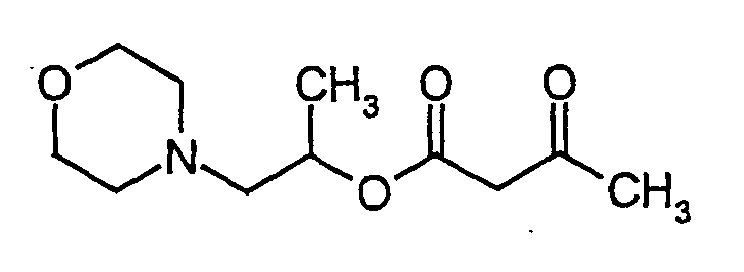
Yield: 5.34 g (68% of th.)
1H-NMR (200 MHz, DMSO-d6): δ = 1.2 (d, 3H); 2.2 (s, 3H); 2.3-2.4 (m, 6H); 3.5 (m, 6H); 5.1 (m, 1H) ppm. - In analogy to Example 3A, the following compounds are prepared:
Ex.-No. Structure Yield [%] Rt [min] (method) Mass [M+H]+ 7A 
15 3.0
(8)288 8A 
37 3.2
(8)332 9A 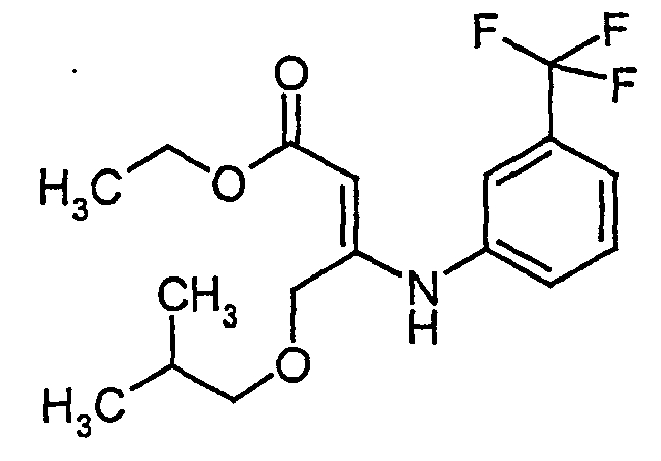
48 3.88
(3)346 10A 
47 3.46
(3)320 11A 
2 4.23
(7)332 12A 
21 3.2
(8)285
[M]+13A 
45 3.2
(8)332 14A 
26 3.2
(8)360 15A 
52 2.54
(7)290 16A 
25 3.93
(7)362 17A 
24 3.97
(7)318 18A 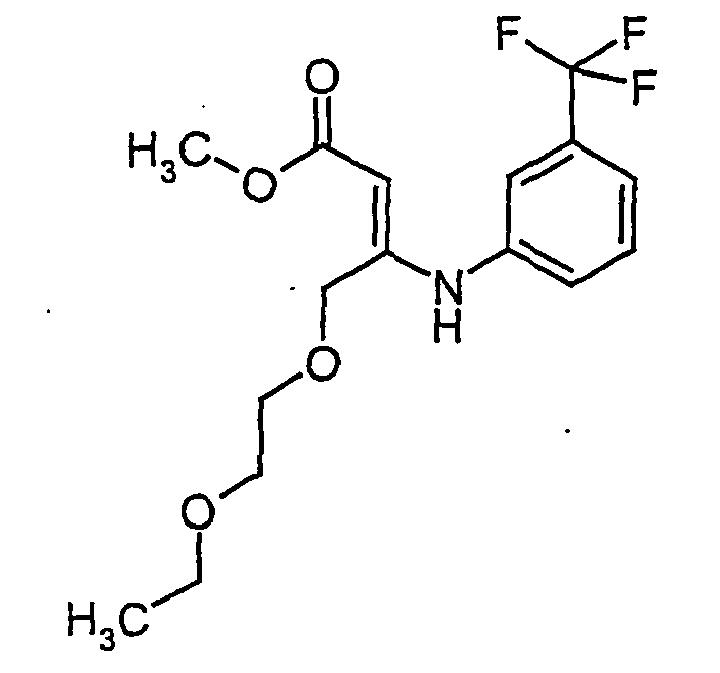
25 3.70
(7)348 19A 
49 4.1
(7)330 20A 
15 3.2
(8)373 -

Yield: 249 mg (28% of th.)
1H-NMR (300 MHz, DMSO-d6): δ = 3.3 (m, 2H); 3.4 (m, 2H); 3.6 (m, 4H); 4.0 (s, 2H) ppm. -

Yield: 0.44 g (70% of th.)
1H-NMR (300 MHz, DMSO-d6): δ = 3.2 (s, 3H, m, 2H); 3.3 (m, 2H); 3.6 (s, 2H); 8.3 (s, 1H) ppm. -

Yield: 172 mg (23% of th.)
1H-NMR (200 MHz, DMSO-d6): δ = 0.8 (t, 3H); 1.4 (sext, 2H); 3.0 (q, 2H); 3.6 (s, 2H; 8.2 (s, 1H) ppm. -
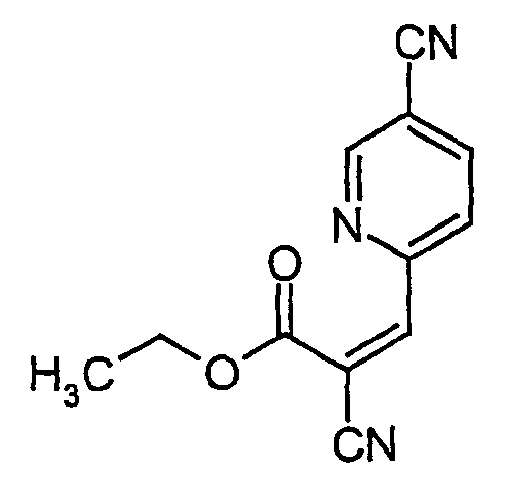
Yield: 395 mg (50% of th.)
HPLC (method 8) = 4.18 min
MS (ESIpos): m/z = 228 (M+H)+
1H-NMR (400 MHz, DMSO-d6): δ = 9.21 (d, 1H); 8.54 (dd, 1H); 8.46 (s, 1H); 8.12 (d, 1H); 4.35 (q, 2H); 1.32 (t, 3H) ppm. -

Yield: 194 mg (51% of th.)
HPLC (method 8): Rt = 3.70 min + 4.14 min
LC-MS (method 4): Rt = 3.96 min + 4.11 min
MS (EI): m/z = 252 (M+H)+
1H-NMR (200 MHz, DMSO-d6): δ =1.24 (s, 6H); 4.10 (s, 2H); 7.41 (d, 1H); 7.78 (d, 2H); 7.96 (d, 1H); 8.07 (d, 1H) ppm. -
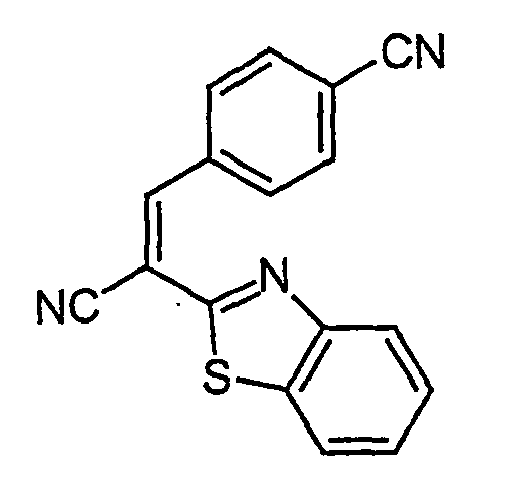
Yield: 1.12 g (91 % of th.)
HPLC (method 8): Rt = 4.94 min
MS (EI): m/z = 288 (M+H)+
1H-NMR (200 MHz, DMSO-d6): δ = 7.47-7.69 (m, 2H); 8.08 (d, 3H); 8.23 (d, 3H); 8.53 (s, 1H) ppm. -

- Ethyl (triphenylphosphoranylidene)acetate (677 mg, 1.95 mmol) and 2,2,2-trifluoro-N-[3-(trifluoromethyl)phenyl]acetamide (Example 35A; 500 mg, 1.95 mmol) are dissolved in toluene and stirred at reflux (120°C) overnight (18 hours). The crude reaction mixture is cooled to room temperature, concentrated, and the residue is chromatographed over silica gel with cyclohexane/ethyl acetate mixtures as eluent to afford a yellow oil which is analytically pure.
Yield: 270 mg (27% ofth.)
HPLC (method 8): Rt = 5.38 min
MS (EI): m/z = 328 (M+H)+
1H-NMR (300 MHz, CDCl3): δ = 1.32 (t, 3H); 4.22. (q, 2H); 5.43 (s, 1H); 7.36 (d, 1H); 7.41-7.47 (m, 2H); 7.48-7.49 (m, 2H) ppm. -

Yield: 5.0 g (97% of th.)
HPLC (method 8): Rt = 4.47 min
MS (DCI): m/z = 244 (M+NH4)+
1H-NMR (300 MHz, CDCl3): δ = 1.41 (t, 3H); 4.41 (q, 2H); 7.79 (d, 2H); 8.05 (d, 2H); 8.24 (s, 1H) ppm. -

Yield: 257 mg (48% of th.)
HPLC (method 8): Rt = 4.83 min
MS (DCI): m/z = 346 (M+NH4)+
1H-NMR (200 MHz, DMSO-d6): δ = 1.04 (t, 3H); 3.93 (q, 2H); 5.77 (s, 1H); 7.61 (s, 1H); 8.49-8.62 (m, 2H); 9.49 (s, 1H) ppm. -

- 6-Methylnicotinonitrile (3.68 g, 31.15 mmol) is dissolved in chloroform (60 ml). 3-Chloroperoxybenzoic acid (7.53 g, 32.71 mmol) is added dropwise as a solution in chloroform (60 ml), and the solution is stirred at room temperature overnight. Sodium sulphite (2.92 g, 23.17 mmol) is added, and the resulting mixture is stirred for one hour. The reaction is quenched with saturated sodium bicarbonate solution, and the product is extracted with chloroform (500 ml). The organic phase is washed with brine, dried over magnesium sulphate monohydrate, filtered and concentrated in vacuo. The residue is used without further purification.
Yield: 3.2 g (77% of th.)
1H-NMR (400 MHz, DMSO-d6): δ = 2.40 (s, 3H); 7.68 (d, 1H); 7.73 (d, 1H); 8.90 (s, 1H) ppm. -

Yield: 233 mg (25% ofth.)
HPLC (method 8): Rt = 3.15 min
MS (EI): m/z =177 (M+H)+
1H-NMR (300 MHz, DMSO-d6): δ = 2.14 (s, 3H); 5.23 (s, 2H); 7.62 (d, 1H); 8.33 (dd, 1H); 8.99 (d, 1H) ppm. -

Yield: 125 mg (91 % of th.)
HPLC (method 8): Rt =1.17 min
MS (DCI): m/z = 152 (M+NH4)+
1H-NMR (300 MHz, DMSO-d6): δ = 4.63 (d, 2H); 5.64 (t, 1H); 7.65 (d, 1H); 8.29 (dd, 1H); 8.92 (d, 1H) ppm. -

Yield: 424 mg (48% of th.)
HPLC (method 8): Rt = 1.19 min
MS (EI): m/z =132 (M)+
1H-NMR (200 MHz, DMSO-d6): δ = 5.69 (t, 1H); 7.65 (d, 1H); 8.31 (dd, 1H); 8.93 (d, 1H) ppm. -

- Dicyanomethane (500 mg, 7.6 mmol), 2-amino-2-methylpropanol (675 mg, 7.6 mmol) and Montmorillonite K-10 (135 mg) are dissolved / suspended in toluene (150 ml). The mixture is heated to reflux and stirred at this temperature overnight (18 hours). The mixture is cooled to room temperature and filtered. The solid is washed with additional toluene and acetone, and the filtrate is concentrated in vacuo to give a dark oil which is used in the next step without further purification.
Yield: 781 mg (75% of th.) -

Yield: 6.3 g (98% of th.)
HPLC (method 8): Rt= 4.68 min
MS (EI): m/z = 258 (M+H)+
1H-NMR (300 MHz, DMSO-d6): δ = 7.59 (d, 1H); 7.67 (t, 1H); 7.96 (d, 1H); 8.08 (s, 1H); 11.52 (br. s, 1H) ppm. -

- 3-Chloro-5-(trifluoromethyl)pyridine (3.0 g, 16.52 mmol) is suspended in water (67.5 ml) and treated with copper(I)chloride (8.18 g, 82.62 mmol). Ammonia solution (25%, 67.5 ml) is added and the reaction is stirred for 48 hours at 170°C in an autoclave. The reaction mixture is cooled to room temperature and extracted three times with dichloromethane. The combined organic phases are washed with brine, dried with magnesium sulphate, filtered and concentrated in vacuo to yield analytically pure product.
Yield: 2.09 g (78% of th.)
HPLC (method 8): R t =1.73 min
MS (DCI): m/z = 180 (M+NH4)+
1H-NMR (200 MHz, DMSO-d6): δ = 5.85 (s, 2H); 7.16 (s, 1H); 8.02 (s, 1H); 8.17 (s, 1H) ppm. -

Yield: 1.05 g (66% of th.)
HPLC (method 8): Rt = 4.23 min
MS (El): m/z = 259 (M+H)+
1H-NMR (300 MHz, DMSO-d6): δ = 8.46 (s, 1H); 8.84 (s, 1H); 9.10 (s, 1H); 11.80 (s, 1H) ppm. -

Yield: 1.63 g (57% of th.)
Bp.: 76-78°C / 0.51 mbar
HPLC (method 9): Rt = 4.67 min
MS (DCI): m/z = 203 (M+NH4)+
1H-NMR (300 MHz, CDCl3): δ = 0.04 (s, 9H); 0.99-1.09 (m, 2H); 3.40 (s, 2H); 4.24-4.33 (m, 2H) ppm. -

Yield: 8.06 g (94% of th.)
Bp.: 80°C / 0.46 mbar
MS (EI): m/z = 220 (M+NH4)+
1H-NMR (300 MHz, CDCl3): δ = 0.00 (s, 9H); 0.92-1.01 (m, 2H); 2.22 (s, 3H); 3.37 (s, 2H); 4.14-4.23 (m, 2H) ppm. -

Yield: 1.86 g (29% of th.)
MS (EI): m/z = 346 (M+H)+
1H-NMR (300 MHz, DMSO-d6): δ = 0.00 (s, 9H); 0.87-0.96 (m, 2H); 2.01 (s, 3H); 4.06-4.14 (m, 2H); 4.70 (s, 1H); 7.40-7.48 (m, 3H); 7.49-7.57 (m, 1H); 10.42 (s, 1H) ppm. -

Yield: 2.56 g (33% of th.)
MS (EI): m/z = 260 (M+H)+
1H-NMR (200 MHz, DMSO-d6): δ = 2.06 (s, 3H); 2.35 (s, 3H); 5.10 (s, 1H); 7.49-7.57 (m, 4H); 10.41 (s, 1H) ppm. -
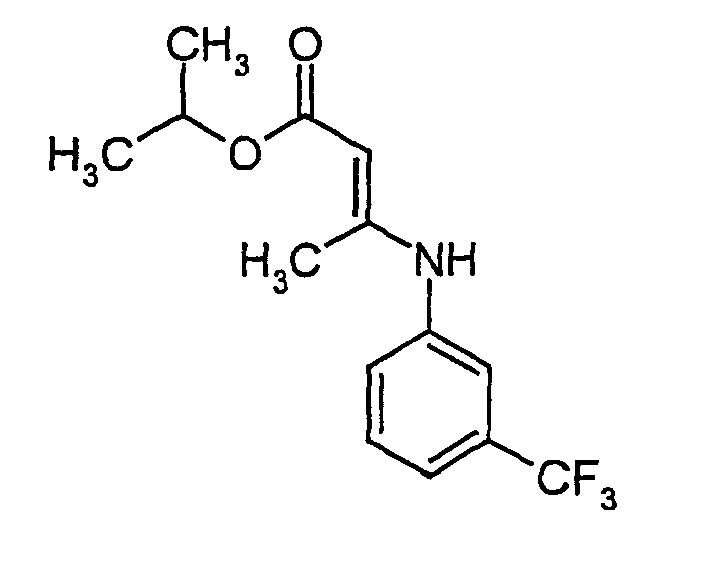
Yield: 2.83 g (33% of th.)
MS (EI): m/z = 288 (M+H)+
1H-NMR (200 MHz, DMSO-d6): δ = 1.19 (s, 6H); 2.05 (s, 3H); 4.74 (s, 1H); 4.85-5.02 (m, 1H); 7.47-7.56 (m, 4H); 10.46 (s, 1H) ppm. -

Yield: 2.68 g (29% of th.)
MS (EI): m/z = 304 (M+H)+
1H-NMR (200 MHz, DMSO-d6): δ = 2.06 (s, 3H); 3.27 (s, 3H); 3.53 (t, 2H); 4.15 (t, 2H); 4.80 (s, 1H); 7.50-7.56 (m, 4H); 10.39 (s, 1H) ppm. -

Yield: 16 mg (8% of th.)
LC-MS (method 2): Rt = 3.05 min
MS (EI): m/z = 446 (M+H)+
1H-NMR (200 MHz, DMSO-d6): δ =1.05-1.16 (m, 6H); 1.95 (s, 3H); 2.39 (s, 3H); 3.89-4.10 (m, 4H); 4.95 (s, 1H); 6.72 (br. s, 2H); 7.15-7.27 (m, 2H); 7.32-7.40 (m, 1H); 7.46 (d, 3H); 7.76 (d, 2H) ppm. -

- The compound is prepared as described in Example 1 from 100 mg (0.37 mmol) of the compound of Example 1A, 48 mg (0.37 mmol) 4-formylbenzonitrile, 41.40 mg (0.37 mmol) ethyl cyanoacetate and 62.32 mg (72 µl, 0.73 mmol) piperidine in 2 ml ethanol. The mixture is purified by preparative HPLC.
Yield: 72 mg (39% of th.)
HPLC (method 8): Rt=4.63 min
MS (EI): m/z = 500 (M+H+)
1H-NMR (200 MHz, DMSO-d6): δ = 1.04-1.16 (m, 6H); 1.92 (s, 3H); 3.89-4.09 (m, 4H); 4.96 (s, 1H); 6.85 (br. s, 2H); 7.49 (d, 2H); 7.74 (d, 3H); 7.83 (d, 2H); 7.93 (d, 1H) ppm. - Ethyl cyanoacetate (2.07 g, 18.3 mmol) and 4-cyanobenzaldehyde (2.40 g, 18.3 mmol) are dissolved in ethanol (125 ml) under an argon atmosphere. Piperidine (46.7 mg, 0.55 mmol) is added and the reaction mixture is stirred at room temperature for 2 hours. An ethanol (300 ml) solution of the compound of Example 1A (5.00 g, 18.3 mmol) and additional piperidine (0.156 g, 1.83 mmol) is added, and the reaction mixture is stirred at reflux for an aditional 16 hours. The crude reaction product is concentrated in vacuo and chromatographed over silica gel with cyclohexane/ethyl acetate mixtures to give a pale yellow oil.
Yield: 4.6 g (43% of th.) - The following compound is prepared analogously as described for Example 1:
Ex.-No. Structure Analytical data 3 
LC-MS (method 7): Rt=3.83 min
MS (EI): m/z = 399 (M+H+) -

Yield: 63 mg (34% of th.)
LC-MS (method 6): Rt = 4.21 min
MS (EI): m/z = 424 (M+H)+
HPLC (method 8): Rt = 3.99 min
1H-NMR (200 MHz, DMSO-d6): δ = 1.68 (s, 3H); 4.76 (s, 1H); 6.42 (br. s, 2H); 7.24 (br. s, 2H); 7.63 (d, 2H); 7.77 (d, 2H); 7.82-7.95 (m, 4H) ppm. -

Yield: 40 mg (23% of th.)
HPLC (method 8): Rt = 4.18 min
MS (EI): m/z = 471 (M+H)+
1H-NMR (300 MHz, DMSO-d6): δ = 1.19 (t, 3H); 1.87 (s, 3H); 4.06 (q, 2H); 4.90 (s, 1H); 6.45 (br. s, 2H); 7.03 (br. s, 2H); 7.61 (d, 2H); 7.68 (d, 2H); 7.72-7.79 (m, 3H); 7.89 (d, 1H) ppm. -

Yield: 63 mg (32% of th.)
HPLC (method 8): Rt= 4.89 min
MS (EI): m/z = 453 (M+H)+
1H-NMR (300 MHz, DMSO-d6): δ = 0.97 (t, 3H); 1.72 (s, 3H); 3.88 (q, 2H); 4.59 (s,
1H); 7.04 (br. s, 2H); 7.56 (d, 2H); 7.76-7.86 (m, 4H); 7.91-7.96 (m, 1H); 7.98 (s, 1H) ppm. -

Yield: 70 mg (35% of th.)
LC-MS (method 3): Rt = 2.49 min
MS (EI): m/z = 452 (M+H)+
1H-NMR (300 MHz, DMSO-d6): δ = 1.90 (s, 3H); 2.89 (s, 3H); 3.14 (s, 3H); 4.12-4.17 (m, 1H); 4.28-4.33 (m, 1H); 7.60 (d, 2H); 7.66-7.85 (m, 4H); 7.89 (d, 2H); 8.52 (s, 1H) ppm. - The following compounds are prepared analogously as described for Example 4:
Ex.-No. Starting material Structure Analytical data 8 Example 2A 
HPLC (method 8):
Rt = 5.31 min.
MS (EI): m/z = 506
(M+H)+9 Example 3A 
LC-MS (method 3):
Rt = 3.68 min.
MS (EI): m/z = 528
(M+H)+10 Example 7A 
LC-MS (method 7):
Rt = 4.43 min
HPLC (method 8):
Rt = 4.67 min
MS (EI): m/z = 514
(M+H)+ -

Yield: 29 mg (8% of th.)
LC-MS (method 4): Rt = 3.31 min.
MS (EI): m/z = 498 (M)+
1H-NMR (400 MHz, DMSO-d6): δ = 1.04 (t, 3H); 2.08 (s, 3H); 2.89 (s, 3H); 3.21 (s, 3H); 3.97 (q, 2H); 4.20 (s, 1H); 4.35 (s, 1H); 7.54 (d, 2H); 7.59-7.65 (m, 2H); 7.67-7.76 (m, 2H); 7.83 (d, 2H); 8.27 (s, 1H) ppm. -

Yield: 44 mg (9% of th.)
LC-MS (method 6): Rt = 4.40 min.
MS (EI): m/z = 423 (M+H)+
1H-NMR (300 MHz, DMSO-d6): δ =1.68 (s, 3H); 1.80 (s, 3H); 4.80 (s, 1H); 7.60 (d, 2H); 7.81 (d, 2H); 7.87 (d, 2H); 7.94 (d, 2H) ppm. - The following compounds are prepared analogously as described for Example 4:
Ex-No. Starting material Structure Analytical data 13 Example 8A 
mixture of diastereomers
LC-MS (method 7):
Rt = 4.13 min.
MS (EI): m/z = 558
(M+H)+14 Example 9A 
LC-MS (method 7):
Rt = 4.56 min.
HPLC (method 8):
Rt = 5.05 min.
MS (EI): m/z = 572
(M+H)+15 Example 10A 
LC-MS (method 7):
Rt = 4.20 min
HPLC (method 8):
Rt = 4.75 min
MS (EI): m/z = 546
(M+H) +16 Example 11A 
LC-MS (method 7):
Rt = 4.03 min
HPLC (method 8):
Rt= 5.23 min
MS (EI): m/z = 558
(M+H)+17 Example 8A 
mixture of diastereomers
LC-MS (method 7):
Rt = 2.18 + 3.18 min
MS (EI): m/z = 529
(M+H)+18 Example 12A 
LC-MS (method 7):
Rt = 4.12 min
MS (EI): m/z = 512
(M+H)+ -

- The two diastereomers of Example 13 are separated by preparative HPLC.
- 1H-NMR (200 MHz, DMSO-d6): δ = 1.1 (t, 3H); 1.3 (d, 3H); 2.0 (s, 3H); 3.6 (s, 3H); 4.0 (m, 2H); 4.9 (q, 1H); 5.0 (s, 1H); 6.9 (br. s, 2H); 7.5 (m, 2H); 7.8 (m, 3H); 7.9 (m, 3H) ppm.
- 1H-NMR (200 MHz, DMSO-d6): δ = 1.1 (t, 3H); 1.4 (d, 3H); 1.9 (s, 3H); 3.5 (s, 3H); 4.0 (m, 2H); 5.0 (m, 1H); 5.0 (s, 1H); 6.9 (br. s, 2H); 7.5 (m, 2H); 7.8 (m, 3H); 7.9 (m, 3H) ppm.
-

Yield: 55 mg (34% of th.) as mixture of diastereomers
HPLC (method 8): Rt= 4.63 min
MS (EI): m/z = 558 (M+H)+
1H-NMR (300 MHz, DMSO-d6): δ = 1.10 (t, 6H); 1.3 (d, 3H); 1.4 (d, 3H); 1.91 (s, 3H); 1.96 (s, 3H); 3.54 (s, 3H); 3.63 (s, 3H); 3.92-4.05 (m, 4H); 4.85-4.96 (m, 2H); 4.98 (s, 2H); 6.83 (br.s, 4H); 7.51 (m, 4H); 7.73 (m, 6H); 7.77-7.93 (m, 6H) ppm. -

- 1H-NMR (400 MHz, DMSO-d6): δ =1.1 (t, 3H); 1.4 (d, 3H); 1.9 (s, 3H); 3.6 (s, 3H); 4.0 (m, 2H); 5.0 (m, 1H); 5.0 (s, 1H); 6.9 (br. s, 2H); 7.5 (m, 2H); 7.7 (m, 3H); 7.8 (m, 2H); 7.9 (m, 1H) ppm.
- 1H-NMR (400 MHz, DMSO-d6): δ = 1.1 (t, 3H); 1.3 (d, 3H); 1.9 (s, 3H); 3.7 (s, 3H); 4.0 (m, 2H); 4.9 (q, 1H); 5.0 (s, 1H); 6.9 (br. s, 2H); 7.5 (m, 2H); 7.7 (m, 3H); 7.8 (m, 1H); 7.9 (m, 2H) ppm.
- The following compounds are prepared analogously as described for Example 4:
Ex-No. Starting material Structure Analytical data 24 Example 14A 
HPLC (method 8):
Rt=4.74min.
MS (EI): m/z = 586
(M+H)+25 Example 15A 
LC-MS (method 7):
Rt = 3.80 min.
MS (EI): m/z = 516
(M+H)+26 Example 16A 
LC-MS (method 7):
Rt = 4.12 min.
MS (EI): m/z = 588
(M+H)+27 Example 17A 
LC-MS (method 7):
Rt = 4.10 min.
MS (EI): m/z = 544
(M+H)+28 Example 18A 
LC-MS (method 7):
Rt = 3.95 min
MS (EI): m/z = 574
(M+H)+29 Example 19A 
LC-MS (method 7):
Rt = 4.18 min
MS (EI): m/z = 556
(M+H)+30 Example 20A 
MS (EI): m/z =
599 (M+H)+31 Example 1A and 21A 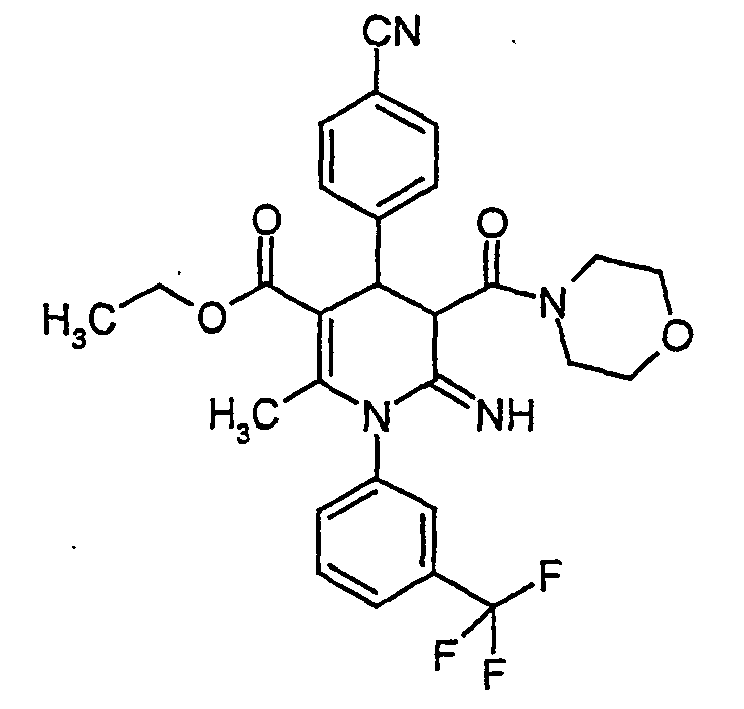
LC-MS (method 7):
Rt = 2.15 min.
HPLC (method 8):
Rt = 4.43 min.
MS (EI): m/z = 541
(M+H)+32 Example 1A and 23A 
HPLC (method 8):
Rt = 4.57 min.
MS (EI) : m/z = 513
(M+H)+33 Example 1A and 22A 
LC-MS (method 7):
Rt = 2.12 + 2.92 min.
MS (EI): m/z = 529
(M+H)+34 Example 1A 
LC-MS (method 7): Rt = 2.54 + 3.34 min.
MS (EI): m/z = 553 (M+H)+35 Example 1A 
LC-MS (method 7):
Rt = 2.17 + 2.98 min.
MS(EI):m/z=511
(M+H)+36 Example 1A 
LC-MS (method 7):
Rt = 2.32 min.
MS (EI): m/z = 539
(M+H)+37 Example 1A 
LC-MS (method 7):
Rt =1.64 + 1.92 min.
MS (EI): m/z = 554
(M+H)+38 Example 1A 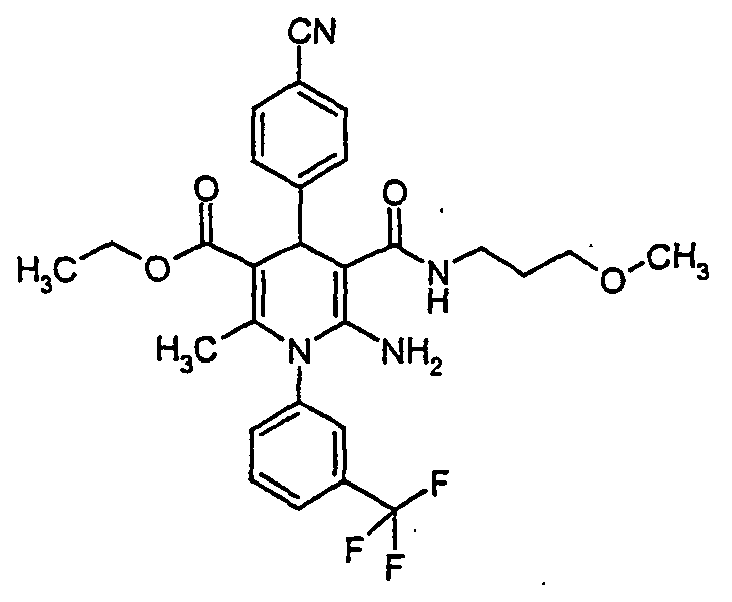
LC-MS (method 7):
Rt= 2.22 + 3.04 min.
MS (EI): m/z = 543
(M+H)+39 Example 1A 
LC-MS (method 7):
Rt = 2.26 + 2.92 min.
MS (EI): m/z = 513
(M+H)+40 Example 1A 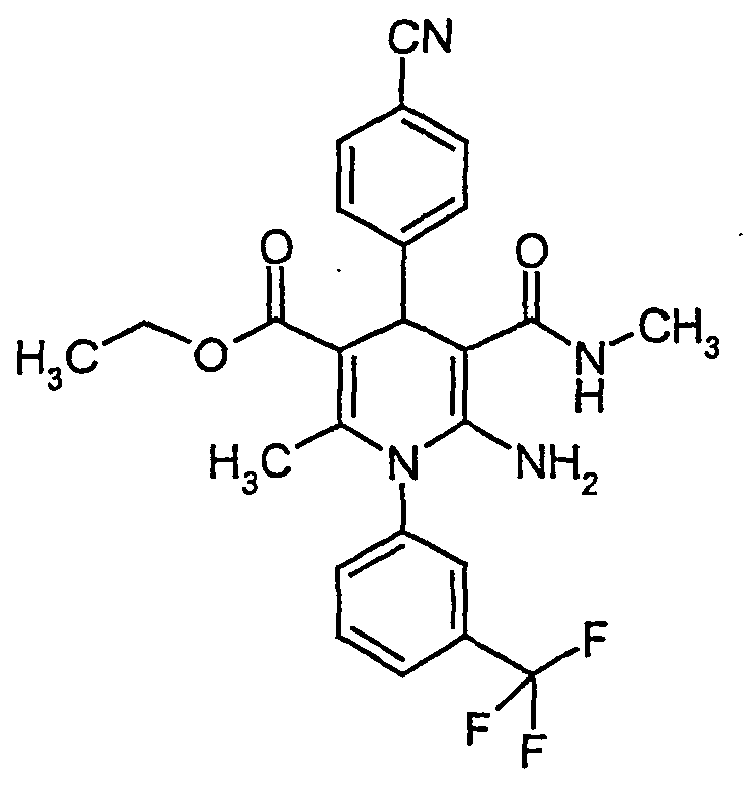
LC-MS (method 7):
Rt = 2.12 + 2.81 min.
MS (EI): m/z = 485
(M+H)+ -

Yield: 33 mg (20% ofth.)
HPLC (method 8): Rt = 4.91 min.
LC-MS (method 7): Rt = 3.59 min.
MS (EI): m/z = 453 (M+H)+
1H-NMR (300 MHz, DMSO-d6): δ = 1.04 (t, 3H); 1.94 (s, 3H); 3.96 (q, 2H); 4.60 (s, 1H); 5.53 (s, 2H); 7.50 (d, 2H); 7.66 (d, 1H); 7.72-7.91 (m, 5H) ppm. -

Yield: 1.17 g (83% of th.)
LC-MS (method 7): Rt = 3.20 min.
MS (El): m/z = 406 (M+H)+
1H-NMR (200 MHz, DMSO-d6): δ = 1.73 (s, 3H); 4.55 (s, 1H); 5.78 (s, 2H); 7.65 (d, 2H); 7.76 (d, 2H); 7.91 (d, 4H) ppm. - The following compound is prepared analogously as described for Example 2:
Ex-No. Starting material Structure Analytical data 43 Example 1A 
LC-MS (method 6):
Rt = 3.92 min.
HPLC (method 8):
Rt = 5.34 min.
MS (EI): m/z = 555
(M+H)+ -

Yield: 9.7 mg (8% ofth.)
LC-MS (method 4): Rt = 4.9 min
MS (EI): m/z = 571 (M+H)+
1H-NMR (300 MHz, DMSO-d6): δ = 0.85 (t, 3H); 1.13-1.26 (m, 6H); 2.01 (s, 3H); 3.95-4.29 (m, 6H); 5.11 (s, 1H); 6.36 (t, 1H); 7.35 (d, 2H); 7.49-7.56 (m, 1H); 7.59. (d, 3H); 7.76-7.83 (m, 3H) ppm. - The following compounds are prepared analogously as described for Example 2:
Ex-No. Starting material Structure Analytical data 45 Example 1A 
LC-MS (method 4):
Rt = 5.34 min.
MS (EI): m/z = 540
(M+H)+46 Example 1A 
LC-MS (method 4):
Rt = 5.10 min.
MS (EI): m/z = 506
(M+H)+ -
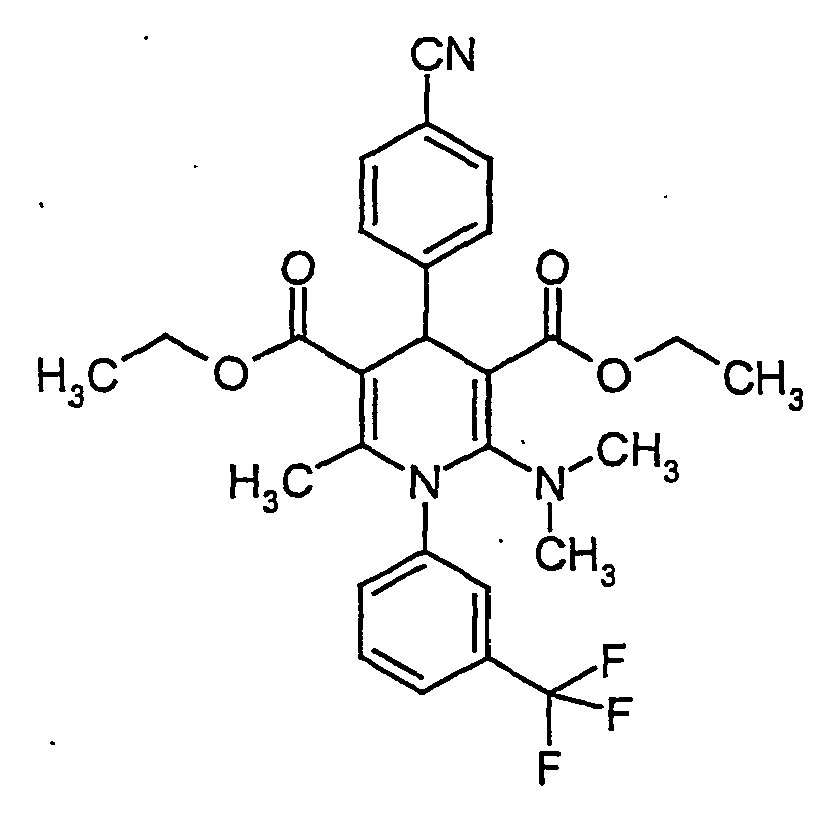
The crude oil is purified by preparative HPLC.
Yield: 143 mg (45% of th.)
HPLC (method 8): Rt = 5.45 min
MS (EI): m/z = 528 (M+H)+
1H-NMR (300 MHz, DMSO-d6): δ = 1.19 (t, 3H); 1.26 (t, 3H); 2.34 (s, 3H); 2.39 (s, 6H); 4.11-4.24 (m, 4H); 4.94 (s, 1H); 6.61 (s, 1H); 7.32 (d, 1H); 7.41 (d, 2H); 7.55-7.68 (m, 2H); 7.75 (d, 2H) ppm. -

Yield: 20.4 mg (7% of th.)
LC-MS (method 6): Rt = 4.35 min
MS (EI): m/z = 514 (M+H)+
1H-NMR (400 MHz, DMSO-d6): δ = 1.02-1.09 (m, 6H); 2.09 (s, 3H); 2.64 (s, 3H); 3.97-4.04 (m, 2H); 4.19-4.28 (m, 2H); 4.59 (s, 1H); 4.80 (s, 1H); 7.37-7.49 (m, 2H); 7.58 (d, 2H); 7.70 (d, 2H); 7.80 (d, 2H) ppm. -

Yield: 130 mg (27% of th.)
LC-MS (method 6): Rt = 5.10 min
MS (EI): m/z = 501 (M+H)+
1H-NMR (300 MHz, DMSO-d.6): δ = 1.08-1.16 (m, 6H); 1.93 (s, 3H); 3.93-4.09 (m, 4H); 5.03 (s, 1H); 6.78 (br. s, 2H); 7.42 (d, 1H); 7.80-7.93 (m, 4H); 8.18 (dd, 1H); 8.94 (d, 1H) ppm. -

Yield: 21 mg (7% of th.)
LC-MS (method 7): Rt = 2.36 min
MS (EI): m/z = 525 (M+H)+
1H-NMR (300 MHz, DMSO-d6): δ = 1.06-1.18 (m, 9H); 1.96 (s, 3H); 3.69 (d, 1H); 3.86 (d, 1H); 4.03 (q, 2H); 4.98 (s, 1H); 5.74 (s, 1H); 6.74 (br. s, 2H); 7.47 (d, 2H); 7.65 (d, 1H); 7.69-7.79 (m, 3H); 7.89 (d, 1H) ppm. -

Yield: 116 mg (35% of th.)
LC-MS (method 6): Rt = 5.85 min.
MS (EI): m/z = 561 (M+H)+
1H-NMR (300 MHz, DMSO-d6): δ = 1.24 (t, 3H); 1.96 (s, 3H); 4.14 (q, 2H); 5.02 (s, 1H); 7.15 (t, 1H); 7.32 (t, 1H); 7.59 (d, 2H); 7.64 (d, 3H); 7.77 (d, 2H); 7.80-7.87 (m, 3H); 7.95 (d, 2H) ppm. -

Yield: 13 mg (5% of th.)
LC-MS (method 10): Rt = 4.16 min.
MS (EI): m/z = 554 (M+H)+
1H-NMR (300 MHz, DMSO-d6): δ = 1.04 (t, 3H); 1.11 (t, 3H); 3.94-4.03 (m, 2H); 4.10-4.21 (m, 2H); 4.92 (s, 1H); 7.08 (br.s, 2H); 7.46 (d, 1H); 7.64 (s, 2H); 7.69 (d, 2H); 7.77 (t, 1H); 7.86 (d, 2H) ppm. -
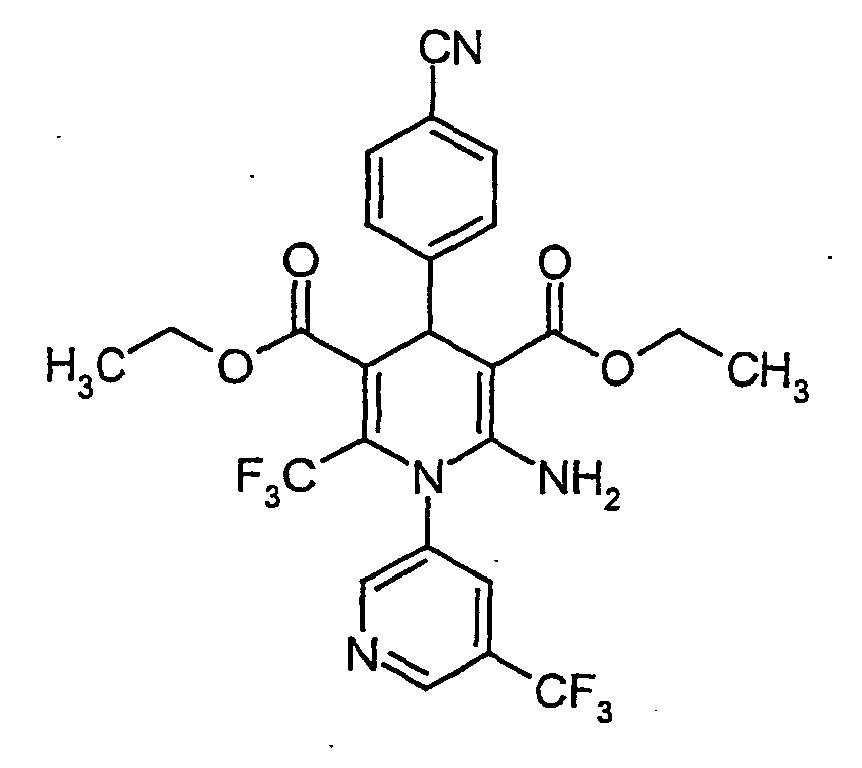
Yield: 38 mg (17% of th.)
LC-MS (method 7): Rt = 3.91 min.
MS (EI): m/z = 555 (M+H)+
1H-NMR (300 MHz, CDCl3): δ = 1.14 (dt, 6H); 4.06 (q, 2H); 4.16 (q, 2H); 5.04 (s, 1H); 6.17 (br. s, 2H); 7.42 (d, 2H); 7.66 (d, 2H); 7.82 (s, 1H); 8.79 (s, 1H); 9.01 (s, 1H) ppm. -

Yield: 5.5 mg (1.6% of th.)
LC-MS (method 5): Rt = 3.31 min.
HPLC (method 8): Rt = 4.32 min.
MS (EI): m/z = 479 (M+H)+
1H-NMR (200 MHz, DMSO-d6): δ = 1.17 (t, 6H); 1.91 (s, 3H); 2.21 (s, 3H); 3.88-4.12 (m, 4H); 4.80 and 5.05 (s, 1H); 6.41-6.82 (m, 2H); 7.30 (s, 1H); 7.70-7.96 (m, 2H); 8.05 (d, 1H); 8.42 (d, 1H); 11.41 (s, 1H) ppm. -
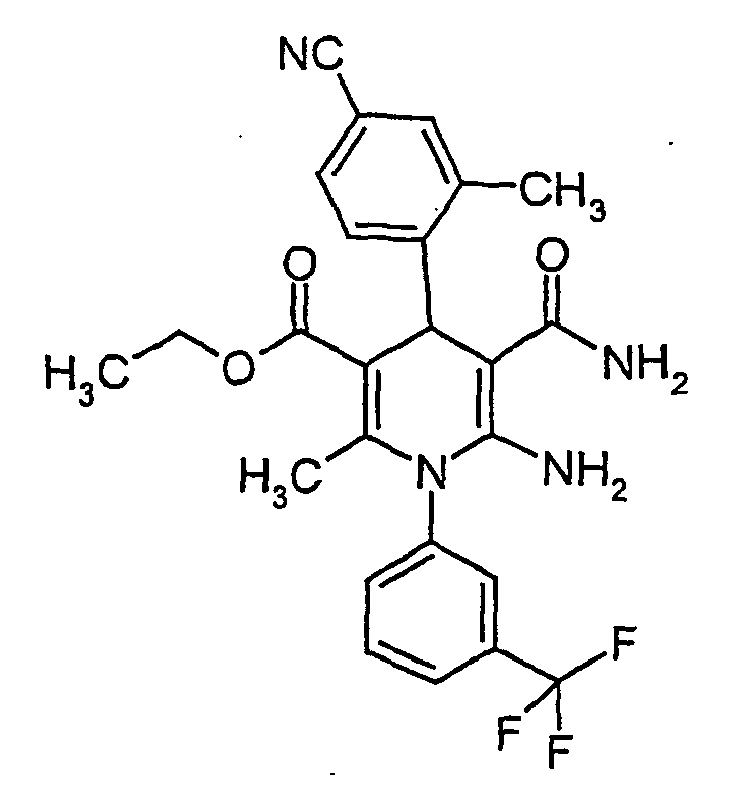
Yield: 16.6 mg (9.2% of th.)
LC-MS (method 5): Rt = 3.62 min.
HPLC (method 8): Rt = 4.26 min.
MS (EI): m/z = 485 (M+H)+
1H-NMR (mixture of tautomers; 400 MHz, CDCl3): δ = 1.10 and 1.20 (t, 3H); 1.89 and 2.17 (s, 3H); 2.48 and 2.52 (s, 3H); 3.49 (m, 1H); 4.02-4.19 (m, 2H); 4.88 (br. s, 1H); 5.06 and 5.23 (s, 1H); 6.40 and 6.66 (br. s, 2H); 7.38-7.60 (m, 5H); 7.68-7.85 (m, 2H) ppm. -

Yield: 163 mg (26% ofth.)
LC-MS (method 7): Rt = 4.69 min.
HPLC (method 8): Rt = 5.02 min.
MS (EI): m/z = 572 (M+H)+
1H-NMR (300 MHz, DMSO-d6): δ = 0.00 (s, 9H); 0.81-0.91 (m, 2H); 1.11 (t, 3H); 1.91 (s, 3H); 3.92-4.07 (m, 4H); 5.00 (s, 1H); 6.81 (br. s, 2H); 7.47 (d, 2H); 7.65-7.77 (m, 3H); 7.78-7.86 (m, 2H); 7.90 (d, 1H) ppm. -

Yield: 4 mg (3.7% of th.)
MS (EI): m/z = 544 (M+H)+
1H-NMR (300 MHz, DMSO-d6): δ = 1.40 (d, 3H); 2.06 (s, 3H); 3.54 (d, 3H); 3.65 (d, 3H); 4.8-5.0 (m, 2H); 6.84 (br. s, 2H); 7.47-7.54 (m, 4H); 7.74 (d, 2H); 7.80-7.85 (m, 2H); 7.93 (d, 1H) ppm. -

Yield: 477 mg (16.2% ofth.)
MS (EI): m/z = 572 (M)+
1H-NMR (200 MHz, DMSO-d6): δ = 0.00 (s, 9H); 0.80-0.95 (m, 2H); 1.11 (t, 3H); 1.93 (s, 3H); 3.89-4.20 (m, 4H); 4.99 (s, 1H); 6.84 (br. s, 2H); 7.49 (d, 2H); 7.67-7.9 (m, 5H); 7.93 (d, 1H) ppm. -

Yield: 741 mg (25% of th.)
MS (EI): m/z = 543 (M+H)+
1H-NMR (300 MHz, DMSO-d6): δ = 0.00 (s, 9H); 0.86-1.09 (m, 2H); 1.88 (s, 3H); 4.11 (t, 2H); 4.90 (s, 1H); 6.44 (br. s, 2H); 7.03 (br. s, 2H); 7.61 (d, 2H); 7.67 (d, 2H); 7.73-7.82 (m, 3H); 7.89 (d, 1H) ppm. -

Yield: 288 mg (85% of th.)
MS (EI): m/z = 472 (M+H)+
1H-NMR (200 MHz, DMSO-d6): δ = 1.12 (t, 3H); 1.94 (s, 3H); 3.98 (q, 2H); 4.99 (s,
1H); 6.81 (br. s, 2H); 7.49 (d, 2H); 7.65-7.79 (m, 3H); 7.80-7.87 (m, 2H); 7.92 (d, 1H); 12.29 (br. s, 1H) ppm. -

Yield: 112 mg (21% of th.)
MS (EI): m/z = 443 (M+H)+
1H-NMR (400 MHz, DMSO-d6): δ = 1.89 (s, 3H); 4.93 (s, 1H); 6.43 (br. s, 2H); 7.02 (br. s, 2H); 7.58-7.67 (m, 3H); 7.72-7.83 (m, 4H); 7.87 (d, 1H) ppm. -

Yield: 3.5 mg (14% of th.)
MS (EI): m/z = 515 (M+H)+
1H-NMR (200 MHz, DMSO-d6): δ = 1.00 (t, 3H); 1.53 (s, 3H); 2.95-3.12 (m, 2H); 3.19-3.33 (m, 2H); 3.80-4.01 (m, 2H); 4.56 (t, 1H); 4.80 (s, 1H); 6.85 (br. s, 2H); 7.44 (d, 2H); 7.68-7.77 (m, 6H); 7.90 (d, 1H) ppm. -

- Yield: 3 mg (12% of th.)
MS (EI): m/z = 493 (M+H)+
1H-NMR (300 MHz, DMSO-d6): δ =1.36 (s, 3H); 4.88 (s, 1H); 6.43 (br. s, 2H); 7.04 (s, 1H); 7.13 (br. s, 2H); 7.55-7.61 (m, 3H); 7.73-7.78 (m, 4H); 7.88 (tr, 1H); 7.93 (s, 1H); 8.17 (s, 1H) ppm. -

- Yield: 64 mg (68% of th.)
MS (EI): m/z = 522 (M+H)+
1H-NMR (300 MHz, DMSO-d6): δ = 1.01 (t, 3H); 1.36 (s, 3H); 3.91 (q, 2H); 4.84 (s, 1H); 6.95 (br. s, 2H); 7.02 (s, 1H); 7.48 (d, 2H); 7.54 (s, 1H); 7.73 (d, 2H); 7.81 (tr, 2H); 7.92 (d, 1H); 8.08 (s, 1H); 8.20 (s, 1H) ppm. -

- Yield: 23 mg (83% of th.)
MS (EI): m/z = 516 (M+H)+
1H-NMR (300 MHz, DMSO-d6): δ = 1.08 (t, 3H); 1.91 (s, 3H); 3.52 (q, 2H); 3.87-4.08 (m, 4H); 4.73 (t, 1H); 4.99 (s, 1H); 6.82 (br. s, 2H); 7.52 (d, 2H); 7.72 (d, 3H); 7.82 (tr, 2H); 7.92 (d, 1H) ppm. -

- Yield: 14.1 mg (23% of th.)
MS (EI): m/z = 499 (M+H)+
1H-NMR (200 MHz, DMSO-d6): δ = 0.85 (t, 3H); 1.05 (t, 3H); 1.51 (s, 3H); 2.98 (quin, 2H); 3.88 (m, 2H); 4.80 (s, 1H); 6.85 (br. s, 2H); 7.43 (d, 2H); 7.70-7.77 (m, 5H); 7.82 (tr, 1H); 7.91 (d, 1H) ppm. - The following compounds are prepared analogously as described for Example 57:
Ex.-No. Starting material Structure Yield [%] Analytical data 67 Example 41A 
3.8 LC-MS (method 1):
Rt = 5.40 min.
MS (EI): m/z = 525
(M+H)+68 Example 41A 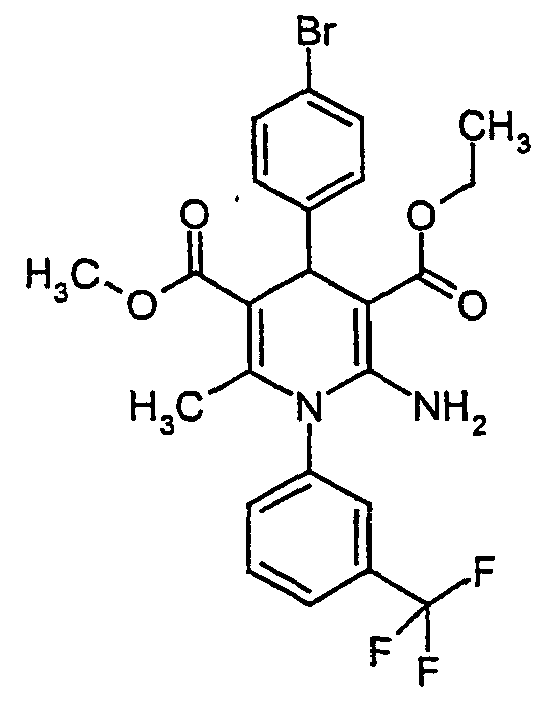
8.3 LC-MS (method 1):
Rt = 5.5 5 min.
MS (EI): m/z = 539
(M+H)+69 Example 41A 
15.4 LC-MS (method 1):
Rt = 5.69 min.
MS (EI): m/z = 553
(M+H)+70 Example 41A 
2.6 LC-MS (method 1):
Rt = 5.34 min.
MS (EI): m/z = 569
(M+H)+71 Example 41A 
6.0 LC-MS (method 1):
Rt = 5.50 min.
MS (EI): m/z = 583
(M+H)+72 Example 41A 
7.1 LC-MS (method 1):
Rt = 5.89 min.
MS (EI): m/z = 567
(M+H)+73 Example 41A 
11.3 LC-MS (method 1):
Rt = 5.10 min.
MS (EI): m/z = 486
(M+H)+74 Example 41A 
11.3 LC-MS (method 1):
Rt = 5.04 min.
MS (EI): m/z = 530
(M+H)+75 Example 41A 
13.6 LC-MS (method 1):
Rt = 5.42 min.
MS (EI): m/z = 514
(M+H)+76 Example 1A 
3.7 LC-MS (method 1):
Rt = 5.57 min.
MS (EI): m/z = 539
(M+H)+77 Example 1A 
4.5 LC-MS (method 1):
Rt = 5.72 min.
MS (EI): m/z = 553
(M+H)+78 Example 1A 
8.8 LC-MS (method 1):
Rt = 5.87 min.
MS (EI): m/z = 567
(M+H)+79 Example 1A 
5.0 LC-MS (method 1):
Rt = 5.67 min.
MS (EI): m/z = 597
(M+H)+80 Example 1A 
27.3 LC-MS (method 1):
Rt = 5.42 min.
MS (EI): m/z = 514
(M+H)+81 Example 1A 
11.4 LC-MS (method 1):
Rt = 5.59 min.
MS (EI): m/z = 528
(M+H)+82 Example 42A 
2.6 LC-MS (method 1):
Rt = 5.89 min.
MS (EI): m/z = 567
(M+H)+83 Example 42A 
11.2 LC-MS (method 1):
Rt = 6.05 min.
MS (EI): m/z = 581 (M+H)+84 Example 42A 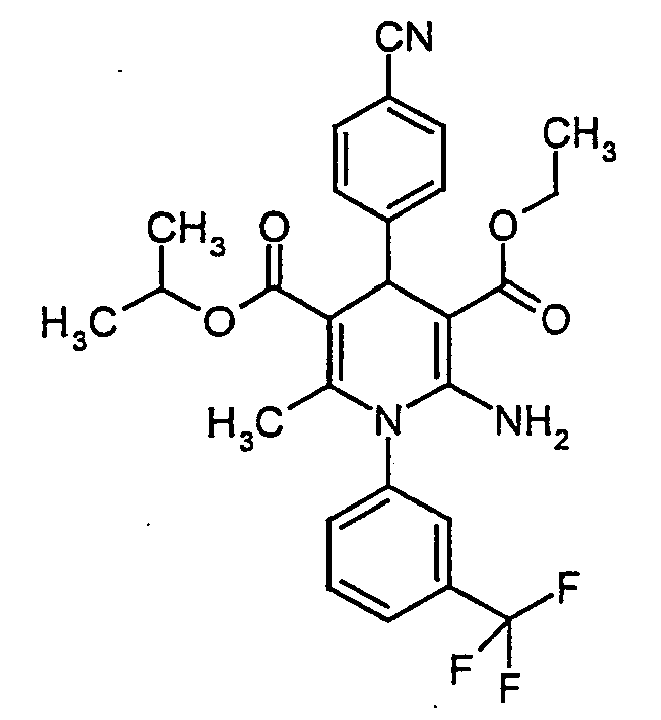
4.9 LC-MS (method 1): Rt = 5.43 min.
MS (EI): m/z = 514
(M+H)+85 Example 42A 
17.1 LC-MS (method 1):
Rt = 5.56 min.
MS (EI): m/z = 528
(M+H)+86 Example 42A 
3.7 LC-MS (method 1):
Rt = 5.74 min.
MS (EI): m/z = 542
(M+H)+87 Example 43A 
2.6 LC-MS (method 1):
Rt = 5.33 min.
MS (EI): m/z = 569
(M+H)+88 Example 43A 
6.9 LC-MS (method 1):
Rt = 5.49 min: MS (EI): m/z = 583
(M+H)+89 Example 43A 
4.9 LC-MS (method 1):
Rt = 5.82 min.
MS (EI): m/z = 611
(M+H)+90 Example 43A 
6.6 LC-MS (method 1):
Rt = 5.05 min.
MS (EI) : m/z = 530
(M+H)+91 Example 43A 
25.8 LC-MS (method 1):
Rt = 5.19 min.
MS (EI): m/z = 544
(M+H)+92 Example 43A 
13.5 LC-MS (method 1):
Rt = 5.36 min.
MS (EI): m/z = 558
(M+H)+93 Example 8A 
5.9 LC-MS (method 1):
Rt = 5.40 min.
MS (EI): m/z = 597
(M+H)+94 Example 8A 
11.5 LC-MS (method 1):
Rt = 5.55 min.
MS (EI): m/z = 611
(M+H)+95 Example 8A 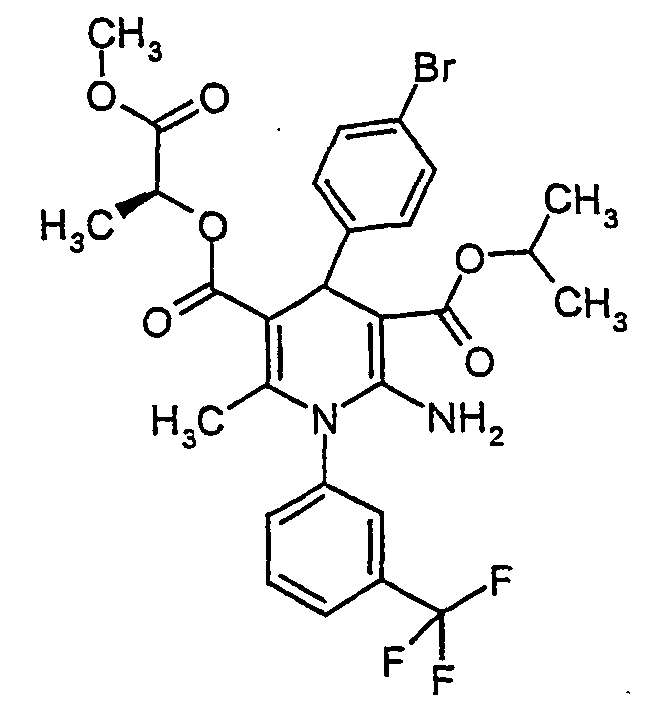
11.2 LC-MS (method 1):
Rt = 5.68 min.
MS (EI): m/z = 625
(M+H)+96 Example 8A 
5.3 LC-MS (method 1):
Rt = 5.50 min.
MS (EI): m/z = 655
(M+H)+97 Example 8A 
26.2 LC-MS (method 1):
Rt = 5.27 min.
MS (EI): m/z = 572
(M+H)+98 Example 8A 
25.6 LC-MS (method 1):
Rt = 5.42 min.
MS (EI): m/z = 586
(M+H)+99 Example 41A 
2.4 LC-MS (method 1):
Rt = 4.95 min.
MS (EI): m/z = 472
(M+H)+100 Example 41A 
1.9 LC-MS (method 1):
Rt = 5.25 min.
MS (EI): m/z = 500
(M+H)+101 Example 41A 
1.9 LC-MS (method 1):
Rt = 4.92 min.
MS (EI): m/z = 516
(M+H)+102 Example 1A 
1.3 LC-MS (method 1):
Rt = 5.51 min.
MS (EI): m/z = 583
(M+H)+103 Example 1A 
2.6 LC-MS (method 1):
Rt = 5.12 min.
MS (EI): m/z = 486
(M+H)+104 Example 42A 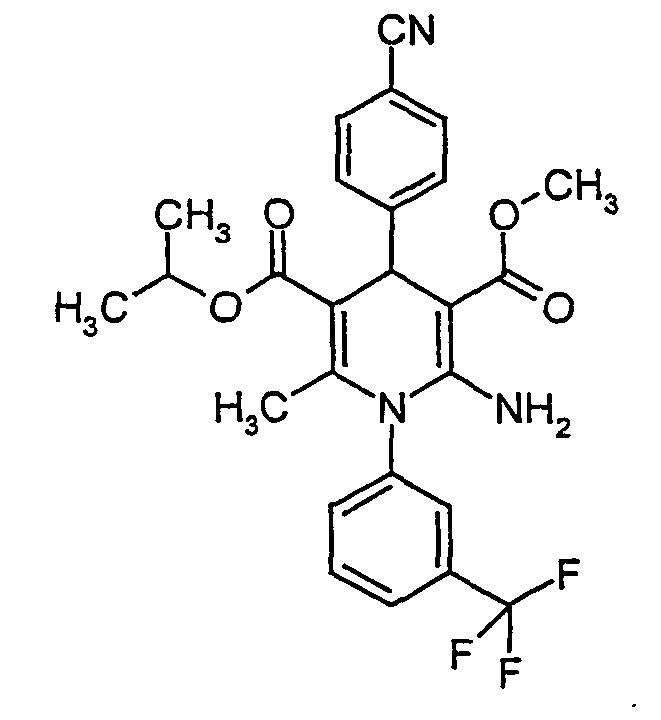
0.8 LC-MS (method 1):
Rt = 5.27min.
MS (EI): m/z = 500
(M+H)+105 Example 42A 
1.5 LC-MS (method 1):
Rt = 5.35 min.
MS (EI): m/z = 557
(M+H)+106 Example 43A 
1.4 LC-MS (method 1):
Rt = 4.87 min.
MS (EI): m/z = 560
(M+H)+107 Example 8A 
0.6 LC-MS (method 1):
Rt = 5.35 min.
MS (EI): m/z = 641
(M+H)+108 Example 8A 
1.0 LC-MS (method 1):
Rt = 4.98 min.
MS (EI): m/z = 588
(M+H)+ - The compounds according to the invention can be converted into pharmaceutical preparations as follows:
- 100 mg of the compound of Example 1, 50 mg of lactose (monohydrate), 50 mg of maize starch (native), 10 mg of polyvinylpyrrolidone (PVP 25) (from BASF, Ludwigshafen, Germany) and 2 mg of magnesium stearate.
Tablet weight 212 mg, diameter 8 mm, curvature radius 12 mm. - The mixture of active component, lactose and starch is granulated with a 5% solution (m/m) of the PVP in water. After drying, the granules are mixed with magnesium stearate for 5 min. This mixture is moulded using a customary tablet press (tablet
- 1000 mg of the compound of Example 1, 1000 mg of ethanol (96%), 400 mg of Rhodigel (xanthan gum from FMC, Pennsylvania, USA) and 99 g of water.
A single dose of 100 mg of the compound according to the invention is provided by 10 ml of oral suspension. - The Rhodigel is suspended in ethanol and the active component is added to the suspension. The water is added with stirring. Stirring is continued for about 6h until the swelling of the Rhodigel is complete.
Claims (19)
- Compounds of the general formula (I)

A represents an aryl or heteroaryl ring,
R1, R2 and R3 independently from each other represent hydrogen, halogen, nitro, cyano, C1-C6-alkyl, hydroxy or C1-C6-alkoxy, wherein C1-C6-alkyl and C1-C6-alkoxy can be further substituted with one to three identical or different radicals selected from the group consisting of halogen, hydroxy and C1-C4-alkoxy,
R4 represents C1-C6-alkoxycarbonyl, C1-C6-alkenoxycarbonyl, hydroxycarbonyl, aminocarbonyl, mono- or di-C1-C4-alkylaminocarbonyl, C6-C10-arylaminocarbonyl, heteroarylcarbonyl, heterocyclylcarbonyl or cyano, wherein C1-C6-alkoxycarbonyl, mono- and di-C1-C4-alkylaminocarbonyl can be substituted with one to three identical or different radicals selected from the group consisting of hydroxy, C1-C4-alkoxy, hydroxycarbonyl, C1-C4-alkoxycarbonyl, amino, mono-and di-C1-C4-alkylamino, aminocarbonyl, mono- and di-C1-C4-alkylaminocarbonyl, C1-C4-alkylcarbonylamino, heteroaryl, heterocyclyl and tri-(C1-C6-alkyl)-silyl,
R5 represents C1-C4-alkyl, which can be substituted with one to three identical or different radicals selected from the group consisting of halogen, hydroxy, C1-C6-alkoxy, C1-C6-alkenoxy, C1-C6-alkylthio, amino, mono- and di-C1-C6-alkylamino, hydroxycarbonyl, C1-C6-alkoxycarbonyl and the radical -O-(C1-C4)-alkyl-O-(C1-C4)-alkyl,
or
R5 represents C1-C6-alkoxycarbonyl,
R6 represents cyano, aminocarbonyl, mono- or di-C1-C4-alkylaminocarbonyl, C3-C8-cycloalkylaminocarbonyl, C1-C6-alkylcarbonyl, hydroxycarbonyl, C1-C6-alkoxycarbonyl, heteroaryl, heterocyclyl, heteroarylcarbonyl or heterocyclylcarbonyl, wherein mono- and di-C1-C4-alkylaminocarbonyl, C1-C6-alkylcarbonyl, C1-C6-alkoxycarbonyl, heteroaryl, heterocyclyl, heteroarylcarbonyl and heterocyclylcarbonyl can be substituted with one to three identical or different radicals selected from the group consisting of C1-C4-alkyl, hydroxy, C1-C4-alkoxy, hydroxycarbonyl, C1-C4-alkoxycarbonyl, amino, mono- and di-C1-C4-alkylamino, aminocarbonyl, mono- and di-C1-C4-alkylaminocarbonyl, C1-C4- alkylcarbonylamino, tri-(C1-C6-alkyl)-silyl, phenyl and heteroaryl,
R7 represents hydrogen, C1-C6-alkyl, aminocarbonyl, mono- or di-C1-C6-alkylaminocarbonyl or C1-C6-alkoxycarbonyl,
R8 represents hydrogen or C1-C6-alkyl,
R9 represents hydrogen, halogen, nitro, cyano, trifluoromethyl, C1-C6-alkyl, hydroxy, C1-C6-alkoxy or trifluoromethoxy, wherein C1-C6-alkyl and C1-C6-alkoxy can be further substituted with one to three identical or different radicals selected from the group consisting of hydroxy and C1-C4-alkoxy,
and
Y1, Y2, Y3, Y4 and Y5 independently from each other represent CH or N, wherein the ring contains either 0, 1 or 2 nitrogen atoms,
with the exception of ethyl 6-amino-1,4-bis(4-chlorophenyl)-5-cyano-2-methyl-1.4-dihydro-pyridine-3-carboxylate. - Compounds of general formula (I) according to claim 1, wherein
A represents an aryl ring,
R1, R2 and R3 independently from each other represent hydrogen, methyl, ethyl, fluoro, chloro, bromo, nitro, cyano, trifluoromethyl or trifluoromethoxy,
R4 represents C1-C6-alkoxycarbonyl, C1-C6-alkenoxycarbonyl, hydroxycarbonyl, aminocarbonyl, mono- or di-C1-C4-alkylaminocarbonyl, heteroarylcarbonyl or cyano, wherein C1-C6-alkoxycarbonyl, mono-and di-C1-C4-alkylaminocarbonyl can be substituted with one to three identical or different radicals selected from the group consisting of hydroxy, C1-C4-alkoxy, C1-C4-alkoxycarbonyl, amino, mono- and di-C,-C4-alkylamino, heterocyclyl or tri-(C1-C6-alkyl)-silyl,
R5 represents C1-C4-alkyl, which can be substituted with one to three identical or different radicals selected from the group consisting of halogen, C1-C6-alkoxy, C1-C6-alkenoxy, C1-C6-alkylthio and the radical -O-(C1-C4)-alk-yl-O-(C1-C4)-alkyl,
or
R5 represents C1-C6-alkoxycarbonyl,
R6 represents cyano, aminocarbonyl, mono- or di-C1-C4-alkylaminocarbonyl, C3-C8-cycloalkylaminocarbonyl, C1-C6-alkylcarbonyl, hydroxycarbonyl, C1-C6-alkoxycarbonyl, heteroaryl or heterocyclyl, wherein mono- and di-C1-C4-alkylaminocarbonyl, C1-C6-alkylcarbonyl, C1-C6-alkoxycarbonyl, heteroaryl and heterocyclyl can be substituted with one to three identical or different radicals selected from the group consisting of hydroxy, C1-C4-alkoxy and tri- (C1-C6-alkyl)-silyl,
or
R6 represents a moiety of the formula
R7 represents hydrogen, C1-C6-alkyl, aminocarbonyl or mono- or di-C1-C6-alkylaminocarbonyl,
R8 represents hydrogen or C1-C6-alkyl,
R9 represents hydrogen, halogen, nitro, cyano, trifluoromethyl, trifluoromethoxy, methyl or ethyl,
and
Y1, Y2, Y3, Y4 and Y5 each represent CH,
with the exception of ethyl 6-amino-1.4-bis(4-chlorophenyl)-5-cyano-2-methyl-1.4-dihydro-pyridine-3-carboxylate. - Compounds of general formula (I) according to claim 1 or 2, wherein A is phenyl,
with the exception of ethyl 6-amino-1.4-bis(4-chlorophenyl)-5-cyano-2-methyl-1.4-dihydro-pyridine-3-carboxylate. - Compounds of general formula (I) according to claim 1 or 2, wherein R1 is hydrogen,
with the exception of ethyl 6-amino-1,4-bis(4-chlorophenyl)-5-cyano-2-methyl-1,4-dihydro-pyridine-3-carboxylate. - Compounds of general formula (I) according to claim 1 or 2, wherein R2 is cyano.
- Compounds of general formula (I) according to claim 1 or 2, wherein R3 is hydrogen,
with the exception of ethyl 6-amino-1,4-bis(4-chlorophenyl)-5-cyano-2-methyl-1,4-dihydro-pyridine-3-carboxylate. - Compounds of general formula (I) according to claim 1 or 2, wherein R4 is C1-C6-alkoxycarbonyl or cyano,
with the exception of ethyl 6-amino-1,4-bis(4-chlorophenyl)-5-cyano-2-methyl-1,4-dihydro-pyridine-3-carboxylate. - Compounds of general formula (I) according to claim 1 or 2, wherein R5 is methyl,
with the exception of ethyl 6-amino-1,4-bis(4-chloropheyl)-5-cyano-2-methyl-1,4-dihydro-pyridine-3-carboxylate. - Compounds of general formula (I) according to claim 1 or 2, wherein R6 is cyano, aminocarbonyl, mono- or di-methyl- or -ethylaminocarbonyl, methoxycarbonyl or ethoxycarbonyl,
with the exception of ethyl 6-amino-1,4-bis(4-chlorophenyl)-5-cyano-2-methyl-1,4-dihydro-pyridine-3-carboxylate. - Compounds of general formula (I) according to claim 1 or 2, wherein R7 and/or R8 is hydrogen,
with the exception of ethyl 6-amino-1,4-bis(4-chlorophenyl)-5-cyano-2-methyl-1 ,4-dihydro-pyridine-3-carboxylate. - Compounds of general formula (I) according to claim 1 or 2, wherein R9 is trifluoromethyl or nitro.
- Compounds of general formula (II) according to claim 1 or 2,

- Process for synthesizing the compounds of general formula (I) according to claim 1 or 2, wherein R7 and R8 represent hydrogen, by condensing compounds of general formula (III)
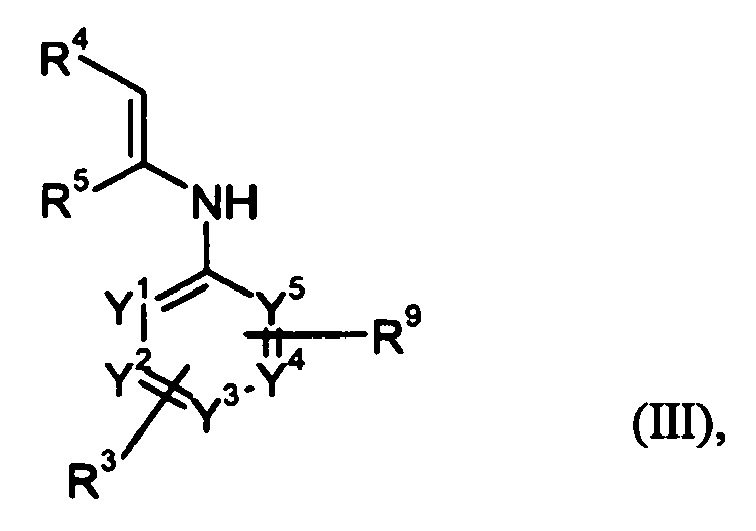
in the presence of a base, with compounds of the general formulas (IV) and (V)
- The composition containing at least one compound of general formula (I) according to claim 1 or 2 and a pharmacologically acceptable diluent.
- A composition according to claim 14 for the treatment of acute and chronic inflammatory, ischaemic and/or remodelling processes.
- The process for the preparation of compositions according to claim 14 and 15 characterized in that the compounds of general formula (1) according to claim 1 or 2 together with customary auxiliaries are brought into a suitable application form.
- Use compounds of general formula (I) according to claim 1 or 2 for the preparation of medicaments.
- Use according to claim 17 for the preparation of medicaments for the treatment of acute and chronic inflammatory, ischaemic and/or remodelling processes.
- Use according to claim 18, wherein the process is chronic obstructive pulmonary disease, acute coronary syndrome, acute myocardial infarction or development of heart failure.
Applications Claiming Priority (3)
| Application Number | Priority Date | Filing Date | Title |
|---|---|---|---|
| GBGB0219896.8A GB0219896D0 (en) | 2002-08-27 | 2002-08-27 | Dihydropyridine derivatives |
| GB0219896 | 2002-08-27 | ||
| PCT/EP2003/009120 WO2004020412A1 (en) | 2002-08-27 | 2003-08-18 | Dihydropyridine derivatives for use as human neutrophil elastase inhibitors |
Publications (2)
| Publication Number | Publication Date |
|---|---|
| EP1537081A1 EP1537081A1 (en) | 2005-06-08 |
| EP1537081B1 true EP1537081B1 (en) | 2008-10-15 |
Family
ID=9943022
Family Applications (1)
| Application Number | Title | Priority Date | Filing Date |
|---|---|---|---|
| EP03790905A Expired - Lifetime EP1537081B1 (en) | 2002-08-27 | 2003-08-18 | Dihydropyridine derivatives for use as human neutrophil elastase inhibitors |
Country Status (9)
| Country | Link |
|---|---|
| US (1) | US7691854B2 (en) |
| EP (1) | EP1537081B1 (en) |
| JP (1) | JP4601425B2 (en) |
| AU (1) | AU2003260425A1 (en) |
| CA (1) | CA2496844C (en) |
| DE (1) | DE60324166D1 (en) |
| ES (1) | ES2314276T3 (en) |
| GB (1) | GB0219896D0 (en) |
| WO (1) | WO2004020412A1 (en) |
Families Citing this family (40)
| Publication number | Priority date | Publication date | Assignee | Title |
|---|---|---|---|---|
| WO2004024701A1 (en) * | 2002-09-10 | 2004-03-25 | Bayer Healthcare Ag | Heterocyclic derivatives |
| DE60330391D1 (en) * | 2002-12-23 | 2010-01-14 | 4Sc Ag | CYCLOALKENIC DICARBOXYLIC COMPOUNDS AS ANTI-INFLAMMATORY, IMMUNOMATULATORY AND ANTIPROLIFERATIVE AGENTS |
| ES2367699T3 (en) | 2004-02-19 | 2011-11-07 | Bayer Pharma Aktiengesellschaft | DERIVATIVES OF DIHYDROPIRIDINONE. |
| EP1789036B1 (en) | 2004-08-19 | 2011-05-11 | Quest Pharmaceutical Services | 5-[3-(4-benzyloxyphenylthio)-fur-2-yl]-imidazolidin-2, 4-dione and analogues as inhibitors of macrophage elastase |
| GB0516313D0 (en) | 2005-08-08 | 2005-09-14 | Argenta Discovery Ltd | Azole derivatives and their uses |
| EP1924553A1 (en) | 2005-08-08 | 2008-05-28 | Argenta Discovery Limited | Bicyclo[2.2.]hept-7-ylamine derivatives and their uses |
| DE102007019690A1 (en) | 2007-04-26 | 2008-10-30 | Bayer Healthcare Ag | Use of cyclic substituted furopyrimidine derivatives for the treatment of pulmonary arterial hypertension |
| DE102007019691A1 (en) | 2007-04-26 | 2008-10-30 | Bayer Healthcare Ag | Use of acyclically substituted furopyrimidine derivatives for the treatment of pulmonary arterial hypertension |
| DE102007027800A1 (en) | 2007-06-16 | 2008-12-18 | Bayer Healthcare Ag | Substituted bicyclic heteroaryl compounds and their use |
| DE102007027799A1 (en) | 2007-06-16 | 2008-12-18 | Bayer Healthcare Ag | Substituted furopyrimidines and their use |
| DE102007051762A1 (en) | 2007-10-30 | 2009-05-07 | Bayer Healthcare Ag | Substituted pyrrolotriazines and their use |
| DE102007054786A1 (en) | 2007-11-16 | 2009-05-20 | Bayer Healthcare Ag | Trisubstituted Furopyrimidines and their Use |
| RS52270B (en) * | 2007-12-20 | 2012-10-31 | Bayer Pharma Aktiengesellschaft | 4- (4-CYANO-2-THIORYL) -DIHYDROPYRIMIDINONE AND ITS APPLICATION |
| DE102008007400A1 (en) | 2008-02-04 | 2009-08-06 | Bayer Healthcare Ag | Substituted furans and their use |
| EP2295414B1 (en) | 2008-06-03 | 2012-09-26 | Taiho Pharmaceutical Co., Ltd. | Uracil compound having inhibitory activity on human deoxyuridine triphosphatase or salt thereof |
| DE102009004197A1 (en) * | 2009-01-09 | 2010-07-15 | Bayer Schering Pharma Aktiengesellschaft | Heterocyclic fused diaryldihydropyrimidine derivatives and their use |
| GB0918922D0 (en) | 2009-10-28 | 2009-12-16 | Vantia Ltd | Aminopyridine derivatives |
| GB0918924D0 (en) | 2009-10-28 | 2009-12-16 | Vantia Ltd | Azaindole derivatives |
| GB0918923D0 (en) | 2009-10-28 | 2009-12-16 | Vantia Ltd | Aminothiazole derivatives |
| CN104718312B (en) | 2012-08-29 | 2017-03-15 | Ppg工业俄亥俄公司 | Zirconium pretreatment composition containing molybdenum, related method for treating metal substrates and related coated metal substrates |
| SG11201501406SA (en) | 2012-08-29 | 2015-03-30 | Ppg Ind Ohio Inc | Zirconium pretreatment compositions containing lithium, associated methods for treating metal substrates, and related coated metal substrates |
| US20140221335A1 (en) | 2013-02-06 | 2014-08-07 | Boehringer Ingelheim International Gmbh | Substituted bicyclic dihydropyrimidinones and their use as inhibitors of neutrophil elastase activity |
| US9115093B2 (en) | 2013-03-04 | 2015-08-25 | Boehringer Ingelheim International Gmbh | Substituted bicyclic dihydropyrimidinones and their use as inhibitors of neutrophil elastase activity |
| WO2015150363A1 (en) | 2014-04-03 | 2015-10-08 | Bayer Pharma Aktiengesellschaft | 2,5-disubstituted cyclopentane carboxylic acids and use thereof |
| WO2015150350A1 (en) | 2014-04-03 | 2015-10-08 | Bayer Pharma Aktiengesellschaft | 2,5-disubstituted cyclopentane carboxylic acids for the treatment of respiratoy tract diseases |
| CN106458938A (en) | 2014-04-03 | 2017-02-22 | 拜耳制药股份公司 | Chiral 2,5-disubstituted cyclopentanecarboxylic acid derivatives and use thereof |
| US9458113B2 (en) | 2014-07-31 | 2016-10-04 | Boehringer Ingelheim International Gmbh | Substituted bicyclic dihydropyrimidinones and their use as inhibitors of neutrophil elastase activity |
| US9475779B2 (en) | 2014-07-31 | 2016-10-25 | Boehringer Ingelheim International Gmbh | Substituted bicyclic dihydropyrimidinones and their use as inhibitors of neutrophil elastase activity |
| US9440930B2 (en) | 2014-07-31 | 2016-09-13 | Boehringer Ingelheim International Gmbh | Substituted bicyclic dihydropyrimidinones and their use as inhibitors of neutrophil elastase activity |
| US9290457B2 (en) | 2014-07-31 | 2016-03-22 | Boehringer Ingelheim International Gmbh | Substituted dihydropyrimidinones and their use as inhibitors of neutrophil elastase activity |
| US9657015B2 (en) | 2014-07-31 | 2017-05-23 | Boehringer Ingelheim International Gmbh | Substituted bicyclic dihydropyrimidinones and their use as inhibitors of neutrophil elastase activity |
| AU2016232270B2 (en) | 2015-03-18 | 2020-09-03 | Ph Pharma Co., Ltd. | Method for producing (4S)-4-[4-cyano-2-(methylsulfonyl)phenyl]-3,6-dimethyl-2-oxo-1-[3-(trifluoromethyl)phenyl]-1,2,3,4-tetrahydro pyrimidine-5-carbonitrile |
| US10189776B2 (en) | 2015-09-18 | 2019-01-29 | Boehringer Ingelheim International Gmbh | Stereoselective process |
| CN107663384B (en) | 2016-07-20 | 2020-05-12 | 上海高驰资产管理有限公司 | A kind of fluorescent dye and its preparation method and use |
| KR20190043155A (en) | 2016-08-24 | 2019-04-25 | 피피지 인더스트리즈 오하이오 인코포레이티드 | Alkaline compositions for treating metal substrates |
| US12570599B2 (en) | 2019-06-12 | 2026-03-10 | Ketolipix Therapeutics Gmbh | Process for preparing acyl-capped 3-hydroxycarboxylic acids and their salts and esters |
| WO2021053058A1 (en) | 2019-09-17 | 2021-03-25 | Mereo Biopharma 4 Limited | Alvelestat for use in the treatment of graft rejection, bronchiolitis obliterans syndrome and graft versus host disease |
| LT4106757T (en) | 2020-04-16 | 2023-11-10 | Mereo Biopharma 4 Limited | USE OF THE NEUTROPHIL ELASTASIS INHIBITOR ALVELESTAT IN THE TREATMENT OF RESPIRATORY DISEASES CAUSED BY ALPHA-1 ANTITRYPSIN DEFICIENCY |
| JP2024540952A (en) | 2021-10-20 | 2024-11-06 | メレオ バイオファーマ 4 リミテッド | Neutrophil elastase inhibitors for use in the treatment of fibrosis - Patent Application 20070123333 |
| CN120309500B (en) * | 2025-06-19 | 2025-08-15 | 南昌大学 | Oraglycone raw material intermediate and synthesis method thereof, and Oraglycone raw material synthesis method |
Family Cites Families (4)
| Publication number | Priority date | Publication date | Assignee | Title |
|---|---|---|---|---|
| ZA848907B (en) * | 1983-11-16 | 1985-06-26 | Ciba Geigy Ag | Novel amide compounds |
| US5166148A (en) * | 1990-07-09 | 1992-11-24 | The Du Pont Merck Pharmaceutical Company | 2-amino-1,4-dihydropyridine derivatives with calcium agonist and alpha1 -antagonist activity |
| CA2470813A1 (en) | 2001-12-20 | 2003-07-03 | Bayer Healthcare Ag | 1,4-dihydro-1,4-diphenylpyridine derivatives |
| GB2383326A (en) | 2001-12-20 | 2003-06-25 | Bayer Ag | Antiinflammatory dihydropyridines |
-
2002
- 2002-08-27 GB GBGB0219896.8A patent/GB0219896D0/en not_active Ceased
-
2003
- 2003-08-18 US US10/525,867 patent/US7691854B2/en not_active Expired - Fee Related
- 2003-08-18 CA CA2496844A patent/CA2496844C/en not_active Expired - Fee Related
- 2003-08-18 ES ES03790905T patent/ES2314276T3/en not_active Expired - Lifetime
- 2003-08-18 EP EP03790905A patent/EP1537081B1/en not_active Expired - Lifetime
- 2003-08-18 JP JP2004532091A patent/JP4601425B2/en not_active Expired - Fee Related
- 2003-08-18 DE DE60324166T patent/DE60324166D1/en not_active Expired - Lifetime
- 2003-08-18 AU AU2003260425A patent/AU2003260425A1/en not_active Abandoned
- 2003-08-18 WO PCT/EP2003/009120 patent/WO2004020412A1/en not_active Ceased
Also Published As
| Publication number | Publication date |
|---|---|
| WO2004020412A1 (en) | 2004-03-11 |
| JP2006508054A (en) | 2006-03-09 |
| US7691854B2 (en) | 2010-04-06 |
| GB0219896D0 (en) | 2002-10-02 |
| AU2003260425A1 (en) | 2004-03-19 |
| CA2496844C (en) | 2011-01-18 |
| CA2496844A1 (en) | 2004-03-11 |
| JP4601425B2 (en) | 2010-12-22 |
| US20070167406A1 (en) | 2007-07-19 |
| EP1537081A1 (en) | 2005-06-08 |
| ES2314276T3 (en) | 2009-03-16 |
| DE60324166D1 (en) | 2008-11-27 |
Similar Documents
| Publication | Publication Date | Title |
|---|---|---|
| US7691854B2 (en) | Dihydropyridine derivatives for use as human neutrophil elastase inhibitors | |
| EP1539710B1 (en) | Heterocyclic derivatives | |
| US7687510B2 (en) | Pyrimidinone derivatives as therapeutic agents against acute and chronic inflammatory, ischaemic and remodelling processes | |
| EP1730121B1 (en) | 1,4-diaryl-dihydropyrimidin-2-ones and their use as human neutrophil elastase inhibitors | |
| EP1554246B1 (en) | Dihydropyridinone derivatives as hne inhibitors | |
| EP1723121B1 (en) | 1,4-diaryl-dihydropyrimidin-2-ones and their use as human neutrophil elastase inhibitors | |
| EP1720857B1 (en) | Dihydropyridinone derivatives | |
| JP4708034B2 (en) | Pyrimidinone derivatives as therapeutic agents for acute and chronic inflammation, ischemia and remodeling processes | |
| JP4708025B2 (en) | Heterocyclic derivatives |
Legal Events
| Date | Code | Title | Description |
|---|---|---|---|
| PUAI | Public reference made under article 153(3) epc to a published international application that has entered the european phase |
Free format text: ORIGINAL CODE: 0009012 |
|
| 17P | Request for examination filed |
Effective date: 20050329 |
|
| AK | Designated contracting states |
Kind code of ref document: A1 Designated state(s): AT BE BG CH CY CZ DE DK EE ES FI FR GB GR HU IE IT LI LU MC NL PT RO SE SI SK TR |
|
| AX | Request for extension of the european patent |
Extension state: AL LT LV MK |
|
| DAX | Request for extension of the european patent (deleted) | ||
| RBV | Designated contracting states (corrected) |
Designated state(s): DE ES FR GB IT |
|
| RIN1 | Information on inventor provided before grant (corrected) |
Inventor name: FITZGERALD, MARY, F. Inventor name: TELAN, LEILA Inventor name: NASH, KEVIN Inventor name: ALBRECHT, BARBARA Inventor name: ALLERHEILIGEN, SWEN Inventor name: MEURER, DIRK Inventor name: BAERFACKER, LARS Inventor name: MIN-JIAN LI, VOLKHART Inventor name: GIELEN-HAERTWIG, HEIKE Inventor name: SCHLEMMER, KARL-HEINZ Inventor name: ROSENTRETER, ULRICH Inventor name: KELDENICH, JOERG |
|
| 17Q | First examination report despatched |
Effective date: 20060116 |
|
| GRAP | Despatch of communication of intention to grant a patent |
Free format text: ORIGINAL CODE: EPIDOSNIGR1 |
|
| GRAS | Grant fee paid |
Free format text: ORIGINAL CODE: EPIDOSNIGR3 |
|
| GRAA | (expected) grant |
Free format text: ORIGINAL CODE: 0009210 |
|
| AK | Designated contracting states |
Kind code of ref document: B1 Designated state(s): DE ES FR GB IT |
|
| REG | Reference to a national code |
Ref country code: GB Ref legal event code: FG4D |
|
| REF | Corresponds to: |
Ref document number: 60324166 Country of ref document: DE Date of ref document: 20081127 Kind code of ref document: P |
|
| REG | Reference to a national code |
Ref country code: ES Ref legal event code: FG2A Ref document number: 2314276 Country of ref document: ES Kind code of ref document: T3 |
|
| PLBE | No opposition filed within time limit |
Free format text: ORIGINAL CODE: 0009261 |
|
| STAA | Information on the status of an ep patent application or granted ep patent |
Free format text: STATUS: NO OPPOSITION FILED WITHIN TIME LIMIT |
|
| 26N | No opposition filed |
Effective date: 20090716 |
|
| REG | Reference to a national code |
Ref country code: FR Ref legal event code: TP |
|
| REG | Reference to a national code |
Ref country code: DE Ref legal event code: R081 Ref document number: 60324166 Country of ref document: DE Owner name: BAYER INTELLECTUAL PROPERTY GMBH, DE Free format text: FORMER OWNER: BAYER SCHERING PHARMA AKTIENGESELLSCHAFT, 13353 BERLIN, DE Effective date: 20120612 |
|
| REG | Reference to a national code |
Ref country code: FR Ref legal event code: CD Owner name: BAYER INTELLECTUAL PROPERTY GMBH, DE Effective date: 20130130 Ref country code: FR Ref legal event code: TP Owner name: BAYER INTELLECTUAL PROPERTY GMBH, DE Effective date: 20130130 |
|
| REG | Reference to a national code |
Ref country code: ES Ref legal event code: PC2A Owner name: BAYER INTELLECTUAL PROPERTY GMBH Effective date: 20130319 |
|
| REG | Reference to a national code |
Ref country code: DE Ref legal event code: R081 Ref document number: 60324166 Country of ref document: DE Owner name: BAYER INTELLECTUAL PROPERTY GMBH, DE Free format text: FORMER OWNER: BAYER PHARMA AKTIENGESELLSCHAFT, 13353 BERLIN, DE Effective date: 20130410 |
|
| PGFP | Annual fee paid to national office [announced via postgrant information from national office to epo] |
Ref country code: ES Payment date: 20130729 Year of fee payment: 11 Ref country code: DE Payment date: 20130814 Year of fee payment: 11 |
|
| PGFP | Annual fee paid to national office [announced via postgrant information from national office to epo] |
Ref country code: GB Payment date: 20130814 Year of fee payment: 11 Ref country code: FR Payment date: 20130808 Year of fee payment: 11 |
|
| PGFP | Annual fee paid to national office [announced via postgrant information from national office to epo] |
Ref country code: IT Payment date: 20130725 Year of fee payment: 11 |
|
| REG | Reference to a national code |
Ref country code: GB Ref legal event code: 732E Free format text: REGISTERED BETWEEN 20131212 AND 20131218 |
|
| REG | Reference to a national code |
Ref country code: DE Ref legal event code: R119 Ref document number: 60324166 Country of ref document: DE |
|
| GBPC | Gb: european patent ceased through non-payment of renewal fee |
Effective date: 20140818 |
|
| PG25 | Lapsed in a contracting state [announced via postgrant information from national office to epo] |
Ref country code: IT Free format text: LAPSE BECAUSE OF NON-PAYMENT OF DUE FEES Effective date: 20140818 |
|
| REG | Reference to a national code |
Ref country code: FR Ref legal event code: ST Effective date: 20150430 |
|
| REG | Reference to a national code |
Ref country code: DE Ref legal event code: R119 Ref document number: 60324166 Country of ref document: DE Effective date: 20150303 |
|
| PG25 | Lapsed in a contracting state [announced via postgrant information from national office to epo] |
Ref country code: DE Free format text: LAPSE BECAUSE OF NON-PAYMENT OF DUE FEES Effective date: 20150303 Ref country code: GB Free format text: LAPSE BECAUSE OF NON-PAYMENT OF DUE FEES Effective date: 20140818 |
|
| PG25 | Lapsed in a contracting state [announced via postgrant information from national office to epo] |
Ref country code: FR Free format text: LAPSE BECAUSE OF NON-PAYMENT OF DUE FEES Effective date: 20140901 |
|
| REG | Reference to a national code |
Ref country code: ES Ref legal event code: FD2A Effective date: 20150925 |
|
| PG25 | Lapsed in a contracting state [announced via postgrant information from national office to epo] |
Ref country code: ES Free format text: LAPSE BECAUSE OF NON-PAYMENT OF DUE FEES Effective date: 20140819 |