EP1536614B1 - Portable game and communication device comprising sliding and rotating housing parts - Google Patents
Portable game and communication device comprising sliding and rotating housing parts Download PDFInfo
- Publication number
- EP1536614B1 EP1536614B1 EP04027677A EP04027677A EP1536614B1 EP 1536614 B1 EP1536614 B1 EP 1536614B1 EP 04027677 A EP04027677 A EP 04027677A EP 04027677 A EP04027677 A EP 04027677A EP 1536614 B1 EP1536614 B1 EP 1536614B1
- Authority
- EP
- European Patent Office
- Prior art keywords
- housing
- set forth
- longitudinal direction
- top surface
- key array
- Prior art date
- Legal status (The legal status is an assumption and is not a legal conclusion. Google has not performed a legal analysis and makes no representation as to the accuracy of the status listed.)
- Expired - Lifetime
Links
Images


Classifications
-
- H—ELECTRICITY
- H04—ELECTRIC COMMUNICATION TECHNIQUE
- H04B—TRANSMISSION
- H04B1/00—Details of transmission systems, not covered by a single one of groups H04B3/00 - H04B13/00; Details of transmission systems not characterised by the medium used for transmission
- H04B1/38—Transceivers, i.e. devices in which transmitter and receiver form a structural unit and in which at least one part is used for functions of transmitting and receiving
- H04B1/40—Circuits
-
- H—ELECTRICITY
- H04—ELECTRIC COMMUNICATION TECHNIQUE
- H04M—TELEPHONIC COMMUNICATION
- H04M1/00—Substation equipment, e.g. for use by subscribers
- H04M1/02—Constructional features of telephone sets
- H04M1/0202—Portable telephone sets, e.g. cordless phones, mobile phones or bar type handsets
- H04M1/0206—Portable telephones comprising a plurality of mechanically joined movable body parts, e.g. hinged housings
-
- A—HUMAN NECESSITIES
- A63—SPORTS; GAMES; AMUSEMENTS
- A63F—CARD, BOARD, OR ROULETTE GAMES; INDOOR GAMES USING SMALL MOVING PLAYING BODIES; VIDEO GAMES; GAMES NOT OTHERWISE PROVIDED FOR
- A63F13/00—Video games, i.e. games using an electronically generated display having two or more dimensions
- A63F13/20—Input arrangements for video game devices
- A63F13/24—Constructional details thereof, e.g. game controllers with detachable joystick handles
-
- A—HUMAN NECESSITIES
- A63—SPORTS; GAMES; AMUSEMENTS
- A63F—CARD, BOARD, OR ROULETTE GAMES; INDOOR GAMES USING SMALL MOVING PLAYING BODIES; VIDEO GAMES; GAMES NOT OTHERWISE PROVIDED FOR
- A63F13/00—Video games, i.e. games using an electronically generated display having two or more dimensions
- A63F13/90—Constructional details or arrangements of video game devices not provided for in groups A63F13/20 or A63F13/25, e.g. housing, wiring, connections or cabinets
- A63F13/92—Video game devices specially adapted to be hand-held while playing
-
- H—ELECTRICITY
- H04—ELECTRIC COMMUNICATION TECHNIQUE
- H04M—TELEPHONIC COMMUNICATION
- H04M1/00—Substation equipment, e.g. for use by subscribers
- H04M1/02—Constructional features of telephone sets
- H04M1/0202—Portable telephone sets, e.g. cordless phones, mobile phones or bar type handsets
- H04M1/0206—Portable telephones comprising a plurality of mechanically joined movable body parts, e.g. hinged housings
- H04M1/0208—Portable telephones comprising a plurality of mechanically joined movable body parts, e.g. hinged housings characterized by the relative motions of the body parts
- H04M1/0235—Slidable or telescopic telephones, i.e. with a relative translation movement of the body parts; Telephones using a combination of translation and other relative motions of the body parts
-
- H—ELECTRICITY
- H04—ELECTRIC COMMUNICATION TECHNIQUE
- H04M—TELEPHONIC COMMUNICATION
- H04M1/00—Substation equipment, e.g. for use by subscribers
- H04M1/02—Constructional features of telephone sets
- H04M1/0202—Portable telephone sets, e.g. cordless phones, mobile phones or bar type handsets
- H04M1/0206—Portable telephones comprising a plurality of mechanically joined movable body parts, e.g. hinged housings
- H04M1/0247—Portable telephones comprising a plurality of mechanically joined movable body parts, e.g. hinged housings comprising more than two body parts
-
- H—ELECTRICITY
- H04—ELECTRIC COMMUNICATION TECHNIQUE
- H04M—TELEPHONIC COMMUNICATION
- H04M1/00—Substation equipment, e.g. for use by subscribers
- H04M1/72—Mobile telephones; Cordless telephones, i.e. devices for establishing wireless links to base stations without route selection
- H04M1/724—User interfaces specially adapted for cordless or mobile telephones
- H04M1/72403—User interfaces specially adapted for cordless or mobile telephones with means for local support of applications that increase the functionality
- H04M1/72427—User interfaces specially adapted for cordless or mobile telephones with means for local support of applications that increase the functionality for supporting games or graphical animations
-
- A—HUMAN NECESSITIES
- A63—SPORTS; GAMES; AMUSEMENTS
- A63F—CARD, BOARD, OR ROULETTE GAMES; INDOOR GAMES USING SMALL MOVING PLAYING BODIES; VIDEO GAMES; GAMES NOT OTHERWISE PROVIDED FOR
- A63F2300/00—Features of games using an electronically generated display having two or more dimensions, e.g. on a television screen, showing representations related to the game
- A63F2300/10—Features of games using an electronically generated display having two or more dimensions, e.g. on a television screen, showing representations related to the game characterized by input arrangements for converting player-generated signals into game device control signals
- A63F2300/1043—Features of games using an electronically generated display having two or more dimensions, e.g. on a television screen, showing representations related to the game characterized by input arrangements for converting player-generated signals into game device control signals being characterized by constructional details
-
- A—HUMAN NECESSITIES
- A63—SPORTS; GAMES; AMUSEMENTS
- A63F—CARD, BOARD, OR ROULETTE GAMES; INDOOR GAMES USING SMALL MOVING PLAYING BODIES; VIDEO GAMES; GAMES NOT OTHERWISE PROVIDED FOR
- A63F2300/00—Features of games using an electronically generated display having two or more dimensions, e.g. on a television screen, showing representations related to the game
- A63F2300/20—Features of games using an electronically generated display having two or more dimensions, e.g. on a television screen, showing representations related to the game characterised by details of the game platform
- A63F2300/204—Features of games using an electronically generated display having two or more dimensions, e.g. on a television screen, showing representations related to the game characterised by details of the game platform the platform being a handheld device
-
- H—ELECTRICITY
- H04—ELECTRIC COMMUNICATION TECHNIQUE
- H04M—TELEPHONIC COMMUNICATION
- H04M1/00—Substation equipment, e.g. for use by subscribers
- H04M1/02—Constructional features of telephone sets
- H04M1/0202—Portable telephone sets, e.g. cordless phones, mobile phones or bar type handsets
- H04M1/0206—Portable telephones comprising a plurality of mechanically joined movable body parts, e.g. hinged housings
- H04M1/0208—Portable telephones comprising a plurality of mechanically joined movable body parts, e.g. hinged housings characterized by the relative motions of the body parts
Definitions
- the present invention relates generally to a portable digital communication device including cellular phones, personal digital assistants, hand-held phones, and phones with game functions, and more particularly to a portable game and digital communication device including a control pad for playing games.
- portable communication devices are devices that are portable and enable owners of the devices to communicate wirelessly. Such portable communication devices have become increasingly small, slim, graspable, and lightweight, whereby portability thereof is improved. Furthermore, such portable communication devices include multimedia functions. More specifically, future portable communication terminals will be miniaturized, lightweight, multipurpose terminals with various functions, which will be easily adapted to various multimedia and Internet environments.
- the portable communication devices may be classified into several different types of communication devices based on their appearances.
- portable communication devices may be classified into a bar-type communication device, a flip-type communication device, and a folder-type communication device.
- the bar-type communication device has a bar-type single housing
- the flip-type communication device comprises a bar-type housing and a flip part pivotably attached to the housing
- the folder-type communication device comprises a bar-type housing and a folder part pivotably attached to the housing.
- the portable communication devices may also be classified into a necklace-type communication device and a wrist-type communication device according to where or how they are worn by a user.
- the necklace-type communication device is worn on the neck of a user by means of a string
- the wrist-type communication device is worn on the wrist of the user.
- Portable communication devices may be further classified according to how they are opened or closed, for example, into a rotating-type communication device and a sliding-type communication device.
- the rotating-type communication device is characterized in that two housings are rotatably connected to each other while the housings are continuously opposite to each other.
- the rotating-type communication device is opened or closed by the rotation of the two housings in such a manner that the housings are rotated apart from or close to each other.
- the sliding-type communication device is characterized in that two housings are longitudinally slid.
- the sliding-type communication device is opened or closed by the sliding movement of the two housings in such a manner that the housings are slid apart from or close to each other
- the portable communication devices have also been improved with the capability to transmit and receive data at high speeds. Consequently, the portable communication devices use wireless communication technology for transmitting data at high speed, which will satisfy the increasing desires of the consuming public.
- a camera lens is included in portable communication devices that transmit image signals.
- the portable communication device has a camera lens module mounted outside or inside the device so that a user of the device can talk with another user of the device while looking at each other, or take pictures of his/her desired subjects.
- the conventional portable communication device has a problem in that a key operation is very inconvenient in a game mode.
- the key operation is not usually performed very quickly and accurately, because keys used in the game mode are also used in a communication mode.
- the conventional portable communication device has a housing on which a plurality of keys are arranged. Consequently, distances between keys are small with the result that the key operation is not performed accurately. Also, the conventional portable communication device is used by only one hand of a user with the result that the key operation is not performed rapidly.
- US 2003/0073462 A1 discloses in connection with Figures 9a - 9c a mobile device having a foldable body comprising on one side a display and on the other side a keypad.
- the part comprising the keypad is further rotatable around an axis along the longitudinal direction of the mobile device, thereby allowing to turn this part by 180 ° degree and enabling that game control buttons located on the opposite side of the part carrying the keypad are brought in a position allowing a user to operate these buttons while viewing the display.
- GB-A-2381988 describes a slide type mobile phone wherein the slide type phone is a portable communication device with a first unit having a touch screen display and a second unit having a keypad.
- the described portable communication device has a spring and a lock release button which opens the unit from a retracted state to an extended state.
- the second unit may comprise two housings which are hinged together.
- the portable communication device includes an extension detector and the extent of functionality of the keypad and the touch screen depends on the state of extension.
- WO 99/43134 refers to hinge assemblies for electronic devices and refers in particular to an electronic device which comprises a first housing and a second housing which is mounted on the first housing by way of a hinge assembly.
- the hinge assembly comprises first and second cooperating parts attached to the first and second housings respectively.
- the second part is rotatably and slidably engaged with the first part such that the second housing is rotatable with respect to the first part about an axis from the closed position to a first open position of the device, and such that the second housing is linearly movable, with respect to the first housing in a direction parallel to the axis, with respect to the first housing, from a closed position of the device to a second open position of the device.
- WO 01/99481 A discloses a configurable housing for a personal electronic device having multiple operating modes, wherein the configuration of the housing determines the operating mode of the personal electronic device.
- the personal electronic device With a configurable section rotated 90° to the main body, the personal electronic device is configured to operate in a PDA mode. With the configurable sections rotated so that the front surfaces are aligned with the front surface of the main body, the personal electronic device is configured to operate in a cell phone mode.
- the user interface comprises a microphone 10, a speaker 21 and a LCD 20 which functions as a touch sensitive numerical keypad and/or optimally as an alphanumeric display and control keys 13 and 14.
- a portable digital communication device comprising: a first housing having a first top surface and a second top surface stepped from the first top surface, the first housing being extended in the longitudinal direction of the device; a second housing having a first bottom surface and a second bottom surface stepped from the first bottom surface, the second housing being slid in the longitudinal direction of the device while being opposite to the first housing; a first side housing rotated about a first hinge axis while being opposite to one side surface of the first housing; and a second side housing rotated about a second hinge axis while being opposite to one side surface of the second housing, the second side housing being spaced apart from the first side housing while the second side housing is symmetrical to the first side housing.
- a portable digital communication device comprising: a first housing extended in the longitudinal direction of the device; a second housing slid in the longitudinal direction of the device while being opposite to the first housing; a first side housing extended in the direction perpendicular to the longitudinal direction of the first housing, the first side housing being rotated about a first hinge axis while being opposite to one side surface of the first housing, the first side housing being positioned uprightly in the shape of stick at one side of the first housing when the first side housing is rotated a prescribed angle; and a second side housing extended in the direction perpendicular to the longitudinal direction of the second housing, the second side housing being rotated about a second hinge axis while being opposite to one side surface of the second housing, the second side housing being spaced apart from the first side housing, the second side housing being positioned uprightly in the shape of a stick at one side of the second housing when the second side housing is rotated a prescribed angle.
- a portable digital communication device of the present invention is directed a device that enables a user to use both hands in a game mode, thereby accomplishing a rapid and accurate key operation.
- a portable digital communication device comprises a first housing 10, which is extended in the longitudinal direction of the device, a second housing 20, which is slid in the longitudinal direction of the device while being opposite to the first housing 10, a first side housing 30, which is rotatable about a first hinge axis A1 while being located at a side surface 10d of the first housing 10, and a second side housing 40, which is rotated about a second hinge axis A2 and attached to a side surface 20d of the second housing 20.
- the first housing 10 includes a first top surface 10a, a second top surface stepped from the first top surface, and a bottom surface 10c.
- the first top surface 10a is adjacent to the first side housing 30, especially, to a top surface 30a of the first side housing 30.
- a first key array 12 comprising a plurality of keys is disposed on the second top surface 10b of the first housing 10. More specifically, the first key array 12 comprises keys related to communication.
- the first key array 12 is exposed to or hidden from the outside depending upon the sliding movement of the second housing 20.
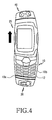
- the keys of the first key array 12 are exposed to the outside as illustrated in FIG. 4.
- a detachable a battery pack is attached to the bottom surface 10c of the first housing 10 is as illustrated in FIG. 3.
- the battery pack 14 is attached to or detached from the bottom surface 10c of the first housing 10 by means of a locking knob 16.
- Reference numeral 16 indicates a charging terminal.
- the second housing 20 includes a top surface 20a, a first bottom surface 20b, and a second bottom surface 20c, which is stepped from the first bottom surface 20b.
- the first bottom surface 20b is arranged adjacent to the second side housing 40, especially, a bottom surface 40c of the second side housing 40.
- a display unit 22 is disposed on the top surface 20a of the second housing 20.
- the display unit 22 may be, for example, an LCD, a touch screen, or a holographic screen.
- the first and second housings 10 and 20 correspond to each other in terms of the shape, and the first and second side housings 30 and 40 are symmetrical to each other.
- the first and second side housings 30 and 40 are disposed at the sides of the first and second housings 10 and 20, respectively.
- the first and second housings 10 and 20 are slid relative to each other while the second top surface 10b of the first housing 10 is opposite to the second bottom surface 20c of the second housing 20.
- the first and second side housings 30 and 40 are extended in a direction perpendicular to the longitudinal direction of the first and second housings 10 and 20, and are attached to the first and second housings 10 and 20, respectively, in such a manner that the first and second side housing 30 and 40 are rotated about the first and second hinge axes A1 and A2, respectively. When they are rotated approximately 90 degrees, the first and second side housings 30 and 40 are placed in an upright position, which means that each of the first and second side housings 30 and 40 is positioned as a handle.
- the first side housing 30 includes a second key array 32 disposed on the top surface 30a thereof, a third key array 34 disposed on the side surface 30b thereof, and a fourth key array 36 disposed on the bottom surface 30c thereof.
- the second, third, and fourth key arrays 32, 34 and 36 comprise keys related to video gaming.
- the second side housing 40 includes a fifth key array 42 disposed on the top surface 40a thereof, a sixth key array 44 disposed on the side surface 40b thereof, and a seventh key array 46 disposed on the bottom surface 40c thereof.
- the fifth, sixth, and seventh key arrays 42, 44 and 46 are also keys related to video gaming.
- the longitudinal direction of the first and second housings 10 and 20 is parallel to the sliding direction of the second housing 20, which is parallel to the axial direction of the first and second hinge axes A1 and A2.
- the first and second hinge axes A1 and A2 are coaxially arranged since the first and second housings 10 and 20 are symmetrical to each other, and the first and second side housings 30 and 40 are also symmetrical to each other.
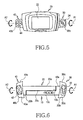
- FIGS. 5 and 6 illustrate the portable game and communication device in a game mode.
- first and second side housings 30 and 40 are rotated approximately 90 degrees.
- a user grasps the first and second side housings 30 and 40 with both hands, and then performs a key operation with his/her fingers to play a game.
- the second, third, and fourth key arrays 32, 34 and 36, and the fifth, sixth, and seventh key arrays 42, 44, and 46 are mainly used.
- the present invention provides a portable game and communication device that enables a user to use both hands to play a video game, thereby accomplishing a rapid and accurate key operation, and improving convenience of game play.
Landscapes
- Engineering & Computer Science (AREA)
- Multimedia (AREA)
- Signal Processing (AREA)
- Human Computer Interaction (AREA)
- Computer Networks & Wireless Communication (AREA)
- Telephone Set Structure (AREA)
Description
- The present invention relates generally to a portable digital communication device including cellular phones, personal digital assistants, hand-held phones, and phones with game functions, and more particularly to a portable game and digital communication device including a control pad for playing games.
- Generally, "portable communication devices" are devices that are portable and enable owners of the devices to communicate wirelessly. Such portable communication devices have become increasingly small, slim, graspable, and lightweight, whereby portability thereof is improved. Furthermore, such portable communication devices include multimedia functions. More specifically, future portable communication terminals will be miniaturized, lightweight, multipurpose terminals with various functions, which will be easily adapted to various multimedia and Internet environments.
- The portable communication devices may be classified into several different types of communication devices based on their appearances. For example, portable communication devices may be classified into a bar-type communication device, a flip-type communication device, and a folder-type communication device. The bar-type communication device has a bar-type single housing, the flip-type communication device comprises a bar-type housing and a flip part pivotably attached to the housing, and the folder-type communication device comprises a bar-type housing and a folder part pivotably attached to the housing.
- Additionally, the portable communication devices may also be classified into a necklace-type communication device and a wrist-type communication device according to where or how they are worn by a user. Obviously, the necklace-type communication device is worn on the neck of a user by means of a string, and the wrist-type communication device is worn on the wrist of the user.
- Portable communication devices may be further classified according to how they are opened or closed, for example, into a rotating-type communication device and a sliding-type communication device. The rotating-type communication device is characterized in that two housings are rotatably connected to each other while the housings are continuously opposite to each other. The rotating-type communication device is opened or closed by the rotation of the two housings in such a manner that the housings are rotated apart from or close to each other. Alternatively, the sliding-type communication device is characterized in that two housings are longitudinally slid. The sliding-type communication device is opened or closed by the sliding movement of the two housings in such a manner that the housings are slid apart from or close to each other
- The portable communication devices have also been improved with the capability to transmit and receive data at high speeds. Consequently, the portable communication devices use wireless communication technology for transmitting data at high speed, which will satisfy the increasing desires of the consuming public.
- It is another increasing trend that a camera lens is included in portable communication devices that transmit image signals. The portable communication device has a camera lens module mounted outside or inside the device so that a user of the device can talk with another user of the device while looking at each other, or take pictures of his/her desired subjects.
- However, the conventional portable communication device has a problem in that a key operation is very inconvenient in a game mode. For example, the key operation is not usually performed very quickly and accurately, because keys used in the game mode are also used in a communication mode.
- For example, the conventional portable communication device has a housing on which a plurality of keys are arranged. Consequently, distances between keys are small with the result that the key operation is not performed accurately. Also, the conventional portable communication device is used by only one hand of a user with the result that the key operation is not performed rapidly.
- US 2003/0073462 A1 discloses in connection with Figures 9a - 9c a mobile device having a foldable body comprising on one side a display and on the other side a keypad. The part comprising the keypad is further rotatable around an axis along the longitudinal direction of the mobile device, thereby allowing to turn this part by 180 ° degree and enabling that game control buttons located on the opposite side of the part carrying the keypad are brought in a position allowing a user to operate these buttons while viewing the display.
-
GB-A-2381988 -
WO 99/43134 -
WO 01/99481 A microphone 10, a speaker 21 and aLCD 20 which functions as a touch sensitive numerical keypad and/or optimally as an alphanumeric display andcontrol keys 13 and 14. - Therefore, the present invention has been designed in view of the above and other problems occurring in the prior art.
- It is another object of the present invention to provide an improved portable game and digital communication device that enables a user to conveniently perform a key operation for communication and provides convenient game controls, but still offers a compact size.
- This object is solved by the subject matter of the independent claims.
- Preferred embodiments are defined in the dependent claims.
- In accordance with one aspect of the present invention, the above and other objects can be accomplished by a portable digital communication device comprising: a first housing having a first top surface and a second top surface stepped from the first top surface, the first housing being extended in the longitudinal direction of the device; a second housing having a first bottom surface and a second bottom surface stepped from the first bottom surface, the second housing being slid in the longitudinal direction of the device while being opposite to the first housing; a first side housing rotated about a first hinge axis while being opposite to one side surface of the first housing; and a second side housing rotated about a second hinge axis while being opposite to one side surface of the second housing, the second side housing being spaced apart from the first side housing while the second side housing is symmetrical to the first side housing.
- In accordance with another aspect of the present invention, there is provided a portable digital communication device comprising: a first housing extended in the longitudinal direction of the device; a second housing slid in the longitudinal direction of the device while being opposite to the first housing; a first side housing extended in the direction perpendicular to the longitudinal direction of the first housing, the first side housing being rotated about a first hinge axis while being opposite to one side surface of the first housing, the first side housing being positioned uprightly in the shape of stick at one side of the first housing when the first side housing is rotated a prescribed angle; and a second side housing extended in the direction perpendicular to the longitudinal direction of the second housing, the second side housing being rotated about a second hinge axis while being opposite to one side surface of the second housing, the second side housing being spaced apart from the first side housing, the second side housing being positioned uprightly in the shape of a stick at one side of the second housing when the second side housing is rotated a prescribed angle.
- The above features, and advantages of the present invention will be more clearly understood from the following detailed description taken in conjunction with the accompanying drawings, in which:
- FIG. 1 is a perspective view illustrating a portable game/communication device according to a preferred embodiment of the present invention;
- FIG. 2 is a plan view of the portable game/communication device illustrated in FIG. 1;
- FIG. 3 is a bottom view of the portable game/communication device illustrated in FIG. 1;
- FIG. 4 is a plan view showing sliding movement of a second housing of the portable game/communication device illustrated in FIG. 1;
- FIG. 5 is a plan view illustrating approximately 90 degrees rotations of first and second side housings of the portable game/communication device illustrated in FIG. 1; and
- FIG. 6 is a side view of the portable game/communication device illustrated in FIG. 5.
- Preferred embodiments of the present invention will be described in detail herein below with reference to the accompanying drawings. In the following description, a detailed description of known functions and configurations incorporated herein will be omitted when it may obscure the subject matter of the present invention.
- Accordingly, it should be noted that a portable digital communication device of the present invention is directed a device that enables a user to use both hands in a game mode, thereby accomplishing a rapid and accurate key operation.
- As illustrated in FIGS. 1 to 6, a portable digital communication device according to the present invention comprises a
first housing 10, which is extended in the longitudinal direction of the device, asecond housing 20, which is slid in the longitudinal direction of the device while being opposite to thefirst housing 10, afirst side housing 30, which is rotatable about a first hinge axis A1 while being located at aside surface 10d of thefirst housing 10, and asecond side housing 40, which is rotated about a second hinge axis A2 and attached to aside surface 20d of thesecond housing 20. - The
first housing 10 includes a firsttop surface 10a, a second top surface stepped from the first top surface, and abottom surface 10c. The firsttop surface 10a is adjacent to thefirst side housing 30, especially, to atop surface 30a of thefirst side housing 30. Afirst key array 12 comprising a plurality of keys is disposed on the secondtop surface 10b of thefirst housing 10. More specifically, thefirst key array 12 comprises keys related to communication. Thefirst key array 12 is exposed to or hidden from the outside depending upon the sliding movement of thesecond housing 20. The keys of thefirst key array 12 are exposed to the outside as illustrated in FIG. 4. - A detachable a battery pack is attached to the
bottom surface 10c of thefirst housing 10 is as illustrated in FIG. 3. Thebattery pack 14 is attached to or detached from thebottom surface 10c of thefirst housing 10 by means of alocking knob 16.Reference numeral 16 indicates a charging terminal. - The
second housing 20 includes atop surface 20a, afirst bottom surface 20b, and asecond bottom surface 20c, which is stepped from thefirst bottom surface 20b. Thefirst bottom surface 20b is arranged adjacent to thesecond side housing 40, especially, abottom surface 40c of thesecond side housing 40. Adisplay unit 22 is disposed on thetop surface 20a of thesecond housing 20. Thedisplay unit 22 may be, for example, an LCD, a touch screen, or a holographic screen. - Preferably, the first and
second housings second side housings second side housings second housings second housings top surface 10b of thefirst housing 10 is opposite to thesecond bottom surface 20c of thesecond housing 20. - When the
second housing 20 is slid relative to thefirst housing 10, while thesecond housing 20 is opposite to thefirst housing 10, as illustrated in FIG. 4, the firstkey array 12 is gradually exposed to the outside, and thesecond housing 20 is moved away from thefirst housing 10. Consequently, a secondkey array 32 of thefirst side housing 30 is moved away from a fifthkey array 42 of thesecond side housing 40. - As illustrated in FIGS. 5 and 6, the first and
second side housings second housings second housings second side housing second side housings second side housings - The
first side housing 30 includes a secondkey array 32 disposed on thetop surface 30a thereof, a thirdkey array 34 disposed on theside surface 30b thereof, and a fourthkey array 36 disposed on thebottom surface 30c thereof. The second, third, and fourthkey arrays - The
second side housing 40 includes a fifthkey array 42 disposed on thetop surface 40a thereof, a sixthkey array 44 disposed on theside surface 40b thereof, and a seventhkey array 46 disposed on thebottom surface 40c thereof. The fifth, sixth, and seventhkey arrays - Preferably, the longitudinal direction of the first and
second housings second housing 20, which is parallel to the axial direction of the first and second hinge axes A1 and A2. The first and second hinge axes A1 and A2 are coaxially arranged since the first andsecond housings second side housings - FIGS. 5 and 6 illustrate the portable game and communication device in a game mode. As illustrated in FIGS. 5 and 6, first and
second side housings second side housings key arrays key arrays - As is apparent from the above description, the present invention provides a portable game and communication device that enables a user to use both hands to play a video game, thereby accomplishing a rapid and accurate key operation, and improving convenience of game play.
Claims (13)
- A portable digital communication device comprising:a first housing (10) extended in a longitudinal direction of the device and having a top surface which is stepped in the longitudinal direction into a first top surface (10a) and a second top surface (10b) including a first key array (12) comprising a plurality of keys related to communication;a second housing (20) extended in the longitudinal direction and having a bottom surface which is stepped in the longitudinal direction into a first bottom surface (20b), a second bottom surface (20c), and a first top surface (20a) including a display unit (22), the second housing being slideably attached to the first housing for sliding the first housing relative to the second housing in the longitudinal direction;a first side housing (30), which is rotatable about a first hinge axis aligned in the longitudinal direction and attached at a side surface of the first housing thus forming a first end piece of the device in the longitudinal direction; anda second side housing (40), which is rotatable about a second hinge axis aligned in the longitudinal direction and attached at a side surface of the second housing thus forming a second end piece of the device in the longitudinal direction opposite to the first end piece.
- The device as set forth in claim 1, wherein the first top surface of the first housing is adjacent to the first side housing.
- The device as set forth in claim 1 or 2, wherein the first bottom surface of the second housing is adjacent to the second side housing.
- The device as set forth in one of claims 1 to 3, wherein the second top surface of the first housing faces the second bottom surface of the second housing.
- The device as set forth in one of claims 1 to 4, wherein the first and second side housings extend in a direction perpendicular to the longitudinal direction of the first and second housings, and wherein each of the first and second side housings are adapted to be used as a handle when the first and second side housings are rotated approximately 90 degrees from the first and second housings.
- The device as set forth in one of claims 1 to 5, wherein the first housing includes a first key array disposed on the second top surface thereof, the first key array including a plurality of keys related to communication functions.
- The device as set forth in one of claims 1 to 6, wherein the second housing includes a display unit disposed on the first top surface thereof.
- The device as set forth in one of claims 1 to 7, wherein the first side housing includes a key array disposed on the top surface thereof, the key array including keys related to video gaming.
- The device as set forth in claim 8, wherein the first side housing includes a second key array, which includes keys related to video gaming, disposed on the side surface thereof.
- The device as set forth in claim 9, wherein the first side housing includes a third key array, which includes keys related to video gaming, disposed on the bottom surface thereof.
- The device as set forth in one of claims 1 to 10, wherein the second side housing includes a key array disposed on the top surface thereof the key array including keys related to video gaming.
- The device as set forth in claim 11, wherein the second side housing includes a second key array, which includes keys related to video gaming, disposed on the side surface thereof.
- The device as set forth in claim 12, wherein the second side housing includes a third key array, which includes keys related to video gaming, disposed on the bottom surface thereof.
Applications Claiming Priority (2)
| Application Number | Priority Date | Filing Date | Title |
|---|---|---|---|
| KR1020030084043A KR100566282B1 (en) | 2003-11-25 | 2003-11-25 | Gaming handheld communication device with stick function |
| KR2003084043 | 2003-11-25 |
Publications (2)
| Publication Number | Publication Date |
|---|---|
| EP1536614A1 EP1536614A1 (en) | 2005-06-01 |
| EP1536614B1 true EP1536614B1 (en) | 2008-01-30 |
Family
ID=34464741
Family Applications (1)
| Application Number | Title | Priority Date | Filing Date |
|---|---|---|---|
| EP04027677A Expired - Lifetime EP1536614B1 (en) | 2003-11-25 | 2004-11-22 | Portable game and communication device comprising sliding and rotating housing parts |
Country Status (5)
| Country | Link |
|---|---|
| US (1) | US7492606B2 (en) |
| EP (1) | EP1536614B1 (en) |
| KR (1) | KR100566282B1 (en) |
| CN (1) | CN100355213C (en) |
| DE (1) | DE602004011590T2 (en) |
Families Citing this family (19)
| Publication number | Priority date | Publication date | Assignee | Title |
|---|---|---|---|---|
| USD547756S1 (en) * | 2004-02-09 | 2007-07-31 | Nokia Corporation | Front cover of a handset |
| KR100689519B1 (en) * | 2004-03-09 | 2007-03-02 | 삼성전자주식회사 | Gaming Portable Communication Device |
| KR200367293Y1 (en) * | 2004-08-05 | 2004-11-09 | 백남용 | Up and down direction slide mobile terminal |
| USD533529S1 (en) * | 2004-10-16 | 2006-12-12 | Lg Electronics Inc. | Cellular phone |
| USD558706S1 (en) * | 2004-10-29 | 2008-01-01 | Nokia Corporation | Multimedia device |
| USD542758S1 (en) * | 2005-01-26 | 2007-05-15 | Samsung Electronics Co., Ltd. | Portable phone |
| USD533530S1 (en) * | 2005-01-26 | 2006-12-12 | Samsung Electronics Co., Ltd. | Portable phone |
| USD542757S1 (en) * | 2005-01-26 | 2007-05-15 | Samsung Electronics Co., Ltd. | Portable phone |
| USD533531S1 (en) * | 2005-03-21 | 2006-12-12 | Samsung Electronics Co., Ltd. | Mobile phone |
| KR20060134752A (en) * | 2005-06-23 | 2006-12-28 | 엘지전자 주식회사 | Composite Switch Type Mobile Communication Terminal |
| KR100726354B1 (en) * | 2005-11-28 | 2007-06-13 | 지만석 | Game machine with handle function |
| US20070161398A1 (en) * | 2006-01-12 | 2007-07-12 | Inventec Corporation | Electronic mobile device having a turnable game handle |
| US7846027B2 (en) * | 2006-05-30 | 2010-12-07 | Nokia Corporation | Handheld electronic devices |
| US7894848B2 (en) | 2006-08-31 | 2011-02-22 | Research In Motion Limited | System and method for providing a standby mode in a handheld electronic device |
| WO2008057100A1 (en) | 2006-11-10 | 2008-05-15 | Razer( Asia-Pacific) Pte Ltd | Ergonomically configurable game controller |
| KR100799623B1 (en) * | 2006-12-29 | 2008-01-31 | 주식회사 엠투시스 | Slide-down opening and closing mobile terminal |
| KR101353420B1 (en) * | 2007-04-18 | 2014-01-22 | 엘지전자 주식회사 | Slide type portable terminal |
| US20100331062A1 (en) * | 2009-06-30 | 2010-12-30 | Nokia Corporation | Microslide |
| CN103856611A (en) * | 2012-11-30 | 2014-06-11 | 王金青 | Portable wireless electronic communication apparatus |
Family Cites Families (16)
| Publication number | Priority date | Publication date | Assignee | Title |
|---|---|---|---|---|
| JPS6014433B2 (en) * | 1978-03-01 | 1985-04-13 | オリンパス光学工業株式会社 | Tape recorder with calculator |
| US5786789A (en) * | 1994-11-14 | 1998-07-28 | Trimble Navigation Limited | GPS and cellphone unit having add-on modules |
| GB2334301A (en) | 1998-02-17 | 1999-08-18 | Ericsson Telefon Ab L M | Slidable and rotatable hinge assembly for a mobile radiotelephone |
| AU2001264805A1 (en) | 2000-06-16 | 2002-01-02 | Dow Global Technologies Inc. | Functional enclosure for a personal electronic device |
| US6834199B2 (en) * | 2001-03-19 | 2004-12-21 | Samsung Electronics Co., Ltd. | Portable telephone with an exchangeable data input apparatus |
| US20030073462A1 (en) * | 2001-05-17 | 2003-04-17 | Peter Zatloukal | Adding control keys to mobile device via smart interchangeable cover |
| JP2003179678A (en) | 2001-10-03 | 2003-06-27 | Nec Corp | Portable telephone |
| JP2003319042A (en) * | 2002-04-25 | 2003-11-07 | Matsushita Electric Ind Co Ltd | Mobile terminal equipment |
| CN2556869Y (en) * | 2002-06-21 | 2003-06-18 | 林文钦 | Hanset casing structure with electronic game function |
| US20050070348A1 (en) * | 2003-09-29 | 2005-03-31 | Inventec Appliances Corp. | Hand-held communication electronic apparatus having two slidable keypads |
| TWM262719U (en) * | 2004-07-16 | 2005-04-21 | Inpaq Technology Co Ltd | Multi-tasking communication module |
| TWI260152B (en) * | 2005-05-12 | 2006-08-11 | Benq Corp | Ergonomic mobile device |
| JP4205105B2 (en) * | 2006-01-04 | 2009-01-07 | 株式会社東芝 | Portable electronic devices |
| US7493151B2 (en) * | 2006-03-14 | 2009-02-17 | Sony Ericsson Mobile Communications Ab | Housing arrangement for a portable device with a display |
| USD558716S1 (en) * | 2006-03-21 | 2008-01-01 | Lg Electronics Inc. | Mobile phone |
| US7580726B2 (en) * | 2006-04-18 | 2009-08-25 | Nokia Corporation | Dual level slide mechanism for extendible device housings |
-
2003
- 2003-11-25 KR KR1020030084043A patent/KR100566282B1/en not_active Expired - Fee Related
-
2004
- 2004-09-20 US US10/945,205 patent/US7492606B2/en not_active Expired - Fee Related
- 2004-11-22 DE DE602004011590T patent/DE602004011590T2/en not_active Expired - Lifetime
- 2004-11-22 EP EP04027677A patent/EP1536614B1/en not_active Expired - Lifetime
- 2004-11-25 CN CNB2004100962440A patent/CN100355213C/en not_active Expired - Fee Related
Also Published As
| Publication number | Publication date |
|---|---|
| EP1536614A1 (en) | 2005-06-01 |
| CN100355213C (en) | 2007-12-12 |
| DE602004011590T2 (en) | 2009-01-29 |
| DE602004011590D1 (en) | 2008-03-20 |
| KR20050050334A (en) | 2005-05-31 |
| US20050113155A1 (en) | 2005-05-26 |
| KR100566282B1 (en) | 2006-03-30 |
| CN1622479A (en) | 2005-06-01 |
| US7492606B2 (en) | 2009-02-17 |
Similar Documents
| Publication | Publication Date | Title |
|---|---|---|
| US7292882B2 (en) | Portable digital communication device usable as a gaming device and a personal digital assistant (PDA) | |
| EP1610530B1 (en) | Dual-axis rotation folder-type portable apparatus | |
| KR100678215B1 (en) | Mobile terminal and its sliding mounting device | |
| US7492606B2 (en) | Portable game and communication device | |
| US20050245297A1 (en) | Portable communication device with sliding and pop-up type keypads | |
| EP1806909B1 (en) | Portable communication terminal for games and user interfacing device thereof | |
| US8032192B2 (en) | Portable terminal and sliding/swing-type cradling apparatus thereof | |
| EP1411707A1 (en) | Portable communication device with bidirectonal rotatable folder | |
| KR20040018169A (en) | Portable digital communication device | |
| KR20050038982A (en) | Sliding/swing type portable digital communication device | |
| EP1521430A1 (en) | Portable swing-type digital communication device with step compensating mechanism | |
| KR100678200B1 (en) | Folding sliding type portable device | |
| EP1750418A2 (en) | Slidable and foldable portable terminal with flexible hinge | |
| KR100703497B1 (en) | Gaming Portable Communication Device | |
| US20040209577A1 (en) | Portable wireless terminal including a moveable camera lens unit | |
| KR100703509B1 (en) | Sliding handheld mobile game console | |
| CN100525328C (en) | Portable terminal with slide keypad for convenient data input | |
| US20050202878A1 (en) | Portable communication apparatus having a game function | |
| KR20070047948A (en) | Sliding rotary type mobile terminal | |
| KR100681089B1 (en) | Mobile communication device for swing type and its hinge device | |
| KR100703449B1 (en) | Folding sliding type portable terminal for multimedia | |
| KR20050041632A (en) | Portable digital radiotelephone | |
| KR20070067454A (en) | Portable communication terminal for multimedia |
Legal Events
| Date | Code | Title | Description |
|---|---|---|---|
| PUAI | Public reference made under article 153(3) epc to a published international application that has entered the european phase |
Free format text: ORIGINAL CODE: 0009012 |
|
| 17P | Request for examination filed |
Effective date: 20041122 |
|
| AK | Designated contracting states |
Kind code of ref document: A1 Designated state(s): AT BE BG CH CY CZ DE DK EE ES FI FR GB GR HU IE IS IT LI LU MC NL PL PT RO SE SI SK TR |
|
| AX | Request for extension of the european patent |
Extension state: AL HR LT LV MK YU |
|
| AKX | Designation fees paid |
Designated state(s): DE FR GB |
|
| GRAP | Despatch of communication of intention to grant a patent |
Free format text: ORIGINAL CODE: EPIDOSNIGR1 |
|
| GRAS | Grant fee paid |
Free format text: ORIGINAL CODE: EPIDOSNIGR3 |
|
| GRAA | (expected) grant |
Free format text: ORIGINAL CODE: 0009210 |
|
| AK | Designated contracting states |
Kind code of ref document: B1 Designated state(s): DE FR GB |
|
| REG | Reference to a national code |
Ref country code: GB Ref legal event code: FG4D |
|
| REF | Corresponds to: |
Ref document number: 602004011590 Country of ref document: DE Date of ref document: 20080320 Kind code of ref document: P |
|
| ET | Fr: translation filed | ||
| PLBE | No opposition filed within time limit |
Free format text: ORIGINAL CODE: 0009261 |
|
| STAA | Information on the status of an ep patent application or granted ep patent |
Free format text: STATUS: NO OPPOSITION FILED WITHIN TIME LIMIT |
|
| 26N | No opposition filed |
Effective date: 20081031 |
|
| REG | Reference to a national code |
Ref country code: FR Ref legal event code: PLFP Year of fee payment: 13 |
|
| REG | Reference to a national code |
Ref country code: FR Ref legal event code: PLFP Year of fee payment: 14 |
|
| REG | Reference to a national code |
Ref country code: FR Ref legal event code: PLFP Year of fee payment: 15 |
|
| PGFP | Annual fee paid to national office [announced via postgrant information from national office to epo] |
Ref country code: DE Payment date: 20181022 Year of fee payment: 15 |
|
| PGFP | Annual fee paid to national office [announced via postgrant information from national office to epo] |
Ref country code: FR Payment date: 20181029 Year of fee payment: 15 Ref country code: GB Payment date: 20181023 Year of fee payment: 15 |
|
| REG | Reference to a national code |
Ref country code: DE Ref legal event code: R119 Ref document number: 602004011590 Country of ref document: DE |
|
| GBPC | Gb: european patent ceased through non-payment of renewal fee |
Effective date: 20191122 |
|
| PG25 | Lapsed in a contracting state [announced via postgrant information from national office to epo] |
Ref country code: DE Free format text: LAPSE BECAUSE OF NON-PAYMENT OF DUE FEES Effective date: 20200603 Ref country code: FR Free format text: LAPSE BECAUSE OF NON-PAYMENT OF DUE FEES Effective date: 20191130 Ref country code: GB Free format text: LAPSE BECAUSE OF NON-PAYMENT OF DUE FEES Effective date: 20191122 |