EP1536440A1 - Electric double-layer capacitor - Google Patents
Electric double-layer capacitor Download PDFInfo
- Publication number
- EP1536440A1 EP1536440A1 EP03792799A EP03792799A EP1536440A1 EP 1536440 A1 EP1536440 A1 EP 1536440A1 EP 03792799 A EP03792799 A EP 03792799A EP 03792799 A EP03792799 A EP 03792799A EP 1536440 A1 EP1536440 A1 EP 1536440A1
- Authority
- EP
- European Patent Office
- Prior art keywords
- electrical double
- layer capacitor
- activated carbon
- ionic liquid
- electrolyte
- Prior art date
- Legal status (The legal status is an assumption and is not a legal conclusion. Google has not performed a legal analysis and makes no representation as to the accuracy of the status listed.)
- Granted
Links
- 239000003990 capacitor Substances 0.000 title claims abstract description 61
- OKTJSMMVPCPJKN-UHFFFAOYSA-N Carbon Chemical compound [C] OKTJSMMVPCPJKN-UHFFFAOYSA-N 0.000 claims abstract description 132
- 239000002608 ionic liquid Substances 0.000 claims abstract description 39
- 150000003839 salts Chemical class 0.000 claims abstract description 27
- 239000011148 porous material Substances 0.000 claims abstract description 24
- 239000011244 liquid electrolyte Substances 0.000 claims abstract description 23
- 239000003792 electrolyte Substances 0.000 claims abstract description 21
- 238000000034 method Methods 0.000 claims abstract description 16
- 150000003242 quaternary ammonium salts Chemical class 0.000 claims description 14
- 125000001495 ethyl group Chemical group [H]C([H])([H])C([H])([H])* 0.000 claims description 11
- 125000002496 methyl group Chemical group [H]C([H])([H])* 0.000 claims description 10
- 150000004714 phosphonium salts Chemical group 0.000 claims description 10
- 239000005011 phenolic resin Substances 0.000 claims description 9
- 229920001568 phenolic resin Polymers 0.000 claims description 9
- 229920003002 synthetic resin Polymers 0.000 claims description 9
- 239000000057 synthetic resin Substances 0.000 claims description 9
- 125000004183 alkoxy alkyl group Chemical group 0.000 claims description 8
- 150000001450 anions Chemical class 0.000 claims description 8
- 229920005989 resin Polymers 0.000 claims description 6
- 239000011347 resin Substances 0.000 claims description 6
- KXGFMDJXCMQABM-UHFFFAOYSA-N 2-methoxy-6-methylphenol Chemical compound [CH]OC1=CC=CC([CH])=C1O KXGFMDJXCMQABM-UHFFFAOYSA-N 0.000 claims description 5
- 125000000217 alkyl group Chemical group 0.000 claims description 5
- 229910052757 nitrogen Inorganic materials 0.000 claims description 5
- 125000004433 nitrogen atom Chemical group N* 0.000 claims description 4
- 125000004437 phosphorous atom Chemical group 0.000 claims description 4
- 229910052698 phosphorus Chemical group 0.000 claims description 4
- -1 JP-A 61-32509 Chemical class 0.000 description 25
- 239000000203 mixture Substances 0.000 description 19
- 150000001875 compounds Chemical class 0.000 description 18
- 238000006243 chemical reaction Methods 0.000 description 15
- 239000002904 solvent Substances 0.000 description 15
- 239000000243 solution Substances 0.000 description 13
- 239000000126 substance Substances 0.000 description 13
- 230000004913 activation Effects 0.000 description 10
- XLYOFNOQVPJJNP-UHFFFAOYSA-N water Substances O XLYOFNOQVPJJNP-UHFFFAOYSA-N 0.000 description 10
- 230000000052 comparative effect Effects 0.000 description 9
- SECXISVLQFMRJM-UHFFFAOYSA-N N-Methylpyrrolidone Chemical compound CN1CCCC1=O SECXISVLQFMRJM-UHFFFAOYSA-N 0.000 description 8
- WYURNTSHIVDZCO-UHFFFAOYSA-N Tetrahydrofuran Chemical compound C1CCOC1 WYURNTSHIVDZCO-UHFFFAOYSA-N 0.000 description 7
- 239000004020 conductor Substances 0.000 description 7
- 239000011888 foil Substances 0.000 description 7
- 239000007788 liquid Substances 0.000 description 7
- 238000002844 melting Methods 0.000 description 7
- 230000008018 melting Effects 0.000 description 7
- KWYUFKZDYYNOTN-UHFFFAOYSA-M Potassium hydroxide Chemical compound [OH-].[K+] KWYUFKZDYYNOTN-UHFFFAOYSA-M 0.000 description 6
- 239000011230 binding agent Substances 0.000 description 6
- 230000015572 biosynthetic process Effects 0.000 description 6
- 239000011356 non-aqueous organic solvent Substances 0.000 description 6
- PXHVJJICTQNCMI-UHFFFAOYSA-N Nickel Chemical compound [Ni] PXHVJJICTQNCMI-UHFFFAOYSA-N 0.000 description 5
- 230000000694 effects Effects 0.000 description 5
- 239000000835 fiber Substances 0.000 description 5
- 239000000463 material Substances 0.000 description 5
- 229920000642 polymer Polymers 0.000 description 5
- 239000007858 starting material Substances 0.000 description 5
- 238000003786 synthesis reaction Methods 0.000 description 5
- 238000012360 testing method Methods 0.000 description 5
- CURLTUGMZLYLDI-UHFFFAOYSA-N Carbon dioxide Chemical compound O=C=O CURLTUGMZLYLDI-UHFFFAOYSA-N 0.000 description 4
- NBIIXXVUZAFLBC-UHFFFAOYSA-N Phosphoric acid Chemical compound OP(O)(O)=O NBIIXXVUZAFLBC-UHFFFAOYSA-N 0.000 description 4
- 239000002253 acid Substances 0.000 description 4
- 229910052782 aluminium Inorganic materials 0.000 description 4
- XAGFODPZIPBFFR-UHFFFAOYSA-N aluminium Chemical group [Al] XAGFODPZIPBFFR-UHFFFAOYSA-N 0.000 description 4
- 229910002092 carbon dioxide Inorganic materials 0.000 description 4
- 229940125782 compound 2 Drugs 0.000 description 4
- 238000002156 mixing Methods 0.000 description 4
- 238000000655 nuclear magnetic resonance spectrum Methods 0.000 description 4
- RUOJZAUFBMNUDX-UHFFFAOYSA-N propylene carbonate Chemical compound CC1COC(=O)O1 RUOJZAUFBMNUDX-UHFFFAOYSA-N 0.000 description 4
- 125000001453 quaternary ammonium group Chemical group 0.000 description 4
- NDVLTYZPCACLMA-UHFFFAOYSA-N silver oxide Chemical compound [O-2].[Ag+].[Ag+] NDVLTYZPCACLMA-UHFFFAOYSA-N 0.000 description 4
- YLQBMQCUIZJEEH-UHFFFAOYSA-N tetrahydrofuran Natural products C=1C=COC=1 YLQBMQCUIZJEEH-UHFFFAOYSA-N 0.000 description 4
- JIAARYAFYJHUJI-UHFFFAOYSA-L zinc dichloride Chemical compound [Cl-].[Cl-].[Zn+2] JIAARYAFYJHUJI-UHFFFAOYSA-L 0.000 description 4
- YEJRWHAVMIAJKC-UHFFFAOYSA-N 4-Butyrolactone Chemical class O=C1CCCO1 YEJRWHAVMIAJKC-UHFFFAOYSA-N 0.000 description 3
- WEVYAHXRMPXWCK-UHFFFAOYSA-N Acetonitrile Chemical compound CC#N WEVYAHXRMPXWCK-UHFFFAOYSA-N 0.000 description 3
- YMWUJEATGCHHMB-UHFFFAOYSA-N Dichloromethane Chemical compound ClCCl YMWUJEATGCHHMB-UHFFFAOYSA-N 0.000 description 3
- OKKJLVBELUTLKV-UHFFFAOYSA-N Methanol Chemical compound OC OKKJLVBELUTLKV-UHFFFAOYSA-N 0.000 description 3
- ZMXDDKWLCZADIW-UHFFFAOYSA-N N,N-Dimethylformamide Chemical compound CN(C)C=O ZMXDDKWLCZADIW-UHFFFAOYSA-N 0.000 description 3
- RWRDLPDLKQPQOW-UHFFFAOYSA-N Pyrrolidine Chemical compound C1CCNC1 RWRDLPDLKQPQOW-UHFFFAOYSA-N 0.000 description 3
- 230000003213 activating effect Effects 0.000 description 3
- 239000003513 alkali Substances 0.000 description 3
- 238000005349 anion exchange Methods 0.000 description 3
- 125000000129 anionic group Chemical group 0.000 description 3
- 239000003575 carbonaceous material Substances 0.000 description 3
- 239000001913 cellulose Substances 0.000 description 3
- 229920002678 cellulose Polymers 0.000 description 3
- 239000000571 coke Substances 0.000 description 3
- 239000013078 crystal Substances 0.000 description 3
- 230000007423 decrease Effects 0.000 description 3
- 238000011049 filling Methods 0.000 description 3
- 239000007789 gas Substances 0.000 description 3
- 239000012074 organic phase Substances 0.000 description 3
- 239000000123 paper Substances 0.000 description 3
- 239000002245 particle Substances 0.000 description 3
- 239000011301 petroleum pitch Substances 0.000 description 3
- 229920001721 polyimide Polymers 0.000 description 3
- 125000001436 propyl group Chemical group [H]C([*])([H])C([H])([H])C([H])([H])[H] 0.000 description 3
- 239000002002 slurry Substances 0.000 description 3
- 230000002194 synthesizing effect Effects 0.000 description 3
- QFLWZFQWSBQYPS-AWRAUJHKSA-N (3S)-3-[[(2S)-2-[[(2S)-2-[5-[(3aS,6aR)-2-oxo-1,3,3a,4,6,6a-hexahydrothieno[3,4-d]imidazol-4-yl]pentanoylamino]-3-methylbutanoyl]amino]-3-(4-hydroxyphenyl)propanoyl]amino]-4-[1-bis(4-chlorophenoxy)phosphorylbutylamino]-4-oxobutanoic acid Chemical compound CCCC(NC(=O)[C@H](CC(O)=O)NC(=O)[C@H](Cc1ccc(O)cc1)NC(=O)[C@@H](NC(=O)CCCCC1SC[C@@H]2NC(=O)N[C@H]12)C(C)C)P(=O)(Oc1ccc(Cl)cc1)Oc1ccc(Cl)cc1 QFLWZFQWSBQYPS-AWRAUJHKSA-N 0.000 description 2
- XTIGGAHUZJWQMD-UHFFFAOYSA-N 1-chloro-2-methoxyethane Chemical compound COCCCl XTIGGAHUZJWQMD-UHFFFAOYSA-N 0.000 description 2
- IJGRMHOSHXDMSA-UHFFFAOYSA-N Atomic nitrogen Chemical compound N#N IJGRMHOSHXDMSA-UHFFFAOYSA-N 0.000 description 2
- 229920000049 Carbon (fiber) Polymers 0.000 description 2
- HEDRZPFGACZZDS-UHFFFAOYSA-N Chloroform Chemical compound ClC(Cl)Cl HEDRZPFGACZZDS-UHFFFAOYSA-N 0.000 description 2
- 244000060011 Cocos nucifera Species 0.000 description 2
- 235000013162 Cocos nucifera Nutrition 0.000 description 2
- RYGMFSIKBFXOCR-UHFFFAOYSA-N Copper Chemical group [Cu] RYGMFSIKBFXOCR-UHFFFAOYSA-N 0.000 description 2
- XTHFKEDIFFGKHM-UHFFFAOYSA-N Dimethoxyethane Chemical compound COCCOC XTHFKEDIFFGKHM-UHFFFAOYSA-N 0.000 description 2
- LFQSCWFLJHTTHZ-UHFFFAOYSA-N Ethanol Chemical compound CCO LFQSCWFLJHTTHZ-UHFFFAOYSA-N 0.000 description 2
- RAXXELZNTBOGNW-UHFFFAOYSA-O Imidazolium Chemical compound C1=C[NH+]=CN1 RAXXELZNTBOGNW-UHFFFAOYSA-O 0.000 description 2
- ATHHXGZTWNVVOU-UHFFFAOYSA-N N-methylformamide Chemical compound CNC=O ATHHXGZTWNVVOU-UHFFFAOYSA-N 0.000 description 2
- 238000005481 NMR spectroscopy Methods 0.000 description 2
- 229920000297 Rayon Polymers 0.000 description 2
- HEDRZPFGACZZDS-MICDWDOJSA-N Trichloro(2H)methane Chemical compound [2H]C(Cl)(Cl)Cl HEDRZPFGACZZDS-MICDWDOJSA-N 0.000 description 2
- ZULJYVVAYGFYKU-UHFFFAOYSA-N acetonitrile;chloroform Chemical compound CC#N.ClC(Cl)Cl ZULJYVVAYGFYKU-UHFFFAOYSA-N 0.000 description 2
- 239000006230 acetylene black Substances 0.000 description 2
- 150000001350 alkyl halides Chemical class 0.000 description 2
- 229910000147 aluminium phosphate Inorganic materials 0.000 description 2
- 239000000908 ammonium hydroxide Substances 0.000 description 2
- 239000003125 aqueous solvent Substances 0.000 description 2
- 229910052799 carbon Inorganic materials 0.000 description 2
- 239000006229 carbon black Substances 0.000 description 2
- 239000001569 carbon dioxide Substances 0.000 description 2
- 239000004917 carbon fiber Substances 0.000 description 2
- 238000010000 carbonizing Methods 0.000 description 2
- 239000003153 chemical reaction reagent Substances 0.000 description 2
- 239000011300 coal pitch Substances 0.000 description 2
- 238000000576 coating method Methods 0.000 description 2
- 238000001816 cooling Methods 0.000 description 2
- 150000008050 dialkyl sulfates Chemical class 0.000 description 2
- JLFVMLUGHPBHAQ-UHFFFAOYSA-M diethyl-(2-methoxyethyl)-methylazanium;iodide Chemical compound [I-].CC[N+](C)(CC)CCOC JLFVMLUGHPBHAQ-UHFFFAOYSA-M 0.000 description 2
- 238000010494 dissociation reaction Methods 0.000 description 2
- 230000005593 dissociations Effects 0.000 description 2
- 238000004821 distillation Methods 0.000 description 2
- 238000011156 evaluation Methods 0.000 description 2
- 239000000706 filtrate Substances 0.000 description 2
- 239000003365 glass fiber Substances 0.000 description 2
- 150000004820 halides Chemical class 0.000 description 2
- INQOMBQAUSQDDS-UHFFFAOYSA-N iodomethane Chemical compound IC INQOMBQAUSQDDS-UHFFFAOYSA-N 0.000 description 2
- 239000003273 ketjen black Substances 0.000 description 2
- 230000014759 maintenance of location Effects 0.000 description 2
- 238000005259 measurement Methods 0.000 description 2
- PPXWSSUGLNOXLF-UHFFFAOYSA-N n,n-diethyl-2-methoxyethanamine Chemical compound CCN(CC)CCOC PPXWSSUGLNOXLF-UHFFFAOYSA-N 0.000 description 2
- 229910052759 nickel Inorganic materials 0.000 description 2
- 239000003960 organic solvent Substances 0.000 description 2
- XYFCBTPGUUZFHI-UHFFFAOYSA-N phosphine group Chemical group P XYFCBTPGUUZFHI-UHFFFAOYSA-N 0.000 description 2
- 238000007747 plating Methods 0.000 description 2
- 239000009719 polyimide resin Substances 0.000 description 2
- 239000004810 polytetrafluoroethylene Substances 0.000 description 2
- 229920001343 polytetrafluoroethylene Polymers 0.000 description 2
- BWHMMNNQKKPAPP-UHFFFAOYSA-L potassium carbonate Chemical compound [K+].[K+].[O-]C([O-])=O BWHMMNNQKKPAPP-UHFFFAOYSA-L 0.000 description 2
- 238000010248 power generation Methods 0.000 description 2
- 239000002964 rayon Substances 0.000 description 2
- 239000011541 reaction mixture Substances 0.000 description 2
- 229910001923 silver oxide Inorganic materials 0.000 description 2
- 239000007787 solid Substances 0.000 description 2
- 238000003756 stirring Methods 0.000 description 2
- 125000001424 substituent group Chemical group 0.000 description 2
- 238000003828 vacuum filtration Methods 0.000 description 2
- 238000012795 verification Methods 0.000 description 2
- 239000011592 zinc chloride Substances 0.000 description 2
- 235000005074 zinc chloride Nutrition 0.000 description 2
- LZDKZFUFMNSQCJ-UHFFFAOYSA-N 1,2-diethoxyethane Chemical compound CCOCCOCC LZDKZFUFMNSQCJ-UHFFFAOYSA-N 0.000 description 1
- CYSGHNMQYZDMIA-UHFFFAOYSA-N 1,3-Dimethyl-2-imidazolidinon Chemical compound CN1CCN(C)C1=O CYSGHNMQYZDMIA-UHFFFAOYSA-N 0.000 description 1
- WNXJIVFYUVYPPR-UHFFFAOYSA-N 1,3-dioxolane Chemical compound C1COCO1 WNXJIVFYUVYPPR-UHFFFAOYSA-N 0.000 description 1
- KZVBBTZJMSWGTK-UHFFFAOYSA-N 1-[2-(2-butoxyethoxy)ethoxy]butane Chemical compound CCCCOCCOCCOCCCC KZVBBTZJMSWGTK-UHFFFAOYSA-N 0.000 description 1
- JRRDISHSXWGFRF-UHFFFAOYSA-N 1-[2-(2-ethoxyethoxy)ethoxy]-2-methoxyethane Chemical compound CCOCCOCCOCCOC JRRDISHSXWGFRF-UHFFFAOYSA-N 0.000 description 1
- YZWVMKLQNYGKLJ-UHFFFAOYSA-N 1-[2-[2-(2-ethoxyethoxy)ethoxy]ethoxy]-2-methoxyethane Chemical compound CCOCCOCCOCCOCCOC YZWVMKLQNYGKLJ-UHFFFAOYSA-N 0.000 description 1
- DURPTKYDGMDSBL-UHFFFAOYSA-N 1-butoxybutane Chemical compound CCCCOCCCC DURPTKYDGMDSBL-UHFFFAOYSA-N 0.000 description 1
- RRQYJINTUHWNHW-UHFFFAOYSA-N 1-ethoxy-2-(2-ethoxyethoxy)ethane Chemical compound CCOCCOCCOCC RRQYJINTUHWNHW-UHFFFAOYSA-N 0.000 description 1
- OAYXUHPQHDHDDZ-UHFFFAOYSA-N 2-(2-butoxyethoxy)ethanol Chemical compound CCCCOCCOCCO OAYXUHPQHDHDDZ-UHFFFAOYSA-N 0.000 description 1
- POAOYUHQDCAZBD-UHFFFAOYSA-N 2-butoxyethanol Chemical compound CCCCOCCO POAOYUHQDCAZBD-UHFFFAOYSA-N 0.000 description 1
- ZNQVEEAIQZEUHB-UHFFFAOYSA-N 2-ethoxyethanol Chemical compound CCOCCO ZNQVEEAIQZEUHB-UHFFFAOYSA-N 0.000 description 1
- PZAWZLKTRAYNHE-UHFFFAOYSA-N 2-methoxyethyl(dimethyl)azanium;iodide Chemical compound [I-].COCC[NH+](C)C PZAWZLKTRAYNHE-UHFFFAOYSA-N 0.000 description 1
- JWUJQDFVADABEY-UHFFFAOYSA-N 2-methyltetrahydrofuran Chemical compound CC1CCCO1 JWUJQDFVADABEY-UHFFFAOYSA-N 0.000 description 1
- BELGHMWMXFCZTP-UHFFFAOYSA-N 3-ethyl-1,3-oxazolidin-2-one Chemical compound CCN1CCOC1=O BELGHMWMXFCZTP-UHFFFAOYSA-N 0.000 description 1
- VWIIJDNADIEEDB-UHFFFAOYSA-N 3-methyl-1,3-oxazolidin-2-one Chemical compound CN1CCOC1=O VWIIJDNADIEEDB-UHFFFAOYSA-N 0.000 description 1
- GDKSTFXHMBGCPG-UHFFFAOYSA-N 4,4-dimethyl-1,3-dioxane Chemical compound CC1(C)CCOCO1 GDKSTFXHMBGCPG-UHFFFAOYSA-N 0.000 description 1
- ZKOGUIGAVNCCKH-UHFFFAOYSA-N 4-phenyl-1,3-dioxolan-2-one Chemical compound O1C(=O)OCC1C1=CC=CC=C1 ZKOGUIGAVNCCKH-UHFFFAOYSA-N 0.000 description 1
- 244000198134 Agave sisalana Species 0.000 description 1
- 235000011624 Agave sisalana Nutrition 0.000 description 1
- 229910017048 AsF6 Inorganic materials 0.000 description 1
- NOWKCMXCCJGMRR-UHFFFAOYSA-N Aziridine Chemical compound C1CN1 NOWKCMXCCJGMRR-UHFFFAOYSA-N 0.000 description 1
- CPELXLSAUQHCOX-UHFFFAOYSA-M Bromide Chemical compound [Br-] CPELXLSAUQHCOX-UHFFFAOYSA-M 0.000 description 1
- BVKZGUZCCUSVTD-UHFFFAOYSA-L Carbonate Chemical compound [O-]C([O-])=O BVKZGUZCCUSVTD-UHFFFAOYSA-L 0.000 description 1
- 229920002134 Carboxymethyl cellulose Polymers 0.000 description 1
- VEXZGXHMUGYJMC-UHFFFAOYSA-M Chloride anion Chemical compound [Cl-] VEXZGXHMUGYJMC-UHFFFAOYSA-M 0.000 description 1
- OIFBSDVPJOWBCH-UHFFFAOYSA-N Diethyl carbonate Chemical compound CCOC(=O)OCC OIFBSDVPJOWBCH-UHFFFAOYSA-N 0.000 description 1
- IAZDPXIOMUYVGZ-WFGJKAKNSA-N Dimethyl sulfoxide Chemical compound [2H]C([2H])([2H])S(=O)C([2H])([2H])[2H] IAZDPXIOMUYVGZ-WFGJKAKNSA-N 0.000 description 1
- KMTRUDSVKNLOMY-UHFFFAOYSA-N Ethylene carbonate Chemical compound O=C1OCCO1 KMTRUDSVKNLOMY-UHFFFAOYSA-N 0.000 description 1
- 229920000106 Liquid crystal polymer Polymers 0.000 description 1
- 239000004977 Liquid-crystal polymers (LCPs) Substances 0.000 description 1
- 229920000914 Metallic fiber Polymers 0.000 description 1
- 240000000907 Musa textilis Species 0.000 description 1
- OHLUUHNLEMFGTQ-UHFFFAOYSA-N N-methylacetamide Chemical compound CNC(C)=O OHLUUHNLEMFGTQ-UHFFFAOYSA-N 0.000 description 1
- 239000002033 PVDF binder Substances 0.000 description 1
- 239000004642 Polyimide Substances 0.000 description 1
- 229920001328 Polyvinylidene chloride Polymers 0.000 description 1
- 241000533293 Sesbania emerus Species 0.000 description 1
- FAPWRFPIFSIZLT-UHFFFAOYSA-M Sodium chloride Chemical class [Na+].[Cl-] FAPWRFPIFSIZLT-UHFFFAOYSA-M 0.000 description 1
- 229920002125 Sokalan® Polymers 0.000 description 1
- GWEVSGVZZGPLCZ-UHFFFAOYSA-N Titan oxide Chemical compound O=[Ti]=O GWEVSGVZZGPLCZ-UHFFFAOYSA-N 0.000 description 1
- 238000007754 air knife coating Methods 0.000 description 1
- 150000001408 amides Chemical class 0.000 description 1
- 238000004458 analytical method Methods 0.000 description 1
- 239000007864 aqueous solution Substances 0.000 description 1
- 229910021383 artificial graphite Inorganic materials 0.000 description 1
- QVGXLLKOCUKJST-UHFFFAOYSA-N atomic oxygen Chemical compound [O] QVGXLLKOCUKJST-UHFFFAOYSA-N 0.000 description 1
- HONIICLYMWZJFZ-UHFFFAOYSA-N azetidine Chemical compound C1CNC1 HONIICLYMWZJFZ-UHFFFAOYSA-N 0.000 description 1
- 238000009835 boiling Methods 0.000 description 1
- 125000000484 butyl group Chemical group [H]C([*])([H])C([H])([H])C([H])([H])C([H])([H])[H] 0.000 description 1
- 229930188620 butyrolactone Natural products 0.000 description 1
- AXCZMVOFGPJBDE-UHFFFAOYSA-L calcium dihydroxide Chemical compound [OH-].[OH-].[Ca+2] AXCZMVOFGPJBDE-UHFFFAOYSA-L 0.000 description 1
- 239000000920 calcium hydroxide Substances 0.000 description 1
- 229910001861 calcium hydroxide Inorganic materials 0.000 description 1
- 239000005539 carbonized material Substances 0.000 description 1
- 239000001768 carboxy methyl cellulose Substances 0.000 description 1
- 235000010948 carboxy methyl cellulose Nutrition 0.000 description 1
- 239000008112 carboxymethyl-cellulose Substances 0.000 description 1
- 229910001914 chlorine tetroxide Inorganic materials 0.000 description 1
- 239000003245 coal Substances 0.000 description 1
- 239000011248 coating agent Substances 0.000 description 1
- 229910052802 copper Inorganic materials 0.000 description 1
- 239000010949 copper Substances 0.000 description 1
- 239000011889 copper foil Substances 0.000 description 1
- 229920006037 cross link polymer Polymers 0.000 description 1
- 238000000354 decomposition reaction Methods 0.000 description 1
- 230000008021 deposition Effects 0.000 description 1
- 238000010586 diagram Methods 0.000 description 1
- HPNMFZURTQLUMO-UHFFFAOYSA-N diethylamine Chemical compound CCNCC HPNMFZURTQLUMO-UHFFFAOYSA-N 0.000 description 1
- XXJWXESWEXIICW-UHFFFAOYSA-N diethylene glycol monoethyl ether Chemical compound CCOCCOCCO XXJWXESWEXIICW-UHFFFAOYSA-N 0.000 description 1
- SBZXBUIDTXKZTM-UHFFFAOYSA-N diglyme Chemical compound COCCOCCOC SBZXBUIDTXKZTM-UHFFFAOYSA-N 0.000 description 1
- IEJIGPNLZYLLBP-UHFFFAOYSA-N dimethyl carbonate Chemical compound COC(=O)OC IEJIGPNLZYLLBP-UHFFFAOYSA-N 0.000 description 1
- 238000007599 discharging Methods 0.000 description 1
- 239000012153 distilled water Substances 0.000 description 1
- 238000007606 doctor blade method Methods 0.000 description 1
- 238000004146 energy storage Methods 0.000 description 1
- 125000006232 ethoxy propyl group Chemical group [H]C([H])([H])C([H])([H])OC([H])([H])C([H])([H])C([H])([H])* 0.000 description 1
- 125000005448 ethoxyethyl group Chemical group [H]C([H])([H])C([H])([H])OC([H])([H])C([H])([H])* 0.000 description 1
- 125000005745 ethoxymethyl group Chemical group [H]C([H])([H])C([H])([H])OC([H])([H])* 0.000 description 1
- JBTWLSYIZRCDFO-UHFFFAOYSA-N ethyl methyl carbonate Chemical compound CCOC(=O)OC JBTWLSYIZRCDFO-UHFFFAOYSA-N 0.000 description 1
- LYCAIKOWRPUZTN-UHFFFAOYSA-N ethylene glycol Natural products OCCO LYCAIKOWRPUZTN-UHFFFAOYSA-N 0.000 description 1
- 238000000605 extraction Methods 0.000 description 1
- HDNHWROHHSBKJG-UHFFFAOYSA-N formaldehyde;furan-2-ylmethanol Chemical compound O=C.OCC1=CC=CO1 HDNHWROHHSBKJG-UHFFFAOYSA-N 0.000 description 1
- 239000007849 furan resin Substances 0.000 description 1
- GAEKPEKOJKCEMS-UHFFFAOYSA-N gamma-valerolactone Chemical compound CC1CCC(=O)O1 GAEKPEKOJKCEMS-UHFFFAOYSA-N 0.000 description 1
- 239000008187 granular material Substances 0.000 description 1
- 238000010438 heat treatment Methods 0.000 description 1
- XMBWDFGMSWQBCA-UHFFFAOYSA-N hydrogen iodide Chemical compound I XMBWDFGMSWQBCA-UHFFFAOYSA-N 0.000 description 1
- WGCNASOHLSPBMP-UHFFFAOYSA-N hydroxyacetaldehyde Natural products OCC=O WGCNASOHLSPBMP-UHFFFAOYSA-N 0.000 description 1
- YAMHXTCMCPHKLN-UHFFFAOYSA-N imidazolidin-2-one Chemical compound O=C1NCCN1 YAMHXTCMCPHKLN-UHFFFAOYSA-N 0.000 description 1
- 150000004693 imidazolium salts Chemical class 0.000 description 1
- 238000011835 investigation Methods 0.000 description 1
- 125000001449 isopropyl group Chemical group [H]C([H])([H])C([H])(*)C([H])([H])[H] 0.000 description 1
- 239000002655 kraft paper Substances 0.000 description 1
- 229910052751 metal Inorganic materials 0.000 description 1
- 239000002184 metal Substances 0.000 description 1
- 125000004184 methoxymethyl group Chemical group [H]C([H])([H])OC([H])([H])* 0.000 description 1
- 239000012046 mixed solvent Substances 0.000 description 1
- GSJRUEBQWPLHSN-UHFFFAOYSA-N n-methylmethanamine;oxolane Chemical compound CNC.C1CCOC1 GSJRUEBQWPLHSN-UHFFFAOYSA-N 0.000 description 1
- 229910021382 natural graphite Inorganic materials 0.000 description 1
- 239000005445 natural material Substances 0.000 description 1
- 150000002825 nitriles Chemical class 0.000 description 1
- 239000004745 nonwoven fabric Substances 0.000 description 1
- TWNQGVIAIRXVLR-UHFFFAOYSA-N oxo(oxoalumanyloxy)alumane Chemical compound O=[Al]O[Al]=O TWNQGVIAIRXVLR-UHFFFAOYSA-N 0.000 description 1
- 229910052760 oxygen Inorganic materials 0.000 description 1
- 239000001301 oxygen Substances 0.000 description 1
- 239000008188 pellet Substances 0.000 description 1
- 125000001147 pentyl group Chemical group C(CCCC)* 0.000 description 1
- VLTRZXGMWDSKGL-UHFFFAOYSA-M perchlorate Chemical compound [O-]Cl(=O)(=O)=O VLTRZXGMWDSKGL-UHFFFAOYSA-M 0.000 description 1
- 238000011056 performance test Methods 0.000 description 1
- 239000002006 petroleum coke Substances 0.000 description 1
- VXTFGYMINLXJPW-UHFFFAOYSA-N phosphinane Chemical group C1CCPCC1 VXTFGYMINLXJPW-UHFFFAOYSA-N 0.000 description 1
- 229910000073 phosphorus hydride Inorganic materials 0.000 description 1
- 125000003386 piperidinyl group Chemical group 0.000 description 1
- 239000013502 plastic waste Substances 0.000 description 1
- 229920006122 polyamide resin Polymers 0.000 description 1
- 229920000098 polyolefin Polymers 0.000 description 1
- 229920002451 polyvinyl alcohol Polymers 0.000 description 1
- 235000019422 polyvinyl alcohol Nutrition 0.000 description 1
- 229920000915 polyvinyl chloride Polymers 0.000 description 1
- 239000004800 polyvinyl chloride Substances 0.000 description 1
- 239000005033 polyvinylidene chloride Substances 0.000 description 1
- 229920002981 polyvinylidene fluoride Polymers 0.000 description 1
- 229910000027 potassium carbonate Inorganic materials 0.000 description 1
- 239000002244 precipitate Substances 0.000 description 1
- 239000000047 product Substances 0.000 description 1
- FVSKHRXBFJPNKK-UHFFFAOYSA-N propionitrile Chemical compound CCC#N FVSKHRXBFJPNKK-UHFFFAOYSA-N 0.000 description 1
- 238000004080 punching Methods 0.000 description 1
- 230000009257 reactivity Effects 0.000 description 1
- 230000002829 reductive effect Effects 0.000 description 1
- 229910001925 ruthenium oxide Inorganic materials 0.000 description 1
- WOCIAKWEIIZHES-UHFFFAOYSA-N ruthenium(iv) oxide Chemical compound O=[Ru]=O WOCIAKWEIIZHES-UHFFFAOYSA-N 0.000 description 1
- 238000010898 silica gel chromatography Methods 0.000 description 1
- 229910052709 silver Inorganic materials 0.000 description 1
- 239000004332 silver Substances 0.000 description 1
- 229910001494 silver tetrafluoroborate Inorganic materials 0.000 description 1
- GGCZERPQGJTIQP-UHFFFAOYSA-N sodium;9,10-dioxoanthracene-2-sulfonic acid Chemical compound [Na+].C1=CC=C2C(=O)C3=CC(S(=O)(=O)O)=CC=C3C(=O)C2=C1 GGCZERPQGJTIQP-UHFFFAOYSA-N 0.000 description 1
- 238000001179 sorption measurement Methods 0.000 description 1
- 238000001228 spectrum Methods 0.000 description 1
- 239000000725 suspension Substances 0.000 description 1
- 229920001059 synthetic polymer Polymers 0.000 description 1
- 150000003512 tertiary amines Chemical class 0.000 description 1
- OGIDPMRJRNCKJF-UHFFFAOYSA-N titanium oxide Inorganic materials [Ti]=O OGIDPMRJRNCKJF-UHFFFAOYSA-N 0.000 description 1
- 238000005292 vacuum distillation Methods 0.000 description 1
- 238000004804 winding Methods 0.000 description 1
- 239000002759 woven fabric Substances 0.000 description 1
Images

Classifications
-
- H—ELECTRICITY
- H01—ELECTRIC ELEMENTS
- H01G—CAPACITORS; CAPACITORS, RECTIFIERS, DETECTORS, SWITCHING DEVICES, LIGHT-SENSITIVE OR TEMPERATURE-SENSITIVE DEVICES OF THE ELECTROLYTIC TYPE
- H01G11/00—Hybrid capacitors, i.e. capacitors having different positive and negative electrodes; Electric double-layer [EDL] capacitors; Processes for the manufacture thereof or of parts thereof
- H01G11/22—Electrodes
- H01G11/24—Electrodes characterised by structural features of the materials making up or comprised in the electrodes, e.g. form, surface area or porosity; characterised by the structural features of powders or particles used therefor
-
- H—ELECTRICITY
- H01—ELECTRIC ELEMENTS
- H01G—CAPACITORS; CAPACITORS, RECTIFIERS, DETECTORS, SWITCHING DEVICES, LIGHT-SENSITIVE OR TEMPERATURE-SENSITIVE DEVICES OF THE ELECTROLYTIC TYPE
- H01G11/00—Hybrid capacitors, i.e. capacitors having different positive and negative electrodes; Electric double-layer [EDL] capacitors; Processes for the manufacture thereof or of parts thereof
- H01G11/22—Electrodes
- H01G11/30—Electrodes characterised by their material
- H01G11/32—Carbon-based
- H01G11/34—Carbon-based characterised by carbonisation or activation of carbon
-
- H—ELECTRICITY
- H01—ELECTRIC ELEMENTS
- H01G—CAPACITORS; CAPACITORS, RECTIFIERS, DETECTORS, SWITCHING DEVICES, LIGHT-SENSITIVE OR TEMPERATURE-SENSITIVE DEVICES OF THE ELECTROLYTIC TYPE
- H01G11/00—Hybrid capacitors, i.e. capacitors having different positive and negative electrodes; Electric double-layer [EDL] capacitors; Processes for the manufacture thereof or of parts thereof
- H01G11/22—Electrodes
- H01G11/30—Electrodes characterised by their material
- H01G11/32—Carbon-based
- H01G11/44—Raw materials therefor, e.g. resins or coal
-
- H—ELECTRICITY
- H01—ELECTRIC ELEMENTS
- H01G—CAPACITORS; CAPACITORS, RECTIFIERS, DETECTORS, SWITCHING DEVICES, LIGHT-SENSITIVE OR TEMPERATURE-SENSITIVE DEVICES OF THE ELECTROLYTIC TYPE
- H01G11/00—Hybrid capacitors, i.e. capacitors having different positive and negative electrodes; Electric double-layer [EDL] capacitors; Processes for the manufacture thereof or of parts thereof
- H01G11/54—Electrolytes
- H01G11/58—Liquid electrolytes
- H01G11/62—Liquid electrolytes characterised by the solute, e.g. salts, anions or cations therein
-
- Y—GENERAL TAGGING OF NEW TECHNOLOGICAL DEVELOPMENTS; GENERAL TAGGING OF CROSS-SECTIONAL TECHNOLOGIES SPANNING OVER SEVERAL SECTIONS OF THE IPC; TECHNICAL SUBJECTS COVERED BY FORMER USPC CROSS-REFERENCE ART COLLECTIONS [XRACs] AND DIGESTS
- Y02—TECHNOLOGIES OR APPLICATIONS FOR MITIGATION OR ADAPTATION AGAINST CLIMATE CHANGE
- Y02E—REDUCTION OF GREENHOUSE GAS [GHG] EMISSIONS, RELATED TO ENERGY GENERATION, TRANSMISSION OR DISTRIBUTION
- Y02E60/00—Enabling technologies; Technologies with a potential or indirect contribution to GHG emissions mitigation
- Y02E60/13—Energy storage using capacitors
Definitions
- the present invention relates to electrical double-layer capacitors. More particularly, it relates to electrical double-layer capacitors having excellent low-temperature characteristics and a high electrostatic capacitance.
- Nonaqueous liquid electrolyte-type electrical double-layer capacitors can be charged and discharged at a high current, and thus hold considerable promise as energy storage devices for such applications as electric cars and auxiliary power supplies.
- Prior-art nonaqueous liquid electrolyte-type electrical double-layer capacitors are constructed of a nonaqueous liquid electrolyte and positive and negative polarizable electrodes composed largely of a carbonaceous material such as activated carbon.
- the composition of the nonaqueous liquid electrolyte is known to have a large influence on the withstand voltage and electrostatic capacitance of the capacitor.
- the nonaqueous liquid electrolyte is composed of an electrolyte salt and a nonaqueous organic solvent. Studies have hitherto been conducted on various combinations of such electrolyte salts and nonaqueous organic solvents.
- quaternary ammonium salts e.g., JP-A 61-32509, JP-A 63-173312, JP-A 10-5571
- quaternary phosphonium salts e.g., JP-A 62-252927
- the quaternary salt in electrical double-layer capacitors where solid quaternary salts are used as the electrolyte salt, readily deposits out of solution at low temperatures, and particularly at very low temperatures of -20°C or less. Even in the absence of such deposition, the electrical conductivity falls off dramatically at low temperatures.
- dialkylimidazolium salts as ionic liquids
- inorganic salts are very sensitive to such factors as humidity in the air, and are thus difficult to handle.
- imidazolium salts themselves have drawbacks; namely they have melting points which are not as low as might be desired, and they also have a relatively narrow potential window.
- the polarizable electrodes are generally composed of activated carbon.
- This activated carbon is made by carbonizing any of various suitable starting materials, examples of which include natural substances such as coconut shells and sawdust, synthetic resins such as phenolic resins and polyimide resins, and also coal- and petroleum-based pitch, mesophase carbon, carbon fibers and discarded tires.
- the carbonized material is then activated, such as by gas activation with steam or carbon dioxide, or by chemical activation using zinc chloride, potassium hydroxide or phosphoric acid.
- the larger the specific surface area of the activated carbon the greater the electrostatic capacitance tends to be, although this relationship has yet to be fully investigated.
- the inventors have conducted extensive investigations on the relationship at low temperatures between the electrolyte salt and the pore distribution in the activated carbon. As a result, they have found that when quaternary ammonium salts and quaternary phosphonium salts bearing at least one alkoxyalkyl group as a substituent are used as the electrolyte salt, and when the activated carbon making up the polarizable electrodes is one having micropores with a pore radius distribution peak as determined by what is known as the "MP method" within a specific range, electrical double-layer capacitors can be obtained which have, at low temperatures, excellent charge-discharge characteristics and a low internal impedance.
- the invention provides the following:
- the electrical double-layer capacitor according to this invention has a pair of polarizable electrodes, a separator between the polarizable electrodes and a liquid electrolyte, and is characterized in that the polarizable electrodes contain as a main component an activated carbon having micropores with a pore radius distribution peak as determined by the MP method within a range of 4.0 ⁇ 10 -10 to 8.0 ⁇ 10 -10 m, and the liquid electrolyte includes an electrolyte salt which is an ionic liquid.
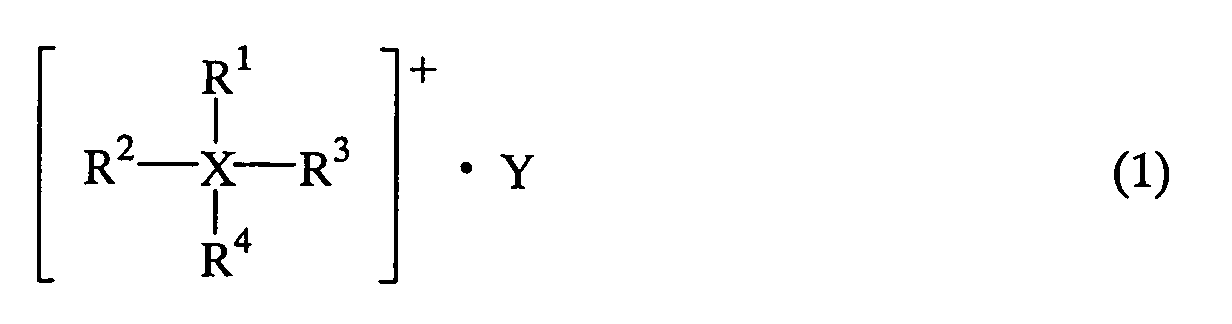
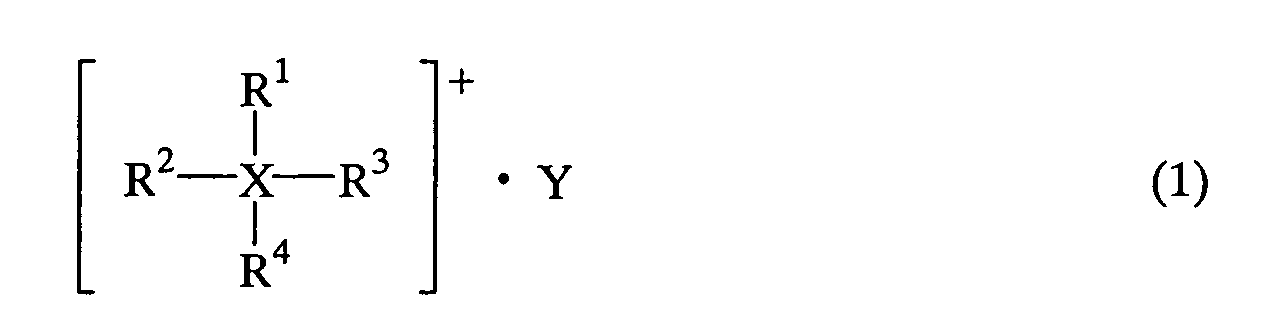
- the ionic liquid although not subject to any particular limitation, is preferably a quaternary ammonium salt or a quaternary phosphonium salt, and most preferably an ionic liquid of general formula (1) below.
- R 1 to R 4 are each independently an alkyl group of 1 to 5 carbons or an alkoxyalkyl group of the formula R'-O-(CH 2 ) n - (R' being methyl or ethyl, and the letter n being an integer from 1 to 4), and any two from among R 1 , R 2 , R 3 and R 4 may together form a ring, with the proviso that at least one of R 1 to R 4 is the alkoxyalkyl group of the above formula.
- X is a nitrogen atom or a phosphorus atom
- Y is a monovalent anion.
- alkyls having 1 to 5 carbons examples include methyl, ethyl, propyl, 2-propyl, butyl and pentyl.
- groups R 1 to R 4 it is preferable for at least one of groups R 1 to R 4 to be methyl, ethyl or propyl, and especially methyl or ethyl.
- the ethyl or propyl group may form a ring with another alkyl group.
- alkoxyalkyl groups of the formula R'-O-(CH 2 ) n - include methoxymethyl, ethoxymethyl, methoxyethyl, ethoxyethyl, methoxypropyl, ethoxypropyl, methoxybutyl and ethoxybutyl.
- the letter n is an integer from 1 to 4. However, to increase the stability of the ionic liquid, the letter n is preferably 1 or 2, and most preferably 2.
- Exemplary compounds in which any two groups from among R 1 to R 4 form a ring include, when X is a nitrogen atom, quaternary ammonium salts containing an aziridine, azetidine, pyrrolidine or piperidine ring; and, when X is a phosphorus atom, quaternary phosphonium salts containing a pentamethylenephosphine (phosphorinane) ring.
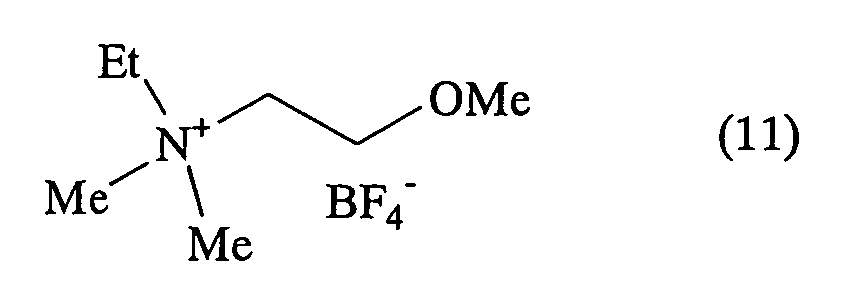
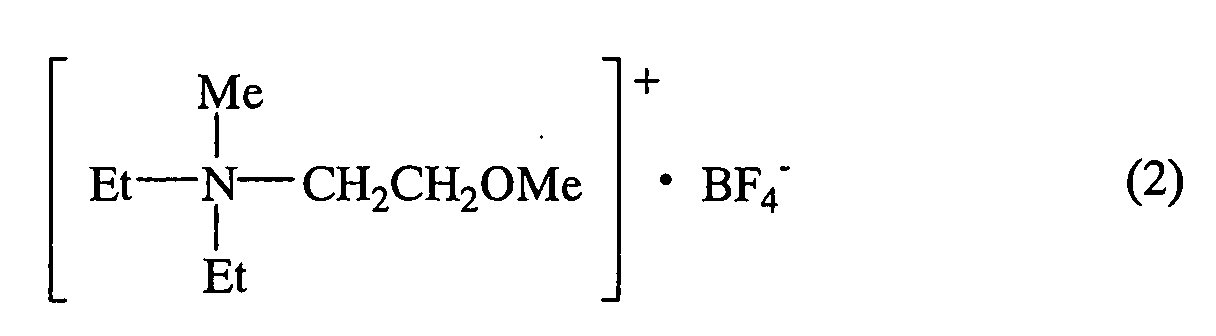
- quaternary ammonium salts and quaternary phosphonium salts highly suitable for use in the invention include compounds (2) to (11) below (wherein Me stands for methyl and Et stands for ethyl).
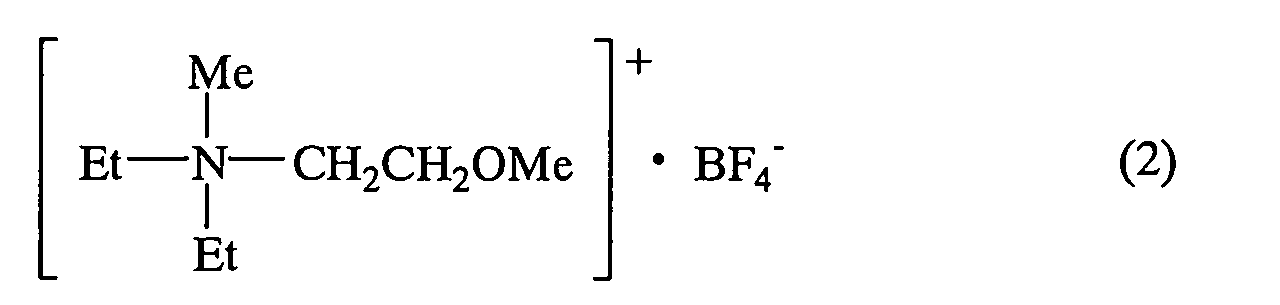
- the quaternary salt of formula (2) below which bears as substituents a methyl group, two ethyl groups and a methoxyethyl group and which includes as the anion BF 4 - , is especially preferred.
- This ionic liquid as the electrolyte salt enables electrical double-layer capacitors having excellent charge-discharge characteristics at even lower temperatures to be obtained.
- Illustrative, non-limiting examples of the monovalent anion Y include BF 4 - , PF 6 - , AsF 6 - , SbF 6 - , AlCl 4 - , HSO 4 - , ClO 4 - , CH 3 SO 3 - , CF 3 SO 3 - , CF 3 CO 2 - , (CF 3 SO 2 ) 2 N - , Cl - , Br - and I - .
- BF 4 - , PF 6 - , (CF 3 SO 2 ) 2 N - , CF 3 SO 3 - or CF 3 CO 2 - is preferred.
- (CF 3 SO 2 ) 2 N - is highly preferable for further reducing the viscosity of the ionic liquid and increasing its handleability.
- BF 4 - is also highly preferable because the resulting ionic liquid has a high versatility and it is less readily affected by water than ionic liquids containing PF 6 - as the anion and thus easier to handle.
- a tertiary amine is mixed with a compound such as an alkyl halide or a dialkyl sulfate and reacted under heating, if necessary, to give a quaternary ammonium halide.
- a compound having a low reactivity e.g., an alkoxyethyl halide or an alkoxymethyl halide
- reaction under applied pressure such as in an autoclave, is preferred.
- the resulting quaternary ammonium halide is dissolved in an aqueous solvent such as water, then reacted with a reagent that generates the required anionic species, such as tetrafluoroboric acid or tetrafluorophosphoric acid, so as to effect an anion exchange reaction, yielding the quaternary ammonium salt.
- a reagent that generates the required anionic species such as tetrafluoroboric acid or tetrafluorophosphoric acid
- the halide may be reacted with a silver salt of the required anionic species so as to effect an anion exchange reaction and thereby yield the quaternary ammonium salt.
- a quaternary ammonium halide is dissolved in water, silver oxide is added and a salt exchange reaction is carried out to form the corresponding quaternary ammonium hydroxide.
- the product is then reacted with tetrafluoroboric acid, yielding the target compound.
- This method is effective for synthesizing high-purity quaternary ammonium tetrafluoroborates because the silver halide that arises as a result of salt exchange during formation of the quaternary ammonium hydroxide can easily be removed.
- Quaternary phosphonium salts can generally be synthesized in much the same way as quaternary ammonium salts.
- a tertiary phosphine is mixed with a suitable compound such as an alkyl halide or a dialkyl sulfate. If necessary, the reaction is carried out under the application of heat.
- quaternary phosphonium salts containing any of various suitable anions may be prepared by dissolving a quaternary phosphonium halide (a chloride, bromide or iodide) in an aqueous solvent and reacting the dissolved halide with a reagent that generates the required anionic species so as to effect an anion exchange reaction.
- a quaternary phosphonium halide a chloride, bromide or iodide
- the above ionic liquid has a melting point not higher than 50°C, preferably not higher than 30°C, and most preferably not higher than 20°C. If the melting point is higher than 50°C, the ionic liquid will deposit out within the electrolyte at low temperatures, increasing the likelihood of a decline in the ionic conductivity. The lower the melting point, the more desirable. The melting point has no particular lower limit.
- the above-described ionic liquid has a lower melting point than imidazolium ion-containing ionic liquids already familiar to the art, by using an electrolyte containing the above ionic liquid, there can be obtained electrical double-layer capacitors having even better low-temperature characteristics.
- the above ionic liquid has a broader potential window than ionic liquids containing imidazolium ions, it does not readily undergo reductive decomposition during charging and discharging. As a result, a highly stable electrical double-layer capacitor can be obtained.
- the liquid electrolyte of the inventive electrical double-layer capacitor includes an ionic liquid and a nonaqueous organic solvent.
- Any nonaqueous organic solvent which is capable of dissolving the ionic liquid and is stable within the working voltage range of the electrical double-layer capacitor may be used without particular limitation.
- the nonaqueous organic solvent it is preferable for the nonaqueous organic solvent to be one having a high dielectric constant, a broad electrochemical stability range, a broad service temperature range and excellent safety.
- suitable solvents include nitriles such as acetonitrile and propionitrile; acyclic ethers such as dibutyl ether, 1,2-dimethoxyethane, 1,2-ethoxymethoxyethane, methyl diglyme, methyl triglyme, methyl tetraglyme, ethyl glyme, ethyl diglyme, butyl diglyme, and glycol ethers (e.g., ethyl cellosolve, ethyl carbitol, butyl cellosolve, butyl carbitol); heterocyclic ethers such as tetrahydrofuran, 2-methyltetrahydrofuran, 1,3-dioxolane and 4,4-dimethyl-1,3-dioxane; butyrolactones such as ⁇ -butyrolactone, ⁇ -valerolactone, ⁇ -valerolactone, 3-methyl
- propylene carbonate is especially preferred because it has a good ability to dissolve the electrolyte salt even at very low temperatures of -20°C or less, an excellent electrical performance, and a relatively high flash point during use at elevated temperatures.
- concentration of the ionic liquid within the liquid electrolyte is preferably 0.5 to 2.0 mol/L, more preferably 0.75 to 1.75 mol/L, and even more preferably 0.9 to 1.5 mol/L.
- the polarizable electrodes used in the electrical double-layer capacitor of the invention contain as a main component an activated carbon having micropores with a pore radius distribution peak as determined by the MP method within a range of 4.0 ⁇ 10 -10 to 8.0 ⁇ 10 -10 m (4.0 to 8.0 ⁇ ), preferably 4.5 ⁇ 10 -10 to 7.0 ⁇ 10 -10 m (4.5 to 7.0 ⁇ ), more preferably 4.5 ⁇ 10 -10 to 6.5 ⁇ 10 -10 m (4.5 to 6.5 ⁇ ), and even more preferably 4.5 ⁇ 10 -10 to 5.0 ⁇ 10 -10 m (4.5 to 5.0 ⁇ ).
- MP method refers to a method commonly used in micropore analysis.
- the results of BET measurements are t-plotted and the curvature in areas near bends in the plot is analyzed, based upon which the pore radius distribution and the pore radius distribution peak are computed.
- the pore radius distribution and peak here are values determined from the results of BET measurements based on nitrogen adsorption.
- the resulting peak in the pore radius distribution for micropores in the activated carbon is lower than 4.0 ⁇ 10 -10 , the charge-discharge characteristics at low temperatures may worsen.
- the electrostatic capacitance may decrease on account of the smaller specific surface area.
- the activated carbon may be prepared from any suitable starting material, provided the pore radius distribution peak can be set within the above-indicated range.
- Starting materials that may be used include coconut shells, coffee beans, sawdust, petroleum pitch, petroleum coke and coal, although it is preferable for the activated carbon to be prepared by carbonizing a synthetic resin as the starting material, then activating the carbonized resin.
- any of various synthetic resins known to be suitable as starting materials for producing activated carbon may be used.
- Illustrative examples include synthetic polymers, phenolic resins, furan resins, polyvinyl chloride resins, polyvinylidene chloride resins, polyimide resins, polyamide resins, liquid crystal polymers, plastic waste and discarded tires. From the standpoint of cost, versatility, and ease of activation, phenolic resins and/or polycarbodiimide resins are preferred.
- the method of activation is not subject to any particular limitation.
- suitable chemical such as potassium hydroxide, zinc chloride or phosphoric acid
- gas activation using a suitable gas such as carbon dioxide, oxygen or steam.
- Steam activation is preferred because the pore radius of the activated carbon can easily be controlled within the above-indicated range.
- Activated carbon exists in a variety of forms, including crushed material, granulated material, pellets, fibers, felt, woven fabric and sheets, any of which may be used in the invention.
- the above-described polarizable electrodes are largely composed of activated carbon having the above-indicated pore radius distribution, and may be of a type fabricated by blending a binder polymer into this activated carbon to form a polarizable electrode composition, then coating the composition onto a current collector.
- the binder polymer may be any known binder polymer capable of being used in applications to which this invention relates.
- Illustrative examples include polytetrafluoroethylene, polyvinylidene fluoride, carboxymethyl cellulose, fluoroolefin copolymer-crosslinked polymers, polyvinyl alcohols, polyacrylic acids, polyimides, petroleum pitch, coal pitch, and phenolic resins.
- binder polymers are preferably added in any amount of 0.5 to 20 parts by weight, and especially 1 to 10 parts by weight, per 100 parts by weight of the activated carbon.
- the method of preparing the polarizable electrode composition is not subject to any particular limitation.
- the composition may be prepared in the form of a solution from the above-described activated carbon and a binder polymer, or it may be prepared by adding a solvent, if necessary, to this solution.
- the polarizable electrode composition thus obtained is coated onto a current collector to form a polarizable electrode.
- Any suitable known coating method may be used at this time, such as doctor blade coating or air knife coating.
- the positive electrode current collector is preferably aluminum foil or aluminum oxide
- the negative electrode current collector is preferably copper foil, nickel foil or a metal foil covered on the surface with a copper plating film or a nickel plating film.
- the foils making up the respective current collectors may be in any of various forms, including thin foils, flat sheets, and perforated, stampable sheets.
- the foil has a thickness of generally about 1 to 200 ⁇ m. However, taking into account, for example, the density of the activated carbon over the entire electrode and the strength of the electrode, a thickness of 8 to 100 ⁇ m is preferred, and a thickness of 8 to 30 is especially preferred.
- the polarizable electrodes can be fabricated by melting and blending the polarizable electrode composition, then extruding the blend as a film.
- a conductive material may be added to the above-described carbonaceous material.
- the conductive material may be any suitable material capable of conferring electrical conductivity to the carbonaceous material.
- Illustrative, non-limiting, examples include carbon black, Ketjenblack, acetylene black, carbon whiskers, carbon fibers, natural graphite, artificial graphite, titanium oxide, ruthenium oxide, and metallic fibers such as aluminum or nickel fibers. Any one or combinations of two or more thereof may be used. Of these, Ketjenblack and acetylene black, both of which are types of carbon black, are preferred.
- the average particle size of the conductive material is not subject to any particular limitation, although a size of 10 nm to 10 ⁇ m, preferably 10 to 100 nm, and more preferably 20 to 40 nm, is desirable.
- the amount of conductive material included is not subject to any particular limitation, although addition of the conductive material in an amount of 0.1 to 20 parts by weight, and preferably 0.5 to 10 parts by weight, per 100 parts by weight of the activated carbon is desirable in light of such considerations as the electrostatic capacitance and the conductivity-imparting effects.
- the separator may be one that is commonly used in electrical double-layer capacitors.
- Illustrative examples include polyolefin nonwoven fabric, polytetrafluoroethylene porous film, kraft paper, sheet laid from a blend of rayon fibers and sisal hemp fibers, manila hemp sheet, glass fiber sheet, cellulose-based electrolytic paper, paper made from rayon fibers, paper made from a blend of cellulose and glass fibers, and combinations thereof in the form of multilayer sheets.
- the electrical double-layer capacitor of the invention can be assembled by stacking, fan-folding or winding an electrical double-layer capacitor assembly composed of a pair of polarizable electrodes produced as described above and a separator therebetween.
- the cell assembly is then placed within a capacitor housing such as a can or a laminate pack.
- the assembly is filled with the liquid electrolyte, following which the housing is mechanically sealed if it is a can or heat-sealed if it is a laminate pack.
- the electrical double-layer capacitors of the invention are highly suitable for use as a memory backup power supply for cell phones, notebook computers and wireless terminals, as a power supply for cell phones and portable acoustic devices, as an uninterruptible power supply for personal computers and other equipment, and as various types of low-current electrical storage devices such as load leveling power supplies used in combination with solar power generation and wind power generation.
- electrical double-layer capacitors capable of being charged and discharged at a high current are well suited for use as high-current electrical storage devices in applications that require a large current such as electric cars and electrical power tools.
- the electrical double-layer capacitor of the invention uses polarizable electrodes that are largely composed of activated carbon in which the micropores have a specific pore radius distribution peak, and because it uses a liquid electrolyte that contains an ionic liquid, the capacitor has excellent charge-discharge characteristics at low temperatures and the internal impedance at low temperatures can be minimized.
- ionic liquids composed of a quaternary ammonium salt or quaternary phosphonium salt have a broader potential window than imidazolium or pyridinium-type ionic liquids, the use of such ionic liquids as the electrolyte enables electrical double-layer capacitors of a high energy density to be obtained.
- the two organic phases that formed as a result were separated with a separatory funnel and subjected twice to extraction with 100 ml of methylene chloride (Wako Pure Chemical Industries, Ltd.).
- the separated organic phases were then combined and washed with a saturated saline solution, following which potassium carbonate (Wako Pure Chemical Industries, Ltd.) was added to remove water, and vacuum filtration was carried out.
- the solvent in the resulting organic phase was distilled off using a rotary evaporator, after which the residue was subjected to normal-pressure distillation, yielding 18.9 g of a fraction having a boiling point close to 135°C.
- This compound was confirmed from a 1 H-nuclear magnetic resonance (abbreviated hereinafter as "NMR”) spectrum to be 2-methoxyethyldiethylamine.
- NMR 1 H-nuclear magnetic resonance
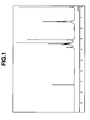
- FIG. 1 shows the NMR spectrum (solvent: deuterated chloroform) of compound (2).
- FIG. 2 shows the NMR spectrum (solvent: deuterated dimethyl sulfoxide) of compound (11).
- a filling material was prepared by mixing an activated carbon (indicated below as "Activated Carbon 1") obtained by steam activating a carbonized phenolic resin for 2 hours and having the specific surface area and the pore distribution peak value shown in Table 1, a conductive material (HS-100, made by Denki Kagaku Kogyo Kabushiki Kaisha) and a binder (PVdF900, made by Kureha Chemical Industries Co., Ltd.) in a weight ratio of 90:5:5, respectively.
- Activated Carbon 1 an activated carbon obtained by steam activating a carbonized phenolic resin for 2 hours and having the specific surface area and the pore distribution peak value shown in Table 1, a conductive material (HS-100, made by Denki Kagaku Kogyo Kabushiki Kaisha) and a binder (PVdF900, made by Kureha Chemical Industries Co., Ltd.) in a weight ratio of 90:5:5, respectively.
- NMP N-methyl-2-pyrrolidone
- the slurry was applied onto 30 ⁇ m aluminum foil to an electrode thickness of 100 ⁇ m, vacuum dried at 140°C for 3 days, then subjected to 30 MPa of stress using a roll press.
- the slurry-coated aluminum foil was vacuum dried once again at 170°C for 3 days, following which 12 mm diameter electrodes were punched on a punching machine. The punched disks were then vacuum dried at 120°C for 2 hours, thereby giving test electrodes.
- an activated carbon (indicated below as “Activated Carbon 2") prepared by steam activating carbonized phenolic resin for 3 hours and using Compound (11) as the electrolyte salt in the liquid electrolyte, an electrical double-layer capacitor sample was fabricated in the same way as in Example 1.
- an activated carbon (indicated below as "Activated Carbon 3") prepared by subjecting alkali-activated carbon (MSP-20, produced by Kansai Coke and Chemicals Co., Ltd.) to 1 hour of steam activation as well so as to broaden the pore size distribution, an electrical double-layer capacitor sample was fabricated in the same way as in Example 1.
- an activated carbon (indicated below as "Activated Carbon 3") prepared by subjecting alkali-activated carbon (MSP-20, made by Kansai Coke and Chemicals Co., Ltd.) to 1 hour of steam activation as well so as to broaden the pore size distribution and using Compound (11) as the electrolyte salt within the liquid electrolyte, an electrical double-layer capacitor sample was fabricated in the same way as in Example 1.
- an electrical double-layer capacitor sample was fabricated in the same way as in Example 1.
- the method of evaluation was an initial capacitance verification test, carried out in a room temperature environment, in which the capacitor was charged at a current density of 0.88 mA/cm 2 , a voltage setting of 2.50 V and a constant voltage time of 15 minutes (cut-off conditions), and was discharged at a current density of 0.88 mA/cm 2 and an end-of-discharge voltage of 0.0 V.
- the electrical double-layer capacitors obtained in Examples 1 to 4 of the invention using activated carbons having a specific pore radius distribution as a main component of the polarizable electrodes and using a quaternary ammonium salt (ionic liquid) as the electrolyte salt all exhibited much better retention of the capacitance at -40°C than did the electrical double-layer capacitors obtained in the comparative examples.
- the electrical double-layer capacitors obtained in Examples 1 to 4 also had sufficiently high electrostatic capacitances.
- the electrical double-layer capacitors according to this invention use polarizable electrodes which are largely composed of an activated carbon having micropores with a pore radius distribution peak as determined by the MP method within a range of 4.0 ⁇ 10 -10 to 8.0 ⁇ 10 -10 m and use a liquid electrolyte that includes an electrolyte salt which is an ionic liquid, they have excellent charge-discharge characteristics at low temperatures and their internal impedance at low temperatures can be minimized.
Landscapes
- Engineering & Computer Science (AREA)
- Power Engineering (AREA)
- Chemical & Material Sciences (AREA)
- Microelectronics & Electronic Packaging (AREA)
- Materials Engineering (AREA)
- Chemical Kinetics & Catalysis (AREA)
- Electrochemistry (AREA)
- Electric Double-Layer Capacitors Or The Like (AREA)
- Semiconductor Integrated Circuits (AREA)
Abstract
Description






1,3-dioxolane and 4,4-dimethyl-1,3-dioxane; butyrolactones such as γ-butyrolactone, γ-valerolactone, δ-valerolactone, 3-methyl-1,3-oxazolidin-2-one and 3-ethyl-1,3-oxazolidin-2-one; and other solvents commonly used in electrochemical devices, such as amide solvents (e.g., N-methylformamide, N,N-dimethylformamide, N-methylacetamide,
N-methylpyrrolidinone), carbonate solvents (e.g., diethyl carbonate, dimethyl carbonate, ethyl methyl carbonate, propylene carbonate, ethylene carbonate, styrene carbonate), and imidazolidinone solvents (e.g., 1,3-dimethyl-2-imidazolidinone). Any one or mixtures of two or more of these solvents may be used.

| Activated carbon | BET specific surface area (m2/g) | Pore radius peak value (Å) |
| Activated Carbon 1 | 1642 | 4.64 |
| Activated | 2120 | 6.30 |
| Activated | 2201 | 4.95 |
| Activated Carbon 4 | 2280 | 3.74 |
| Activated | 1620 | 8.31 |
| Activated carbon | Electrolyte salt | Capacitance (F/g) | Retention of capacitance (%) | |
| Example 1 | Activated Carbon 1 | | 23.4 | 90 |
| Example 2 | | Compound 11 | 25.9 | 95 |
| Example 3 | | | 33.6 | 93 |
| Example 4 | | Compound 11 | 33.5 | 93 |
| Comparative Example 1 | Activated Carbon 4 | | 35.0 | 48 |
| Comparative Example 2 | Activated Carbon 1 | TEA | 24.2 | 65 |
| Comparative Example 3 | | | 21.6 | 99 |
Claims (9)
- An electrical double-layer capacitor comprising a pair of polarizable electrodes, a separator between the polarizable electrodes and a liquid electrolyte,
which electrical double-layer capacitor is characterized in that the polarizable electrodes contain as a main component an activated carbon having micropores with a pore radius distribution peak as determined by the MP method within a range of 4.0×10⁻¹⁰ to 8.0×10⁻¹⁰ m, and the liquid electrolyte includes an electrolyte salt which is an ionic liquid. - The electrical double-layer capacitor of claim 1 which is characterized in that the ionic liquid is a quaternary ammonium salt or a quaternary phosphonium salt.
- The electrical double-layer capacitor of claim 2 which is characterized in that the ionic liquid has general formula (1) belowwherein R1 to R4 are each independently an alkyl group of 1 to 5 carbons or an alkoxyalkyl group of the formula R'-O-(CH2)n- (R' being methyl or ethyl, and the letter n being an integer from 1 to 4), and any two from among R1, R2, R3 and R4 may together form a ring, with the proviso that at least one of R1 to R4 is the alkoxyalkyl group of the above formula; X is a nitrogen atom or a phosphorus atom; and Y is a monovalent anion.
- The electrical double-layer capacitor of claim 3 which is characterized in that the ionic liquid has general formula (2) belowwherein Me stands for methyl and Et stands for ethyl.
- The electrical double-layer capacitor of any one of claims 1 to 4 which is characterized in that the pore radius distribution peak is in a range of 4.5×10⁻¹⁰ to 7.0×10⁻¹⁰.
- The electrical double-layer capacitor of any one of claims 1 to 5 which is characterized in that the ionic liquid has a concentration in the liquid electrolyte of from 0.5 to 2.0 mol/L.
- The electrical double-layer capacitor of any one of claims 1 to 6 which is characterized in that an activated carbon is the activated form of a synthetic resin.
- The electrical double-layer capacitor of claim 7 which is characterized in that the activated carbon is a steam-activated form of a synthetic resin.
- The electrical double-layer capacitor of claim 7 or 8 which is characterized in that the synthetic resin is a phenolic resin and/or a polycarbodiimide resin.
Applications Claiming Priority (3)
| Application Number | Priority Date | Filing Date | Title |
|---|---|---|---|
| JP2002243236 | 2002-08-23 | ||
| JP2002243236 | 2002-08-23 | ||
| PCT/JP2003/010630 WO2004019356A1 (en) | 2002-08-23 | 2003-08-22 | Electric double-layer capacitor |
Publications (3)
| Publication Number | Publication Date |
|---|---|
| EP1536440A1 true EP1536440A1 (en) | 2005-06-01 |
| EP1536440A4 EP1536440A4 (en) | 2009-02-25 |
| EP1536440B1 EP1536440B1 (en) | 2011-09-28 |
Family
ID=31944092
Family Applications (1)
| Application Number | Title | Priority Date | Filing Date |
|---|---|---|---|
| EP03792799A Expired - Lifetime EP1536440B1 (en) | 2002-08-23 | 2003-08-22 | Electric double-layer capacitor |
Country Status (9)
| Country | Link |
|---|---|
| US (1) | US7342769B2 (en) |
| EP (1) | EP1536440B1 (en) |
| JP (1) | JP4548592B2 (en) |
| KR (1) | KR101016268B1 (en) |
| CN (1) | CN100468587C (en) |
| AT (1) | ATE526672T1 (en) |
| AU (1) | AU2003262276A1 (en) |
| CA (1) | CA2496544A1 (en) |
| WO (1) | WO2004019356A1 (en) |
Cited By (2)
| Publication number | Priority date | Publication date | Assignee | Title |
|---|---|---|---|---|
| CN1941238B (en) * | 2005-09-26 | 2011-04-20 | 日清纺织株式会社 | Electric double layer capacitor |
| CN103620714A (en) * | 2011-05-10 | 2014-03-05 | Cap-Xx有限公司 | Electrolyte |
Families Citing this family (21)
| Publication number | Priority date | Publication date | Assignee | Title |
|---|---|---|---|---|
| JP2004146346A (en) * | 2002-08-28 | 2004-05-20 | Nisshinbo Ind Inc | Non-aqueous electrolyte and non-aqueous electrolyte secondary battery |
| EP1715496A4 (en) * | 2004-02-03 | 2010-03-31 | Nisshin Spinning | ELECTRIC CAPACITOR WITH DOUBLE LAYER |
| EP1717831A3 (en) * | 2005-04-25 | 2008-06-04 | Power Systems Co., Ltd. | Positive electrode for electric double layer capacitors and method for the production thereof |
| JP5035510B2 (en) * | 2005-09-26 | 2012-09-26 | 日清紡ホールディングス株式会社 | Electric double layer capacitor |
| JP4952900B2 (en) * | 2005-09-26 | 2012-06-13 | 日清紡ホールディングス株式会社 | Electric double layer capacitor |
| JP2007266248A (en) * | 2006-03-28 | 2007-10-11 | Osaka Gas Co Ltd | Electric double layer capacitor, carbon material thereof, and electrode thereof |
| JP2008108979A (en) * | 2006-10-26 | 2008-05-08 | Kansai Coke & Chem Co Ltd | Electrode material for electric double layer capacitor and manufacturing method thereof |
| EP2221841A4 (en) * | 2007-11-16 | 2018-03-28 | Osaka Gas Company Limited | Positive electrode material for nonaqueous lithium-type storage element |
| US8662471B2 (en) * | 2008-03-31 | 2014-03-04 | Fujikin Incorporated | Solenoid valve |
| JP5573673B2 (en) * | 2008-06-24 | 2014-08-20 | パナソニック株式会社 | Electrochemical element |
| US8927775B2 (en) | 2008-07-14 | 2015-01-06 | Esionic Es, Inc. | Phosphonium ionic liquids, salts, compositions, methods of making and devices formed there from |
| US8907133B2 (en) | 2008-07-14 | 2014-12-09 | Esionic Es, Inc. | Electrolyte compositions and electrochemical double layer capacitors formed there from |
| JP5573146B2 (en) * | 2009-12-21 | 2014-08-20 | パナソニック株式会社 | Electrochemical element |
| CN105164777A (en) * | 2012-12-05 | 2015-12-16 | 伊赛欧尼克公司 | Electrolyte compositions and electrochemical double layer capacitors formed there from |
| WO2015045389A1 (en) | 2013-09-25 | 2015-04-02 | 国立大学法人東京大学 | Electrolyte solution for electricity storage devices such as batteries and capacitors containing salt, wherein alkali metal, alkaline earth metal or aluminum serves as cations, and organic solvent having hetero element, method for producing same, and capacitor provided with said electrolyte solution |
| US20160218394A1 (en) | 2013-09-25 | 2016-07-28 | The University Of Tokyo | Electrolytic solution, for electrical storage devices such as batteries and capacitors, containing salt whose cation is alkali metal, alkaline earth metal, or aluminum, and organic solvent having heteroelement, method for producing said electrolytic solution, and capacitor including said electrolytic solution |
| JP5965445B2 (en) | 2013-09-25 | 2016-08-03 | 国立大学法人 東京大学 | Nonaqueous electrolyte secondary battery |
| DE112014004442T5 (en) | 2013-09-25 | 2016-06-23 | The University Of Tokyo | Non-aqueous electrolyte secondary battery |
| WO2017201173A1 (en) | 2016-05-20 | 2017-11-23 | Avx Corporation | Nonaqueous electrolyte for an ultracapacitor |
| KR102635455B1 (en) | 2016-05-20 | 2024-02-13 | 교세라 에이브이엑스 컴포넌츠 코포레이션 | Ultracapacitor for use at high temperatures |
| WO2017201167A1 (en) | 2016-05-20 | 2017-11-23 | Avx Corporation | Electrode configuration for an ultracapacitor |
Family Cites Families (29)
| Publication number | Priority date | Publication date | Assignee | Title |
|---|---|---|---|---|
| US3652902A (en) * | 1969-06-30 | 1972-03-28 | Ibm | Electrochemical double layer capacitor |
| DE3126522A1 (en) | 1981-07-04 | 1983-01-20 | Basf Ag, 6700 Ludwigshafen | QUATERNAIRE AMMONIUM SALTS AND METHOD FOR THEIR PRODUCTION |
| JPS6132509A (en) | 1984-07-25 | 1986-02-15 | 昭和電工株式会社 | Electrolyte for driving electrolytic condenser |
| JPH0666233B2 (en) | 1986-01-17 | 1994-08-24 | 旭硝子株式会社 | Electric double layer capacitor |
| EP0230907A3 (en) | 1986-01-17 | 1989-05-31 | Asahi Glass Company Ltd. | Electric double layer capacitor having high capacity |
| JPS62226614A (en) * | 1986-03-28 | 1987-10-05 | 日本ケミコン株式会社 | Electrolyte for electrolytic capacitor |
| JPS63173312A (en) | 1987-01-13 | 1988-07-16 | 旭硝子株式会社 | Electric double-layer capacitor |
| JPH0354109A (en) * | 1989-07-21 | 1991-03-08 | Nisshinbo Ind Inc | Active carbon and production thereof |
| JP3075766B2 (en) * | 1991-05-27 | 2000-08-14 | 株式会社東芝 | Lithium battery |
| JPH0543345A (en) | 1991-08-06 | 1993-02-23 | Mitsui Petrochem Ind Ltd | Method for producing activated carbon porous material |
| JPH0574656A (en) * | 1991-09-17 | 1993-03-26 | Murata Mfg Co Ltd | Electric double layer capacitor |
| JPH0661095A (en) | 1992-08-07 | 1994-03-04 | Osaka Gas Co Ltd | Electric double layer capacitor |
| JP3702300B2 (en) * | 1994-03-11 | 2005-10-05 | 旭化成株式会社 | Manufacturing method of electrode for electric double layer capacitor |
| JPH09275042A (en) * | 1996-02-09 | 1997-10-21 | Honda Motor Co Ltd | Activated carbon for organic solvent-based electric double layer capacitor electrodes |
| JPH1055717A (en) | 1996-08-09 | 1998-02-24 | Sony Corp | Molten salt material |
| JPH11222732A (en) | 1997-12-04 | 1999-08-17 | Petoca Ltd | Mesophase pitch-based activated carbon fiber and electric double layer capacitor using the same |
| EP0927778B1 (en) | 1997-12-04 | 2003-07-02 | Kashima Oil Co., Ltd. | Activated carbon fibers and use in double layer capacitor |
| JPH11224831A (en) * | 1998-02-05 | 1999-08-17 | Showa Denko Kk | Electric double layer capacitor electrolyte and the capacitor |
| JP2981545B2 (en) * | 1998-04-03 | 1999-11-22 | 工業技術院長 | Room temperature molten salt |
| JP2000007316A (en) * | 1998-06-29 | 2000-01-11 | Kyocera Corp | Solid activated carbon and electric double layer capacitor using the same |
| CN1204577C (en) * | 1998-08-25 | 2005-06-01 | 钟纺株式会社 | Electrode material and method for producing the same |
| US6183914B1 (en) * | 1998-09-17 | 2001-02-06 | Reveo, Inc. | Polymer-based hydroxide conducting membranes |
| JP2000299259A (en) * | 1999-04-16 | 2000-10-24 | Tokin Corp | Electric double layer capacitor and method of manufacturing the same |
| US6865068B1 (en) * | 1999-04-30 | 2005-03-08 | Asahi Glass Company, Limited | Carbonaceous material, its production process and electric double layer capacitor employing it |
| JP2001110689A (en) * | 1999-10-04 | 2001-04-20 | Asahi Kasei Corp | Active carbon raw material for electric double-layer capacitor electrode, and activated carbon |
| JP2002110472A (en) | 2000-09-26 | 2002-04-12 | Mitsubishi Chemicals Corp | Electric double layer capacitor |
| IL155790A0 (en) * | 2000-11-09 | 2003-12-23 | Foc Frankenburg Oil Company Es | A supercapacitor and a method of manufacturing such a supercapacitor |
| EP2295399A3 (en) | 2001-03-26 | 2018-04-04 | Nisshinbo Industries, Inc. | Liquid electrolytes for electrical storage devices |
| CN1564805A (en) * | 2002-04-24 | 2005-01-12 | 日清纺织株式会社 | Ionic Liquid, Dehydration Method, Double Layer Capacitor, and Secondary Battery |
-
2003
- 2003-08-22 KR KR1020057002436A patent/KR101016268B1/en not_active Expired - Fee Related
- 2003-08-22 CA CA002496544A patent/CA2496544A1/en not_active Abandoned
- 2003-08-22 AT AT03792799T patent/ATE526672T1/en not_active IP Right Cessation
- 2003-08-22 CN CNB038200341A patent/CN100468587C/en not_active Expired - Lifetime
- 2003-08-22 EP EP03792799A patent/EP1536440B1/en not_active Expired - Lifetime
- 2003-08-22 WO PCT/JP2003/010630 patent/WO2004019356A1/en not_active Ceased
- 2003-08-22 JP JP2004530603A patent/JP4548592B2/en not_active Expired - Fee Related
- 2003-08-22 AU AU2003262276A patent/AU2003262276A1/en not_active Abandoned
- 2003-08-22 US US10/525,201 patent/US7342769B2/en not_active Expired - Lifetime
Cited By (2)
| Publication number | Priority date | Publication date | Assignee | Title |
|---|---|---|---|---|
| CN1941238B (en) * | 2005-09-26 | 2011-04-20 | 日清纺织株式会社 | Electric double layer capacitor |
| CN103620714A (en) * | 2011-05-10 | 2014-03-05 | Cap-Xx有限公司 | Electrolyte |
Also Published As
| Publication number | Publication date |
|---|---|
| CN1679126A (en) | 2005-10-05 |
| CN100468587C (en) | 2009-03-11 |
| AU2003262276A1 (en) | 2004-03-11 |
| JP4548592B2 (en) | 2010-09-22 |
| CA2496544A1 (en) | 2004-03-04 |
| EP1536440B1 (en) | 2011-09-28 |
| KR101016268B1 (en) | 2011-02-25 |
| US7342769B2 (en) | 2008-03-11 |
| JPWO2004019356A1 (en) | 2005-12-15 |
| WO2004019356A1 (en) | 2004-03-04 |
| ATE526672T1 (en) | 2011-10-15 |
| US20060176646A1 (en) | 2006-08-10 |
| KR20050056971A (en) | 2005-06-16 |
| EP1536440A4 (en) | 2009-02-25 |
Similar Documents
| Publication | Publication Date | Title |
|---|---|---|
| EP1536440B1 (en) | Electric double-layer capacitor | |
| CA2441981C (en) | Ionic liquids, electrolyte salts for electrical storage devices, liquid electrolytes for electrical storage devices, electrical double-layer capacitors, and secondary batteries | |
| CA2499185A1 (en) | Nonaqueous electrolyte, electrical double-layer capacitors, and nonaqueous electrolyte secondary cells | |
| KR20150143501A (en) | Methods of enhancing electrochemical double layer capacitor(EDLC) performance and EDLC devices formed therefrom | |
| CA2888330C (en) | Electrolyte salt and electrolyte for electricity storage device, and electricity storage device | |
| JP4913864B2 (en) | Electrolyte, electrolytic solution using the same, and electrochemical element | |
| US20080204972A1 (en) | Electric Double Layer Capacitor | |
| JP5947300B2 (en) | Electrochemical power generation device and method for producing such a power generation device | |
| EP1648005A1 (en) | Electric double layer capacitor | |
| JP2006236829A (en) | Ionic liquid, non-aqueous electrolyte for electricity storage device, and electricity storage device | |
| CN109478472B (en) | Electrolytes, electrolytes and electrochemical devices for electrochemical devices | |
| JP5101260B2 (en) | Electrolyte and electrochemical device using quaternary ammonium salt electrolyte | |
| KR101896835B1 (en) | Electrolyte solution composition comprising electrolyte salt having bis(oxalate)borate anion or electric double layer capacitor including the same | |
| JP2010108974A (en) | Quinuclidinium salt-containing electrolyte | |
| JP2003173935A (en) | Electrolytic solution for electrochemical capacitor and electrochemical capacitor using the same | |
| JP2008277464A (en) | Quaternary ammonium salt electrolyte, electrolytic solution using the same, and electrochemical element | |
| JP2008270643A (en) | Quaternary ammonium salt electrolyte, and electrolyte solution and electrochemical device using the same |
Legal Events
| Date | Code | Title | Description |
|---|---|---|---|
| PUAI | Public reference made under article 153(3) epc to a published international application that has entered the european phase |
Free format text: ORIGINAL CODE: 0009012 |
|
| 17P | Request for examination filed |
Effective date: 20050314 |
|
| AK | Designated contracting states |
Kind code of ref document: A1 Designated state(s): AT BE BG CH CY CZ DE DK EE ES FI FR GB GR HU IE IT LI LU MC NL PT RO SE SI SK TR |
|
| AX | Request for extension of the european patent |
Extension state: AL LT LV MK |
|
| DAX | Request for extension of the european patent (deleted) | ||
| A4 | Supplementary search report drawn up and despatched |
Effective date: 20090123 |
|
| 17Q | First examination report despatched |
Effective date: 20101007 |
|
| GRAP | Despatch of communication of intention to grant a patent |
Free format text: ORIGINAL CODE: EPIDOSNIGR1 |
|
| GRAS | Grant fee paid |
Free format text: ORIGINAL CODE: EPIDOSNIGR3 |
|
| RAP1 | Party data changed (applicant data changed or rights of an application transferred) |
Owner name: NISSHINBO HOLDINGS INC. |
|
| GRAA | (expected) grant |
Free format text: ORIGINAL CODE: 0009210 |
|
| AK | Designated contracting states |
Kind code of ref document: B1 Designated state(s): AT BE BG CH CY CZ DE DK EE ES FI FR GB GR HU IE IT LI LU MC NL PT RO SE SI SK TR |
|
| REG | Reference to a national code |
Ref country code: GB Ref legal event code: FG4D |
|
| REG | Reference to a national code |
Ref country code: CH Ref legal event code: EP |
|
| REG | Reference to a national code |
Ref country code: IE Ref legal event code: FG4D |
|
| REG | Reference to a national code |
Ref country code: DE Ref legal event code: R096 Ref document number: 60338564 Country of ref document: DE Effective date: 20111208 |
|
| REG | Reference to a national code |
Ref country code: NL Ref legal event code: VDEP Effective date: 20110928 |
|
| PG25 | Lapsed in a contracting state [announced via postgrant information from national office to epo] |
Ref country code: FI Free format text: LAPSE BECAUSE OF FAILURE TO SUBMIT A TRANSLATION OF THE DESCRIPTION OR TO PAY THE FEE WITHIN THE PRESCRIBED TIME-LIMIT Effective date: 20110928 Ref country code: SE Free format text: LAPSE BECAUSE OF FAILURE TO SUBMIT A TRANSLATION OF THE DESCRIPTION OR TO PAY THE FEE WITHIN THE PRESCRIBED TIME-LIMIT Effective date: 20110928 |
|
| PG25 | Lapsed in a contracting state [announced via postgrant information from national office to epo] |
Ref country code: AT Free format text: LAPSE BECAUSE OF FAILURE TO SUBMIT A TRANSLATION OF THE DESCRIPTION OR TO PAY THE FEE WITHIN THE PRESCRIBED TIME-LIMIT Effective date: 20110928 Ref country code: CY Free format text: LAPSE BECAUSE OF FAILURE TO SUBMIT A TRANSLATION OF THE DESCRIPTION OR TO PAY THE FEE WITHIN THE PRESCRIBED TIME-LIMIT Effective date: 20110928 Ref country code: SI Free format text: LAPSE BECAUSE OF FAILURE TO SUBMIT A TRANSLATION OF THE DESCRIPTION OR TO PAY THE FEE WITHIN THE PRESCRIBED TIME-LIMIT Effective date: 20110928 Ref country code: GR Free format text: LAPSE BECAUSE OF FAILURE TO SUBMIT A TRANSLATION OF THE DESCRIPTION OR TO PAY THE FEE WITHIN THE PRESCRIBED TIME-LIMIT Effective date: 20111229 |
|
| REG | Reference to a national code |
Ref country code: AT Ref legal event code: MK05 Ref document number: 526672 Country of ref document: AT Kind code of ref document: T Effective date: 20110928 |
|
| PG25 | Lapsed in a contracting state [announced via postgrant information from national office to epo] |
Ref country code: BE Free format text: LAPSE BECAUSE OF FAILURE TO SUBMIT A TRANSLATION OF THE DESCRIPTION OR TO PAY THE FEE WITHIN THE PRESCRIBED TIME-LIMIT Effective date: 20110928 |
|
| PG25 | Lapsed in a contracting state [announced via postgrant information from national office to epo] |
Ref country code: SK Free format text: LAPSE BECAUSE OF FAILURE TO SUBMIT A TRANSLATION OF THE DESCRIPTION OR TO PAY THE FEE WITHIN THE PRESCRIBED TIME-LIMIT Effective date: 20110928 Ref country code: CZ Free format text: LAPSE BECAUSE OF FAILURE TO SUBMIT A TRANSLATION OF THE DESCRIPTION OR TO PAY THE FEE WITHIN THE PRESCRIBED TIME-LIMIT Effective date: 20110928 |
|
| PG25 | Lapsed in a contracting state [announced via postgrant information from national office to epo] |
Ref country code: RO Free format text: LAPSE BECAUSE OF FAILURE TO SUBMIT A TRANSLATION OF THE DESCRIPTION OR TO PAY THE FEE WITHIN THE PRESCRIBED TIME-LIMIT Effective date: 20110928 Ref country code: NL Free format text: LAPSE BECAUSE OF FAILURE TO SUBMIT A TRANSLATION OF THE DESCRIPTION OR TO PAY THE FEE WITHIN THE PRESCRIBED TIME-LIMIT Effective date: 20110928 Ref country code: EE Free format text: LAPSE BECAUSE OF FAILURE TO SUBMIT A TRANSLATION OF THE DESCRIPTION OR TO PAY THE FEE WITHIN THE PRESCRIBED TIME-LIMIT Effective date: 20110928 Ref country code: PT Free format text: LAPSE BECAUSE OF FAILURE TO SUBMIT A TRANSLATION OF THE DESCRIPTION OR TO PAY THE FEE WITHIN THE PRESCRIBED TIME-LIMIT Effective date: 20120130 |
|
| PG25 | Lapsed in a contracting state [announced via postgrant information from national office to epo] |
Ref country code: DK Free format text: LAPSE BECAUSE OF FAILURE TO SUBMIT A TRANSLATION OF THE DESCRIPTION OR TO PAY THE FEE WITHIN THE PRESCRIBED TIME-LIMIT Effective date: 20110928 |
|
| PLBE | No opposition filed within time limit |
Free format text: ORIGINAL CODE: 0009261 |
|
| STAA | Information on the status of an ep patent application or granted ep patent |
Free format text: STATUS: NO OPPOSITION FILED WITHIN TIME LIMIT |
|
| 26N | No opposition filed |
Effective date: 20120629 |
|
| REG | Reference to a national code |
Ref country code: DE Ref legal event code: R097 Ref document number: 60338564 Country of ref document: DE Effective date: 20120629 |
|
| REG | Reference to a national code |
Ref country code: CH Ref legal event code: PL |
|
| PG25 | Lapsed in a contracting state [announced via postgrant information from national office to epo] |
Ref country code: MC Free format text: LAPSE BECAUSE OF NON-PAYMENT OF DUE FEES Effective date: 20120831 |
|
| GBPC | Gb: european patent ceased through non-payment of renewal fee |
Effective date: 20120822 |
|
| PG25 | Lapsed in a contracting state [announced via postgrant information from national office to epo] |
Ref country code: CH Free format text: LAPSE BECAUSE OF NON-PAYMENT OF DUE FEES Effective date: 20120831 Ref country code: LI Free format text: LAPSE BECAUSE OF NON-PAYMENT OF DUE FEES Effective date: 20120831 Ref country code: ES Free format text: LAPSE BECAUSE OF FAILURE TO SUBMIT A TRANSLATION OF THE DESCRIPTION OR TO PAY THE FEE WITHIN THE PRESCRIBED TIME-LIMIT Effective date: 20120108 |
|
| REG | Reference to a national code |
Ref country code: IE Ref legal event code: MM4A |
|
| PG25 | Lapsed in a contracting state [announced via postgrant information from national office to epo] |
Ref country code: BG Free format text: LAPSE BECAUSE OF FAILURE TO SUBMIT A TRANSLATION OF THE DESCRIPTION OR TO PAY THE FEE WITHIN THE PRESCRIBED TIME-LIMIT Effective date: 20111228 |
|
| PG25 | Lapsed in a contracting state [announced via postgrant information from national office to epo] |
Ref country code: GB Free format text: LAPSE BECAUSE OF NON-PAYMENT OF DUE FEES Effective date: 20120822 Ref country code: IE Free format text: LAPSE BECAUSE OF NON-PAYMENT OF DUE FEES Effective date: 20120822 |
|
| PG25 | Lapsed in a contracting state [announced via postgrant information from national office to epo] |
Ref country code: TR Free format text: LAPSE BECAUSE OF FAILURE TO SUBMIT A TRANSLATION OF THE DESCRIPTION OR TO PAY THE FEE WITHIN THE PRESCRIBED TIME-LIMIT Effective date: 20110928 |
|
| PG25 | Lapsed in a contracting state [announced via postgrant information from national office to epo] |
Ref country code: LU Free format text: LAPSE BECAUSE OF NON-PAYMENT OF DUE FEES Effective date: 20120822 |
|
| PG25 | Lapsed in a contracting state [announced via postgrant information from national office to epo] |
Ref country code: HU Free format text: LAPSE BECAUSE OF FAILURE TO SUBMIT A TRANSLATION OF THE DESCRIPTION OR TO PAY THE FEE WITHIN THE PRESCRIBED TIME-LIMIT Effective date: 20030822 |
|
| REG | Reference to a national code |
Ref country code: FR Ref legal event code: PLFP Year of fee payment: 14 |
|
| REG | Reference to a national code |
Ref country code: FR Ref legal event code: PLFP Year of fee payment: 15 |
|
| REG | Reference to a national code |
Ref country code: FR Ref legal event code: PLFP Year of fee payment: 16 |
|
| PGFP | Annual fee paid to national office [announced via postgrant information from national office to epo] |
Ref country code: IT Payment date: 20220712 Year of fee payment: 20 Ref country code: DE Payment date: 20220705 Year of fee payment: 20 |
|
| PGFP | Annual fee paid to national office [announced via postgrant information from national office to epo] |
Ref country code: FR Payment date: 20220709 Year of fee payment: 20 |
|
| REG | Reference to a national code |
Ref country code: DE Ref legal event code: R071 Ref document number: 60338564 Country of ref document: DE |