EP1536320A2 - Extended Montgomery multiplication and Montgomery multiplication with longer operand length - Google Patents
Extended Montgomery multiplication and Montgomery multiplication with longer operand length Download PDFInfo
- Publication number
- EP1536320A2 EP1536320A2 EP04027833A EP04027833A EP1536320A2 EP 1536320 A2 EP1536320 A2 EP 1536320A2 EP 04027833 A EP04027833 A EP 04027833A EP 04027833 A EP04027833 A EP 04027833A EP 1536320 A2 EP1536320 A2 EP 1536320A2
- Authority
- EP
- European Patent Office
- Prior art keywords
- factors
- montgomery multiplication
- multiplication
- modulus
- bit length
- Prior art date
- Legal status (The legal status is an assumption and is not a legal conclusion. Google has not performed a legal analysis and makes no representation as to the accuracy of the status listed.)
- Granted
Links
Classifications
-
- G—PHYSICS
- G06—COMPUTING OR CALCULATING; COUNTING
- G06F—ELECTRIC DIGITAL DATA PROCESSING
- G06F7/00—Methods or arrangements for processing data by operating upon the order or content of the data handled
- G06F7/60—Methods or arrangements for performing computations using a digital non-denominational number representation, i.e. number representation without radix; Computing devices using combinations of denominational and non-denominational quantity representations, e.g. using difunction pulse trains, STEELE computers, phase computers
- G06F7/72—Methods or arrangements for performing computations using a digital non-denominational number representation, i.e. number representation without radix; Computing devices using combinations of denominational and non-denominational quantity representations, e.g. using difunction pulse trains, STEELE computers, phase computers using residue arithmetic
- G06F7/728—Methods or arrangements for performing computations using a digital non-denominational number representation, i.e. number representation without radix; Computing devices using combinations of denominational and non-denominational quantity representations, e.g. using difunction pulse trains, STEELE computers, phase computers using residue arithmetic using Montgomery reduction
Definitions
- the invention relates generally to the technical field of mechanical Execution of arithmetic operations and more specifically as Montgomery multiplication known operation.
- the Montgomery multiplication is in The word choice used here is a modular multiplication whose result the product of two multiplied by the inverse of a power of two Factors is.
- the invention is particularly suitable for use in cryptographic Calculations, such as those performed by portable data carriers become.
- a portable disk For example, a smart card or a chip module in different Designs or any other resource-limited system.
- modular multiplications become in the RSA method described in U.S. Patent 4,405,829 executed.
- a modular power calculation is performed a value to be encrypted or decrypted with respect to a module containing the Product of two large primes is.
- the modular power calculation includes usually a sequence of modular multiplications, e.g. Montgomery multiplications. Because the security of the RSA procedure on the difficulty based, the module without additional information in the two primes To factorize, the module should have the largest possible number of digits.
- the invention therefore has the object of a technique to provide for performing a Montgomery multiplication, which is particularly suitable for long operands.
- the proposed technique is an already existing Hardware support for Montgomery multiplications or variants of which is designed with a predetermined number of digits, use to to provide a Montgomery multiplication with an increased number of digits.
- the invention has the object of an extended Provide Montgomery multiplication that can be used as a base for diverse use further calculations.
- this advanced Montgomery multiplication adds an existing hardware support use a regular Montgomery multiplication.
- the invention is based in its first aspect on the basic idea that Montgomery multiplication with long operands extended to several Support Montgomery multiplications with shorter operand length.
- the invention is based on the basic idea that to provide a suitably extended Montgomery multiplication, which also, but not only, implements the Montgomery multiplication can be used with long operands.
- the extended Montgomery multiplication is based on two "ordinary" Montgomery multiplications supported by the same bit length. In these two Montgomery multiplications become the original factors, but two different ones Modules, used.
- bit length is always to be understood as the maximum value for the numbers that can be represented with a given bit length-or their absolute value. In other words, leading 0 bits are allowed.
- the bit length therefore indicates, for example, the register width which is required for a hardware implementation to record the corresponding value.
- the bit length of the Montgomery multiplication with long operands is denoted by L below, and the bit length of the Montgomery extended multiplication is denoted by l .
- L bit length of the Montgomery multiplication with long operands
- l bit length of the Montgomery extended multiplication
- the calculation of an extended Montgomery multiplication involves both a multiplication of two factors and a modular reduction.
- the required calculations can be sequential or completely or partially parallel or completely or partially interleaved .
- the factors of Montgomery multiplication of the bit length L are split into individual coefficients each having the bit length l .
- This splitting may in some embodiments correspond to a 2- liter representation of the factors.
- a splitting may be provided, in whose weighting a root module modulo 2 l received.
- the coefficients are multiplied in pairs as factors of an extended Montgomery multiplication and decomposed into two values of bit length l .
- all pair combinations of the coefficients are used here, while in other embodiments some of these partial multiplications are saved, for example by using the Karatsuba method.
- the reduction comprises in preferred embodiments several - at least two steps, wherein each reduction step is preferably at least includes an extended Montgomery multiplication.
- n 0 in different embodiments is either the least significant 2 l -adic point of the long modulus n or a root - the square root or a higher root - of the long modulus n modulo 2 l or the value - n modulo 2 l .
- the original module n and the module 2 l - n are used in the two underlying "simple" Montgomery multiplications.
- the two Montgomery multiplications can be performed in any order or in whole or in part in parallel or completely or partially interleaved .
- the results are preferably further evaluated in a case distinction.
- the computer program product according to the invention has program instructions in order to implement the method according to the invention.
- One such computer program product may be a physical medium For example, a semiconductor memory or a floppy disk or a CD-ROM.
- the computer program product may also be non-physical Medium, for example, a transmitted over a computer network Signal.
- such a computer program product can program instructions included in the manufacture and / or initialization and / or personalization of a portable data carrier become.
- the computer program product and / or the portable data carrier with features that the described above and / or in the dependent method claims corresponded features.
- the disk can a Coprocessor, the Montgomery multiplication hardware supported.
- the methods according to the following sections B to D are provided in the embodiments of the invention described here to be performed by a processor of a portable data carrier, in particular a smart card or a chip module.
- the methods are implemented in the form of program instructions which are contained in a ROM or an EEPROM or other memory of the data carrier.
- the data carrier also has a cryptographic or mathematical coprocessor, which supports various operations with a predetermined maximum number of digits, which may be 1024 bits, for example.
- the Montgomery multiplication is a modular one Multiplication, in which two factors interact with each other and with the inverse be multiplied by an appropriate power of two. This power of two can e.g. the number of different ones with the given bit length represent representable values.
- the Montgomery multiplication can be implemented much more efficiently than a modular multiplication, which consists of a usual multiplication and a division with remainder is.
- a typical application for Montgomery multiplication is the modular exponentiation, as it is for various cryptographic Method, e.g. RSA method is needed.
- the result of a Montgomery multiplication of two factors a and b with respect to a modulus n can be expressed as a ⁇ b ⁇ 2 -l mod n .
- 0 ⁇ a , b ⁇ n ⁇ 2 l and a module n that is divorced from 2 l are assumed. The latter condition is met if and only if the modulus n is odd.
- An exemplary implementation of this operation is described as Algorithm 14.36 in the Handbook of Applied Cryptography by A. Menzenes, P. van Oorschot and S. Vanstone, CRC Press, Boca Raten, 1997, pages 602-603.
- Implementations of Montgomery multiplication used in practice may differ slightly from the mathematical formulation just mentioned. In particular, it can be provided that the result is not completely reduced modulo n , but, for example, is brought only in the displayable with the bit length l range of values. In some implementations, weaker conditions may be imposed on the operands, eg a , b , n ⁇ 2 l instead of a , b ⁇ n ⁇ 2 l .
- the bit length l generally corresponds to the register width of the coprocessor.
- MM 1 ( a , b , n ).
- a , b , n 0 ⁇ a , b , n ⁇ 2 l must hold, and n must be odd, that is, a prime alien to 2 l .
- the result w of the method is MM l ( a , b , n ).
- the division in step (A1.2) is always executable without remainder, because k was determined in step (A1.1) such that a * b + k . n is divisible by 2 l .
- step (A1.2) 0 ⁇ w ⁇ 2 l + n and consequently, after step (A1.3), 0 ⁇ w ⁇ 2 l .
- the result value w is therefore likewise limited to the bit length l- like the factors a and b .
- Equation (A2) can also be written as: In equation (A3), k 'has the value to which k was set in step (A1.1) if w ⁇ 2 l after step (A1.2). Otherwise k 'has the value k - 2 l .
- a first embodiment of the invention is an extended Montgomery multiplication, which was implemented on the hardware side Montgomery multiplication of the processor or coprocessor, as described in section A above.
- the extended Montgomery multiplication Two factors related to one module provide two Results, one of which is the result of a "normal" Montgomery multiplication the two factors related to the module and the other indicates by what multiple of the module this is the operand bit length shifted to the left first result of the product of differentiates between two factors.
- the calculation of XMM 1 ( a , b , n ) is based on two Montgomery multiplications MM 1 with the factors a and b and the bit length l according to the exemplary embodiment described here.
- One of these MM l operations is executed with the module n .
- the module 2 l - n is used.
- the second result value k of XMM l ( a , b , n ) can then be calculated from the results of the two MM l operations.
- the result ( w , k ) of the method according to the steps (B5.1) - (B5.16) is XMM I ( a , b, n ).
- step (B5.3) of the method described above this value ⁇ is calculated according to relation (B10). It is understood that the calculation in step (B5.3) does not have to be carried out with a full number of digits, but that it is sufficient to determine only the two least significant bits of all intermediate results.
- the relationships (B9) and (B11) - (B13) are used to determine the result values w and k in the different cases with the least possible computational effort.
- the intermediate value k 1 of the relationship (B9) is not explicitly calculated, but the final result k is determined immediately using (B11) and (B12).
- the relation (B13) is used in the steps (B5.7) - (B5.9). For ⁇ ⁇ 0, because of relation (B8) in steps (B5.10) - (B5.15), a case distinction with respect to the sign of k 1 is unnecessary.
- the modified method for calculating XMM I ( a , b , n ) is defined by the following steps (B14.1) - (B14.9). Let be a , b , n ⁇ with 0 ⁇ a , b , n ⁇ 2 l with odd n and l ⁇ 2, and w ⁇ 2 l :
- the XMM l operation is useful not only as a basic building block for the described in the following sections C and D Montgomery multiplications with enlarged operand length, but also for other applications.
- Such an application is, for example, the calculation of the "normal" product a ⁇ b of two factors a , b , which each have the bit length l .
- the operation XMM l ( a , b , 1) is carried out for this purpose; the result is ( w , k ).
- a ⁇ b w ⁇ 2 l - k
- (B2) follows w ⁇ 2 l .
- both the method with the steps (B5.1) - (B5.16) and the simplified method with the steps (B14.1) - (B14.9) can be used.
- the binary representation of a ⁇ b can be obtained by shifting w l by 1 digits and then subtracting k from the result.
- the above-described methods may also be used in a slightly modified form for extended Montgomery multiplication with a bit length that does not exactly correspond to a bit length supported by the processor hardware.
- the extended Montgomery multiplication XMM l + l ' ( a * 2 l' , b , n ) then gives the values ( w , k * 2 l ' ) as a result.
- the Montgomery multiplication performed by a coprocessor is usually limited to a given bit length l for the factors and the modulus.
- a Montgomery multiplication with a larger bit length L may be required.
- such an increased bit length Montgomery multiplication is provided by each executing a plurality of extended Montgomery multiplications of bit length l and combining their results appropriately.
- the embodiments of the present section C are based on the basic idea to process the binary representation of the two factors a and b with bit length L in each case in sections of the bit length l .
- a 2- liter representation of the operands that is the factors a and b and the modulus n .
- the method is composed of a multiplication and a modular reduction, these processes being suitably interlinked in order to minimize the number of XMM 1 operations and the space required for intermediate results.
- the procedure requires seven XMM 1 operations and a few more calculations. The following steps are performed, with the operands of the XMM l operations all non-negative and less than 2 l :
- the values v 2 . v 1 . v 0 can be calculated with a single addition of v 1 and v 0 if the intermediate values of steps (C1.1) - (C1.5) are in binary two's complement representation. Namely, 0 ⁇ v 2 ⁇ 3 because of relationship (C2) and because 0 ⁇ u 0 ⁇ 2 l .
- the result of the Montgomery multiplication after step (C1.10) is also in the form of a higher-order section w 1 and a lower-order section w 0 .
- the exemplary embodiments of this section C are based on a 2- liter representation of the factors a and b .
- the factors a and b of the bit length L are each divided into m sections or "digits" of 1 bit each. These groups of bits are called a i and b i .
- L m ⁇ l results in the relations and where 0 ⁇ a i , b i ⁇ 2 l .
- the 2 l -adical representation also becomes the case for the modulus n with 0 ⁇ n i ⁇ 2 l considered.
- the first decomposition results from the application of XMM 1 ( a j , b k , 1); this decomposition is always used in the exemplary embodiment described here if j ⁇ 0 or k ⁇ 0.
- each reduction step in the present embodiment includes replacing an expression of the form u i * n 0 with an expression containing a multiple of n and whose coefficients are computable by an application of XMM 1 ( u i , n 1 , 1).
- step (C1.5) of the method the terms c 1 + d 1 + e 1 and x 0 - c 0 - d 0 - e 0 are replaced by v 1 and v 0, respectively.
- step (C1.6) of the method is now still a carry calculation, coefficients v 2 . v 1 . v 0 to determine in the for the 2 l -adische notation "correct" value range. From (C7) this results in: a ⁇ b ⁇ G 1 ⁇ 2 3 l - G 0 ⁇ 2 2 l + v 2 ⁇ 2 3 l + v 1 ⁇ 2 2 l + v 0 ⁇ 2 l (mod n )
- step (C1.7) of the method The values of x 1 and u 1 are calculated in step (C1.7) of the method.
- inserting (C9) into (C8) yields the equation: a ⁇ b ⁇ G 1 ⁇ 2 3 l - G 0 ⁇ 2 2 l + v 2 ⁇ 2 3 l + v 1 ⁇ 2 2 l + x 1 ⁇ 2 2 l - u 1 ⁇ n 0 ⁇ 2 l (mod n )
- the first reduction step is over.
- the effective number of sites of the product was reduced by a 2- liter site by this step, as evidenced by the following notation derived from (C10): a ⁇ b ⁇ . 2 -l ⁇ G 1 ⁇ 2 2 l - G 0 ⁇ 2 l + v 2 ⁇ 2 2 l + v 1 ⁇ 2 l + x 1 ⁇ 2 l - u 1 ⁇ n 0 (mod n )
- Equation (C11) the degree of polynomial in 2 l on the right side of Equation (C11) has been reduced by 1 over Equations (C6) - (C8).
- Equation (C6) - (C8) the degree of polynomial in 2 l on the right side of Equation (C11) has been reduced by 1 over Equations (C6) - (C8).
- General ⁇ m> 2 can be the case, the degree of the corresponding polynomials by m l XMM operations by 1 and by (m-1) ⁇ m m -1 XMM l operations to reduce.
- step (C1.8) The values f 1 and f 0 are calculated in step (C1.8) of the method. From (C11) and (C13) it follows: a ⁇ b ⁇ 2 - l ⁇ ( v 2 + f 1 + G 1 ⁇ 2 2 l + ( v 1 + x 1 - f 0 - G 0 ⁇ 2 l - u 1 ⁇ n (mod n )
- the present section D like the preceding section C, relates to methods for performing Montgomery multiplications whose factors a, b and modulus n have a large bit length L. Again the calculation is based on several extended Montgomery multiplications with lesser bit length l . However, the methods described herein are based on a representation of the operands that differs from the 2- liter representation in Section C.
- a weighting representation is used for the two factors a and b , in which the weights differ by a factor of 2 l / n 0 from point to point, where n 0 is an odd, from an approximated m- th root of the modulus n or the negative Module - n dependent number is.
- the notation ⁇ n 0 , l ( x 0 , x 1 ) for x 0 ⁇ 2 l + x 1 ⁇ n 0 is also used.
- the factors a and b are replaced by a pair ( a 0 , a 1 ), ( b 0 , b 1 ) with ⁇ n 0, l ( a 0 , a 1 ) ⁇ a (mod n ) and ⁇ n 0, l ( b 0 , b 1 ) ⁇ b (mod n ).
- n 0 m may be positive in some embodiments but negative in others. In the following description, a negative sign is chosen because it avoids some technical problems.
- n calculates n 0 as the square root of - n modulo 2 l for a 1 that is approximately half the length of n .
- Such a square root exists only for n ⁇ -1 (mod 8). If this condition is not met, n is replaced by 3 n or 5 n or 7 n .
- the bit length l is determined by the following relationship: 16 4 l -1 ⁇ 16 15 , n ⁇ 4 l
- n 0 is calculated which satisfies the following conditions: n 0 2 ⁇ - n (mod 2 l ) and 0 ⁇ n 0 ⁇ 2 l -2
- n 0 For the calculation of a suitable n 0 , the following method is used in the present exemplary embodiment, which determines a sufficiently small square root of A and the inverse Y of X for an I with l ⁇ 3 and an integer A with A ⁇ 1 (mod 8):
- n 0 is to be calculated as a m -th root of n modulo 2 l or as an m- th root of - n modulo 2 l .
- the factors a and b are also each a pair of values ( a 0 , a 1 ), ( b 0 , b 1 ) with ⁇ n 0 , l ( a 0 , a 1 ) ⁇ a (mod n ) and ⁇ n 0 , l ( b 0 , b 1 ) ⁇ b (mod n ) divided.
- n 0 -1 mod 2 l has been calculated by dividing n in steps (D5.1) - (D5.10) as a "by-product", namely as the result value Y.
- the coefficients b 0 and b 1 are calculated accordingly.
- the coefficients a 1 and b 1 calculated according to (D8) may possibly be negative. However, the XMM 1 operations still to be performed with these coefficients are only defined for positive arguments, so that a reduction of the coefficients compatible with the ⁇ representation to the permissible value range 0,..., 2 l -1 is required.
- the procedure described below is for all bit lengths l and values u , n 0 ⁇ applicable, the conditions n 0 ⁇ 2 l -2 , u ⁇ 2 l and u - n 0 ⁇ 3/64 ⁇ 2 l meet.
- the method generally serves to reduce a value pair ( x 0 , x 1 ) ⁇ 2 to a pair of result values ( x 0 . x 1 ) ⁇ such that 0 ⁇ x 0 . x 1 ⁇ 2 l and ⁇ n 0 , l ( x 0 . x 1 ) ⁇ ⁇ n 0 , l ( x 0 . x 1 ) (mod u ⁇ 2 l - n 0 2 ).
- the following process steps are carried out:
- the correctness of the method results from the fact that none of the assignments in steps (D9.3), (D9.4), (D9.7) and (D9.8) has the value ⁇ n 0 , l ( x 0 , x 1 ) modulo u ⁇ 2 l - n 0 2 changed.
- the method terminates because at each pass of the first loop, the smaller of the values x 0 , x 1 is at least 3/64. 2 l increases, and because with each pass of the second loop the larger of the values x 0 , x 1 decreases by at least 3/64 .2 l .
- the method according to the steps (D9.1) - (D9.9) is applied both to the coefficients ( a 0 , a 1 ) and to the coefficients ( b 0 , b 1 ), where l , u and n 0 according to (D3) and (D7) are used.
- These parameter values satisfy the preconditions required for the method.
- the relationships ⁇ n apply 0 , I ( a 0 , a 1 ) ⁇ ⁇ n 0 , l ( a 0 . a 1 ) (mod n ) and ⁇ n 0 , I ( a 0 , a 1 ) ⁇ ⁇ n 0 l ( b 0 .
- the following procedure performs Montgomery multiplication for factors a, b of bit length L and a given module n of bit length L.
- these values are calculated by the above-described steps, namely, the bit length is l in accordance with relationship (D3) defined, n is 0 through the steps (D5.1) - calculated (D5.10) u by relation ( D7), and a 0 , a 1 or b 0 , b 1 are calculated according to relationship (D8) as well as by a respective reduction process with the steps (D9.1) - (D9.9).
- the multiplication method calculates result values ( c 0 , c 1 ) ⁇ with 0 ⁇ c 0 , c 1 ⁇ 2 l , so that ⁇ n 0 , l ( c 0 , c 1 ) ⁇ a ⁇ b ⁇ 2 -2 l (mod n ).
- the following steps are performed:
- step (D11.2) is performed component by component.
- the operation Reduce mentioned in the steps (D11.5), (D11.7) and (D11.9) is the reduction modulo n compatible with the ⁇ -representation, which is achieved, for example, by the method according to the steps (D9.1). (D9.9).
- the method according to the steps (D11.1) - (D11.10) has a multiplication part and a reduction part.
- the multiplication takes place in steps (D11.1) - (D11.3).
- the multiplication part of the method can be expressed in the following representation, which is based on (C3), where p jk and q jk state the result of the decomposition of a j * b k according to (D12):
- step (D11.4) the occupancy of the coefficients h i given by equation (D13) is reached, which is expressed by the following formula: a ⁇ b ⁇ H 3 ⁇ n 0 3 + H 2 ⁇ 2 l , n 0 2 + H 1 , 2 2 l ⁇ n 0 + H 0 ⁇ 2 3 l (mod n )
- step (D15) the leading term in (D15) is eliminated in a further reduction step by q, the relationship 2 n 0 2 ⁇ m 0 x 2 2 l - m 1 ⁇ n 0 ⁇ 2 l (mod n) used is.
- step (D11.8) the operation XMM 1 ( q 2 , u , n 0 ) is carried out in step (D11.8).
- step (D11.9) After the reduction in step (D11.9), the result is: a ⁇ b ⁇ c 1 ⁇ 2 2 l ⁇ n 0 + c 0 ⁇ 2 3 l ⁇ 2 2 l ⁇ ⁇ n 0 . l ( c 0 . c 1 ) (mod n )
- the method according to the steps (D11.1) - (D11.10) requires four multiplication parts and two XMM; operations for the reduction part.
- the number of XMM l operations for the multiplication part can be reduced to three by executing a Karatsuba multiplication instead of the "schoollike" multiplication according to (D13), eg from the article "Multiplication of multidigit numbers on automata " by A. Karatsuba and Yu. Ofman, Soviet Physics - Dokladay, 7, 1963, pages 595-596, is known per se.
- step (D11.3) of the method described above is preferred, and step (D11.2) is replaced by the following calculation and assignment:
- SET ( e 0 . e 1 ): XMM l ( a 0 - a 1 . b 1 - b 0 . n 0 ) + ( d 0 . d 1 ) + ( f 0 . f 1 )
- an XMM 1 operation is saved, so that a Montgomery multiplication with doubled bit length can be based on five extended Montgomery multiplications with single bit length
- the computational effort for the multiplication part 3 carried out by the Karatsuba method is 3 ⁇ instead of otherwise 4 ⁇ XMM l operations.
Landscapes
- Physics & Mathematics (AREA)
- Engineering & Computer Science (AREA)
- General Physics & Mathematics (AREA)
- Mathematical Analysis (AREA)
- Mathematical Optimization (AREA)
- Pure & Applied Mathematics (AREA)
- Computational Mathematics (AREA)
- Theoretical Computer Science (AREA)
- Computing Systems (AREA)
- Mathematical Physics (AREA)
- General Engineering & Computer Science (AREA)
- Executing Machine-Instructions (AREA)
- Complex Calculations (AREA)
Abstract
Description
Die Erfindung betrifft allgemein das technische Gebiet der maschinellen Ausführung arithmetischer Operationen und spezieller die als Montgomery-Multiplikation bekannte Operation. Die Montgomery-Multiplikation ist in der hier verwendeten Wortwahl eine modulare Multiplikation, deren Ergebnis das mit dem Inversen einer Zweierpotenz multiplizierte Produkt zweier Faktoren ist.The invention relates generally to the technical field of mechanical Execution of arithmetic operations and more specifically as Montgomery multiplication known operation. The Montgomery multiplication is in The word choice used here is a modular multiplication whose result the product of two multiplied by the inverse of a power of two Factors is.
Die Erfindung eignet sich insbesondere zum Einsatz bei kryptographischen Berechnungen, wie sie beispielsweise von tragbaren Datenträgern ausgeführt werden. In der hier verwendeten Wortwahl kann ein tragbarer Datenträger beispielsweise eine Chipkarte oder ein Chipmodul in unterschiedlichen Bauformen oder ein sonstiges ressourcenbeschränktes System sein.The invention is particularly suitable for use in cryptographic Calculations, such as those performed by portable data carriers become. In the wording used here can be a portable disk For example, a smart card or a chip module in different Designs or any other resource-limited system.
Auf dem Gebiet der Kryptographie werden modulare Multiplikationen beispielsweise bei dem im US-Patent 4,405,829 beschriebenen RSA-Verfahren ausgeführt. Bei diesem Verfahren erfolgt eine modulare Potenzberechnung eines zu ver- oder entschlüsselnden Wertes bezüglich eines Moduls, der das Produkt zweier großer Primzahlen ist. Die modulare Potenzberechnung beinhaltet in der Regel eine Folge modularer Multiplikationen, z.B. Montgomery-Multiplikationen. Da die Sicherheit des RSA-Verfahrens auf der Schwierigkeit beruht, den Modul ohne Zusatzinformationen in die beiden Primzahlen zu faktorisieren, soll der Modul eine möglichst große Stellenanzahl aufweisen.For example, in the field of cryptography, modular multiplications become in the RSA method described in U.S. Patent 4,405,829 executed. In this method, a modular power calculation is performed a value to be encrypted or decrypted with respect to a module containing the Product of two large primes is. The modular power calculation includes usually a sequence of modular multiplications, e.g. Montgomery multiplications. Because the security of the RSA procedure on the difficulty based, the module without additional information in the two primes To factorize, the module should have the largest possible number of digits.
Aus dem US-Patent 5,961,578 ist ein Verfahren zur effizienten Ausführung von Montgomery-Multiplikationen bekannt, das zur Verwendung in kryptographischen Koprozessoren geeignet ist. Halbleiterchips für tragbare Datenträger, die einen gemäß diesem Patent ausgestalteten Koprozessor aufweisen, sind unter der Bezeichnung "AE4" von der Firma Hitachi, Ltd., Tokio, Japan, erhältlich. Die durch diesen Koprozessor für die Montgomery-Multiplikation bereitgestellte Hardwareunterstützung ist jedoch auf Operanden mit einer Bitlänge von 1024 Bit beschränkt.From US patent 5,961,578 is a method for efficient execution of Montgomery multiplications known for use in cryptographic Coprocessors is suitable. Semiconductor chips for portable data carriers, which have a coprocessor designed according to this patent, are sold under the name "AE4" by Hitachi, Ltd., Tokyo, Japan, available. The through this coprocessor for the Montgomery multiplication However, hardware support provided is on operands limited to a bit length of 1024 bits.
Auch bei anderen Koprozessoren besteht in der Regel eine fest vorgegebene Maximallänge für die Operanden und Ergebnisse. Insbesondere im Zusammenhang mit modularer Arithmetik - z.B. der hier betrachteten Montgomery-Multiplikation - ist es nicht einfach, eine solche von der Hardware vorgegebene Längenbegrenzung zu überwinden. Weil jedoch, wie oben erwähnt, die Sicherheit von kryptographischen Verfahren insbesondere von der Schlüssellänge abhängt, besteht in zunehmendem Maße das Bedürfnis, modulare Arithmetik mit einer Operandenlänge auszuführen, die über eine hardwaremäßig vorbestimmte Maximallänge hinausgeht.In other coprocessors is usually a fixed predetermined Maximum length for the operands and results. Especially in context with modular arithmetic - e.g. the Montgomery multiplication considered here - is not it easy, such as given by the hardware Overcome length limitation. Because, however, as mentioned above, the security of cryptographic processes in particular from the Key length, there is an increasing need to perform modular arithmetic with an operand length that passes over a hardware exceeds predetermined maximum length.
Der Konferenzbeitrag "Increasing the bitlength of a crypto-coprocessor" von W. Fischer und J.-P. Seifert, erschienen in dem Tagungsband zum "Workshop on Cryptographic Hardware and Embedded Systems 2002 (CHES 2002)", Band 2523 der Lecture Notes in Computer Science, Springer-Verlag, 2003, Seiten 71 - 81, beschreibt mehrere Verfahren zum Ausführen einer modularen Multiplikation mit ungefähr verdoppelter Stellenanzahl. Diese Verfahren sind jedoch nicht zur Verwendung im Zusammenhang mit Montgomery-Multiplikationen vorgesehen.The conference paper "Increasing the bitlength of a crypto-coprocessor" by W. Fischer and J.-P. Seifert, published in the proceedings of the "Workshop on Cryptographic Hardware and Embedded Systems 2002 (CHES 2002)", Volume 2523 of the Lecture Notes in Computer Science, Springer-Verlag, 2003, pages 71-81 , describes several methods for performing a modular multiplication with about twice the number of places. However, these methods are not intended for use in connection with Montgomery multiplications.
Gemäß einem ersten Aspekt hat die Erfindung daher die Aufgabe, eine Technik zum maschinellen Ausführen einer Montgomery-Multiplikation bereitzustellen, die sich insbesondere für lange Operanden eignet. In bevorzugten Ausgestaltungen soll die vorgeschlagene Technik eine bereits vorhandene Hardwareunterstützung, die für Montgomery-Multiplikationen oder Varianten davon mit einer vorbestimmten Stellenanzahl ausgelegt ist, nutzen, um eine Montgomery-Multiplikation mit vergrößerter Stellenanzahl bereitzustellen.According to a first aspect, the invention therefore has the object of a technique to provide for performing a Montgomery multiplication, which is particularly suitable for long operands. In preferred Embodiments, the proposed technique is an already existing Hardware support for Montgomery multiplications or variants of which is designed with a predetermined number of digits, use to to provide a Montgomery multiplication with an increased number of digits.
Gemäß einem zweiten Aspekt hat die Erfindung die Aufgabe, eine erweiterte Montgomery-Multiplikation bereitzustellen, die sich als Basis für diverse weitere Berechnungen nutzen läßt. In bevorzugten Ausgestaltungen soll diese erweiterte Montgomery-Multiplikation eine bereits vorhandene Hardwareunterstützung einer regulären Montgomery-Multiplikation nutzen.According to a second aspect, the invention has the object of an extended Provide Montgomery multiplication that can be used as a base for diverse use further calculations. In preferred embodiments should this advanced Montgomery multiplication adds an existing hardware support use a regular Montgomery multiplication.
Erfindungsgemäß werden diese Aufgaben ganz oder zum Teil gelöst durch Verfahren mit den Merkmalen des Anspruchs 1 bzw. des Anspruchs 19, ein Computerprogrammprodukt gemäß Anspruch 24 und einen tragbaren Datenträger gemäß Anspruch 25. Die abhängigen Ansprüche definieren bevorzugte Ausgestaltungen der Erfindung.According to the invention, these objects are completely or partially solved by Method with the features of claim 1 or claim 19, a A computer program product according to claim 24 and a portable data carrier according to claim 25. The dependent claims define preferred Embodiments of the invention.
Die Erfindung beruht gemäß ihrem ersten Aspekt auf der Grundidee, die Montgomery-Multiplikation mit langen Operanden auf mehrere erweiterte Montgomery-Multiplikationen mit geringerer Operandenlänge abzustützen.The invention is based in its first aspect on the basic idea that Montgomery multiplication with long operands extended to several Support Montgomery multiplications with shorter operand length.
Gemäß ihrem zweiten Aspekt geht die Erfindung von der Grundidee aus, eine geeignet erweiterte Montgomery-Multiplikation zur Verfügung zu stellen, die sich auch, aber nicht nur, zur Implementierung der Montgomery-Multiplikation mit langen Operanden einsetzen läßt. Die erweiterte Montgomery-Multiplikation wird auf zwei "gewöhnliche" Montgomery-Multiplikationen derselben Bitlänge abgestützt. Bei diesen beiden Montgomery-Multiplikationen werden die ursprünglichen Faktoren, aber zwei verschiedene Module, verwendet.According to its second aspect, the invention is based on the basic idea that to provide a suitably extended Montgomery multiplication, which also, but not only, implements the Montgomery multiplication can be used with long operands. The extended Montgomery multiplication is based on two "ordinary" Montgomery multiplications supported by the same bit length. In these two Montgomery multiplications become the original factors, but two different ones Modules, used.
Mittels der Montgomery-Multiplikation mit langen Operanden lassen sich beispielsweise umfangreiche kryptographische Berechnungen ausführen. So kann z.B. unter Verwendung der Erfindung eine für den Hitachi-AE4-Prozessor geeignete Implementierung des RSA-Verfahrens mit einer maximalen Schlüssellänge von 2048 Bit geschaffen werden, obwohl die kryptographischen Operationen dieses Prozessors hardwaremäßig auf Operandenlängen von 1024 Bit beschränkt sind.By means of Montgomery multiplication with long operands can be For example, perform extensive cryptographic calculations. So can e.g. using the invention one for the Hitachi AE4 processor appropriate implementation of the RSA method with a maximum Key length of 2048 bits are created, although the cryptographic Operations of this processor in terms of hardware to operand lengths are limited by 1024 bits.
Im vorliegenden Text ist der Begriff "Bitlänge" stets als Maximalwert für die mit einer vorgegebenen Bitlänge darstellbaren Zahlen - bzw. deren Absolutbetrag - zu verstehen. Mit anderen Worten sind führende 0-Bits zulässig. Die Bitlänge gibt daher z.B. die Registerbreite an, die bei einer Hardwareimplementierung zur Aufnahme des entsprechenden Wertes erforderlich ist. Die Bitlänge der Montgomery-Multiplikation mit langen Operanden wird im folgenden mit L bezeichnet, und die Bitlänge der erweiterten Montgomery-Multiplikation wird mit l bezeichnet. Bevorzugt wird durch das Verfahren erzielt, daß die Bitlänge L ungefähr oder genau doppelt so groß wie die Bitlänge l ist.In the present text, the term "bit length" is always to be understood as the maximum value for the numbers that can be represented with a given bit length-or their absolute value. In other words, leading 0 bits are allowed. The bit length therefore indicates, for example, the register width which is required for a hardware implementation to record the corresponding value. The bit length of the Montgomery multiplication with long operands is denoted by L below, and the bit length of the Montgomery extended multiplication is denoted by l . Preferably, it is achieved by the method that the bit length L is approximately or exactly twice as large as the bit length l .
In bevorzugten Ausgestaltungen umfaßt die Berechnung einer erweiterten Montgomery-Multiplikation sowohl eine Multiplikation zweier Faktoren als auch eine modulare Reduktion. Die dazu erforderlichen Berechnungen können sequenziell ablaufen oder ganz oder teilweise parallel oder ganz oder teilweise ineinander verzahnt (interleaved) ausgeführt werden.In preferred embodiments, the calculation of an extended Montgomery multiplication involves both a multiplication of two factors and a modular reduction. The required calculations can be sequential or completely or partially parallel or completely or partially interleaved .
Vorzugsweise werden die Faktoren der Montgomery-Multiplikation der Bitlänge L in einzelne Koeffizienten mit jeweils der Bitlänge l aufgespalten. Diese Aufspaltung kann in manchen Ausführungsformen einer 2 l -adischen Darstellung der Faktoren entsprechen. In anderen Ausführungsformen kann dagegen eine Aufspaltung vorgesehen sein, in deren Stellengewichtung eine Wurzel des Moduls modulo 2 l eingeht.Preferably, the factors of Montgomery multiplication of the bit length L are split into individual coefficients each having the bit length l . This splitting may in some embodiments correspond to a 2- liter representation of the factors. In other embodiments, on the other hand, a splitting may be provided, in whose weighting a root module modulo 2 l received.
Um in bevorzugten Ausgestaltungen den Multiplikationsteil des Verfahrens durchzuführen, werden die Koeffizienten paarweise als Faktoren einer erweiterten Montgomery-Multiplikation multipliziert und in je zwei Werte der Bitlänge l zerlegt. In manchen Ausführungsformen werden hierbei alle Paarkombinationen der Koeffizienten herangezogen, während in anderen Ausgestaltungen manche dieser Teilmultiplikationen eingespart werden, indem z.B. das Karatsuba-Verfahren genutzt wird.In preferred embodiments, to perform the multiplication part of the method, the coefficients are multiplied in pairs as factors of an extended Montgomery multiplication and decomposed into two values of bit length l . In some embodiments, all pair combinations of the coefficients are used here, while in other embodiments some of these partial multiplications are saved, for example by using the Karatsuba method.
Die Reduktion umfaßt in bevorzugten Ausgestaltungen mehrere - zumindest zwei - Schritte, wobei jeder Reduktionsschritt vorzugsweise mindestens eine erweiterte Montgomery-Multiplikation beinhaltet.The reduction comprises in preferred embodiments several - at least two steps, wherein each reduction step is preferably at least includes an extended Montgomery multiplication.
Die erweiterten Montgomery-Multiplikationen werden sowohl bei dem Multiplikationsteil als auch bei dem Reduktionsteil in bevorzugten Ausgestaltungen des Verfahrens mit einem Modul durchgeführt, das entweder den Wert 1 oder den Wert n 0 hat. Hierbei ist n 0 in unterschiedlichen Ausgestaltungen entweder die geringstwertige 2 l -adische Stelle des langen Moduls n oder eine Wurzel - die Quadratwurzel oder eine höhere Wurzel - des langen Moduls n modulo 2 l oder des Wertes -n modulo 2 l .The extended Montgomery multiplications are performed both in the multiplication part and in the reduction part in preferred embodiments of the method with a module having either the value 1 or the value n 0 . Here, n 0 in different embodiments is either the least significant 2 l -adic point of the long modulus n or a root - the square root or a higher root - of the long modulus n modulo 2 l or the value - n modulo 2 l .
In bevorzugten Ausgestaltungen der erweiterten Montgomery-Multiplikation werden in den beiden zugrundeliegenden "einfachen" Montgomery-Multiplikationen der ursprüngliche Modul n und der Modul 2 l - n verwendet. Die beiden Montgomery-Multiplikationen können in beliebiger Reihenfolge oder ganz oder teilweise parallel oder ganz oder teilweise ineinander verzahnt (interleaved) ausgeführt werden. Die Ergebnisse werden vorzugsweise in einer Fallunterscheidung weiter ausgewertet.In preferred embodiments of the extended Montgomery multiplication, the original module n and the module 2 l - n are used in the two underlying "simple" Montgomery multiplications. The two Montgomery multiplications can be performed in any order or in whole or in part in parallel or completely or partially interleaved . The results are preferably further evaluated in a case distinction.
Das erfindungsgemäße Computerprogrammprodukt weist Programmbefehle auf, um das erfindungsgemäße Verfahren zu implementieren. Ein derartiges Computerprogrammprodukt kann ein körperliches Medium sein, beispielsweise ein Halbleiterspeicher oder eine Diskette oder eine CD-ROM. Das Computerprogrammprodukt kann jedoch auch ein nicht-körperliches Medium sein, beispielsweise ein über ein Computernetzwerk übermitteltes Signal. Insbesondere kann ein derartiges Computerprogrammprodukt Programmbefehle enthalten, die bei der Herstellung und/ oder Initialisierung und/ oder Personalisierung eines tragbaren Datenträgers in diesen übertragen werden.The computer program product according to the invention has program instructions in order to implement the method according to the invention. One such computer program product may be a physical medium For example, a semiconductor memory or a floppy disk or a CD-ROM. However, the computer program product may also be non-physical Medium, for example, a transmitted over a computer network Signal. In particular, such a computer program product can program instructions included in the manufacture and / or initialization and / or personalization of a portable data carrier become.
In bevorzugten Ausgestaltungen sind das Computerprogrammprodukt und/oder der tragbare Datenträger mit Merkmalen weitergebildet, die den oben beschriebenen und/oder den in den abhängigen Verfahrensansprüchen genannten Merkmalen entsprechen. Insbesondere kann der Datenträger einen Koprozessor aufweisen, der die Montgomery-Multiplikation hardwaremäßig unterstützt.In preferred embodiments, the computer program product and / or the portable data carrier with features that the described above and / or in the dependent method claims corresponded features. In particular, the disk can a Coprocessor, the Montgomery multiplication hardware supported.
Weitere Merkmale, Vorteile und Aufgaben der Erfindung gehen aus der folgenden genauen Beschreibung mehrerer Ausführungsbeispiele und Ausführungsalternativen hervor. Die folgenden Abschnitte enthalten:
- Abschnitt A
- ein Beispiel einer hardwaremäßig unterstützten Montgomery-Multiplikation nach dem Stand der Technik,
- Abschnitt B
- ein beispielhaftes Verfahren sowie mehrere Abwandlungen zum Ausführen einer erweiterten Montgomery-Multiplika-- tion,
- Abschnitt C
- ein beispielhaftes Verfahren sowie mehrere Abwandlungen zum Ausführen einer Montgomery-Multiplikation mit ver-größerter Operandenlänge, bei dem eine 2 l -adische Darstel-lung der Operanden genutzt wird, und
- Abschnitt D
- ein beispielhaftes Verfahren sowie mehrere Abwandlungen zum Ausführen einer Montgomery-Multiplikation mit ver-größerter Operandenlänge, bei dem die Operanden in Abhängigkeit von einer Modulwurzel dargestellt werden.
- Section A
- an example of a hardware supported Montgomery multiplication according to the prior art,
- Section B
- an exemplary method as well as several modifications for carrying out an extended Montgomery multiplication,
- Section C
- an exemplary method as well as several modifications for carrying out a Montgomery multiplication with increased operand length, in which a 2 l -adige representation of the operands is used, and
- Section D
- an exemplary method as well as several modifications for carrying out a Montgomery multiplication with increased operand length, in which the operands are represented as a function of a module root.
Die Verfahren gemäß den folgenden Abschnitten B bis D sind in den hier beschriebenen Ausführungsbeispielen der Erfindung dazu vorgesehen, von einem Prozessor eines tragbaren Datenträgers, insbesondere einer Chipkarte (smart card) oder eines Chipmoduls, ausgeführt zu werden. Die Verfahren sind dazu in Form von Programmbefehlen implementiert, die in einem ROM oder einem EEPROM oder einem sonstigen Speicher des Datenträgers enthalten sind. Der Datenträger weist ferner einen kryptographischen oder mathematischen Koprozessor auf, der diverse Operationen mit einer vorgegebenen maximalen Stellenanzahl, die beispielsweise 1024 Bit betragen kann, unterstützt.The methods according to the following sections B to D are provided in the embodiments of the invention described here to be performed by a processor of a portable data carrier, in particular a smart card or a chip module. The methods are implemented in the form of program instructions which are contained in a ROM or an EEPROM or other memory of the data carrier. The data carrier also has a cryptographic or mathematical coprocessor, which supports various operations with a predetermined maximum number of digits, which may be 1024 bits, for example.
Eine der von dem Koprozessor unterstützen Operationen ist die Montgomery-Multiplikation. Die Montgomery-Multiplikation ist eine modulare Multiplikation, bei der zwei Faktoren miteinander und mit dem Inversen einer geeigneten Zweierpotenz multipliziert werden. Diese Zweierpotenz kann z.B. der Anzahl der unterschiedlichen mit der vorgegebenen Bitlänge darstellbaren Werten entsprechen. Die Montgomery-Multiplikation kann deutlich effizienter implementiert werden als eine modulare Multiplikation, die aus einer üblichen Multiplikation und einer Division mit Rest zusammengesetzt ist. Ein typisches Anwendungsgebiet für die Montgomery-Multiplikation ist die modulare Exponentiation, wie sie für diverse kryptographische Verfahren, z.B. RSA-Verfahren, benötigt wird.One of the operations supported by the coprocessor is Montgomery multiplication. The Montgomery multiplication is a modular one Multiplication, in which two factors interact with each other and with the inverse be multiplied by an appropriate power of two. This power of two can e.g. the number of different ones with the given bit length represent representable values. The Montgomery multiplication can be implemented much more efficiently than a modular multiplication, which consists of a usual multiplication and a division with remainder is. A typical application for Montgomery multiplication is the modular exponentiation, as it is for various cryptographic Method, e.g. RSA method is needed.
In Formelschreibweise läßt sich das Ergebnis einer Montgomery-Multiplikation zweier Faktoren a und b bezüglich eines Moduls n als a · b · 2-l mod n ausdrücken. Hierbei werden 0 ≤ a, b < n < 2 l und ein zu 2 l teilerfremder Modul n vorausgesetzt. Die letztgenannte Bedingung ist genau dann erfüllt, wenn der Modul n ungerade ist. Eine beispielhafte Implementierung dieser Operation ist als Algorithmus 14.36 in dem Buch Handbook of Applied Cryptography von A. Menzenes, P. van Oorschot und S. Vanstone, CRC Press, Boca Raten, 1997, Seiten 602 - 603, beschrieben.In formula notation, the result of a Montgomery multiplication of two factors a and b with respect to a modulus n can be expressed as a · b · 2 -l mod n . In this case, 0 ≤ a , b < n <2 l and a module n that is divorced from 2 l are assumed. The latter condition is met if and only if the modulus n is odd. An exemplary implementation of this operation is described as Algorithm 14.36 in the Handbook of Applied Cryptography by A. Menzenes, P. van Oorschot and S. Vanstone, CRC Press, Boca Raten, 1997, pages 602-603.
In der Praxis verwendete Implementierungen der Montgomery-Multiplikation können von der gerade angeführten mathematischen Formulierung geringfügig abweichen. Insbesondere kann vorgesehen sein, daß das Ergebnis nicht vollständig modulo n reduziert, sondern z.B. nur in den mit der Bitlänge l darstellbaren Wertebereich gebracht wird. Bei manchen Implementierungen können auch schwächere Bedingungen an die Operanden gestellt werden, z.B. a, b, n < 2 l statt a, b < n < 2 l . Die Bitlänge l entspricht in der Regel der Registerbreite des Koprozessors.Implementations of Montgomery multiplication used in practice may differ slightly from the mathematical formulation just mentioned. In particular, it can be provided that the result is not completely reduced modulo n , but, for example, is brought only in the displayable with the bit length l range of values. In some implementations, weaker conditions may be imposed on the operands, eg a , b , n <2 l instead of a , b < n <2 l . The bit length l generally corresponds to the register width of the coprocessor.
Eine vorteilhafte Implementierung der Montgomery-Multiplikation, die
auch in dem US-Patent 5,961,578 beschrieben ist, wird im folgenden mit
MM l (a, b, n) bezeichnet. Für die Operanden a, b, n muß 0 ≤ a, b, n < 2 l gelten,
und n muß ungerade, also teilerfremd zu 2 l , sein. Es werden dann - z.B. von
dem mathematischen Koprozessor des Datenträgers - Berechnungen ausgeführt,
die äquivalent zu den folgenden Rechenschritten sind:
Das Ergebnis w des Verfahrens ist MM l (a, b, n). Die Division in Schritt (A1.2) ist stets ohne Rest ausführbar, weil k in Schritt (A1.1) so bestimmt wurde, daß a · b + k. n durch 2 l teilbar ist. Nach Schritt (A1.2) gilt 0 ≤ w < 2 l + n und demzufolge nach Schritt (A1.3) 0 ≤ w < 2 l . Der Ergebniswert w ist also ebenfalls - wie die Faktoren a und b - auf die Bitlänge l beschränkt.The result w of the method is MM l ( a , b , n ). The division in step (A1.2) is always executable without remainder, because k was determined in step (A1.1) such that a * b + k . n is divisible by 2 l . After step (A1.2), 0 ≦ w <2 l + n and consequently, after step (A1.3), 0 ≦ w <2 l . The result value w is therefore likewise limited to the bit length l- like the factors a and b .
Die Berechnung von MM l (a, b, n) gemäß den Schritten (A1.1) - (A1.4) ist eine
Montgomery-Multiplikation, weil gilt:
Gleichung (A2) läßt sich auch schreiben als:

Gemäß einem ersten Ausführungsbeispiel der Erfindung wird eine erweiterte Montgomery-Multiplikation bereitgestellt, die auf die hardwaremäßig implementierte Montgomery-Multiplikation des Prozessors oder Koprozessors, wie im obigen Abschnitt A beschrieben, abgestützt ist. Die erweiterte Montgomery-Multiplikation zweier Faktoren bezüglich eines Moduls liefert zwei Ergebnisse, von denen das eine dem Ergebnis einer "normalen" Montgomery-Multiplikation der beiden Faktoren bezüglich des Moduls entspricht und das andere angibt, um welches Vielfache des Moduls sich das um die Operandenbitlänge nach links verschobene erste Ergebnis von dem Produkt der beiden Faktoren unterscheidet.According to a first embodiment of the invention is an extended Montgomery multiplication, which was implemented on the hardware side Montgomery multiplication of the processor or coprocessor, as described in section A above. The extended Montgomery multiplication Two factors related to one module provide two Results, one of which is the result of a "normal" Montgomery multiplication the two factors related to the module and the other indicates by what multiple of the module this is the operand bit length shifted to the left first result of the product of differentiates between two factors.
Die erweiterte Montgomery-Multiplikation zweier Faktoren a und b bezüglich
eines Moduls n wird im folgenden als XMM l (a, b, n) geschrieben, wobei l
eine Obergrenze für die Bitlänge der Operanden a, b, n angibt. Führende
0-Bits sind zulässig. Für l ≥ 2 und ganze Zahlen 0 ≤ a, b, n < 2 l mit ungeradem
n wird definiert:

Durch die Definition (B1) sind für alle a, b, n, die die oben genannten Voraussetzungen
erfüllen, die Werte w und k eindeutig bestimmt. Ferner gelten für
(w, k) = XMM l (a, b, n) die Beziehungen:
Die Berechnung von XMM l (a, b, n) wird gemäß dem hier beschriebenen Ausführungsbeispiel auf zwei Montgomery-Multiplikationen MM l mit den Faktoren a und b und der Bitlänge l abgestützt. Eine dieser MM l -Operationen wird mit dem Modul n ausgeführt. Für die andere MM l -Operation wird der Modul 2 l - n verwendet. Der zweite Ergebniswert k von XMM l (a, b, n) kann dann aus den Ergebnissen der beiden MM l -Operationen berechnet werden.The calculation of XMM 1 ( a , b , n ) is based on two Montgomery multiplications MM 1 with the factors a and b and the bit length l according to the exemplary embodiment described here. One of these MM l operations is executed with the module n . For the other MM l operation, the module 2 l - n is used. The second result value k of XMM l ( a , b , n ) can then be calculated from the results of the two MM l operations.
Insgesamt werden zur Berechnung von XMM l (a, b, n) für a, b, n ∈ 

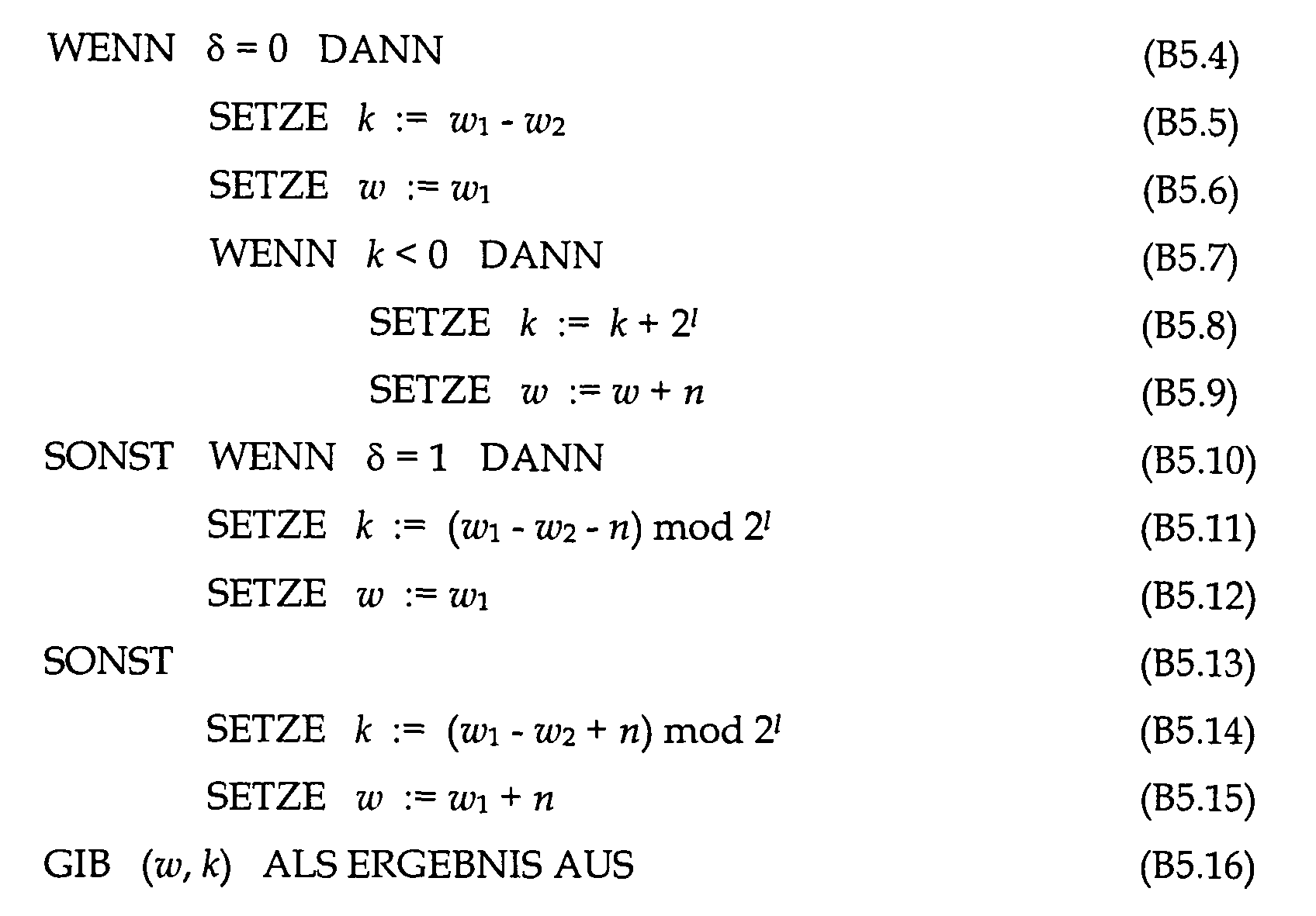
Das Ergebnis (w, k) des Verfahrens gemäß den Schritten (B5.1) - (B5.16) ist XMM l (a, b, n).The result ( w , k ) of the method according to the steps (B5.1) - (B5.16) is XMM I ( a , b, n ).
Es versteht sich, daß in Ausführungsalternativen die Reihenfolge der MM l -Operationen und der weiteren Berechnungsschritte verändert werden kann. In weiteren Ausführungsalternativen ist die Berechnung von XMM l (a, b, n) an einen Koprozessor angepaßt, der nicht genau die MM l -Operation gemäß den Schritten (A1.1) - (A1.4), sondern eine etwas abgewandelte Montgomery-Operation ausführt. Eine solche Anpassung ist auf jeden Fall dann möglich, wenn das Verhalten des Koprozessors hinsichtlich des Werts k' aus Gleichung (A3) bekannt ist.It is understood that in alternative embodiments, the order of the MM l operations and the further calculation steps can be changed. In further alternative embodiments, the calculation of XMM l ( a , b , n ) is adapted to a coprocessor, which is not exactly the MM l operation according to the steps (A1.1) - (A1.4), but a slightly modified Montgomery Operation performs. Such an adaptation is in any case possible if the behavior of the coprocessor with respect to the value k ' from equation (A3) is known.
Um dem Fachmann Abwandlungen und Verbesserungen des Verfahrens gemäß den Schritten (B5.1) - (B5.16) sowie die Anpassung an eine modifizierte MM l -Operation zu ermöglichen, werden im folgenden einige Grundprinzipien dargestellt, auf denen das Verfahren gemäß den Schritten (B5.1) - (B5.16) beruht. In order to allow the person skilled in the art modifications and improvements of the method according to the steps (B5.1) - (B5.16) as well as the adaptation to a modified MM 1 operation, some basic principles are presented below, on which the method according to the steps (FIG. B5.1) - (B5.16).
Für den in Schritt (B5.1) berechneten Wert w 1 gilt gemäß (B2) und (B4)
0 ≤ w 1 < 2 l , und es gibt gemäß (B1) und (B4) eine ganze Zahl k 1 mit -2 l < k 1 < 2 l ,
so daß gilt:
Entsprechend gilt für den in Schritt (B5.2) berechneten Wert w 2 die Ungleichung
0 ≤ w2 < 2 l , und es gibt eine ganze Zahl k 2 mit -2 l < k 2 < 2 l , so daß gilt:
Indem die Gleichung (B7) von der Gleichung (B6) subtrahiert wird, ergibt
sich modulo 2 l die Äquivalenz (k 1 + k 2) · n ≡ 0. Weil n ungerade ist, muß es
eine ganze Zahl δ mit k 1 + k 2 = δ · 2 l geben. Wegen -2 l < k 1 < 2 l und -2 l < k 2 < 2 l
folgt δ ∈ {-1, 0, 1}, so daß der Wert δ schon durch seinen Rest modulo 4 eindeutig
definiert ist. Es gilt ferner:
Durch Einsetzen der Beziehung k 2 = δ · 2 l - k 1 in die Differenz der Gleichungen
(B7) und (B6) ergibt sich ferner:
Aus (B9) läßt sich unter Berücksichtigung der Tatsache, daß n ≡ n -1 (mod 4)
für ungerade n gilt, die folgende Beziehung ableiten:
Der Wert von k 1 folgt nun aus (B9). Aus w 1 und k 1 lassen sich w und k durch
Anwendung der folgenden Äquivalenzen bestimmen, die aus (B1), (B4) und
(B6) abgeleitet sind:
Im Hinblick auf den Wert von w ergibt sich:
In der Fallunterscheidung gemäß den Schritten (B5.4) - (B5.15) werden die Beziehungen (B9) und (B11) - (B13) genutzt, um die Ergebniswerte w und k in den unterschiedlichen Fällen mit möglichst geringem Rechenaufwand zu bestimmen. Insbesondere werden die drei Fälle δ = 0, δ = 1 und δ = -1 unterschieden, um den in der Beziehung (B9) enthaltenen Summanden δ · (2 l - n) möglichst weitgehend auszuwerten. Ferner wird der Zwischenwert k 1 der Beziehung (B9) nicht explizit berechnet, sondern es wird sogleich das Endergebnis k unter Verwendung von (B11) und (B12) bestimmt. Die Beziehung (B13) wird in den Schritten (B5.7) - (B5.9) verwendet. Für δ ≠ 0 erübrigt sich wegen Beziehung (B8) in den Schritten (B5.10) - (B5.15) eine Fallunterscheidung bezüglich des Vorzeichens von k 1.In the case distinction according to the steps (B5.4) - (B5.15), the relationships (B9) and (B11) - (B13) are used to determine the result values w and k in the different cases with the least possible computational effort. In particular, the three cases δ = 0, δ = 1 and δ = -1 are distinguished in order to evaluate as much as possible the summands δ · (2 l - n ) contained in the relationship (B9). Further, the intermediate value k 1 of the relationship (B9) is not explicitly calculated, but the final result k is determined immediately using (B11) and (B12). The relation (B13) is used in the steps (B5.7) - (B5.9). For δ ≠ 0, because of relation (B8) in steps (B5.10) - (B5.15), a case distinction with respect to the sign of k 1 is unnecessary.
Eine vorteilhafte Abwandlung des Verfahrens gemäß den Schritten (B5.1) -
(B5.16) ergibt sich für den Spezialfall w < 2 l . Wie aus (B1) und (B2) folgt, ist
dieser Fall z.B. gegeben, wenn n = 1 ist oder wenn a · b < 2 l gilt. Aus (B11)
folgt dann w 1 = w und k 1 = k, und wegen (B13) ist ein negativer Wert von k
ausgeschlossen. Ferner muß wegen (B8) entweder δ = 0 oder δ = 1 gelten.
Der Wert δ braucht daher nicht wie in (B10) modulo 4 berechnet zu werden,
sondern eine Rechnung modulo 2 genügt. Die Fallunterscheidung der Schritte
(B5.4) - (B5.15) vereinfacht sich dann erheblich. Insgesamt wird das abgewandelte
Verfahren zur Berechnung von XMM l (a, b, n) durch die folgenden
Schritte (B14.1) - (B14.9) definiert. Es seien a, b, n ∈ 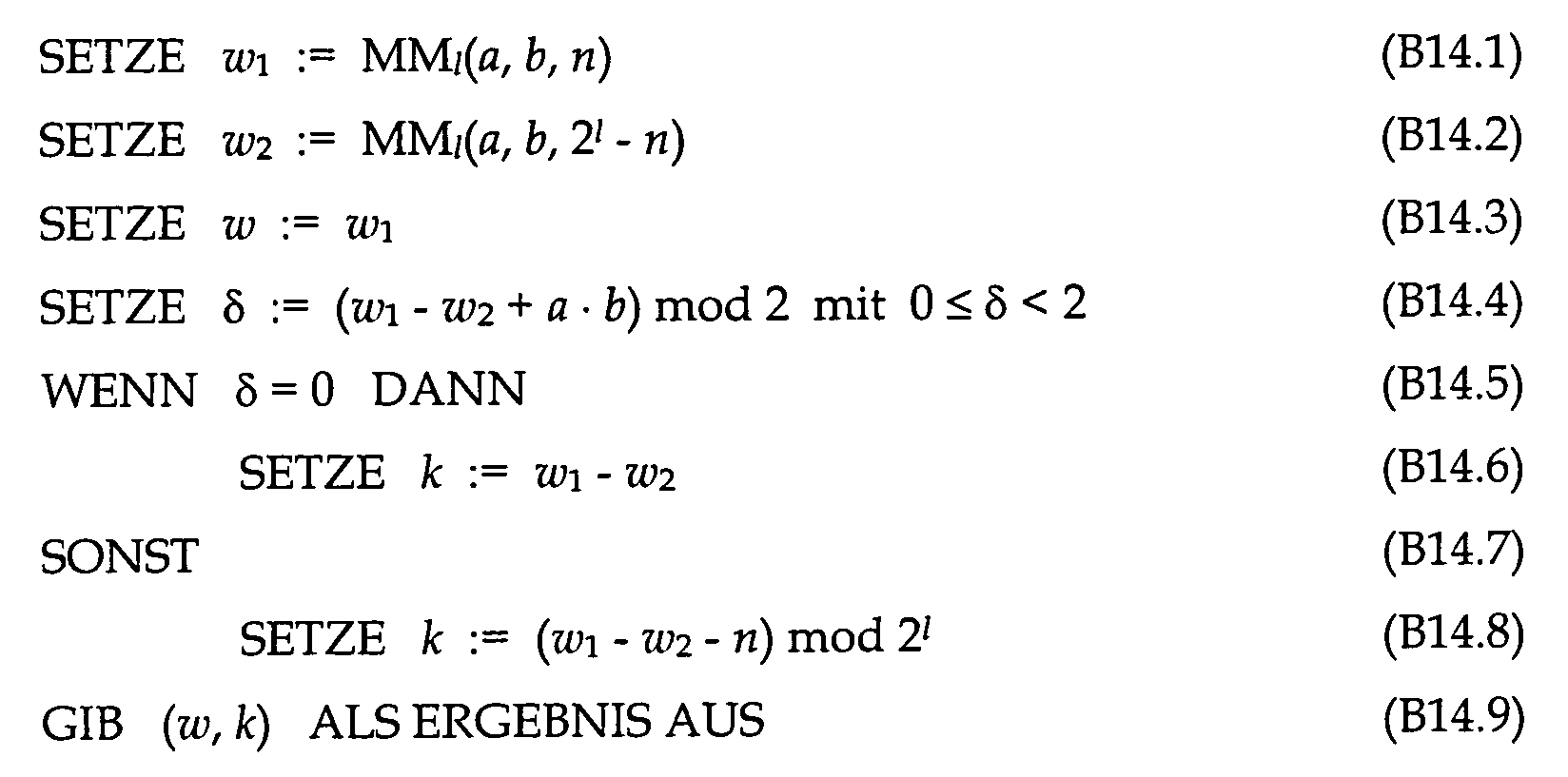
Die XMM l -Operation ist nicht nur als Grundbaustein für die in den folgenden Abschnitten C und D beschriebenen Montgomery-Multiplikationen mit vergrößerter Operandenlänge, sondern auch für andere Anwendungen nützlich. Eine solche Anwendung ist z.B. die Berechnung des "normalen" Produkts a · b zweier Faktoren a, b, die je die Bitlänge l aufweisen. Es wird dazu die Operation XMM l (a, b, 1) ausgeführt; das Ergebnis sei (w, k). Dann gilt nach (B1) a · b = w · 2 l - k, und aus (B2) folgt w < 2 l . Für die XMM l -Operation kann daher sowohl das Verfahren mit den Schritten (B5.1) - (B5.16) als auch das vereinfachte Verfahren mit den Schritten (B14.1) - (B14.9) verwendet werden. Wenn gewünscht, kann die Binärdarstellung von a · b erhalten werden, indem w um l Stellen nach links geschoben und anschließend k vom Ergebnis subtrahiert wird.The XMM l operation is useful not only as a basic building block for the described in the following sections C and D Montgomery multiplications with enlarged operand length, but also for other applications. Such an application is, for example, the calculation of the "normal" product a · b of two factors a , b , which each have the bit length l . The operation XMM l ( a , b , 1) is carried out for this purpose; the result is ( w , k ). Then, according to (B1), a · b = w · 2 l - k , and from (B2) follows w <2 l . For the XMM 1 operation, therefore, both the method with the steps (B5.1) - (B5.16) and the simplified method with the steps (B14.1) - (B14.9) can be used. If desired, the binary representation of a · b can be obtained by shifting w l by 1 digits and then subtracting k from the result.
Ein weiterer Anwendungsfall insbesondere für das vereinfachte Verfahren mit den Schritten (B14.1) - (B14.9) sind Operationen der Form XMM l (a, 1, n). Für das Resultat solcher Operationen gilt ebenfalls w < 2 l , weil aus den Beziehungen w = (a · b + k · n) / 2 l < (2 l + 2 l · n) / 2 l < n + 1 die Ungleichung w ≤ n < 2 l folgt.Another use case in particular for the simplified method with the steps (B14.1) - (B14.9) are operations of the form XMM 1 ( a , 1, n ). For the result of such operations we also have w <2 l , because of the relations w = ( a · b + k · n ) / 2 l <(2 l + 2 l · n ) / 2 l < n + 1 the inequality w ≤ n <2 l follows.
Die oben beschriebenen Verfahren können in leicht abgewandelter Form auch für eine erweiterte Montgomery-Multiplikation mit einer Bitlänge verwendet werden, die nicht genau einer von der Prozessorhardware unterstützten Bitlänge entspricht. Um (w, k) als Ergebnis von XMM l (a, b, n) zu berechnen, wird zunächst die nächstgrößere von der Prozessorhardware unterstützte Bitlänge l + l' mit l' > 0 bestimmt. Die erweiterte Montgomery-Multiplikation XMM l+l' (a · 2 l' , b, n) ergibt dann die Werte (w, k · 2 l') als Ergebnis.The above-described methods may also be used in a slightly modified form for extended Montgomery multiplication with a bit length that does not exactly correspond to a bit length supported by the processor hardware. To calculate ( w , k ) as a result of XMM 1 ( a , b , n ), first the next larger bit length l + 1 ' supported by the processor hardware is determined to be 1' > 0. The extended Montgomery multiplication XMM l + l ' ( a * 2 l' , b , n ) then gives the values ( w , k * 2 l ' ) as a result.
Wie bereits in Abschnitt A erwähnt, ist die von einem Koprozessor ausgeführte Montgomery-Multiplikation meist auf eine vorgegebene Bitlänge l für die Faktoren und den Modul beschränkt. Insbesondere für kryptographische Anwendungen kann aber eine Montgomery-Multiplikation mit größerer Bitlänge L erforderlich sein. Gemäß den im vorliegenden und im nächsten Abschnitt beschriebenen Ausführungsbeispielen der Erfindung wird eine solche Montgomery-Multiplikation mit vergrößerter Bitlänge dadurch bereitgestellt, daß jeweils mehrere erweiterte Montgomery-Multiplikationen der Bitlänge l ausgeführt und deren Ergebnisse geeignet miteinander verknüpft werden. As mentioned in Section A, the Montgomery multiplication performed by a coprocessor is usually limited to a given bit length l for the factors and the modulus. However, in particular for cryptographic applications, a Montgomery multiplication with a larger bit length L may be required. In accordance with the embodiments of the invention described herein and in the next section, such an increased bit length Montgomery multiplication is provided by each executing a plurality of extended Montgomery multiplications of bit length l and combining their results appropriately.
Die Ausführungsbeispiele des vorliegenden Abschnitts C beruhen auf der Grundidee, die Binärdarstellung der beiden Faktoren a und b mit Bitlänge L jeweils in Abschnitten der Bitlänge l zu verarbeiten. Mit anderen Worten wird eine 2 l -adische Darstellung der Operanden, also der Faktoren a und b und des Moduls n, verwendet. Im Ergebnis setzt sich das Verfahren aus einer Multiplikation und einer modularen Reduktion zusammen, wobei diese Vorgänge geeignet ineinander verzahnt werden, um die Anzahl der XMM l -Operationen und den für Zwischenergebnisse benötigten Speicherplatz zu minimieren.The embodiments of the present section C are based on the basic idea to process the binary representation of the two factors a and b with bit length L in each case in sections of the bit length l . In other words, a 2- liter representation of the operands, that is the factors a and b and the modulus n , is used. As a result, the method is composed of a multiplication and a modular reduction, these processes being suitably interlinked in order to minimize the number of XMM 1 operations and the space required for intermediate results.
Das im folgenden beschriebene Ausführungsbeispiel verdoppelt im Ergebnis die Bitlänge der von dem Koprozessor bereitgestellten Montgomery-Multiplikation; es gilt also L = 2l mit l ≥ 2. Die Faktoren a und b sowie der ungerade Modul n, die jeweils die Bitlänge L = 2l aufweisen, werden durch je einen höherwertigen Abschnitt a 1, b 1, n 1 mit l Bits und je einen geringerwertigen Abschnitt a 0, b 0, n 0 mit ebenfalls l Bits dargestellt. Insgesamt gelten also die Beziehungen a = a 1 · 2 l + a 0, b = b 1 · 2 l + b 0, n = n 1 · 2 l + n 0 und 0 ≤ a 1, a 0, b 1, b 0, n 1, n 0 < 2 l sowie n ungerade; letzteres ist gleichbedeutend mit n 0 ungerade.As a result, the embodiment described below doubles the bit length of the Montgomery multiplication provided by the coprocessor; L = 2 l with l ≥ 2. The factors a and b and the odd modulus n , which each have the bit length L = 2 l , are each given by a higher-order section a 1 , b 1 , n 1 with 1 bits and a lower-value portion a 0 , b 0 , n 0 each also represented with l bits. Altogether, therefore, the relationships a = a 1 · 2 l + a 0 , b = b 1 · 2 l + b 0 , n = n 1 · 2 l + n 0 and 0 ≦ a 1 , a 0 , b 1 , b 0 , n 1 , n 0 <2 l and n odd; the latter is equivalent to n 0 odd.
Das Verfahren benötigt sieben XMM l -Operationen und einige weitere Berechnungen.
Die folgenden Schritte werden ausgeführt, wobei die Operanden
der XMM l -Operationen sämtlich nicht-negativ und kleiner als 2 l sind:
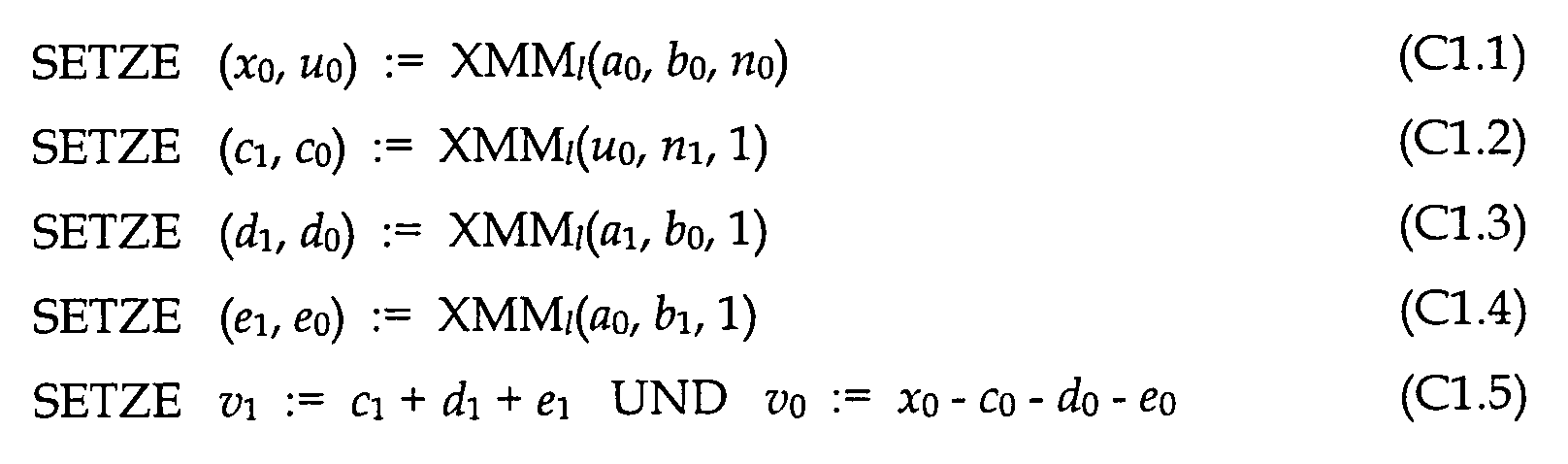
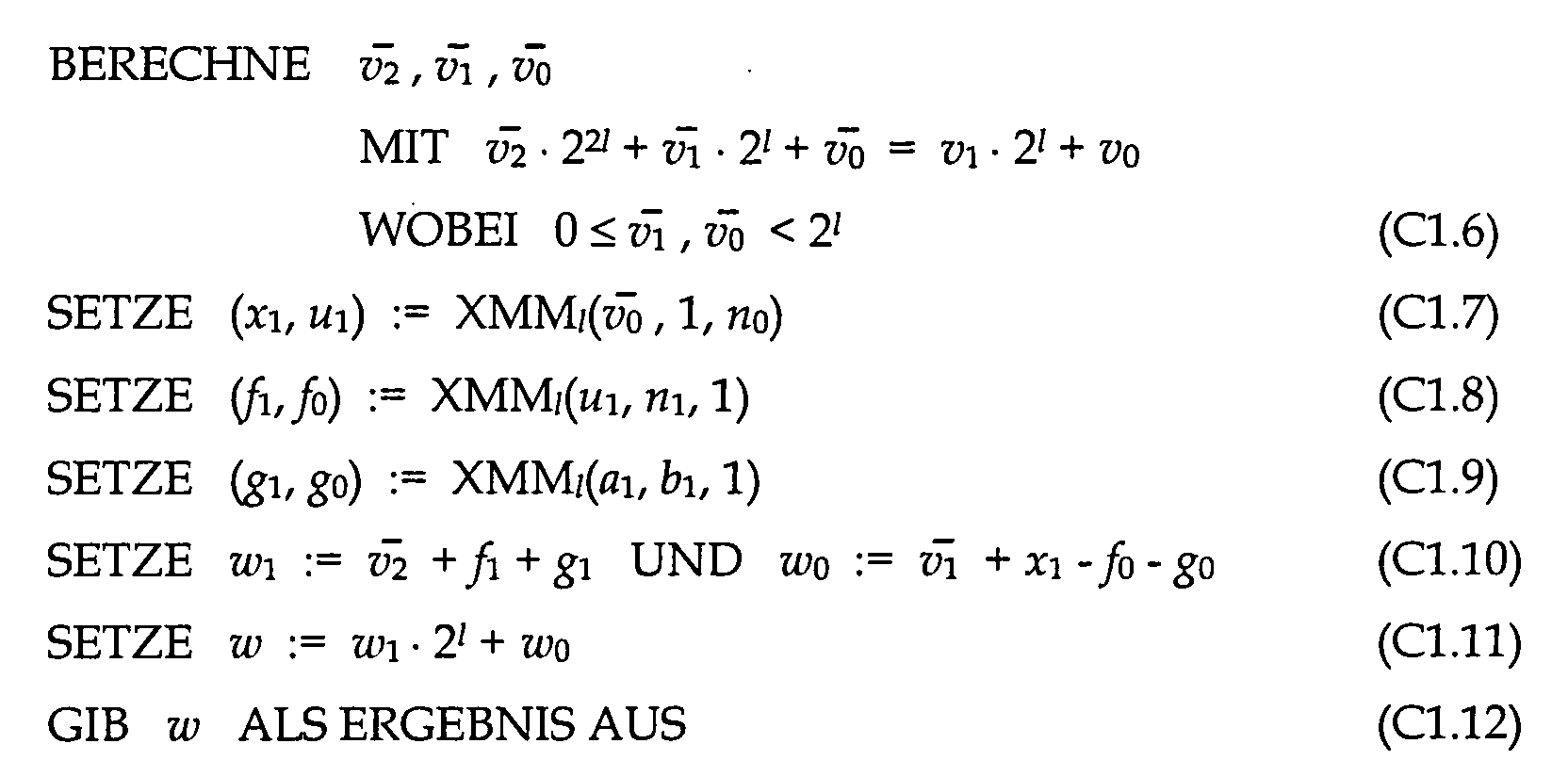
Für das Ergebnis w gilt w ≡ a · b · 2-2l (mod n) mit 0 ≤ w < 22l + n - 1.For the result w , w ≡ a · b · 2 -2 l (mod n ) with 0 ≦ w <2 2 l + n -1.
Nach Schritt (C1.6) ist (
Die Werte
Ebenso wie die Operanden a, b und n liegt auch Ergebnis der Montgomery-Multiplikation nach Schritt (C1.10) in Form eines höherwertigen Abschnitts w 1 und eines geringerwertigen Abschnitts w 0 vor.Like the operands a , b and n , the result of the Montgomery multiplication after step (C1.10) is also in the form of a higher-order section w 1 and a lower-order section w 0 .
Für den in Schritt (C1.12) ausgegebenen Gesamtwert w läßt sich aus der Gleichung (C2) ableiten, daß die Ungleichung 0 ≤ w < 22l + n - 1 gilt, und daß es eine ganze Zahl u mit 0 ≤ u < 22l gibt, so daß w · 22l = a · b + u · n erfüllt ist. Mit anderen Worten gilt w ≡ a ≡ b · 2-2l (mod n), so daß das Verfahren gemäß den Schritten (C1.1) - (C1.12) tatsächlich eine Montgomery-Multiplikation ausführt.For the total value w output in step (C1.12), it can be deduced from the equation (C2) that the inequality 0 ≦ w < 2 2 l + n -1, and that there is an integer u with 0 ≦ u < 2 2 l , so that w · 2 2 l = a · b + u · n is satisfied. In other words, w ≡ a ≡ b · 2 -2 l (mod n ), so that the method of steps (C1.1) - (C1.12) actually performs a Montgomery multiplication.
In einem konkreten Anwendungsbeispiel wird durch das Verfahren gemäß den Schritten (C1.1) - (C1.12) die von dem Koprozessor des Datenträgers vorgegebene Operandenlänge verdoppelt, um beispielsweise ein RSA-Verfahren - z.B. zur Ver- oder Entschlüsselung oder Verifikation oder Signaturerzeugung - mit einer Schlüssellänge von bis zu 2048 Bit unter Verwendung von 1024-Bit-Operationen des Koprozessors auszuführen.In a concrete application example is by the method according to the steps (C1.1) - (C1.12) that of the coprocessor of the disk predefined operand length doubled, for example, an RSA method - e.g. for encryption or decryption or verification or signature generation - with a key length of up to 2048 bits using 1024-bit operations of the coprocessor.
Wenn statt einer Montgomery-Multiplikation eine Montgomery-Quadrierung ausgeführt werden soll, also die Faktoren a und b gleich sind, dann kann in einer Abwandlung des oben beschriebenen Verfahrens einer der Schritte (C1.3) und (C1.4) eingespart werden, weil dann XMM l (a1, b 0 , 1) = XMM l (a 0, b 1, 1) gilt.If instead of a Montgomery multiplication a Montgomery squaring is to be performed, ie the factors a and b are the same, one of the steps (C1.3) and (C1.4) can be saved in a modification of the method described above, because then XMM 1 (a 1 , b 0 , 1) = XMM 1 ( a 0 , b 1 , 1).
Im folgenden werden einige Prinzipien des oben beschriebenen Verfahrens in allgemeinerer Form dargestellt, um es dem Fachmann zu ermöglichen, das Verfahren an geänderte Anforderungen oder Bedingungen - z.B. eine größere gewünschte Bitlänge oder eine geringfügig anders definierte Berechnung der erweiterten Montgomery-Multiplikation - anzupassen. Die folgenden Anmerkungen betreffen wieder die Montgomery-Multiplikation zweier Faktoren a und b bezüglich eines Moduls n, wobei die Bitlänge von a, b und n jeweils durch L beschränkt ist. Das Ergebnis w soll modulo n äquivalent zu a · b · 2-L sein.In the following, some principles of the above-described method will be presented in more general terms to allow those skilled in the art to adapt the method to changing requirements or conditions - eg, a larger desired bit length or a slightly different calculation of extended Montgomery multiplication. The following remarks again relate to the Montgomery multiplication of two factors a and b with respect to a modulus n , where the bit lengths of a, b and n are each limited by L. The result w should be modulo n equivalent to a · b · 2 -L .
Wie bereits erwähnt, liegt den Ausführungsbeispielen des vorliegenden Abschnitts
C eine 2 l -adische Darstellung der Faktoren a und b zugrunde. Mit
anderen Worten werden die Faktoren a und b der Bitlänge L jeweils in m Abschnitte
oder "Stellen" mit je l Bits gegliedert. Diese Bitgruppen werden mit a i
und b i bezeichnet. In Formelschreibweise ergeben sich also für L = m · l die
Beziehungen
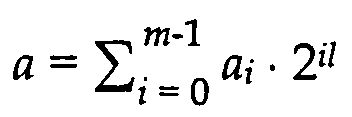

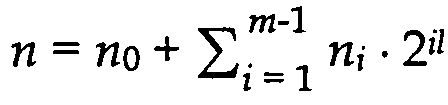
Das Produkt a · b läßt sich somit in üblicher Weise schreiben als:

Während die "Stellen" a i und b i jeweils maximal l Bits lang sind, können die
Zwischenprodukte a j · b k maximal 2l Bit lang sein. Um die Berechnung durch
einen Koprozessor mit einer Registerbreite von l Bits zu ermöglichen, ist
daher vorgesehen, diese Zwischenprodukte wiederum mittels XMM l -Operationen
in je zwei l Bits lange Teilstücke zu zerlegen. Hierzu werden im hier
beschriebenen Ausführungsbeispiel zwei Vorgehensweisen verwendet, nämlich
erstens eine Zerlegung der Form a j · b k = p jk · 2 l + q jk und zweitens eine
Zerlegung der Form a j · b k = p
Die erstgenannte Zerlegung ergibt sich durch Anwendung von XMM l (a j , b k , 1); diese Zerlegung wird im hier beschriebenen Ausführungsbeispiel immer dann verwendet, wenn j ≠ 0 oder k ≠ 0 gilt. Die zweitgenannte Zerlegung ergibt sich durch Anwendung von XMM l (a j , b k , n 0); diese Zerlegung wird im vorliegenden Ausführungsbeispiel für j = k = 0 verwendet.The first decomposition results from the application of XMM 1 ( a j , b k , 1); this decomposition is always used in the exemplary embodiment described here if j ≠ 0 or k ≠ 0. The second decomposition results from the use of XMM 1 ( a j , b k , n 0 ); this decomposition is used in the present embodiment for j = k = 0.
In dem Ausführungsbeispiel des Verfahrens gemäß den Schritten (C1.1) -
(C1.12) gilt m = 2. Hier erfolgt die Berechnung der vier Zwischenprodukte
gemäß der Gleichung (C3) mit den gerade genannten Zerlegungen in den
Schritten (C1.1), (C1.3), (C1.4) und (C1.9). Für die in diesen Schritten berechneten
Werte gilt insgesamt die Gleichung:
Das gemäß (C4) in Form von Koeffizienten der Bitlänge l ausgedrückte Produkt a · b ist nun noch in modular reduzierter Form darzustellen. Die Grundidee für diese modulare Reduktion ist es, geeignete Vielfache des Moduls n "von rechts" zu subtrahieren. Mit jedem Reduktionsschritt verkürzt sich die effektive Stellenanzahl des Produkts um eine Stelle. Hierunter ist zu verstehen, daß nach jedem Reduktionsschritt beide Seiten der sich jeweils ergebenden Gleichung mit 2-l multipliziert werden können, so daß sich nach m Schritten eine Gleichung der Form a · b · 2-ml = w ergibt, wobei w die Bitlänge m · l, also die "Stellenanzahl" m, aufweist.The product a · b expressed in terms of coefficients of the bit length l according to (C4) is now to be represented in a modularly reduced form. The basic idea for this modular reduction is to subtract appropriate multiples of the modulus n "from the right". With each reduction step, the effective number of digits of the product is shortened by one digit. This means that after each reduction step both sides of the respectively resulting equation can be multiplied by 2 - l , so that after m steps an equation of the form a * b * 2 - ml = w results, where w is the bit length m · L , that is the "number of digits" m .
Dieser Reduktionsvorgang wird nun am Beispiel m = 2 veranschaulicht. Hier umfaßt jeder Reduktionsschritt im vorliegenden Ausführungsbeispiel das Ersetzen eines Ausdrucks der Form u i · n 0 durch einen Ausdruck, der ein Vielfaches von n enthält und dessen Koeffizienten durch eine Anwendung von XMM l (u i, n 1, 1) berechenbar sind.This reduction process will now be illustrated using the example m = 2. Here, each reduction step in the present embodiment includes replacing an expression of the form u i * n 0 with an expression containing a multiple of n and whose coefficients are computable by an application of XMM 1 ( u i , n 1 , 1).
Im ersten Reduktionsschritt wird die gerade genannte Grundidee genutzt,
indem die folgende Beziehung, die sich für XMM l (u 0, n 1, 1) = (c 1, c 0) aus Definition
(B1) unter Verwendung der Gleichung n = n 1 · 2 l + n 0 ergibt, verwendet
wird:
Die Bestimmung der Koeffizienten c 1 und c 0 erfolgt in Schritt (C1.2) des oben
beschriebenen Verfahrens. Einsetzen von (C5) in die Gleichung (C4) ergibt:
Bei der hier erfolgenden Betrachtung modulo n kann der Summand u 0 · n
weggelassen werden. Ferner werden, wie in Schritt (C1.5) des Verfahrens,
die Terme c 1 + d 1 + e 1 bzw. x 0 - c 0 - d 0 - e 0 durch v 1 bzw. v 0 ersetzt. Insgesamt
ergibt sich:
In Schritt (C1.6) des Verfahrens erfolgt nun noch eine Übertragsberechnung,
um Koeffizienten
Um wieder ein Polynom zu erhalten, dessen geringstwertiger Koeffizient ein
Vielfaches von n 0 aufweist, wird die folgende Beziehung angewendet, die für
XMM l (
Die Werte von x 1 und u 1 werden in Schritt (C1.7) des Verfahrens berechnet.
Insgesamt ergibt sich durch Einsetzen von (C9) in (C8) die Gleichung:
Der erste Reduktionsschritt ist damit beendet. Die effektive Stellenanzahl des
Produkts wurde durch diesen Schritt um eine 2 l -adische Stelle reduziert, wie
aus der folgenden aus (C10) abgeleiteten Schreibweise deutlich wird:
Insgesamt ist somit durch zwei XMM l -Operationen und einige zusätzliche
Berechnungen der Grad des Polynoms in 2 l auf der rechten Seite der Gleichung
(C11) gegenüber den Gleichungen (C6) - (C8) um 1 reduziert worden.
Allgemein läßt sich im Fall·m > 2 der Grad der entsprechenden Polynome
durch m XMM l -Operationen um 1 und durch (m-1) · m XMM l -Operationen
um m-1 reduzieren. Es ergibt sich dadurch eine Äquivalenz der Form:
Es ist nun noch ein abschließender Reduktionsschritt erforderlich, der analog
zu den Schritten (C5) - (C7) ausgeführt wird. Um das Beispiel für den Spezialfall
m = 2 fortzusetzen, soll der Term u 1 · n 0 in Gleichung (C11) durch
einen Ausdruck, der ein Vielfaches von n aufweist, ersetzt werden. Dazu
wird die folgende Beziehung, die sich für XMM l (u 1, n 1, 1) aus Definition (B1)
ergibt, verwendet:
Die Werte f 1 und f 0 werden in Schritt (C1.8) des Verfahrens berechnet. Aus
(C11) und (C13) ergibt sich:
Wegen der Rechnung modulo n kann der Summand u 1 · n weggelassen werden.
Mit der Benennung der Koeffizienten
Damit ist der letzte Reduktionsschritt mit einer einzigen XMM l -Operation abgeschlossen. Allgemein werden für die bitabschnittsweisen Multiplikationen m 2 XMM l -Operationen benötigt, für die ersten m-1 Reduktionsschritte werden (m-1) · m XMM l -Operationen benötigt, und für den abschließenden Reduktionsschritt werden m-1 XMM l -Operationen benötigt. In der Summe ergeben sich somit 2m 2-1 XMM l -Operationen für eine Montgomery-Multiplikation mit m-facher Bitlänge.This concludes the final reduction step with a single XMM l operation. In general, m 2 XMM 1 operations are required for the bit segment multiplications, ( m -1) * m XMM 1 operations are required for the first m -1 reduction steps, and m -1 XMM 1 operations are required for the final reduction step. In sum, 2 m 2 -1 XMM l operations result in a Montgomery multiplication with an m-bit length.
Der vorliegende Abschnitt D betrifft wie der vorhergehende Abschnitt C Verfahren zum Durchführen von Montgomery-Multiplikationen, deren Faktoren a, b und Modul n eine große Bitlänge L aufweisen. Wieder wird die Berechnung auf mehrere erweiterte Montgomery-Multiplikationen mit geringerer Bitlänge l abgestützt. Die vorliegend beschriebenen Verfahren beruhen jedoch auf einer Repräsentation der Operanden, die von der 2 l -adischen Darstellung gemäß Abschnitt C abweicht.The present section D, like the preceding section C, relates to methods for performing Montgomery multiplications whose factors a, b and modulus n have a large bit length L. Again the calculation is based on several extended Montgomery multiplications with lesser bit length l . However, the methods described herein are based on a representation of the operands that differs from the 2- liter representation in Section C.
Für die beiden Faktoren a und b wird eine Stellenwertdarstellung verwendet,
bei der sich die Gewichte von Stelle zu Stelle um den Faktor 2 l /n 0 unterscheiden,
wobei n 0 eine ungerade, von einer angenäherten m-ten Wurzel des Moduls
n oder des negativen Moduls -n abhängige Zahl ist. In Formelschreibweise
gilt:

Für den Spezialfall m = 2 vereinfachen sich die obigen Gleichungen (D1) zu a ≡ a 0 · 2 l + a 1 · n 0 (mod n) beziehungsweise b ≡ b 0 · 2 l + b 1 · n 0 (mod n).For the special case m = 2, the above equations (D1) simplify to a ≡ a 0 · 2 l + a 1 · n 0 (mod n ) or b ≡ b 0 · 2 l + b 1 · n 0 (mod n ) ,
Im folgenden wird auch die Schreibweise µn 0,l(x 0, x 1) für x 0 · 2 l + x 1 · n 0 verwendet. Für den Fall m = 2 werden die Faktoren a und b damit durch je ein Paar (a 0, a 1), (b 0, b 1) mit µn 0,l (a 0, a 1) ≡ a (mod n) und µn 0,l (b 0 , b 1) ≡ b (mod n) repräsentiert. Den hier beschriebenen Verfahren liegt die Tatsache zugrunde, daß (c 0, c 1) = XMM l (a, b, n 0) äquivalent zu µ n0,l (c 0, -c 1) = a · b ist.In the following, the notation μ n 0 , l ( x 0 , x 1 ) for x 0 · 2 l + x 1 · n 0 is also used. For the case m = 2, the factors a and b are replaced by a pair ( a 0 , a 1 ), ( b 0 , b 1 ) with μ n 0, l ( a 0 , a 1 ) ≡ a (mod n ) and μ n 0, l ( b 0 , b 1 ) ≡ b (mod n ). The method described here is based on the fact that ( c 0 , c 1 ) = XMM 1 ( a , b , n 0 ) is equivalent to μ n 0, l ( c 0 , -c 1 ) = a · b .
Für den Modul n wird im vorliegenden Abschnitt D die folgende Darstellung
genutzt, die an die Darstellung des Moduls n gemäß Abschnitt C angelehnt
ist:

Wieder unterscheiden sich die Stellengewichte für den Bereich i = 2, ..., m jeweils um den Faktor 2 l /n 0, und es ist ±n 0 m als zusätzlicher Summand vorgesehen. Das Vorzeichen von n 0 m kann in einigen Ausgestaltungen positiv, in anderen dagegen negativ sein. In der folgenden Beschreibung wird ein negatives Vorzeichen gewählt, weil damit einige technische Probleme vermieden werden.Again, the position weights for the range i = 2, ..., m each differ by a factor of 2 l / n 0 , and ± n 0 m is provided as an additional summand. The sign of n 0 m may be positive in some embodiments but negative in others. In the following description, a negative sign is chosen because it avoids some technical problems.
Im folgenden wird der Spezialfall m = 2 mit dem Summanden -n 0 m betrachtet. Die Gleichung (D2) vereinfacht sich damit zu n = -n 0 2 + u · 2 l wobei der Koeffizient u 2 aus Gleichung (D2) hier der Einfachheit halber als u geschrieben wird. Um zu einem gegebenen Modul n die Werte n 0 und u zu ermitteln, wird n 0 als Quadratwurzel von -n modulo 2 l für ein l berechnet, das ungefähr die halbe Bitlänge von n aufweist. Eine solche Quadratwurzel existiert nur für n ≡ -1 (mod 8). Falls diese Bedingung nicht erfüllt ist, wird n durch 3n oder 5n oder 7n ersetzt.In the following the special case m = 2 with the summand - n 0 m is considered. The equation (D2) is thus simplified to n = - n 0 2 + u · 2 l where the coefficient u 2 from equation (D2) is written here as u for the sake of simplicity. To find the values n 0 and u for a given modulus n , calculate n 0 as the square root of - n modulo 2 l for a 1 that is approximately half the length of n . Such a square root exists only for n ≡ -1 (mod 8). If this condition is not met, n is replaced by 3 n or 5 n or 7 n .
Im vorliegenden Ausführungsbeispiel wird aus technischen Gründen eine Wurzel - hier für m = 2 die Quadratwurzel - des negativen Moduls -n verwendet, während in Ausführungsalternativen - bei geeigneter Anpassung des restlichen Verfahrens - auch eine Wurzel des Moduls n zur Berechnung von n 0 herangezogen werden kann.Can also be a root of the modulus n for the calculation of n is 0 used - in the present embodiment is for technical reasons a root - here for m = 2, the square root of - the negative module - used n, while in alternative embodiments - with suitable adaptation of the remainder of the process ,
Liegt der Modul n mit n ≡ -1 (mod 8) vor, wird die Bitlänge l durch die folgende
Beziehung festgelegt:
Im folgenden wird l ≥ 3 vorausgesetzt. Es wird nun eine natürliche Zahl n 0
berechnet, die die folgenden Bedingungen erfüllt:
Zur Berechnung eines geeigneten n 0 wird im vorliegenden Ausführungsbeispiel
das folgende Verfahren verwendet, das für ein l mit l ≥ 3 und eine
ganze Zahl A mit A ≡ 1 (mod 8) eine hinreichend kleine Quadratwurzel
von A und das Inverse Y von X bestimmt:
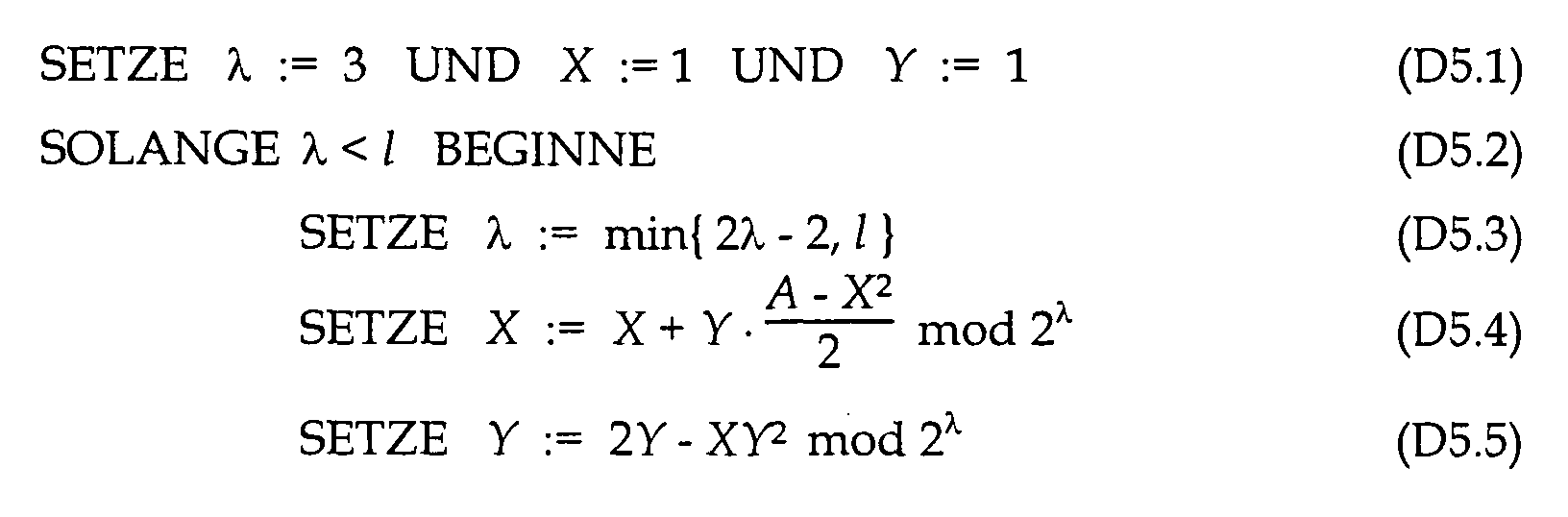

Für die Ergebniswerte X und Y gelten nach der Ausführung dieses Verfahrens
die folgenden Beziehungen:
Die Gültigkeit der Beziehungen (D6) ergibt sich aus der Beobachtung, daß nach jedem Schleifendurchlauf in den Schritten (D5.2) - (D5.5) die Beziehungen X2 ≡ A (mod 2λ) und X · Y ≡ 1 (mod 2λ) gelten. Nach Beendigung der Schleife gelten somit X 2 ≡ A (mod 2 l ) und X · Y ≡ 1 (mod 2 l ), und diese Äquivalenzen werden durch die Schritte (D5.6) - (D5.9) nicht beeinflußt.The validity of the relations (D6) results from the observation that after each loop through the steps (D5.2) - (D5.5) the relations X 2 ≡ A (mod 2 λ ) and X · Y ≡ 1 (mod 2 λ ) apply. Thus, after termination of the loop, X 2 ≡ A (mod 2 l ) and X · Y ≡ 1 (mod 2 l ), and these equivalences are unaffected by steps (D5.6) - (D5.9).
Insgesamt läßt sich somit durch die Schritte (D5.1) - (D5.10) die für die
Aufteilung des Moduls n benötigte 2-adische Quadratwurzel n 0 berechnen,
indem l gemäß der Ungleichung (D3) bestimmt wird und A auf -n gesetzt
wird. Der Ergebniswert X ist die gewünschte Quadratwurzel n 0. Der für die
Aufteilung des Moduls n ebenfalls benötigte Parameter u ergibt sich aus der
Gleichung u = (n 0 2 + n) · 2-l . Für die so berechneten Werte n 0 und u gilt dann:

Das Verfahren gemäß den Schritten (D5.1) - (D5.10) läßt sich als 2-adische Newton-Iteration charakterisieren. Hierbei ist unter "2-adisch" grob gesagt zu verstehen, daß die Bits von "rechts nach links" abgearbeitet werden, statt wie bei der normalen Newton-Iteration die Genauigkeit schrittweise durch Abarbeiten der Ziffern von "links nach rechts" zu erhöhen. In diesem Zusammenhang ist das aus der Zahlentheorie an sich bekannte Hensel'sche Lemma einschlägig.The process according to the steps (D5.1) - (D5.10) can be described as 2-adic Characterize Newton iteration. This is roughly stated under "2-adic" to understand that the bits are being processed from "right to left" instead as in the normal Newton iteration, the accuracy gradually through To increase the number of digits from "left to right". In this context is Hensel's lemma, which is known per se from number theory relevant.
Für den Fall m > 2 ist n 0 als eine m-te Wurzel von n modulo 2 l oder als eine m-te Wurzel von -n modulo 2 l zu berechnen.For the case m > 2, n 0 is to be calculated as a m -th root of n modulo 2 l or as an m- th root of - n modulo 2 l .
Wie bereits erwähnt, werden im vorliegenden Ausführungsbeispiel für m = 2
auch die Faktoren a und b in je ein Wertepaar (a 0, a 1), (b 0 , b1) mit µn0,l(a 0, a 1) ≡ a
(mod n) und µn0,l(b 0, b 1) ≡ b (mod n) aufgeteilt. Die Berechnung von a 0, a 1 erfolgt
durch Anwendung der folgenden Beziehungen:
Der Wert n 0 -1 mod 2 l ist bei der Aufteilung von n in den Schritten (D5.1) - (D5.10) als "Nebenprodukt", nämlich als Ergebniswert Y, berechnet worden. Die Koeffizienten b 0 und b 1 werden entsprechend berechnet.The value n 0 -1 mod 2 l has been calculated by dividing n in steps (D5.1) - (D5.10) as a "by-product", namely as the result value Y. The coefficients b 0 and b 1 are calculated accordingly.
Die gemäß (D8) berechneten Koeffizienten a 1 und b 1 können möglicherweise negativ sein. Die mit diesen Koeffizienten noch auszuführenden XMM l -Operationen sind jedoch nur für positive Argumente definiert, so daß eine mit der µ-Darstellung verträgliche Reduktion der Koeffizienten auf den zulässigen Wertebereich 0, ..., 2 l -1 erforderlich ist.The coefficients a 1 and b 1 calculated according to (D8) may possibly be negative. However, the XMM 1 operations still to be performed with these coefficients are only defined for positive arguments, so that a reduction of the coefficients compatible with the μ representation to the permissible value range 0,..., 2 l -1 is required.
Das im folgenden beschriebene Verfahren ist für alle Bitlängen l und Werte
u, n 0 ∈ 


Die Korrektheit des Verfahrens ergibt sich aus der Tatsache, daß keine der
Zuweisungen in den Schritten (D9.3), (D9.4), (D9.7) und (D9.8) den Wert
µ n
Das Verfahren gemäß den Schritten (D9.1) - (D9.9) wird sowohl auf die Koeffizienten
(a 0 , a 1) als auch auf die Koeffizienten (b 0, b 1) angewendet, wobei l,
u und n 0 gemäß (D3) und (D7) verwendet werden. Mit diesen Parameterwerten
sind die für das Verfahren vorausgesetzten Vorbedingungen erfüllt.
Nach der Reduktion gelten die Beziehungen µ n
Das folgende Verfahren führt eine Montgomery-Multiplikation für Faktoren
a, b der Bitlänge L und einen vorgegebenen Modul n der Bitlänge L aus. Das
Verfahren setzt vorberechnete Werte l, u, n 0 ∈ 
Im vorliegenden Ausführungsbeispiel werden diese Werte durch die bereits beschriebenen Schritte berechnet, und zwar wird die Bitlänge l gemäß Beziehung (D3) festgelegt, n 0 wird durch die Schritte (D5.1) - (D5.10) berechnet, u wird durch Beziehung (D7) bestimmt, und a 0, a 1 bzw. b 0, b 1 werden gemäß Beziehung (D8) sowie durch je einen Reduktionsvorgang mit den Schritten (D9.1) - (D9.9) berechnet.In the present embodiment, these values are calculated by the above-described steps, namely, the bit length is l in accordance with relationship (D3) defined, n is 0 through the steps (D5.1) - calculated (D5.10) u by relation ( D7), and a 0 , a 1 or b 0 , b 1 are calculated according to relationship (D8) as well as by a respective reduction process with the steps (D9.1) - (D9.9).
Das Multiplikationsverfahren berechnet Ergebniswerte (c 0, c 1) ∈ 
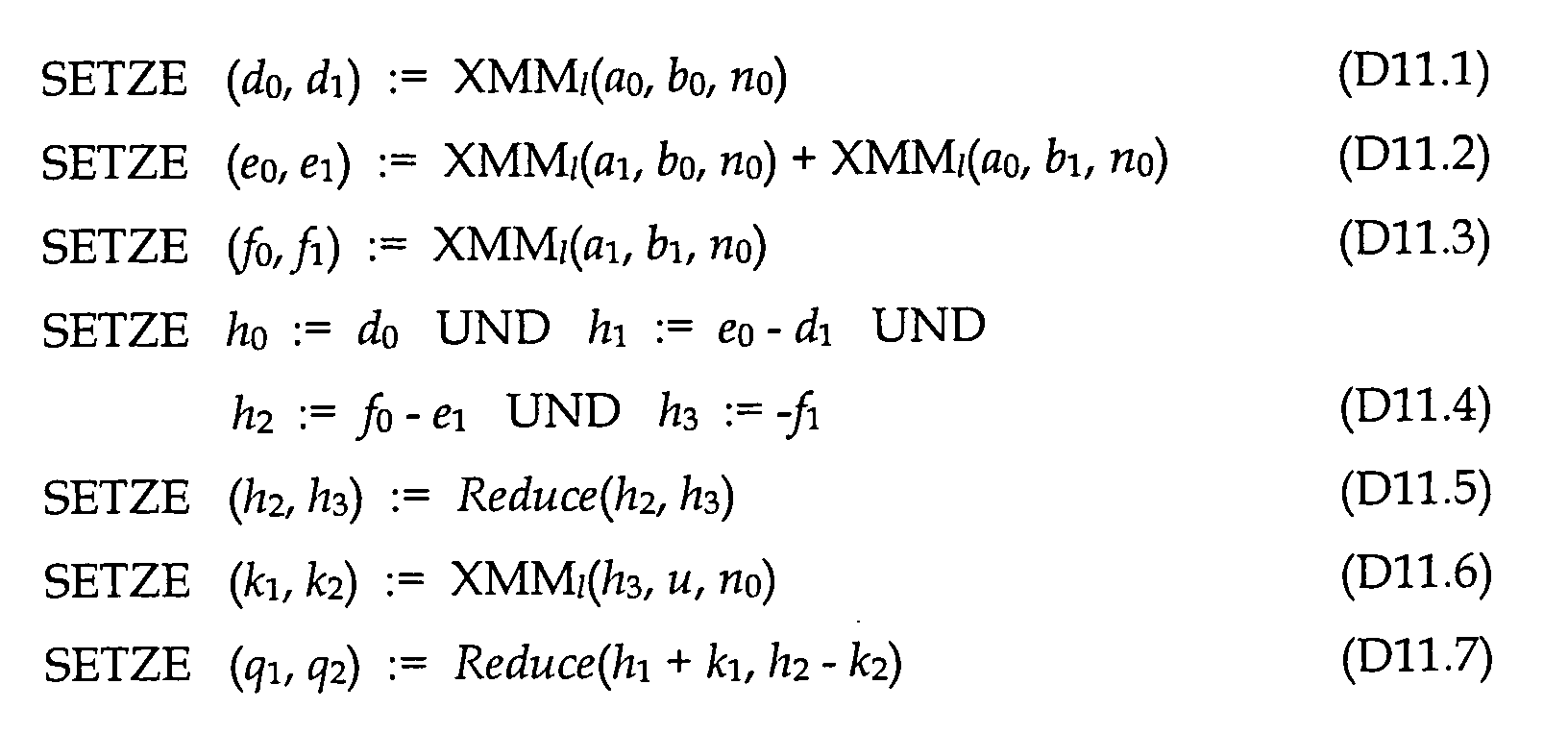

Die Addition von Tupeln in Schritt (D11.2) wird komponentenweise ausgeführt. Die in den Schritten (D11.5), (D11.7) und (D11.9) genannte Operation Reduce ist die mit der µ-Darstellung verträgliche Reduktion modulo n, die z.B. durch das Verfahren gemäß den Schritten (D9.1) - (D9.9) erfolgen kann.The addition of tuples in step (D11.2) is performed component by component. The operation Reduce mentioned in the steps (D11.5), (D11.7) and (D11.9) is the reduction modulo n compatible with the μ-representation, which is achieved, for example, by the method according to the steps (D9.1). (D9.9).
Auch das Verfahren gemäß den Schritten (D11.1) - (D11.10) weist einen
Multiplikationsteil und einen Reduktionsteil auf. Die Multiplikation findet in
den Schritten (D11.1) - (D11.3) statt. Ähnlich wie bei dem in Abschnitt C beschriebenen
Verfahren werden die Zwischenprodukte durch Anwendung
von XMM l (a j , b k , n 0) in je zwei l Bits lange Teilkoeffizienten zerlegt. Im allgemeinen
Fall m ≥ 2 hat diese Zerlegung die folgende Form, wobei negative
Werte für
Im Gegensatz zu dem Verfahren gemäß Abschnitt C ist bei dem vorliegenden Verfahren keine Fallunterscheidung hinsichtlich des verwendeten Zerlegungsverfahrens erforderlich, sondern es wird stets die Aufspaltung gemäß (D12) verwendet. Diese gesteigerte Homogenität hat den Vorteil, daß in Ausführungsalternativen effizientere Multiplikationstechniken verwendet werden können. Beispielsweise werden in einer unten noch genauer zu beschreibenden Variante XMM l -Operationen eingespart, indem eine unter dem Namen Karatsuba-Multiplikation an sich bekannte Technik angewendet wird. In contrast to the method according to Section C, in the present method no case distinction is required with regard to the decomposition method used, but the splitting according to (D12) is always used. This increased homogeneity has the advantage that, in alternative embodiments, more efficient multiplication techniques can be used. For example, be saved in a greater detail below, to be described variant XMM l operations by one under the name Karatsuba multiplication is applied in a known technology.
Allgemein läßt sich der Multiplikationsteil des Verfahrens in der folgenden,
an (C3) angelehnten Darstellung ausdrücken, wobei 
Im folgenden soll wieder der Spezialfall m = 2 gemäß dem Verfahren (D11.1)
- (D11.10) behandelt werden. Nach Schritt (D11.4) ist die durch Gleichung
(D13) angegebene Belegung der Koeffizienten h i erreicht, die ausgeschrieben
durch die folgende Formel ausgedrückt wird:
Die Anwendung der Funktion Reduce auf ein Paar (h i , h i+1) verändert dessen Summe modulo n nicht.Applying the function Reduce to a pair ( h i , h i +1 ) does not change its sum modulo n .
Es wird nun der führende Term von (D14) eliminiert. Hierzu wird die Beziehung
h 3 · n 0 2 ≡ k 1 · 22l - k 2 · n 0 · 2 l (mod n) verwendet, die sich aus (D7),
einer Reduktion modulo n sowie (B1) für XMM l(h 3, u, n 0) ergibt. Nach dem
Reduktionsschritt (D11.7) gilt dann:
Auf ähnliche Weise wird in einem weiteren Reduktionsschritt der führende
Term von (D15) eliminiert, indem die Beziehung q 2 · n 0 2 ≡ m 0 · 22l - m 1 · n 0 · 2 l
(mod n) angewendet wird. Zur Bestimmung der Koeffizienten m 0 und m 1
wird in Schritt (D11.8) die Operation XMM l (q 2, u, n 0) ausgeführt. Nach der
Reduktion in Schritt (D11.9) ergibt sich dann:
Das Verfahren gemäß den Schritten (D11.1) - (D11.10) benötigt für den Multiplikationsteil vier und für den Reduktionsteil zwei XMM;-Operationen. Wie bereits erwähnt, läßt sich die Anzahl der XMM l -Operationen für den Multiplikationsteil auf drei verringern, indem statt der "schulmäßigen" Multiplikation gemäß (D13) eine Karatsuba-Multiplikation ausgeführt wird, die z.B. aus dem Artikel "Multiplication of multidigit numbers on automata" von A. Karatsuba und Yu. Ofman, Soviet Physics - Dokladay, 7,1963, Seiten 595 - 596, an sich bekannt ist.The method according to the steps (D11.1) - (D11.10) requires four multiplication parts and two XMM; operations for the reduction part. As already mentioned, the number of XMM l operations for the multiplication part can be reduced to three by executing a Karatsuba multiplication instead of the "schoollike" multiplication according to (D13), eg from the article "Multiplication of multidigit numbers on automata " by A. Karatsuba and Yu. Ofman, Soviet Physics - Dokladay, 7, 1963, pages 595-596, is known per se.
In einer Ausgestaltung, die die Karatsuba-Multiplikation verwendet, wird
Schritt (D11.3) des oben beschriebenen Verfahrens vorgezogen, und Schritt
(D11.2) wird durch die folgende Berechnung und Zuweisung ersetzt:
Hierbei gilt die Definition XMM l (-x, y, n 0) = XMM l (x, -y, n 0) = -XMM l (x(, y, n 0) für positive Zahlen x und y. In dieser Ausgestaltung wird somit eine XMM l -Operation gespart, so daß sich eine Montgomery-Multiplikation mit verdoppelter Bitlänge auf fünf erweiterte Montgomery-Multiplikationen mit einfacher Bitlänge abstützen läßt. Allgemein beträgt für m = 2α der Rechenaufwand für den durch das Karatsuba-Verfahren ausgeführten Multiplikationsteil 3α statt sonst 4α XMM l -Operationen.Here, the definition applies XMM l (- x, y, n 0) = XMM l (x, - y, n 0) = -XMM l (x (, y, n 0) for positive numbers X and Y in this embodiment. Thus, an XMM 1 operation is saved, so that a Montgomery multiplication with doubled bit length can be based on five extended Montgomery multiplications with single bit length In general, for m = 2 α, the computational effort for the multiplication part 3 carried out by the Karatsuba method is 3 α instead of otherwise 4 α XMM l operations.
Schon das Verfahren gemäß den Schritten (D11.1) - (D11.10) spart gegenüber den in Abschnitt C beschriebenen Verfahren XMM l -Operationen ein, und diese Einsparung läßt sich durch die gerade beschriebene Ausführungsalternative weiter steigern. Die geringere Anzahl von XMM l -Operationen wird jedoch durch zusätzliche Nebenrechnungen erkauft, insbesondere durch die Berechnungen, die erforderlich sind, um aus der üblichen Binärdarstellung von a und b die Darstellung mit Koeffizienten a 0, a 1, b 0, b 1 gemäß (D8) zu berechnen. Je nach der Prozessorumgebung, in der die Montgomery-Multiplikation mit erweiterter Bitlänge ausgeführt werden soll, kann es daher geraten sein, entweder ein Verfahren gemäß Abschnitt C oder eines der im vorliegenden Abschnitt D beschriebenen Verfahren einzusetzen.Even the method according to the steps (D11.1) - (D11.10) saves XMM 1 operations compared to the methods described in section C, and this saving can be further increased by the alternative embodiment just described. However, the smaller number of XMM 1 operations is paid for by additional ancillary calculations, in particular by the calculations required to convert from the usual binary representation of a and b the representation with coefficients a 0 , a 1 , b 0 , b 1 according to ( D8). Depending on the processor environment in which the extended bit length Montgomery multiplication is to be performed, it may therefore be advisable to use either a method in accordance with Section C or one of the methods described in this Section D.
Es versteht sich, daß die in der obigen Beschreibung von Ausführungsbeispielen enthaltenen Einzelheiten nicht als Einschränkungen des Schutzbereichs der Erfindung aufgefaßt werden sollen. Viele Abwandlungen und weitere Ausführungsalternativen sind möglich und für den Fachmann offensichtlich. So können z.B. die oben aufgeführten Rechenschritte umgeordnet werden oder ganz oder teilweise parallel oder ganz oder teilweise ineinander verzahnt (interleaved) ausgeführt werden. Der Schutzbereich der Erfindung soll daher nicht durch die obigen Ausführungsbeispiele, sondern durch die folgenden Ansprüche bestimmt werden.It should be understood that the details contained in the above description of embodiments should not be construed as limitations on the scope of the invention. Many modifications and other alternative embodiments are possible and obvious to those skilled in the art. Thus, for example, the computation steps listed above can be rearranged or completely or partially executed in parallel or completely or partially interlocked ( interleaved ). The scope of the invention should therefore be determined not by the above embodiments, but by the following claims.
Claims (26)



Applications Claiming Priority (2)
| Application Number | Priority Date | Filing Date | Title |
|---|---|---|---|
| DE10355642A DE10355642A1 (en) | 2003-11-28 | 2003-11-28 | Extended Montgomery multiplication and Montgomery multiplication with increased operand length |
| DE10355642 | 2003-11-28 |
Publications (3)
| Publication Number | Publication Date |
|---|---|
| EP1536320A2 true EP1536320A2 (en) | 2005-06-01 |
| EP1536320A3 EP1536320A3 (en) | 2006-05-24 |
| EP1536320B1 EP1536320B1 (en) | 2010-09-01 |
Family
ID=34442324
Family Applications (1)
| Application Number | Title | Priority Date | Filing Date |
|---|---|---|---|
| EP04027833A Expired - Lifetime EP1536320B1 (en) | 2003-11-28 | 2004-11-24 | Montgomery multiplication with longer operand length |
Country Status (3)
| Country | Link |
|---|---|
| EP (1) | EP1536320B1 (en) |
| AT (1) | ATE479935T1 (en) |
| DE (2) | DE10355642A1 (en) |
Cited By (2)
| Publication number | Priority date | Publication date | Assignee | Title |
|---|---|---|---|---|
| CN115276960A (en) * | 2022-08-02 | 2022-11-01 | 山东大学 | Device and method for realizing fast modular inversion chip on SM2 Montgomery domain |
| CN120179209A (en) * | 2023-12-19 | 2025-06-20 | 珠海一微半导体股份有限公司 | A high-radix Montgomery modular multiplication circuit and parallel operation method thereof |
Family Cites Families (3)
| Publication number | Priority date | Publication date | Assignee | Title |
|---|---|---|---|---|
| US4405829A (en) * | 1977-12-14 | 1983-09-20 | Massachusetts Institute Of Technology | Cryptographic communications system and method |
| FR2726667B1 (en) * | 1994-11-08 | 1997-01-17 | Sgs Thomson Microelectronics | METHOD FOR IMPLEMENTING MODULAR MULTIPLICATION ACCORDING TO THE MONTGOMERY METHOD |
| JP3615622B2 (en) * | 1996-06-28 | 2005-02-02 | 株式会社ルネサステクノロジ | Microcomputer |
-
2003
- 2003-11-28 DE DE10355642A patent/DE10355642A1/en not_active Ceased
-
2004
- 2004-11-24 AT AT04027833T patent/ATE479935T1/en not_active IP Right Cessation
- 2004-11-24 DE DE502004011605T patent/DE502004011605D1/en not_active Expired - Lifetime
- 2004-11-24 EP EP04027833A patent/EP1536320B1/en not_active Expired - Lifetime
Non-Patent Citations (1)
| Title |
|---|
| None |
Cited By (3)
| Publication number | Priority date | Publication date | Assignee | Title |
|---|---|---|---|---|
| CN115276960A (en) * | 2022-08-02 | 2022-11-01 | 山东大学 | Device and method for realizing fast modular inversion chip on SM2 Montgomery domain |
| CN115276960B (en) * | 2022-08-02 | 2024-03-15 | 山东大学 | A device and method for implementing fast modular inversion chip on SM2 Montgomery domain |
| CN120179209A (en) * | 2023-12-19 | 2025-06-20 | 珠海一微半导体股份有限公司 | A high-radix Montgomery modular multiplication circuit and parallel operation method thereof |
Also Published As
| Publication number | Publication date |
|---|---|
| DE10355642A1 (en) | 2005-06-23 |
| EP1536320A3 (en) | 2006-05-24 |
| DE502004011605D1 (en) | 2010-10-14 |
| ATE479935T1 (en) | 2010-09-15 |
| EP1536320B1 (en) | 2010-09-01 |
Similar Documents
| Publication | Publication Date | Title |
|---|---|---|
| EP2771782B1 (en) | Efficient primality checking | |
| DE10304451B3 (en) | Modular exponentiation with randomized exponent | |
| DE10357661B4 (en) | Modular Montgomery multiplier and associated multiplication method | |
| EP1499954B1 (en) | Device and method for calculating a result of a modular multiplication | |
| EP1664979B1 (en) | Transition between masked representations of a value during cryptographic calculations | |
| EP1891512B1 (en) | Determination of a modular inverse | |
| DE10111987A1 (en) | Method and device for modular multiplication | |
| DE102006025673A1 (en) | Computer system for the modular reduction of input numbers using estimation processing of stored values for cryptography | |
| DE10151129B4 (en) | Method and device for calculating a result of an exponentiation in a cryptography circuit | |
| DE102006025713B4 (en) | Cryptographic device and cryptographic method for calculating a result of a modular multiplication | |
| EP1536320B1 (en) | Montgomery multiplication with longer operand length | |
| EP1478999B1 (en) | Device and method for converting a term | |
| DE102006025677B4 (en) | Device and method for calculating a result of a sum with an arithmetic unit with a limited word length | |
| EP1515226B1 (en) | Modular mutliplication | |
| DE10042234C2 (en) | Method and device for performing a modular exponentiation in a cryptographic processor | |
| DE10156708B4 (en) | Method and apparatus for multiplying and method and apparatus for adding on an elliptic curve | |
| EP1504337B1 (en) | Calculating the modular inverse of a value | |
| EP1506473B1 (en) | Modular inversion that is protected against espionage | |
| EP1518165B1 (en) | Computation of a multiple of a group element for cryptographic purposes | |
| EP3504616B1 (en) | Module and method for the secured computation of mathematical operations | |
| EP2128754B1 (en) | Safe sliding window exponentiation | |
| EP2521024A1 (en) | Accelerated cryptographic calculation, in particular ECC calculation, in processor with Montgomery coprocessor | |
| EP1746495B1 (en) | Use of a coprocessor for modular inversion | |
| EP2455852B1 (en) | Method for long division | |
| EP1271304B1 (en) | Method for calculating the modular inverses of two numbers |
Legal Events
| Date | Code | Title | Description |
|---|---|---|---|
| PUAI | Public reference made under article 153(3) epc to a published international application that has entered the european phase |
Free format text: ORIGINAL CODE: 0009012 |
|
| AK | Designated contracting states |
Kind code of ref document: A2 Designated state(s): AT BE BG CH CY CZ DE DK EE ES FI FR GB GR HU IE IS IT LI LU MC NL PL PT RO SE SI SK TR |
|
| AX | Request for extension of the european patent |
Extension state: AL HR LT LV MK YU |
|
| PUAL | Search report despatched |
Free format text: ORIGINAL CODE: 0009013 |
|
| AK | Designated contracting states |
Kind code of ref document: A3 Designated state(s): AT BE BG CH CY CZ DE DK EE ES FI FR GB GR HU IE IS IT LI LU MC NL PL PT RO SE SI SK TR |
|
| AX | Request for extension of the european patent |
Extension state: AL HR LT LV MK YU |
|
| 17P | Request for examination filed |
Effective date: 20061124 |
|
| AKX | Designation fees paid |
Designated state(s): AT BE BG CH CY CZ DE DK EE ES FI FR GB GR HU IE IS IT LI LU MC NL PL PT RO SE SI SK TR |
|
| 17Q | First examination report despatched |
Effective date: 20070823 |
|
| GRAP | Despatch of communication of intention to grant a patent |
Free format text: ORIGINAL CODE: EPIDOSNIGR1 |
|
| RTI1 | Title (correction) |
Free format text: MONTGOMERY MULTIPLICATION WITH LONGER OPERAND LENGTH |
|
| GRAS | Grant fee paid |
Free format text: ORIGINAL CODE: EPIDOSNIGR3 |
|
| GRAA | (expected) grant |
Free format text: ORIGINAL CODE: 0009210 |
|
| AK | Designated contracting states |
Kind code of ref document: B1 Designated state(s): AT BE BG CH CY CZ DE DK EE ES FI FR GB GR HU IE IS IT LI LU MC NL PL PT RO SE SI SK TR |
|
| REG | Reference to a national code |
Ref country code: GB Ref legal event code: FG4D Free format text: NOT ENGLISH |
|
| REG | Reference to a national code |
Ref country code: CH Ref legal event code: EP |
|
| REG | Reference to a national code |
Ref country code: IE Ref legal event code: FG4D Free format text: LANGUAGE OF EP DOCUMENT: GERMAN |
|
| REF | Corresponds to: |
Ref document number: 502004011605 Country of ref document: DE Date of ref document: 20101014 Kind code of ref document: P |
|
| REG | Reference to a national code |
Ref country code: NL Ref legal event code: VDEP Effective date: 20100901 |
|
| PG25 | Lapsed in a contracting state [announced via postgrant information from national office to epo] |
Ref country code: FI Free format text: LAPSE BECAUSE OF FAILURE TO SUBMIT A TRANSLATION OF THE DESCRIPTION OR TO PAY THE FEE WITHIN THE PRESCRIBED TIME-LIMIT Effective date: 20100901 |
|
| PG25 | Lapsed in a contracting state [announced via postgrant information from national office to epo] |
Ref country code: PL Free format text: LAPSE BECAUSE OF FAILURE TO SUBMIT A TRANSLATION OF THE DESCRIPTION OR TO PAY THE FEE WITHIN THE PRESCRIBED TIME-LIMIT Effective date: 20100901 Ref country code: SI Free format text: LAPSE BECAUSE OF FAILURE TO SUBMIT A TRANSLATION OF THE DESCRIPTION OR TO PAY THE FEE WITHIN THE PRESCRIBED TIME-LIMIT Effective date: 20100901 Ref country code: CY Free format text: LAPSE BECAUSE OF FAILURE TO SUBMIT A TRANSLATION OF THE DESCRIPTION OR TO PAY THE FEE WITHIN THE PRESCRIBED TIME-LIMIT Effective date: 20100901 |
|
| REG | Reference to a national code |
Ref country code: IE Ref legal event code: FD4D |
|
| PG25 | Lapsed in a contracting state [announced via postgrant information from national office to epo] |
Ref country code: SE Free format text: LAPSE BECAUSE OF FAILURE TO SUBMIT A TRANSLATION OF THE DESCRIPTION OR TO PAY THE FEE WITHIN THE PRESCRIBED TIME-LIMIT Effective date: 20100901 Ref country code: GR Free format text: LAPSE BECAUSE OF FAILURE TO SUBMIT A TRANSLATION OF THE DESCRIPTION OR TO PAY THE FEE WITHIN THE PRESCRIBED TIME-LIMIT Effective date: 20101202 Ref country code: NL Free format text: LAPSE BECAUSE OF FAILURE TO SUBMIT A TRANSLATION OF THE DESCRIPTION OR TO PAY THE FEE WITHIN THE PRESCRIBED TIME-LIMIT Effective date: 20100901 |
|
| PG25 | Lapsed in a contracting state [announced via postgrant information from national office to epo] |
Ref country code: IE Free format text: LAPSE BECAUSE OF FAILURE TO SUBMIT A TRANSLATION OF THE DESCRIPTION OR TO PAY THE FEE WITHIN THE PRESCRIBED TIME-LIMIT Effective date: 20100901 |
|
| BERE | Be: lapsed |
Owner name: GIESECKE & DEVRIENT G.M.B.H. Effective date: 20101130 |
|
| PG25 | Lapsed in a contracting state [announced via postgrant information from national office to epo] |
Ref country code: CZ Free format text: LAPSE BECAUSE OF FAILURE TO SUBMIT A TRANSLATION OF THE DESCRIPTION OR TO PAY THE FEE WITHIN THE PRESCRIBED TIME-LIMIT Effective date: 20100901 Ref country code: PT Free format text: LAPSE BECAUSE OF FAILURE TO SUBMIT A TRANSLATION OF THE DESCRIPTION OR TO PAY THE FEE WITHIN THE PRESCRIBED TIME-LIMIT Effective date: 20110103 Ref country code: IS Free format text: LAPSE BECAUSE OF FAILURE TO SUBMIT A TRANSLATION OF THE DESCRIPTION OR TO PAY THE FEE WITHIN THE PRESCRIBED TIME-LIMIT Effective date: 20110101 Ref country code: EE Free format text: LAPSE BECAUSE OF FAILURE TO SUBMIT A TRANSLATION OF THE DESCRIPTION OR TO PAY THE FEE WITHIN THE PRESCRIBED TIME-LIMIT Effective date: 20100901 Ref country code: SK Free format text: LAPSE BECAUSE OF FAILURE TO SUBMIT A TRANSLATION OF THE DESCRIPTION OR TO PAY THE FEE WITHIN THE PRESCRIBED TIME-LIMIT Effective date: 20100901 Ref country code: RO Free format text: LAPSE BECAUSE OF FAILURE TO SUBMIT A TRANSLATION OF THE DESCRIPTION OR TO PAY THE FEE WITHIN THE PRESCRIBED TIME-LIMIT Effective date: 20100901 Ref country code: IT Free format text: LAPSE BECAUSE OF FAILURE TO SUBMIT A TRANSLATION OF THE DESCRIPTION OR TO PAY THE FEE WITHIN THE PRESCRIBED TIME-LIMIT Effective date: 20100901 |
|
| PG25 | Lapsed in a contracting state [announced via postgrant information from national office to epo] |
Ref country code: MC Free format text: LAPSE BECAUSE OF NON-PAYMENT OF DUE FEES Effective date: 20101130 Ref country code: ES Free format text: LAPSE BECAUSE OF FAILURE TO SUBMIT A TRANSLATION OF THE DESCRIPTION OR TO PAY THE FEE WITHIN THE PRESCRIBED TIME-LIMIT Effective date: 20101212 |
|
| REG | Reference to a national code |
Ref country code: CH Ref legal event code: PL |
|
| PLBE | No opposition filed within time limit |
Free format text: ORIGINAL CODE: 0009261 |
|
| STAA | Information on the status of an ep patent application or granted ep patent |
Free format text: STATUS: NO OPPOSITION FILED WITHIN TIME LIMIT |
|
| PG25 | Lapsed in a contracting state [announced via postgrant information from national office to epo] |
Ref country code: CH Free format text: LAPSE BECAUSE OF NON-PAYMENT OF DUE FEES Effective date: 20101130 Ref country code: LI Free format text: LAPSE BECAUSE OF NON-PAYMENT OF DUE FEES Effective date: 20101130 |
|
| 26N | No opposition filed |
Effective date: 20110606 |
|
| GBPC | Gb: european patent ceased through non-payment of renewal fee |
Effective date: 20101201 |
|
| PG25 | Lapsed in a contracting state [announced via postgrant information from national office to epo] |
Ref country code: DK Free format text: LAPSE BECAUSE OF FAILURE TO SUBMIT A TRANSLATION OF THE DESCRIPTION OR TO PAY THE FEE WITHIN THE PRESCRIBED TIME-LIMIT Effective date: 20100901 Ref country code: BE Free format text: LAPSE BECAUSE OF NON-PAYMENT OF DUE FEES Effective date: 20101130 |
|
| REG | Reference to a national code |
Ref country code: DE Ref legal event code: R097 Ref document number: 502004011605 Country of ref document: DE Effective date: 20110606 |
|
| PG25 | Lapsed in a contracting state [announced via postgrant information from national office to epo] |
Ref country code: GB Free format text: LAPSE BECAUSE OF NON-PAYMENT OF DUE FEES Effective date: 20101201 |
|
| REG | Reference to a national code |
Ref country code: AT Ref legal event code: MM01 Ref document number: 479935 Country of ref document: AT Kind code of ref document: T Effective date: 20101124 |
|
| PG25 | Lapsed in a contracting state [announced via postgrant information from national office to epo] |
Ref country code: AT Free format text: LAPSE BECAUSE OF NON-PAYMENT OF DUE FEES Effective date: 20101124 |
|
| PG25 | Lapsed in a contracting state [announced via postgrant information from national office to epo] |
Ref country code: HU Free format text: LAPSE BECAUSE OF FAILURE TO SUBMIT A TRANSLATION OF THE DESCRIPTION OR TO PAY THE FEE WITHIN THE PRESCRIBED TIME-LIMIT Effective date: 20110302 Ref country code: BG Free format text: LAPSE BECAUSE OF FAILURE TO SUBMIT A TRANSLATION OF THE DESCRIPTION OR TO PAY THE FEE WITHIN THE PRESCRIBED TIME-LIMIT Effective date: 20100901 Ref country code: LU Free format text: LAPSE BECAUSE OF NON-PAYMENT OF DUE FEES Effective date: 20101124 |
|
| PG25 | Lapsed in a contracting state [announced via postgrant information from national office to epo] |
Ref country code: TR Free format text: LAPSE BECAUSE OF FAILURE TO SUBMIT A TRANSLATION OF THE DESCRIPTION OR TO PAY THE FEE WITHIN THE PRESCRIBED TIME-LIMIT Effective date: 20100901 |
|
| PG25 | Lapsed in a contracting state [announced via postgrant information from national office to epo] |
Ref country code: BG Free format text: LAPSE BECAUSE OF FAILURE TO SUBMIT A TRANSLATION OF THE DESCRIPTION OR TO PAY THE FEE WITHIN THE PRESCRIBED TIME-LIMIT Effective date: 20101201 |
|
| REG | Reference to a national code |
Ref country code: FR Ref legal event code: PLFP Year of fee payment: 12 |
|
| REG | Reference to a national code |
Ref country code: FR Ref legal event code: PLFP Year of fee payment: 13 |
|
| REG | Reference to a national code |
Ref country code: DE Ref legal event code: R082 Ref document number: 502004011605 Country of ref document: DE Representative=s name: DENDORFER & HERRMANN PATENTANWAELTE PARTNERSCH, DE Ref country code: DE Ref legal event code: R081 Ref document number: 502004011605 Country of ref document: DE Owner name: GIESECKE+DEVRIENT MOBILE SECURITY GMBH, DE Free format text: FORMER OWNER: GIESECKE & DEVRIENT GMBH, 81677 MUENCHEN, DE |
|
| REG | Reference to a national code |
Ref country code: FR Ref legal event code: PLFP Year of fee payment: 14 |
|
| REG | Reference to a national code |
Ref country code: FR Ref legal event code: TP Owner name: GIESECKE+DEVRIENT MOBILE SECURITY GMBH, DE Effective date: 20180619 |
|
| PGFP | Annual fee paid to national office [announced via postgrant information from national office to epo] |
Ref country code: FR Payment date: 20211119 Year of fee payment: 18 Ref country code: DE Payment date: 20211130 Year of fee payment: 18 |
|
| REG | Reference to a national code |
Ref country code: DE Ref legal event code: R119 Ref document number: 502004011605 Country of ref document: DE |
|
| PG25 | Lapsed in a contracting state [announced via postgrant information from national office to epo] |
Ref country code: DE Free format text: LAPSE BECAUSE OF NON-PAYMENT OF DUE FEES Effective date: 20230601 |
|
| PG25 | Lapsed in a contracting state [announced via postgrant information from national office to epo] |
Ref country code: FR Free format text: LAPSE BECAUSE OF NON-PAYMENT OF DUE FEES Effective date: 20221130 |