EP1536021A1 - Method for HLA typing - Google Patents
Method for HLA typing Download PDFInfo
- Publication number
- EP1536021A1 EP1536021A1 EP03292952A EP03292952A EP1536021A1 EP 1536021 A1 EP1536021 A1 EP 1536021A1 EP 03292952 A EP03292952 A EP 03292952A EP 03292952 A EP03292952 A EP 03292952A EP 1536021 A1 EP1536021 A1 EP 1536021A1
- Authority
- EP
- European Patent Office
- Prior art keywords
- hla
- positions
- drb1
- resolve
- resolve subgroup
- Prior art date
- Legal status (The legal status is an assumption and is not a legal conclusion. Google has not performed a legal analysis and makes no representation as to the accuracy of the status listed.)
- Withdrawn
Links
Images


Classifications
-
- C—CHEMISTRY; METALLURGY
- C12—BIOCHEMISTRY; BEER; SPIRITS; WINE; VINEGAR; MICROBIOLOGY; ENZYMOLOGY; MUTATION OR GENETIC ENGINEERING
- C12Q—MEASURING OR TESTING PROCESSES INVOLVING ENZYMES, NUCLEIC ACIDS OR MICROORGANISMS; COMPOSITIONS OR TEST PAPERS THEREFOR; PROCESSES OF PREPARING SUCH COMPOSITIONS; CONDITION-RESPONSIVE CONTROL IN MICROBIOLOGICAL OR ENZYMOLOGICAL PROCESSES
- C12Q1/00—Measuring or testing processes involving enzymes, nucleic acids or microorganisms; Compositions therefor; Processes of preparing such compositions
- C12Q1/68—Measuring or testing processes involving enzymes, nucleic acids or microorganisms; Compositions therefor; Processes of preparing such compositions involving nucleic acids
- C12Q1/6876—Nucleic acid products used in the analysis of nucleic acids, e.g. primers or probes
- C12Q1/6881—Nucleic acid products used in the analysis of nucleic acids, e.g. primers or probes for tissue or cell typing, e.g. human leukocyte antigen [HLA] probes
-
- C—CHEMISTRY; METALLURGY
- C12—BIOCHEMISTRY; BEER; SPIRITS; WINE; VINEGAR; MICROBIOLOGY; ENZYMOLOGY; MUTATION OR GENETIC ENGINEERING
- C12Q—MEASURING OR TESTING PROCESSES INVOLVING ENZYMES, NUCLEIC ACIDS OR MICROORGANISMS; COMPOSITIONS OR TEST PAPERS THEREFOR; PROCESSES OF PREPARING SUCH COMPOSITIONS; CONDITION-RESPONSIVE CONTROL IN MICROBIOLOGICAL OR ENZYMOLOGICAL PROCESSES
- C12Q1/00—Measuring or testing processes involving enzymes, nucleic acids or microorganisms; Compositions therefor; Processes of preparing such compositions
- C12Q1/68—Measuring or testing processes involving enzymes, nucleic acids or microorganisms; Compositions therefor; Processes of preparing such compositions involving nucleic acids
- C12Q1/6813—Hybridisation assays
- C12Q1/6827—Hybridisation assays for detection of mutation or polymorphism
-
- C—CHEMISTRY; METALLURGY
- C12—BIOCHEMISTRY; BEER; SPIRITS; WINE; VINEGAR; MICROBIOLOGY; ENZYMOLOGY; MUTATION OR GENETIC ENGINEERING
- C12Q—MEASURING OR TESTING PROCESSES INVOLVING ENZYMES, NUCLEIC ACIDS OR MICROORGANISMS; COMPOSITIONS OR TEST PAPERS THEREFOR; PROCESSES OF PREPARING SUCH COMPOSITIONS; CONDITION-RESPONSIVE CONTROL IN MICROBIOLOGICAL OR ENZYMOLOGICAL PROCESSES
- C12Q1/00—Measuring or testing processes involving enzymes, nucleic acids or microorganisms; Compositions therefor; Processes of preparing such compositions
- C12Q1/68—Measuring or testing processes involving enzymes, nucleic acids or microorganisms; Compositions therefor; Processes of preparing such compositions involving nucleic acids
- C12Q1/6869—Methods for sequencing
- C12Q1/6872—Methods for sequencing involving mass spectrometry
-
- C—CHEMISTRY; METALLURGY
- C12—BIOCHEMISTRY; BEER; SPIRITS; WINE; VINEGAR; MICROBIOLOGY; ENZYMOLOGY; MUTATION OR GENETIC ENGINEERING
- C12Q—MEASURING OR TESTING PROCESSES INVOLVING ENZYMES, NUCLEIC ACIDS OR MICROORGANISMS; COMPOSITIONS OR TEST PAPERS THEREFOR; PROCESSES OF PREPARING SUCH COMPOSITIONS; CONDITION-RESPONSIVE CONTROL IN MICROBIOLOGICAL OR ENZYMOLOGICAL PROCESSES
- C12Q2600/00—Oligonucleotides characterized by their use
- C12Q2600/156—Polymorphic or mutational markers
-
- C—CHEMISTRY; METALLURGY
- C12—BIOCHEMISTRY; BEER; SPIRITS; WINE; VINEGAR; MICROBIOLOGY; ENZYMOLOGY; MUTATION OR GENETIC ENGINEERING
- C12Q—MEASURING OR TESTING PROCESSES INVOLVING ENZYMES, NUCLEIC ACIDS OR MICROORGANISMS; COMPOSITIONS OR TEST PAPERS THEREFOR; PROCESSES OF PREPARING SUCH COMPOSITIONS; CONDITION-RESPONSIVE CONTROL IN MICROBIOLOGICAL OR ENZYMOLOGICAL PROCESSES
- C12Q2600/00—Oligonucleotides characterized by their use
- C12Q2600/172—Haplotypes
Definitions
- the present invention relates to a method for HLA typing by the unambiguous determination of short DNA sequence elements (2-6 bases) at a given position simultaneously on both parental alleles at a selected number of positions in HLA genes, comprised of the steps for each position of a) hybridising a combination of oligonucleotides (primers) complementary to all known sequence variants to a DNA strand upstream of a given position; b) carrying out a primer extension reaction with at least one of the four dNTP substrates substituted by a terminating analog; c) analysing the products by mass spectrometry, with the resulting masses allowing unambiguous identification of the used primers and the added bases.
- oligonucleotides primers
- This method is particularly well suited for DNA-based HLA typing and in combination with a suitable selection of sites tested, it is superior in ease of operation to conventional HLA typing methods.
- the most important of the genome projects the complete sequence of the human genome, is finished. This project reveals the complete sequence of the 3 billion bases and the relative positions of all estimated 30.000 genes in this genome. Having this sequence opens unlimited possibilities for the elucidation of gene function and interaction of different genes.
- SNP consortium a systematic effort (SNP consortium) has been underway to identify single nucleotide polymorphisms (SNPs) throughout the human genome and so far several million of these differences between different human beings have been identified (dbSNP contained 5.5 million SNPs in October 2003).
- Matrix-assisted laser desorption/ionization time-of-flight mass spectrometry has revolutionized the mass spectrometric analysis of biomolecules (Karas, M. & Hillenkamp, F. Anal . Chem. 60, 2299-2301 (1988)).
- the field of DNA analysis by mass spectrometry was recently extensively reviewed by Tost and Gut (Mass Spectrometry Reviews, 21 , 388-418 (2002)) and Sauer and Gut (Journal of Chromatography B, 782 , 73-87, (2002)).
- MALDI has been applied to the analysis of DNA in variations that range from the analysis of PCR products to approaches using allele-specific termination to single nucleotide primer extension reactions and sequencing (Liu, Y.-H., et al . Rapid Commun . Mass Spectrom. 9, 735-743 (1995); Ch'ang, L.-Y., et al . Rapid Commun. Mass Spectrom. 9, 772-774 (1995); Little, D.P., et al . J . Mol. Med . 75, 745-750 (1997); Haff, L. & Smirnov, I.P. Genome Res. 7 , 378-388 (1997), Fei, Z., Ono, T.
- the GOOD assay (IG Gut et S. Beck: US 6,268,812 ; IG Gut et al: US 6,503,710) is a method for SNP genotyping that uses MALDI mass spectrometry for detection (Sauer et al. 28, e13 and e100 (2000)). Allele-distinction is based on primer extension. In order to make products more amenable to MALDI analysis a substantial part of the primer is removed prior to mass spectrometric analysis. A further element that is included is charge tagging.
- MHC major histocompatibility complex
- the HLA genes are highly variable and implicated in tissue transplantation, immunity and autoimmune disease such as diabetes, psoriasis, lupus, Crohn's disease, colitis, arthritis, and others.
- the HLA class I genes are HLA-A, HLA-B, HLA-C, whereas
- the HLA class II genes are HLA-DR, HLA-DQ, HLA-DP,....
- HLA typing methods differ dramatically in their approaches. Serological tests can be carried out but have only limited resolution. In the last 15 years the DNA sequence of the MHC has been extensively studied and high resolution typing now makes use of a wealth of DNA sequence information.
- Methods for DNA based HLA typing range from SSA (sequence specific amplification) where combinations of primers that are specific for different alleles are used to carry out PCR (US 5,545,526). Primers are combined in a way that the sizing of the PCR products allows unambiguous assignment of present base combinations. Multiple combinations are used to identify HLA types. The procedure works its way through a tree of combinations starting with a grouping into rough classes from where on further tests are carried out with specific reagents to subdivide in a class.
- SSP sequence specific primers
- SSOP sequence specific oligonucleotide probes
- Reference strand mediated conformation analysis is a method used to study samples that potentially have a previously unknown sequence in their HLA (Correl et al., Tissue Antigens 56, 82-86, 2000). For a recent review for the reasoning of HLA typing as well as methodological advances see Petersdorf et al. (Tissue Antigens, 61, 1-11, 2003).
- the inventors have thus set themselves the task of providing an easy method for the simultaneous capture of all parental mini-haplotypes in highly polymorphic regions of genomes.
- the procedure has to be executable on a cost-effective genotyping platform.
- the method should be particularly applicable for HLA typing. It is an aim to resolve frequent and rare HLA alleles as well as possible.
- the object of the present invention is a method for HLA typing by the unambiguous determination of short DNA sequence elements (2-6 bases) simultaneously on both parental alleles at a selected number of positions in HLA genes, comprised of the steps for each position of a) hybridising a combination of oligonucleotides (primer pool) complementary to all known sequence variants to a DNA strand upstream of a given position; b) carrying out a primer extension reaction with at least one of the four dNTP substrates substituted by a terminating analog; c) analysing the products by mass spectrometry, with the resulting masses allowing unambiguous identification of the used primers and the added bases.
- the frequent alleles that were screened for are A*0101, A*0201, A*0301, A*2301, A*2402, A*2902, A*3001 and A*3002 for HLA-A, B*0702, B*0801, B*1302, B*1501, B*1801, B*3501, B*3503, B*4001, B*4402, B*4403, B*5101 and B*5701 for HLA-B, and DRB1*0101, DRB1*0301, DRB1*0401, DRB1*0701, DRB1*1101, DRB1*1104, DRB1*1302 and DRB1*1501 for HLA-DRB1.
- This set of markers provides unambiguous identification of frequent HLA alleles with 93.4 - 100 % certainty in HLA-A, 97.6 - 100 % in HLA-B, and 97.2 - 100 % in HLA-DRB1.
- a second set of 10 positions each in HLA-A, HLA-B, and HLA-DRB1, respectively are described that provide a maximum number of subgroups, that can then be further resolved by the addition of a set of subgroup specific positions. Again the ten positions in each locus were chosen on the basis of providing best distinction between the frequent HLA alleles listed above from the rest of the HLA alleles (rare). This resulted in groups containing 2-30 HLA alleles depending on the locus.
- HLA typing can be carried out at a substantially reduced cost with a proven high-throughput detection platform (MALDI mass spectrometry).
- the DNA strand of step a) is produced by a DNA replication procedure such as PCR or rolling circle replication.
- a DNA replication procedure such as PCR or rolling circle replication.
- a set of locus-specific PCR reactions for the selective amplification of each locus is described by the International Histocompatibility Working Group, Technical Manuals (Hurly, Fernandes-Vina, Gao, Middleton, Noreen, Ren and Smith; www.ihwg.org/tmanual/Tmcontents.htm).
- a combination of primers contains slightly varying sequences so that all known sequences of the HLA alleles are accommodated by a perfectly matching primer.
- the pool of primers guarantees that at least one primer is perfectly matched.
- the hybridised oligonucleotides of the primer pool are extended onto a polymorphic position.
- a requirement is that the added base together with the base composition of the primer gives a unique mass.
- the detection of this mass in the mass spectrometric profile indicates the presence of a sequence containing both the complementary sequence of the primer and the added base.
- the easiest way to accomplish this is by using charge/mass tagging technology such as is used in the GOOD assay.
- the penultimate base from the 3'end of the primer is amino-modified and used to add tags via NHS-ester chemistry.
- the pools of primers of course contain primers that sometimes differ by as little as one base. Sequences identical in base content can still be distinguished by the suitable selection of mass tags. Also, we have found that a primer carrying a mismatch in the last eight bases from the 3'end even if it anneals is not extended by the polymerase and thus screened out. This might be due to insufficient hybridisation or a resistance of the DNA polymerase to attach or extend when a mismatch is present. We thus make use of two effects for our mini-haplotyping: 1) allele-specific hybridisation and 2) allele-specific primer extension.
- Mismatches that are further than four bases away from the 3'end of the extension primer do not result in increased complexity of the mass spectra as they are removed in the 5'phosphodiesterase digestion step of the GOOD assay.
- mass shifting tags are added to the individual primers sequences of a primer pool to make them uniquely distinguishable once the terminating base is added.
- termination products for know alleles are generated by extending the perfectly hybridised primer with a combination of dNTPs and ddNTPs or analogues thereof with a DNA polymerase to generate specific termination products to make them uniquely distinguishable by their mass.
- the GOOD assay is used.
- ddNTPs terminating bases
- ⁇ -S-ddNTPs are very suitable analogues.
- mass spectrometry in particular MALDI or ESI mass spectrometry is used for analysis of the masses of products.
- a set of said mini-haplotyping assays has to be carried out to achieve sufficient information content.
- the preferred set of assays are those of positions 98, 414, 539, 282, 571, 368, 256, 292, 238, 270, 453, 527, 502, 81, 268, 559, 92, 123 and 396 (according to the numbering of the HLA-A gene starting at cDNA sequence position 1 of exon 1; see Figure 1). This results in medium resolution HLA typing.
- the input criteria for the selection are the frequency of HLA alleles.
- HLA typing of HLA-B accordingly the following positions are preferably analysed by mini-haplotyping assays to achieve medium resolution: 539, 419, 559, 412, 272, 362, 302, 363, 206, 369, 259, 97, 583, 292, 222, 527, 418, 435 and 571 (according to the numbering of the HLA-B gene starting at cDNA sequence position 1 of exon 1; see Figure 2).
- HLA typing of HLA-DRB1 accordingly the following positions are preferably analysed by mini-haplotyping to achieve medium resolution: 125, 196, 197, 227, 261, 286, 299, 308, 341 and 345 (according to the numbering of the HLA-DRB1 gene starting at cDNA sequence position 1 of exon 1; see Figure 3).
- Positions 224, 268, 376, 502, 561 and 616 are preferably analysed to resolve subgroup HLA-A_A (sequences identical over exons 2 and 3 for alleles A*29010101 and A*29010102); positions 126 and 526 to resolve subgroup HLA-A_B; positions 81, 90, 92, 212, 214, 257, 265, 299, 302, 404, 420, 427, 453, 485, 489 and 502 to resolve subgroup HLA-A_C (sequences identical over exons 2 and 3 for alleles A*24020101, A*24020102L, A*240203, A*2409N and A*2411N); positions 160, 200, 362 and 524 to resolve subgroup HLA-A_D; positions 180, 299, 301, 302, 346, 418, 453, 517, 524, 526, 527, 557, 559 and 560 to resolve subgroup HLA-A_E; positions 299,
- Subgroups of HLA-A Alleles of Subgroups Positions to resolve Subgroups HLA-A_A A*29010101, A*29010102, A*290201, A*290202, A*2904, A*2906, A*2908N, A*2909 224, 268, 376, 502, 561, 616 HLA-A_B A*3002, A*3009, A*3012 126, 526 HLA-A_C A*24020101, A*24020102L, A*240202, A*240203, A*240204, A*2404, A*2405, A*2408, A*2409N, A*2411N, A*2420, A*2421, A*2425, A*2426, A*2427, A*2429, A*2432, A*2435, A*2436N, A*2437, A*2438, A*2439 81, 90, 92, 212, 214, 257, 265, 299, 302, 404, 420, 427,
- HLA typing of HLA-B positions 539, 419, 559, 412, 272, 362, 302, 363, 206 and 369 are used for mini-haplotyping to generate sub-groups (HLA-B_A, HLA-B_B, HLA-B_C, HLA-B_D, HLA-B_E, HLA-B_F, HLA-B_G, HLA-B_H, HLA-B_I, HLA-B_J, HLA-B_K, HLA-B_L, HLA-B_M, HLA-B_N, HLA-B_O, HLA-B_P, HLA-B_Q, HLA-B_R, HLA-B_S, HLA-B_T, HLA-B_U, HLA-B_V, HLA-B_W, HLA-B
- Positions 259, 341 and 473 are preferably analyzed to resolve subgroup HLA-B_A (sequences identical over exons 2 and 3 for alleles B*0801 and B*0819N); positions 106, 144, 222, 259, 273, 311, 313, 418, 445, 493, 528 and 540 to resolve subgroup HLA-B_B (sequences identical over exons 2 and 3 for alleles B*44020101, B*44020102, B*4419N and B*4427); positions 319, 416, 545 and 572 to resolve subgroup HLA-B_C; positions 106, 131, 165, 215, 243, 277, 292, 322, 481, 582, 603 and 616 to resolve subgroup HLA-B_D; positions 106, 146, 165, 181, 238, 259, 263, 292, 328.1/329(insert for B*1579N), 379, 435, 453, 463, 485, 526
- the method for HLA typing resolves groups A-P of HLA-DRB1.
- HLA typing of HLA-DRB1 positions are: 125, 196, 197, 227, 261, 286, 299, 308, 341 and 345 (according to the numbering of the HLA-DRB1 gene starting at DNA sequence position 1 of exon 1; see Figure 6) are used for mini-haplotyping to generate sub-groups (HLA-DRB1_A, HLA-DRB1_B, HLA-DRB1_C, HLA-DRB1_D, HLA-DRB1_E, HLA-DRB1_F, HLA-DRB1_G, HLA-DRB1_H, HLA-DRB1_I, HLA-DRB1_J, HLA-DRB1_K, HLA-DRB1_L, HLA-DRB1_M, HLA-DRB1_N, HLA-DRB1_O, HLA-DRB
- positions 123, 174, 250, 278 and 317 are analysed to resolve subgroup HLA-DRB1_A; positions 192, 203, 256 and 259 to resolve subgroup HLA-DRB1_B; 256, 260, 317 and 351 to resolve subgroup HLA-DRB1_C; positions 155, 204, 233, 239, 256, 304, 357 and 366 to resolve subgroup HLA-DRB1_D; positions 122, 171, 257 and 317 to resolve subgroup HLA-DRB1_E; positions 164, 167, 171, 230, 235, 306, 317, 321 and 337 to resolve subgroup HLA-DRB1_F; positions 164, 257, 266 and 303 to resolve subgroup HLA-DRB1_G; positions 164, 181, 188, 220, 229, 256, 266, 317 and 318 to resolve subgroup HLA-DRB1_H; position 257 to resolve subgroup
- Another object of the invention is a kit to carry out the procedure. It consists of pooled combinations of primers.
- the primers that are used in the pools for HLA-A, HLA-B, and HLA-DRB1 and the masses of the genotyping products are listed in Tables IV, V, and VI respectively.
- CT refers to the mass shifting mass tag that is attached to that primer of the pool.
- Another object of the invention is the use of the method of the invention for screening of tissue donors. In a preferred embodiment, the use is for bone marrow donors in registries for screening of frequent and rare HLA types.
- Still another object of the invention is the use of the primers represented in Table IV, V and VI to carry out HLA typing.
- Subgroups of HLA-DRB1 Alleles of Subgroups Positions to resolve Subgroups HLA-DRB1_A DRB1*070101, DRB1*070102, DRB1*0703, DRB1*0704, DRB1*0705, DRB1*0707 123,174,250,317 HLA-DRB1_B DRB1*040101, DRB1*040102, DRB1*0409, DRB1*0426, DRB1*0433 192, 203, 256, 259 HLA-DRB1_C DRB1*0404, DRB1*0410, DRB1*0423, DRB1*0440, DRB1*0444 256, 260, 317, 351 HLA-DRB1_D DRB1*040501, DRB1*040502, DRB1*040503, DRB1*040504, DRB1*0408, DRB1*0429, DRB1*0430, DRB
- HLA alleles and sub-groups generated by the most informative mini-haplotyping markers are listed in Tables X to XII below.
- a maximally informative set of marker positions were determined. These consist of positions 98, 414, 539, 282, 571, 368, 256, 292, 238, 270, 453, 527, 502, 81, 268, 559, 92, 123 and 396 of HLA-A (numbering starts at the transcription start position of exon 1), positions 539, 419, 559, 412, 272, 362, 302, 363, 206, 369, 259, 97, 583, 292, 222, 527, 418, 435 and 571 of HLA-B (numbering starts at the transcription start position of exon 1), and positions 125, 196, 197, 227, 261, 286, 299, 308, 341 and 345 of HLA-DRB1 (numbering starts at the transcription start position of exon 1).
- the order of the positions is from the most informative to the least informative with respect to the selection criteria of frequent and rare HLA alleles (see list of frequent HLA alleles above).
- the ten markers (HLA-A and HLA-B) that were selected for the fine typing strategy constitute the first ten markers of the set of 19 markers for the single pass classification into frequent and rare HLA alleles (HLA-A and HLA-B).
- sequence-based HLA typing there are heterozygous combinations of HLA alleles that can not be resolved. However, there are fewer ambiguities with this method due to the mini-haplotypes that are provided.
- Another object of the present invention is the use of said methodology of the invention is for screening of tissue donors, for example, bone marrow donors in registries for frequent and rare HLA types.
- 1407,3 Da corresponds to the addition of C to primer 6, 7, 8, or 9
- 1422,3 Da corresponds to the addition of T to primer 6, 7, 8, or 9
- 1431,4 Da/ 1430,9 Da corresponds to the addition of A to primer 6, 7, 8, or 9
- 1447,4 Da/ 1448,5 Da corresponds to the addition of G to primer 6, 7, 8, or 9.
- Table I represents HLA-A alleles captured by the 10 markers in the different subgroups and additional positions that have to be typed to resolve the subgroups.
- Table II represents HLA-B alleles captured by the 10 markers in the different subgroups and additional positions that have to be typed to resolve the subgroups.
- Table III represents HLA-DRB1 alleles captured by the 10 markers in the different subgroups and additional positions that have to be typed to resolve the subgroups.
- Table IV represents the list of the individual primers that are required to constitute the pools for mini-haplotyping of HLA-A (19 markers). The 10 markers required for the creation of subgroups are also contained.
- ⁇ refers to the base used to attach the mass/charge tag
- CT refers to the mass difference of the mass/charge tag
- sp means phosphorothioate group.
- the product analysed by mass spectrometry includes the base 5'of the most 5' sp.
- Table V represents the list of the individual primers that are required to constitute the pools for mini-haplotyping of HLA-B (19 markers). The 10 markers required for the creation of subgroups are also contained.
- ⁇ refers to the base used to attach the mass/charge tag
- CT refers to the mass difference of the mass/charge tag
- sp means phosphorothioate group.
- the product analysed by mass spectrometry includes the base 5'of the most 5' sp.
- Table VI represents the list of the individual primers that are required to constitute the pools for mini-haplotyping of HLA-DRB1 (10 markers).
- ⁇ refers to the base used to attach the mass/charge tag
- CT refers to the mass difference of the mass/charge tag
- sp means phosphorothioate group.
- the product analysed by mass spectrometry includes the base 5'of the most 5' sp.
- Table VII represents the resolution that can be generated with the 19 markers for the distinction of the frequent HLA alleles in HLA-A.
- Table VIII represents the resolution that can be generated with the 19 markers for the distinction of the frequent HLA alleles in HLA-B.
- Table IX represents the resolution that can be generated with the 10 markers for the distinction of the frequent HLA alleles in HLA-DRB1.
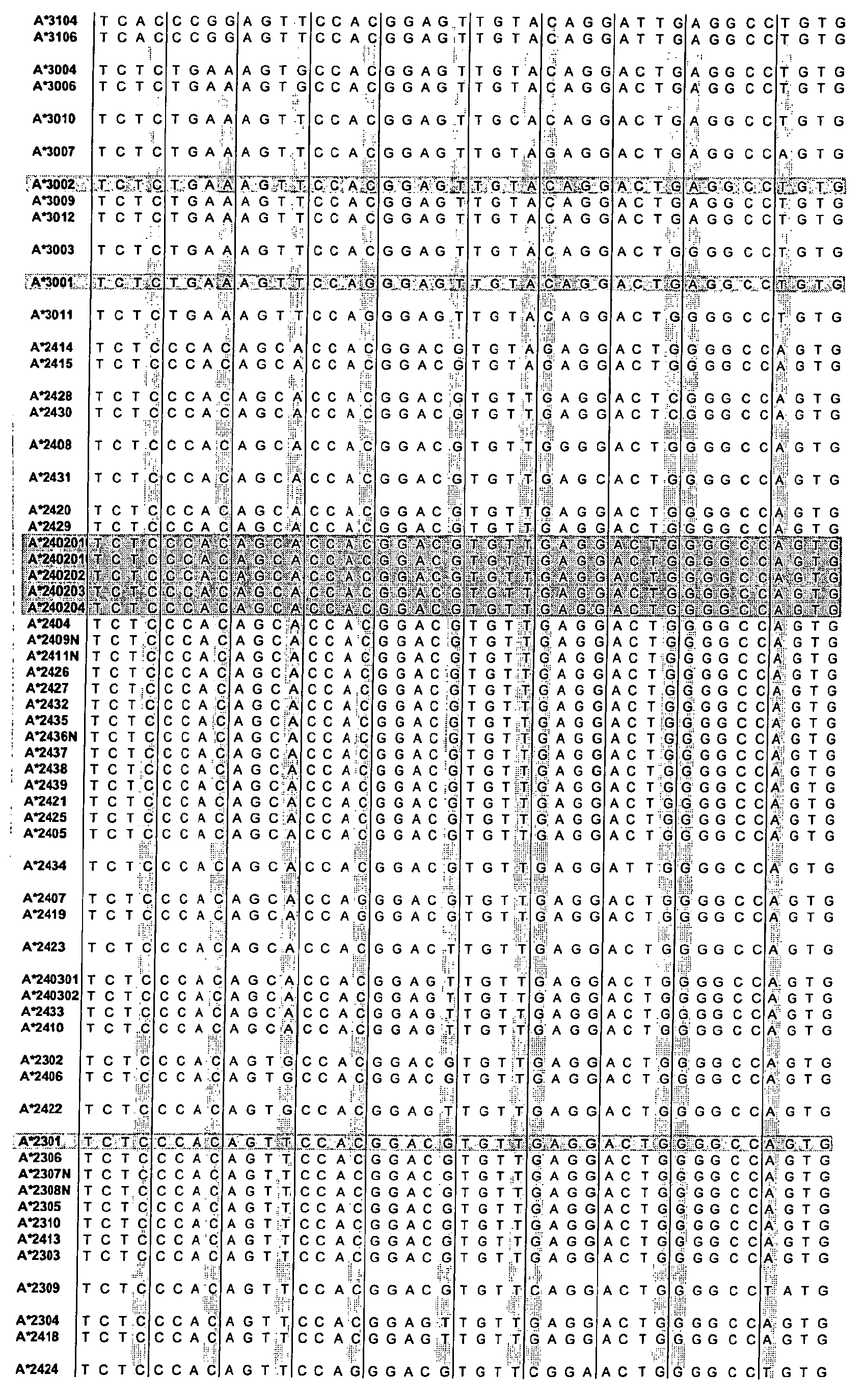
- Table X represents the list of HLA-A alleles that are resolved with the 10 markers for the creation of subgroups. Each subgroup is separated by an empty line. Frequent alleles are shaded in darker grey, while lighter grey indicates the position that primers are extended onto.
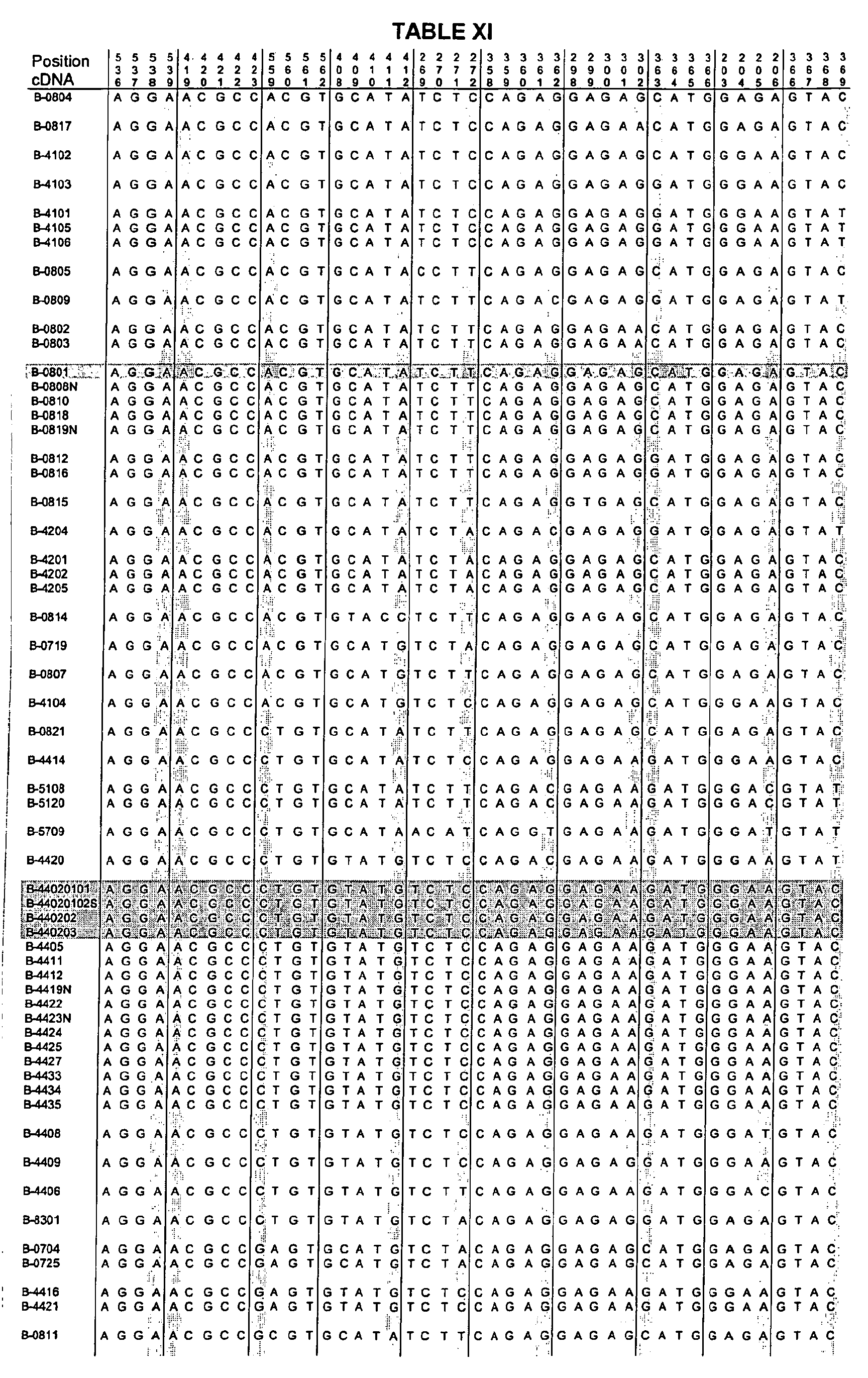
- Table XI represents the list of HLA-B alleles that are resolved with the 10 markers for the creation of subgroups. Each subgroup is separated by an empty line. Frequent alleles are shaded in darker grey, while lighter grey indicates the position that primers are extended onto.
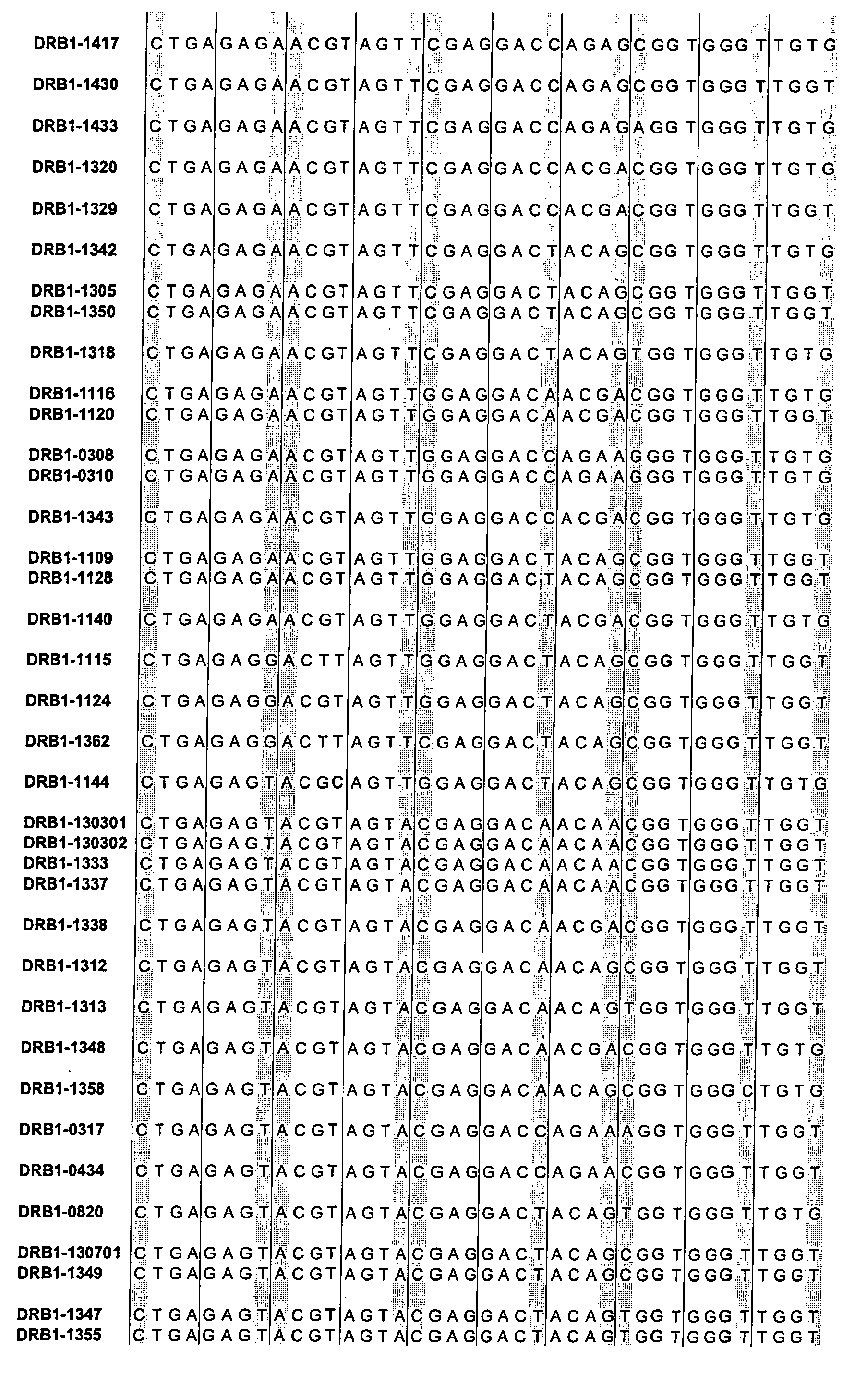
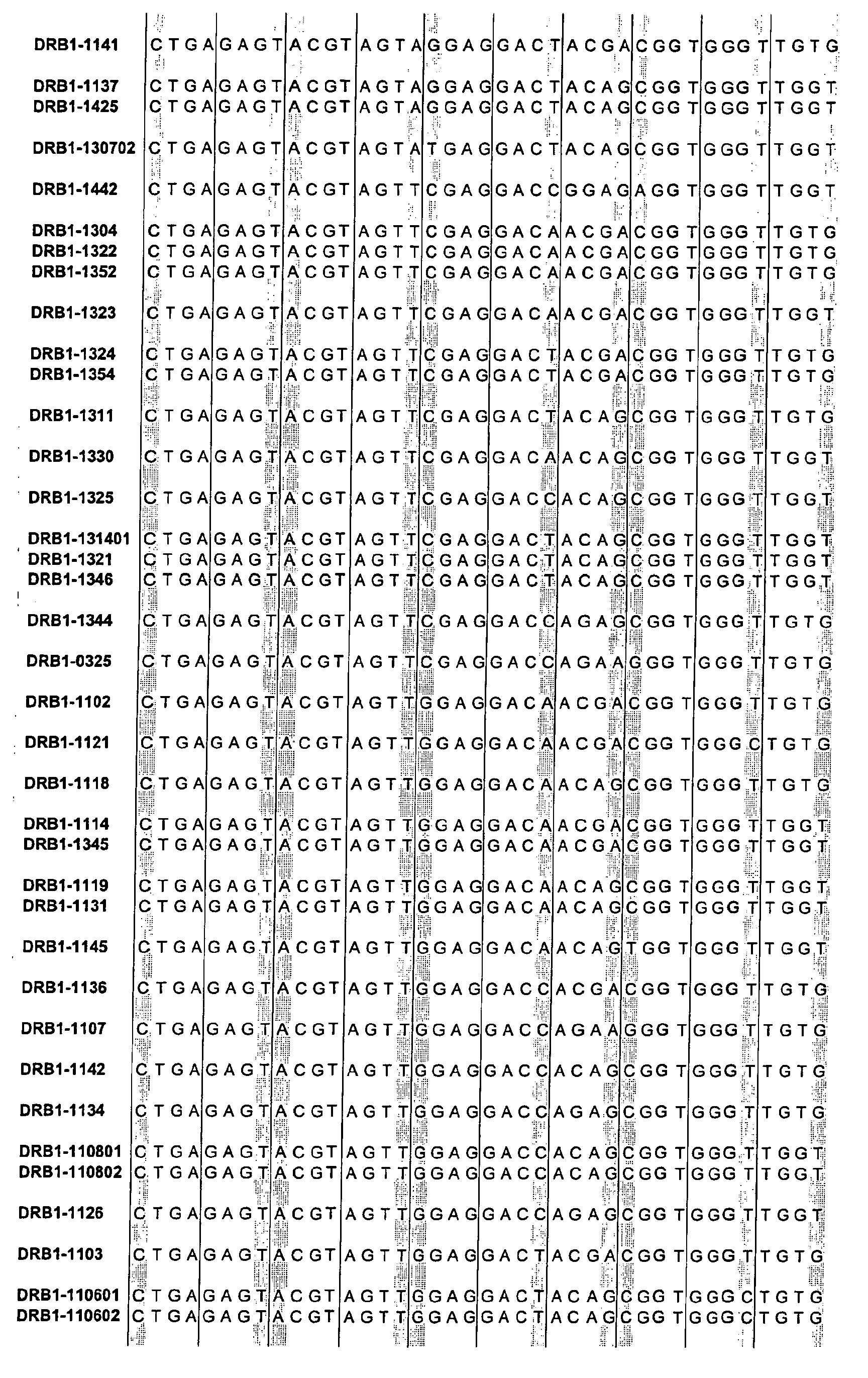
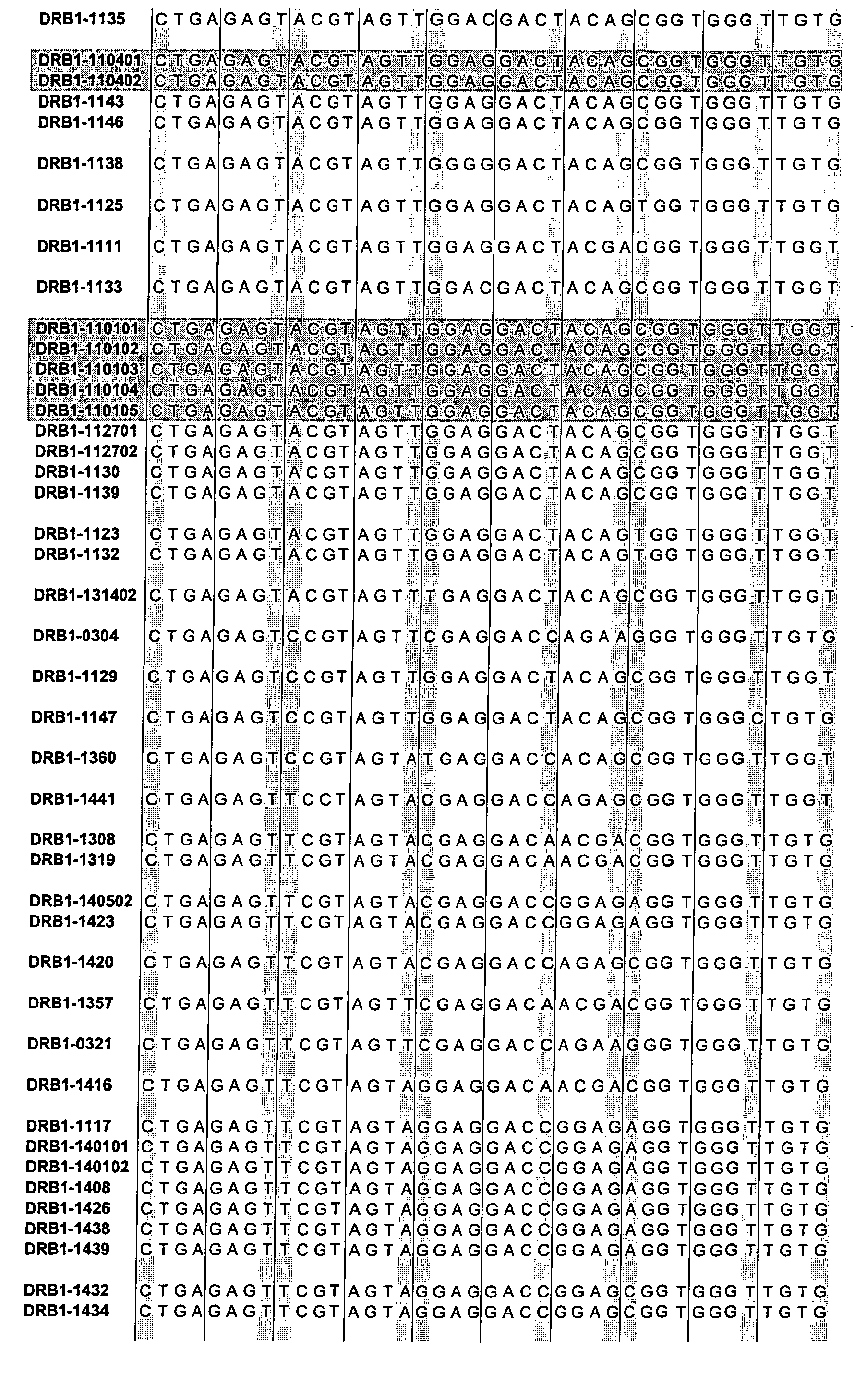
- Table XII represents the list of HLA-DRB1 alleles that are resolved with the 10 markers for the creation of subgroups. Each subgroup is separated by an empty line. Frequent alleles are shaded in darker grey, while lighter grey indicates the position that primers are extended onto.
- a locus specific PCR product of exon 2 and exon 3 of HLA-B is amplified with a set of primers published by the International Histocompatibility Working Group, Technical Manuals (Hurly, Fernandes-Vina, Gao, Middleton, Noreen, Ren and Smith; www.ihwg.org/tmanual/Tmcontents.htm).
- the PCR product is incubated with SAP to remove all excess dNTPs. Then a single base primer extension at position 272 in the PCR amplicon is carried out.
- the set of primers, to generate the mini-haplotypes is shown in Table V. Thereafter a 5'phosphodiesterase digest is applied to reduce the primers to a core sequence.
- the products are transferred onto a MALDI target pre-coated with matrix.
- the matrix solution can be mixed with the samples and transferred onto the MALDI target to dry.
- the MALDI target is introduced into a MALDI mass spectrometer and analysed. The mass spectra show one or two mass peaks and that correspond to specific mini-haplotypes.
- extension product has to be added 0.5 ul 0.5 M acetic acid and 1.5 ul PDE (5.1U) and incubate for at lease 120 min at 37 °C.
- the alkylation is carried out by adding 21 ⁇ l of an alkylation mix and incubate for 15 min at 40°C. This mix contains 377 parts water free acetonitrile, 15 part 2M triethylamine/CO 2 (pH ⁇ 7.5), 75 parts 2mM Tris-HCl and 174 parts methyljodate.
- the alkylation is to stop by adding 10 ⁇ l deionisated water. 5 ⁇ l of the resulted upper phase are to dilute in 10 ⁇ l 40% acetonitrile.
- MALDI target preparation and measurement with the MALDI mass spectrometer 0.5 ⁇ l of the final dilution are transferred onto a MALDI target pre-coated with matrix ( ⁇ -cyano-4-hydroxycinnamic acid methyl ester). Measurement was carried out in a Bruker Autoflex with typically 18 kV acceleration voltage, pulsed ion extraction with a delay of 200 ns, and detection in linear detection mode. Results for CEPH family 1418 are shown in figure 6.
Landscapes
- Chemical & Material Sciences (AREA)
- Life Sciences & Earth Sciences (AREA)
- Organic Chemistry (AREA)
- Health & Medical Sciences (AREA)
- Proteomics, Peptides & Aminoacids (AREA)
- Zoology (AREA)
- Wood Science & Technology (AREA)
- Engineering & Computer Science (AREA)
- Immunology (AREA)
- Analytical Chemistry (AREA)
- Molecular Biology (AREA)
- Bioinformatics & Cheminformatics (AREA)
- Biotechnology (AREA)
- Biophysics (AREA)
- Physics & Mathematics (AREA)
- Genetics & Genomics (AREA)
- Biochemistry (AREA)
- Microbiology (AREA)
- General Engineering & Computer Science (AREA)
- General Health & Medical Sciences (AREA)
- Cell Biology (AREA)
- Measuring Or Testing Involving Enzymes Or Micro-Organisms (AREA)
- Other Investigation Or Analysis Of Materials By Electrical Means (AREA)
- Saccharide Compounds (AREA)
- Nitrogen And Oxygen Or Sulfur-Condensed Heterocyclic Ring Systems (AREA)
Abstract
A method for the identification of DNA sequence elements in complex and highly
variable sequences is described. The method consists of identifying a short
sequence element of several DNA bases (2-6 bases) at a given position in the
genome simultaneously on all parental alleles. The method allows differentiating
mini-haplotypes on different alleles in one analysis. The method consists of
carrying out an enzymatic primer extension reaction with a combination of
extension primers (pool of primers) and analysing the products by mass
spectrometry. The pool of primers is assembled in such a way that the primer
extension product allows unambiguous identification of both the primer of the pool
that was extended and the base that was added. The method is of great utility for
DNA sequences harbouring many SNPs close to each other with many possible
haplotypes. Such sequences are known in the Major Histocompatibility Complex
(MHC). This method is particularly well suited for DNA-based HLA typing and in
combination with a suitable selection of sites tested, it is superior in ease of
operation to conventional HLA typing methods. We have identified sets of these
assays for HLA-A, HLA-B, and HLA-DRB1 that allow unambiguous four-digit
HLA of each of these genes with between 11 and 28 queried markers.
Description
- The present invention relates to a method for HLA typing by the unambiguous determination of short DNA sequence elements (2-6 bases) at a given position simultaneously on both parental alleles at a selected number of positions in HLA genes, comprised of the steps for each position of a) hybridising a combination of oligonucleotides (primers) complementary to all known sequence variants to a DNA strand upstream of a given position; b) carrying out a primer extension reaction with at least one of the four dNTP substrates substituted by a terminating analog; c) analysing the products by mass spectrometry, with the resulting masses allowing unambiguous identification of the used primers and the added bases. This method is particularly well suited for DNA-based HLA typing and in combination with a suitable selection of sites tested, it is superior in ease of operation to conventional HLA typing methods.
The most important of the genome projects, the complete sequence of the human genome, is finished. This project reveals the complete sequence of the 3 billion bases and the relative positions of all estimated 30.000 genes in this genome. Having this sequence opens unlimited possibilities for the elucidation of gene function and interaction of different genes. In recent years a systematic effort (SNP consortium) has been underway to identify single nucleotide polymorphisms (SNPs) throughout the human genome and so far several million of these differences between different human beings have been identified (dbSNP contained 5.5 million SNPs in October 2003).
Matrix-assisted laser desorption/ionization time-of-flight mass spectrometry (MALDI) has revolutionized the mass spectrometric analysis of biomolecules (Karas, M. & Hillenkamp, F. Anal. Chem. 60, 2299-2301 (1988)). The field of DNA analysis by mass spectrometry was recently extensively reviewed by Tost and Gut (Mass Spectrometry Reviews, 21, 388-418 (2002)) and Sauer and Gut (Journal of Chromatography B, 782, 73-87, (2002)). MALDI has been applied to the analysis of DNA in variations that range from the analysis of PCR products to approaches using allele-specific termination to single nucleotide primer extension reactions and sequencing (Liu, Y.-H., et al. Rapid Commun. Mass Spectrom. 9, 735-743 (1995); Ch'ang, L.-Y., et al. Rapid Commun. Mass Spectrom. 9, 772-774 (1995); Little, D.P., et al. J. Mol. Med. 75, 745-750 (1997); Haff, L. & Smirnov, I.P. Genome Res. 7, 378-388 (1997), Fei, Z., Ono, T. & Smith, L.M. Nucleic Acids Res. 26, 2827-2828 (1998); Ross, P., Hall, L., Smirnov, I. & Haff, L. Nature Biotech. 16, 1347-1351 (1998); Ross, P.L., Lee, K. & Belgrader, P. Anal. Chem. 69, 4197-4202 (1997); Griffin, T.J., Tang, W. & Smith, L.M. Nature Biotech. 15, 1368-1372 (1997); Köster, H., Higgins, G.S & Little, D.P. US Patent 6,043,031). These methods are used to genotype previously identified mutations, SNPs, or insertion/deletions (indels). Spin column purification and/or magnetic bead technology, reversed-phase purification, or ion-exchange resins are frequently applied prior to mass spectrometric analysis.
The GOOD assay (IG Gut et S. Beck: US 6,268,812 ; IG Gut et al: US 6,503,710) is a method for SNP genotyping that uses MALDI mass spectrometry for detection (Sauer et al. 28, e13 and e100 (2000)). Allele-distinction is based on primer extension. In order to make products more amenable to MALDI analysis a substantial part of the primer is removed prior to mass spectrometric analysis. A further element that is included is charge tagging. This means that the final product is conditioned such that it carries either a single positive or a single negative charge. Generally this is achieved by alkylation of a phosphorothioate backbone and in some instances including a quaternary ammonium group to the penultimate base of the primer. The attachment of the quaternary ammonium group gives options for the design of multiplexes - individual SNPs can be moved up or down in the mass spectrum to achieve optimal resolution and separation.
The major histocompatibility complex (MHC) of humans is a cluster of genes on chromosome 6p21. It is of greatest importance as many diseases show association with genes in this region of the genome. All human leukocyte antigen (HLA) coding genes are found in the MHC. The HLA genes are highly variable and implicated in tissue transplantation, immunity and autoimmune disease such as diabetes, psoriasis, lupus, Crohn's disease, colitis, arthritis, and others. The HLA class I genes are HLA-A, HLA-B, HLA-C, ..... The HLA class II genes are HLA-DR, HLA-DQ, HLA-DP,.... - HLA typing methods differ dramatically in their approaches. Serological tests can be carried out but have only limited resolution. In the last 15 years the DNA sequence of the MHC has been extensively studied and high resolution typing now makes use of a wealth of DNA sequence information. Methods for DNA based HLA typing range from SSA (sequence specific amplification) where combinations of primers that are specific for different alleles are used to carry out PCR (US 5,545,526). Primers are combined in a way that the sizing of the PCR products allows unambiguous assignment of present base combinations. Multiple combinations are used to identify HLA types. The procedure works its way through a tree of combinations starting with a grouping into rough classes from where on further tests are carried out with specific reagents to subdivide in a class. This method is also known as SSP (sequence specific primers). An alternative method is termed SSOP (sequence specific oligonucleotide probes; US 6,503,707). Here a locus specific PCR is carried out followed by hybridisation with sequence specific oligonucleotide probes. As sequencing technology (and in particular the software for sequence calling) has dramatically improved over the last decade it now is also possible to gain a good degree of identification of HLA types by sequencing (
WO 98/35059). Effectively a locus-specific PCR product is sequenced. Problems that arise here are that heterozygous individuals occasionally give rise to ambiguous haplotype calls that can not be resolved (Robinson, J.; Waller, M.J.; Marsh, St.G.E.: "Exon Identities and Ambiguous Typing Combinations"; IMGT/HLA Database; October 2003). The inclusion of allele-specific PCR helps achieve certainty. Resolution requires multiple products per locus to be generated and sequenced. However, as sequencing results can be very convoluted the interpretation in absence of allele-specific PCR can be cumbersome. All together the sequence-based typing requires many iterations in application. Reference strand mediated conformation analysis (RSCA) is a method used to study samples that potentially have a previously unknown sequence in their HLA (Correl et al., Tissue Antigens 56, 82-86, 2000). For a recent review for the reasoning of HLA typing as well as methodological advances see Petersdorf et al. (Tissue Antigens, 61, 1-11, 2003). - The inventors have thus set themselves the task of providing an easy method for the simultaneous capture of all parental mini-haplotypes in highly polymorphic regions of genomes. The procedure has to be executable on a cost-effective genotyping platform. The method should be particularly applicable for HLA typing. It is an aim to resolve frequent and rare HLA alleles as well as possible.
- The object of the present invention is a method for HLA typing by the unambiguous determination of short DNA sequence elements (2-6 bases) simultaneously on both parental alleles at a selected number of positions in HLA genes, comprised of the steps for each position of a) hybridising a combination of oligonucleotides (primer pool) complementary to all known sequence variants to a DNA strand upstream of a given position; b) carrying out a primer extension reaction with at least one of the four dNTP substrates substituted by a terminating analog; c) analysing the products by mass spectrometry, with the resulting masses allowing unambiguous identification of the used primers and the added bases.
- In the present invention:
- "HLA" means the human leukocyte antigen locus on chromosome 6p21, consisting of HLA genes (HLA-A, HLA-B, HLA-C, HLA-DRB1,...) that are used to determine the degree of matching, for example, between a recipient and a donor of a tissue graft.
- "HLA typing" means the identification of a known HLA allele of a given locus (HLA-A, HLA-B, HLA-C, HLA-DRB1,...).
- "HLA allele" means a nucleotide sequence within a locus on one of the two parental chromosomes.
- "HLA-A" means the DNA sequence of exons 2 and 3 of the HLA-A gene.
- "HLA-B" means the DNA sequence of exons 2 and 3 of the HLA-B gene.
- "HLA-DRB1" means the DNA sequence of exon 2 of the HLA-DRB1 gene.
- "Polymorphism" means individual positions in a DNA sequence that exist in different variants.
- "Haplotype" means the DNA sequence of one of the two alleles in a give region of the genome.
- "Mini-haplotype" means 2-6 contiguous bases on one parental allele.
- "Primer pools" or "pools of primers" means sets of primers that are used in one primer extension reaction. For each known HLA allele at least one primer is in the pool that is completely complementary in sequence. This assures perfect annealing. Mismatches that are more than 4 bases from the 3'end of the primer do not affect the results of the GOOD assay, as all of those bases are removed by 5'phosphodiesterase after the primer extension reaction. Primers of the pool containing mismatches in the last few bases are not extended by the DNA polymerase and thus not observable.
- "MALDI mass spectrometer" means a mass spectrometer that uses matrix-assisted laser desorption/ionization for the volatilisation of a sample and time-of-flight analysis for mass separation.
- "Subgroup" means alleles, which are identical after the mini-haplotyping of the first set of selected positions. For the high resolution typing we resolve subgroups generated with 10 mini-haplotyping reactions. The criteria for resolving subgroups are: a) they still contain alleles with different two-digit types, b) subgroups with more than four alleles, and c) subgroups with frequent alleles (see list below).
- Here we show a methodology for the determination of sequence motifs of 2-6 bases in very polymorphic regions of genomes. In principle this methods equates to the determination of mini-haplotypes of 2-6 bases. The individual parental mini-haplotypes can be determined in one reaction without ambiguities. This methodology is applied to a chosen set of positions for HLA typing of HLA-A, HLA-B, and HLA-DRB1. The sets disclosed here have different purposes. First sets of 19, 19, and 10 positions are suggested to distinguish a maximum of HLA alleles in HLA-A, HLA-B, and HLA-DRB1, respectively, with respect to differentiating alleles that are frequent in the general population from ones that are rare. The frequent alleles that were screened for are A*0101, A*0201, A*0301, A*2301, A*2402, A*2902, A*3001 and A*3002 for HLA-A, B*0702, B*0801, B*1302, B*1501, B*1801, B*3501, B*3503, B*4001, B*4402, B*4403, B*5101 and B*5701 for HLA-B, and DRB1*0101, DRB1*0301, DRB1*0401, DRB1*0701, DRB1*1101, DRB1*1104, DRB1*1302 and DRB1*1501 for HLA-DRB1. This set of markers provides unambiguous identification of frequent HLA alleles with 93.4 - 100 % certainty in HLA-A, 97.6 - 100 % in HLA-B, and 97.2 - 100 % in HLA-DRB1.
A second set of 10 positions each in HLA-A, HLA-B, and HLA-DRB1, respectively are described that provide a maximum number of subgroups, that can then be further resolved by the addition of a set of subgroup specific positions. Again the ten positions in each locus were chosen on the basis of providing best distinction between the frequent HLA alleles listed above from the rest of the HLA alleles (rare). This resulted in groups containing 2-30 HLA alleles depending on the locus. Within each group a number of positions can be tested to provide resolution between the HLA alleles within the group. The number of positions that have to be additionally analysed range from 1-25 in order to achieve 4-digit resolution. With this technology HLA typing can be carried out at a substantially reduced cost with a proven high-throughput detection platform (MALDI mass spectrometry). - In a preferred embodiment of the method of the invention, the DNA strand of step a) is produced by a DNA replication procedure such as PCR or rolling circle replication.
A set of locus-specific PCR reactions for the selective amplification of each locus is described by the International Histocompatibility Working Group, Technical Manuals (Hurly, Fernandes-Vina, Gao, Middleton, Noreen, Ren and Smith; www.ihwg.org/tmanual/Tmcontents.htm).
In a very preferred embodiment of the method of the invention, a combination of primers (pools of primers) contains slightly varying sequences so that all known sequences of the HLA alleles are accommodated by a perfectly matching primer. The pool of primers guarantees that at least one primer is perfectly matched. The hybridised oligonucleotides of the primer pool are extended onto a polymorphic position. A requirement is that the added base together with the base composition of the primer gives a unique mass. The detection of this mass in the mass spectrometric profile indicates the presence of a sequence containing both the complementary sequence of the primer and the added base. In order to make all primers of a primer pool distinguishable by mass it is possible to add different mass shifting agents to the primers. The easiest way to accomplish this is by using charge/mass tagging technology such as is used in the GOOD assay. The penultimate base from the 3'end of the primer is amino-modified and used to add tags via NHS-ester chemistry. The pools of primers of course contain primers that sometimes differ by as little as one base. Sequences identical in base content can still be distinguished by the suitable selection of mass tags. Also, we have found that a primer carrying a mismatch in the last eight bases from the 3'end even if it anneals is not extended by the polymerase and thus screened out. This might be due to insufficient hybridisation or a resistance of the DNA polymerase to attach or extend when a mismatch is present. We thus make use of two effects for our mini-haplotyping: 1) allele-specific hybridisation and 2) allele-specific primer extension. Mismatches that are further than four bases away from the 3'end of the extension primer do not result in increased complexity of the mass spectra as they are removed in the 5'phosphodiesterase digestion step of the GOOD assay.
In a preferred embodiment of the method of the invention, mass shifting tags are added to the individual primers sequences of a primer pool to make them uniquely distinguishable once the terminating base is added.
In another preferred embodiment of the method of the invention, termination products for know alleles are generated by extending the perfectly hybridised primer with a combination of dNTPs and ddNTPs or analogues thereof with a DNA polymerase to generate specific termination products to make them uniquely distinguishable by their mass.
In a preferred embodiment of the method of the invention, the GOOD assay is used. It typically applies single base primer extension, thus only the four terminating bases (ddNTPs) or synthetic analogues with the same qualities in terms of DNA polymerase tolerance are used for primer extension. α-S-ddNTPs are very suitable analogues.
In a preferred embodiment of the method of the invention, mass spectrometry, in particular MALDI or ESI mass spectrometry is used for analysis of the masses of products. - For HLA typing a set of said mini-haplotyping assays has to be carried out to achieve sufficient information content.
For HLA typing of HLA-A the preferred set of assays are those ofpositions
For HLA typing of HLA-B accordingly the following positions are preferably analysed by mini-haplotyping assays to achieve medium resolution: 539, 419, 559, 412, 272, 362, 302, 363, 206, 369, 259, 97, 583, 292, 222, 527, 418, 435 and 571 (according to the numbering of the HLA-B gene starting at cDNA sequence position 1 of exon 1; see Figure 2).
For HLA typing of HLA-DRB1 accordingly the following positions are preferably analysed by mini-haplotyping to achieve medium resolution: 125, 196, 197, 227, 261, 286, 299, 308, 341 and 345 (according to the numbering of the HLA-DRB1 gene starting at cDNA sequence position 1 of exon 1; see Figure 3).
In a preferred embodiment for high resolution HLA typing of HLA-A positions Subgroups of HLA-A Alleles of Subgroups Positions to resolve Subgroups HLA-A_A A*29010101, A*29010102, A*290201, A*290202, A*2904, A*2906, A*2908N, A*2909 224, 268, 376, 502, 561, 616 HLA-A_B A*3002, A*3009, A*3012 126, 526 HLA-A_C A*24020101, A*24020102L, A*240202, A*240203, A*240204, A*2404, A*2405, A*2408, A*2409N, A*2411N, A*2420, A*2421, A*2425, A*2426, A*2427, A*2429, A*2432, A*2435, A*2436N, A*2437, A*2438, A*2439 81, 90, 92, 212, 214, 257, 265, 299, 302, 404, 420, 427, 453, 485, 485, 489, 502 HLA-A_D A*0206, A*0214, A*0221, A*0251, A*0257 160, 200, 362, 524 HLA-A_E A*250101, A*250102, A*2601, A*2604, A*2605, A*2609, A*2610, A*2611N, A*2612, A*2614, A*2615, A*2617, A*2618, A*6603 180, 299, 301, 302, 346, 418, 453, 517, 524, 526, 527, 557, 559, 560 HLA-A_F A*2502, A*2613, A*6601, A*6602, A*6604 299, 301, 302, 341, 583 HLA-A_G A*110101, A*110102, A*1102, A*1103, A*1104, A*1105, A*1107, A*1109, A*1112, A*1113, A*1114, A*1115 127, 341, 399, 480, 502, 503, 524, 526, 527, 553, 559, 560, 565 HLA-A_H A*3301, A*330301, A*330302, A*3304, A*3305, A*3306, A*3307 228, 233, 463, 519, 530, 583 HLA-A_I A*680101, A*680102, A*680103, A*6807, A*6811N, A*6812, A*6816, A*6817, A*6819, A*6821, A*6822, A*6823, A*6824 102, 275, 317, 362, 418, 419, 497, 524, 555, 595, 618 HLA-A_J A*2301, A*2303, A*2305, A*2306, A*2307N, A*2308N, A*2310, A*2413 92, 331, 453, 524, 556, 560, 564 HLA-A_K A*02010101, A*02010102, A*020102, A*020103, A*020104, A*020105, A*020106, A*020107, A*020108, A*020109, A*0204, A*0209, A*0216, A*0224, A*0225, A*0226, A*0229, A*0230, A*0231, A*0232N, 0A*0240, A*0242, A*0243N, A*0258, A*0259, A*0260, A*0264, A*0266, A*0267, A*0253N 78, 81, 123, 125, 142, 144, 194, 268, 294, 324, 355, 362, 396, 403, 419, 453, 419, 453, 456, 477, 493, 517, 524, 526, 527, 559, 560 HLA-A_L A*3201, A*3203, A*3206, A*7401, A*7402, A*7403, A*7408, A*7409 113, 299, 301, 302, 308, 311, 523, 524 HLA-A_M A*010101, A*010102, A*0103, A*0104N, A*0108, A*0109 171, 363, 498, 559 HLA-A_N A*03010101, A*03010102, A*0303N, A*0304, A*0305, A*0306, A*0307, A*0311N 376, 426, 527, 555, 557, 595 HLA-A_O A*2504, A*2608 299 - In a preferred embodiment for high resolution, HLA typing of HLA-
B positions Subgroups of HLA-B Alleles of the subgroup Positions to resolve Subgroups HLA-B_A B*0801, B*0808N, B*0810, B*0818, B*0819N 259, 341, 473 HLA-B_B B*44020101, B*44020102S, B*440202, B*440203, B*4405, B*4411, B*4412, B*4419N, B*4422, B*4423N, B*4424, B*4425, B*4427, B*4433, B*4434, B*4435 106, 144, 222, 259, 273 311, 313, 418 445, 493, 528, 540 HLA-B_C B*4415, B*4501, B*4503, B*4504, B*4505 319, 416, 545, 572 HLA-B_D B*070201, B*070202, B*070203, B*070204, B*0703, B*0716, B*0721, B*0722, B*0723, B*0729, B*0730, B*0733, B*0735 106, 131, 165, 215, 243, 277, 292, 322, 481, 582, 603,616 HLA-B_E B*15010101, B*15010102, B*150102, B*150103, B*150104, B*1512, B*1514, B*1515, B*1519, B*1528, B*1533, B*1534, B*1538, B*1560, B*1570, B*1571, B*1575, B*1578, B*1579N, B*1581, B*1582 106, 146, 165, 181, 238, 259, 263, 292, 328.1/329, 379, 435, 453, 463, 485, 526, 571, 572 , 583 HLA-B_F B*440301, B*4413, B*4426, B*4429, B*4430, B*4432, B*4436, B*4437, B*4438, B*4439 142, 171, 255, 257, 395, 430, 544, 566 , 572 HLA-B_G B*2703, B*270502, B*270503, B*270504, B*270505, B*270506, B*2709, B*2710, B*2713, B*2716, B*2717 117, 247, 248, 277, 345, 418, 489 , 527 HLA-B_H B*5107, B*520101, B*520102, B*520103, B*520104, B*5203, B*5204, B*5205 134, 141, 200, 213, 259, 304,527 HLA-B_I B*510101, B*510102, B*510103, B*510104, B*510105, B*510201, B*510202, B*5103, B*5109, B*5111N, B*5112, B*5114, B*5118, B*5119, B*5123, B*5124, B*5126, B*5127N, B*5128, B*5130, B*5132, B*5133 83, 141, 211, 222, 242, 322, 404, 414, 435, 463, 502, 527, 544, 571, 572, 583 HLA-B_J B*400101, B*400102, B*400103, B*4010, B*4011, B*401401, B*401402, B*401403, B*4022N, B*4025, B*4043 103, 142, 222, 243, 259, 292, 477, 486, 499 HLA-B_K B*180101, B*180102, B*1803, B*1804, B*1805, B*1811, B*1812, B*1815, B*1817N 103,259,292,295,527, 583 HLA-B_L B*570101, B*5706, B*5708 320,500 HLA-B_M B*3527, B*5301, B*5302, B*5306, B*5308 311, 527 , 583 HLA-B_N B*350101, B*350102, B*3507, B*3510, B*3511, B*3521, B*3524, B*3529, B*3540N, B*3541, B*3542, B*5305 119, 292, 259, 319, 425, 527,546,583 HLA-B_O B*5501, B*5502, B*5505, B*5510, B*5516 97, 142, 245, 527 HLA-B_P B*5401, B*5402, B*5507 97, 175 HLA-B_Q B*3910, B*670101, B*670102 246, 277 HLA-B_R B*3803, B*390201, B*390202, B*3913, B*3923 246, 292, 311, 503 HLA-B_S B*3801, B*380201, B*380202, B*3804, B*3805, B*3809 103, 261, 309, 311 , 474 HLA-B_T B*390101, B*390103, B*390104, B*3904, B*3905, B*3912, B*3922, B*3925N, B*3926 97, 103, 106, 243, 259, 292, 404 , 524 HLA-B_U B*3503, B*3513, B*3536 259 , 320 HLA-B_V B*0734, B*5504 106 HLA-B_W B*4047, B* 4431 97 HLA-B_X B*4002, B*4027, B*4029, B*4035, B*4040, B*4045 97, 106, 257, 418, 463 HLA-B_Y B*400104, B*4004 106 HLA-B_Z B*4012, B*4046, B*4803 106, 144 HLA-B_AA B*2703, B*270502, B*270503, B*270504, B*270505, B*270506, B*2709, B*2710, B*2713, B*2716, B*2717 117, 247, 248, 283, 345, 418, 489, 527 HLA-B_AB B*1562, B*4802 106 HLA-B_AC B*1302, B*1308 548
In a preferred embodiment, the method for HLA typing resolves groups A-P of HLA-DRB1.
For high resolution, HLA typing of HLA-DRB1 positions are: 125, 196, 197, 227, 261, 286, 299, 308, 341 and 345 (according to the numbering of the HLA-DRB1 gene starting at DNA sequence position 1 of exon 1; see Figure 6) are used for mini-haplotyping to generate sub-groups (HLA-DRB1_A, HLA-DRB1_B, HLA-DRB1_C, HLA-DRB1_D, HLA-DRB1_E, HLA-DRB1_F, HLA-DRB1_G, HLA-DRB1_H, HLA-DRB1_I, HLA-DRB1_J, HLA-DRB1_K, HLA-DRB1_L, HLA-DRB1_M, HLA-DRB1_N, HLA-DRB1_O, HLA-DRB1_P; see Table III). - In a very preferred embodiment, positions 123, 174, 250, 278 and 317 are analysed to resolve subgroup HLA-DRB1_A; positions 192, 203, 256 and 259 to resolve subgroup HLA-DRB1_B; 256, 260, 317 and 351 to resolve subgroup HLA-DRB1_C; positions 155, 204, 233, 239, 256, 304, 357 and 366 to resolve subgroup HLA-DRB1_D; positions 122, 171, 257 and 317 to resolve subgroup HLA-DRB1_E; positions 164, 167, 171, 230, 235, 306, 317, 321 and 337 to resolve subgroup HLA-DRB1_F; positions 164, 257, 266 and 303 to resolve subgroup HLA-DRB1_G; positions 164, 181, 188, 220, 229, 256, 266, 317 and 318 to resolve subgroup HLA-DRB1_H; position 257 to resolve subgroup HLA-DRB1_I; positions 181, 239 and 357 to resolve subgroup HLA-DRB1_J; positions 122, 144, 239, 303, 317, 318 and 321 to resolve subgroup HLA-DRB1_K (sequences identical over exons 2 and 3 for alleles DRB1*110101 and DRB1*110102); positions 118, 161, 257, 260, 318 and 321 to resolve subgroup HLA-DRB1_L; positions 165, 257, 293 and 303 to resolve subgroup HLA-DRB1_M (sequences identical over exons 2 and 3 for alleles DRB1*120101 and DRB1*1206); positions 177, 240, 256, 257 and 357 to resolve subgroup HLA-DRB1_N; positions 150 175, 230, 236 and 321 to resolve subgroup HLA-DRB 1 _O (sequences identical over exons 2 and 3 for alleles DRB1*150101 and DRB1*1513); positions 115,220 and 317 to resolve subgroup HLA-DRB1_P.
Another object of the invention is a kit to carry out the procedure. It consists of pooled combinations of primers. The primers that are used in the pools for HLA-A, HLA-B, and HLA-DRB1 and the masses of the genotyping products are listed in Tables IV, V, and VI respectively. CT refers to the mass shifting mass tag that is attached to that primer of the pool.
Another object of the invention is the use of the method of the invention for screening of tissue donors.
In a preferred embodiment, the use is for bone marrow donors in registries for screening of frequent and rare HLA types.
Still another object of the invention is the use of the primers represented in Table IV, V and VI to carry out HLA typing.Subgroups of HLA-DRB1 Alleles of Subgroups Positions to resolve Subgroups HLA-DRB1_A DRB1*070101, DRB1*070102, DRB1*0703, DRB1*0704, DRB1*0705, DRB1*0707 123,174,250,317 HLA-DRB1_B DRB1*040101, DRB1*040102, DRB1*0409, DRB1*0426, DRB1*0433 192, 203, 256, 259 HLA-DRB1_C DRB1*0404, DRB1*0410, DRB1*0423, DRB1*0440, DRB1*0444 256, 260, 317, 351 HLA-DRB1_D DRB1*040501, DRB1*040502, DRB1*040503, DRB1*040504, DRB1*0408, DRB1*0429, DRB1*0430, DRB 1*0445, DRB1*0448 155, 204, 233, 239, 256, 304, 357, 366 HLA-DRB1_E DRB1*1402, DRB1*1409, DRB1*1413, DRB1*1446, DRB1*1447, DRB1*1448 122, 171, 257, 317 HLA-DRB1_F DRB1*130101, DRB1*130102, DRB1*130103, DRB1*1315, DRB1* 1327, 164, 167, 171, 230, 235, 306, 317, 321, 337 HLA-DRB1_G DRB1*130201, DRB1*130202, DRB1*1331, DRB1*1339, DRB1*1341 164, 257, 266, 303 HLA-DRB1_H DRB1*030101, DRB1*030102, DRB1*0307, DRB1*0312, DRB1*0313, DRB1*0315, DRB1*0316, DRB1*0318, DRB1 *0322, DRB 1*0323 164, 181, 188, 220, 229, 256, 266, 317, 318 HLA-DRB1_I DRB1*1137, DRB1*1425 257 HLA-DRB1_J DRB1*110401, DRB1*110402, DRB1*1143, DRB1*1146 181,239,357 HLA-DRB1_K DRB1*110101, DRB1*110102, DRB1*110103, DRB1*110104, DRB1*110105, DRB1*112701, DRB1*112702, DRB1*1130, DRB1*1139 122, 144, 239, 303, 317,318,321 HLA-DRB1_L DRB1*1117, DRB1*140101, DRB1*140102, DRB1*1408, DRB1*1426, DRB1*1438, DRB 1*1439 118, 161, 257, 260, 318, 321 HLA-DRB1_M DRB1*120101, DRB1*120102, DRB1*1206, DRB1*1207, DRB1*1208, DRB1*1209 165,257,293,303 HLA-DRB1_N DRB1*080101, DRB1*080102, DRB1*080201, DRB1*080202, DRB1*080203, DRB1*0807, DRB1*0811 177, 240, 256, 257, 357 HLA-DRB1_O DRB1*150101, DRB1*150103, DRB1*150105, DRB1*1503, DRB1*1506, DRB1*1509, DRB1*1513 150 175, 230, 236, 321 HLA-DRB1_P DRB1*010101, DRB1*0105, DRB1*0107, DRB1*0111 115, 220, 317 No. Name Sequence CT Primer Masses A C G T 1 HLAA_811_1f20 TGCTCGCCCCCAGGCTCCspC^spA 0 1098,1 1425,1 1401,3 - - 2 HLAA_812_1f20 TGCTCGCCCCCAGGCTCTspC^spA 0 1113,1 - 1416,3 1452,4 - 3 HLAA_921_1f20 AGGCTCCCACTCCATGAGspC^spT 0 1129,1 1456,4 - - - 4 HLAA_922_1f20 AGGCTCCCAMTCCATGAGspG^spT 0 1169,1 1496,4 - 1512,4 - 5 HLAA_923_1f20 AGGCTCTCASTCCATGAGspG^spT 0 1169,1 1496,4 - 1512,4 - 6 HLAA_981_1f20 CCACTCCATGAGGTATTTspC^spA 0 1113,1 - 1416,3 - - 7 HLAA_982_1f20 CCACTCCATGAGGTATTTspC^spT 0 1104,1 1431,4 1407,3 - 1422,3 8 HLAA_1231_2r20 GCGATGAAGCGGGGCTCspCspT^spC 0 1510,5 - - 1853,8 - 9 HLAA_1232_2r20 GCGATGAAGCGGGGCTCspTspC^spC -28 1380,4 1707,7 - - - 10 HLAA_1233_2r20 GCGATGAAGCGGGGCTTspCspC^spC 0 1408,4 - - 1751,6 - 11 HLAA_1234_2r20 GMGATGAAGCGGGGCTCspCspC^spC 0 1393,4 1720,7 - 1736,7 - 12 HLAA_2381_2r20 CTSGTCCCAATACTCCGspGspA^spC 0 1497,4 - 1800,6 - - 13 HLAA_2382_2r20 CYCGTCCCAATACTCCGspGspA^spC 0 1497,4 - 1800,6 - - 14 HLAA_2383_2r20 CTCGTCCCAATACTCCGspGspC^spT 0 1488,4 - 1791,6 - 1806,4 15 HLAA_2384_2r20 CTSGTCCCAATACTCAGspGspC^spC 0 1473,4 - 1776,6 - - 16 HLAA_2385_2r20 CYGGTCCCAATACTCCGspGspC^spC 0 1473,4 - 1776,6 - - 17 HLAA_2386_2r20 CMGGTCCCAATACTCCGspGspC^spC 0 1473,4 - 1776,6 - - 18 HLAA_2387_2r20 CYCGTCCCAATACTCCGspGspC^spC 0 1473,4 - 1776,6 - - 19 HLAA_2561_1r19 CTTCATATTCCGTGTCTCspC^spT 0 1089,1 - 1392,3 1432,4 - 20 HLAA_2562_1r19 CTTCACWTTCCGTGTCTCspC^spT 0 1089,1 - 1392,3 1432,4 - 21 HLAA_2563_1r19 CTTCACATKCCGTGTCTGspC^spA 0 1138,1 - - 1481,4 - 22 HLAA_2564_1r19 CTTCACTTTCCGTGTGTTspC^spC 0 1089,1 - - 1432,1 - 23 HLAA_2565_1r19 CYTCACATTCCGTGTGTTspC^spC 0 1089,1 - - 1432,1 - 24 HLAA_2566_1r19 CTTCACRTTCCGTGTCTCspC^spC 0 1074,1 - 1377,3 1417,4 - 25 HLAA_2567_1r19 CTTCASTTGCCGTGTCTCspC^spC 0 1074,1 - 1377,3 1417,4 - 26 HLAA _2568_1r19 CTTCAGTTKCCGTGTCTCspC^spC 0 1074,1 - 1377,3 1417,4 - 28 HLAA_2681_1f20 ATTGGGACCGGAACACACspG^spG 0 1154,1 1481,4 1457,3 - - 29 HLAA_2682_1f20 ATTGGGACCTGCAGACACspG^spG 0 1154,1 1481,4 1457,3 - - 30 HLAA_2683_1f20 ATTGGGACSAGGAGACACspG^spG 0 1154,1 1481,4 1457,3 - - 31 HLAA_2684_1f20 ATTGGGACSGGGAGACACspG^spG 0 1154,1 1481,4 1457,3 - - 32 HLAA_2685_1f20 ATTGGGACSAGGAGACAGspG^spG 0 1194,1 1521,4 - - - 33 HLAA_2701_1r19 CTGTGAGTGGGCCTTCspA^spT 0 1113,1 1440,4 - - - 34 HLAA_2702_1r19 CTGTGACTGGGCCYTCspA^spC -14 1084,1 1411,4 - 1427,4 1402,4 35 HLAA_2703_1r19 CTGTGAGTGGSCCTTCspA^spC -14 1084,1 1411,4 - 1427,4 1402,4 36 HLAA_2821_1f20 ACACGGAATGTGARGGGCspC^spA 0 1098,1 - 1401,3 1441,3 - 37 HLAA_2822_1f20 ACASGGAAAGTGAAGGCCspC^spA 0 1098,1 - 1401,3 1441,3 - 38 HLAA_2823_1f20 ACACGGCAWGTGAAGGCCspC^spA 0 1098,1 - 1401,3 1441,3 - 39 HLAA_2824_1f20 ACACGGAACGTGAAGGCCspC^spA 0 1098,1 - 1401,3 1441,3 - 40 HLAA_2825_1f20 ACACGGAATRTGAAGGCCspC^spA 0 1098,1 - 1401,3 1441,3 - 41 HLAA_2921_2f20 TGAAGGCCCACTCACAGspAspG^spT -14 1498,4 - 1801,6 - - 42 HLAA_2922_2f20 TGAAGGCCCACTCACAGspGspC^spT 0 1488,4 - - 1831,7 - 43 HLAA_2923_2f20 TGAAGGSCCACTCACAGspAspT^spT 0 1589,6 - - 1932,9 - 44 HLAA_2924_2f20 TGARGGCCCAGTCACAGspAspC^spT 0 1427,4 - 1775,6 1815,7 - 45 HLAA_2925_2f20 TGAAGGCCCASTCACAGspAspC^spT 0 1427,4 - 1775,6 1815,7 - 46 HLAA_3681_1f20 TCACACCATCCAGATAATspG^spC 0 1129,1 1456,4 - - - 47 HLAA_3682_1f20 TCACACCATCCAGMTAATspG^spT 0 1144,1 1471,6 1447,1 1487,4 1462,3 48 HLAA_3683_1f20 TCACACCSTCCAGAGGATspG^spT 0 1144,1 1471,6 1447,1 1487,4 1462,3 49 HLAA_3684_1f20 TCACACCVTCCAGATGATspG^spT 0 1144,1 1471,6 1447,1 1487,4 1462,3 50 HLAA_3961_2r20 GCTGGTACCCGCGGAGspGspA^spG 0 1537,4 - - 1880,7 - 51 HLAA_3962_2r20 GCCGGTACCCGCGGAGspTspA^spA 0 1496,4 - - 1839,7 - 52 HLAA_3963_2r20 GGTGGTACCCGYGCAGspGspA^spA 0 1496,4 - - 1839,7 - 53 HLAA_3964_2r20 GGTGGTACCCGCAGAGspGspA^spA 0 1521,5 - - 1864,8 1839,7 54 HLAA_3965_2r20 GTTCATACCCGCGGAGspGspA^spA 0 1521,5 - - 1864,8 1839,7 55 HLAA_3966_2r20 GSTGGTACCCGCGGAGspGspA^spA 0 1521,5 - - 1864,8 1839,7 56 HLAA_3967_2r20 GCCGGTACCCGCGGAGspGspA^spA 0 1521,5 - - 1864,8 1839,7 57 HLAA_4141_1f20 CGCTTCCTCCGCGGGTATspG^spA 0 1153,1 1480,1 - - - 58 HLAA_4142_1f20 CGCTTCCTCTGCGGGTACspC^spA 0 1098,1 - 1401,3 1441,4 - 59 HLAA_4143_1f20 CGCTTCCTGCGCGGGTACspC^spA 0 1098,1 - 1401,3 1441,4 - 60 HLAA_4144_1f20 CGCTTCCTCCACGGGTACspC^spA 0 1098,1 - 1401,3 1441,4 - 61 HLAA_4145_1f20 CGMTTCCTCCGCGGGTACspC^spA 0 1098,1 - 1401,3 1441,4 - 62 HLAA_4146_1f20 CGCCTCCTCCGCGGGTACspC^spA 0 1098,1 - 1401,3 1441,4 - 63 HLAA_4147_1f20 CACTTCCTCCGCGGGTACspC^spG 0 1114,1 - - 1457,4 - 64 HLAA_4148_1f20 CGCTTMCTCCGCGGGTACspC^spG 0 1114,1 - - 1457,4 - 65 HLAA_4531_1r20 GTCCAAGAGCGCAGGTCTspT^spC 0 1206,2 - - - 1524,4 66 HLAA_4532_1r20 GTCCAAGAGCGCAGGTCCspT^spC 0 1191,2 - - 1534,5 1509,4 67 HLAA_4533_1r20 GTCCAGGAGCTCAGGTCCspT^spC 0 1191,2 - - 1534,5 1509,4 68 HLAA_5021_2r20 GGCCGYCTCCCACTTGTspGspC^spT 0 1463,4 - - - 1781,6 69 HLAA_5022_2r20 GGCYGCCTCCCACTTGCspGspC^spT 0 1448,4 - 1751,6 1791,7 1766,6 70 HLAA_5023_2r20 CGGAGTCTCCCACTTGCspGspC^spT 0 1448,4 - 1751,6 1791,7 1766,6 71 HLAA_5024_2r20 GGCCGCCTCCCACTTGCspGspC^spC -14 1419,4 - - - 1737,6 72 HLAA_5271_1f20 AGTGGGAGACTCCGCCCAspT^spG 0 1255,3 1582,6 1558,5 - 1573,5 73 HLAA_5272_1f20 CAAGTGGGAGGCGGYCCAspT^spG 0 1255,3 1582,6 1558,5 - 1573,5 74 HLAA_5273_1f20 CAAGTGGGAGRCGGCCCAspT^spG 0 1255,3 1582,6 1558,5 - 1573,5 75 HLAA_5274_1f20 CAAGTGGGAGGCGGCCCTspT^spG 0 1246,3 - - - 1564,5 76 HLAA_5275_1f20 CAAGTGGGAGGCGGCCCGspT^spT 0 1246,3 - - 1589,6 - 77 HLAA_5276_1f20 CAAGTGGGAGGCGGCCCGspT^spC 0 1231,3 - - 1574,5 - 78 HLAA_5277_1f20 CAAGTGGGAGGCGGCCMGspT^spG 0 1271,3 1598,6 - - 1589,5 79 HLAA_5278_1f20 CAAGTGGGAGGCRGCCCGspT^spG 0 1271,3 1598,6 - - 1589,5 80 HLAA_5391_1f19 GCCCRTGAGGCGGAGCAspG^spC 0 1138,1 1465,4 - 1481,4 1456,3 81 HLAA_5392_1f19 GYCCATGCGGCGGAGCAspG^spC 0 1138,1 1465,4 - 1481,4 1456,3 82 HLAA_5393_1f19 GCCCGTCGGGCGGAGCAspG^spC 0 1138,1 1465,4 - 1481,4 1456,3 83 HLAA_5394_1f19 GCCCATGTGGCGGAGCAspG^spC 0 1138,1 1465,4 - 1481,4 1456,3 84 HLAA_5395_1f19 GTCCATGCGGCGGAGCAspG^spT 0 1153,1 - - 1496,4 1471,3 85 HLAA_5396_1f19 GCCCGTYGGGCGGAGCAspG^spT 0 1153,1 - - 1496,4 1471,3 86 HLAA_5397_1f19 GCCCATGAGGCGGAGCAspG^spT 0 1153,1 - - 1496,4 1471,3 87 HLAA_5398_1f19 GCCCWTGTGGCGGAGCAspG^spT 0 1153,1 - - 1496,4 1471,3 88 HLAA_5399_1f19 GCCMGTGTGGCGGAGCAspG^spT 0 1153,1 - - 1496,4 1471,3 89 HLAA_5591_1r20 GCGGAGCCACTCCACGCAspC^spT 0 1113,1 - 1416,3 - - 90 HLAA_5592_1r20 GCGGAGCCCGTCCACGCAspC^spT 0 1113,1 - 1416,3 - - 91 HLAA_5593_1r20 GCGGAGCCACTCCACGCAspC^spA 0 1122,1 - - 1465,4 - 92 HLAA_5594_1r20 GCGGAGCCCGTCCACTCAspC^spG 0 1138,1 - - - 1456,3 93 HLAA_5595_1r20 GCGGAGCCAGTCCACGCAspC^spG 0 1138,1 - - - 1456,3 94 HLAA_5596_1r20 GCGGAGCCMGTCCACGCAspC^spG 0 1138,1 - - - 1456,3 95 HLAA_5597_1r20 GCGGAGCCACTCCACGCAspC^spC 0 1098,1 1425,4 - 1441,4 - 96 HLAA_5598_1r20 GCGGAGCCCGTCCACGCAspC^spC 0 1098,1 1425,4 - 1441,4 - HLAA_5599_1r20 GCGGAGCCACTCCACGCAspG^spG 0 1178,1 - - - 1496,3 97 HLAA_5711_2f20 TGGAGGGCCKGTGCGTGspGspA^spG 0 1537,4 - - - 1855,6 98 HLAA_5712_2f20 TGGAGGGYGAGTGCGTGspGspA^spG 0 1537,4 - - - 1855,6 99 HLAA_5713_2f20 TGSAGGGCCGGTGCGTGspGspA^spG 0 1537,4 - - - 1855,6 100 HLAA_5714_2f20 TGGATGSCACGTGCGTGspGspA^spG 0 1537,4 - - - 1855,6 101 HLAA_5715_2f20 TGGAGGGCACSTGCGTGspGspA^spG 0 1537,4 - - - 1855,6 102 HLAA_5716_2f20 TGGAGGGCACGTGMGTGspGspA^spC 0 1497,4 - - 1840,7 1815,6 103 HLAA_5717_2f20 TGGAGGGCYGGTGCGTGspGspA^spC 0 1497,4 - - 1840,7 1815,6 No Name Sequence CT Primer Masses A C G T 1 HLAB_971_2f20 CCCACTCCATGAGGCATspTspT^spC 0 1540,3 - 1843,7 1883,8 1858,7 2 HLAB_972_2f20 CCCACTYCATGAGGTATspTspT^spC 0 1540,3 - 1843,7 1883,8 1858,7 3 HLAB_2061_1f20 CGACGCCGCGAGTCMGAGspG^spA -28 1150,1 1477,4 1453,3 - 1468,3 4 HLAB_2062_1f20 CGACGCCACGAGTCCGAGspG^spA -28 1150,1 1477,4 1453,3 - 1468,3 5 HLAB_2063_1f20 CGACGCCGCGAGTCCRAGspA^spG 0 1178,1 1505,4 - 1521,4 - 6 HLAB_2064_1f20 CGACGCCRCGAGTCCGAGspA^spG 0 1178,1 1505,4 - 1521,4 - 7 HLAB_2221_1r19 GCCCCTCCTGCTCCACCspC^spA 0 1098,3 1425,4 - 1441,4 - 8 HLAB_2222_1r19 GCCCCTCYTGCTCTATCspC^spA 0 1098,3 1425,4 - 1441,4 - 9 HLAB_2591_2f20 GGCCGGAGTATTGGGACspGspG^spG 0 1513,4 - - 1856,7 - 10 HLAB_2592_2f20 GGCCGGAGTATTGGGACspGspA^spG 0 1497,4 - - 1840,7 - 11 HLAB_2593_2f20 GGCCGGAGTATTGGGACspCspC^spG -28 1405,4 - - 1748,7 - 12 HLAB_2594_2f20 GGCCGGAGTATTGGGATspCspG^spG 0 1488,4 1815,7 - 1831,7 - 13 HLAB_2595_2f20 GGCCGGAGTTTTGGGACspCspG^spG -28 1445,4 1772,7 - 1788,7 - 14 HLAB_2596_2f20 GGCCGGAGCATTGGGACspCspG^spG -28 1445,4 1772,7 - 1788,7 - 15 HLAB_2597_2f20 GGCCGGGATATTGGGACspCspG^spG -28 1445,4 1772,7 - 1788,7 - 16 HLAB_2598_2f20 GGCCRGAATATTGGGACspCspG^spG -28 1445,4 1772,7 - 1788,7 - 17 HLAB_2599_2f20 GGCGGGMGTATTGGGACspCspG^spG -28 1445,4 1772,7 - 1788,7 - 18 HLAB_25910_2f20 GGCCTTAGTATTGGGACspCspG^spG -28 1445,4 1772,7 - 1788,7 - 19 HLAB_2721_1f20 GGACSGGGAGACACGGAAspC^spA 0 1122,1 - - - 1440,3 20 HLAB_2722_1f20 GGACGRGGAGACACGGAAspC^spA 0 1122,1 - - - 1440,3 21 HLAB_2723_1f20 GGACCGGAACACACAGAAspC^spT 0 1113,1 - - 1456,4 - 22 HLAB_2724_1f20 GGACCGGAACACACAGACspC^spT -14 1075,1 - - - 1393,3 23 HLAB_2725_1f20 GGACCGGGAGACACAGAAspG^spT 0 1153,1 1480,4 - - - 24 HLAB_2726_1f20 GGACCGGGAGATACAGATspC^spT 0 1104,1 1431,4 1407,3 1447,4 1422,3 25 HLAB_2727_1f20 GGACCGGGASACACAGATspC^spT 0 1104,1 1431,4 1407,3 1447,4 1422,3 26 HLAB_2728_1f20 GGACCGGGACACACAGATspC^spT 0 1104,1 1431,4 1407,3 1447,4 1422,3 27 HLAB_2729_1f20 GGACCSGGAGACACAGATspC^spT 0 1104,1 1431,4 1407,3 1447,4 1422,3 28 HLAB_2921_2f19 CAAGACCAACACACAGspGspC^spT 0 1458,3 - - 1801,6 - 29 HLAB_2922_2f19 CAAGSCCCAGGCACAGspGspC^spT 0 1458,3 - - 1801,6 - 30 HLAB_2923_2f19 CAAGACCAACACACGGspAspC^spT -28 1414,3 - - 1757,6 1732,5 31 HLAB_2924_2f19 GAAGGCCTCCGCGCAGspAspC^spT -28 1414,3 - - 1757,6 1732,5 32 HLAB_2925_2f19 CAAGGCCMAGGCACAGspAspC^spT -28 1414,3 - - 1757,6 1732,5 33 HLAB_2926_2f19 CAAGSGCCAGGCACAGspAspC^spT -28 1414,3 - - 1757,6 1732,5 34 HLAB_2927_2f19 GAAGACCAACACACAGspAspC^spT -28 1414,3 - - 1757,6 1732,5 35 HLAB_3021_2f19 GCACAGACTGACCGAGspTspG^spG 0 1528,4 - - 1871,7 - 36 HLAB_30211_2f19 ACACAGACTTACAGAGspAspG^spA -28 1493,5 1820,8 - 1836,8 - 37 HLAB_3022_2f19 ACACAGACTTACCGAGspAspG^spG 0 1537,4 1864,7 - - - 38 HLAB_3023_2f19 RCACAGACTGACCGAGspAspG^spG 0 1537,4 1864,7 - - - 39 HLAB_3024_2f19 GCACAGACTGGCCGAGspTspG^spA -28 1481,4 1811,7 - 1827,7 - 40 HLAB_3025_2f19 ACACAGACTTACCGAGspTspG^spA -28 1481,4 1811,7 - 1827,7 - 41 HLAB_3026_2f19 RCACAGACTGACCGAGspTspG^spA -28 1481,4 1811,7 - 1827,7 - 42 HLAB_3027_2f19 ACACAGGCTGACCGAGspAspG^spA -28 1493,5 1820,8 - 1836,8 - 43 HLAB_3028_2f19 RCACAGACTGACCGAGspAspG^spA -28 1493,5 1820,8 - 1836,8 - 44 HLAB_3029_2f19 GCRCAGACTTACCGAGspAspG^spA -28 1493,5 1820,8 - 1836,8 - 45 HLAB_30210_2f19 ACACRGACTTACCGAGspAspG^spA -28 1493,5 1820,8 - 1836,8 - 46 HLAB_3621_2f20 CGGGTCTCACACCCTCCspAspC^spA -28 1413,4 - - 1756,7 - 47 HLAB_3622_2f20 CGGGTCTCACAYCATCCspAspG^spA -14 1467,4 1794,7 1770,6 1810,7 1785,6 48 HLAB_3623_2f20 CGGKTCTCACACCCTCCspAspG^spA -14 1467,4 1794,7 1770,6 1810,7 1785,6 49 HLAB_3624_2f20 CGGGTCTCACACTTGGCspAspG^spA -14 1467,4 1794,7 1770,6 1810,7 1785,6 50 HLAB_3625_2f20 CGGGTCTCACATCATCCspAspG^spG -14 1483,4 - - - 1801,6 51 HLAB_3626_2f20 CGGGTCTCACACCCTCCspAspG^spT 0 1472,4 - - 1815,7 - 52 HLAB_3631_1r20 CCCASGTCGCAGCCGTACspA^spT -28 1085,1 - 1388,3 1428,4 1403,3 53 HLAB_3632_1r20 CCCABGTCGCAGCCATACspA^spT -28 1085,1 - 1388,3 1428,4 1403,3 54 HLAB_3633_1r20 CCCASGTCGCAGCCAAACspA^spT -28 1085,1 - 1388,3 1428,4 1403,3 55 HLAB_3634_1r20 CCCACGTCGCAGCCAGACspA^spT -28 1085,1 - 1388,3 1428,4 1403,3 56 HLAB_3635_1r20 CCCACGTCGCAGCCGGAGspA^spT -28 1085,1 - 1388,3 1428,4 1403,3 57 HLAB_3636_1r20 CCCACGTCGCAGCCTTACspA^spT -28 1085,1 - 1388,3 1428,4 1403,3 58 HLAB_3637_1r20 CCCACGTCGCAGCCGTACspG^spT 0 1129,1 - 1432,3 1472,4 1447,3 59 HLAB_3691_1f20 TCCGGCCCCAKGTCGCAGspC^spC 0 1114,1 1441,4 - 1457,4 1432,3 60 HLAB_3692_1f20 TCGGGCCCCASGTCGCAGspC^spC 0 1114,1 1441,4 - 1457,4 1432,3 55 HLAB_4121_2f20 GGCGCCTCCTCCGCGGGspTspA^spC -28 1444,4 - 1747,6 - - 56 HLAB_4122_2f20 GGCGCCTCCTCCSCGGGspCspA^spT 0 1472,4 1799,7 - 1815,7 - 57 HLAB_4123_2f20 GGCGCYTCCTCCGCGGGspCspA^spT 0 1472,4 1799,7 - 1815,7 - 58 HLAB_4124_2f20 GGCGTCTCCTCCGCGGTspTspA^spT 0 1462,4 - 1765,6 - - 59 HLAB_4125_2f20 GGCGCCTCCTCCGCGGGspTspA^spT -14 1473,4 - 1776,6 - - 60 HLAB_4181_2f20 TCCTCCGCGGGTATGAAspCspA^spG 0 1481,4 1808,7 - - - 61 HLAB_4182_2f20 TCCTCCACGGGTACCACspCspA^spG 0 1457,4 - - - 1775,6 62 HLAB_4183_2f20 TCCTGCGCGGGTACCACspCspA^spG 0 1457,4 - - - 1775,6 63 HLAB_4184_2f20 TCCTCCGCGGGTACCACspCspA^spG 0 1457,4 - - - 1775,6 64 HLAB_4185_2f20 TCCTCTGCGGGTACCACspCspA^spG 0 1457,4 - - - 1775,6 65 HLAB_4186_2f20 TCCTCCGCGGGTACCAGspCspA^spG 0 1497,4, 1824,7 1800,6 1840,7 1815,6 66 HLAB_4187_2f20 TMCTCCGCGGGTACCGGspCspA^spG 0 1497,4 1824,7 1800,6 1840,7 1815,6 67 HLAB_4188_2f20 TCCTCCGCGGGTACCAGspCspG^spG 0 1513,4 - - 1856,7 - 68 HLAB_4191_2r20 AATCCTTGCCGTCGTAGspGspC^spT -14 1474,4 1801,7 - - - 69 HLAB_4192_2r20 AATCCTTGCCGTCGTAGspGspC^spA -28 1469,4 - - 1812,7 - 70 HLAB_4193_2r20 AATTCTTGCCGTCGTAGspGspC^spG 0 1513,4 1840,7 - 1856,7 1831,6 71 HLAB_4194_2r20 AATCTTTGCCGTCGTAGspGspC^spG 0 1513,4 1840,7 - 1856,7 1831,6 72 HLAB_4195_2r20 AATCCTTGCCGTCGYAGspGspC^spG 0 1513,4 1840,7 - 1856,7 1831,6 73 HLAB_4351n_1r20 TCMTTCAGGGCGATGTAAspT^spC -14 1201,3 - 1504,4 - 1519,4 74 HLAB_4352n_1r20 TCGTTCAGGGCGATGTAAspT^spT 0 1230,3 - 1533,5 - - 75 HLAB_5271_1f20 CAAGTGGGAGGCGGCCCTspT^spG 0 1246,3 - - - 1564,5 76 HLAB_5272_1f20 CAAGTKGGAGGCGGCCCGspT^spG 0 1271,3 1598,6 1574,3 - 1589,5 77 HLAB_5391_1f20 GGCCCGTGYGGCGGAGCAspG^spC 0 1138,1 - - 1481,3 1456,3 78 HLAB_5392_1f20 GGCCCGTGTCGCGGAGCAspG^spG 0 1178,1 1505,4 - - - 79 HLAB_5393_1f20 GGCCCGTGWGGCGGAGCAspG^spG 0 1178,1 1505,4 - - - 80 HLAB_5394_1f20 GGCCCGTGAGGCGGAGCAspG^spT 0 1153,1 - - 1496,4 - 81 HLAB_5591_1r20 GCGGAGCGACTCCACGCAspC^spT 0 1113,1 - - 1456,4 - 82 HLAB_5592_1r20 GCGGAGCCACTCCACGCAspC^spT 0 1113,1 - - 1456,4 - 83 HLAB_5593_1r20 GCGGAGCCAATCCACGCAspC^spT 0 1113,1 - - 1456,4 - 84 HLAB_5594_1r20 GCGGAGCCACTCCACGCAspC^spG 0 1152,1 - - - 1470,3 85 HLAB_5595_1r20 GCGGAGCGACTCCRCGCAspC^spA -14 1122,1 1449,1 1425,3 - - 86 HLAB_5596_1r20 GCGGAGCSACTCCACGCAspC^spA -14 1122,1 1449,1 1425,3 - - 87 HLAB_5597_1r20 GCGGAGCCCGTCCACGCAspC^spA -14 1122,1 1449,1 1425,3 - - 88 HLAB_5711_1r20 CTCCAGGTAYCTGCGGAGspC^spG 0 1154,1 1481,4 - - - 89 HLAB_5712_1r20 CTCCAGGTRTCTGCGGAGspC^spC 0 1114,1 1441,4 1417,3 - - 90 HLAB_583_1r19 ACCTGGAGAACGGGAAGspG^spA 0 1178,1 1505,4 - 1521,4 - No Name Sequence CT Masses Primer A C G T 1 DRB1_1251_1r20 CATTGAAGAAATGACACTspC^spC 0 1098,1 - 1392,3 - - 2 DRB1_1252_1r20 CGTTGAAGAAATGACACTspT^spA 0 1230,1 - - - 1548,5 3 DRB1_1253_1r20 CATTGAAGAAATGACATTspC^spA 0 1113,1 1440,4 1416,3 1456,4 1431,3 4 DRB1_1254_1r20 CATTGAAGAAWTAACACTspC^spA 0 1113,2 1440,4 1416,3 1456,4 1431,3 5 DRB1_1255_1r20 CRTTGAAGAAATGACACTspC^spA 0 1113,3 1440,4 1416,3 1456,4 1431,3 6 DRB1_1961_1f19 CATCTATAACCAAGAGGspA^spA 0 1162,1 - - - 1480,3 7 DRB1_1962_1f19 CTTCTATCACCAAGARGspA^spG 0 1178,1 1505,4 - - 1496,3 8 DRB1_1963_1f19 CTTCTATAATCARGAGGspA^spG 0 1178,1 1505,4 - - 1496,3 9 DRB1_1964_1f19 CGTCCATAACCAAGAGGspA^spG 0 1178,1 1505,4 - - 1496,3 10 DRB1_1965_1f19 CATCTATAACCAAGAGGspA^spG 0 1178,1 1505,4 - - 1496,3 11 DRB1_1966_1f19 CTTCCATAACCRGGAGGspA^spG 0 1178,1 1505,4 - - 1496,3 12 DRB1_1967_1f19 CTTCGATAACCAGGAGGspA^spG 0 1178,1 1505,4 - - 1496,3 13 DRB1_1968_1f19 CTTCTATAACCTGGAGGspA^spG 0 1178,1 1505,4 - - 1496,3 14 DRB1_1971_1r20 CGTCGCTGTCGAAGCGCAspG^spG 0 1178,1 1505,4 - - 1496,3 15 DRB1_1972_1r20 CGTCGCTGTCGTAGCGCGspC^spG 0 1154,1 - - - 1472,3 16 DRB1_1973_1r20 CGTCGCTGTCGAAGCGCAspA^spG 0 1162,1 - - - 1480,3 17 DRB1_1974_1r20 CGTCGCTGTCGAAGYGCAspC^spG -28 1110,1 1437,4 - 1453,4 1428,3 18 DRB1_1975_1r20 CGTCGCTGTCGAASCGCAspC^spG -28 1110,1 1437,4 - 1453,4 1428,3 19 DRB1_2271_1f20 CGACAGCGACGTGGGGGAspC^spT 0 1113,1 1440,4 - - - 20 DRB1_2272_1f20 CGACAGCGACGTGVGGGAspG^spT 0 1153,1 1480,4 - - 1471,3 21 DRB1_2611_1r20 TTCTGGCTGTTCCAGTACspT^spG 0 1231,2 - - 1574,5 - 22 DRB1_2612_1r20 TTCTGGCTGTTCCAGTACspC^spC 0 1074,1 - 1377,3 - - 23 DRB1_2613_1r20 TTCTGGCTGTTCCAGTAGspT^spC 0 1231,2 - 1534,4 - - 24 DRB1_2614_1r20 TTCTGGCTGTTCCAGTRCspT^spC -14 1177,2 1504,5 1480,4 1520,5 - 25 DRB1_2615_1r20 TTCYGGCTGTTCCAGGACspT^spC -14 1177,2 1504,5 1480,4 1520,5 - 26 DRB1_2861_1f19 CTGGAACAGCCAGAAGAspA^spC -28 1122,1 1449,4 - - - 27 DRB1_2862_1f19 CTGGAACAGCCRGAAGGspA^spC 0 1138,1 1465,4 1441,3 - 1456,3 28 DRB1_2991_1f20 GAAGGACHTCCTGGAGCAspG^spG 0 1178,1 - 1481,3 - - 29 DRB1_2992_1f20 GAAGGACATCCTGGGAGAspC^spA -14 1108,1 1435,1 - 1451,4 - 30 DRB1_2993_1f20 GAAGGACATCCTGGARGAspC^spA -14 1108,1 1435,1 - 1452,4 - 31 DRB1_2994_1f20 GAAGGACYTCCTGGAAGAspC^spA -14 1108,1 1435,1 - 1453,4 - 32 DRB1_2995_1f20 GAAGGACATCCTGGAGCAspG^spA 0 1162,1 1489,4 - 1505,4 - 33 DRB1_2996_1f20 GAAGGACHTCCTGGAGCGspG^spA 0 1178,1 - - 1521,4 - 34 DRB1_2997_1f20 GAAGGACHTCCTGGAAGAspC^spG 0 1138,1 1465,4 - - - 35 DBR1_3081_1r20 GTCTGCAATAGGTGTCCAspC^spG 0 1138,1 - 1441,3 - - 36 DRB1_3082_1r20 GTCTGCARTAGGCGTCCAspC^spC -14 1084,1 1411,4 1387,3 1427,4 1402,3 37 DRB1_3083_1r20 GTCTGCAGTAATTGTCCAspC^spC -14 1084,1 1411,4 1387,3 1427,4 1402,3 38 DRB1_3084_1r20 GTCTGCACACGGTGTCCAspC^spC -14 1084,1 1411,4 1387,3 1427,4 1402,3 39 DRB1_3085_1r20 GTCTGCAGTAGGTGTCCAspC^spC -14 1084,1 1411,4 1387,3 1427,4 1402,3 40 DRB1_3086_1r20 GTCTGCAATAGGTGTCCAspC^spC -14 1084,1 1411,4 1387,3 1427,4 1402,3 41 DRB1_341_1f19 TGCAGACACAACTACSGspG^spG 0 1194,1 - 1497,3 - 1512,3 42 DRB1_3451_1r20 CGCTGCACTGTGAATCTCspT^spC 0 1191,3 1518,5 1494,4 - - 43 DRB1_3452_1r20 CTCTGCACTGTGAAGCTCspT^spC 0 1191,3 1518,5 1494,4 - - 44 DRB1_3453_1r20 CGCTGCACYGTGAAGCTCspT^spC 0 1191,3 1518,5 1494,4 - - - The resolution achievable by 19 markers each for HLA-A and HLA-B and the ten markers for HLA-DRB1 are listed in Tables VII to IX below.
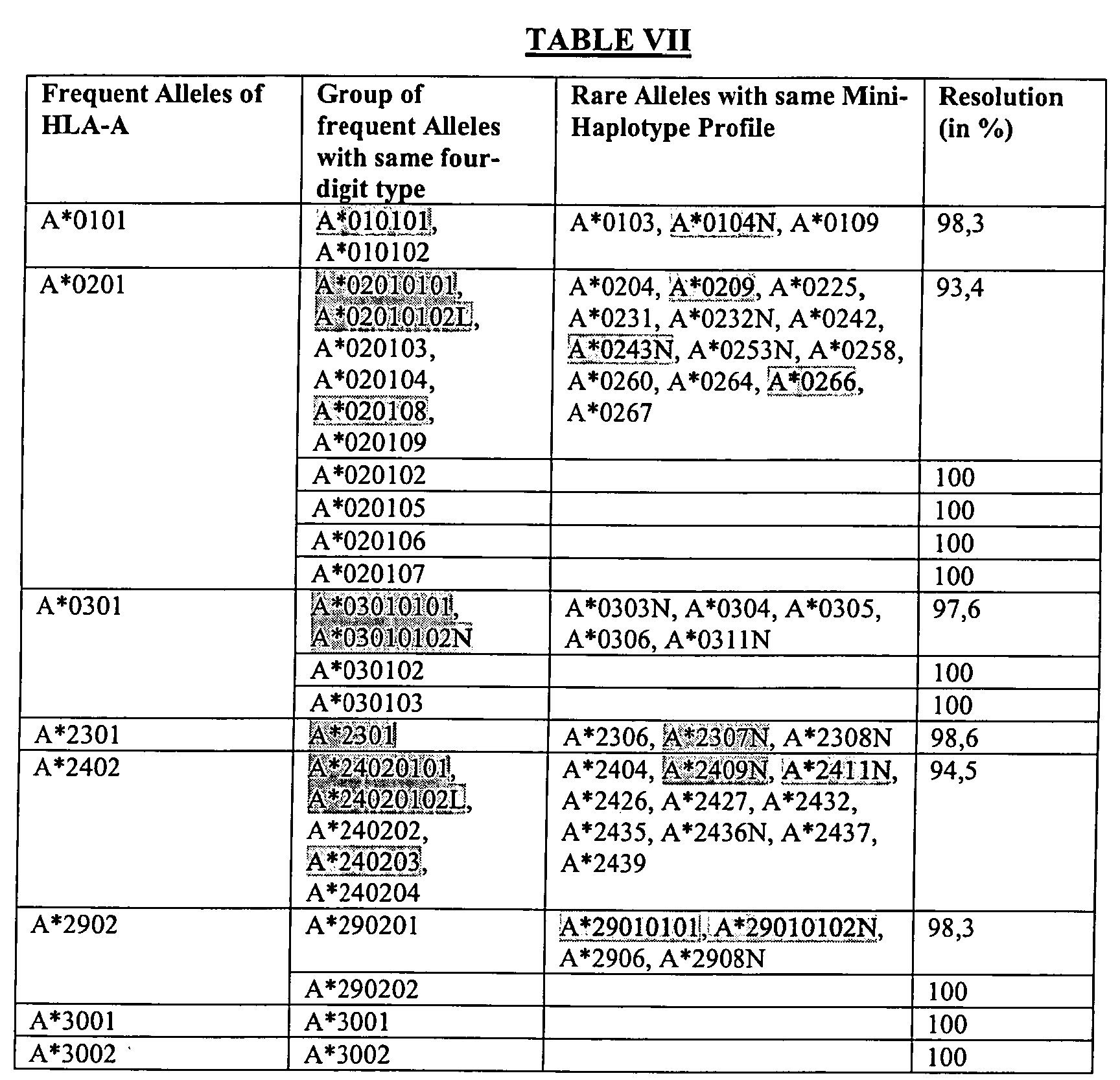
- Capture: Alleles in a same field have the same mini-haplotype profile; grey high lighted are all alleles with identical sequences over exons 2 and 3.

- Capture: Alleles in a same field have the same mini-haplotype profile; grey high lighted are all alleles with identical sequences over exons 2 and 3.
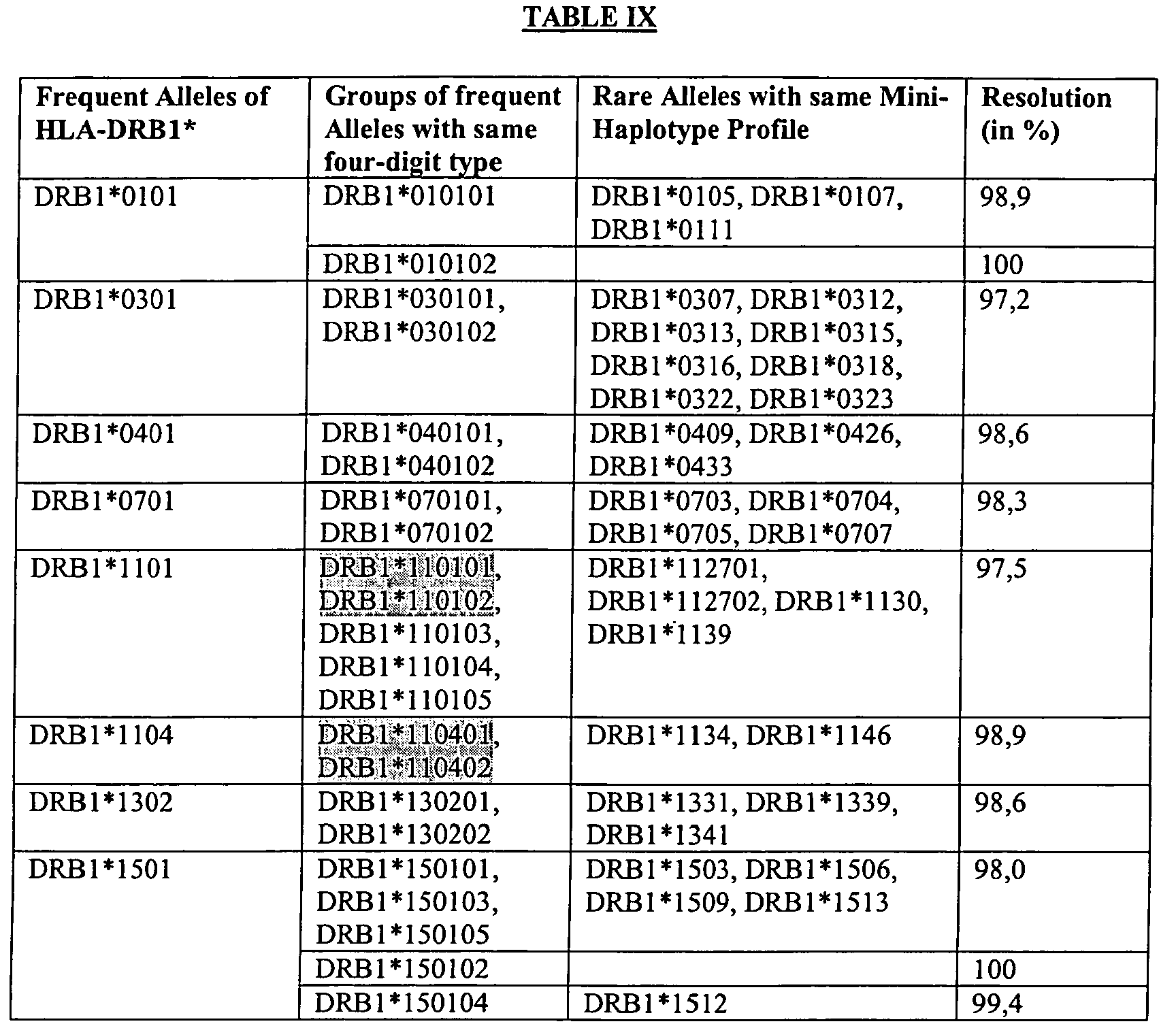
- Capture: Alleles in a same field have the same mini-haplotype profile; grey high lighted are all alleles with identical sequences over exon 2 (base 101 to 356)
- The complete list of HLA alleles and sub-groups generated by the most informative mini-haplotyping markers (ten each for HLA-A, HLA-B and HLA-DRB1) are listed in Tables X to XII below.





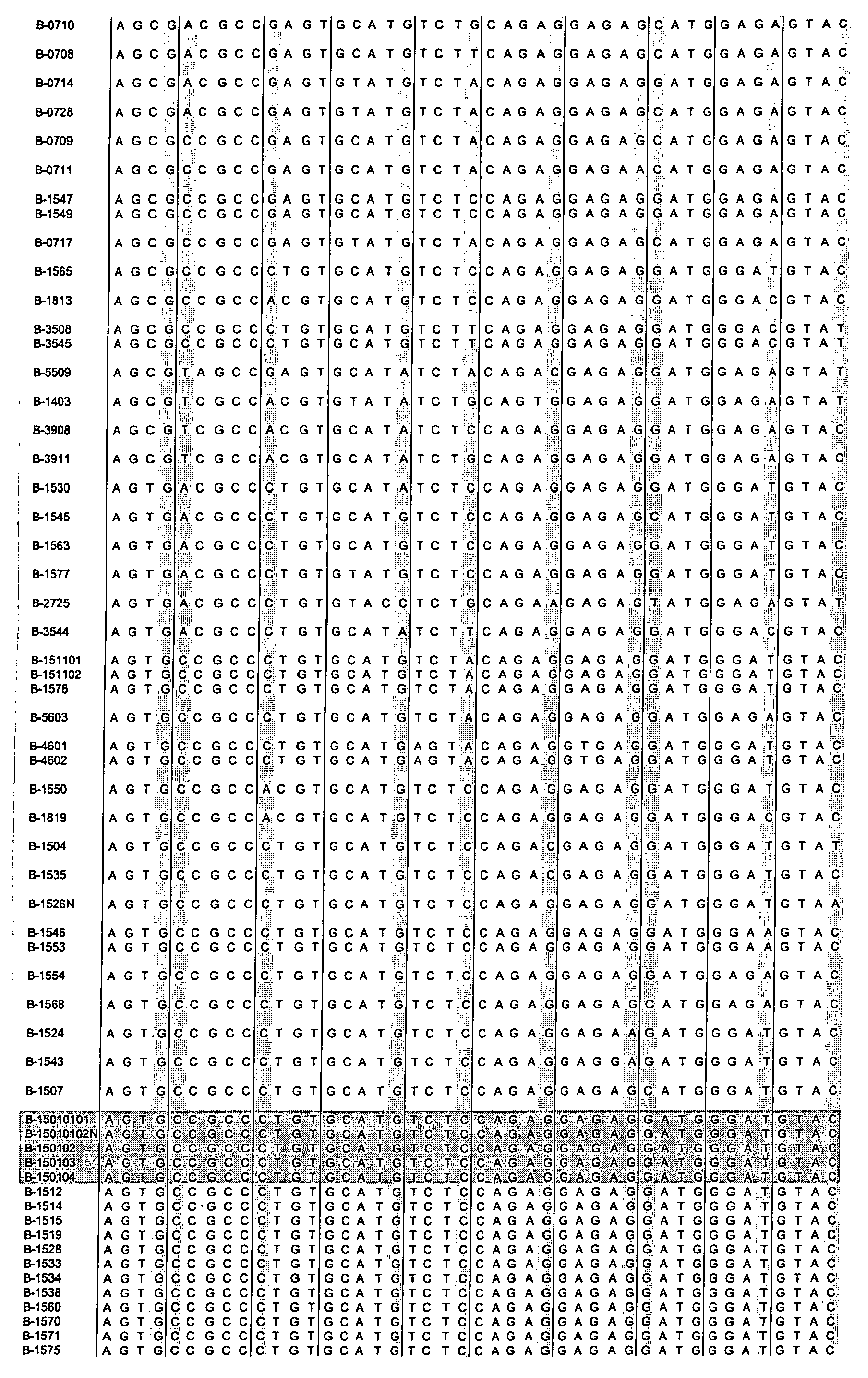
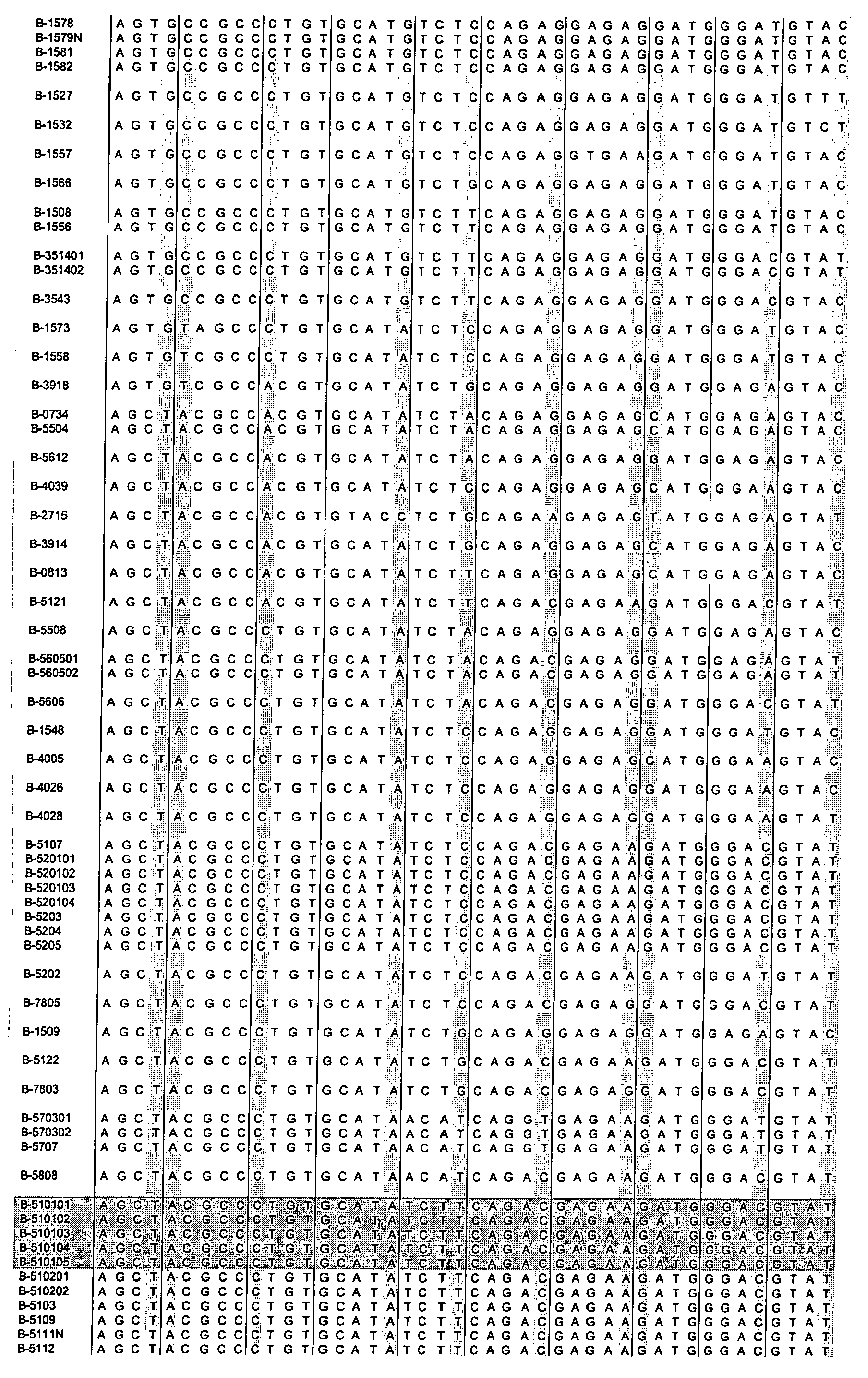
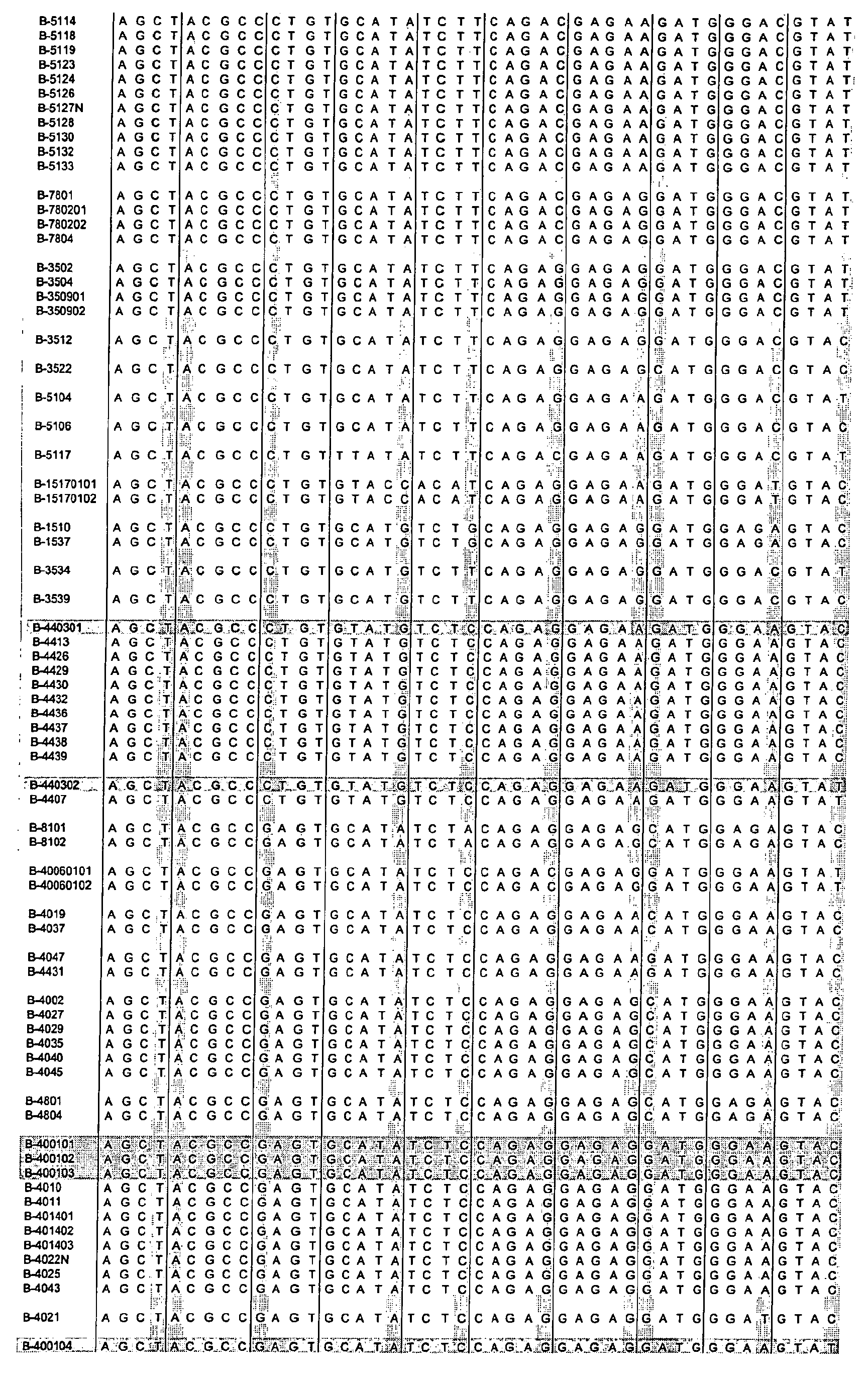
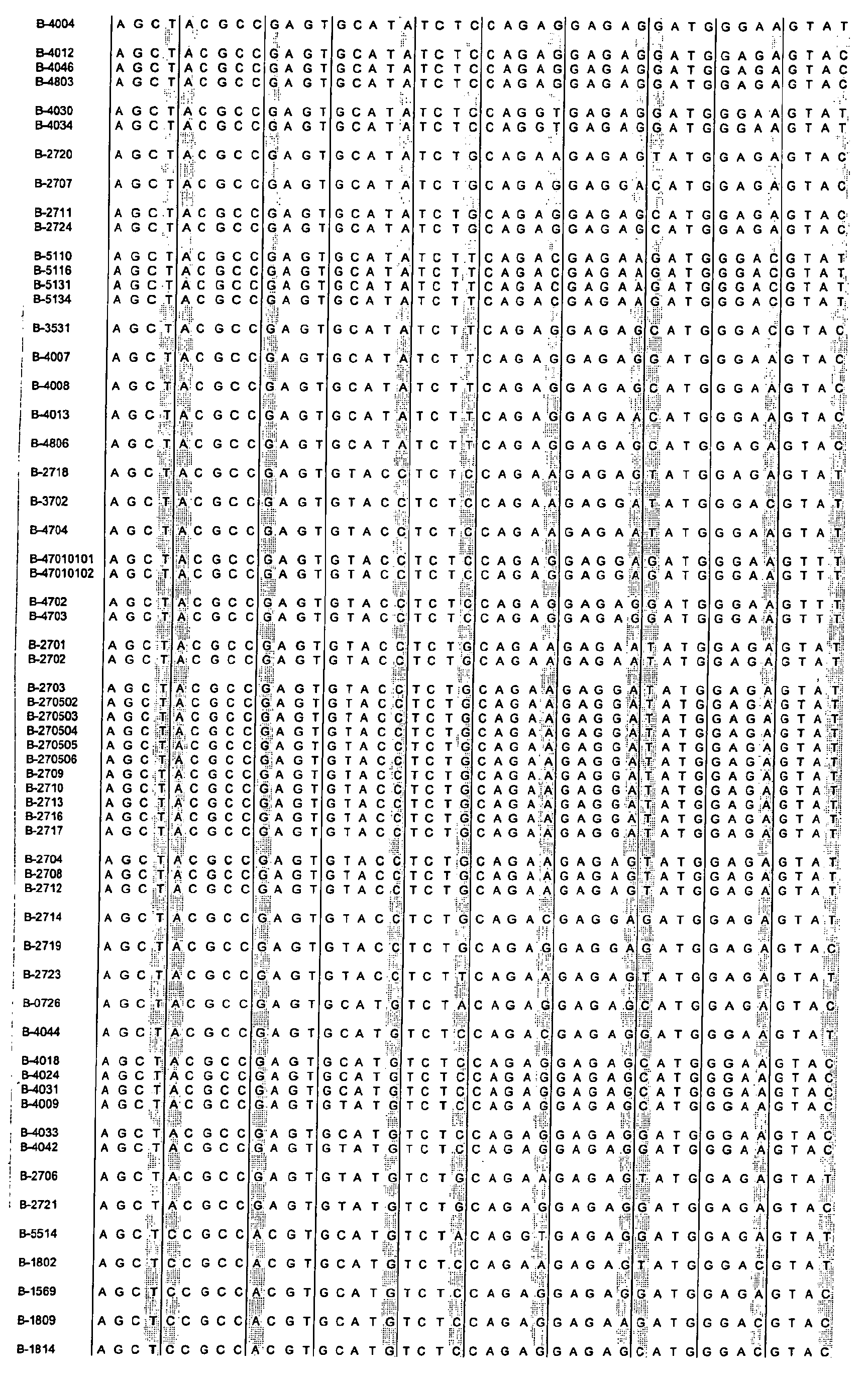




- General strategy for medium resolution typing is described below:
For medium resolution typing a maximally informative set of marker positions were determined. These consist ofpositions - In general, the order of the positions is from the most informative to the least informative with respect to the selection criteria of frequent and rare HLA alleles (see list of frequent HLA alleles above). Thus the ten markers (HLA-A and HLA-B) that were selected for the fine typing strategy constitute the first ten markers of the set of 19 markers for the single pass classification into frequent and rare HLA alleles (HLA-A and HLA-B). Like with sequence-based HLA typing there are heterozygous combinations of HLA alleles that can not be resolved. However, there are fewer ambiguities with this method due to the mini-haplotypes that are provided.
- Another object of the present invention is the use of said methodology of the invention is for screening of tissue donors, for example, bone marrow donors in registries for frequent and rare HLA types.
- The description of the HLA alleles is based on the Anthony Nolan database (October 2003).
- In addition to the aforementioned method, the invention includes yet other arrangements which will emerge from the description that follows, which refers to examples of supports according to the invention, as well as the annexed figures and tables, wherein:
- Figure 1 describes 19 positions covered by mini-haplotyping assays for discrimination of HLA-A mapped onto the HLA-A allele A*010101 as reference. Black boxes indicate an extension position while grey boxes indicate polymorphisms that are captured by the annealing of the respective primer of the primer pool. Pools are used in forward and reverse. Numbering is according to the transcription start of the cDNA.
- Figure 2 describes 19 positions covered by mini-haplotyping assays for discrimination of HLA-B mapped onto the HLA-B allele B*070201 as reference. Black boxes indicate an extension position while grey boxes indicate polymorphisms that are captured by the annealing of the respective primer of the primer pool. Pools are used in forward and reverse. Numbering is according to the transcription start of the cDNA.
- Figure 3 describes 10 positions covered by mini-haplotyping assays for discrimination of HLA-DRB1 mapped onto the HLA-DRB1 allele DRB1*034874 as reference. Black boxes indicate an extension position while grey boxes indicate polymorphisms that are captured by the annealing of the respective primer of the primer pool. Pools are used in forward and reverse. Numbering is according to the transcription start of the cDNA.
- Figure 4 describes 10 positions covered by mini-haplotyping assays for discrimination of HLA-A mapped onto the HLA-A allele A*010101 as reference for the distinction of subgroups that can then be further analysed. Black boxes indicate an extension position while grey boxes indicate polymorphisms that are captured by the annealing of the respective primer of the primer pool. Pools are used in forward and reverse. Numbering is according to the transcription start of the cDNA.
- Figure 5 describes 10 positions covered by mini-haplotyping assays for discrimination of HLA-B mapped onto the HLA-B allele B*070201 as reference for the distinction of subgroups that can then be further analysed. Black boxes indicate an extension position while grey boxes indicate polymorphisms that are captured by the annealing of the respective primer of the primer pool. Pools are used in forward and reverse. Numbering is according to the transcription start of the cDNA.
-
- Figure 6 describes Genotyping results of a CEPH family (1418, 01 = father, 02 = mother, 03 = child, 04 = child) for position HLA-B_272. 1407,3 Da corresponds to the addition of C to primer 6, 7, 8, or 9; 1422,3 Da corresponds to the addition of T to primer 6, 7, 8, or 9; 1431,4 Da/ 1430,9 Da corresponds to the addition of A to primer 6, 7, 8, or 9; and 1447,4 Da/ 1448,5 Da corresponds to the addition of G to primer 6, 7, 8, or 9.
- Table I represents HLA-A alleles captured by the 10 markers in the different subgroups and additional positions that have to be typed to resolve the subgroups.
- Table II represents HLA-B alleles captured by the 10 markers in the different subgroups and additional positions that have to be typed to resolve the subgroups.
- Table III represents HLA-DRB1 alleles captured by the 10 markers in the different subgroups and additional positions that have to be typed to resolve the subgroups.
- Table IV represents the list of the individual primers that are required to constitute the pools for mini-haplotyping of HLA-A (19 markers). The 10 markers required for the creation of subgroups are also contained. ^ refers to the base used to attach the mass/charge tag, CT refers to the mass difference of the mass/charge tag, sp means phosphorothioate group. The product analysed by mass spectrometry includes the base 5'of the most 5' sp.
- Table V represents the list of the individual primers that are required to constitute the pools for mini-haplotyping of HLA-B (19 markers). The 10 markers required for the creation of subgroups are also contained. ^ refers to the base used to attach the mass/charge tag, CT refers to the mass difference of the mass/charge tag, sp means phosphorothioate group. The product analysed by mass spectrometry includes the base 5'of the most 5' sp.
- Table VI represents the list of the individual primers that are required to constitute the pools for mini-haplotyping of HLA-DRB1 (10 markers). ^ refers to the base used to attach the mass/charge tag, CT refers to the mass difference of the mass/charge tag, sp means phosphorothioate group. The product analysed by mass spectrometry includes the base 5'of the most 5' sp.
- Table VII represents the resolution that can be generated with the 19 markers for the distinction of the frequent HLA alleles in HLA-A.
- Table VIII represents the resolution that can be generated with the 19 markers for the distinction of the frequent HLA alleles in HLA-B.
- Table IX represents the resolution that can be generated with the 10 markers for the distinction of the frequent HLA alleles in HLA-DRB1.
- Table X represents the list of HLA-A alleles that are resolved with the 10 markers for the creation of subgroups. Each subgroup is separated by an empty line. Frequent alleles are shaded in darker grey, while lighter grey indicates the position that primers are extended onto.
- Table XI represents the list of HLA-B alleles that are resolved with the 10 markers for the creation of subgroups. Each subgroup is separated by an empty line. Frequent alleles are shaded in darker grey, while lighter grey indicates the position that primers are extended onto.
- Table XII represents the list of HLA-DRB1 alleles that are resolved with the 10 markers for the creation of subgroups. Each subgroup is separated by an empty line. Frequent alleles are shaded in darker grey, while lighter grey indicates the position that primers are extended onto.
- A locus specific PCR product of exon 2 and exon 3 of HLA-B is amplified with a set of primers published by the International Histocompatibility Working Group, Technical Manuals (Hurly, Fernandes-Vina, Gao, Middleton, Noreen, Ren and Smith; www.ihwg.org/tmanual/Tmcontents.htm). The PCR product is incubated with SAP to remove all excess dNTPs. Then a single base primer extension at
position 272 in the PCR amplicon is carried out. The set of primers, to generate the mini-haplotypes is shown in Table V. Thereafter a 5'phosphodiesterase digest is applied to reduce the primers to a core sequence. After alkylation of the DNA backbone of the mini-haplotype fragments the products are transferred onto a MALDI target pre-coated with matrix. Alternatively the matrix solution can be mixed with the samples and transferred onto the MALDI target to dry. The MALDI target is introduced into a MALDI mass spectrometer and analysed. The mass spectra show one or two mass peaks and that correspond to specific mini-haplotypes. - Forward primer, BAmp1 5'-G GGT CCC AGT TCT AAA GTC CCC ACG-3'(1.875 pmol), reverse primer, BAmp2 5'-CC ATC CCC GGC GAC CTA TAG GAG ATG-3' (1.875 pmol) an BAmp3 5'-AGG CCA TCC CGG CGG GCG ATC TAT-3' (1.875 pmol), 0.25 µl 10x PCR buffer (HiFi Platinum Taq) ), 0.3 µl MgSO4 (50 mM), 0.2 µl of a mix of each dCTP, dATP, dGTP and dTTP (2 mM each), 0.25U engineered DNA polymerase (HiFi Platinum DNA Polymerase; Invitrogen) and 5 ng DNA fill to 3 ul with water. Cycling: 1. 94°C 3 min, 2. 94°C 20 sec, 3. 64°C 30 sec, 4. 72°C 30 sec, steps 2 to 4 are repeated 35 times, 5. 72°C 5 min.
- 1.75 µl of 50 mM Tris-HCl and 0.25 µl SAP (USB corporation, Cleveland, USA) are to add to the PCR product and this has to be incubated for 60 min at 37°C, followed by an incubation at 90°C for 10 min to denature the SAP enzyme.
- To the SAP treated PCR product 2 ul of an extension mix is to add. This mix contains 15 mM MgCl2, 0.1 mM of each of the four α-S-ddNTPs, 5 pmol of the extension primers set and 0,4 U of Thermosequenase. Cycling: 1. 94°C 2 min, 2. 94°C 15 sec, 3. 58°C 20 sec, 4. 72°C 20 sec, steps 2 to 4 are repeated 50 times.
- To the extension product has to be added 0.5 ul 0.5 M acetic acid and 1.5 ul PDE (5.1U) and incubate for at lease 120 min at 37 °C.
- The alkylation is carried out by adding 21 µl of an alkylation mix and incubate for 15 min at 40°C. This mix contains 377 parts water free acetonitrile, 15 part 2M triethylamine/CO2 (pH ∼7.5), 75 parts 2mM Tris-HCl and 174 parts methyljodate. The alkylation is to stop by adding 10 µl deionisated water. 5 µl of the resulted upper phase are to dilute in 10 µl 40% acetonitrile.
- For MALDI target preparation and measurement with the MALDI mass spectrometer 0.5 µl of the final dilution are transferred onto a MALDI target pre-coated with matrix (α-cyano-4-hydroxycinnamic acid methyl ester). Measurement was carried out in a Bruker Autoflex with typically 18 kV acceleration voltage, pulsed ion extraction with a delay of 200 ns, and detection in linear detection mode. Results for
CEPH family 1418 are shown in figure 6.


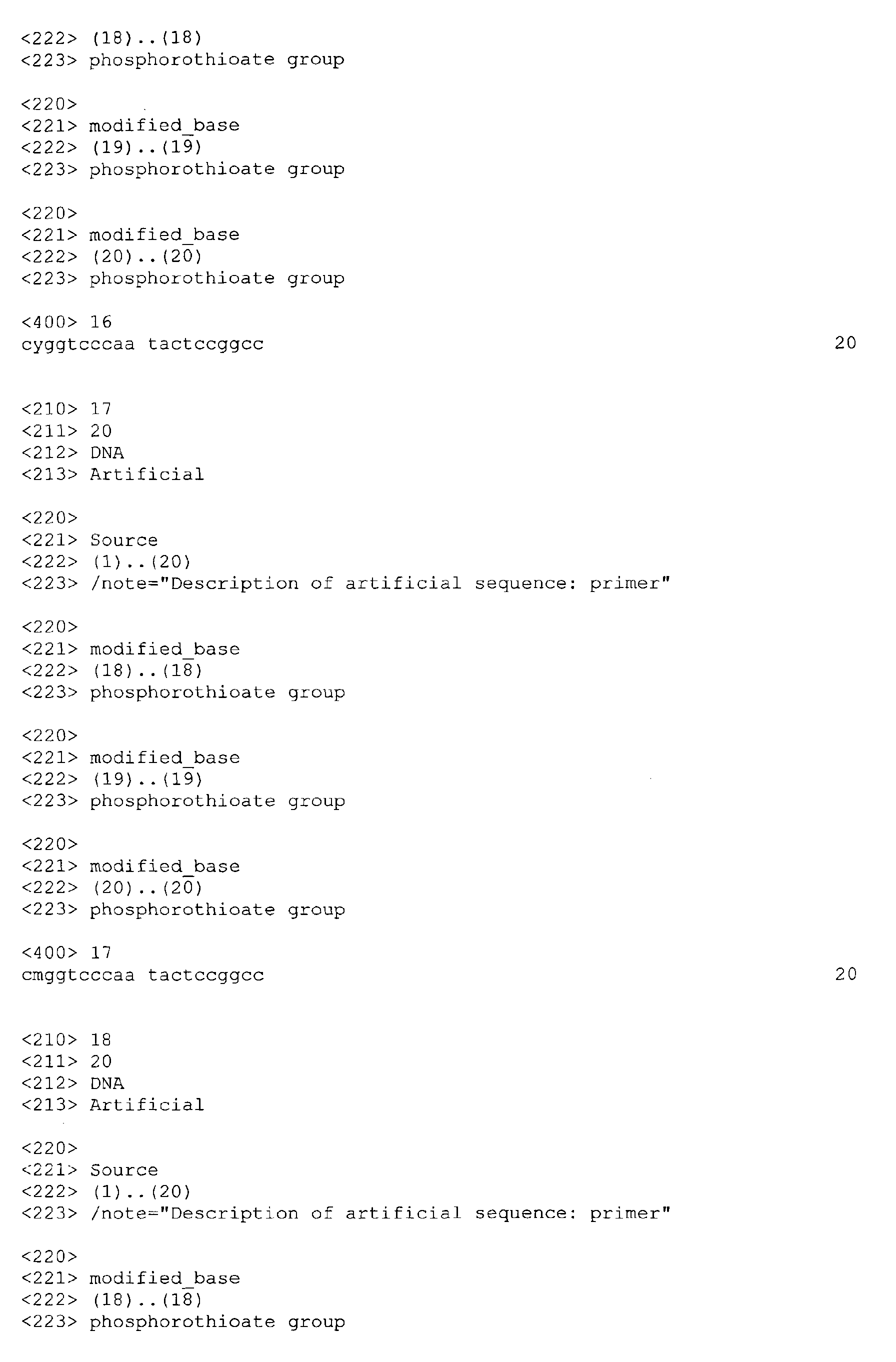

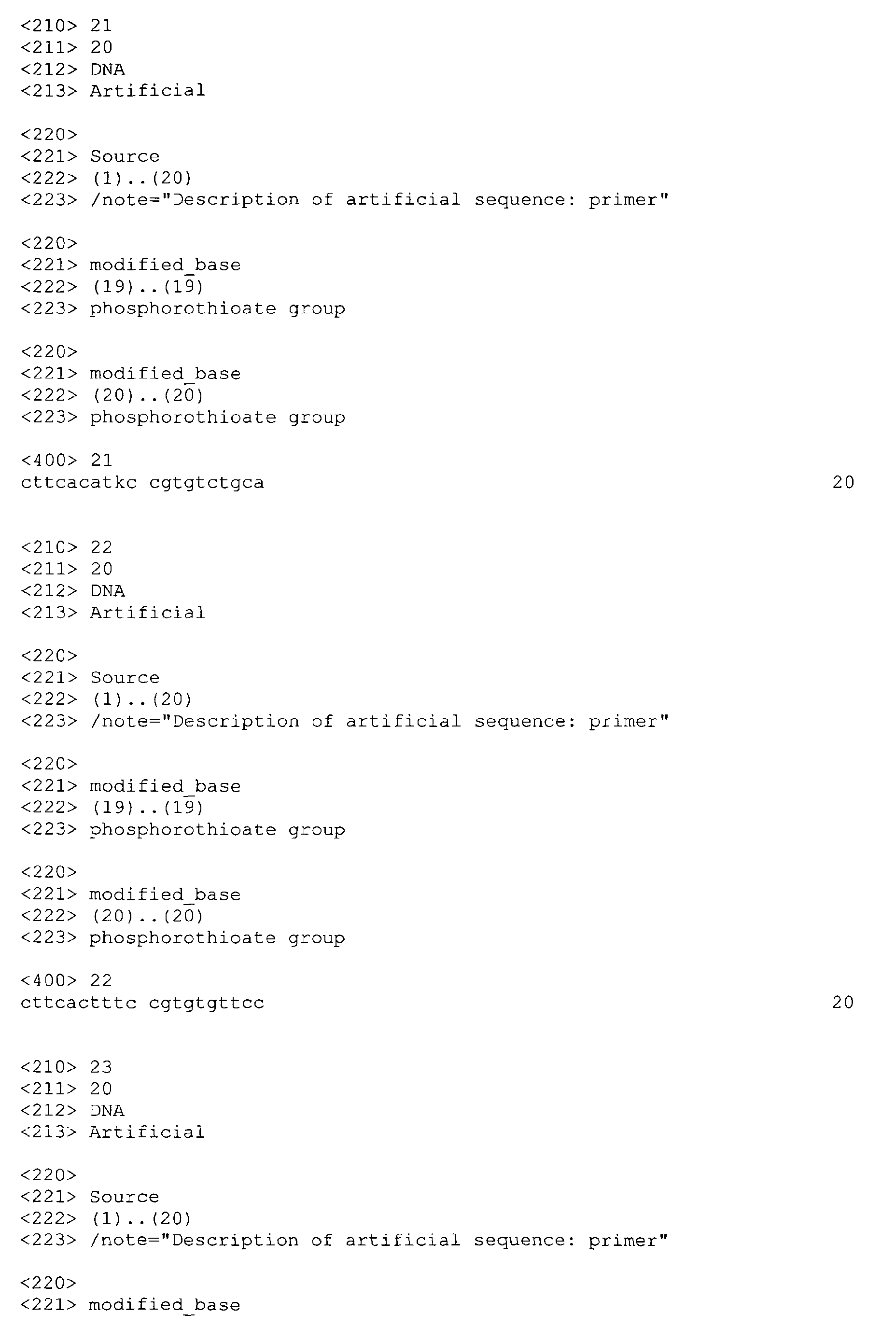

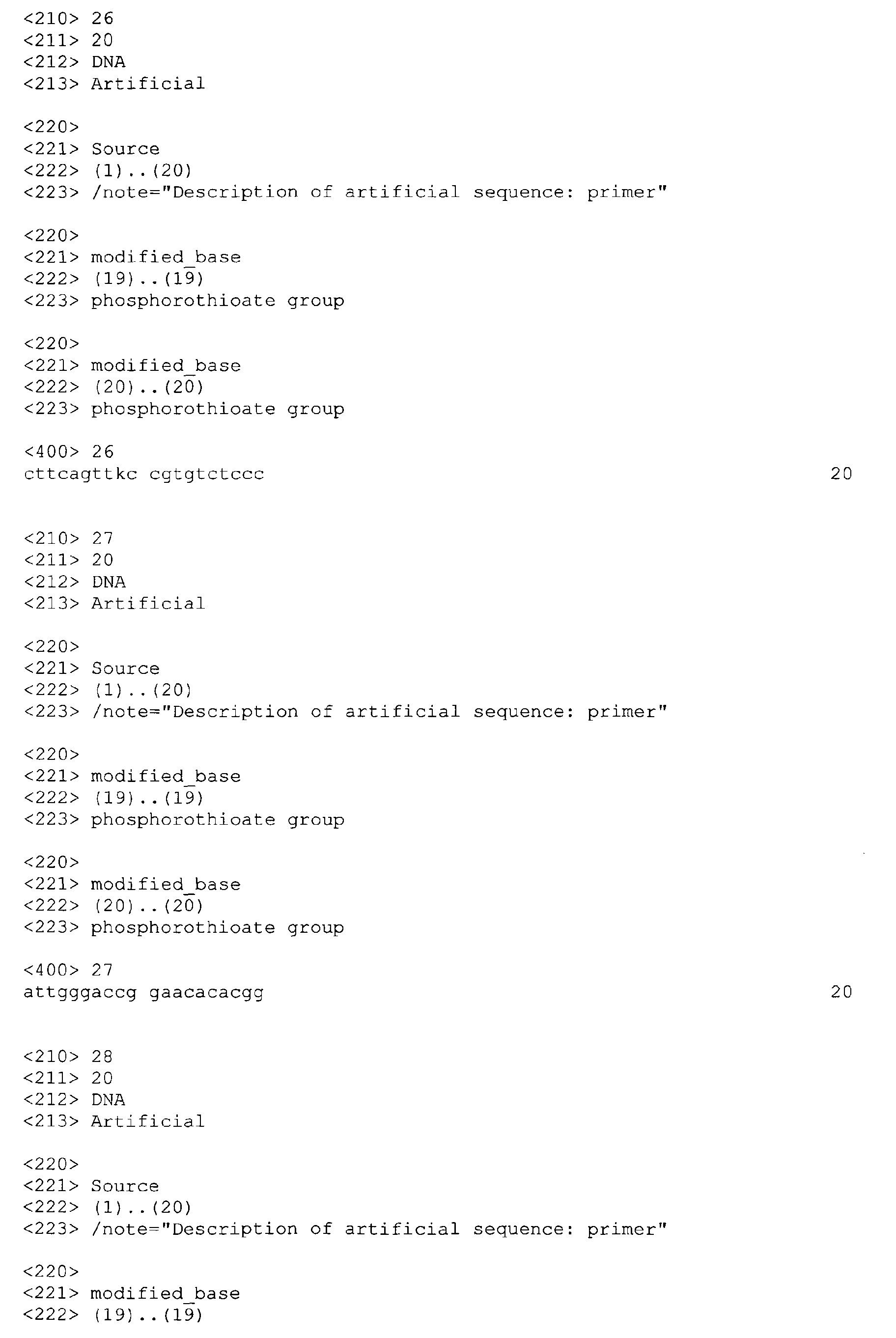
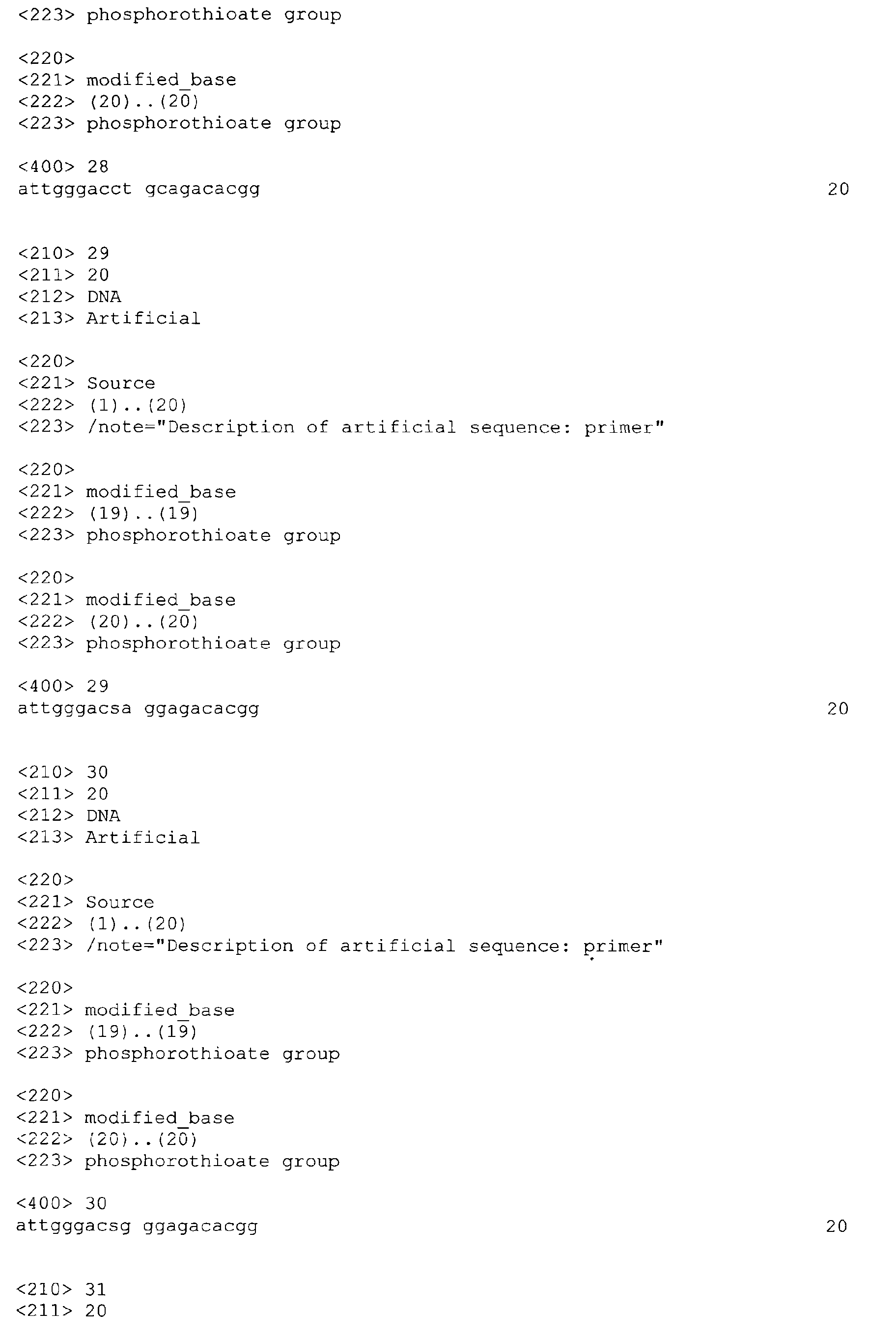
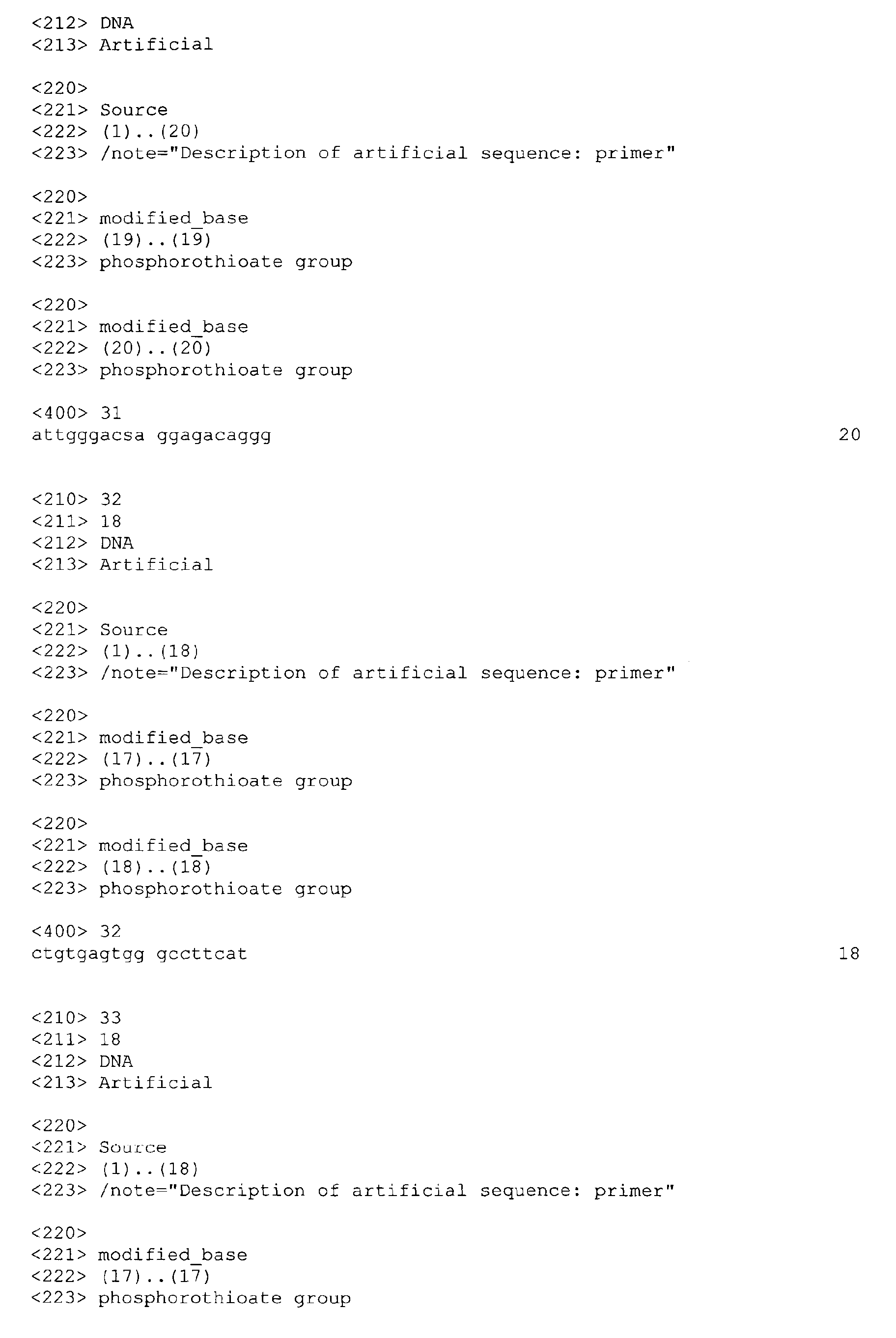




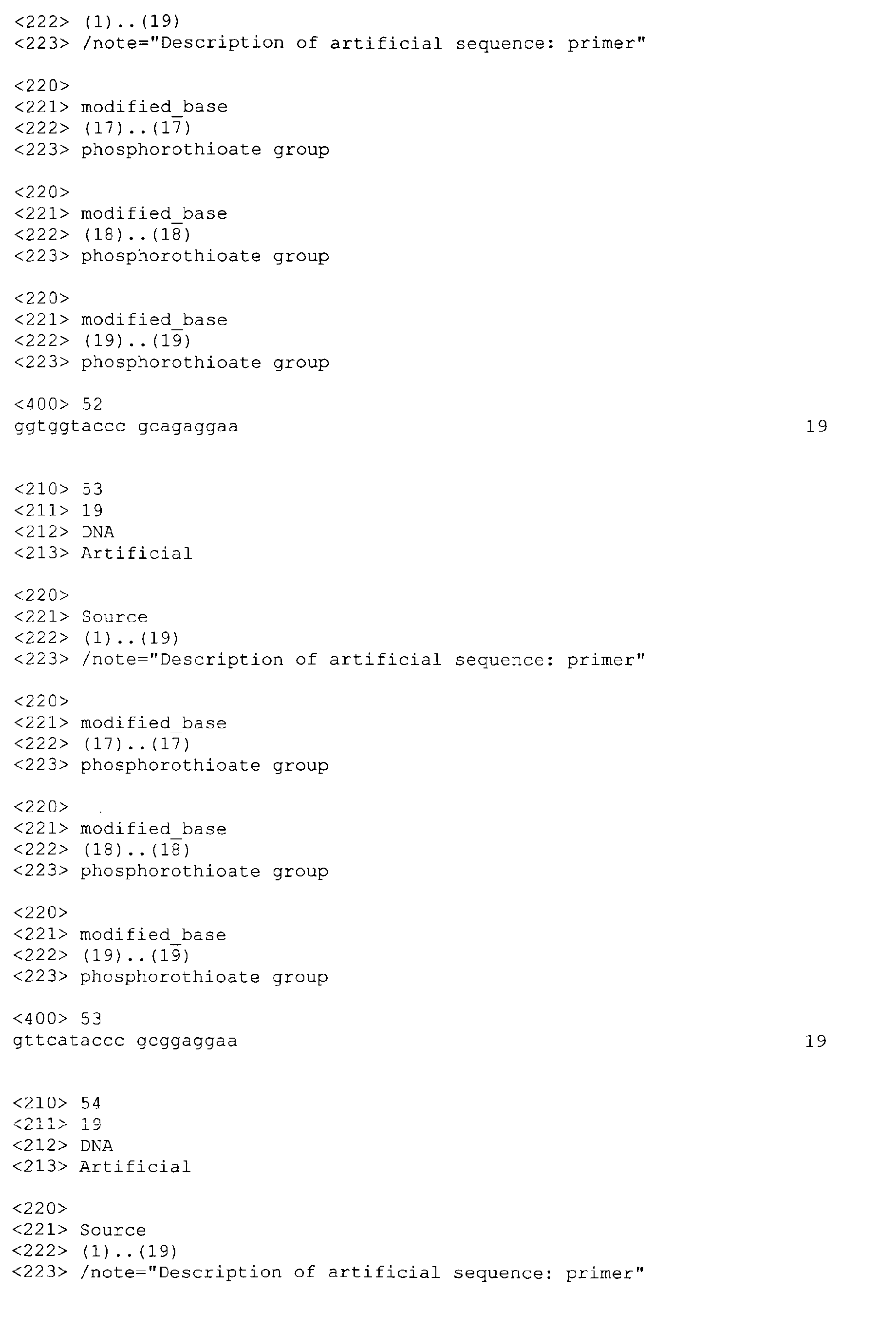


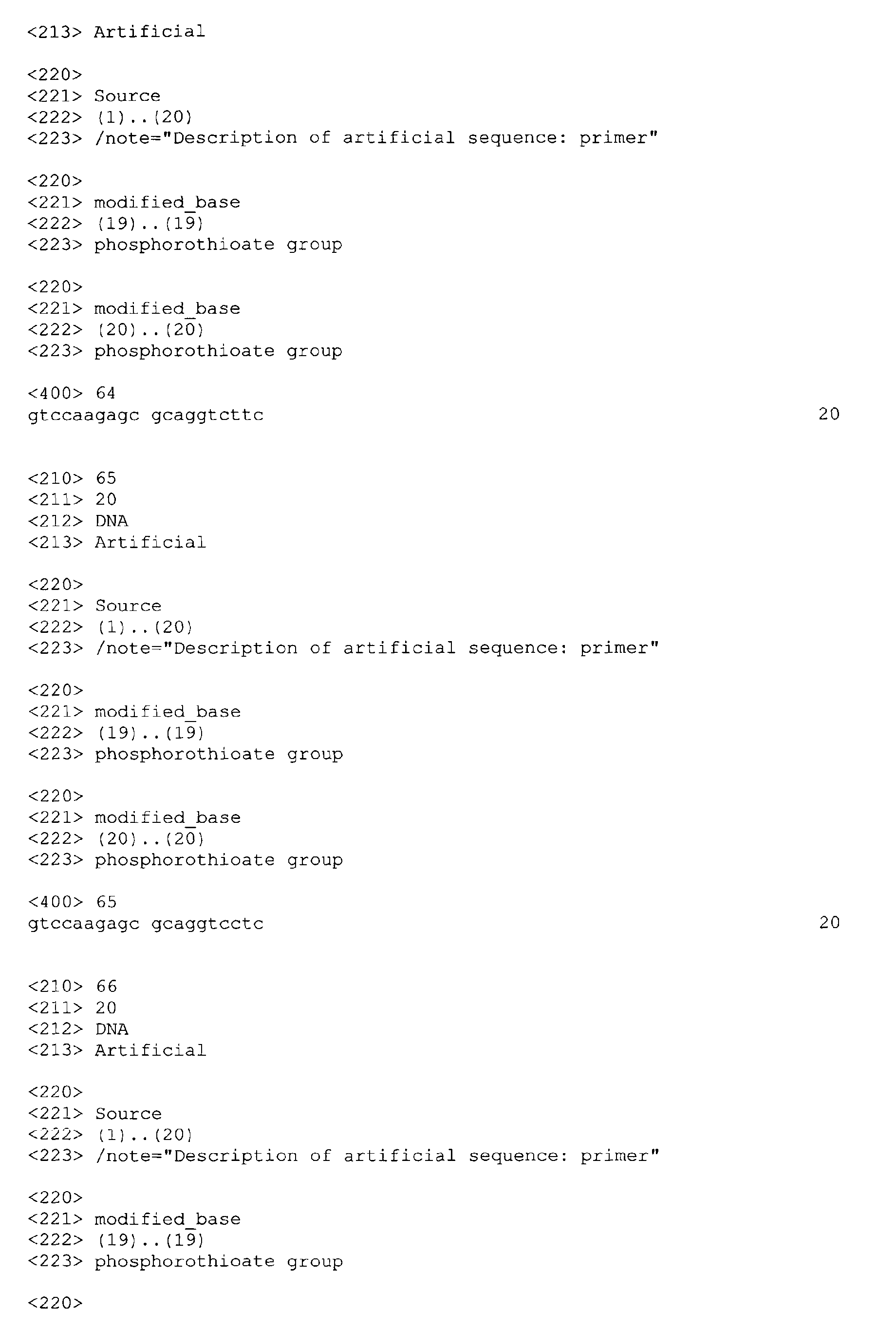
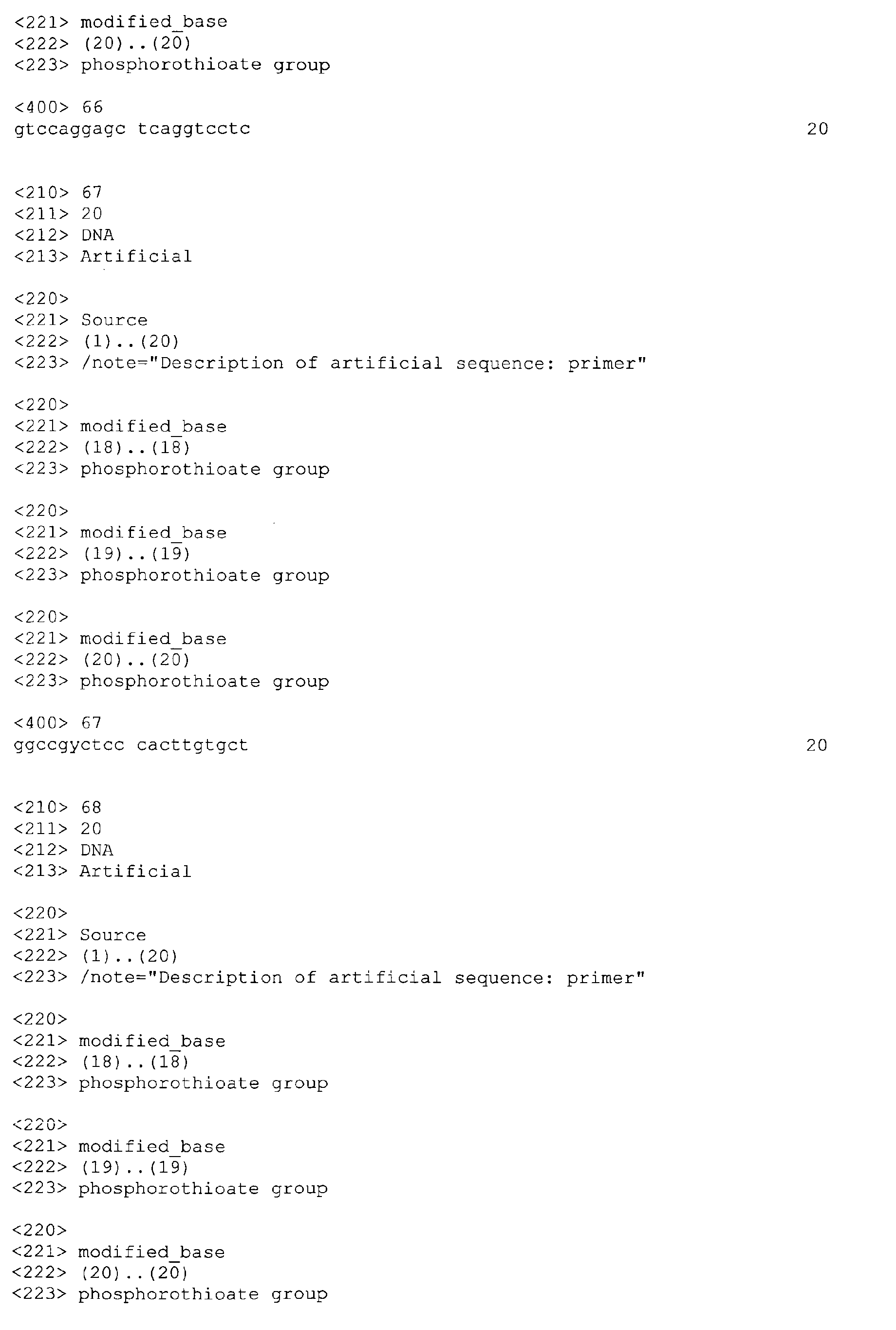

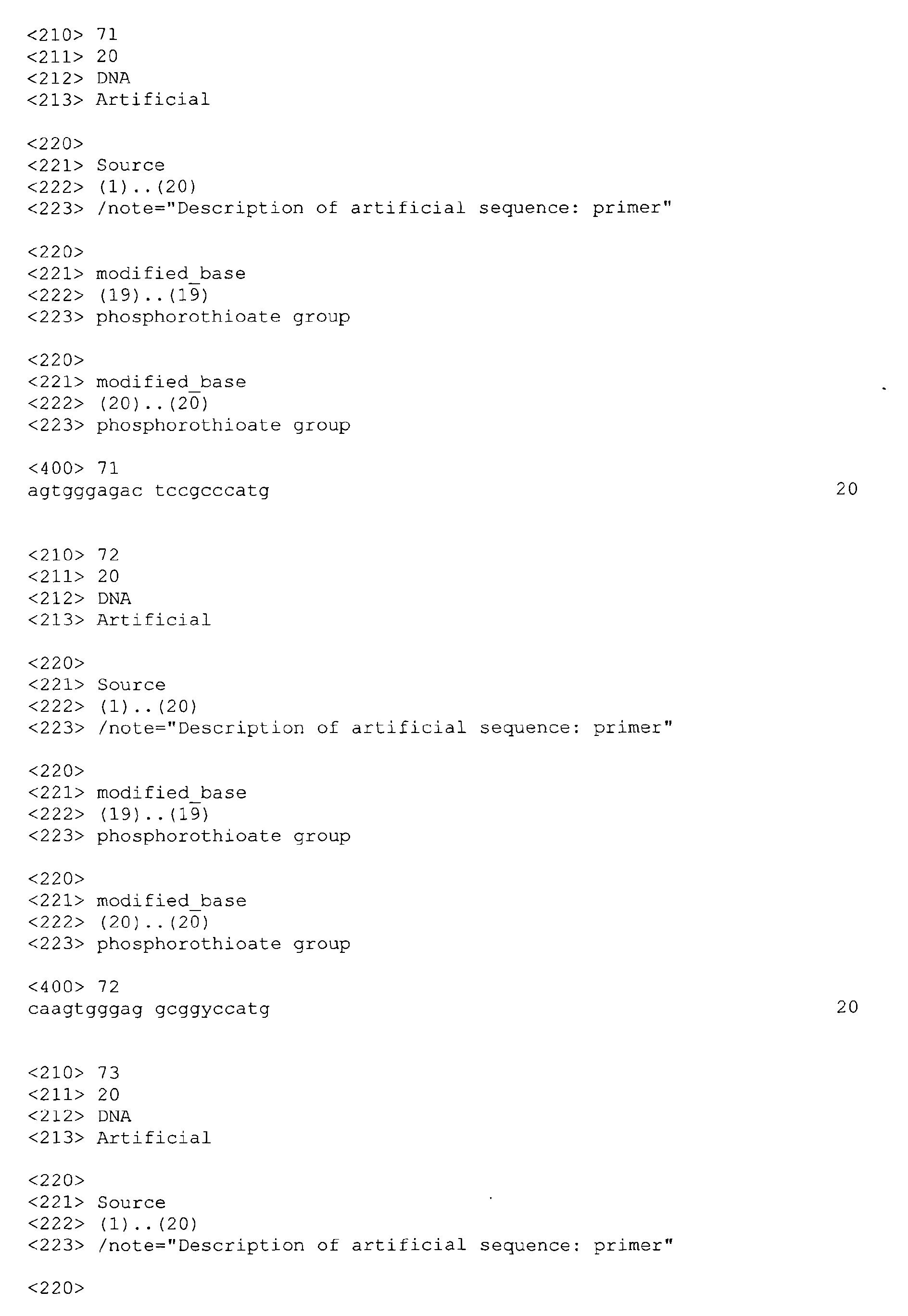

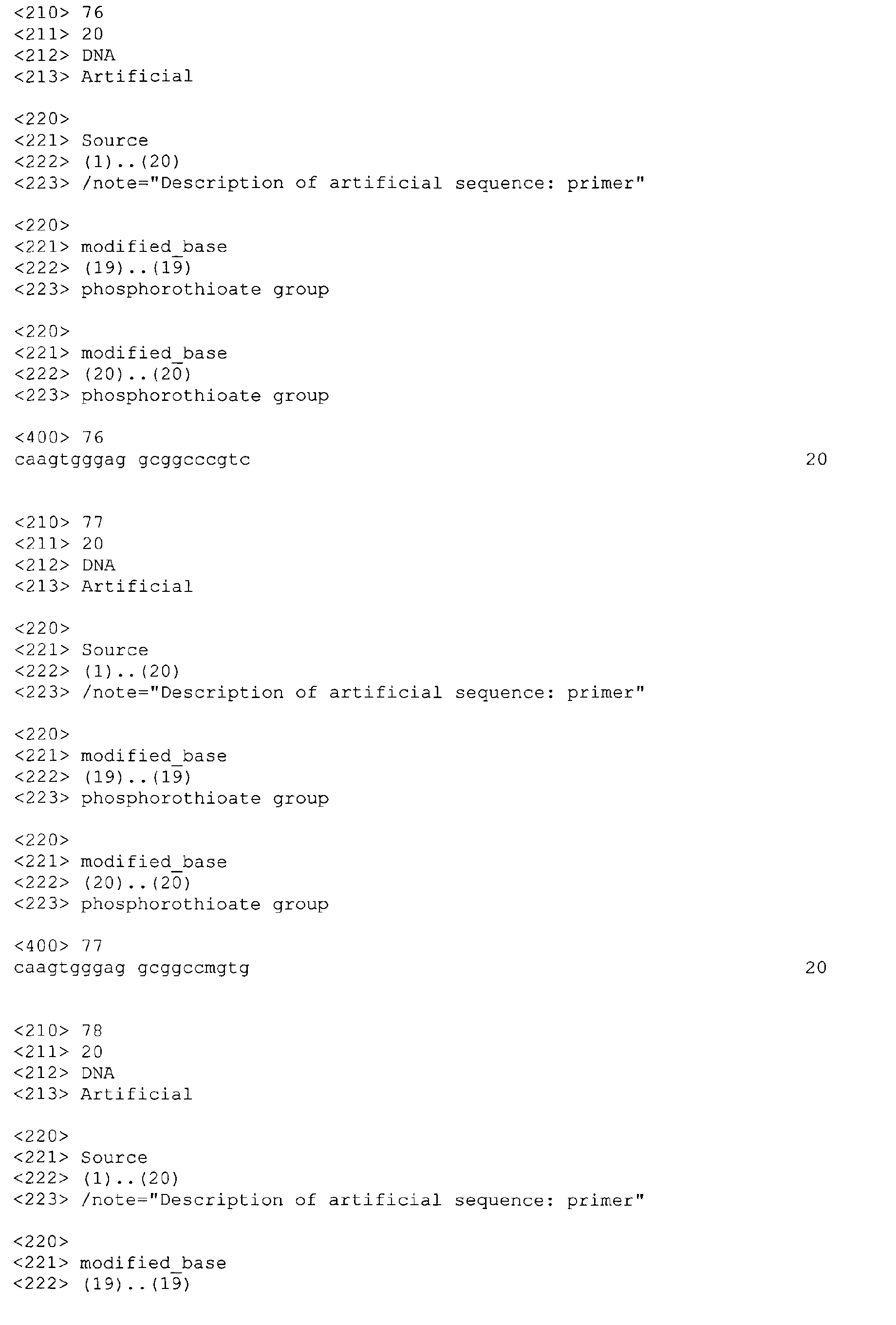
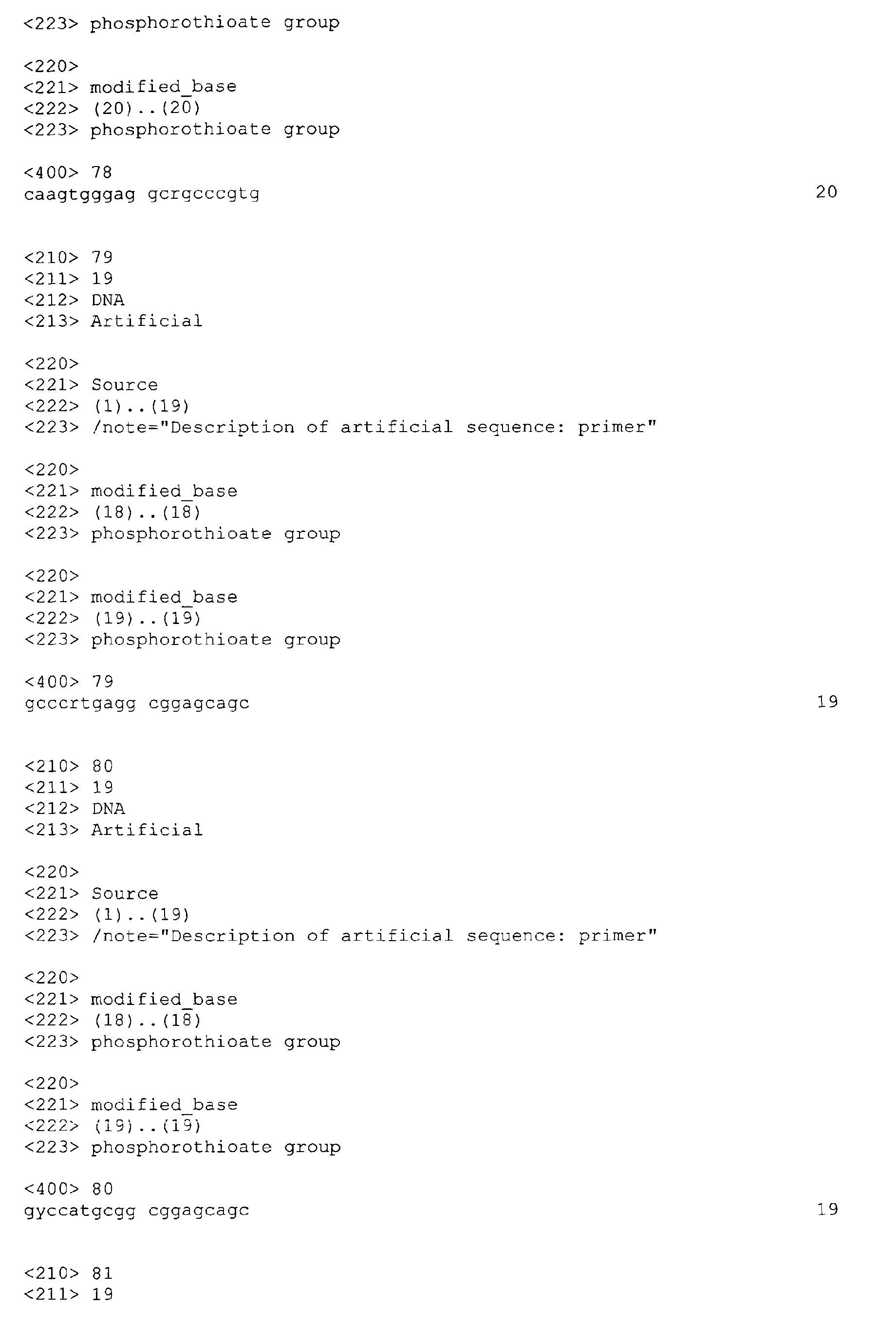

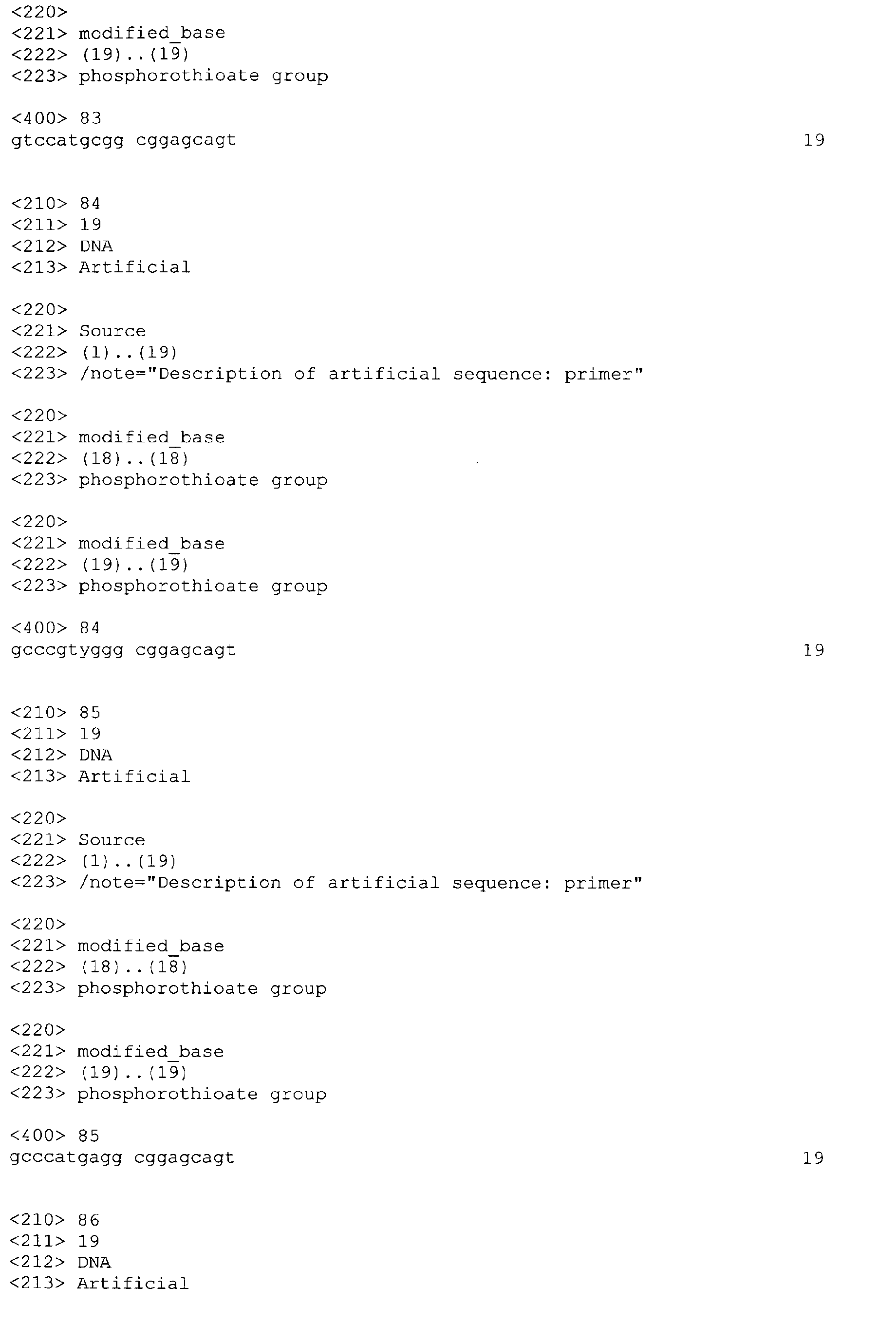

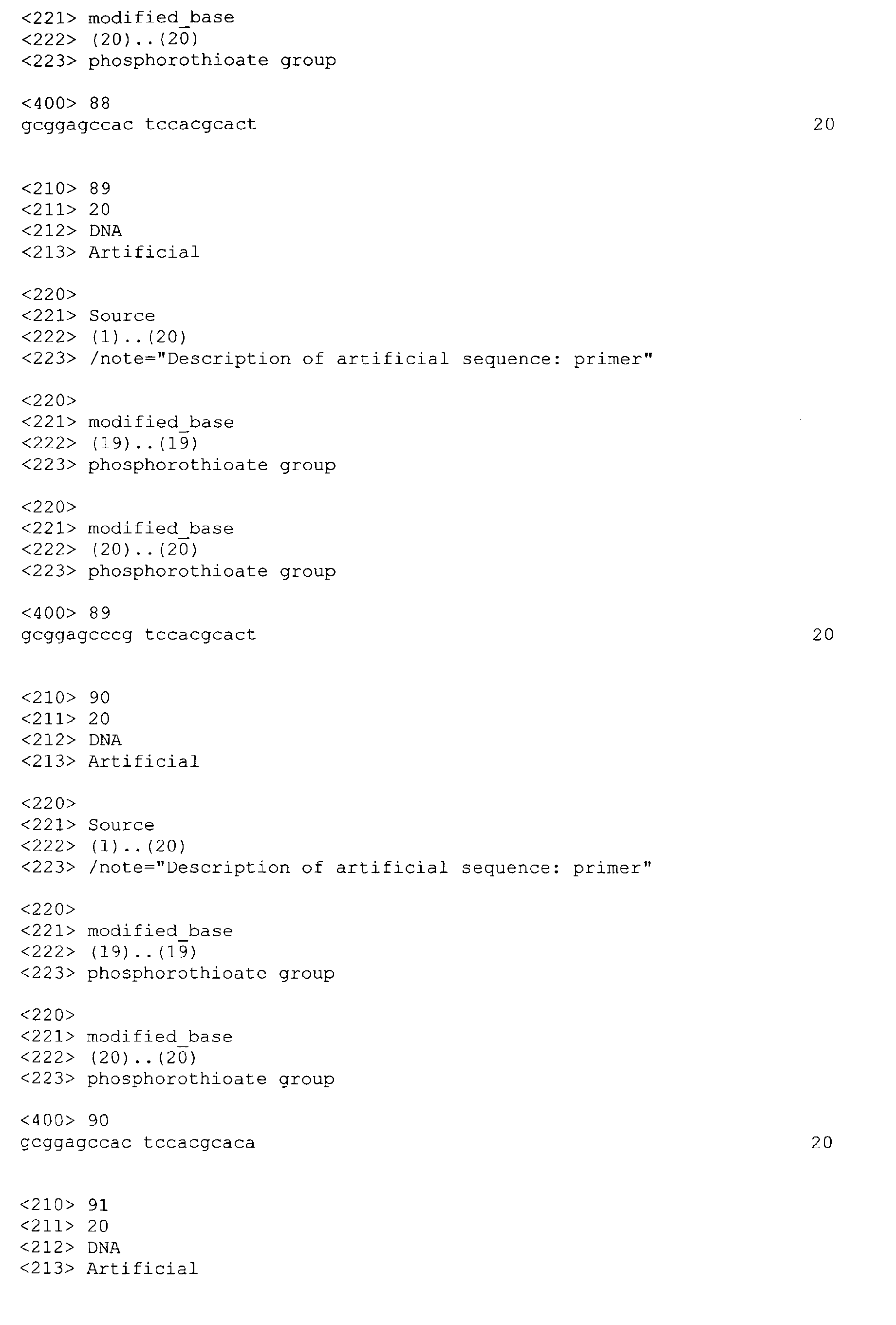
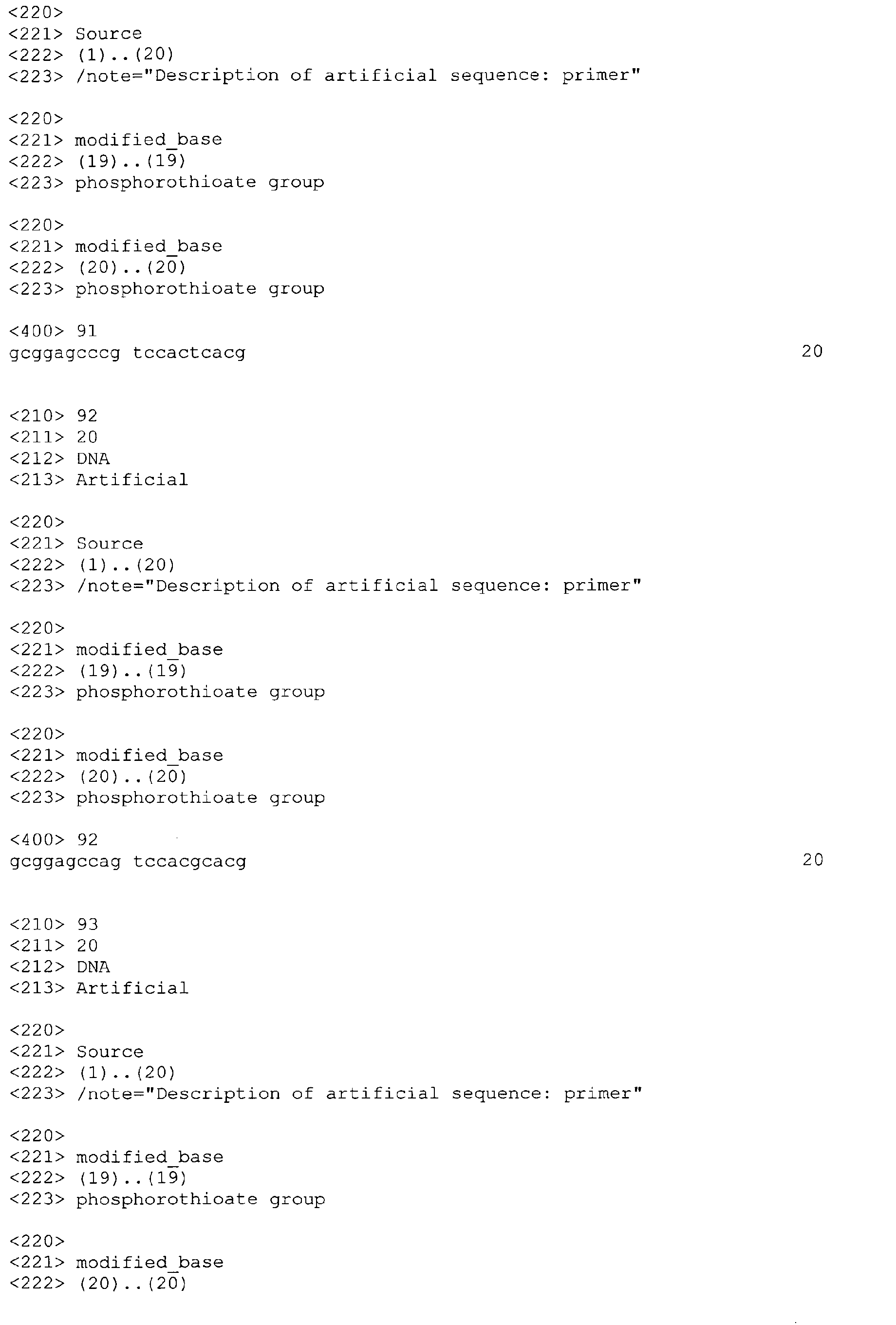
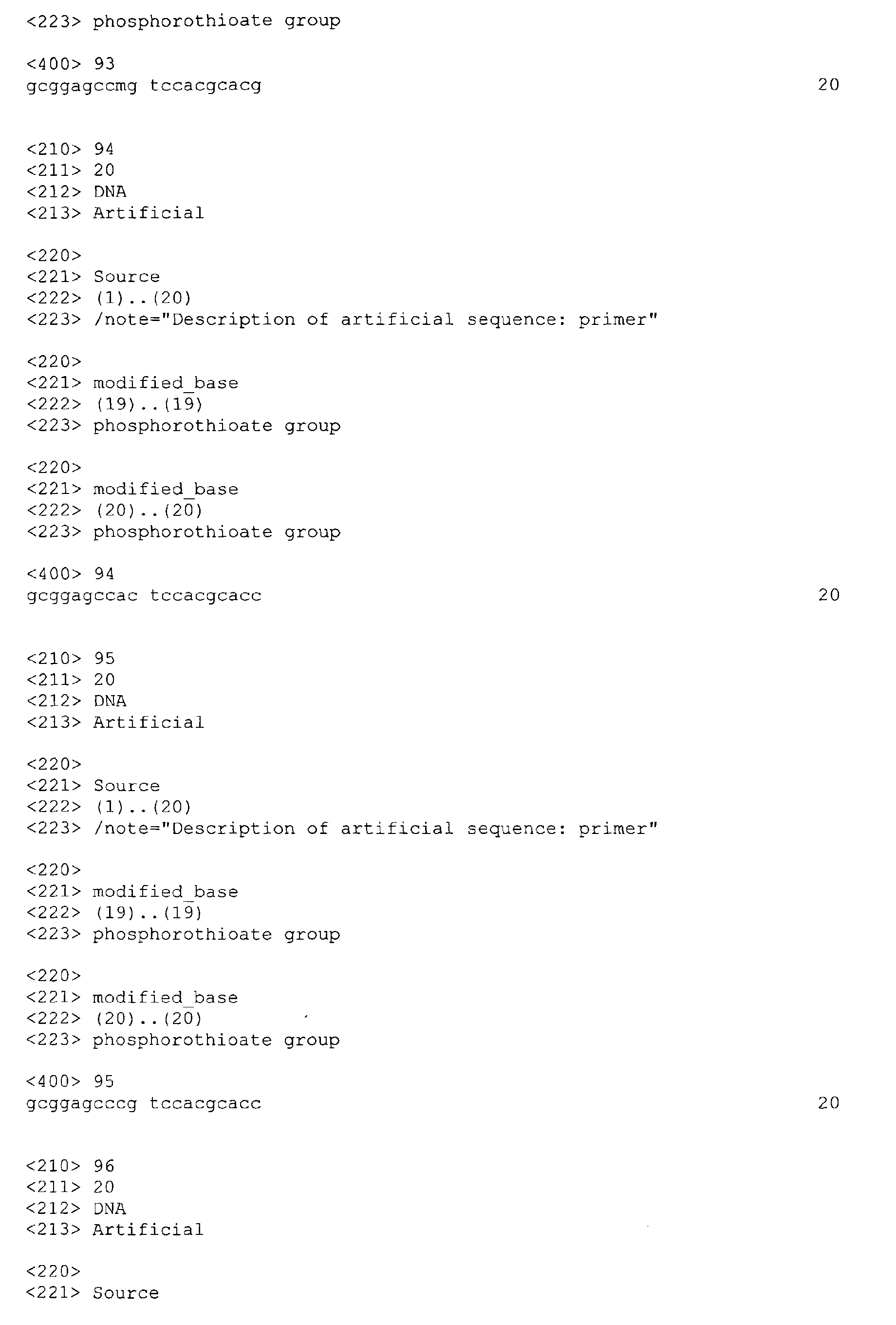
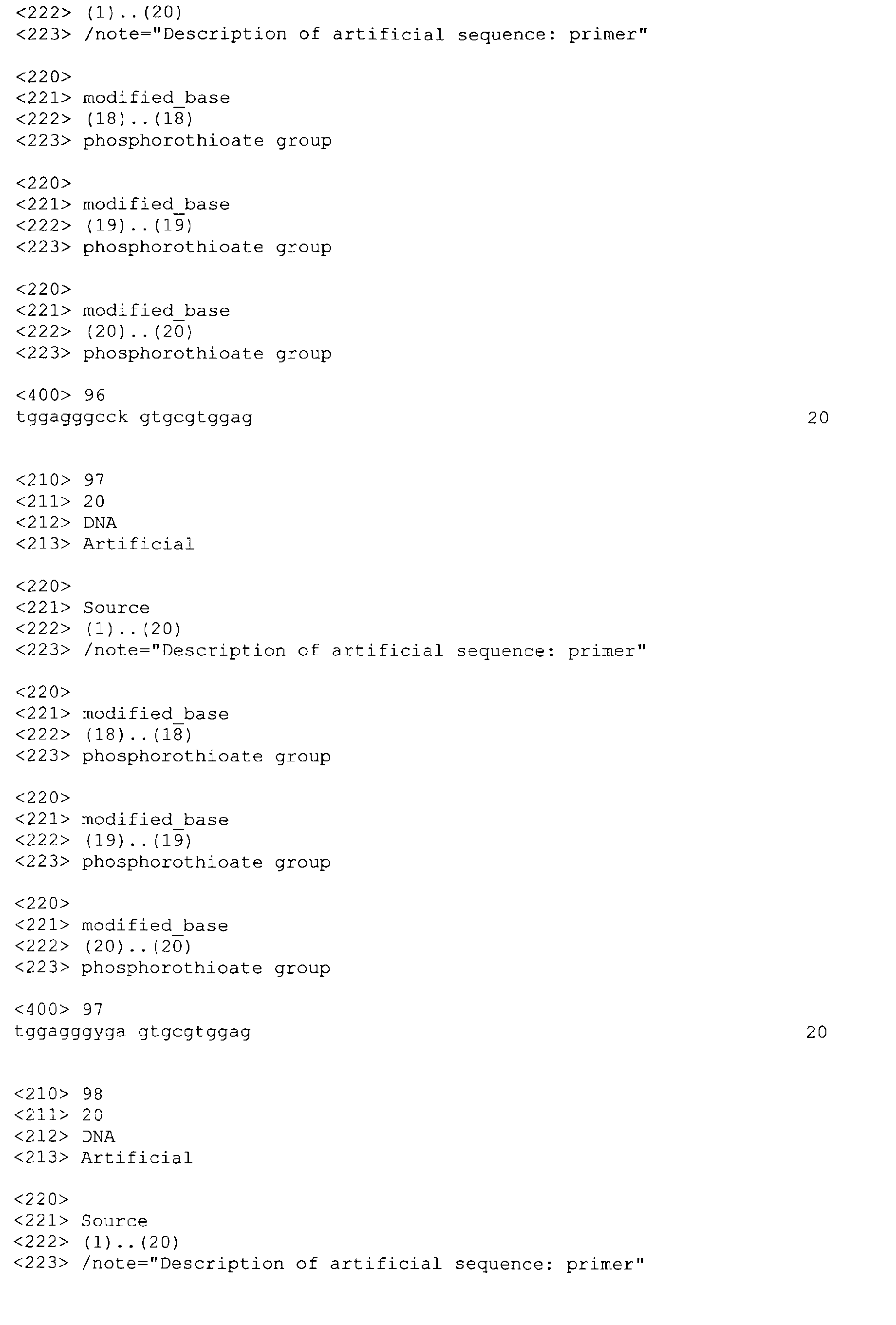

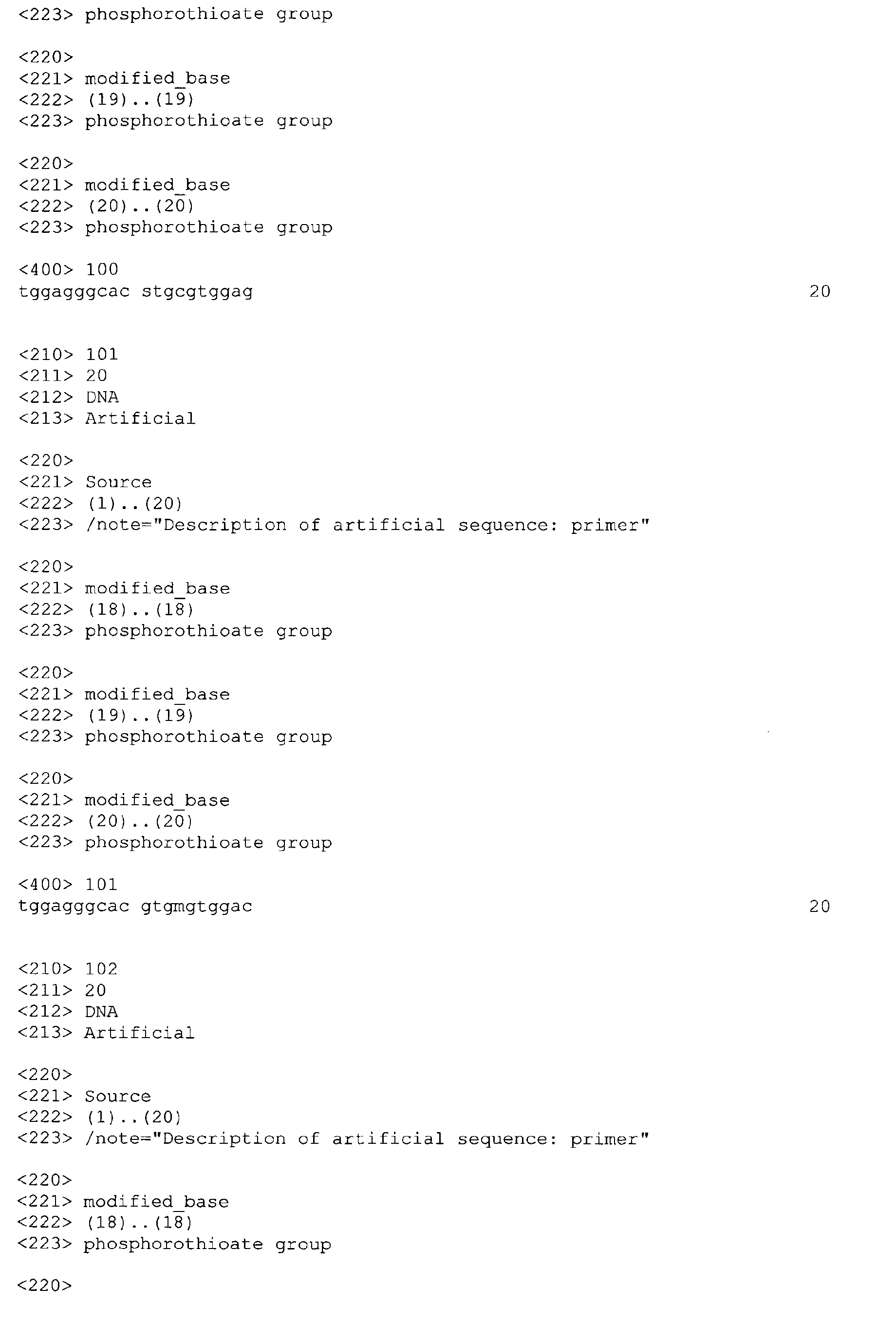


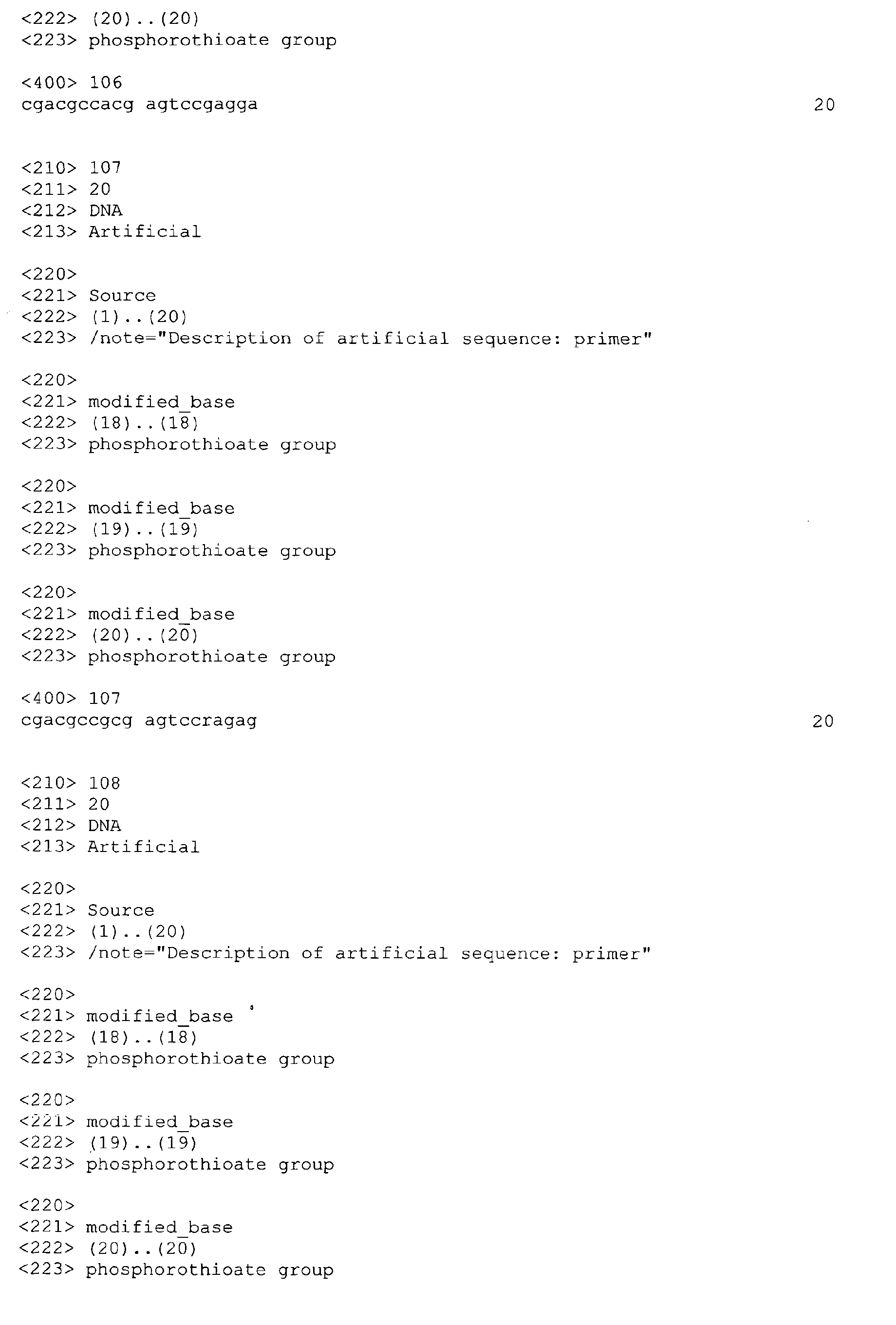

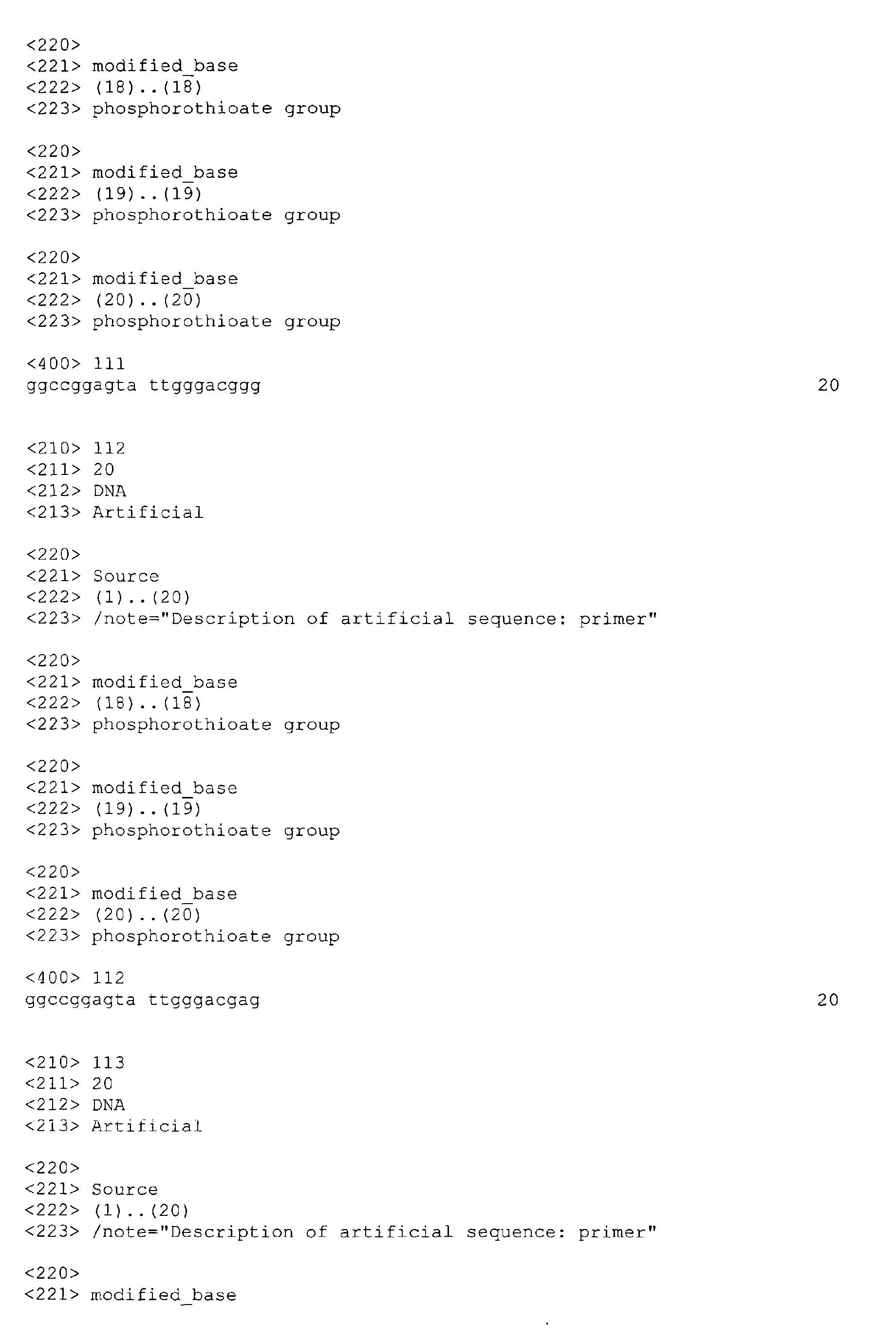


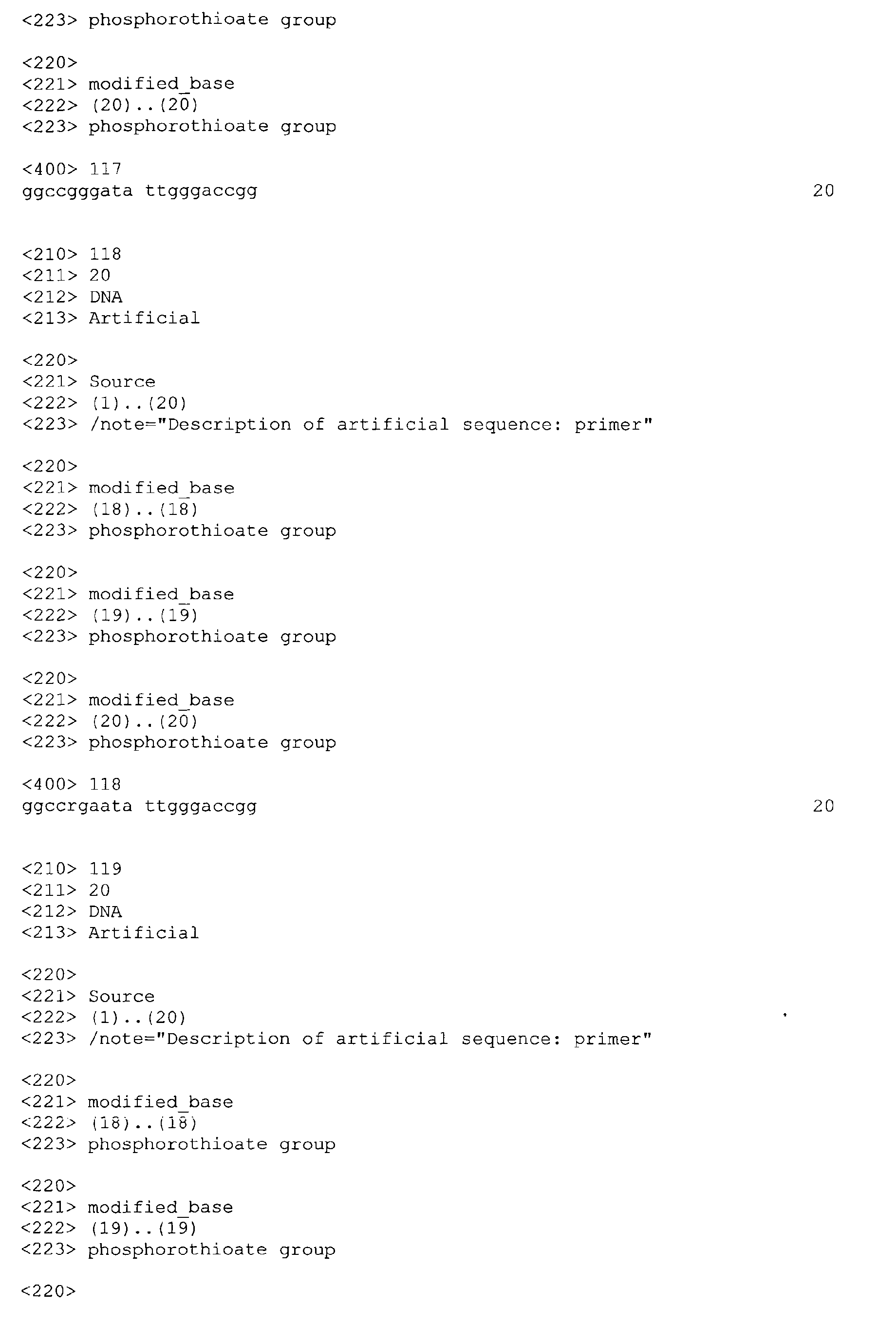

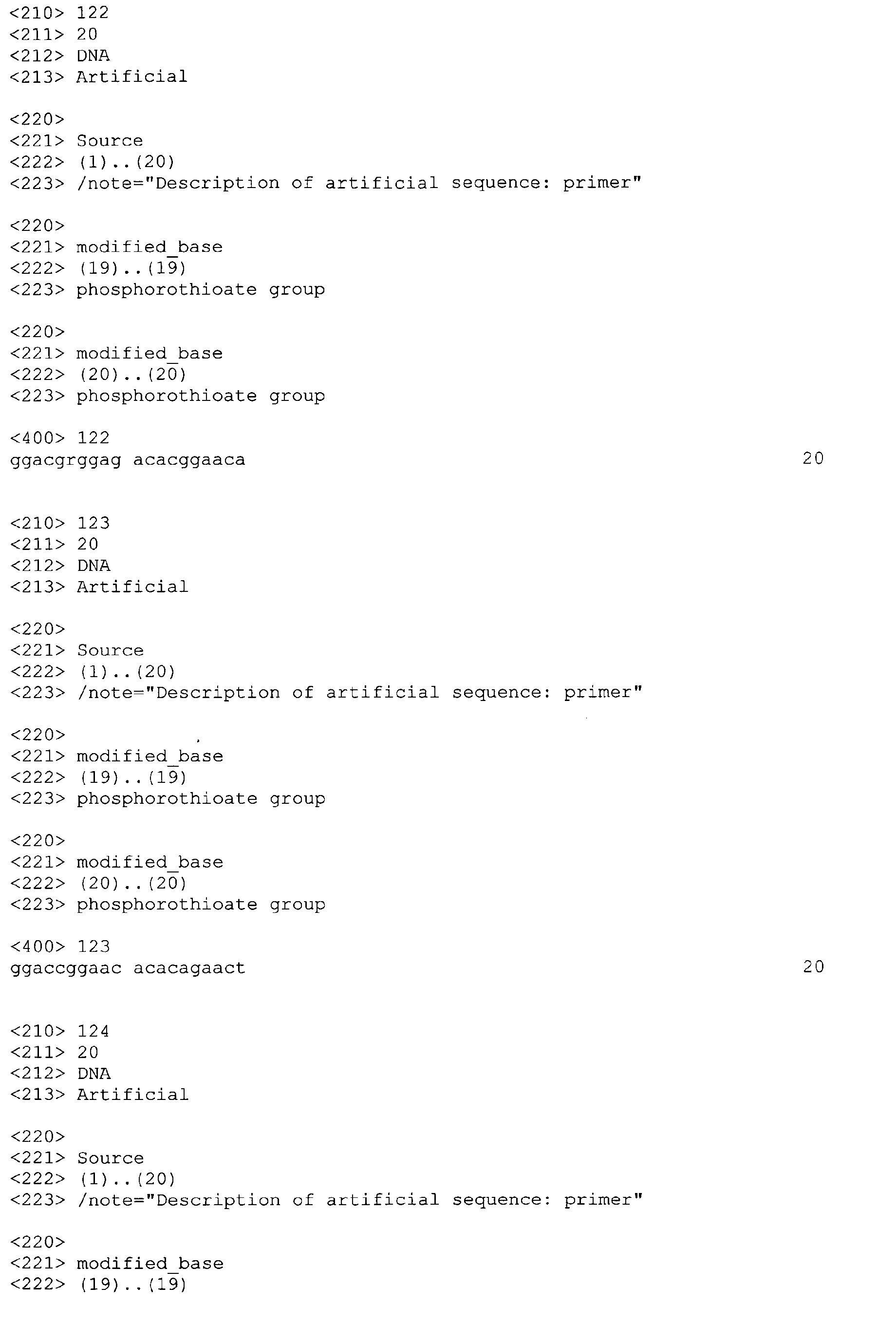


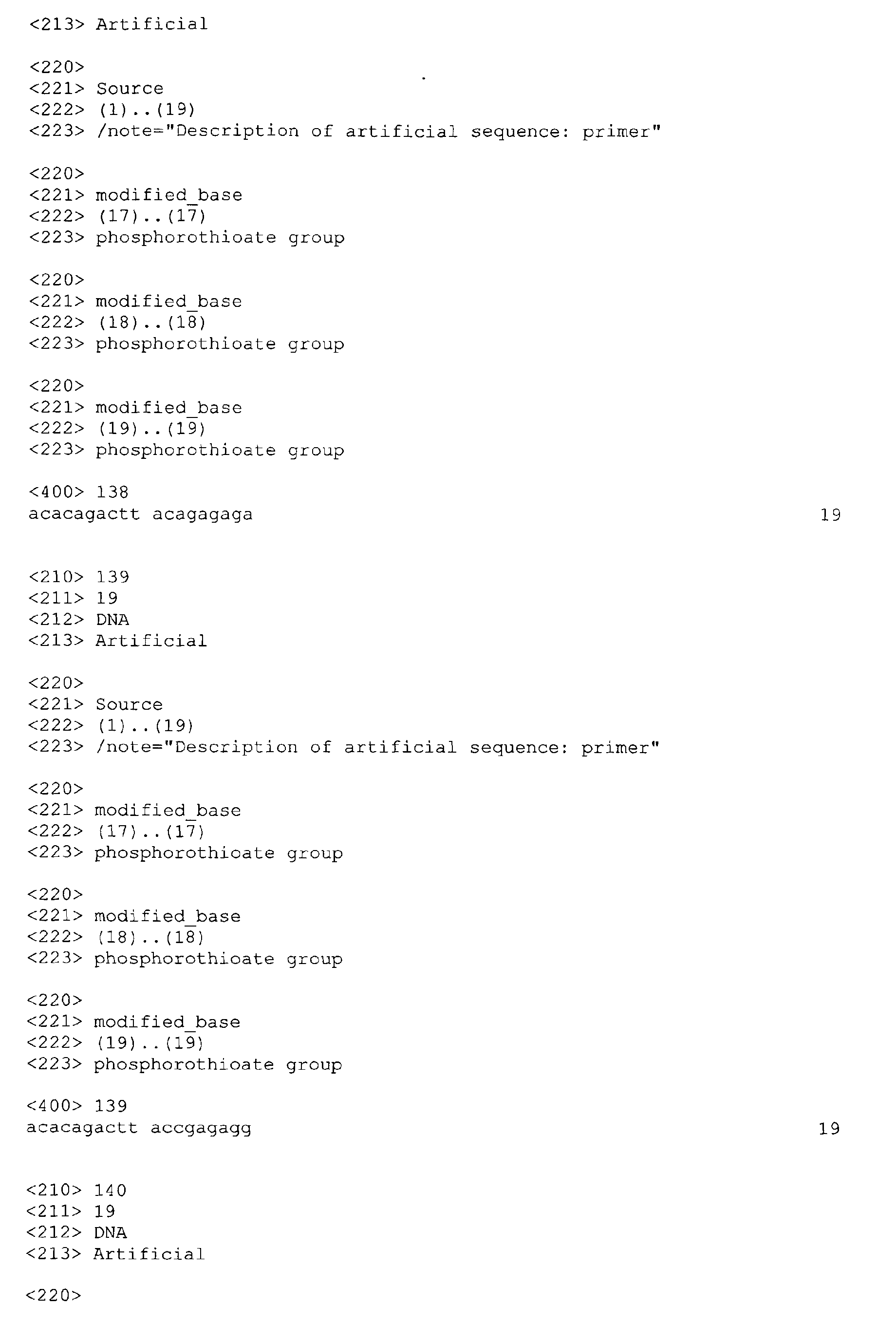

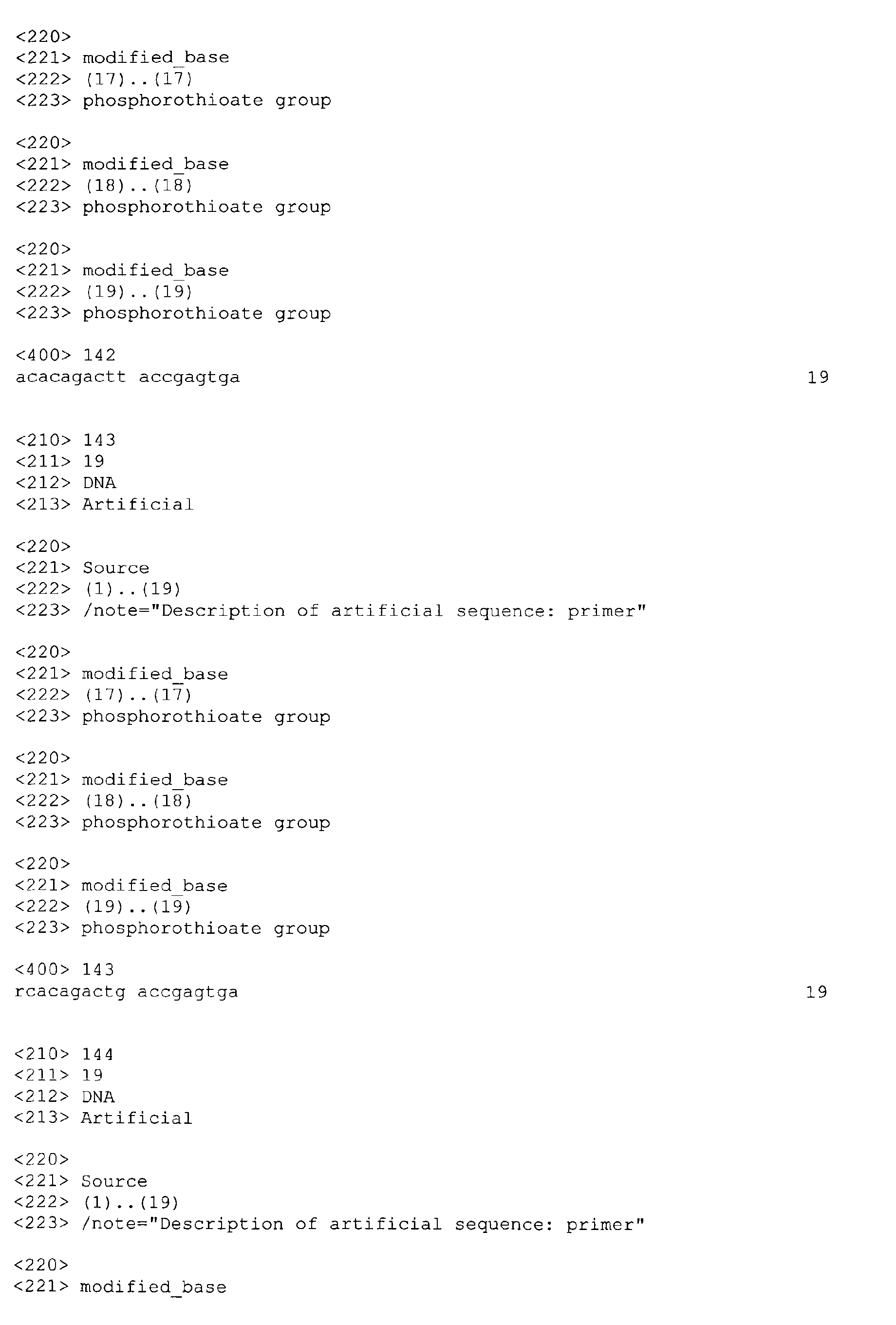
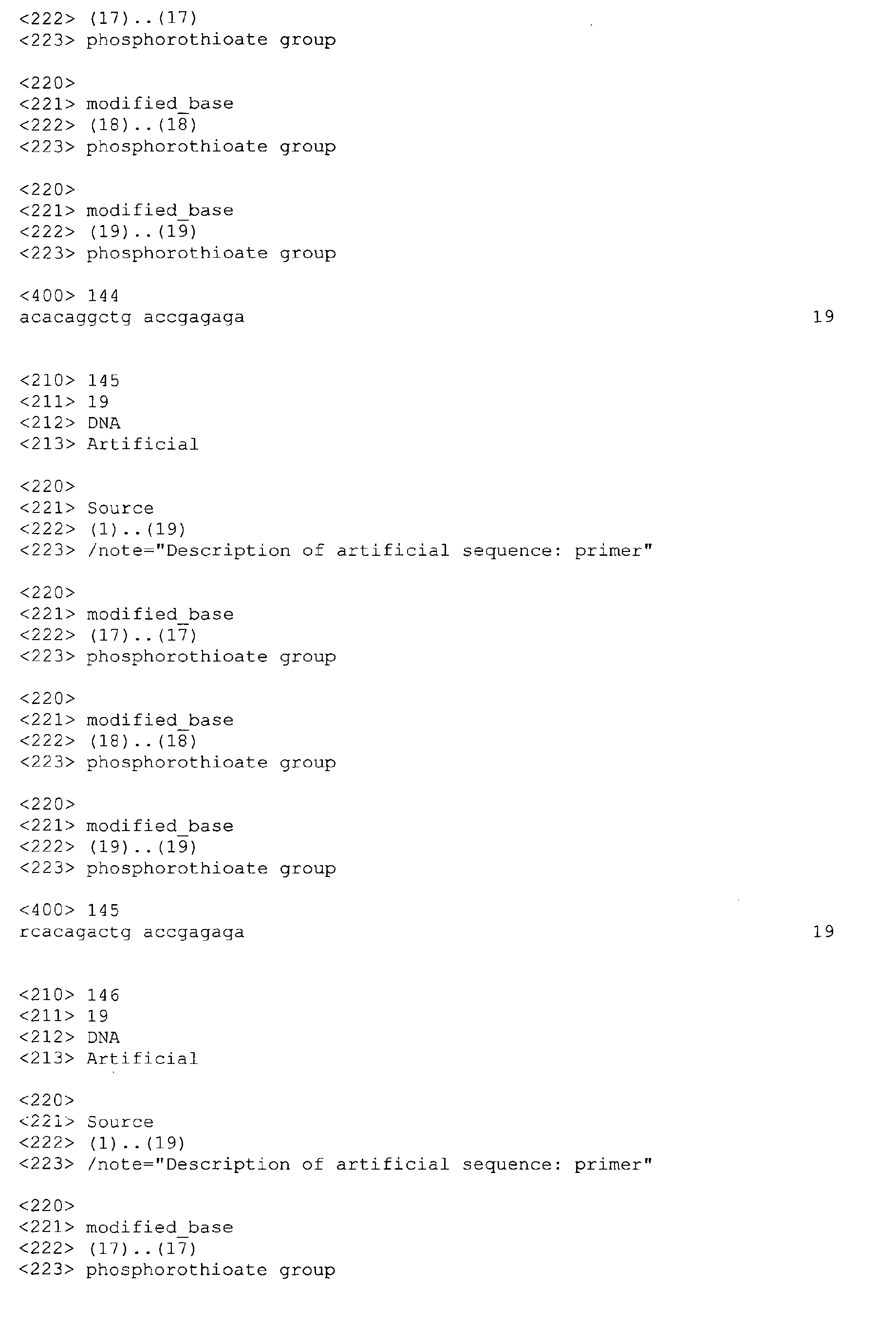
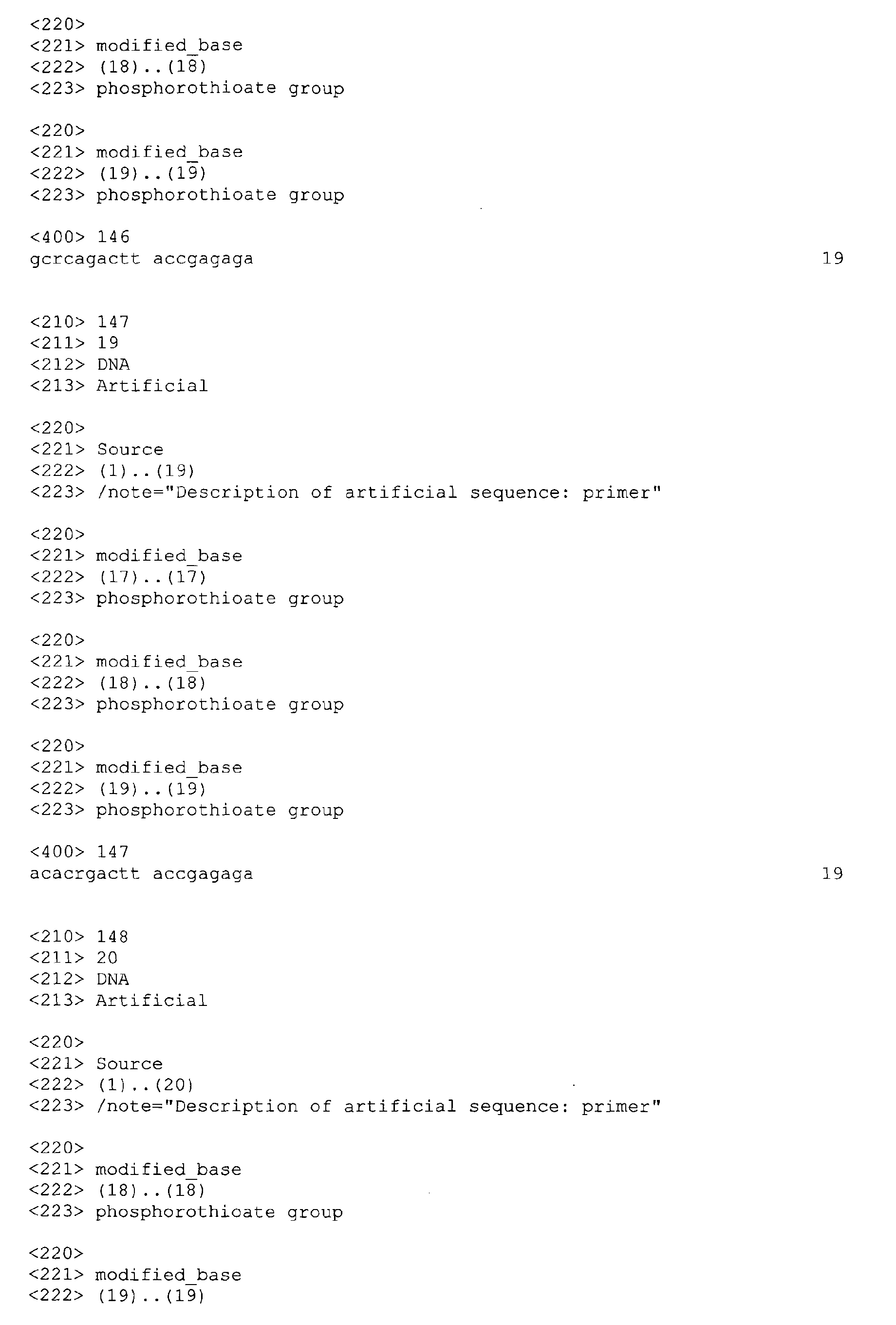

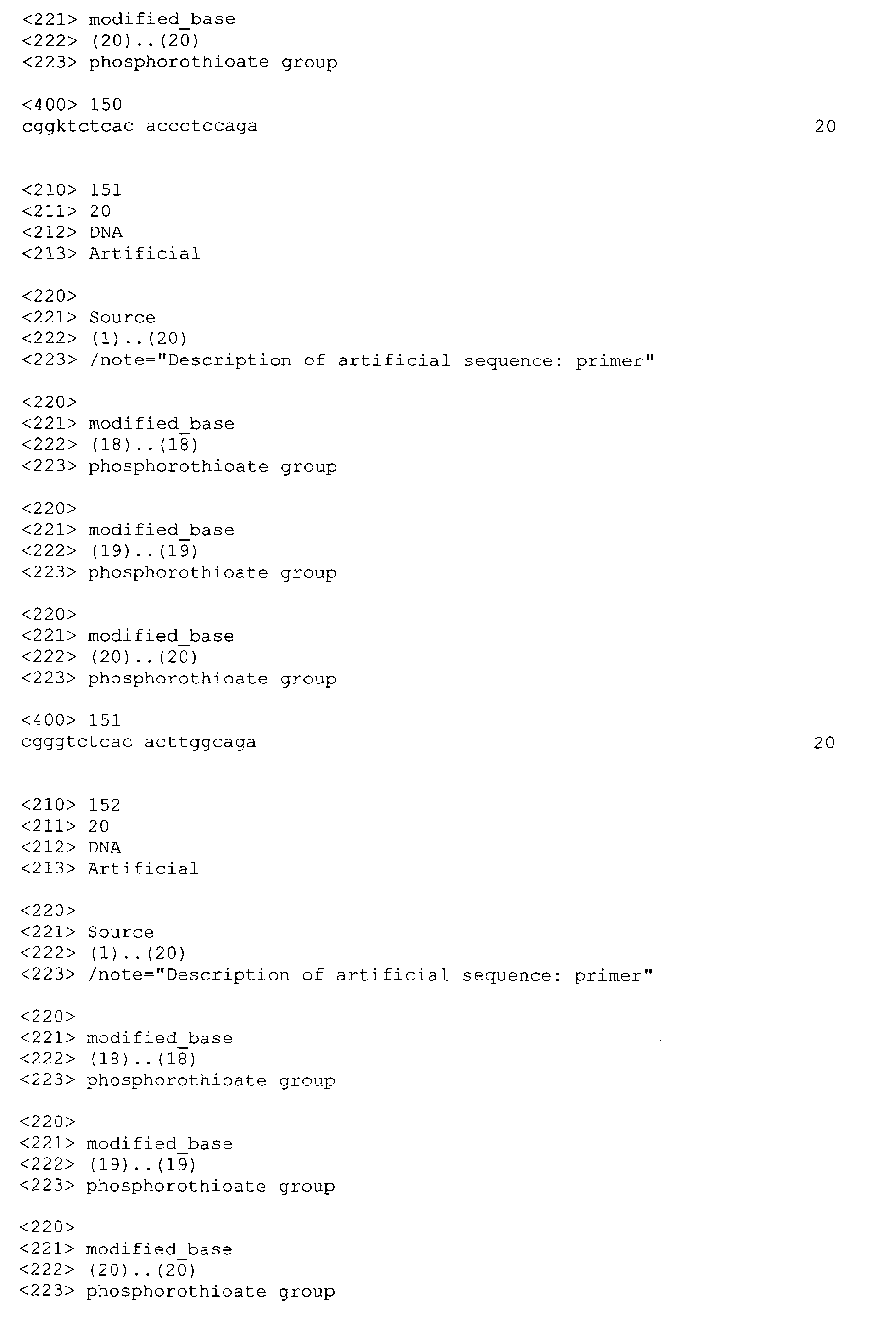
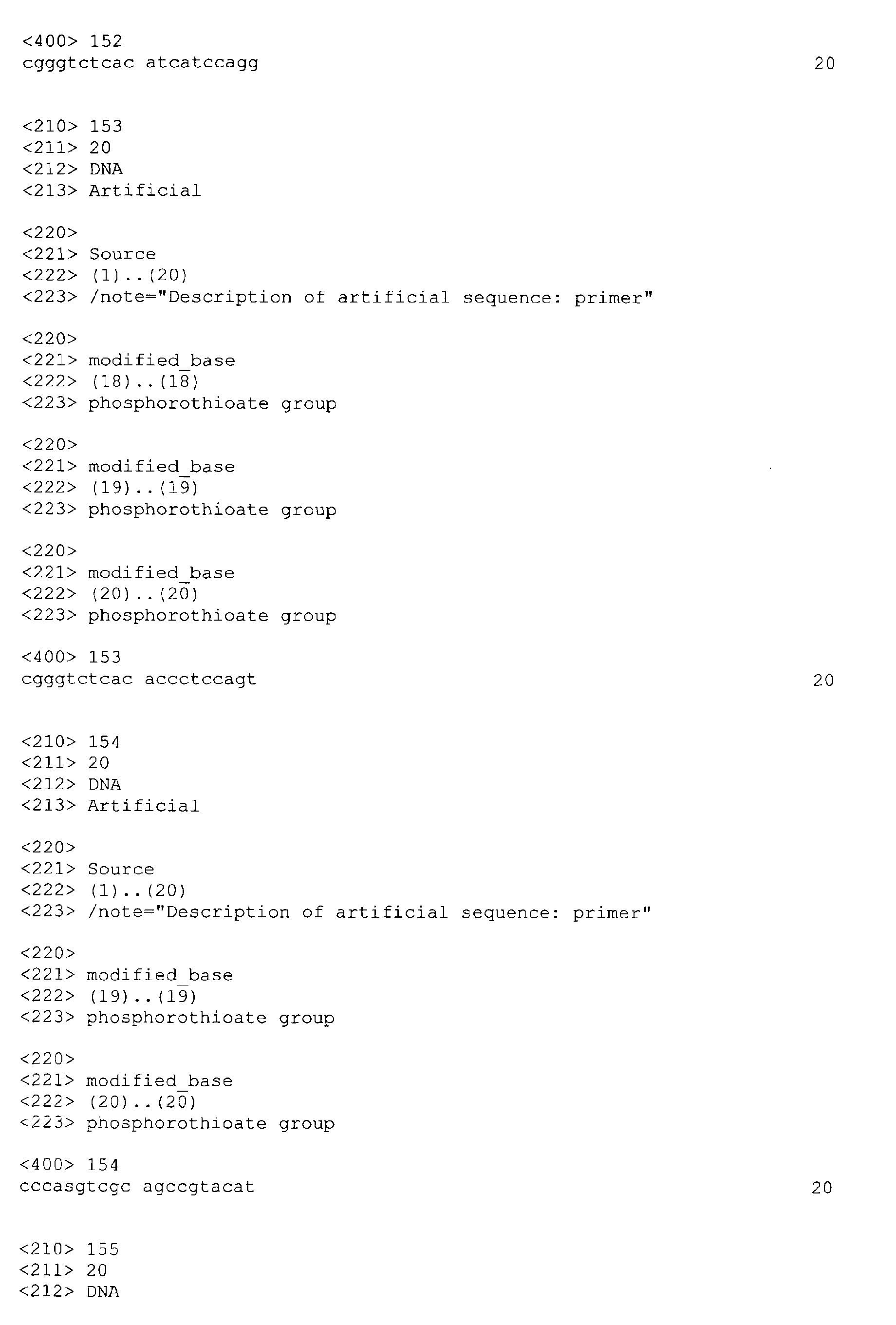


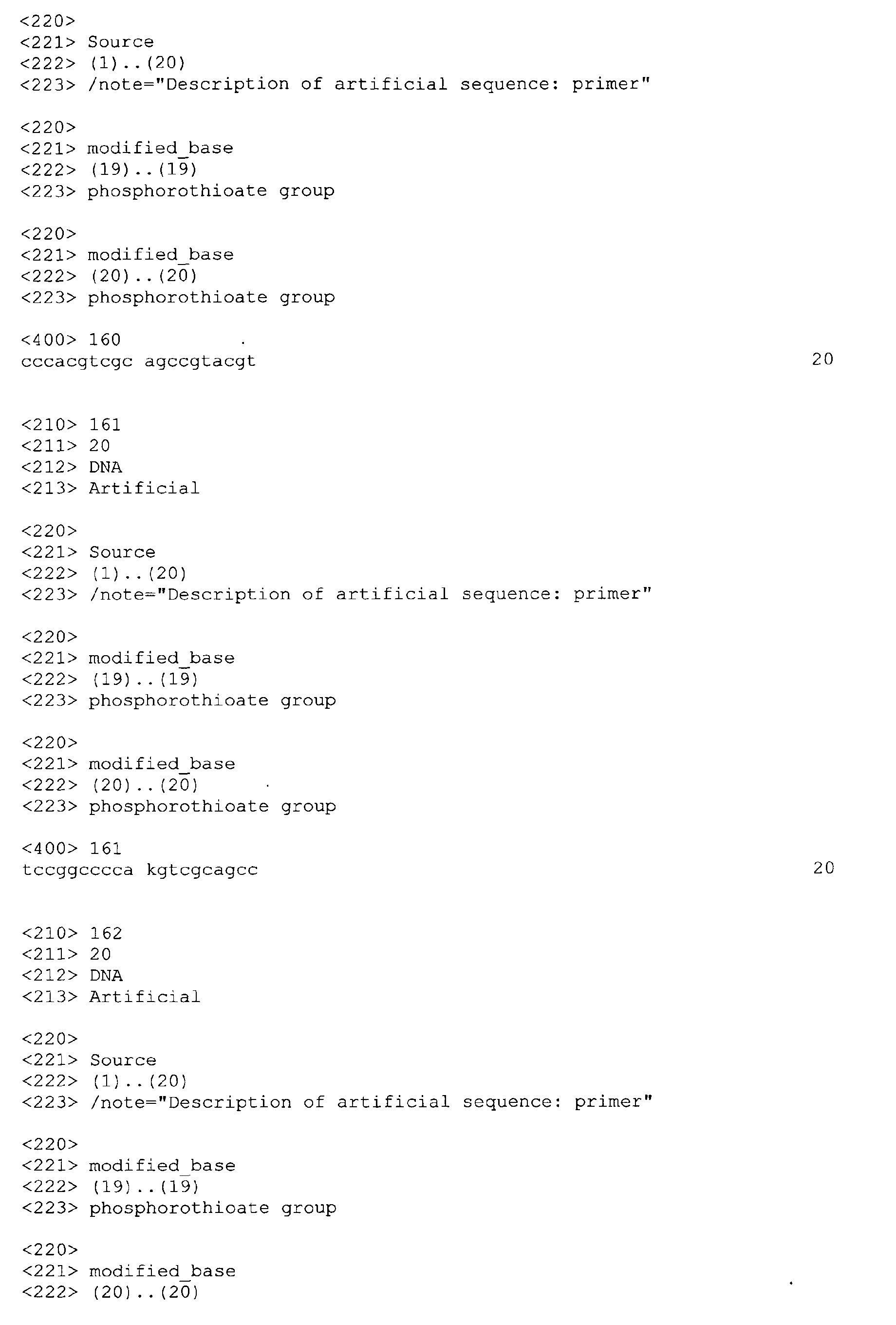
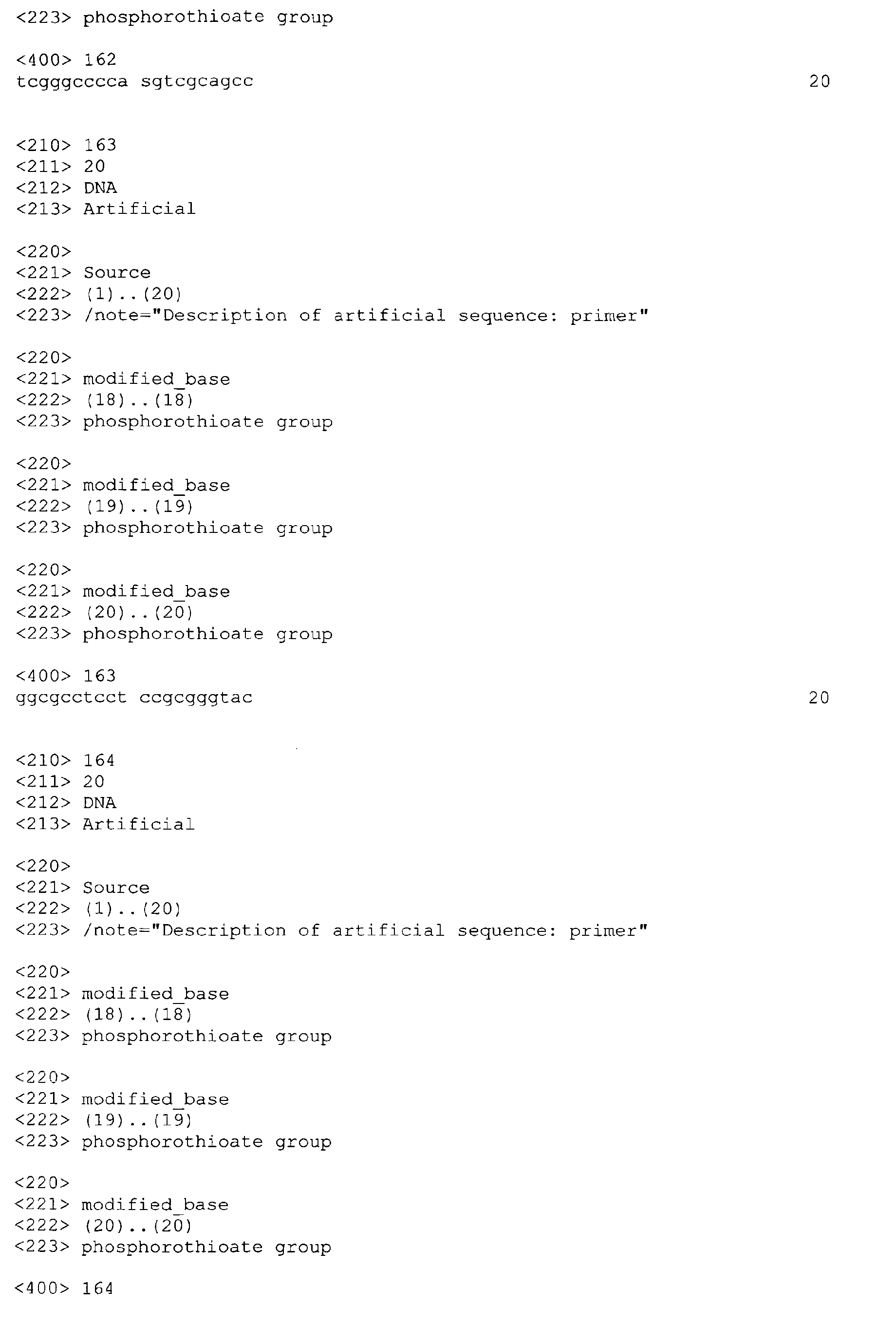

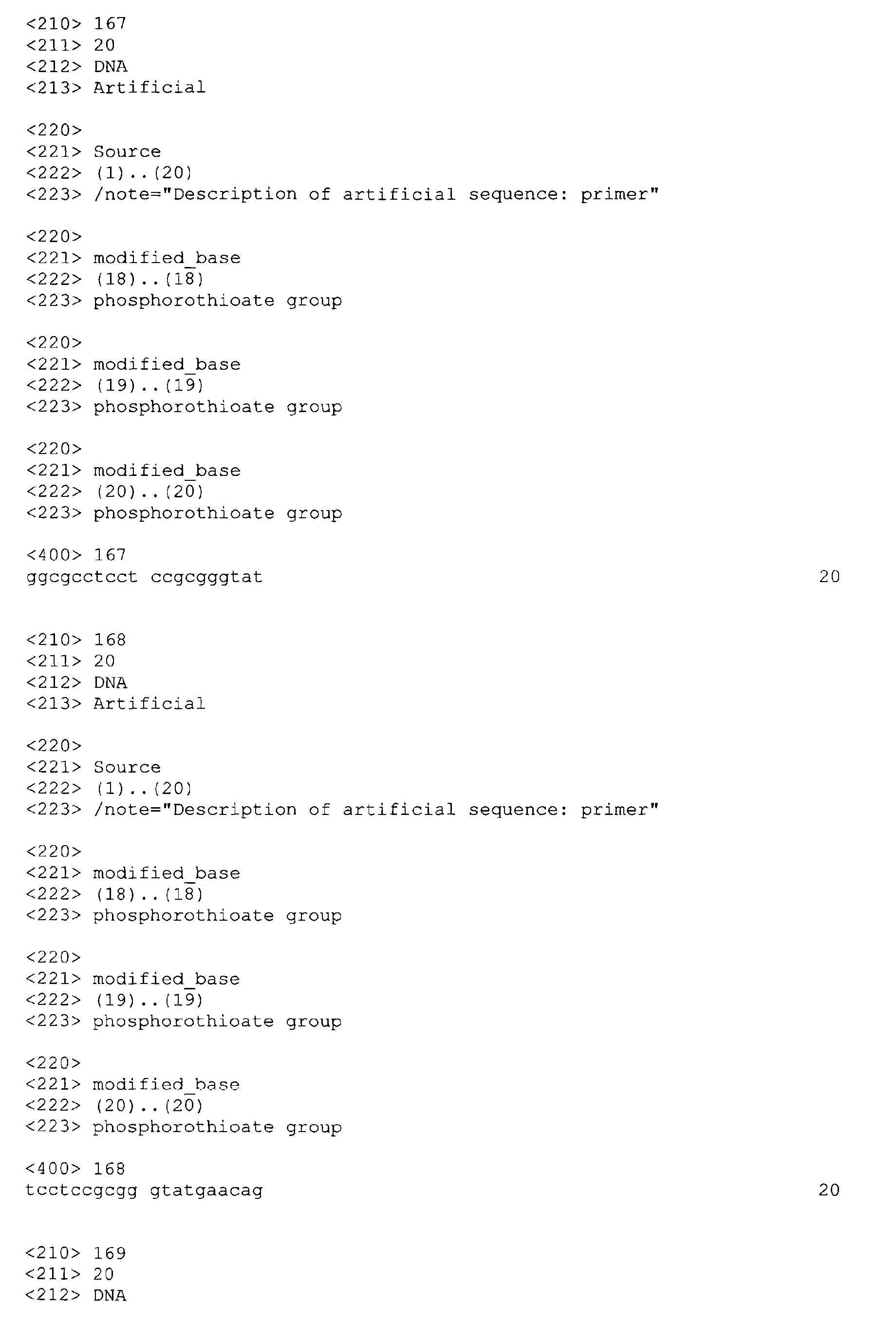
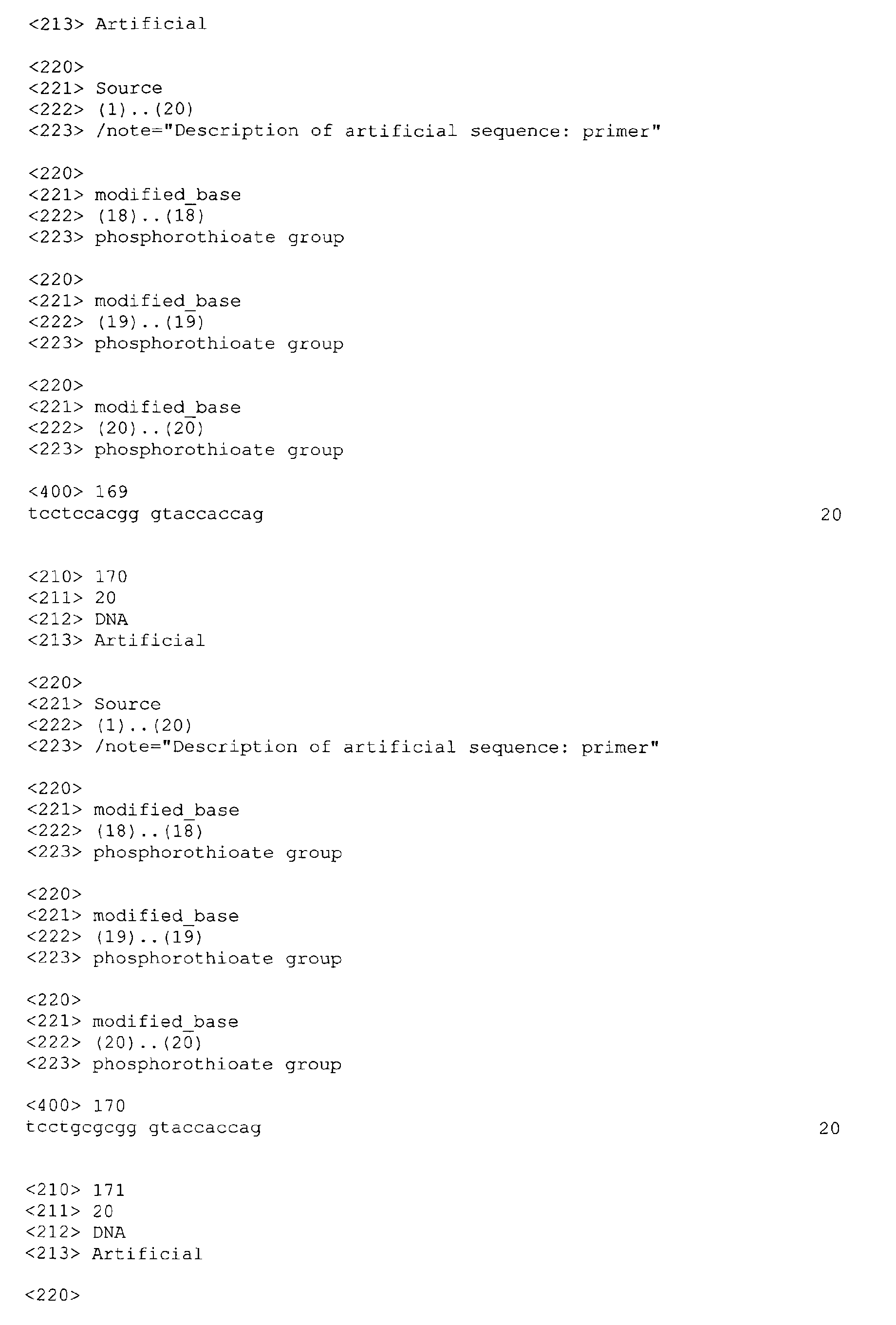
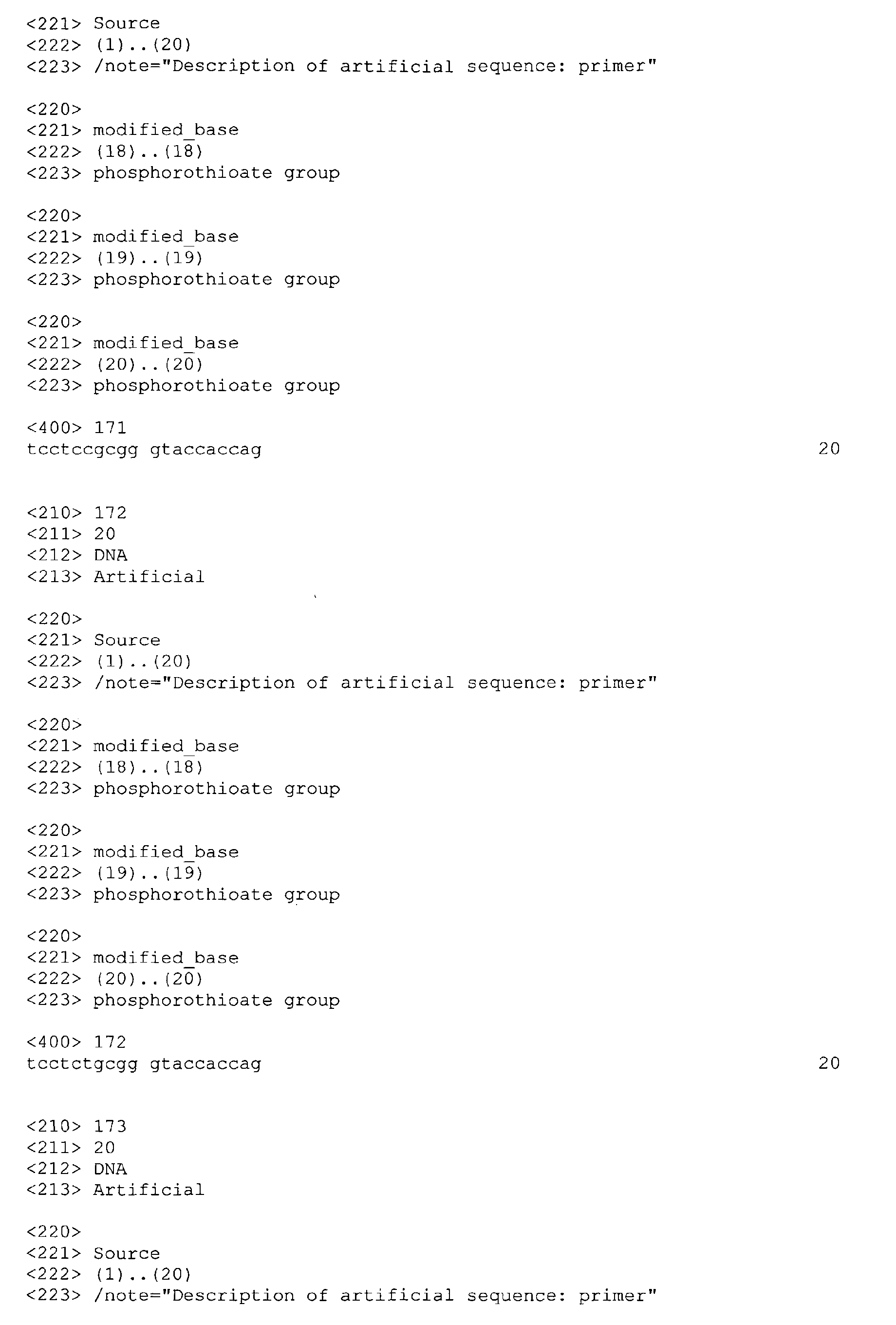


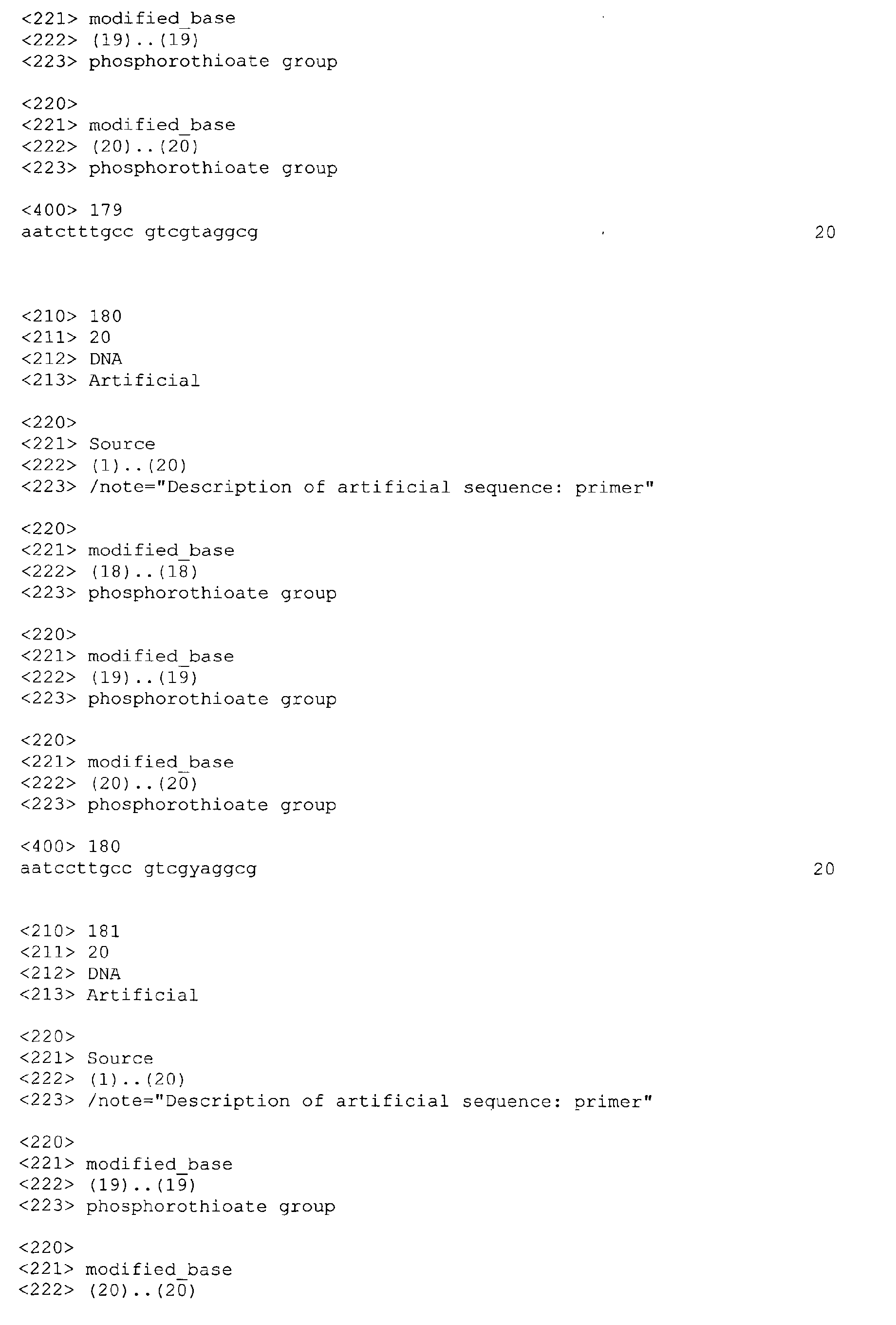


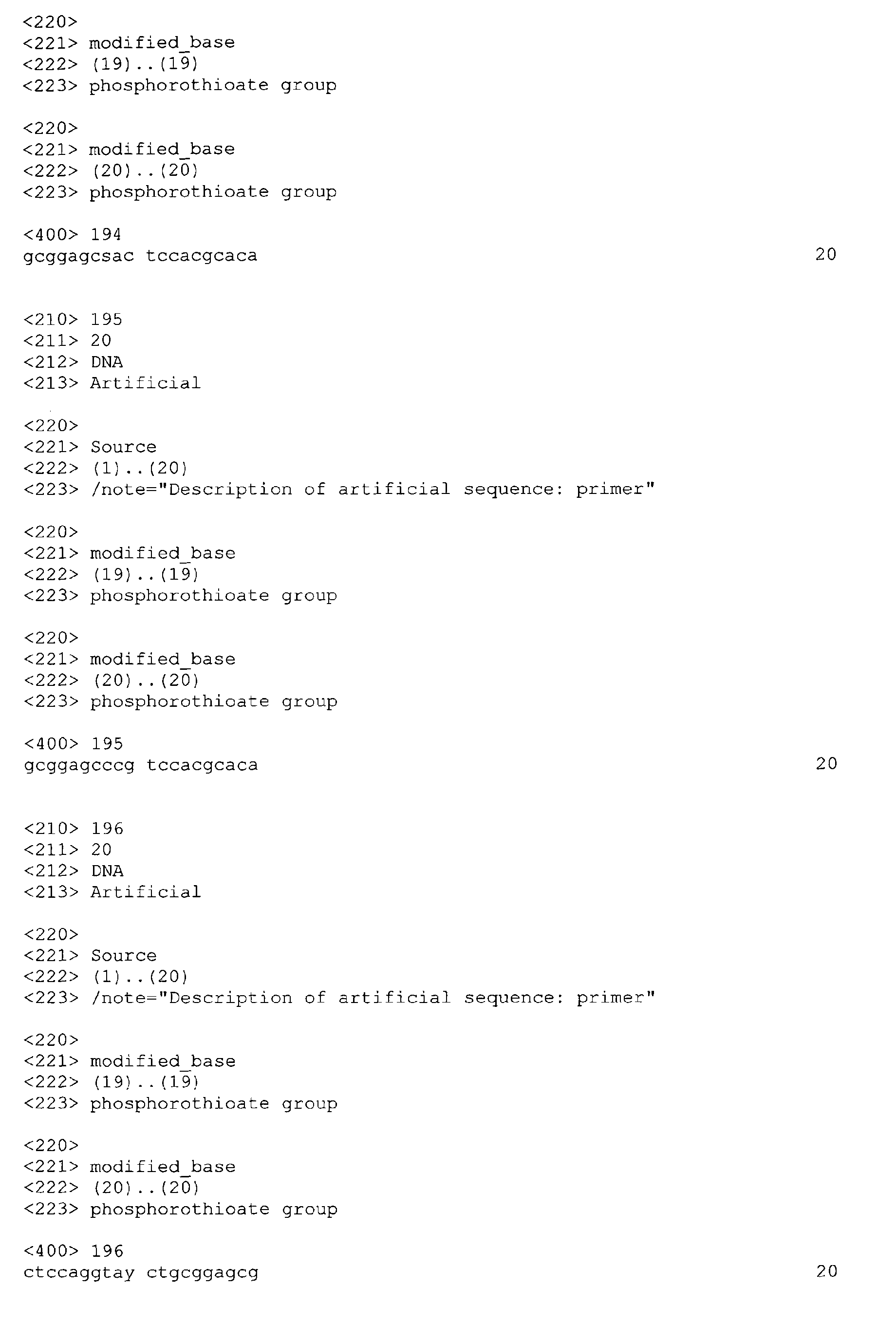


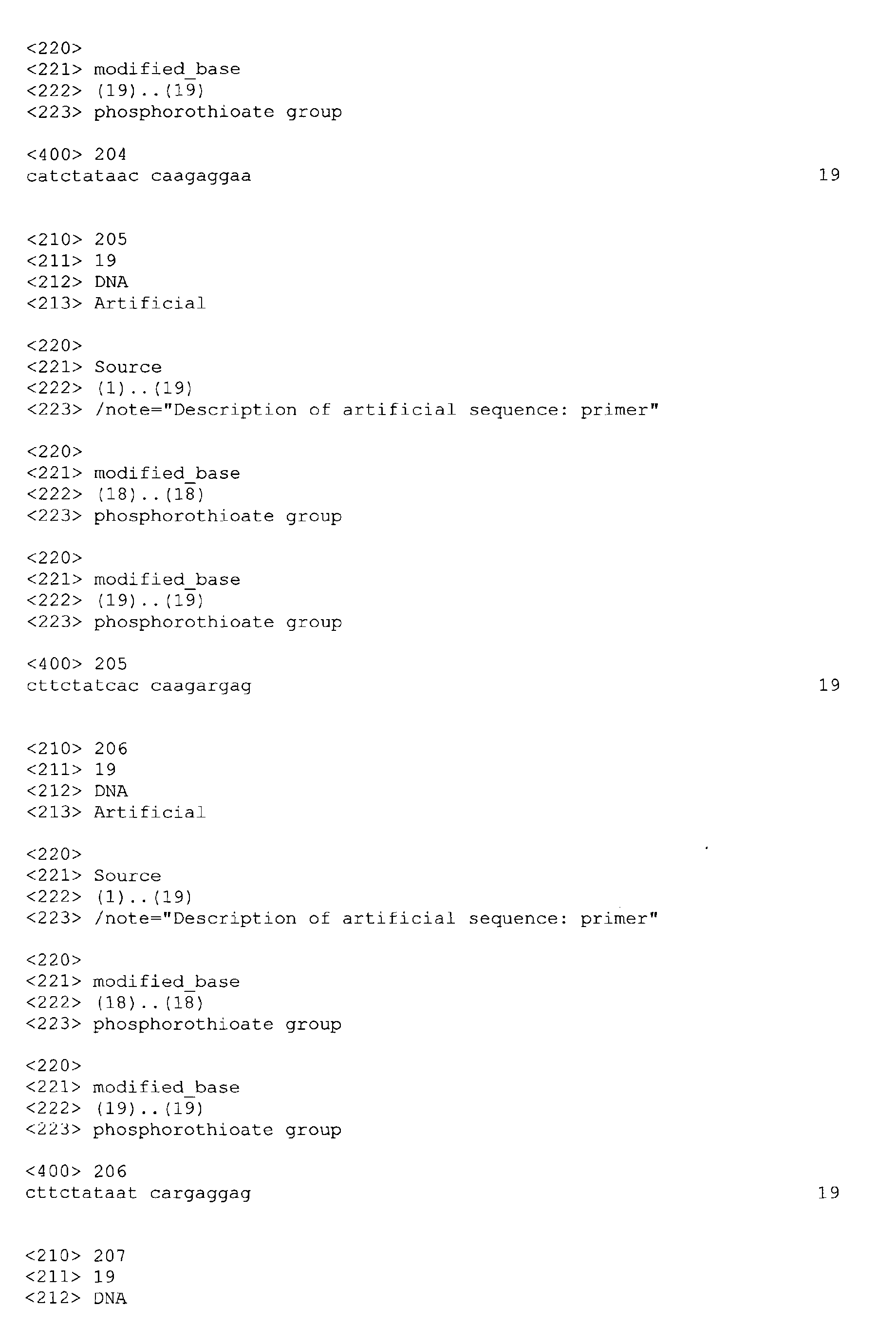

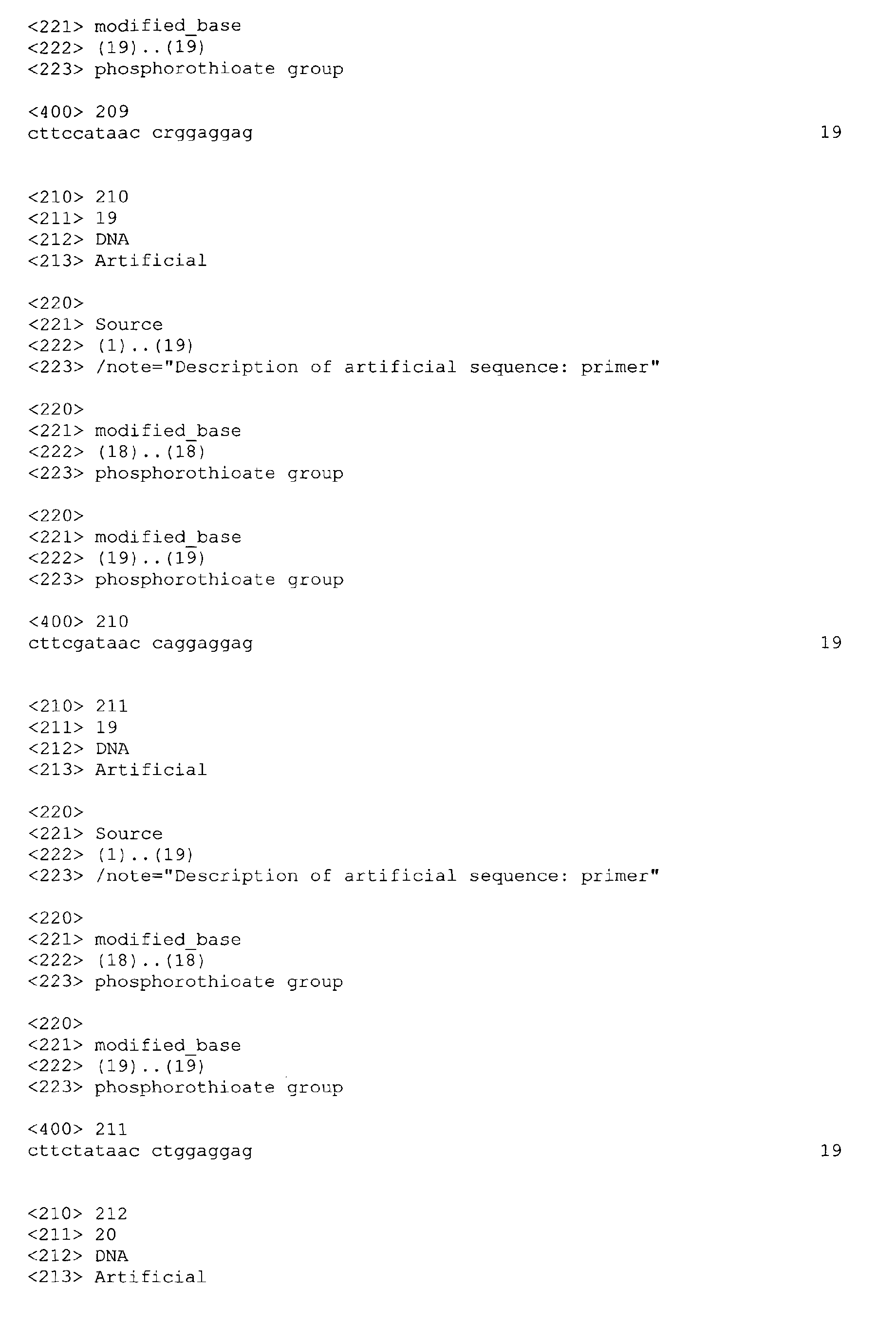
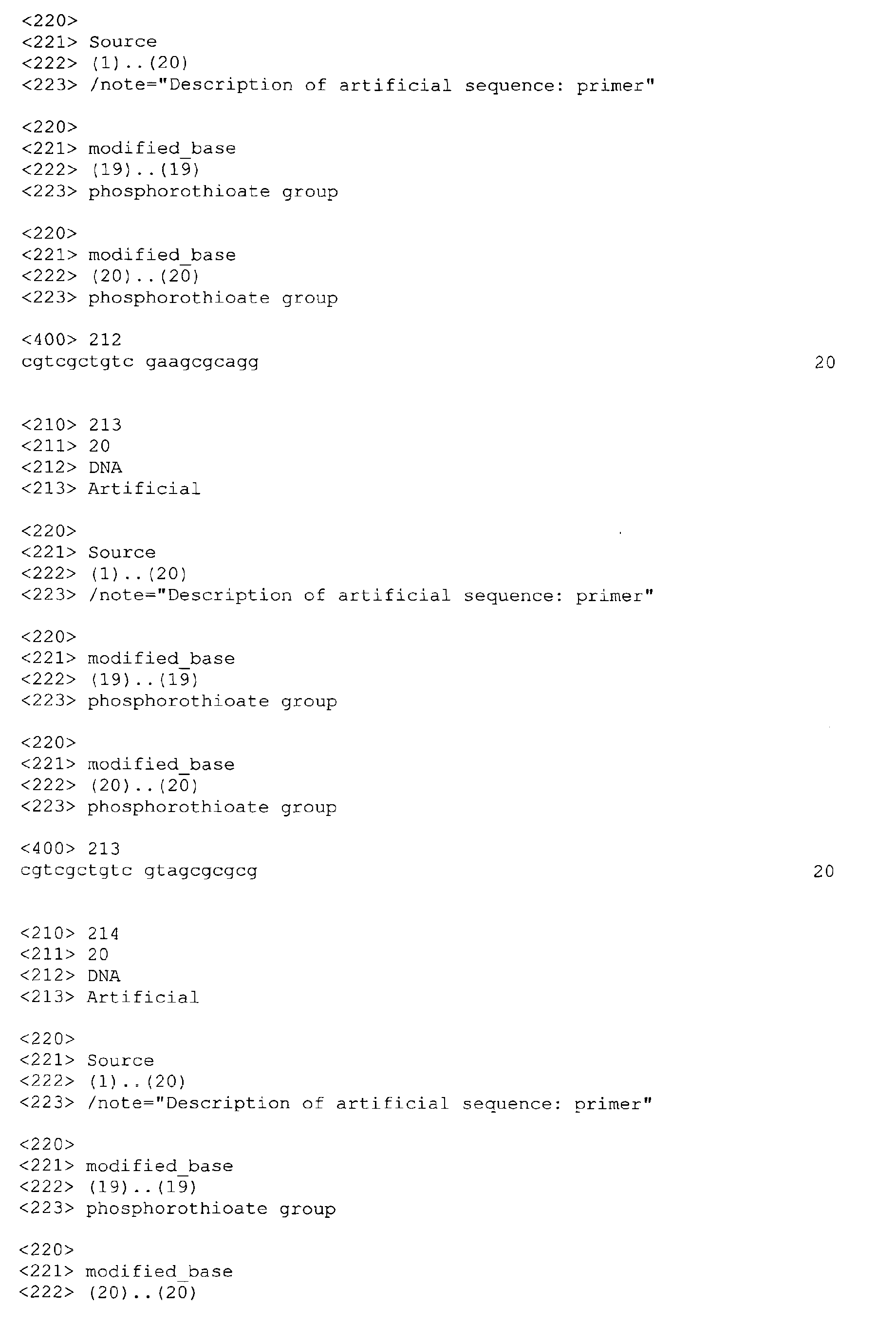
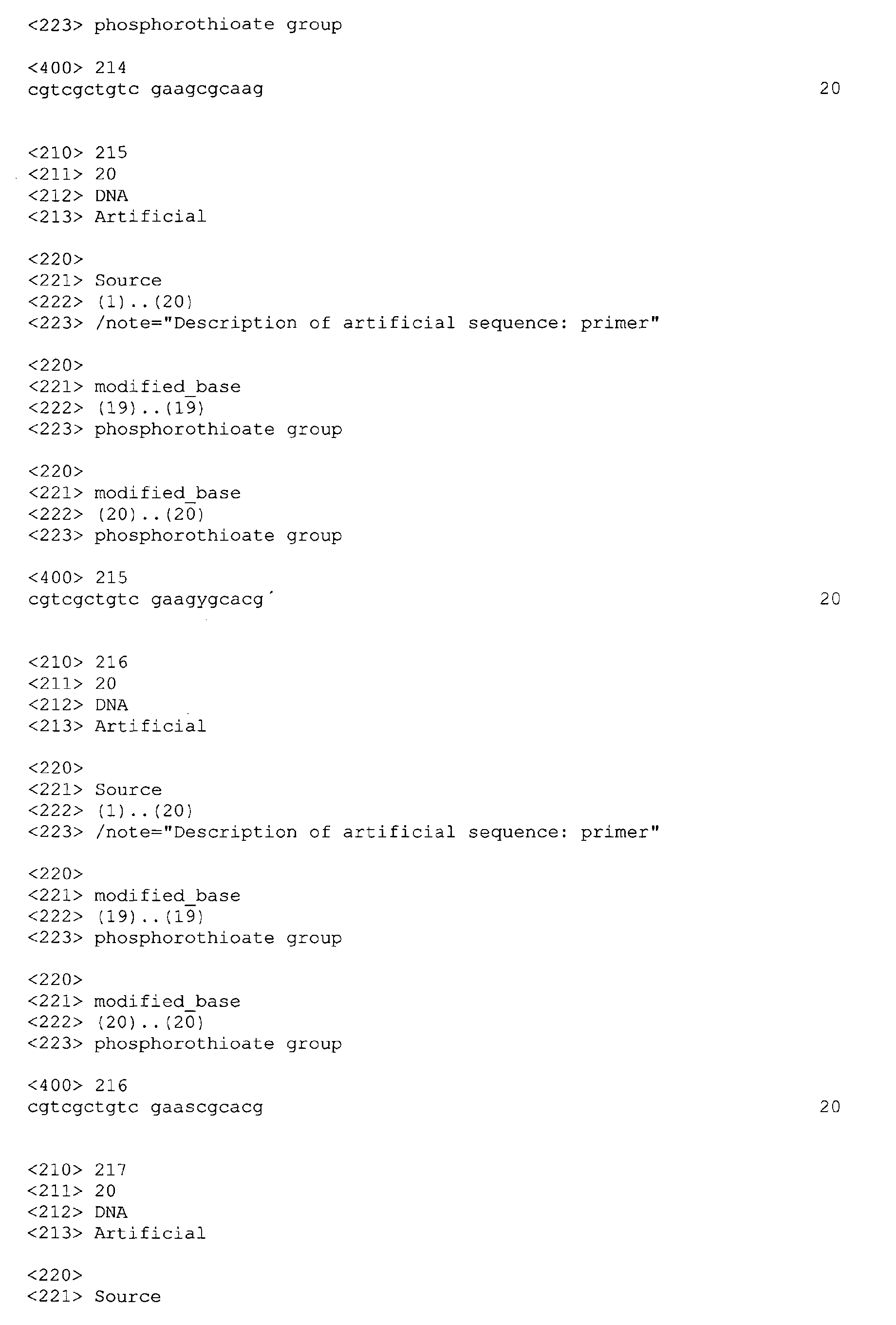
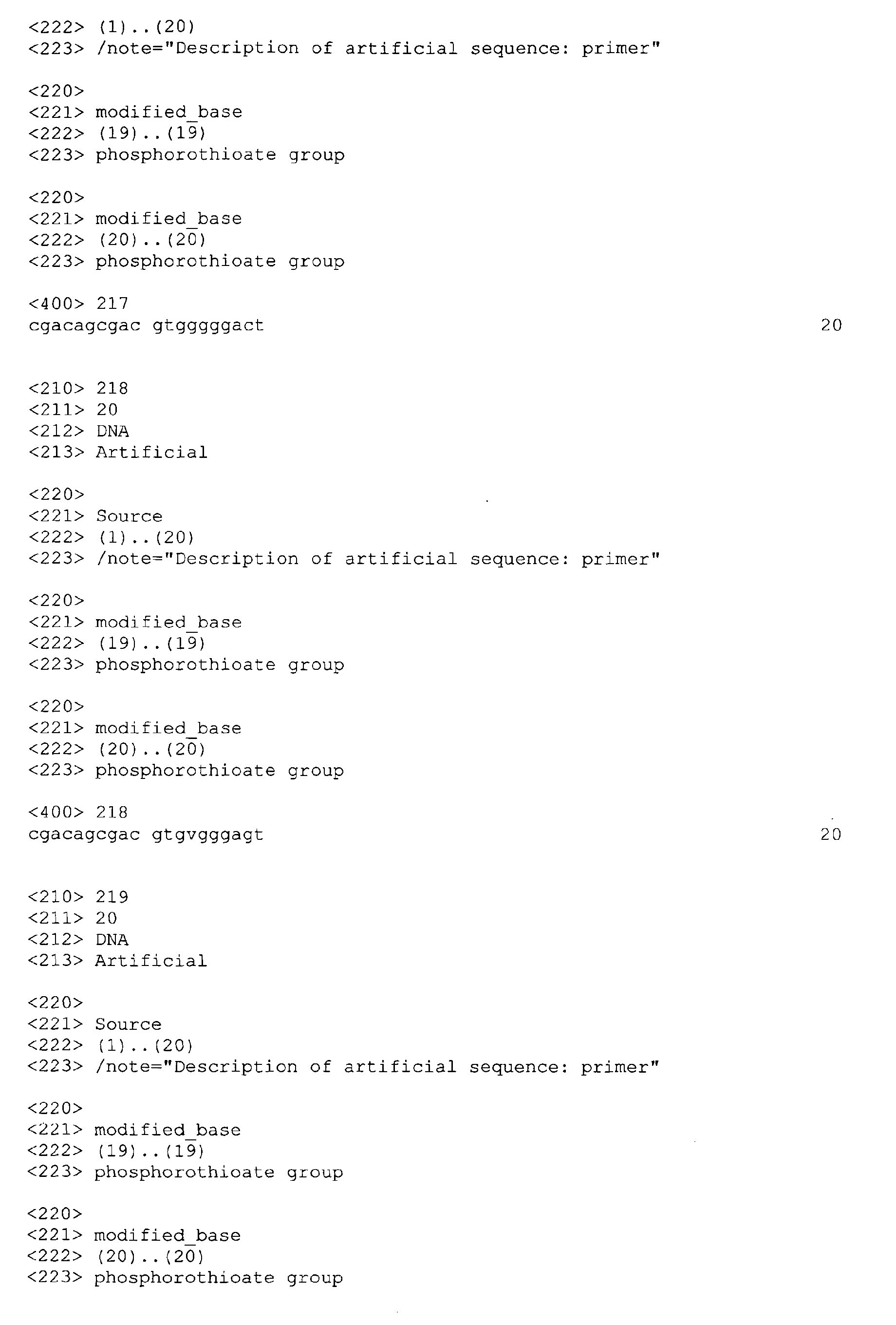
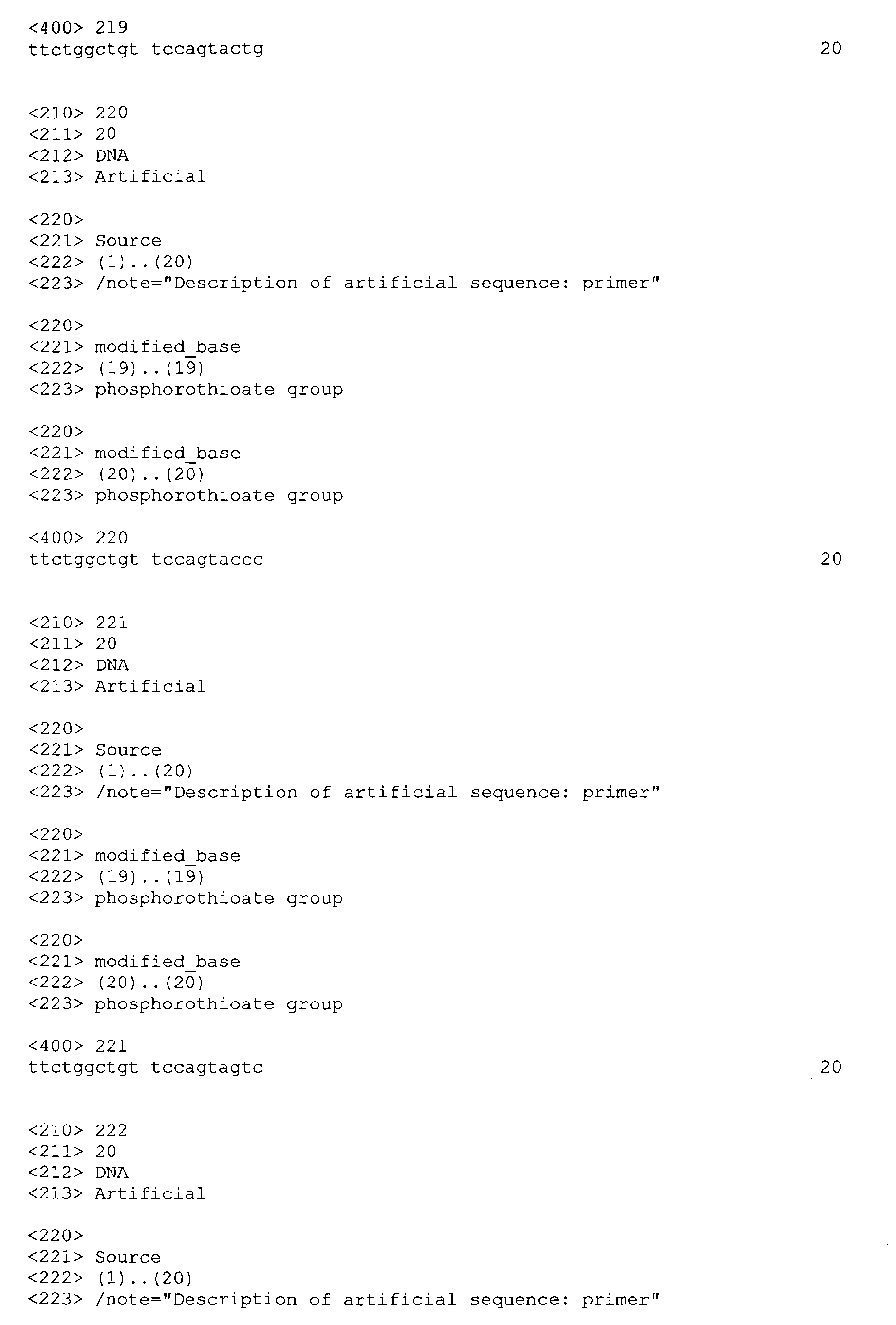
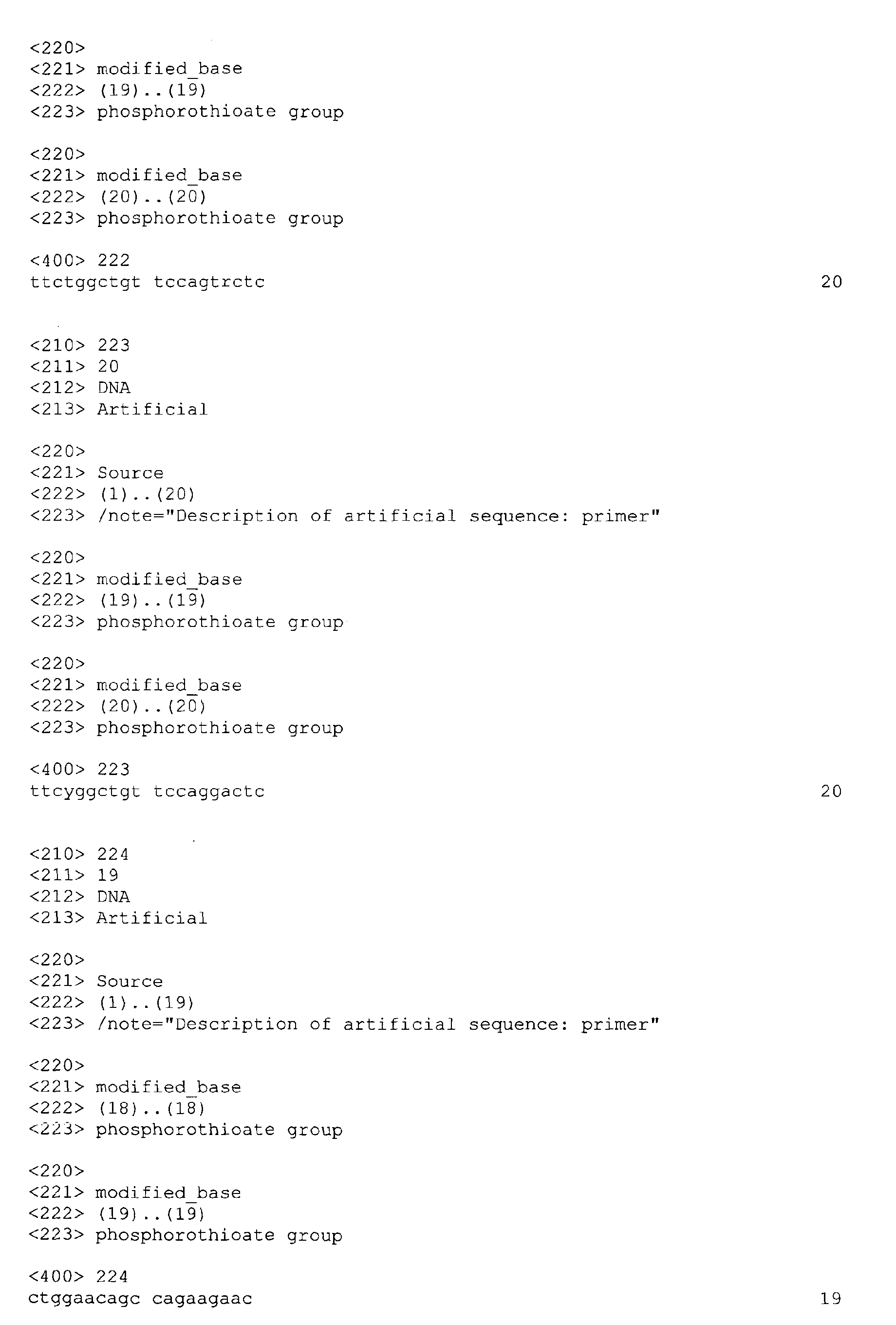
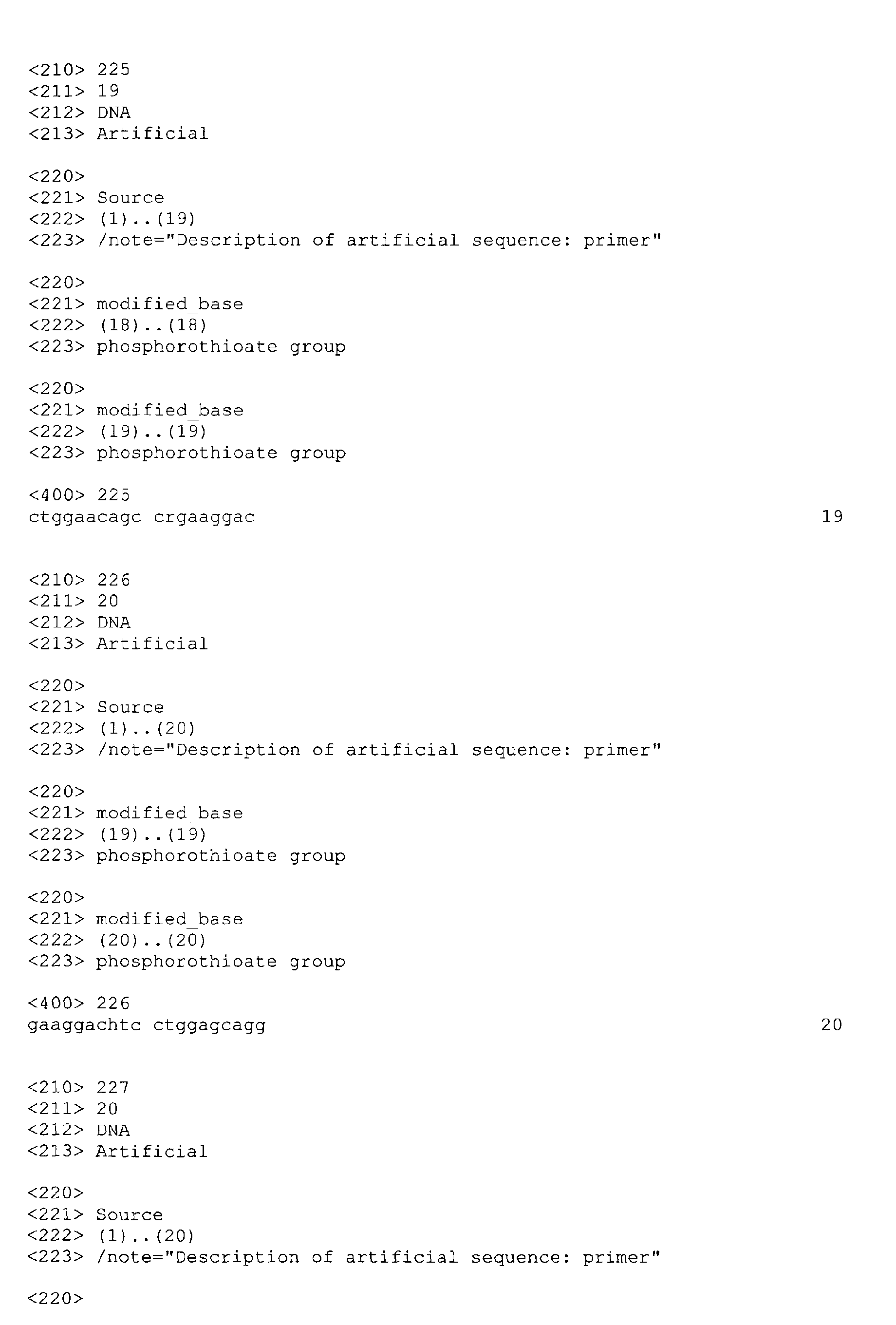
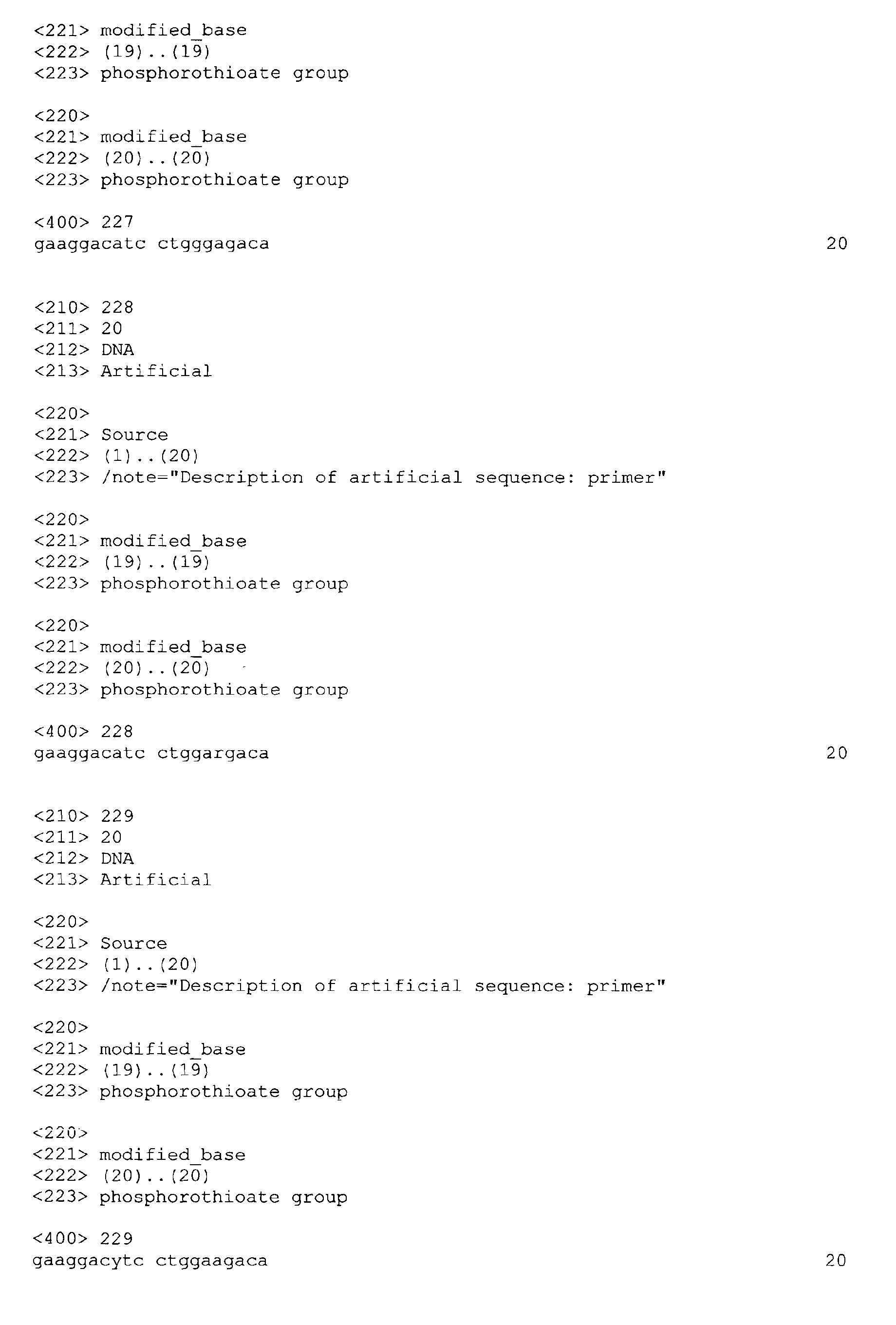

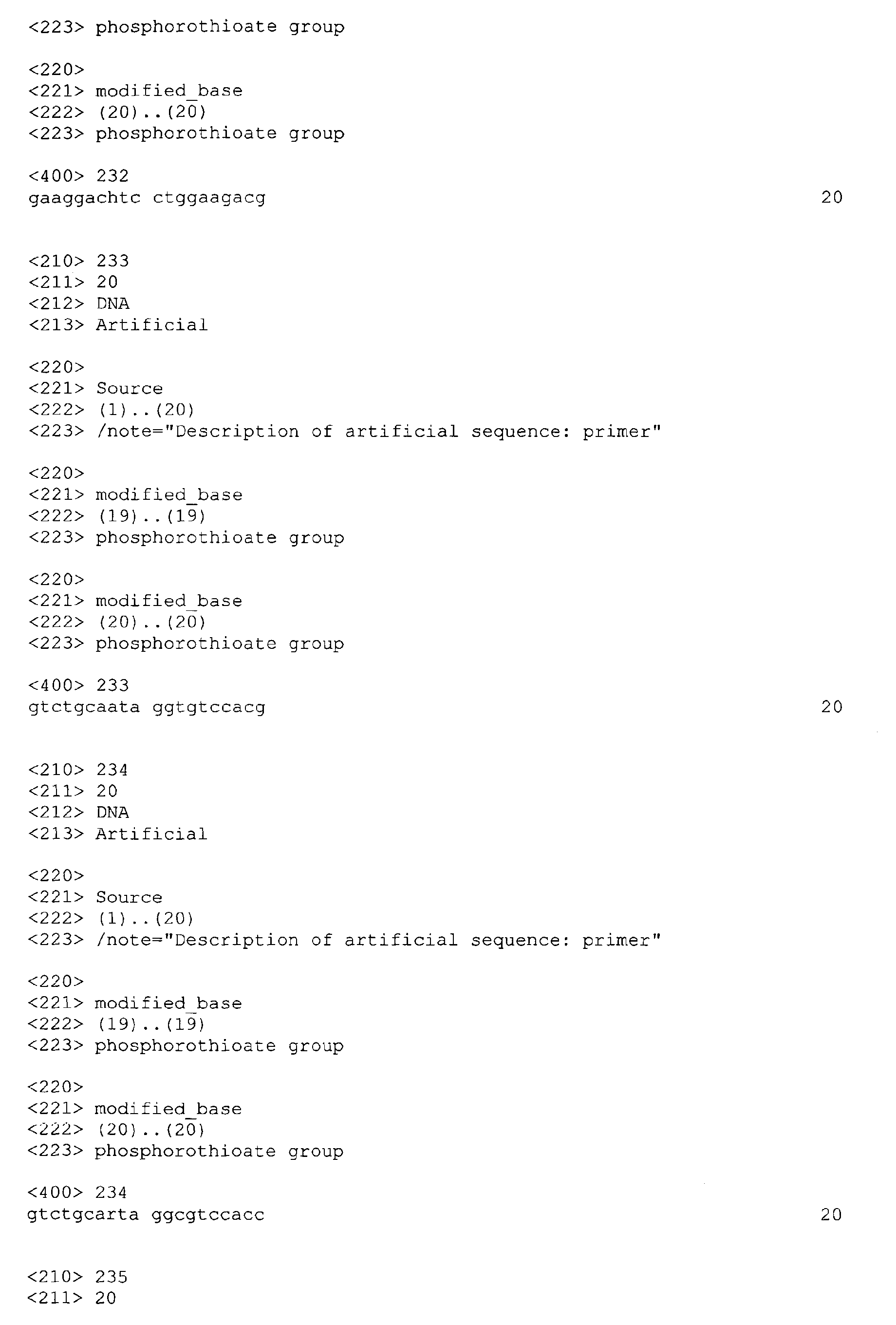

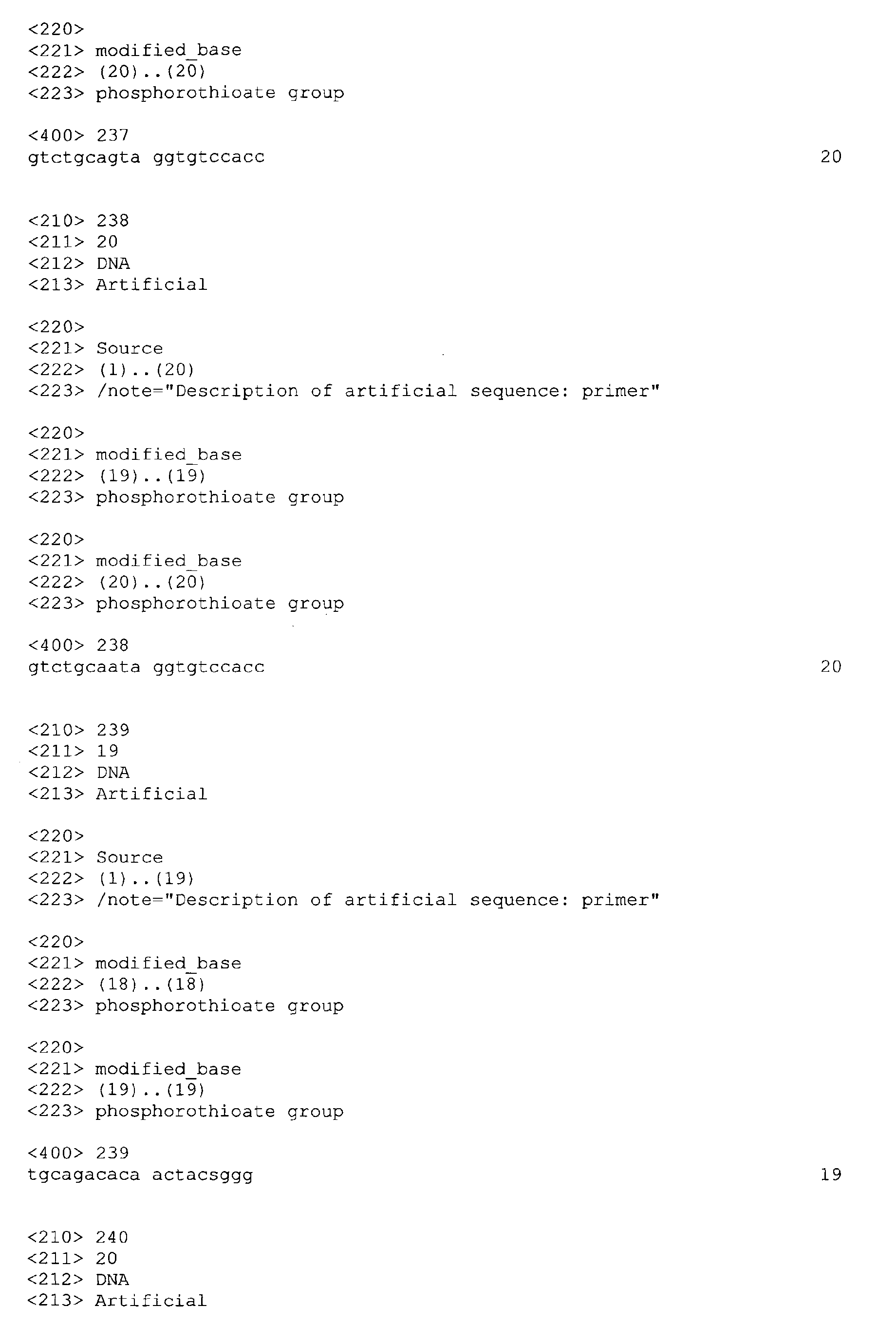
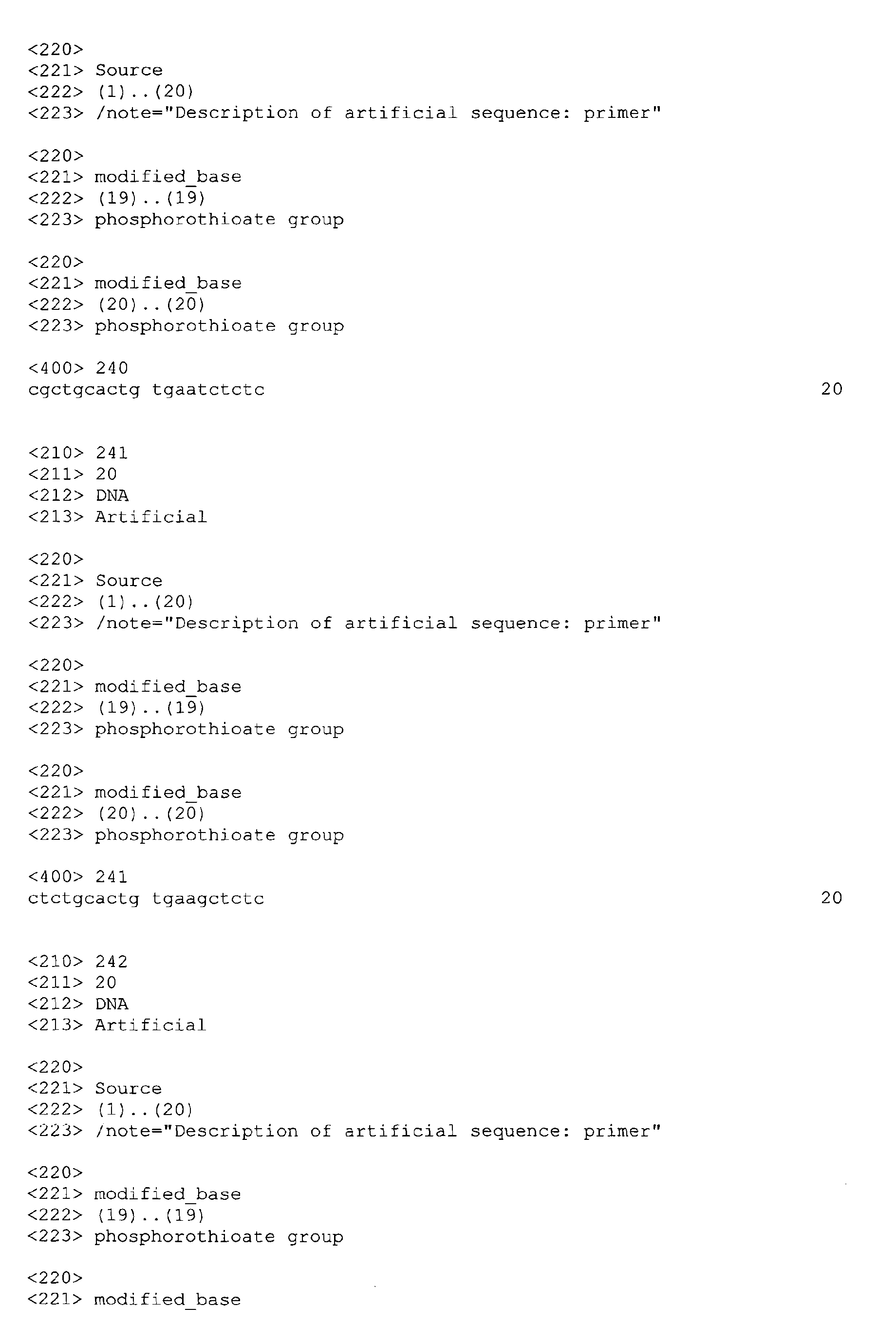

Claims (21)
- Method for HLA typing by the unambiguous determination of short DNA sequence elements (2-6 bases) at a given position simultaneously on both parental alleles at a selected number of positions in HLA genes, comprised of the steps for each position of a) hybridising a combination of oligonucleotides (primers) complementary to all known sequence variants to a DNA strand upstream of a given position; b) carrying out a primer extension reaction with at least one of the four dNTP substrates substituted by a terminating analog; c) analysing the products by mass spectrometry, with the resulting masses allowing unambiguous identification of the used primers and the added bases.
- Method according to claim 1 where the DNA strand of step a) is produced by a DNA replication procedure such as PCR or rolling circle replication.
- Method according to claim 1 where the combination of primers has slightly varying sequences so that all sequences of the haplotypes are represented by a perfectly matching primer.
- Method according to claim 3 where mass shifting tags are added to the individual primers sequences to make them uniquely distinguishable once the terminating base is added.
- Method according to claim 1 where distinguishable termination products for known alleles are generated by extending the perfectly hybridised primer with a combination of dNTPs and ddNTPs or analogs thereof with a DNA polymerase to generate specific termination products.
- Method according to claim 1 where the GOOD assay is used.
- Method according to any of the precedent claims where mass spectrometry, in particular MALDI or ESI mass spectrometry is used for analysis of the masses of products.
- Method for HLA typing according to any of the precedent claims above where set of multiple selected positions are queried to achieve sufficient information content.
- Method for HLA typing of HLA-A according to claims 1-8 where assays of the positions 98, 414, 539, 282, 571, 368, 256, 292, 238, 270, 453, 527, 502, 81, 268, 559, 92, 123 and 396 (according to the numbering of the HLA-A gene starting at cDNA sequence position 1 of exon 1) are used to achieve medium resolution.
- Method for HLA typing of HLA-B according to claims 1-8 where assays of the positions: 539, 419, 559, 412, 272, 362, 302, 363, 206, 369, 259, 97, 583, 292, 222, 527, 418, 435 and 571 (according to the numbering of the HLA-B gene starting at cDNA sequence position 1 of exon 1) are used to achieve medium resolution.
- Method for HLA typing of HLA-DRB1 according to claims 1-8 where assays of the positions 125, 196, 197, 227, 261, 286, 299, 308, 341 and 345 (according to the numbering of the HLA-DRB1 gene starting at cDNA sequence position 1 of exon 1) are used to achieve medium resolution.
- Method for HLA typing of HLA-A according to claims 1-8 where assays of the positions 98, 414, 539, 282, 571, 368, 256, 292, 238 and 270 (according to the numbering of the HLA-B gene starting at cDNA sequence position 1 of exon 1) are used to generate subgroups A-O.
- Method for HLA typing according to claim 12 where assays of the positions 224, 268, 376, 502, 561 and 616 are preferably analysed to resolve subgroup HLA-A_A; positions 126 and 526 to resolve subgroup HLA-A_B; positions 81, 90, 92, 212, 214, 257, 265, 299, 302, 404, 420, 427, 453, 485, 489 and 502 to resolve subgroup HLA-A_C; positions 160, 200, 362 and 524 to resolve subgroup HLA-A_D; positions 180, 299, 301, 302, 346, 418, 453, 517, 524, 526, 527, 557, 559 and 560 to resolve subgroup HLA-A_E; positions 299, 301, 302, 341 and 583 to resolve subgroup HLA-A_F; positions 127, 341, 399, 480, 502, 503, 524, 526, 527, 553, 559, 560 and 565 to resolve subgroup HLA-A_G; positions 228, 233, 463, 519, 530 and 583 to resolve subgroup HLA-A_H; positions 102, 275, 317, 362, 418, 419, 497, 524, 555, 595 and 618 to resolve subgroup HLA-A_I; positions 92, 331, 453, 524, 559, 560 and 564 to resolve subgroup HLA-A_J; positions 78, 81, 123, 125, 142, 144, 194, 268, 294, 324, 355, 362, 396, 403, 419, 453, 456, 477, 493, 517, 524, 526, 527, 559 and 560 to resolve subgroup HLA-A_K; positions 113, 299, 301, 302, 308, 311, 523, 524 to resolve subgroup HLA-A_L; positions 171, 363, 498 and 559 to resolve subgroup HLA-A_M; positions 376, 426, 527, 555, 557 and 595 to resolve subgroup HLA-A_N; position 299 to resolve subgroup HLA-A_O are used.
- Method for HLA typing of HLA-B according to claims 1-8 where assays of the positions 539, 419, 559, 412, 272, 362, 302, 363, 206 and 369 (according to the numbering of the HLA-B gene starting at DNA sequence position 1 of exon 1) are used to generate subgroups A-AC.
- Method for HLA typing according to claim 14 where assays of the positions 259, 341 and 473 are preferably analyzed to resolve subgroup HLA-B_A; positions 106, 144, 222, 259, 273, 311, 313, 418, 445, 493, 528 and 540 to resolve subgroup HLA-B_B; positions 319, 416, 545 and 572 to resolve subgroup HLA-B_C; positions 106, 131, 165, 215, 243, 277, 292, 322, 481, 582, 603 and 616 to resolve subgroup HLA-B_D; positions 106, 146, 165, 181, 238, 259, 263, 292, 328.1/329, 379, 435, 453, 463, 485, 526, 571, 572 and 583 to resolve subgroup HLA-B_E; positions 142, 171, 255, 257, 395, 430, 544, 566 and 572 to resolve subgroup HLA-B_F; positions 117, 247, 248, 277, 345, 418, 489 and 527 to resolve subgroup HLA-B_G; positions 134, 141, 200, 213, 259, 304 and 527 to resolve subgroup HLA-B_H; positions 83, 141, 211, 222, 242, 322, 404, 414, 435, 463, 502, 527, 544, 571, 572 and 583 to resolve subgroup HLA-B_I; positions 103, 142, 222, 243, 259, 292, 477, 486 and 499 to resolve subgroup HLA-B_J; positions 103, 259, 292, 295, 527 and 583 to resolve subgroup HLA-B_K; positions 320 and 500 to resolve subgroup HLA-B_L; positions 311, 527 and 583 to resolve subgroup HLA-B_M; positions 119, 292, 259, 319, 425, 527, 546 and 583 to resolve subgroup HLA-B_N; positions 97, 142, 245 and 527 to resolve subgroup HLA-B_O; positions 97 and 175 to resolve subgroup HLA-B_P; positions 246 and 277 to resolve subgroup HLA-B_Q; positions 246, 292, 311 and 503 to resolve subgroup HLA-B_R; positions 103, 261, 309, 311 and 474 to resolve subgroup HLA-B_S; positions 97, 103, 106, 243, 259, 292, 404 and 524 to resolve subgroup HLA-B_T; positions 259 and 320 to resolve subgroup HLA-B_U; position 106 to resolve HLA-B_V; positions 97 to resolve HLA-B_W; positions 97, 106, 257, 418 and 463 to resolve HLA-B_X; position 106 to resolve HLA-B_Y; positions 106 and 144 to resolve HLA-B_Z; positions 117, 247, 248, 283, 345, 418, 489, and 527 to resolve HLA-B_AA; positions 106 to resolve HLA-B_AB; positions 548 to resolve HLA-B_AC.
- Method of HLA typing according to claim 11 to resolve subgroups A-P of HLA-DRB1.
- Method for HLA typing according to claim 16 where assays of the positions 123, 174, 250, 278 and 317 are analysed to resolve subgroup HLA-DRB1_A; positions 192, 203, 256 and 259 to resolve subgroup HLA-DRB1_B; 256, 260, 317 and 351 to resolve subgroup HLA-DRB1_C; positions 155, 204, 233, 239, 256, 304, 357 and 366 to resolve subgroup HLA-DRB1_D; positions 122, 171, 257 and 317 to resolve subgroup HLA-DRB1_E; positions 164, 167, 171, 230, 235, 306, 317, 321 and 337 to resolve subgroup HLA-DRBI_F; positions 164, 257, 266 and 303 to resolve subgroup HLA-DRB1_G; positions 164, 181, 188, 220, 229, 256, 266, 317 and 318 to resolve subgroup HLA-DRB1_H; position 257 to resolve subgroup HLA-DRB1_I; positions 181, 239 and 357 to resolve subgroup HLA-DRB1_J; positions 122, 144, 239, 303, 317, 318 and 321 to resolve subgroup HLA-DRB1_K; positions 118, 161, 257, 260, 318 and 321 to resolve subgroup HLA-DRB1_L; positions 165, 257, 293 and 303 to resolve subgroup HLA-DRB1_M; positions 177, 240, 256, 257 and 357 to resolve subgroup HLA-DRB1_N; positions 150 175, 230, 236 and 321 to resolve subgroup HLA-DRB1_O; positions 115, 220 and 317 to resolve subgroup HLA-DRB1_P are used.
- Kit for the implementation of the procedure according to claims 1 - 17 comprising pools of primers.
- Use of the method according to claims 1-17 for screening of tissue donors.
- Use according to claim 19 for bone marrow donors in registries for screening of frequent and rare HLA types.
- Use of the primers represented in Table IV, V and VI to carry out HLA typing.
Priority Applications (12)
| Application Number | Priority Date | Filing Date | Title |
|---|---|---|---|
| EP03292952A EP1536021A1 (en) | 2003-11-27 | 2003-11-27 | Method for HLA typing |
| EP04799043A EP1692307B1 (en) | 2003-11-27 | 2004-11-26 | Method for hla typing |
| JP2006540671A JP5052898B2 (en) | 2003-11-27 | 2004-11-26 | HLA typing method |
| PCT/IB2004/004115 WO2005052189A2 (en) | 2003-11-27 | 2004-11-26 | Method for hla typing |
| DE602004028281T DE602004028281D1 (en) | 2003-11-27 | 2004-11-26 | PROCESS FOR HLA TYPING |
| AT04799043T ATE474934T1 (en) | 2003-11-27 | 2004-11-26 | HLA TYPING METHOD |
| CA2547357A CA2547357C (en) | 2003-11-27 | 2004-11-26 | Method for hla typing |
| EP10165761A EP2267159B1 (en) | 2003-11-27 | 2004-11-26 | Method of typing of HLA-B |
| EP10181302.0A EP2272986B1 (en) | 2003-11-27 | 2004-11-26 | Method for HLA typing |
| US10/580,646 US7820377B2 (en) | 2003-11-27 | 2004-11-26 | Method for HLA typing |
| US12/881,867 US8435740B2 (en) | 2003-11-27 | 2010-09-14 | Method for HLA typing |
| JP2011117721A JP5562904B2 (en) | 2003-11-27 | 2011-05-26 | HLA typing method |
Applications Claiming Priority (1)
| Application Number | Priority Date | Filing Date | Title |
|---|---|---|---|
| EP03292952A EP1536021A1 (en) | 2003-11-27 | 2003-11-27 | Method for HLA typing |
Publications (1)
| Publication Number | Publication Date |
|---|---|
| EP1536021A1 true EP1536021A1 (en) | 2005-06-01 |
Family
ID=34443092
Family Applications (4)
| Application Number | Title | Priority Date | Filing Date |
|---|---|---|---|
| EP03292952A Withdrawn EP1536021A1 (en) | 2003-11-27 | 2003-11-27 | Method for HLA typing |
| EP04799043A Expired - Lifetime EP1692307B1 (en) | 2003-11-27 | 2004-11-26 | Method for hla typing |
| EP10165761A Expired - Lifetime EP2267159B1 (en) | 2003-11-27 | 2004-11-26 | Method of typing of HLA-B |
| EP10181302.0A Expired - Lifetime EP2272986B1 (en) | 2003-11-27 | 2004-11-26 | Method for HLA typing |
Family Applications After (3)
| Application Number | Title | Priority Date | Filing Date |
|---|---|---|---|
| EP04799043A Expired - Lifetime EP1692307B1 (en) | 2003-11-27 | 2004-11-26 | Method for hla typing |
| EP10165761A Expired - Lifetime EP2267159B1 (en) | 2003-11-27 | 2004-11-26 | Method of typing of HLA-B |
| EP10181302.0A Expired - Lifetime EP2272986B1 (en) | 2003-11-27 | 2004-11-26 | Method for HLA typing |
Country Status (7)
| Country | Link |
|---|---|
| US (2) | US7820377B2 (en) |
| EP (4) | EP1536021A1 (en) |
| JP (2) | JP5052898B2 (en) |
| AT (1) | ATE474934T1 (en) |
| CA (1) | CA2547357C (en) |
| DE (1) | DE602004028281D1 (en) |
| WO (1) | WO2005052189A2 (en) |
Families Citing this family (9)
| Publication number | Priority date | Publication date | Assignee | Title |
|---|---|---|---|---|
| WO2005063985A1 (en) | 2003-12-25 | 2005-07-14 | Canon Kabushiki Kaisha | Probe set and method for identifying hla allele |
| AU2007353877B2 (en) | 2006-09-14 | 2012-07-19 | Ibis Biosciences, Inc. | Targeted whole genome amplification method for identification of pathogens |
| WO2012083240A2 (en) * | 2010-12-16 | 2012-06-21 | Dana-Farber Cancer Institute, Inc. | Oligonucleotide array for tissue typing |
| SG11201403630RA (en) * | 2011-12-28 | 2014-10-30 | Toppan Printing Co Ltd | Method for determining hla-a*24 group |
| CN104395468A (en) * | 2012-04-20 | 2015-03-04 | 大塚制药株式会社 | Method and detection kit for detecting HLA-A*24:02 |
| JP6160104B2 (en) * | 2013-02-08 | 2017-07-12 | 凸版印刷株式会社 | HLA-A * 02 group judgment method |
| US10889860B2 (en) * | 2013-09-24 | 2021-01-12 | Georgetown University | Compositions and methods for single G-level HLA typing |
| EA201890512A1 (en) | 2015-08-17 | 2018-09-28 | Кура Онколоджи, Инк. | METHODS OF TREATING PATIENTS WITH MALIGNANT TUMORS WITH THE USE OF PHARNESILTRANSFERASE INHIBITORS |
| KR101815529B1 (en) * | 2016-07-29 | 2018-01-30 | (주)신테카바이오 | Human Haplotyping System And Method |
Citations (4)
| Publication number | Priority date | Publication date | Assignee | Title |
|---|---|---|---|---|
| US5451512A (en) * | 1991-11-05 | 1995-09-19 | Hoffmann-La Roche Inc. | Methods and reagents for HLA class I A locus DNA typing |
| WO2000065088A2 (en) * | 1999-04-26 | 2000-11-02 | Amersham Pharmacia Biotech Ab | Primers for identifying typing or classifying nucleic acids |
| WO2002008462A1 (en) * | 2000-07-24 | 2002-01-31 | Consortium National De Recherche En Genomique (Cnrg) | Method for haplotyping by mass spectrometry |
| WO2002018659A2 (en) * | 2000-08-30 | 2002-03-07 | Haplogen, Llc | Method for determining alleles |
Family Cites Families (39)
| Publication number | Priority date | Publication date | Assignee | Title |
|---|---|---|---|---|
| US5310893A (en) * | 1986-03-31 | 1994-05-10 | Hoffmann-La Roche Inc. | Method for HLA DP typing |
| US5567809A (en) * | 1986-03-13 | 1996-10-22 | Hoffmann-La Roche Inc. | Methods and reagents for HLA DRbeta DNA typing |
| US6194561B1 (en) * | 1986-03-13 | 2001-02-27 | Roche Molecular Systems, Inc. | Characterization and detection of sequences associated with autoimmune diseases |
| US5449605A (en) * | 1988-10-14 | 1995-09-12 | Georgetown University | Method of detecting a predisposition to cancer by detecting a deletion polymorphism in the gene for human poly (ADP-ribose) polymerase |
| GB9002625D0 (en) * | 1990-02-06 | 1990-04-04 | Univ Singapore | Human leukocyte antigen typing |
| US5545526A (en) | 1990-06-27 | 1996-08-13 | Blood Center Research Foundation, Inc., The | Method for HLA Typing |
| US6503707B1 (en) | 1990-06-27 | 2003-01-07 | The Blood Center Research Foundation, Inc. | Method for genetic typing |
| JP2560160B2 (en) * | 1990-08-20 | 1996-12-04 | 社団法人北里研究所 | Novel DNA nucleotide sequence and its use |
| US5256543A (en) * | 1991-05-10 | 1993-10-26 | Sangstat Medical Corporation | HLA typing |
| FR2679252B1 (en) * | 1991-07-17 | 1993-12-10 | Bio Merieux | PROBE SYSTEM FOR HLA DR TYPING, AND TYPING METHOD USING THE SAME. |
| US5605798A (en) | 1993-01-07 | 1997-02-25 | Sequenom, Inc. | DNA diagnostic based on mass spectrometry |
| US6103465A (en) * | 1995-02-14 | 2000-08-15 | The Perkin-Elmer Corporation | Methods and reagents for typing HLA class I genes |
| US5908749A (en) * | 1995-02-17 | 1999-06-01 | Tge Board Of Trustees Of The Leland Stanford Junior University | Methods and compositions for high resolution HLA typing |
| US5550039A (en) * | 1995-03-07 | 1996-08-27 | Hoffmann-La Roche Inc. | Oligonucleotide primers for HLA class I B locus DNA typing |
| GB9524381D0 (en) * | 1995-11-29 | 1996-01-31 | Anthony Nolan Bone Marrow Trus | Method for identifying an unknown allele |
| KR0181782B1 (en) * | 1995-12-08 | 1999-05-01 | 구자홍 | Bend-oriented liquid crystal cell manufacturing method using light |
| AU6321998A (en) | 1997-02-11 | 1998-08-26 | William H. Hildebrand | Class i sequence based typing of hla-a, -b, and -c alleles by direct dna sequencing |
| US20030007978A1 (en) * | 1997-09-16 | 2003-01-09 | Burrows Gregory G. | Recombinant MHC molecules useful for manipulation of antigen-specific T-cells |
| EP0953650A1 (en) * | 1998-04-20 | 1999-11-03 | Innogenetics N.V. | Method for typing of HLA alleles |
| DE19824280B4 (en) | 1998-05-29 | 2004-08-19 | Bruker Daltonik Gmbh | Mutation analysis using mass spectrometry |
| US6790616B1 (en) * | 1998-11-26 | 2004-09-14 | Shionogi & Co., Ltd. | Method for typing of HLA class I alleles |
| CA2365924A1 (en) * | 1999-04-09 | 2000-10-19 | Innogenetics N.V. | Method for the amplification of hla class i alleles |
| FR2793809B1 (en) * | 1999-05-20 | 2006-07-28 | Biomerieux Sa | METHOD OF ANALYZING THE GENETIC PREDISPOSITION OF A PATIENT WITH AT LEAST ONE DISEASE AND AMPLIFICATION SUITABLE FOR SUCH A METHOD |
| JP2001127640A (en) | 1999-10-29 | 2001-05-11 | Sony Corp | Optical rotary recording medium, data recording method, recording device, reproducing device |
| US6670124B1 (en) * | 1999-12-20 | 2003-12-30 | Stemcyte, Inc. | High throughput methods of HLA typing |
| EP2311951A1 (en) * | 2000-01-28 | 2011-04-20 | The Government of the United States of America, as represented by the Secretary, Department of Health and Human Services | Novel MHC class II restricted T cell epitopes from the cancer antigen, NY ESO-1 |
| US20030228585A1 (en) * | 2000-06-01 | 2003-12-11 | Hidetoshi Inoko | Kit and method for determining hla type |
| WO2002086071A2 (en) * | 2001-04-20 | 2002-10-31 | Ludwig Institute For Cancer Research | Cancer-testis antigens |
| US7550261B2 (en) * | 2001-08-21 | 2009-06-23 | Smithkline Beecham Corporation | Method of screening for drug hypersensitivity reaction |
| US7732138B2 (en) * | 2001-11-07 | 2010-06-08 | Diagcor Bioscience Incorporation Limited | Rapid genotyping analysis and the device thereof |
| AU2003273219A1 (en) * | 2002-07-12 | 2004-02-02 | Dana-Farber Cancer Institute, Inc. | Novel compositions and methods for the generation of mhc class ii compounds by peptide exchange |
| CN100494399C (en) * | 2003-06-30 | 2009-06-03 | 清华大学 | Genotype typing method based on DNA chip and use thereof |
| WO2005063985A1 (en) * | 2003-12-25 | 2005-07-14 | Canon Kabushiki Kaisha | Probe set and method for identifying hla allele |
| ES2276630B1 (en) * | 2005-12-13 | 2008-06-16 | Universitat Autonoma De Barcelona | METHOD AND KIT FOR GENOTIPIFICATION OF HLA-B BASED ON REAL-TIME PCR. |
| NZ571513A (en) * | 2006-02-27 | 2012-02-24 | Genomics Usa | Population scale HLA-typing and uses thereof |
| PT2016198E (en) * | 2006-05-11 | 2013-07-29 | Academia Sinica | Method for predicting a risk of adverse drug reactions by determination of hla-b 1502 |
| US20090012261A1 (en) * | 2007-03-19 | 2009-01-08 | Ma Luo | HLA Epitope Identification |
| EP2167537A2 (en) * | 2007-07-03 | 2010-03-31 | Dako Denmark A/S | Compiled methods for analysing and sorting samples |
| US8491913B2 (en) * | 2009-03-07 | 2013-07-23 | Oregon Health & Science University | Compositions and methods using recombinant MHC molecules for the treatment of stroke |
-
2003
- 2003-11-27 EP EP03292952A patent/EP1536021A1/en not_active Withdrawn
-
2004
- 2004-11-26 CA CA2547357A patent/CA2547357C/en not_active Expired - Fee Related
- 2004-11-26 JP JP2006540671A patent/JP5052898B2/en not_active Expired - Fee Related
- 2004-11-26 EP EP04799043A patent/EP1692307B1/en not_active Expired - Lifetime
- 2004-11-26 DE DE602004028281T patent/DE602004028281D1/en not_active Expired - Lifetime
- 2004-11-26 EP EP10165761A patent/EP2267159B1/en not_active Expired - Lifetime
- 2004-11-26 WO PCT/IB2004/004115 patent/WO2005052189A2/en not_active Ceased
- 2004-11-26 US US10/580,646 patent/US7820377B2/en not_active Expired - Fee Related
- 2004-11-26 AT AT04799043T patent/ATE474934T1/en not_active IP Right Cessation
- 2004-11-26 EP EP10181302.0A patent/EP2272986B1/en not_active Expired - Lifetime
-
2010
- 2010-09-14 US US12/881,867 patent/US8435740B2/en not_active Expired - Fee Related
-
2011
- 2011-05-26 JP JP2011117721A patent/JP5562904B2/en not_active Expired - Fee Related
Patent Citations (4)
| Publication number | Priority date | Publication date | Assignee | Title |
|---|---|---|---|---|
| US5451512A (en) * | 1991-11-05 | 1995-09-19 | Hoffmann-La Roche Inc. | Methods and reagents for HLA class I A locus DNA typing |
| WO2000065088A2 (en) * | 1999-04-26 | 2000-11-02 | Amersham Pharmacia Biotech Ab | Primers for identifying typing or classifying nucleic acids |
| WO2002008462A1 (en) * | 2000-07-24 | 2002-01-31 | Consortium National De Recherche En Genomique (Cnrg) | Method for haplotyping by mass spectrometry |
| WO2002018659A2 (en) * | 2000-08-30 | 2002-03-07 | Haplogen, Llc | Method for determining alleles |
Non-Patent Citations (8)
| Title |
|---|
| LEUSHNER JAMES ET AL: "Automated mass spectroscopic platform for high throughput DR Beta typing", HUMAN IMMUNOLOGY, vol. 61, no. Supplement 2, 2000, & 26TH ANNUAL MEETING OF THE AMERICAN SOCIETY FOR HISTOCOMPATIBILITY AND IMMUNOGENETICS; LAKE BUENA VISTA, FLORIDA, USA; OCTOBER 10-14, 2000, pages S126, XP008032510, ISSN: 0198-8859 * |
| PASTINEN T ET AL: "Multiplex, fluorescent, solid-phase minisequencing for efficient screening of DNA sequence variation", CLINICAL CHEMISTRY, AMERICAN ASSOCIATION FOR CLINICAL CHEMISTRY. WINSTON, US, vol. 42, no. 9, 1996, pages 1391 - 1397, XP002126144, ISSN: 0009-9147 * |
| ROZEMULLER: "Reference panels for sequence based typing: Selection criteria for HLA-A and HLA-B", 2000, ISBN: 0-945278-02-0, XP002287586 * |
| SAUER S ET AL: "EXTENSION OF THE GOOD ASSAY FOR GENOTYPING SINGLE NUCLEOTIDE POLYMORPHISMS BY MATRIX-ASSISTED LASER DESORPTION/IONIZATION MASS SPECTROMETRY", RAPID COMMUNICATIONS IN MASS SPECTROMETRY, HEYDEN, LONDON, GB, vol. 17, no. 12, 9 May 2003 (2003-05-09), pages 1265 - 1272, XP009019406, ISSN: 0951-4198 * |
| SAUER SASCHA ET AL: "Genotyping single-nucleotide polymorphisms by matrix-assisted laser-desorption/ionization time-of-flight mass spectrometry.", JOURNAL OF CHROMATOGRAPHY. B, ANALYTICAL TECHNOLOGIES IN THE BIOMEDICAL AND LIFE SCIENCES. 25 DEC 2002, vol. 782, no. 1-2, 25 December 2002 (2002-12-25), pages 73 - 87, XP002287585, ISSN: 1570-0232 * |
| TOST J ET AL: "GENOTYPING SINGLE NUCLEOTIDE POLYMORPHISMS BY MASS SPECTROMETRY", MASS SPECTROMETRY REVIEWS, JOHN WILEY AND SONS, NEW YORK, NY, US, vol. 21, no. 6, November 2002 (2002-11-01), pages 388 - 418, XP009019382, ISSN: 0022-7037 * |
| TOST JÖRG ET AL: "Molecular haplotyping at high throughput.", NUCLEIC ACIDS RESEARCH. 1 OCT 2002, vol. 30, no. 19, 1 October 2002 (2002-10-01), pages e96, XP002287584, ISSN: 1362-4962 * |
| WORRALL T A ET AL: "Allele-specific HLA-DR typing by mass spectrometry: an alternative to hybridization-based typing methods.", ANALYTICAL CHEMISTRY. 1 NOV 2000, vol. 72, no. 21, 1 November 2000 (2000-11-01), pages 5233 - 5238, XP002287583, ISSN: 0003-2700 * |
Also Published As
| Publication number | Publication date |
|---|---|
| WO2005052189A3 (en) | 2005-10-20 |
| EP2267159A2 (en) | 2010-12-29 |
| EP1692307B1 (en) | 2010-07-21 |
| EP2272986A3 (en) | 2011-11-02 |
| US20080241823A1 (en) | 2008-10-02 |
| US8435740B2 (en) | 2013-05-07 |
| US20120157347A1 (en) | 2012-06-21 |
| CA2547357A1 (en) | 2005-06-09 |
| EP2267159B1 (en) | 2013-01-02 |
| ATE474934T1 (en) | 2010-08-15 |
| JP5052898B2 (en) | 2012-10-17 |
| US7820377B2 (en) | 2010-10-26 |
| WO2005052189A2 (en) | 2005-06-09 |
| EP2272986B1 (en) | 2013-04-17 |
| EP1692307A2 (en) | 2006-08-23 |
| JP5562904B2 (en) | 2014-07-30 |
| DE602004028281D1 (en) | 2010-09-02 |
| CA2547357C (en) | 2016-07-05 |
| JP2007512014A (en) | 2007-05-17 |
| EP2267159A3 (en) | 2011-08-10 |
| EP2272986A2 (en) | 2011-01-12 |
| JP2011200244A (en) | 2011-10-13 |
Similar Documents
| Publication | Publication Date | Title |
|---|---|---|
| US8435740B2 (en) | Method for HLA typing | |
| Daniel et al. | A SNaPshot of next generation sequencing for forensic SNP analysis | |
| Makridakis et al. | Multiplex automated primer extension analysis: simultaneous genotyping of several polymorphisms | |
| Cheng et al. | Microsatellite markers for genetic mapping in the chicken | |
| Pusch et al. | MALDI-TOF mass spectrometry-based SNP genotyping | |
| EP2710144B1 (en) | Processes for multiplex nucleic acid identification | |
| Ender et al. | RAPD identification of microsatellites in Daphnia | |
| JP5680304B2 (en) | Rapid forensic DNA analysis | |
| JP2024012522A (en) | Multiplex method for identification and quantification of low abundance alleles and polymorphisms | |
| Krjutškov et al. | Evaluation of the 124-plex SNP typing microarray for forensic testing | |
| US20040058349A1 (en) | Methods for identifying nucleotides at defined positions in target nucleic acids | |
| EP1303638B1 (en) | Method for haplotyping by mass spectrometry | |
| US20120021427A1 (en) | Methods For Rapid Forensic DNA Analysis | |
| WO2005075678A1 (en) | Determination of genetic variants in a population using dna pools | |
| Varney et al. | A novel strategy for unambiguous DPB1 typing | |
| Mauger et al. | Ribo‐polymerase chain reaction—A facile method for the preparation of chimeric RNA/DNA applied to DNA sequencing | |
| Nissum et al. | High-throughput genetic screening using matrix-assisted laser desorption/ionization mass spectrometry | |
| Niemeyer et al. | Detection of genetic variation by MALDI-TOF mass spectrometry: rapid SNP genotyping using the GENOLINK system | |
| Ross et al. | Multiplex genotyping by specialized mass spectrometry | |
| van den Boom et al. | Analysis of nucleic acids by mass spectrometry | |
| Sun et al. | Human leukocyte antigens A and B loci genotyping by reference strand-mediated conformation analysis in hematopoietic stem cell transplantation donor selection | |
| Kucharzak et al. | Genotyping Methods and Disease Gene Identification | |
| Parson et al. | Future Analytical Techniques: DNA Mass Spectrometry | |
| CA2170950A1 (en) | Method of quick screening and identification of specific dna sequences by a single nucleotide primer extension and kits thereof |
Legal Events
| Date | Code | Title | Description |
|---|---|---|---|
| PUAI | Public reference made under article 153(3) epc to a published international application that has entered the european phase |
Free format text: ORIGINAL CODE: 0009012 |
|
| AK | Designated contracting states |
Kind code of ref document: A1 Designated state(s): AT BE BG CH CY CZ DE DK EE ES FI FR GB GR HU IE IT LI LU MC NL PT RO SE SI SK TR |
|
| AX | Request for extension of the european patent |
Extension state: AL LT LV MK |
|
| AKX | Designation fees paid |
Designated state(s): AT BE BG CH CY CZ DE DK EE ES FI FR GB GR HU IE IT LI LU MC NL PT RO SE SI SK TR |
|
| STAA | Information on the status of an ep patent application or granted ep patent |
Free format text: STATUS: THE APPLICATION IS DEEMED TO BE WITHDRAWN |
|
| 18D | Application deemed to be withdrawn |
Effective date: 20051202 |