EP1536002A1 - Yeast-origin promoter and vector and expression system using the same - Google Patents
Yeast-origin promoter and vector and expression system using the same Download PDFInfo
- Publication number
- EP1536002A1 EP1536002A1 EP03723349A EP03723349A EP1536002A1 EP 1536002 A1 EP1536002 A1 EP 1536002A1 EP 03723349 A EP03723349 A EP 03723349A EP 03723349 A EP03723349 A EP 03723349A EP 1536002 A1 EP1536002 A1 EP 1536002A1
- Authority
- EP
- European Patent Office
- Prior art keywords
- dna fragment
- dna
- cold
- plasmid
- yeast
- Prior art date
- Legal status (The legal status is an assumption and is not a legal conclusion. Google has not performed a legal analysis and makes no representation as to the accuracy of the status listed.)
- Withdrawn
Links
- 239000013598 vector Substances 0.000 title description 39
- 239000012634 fragment Substances 0.000 claims abstract description 242
- 108090000623 proteins and genes Proteins 0.000 claims abstract description 210
- 240000004808 Saccharomyces cerevisiae Species 0.000 claims abstract description 149
- 235000014680 Saccharomyces cerevisiae Nutrition 0.000 claims abstract description 149
- 238000011144 upstream manufacturing Methods 0.000 claims abstract description 38
- 238000013519 translation Methods 0.000 claims abstract description 21
- 108020004414 DNA Proteins 0.000 claims description 279
- 102000004169 proteins and genes Human genes 0.000 claims description 64
- 238000000034 method Methods 0.000 claims description 62
- 230000003247 decreasing effect Effects 0.000 claims description 47
- 239000013604 expression vector Substances 0.000 claims description 46
- 108091028043 Nucleic acid sequence Proteins 0.000 claims description 39
- 238000004519 manufacturing process Methods 0.000 claims description 32
- 230000009897 systematic effect Effects 0.000 claims description 29
- 239000002773 nucleotide Substances 0.000 claims description 22
- 125000003729 nucleotide group Chemical group 0.000 claims description 22
- 230000000295 complement effect Effects 0.000 claims description 14
- 101100432442 Saccharomyces cerevisiae (strain ATCC 204508 / S288c) YKR075C gene Proteins 0.000 claims description 12
- 101100498487 Saccharomyces cerevisiae (strain ATCC 204508 / S288c) DBP2 gene Proteins 0.000 claims description 9
- 101100071245 Saccharomyces cerevisiae (strain ATCC 204508 / S288c) HMT1 gene Proteins 0.000 claims description 9
- 101100009581 Saccharomyces cerevisiae (strain ATCC 204508 / S288c) DHR2 gene Proteins 0.000 claims description 8
- 101100133563 Saccharomyces cerevisiae (strain ATCC 204508 / S288c) NOG1 gene Proteins 0.000 claims description 8
- 101100133576 Saccharomyces cerevisiae (strain ATCC 204508 / S288c) NOG2 gene Proteins 0.000 claims description 8
- 101100260935 Saccharomyces cerevisiae (strain ATCC 204508 / S288c) TOD6 gene Proteins 0.000 claims description 8
- 230000001105 regulatory effect Effects 0.000 claims description 8
- 101100215585 Saccharomyces cerevisiae (strain ATCC 204508 / S288c) AAH1 gene Proteins 0.000 claims description 7
- 238000006467 substitution reaction Methods 0.000 claims description 7
- 101100399272 Saccharomyces cerevisiae (strain ATCC 204508 / S288c) ATC1 gene Proteins 0.000 claims description 6
- 101100437892 Saccharomyces cerevisiae (strain ATCC 204508 / S288c) BSC1 gene Proteins 0.000 claims description 6
- 101100502558 Saccharomyces cerevisiae (strain ATCC 204508 / S288c) FCY2 gene Proteins 0.000 claims description 6
- 101100071588 Saccharomyces cerevisiae (strain ATCC 204508 / S288c) HSP12 gene Proteins 0.000 claims description 6
- 101100287406 Saccharomyces cerevisiae (strain ATCC 204508 / S288c) IZH1 gene Proteins 0.000 claims description 6
- 101100182913 Saccharomyces cerevisiae (strain ATCC 204508 / S288c) MAK16 gene Proteins 0.000 claims description 6
- 101100190360 Saccharomyces cerevisiae (strain ATCC 204508 / S288c) PHO89 gene Proteins 0.000 claims description 6
- 101100137600 Saccharomyces cerevisiae (strain ATCC 204508 / S288c) PRM7 gene Proteins 0.000 claims description 6
- 101100306065 Saccharomyces cerevisiae (strain ATCC 204508 / S288c) RKI1 gene Proteins 0.000 claims description 6
- 101100240630 Saccharomyces cerevisiae (strain ATCC 204508 / S288c) RSA4 gene Proteins 0.000 claims description 6
- 101100257795 Saccharomyces cerevisiae (strain ATCC 204508 / S288c) SSF1 gene Proteins 0.000 claims description 6
- 101100482231 Saccharomyces cerevisiae (strain ATCC 204508 / S288c) TRM11 gene Proteins 0.000 claims description 6
- 101100316557 Saccharomyces cerevisiae (strain ATCC 204508 / S288c) UTP5 gene Proteins 0.000 claims description 6
- 101100544535 Saccharomyces cerevisiae (strain ATCC 204508 / S288c) YLR413W gene Proteins 0.000 claims description 6
- 238000007792 addition Methods 0.000 claims description 6
- 238000012217 deletion Methods 0.000 claims description 6
- 230000037430 deletion Effects 0.000 claims description 6
- 238000012258 culturing Methods 0.000 claims description 5
- 101100433692 Saccharomyces cerevisiae (strain ATCC 204508 / S288c) AAD10 gene Proteins 0.000 claims description 4
- 101100433693 Saccharomyces cerevisiae (strain ATCC 204508 / S288c) AAD14 gene Proteins 0.000 claims description 4
- 101100433694 Saccharomyces cerevisiae (strain ATCC 204508 / S288c) AAD15 gene Proteins 0.000 claims description 4
- 101100433696 Saccharomyces cerevisiae (strain ATCC 204508 / S288c) AAD3 gene Proteins 0.000 claims description 4
- 101100433697 Saccharomyces cerevisiae (strain ATCC 204508 / S288c) AAD4 gene Proteins 0.000 claims description 4
- 101100433698 Saccharomyces cerevisiae (strain ATCC 204508 / S288c) AAD6 gene Proteins 0.000 claims description 4
- 101100215686 Saccharomyces cerevisiae (strain ATCC 204508 / S288c) AGP3 gene Proteins 0.000 claims description 4
- 101100108403 Saccharomyces cerevisiae (strain ATCC 204508 / S288c) AGX1 gene Proteins 0.000 claims description 4
- 101100378667 Saccharomyces cerevisiae (strain ATCC 204508 / S288c) AIM17 gene Proteins 0.000 claims description 4
- 101100322926 Saccharomyces cerevisiae (strain ATCC 204508 / S288c) ALT2 gene Proteins 0.000 claims description 4
- 101100435017 Saccharomyces cerevisiae (strain ATCC 204508 / S288c) APA2 gene Proteins 0.000 claims description 4
- 101100434856 Saccharomyces cerevisiae (strain ATCC 204508 / S288c) APE1 gene Proteins 0.000 claims description 4
- 101100380266 Saccharomyces cerevisiae (strain ATCC 204508 / S288c) ARR2 gene Proteins 0.000 claims description 4
- 101100492725 Saccharomyces cerevisiae (strain ATCC 204508 / S288c) ATG20 gene Proteins 0.000 claims description 4
- 101100003193 Saccharomyces cerevisiae (strain ATCC 204508 / S288c) ATG39 gene Proteins 0.000 claims description 4
- 101100057207 Saccharomyces cerevisiae (strain ATCC 204508 / S288c) ATG41 gene Proteins 0.000 claims description 4
- 101100110304 Saccharomyces cerevisiae (strain ATCC 204508 / S288c) ATG5 gene Proteins 0.000 claims description 4
- 101100057215 Saccharomyces cerevisiae (strain ATCC 204508 / S288c) ATG8 gene Proteins 0.000 claims description 4
- 101100218590 Saccharomyces cerevisiae (strain ATCC 204508 / S288c) BDF2 gene Proteins 0.000 claims description 4
- 101100218792 Saccharomyces cerevisiae (strain ATCC 204508 / S288c) BIO2 gene Proteins 0.000 claims description 4
- 101100111741 Saccharomyces cerevisiae (strain ATCC 204508 / S288c) BRE5 gene Proteins 0.000 claims description 4
- 101100004781 Saccharomyces cerevisiae (strain ATCC 204508 / S288c) BUD32 gene Proteins 0.000 claims description 4
- 101100383390 Saccharomyces cerevisiae (strain ATCC 204508 / S288c) CGR1 gene Proteins 0.000 claims description 4
- 101100439777 Saccharomyces cerevisiae (strain ATCC 204508 / S288c) CIT2 gene Proteins 0.000 claims description 4
- 101100019722 Saccharomyces cerevisiae (strain ATCC 204508 / S288c) CMK1 gene Proteins 0.000 claims description 4
- 101100126881 Saccharomyces cerevisiae (strain ATCC 204508 / S288c) CMK2 gene Proteins 0.000 claims description 4
- 101100007326 Saccharomyces cerevisiae (strain ATCC 204508 / S288c) COS10 gene Proteins 0.000 claims description 4
- 101100329440 Saccharomyces cerevisiae (strain ATCC 204508 / S288c) CRP1 gene Proteins 0.000 claims description 4
- 101100007760 Saccharomyces cerevisiae (strain ATCC 204508 / S288c) CRS5 gene Proteins 0.000 claims description 4
- 101100377936 Saccharomyces cerevisiae (strain ATCC 204508 / S288c) CST6 gene Proteins 0.000 claims description 4
- 101100166180 Saccharomyces cerevisiae (strain ATCC 204508 / S288c) CTA1 gene Proteins 0.000 claims description 4
- 101100438504 Saccharomyces cerevisiae (strain ATCC 204508 / S288c) CTT1 gene Proteins 0.000 claims description 4
- 101100008033 Saccharomyces cerevisiae (strain ATCC 204508 / S288c) CUE2 gene Proteins 0.000 claims description 4
- 101100276454 Saccharomyces cerevisiae (strain ATCC 204508 / S288c) CYC7 gene Proteins 0.000 claims description 4
- 101100115711 Saccharomyces cerevisiae (strain ATCC 204508 / S288c) CYT2 gene Proteins 0.000 claims description 4
- 101100276999 Saccharomyces cerevisiae (strain ATCC 204508 / S288c) DBP10 gene Proteins 0.000 claims description 4
- 101100277781 Saccharomyces cerevisiae (strain ATCC 204508 / S288c) DIA1 gene Proteins 0.000 claims description 4
- 101100030422 Saccharomyces cerevisiae (strain ATCC 204508 / S288c) DIA3 gene Proteins 0.000 claims description 4
- 101100278675 Saccharomyces cerevisiae (strain ATCC 204508 / S288c) DUR3 gene Proteins 0.000 claims description 4
- 101100011066 Saccharomyces cerevisiae (strain ATCC 204508 / S288c) EFM6 gene Proteins 0.000 claims description 4
- 101100065239 Saccharomyces cerevisiae (strain ATCC 204508 / S288c) EMC10 gene Proteins 0.000 claims description 4
- 101100333307 Saccharomyces cerevisiae (strain ATCC 204508 / S288c) EMI2 gene Proteins 0.000 claims description 4
- 101100333769 Saccharomyces cerevisiae (strain ATCC 204508 / S288c) ERR2 gene Proteins 0.000 claims description 4
- 101100127692 Saccharomyces cerevisiae (strain ATCC 204508 / S288c) FAA4 gene Proteins 0.000 claims description 4
- 101100226477 Saccharomyces cerevisiae (strain ATCC 204508 / S288c) FBP26 gene Proteins 0.000 claims description 4
- 101100173991 Saccharomyces cerevisiae (strain ATCC 204508 / S288c) FMP16 gene Proteins 0.000 claims description 4
- 101100173993 Saccharomyces cerevisiae (strain ATCC 204508 / S288c) FMP23 gene Proteins 0.000 claims description 4
- 101100281303 Saccharomyces cerevisiae (strain ATCC 204508 / S288c) FMP46 gene Proteins 0.000 claims description 4
- 101100281842 Saccharomyces cerevisiae (strain ATCC 204508 / S288c) FUN19 gene Proteins 0.000 claims description 4
- 101100335885 Saccharomyces cerevisiae (strain ATCC 204508 / S288c) GAL7 gene Proteins 0.000 claims description 4
- 101100335936 Saccharomyces cerevisiae (strain ATCC 204508 / S288c) GAS4 gene Proteins 0.000 claims description 4
- 101100121693 Saccharomyces cerevisiae (strain ATCC 204508 / S288c) GFD1 gene Proteins 0.000 claims description 4
- 101100068378 Saccharomyces cerevisiae (strain ATCC 204508 / S288c) GIP1 gene Proteins 0.000 claims description 4
- 101100229007 Saccharomyces cerevisiae (strain ATCC 204508 / S288c) GLC3 gene Proteins 0.000 claims description 4
- 101100128199 Saccharomyces cerevisiae (strain ATCC 204508 / S288c) GLO1 gene Proteins 0.000 claims description 4
- 101100489717 Saccharomyces cerevisiae (strain ATCC 204508 / S288c) GND2 gene Proteins 0.000 claims description 4
- 101100069128 Saccharomyces cerevisiae (strain ATCC 204508 / S288c) GPA2 gene Proteins 0.000 claims description 4
- 101100393304 Saccharomyces cerevisiae (strain ATCC 204508 / S288c) GPD1 gene Proteins 0.000 claims description 4
- 101100136607 Saccharomyces cerevisiae (strain ATCC 204508 / S288c) GPH1 gene Proteins 0.000 claims description 4
- 101100337690 Saccharomyces cerevisiae (strain ATCC 204508 / S288c) GPX1 gene Proteins 0.000 claims description 4
- 101100069417 Saccharomyces cerevisiae (strain ATCC 204508 / S288c) GRE1 gene Proteins 0.000 claims description 4
- 101100176983 Saccharomyces cerevisiae (strain ATCC 204508 / S288c) GSY1 gene Proteins 0.000 claims description 4
- 101100121329 Saccharomyces cerevisiae (strain ATCC 204508 / S288c) GTF1 gene Proteins 0.000 claims description 4
- 101100449816 Saccharomyces cerevisiae (strain ATCC 204508 / S288c) GTO1 gene Proteins 0.000 claims description 4
- 101100231549 Saccharomyces cerevisiae (strain ATCC 204508 / S288c) HMO1 gene Proteins 0.000 claims description 4
- 101100124543 Saccharomyces cerevisiae (strain ATCC 204508 / S288c) HNT1 gene Proteins 0.000 claims description 4
- 101100339506 Saccharomyces cerevisiae (strain ATCC 204508 / S288c) HOP2 gene Proteins 0.000 claims description 4
- 101100339886 Saccharomyces cerevisiae (strain ATCC 204508 / S288c) HSP26 gene Proteins 0.000 claims description 4
- 101100339896 Saccharomyces cerevisiae (strain ATCC 204508 / S288c) HSP32 gene Proteins 0.000 claims description 4
- 101100339898 Saccharomyces cerevisiae (strain ATCC 204508 / S288c) HSP33 gene Proteins 0.000 claims description 4
- 101100395867 Saccharomyces cerevisiae (strain ATCC 204508 / S288c) HST2 gene Proteins 0.000 claims description 4
- 101100018055 Saccharomyces cerevisiae (strain ATCC 204508 / S288c) HSV2 gene Proteins 0.000 claims description 4
- 101100232290 Saccharomyces cerevisiae (strain ATCC 204508 / S288c) HXK1 gene Proteins 0.000 claims description 4
- 101100322224 Saccharomyces cerevisiae (strain ATCC 204508 / S288c) ICL1 gene Proteins 0.000 claims description 4
- 101100125450 Saccharomyces cerevisiae (strain ATCC 204508 / S288c) ICP55 gene Proteins 0.000 claims description 4
- 101100232769 Saccharomyces cerevisiae (strain ATCC 204508 / S288c) IGD1 gene Proteins 0.000 claims description 4
- 101100072646 Saccharomyces cerevisiae (strain ATCC 204508 / S288c) INO4 gene Proteins 0.000 claims description 4
- 101100180339 Saccharomyces cerevisiae (strain ATCC 204508 / S288c) IWR1 gene Proteins 0.000 claims description 4
- 101100287407 Saccharomyces cerevisiae (strain ATCC 204508 / S288c) IZH2 gene Proteins 0.000 claims description 4
- 101100287410 Saccharomyces cerevisiae (strain ATCC 204508 / S288c) IZH4 gene Proteins 0.000 claims description 4
- 101100341606 Saccharomyces cerevisiae (strain ATCC 204508 / S288c) JID1 gene Proteins 0.000 claims description 4
- 101100181262 Saccharomyces cerevisiae (strain ATCC 204508 / S288c) KTR4 gene Proteins 0.000 claims description 4
- 101100074339 Saccharomyces cerevisiae (strain ATCC 204508 / S288c) LEE1 gene Proteins 0.000 claims description 4
- 101100075458 Saccharomyces cerevisiae (strain ATCC 204508 / S288c) LRE1 gene Proteins 0.000 claims description 4
- 101100455540 Saccharomyces cerevisiae (strain ATCC 204508 / S288c) LSP1 gene Proteins 0.000 claims description 4
- 101100290064 Saccharomyces cerevisiae (strain ATCC 204508 / S288c) MAL31 gene Proteins 0.000 claims description 4
- 101100075880 Saccharomyces cerevisiae (strain ATCC 204508 / S288c) MAL33 gene Proteins 0.000 claims description 4
- 101100344659 Saccharomyces cerevisiae (strain ATCC 204508 / S288c) MCR1 gene Proteins 0.000 claims description 4
- 101100512864 Saccharomyces cerevisiae (strain ATCC 204508 / S288c) MEP2 gene Proteins 0.000 claims description 4
- 101100183568 Saccharomyces cerevisiae (strain ATCC 204508 / S288c) MET32 gene Proteins 0.000 claims description 4
- 101100023110 Saccharomyces cerevisiae (strain ATCC 204508 / S288c) MFB1 gene Proteins 0.000 claims description 4
- 101100495446 Saccharomyces cerevisiae (strain ATCC 204508 / S288c) MIF2 gene Proteins 0.000 claims description 4
- 101100023517 Saccharomyces cerevisiae (strain ATCC 204508 / S288c) MLS1 gene Proteins 0.000 claims description 4
- 101100345757 Saccharomyces cerevisiae (strain ATCC 204508 / S288c) MMT2 gene Proteins 0.000 claims description 4
- 101100077712 Saccharomyces cerevisiae (strain ATCC 204508 / S288c) MOH1 gene Proteins 0.000 claims description 4
- 101100402353 Saccharomyces cerevisiae (strain ATCC 204508 / S288c) MPS2 gene Proteins 0.000 claims description 4
- 101100184904 Saccharomyces cerevisiae (strain ATCC 204508 / S288c) MRX8 gene Proteins 0.000 claims description 4
- 101100077989 Saccharomyces cerevisiae (strain ATCC 204508 / S288c) MSA2 gene Proteins 0.000 claims description 4
- 101100078000 Saccharomyces cerevisiae (strain ATCC 204508 / S288c) MSC1 gene Proteins 0.000 claims description 4
- 101100078101 Saccharomyces cerevisiae (strain ATCC 204508 / S288c) MSN1 gene Proteins 0.000 claims description 4
- 101100024792 Saccharomyces cerevisiae (strain ATCC 204508 / S288c) MUB1 gene Proteins 0.000 claims description 4
- 101100346945 Saccharomyces cerevisiae (strain ATCC 204508 / S288c) MUM3 gene Proteins 0.000 claims description 4
- 101100346958 Saccharomyces cerevisiae (strain ATCC 204508 / S288c) MUP3 gene Proteins 0.000 claims description 4
- 101100185065 Saccharomyces cerevisiae (strain ATCC 204508 / S288c) MXR1 gene Proteins 0.000 claims description 4
- 101100347654 Saccharomyces cerevisiae (strain ATCC 204508 / S288c) NAB2 gene Proteins 0.000 claims description 4
- 101100239885 Saccharomyces cerevisiae (strain ATCC 204508 / S288c) NAF1 gene Proteins 0.000 claims description 4
- 101100240678 Saccharomyces cerevisiae (strain ATCC 204508 / S288c) NNR2 gene Proteins 0.000 claims description 4
- 101100026595 Saccharomyces cerevisiae (strain ATCC 204508 / S288c) NOP19 gene Proteins 0.000 claims description 4
- 101100026606 Saccharomyces cerevisiae (strain ATCC 204508 / S288c) NOP4 gene Proteins 0.000 claims description 4
- 101100312936 Saccharomyces cerevisiae (strain ATCC 204508 / S288c) NQM1 gene Proteins 0.000 claims description 4
- 101100134054 Saccharomyces cerevisiae (strain ATCC 204508 / S288c) NTG1 gene Proteins 0.000 claims description 4
- 101100406396 Saccharomyces cerevisiae (strain ATCC 204508 / S288c) OM45 gene Proteins 0.000 claims description 4
- 101100028328 Saccharomyces cerevisiae (strain ATCC 204508 / S288c) OYE3 gene Proteins 0.000 claims description 4
- 101100296458 Saccharomyces cerevisiae (strain ATCC 204508 / S288c) PAU1 gene Proteins 0.000 claims description 4
- 101100242851 Saccharomyces cerevisiae (strain ATCC 204508 / S288c) PAU10 gene Proteins 0.000 claims description 4
- 101100242852 Saccharomyces cerevisiae (strain ATCC 204508 / S288c) PAU11 gene Proteins 0.000 claims description 4
- 101100296450 Saccharomyces cerevisiae (strain ATCC 204508 / S288c) PAU12 gene Proteins 0.000 claims description 4
- 101100296451 Saccharomyces cerevisiae (strain ATCC 204508 / S288c) PAU13 gene Proteins 0.000 claims description 4
- 101100296454 Saccharomyces cerevisiae (strain ATCC 204508 / S288c) PAU16 gene Proteins 0.000 claims description 4
- 101100296459 Saccharomyces cerevisiae (strain ATCC 204508 / S288c) PAU20 gene Proteins 0.000 claims description 4
- 101100296460 Saccharomyces cerevisiae (strain ATCC 204508 / S288c) PAU21 gene Proteins 0.000 claims description 4
- 101100296461 Saccharomyces cerevisiae (strain ATCC 204508 / S288c) PAU22 gene Proteins 0.000 claims description 4
- 101100296463 Saccharomyces cerevisiae (strain ATCC 204508 / S288c) PAU24 gene Proteins 0.000 claims description 4
- 101100296468 Saccharomyces cerevisiae (strain ATCC 204508 / S288c) PAU6 gene Proteins 0.000 claims description 4
- 101100028968 Saccharomyces cerevisiae (strain ATCC 204508 / S288c) PDR8 gene Proteins 0.000 claims description 4
- 101100407743 Saccharomyces cerevisiae (strain ATCC 204508 / S288c) PET54 gene Proteins 0.000 claims description 4
- 101100489708 Saccharomyces cerevisiae (strain ATCC 204508 / S288c) PFK26 gene Proteins 0.000 claims description 4
- 101100029551 Saccharomyces cerevisiae (strain ATCC 204508 / S288c) PGM2 gene Proteins 0.000 claims description 4
- 101100190331 Saccharomyces cerevisiae (strain ATCC 204508 / S288c) PHM7 gene Proteins 0.000 claims description 4
- 101100083338 Saccharomyces cerevisiae (strain ATCC 204508 / S288c) PIC2 gene Proteins 0.000 claims description 4
- 101100520062 Saccharomyces cerevisiae (strain ATCC 204508 / S288c) PIG2 gene Proteins 0.000 claims description 4
- 101100020668 Saccharomyces cerevisiae (strain ATCC 204508 / S288c) PPM1 gene Proteins 0.000 claims description 4
- 101100520793 Saccharomyces cerevisiae (strain ATCC 204508 / S288c) PTC3 gene Proteins 0.000 claims description 4
- 101100299658 Saccharomyces cerevisiae (strain ATCC 204508 / S288c) PUF6 gene Proteins 0.000 claims description 4
- 101100411628 Saccharomyces cerevisiae (strain ATCC 204508 / S288c) RAD59 gene Proteins 0.000 claims description 4
- 101100355955 Saccharomyces cerevisiae (strain ATCC 204508 / S288c) RCR2 gene Proteins 0.000 claims description 4
- 101100412398 Saccharomyces cerevisiae (strain ATCC 204508 / S288c) REG2 gene Proteins 0.000 claims description 4
- 101100087377 Saccharomyces cerevisiae (strain ATCC 204508 / S288c) RGI1 gene Proteins 0.000 claims description 4
- 101100468773 Saccharomyces cerevisiae (strain ATCC 204508 / S288c) RIM11 gene Proteins 0.000 claims description 4
- 101100406845 Saccharomyces cerevisiae (strain ATCC 204508 / S288c) RIM8 gene Proteins 0.000 claims description 4
- 101100472427 Saccharomyces cerevisiae (strain ATCC 204508 / S288c) RLP24 gene Proteins 0.000 claims description 4
- 101100472511 Saccharomyces cerevisiae (strain ATCC 204508 / S288c) RMD6 gene Proteins 0.000 claims description 4
- 101100528457 Saccharomyces cerevisiae (strain ATCC 204508 / S288c) RMP1 gene Proteins 0.000 claims description 4
- 101100417089 Saccharomyces cerevisiae (strain ATCC 204508 / S288c) ROY1 gene Proteins 0.000 claims description 4
- 101100142277 Saccharomyces cerevisiae (strain ATCC 204508 / S288c) RPL1B gene Proteins 0.000 claims description 4
- 101100526419 Saccharomyces cerevisiae (strain ATCC 204508 / S288c) RPL23B gene Proteins 0.000 claims description 4
- 101100414752 Saccharomyces cerevisiae (strain ATCC 204508 / S288c) RPL25 gene Proteins 0.000 claims description 4
- 101100035869 Saccharomyces cerevisiae (strain ATCC 204508 / S288c) RPL27B gene Proteins 0.000 claims description 4
- 101100471041 Saccharomyces cerevisiae (strain ATCC 204508 / S288c) RPL31A gene Proteins 0.000 claims description 4
- 101100090299 Saccharomyces cerevisiae (strain ATCC 204508 / S288c) RPL42B gene Proteins 0.000 claims description 4
- 101100473175 Saccharomyces cerevisiae (strain ATCC 204508 / S288c) RPN13 gene Proteins 0.000 claims description 4
- 101100147076 Saccharomyces cerevisiae (strain ATCC 204508 / S288c) RPS24B gene Proteins 0.000 claims description 4
- 101100475174 Saccharomyces cerevisiae (strain ATCC 204508 / S288c) RPS3 gene Proteins 0.000 claims description 4
- 101100354335 Saccharomyces cerevisiae (strain ATCC 204508 / S288c) RRD1 gene Proteins 0.000 claims description 4
- 101100306828 Saccharomyces cerevisiae (strain ATCC 204508 / S288c) RRG9 gene Proteins 0.000 claims description 4
- 101100306842 Saccharomyces cerevisiae (strain ATCC 204508 / S288c) RRN3 gene Proteins 0.000 claims description 4
- 101100199746 Saccharomyces cerevisiae (strain ATCC 204508 / S288c) RRP15 gene Proteins 0.000 claims description 4
- 101100092379 Saccharomyces cerevisiae (strain ATCC 204508 / S288c) RRT1 gene Proteins 0.000 claims description 4
- 101100253480 Saccharomyces cerevisiae (strain ATCC 204508 / S288c) RRT13 gene Proteins 0.000 claims description 4
- 101100363972 Saccharomyces cerevisiae (strain ATCC 204508 / S288c) RSF1 gene Proteins 0.000 claims description 4
- 101100365142 Saccharomyces cerevisiae (strain ATCC 204508 / S288c) RTC3 gene Proteins 0.000 claims description 4
- 101100532080 Saccharomyces cerevisiae (strain ATCC 204508 / S288c) RTN2 gene Proteins 0.000 claims description 4
- 101100476825 Saccharomyces cerevisiae (strain ATCC 204508 / S288c) SCO2 gene Proteins 0.000 claims description 4
- 101100095741 Saccharomyces cerevisiae (strain ATCC 204508 / S288c) SHH4 gene Proteins 0.000 claims description 4
- 101100203312 Saccharomyces cerevisiae (strain ATCC 204508 / S288c) SKG1 gene Proteins 0.000 claims description 4
- 101100149742 Saccharomyces cerevisiae (strain ATCC 204508 / S288c) SNG1 gene Proteins 0.000 claims description 4
- 101100042911 Saccharomyces cerevisiae (strain ATCC 204508 / S288c) SNO4 gene Proteins 0.000 claims description 4
- 101100366416 Saccharomyces cerevisiae (strain ATCC 204508 / S288c) SPG3 gene Proteins 0.000 claims description 4
- 101100203778 Saccharomyces cerevisiae (strain ATCC 204508 / S288c) SPG4 gene Proteins 0.000 claims description 4
- 101100534080 Saccharomyces cerevisiae (strain ATCC 204508 / S288c) SPI1 gene Proteins 0.000 claims description 4
- 101100203980 Saccharomyces cerevisiae (strain ATCC 204508 / S288c) SPS100 gene Proteins 0.000 claims description 4
- 101100193596 Saccharomyces cerevisiae (strain ATCC 204508 / S288c) SSL2 gene Proteins 0.000 claims description 4
- 101100311241 Saccharomyces cerevisiae (strain ATCC 204508 / S288c) STF2 gene Proteins 0.000 claims description 4
- 101100204262 Saccharomyces cerevisiae (strain ATCC 204508 / S288c) STR3 gene Proteins 0.000 claims description 4
- 101100152780 Saccharomyces cerevisiae (strain ATCC 204508 / S288c) SUA7 gene Proteins 0.000 claims description 4
- 101100422761 Saccharomyces cerevisiae (strain ATCC 204508 / S288c) SUI1 gene Proteins 0.000 claims description 4
- 101100204457 Saccharomyces cerevisiae (strain ATCC 204508 / S288c) SVF1 gene Proteins 0.000 claims description 4
- 101100368086 Saccharomyces cerevisiae (strain ATCC 204508 / S288c) SYM1 gene Proteins 0.000 claims description 4
- 101100311320 Saccharomyces cerevisiae (strain ATCC 204508 / S288c) SYN8 gene Proteins 0.000 claims description 4
- 101100483253 Saccharomyces cerevisiae (strain ATCC 204508 / S288c) TDP1 gene Proteins 0.000 claims description 4
- 101100206342 Saccharomyces cerevisiae (strain ATCC 204508 / S288c) TFB2 gene Proteins 0.000 claims description 4
- 101100152885 Saccharomyces cerevisiae (strain ATCC 204508 / S288c) THI22 gene Proteins 0.000 claims description 4
- 101100481337 Saccharomyces cerevisiae (strain ATCC 204508 / S288c) THP3 gene Proteins 0.000 claims description 4
- 101100099697 Saccharomyces cerevisiae (strain ATCC 204508 / S288c) TKL2 gene Proteins 0.000 claims description 4
- 101100481654 Saccharomyces cerevisiae (strain ATCC 204508 / S288c) TMA10 gene Proteins 0.000 claims description 4
- 101100537669 Saccharomyces cerevisiae (strain ATCC 204508 / S288c) TOS3 gene Proteins 0.000 claims description 4
- 101100314406 Saccharomyces cerevisiae (strain ATCC 204508 / S288c) TPS1 gene Proteins 0.000 claims description 4
- 101100208131 Saccharomyces cerevisiae (strain ATCC 204508 / S288c) TSA2 gene Proteins 0.000 claims description 4
- 101100155336 Saccharomyces cerevisiae (strain ATCC 204508 / S288c) UGX2 gene Proteins 0.000 claims description 4
- 101100262737 Saccharomyces cerevisiae (strain ATCC 204508 / S288c) UIP4 gene Proteins 0.000 claims description 4
- 101100193338 Saccharomyces cerevisiae (strain ATCC 204508 / S288c) URA10 gene Proteins 0.000 claims description 4
- 101100428878 Saccharomyces cerevisiae (strain ATCC 204508 / S288c) WHI2 gene Proteins 0.000 claims description 4
- 101100105573 Saccharomyces cerevisiae (strain ATCC 204508 / S288c) YBL065W gene Proteins 0.000 claims description 4
- 101100375814 Saccharomyces cerevisiae (strain ATCC 204508 / S288c) YBR016W gene Proteins 0.000 claims description 4
- 101100212926 Saccharomyces cerevisiae (strain ATCC 204508 / S288c) YBR116C gene Proteins 0.000 claims description 4
- 101100375992 Saccharomyces cerevisiae (strain ATCC 204508 / S288c) YCT1 gene Proteins 0.000 claims description 4
- 101100488079 Saccharomyces cerevisiae (strain ATCC 204508 / S288c) YDR018C gene Proteins 0.000 claims description 4
- 101100159807 Saccharomyces cerevisiae (strain ATCC 204508 / S288c) YDR262W gene Proteins 0.000 claims description 4
- 101100213119 Saccharomyces cerevisiae (strain ATCC 204508 / S288c) YDR306C gene Proteins 0.000 claims description 4
- 101100052543 Saccharomyces cerevisiae (strain ATCC 204508 / S288c) YDR387C gene Proteins 0.000 claims description 4
- 101100544006 Saccharomyces cerevisiae (strain ATCC 204508 / S288c) YER079W gene Proteins 0.000 claims description 4
- 101100267077 Saccharomyces cerevisiae (strain ATCC 204508 / S288c) YFL057C gene Proteins 0.000 claims description 4
- 101100267087 Saccharomyces cerevisiae (strain ATCC 204508 / S288c) YGR053C gene Proteins 0.000 claims description 4
- 101100376303 Saccharomyces cerevisiae (strain ATCC 204508 / S288c) YHR138C gene Proteins 0.000 claims description 4
- 101100085255 Saccharomyces cerevisiae (strain ATCC 204508 / S288c) YIL077C gene Proteins 0.000 claims description 4
- 101100376530 Saccharomyces cerevisiae (strain ATCC 204508 / S288c) YJL132W gene Proteins 0.000 claims description 4
- 101100432403 Saccharomyces cerevisiae (strain ATCC 204508 / S288c) YJR085C gene Proteins 0.000 claims description 4
- 101100513176 Saccharomyces cerevisiae (strain ATCC 204508 / S288c) YJU3 gene Proteins 0.000 claims description 4
- 101100213697 Saccharomyces cerevisiae (strain ATCC 204508 / S288c) YKL070W gene Proteins 0.000 claims description 4
- 101100213698 Saccharomyces cerevisiae (strain ATCC 204508 / S288c) YKL071W gene Proteins 0.000 claims description 4
- 101100160201 Saccharomyces cerevisiae (strain ATCC 204508 / S288c) YKL091C gene Proteins 0.000 claims description 4
- 101100026157 Saccharomyces cerevisiae (strain ATCC 204508 / S288c) YKL162C gene Proteins 0.000 claims description 4
- 101100053113 Saccharomyces cerevisiae (strain ATCC 204508 / S288c) YKL187C gene Proteins 0.000 claims description 4
- 101100320753 Saccharomyces cerevisiae (strain ATCC 204508 / S288c) YLL056C gene Proteins 0.000 claims description 4
- 101100160243 Saccharomyces cerevisiae (strain ATCC 204508 / S288c) YLR149C gene Proteins 0.000 claims description 4
- 101100106468 Saccharomyces cerevisiae (strain ATCC 204508 / S288c) YLR252W gene Proteins 0.000 claims description 4
- 101100376602 Saccharomyces cerevisiae (strain ATCC 204508 / S288c) YLR311C gene Proteins 0.000 claims description 4
- 101100160336 Saccharomyces cerevisiae (strain ATCC 204508 / S288c) YML131W gene Proteins 0.000 claims description 4
- 101100320859 Saccharomyces cerevisiae (strain ATCC 204508 / S288c) YMR090W gene Proteins 0.000 claims description 4
- 101100320843 Saccharomyces cerevisiae (strain ATCC 204508 / S288c) YMR262W gene Proteins 0.000 claims description 4
- 101100432556 Saccharomyces cerevisiae (strain ATCC 204508 / S288c) YMR320W gene Proteins 0.000 claims description 4
- 101100106554 Saccharomyces cerevisiae (strain ATCC 204508 / S288c) YNL011C gene Proteins 0.000 claims description 4
- 101100376751 Saccharomyces cerevisiae (strain ATCC 204508 / S288c) YNL194C gene Proteins 0.000 claims description 4
- 101100376752 Saccharomyces cerevisiae (strain ATCC 204508 / S288c) YNL195C gene Proteins 0.000 claims description 4
- 101100432594 Saccharomyces cerevisiae (strain ATCC 204508 / S288c) YNR071C gene Proteins 0.000 claims description 4
- 101100005426 Saccharomyces cerevisiae (strain ATCC 204508 / S288c) YOL153C gene Proteins 0.000 claims description 4
- 101100267616 Saccharomyces cerevisiae (strain ATCC 204508 / S288c) YOL162W gene Proteins 0.000 claims description 4
- 101100267617 Saccharomyces cerevisiae (strain ATCC 204508 / S288c) YOL163W gene Proteins 0.000 claims description 4
- 101100267609 Saccharomyces cerevisiae (strain ATCC 204508 / S288c) YOR019W gene Proteins 0.000 claims description 4
- 101100053325 Saccharomyces cerevisiae (strain ATCC 204508 / S288c) YOR292C gene Proteins 0.000 claims description 4
- 101100320970 Saccharomyces cerevisiae (strain ATCC 204508 / S288c) YPL014W gene Proteins 0.000 claims description 4
- 101100160478 Saccharomyces cerevisiae (strain ATCC 204508 / S288c) YPL107W gene Proteins 0.000 claims description 4
- 101100213934 Saccharomyces cerevisiae (strain ATCC 204508 / S288c) YPL245W gene Proteins 0.000 claims description 4
- 101100489119 Saccharomyces cerevisiae (strain ATCC 204508 / S288c) YSW1 gene Proteins 0.000 claims description 4
- 101100433395 Saccharomyces cerevisiae (strain ATCC 204508 / S288c) ZPS1 gene Proteins 0.000 claims description 4
- 101100214438 Saccharomyces cerevisiae (strain ATCC 204508 / S288c) ZRG17 gene Proteins 0.000 claims description 4
- 101100053997 Saccharomyces cerevisiae (strain ATCC 204508 / S288c) ZRT1 gene Proteins 0.000 claims description 4
- 230000000694 effects Effects 0.000 abstract description 12
- 239000013612 plasmid Substances 0.000 description 138
- 230000006870 function Effects 0.000 description 121
- 108010048367 enhanced green fluorescent protein Proteins 0.000 description 67
- 108020004999 messenger RNA Proteins 0.000 description 64
- 238000004458 analytical method Methods 0.000 description 53
- 238000003752 polymerase chain reaction Methods 0.000 description 39
- 101000907912 Homo sapiens Pre-mRNA-splicing factor ATP-dependent RNA helicase DHX16 Proteins 0.000 description 36
- 102100023390 Pre-mRNA-splicing factor ATP-dependent RNA helicase DHX16 Human genes 0.000 description 36
- 108700026244 Open Reading Frames Proteins 0.000 description 35
- 239000000243 solution Substances 0.000 description 34
- 239000000047 product Substances 0.000 description 33
- 238000000636 Northern blotting Methods 0.000 description 31
- 108091032973 (ribonucleotides)n+m Proteins 0.000 description 26
- 230000014616 translation Effects 0.000 description 24
- 238000000246 agarose gel electrophoresis Methods 0.000 description 23
- 108091008146 restriction endonucleases Proteins 0.000 description 20
- 238000005406 washing Methods 0.000 description 19
- 241000620209 Escherichia coli DH5[alpha] Species 0.000 description 18
- 102100029276 Protein RD3 Human genes 0.000 description 17
- 238000003776 cleavage reaction Methods 0.000 description 17
- 230000007017 scission Effects 0.000 description 17
- 239000013613 expression plasmid Substances 0.000 description 16
- 239000000523 sample Substances 0.000 description 16
- 238000000018 DNA microarray Methods 0.000 description 15
- 101001062227 Homo sapiens Protein RD3 Proteins 0.000 description 15
- 230000008859 change Effects 0.000 description 15
- 102000007698 Alcohol dehydrogenase Human genes 0.000 description 14
- 108010021809 Alcohol dehydrogenase Proteins 0.000 description 14
- 108091005942 ECFP Proteins 0.000 description 12
- LFQSCWFLJHTTHZ-UHFFFAOYSA-N Ethanol Chemical compound CCO LFQSCWFLJHTTHZ-UHFFFAOYSA-N 0.000 description 12
- DBMJMQXJHONAFJ-UHFFFAOYSA-M Sodium laurylsulphate Chemical compound [Na+].CCCCCCCCCCCCOS([O-])(=O)=O DBMJMQXJHONAFJ-UHFFFAOYSA-M 0.000 description 12
- 210000004027 cell Anatomy 0.000 description 12
- 238000009396 hybridization Methods 0.000 description 12
- 238000002415 sodium dodecyl sulfate polyacrylamide gel electrophoresis Methods 0.000 description 12
- 238000005070 sampling Methods 0.000 description 11
- 101001137525 Homo sapiens Nucleolin Proteins 0.000 description 10
- 102100021010 Nucleolin Human genes 0.000 description 10
- 101150113476 OLE1 gene Proteins 0.000 description 10
- ISAKRJDGNUQOIC-UHFFFAOYSA-N Uracil Chemical compound O=C1C=CNC(=O)N1 ISAKRJDGNUQOIC-UHFFFAOYSA-N 0.000 description 10
- 101100188627 Zea mays OLE16 gene Proteins 0.000 description 10
- 230000001965 increasing effect Effects 0.000 description 10
- 238000001262 western blot Methods 0.000 description 10
- 102000004190 Enzymes Human genes 0.000 description 9
- 108090000790 Enzymes Proteins 0.000 description 9
- 108020005091 Replication Origin Proteins 0.000 description 9
- 230000003321 amplification Effects 0.000 description 9
- 238000001514 detection method Methods 0.000 description 9
- 230000001747 exhibiting effect Effects 0.000 description 9
- 238000003199 nucleic acid amplification method Methods 0.000 description 9
- 241000588724 Escherichia coli Species 0.000 description 8
- ROHFNLRQFUQHCH-YFKPBYRVSA-N L-leucine Chemical compound CC(C)C[C@H](N)C(O)=O ROHFNLRQFUQHCH-YFKPBYRVSA-N 0.000 description 8
- ROHFNLRQFUQHCH-UHFFFAOYSA-N Leucine Natural products CC(C)CC(N)C(O)=O ROHFNLRQFUQHCH-UHFFFAOYSA-N 0.000 description 8
- 238000012300 Sequence Analysis Methods 0.000 description 8
- FAPWRFPIFSIZLT-UHFFFAOYSA-M Sodium chloride Chemical compound [Na+].[Cl-] FAPWRFPIFSIZLT-UHFFFAOYSA-M 0.000 description 8
- 238000002835 absorbance Methods 0.000 description 8
- 238000000137 annealing Methods 0.000 description 8
- 108010021843 fluorescent protein 583 Proteins 0.000 description 8
- 101710140859 E3 ubiquitin ligase TRAF3IP2 Proteins 0.000 description 7
- 102100026620 E3 ubiquitin ligase TRAF3IP2 Human genes 0.000 description 7
- 241000196324 Embryophyta Species 0.000 description 7
- 101150039629 aah1 gene Proteins 0.000 description 7
- 238000002360 preparation method Methods 0.000 description 7
- XLYOFNOQVPJJNP-UHFFFAOYSA-N water Substances O XLYOFNOQVPJJNP-UHFFFAOYSA-N 0.000 description 7
- 108010053481 Antifreeze Proteins Proteins 0.000 description 6
- 241000894006 Bacteria Species 0.000 description 6
- 241000235058 Komagataella pastoris Species 0.000 description 6
- 101100027002 Saccharomyces cerevisiae (strain ATCC 204508 / S288c) NSR1 gene Proteins 0.000 description 6
- 101100000680 Saccharomyces cerevisiae (strain ATCC 204508 / S288c) OLE1 gene Proteins 0.000 description 6
- 210000000349 chromosome Anatomy 0.000 description 6
- 108010030074 endodeoxyribonuclease MluI Proteins 0.000 description 6
- 108091006047 fluorescent proteins Proteins 0.000 description 6
- 102000034287 fluorescent proteins Human genes 0.000 description 6
- 239000005090 green fluorescent protein Substances 0.000 description 6
- 230000006698 induction Effects 0.000 description 6
- 239000000203 mixture Substances 0.000 description 6
- 102000002260 Alkaline Phosphatase Human genes 0.000 description 5
- 108020004774 Alkaline Phosphatase Proteins 0.000 description 5
- VMHLLURERBWHNL-UHFFFAOYSA-M Sodium acetate Chemical compound [Na+].CC([O-])=O VMHLLURERBWHNL-UHFFFAOYSA-M 0.000 description 5
- 239000003153 chemical reaction reagent Substances 0.000 description 5
- 238000004520 electroporation Methods 0.000 description 5
- 238000011160 research Methods 0.000 description 5
- 229940035893 uracil Drugs 0.000 description 5
- 210000005253 yeast cell Anatomy 0.000 description 5
- IJGRMHOSHXDMSA-UHFFFAOYSA-N Atomic nitrogen Chemical compound N#N IJGRMHOSHXDMSA-UHFFFAOYSA-N 0.000 description 4
- 108010014303 DNA-directed DNA polymerase Proteins 0.000 description 4
- 102000016928 DNA-directed DNA polymerase Human genes 0.000 description 4
- 241000238631 Hexapoda Species 0.000 description 4
- ISWSIDIOOBJBQZ-UHFFFAOYSA-N Phenol Chemical compound OC1=CC=CC=C1 ISWSIDIOOBJBQZ-UHFFFAOYSA-N 0.000 description 4
- 101100270965 Saccharomyces cerevisiae (strain ATCC 204508 / S288c) ARX1 gene Proteins 0.000 description 4
- 101100284376 Saccharomyces cerevisiae (strain ATCC 204508 / S288c) HAS1 gene Proteins 0.000 description 4
- 101100233070 Saccharomyces cerevisiae (strain ATCC 204508 / S288c) IMP3 gene Proteins 0.000 description 4
- 101100516731 Saccharomyces cerevisiae (strain ATCC 204508 / S288c) NMD3 gene Proteins 0.000 description 4
- 101100082669 Saccharomyces cerevisiae (strain ATCC 204508 / S288c) PDX3 gene Proteins 0.000 description 4
- 101100247630 Saccharomyces cerevisiae (strain ATCC 204508 / S288c) RCL1 gene Proteins 0.000 description 4
- XSQUKJJJFZCRTK-UHFFFAOYSA-N Urea Chemical compound NC(N)=O XSQUKJJJFZCRTK-UHFFFAOYSA-N 0.000 description 4
- 230000001580 bacterial effect Effects 0.000 description 4
- 238000006243 chemical reaction Methods 0.000 description 4
- 239000000796 flavoring agent Substances 0.000 description 4
- 235000019634 flavors Nutrition 0.000 description 4
- 235000013305 food Nutrition 0.000 description 4
- 238000002372 labelling Methods 0.000 description 4
- 239000003550 marker Substances 0.000 description 4
- 230000035772 mutation Effects 0.000 description 4
- 101150097258 rpc19 gene Proteins 0.000 description 4
- 239000011780 sodium chloride Substances 0.000 description 4
- 108020005544 Antisense RNA Proteins 0.000 description 3
- 101100353069 Arabidopsis thaliana PPOX1 gene Proteins 0.000 description 3
- 102100023745 GTP-binding protein 4 Human genes 0.000 description 3
- 101000828886 Homo sapiens GTP-binding protein 4 Proteins 0.000 description 3
- KFZMGEQAYNKOFK-UHFFFAOYSA-N Isopropanol Chemical compound CC(C)O KFZMGEQAYNKOFK-UHFFFAOYSA-N 0.000 description 3
- 108090000364 Ligases Proteins 0.000 description 3
- 108091036060 Linker DNA Proteins 0.000 description 3
- 108010021757 Polynucleotide 5'-Hydroxyl-Kinase Proteins 0.000 description 3
- 102000008422 Polynucleotide 5'-hydroxyl-kinase Human genes 0.000 description 3
- 239000013614 RNA sample Substances 0.000 description 3
- 241000235070 Saccharomyces Species 0.000 description 3
- 101100159811 Saccharomyces cerevisiae (strain ATCC 204508 / S288c) YFL015C gene Proteins 0.000 description 3
- XUIMIQQOPSSXEZ-UHFFFAOYSA-N Silicon Chemical compound [Si] XUIMIQQOPSSXEZ-UHFFFAOYSA-N 0.000 description 3
- 108091081024 Start codon Proteins 0.000 description 3
- 108020005038 Terminator Codon Proteins 0.000 description 3
- 150000001413 amino acids Chemical class 0.000 description 3
- 210000004102 animal cell Anatomy 0.000 description 3
- 239000002299 complementary DNA Substances 0.000 description 3
- 239000003184 complementary RNA Substances 0.000 description 3
- 230000007423 decrease Effects 0.000 description 3
- 238000004925 denaturation Methods 0.000 description 3
- 230000036425 denaturation Effects 0.000 description 3
- 238000002474 experimental method Methods 0.000 description 3
- 239000007850 fluorescent dye Substances 0.000 description 3
- 238000005194 fractionation Methods 0.000 description 3
- 238000007852 inverse PCR Methods 0.000 description 3
- 230000008569 process Effects 0.000 description 3
- 230000035484 reaction time Effects 0.000 description 3
- 229910052710 silicon Inorganic materials 0.000 description 3
- 239000010703 silicon Substances 0.000 description 3
- 239000000126 substance Substances 0.000 description 3
- 238000013518 transcription Methods 0.000 description 3
- 230000035897 transcription Effects 0.000 description 3
- 102100038954 60S ribosomal export protein NMD3 Human genes 0.000 description 2
- 102100021407 ATP-dependent RNA helicase DDX18 Human genes 0.000 description 2
- 102100036826 Aldehyde oxidase Human genes 0.000 description 2
- 244000063299 Bacillus subtilis Species 0.000 description 2
- 235000014469 Bacillus subtilis Nutrition 0.000 description 2
- 108091003079 Bovine Serum Albumin Proteins 0.000 description 2
- 229920001917 Ficoll Polymers 0.000 description 2
- WQZGKKKJIJFFOK-GASJEMHNSA-N Glucose Natural products OC[C@H]1OC(O)[C@H](O)[C@@H](O)[C@@H]1O WQZGKKKJIJFFOK-GASJEMHNSA-N 0.000 description 2
- 101000603190 Homo sapiens 60S ribosomal export protein NMD3 Proteins 0.000 description 2
- 101000928314 Homo sapiens Aldehyde oxidase Proteins 0.000 description 2
- 101000599782 Homo sapiens Insulin-like growth factor 2 mRNA-binding protein 3 Proteins 0.000 description 2
- 101001059604 Homo sapiens Protein MAK16 homolog Proteins 0.000 description 2
- 101000580317 Homo sapiens RNA 3'-terminal phosphate cyclase-like protein Proteins 0.000 description 2
- 101000702394 Homo sapiens Signal peptide peptidase-like 2A Proteins 0.000 description 2
- 101000700835 Homo sapiens Suppressor of SWI4 1 homolog Proteins 0.000 description 2
- 101000960621 Homo sapiens U3 small nucleolar ribonucleoprotein protein IMP3 Proteins 0.000 description 2
- 108090000320 Hyaluronan Synthases Proteins 0.000 description 2
- CSNNHWWHGAXBCP-UHFFFAOYSA-L Magnesium sulfate Chemical compound [Mg+2].[O-][S+2]([O-])([O-])[O-] CSNNHWWHGAXBCP-UHFFFAOYSA-L 0.000 description 2
- 241001465754 Metazoa Species 0.000 description 2
- 108091005804 Peptidases Proteins 0.000 description 2
- 108010002747 Pfu DNA polymerase Proteins 0.000 description 2
- OAICVXFJPJFONN-OUBTZVSYSA-N Phosphorus-32 Chemical compound [32P] OAICVXFJPJFONN-OUBTZVSYSA-N 0.000 description 2
- 239000004365 Protease Substances 0.000 description 2
- 102100028815 Protein MAK16 homolog Human genes 0.000 description 2
- 102100027566 RNA 3'-terminal phosphate cyclase-like protein Human genes 0.000 description 2
- 108020004511 Recombinant DNA Proteins 0.000 description 2
- 108700008625 Reporter Genes Proteins 0.000 description 2
- 102100037486 Reverse transcriptase/ribonuclease H Human genes 0.000 description 2
- 101100270085 Saccharomyces cerevisiae (strain ATCC 204508 / S288c) AQR1 gene Proteins 0.000 description 2
- 101100326228 Saccharomyces cerevisiae (strain ATCC 204508 / S288c) BMT5 gene Proteins 0.000 description 2
- 101100503583 Saccharomyces cerevisiae (strain ATCC 204508 / S288c) FUI1 gene Proteins 0.000 description 2
- 101100288568 Saccharomyces cerevisiae (strain ATCC 204508 / S288c) LCP5 gene Proteins 0.000 description 2
- 101100187295 Saccharomyces cerevisiae (strain ATCC 204508 / S288c) NOP13 gene Proteins 0.000 description 2
- 101100135860 Saccharomyces cerevisiae (strain ATCC 204508 / S288c) PDE2 gene Proteins 0.000 description 2
- 101100247318 Saccharomyces cerevisiae (strain ATCC 204508 / S288c) RAS1 gene Proteins 0.000 description 2
- 101100470877 Saccharomyces cerevisiae (strain ATCC 204508 / S288c) RPL2B gene Proteins 0.000 description 2
- 101100143815 Saccharomyces cerevisiae (strain ATCC 204508 / S288c) RPL3 gene Proteins 0.000 description 2
- 101100151763 Saccharomyces cerevisiae (strain ATCC 204508 / S288c) SYO1 gene Proteins 0.000 description 2
- 101100206899 Saccharomyces cerevisiae (strain ATCC 204508 / S288c) TIR2 gene Proteins 0.000 description 2
- 101100428015 Saccharomyces cerevisiae (strain ATCC 204508 / S288c) UTP9 gene Proteins 0.000 description 2
- 101100159860 Saccharomyces cerevisiae (strain ATCC 204508 / S288c) YGR283C gene Proteins 0.000 description 2
- 101100544531 Saccharomyces cerevisiae (strain ATCC 204508 / S288c) YLR407W gene Proteins 0.000 description 2
- 101100106614 Saccharomyces cerevisiae (strain ATCC 204508 / S288c) YOR338W gene Proteins 0.000 description 2
- 102100030403 Signal peptide peptidase-like 2A Human genes 0.000 description 2
- 102100029338 Suppressor of SWI4 1 homolog Human genes 0.000 description 2
- 241000700605 Viruses Species 0.000 description 2
- 235000013405 beer Nutrition 0.000 description 2
- 230000008901 benefit Effects 0.000 description 2
- 230000000903 blocking effect Effects 0.000 description 2
- 229940098773 bovine serum albumin Drugs 0.000 description 2
- 239000001506 calcium phosphate Substances 0.000 description 2
- 229910000389 calcium phosphate Inorganic materials 0.000 description 2
- 235000011010 calcium phosphates Nutrition 0.000 description 2
- 239000004202 carbamide Substances 0.000 description 2
- 210000002230 centromere Anatomy 0.000 description 2
- 210000004978 chinese hamster ovary cell Anatomy 0.000 description 2
- 238000012790 confirmation Methods 0.000 description 2
- 238000005516 engineering process Methods 0.000 description 2
- 238000000605 extraction Methods 0.000 description 2
- 238000000855 fermentation Methods 0.000 description 2
- 230000004151 fermentation Effects 0.000 description 2
- 239000008103 glucose Substances 0.000 description 2
- 230000006872 improvement Effects 0.000 description 2
- 238000000338 in vitro Methods 0.000 description 2
- 230000003834 intracellular effect Effects 0.000 description 2
- 238000001638 lipofection Methods 0.000 description 2
- 230000035800 maturation Effects 0.000 description 2
- 229910052757 nitrogen Inorganic materials 0.000 description 2
- 229940097886 phosphorus 32 Drugs 0.000 description 2
- 239000001267 polyvinylpyrrolidone Substances 0.000 description 2
- 229920000036 polyvinylpyrrolidone Polymers 0.000 description 2
- 235000013855 polyvinylpyrrolidone Nutrition 0.000 description 2
- 230000029279 positive regulation of transcription, DNA-dependent Effects 0.000 description 2
- 239000002244 precipitate Substances 0.000 description 2
- 108090000765 processed proteins & peptides Proteins 0.000 description 2
- 238000005215 recombination Methods 0.000 description 2
- 238000002741 site-directed mutagenesis Methods 0.000 description 2
- 239000001509 sodium citrate Substances 0.000 description 2
- NLJMYIDDQXHKNR-UHFFFAOYSA-K sodium citrate Chemical compound O.O.[Na+].[Na+].[Na+].[O-]C(=O)CC(O)(CC([O-])=O)C([O-])=O NLJMYIDDQXHKNR-UHFFFAOYSA-K 0.000 description 2
- 239000006228 supernatant Substances 0.000 description 2
- MLGCXEBRWGEOQX-UHFFFAOYSA-N tetradifon Chemical compound C1=CC(Cl)=CC=C1S(=O)(=O)C1=CC(Cl)=C(Cl)C=C1Cl MLGCXEBRWGEOQX-UHFFFAOYSA-N 0.000 description 2
- 230000002103 transcriptional effect Effects 0.000 description 2
- 230000009466 transformation Effects 0.000 description 2
- QORWJWZARLRLPR-UHFFFAOYSA-H tricalcium bis(phosphate) Chemical compound [Ca+2].[Ca+2].[Ca+2].[O-]P([O-])([O-])=O.[O-]P([O-])([O-])=O QORWJWZARLRLPR-UHFFFAOYSA-H 0.000 description 2
- 102100033409 40S ribosomal protein S3 Human genes 0.000 description 1
- 102100040540 60S ribosomal protein L3 Human genes 0.000 description 1
- MKPCNMXYTMQZBE-UHFFFAOYSA-N 7h-purin-6-amine;sulfuric acid;dihydrate Chemical compound O.O.OS(O)(=O)=O.NC1=NC=NC2=C1NC=N2.NC1=NC=NC2=C1NC=N2 MKPCNMXYTMQZBE-UHFFFAOYSA-N 0.000 description 1
- 229920000936 Agarose Polymers 0.000 description 1
- 241000589158 Agrobacterium Species 0.000 description 1
- 101100489349 Arabidopsis thaliana PAT24 gene Proteins 0.000 description 1
- 101100298224 Arabidopsis thaliana POT2 gene Proteins 0.000 description 1
- 101100259716 Arabidopsis thaliana TAA1 gene Proteins 0.000 description 1
- 102100023611 Autophagy protein 5 Human genes 0.000 description 1
- 241000193830 Bacillus <bacterium> Species 0.000 description 1
- 101100434663 Bacillus subtilis (strain 168) fbaA gene Proteins 0.000 description 1
- 108010023063 Bacto-peptone Proteins 0.000 description 1
- 102100029648 Beta-arrestin-2 Human genes 0.000 description 1
- 241000219193 Brassicaceae Species 0.000 description 1
- 101100327917 Caenorhabditis elegans chup-1 gene Proteins 0.000 description 1
- BHPQYMZQTOCNFJ-UHFFFAOYSA-N Calcium cation Chemical compound [Ca+2] BHPQYMZQTOCNFJ-UHFFFAOYSA-N 0.000 description 1
- 108090000994 Catalytic RNA Proteins 0.000 description 1
- 102000053642 Catalytic RNA Human genes 0.000 description 1
- 101000643834 Cavia porcellus 3-beta-hydroxysteroid sulfotransferase Proteins 0.000 description 1
- 102100025828 Centromere protein C Human genes 0.000 description 1
- 241000282693 Cercopithecidae Species 0.000 description 1
- 108091026890 Coding region Proteins 0.000 description 1
- 108091033380 Coding strand Proteins 0.000 description 1
- 102100026891 Cystatin-B Human genes 0.000 description 1
- 108020003215 DNA Probes Proteins 0.000 description 1
- 239000003298 DNA probe Substances 0.000 description 1
- 238000001712 DNA sequencing Methods 0.000 description 1
- KCXVZYZYPLLWCC-UHFFFAOYSA-N EDTA Chemical compound OC(=O)CN(CC(O)=O)CCN(CC(O)=O)CC(O)=O KCXVZYZYPLLWCC-UHFFFAOYSA-N 0.000 description 1
- 101000823089 Equus caballus Alpha-1-antiproteinase 1 Proteins 0.000 description 1
- 241000588722 Escherichia Species 0.000 description 1
- 241000701959 Escherichia virus Lambda Species 0.000 description 1
- 241000206602 Eukaryota Species 0.000 description 1
- 102100029775 Eukaryotic translation initiation factor 1 Human genes 0.000 description 1
- 101150095274 FBA1 gene Proteins 0.000 description 1
- 102100028075 Fibroblast growth factor 6 Human genes 0.000 description 1
- 101150094690 GAL1 gene Proteins 0.000 description 1
- 102100028501 Galanin peptides Human genes 0.000 description 1
- 102100039555 Galectin-7 Human genes 0.000 description 1
- 102100031885 General transcription and DNA repair factor IIH helicase subunit XPB Human genes 0.000 description 1
- 102100032862 General transcription factor IIH subunit 4 Human genes 0.000 description 1
- 102100033039 Glutathione peroxidase 1 Human genes 0.000 description 1
- 102100036669 Glycerol-3-phosphate dehydrogenase [NAD(+)], cytoplasmic Human genes 0.000 description 1
- 102100033808 Glycoprotein hormone alpha-2 Human genes 0.000 description 1
- 102100038367 Gremlin-1 Human genes 0.000 description 1
- 101150028511 HSP12 gene Proteins 0.000 description 1
- 101000656561 Homo sapiens 40S ribosomal protein S3 Proteins 0.000 description 1
- 101000673985 Homo sapiens 60S ribosomal protein L3 Proteins 0.000 description 1
- 101000905661 Homo sapiens Autophagy protein 5 Proteins 0.000 description 1
- 101000728661 Homo sapiens Beta-arrestin-2 Proteins 0.000 description 1
- 101000914241 Homo sapiens Centromere protein C Proteins 0.000 description 1
- 101000912191 Homo sapiens Cystatin-B Proteins 0.000 description 1
- 101000884770 Homo sapiens Cystatin-M Proteins 0.000 description 1
- 101000927579 Homo sapiens D-dopachrome decarboxylase Proteins 0.000 description 1
- 101000805864 Homo sapiens Divergent protein kinase domain 2A Proteins 0.000 description 1
- 101001012787 Homo sapiens Eukaryotic translation initiation factor 1 Proteins 0.000 description 1
- 101100121078 Homo sapiens GAL gene Proteins 0.000 description 1
- 101000608772 Homo sapiens Galectin-7 Proteins 0.000 description 1
- 101000920748 Homo sapiens General transcription and DNA repair factor IIH helicase subunit XPB Proteins 0.000 description 1
- 101000655406 Homo sapiens General transcription factor IIH subunit 4 Proteins 0.000 description 1
- 101001014936 Homo sapiens Glutathione peroxidase 1 Proteins 0.000 description 1
- 101001072574 Homo sapiens Glycerol-3-phosphate dehydrogenase [NAD(+)], cytoplasmic Proteins 0.000 description 1
- 101001069261 Homo sapiens Glycoprotein hormone alpha-2 Proteins 0.000 description 1
- 101000893897 Homo sapiens Guanidinoacetate N-methyltransferase Proteins 0.000 description 1
- 101001025416 Homo sapiens Homologous-pairing protein 2 homolog Proteins 0.000 description 1
- 101001004946 Homo sapiens Lactoylglutathione lyase Proteins 0.000 description 1
- 101000998623 Homo sapiens NADH-cytochrome b5 reductase 3 Proteins 0.000 description 1
- 101000583057 Homo sapiens NGFI-A-binding protein 2 Proteins 0.000 description 1
- 101000637326 Homo sapiens Neuroguidin Proteins 0.000 description 1
- 101000974343 Homo sapiens Nuclear receptor coactivator 4 Proteins 0.000 description 1
- 101001072903 Homo sapiens Phosphoglucomutase-2 Proteins 0.000 description 1
- 101000928034 Homo sapiens Proteasomal ubiquitin receptor ADRM1 Proteins 0.000 description 1
- 101000799554 Homo sapiens Protein AATF Proteins 0.000 description 1
- 101000874364 Homo sapiens Protein SCO2 homolog, mitochondrial Proteins 0.000 description 1
- 101001119130 Homo sapiens RNA polymerase I-specific transcription initiation factor RRN3 Proteins 0.000 description 1
- 101000851696 Homo sapiens Steroid hormone receptor ERR2 Proteins 0.000 description 1
- 101100315589 Homo sapiens TAX1BP3 gene Proteins 0.000 description 1
- 101000651211 Homo sapiens Transcription factor PU.1 Proteins 0.000 description 1
- 101000795074 Homo sapiens Tryptase alpha/beta-1 Proteins 0.000 description 1
- 101000917519 Homo sapiens rRNA 2'-O-methyltransferase fibrillarin Proteins 0.000 description 1
- 102100037898 Homologous-pairing protein 2 homolog Human genes 0.000 description 1
- 101710122479 Isocitrate lyase 1 Proteins 0.000 description 1
- 241001506991 Komagataella phaffii GS115 Species 0.000 description 1
- 238000012218 Kunkel's method Methods 0.000 description 1
- LRQKBLKVPFOOQJ-YFKPBYRVSA-N L-norleucine Chemical compound CCCC[C@H]([NH3+])C([O-])=O LRQKBLKVPFOOQJ-YFKPBYRVSA-N 0.000 description 1
- QIVBCDIJIAJPQS-VIFPVBQESA-N L-tryptophane Chemical compound C1=CC=C2C(C[C@H](N)C(O)=O)=CNC2=C1 QIVBCDIJIAJPQS-VIFPVBQESA-N 0.000 description 1
- 102100026004 Lactoylglutathione lyase Human genes 0.000 description 1
- KDXKERNSBIXSRK-UHFFFAOYSA-N Lysine Natural products NCCCCC(N)C(O)=O KDXKERNSBIXSRK-UHFFFAOYSA-N 0.000 description 1
- 239000004472 Lysine Substances 0.000 description 1
- CZSLEMCYYGEGKP-UHFFFAOYSA-N N-(2-chlorobenzyl)-1-(2,5-dimethylphenyl)benzimidazole-5-carboxamide Chemical compound CC1=CC=C(C)C(N2C3=CC=C(C=C3N=C2)C(=O)NCC=2C(=CC=CC=2)Cl)=C1 CZSLEMCYYGEGKP-UHFFFAOYSA-N 0.000 description 1
- 102100033153 NADH-cytochrome b5 reductase 3 Human genes 0.000 description 1
- 102100030391 NGFI-A-binding protein 2 Human genes 0.000 description 1
- 102100032139 Neuroguidin Human genes 0.000 description 1
- 102100022927 Nuclear receptor coactivator 4 Human genes 0.000 description 1
- 101100313925 Oryza sativa subsp. japonica TIP1-2 gene Proteins 0.000 description 1
- 102100036629 Phosphoglucomutase-2 Human genes 0.000 description 1
- 101000662819 Physarum polycephalum Terpene synthase 1 Proteins 0.000 description 1
- 241000235648 Pichia Species 0.000 description 1
- 101710169169 Polyprenol monophosphomannose synthase Proteins 0.000 description 1
- 229940124158 Protease/peptidase inhibitor Drugs 0.000 description 1
- 102100036915 Proteasomal ubiquitin receptor ADRM1 Human genes 0.000 description 1
- 102100034180 Protein AATF Human genes 0.000 description 1
- 102100035546 Protein SCO2 homolog, mitochondrial Human genes 0.000 description 1
- 241000589516 Pseudomonas Species 0.000 description 1
- 241000589776 Pseudomonas putida Species 0.000 description 1
- 102100026763 RNA polymerase I-specific transcription initiation factor RRN3 Human genes 0.000 description 1
- 238000011530 RNeasy Mini Kit Methods 0.000 description 1
- 101100054798 Saccharomyces cerevisiae (strain ATCC 204508 / S288c) ACT1 gene Proteins 0.000 description 1
- 101100004321 Saccharomyces cerevisiae (strain ATCC 204508 / S288c) BFR2 gene Proteins 0.000 description 1
- 101100108588 Saccharomyces cerevisiae (strain ATCC 204508 / S288c) FBA1 gene Proteins 0.000 description 1
- 101100235798 Saccharomyces cerevisiae (strain ATCC 204508 / S288c) LOT5 gene Proteins 0.000 description 1
- 101100334474 Saccharomyces cerevisiae (strain ATCC 204508 / S288c) NOP1 gene Proteins 0.000 description 1
- 101100252602 Saccharomyces cerevisiae (strain ATCC 204508 / S288c) RPC19 gene Proteins 0.000 description 1
- 101100527658 Saccharomyces cerevisiae (strain ATCC 204508 / S288c) RPL4B gene Proteins 0.000 description 1
- 101100313930 Saccharomyces cerevisiae (strain ATCC 204508 / S288c) TIP1 gene Proteins 0.000 description 1
- 101100313932 Saccharomyces cerevisiae (strain ATCC 204508 / S288c) TIP20 gene Proteins 0.000 description 1
- 101100206897 Saccharomyces cerevisiae (strain ATCC 204508 / S288c) TIR1 gene Proteins 0.000 description 1
- 101100470876 Schizosaccharomyces pombe (strain 972 / ATCC 24843) rpl802 gene Proteins 0.000 description 1
- 238000002105 Southern blotting Methods 0.000 description 1
- 102100036831 Steroid hormone receptor ERR2 Human genes 0.000 description 1
- 102100036221 Tax1-binding protein 3 Human genes 0.000 description 1
- 102100027654 Transcription factor PU.1 Human genes 0.000 description 1
- 102100029639 Tryptase alpha/beta-1 Human genes 0.000 description 1
- QIVBCDIJIAJPQS-UHFFFAOYSA-N Tryptophan Natural products C1=CC=C2C(CC(N)C(O)=O)=CNC2=C1 QIVBCDIJIAJPQS-UHFFFAOYSA-N 0.000 description 1
- 241000700618 Vaccinia virus Species 0.000 description 1
- 101100020289 Xenopus laevis koza gene Proteins 0.000 description 1
- 101150045290 YFL015C gene Proteins 0.000 description 1
- -1 YKL011W Proteins 0.000 description 1
- 101100313921 Zea mays TIP1-1 gene Proteins 0.000 description 1
- 108010084455 Zeocin Proteins 0.000 description 1
- 235000013334 alcoholic beverage Nutrition 0.000 description 1
- 230000000692 anti-sense effect Effects 0.000 description 1
- 210000003050 axon Anatomy 0.000 description 1
- 230000033228 biological regulation Effects 0.000 description 1
- 235000008429 bread Nutrition 0.000 description 1
- 229910001424 calcium ion Inorganic materials 0.000 description 1
- 238000005251 capillar electrophoresis Methods 0.000 description 1
- 230000005779 cell damage Effects 0.000 description 1
- 208000037887 cell injury Diseases 0.000 description 1
- 238000005119 centrifugation Methods 0.000 description 1
- 238000005352 clarification Methods 0.000 description 1
- 238000010276 construction Methods 0.000 description 1
- 238000007796 conventional method Methods 0.000 description 1
- 238000001816 cooling Methods 0.000 description 1
- 210000004748 cultured cell Anatomy 0.000 description 1
- 230000003013 cytotoxicity Effects 0.000 description 1
- 231100000135 cytotoxicity Toxicity 0.000 description 1
- 238000011161 development Methods 0.000 description 1
- UKWLRLAKGMZXJC-QIECWBMSSA-L disodium;[4-chloro-3-[(3r,5s)-1-chloro-3'-methoxyspiro[adamantane-4,4'-dioxetane]-3'-yl]phenyl] phosphate Chemical compound [Na+].[Na+].O1OC2([C@@H]3CC4C[C@H]2CC(Cl)(C4)C3)C1(OC)C1=CC(OP([O-])([O-])=O)=CC=C1Cl UKWLRLAKGMZXJC-QIECWBMSSA-L 0.000 description 1
- 239000012153 distilled water Substances 0.000 description 1
- 238000006911 enzymatic reaction Methods 0.000 description 1
- 210000002615 epidermis Anatomy 0.000 description 1
- 238000012869 ethanol precipitation Methods 0.000 description 1
- ZMMJGEGLRURXTF-UHFFFAOYSA-N ethidium bromide Chemical compound [Br-].C12=CC(N)=CC=C2C2=CC=C(N)C=C2[N+](CC)=C1C1=CC=CC=C1 ZMMJGEGLRURXTF-UHFFFAOYSA-N 0.000 description 1
- 229960005542 ethidium bromide Drugs 0.000 description 1
- 108020001507 fusion proteins Proteins 0.000 description 1
- 102000037865 fusion proteins Human genes 0.000 description 1
- 239000000499 gel Substances 0.000 description 1
- 239000011521 glass Substances 0.000 description 1
- 102000006602 glyceraldehyde-3-phosphate dehydrogenase Human genes 0.000 description 1
- 108020004445 glyceraldehyde-3-phosphate dehydrogenase Proteins 0.000 description 1
- 230000012010 growth Effects 0.000 description 1
- HNDVDQJCIGZPNO-UHFFFAOYSA-N histidine Natural products OC(=O)C(N)CC1=CN=CN1 HNDVDQJCIGZPNO-UHFFFAOYSA-N 0.000 description 1
- 125000002887 hydroxy group Chemical group [H]O* 0.000 description 1
- 238000001727 in vivo Methods 0.000 description 1
- 238000010348 incorporation Methods 0.000 description 1
- 230000001939 inductive effect Effects 0.000 description 1
- 230000000977 initiatory effect Effects 0.000 description 1
- 238000003780 insertion Methods 0.000 description 1
- 230000037431 insertion Effects 0.000 description 1
- 238000012933 kinetic analysis Methods 0.000 description 1
- 239000007788 liquid Substances 0.000 description 1
- XIXADJRWDQXREU-UHFFFAOYSA-M lithium acetate Chemical compound [Li+].CC([O-])=O XIXADJRWDQXREU-UHFFFAOYSA-M 0.000 description 1
- 229910052943 magnesium sulfate Inorganic materials 0.000 description 1
- 102000003888 major urinary proteins Human genes 0.000 description 1
- 108090000280 major urinary proteins Proteins 0.000 description 1
- 238000002844 melting Methods 0.000 description 1
- 230000008018 melting Effects 0.000 description 1
- 239000002207 metabolite Substances 0.000 description 1
- 239000011259 mixed solution Substances 0.000 description 1
- 238000010369 molecular cloning Methods 0.000 description 1
- 230000009456 molecular mechanism Effects 0.000 description 1
- 238000002703 mutagenesis Methods 0.000 description 1
- 231100000350 mutagenesis Toxicity 0.000 description 1
- 239000013642 negative control Substances 0.000 description 1
- 210000000056 organ Anatomy 0.000 description 1
- 239000002245 particle Substances 0.000 description 1
- 239000000137 peptide hydrolase inhibitor Substances 0.000 description 1
- 239000012071 phase Substances 0.000 description 1
- 150000002989 phenols Chemical class 0.000 description 1
- CWCMIVBLVUHDHK-ZSNHEYEWSA-N phleomycin D1 Chemical compound N([C@H](C(=O)N[C@H](C)[C@@H](O)[C@H](C)C(=O)N[C@@H]([C@H](O)C)C(=O)NCCC=1SC[C@@H](N=1)C=1SC=C(N=1)C(=O)NCCCCNC(N)=N)[C@@H](O[C@H]1[C@H]([C@@H](O)[C@H](O)[C@H](CO)O1)O[C@@H]1[C@H]([C@@H](OC(N)=O)[C@H](O)[C@@H](CO)O1)O)C=1N=CNC=1)C(=O)C1=NC([C@H](CC(N)=O)NC[C@H](N)C(N)=O)=NC(N)=C1C CWCMIVBLVUHDHK-ZSNHEYEWSA-N 0.000 description 1
- 238000002264 polyacrylamide gel electrophoresis Methods 0.000 description 1
- 238000010791 quenching Methods 0.000 description 1
- 230000000171 quenching effect Effects 0.000 description 1
- 102100029526 rRNA 2'-O-methyltransferase fibrillarin Human genes 0.000 description 1
- 230000006798 recombination Effects 0.000 description 1
- 230000004044 response Effects 0.000 description 1
- 108091092562 ribozyme Proteins 0.000 description 1
- 238000007363 ring formation reaction Methods 0.000 description 1
- 230000035945 sensitivity Effects 0.000 description 1
- 239000013605 shuttle vector Substances 0.000 description 1
- 150000003384 small molecules Chemical class 0.000 description 1
- 239000007790 solid phase Substances 0.000 description 1
- 238000010186 staining Methods 0.000 description 1
- 238000003786 synthesis reaction Methods 0.000 description 1
- 230000002194 synthesizing effect Effects 0.000 description 1
- 238000012731 temporal analysis Methods 0.000 description 1
- 238000012360 testing method Methods 0.000 description 1
- 238000000700 time series analysis Methods 0.000 description 1
- 101150023068 tip1 gene Proteins 0.000 description 1
- 210000001519 tissue Anatomy 0.000 description 1
- 230000005030 transcription termination Effects 0.000 description 1
- 238000011426 transformation method Methods 0.000 description 1
- 239000001226 triphosphate Substances 0.000 description 1
- 235000011178 triphosphate Nutrition 0.000 description 1
- UNXRWKVEANCORM-UHFFFAOYSA-N triphosphoric acid Chemical compound OP(O)(=O)OP(O)(=O)OP(O)(O)=O UNXRWKVEANCORM-UHFFFAOYSA-N 0.000 description 1
- 241000701447 unidentified baculovirus Species 0.000 description 1
- 241001430294 unidentified retrovirus Species 0.000 description 1
- 230000002792 vascular Effects 0.000 description 1
- 239000013603 viral vector Substances 0.000 description 1
Images










Classifications
-
- C—CHEMISTRY; METALLURGY
- C07—ORGANIC CHEMISTRY
- C07K—PEPTIDES
- C07K14/00—Peptides having more than 20 amino acids; Gastrins; Somatostatins; Melanotropins; Derivatives thereof
- C07K14/37—Peptides having more than 20 amino acids; Gastrins; Somatostatins; Melanotropins; Derivatives thereof from fungi
- C07K14/39—Peptides having more than 20 amino acids; Gastrins; Somatostatins; Melanotropins; Derivatives thereof from fungi from yeasts
- C07K14/395—Peptides having more than 20 amino acids; Gastrins; Somatostatins; Melanotropins; Derivatives thereof from fungi from yeasts from Saccharomyces
-
- C—CHEMISTRY; METALLURGY
- C12—BIOCHEMISTRY; BEER; SPIRITS; WINE; VINEGAR; MICROBIOLOGY; ENZYMOLOGY; MUTATION OR GENETIC ENGINEERING
- C12N—MICROORGANISMS OR ENZYMES; COMPOSITIONS THEREOF; PROPAGATING, PRESERVING, OR MAINTAINING MICROORGANISMS; MUTATION OR GENETIC ENGINEERING; CULTURE MEDIA
- C12N15/00—Mutation or genetic engineering; DNA or RNA concerning genetic engineering, vectors, e.g. plasmids, or their isolation, preparation or purification; Use of hosts therefor
- C12N15/09—Recombinant DNA-technology
- C12N15/63—Introduction of foreign genetic material using vectors; Vectors; Use of hosts therefor; Regulation of expression
- C12N15/79—Vectors or expression systems specially adapted for eukaryotic hosts
- C12N15/80—Vectors or expression systems specially adapted for eukaryotic hosts for fungi
- C12N15/81—Vectors or expression systems specially adapted for eukaryotic hosts for fungi for yeasts
Definitions
- the present invention relates to a DNA fragment having a cold-inducible promoter function of yeast.
- yeast has widely been used for production of foods by fermentation, such as alcoholic beverages including beer or Japanese sake, or breads, for production of metabolites such as amino acids, and also as a host used for production of proteins of homogeneous or heterogenous organisms using the recombinant DNA technique.
- the characteristics of yeast used in production of proteins by such recombinant DNA technology include: the safety of yeast as an organism, which is assumed from the past record in that yeast has previously been used in the food industry; a relatively high probability of success in the expression of proteins of animals such as a human because yeast is not a prokaryote such as Escherichia coli , but a eukaryote; and sufficiently developed gene recombination technology regarding yeast.
- promoters functioning at an ordinary culture temperature (30°C in the case of yeast and 37°C in the case of Escherichia coli ) have conventionally been used to produce proteins.
- strong promoters producing a more large amount of mRNA have been used.
- culture at a low temperature is disadvantageous in the production of proteins by genetic recombination.
- a low temperature is intentionally used to produce proteins. For example, when a protein produced at an ordinary temperature does not have a correct three-dimensional structure, a protein having a correct three-dimensional structure may be then produced at a low temperature.
- a DNA fragment having a cold-inducible promoter function of yeast which has high activity in a low temperature range (e.g. 10°C or lower), by identifying and analyzing a large number of cold-inducible genes of yeast.
- the present inventors have identified genes of Saccharomyces cerevisiae exhibiting cold inducibility using a DNA microarray, and have found a DNA fragment having a cold-inducible promoter function in the non-translation region located upstream of the 5'-terminal side of each gene, thereby completing the present invention.
- the present invention relates to a DNA fragment, which exists in the non-translation region located upstream of the 5'-terminal side of a gene selected from the group consisting of genes of Saccharomyces cerevisiae described in Table 1 indicated below, and has a cold-inducible promoter function.
- a gene selected from the group consisting of genes of Saccharomyces cerevisiae described in Table 1 indicated below, and has a cold-inducible promoter function.
- the present invention relates to a DNA fragment having a cold-inducible promoter function, which comprises DNA described in the following (a) or (b):
- the present invention relates to a DNA fragment, which comprises a cis sequence of the following (a) or (b), and has a cold-inducible promoter function:
- the present invention relates to a DNA fragment having a cold-inducible promoter function, which comprises DNA described in the following (a) or (b):
- the present invention relates to an expression vector comprising the above DNA fragment, or an expression vector characterized in that it comprises a foreign gene or foreign DNA fragment downstream of the above DNA fragment in the above expression vector.
- the present invention relates to a transformant transformed with the above expression vector.
- a host is yeast.
- the present invention relates to a method for producing a protein or a method for regulating RNA production, which is characterized in that it comprises decreasing a culture temperature and culturing the transformant at the decreased temperature.
- a culture temperature is 10°C or lower.
- the DNA fragment of the present invention having a cold-inducible promoter function of yeast can be identified.
- Genes, the amount of mRNA of which is increased when the culture temperature is decreased from 30°C, an optimal culture temperature for yeast, to 10°C, are identified as cold-inducible genes.
- approximately 5,800 genes are obtained by eliminating genes, whose preparation is difficult for reasons such as amplification or the like, from all genes (approximately 6,200) derived from Saccharomyces cerevisiae .
- cDNA derived from each of the 5,800 genes is fixed on a slide glass, so as to prepare a DNA microarray (manufactured by DNA Chip Research Inc.).
- RNA samples allowing to act on the DNA microarray multiple RNA samples prepared by recovering a cell mass over time after decreasing the culture temperature of Saccharomyces cerevisiae from 30°C to 10°C and then extracting RNA from the recovered cell mass can be used.
- genes whose expression level increases immediately after shifting the culture temperature of Saccharomyces cerevisiae to a low temperature, and genes whose expression level gradually increases, can be identified.
- the mRNA amount of each gene fixed on a DNA microarray is compared between before and after a low temperature treatment, so that a gene whose mRNA amount after the low temperature treatment is greater than the mRNA amount before the low temperature treatment can be identified as a cold-inducible gene.
- a gene whose mRNA amount after a low temperature treatment is 3 times or more greater than the mRNA amount before the low temperature treatment can be identified as a cold-inducible gene.
- the thus identified 259 genes which are novel as a cold-inducible gene are shown in the following Table 2.
- the DNA fragment of the present invention exists in the non-translation region located upstream of the 5'-terminal side of a gene selected from the group consisting of genes of Saccharomyces cerevisiae described in the above Table 2, and functions as a cold-inducible promoter.
- Table 2 shows numbers from 1 to 259 imparted to 259 genes in association with systematic gene names thereof.
- These systematic gene names correspond to the names registered as systematic names in yeast genome database ( Saccharomyces cerevisiae genome database; http://genome-www.stanford.edu/Saccharomyces/). Accordingly, the genes of Saccharomyces cerevisiae described in the above Table 2 can easily be specified by using such a systematic gene name as a key and searching for the systematic name through the yeast genome database.
- the nucleotide sequences of the genes of Saccharomyces cerevisiae described in Table 2 can be obtained by searching through the yeast genome database.
- other types of information regarding the genes of Saccharomyces cerevisiae described in Table 2 can also be obtained by searching through the yeast genome database.
- a cold-inducible promoter means a promoter exhibiting higher promoter activity at a temperature lower than the optimal culture temperature for yeast as compared to the promoter activity obtained at the optimal culture temperature for yeast. More specifically, such a cold-inducible promoter exhibits 3 times or more higher promoter activity at a temperature lower than the optimal culture temperature for yeast as compared to the promoter activity obtained at the optimal culture temperature for yeast.
- the optimal culture temperature for yeast is approximately 30°C.
- a temperature lower than the optimal culture temperature for yeast means a temperature lower than 30°C, and for example, approximately 10°C. However, if the above temperature is a temperature of 20°C or lower, and preferably 15°C or lower, it is not limited to approximately 10°C.
- Promoter activity can be measured according to conventional methods. For example, an expression vector, in which a reporter gene is ligated downstream of a promoter such that the gene can be expressed, is constructed. Subsequently, a suitable host (e.g. yeast) is transformed with the expression vector. The obtained transformant is cultured under certain conditions, and the expression level of the reporter gene can be assayed at a level of mRNA or protein, so as to measure promoter activity under the above-described conditions.
- a suitable host e.g. yeast
- non-translation region located upstream of the 5'-terminal side of a gene means a region, which exists on the 5'-terminal side of the coding strand of a gene specified as stated above and is not translated into a protein.
- non-translation region means a region that is not included in what is called ORF (open reading frame).
- the non-translation region located upstream of 5'-terminal side of a certain gene (hereinafter referred to as a target gene) can specifically be identified using the yeast genome database. That is to say, first, a search is performed through the yeast genome database using the systematic gene name of a target gene as a key. As a result of the search, various types of information regarding the target gene are obtained. Using various types of information, the position of the target gene on a chromosome is determined. Thereafter, on the basis of the position of the target gene on a chromosome, a gene located upstream of the 5'-terminal side of the target gene (referred to as a 5' upstream adjacent gene) is specified from the chromosome map registered in the yeast genome database.
- a 5' upstream adjacent gene a gene located upstream of the 5'-terminal side of the target gene
- a region sandwiched between the thus specified target gene and 5' upstream adjacent gene is a region that is neither translated into a protein, nor contains ORF.
- the region sandwiched between the target gene and 5' upstream adjacent gene can be specified by the above-described processes as a non-translation region on the 5'-terminal side of the target gene.
- the nucleotide sequence of the thus specified non-translation region on the 5'-terminal side of the target gene can be obtained by searching information regarding total nucleotide sequences of yeast genome registered in the yeast genome database.
- the specified non-translation region on the 5'-terminal side of the target gene can easily be obtained by performing PCR using the genome extracted form yeast as a template and also using primers complementary to the nucleotide sequences at both termini of the above region consisting of approximately 20 nucleotides.
- the DNA fragment of the present invention may be either the entire non-translation region on the 5'-terminal side, or a portion of the non-translation region on 5'-terminal side as long as it has a function as a cold-inducible promoter.
- the DNA fragment of the present invention may be a DNA fragment, which comprises DNA comprising a deletion, substitution or addition of one or several (for example, 1 to 10, or 1 to 5) nucleotides with respect to the above DNA fragment and has a cold-inducible promoter function.
- DNA fragment of the present invention included is a DNA fragment, which hybridizes with a DNA fragment consisting of a nucleotide sequence complementary to the above DNA fragment under stringent conditions and has a cold-inducible promoter function.
- probe DNA labeled with phosphorus-32 when probe DNA labeled with phosphorus-32 is used, the term "stringent conditions" is used to mean hybridization performed in a hybridization solution consisting of 5 x SSC (0.75 M NaCl, 0.75 M sodium citrate), 5 x Denhardt's reagent (0.1% ficoll, 0.1% polyvinylpyrrolidone, 0.1% bovine serum albumin), and 0.1% sodium dodecyl sulfate (SDS), at a temperature between 45°C and 65°C, and preferably between 55°C and 65°C.
- 5 x SSC 0.75 M NaCl, 0.75 M sodium citrate
- 5 x Denhardt's reagent 0.1% ficoll, 0.1% polyvinylpyrrolidone, 0.1% bovine serum albumin
- SDS sodium dodecyl sulfate
- washing is performed in a washing solution consisting of 2 x SSC and 0.1% SDS at a temperature between 45°C and 55°C, and more preferably, washing is performed in a washing solution consisting of 0.1 x SSC and 0.1% SDS at a temperature between 45°C and 55°C.
- hybridization is carried out in a hybridization solution (containing 0.5 M NaCl and a 4% blocking reagent), the composition of which is described in a manual attached with the kit, at a temperature between 55°C and 75°C.
- washing is performed in a first washing solution (containing 2 M urea) described in the manual attached with the kit at a temperature between 55°C and 75°C, and then in a second washing solution at room temperature.
- a first washing solution containing 2 M urea
- second washing solution at room temperature.
- other detection methods may also be applied. When other detection methods are applied, standard conditions for the applied detection method may be used.
- the DNA fragment of the present invention may be a DNA fragment, which comprises DNA described in the following (a) or (b) and has a cold-inducible promoter function:
- the DNAs described in the above (a) and (b) are sequences (referred to as cis sequences) that are common in the non-translation regions located upstream of the 5'-terminal sides of genes exhibiting cold inducibility at an early stage, which are identified by the above-described method using the above-described DNA microarray. For example, regarding genes exhibiting cold inducibility at an early stage, the culture temperature is first decreased to 10°C. Then, 15 minutes later, genes whose signal is 2 times or more increased can be identified as genes exhibiting cold inducibility at an early stage. The identified 41 genes are shown in the following Table 3. No. Systematic gene name No.
- Table 3 shows numbers from 1 to 41 imparted to 41 genes in association with systematic gene names thereof. As in the case of Table 2, these systematic gene names correspond to the names registered as systematic names in the above-described yeast genome database.
- DNA sequence A is a common cis sequence that can be found in YNL112W, YGR159C, YGL055W, YNR053C, YPL093W, YHR170W, and YHR148W (which correspond to Nos.
- DNA sequence B is a common cis sequence that can be found in YBR034C, YOL010W, YKL078W, YMR290C, YDR101C, and YBL054W (which correspond to Nos. 36 to 41 in Table 3).
- the above DNA fragment may be a DNA fragment, which comprises DNA comprising a deletion, substitution or addition of one or several nucleotides (for example, 1 to 3) with respect to the above DNA fragment, and has a cold-inducible promoter function.
- DNA fragment comprising DNA hybridizing with a DNA fragment consisting of a nucleotide sequence complementary to the above DNA fragment under stringent conditions and having a cold-inducible promoter function may also be included in the DNA fragment of the present invention.
- probe DNA labeled with phosphorus-32 when probe DNA labeled with phosphorus-32 is used, the term "stringent conditions" is used to mean hybridization performed in a hybridization solution consisting of 5 x SSC (0.75 M NaCl, 0.75 M sodium citrate), 5 x Denhardt's reagent (0.1% ficoll, 0.1% polyvinylpyrrolidone, 0.1% bovine serum albumin), and 0.1% sodium dodecyl sulfate (SDS), at a temperature between 45°C and 65°C, and preferably between 55°C and 65°C.
- 5 x SSC 0.75 M NaCl, 0.75 M sodium citrate
- 5 x Denhardt's reagent 0.1% ficoll, 0.1% polyvinylpyrrolidone, 0.1% bovine serum albumin
- SDS sodium dodecyl sulfate
- washing is performed in a washing solution consisting of 2 x SSC and 0.1% SDS at a temperature between 45°C and 55°C, and more preferably, washing is performed in a washing solution consisting of 0.1 x SSC and 0.1% SDS at a temperature between 45°C and 55°C.
- hybridization is carried out in a hybridization solution (containing 0.5 M NaCl and a 4% blocking reagent), the composition of which is described in a manual attached with the kit, at a temperature between 55°C and 75°C.
- washing is performed in a first washing solution (containing 2 M urea) described in a manual attached with the kit at a temperature between 55°C and 75°C, and then in a second washing solution at room temperature.
- a first washing solution containing 2 M urea
- second washing solution at room temperature.
- other detection methods may also be applied. When other detection methods are applied, standard conditions for the applied detection method may be used.
- the DNA fragment of the present invention can be obtained by chemical synthesis, by performing PCR using the cloned probe as a template, or by hybridization of a DNA fragment having the above nucleotide sequence as a probe. Moreover, even in the case of a mutant of the DNA fragment of the present invention, a site-directed mutagenesis or other techniques can be applied, so as to synthesize a fragment having the same functions as those of a DNA fragment before mutation.
- mutation can be introduced by using a kit for introducing mutation (e.g. Mutant-K (manufactured by Takara) or Mutant G (manufactured by Takara)) using the site-directed mutagenesis, or by using a series of LA PCR in vitro Mutagenesis kits manufactured by Takara.
- kit for introducing mutation e.g. Mutant-K (manufactured by Takara) or Mutant G (manufactured by Takara)
- Mutant G manufactured by Takara
- the expression vector of the present invention can be obtained by inserting the DNA fragment of the present invention into a suitable vector.
- a vector into which the DNA fragment of the present invention is inserted is not particularly limited, as long as it can replicate itself in a host. Examples of such a vector may include a plasmid, a shuttle vector, and a helper plasmid. When a vector has no self-replicating ability, a DNA fragment, which can replicate itself when it is inserted into the chromosome of a host, may be used.
- plasmid DNA may include plasmids derived from Escherichia coli (e.g. pBR322, pBR325, pUC118, pUC119, pUC18, pUC19, and pBluescript), plasmids derived from Bacillus subtilis (e.g. pUB110 and pTP5), and plasmids derived from yeast (e.g. YEp system such as YEp13, and YCp system such as YCp50).
- phage DNA may include ⁇ phages (e.g. Charon 4A, Charon 21A, EMBL 3, EMBL 4, ⁇ gt10, ⁇ gt11, and ⁇ ZAP).
- animal viruses such as retrovirus or vaccinia virus, and insect viruses such as baculovirus, may also be used as viral vectors.
- both vector and the DNA fragment of the present invention be allowed to have a portion of homologous regions, and that both be ligated by the in vitro method using PCR and the like, or by the in vivo method using yeast and the like.
- the expression vector of the present invention may further comprise a foreign gene or foreign DNA fragment, which is inserted downstream of the DNA fragment of the present invention.
- a method of inserting such a foreign gene or foreign DNA fragment into a vector is the same as the method of inserting the DNA fragment of the present invention into a vector.
- Any protein or peptide may be used as such a foreign gene located downstream of the DNA fragment of the present invention in the expression vector of the present invention.
- An example may be a protein that is particularly suitable for production at a low temperature. More specifically, examples of such a protein may include an antifreeze protein functioning at a low temperature, a cold-active enzyme that is thermolabile and is likely to denature due to heat, and a fluorescent protein GFP.
- examples of a foreign DNA fragment located downstream of the DNA fragment of the present invention may include antisense RNA and ribozyme, wherein RNA functions by itself.
- the transformant of the present invention can be obtained by introducing the expression vector of the present invention into a host.
- a host is not particularly limited herein, as long as it can allow a promoter and a foreign gene to express.
- an example of the host may be yeast. Examples of such yeast may include Saccharomyces cerevisiae , experimental yeast, brewer's yeast, edible yeast, and industrial yeast.
- a method of introducing the expression vector of the present invention into yeast is not particularly limited, as long as it is a method of introducing DNA into yeast. Examples of such a method may include electroporation, the spheroplast method, and the lithium acetate method. In addition, it may also be a yeast transformation method, which involves substitution or insertion into a chromosome, using a vector such as YIp system or a DNA sequence homologous to a certain region in a chromosome. Furthermore, any methods described in common experimental manuals or scientific papers may be applied as methods of introducing the expression vector of the present invention into a yeast cell.
- the expression vector of the present invention is not only introduced into the aforementioned yeast hosts, but it can be also introduced into bacteria belonging to the genus Escherichia such as Escherichia coli , the genus Bacillus such as Bacillus subtilis , or the genus Pseudomonas such as Pseudomonas putida , animal cells such as COS cells, insect cells such as Sf9, or plants belonging to Brassicaceae, so as to obtain a transformant.
- bacteria belonging to the genus Escherichia such as Escherichia coli
- Bacillus subtilis such as Bacillus subtilis
- Pseudomonas such as Pseudomonas putida
- animal cells such as COS cells
- insect cells such as Sf9
- plants belonging to Brassicaceae so as to obtain a transformant.
- the expression vector of the present invention be able to self-replicate in the bacterium, and also that it be composed of the DNA fragment of the present invention, a ribosome-binding sequence, a gene of interest, and a transcription termination sequence.
- a gene regulating a promoter may also be comprised in the expression vector.
- a method of introducing the expression vector of the present invention into a bacterium is not particularly limited, as long as it is a method of introducing DNA into a bacterium. Examples of such a method may include a method of using calcium ions and electroporation.
- a monkey cell COS-7, Vero, a Chinese hamster ovary cell (CHO cell), a mouse L cell, or the like is used as a host.
- Examples of a method of introducing the expression vector of the present invention into an animal cell may include electroporation, the calcium phosphate method, and lipofection.
- an Sf9 cell or the like is used.
- Examples of a method of introducing the expression vector of the present invention into an insect cell may include the calcium phosphate method, lipofection, and electroporation.
- a plant body as a whole, a plant organ (e.g. a leaf, a petal, a stem, a root, and a seed), a plant tissue (e.g. epidermis, phloem, parenchyma, xylem, and vascular bundle), a plant cultured cell, or the like is used.
- a method of introducing the expression vector of the present invention into a plant may include electroporation, the Agrobacterium method, particle gun, and the PEG method.
- Incorporation of a gene into a host can be confirmed by PCR, Southern hybridization, Northern hybridization, and other methods.
- DNA is prepared from a transformant, DNA-specific primers are designed, and PCR is then carried out. Thereafter, the amplified product is subjected to agarose gel electrophoresis, polyacrylamide gel electrophoresis, capillary electrophoresis, etc., followed by staining with ethidium bromide, SYBR Green solution, or the like. Thereafter, the amplified product is detected as a single band, so as to confirm that transformation has been carried out.
- PCR can be carried out using primers that have previously been labeled with fluorescent dye or the like, so as to detect an amplified product. Further, a method of binding an amplified product to a solid phase such as a microplate, and then confirming the amplified product by a fluorescent or enzyme reaction may also be adopted.
- the method of the present invention for producing a protein comprises: introducing into a host an expression vector comprising the DNA fragment of the present invention and a foreign gene ligated downstream of the above DNA fragment, so as to prepare a transformant; and decreasing a culture temperature and culturing the transformant at the decreased temperature, so as to produce a protein encoded by the foreign gene located downstream thereof.
- An example of such a culture temperature may be 10°C or lower. Since, for example, among cold-active enzymes or antifreeze proteins which some organisms living in a low temperature area have, these cold-active enzymes or antifreeze proteins can be extremely thermolabile, they may be denatured when they are produced at an ordinary temperature.
- an expression vector which comprises a gene encoding the aforementioned cold-active enzyme or antifreeze protein that is ligated downstream of the cold-inducible promoter of the present invention, is introduced into yeast, and the temperature in this system is decreased from approximately 30°C as an optimal culture temperature for yeast to a lower temperature (for example, 10°C), so that the amount of mRNA corresponding to the gene ligated downstream of the DNA fragment of the present invention can be increased and that an expression system for efficiently expressing an active protein can be constructed.
- a recombinant is first allowed to grow, while the production amount of a foreign gene product is limited at an optimal culture temperature (approximately 30°C). Thereafter, at the time when a sufficient amount of cell mass is obtained, the temperature can be decreased, thereby inducibly producing a foreign gene product while suppressing cytotoxicity.
- the protein production method of the present invention enables biomonitoring whereby GFP is used at higher sensitivity.
- the method of the present invention for regulating RNA production comprises: preparing an expression vector comprising the DNA fragment of the present invention and a foreign DNA fragment ligated downstream of the above DNA fragment; introducing the expression vector into a host, so as to prepare a transformant; and decreasing a culture temperature and culturing the transformant at the decreased temperature, so that RNA production can be regulated by the foreign DNA fragment located downstream thereof.
- An example of such a culture temperature may be 10°C or lower.
- an expression vector which comprises the cold-inducible promoter of the present invention and a gene encoding antisense RNA to a specific gene ligated downstream of the above promoter, is introduced into yeast, and the temperature in this system is decreased from approximately 30°C as an optimal culture temperature for yeast to a lower temperature (for example, 10°C), so that the amount of antisense RNA corresponding to the gene ligated downstream of the DNA fragment of the present invention can be increased and that the expression of the specific gene can be regulated.
- a yeast strain, Saccharomyces cerevisiae YPH500 (purchased from Stratagene) was inoculated into 10 ml of YEPD medium (2% bactopeptone, 1% bactoyeast extract, 2% glucose), using an inoculating loop, followed by a shake culture at 30°C for 2 days. 5 ml of the obtained culture solution was then inoculated into 1,000 ml of YEPD medium, followed by a shake culture at 30°C, until the absorbance at 600 nm became approximately 2 (Culture solution 1).
- YEPD medium 2% bactopeptone, 1% bactoyeast extract, 2% glucose
- the time when the culture solution was immersed in a shake water bath at 10°C was determined at 0 minute, and 50 ml each of the culture solution (a post-low temperature treatment sample) was separated by the same method as described above, 15 minutes, 30 minutes, 2 hours, 4 hours, and 8 hours later. Every time, a yeast cell mass was recovered and conserved at -80°C.
- RNA from the recovered yeast cell mass was carried out by the hot phenol method.
- Ten ml of an NaOAc/SDS solution (20 mM NaOAc (pH 5.5), 0.5% SDS, 1 mM EDTA), which had previously been heated to 65°C, was added to the recovered yeast cell mass.
- 20 mM NaOAc (pH 5.5)-saturated phenol which had been heated to 65°C, was further added thereto.
- the mixture was fully stirred at 65°C for 10 minutes, and it was then cooled on ice for 5 minutes.
- the mixture was centrifuged to recover a water phase, and 30 ml of ethanol was then added thereto, followed by cooling at -80°C for 30 minutes.
- RNA recovered as a precipitate was dissolved in 200 ⁇ l of NaOAc/SDS, and ethanol precipitation and washing with 70% ethanol were carried out, as described above. Finally, RNA was dissolved in 200 ⁇ l of distilled water.
- Qiagen RNeasy Mini Kit Qiagen was used to eliminate small molecule RNA, and RNA was purified in accordance with the protocol attached with the kit.
- DNA labeled with fluorescent dye was produced using 15 ⁇ g of the thus prepared yeast total RNA and 5 ⁇ g of oligo (dT) in accordance with the manual prepared by DNA Chip Research Inc.
- fluorescent dye markers Cy3-dUTP (a pre-low temperature treatment sample) and Cy5-dUTP (a post-low temperature treatment sample), which were manufactured by Amersham Biotech, were used. Hybridization of a DNA microarray with a labeled cDNA was carried out in accordance with the manual prepared by DNA Chip Research Inc.
- Hybridization was carried out.
- the washed DNA microarray was analyzed using GenePix4000A and Gene Pix Pro programs manufactured by Axon.
- the intensities of fluorescences derived from Cy3 and Cy5, which hybridized with each gene spotted on the DNA microarray, were measured.
- the obtained data was analyzed using a Gene Spring program manufactured by Silicon Genetics, so as to carry out the equalization, standardization, and time series analysis of the data.
- the operations were carried out in accordance with a manual attached with the program.
- a gene spot regarding which the fluorescence intensity of Cy5 (a post-low temperature treatment sample) was 3 times or more higher than that of Cy3 (a pre-low temperature treatment sample) at any time of 15 minutes, 30 minutes, 2 hours, 4 hours, and 8 hours, was determined to be a gene controlled by a cold-inducible promoter.
- a cold-inducible promoter Using an arrangement plan of genes provided from DNA Chip Research Inc., the name of the gene was specified.
- the thus identified genes which are novel as a cold-inducible gene are shown in the following Table 4. Genes exhibiting 3 times or more of cold inducibility No.
- Table 4 shows: systematic gene names of yeasts; common names (only in a case where such a common name is given) (wherein, with regard to these gene names and common names, please refer to the yeast genome database ( Saccharomyces cerevisiae genome database; http://genome-www.stanford.edu/Saccharomyces/); and the ratios of the normalized values of fluorescence intensities of post-low temperature treatment samples at various periods of time to the normalized values of fluorescence intensities of pre-low temperature treatment samples.
- an HSP12 fragment consisting of approximately 330 bases was amplified with Takara PCR Thermal Cycler MP in accordance with the manual attached therewith.
- sequences of the above primers are as follows. With regard to the positions of the primers, please refer to the above-described yeast genome database.
- PCR was carried out using 100 ⁇ l of a reaction solution containing 300 nM each primer, 200 ⁇ M dNTP (a mixed solution consisting of 4 types of deoxynucleotide triphosphate), 100 ng of the genome DNA of the Saccharomyces cerevisiae YPH500 strain, and a buffer (1 x) and 2.6 U Expand HiFi DNA polymerase attached with the Expand High Fidelity PCR system, under conditions consisting of: a first step of 95°C, 2 minutes; a second step of 35 cycles consisting of 95°C, 30 seconds (denaturation), 55°C, 30 seconds (annealing), and 72°C, 1 minute (elongation); and a third step of 72°C, 5 minutes.
- a reaction solution containing 300 nM each primer, 200 ⁇ M dNTP (a mixed solution consisting of 4 types of deoxynucleotide triphosphate), 100 ng of the genome DNA of the Saccharomyces cerevisiae YPH500
- the prepared HSP12 fragment was ligated to a pT7Blue T-vector (Novagen), and Escherichia coli DH5 ⁇ was transformed with the obtained vector.
- Several transformants were cultured in a test tube, and a plasmid was then prepared using QuantumPrep Plasmid MiniPrep kit (Bio-Rad). Based on a cleavage pattern made by restriction enzymes, a transformant containing a plasmid of interest was identified. Thereafter, the obtained transformant was cultured in 80 ml of a culture solution, and a plasmid was prepared using QuantumPrep Plasmid MidiPrep kit (Bio-Rad).
- the nucleotide sequence of the obtained HSP12 fragment was sequenced using DNA sequencing kit (Applied Biosystems), and the obtained nucleotide sequence of the HSP12 fragment was compared with the nucleotide sequence of HSP12 in the genome database ( Saccharomyces cerevisiae genome database; http://genome-www.stanford.edu/Saccharomyces/), so as to identify it. Thereafter, an HSP12 fragment was cut out of the pT7Blue T-vector containing the HSP12 fragment, using restriction enzymes. The HSP12 fragment was then separated and recovered by agarose gel electrophoresis using low melting point agarose (FMC). The thus obtained HSP12 fragment was labeled with alkaline phosphatase, using AlkPhos Direct Labeling Module (Amersham Biotech) in accordance with the protocol attached therewith.
- YNL112W DBP2
- YGR159C NRR1
- YNL141W AAH1
- YKR075C YGL055W
- OLED1 YFL039C
- primers are as follows. Primers to DBP2 Primers to NSR1 Primers to AAH1 Primers to YKR075C Primers to OLE1 Primers to ACT1
- PCR was carried out under the same conditions as in the above amplification of the HSP12 fragment.
- DBP2 PCR was carried out under the same conditions as in the above amplification of the HSP12 fragment with the exception that the annealing temperature in the second step was changed from 55°C to 47°C and that the elongation reaction time (72°C) was changed from 1 minute to 1.5 minutes.
- PCR was carried out using 100 ⁇ l of a reaction solution containing 200 nM each primer, 200 ⁇ M dNTP, 1 ⁇ g of the genome DNA of the Saccharomyces cerevisiae YPH500 strain, and a 1 x natural Pfu polymerase buffer (Stratagene) and 2.5 U Pfu DNA polymerase, under conditions consisting of: a first step of 94°C, 2 minutes; a second step of 25 cycles consisting of 94°C, 30 seconds (denaturation), 55°C, 30 seconds (annealing), and 72°C, 3 minutes (elongation); and a third step of 72°C, 5 minutes.
- DNA amplified by PCR was not phosphorylated, but directly subcloned into a pZErO2 vector (Invitrogen) that had previously been cleaved with Eco RV.
- RNA prepared in the same manner as in Example 1 was subjected to 1% denatured agarose gel electrophoresis, and RNA was then transferred to Hybond-N+ (Amersham Biotech) overnight.
- the obtained filter was hybridized with the labeled HSP12 fragment as prepared above in accordance with the protocol of AlkPhos Direct Labeling Module.
- CDP-Star Detection Reagent Amersham Biotech
- the hybridized HSP12 mRNA was detected by exposure to an X-ray film, and then assayed.
- ECF Detection Module the concentration of the purified fluorescent substance was detected with Molecular Imager FX Pro (Bio-Rad), and then assayed.
- a DNA fragment having a cold-inducible promoter function was isolated, and heterogenous DNA was ligated downstream thereof, so that the production of RNA from DNA located downstream could be induced by a low temperature treatment. This was confirmed as follows. First, a DNA fragment having a DBP2 cold-inducible promoter function was isolated. The 5' upstream adjacent gene of DBP2 is YNL113W (RPC19).
- a region sandwiched between RPC19 and DBP2 was isolated by PCR, using two primers, each consisting of 24 bases located downstream of the 3'-terminal side adjacent to the ORF of RPC19 (RPC19-DBP2 IGR F) and 28 bases located upstream of the 5'-terminal side adjacent to the ORF of DBP2 (RPC19-DBP2 IGR R), and the genome DNA of a Saccharomyces cerevisiae YPH500 strain.
- sequences of the primers are as follows.
- the isolated DNA was inserted into the site located upstream of the ORF of an enhanced green fluorescent protein (EGFP) in a reporter plasmid pUG35-MET25.
- EGFP enhanced green fluorescent protein
- the pUG35-MET25 plasmid was produced by cleaving pUG35 (http://www.mips.biochem.mpg.de/proj/yeast/info/tools/index.html) with Xba I and Sac I, and blunt-ending the cleaved portion with T4 DNA polymerase, followed by the self-cyclization of the obtained product.
- the pUG35-MET25 plasmid was cleaved with Sal I, and then converted into a blunt end with T4 DNA polymerase.
- a transformant containing a plasmid of interest was identified.
- a plasmid in which a region adjacent to an RPC19 side is ligated immediately upstream of EGFP ORF (reverse direction) were isolated.
- a transformant obtained in each case was cultured in 80 ml of a culture solution, and a plasmid was then prepared using QuantumPrep Plasmid MidiPrep kit.
- a yeast strain Saccharomyces cerevisiae YPH500 was transformed with this plasmid.
- Transformation was carried out by the method described in Yeast Protocol Handbook published from Invitrogen.
- the obtained transformed yeast was cultured at 30°C, and at the time when the absorbance at 600 nm became 1, sampling was carried out at 0 minute. Thereafter, the culture temperature was decreased from 30°C to 10°C, and the culture was continuously carried out. Then, sampling was carried out in the same manner as described above.
- RNA was prepared from yeast by the same method as in Example 2, and the amount of EGFP mRNA was measured by Northern blotting analysis.
- a probe used in Northern blotting analysis was produced by cleaving pGFPuv (Clontech) with restriction enzymes Pst I and Eco RI and recovering a GFP fragment.
- Northern blotting analysis was carried out by the same method as in Example 2. The results are shown in Figure 9. From Figure 9, it was proved that the use of a DNA fragment having a DBP2 cold-inducible promoter function promotes the transcription of DNA located downstream thereof by a low temperature treatment.
- a DNA fragment having an HMT1 cold-inducible promoter function was isolated.
- the 5' upstream adjacent gene of HMT1 is YBR035C (PDX3).
- a region sandwiched between PDX3 and HMT1 (that is, a non-translation region located upstream of the 5'-terminal side of HMT1) was isolated by PCR, using two primers, each consisting of 25 bases located downstream of the 3'-terminal side adjacent to the ORF of PDX3 (PDX3-HMT1 IGR F) and 25 bases located upstream of the 5'-terminal side adjacent to the ORF of HMT1 (PDX3-HMT1 IGR R).
- sequences of the primers are as follows.
- PCR was carried out under the same conditions as in the above amplification of the HSP12 fragment with the exception that the annealing temperature was changed from 55°C to 50°C in the second step.
- a DNA fragment having an HMT1 cold-inducible promoter function which was obtained by the same method as in the case of the above DNA fragment having a DBP2 cold-inducible promoter function, was inserted into pUG35-MET25 (this time, a product in which the DNA fragment was inserted therein in the reverse direction was also prepared). Thereafter, cold inducibility was confirmed in the same manner as described above, using an increase in the amount of EGFP mRNA as an indicator. As a result, when the DNA fragment having an HMT1 cold-inducible promoter function was located immediately upstream of EGFP in a correct direction, cold inducibility could be confirmed (Figure 11). However, when it was inserted therein in the reverse direction, cold inducibility was not observed ( Figure 12). From these results, it was found that the use of a DNA fragment having an HMT1 cold-inducible promoter function enables induction of the transcription of DNA located downstream thereof by a low temperature.
- the 5' upstream adjacent gene of HSP12 is YFL015C.
- a region comprising a portion of the YFL015C gene and the sandwiched portion between YFL015C and HSP12 was isolated by PCR, using two primers, each consisting of 19 bases located in the antisense chain in the ORF of YFL015C (-610 HSP12) and 28 bases located upstream of the 5'-terminal side adjacent to the ORF of HSP 12 (HSP12 IGR R).
- sequences of the primers are as follows.
- PCR was carried out under the same conditions as in the above amplification of the HSP12 fragment with the exception that the annealing temperature was changed from 55°C to 50°C in the second step.
- a DNA fragment having an HSP12 cold-inducible promoter function which was obtained by the same method as in the case of the above DNA fragment having a DBP2 or HMT1 cold-inducible promoter function, was inserted into pUG35-MET25 (this time, a product in which the DNA fragment was inserted therein in the reverse direction was also prepared). Thereafter, cold inducibility was confirmed in the same manner as described above, using an increase in the amount of EGFP mRNA as an indicator. As a result, when the DNA fragment having an HSP12 cold-inducible promoter function was located immediately upstream of EGFP in a correct direction, cold inducibility could be confirmed (Figure 13).
- a cis sequence of a DNA fragment having the cold-inducible promoter function of a gene exhibiting cold inducibility at an early stage was identified as follows. First, in the experiment described in Example 1, genes whose signal increased to 2 times or more at 15 minutes after the culture temperature was decreased to 10°C were identified. The identified 41 genes are shown in the following Table 5. Genes exhibiting 2 times or more of cold inducibility after 15 minutes No. Systematic gene name Common name 15 minutes (Normalized) No.
- Table 5 shows systematic gene names of yeasts, common names (only in a case where such a common name is given), and the ratios of the normalized values of fluorescence intensities of samples after being subjected to a low temperature treatment for 15 minutes to the normalized values of fluorescence intensities of pre-low temperature treatment samples.
- the cis sequences are as follows.
- the above DNA sequence A was found as a cis sequence that was common in YNL112W (DBP2), YGR159C (NSR1), YGL055W (OLE1), YNR053C, YPL093W (NOG1), YHR170W (NMD3), and YHR148W (IMP3) (which correspond to Nos. 29 to 35 in Table 5), and the above DNA sequence B was found as a cis sequence that was common in YBR034C (HMT1), YOL010W (RCL1), YKL078W, YMR290C (HAS1), YDR101C, and YBL054W (which correspond to Nos. 36 to 41 in Table 5).
- the DNA sequence A was removed from a DNA fragment with a DBP2 cold-inducible promoter function having the above sequence, so as to confirm whether or not the cold inducibility was lost.
- the DNA fragment having a DBP2 cold-inducible promoter function prepared by PCR in Example 3 was ligated to a pT7Blue T-vector, using TaKaRa DNA Ligation Kit ver. 2. Thereafter, Escherichia coli DH5 ⁇ was transformed with the obtained vector.
- a plasmid was prepared from the obtained transformant, and it was then sequenced, so as to confirm its nucleotide sequence. Subsequently, the plasmid as a whole, excluding the DNA sequence A, was amplified by Inverse PCR using outward primers complementary to sequences located at both ends of the DNA sequence A in the plasmid (see Figure 8).
- sequences of the primers are as follows.
- PCR was carried out under the same conditions as in the above amplification of the HSP12 fragment with the exception that the annealing temperature was changed from 55°C to 50°C and the elongation reaction time (72°C) was changed from 1 minute to 5 minutes in the second step, and that the reaction time was changed from 5 minutes to 10 minutes in the third step.
- the amplified DNA was subjected to self-circularization using TaKaRa DNA Ligation Kit ver. 2, and Escherichia coli DH5 ⁇ was then transformed again with the obtained vector. Thereafter, plasmid DNA was prepared from several transformants as obtained above, and the nucleotide sequence thereof was determined. Thus, a clone was identified, from which only the DNA sequence A was removed but other nucleotide sequence portions of the DNA fragment having a DBP2 cold-inducible promoter function were not changed. Thereafter, using such a modified clone as a template, a DNA fragment having a modified DBP2 cold-inducible promoter function that was modified by the same method as in Example 3 was amplified by PCR.
- the amplified DNA fragment was phosphorylated, and then inserted into pUG35-MET25, so as to produce a reporter plasmid.
- a yeast strain, Saccharomyces cerevisiae was transformed with this reporter plasmid, and samples were then prepared in the same manner as in Example 3, followed by performing Northern blotting analysis.
- the results are shown in Figure 15.
- Figure 15 when compared with the case where a native DNA fragment having a DBP2 cold-inducible promoter function was ligated upstream of EGFP DNA (Figure 15, +cis), cold inducibility became weak by removing the DNA sequence A from the above DNA fragment ( Figure 15, -cis). Thus, it could be confirmed that it was a cis sequence in which the DNA sequence A was associated with cold induction.
- the DNA sequence B (GAGATGAG) was removed from a DNA fragment with an HMT1 cold-inducible promoter function having the above sequence, so as to confirm whether or not the cold inducibility of the DNA fragment with an HMT1 cold-inducible promoter function was lost.
- the DNA fragment having an HMT1 cold-inducible promoter function was inserted into a pT7Blue T-vector by the same method as in the case of the DNA sequence A. Then, Inverse PCR was carried out using outward primers complementary to sequences located at both ends of the DNA sequence B in the plasmid. Thereafter, the same above analysis was carried out.
- sequences of the primers are as follows.
- PCR was carried out under the same conditions as in the above described PCR for removing a cis sequence from the non-translation region located upstream of the 5'-terminal side of DBP2.
- a cold-inducible promoter was compared with known promoters. Specifically, a DNA fragment having an HSP12 cold-inducible promoter function was compared with an alcohol dehydrogenase (ADH1) promoter and a glyceraldehyde-3-phosphate dehydrogenase (TDH3) promoter. 3 types of expression vectors having the same plasmid structure were produced as follows, and compared.
- ADH1 alcohol dehydrogenase
- TDH3 glyceraldehyde-3-phosphate dehydrogenase
- Example 3 As a plasmid comprising the DNA fragment having an HSP12 cold-inducible promoter function, the plasmid described in Example 3 was used.
- a plasmid comprising an ADH1 promoter was produced as follows. First, a yeast expression vector pAAH5 having an ADH1 promoter (provided from Dr. Ryo Sato, an emeritus professor of Osaka University; Methods Enzymol. 101, 192-201 (1983)) was cleaved with Sph I and Hind III. The cleaved portion was then blunt-ended with DNA Blunting Kit (Takara). Thereafter, the DNA fragment was fractionated by agarose gel electrophoresis, so as to recover a fragment containing the ADH1 promoter (approximately 400 bp).
- a plasmid pUG35-MET25 was cleaved with Sal I, and the cleaved portion was then blunt-ended with DNA Blunting Kit, followed by performing dephosphorization with bacterial alkaline phosphatase.
- the above fragment containing an ADH1 promoter was ligated to the plasmid pUG35-MET25 using DNA Ligation Kit ver. 2 (Takara). Thereafter, Escherichia coli DH5 ⁇ was transformed with the ligated product. The obtained transformant was cultured overnight. Thereafter, a plasmid was extracted using QuantumPrep Plasmid MiniPrep kit. Based on a cleavage pattern made by restriction enzymes and sequence analysis, a transformant containing a plasmid of interest was distinguished. From this transformant, an expression plasmid having an ADH1 promoter was prepared.
- a plasmid comprising a TDH3 promoter was produced as follows. First, a yeast expression vector pG-3 having a TDH3 promoter (provided from Dr. Tadashi Nagashima of Shin Nihon Chemical Co., Ltd.; Methods Enzymol. 194, 389-398 (1991)) was cleaved with Bam HI and Hind III. The cleaved portion was then blunt-ended with DNA Blunting Kit. Thereafter, the DNA fragment was fractionated by agarose gel electrophoresis, so as to recover a fragment containing the TDH3 promoter (approximately 660 bp).
- the obtained DNA fragment was inserted into the Sal I site of a plasmid pUG35-MET25 by the same method as described above.
- a transformant having a plasmid with a structure of interest was selected, and finally, an expression plasmid having a TDH3 promoter was prepared.
- a yeast strain Saccharomyces cerevisiae YPH500 was transformed with each of these 3 types of plasmids.
- the obtained transformed yeast was inoculated into a synthetic medium containing no uracil (0.67% yeast nitrogen base (containing no amino acid), 2% glucose, 0.02 mg/ml adenine sulfate, 0.02 mg/ml tryptophan, 0.02 mg/ml histidine, 0.03 mg/ml leucine, and 0.03 mg/ml lysine), followed by performing a shake culture at 30°C.
- yeast transformed with an expression plasmid comprising an ADH1 promoter and yeast transformed with an expression plasmid comprising a TDH3 promoter a culture solution thereof was recovered at the time when the absorbance at 600 nm became approximately 1.3.
- yeast transformed with an expression plasmid comprising a DNA fragment having an HSP12 cold-inducible promoter function a culture solution thereof contained in a flask was immersed in a water bath that had previously been set at 10°C, at the time when the absorbance at 600 nm became 0.5. Thereafter, while the flask was gently shaken for 15 minutes, it was quenched.
- RNA from yeast was carried out in the same manner as in Example 1. Ten ⁇ g of the prepared RNA was subjected to Northern blotting analysis by the method described in Example 2. The results are shown in Figure 17.
- the middle case in Figure 17 shows the amount of EGFP mRNA obtained when the culture temperature for yeast transformed with 3 types of plasmids was 30°C, or when the temperature was decreased from 30°C to 10°C.
- the lower case in Figure 17 shows the results obtained by comparing the amount of EGFP mRNA produced from a TDH 3 promoter, which was found to be relatively stronger than ADH1 promoter from the results of the middle case, with the amount of EGFP mRNA produced from a DNA fragment having an HSP12 cold-inducible promoter function in yeast, at 30°C, or when the temperature was decreased from 30°C to 10°C, over time.
- the TDH3 promoter showing a higher mRNA level than that of the ADH1 promoter was used as a control, and it was compared with the DNA fragment having an HSP12 cold-inducible promoter function in terms of a protein production level.
- Sampling was carried out in the same manner as described above. After completion of the sampling, yeast recovered by centrifugation was added in the presence of 5 mM DTT using CelLyticTM Y (Sigma) and Protease Inhibitor Cocktail (Sigma), such that it had a concentration described in the manual attached with each of the above instruments. It was then vigorously vortexed at 4°C for 1 hour.
- the lower case in Figure 18 shows the amount of the EGFP protein over time, which was obtained when the culture temperature for yeast transformed with a plasmid comprising a TDH3 promoter, or DNA fragment having an HSP12 cold-inducible promoter function, was decreased from 30°C to 10°C.
- Example 7 Construction of other expression vectors comprising DNA fragment having cold-inducible promoter function, and expression of protein by other types of yeast ( Saccharomyces cerevisiae ) strains
- sequences of the used primers are as follows.
- EGFP3 ORF F corresponded to a 29-bp downstream portion including an EGFP initiation codon ATG in the plasmid pUG35-MET25 used in Example 3.
- EGFP3 ORF R was a sequence complementary to a 29-bp upstream portion including an EGFP termination codon in the same above plasmid.
- PCR was carried out under the same conditions as in the above amplification of the HSP12 fragment in Example 2 with the exception that 1 ng of a plasmid pUG35 was used, that the annealing temperature was set at 50°C, and that 30 cycles of reactions were carried out.
- the amplified DNA was phosphorylated with T4 polynucleotide kinase (Takara).
- pYES2 purchased from Invitrogen
- the amplified EGFP ORF was ligated to the blunt-ended pYES2 using DNA Ligation Kit ver. 2. Thereafter, Escherichia coli DH5 ⁇ was transformed with the ligated product. The obtained transformant was cultured overnight, and a plasmid was then extracted using QuantumPrep Plasmid MiniPrep kit. Based on a cleavage pattern made by restriction enzymes, a transformant containing a plasmid of interest was identified. A plasmid pYES2+EGFP3 was prepared from this transformant.
- the plasmid pYES2+EGFP3 was cleaved with Hpa I and Mlu I, so as to recover a DNA fragment having a size of approximately 450 bp.
- pUG35-MET25 comprising the DNA fragment having an HSP12 cold-inducible promoter function produced in Example 3 (hereinafter referred to as pUG35+PHSP12) was also cleaved with Hpa I and Mlu I.
- 450-bp DNA fragment was ligated to the pUG35+PHSP12 (approximately 6 kb) using DNA ligation kit ver. 2. Thereafter, Escherichia coli DH5 ⁇ was transformed with the thus ligated product. The obtained transformant was cultured overnight, and a plasmid was then extracted using QuantumPrep Plasmid MiniPrep kit. Based on a cleavage pattern made by restriction enzymes, a transformant containing a plasmid of interest was identified. A plasmid pUG35+PHSP12+MCS was prepared from this transformant.
- the obtained plasmid pUG35+PHSP12+MCS was cleaved with Spe I and Mlu I.
- the cleaved portion was subjected to agarose gel electrophoresis, so as to fractionate and recover an expression unit (approximately 1.6 kb).
- pYES2 was also cleaved with Spe I and Mlu I, and the cleaved portion was subjected to agarose gel electrophoresis, so as to fractionate and recover a pYES2 vector fragment (approximately 5.1 kb).
- the above expression unit was ligated to the pYES2 vector fragment using Ligation Kit ver. 2, and Escherichia coli DH5 ⁇ was transformed with the thus ligated product.
- the obtained transformant was cultured overnight, and a plasmid was then extracted using QuantumPrep Plasmid MiniPrep kit. Based on a cleavage pattern made by restriction enzymes, a transformant containing a plasmid of interest was identified.
- a plasmid pYES2+PHSP12+EGFP3 was prepared from this transformant.
- the obtained plasmid pUG35+PHSP12+MCS was cleaved with Hind III and Kpn I.
- the cleaved portion was subjected to agarose gel electrophoresis, so as to obtain a DNA fragment (approximately 1.7 kb) containing an EGFP3 expression unit.
- pYEX-BX (purchased from AMRAD Biotech) was also cleaved with Hind III and Kpn I, and the cleaved portion was subjected to agarose gel electrophoresis, so as to recover a pYEX-BX vector fragment (approximately 6.3 kb).
- the above DNA fragment containing the EGFP3 expression unit was ligated to the pYEX-BX vector fragment using DNA Ligation Kit ver. 2, and Escherichia coli DH5 ⁇ was transformed with the thus ligated product.
- the obtained transformant was cultured overnight, and a plasmid was then extracted using QuantumPrep Plasmid MiniPrep kit. Based on a cleavage pattern made by restriction enzymes, a transformant containing a plasmid of interest was identified.
- a plasmid pYEX+PHSP12+EGFP3+TCYC1 was prepared from this transformant.
- a yeast strain Saccharomyces cerevisiae YPH500 was transformed with each of these 3 types of plasmids.
- the obtained transformant was inoculated into a synthetic medium containing no uracil in the same manner as in Example 6, followed by performing a shake culture at 30°C.
- a medium formed by removing leucine from the above synthetic medium was also carried out. Culture, sampling, preparation of RNA, preparation of a protein, Northern blotting analysis, and SDS-PAGE analysis were all carried out in the same manner as in Example 6.
- the middle and lower cases in Figure 19 show the amount of EGFP mRNA over time, obtained when the culture temperature for yeast transformed with these plasmids was decreased from 30°C to 10°C.
- the lower case in Figure 19 also shows the effects of removing leucine from the culture solution on the amount of the EGFP mRNA in the case of pYEX-BX.
- Figure 20 shows the amount of an EGFP protein over time, obtained when the culture temperature for yeast transformed with the plasmids shown in Figure 19 was decreased from 30°C to 10°C.
- the figure also shows the effects of removing leucine from the culture solution on the amount of the EGFP protein in the case of pYEX-BX.
- an expression plasmid comprising a DNA fragment having a cold-inducible promoter function enables cold-inducible production of a protein, regardless of a replication origin and a selective marker.
- selection of such a replication origin or marker may lead to an increase in the production amount.
- yeast strains of Saccharomyces cerevisiae were used as such different types of yeast strains.
- YPH499, YPH501 purchasedd from Stratagene
- SHY3, KK4 provided from Dr. Ryo Sato, an emeritus professor of Osaka University
- EGY48 purchasedd from Takara
- BY4741, BY4742 and BY4743 purchasedd from Research Genetics
- Figure 21 shows the amount of an EGFP protein obtained when the culture temperature was decreased from 30°C to 10°C for various strains transformed with pYEX+PHSP12+EGFP3+TCYC1.
- pYES2 containing a galactose-inducible GAL1 promoter containing a galactose-inducible GAL1 promoter
- pYEX-BX containing a heavy metal-inducible CUP 1 promoter containing an expression plasmid pYEX+PHSP12+EGFP3+TCYC1 containing the aforementioned DNA fragment having an HSP12 cold-inducible promoter function (hereinafter referred to as pLTex221+EGFP3), were compared to one another under each recommended inducible conditions, in terms of the expression level of EGFP.
- the plasmid pYES2+EGFP3 produced in Example 7 was used as pYES2 containing EGFP.
- pYEX-BX containing EGFP was prepared as follows.
- the above plasmid pYES2+EGFP3 was cleaved with Bam HI and Xho I, and the cleaved portion was subjected to agarose gel electrophoresis, so as to fractionate and recover EGFP3 ORF with a size of approximately 780 bp.
- pYEX-BX was cleaved with Sal I and Bam HI.
- the obtained EGFP3 ORF was ligated to pYEX-BX using DNA Ligation Kit ver 2. Thereafter, Escherichia coli DH5 ⁇ was transformed with the thus ligated product.
- the obtained transformant was cultured overnight, and a plasmid was then extracted using QuantumPrep Plasmid MiniPrep kit. Based on a cleavage pattern made by restriction enzymes, a transformant containing a plasmid of interest was identified. A plasmid pYEX-BX+EGFP3 was prepared from this transformant. A yeast strain Saccharomyces cerevisiae YPH500 was transformed with each of these 3 types of plasmids (pYES2+EGFP3, pYEX-BX+EGFP3, and pLTex221+EGFP3). Culture, sampling, preparation of a protein, and SDS-PAGE analysis were carried out on the obtained transformant in the same manner as in Example 6. Figure 22 shows the results of SDS-PAGE analysis.
- the expression vector pLTex221+EGFP3 containing a DNA fragment having an HSP12 cold-inducible promoter function produced a larger amount of EGFP3 than those of pYES2+EGFP3 and pYEX-BX+EGFP3. From these results, it became clear that an expression vector containing a DNA fragment having an HSP12 cold-inducible promoter function is more excellent than the existing expression vectors.
- Example 9 Cold-inducible conditions applied in case of using expression vector containing DNA fragment having cold-inducible promoter function
- Example 7 Using a yeast strain Saccharomyces cerevisiae YPH500 transformed with the plasmid pYEX+PHSP12+EGFP3+TCYC1 (pLTex221+EGFP3) produced in Example 7, cold-inducible conditions were studied.
- the present transformed yeast was subjected to culture, sampling, preparation of a protein, and SDS-PAGE analysis by the same methods as in Example 8. Exposure to a low temperature was carried out at 4°C, 10°C, and 20°C, and sampling was carried out at 0, 6, 12, 24, 48, 72, and 96 hours after initiation of the low temperature treatment.
- Figure 23 shows the results of SDS-PAGE analysis.
- a DNA fragment having a cold-inducible promoter function acts in yeasts other than Saccharomyces cerevisiae .
- a DNA fragment having an HSP12 cold-inducible promoter function and EGFP3 ORF were introduced into methylotrophic yeast Pichia pastoris .
- pUG35+PHSP12+MCS produced in Example 7 was cleaved with Bam HI and Kpn I.
- the cleaved portion was then subjected to agarose gel electrophoresis, so as to fractionate and recover an approx. 1.7-kb DNA fragment comprising a DNA fragment having an HSP12 cold-inducible promoter function, EGFP3 ORF, and a CYC1 terminator.
- a plasmid pPICZ-B purchased from Invitrogen used for Pichia pastoris was cleaved with Bam HI and Kpn I.
- the cleaved portion was subjected to agarose gel electrophoresis, so as to fractionate and recover an approx. 3.0-kb plasmid main body excluding an AOX1 terminator.
- the above DNA fragment was ligated to the plasmid pPICZ-B excluding the AOX1 terminator using DNA Ligation Kit ver. 2.
- Escherichia coli DH5 ⁇ was transformed with the thus ligated product.
- the obtained transformant was cultured overnight, and a plasmid was then extracted using QuantumPrep Plasmid MiniPrep kit. Based on a cleavage pattern made by restriction enzymes, a transformant containing a plasmid of interest was identified.
- a plasmid pPICZ+PHSP12+EGFP3+TCYC1 was prepared from this transformant.
- a Pichia pastoris GS115 strain was transformed with this plasmid pPICZ+PHSP12+EGFP3+TCYC1 in accordance with the manual attached with Easy Select Pichia Expression Kit (Invitrogen). Subsequently, a stain resistant to 4 mg/ml Zeocin was selected.
- the obtained transformant was inoculated into a YPED medium, and it was then cultured at 30°C until the absorbance at 600 nm became 2.2. Thereafter, the culture temperature was decreased to 10°C by the same method as in Example 6, and sampling was carried out at 3 days and 10 days after the low temperature treatment.
- Figure 24 shows the results of Western blotting analysis.
- Figure 24 shows the expression of an EGFP protein observed at 3 days and 10 days after the culture temperature was decreased from 30°C to 10°C, after the transformant Pichia pastoris had first been cultured at 30°C.
- the EGFP protein was inducibly produced by decreasing the culture temperature for methylotrophic yeast Pichia pastoris . From these results, it was found that the cold-inducible expression with a DNA fragment having an HSP12 cold-inducible promoter function can be carried out not only in Saccharomyces cerevisiae but also in other types of yeasts.
- An expression plasmid for RD3 was produced as follows. First, a plasmid pET20b/RD3 containing RD3 ORF (provided from Dr. Yoshiyuki Nishimiya of the National Institute of Advanced Industrial Science and Technology) was cleaved with Nde I and Eco RI, and the cleaved portion was then blunt-ended with DNA Blunting Kit. The resultant product was then subjected to agarose gel electrophoresis, so as to fractionate and recover a DNA fragment containing RD3 ORF (approximately 400 bp). On the other hand, the plasmid pUG35-MET25 produced in Example 3 was cleaved with Hpa I and Mlu I.
- the cleaved portion was subjected to agarose gel electrophoresis, so as to fractionate a DNA fragment and to recover a vector fragment with a size of approximately 5.4 kb.
- the plasmid pYES2+EGFP3 produced in Example 7 was cleaved with Hpa I and Mlu I.
- the cleaved portion was subjected to agarose gel electrophoresis, so as to fractionate and recover a fragment with a size of approximately 450 bp.
- the obtained vector fragment was ligated to the approx. 450-bp fragment using DNA Ligation Kit ver. 2. Thereafter, Escherichia coli DH5 ⁇ was transformed with the thus ligated product.
- the obtained transformant was cultured overnight, and a plasmid was then extracted using QuantumPrep Plasmid MiniPrep kit. Based on a cleavage pattern made by restriction enzymes, a transformant containing a plasmid of interest was identified. A plasmid pUG35-MET25+MCS of interest was prepared from this transformant. This plasmid pUG35-MET25+MCS was cleaved with Eco RI and Not I. The cleaved portion was then blunt-ended with DNA Blunting Kit, followed by performing dephosphorization with bacterial alkaline phosphatase.
- the resultant product was subjected to agarose gel electrophoresis, so as to recover a vector fragment (approximately 5.1 kb).
- the above DNA fragment containing RD3 ORF was ligated to the above vector fragment using DNA Ligation Kit ver. 2. Thereafter, Escherichia coli DH5 ⁇ was transformed with the ligated product. The obtained transformant was cultured overnight, and a plasmid was then extracted using QuantumPrep Plasmid MiniPrep kit. Based on a cleavage pattern made by restriction enzymes and sequence analysis, a transformant containing a plasmid of interest was identified. A plasmid pUG35-MET25+MCS+RD3 having RD3 ORF was prepared from this transformant.
- a plasmid containing a DNA fragment having an HSP12 cold-inducible promoter function was produced.
- a DNA fragment having an HSP12 cold-inducible promoter function was amplified by PCR according to the method described in Example 4. The termini thereof were phosphorylated with T4 polynucleotide kinase, and fractionation of DNA fragments was then carried out by agarose gel electrophoresis, so as to recover a DNA fragment (approximately 610 bp) having an HSP 12 cold-inducible promoter function.
- pUG35-MET25+MCS+RD3 was cleaved with Spe I.
- the cleaved portion was then blunt-ended with DNA Blunting Kit, followed by performing dephosphorization with bacterial alkaline phosphatase.
- the above DNA fragment having an HSP12 cold-inducible promoter function was ligated to the above vector fragment using DNA Ligation Kit ver. 2. Thereafter, Escherichia coli DH5 ⁇ was transformed with the ligated product. The obtained transformant was cultured overnight, and a plasmid was then extracted using QuantumPrep Plasmid MiniPrep kit. Based on a cleavage pattern made by restriction enzymes and sequence analysis, a transformant containing a plasmid of interest was identified. Thus, an expression plasmid containing a DNA fragment having an HSP12 cold-inducible promoter function was finally prepared from this transformant.
- a plasmid containing a TDH3 promoter was produced as follows. First, a yeast expression vector pG-3 containing a TDH3 promoter was cleaved with Bam HI and Hind III. The cleaved portion was then blunt-ended with DNA Blunting Kit, and fractionation of DNA fragments was carried out by agarose gel electrophoresis, so as to recover a fragment containing a TDH3 promoter (approximately 660 bp). The obtained DNA fragment was inserted into the Spe I site of pUG35-MET25+MCS+RD3 by the same method as described above. Based on a cleavage pattern made by restriction enzymes and sequence analysis, a transformant containing a plasmid having a structure of interest was selected. Thus, an expression plasmid containing a TDH3 promoter was finally prepared.
- yeast strain Saccharomyces cerevisiae YPH500 was transformed with each of these 2 types of plasmids.
- the obtained transformant was inoculated into a synthetic medium containing no uracil, followed by performing a shake culture at 30°C.
- yeast transformed with an expression plasmid containing a TDH3 promoter a culture solution thereof was recovered at the time when the absorbance at 600 nm became 0.7.
- yeast transformed with an expression plasmid containing a DNA fragment having an HSP12 cold-inducible promoter function culture and sampling were carried out by the same experimental methods as in Example 6 with exception that a low temperature treatment was initiated at the time when the absorbance at 600 nm became 1.0.
- Western blotting analysis a 5000 times diluted anti-RD3-N1 antibody was used (which was an antibody recognizing the subunit of RD3, which was produced by Hokudo Co., Ltd., according to our request).
- Figure 25 shows the results of Western blotting analysis showing the expression level of the RD3 protein obtained when the transformed yeast was cultured, while decreasing the temperature from 30°C to 10°C, or at 30°C.
- each ORF region encoding the natural proteins from pECFP and pDsRed-Express (both of which were purchased from Clontech) was amplified by PCR, and each amplified product was then introduced into expression vectors pTrc99A (purchased from Pharmacia). Escherichia coli was transformed with each of these expression plasmids, but no fluorescence derived from a fluorescent protein was observed.
- a cold-inducible expression vector pLTex321 having a multicloning site was constructed.
- pUG35-MET25+MCS was cleaved with Cla I and Xho I.
- the cleaved portion was then subjected to agarose gel electrophoresis, so as to recover a vector fragment (approximately 5.1 kbp).
- the following oligo DNAs were synthesized and used as linkers.
- the linker DNAs contain a restriction site of Xho I- Not I- Sac I- Sal I- Cla I. Both oligo DNAs were annealed, and both termini of each of the linker DNAs were cleaved with Xho I and Cla I.
- the above vector fragment was ligated to the linker DNA using DNA Ligation Kit ver. 2. Thereafter, the ligated product was introduced into Escherichia coli DH5 ⁇ . The obtained transformant was cultured overnight, and a plasmid was then extracted using QuantumPrep Plasmid MiniPrep kit. Based on a cleavage pattern made by restriction enzymes and sequence analysis, a transformant containing a plasmid of interest was identified. A plasmid of interest was prepared from this transformant.
- the obtained plasmid was further cleaved with Spe I and Bam HI, and the cleaved portion was subjected to agarose gel electrophoresis, so as to recover a vector fragment (approximately 5.1 kb).
- a DNA fragment having an HSP12 cold-inducible promoter function was amplified by PCR using the primers indicated below. PCR was carried out under the same conditions as in amplification of an HSP12 fragment in Example 2.
- the amplified product was cleaved with Spe I and Bam HI, followed by fractionation by agarose gel electrophoresis, so as to recover a DNA fragment (approximately 600 bp) having an HSP12 cold-inducible promoter function.
- the above vector fragment was ligated to the DNA fragment having an HSP12 cold-inducible promoter function using DNA Ligation Kit ver. 2. Thereafter, the ligated product was introduced into Escherichia coli DH5 ⁇ . The obtained transformant was cultured overnight, and a plasmid was then extracted using QuantumPrep Plasmid MiniPrep kit. Based on a cleavage pattern made by restriction enzymes and sequence analysis, a plasmid of interest was prepared.
- the obtained plasmid was cleaved with Spe I and Kpn I, and the cleaved portion was subjected to agarose gel electrophoresis, so as to recover a DNA fragment (approximately 1 kb) containing the DNA fragment having an HSP12 cold-inducible promoter function, a multicloning site, and a CYC1 terminator.
- a pYEX-BX expression vector was cleaved with Spe I and Kpn I, and the cleaved portion was subjected to agarose gel electrophoresis, so as to recover a vector fragment (approximately 6.4 kb).
- the above DNA fragment containing the DNA fragment having an HSP12 cold-inducible promoter function, a multicloning site, and a CYC1 terminator was ligated to the above vector fragment using DNA Ligation Kit ver. 2. Thereafter, the ligated product was introduced into Escherichia coli DH5 ⁇ . The obtained transformant was cultured overnight, and a plasmid was then extracted using QuantumPrep Plasmid MiniPrep kit. Based on a cleavage pattern made by restriction enzymes and sequence analysis, an expression vector pLTex321 was prepared.
- an expression plasmid of ECFP was produced as follows. First, ECFP ORF was prepared from a plasmid pECFP by PCR.
- BAMCFP1 comprises, in the order from the 5'-terminal side, 4 A bases, a Bam HI recognition sequence, 6 A bases, and the downstream 21-bp portion from the initiation codon of ECFP ORF in pECFP.
- HNDCFP2 comprises, in the order from the 5'-terminal side, 4 T bases, a Hind III recognition sequence, and a sequence complementary to the upstream 21 bases from the termination codon of ECFP ORF.
- PCR was carried out using 50 ⁇ l of a reaction solution containing 1ng pECFP, 300 nM each primer, 200 ⁇ M dNTP, 1 mM MgSO 4 , and a 1 x PCR buffer used for KOD -Plus-(Toyobo Co., Ltd.) and 1U KOD -Plus- DNA polymerase, under conditions consisting of: a first step of 94°C, 2 minutes; and a second step of 30 cycles consisting of 94°C, 15 seconds (denaturation), 45°C, 30 seconds (annealing), and 68°C, 1 minute (elongation). Thereafter, the amplified DNA was cleaved with Bam HI and Hind III.
- the above produced expression vector pLTex321 was cleaved with Bam HI and Hind III.
- the ECFP ORF amplified by the above PCR was ligated to the pLTex321 vector fragment using Ligation High (Toyobo Co., Ltd.) Thereafter, the ligated product was introduced into Escherichia coli DH5 ⁇ .
- the obtained transformant was cultured overnight, and a plasmid was then extracted using QuantumPrep Plasmid MiniPrep kit. Based on a cleavage pattern made by restriction enzymes and sequence analysis, a transformant containing a plasmid of interest was identified.
- a plasmid pLTex321+ECFP having ECFP was prepared from this transformant.
- pLTex321+DsRed was produced under the same conditions as for the above ECFP with exception that the primers indicated below were used and that pDsRed-Express was used as a template for PCR.
- sequences of the used primers are as follows.
- BAMRED1 comprises, in the order from the 5'-terminal side, 4 A bases, a Bam HI recognition sequence, 6 A bases, and the downstream 21-bp portion from the initiation codon of DsRed ORF in pDsRed-Express.
- HNDRED2 comprises, in the order from the 5'-terminal side, 4 A bases, a Hind III recognition sequence, and a sequence complementary to the upstream 21 bases from the termination codon of DsRed ORF.
- a yeast strain Saccharomyces cerevisiae YPH500 was transformed with each of these 2 types of plasmids thus produced.
- the obtained transformant was inoculated into a synthetic medium containing neither uracil nor leucine, followed by performing a shake culture at 30°C. At the time when the absorbance at 600 nm became approximately 0.9, the culture product was subjected to a low temperature treatment at 10°C. Then, culture was continued at 10°C for 24 hours.
- the expression of a fluorescent protein was confirmed with fluorescence under a UV lamp (356 nm). The results are shown in Figure 26. As shown in Figure 26, in both cases of ECFP expression yeast and DsRed expression yeast, a strong fluorescence due to the produced fluorescent protein was observed.
- the present invention provides a DNA fragment having a cold-inducible promoter function of yeast.
- the DNA fragment of the present invention is useful in that it can be used in production of a protein and in regulation of production of RNA at a low temperature.
- the present invention enables the development of a novel protein production system utilizing advantages of a low temperature, such as production of a protein, the expression of which has previously been difficult.
- the present invention promotes clarification of cold inducibility in terms of molecular mechanism.
Landscapes
- Life Sciences & Earth Sciences (AREA)
- Health & Medical Sciences (AREA)
- Genetics & Genomics (AREA)
- Chemical & Material Sciences (AREA)
- Mycology (AREA)
- Organic Chemistry (AREA)
- Engineering & Computer Science (AREA)
- General Engineering & Computer Science (AREA)
- Bioinformatics & Cheminformatics (AREA)
- Biophysics (AREA)
- Zoology (AREA)
- Molecular Biology (AREA)
- Wood Science & Technology (AREA)
- Biochemistry (AREA)
- General Health & Medical Sciences (AREA)
- Microbiology (AREA)
- Biomedical Technology (AREA)
- Biotechnology (AREA)
- Gastroenterology & Hepatology (AREA)
- Plant Pathology (AREA)
- Physics & Mathematics (AREA)
- Proteomics, Peptides & Aminoacids (AREA)
- Medicinal Chemistry (AREA)
- Micro-Organisms Or Cultivation Processes Thereof (AREA)
- Measuring Or Testing Involving Enzymes Or Micro-Organisms (AREA)
Abstract
Description
- The present invention relates to a DNA fragment having a cold-inducible promoter function of yeast.
- Yeast has widely been used for production of foods by fermentation, such as alcoholic beverages including beer or Japanese sake, or breads, for production of metabolites such as amino acids, and also as a host used for production of proteins of homogeneous or heterogenous organisms using the recombinant DNA technique. The characteristics of yeast used in production of proteins by such recombinant DNA technology include: the safety of yeast as an organism, which is assumed from the past record in that yeast has previously been used in the food industry; a relatively high probability of success in the expression of proteins of animals such as a human because yeast is not a prokaryote such as Escherichia coli, but a eukaryote; and sufficiently developed gene recombination technology regarding yeast.
- In general, it has been already known regarding production of beer or brewage that fermentation at a low temperature such as 10°C or lower brings on exquisite flavor and taste, and that the quality as food can be improved. Since the existence of a chemical substance for improving flavor or taste is assumed from such improvement of flavor and taste, it is considered that the functions of a gene of an enzyme synthesizing such a chemical substance are appropriately regulated by decreasing the temperature. However, there is only a limited amount of information regarding genes of yeast functioning at a low temperature. Thus, the type of a gene that is important for improvement of the flavor or taste of foods is still unknown.
- In gene recombination technology using yeast or Escherichia coli as a host, promoters functioning at an ordinary culture temperature (30°C in the case of yeast and 37°C in the case of Escherichia coli) have conventionally been used to produce proteins. In general, strong promoters producing a more large amount of mRNA have been used. It is considered that culture at a low temperature is disadvantageous in the production of proteins by genetic recombination. As a matter of fact, however, there are some cases where a low temperature is intentionally used to produce proteins. For example, when a protein produced at an ordinary temperature does not have a correct three-dimensional structure, a protein having a correct three-dimensional structure may be then produced at a low temperature. Thus, in order that a protein has a correct three-dimensional structure, there are some cases where production of a protein may be carried out at a culture temperature that is 10°C lower than the ordinary temperature (Prot. Exp. Purif. 2, 432-441 (1991)). In addition, it is also expected that application of such a low temperature prevent the produced protein from being decomposed with protease of a host. Thus, it is considered that production of proteins at a low temperature has advantages. On the other hand, it is also considered that in the case of the currently used promoter functioning at an ordinary temperature, the promoter activity decreases together with a decrease in the temperature. Accordingly, it is appropriate to use a promoter exhibiting high activity in a low temperature range to establish an efficient protein production system at a low temperature.
- To date, there has been a report that the mRNA of each of YBR067C (TIP1), YER011W (TIR1), YGR159C (NSR1), YGL055W (OLE1), YOR010C (TIR2), YKL060C (FBA1), YIL018W (RPL2B), YDL014W (NOP1), YKL183W, YKL011W, and YDR299W (BFR2), is increased by treating the yeast at a low temperature. However, the degree of cold inducibility of each of the promoters of the above genes has not yet been examined.
- It is an object of the present invention to provide, for example, a DNA fragment having a cold-inducible promoter function of yeast, which has high activity in a low temperature range (e.g. 10°C or lower), by identifying and analyzing a large number of cold-inducible genes of yeast.
- As a result of intensive studies directed towards achieving the aforementioned object, the present inventors have identified genes of Saccharomyces cerevisiae exhibiting cold inducibility using a DNA microarray, and have found a DNA fragment having a cold-inducible promoter function in the non-translation region located upstream of the 5'-terminal side of each gene, thereby completing the present invention.
- That is to say, the present invention relates to a DNA fragment, which exists in the non-translation region located upstream of the 5'-terminal side of a gene selected from the group consisting of genes of Saccharomyces cerevisiae described in Table 1 indicated below, and has a cold-inducible promoter function.
No. Systematic gene name No. Systematic gene name No. Systematic gene name No. Systematic gene name No. Systematic gene name 1 YAL014C 53 YDR184C 105 YGR008C 157 YKL224C 209 YNR071C 2 YAL015C 54 YDR219C 106 YGR043C 158 YKR049C 210 YNR075W 3 YAL025C 55 YDR253C 107 YGR053C 159 YKR075C 211 YNR076W 4 YAL034C 56 YDR256C 108 YGR088W 160 YKR077W 212 YOL002C 5 YBL048W 57 YDR262W 109 YGR102C 161 YKR100C 213 YOL016C 6 YBL049W 58 YDR306C 110 YGR154C 162 YLL055W 214 YOL084W 7 YBL054W 59 YDR336W 111 YGR197C 163 YLL056C 215 YOL101C 8 YBL056W 60 YDR346C 112 YGR222W 164 YLR009W 216 YOL108C 9 YBL065W 61 YDR387C 113 YGR223C 165 YLR145W 217 YOL116W 10 YBL078C 62 YDR398W 114 YGR251W 166 YLR149C 218 YOL124C 11 YBR016W 63 YDR435C 115 YGR256W 167 YLR164W 219 YOL127W 12 YBR018C 64 YDR453C 116 YGR262C 168 YLR251W 220 YOL132W 13 YBR024W 65 YDR471W 117 YGR286C 169 YLR252W 221 YOL153C 14 YBR034C 66 YDR492W 118 YGR294W 170 YLR266C 222 YOL154W 15 YBR045C 67 YDR496C 119 YHL016C 171 YLR311C 223 YOL161C 16 YBR047W 68 YDR504C 120 YHL021C 172 YLR312C 224 YOL162W 17 YBR050C 69 YDR516C 121 YHL036W 173 YLR327C 225 YOL163W 18 YBR072W 70 YDR530C 122 YHL046C 174 YLR413W 226 YOL165C 19 YBR116C 71 YDR542W 123 YHR066W 175 YLR421C 227 YOR019W 20 YBR117C 72 YEL011W 124 YHR087W 176 YML004C 228 YOR031W 21 YBR126C 73 YEL039C 125 YHR138C 177 YML128C 229 YOR043W 22 YBR148W 74 YEL072W 126 YHR139C 178 YML131W 230 YOR095C 23 YBR199W 75 YER020W 127 YHR141C 179 YMR030W 231 YOR292C 24 YBR223C 76 YER042W 128 YHR146W 180 YMR090W 232 YOR298W 25 YBR296C 77 YER053C 129 YIL036W 181 YMR100W 233 YOR391C 26 YBR297W 78 YER056C 130 YIL045W 182 YMR105C 234 YOR394W 27 YBR298C 79 YER065C 131 YIL069C 183 YMR107W 235 YPL004C 28 YBR301W 80 YER066W 132 YIL077C 184 YMR139W 236 YPL014W 29 YCL051W 81 YER067W 133 YIL107C 185 YMR246W 237 YPL015C 30 YCR005C 82 YER078C 134 YIL136W 186 YMR255W 238 YPL043W 31 YCR072C 83 YER079W 135 YIL143C 187 YMR258C 239 YPL054W 32 YCR107W 84 YER117W 136 YIL153W 188 YMR262W 240 YPL093W 33 YDL022W 85 YER150W 137 YJL132W 189 YMR271C 241 YPL107W 34 YDL024C 86 YFL014W 138 YJL155C 190 YMR316W 242 YPL122C 35 YDL031W 87 YFL030W 139 YJL223C 191 YMR320W 243 YPL149W 36 YDL037C 88 YFL055W 140 YJR085C 192 YMR322C 244 YPL171C 37 YDL039C 89 YFL056C 141 YJR155W 193 YNL011C 245 YPL186C 38 YDL059C 90 YFL057C 142 YKL026C 194 YNL024C 246 YPL223C 39 YDL070W 91 YFR014C 143 YKL070W 195 YNL112W 247 YPL224C 40 YDL075W 92 YFR015C 144 YKL071W 196 YNL117W 248 YPL245W 41 YDL113C 93 YFR017C 145 YKL078W 197 YNL124W 249 YPL250C 42 YDL115C 94 YFR053C 146 YKL087C 198 YNL141W 250 YPL280W 43 YDL125C 95 YGL029W 147 YKL089W 199 YNL142W 251 YPL281C 44 YDL169C 96 YGL033W 148 YKL090W 200 YNL178W 252 YPL282C 45 YDL204W 97 YGL045W 149 YKL091C 201 YNL194C 253 YPR045C 46 YDL243C 98 YGL075C 150 YKL094W 202 YNL195C 254 YPR061C 47 YDR003W 99 YGL122C 151 YKL103C 203 YNL213C 255 YPR086W 48 YDR018C 100 YGL135W 152 YKL125W 204 YNL244C 256 YPR121W 49 YDR056C 101 YGL179C 153 YKL150W 205 YNL331C 257 YPR143W 50 YDR070C 102 YGL184C 154 YKL151C 206 YNR039C 258 YPR160W 51 YDR111C 103 YGL255W 155 YKL162C 207 YNR051C 259 YPR200C 52 YDR174W 104 YGL261C 156 YKL187C 208 YNR053C - In addition, the present invention relates to a DNA fragment having a cold-inducible promoter function, which comprises
DNA described in the following (a) or (b): - (a) DNA existing in the non-translation region located upstream of the 5'-terminal side of a gene selected from the group consisting of genes of Saccharomyces cerevisiae described in Table 1, and comprising a deletion, substitution or addition of one or more nucleotides with respect to the DNA fragment having a cold-inducible promoter function; or
- (b) DNA existing in the non-translation region located upstream of the 5'-terminal side of a gene selected from the group consisting of genes of Saccharomyces cerevisiae described in Table 1, and hybridizing with a DNA fragment consisting of a nucleotide sequence complementary to the DNA fragment having a cold-inducible promoter function under stringent conditions.
-
- Moreover, the present invention relates to a DNA fragment, which comprises a cis sequence of the following (a) or (b), and has a cold-inducible promoter function:
- (a) DNA sequence A: GCTCATCG; or
- (b) DNA sequence B: GAGATGAG.
-
- Furthermore, the present invention relates to a DNA fragment having a cold-inducible promoter function, which comprises DNA described in the following (a) or (b):
- (a) DNA having the above cis sequence, and comprising a deletion, substitution or addition of one or more nucleotides with respect to the DNA fragment having a cold-inducible promoter function; or
- (b) DNA having the above cis sequence, and hybridizing with a DNA fragment consisting of a nucleotide sequence complementary to the DNA fragment having a cold-inducible promoter function under stringent conditions.
-
- Still further, the present invention relates to an expression vector comprising the above DNA fragment, or an expression vector characterized in that it comprises a foreign gene or foreign DNA fragment downstream of the above DNA fragment in the above expression vector.
- Still further, the present invention relates to a transformant transformed with the above expression vector. An example of a host is yeast.
- Still further, the present invention relates to a method for producing a protein or a method for regulating RNA production, which is characterized in that it comprises decreasing a culture temperature and culturing the transformant at the decreased temperature. An example of a culture temperature is 10°C or lower.
- The present invention will be described in detail below. The present application claims priority from Japanese Patent Application No. 2002-191383 filed on June 28, 2002. This specification includes part or all of the contents as disclosed in the specification and/or drawings of the above Japanese Patent Application.
- By identifying a cold-inducible gene of yeast, the DNA fragment of the present invention having a cold-inducible promoter function of yeast can be identified. Genes, the amount of mRNA of which is increased when the culture temperature is decreased from 30°C, an optimal culture temperature for yeast, to 10°C, are identified as cold-inducible genes. In order to completely capture these cold-inducible genes, approximately 5,800 genes are obtained by eliminating genes, whose preparation is difficult for reasons such as amplification or the like, from all genes (approximately 6,200) derived from Saccharomyces cerevisiae. Thereafter, cDNA derived from each of the 5,800 genes is fixed on a slide glass, so as to prepare a DNA microarray (manufactured by DNA Chip Research Inc.). As RNA samples allowing to act on the DNA microarray, multiple RNA samples prepared by recovering a cell mass over time after decreasing the culture temperature of Saccharomyces cerevisiae from 30°C to 10°C and then extracting RNA from the recovered cell mass can be used. Using the thus prepared multiple samples, genes whose expression level increases immediately after shifting the culture temperature of Saccharomyces cerevisiae to a low temperature, and genes whose expression level gradually increases, can be identified. Using these RNA samples, the mRNA amount of each gene fixed on a DNA microarray is compared between before and after a low temperature treatment, so that a gene whose mRNA amount after the low temperature treatment is greater than the mRNA amount before the low temperature treatment can be identified as a cold-inducible gene. For example, a gene whose mRNA amount after a low temperature treatment is 3 times or more greater than the mRNA amount before the low temperature treatment can be identified as a cold-inducible gene. The thus identified 259 genes which are novel as a cold-inducible gene are shown in the following Table 2.
No. Systematic gene name No. Systematic gene name No. Systematic gene name No. Systematic gene name No. Systematic gene name 1 YAL014C 53 YDR184C 105 YGR008C 157 YKL224C 209 YNR071C 2 YAL015C 54 YDR219C 106 YGR043C 158 YKR049C 210 YNR075W 3 YAL025C 55 YDR253C 107 YGR053C 159 YKR075C 211 YNR076W 4 YAL034C 56 YDR256C 108 YGR088W 160 YKR077W 212 YOL002C 5 YBL048W 57 YDR262W 109 YGR102C 161 YKR100C 213 YOL016C 6 YBL049W 58 YDR306C 110 YGR154C 162 YLL055W 214 YOL084W 7 YBL054W 59 YDR336W 111 YGR197C 163 YLL056C 215 YOL101C 8 YBL056W 60 YDR346C 112 YGR222W 164 YLR009W 216 YOL108C 9 YBL065W 61 YDR387C 113 YGR223C 165 YLR145W 217 YOL116W 10 YBL078C 62 YDR398W 114 YGR251W 166 YLR149C 218 YOL124C 11 YBR016W 63 YDR435C 115 YGR256W 167 YLR164W 219 YOL127W 12 YBR018C 64 YDR453C 116 YGR262C 168 YLR251W 220 YOL132W 13 YBR024W 65 YDR471W 117 YGR286C 169 YLR252W 221 YOL153C 14 YBR034C 66 YDR492W 118 YGR294W 170 YLR266C 222 YOL154W 15 YBR045C 67 YDR496C 119 YHL016C 171 YLR311C 223 YOL161C 16 YBR047W 68 YDR504C 120 YHL021C 172 YLR312C 224 YOL162W 17 YBR050C 69 YDR516C 121 YHL036W 173 YLR327C 225 YOL163W 18 YBR072W 70 YDR530C 122 YHL046C 174 YLR413W 226 YOL165C 19 YBR116C 71 YDR542W 123 YHR066W 175 YLR421C 227 YOR019W 20 YBR117C 72 YEL011W 124 YHR087W 176 YML004C 228 YOR031W 21 YBR126C 73 YEL039C 125 YHR138C 177 YML128C 229 YOR043W 22 YBR148W 74 YEL072W 126 YHR139C 178 YML131W 230 YOR095C 23 YBR199W 75 YER020W 127 YHR141C 179 YMR030W 231 YOR292C 24 YBR223C 76 YER042W 128 YHR146W 180 YMR090W 232 YOR298W 25 YBR296C 77 YER053C 129 YIL036W 181 YMR100W 233 YOR391C 26 YBR297W 78 YER056C 130 YIL045W 182 YMR105C 234 YOR394W 27 YBR298C 79 YER065C 131 YIL069C 183 YMR107W 235 YPL004C 28 YBR301W 80 YER066W 132 YIL077C 184 YMR139W 236 YPL014W 29 YCL051W 81 YER067W 133 YIL107C 185 YMR246W 237 YPL015C 30 YCR005C 82 YER078C 134 YIL136W 186 YMR255W 238 YPL043W 31 YCR072C 83 YER079W 135 YIL143C 187 YMR258C 239 YPL054W 32 YCR107W 84 YER117W 136 YIL153W 188 YMR262W 240 YPL093W 33 YDL022W 85 YER150W 137 YJL132W 189 YMR271C 241 YPL107W 34 YDL024C 86 YFL014W 138 YJL155C 190 YMR316W 242 YPL122C 35 YDL031W 87 YFL030W 139 YJL223C 191 YMR320W 243 YPL149W 36 YDL037C 88 YFL055W 140 YJR085C 192 YMR322C 244 YPL171C 37 YDL039C 89 YFL056C 141 YJR155W 193 YNL011C 245 YPL186C 38 YDL059C 90 YFL057C 142 YKL026C 194 YNL024C 246 YPL223C 39 YDL070W 91 YFR014C 143 YKL070W 195 YNL112W 247 YPL224C 40 YDL075W 92 YFR015C 144 YKL071W 196 YNL117W 248 YPL245W 41 YDL113C 93 YFR017C 145 YKL078W 197 YNL124W 249 YPL250C 42 YDL115C 94 YFR053C 146 YKL087C 198 YNL141W 250 YPL280W 43 YDL125C 95 YGL029W 147 YKL089W 199 YNL142W 251 YPL281C 44 YDL169C 96 YGL033W 148 YKL090W 200 YNL178W 252 YPL282C 45 YDL204W 97 YGL045W 149 YKL091C 201 YNL194C 253 YPR045C 46 YDL243C 98 YGL075C 150 YKL094W 202 YNL195C 254 YPR061C 47 YDR003W 99 YGL122C 151 YKL103C 203 YNL213C 255 YPR086W 48 YDR018C 100 YGL135W 152 YKL125W 204 YNL244C 256 YPR121W 49 YDR056C 101 YGL179C 153 YKL150W 205 YNL331C 257 YPR143W 50 YDR070C 102 YGL184C 154 YKL151C 206 YNR039C 258 YPR160W 51 YDR111C 103 YGL255W 155 YKL162C 207 YNR051C 259 YPR200C 52 YDR174W 104 YGL261C 156 YKL187C 208 YNR053C - The DNA fragment of the present invention exists in the non-translation region located upstream of the 5'-terminal side of a gene selected from the group consisting of genes of Saccharomyces cerevisiae described in the above Table 2, and functions as a cold-inducible promoter.
- Table 2 shows numbers from 1 to 259 imparted to 259 genes in association with systematic gene names thereof. These systematic gene names correspond to the names registered as systematic names in yeast genome database (Saccharomyces cerevisiae genome database; http://genome-www.stanford.edu/Saccharomyces/). Accordingly, the genes of Saccharomyces cerevisiae described in the above Table 2 can easily be specified by using such a systematic gene name as a key and searching for the systematic name through the yeast genome database. Moreover, the nucleotide sequences of the genes of Saccharomyces cerevisiae described in Table 2 can be obtained by searching through the yeast genome database. Furthermore, other types of information regarding the genes of Saccharomyces cerevisiae described in Table 2 can also be obtained by searching through the yeast genome database.
- The term "a cold-inducible promoter" means a promoter exhibiting higher promoter activity at a temperature lower than the optimal culture temperature for yeast as compared to the promoter activity obtained at the optimal culture temperature for yeast. More specifically, such a cold-inducible promoter exhibits 3 times or more higher promoter activity at a temperature lower than the optimal culture temperature for yeast as compared to the promoter activity obtained at the optimal culture temperature for yeast. Herein, the optimal culture temperature for yeast is approximately 30°C. In addition, the term "a temperature lower than the optimal culture temperature for yeast" means a temperature lower than 30°C, and for example, approximately 10°C. However, if the above temperature is a temperature of 20°C or lower, and preferably 15°C or lower, it is not limited to approximately 10°C.
- Promoter activity can be measured according to conventional methods. For example, an expression vector, in which a reporter gene is ligated downstream of a promoter such that the gene can be expressed, is constructed. Subsequently, a suitable host (e.g. yeast) is transformed with the expression vector. The obtained transformant is cultured under certain conditions, and the expression level of the reporter gene can be assayed at a level of mRNA or protein, so as to measure promoter activity under the above-described conditions.
- The term "non-translation region located upstream of the 5'-terminal side of a gene" means a region, which exists on the 5'-terminal side of the coding strand of a gene specified as stated above and is not translated into a protein. In other words, such a non-translation region means a region that is not included in what is called ORF (open reading frame).
- The non-translation region located upstream of 5'-terminal side of a certain gene (hereinafter referred to as a target gene) can specifically be identified using the yeast genome database. That is to say, first, a search is performed through the yeast genome database using the systematic gene name of a target gene as a key. As a result of the search, various types of information regarding the target gene are obtained. Using various types of information, the position of the target gene on a chromosome is determined. Thereafter, on the basis of the position of the target gene on a chromosome, a gene located upstream of the 5'-terminal side of the target gene (referred to as a 5' upstream adjacent gene) is specified from the chromosome map registered in the yeast genome database. A region sandwiched between the thus specified target gene and 5' upstream adjacent gene is a region that is neither translated into a protein, nor contains ORF. Thus, the region sandwiched between the target gene and 5' upstream adjacent gene can be specified by the above-described processes as a non-translation region on the 5'-terminal side of the target gene.
- The nucleotide sequence of the thus specified non-translation region on the 5'-terminal side of the target gene can be obtained by searching information regarding total nucleotide sequences of yeast genome registered in the yeast genome database. In addition, the specified non-translation region on the 5'-terminal side of the target gene can easily be obtained by performing PCR using the genome extracted form yeast as a template and also using primers complementary to the nucleotide sequences at both termini of the above region consisting of approximately 20 nucleotides.
- The DNA fragment of the present invention may be either the entire non-translation region on the 5'-terminal side, or a portion of the non-translation region on 5'-terminal side as long as it has a function as a cold-inducible promoter.
- Moreover, the DNA fragment of the present invention may be a DNA fragment, which comprises DNA comprising a deletion, substitution or addition of one or several (for example, 1 to 10, or 1 to 5) nucleotides with respect to the above DNA fragment and has a cold-inducible promoter function.
- Furthermore, in the DNA fragment of the present invention included is a DNA fragment, which hybridizes with a DNA fragment consisting of a nucleotide sequence complementary to the above DNA fragment under stringent conditions and has a cold-inducible promoter function.
- Herein, when probe DNA labeled with phosphorus-32 is used, the term "stringent conditions" is used to mean hybridization performed in a hybridization solution consisting of 5 x SSC (0.75 M NaCl, 0.75 M sodium citrate), 5 x Denhardt's reagent (0.1% ficoll, 0.1% polyvinylpyrrolidone, 0.1% bovine serum albumin), and 0.1% sodium dodecyl sulfate (SDS), at a temperature between 45°C and 65°C, and preferably between 55°C and 65°C. In addition, in a washing step, washing is performed in a washing solution consisting of 2 x SSC and 0.1% SDS at a temperature between 45°C and 55°C, and more preferably, washing is performed in a washing solution consisting of 0.1 x SSC and 0.1% SDS at a temperature between 45°C and 55°C. When probe DNA labeled with an enzyme using an AlkPhos direct labeling module kit (Amersham Biotech) is used, hybridization is carried out in a hybridization solution (containing 0.5 M NaCl and a 4% blocking reagent), the composition of which is described in a manual attached with the kit, at a temperature between 55°C and 75°C. In addition, in a washing step, washing is performed in a first washing solution (containing 2 M urea) described in the manual attached with the kit at a temperature between 55°C and 75°C, and then in a second washing solution at room temperature. Furthermore, other detection methods may also be applied. When other detection methods are applied, standard conditions for the applied detection method may be used.
- The DNA fragment of the present invention may be a DNA fragment, which comprises DNA described in the following (a) or (b) and has a cold-inducible promoter function:
- (a) DNA sequence A: GCTCATCG; or
- (b) DNA sequence B: GAGATGAG.
-
- The DNAs described in the above (a) and (b) are sequences (referred to as cis sequences) that are common in the non-translation regions located upstream of the 5'-terminal sides of genes exhibiting cold inducibility at an early stage, which are identified by the above-described method using the above-described DNA microarray. For example, regarding genes exhibiting cold inducibility at an early stage, the culture temperature is first decreased to 10°C. Then, 15 minutes later, genes whose signal is 2 times or more increased can be identified as genes exhibiting cold inducibility at an early stage. The identified 41 genes are shown in the following Table 3.
No. Systematic gene name No. Systematic gene name 1 YDL039C 22 YDL063C 2 YNL141W 23 YOR360C 3 YDL037C 24 YHR196W 4 YKR075C 25 YNL065W 5 YER056C 26 YHR066W 6 YOL124C 27 YLR407W 7 YDR492W 28 YOR101W 8 YLR413W 29 YNL112W 9 YCR072C 30 YGR159C 10 YOR095C 31 YGL055W 11 YNL175C 32 YNR053C 12 YDR398W 33 YPL093W 13 YGR283C 34 YHR170W 14 YBR296C 35 YHR148W 15 YDR184C 36 YBR034C 16 YOR338W 37 YOL010W 17 YAL025C 38 YKL078W 18 YOR063W 39 YMR290C 19 YIL096C 40 YDR101C 20 YER127W 41 YBL054W 21 YBL042C - Table 3 shows numbers from 1 to 41 imparted to 41 genes in association with systematic gene names thereof. As in the case of Table 2, these systematic gene names correspond to the names registered as systematic names in the above-described yeast genome database.
- Subsequently, using Gene Spring (Silicon Genetics), cis sequences existing between the ORF and 600 bp upstream of individual genes are searched. As a result, common DNA sequences existing in some of these genes can be obtained. Specifically, the above DNA sequence A is a common cis sequence that can be found in YNL112W, YGR159C, YGL055W, YNR053C, YPL093W, YHR170W, and YHR148W (which correspond to Nos. 29 to 35 in Table 3), and the above DNA sequence B is a common cis sequence that can be found in YBR034C, YOL010W, YKL078W, YMR290C, YDR101C, and YBL054W (which correspond to Nos. 36 to 41 in Table 3).
- Further, the above DNA fragment may be a DNA fragment, which comprises DNA comprising a deletion, substitution or addition of one or several nucleotides (for example, 1 to 3) with respect to the above DNA fragment, and has a cold-inducible promoter function.
- Furthermore, a DNA fragment comprising DNA hybridizing with a DNA fragment consisting of a nucleotide sequence complementary to the above DNA fragment under stringent conditions and having a cold-inducible promoter function may also be included in the DNA fragment of the present invention.
- Herein, when probe DNA labeled with phosphorus-32 is used, the term "stringent conditions" is used to mean hybridization performed in a hybridization solution consisting of 5 x SSC (0.75 M NaCl, 0.75 M sodium citrate), 5 x Denhardt's reagent (0.1% ficoll, 0.1% polyvinylpyrrolidone, 0.1% bovine serum albumin), and 0.1% sodium dodecyl sulfate (SDS), at a temperature between 45°C and 65°C, and preferably between 55°C and 65°C. In addition, in a washing step, washing is performed in a washing solution consisting of 2 x SSC and 0.1% SDS at a temperature between 45°C and 55°C, and more preferably, washing is performed in a washing solution consisting of 0.1 x SSC and 0.1% SDS at a temperature between 45°C and 55°C. When probe DNA labeled with an enzyme using an AlkPhos direct labeling module kit (Amersham Biotech) is used, hybridization is carried out in a hybridization solution (containing 0.5 M NaCl and a 4% blocking reagent), the composition of which is described in a manual attached with the kit, at a temperature between 55°C and 75°C. In addition, in a washing step, washing is performed in a first washing solution (containing 2 M urea) described in a manual attached with the kit at a temperature between 55°C and 75°C, and then in a second washing solution at room temperature. Furthermore, other detection methods may also be applied. When other detection methods are applied, standard conditions for the applied detection method may be used.
- Once the nucleotide sequence of the DNA fragment of the present invention is established, then the DNA fragment of the present invention can be obtained by chemical synthesis, by performing PCR using the cloned probe as a template, or by hybridization of a DNA fragment having the above nucleotide sequence as a probe. Moreover, even in the case of a mutant of the DNA fragment of the present invention, a site-directed mutagenesis or other techniques can be applied, so as to synthesize a fragment having the same functions as those of a DNA fragment before mutation.
- In order to introduce mutation into the DNA fragment of the present invention, known methods such as Kunkel method or Gapped duplex method, or methods equivalent thereto, can be applied. For example, mutation can be introduced by using a kit for introducing mutation (e.g. Mutant-K (manufactured by Takara) or Mutant G (manufactured by Takara)) using the site-directed mutagenesis, or by using a series of LA PCR in vitro Mutagenesis kits manufactured by Takara.
- The expression vector of the present invention can be obtained by inserting the DNA fragment of the present invention into a suitable vector. A vector into which the DNA fragment of the present invention is inserted is not particularly limited, as long as it can replicate itself in a host. Examples of such a vector may include a plasmid, a shuttle vector, and a helper plasmid. When a vector has no self-replicating ability, a DNA fragment, which can replicate itself when it is inserted into the chromosome of a host, may be used.
- Examples of plasmid DNA may include plasmids derived from Escherichia coli (e.g. pBR322, pBR325, pUC118, pUC119, pUC18, pUC19, and pBluescript), plasmids derived from Bacillus subtilis (e.g. pUB110 and pTP5), and plasmids derived from yeast (e.g. YEp system such as YEp13, and YCp system such as YCp50). Examples of phage DNA may include λ phages (e.g. Charon 4A, Charon 21A,
EMBL 3, EMBL 4, λ gt10, λ gt11, and λ ZAP). Moreover, animal viruses such as retrovirus or vaccinia virus, and insect viruses such as baculovirus, may also be used as viral vectors. - In order to insert the DNA fragment of the present invention into a vector, a method comprising, first cleaving the purified DNA with suitable restriction enzymes, and then inserting the obtained DNA portion into a restriction site or multicloning site of suitable vector DNA, and ligating it to the vector, is applied. Otherwise, it may also be possible that both vector and the DNA fragment of the present invention be allowed to have a portion of homologous regions, and that both be ligated by the in vitro method using PCR and the like, or by the in vivo method using yeast and the like.
- The expression vector of the present invention may further comprise a foreign gene or foreign DNA fragment, which is inserted downstream of the DNA fragment of the present invention. A method of inserting such a foreign gene or foreign DNA fragment into a vector is the same as the method of inserting the DNA fragment of the present invention into a vector.
- Any protein or peptide may be used as such a foreign gene located downstream of the DNA fragment of the present invention in the expression vector of the present invention. An example may be a protein that is particularly suitable for production at a low temperature. More specifically, examples of such a protein may include an antifreeze protein functioning at a low temperature, a cold-active enzyme that is thermolabile and is likely to denature due to heat, and a fluorescent protein GFP. Furthermore, examples of a foreign DNA fragment located downstream of the DNA fragment of the present invention may include antisense RNA and ribozyme, wherein RNA functions by itself.
- The transformant of the present invention can be obtained by introducing the expression vector of the present invention into a host. A host is not particularly limited herein, as long as it can allow a promoter and a foreign gene to express. In the present invention, an example of the host may be yeast. Examples of such yeast may include Saccharomyces cerevisiae, experimental yeast, brewer's yeast, edible yeast, and industrial yeast.
- A method of introducing the expression vector of the present invention into yeast is not particularly limited, as long as it is a method of introducing DNA into yeast. Examples of such a method may include electroporation, the spheroplast method, and the lithium acetate method. In addition, it may also be a yeast transformation method, which involves substitution or insertion into a chromosome, using a vector such as YIp system or a DNA sequence homologous to a certain region in a chromosome. Furthermore, any methods described in common experimental manuals or scientific papers may be applied as methods of introducing the expression vector of the present invention into a yeast cell.
- The expression vector of the present invention is not only introduced into the aforementioned yeast hosts, but it can be also introduced into bacteria belonging to the genus Escherichia such as Escherichia coli, the genus Bacillus such as Bacillus subtilis, or the genus Pseudomonas such as Pseudomonas putida, animal cells such as COS cells, insect cells such as Sf9, or plants belonging to Brassicaceae, so as to obtain a transformant. When a bacterium is used as a host, it is preferable that the expression vector of the present invention be able to self-replicate in the bacterium, and also that it be composed of the DNA fragment of the present invention, a ribosome-binding sequence, a gene of interest, and a transcription termination sequence. In addition, a gene regulating a promoter may also be comprised in the expression vector.
- A method of introducing the expression vector of the present invention into a bacterium is not particularly limited, as long as it is a method of introducing DNA into a bacterium. Examples of such a method may include a method of using calcium ions and electroporation.
- When an animal cell is used as a host, a monkey cell COS-7, Vero, a Chinese hamster ovary cell (CHO cell), a mouse L cell, or the like is used. Examples of a method of introducing the expression vector of the present invention into an animal cell may include electroporation, the calcium phosphate method, and lipofection.
- When an insect cell is used as a host, an Sf9 cell or the like is used. Examples of a method of introducing the expression vector of the present invention into an insect cell may include the calcium phosphate method, lipofection, and electroporation.
- When a plant is used as a host, a plant body as a whole, a plant organ (e.g. a leaf, a petal, a stem, a root, and a seed), a plant tissue (e.g. epidermis, phloem, parenchyma, xylem, and vascular bundle), a plant cultured cell, or the like is used. Examples of a method of introducing the expression vector of the present invention into a plant may include electroporation, the Agrobacterium method, particle gun, and the PEG method.
- Incorporation of a gene into a host can be confirmed by PCR, Southern hybridization, Northern hybridization, and other methods. For example, DNA is prepared from a transformant, DNA-specific primers are designed, and PCR is then carried out. Thereafter, the amplified product is subjected to agarose gel electrophoresis, polyacrylamide gel electrophoresis, capillary electrophoresis, etc., followed by staining with ethidium bromide, SYBR Green solution, or the like. Thereafter, the amplified product is detected as a single band, so as to confirm that transformation has been carried out. Also, PCR can be carried out using primers that have previously been labeled with fluorescent dye or the like, so as to detect an amplified product. Further, a method of binding an amplified product to a solid phase such as a microplate, and then confirming the amplified product by a fluorescent or enzyme reaction may also be adopted.
- The method of the present invention for producing a protein comprises: introducing into a host an expression vector comprising the DNA fragment of the present invention and a foreign gene ligated downstream of the above DNA fragment, so as to prepare a transformant; and decreasing a culture temperature and culturing the transformant at the decreased temperature, so as to produce a protein encoded by the foreign gene located downstream thereof. An example of such a culture temperature may be 10°C or lower. Since, for example, among cold-active enzymes or antifreeze proteins which some organisms living in a low temperature area have, these cold-active enzymes or antifreeze proteins can be extremely thermolabile, they may be denatured when they are produced at an ordinary temperature. In such a case, an expression vector, which comprises a gene encoding the aforementioned cold-active enzyme or antifreeze protein that is ligated downstream of the cold-inducible promoter of the present invention, is introduced into yeast, and the temperature in this system is decreased from approximately 30°C as an optimal culture temperature for yeast to a lower temperature (for example, 10°C), so that the amount of mRNA corresponding to the gene ligated downstream of the DNA fragment of the present invention can be increased and that an expression system for efficiently expressing an active protein can be constructed.
- When a protein (enzyme) to be produced causes cell damage, such as the case of protease, since it inhibits the growth of a recombinant, it is extremely difficult to produce such a protein (enzyme). In this case, according to the protein production method of the present invention, a recombinant is first allowed to grow, while the production amount of a foreign gene product is limited at an optimal culture temperature (approximately 30°C). Thereafter, at the time when a sufficient amount of cell mass is obtained, the temperature can be decreased, thereby inducibly producing a foreign gene product while suppressing cytotoxicity. Moreover, with regard to a fluorescent protein GFP that has frequently been used for kinetic analysis of intracellular proteins or biomonitoring in recent years, it has been known that when the protein is produced in a recombinant, it requires a maturation process of changing its structure into a protein structure for emitting fluorescence. It is considered that this maturation process is promoted at a low temperature. As a matter of fact, when the protein is produced at a temperature lower than the ordinary culture temperature, a higher amount of fluorescence can be obtained (Matsuzaki et al., a supplementary volume of Jikken Igaku, post genome jidai no jikken koza 3, "GFP to bioimaging," Yodosha Co., Ltd., (2000) pp. 31-37). Thus, the protein production method of the present invention enables biomonitoring whereby GFP is used at higher sensitivity.
- Moreover, the method of the present invention for regulating RNA production comprises: preparing an expression vector comprising the DNA fragment of the present invention and a foreign DNA fragment ligated downstream of the above DNA fragment; introducing the expression vector into a host, so as to prepare a transformant; and decreasing a culture temperature and culturing the transformant at the decreased temperature, so that RNA production can be regulated by the foreign DNA fragment located downstream thereof. An example of such a culture temperature may be 10°C or lower. For example, an expression vector, which comprises the cold-inducible promoter of the present invention and a gene encoding antisense RNA to a specific gene ligated downstream of the above promoter, is introduced into yeast, and the temperature in this system is decreased from approximately 30°C as an optimal culture temperature for yeast to a lower temperature (for example, 10°C), so that the amount of antisense RNA corresponding to the gene ligated downstream of the DNA fragment of the present invention can be increased and that the expression of the specific gene can be regulated.
-
- Figure 1 shows the results of Northern blotting analysis showing a change in the amount of HSP12 mRNA obtained when the culture temperature is decreased from 30°C to 10°C. The culture time after a low temperature treatment is shown at the top. The amount of mRNA is represented by the density and size of dots in each lane;
- Figure 2 shows the results of Northern blotting analysis showing a change in the amount of DBP2 mRNA obtained when the culture temperature is decreased from 30°C to 10°C. The culture time after a low temperature treatment is shown at the top. The amount of mRNA is represented by the density and size of dots in each lane;
- Figure 3 shows the results of Northern blotting analysis showing a change in the amount of NSR1 mRNA obtained when the culture temperature is decreased from 30°C to 10°C. The culture time after a low temperature treatment is shown at the top. The amount of mRNA is represented by the density and size of dots in each lane;
- Figure 4 shows the results of Northern blotting analysis showing a change in the amount of AAH1 mRNA obtained when the culture temperature is decreased from 30°C to 10°C. The culture time after a low temperature treatment is shown at the top. The amount of mRNA is represented by the density and size of dots in each lane;
- Figure 5 shows the results of Northern blotting analysis showing a change in the amount of YKR075C mRNA obtained when the culture temperature is decreased from 30°C to 10°C. The culture time after a low temperature treatment is shown at the top. The amount of mRNA is represented by the density and size of dots in each lane;
- Figure 6 shows the results of Northern blotting analysis showing a change in the amount of OLE1 mRNA obtained when the culture temperature is decreased from 30°C to 10°C. The culture time after a low temperature treatment is shown at the top. The amount of mRNA is represented by the density and size of dots in each lane;
- Figure 7 shows the results of Northern blotting analysis showing a change in the amount of ACT1 mRNA obtained when the culture temperature is decreased from 30°C to 10°C. The culture time after a low temperature treatment is shown at the top. The amount of mRNA is represented by the density and size of dots in each lane;
- Figure 8 shows the structure of a plasmid obtained by ligating a DNA fragment having a DBP2 promoter function upstream of the 5'-terminal side of EGFP DNA, using pUG35-MET25 as a reporter vector. The position of a DNA sequence A (GCTCATCG) and the positions of Inverse PCR primers for removing the above DNA sequence (wherein RPC19-DBP2 IGR-cis F and RPC19-DBP2 IGR-cis R are abbreviated as DBP2-cis F and DBP2-cis R, respectively) are also shown in the figure;
- Figure 9 shows the results of Northern blotting analysis showing a change in the amount of EGFP mRNA obtained when a DNA fragment having a DBP2 promoter function is ligated to EGFP DNA and when the culture temperature is decreased from 30°C to 10°C. The culture time after a low temperature treatment is shown at the top. The amount of mRNA is represented by the density and size of dots in each lane;
- Figure 10 shows the results of Northern blotting analysis showing a change in the amount of EGFP mRNA obtained when a DNA fragment having a DBP2 promoter function is ligated in the direction opposite to EGFP DNA and when the culture temperature is decreased from 30°C to 10°C. The culture time after a low temperature treatment is shown at the top. The amount of mRNA is represented by the density and size of dots in each lane;
- Figure 11 shows the results of Northern blotting analysis showing a change in the amount of EGFP mRNA obtained when a DNA fragment having an HMT1 promoter function is ligated to EGFP DNA and when the culture temperature is decreased from 30°C to 10°C. The culture time after a low temperature treatment is shown at the top. The amount of mRNA is represented by the density and size of dots in each lane;
- Figure 12 shows the results of Northern blotting analysis showing a change in the amount of EGFP mRNA obtained when a DNA fragment having an HMT1 promoter function is ligated in the direction opposite to EGFP DNA and when the culture temperature is decreased from 30°C to 10°C. The culture time after a low temperature treatment is shown at the top. The amount of mRNA is represented by the density and size of dots in each lane;
- Figure 13 shows the results of Northern blotting analysis showing a change in the
amount of EGFP mRNA obtained when a DNA fragment having an
HSP 12 promoter function is ligated to EGFP DNA and when the culture temperature is decreased from 30°C to 10°C. The culture time after a low temperature treatment is shown at the top. The amount of mRNA is represented by the density and size of dots in each lane; - Figure 14 shows the results of Northern blotting analysis showing a change in the amount of EGFP mRNA obtained when a DNA fragment having an HSP12 promoter function is ligated in the direction opposite to EGFP DNA and when the culture temperature is decreased from 30°C to 10°C. The culture time after a low temperature treatment is shown at the top. The amount of mRNA is represented by the density and size of dots in each lane;
- Figure 15 shows the results of Northern blotting analysis showing a change in the amount of EGFP mRNA, which is obtained, when a DNA fragment having a modified DBP2 promoter function (right) obtained by removing a DNA sequence A (GCTCATCG) from a DNA fragment having a DBP2 promoter function comprising the above DNA sequence A and a native DNA fragment having a DBP2 promoter function (left) are used, and when the culture temperature is decreased from 30°C to 10°C. The culture time after a low temperature treatment is shown at the top. The amount of mRNA is represented by the density and size of dots in each lane;
- Figure 16 shows the results of Northern blotting analysis showing a change in the amount of EGFP mRNA, which is obtained, when a DNA fragment having a modified HMT1 promoter function (right) obtained by removing a DNA sequence B (GAGATGAG) from a DNA fragment having an HMT1 promoter function comprising the above DNA sequence B and a native DNA fragment having a HMT1 promoter function (left) are used, and when the culture temperature is decreased from 30°C to 10°C. The culture time after a low temperature treatment is shown at the top. The amount of mRNA is represented by the density and size of dots in each lane;
- Figure 17 shows, in the upper case, a plasmid construct comprising an ADH1 promoter, a TDH3 promoter, or a DNA fragment having an HSP12 cold-inducible promoter function, and in the middle and lower cases, the results of Northern blotting analysis, which is performed to compare the transcriptional activity of a DNA fragment having an HSP12 cold-inducible promoter function with the transcriptional activities of an ADH1 promoter and a TDH3 promoter in yeast. The amount of EGFP mRNA is represented by the density and size of dots in each lane;
- Figure 18 shows, in the upper case, a plasmid construct comprising a TDH3 promoter or a DNA fragment having an HSP12 cold-inducible promoter function, and in the lower case, the results of Western blotting analysis, which is performed to compare the protein-producing ability of a DNA fragment having an HSP12 cold-inducible promoter function with the protein-producing ability of a TDH3 promoter in yeast. The amount of an EGFP protein is represented by the density and size of dots in each lane;
- Figure 19 shows, in the upper case, an expression plasmid construct, which is obtained by inserting an expression cassette comprising a DNA fragment having an HSP12 cold-inducible promoter function, the ORF of EGFP, and a CYC1 terminator, into pUG35 having a centromere as a replication origin, pYES2 having 2 µ as a replication origin, or pYEX-BX having 2 µ as a replication origin and having a weak leucine synthetase gene (leu2-d), from each of which an original promoter has been removed, and in the middle and lower cases, the results of Northern blotting analysis showing the fact that the ability of the transcriptional activation of a DNA fragment having an HSP12 cold-inducible promoter function does not depend on the structure of a plasmid in itself. The amount of EGFP mRNA is represented by the density and size of dots in each lane;
- Figure 20 shows the results of SDS-PAGE analysis showing the fact that the protein-producing ability of a DNA fragment having an HSP12 cold-inducible promoter function does not depend on the structure of a plasmid in itself. The amount of an EGFP protein is represented by the density and size of a band indicated with an arrow in each lane;
- Figure 21 shows the results of SDS-PAGE analysis showing the fact that the protein-producing ability of a DNA fragment having an HSP12 cold-inducible promoter function does not depend on the type of yeast strain Saccharomyces cerevisiae. The amount of an EGFP protein is represented by the density and size of a band indicated with an arrow in each lane;
- Figure 22 shows the results of SDS-PAGE analysis showing the fact that the protein-producing ability of an expression vector comprising a DNA fragment having an HSP12 cold-inducible promoter function is more excellent than that of the existing expression vector of yeast. The amount of an EGFP protein is represented by the density and size of a band indicated with an arrow in each lane;
- Figure 23 shows the results of SDS-PAGE analysis showing the fact that the protein-producing ability of an expression vector comprising a DNA fragment having an HSP12 cold-inducible promoter function is induced in a wide low temperature range. The amount of an EGFP protein is represented by the density and size of a band indicated with an arrow in each lane;
- Figure 24 shows the results of Western blotting analysis showing the fact that a cassette comprising an HSP12 promoter, the ORF of EGFP, and a CYC1 terminator was incorporated into methylotrophic yeast, Pichia pastoris, so that an EGRP protein was inducibly produced in Pichia pastoris at a low temperature;
- Figure 25 shows the results of Western blotting analysis showing the fact that an antifreeze protein RD3 is expressed as a soluble protein by a DNA fragment having an HSP12 cold-inducible promoter function. The amount of an RD3 protein is represented by the density and size of a band in each lane; and
- Figure 26 shows results obtained by expressing two types of fluorescent proteins, ECFP and DsRed by cold induction using pLTex321.
-
- The present invention will be further specifically described in the following examples. However, the examples are not intended to limit the technical scope of the invention.
- A yeast strain, Saccharomyces cerevisiae YPH500 (purchased from Stratagene) was inoculated into 10 ml of YEPD medium (2% bactopeptone, 1% bactoyeast extract, 2% glucose), using an inoculating loop, followed by a shake culture at 30°C for 2 days. 5 ml of the obtained culture solution was then inoculated into 1,000 ml of YEPD medium, followed by a shake culture at 30°C, until the absorbance at 600 nm became approximately 2 (Culture solution 1).
- Fifty ml of a solution was separated from Culture solution 1, and cells were collected (a pre-low temperature treatment sample). The yeast cell mass was then frozen with liquid nitrogen, and the frozen cell mass was conserved at -80°C in a deep freezer, until the time when RNA was prepared. The residue of Culture solution 1 was rapidly immersed in a shake water bath, which had previously been set at 10°C, and it was shaken for 30 minutes for quenching. Subsequently, the resultant product was transferred to a low temperature thermostat, which had previously been set at 10°C, and a shake culture was continuously carried out at 10°C. The time when the culture solution was immersed in a shake water bath at 10°C was determined at 0 minute, and 50 ml each of the culture solution (a post-low temperature treatment sample) was separated by the same method as described above, 15 minutes, 30 minutes, 2 hours, 4 hours, and 8 hours later. Every time, a yeast cell mass was recovered and conserved at -80°C.
- Preparation of RNA from the recovered yeast cell mass was carried out by the hot phenol method. Ten ml of an NaOAc/SDS solution (20 mM NaOAc (pH 5.5), 0.5% SDS, 1 mM EDTA), which had previously been heated to 65°C, was added to the recovered yeast cell mass. Thereafter, 20 mM NaOAc (pH 5.5)-saturated phenol, which had been heated to 65°C, was further added thereto. The mixture was fully stirred at 65°C for 10 minutes, and it was then cooled on ice for 5 minutes. The mixture was centrifuged to recover a water phase, and 30 ml of ethanol was then added thereto, followed by cooling at -80°C for 30 minutes. The resultant product was centrifuged to recover RNA. After a supernatant was discarded, 70% ethanol was added to the residue to wash it. The resultant product was centrifuged again, so that RNA was recovered as a precipitate. The obtained RNA was dissolved in 1 ml of NaOAc/SDS, followed by performing phenol extraction twice. Subsequently, 500 µl of 2-propanol was added thereto, and the mixture was then cooled at -80°C for 20 minutes. Thereafter, the mixture was centrifuged to recover RNA. The residue was washed with 70% ethanol, as described above. RNA recovered as a precipitate was dissolved in 200 µl of NaOAc/SDS, and ethanol precipitation and washing with 70% ethanol were carried out, as described above. Finally, RNA was dissolved in 200 µl of distilled water. Qiagen RNeasy Mini Kit (Qiagen) was used to eliminate small molecule RNA, and RNA was purified in accordance with the protocol attached with the kit.
- DNA labeled with fluorescent dye was produced using 15 µg of the thus prepared yeast total RNA and 5 µg of oligo (dT) in accordance with the manual prepared by DNA Chip Research Inc. As fluorescent dye markers, Cy3-dUTP (a pre-low temperature treatment sample) and Cy5-dUTP (a post-low temperature treatment sample), which were manufactured by Amersham Biotech, were used. Hybridization of a DNA microarray with a labeled cDNA was carried out in accordance with the manual prepared by DNA Chip Research Inc.
- Hybridization was carried out. The washed DNA microarray was analyzed using GenePix4000A and Gene Pix Pro programs manufactured by Axon. The intensities of fluorescences derived from Cy3 and Cy5, which hybridized with each gene spotted on the DNA microarray, were measured. Thereafter, the obtained data was analyzed using a Gene Spring program manufactured by Silicon Genetics, so as to carry out the equalization, standardization, and time series analysis of the data. The operations were carried out in accordance with a manual attached with the program.
- As a result of the analysis, a gene spot, regarding which the fluorescence intensity of Cy5 (a post-low temperature treatment sample) was 3 times or more higher than that of Cy3 (a pre-low temperature treatment sample) at any time of 15 minutes, 30 minutes, 2 hours, 4 hours, and 8 hours, was determined to be a gene controlled by a cold-inducible promoter. Using an arrangement plan of genes provided from DNA Chip Research Inc., the name of the gene was specified. The thus identified genes which are novel as a cold-inducible gene are shown in the following Table 4.
Genes exhibiting 3 times or more of cold inducibility No. Systematic gene name Common name 0.25 hr (Normalized ) 0.5 hr (Normalized ) 2 hr (Normalized ) 4 hr (Normalized ) 8 hr (Normalized ) 1 YAL014C 1.0033 1.38948 1.72818 2.9439597 4.03293 2 YAL015C NTG1 1.30889 1.37036 2.00195 2.6074 3.3652697 3 YAL025C MAK16 2.23906 3.4162998 2.42264 1.12295 0.8204 4 YAL034C FUN19 0.6976 0.74361 2.20462 4.08124 1.68092 5 YBL048W 0.88448 0.8266 1.09091 2.02884 3.3299603 6 YBL049W 1.03575 1.05359 1.34462 2.65459 4.5075 7 YBL054W 2.15287 3.11488 1.74043 0.62387 0.52929 8 YBL056W PTC3 1.1519 1.17583 2.13383 2.88587 4.9089103 9 YBL065W 0.86021 0.96902 1.54386 2.37517 4.7262497 10 YBL078C AUT7 1.18513 1.2101 1.48343 2.94463 5.8092504 11 YBR016W 0.98765 0.9521 1.62529 3.0799499 2.9415097 12 YBR018C GAL7 0.66284 0.62314 0.7807 1.93283 3.0417998 13 YBR024W SCO2 1.24344 1.20799 1.80866 3.0938697 3.6857402 14 YBR034C HMT1 2.63514 3.09186 0.81714 0.6994 15 YBR045C GIP1 0.95867 1.00611 2.66207 5.17561 3.44039 16 YBR047W 1.05117 0.92493 1.34783 2.19222 3.0629797 17 YBR050C REG2 1.54439 2.35019 4.04587 6.1531 1.82178 18 YBR072W HSP26 1.14509 1.03625 0.67711 1.38069 3.6218097 19 YBR116C 0.8781 0.90162 0.87838 5.7050705 7.27097 20 YBR117C TKL2 0.86577 0.81363 2 3.31154 7.0771995 21 YBR126C TPS1 0.91332 0.74795 1.15979 2.61072 3.6894302 22 YBR148W YSW1 0.89222 1.07221 1.66102 3.1233997 1.70299 23 YBR199W KTR4 1.0203 0.98227 1.44268 1.95379 3.15104 24 YBR223C 0.88953 0.87627 1.36441 3.0317502 3.5880897 25 YBR296C PHO89 2.39344 5.2771997 8.24286 6.0016 1.35429 26 YBR297W MAL33 1.6135 2.16031 1.89716 2.53522 4.09979 27 YBR298C MAL31 1.03296 1.30158 1.65693 2.67207 3.10517 28 YBR301W 0.87094 0.98242 1.74468 3.0934799 2.27173 29 YCL051W LRE1 0.77913 0.98816 2.06154 3.2779498 3.2061903 30 YCR005C CIT2 0.84784 0.8432 1.74417 2.0718 3.03626 31 YCR072C 2.54439 3.15586 1.28448 0.40795 0.59545 32 YCR107W AAD3 1.36231 1.59594 1.75516 2.30492 4.79259 33 YDL022W GPD1 0.95536 0.88068 1.64979 3.97264 3.5084 34 YDL024C DIA3 0.88413 0.75221 1.36538 2.46758 3.6631303 35 YDL031W DBP10 1.61122 2.08052 3.27619 2.20487 1.43297 36 YDL037C 3.0142403 2.70624 0.3301 0.14693 0.47497 37 YDL039C PRM7 4.11342 4.6858206 0.46122 0.18271 0.12441 38 YDL059C RAD59 1.27384 1.32102 2.01786 3.62362 6.0652 39 YDL070W BDF2 1.0365 1.44972 2.60526 2.71815 3.20639 40 YDL075W RPL31A 1.56944 2.0143 3.0091102 2.4121 0.75203 41 YDL113C 0.97938 0.92197 1.28113 2.10491 3.54966 42 YDL115C 1.0908 1.15849 1.37566 1.99613 3.00302 43 YDL125C HNT1 1.22652 1.30884 3.05383 4.68391 8.5493 44 YDL169C UGX2 1.2128 1.28893 2.17714 4.49506 1.66542 45 YDL204W 0.9393 0.73074 1.38918 5.69632 9.932331 46 YDL243C AAD4 1.45847 1.67523 1.94364 2.48658 4.03121 47 YDR003W 1.04936 1.11417 1.96771 2.83599 3.64743 48 YDR018C 1.08121 1.19178 1.31746 2.47958 4.25155 49 YDR056C 1.15346 1.17336 2.27527 3.2575502 3.2205 50 YDR070C 1.02834 0.86121 1.02096 4.63736 11.93918 51 YDR111C 1.34719 1.391 1.91391 3.1618202 4.73053 52 YDR174W HMO1 1.1481 1.36264 1.92944 2.88877 3.26418 53 YDR184C ATC1 2.3198 3.3462002 1.25904 0.76762 0.6323 54 YDR219C 1.14019 1.30057 2.38916 2.91331 3.7844203 55 YDR253C MET32 0.88377 0.92164 1.01786 1.74309 3.23206 56 YDR256C CTA1 1.00678 1.3297 1.0625 2.19923 5.23997 57 YDR262W 1.00281 1.13639 1.90785 2.68828 3.6677098 58 YDR306C 1.03452 0.97753 2.19792 3.3892598 4.26821 59 YDR336W 1.46868 1.70028 2.3625 3.4174497 1.51793 60 YDR346C 1.48413 2.06148 3.6093798 3.1203103 2.72309 61 YDR387C 0.78635 0.72793 1.51411 2.63446 3.0599303 62 YDR398W 2.50124 3.5828202 2.09428 0.81503 0.47692 63 YDR435C PPM1 1.19833 1.26417 1.83004 2.43209 3.35998 64 YDR453C 1.02314 0.89832 1.0219 3.6123 4.25316 65 YDR471W RPL27B 1.50493 2.08128 3.1332302 1.31769 0.42956 66 YDR492W 2.58023 6.62935 13.0743 10.20106 5.89573 67 YDR496C 1.93937 3.0013602 3.0263703 1.37132 0.60135 68 YDR504C 1.00437 1.03392 1.58559 2.33226 3.02352 69 YDR516C 0.81438 0.69661 1.57257 2.9018703 3.2232897 70 YDR530C APA2 1.02962 1.13114 1.66489 3.4215798 3.88631 71 YDR542W 0.92785 1.2273 1.625 3.1067197 2.69385 72 YEL011W GLC3 0.96412 0.75124 2.88229 7.0288205 11.758249 73 YEL039C CYC7 0.92893 0.73858 1.17658 3.8259 3.18927 74 YEL072W 1.19934 1.57944 4.93791 8.34776 12.152559 75 YER020W GPA2 0.95994 1.08487 2.46207 3.864 2.30808 76 YER042W MXR1 1.35873 1.35649 1.62658 2.16199 3.4200802 77 YER053C 0.99461 0.85507 1.66765 3.3705401 4.5278196 78 YER056C FCY2 2.64863 3.2977998 1.35123 0.32066 0.22148 79 YER065C ICL1 1.17778 1.66126 2.44286 2.98419 4.15741 80 YER066W 0.78102 0.87729 2.92213 4.50196 4.60095 81 YER067W 0.50699 0.62875 3.71825 7.8568697 8.223431 82 YER078C 1.03939 1.09121 2.2375 3.31545 1.94628 83 YER079W 0.85437 0.82674 1.50259 3.6082 1.96935 84 YER117W RPL23B 1.51201 1.94439 3.17666 2.00212 0.83311 85 YER150W SPI1 0.84877 0.77781 1.29897 2.80709 3.0019 86 YFL014W HSP12 1.20927 0.9725 0.87215 2.46087 9.3936205 87 YFL030W 1.13982 1.11851 1.65561 2.55246 3.8397 88 YFL055W AGP3 1.00927 1.30234 4.47706 10.714099 18.273357 89 YFL056C AAD6 1.16193 1.32224 1.62179 2.41718 3.5401 90 YFL057C 1.31235 1.54697 1.78583 2.65886 4.9862905 91 YFR014C CMK1 1.23873 1.40431 1.78136 2.79512 4.85549 92 YFR015C GSY1 0.80209 0.61885 1.56667 3.61418 2.04716 93 YFR017C 0.75176 0.65432 1.81091 3.7296097 4.3214703 94 YFR053C HXK1 1.0097 1.14979 3.8469803 4.8080006 4.44604 95 YGL029W CGRI 1.47899 2.80426 3.41014 2.20962 1.07818 96 YGL033W HOP2 0.88809 0.8757 0.86 1.82706 3.46097 97 YGL045W 0.84499 0.88588 1.675 3.94022 3.7547197 98 YGL075C MPS2 0.92903 0.96407 1.08609 1.9752 3.1905599 99 YGL122C NAB2 0.81065 0.98731 2.9251502 3.3459601 4.15031 100 YGL135W RPL1B 1.54394 1.91542 3.12628 2.31277 1.20963 101 YGL179C TOS3 0.92586 0.97704 3.6000001 5.87365 4.88168 102 YGL184C STR3 0.93984 0.96212 1.01517 1.91628 3.90721 103 YGL255W ZRT1 1.94464 2.8635201 3.5871997 4.1866007 10.74703 104 YGL261C 0.93717 1.04224 1.66667 3.0096 3.47758 105 YGR008C STF2 1.01723 0.82271 2.60458 6.17081 12.13232 106 YGR043C 1.10852 1.05999 1.22387 4.53298 12.765181 107 YGR053C 0.87555 0.85445 1.38938 1.89862 3.0796297 108 YGR088W CTT1 0.73144 0.5275 2.61392 8.44166 9.138019 109 YGR102C 1.02841 1.10224 0.92 1.99894 3.01003 110 YGR154C 1.08783 1.16426 1.53119 2.40742 4.68076 111 YGR197C SNG1 1.00376 1.1192 2.2019 3.2474 3.1514597 112 YGR222W PET54 1.26054 1.42349 1.60366 2.08335 3.08212 113 YGR223C 1.19349 1.26046 2.53929 3.2797003 3.1076899 114 YGR251W 1.6456 2.2153 2.10687 1.95891 3.09891 115 YGR256W GND2 1.00473 0.91066 0.80725 1.505 3.26524 116 YGR262C 1.1995 1.26261 1.58052 2.31353 3.66908 117 YGR286C BIO2 1.27075 1.81795 4.17834 4.07809 2.96402 118 YGR294W 0.95577 1.15384 2.4 3.1283402 1.82326 119 YHL016C DUR3 0.87458 1.24974 3.37398 1.98922 1.26147 120 YHL021C 0.53181 0.33107 1.4273 3.25184 3.4255702 121 YHL036W MUP3 0.96214 1.05319 2.00749 2.55455 3.1350303 122 YHL046C 0.88892 1.08159 2.48555 3.8127797 3.1550698 123 YHR066W SSF1 2.03287 3.06945 1.28049 0.39122 0.42343 124 YHR087W 0.96424 0.85725 1.97701 8.501441 11.07285 125 YHR138C 1.38952 1.42322 3.06207 3.10159 4.42282 126 YHR139C SPS 100 0.98016 1.02298 2.97178 10.10476 17.492609 127 YHR141C RPL42B 1.67425 2.11846 3.2603197 1.71907 0.50346 128 YHR146W 0.73244 1.10551 1.84584 3.1886997 3.3606603 129 YIL036W CST6 1.0246 1.11707 2.81361 3.82443 3.8948402 130 YIL045W PIG2 0.71006 0.52756 1.42746 3.0158298 2.69356 131 YIL069C RPS24B 1.74011 2.2868 3.1866403 1.75181 0.68099 132 YIL077C 1.10246 1.15074 2.4375 3.40083 2.0907 133 YIL107C PFK26 0.90527 0.77253 1.14115 2.4408 3.8814597 134 YIL136W OM45 0.84002 0.71072 0.72702 2.82218 3.83757 135 YIL143C SSL2 1.12017 1.16916 2.10938 2.7908301 3.29 136 YIL153W RRD1 0.89555 0.93818 1.50312 2.78051 3.1932 137 YJL132W 0.87519 0.78836 1.25191 1.77312 3.03586 138 YJL155C FBP26 0.95693 0.91742 1.43721 2.23459 4.2299094 139 YJL223C PAU1 0.94032 1.07645 2.33929 4.01076 3.37687 140 YJR085C 1.22341 1.13732 1.30019 1.75168 3.03429 141 YJR155W AAD10 1.11394 1.16776 1.52716 2.03351 3.72837 142 YKL026C GPX1 1.0308 0.96926 2.38347 4.73596 8.17473 143 YKL070W 1.77472 3.02877 7.3672304 13.586381 14.590239 144 YKL071W 1.36053 1.46881 1.66965 2.03659 3.51212 145 YKL078W 2.37036 3.2950103 1.38636 0.90211 0.7957 146 YKL087C CYT2 1.08878 1.13993 1.52257 2.52182 4.00504 147 YKL089W MIF2 0.9988 0.93813 1.48333 3.3537698 3.56049 148 YKL090W 0.95164 1.0171 1.17553 3.4655097 2.18442 149 YKL091C 0.75033 0.54752 1.17633 3.13907 4.35414 150 YKL094W YJU3 1.11442 1.15337 1.49033 2.88253 5.11229 151 YKL103C LAP4 1.11797 1.18683 1.50443 2.29227 3.98024 152 YKL125W RRN3 1.28447 1.13671 1.45736 2.11759 3.15104 153 YKL150W MCR1 0.98958 0.91165 1.66348 3.1258898 4.36814 154 YKL151C 1.02779 0.87802 1.28317 2.40705 3.64677 155 YKL162C 0.90755 1.10725 1.61719 2.48505 5.47137 156 YKL187C 0.95593 1.04668 6.15217 22.404268 15.74071 157 YKL224C 0.89848 1.12533 2.81176 3.25963 2.08497 158 YKR049C 1.25539 1.2027 1.75 3.07264 2.44532 159 YKR075C 3.0095403 3.27039 0.50806 0.95682 0.91958 160 YKR077W 1.14206 1.71613 1.91304 4.17779 2.21691 161 YKR100C 0.91584 1.08788 1.70127 2.34189 3.0141 162 YLL055W 1.13227 1.26922 3.6136997 3.98156 4.27876 163 YLL056C 0.98863 1.09245 2.02424 4.75816 7.3932605 164 YLR009W 1.60275 2.40353 3.1268404 1.1439 0.41884 165 YLR145W 0.97333 1.2659 1.44364 4.03507 3.76035 166 YLR149C 0.63981 0.81805 1.11078 2.54315 3.70763 167 YLR164W 0.7098 0.64934 1.0303 3.7946599 3.82147 168 YLR251W 0.80386 0.68135 0.7995 1.78338 3.56716 169 YLR252W 0.88886 0.75325 0.93727 1.98089 3.0293598 170 YLR266C 1.12845 1.25712 1.67885 2.21115 3.2613397 171 YLR311C 0.9542 1.0924 1.99216 3.5065703 5.76001 172 YLR312C 1.12083 1.11103 2.60448 4.70583 7.24224 173 YLR327C 0.69919 0.88948 1.2234 3.0811 1.38007 174 YLR413W 2.57574 3.95178 3.42857 1.36255 0.67484 175 YLR421C RPN13 1.27411 1.25963 1.62864 2.07345 3.52192 176 YML004C GLO1 1.0562 1.13595 1.15769 2.08466 3.8888502 177 YML128C 1.06312 0.88233 1.19443 3.34315 7.0703206 178 YML131W 1.25133 1.36287 1.6693 2.30028 4.31475 179 YMR030W 0.71059 0.81793 1.29167 3.37439 1.48566 180 YMR090W 1.25887 1.12985 1.38467 2.31588 3.95838 181 YMR100W MUB1 0.98043 1.16973 2.1046 2.71536 3.0512598 182 YMR105C PGM2 0.93366 0.67889 0.84615 2.33853 3.23185 183 YMR107W 1.05274 0.9975 3.35795 13.346421 26.729939 184 YMR139W RIM11 0.84478 0.8269 1.88423 2.86575 3.3071597 185 YMR246W FAA4 1.51515 2.70731 7.9028206 5.6360803 2.22328 186 YMR255W GFD1 0.86952 1.19143 1.6185 3.07659 1.97355 187 YMR258C 0.83821 0.75127 1.81532 2.99214 3.62522 188 YMR262W 0.91145 0.88096 1.56184 3.65197 3.4286199 189 YMR271C URA10 1.18771 1.17152 1.64009 3.0692298 6.2542396 190 YMR316W DIA1 1.14344 1.59805 3.15714 2.4773 3.35398 191 YMR320W 1.01219 1.3638 1.81944 3.53727 1.9338 192 YMR322C 1.07036 0.92294 1.04425 3.2590702 3.9411802 193 YNL011C 0.78709 0.83233 1.16337 2.48838 3.23587 194 YNL024C 1.46682 2.16135 4.9626203 6.2175603 3.3494 195 YNL112W DBP2 4.01042 6.8630104 6.7637796 3.18022 0.77863 196 YNL117W MLS1 1.01106 1.25314 1.05263 1.76615 3.1688 197 YNL124W 1.88126 3.18683 1.20395 0.32775 0.43034 198 YNL141W AAH1 3.2322798 4.3802 2.65306 0.76989 0.63074 199 YNL142W MEP2 1.11873 1.76151 3.07634 1.71723 1.73964 200 YNL178W RPS3 1.86694 2.28552 3.26319 2.9932404 1.222 201 YNL194C 0.60936 0.26556 0.54245 3.3947198 2.92208 202 YNL195C 0.77047 0.53543 0.54603 2.8285697 3.674 203 YNL213C 1.21604 1.28292 1.8547 2.64103 3.2764103 204 YNL244C SUI1 1.42833 1.67499 2.85473 3.05486 3.30479 205 YNL331C AAD14 1.27426 1.28444 1.46592 1.74846 3.3124697 206 YNR039C ZRG17 1.35281 1.43951 1.24797 1.87414 3.47606 207 YNR051C BRE5 1.02042 1.58095 2.44323 3.06008 3.4274 208 YNR053C 2.43279 3.8915102 2.9575803 0.96136 0.70268 209 YNR071C 1.4138 1.79554 2.05263 3.85069 1.97059 210 YNR075W COS10 1.01794 1.38808 3.92754 5.2499 3.21607 211 YNR076W PAU6 0.95206 1.06779 1.9951 3.30685 2.41205 212 YOL002C 1.29616 2.15787 9.937701 10.26189 2.54972 213 YOL016C CMK2 0.98959 1.09154 2.51295 2.511 3.29924 214 YOL084W PHM7 0.89374 1.06172 1.34868 3.0450897 2.44176 215 YOL101C 1.45019 2.04909 19.401777 25.94569 5.15477 216 YOL108C INO4 1.00123 1.1017 2.7381 3.71228 4.51399 217 YOL116W MSN1 0.85785 0.93227 1.41 2.236 3.92998 218 YOL124C 2.62574 3.8273304 1.82258 0.59246 0.50758 219 YOL127W RPL25 1.43301 1.79808 3.0211596 2.16872 0.60117 220 YOL132W 1.04835 1.24031 1.54286 3.106 1.38277 221 YOL153C 0.5938 0.52128 1.14079 2.9794703 3.91833 222 YOL154W 1.34726 1.6499 1.56098 3.08407 2.6685 223 YOL161C 0.96664 1.03449 2.15947 3.3816001 2.71004 224 YOL162W 0.96196 1.16852 2.69014 5.84978 2.8762603 225 YOL163W 0.96778 1.11322 2.8315797 5.91772 10.61694 226 YOL165C AAD15 1.22875 1.30924 1.71266 2.40526 3.41076 227 YOR019W 0.9127 0.89891 1.57317 3.0450897 2.8125703 228 YOR031W CRS5 0.99219 0.97751 1.31677 2.15347 4.49082 229 YOR043W WHI2 1.13856 1.49043 2.8123202 2.99276 3.5548503 230 YOR095C RKI1 2.54298 3.30516 2.6587 0.74247 0.51106 231 YOR292C 0.8462 0.8146 1.8877 3.63797 3.36628 232 YOR298W 1.13806 1.34351 2.20339 3.03402 1.37237 233 YOR391C 1.02427 0.93243 1.21622 3.1344903 4.50622 234 YOR394W 0.93912 1.01044 2.27089 3.1992402 3.01734 235 YPL004C 0.96002 0.89191 1.30196 2.85464 4.09551 236 YPL014W 0.52817 0.7035 3.98544 5.42407 2.79718 237 YPL015C HST2 0.9054 0.99103 1.71743 2.89551 3.0497203 238 YPL043W NOP4 1.46609 2.46296 3.48128 1.46577 0.92248 239 YPL054W LEE1 1.2276 1.48657 2.8826299 4.24342 4.39311 240 YPL093W NOG1 2.31796 3.42804 2.76864 0.35724 0.21256 241 YPL107W 1.20868 1.27572 1.78309 4.46614 4.12846 242 YPL122C TFB2 1.20815 1.39332 2.20091 3.24515 1.51419 243 YPL149W APG5 1.24369 1.40163 1.99367 2.35995 3.04209 244 YPL171C OYE3 1.23205 1.16524 1.72912 2.60267 3.9988701 245 YPL186C 0.93532 0.73402 1.39045 4.42236 7.3833003 246 YPL223C GRE1 1.02493 0.95208 0.96131 4.45988 19.046879 247 YPL224C MMT2 1.10505 1.2202 1.81892 2.67785 3.53972 248 YPL245W 1.25743 1.27819 1.94444 3.15968 0.71742 249 YPL250C ICY2 1.35039 1.62825 1.53159 1.8243 3.9844902 250 YPL280W 1.00028 0.8794 1.08612 3.5273502 6.96237 251 YPL281C ERR2 0.85369 0.76881 0.77273 1.15636 3.3315897 252 YPL282C 0.94257 1.01298 2.54118 3.04157 2.20817 253 YPR045C 0.90533 0.81637 1.32194 2.57976 3.18647 254 YPR061C 1.28251 1.48397 2.21667 2.86721 3.37915 255 YPR086W SUA7 1.33226 1.38649 2.12824 2.46114 3.1201 256 YPR121W THI22 0.85368 1.03169 2.96296 4.04236 2.568 257 YPR143W 1.24535 1.88597 3.25366 2.03536 1.03127 258 YPR160W GPH1 0.93853 0.73339 1.57334 3.6765997 3.65112 259 YPR200C ARR2 1.19842 1.10383 1.30505 1.7543 3.19482 - Table 4 shows: systematic gene names of yeasts; common names (only in a case where such a common name is given) (wherein, with regard to these gene names and common names, please refer to the yeast genome database (Saccharomyces cerevisiae genome database; http://genome-www.stanford.edu/Saccharomyces/); and the ratios of the normalized values of fluorescence intensities of post-low temperature treatment samples at various periods of time to the normalized values of fluorescence intensities of pre-low temperature treatment samples.
- In order to confirm the cold inducibility of each cold-inducible gene identified by DNA microarray analysis, Northern blotting analysis was carried out according to the method described in Sambrook et al., Molecular Cloning, Cold Spring Harbor Laboratory. In order to measure the amount of RNA by Northern blotting analysis, probe DNA used to specifically detect RNA of interest was first prepared by the polymerase chain reaction (PCR) method. In the preset example, a method of producing the DNA probe of YFL014W (HSP12), one of the cold-inducible genes identified in Example 1, will be specifically described. Using the genome DNA of a Saccharomyces cerevisiae YPH500 strain, and an HSP12-F primer and an HSP12-R primer complementary to nucleotide sequences in the ORF of an HSP12 gene, and applying Expand High Fidelity PCR system (Roche), an HSP12 fragment consisting of approximately 330 bases was amplified with Takara PCR Thermal Cycler MP in accordance with the manual attached therewith.
- The sequences of the above primers are as follows. With regard to the positions of the primers, please refer to the above-described yeast genome database.


- PCR was carried out using 100 µl of a reaction solution containing 300 nM each primer, 200 µM dNTP (a mixed solution consisting of 4 types of deoxynucleotide triphosphate), 100 ng of the genome DNA of the Saccharomyces cerevisiae YPH500 strain, and a buffer (1 x) and 2.6 U Expand HiFi DNA polymerase attached with the Expand High Fidelity PCR system, under conditions consisting of: a first step of 95°C, 2 minutes; a second step of 35 cycles consisting of 95°C, 30 seconds (denaturation), 55°C, 30 seconds (annealing), and 72°C, 1 minute (elongation); and a third step of 72°C, 5 minutes.
- Subsequently, the prepared HSP12 fragment was ligated to a pT7Blue T-vector (Novagen), and Escherichia coli DH5α was transformed with the obtained vector. Several transformants were cultured in a test tube, and a plasmid was then prepared using QuantumPrep Plasmid MiniPrep kit (Bio-Rad). Based on a cleavage pattern made by restriction enzymes, a transformant containing a plasmid of interest was identified. Thereafter, the obtained transformant was cultured in 80 ml of a culture solution, and a plasmid was prepared using QuantumPrep Plasmid MidiPrep kit (Bio-Rad). The nucleotide sequence of the obtained HSP12 fragment was sequenced using DNA sequencing kit (Applied Biosystems), and the obtained nucleotide sequence of the HSP12 fragment was compared with the nucleotide sequence of HSP12 in the genome database (Saccharomyces cerevisiae genome database; http://genome-www.stanford.edu/Saccharomyces/), so as to identify it. Thereafter, an HSP12 fragment was cut out of the pT7Blue T-vector containing the HSP12 fragment, using restriction enzymes. The HSP12 fragment was then separated and recovered by agarose gel electrophoresis using low melting point agarose (FMC). The thus obtained HSP12 fragment was labeled with alkaline phosphatase, using AlkPhos Direct Labeling Module (Amersham Biotech) in accordance with the protocol attached therewith.
- Likewise, with regard to YNL112W (DBP2), YGR159C (NSR1), YNL141W (AAH1), YKR075C, YGL055W (OLE1), and YFL039C (ACT1), the same above operations were carried out using primers complementary to nucleotide sequences in ORF, so as to produce a probe used in Northern blotting.
- The sequences of primers are as follows.
Primers to DBP2 Primers to NSR1
 Primers to AAH1
 Primers to YKR075C
 Primers to OLE1
 Primers to ACT1


- For NSR1, AAH1, and YKR075, PCR was carried out under the same conditions as in the above amplification of the HSP12 fragment. For DBP2, PCR was carried out under the same conditions as in the above amplification of the HSP12 fragment with the exception that the annealing temperature in the second step was changed from 55°C to 47°C and that the elongation reaction time (72°C) was changed from 1 minute to 1.5 minutes. For OLE1 and ACT1, PCR was carried out using 100 µl of a reaction solution containing 200 nM each primer, 200 µM dNTP, 1 µg of the genome DNA of the Saccharomyces cerevisiae YPH500 strain, and a 1 x natural Pfu polymerase buffer (Stratagene) and 2.5 U Pfu DNA polymerase, under conditions consisting of: a first step of 94°C, 2 minutes; a second step of 25 cycles consisting of 94°C, 30 seconds (denaturation), 55°C, 30 seconds (annealing), and 72°C, 3 minutes (elongation); and a third step of 72°C, 5 minutes. It is to be noted that with regard to OLE1 and ACT1, DNA amplified by PCR was not phosphorylated, but directly subcloned into a pZErO2 vector (Invitrogen) that had previously been cleaved with EcoRV.
- Subsequently, 10 µg of RNA prepared in the same manner as in Example 1 was subjected to 1% denatured agarose gel electrophoresis, and RNA was then transferred to Hybond-N+ (Amersham Biotech) overnight. The obtained filter was hybridized with the labeled HSP12 fragment as prepared above in accordance with the protocol of AlkPhos Direct Labeling Module. Thereafter, using CDP-Star Detection Reagent (Amersham Biotech), the hybridized HSP12 mRNA was detected by exposure to an X-ray film, and then assayed. Likewise, using ECF Detection Module, the concentration of the purified fluorescent substance was detected with Molecular Imager FX Pro (Bio-Rad), and then assayed. The results are shown in Figure 1. From Figure 1, it became clear that the amount of HSP12 mRNA increased from 4 hours after the culture temperature was decreased to 10°C. Likewise, the results of Northern blotting analysis performed on DBP2, NSR1, AAH1, YKR075C, OLE1, and ACT1 are shown in Figures 2, 3, 4, 5, 6, and 7, respectively. In the case of DBP2, NSR1, AAH1, and YKR075C, the amount of mRNA became greater than that of a pre-low temperature treatment sample at 1 hour after the culture temperature was decreased to 10°C. In the case of OLE1 also, an increase in the amount of mRNA by a low temperature treatment was observed, and the amount of mRNA reached the maximum at 2 hours after a decrease in the culture temperature. When Northern blotting analysis was carried out on ACT1 as a negative control, the amount of mRNA of which had not been changed by a low temperature treatment in the DNA microarray, it was found that the amount of the mRNA was hardly changed by such a low temperature treatment (Figure 7). From these results, in all the cases of HSP12, DBP2, NSR1, AAH1, YKR075C, and OLE1, an increase in the amount of mRNA by a low temperature treatment, obtained by the DNA microarray, could be confirmed by Northern blotting analysis. Accordingly, with regard to these genes, it was found that a promoter for increasing the amount of mRNA in response to a low temperature exists in the non-translation region located upstream of the 5'-terminal side of each gene.
- A DNA fragment having a cold-inducible promoter function was isolated, and heterogenous DNA was ligated downstream thereof, so that the production of RNA from DNA located downstream could be induced by a low temperature treatment. This was confirmed as follows. First, a DNA fragment having a DBP2 cold-inducible promoter function was isolated. The 5' upstream adjacent gene of DBP2 is YNL113W (RPC19). A region sandwiched between RPC19 and DBP2 (that is, a non-translation region located upstream of the 5'-terminal side of DBP2) was isolated by PCR, using two primers, each consisting of 24 bases located downstream of the 3'-terminal side adjacent to the ORF of RPC19 (RPC19-DBP2 IGR F) and 28 bases located upstream of the 5'-terminal side adjacent to the ORF of DBP2 (RPC19-DBP2 IGR R), and the genome DNA of a Saccharomyces cerevisiae YPH500 strain.
- The sequences of the primers are as follows.


- PCR was carried out under the same conditions as in the above amplification of the
HSP 12 fragment. - Subsequently, the isolated DNA was inserted into the site located upstream of the ORF of an enhanced green fluorescent protein (EGFP) in a reporter plasmid pUG35-MET25. It is to be noted that the pUG35-MET25 plasmid was produced by cleaving pUG35 (http://www.mips.biochem.mpg.de/proj/yeast/info/tools/index.html) with XbaI and SacI, and blunt-ending the cleaved portion with T4 DNA polymerase, followed by the self-cyclization of the obtained product. The pUG35-MET25 plasmid was cleaved with SalI, and then converted into a blunt end with T4 DNA polymerase. Thereafter, hydroxyl groups at both ends of the DNA fragment having a DBP2 cold-inducible promoter function, which had been isolated by PCR, were phosphorylated with T4 DNA kinase and ATP. The phosphorylated DNA fragment having a DBP2 promoter function was ligated to the blunt-ended pUG35-MET25 plasmid, using TaKaRa DNA Ligation Kit ver. 2 in accordance with the protocol attached with the kit. Thereafter, Escherichia coli DH5α was transformed with the ligated product. Several transformants as obtained above were cultured in 3 ml of a culture solution overnight, and plasmids were then prepared using QuantumPrep Plasmid MiniPrep kit. Based on a cleavage pattern made by restriction enzymes, a transformant containing a plasmid of interest was identified. In addition, at this time, a plasmid in which a DBP2 promoter is adjacent upstream of EGFP ORF (forward direction; Figure 8), and a plasmid in which a region adjacent to an RPC19 side is ligated immediately upstream of EGFP ORF (reverse direction), were isolated. Thereafter, a transformant obtained in each case was cultured in 80 ml of a culture solution, and a plasmid was then prepared using QuantumPrep Plasmid MidiPrep kit. A yeast strain Saccharomyces cerevisiae YPH500 was transformed with this plasmid. Transformation was carried out by the method described in Yeast Protocol Handbook published from Invitrogen. The obtained transformed yeast was cultured at 30°C, and at the time when the absorbance at 600 nm became 1, sampling was carried out at 0 minute. Thereafter, the culture temperature was decreased from 30°C to 10°C, and the culture was continuously carried out. Then, sampling was carried out in the same manner as described above.
- Using these samples, RNA was prepared from yeast by the same method as in Example 2, and the amount of EGFP mRNA was measured by Northern blotting analysis. A probe used in Northern blotting analysis was produced by cleaving pGFPuv (Clontech) with restriction enzymes PstI and EcoRI and recovering a GFP fragment. Northern blotting analysis was carried out by the same method as in Example 2. The results are shown in Figure 9. From Figure 9, it was proved that the use of a DNA fragment having a DBP2 cold-inducible promoter function promotes the transcription of DNA located downstream thereof by a low temperature treatment. Such cold inducibility was not observed, when the DNA fragment having a DBP2 cold-inducible promoter function was inserted into pUG35-MET25 in the reverse direction (Figure 10). Thus, it was confirmed that transcriptional activation by a low temperature shown in Figure 9 is caused by the function of a DBP2 promoter.
- Likewise, with regard to DNA fragments having functions of cold-inducible promoters of YBR034C (HMT1) and YFL014W (HSP12), which were identified as cold-inducible genes in Example 1, their cold inducibility was confirmed.
- First, as with the above DBP2, a DNA fragment having an HMT1 cold-inducible promoter function was isolated. The 5' upstream adjacent gene of HMT1 is YBR035C (PDX3). A region sandwiched between PDX3 and HMT1 (that is, a non-translation region located upstream of the 5'-terminal side of HMT1) was isolated by PCR, using two primers, each consisting of 25 bases located downstream of the 3'-terminal side adjacent to the ORF of PDX3 (PDX3-HMT1 IGR F) and 25 bases located upstream of the 5'-terminal side adjacent to the ORF of HMT1 (PDX3-HMT1 IGR R).
- The sequences of the primers are as follows.


- PCR was carried out under the same conditions as in the above amplification of the HSP12 fragment with the exception that the annealing temperature was changed from 55°C to 50°C in the second step.
- A DNA fragment having an HMT1 cold-inducible promoter function, which was obtained by the same method as in the case of the above DNA fragment having a DBP2 cold-inducible promoter function, was inserted into pUG35-MET25 (this time, a product in which the DNA fragment was inserted therein in the reverse direction was also prepared). Thereafter, cold inducibility was confirmed in the same manner as described above, using an increase in the amount of EGFP mRNA as an indicator. As a result, when the DNA fragment having an HMT1 cold-inducible promoter function was located immediately upstream of EGFP in a correct direction, cold inducibility could be confirmed (Figure 11). However, when it was inserted therein in the reverse direction, cold inducibility was not observed (Figure 12). From these results, it was found that the use of a DNA fragment having an HMT1 cold-inducible promoter function enables induction of the transcription of DNA located downstream thereof by a low temperature.
- Thereafter, a DNA fragment having an HSP12 cold-inducible promoter function was isolated. The 5' upstream adjacent gene of HSP12 is YFL015C. However, since both genes were very close to each other and a coding region existed in the opposite chain of DNA, a region comprising a portion of the YFL015C gene and the sandwiched portion between YFL015C and HSP12 (that is, a non-translation region located upstream of the 5'-terminal side of HSP12), was isolated by PCR, using two primers, each consisting of 19 bases located in the antisense chain in the ORF of YFL015C (-610 HSP12) and 28 bases located upstream of the 5'-terminal side adjacent to the ORF of HSP 12 (HSP12 IGR R).
- The sequences of the primers are as follows.


- PCR was carried out under the same conditions as in the above amplification of the HSP12 fragment with the exception that the annealing temperature was changed from 55°C to 50°C in the second step.
- A DNA fragment having an HSP12 cold-inducible promoter function, which was obtained by the same method as in the case of the above DNA fragment having a DBP2 or HMT1 cold-inducible promoter function, was inserted into pUG35-MET25 (this time, a product in which the DNA fragment was inserted therein in the reverse direction was also prepared). Thereafter, cold inducibility was confirmed in the same manner as described above, using an increase in the amount of EGFP mRNA as an indicator. As a result, when the DNA fragment having an HSP12 cold-inducible promoter function was located immediately upstream of EGFP in a correct direction, cold inducibility could be confirmed (Figure 13). However, when it was inserted therein in the reverse direction, cold inducibility was not observed (Figure 14). From these results, it was found that the use of a DNA fragment having an HSP12 cold-inducible promoter function enables induction of the transcription of DNA located downstream thereof by a low temperature.
- A cis sequence of a DNA fragment having the cold-inducible promoter function of a gene exhibiting cold inducibility at an early stage was identified as follows. First, in the experiment described in Example 1, genes whose signal increased to 2 times or more at 15 minutes after the culture temperature was decreased to 10°C were identified. The identified 41 genes are shown in the following Table 5.
Genes exhibiting 2 times or more of cold inducibility after 15 minutes No. Systematic gene name Common name 15 minutes (Normalized) No. Systematic gene name Common name 15 minutes (Normalized) 1 YDL039C PRM7 4.11342 22 YDL063C 2.16531 2 YNL141W AAH1 3.2322798 23 YOR360C PDE2 2.08345 3 YDL037C 3.0142403 24 YHR196W 2.08005 4 YKR075C 3.0095403 25 YNL065W 2.05877 5 YER056C FCY2 2.64863 26 YHR066W SSF1 2.03287 6 YOL124C 2.62574 27 YLR407W 2.01923 7 YDR492W 2.58023 28 YOR101W RAS1 2.00532 8 YLR413W 2.57574 29 YNL112W DBP2 4.01042 9 YCR072C 2.54439 30 YGR159C NSR1 2.9673197 10 YOR095C RKI1 2.54298 31 YGL055W OLE1 2.51904 11 YNL175C NOP13 2.5208 32 YNR053C 2.43279 12 YDR398W 2.50124 33 YPL093W NOG1 2.31796 13 YGR283C 2.40094 34 YHR170W NMD3 2.08971 14 YBR296C PHO89 2.39344 35 YHR148W IMP3 2.04153 15 YDR184C ATC1 2.3198 36 YBR034C HMT1 2.63514 16 YOR338W 2.25481 37 YOL010W RCL1 2.46012 17 YAL025C MAK16 2.23906 38 YKL078W 2.37036 18 YOR063W RPL3 2.21192 39 YMR290C HAS1 2.35991 19 YIL096C 2.19996 40 YDR101C 2.28186 20 YER127W LCP5 2.19577 41 YBL054W 2.15287 21 YBL042C FUI1 2.16603 - As with Table 4, Table 5 shows systematic gene names of yeasts, common names (only in a case where such a common name is given), and the ratios of the normalized values of fluorescence intensities of samples after being subjected to a low temperature treatment for 15 minutes to the normalized values of fluorescence intensities of pre-low temperature treatment samples.
- Using Gene Spring (Silicon Genetics), cis sequences existing between the ORF of each of the above genes and the site 600 bp upstream thereof were searched. As a result, cis sequences could be obtained as DNA sequences that were common in some of these genes.
- The cis sequences are as follows.
- (a) DNA sequence A: GCTCATCG
- (b) DNA sequence B: GAGATGAG
-
- Specifically, the above DNA sequence A was found as a cis sequence that was common in YNL112W (DBP2), YGR159C (NSR1), YGL055W (OLE1), YNR053C, YPL093W (NOG1), YHR170W (NMD3), and YHR148W (IMP3) (which correspond to Nos. 29 to 35 in Table 5), and the above DNA sequence B was found as a cis sequence that was common in YBR034C (HMT1), YOL010W (RCL1), YKL078W, YMR290C (HAS1), YDR101C, and YBL054W (which correspond to Nos. 36 to 41 in Table 5).
- In order to confirm that the DNA sequence A (GCTCATCG) obtained Example 4 has cold inducibility, the DNA sequence A was removed from a DNA fragment with a DBP2 cold-inducible promoter function having the above sequence, so as to confirm whether or not the cold inducibility was lost. First, the DNA fragment having a DBP2 cold-inducible promoter function prepared by PCR in Example 3 was ligated to a pT7Blue T-vector, using TaKaRa DNA Ligation Kit ver. 2. Thereafter, Escherichia coli DH5α was transformed with the obtained vector. A plasmid was prepared from the obtained transformant, and it was then sequenced, so as to confirm its nucleotide sequence. Subsequently, the plasmid as a whole, excluding the DNA sequence A, was amplified by Inverse PCR using outward primers complementary to sequences located at both ends of the DNA sequence A in the plasmid (see Figure 8).
- The sequences of the primers are as follows.


- PCR was carried out under the same conditions as in the above amplification of the HSP12 fragment with the exception that the annealing temperature was changed from 55°C to 50°C and the elongation reaction time (72°C) was changed from 1 minute to 5 minutes in the second step, and that the reaction time was changed from 5 minutes to 10 minutes in the third step.
- The amplified DNA was subjected to self-circularization using TaKaRa DNA Ligation Kit ver. 2, and Escherichia coli DH5α was then transformed again with the obtained vector. Thereafter, plasmid DNA was prepared from several transformants as obtained above, and the nucleotide sequence thereof was determined. Thus, a clone was identified, from which only the DNA sequence A was removed but other nucleotide sequence portions of the DNA fragment having a DBP2 cold-inducible promoter function were not changed. Thereafter, using such a modified clone as a template, a DNA fragment having a modified DBP2 cold-inducible promoter function that was modified by the same method as in Example 3 was amplified by PCR. The amplified DNA fragment was phosphorylated, and then inserted into pUG35-MET25, so as to produce a reporter plasmid. A yeast strain, Saccharomyces cerevisiae, was transformed with this reporter plasmid, and samples were then prepared in the same manner as in Example 3, followed by performing Northern blotting analysis. The results are shown in Figure 15. As shown in Figure 15, when compared with the case where a native DNA fragment having a DBP2 cold-inducible promoter function was ligated upstream of EGFP DNA (Figure 15, +cis), cold inducibility became weak by removing the DNA sequence A from the above DNA fragment (Figure 15, -cis). Thus, it could be confirmed that it was a cis sequence in which the DNA sequence A was associated with cold induction.
- Likewise, the DNA sequence B (GAGATGAG) was removed from a DNA fragment with an HMT1 cold-inducible promoter function having the above sequence, so as to confirm whether or not the cold inducibility of the DNA fragment with an HMT1 cold-inducible promoter function was lost. First, the DNA fragment having an HMT1 cold-inducible promoter function was inserted into a pT7Blue T-vector by the same method as in the case of the DNA sequence A. Then, Inverse PCR was carried out using outward primers complementary to sequences located at both ends of the DNA sequence B in the plasmid. Thereafter, the same above analysis was carried out.
- The sequences of the primers are as follows.


- PCR was carried out under the same conditions as in the above described PCR for removing a cis sequence from the non-translation region located upstream of the 5'-terminal side of DBP2.
- The results of Northern blotting analysis are shown in Figure 16. When compared with the case where a native DNA fragment having a HMT1 cold-inducible promoter function was ligated upstream of EGFP DNA (Figure 16, +cis), cold inducibility was lost by removing the DNA sequence B from the above DNA fragment (Figure 16, -cis). Thus, it was confirmed that it was a cis sequence in which the DNA sequence B was associated with cold induction.
- Using a DNA fragment having a cold-inducible promoter function, it was confirmed that the DNA fragment allows a foreign gene ligated downstream thereof to express. In addition, in order to demonstrate the usefulness as an expression system, a cold-inducible promoter was compared with known promoters. Specifically, a DNA fragment having an HSP12 cold-inducible promoter function was compared with an alcohol dehydrogenase (ADH1) promoter and a glyceraldehyde-3-phosphate dehydrogenase (TDH3) promoter. 3 types of expression vectors having the same plasmid structure were produced as follows, and compared.
- As a plasmid comprising the DNA fragment having an HSP12 cold-inducible promoter function, the plasmid described in Example 3 was used.
- A plasmid comprising an ADH1 promoter was produced as follows. First, a yeast expression vector pAAH5 having an ADH1 promoter (provided from Dr. Ryo Sato, an emeritus professor of Osaka University; Methods Enzymol. 101, 192-201 (1983)) was cleaved with SphI and HindIII. The cleaved portion was then blunt-ended with DNA Blunting Kit (Takara). Thereafter, the DNA fragment was fractionated by agarose gel electrophoresis, so as to recover a fragment containing the ADH1 promoter (approximately 400 bp). On the other hand, as in the case of the DNA fragment having an
HSP 12 cold-inducible promoter function, a plasmid pUG35-MET25 was cleaved with SalI, and the cleaved portion was then blunt-ended with DNA Blunting Kit, followed by performing dephosphorization with bacterial alkaline phosphatase. The above fragment containing an ADH1 promoter was ligated to the plasmid pUG35-MET25 using DNA Ligation Kit ver. 2 (Takara). Thereafter, Escherichia coli DH5α was transformed with the ligated product. The obtained transformant was cultured overnight. Thereafter, a plasmid was extracted using QuantumPrep Plasmid MiniPrep kit. Based on a cleavage pattern made by restriction enzymes and sequence analysis, a transformant containing a plasmid of interest was distinguished. From this transformant, an expression plasmid having an ADH1 promoter was prepared. - A plasmid comprising a TDH3 promoter was produced as follows. First, a yeast expression vector pG-3 having a TDH3 promoter (provided from Dr. Tadashi Nagashima of Shin Nihon Chemical Co., Ltd.; Methods Enzymol. 194, 389-398 (1991)) was cleaved with BamHI and HindIII. The cleaved portion was then blunt-ended with DNA Blunting Kit. Thereafter, the DNA fragment was fractionated by agarose gel electrophoresis, so as to recover a fragment containing the TDH3 promoter (approximately 660 bp). The obtained DNA fragment was inserted into the SalI site of a plasmid pUG35-MET25 by the same method as described above. A transformant having a plasmid with a structure of interest was selected, and finally, an expression plasmid having a TDH3 promoter was prepared.
- These 3 types of plasmids had the same structure other than their promoters. A yeast strain Saccharomyces cerevisiae YPH500 was transformed with each of these 3 types of plasmids. The obtained transformed yeast was inoculated into a synthetic medium containing no uracil (0.67% yeast nitrogen base (containing no amino acid), 2% glucose, 0.02 mg/ml adenine sulfate, 0.02 mg/ml tryptophan, 0.02 mg/ml histidine, 0.03 mg/ml leucine, and 0.03 mg/ml lysine), followed by performing a shake culture at 30°C. With regard to yeast transformed with an expression plasmid comprising an ADH1 promoter and yeast transformed with an expression plasmid comprising a TDH3 promoter, a culture solution thereof was recovered at the time when the absorbance at 600 nm became approximately 1.3. With regard to yeast transformed with an expression plasmid comprising a DNA fragment having an HSP12 cold-inducible promoter function, a culture solution thereof contained in a flask was immersed in a water bath that had previously been set at 10°C, at the time when the absorbance at 600 nm became 0.5. Thereafter, while the flask was gently shaken for 15 minutes, it was quenched. The flask was then transferred into a low temperature thermostat that had previously been set at 10°C, and a shake culture was continued at 10°C. The time when the culture solution was immersed in a water bath at 10°C was determined at 0 minute, and sampling was carried out over time. Extraction of RNA from yeast was carried out in the same manner as in Example 1. Ten µg of the prepared RNA was subjected to Northern blotting analysis by the method described in Example 2. The results are shown in Figure 17.
- The middle case in Figure 17 shows the amount of EGFP mRNA obtained when the culture temperature for yeast transformed with 3 types of plasmids was 30°C, or when the temperature was decreased from 30°C to 10°C. The amount of EGFP mRNA produced from the ADH1 promoter and TDH3 promoter, which are commonly used at 30°C, was compared with the amount of EGFP mRNA produced from a DNA fragment having an HSP12 cold-inducible promoter function in yeast wherein the temperature was decreased from 30°C to 10°C. The obtained results are shown over time. The lower case in Figure 17 shows the results obtained by comparing the amount of EGFP mRNA produced from a
TDH 3 promoter, which was found to be relatively stronger than ADH1 promoter from the results of the middle case, with the amount of EGFP mRNA produced from a DNA fragment having an HSP12 cold-inducible promoter function in yeast, at 30°C, or when the temperature was decreased from 30°C to 10°C, over time. - From these results, it was found that a higher EGFP mRNA level was obtained when a DNA fragment having an HSP12 cold-inducible promoter function was used, than when known promoters such as an ADH1 promoter or TDH3 promoter were used.
- Subsequently, the TDH3 promoter showing a higher mRNA level than that of the ADH1 promoter was used as a control, and it was compared with the DNA fragment having an HSP12 cold-inducible promoter function in terms of a protein production level. Sampling was carried out in the same manner as described above. After completion of the sampling, yeast recovered by centrifugation was added in the presence of 5 mM DTT using CelLytic™ Y (Sigma) and Protease Inhibitor Cocktail (Sigma), such that it had a concentration described in the manual attached with each of the above instruments. It was then vigorously vortexed at 4°C for 1 hour. Subsequently, the solution was centrifuged at 4°C at 15,000 rpm for 10 minutes. Thereafter, the supernatant was used as a total protein extract in the subsequent analysis. Thirty µg of the total protein extract was subjected to SDS-PAGE (12.5% gel) according to a common method (described in Tanpakushitsu Jikken Note, edited by Masato Okada and Kaori Miyazaki, Yodosha Co., Ltd., etc.). Thereafter, a protein separated by the method described in the manual was transferred to Immobilon-P (Millipore). Thereafter, using a 1,000 times diluted anti-GFP antibody (Living Colors™ A.v. Peptide Antibody, Clontech) and ECL PLUS Western Blotting Detection Kit (Amersham Biosciences), Western blotting analysis was carried out in accordance with the manual attached with each instrument, so as to detect an EGFP protein. The results are shown in Figure 18.
- The lower case in Figure 18 shows the amount of the EGFP protein over time, which was obtained when the culture temperature for yeast transformed with a plasmid comprising a TDH3 promoter, or DNA fragment having an HSP12 cold-inducible promoter function, was decreased from 30°C to 10°C.
- From these results, it was found that a larger amount of protein could be produced when it was inducibly produced at 10°C using a DNA fragment having an HSP12 cold-inducible promoter function, than when it was produced at 30°C using the existing TDH3 promoter.
- First, various plasmids were produced by incorporating various types of restriction sites into the positions before and after EGFP. At first, using a plasmid pUG35-MET25, the ORF of EGFP was amplified by PCR.
- The sequences of the used primers are as follows.


- EGFP3 ORF F corresponded to a 29-bp downstream portion including an EGFP initiation codon ATG in the plasmid pUG35-MET25 used in Example 3. EGFP3 ORF R was a sequence complementary to a 29-bp upstream portion including an EGFP termination codon in the same above plasmid.
- PCR was carried out under the same conditions as in the above amplification of the HSP12 fragment in Example 2 with the exception that 1 ng of a plasmid pUG35 was used, that the annealing temperature was set at 50°C, and that 30 cycles of reactions were carried out. The amplified DNA was phosphorylated with T4 polynucleotide kinase (Takara). On the other hand, pYES2 (purchased from Invitrogen) was cleaved with EcoRI, and the cleaved portion was then blunt-ended with DNA Blunting Kit, followed by performing dephosphorization with bacterial alkaline phosphatase. The amplified EGFP ORF was ligated to the blunt-ended pYES2 using DNA Ligation Kit ver. 2. Thereafter, Escherichia coli DH5α was transformed with the ligated product. The obtained transformant was cultured overnight, and a plasmid was then extracted using QuantumPrep Plasmid MiniPrep kit. Based on a cleavage pattern made by restriction enzymes, a transformant containing a plasmid of interest was identified. A plasmid pYES2+EGFP3 was prepared from this transformant.
- Subsequently, in order to produce a plasmid having a centromere as a replication origin, the plasmid pYES2+EGFP3 was cleaved with HpaI and MluI, so as to recover a DNA fragment having a size of approximately 450 bp. On the other hand, pUG35-MET25 comprising the DNA fragment having an HSP12 cold-inducible promoter function produced in Example 3 (hereinafter referred to as pUG35+PHSP12) was also cleaved with HpaI and MluI. Thereafter, the above approx. 450-bp DNA fragment was ligated to the pUG35+PHSP12 (approximately 6 kb) using DNA ligation kit ver. 2. Thereafter, Escherichia coli DH5α was transformed with the thus ligated product. The obtained transformant was cultured overnight, and a plasmid was then extracted using QuantumPrep Plasmid MiniPrep kit. Based on a cleavage pattern made by restriction enzymes, a transformant containing a plasmid of interest was identified. A plasmid pUG35+PHSP12+MCS was prepared from this transformant.
- Moreover, in order to produce a plasmid having 2 µ as a replication origin, the obtained plasmid pUG35+PHSP12+MCS was cleaved with SpeI and MluI. The cleaved portion was subjected to agarose gel electrophoresis, so as to fractionate and recover an expression unit (approximately 1.6 kb). On the other hand, pYES2 was also cleaved with SpeI and MluI, and the cleaved portion was subjected to agarose gel electrophoresis, so as to fractionate and recover a pYES2 vector fragment (approximately 5.1 kb). The above expression unit was ligated to the pYES2 vector fragment using Ligation Kit ver. 2, and Escherichia coli DH5α was transformed with the thus ligated product. The obtained transformant was cultured overnight, and a plasmid was then extracted using QuantumPrep Plasmid MiniPrep kit. Based on a cleavage pattern made by restriction enzymes, a transformant containing a plasmid of interest was identified. A plasmid pYES2+PHSP12+EGFP3 was prepared from this transformant.
- Furthermore, in order to produce a plasmid having 2 µ as a replication origin and having a weak leucine synthetase gene (leu2-d), the obtained plasmid pUG35+PHSP12+MCS was cleaved with HindIII and KpnI. The cleaved portion was subjected to agarose gel electrophoresis, so as to obtain a DNA fragment (approximately 1.7 kb) containing an EGFP3 expression unit. On the other hand, pYEX-BX (purchased from AMRAD Biotech) was also cleaved with HindIII and KpnI, and the cleaved portion was subjected to agarose gel electrophoresis, so as to recover a pYEX-BX vector fragment (approximately 6.3 kb). The above DNA fragment containing the EGFP3 expression unit was ligated to the pYEX-BX vector fragment using DNA Ligation Kit ver. 2, and Escherichia coli DH5α was transformed with the thus ligated product. The obtained transformant was cultured overnight, and a plasmid was then extracted using QuantumPrep Plasmid MiniPrep kit. Based on a cleavage pattern made by restriction enzymes, a transformant containing a plasmid of interest was identified. A plasmid pYEX+PHSP12+EGFP3+TCYC1 was prepared from this transformant.
- A yeast strain Saccharomyces cerevisiae YPH500 was transformed with each of these 3 types of plasmids. The obtained transformant was inoculated into a synthetic medium containing no uracil in the same manner as in Example 6, followed by performing a shake culture at 30°C. In the case of the plasmid pYEX+PHSP12+EGFP3+TCYC1, however, since it had a weak leucine synthetase gene, an experiment wherein a medium formed by removing leucine from the above synthetic medium was used was also carried out. Culture, sampling, preparation of RNA, preparation of a protein, Northern blotting analysis, and SDS-PAGE analysis were all carried out in the same manner as in Example 6.
- The middle and lower cases in Figure 19 show the amount of EGFP mRNA over time, obtained when the culture temperature for yeast transformed with these plasmids was decreased from 30°C to 10°C. The lower case in Figure 19 also shows the effects of removing leucine from the culture solution on the amount of the EGFP mRNA in the case of pYEX-BX.
- As a result of Northern blotting analysis, in all cases of yeast transformed with 3 types of plasmids each having a different replication origin and a different selective marker (all of which comprised a DNA fragment having an HSP12 cold-inducible promoter function), the level of EGFP mRNA was increased by a low temperature treatment (10°C).
- Figure 20 shows the amount of an EGFP protein over time, obtained when the culture temperature for yeast transformed with the plasmids shown in Figure 19 was decreased from 30°C to 10°C. The figure also shows the effects of removing leucine from the culture solution on the amount of the EGFP protein in the case of pYEX-BX.
- As shown in Figure 20, when the expression level of the EGFP protein in yeast transformed with each of 2 types of plasmids pUG35+PHSP12+MCS and pYEX+PHSP12+EGFP3+TCYC1 was examined by SDS-PAGE analysis, it was found that the level of the EGFP protein was increased by a low temperature treatment (10°C) in both cases, and that a large amount of EGFP could be produced. In particular, the use of a plasmid having a leu2-d marker and a medium containing no leucine resulted in a significant production amount.
- From the above studies, it was found that an expression plasmid comprising a DNA fragment having a cold-inducible promoter function enables cold-inducible production of a protein, regardless of a replication origin and a selective marker. On the other hand, it was also found that selection of such a replication origin or marker may lead to an increase in the production amount.
- Subsequently, protein expression was carried out using different types of yeast strains of Saccharomyces cerevisiae. As such different types of yeast strains, YPH499, YPH501 (purchased from Stratagene), SHY3, KK4 (provided from Dr. Ryo Sato, an emeritus professor of Osaka University), EGY48 (purchased from Takara), and BY4741, BY4742 and BY4743 (purchased from Research Genetics) were used. These yeast strains were transformed with an expression plasmid pYEX+PHSP12+EGFP3+TCYC1. Each transformant was allowed to grow in a synthetic medium, to which necessary amino acids were added except for uracil, in the same manner as in Example 3. Thus, an intracellular protein was prepared, and analyzed by SDS-PAGE. Figure 21 shows the amount of an EGFP protein obtained when the culture temperature was decreased from 30°C to 10°C for various strains transformed with pYEX+PHSP12+EGFP3+TCYC1.
- Expression of EGFP was observed in all the yeast strains. Thus, it was found that the DNA fragment having an HSP12 cold-inducible promoter function acts regardless of the type of yeast strain. In particular, when EGY48 strain or BY4743 strain was used, a high production amount of EGFP was obtained.
- pYES2 containing a galactose-inducible GAL1 promoter, pYEX-BX containing a heavy metal-inducible CUP 1 promoter, and an expression plasmid pYEX+PHSP12+EGFP3+TCYC1 containing the aforementioned DNA fragment having an HSP12 cold-inducible promoter function (hereinafter referred to as pLTex221+EGFP3), were compared to one another under each recommended inducible conditions, in terms of the expression level of EGFP. The plasmid pYES2+EGFP3 produced in Example 7 was used as pYES2 containing EGFP. pYEX-BX containing EGFP was prepared as follows. The above plasmid pYES2+EGFP3 was cleaved with BamHI and XhoI, and the cleaved portion was subjected to agarose gel electrophoresis, so as to fractionate and recover EGFP3 ORF with a size of approximately 780 bp. On the other hand, pYEX-BX was cleaved with SalI and BamHI. The obtained EGFP3 ORF was ligated to pYEX-BX using DNA
Ligation Kit ver 2. Thereafter, Escherichia coli DH5α was transformed with the thus ligated product. The obtained transformant was cultured overnight, and a plasmid was then extracted using QuantumPrep Plasmid MiniPrep kit. Based on a cleavage pattern made by restriction enzymes, a transformant containing a plasmid of interest was identified. A plasmid pYEX-BX+EGFP3 was prepared from this transformant. A yeast strain Saccharomyces cerevisiae YPH500 was transformed with each of these 3 types of plasmids (pYES2+EGFP3, pYEX-BX+EGFP3, and pLTex221+EGFP3). Culture, sampling, preparation of a protein, and SDS-PAGE analysis were carried out on the obtained transformant in the same manner as in Example 6. Figure 22 shows the results of SDS-PAGE analysis. - As shown in Figure 22, the expression vector pLTex221+EGFP3 containing a DNA fragment having an HSP12 cold-inducible promoter function produced a larger amount of EGFP3 than those of pYES2+EGFP3 and pYEX-BX+EGFP3. From these results, it became clear that an expression vector containing a DNA fragment having an HSP12 cold-inducible promoter function is more excellent than the existing expression vectors.
- Using a yeast strain Saccharomyces cerevisiae YPH500 transformed with the plasmid pYEX+PHSP12+EGFP3+TCYC1 (pLTex221+EGFP3) produced in Example 7, cold-inducible conditions were studied. The present transformed yeast was subjected to culture, sampling, preparation of a protein, and SDS-PAGE analysis by the same methods as in Example 8. Exposure to a low temperature was carried out at 4°C, 10°C, and 20°C, and sampling was carried out at 0, 6, 12, 24, 48, 72, and 96 hours after initiation of the low temperature treatment. Figure 23 shows the results of SDS-PAGE analysis.
- As shown in Figure 23, production of an EGFP protein was observed in all the cases of the temperatures of 4°C, 10°C, and 20°C. From these results, it was found that using a DNA fragment having an HSP12 cold-inducible promoter function, cold-inducible production of protein can be carried out by a low temperature treatment, not only at 10°C, but also at 4°C or 20°C.
- In order to examine whether or not a DNA fragment having a cold-inducible promoter function acts in yeasts other than Saccharomyces cerevisiae, a DNA fragment having an HSP12 cold-inducible promoter function and EGFP3 ORF were introduced into methylotrophic yeast Pichia pastoris.
- First, pUG35+PHSP12+MCS produced in Example 7 was cleaved with BamHI and KpnI. The cleaved portion was then subjected to agarose gel electrophoresis, so as to fractionate and recover an approx. 1.7-kb DNA fragment comprising a DNA fragment having an HSP12 cold-inducible promoter function, EGFP3 ORF, and a CYC1 terminator. On the other hand, a plasmid pPICZ-B (purchased from Invitrogen) used for Pichia pastoris was cleaved with BamHI and KpnI. Thereafter, the cleaved portion was subjected to agarose gel electrophoresis, so as to fractionate and recover an approx. 3.0-kb plasmid main body excluding an AOX1 terminator. The above DNA fragment was ligated to the plasmid pPICZ-B excluding the AOX1 terminator using DNA Ligation Kit ver. 2. Thereafter, Escherichia coli DH5α was transformed with the thus ligated product. The obtained transformant was cultured overnight, and a plasmid was then extracted using QuantumPrep Plasmid MiniPrep kit. Based on a cleavage pattern made by restriction enzymes, a transformant containing a plasmid of interest was identified. A plasmid pPICZ+PHSP12+EGFP3+TCYC1 was prepared from this transformant. A Pichia pastoris GS115 strain was transformed with this plasmid pPICZ+PHSP12+EGFP3+TCYC1 in accordance with the manual attached with Easy Select Pichia Expression Kit (Invitrogen). Subsequently, a stain resistant to 4 mg/ml Zeocin was selected. The obtained transformant was inoculated into a YPED medium, and it was then cultured at 30°C until the absorbance at 600 nm became 2.2. Thereafter, the culture temperature was decreased to 10°C by the same method as in Example 6, and sampling was carried out at 3 days and 10 days after the low temperature treatment. Preparation of a protein and Western blotting analysis were carried out by the same methods as in Example 6. Figure 24 shows the results of Western blotting analysis. Figure 24 shows the expression of an EGFP protein observed at 3 days and 10 days after the culture temperature was decreased from 30°C to 10°C, after the transformant Pichia pastoris had first been cultured at 30°C.
- As shown in Figure 24, the EGFP protein was inducibly produced by decreasing the culture temperature for methylotrophic yeast Pichia pastoris. From these results, it was found that the cold-inducible expression with a DNA fragment having an HSP12 cold-inducible promoter function can be carried out not only in Saccharomyces cerevisiae but also in other types of yeasts.
- The possibility of expression of proteins other than the EGFP protein using a DNA fragment having a cold-inducible promoter function was confirmed as follows. Specifically, using a DNA fragment having an HSP12 cold-inducible promoter function, cDNA of an antifreeze protein RD3 (J. Biol. Chem. 276, 1304-1310 (2001)) was ligated downstream of the aforementioned promoter. Thereafter, expression of the protein was confirmed by Western blotting analysis. It is to be noted that the RD3 protein became insolubilized, when it was allowed to express at 37°C in an expression system using Escherichia coli as a host.
- An expression plasmid for RD3 was produced as follows. First, a plasmid pET20b/RD3 containing RD3 ORF (provided from Dr. Yoshiyuki Nishimiya of the National Institute of Advanced Industrial Science and Technology) was cleaved with NdeI and EcoRI, and the cleaved portion was then blunt-ended with DNA Blunting Kit. The resultant product was then subjected to agarose gel electrophoresis, so as to fractionate and recover a DNA fragment containing RD3 ORF (approximately 400 bp). On the other hand, the plasmid pUG35-MET25 produced in Example 3 was cleaved with HpaI and MluI. The cleaved portion was subjected to agarose gel electrophoresis, so as to fractionate a DNA fragment and to recover a vector fragment with a size of approximately 5.4 kb. Likewise, the plasmid pYES2+EGFP3 produced in Example 7 was cleaved with HpaI and MluI. The cleaved portion was subjected to agarose gel electrophoresis, so as to fractionate and recover a fragment with a size of approximately 450 bp. The obtained vector fragment was ligated to the approx. 450-bp fragment using DNA Ligation Kit ver. 2. Thereafter, Escherichia coli DH5α was transformed with the thus ligated product. The obtained transformant was cultured overnight, and a plasmid was then extracted using QuantumPrep Plasmid MiniPrep kit. Based on a cleavage pattern made by restriction enzymes, a transformant containing a plasmid of interest was identified. A plasmid pUG35-MET25+MCS of interest was prepared from this transformant. This plasmid pUG35-MET25+MCS was cleaved with EcoRI and NotI. The cleaved portion was then blunt-ended with DNA Blunting Kit, followed by performing dephosphorization with bacterial alkaline phosphatase. Thereafter, the resultant product was subjected to agarose gel electrophoresis, so as to recover a vector fragment (approximately 5.1 kb). The above DNA fragment containing RD3 ORF was ligated to the above vector fragment using DNA Ligation Kit ver. 2. Thereafter, Escherichia coli DH5α was transformed with the ligated product. The obtained transformant was cultured overnight, and a plasmid was then extracted using QuantumPrep Plasmid MiniPrep kit. Based on a cleavage pattern made by restriction enzymes and sequence analysis, a transformant containing a plasmid of interest was identified. A plasmid pUG35-MET25+MCS+RD3 having RD3 ORF was prepared from this transformant.
- Subsequently, a plasmid containing a DNA fragment having an HSP12 cold-inducible promoter function was produced. First, a DNA fragment having an HSP12 cold-inducible promoter function was amplified by PCR according to the method described in Example 4. The termini thereof were phosphorylated with T4 polynucleotide kinase, and fractionation of DNA fragments was then carried out by agarose gel electrophoresis, so as to recover a DNA fragment (approximately 610 bp) having an
HSP 12 cold-inducible promoter function. On the other hand, pUG35-MET25+MCS+RD3 was cleaved with SpeI. The cleaved portion was then blunt-ended with DNA Blunting Kit, followed by performing dephosphorization with bacterial alkaline phosphatase. The above DNA fragment having an HSP12 cold-inducible promoter function was ligated to the above vector fragment using DNA Ligation Kit ver. 2. Thereafter, Escherichia coli DH5α was transformed with the ligated product. The obtained transformant was cultured overnight, and a plasmid was then extracted using QuantumPrep Plasmid MiniPrep kit. Based on a cleavage pattern made by restriction enzymes and sequence analysis, a transformant containing a plasmid of interest was identified. Thus, an expression plasmid containing a DNA fragment having an HSP12 cold-inducible promoter function was finally prepared from this transformant. - Moreover, a plasmid containing a TDH3 promoter was produced as follows. First, a yeast expression vector pG-3 containing a TDH3 promoter was cleaved with BamHI and HindIII. The cleaved portion was then blunt-ended with DNA Blunting Kit, and fractionation of DNA fragments was carried out by agarose gel electrophoresis, so as to recover a fragment containing a TDH3 promoter (approximately 660 bp). The obtained DNA fragment was inserted into the SpeI site of pUG35-MET25+MCS+RD3 by the same method as described above. Based on a cleavage pattern made by restriction enzymes and sequence analysis, a transformant containing a plasmid having a structure of interest was selected. Thus, an expression plasmid containing a TDH3 promoter was finally prepared.
- These two types of plasmids have the same structure other than their promoters. A yeast strain Saccharomyces cerevisiae YPH500 was transformed with each of these 2 types of plasmids. The obtained transformant was inoculated into a synthetic medium containing no uracil, followed by performing a shake culture at 30°C. With regard to yeast transformed with an expression plasmid containing a TDH3 promoter, a culture solution thereof was recovered at the time when the absorbance at 600 nm became 0.7. With regard to yeast transformed with an expression plasmid containing a DNA fragment having an HSP12 cold-inducible promoter function, culture and sampling were carried out by the same experimental methods as in Example 6 with exception that a low temperature treatment was initiated at the time when the absorbance at 600 nm became 1.0. In Western blotting analysis, a 5000 times diluted anti-RD3-N1 antibody was used (which was an antibody recognizing the subunit of RD3, which was produced by Hokudo Co., Ltd., according to our request). Figure 25 shows the results of Western blotting analysis showing the expression level of the RD3 protein obtained when the transformed yeast was cultured, while decreasing the temperature from 30°C to 10°C, or at 30°C. From these results, it was found that when the RD3 proteins that are insolubilized in an Escherichia coli expression system are inducibly produced at 10°C using a DNA fragment having an HSP12 cold-inducible promoter function, almost the proteins are produced as soluble proteins. It could also be confirmed that the use of the DNA fragment having an HSP12 cold-inducible promoter function enables production of a larger amount of protein than the case where the protein is produced at 30°C using the existing TDH3 promoter.
- Subsequently, as in the case of RD3, ECFP and DsRed were allowed to express. In order to produce ECFP and DsRed not as fusion proteins but as natural proteins, each ORF region encoding the natural proteins from pECFP and pDsRed-Express (both of which were purchased from Clontech) was amplified by PCR, and each amplified product was then introduced into expression vectors pTrc99A (purchased from Pharmacia). Escherichia coli was transformed with each of these expression plasmids, but no fluorescence derived from a fluorescent protein was observed.
- First, a cold-inducible expression vector pLTex321 having a multicloning site was constructed. pUG35-MET25+MCS was cleaved with ClaI and XhoI. The cleaved portion was then subjected to agarose gel electrophoresis, so as to recover a vector fragment (approximately 5.1 kbp). In order to circularize this vector fragment, the following oligo DNAs were synthesized and used as linkers.


- The linker DNAs contain a restriction site of XhoI-NotI-SacI-SalI-ClaI. Both oligo DNAs were annealed, and both termini of each of the linker DNAs were cleaved with XhoI and ClaI. The above vector fragment was ligated to the linker DNA using DNA Ligation Kit ver. 2. Thereafter, the ligated product was introduced into Escherichia coli DH5α. The obtained transformant was cultured overnight, and a plasmid was then extracted using QuantumPrep Plasmid MiniPrep kit. Based on a cleavage pattern made by restriction enzymes and sequence analysis, a transformant containing a plasmid of interest was identified. A plasmid of interest was prepared from this transformant.
- The obtained plasmid was further cleaved with SpeI and BamHI, and the cleaved portion was subjected to agarose gel electrophoresis, so as to recover a vector fragment (approximately 5.1 kb). In order to introduce a DNA fragment having an HSP12 cold-inducible promoter function into the obtained vector fragment, a DNA fragment having an
HSP 12 cold-inducible promoter function and containing a SpeI recognition sequence and a BamHI recognition sequence was amplified by PCR using the primers indicated below. PCR was carried out under the same conditions as in amplification of an HSP12 fragment in Example 2.

- Thereafter, the amplified product was cleaved with SpeI and BamHI, followed by fractionation by agarose gel electrophoresis, so as to recover a DNA fragment (approximately 600 bp) having an HSP12 cold-inducible promoter function.
- The above vector fragment was ligated to the DNA fragment having an HSP12 cold-inducible promoter function using DNA Ligation Kit ver. 2. Thereafter, the ligated product was introduced into Escherichia coli DH5α. The obtained transformant was cultured overnight, and a plasmid was then extracted using QuantumPrep Plasmid MiniPrep kit. Based on a cleavage pattern made by restriction enzymes and sequence analysis, a plasmid of interest was prepared.
- The obtained plasmid was cleaved with SpeI and KpnI, and the cleaved portion was subjected to agarose gel electrophoresis, so as to recover a DNA fragment (approximately 1 kb) containing the DNA fragment having an HSP12 cold-inducible promoter function, a multicloning site, and a CYC1 terminator. Likewise, a pYEX-BX expression vector was cleaved with SpeI and KpnI, and the cleaved portion was subjected to agarose gel electrophoresis, so as to recover a vector fragment (approximately 6.4 kb). The above DNA fragment containing the DNA fragment having an HSP12 cold-inducible promoter function, a multicloning site, and a CYC1 terminator was ligated to the above vector fragment using DNA Ligation Kit ver. 2. Thereafter, the ligated product was introduced into Escherichia coli DH5α. The obtained transformant was cultured overnight, and a plasmid was then extracted using QuantumPrep Plasmid MiniPrep kit. Based on a cleavage pattern made by restriction enzymes and sequence analysis, an expression vector pLTex321 was prepared.
- On the other hand, an expression plasmid of ECFP was produced as follows. First, ECFP ORF was prepared from a plasmid pECFP by PCR.
- The sequences of the used primers were as follows.


- BAMCFP1 comprises, in the order from the 5'-terminal side, 4 A bases, a BamHI recognition sequence, 6 A bases, and the downstream 21-bp portion from the initiation codon of ECFP ORF in pECFP. HNDCFP2 comprises, in the order from the 5'-terminal side, 4 T bases, a HindIII recognition sequence, and a sequence complementary to the upstream 21 bases from the termination codon of ECFP ORF.
- PCR was carried out using 50 µl of a reaction solution containing 1ng pECFP, 300 nM each primer, 200 µM dNTP, 1 mM MgSO4, and a 1 x PCR buffer used for KOD -Plus-(Toyobo Co., Ltd.) and 1U KOD -Plus- DNA polymerase, under conditions consisting of: a first step of 94°C, 2 minutes; and a second step of 30 cycles consisting of 94°C, 15 seconds (denaturation), 45°C, 30 seconds (annealing), and 68°C, 1 minute (elongation). Thereafter, the amplified DNA was cleaved with BamHI and HindIII. On the other hand, the above produced expression vector pLTex321 was cleaved with BamHI and HindIII. The ECFP ORF amplified by the above PCR was ligated to the pLTex321 vector fragment using Ligation High (Toyobo Co., Ltd.) Thereafter, the ligated product was introduced into Escherichia coli DH5α. The obtained transformant was cultured overnight, and a plasmid was then extracted using QuantumPrep Plasmid MiniPrep kit. Based on a cleavage pattern made by restriction enzymes and sequence analysis, a transformant containing a plasmid of interest was identified. A plasmid pLTex321+ECFP having ECFP was prepared from this transformant.
- With regard to DsRed, pLTex321+DsRed was produced under the same conditions as for the above ECFP with exception that the primers indicated below were used and that pDsRed-Express was used as a template for PCR.
- The sequences of the used primers are as follows.


- BAMRED1 comprises, in the order from the 5'-terminal side, 4 A bases, a BamHI recognition sequence, 6 A bases, and the downstream 21-bp portion from the initiation codon of DsRed ORF in pDsRed-Express. HNDRED2 comprises, in the order from the 5'-terminal side, 4 A bases, a HindIII recognition sequence, and a sequence complementary to the upstream 21 bases from the termination codon of DsRed ORF.
- A yeast strain Saccharomyces cerevisiae YPH500 was transformed with each of these 2 types of plasmids thus produced. The obtained transformant was inoculated into a synthetic medium containing neither uracil nor leucine, followed by performing a shake culture at 30°C. At the time when the absorbance at 600 nm became approximately 0.9, the culture product was subjected to a low temperature treatment at 10°C. Then, culture was continued at 10°C for 24 hours. The expression of a fluorescent protein was confirmed with fluorescence under a UV lamp (356 nm). The results are shown in Figure 26. As shown in Figure 26, in both cases of ECFP expression yeast and DsRed expression yeast, a strong fluorescence due to the produced fluorescent protein was observed.
- All publications, patents and patent applications cited herein are incorporated herein by reference in their entirety.
- The present invention provides a DNA fragment having a cold-inducible promoter function of yeast. The DNA fragment of the present invention is useful in that it can be used in production of a protein and in regulation of production of RNA at a low temperature. The present invention enables the development of a novel protein production system utilizing advantages of a low temperature, such as production of a protein, the expression of which has previously been difficult. In addition, it is considered that the present invention promotes clarification of cold inducibility in terms of molecular mechanism.


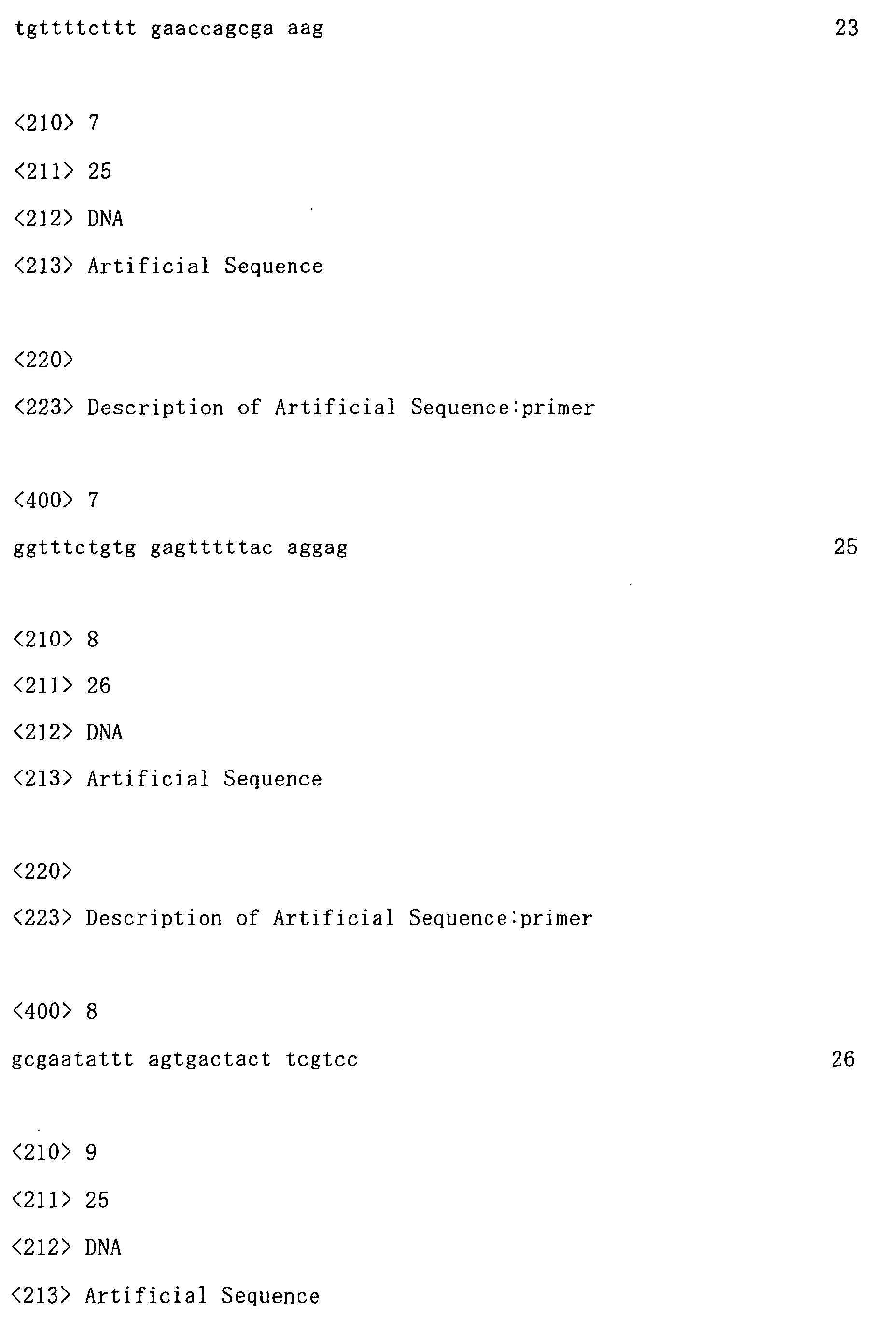

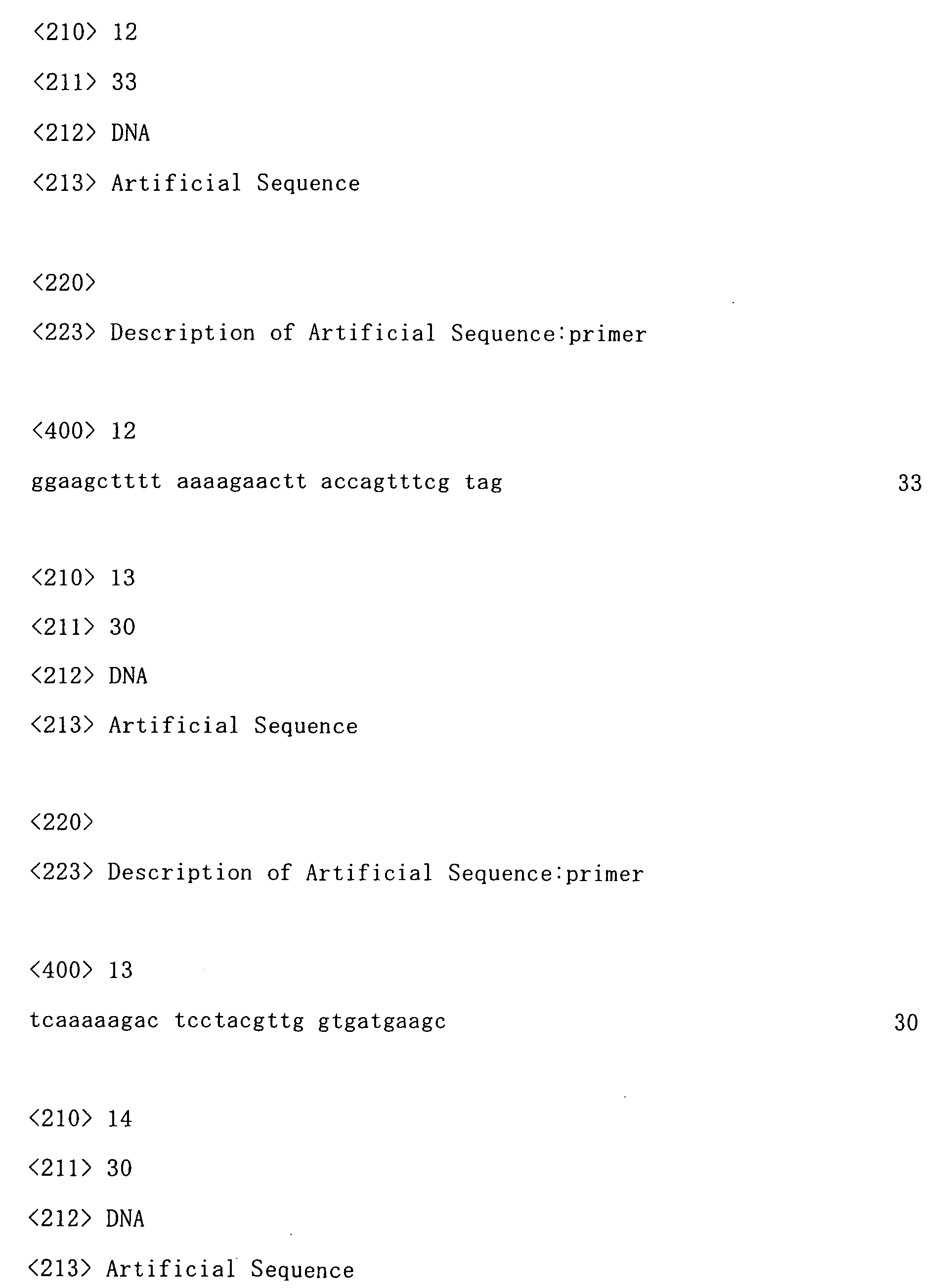

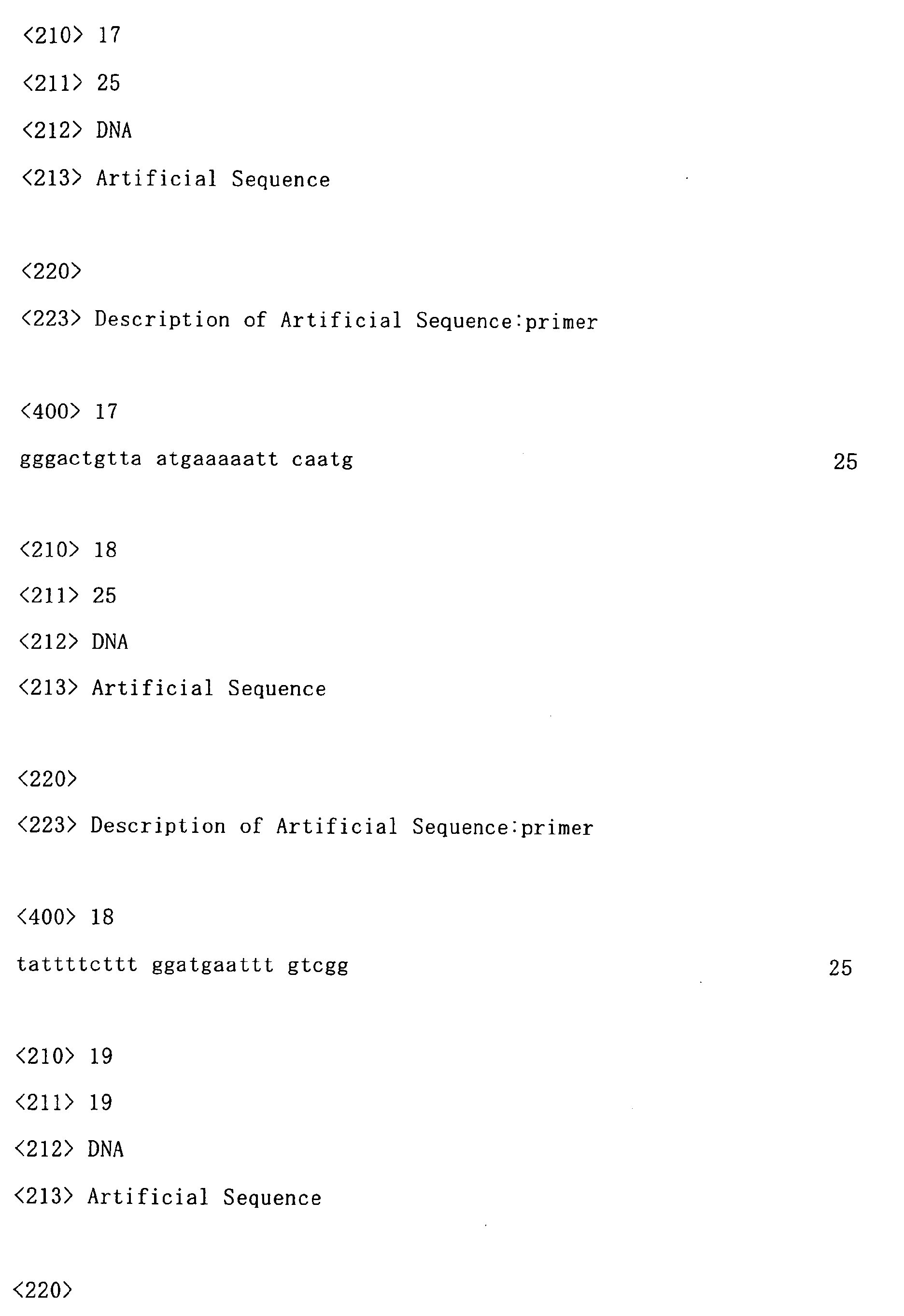



Claims (12)
- A DNA fragment, which exists in a non-translation region located upstream of the 5'-terminal side of a gene selected from the group consisting of genes of Saccharomyces cerevisiae described in the table indicated below, and has a cold-inducible promoter function.
No. Systematic gene name No. Systematic gene name No. Systematic gene name No. Systematic gene name No. Systematic gene name 1 YAL014C 53 YDR184C 105 YGR008C 157 YKL224C 209 YNR071C 2 YAL015C 54 YDR219C 106 YGR043C 158 YKR049C 210 YNR075W 3 YAL025C 55 YDR253C 107 YGR053C 159 YKR075C 211 YNR076W 4 YAL034C 56 YDR256C 108 YGR088W 160 YKR077W 212 YOL002C 5 YBL048W 57 YDR262W 109 YGR102C 161 YKR100C 213 YOL016C 6 YBL049W 58 YDR306C 110 YGR154C 162 YLL055W 214 YOL084W 7 YBL054W 59 YDR336W 111 YGR197C 163 YLL056C 215 YOL101C 8 YBL056W 60 YDR346C 112 YGR222W 164 YLR009W 216 YOL108C 9 YBL065W 61 YDR387C 113 YGR223C 165 YLR145W 217 YOL116W 10 YBL078C 62 YDR398W 114 YGR251W 166 YLR149C 218 YOL124C 11 YBR016W 63 YDR435C 115 YGR256W 167 YLR164W 219 YOL127W 12 YBR018C 64 YDR453C 116 YGR262C 168 YLR251W 220 YOL132W 13 YBR024W 65 YDR471W 117 YGR286C 169 YLR252W 221 YOL153C 14 YBR034C 66 YDR492W 118 YGR294W 170 YLR266C 222 YOL154W 15 YBR045C 67 YDR496C 119 YHL016C 171 YLR311C 223 YOL161C 16 YBR047W 68 YDR504C 120 YHL021C 172 YLR312C 224 YOL162W 17 YBR050C 69 YDR516C 121 YHL036W 173 YLR327C 225 YOL163W 18 YBR072W 70 YDR530C 122 YHL046C 174 YLR413W 226 YOL165C 19 YBR116C 71 YDR542W 123 YHR066W 175 YLR421C 227 YOR019W 20 YBR117C 72 YEL011W 124 YHR087W 176 YML004C 228 YOR031W 21 YBR126C 73 YEL039C 125 YHR138C 177 YML128C 229 YOR043W 22 YBR148W 74 YEL072W 126 YHR139C 178 YML131W 230 YOR095C 23 YBR199W 75 YER020W 127 YHR141C 179 YMR030W 231 YOR292C 24 YBR223C 76 YER042W 128 YHR146W 180 YMR090W 232 YOR298W 25 YBR296C 77 YER053C 129 YIL036W 181 YMR100W 233 YOR391C 26 YBR297W 78 YER056C 130 YIL045W 182 YMR105C 234 YOR394W 27 YBR298C 79 YER065C 131 YIL069C 183 YMR107W 235 YPL004C 28 YBR301W 80 YER066W 132 YIL077C 184 YMR139W 236 YPL014W 29 YCL051W 81 YER067W 133 YIL107C 185 YMR246W 237 YPL015C 30 YCR005C 82 YER078C 134 YIL136W 186 YMR255W 238 YPL043W 31 YCR072C 83 YER079W 135 YIL143C 187 YMR258C 239 YPL054W 32 YCR107W 84 YER117W 136 YIL153W 188 YMR262W 240 YPL093W 33 YDL022W 85 YER150W 137 YJL132W 189 YMR271C 241 YPL107W 34 YDL024C 86 YFL014W 138 YJL155C 190 YMR316W 242 YPL122C 35 YDL031W 87 YFL030W 139 YJL223C 191 YMR320W 243 YPL149W 36 YDL037C 88 YFL055W 140 YJR085C 192 YMR322C 244 YPL171C 37 YDL039C 89 YFL056C 141 YJR155W 193 YNL011C 245 YPL186C 38 YDL059C 90 YFL057C 142 YKL026C 194 YNL024C 246 YPL223C 39 YDL070W 91 YFR014C 143 YKL070W 195 YNL112W 247 YPL224C 40 YDL075W 92 YFR015C 144 YKL071W 196 YNL117W 248 YPL245W 41 YDL113C 93 YFR017C 145 YKL078W 197 YNL124W 249 YPL250C 42 YDL115C 94 YFR053C 146 YKL087C 198 YNL141W 250 YPL280W 43 YDL125C 95 YGL029W 147 YKL089W 199 YNL142W 251 YPL281C 44 YDL169C 96 YGL033W 148 YKL090W 200 YNL178W 252 YPL282C 45 YDL204W 97 YGL045W 149 YKL091C 201 YNL194C 253 YPR045C 46 YDL243C 98 YGL075C 150 YKL094W 202 YNL195C 254 YPR061C 47 YDR003W 99 YGL122C 151 YKL103C 203 YNL213C 255 YPR086W 48 YDR018C 100 YGL135W 152 YKL125W 204 YNL244C 256 YPR121W 49 YDR056C 101 YGL179C 153 YKL150W 205 YNL331C 257 YPR143W 50 YDR070C 102 YGL184C 154 YKL151C 206 YNR039C 258 YPR160W 51 YDR111C 103 YGL255W 155 YKL162C 207 YNR051C 259 YPR200C 52 YDR174W 104 YGL261C 156 YKL187C 208 YNR053C - A DNA fragment having a cold-inducible promoter function, which comprises DNA described in the following (a) or (b):(a) DNA comprising a deletion, substitution or addition of one or more nucleotides with respect to the DNA fragment according to claim 1;(b) DNA hybridizing with a DNA fragment consisting of a nucleotide sequence complementary to the DNA fragment according to claim 1 under stringent conditions.
- A DNA fragment, which comprises a cis sequence of the following (a) and/or (b), and has a cold-inducible promoter function:(a) DNA sequence A: GCTCATCG;(b) DNA sequence B: GAGATGAG.
- A DNA fragment having a cold-inducible promoter function, which comprises DNA described in the following (a) or (b):(a) DNA comprising a deletion, substitution or addition of one or more nucleotides with respect to the DNA fragment according to claim 3;(b) DNA hybridizing with a DNA fragment consisting of a nucleotide sequence complementary to the DNA fragment according to claim 3 under stringent conditions.
- An expression vector comprising the DNA fragment according to any one of claims 1 to 4.
- The expression vector according to claim 5, characterized by comprising a foreign gene or foreign DNA fragment downstream of said DNA fragment.
- A transformant, which is transformed with the expression vector according to claim 5 or 6.
- The transformant according to claim 7, wherein a host is yeast.
- A method for producing a protein, characterized by comprising decreasing a culture temperature and culturing the transformant according to claim 7 or 8 at the decreased temperature.
- The method for producing a protein according to claim 9, wherein the culture temperature is 10°C or lower.
- A method for regulating RNA production, characterized by comprising decreasing a culture temperature and culturing the transformant according to claim 7 or 8 at the decreased temperature.
- The method for regulating RNA production according to claim 11, wherein the culture temperature is 10°C or lower.
Applications Claiming Priority (3)
| Application Number | Priority Date | Filing Date | Title |
|---|---|---|---|
| JP2002191383 | 2002-06-28 | ||
| JP2002191383 | 2002-06-28 | ||
| PCT/JP2003/005956 WO2004003197A1 (en) | 2002-06-28 | 2003-05-13 | Yeast-origin promoter and vector and expression system using the same |
Publications (2)
| Publication Number | Publication Date |
|---|---|
| EP1536002A1 true EP1536002A1 (en) | 2005-06-01 |
| EP1536002A4 EP1536002A4 (en) | 2006-01-11 |
Family
ID=29996922
Family Applications (1)
| Application Number | Title | Priority Date | Filing Date |
|---|---|---|---|
| EP03723349A Withdrawn EP1536002A4 (en) | 2002-06-28 | 2003-05-13 | PROMOTER AND VECTOR FROM YEAST AND EXPRESSION SYSTEM USING THE SAME |
Country Status (5)
| Country | Link |
|---|---|
| US (1) | US7371847B2 (en) |
| EP (1) | EP1536002A4 (en) |
| JP (1) | JP4332630B2 (en) |
| AU (1) | AU2003235252A1 (en) |
| WO (1) | WO2004003197A1 (en) |
Families Citing this family (5)
| Publication number | Priority date | Publication date | Assignee | Title |
|---|---|---|---|---|
| JP5354559B2 (en) * | 2005-11-24 | 2013-11-27 | 独立行政法人産業技術総合研究所 | Highly efficient secretory signal peptides and protein expression systems using them |
| JP2007174957A (en) * | 2005-12-27 | 2007-07-12 | Toyobo Co Ltd | Hyaluronic acid producing yeast |
| JP4586149B2 (en) * | 2007-09-10 | 2010-11-24 | 長瀬産業株式会社 | Promoter and activation method thereof |
| JP5183336B2 (en) * | 2008-07-15 | 2013-04-17 | 富士フイルム株式会社 | Display device |
| US10467653B1 (en) * | 2013-03-14 | 2019-11-05 | Oath (Americas) Inc. | Tracking online conversions attributable to offline events |
Family Cites Families (1)
| Publication number | Priority date | Publication date | Assignee | Title |
|---|---|---|---|---|
| JPH089977A (en) * | 1994-07-04 | 1996-01-16 | Kirin Brewery Co Ltd | Yeast promoter |
-
2003
- 2003-05-13 JP JP2004517241A patent/JP4332630B2/en not_active Expired - Lifetime
- 2003-05-13 EP EP03723349A patent/EP1536002A4/en not_active Withdrawn
- 2003-05-13 AU AU2003235252A patent/AU2003235252A1/en not_active Abandoned
- 2003-05-13 WO PCT/JP2003/005956 patent/WO2004003197A1/en not_active Ceased
- 2003-05-13 US US10/519,545 patent/US7371847B2/en not_active Expired - Fee Related
Non-Patent Citations (4)
| Title |
|---|
| DATABASE WPI Derwent Publications Ltd., London, GB; AN 1996-110275 XP002337559 "Novel yeast promoter active at low temperatures - comprises the Lg-CSP1 promoter region from S. cerevisiae" & JP 08 009977 A (KIRIN BREWERY) 16 January 1996 (1996-01-16) * |
| MUJACIC M ET AL: "Cold-inducible cloning vectors for low-temperature protein expression in escherichia coli: application to the production of a toxic and proteolytically sensitive fusion protein" GENE: AN INTERNATIONAL JOURNAL ON GENES AND GENOMES, ELSEVIER SCIENCE PUBLISHERS, BARKING, GB, vol. 238, no. 2, 1999, pages 325-332, XP002972185 ISSN: 0378-1119 * |
| QORONFLEH M WALID ET AL: "Identification and characterization of novel low-temperature-inducible promoters of Escherichia coli" JOURNAL OF BACTERIOLOGY, vol. 174, no. 24, 1992, pages 7902-7909, XP002337601 ISSN: 0021-9193 * |
| See also references of WO2004003197A1 * |
Also Published As
| Publication number | Publication date |
|---|---|
| EP1536002A4 (en) | 2006-01-11 |
| WO2004003197A1 (en) | 2004-01-08 |
| JP4332630B2 (en) | 2009-09-16 |
| US20050260590A1 (en) | 2005-11-24 |
| AU2003235252A1 (en) | 2004-01-19 |
| US7371847B2 (en) | 2008-05-13 |
| JPWO2004003197A1 (en) | 2005-10-27 |
Similar Documents
| Publication | Publication Date | Title |
|---|---|---|
| DK175658B1 (en) | Process for Preparing Glucose Oxidase in Recombinant Systems | |
| Vai et al. | Isolation and deduced amino acid sequence of the gene encoding gp115, a yeast glycophospholipid-anchored protein containing a serine-rich region | |
| KR20170138543A (en) | Expression constructs and methods for genetically engineering methylnutritic yeast | |
| JP5354559B2 (en) | Highly efficient secretory signal peptides and protein expression systems using them | |
| Yamada et al. | Cloning of NAD-dependent sorbitol dehydrogenase from apple fruit and gene expression | |
| Hongoh et al. | Cloning, sequence analysis and expression in Escherichia coli of the gene encoding a uricase from the yeast-like symbiont of the brown planthopper, Nilaparvata lugens | |
| US7381810B2 (en) | Polyphenol oxidase genes from lettuce | |
| Yamada et al. | cDNA cloning of NAD-dependent sorbitol dehydrogenase from peach fruit and its expression during fruit development | |
| US5470971A (en) | Stress-induced proteins, genes coding therefor, transformed cells of organisms, methods and applications | |
| JPH0662849A (en) | Alcohol acetyltransferase gene and its use | |
| US7371847B2 (en) | Yeast-origin promoter and vector and expression system using the same | |
| US6342375B1 (en) | Modified methylotrophic Pichia pastoris yeast which secretes human growth hormone | |
| US6291666B1 (en) | Spike tissue-specific promoter | |
| CN100393744C (en) | Rice stem elongation gene and its encoded protein and application | |
| US20060089492A1 (en) | Promoters having a modified transcription efficiency and derived from methyltrophic yeast | |
| CN111944772B (en) | Eggplant cryptochrome blue light inhibitor SmBIC1 protein and coding gene | |
| Guterman et al. | Senescence‐associated mRNAs that may participate in signal transduction and protein trafficking | |
| Aisemberg et al. | A major transcript in the response ofNeurospora crassa to protein synthesis inhibition by cycloheximide | |
| Yamada et al. | Identification and cDNA cloning of a protein abundantly expressed during apple fruit development | |
| CN109280668B (en) | Tobacco amino acid transporter gene NtTAT and application thereof | |
| US7273931B2 (en) | Plant promoter | |
| KR20070058467A (en) | Yeast promoter | |
| CN119638811B (en) | Eggplant bHLH family transcription factor SmbHLH protein and encoding gene thereof | |
| WO1997004106A2 (en) | New saccharomyces cerevisiae pectinase sequences and heterologous expression systems derived therefrom | |
| CN112941083B (en) | A kind of rice lesion senescence regulation gene and its application |
Legal Events
| Date | Code | Title | Description |
|---|---|---|---|
| PUAI | Public reference made under article 153(3) epc to a published international application that has entered the european phase |
Free format text: ORIGINAL CODE: 0009012 |
|
| 17P | Request for examination filed |
Effective date: 20050117 |
|
| AK | Designated contracting states |
Kind code of ref document: A1 Designated state(s): AT BE BG CH CY CZ DE DK EE ES FI FR GB GR HU IE IT LI LU MC NL PT RO SE SI SK TR |
|
| AX | Request for extension of the european patent |
Extension state: AL LT LV MK |
|
| DAX | Request for extension of the european patent (deleted) | ||
| RBV | Designated contracting states (corrected) |
Designated state(s): DK GB NL |
|
| REG | Reference to a national code |
Ref country code: DE Ref legal event code: 8566 |
|
| A4 | Supplementary search report drawn up and despatched |
Effective date: 20051123 |
|
| 17Q | First examination report despatched |
Effective date: 20070108 |
|
| GRAP | Despatch of communication of intention to grant a patent |
Free format text: ORIGINAL CODE: EPIDOSNIGR1 |
|
| STAA | Information on the status of an ep patent application or granted ep patent |
Free format text: STATUS: THE APPLICATION IS DEEMED TO BE WITHDRAWN |
|
| 18D | Application deemed to be withdrawn |
Effective date: 20111108 |