EP1535971A1 - Treated pigment, use thereof, and compound for pigment treatment - Google Patents
Treated pigment, use thereof, and compound for pigment treatment Download PDFInfo
- Publication number
- EP1535971A1 EP1535971A1 EP03733572A EP03733572A EP1535971A1 EP 1535971 A1 EP1535971 A1 EP 1535971A1 EP 03733572 A EP03733572 A EP 03733572A EP 03733572 A EP03733572 A EP 03733572A EP 1535971 A1 EP1535971 A1 EP 1535971A1
- Authority
- EP
- European Patent Office
- Prior art keywords
- group
- carbodiimide
- compound
- pigment
- compounds
- Prior art date
- Legal status (The legal status is an assumption and is not a legal conclusion. Google has not performed a legal analysis and makes no representation as to the accuracy of the status listed.)
- Withdrawn
Links
- 150000001875 compounds Chemical class 0.000 title claims abstract description 287
- 239000000049 pigment Substances 0.000 title claims abstract description 232
- 239000000203 mixture Substances 0.000 claims abstract description 141
- 150000001718 carbodiimides Chemical class 0.000 claims abstract description 113
- VPKDCDLSJZCGKE-UHFFFAOYSA-N carbodiimide group Chemical group N=C=N VPKDCDLSJZCGKE-UHFFFAOYSA-N 0.000 claims abstract description 107
- 239000006185 dispersion Substances 0.000 claims abstract description 101
- QJGQUHMNIGDVPM-UHFFFAOYSA-N nitrogen group Chemical group [N] QJGQUHMNIGDVPM-UHFFFAOYSA-N 0.000 claims abstract description 91
- 229920000728 polyester Polymers 0.000 claims abstract description 67
- 125000000524 functional group Chemical group 0.000 claims abstract description 57
- 239000004721 Polyphenylene oxide Substances 0.000 claims abstract description 55
- 229920000570 polyether Polymers 0.000 claims abstract description 55
- 239000002612 dispersion medium Substances 0.000 claims abstract description 25
- 125000003178 carboxy group Chemical group [H]OC(*)=O 0.000 claims description 69
- 125000002887 hydroxy group Chemical group [H]O* 0.000 claims description 62
- 239000006229 carbon black Substances 0.000 claims description 39
- 239000012860 organic pigment Substances 0.000 claims description 21
- 238000001179 sorption measurement Methods 0.000 claims description 14
- 125000000542 sulfonic acid group Chemical group 0.000 claims description 14
- 125000003277 amino group Chemical group 0.000 claims description 13
- 125000000623 heterocyclic group Chemical group 0.000 claims description 6
- 125000001302 tertiary amino group Chemical group 0.000 claims description 5
- -1 lactone compound Chemical class 0.000 description 137
- IQPQWNKOIGAROB-UHFFFAOYSA-N isocyanate group Chemical group [N-]=C=O IQPQWNKOIGAROB-UHFFFAOYSA-N 0.000 description 69
- LLHKCFNBLRBOGN-UHFFFAOYSA-N propylene glycol methyl ether acetate Chemical compound COCC(C)OC(C)=O LLHKCFNBLRBOGN-UHFFFAOYSA-N 0.000 description 60
- 238000002360 preparation method Methods 0.000 description 51
- 238000006243 chemical reaction Methods 0.000 description 39
- IJGRMHOSHXDMSA-UHFFFAOYSA-N Atomic nitrogen Chemical compound N#N IJGRMHOSHXDMSA-UHFFFAOYSA-N 0.000 description 35
- 238000000034 method Methods 0.000 description 33
- 238000007151 ring opening polymerisation reaction Methods 0.000 description 33
- 238000003756 stirring Methods 0.000 description 31
- 238000010992 reflux Methods 0.000 description 26
- LYCAIKOWRPUZTN-UHFFFAOYSA-N ethylene glycol Natural products OCCO LYCAIKOWRPUZTN-UHFFFAOYSA-N 0.000 description 25
- 239000000047 product Substances 0.000 description 25
- 239000003999 initiator Substances 0.000 description 24
- 229910001873 dinitrogen Inorganic materials 0.000 description 21
- 239000000178 monomer Substances 0.000 description 21
- 239000003960 organic solvent Substances 0.000 description 20
- CRVGTESFCCXCTH-UHFFFAOYSA-N methyl diethanolamine Chemical compound OCCN(C)CCO CRVGTESFCCXCTH-UHFFFAOYSA-N 0.000 description 19
- 229920003229 poly(methyl methacrylate) Polymers 0.000 description 17
- 239000004926 polymethyl methacrylate Substances 0.000 description 17
- 230000000052 comparative effect Effects 0.000 description 16
- 239000000463 material Substances 0.000 description 16
- 238000011156 evaluation Methods 0.000 description 15
- 239000000976 ink Substances 0.000 description 15
- 239000011324 bead Substances 0.000 description 14
- 239000004698 Polyethylene Substances 0.000 description 13
- 229920000573 polyethylene Polymers 0.000 description 13
- 229920001451 polypropylene glycol Polymers 0.000 description 13
- XLYOFNOQVPJJNP-UHFFFAOYSA-N water Substances O XLYOFNOQVPJJNP-UHFFFAOYSA-N 0.000 description 13
- LFQSCWFLJHTTHZ-UHFFFAOYSA-N Ethanol Chemical compound CCO LFQSCWFLJHTTHZ-UHFFFAOYSA-N 0.000 description 12
- NBIIXXVUZAFLBC-UHFFFAOYSA-N Phosphoric acid Chemical group OP(O)(O)=O NBIIXXVUZAFLBC-UHFFFAOYSA-N 0.000 description 12
- 230000015572 biosynthetic process Effects 0.000 description 12
- 239000003973 paint Substances 0.000 description 12
- 238000000576 coating method Methods 0.000 description 11
- HRPVXLWXLXDGHG-UHFFFAOYSA-N Acrylamide Chemical compound NC(=O)C=C HRPVXLWXLXDGHG-UHFFFAOYSA-N 0.000 description 10
- 229910000831 Steel Inorganic materials 0.000 description 10
- NIXOWILDQLNWCW-UHFFFAOYSA-N acrylic acid group Chemical group C(C=C)(=O)O NIXOWILDQLNWCW-UHFFFAOYSA-N 0.000 description 10
- 239000008213 purified water Substances 0.000 description 10
- 239000010959 steel Substances 0.000 description 10
- OKKJLVBELUTLKV-UHFFFAOYSA-N Methanol Chemical compound OC OKKJLVBELUTLKV-UHFFFAOYSA-N 0.000 description 9
- 239000002253 acid Substances 0.000 description 9
- 239000010408 film Substances 0.000 description 9
- 238000009472 formulation Methods 0.000 description 9
- XLLIQLLCWZCATF-UHFFFAOYSA-N 2-methoxyethyl acetate Chemical compound COCCOC(C)=O XLLIQLLCWZCATF-UHFFFAOYSA-N 0.000 description 8
- OFOBLEOULBTSOW-UHFFFAOYSA-N Malonic acid Chemical compound OC(=O)CC(O)=O OFOBLEOULBTSOW-UHFFFAOYSA-N 0.000 description 8
- JHIVVAPYMSGYDF-UHFFFAOYSA-N cyclohexanone Chemical compound O=C1CCCCC1 JHIVVAPYMSGYDF-UHFFFAOYSA-N 0.000 description 8
- 125000005647 linker group Chemical group 0.000 description 8
- 229910052757 nitrogen Inorganic materials 0.000 description 8
- PAPBSGBWRJIAAV-UHFFFAOYSA-N ε-Caprolactone Chemical compound O=C1CCCCCO1 PAPBSGBWRJIAAV-UHFFFAOYSA-N 0.000 description 8
- NIXOWILDQLNWCW-UHFFFAOYSA-M Acrylate Chemical compound [O-]C(=O)C=C NIXOWILDQLNWCW-UHFFFAOYSA-M 0.000 description 7
- DNIAPMSPPWPWGF-UHFFFAOYSA-N Propylene glycol Chemical compound CC(O)CO DNIAPMSPPWPWGF-UHFFFAOYSA-N 0.000 description 7
- BVKZGUZCCUSVTD-UHFFFAOYSA-N carbonic acid Chemical compound OC(O)=O BVKZGUZCCUSVTD-UHFFFAOYSA-N 0.000 description 7
- 239000002270 dispersing agent Substances 0.000 description 7
- JVTAAEKCZFNVCJ-UHFFFAOYSA-N lactic acid Chemical compound CC(O)C(O)=O JVTAAEKCZFNVCJ-UHFFFAOYSA-N 0.000 description 7
- 229920001610 polycaprolactone Polymers 0.000 description 7
- 239000004632 polycaprolactone Substances 0.000 description 7
- 241000894007 species Species 0.000 description 7
- ULQISTXYYBZJSJ-UHFFFAOYSA-N 12-hydroxyoctadecanoic acid Chemical compound CCCCCCC(O)CCCCCCCCCCC(O)=O ULQISTXYYBZJSJ-UHFFFAOYSA-N 0.000 description 6
- RTZKZFJDLAIYFH-UHFFFAOYSA-N Diethyl ether Chemical compound CCOCC RTZKZFJDLAIYFH-UHFFFAOYSA-N 0.000 description 6
- ZMXDDKWLCZADIW-UHFFFAOYSA-N N,N-Dimethylformamide Chemical compound CN(C)C=O ZMXDDKWLCZADIW-UHFFFAOYSA-N 0.000 description 6
- YXFVVABEGXRONW-UHFFFAOYSA-N Toluene Chemical compound CC1=CC=CC=C1 YXFVVABEGXRONW-UHFFFAOYSA-N 0.000 description 6
- 239000000654 additive Substances 0.000 description 6
- LZCLXQDLBQLTDK-UHFFFAOYSA-N ethyl 2-hydroxypropanoate Chemical compound CCOC(=O)C(C)O LZCLXQDLBQLTDK-UHFFFAOYSA-N 0.000 description 6
- CATSNJVOTSVZJV-UHFFFAOYSA-N heptan-2-one Chemical compound CCCCCC(C)=O CATSNJVOTSVZJV-UHFFFAOYSA-N 0.000 description 6
- FUZZWVXGSFPDMH-UHFFFAOYSA-N hexanoic acid Chemical compound CCCCCC(O)=O FUZZWVXGSFPDMH-UHFFFAOYSA-N 0.000 description 6
- 238000006068 polycondensation reaction Methods 0.000 description 6
- 239000002244 precipitate Substances 0.000 description 6
- 238000007639 printing Methods 0.000 description 6
- FALRKNHUBBKYCC-UHFFFAOYSA-N 2-(chloromethyl)pyridine-3-carbonitrile Chemical compound ClCC1=NC=CC=C1C#N FALRKNHUBBKYCC-UHFFFAOYSA-N 0.000 description 5
- 150000001252 acrylic acid derivatives Chemical class 0.000 description 5
- 150000002148 esters Chemical class 0.000 description 5
- 239000011521 glass Substances 0.000 description 5
- WGCNASOHLSPBMP-UHFFFAOYSA-N hydroxyacetaldehyde Natural products OCC=O WGCNASOHLSPBMP-UHFFFAOYSA-N 0.000 description 5
- 239000011164 primary particle Substances 0.000 description 5
- 239000011347 resin Substances 0.000 description 5
- 229920005989 resin Polymers 0.000 description 5
- 229940014800 succinic anhydride Drugs 0.000 description 5
- 230000002194 synthesizing effect Effects 0.000 description 5
- VZCYOOQTPOCHFL-UHFFFAOYSA-N trans-butenedioic acid Natural products OC(=O)C=CC(O)=O VZCYOOQTPOCHFL-UHFFFAOYSA-N 0.000 description 5
- TXBCBTDQIULDIA-UHFFFAOYSA-N 2-[[3-hydroxy-2,2-bis(hydroxymethyl)propoxy]methyl]-2-(hydroxymethyl)propane-1,3-diol Chemical compound OCC(CO)(CO)COCC(CO)(CO)CO TXBCBTDQIULDIA-UHFFFAOYSA-N 0.000 description 4
- LWRBVKNFOYUCNP-UHFFFAOYSA-N 2-methyl-1-(4-methylsulfanylphenyl)-2-morpholin-4-ylpropan-1-one Chemical compound C1=CC(SC)=CC=C1C(=O)C(C)(C)N1CCOCC1 LWRBVKNFOYUCNP-UHFFFAOYSA-N 0.000 description 4
- BXGYBSJAZFGIPX-UHFFFAOYSA-N 2-pyridin-2-ylethanol Chemical compound OCCC1=CC=CC=N1 BXGYBSJAZFGIPX-UHFFFAOYSA-N 0.000 description 4
- SOGAXMICEFXMKE-UHFFFAOYSA-N Butylmethacrylate Chemical compound CCCCOC(=O)C(C)=C SOGAXMICEFXMKE-UHFFFAOYSA-N 0.000 description 4
- 239000005058 Isophorone diisocyanate Substances 0.000 description 4
- CDBYLPFSWZWCQE-UHFFFAOYSA-L Sodium Carbonate Chemical compound [Na+].[Na+].[O-]C([O-])=O CDBYLPFSWZWCQE-UHFFFAOYSA-L 0.000 description 4
- LSNNMFCWUKXFEE-UHFFFAOYSA-N Sulfurous acid Chemical compound OS(O)=O LSNNMFCWUKXFEE-UHFFFAOYSA-N 0.000 description 4
- WYURNTSHIVDZCO-UHFFFAOYSA-N Tetrahydrofuran Chemical compound C1CCOC1 WYURNTSHIVDZCO-UHFFFAOYSA-N 0.000 description 4
- 150000008065 acid anhydrides Chemical class 0.000 description 4
- AOJOEFVRHOZDFN-UHFFFAOYSA-N benzyl 2-methylprop-2-enoate Chemical compound CC(=C)C(=O)OCC1=CC=CC=C1 AOJOEFVRHOZDFN-UHFFFAOYSA-N 0.000 description 4
- 238000009835 boiling Methods 0.000 description 4
- 239000007795 chemical reaction product Substances 0.000 description 4
- 125000004122 cyclic group Chemical group 0.000 description 4
- 238000006114 decarboxylation reaction Methods 0.000 description 4
- 230000000694 effects Effects 0.000 description 4
- 239000007789 gas Substances 0.000 description 4
- NIMLQBUJDJZYEJ-UHFFFAOYSA-N isophorone diisocyanate Chemical compound CC1(C)CC(N=C=O)CC(C)(CN=C=O)C1 NIMLQBUJDJZYEJ-UHFFFAOYSA-N 0.000 description 4
- 150000002576 ketones Chemical class 0.000 description 4
- 239000004310 lactic acid Substances 0.000 description 4
- 235000014655 lactic acid Nutrition 0.000 description 4
- VZCYOOQTPOCHFL-UPHRSURJSA-N maleic acid Chemical compound OC(=O)\C=C/C(O)=O VZCYOOQTPOCHFL-UPHRSURJSA-N 0.000 description 4
- 239000011976 maleic acid Substances 0.000 description 4
- LPEKGGXMPWTOCB-UHFFFAOYSA-N methyl 2-hydroxypropionate Chemical compound COC(=O)C(C)O LPEKGGXMPWTOCB-UHFFFAOYSA-N 0.000 description 4
- 238000006116 polymerization reaction Methods 0.000 description 4
- 230000009257 reactivity Effects 0.000 description 4
- 238000007142 ring opening reaction Methods 0.000 description 4
- 239000002904 solvent Substances 0.000 description 4
- XOAAWQZATWQOTB-UHFFFAOYSA-N taurine Chemical compound NCCS(O)(=O)=O XOAAWQZATWQOTB-UHFFFAOYSA-N 0.000 description 4
- OWSKJORLRSWYGK-UHFFFAOYSA-N (3-methoxy-3-methylbutyl) propanoate Chemical compound CCC(=O)OCCC(C)(C)OC OWSKJORLRSWYGK-UHFFFAOYSA-N 0.000 description 3
- CNJRPYFBORAQAU-UHFFFAOYSA-N 1-ethoxy-2-(2-methoxyethoxy)ethane Chemical compound CCOCCOCCOC CNJRPYFBORAQAU-UHFFFAOYSA-N 0.000 description 3
- 229940114072 12-hydroxystearic acid Drugs 0.000 description 3
- PTBDIHRZYDMNKB-UHFFFAOYSA-N 2,2-Bis(hydroxymethyl)propionic acid Chemical compound OCC(C)(CO)C(O)=O PTBDIHRZYDMNKB-UHFFFAOYSA-N 0.000 description 3
- ZWEHNKRNPOVVGH-UHFFFAOYSA-N 2-Butanone Chemical compound CCC(C)=O ZWEHNKRNPOVVGH-UHFFFAOYSA-N 0.000 description 3
- SVONRAPFKPVNKG-UHFFFAOYSA-N 2-ethoxyethyl acetate Chemical compound CCOCCOC(C)=O SVONRAPFKPVNKG-UHFFFAOYSA-N 0.000 description 3
- 239000004593 Epoxy Substances 0.000 description 3
- XEKOWRVHYACXOJ-UHFFFAOYSA-N Ethyl acetate Chemical compound CCOC(C)=O XEKOWRVHYACXOJ-UHFFFAOYSA-N 0.000 description 3
- IAYPIBMASNFSPL-UHFFFAOYSA-N Ethylene oxide Chemical compound C1CO1 IAYPIBMASNFSPL-UHFFFAOYSA-N 0.000 description 3
- KFZMGEQAYNKOFK-UHFFFAOYSA-N Isopropanol Chemical compound CC(C)O KFZMGEQAYNKOFK-UHFFFAOYSA-N 0.000 description 3
- DIQMPQMYFZXDAX-UHFFFAOYSA-N Pentyl formate Chemical compound CCCCCOC=O DIQMPQMYFZXDAX-UHFFFAOYSA-N 0.000 description 3
- MPIAGWXWVAHQBB-UHFFFAOYSA-N [3-prop-2-enoyloxy-2-[[3-prop-2-enoyloxy-2,2-bis(prop-2-enoyloxymethyl)propoxy]methyl]-2-(prop-2-enoyloxymethyl)propyl] prop-2-enoate Chemical compound C=CC(=O)OCC(COC(=O)C=C)(COC(=O)C=C)COCC(COC(=O)C=C)(COC(=O)C=C)COC(=O)C=C MPIAGWXWVAHQBB-UHFFFAOYSA-N 0.000 description 3
- 125000001931 aliphatic group Chemical group 0.000 description 3
- 150000004945 aromatic hydrocarbons Chemical class 0.000 description 3
- HNEGQIOMVPPMNR-IHWYPQMZSA-N citraconic acid Chemical compound OC(=O)C(/C)=C\C(O)=O HNEGQIOMVPPMNR-IHWYPQMZSA-N 0.000 description 3
- 229940018557 citraconic acid Drugs 0.000 description 3
- 238000011161 development Methods 0.000 description 3
- XXJWXESWEXIICW-UHFFFAOYSA-N diethylene glycol monoethyl ether Chemical compound CCOCCOCCO XXJWXESWEXIICW-UHFFFAOYSA-N 0.000 description 3
- 229940075557 diethylene glycol monoethyl ether Drugs 0.000 description 3
- 150000002009 diols Chemical class 0.000 description 3
- 238000005516 engineering process Methods 0.000 description 3
- 150000002170 ethers Chemical class 0.000 description 3
- NGAZZOYFWWSOGK-UHFFFAOYSA-N heptan-3-one Chemical compound CCCCC(=O)CC NGAZZOYFWWSOGK-UHFFFAOYSA-N 0.000 description 3
- 239000012948 isocyanate Substances 0.000 description 3
- 238000004519 manufacturing process Methods 0.000 description 3
- 238000003801 milling Methods 0.000 description 3
- 238000002156 mixing Methods 0.000 description 3
- 239000002245 particle Substances 0.000 description 3
- 229920000058 polyacrylate Polymers 0.000 description 3
- 229920001515 polyalkylene glycol Polymers 0.000 description 3
- 229920005862 polyol Polymers 0.000 description 3
- 235000013772 propylene glycol Nutrition 0.000 description 3
- 239000000126 substance Substances 0.000 description 3
- 239000000758 substrate Substances 0.000 description 3
- 238000004381 surface treatment Methods 0.000 description 3
- 238000003786 synthesis reaction Methods 0.000 description 3
- JYEUMXHLPRZUAT-UHFFFAOYSA-N 1,2,3-triazine Chemical compound C1=CN=NN=C1 JYEUMXHLPRZUAT-UHFFFAOYSA-N 0.000 description 2
- NNOZGCICXAYKLW-UHFFFAOYSA-N 1,2-bis(2-isocyanatopropan-2-yl)benzene Chemical compound O=C=NC(C)(C)C1=CC=CC=C1C(C)(C)N=C=O NNOZGCICXAYKLW-UHFFFAOYSA-N 0.000 description 2
- KVNYFPKFSJIPBJ-UHFFFAOYSA-N 1,2-diethylbenzene Chemical compound CCC1=CC=CC=C1CC KVNYFPKFSJIPBJ-UHFFFAOYSA-N 0.000 description 2
- FRASJONUBLZVQX-UHFFFAOYSA-N 1,4-naphthoquinone Chemical compound C1=CC=C2C(=O)C=CC(=O)C2=C1 FRASJONUBLZVQX-UHFFFAOYSA-N 0.000 description 2
- RRQYJINTUHWNHW-UHFFFAOYSA-N 1-ethoxy-2-(2-ethoxyethoxy)ethane Chemical compound CCOCCOCCOCC RRQYJINTUHWNHW-UHFFFAOYSA-N 0.000 description 2
- JOLQKTGDSGKSKJ-UHFFFAOYSA-N 1-ethoxypropan-2-ol Chemical compound CCOCC(C)O JOLQKTGDSGKSKJ-UHFFFAOYSA-N 0.000 description 2
- LIPRQQHINVWJCH-UHFFFAOYSA-N 1-ethoxypropan-2-yl acetate Chemical compound CCOCC(C)OC(C)=O LIPRQQHINVWJCH-UHFFFAOYSA-N 0.000 description 2
- ARXJGSRGQADJSQ-UHFFFAOYSA-N 1-methoxypropan-2-ol Chemical compound COCC(C)O ARXJGSRGQADJSQ-UHFFFAOYSA-N 0.000 description 2
- JVYDLYGCSIHCMR-UHFFFAOYSA-N 2,2-bis(hydroxymethyl)butanoic acid Chemical compound CCC(CO)(CO)C(O)=O JVYDLYGCSIHCMR-UHFFFAOYSA-N 0.000 description 2
- QRIMLDXJAPZHJE-UHFFFAOYSA-N 2,3-dihydroxypropyl 2-methylprop-2-enoate Chemical compound CC(=C)C(=O)OCC(O)CO QRIMLDXJAPZHJE-UHFFFAOYSA-N 0.000 description 2
- SBASXUCJHJRPEV-UHFFFAOYSA-N 2-(2-methoxyethoxy)ethanol Chemical compound COCCOCCO SBASXUCJHJRPEV-UHFFFAOYSA-N 0.000 description 2
- LEJBBGNFPAFPKQ-UHFFFAOYSA-N 2-(2-prop-2-enoyloxyethoxy)ethyl prop-2-enoate Chemical compound C=CC(=O)OCCOCCOC(=O)C=C LEJBBGNFPAFPKQ-UHFFFAOYSA-N 0.000 description 2
- JAHNSTQSQJOJLO-UHFFFAOYSA-N 2-(3-fluorophenyl)-1h-imidazole Chemical compound FC1=CC=CC(C=2NC=CN=2)=C1 JAHNSTQSQJOJLO-UHFFFAOYSA-N 0.000 description 2
- XNWFRZJHXBZDAG-UHFFFAOYSA-N 2-METHOXYETHANOL Chemical compound COCCO XNWFRZJHXBZDAG-UHFFFAOYSA-N 0.000 description 2
- XFCMNSHQOZQILR-UHFFFAOYSA-N 2-[2-(2-methylprop-2-enoyloxy)ethoxy]ethyl 2-methylprop-2-enoate Chemical compound CC(=C)C(=O)OCCOCCOC(=O)C(C)=C XFCMNSHQOZQILR-UHFFFAOYSA-N 0.000 description 2
- HCLJOFJIQIJXHS-UHFFFAOYSA-N 2-[2-[2-(2-prop-2-enoyloxyethoxy)ethoxy]ethoxy]ethyl prop-2-enoate Chemical compound C=CC(=O)OCCOCCOCCOCCOC(=O)C=C HCLJOFJIQIJXHS-UHFFFAOYSA-N 0.000 description 2
- NQBXSWAWVZHKBZ-UHFFFAOYSA-N 2-butoxyethyl acetate Chemical compound CCCCOCCOC(C)=O NQBXSWAWVZHKBZ-UHFFFAOYSA-N 0.000 description 2
- ZNQVEEAIQZEUHB-UHFFFAOYSA-N 2-ethoxyethanol Chemical compound CCOCCO ZNQVEEAIQZEUHB-UHFFFAOYSA-N 0.000 description 2
- YEJRWHAVMIAJKC-UHFFFAOYSA-N 4-Butyrolactone Chemical compound O=C1CCCO1 YEJRWHAVMIAJKC-UHFFFAOYSA-N 0.000 description 2
- OZJPLYNZGCXSJM-UHFFFAOYSA-N 5-valerolactone Chemical compound O=C1CCCCO1 OZJPLYNZGCXSJM-UHFFFAOYSA-N 0.000 description 2
- KWOLFJPFCHCOCG-UHFFFAOYSA-N Acetophenone Chemical compound CC(=O)C1=CC=CC=C1 KWOLFJPFCHCOCG-UHFFFAOYSA-N 0.000 description 2
- OKTJSMMVPCPJKN-UHFFFAOYSA-N Carbon Chemical compound [C] OKTJSMMVPCPJKN-UHFFFAOYSA-N 0.000 description 2
- 239000004970 Chain extender Substances 0.000 description 2
- VZCYOOQTPOCHFL-OWOJBTEDSA-N Fumaric acid Chemical compound OC(=O)\C=C\C(O)=O VZCYOOQTPOCHFL-OWOJBTEDSA-N 0.000 description 2
- WOBHKFSMXKNTIM-UHFFFAOYSA-N Hydroxyethyl methacrylate Chemical compound CC(=C)C(=O)OCCO WOBHKFSMXKNTIM-UHFFFAOYSA-N 0.000 description 2
- CERQOIWHTDAKMF-UHFFFAOYSA-N Methacrylic acid Chemical compound CC(=C)C(O)=O CERQOIWHTDAKMF-UHFFFAOYSA-N 0.000 description 2
- BAPJBEWLBFYGME-UHFFFAOYSA-N Methyl acrylate Chemical compound COC(=O)C=C BAPJBEWLBFYGME-UHFFFAOYSA-N 0.000 description 2
- NTIZESTWPVYFNL-UHFFFAOYSA-N Methyl isobutyl ketone Chemical compound CC(C)CC(C)=O NTIZESTWPVYFNL-UHFFFAOYSA-N 0.000 description 2
- UIHCLUNTQKBZGK-UHFFFAOYSA-N Methyl isobutyl ketone Natural products CCC(C)C(C)=O UIHCLUNTQKBZGK-UHFFFAOYSA-N 0.000 description 2
- FXHOOIRPVKKKFG-UHFFFAOYSA-N N,N-Dimethylacetamide Chemical compound CN(C)C(C)=O FXHOOIRPVKKKFG-UHFFFAOYSA-N 0.000 description 2
- SECXISVLQFMRJM-UHFFFAOYSA-N N-Methylpyrrolidone Chemical compound CN1CCCC1=O SECXISVLQFMRJM-UHFFFAOYSA-N 0.000 description 2
- CTQNGGLPUBDAKN-UHFFFAOYSA-N O-Xylene Chemical compound CC1=CC=CC=C1C CTQNGGLPUBDAKN-UHFFFAOYSA-N 0.000 description 2
- 229910019142 PO4 Inorganic materials 0.000 description 2
- GLUUGHFHXGJENI-UHFFFAOYSA-N Piperazine Chemical compound C1CNCCN1 GLUUGHFHXGJENI-UHFFFAOYSA-N 0.000 description 2
- NQRYJNQNLNOLGT-UHFFFAOYSA-N Piperidine Chemical compound C1CCNCC1 NQRYJNQNLNOLGT-UHFFFAOYSA-N 0.000 description 2
- 239000002202 Polyethylene glycol Substances 0.000 description 2
- KYQCOXFCLRTKLS-UHFFFAOYSA-N Pyrazine Chemical compound C1=CN=CC=N1 KYQCOXFCLRTKLS-UHFFFAOYSA-N 0.000 description 2
- JUJWROOIHBZHMG-UHFFFAOYSA-N Pyridine Chemical compound C1=CC=NC=C1 JUJWROOIHBZHMG-UHFFFAOYSA-N 0.000 description 2
- SMWDFEZZVXVKRB-UHFFFAOYSA-N Quinoline Chemical compound N1=CC=CC2=CC=CC=C21 SMWDFEZZVXVKRB-UHFFFAOYSA-N 0.000 description 2
- PPBRXRYQALVLMV-UHFFFAOYSA-N Styrene Chemical compound C=CC1=CC=CC=C1 PPBRXRYQALVLMV-UHFFFAOYSA-N 0.000 description 2
- 125000005396 acrylic acid ester group Chemical group 0.000 description 2
- WNLRTRBMVRJNCN-UHFFFAOYSA-N adipic acid Chemical compound OC(=O)CCCCC(O)=O WNLRTRBMVRJNCN-UHFFFAOYSA-N 0.000 description 2
- 150000001298 alcohols Chemical class 0.000 description 2
- 125000002947 alkylene group Chemical group 0.000 description 2
- 229910000147 aluminium phosphate Inorganic materials 0.000 description 2
- PYKYMHQGRFAEBM-UHFFFAOYSA-N anthraquinone Natural products CCC(=O)c1c(O)c2C(=O)C3C(C=CC=C3O)C(=O)c2cc1CC(=O)OC PYKYMHQGRFAEBM-UHFFFAOYSA-N 0.000 description 2
- 150000004056 anthraquinones Chemical class 0.000 description 2
- 125000003118 aryl group Chemical group 0.000 description 2
- 239000002585 base Substances 0.000 description 2
- ISAOCJYIOMOJEB-UHFFFAOYSA-N benzoin Chemical compound C=1C=CC=CC=1C(O)C(=O)C1=CC=CC=C1 ISAOCJYIOMOJEB-UHFFFAOYSA-N 0.000 description 2
- GCTPMLUUWLLESL-UHFFFAOYSA-N benzyl prop-2-enoate Chemical compound C=CC(=O)OCC1=CC=CC=C1 GCTPMLUUWLLESL-UHFFFAOYSA-N 0.000 description 2
- WERYXYBDKMZEQL-UHFFFAOYSA-N butane-1,4-diol Chemical compound OCCCCO WERYXYBDKMZEQL-UHFFFAOYSA-N 0.000 description 2
- DKPFZGUDAPQIHT-UHFFFAOYSA-N butyl acetate Chemical compound CCCCOC(C)=O DKPFZGUDAPQIHT-UHFFFAOYSA-N 0.000 description 2
- 239000003054 catalyst Substances 0.000 description 2
- 239000003086 colorant Substances 0.000 description 2
- 229920001577 copolymer Polymers 0.000 description 2
- 230000007423 decrease Effects 0.000 description 2
- 150000001991 dicarboxylic acids Chemical class 0.000 description 2
- 229940019778 diethylene glycol diethyl ether Drugs 0.000 description 2
- SBZXBUIDTXKZTM-UHFFFAOYSA-N diglyme Chemical compound COCCOCCOC SBZXBUIDTXKZTM-UHFFFAOYSA-N 0.000 description 2
- 230000032050 esterification Effects 0.000 description 2
- 238000005886 esterification reaction Methods 0.000 description 2
- CKSRFHWWBKRUKA-UHFFFAOYSA-N ethyl 2-ethoxyacetate Chemical compound CCOCC(=O)OCC CKSRFHWWBKRUKA-UHFFFAOYSA-N 0.000 description 2
- GFUIDHWFLMPAGY-UHFFFAOYSA-N ethyl 2-hydroxy-2-methylpropanoate Chemical compound CCOC(=O)C(C)(C)O GFUIDHWFLMPAGY-UHFFFAOYSA-N 0.000 description 2
- ZANNOFHADGWOLI-UHFFFAOYSA-N ethyl 2-hydroxyacetate Chemical compound CCOC(=O)CO ZANNOFHADGWOLI-UHFFFAOYSA-N 0.000 description 2
- BHXIWUJLHYHGSJ-UHFFFAOYSA-N ethyl 3-ethoxypropanoate Chemical compound CCOCCC(=O)OCC BHXIWUJLHYHGSJ-UHFFFAOYSA-N 0.000 description 2
- IJUHLFUALMUWOM-UHFFFAOYSA-N ethyl 3-methoxypropanoate Chemical compound CCOC(=O)CCOC IJUHLFUALMUWOM-UHFFFAOYSA-N 0.000 description 2
- 238000001914 filtration Methods 0.000 description 2
- 125000004435 hydrogen atom Chemical group [H]* 0.000 description 2
- 150000002466 imines Chemical class 0.000 description 2
- 239000003112 inhibitor Substances 0.000 description 2
- 238000011835 investigation Methods 0.000 description 2
- 150000002513 isocyanates Chemical group 0.000 description 2
- 238000004898 kneading Methods 0.000 description 2
- 239000007788 liquid Substances 0.000 description 2
- FPYJFEHAWHCUMM-UHFFFAOYSA-N maleic anhydride Chemical compound O=C1OC(=O)C=C1 FPYJFEHAWHCUMM-UHFFFAOYSA-N 0.000 description 2
- 229940117841 methacrylic acid copolymer Drugs 0.000 description 2
- 229920003145 methacrylic acid copolymer Polymers 0.000 description 2
- 125000005397 methacrylic acid ester group Chemical group 0.000 description 2
- HSDFKDZBJMDHFF-UHFFFAOYSA-N methyl 3-ethoxypropanoate Chemical compound CCOCCC(=O)OC HSDFKDZBJMDHFF-UHFFFAOYSA-N 0.000 description 2
- BDJSOPWXYLFTNW-UHFFFAOYSA-N methyl 3-methoxypropanoate Chemical compound COCCC(=O)OC BDJSOPWXYLFTNW-UHFFFAOYSA-N 0.000 description 2
- LVHBHZANLOWSRM-UHFFFAOYSA-N methylenebutanedioic acid Natural products OC(=O)CC(=C)C(O)=O LVHBHZANLOWSRM-UHFFFAOYSA-N 0.000 description 2
- BDJRBEYXGGNYIS-UHFFFAOYSA-N nonanedioic acid Chemical compound OC(=O)CCCCCCCC(O)=O BDJRBEYXGGNYIS-UHFFFAOYSA-N 0.000 description 2
- 230000035699 permeability Effects 0.000 description 2
- 239000010452 phosphate Substances 0.000 description 2
- XNGIFLGASWRNHJ-UHFFFAOYSA-N phthalic acid Chemical compound OC(=O)C1=CC=CC=C1C(O)=O XNGIFLGASWRNHJ-UHFFFAOYSA-N 0.000 description 2
- 229920000083 poly(allylamine) Polymers 0.000 description 2
- 229920001223 polyethylene glycol Polymers 0.000 description 2
- 239000011148 porous material Substances 0.000 description 2
- 239000000376 reactant Substances 0.000 description 2
- 239000004576 sand Substances 0.000 description 2
- CXMXRPHRNRROMY-UHFFFAOYSA-N sebacic acid Chemical compound OC(=O)CCCCCCCCC(O)=O CXMXRPHRNRROMY-UHFFFAOYSA-N 0.000 description 2
- 229910000029 sodium carbonate Inorganic materials 0.000 description 2
- 239000000243 solution Substances 0.000 description 2
- 238000006277 sulfonation reaction Methods 0.000 description 2
- 239000004094 surface-active agent Substances 0.000 description 2
- 229960003080 taurine Drugs 0.000 description 2
- 238000012360 testing method Methods 0.000 description 2
- YLQBMQCUIZJEEH-UHFFFAOYSA-N tetrahydrofuran Natural products C=1C=COC=1 YLQBMQCUIZJEEH-UHFFFAOYSA-N 0.000 description 2
- 239000008096 xylene Substances 0.000 description 2
- DNIAPMSPPWPWGF-VKHMYHEASA-N (+)-propylene glycol Chemical compound C[C@H](O)CO DNIAPMSPPWPWGF-VKHMYHEASA-N 0.000 description 1
- NAWXUBYGYWOOIX-SFHVURJKSA-N (2s)-2-[[4-[2-(2,4-diaminoquinazolin-6-yl)ethyl]benzoyl]amino]-4-methylidenepentanedioic acid Chemical compound C1=CC2=NC(N)=NC(N)=C2C=C1CCC1=CC=C(C(=O)N[C@@H](CC(=C)C(O)=O)C(O)=O)C=C1 NAWXUBYGYWOOIX-SFHVURJKSA-N 0.000 description 1
- LGPAKRMZNPYPMG-UHFFFAOYSA-N (3-hydroxy-2-prop-2-enoyloxypropyl) prop-2-enoate Chemical compound C=CC(=O)OC(CO)COC(=O)C=C LGPAKRMZNPYPMG-UHFFFAOYSA-N 0.000 description 1
- DNIAPMSPPWPWGF-GSVOUGTGSA-N (R)-(-)-Propylene glycol Chemical compound C[C@@H](O)CO DNIAPMSPPWPWGF-GSVOUGTGSA-N 0.000 description 1
- MYWOJODOMFBVCB-UHFFFAOYSA-N 1,2,6-trimethylphenanthrene Chemical compound CC1=CC=C2C3=CC(C)=CC=C3C=CC2=C1C MYWOJODOMFBVCB-UHFFFAOYSA-N 0.000 description 1
- FKTHNVSLHLHISI-UHFFFAOYSA-N 1,2-bis(isocyanatomethyl)benzene Chemical compound O=C=NCC1=CC=CC=C1CN=C=O FKTHNVSLHLHISI-UHFFFAOYSA-N 0.000 description 1
- VDYWHVQKENANGY-UHFFFAOYSA-N 1,3-Butyleneglycol dimethacrylate Chemical compound CC(=C)C(=O)OC(C)CCOC(=O)C(C)=C VDYWHVQKENANGY-UHFFFAOYSA-N 0.000 description 1
- YPFDHNVEDLHUCE-UHFFFAOYSA-N 1,3-propanediol Substances OCCCO YPFDHNVEDLHUCE-UHFFFAOYSA-N 0.000 description 1
- OVBFMUAFNIIQAL-UHFFFAOYSA-N 1,4-diisocyanatobutane Chemical compound O=C=NCCCCN=C=O OVBFMUAFNIIQAL-UHFFFAOYSA-N 0.000 description 1
- DVFAVJDEPNXAME-UHFFFAOYSA-N 1,4-dimethylanthracene-9,10-dione Chemical compound O=C1C2=CC=CC=C2C(=O)C2=C1C(C)=CC=C2C DVFAVJDEPNXAME-UHFFFAOYSA-N 0.000 description 1
- DKEGCUDAFWNSSO-UHFFFAOYSA-N 1,8-dibromooctane Chemical compound BrCCCCCCCCBr DKEGCUDAFWNSSO-UHFFFAOYSA-N 0.000 description 1
- HNAGHMKIPMKKBB-UHFFFAOYSA-N 1-benzylpyrrolidine-3-carboxamide Chemical compound C1C(C(=O)N)CCN1CC1=CC=CC=C1 HNAGHMKIPMKKBB-UHFFFAOYSA-N 0.000 description 1
- RWNUSVWFHDHRCJ-UHFFFAOYSA-N 1-butoxypropan-2-ol Chemical compound CCCCOCC(C)O RWNUSVWFHDHRCJ-UHFFFAOYSA-N 0.000 description 1
- BOCJQSFSGAZAPQ-UHFFFAOYSA-N 1-chloroanthracene-9,10-dione Chemical compound O=C1C2=CC=CC=C2C(=O)C2=C1C=CC=C2Cl BOCJQSFSGAZAPQ-UHFFFAOYSA-N 0.000 description 1
- UHHKAVNUKKRGJE-UHFFFAOYSA-N 1-ethyl-3-methyl-2,5-dihydro-1$l^{5}-phosphole 1-oxide Chemical compound CCP1(=O)CC=C(C)C1 UHHKAVNUKKRGJE-UHFFFAOYSA-N 0.000 description 1
- 239000012956 1-hydroxycyclohexylphenyl-ketone Substances 0.000 description 1
- HIDBROSJWZYGSZ-UHFFFAOYSA-N 1-phenylpyrrole-2,5-dione Chemical compound O=C1C=CC(=O)N1C1=CC=CC=C1 HIDBROSJWZYGSZ-UHFFFAOYSA-N 0.000 description 1
- BGJQNPIOBWKQAW-UHFFFAOYSA-N 1-tert-butylanthracene-9,10-dione Chemical compound O=C1C2=CC=CC=C2C(=O)C2=C1C=CC=C2C(C)(C)C BGJQNPIOBWKQAW-UHFFFAOYSA-N 0.000 description 1
- PIZHFBODNLEQBL-UHFFFAOYSA-N 2,2-diethoxy-1-phenylethanone Chemical compound CCOC(OCC)C(=O)C1=CC=CC=C1 PIZHFBODNLEQBL-UHFFFAOYSA-N 0.000 description 1
- KWVGIHKZDCUPEU-UHFFFAOYSA-N 2,2-dimethoxy-2-phenylacetophenone Chemical compound C=1C=CC=CC=1C(OC)(OC)C(=O)C1=CC=CC=C1 KWVGIHKZDCUPEU-UHFFFAOYSA-N 0.000 description 1
- KPYPNTLKDIYIKB-UHFFFAOYSA-N 2,3-dichloroanthracene-9,10-dione Chemical compound O=C1C2=CC=CC=C2C(=O)C2=C1C=C(Cl)C(Cl)=C2 KPYPNTLKDIYIKB-UHFFFAOYSA-N 0.000 description 1
- OWPUOLBODXJOKH-UHFFFAOYSA-N 2,3-dihydroxypropyl prop-2-enoate Chemical compound OCC(O)COC(=O)C=C OWPUOLBODXJOKH-UHFFFAOYSA-N 0.000 description 1
- ZLNUJPBWTOAWMA-UHFFFAOYSA-N 2-(2-butanoyloxypropoxy)propyl butanoate Chemical compound CCCC(=O)OCC(C)OCC(C)OC(=O)CCC ZLNUJPBWTOAWMA-UHFFFAOYSA-N 0.000 description 1
- OAYXUHPQHDHDDZ-UHFFFAOYSA-N 2-(2-butoxyethoxy)ethanol Chemical compound CCCCOCCOCCO OAYXUHPQHDHDDZ-UHFFFAOYSA-N 0.000 description 1
- FPZWZCWUIYYYBU-UHFFFAOYSA-N 2-(2-ethoxyethoxy)ethyl acetate Chemical compound CCOCCOCCOC(C)=O FPZWZCWUIYYYBU-UHFFFAOYSA-N 0.000 description 1
- SMZOUWXMTYCWNB-UHFFFAOYSA-N 2-(2-methoxy-5-methylphenyl)ethanamine Chemical compound COC1=CC=C(C)C=C1CCN SMZOUWXMTYCWNB-UHFFFAOYSA-N 0.000 description 1
- UHOPWFKONJYLCF-UHFFFAOYSA-N 2-(2-sulfanylethyl)isoindole-1,3-dione Chemical compound C1=CC=C2C(=O)N(CCS)C(=O)C2=C1 UHOPWFKONJYLCF-UHFFFAOYSA-N 0.000 description 1
- JKNCOURZONDCGV-UHFFFAOYSA-N 2-(dimethylamino)ethyl 2-methylprop-2-enoate Chemical compound CN(C)CCOC(=O)C(C)=C JKNCOURZONDCGV-UHFFFAOYSA-N 0.000 description 1
- DPBJAVGHACCNRL-UHFFFAOYSA-N 2-(dimethylamino)ethyl prop-2-enoate Chemical compound CN(C)CCOC(=O)C=C DPBJAVGHACCNRL-UHFFFAOYSA-N 0.000 description 1
- GOXQRTZXKQZDDN-UHFFFAOYSA-N 2-Ethylhexyl acrylate Chemical compound CCCCC(CC)COC(=O)C=C GOXQRTZXKQZDDN-UHFFFAOYSA-N 0.000 description 1
- PTTPXKJBFFKCEK-UHFFFAOYSA-N 2-Methyl-4-heptanone Chemical compound CC(C)CC(=O)CC(C)C PTTPXKJBFFKCEK-UHFFFAOYSA-N 0.000 description 1
- COBPKKZHLDDMTB-UHFFFAOYSA-N 2-[2-(2-butoxyethoxy)ethoxy]ethanol Chemical compound CCCCOCCOCCOCCO COBPKKZHLDDMTB-UHFFFAOYSA-N 0.000 description 1
- LTHJXDSHSVNJKG-UHFFFAOYSA-N 2-[2-[2-[2-(2-methylprop-2-enoyloxy)ethoxy]ethoxy]ethoxy]ethyl 2-methylprop-2-enoate Chemical compound CC(=C)C(=O)OCCOCCOCCOCCOC(=O)C(C)=C LTHJXDSHSVNJKG-UHFFFAOYSA-N 0.000 description 1
- LSRXVFLSSBNNJC-UHFFFAOYSA-N 2-[2-[2-[2-[2-(2-phenoxyethoxy)ethoxy]ethoxy]ethoxy]ethoxy]ethanol Chemical compound OCCOCCOCCOCCOCCOCCOC1=CC=CC=C1 LSRXVFLSSBNNJC-UHFFFAOYSA-N 0.000 description 1
- FDSUVTROAWLVJA-UHFFFAOYSA-N 2-[[3-hydroxy-2,2-bis(hydroxymethyl)propoxy]methyl]-2-(hydroxymethyl)propane-1,3-diol;prop-2-enoic acid Chemical compound OC(=O)C=C.OC(=O)C=C.OC(=O)C=C.OC(=O)C=C.OC(=O)C=C.OCC(CO)(CO)COCC(CO)(CO)CO FDSUVTROAWLVJA-UHFFFAOYSA-N 0.000 description 1
- YQZZHMXSIYMFDK-UHFFFAOYSA-N 2-[bis(2-prop-2-enoyloxyethoxy)phosphoryloxy]ethyl prop-2-enoate Chemical compound C=CC(=O)OCCOP(=O)(OCCOC(=O)C=C)OCCOC(=O)C=C YQZZHMXSIYMFDK-UHFFFAOYSA-N 0.000 description 1
- JTXMVXSTHSMVQF-UHFFFAOYSA-N 2-acetyloxyethyl acetate Chemical compound CC(=O)OCCOC(C)=O JTXMVXSTHSMVQF-UHFFFAOYSA-N 0.000 description 1
- POAOYUHQDCAZBD-UHFFFAOYSA-N 2-butoxyethanol Chemical compound CCCCOCCO POAOYUHQDCAZBD-UHFFFAOYSA-N 0.000 description 1
- DJKKWVGWYCKUFC-UHFFFAOYSA-N 2-butoxyethyl 2-methylprop-2-enoate Chemical compound CCCCOCCOC(=O)C(C)=C DJKKWVGWYCKUFC-UHFFFAOYSA-N 0.000 description 1
- PTJDGKYFJYEAOK-UHFFFAOYSA-N 2-butoxyethyl prop-2-enoate Chemical compound CCCCOCCOC(=O)C=C PTJDGKYFJYEAOK-UHFFFAOYSA-N 0.000 description 1
- YQZHOBBQNFBTJE-UHFFFAOYSA-N 2-chloro-3-methylanthracene-9,10-dione Chemical compound O=C1C2=CC=CC=C2C(=O)C2=C1C=C(C)C(Cl)=C2 YQZHOBBQNFBTJE-UHFFFAOYSA-N 0.000 description 1
- ZCDADJXRUCOCJE-UHFFFAOYSA-N 2-chlorothioxanthen-9-one Chemical compound C1=CC=C2C(=O)C3=CC(Cl)=CC=C3SC2=C1 ZCDADJXRUCOCJE-UHFFFAOYSA-N 0.000 description 1
- BFSVOASYOCHEOV-UHFFFAOYSA-N 2-diethylaminoethanol Chemical compound CCN(CC)CCO BFSVOASYOCHEOV-UHFFFAOYSA-N 0.000 description 1
- SJEBAWHUJDUKQK-UHFFFAOYSA-N 2-ethylanthraquinone Chemical compound C1=CC=C2C(=O)C3=CC(CC)=CC=C3C(=O)C2=C1 SJEBAWHUJDUKQK-UHFFFAOYSA-N 0.000 description 1
- WDQMWEYDKDCEHT-UHFFFAOYSA-N 2-ethylhexyl 2-methylprop-2-enoate Chemical compound CCCCC(CC)COC(=O)C(C)=C WDQMWEYDKDCEHT-UHFFFAOYSA-N 0.000 description 1
- XMLYCEVDHLAQEL-UHFFFAOYSA-N 2-hydroxy-2-methyl-1-phenylpropan-1-one Chemical compound CC(C)(O)C(=O)C1=CC=CC=C1 XMLYCEVDHLAQEL-UHFFFAOYSA-N 0.000 description 1
- 125000000954 2-hydroxyethyl group Chemical group [H]C([*])([H])C([H])([H])O[H] 0.000 description 1
- OMIGHNLMNHATMP-UHFFFAOYSA-N 2-hydroxyethyl prop-2-enoate Chemical compound OCCOC(=O)C=C OMIGHNLMNHATMP-UHFFFAOYSA-N 0.000 description 1
- BQZJOQXSCSZQPS-UHFFFAOYSA-N 2-methoxy-1,2-diphenylethanone Chemical compound C=1C=CC=CC=1C(OC)C(=O)C1=CC=CC=C1 BQZJOQXSCSZQPS-UHFFFAOYSA-N 0.000 description 1
- IYBOGQYZTIIPNI-UHFFFAOYSA-N 2-methylhexano-6-lactone Chemical compound CC1CCCCOC1=O IYBOGQYZTIIPNI-UHFFFAOYSA-N 0.000 description 1
- NTZCFGZBDDCNHI-UHFFFAOYSA-N 2-phenylanthracene-9,10-dione Chemical compound C=1C=C2C(=O)C3=CC=CC=C3C(=O)C2=CC=1C1=CC=CC=C1 NTZCFGZBDDCNHI-UHFFFAOYSA-N 0.000 description 1
- SEILKFZTLVMHRR-UHFFFAOYSA-N 2-phosphonooxyethyl 2-methylprop-2-enoate Chemical compound CC(=C)C(=O)OCCOP(O)(O)=O SEILKFZTLVMHRR-UHFFFAOYSA-N 0.000 description 1
- HCGFUIQPSOCUHI-UHFFFAOYSA-N 2-propan-2-yloxyethanol Chemical compound CC(C)OCCO HCGFUIQPSOCUHI-UHFFFAOYSA-N 0.000 description 1
- JHYNEQNPKGIOQF-UHFFFAOYSA-N 3,4-dihydro-2h-phosphole Chemical class C1CC=PC1 JHYNEQNPKGIOQF-UHFFFAOYSA-N 0.000 description 1
- QCAHUFWKIQLBNB-UHFFFAOYSA-N 3-(3-methoxypropoxy)propan-1-ol Chemical compound COCCCOCCCO QCAHUFWKIQLBNB-UHFFFAOYSA-N 0.000 description 1
- DBZGWWBWDYGSRA-UHFFFAOYSA-N 3-methyl-1-phenyl-2,5-dihydro-1$l^{5}-phosphole 1-oxide Chemical compound C1C(C)=CCP1(=O)C1=CC=CC=C1 DBZGWWBWDYGSRA-UHFFFAOYSA-N 0.000 description 1
- AYKYXWQEBUNJCN-UHFFFAOYSA-N 3-methylfuran-2,5-dione Chemical compound CC1=CC(=O)OC1=O AYKYXWQEBUNJCN-UHFFFAOYSA-N 0.000 description 1
- UVHLUYZMNUCVJN-UHFFFAOYSA-N 3-methyloctane-4,4-diol Chemical compound CCCCC(O)(O)C(C)CC UVHLUYZMNUCVJN-UHFFFAOYSA-N 0.000 description 1
- SXFJDZNJHVPHPH-UHFFFAOYSA-N 3-methylpentane-1,5-diol Chemical compound OCCC(C)CCO SXFJDZNJHVPHPH-UHFFFAOYSA-N 0.000 description 1
- FQMIAEWUVYWVNB-UHFFFAOYSA-N 3-prop-2-enoyloxybutyl prop-2-enoate Chemical compound C=CC(=O)OC(C)CCOC(=O)C=C FQMIAEWUVYWVNB-UHFFFAOYSA-N 0.000 description 1
- UPMLOUAZCHDJJD-UHFFFAOYSA-N 4,4'-Diphenylmethane Diisocyanate Chemical compound C1=CC(N=C=O)=CC=C1CC1=CC=C(N=C=O)C=C1 UPMLOUAZCHDJJD-UHFFFAOYSA-N 0.000 description 1
- XOJWAAUYNWGQAU-UHFFFAOYSA-N 4-(2-methylprop-2-enoyloxy)butyl 2-methylprop-2-enoate Chemical compound CC(=C)C(=O)OCCCCOC(=O)C(C)=C XOJWAAUYNWGQAU-UHFFFAOYSA-N 0.000 description 1
- YMKWWHFRGALXLE-UHFFFAOYSA-N 4-methyl-1-phenyl-2,3-dihydro-1$l^{5}-phosphole 1-oxide Chemical compound C1CC(C)=CP1(=O)C1=CC=CC=C1 YMKWWHFRGALXLE-UHFFFAOYSA-N 0.000 description 1
- YHTLGFCVBKENTE-UHFFFAOYSA-N 4-methyloxan-2-one Chemical compound CC1CCOC(=O)C1 YHTLGFCVBKENTE-UHFFFAOYSA-N 0.000 description 1
- JHWGFJBTMHEZME-UHFFFAOYSA-N 4-prop-2-enoyloxybutyl prop-2-enoate Chemical compound C=CC(=O)OCCCCOC(=O)C=C JHWGFJBTMHEZME-UHFFFAOYSA-N 0.000 description 1
- VNXMFQWTDCWMDQ-UHFFFAOYSA-N 5-methyloxepan-2-one Chemical compound CC1CCOC(=O)CC1 VNXMFQWTDCWMDQ-UHFFFAOYSA-N 0.000 description 1
- ZMFWEWMHABZQNB-UHFFFAOYSA-N 6-acetyloxyhexyl acetate Chemical compound CC(=O)OCCCCCCOC(C)=O ZMFWEWMHABZQNB-UHFFFAOYSA-N 0.000 description 1
- QTBSBXVTEAMEQO-UHFFFAOYSA-M Acetate Chemical compound CC([O-])=O QTBSBXVTEAMEQO-UHFFFAOYSA-M 0.000 description 1
- 239000004925 Acrylic resin Substances 0.000 description 1
- 229920000178 Acrylic resin Polymers 0.000 description 1
- XXRCUYVCPSWGCC-UHFFFAOYSA-N Ethyl pyruvate Chemical compound CCOC(=O)C(C)=O XXRCUYVCPSWGCC-UHFFFAOYSA-N 0.000 description 1
- 239000005057 Hexamethylene diisocyanate Substances 0.000 description 1
- 235000000177 Indigofera tinctoria Nutrition 0.000 description 1
- 239000002879 Lewis base Substances 0.000 description 1
- VVQNEPGJFQJSBK-UHFFFAOYSA-N Methyl methacrylate Chemical compound COC(=O)C(C)=C VVQNEPGJFQJSBK-UHFFFAOYSA-N 0.000 description 1
- WRQNANDWMGAFTP-UHFFFAOYSA-N Methylacetoacetic acid Chemical compound COC(=O)CC(C)=O WRQNANDWMGAFTP-UHFFFAOYSA-N 0.000 description 1
- UEEJHVSXFDXPFK-UHFFFAOYSA-N N-dimethylaminoethanol Chemical compound CN(C)CCO UEEJHVSXFDXPFK-UHFFFAOYSA-N 0.000 description 1
- AKNUHUCEWALCOI-UHFFFAOYSA-N N-ethyldiethanolamine Chemical compound OCCN(CC)CCO AKNUHUCEWALCOI-UHFFFAOYSA-N 0.000 description 1
- OMRDSWJXRLDPBB-UHFFFAOYSA-N N=C=O.N=C=O.C1CCCCC1 Chemical compound N=C=O.N=C=O.C1CCCCC1 OMRDSWJXRLDPBB-UHFFFAOYSA-N 0.000 description 1
- ZBVOEVQTNYNNMY-UHFFFAOYSA-N O=P1=CCCC1 Chemical class O=P1=CCCC1 ZBVOEVQTNYNNMY-UHFFFAOYSA-N 0.000 description 1
- PCNDJXKNXGMECE-UHFFFAOYSA-N Phenazine Natural products C1=CC=CC2=NC3=CC=CC=C3N=C21 PCNDJXKNXGMECE-UHFFFAOYSA-N 0.000 description 1
- LGRFSURHDFAFJT-UHFFFAOYSA-N Phthalic anhydride Natural products C1=CC=C2C(=O)OC(=O)C2=C1 LGRFSURHDFAFJT-UHFFFAOYSA-N 0.000 description 1
- 239000004952 Polyamide Substances 0.000 description 1
- 239000004793 Polystyrene Substances 0.000 description 1
- GOOHAUXETOMSMM-UHFFFAOYSA-N Propylene oxide Chemical compound CC1CO1 GOOHAUXETOMSMM-UHFFFAOYSA-N 0.000 description 1
- NRCMAYZCPIVABH-UHFFFAOYSA-N Quinacridone Chemical compound N1C2=CC=CC=C2C(=O)C2=C1C=C1C(=O)C3=CC=CC=C3NC1=C2 NRCMAYZCPIVABH-UHFFFAOYSA-N 0.000 description 1
- 235000000126 Styrax benzoin Nutrition 0.000 description 1
- 244000028419 Styrax benzoin Species 0.000 description 1
- KDYFGRWQOYBRFD-UHFFFAOYSA-N Succinic acid Natural products OC(=O)CCC(O)=O KDYFGRWQOYBRFD-UHFFFAOYSA-N 0.000 description 1
- 235000008411 Sumatra benzointree Nutrition 0.000 description 1
- DHXVGJBLRPWPCS-UHFFFAOYSA-N Tetrahydropyran Chemical compound C1CCOCC1 DHXVGJBLRPWPCS-UHFFFAOYSA-N 0.000 description 1
- ZJCCRDAZUWHFQH-UHFFFAOYSA-N Trimethylolpropane Chemical compound CCC(CO)(CO)CO ZJCCRDAZUWHFQH-UHFFFAOYSA-N 0.000 description 1
- DAKWPKUUDNSNPN-UHFFFAOYSA-N Trimethylolpropane triacrylate Chemical compound C=CC(=O)OCC(CC)(COC(=O)C=C)COC(=O)C=C DAKWPKUUDNSNPN-UHFFFAOYSA-N 0.000 description 1
- OKKRPWIIYQTPQF-UHFFFAOYSA-N Trimethylolpropane trimethacrylate Chemical compound CC(=C)C(=O)OCC(CC)(COC(=O)C(C)=C)COC(=O)C(C)=C OKKRPWIIYQTPQF-UHFFFAOYSA-N 0.000 description 1
- IAXXETNIOYFMLW-COPLHBTASA-N [(1s,3s,4s)-4,7,7-trimethyl-3-bicyclo[2.2.1]heptanyl] 2-methylprop-2-enoate Chemical compound C1C[C@]2(C)[C@@H](OC(=O)C(=C)C)C[C@H]1C2(C)C IAXXETNIOYFMLW-COPLHBTASA-N 0.000 description 1
- ULQMPOIOSDXIGC-UHFFFAOYSA-N [2,2-dimethyl-3-(2-methylprop-2-enoyloxy)propyl] 2-methylprop-2-enoate Chemical compound CC(=C)C(=O)OCC(C)(C)COC(=O)C(C)=C ULQMPOIOSDXIGC-UHFFFAOYSA-N 0.000 description 1
- JUDXBRVLWDGRBC-UHFFFAOYSA-N [2-(hydroxymethyl)-3-(2-methylprop-2-enoyloxy)-2-(2-methylprop-2-enoyloxymethyl)propyl] 2-methylprop-2-enoate Chemical compound CC(=C)C(=O)OCC(CO)(COC(=O)C(C)=C)COC(=O)C(C)=C JUDXBRVLWDGRBC-UHFFFAOYSA-N 0.000 description 1
- HVVWZTWDBSEWIH-UHFFFAOYSA-N [2-(hydroxymethyl)-3-prop-2-enoyloxy-2-(prop-2-enoyloxymethyl)propyl] prop-2-enoate Chemical compound C=CC(=O)OCC(CO)(COC(=O)C=C)COC(=O)C=C HVVWZTWDBSEWIH-UHFFFAOYSA-N 0.000 description 1
- UKMBKKFLJMFCSA-UHFFFAOYSA-N [3-hydroxy-2-(2-methylprop-2-enoyloxy)propyl] 2-methylprop-2-enoate Chemical compound CC(=C)C(=O)OCC(CO)OC(=O)C(C)=C UKMBKKFLJMFCSA-UHFFFAOYSA-N 0.000 description 1
- ARNIZPSLPHFDED-UHFFFAOYSA-N [4-(dimethylamino)phenyl]-(4-methoxyphenyl)methanone Chemical compound C1=CC(OC)=CC=C1C(=O)C1=CC=C(N(C)C)C=C1 ARNIZPSLPHFDED-UHFFFAOYSA-N 0.000 description 1
- FHLPGTXWCFQMIU-UHFFFAOYSA-N [4-[2-(4-prop-2-enoyloxyphenyl)propan-2-yl]phenyl] prop-2-enoate Chemical compound C=1C=C(OC(=O)C=C)C=CC=1C(C)(C)C1=CC=C(OC(=O)C=C)C=C1 FHLPGTXWCFQMIU-UHFFFAOYSA-N 0.000 description 1
- KXBFLNPZHXDQLV-UHFFFAOYSA-N [cyclohexyl(diisocyanato)methyl]cyclohexane Chemical compound C1CCCCC1C(N=C=O)(N=C=O)C1CCCCC1 KXBFLNPZHXDQLV-UHFFFAOYSA-N 0.000 description 1
- 239000006096 absorbing agent Substances 0.000 description 1
- 230000000996 additive effect Effects 0.000 description 1
- 239000001361 adipic acid Substances 0.000 description 1
- 235000011037 adipic acid Nutrition 0.000 description 1
- 230000002776 aggregation Effects 0.000 description 1
- 238000004220 aggregation Methods 0.000 description 1
- 125000002723 alicyclic group Chemical group 0.000 description 1
- 239000003513 alkali Substances 0.000 description 1
- 150000001346 alkyl aryl ethers Chemical class 0.000 description 1
- 125000005907 alkyl ester group Chemical group 0.000 description 1
- 230000029936 alkylation Effects 0.000 description 1
- 238000005804 alkylation reaction Methods 0.000 description 1
- 150000001408 amides Chemical class 0.000 description 1
- 150000001413 amino acids Chemical class 0.000 description 1
- 229940072049 amyl acetate Drugs 0.000 description 1
- PGMYKACGEOXYJE-UHFFFAOYSA-N anhydrous amyl acetate Natural products CCCCCOC(C)=O PGMYKACGEOXYJE-UHFFFAOYSA-N 0.000 description 1
- 239000003963 antioxidant agent Substances 0.000 description 1
- 239000012736 aqueous medium Substances 0.000 description 1
- QVGXLLKOCUKJST-UHFFFAOYSA-N atomic oxygen Chemical compound [O] QVGXLLKOCUKJST-UHFFFAOYSA-N 0.000 description 1
- 125000004069 aziridinyl group Chemical group 0.000 description 1
- WURBFLDFSFBTLW-UHFFFAOYSA-N benzil Chemical compound C=1C=CC=CC=1C(=O)C(=O)C1=CC=CC=C1 WURBFLDFSFBTLW-UHFFFAOYSA-N 0.000 description 1
- MYONAGGJKCJOBT-UHFFFAOYSA-N benzimidazol-2-one Chemical compound C1=CC=CC2=NC(=O)N=C21 MYONAGGJKCJOBT-UHFFFAOYSA-N 0.000 description 1
- LHMRXAIRPKSGDE-UHFFFAOYSA-N benzo[a]anthracene-7,12-dione Chemical compound C1=CC2=CC=CC=C2C2=C1C(=O)C1=CC=CC=C1C2=O LHMRXAIRPKSGDE-UHFFFAOYSA-N 0.000 description 1
- 229960002130 benzoin Drugs 0.000 description 1
- RWCCWEUUXYIKHB-UHFFFAOYSA-N benzophenone Chemical compound C=1C=CC=CC=1C(=O)C1=CC=CC=C1 RWCCWEUUXYIKHB-UHFFFAOYSA-N 0.000 description 1
- 239000012965 benzophenone Substances 0.000 description 1
- VEZXCJBBBCKRPI-UHFFFAOYSA-N beta-propiolactone Chemical compound O=C1CCO1 VEZXCJBBBCKRPI-UHFFFAOYSA-N 0.000 description 1
- 239000011230 binding agent Substances 0.000 description 1
- MQDJYUACMFCOFT-UHFFFAOYSA-N bis[2-(1-hydroxycyclohexyl)phenyl]methanone Chemical compound C=1C=CC=C(C(=O)C=2C(=CC=CC=2)C2(O)CCCCC2)C=1C1(O)CCCCC1 MQDJYUACMFCOFT-UHFFFAOYSA-N 0.000 description 1
- QUZSUMLPWDHKCJ-UHFFFAOYSA-N bisphenol A dimethacrylate Chemical compound C1=CC(OC(=O)C(=C)C)=CC=C1C(C)(C)C1=CC=C(OC(=O)C(C)=C)C=C1 QUZSUMLPWDHKCJ-UHFFFAOYSA-N 0.000 description 1
- KDYFGRWQOYBRFD-NUQCWPJISA-N butanedioic acid Chemical compound O[14C](=O)CC[14C](O)=O KDYFGRWQOYBRFD-NUQCWPJISA-N 0.000 description 1
- OBNCKNCVKJNDBV-UHFFFAOYSA-N butanoic acid ethyl ester Natural products CCCC(=O)OCC OBNCKNCVKJNDBV-UHFFFAOYSA-N 0.000 description 1
- JHIWVOJDXOSYLW-UHFFFAOYSA-N butyl 2,2-difluorocyclopropane-1-carboxylate Chemical compound CCCCOC(=O)C1CC1(F)F JHIWVOJDXOSYLW-UHFFFAOYSA-N 0.000 description 1
- CQEYYJKEWSMYFG-UHFFFAOYSA-N butyl acrylate Chemical compound CCCCOC(=O)C=C CQEYYJKEWSMYFG-UHFFFAOYSA-N 0.000 description 1
- BTMVHUNTONAYDX-UHFFFAOYSA-N butyl propionate Chemical compound CCCCOC(=O)CC BTMVHUNTONAYDX-UHFFFAOYSA-N 0.000 description 1
- 150000001721 carbon Chemical group 0.000 description 1
- 229910052799 carbon Inorganic materials 0.000 description 1
- 239000013522 chelant Substances 0.000 description 1
- 239000003795 chemical substances by application Substances 0.000 description 1
- 229920006026 co-polymeric resin Polymers 0.000 description 1
- 230000000295 complement effect Effects 0.000 description 1
- 239000000470 constituent Substances 0.000 description 1
- 238000007796 conventional method Methods 0.000 description 1
- XCJYREBRNVKWGJ-UHFFFAOYSA-N copper(II) phthalocyanine Chemical compound [Cu+2].C12=CC=CC=C2C(N=C2[N-]C(C3=CC=CC=C32)=N2)=NC1=NC([C]1C=CC=CC1=1)=NC=1N=C1[C]3C=CC=CC3=C2[N-]1 XCJYREBRNVKWGJ-UHFFFAOYSA-N 0.000 description 1
- 238000004132 cross linking Methods 0.000 description 1
- LDHQCZJRKDOVOX-NSCUHMNNSA-N crotonic acid Chemical compound C\C=C\C(O)=O LDHQCZJRKDOVOX-NSCUHMNNSA-N 0.000 description 1
- 125000004386 diacrylate group Chemical group 0.000 description 1
- MTHSVFCYNBDYFN-UHFFFAOYSA-N diethylene glycol Chemical class OCCOCCO MTHSVFCYNBDYFN-UHFFFAOYSA-N 0.000 description 1
- UBPGILLNMDGSDS-UHFFFAOYSA-N diethylene glycol diacetate Chemical compound CC(=O)OCCOCCOC(C)=O UBPGILLNMDGSDS-UHFFFAOYSA-N 0.000 description 1
- 125000005442 diisocyanate group Chemical group 0.000 description 1
- PPSZHCXTGRHULJ-UHFFFAOYSA-N dioxazine Chemical compound O1ON=CC=C1 PPSZHCXTGRHULJ-UHFFFAOYSA-N 0.000 description 1
- 230000001804 emulsifying effect Effects 0.000 description 1
- 125000003700 epoxy group Chemical group 0.000 description 1
- 229940117360 ethyl pyruvate Drugs 0.000 description 1
- STVZJERGLQHEKB-UHFFFAOYSA-N ethylene glycol dimethacrylate Chemical compound CC(=C)C(=O)OCCOC(=O)C(C)=C STVZJERGLQHEKB-UHFFFAOYSA-N 0.000 description 1
- 239000001530 fumaric acid Substances 0.000 description 1
- 238000001879 gelation Methods 0.000 description 1
- 235000019382 gum benzoic Nutrition 0.000 description 1
- MNWFXJYAOYHMED-UHFFFAOYSA-M heptanoate Chemical compound CCCCCCC([O-])=O MNWFXJYAOYHMED-UHFFFAOYSA-M 0.000 description 1
- 150000002391 heterocyclic compounds Chemical class 0.000 description 1
- RRAMGCGOFNQTLD-UHFFFAOYSA-N hexamethylene diisocyanate Chemical compound O=C=NCCCCCCN=C=O RRAMGCGOFNQTLD-UHFFFAOYSA-N 0.000 description 1
- XXMIOPMDWAUFGU-UHFFFAOYSA-N hexane-1,6-diol Chemical compound OCCCCCCO XXMIOPMDWAUFGU-UHFFFAOYSA-N 0.000 description 1
- 238000009775 high-speed stirring Methods 0.000 description 1
- 150000002430 hydrocarbons Chemical group 0.000 description 1
- 235000019239 indanthrene blue RS Nutrition 0.000 description 1
- UHOKSCJSTAHBSO-UHFFFAOYSA-N indanthrone blue Chemical compound C1=CC=C2C(=O)C3=CC=C4NC5=C6C(=O)C7=CC=CC=C7C(=O)C6=CC=C5NC4=C3C(=O)C2=C1 UHOKSCJSTAHBSO-UHFFFAOYSA-N 0.000 description 1
- 229940097275 indigo Drugs 0.000 description 1
- COHYTHOBJLSHDF-UHFFFAOYSA-N indigo powder Natural products N1C2=CC=CC=C2C(=O)C1=C1C(=O)C2=CC=CC=C2N1 COHYTHOBJLSHDF-UHFFFAOYSA-N 0.000 description 1
- 238000007641 inkjet printing Methods 0.000 description 1
- 239000011810 insulating material Substances 0.000 description 1
- GJRQTCIYDGXPES-UHFFFAOYSA-N iso-butyl acetate Natural products CC(C)COC(C)=O GJRQTCIYDGXPES-UHFFFAOYSA-N 0.000 description 1
- 229940119545 isobornyl methacrylate Drugs 0.000 description 1
- FGKJLKRYENPLQH-UHFFFAOYSA-M isocaproate Chemical compound CC(C)CCC([O-])=O FGKJLKRYENPLQH-UHFFFAOYSA-M 0.000 description 1
- PXZQEOJJUGGUIB-UHFFFAOYSA-N isoindolin-1-one Chemical compound C1=CC=C2C(=O)NCC2=C1 PXZQEOJJUGGUIB-UHFFFAOYSA-N 0.000 description 1
- OQAGVSWESNCJJT-UHFFFAOYSA-N isovaleric acid methyl ester Natural products COC(=O)CC(C)C OQAGVSWESNCJJT-UHFFFAOYSA-N 0.000 description 1
- 150000007527 lewis bases Chemical class 0.000 description 1
- CDOSHBSSFJOMGT-UHFFFAOYSA-N linalool Chemical compound CC(C)=CCCC(C)(O)C=C CDOSHBSSFJOMGT-UHFFFAOYSA-N 0.000 description 1
- 239000011159 matrix material Substances 0.000 description 1
- 239000002609 medium Substances 0.000 description 1
- 238000002844 melting Methods 0.000 description 1
- 230000008018 melting Effects 0.000 description 1
- QSHDDOUJBYECFT-UHFFFAOYSA-N mercury Chemical compound [Hg] QSHDDOUJBYECFT-UHFFFAOYSA-N 0.000 description 1
- 229910052753 mercury Inorganic materials 0.000 description 1
- YDKNBNOOCSNPNS-UHFFFAOYSA-N methyl 1,3-benzoxazole-2-carboxylate Chemical compound C1=CC=C2OC(C(=O)OC)=NC2=C1 YDKNBNOOCSNPNS-UHFFFAOYSA-N 0.000 description 1
- 230000004048 modification Effects 0.000 description 1
- 238000012986 modification Methods 0.000 description 1
- SLCVBVWXLSEKPL-UHFFFAOYSA-N neopentyl glycol Chemical compound OCC(C)(C)CO SLCVBVWXLSEKPL-UHFFFAOYSA-N 0.000 description 1
- 230000007935 neutral effect Effects 0.000 description 1
- 125000000449 nitro group Chemical group [O-][N+](*)=O 0.000 description 1
- 239000012299 nitrogen atmosphere Substances 0.000 description 1
- 125000000018 nitroso group Chemical group N(=O)* 0.000 description 1
- 230000003287 optical effect Effects 0.000 description 1
- AHHWIHXENZJRFG-UHFFFAOYSA-N oxetane Chemical compound C1COC1 AHHWIHXENZJRFG-UHFFFAOYSA-N 0.000 description 1
- 239000001301 oxygen Substances 0.000 description 1
- 229910052760 oxygen Inorganic materials 0.000 description 1
- WXZMFSXDPGVJKK-UHFFFAOYSA-N pentaerythritol Chemical compound OCC(CO)(CO)CO WXZMFSXDPGVJKK-UHFFFAOYSA-N 0.000 description 1
- DGBWPZSGHAXYGK-UHFFFAOYSA-N perinone Chemical compound C12=NC3=CC=CC=C3N2C(=O)C2=CC=C3C4=C2C1=CC=C4C(=O)N1C2=CC=CC=C2N=C13 DGBWPZSGHAXYGK-UHFFFAOYSA-N 0.000 description 1
- 125000002080 perylenyl group Chemical group C1(=CC=C2C=CC=C3C4=CC=CC5=CC=CC(C1=C23)=C45)* 0.000 description 1
- CSHWQDPOILHKBI-UHFFFAOYSA-N peryrene Natural products C1=CC(C2=CC=CC=3C2=C2C=CC=3)=C3C2=CC=CC3=C1 CSHWQDPOILHKBI-UHFFFAOYSA-N 0.000 description 1
- IEQIEDJGQAUEQZ-UHFFFAOYSA-N phthalocyanine Chemical compound N1C(N=C2C3=CC=CC=C3C(N=C3C4=CC=CC=C4C(=N4)N3)=N2)=C(C=CC=C2)C2=C1N=C1C2=CC=CC=C2C4=N1 IEQIEDJGQAUEQZ-UHFFFAOYSA-N 0.000 description 1
- 238000009832 plasma treatment Methods 0.000 description 1
- 229920001281 polyalkylene Polymers 0.000 description 1
- 229920002647 polyamide Polymers 0.000 description 1
- 229920000768 polyamine Polymers 0.000 description 1
- 230000000379 polymerizing effect Effects 0.000 description 1
- 229920005650 polypropylene glycol diacrylate Polymers 0.000 description 1
- 229920005651 polypropylene glycol dimethacrylate Polymers 0.000 description 1
- 229920002223 polystyrene Polymers 0.000 description 1
- 229920000166 polytrimethylene carbonate Polymers 0.000 description 1
- FBCQUCJYYPMKRO-UHFFFAOYSA-N prop-2-enyl 2-methylprop-2-enoate Chemical compound CC(=C)C(=O)OCC=C FBCQUCJYYPMKRO-UHFFFAOYSA-N 0.000 description 1
- QTECDUFMBMSHKR-UHFFFAOYSA-N prop-2-enyl prop-2-enoate Chemical compound C=CCOC(=O)C=C QTECDUFMBMSHKR-UHFFFAOYSA-N 0.000 description 1
- BDERNNFJNOPAEC-UHFFFAOYSA-N propan-1-ol Chemical compound CCCO BDERNNFJNOPAEC-UHFFFAOYSA-N 0.000 description 1
- 229960000380 propiolactone Drugs 0.000 description 1
- KRIOVPPHQSLHCZ-UHFFFAOYSA-N propiophenone Chemical compound CCC(=O)C1=CC=CC=C1 KRIOVPPHQSLHCZ-UHFFFAOYSA-N 0.000 description 1
- LLBIOIRWAYBCKK-UHFFFAOYSA-N pyranthrene-8,16-dione Chemical compound C12=CC=CC=C2C(=O)C2=CC=C3C=C4C5=CC=CC=C5C(=O)C5=C4C4=C3C2=C1C=C4C=C5 LLBIOIRWAYBCKK-UHFFFAOYSA-N 0.000 description 1
- UBQKCCHYAOITMY-UHFFFAOYSA-N pyridin-2-ol Chemical compound OC1=CC=CC=N1 UBQKCCHYAOITMY-UHFFFAOYSA-N 0.000 description 1
- SHNUBALDGXWUJI-UHFFFAOYSA-N pyridin-2-ylmethanol Chemical compound OCC1=CC=CC=N1 SHNUBALDGXWUJI-UHFFFAOYSA-N 0.000 description 1
- UMJSCPRVCHMLSP-UHFFFAOYSA-N pyridine Natural products COC1=CC=CN=C1 UMJSCPRVCHMLSP-UHFFFAOYSA-N 0.000 description 1
- FYNROBRQIVCIQF-UHFFFAOYSA-N pyrrolo[3,2-b]pyrrole-5,6-dione Chemical compound C1=CN=C2C(=O)C(=O)N=C21 FYNROBRQIVCIQF-UHFFFAOYSA-N 0.000 description 1
- 125000001453 quaternary ammonium group Chemical group 0.000 description 1
- IZMJMCDDWKSTTK-UHFFFAOYSA-N quinoline yellow Chemical compound C1=CC=CC2=NC(C3C(C4=CC=CC=C4C3=O)=O)=CC=C21 IZMJMCDDWKSTTK-UHFFFAOYSA-N 0.000 description 1
- 238000011160 research Methods 0.000 description 1
- 229920006395 saturated elastomer Polymers 0.000 description 1
- 238000007086 side reaction Methods 0.000 description 1
- 230000006641 stabilisation Effects 0.000 description 1
- 238000011105 stabilization Methods 0.000 description 1
- 239000007858 starting material Substances 0.000 description 1
- 230000009469 supplementation Effects 0.000 description 1
- 238000012719 thermal polymerization Methods 0.000 description 1
- 239000010409 thin film Substances 0.000 description 1
- JOUDBUYBGJYFFP-FOCLMDBBSA-N thioindigo Chemical compound S\1C2=CC=CC=C2C(=O)C/1=C1/C(=O)C2=CC=CC=C2S1 JOUDBUYBGJYFFP-FOCLMDBBSA-N 0.000 description 1
- YRHRIQCWCFGUEQ-UHFFFAOYSA-N thioxanthen-9-one Chemical compound C1=CC=C2C(=O)C3=CC=CC=C3SC2=C1 YRHRIQCWCFGUEQ-UHFFFAOYSA-N 0.000 description 1
- DVKJHBMWWAPEIU-UHFFFAOYSA-N toluene 2,4-diisocyanate Chemical compound CC1=CC=C(N=C=O)C=C1N=C=O DVKJHBMWWAPEIU-UHFFFAOYSA-N 0.000 description 1
- LDHQCZJRKDOVOX-UHFFFAOYSA-N trans-crotonic acid Natural products CC=CC(O)=O LDHQCZJRKDOVOX-UHFFFAOYSA-N 0.000 description 1
- SRPWOOOHEPICQU-UHFFFAOYSA-N trimellitic anhydride Chemical compound OC(=O)C1=CC=C2C(=O)OC(=O)C2=C1 SRPWOOOHEPICQU-UHFFFAOYSA-N 0.000 description 1
- 238000010792 warming Methods 0.000 description 1
Classifications
-
- B—PERFORMING OPERATIONS; TRANSPORTING
- B82—NANOTECHNOLOGY
- B82Y—SPECIFIC USES OR APPLICATIONS OF NANOSTRUCTURES; MEASUREMENT OR ANALYSIS OF NANOSTRUCTURES; MANUFACTURE OR TREATMENT OF NANOSTRUCTURES
- B82Y30/00—Nanotechnology for materials or surface science, e.g. nanocomposites
-
- C—CHEMISTRY; METALLURGY
- C09—DYES; PAINTS; POLISHES; NATURAL RESINS; ADHESIVES; COMPOSITIONS NOT OTHERWISE PROVIDED FOR; APPLICATIONS OF MATERIALS NOT OTHERWISE PROVIDED FOR
- C09C—TREATMENT OF INORGANIC MATERIALS, OTHER THAN FIBROUS FILLERS, TO ENHANCE THEIR PIGMENTING OR FILLING PROPERTIES ; PREPARATION OF CARBON BLACK ; PREPARATION OF INORGANIC MATERIALS WHICH ARE NO SINGLE CHEMICAL COMPOUNDS AND WHICH ARE MAINLY USED AS PIGMENTS OR FILLERS
- C09C1/00—Treatment of specific inorganic materials other than fibrous fillers; Preparation of carbon black
- C09C1/44—Carbon
- C09C1/48—Carbon black
- C09C1/56—Treatment of carbon black ; Purification
-
- C—CHEMISTRY; METALLURGY
- C09—DYES; PAINTS; POLISHES; NATURAL RESINS; ADHESIVES; COMPOSITIONS NOT OTHERWISE PROVIDED FOR; APPLICATIONS OF MATERIALS NOT OTHERWISE PROVIDED FOR
- C09C—TREATMENT OF INORGANIC MATERIALS, OTHER THAN FIBROUS FILLERS, TO ENHANCE THEIR PIGMENTING OR FILLING PROPERTIES ; PREPARATION OF CARBON BLACK ; PREPARATION OF INORGANIC MATERIALS WHICH ARE NO SINGLE CHEMICAL COMPOUNDS AND WHICH ARE MAINLY USED AS PIGMENTS OR FILLERS
- C09C3/00—Treatment in general of inorganic materials, other than fibrous fillers, to enhance their pigmenting or filling properties
- C09C3/08—Treatment with low-molecular-weight non-polymer organic compounds
-
- C—CHEMISTRY; METALLURGY
- C09—DYES; PAINTS; POLISHES; NATURAL RESINS; ADHESIVES; COMPOSITIONS NOT OTHERWISE PROVIDED FOR; APPLICATIONS OF MATERIALS NOT OTHERWISE PROVIDED FOR
- C09C—TREATMENT OF INORGANIC MATERIALS, OTHER THAN FIBROUS FILLERS, TO ENHANCE THEIR PIGMENTING OR FILLING PROPERTIES ; PREPARATION OF CARBON BLACK ; PREPARATION OF INORGANIC MATERIALS WHICH ARE NO SINGLE CHEMICAL COMPOUNDS AND WHICH ARE MAINLY USED AS PIGMENTS OR FILLERS
- C09C3/00—Treatment in general of inorganic materials, other than fibrous fillers, to enhance their pigmenting or filling properties
- C09C3/10—Treatment with macromolecular organic compounds
-
- C—CHEMISTRY; METALLURGY
- C01—INORGANIC CHEMISTRY
- C01P—INDEXING SCHEME RELATING TO STRUCTURAL AND PHYSICAL ASPECTS OF SOLID INORGANIC COMPOUNDS
- C01P2004/00—Particle morphology
- C01P2004/60—Particles characterised by their size
- C01P2004/64—Nanometer sized, i.e. from 1-100 nanometer
Definitions
- Japanese Kokai Publication Sho-54-37082 discloses a dispersant which comprises a reaction product derived from poly(lower alkylene)imine and a free carboxyl group-containing polyester in which at least two polyester chains are bonded to each poly(lower alkylene)imine chain;
- Japanese Kokai Publication Hei-07-207012 discloses a pigment dispersant produced by reacting a carboxyl group-terminated polylactone compound obtained by the ring-polymerization of a lactone compound using hydroxycarboxylic acid as an initiator with a polyalkylene polyamine compound;
- Japanese Kokai Publication Hei-09-169821 discloses a polyallylamine derivative introduced with a polyester, polyamide, etc.
- the present inventors have made intensive investigations for solving the above-mentioned objects, and as a result, they found that all the above objects can be solved by treating a pigment having an adsorption part with a basic nitrogen-containing group and further preferably a functional group reactive with a carbodiimide group with a carbodiimide-based compound having at least one side chain selected from the group consisting of polyester side chains, polyether side chains and polyacrylic side chains and a basic nitrogen-containing group. Based on such and other findings, the present invention has been completed.
- the treated pigment of the present invention is producible by the treatment of an organic pigment or carbon black having an adsorption part with a basic nitrogen-containing group on the surfaces thereof with a carbodiimide-based compound having at least one side chain selected from the group consisting of polyester side chains, polyether side chains and polyacrylic side chains and a basic nitrogen-containing group.
- the treated pigment of the invention may be in the form of a pigment dispersion obtained by using a dispersion medium or the like, or in the form of a dry matter obtained without using any dispersion medium.
- this treated pigment is dispersed in a dispersion medium and when the carbodiimide-based compound is one having at least one side chain selected from the group consisting of those polyester side chains, polyether side chains and polyacrylic side chains which are to be mentioned later herein, said side chain forms a domain in the dispersion medium and shows a steric hindrance effect, etc., hence it appears that the pigment can thereby be more stably dispersed in the dispersion medium as compared with the case of general acid-base adsorption alone.
- carbon black produced by Degussa are ColorBlack Fw200, ColorBlack Fw2, ColorBlack Fw2V, ColorBlack Fw1, ColorBlack Fw18, ColorBlack S170, ColorBlack S160, SpecialBlack6, SpecialBlack5, SpecialBlack4, SpecialBlack4A, SpecialBlack550, SpecialBlack350, SpecialBlack250, SpecialBlack100, Printex150T, PrintexU, PrintexV, Printex140U, Printex140V, and the like. These are all product names.
- the above pigments preferably have further a functional group reactive with a carbodiimide group.
- the functional group reactive with a carbodiimide group preferably has at least one functional group selected from the group consisting of a carboxyl group, sulfonic acid group, hydroxyl group and amino group. In such cases, even pigments having no functional group reactive with a carbodiimide group can be introduced with a functional group by surface treatment.
- the above functional group reactive with a carbodiimide group can be introduced, for example, by the plasma treatment or oxygen/ultraviolet treatment described in "Ganryo Bunsan Anteika to Hyomen Shori Gijyutsu: Hyoka (Pigment Dispersion Stabilization and Surface Treatment Techniques: Evaluations)", 1st printing, published by Technical Information Institute on December 25, 2001, pages 76-85, or by the low-temperature plasma method described in Japanese Kokai Publication Sho-58-217559.
- the carbodiimide-based compounds which can be used in the invention is a carbodiimide-based compound having at least one side chain selected from the group consisting of a polyester side chain, polyether side chain and polyacrylic side chain and at least one basic nitrogen-containing group within the molecule.
- the carbodiimide-based compound refers to a compound obtainable by the introduction of the above side chain and basic nitrogen-containing group using a carbodiimide group-containing compound as a basis, and includes, needless to say, ones containing a carbodiimide group, and also includes ones containing no carbodiimide group within the molecule of the compound finally obtained.
- the side chain thus formed belongs to all the categories of "polyester side chain”, “polyether side chain” and “polyacrylic side chain”.
- Such side chains in which a polyester chain and/or a polyether chain and/or a polyacrylic chain occur in admixture each of course is a side chain satisfying the requirement "having at least one side chain selected from the group consisting of polyester side chains, polyether side chains and polyacrylic side chains”.
- the basic nitrogen-containing group includes a nitrogen-containing group forming a quaternary ammonium ion in water, as well as a nitrogen-containing group acting as a Lewis base, i.e. typical ones thereof include an amino group, nitrogen-containing heterocyclic group, etc.
- compounds resulting from intramolecular introduction of at least one side chain selected from the group consisting of polyester chains, polyether chains and polyacrylic chains by utilizing the reaction of the carbodiimide group with a functional group reactive therewith can be utilized as the carbodiimide-based compound.
- such reaction between a carbodiimide group and a functional group is sometimes referred to as "grafting reaction”, and the thus-introduced side chain as "grafted side chain”.
- the polyester side chain thus introduced is sometimes referred to as "grafted polyester side chain”
- carbodiimide-based compound having such a grafted side chain(s) as mentioned above there may first be mentioned compounds derived from compounds having one or more carbodiimide groups in each molecule by addition of at least one side chain selected from the group consisting of polyester side chains, polyether side chains and polyacrylic side chains by the grafting reaction.
- Utilizable as the compound having one or more carbodiimide groups in each molecule are, for example, compounds obtained by subjecting a diisocyanate compound to decarboxylation for carbodiimide group formation in an organic solvent in the presence of a carbodiimide formation catalyst.
- diisocyanate compound to be subjected to decarboxylation there may be mentioned such aliphatic, alicyclic, aromatic or araliphatic diisocyanate compounds as hexamethylene diisocyanate, isophoronediisocyanate, tolylene diisocyanate, diphenylmethanediisocyanate, cyclohexanediisocyanate, dicyclohexylmethanediisocyanate, xylylene diisocyanate, tetramethylene diisocyanate, and tetramethylxylylene diisocyanate.
- aliphatic, alicyclic, aromatic or araliphatic diisocyanate compounds as hexamethylene diisocyanate, isophoronediisocyanate, tolylene diisocyanate, diphenylmethanediisocyanate, cyclohexanediisocyanate, dicyclohexylme
- phospholenes Utilizable as the carbodiimide formation catalyst are phospholenes, phospholene oxides and so forth. As specific examples, there may be mentioned 1-ethyl-3-methyl-3-phospholene oxide, 1-phenyl-3-methyl-3-phospholene oxide, 1-phenyl-3-methyl-2-phospholene oxide, and the like.
- the compound as a compound having one or more carbodiimide groups within the molecule which is to be used as a basis for forming the carbodiimide-based compound of the invention by reacting the isocyanate group with a compound selectively reacting with the isocyanate group firstly due to low reactivity with residual carbodiimide groups.
- N,N-dialkylalkanolamine compounds such as N,N-dimethylethanolamine and N,N-diethylethanolamine, an ethylene oxide adduct of a secondary amine compound, a reaction product of a secondary amine compound and an epoxy compound, and the like.
- a polyester side chain, polyether side chain or polyacrylic side chain is further introduced, by the grafting reaction, into the compounds having one or more carbodiimide groups within the molecule as obtained by using such a method as mentioned above to give carbodiimide compounds containing at least one grafted side chain selected from the group consisting of grafted polyester side chains, grafted polyether side chains and grafted polyacrylic side chains.
- (meth)acrylic polymers obtained by polymerization of a monomer composition comprising at least one monomer selected from among (meth)acrylic monomers having at least one group selected from the group consisting of a carboxyl group, sulfonic acid group, phosphoric acid group, hydroxyl group and amino group.
- a monomer composition comprising at least one monomer selected from among (meth)acrylic monomers having at least one group selected from the group consisting of a carboxyl group, sulfonic acid group, phosphoric acid group, hydroxyl group and amino group. Examples thereof include, e.g.
- (meth)acrylic polymers obtained by polymerization of at least one monomer component selected from among such monomers as carboxyl group-containing (meth)acrylic monomers: (meth)acrylic acid, crotonic acid, maleic acid, fumaric acid, citraconic acid, itaconic acid, etc.; sulfonic acid group-containing (meth)acrylic monomers: sulfoethyl (meth)acrylate, sulfopropyl (meth)acrylate, etc.; phosphoric acid group-containing (meth)acrylic monomers: 2-methacryloyloxyethyl acid phosphate, tris(acryloyloxyethyl) phosphate, etc.; hydroxyl group-containing (meth)acrylic monomers: (meth)acrylic acid hydroxyalkyl esters such as 2-hydroxyethyl (meth)acrylate, hydroxypropyl (meth)acrylate and hydroxypentyl (meth)acrylate; amino
- the hydroxyl group-containing compounds react with the isocyanate group earlier than with the carbodiimide group(s), whereby it becomes difficult to control the reaction. Furthermore, those compounds having two or more hydroxyl groups may possibly cause gelation as a result of crosslinking during a grafting reaction.
- polyester compounds polyether compounds or polyacrylic compounds to be introduced into the molecule of a carbodiimide-based compound as a side chain, as for those having a basic nitrogen-containing group, the side chain and basic nitrogen-containing group can be introduced into the carbodiimide-based compound at the same time.
- the compounds resulting from intramolecular introduction, by grafting reaction, of at least one of the polyester compounds, polyether compounds or polyacrylic compounds enumerated hereinabove may have no carbodiimide group, or preferably have at least one carbodiimide group.
- a side chain is introduced, by grafting reaction, into a polycarbodiimide compound represented by the general formula (1) given hereinabove, a carbodiimide compound represented by the following general formulas (2) and (3) can be obtained.
- A is the residue derived from the diisocyanate compound used in synthesizing the polycarbodiimide compound by removal of isocyanate groups.
- X's are the same or different and each is a trivalent linking group resulting from the reaction of the carbodiimide group with a functional group reactive therewith, Y's are the same or different and each is a polyester chain, polyether chain or polyacrylic chain, and 1, m and n each represents an integer of not smaller than 1.
- R represents a hydrogen atom or a hydrocarbon group containing at least one carbon atom.
- R represents a hydrogen atom or a hydrocarbon group containing at least one carbon atom.
- the compound of general formula (1) or of general formula (3) is used, and the isocyanate groups on both ends are reacted with a diol compound to give a compound having a hydroxyl group at each terminus.
- the compound obtained by reacting 1 mole of the compound of general formula (1) with 2 moles of a diol compound is represented by the general formula (13) given below
- the compound obtained by reacting 1 mole of the compound of general formula (3) with 2 moles of a diol compound is represented by the general formula (14) given below.
- G may be the same or different and each represents the diol compound residue resulting from removal of the hydroxyl group that has reacted with an isocyanate group.
- polyether chain-containing ones there may be mentioned compounds obtained by ring-opening polymerization of the above-mentioned cyclic polyether compound on the above-mentioned polyol compound, and the like.
- polyacrylic chain-containing ones there may be mentioned compounds obtained by reacting the above-mentioned polyol compound with a carboxyl group-containing (meth)acrylic polymer, and the like.
- the polyester chain, polyether chain or polyacrylic chain to be introduced as a side chain is not particularly restricted but may be any of those which are effective in improving the dispersion stability of pigments in a dispersion medium.
- it has a formula weight of not less than 200 but not more than 10,000, more preferably not less than 300 but not more than 5,000.
- the dispersion stability of the above-mentioned pigments in a dispersion medium unfavorably decreases and, in particular when carbon black is used as the pigment, the black matrix coatings finally produced unfavorably show deteriorated insulating properties.
- the mixture is preferably warmed to a temperature which is not lower than the melting point of the carbodiimide-based compound, and when a pigment having a functional group reactive with a carbodiimide group is treated with a carbodiimide-based compound having a carbodiimide group within the molecule, the mixture is preferably warmed to a temperature at which the reaction between said functional groups can be promoted.
- the reaction-promoting temperature mentioned above is generally not higher than 100°C, preferably about 40 to 80°C.
- the treated pigment obtained by such method can be roughly ground or made into a chip-like form for later utilization following dispersion in an appropriate dispersion medium in an arbitrary field of application.
- the treatment product as such can be used as a pigment dispersion in preparing inks or paints.
- a compound (b-2) with a number average molecular weight of about 5,500 and a basic nitrogen-containing group amount of 0.3600 mmol was obtained in the same manner as in Preparation Example b-1 except that a polyethylene oxide-polypropylene oxide copolymer with a molecular weight of 1,500 was used in lieu of the polyethylene oxide-polypropylene oxide copolymer with a molecular weight of 1,500.
- a four-necked flask equipped with a reflux condenser, nitrogen gas inlet tube, stirring rod and thermometer was charged with 65 parts of an isocyanate group-containing polycarbodiimide compound with a carbodiimide equivalent of 315, 8.2 parts of methyl diethanolamine, and 9.5 parts of 2-pyridine ethanol, the mixture was maintained at about 100°C for 2 hours to allow the isocyanate group to react with the hydroxyl group.
- a compound (c-4) with a number average molecular weight of about 6,500 and a basic nitrogen-containing group amount of 0.3083 mmol was obtained in the same manner as in Preparation Example c-1 except that polymethyl methacrylate with a molecular weight of 2,000 was used in lieu of polymethyl methacrylate with a molecular weight of 1,000.
- a four-necked flask equipped with a reflux condenser, nitrogen gas inlet tube, stirring rod and thermometer was charged with 54 parts of an isocyanate group-containing polycarbodiimide compound with a carbodiimide equivalent of 315, 109.4 parts of methyl diethanolamine, and 174.7 parts of isophorone diisocyanate, the mixture was maintained at about 100°C for 2 hours to allow the isocyanate group to react with the hydroxyl group.
- a 1,000-ml steel can filled with 1,000 g of steel beads ( ⁇ 5 mm) was charged with 50 g of carbon black A (average primary particle size 56 nm, pH 3.1) and 450 g of purified water. This mixture was milled for 30 minutes using a paint conditioner to give an aqueous pigment dispersion. This aqueous pigment dispersion was transferred to a four-necked flask equipped with a reflux condenser, nitrogen inlet tube, stirring rod and thermometer, 50 g of the carbodiimide compound (b-1) and 170 g of propylene glycol monomethyl ether acetate were added with stirring, and the reaction was allowed to proceed at about 90°C for 8 hours.
- a 1,000-ml steel can filled with 1,000 g of steel beads ( ⁇ 5 mm) was charged with 50 g of carbon black A (average primary particle size 56 nm, pH 3.1) and 450 g of purified water. This mixture was milled for 30 minutes using a paint conditioner to give an aqueous pigment dispersion. This aqueous pigment dispersion was transferred to a four-necked flask equipped with a reflux condenser, nitrogen inlet tube, stirring rod and thermometer, 50 g of the carbodiimide compound (c-1) and 170 g of propylene glycol monomethyl ether acetate were added with stirring, and the reaction was allowed to proceed at about 90°C for 8 hours.
- Dispersion compositions comprising the treated carbon black species of Examples 2 to 10, 12 to 20 and 22 to 30 and of Comparative Examples 1 to 4 were prepared each by kneading the materials for each formulation given in Table 1, 2 or 3 in a bead mill for 1 day.
- Pigment dispersion-based resist compositions for black matrices of Examples 1 to 30 and Comparative Examples 1 to 4 were obtained by uniformly mixing and milling, using a high-speed stirrer, each of the above-mentioned treated carbon black dispersion compositions of Examples 1 to 30 and Comparative Examples 1 to 4 with the other materials for the formulation in question given in Table 4, 5 or 6, followed by filtration through a filter with a pore size of 3 ⁇ m.
- the treated carbon black dispersion compositions of Examples 1 to 30 and Comparative Examples 1 to 4 and the pigment dispersion-based resist compositions for black matrices of Examples 1 to 30 and Comparative Examples 1 to 4 were each sampled and placed in a glass bottle and, after tight closure, stored at room temperature for 7 days, and the state of the composition was evaluated according to the criteria given below. The evaluation results are shown in Tables 1 to 6.
- pigment dispersion-based resist compositions for black matrices which had been given the evaluation A or B in the above dispersion stability evaluation were each applied onto a glass substrate to a film thickness of 1 ⁇ m using a spin coater. After 3 minutes of prebaking at 100°C, each coat film was exposed to light from a high-pressure mercury lamp and further post-baked at 230°C for 30 minutes to give an all over coated resist pattern.
- “Pigment dispersant A” stands for PB821 (product name, manufactured by AJINOMOTO Co., Inc.), and "PGMEA” for propylene glycol monomethyl ether acetate.
- "BMA/MAA copolymer” stands for a benzyl methacrylate/methacrylic acid copolymer
- "DPEHA” dipentaerythritol hexaacrylate
- "Irgacure 907” for 2-methyl-1[4-(methylthio)phenyl]-2-morpholinopropane-1-one (product name, manufactured by CIBA SPECIALITY CHEMICALS).
- Examples 31 to 34 are concerned with treated pigments surface-treated with the carbodiimide compound (a-1) or (a-6), while Examples 35 to 46 are concerned with dispersion compositions of surface-treated pigments dispersed in a dispersion medium while simultaneously surface-treating the same with the respective carbodiimide compounds.
- Carbodiimide compound surface-treated pigment dispersion compositions of Examples 35 to 46 and pigment dispersion compositions of Comparative Examples 5 and 6 were prepared each by milling the materials for each formulation given in Table 7 in a bead mill at a temperature of 60°C for 1 day.
Landscapes
- Chemical & Material Sciences (AREA)
- Engineering & Computer Science (AREA)
- Organic Chemistry (AREA)
- Nanotechnology (AREA)
- Composite Materials (AREA)
- Condensed Matter Physics & Semiconductors (AREA)
- General Physics & Mathematics (AREA)
- Materials Engineering (AREA)
- Crystallography & Structural Chemistry (AREA)
- Physics & Mathematics (AREA)
- Pigments, Carbon Blacks, Or Wood Stains (AREA)
- Paints Or Removers (AREA)
- Polyesters Or Polycarbonates (AREA)
Abstract
The present invention provides a treated pigment and
a dispersion composition thereof having preferable
dispersion stability and fluidity in a dispersion medium
even the pigment has no functional group reactive with a
carbodiimide group on the surface thereof, and further to
provide a resist composition exerting very excellent
developing characteristics when forming color filters,
black matrices and the like patterns. Furthermore, the
invention also provides a compound for pigment treatment
suited for the treatment of such pigment.
The present invention relates to a treated pigment
which is producible by the treatment with a carbodiimide-based
compound having at least one side chain selected from
the group consisting of polyester side chains, polyether
side chains and polyacrylic side chains and at least one
basic nitrogen-containing group within the molecule.
Description
The present invention relates to a treated pigment
and a use thereof and, more particularly, to a treated
pigment intended for use not only in ordinary printing inks
and paints but also in colorant compositions required to
show good fluidity and dispersion stability in a finely
dispersed state at high concentrations and, in relation to
a use thereof, to a pigment dispersion-based resist
composition enabling the manufacture of color filters
having good contrast and high transmissivity
characteristics and black matrices having excellent
shielding and high insulating characteristics. The
invention also relates to a compound for pigment treatment
suited for treating an organic pigment or carbon black, and
particularly one having an adsorption part with a basic
nitrogen-containing group on the surface thereof.
It is a current tendency to utilize pigments as
colorants not only in various printing inks and paints but
also in those fields in which clearer colorations are
required, for example in color filters and inks for ink jet
printing.
In recent years, marked advances have been made in
the technology of dispersing such pigments. The method
which is used for further rationalization of production
processes comprises carrying out dispersion so as to
increase the pigment concentration as far as possible.
However, there is a fundamental problem that as the pigment
concentration increases, the fluidity and dispersion
stability decrease.
In addition, in the fields of color filters and ink
jet recording, where high levels of fastness are required,
it is necessary to use high-grade pigments and reduce the
particle diameter to a finer level so that clearer
colorations may be accomplished. However, high-grade
pigments are by nature poor in dispersion stability as
compared with other pigments and, further, as the particle
diameter becomes finer, the tendency toward aggregation
increases and it becomes difficult to obtain stable
dispersions.
On the other hand, carbon black is widely used as a
pigment showing a high level of blackness. However, it has
problems, namely difficulty in attaining high
concentrations thereof and insufficiency in dispersion
stability due to its characteristics that its primary
particle diameter is very small and it is porous and has a
large specific surface area. Recently, attempts have been
made to use carbon black also as a light-shielding material
for black matrices. It is a problem, however, that it is
difficult to obtain highly insulating black matrices from
carbon black which is highly conductive.
Therefore, for solving such problems, investigations
have so far been made concerning, for example, the
treatment (surface treatment/modification) of pigments
themselves or the development of pigment dispersants,
pigment derivatives or surfactants, each having marked
ability to wet (adsorption ability) pigments and/or be
wetted to increase the pigment dispersion stability and/or
pigment concentration, and a number of research works are
now still going on.
For example, Japanese Kokai Publication Sho-54-37082
discloses a dispersant which comprises a reaction product
derived from poly(lower alkylene)imine and a free carboxyl
group-containing polyester in which at least two polyester
chains are bonded to each poly(lower alkylene)imine chain;
Japanese Kokai Publication Hei-07-207012 discloses a
pigment dispersant produced by reacting a carboxyl group-terminated
polylactone compound obtained by the ring-polymerization
of a lactone compound using
hydroxycarboxylic acid as an initiator with a polyalkylene
polyamine compound; Japanese Kokai Publication Hei-09-169821
discloses a polyallylamine derivative introduced
with a polyester, polyamide, etc. into an amino group of
the polyallylamine; and further Japanese Kokai Publication
Hei-09-166869 discloses a grafting method which comprises
reacting a dispersant having a functional group such as an
aziridine group, isocyanate group and epoxy group with a
carboxyl group in carbon black having a functional group
such as a carboxyl group, however, even with this method,
improvements in fluidity and dispersion stability at high
concentrations have not been achieved.
Thus, the applicant paid attention to a carbodiimide
group having high reactivity particularly with a carboxyl
group as a technology of improving the dispersibility by
grafting a pigment such as carbon black, and has already
developed and proposed a treated pigment capable of stably
maintaining a finely dispersed state by grafting a
dispersant containing the carbodiimide group within the
molecule onto the surface of the above pigment (Japanese
Kokai Publication 2002-201381). Furthermore, the applicant
has found that the dispersion stability and fluidity of a
treated pigment can be further improved by introducing a
specific side chain into the molecule of a carbodiimide
compound (Japanese Patent Applications No.2002-064416,
No.2002-74966, No.2002-89231, and No.2002-186838).
Such a treated pigment as proposed by the applicant
is utilized in printing inks, paints, ink jet recording
liquids and the like and, in addition, suitably utilized
particularly in resist compositions for said color filters
and black matrices.
Furthermore, in recent years, dealing with high
concentration of pigments which has been required,
dispersing stability and fluidity become exceedingly
preferable even in the case of highly-concentrated pigments,
clear and high contrast coatings can be obtained in organic
pigments, coatings having high insulating property and
light-shielding property can be obtained in carbon black,
further developing ability is improved when used as a
resist composition; and other excellent effects are to be
obtained.
However, the above-mentioned technology is highly
effective for pigments having a functional group reactive
with a carbodiimide group on the surfaces, but there has
been a problem that the effect is hardly obtained for those
pigments having no such functional group. Further, when
the pigment is used as a resist composition, higher
developability is sometimes required, and there has been
room for further improvements.
It is an object of the present invention to provide a
treated pigment and a dispersion composition thereof having
preferable dispersion stability and fluidity in a
dispersion medium even the pigment has no functional group
reactive with a carbodiimide group on the surface thereof,
and further to provide a resist composition exerting very
excellent developing characteristics when forming color
filters, black matrices and the like patterns. Furthermore,
the invention is also to provide a compound for pigment
treatment suited for the treatment of such pigment.
The present inventors have made intensive
investigations for solving the above-mentioned objects, and
as a result, they found that all the above objects can be
solved by treating a pigment having an adsorption part with
a basic nitrogen-containing group and further preferably a
functional group reactive with a carbodiimide group with a
carbodiimide-based compound having at least one side chain
selected from the group consisting of polyester side chains,
polyether side chains and polyacrylic side chains and a
basic nitrogen-containing group. Based on such and other
findings, the present invention has been completed.
That is, the present invention relates to
which is producible by the treatment of a pigment with a carbodiimide-based compound having at least one side chain selected from the group consisting of polyester side chains, polyether side chains and polyacrylic side chains and at least one basic nitrogen-containing group within the molecule. Further, the invention relates to
wherein said carbodiimide-based compound contains 0.02 to 4 mmol of a basic nitrogen-containing group per 1 g of said compound. Further, the invention relates to
wherein said pigment has an adsorption part with a basic nitrogen-containing group. Further, the invention relates to
wherein said pigment has a functional group reactive with a carbodiimide group, and
said carbodiimide-based compound further contains at least one carbodiimide group within the molecule. Further, the invention relates to
wherein said pigment having a functional group reactive with a carbodiimide group is an organic pigment or carbon black having a functional group reactive with a carbodiimide group,
said functional group reactive with a carbodiimide group having at least one functional group selected from the group consisting of a carboxyl group, sulfonic acid group, hydroxyl group and amino group. Further, the invention relates to
wherein said carbodiimide-based compound has a basic nitrogen-containing group in the main chain. Further, the invention relates to
wherein said basic nitrogen-containing group is a tertiary amino group or a nitrogen-containing heterocyclic group. Further, the invention relates to
which comprises the treated pigment according to any one of the above (1) to (7) and a dispersion medium. Further, the invention relates to
which is a carbodiimide-based compound having at least one side chain selected from the group consisting of polyester chains, polyether chains and polyacrylic chains, and at least one basic nitrogen-containing group within the molecule. Further, the invention relates to
which is a carbodiimide-based compound further comprising at least one carbodiimide group within the molecule.
In the following, the treated pigment, the use
thereof, and the compound for pigment treatment of the
invention are described in detail.
The treated pigment of the present invention is
producible by the treatment of an organic pigment or carbon
black having an adsorption part with a basic nitrogen-containing
group on the surfaces thereof with a
carbodiimide-based compound having at least one side chain
selected from the group consisting of polyester side chains,
polyether side chains and polyacrylic side chains and a
basic nitrogen-containing group. The treated pigment of
the invention may be in the form of a pigment dispersion
obtained by using a dispersion medium or the like, or in
the form of a dry matter obtained without using any
dispersion medium.
Further, when this treated pigment is dispersed in a
dispersion medium and when the carbodiimide-based compound
is one having at least one side chain selected from the
group consisting of those polyester side chains, polyether
side chains and polyacrylic side chains which are to be
mentioned later herein, said side chain forms a domain in
the dispersion medium and shows a steric hindrance effect,
etc., hence it appears that the pigment can thereby be more
stably dispersed in the dispersion medium as compared with
the case of general acid-base adsorption alone.
In cases where the pigment is carbon black, there
presumably arises a state such that the carbon black
surface is covered with such an insulating material as the
carbodiimide compound, hence a pigment dispersion-based
resist composition for black matrices which contains such a
treated carbon black species can acquire very excellent
high-level insulating properties.
First, the pigment used in the practice of the
invention is described.
The pigments to be used in the practice of the
invention include organic pigments and carbon black which
are in general use for printing inks, resist composition
for color filters, etc. As the species of the organic
pigments, there may be mentioned, for example, dye chelate
pigments, azo pigments, benzimidazolone pigments,
phthalocyanine pigments, quinacridone pigments,
anthraquinone pigments, dioxazine pigments, indigo pigments,
thioindigo pigments, perylene pigments, perinone pigments,
diketopyrrolopyrrole pigments, isoindolinone pigments,
nitro pigments, nitroso pigments, anthraquinone pigments,
flavanthrone pigments, quinophthalone pigments, pyranthrone
pigments, indanthrone pigments, and like organic pigments.
Usable as the carbon black are preferably those
carboxyl group-containing species showing a pH of 7.0 or
below. More specifically, one or more of the carbon black
species given below by way of example can be used.
Firstly, usable as the carbon black produced by
Mitsubishi Chemical Corporation are carbon black #2700,
#2650, #2600, #2400, #2350, #2200, #1000, #990, #970, MA600,
MA77, MA7, MA8, MA11, MA100, MA220, and the like.
Additionally, usable as the carbon black produced by
Cabot are MONARCH1400, MONARCH1300, MONARCH1100,
MONARCH1000, MOGUL-L, REGAL400R, REGAL350R, and the like.
Further, usable as the carbon black produced by
Degussa are ColorBlack Fw200, ColorBlack Fw2, ColorBlack
Fw2V, ColorBlack Fw1, ColorBlack Fw18, ColorBlack S170,
ColorBlack S160, SpecialBlack6, SpecialBlack5,
SpecialBlack4, SpecialBlack4A, SpecialBlack550,
SpecialBlack350, SpecialBlack250, SpecialBlack100,
Printex150T, PrintexU, PrintexV, Printex140U, Printex140V,
and the like. These are all product names.
The above-mentioned pigments preferably have an
adsorption part with a basic nitrogen-containing group.
Said adsorption part with a basic nitrogen-containing group
is typically an acid group, and preferably a functional
group reactive with a basic nitrogen-containing group such
as a carboxyl group and sulfonic acid group. In addition,
even those pigments having no adsorption part with a basic
nitrogen-containing group in the untreated state can be
used by treating with a general functional group-introduction
method such as derivative treatment and
sulfonation treatment of the pigment surface as a method of
introducing a carboxyl group and sulfonic acid group.
When the below-mentioned carbodiimide-based compounds
have a carbodiimide group, the above pigments preferably
have further a functional group reactive with a
carbodiimide group. Herein, the functional group reactive
with a carbodiimide group preferably has at least one
functional group selected from the group consisting of a
carboxyl group, sulfonic acid group, hydroxyl group and
amino group. In such cases, even pigments having no
functional group reactive with a carbodiimide group can be
introduced with a functional group by surface treatment.
In addition to the above derivative treatment and
sulfonation treatment, the above functional group reactive
with a carbodiimide group can be introduced, for example,
by the plasma treatment or oxygen/ultraviolet treatment
described in "Ganryo Bunsan Anteika to Hyomen Shori
Gijyutsu: Hyoka (Pigment Dispersion Stabilization and
Surface Treatment Techniques: Evaluations)", 1st printing,
published by Technical Information Institute on December 25,
2001, pages 76-85, or by the low-temperature plasma method
described in Japanese Kokai Publication Sho-58-217559.
Next, the carbodiimide-based compounds to be used for
treating pigments in the practice of the invention are
described.
The carbodiimide-based compounds which can be used in
the invention is a carbodiimide-based compound having at
least one side chain selected from the group consisting of
a polyester side chain, polyether side chain and
polyacrylic side chain and at least one basic nitrogen-containing
group within the molecule.
In this specification, "the carbodiimide-based
compound" refers to a compound obtainable by the
introduction of the above side chain and basic nitrogen-containing
group using a carbodiimide group-containing
compound as a basis, and includes, needless to say, ones
containing a carbodiimide group, and also includes ones
containing no carbodiimide group within the molecule of the
compound finally obtained.
The term "side chain" as used herein means a chain
branching off from the main chain, which is the
carbodiimide-based compound proper. When at least one
polyester chain and at least one polyether chain are
combined in one side chain, the side chain thus formed
belongs to both categories of "polyester side chain" and
"polyether side chain". When at least one polyester chain
and at least one polyacrylic chain are combined in one side
chain, the side chain thus formed belongs to both
categories of "polyester side chain" and "polyacrylic side
chain" and, when at least one polyether chain and at least
one polyacrylic chain are combined in one side chain, the
side chain thus formed belongs to both categories of
"polyether side chain" and "polyacrylic side chain".
Further, when at least one polyester chain, at least one
polyether chain and at least one polyacrylic chain are
combined, the side chain thus formed belongs to all the
categories of "polyester side chain", "polyether side
chain" and "polyacrylic side chain". Such side chains in
which a polyester chain and/or a polyether chain and/or a
polyacrylic chain occur in admixture each of course is a
side chain satisfying the requirement "having at least one
side chain selected from the group consisting of polyester
side chains, polyether side chains and polyacrylic side
chains". In addition, "the basic nitrogen-containing
group" includes a nitrogen-containing group forming a
quaternary ammonium ion in water, as well as a nitrogen-containing
group acting as a Lewis base, i.e. typical ones
thereof include an amino group, nitrogen-containing
heterocyclic group, etc.
Most preferably, compounds resulting from
intramolecular introduction of at least one side chain
selected from the group consisting of polyester chains,
polyether chains and polyacrylic chains by utilizing the
reaction of the carbodiimide group with a functional group
reactive therewith can be utilized as the carbodiimide-based
compound. In the present specification, such
reaction between a carbodiimide group and a functional
group is sometimes referred to as "grafting reaction", and
the thus-introduced side chain as "grafted side chain".
The polyester side chain thus introduced is sometimes
referred to as "grafted polyester side chain", the
polyether side chain thus introduced as "grafted polyether
side chain", and the polyacrylic side chain thus introduced
as "grafted polyacrylic side chain".
As the carbodiimide-based compound having such a
grafted side chain(s) as mentioned above, there may first
be mentioned compounds derived from compounds having one or
more carbodiimide groups in each molecule by addition of at
least one side chain selected from the group consisting of
polyester side chains, polyether side chains and
polyacrylic side chains by the grafting reaction.
Utilizable as the compound having one or more
carbodiimide groups in each molecule are, for example,
compounds obtained by subjecting a diisocyanate compound to
decarboxylation for carbodiimide group formation in an
organic solvent in the presence of a carbodiimide formation
catalyst. As specific examples of the diisocyanate
compound to be subjected to decarboxylation, there may be
mentioned such aliphatic, alicyclic, aromatic or
araliphatic diisocyanate compounds as hexamethylene
diisocyanate, isophoronediisocyanate, tolylene diisocyanate,
diphenylmethanediisocyanate, cyclohexanediisocyanate,
dicyclohexylmethanediisocyanate, xylylene diisocyanate,
tetramethylene diisocyanate, and tetramethylxylylene
diisocyanate.
The organic solvent which is utilizable is one having
a high boiling point and having no active hydrogen atom
reactive with the isocyanate compound or the carbodiimide
group-containing compound formed. Specifically, there may
be mentioned aromatic hydrocarbons such as toluene, xylene
and diethylbenzene; glycol ether esters such as diethylene
glycol diacetate, dipropylene glycol dibutyrate, hexylene
glycol diacetate, glycol diacetate, methylglycol acetate,
ethylglycol acetate, butylglycol acetate, ethyldiglycol
acetate and butyldiglycol acetate; ketones such as ethyl
butyl ketone, acetophenone, propiophenone, diisobutyl
ketone and cyclohexanone; and aliphatic esters such as amyl
acetate, propyl propionate and ethyl butyrate; and the like.
Utilizable as the carbodiimide formation catalyst are
phospholenes, phospholene oxides and so forth. As specific
examples, there may be mentioned 1-ethyl-3-methyl-3-phospholene
oxide, 1-phenyl-3-methyl-3-phospholene oxide,
1-phenyl-3-methyl-2-phospholene oxide, and the like.
In carrying out the isocyanate group-involving
decarboxylation reaction using these materials, use may be
made of any of the methods known in the art. Thus, for
example, the reaction can be carried out in a nitrogen
atmosphere at a reaction temperature of 100 to 200°C. As
other methods for obtaining the carbodiimide group-containing
compounds mentioned above, there may be
mentioned the methods described in U. S. Patent No.
2,941,956, Japanese Patent Publication Sho-47-33279,
Japanese Kokai Publication Hei-05-178954 and Japanese Kokai
Publication Hei-06-56950, and the like.
Those compounds obtained by using such a method, for
example by decarboxylation of K (≥ 2) moles of a
diisocyanate compound, can be represented by the general
formula (1) given below.
OCN-(A-N=C=N)K-1-A-NCO
In the above general formula, A is the residue
derived from the diisocyanate compound used for the
synthesis of the carbodiimide compounds by removal of the
isocyanate groups.
As commercial grades of the carbodiimide group-containing
compounds represented by the above general
formula (1), there may be mentioned Carbodilite V-03, V-05,
etc. (all being product names, manufactured by Nisshinbo
Industries, Inc.), which are carbodiimides derived from
tetramethylxylylene diisocyanate as a starting material.
The compound represented by the above general formula
(1) has an isocyanate group within the molecule. In
synthesizing the carbodiimide-based compound to be used in
the invention, in some cases, preferably, the compound is
subjected to a reaction so as to eliminate the isocyanate
group in advance, and then reacted with a carbodiimide
group. Particularly in the cases where the component
forming a side chain by the grafting mentioned below has a
functional group reactive with an isocyanate group in
addition to the functional group reactive with a
carbodiimide group, or where said component has a
functional group having a reactivity with an isocyanate
group being equivalent or more as compared with that with a
carbodiimide group, the isocyanate group is preferably
eliminated.
In such case, it is also possible to use the compound
as a compound having one or more carbodiimide groups within
the molecule which is to be used as a basis for forming the
carbodiimide-based compound of the invention by reacting
the isocyanate group with a compound selectively reacting
with the isocyanate group firstly due to low reactivity
with residual carbodiimide groups.
The carbodiimide-based compound which is the compound
for pigment treatment of the invention has a basic
nitrogen-containing group within the molecule. As the
method for obtaining such carbodiimide-based compound, one
can be mentioned as a preferable example which comprises
introducing a basic nitrogen-containing group into a
carbodiimide group-containing compound using the reaction
with an isocyanate group mentioned above. In introducing a
basic nitrogen-containing group into a carbodiimide group-containing
compound, from the above-mentioned conditions,
it is preferable to use a compound containing a hydroxyl
group suitable as a functional group selectively-reactive
with an isocyanate group and a tertiary amino group or
basic nitrogen-containing heterocyclic group which are not
involved with the reactions with a carbodiimide group and
isocyanate group.
Specifically, as the compound containing one hydroxyl
group and a tertiary amino group, there may be mentioned,
for example, N,N-dialkylalkanolamine compounds such as N,N-dimethylethanolamine
and N,N-diethylethanolamine, an
ethylene oxide adduct of a secondary amine compound, a
reaction product of a secondary amine compound and an epoxy
compound, and the like. And as the compound containing two
hydroxyl groups and a tertiary amino group, there may be
mentioned, for example, N-alkyldialkanolamine compounds
such as N-methyldiethanolamine and N-ethyldiethanolamine,
an ethylene oxide adduct of a primary amine compound, a
reaction product of a primary amine compound and an epoxy
compound, and the like.
Moreover, as the compound containing a hydroxyl group
and a basic nitrogen-containing heterocyclic group,
utilizable are, for example, compounds having a heterocycle
containing a tertiary basic nitrogen such as pyridine,
pyrazine, triazine and quinoline, and a hydroxyl group, for
example, hydroxypyridine, pyridinemethanol, pyridineethanol,
and the like. Furthermore, even a heterocyclic compound
containing a secondary basic nitrogen such as piperidine
and piperazine can be used by converting the compound to a
tertiary one by an alkylation treatment and to have a
hydroxyl group.
In addition, 2 moles of a compound containing one
hydroxyl group may be reacted with 1 mole of the compound
represented by the above general formula (1) to introduce a
basic nitrogen-containing group into the main chain
terminus, and also a compound containing two hydroxyl
groups may be reacted with the compound represented by the
above general formula (1) in such manner that the amount of
an isocyanate group become excessive than a hydroxyl group
to introduce a basic nitrogen-containing group into the
main chain. Such compounds introduced with a basic
nitrogen-containing group into the main chain are more
preferred.
Furthermore, a compound having no basic nitrogen-containing
group can also be used for the reaction. There
may be mentioned, for example, low molecular weight
monohydric alcohol compounds such as methanol and ethanol,
a monoalkylester compound of (poly)alkylene glycol, the
polyester compound, polyether compound and polyacrylic
compound containing one hydroxyl group mentioned below, and
the like.
A polyester side chain, polyether side chain or
polyacrylic side chain is further introduced, by the
grafting reaction, into the compounds having one or more
carbodiimide groups within the molecule as obtained by
using such a method as mentioned above to give carbodiimide
compounds containing at least one grafted side chain
selected from the group consisting of grafted polyester
side chains, grafted polyether side chains and grafted
polyacrylic side chains.
Utilizable as a typical method of introducing such
side chains into the molecule by the grafting reaction is
the method which comprises reacting a polyester compound,
polyether compound or polyacrylic compound having a
functional group capable of reacting with a carbodiimide
group, for example a carboxyl group, sulfonic acid group,
phosphoric acid group, hydroxyl group or amino group, with
a carbodiimide group of a carbodiimide compound.
As the functional group-containing polyester compound,
there may first be mentioned
As the functional group-containing polyether compound,
there may first be mentioned
As the above-mentioned functional group-containing
polyacrylic compound, preferred are (meth)acrylic polymers
obtained by polymerization of a monomer composition
comprising at least one monomer selected from among
(meth)acrylic monomers having at least one group selected
from the group consisting of a carboxyl group, sulfonic
acid group, phosphoric acid group, hydroxyl group and amino
group. Examples thereof include, e.g. (meth)acrylic
polymers obtained by polymerization of at least one monomer
component selected from among such monomers as carboxyl
group-containing (meth)acrylic monomers: (meth)acrylic acid,
crotonic acid, maleic acid, fumaric acid, citraconic acid,
itaconic acid, etc.; sulfonic acid group-containing
(meth)acrylic monomers: sulfoethyl (meth)acrylate,
sulfopropyl (meth)acrylate, etc.; phosphoric acid group-containing
(meth)acrylic monomers: 2-methacryloyloxyethyl
acid phosphate, tris(acryloyloxyethyl) phosphate, etc.;
hydroxyl group-containing (meth)acrylic monomers:
(meth)acrylic acid hydroxyalkyl esters such as 2-hydroxyethyl
(meth)acrylate, hydroxypropyl (meth)acrylate
and hydroxypentyl (meth)acrylate; amino group-containing
(meth)acrylic monomers: (meth)acrylamide, N-methyl(meth)acrylamide,
N-ethyl(meth)acrylamide, N-propyl(meth)acrylamide,
N-butyl(meth)acrylamide, N-hexyl(meth)acrylamide,
N-octyl(meth)acrylamide, N,N-dimethylaminoethyl(meth)acrylamide,
N,N-diethylaminoethyl(meth)acrylamide,
N,N-dimethylaminopropyl(meth)acrylamide,
etc., if necessary
together with one or more of known monomers (other than the
above-mentioned monomers) generally used as reactant
components of acrylic resins, for example alkyl esters,
styrenic monomers, and the like.
Furthermore, those compounds which have the
functional group defined above and contains both a
polyester chain and a polyether chain, those polyacrylic
compounds which have the functional group defined above and
a polyester chain, and those polyacrylic compounds which
have the functional group defined above and a polyether
chain may also be used. Thus, usable are, for example,
compounds obtained by reacting cyclic ester compounds with
a polyalkylene glycol or a monoalkyl ether compound derived
therefrom, which is used as an initiator, compounds
obtained by reacting hydroxyl group-containing polyester
compounds with a cyclic ether compound, and polyacrylic
compounds obtained by using (meth)acrylic monomers
containing a polyester chain within the molecule or
(meth)acrylic monomers containing a polyether chain within
the molecule.
Those polyester compounds, polyether compounds and
polyacrylic compounds which contain a carboxyl group,
sulfonic acid group or phosphoric acid group are
advantageous from the viewpoint of reactivity with a
carbodiimide group.
In cases where the carbodiimide-group containing
compound to serve as a basis further has at least one
isocyanate group, the hydroxyl group-containing compounds
react with the isocyanate group earlier than with the
carbodiimide group(s), whereby it becomes difficult to
control the reaction. Furthermore, those compounds having
two or more hydroxyl groups may possibly cause gelation as
a result of crosslinking during a grafting reaction.
Therefore, with those compounds which contain
hydroxyl groups alone as the functional groups, it is
desirable that they be further reacted with an acid
anhydride such as phthalic anhydride, maleic anhydride or
succinic anhydride to give polyester compounds, polyether
compounds or polyacrylic compounds having one carboxyl
group and such compounds be subjected to grafting reaction.
Additionally, among the polyester compounds,
polyether compounds or polyacrylic compounds to be
introduced into the molecule of a carbodiimide-based
compound as a side chain, as for those having a basic
nitrogen-containing group, the side chain and basic
nitrogen-containing group can be introduced into the
carbodiimide-based compound at the same time.
The compounds resulting from intramolecular
introduction, by grafting reaction, of at least one of the
polyester compounds, polyether compounds or polyacrylic
compounds enumerated hereinabove may have no carbodiimide
group, or preferably have at least one carbodiimide group.
For example, when a side chain is introduced, by grafting
reaction, into a polycarbodiimide compound represented by
the general formula (1) given hereinabove, a carbodiimide
compound represented by the following general formulas (2)
and (3) can be obtained.


In the above formulas, A is the residue derived from
the diisocyanate compound used in synthesizing the
polycarbodiimide compound by removal of isocyanate groups.
X's are the same or different and each is a trivalent
linking group resulting from the reaction of the
carbodiimide group with a functional group reactive
therewith, Y's are the same or different and each is a
polyester chain, polyether chain or polyacrylic chain, and
1, m and n each represents an integer of not smaller than 1.
As for the trivalent linking group represented by X
in the above formula, for instance, the linking group
formed by the reaction between a carbodiimide group and a
carboxyl group is represented by the general formula (4) or
(5) given below, the linking group formed by the reaction
between a carbodiimide group and a hydroxyl group by the
general formula (6) or (7) given below, the linking group
formed by the reaction between a carbodiimide group and an
amino group by the general formula (8) given below, the
linking group formed by the reaction between a carbodiimide
group and a sulfonic acid group by the general formula (9)
given below, and the linking group formed by the reaction
between a carbodiimide group and a phosphoric acid group by
the general formula (10) given below.

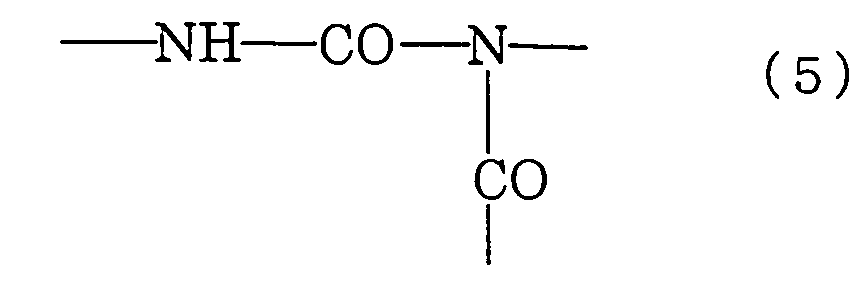
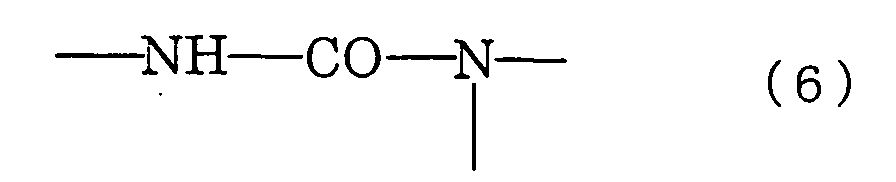
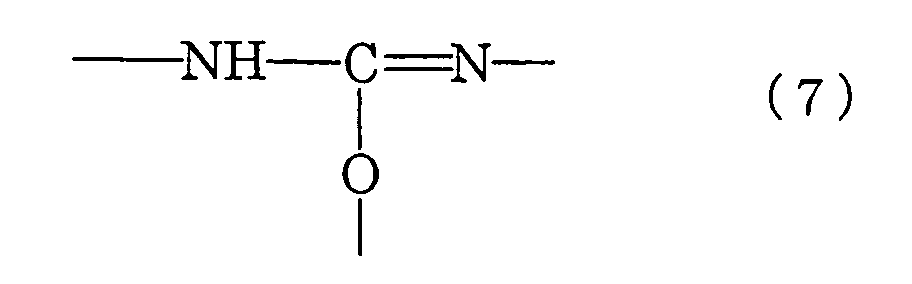

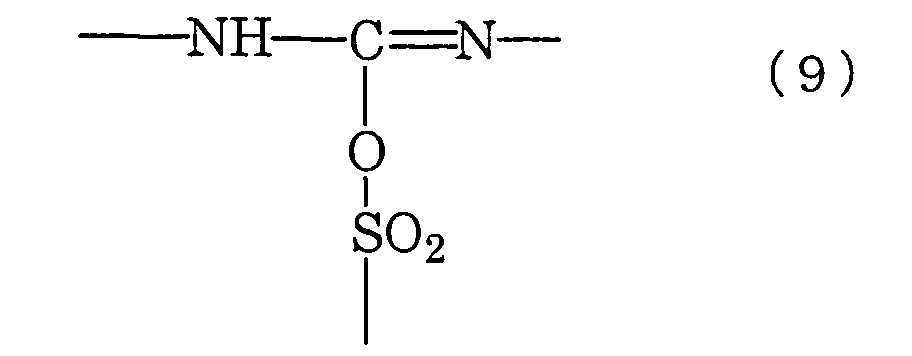
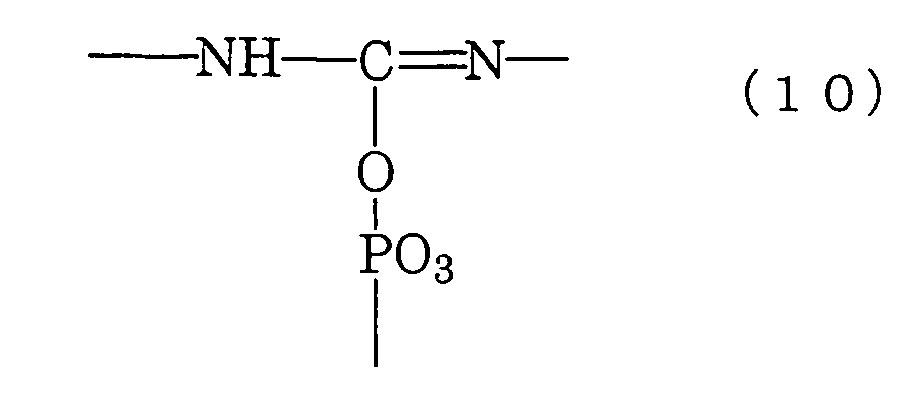
In the above general formulas, R represents a
hydrogen atom or a hydrocarbon group containing at least
one carbon atom. Furthermore, it is also possible to react
the carbodiimide-based compounds represented by the general
formulas (2) and (3), which have isocyanate groups within
the molecule, with a compound having a functional group
reactive with an isocyanate group in the same manner as
mentioned above. Consequently, the same compound can be
obtained as one obtainable by reacting a component forming
a side chain with a carbodiimide group-containing compound
in which an isocyanate group is eliminated in advace.
For example, carbodiimide-based compounds obtainable
by reacting a compound having one hydroxyl group with
isocyanate groups at both termini of the carbodiimide-based
compounds represented by the general formulas (2) and (3)
can be represented by the following general formulas (11)
and (12). Theses compounds can also be utilized as the
carbodiimide-based compounds in the practice of the
invention.


In the above general formulas, Z1 and Z2 each
independently represents the residue resulting from removal
of the functional group of the isocyanate group-reactive
functional group-containing compound, which may be
different in structure. A is the residue resulting from
removal of isocyanate groups from the diisocyanate compound
used for the synthesis of the polycarbodiimide compound.
X's are the same or different and each is a trivalent
linking group resulting from the reaction of the
carbodiimide group with the functional group reactive
therewith, Y's are the same or different and each is a
polyester chain, polyether chain or polyacrylic chain, and
1, m and n each represents an integer of not smaller than 1.
In cases where the compound of the general formula (11) is
used as such or the compound of the general formula (12) is
used, either of Z1, Z2 and Y is required to have at least
one basic nitrogen-containing group. The basic nitrogen-containing
group is introduced into a main chain for those
having a nitrogen-containing group as the above Z1 and Z2,
or into a side chain for those having a nitrogen-containing
group as the above Y.
On the other hand, in the general formula (11), in
case where a basic nitrogen-containing group is not
contained in any of Z1, Z2 and Y, such compound can be used
by introducing a basic nitrogen-containing group into the
molecule by subjecting residual carbodiimide groups to
grafting reaction with an amino acid, or the above compound
containing a hydroxyl group and basic nitrogen-containing
group, or the like.
In carrying out the reactions mentioned above, namely
the above-mentioned ring-opening reaction of cyclic ester
compounds using a hydroxyl group-containing compound as an
initiator, polycondensation reaction of hydroxycarboxylic
acids, polycondensation reaction of low-molecular-weight
diol compounds with low-molecular-weight dicarboxylic acid
compounds, ring-opening reaction of hydroxyl group-containing
ester compounds with acid anhydrides, ring-opening
reaction of cyclic ether compounds, ring-opening
reaction of hydroxyl group-containing ether compounds with
acid anhydrides, reaction of a carbodiimide group with a
carboxyl, hydroxyl or the like group and, further, reaction
of an isocyanate group with a hydroxyl group, and the like,
the conventional methods can be utilized.
As a means of improving the developability, when the
above carbodiimide-based compound does not contain a
carbodiimide group within the molecule, (a) a method
comprising introducing an acid value by reacting the
compound with an acid anhydride such as succinic anhydride
and trimellitic anhydride can be considered as one means.
When a carbodiimide group is contained within the molecule,
the developability can be improved by (b) a method
comprising, without introducing an acid value, reacting a
pigment having a functional group reactive with a
carbodiimide group and a carbodiimide group in the molecule
of the carbodiimide-based compound, and making a basic
nitrogen-containing group introduced into the molecule
freely occur. In the invention, either means (a) or (b)
can be used.
Moreover, as for the above-mentioned carbodiimide-based
compound, even when the order of reactions of the
respective reactants is changed, the compound finally
obtained has the same molecular structure, and the
performance characteristics obtainable do not differ.
Therefore, referring to the compounds of the above
general formulas (11) and (12), the method for producing a
side chain which comprises first synthesizing a
carbodiimide group-reactive functional group-containing
polyester compound, and then reacting this with a
carbodiimide group for, e.g. the introduction of a grafted
polyester chain, has been described hereinabove. According
to an alternative method, such a side chain can be
introduced by reacting a carbodiimide group-reactive
functional group-containing compound with a carbodiimide
group, followed by intramolecularly introducing polyester
chains.
That is, in the case of introduction of a grafted
polyester side chain or grafted polyether side chain, use
may be made of the method which comprises first reacting a
hydroxycarboxylic acid with a carbodiimide group for
intramolecular introduction of a hydroxyl group into the
carbodiimide compound and then subjecting a cyclic
polyester compound or cyclic polyether compound to ring-opening
polymerization for graft bonding of a polyester
chain or polyether chain. In the case of introduction of a
grafted polyacrylic chain, for example, use may be made of
the method which comprises first reacting a compound having
a radically polymerizable unsaturated double bond and a
functional group reactive with a carbodiimide group such as
an acid group and hydroxyl group with a carbodiimide group,
thereby introducing the radically polymerizable unsaturated
double bond into the molecule of the carbodiimide compound,
and then polymerizing an acrylic monomer with the resultant
to bind a polyacrylic chain by a graft bonding. As
regarding the order of these reactions, it is desirable to
carry out the synthesis under such condition that the
amount of undesirable side-reaction product becomes
smallest.
As a preferable mode of the above carbodiimide-based
compound having a grafted side chain within the molecule,
in synthesizing a compound containing one or more
carbodiimide groups (compounds represented by the general
formulas (2) and (11)), both a compound having no grafted
side chain within the molecule (m=0) and a compound having
no carbodiimide group within the molecule (1=0) are
possibly generated.
Then, as a method of synthesizing a compound having
one or more grafted side chain and carbodiimide group
within the molecule alone, there may be mentioned the
method described below using, as bases, the compound
represented by the above general formula (1) and the
compound represented by the above general formula (3) as
derived by introduction of a grafted polyester chain,
grafted polyether chain or grafted polyacrylic chain into
each carbodiimide group.
First, the compound of general formula (1) or of
general formula (3) is used, and the isocyanate groups on
both ends are reacted with a diol compound to give a
compound having a hydroxyl group at each terminus. For
example, the compound obtained by reacting 1 mole of the
compound of general formula (1) with 2 moles of a diol
compound is represented by the general formula (13) given
below, while the compound obtained by reacting 1 mole of
the compound of general formula (3) with 2 moles of a diol
compound is represented by the general formula (14) given
below.
HO―G―OCONH―(A―N=C=N)K-1―A―NHCOO―G―OH

In the above general formulas, G may be the same or
different and each represents the diol compound residue
resulting from removal of the hydroxyl group that has
reacted with an isocyanate group.
And, those compounds obtained by reacting the above-mentioned
carbodiimide group-containing diol compound
(compound represented by the general formula (13)) with a
diisocyanate compound having a grafted polyester chain,
grafted polyether chain or grafted polyacrylic chain
(compound represented by the general formula (3)) or,
conversely, reacting a diol compound having such a graft
side chain (compound represented by the general formula
(14)) with a carbodiimide group-containing diisocyanate
compound (compound represented by the general formula (1))
are compounds essentially having at least one of the
grafted side chain and carbodiimide group. Furthermore,
with this method, it is preferable to use a diol compound
containing a basic nitrogen-containing group within the
molecule since the basic nitrogen-containing group can be
introduced into the molecule at the same time.
As described above, the side chain can be easily
introduced into a carbodiimide-based compound when a
grafting reaction is used, but it is also possible to
introduce a side chain into the carbodiimide-based compound
other than the grafting reaction. As such method, for
example, a method which comprises subjecting a
polycarbodiimide compound represented by the general
formula (1) to chain extension using a chain extender
having a polyester chain, polyether chain or polyacrylic
chain can be used.
Such chain extenders include such polyester chain-containing
ones as compounds obtained by ring-opening
polymerization of the above-mentioned cyclic polyester
compound on a polyol compound having three or more hydroxyl
groups, for example trimethylolpropane or pentaerythritol,
compounds obtained by polycondensation of the above-mentioned
low-molecular-weight dicarboxylic acid and the
above-mentioned low-molecular-weight diol compound partly
in combination with a triol compound, and compounds
obtained by reacting a diol monocarboxylic acid, such as
dimethylolpropionic acid, with an epoxy compound having a
polyester chain within the molecule. As polyether chain-containing
ones, there may be mentioned compounds obtained
by ring-opening polymerization of the above-mentioned
cyclic polyether compound on the above-mentioned polyol
compound, and the like. As polyacrylic chain-containing
ones, there may be mentioned compounds obtained by reacting
the above-mentioned polyol compound with a carboxyl group-containing
(meth)acrylic polymer, and the like.
The carbodiimide-based compound having at least one
side chain selected from the group consisting of polyester
side chains, polyether side chains and polyacrylic side
chains and a basic nitrogen-containing group within the
molecule which is obtainable by reacting the materials
mentioned above preferably contains 0.02 to 4 mmol, and
more preferably 0.05 to 3 mmol of a basic nitrogen-containing
group per 1 g of the carbodiimide-based compound.
When the amount of the basic nitrogen-containing group per
1 g of the carbodiimide-based compound falls within the
above range, preferable pigment disperion stability can be
obtained.
In the above-mentioned carbodiimide-based compounds,
the polyester chain, polyether chain or polyacrylic chain
to be introduced as a side chain is not particularly
restricted but may be any of those which are effective in
improving the dispersion stability of pigments in a
dispersion medium. Preferably, it has a formula weight of
not less than 200 but not more than 10,000, more preferably
not less than 300 but not more than 5,000.
In the case where the above carbodiimide-based
compounds have one or more carbodiimide groups within the
molecule, a carbodiimide equivalent is preferably 100 to
50,000, more preferably within the range of 200 to 10,000.
If the carbodiimide equivalent is within the above range,
when an organic pigment and carbon black each having a
functional group reactive with a carbodiimide group are
used, the effect for improving the dispersion stability is
improved. Furthermore, color filters having preferable
contrast and high transmissivity can be finally obtained
when the organic pigment is used, and black matrices having
more improved insulating property and shielding property
can be finally obtained when carbon black is used.
Additionally, the carbodiimide equivalent refers to a
number represented by (molecular weight of the
carbodiimide-based compound)/(number of carbodiimide group
within the molecule of the carbodiimide-based compound).
The carbodiimide-based compound to be used in the
practice of the invention preferably has a number average
molecular weight of not less than 1,000 but not more than
100,000, more preferably not less than 1,000 but not more
than 50,000. When the number average molecular weight of
the carbodiimide-based compound is excessively high, it
becomes difficult for dispersions prepared by dispersing a
carbodiimide group-reactive functional group-containing
pigment in a dispersion medium and pigment dispersion-based
resist compositions prepared therefrom to have an
appropriate level of viscosity, and this is unfavorable in
particular when a high-concentration pigment dispersion
composition is required. On the other hand, when the
number average molecular weight is excessively low, the
dispersion stability of the above-mentioned pigments in a
dispersion medium unfavorably decreases and, in particular
when carbon black is used as the pigment, the black matrix
coatings finally produced unfavorably show deteriorated
insulating properties.
Therefore, the amount of the basic nitrogen-containing
group, the number and formula weight of a
polyester side chain, polyether side chain, polyacrylic
side chain, etc. occurring in the molecule, and
carbodiimide equivalent, etc. of the carbodiimide-based
compound are preferably adjusted in an appropriate manner
according to the performance characteristics required in
the intended field of application.
The carbodiimide-based compounds enumerated
hereinabove can be used alone or two or more of them may be
used in combination. The carbodiimide-based compounds can
be used as compounds for pigment treatment which are used
for treating organic pigments and carbon black having an
adsorption part with a basic nitrogen-containing group, and
such compounds for pigment treatment are one aspect of the
present invention. The carbodiimide-based compounds
further having one or more carbodiimide groups in the
molecule are compounds for pigment treatment suited for the
pigment dispersion treatment of organic pigments and carbon
black having an adsorption part with a basic nitrogen-containing
group and a functional group reactive with a
carbodiimide group.
Now, the method of treating the above-mentioned
pigments using the carbodiimide-based compound specified
herein is described.
The treatment, so referred to herein, comprises
treating the whole or part of the surface of dispersed
particles of any of the pigments mentioned above using the
carbodiimide-based compound of the invention. More
specifically, there may be mentioned the method which
comprises kneading or milling, for dispersion/treatment, a
mixture composed of the above-mentioned pigment and
carbodiimide-based compound, if necessary together with a
dispersion medium and another or other additives and so
forth, using a roll mill, kneader, high-speed stirrer, bead
mill, ball mill, sand mill, ultrasonic dispersing apparatus
or high-pressure dispersing apparatus, for instance.
In carrying out the above pigment treatment using the
carbodiimide-based compound alone without using any
dispersion medium, the mixture is preferably warmed to a
temperature which is not lower than the melting point of
the carbodiimide-based compound, and when a pigment having
a functional group reactive with a carbodiimide group is
treated with a carbodiimide-based compound having a
carbodiimide group within the molecule, the mixture is
preferably warmed to a temperature at which the reaction
between said functional groups can be promoted. The
reaction-promoting temperature mentioned above is generally
not higher than 100°C, preferably about 40 to 80°C. The
treated pigment obtained by such method can be roughly
ground or made into a chip-like form for later utilization
following dispersion in an appropriate dispersion medium in
an arbitrary field of application.
On the other hand, when the treatment is carried out
in an organic dispersion medium or aqueous dispersion
medium capable of dissolving the carbodiimide-based
compound to be used in the practice of the invention and
stably dispersing the pigment in question while dispersing
the pigment in that medium, the treatment can be carried
out at relatively low temperatures. But when a pigment
having a functional group reactive with a carbodiimide
group is treated with a carbodiimide-based compound having
a carbodiimide group within the molecule, the treatment is
more preferably carried out with warming to a temperature
at which the reaction mentioned above can be promoted. In
cases where the treatment is carried out while finely
dispersing the above pigment in a dispersion medium which
is adequately used in the field of inks or paints, the
treatment product as such can be used as a pigment
dispersion in preparing inks or paints.
As examples of the dispersion medium adequately
utilized in the field of inks or paints, there may be
mentioned, among organic dispersion media, (poly)alkylene
glycol monoalkyl ethers such as ethylene glycol monomethyl
ether, ethylene glycol monoethyl ether, diethylene glycol
monomethyl ether, diethylene glycol monoethyl ether,
propylene glycol monomethyl ether and propylene glycol
monoethyl ether; (poly)alkylene glycol monoalkyl ether
acetates such as ethylene glycol monomethyl ether acetate,
ethylene glycol monoethyl ether acetate and propylene
glycol monomethyl ether acetate; ethers such as diethylene
glycol diethyl ether, diethylene glycol methyl ethyl ether
and tetrahydrofuran; ketones such as methyl ethyl ketone,
methyl isobutyl ketone, cyclohexanone, 2-heptanone and 3-heptanone;
lactic acid alkyl esters such as methyl 2-hydroxypropionate
and ethyl 2-hydroxypropionate; esters
such as ethyl 2-hydroxy-2-methylpropionate, 3-methyl-3-methoxybutyl
propionate, methyl 3-methoxypropionate, ethyl
3-ethoxypropionate, ethyl ethoxyacetate, ethyl
hydroxyacetate, ethyl acetate, n-butyl acetate, isobutyl
acetate, n-butyl propionate, methyl acetoacetate, n-amyl
formate and ethyl pyruvate; aromatic hydrocarbons such as
toluene and xylene; amides such as N-methylpyrrolidone,
N,N-dimethylformamide and N,N-dimethylacetamide; and
alcohols such as isopropyl alcohol and normalpropyl alcohol.
These dispersion media may be used singly or as a mixture
of two or more of them.
The aqueous medium may consist of water alone or a
combination of water and a water-miscible organic
dispersion medium.
Further, the proportion of the carbodiimide-based
compound for the above pigment treatment is preferably not
less than 3 parts by mass but not more than 100 parts by
mass, more preferably not less than 5 parts by mass but not
more than 50 parts by mass, relative to 100 parts by mass
of the pigment (or the sum of the pigments used).
Preferably, that proportion is adjusted according to the
amount of the carbodiimide group-reactive functional group
occurring on the pigment surface and to the required
performance characteristics such as dispersion performance,
fluidity and insulating properties.
The treated pigments thus obtained are suitably
utilized in the fields of printing inks, paints, pigment
dispersion-based resist compositions for black matrices,
pigment dispersion-based resist compositions for color
filters, inks for ink jet, inks for writing materials,
ribbon inks, liquid developers and the like, if necessary
after supplementation with one or more of various binder
resins, solvents, surfactants and other additives.
The pigment dispersion-based resist composition for
black matrices and color filters as a preferred example of
the use of the treated pigment according to the invention
is now described in further detail.
The pigment dispersion-based resist composition is a
resist composition which can be cured upon irradiation with
actinic rays and can be developed with an alkali. It is
mainly composed of the treated pigment of the invention
(treated carbon black or treated organic pigment), a film-forming
resin, a photopolymerizable compound, a
photopolymerization initiator and a solvent, if necessary
together with one or more appropriate additives, for
example a polymerization inhibitor.
As for the treated carbon black constituting the
pigment dispersion-based resist composition for black
matrices according to the invention, one which, once
dispersed, hardly form aggregates is preferably used so
that highly insulating films may be formed.
As for the treated carbon black constituting the
pigment dispersion-based resist composition for black
matrices, a carbon black species whose mean primary
particle size is small and not greater than 0.15 µm is
preferred. When such a carbon black species is dispersed,
the hue is preferably adjusted to neutral black by adding a
complementary color pigment as necessary.
As for the carbodiimide group-reactive functional
group-containing organic pigment for obtaining the treated
organic pigment which constitutes the pigment dispersion-based
resist composition for color filters according to the
present invention, a carbodiimide group-reactive function
group-containing organic pigment of high grade is
preferably utilized for forming coatings having a vivid hue.
The film-forming resins for constituting the pigment
dispersion-based resist composition of the invention
include carboxyl group-containing, alkali-soluble copolymer
resins obtained by reacting a carboxyl group-containing
unsaturated monomer, such as acrylic acid, methacrylic acid,
itaconic acid, maleic acid, maleic anhydride, a maleic acid
monoalkyl ester, citraconic acid, citraconic anhydride, a
citraconic acid monoalkyl ester, with at least one monomer
selected from the group consisting of styrene, 2-hydroxyethyl
acrylate, 2-hydroxyethyl methacrylate, allyl
acrylate, allyl methacrylate, benzyl acrylate, benzyl
methacrylate, glycerol monoacrylate, glycerol methacrylate,
N-phenylmaleimide, polystyrene macromonomers and polymethyl
methacrylate macromonomers. They can be used singly or as
a mixture of two or more of them.
As the photopolymerizable compound which constitutes
the pigment dispersion-based resist composition of the
invention, there may be mentioned a monomer or oligomer
having a photopolymerizable unsaturated bond(s), and the
like.
As example of the monomer having one
photopolymerizable unsaturated bond within the molecule,
there may be mentioned alkyl methacrylates or acrylates
such as methyl methacrylate, butyl methacrylate, 2-ethylhexyl
methacrylate, methyl acrylate, butyl acrylate
and 2-ethylhexyl acrylate; aralkyl methacrylates or
acrylates such as benzyl methacrylate and benzyl acrylate;
alkoxyalkyl methacrylates or acrylates such as butoxyethyl
methacrylate and butoxyethyl acrylate; aminoalkyl
methacrylates or acrylates such as N,N-dimethylaminoethyl
methacrylate and N,N-dimethylaminoethyl acrylate;
methacrylic acid esters or acrylic acid esters of
polyalkylene glycol monoalkyl ethers such as diethylene
glycol monoethyl ether, triethylene glycol monobutyl ether
and dipropylene glycol monomethyl ether; methacrylic acid
esters or acrylic acid esters of polyalkylene glycol
monoaryl ethers such as hexaethylene glycol monophenyl
ether; isobornyl methacrylate or acrylate; glycerol
methacrylates or acrylates; 2-hydroxyethyl methacrylate or
acrylate; or the like.
As example of the monomer having two or more
photopolymerizable unsaturated bonds within the molecule,
there may be mentioned bisphenol A dimethacrylate, 1,4-butanediol
dimethacrylate, 1,3-butylene glycol
dimethacrylate, diethylene glycol dimethacrylate, glycerol
dimethacrylate, neopentyl glycol dimethacrylate,
polyethylene glycol dimethacrylate, polypropylene glycol
dimethacrylate, tetraethylene glycol dimethacrylate,
trimethylolpropane trimethacrylate, pentaerythritol
trimethacrylate, pentaerythritol tetramethacrylate,
dipentaerythritol tetramethacrylate, dipentaerythritol
hexamethacrylate, dipentaerythritol pentamethacrylate,
bisphenol A diacrylate, 1,4-butanediol diacrylate, 1,3-butylene
glycol diacrylate, diethylene glycol diacrylate,
glycerol diacrylate, neopentyl glycol diacrylate,
polyethylene glycol diacrylate, polypropylene glycol
diacrylate, tetraethylene glycol diacrylate,
trimethylolpropane triacrylate, pentaerythritol triacrylate,
pentaerythritol tetraacrylate, dipentaerythritol
tetraacrylate, dipentaerythritol hexaacrylate,
dipentaerythritol pentaacrylate, and the like. These
photopolymerizable compounds can be used singly or in
combination of two or more of them.
The photopolymerization initiators which constitute
the pigment dispersion-based resist composition of the
invention are not particularly restricted but include, for
example, benzophenone, N,N'-tetraethyl-4,4'-diaminobenzophenone,
4-methoxy-4'-dimethylaminobenzophenone,
benzil, 2,2-diethoxyacetophenone, benzoin, benzoin methyl
ether, benzoin isobutyl ether, benzil dimethyl ketal, α-hydroxyisobutyrophenone,
thioxanthone, 2-chlorothioxanthone,
1-hydroxycyclohexyl phenyl ketone, tert-butylanthraquinone,
1-chloroanthraquinone, 2,3-dichloroanthraquinone, 3-chloro-2-methylanthraquinone,
2-ethylanthraquinone, 1,4-naphthoquinone,
1,2-benzanthraquinone, 1,4-dimethylanthraquinone,
2-phenylanthraquinone, triazine type
photopolymerization initiators, and the like. These
photopolymerization initiators are used singly or in
combination of two or more of them.
As the solvent which constitutes the pigment
dispersion-based resist composition of the invention, there
may be mentioned the same as the dispersion medium
mentioned hereinabove and preferably is one having a
boiling point of 100 to 220°C at atmospheric pressure
(1.013 x 10² kPa) as selected from among ester type organic
solvents, ether type organic solvents, ether ester type
organic solvents, ketone type organic solvents, aromatic
hydrocarbon solvents, nitrogen-containing organic solvents,
and the like.
As specific examples of such organic solvents, there
may be mentioned ether type organic solvents such as
ethylene glycol monomethyl ether, ethylene glycol monoethyl
ether, ethylene glycol monoisopropyl ether, ethylene glycol
monobutyl ether, diethylene glycol monomethyl ether,
diethylene glycol monoethyl ether, propylene glycol
monomethyl ether, propylene glycol monoethyl ether,
propylene glycol monobutyl ether, diethylene glycol diethyl
ether, diethylene glycol dimethyl ether and diethylene
glycol methyl ethyl ether; ether ester type organic
solvents such as ethylene glycol monomethyl ether acetate,
ethylene glycol monoethyl ether acetate, ethylene glycol
monobutyl ether acetate, propylene glycol monomethyl ether
acetate and propylene glycol monoethyl ether acetate;
ketone type organic solvents such as methyl isobutyl ketone,
cyclohexanone, 2-heptanone and δ-butyrolactone; ester type
organic solvents such as methyl 2-hydroxypropionate, ethyl
2-hydroxypropionate, ethyl 2-hydroxy-2-methylpropionate, 3-methyl-3-methoxybutyl
propionate, methyl 3-methoxypropionate,
ethyl 3-methoxypropionate, methyl 3-ethoxypropionate,
ethyl 3-ethoxypropionate, ethyl
ethoxyacetate, ethyl hydroxyacetate and n-amyl formate;
nitrogen-containing organic solvents such as N-methylpyrrolidone,
N,N-dimethylformamide and N,N-dimethylacetamide;
and the like. These may be used singly
or as a mixture of two or more of them.
Preferred among these organic solvents from the
solubility, dispersibility, applicability and the like
viewpoint are diethylene glycol dimethyl ether, diethylene
glycol methyl ethyl ether, ethylene glycol monomethyl ether
acetate, propylene glycol monomethyl ether acetate,
propylene glycol monoethyl ether acetate, cyclohexanone, 2-heptanone,
ethyl 2-hydroxypropionate, 3-methyl-3-methoxybutyl
propionate, ethyl 3-methoxypropionate, methyl
3-ethoxypropionate, n-amyl formate and the like. Propylene
glycol monomethyl ether acetate is more preferred.
Further, from the viewpoint of the solubility of the
alkali-soluble resin, the dispersibility of the pigment,
the applicability and the like, such organic solvents are
preferably used in an amount of not less than 50% by mass,
more preferably not less than 70% by mass, relative to the
whole amount of the organic solvents used in the pigment
dispersion-based resist composition of the invention.
When the content of an organic solvent(s) having a
boiling point of 220°C or above is high, the organic
solvent may not be fully evaporated but partly remain in
the dried coatings on the occasion of prebaking the
coatings applied and formed, hence the heat resistance of
the dried coatings may be deteriorated. When the content
of an organic solvent(s) with a boiling point below 100°C
is high, it becomes difficult to apply the composition
evenly and uniformly and, accordingly, it may become
impossible to obtain coatings excellent in surface
smoothness.
Furthermore, the pigment dispersion-based resist
composition of the invention may contain, according to need,
one or more of various additives such as other
photopolymerizable compounds, thermal polymerization
inhibitors, ultraviolet absorbers and antioxidants, each in
an appropriate amount.
A method of producing the pigment dispersion-based
resist composition of the invention using the materials
mentioned above is now described.
The method of producing the pigment dispersion-based
resist composition of the invention is an example of the
mode of embodiment of the present invention and is by no
means limitative of the scope of the present invention.
In producing the pigment dispersion-based resist
composition of the invention from the constituent materials
described above, use may be made of the method which
comprises adding the above-mentioned photopolymerizable
compound, photopolymerization initiator and film-forming
resin, if necessary together with an organic solvent and
another additive or other additives, to the pigment
dispersion composition prepared by dispersing the treated
pigment by the method described above, and mixing them
together using a high-speed stirring apparatus, high-pressure
emulsifying apparatus, bead mill, three-roll mill,
sand mill, kneader, etc.
The pigment dispersion composition of the invention
has good dispersion stability and fluidity even at high
pigment content levels and, when carbon black is used as
the pigment, the coatings formed therefrom show great
hiding power and good insulating properties even when they
are thin films and, when an organic pigment having an
adsorption part with a basic nitrogen-containing group is
used as the pigment, the coatings have high permeability
and high contrast. Therefore, for example, the pigment
dispersion composition of the invention can be adequately
used as a material for producing black matrices which are
required to have high insulating properties and in a
pigment dispersion-based resist composition for color
filters which are required to have high permeability and
high contrast.
Furthermore, the pigment dispersion-based resist
composition thus obtained has a very excellent development
characteristic that uncured coatings can be clearly removed
at short times in the development.
The following examples illustrate the present
invention more specifically. They are, however, by no
means limitative of the scope of the invention. In the
following examples, "part(s)" denotes "part(s) by mass",
unless otherwise specified.
A four-necked flask equipped with a reflux condenser,
nitrogen gas inlet tube, stirring rod and thermometer was
charged with 57 parts of an isocyanate group-containing
polycarbodiimide compound with a carbodiimide equivalent of
315 and 16 parts of methyl diethanolamine, the mixture was
maintained at about 100°C for 2 hours to allow the
isocyanate group to react with the hydroxyl group. Then,
97.7 parts of propylene glycol monomethyl ether acetate was
charged, 178.7 parts of a carboxyl group-terminated
caprolactone ring-opening polymerization product with a
molecular weight of 1,000 was added, and the whole mixture
was maintained at about 90°C to allow the carbodiimide
group to react with the carboxyl group. Thereafter, 97.7
parts of propylene glycol monomethyl ether acetate was
added. A compound (a-1) with a number average molecular
weight of about 3,800 and a basic nitrogen-containing group
amount of 0.5275 mmol was thus obtained.
A compound (a-2) with a number average molecular
weight of about 5,500 and a basic nitrogen-containing group
amount of 0.3600 mmol was obtained in the same manner as in
Preparation Example a-1 except that a polycaprolactone
ring-opening polymerization product with a molecular weight
of 1,500 was used in lieu of the polycaprolactone ring-opening
polymerization product with a molecular weight of
1,000.
A four-necked flask equipped with a reflux condenser,
nitrogen gas inlet tube, stirring rod and thermometer was
charged with 52.5 parts of an isocyanate group-containing
polycarbodiimide compound with a carbodiimide equivalent of
315 and 14.7 parts of methyl diethanolamine, the mixture
was maintained at about 100°C for 2 hours to allow the
isocyanate group to react with the hydroxyl group. Then,
99.5 parts of propylene glycol monomethyl ether acetate was
charged, 171.7 parts of a carboxyl group-terminated
caprolactone ring-opening polymerization product with a
molecular weight of 1,000 was added, and the whole mixture
was maintained at about 90°C to allow the carbodiimide
group to react with the carboxyl group. Thereafter, 12.4
parts of succinic anhydride was added and the mixture was
maintained at about 90°C to allow the isocyanate group and
carboxyl group to react. Then, 99.5 parts of propylene
glycol monomethyl ether acetate was added, and a compound
(a-3) with a number average molecular weight of about 4,100,
acid value of 27.6 mgKOH/g, and a basic nitrogen-containing
group amount of 0.4919 mmol was thus obtained.
A compound (a-4) with a number average molecular
weight of about 6,500 and a basic nitrogen-containing group
amount of 0.3083 mmol was obtained in the same manner as in
Preparation Example a-1 except that a polycaprolactone
ring-opening polymerization product with a molecular weight
of 2,000 was used in lieu of the polycaprolactone ring-opening
polymerization product with a molecular weight of
1,000.
A compound (a-5) with a number average molecular
weight of about 9,100 and a basic nitrogen-containing group
amount of 0.2192 mmol was obtained in the same manner as in
Preparation Example a-1 except that a polycaprolactone
ring-opening polymerization product with a molecular weight
of 3,000 was used in lieu of the polycaprolactone ring-opening
polymerization product with a molecular weight of
1,000.
A four-necked flask equipped with a reflux condenser,
nitrogen gas inlet tube, stirring rod and thermometer was
charged with 57 parts of an isocyanate group-containing
polycarbodiimide compound with a carbodiimide equivalent of
315 and 16 parts of methyl diethanolamine, the mixture was
maintained at about 100°C for 2 hours to allow the
isocyanate group to react with the hydroxyl group. Then,
97.7 parts of propylene glycol monomethyl ether acetate was
charged, 90.5 parts of a carboxyl group-terminated
caprolactone ring-opening polymerization product with a
molecular weight of 1,000 was added, and the whole mixture
was maintained at about 90°C to allow the carbodiimide
group to react with the carboxyl group. Thereafter, 106.7
parts of propylene glycol monomethyl ether acetate was
added. A compound (a-6) with a number average molecular
weight of about 2,400, a carbodiimide equivalent of 1,807
and a basic nitrogen-containing group amount of 0.8216 mmol
was thus obtained.
A four-necked flask equipped with a reflux condenser,
nitrogen gas inlet tube, stirring rod and thermometer was
charged with 54 parts of an isocyanate group-containing
polycarbodiimide compound with a carbodiimide equivalent of
315, 3.9 parts of methyl diethanolamine, and 59.5 parts of
polymethyl methacrylate diol with a molecular weight of
1,000, the mixture was maintained at about 100°C for 2
hours to allow the isocyanate group to react with the
hydroxyl group. Then, 92.4 parts of propylene glycol
monomethyl ether acetate was charged, 170.1 parts of a
carboxyl group-terminated caprolactone ring-opening
polymerization product with a molecular weight of 2,000 was
added, and the whole mixture was maintained at about 90°C
to allow the carbodiimide group to react with the carboxyl
group. Thereafter, 255.2 parts of propylene glycol
monomethyl ether acetate was added. A compound (a-7) with
a number average molecular weight of about 8,800, a
carbodiimide equivalent of 3,400 and a basic nitrogen-containing
group amount of 0.1141 mmol was thus obtained.
A four-necked flask equipped with a reflux condenser,
nitrogen gas inlet tube, stirring rod and thermometer was
charged with 54 parts of an isocyanate group-containing
polycarbodiimide compound with a carbodiimide equivalent of
315, 109.4 parts of methyl diethanolamine, and 174.7 parts
of isophorone diisocyanate, the mixture was maintained at
about 100°C for 2 hours to allow the isocyanate group to
react with the hydroxyl group. Then, 453.7 parts of
propylene glycol monomethyl ether acetate was charged,
170.1 parts of a carboxyl group-terminated caprolactone
ring-opening polymerization product with a molecular weight
of 2,000 was added, and the whole mixture was maintained at
about 90°C to allow the carbodiimide group to react with
the carboxyl group. Thereafter, 255.2 parts of propylene
glycol monomethyl ether acetate was added. A compound (a-8)
with a number average molecular weight of about 15,500,
a carbodiimide equivalent of 6,000 and a basic nitrogen-containing
group amount of 1.8072 mmol was thus obtained.
A four-necked flask equipped with a reflux condenser,
nitrogen gas inlet tube, stirring rod and thermometer was
charged with 65 parts of an isocyanate group-containing
polycarbodiimide compound with a carbodiimide equivalent of
315, 8.2 parts of methyl diethanolamine, and 9.5 parts of
2-pyridine ethanol, the mixture was maintained at about
100°C for 2 hours to allow the isocyanate group to react
with the hydroxyl group. Then, 99.7 parts of propylene
glycol monomethyl ether acetate was charged, 209.2 parts of
a carboxyl group-terminated caprolactone ring-opening
polymerization product with a molecular weight of 2,000 was
added, and the whole mixture was maintained at about 90°C
to allow the carbodiimide group to react with the carboxyl
group. Thereafter, 129.5 parts of propylene glycol
monomethyl ether acetate was added. A compound (a-9) with
a number average molecular weight of about 3,786, a
carbodiimide equivalent of 2,857 and a basic nitrogen-containing
group amount of 0.5275 mmol was thus obtained.
A four-necked flask equipped with a reflux condenser,
nitrogen gas inlet tube, stirring rod and thermometer was
charged with 55 parts of an isocyanate group-containing
polycarbodiimide compound with a carbodiimide equivalent of
315, and 8.1 parts of ethylene glycol, the mixture was
maintained at about 100°C for 2 hours to allow the
isocyanate group to react with the hydroxyl group. Then,
94.5 parts of propylene glycol monomethyl ether acetate was
charged, 179.8 parts of a carboxyl group-terminated
caprolactone ring-opening polymerization product with a
molecular weight of 1,000 was added, and the whole mixture
was maintained at about 90°C to allow the carbodiimide
group to react with the carboxyl group. Thereafter, 94.5
parts of propylene glycol monomethyl ether acetate was
added. A compound (a-10) with a number average molecular
weight of about 3,700 and a basic nitrogen-containing group
amount of 0 mmol was thus obtained.
A four-necked flask equipped with a reflux condenser,
nitrogen gas inlet tube, stirring rod and thermometer was
charged with 57 parts of an isocyanate group-containing
polycarbodiimide compound with a carbodiimide equivalent of
315 and 16 parts of methyl diethanolamine, the mixture was
maintained at about 100°C for 2 hours to allow the
isocyanate group to react with the hydroxyl group. Then,
97.7 parts of propylene glycol monomethyl ether acetate was
charged, 178.7 parts of a carboxyl group-terminated
polyethylene oxide-polypropylene oxide copolymer with a
molecular weight of 1,000 was added, and the whole mixture
was maintained at about 90°C to allow the carbodiimide
group to react with the carboxyl group. Thereafter, 97.7
parts of propylene glycol monomethyl ether acetate was
added. A compound (b-1) with a number average molecular
weight of about 3,800 and a basic nitrogen-containing group
amount of 0.5275 mmol was thus obtained.
A compound (b-2) with a number average molecular
weight of about 5,500 and a basic nitrogen-containing group
amount of 0.3600 mmol was obtained in the same manner as in
Preparation Example b-1 except that a polyethylene oxide-polypropylene
oxide copolymer with a molecular weight of
1,500 was used in lieu of the polyethylene oxide-polypropylene
oxide copolymer with a molecular weight of
1,500.
A four-necked flask equipped with a reflux condenser,
nitrogen gas inlet tube, stirring rod and thermometer was
charged with 52.5 parts of an isocyanate group-containing
polycarbodiimide compound with a carbodiimide equivalent of
315 and 14.7 parts of methyl diethanolamine, the mixture
was maintained at about 100°C for 2 hours to allow the
isocyanate group to react with the hydroxyl group. Then,
99.5 parts of propylene glycol monomethyl ether acetate was
charged, 171.7 parts of a carboxyl group-terminated
polyethylene oxide-polypropylene oxide copolymer with a
molecular weight of 1,000 was added, and the mixture was
maintained at about 90°C to allow the carbodiimide group to
react with the carboxyl group. Thereafter, 12.4 parts of
succinic anhydride was charged, the mixture was maintained
at about 90°C to allow the isocyanate group with the
carboxyl group, and 99.5 parts of propylene glycol
monomethyl ether acetate was added. A compound (b-3) with
a number average molecular weight of about 4,100, acid
value of 27.6 mgKOH/g, and a basic nitrogen-containing
group amount of 0.4919 mmol was thus obtained.
A compound (b-4) with a number average molecular
weight of about 6,500 and a basic nitrogen-containing group
amount of 0.3083 mmol was obtained in the same manner as in
Preparation Example b-1 except that a polyethylene oxide-polypropylene
oxide copolymer with a molecular weight of
2,000 was used in lieu of the polyethylene oxide-polypropylene
oxide copolymer with a molecular weight of
1,000.
A compound (b-5) with a number average molecular
weight of about 9,100 and a basic nitrogen-containing group
amount of 0.2192 mmol was obtained in the same manner as in
Preparation Example b-1 except that a polyethylene oxide-polypropylene
oxide copolymer with a molecular weight of
3,000 was used in lieu of the polyethylene oxide-polypropylene
oxide copolymer with a molecular weight of
1,000.
A four-necked flask equipped with a reflux condenser,
nitrogen gas inlet tube, stirring rod and thermometer was
charged with 57 parts of an isocyanate group-containing
polycarbodiimide compound with a carbodiimide equivalent of
315 and 16 parts of methyl diethanolamine, the mixture was
maintained at about 100°C for 2 hours to allow the
isocyanate group to react with the hydroxyl group. Then,
97.7 parts of propylene glycol monomethyl ether acetate was
charged, 90.5 parts of a carboxyl group-terminated
polyethylene oxide-polypropylene oxide copolymer with a
molecular weight of 1,000 was added, and the mixture was
maintained at about 90°C to allow the carbodiimide group to
react with the carboxyl group. Thereafter, 106.7 parts of
propylene glycol monomethyl ether acetate was added. A
compound (b-6) with a number average molecular weight of
about 2,400, carbodiimide equivalent of 1,807, and a basic
nitrogen-containing group amount of 0.8216 mmol was thus
obtained.
A four-necked flask equipped with a reflux condenser,
nitrogen gas inlet tube, stirring rod and thermometer was
charged with 54 parts of an isocyanate group-containing
polycarbodiimide compound with a carbodiimide equivalent of
315, 3.9 parts of methyl diethanolamine, and 59.5 parts of
polymethyl methacrylate diol with a molecular weight of
1,000, the mixture was maintained at about 100°C for 2
hours to allow the isocyanate group to react with the
hydroxyl group. Then, 92.4 parts of propylene glycol
monomethyl ether acetate was charged, 170.1 parts of a
carboxyl group-terminated polyethylene oxide-polypropylene
oxide copolymer with a molecular weight of 2,000 was added,
and the mixture was maintained at about 90°C to allow the
carbodiimide group to react with the carboxyl group.
Thereafter, 255.2 parts of propylene glycol monomethyl
ether acetate was added. A compound (b-7) with a number
average molecular weight of about 8,800, carbodiimide
equivalent of 3,400, and a basic nitrogen-containing group
amount of 0.1141 mmol was thus obtained.
A four-necked flask equipped with a reflux condenser,
nitrogen gas inlet tube, stirring rod and thermometer was
charged with 54 parts of an isocyanate group-containing
polycarbodiimide compound with a carbodiimide equivalent of
315, 109.4 parts of methyl diethanolamine, and 174.7 parts
of isophorone diisocyanate, the mixture was maintained at
about 100°C for 2 hours to allow the isocyanate group to
react with the hydroxyl group. Then, 453.7 parts of
propylene glycol monomethyl ether acetate was charged,
170.1 parts of a carboxyl group-terminated polyethylene
oxide-polypropylene oxide copolymer with a molecular weight
of 2,000 was added, and the mixture was maintained at about
90°C to allow the carbodiimide group to react with the
carboxyl group. Thereafter, 255.2 parts of propylene
glycol monomethyl ether acetate was added. A compound (b-8)
with a number average molecular weight of about 15,500,
carbodiimide equivalent of 6,000, and a basic nitrogen-containing
group amount of 1.8072 mmol was thus obtained.
A four-necked flask equipped with a reflux condenser,
nitrogen gas inlet tube, stirring rod and thermometer was
charged with 65 parts of an isocyanate group-containing
polycarbodiimide compound with a carbodiimide equivalent of
315, 8.2 parts of methyl diethanolamine, and 9.5 parts of
2-pyridine ethanol, the mixture was maintained at about
100°C for 2 hours to allow the isocyanate group to react
with the hydroxyl group. Then, 99.7 parts of propylene
glycol monomethyl ether acetate was charged, 209.2 parts of
a carboxyl group-terminated polyethylene oxide-polypropylene
oxide copolymer with a molecular weight of
2,000 was added, and the mixture was maintained at about
90°C to allow the carbodiimide group to react with the
carboxyl group. Thereafter, 129.5 parts of propylene
glycol monomethyl ether acetate was added. A compound (b-9)
with a number average molecular weight of about 3,786,
carbodiimide equivalent of 2,857, and a basic nitrogen-containing
group amount of 0.5275 mmol was thus obtained.
A four-necked flask equipped with a reflux condenser,
nitrogen gas inlet tube, stirring rod and thermometer was
charged with 55 parts of an isocyanate group-containing
polycarbodiimide compound with a carbodiimide equivalent of
315, and 8.1 parts of ethylene glycol, the mixture was
maintained at about 100°C for 2 hours to allow the
isocyanate group to react with the hydroxyl group. Then,
94.5 parts of propylene glycol monomethyl ether acetate was
charged, 179.8 parts of a carboxyl group-terminated
polyethylene oxide-polypropylene oxide copolymer with a
molecular weight of 1,000 was added, and the mixture was
maintained at about 90°C to allow the carbodiimide group to
react with the carboxyl group. Thereafter, 94.5 parts of
propylene glycol monomethyl ether acetate was added. A
compound (b-10) with a number average molecular weight of
about 3,700, and a basic nitrogen-containing group amount
of 0 mmol was thus obtained.
A four-necked flask equipped with a reflux condenser,
nitrogen gas inlet tube, stirring rod and thermometer was
charged with 57 parts of an isocyanate group-containing
polycarbodiimide compound with a carbodiimide equivalent of
315, and 16 parts of methyl diethanolamine, the mixture was
maintained at about 100°C for 2 hours to allow the
isocyanate group to react with the hydroxyl group. Then,
97.7 parts of propylene glycol monomethyl ether acetate was
charged, 178.7 parts of a carboxyl group-terminated
polymethyl methacrylate with a molecular weight of 1,000
was added, and the mixture was maintained at about 90°C to
allow the carbodiimide group to react with the carboxyl
group. Thereafter, 97.7 parts of propylene glycol
monomethyl ether acetate was added. A compound (c-1) with
a number average molecular weight of about 3,800, and a
basic nitrogen-containing group amount of 0.5275 mmol was
thus obtained.
A compound (c-2) with a number average molecular
weight of about 5,500 and a basic nitrogen-containing group
amount of 0.3600 mmol was obtained in the same manner as in
Preparation Example c-1 except that polymethyl methacrylate
with a molecular weight of 1,500 was used in lieu of
polymethyl methacrylate with a molecular weight of 1,000.
A four-necked flask equipped with a reflux condenser,
nitrogen gas inlet tube, stirring rod and thermometer was
charged with 52.5 parts of an isocyanate group-containing
polycarbodiimide compound with a carbodiimide equivalent of
315, and 14.7 parts of methyl diethanolamine, the mixture
was maintained at about 100°C for 2 hours to allow the
isocyanate group to react with the hydroxyl group. Then,
99.5 parts of propylene glycol monomethyl ether acetate was
charged, 171.7 parts of a carboxyl group-terminated
polymethyl methacrylate with a molecular weight of 1,000
was added, and the mixture was maintained at about 90°C to
allow the carbodiimide group to react with the carboxyl
group. Thereafter, 12.4 parts of succinic anhydride was
added, the mixture was maintained at about 90°C to allow
the isocyanate group to react with the carboxyl group and
then 99.5 parts of propylene glycol monomethyl ether
acetate was added. A compound (c-3) with a number average
molecular weight of about 4,100, an acid value of 27.6
mgKOH/g, and a basic nitrogen-containing group amount of
0.4919 mmol was thus obtained.
A compound (c-4) with a number average molecular
weight of about 6,500 and a basic nitrogen-containing group
amount of 0.3083 mmol was obtained in the same manner as in
Preparation Example c-1 except that polymethyl methacrylate
with a molecular weight of 2,000 was used in lieu of
polymethyl methacrylate with a molecular weight of 1,000.
A compound (c-5) with a number average molecular
weight of about 9,100 and a basic nitrogen-containing group
amount of 0.2192 mmol was obtained in the same manner as in
Preparation Example c-1 except that polymethyl methacrylate
with a molecular weight of 3,000 was used in lieu of
polymethyl methacrylate with a molecular weight of 1,000.
A four-necked flask equipped with a reflux condenser,
nitrogen gas inlet tube, stirring rod and thermometer was
charged with 57 parts of an isocyanate group-containing
polycarbodiimide compound with a carbodiimide equivalent of
315, and 16 parts of methyl diethanolamine, the mixture was
maintained at about 100°C for 2 hours to allow the
isocyanate group to react with the hydroxyl group. Then,
97.7 parts of propylene glycol monomethyl ether acetate was
charged, 90.5 parts of a carboxyl group-terminated
polymethyl methacrylate with a molecular weight of 1,000
was added, and the mixture was maintained at about 90°C to
allow the carbodiimide group to react with the carboxyl
group. Thereafter, 106.7 parts of propylene glycol
monomethyl ether acetate was added. A compound (c-6) with
a number average molecular weight of about 2,400, a
carbodiimide equivalent of 1,807, and a basic nitrogen-containing
group amount of 0.8216 mmol was thus obtained.
A four-necked flask equipped with a reflux condenser,
nitrogen gas inlet tube, stirring rod and thermometer was
charged with 54 parts of an isocyanate group-containing
polycarbodiimide compound with a carbodiimide equivalent of
315, 3.9 parts of methyl diethanolamine, and 59.5 parts of
polymethyl methacrylate diol with a molecular weight of
1,000, the mixture was maintained at about 100°C for 2
hours to allow the isocyanate group to react with the
hydroxyl group. Then, 92.4 parts of propylene glycol
monomethyl ether acetate was charged, 170.1 parts of a
carboxyl group-terminated polymethyl methacrylate with a
molecular weight of 2,000 was added, and the mixture was
maintained at about 90°C to allow the carbodiimide group to
react with the carboxyl group. Thereafter, 255.2 parts of
propylene glycol monomethyl ether acetate was charged. A
compound (c-7) with a number average molecular weight of
about 8,800, a carbodiimide equivalent of 3,400, and a
basic nitrogen-containing group amount of 0.1141 mmol was
thus obtained.
A four-necked flask equipped with a reflux condenser,
nitrogen gas inlet tube, stirring rod and thermometer was
charged with 54 parts of an isocyanate group-containing
polycarbodiimide compound with a carbodiimide equivalent of
315, 109.4 parts of methyl diethanolamine, and 174.7 parts
of isophorone diisocyanate, the mixture was maintained at
about 100°C for 2 hours to allow the isocyanate group to
react with the hydroxyl group. Then, 453.7 parts of
propylene glycol monomethyl ether acetate was charged,
170.1 parts of a carboxyl group-terminated polymethyl
methacrylate with a molecular weight of 2,000 was added,
and the mixture was maintained at about 90°C to allow the
carbodiimide group to react with the carboxyl group.
Thereafter, 255.2 parts of propylene glycol monomethyl
ether acetate was charged. A compound (c-8) with a number
average molecular weight of about 15,500, a carbodiimide
equivalent of 6,000, and a basic nitrogen-containing group
amount of 1.8072 mmol was thus obtained.
A four-necked flask equipped with a reflux condenser,
nitrogen gas inlet tube, stirring rod and thermometer was
charged with 65 parts of an isocyanate group-containing
polycarbodiimide compound with a carbodiimide equivalent of
315, 8.2 parts of methyl diethanolamine, and 9.5 parts of
2-pyridine ethanol, the mixture was maintained at about
100°C for 2 hours to allow the isocyanate group to react
with the hydroxyl group. Then, 99.7 parts of propylene
glycol monomethyl ether acetate was charged, 209.2 parts of
a carboxyl group-terminated polymethyl methacrylate with a
molecular weight of 2,000 was added, and the mixture was
maintained at about 90°C to allow the carbodiimide group to
react with the carboxyl group. Thereafter, 129.5 parts of
propylene glycol monomethyl ether acetate was charged. A
compound (c-9) with a number average molecular weight of
about 3,786, a carbodiimide equivalent of 2,857, and a
basic nitrogen-containing group amount of 0.5275 mmol was
thus obtained.
A four-necked flask equipped with a reflux condenser,
nitrogen gas inlet tube, stirring rod and thermometer was
charged with 55 parts of an isocyanate group-containing
polycarbodiimide compound with a carbodiimide equivalent of
315, and 8.1 parts of ethylene glycol, the mixture was
maintained at about 100°C for 2 hours to allow the
isocyanate group to react with the hydroxyl group. Then,
94.5 parts of propylene glycol monomethyl ether acetate was
charged, 179.8 parts of a carboxyl group-terminated
polymethyl methacrylate with a molecular weight of 1,000
was added, and the mixture was maintained at about 90°C to
allow the carbodiimide group to react with the carboxyl
group. Thereafter, 94.5 parts of propylene glycol
monomethyl ether acetate was charged. A compound (c-10)
with a number average molecular weight of about 3,700 and a
basic nitrogen-containing group amount of 0 mmol was thus
obtained.
A 1,000-ml steel can filled with 1,000 g of steel
beads (ø 5 mm) was charged with 50 g of carbon black A
(average primary particle size 56 nm, pH = 3.1) and 450 g
of purified water. This mixture was milled for 30 minutes
using a paint conditioner to give an aqueous pigment
dispersion. This aqueous pigment dispersion was
transferred to a four-necked flask equipped with a reflux
condenser, nitrogen inlet tube, stirring rod and
thermometer, 50 g of the carbodiimide compound (a-1) and
170 g of propylene glycol monomethyl ether acetate were
added with stirring, and the reaction was allowed to
proceed at about 90°C for 8 hours. Thereafter, the
purified water and propylene glycol monomethyl ether
acetate were removed, and the residue was placed in a
vacuum drier and dried at 80°C for 2 hours to give a
treated pigment (surface-treated pigment of Example 1;
surface-treated pigment 1) as surface-treated with the
carbodiimide compound. Further, the formulation materials
shown in Table 1 were milled in a bead mill at a
temperature of 60°C for 1 day to give a dispersion
composition comprising the surface-treated pigment of
Example 1.
A 1,000-ml steel can filled with 1,000 g of steel
beads (ø 5 mm) was charged with 50 g of carbon black A
(average primary particle size 56 nm, pH = 3.1) and 450 g
of purified water. This mixture was milled for 30 minutes
using a paint conditioner to give an aqueous pigment
dispersion. This aqueous pigment dispersion was
transferred to a four-necked flask equipped with a reflux
condenser, nitrogen inlet tube, stirring rod and
thermometer, 50 g of the carbodiimide compound (b-1) and
170 g of propylene glycol monomethyl ether acetate were
added with stirring, and the reaction was allowed to
proceed at about 90°C for 8 hours. Thereafter, the
purified water and propylene glycol monomethyl ether
acetate were removed, and the residue was placed in a
vacuum drier and dried at 80°C for 2 hours to give a
treated pigment (surface-treated pigment of Example 11;
surface-treated pigment 2) as surface-treated with the
carbodiimide compound. Further, the formulation materials
shown in Table 1 were milled in a bead mill at a
temperature of 60°C for 1 day to give a dispersion
composition comprising the surface-treated pigment of
Example 11.
A 1,000-ml steel can filled with 1,000 g of steel
beads (ø 5 mm) was charged with 50 g of carbon black A
(average primary particle size 56 nm, pH = 3.1) and 450 g
of purified water. This mixture was milled for 30 minutes
using a paint conditioner to give an aqueous pigment
dispersion. This aqueous pigment dispersion was
transferred to a four-necked flask equipped with a reflux
condenser, nitrogen inlet tube, stirring rod and
thermometer, 50 g of the carbodiimide compound (c-1) and
170 g of propylene glycol monomethyl ether acetate were
added with stirring, and the reaction was allowed to
proceed at about 90°C for 8 hours. Thereafter, the
purified water and propylene glycol monomethyl ether
acetate were removed, and the residue was placed in a
vacuum drier and dried at 80°C for 2 hours to give a
treated pigment (surface-treated pigment of Example 21;
surface-treated pigment 3) as surface-treated with the
carbodiimide compound. Further, the formulation materials
shown in Table 1 were milled in a bead mill at a
temperature of 60°C for 1 day to give a dispersion
composition comprising the surface-treated pigment of
Example 21.
Dispersion compositions comprising the treated carbon
black species of Examples 2 to 10, 12 to 20 and 22 to 30
and of Comparative Examples 1 to 4 were prepared each by
kneading the materials for each formulation given in Table
1, 2 or 3 in a bead mill for 1 day.
Pigment dispersion-based resist compositions for
black matrices of Examples 1 to 30 and Comparative Examples
1 to 4 were obtained by uniformly mixing and milling, using
a high-speed stirrer, each of the above-mentioned treated
carbon black dispersion compositions of Examples 1 to 30
and Comparative Examples 1 to 4 with the other materials
for the formulation in question given in Table 4, 5 or 6,
followed by filtration through a filter with a pore size of
3 µm.
The treated carbon black dispersion compositions of
Examples 1 to 30 and Comparative Examples 1 to 4 and the
pigment dispersion-based resist compositions for black
matrices of Examples 1 to 30 and Comparative Examples 1 to
4 were each sampled and placed in a glass bottle and, after
tight closure, stored at room temperature for 7 days, and
the state of the composition was evaluated according to the
criteria given below. The evaluation results are shown in
Tables 1 to 6.
Those pigment dispersion-based resist compositions
for black matrices which had been given the evaluation A or
B in the above dispersion stability evaluation were each
applied onto a glass substrate to a film thickness of 1 µm
using a spin coater. After 3 minutes of prebaking at 100°C,
each coat film was exposed to light from a high-pressure
mercury lamp and further post-baked at 230°C for 30 minutes
to give an all over coated resist pattern.
The optical density (OD value) of each all over
coated resist pattern was measured on a Macbeth
densitometer (TD-931, manufactured by GretagMacbeth AG.) to
determine the light-shielding property. The evaluation
results thus obtained are shown in Tables 4 to 6.
The surface resistance value of each resist pattern
obtained by the above method was measured using a
resistance measuring apparatus (R8340/8340A, product name,
manufactured by Avantest Corp.). The evaluation results
are shown in Tables 4 to 6.
Those pigment dispersion-based resist compositions
for black matrices which had been given the evaluation A or
B in the above dispersion stability evaluation were each
applied to a glass substrate to a film thickness of 1 µm
using a spin coater. Each coat film was prebaked at 100°C
for 3 minutes. The coat film obtained was developed using
an aqueous 0.15% solution of Na2CO3, and the developability
thereof was evaluated in terms of the time required for
complete removal of the uncured portion of the resist
composition according to the criteria given below. The
evaluation results are shown in Tables 4 to 6.

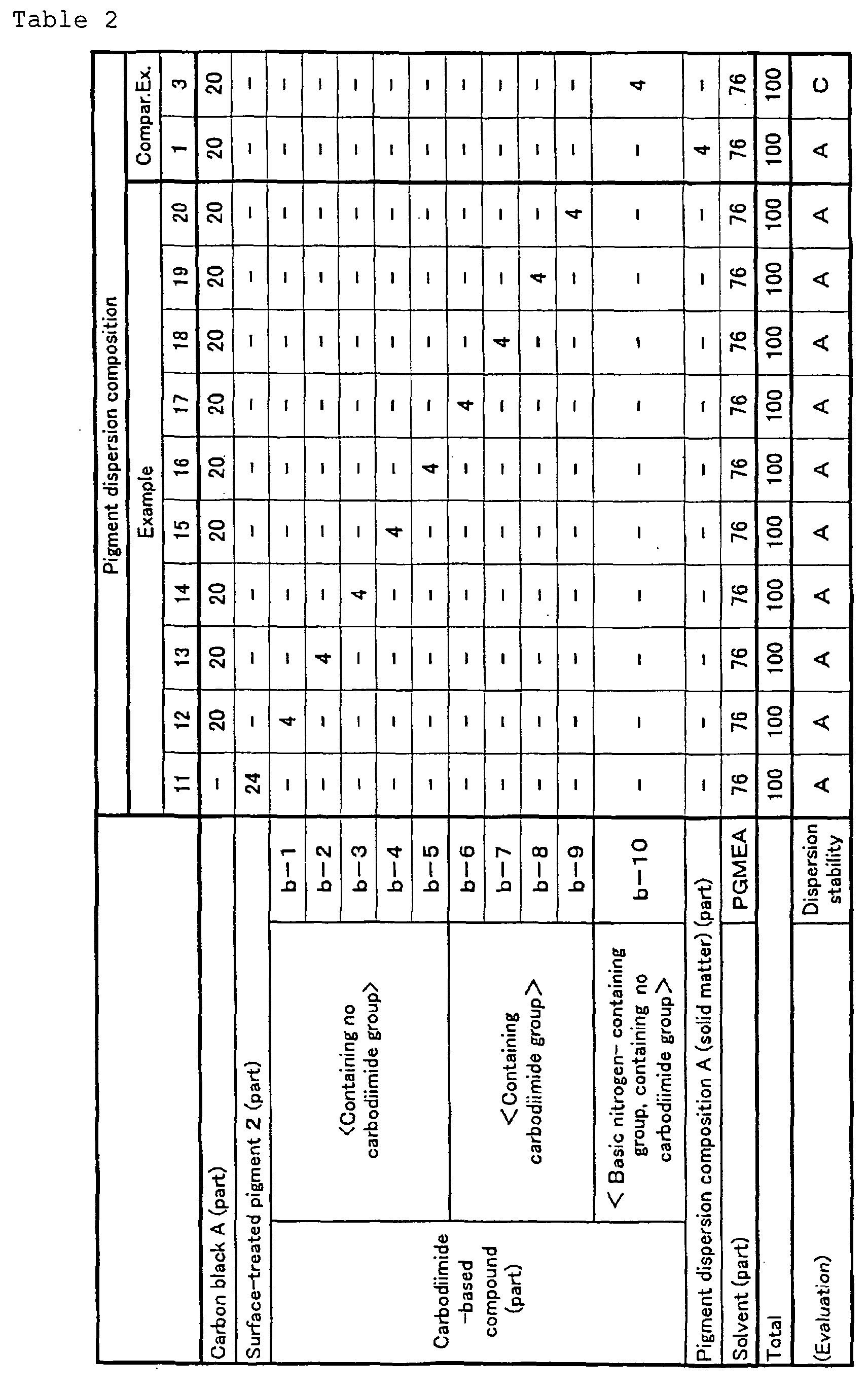


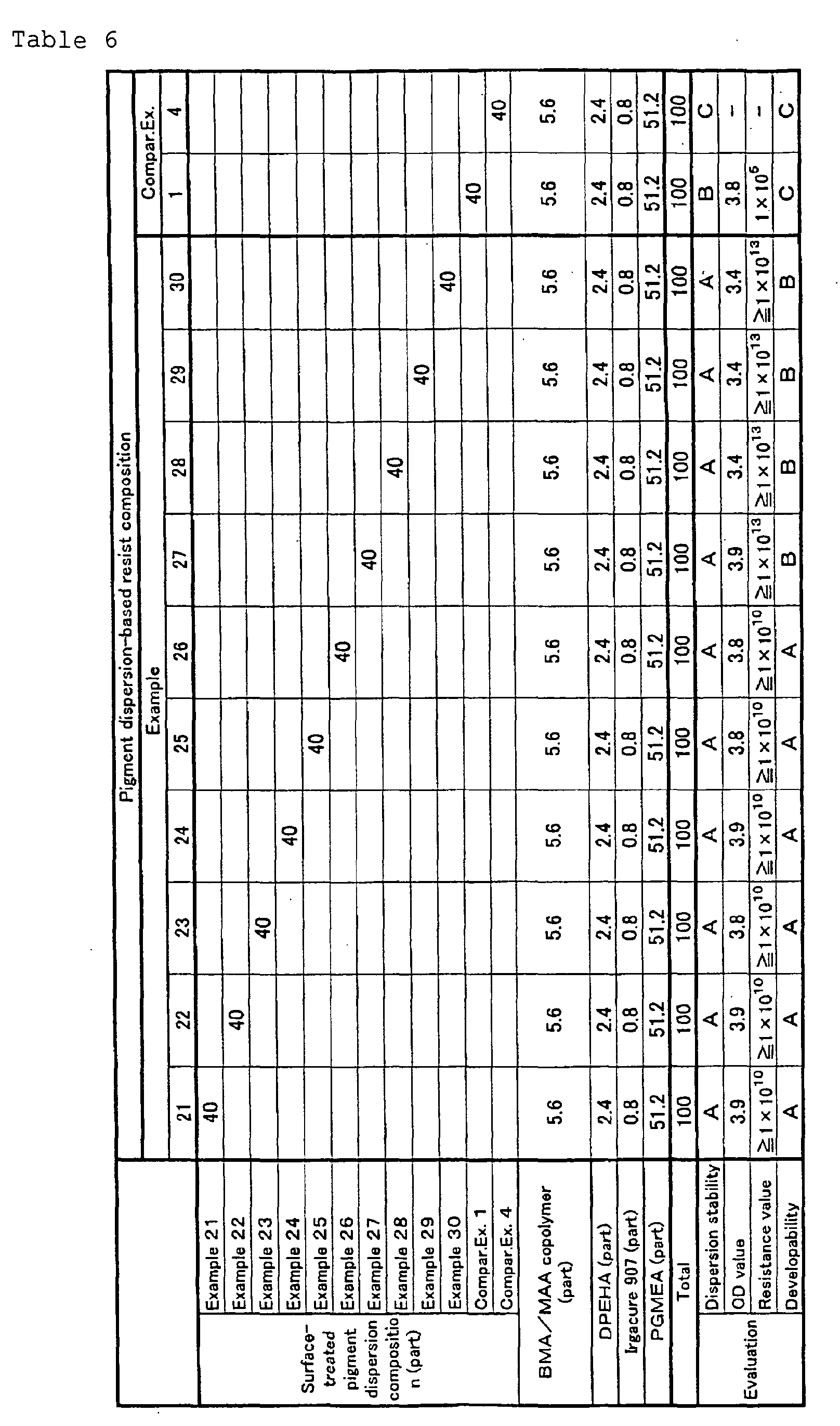
In Tables 1 to 3, "Pigment dispersant A" stands for
PB821 (product name, manufactured by AJINOMOTO Co., Inc.),
and "PGMEA" for propylene glycol monomethyl ether acetate.
In Tables 4 to 6, "BMA/MAA copolymer" stands for a benzyl
methacrylate/methacrylic acid copolymer, "DPEHA" for
dipentaerythritol hexaacrylate, and "Irgacure 907" for 2-methyl-1[4-(methylthio)phenyl]-2-morpholinopropane-1-one
(product name, manufactured by CIBA SPECIALITY CHEMICALS).
Examples 31 to 34 are concerned with treated pigments
surface-treated with the carbodiimide compound (a-1) or (a-6),
while Examples 35 to 46 are concerned with dispersion
compositions of surface-treated pigments dispersed in a
dispersion medium while simultaneously surface-treating the
same with the respective carbodiimide compounds.
A 1,000-ml steel can filled with 1,000 g of steel
beads (ø 5 mm) was charged with 50 g of plasma-treated C.I.
Pigment Red 122 and 450 g of purified water. This mixture
was milled for 30 minutes using a paint conditioner to give
an aqueous pigment dispersion. This aqueous pigment
dispersion was transferred to a four-necked flask equipped
with a reflux condenser, nitrogen inlet tube, stirring rod
and thermometer, 50 g of the compound (a-1) or the compound
(a-6) and 170 g of propylene glycol monomethyl ether
acetate were added with stirring, and the reaction was
allowed to proceed at about 90°C for 8 hours. Thereafter,
the purified water and propylene glycol monomethyl ether
acetate were removed, and the residue was placed in a
vacuum drier and dried at 80°C for 2 hours to give treated
pigments (surface-treated pigment of Example 31; surface-treated
pigment 4, and surface-treated pigment of Example
32; surface-treated pigment 5) as surface-treated with the
carbodiimide compound. Further, the formulation materials
shown in Table 7 were kneaded together in a bead mill at a
temperature of 60°C for 1 day to give dispersion
compositions comprising the surface-treated pigments of
Example 31 and 32.
A 1,000-ml steel can filled with 1,000 g of steel
beads ( 5 mm) was charged with 50 g of plasma-treated C.I.
Pigment Blue 15:3 and 450 g of purified water. This
mixture was milled for 30 minutes using a paint conditioner
to give an aqueous pigment dispersion. This aqueous
pigment dispersion was transferred to a four-necked flask
equipped with a reflux condenser, nitrogen inlet tube,
stirring rod and thermometer, 50 g of the compound (a-1) or
the compound (a-6) and 170 g of propylene glycol monomethyl
ether acetate were added with stirring, and the reaction
was allowed to proceed at about 90°C for 8 hours.
Thereafter, the purified water and propylene glycol
monomethyl ether acetate were removed, and the residue was
placed in a vacuum drier and dried at 80°C for 2 hours to
give treated pigments (surface-treated pigment of Example
33; surface-treated pigment 5, and surface-treated pigment
of Example 34; surface-treated pigment 6) as surface-treated
with the carbodiimide compound. Further, the
formulation materials shown in Table 7 were kneaded
together in a bead mill at a temperature of 60°C for 1 day
to give dispersion compositions comprising the surface-treated
pigments of Example 33 and 34.
Carbodiimide compound surface-treated pigment
dispersion compositions of Examples 35 to 46 and pigment
dispersion compositions of Comparative Examples 5 and 6
were prepared each by milling the materials for each
formulation given in Table 7 in a bead mill at a
temperature of 60°C for 1 day.
Pigment dispersion-based resist compositions for
color filters of Examples 31 to 46 and Comparative Examples
5 and 6 were obtained by uniformly mixing, using a high-speed
stirrer, each of the pigment dispersion compositions
of Examples 31 to 46 and Comparative Examples 5 and 6 with
the other materials for the formulation in question given
in Table 8, followed by filtration through a filter with a
pore size of 3 µm.
The treated organic pigment dispersion compositions
of Examples 31 to 46 and Comparative Examples 5 and 6 and
the pigment dispersion-based resist compositions for color
filters of Examples 31 to 46 and Comparative Examples 5 and
6 were each sampled and placed in a glass bottle and, after
tight closure, stored at room temperature for 7 days, and
the state of the composition was then evaluated according
to the criteria given below. The results are shown in
Tables 7 and 8.
Those pigment dispersion-based resist compositions
for color filters which had been given the evaluation A or
B in the above dispersion stability evaluation were each
applied to a glass substrate to a film thickness of 1 µm
using a spin coater. Each coat film was prebaked at 100°C
for 3 minutes. The coat film obtained was developed using
an aqueous 0.15% solution of Na2CO3, and the developability
thereof was evaluated in terms of the time required for
complete removal of the uncured portion of the resist
composition according to the criteria given below. The
results are shown in Table 8.

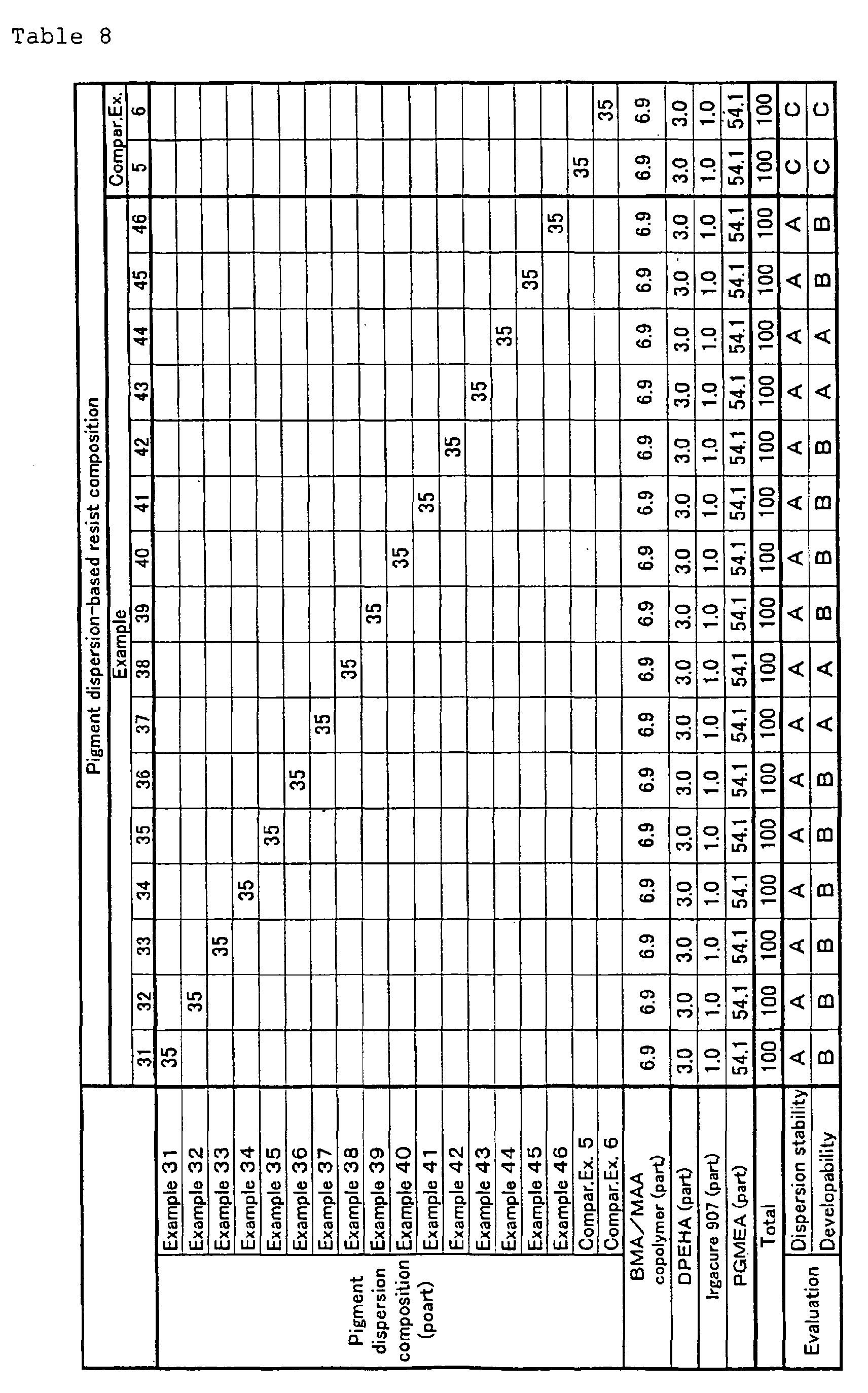
In Tables 7 and 8, "Pigment dispersant A" stands for
PB821 (product name, manufactured by Ajinomoto Co., Inc.),
"PGMEA" for propylene glycol monomethyl ether acetate,
"BMA/MAA copolymer" for a benzyl methacrylate/methacrylic
acid copolymer, "DPEHA" for dipentaerythritol hexaacrylate,
and "Irgacure 907" for 2-methyl-1[4-(methylthio)phenyl]-2-morpholinopropane-1-one
(product name, manufactured by CIBA
SPECIALITY CHEMICALS).
In accordance with the present invention, treated
pigments showing good dispersibility and dispersion
stability even at high concentrations when dispersed in
dispersion media can be obtained. Furthermore, when
pigment dispersion-based resist compositions for color
filters are prepared using, as a pigment, organic pigments
(high grade organic pigments) having an adsorption part
with a basic nitrogen-containing group, and optionally a
functional group reactive with a carbodiimide group on the
surface thereof, pigment dispersion-based resist
compositions for color filters which are excellent in
developability, and show high transmissivity and are
excellent in contrast can be obtained and, when pigment
dispersion-based resist compositions for black matrices are
prepared using carbon black as a pigment, pigment
dispersion-based resist compositions for black matrices
which are excellent in developability, and show high light-shielding
and high insulating properties can be obtained.
Claims (10)
- A treated pigment
which is producible by the treatment with a carbodiimide-based compound having at least one side chain selected from the group consisting of polyester side chains, polyether side chains and polyacrylic side chains and at least one basic nitrogen-containing group within the molecule. - The treated pigment according to Claim 1,
wherein said carbodiimide-based compound contains 0.02 to 4 mmol of a basic nitrogen-containing group per 1 g of said compound. - The treated pigment according to Claim 1 or 2,
wherein said pigment has an adsorption part with a basic nitrogen-containing group. - The treated pigment according to any one of Claims 1 to 3,
wherein said pigment has a functional group reactive with a carbodiimide group, and
said carbodiimide-based compound further contains at least one carbodiimide group within the molecule. - The treated pigment according to Claim 4,
wherein said pigment having a functional group reactive with a carbodiimide group is an organic pigment or carbon black having a functional group reactive with a carbodiimide group,
said functional group reactive with a carbodiimide group having at least one functional group selected from the group consisting of a carboxyl group, sulfonic acid group, hydroxyl group and amino group. - The treated pigment according to any one of Claims 1 to 5,
wherein said carbodiimide-based compound has a basic nitrogen-containing group in the main chain. - The treated pigment according to any one of Claims 1 to 6,
wherein said basic nitrogen-containing group is a tertiary amino group or a nitrogen-containing heterocyclic group. - A pigment dispersion composition
which comprises the treated pigment according to any one of Claims 1 to 7 and a dispersion medium. - A compound for pigment treatment
which is a carbodiimide-based compound having at least one side chain selected from the group consisting of polyester chains, polyether chains and polyacrylic chains, and at least one basic nitrogen-containing group within the molecule. - The compound for pigment treatment according to Claim 9,
which is a carbodiimide-based compound further comprising at least one carbodiimide group within the molecule.
Applications Claiming Priority (3)
| Application Number | Priority Date | Filing Date | Title |
|---|---|---|---|
| JP2002185172 | 2002-06-25 | ||
| JP2002185172 | 2002-06-25 | ||
| PCT/JP2003/008019 WO2004000950A1 (en) | 2002-06-25 | 2003-06-25 | Treated pigment, use thereof, and compound for pigment treatment |
Publications (2)
| Publication Number | Publication Date |
|---|---|
| EP1535971A1 true EP1535971A1 (en) | 2005-06-01 |
| EP1535971A4 EP1535971A4 (en) | 2010-01-20 |
Family
ID=29996727
Family Applications (1)
| Application Number | Title | Priority Date | Filing Date |
|---|---|---|---|
| EP03733572A Withdrawn EP1535971A4 (en) | 2002-06-25 | 2003-06-25 | TREATED PIGMENT, ITS USE, AND COMPOUND FOR THE TREATMENT OF PIGMENTS |
Country Status (6)
| Country | Link |
|---|---|
| US (1) | US7220307B2 (en) |
| EP (1) | EP1535971A4 (en) |
| JP (1) | JP4365318B2 (en) |
| KR (1) | KR100972318B1 (en) |
| CN (1) | CN100369980C (en) |
| WO (1) | WO2004000950A1 (en) |
Cited By (5)
| Publication number | Priority date | Publication date | Assignee | Title |
|---|---|---|---|---|
| WO2008133887A1 (en) * | 2007-04-24 | 2008-11-06 | Cabot Corporation | Coating composition incorporating a low structure carbon black and devices formed therewith |
| EP2048539A1 (en) * | 2007-09-06 | 2009-04-15 | FUJIFILM Corporation | Processed pigment, pigment-dispersed composition, colored photosensitive composition, color filter, liquid crystal display element, and solid image pickup element |
| EP1956438A4 (en) * | 2005-11-28 | 2011-04-06 | Sakata Inx Corp | LIQUID REVELATOR |
| EP1876497A4 (en) * | 2005-04-28 | 2011-07-06 | Sakata Inx Corp | LIQUID DEVELOPER |
| EP3412723A4 (en) * | 2016-02-03 | 2018-12-12 | Fujifilm Corporation | Dispersion composition, curable composition, light-blocking film, color filter, and solid-state imaging device |
Families Citing this family (37)
| Publication number | Priority date | Publication date | Assignee | Title |
|---|---|---|---|---|
| US7357188B1 (en) | 1998-12-07 | 2008-04-15 | Shell Oil Company | Mono-diameter wellbore casing |
| JP4114805B2 (en) * | 2004-07-06 | 2008-07-09 | サカタインクス株式会社 | Pigment dispersion composition, use thereof and compound for pigment treatment |
| JP2006225431A (en) * | 2005-02-15 | 2006-08-31 | Sakata Corp | Carbodiimide compound and method for producing pigment dispersion composition using the same |
| CN101146849B (en) | 2005-03-24 | 2011-06-15 | 阪田油墨株式会社 | Carbodiimides and their uses |
| CA2610287C (en) | 2005-06-27 | 2013-10-22 | Sakata Inx Corp. | Process for production of liquid developer, and liquid developer produced by the process |
| KR20080032210A (en) * | 2005-07-22 | 2008-04-14 | 캐보트 코포레이션 | Method of preparing pigment compositions |
| JP5090338B2 (en) * | 2006-03-22 | 2012-12-05 | サカタインクス株式会社 | Method for producing liquid developer and liquid developer obtained by the method |
| BRPI0711727B1 (en) * | 2006-05-31 | 2018-01-30 | The Sherwin-Williams Company | DISPERSING POLYMER, DISPERSION, SURFACE COATING COMPOSITION AND METHOD FOR DISPERSING PIGMENTAL PARTICLES IN LIQUID- VEHICLE |
| JP5085655B2 (en) * | 2006-09-27 | 2012-11-28 | チバ ホールディング インコーポレーテッド | Polyethyleneimine-based dendritic dispersant |
| JP2010516860A (en) * | 2007-01-24 | 2010-05-20 | キャボット コーポレイション | Method for producing modified pigments |
| EP2129731A2 (en) * | 2007-02-27 | 2009-12-09 | Cabot Corporation | Inkjet ink compositions comprising multiple modified pigments |
| US8722302B2 (en) | 2007-09-28 | 2014-05-13 | Sakata Inx Corp. | Method for producing liquid developer |
| EP2231784A2 (en) * | 2007-12-07 | 2010-09-29 | Cabot Corporation | Method of preparing coated pigments |
| US8129448B2 (en) * | 2008-12-18 | 2012-03-06 | Cabot Corporation | Method of preparing polymer modified pigments |
| AU2014215195B2 (en) | 2013-02-08 | 2017-07-27 | Sakata Inx Corporation | Liquid developing agent |
| PL3031869T3 (en) | 2013-08-07 | 2021-07-05 | Sakata Inx Corporation | Nonaqueous inkjet ink composition and printed matter obtained using same |
| EP3104227A4 (en) * | 2014-02-04 | 2017-09-06 | Sakata INX Corp. | Liquid developer |
| CN105216460B (en) * | 2015-10-30 | 2018-05-01 | 河南卓立膜材料股份有限公司 | Water-based ink thermal transfer ribbon and preparation method thereof |
| JP6762134B2 (en) | 2016-04-28 | 2020-09-30 | サカタインクス株式会社 | Non-aqueous inkjet ink composition |
| JP6811038B2 (en) | 2016-06-29 | 2021-01-13 | サカタインクス株式会社 | Non-Aqueous Ink Magenta Color Ink Composition |
| JP2018024771A (en) | 2016-08-10 | 2018-02-15 | サカタインクス株式会社 | Non-aqueous ink composition |
| JP6829064B2 (en) | 2016-12-09 | 2021-02-10 | サカタインクス株式会社 | Non-aqueous inkjet ink composition |
| JP6914807B2 (en) | 2017-10-30 | 2021-08-04 | サカタインクス株式会社 | Black coloring composition and black colored resist composition containing it |
| JP7400165B2 (en) | 2019-10-30 | 2023-12-19 | サカタインクス株式会社 | Non-aqueous inkjet ink composition |
| JP7400166B2 (en) | 2019-10-30 | 2023-12-19 | サカタインクス株式会社 | Non-aqueous inkjet ink composition |
| JP7455637B2 (en) | 2020-03-31 | 2024-03-26 | サカタインクス株式会社 | Photocurable inkjet printing ink composition |
| JP7506516B2 (en) | 2020-04-24 | 2024-06-26 | サカタインクス株式会社 | Photocurable aqueous ink composition for ink-jet printing |
| US12509600B2 (en) | 2020-06-24 | 2025-12-30 | Sakata Inx Corporation | Photocurable inkjet printing ink composition |
| US12509605B2 (en) | 2020-07-29 | 2025-12-30 | Sakata Inx Corporation | Active energy ray-curable inkjet printing ink composition |
| EP4190566B1 (en) | 2020-07-29 | 2025-06-11 | Sakata INX Corporation | Actinic ray curable ink composition for inkjet printing |
| JP7631637B2 (en) | 2020-07-29 | 2025-02-19 | サカタインクス株式会社 | Active energy ray curable ink composition for ink jet printing |
| JP7354502B2 (en) | 2020-08-07 | 2023-10-03 | サカタインクス株式会社 | Photocurable inkjet printing ink composition |
| JP7641105B2 (en) | 2020-10-23 | 2025-03-06 | サカタインクス株式会社 | Photocurable ink composition for ink-jet printing |
| JP7340306B1 (en) | 2023-03-28 | 2023-09-07 | サカタインクス株式会社 | Photocurable inkjet printing ink composition |
| JP2025025657A (en) | 2023-08-10 | 2025-02-21 | サカタインクス株式会社 | Photocurable ink composition for ink-jet printing |
| JP2025025656A (en) | 2023-08-10 | 2025-02-21 | サカタインクス株式会社 | Photocurable ink composition for ink-jet printing |
| EP4692250A1 (en) | 2024-08-05 | 2026-02-11 | Sakata INX Corporation | Active-energy-ray-curable inkjet ink composition |
Family Cites Families (18)
| Publication number | Priority date | Publication date | Assignee | Title |
|---|---|---|---|---|
| US4049610A (en) * | 1974-01-22 | 1977-09-20 | Bayer Aktiengesellschaft | Pigment preparations |
| NZ187714A (en) | 1977-07-15 | 1980-09-12 | Ici Ltd | Dispersing agent reaction product of a polyalkylene imine and a polyester |
| DE4039193A1 (en) * | 1990-12-08 | 1992-06-11 | Bayer Ag | WET-DISPERSIBLE, ELECTROLYTE-TABLE POLYETHERESTER-MODIFIED POLYURETHANIONOMERS |
| US5371148A (en) * | 1993-06-23 | 1994-12-06 | Union Carbide Chemicals & Plastics Technology Corporation | Reactive polymers having pendant flexible side chains prepared from ethylenically unsaturated carbodiimides |
| JP3235930B2 (en) | 1994-01-10 | 2001-12-04 | ダイセル化学工業株式会社 | Method for producing pigment dispersant |
| US5602264A (en) * | 1994-11-28 | 1997-02-11 | The Regents Of The University Of California | Highly reactive, water soluble carbodiimides, intermediates and derivatives thereof |
| JP3856402B2 (en) | 1995-10-13 | 2006-12-13 | 東京応化工業株式会社 | Photosensitive resin composition for light shielding film formation, black matrix formed with the photosensitive resin composition for light shielding film formation, and method for producing the same |
| JP3718915B2 (en) | 1995-10-16 | 2005-11-24 | 味の素株式会社 | Pigment dispersant |
| CA2298476A1 (en) * | 1997-07-31 | 1999-02-11 | Basf Aktiengesellschaft | Aqueous dispersions containing polyurethanes with carbodiimide groups |
| DE19954500A1 (en) * | 1999-11-11 | 2001-05-17 | Basf Ag | Carbodiimides with carboxyl or caboxylate groups |
| DE10000656A1 (en) * | 2000-01-11 | 2001-07-12 | Basf Ag | New compatible hydrophilic compounds containing carbodiimide units and carboxyl or carboxylate groups are useful in increasing the molecular weight of aqueous polymer dispersions for use as adhesives or coatings |
| JP3963635B2 (en) | 2000-08-29 | 2007-08-22 | 触媒化成工業株式会社 | Cosmetics and method for producing the same |
| JP4752096B2 (en) * | 2000-09-22 | 2011-08-17 | 三菱化学株式会社 | Inkjet recording liquid and inkjet recording method |
| JP4402287B2 (en) * | 2000-12-27 | 2010-01-20 | サカタインクス株式会社 | Surface-treated carbon black and black matrix resist composition containing the same |
| JP2003039824A (en) | 2001-05-22 | 2003-02-13 | Fuji Photo Film Co Ltd | Inkjet recording sheet |
| WO2003076527A1 (en) | 2002-03-08 | 2003-09-18 | Sakata Inx Corp. | Treated pigment, use thereof, and compound for treating pigment |
| JP4117140B2 (en) * | 2002-03-13 | 2008-07-16 | 日清紡績株式会社 | Carbodiimide-containing curable reactive particles, production method and use thereof |
| US8440779B2 (en) * | 2004-11-04 | 2013-05-14 | 3M Innovative Properties Company | Carbodiimide compound and compositions for rendering substrates oil and water repellent |
-
2003
- 2003-06-25 US US10/519,079 patent/US7220307B2/en not_active Expired - Lifetime
- 2003-06-25 WO PCT/JP2003/008019 patent/WO2004000950A1/en not_active Ceased
- 2003-06-25 CN CNB038148366A patent/CN100369980C/en not_active Expired - Fee Related
- 2003-06-25 JP JP2004515181A patent/JP4365318B2/en not_active Expired - Fee Related
- 2003-06-25 EP EP03733572A patent/EP1535971A4/en not_active Withdrawn
- 2003-06-25 KR KR1020047021091A patent/KR100972318B1/en not_active Expired - Fee Related
Cited By (10)
| Publication number | Priority date | Publication date | Assignee | Title |
|---|---|---|---|---|
| EP1876497A4 (en) * | 2005-04-28 | 2011-07-06 | Sakata Inx Corp | LIQUID DEVELOPER |
| EP1956438A4 (en) * | 2005-11-28 | 2011-04-06 | Sakata Inx Corp | LIQUID REVELATOR |
| AU2006316919B2 (en) * | 2005-11-28 | 2012-06-07 | Sakata Inx Corp. | Liquid developer |
| WO2008133887A1 (en) * | 2007-04-24 | 2008-11-06 | Cabot Corporation | Coating composition incorporating a low structure carbon black and devices formed therewith |
| CN101688070B (en) * | 2007-04-24 | 2014-02-12 | 卡伯特公司 | Coating composition incorporating low structure carbon black and devices formed therewith |
| JP2015155552A (en) * | 2007-04-24 | 2015-08-27 | キャボット コーポレイションCabot Corporation | Low structure carbon black and method of making the same |
| EP2048539A1 (en) * | 2007-09-06 | 2009-04-15 | FUJIFILM Corporation | Processed pigment, pigment-dispersed composition, colored photosensitive composition, color filter, liquid crystal display element, and solid image pickup element |
| US8343709B2 (en) | 2007-09-06 | 2013-01-01 | Fujifilm Corporation | Processed pigment, pigment-dispersed composition, colored photosensitive composition, color filter, liquid crystal display element, and solid image pickup element |
| EP3412723A4 (en) * | 2016-02-03 | 2018-12-12 | Fujifilm Corporation | Dispersion composition, curable composition, light-blocking film, color filter, and solid-state imaging device |
| US11091594B2 (en) | 2016-02-03 | 2021-08-17 | Fujifilm Corporation | Dispersion composition, curable composition, light-shielding film, color filter, and solid-state imaging device |
Also Published As
| Publication number | Publication date |
|---|---|
| JPWO2004000950A1 (en) | 2005-10-20 |
| US20050256247A1 (en) | 2005-11-17 |
| KR100972318B1 (en) | 2010-07-26 |
| KR20050026931A (en) | 2005-03-16 |
| CN1662614A (en) | 2005-08-31 |
| CN100369980C (en) | 2008-02-20 |
| WO2004000950A1 (en) | 2003-12-31 |
| EP1535971A4 (en) | 2010-01-20 |
| US7220307B2 (en) | 2007-05-22 |
| JP4365318B2 (en) | 2009-11-18 |
Similar Documents
| Publication | Publication Date | Title |
|---|---|---|
| US7220307B2 (en) | Treated pigment, use thereof, and compound for pigment treatment | |
| US7220306B2 (en) | Treated pigment, use thereof, and compound for treating pigment | |
| JP6005620B2 (en) | Low viscosity, high particulate content dispersion | |
| US7252710B2 (en) | Pigment dispersion composition, use thereof and compound for pigment treatment | |
| JP4114793B2 (en) | Treated organic pigments, their use and pigment treatment compounds | |
| JP4114805B2 (en) | Pigment dispersion composition, use thereof and compound for pigment treatment | |
| JP2010204231A (en) | Color composition for color filter, and color filter | |
| JP4559209B2 (en) | Carbodiimide compounds, pigment dispersion compositions and uses thereof | |
| JP4402287B2 (en) | Surface-treated carbon black and black matrix resist composition containing the same | |
| JP4114797B2 (en) | Treated titanium black, dispersion of treated titanium black and compound for treating titanium black | |
| JP2006225431A (en) | Carbodiimide compound and method for producing pigment dispersion composition using the same |
Legal Events
| Date | Code | Title | Description |
|---|---|---|---|
| PUAI | Public reference made under article 153(3) epc to a published international application that has entered the european phase |
Free format text: ORIGINAL CODE: 0009012 |
|
| 17P | Request for examination filed |
Effective date: 20050119 |
|
| AK | Designated contracting states |
Kind code of ref document: A1 Designated state(s): AT BE BG CH CY CZ DE DK EE ES FI FR GB GR HU IE IT LI LU MC NL PT RO SE SI SK TR |
|
| RBV | Designated contracting states (corrected) |
Designated state(s): DE FR GB |
|
| A4 | Supplementary search report drawn up and despatched |
Effective date: 20091223 |
|
| 17Q | First examination report despatched |
Effective date: 20100420 |
|
| STAA | Information on the status of an ep patent application or granted ep patent |
Free format text: STATUS: THE APPLICATION IS DEEMED TO BE WITHDRAWN |
|
| 18D | Application deemed to be withdrawn |
Effective date: 20130723 |