EP1535907A1 - Benzenesulfonate of 4-fluoro-2-cyanopyrrolidine derivative - Google Patents
Benzenesulfonate of 4-fluoro-2-cyanopyrrolidine derivative Download PDFInfo
- Publication number
- EP1535907A1 EP1535907A1 EP03791325A EP03791325A EP1535907A1 EP 1535907 A1 EP1535907 A1 EP 1535907A1 EP 03791325 A EP03791325 A EP 03791325A EP 03791325 A EP03791325 A EP 03791325A EP 1535907 A1 EP1535907 A1 EP 1535907A1
- Authority
- EP
- European Patent Office
- Prior art keywords
- compound
- fluoro
- present
- cyano
- benzenesulfonate
- Prior art date
- Legal status (The legal status is an assumption and is not a legal conclusion. Google has not performed a legal analysis and makes no representation as to the accuracy of the status listed.)
- Withdrawn
Links
Classifications
-
- A—HUMAN NECESSITIES
- A61—MEDICAL OR VETERINARY SCIENCE; HYGIENE
- A61K—PREPARATIONS FOR MEDICAL, DENTAL OR TOILETRY PURPOSES
- A61K31/00—Medicinal preparations containing organic active ingredients
- A61K31/33—Heterocyclic compounds
- A61K31/395—Heterocyclic compounds having nitrogen as a ring hetero atom, e.g. guanethidine or rifamycins
- A61K31/40—Heterocyclic compounds having nitrogen as a ring hetero atom, e.g. guanethidine or rifamycins having five-membered rings with one nitrogen as the only ring hetero atom, e.g. sulpiride, succinimide, tolmetin, buflomedil
-
- A—HUMAN NECESSITIES
- A61—MEDICAL OR VETERINARY SCIENCE; HYGIENE
- A61P—SPECIFIC THERAPEUTIC ACTIVITY OF CHEMICAL COMPOUNDS OR MEDICINAL PREPARATIONS
- A61P13/00—Drugs for disorders of the urinary system
- A61P13/08—Drugs for disorders of the urinary system of the prostate
-
- A—HUMAN NECESSITIES
- A61—MEDICAL OR VETERINARY SCIENCE; HYGIENE
- A61P—SPECIFIC THERAPEUTIC ACTIVITY OF CHEMICAL COMPOUNDS OR MEDICINAL PREPARATIONS
- A61P19/00—Drugs for skeletal disorders
- A61P19/02—Drugs for skeletal disorders for joint disorders, e.g. arthritis, arthrosis
-
- A—HUMAN NECESSITIES
- A61—MEDICAL OR VETERINARY SCIENCE; HYGIENE
- A61P—SPECIFIC THERAPEUTIC ACTIVITY OF CHEMICAL COMPOUNDS OR MEDICINAL PREPARATIONS
- A61P19/00—Drugs for skeletal disorders
- A61P19/08—Drugs for skeletal disorders for bone diseases, e.g. rachitism, Paget's disease
- A61P19/10—Drugs for skeletal disorders for bone diseases, e.g. rachitism, Paget's disease for osteoporosis
-
- A—HUMAN NECESSITIES
- A61—MEDICAL OR VETERINARY SCIENCE; HYGIENE
- A61P—SPECIFIC THERAPEUTIC ACTIVITY OF CHEMICAL COMPOUNDS OR MEDICINAL PREPARATIONS
- A61P3/00—Drugs for disorders of the metabolism
- A61P3/04—Anorexiants; Antiobesity agents
-
- A—HUMAN NECESSITIES
- A61—MEDICAL OR VETERINARY SCIENCE; HYGIENE
- A61P—SPECIFIC THERAPEUTIC ACTIVITY OF CHEMICAL COMPOUNDS OR MEDICINAL PREPARATIONS
- A61P3/00—Drugs for disorders of the metabolism
- A61P3/08—Drugs for disorders of the metabolism for glucose homeostasis
- A61P3/10—Drugs for disorders of the metabolism for glucose homeostasis for hyperglycaemia, e.g. antidiabetics
-
- A—HUMAN NECESSITIES
- A61—MEDICAL OR VETERINARY SCIENCE; HYGIENE
- A61P—SPECIFIC THERAPEUTIC ACTIVITY OF CHEMICAL COMPOUNDS OR MEDICINAL PREPARATIONS
- A61P37/00—Drugs for immunological or allergic disorders
-
- A—HUMAN NECESSITIES
- A61—MEDICAL OR VETERINARY SCIENCE; HYGIENE
- A61P—SPECIFIC THERAPEUTIC ACTIVITY OF CHEMICAL COMPOUNDS OR MEDICINAL PREPARATIONS
- A61P43/00—Drugs for specific purposes, not provided for in groups A61P1/00-A61P41/00
-
- C—CHEMISTRY; METALLURGY
- C07—ORGANIC CHEMISTRY
- C07D—HETEROCYCLIC COMPOUNDS
- C07D207/00—Heterocyclic compounds containing five-membered rings not condensed with other rings, with one nitrogen atom as the only ring hetero atom
- C07D207/02—Heterocyclic compounds containing five-membered rings not condensed with other rings, with one nitrogen atom as the only ring hetero atom with only hydrogen or carbon atoms directly attached to the ring nitrogen atom
- C07D207/04—Heterocyclic compounds containing five-membered rings not condensed with other rings, with one nitrogen atom as the only ring hetero atom with only hydrogen or carbon atoms directly attached to the ring nitrogen atom having no double bonds between ring members or between ring members and non-ring members
- C07D207/10—Heterocyclic compounds containing five-membered rings not condensed with other rings, with one nitrogen atom as the only ring hetero atom with only hydrogen or carbon atoms directly attached to the ring nitrogen atom having no double bonds between ring members or between ring members and non-ring members with hetero atoms or with carbon atoms having three bonds to hetero atoms with at the most one bond to halogen, e.g. ester or nitrile radicals, directly attached to ring carbon atoms
- C07D207/16—Carbon atoms having three bonds to hetero atoms with at the most one bond to halogen, e.g. ester or nitrile radicals
Definitions
- the present invention relates to benzenesulfonate salts of 4-fluoro-2-cyanopyrrolidine derivatives.
- DPPIV Dipeptidyl peptidase IV
- a compound known as a DPPIV inhibitor is (2S,4S)-2-cyano-4-fluoro-1-[(2-hydroxy-1,1-dimethyl)ethylamino]-acetylpyrrolidine (WO02/38541).
- this compound has low solid-state stability in free form, and its salts with mineral or organic acids disclosed in the application are also disadvantageous in terms of low solid-state stability, low stability under humidified conditions and difficulties in their synthesis, etc.
- the present invention aims to provide 4-fluoro-2-cyanopyrrolidine derivatives that have an excellent DPPIV inhibition activity as well as physical properties (e.g., stability) required for pharmaceutical preparations.
- the inventors of the present invention have conducted various studies on 4-fluoro-2-cyanopyrrolidine derivatives and thus have found that preferred stable compounds can be obtained when the derivatives are converted into salt form with benzenesulfonic acid. This finding led to the completion of the present invention.
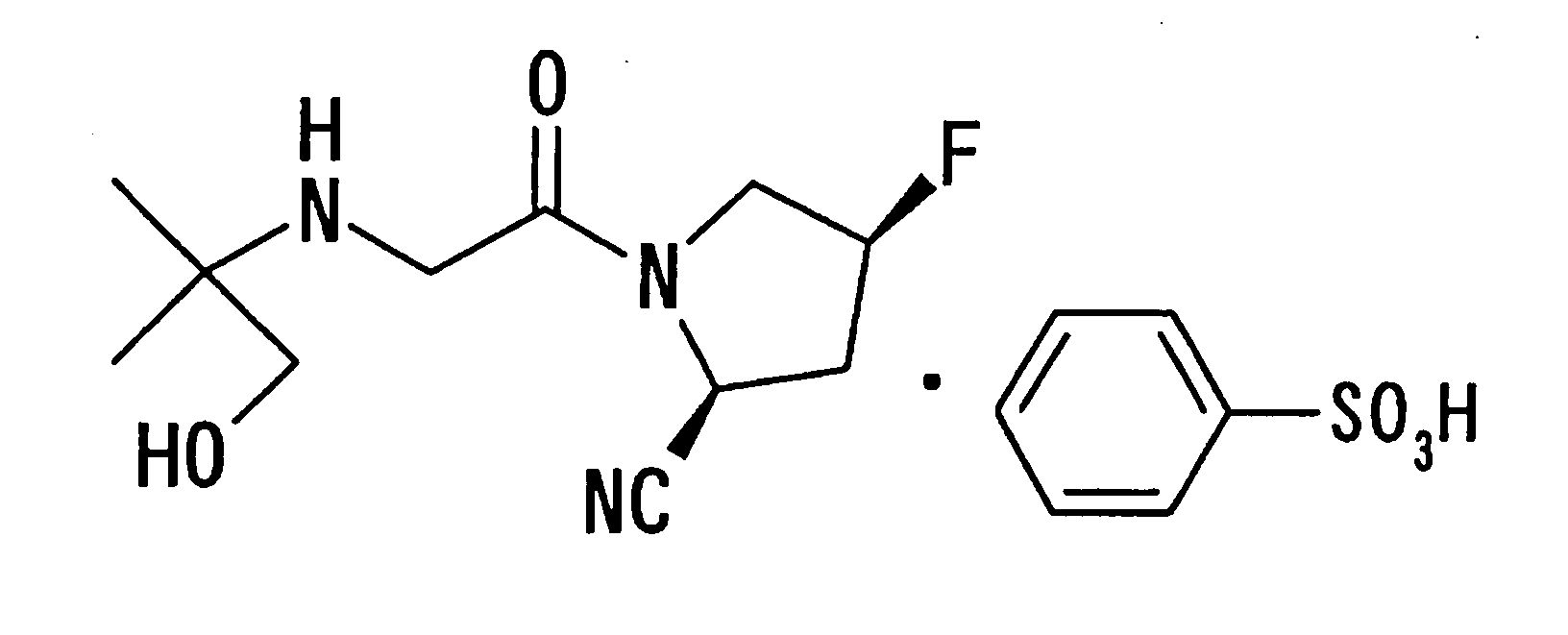
- the present invention is directed to a benzenesulfonate salt of (2S,4S)-2-cyano-4-fluoro-1-[(2-hydroxy-1,1-dimethyl)ethylamino]acetylpyrrolidine represented by Formula [I]:
- the benzenesulfonate salt of the present invention may be prepared as follows: (2S,4S)-2-cyano-4-fluoro-1-[(2-hydroxy-1,1-dimethyl)ethylamino]acetylpyrrolidine obtained as described in WO02/38541 is dissolved in an appropriate solvent and mixed with benzenesulfonic acid or a hydrate thereof, either directly or in dissolved form, followed by filtration to collect the resulting precipitate as a target product after addition of a poor solvent, if necessary.
- the compound of the present invention can be readily obtained in uniform crystal form with excellent crystallinity, as compared to other salt compounds (e.g., tosylate salt). It was also possible to produce more stable compositions in terms of stability when mixed with formulation ingredients commonly used for formulating pharmaceutical preparations.
- the compound of the present invention can inhibit dipeptidyl peptidase IV in vivo, thus enhancing insulin activity and improving glucose metabolism.
- the compound of the present invention can also contribute to inhibition of neuropeptide Y metabolism, inhibition of T cell activation, inhibition of cancer cell adhesion to the endothelium, and prevention of HIV virus entry into lymphocytes.
- the present invention provides such a pharmaceutical preparation for preventing or treating diseases or conditions capable of being ameliorated by inhibition of dipeptidyl peptidase IV, as exemplified by diabetes mellitus (especially type II), immune diseases, arthritis, obesity, osteoporosis, conditions of impaired glucose tolerance, benign prostatic hyperplasia and skin diseases.
- immunosuppressive agents for use in tissue transplantation, for example, cytokine release inhibitors for various autoimmune diseases such as inflammatory enteritis, multiple sclerosis and chronic rheumatoid arthritis (RA), as well as agents useful for preventing or treating AIDS by blocking HIV entry into T-cells and agents for preventing metastasis, especially metastasis of breast and prostate tumors to the lung.
- cytokine release inhibitors for various autoimmune diseases such as inflammatory enteritis, multiple sclerosis and chronic rheumatoid arthritis (RA), as well as agents useful for preventing or treating AIDS by blocking HIV entry into T-cells and agents for preventing metastasis, especially metastasis of breast and prostate tumors to the lung.
- RA chronic rheumatoid arthritis
- the pharmaceutical preparation of the present invention can be administered systemically or topically via oral route or parenteral (e.g., intrarectal, subcutaneous, intramuscular, intravenous, percutaneous) routes.
- parenteral e.g., intrarectal, subcutaneous, intramuscular, intravenous, percutaneous
- the compound of the present invention may be formulated into any desired dosage form selected from solid compositions, liquid compositions and other compositions, as appropriate for the intended purpose.
- the pharmaceutical preparation of the present invention can be prepared by blending the compound of the present invention with pharmaceutically acceptable carrier(s). More specifically, the compound of the present invention may be supplemented with commonly used excipients, extenders, binders, disintegrating agents, coating agents, sugar-coating agents, pH adjustors, solubilizers, aqueous or non-aqueous solvents and so on, and then formulated using standard techniques into tablets, pills, capsules, granules, powders, solutions, emulsions, suspensions, injections, etc.
- the compound of the present invention may be modified to form an inclusion compound with, e.g., ⁇ -, ⁇ -or ⁇ -cyclodextrin or methylated cyclodextrin before being formulated.
- the dose of the compound of the present invention will vary depending on the disease or symptom to be treated, body weight, age, sex, the route of administration, etc.
- the adult dose for oral administration is preferably about 1 to about 1000 mg/person/day, more preferably about 10 to about 200 mg/person/day, given as a single dose or in divided doses per day.
- Each analyte (10.0 mg) was metered into a microtube (diameter: 8 mm, length: 50 mm) and allowed to stand in a desiccator containing water in such a manner as to keep the tube from coming into contact with water.
- the desiccator was allowed to stand at room temperature.
- the analytes were monitored for their state and measured for their weight with time. Changes in weight were expressed as percentages (%). ⁇ Changes in weight and state> Day 1 Day 2 Day 3 Compound of Reference Example 1 + 44% Deliquescence --- --- Compound of Reference Example 2 + 28% + 71% Deliquescence --- Compound of Example 1 ⁇ 0% ⁇ 0% ⁇ 0% No change in appearance
- Each analyte (about 1 mg) was precisely metered and stored in a screw-capped test tube covered with aluminum foil for light shielding, which was sealed under heated conditions (70°C) or opened under heated and humidified conditions (40°C, 75% RH).
- the remaining percentage of each drug was measured in the following manner. After completion of a given period of storage, the test tubes were supplemented with 10 ml HPLC mobile phase to dissolve the analytes and then provided for quantification by HPLC. The results were compared in area with the initial values obtained before heating or before heating and humidification to calculate the remaining percentage of drugs.
- the mixture according to Recipe A or B was further stirred using a vortex mixer (TOUCH MIXER MT-31, Yamato Scientific Co., Ltd., Japan), provided that Recipe A was supplemented with no additional ingredient, while Recipe B was supplemented with 16 ⁇ l purified water.
- the mixtures were stored at 65°C for 1 week under sealed and completely light-shielded conditions and then measured for drug content after storage to calculate the remaining percentage of each drug in each recipe.
- the drug content was determined in the following manner.
- the stored samples were supplemented with 10 ml of 50% methanol, ultrasonicated for 30 minutes (using a BRANSONIC 5200, BRANSON Co.) to disperse and extract the drugs, and then shaken in a shaker for 1 hour.
- the resulting solutions were transferred to 50 ml measuring flasks and the solutions remaining in the test tubes were also collected by washing with 50% methanol, followed by filling up to 50 ml with 50% methanol. The flasks were further ultrasonicated for 30 minutes.
- Recipe A Recipe B Compound of Reference Example 2 91.6% 74.5% Compound of Example 1 99.1% 91.6%
- Example 1 The compound of Example 1 was confirmed to resist deterioration even when supplemented with formulation ingredients used for formulating pharmaceutical preparations, thus enabling the provision of formulated compositions stable enough as pharmaceutical preparations.
- the compound of the present invention can be readily obtained in high-purity uniform crystal form with excellent stability under highly humidified conditions. This fact eliminates risks such as powder adhesion onto machines and reduced flowability during preparation, and enables a stable supply of pharmaceutical preparations containing the compound. Because of its excellent solid-state stability, the compound of the present invention is also free from problems such as changes in appearance and transformation of crystal structure, has resistance to extreme conditions required for formulating pharmaceutical preparations, and also ensures long-term quality maintenance even when supplemented with formulation ingredients.
Landscapes
- Health & Medical Sciences (AREA)
- Chemical & Material Sciences (AREA)
- Organic Chemistry (AREA)
- Medicinal Chemistry (AREA)
- Veterinary Medicine (AREA)
- Public Health (AREA)
- General Health & Medical Sciences (AREA)
- Animal Behavior & Ethology (AREA)
- Life Sciences & Earth Sciences (AREA)
- Pharmacology & Pharmacy (AREA)
- Bioinformatics & Cheminformatics (AREA)
- General Chemical & Material Sciences (AREA)
- Nuclear Medicine, Radiotherapy & Molecular Imaging (AREA)
- Chemical Kinetics & Catalysis (AREA)
- Engineering & Computer Science (AREA)
- Physical Education & Sports Medicine (AREA)
- Diabetes (AREA)
- Orthopedic Medicine & Surgery (AREA)
- Rheumatology (AREA)
- Epidemiology (AREA)
- Obesity (AREA)
- Immunology (AREA)
- Hematology (AREA)
- Child & Adolescent Psychology (AREA)
- Endocrinology (AREA)
- Emergency Medicine (AREA)
- Urology & Nephrology (AREA)
- Pharmaceuticals Containing Other Organic And Inorganic Compounds (AREA)
- Pyrrole Compounds (AREA)
- Medicinal Preparation (AREA)
- Medicines That Contain Protein Lipid Enzymes And Other Medicines (AREA)
Abstract
A benzenesulfonate salt of (2S,4S)-2-cyano-4-fluoro-1-[(2-hydroxy-1,1-dimethyl)ethylamino]acetylpyrrolidine
that has an excellent DPPIV inhibition activity as well as
physical properties (e.g., stability) required for
pharmaceutical preparations. The present invention allows
easy obtaining of the compound in high-purity uniform
crystal form with excellent solid-state stability.
Description
The present invention relates to benzenesulfonate
salts of 4-fluoro-2-cyanopyrrolidine derivatives.
Dipeptidyl peptidase IV (DPPIV), a member of serine
protease, is widely distributed in tissues (e.g., kidney,
liver) and plasma and is involved in the metabolism of
various physiologically active peptides.
A compound known as a DPPIV inhibitor is (2S,4S)-2-cyano-4-fluoro-1-[(2-hydroxy-1,1-dimethyl)ethylamino]-acetylpyrrolidine
(WO02/38541). However, this compound
has low solid-state stability in free form, and its salts
with mineral or organic acids disclosed in the application
are also disadvantageous in terms of low solid-state
stability, low stability under humidified conditions and
difficulties in their synthesis, etc.
The present invention aims to provide 4-fluoro-2-cyanopyrrolidine
derivatives that have an excellent DPPIV
inhibition activity as well as physical properties (e.g.,
stability) required for pharmaceutical preparations.
To achieve the object stated above, the inventors of
the present invention have conducted various studies on
4-fluoro-2-cyanopyrrolidine derivatives and thus have
found that preferred stable compounds can be obtained when
the derivatives are converted into salt form with
benzenesulfonic acid. This finding led to the completion
of the present invention.
Namely, the present invention is directed to a
benzenesulfonate salt of (2S,4S)-2-cyano-4-fluoro-1-[(2-hydroxy-1,1-dimethyl)ethylamino]acetylpyrrolidine
represented by Formula [I]:
The benzenesulfonate salt of the present invention
may be prepared as follows: (2S,4S)-2-cyano-4-fluoro-1-[(2-hydroxy-1,1-dimethyl)ethylamino]acetylpyrrolidine
obtained as described in WO02/38541 is dissolved in an
appropriate solvent and mixed with benzenesulfonic acid or
a hydrate thereof, either directly or in dissolved form,
followed by filtration to collect the resulting
precipitate as a target product after addition of a poor
solvent, if necessary. When using the above procedure,
the compound of the present invention can be readily
obtained in uniform crystal form with excellent
crystallinity, as compared to other salt compounds (e.g.,
tosylate salt). It was also possible to produce more
stable compositions in terms of stability when mixed with
formulation ingredients commonly used for formulating
pharmaceutical preparations.
The compound of the present invention can inhibit
dipeptidyl peptidase IV in vivo, thus enhancing insulin
activity and improving glucose metabolism. The compound
of the present invention can also contribute to inhibition
of neuropeptide Y metabolism, inhibition of T cell
activation, inhibition of cancer cell adhesion to the
endothelium, and prevention of HIV virus entry into
lymphocytes.
Accordingly, the present invention provides such a
pharmaceutical preparation for preventing or treating
diseases or conditions capable of being ameliorated by
inhibition of dipeptidyl peptidase IV, as exemplified by
diabetes mellitus (especially type II), immune diseases,
arthritis, obesity, osteoporosis, conditions of impaired
glucose tolerance, benign prostatic hyperplasia and skin
diseases.
Examples of pharmaceutical preparations for immune
diseases include immunosuppressive agents for use in
tissue transplantation, for example, cytokine release
inhibitors for various autoimmune diseases such as
inflammatory enteritis, multiple sclerosis and chronic
rheumatoid arthritis (RA), as well as agents useful for
preventing or treating AIDS by blocking HIV entry into
T-cells and agents for preventing metastasis, especially
metastasis of breast and prostate tumors to the lung.
The pharmaceutical preparation of the present
invention can be administered systemically or topically
via oral route or parenteral (e.g., intrarectal,
subcutaneous, intramuscular, intravenous, percutaneous)
routes.
For use as a pharmaceutical preparation, the
compound of the present invention may be formulated into
any desired dosage form selected from solid compositions,
liquid compositions and other compositions, as appropriate
for the intended purpose. The pharmaceutical preparation
of the present invention can be prepared by blending the
compound of the present invention with pharmaceutically
acceptable carrier(s). More specifically, the compound of
the present invention may be supplemented with commonly
used excipients, extenders, binders, disintegrating agents,
coating agents, sugar-coating agents, pH adjustors,
solubilizers, aqueous or non-aqueous solvents and so on,
and then formulated using standard techniques into tablets,
pills, capsules, granules, powders, solutions, emulsions,
suspensions, injections, etc.
Also, the compound of the present invention may be
modified to form an inclusion compound with, e.g., α-, β-or
γ-cyclodextrin or methylated cyclodextrin before being
formulated.
The dose of the compound of the present invention
will vary depending on the disease or symptom to be
treated, body weight, age, sex, the route of
administration, etc. The adult dose for oral
administration is preferably about 1 to about 1000
mg/person/day, more preferably about 10 to about 200
mg/person/day, given as a single dose or in divided doses
per day.
The present invention will be further illustrated in
the following reference examples, example and test
examples.
To a suspension of (2S,4S)-2-cyano-4-fluoro-1-[(2-hydroxy-1,1-dimethyl)ethylamino]acetylpyrrolidine
(5.00 g)
in methanol (75 mL), 4M hydrochloric acid (in ethyl
acetate, 6.17 mL) was added to give a clear solution. To
this solution, diisopropyl ether (300 mL) was added and
stirred, followed by filtration to collect the
precipitated powders, which were the titled compound (5.47
g) as a colorless powder.
Melting point: 197-198°C
Melting point: 197-198°C
To a suspension of (2S,4S)-2-cyano-4-fluoro-1-[(2-hydroxy-1,1-dimethyl)ethylamino]acetylpyrrolidine
(0.15 g)
in methanol (0.92 mL), a solution of methanesulfonic acid
(0.042 mL) in methanol (0.08 mL) was added to give a clear
solution. This solution was added dropwise to diisopropyl
ether (5 mL) while stirring. The precipitated powders
were collected by filtration to give the titled compound
(0.20 g) as a colorless powder.
Melting point: 179-180°C
Melting point: 179-180°C
2-Amino-2-methyl-1-propanol (0.54 g) was dissolved
in a mixed solvent of tetrahydrofuran (7.5 mL) and ethanol
(2.5 ml). To this solution, (2S,4S)-1-bromoacetyl-2-cyano-4-fluoropyrrolidine
(0.71 g) was added under ice
cooling and then stirred at room temperature for 1 hour.
The precipitated crystals were collected by filtration to
give the titled compound (0.36 g) as a colorless solid.
Further, the filtrate was also purified by silica gel
column chromatography (developing solvent;
chloroform:methanol:25% aqueous ammonia = 300:10:1) to
give the titled compound (0.22 g).
(2S,4S)-2-Cyano-4-fluoro-1-[(2-hydroxy-1,1-dimethyl)ethylamino]acetylpyrrolidine
(20 g) was dissolved
under heating in methanol (300 mL). Powders were
precipitated from this solution upon addition of a
solution of benzenesulfonic acid monohydrate (15.2 g) in
methanol (30 mL). After addition of diisopropyl ether
(330 mL) to this suspension, the powders were collected by
filtration to give the titled compound (31.5 g) as a
colorless powder.
Melting point: 220-221°C
Melting point: 220-221°C
Each analyte (10.0 mg) was metered into a microtube
(diameter: 8 mm, length: 50 mm) and allowed to stand in a
desiccator containing water in such a manner as to keep
the tube from coming into contact with water. The
desiccator was allowed to stand at room temperature. The
analytes were monitored for their state and measured for
their weight with time. Changes in weight were expressed
as percentages (%).
<Changes in weight and state>
<Changes in weight and state>
| Day 1 | Day 2 | Day 3 | |
| Compound of Reference Example 1 | + 44% Deliquescence | --- | --- |
| Compound of Reference Example 2 | + 28% | + 71% Deliquescence | --- |
| Compound of Example 1 | ± 0% | ± 0% | ± 0% No change in appearance |
The hydrochloride salt of Reference Example 1 and
the methanesulfonate salt of Reference Example 2 both
absorbed moisture and thus deliquesced, whereas the
benzenesulfonate salt of Example 1 showed no change in
weight and no deliquescence.
Each analyte (about 1 mg) was precisely metered and
stored in a screw-capped test tube covered with aluminum
foil for light shielding, which was sealed under heated
conditions (70°C) or opened under heated and humidified
conditions (40°C, 75% RH). The remaining percentage of
each drug was measured in the following manner. After
completion of a given period of storage, the test tubes
were supplemented with 10 ml HPLC mobile phase to dissolve
the analytes and then provided for quantification by HPLC.
The results were compared in area with the initial values
obtained before heating or before heating and
humidification to calculate the remaining percentage of
drugs.
Column: CAPCELL PAK UG120, 5 µm, 4.6 × 150 mm
Column temperature: 40°C
Detection: UV absorptiometer (Detection wavelength: 210 nm)
Flow rate: 1.0 ml/min
Injection volume: 10 µl
Mobile phase: water/acetonitrile/phosphoric acid /SDS (700:300:1:2)
Detection: UV absorptiometer (Detection wavelength: 210 nm)
Flow rate: 1.0 ml/min
Injection volume: 10 µl
Mobile phase: water/acetonitrile/phosphoric acid /SDS (700:300:1:2)
| 70°C for 3 days | 40°C, 75% for 1 month | |
| Compound of Reference Example 1 | 97.0% | 92.6% |
| Compound of Reference Example 2 | 95.5% | 95.9% |
| Compound of Example 1 | 99.3% | 99.6% |
The hydrochloride salt of Reference Example 1 and
the methanesulfonate salt of Reference Example 2 showed a
remaining percentage of 97% or less under either condition,
whereas the benzenesulfonate salt of Example 1 showed a
remaining percentage of 99% or more under either condition.
This testing was performed according to the report
of Serajuddin A.T.M. et al. (J.Pharm.Sci., 88, 696-704,
1999). A drug substance and additives were metered into a
screw-capped test tube according to Recipe A (10 mg drug
substance, 68 mg crystalline cellulose, 2 mg magnesium
stearate) or Recipe B (10 mg drug substance, 68 mg lactose,
2 mg hydrogenated oil) and mixed in a rotary mixer (MIX-ROTAR
VMR-5, Iuchi Seieido Co., Ltd., Japan) for 1 hour.
The mixture according to Recipe A or B was further stirred
using a vortex mixer (TOUCH MIXER MT-31, Yamato Scientific
Co., Ltd., Japan), provided that Recipe A was supplemented
with no additional ingredient, while Recipe B was
supplemented with 16 µl purified water. The mixtures were
stored at 65°C for 1 week under sealed and completely
light-shielded conditions and then measured for drug
content after storage to calculate the remaining
percentage of each drug in each recipe.
The drug content was determined in the following
manner. The stored samples were supplemented with 10 ml
of 50% methanol, ultrasonicated for 30 minutes (using a
BRANSONIC 5200, BRANSON Co.) to disperse and extract the
drugs, and then shaken in a shaker for 1 hour. The
resulting solutions were transferred to 50 ml measuring
flasks and the solutions remaining in the test tubes were
also collected by washing with 50% methanol, followed by
filling up to 50 ml with 50% methanol. The flasks were
further ultrasonicated for 30 minutes. The resulting
solutions were each filtered through a 0.45 µm membrane
filter, 5 ml of which was sampled and filled up with 50%
methanol in a 10 ml measuring flask for use as a sample
solution and then quantified by HPLC. HPLC conditions
were the same as used in Test Example 2.
| Recipe A | Recipe B | |
| Compound of Reference Example 2 | 91.6% | 74.5% |
| Compound of Example 1 | 99.1% | 91.6% |
In the case of Recipe A, the remaining percentage of
drug was reduced to 91.6% in the methanesulfonate salt of
Reference Example 2, whereas there was almost no reduction
in the remaining percentage of the benzenesulfonate salt
of Example 1. Likewise, even in the case of Recipe B
where the methanesulfonate salt showed a remaining
percentage reduced to 74.5%, the benzenesulfonate salt
maintained a remaining percentage of 90% or more.
The compound of Example 1 was confirmed to resist
deterioration even when supplemented with formulation
ingredients used for formulating pharmaceutical
preparations, thus enabling the provision of formulated
compositions stable enough as pharmaceutical preparations.
The compound of the present invention can be readily
obtained in high-purity uniform crystal form with
excellent stability under highly humidified conditions.
This fact eliminates risks such as powder adhesion onto
machines and reduced flowability during preparation, and
enables a stable supply of pharmaceutical preparations
containing the compound. Because of its excellent solid-state
stability, the compound of the present invention is
also free from problems such as changes in appearance and
transformation of crystal structure, has resistance to
extreme conditions required for formulating pharmaceutical
preparations, and also ensures long-term quality
maintenance even when supplemented with formulation
ingredients.
Claims (1)
- A benzenesulfonate salt of (2S,4S)-2-cyano-4-fluoro-1-[(2-hydroxy-1,1-dimethyl)ethylamino]acetylpyrrolidine.
Applications Claiming Priority (3)
| Application Number | Priority Date | Filing Date | Title |
|---|---|---|---|
| JP2002249821 | 2002-08-29 | ||
| JP2002249821 | 2002-08-29 | ||
| PCT/JP2003/010828 WO2004020407A1 (en) | 2002-08-29 | 2003-08-27 | Benzenesulfonate of 4-fluoro-2-cyanopyrrolidine derivative |
Publications (2)
| Publication Number | Publication Date |
|---|---|
| EP1535907A1 true EP1535907A1 (en) | 2005-06-01 |
| EP1535907A4 EP1535907A4 (en) | 2006-11-29 |
Family
ID=31972599
Family Applications (1)
| Application Number | Title | Priority Date | Filing Date |
|---|---|---|---|
| EP03791325A Withdrawn EP1535907A4 (en) | 2002-08-29 | 2003-08-27 | BENZENESULFONATE OF A 4-FLUORO-2-CYANOPYRROLIDINE DERIVATIVE |
Country Status (18)
| Country | Link |
|---|---|
| US (1) | US7304166B2 (en) |
| EP (1) | EP1535907A4 (en) |
| JP (1) | JP3746063B2 (en) |
| KR (1) | KR100582141B1 (en) |
| CN (1) | CN1310885C (en) |
| AU (1) | AU2003261748B2 (en) |
| BR (1) | BR0313831A (en) |
| CA (1) | CA2496623C (en) |
| EA (1) | EA007613B1 (en) |
| EC (1) | ECSP055708A (en) |
| HR (1) | HRP20050205A2 (en) |
| MX (1) | MXPA05002253A (en) |
| NO (1) | NO20050867L (en) |
| NZ (1) | NZ538956A (en) |
| PL (1) | PL374664A1 (en) |
| UA (1) | UA78104C2 (en) |
| WO (1) | WO2004020407A1 (en) |
| ZA (1) | ZA200501418B (en) |
Cited By (1)
| Publication number | Priority date | Publication date | Assignee | Title |
|---|---|---|---|---|
| WO2006080412A3 (en) * | 2005-01-28 | 2006-09-21 | Taisho Pharmaceutical Co Ltd | Cyanopyrrolidine derivative-containing composition for solid pharmaceutical preparations, solid pharmaceutical preparation containing the composition, and process for producing the solid pharmaceutical preparation |
Families Citing this family (28)
| Publication number | Priority date | Publication date | Assignee | Title |
|---|---|---|---|---|
| CN1723196A (en) | 2001-06-27 | 2006-01-18 | 史密丝克莱恩比彻姆公司 | Fluoropyrrolidines as dipeptidyl peptidase inhibitors |
| CA2518465A1 (en) | 2003-03-25 | 2004-10-14 | Takeda San Diego, Inc. | Dipeptidyl peptidase inhibitors |
| US7638638B2 (en) | 2003-05-14 | 2009-12-29 | Takeda San Diego, Inc. | Dipeptidyl peptidase inhibitors |
| KR20060041309A (en) | 2003-08-13 | 2006-05-11 | 다케다 야쿠힌 고교 가부시키가이샤 | 4-pyrimidone derivatives and their use as peptidyl peptidase inhibitors |
| DOP2006000008A (en) | 2005-01-10 | 2006-08-31 | Arena Pharm Inc | COMBINED THERAPY FOR THE TREATMENT OF DIABETES AND RELATED AFFECTIONS AND FOR THE TREATMENT OF AFFECTIONS THAT IMPROVE THROUGH AN INCREASE IN THE BLOOD CONCENTRATION OF GLP-1 |
| US20080114053A1 (en) | 2005-01-27 | 2008-05-15 | Mitsui Chemicals, Inc. | Method for Producing Fluorinated Proline Derivative |
| KR20070113305A (en) | 2005-03-22 | 2007-11-28 | 에프. 호프만-라 로슈 아게 | Novel salts and homologues of PDP-IV inhibitors |
| CN101277949A (en) | 2005-04-22 | 2008-10-01 | 阿兰托斯制药控股公司 | Dipeptidyl peptidase-iv inhibitors |
| AU2006290205B2 (en) | 2005-09-14 | 2012-12-13 | Takeda Pharmaceutical Company Limited | Dipeptidyl peptidase inhibitors for treating diabetes |
| CA2622642C (en) | 2005-09-16 | 2013-12-31 | Takeda Pharmaceutical Company Limited | Dipeptidyl peptidase inhibitors |
| WO2007112347A1 (en) | 2006-03-28 | 2007-10-04 | Takeda Pharmaceutical Company Limited | Dipeptidyl peptidase inhibitors |
| PE20071221A1 (en) | 2006-04-11 | 2007-12-14 | Arena Pharm Inc | GPR119 RECEPTOR AGONISTS IN METHODS TO INCREASE BONE MASS AND TO TREAT OSTEOPOROSIS AND OTHER CONDITIONS CHARACTERIZED BY LOW BONE MASS, AND COMBINED THERAPY RELATED TO THESE AGONISTS |
| TW200838536A (en) | 2006-11-29 | 2008-10-01 | Takeda Pharmaceutical | Polymorphs of succinate salt of 2-[6-(3-amino-piperidin-1-yl)-3-methyl-2,4-dioxo-3,4-dihydro-2H-pyrimidin-1-ylmethy]-4-fluor-benzonitrile and methods of use therefor |
| KR101361427B1 (en) | 2007-04-03 | 2014-02-10 | 미쓰비시 타나베 파마 코퍼레이션 | Combined use of dipeptidyl peptidase iv inhibitor compound and sweetener |
| CL2008003653A1 (en) | 2008-01-17 | 2010-03-05 | Mitsubishi Tanabe Pharma Corp | Use of a glucopyranosyl-derived sglt inhibitor and a selected dppiv inhibitor to treat diabetes; and pharmaceutical composition. |
| EP2146210A1 (en) | 2008-04-07 | 2010-01-20 | Arena Pharmaceuticals, Inc. | Methods of using A G protein-coupled receptor to identify peptide YY (PYY) secretagogues and compounds useful in the treatment of conditions modulated by PYY |
| AR077642A1 (en) | 2009-07-09 | 2011-09-14 | Arena Pharm Inc | METABOLISM MODULATORS AND THE TREATMENT OF DISORDERS RELATED TO THE SAME |
| MX2012011631A (en) | 2010-04-06 | 2013-01-18 | Arena Pharm Inc | Modulators of the gpr119 receptor and the treatment of disorders related thereto. |
| MX2013003184A (en) | 2010-09-22 | 2013-06-07 | Arena Pharm Inc | Modulators of the gpr119 receptor and the treatment of disorders related thereto. |
| WO2012135570A1 (en) | 2011-04-01 | 2012-10-04 | Arena Pharmaceuticals, Inc. | Modulators of the gpr119 receptor and the treatment of disorders related thereto |
| WO2012145361A1 (en) | 2011-04-19 | 2012-10-26 | Arena Pharmaceuticals, Inc. | Modulators of the gpr119 receptor and the treatment of disorders related thereto |
| US20140038889A1 (en) | 2011-04-22 | 2014-02-06 | Arena Pharmaceuticals, Inc. | Modulators Of The GPR119 Receptor And The Treatment Of Disorders Related Thereto |
| US20140051714A1 (en) | 2011-04-22 | 2014-02-20 | Arena Pharmaceuticals, Inc. | Modulators Of The GPR119 Receptor And The Treatment Of Disorders Related Thereto |
| WO2012170702A1 (en) | 2011-06-08 | 2012-12-13 | Arena Pharmaceuticals, Inc. | Modulators of the gpr119 receptor and the treatment of disorders related thereto |
| WO2013055910A1 (en) | 2011-10-12 | 2013-04-18 | Arena Pharmaceuticals, Inc. | Modulators of the gpr119 receptor and the treatment of disorders related thereto |
| WO2014074668A1 (en) | 2012-11-08 | 2014-05-15 | Arena Pharmaceuticals, Inc. | Modulators of gpr119 and the treatment of disorders related thereto |
| HK1249847A1 (en) | 2015-03-09 | 2018-11-16 | Intekrin Therapeutics, Inc. | Methods for the treatment of nonalcoholic fatty liver disease and/or lipodystrophy |
| KR20200036808A (en) | 2017-04-03 | 2020-04-07 | 코히러스 바이오사이언시스, 인크. | PPARγ agonist for the treatment of advanced nuclear paralysis |
Family Cites Families (8)
| Publication number | Priority date | Publication date | Assignee | Title |
|---|---|---|---|---|
| US4432987A (en) | 1982-04-23 | 1984-02-21 | Pfizer Inc. | Crystalline benzenesulfonate salts of sultamicillin |
| GB8608335D0 (en) | 1986-04-04 | 1986-05-08 | Pfizer Ltd | Pharmaceutically acceptable salts |
| TW492957B (en) * | 1996-11-07 | 2002-07-01 | Novartis Ag | N-substituted 2-cyanopyrrolidnes |
| US6011155A (en) * | 1996-11-07 | 2000-01-04 | Novartis Ag | N-(substituted glycyl)-2-cyanopyrrolidines, pharmaceutical compositions containing them and their use in inhibiting dipeptidyl peptidase-IV |
| JP3107784B2 (en) | 1996-12-26 | 2000-11-13 | 宇部興産株式会社 | Acid addition salts of optically active piperidine derivatives and their preparation |
| TW486475B (en) | 1996-12-26 | 2002-05-11 | Ube Industries | Acid addition salt of optically active piperidine compound and process for preparing the same |
| US6252063B1 (en) | 1998-12-01 | 2001-06-26 | Merck & Co., Inc. | Crystalline salts of a carbapenem antibiotic |
| TWI243162B (en) * | 2000-11-10 | 2005-11-11 | Taisho Pharmaceutical Co Ltd | Cyanopyrrolidine derivatives |
-
2003
- 2003-08-27 UA UAA200502704A patent/UA78104C2/en unknown
- 2003-08-27 NZ NZ538956A patent/NZ538956A/en unknown
- 2003-08-27 AU AU2003261748A patent/AU2003261748B2/en not_active Ceased
- 2003-08-27 HR HR20050205A patent/HRP20050205A2/en not_active Application Discontinuation
- 2003-08-27 JP JP2004532725A patent/JP3746063B2/en not_active Expired - Fee Related
- 2003-08-27 CN CNB038203367A patent/CN1310885C/en not_active Expired - Fee Related
- 2003-08-27 EP EP03791325A patent/EP1535907A4/en not_active Withdrawn
- 2003-08-27 ZA ZA200501418A patent/ZA200501418B/en unknown
- 2003-08-27 WO PCT/JP2003/010828 patent/WO2004020407A1/en not_active Ceased
- 2003-08-27 EA EA200500420A patent/EA007613B1/en not_active IP Right Cessation
- 2003-08-27 BR BR0313831-3A patent/BR0313831A/en not_active IP Right Cessation
- 2003-08-27 CA CA002496623A patent/CA2496623C/en not_active Expired - Fee Related
- 2003-08-27 US US10/525,748 patent/US7304166B2/en not_active Expired - Fee Related
- 2003-08-27 KR KR1020057003211A patent/KR100582141B1/en not_active Expired - Fee Related
- 2003-08-27 PL PL03374664A patent/PL374664A1/en not_active Application Discontinuation
- 2003-08-27 MX MXPA05002253A patent/MXPA05002253A/en active IP Right Grant
-
2005
- 2005-02-18 NO NO20050867A patent/NO20050867L/en not_active Application Discontinuation
- 2005-03-28 EC EC2005005708A patent/ECSP055708A/en unknown
Cited By (1)
| Publication number | Priority date | Publication date | Assignee | Title |
|---|---|---|---|---|
| WO2006080412A3 (en) * | 2005-01-28 | 2006-09-21 | Taisho Pharmaceutical Co Ltd | Cyanopyrrolidine derivative-containing composition for solid pharmaceutical preparations, solid pharmaceutical preparation containing the composition, and process for producing the solid pharmaceutical preparation |
Also Published As
| Publication number | Publication date |
|---|---|
| ZA200501418B (en) | 2006-10-25 |
| US20060106087A1 (en) | 2006-05-18 |
| KR100582141B1 (en) | 2006-05-22 |
| EP1535907A4 (en) | 2006-11-29 |
| NZ538956A (en) | 2006-08-31 |
| US7304166B2 (en) | 2007-12-04 |
| CA2496623A1 (en) | 2004-03-11 |
| HK1082497A1 (en) | 2006-06-09 |
| AU2003261748B2 (en) | 2006-11-23 |
| JPWO2004020407A1 (en) | 2005-12-15 |
| UA78104C2 (en) | 2007-02-15 |
| BR0313831A (en) | 2005-07-05 |
| NO20050867L (en) | 2005-02-18 |
| AU2003261748A1 (en) | 2004-03-19 |
| ECSP055708A (en) | 2005-08-11 |
| JP3746063B2 (en) | 2006-02-15 |
| EA007613B1 (en) | 2006-12-29 |
| WO2004020407A1 (en) | 2004-03-11 |
| EA200500420A1 (en) | 2005-08-25 |
| PL374664A1 (en) | 2005-10-31 |
| CN1310885C (en) | 2007-04-18 |
| CN1678575A (en) | 2005-10-05 |
| KR20050059094A (en) | 2005-06-17 |
| HRP20050205A2 (en) | 2005-10-31 |
| CA2496623C (en) | 2008-02-12 |
| MXPA05002253A (en) | 2005-06-08 |
Similar Documents
| Publication | Publication Date | Title |
|---|---|---|
| US7304166B2 (en) | Benzenesulfonate salt of 4-fluoro-2-cyanopyrrolidine derivatives | |
| WO1999002158A1 (en) | Stable medicinal compositions containing 4,5-epoxymorphinane derivatives | |
| WO2012090104A1 (en) | Methods and compositions for designing novel conjugate therapeutics | |
| SK287252B6 (en) | Pharmaceutical formulation containing benzamide derivative with improved solubility and oral absorptivity | |
| CN101668426A (en) | Smac mimetic dimers and trimers useful as anti-cancer agents | |
| JP2020533396A (en) | Crystal form of GSK1278863, its manufacturing method and pharmaceutical use | |
| EP2530079A1 (en) | Phenyl c-glucoside derivatives, preparation methods and uses thereof | |
| KR20010013626A (en) | Pyrimidinone compounds, pharmaceutical compositions containing the compounds and the process for preparing the same | |
| JP5634862B2 (en) | Low viscosity anthracycline formulation | |
| Ouyang et al. | Selective bone targeting 5-fluorouracil prodrugs: synthesis and preliminary biological evaluation | |
| US11084790B2 (en) | Insoluble complex or solvate thereof, pharmaceutical composition and use thereof | |
| TW202333704A (en) | Drug combination for treating tumor, and application thereof | |
| JP2020505355A (en) | Crystal form of GFT-505, method for producing the same, and use | |
| US6596755B2 (en) | Oral formulation of methylglyoxal and its imino acid conjugates for human use | |
| KR20100057423A (en) | Manufacturing method of dexibuprofen salt and oral pharmaceutical composition comprising the same | |
| JPS6352012B2 (en) | ||
| JP2005272457A (en) | Medicine containing cyanopyrrolidine derivative as active ingredient | |
| WO2005023803A1 (en) | Phosphoric acid salt of 5-[[4-[2-(methyl-2-pyridinylamino) ethoxy] phenyl] methyl]- 2,4-thiazolidinedione | |
| HK1082497B (en) | Benzenesulfonate of 4-fluoro-2-cyanopyrrolidine derivative | |
| Mude | Resolving Solubility Problems and Providing an Overview of Excipients to Boost Oral Drug Bioavailability | |
| WO2026086903A1 (en) | Compound and use thereof in treatment of nmdar‑related diseases | |
| JPH0158161B2 (en) | ||
| HK40092810A (en) | 1-(2-(4-cyclopropyl-1h-1,2,3-triazol-1-yl)acetyl)-4-hydroxy-n-(benzyl)pyrrolidine-2-carboxamide derivatives as vhl inhibitors for the treatment of anemia and cancer | |
| JPH0565487B2 (en) | ||
| JP2024529379A (en) | Compounds and compositions for targeted therapy of kidney disease |
Legal Events
| Date | Code | Title | Description |
|---|---|---|---|
| PUAI | Public reference made under article 153(3) epc to a published international application that has entered the european phase |
Free format text: ORIGINAL CODE: 0009012 |
|
| 17P | Request for examination filed |
Effective date: 20050307 |
|
| AK | Designated contracting states |
Kind code of ref document: A1 Designated state(s): AT BE BG CH CY CZ DE DK EE ES FI FR GB GR HU IE IT LI LU MC NL PT RO SE SI SK TR |
|
| AX | Request for extension of the european patent |
Extension state: AL LT LV MK |
|
| A4 | Supplementary search report drawn up and despatched |
Effective date: 20061027 |
|
| STAA | Information on the status of an ep patent application or granted ep patent |
Free format text: STATUS: THE APPLICATION HAS BEEN WITHDRAWN |
|
| 18W | Application withdrawn |
Effective date: 20080506 |