EP1535790A1 - Car and method of controlling the car - Google Patents
Car and method of controlling the car Download PDFInfo
- Publication number
- EP1535790A1 EP1535790A1 EP03733136A EP03733136A EP1535790A1 EP 1535790 A1 EP1535790 A1 EP 1535790A1 EP 03733136 A EP03733136 A EP 03733136A EP 03733136 A EP03733136 A EP 03733136A EP 1535790 A1 EP1535790 A1 EP 1535790A1
- Authority
- EP
- European Patent Office
- Prior art keywords
- automobile
- torque
- power
- accordance
- vehicle speed
- Prior art date
- Legal status (The legal status is an assumption and is not a legal conclusion. Google has not performed a legal analysis and makes no representation as to the accuracy of the status listed.)
- Granted
Links
Images


Classifications
-
- B—PERFORMING OPERATIONS; TRANSPORTING
- B60—VEHICLES IN GENERAL
- B60W—CONJOINT CONTROL OF VEHICLE SUB-UNITS OF DIFFERENT TYPE OR DIFFERENT FUNCTION; CONTROL SYSTEMS SPECIALLY ADAPTED FOR HYBRID VEHICLES; ROAD VEHICLE DRIVE CONTROL SYSTEMS FOR PURPOSES NOT RELATED TO THE CONTROL OF A PARTICULAR SUB-UNIT
- B60W30/00—Purposes of road vehicle drive control systems not related to the control of a particular sub-unit, e.g. of systems using conjoint control of vehicle sub-units
- B60W30/18—Propelling the vehicle
- B60W30/18009—Propelling the vehicle related to particular drive situations
- B60W30/18109—Braking
- B60W30/18118—Hill holding
-
- B—PERFORMING OPERATIONS; TRANSPORTING
- B60—VEHICLES IN GENERAL
- B60W—CONJOINT CONTROL OF VEHICLE SUB-UNITS OF DIFFERENT TYPE OR DIFFERENT FUNCTION; CONTROL SYSTEMS SPECIALLY ADAPTED FOR HYBRID VEHICLES; ROAD VEHICLE DRIVE CONTROL SYSTEMS FOR PURPOSES NOT RELATED TO THE CONTROL OF A PARTICULAR SUB-UNIT
- B60W30/00—Purposes of road vehicle drive control systems not related to the control of a particular sub-unit, e.g. of systems using conjoint control of vehicle sub-units
- B60W30/18—Propelling the vehicle
- B60W30/18009—Propelling the vehicle related to particular drive situations
- B60W30/18054—Propelling the vehicle related to particular drive situations at stand still, e.g. engine in idling state
-
- B—PERFORMING OPERATIONS; TRANSPORTING
- B60—VEHICLES IN GENERAL
- B60L—PROPULSION OF ELECTRICALLY-PROPELLED VEHICLES; SUPPLYING ELECTRIC POWER FOR AUXILIARY EQUIPMENT OF ELECTRICALLY-PROPELLED VEHICLES; ELECTRODYNAMIC BRAKE SYSTEMS FOR VEHICLES IN GENERAL; MAGNETIC SUSPENSION OR LEVITATION FOR VEHICLES; MONITORING OPERATING VARIABLES OF ELECTRICALLY-PROPELLED VEHICLES; ELECTRIC SAFETY DEVICES FOR ELECTRICALLY-PROPELLED VEHICLES
- B60L50/00—Electric propulsion with power supplied within the vehicle
- B60L50/10—Electric propulsion with power supplied within the vehicle using propulsion power supplied by engine-driven generators, e.g. generators driven by combustion engines
- B60L50/16—Electric propulsion with power supplied within the vehicle using propulsion power supplied by engine-driven generators, e.g. generators driven by combustion engines with provision for separate direct mechanical propulsion
-
- B—PERFORMING OPERATIONS; TRANSPORTING
- B60—VEHICLES IN GENERAL
- B60K—ARRANGEMENT OR MOUNTING OF PROPULSION UNITS OR OF TRANSMISSIONS IN VEHICLES; ARRANGEMENT OR MOUNTING OF PLURAL DIVERSE PRIME-MOVERS IN VEHICLES; AUXILIARY DRIVES FOR VEHICLES; INSTRUMENTATION OR DASHBOARDS FOR VEHICLES; ARRANGEMENTS IN CONNECTION WITH COOLING, AIR INTAKE, GAS EXHAUST OR FUEL SUPPLY OF PROPULSION UNITS IN VEHICLES
- B60K6/00—Arrangement or mounting of plural diverse prime-movers for mutual or common propulsion, e.g. hybrid propulsion systems comprising electric motors and internal combustion engines
- B60K6/20—Arrangement or mounting of plural diverse prime-movers for mutual or common propulsion, e.g. hybrid propulsion systems comprising electric motors and internal combustion engines the prime-movers consisting of electric motors and internal combustion engines, e.g. HEVs
- B60K6/22—Arrangement or mounting of plural diverse prime-movers for mutual or common propulsion, e.g. hybrid propulsion systems comprising electric motors and internal combustion engines the prime-movers consisting of electric motors and internal combustion engines, e.g. HEVs characterised by apparatus, components or means specially adapted for HEVs
- B60K6/26—Arrangement or mounting of plural diverse prime-movers for mutual or common propulsion, e.g. hybrid propulsion systems comprising electric motors and internal combustion engines the prime-movers consisting of electric motors and internal combustion engines, e.g. HEVs characterised by apparatus, components or means specially adapted for HEVs characterised by the motors or the generators
-
- B—PERFORMING OPERATIONS; TRANSPORTING
- B60—VEHICLES IN GENERAL
- B60K—ARRANGEMENT OR MOUNTING OF PROPULSION UNITS OR OF TRANSMISSIONS IN VEHICLES; ARRANGEMENT OR MOUNTING OF PLURAL DIVERSE PRIME-MOVERS IN VEHICLES; AUXILIARY DRIVES FOR VEHICLES; INSTRUMENTATION OR DASHBOARDS FOR VEHICLES; ARRANGEMENTS IN CONNECTION WITH COOLING, AIR INTAKE, GAS EXHAUST OR FUEL SUPPLY OF PROPULSION UNITS IN VEHICLES
- B60K6/00—Arrangement or mounting of plural diverse prime-movers for mutual or common propulsion, e.g. hybrid propulsion systems comprising electric motors and internal combustion engines
- B60K6/20—Arrangement or mounting of plural diverse prime-movers for mutual or common propulsion, e.g. hybrid propulsion systems comprising electric motors and internal combustion engines the prime-movers consisting of electric motors and internal combustion engines, e.g. HEVs
- B60K6/22—Arrangement or mounting of plural diverse prime-movers for mutual or common propulsion, e.g. hybrid propulsion systems comprising electric motors and internal combustion engines the prime-movers consisting of electric motors and internal combustion engines, e.g. HEVs characterised by apparatus, components or means specially adapted for HEVs
- B60K6/36—Arrangement or mounting of plural diverse prime-movers for mutual or common propulsion, e.g. hybrid propulsion systems comprising electric motors and internal combustion engines the prime-movers consisting of electric motors and internal combustion engines, e.g. HEVs characterised by apparatus, components or means specially adapted for HEVs characterised by the transmission gearings
- B60K6/365—Arrangement or mounting of plural diverse prime-movers for mutual or common propulsion, e.g. hybrid propulsion systems comprising electric motors and internal combustion engines the prime-movers consisting of electric motors and internal combustion engines, e.g. HEVs characterised by apparatus, components or means specially adapted for HEVs characterised by the transmission gearings with the gears having orbital motion
-
- B—PERFORMING OPERATIONS; TRANSPORTING
- B60—VEHICLES IN GENERAL
- B60K—ARRANGEMENT OR MOUNTING OF PROPULSION UNITS OR OF TRANSMISSIONS IN VEHICLES; ARRANGEMENT OR MOUNTING OF PLURAL DIVERSE PRIME-MOVERS IN VEHICLES; AUXILIARY DRIVES FOR VEHICLES; INSTRUMENTATION OR DASHBOARDS FOR VEHICLES; ARRANGEMENTS IN CONNECTION WITH COOLING, AIR INTAKE, GAS EXHAUST OR FUEL SUPPLY OF PROPULSION UNITS IN VEHICLES
- B60K6/00—Arrangement or mounting of plural diverse prime-movers for mutual or common propulsion, e.g. hybrid propulsion systems comprising electric motors and internal combustion engines
- B60K6/20—Arrangement or mounting of plural diverse prime-movers for mutual or common propulsion, e.g. hybrid propulsion systems comprising electric motors and internal combustion engines the prime-movers consisting of electric motors and internal combustion engines, e.g. HEVs
- B60K6/42—Arrangement or mounting of plural diverse prime-movers for mutual or common propulsion, e.g. hybrid propulsion systems comprising electric motors and internal combustion engines the prime-movers consisting of electric motors and internal combustion engines, e.g. HEVs characterised by the architecture of the hybrid electric vehicle
- B60K6/44—Series-parallel type
- B60K6/445—Differential gearing distribution type
-
- B—PERFORMING OPERATIONS; TRANSPORTING
- B60—VEHICLES IN GENERAL
- B60L—PROPULSION OF ELECTRICALLY-PROPELLED VEHICLES; SUPPLYING ELECTRIC POWER FOR AUXILIARY EQUIPMENT OF ELECTRICALLY-PROPELLED VEHICLES; ELECTRODYNAMIC BRAKE SYSTEMS FOR VEHICLES IN GENERAL; MAGNETIC SUSPENSION OR LEVITATION FOR VEHICLES; MONITORING OPERATING VARIABLES OF ELECTRICALLY-PROPELLED VEHICLES; ELECTRIC SAFETY DEVICES FOR ELECTRICALLY-PROPELLED VEHICLES
- B60L15/00—Methods, circuits, or devices for controlling the traction-motor speed of electrically-propelled vehicles
- B60L15/20—Methods, circuits, or devices for controlling the traction-motor speed of electrically-propelled vehicles for control of the vehicle or its driving motor to achieve a desired performance, e.g. speed, torque, programmed variation of speed
-
- B—PERFORMING OPERATIONS; TRANSPORTING
- B60—VEHICLES IN GENERAL
- B60L—PROPULSION OF ELECTRICALLY-PROPELLED VEHICLES; SUPPLYING ELECTRIC POWER FOR AUXILIARY EQUIPMENT OF ELECTRICALLY-PROPELLED VEHICLES; ELECTRODYNAMIC BRAKE SYSTEMS FOR VEHICLES IN GENERAL; MAGNETIC SUSPENSION OR LEVITATION FOR VEHICLES; MONITORING OPERATING VARIABLES OF ELECTRICALLY-PROPELLED VEHICLES; ELECTRIC SAFETY DEVICES FOR ELECTRICALLY-PROPELLED VEHICLES
- B60L15/00—Methods, circuits, or devices for controlling the traction-motor speed of electrically-propelled vehicles
- B60L15/20—Methods, circuits, or devices for controlling the traction-motor speed of electrically-propelled vehicles for control of the vehicle or its driving motor to achieve a desired performance, e.g. speed, torque, programmed variation of speed
- B60L15/2009—Methods, circuits, or devices for controlling the traction-motor speed of electrically-propelled vehicles for control of the vehicle or its driving motor to achieve a desired performance, e.g. speed, torque, programmed variation of speed for braking
-
- B—PERFORMING OPERATIONS; TRANSPORTING
- B60—VEHICLES IN GENERAL
- B60W—CONJOINT CONTROL OF VEHICLE SUB-UNITS OF DIFFERENT TYPE OR DIFFERENT FUNCTION; CONTROL SYSTEMS SPECIALLY ADAPTED FOR HYBRID VEHICLES; ROAD VEHICLE DRIVE CONTROL SYSTEMS FOR PURPOSES NOT RELATED TO THE CONTROL OF A PARTICULAR SUB-UNIT
- B60W10/00—Conjoint control of vehicle sub-units of different type or different function
- B60W10/04—Conjoint control of vehicle sub-units of different type or different function including control of propulsion units
- B60W10/06—Conjoint control of vehicle sub-units of different type or different function including control of propulsion units including control of combustion engines
-
- B—PERFORMING OPERATIONS; TRANSPORTING
- B60—VEHICLES IN GENERAL
- B60W—CONJOINT CONTROL OF VEHICLE SUB-UNITS OF DIFFERENT TYPE OR DIFFERENT FUNCTION; CONTROL SYSTEMS SPECIALLY ADAPTED FOR HYBRID VEHICLES; ROAD VEHICLE DRIVE CONTROL SYSTEMS FOR PURPOSES NOT RELATED TO THE CONTROL OF A PARTICULAR SUB-UNIT
- B60W10/00—Conjoint control of vehicle sub-units of different type or different function
- B60W10/04—Conjoint control of vehicle sub-units of different type or different function including control of propulsion units
- B60W10/08—Conjoint control of vehicle sub-units of different type or different function including control of propulsion units including control of electric propulsion units, e.g. motors or generators
-
- B—PERFORMING OPERATIONS; TRANSPORTING
- B60—VEHICLES IN GENERAL
- B60W—CONJOINT CONTROL OF VEHICLE SUB-UNITS OF DIFFERENT TYPE OR DIFFERENT FUNCTION; CONTROL SYSTEMS SPECIALLY ADAPTED FOR HYBRID VEHICLES; ROAD VEHICLE DRIVE CONTROL SYSTEMS FOR PURPOSES NOT RELATED TO THE CONTROL OF A PARTICULAR SUB-UNIT
- B60W10/00—Conjoint control of vehicle sub-units of different type or different function
- B60W10/10—Conjoint control of vehicle sub-units of different type or different function including control of change-speed gearings
-
- B—PERFORMING OPERATIONS; TRANSPORTING
- B60—VEHICLES IN GENERAL
- B60W—CONJOINT CONTROL OF VEHICLE SUB-UNITS OF DIFFERENT TYPE OR DIFFERENT FUNCTION; CONTROL SYSTEMS SPECIALLY ADAPTED FOR HYBRID VEHICLES; ROAD VEHICLE DRIVE CONTROL SYSTEMS FOR PURPOSES NOT RELATED TO THE CONTROL OF A PARTICULAR SUB-UNIT
- B60W20/00—Control systems specially adapted for hybrid vehicles
-
- B—PERFORMING OPERATIONS; TRANSPORTING
- B60—VEHICLES IN GENERAL
- B60W—CONJOINT CONTROL OF VEHICLE SUB-UNITS OF DIFFERENT TYPE OR DIFFERENT FUNCTION; CONTROL SYSTEMS SPECIALLY ADAPTED FOR HYBRID VEHICLES; ROAD VEHICLE DRIVE CONTROL SYSTEMS FOR PURPOSES NOT RELATED TO THE CONTROL OF A PARTICULAR SUB-UNIT
- B60W30/00—Purposes of road vehicle drive control systems not related to the control of a particular sub-unit, e.g. of systems using conjoint control of vehicle sub-units
- B60W30/18—Propelling the vehicle
- B60W30/18009—Propelling the vehicle related to particular drive situations
- B60W30/18063—Creeping
-
- F—MECHANICAL ENGINEERING; LIGHTING; HEATING; WEAPONS; BLASTING
- F02—COMBUSTION ENGINES; HOT-GAS OR COMBUSTION-PRODUCT ENGINE PLANTS
- F02D—CONTROLLING COMBUSTION ENGINES
- F02D29/00—Controlling engines, such controlling being peculiar to the devices driven thereby, the devices being other than parts or accessories essential to engine operation, e.g. controlling of engines by signals external thereto
- F02D29/02—Controlling engines, such controlling being peculiar to the devices driven thereby, the devices being other than parts or accessories essential to engine operation, e.g. controlling of engines by signals external thereto peculiar to engines driving vehicles; peculiar to engines driving variable pitch propellers
-
- B—PERFORMING OPERATIONS; TRANSPORTING
- B60—VEHICLES IN GENERAL
- B60K—ARRANGEMENT OR MOUNTING OF PROPULSION UNITS OR OF TRANSMISSIONS IN VEHICLES; ARRANGEMENT OR MOUNTING OF PLURAL DIVERSE PRIME-MOVERS IN VEHICLES; AUXILIARY DRIVES FOR VEHICLES; INSTRUMENTATION OR DASHBOARDS FOR VEHICLES; ARRANGEMENTS IN CONNECTION WITH COOLING, AIR INTAKE, GAS EXHAUST OR FUEL SUPPLY OF PROPULSION UNITS IN VEHICLES
- B60K1/00—Arrangement or mounting of electrical propulsion units
- B60K1/02—Arrangement or mounting of electrical propulsion units comprising more than one electric motor
-
- B—PERFORMING OPERATIONS; TRANSPORTING
- B60—VEHICLES IN GENERAL
- B60L—PROPULSION OF ELECTRICALLY-PROPELLED VEHICLES; SUPPLYING ELECTRIC POWER FOR AUXILIARY EQUIPMENT OF ELECTRICALLY-PROPELLED VEHICLES; ELECTRODYNAMIC BRAKE SYSTEMS FOR VEHICLES IN GENERAL; MAGNETIC SUSPENSION OR LEVITATION FOR VEHICLES; MONITORING OPERATING VARIABLES OF ELECTRICALLY-PROPELLED VEHICLES; ELECTRIC SAFETY DEVICES FOR ELECTRICALLY-PROPELLED VEHICLES
- B60L2210/00—Converter types
- B60L2210/20—AC to AC converters
-
- B—PERFORMING OPERATIONS; TRANSPORTING
- B60—VEHICLES IN GENERAL
- B60L—PROPULSION OF ELECTRICALLY-PROPELLED VEHICLES; SUPPLYING ELECTRIC POWER FOR AUXILIARY EQUIPMENT OF ELECTRICALLY-PROPELLED VEHICLES; ELECTRODYNAMIC BRAKE SYSTEMS FOR VEHICLES IN GENERAL; MAGNETIC SUSPENSION OR LEVITATION FOR VEHICLES; MONITORING OPERATING VARIABLES OF ELECTRICALLY-PROPELLED VEHICLES; ELECTRIC SAFETY DEVICES FOR ELECTRICALLY-PROPELLED VEHICLES
- B60L2240/00—Control parameters of input or output; Target parameters
- B60L2240/10—Vehicle control parameters
- B60L2240/32—Driving direction
-
- B—PERFORMING OPERATIONS; TRANSPORTING
- B60—VEHICLES IN GENERAL
- B60L—PROPULSION OF ELECTRICALLY-PROPELLED VEHICLES; SUPPLYING ELECTRIC POWER FOR AUXILIARY EQUIPMENT OF ELECTRICALLY-PROPELLED VEHICLES; ELECTRODYNAMIC BRAKE SYSTEMS FOR VEHICLES IN GENERAL; MAGNETIC SUSPENSION OR LEVITATION FOR VEHICLES; MONITORING OPERATING VARIABLES OF ELECTRICALLY-PROPELLED VEHICLES; ELECTRIC SAFETY DEVICES FOR ELECTRICALLY-PROPELLED VEHICLES
- B60L2240/00—Control parameters of input or output; Target parameters
- B60L2240/40—Drive Train control parameters
- B60L2240/48—Drive Train control parameters related to transmissions
- B60L2240/486—Operating parameters
-
- B—PERFORMING OPERATIONS; TRANSPORTING
- B60—VEHICLES IN GENERAL
- B60L—PROPULSION OF ELECTRICALLY-PROPELLED VEHICLES; SUPPLYING ELECTRIC POWER FOR AUXILIARY EQUIPMENT OF ELECTRICALLY-PROPELLED VEHICLES; ELECTRODYNAMIC BRAKE SYSTEMS FOR VEHICLES IN GENERAL; MAGNETIC SUSPENSION OR LEVITATION FOR VEHICLES; MONITORING OPERATING VARIABLES OF ELECTRICALLY-PROPELLED VEHICLES; ELECTRIC SAFETY DEVICES FOR ELECTRICALLY-PROPELLED VEHICLES
- B60L2240/00—Control parameters of input or output; Target parameters
- B60L2240/60—Navigation input
- B60L2240/64—Road conditions
- B60L2240/642—Slope of road
-
- B—PERFORMING OPERATIONS; TRANSPORTING
- B60—VEHICLES IN GENERAL
- B60L—PROPULSION OF ELECTRICALLY-PROPELLED VEHICLES; SUPPLYING ELECTRIC POWER FOR AUXILIARY EQUIPMENT OF ELECTRICALLY-PROPELLED VEHICLES; ELECTRODYNAMIC BRAKE SYSTEMS FOR VEHICLES IN GENERAL; MAGNETIC SUSPENSION OR LEVITATION FOR VEHICLES; MONITORING OPERATING VARIABLES OF ELECTRICALLY-PROPELLED VEHICLES; ELECTRIC SAFETY DEVICES FOR ELECTRICALLY-PROPELLED VEHICLES
- B60L2260/00—Operating Modes
- B60L2260/20—Drive modes; Transition between modes
- B60L2260/22—Standstill, e.g. zero speed
-
- B—PERFORMING OPERATIONS; TRANSPORTING
- B60—VEHICLES IN GENERAL
- B60W—CONJOINT CONTROL OF VEHICLE SUB-UNITS OF DIFFERENT TYPE OR DIFFERENT FUNCTION; CONTROL SYSTEMS SPECIALLY ADAPTED FOR HYBRID VEHICLES; ROAD VEHICLE DRIVE CONTROL SYSTEMS FOR PURPOSES NOT RELATED TO THE CONTROL OF A PARTICULAR SUB-UNIT
- B60W2520/00—Input parameters relating to overall vehicle dynamics
- B60W2520/06—Direction of travel
-
- B—PERFORMING OPERATIONS; TRANSPORTING
- B60—VEHICLES IN GENERAL
- B60W—CONJOINT CONTROL OF VEHICLE SUB-UNITS OF DIFFERENT TYPE OR DIFFERENT FUNCTION; CONTROL SYSTEMS SPECIALLY ADAPTED FOR HYBRID VEHICLES; ROAD VEHICLE DRIVE CONTROL SYSTEMS FOR PURPOSES NOT RELATED TO THE CONTROL OF A PARTICULAR SUB-UNIT
- B60W2552/00—Input parameters relating to infrastructure
- B60W2552/15—Road slope, i.e. the inclination of a road segment in the longitudinal direction
-
- B—PERFORMING OPERATIONS; TRANSPORTING
- B60—VEHICLES IN GENERAL
- B60W—CONJOINT CONTROL OF VEHICLE SUB-UNITS OF DIFFERENT TYPE OR DIFFERENT FUNCTION; CONTROL SYSTEMS SPECIALLY ADAPTED FOR HYBRID VEHICLES; ROAD VEHICLE DRIVE CONTROL SYSTEMS FOR PURPOSES NOT RELATED TO THE CONTROL OF A PARTICULAR SUB-UNIT
- B60W2552/00—Input parameters relating to infrastructure
- B60W2552/40—Coefficient of friction
-
- B—PERFORMING OPERATIONS; TRANSPORTING
- B60—VEHICLES IN GENERAL
- B60W—CONJOINT CONTROL OF VEHICLE SUB-UNITS OF DIFFERENT TYPE OR DIFFERENT FUNCTION; CONTROL SYSTEMS SPECIALLY ADAPTED FOR HYBRID VEHICLES; ROAD VEHICLE DRIVE CONTROL SYSTEMS FOR PURPOSES NOT RELATED TO THE CONTROL OF A PARTICULAR SUB-UNIT
- B60W2710/00—Output or target parameters relating to a particular sub-units
- B60W2710/10—Change speed gearings
- B60W2710/1038—Output speed
-
- B—PERFORMING OPERATIONS; TRANSPORTING
- B60—VEHICLES IN GENERAL
- B60W—CONJOINT CONTROL OF VEHICLE SUB-UNITS OF DIFFERENT TYPE OR DIFFERENT FUNCTION; CONTROL SYSTEMS SPECIALLY ADAPTED FOR HYBRID VEHICLES; ROAD VEHICLE DRIVE CONTROL SYSTEMS FOR PURPOSES NOT RELATED TO THE CONTROL OF A PARTICULAR SUB-UNIT
- B60W2710/00—Output or target parameters relating to a particular sub-units
- B60W2710/10—Change speed gearings
- B60W2710/105—Output torque
-
- Y—GENERAL TAGGING OF NEW TECHNOLOGICAL DEVELOPMENTS; GENERAL TAGGING OF CROSS-SECTIONAL TECHNOLOGIES SPANNING OVER SEVERAL SECTIONS OF THE IPC; TECHNICAL SUBJECTS COVERED BY FORMER USPC CROSS-REFERENCE ART COLLECTIONS [XRACs] AND DIGESTS
- Y02—TECHNOLOGIES OR APPLICATIONS FOR MITIGATION OR ADAPTATION AGAINST CLIMATE CHANGE
- Y02T—CLIMATE CHANGE MITIGATION TECHNOLOGIES RELATED TO TRANSPORTATION
- Y02T10/00—Road transport of goods or passengers
- Y02T10/60—Other road transportation technologies with climate change mitigation effect
- Y02T10/62—Hybrid vehicles
-
- Y—GENERAL TAGGING OF NEW TECHNOLOGICAL DEVELOPMENTS; GENERAL TAGGING OF CROSS-SECTIONAL TECHNOLOGIES SPANNING OVER SEVERAL SECTIONS OF THE IPC; TECHNICAL SUBJECTS COVERED BY FORMER USPC CROSS-REFERENCE ART COLLECTIONS [XRACs] AND DIGESTS
- Y02—TECHNOLOGIES OR APPLICATIONS FOR MITIGATION OR ADAPTATION AGAINST CLIMATE CHANGE
- Y02T—CLIMATE CHANGE MITIGATION TECHNOLOGIES RELATED TO TRANSPORTATION
- Y02T10/00—Road transport of goods or passengers
- Y02T10/60—Other road transportation technologies with climate change mitigation effect
- Y02T10/64—Electric machine technologies in electromobility
-
- Y—GENERAL TAGGING OF NEW TECHNOLOGICAL DEVELOPMENTS; GENERAL TAGGING OF CROSS-SECTIONAL TECHNOLOGIES SPANNING OVER SEVERAL SECTIONS OF THE IPC; TECHNICAL SUBJECTS COVERED BY FORMER USPC CROSS-REFERENCE ART COLLECTIONS [XRACs] AND DIGESTS
- Y02—TECHNOLOGIES OR APPLICATIONS FOR MITIGATION OR ADAPTATION AGAINST CLIMATE CHANGE
- Y02T—CLIMATE CHANGE MITIGATION TECHNOLOGIES RELATED TO TRANSPORTATION
- Y02T10/00—Road transport of goods or passengers
- Y02T10/60—Other road transportation technologies with climate change mitigation effect
- Y02T10/72—Electric energy management in electromobility
-
- Y—GENERAL TAGGING OF NEW TECHNOLOGICAL DEVELOPMENTS; GENERAL TAGGING OF CROSS-SECTIONAL TECHNOLOGIES SPANNING OVER SEVERAL SECTIONS OF THE IPC; TECHNICAL SUBJECTS COVERED BY FORMER USPC CROSS-REFERENCE ART COLLECTIONS [XRACs] AND DIGESTS
- Y02—TECHNOLOGIES OR APPLICATIONS FOR MITIGATION OR ADAPTATION AGAINST CLIMATE CHANGE
- Y02T—CLIMATE CHANGE MITIGATION TECHNOLOGIES RELATED TO TRANSPORTATION
- Y02T90/00—Enabling technologies or technologies with a potential or indirect contribution to GHG emissions mitigation
- Y02T90/10—Technologies relating to charging of electric vehicles
- Y02T90/16—Information or communication technologies improving the operation of electric vehicles
Definitions
- the present invention relates to an automobile and a control method of the automobile. More specifically the invention pertains to an automobile that is driven with power supplied from a power output device, as well as to a control method of such an automobile.
- One proposed automobile actuates and controls a motor attached to drive wheels to apply a creep torque corresponding to a step-on amount of a brake pedal (see, for example, Japanese Patent Laid-Open Gazette No. 10-75505).
- This automobile sets the creep torque corresponding to the step-on amount of the brake pedal to prevent an unintentional slide-down on a sloping road, while attaining a creep torque-based drive on a flat road to enhance the energy efficiency.
- the automobile applies only a preset level of creep torque, when the driver fully releases the brake pedal. While the automobile is at a stop on an upslope, the road surface gradient of the upslope may cause the automobile to slide down with no regulation of the slide-down speed.
- the object of the invention is thus to regulate a vehicle speed of an automobile moving in a reverse direction opposite to a preset driving direction.
- the object of the invention is also to ensure the driver's substantially constant drive feeling regardless of a variation in road surface gradient.
- the automobile of the present invention is structured as follows.
- An automobile of the present invention is driven with power supplied from a power output device, and includes: a driving direction setting module that presets a driving direction of the automobile; a reverse direction travel detection module that detects a travel of the automobile in a reverse direction opposite to the preset driving direction; and a driving control module that sets an adjustment torque to be applied in the preset driving direction and actuates and controls the power output device to apply the adjustment torque, only in response to setting of the driving direction by the driving direction setting module and detection of the travel of the automobile in the reverse direction opposite to the preset driving direction in an accelerator off state by the reverse direction travel detection module.
- the automobile of the invention sets the adjustment torque to be applied in the preset driving direction and actuates and controls the power output device to apply the adjustment torque, in response to detection of the travel of the automobile in the reverse direction opposite to the preset driving direction in an accelerator off state.
- This arrangement effectively regulates the vehicle speed of the automobile moving in the reverse direction, that is, in a slide-down direction.
- a road surface gradient measurement estimation module that measures or estimates a road surface gradient and the driving control module may set the adjustment torque based on the measured or estimated road surface gradient. This arrangement sets the adjustment torque based on the road surface gradient and thereby ensures the driver's substantially constant drive feeing regardless of a variation in road surface gradient.
- the driving control module sets the adjustment torque according to a map that represents a variation in adjustment torque against road surface gradient to converge a vehicle speed of the automobile with only a driver riding thereon in the reverse direction to a preset level of vehicle speed.
- an initial torque setting module that sets an initial torque applied in the preset driving direction, based on the measured or estimated road surface gradient
- the driving control module actuates and controls the power output device to apply the initial torque in a brake off state while the automobile is at a stop.
- the reverse direction travel detection module may measure a vehicle speed in the reverse direction
- the driving control module may set the adjustment torque to converge the measured vehicle speed in the reverse direction to a preset level of vehicle speed.
- This arrangement regulates the vehicle speed in the reverse direction to the preset level of vehicle speed.
- the preset level of vehicle speed may be equal to, for example, a walking speed.
- a creep torque setting module that sets a creep torque applied in the preset driving direction when a predetermined condition is fulfilled, and the driving control module may actuate and control the power output device to apply a greater torque between the adjustment torque and the creep torque.
- the creep torque setting module may set a value '0' to the creep torque in response to a braking operation of lowering a vehicle speed of the automobile to zero, and set a predetermined level of the creep torque in response to detection of a brake off state.
- This arrangement desirably restrains output of a non-required creep torque, thus desirably enhancing the energy efficiency.
- the driving control module may release the adjustment torque in response to an accelerator off operation after an accelerator on operation. This arrangement effectively prevents a potential torque shock due to release of the adjustment torque.
- the power output device may include a motor that inputs and outputs powers from and to an axle. This arrangement regulates the output torque from the motor to apply the adjustment torque.
- the power output device may include an internal combustion engine, a drive shaft motor that inputs and outputs powers from and to a drive shaft linked to an axle, and a power transmission module that transmits power from an output shaft of the internal combustion engine to the drive shaft through input and output of electrical energy-based powers, and the driving control module may control the internal combustion engine, the drive shaft motor, and the power transmission module to apply a power corresponding to a preset deceleration to the drive shaft.
- the power transmission module has: a three shaft-type power input output module that is linked to the output shaft of the internal combustion engine, the drive shaft, and a rotating shaft and inputs and outputs powers from and to one residual shaft according to powers input and output from and to any two shafts among the three shafts; and a rotating shaft motor that inputs and outputs powers from and to the rotating shaft.
- the power transmission module may include a pair rotor motor that has a first rotor connected to the output shaft of the internal combustion engine and a second rotor connected to the drive shaft to be rotatable relative to the first rotor, where the pair rotor motor enables the input and output of the electrical energy-based powers based on an electromagnetic operation of the first rotor relative to the second rotor.
- the automobile control method of the invention controls an automobile that is driven in a preset driving direction with power supplied from a power output device, and includes the steps of: (a) detecting a travel of the automobile in a reverse direction opposite to the preset driving direction; and (b) setting an adjustment torque to be applied in the preset driving direction and actuating and controlling the power output device to apply the adjustment torque, only in response to detection of the travel of the automobile in the reverse direction opposite to the preset driving direction in an accelerator off state.
- the automobile control method of the invention sets the adjustment torque to be applied in the preset driving direction and actuates and controls the power output device to apply the adjustment torque, in response to detection of the travel of the automobile in the reverse direction opposite to the preset driving direction in an accelerator off state.
- This arrangement effectively regulates the vehicle speed of the automobile moving in the reverse direction, that is, in a slide-down direction.
- the step (b) may detect a road surface gradient and sets the adjustment torque based on the detected road surface gradient. This arrangement sets the adjustment torque based on the road surface gradient and thereby ensures the driver's substantially constant drive feeing regardless of a variation in road surface gradient.
- the automobile control method of the invention may further include the step of setting a creep torque applied in the preset driving direction when a predetermined condition is fulfilled, prior to the step (b), and the step (b) may actuate and control the power output device to apply a greater torque between the adjustment torque and the creep torque.
- This arrangement well balances the conventional vehicle control based on the creep torque with the vehicle control based on the adjustment torque.
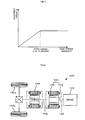
- Fig. 1 schematically illustrates the structure of a hybrid vehicle 20 with a power output apparatus mounted thereon in one embodiment of the present invention.
- the hybrid vehicle 20 of the embodiment includes an engine 22, a triaxial power distribution integration mechanism 30 that is connected to a crankshaft 26 or an output shaft of the engine 22 via a damper 28, a motor MG1 that is connected to the power distribution integration mechanism 30 to generate electric power, another motor MG2 that is connected to the power distribution integration mechanism 30, and a hybrid electronic control unit 70 that controls the whole driving system of driving wheels.
- the engine 22 is an internal combustion engine that outputs power using a hydrocarbon fuel, such as gasoline or diesel oil.
- An engine electronic control unit (hereinafter referred to as engine ECU) 24 receives signals from diverse sensors that detect the driving conditions of the engine 22, and controls the operations of the engine 22 including the control of fuel injection, the control of ignition, and the regulation of the intake air flow.
- the engine ECU 24 communicates with the hybrid electronic control unit 70 and controls the operations of the engine 22 in response to control signals from the hybrid electronic control unit 70 while outputting data regarding the driving conditions of the engine 22 to the hybrid electronic control unit 70 according to the requirements.
- the power distribution integration mechanism 30 includes a sun gear 31 as an external gear, a ring gear 32 as an internal gear arranged concentrically with the sun gear 31, multiple pinion gears 33 engaging with both the sun gear 31 and the ring gear 32, and a carrier 34 holding the multiple pinion gears 33 in such a manner that allows both revolution and rotation on its axis.
- the power distribution integration mechanism 30 is constructed as a planetary gear mechanism that attains differential actions with the sun gear 31, the ring gear 32, and the carrier 34 as rotational elements.
- the crankshaft 26 of the engine 22, the motor MG1, and the motor MG2 are respectively linked with the carrier 34, the sun gear 31, and the ring gear 32.
- the motor MG1 works as an electric generator
- the power of the engine 22 input via the carrier 34 is distributed into the sun gear 31 and the ring gear 32 according to their gear ratio.
- the motor MG1 works as an electric motor
- the power of the engine 22 input via the carrier 34 and the power of the motor MG1 input via the sun gear 31 are integrated and output to the ring gear 32.
- the ring gear 32 is mechanically linked with front driving wheels 39a and 39b of the vehicle via a belt 36, a gear mechanism 37, and a differential gear 38.
- the power output to the ring gear 32 is accordingly transmitted to the driving wheels 39a and 39b via the belt 36, the gear mechanism 37, and the differential gear 38.
- the three shafts connected to the power distribution and integration mechanism 30 include the output shaft of the engine 22 or the crankshaft 26 that is coupled with the carrier 34, a rotating shaft of the motor MG1 or a sun gear shaft 31a that is coupled with the sun gear 31, and a drive shaft or a ring gear shaft 32a that is coupled with the ring gear 32 and is mechanically linked with the driving wheels 39a and 39b.
- Both of the motors MG1 and MG2 are constructed as known synchronous generator motors, which are driven as an electric generator as well as an electric motor.
- the motors MG1 and MG2 transmit electric power from and to a battery 50 via inverters 41 and 42.
- a power line 54 connecting the inverters 41 and 42 with the battery 50 includes a positive terminal bus line and a negative terminal bus line shared by the two inverters 41 and 42. This arrangement enables the electric power generated by one of the motors MG1 and MG2 to be consumed by the other motor.
- the battery 50 is charged with the excess electric power of the motor MG1 or the motor MG2 and is discharged to supplement the insufficient electric power of the motor MG1 or the motor MG2.
- the battery 50 is neither charged not discharged when there is an electric power balance by the motors MG1 and MG2.
- the motors MG1 and MG2 are both driven and controlled by a motor electronic control unit (hereinafter referred to as motor ECU) 40.
- the motor ECU 40 receives signals required for driving and controlling the motors MG1 and MG2, for example, signals from rotational position detection sensors 43 and 44 that detect the rotational positions of rotors in the motors MG1 and MG2 and values of phase electric currents supplied to the motors MG1 and MG2 and detected by non-illustrated electric current sensors.
- the motor ECU 40 outputs switching control signals to the inverters 41 and 42.
- the motor ECU 40 calculates revolving speeds Nm1 and Nm2 of the rotors in the motors MG1 and MG2 from the signals input from the rotational position detection sensors 43 and 44 according to a revolving speed calculation routine (not shown). Since the motor MG1 is linked with the sun gear 31 and the motor MG2 is linked with the ring gear 32, the revolving speeds Nm1 and Nm2 correspond to the revolving speeds of the sun gear shaft 31a and the ring gear shaft 32a.
- the motor ECU 40 communicates with the hybrid electronic control unit 70 and drives and controls the motors MG1 and MG2 in response to control signals from the hybrid electronic control unit 70 while outputting data regarding the driving conditions of the motors MG1 and MG2 to the hybrid electronic control unit 70 according to the requirements.
- the battery 50 is controlled by a battery electronic control unit (hereinafter referred to as battery ECU) 52.
- the battery ECU 52 receives signals required for controlling the battery 50, for example, a value of inter-terminal voltage measured by a non-illustrated voltage sensor disposed between terminals of the battery 50, a value of charge discharge electric current measured by a non-illustrated electric current sensor attached to the power line 54 connecting with an output terminal of the battery 50, and a battery temperature measured by a non-illustrated temperature sensor attached to the battery 50.
- the battery ECU 52 outputs data regarding the conditions of the battery 50 to the hybrid electronic control unit 70 via communication according to the requirements.
- the battery ECU 52 computes a state of charge (SOC) from an accumulated value of the charge discharge electric current measured by the electric current sensor for controlling the battery 50.
- SOC state of charge
- the hybrid electronic control unit 70 is constructed as a microprocessor including a CPU 72, a ROM 74 that stores processing programs, a RAM 76 that temporarily stores data, and non-illustrated input and output ports and communication port.
- the hybrid electronic control unit 70 receives, via the input port, an ignition signal from an ignition switch 80, a gearshift position SP from a gearshift position sensor 82 that detects the current position of a gearshift lever 81 set by the driver' s gearshift operation, an accelerator opening Adrv from an accelerator pedal position sensor 84 that detects the accelerator opening Adrv corresponding to the driver's step-on amount of an accelerator pedal 83, a brake pedal position BP from a brake pedal position sensor 86 that detects the driver's step-on amount of a brake pedal 85, a vehicle speed V from a vehicle speed sensor 88, and a road surface gradient ⁇ from a slope sensor 90.
- the hybrid electronic control unit 70 is connected with the engine ECU 24, the motor ECU 40, and the battery ECU 52 via the
- the hybrid vehicle 20 of the embodiment constructed as discussed above calculates a torque demand to be output to the ring gear shaft 32a or the drive shaft from the vehicle speed V and the accelerator opening Adrv corresponding to the driver's step-on amount of the accelerator pedal 83, and controls the operations of the engine 22 and the motors MG1 and MG2 to attain output of a power demand corresponding to the torque demand to the ring gear shaft 32a.
- the motors MG1 and MG2 are driven and controlled to make all the output power of the engine 22 subjected to torque conversion by the combination of the power distribution integration mechanism 30 and the motors MG1 and MG2 and to output the torque-converted power to the ring gear shaft 32a.
- the engine 22 is driven and controlled to output a power corresponding to the sum of the power demand and an electric power required to charge the battery 50 or discharged from the battery 50.
- the motors MG1 and MG2 are driven and controlled to make all or part of the output power of the engine 22 with charge or discharge of the battery 50 subjected to torque conversion by the combination of the power distribution integration mechanism 30 and the motors MG1 and MG2 and to output a power corresponding to the power demand to the ring gear shaft 32a.
- the engine 22 stops operations, while the motor MG2 is driven and controlled to output a power corresponding to the power demand to the ring gear shaft 32a.
- Fig. 2 is a flowchart showing a torque control routine executed by the hybrid electronic control unit 70. This torque control routine is repeatedly executed at preset time intervals (for example, at every 8 msec).
- the CPU 72 of the hybrid electronic control unit 70 first reads the required data for control, for example, the gearshift position SP detected by the gearshift position sensor 81, the accelerator opening Adrv detected by the accelerator pedal position sensor 83, the brake pedal position BP detected by the brake pedal position sensor 85, the vehicle speed V measured by the vehicle speed sensor 88, and the road surface gradient ⁇ measured by the slope sensor 90 (step S100). The CPU 72 then determines whether the current setting of the gearshift position SP is at a drivable position, that is, in any of ranges D, B, and R and whether the current setting of the accelerator opening Adrv represents an accelerator OFF state (step S110).
- the driver When it is determined that the current setting of the gearshift position SP is not at any drivable position, the driver does not intend to drive currently.
- the driver steps on the accelerator pedal 83 to output the torque corresponding to the accelerator opening Adrv.
- the hybrid vehicle 20 is not in the target state of this torque control, that is, neither at a stop nor in a state immediately before a stop or immediately before a re-start.
- the CPU 72 accordingly sets a value '1' to an adjustment torque release flag Fa (step S230) and executes another control, for example, torque control according to the accelerator opening Adrv (step S240), before exiting from this torque control routine.
- the CPU 72 determines whether the adjustment torque release flag Fa is set equal to 1 (step S120). When the adjustment torque release flag Fa is equal to 1, the CPU 72 sets a value '0' to both an adjustment torque Ta and the adjustment torque release flag Fa (step S130) .
- the adjustment torque Ta will be discussed later.
- the CPU 72 subsequently determines whether the current driving state of the vehicle is in an allowable creep torque output range (step S140).
- the allowable creep torque output range is set as a required creep torque output area and is specified according to the driving conditions including the vehicle speed V, the brake pedal position BP, and the brake oil pressure, the performances of the motor MG2, and the driving characteristics of the vehicle.
- the CPU 72 determines no necessity of output of the creep torque and executes another control (step S240), before exiting from this torque control routine.
- the CPU 72 sets a creep torque Tc (step S150).
- the creep torque Tc may be set by any suitable technique. One applicable technique multiplies a specified level of torque by a correction coefficient depending upon the vehicle speed V or the brake oil pressure to set the creep torque Tc. Another applicable technique may directly set a specified level of torque to the creep torque Tc.
- the CPU 72 determines whether the vehicle is at a stop, on the basis of the input vehicle speed V (step S160). When the vehicle is at a stop, the CPU 72 subsequently determines whether the vehicle is in the brake ON state, on the basis of the input brake pedal position BP (step S170). In the brake ON state, the CPU 72 determines no necessity of the creep torque and sets a value '0' to the creep torque Tc (step S180). When it is determined at step S160 that the vehicle is not at a stop, the CPU 72 determines whether the vehicle moves in a reverse direction, that is, whether a slide-down of the vehicle is detected, on the basis of the gearshift position SP (step S190).
- the adjustment torque Ta is set according to the input road surface gradient ⁇ (step S200).
- the adjustment torque Ta, as well as the creep torque Tc is applied in an expected driving direction, that is, in a forward direction in the setting of the gearshift position SP in the D range and in a backward direction in the setting of the gearshift position SP in the R range.
- a variation in adjustment torque Ta against the road surface gradient ⁇ is specified in advance and is stored as an adjustment torque setting map in the ROM 74.
- the adjustment torque Ta corresponding to the given road surface gradient ⁇ is read from the adjustment torque setting map.
- the adjustment torque setting map used in this embodiment sets the adjustment torque Ta equal to a required torque for converging the vehicle speed of the vehicle with only a driver riding thereon in the reverse direction (in the slide-down direction) to a preset level of vehicle speed (for example, a walking speed of 1 to 5 km/h) against the road surface gradient ⁇ of or below a predetermined level.
- the adjustment torque setting map sets a torque corresponding to the road surface gradient ⁇ of the predetermined level to the adjustment torque Ta against the road surface gradient ⁇ exceeding the predetermined level.
- Fig. 3 shows an example of the adjustment torque setting map.
- the torque control routine does not set the creep torque Tc equal to zero in the brake OFF state, even when the vehicle is at a stop.
- the torque control routine does not execute setting of the adjustment torque Ta, when the vehicle is not at a stop nor moves in the reverse direction.
- the greater torque between the creep torque Tc and the adjustment torque Ta is set to a motor torque Tm to be output from the motor MG2 (step S210) .
- the motor MG2 is then controlled to output the setting of the motor torque Tm (step S220).
- the torque control routine is here terminated.
- the driver sets the gearshift lever 81 in the D range and releases the brake pedal 85, while the vehicle is at a stop on an upslope.
- the adjustment torque Ta is cancelled and is reset to zero at step S130.
- the vehicle still stops with the vehicle speed V equal to 0 and is in the brake OFF state immediately after the driver releases the brake pedal 85.
- the creep torque Tc is accordingly set at step S150 and is output as the motor torque Tm from the motor MG2. Under the condition of a large road surface gradient ⁇ , a reverse travel of the vehicle (in a backward direction in the D range), that is, a slide-down of the vehicle, is detected after the driver releases the brake pedal 85.
- the adjustment torque Ta is set corresponding to the road surface gradient ⁇ at step S200.
- the adjustment torque Ta is output as the motor torque Tm from the motor MG2, when the adjustment torque Ta is greater than the creep torque Tc.
- the adjustment torque Ta is set as the required torque for converging the vehicle speed of the vehicle with only a driver riding thereon in the reverse direction (in the slide-down direction) to the preset level of vehicle speed. Under the condition of the road surface gradient ⁇ of or below the predetermined level, the vehicle speed in the reverse direction is converged to the preset level of vehicle speed regardless of a variation in road surface gradient ⁇ .
- the procedure of the embodiment refers to the adjustment torque setting map specified for the vehicle with only a driver riding thereon to set the adjustment torque Ta even when the vehicle has one or two passengers in addition to the driver.
- the vehicle speed is accordingly converged to a slightly greater level than the preset level of vehicle speed when the vehicle has one or two passengers in addition to the driver.
- another torque control which is different from the flow of the torque control discussed above, is executed based on the accelerator opening Adrv corresponding to the driver's step-on amount of the accelerator pedal 83 to make the behavior of the vehicle depend upon the driver's step-on action of the accelerator pedal 83.
- the vehicle speed in the reverse direction opposite to the expected driving direction is effectively converged to the preset level of vehicle speed, when the driver manipulates the shift lever 81 and releases the brake pedal 85 to re-start the vehicle.
- the adjustment torque Ta used for the convergence is set corresponding to the road surface gradient ⁇ . This arrangement ensures the driver's substantially constant drive feeling regardless of a variation in road surface gradient.
- the creep torque Tc set at step S150 is output as the motor torque Tm from the motor MG2.
- One modified procedure may set either the creep torque Tc or the adjustment torque Ta as an initial torque corresponding to the road surface gradient ⁇ and may output the initial torque as the motor torque Tm from the motor MG2, when the vehicle stops with the vehicle speed V equal to 0 and is in the brake OFF state. This arrangement effectively restrains an abrupt slide-down of the vehicle.
- the torque control routine specifies the creep torque Tc and the adjustment torque Ta and sets the greater torque between the creep torque Tc and the adjustment torque Ta to the motor torque Tm to be output from the motor MG2.
- One modified procedure may set the sum of the creep torque Tc and the adjustment torque Tm to the motor torque Tm to be output from the motor MG2.
- Another modified procedure may not specify the creep torque Tc but set the adjustment torque Ta to the motor torque Tm to be output from the motor MG2. In the latter modification with no setting of the creep torque Tc, no torque is output from the motor MG2 in the brake OFF state when the vehicle is at a stop on the flat road.
- the hybrid vehicle 20 of the embodiment sets the adjustment torque Ta corresponding to the road surface gradient ⁇ measured by the slope sensor 90.
- One modified procedure may estimate the road surface gradient ⁇ from the relation between the acceleration of the vehicle and the output torque from the engine 22, the power distribution integration mechanism 30, and the motors MG1 and MG2 as the power output device during a drive or in the state to a stop of the vehicle, and set the adjustment torque Ta corresponding to the estimated road surface gradient ⁇ .
- the hybrid vehicle 20 of the embodiment uses the adjustment torque setting map to set the adjustment torque Ta.
- the adjustment torque setting map represents the variation in adjustment torque Ta against the road surface gradient ⁇ as the required torque for converging the vehicle speed of the vehicle with only a driver riding thereon in the reverse direction (in the slide-down direction) to the preset level of vehicle speed.
- the adjustment torque Ta may be set according to any other map representing the relation between the adjustment torque Ta.and the road surface gradient ⁇ .
- the hybrid vehicle 20 of the embodiment uses the adjustment torque setting map to set the adjustment torque Ta.
- the adjustment torque setting map represents the variation in adjustment torque Ta against the road surface gradient ⁇ as the required torque for converging the vehicle speed of the vehicle with only a driver riding thereon in the reverse direction (in the slide-down direction) to the preset level of vehicle speed based on the vehicle behavior (for example, the speed and the acceleration).
- One modified procedure may adopt feedback control to set the adjustment torque Ta for convergence of the vehicle speed to the preset level of vehicle speed.
- the above embodiment regards the hybrid vehicle 20 with the engine 22, the power distribution integration mechanism 30, and the motors MG1 and MG2 mounted thereon.
- the technique of the invention is applicable to a vehicle of any construction as long as the vehicle is driven with the power given by the setting of the accelerator opening Adrv corresponding to the driver's step-on amount of the accelerator pedal 83.
- the technique of the invention is applicable to a hybrid vehicle 120 of a modified structure shown in Fig. 4.
- the hybrid vehicle 120 includes a motor 130, which has an inner rotor 132 connected to a crankshaft 126 of an engine 122 and an outer rotor 134 attached to a drive shaft 152 linked to drive wheels 159a and 159b and is relatively rotated through electromagnetic actions of the inner rotor 132 relative to the outer rotor 134, and another motor 140 that is capable of directly outputting power to the drive shaft 152.
- the technique of the invention is also applicable to an electric vehicle of a simpler structure having a motor that uses a supply of electric power from a battery to output a driving force.
- the technique of the invention is adoptable in the automobile industries.
Landscapes
- Engineering & Computer Science (AREA)
- Mechanical Engineering (AREA)
- Chemical & Material Sciences (AREA)
- Combustion & Propulsion (AREA)
- Transportation (AREA)
- Power Engineering (AREA)
- Automation & Control Theory (AREA)
- General Engineering & Computer Science (AREA)
- Electric Propulsion And Braking For Vehicles (AREA)
- Hybrid Electric Vehicles (AREA)
- Control Of Driving Devices And Active Controlling Of Vehicle (AREA)
- Control Of Vehicle Engines Or Engines For Specific Uses (AREA)
- Combined Controls Of Internal Combustion Engines (AREA)
- Regulating Braking Force (AREA)
- Hydraulic Control Valves For Brake Systems (AREA)
- Vehicle Body Suspensions (AREA)
Abstract
Description
Claims (15)
- An automobile that is driven with power supplied from a power output device, said automobile comprising:a driving direction setting module that presets a driving direction of said automobile;a reverse direction travel detection module that detects a travel of said automobile in a reverse direction opposite to the preset driving direction; anda driving control module that sets an adjustment torque to be applied in the preset driving direction and actuates and controls said power output device to apply the adjustment torque, only in response to setting of the driving direction by said driving direction setting module and detection of the travel of said automobile in the reverse direction opposite to the preset driving direction in an accelerator off state by said reverse direction travel detection module.
- An automobile in accordance with claim 1, said automobile further comprising:wherein said driving control module sets the adjustment torque based on the measured or estimated road surface gradient.a road surface gradient measurement estimation module that measures or estimates a road surface gradient,
- An automobile in accordance with claim 2, wherein said driving control module sets the adjustment torque according to a map that represents a variation in adjustment torque against road surface gradient to converge a vehicle speed of said automobile with only a driver riding thereon in the reverse direction to a preset level of vehicle speed.
- An automobile in accordance with either one of claims 2 and 3, said automobile further comprising:wherein said driving control module actuates and controls said power output device to apply the initial torque in a brake off state while said automobile is at a stop.an initial torque setting module that sets an initial torque applied in the preset driving direction, based on the measured or estimated road surface gradient,
- An automobile in accordance with claim 1, wherein said reverse direction travel detection module measures a vehicle speed in the reverse direction, and
said driving control module sets the adjustment torque to converge the measured vehicle speed in the reverse direction to a preset level of vehicle speed. - An automobile in accordance with any one of claims 1 through 5, said automobile further comprising:wherein said driving control module actuates and controls said power output device to apply a greater torque between the adjustment torque and the creep torque.a creep torque setting module that sets a creep torque applied in the preset driving direction when a predetermined condition is fulfilled,
- An automobile in accordance with claim 6, wherein said creep torque setting module sets a value ' 0' to the creep torque in response to a braking operation of lowering a vehicle speed of said automobile to zero, and sets a predetermined level of the creep torque in response to detection of a brake off state.
- An automobile in accordance with any one of claims 1 through 7, wherein said driving control module releases the adjustment torque in response to an accelerator off operation after an accelerator on operation.
- An automobile in accordance with any one of claims 1 through 8, wherein said power output device comprises a motor that inputs and outputs powers from and to an axle.
- An automobile in accordance with any one of claims 1 through 9, wherein said power output device comprises an internal combustion engine, a drive shaft motor that inputs and outputs powers from and to a drive shaft linked to an axle, and a power transmission module that transmits power from an output shaft of said internal combustion engine to the drive shaft through input and output of electrical energy-based powers, and
said driving control module controls said internal combustion engine, said drive shaft motor, and said power transmission module to apply a power corresponding to a preset deceleration to the drive shaft. - An automobile in accordance with claim 10, wherein said power transmission module comprises: a three shaft-type power input output module that is linked to the output shaft of said internal combustion engine, the drive shaft, and a rotating shaft and inputs and outputs powers from and to one residual shaft according to powers input and output from and to any two shafts among the three shafts; and a rotating shaft motor that inputs and outputs powers from and to the rotating shaft.
- An automobile in accordance with claim 10, wherein said power transmission module comprises a pair rotor motor that has a first rotor connected to the output shaft of said internal combustion engine and a second rotor connected to the drive shaft to be rotatable relative to the first rotor, where said pair rotor motor enables the input and output of the electrical energy-based powers based on an electromagnetic operation of the first rotor relative to the second rotor.
- An automobile control method of controlling an automobile that is driven in a preset driving direction with power supplied from a power output device, said automobile control method comprising the steps of:(a) detecting a travel of said automobile in a reverse direction opposite to the preset driving direction; and(b) setting an adjustment torque to be applied in the preset driving direction and actuating and controlling said power output device to apply the adjustment torque, only in response to detection of the travel of said automobile in the reverse direction opposite to the preset driving direction in an accelerator off state.
- An automobile control method in accordance with claim 13, wherein said step (b) detects a road surface gradient and sets the adjustment torque based on the detected road surface gradient.
- An automobile control method in accordance with either one of claims 13 and 14, said automobile control method further comprising the step of setting a creep torque applied in the preset driving direction when a predetermined condition is fulfilled, prior to said step (b),
wherein said step (b) actuates and controls said power output device to apply a greater torque between the adjustment torque and the creep torque.
Applications Claiming Priority (3)
| Application Number | Priority Date | Filing Date | Title |
|---|---|---|---|
| JP2002194632 | 2002-07-03 | ||
| JP2002194632A JP3612711B2 (en) | 2002-07-03 | 2002-07-03 | Automobile |
| PCT/JP2003/006688 WO2004011296A1 (en) | 2002-07-03 | 2003-05-28 | Car and method of controlling the car |
Publications (3)
| Publication Number | Publication Date |
|---|---|
| EP1535790A1 true EP1535790A1 (en) | 2005-06-01 |
| EP1535790A4 EP1535790A4 (en) | 2006-04-19 |
| EP1535790B1 EP1535790B1 (en) | 2009-12-23 |
Family
ID=31184251
Family Applications (1)
| Application Number | Title | Priority Date | Filing Date |
|---|---|---|---|
| EP03733136A Expired - Lifetime EP1535790B1 (en) | 2002-07-03 | 2003-05-28 | Car and method of controlling the car |
Country Status (11)
| Country | Link |
|---|---|
| US (1) | US7295918B2 (en) |
| EP (1) | EP1535790B1 (en) |
| JP (1) | JP3612711B2 (en) |
| KR (1) | KR100770394B1 (en) |
| CN (1) | CN100376438C (en) |
| AT (1) | ATE452788T1 (en) |
| AU (1) | AU2003241841A1 (en) |
| BR (1) | BRPI0312295B1 (en) |
| DE (1) | DE60330676D1 (en) |
| RU (1) | RU2290330C2 (en) |
| WO (1) | WO2004011296A1 (en) |
Cited By (6)
| Publication number | Priority date | Publication date | Assignee | Title |
|---|---|---|---|---|
| WO2008077352A1 (en) | 2006-12-26 | 2008-07-03 | Byd Company Limited | Method and apparatus for controlling output torque of a motor for an electric vehicle in uphill mode |
| CN101412378B (en) * | 2007-12-11 | 2010-12-22 | 深圳市欧得亿泰智能技术开发有限公司 | Electric automobile using a plurality of electric apparatuses to drive running |
| EP2695789A1 (en) * | 2012-08-09 | 2014-02-12 | Volkswagen Aktiengesellschaft | Circuit, method and computer program for controlling a creep modulus |
| CN101987622B (en) * | 2009-07-30 | 2015-04-15 | 现代自动车株式会社 | Apparatus and method for controlling motor position and creep of electric vehicle |
| FR3091247A1 (en) * | 2018-12-26 | 2020-07-03 | Renault S.A.S | Method and system for managing a setback torque setpoint applied to the drive wheels of a motor vehicle with electric or hybrid traction |
| US20220227241A1 (en) * | 2016-12-30 | 2022-07-21 | Textron Innovations Inc. | Controlling electrical access to a lithium battery on a utility vehicle |
Families Citing this family (59)
| Publication number | Priority date | Publication date | Assignee | Title |
|---|---|---|---|---|
| JP3818278B2 (en) * | 2003-07-22 | 2006-09-06 | トヨタ自動車株式会社 | Hybrid vehicle and control method thereof |
| CN100402335C (en) * | 2004-11-16 | 2008-07-16 | 丰田自动车株式会社 | Hybrid electric vehicle and its control method |
| CN100400333C (en) * | 2004-11-19 | 2008-07-09 | 丰田自动车株式会社 | automobile and control method thereof |
| FR2878215B1 (en) * | 2004-11-25 | 2007-01-05 | Renault Sas | ELECTRIC BRAKE DEVICE FOR VEHICLE |
| JP4640044B2 (en) * | 2005-06-01 | 2011-03-02 | トヨタ自動車株式会社 | Automobile and control method thereof |
| JP4613803B2 (en) * | 2005-11-18 | 2011-01-19 | トヨタ自動車株式会社 | POWER OUTPUT DEVICE, ITS CONTROL METHOD, AND VEHICLE |
| DE102006003714A1 (en) * | 2006-01-26 | 2007-08-02 | Zf Friedrichshafen Ag | Method for regulating electrodynamic drive system of motor vehicle, involves disposing electric machine, which is used as electrodynamic starting element and summing transmission between combustion engine and transmission |
| JP2008087672A (en) * | 2006-10-03 | 2008-04-17 | Jtekt Corp | Vehicle steering system |
| JP2008199716A (en) * | 2007-02-09 | 2008-08-28 | Hitachi Ltd | VEHICLE DRIVE DEVICE AND ELECTRONIC CIRCUIT DEVICE USED FOR THE SAME |
| JP4973320B2 (en) * | 2007-06-01 | 2012-07-11 | トヨタ自動車株式会社 | Vehicle and control method thereof |
| US7847461B2 (en) * | 2007-06-06 | 2010-12-07 | Gm Global Technology Operations, Inc. | Multi-layer magnet arrangement in a permanent magnet machine for a motorized vehicle |
| KR100962783B1 (en) * | 2007-12-13 | 2010-06-09 | 현대자동차주식회사 | How to Limit Motor Torque in Hybrid Vehicles |
| US7988593B2 (en) * | 2008-02-11 | 2011-08-02 | Caterpillar Inc. | Creep control for motor system |
| CN101638062B (en) * | 2008-07-30 | 2011-05-25 | 比亚迪股份有限公司 | Vehicle slope climbing control method and vehicle slope climbing control device |
| EP2411646B1 (en) * | 2009-03-24 | 2020-07-08 | Volvo Lastvagnar AB | Method for controlling an exhaust gas temperature |
| RU2392602C1 (en) * | 2009-06-17 | 2010-06-20 | Василий Васильевич Ефанов | Method for estimating serviceability of vehicle braking system and device for its implementation |
| KR101144430B1 (en) | 2009-12-04 | 2012-05-10 | 현대자동차주식회사 | Brake System for Vehicle with Idle Stop and Go device and Control Method thereof |
| JP5700955B2 (en) * | 2010-05-31 | 2015-04-15 | 日産自動車株式会社 | Electric vehicle backlash control device |
| JP5521834B2 (en) * | 2010-06-30 | 2014-06-18 | 日産自動車株式会社 | Creep cut control device for electric vehicle |
| JP5652020B2 (en) * | 2010-06-30 | 2015-01-14 | 日産自動車株式会社 | Creep cut control device for electric vehicle |
| JP2012163092A (en) * | 2011-01-20 | 2012-08-30 | Nissan Motor Co Ltd | Output characteristics control device for internal combustion engine |
| CN102198805B (en) * | 2011-03-09 | 2016-09-28 | 王子辉 | A kind of pure electric automobile ramp method in slope that magneto drives |
| WO2012172639A1 (en) * | 2011-06-14 | 2012-12-20 | トヨタ自動車株式会社 | Vehicle control apparatus |
| JP5365676B2 (en) * | 2011-09-30 | 2013-12-11 | トヨタ自動車株式会社 | Information processing system and information processing apparatus |
| US9168915B2 (en) * | 2011-11-04 | 2015-10-27 | Toyota Jidosha Kabushiki Kaisha | Vehicle and method for controlling vehicle |
| JP5143271B1 (en) * | 2011-11-17 | 2013-02-13 | 三菱電機株式会社 | Apparatus and method for detecting and controlling pumping brake for internal combustion engine |
| KR101327033B1 (en) * | 2011-12-12 | 2013-11-20 | 현대자동차주식회사 | Method of the Motor Torque Control for Preventing Reverse-traveling on Slope Road for a Fuel cell and a Electric Vehicle by Real Time Slope Prediction Algorithm |
| CN102874257B (en) * | 2012-10-23 | 2015-04-08 | 力帆实业(集团)股份有限公司 | Hill-start assist system for electric car and control method of hill-start assist system |
| CN103029596B (en) * | 2012-10-30 | 2015-07-08 | 荣成华泰汽车有限公司 | Creep control method and device for electric automobile and electric automobile |
| JP6055334B2 (en) * | 2013-02-14 | 2016-12-27 | 富士重工業株式会社 | Accelerator pedal misoperation control device |
| US9352741B2 (en) * | 2013-08-15 | 2016-05-31 | GM Global Technology Operations LLC | Method and apparatus for controlling creep torque in a powertrain system |
| CN104417557B (en) | 2013-09-09 | 2017-07-04 | 比亚迪股份有限公司 | A kind of vehicle slides feedback control system and its control method |
| CN104417346B (en) | 2013-09-09 | 2017-04-12 | 比亚迪股份有限公司 | Control system and control method of hybrid electrical vehicle (HEV) |
| CN104417347B (en) | 2013-09-09 | 2017-08-04 | 比亚迪股份有限公司 | The control system and control method of hybrid vehicle |
| CN104417544B (en) | 2013-09-09 | 2017-08-22 | 比亚迪股份有限公司 | The control system and control method of hybrid vehicle |
| CN104417543B (en) | 2013-09-09 | 2017-08-22 | 比亚迪股份有限公司 | The control system and control method of hybrid vehicle |
| CN104417554B (en) | 2013-09-09 | 2018-03-13 | 比亚迪股份有限公司 | Hybrid vehicle and its cruise control method |
| US9428193B2 (en) * | 2014-05-21 | 2016-08-30 | Ford Global Technologies, Llc | Method for preventing wheel spin on stopped vehicles |
| JP6048457B2 (en) * | 2014-07-16 | 2016-12-21 | トヨタ自動車株式会社 | Vehicle travel control device |
| US10099575B2 (en) | 2014-09-29 | 2018-10-16 | Ford Global Technlogies, Llc | Creep compensation using road grade and mass estimation |
| KR20160090524A (en) * | 2015-01-22 | 2016-08-01 | 엘지전자 주식회사 | Electric Vehicle and Control Method Thereof |
| WO2016120979A1 (en) * | 2015-01-26 | 2016-08-04 | 日産自動車株式会社 | Control device for electric vehicle and control method for electric vehicle |
| BR112017015719B1 (en) * | 2015-01-26 | 2022-09-13 | Nissan Motor Co., Ltd | VEHICLE CONTROL DEVICE AND METHOD THAT GENERATES A FRICTIVE BRAKING FORCE TO DECELERATE A VEHICLE |
| JP6060195B2 (en) * | 2015-03-06 | 2017-01-11 | 本田技研工業株式会社 | Vehicle parking control device |
| US9944200B2 (en) | 2015-03-09 | 2018-04-17 | Ford Global Technologies, Llc | Variable creep torque |
| MY190446A (en) * | 2015-08-26 | 2022-04-21 | Nissan Motor | Control method and control device for electric vehicle |
| CN106555680B (en) * | 2015-09-25 | 2019-11-22 | 比亚迪股份有限公司 | Control method and device for vehicle engine |
| US10150461B2 (en) | 2016-06-15 | 2018-12-11 | Ford Global Technologies, Llc | Method and assembly for powertrain braking and friction braking a vehicle |
| CN108128210B (en) * | 2016-12-01 | 2021-04-27 | 上海汽车集团股份有限公司 | Creep torque output control method and device, automobile |
| EP3575133B1 (en) * | 2017-01-24 | 2022-03-09 | Nissan Motor Co., Ltd. | Electric vehicle control method and control device |
| CN110234533B (en) * | 2017-01-24 | 2020-09-15 | 日产自动车株式会社 | Control method and control device for electric vehicle |
| US11027617B2 (en) * | 2017-01-24 | 2021-06-08 | Nissan Motor Co., Ltd. | Control method for electrically driven vehicle and control device for electrically driven vehicle |
| GB2578058B (en) * | 2017-06-26 | 2023-02-01 | Cummins Inc | Dynamic accelerator response management for a vehicle |
| CN107599820A (en) * | 2017-10-24 | 2018-01-19 | 广西玉柴机器股份有限公司 | Hybrid drive train |
| GB2573979B (en) * | 2018-02-26 | 2020-09-02 | Jaguar Land Rover Ltd | A controller and a method of controlling speed of a vehicle |
| CN112654578B (en) | 2018-09-13 | 2023-03-14 | 克朗设备公司 | System and method for controlling maximum vehicle speed of industrial vehicle based on calculated load |
| KR102621540B1 (en) * | 2018-12-06 | 2024-01-04 | 현대자동차주식회사 | Method for automatically generating APS MAP |
| KR102450762B1 (en) * | 2021-02-18 | 2022-10-07 | 주식회사 현대케피코 | System for controlling stop of vehicle and method thereof |
| US11951987B2 (en) | 2021-10-21 | 2024-04-09 | Toyota Motor Engineering & Manufacturing North America, Inc. | Creep torque feedback to improve controllably maneuvering a vehicle |
Family Cites Families (40)
| Publication number | Priority date | Publication date | Assignee | Title |
|---|---|---|---|---|
| DE2411550C2 (en) * | 1974-03-11 | 1985-11-14 | Standard Elektrik Lorenz Ag, 7000 Stuttgart | Circuit arrangement for the automatic start-up control of a vehicle on inclines |
| JPH0727387Y2 (en) | 1987-08-05 | 1995-06-21 | トヨタ自動車株式会社 | Throttle valve control device |
| JPH04164590A (en) | 1990-10-26 | 1992-06-10 | Matsushita Electric Works Ltd | Holding device |
| EP0602124B1 (en) * | 1991-09-06 | 1995-11-22 | Siemens Aktiengesellschaft | Device for maintaining a preselected travelling direction of a vehicle, in particular an electric car, on slopes |
| JP2714298B2 (en) | 1991-12-26 | 1998-02-16 | 株式会社東芝 | Wire fixing device and wire attaching / detaching method using the same |
| JPH05184737A (en) | 1992-01-13 | 1993-07-27 | Kyushu Hitachi Maxell Ltd | Rotary electric razor |
| JPH05230414A (en) | 1992-02-18 | 1993-09-07 | Tombow Pencil Co Ltd | Watercolor pencil lead |
| JP2841350B2 (en) | 1992-09-25 | 1998-12-24 | 池田物産株式会社 | Interior material with decorative member and method of manufacturing the same |
| US5376869A (en) * | 1993-02-11 | 1994-12-27 | General Electric Company | Electric vehicle drive train with rollback detection and compensation |
| JPH0787622A (en) * | 1993-09-16 | 1995-03-31 | Toyota Autom Loom Works Ltd | Running controller for battery vehicle |
| JPH07322404A (en) * | 1994-05-20 | 1995-12-08 | Fuji Heavy Ind Ltd | Drive controller for electric car |
| JP2850783B2 (en) | 1995-03-01 | 1999-01-27 | 株式会社イナックス | Bathroom vanity |
| CN1055895C (en) * | 1995-05-19 | 2000-08-30 | 丰田自动车株式会社 | Transmission system four wheel drive vehicle using same, power transmitting method, and four wheel driving method |
| JPH0937407A (en) * | 1995-07-18 | 1997-02-07 | Toyota Motor Corp | Regenerative braking control device |
| WO1997010966A1 (en) * | 1995-09-20 | 1997-03-27 | Mitsubishi Jidosha Kogyo Kabushiki Kaisha | Apparatus for controlling regenerative braking of electric vehicle |
| JPH0997177A (en) | 1995-09-29 | 1997-04-08 | Toshiba Corp | Computer system interrupt control method |
| JPH1095716A (en) | 1996-09-19 | 1998-04-14 | Kao Corp | Anti-white hair agent |
| JP3050141B2 (en) * | 1996-09-24 | 2000-06-12 | トヨタ自動車株式会社 | Power output device and control method thereof |
| JPH10274112A (en) | 1997-03-31 | 1998-10-13 | Kubota Corp | Oil bath type air cleaner |
| JPH1125822A (en) | 1997-06-30 | 1999-01-29 | Matsushita Electric Works Ltd | Wall switch |
| JP2000034150A (en) | 1998-07-16 | 2000-02-02 | Denki Kagaku Kogyo Kk | Cement hydration heat control material and cement composition |
| JP2000057194A (en) | 1998-08-12 | 2000-02-25 | Sharp Corp | Synchronous sequential circuit state allocation method and apparatus, and computer-readable recording medium storing synchronous sequential circuit state allocation program |
| JP3649007B2 (en) * | 1998-11-27 | 2005-05-18 | トヨタ自動車株式会社 | Vehicle reverse determination method and vehicle control apparatus |
| JP3873505B2 (en) | 1999-02-19 | 2007-01-24 | Jfeスチール株式会社 | Roll position adjustment method and roll position adjustment guidance device for rolling roll for steel bars |
| JP2000308305A (en) | 1999-04-22 | 2000-11-02 | Asmo Co Ltd | Motor and washer |
| JP3646642B2 (en) * | 1999-10-08 | 2005-05-11 | トヨタ自動車株式会社 | Vehicle drive control device |
| DE10049567B4 (en) * | 1999-10-08 | 2017-12-14 | Toyota Jidosha Kabushiki Kaisha | Vehicle control unit for controlling a four-wheel drive motor vehicle |
| DE19961943A1 (en) * | 1999-12-22 | 2001-07-12 | Bosch Gmbh Robert | Control method of an internal combustion engine when a backwards movement of the wheel is detected, involves modification of the ignition angle and the air intake ratio |
| JP3723028B2 (en) * | 1999-12-28 | 2005-12-07 | 本田技研工業株式会社 | Road surface gradient detecting device and starting clutch control device |
| JP4399842B2 (en) * | 2000-01-06 | 2010-01-20 | 本田技研工業株式会社 | Electric vehicle motor control device |
| JP2001243147A (en) | 2000-03-01 | 2001-09-07 | Indigo Corp | System for evaluation of homepage |
| JP3333488B2 (en) * | 2000-03-02 | 2002-10-15 | 株式会社日立製作所 | Electric four-wheel drive system for vehicles |
| US6278916B1 (en) * | 2000-05-09 | 2001-08-21 | Ford Global Technologies, Inc. | Torque control strategy for management of creep and grade hold torque in a wheeled vehicle whose powertrain includes a rotary electric machine |
| RU2200526C2 (en) * | 2000-05-30 | 2003-03-20 | Пендэйл Вентурес Лимитед | Vehicle and method for overcoming flights of stairs by vehicle (versions) |
| JP3458830B2 (en) * | 2000-07-21 | 2003-10-20 | 日産自動車株式会社 | Control device for infinitely variable speed ratio transmission |
| JP4419290B2 (en) * | 2000-08-04 | 2010-02-24 | トヨタ車体株式会社 | Rollback suppression device for electric vehicle |
| JP2002168333A (en) * | 2000-11-28 | 2002-06-14 | Fuji Heavy Ind Ltd | Vehicle hill hold control device |
| JP2003061205A (en) * | 2001-08-10 | 2003-02-28 | Mitsubishi Motors Corp | Electric vehicle motor control device |
| US6590299B2 (en) * | 2001-11-08 | 2003-07-08 | Ford Global Technologies, Llc | Hybrid electric vehicle control strategy to provide vehicle creep and hill holding |
| US7032697B2 (en) * | 2002-05-30 | 2006-04-25 | Hyeongcheol Lee | Drive control system for vehicles with an auxiliary driving system |
-
2002
- 2002-07-03 JP JP2002194632A patent/JP3612711B2/en not_active Expired - Lifetime
-
2003
- 2003-05-28 WO PCT/JP2003/006688 patent/WO2004011296A1/en not_active Ceased
- 2003-05-28 CN CNB038158272A patent/CN100376438C/en not_active Expired - Lifetime
- 2003-05-28 EP EP03733136A patent/EP1535790B1/en not_active Expired - Lifetime
- 2003-05-28 DE DE60330676T patent/DE60330676D1/en not_active Expired - Lifetime
- 2003-05-28 AT AT03733136T patent/ATE452788T1/en not_active IP Right Cessation
- 2003-05-28 KR KR1020047021549A patent/KR100770394B1/en not_active Expired - Lifetime
- 2003-05-28 AU AU2003241841A patent/AU2003241841A1/en not_active Abandoned
- 2003-05-28 RU RU2005102599/11A patent/RU2290330C2/en active
- 2003-05-28 BR BRPI0312295A patent/BRPI0312295B1/en active IP Right Grant
-
2005
- 2005-01-03 US US11/025,965 patent/US7295918B2/en not_active Expired - Lifetime
Cited By (10)
| Publication number | Priority date | Publication date | Assignee | Title |
|---|---|---|---|---|
| WO2008077352A1 (en) | 2006-12-26 | 2008-07-03 | Byd Company Limited | Method and apparatus for controlling output torque of a motor for an electric vehicle in uphill mode |
| EP2097291A4 (en) * | 2006-12-26 | 2013-05-08 | Byd Co Ltd | METHOD AND APPARATUS FOR CONTROLLING UPGRADE ELECTRIC MOTOR OUTPUT TORQUE |
| CN101412378B (en) * | 2007-12-11 | 2010-12-22 | 深圳市欧得亿泰智能技术开发有限公司 | Electric automobile using a plurality of electric apparatuses to drive running |
| CN101987622B (en) * | 2009-07-30 | 2015-04-15 | 现代自动车株式会社 | Apparatus and method for controlling motor position and creep of electric vehicle |
| EP2695789A1 (en) * | 2012-08-09 | 2014-02-12 | Volkswagen Aktiengesellschaft | Circuit, method and computer program for controlling a creep modulus |
| US20220227241A1 (en) * | 2016-12-30 | 2022-07-21 | Textron Innovations Inc. | Controlling electrical access to a lithium battery on a utility vehicle |
| US11865927B2 (en) * | 2016-12-30 | 2024-01-09 | Textron Innovations Inc. | Controlling electrical access to a lithium battery on a utility vehicle |
| US20240092190A1 (en) * | 2016-12-30 | 2024-03-21 | Textron Innovations Inc. | Controlling electrical access to a lithium battery on a utility vehicle |
| US12240340B2 (en) * | 2016-12-30 | 2025-03-04 | Textron Innovations Inc. | Controlling electrical access to a lithium battery on a utility vehicle |
| FR3091247A1 (en) * | 2018-12-26 | 2020-07-03 | Renault S.A.S | Method and system for managing a setback torque setpoint applied to the drive wheels of a motor vehicle with electric or hybrid traction |
Also Published As
| Publication number | Publication date |
|---|---|
| EP1535790A4 (en) | 2006-04-19 |
| RU2005102599A (en) | 2005-06-27 |
| KR20050019814A (en) | 2005-03-03 |
| ATE452788T1 (en) | 2010-01-15 |
| WO2004011296A1 (en) | 2004-02-05 |
| BR0312295A (en) | 2005-04-12 |
| US7295918B2 (en) | 2007-11-13 |
| DE60330676D1 (en) | 2010-02-04 |
| JP2004036489A (en) | 2004-02-05 |
| EP1535790B1 (en) | 2009-12-23 |
| RU2290330C2 (en) | 2006-12-27 |
| KR100770394B1 (en) | 2007-10-31 |
| BRPI0312295B1 (en) | 2016-12-27 |
| CN1665697A (en) | 2005-09-07 |
| US20050187671A1 (en) | 2005-08-25 |
| AU2003241841A1 (en) | 2004-02-16 |
| CN100376438C (en) | 2008-03-26 |
| JP3612711B2 (en) | 2005-01-19 |
Similar Documents
| Publication | Publication Date | Title |
|---|---|---|
| EP1535790B1 (en) | Car and method of controlling the car | |
| EP1644215B1 (en) | Power output apparatus, method of controlling the same, and automobile | |
| EP1636080B1 (en) | Hybrid vehicle and method of controlling the same | |
| EP1548253B1 (en) | Vehicle control device, car having the device, and method of controlling the car | |
| US8849486B2 (en) | Vehicle and method of controlling the same | |
| US7523797B2 (en) | Power output apparatus, method of controlling power output apparatus, and automobile with power output apparatus mounted thereon | |
| EP1979185B1 (en) | Vehicle, control method thereof and braking device | |
| EP1863668B1 (en) | Vehicle and control method of vehicle | |
| EP1768868B1 (en) | Power output apparatus, motor vehicle equipped with power output apparatus, and control method of power output apparatus | |
| EP1297981A2 (en) | Hybrid vehicle with planetary gearing power distribution apparatus | |
| US7698042B2 (en) | Motor vehicle and control method of the same | |
| KR100934743B1 (en) | Hybrid vehicle and hybrid vehicle control method | |
| EP1809506B1 (en) | Motor vehicle and control method of motor vehicle, in particular during downshift | |
| EP2058200B1 (en) | Vehicle and method of controlling the same | |
| WO2005012029A1 (en) | Hybrid power output apparatus and control method | |
| WO2005007440A1 (en) | Power output apparatus for hybrid vehicle | |
| EP1819545A1 (en) | Vehicle and control method of the same | |
| US20080086255A1 (en) | Motor Vehicle And Control Method Of The Same | |
| EP1763447B1 (en) | Hybrid vehicle and driving resistance measurement method of hybrid vehicle | |
| JP4061899B2 (en) | Electric car | |
| JP2006063866A (en) | Power output apparatus, automobile equipped with the same, and control method of power output apparatus | |
| HK1082939A (en) | Car and method of controlling the car |
Legal Events
| Date | Code | Title | Description |
|---|---|---|---|
| PUAI | Public reference made under article 153(3) epc to a published international application that has entered the european phase |
Free format text: ORIGINAL CODE: 0009012 |
|
| 17P | Request for examination filed |
Effective date: 20041228 |
|
| AK | Designated contracting states |
Kind code of ref document: A1 Designated state(s): AT BE BG CH CY CZ DE DK EE ES FI FR GB GR HU IE IT LI LU MC NL PT RO SE SI SK TR |
|
| AX | Request for extension of the european patent |
Extension state: AL LT LV MK |
|
| DAX | Request for extension of the european patent (deleted) | ||
| A4 | Supplementary search report drawn up and despatched |
Effective date: 20060308 |
|
| RIC1 | Information provided on ipc code assigned before grant |
Ipc: B60L 15/20 20060101ALI20060302BHEP Ipc: F02D 29/02 20060101ALI20060302BHEP Ipc: B60L 11/14 20060101AFI20040216BHEP Ipc: B60K 6/04 20060101ALI20060302BHEP |
|
| 17Q | First examination report despatched |
Effective date: 20070117 |
|
| GRAP | Despatch of communication of intention to grant a patent |
Free format text: ORIGINAL CODE: EPIDOSNIGR1 |
|
| RIC1 | Information provided on ipc code assigned before grant |
Ipc: B60L 11/14 20060101AFI20090723BHEP Ipc: F02D 29/02 20060101ALI20090723BHEP Ipc: B60L 15/20 20060101ALI20090723BHEP Ipc: B60K 6/22 20071001ALI20090723BHEP |
|
| GRAS | Grant fee paid |
Free format text: ORIGINAL CODE: EPIDOSNIGR3 |
|
| GRAA | (expected) grant |
Free format text: ORIGINAL CODE: 0009210 |
|
| AK | Designated contracting states |
Kind code of ref document: B1 Designated state(s): AT BE BG CH CY CZ DE DK EE ES FI FR GB GR HU IE IT LI LU MC NL PT RO SE SI SK TR |
|
| REG | Reference to a national code |
Ref country code: GB Ref legal event code: FG4D |
|
| REG | Reference to a national code |
Ref country code: CH Ref legal event code: EP |
|
| REG | Reference to a national code |
Ref country code: IE Ref legal event code: FG4D |
|
| REF | Corresponds to: |
Ref document number: 60330676 Country of ref document: DE Date of ref document: 20100204 Kind code of ref document: P |
|
| REG | Reference to a national code |
Ref country code: NL Ref legal event code: VDEP Effective date: 20091223 |
|
| PG25 | Lapsed in a contracting state [announced via postgrant information from national office to epo] |
Ref country code: FI Free format text: LAPSE BECAUSE OF FAILURE TO SUBMIT A TRANSLATION OF THE DESCRIPTION OR TO PAY THE FEE WITHIN THE PRESCRIBED TIME-LIMIT Effective date: 20091223 Ref country code: SE Free format text: LAPSE BECAUSE OF FAILURE TO SUBMIT A TRANSLATION OF THE DESCRIPTION OR TO PAY THE FEE WITHIN THE PRESCRIBED TIME-LIMIT Effective date: 20091223 |
|
| PG25 | Lapsed in a contracting state [announced via postgrant information from national office to epo] |
Ref country code: SI Free format text: LAPSE BECAUSE OF FAILURE TO SUBMIT A TRANSLATION OF THE DESCRIPTION OR TO PAY THE FEE WITHIN THE PRESCRIBED TIME-LIMIT Effective date: 20091223 |
|
| PG25 | Lapsed in a contracting state [announced via postgrant information from national office to epo] |
Ref country code: AT Free format text: LAPSE BECAUSE OF FAILURE TO SUBMIT A TRANSLATION OF THE DESCRIPTION OR TO PAY THE FEE WITHIN THE PRESCRIBED TIME-LIMIT Effective date: 20091223 |
|
| PG25 | Lapsed in a contracting state [announced via postgrant information from national office to epo] |
Ref country code: PT Free format text: LAPSE BECAUSE OF FAILURE TO SUBMIT A TRANSLATION OF THE DESCRIPTION OR TO PAY THE FEE WITHIN THE PRESCRIBED TIME-LIMIT Effective date: 20100423 Ref country code: NL Free format text: LAPSE BECAUSE OF FAILURE TO SUBMIT A TRANSLATION OF THE DESCRIPTION OR TO PAY THE FEE WITHIN THE PRESCRIBED TIME-LIMIT Effective date: 20091223 Ref country code: RO Free format text: LAPSE BECAUSE OF FAILURE TO SUBMIT A TRANSLATION OF THE DESCRIPTION OR TO PAY THE FEE WITHIN THE PRESCRIBED TIME-LIMIT Effective date: 20091223 Ref country code: BG Free format text: LAPSE BECAUSE OF FAILURE TO SUBMIT A TRANSLATION OF THE DESCRIPTION OR TO PAY THE FEE WITHIN THE PRESCRIBED TIME-LIMIT Effective date: 20100323 Ref country code: ES Free format text: LAPSE BECAUSE OF FAILURE TO SUBMIT A TRANSLATION OF THE DESCRIPTION OR TO PAY THE FEE WITHIN THE PRESCRIBED TIME-LIMIT Effective date: 20100403 Ref country code: EE Free format text: LAPSE BECAUSE OF FAILURE TO SUBMIT A TRANSLATION OF THE DESCRIPTION OR TO PAY THE FEE WITHIN THE PRESCRIBED TIME-LIMIT Effective date: 20091223 |
|
| PG25 | Lapsed in a contracting state [announced via postgrant information from national office to epo] |
Ref country code: BE Free format text: LAPSE BECAUSE OF FAILURE TO SUBMIT A TRANSLATION OF THE DESCRIPTION OR TO PAY THE FEE WITHIN THE PRESCRIBED TIME-LIMIT Effective date: 20091223 Ref country code: SK Free format text: LAPSE BECAUSE OF FAILURE TO SUBMIT A TRANSLATION OF THE DESCRIPTION OR TO PAY THE FEE WITHIN THE PRESCRIBED TIME-LIMIT Effective date: 20091223 Ref country code: CZ Free format text: LAPSE BECAUSE OF FAILURE TO SUBMIT A TRANSLATION OF THE DESCRIPTION OR TO PAY THE FEE WITHIN THE PRESCRIBED TIME-LIMIT Effective date: 20091223 |
|
| PG25 | Lapsed in a contracting state [announced via postgrant information from national office to epo] |
Ref country code: GR Free format text: LAPSE BECAUSE OF FAILURE TO SUBMIT A TRANSLATION OF THE DESCRIPTION OR TO PAY THE FEE WITHIN THE PRESCRIBED TIME-LIMIT Effective date: 20100324 Ref country code: CY Free format text: LAPSE BECAUSE OF FAILURE TO SUBMIT A TRANSLATION OF THE DESCRIPTION OR TO PAY THE FEE WITHIN THE PRESCRIBED TIME-LIMIT Effective date: 20091223 |
|
| PLBE | No opposition filed within time limit |
Free format text: ORIGINAL CODE: 0009261 |
|
| STAA | Information on the status of an ep patent application or granted ep patent |
Free format text: STATUS: NO OPPOSITION FILED WITHIN TIME LIMIT |
|
| 26N | No opposition filed |
Effective date: 20100924 |
|
| PG25 | Lapsed in a contracting state [announced via postgrant information from national office to epo] |
Ref country code: MC Free format text: LAPSE BECAUSE OF NON-PAYMENT OF DUE FEES Effective date: 20100531 |
|
| REG | Reference to a national code |
Ref country code: CH Ref legal event code: PL |
|
| PG25 | Lapsed in a contracting state [announced via postgrant information from national office to epo] |
Ref country code: DK Free format text: LAPSE BECAUSE OF FAILURE TO SUBMIT A TRANSLATION OF THE DESCRIPTION OR TO PAY THE FEE WITHIN THE PRESCRIBED TIME-LIMIT Effective date: 20091223 |
|
| PG25 | Lapsed in a contracting state [announced via postgrant information from national office to epo] |
Ref country code: LI Free format text: LAPSE BECAUSE OF NON-PAYMENT OF DUE FEES Effective date: 20100531 Ref country code: CH Free format text: LAPSE BECAUSE OF NON-PAYMENT OF DUE FEES Effective date: 20100531 |
|
| PG25 | Lapsed in a contracting state [announced via postgrant information from national office to epo] |
Ref country code: IT Free format text: LAPSE BECAUSE OF FAILURE TO SUBMIT A TRANSLATION OF THE DESCRIPTION OR TO PAY THE FEE WITHIN THE PRESCRIBED TIME-LIMIT Effective date: 20091223 |
|
| PG25 | Lapsed in a contracting state [announced via postgrant information from national office to epo] |
Ref country code: IE Free format text: LAPSE BECAUSE OF NON-PAYMENT OF DUE FEES Effective date: 20100528 |
|
| PG25 | Lapsed in a contracting state [announced via postgrant information from national office to epo] |
Ref country code: LU Free format text: LAPSE BECAUSE OF NON-PAYMENT OF DUE FEES Effective date: 20100528 Ref country code: HU Free format text: LAPSE BECAUSE OF FAILURE TO SUBMIT A TRANSLATION OF THE DESCRIPTION OR TO PAY THE FEE WITHIN THE PRESCRIBED TIME-LIMIT Effective date: 20100624 |
|
| PG25 | Lapsed in a contracting state [announced via postgrant information from national office to epo] |
Ref country code: TR Free format text: LAPSE BECAUSE OF FAILURE TO SUBMIT A TRANSLATION OF THE DESCRIPTION OR TO PAY THE FEE WITHIN THE PRESCRIBED TIME-LIMIT Effective date: 20091223 |
|
| REG | Reference to a national code |
Ref country code: GB Ref legal event code: 746 Effective date: 20130215 |
|
| REG | Reference to a national code |
Ref country code: DE Ref legal event code: R084 Ref document number: 60330676 Country of ref document: DE Effective date: 20130312 |
|
| REG | Reference to a national code |
Ref country code: FR Ref legal event code: PLFP Year of fee payment: 14 |
|
| REG | Reference to a national code |
Ref country code: FR Ref legal event code: PLFP Year of fee payment: 15 |
|
| REG | Reference to a national code |
Ref country code: FR Ref legal event code: PLFP Year of fee payment: 16 |
|
| REG | Reference to a national code |
Ref country code: DE Ref legal event code: R079 Ref document number: 60330676 Country of ref document: DE Free format text: PREVIOUS MAIN CLASS: B60L0011140000 Ipc: B60L0050160000 |
|
| PGFP | Annual fee paid to national office [announced via postgrant information from national office to epo] |
Ref country code: GB Payment date: 20220407 Year of fee payment: 20 Ref country code: FR Payment date: 20220408 Year of fee payment: 20 Ref country code: DE Payment date: 20220406 Year of fee payment: 20 |
|
| REG | Reference to a national code |
Ref country code: DE Ref legal event code: R071 Ref document number: 60330676 Country of ref document: DE |
|
| P01 | Opt-out of the competence of the unified patent court (upc) registered |
Effective date: 20230427 |
|
| REG | Reference to a national code |
Ref country code: GB Ref legal event code: PE20 Expiry date: 20230527 |
|
| PG25 | Lapsed in a contracting state [announced via postgrant information from national office to epo] |
Ref country code: GB Free format text: LAPSE BECAUSE OF EXPIRATION OF PROTECTION Effective date: 20230527 |