EP1535632A1 - Biological repair material compatible with biological tissue adhesive - Google Patents
Biological repair material compatible with biological tissue adhesive Download PDFInfo
- Publication number
- EP1535632A1 EP1535632A1 EP03797534A EP03797534A EP1535632A1 EP 1535632 A1 EP1535632 A1 EP 1535632A1 EP 03797534 A EP03797534 A EP 03797534A EP 03797534 A EP03797534 A EP 03797534A EP 1535632 A1 EP1535632 A1 EP 1535632A1
- Authority
- EP
- European Patent Office
- Prior art keywords
- polymeric material
- ions
- tissue adhesive
- dura mater
- eptfe
- Prior art date
- Legal status (The legal status is an assumption and is not a legal conclusion. Google has not performed a legal analysis and makes no representation as to the accuracy of the status listed.)
- Granted
Links
Images


Classifications
-
- A—HUMAN NECESSITIES
- A61—MEDICAL OR VETERINARY SCIENCE; HYGIENE
- A61L—METHODS OR APPARATUS FOR STERILISING MATERIALS OR OBJECTS IN GENERAL; DISINFECTION, STERILISATION OR DEODORISATION OF AIR; CHEMICAL ASPECTS OF BANDAGES, DRESSINGS, ABSORBENT PADS OR SURGICAL ARTICLES; MATERIALS FOR BANDAGES, DRESSINGS, ABSORBENT PADS OR SURGICAL ARTICLES
- A61L27/00—Materials for grafts or prostheses or for coating grafts or prostheses
- A61L27/14—Macromolecular materials
- A61L27/16—Macromolecular materials obtained by reactions only involving carbon-to-carbon unsaturated bonds
-
- A—HUMAN NECESSITIES
- A61—MEDICAL OR VETERINARY SCIENCE; HYGIENE
- A61L—METHODS OR APPARATUS FOR STERILISING MATERIALS OR OBJECTS IN GENERAL; DISINFECTION, STERILISATION OR DEODORISATION OF AIR; CHEMICAL ASPECTS OF BANDAGES, DRESSINGS, ABSORBENT PADS OR SURGICAL ARTICLES; MATERIALS FOR BANDAGES, DRESSINGS, ABSORBENT PADS OR SURGICAL ARTICLES
- A61L17/00—Materials for surgical sutures or for ligaturing blood vessels ; Materials for prostheses or catheters
- A61L17/06—At least partially resorbable materials
- A61L17/10—At least partially resorbable materials containing macromolecular materials
- A61L17/12—Homopolymers or copolymers of glycolic acid or lactic acid
-
- A—HUMAN NECESSITIES
- A61—MEDICAL OR VETERINARY SCIENCE; HYGIENE
- A61L—METHODS OR APPARATUS FOR STERILISING MATERIALS OR OBJECTS IN GENERAL; DISINFECTION, STERILISATION OR DEODORISATION OF AIR; CHEMICAL ASPECTS OF BANDAGES, DRESSINGS, ABSORBENT PADS OR SURGICAL ARTICLES; MATERIALS FOR BANDAGES, DRESSINGS, ABSORBENT PADS OR SURGICAL ARTICLES
- A61L17/00—Materials for surgical sutures or for ligaturing blood vessels ; Materials for prostheses or catheters
- A61L17/14—Post-treatment to improve physical properties
-
- A—HUMAN NECESSITIES
- A61—MEDICAL OR VETERINARY SCIENCE; HYGIENE
- A61L—METHODS OR APPARATUS FOR STERILISING MATERIALS OR OBJECTS IN GENERAL; DISINFECTION, STERILISATION OR DEODORISATION OF AIR; CHEMICAL ASPECTS OF BANDAGES, DRESSINGS, ABSORBENT PADS OR SURGICAL ARTICLES; MATERIALS FOR BANDAGES, DRESSINGS, ABSORBENT PADS OR SURGICAL ARTICLES
- A61L24/00—Surgical adhesives or cements; Adhesives for colostomy devices
- A61L24/001—Use of materials characterised by their function or physical properties
-
- A—HUMAN NECESSITIES
- A61—MEDICAL OR VETERINARY SCIENCE; HYGIENE
- A61L—METHODS OR APPARATUS FOR STERILISING MATERIALS OR OBJECTS IN GENERAL; DISINFECTION, STERILISATION OR DEODORISATION OF AIR; CHEMICAL ASPECTS OF BANDAGES, DRESSINGS, ABSORBENT PADS OR SURGICAL ARTICLES; MATERIALS FOR BANDAGES, DRESSINGS, ABSORBENT PADS OR SURGICAL ARTICLES
- A61L24/00—Surgical adhesives or cements; Adhesives for colostomy devices
- A61L24/04—Surgical adhesives or cements; Adhesives for colostomy devices containing macromolecular materials
-
- A—HUMAN NECESSITIES
- A61—MEDICAL OR VETERINARY SCIENCE; HYGIENE
- A61L—METHODS OR APPARATUS FOR STERILISING MATERIALS OR OBJECTS IN GENERAL; DISINFECTION, STERILISATION OR DEODORISATION OF AIR; CHEMICAL ASPECTS OF BANDAGES, DRESSINGS, ABSORBENT PADS OR SURGICAL ARTICLES; MATERIALS FOR BANDAGES, DRESSINGS, ABSORBENT PADS OR SURGICAL ARTICLES
- A61L27/00—Materials for grafts or prostheses or for coating grafts or prostheses
- A61L27/14—Macromolecular materials
-
- A—HUMAN NECESSITIES
- A61—MEDICAL OR VETERINARY SCIENCE; HYGIENE
- A61L—METHODS OR APPARATUS FOR STERILISING MATERIALS OR OBJECTS IN GENERAL; DISINFECTION, STERILISATION OR DEODORISATION OF AIR; CHEMICAL ASPECTS OF BANDAGES, DRESSINGS, ABSORBENT PADS OR SURGICAL ARTICLES; MATERIALS FOR BANDAGES, DRESSINGS, ABSORBENT PADS OR SURGICAL ARTICLES
- A61L27/00—Materials for grafts or prostheses or for coating grafts or prostheses
- A61L27/14—Macromolecular materials
- A61L27/18—Macromolecular materials obtained otherwise than by reactions only involving carbon-to-carbon unsaturated bonds
-
- A—HUMAN NECESSITIES
- A61—MEDICAL OR VETERINARY SCIENCE; HYGIENE
- A61L—METHODS OR APPARATUS FOR STERILISING MATERIALS OR OBJECTS IN GENERAL; DISINFECTION, STERILISATION OR DEODORISATION OF AIR; CHEMICAL ASPECTS OF BANDAGES, DRESSINGS, ABSORBENT PADS OR SURGICAL ARTICLES; MATERIALS FOR BANDAGES, DRESSINGS, ABSORBENT PADS OR SURGICAL ARTICLES
- A61L27/00—Materials for grafts or prostheses or for coating grafts or prostheses
- A61L27/50—Materials characterised by their function or physical properties, e.g. injectable or lubricating compositions, shape-memory materials, surface modified materials
-
- A—HUMAN NECESSITIES
- A61—MEDICAL OR VETERINARY SCIENCE; HYGIENE
- A61L—METHODS OR APPARATUS FOR STERILISING MATERIALS OR OBJECTS IN GENERAL; DISINFECTION, STERILISATION OR DEODORISATION OF AIR; CHEMICAL ASPECTS OF BANDAGES, DRESSINGS, ABSORBENT PADS OR SURGICAL ARTICLES; MATERIALS FOR BANDAGES, DRESSINGS, ABSORBENT PADS OR SURGICAL ARTICLES
- A61L27/00—Materials for grafts or prostheses or for coating grafts or prostheses
- A61L27/50—Materials characterised by their function or physical properties, e.g. injectable or lubricating compositions, shape-memory materials, surface modified materials
- A61L27/507—Materials characterised by their function or physical properties, e.g. injectable or lubricating compositions, shape-memory materials, surface modified materials for artificial blood vessels
-
- A—HUMAN NECESSITIES
- A61—MEDICAL OR VETERINARY SCIENCE; HYGIENE
- A61L—METHODS OR APPARATUS FOR STERILISING MATERIALS OR OBJECTS IN GENERAL; DISINFECTION, STERILISATION OR DEODORISATION OF AIR; CHEMICAL ASPECTS OF BANDAGES, DRESSINGS, ABSORBENT PADS OR SURGICAL ARTICLES; MATERIALS FOR BANDAGES, DRESSINGS, ABSORBENT PADS OR SURGICAL ARTICLES
- A61L2400/00—Materials characterised by their function or physical properties
- A61L2400/18—Modification of implant surfaces in order to improve biocompatibility, cell growth, fixation of biomolecules, e.g. plasma treatment
-
- Y—GENERAL TAGGING OF NEW TECHNOLOGICAL DEVELOPMENTS; GENERAL TAGGING OF CROSS-SECTIONAL TECHNOLOGIES SPANNING OVER SEVERAL SECTIONS OF THE IPC; TECHNICAL SUBJECTS COVERED BY FORMER USPC CROSS-REFERENCE ART COLLECTIONS [XRACs] AND DIGESTS
- Y10—TECHNICAL SUBJECTS COVERED BY FORMER USPC
- Y10T—TECHNICAL SUBJECTS COVERED BY FORMER US CLASSIFICATION
- Y10T428/00—Stock material or miscellaneous articles
- Y10T428/31504—Composite [nonstructural laminate]
- Y10T428/3154—Of fluorinated addition polymer from unsaturated monomers
Definitions
- the present invention relates to a repair material having an affinity with a tissue adhesive, that is, a polymeric material that is used in combination with a tissue adhesive. More specifically, the present invention relates to a polymeric material that is used in combination with a tissue adhesive, at least a portion of the surface of which is modified by ion bombardment, thereby resulting in an improved affinity with the tissue adhesive, and a production method thereof.
- the cranial dura mater is hardest and exists as the outermost layer of the three aforementioned layers.
- the cranial dura mater is also considered to be the inner periosteum of the cranial bone.
- the cranial dura mater must be excised in many cases, thereby resulting in the absence of the cranial dura mater.
- spontaneous contraction of the cranial dura mater per se makes the primary suture difficult.
- the operative site were sutured without closing the cranial dura mater, it would cause serious complications. For example, it could cause a leakage of spinal fluid, which may result in development of an intracranial infection, or it could cause the adhesion of the brain parenchyma to the bone or subcutaneous tissues, which may lead to local nervous symptoms or become a focal point of a seizure.
- a strict suture is required, so as to avoid the formation of gaps on the cranial dura mater. Accordingly, in a case where a part of the cranial dura mater is lost, or where the primary suture becomes difficult, it is necessary to completely suture the operative site using a certain supply material, so as to prevent the formation of gaps.
- ePTFE expanded polytetra-fluoroethylene
- ePTFE expanded polytetra-fluoroethylene
- ePTFE does not have adhesive properties also to peripheral tissues, there is a high possibility that it functions only as a simple skeletal material.
- a large number of attempts have been made to utilize such ePTFE to as great an extent. All of these attempts relate to a technique of using ePTFE as a skeletal material for the subsequent formation of fibrous tissues around the ePTFE.
- a method involving plasma treatment comprises improving adhesive properties by modifying the surface of the material.
- a plasma-treated layer obtained by the plasma treatment method is unstable in living bodies, and it has a risk of decomposing or peeling off over time. In living bodies, it is necessary to maintain a stable cell adhesion layer over a long period of time.
- the aforementioned plasma treatment method is particularly applied to the artificial dura mater, although the material adheres to the contact surface of the cranial bone at the initial stage, it has a risk of peeling off after a long period of time.
- ePTFE that has been irradiated with an Ne ion beam has a higher affinity with a tissue adhesive than that of unirradiated ePTFE, thereby completing the present invention.
- the present invention provides a polymeric material used in combination with a tissue adhesive, which comprises carbon or silicon as a constitutional element, and at least a portion of the surface of which is modified by ion bombardment.
- the tissue adhesive is preferably fibrin glue.
- the polymeric material comprising carbon or silicon as a constitutional element is preferably expanded polytetra-fluoroethylene (ePTFE), polylactic acid, or polyglactin.
- ePTFE expanded polytetra-fluoroethylene
- polylactic acid polylactic acid
- polyglactin polyglactin
- the modification by ion bombardment is preferably carried out by irradiation with ions at a dose ( ⁇ ) of 1 x 10 12 ⁇ ⁇ ⁇ 1 x 10 16 ions/cm 2 .
- the polymeric material of the present invention is preferably used for an artificial dura mater, an artificial blood vessel, a patch used for the heart or blood vessel, or a surgical suture.
- the present invention provides a method for producing a polymeric material used in combination with a tissue adhesive, which is characterized in that at least a portion of the surface of the polymeric material comprising carbon or silicon as a constitutional element is irradiated with ions at a dose ( ⁇ ) of 1 x 10 12 ⁇ ⁇ ⁇ 1 x 10 16 ions/cm 2 .
- the present invention provides a method for improving the affinity of a polymeric material comprising carbon or silicon as a constitutional element with a tissue adhesive, which is characterized in that at least a portion of the surface of the polymeric material is irradiated with ions at a dose ( ⁇ ) of 1 x 10 12 ⁇ ⁇ ⁇ 1 x 10 16 ions/cm 2 .
- the polymeric material of the present invention is used in combination with a tissue adhesive.
- the polymeric material of the present invention comprises carbon or silicon as a constitutional element, and it is characterized in that at least a portion of the surface thereof is modified by ion bombardment.
- a polymeric material comprising carbon or silicon as a constitutional element is irradiated with an ion beam, so as to improve the affinity of the material with a tissue adhesive, thereby preventing the leakage of the blood or spinal fluid.
- the present invention also relates to a method for treating the surface layer of a polymeric material, which comprises irradiating the above-described polymeric material with an ion beam, so as to improve the affinity of the material with a tissue adhesive.
- the living blood vessel is connected with the artificial blood vessel by suturing with a surgical suture.
- a surgical suture made from the same material.
- the absent portion should be repaired.
- the blood or tissue fluid leaks through pin holes.
- the cranial dura mater is lost.
- An artificial dura mater is used to compensate for such loss of the cranial dura mater.
- spinal fluid leaks through pin holes.
- fibrin glue a tissue adhesive known as fibrin glue is used to prevent such leakage of the blood vessel or spinal fluid.
- fibrin glue a tissue adhesive known as fibrin glue
- fluorine compound materials have extremely poor properties to adhere to fibrin glue, and thus, these materials are insufficient for preventing the leakage of the blood or spinal fluid.
- the surface layers of these artificial materials are irradiated with an ion beam according to the ion implantation method, so as to improve the adhesive properties of the materials to fibrin glue.
- Such ion beam treatment can be carried out not only on an artificial dura mater, an artificial blood vessel, or a patch used for the heart or blood vessel, but also on the surface layer of a surgical suture used for connecting these artificial materials with living bodies.
- the adhesive properties of an artificial material to fibrin glue are improved by modifying the surface layer of a surgical suture with a beam.
- a polymeric material used in the present invention which comprises carbon or silicon as a constitutional element, is not particularly limited. Any material can be used, as long as it has biocompatibility and handlability.
- fluorocarbon resin molded products such as expanded polytetra-fluoroethylene (ePTFE) or silicides such as silicon can be used.
- Polymeric materials preferably used in the present invention may include expanded polytetra-fluoroethylene (ePTFE) and biodegradable polymers (e.g. polylactic acid, polyglactin, etc.). Of these, expanded polytetra-fluoroethylene (ePTFE) is particularly preferable.
- At least a portion of the surface of the polymeric material of the present invention is modified by ion bombardment.
- ion species to be implanted may include H + , He + , C + , N + , Ne + , Na + , N 2 + , O 2 + , Ar + , Kr + , and Xe + .
- examples are not limited thereto, unless such ion species is eluted and inhibits the affinity of the polymeric material with a tissue adhesive.
- Preferred examples may include Ne + , Ar + , Kr + , and Xe + .
- the dose ⁇ (amount of irradiation) is preferably in a range of 1 x 10 12 ⁇ ⁇ ⁇ 1 x 10 16 ions/cm 2 . If the dose is lower than 10 12 ions/cm 2 , its effect of significantly improving the affinity of the polymeric material with a tissue adhesive decreases. If the dose is higher than 10 16 ions/cm 2 , the polymeric material is easily disrupted. Thus, both the cases are not preferable.
- the dose ⁇ is more preferably in a range of 1 x 10 13 ⁇ ⁇ ⁇ 1 x 10 15 ions/cm 2 .
- the ion acceleration energy it is considered that energy transfer mechanism is varied depending on the level of such energy. Practically, the ion acceleration energy can be set within a range between several tens of keV and several MeV. It is more preferably set between 50 keV and 2 MeV.
- Beam current density is preferably set in a range that does not exceed 0.5 ⁇ A/cm 2 . This is because if such beam current density is too high, the temperature of the polymeric material as a target excessively increases, and the polymeric material itself thereby degenerates, and also because there is a risk that the affinity of the material with a tissue adhesive decreases.
- a means for giving ion bombardment in the present invention may be ion implantation.
- Such ion implantation reaction is limited to an interaction between an ion beam and a material to which ions are implanted (target material).
- target material a material to which ions are implanted
- ions can be embedded at any given depth from the surface.
- ion implantation is extremely excellent in controllability. This is a characteristic that plasma treatment does not have.
- electron stopping capability acts on ions with a relatively low mass at the initial stage of diffusion
- nuclear stopping capability acts on ions with a relatively high mass from the initial stage.
- the implanted ions heat the polymeric material due to lattice vibration (thermal nonequilibrium state), and cause dissolution, amorphization, and the like.
- the polymeric material of the present invention is used in combination with a tissue adhesive.
- a tissue adhesive may include fibrin glue and a cyanoacrylate instant adhesive that is a polymeric adhesive.
- suture has been carried out with a thread such as silk thread or catgut and a needle in surgical operations.
- an adhesive has also been used.
- the suture of small blood vessels together or the repair of blood vessels have often been difficult.
- the conventional methods have also been problematic in that it generally takes a considerable period of time for suturing and in that ugly scar remains after suturing.
- a tissue adhesive is adopted as a means for solving such problems.
- Fibrin glue is composed of fibrinogen freeze-dried powders, a fibrinogen-dissolving solution, thrombin freeze-dried powders, and a thrombin-dissolving solution. Fibrinogen freeze-dried powders are dissolved in a fibrinogen-dissolving solution, so as to obtain solution A. Thrombin freeze-dried powders are dissolved in a thrombin-dissolving solution, so as to obtain solution B. The thus dissolved solutions are laminated at equivalent volumes on an adhesive site. Otherwise, both the solutions are mixed with each other at equivalent volumes, and the mixture is applied thereto. Fibrin glue is a physiological tissue adhesive, which utilizes the final stage of blood coagulation.
- Fibrinogen contained in the fibrin glue becomes a soluble fibrin clot by the action of thrombin. Then, the fibrin clot becomes a urea-insoluble stable fibrin clot with physical strength by the action of the blood clotting factor XIII activated with thrombin in the presence of calcium ions.
- the thus obtained fibrin clot acts to adhere and close tissues. Fibroblasts grow in this stable fibrin clot, and collagen fibers or granulation matrix components are generated. Thus, the tissues are repaired, then reaching complete recovery.
- a specific example of such fibrin glue may be Bolheal (product name) (Chemo-Sero-Therapeutic Research Institute (Kaketsuken)).
- Surgical treatments wherein fibrin glue is used for the purpose of fixing living tissues may include occlusion of bleeding injuries, fixation of broken bones, anastomosis of peripheral nerves or small blood vessels, reinforcement of tendon adhesion or tendon suture, and adhesion of parenchymal organs.
- fibrin glue is used to prevent the spinal fluid or blood from leaking through pin holes.
- fibrin glue is used together with a patch for repairing the absent portion of the heart or blood vessel, so as to prevent the blood from leaking through pin holes.
- ePTFE has been problematic in that it has poor adhesive properties with fibrin glue.
- such a problem has been solved by modifying at least a portion of the surface thereof by ion bombardment according to the present invention.
- a male Japanese white rabbit with a body weight of 2.5 to 3.0 kg was used in the experiment.
- the scalp of the rabbit was excised in a coronary form under general anesthesia with pentobarbital, so that the skull was exposed.
- Expanded polytetra-ethylene (ePTFE) irradiated with an ion beam (Ne + , 150 keV, 5 ⁇ 10 14 ions/cm 2 ) using a 200 keV ion implanter (Riken, Japan) was used as a sample.
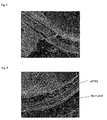
- the periosteum covering the surface of the skull was completely removed, and the cranial bone was then removed, so that the cranial dura mater was exposed.
- tissue adhesive fibrin glue; Bolheal (product name); Chemo-Sero-Therapeutic Research Institute (Kaketsuken)
- a tissue adhesive was dropped on the ion beam-irradiated face and then excess solution was removed.
- the remaining tissue adhesive was allowed to fix with the remaining cranial bone.
- a non-irradiated sample was also subjected to the same above operations. After dropping fibrin glue, the scalp was anastomosed with the skull, and the affected area was then covered.
- the rabbit was sacrificed with Nembutal. Thereafter, the affected area was removed together with the peripheral tissues thereof in the form of a mass, and it was immobilized with 10% buffer formalin. On the ion beam non-treated face, fibrin glue did not adhere to ePTFE at all. Thus, in order to avoid that the ePTFE was separated from the tissues, the sample was excised together with the peripheral tissues thereof. After the skull was decalcified, the sample placed on the dura mater was embedded in paraffin. The sample was subjected to hematoxylin-eosin staining and Masson trichrome staining, and then observed with a microscope.
- a catheter for applying pressure to the brain was inserted into one hole.
- Another catheter for measuring the brain pressure was inserted into the other hole. The catheter was connected with a syringe pump, and the brain pressure was increased. Thereafter, an artificial dura mater and fibrin glue immobilizing the artificial dura mater were observed, and it was confirmed whether or not these materials were peeled off due to the increased brain pressure.
- FIG. 3 shows the relationship between time and brain pressure.
- the brain pressure was approximately 10 mmHg before applying the pressure. 1.5 minutes after applying the pressure, the brain pressure began to increase. The brain pressure increased slowly at the initial stage, but it increased drastically from 3 minutes after the application of the pressure. The brain pressure reached 70 mmHg.
- the leakage of spinal fluid was not observed from the ion beam-irradiated artificial dura mater that was immobilized with fibrin glue, and thus, it showed good sealing performance.
- the adhesion of the ion beam-irradiated ePTFE with fibrin glue was evaluated in vitro, using a pressure device.
- a sample that was cut into a round form with a diameter of 15 mm was connected with a square sample having a round hole with a diameter of 10 mm such that both non ion irradiated faces or both ion beam irradiated faces were adhere to each other using fibrin glue.
- a fibrinogen solution was applied around pore C, a thrombin solution was added dropwise thereto, and B was placed on it. While mixing the two solutions, B was allowed to closely come into contact with C.
- the contacted portion corresponds to the overlapped portion between the circle with a diameter of 15 mm and the circle with a diameter of 10 mm, which was fixed with fibrin glue.
- ePTFE (B + C) fixed with fibrin glue was immobilized on the upper portion of an acryl cylinder (D). 30 minutes later, the fixed portion B + C was placed on the cylinder D, which was filled with water stained with ink. An acryl plate A having a hole with an inner diameter of 17 mm was further placed thereon, and the pressure was applied thereto, so that the device was immobilized.
- Figure 5 shows the relationship among a leakage critical pressure, ion species, and a dose of radiation in a pressure test.
- the withstanding pressure significantly increased.
- the critical pressure increased to 100 mmHg, when a sample irradiated with an Ar + ion beam at a dose of 1 x 10 14 ions/cm 2 was used.
- it showed favorable adhesive properties.
- the present invention enables the improvement of the affinity of a material that is embedded in a living body, such as an artificial blood vessel or an artificial dura mater, with a tissue adhesive.
- a material that is embedded in a living body such as an artificial blood vessel or an artificial dura mater
Landscapes
- Health & Medical Sciences (AREA)
- Chemical & Material Sciences (AREA)
- Animal Behavior & Ethology (AREA)
- Veterinary Medicine (AREA)
- Public Health (AREA)
- General Health & Medical Sciences (AREA)
- Epidemiology (AREA)
- Life Sciences & Earth Sciences (AREA)
- Oral & Maxillofacial Surgery (AREA)
- Transplantation (AREA)
- Medicinal Chemistry (AREA)
- Dermatology (AREA)
- Surgery (AREA)
- Engineering & Computer Science (AREA)
- Materials Engineering (AREA)
- Vascular Medicine (AREA)
- Chemical Kinetics & Catalysis (AREA)
- Materials For Medical Uses (AREA)
- Treatments Of Macromolecular Shaped Articles (AREA)
Abstract
Description
Claims (7)
- A polymeric material used in combination with a tissue adhesive, which comprises carbon or silicon as a constitutional element, and at least a portion of the surface of which is modified by ion bombardment.
- The polymeric material according to claim 1 wherein thhe tissue adhesive is fibrin glue.
- The polymeric material according to claim 1 or 2 wherein the polymeric material comprising carbon or silicon as a constitutional element is expanded polytetra-fluoroethylene (ePTFE), polylactic acid, or polyglactin.
- The polymeric material according to any of claims 1 to 3 wherein the modification by ion bombardment is carried out by irradiation with ions at a dose (ϕ) of 1 x 10¹² ≤ ϕ ≤ 1 x 10¹⁶ ions/cm2.
- The polymeric material according to any of claims 1 to 4 which is used for an artificial dura mater, an artificial blood vessel, a patch used for the heart or blood vessel, or a surgical suture.
- A method for producing the polymeric material of any of claims 1 to 5, which is characterized in that at least a portion of the surface of the polymeric material comprising carbon or silicon as a constitutional element is irradiated with ions at a dose (ϕ) of 1 x 10¹² ≤ ϕ ≤ 1 x 10¹⁶ ions/cm2.
- A method for improving the affinity of a polymeric material comprising carbon or silicon as a constitutional element with a tissue adhesive, which is characterized in that at least a portion of the surface of the polymeric material is irradiated with ions at a dose (ϕ) of 1 x 10¹² ≤ ϕ ≤ 1 x 10¹⁶ ions/cm2.
Applications Claiming Priority (3)
| Application Number | Priority Date | Filing Date | Title |
|---|---|---|---|
| JP2002253322A JP4445697B2 (en) | 2002-08-30 | 2002-08-30 | Biological repair material having affinity with biological tissue adhesive |
| JP2002253322 | 2002-08-30 | ||
| PCT/JP2003/011048 WO2004026355A1 (en) | 2002-08-30 | 2003-08-29 | Biological repair material compatible with biological tissue adhesive |
Publications (3)
| Publication Number | Publication Date |
|---|---|
| EP1535632A1 true EP1535632A1 (en) | 2005-06-01 |
| EP1535632A4 EP1535632A4 (en) | 2008-09-17 |
| EP1535632B1 EP1535632B1 (en) | 2011-08-03 |
Family
ID=32024502
Family Applications (1)
| Application Number | Title | Priority Date | Filing Date |
|---|---|---|---|
| EP20030797534 Expired - Lifetime EP1535632B1 (en) | 2002-08-30 | 2003-08-29 | Biological repair material compatible with biological tissue adhesive |
Country Status (5)
| Country | Link |
|---|---|
| US (1) | US7722934B2 (en) |
| EP (1) | EP1535632B1 (en) |
| JP (1) | JP4445697B2 (en) |
| AT (1) | ATE518550T1 (en) |
| WO (1) | WO2004026355A1 (en) |
Cited By (1)
| Publication number | Priority date | Publication date | Assignee | Title |
|---|---|---|---|---|
| CN102634978A (en) * | 2011-02-11 | 2012-08-15 | 傅亚 | Preparation method of fibrin glue reinforced polylactic acid fiber |
Families Citing this family (13)
| Publication number | Priority date | Publication date | Assignee | Title |
|---|---|---|---|---|
| JP2005034256A (en) * | 2003-07-17 | 2005-02-10 | Institute Of Physical & Chemical Research | Blood vessel wall repair material |
| JP2007020590A (en) * | 2003-08-19 | 2007-02-01 | Institute Of Physical & Chemical Research | Aneurysm treatment material |
| JP2006230639A (en) | 2005-02-24 | 2006-09-07 | Institute Of Physical & Chemical Research | Catheters with modified living body contact parts |
| JP2006263144A (en) * | 2005-03-24 | 2006-10-05 | Mcrotech Kk | Soft biotissue substitute grafting material and its production method |
| US9526503B2 (en) * | 2013-08-12 | 2016-12-27 | W. L. Gore & Associates, Inc. | Lumbar ostia occlusion devices and methods of deploying the same |
| CN103933609B (en) * | 2014-02-28 | 2016-06-08 | 武汉杨森生物技术有限公司 | One-time formed polyurethane artificial blood vessel and preparation method thereof |
| JP7074354B2 (en) * | 2017-04-17 | 2022-05-24 | 慶應義塾 | Medical tube connection device |
| JP6263305B1 (en) * | 2017-08-01 | 2018-01-17 | 株式会社多磨バイオ | Medical sheet |
| JP6426812B1 (en) | 2017-08-01 | 2018-11-21 | 株式会社多磨バイオ | Medical seat |
| JP6316496B1 (en) * | 2017-11-24 | 2018-04-25 | 株式会社多磨バイオ | Artificial pericardium sheet |
| US12599698B2 (en) | 2021-10-28 | 2026-04-14 | Kismet Technologies Inc. | Therapeutic article of manufacture with nanoparticles to promote wound healing and/or antimicrobial infection control |
| JP7607854B1 (en) | 2023-12-26 | 2025-01-06 | 株式会社多磨バイオ | Nerve injury repair sheet, brain injury repair sheet, and spinal cord injury repair sheet |
| CN120732579B (en) * | 2025-08-29 | 2025-11-11 | 山东第一医科大学第一附属医院(山东省千佛山医院) | A bio-adhesive patch for non-invasive repair of the dura mater |
Family Cites Families (11)
| Publication number | Priority date | Publication date | Assignee | Title |
|---|---|---|---|---|
| JP2930329B2 (en) | 1989-09-28 | 1999-08-03 | ソニー株式会社 | Antithrombotic material |
| JPH0549689A (en) | 1991-08-20 | 1993-03-02 | Sony Corp | Cell adhesive material and method for producing the same |
| JPH05208042A (en) * | 1992-01-30 | 1993-08-20 | Ajinomoto Co Inc | Adhesive agent |
| JPH07500A (en) | 1993-06-21 | 1995-01-06 | Sumitomo Electric Ind Ltd | Bioimplant material and method of manufacturing the same |
| US6051751A (en) * | 1995-01-20 | 2000-04-18 | Spire Corporation | Arthroplasty process for securely anchoring prostheses to bone, and arthroplasty products therefor |
| JP3536051B2 (en) | 1996-05-17 | 2004-06-07 | 独立行政法人理化学研究所 | Antithrombotic material and method for producing the same |
| US5891192A (en) * | 1997-05-22 | 1999-04-06 | The Regents Of The University Of California | Ion-implanted protein-coated intralumenal implants |
| EP1032367B1 (en) * | 1997-11-17 | 2009-08-12 | Haemacure Corporation | Fibrin sealants or adhesives comprising a hyaluronic acid derivative material |
| JP2000129015A (en) | 1998-10-23 | 2000-05-09 | Nitto Denko Corp | Surface modification method for fluororesin molding |
| EP1267795A1 (en) * | 2000-03-30 | 2003-01-02 | Brennen Medical Inc. | Anti-microbial and immunostimulating composition |
| JP5505752B2 (en) * | 2001-04-23 | 2014-05-28 | 独立行政法人理化学研究所 | Artificial dura mater having cell adhesion and method for producing the same |
-
2002
- 2002-08-30 JP JP2002253322A patent/JP4445697B2/en not_active Expired - Lifetime
-
2003
- 2003-08-29 EP EP20030797534 patent/EP1535632B1/en not_active Expired - Lifetime
- 2003-08-29 US US10/525,724 patent/US7722934B2/en not_active Expired - Fee Related
- 2003-08-29 WO PCT/JP2003/011048 patent/WO2004026355A1/en not_active Ceased
- 2003-08-29 AT AT03797534T patent/ATE518550T1/en not_active IP Right Cessation
Cited By (1)
| Publication number | Priority date | Publication date | Assignee | Title |
|---|---|---|---|---|
| CN102634978A (en) * | 2011-02-11 | 2012-08-15 | 傅亚 | Preparation method of fibrin glue reinforced polylactic acid fiber |
Also Published As
| Publication number | Publication date |
|---|---|
| JP4445697B2 (en) | 2010-04-07 |
| ATE518550T1 (en) | 2011-08-15 |
| US20060155041A1 (en) | 2006-07-13 |
| JP2004089361A (en) | 2004-03-25 |
| EP1535632B1 (en) | 2011-08-03 |
| EP1535632A4 (en) | 2008-09-17 |
| WO2004026355A1 (en) | 2004-04-01 |
| US7722934B2 (en) | 2010-05-25 |
Similar Documents
| Publication | Publication Date | Title |
|---|---|---|
| US7722934B2 (en) | Biological repair material compatible with biological tissue adhesive | |
| US8834864B2 (en) | Methods for repairing and regenerating human dura mater | |
| EP1484070B1 (en) | Compositions for repairing and regenerating human dura mater | |
| US5607590A (en) | Material for medical use and process for preparing same | |
| ES2700677T3 (en) | Compositions for bone implant that can initially be deformed plastically | |
| US6214045B1 (en) | Bioabsorbable breast implant | |
| US6310036B1 (en) | High strength, Bio-compatible tissue adhesive and methods for treating vigorously bleeding surfaces | |
| EP3940129B1 (en) | Sealed fabric for use as a medical material | |
| EP0701801B1 (en) | Method for making an intraluminal stent | |
| US6398814B1 (en) | Bioabsorbable two-dimensional multi-layer composite device and a method of manufacturing same | |
| JP2017524405A (en) | Method and apparatus for reinforcing staple lines | |
| WO1996023533A1 (en) | Medical material and process for producing the same | |
| JP3726280B2 (en) | Medical collagen membrane | |
| EP1252902B1 (en) | Artificial dura mater having cell adhesiveness and a process for producing the same | |
| US9474825B2 (en) | Methods for sealing fluid leaks in lung tissue | |
| CN112107736A (en) | Absorbable endocranium and preparation method thereof | |
| JP3410195B2 (en) | Composite material of bioabsorbable plastic and collagen | |
| CN206587207U (en) | Compound hard brain or spinal meninges implant | |
| Staindl | Treatment of hemangiomas of the face with magnesium seeds | |
| WO2000040277A1 (en) | Tissue adhesive for treating vigorously bleeding surfaces | |
| WO1986002560A1 (en) | Mechanically desintegratable bone cement | |
| RU2194516C2 (en) | Method for performing cranioplastic repair of cranium vault bone defects | |
| Géza | Polymers of Natural Origin as Biomaterials. 1. Fibrin | |
| Mehdizadeh | Syntheses, Characterization, And Applications Of Injectable Citrate-based Mussel-inspired Biodegradable Adhesive (iCMBA) Polymers And Hydrogels | |
| Suda et al. | Pneumocephalus Caused by Fistulas of the Mastoid Air Cells Treated with a Temporoparietal Fascial Flap |
Legal Events
| Date | Code | Title | Description |
|---|---|---|---|
| PUAI | Public reference made under article 153(3) epc to a published international application that has entered the european phase |
Free format text: ORIGINAL CODE: 0009012 |
|
| 17P | Request for examination filed |
Effective date: 20050302 |
|
| AK | Designated contracting states |
Kind code of ref document: A1 Designated state(s): AT BE BG CH CY CZ DE DK EE ES FI FR GB GR HU IE IT LI LU MC NL PT RO SE SI SK TR |
|
| A4 | Supplementary search report drawn up and despatched |
Effective date: 20080821 |
|
| 17Q | First examination report despatched |
Effective date: 20090610 |
|
| GRAP | Despatch of communication of intention to grant a patent |
Free format text: ORIGINAL CODE: EPIDOSNIGR1 |
|
| GRAS | Grant fee paid |
Free format text: ORIGINAL CODE: EPIDOSNIGR3 |
|
| GRAA | (expected) grant |
Free format text: ORIGINAL CODE: 0009210 |
|
| AK | Designated contracting states |
Kind code of ref document: B1 Designated state(s): AT BE BG CH CY CZ DE DK EE ES FI FR GB GR HU IE IT LI LU MC NL PT RO SE SI SK TR |
|
| REG | Reference to a national code |
Ref country code: GB Ref legal event code: FG4D |
|
| REG | Reference to a national code |
Ref country code: CH Ref legal event code: EP |
|
| REG | Reference to a national code |
Ref country code: IE Ref legal event code: FG4D |
|
| REG | Reference to a national code |
Ref country code: DE Ref legal event code: R096 Ref document number: 60337935 Country of ref document: DE Effective date: 20110929 |
|
| REG | Reference to a national code |
Ref country code: NL Ref legal event code: VDEP Effective date: 20110803 |
|
| PG25 | Lapsed in a contracting state [announced via postgrant information from national office to epo] |
Ref country code: PT Free format text: LAPSE BECAUSE OF FAILURE TO SUBMIT A TRANSLATION OF THE DESCRIPTION OR TO PAY THE FEE WITHIN THE PRESCRIBED TIME-LIMIT Effective date: 20111205 Ref country code: FI Free format text: LAPSE BECAUSE OF FAILURE TO SUBMIT A TRANSLATION OF THE DESCRIPTION OR TO PAY THE FEE WITHIN THE PRESCRIBED TIME-LIMIT Effective date: 20110803 Ref country code: SE Free format text: LAPSE BECAUSE OF FAILURE TO SUBMIT A TRANSLATION OF THE DESCRIPTION OR TO PAY THE FEE WITHIN THE PRESCRIBED TIME-LIMIT Effective date: 20110803 Ref country code: NL Free format text: LAPSE BECAUSE OF FAILURE TO SUBMIT A TRANSLATION OF THE DESCRIPTION OR TO PAY THE FEE WITHIN THE PRESCRIBED TIME-LIMIT Effective date: 20110803 |
|
| REG | Reference to a national code |
Ref country code: AT Ref legal event code: MK05 Ref document number: 518550 Country of ref document: AT Kind code of ref document: T Effective date: 20110803 |
|
| PG25 | Lapsed in a contracting state [announced via postgrant information from national office to epo] |
Ref country code: GR Free format text: LAPSE BECAUSE OF FAILURE TO SUBMIT A TRANSLATION OF THE DESCRIPTION OR TO PAY THE FEE WITHIN THE PRESCRIBED TIME-LIMIT Effective date: 20111104 Ref country code: SI Free format text: LAPSE BECAUSE OF FAILURE TO SUBMIT A TRANSLATION OF THE DESCRIPTION OR TO PAY THE FEE WITHIN THE PRESCRIBED TIME-LIMIT Effective date: 20110803 Ref country code: CY Free format text: LAPSE BECAUSE OF FAILURE TO SUBMIT A TRANSLATION OF THE DESCRIPTION OR TO PAY THE FEE WITHIN THE PRESCRIBED TIME-LIMIT Effective date: 20110803 Ref country code: AT Free format text: LAPSE BECAUSE OF FAILURE TO SUBMIT A TRANSLATION OF THE DESCRIPTION OR TO PAY THE FEE WITHIN THE PRESCRIBED TIME-LIMIT Effective date: 20110803 |
|
| PG25 | Lapsed in a contracting state [announced via postgrant information from national office to epo] |
Ref country code: BE Free format text: LAPSE BECAUSE OF FAILURE TO SUBMIT A TRANSLATION OF THE DESCRIPTION OR TO PAY THE FEE WITHIN THE PRESCRIBED TIME-LIMIT Effective date: 20110803 Ref country code: MC Free format text: LAPSE BECAUSE OF NON-PAYMENT OF DUE FEES Effective date: 20110831 |
|
| REG | Reference to a national code |
Ref country code: CH Ref legal event code: PL |
|
| PG25 | Lapsed in a contracting state [announced via postgrant information from national office to epo] |
Ref country code: LI Free format text: LAPSE BECAUSE OF NON-PAYMENT OF DUE FEES Effective date: 20110831 Ref country code: CH Free format text: LAPSE BECAUSE OF NON-PAYMENT OF DUE FEES Effective date: 20110831 Ref country code: SK Free format text: LAPSE BECAUSE OF FAILURE TO SUBMIT A TRANSLATION OF THE DESCRIPTION OR TO PAY THE FEE WITHIN THE PRESCRIBED TIME-LIMIT Effective date: 20110803 Ref country code: CZ Free format text: LAPSE BECAUSE OF FAILURE TO SUBMIT A TRANSLATION OF THE DESCRIPTION OR TO PAY THE FEE WITHIN THE PRESCRIBED TIME-LIMIT Effective date: 20110803 |
|
| REG | Reference to a national code |
Ref country code: IE Ref legal event code: MM4A |
|
| PG25 | Lapsed in a contracting state [announced via postgrant information from national office to epo] |
Ref country code: EE Free format text: LAPSE BECAUSE OF FAILURE TO SUBMIT A TRANSLATION OF THE DESCRIPTION OR TO PAY THE FEE WITHIN THE PRESCRIBED TIME-LIMIT Effective date: 20110803 Ref country code: RO Free format text: LAPSE BECAUSE OF FAILURE TO SUBMIT A TRANSLATION OF THE DESCRIPTION OR TO PAY THE FEE WITHIN THE PRESCRIBED TIME-LIMIT Effective date: 20110803 |
|
| PLBE | No opposition filed within time limit |
Free format text: ORIGINAL CODE: 0009261 |
|
| STAA | Information on the status of an ep patent application or granted ep patent |
Free format text: STATUS: NO OPPOSITION FILED WITHIN TIME LIMIT |
|
| PG25 | Lapsed in a contracting state [announced via postgrant information from national office to epo] |
Ref country code: DK Free format text: LAPSE BECAUSE OF FAILURE TO SUBMIT A TRANSLATION OF THE DESCRIPTION OR TO PAY THE FEE WITHIN THE PRESCRIBED TIME-LIMIT Effective date: 20110803 |
|
| 26N | No opposition filed |
Effective date: 20120504 |
|
| PG25 | Lapsed in a contracting state [announced via postgrant information from national office to epo] |
Ref country code: IE Free format text: LAPSE BECAUSE OF NON-PAYMENT OF DUE FEES Effective date: 20110829 |
|
| REG | Reference to a national code |
Ref country code: DE Ref legal event code: R097 Ref document number: 60337935 Country of ref document: DE Effective date: 20120504 |
|
| PG25 | Lapsed in a contracting state [announced via postgrant information from national office to epo] |
Ref country code: ES Free format text: LAPSE BECAUSE OF FAILURE TO SUBMIT A TRANSLATION OF THE DESCRIPTION OR TO PAY THE FEE WITHIN THE PRESCRIBED TIME-LIMIT Effective date: 20111114 |
|
| PG25 | Lapsed in a contracting state [announced via postgrant information from national office to epo] |
Ref country code: LU Free format text: LAPSE BECAUSE OF NON-PAYMENT OF DUE FEES Effective date: 20110829 |
|
| PG25 | Lapsed in a contracting state [announced via postgrant information from national office to epo] |
Ref country code: BG Free format text: LAPSE BECAUSE OF FAILURE TO SUBMIT A TRANSLATION OF THE DESCRIPTION OR TO PAY THE FEE WITHIN THE PRESCRIBED TIME-LIMIT Effective date: 20111103 |
|
| PG25 | Lapsed in a contracting state [announced via postgrant information from national office to epo] |
Ref country code: TR Free format text: LAPSE BECAUSE OF FAILURE TO SUBMIT A TRANSLATION OF THE DESCRIPTION OR TO PAY THE FEE WITHIN THE PRESCRIBED TIME-LIMIT Effective date: 20110803 |
|
| PG25 | Lapsed in a contracting state [announced via postgrant information from national office to epo] |
Ref country code: HU Free format text: LAPSE BECAUSE OF FAILURE TO SUBMIT A TRANSLATION OF THE DESCRIPTION OR TO PAY THE FEE WITHIN THE PRESCRIBED TIME-LIMIT Effective date: 20110803 |
|
| REG | Reference to a national code |
Ref country code: DE Ref legal event code: R082 Ref document number: 60337935 Country of ref document: DE Representative=s name: GODEMEYER BLUM LENZE PATENTANWAELTE, PARTNERSC, DE Ref country code: DE Ref legal event code: R082 Ref document number: 60337935 Country of ref document: DE Representative=s name: GODEMEYER BLUM LENZE PARTNERSCHAFT, PATENTANWA, DE |
|
| REG | Reference to a national code |
Ref country code: FR Ref legal event code: PLFP Year of fee payment: 13 |
|
| REG | Reference to a national code |
Ref country code: FR Ref legal event code: PLFP Year of fee payment: 14 |
|
| REG | Reference to a national code |
Ref country code: FR Ref legal event code: PLFP Year of fee payment: 15 |
|
| REG | Reference to a national code |
Ref country code: FR Ref legal event code: PLFP Year of fee payment: 16 |
|
| PGFP | Annual fee paid to national office [announced via postgrant information from national office to epo] |
Ref country code: DE Payment date: 20190822 Year of fee payment: 17 Ref country code: IT Payment date: 20190829 Year of fee payment: 17 Ref country code: FR Payment date: 20190822 Year of fee payment: 17 |
|
| PGFP | Annual fee paid to national office [announced via postgrant information from national office to epo] |
Ref country code: GB Payment date: 20190821 Year of fee payment: 17 |
|
| REG | Reference to a national code |
Ref country code: DE Ref legal event code: R119 Ref document number: 60337935 Country of ref document: DE |
|
| GBPC | Gb: european patent ceased through non-payment of renewal fee |
Effective date: 20200829 |
|
| PG25 | Lapsed in a contracting state [announced via postgrant information from national office to epo] |
Ref country code: DE Free format text: LAPSE BECAUSE OF NON-PAYMENT OF DUE FEES Effective date: 20210302 Ref country code: IT Free format text: LAPSE BECAUSE OF NON-PAYMENT OF DUE FEES Effective date: 20200829 Ref country code: FR Free format text: LAPSE BECAUSE OF NON-PAYMENT OF DUE FEES Effective date: 20200831 |
|
| PG25 | Lapsed in a contracting state [announced via postgrant information from national office to epo] |
Ref country code: GB Free format text: LAPSE BECAUSE OF NON-PAYMENT OF DUE FEES Effective date: 20200829 |