EP1533928B1 - Space-time coding/decoding method for frequency selective fading channel - Google Patents
Space-time coding/decoding method for frequency selective fading channel Download PDFInfo
- Publication number
- EP1533928B1 EP1533928B1 EP20030729806 EP03729806A EP1533928B1 EP 1533928 B1 EP1533928 B1 EP 1533928B1 EP 20030729806 EP20030729806 EP 20030729806 EP 03729806 A EP03729806 A EP 03729806A EP 1533928 B1 EP1533928 B1 EP 1533928B1
- Authority
- EP
- European Patent Office
- Prior art keywords
- interference
- decoding
- encoding
- joint detection
- diversity
- Prior art date
- Legal status (The legal status is an assumption and is not a legal conclusion. Google has not performed a legal analysis and makes no representation as to the accuracy of the status listed.)
- Expired - Lifetime
Links
- 238000000034 method Methods 0.000 title claims abstract description 43
- 238000005562 fading Methods 0.000 title claims abstract description 21
- 238000001514 detection method Methods 0.000 claims abstract description 37
- 238000012545 processing Methods 0.000 claims abstract description 23
- 239000013598 vector Substances 0.000 claims abstract description 9
- 239000011159 matrix material Substances 0.000 claims description 23
- 230000000694 effects Effects 0.000 claims description 7
- 230000005540 biological transmission Effects 0.000 claims description 5
- 230000008054 signal transmission Effects 0.000 claims description 4
- NAWXUBYGYWOOIX-SFHVURJKSA-N (2s)-2-[[4-[2-(2,4-diaminoquinazolin-6-yl)ethyl]benzoyl]amino]-4-methylidenepentanedioic acid Chemical compound C1=CC2=NC(N)=NC(N)=C2C=C1CCC1=CC=C(C(=O)N[C@@H](CC(=C)C(O)=O)C(O)=O)C=C1 NAWXUBYGYWOOIX-SFHVURJKSA-N 0.000 description 26
- 238000004364 calculation method Methods 0.000 description 12
- 238000004891 communication Methods 0.000 description 4
- 238000005516 engineering process Methods 0.000 description 3
- 238000003672 processing method Methods 0.000 description 3
- 238000013461 design Methods 0.000 description 2
- 238000011161 development Methods 0.000 description 1
- 238000010586 diagram Methods 0.000 description 1
- 238000010295 mobile communication Methods 0.000 description 1
- 230000001629 suppression Effects 0.000 description 1
Images

Classifications
-
- H—ELECTRICITY
- H04—ELECTRIC COMMUNICATION TECHNIQUE
- H04L—TRANSMISSION OF DIGITAL INFORMATION, e.g. TELEGRAPHIC COMMUNICATION
- H04L1/00—Arrangements for detecting or preventing errors in the information received
- H04L1/02—Arrangements for detecting or preventing errors in the information received by diversity reception
- H04L1/06—Arrangements for detecting or preventing errors in the information received by diversity reception using space diversity
- H04L1/0618—Space-time coding
-
- H—ELECTRICITY
- H04—ELECTRIC COMMUNICATION TECHNIQUE
- H04B—TRANSMISSION
- H04B1/00—Details of transmission systems, not covered by a single one of groups H04B3/00 - H04B13/00; Details of transmission systems not characterised by the medium used for transmission
- H04B1/69—Spread spectrum techniques
- H04B1/707—Spread spectrum techniques using direct sequence modulation
- H04B1/7097—Interference-related aspects
- H04B1/7103—Interference-related aspects the interference being multiple access interference
- H04B1/7105—Joint detection techniques, e.g. linear detectors
-
- H—ELECTRICITY
- H04—ELECTRIC COMMUNICATION TECHNIQUE
- H04B—TRANSMISSION
- H04B2201/00—Indexing scheme relating to details of transmission systems not covered by a single group of H04B3/00 - H04B13/00
- H04B2201/69—Orthogonal indexing scheme relating to spread spectrum techniques in general
- H04B2201/707—Orthogonal indexing scheme relating to spread spectrum techniques in general relating to direct sequence modulation
- H04B2201/70707—Efficiency-related aspects
Definitions
- the invention relates to mobile communication technology, more particularly to a method of space-time encoding and decoding for a frequency selective fading channel.
- Space-time encoding is one of the important methods that can raise performance of a wireless communication system effectively.
- There are two branches of the space-time encoding one is layered space-time encoding and the other is space-time encoding based on transmitting diversity.
- the space-time encoding based on transmitting diversity can be further divided into two kinds: space-time block encoding and space-time trellis encoding.
- the prior space-time encoding and decoding schemes are designed based on a flat fading channel.
- the schemes are used for a frequency selective fading channel, the performance becomes worse obviously, and it is too complex to implement when improving performance of the algorithm.
- ISI Inter-Symbol Interference
- MAI Multiple Access Interference
- 3GPP-TDD Time Division Duplex
- 3GPP-FDD Frequency Division Duplex
- the space-time transmission diversity (STTD) scheme is discarded in 3GPP-TDD v4.3 and space code transmission diversity (SCTD) scheme is applied.
- SCTD space code transmission diversity
- ST-OFDM space-time - orthogonal frequency division multiplexing
- the space-time encoding and decoding method is important to improve performance of a wireless communication system.
- a symbol or a string of symbols are used as a processing unit for encoding and decoding, but under the condition of a frequency selective fading channel, improvement of performance is limited by the calculation complexity.
- EP-A-1 069 707 discloses a space time transmit diversity scheme using two antenna in which a data block of symbols (D22) is transmitted simultaneously with a complex conjugate of another block (D21*) With suitable receiver processing, the symbols can be recovered with only a small complexity increase.
- An object of the invention is to design a space-time encoding and decoding method that is suitable to the frequency selective fading channel to obtain better performance with small amount of calculation complexity.
- a space-time encoding and decoding method for a frequency selective fading channel comprises:
- Two diversity signals in step A may be transmitted through two diversity beams of one smart antenna respectively and simultaneously.
- the method may further comprise the step of predefining number of iteration times to determine execution times from step C to step D and from step D to step C again.
- the method of the invention is a new space-time encoding and decoding method that is suitable to a frequency selective fading channel.
- the method takes an independent data field as a processing unit, and the decoding applies an iteration method based on joint detection and interference counteraction.
- joint detection only effect to diversity signal from multipath interference and multi-user interference is taken into account, and then interference counteraction is implemented based on the joint detection result to remove interference between diversity signals.
- the invention provides a simple and effective solution for space-time encoding and decoding on a frequency selective fading channel.
- the ISI exists between neighbor symbols. Therefore, in a general space-time encoding method, there is not only interference between diversity signals, but also interference between neighbor encoding units and interference between neighbor encoding blocks. If the interference were neglected, the communication performance would be worse; and if the interference were considered, the calculation complexity would be increased greatly.
- An independent data block is taken as the processing unit in the encoding and decoding method according to the present invention, so the interference between neighbor encoding units and neighbor encoding blocks does not exist, which simplifies the signal detection and decoding processing.
- This processing method is similar or compatible to the processing methods in which space-time encoding processing is not employed to a great extent. Many processing schemes for counteracting ISI and MAI can be used in the space-time encoding situation with small amount of change.
- FIG. 1 shows data structure of a time-slot CDMA burst data in the 3GPP-TDD system. It can be seen from Fig.1 that in parallel K burst data of a multi-user or multichannel, each time-slot includes two data fields (or referred as data blocks): DATA FIELD 1 and DATA FIELD 2, and there is a midamble between these two data fields. So these two data fields are independent and there is no mutual interference between them.
- the end of a time slot is a guard period (GP). Every data field has N symbols, and every symbol is consisted of Q chips.
- GP guard period
- an independent data field is used as a processing unit for encoding, and at the receiving end the decoding also takes a data field as a processing unit. It is simple when this method is used in double diversity (theoretically it can be used in the multiple diversity, but the complexity is increased and therefore it is not practicable). Therefore, the encoding and decoding method according to the present invention can be employed with small amount of change for the signal structure and processing method. Furthermore, since the two data fields are independent, and there is no interference between them, the detection and decoding method can be simplified and improved, and better detection performance can be obtained with a small amount of calculation volume or a small quantity of iterative times.
- Figure 2 shows a space-time encoder 20 taking a data field as a processing unit.
- the data which has been encoded by the encoder 20 is [d T (1)d T (2)] T and [- d *T (2) d *T (1)] T , wherein * represents conjugate.
- the two generated data vectors can be transmitted simultaneously by two different conventional diversity antennas: diversity antenna 1 and diversity antenna 2, or by two different diversity beams of one smart antenna: smart antenna diversity beam 1 and smart antenna diversity beam 2.
- the diversity antenna 1 (or diversity beam 1) transmits data vector [ d T (1) d T (2)] T
- the diversity antenna 2 (or diversity beam2) transmits data vector [- d *T (2) d *T (1)] T simultaneously, thereby the space-time encoding is realized.
- the input data [ d T (1) d T (2)] T is encoded by conventional space-time diversity orthogonal encoding method, and two output data vectors: [ d T (1) d T (2)] T and [- d * T (2) d *T (1)] T are obtained and transmitted via two diversity antennas simultaneously and respectively.
- the detection and decoding method for space-time encoding mode which takes a data field as a processing unit will be described, i.e. the detection and decoding scheme corresponding to the designed data field encoding scheme will be described.
- the original detection and decoding method it is called the original detection and decoding method.
- r 1 and r 2 represent the sample values of two data fields received at the terminal, and there is no interference between r 1 and r 2 even on a frequency selective fading channel.
- n i is the noise vector of the ith data field
- a i is the system matrix of the signal transmission between the ith transmitting antenna and receiving antenna, and the system matrix is determined by the channel pulse response and the user transmission waveform.
- a * T ⁇ A A 1 * T ⁇ A 1 + A 2 * T ⁇ A 2 * A 1 * T ⁇ A 2 T - A 1 * T ⁇ A 2 A 1 * T ⁇ A 2 T - A 1 * T ⁇ A 2 * T A 1 * T ⁇ A 1 + A 2 * T ⁇ A 2 * *
- the matrix A is not an orthogonal matrix under the condition of frequency selective fading channel, so the performance will become worse if a match filter is applied.
- the optimized linear joint detection scheme is provided.
- ( B ) -1 has the function of interference suppression (implement inverse operation for B); A * T r is the result of orthogonal match.
- the formula (7) shows three solutions among which MF represents matched filter scheme, ZF-BLE represents zero-forcing block equalization scheme and MMSE-BLE represents the minimum mean-square-error block equalization scheme.
- the invention provides a simplified decoding procedure having a characteristic of a small amount of calculation volume.
- the simplified algorithm is an iterative algorithm. It is divided into two steps. In the first step, only multi-path interference and multi-user interference to every diversity signal is taken into account, and the upper right block of the formula (5) and the lower left block of the formula (5) are set to null, then the equation (6) is calculated. In the second step, interference is counteracted with the result of the first step to remove interference between diversity signals. The procedure can be done by multiple iterations.
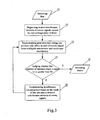
- FIG. 3 is a flowchart of the simplified decoding procedure of the invention.
- Step 31 the terminal receives data.
- Step 32 mutual interference between diversity signals caused by their non-orthogonality is neglected, upper right block and lower left block of formula (5) are set to be null (they are null under the condition of a flat fading channel).
- Formula (8) gives the result of simplified joint detection.
- the matrix B S in formula (8) is given by formula (9):
- B S ⁇ I MF A 1 * T ⁇ A 1 + A 2 * T ⁇ A 2 * ZF - BLE A 1 * T ⁇ A 1 + A 2 * T ⁇ A 2 * + ⁇ 2 ⁇ I MMSE - BLE
- ⁇ 2 is the noise power
- I is the identity matrix.
- Calculating matrix B s also has three ways: match filter MF, zero-forcing block equalization ZF-BLE and minimum mean-square-error block equalization MMSE - BLE.
- Step 34 whether the number of iteration times is equal to or greater than the predefined number M is judged.
- M is set at 1 or 2.
- Step 35 when the number of iteration times is equal to or greater than the predefined number M , the calculation result of formula (8) is outputted as the decoding result directly.
- Step 36 when the number of iteration times is less than the predefined number M , the calculation result of formula (8) is used to implement interference counteraction so as to remove interference between diversity signals, that is, an interference counteraction method is used to counteract the remain interference between two diversity signals. This is done as follows:
- a second iteration operation can be done by taking last result d ⁇ (1) and d ⁇ (2) of formula (8) in formula (10) and formula (11).
- the obtained results of r 1 ', r 2 ', r 1 " and r 2 " are substituted to formula (8) again, and then formula (8) is recalculated to obtain a decoding result after the second iteration operation.
- the iteration procedure can be done for M times, and this is the simplified joint detection algorithm.
- the invention proposes a space-time encoding and decoding method that takes independent data field as a processing unit for encoding input, and this is different with the prior method that takes data symbols or a string of symbols as a processing unit.
- a simplified decoding method is designed to obtain a better performance with small amount of calculation complexity.
- the invention provides a simple and effective solution for space-time encoding and decoding on a frequency selective fading channel.
Landscapes
- Engineering & Computer Science (AREA)
- Computer Networks & Wireless Communication (AREA)
- Signal Processing (AREA)
- Radio Transmission System (AREA)
- Mobile Radio Communication Systems (AREA)
Abstract
Description
- The invention relates to mobile communication technology, more particularly to a method of space-time encoding and decoding for a frequency selective fading channel.
- Space-time encoding is one of the important methods that can raise performance of a wireless communication system effectively. There are two branches of the space-time encoding, one is layered space-time encoding and the other is space-time encoding based on transmitting diversity. The space-time encoding based on transmitting diversity can be further divided into two kinds: space-time block encoding and space-time trellis encoding.
- Along with the development of high-speed wireless communication technology, the signal transmission bandwidth and rate is increased continuously, which means that time for transmitting a data symbol is shorter and shorter. Therefore, time delay spread of a wireless transmission channel cannot be neglected, that is, the channel frequency selective fading is getting worse.
- The prior space-time encoding and decoding schemes are designed based on a flat fading channel. When the schemes are used for a frequency selective fading channel, the performance becomes worse obviously, and it is too complex to implement when improving performance of the algorithm.
- In a multi-user frequency selective fading channel, since Inter-Symbol Interference (ISI) and Multiple Access Interference (MAI) exist at the same time, implementation of space-time encoding and decoding has great difficulty. Some effective methods for counteracting ISI and MAI on a frequency selective channel, such as equalization, joint detection method etc., become very complex or even failure if space-time encoding is involved therein.
- In the 3rd Generation Partnership Project - Time Division Duplex (3GPP-TDD) system, the prior space-time encoding and decoding scheme used for a multi-user frequency selective fading channel only performs space-time encoding for the basic common control channel, but in the 3rd Generation Partnership Project - Frequency Division Duplex (3GPP-FDD) system, space-time encoding is employed for most channels. The 3GPP-TDD space-time encoding scheme first takes a symbol as an encoding and decoding unit, later it takes a half of symbols of a data field as an encoding and decoding unit. Since these schemes have many changes that bring more complex compared with the schemes in which space-time encoding is not employed, the space-time transmission diversity (STTD) scheme is discarded in 3GPP-TDD v4.3 and space code transmission diversity (SCTD) scheme is applied. Although the reception processing procedure is simplified with the SCTD, more channel resource is occupied and more channels are employed; it is difficult to be applied to other kinds of channels, and also it is impossible to be applied on the multipath diversity situation.
- There is a space-time encoding and decoding scheme that transforms high-speed data to multiple parallel low-speed data and transmits them on multiple channels, but really this is a space-time - orthogonal frequency division multiplexing (ST-OFDM) method that would thoroughly change the signal structure and system on the physical layer, so it is greatly limited in practical use.
- In summary, the space-time encoding and decoding method is important to improve performance of a wireless communication system. Usually, a symbol or a string of symbols are used as a processing unit for encoding and decoding, but under the condition of a frequency selective fading channel, improvement of performance is limited by the calculation complexity.
-
EP-A-1 069 707 discloses a space time transmit diversity scheme using two antenna in which a data block of symbols (D22) is transmitted simultaneously with a complex conjugate of another block (D21*) With suitable receiver processing, the symbols can be recovered with only a small complexity increase. - "Computationally efficient multiuser detectors" discloses the use of iterative techniques to solve a symmetric system, which can reduce the computational complexity.
- An object of the invention is to design a space-time encoding and decoding method that is suitable to the frequency selective fading channel to obtain better performance with small amount of calculation complexity.
- A space-time encoding and decoding method for a frequency selective fading channel according to the present invention comprises:
- A. an encoder taking two independent data fields of a time slot in input data as a processing unit with space-time orthogonal encoding method, encoding them and generating two data vectors, thereby forming two diversity signals, and transmitting said two diversity signals simultaneously with each through one diversity antenna;
- B. a terminal receiving said two diversity signals, and neglecting mutual interference between said two diversity signals caused by non-orthogonality; step B includes:
- setting the upper right block and the lower left block of matrix


- wherein MF represents a match filter scheme, ZF-BLE represents a zero-forcing block equalization scheme and MMSE - BLE represents a minimum mean-square-error block equalization scheme; wherein 2 is noise power, and I is an identity matrix;
- setting the upper right block and the lower left block of matrix
- C. said terminal performing joint detection only taking into account effect to said two diversity signals from multipath interference and multi-user interference, thereby obtaining a decoding result; said joint detection is calculated based on a simplified joint detection equation:


wherein MF represents a match filter scheme, ZF-BLE represents a zero-forcing block equalization scheme and MMSE - BLE represents a minimum mean-square-error block equalization scheme; wherein σ2 is noise power, and I is an identity matrix; and - D. performing interference counteraction based on result of joint detection to remove interference between two diversity signals, and then returning to step C to implement iteration for decoding processing; the step of performing interference couateraction based on result of joint detection comprises:.
- D1. subtracting effect of a data field d(1) from received data signal based on the following formula,

thereby obtaining r'1 and r'2 ; subtracting effect of another data field d(2) from received data signal based on the following formula:
thereby obtaining r"1 and r"2 ; and - D2. substituting r'1 and r'2 for r1 and r2 in the second equation of said simplified joint detection formula used in step C, and substituting r"1 and r"2 for r1 and r2 in the first equation of said simplified joint detection formula used in step C, calculating said simplified joint detection formula, thereby obtaining iteration results of d̂(1) and d̂(2).
- D1. subtracting effect of a data field d(1) from received data signal based on the following formula,
- Two diversity signals in step A may be transmitted through two diversity beams of one smart antenna respectively and simultaneously.
- The method may further comprise the step of predefining number of iteration times to determine execution times from step C to step D and from step D to step C again.
- The method of the invention is a new space-time encoding and decoding method that is suitable to a frequency selective fading channel. The method takes an independent data field as a processing unit, and the decoding applies an iteration method based on joint detection and interference counteraction. When making joint detection, only effect to diversity signal from multipath interference and multi-user interference is taken into account, and then interference counteraction is implemented based on the joint detection result to remove interference between diversity signals.
- With the space-time encoding and decoding scheme proposed in the invention, good performance can be reached with small amount of computation complexity in a frequency selective fading channel. The invention provides a simple and effective solution for space-time encoding and decoding on a frequency selective fading channel.
-
-
Figure 1 is a schematic diagram illustrating a data structure for time-slot CDMA burst data. -
Figure 2 shows the input and output of a space-time encoder when taking a data field as a processing unit. -
Figure 3 is a flowchart illustrating the simplified decoding procedure of the invention. - The invention will be described in more detail hereinafter with reference to the accompanying drawings.
- In a frequency selective fading channel, the ISI exists between neighbor symbols. Therefore, in a general space-time encoding method, there is not only interference between diversity signals, but also interference between neighbor encoding units and interference between neighbor encoding blocks. If the interference were neglected, the communication performance would be worse; and if the interference were considered, the calculation complexity would be increased greatly.
- An independent data block is taken as the processing unit in the encoding and decoding method according to the present invention, so the interference between neighbor encoding units and neighbor encoding blocks does not exist, which simplifies the signal detection and decoding processing. This processing method is similar or compatible to the processing methods in which space-time encoding processing is not employed to a great extent. Many processing schemes for counteracting ISI and MAI can be used in the space-time encoding situation with small amount of change.
-
Figure 1 shows data structure of a time-slot CDMA burst data in the 3GPP-TDD system. It can be seen fromFig.1 that in parallel K burst data of a multi-user or multichannel, each time-slot includes two data fields (or referred as data blocks):DATA FIELD 1 andDATA FIELD 2, and there is a midamble between these two data fields. So these two data fields are independent and there is no mutual interference between them. The end of a time slot is a guard period (GP). Every data field has N symbols, and every symbol is consisted of Q chips. - In this invention, an independent data field is used as a processing unit for encoding, and at the receiving end the decoding also takes a data field as a processing unit. It is simple when this method is used in double diversity (theoretically it can be used in the multiple diversity, but the complexity is increased and therefore it is not practicable). Therefore, the encoding and decoding method according to the present invention can be employed with small amount of change for the signal structure and processing method. Furthermore, since the two data fields are independent, and there is no interference between them, the detection and decoding method can be simplified and improved, and better detection performance can be obtained with a small amount of calculation volume or a small quantity of iterative times.
-
Figure 2 shows a space-time encoder 20 taking a data field as a processing unit. Input data of the encoder 20, i.e., information data vector d in a time slot, can be represented as d=[d T(1) d T(2)] T ; wherein d(1) and d(2) are two independent data fields, and in a 3GPP-TDD system they can be two data fields in one time slot; T denotes a transpose operation. The data which has been encoded by the encoder 20 is [d T (1)d T (2)] T and [-d *T(2)d *T(1)]T , wherein * represents conjugate. The two generated data vectors can be transmitted simultaneously by two different conventional diversity antennas:diversity antenna 1 anddiversity antenna 2, or by two different diversity beams of one smart antenna: smartantenna diversity beam 1 and smartantenna diversity beam 2. In other words, the diversity antenna 1 (or diversity beam 1) transmits data vector [d T(1)dT (2)]T and the diversity antenna 2 (or diversity beam2) transmits data vector [-d *T(2)d *T(1)]T simultaneously, thereby the space-time encoding is realized. Specially, the input data [d T(1)d T(2)]T is encoded by conventional space-time diversity orthogonal encoding method, and two output data vectors: [d T(1)d T(2)]T and [-d*T(2)d *T(1)]T are obtained and transmitted via two diversity antennas simultaneously and respectively. - In the following, the detection and decoding method for space-time encoding mode which takes a data field as a processing unit will be described, i.e. the detection and decoding scheme corresponding to the designed data field encoding scheme will be described. Here, it is called the original detection and decoding method.
- Data corresponding to a data field can be expressed as the formula (1):

Wherein i is 1, 2; K is the number of terminal users working simultaneously; N is the number of symbols in a user data field. - Suppose r 1 and r 2 represent the sample values of two data fields received at the terminal, and there is no interference between r 1 and r 2 even on a frequency selective fading channel. The r 1 and r 2 can be expressed as the formula (2):

- Wherein n i is the noise vector of the ith data field; A i is the system matrix of the signal transmission between the ith transmitting antenna and receiving antenna, and the system matrix is determined by the channel pulse response and the user transmission waveform. The formula (2) can be rewritten as formula (3):

Wherein r=[r 1 T,r 2 *T]T,d t =[d T(1)d *T(2)]T,n=[n 1 T,n 2 *T]T, and
- From formula (4), it can be obtained that:

The matrix A is not an orthogonal matrix under the condition of frequency selective fading channel, so the performance will become worse if a match filter is applied. In order to obtain better performance, the optimized linear joint detection scheme is provided. The continuously estimated value d̂ t of the receiving data d̂ t is:
- Wherein (B)-1 has the function of interference suppression (implement inverse operation for B); A *T r is the result of orthogonal match. The matrix B is shown in formula (7):

wherein σ2 is the noise power, and I is an identity matrix. The formula (7) shows three solutions among which MF represents matched filter scheme, ZF-BLE represents zero-forcing block equalization scheme and MMSE-BLE represents the minimum mean-square-error block equalization scheme. - The dimension of matrix B is 2NK × 2NK, so the calculation complexity of formula (6) is far greater than that under the situation of no space-time encoding. Therefore, the object of simplifying processing and reducing calculation volume proposed in the invention cannot be realized with the original joint detection algorithm.
- Based on the above-mentioned design, the invention provides a simplified decoding procedure having a characteristic of a small amount of calculation volume.
- The simplified algorithm is an iterative algorithm. It is divided into two steps. In the first step, only multi-path interference and multi-user interference to every diversity signal is taken into account, and the upper right block of the formula (5) and the lower left block of the formula (5) are set to null, then the equation (6) is calculated. In the second step, interference is counteracted with the result of the first step to remove interference between diversity signals. The procedure can be done by multiple iterations.
-
Figure 3 is a flowchart of the simplified decoding procedure of the invention. -
Step 31, the terminal receives data. -
Step 32, mutual interference between diversity signals caused by their non-orthogonality is neglected, upper right block and lower left block of formula (5) are set to be null (they are null under the condition of a flat fading channel). -
Step 33, joint detection is performed, wherein only multipath interference and multi-user interference to every diversity signal is taken account, in this case formula (6) is simplified to formula (8) shown in the following:
- Formula (8) gives the result of simplified joint detection. The matrix BS in formula (8) is given by formula (9):

- Wherein σ2 is the noise power, and I is the identity matrix. Calculating matrix Bs also has three ways: match filter MF, zero-forcing block equalization ZF-BLE and minimum mean-square-error block equalization MMSE - BLE.
- The dimension of matrix BS is NK × NK, so the calculation complexity of formula (8) is far less than that of formula (6) and is similar to that under the situation of no space-time encoding.
-
Step 34, whether the number of iteration times is equal to or greater than the predefined number M is judged. Usually M is set at 1 or 2. -
Step 35, when the number of iteration times is equal to or greater than the predefined number M, the calculation result of formula (8) is outputted as the decoding result directly. -
Step 36, when the number of iteration times is less than the predefined number M, the calculation result of formula (8) is used to implement interference counteraction so as to remove interference between diversity signals, that is, an interference counteraction method is used to counteract the remain interference between two diversity signals. This is done as follows: - Affect of d(1) is subtracted from the received data signal to obtain a 'clean' signal as shown in formula (10):

and affect of d(2) is subtracted from the received signal to obtain another 'clean' signal as shown in formula (11):
- Iteration operation is implemented. In detail, r 1 and r 2 in the second formula of formula (8) are respectively substituted with the result of the formula (10) r 1' and r 2'; r 1 and r 2 in the first formula of formula (8) are respectively substituted with the result of the formula (11) r 1" and r 2"; and then formula (8) is recalculated to obtain a decoding result after one iteration operation.
- A second iteration operation can be done by taking last result d̂(1) and d̂(2) of formula (8) in formula (10) and formula (11). In other words, the obtained results of r 1', r 2', r 1" and r 2" are substituted to formula (8) again, and then formula (8) is recalculated to obtain a decoding result after the second iteration operation.
- The iteration procedure can be done for M times, and this is the simplified joint detection algorithm.
- Experience shows that usually only several iteration times, such as one to two times, are necessary to reach performance of the original joint detection algorithm. Therefore, the simplified joint detection algorithm according to this invention can obtain better performance with small amount of calculation complexity.
- The invention proposes a space-time encoding and decoding method that takes independent data field as a processing unit for encoding input, and this is different with the prior method that takes data symbols or a string of symbols as a processing unit. With the proposed method, a simplified decoding method is designed to obtain a better performance with small amount of calculation complexity.
- The invention provides a simple and effective solution for space-time encoding and decoding on a frequency selective fading channel.
Claims (4)
- A space-time encoding and decoding method for a frequency selective fading channel, comprising:A. an encoder taking two independent data fields of a time slot in input data as a processing unit with space-time orthogonal encoding method, encoding them and generating two data vectors, thereby forming two diversity signals, and transmitting said two diversity signals simultaneously with each through one diversity antenna; characterized in that the method further comprises:B. a terminal receiving said two diversity signals, and neglecting (32) mutual interference between said two diversity signals caused by non-orthogonality; wherein step B comprises:setting the upper right block and the lower left block of matrix
 calculating equation d̂t=(B)-1A*Tr to obtain a simplified equation for joint detection; wherein A 1 and A 2 are system matrixes of signal transmission between first and second transmitting antennas and receiving antennas; A and B are matrixes; d̂t is a value of continuous estimation of a receiving data field; r is a sample value of said receiving data field; T denotes a transpose operation; * denotes conjugate; wherein said matrix B is calculated by one of the following formulas:
 wherein MF represents a match filter scheme, ZF-BLE represents a zero-forcing block equalization scheme and MMSE - BLE represents a minimum mean-square-error block equalization scheme; wherein σ2 is noise power, and I is an identity matrix;C. said terminal performing (33) joint detection only taking into account effect to said two diversity signals from multipath interference and multi-user interference, thereby obtaining (35) a decoding result; wherein said joint detection is calculated
based on a simplified joint detection equation:

wherein MF represents a match filter scheme, ZF-BLE represents a zero-forcing block equalization scheme and MMSE - BLE represents a minimum mean-square-error block equalization scheme; wherein σ 2 is noise power, and I is an identity matrix; andD. performing (36) interference counteraction based on result of joint detection to remove interference between two diversity signals, and then retuming to step C to implement iteration for decoding processing; wherein the step of performing interference counteraction based on result of joint detection comprises:D1. subtracting effect of a data field d(1) from received data signal based on the following formula,
thereby obtaining r'1 and r'2 ; subtracting effect of another data field d(2) from received data signal based on the following formula:
thereby obtaining r"1 and r"2 ; andD2. substituting r'1 and r'2 for r1 and r2 in the second equation of said simplified joint detection formula used in step C, and substituting r'1 and r'2 for r1 and r2 in the first equation of said simplified joint detection formula used in step C, calculating said
simplified joint detection formula, thereby obtaining iteration results of d̂(1) and d̂(2). - The method of claim 1, wherein two diversity signals in step A are transmitted through two diversity beams of one smart antenna respectively and simultaneously.
- The method of claim 1, further comprising the step of predefining number of iteration times to determine execution times from step C to step D and from step D to step C again.
- The method of claim 1, wherein said system matrixes A 1 and A 2 are determined by channel pulse response and user transmission waveform.
Applications Claiming Priority (3)
| Application Number | Priority Date | Filing Date | Title |
|---|---|---|---|
| CNB021214107A CN1170374C (en) | 2002-06-20 | 2002-06-20 | Space-time compilation code method suitable for frequency selective fading channels |
| CN02121410 | 2002-06-20 | ||
| PCT/CN2003/000425 WO2004002036A1 (en) | 2002-06-20 | 2003-06-02 | Space-time coding/decoding method for frequency selective fading channel |
Publications (3)
| Publication Number | Publication Date |
|---|---|
| EP1533928A1 EP1533928A1 (en) | 2005-05-25 |
| EP1533928A4 EP1533928A4 (en) | 2008-06-04 |
| EP1533928B1 true EP1533928B1 (en) | 2011-11-02 |
Family
ID=27811317
Family Applications (1)
| Application Number | Title | Priority Date | Filing Date |
|---|---|---|---|
| EP20030729806 Expired - Lifetime EP1533928B1 (en) | 2002-06-20 | 2003-06-02 | Space-time coding/decoding method for frequency selective fading channel |
Country Status (8)
| Country | Link |
|---|---|
| US (1) | US7606318B2 (en) |
| EP (1) | EP1533928B1 (en) |
| JP (1) | JP4267571B2 (en) |
| KR (1) | KR100630917B1 (en) |
| CN (1) | CN1170374C (en) |
| AT (1) | ATE532282T1 (en) |
| AU (1) | AU2003242195A1 (en) |
| WO (1) | WO2004002036A1 (en) |
Families Citing this family (19)
| Publication number | Priority date | Publication date | Assignee | Title |
|---|---|---|---|---|
| US7203181B2 (en) * | 2002-06-28 | 2007-04-10 | Interdigital Technology Corporation | CDMA system transmission matrix coefficient calculation |
| US7583745B2 (en) * | 2003-12-03 | 2009-09-01 | Nokia Corporation | Exploiting selection diversity in communications systems with non-orthonormal matrix and vector modulation |
| CN100452928C (en) * | 2003-12-25 | 2009-01-14 | 西安电子科技大学 | Coding Method of Hybrid Recursive Trellis Space-Time Codes |
| CN100401646C (en) * | 2004-09-24 | 2008-07-09 | 大唐移动通信设备有限公司 | Multi-cell Joint Detection Method in Slotted Code Division Multiple Access System |
| CN1953343B (en) * | 2005-10-18 | 2010-12-08 | 大唐移动通信设备有限公司 | A method to check soft bit of output generated channel encoder by linear joint detection |
| KR101241881B1 (en) * | 2005-10-26 | 2013-03-11 | 엘지전자 주식회사 | Method for encoding space-time codes in multi-antenna system |
| CN100369403C (en) * | 2006-02-20 | 2008-02-13 | 东南大学 | A Parallel Implementation Method of Iterative Detection, Decoding and Receiving in Wireless Communication System |
| CN100442062C (en) * | 2006-04-18 | 2008-12-10 | 大唐移动通信设备有限公司 | Method for Realizing Iterative Detection in Multiple-Input Multiple-Output System and Multi-antenna Detector |
| CN101123594B (en) * | 2006-08-08 | 2012-07-25 | 上海贝尔阿尔卡特股份有限公司 | System, device and method for MIMO base band processing |
| KR100829560B1 (en) | 2006-08-09 | 2008-05-14 | 삼성전자주식회사 | Method and apparatus for encoding / decoding multi-channel audio signal, Decoding method and apparatus for outputting multi-channel downmixed signal in 2 channels |
| CN101378284B (en) * | 2007-08-29 | 2013-02-27 | 中兴通讯股份有限公司 | Method for implementing control channel transmission diversity and corresponding signal transmission device |
| CN101399803B (en) * | 2007-09-27 | 2011-04-13 | 大唐移动通信设备有限公司 | Multi-user detection method and device for OFDM signal |
| CN101630969B (en) * | 2007-12-21 | 2014-05-14 | 联发科技股份有限公司 | Signal processing device and method |
| CN101494488B (en) * | 2008-01-23 | 2013-06-05 | 电信科学技术研究院 | Method and apparatus for transmitting data through polarization antenna |
| CN103647591B (en) * | 2013-12-27 | 2016-06-08 | 中国电子科技集团公司第五十四研究所 | A kind of multipoint cooperative interference detection method based on SVMs |
| CN105763288B (en) * | 2014-12-16 | 2019-08-30 | 电信科学技术研究院 | Method and device for configuring and determining multi-user coding mode based on coding superposition |
| CN106161291B (en) | 2015-04-07 | 2019-09-17 | 电信科学技术研究院 | A kind of sending method of data, method of reseptance and device |
| JP2018207333A (en) * | 2017-06-06 | 2018-12-27 | 富士通株式会社 | Base station, radio terminal, radio communication system, and communication control method |
| CN115453477B (en) * | 2022-08-03 | 2024-06-25 | 西安电子科技大学 | A method for canceling multipath clutter in external radiation source radar monitoring channel signal |
Family Cites Families (17)
| Publication number | Priority date | Publication date | Assignee | Title |
|---|---|---|---|---|
| US6185258B1 (en) * | 1997-09-16 | 2001-02-06 | At&T Wireless Services Inc. | Transmitter diversity technique for wireless communications |
| US6178196B1 (en) * | 1997-10-06 | 2001-01-23 | At&T Corp. | Combined interference cancellation and maximum likelihood decoding of space-time block codes |
| US7215718B1 (en) * | 1999-04-28 | 2007-05-08 | At&T Corp. | Combined channel coding and space-time block coding in a multi-antenna arrangement |
| US6356605B1 (en) * | 1998-10-07 | 2002-03-12 | Texas Instruments Incorporated | Frame synchronization in space time block coded transmit antenna diversity for WCDMA |
| US6775260B1 (en) * | 1999-02-25 | 2004-08-10 | Texas Instruments Incorporated | Space time transmit diversity for TDD/WCDMA systems |
| EP1133071B1 (en) * | 1999-02-25 | 2014-05-21 | Texas Instruments Incorporated | Space time transmit diversity for tdd/wcdma systems |
| US6898248B1 (en) * | 1999-07-12 | 2005-05-24 | Hughes Electronics Corporation | System employing threaded space-time architecture for transporting symbols and receivers for multi-user detection and decoding of symbols |
| EP1069707A1 (en) * | 1999-07-13 | 2001-01-17 | Motorola, Inc. | Transmit diversity transmitter and receiver for radio communications systems |
| JP2001267982A (en) * | 2000-03-22 | 2001-09-28 | Matsushita Electric Ind Co Ltd | STTD encoding method and diversity transmitter |
| US7272192B2 (en) * | 2000-04-14 | 2007-09-18 | Board Of Trustees Of The Leland Stanford Junior University | Time-reversal block transmit diversity system for channels with intersymbol interference and method |
| EP2262157A3 (en) | 2000-07-05 | 2011-03-23 | Sony Deutschland Gmbh | Pilot pattern design for a STTD scheme in an OFDM system |
| KR100355266B1 (en) * | 2000-09-29 | 2002-10-11 | 한국전자통신연구원 | STTD Decoding Demodulator Applicable To Spread Spectrum Communication |
| EP1195937A1 (en) * | 2000-10-03 | 2002-04-10 | Telefonaktiebolaget Lm Ericsson | Space-time coding with orthogonal transformations |
| US7181244B2 (en) * | 2000-11-16 | 2007-02-20 | Qualcomm, Incorporated | Method and apparatus for using position location to direct narrow beam antennas |
| US6959047B1 (en) * | 2001-04-09 | 2005-10-25 | At&T Corp | Training-based channel estimation for multiple-antennas |
| US7154964B1 (en) * | 2001-04-09 | 2006-12-26 | At&T Corp. | Creating training sequences for space-time diversity arrangements |
| US6865373B2 (en) * | 2001-05-21 | 2005-03-08 | Nortel Networks Limited | Apparatus and method for encoding and decoding data within wireless networks |
-
2002
- 2002-06-20 CN CNB021214107A patent/CN1170374C/en not_active Expired - Lifetime
-
2003
- 2003-06-02 JP JP2004514518A patent/JP4267571B2/en not_active Expired - Lifetime
- 2003-06-02 AT AT03729806T patent/ATE532282T1/en active
- 2003-06-02 EP EP20030729806 patent/EP1533928B1/en not_active Expired - Lifetime
- 2003-06-02 KR KR20047020634A patent/KR100630917B1/en not_active Expired - Lifetime
- 2003-06-02 US US10/518,426 patent/US7606318B2/en not_active Expired - Lifetime
- 2003-06-02 WO PCT/CN2003/000425 patent/WO2004002036A1/en not_active Ceased
- 2003-06-02 AU AU2003242195A patent/AU2003242195A1/en not_active Abandoned
Also Published As
| Publication number | Publication date |
|---|---|
| KR20060055274A (en) | 2006-05-23 |
| AU2003242195A1 (en) | 2004-01-06 |
| US20060072680A1 (en) | 2006-04-06 |
| EP1533928A4 (en) | 2008-06-04 |
| EP1533928A1 (en) | 2005-05-25 |
| WO2004002036A8 (en) | 2005-02-10 |
| AU2003242195A8 (en) | 2004-01-06 |
| KR100630917B1 (en) | 2006-10-02 |
| CN1170374C (en) | 2004-10-06 |
| WO2004002036A1 (en) | 2003-12-31 |
| ATE532282T1 (en) | 2011-11-15 |
| US7606318B2 (en) | 2009-10-20 |
| CN1446005A (en) | 2003-10-01 |
| JP2005530434A (en) | 2005-10-06 |
| JP4267571B2 (en) | 2009-05-27 |
Similar Documents
| Publication | Publication Date | Title |
|---|---|---|
| EP1533928B1 (en) | Space-time coding/decoding method for frequency selective fading channel | |
| EP1779537B1 (en) | Reduced complexity soft value generation for mimo jd-grake receivers | |
| US7796678B2 (en) | Communication system with receivers employing generalized two-stage data estimation | |
| EP1686696B1 (en) | Single user detection | |
| US20080279091A1 (en) | Fourier-transform based linear equalization for MIMO CDMA downlink | |
| US20060182193A1 (en) | Technique for adaptive equalization in band-limited high data rate communication over fading dispersive channels | |
| Bhashyam et al. | Multiuser channel estimation and tracking for long-code CDMA systems | |
| US6466611B1 (en) | Multi-user detection using a finite-impulse-response matrix filter | |
| EP1721475A1 (en) | Constrained optimization based mimo lmmse-sic receiver for cdma downlink | |
| EP2100389B1 (en) | Data equalisation in a communication receiver with transmit and receive diversity | |
| EP1342336B1 (en) | Modified block space time transmit diversity encoder | |
| JP4966190B2 (en) | Method and apparatus for transmitting a signal in a multi-antenna system, signal and method for estimating a corresponding transmission channel | |
| US7486750B1 (en) | Method for obtaining information regarding interference in the receiver of a message transmission system | |
| Lasaulce et al. | A semi-blind channel estimation technique based on second-order blind method for CDMA systems | |
| EP1133071B1 (en) | Space time transmit diversity for tdd/wcdma systems | |
| CN101411088B (en) | receiver | |
| AU2007249091A1 (en) | Data equalisation in a communication receiver with receive diversity | |
| Li et al. | Transmit diversity and linear and decision-feedback equalizations for frequency-selective fading channels | |
| Chan et al. | A reduced-rank MMSE-DFE receiver for space-time coded DS-CDMA systems | |
| EP1560347B1 (en) | Simplified block linear equalizer with block space time transmit diversity | |
| Hjorungnes | Minimum MSE transmitter and receiver FIR MIMO filters for multi-user uplink communications | |
| EP1650892A1 (en) | Modified block space time transmit diversity decoder | |
| Yue et al. | Space-time coded CDMA: blind equalization and multiuser detection | |
| Dcvi et al. | Subband adaptive array for STBC W-CDMA system | |
| Wang et al. | Joint detection for space-time block-coded TD-CDMA systems |
Legal Events
| Date | Code | Title | Description |
|---|---|---|---|
| PUAI | Public reference made under article 153(3) epc to a published international application that has entered the european phase |
Free format text: ORIGINAL CODE: 0009012 |
|
| 17P | Request for examination filed |
Effective date: 20050118 |
|
| AK | Designated contracting states |
Kind code of ref document: A1 Designated state(s): AT BE BG CH CY CZ DE DK EE ES FI FR GB GR HU IE IT LI LU MC NL PT RO SE SI SK TR |
|
| AX | Request for extension of the european patent |
Extension state: AL LT LV MK |
|
| DAX | Request for extension of the european patent (deleted) | ||
| A4 | Supplementary search report drawn up and despatched |
Effective date: 20080506 |
|
| RIC1 | Information provided on ipc code assigned before grant |
Ipc: H04J 13/00 20060101AFI20040113BHEP Ipc: H04B 1/707 20060101ALI20080425BHEP Ipc: H04L 1/06 20060101ALI20080425BHEP |
|
| 17Q | First examination report despatched |
Effective date: 20091009 |
|
| GRAP | Despatch of communication of intention to grant a patent |
Free format text: ORIGINAL CODE: EPIDOSNIGR1 |
|
| RAP1 | Party data changed (applicant data changed or rights of an application transferred) |
Owner name: CHINA ACADEMY OF TELECOMMUNICATIONS TECHNOLOGY |
|
| GRAS | Grant fee paid |
Free format text: ORIGINAL CODE: EPIDOSNIGR3 |
|
| GRAA | (expected) grant |
Free format text: ORIGINAL CODE: 0009210 |
|
| AK | Designated contracting states |
Kind code of ref document: B1 Designated state(s): AT BE BG CH CY CZ DE DK EE ES FI FR GB GR HU IE IT LI LU MC NL PT RO SE SI SK TR |
|
| REG | Reference to a national code |
Ref country code: GB Ref legal event code: FG4D |
|
| REG | Reference to a national code |
Ref country code: CH Ref legal event code: EP |
|
| REG | Reference to a national code |
Ref country code: IE Ref legal event code: FG4D |
|
| REG | Reference to a national code |
Ref country code: DE Ref legal event code: R096 Ref document number: 60338976 Country of ref document: DE Effective date: 20120105 |
|
| REG | Reference to a national code |
Ref country code: NL Ref legal event code: VDEP Effective date: 20111102 |
|
| PG25 | Lapsed in a contracting state [announced via postgrant information from national office to epo] |
Ref country code: SE Free format text: LAPSE BECAUSE OF FAILURE TO SUBMIT A TRANSLATION OF THE DESCRIPTION OR TO PAY THE FEE WITHIN THE PRESCRIBED TIME-LIMIT Effective date: 20111102 Ref country code: GR Free format text: LAPSE BECAUSE OF FAILURE TO SUBMIT A TRANSLATION OF THE DESCRIPTION OR TO PAY THE FEE WITHIN THE PRESCRIBED TIME-LIMIT Effective date: 20120203 Ref country code: PT Free format text: LAPSE BECAUSE OF FAILURE TO SUBMIT A TRANSLATION OF THE DESCRIPTION OR TO PAY THE FEE WITHIN THE PRESCRIBED TIME-LIMIT Effective date: 20120302 Ref country code: SI Free format text: LAPSE BECAUSE OF FAILURE TO SUBMIT A TRANSLATION OF THE DESCRIPTION OR TO PAY THE FEE WITHIN THE PRESCRIBED TIME-LIMIT Effective date: 20111102 Ref country code: BE Free format text: LAPSE BECAUSE OF FAILURE TO SUBMIT A TRANSLATION OF THE DESCRIPTION OR TO PAY THE FEE WITHIN THE PRESCRIBED TIME-LIMIT Effective date: 20111102 Ref country code: NL Free format text: LAPSE BECAUSE OF FAILURE TO SUBMIT A TRANSLATION OF THE DESCRIPTION OR TO PAY THE FEE WITHIN THE PRESCRIBED TIME-LIMIT Effective date: 20111102 |
|
| PG25 | Lapsed in a contracting state [announced via postgrant information from national office to epo] |
Ref country code: CY Free format text: LAPSE BECAUSE OF FAILURE TO SUBMIT A TRANSLATION OF THE DESCRIPTION OR TO PAY THE FEE WITHIN THE PRESCRIBED TIME-LIMIT Effective date: 20111102 |
|
| PG25 | Lapsed in a contracting state [announced via postgrant information from national office to epo] |
Ref country code: BG Free format text: LAPSE BECAUSE OF FAILURE TO SUBMIT A TRANSLATION OF THE DESCRIPTION OR TO PAY THE FEE WITHIN THE PRESCRIBED TIME-LIMIT Effective date: 20120202 Ref country code: SK Free format text: LAPSE BECAUSE OF FAILURE TO SUBMIT A TRANSLATION OF THE DESCRIPTION OR TO PAY THE FEE WITHIN THE PRESCRIBED TIME-LIMIT Effective date: 20111102 Ref country code: CZ Free format text: LAPSE BECAUSE OF FAILURE TO SUBMIT A TRANSLATION OF THE DESCRIPTION OR TO PAY THE FEE WITHIN THE PRESCRIBED TIME-LIMIT Effective date: 20111102 Ref country code: DK Free format text: LAPSE BECAUSE OF FAILURE TO SUBMIT A TRANSLATION OF THE DESCRIPTION OR TO PAY THE FEE WITHIN THE PRESCRIBED TIME-LIMIT Effective date: 20111102 Ref country code: EE Free format text: LAPSE BECAUSE OF FAILURE TO SUBMIT A TRANSLATION OF THE DESCRIPTION OR TO PAY THE FEE WITHIN THE PRESCRIBED TIME-LIMIT Effective date: 20111102 |
|
| PG25 | Lapsed in a contracting state [announced via postgrant information from national office to epo] |
Ref country code: IT Free format text: LAPSE BECAUSE OF FAILURE TO SUBMIT A TRANSLATION OF THE DESCRIPTION OR TO PAY THE FEE WITHIN THE PRESCRIBED TIME-LIMIT Effective date: 20111102 Ref country code: RO Free format text: LAPSE BECAUSE OF FAILURE TO SUBMIT A TRANSLATION OF THE DESCRIPTION OR TO PAY THE FEE WITHIN THE PRESCRIBED TIME-LIMIT Effective date: 20111102 |
|
| PLBE | No opposition filed within time limit |
Free format text: ORIGINAL CODE: 0009261 |
|
| STAA | Information on the status of an ep patent application or granted ep patent |
Free format text: STATUS: NO OPPOSITION FILED WITHIN TIME LIMIT |
|
| REG | Reference to a national code |
Ref country code: AT Ref legal event code: MK05 Ref document number: 532282 Country of ref document: AT Kind code of ref document: T Effective date: 20111102 |
|
| 26N | No opposition filed |
Effective date: 20120803 |
|
| REG | Reference to a national code |
Ref country code: DE Ref legal event code: R097 Ref document number: 60338976 Country of ref document: DE Effective date: 20120803 |
|
| PG25 | Lapsed in a contracting state [announced via postgrant information from national office to epo] |
Ref country code: AT Free format text: LAPSE BECAUSE OF FAILURE TO SUBMIT A TRANSLATION OF THE DESCRIPTION OR TO PAY THE FEE WITHIN THE PRESCRIBED TIME-LIMIT Effective date: 20111102 Ref country code: MC Free format text: LAPSE BECAUSE OF NON-PAYMENT OF DUE FEES Effective date: 20120630 |
|
| REG | Reference to a national code |
Ref country code: CH Ref legal event code: PL |
|
| REG | Reference to a national code |
Ref country code: CH Ref legal event code: PL |
|
| REG | Reference to a national code |
Ref country code: IE Ref legal event code: MM4A |
|
| PG25 | Lapsed in a contracting state [announced via postgrant information from national office to epo] |
Ref country code: ES Free format text: LAPSE BECAUSE OF FAILURE TO SUBMIT A TRANSLATION OF THE DESCRIPTION OR TO PAY THE FEE WITHIN THE PRESCRIBED TIME-LIMIT Effective date: 20120213 Ref country code: LI Free format text: LAPSE BECAUSE OF NON-PAYMENT OF DUE FEES Effective date: 20120630 Ref country code: IE Free format text: LAPSE BECAUSE OF NON-PAYMENT OF DUE FEES Effective date: 20120602 Ref country code: CH Free format text: LAPSE BECAUSE OF NON-PAYMENT OF DUE FEES Effective date: 20120630 |
|
| PG25 | Lapsed in a contracting state [announced via postgrant information from national office to epo] |
Ref country code: FI Free format text: LAPSE BECAUSE OF FAILURE TO SUBMIT A TRANSLATION OF THE DESCRIPTION OR TO PAY THE FEE WITHIN THE PRESCRIBED TIME-LIMIT Effective date: 20111102 |
|
| PG25 | Lapsed in a contracting state [announced via postgrant information from national office to epo] |
Ref country code: TR Free format text: LAPSE BECAUSE OF FAILURE TO SUBMIT A TRANSLATION OF THE DESCRIPTION OR TO PAY THE FEE WITHIN THE PRESCRIBED TIME-LIMIT Effective date: 20111102 |
|
| PG25 | Lapsed in a contracting state [announced via postgrant information from national office to epo] |
Ref country code: LU Free format text: LAPSE BECAUSE OF NON-PAYMENT OF DUE FEES Effective date: 20120602 |
|
| PG25 | Lapsed in a contracting state [announced via postgrant information from national office to epo] |
Ref country code: HU Free format text: LAPSE BECAUSE OF FAILURE TO SUBMIT A TRANSLATION OF THE DESCRIPTION OR TO PAY THE FEE WITHIN THE PRESCRIBED TIME-LIMIT Effective date: 20030602 |
|
| REG | Reference to a national code |
Ref country code: FR Ref legal event code: PLFP Year of fee payment: 14 |
|
| REG | Reference to a national code |
Ref country code: FR Ref legal event code: PLFP Year of fee payment: 15 |
|
| REG | Reference to a national code |
Ref country code: FR Ref legal event code: PLFP Year of fee payment: 16 |
|
| REG | Reference to a national code |
Ref country code: DE Ref legal event code: R081 Ref document number: 60338976 Country of ref document: DE Owner name: DATANG MOBILE COMMUNICATIONS EQUIPMENT CO., LT, CN Free format text: FORMER OWNER: CHINA ACADEMY OF TELECOMMUNICATIONS TECHNOLOGY, BEIJING, CN |
|
| REG | Reference to a national code |
Ref country code: GB Ref legal event code: 732E Free format text: REGISTERED BETWEEN 20210729 AND 20210804 |
|
| PGFP | Annual fee paid to national office [announced via postgrant information from national office to epo] |
Ref country code: GB Payment date: 20220622 Year of fee payment: 20 Ref country code: DE Payment date: 20220620 Year of fee payment: 20 |
|
| PGFP | Annual fee paid to national office [announced via postgrant information from national office to epo] |
Ref country code: FR Payment date: 20220628 Year of fee payment: 20 |
|
| REG | Reference to a national code |
Ref country code: DE Ref legal event code: R071 Ref document number: 60338976 Country of ref document: DE |
|
| REG | Reference to a national code |
Ref country code: GB Ref legal event code: PE20 Expiry date: 20230601 |
|
| PG25 | Lapsed in a contracting state [announced via postgrant information from national office to epo] |
Ref country code: GB Free format text: LAPSE BECAUSE OF EXPIRATION OF PROTECTION Effective date: 20230601 |