EP1533383A1 - Neues selektionsverfahren für ein immunsuppressivum mit geringer thrombozytopeniewirkung - Google Patents
Neues selektionsverfahren für ein immunsuppressivum mit geringer thrombozytopeniewirkung Download PDFInfo
- Publication number
- EP1533383A1 EP1533383A1 EP03741246A EP03741246A EP1533383A1 EP 1533383 A1 EP1533383 A1 EP 1533383A1 EP 03741246 A EP03741246 A EP 03741246A EP 03741246 A EP03741246 A EP 03741246A EP 1533383 A1 EP1533383 A1 EP 1533383A1
- Authority
- EP
- European Patent Office
- Prior art keywords
- gata
- gene
- reporter gene
- immunosuppressive agent
- cell
- Prior art date
- Legal status (The legal status is an assumption and is not a legal conclusion. Google has not performed a legal analysis and makes no representation as to the accuracy of the status listed.)
- Withdrawn
Links
- 238000000034 method Methods 0.000 title claims abstract description 104
- 239000003018 immunosuppressive agent Substances 0.000 title claims abstract description 62
- 229960003444 immunosuppressant agent Drugs 0.000 title 1
- 230000001861 immunosuppressant effect Effects 0.000 title 1
- 230000003582 thrombocytopenic effect Effects 0.000 title 1
- 101710100588 Erythroid transcription factor Proteins 0.000 claims abstract description 180
- 102100031690 Erythroid transcription factor Human genes 0.000 claims abstract description 146
- 108010002350 Interleukin-2 Proteins 0.000 claims abstract description 119
- 230000000694 effects Effects 0.000 claims abstract description 106
- 108700008625 Reporter Genes Proteins 0.000 claims abstract description 99
- 230000035897 transcription Effects 0.000 claims abstract description 78
- 238000013518 transcription Methods 0.000 claims abstract description 78
- 206010043554 thrombocytopenia Diseases 0.000 claims abstract description 74
- 230000002401 inhibitory effect Effects 0.000 claims abstract description 73
- 229940125721 immunosuppressive agent Drugs 0.000 claims abstract description 61
- 238000012360 testing method Methods 0.000 claims abstract description 57
- 239000012491 analyte Substances 0.000 claims abstract description 46
- 230000001506 immunosuppresive effect Effects 0.000 claims abstract description 27
- 210000004027 cell Anatomy 0.000 claims description 143
- 102000000588 Interleukin-2 Human genes 0.000 claims description 99
- 150000001875 compounds Chemical class 0.000 claims description 82
- 239000003276 histone deacetylase inhibitor Substances 0.000 claims description 69
- 230000014509 gene expression Effects 0.000 claims description 58
- 229940121372 histone deacetylase inhibitor Drugs 0.000 claims description 49
- 108020004414 DNA Proteins 0.000 claims description 44
- 230000022532 regulation of transcription, DNA-dependent Effects 0.000 claims description 32
- 206010016654 Fibrosis Diseases 0.000 claims description 31
- 230000005026 transcription initiation Effects 0.000 claims description 24
- 238000011144 upstream manufacturing Methods 0.000 claims description 24
- 210000001744 T-lymphocyte Anatomy 0.000 claims description 21
- 239000003814 drug Substances 0.000 claims description 21
- 210000000056 organ Anatomy 0.000 claims description 19
- 208000036762 Acute promyelocytic leukaemia Diseases 0.000 claims description 18
- 208000033826 Promyelocytic Acute Leukemia Diseases 0.000 claims description 18
- 208000023275 Autoimmune disease Diseases 0.000 claims description 17
- 208000002249 Diabetes Complications Diseases 0.000 claims description 16
- 206010012655 Diabetic complications Diseases 0.000 claims description 16
- 206010028980 Neoplasm Diseases 0.000 claims description 16
- 208000002903 Thalassemia Diseases 0.000 claims description 16
- 206010052779 Transplant rejections Diseases 0.000 claims description 16
- 206010012601 diabetes mellitus Diseases 0.000 claims description 16
- 230000004761 fibrosis Effects 0.000 claims description 16
- 208000027866 inflammatory disease Diseases 0.000 claims description 16
- 108090000331 Firefly luciferases Proteins 0.000 claims description 15
- 206010037075 Protozoal infections Diseases 0.000 claims description 15
- 230000007882 cirrhosis Effects 0.000 claims description 15
- 208000019425 cirrhosis of liver Diseases 0.000 claims description 15
- 239000004480 active ingredient Substances 0.000 claims description 10
- 238000005259 measurement Methods 0.000 claims description 10
- 229940124597 therapeutic agent Drugs 0.000 claims description 10
- 239000003795 chemical substances by application Substances 0.000 claims description 9
- 101100282136 Homo sapiens GATA1 gene Proteins 0.000 claims description 8
- 101100232904 Homo sapiens IL2 gene Proteins 0.000 claims description 7
- PHEDXBVPIONUQT-RGYGYFBISA-N phorbol 13-acetate 12-myristate Chemical compound C([C@]1(O)C(=O)C(C)=C[C@H]1[C@@]1(O)[C@H](C)[C@H]2OC(=O)CCCCCCCCCCCCC)C(CO)=C[C@H]1[C@H]1[C@]2(OC(C)=O)C1(C)C PHEDXBVPIONUQT-RGYGYFBISA-N 0.000 claims description 7
- PHEDXBVPIONUQT-UHFFFAOYSA-N Cocarcinogen A1 Natural products CCCCCCCCCCCCCC(=O)OC1C(C)C2(O)C3C=C(C)C(=O)C3(O)CC(CO)=CC2C2C1(OC(C)=O)C2(C)C PHEDXBVPIONUQT-UHFFFAOYSA-N 0.000 claims description 6
- PGHMRUGBZOYCAA-ADZNBVRBSA-N ionomycin Chemical compound O1[C@H](C[C@H](O)[C@H](C)[C@H](O)[C@H](C)/C=C/C[C@@H](C)C[C@@H](C)C(/O)=C/C(=O)[C@@H](C)C[C@@H](C)C[C@@H](CCC(O)=O)C)CC[C@@]1(C)[C@@H]1O[C@](C)([C@@H](C)O)CC1 PGHMRUGBZOYCAA-ADZNBVRBSA-N 0.000 claims description 5
- PGHMRUGBZOYCAA-UHFFFAOYSA-N ionomycin Natural products O1C(CC(O)C(C)C(O)C(C)C=CCC(C)CC(C)C(O)=CC(=O)C(C)CC(C)CC(CCC(O)=O)C)CCC1(C)C1OC(C)(C(C)O)CC1 PGHMRUGBZOYCAA-UHFFFAOYSA-N 0.000 claims description 5
- 238000004519 manufacturing process Methods 0.000 claims description 5
- 238000002560 therapeutic procedure Methods 0.000 claims description 5
- 239000003112 inhibitor Substances 0.000 claims description 2
- 230000003389 potentiating effect Effects 0.000 abstract description 2
- 108090000623 proteins and genes Proteins 0.000 description 63
- 239000012634 fragment Substances 0.000 description 40
- 108060001084 Luciferase Proteins 0.000 description 32
- 230000002103 transcriptional effect Effects 0.000 description 32
- 239000005089 Luciferase Substances 0.000 description 27
- 239000013612 plasmid Substances 0.000 description 27
- 230000027455 binding Effects 0.000 description 19
- 210000003593 megakaryocyte Anatomy 0.000 description 19
- 241000700159 Rattus Species 0.000 description 18
- 102100036646 Glutamyl-tRNA(Gln) amidotransferase subunit A, mitochondrial Human genes 0.000 description 17
- 101001072655 Homo sapiens Glutamyl-tRNA(Gln) amidotransferase subunit A, mitochondrial Proteins 0.000 description 17
- 230000035772 mutation Effects 0.000 description 16
- 230000005764 inhibitory process Effects 0.000 description 14
- 102000004169 proteins and genes Human genes 0.000 description 14
- 239000013598 vector Substances 0.000 description 14
- 101100297347 Caenorhabditis elegans pgl-3 gene Proteins 0.000 description 12
- 102100024040 Signal transducer and activator of transcription 3 Human genes 0.000 description 12
- 238000003571 reporter gene assay Methods 0.000 description 12
- 238000012216 screening Methods 0.000 description 12
- 108010017324 STAT3 Transcription Factor Proteins 0.000 description 11
- 238000003556 assay Methods 0.000 description 11
- 229940079593 drug Drugs 0.000 description 11
- 239000003550 marker Substances 0.000 description 11
- 102100032606 Heat shock factor protein 1 Human genes 0.000 description 10
- 101000867525 Homo sapiens Heat shock factor protein 1 Proteins 0.000 description 10
- 239000012980 RPMI-1640 medium Substances 0.000 description 10
- 238000002054 transplantation Methods 0.000 description 9
- 238000003780 insertion Methods 0.000 description 8
- 230000037431 insertion Effects 0.000 description 8
- 229920006395 saturated elastomer Polymers 0.000 description 8
- 239000013599 cloning vector Substances 0.000 description 7
- 238000010276 construction Methods 0.000 description 7
- 238000004520 electroporation Methods 0.000 description 7
- 108020004999 messenger RNA Proteins 0.000 description 7
- 210000000952 spleen Anatomy 0.000 description 7
- 108700039691 Genetic Promoter Regions Proteins 0.000 description 6
- 230000000875 corresponding effect Effects 0.000 description 6
- -1 for example Proteins 0.000 description 6
- 229930105110 Cyclosporin A Natural products 0.000 description 5
- PMATZTZNYRCHOR-CGLBZJNRSA-N Cyclosporin A Chemical compound CC[C@@H]1NC(=O)[C@H]([C@H](O)[C@H](C)C\C=C\C)N(C)C(=O)[C@H](C(C)C)N(C)C(=O)[C@H](CC(C)C)N(C)C(=O)[C@H](CC(C)C)N(C)C(=O)[C@@H](C)NC(=O)[C@H](C)NC(=O)[C@H](CC(C)C)N(C)C(=O)[C@H](C(C)C)NC(=O)[C@H](CC(C)C)N(C)C(=O)CN(C)C1=O PMATZTZNYRCHOR-CGLBZJNRSA-N 0.000 description 5
- 108010036949 Cyclosporine Proteins 0.000 description 5
- 102100034049 Heat shock factor protein 2 Human genes 0.000 description 5
- 102000003964 Histone deacetylase Human genes 0.000 description 5
- 108090000353 Histone deacetylase Proteins 0.000 description 5
- 241001465754 Metazoa Species 0.000 description 5
- 210000004369 blood Anatomy 0.000 description 5
- 239000008280 blood Substances 0.000 description 5
- 229960001265 ciclosporin Drugs 0.000 description 5
- 230000004069 differentiation Effects 0.000 description 5
- 210000003743 erythrocyte Anatomy 0.000 description 5
- 238000002474 experimental method Methods 0.000 description 5
- 238000011534 incubation Methods 0.000 description 5
- 230000029279 positive regulation of transcription, DNA-dependent Effects 0.000 description 5
- 230000002829 reductive effect Effects 0.000 description 5
- 238000011160 research Methods 0.000 description 5
- 230000000638 stimulation Effects 0.000 description 5
- 230000009466 transformation Effects 0.000 description 5
- 239000011701 zinc Substances 0.000 description 5
- 108091032973 (ribonucleotides)n+m Proteins 0.000 description 4
- 101001016883 Homo sapiens Heat shock factor protein 2 Proteins 0.000 description 4
- QJJXYPPXXYFBGM-LFZNUXCKSA-N Tacrolimus Chemical compound C1C[C@@H](O)[C@H](OC)C[C@@H]1\C=C(/C)[C@@H]1[C@H](C)[C@@H](O)CC(=O)[C@H](CC=C)/C=C(C)/C[C@H](C)C[C@H](OC)[C@H]([C@H](C[C@H]2C)OC)O[C@@]2(O)C(=O)C(=O)N2CCCC[C@H]2C(=O)O1 QJJXYPPXXYFBGM-LFZNUXCKSA-N 0.000 description 4
- 239000002299 complementary DNA Substances 0.000 description 4
- 231100000673 dose–response relationship Toxicity 0.000 description 4
- 108010030074 endodeoxyribonuclease MluI Proteins 0.000 description 4
- 238000003670 luciferase enzyme activity assay Methods 0.000 description 4
- 108091008146 restriction endonucleases Proteins 0.000 description 4
- 239000000126 substance Substances 0.000 description 4
- QJJXYPPXXYFBGM-SHYZHZOCSA-N tacrolimus Natural products CO[C@H]1C[C@H](CC[C@@H]1O)C=C(C)[C@H]2OC(=O)[C@H]3CCCCN3C(=O)C(=O)[C@@]4(O)O[C@@H]([C@H](C[C@H]4C)OC)[C@@H](C[C@H](C)CC(=C[C@@H](CC=C)C(=O)C[C@H](O)[C@H]2C)C)OC QJJXYPPXXYFBGM-SHYZHZOCSA-N 0.000 description 4
- 230000001225 therapeutic effect Effects 0.000 description 4
- 229940126062 Compound A Drugs 0.000 description 3
- 102000007260 Deoxyribonuclease I Human genes 0.000 description 3
- 108010008532 Deoxyribonuclease I Proteins 0.000 description 3
- NLDMNSXOCDLTTB-UHFFFAOYSA-N Heterophylliin A Natural products O1C2COC(=O)C3=CC(O)=C(O)C(O)=C3C3=C(O)C(O)=C(O)C=C3C(=O)OC2C(OC(=O)C=2C=C(O)C(O)=C(O)C=2)C(O)C1OC(=O)C1=CC(O)=C(O)C(O)=C1 NLDMNSXOCDLTTB-UHFFFAOYSA-N 0.000 description 3
- 108010001336 Horseradish Peroxidase Proteins 0.000 description 3
- 241000254158 Lampyridae Species 0.000 description 3
- 229920002700 Polyoxyl 60 hydrogenated castor oil Polymers 0.000 description 3
- 102100038313 Transcription factor E2-alpha Human genes 0.000 description 3
- 102100026457 Zinc finger E-box-binding homeobox 1 Human genes 0.000 description 3
- 230000009471 action Effects 0.000 description 3
- 230000004913 activation Effects 0.000 description 3
- 230000010261 cell growth Effects 0.000 description 3
- 201000010099 disease Diseases 0.000 description 3
- 208000037265 diseases, disorders, signs and symptoms Diseases 0.000 description 3
- 239000003623 enhancer Substances 0.000 description 3
- 210000003958 hematopoietic stem cell Anatomy 0.000 description 3
- 238000001727 in vivo Methods 0.000 description 3
- 238000002372 labelling Methods 0.000 description 3
- 238000011694 lewis rat Methods 0.000 description 3
- 239000007788 liquid Substances 0.000 description 3
- 230000035800 maturation Effects 0.000 description 3
- 239000000203 mixture Substances 0.000 description 3
- 210000004897 n-terminal region Anatomy 0.000 description 3
- 230000035945 sensitivity Effects 0.000 description 3
- 230000001629 suppression Effects 0.000 description 3
- 229960001967 tacrolimus Drugs 0.000 description 3
- 102000002260 Alkaline Phosphatase Human genes 0.000 description 2
- 108020004774 Alkaline Phosphatase Proteins 0.000 description 2
- 102100035875 C-C chemokine receptor type 5 Human genes 0.000 description 2
- 101710149870 C-C chemokine receptor type 5 Proteins 0.000 description 2
- 102100034798 CCAAT/enhancer-binding protein beta Human genes 0.000 description 2
- 108010035563 Chloramphenicol O-acetyltransferase Proteins 0.000 description 2
- 108091035707 Consensus sequence Proteins 0.000 description 2
- 238000000018 DNA microarray Methods 0.000 description 2
- 108700011215 E-Box Elements Proteins 0.000 description 2
- 238000002965 ELISA Methods 0.000 description 2
- 241000588724 Escherichia coli Species 0.000 description 2
- 108700024394 Exon Proteins 0.000 description 2
- 108010043121 Green Fluorescent Proteins Proteins 0.000 description 2
- 102000004144 Green Fluorescent Proteins Human genes 0.000 description 2
- 208000010496 Heart Arrest Diseases 0.000 description 2
- 101000914514 Homo sapiens T-cell-specific surface glycoprotein CD28 Proteins 0.000 description 2
- 101000666382 Homo sapiens Transcription factor E2-alpha Proteins 0.000 description 2
- 108091028043 Nucleic acid sequence Proteins 0.000 description 2
- 108700020796 Oncogene Proteins 0.000 description 2
- 102100035593 POU domain, class 2, transcription factor 1 Human genes 0.000 description 2
- 101710084414 POU domain, class 2, transcription factor 1 Proteins 0.000 description 2
- 229930040373 Paraformaldehyde Natural products 0.000 description 2
- 102100027213 T-cell-specific surface glycoprotein CD28 Human genes 0.000 description 2
- 102000040945 Transcription factor Human genes 0.000 description 2
- 108091023040 Transcription factor Proteins 0.000 description 2
- 108010023606 Zinc Finger E-box-Binding Homeobox 1 Proteins 0.000 description 2
- 230000002159 abnormal effect Effects 0.000 description 2
- 230000001154 acute effect Effects 0.000 description 2
- 238000004458 analytical method Methods 0.000 description 2
- 230000037429 base substitution Effects 0.000 description 2
- 210000000601 blood cell Anatomy 0.000 description 2
- 238000010609 cell counting kit-8 assay Methods 0.000 description 2
- 230000001413 cellular effect Effects 0.000 description 2
- 230000008859 change Effects 0.000 description 2
- 238000012790 confirmation Methods 0.000 description 2
- 238000011161 development Methods 0.000 description 2
- 230000018109 developmental process Effects 0.000 description 2
- 108010048367 enhanced green fluorescent protein Proteins 0.000 description 2
- 238000011156 evaluation Methods 0.000 description 2
- 239000000284 extract Substances 0.000 description 2
- 239000005090 green fluorescent protein Substances 0.000 description 2
- 239000001963 growth medium Substances 0.000 description 2
- 230000006698 induction Effects 0.000 description 2
- 238000002347 injection Methods 0.000 description 2
- 239000007924 injection Substances 0.000 description 2
- 230000003993 interaction Effects 0.000 description 2
- 230000007246 mechanism Effects 0.000 description 2
- 102000039446 nucleic acids Human genes 0.000 description 2
- 108020004707 nucleic acids Proteins 0.000 description 2
- 150000007523 nucleic acids Chemical class 0.000 description 2
- 229920002866 paraformaldehyde Polymers 0.000 description 2
- 239000000825 pharmaceutical preparation Substances 0.000 description 2
- 238000002360 preparation method Methods 0.000 description 2
- 230000002265 prevention Effects 0.000 description 2
- 230000003449 preventive effect Effects 0.000 description 2
- LVTJOONKWUXEFR-FZRMHRINSA-N protoneodioscin Natural products O(C[C@@H](CC[C@]1(O)[C@H](C)[C@@H]2[C@]3(C)[C@H]([C@H]4[C@@H]([C@]5(C)C(=CC4)C[C@@H](O[C@@H]4[C@H](O[C@H]6[C@@H](O)[C@@H](O)[C@@H](O)[C@H](C)O6)[C@@H](O)[C@H](O[C@H]6[C@@H](O)[C@@H](O)[C@@H](O)[C@H](C)O6)[C@H](CO)O4)CC5)CC3)C[C@@H]2O1)C)[C@H]1[C@H](O)[C@H](O)[C@H](O)[C@@H](CO)O1 LVTJOONKWUXEFR-FZRMHRINSA-N 0.000 description 2
- 230000001105 regulatory effect Effects 0.000 description 2
- 238000003757 reverse transcription PCR Methods 0.000 description 2
- 239000000523 sample Substances 0.000 description 2
- 239000007787 solid Substances 0.000 description 2
- 239000002904 solvent Substances 0.000 description 2
- 241000894007 species Species 0.000 description 2
- 210000001550 testis Anatomy 0.000 description 2
- XLYOFNOQVPJJNP-UHFFFAOYSA-N water Substances O XLYOFNOQVPJJNP-UHFFFAOYSA-N 0.000 description 2
- 206010067484 Adverse reaction Diseases 0.000 description 1
- 101000719121 Arabidopsis thaliana Protein MEI2-like 1 Proteins 0.000 description 1
- 101000583086 Bunodosoma granuliferum Delta-actitoxin-Bgr2b Proteins 0.000 description 1
- 108010064535 CCAAT-Enhancer-Binding Protein-beta Proteins 0.000 description 1
- 101710186200 CCAAT/enhancer-binding protein Proteins 0.000 description 1
- 101100227322 Caenorhabditis elegans fli-1 gene Proteins 0.000 description 1
- 101100128229 Caenorhabditis elegans ldb-1 gene Proteins 0.000 description 1
- 102000004631 Calcineurin Human genes 0.000 description 1
- 108010042955 Calcineurin Proteins 0.000 description 1
- OYPRJOBELJOOCE-UHFFFAOYSA-N Calcium Chemical compound [Ca] OYPRJOBELJOOCE-UHFFFAOYSA-N 0.000 description 1
- 102000000584 Calmodulin Human genes 0.000 description 1
- 108010041952 Calmodulin Proteins 0.000 description 1
- 102000014914 Carrier Proteins Human genes 0.000 description 1
- 108010077544 Chromatin Proteins 0.000 description 1
- 108091026890 Coding region Proteins 0.000 description 1
- 241000195493 Cryptophyta Species 0.000 description 1
- 102000001493 Cyclophilins Human genes 0.000 description 1
- 108010068682 Cyclophilins Proteins 0.000 description 1
- 102000052510 DNA-Binding Proteins Human genes 0.000 description 1
- 101710096438 DNA-binding protein Proteins 0.000 description 1
- 101100480530 Danio rerio tal1 gene Proteins 0.000 description 1
- 206010013710 Drug interaction Diseases 0.000 description 1
- 108091035710 E-box Proteins 0.000 description 1
- 102100031702 Endoplasmic reticulum membrane sensor NFE2L1 Human genes 0.000 description 1
- 102000004190 Enzymes Human genes 0.000 description 1
- 108090000790 Enzymes Proteins 0.000 description 1
- 241000233866 Fungi Species 0.000 description 1
- 108010088742 GATA Transcription Factors Proteins 0.000 description 1
- 102000009041 GATA Transcription Factors Human genes 0.000 description 1
- 101710082961 GATA-binding factor 2 Proteins 0.000 description 1
- 108010060309 Glucuronidase Proteins 0.000 description 1
- 102000003886 Glycoproteins Human genes 0.000 description 1
- 108090000288 Glycoproteins Proteins 0.000 description 1
- 102000000039 Heat Shock Transcription Factor Human genes 0.000 description 1
- 108050008339 Heat Shock Transcription Factor Proteins 0.000 description 1
- 108050008354 Heat shock factor protein 2 Proteins 0.000 description 1
- 102100021519 Hemoglobin subunit beta Human genes 0.000 description 1
- 108091005904 Hemoglobin subunit beta Proteins 0.000 description 1
- 108090000246 Histone acetyltransferases Proteins 0.000 description 1
- 102000003893 Histone acetyltransferases Human genes 0.000 description 1
- 101000945963 Homo sapiens CCAAT/enhancer-binding protein beta Proteins 0.000 description 1
- 101000588298 Homo sapiens Endoplasmic reticulum membrane sensor NFE2L1 Proteins 0.000 description 1
- 101001066268 Homo sapiens Erythroid transcription factor Proteins 0.000 description 1
- 101001111742 Homo sapiens Rhombotin-2 Proteins 0.000 description 1
- 101000857677 Homo sapiens Runt-related transcription factor 1 Proteins 0.000 description 1
- 101000826373 Homo sapiens Signal transducer and activator of transcription 3 Proteins 0.000 description 1
- 101000914484 Homo sapiens T-lymphocyte activation antigen CD80 Proteins 0.000 description 1
- 101000596772 Homo sapiens Transcription factor 7-like 1 Proteins 0.000 description 1
- 101001023770 Homo sapiens Transcription factor NF-E2 45 kDa subunit Proteins 0.000 description 1
- 101000785626 Homo sapiens Zinc finger E-box-binding homeobox 1 Proteins 0.000 description 1
- 108010016648 Immunophilins Proteins 0.000 description 1
- 102000000521 Immunophilins Human genes 0.000 description 1
- 102100022248 Krueppel-like factor 1 Human genes 0.000 description 1
- 241000124008 Mammalia Species 0.000 description 1
- 101100281205 Mus musculus Fli1 gene Proteins 0.000 description 1
- 101100480538 Mus musculus Tal1 gene Proteins 0.000 description 1
- 108010057466 NF-kappa B Proteins 0.000 description 1
- 102000003945 NF-kappa B Human genes 0.000 description 1
- 108091092724 Noncoding DNA Proteins 0.000 description 1
- 102000007999 Nuclear Proteins Human genes 0.000 description 1
- 108010089610 Nuclear Proteins Proteins 0.000 description 1
- 101100312945 Pasteurella multocida (strain Pm70) talA gene Proteins 0.000 description 1
- 102100027913 Peptidyl-prolyl cis-trans isomerase FKBP1A Human genes 0.000 description 1
- 108700019535 Phosphoprotein Phosphatases Proteins 0.000 description 1
- 102000045595 Phosphoprotein Phosphatases Human genes 0.000 description 1
- 102100030264 Pleckstrin Human genes 0.000 description 1
- 238000010802 RNA extraction kit Methods 0.000 description 1
- 108020004511 Recombinant DNA Proteins 0.000 description 1
- 241000242739 Renilla Species 0.000 description 1
- 102100023876 Rhombotin-2 Human genes 0.000 description 1
- 102100025373 Runt-related transcription factor 1 Human genes 0.000 description 1
- XUIMIQQOPSSXEZ-UHFFFAOYSA-N Silicon Chemical compound [Si] XUIMIQQOPSSXEZ-UHFFFAOYSA-N 0.000 description 1
- FAPWRFPIFSIZLT-UHFFFAOYSA-M Sodium chloride Chemical compound [Na+].[Cl-] FAPWRFPIFSIZLT-UHFFFAOYSA-M 0.000 description 1
- 108700042075 T-Cell Receptor Genes Proteins 0.000 description 1
- 102100027222 T-lymphocyte activation antigen CD80 Human genes 0.000 description 1
- 108010006877 Tacrolimus Binding Protein 1A Proteins 0.000 description 1
- 108010048999 Transcription Factor 3 Proteins 0.000 description 1
- 108700009124 Transcription Initiation Site Proteins 0.000 description 1
- 102100035412 Transcription factor NF-E2 45 kDa subunit Human genes 0.000 description 1
- 102100027654 Transcription factor PU.1 Human genes 0.000 description 1
- 101710122472 Transcriptional repressor protein YY1 Proteins 0.000 description 1
- 210000001766 X chromosome Anatomy 0.000 description 1
- HCHKCACWOHOZIP-UHFFFAOYSA-N Zinc Chemical compound [Zn] HCHKCACWOHOZIP-UHFFFAOYSA-N 0.000 description 1
- 102100020993 Zinc finger protein ZFPM1 Human genes 0.000 description 1
- 101710163895 Zinc finger protein ZFPM1 Proteins 0.000 description 1
- HMNZFMSWFCAGGW-XPWSMXQVSA-N [3-[hydroxy(2-hydroxyethoxy)phosphoryl]oxy-2-[(e)-octadec-9-enoyl]oxypropyl] (e)-octadec-9-enoate Chemical compound CCCCCCCC\C=C\CCCCCCCC(=O)OCC(COP(O)(=O)OCCO)OC(=O)CCCCCCC\C=C\CCCCCCCC HMNZFMSWFCAGGW-XPWSMXQVSA-N 0.000 description 1
- 125000002015 acyclic group Chemical group 0.000 description 1
- 230000002411 adverse Effects 0.000 description 1
- 230000006838 adverse reaction Effects 0.000 description 1
- 239000000443 aerosol Substances 0.000 description 1
- 238000004220 aggregation Methods 0.000 description 1
- 230000002776 aggregation Effects 0.000 description 1
- 102000006707 alpha-beta T-Cell Antigen Receptors Human genes 0.000 description 1
- 230000004075 alteration Effects 0.000 description 1
- 229960000723 ampicillin Drugs 0.000 description 1
- AVKUERGKIZMTKX-NJBDSQKTSA-N ampicillin Chemical compound C1([C@@H](N)C(=O)N[C@H]2[C@H]3SC([C@@H](N3C2=O)C(O)=O)(C)C)=CC=CC=C1 AVKUERGKIZMTKX-NJBDSQKTSA-N 0.000 description 1
- 230000003321 amplification Effects 0.000 description 1
- 208000007502 anemia Diseases 0.000 description 1
- 210000004102 animal cell Anatomy 0.000 description 1
- 238000010171 animal model Methods 0.000 description 1
- 239000003242 anti bacterial agent Substances 0.000 description 1
- 229940088710 antibiotic agent Drugs 0.000 description 1
- 230000000890 antigenic effect Effects 0.000 description 1
- 108010005774 beta-Galactosidase Proteins 0.000 description 1
- 108091008324 binding proteins Proteins 0.000 description 1
- 230000033228 biological regulation Effects 0.000 description 1
- 230000035584 blastogenesis Effects 0.000 description 1
- 230000037396 body weight Effects 0.000 description 1
- 239000011575 calcium Substances 0.000 description 1
- 229910052791 calcium Inorganic materials 0.000 description 1
- 229910000389 calcium phosphate Inorganic materials 0.000 description 1
- 239000001506 calcium phosphate Substances 0.000 description 1
- 235000011010 calcium phosphates Nutrition 0.000 description 1
- 239000002775 capsule Substances 0.000 description 1
- 210000003855 cell nucleus Anatomy 0.000 description 1
- 238000006243 chemical reaction Methods 0.000 description 1
- 210000003483 chromatin Anatomy 0.000 description 1
- 239000013611 chromosomal DNA Substances 0.000 description 1
- 238000010367 cloning Methods 0.000 description 1
- 230000000052 comparative effect Effects 0.000 description 1
- JNGZXGGOCLZBFB-IVCQMTBJSA-N compound E Chemical compound N([C@@H](C)C(=O)N[C@@H]1C(N(C)C2=CC=CC=C2C(C=2C=CC=CC=2)=N1)=O)C(=O)CC1=CC(F)=CC(F)=C1 JNGZXGGOCLZBFB-IVCQMTBJSA-N 0.000 description 1
- 239000012050 conventional carrier Substances 0.000 description 1
- 238000007796 conventional method Methods 0.000 description 1
- 230000002596 correlated effect Effects 0.000 description 1
- 230000008878 coupling Effects 0.000 description 1
- 238000010168 coupling process Methods 0.000 description 1
- 238000005859 coupling reaction Methods 0.000 description 1
- 239000006071 cream Substances 0.000 description 1
- 210000004748 cultured cell Anatomy 0.000 description 1
- 125000004122 cyclic group Chemical group 0.000 description 1
- 230000003247 decreasing effect Effects 0.000 description 1
- 230000001419 dependent effect Effects 0.000 description 1
- 238000001514 detection method Methods 0.000 description 1
- 239000003995 emulsifying agent Substances 0.000 description 1
- 239000000839 emulsion Substances 0.000 description 1
- 238000005516 engineering process Methods 0.000 description 1
- 108010089558 erythroid Kruppel-like factor Proteins 0.000 description 1
- 210000000267 erythroid cell Anatomy 0.000 description 1
- 230000001747 exhibiting effect Effects 0.000 description 1
- 108060003196 globin Proteins 0.000 description 1
- 230000002607 hemopoietic effect Effects 0.000 description 1
- 210000003630 histaminocyte Anatomy 0.000 description 1
- 230000006197 histone deacetylation Effects 0.000 description 1
- 210000004408 hybridoma Anatomy 0.000 description 1
- 230000001900 immune effect Effects 0.000 description 1
- 238000003018 immunoassay Methods 0.000 description 1
- 230000000984 immunochemical effect Effects 0.000 description 1
- 238000000338 in vitro Methods 0.000 description 1
- 150000002484 inorganic compounds Chemical class 0.000 description 1
- 229910010272 inorganic material Inorganic materials 0.000 description 1
- 230000016507 interphase Effects 0.000 description 1
- 238000001361 intraarterial administration Methods 0.000 description 1
- 230000003834 intracellular effect Effects 0.000 description 1
- 238000007918 intramuscular administration Methods 0.000 description 1
- 238000001990 intravenous administration Methods 0.000 description 1
- 238000010253 intravenous injection Methods 0.000 description 1
- 239000012948 isocyanate Substances 0.000 description 1
- 230000000155 isotopic effect Effects 0.000 description 1
- 238000011813 knockout mouse model Methods 0.000 description 1
- 231100000518 lethal Toxicity 0.000 description 1
- 230000001665 lethal effect Effects 0.000 description 1
- 239000002502 liposome Substances 0.000 description 1
- 210000004072 lung Anatomy 0.000 description 1
- 230000036244 malformation Effects 0.000 description 1
- 238000000691 measurement method Methods 0.000 description 1
- 244000005700 microbiome Species 0.000 description 1
- 229940105132 myristate Drugs 0.000 description 1
- 229930014626 natural product Natural products 0.000 description 1
- 230000006892 negative regulation of dephosphorylation Effects 0.000 description 1
- 239000002547 new drug Substances 0.000 description 1
- 238000003199 nucleic acid amplification method Methods 0.000 description 1
- 239000002674 ointment Substances 0.000 description 1
- 150000002894 organic compounds Chemical class 0.000 description 1
- 230000000144 pharmacologic effect Effects 0.000 description 1
- 239000002644 phorbol ester Substances 0.000 description 1
- 230000026731 phosphorylation Effects 0.000 description 1
- 238000006366 phosphorylation reaction Methods 0.000 description 1
- 230000035479 physiological effects, processes and functions Effects 0.000 description 1
- 239000002504 physiological saline solution Substances 0.000 description 1
- 239000006187 pill Substances 0.000 description 1
- 108010026735 platelet protein P47 Proteins 0.000 description 1
- 239000000843 powder Substances 0.000 description 1
- 239000002243 precursor Substances 0.000 description 1
- 108090000765 processed proteins & peptides Proteins 0.000 description 1
- 108010008929 proto-oncogene protein Spi-1 Proteins 0.000 description 1
- 208000028172 protozoa infectious disease Diseases 0.000 description 1
- 230000002285 radioactive effect Effects 0.000 description 1
- 239000000941 radioactive substance Substances 0.000 description 1
- 238000003753 real-time PCR Methods 0.000 description 1
- 210000000664 rectum Anatomy 0.000 description 1
- 230000010076 replication Effects 0.000 description 1
- 230000004044 response Effects 0.000 description 1
- PYWVYCXTNDRMGF-UHFFFAOYSA-N rhodamine B Chemical compound [Cl-].C=12C=CC(=[N+](CC)CC)C=C2OC2=CC(N(CC)CC)=CC=C2C=1C1=CC=CC=C1C(O)=O PYWVYCXTNDRMGF-UHFFFAOYSA-N 0.000 description 1
- 238000005070 sampling Methods 0.000 description 1
- 210000000717 sertoli cell Anatomy 0.000 description 1
- 230000035939 shock Effects 0.000 description 1
- 229910052710 silicon Inorganic materials 0.000 description 1
- 239000010703 silicon Substances 0.000 description 1
- 239000011780 sodium chloride Substances 0.000 description 1
- 238000010186 staining Methods 0.000 description 1
- 238000007920 subcutaneous administration Methods 0.000 description 1
- 238000010254 subcutaneous injection Methods 0.000 description 1
- 239000007929 subcutaneous injection Substances 0.000 description 1
- 239000000758 substrate Substances 0.000 description 1
- 235000000346 sugar Nutrition 0.000 description 1
- 150000008163 sugars Chemical class 0.000 description 1
- 239000000829 suppository Substances 0.000 description 1
- 239000000375 suspending agent Substances 0.000 description 1
- 239000000725 suspension Substances 0.000 description 1
- 238000012546 transfer Methods 0.000 description 1
- QORWJWZARLRLPR-UHFFFAOYSA-H tricalcium bis(phosphate) Chemical compound [Ca+2].[Ca+2].[Ca+2].[O-]P([O-])([O-])=O.[O-]P([O-])([O-])=O QORWJWZARLRLPR-UHFFFAOYSA-H 0.000 description 1
- 235000015112 vegetable and seed oil Nutrition 0.000 description 1
- 239000008158 vegetable oil Substances 0.000 description 1
- 239000003981 vehicle Substances 0.000 description 1
- 229910052725 zinc Inorganic materials 0.000 description 1
Images







Classifications
-
- C—CHEMISTRY; METALLURGY
- C12—BIOCHEMISTRY; BEER; SPIRITS; WINE; VINEGAR; MICROBIOLOGY; ENZYMOLOGY; MUTATION OR GENETIC ENGINEERING
- C12Q—MEASURING OR TESTING PROCESSES INVOLVING ENZYMES, NUCLEIC ACIDS OR MICROORGANISMS; COMPOSITIONS OR TEST PAPERS THEREFOR; PROCESSES OF PREPARING SUCH COMPOSITIONS; CONDITION-RESPONSIVE CONTROL IN MICROBIOLOGICAL OR ENZYMOLOGICAL PROCESSES
- C12Q1/00—Measuring or testing processes involving enzymes, nucleic acids or microorganisms; Compositions therefor; Processes of preparing such compositions
- C12Q1/68—Measuring or testing processes involving enzymes, nucleic acids or microorganisms; Compositions therefor; Processes of preparing such compositions involving nucleic acids
- C12Q1/6897—Measuring or testing processes involving enzymes, nucleic acids or microorganisms; Compositions therefor; Processes of preparing such compositions involving nucleic acids involving reporter genes operably linked to promoters
-
- A—HUMAN NECESSITIES
- A61—MEDICAL OR VETERINARY SCIENCE; HYGIENE
- A61P—SPECIFIC THERAPEUTIC ACTIVITY OF CHEMICAL COMPOUNDS OR MEDICINAL PREPARATIONS
- A61P1/00—Drugs for disorders of the alimentary tract or the digestive system
- A61P1/16—Drugs for disorders of the alimentary tract or the digestive system for liver or gallbladder disorders, e.g. hepatoprotective agents, cholagogues, litholytics
-
- A—HUMAN NECESSITIES
- A61—MEDICAL OR VETERINARY SCIENCE; HYGIENE
- A61P—SPECIFIC THERAPEUTIC ACTIVITY OF CHEMICAL COMPOUNDS OR MEDICINAL PREPARATIONS
- A61P29/00—Non-central analgesic, antipyretic or antiinflammatory agents, e.g. antirheumatic agents; Non-steroidal antiinflammatory drugs [NSAID]
-
- A—HUMAN NECESSITIES
- A61—MEDICAL OR VETERINARY SCIENCE; HYGIENE
- A61P—SPECIFIC THERAPEUTIC ACTIVITY OF CHEMICAL COMPOUNDS OR MEDICINAL PREPARATIONS
- A61P3/00—Drugs for disorders of the metabolism
- A61P3/08—Drugs for disorders of the metabolism for glucose homeostasis
- A61P3/10—Drugs for disorders of the metabolism for glucose homeostasis for hyperglycaemia, e.g. antidiabetics
-
- A—HUMAN NECESSITIES
- A61—MEDICAL OR VETERINARY SCIENCE; HYGIENE
- A61P—SPECIFIC THERAPEUTIC ACTIVITY OF CHEMICAL COMPOUNDS OR MEDICINAL PREPARATIONS
- A61P33/00—Antiparasitic agents
-
- A—HUMAN NECESSITIES
- A61—MEDICAL OR VETERINARY SCIENCE; HYGIENE
- A61P—SPECIFIC THERAPEUTIC ACTIVITY OF CHEMICAL COMPOUNDS OR MEDICINAL PREPARATIONS
- A61P35/00—Antineoplastic agents
-
- A—HUMAN NECESSITIES
- A61—MEDICAL OR VETERINARY SCIENCE; HYGIENE
- A61P—SPECIFIC THERAPEUTIC ACTIVITY OF CHEMICAL COMPOUNDS OR MEDICINAL PREPARATIONS
- A61P35/00—Antineoplastic agents
- A61P35/02—Antineoplastic agents specific for leukemia
-
- A—HUMAN NECESSITIES
- A61—MEDICAL OR VETERINARY SCIENCE; HYGIENE
- A61P—SPECIFIC THERAPEUTIC ACTIVITY OF CHEMICAL COMPOUNDS OR MEDICINAL PREPARATIONS
- A61P37/00—Drugs for immunological or allergic disorders
- A61P37/02—Immunomodulators
- A61P37/06—Immunosuppressants, e.g. drugs for graft rejection
-
- G—PHYSICS
- G01—MEASURING; TESTING
- G01N—INVESTIGATING OR ANALYSING MATERIALS BY DETERMINING THEIR CHEMICAL OR PHYSICAL PROPERTIES
- G01N33/00—Investigating or analysing materials by specific methods not covered by groups G01N1/00 - G01N31/00
- G01N33/48—Biological material, e.g. blood, urine; Haemocytometers
- G01N33/50—Chemical analysis of biological material, e.g. blood, urine; Testing involving biospecific ligand binding methods; Immunological testing
- G01N33/5005—Chemical analysis of biological material, e.g. blood, urine; Testing involving biospecific ligand binding methods; Immunological testing involving human or animal cells
- G01N33/5008—Chemical analysis of biological material, e.g. blood, urine; Testing involving biospecific ligand binding methods; Immunological testing involving human or animal cells for testing or evaluating the effect of chemical or biological compounds, e.g. drugs, cosmetics
- G01N33/5044—Chemical analysis of biological material, e.g. blood, urine; Testing involving biospecific ligand binding methods; Immunological testing involving human or animal cells for testing or evaluating the effect of chemical or biological compounds, e.g. drugs, cosmetics involving specific cell types
- G01N33/5047—Cells of the immune system
-
- G—PHYSICS
- G01—MEASURING; TESTING
- G01N—INVESTIGATING OR ANALYSING MATERIALS BY DETERMINING THEIR CHEMICAL OR PHYSICAL PROPERTIES
- G01N33/00—Investigating or analysing materials by specific methods not covered by groups G01N1/00 - G01N31/00
- G01N33/48—Biological material, e.g. blood, urine; Haemocytometers
- G01N33/50—Chemical analysis of biological material, e.g. blood, urine; Testing involving biospecific ligand binding methods; Immunological testing
- G01N33/68—Chemical analysis of biological material, e.g. blood, urine; Testing involving biospecific ligand binding methods; Immunological testing involving proteins, peptides or amino acids
- G01N33/6863—Cytokines, i.e. immune system proteins modifying a biological response such as cell growth proliferation or differentiation, e.g. TNF, CNF, GM-CSF, lymphotoxin, MIF or their receptors
- G01N33/6869—Interleukin
-
- G—PHYSICS
- G01—MEASURING; TESTING
- G01N—INVESTIGATING OR ANALYSING MATERIALS BY DETERMINING THEIR CHEMICAL OR PHYSICAL PROPERTIES
- G01N33/00—Investigating or analysing materials by specific methods not covered by groups G01N1/00 - G01N31/00
- G01N33/48—Biological material, e.g. blood, urine; Haemocytometers
- G01N33/50—Chemical analysis of biological material, e.g. blood, urine; Testing involving biospecific ligand binding methods; Immunological testing
- G01N33/68—Chemical analysis of biological material, e.g. blood, urine; Testing involving biospecific ligand binding methods; Immunological testing involving proteins, peptides or amino acids
- G01N33/6872—Intracellular protein regulatory factors and their receptors, e.g. including ion channels
-
- C—CHEMISTRY; METALLURGY
- C12—BIOCHEMISTRY; BEER; SPIRITS; WINE; VINEGAR; MICROBIOLOGY; ENZYMOLOGY; MUTATION OR GENETIC ENGINEERING
- C12Q—MEASURING OR TESTING PROCESSES INVOLVING ENZYMES, NUCLEIC ACIDS OR MICROORGANISMS; COMPOSITIONS OR TEST PAPERS THEREFOR; PROCESSES OF PREPARING SUCH COMPOSITIONS; CONDITION-RESPONSIVE CONTROL IN MICROBIOLOGICAL OR ENZYMOLOGICAL PROCESSES
- C12Q1/00—Measuring or testing processes involving enzymes, nucleic acids or microorganisms; Compositions therefor; Processes of preparing such compositions
- C12Q1/68—Measuring or testing processes involving enzymes, nucleic acids or microorganisms; Compositions therefor; Processes of preparing such compositions involving nucleic acids
- C12Q1/6876—Nucleic acid products used in the analysis of nucleic acids, e.g. primers or probes
- C12Q1/6883—Nucleic acid products used in the analysis of nucleic acids, e.g. primers or probes for diseases caused by alterations of genetic material
-
- G—PHYSICS
- G01—MEASURING; TESTING
- G01N—INVESTIGATING OR ANALYSING MATERIALS BY DETERMINING THEIR CHEMICAL OR PHYSICAL PROPERTIES
- G01N2333/00—Assays involving biological materials from specific organisms or of a specific nature
- G01N2333/435—Assays involving biological materials from specific organisms or of a specific nature from animals; from humans
- G01N2333/52—Assays involving cytokines
- G01N2333/54—Interleukins [IL]
- G01N2333/55—IL-2
Definitions
- the present invention relates to a novel method for selecting an immunosuppressive agent having the reduced risk of causing thrombocytopenia.
- cyclosporin A CsA
- tacrolimus KF506
- calcineurin a Ca 2+ /calmodulin-dependent protein phosphatase
- immunophilins for example, cyclophilin for CsA and FKBP12 for FK506
- HDAC histone deacetylases
- FR225497 has been found to show an excellent effect as a therapeutic or preventive agent for organ transplant rejection or autoimmune diseases through the potent immunosuppressive effect, and in addition, it is suggested to have usefulness as a therapeutic or preventive agent for many other diseases which are considered to onset due to abnormal expression of genes.
- diseases include, for example, inflammatory disorders, diabetes mellitus, diabetic complication, homozygous thalassemia, fibrosis, cirrhosis, acute promyelocytic leukemia (APL), protozoal infection, tumor, and the like.
- APL acute promyelocytic leukemia
- GATA-1 is a DNA binding protein which recognizes a (A/T) GATA (A/G) consensus sequence characteristically existing in the transcriptional region of hemopoietic gene.
- This GATA motif sequence has been found in a variety of regulatory regions or promoters such as enhancer regions of various globin genes, locus control regions (LCRs) of ⁇ -globin genes, T-cell receptor ⁇ -chain, or enhancer regions of ⁇ -chain genes.
- GATA-1 mRNA has been highly expressed in mature erythrocytes, mast cells or megakaryocytes and slightly expressed in polyfunctional precursor cells, or the testicle of young mouse.
- Gata-1 protein there are 2 sites of C4-type Zn (zinc) finger region.
- the Zn finger existing on the N-terminal end has been known to carry the essential function for mature of erythrocytes and megakaryocytes through inter act ion with a transcriptional coupling factor such as Fog-1 (friend of GATA-1).
- Fog-1 friend of GATA-1
- V205M or D218G can be recognized at the site corresponding to the Zn finger in some patients suffering from X-chromosomal associated hereditary dyshemopoietic anemia or thrombocytopenia
- Fog-1 per se has 9 Zn fingers, probably through which it is estimated to play a role in mediating the binding between the GATA-1 linking to a promoter region and the other nuclear factor.
- IE promoter specifically acts in the testicle Sertoli cells and IE promoter act mainly in hematopoietic cells.
- IT promoter also acts at the step of differentiation of primary erythroid cells (A.M. Vannucchi et al., (1999) Journal of Cellular Physiology 180, 390-401), but it has not yet been elucidated fully how the 2 promoters are chosen in vivo for action.
- the IE promoter sequence which is estimated to exist in the range up to around 0.7 kb upstream of the transcription initiation point is considered important.
- this region though there is a sequence coincident with GATA motif or CACC motif, the details of the control sequence present therein are almost unknown since direct analysis on the human sequence has been reported very little.
- the transcriptional activity in this region alone is very weak, and accordingly it is considered to need the HSI region of about 317 base pairs (highly sensitive region of DNase I) existing at around 3.8kb to 3.5kb further upstream, at least in expression in megakaryocytes (P. Vyas et al., (1999) Development 126, 2799-2811; S.
- GATA-E-box motif in which the GATA motif sequence is proximate to the E-box motif sequence; this suggests that the GATA factor such as GATA-1, GATA-2, etc., possibly forms a complex with a nuclear protein, for example, SCL/tal-1, E2A (TCF3, transcription factor 3), LMO-2 (LIM only protein 2) or Ldb-1 (LIM domain binding factor-1) for interaction.
- GATA factor such as GATA-1, GATA-2, etc.
- a nuclear protein for example, SCL/tal-1, E2A (TCF3, transcription factor 3), LMO-2 (LIM only protein 2) or Ldb-1 (LIM domain binding factor-1) for interaction.
- E2A TGF3, transcription factor 3
- LMO-2 LIM only protein 2
- Ldb-1 LIM domain binding factor-1
- HDAC inhibitory compounds exhibiting an excellent immunosuppressive effect when administered to the living body, are known, but these compounds are not necessarily satisfactory because they have serious thrombocytopenia at the same time, making it difficult to use clinically.
- the purpose of the invention is to solve such a problem.
- GATA-1 GATA-1 gene product plays an important role in differentiation and maturation of erythrocytes and megakaryocytic cells (X. Tang et al., (2001) : CMLS, Cell. Mol. Life Sci. 58, 2008-2017).
- GATA-1 many other factors have been suggested to be involved in differentiation and maturation of megakaryocytic cells; and it was really unclear whether the thrombocytopenia effect often recognized in many of HDAC inhibitors is through inhibition of the function of GATA-1 itself.
- the inventors obtained 10 genes as candidates for a transcriptional factor expected to have the function involved in differentiation of blood corpuscles or as candidates expected to be megakaryocytic marker genes. Then, the inventors examined in details whether or not a binding sequence of a transcriptional factor commonly present in the transcriptional control region of the respective genes and that of the GATA-1 gene exists, and they found that there is a responsive sequence recognized by STAT3, C/EBP ⁇ and HSF1 almost commonly in addition to the responsive sequence recognized by GATA-1 itself (GATA sequence).
- the inventors then constructed an expression system for a reporter gene which is regulated by the responsive sequence recognized by other respective transcriptional factors than the above-mentioned GATA-1, and examined the effect with HDAC inhibitors. In any cases, it was found that the transcription of reporter gene was not inhibited by HDAC inhibitors.
- the present inventors constructed artificially a promoter in which a responsive sequence recognized by GATA-1 itself was lost, by introducing a mutation into the GATA sequence present in the GATA-1 gene promoter. This was integrated in an expression system for a reporter gene and transformed into cells to examine. As a result, it was found that transcription of the reporter gene was not inhibited by at least 3 members of HDAC inhibitors. These results indicate that the inhibition of GATA-1 gene expression by HDAC inhibitors is caused by inhibition of the function of transcriptional activation by transcriptional factors through a GATA sequence in the GATA-1 gene promoter.
- the present inventors have eagerly studied an effective dose of a large number of HDAC inhibitors showing an immunosuppressive activity on a rat's heart transplantation model, and they have realized that the efficacy as an immunosuppressive agent in the rat's heart transplantation model is deeply associated with inhibition of the IL-2 gene expression.
- a reporter assay system was constructed using a transcriptional control region of IL-2 gene. A DNA construct containing the reporter gene was introduced into an activated cell strain derived from T-cell, and a change of the reporter activity was measured and compared with addition of a variety of compounds to be tested. As a result, it was found that the efficacy as an immunosuppressive agent in the rat's heart transplantation model correlated well with the inhibition of IL-2 transcription.
- thrombocytopenia effect is deeply associated with the inhibition of expression of GATA-1 gene.
- a reporter assay system was constructed using a transcriptional control region of GATA-1 gene. A DNA construct containing these reporter genes was introduced into a cell strain derived from a megakaryocytic cells, and a change of the reporter activity was measured and compared with addition of a variety of compounds (analytes) to be tested. As a result, it was found that there was a tendency that a compound having a stronger platelet inhibitory activity strongly inhibited the transcription of GATA-1 gene.
- the present inventors have found a method for selecting an immunosuppressive agent with a less thrombocytopenia effect, the method comprising making an analyte coexist with a test cell into which a GATA-1 reporter gene has been introduced, and measuring the transcription inhibitory activity of the GATA-1 in the test cell.
- the inventors invented a method for rapidly selecting a compound with a less thrombocytopenia effect as a side effect and with an immunosuppressive activity, the method comprising selecting a compound having a strong inhibitory activity for IL-2 transcription and a weak inhibitory activity for GATA-1 transcription by simultaneously using a reporter assay system utilizing the above 2 species of cells.
- the invention relates to a method for selecting an immunosuppressive agent with a less thrombocytopenia effect, the method comprising measuring an IL-2 transcription inhibitory activity in a test cell into which an IL-2 reporter gene has been introduced in the coexistence of an analyte, while measuring a GATA-1 transcription inhibitory activity in the test cell into which a GATA-1 reporter gene has been introduced in the coexistence of an analyte, and comparing both the transcription inhibitory activities.
- the invention relates to a method for selecting an immunosuppressive agent with a less thrombocytopenia effect, the method comprising measuring the amount of expressed IL-2 protein, measuring the amount of expressed GATA-1 protein, and comparing both the amounts of expression.
- the invention relates to a kit for selecting an immunosuppressive agent with a less thrombocytopenia effect, the kit comprising a DNA construct containing an IL-2 reporter gene, a DNA construct containing a GATA-1 reporter gene, a test cell of T-cell line, and a test cell of megakaryocytic cell line.
- the invention relates to a therapeutic agent for treatment of inflammatory disorders, diabetes mellitus, diabetic complications, homozygous thalassemia, fibrosis, cirrhosis, acute promyelocytic leukemia (APL), protozoal infections, organ transplant rejection, autoimmune diseases, and tumors, the agent comprising as an active ingredient a compound selected by measuring the (IL-2 IC50) value as an IL-2transcription inhibitory activity, measuring the (GATA-1 IC50) value as a GATA-1transcription inhibitory activity, comparing both the values, and selecting a compound having the (GATA-1 IC50)/(IL-2 IC50) value of 5 or more.
- the present invention relates to the following ones.
- the invention relates to a method for selecting an immunosuppressive agent with a less thrombocytopenia effect, the method comprising measuring an IL-2 transcription inhibitory activity in a test cell into which an IL-2 reporter gene has been introduced in the coexistence of an analyte, while measuring a GATA-1 transcription inhibitory activity in the test cell into which a GATA-1 reporter gene has been introduced in the coexistence of an analyte, and comparing both the transcription inhibitory activities.
- IL-2 reporter gene refers to a DNA construct in which a transcriptional control region of IL-2 gene is ligated artificially to a reporter gene.
- a transcriptional control region of IL-2 gene for example, a sequence comprising a proximal region of the transcription initiation point of IL-2 gene (GenBank Accession Number: X00695, Locus code: HSIL05) and its upstream region may be used.
- the transcriptional control region necessary for the purpose of the invention, it is desired to not only hold a transcriptional activity but also substantially reflect the transcriptional control mode of a natural IL-2 gene in an active-type T cell.
- NF-AT octamer-binding transcription factor-1
- NF- ⁇ B NF- ⁇ B
- AP-1 NF- ⁇ B
- CD28RC CD28 responsive element binding complex
- ZEB ZEB
- any length of sequence could be used as the region for use in construction of an IL-2 reporter gene; for example, the region of 434 base pairs as described in Sequence Listing 9 (when the major transcription initiation point is +1, the region corresponds to from -378 to +54) may be used.
- a transcriptional control region of an IL-2 gene of human origin In order to establish a screening system for immunosuppressive agents effective to human, it is desired to use a transcriptional control region of an IL-2 gene of human origin.
- the transcriptional control region of IL-2 gene derived from each animal may be used, and such a DNA construct can easily be constructed by a person skilled in the usual experimental technique.
- GATA-1 reporter gene refers to a DNA construct in which a transcriptional control region of GATA-1 gene is ligated artificially to a reporter gene.
- a transcriptional control region of GATA-1 gene for example, a DNA fragment comprising both an IE promoter region of GATA-1 gene (GenBank Accession Number: AF196971) and an HSI region (highly sensitive region to DNase I) at about 3.5 kb separated from its upstream region maybe used.
- IE promoter region of GATA-1 gene GenBank Accession Number: AF196971
- HSI region highly sensitive region to DNase I
- IE promoter As mentioned above, it is known that as a promoter of GATA-1 gene there are at least 2 kinds of promoters, i.e., IE promoter and IT promoter. Among them, IE promoter is known to have a close relation with the transcriptional control in the megakaryocytic cells in relation with a thrombocytopenia effect by an HDAC inhibitor; thus, the function of IE promoter is estimated to be important, and its control region is utilized in this invention.
- a sequence present within 0.7 kb just upstream of the transcription initiation point and the further upstream HSI region (highly sensitive region to DNase I) both are important.
- a characteristic palindrome sequence CTGTGGCCACAG sequence and a region rich in GC are present.
- a GGAA sequence seen in the ETS binding site of a transcriptional factor is present.
- the GATA-1 HSI region containing these sequences even though the 5'-side CACC site is deleted, the expression specific to erythrocytes or megakaryocytes can be observed, but when the GATE-E-box motif is deleted, no expression is observed.
- those containing at most about 250 base pairs at downstream of E-box function as an enhancer.
- any length of the sequence might be accepted practically; for example, it is possible to use a sequence in which a region containing 819 base pairs proximal to the transcription initiation point (from -789 to +30; the transcription initiation point is fixed as +1) by IEpromoter of human GATA-1 gene is ligated artificially to a region containing 637 base pairs (from -3769 to -3133) as an HIS region at upstream of the transcription initiation point.
- an essential sequence site such as GATE-E box motif
- an artificial DNA construct in which a multiple of the essential sequences are linked together in tandem by a conventional recombinant DNA experimental technique.
- the transcriptional induction activity in the transcriptional control region can sometimes be increased.
- a similar DNA construct may be prepared using the transcriptional control region of GATA-1 gene of animal origin in place of the above-mentioned human sequence; such a DNA construct can easily be constructed by a person skilled in the usual experimental technique.
- reporter gene refers to a gene which comprises a structural gene region coding for a specific protein as a marker of the gene expression and a downstream 3'-non coding region and in which the transcriptional control regions originally present at the upstream of the structural genes are deleted all.
- structural gene region which codes for a specific protein serving as a marker of the gene expression any type of ones may be used as far as the gene expression from the transcriptional control region contained in an extraneous gene fragment can easily be measured from the function of a marker protein corded by the reporter gene when it is artificially ligated to the extraneous gene fragment and introduced into a cell.
- the protein as a marker can exist stably in mammal cells and no intrinsic protein having a similar activity exists in the cell or it can easily be distinguished from the marker even though it exists in the cell. More preferably, it is to be desirable that mRNA coding for a marker protein exists stably in cells. It is also desirable that in measurement of the activity, the substrate for the marker protein is not required to be added additionally or easily incorporated sufficiently in the cells even if addition is required. Further, the measurement system composed of these elements is desired to provide linearity in a wide range and high sensitivity.
- Luciferase gene of firefly origin luciferase gene of firefly origin, luciferase gene of Renilla origin, alkaline phosphatase, ⁇ -galactosidase gene, green fluorescent protein (GFP) gene, enhanced green fluorescent protein (EGFP) gene, ⁇ -glucuronidase gene, chloramphenicol acetyltransferase (CAT) gene, horse radish peroxidase (HRP) gene, and the like may be used. More preferably, luciferase gene of firefly origin may be used. As for luciferase gene of firefly origin, an improved type of luciferase gene (luc+) may be used to increase the detection sensitivity of a measurement system. For the non-coding region downstream of the structural gene, for example, a sequence derived from SV40 virus genome late gene may be used.
- the above-mentioned IL-2 reporter gene and GATA-1 reporter gene are respectively ligated to a cloning vector and multiplied in Escherichia coli as a host.
- a cloning vector used in this operation a vector having the origin of replication and selective marker amplifiable in Escherichia coli can be used without any limitation; for example, pGL3-Basic (Promega Corporation) coding for an ampicillin resistance marker and an improved lucifurase structural gene (luc+) may be used to easily prepare the above-mentioned DNA construct. Thereafter, the amplified vector is introduced transiently into an animal cell to measure the reporter activity.
- the DNA construct containing a IL-2 reporter gene and GATA-1 reporter gene maybe introduced by means of transformation utilizing any one of a usual calcium phosphate method, liposome method, lipofectin method, and electroporation method, without any limitation. More preferably, electroporation may be used.
- test cell into which an IL-2 reporter gene is introduced as a system for selecting immunosuppressive compounds
- Jurkat cells JCRB0062, Japanese Collection of Research Bioresources
- other cell lines may be used as far as they are those derived from T cells.
- immunosuppressive agents such as cyclosporin A, tacrolimus, and the like, it has been known that the inhibition of the IL-2 expression in activated T-cells correlates well with the suppressive effect of these drugs for acute rejection after organ transplantation.
- T cells 2 signals are known, i.e., the first signal which mediates a TCR/CD3 complex recognizing a MHC complex representing CD4/CD8 and an antigenic peptide on the target cell, and the second signal which mediates CD28 recognizing CD80 or CD86 on the target cell.
- the first signal which mediates a TCR/CD3 complex recognizing a MHC complex representing CD4/CD8 and an antigenic peptide on the target cell
- CD28 recognizing CD80 or CD86 on the target cell.
- the non-specific activation of T cells caused by the first signal is known to be accompanied by phosphorylation of a group of proteins or increase of an intracellular calcium concentration; this effect empirically can be substituted by addition of a phorbol ester such as 12-myristate 13-acetate, or ionomycin.
- anti-CD28 antibody may be used as stimulation to the above second signal.
- the activated test cells used in the invention accordingly, can be obtained by simultaneous stimulation of the above-mentioned host cells with phorbol 12 myristate 13 acetate, ionomycin or anti-CD28 antibody.
- a test cell into which a GATA-1 reporter gene is introduced in selecting a compound with a less thrombocytopenia effect, it is necessary to use as a host cell a cell strain substantially reflecting the state of the cell of megakaryocytic cell line.
- a cell line of megakaryocytes for example, HELcell (JCRB0062, Japanese Collection of Research Bioresources) of human origin can be used without particular limitation.
- analyte as used in the invention means a candidate substance to be measured in the invention, including, but not limited to, low molecular organic compounds, low molecular inorganic compounds, high molecular compounds including proteins and nucleic acids, sugars, and all other compounds, as well as their liquid mixtures, natural products, synthetic products, and extracts from animals or fungi, algae, or microorganisms.
- the coexistence of the test cell and an analyte may be achieved by adding an analyte to a culture medium before or after introduction of an IL-2 reporter gene or GATA-1 reporter gene into a test cell by electroporation. More preferably, about 1 to 24 hours after introduction of an IL-2 reporter gene or GATA-1 reporter gene, more preferably about 3 to 12 hours after the introduction, an analyte may be added to the culture medium, and cultured for an additional 1 - 24 hours, more preferably for 8 - 12 hours.
- IL-2 transcription inhibitory activity can be determined in the above-mentioned test cell into which an IL-2 reporter gene has been introduced, by comparing the activity of the reporter gene product in the coexistence of an analyte with the standard activity of the reporter gene product determined in the absence of an analyte.
- the reporter gene product is a sufficiently stable protein, the activity of this gene product is expected to be roughly proportional to the transcriptional activity of the IL-2 gene.
- GATA-1 transcription inhibitory activity can be determined in the above-mentioned test cell into which a GATA-1 reporter gene has been introduced, by comparing the activity of the reporter gene product in the coexistence of an analyte with the standard activity of the reporter gene product determined in the absence of an analyte.
- a test cell into which an IL-2 reporter gene has been introduced e.g., Jarkat cell
- a test cell into which a GATA-1 reporter gene has been introduced e.g., HEL cell
- These cells respectively are allowed to coexist with a variety of analytes, and the potency of IL-2 transcription inhibitory activity and of GATA-1 transcription inhibitory activity can be detected and measured using expression of the respective reporter genes as indicator.
- an immunosuppressive agent with a less thrombocytopenia effect, a substance which specifically inhibits expression of IL-2 but does not inhibit expression of GATA-1 gene in a test cell system may be selected.
- IL-2 IC50 indicates the concentration of the added analyte at which the expression of the IL-2 reporter gene is inhibited by 50% when the amount of expression of IL-2 reporter gene is regarded as 100% where no analyte is added at all.
- IC50 can easily be calculated from a drug dose-response curve. This value is expected to correlate with an effective dose at which a drug shows a certain immunosuppressive effect in vivo, that is, a minimum effective dose at which the drug shows an immunosuppressive effect.
- GATA-1 IC50 indicates the concentration of the added analyte at which the expression of the GATA-1 reporter gene is inhibited by 50% when the amount of expression of GATA-1 reporter gene is regarded as 100% where no analyte is added at all.
- GATA-1 IC50 can easily be calculated from a drug dose-response curve.
- GATA-1 IC50 value is divided by the IL-2 IC50 value (i.e., (GATA-1 IC50) / (IL-2 IC50)); the resulting (GATA-1 IC50)/(IL-2 IC50) value is expected to correlate with the degree of thrombocytopenia effect caused by an analyte at a dose at which the analyte can show a certain degree of immunosuppressive effect when administered to a living body. That is, this (GATA-1 IC50)/(IL-2 IC50) value, for example, is expected to correlate with the potency of thrombocytopenia effect at the minimum effective dose of an analyte at which dose an immunosuppressive effect is recognized when administered to a living body.
- the (GATA-1 IC50)/(IL-2 IC50) value of each analyte obtained as mentioned above based on the reporter assay data has been confirmed to well correlate with the rate of platelet decrease at a minimum dose at which the analyte administered to a rat's heart transplant model shows an immunosuppressive effect.
- the rate of platelet decrease is suppressed to 30% or lower at a minimum dose at which an immunosuppressive effect is shown in a rat's heart transplant model.
- GATA-1 transcription inhibitory activity and "IL-2 transcription inhibitory activity” using the activity of the reporter gene product as an indicator, by introducing an artificially constructed GATA-1 reporter gene or IL-2 reporter gene into a cell.
- it is also possible to measure the transcriptional activity by determining GATA-1 mRNA or IL-2 mRNA by means of RT-PCR or DNA microarray on the cell into which the GATA-1 gene or IL-2 gene containing all of the above-mentioned transcriptional control region per se has been introduced.
- RT-PCR or DNAmicroarray it is also possible to directly monitor the expression of native GATA-1 gene or IL-2 gene endogenous in cells by means of RT-PCR or DNAmicroarray.
- Such an assay system can easily be established ingeniously by a person skillful in an experimental technique.
- the invention relates to a method for selecting an immunosuppressive agent with less thrombocytopenia effect, the method comprising measuring the amount of expression of IL-2 protein, measuring the amount of expression of GATA-1 protein, and comparing both the amounts of expression.
- the "amount of expression of IL-2 protein” can be determined by treating an extract of the above-mentioned test cells containing no IL-2 reporter gene with an analyte, and measuring the amount of expression of IL-2 protein with an anti-IL-2 antibody and a labeled secondary antibody.
- the labeling substance used in labeling the above secondary antibody includes enzymes such as horse radish peroxidase, alkaline phosphatase, etc., fluorescent substances such as fluorescein isocyanate, rhodamine, etc., radioactive substances such as 32 P, 125 I, etc., and chemiluminescences.
- the "amount of expression of GATA-1 protein" may be determined by using an anti-GATA-1 antibody and a labeled secondary antibody.
- the invention relates to a kit for measurement in selecting an immunosuppressive agent with a less thrombocytopenia effect, comprising a DNA construct containing an IL-2 reporter gene; a DNA construct containing a GATA-1 reporter gene; a test cell of T-cell line; and a test cell of megakaryocytic cell line.
- the "kit for measurement in selecting an immunosuppressive agent with a less thrombocytopenia effect” maybe used in measurement by detecting the potency of the IL-2 transcription inhibitory activity and of the GATA-1 transcription inhibitory activity in a test cell in the coexistence of the test cell into which an IL-2 reporter gene or GATA-1 gene has been introduced and an analyte, wherein the expression of IL-2 reporter gene or GATA-1 reporter gene is used as an indicator of the expression.
- the kit comprises the following items (1) to (4):
- the "DNA construct” refers to DNA containing the above-described IL-2 reporter gene or GATA-1 reporter gene, which may be or may not be incorporated in a cloning vector and may be cyclic or acyclic.
- the invention relates to a therapeutic method and therapeutic agent for treatment of inflammatory disorders, diabetes mellitus, diabetic complications, homozygous thalassemia, fibrosis, cirrhasis, acute promyelocytic leukemia, protozoal infections, organ transplant rejection, autoimmune diseases, and tumors, comprising as an active ingredient a compounds which is obtained by measuring the (IL-2 IC50) value as an IL-2 transcription inhibitory activity, measuring the (GATA-1 IC50) value as a GATA-1 transcription inhibitory activity, and comparing both of the values to select a compound of which the (GATA-1 IC50)/(IL-2 IC50) value is 5 or higher.
- the (IL-2 IC50) value is measured as an IL-2 transcription inhibitory activity
- the (GATA-1 IC50) value is measured as a GATA-1 transcription inhibitory activity
- both of the values are compared to select a compound of which the (GATA-1 IC50) / (IL-2 IC50) value is 5 or higher; thus resulting compound is useful as an immunosuppressive agent with less thrombocytopenia effect in treatment or prevention of organ transplant rejection or autoimmune diseases.
- these compounds when used as drugs in the invention, they can be used per se as drugs, or alternatively they may be formulated into pharmaceutical preparations according to a conventional pharmaceutical technology.
- they may be properly combined with (a) pharmacologically acceptable conventional carrier(s) or vehicle(s), specifically sterilized water, physiological saline, vegetable oils, emulsifying agents, suspending agents, and the like, to form pharmaceutical preparations, for example, solid, semi-solid or liquid preparations (e.g., tablets, pills, troches, capsules, suppositories, cream, ointment, aerosol, powders, liquid preparations, emulsions, suspensions, and the like).
- pharmacologically acceptable conventional carrier(s) or vehicle(s) specifically sterilized water, physiological saline, vegetable oils, emulsifying agents, suspending agents, and the like
- pharmaceutical preparations for example, solid, semi-solid or liquid preparations (e.g., tablets, pills, troches, capsules, suppositories
- Administration to a patient may be achieved properly through nose, eye, external (local) site, rectum, lung (nose or oral injection), oral or parenteral (subcutaneous, intravenous or intramuscular) administration, or inhalation.
- Administration by injection may be achieved by a conventional method such as intra-arterial, intravenous, or subcutaneous injection.
- the dosage of the compound of the invention as a therapeutic agent may be determined as a dose which shows a desired and satisfied therapeutic effect.
- the therapeutically effective dose of the compound for example, for oral administration, is usually in about 0.1-100 mg, preferably 1-16 mg, a day.
- the effective single dose is chosen in the range of 0.001-1 mg, preferably 0.01-0.16 mg, for 1 kg of the patient weight.
- the above-mentioned dose may be altered depending on the individual patient's body weight, age and condition, as well as method for administration.
- An appropriate dosage may be chosen properly by a person with a usual experimental technique based on animal experimental data.
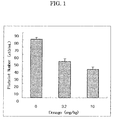
- Rats were divided into 3 groups consisting of a 0 dose group, 3.2 mg/kg dose group, and 10 mg/kg dose group, wherein one group comprised 5 rats.
- 3 groups consisting of a 0 dose group, 3.2 mg/kg dose group, and 10 mg/kg dose group, wherein one group comprised 5 rats.
- blood was collected and the number of platelets was counted.
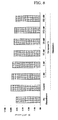
- Fig. 1 shows the number of platelets of each group thus counted. It was recognized that the platelet number was reduced depending on the dose of Compound B.
- a sample of spleen was collected from the rats after drawing blood, and a part of the inferior margin was fixed with 4% paraformaldehyde (PFA) for counting the number of megakaryocytes to prepare aparaf fin section in a conventional way, which section was stained by HE (hematoxylin-eosin) staining.
- PFA paraformaldehyde
- Each section was observed under an object lens of 10 magnifications to count the number of megakaryocytes/section in a bright-field. The number was divided by an area of the section to give the number of megakaryocytes in the spleen.
- Fig. 2 shows the average count of megakaryocytes in a group. It was recognized that the number of megakaryocytes in spleen was increased depending on the dose of Compound B.
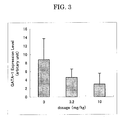
- RNA extraction kit RNA extraction kit
- GATA-1 cDNA was amplified by a real-time PCR (SYBR technique) using ABI Prism 7700. The amount of GATA-1 mRNA was determined from its amplification curve.
- Fig. 3 indicates the amount of expressed GATA-1 determined using GPIIb as an internal standard. Inhibition of GATA-1 transcription was recognized to depend on the dose of an HDAC inhibitor Compound B. From the above experimental results, it was found that the inhibition of GATA-1 transcription was observed in rats in which the platelet was reduced by administration of an HDAC inhibitor.
- a DNA fragment proximal to the transcription initiation point of human IL-2 gene ranging from -674 to +54 (the main transcription initiation point of IL-2 gene is regarded as +1) was obtained by PCR using as a template a genomic DNA isolated from Jurkat cells of human T cell origin.
- the sequences of the primers used in PCR are shown in SEQ ID NOS: 1 and 2 in Sequence Listing. These primers were designed based on the IL-2 gene sequence (Locus code: HSIL05, Accession Number: X00695) as described in GenBank gene database, in which at the end of primers a restriction enzyme recognition site was added in order to introduce it into a vector for reporter gene assay.
- the primers were designed so that a NheI recognition site was formed at the upstream side of the promoter of the amplified DNA fragment and a Hind III recognition site was formed at the downstream side of the promoter.
- the DNA fragment amplified by PCR was introduced into a cloning vector pCR4 (Invitrogen), and the base sequence of the insertion region was confirmed from the resulting plasmid.
- theplasmid was identical to the promoter sequence of IL-2 gene as described in the above GenBank, except for 3 sites of base substitution, 1 site of insertion of 2 bases, and 1 site of 1 base insertion.
- Total base sequence comprising 731 base pairs is shown in SEQ ID NO: 8.
- plasmid was cleaved at the Nhe I recognition site and Hind III recognition site, and the resulting fragment was inserted into the Nhe I-Hind III site of a vector pGL3 basic (Promega) for reporter gene assay containing a firefly luciferase gene.
- a plasmid pGL3 IL-2 Pro which has at the upstream of firefly luciferase gene a DNA sequence of 731 base pairs corresponding to the 728 base pair region proximal to the transcription initiation point of human IL-2 gene ranging from -674 to +54 was obtained.
- a DNA fragment proximal to the transcription initiation point of human IL-2 gene ranging from -378 to +54 was obtained by PCR using pGL3 IL-2 Pro as a template.
- the sequences of the primers used in PCR are shown in SEQ ID NOS: 3 and 2 in Sequence Listing.
- the primer of SEQ ID NO:3 were designed based on the DNA sequence introduced into the above-mentioned pGL3 IL-2 Pro.
- a restriction enzyme recognition site was added in order to insert it into a vector for reporter gene assay.
- the primers are designed so that aNheI recognition site is formed at the upstream side of the promoter of the amplified DNA fragment and a Hind III recognition site was formed at the downstream side of the promoter.
- the DNA fragment amplified by PCR was inserted into a cloning vector pCR4, and the base sequence of the insertion region was confirmed using the resulting plasmid.
- This insertion region was identical to the region ranging from -378 to +54 of the IL-2 promoter sequence as described in GenBank Locus code: HSIL05, except for 2 sites of base substitution and 1 site of insertion of 2 bases. Total base sequence comprising 434 base pairs is shown in SEQ IDNO: 9.
- plasmid was cleaved at the Nhe I recognition site and Hind III recognition site, and the resulting fragment was inserted into the Nhe I-Hind III site of a vector pGL3 basic for reporter gene assay containing a firefly luciferase gene.
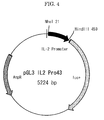
- a plasmid pGL3 IL-2 Pro43 which had at the upstream of firefly luciferase gene a promoter sequence of 434 base pairs corresponding to the 432 base pairs proximal to the transcription initiation point of human IL-2 gene ranging from -378 to +54 was obtained (Fig. 4).
- a fragment of human GATA-1 gene of 819 base pairs proximal to the transcription initiation point ranging from -789 to +30 was obtained by PCR using a human genome DNA as a template.
- the primers as described in SEQ ID NOS: 4 and 5 in Sequence Listing were used. These primers were designed based on the GATA-1 gene sequence of Accession Number: AF196971 as described in GenBank gene database, in which at the end of primers a restriction enzyme recognition site was added in order to insert it into a vector for reporter gene assay.
- a Bgl II recognition site was formed at the upstream side of the promoter of the amplified DNA fragment and a Hind III recognition site was formed at the downstream side of the promoter.
- the DNA fragment amplified by PCR was introduced into a cloning vector pCR4.
- the base sequence of the insertion region in the resulting plasmid was confirmed to be fully identical with the GATA-1 promoter sequence as described in GenBank Accession Number: AF196971.
- the total base sequence is shown in SEQ ID NO: 10.
- resulting plasmid was cleaved at the Nhe I recognition site and Hind III recognition site.
- the resulting fragment was inserted into the Nhe I-Hind III site of a vector pGL3 basic for reporter gene assay containing a firefly luciferase gene.
- a fragment of 637 base pairs of human GATA-1 gene ranging from -3769 to -3133 at the upstream of transcription initiation point was prepared by PCR using a human chromosomal DNA as a template.
- the primers as described in SEQ ID NO: 6 and 7 in Sequence Lisiting were used. These primers were designed based on the GATA-1 gene sequence of Accession Number: AF196971 as described in GenBank gene database, in which at the end of primers a restriction enzyme recognition site was added in order to insert it into a vector for reporter gene assay.
- a Kpn I recognition site was formed at the upstream side of the promoter of the amplified DNA fragment and a Nhe I recognition site was formed at the downstream side of the promoter.
- the DNA fragment amplified by PCR was inserted into a cloning vector pCR4, and the base sequence of the insertion region in the resulting plasmid was confirmed to be fully identical with the sequence at the upstream of transcription initiation point of the GATA-1 gene as described in GenBank AccessionNumber: AF196971.
- the total base sequence consisting of 637 base pairs is shown in SEQ ID NO: 11.
- plasmid was cleaved at the Kpn I recognition site and Nhe I recognition site, and the resulting DNA fragment was inserted into the Kpn I-Nhe I site of a vector pGL3 IE Promoter.
- a plasmid pGL3-HSI-IE Promoter which had at the upstream of firefly luciferase gene a region of 637 base pairs ranging from -3769 to -3133 and a sequence of 819 base pairs ranging from -789 to +30 at the upstream of transcription initiation point of the GATA-1 gene was obtained (Fig. 6).
- pGL3 IL-2 Pro43 (1 ⁇ g) obtained in Example 3 was mixed with 6 ⁇ g of optional carrier plasmid, and Jurkat cells (1x10 7 cells) were transformed therewith by electroporation (Voltage 300V; charge 975 ⁇ F; 400 ⁇ L). After transformation, there was added 2.5 mL of 10% FBS-containing RPMI 1640 (10%FBS RPMI1640), which was distributed to a 96-well white plate at a rate of 50 ⁇ l/well. The plate was incubated at 37°C under 5% CO 2 in a condition of saturated humidity for 12 hours, and then 10%FBS RPMI1640 medium containing Compound D (HDAC inhibitor) at a concentration of 4 times over the final concentration was added at a rate of 25 ⁇ L/well.
- FBS-containing RPMI 1640 10%FBS RPMI1640
- phorbol 12-myristate 13-acetate (PMA, SIGMA), ionomyicn (SIGMA) and anti-CD28 antibody (Pharmingen) was added at a rate of 25 ⁇ L/well (final concentration, 50ng/mL, 1 ⁇ g/mL and75ng/mL, respectively) tostimulatetheJurkatcells.
- PMA phorbol 12-myristate 13-acetate
- SIGMA ionomyicn
- Pharmingen anti-CD28 antibody
- luciferase activity in the cells was measured with a multi-label counter (1420 MULTILABEL COUNTER ARVO SX, WALLAC) according to a manual of Bright-GloTM Luciferase Assay System (Promega Corporation).
- a multi-label counter (1420 MULTILABEL COUNTER ARVO SX, WALLAC) according to a manual of Bright-GloTM Luciferase Assay System (Promega Corporation).
- luciferase was derived from pGL3 IL-2 Pro43 in response to stimulation of Jarkat cells with PMA, ionomycin and anti-CD28 antibody (Fig. 7).
- the amount of expressed luciferase derived therefrom was inhibited dose-dependently by Compound D (Fig. 7).
- HEL cells (JCRB0062, Japanese Collection of Research Bioresources)(8.75x10 6 cells) were transformed by electroporation (Voltage 1750V; charge 10 ⁇ F; 365 ⁇ L). After transformation, there was added 2 mL of 10%FBS RPMI1640, and the mixture was distributed to a 96-well white plate at a rate of 50 ⁇ L/well. After incubation at 37°C under 5% CO 2 in a condition of saturated humidity for 3 hours, 10%FBS RPMI1640 medium containing an HDAC inhibitor Compound D at a concentration of 2 times over the final concentration was added at a rate of 50 ⁇ L/well.
- luciferase activity in the cells was measured with a multi-label counter according to a manual of Bright-GloTM Luciferase Assay System (Promega Corporation). As a result, it was found that luciferase was derived from pGL3-HSI-IE promoter depending on a GATA-1 promoter, and further the amount of expressed luciferase was inhibited dose-dependently by Compound D (Fig. 9).
- HDAC inhibitory compounds selected at random as analytes were evaluated in an allopatric heart-to-neck transplant model (Cuff method), wherein ACI rats were used as donors, and Lewis rats as recipients.
- Each compound was orally administered with 10% HCO-60 (polyoxyl 60 hydrogenated castor oil)/water as solvent or subcutaneously with 10% HCO-60/saline as solvent, once a day continuously for 14 days from the day of transplantation.
- Cardiac arrest was judged as occurrence of rejection, and the number of days of take was regarded as up to the day before the cardiac arrest. Since the median of the number of take days is 5 days in a control group (solvent-administered group), the median over 8 days was judged effective, and the minimum effective dose was determined, respectively.
- the analyte was administered to normal Lewis rats at the minimum effective dose respectively determined above in the same administration route as in a pharmacological test once a day, totally 7 times.
- the day after the final administration blood was collected, and the number of platelet was counted in individuals.
- Tables 1 and 2 indicate the minimum effective dose and the rate of platelet decrease thus obtained in a rat's heart transplant model with a variety of HDAC inhibitors.
- the dose judged as the minimum effective dose is indicated by an underline and boldface.
- the concentration of a drug inhibiting by 50% of the expression of luciferase was calculated as the IC50 value (GATA-1 IC50) for the inhibition of GATA-1 transcription from a dose-response curve when the amount of expression of luciferase in the absence of an analyte was regarded as 100% (Table 3). Further, the G/I ratio was calculated by dividing GATA-1 IC50 by IL-2 IC50 (Table 3). The rate of platelet decrease at a minimum effective dose of an analyte in the rat's heart transplantation obtained in Example 5 and the G/I ratio obtained in this example were plotted (Fig. 11) to give a good correlation.
- HDAC Inhibitor HDAC Inhibitor Reporter Gene Assay IC50 (nM) Ratio GATA-1/IL-2 IL-2 GATA-1 Compound A 342.9 475.7 1.39 Compound B 32.3 117.3 3.63 Compound C 8.7 32.6 3.73 Compound D 27.5 117.3 4.27 Compound E 30.7 150.5 4.90 Compound F 23.1 128.0 5.53 Compound G 14.8 91.0 6.16 Compound H 6.1 37.8 6.20 Compound I 19.6 148.6 7.58
- the total RNA was used as a template to synthesize cDNA using a Superscript Choice System (Invitrogen) and further synthesize a fluorescence labeled cRNA using BioArray High Yield RNA transcript Labeling Kit (Enzo Diagnostics).
- the resulting fluorescence labeled cRNA was used as a probe to investigate the expression pattern of 12,626 genes using a Human Genome U95A Array (Affymetrix).
- sequence information on the 2kb upstream of transcription initiation sites of the above-mentioned respective genes was downloaded from the human genome sequence information (Genome Annotation, NCBI Locus Link), and the database of transcriptional factors (The Transcription Factor Database, TRANSFAC (R) Professional 6.3, BIOBASE Biological Databases /Bisammlung banken GmbH) was searched based on a prediction assisting system for transcriptional control regions TRANSFAC (E. Wingender et al., (2000) Nucleic Acids Research 28, 316-319, TRANSFAC: an integrated system for gene expression regulation) to investigate the transcriptional factor binding sequences commonly present in the respective promoter sequences of human origin.
- TRANSFAC The Transcription Factor Database, TRANSFAC (R) Professional 6.3, BIOBASE Biological Databases /Biologische banken GmbH
- a reporter gene (luciferase) vector having a responsive sequence recognized by the respective transcriptional factors was constructed.
- CEBP-11 and CEBP-12 represented by the following sequences were designed, in which the so far reported 5 consensus sequences recognized by C/EBP ⁇ (M. Rosati et al., (2001) The Journal of Immunology 167, 1654-1662, CCAAT-Enhancer-Binding Protein ⁇ (C/EBP ⁇ ) Activates CCR5 Promoter: Increased C/EBP ⁇ and CCR5 in T Lymphocytes from HIV-1-Infected Individuals) (S. Osada et al., (1996) The Journal of Biological Chemistry 271, 3891-3896, DIVA Binding Specificity of the CCAAT/Enhancer Binding Protein Transcription Factor Family) were connected in series to give synthetic DNAs (Amersham Biosciences).
- This fragment was ligated to a fragment of about 4.2kb prepared by treatment of pC/EBP ⁇ -TA-Luc with BglII/SphI to give a C/EBP ⁇ reporter plasmid pC/EBP ⁇ -TAL-Luc which contains a TAL promoter sequence and firefly luciferase gene at the downstream of the C/EBP ⁇ binding sequence.
- HSE heat shock promoter element
- This fragment was ligated to a fragment of about 4.2kb prepared by treatment of pHSE-TA-Luc with BglII/SphI to give a HSF1 reporter plasmid pHSE-TAL-Luc which contains a TAL promoter sequence and firefly luciferase gene at the downstream of the HSE sequence.
- pTAL-Luc (BD Biosciences Clontech) was treated with BglII/SphI to give a fragment of about 0.7kb coding for TAL promoter sequence and firefly luciferase gene N-terminal region. This fragment was ligated to a fragment of about 4.2kb prepared from pSTAT3-TA-Luc (BD Biosciences Clontech) by treatment with BglII/SphI to give a STAT3 reporter plasmid pSTAT3 -TAL-Luc which contains a TAL promoter sequence and firefly luciferase gene at the downstream of the STAT3 binding sequence as shown in Fig. 14(c).
- HEL cells (8.75x10 6 cells) were transformed with 15 ⁇ g each of pC/EBP ⁇ -TAL-LUc, pHSE-TAL-Luc, and pSTAT3-TA-Luc prepared in Example 10 by electroporation (Voltage 17 50V; Charge 10 ⁇ F, 365 ⁇ L). After transformation, the transformants respectively were suspended in 2 mL of 10% FBS RPMI1640, and distributed into a 96-well white plate at a rate of 50 ⁇ L/well. The plate was incubated at 37°C under 5% CO 2 in a condition of saturated humidity for 3 hours, and then 10%FBS RPMI1640 medium containing Compound D (HDAC inhibitor) at a concentration of 2 times over the final concentration was added at a rate of 50 ⁇ L/well.
- HDAC inhibitor Compound D
- luciferase activity in the cells was measured with a multi-label counter according to a manual of Bright-GloTM Luciferase Assay System (Promega Corporation).
- Bright-GloTM Luciferase Assay System Promega Corporation.
- luciferase is derived from pC/EBP ⁇ -TAL-LUc, pHSE-TAL-Luc, and pSTAT3-TA-Luc depending on the transcriptional activity of C/EBP ⁇ , HSF1 and STAT3, respectively.
- Their induction of luciferase activity wasnot inhibited by Compound D (Table 4).
- Example 12 Construction of a reporter gene (luciferase) vector having a mutant promoter in which mutation is introduced into all of the GATA-1 recognition sites in the GATA-1 promoter
- GATA-1 promoter has therein a responsive sequence (GATA sequence) recognized by GATA-1 per se.
- GATA sequence a responsive sequence recognized by GATA-1 per se.
- an IE promoter (mutant) of about 0.84kb in which a mutation was introduced at the 5 sites of the GATA sequence in the IE promoter region of GATA-1 gene was artificially constructed by means of PCR.
- pGL3-HSI-IE DNA prepared in Example 4 was used as a template in the first PCR, and using synthetic primers corresponding to the both ends of the promoter region and the respective sequences having the mutation, fragments to be placed between the terminals of the region or between the respective sites having the mutation were amplified.
- the resulting PCR products were mixed and used as templates in the subsequent PCR reaction to select appropriate members as synthetic primers and amplify their longer region.
- a PCR fragment corresponding to the total IE promoter region was obtained using the synthetic primers corresponding to both terminals of the promoter region.
- This fragment was inserted into pCR4-TOPO (Invitrogen) to determine the base sequence.
- Fig. 15 shows the sequence of the IE promoter (mutant) thus confirmed.
- the portion of the mutation is indicated by underlines, and both terminals have the Bgl II site and Hind III site as introduced.
- the BglII-HindIII fragment having the total IE promoter (mutant) was inserted between the BglII site and the HindIII site of pGL3 to give pGL3-IE promoter (mutant).
- the HSI (mutant) region of about 0.65kb in which a mutation was introduced at the 2 sites of the GATA sequence of the HSI region in GATA-1 gene was artificially constructed using pGL3-HSI-IE DNA prepared in Example 4 as a template in the first PCR.
- the resulting PCR fragment was inserted into pCR4-TOPO (Invitrogen) to determine the base sequence and confirm the mutation introduced.
- Fig. 16 shows the sequence of the HSI (mutant) region thus confirmed.
- the portion of the mutation is indicated by underlines, and both terminals respectively have the Mlu I site and Bgl II site as introduced.
- the MluI-BglII fragment having the total HSI (mutant) region was inserted between the MluI site and the BglII site of pTAL-Luc to give pTAL-HSI(mutant)-Luc.
- the KpnI-BglII fragment having the total HSI (mutant) region of pTAL-HSI(mutant)-Luc was inserted between KpnI-BglII of pGL3-IEpromoter (mutant) to give pGL3-HSI-IE Promoter (mutant) having the total IE promoter (mutant) and the total HSI (mutant) region.
- HEL cells 8.75x10 6 cells
- electroporation Voltage 1,750V, Charge 10 ⁇ F, 365 ⁇ L
- the transformants respectively were suspended in 2 mL of 10% FBS RPMI1640, and distributed to a 96-well white plate at a rate of 50 ⁇ L/well.
- the plate was incubated at 37°C under 5% CO 2 in a condition of saturated humidity for 3 hours, and then 10%FBS RPMI1640 medium containing an HDAC inhibitor, i.e., Compounds A, C or D at a concentration of 2 times over the final concentration was added at a rate of 50 ⁇ L/well.
- 10%FBS RPMI1640 medium containing an HDAC inhibitor, i.e., Compounds A, C or D at a concentration of 2 times over the final concentration was added at a rate of 50 ⁇ L/well.
- the luciferase activity in the cells was measured with a multi-label counter according to a manual of Bright-GloTM Luciferase Assay System (Promega Corporation).
- luciferase was derived from pGL3-HSI-IE Promoter and pGL3-HSI-IE Promoter (mutant), respectively, depending on the GATA-1 promoter, but the activity derived from the mutant promoter was lower than that of the wild-type promoter.
- the luciferase activity derived from the mutant promoter was not inhibited by Compounds A, C and D differing from the wild-type (Table 5).
- the method of the invention it is possible to rapidly screen a compound having a strong IL-2 transcription inhibitory activity simultaneously with a weak GATA-1 transcription inhibitory activity, by using reporter assay systems using 2 species of cells. It is also possible to rapidly screen a compound having a weak GATA-1 transcription inhibitory activity from HDAC inhibitors.
- the compounds selected by such a method are expected to be candidates for creating highly safe drugs with less thrombocytopenia effect in much higher probability than before. Thus, the method of the invention is very useful in studies for creation of new drugs.
Landscapes
- Health & Medical Sciences (AREA)
- Life Sciences & Earth Sciences (AREA)
- Engineering & Computer Science (AREA)
- Chemical & Material Sciences (AREA)
- Immunology (AREA)
- Molecular Biology (AREA)
- General Health & Medical Sciences (AREA)
- Biomedical Technology (AREA)
- Hematology (AREA)
- Medicinal Chemistry (AREA)
- Organic Chemistry (AREA)
- Cell Biology (AREA)
- Urology & Nephrology (AREA)
- Biochemistry (AREA)
- Biotechnology (AREA)
- Proteomics, Peptides & Aminoacids (AREA)
- Veterinary Medicine (AREA)
- Microbiology (AREA)
- Physics & Mathematics (AREA)
- Bioinformatics & Cheminformatics (AREA)
- Analytical Chemistry (AREA)
- Animal Behavior & Ethology (AREA)
- Pharmacology & Pharmacy (AREA)
- General Chemical & Material Sciences (AREA)
- Chemical Kinetics & Catalysis (AREA)
- Public Health (AREA)
- Nuclear Medicine, Radiotherapy & Molecular Imaging (AREA)
- Pathology (AREA)
- Food Science & Technology (AREA)
- General Physics & Mathematics (AREA)
- Wood Science & Technology (AREA)
- Zoology (AREA)
- Genetics & Genomics (AREA)
- Tropical Medicine & Parasitology (AREA)
- Diabetes (AREA)
- Toxicology (AREA)
- General Engineering & Computer Science (AREA)
- Biophysics (AREA)
- Gastroenterology & Hepatology (AREA)
- Obesity (AREA)
Applications Claiming Priority (3)
| Application Number | Priority Date | Filing Date | Title |
|---|---|---|---|
| JP2002203901 | 2002-07-12 | ||
| JP2002203901 | 2002-07-12 | ||
| PCT/JP2003/008621 WO2004007758A1 (ja) | 2002-07-12 | 2003-07-07 | 血小板減少作用の少ない免疫抑制剤の新規選択方法 |
Publications (2)
| Publication Number | Publication Date |
|---|---|
| EP1533383A1 true EP1533383A1 (de) | 2005-05-25 |
| EP1533383A4 EP1533383A4 (de) | 2006-05-31 |
Family
ID=30112689
Family Applications (1)
| Application Number | Title | Priority Date | Filing Date |
|---|---|---|---|
| EP03741246A Withdrawn EP1533383A4 (de) | 2002-07-12 | 2003-07-07 | Neues selektionsverfahren für ein immunsuppressivum mit geringer thrombozytopeniewirkung |
Country Status (6)
| Country | Link |
|---|---|
| US (1) | US20060135401A1 (de) |
| EP (1) | EP1533383A4 (de) |
| JP (1) | JPWO2004007758A1 (de) |
| AU (1) | AU2003280988A1 (de) |
| CA (1) | CA2493088A1 (de) |
| WO (1) | WO2004007758A1 (de) |
Families Citing this family (2)
| Publication number | Priority date | Publication date | Assignee | Title |
|---|---|---|---|---|
| JPWO2004061101A1 (ja) * | 2002-12-27 | 2006-05-11 | アステラス製薬株式会社 | 新規免疫抑制剤の選択方法 |
| WO2017131228A1 (ja) | 2016-01-29 | 2017-08-03 | 国立大学法人京都大学 | 血小板産生促進剤のスクリーニング方法 |
Family Cites Families (1)
| Publication number | Priority date | Publication date | Assignee | Title |
|---|---|---|---|---|
| AUPP505798A0 (en) * | 1998-08-04 | 1998-08-27 | Fujisawa Pharmaceutical Co., Ltd. | Novel compound fr225497 substance |
-
2003
- 2003-07-07 AU AU2003280988A patent/AU2003280988A1/en not_active Abandoned
- 2003-07-07 WO PCT/JP2003/008621 patent/WO2004007758A1/ja not_active Ceased
- 2003-07-07 EP EP03741246A patent/EP1533383A4/de not_active Withdrawn
- 2003-07-07 JP JP2004521148A patent/JPWO2004007758A1/ja not_active Withdrawn
- 2003-07-07 US US10/519,678 patent/US20060135401A1/en not_active Abandoned
- 2003-07-07 CA CA002493088A patent/CA2493088A1/en not_active Abandoned
Non-Patent Citations (3)
| Title |
|---|
| ATHANASIOU M ET AL.: "FLI-1 is a suppressor of erythroid differentiation in human hematopoietic cells" LEUKEMIA, vol. 14, 2000, pages 439-445, XP002373533 * |
| JUNG M: "Inhibitors of histone deacetylase as new anticancer agents" CURRENT MEDICINAL CHEMISTRY, vol. 8, 2001, pages 1505-1511, XP001098704 * |
| See also references of WO2004007758A1 * |
Also Published As
| Publication number | Publication date |
|---|---|
| EP1533383A4 (de) | 2006-05-31 |
| CA2493088A1 (en) | 2004-01-22 |
| WO2004007758A1 (ja) | 2004-01-22 |
| US20060135401A1 (en) | 2006-06-22 |
| AU2003280988A1 (en) | 2004-02-02 |
| JPWO2004007758A1 (ja) | 2005-11-10 |
Similar Documents
| Publication | Publication Date | Title |
|---|---|---|
| Wei et al. | Receptor activator of nuclear factor-κB ligand activates nuclear factor-κB in osteoclast precursors | |
| US7666608B2 (en) | Methods for determining drug responsiveness | |
| Weiss et al. | Nuclear factor of activated T cells is associated with a mast cell interleukin 4 transcription complex | |
| US20060088532A1 (en) | Lymphatic and blood endothelial cell genes | |
| US7745138B2 (en) | Methods for determining drug responsiveness | |
| US20110142789A1 (en) | Compositions and Methods for the Diagnosis and Treatment of Amyotrophic Lateral Sclerosis | |
| US8298756B2 (en) | Isolation, gene expression, and chemotherapeutic resistance of motile cancer cells | |
| Cron et al. | T cell priming enhances IL-4 gene expression by increasing nuclear factor of activated T cells | |
| Elliott et al. | Multidrug transporter activity in lymphocytes | |
| JP4245539B2 (ja) | 糖尿病の特異的マーカー | |
| EP1533383A1 (de) | Neues selektionsverfahren für ein immunsuppressivum mit geringer thrombozytopeniewirkung | |
| EP2557159A1 (de) | Verfahren zur prognose von lungen-adenokarzinomen, kit zum nachweis von lungen-adenokarzinomen und pharmazeutische zusammensetzung zur behandlung von lungen-adenokarzinomen | |
| US6933119B2 (en) | Methods and compositions for the detection and treatment of multiple sclerosis | |
| JP2010004750A (ja) | 自己免疫疾患による組織傷害の発症または発症可能性の診断方法、およびその利用 | |
| US7718378B2 (en) | Granulysin and uses thereof | |
| Berry et al. | Interferon-inducible factor 16 is a novel modulator of glucocorticoid action | |
| Downes et al. | Rare and novel RELA variants are common in systemic autoimmunity | |
| EP1602723A1 (de) | Verfahren zur untersuchung von obesität und auszehrung | |
| US20030211523A1 (en) | Two-hybrid double screening system and method | |
| KR101885946B1 (ko) | 제2형 당뇨병 진단용 마커 및 그 용도 | |
| US20060275800A1 (en) | Process for characterization of the transactivation and transrepression activity of glucocorticoid receptor ligands in primary immune cells | |
| US20040053282A1 (en) | Method of examining allergic disease | |
| JP2002119281A (ja) | アレルギー性疾患の検査方法 | |
| WO2002064832A1 (fr) | Methode d'examen pour maladie allergique | |
| EP2020447A1 (de) | Verfahren zur Identifizierung von Adiponectin-Genexpressions-modulierenden Verbindungen |
Legal Events
| Date | Code | Title | Description |
|---|---|---|---|
| PUAI | Public reference made under article 153(3) epc to a published international application that has entered the european phase |
Free format text: ORIGINAL CODE: 0009012 |
|
| 17P | Request for examination filed |
Effective date: 20050107 |
|
| AK | Designated contracting states |
Kind code of ref document: A1 Designated state(s): AT BE BG CH CY CZ DE DK EE ES FI FR GB GR HU IE IT LI LU MC NL PT RO SE SI SK TR |
|
| AX | Request for extension of the european patent |
Extension state: AL LT LV MK |
|
| DAX | Request for extension of the european patent (deleted) | ||
| RAP1 | Party data changed (applicant data changed or rights of an application transferred) |
Owner name: ASTELLAS PHARMA INC. |
|
| A4 | Supplementary search report drawn up and despatched |
Effective date: 20060413 |
|
| STAA | Information on the status of an ep patent application or granted ep patent |
Free format text: STATUS: THE APPLICATION HAS BEEN WITHDRAWN |
|
| 18W | Application withdrawn |
Effective date: 20070829 |