EP1533356A1 - Fluorochemical composition for rendering substrates oil and/or water repellent - Google Patents
Fluorochemical composition for rendering substrates oil and/or water repellent Download PDFInfo
- Publication number
- EP1533356A1 EP1533356A1 EP03078694A EP03078694A EP1533356A1 EP 1533356 A1 EP1533356 A1 EP 1533356A1 EP 03078694 A EP03078694 A EP 03078694A EP 03078694 A EP03078694 A EP 03078694A EP 1533356 A1 EP1533356 A1 EP 1533356A1
- Authority
- EP
- European Patent Office
- Prior art keywords
- composition
- fluorochemical
- group
- inorganic particles
- substrate
- Prior art date
- Legal status (The legal status is an assumption and is not a legal conclusion. Google has not performed a legal analysis and makes no representation as to the accuracy of the status listed.)
- Withdrawn
Links
- 239000000203 mixture Substances 0.000 title claims abstract description 106
- 239000000758 substrate Substances 0.000 title claims description 83
- XLYOFNOQVPJJNP-UHFFFAOYSA-N water Substances O XLYOFNOQVPJJNP-UHFFFAOYSA-N 0.000 title claims description 40
- 230000002940 repellent Effects 0.000 title description 8
- 239000005871 repellent Substances 0.000 title description 8
- 238000009877 rendering Methods 0.000 title 1
- 150000001875 compounds Chemical class 0.000 claims abstract description 39
- 239000010954 inorganic particle Substances 0.000 claims abstract description 27
- 239000003093 cationic surfactant Substances 0.000 claims abstract description 15
- 239000006185 dispersion Substances 0.000 claims abstract description 12
- 239000000178 monomer Substances 0.000 claims description 22
- 238000011282 treatment Methods 0.000 claims description 20
- 125000002091 cationic group Chemical group 0.000 claims description 19
- VYPSYNLAJGMNEJ-UHFFFAOYSA-N Silicium dioxide Chemical compound O=[Si]=O VYPSYNLAJGMNEJ-UHFFFAOYSA-N 0.000 claims description 17
- 239000008119 colloidal silica Substances 0.000 claims description 14
- 239000002245 particle Substances 0.000 claims description 14
- 238000000034 method Methods 0.000 claims description 11
- 239000007787 solid Substances 0.000 claims description 11
- 239000004094 surface-active agent Substances 0.000 claims description 10
- 239000004753 textile Substances 0.000 claims description 8
- 229920000642 polymer Polymers 0.000 claims description 5
- QGZKDVFQNNGYKY-UHFFFAOYSA-O Ammonium Chemical compound [NH4+] QGZKDVFQNNGYKY-UHFFFAOYSA-O 0.000 claims description 4
- 239000004745 nonwoven fabric Substances 0.000 claims description 3
- NIXOWILDQLNWCW-UHFFFAOYSA-M Acrylate Chemical compound [O-]C(=O)C=C NIXOWILDQLNWCW-UHFFFAOYSA-M 0.000 description 36
- -1 poly(oxyalkylene) Polymers 0.000 description 29
- 239000003921 oil Substances 0.000 description 16
- 239000012948 isocyanate Substances 0.000 description 15
- 125000001931 aliphatic group Chemical group 0.000 description 14
- PNEYBMLMFCGWSK-UHFFFAOYSA-N aluminium oxide Inorganic materials [O-2].[O-2].[O-2].[Al+3].[Al+3] PNEYBMLMFCGWSK-UHFFFAOYSA-N 0.000 description 14
- 125000004432 carbon atom Chemical group C* 0.000 description 14
- QTBSBXVTEAMEQO-UHFFFAOYSA-N Acetic acid Chemical compound CC(O)=O QTBSBXVTEAMEQO-UHFFFAOYSA-N 0.000 description 12
- KFZMGEQAYNKOFK-UHFFFAOYSA-N Isopropanol Chemical compound CC(C)O KFZMGEQAYNKOFK-UHFFFAOYSA-N 0.000 description 12
- 150000002430 hydrocarbons Chemical group 0.000 description 11
- 150000002513 isocyanates Chemical class 0.000 description 11
- 150000001252 acrylic acid derivatives Chemical class 0.000 description 9
- 125000005647 linker group Chemical group 0.000 description 9
- IQPQWNKOIGAROB-UHFFFAOYSA-N isocyanate group Chemical group [N-]=C=O IQPQWNKOIGAROB-UHFFFAOYSA-N 0.000 description 8
- 239000002981 blocking agent Substances 0.000 description 7
- 239000000835 fiber Substances 0.000 description 7
- 239000007788 liquid Substances 0.000 description 7
- 230000000052 comparative effect Effects 0.000 description 6
- 229910052593 corundum Inorganic materials 0.000 description 6
- 239000001257 hydrogen Substances 0.000 description 6
- 229910052739 hydrogen Inorganic materials 0.000 description 6
- 125000002887 hydroxy group Chemical group [H]O* 0.000 description 6
- 229920000728 polyester Polymers 0.000 description 6
- 229910001845 yogo sapphire Inorganic materials 0.000 description 6
- 239000004606 Fillers/Extenders Substances 0.000 description 5
- CERQOIWHTDAKMF-UHFFFAOYSA-M Methacrylate Chemical compound CC(=C)C([O-])=O CERQOIWHTDAKMF-UHFFFAOYSA-M 0.000 description 5
- IMNFDUFMRHMDMM-UHFFFAOYSA-N N-Heptane Chemical compound CCCCCCC IMNFDUFMRHMDMM-UHFFFAOYSA-N 0.000 description 5
- 239000004952 Polyamide Substances 0.000 description 5
- 239000002202 Polyethylene glycol Substances 0.000 description 5
- 125000004435 hydrogen atom Chemical group [H]* 0.000 description 5
- WHIVNJATOVLWBW-SNAWJCMRSA-N methylethyl ketone oxime Chemical compound CC\C(C)=N\O WHIVNJATOVLWBW-SNAWJCMRSA-N 0.000 description 5
- 125000005702 oxyalkylene group Chemical group 0.000 description 5
- 230000000149 penetrating effect Effects 0.000 description 5
- 229920002647 polyamide Polymers 0.000 description 5
- 229920001223 polyethylene glycol Polymers 0.000 description 5
- 238000009736 wetting Methods 0.000 description 5
- IJGRMHOSHXDMSA-UHFFFAOYSA-N Atomic nitrogen Chemical compound N#N IJGRMHOSHXDMSA-UHFFFAOYSA-N 0.000 description 4
- KAKZBPTYRLMSJV-UHFFFAOYSA-N Butadiene Chemical compound C=CC=C KAKZBPTYRLMSJV-UHFFFAOYSA-N 0.000 description 4
- RRHGJUQNOFWUDK-UHFFFAOYSA-N Isoprene Chemical compound CC(=C)C=C RRHGJUQNOFWUDK-UHFFFAOYSA-N 0.000 description 4
- PPBRXRYQALVLMV-UHFFFAOYSA-N Styrene Chemical compound C=CC1=CC=CC=C1 PPBRXRYQALVLMV-UHFFFAOYSA-N 0.000 description 4
- 125000000217 alkyl group Chemical group 0.000 description 4
- 238000006243 chemical reaction Methods 0.000 description 4
- 239000007795 chemical reaction product Substances 0.000 description 4
- 125000006162 fluoroaliphatic group Chemical group 0.000 description 4
- DCAYPVUWAIABOU-UHFFFAOYSA-N hexadecane Chemical compound CCCCCCCCCCCCCCCC DCAYPVUWAIABOU-UHFFFAOYSA-N 0.000 description 4
- 229930195733 hydrocarbon Natural products 0.000 description 4
- FAHBNUUHRFUEAI-UHFFFAOYSA-M hydroxidooxidoaluminium Chemical compound O[Al]=O FAHBNUUHRFUEAI-UHFFFAOYSA-M 0.000 description 4
- 229960004592 isopropanol Drugs 0.000 description 4
- 125000002496 methyl group Chemical group [H]C([H])([H])* 0.000 description 4
- 239000000243 solution Substances 0.000 description 4
- 239000007921 spray Substances 0.000 description 4
- OEPOKWHJYJXUGD-UHFFFAOYSA-N 2-(3-phenylmethoxyphenyl)-1,3-thiazole-4-carbaldehyde Chemical compound O=CC1=CSC(C=2C=C(OCC=3C=CC=CC=3)C=CC=2)=N1 OEPOKWHJYJXUGD-UHFFFAOYSA-N 0.000 description 3
- 239000004215 Carbon black (E152) Substances 0.000 description 3
- ZAMOUSCENKQFHK-UHFFFAOYSA-N Chlorine atom Chemical compound [Cl] ZAMOUSCENKQFHK-UHFFFAOYSA-N 0.000 description 3
- CERQOIWHTDAKMF-UHFFFAOYSA-N Methacrylic acid Chemical compound CC(=C)C(O)=O CERQOIWHTDAKMF-UHFFFAOYSA-N 0.000 description 3
- NTIZESTWPVYFNL-UHFFFAOYSA-N Methyl isobutyl ketone Chemical compound CC(C)CC(C)=O NTIZESTWPVYFNL-UHFFFAOYSA-N 0.000 description 3
- 239000002253 acid Substances 0.000 description 3
- 125000003118 aryl group Chemical group 0.000 description 3
- 239000003795 chemical substances by application Substances 0.000 description 3
- 239000000460 chlorine Substances 0.000 description 3
- 229910052801 chlorine Inorganic materials 0.000 description 3
- 229920001577 copolymer Polymers 0.000 description 3
- 125000004122 cyclic group Chemical group 0.000 description 3
- 238000007865 diluting Methods 0.000 description 3
- 150000002148 esters Chemical class 0.000 description 3
- 238000002474 experimental method Methods 0.000 description 3
- 229920002313 fluoropolymer Polymers 0.000 description 3
- 125000000524 functional group Chemical group 0.000 description 3
- 239000010985 leather Substances 0.000 description 3
- 150000002734 metacrylic acid derivatives Chemical class 0.000 description 3
- 229910052757 nitrogen Inorganic materials 0.000 description 3
- 239000000843 powder Substances 0.000 description 3
- 125000004079 stearyl group Chemical group [H]C([*])([H])C([H])([H])C([H])([H])C([H])([H])C([H])([H])C([H])([H])C([H])([H])C([H])([H])C([H])([H])C([H])([H])C([H])([H])C([H])([H])C([H])([H])C([H])([H])C([H])([H])C([H])([H])C([H])([H])C([H])([H])[H] 0.000 description 3
- 238000003756 stirring Methods 0.000 description 3
- 239000008399 tap water Substances 0.000 description 3
- 235000020679 tap water Nutrition 0.000 description 3
- 238000010998 test method Methods 0.000 description 3
- VZCYOOQTPOCHFL-UHFFFAOYSA-N trans-butenedioic acid Natural products OC(=O)C=CC(O)=O VZCYOOQTPOCHFL-UHFFFAOYSA-N 0.000 description 3
- 150000003673 urethanes Chemical class 0.000 description 3
- DTGKSKDOIYIVQL-WEDXCCLWSA-N (+)-borneol Chemical group C1C[C@@]2(C)[C@@H](O)C[C@@H]1C2(C)C DTGKSKDOIYIVQL-WEDXCCLWSA-N 0.000 description 2
- RTNSFNKPBIASPV-UHFFFAOYSA-N (1-isocyanato-2-methylprop-2-enyl)benzene Chemical compound O=C=NC(C(=C)C)C1=CC=CC=C1 RTNSFNKPBIASPV-UHFFFAOYSA-N 0.000 description 2
- ARXJGSRGQADJSQ-UHFFFAOYSA-N 1-methoxypropan-2-ol Chemical compound COCC(C)O ARXJGSRGQADJSQ-UHFFFAOYSA-N 0.000 description 2
- SMZOUWXMTYCWNB-UHFFFAOYSA-N 2-(2-methoxy-5-methylphenyl)ethanamine Chemical compound COC1=CC=C(C)C=C1CCN SMZOUWXMTYCWNB-UHFFFAOYSA-N 0.000 description 2
- NIXOWILDQLNWCW-UHFFFAOYSA-N 2-Propenoic acid Natural products OC(=O)C=C NIXOWILDQLNWCW-UHFFFAOYSA-N 0.000 description 2
- XFCMNSHQOZQILR-UHFFFAOYSA-N 2-[2-(2-methylprop-2-enoyloxy)ethoxy]ethyl 2-methylprop-2-enoate Chemical compound CC(=C)C(=O)OCCOCCOC(=O)C(C)=C XFCMNSHQOZQILR-UHFFFAOYSA-N 0.000 description 2
- 125000000954 2-hydroxyethyl group Chemical group [H]C([*])([H])C([H])([H])O[H] 0.000 description 2
- 125000003903 2-propenyl group Chemical group [H]C([*])([H])C([H])=C([H])[H] 0.000 description 2
- HRPVXLWXLXDGHG-UHFFFAOYSA-N Acrylamide Chemical compound NC(=O)C=C HRPVXLWXLXDGHG-UHFFFAOYSA-N 0.000 description 2
- NLHHRLWOUZZQLW-UHFFFAOYSA-N Acrylonitrile Chemical compound C=CC#N NLHHRLWOUZZQLW-UHFFFAOYSA-N 0.000 description 2
- OKTJSMMVPCPJKN-UHFFFAOYSA-N Carbon Chemical group [C] OKTJSMMVPCPJKN-UHFFFAOYSA-N 0.000 description 2
- 229920003043 Cellulose fiber Polymers 0.000 description 2
- LYCAIKOWRPUZTN-UHFFFAOYSA-N Ethylene glycol Chemical compound OCCO LYCAIKOWRPUZTN-UHFFFAOYSA-N 0.000 description 2
- KRHYYFGTRYWZRS-UHFFFAOYSA-N Fluorane Chemical compound F KRHYYFGTRYWZRS-UHFFFAOYSA-N 0.000 description 2
- PXGOKWXKJXAPGV-UHFFFAOYSA-N Fluorine Chemical compound FF PXGOKWXKJXAPGV-UHFFFAOYSA-N 0.000 description 2
- VZCYOOQTPOCHFL-OWOJBTEDSA-N Fumaric acid Chemical compound OC(=O)\C=C\C(O)=O VZCYOOQTPOCHFL-OWOJBTEDSA-N 0.000 description 2
- 229920000877 Melamine resin Polymers 0.000 description 2
- 229920001410 Microfiber Polymers 0.000 description 2
- CNCOEDDPFOAUMB-UHFFFAOYSA-N N-Methylolacrylamide Chemical compound OCNC(=O)C=C CNCOEDDPFOAUMB-UHFFFAOYSA-N 0.000 description 2
- 229920003171 Poly (ethylene oxide) Polymers 0.000 description 2
- OFOBLEOULBTSOW-UHFFFAOYSA-N Propanedioic acid Natural products OC(=O)CC(O)=O OFOBLEOULBTSOW-UHFFFAOYSA-N 0.000 description 2
- GOOHAUXETOMSMM-UHFFFAOYSA-N Propylene oxide Chemical compound CC1CO1 GOOHAUXETOMSMM-UHFFFAOYSA-N 0.000 description 2
- NINIDFKCEFEMDL-UHFFFAOYSA-N Sulfur Chemical compound [S] NINIDFKCEFEMDL-UHFFFAOYSA-N 0.000 description 2
- BZHJMEDXRYGGRV-UHFFFAOYSA-N Vinyl chloride Chemical compound ClC=C BZHJMEDXRYGGRV-UHFFFAOYSA-N 0.000 description 2
- MCMNRKCIXSYSNV-UHFFFAOYSA-N Zirconium dioxide Chemical compound O=[Zr]=O MCMNRKCIXSYSNV-UHFFFAOYSA-N 0.000 description 2
- 238000010521 absorption reaction Methods 0.000 description 2
- 150000007513 acids Chemical class 0.000 description 2
- 230000002411 adverse Effects 0.000 description 2
- 125000002947 alkylene group Chemical group 0.000 description 2
- XXROGKLTLUQVRX-UHFFFAOYSA-N allyl alcohol Chemical compound OCC=C XXROGKLTLUQVRX-UHFFFAOYSA-N 0.000 description 2
- 150000001408 amides Chemical class 0.000 description 2
- 125000000129 anionic group Chemical group 0.000 description 2
- QVGXLLKOCUKJST-UHFFFAOYSA-N atomic oxygen Chemical group [O] QVGXLLKOCUKJST-UHFFFAOYSA-N 0.000 description 2
- 125000001797 benzyl group Chemical group [H]C1=C([H])C([H])=C(C([H])=C1[H])C([H])([H])* 0.000 description 2
- 235000013877 carbamide Nutrition 0.000 description 2
- 150000001721 carbon Chemical group 0.000 description 2
- 229910052799 carbon Inorganic materials 0.000 description 2
- 125000001309 chloro group Chemical group Cl* 0.000 description 2
- 238000000576 coating method Methods 0.000 description 2
- VEZUQRBDRNJBJY-UHFFFAOYSA-N cyclohexanone oxime Chemical compound ON=C1CCCCC1 VEZUQRBDRNJBJY-UHFFFAOYSA-N 0.000 description 2
- 125000000113 cyclohexyl group Chemical group [H]C1([H])C([H])([H])C([H])([H])C([H])(*)C([H])([H])C1([H])[H] 0.000 description 2
- DIOQZVSQGTUSAI-UHFFFAOYSA-N decane Chemical compound CCCCCCCCCC DIOQZVSQGTUSAI-UHFFFAOYSA-N 0.000 description 2
- 239000008367 deionised water Substances 0.000 description 2
- 229910021641 deionized water Inorganic materials 0.000 description 2
- 235000014113 dietary fatty acids Nutrition 0.000 description 2
- 125000003438 dodecyl group Chemical group [H]C([H])([H])C([H])([H])C([H])([H])C([H])([H])C([H])([H])C([H])([H])C([H])([H])C([H])([H])C([H])([H])C([H])([H])C([H])([H])C([H])([H])* 0.000 description 2
- 230000000694 effects Effects 0.000 description 2
- JBKVHLHDHHXQEQ-UHFFFAOYSA-N epsilon-caprolactam Chemical compound O=C1CCCCCN1 JBKVHLHDHHXQEQ-UHFFFAOYSA-N 0.000 description 2
- FJKIXWOMBXYWOQ-UHFFFAOYSA-N ethenoxyethane Chemical compound CCOC=C FJKIXWOMBXYWOQ-UHFFFAOYSA-N 0.000 description 2
- 239000000194 fatty acid Substances 0.000 description 2
- 229930195729 fatty acid Natural products 0.000 description 2
- 150000004665 fatty acids Chemical class 0.000 description 2
- 229910052731 fluorine Inorganic materials 0.000 description 2
- 239000011737 fluorine Substances 0.000 description 2
- VOZRXNHHFUQHIL-UHFFFAOYSA-N glycidyl methacrylate Chemical compound CC(=C)C(=O)OCC1CO1 VOZRXNHHFUQHIL-UHFFFAOYSA-N 0.000 description 2
- LEQAOMBKQFMDFZ-UHFFFAOYSA-N glyoxal Chemical compound O=CC=O LEQAOMBKQFMDFZ-UHFFFAOYSA-N 0.000 description 2
- 229920001519 homopolymer Polymers 0.000 description 2
- 125000000959 isobutyl group Chemical group [H]C([H])([H])C([H])(C([H])([H])[H])C([H])([H])* 0.000 description 2
- VZCYOOQTPOCHFL-UPHRSURJSA-N maleic acid Chemical compound OC(=O)\C=C/C(O)=O VZCYOOQTPOCHFL-UPHRSURJSA-N 0.000 description 2
- 239000011976 maleic acid Substances 0.000 description 2
- 230000007246 mechanism Effects 0.000 description 2
- JDSHMPZPIAZGSV-UHFFFAOYSA-N melamine Chemical compound NC1=NC(N)=NC(N)=N1 JDSHMPZPIAZGSV-UHFFFAOYSA-N 0.000 description 2
- 239000003658 microfiber Substances 0.000 description 2
- 238000012986 modification Methods 0.000 description 2
- 230000004048 modification Effects 0.000 description 2
- HMZGPNHSPWNGEP-UHFFFAOYSA-N octadecyl 2-methylprop-2-enoate Chemical compound CCCCCCCCCCCCCCCCCCOC(=O)C(C)=C HMZGPNHSPWNGEP-UHFFFAOYSA-N 0.000 description 2
- TVMXDCGIABBOFY-UHFFFAOYSA-N octane Chemical compound CCCCCCCC TVMXDCGIABBOFY-UHFFFAOYSA-N 0.000 description 2
- 125000005515 organic divalent group Chemical group 0.000 description 2
- 125000000962 organic group Chemical group 0.000 description 2
- 239000001301 oxygen Substances 0.000 description 2
- 229910052760 oxygen Inorganic materials 0.000 description 2
- XUWHAWMETYGRKB-UHFFFAOYSA-N piperidin-2-one Chemical compound O=C1CCCCN1 XUWHAWMETYGRKB-UHFFFAOYSA-N 0.000 description 2
- 229920000058 polyacrylate Polymers 0.000 description 2
- 229920001228 polyisocyanate Polymers 0.000 description 2
- 239000005056 polyisocyanate Substances 0.000 description 2
- 238000002360 preparation method Methods 0.000 description 2
- 239000011164 primary particle Substances 0.000 description 2
- HNJBEVLQSNELDL-UHFFFAOYSA-N pyrrolidin-2-one Chemical compound O=C1CCCN1 HNJBEVLQSNELDL-UHFFFAOYSA-N 0.000 description 2
- 150000003254 radicals Chemical class 0.000 description 2
- 150000003839 salts Chemical class 0.000 description 2
- 125000001424 substituent group Chemical group 0.000 description 2
- 239000011593 sulfur Substances 0.000 description 2
- 229910052717 sulfur Inorganic materials 0.000 description 2
- 229920002994 synthetic fiber Polymers 0.000 description 2
- 239000012209 synthetic fiber Substances 0.000 description 2
- BGHCVCJVXZWKCC-UHFFFAOYSA-N tetradecane Chemical compound CCCCCCCCCCCCCC BGHCVCJVXZWKCC-UHFFFAOYSA-N 0.000 description 2
- 150000003672 ureas Chemical class 0.000 description 2
- FZENGILVLUJGJX-NSCUHMNNSA-N (E)-acetaldehyde oxime Chemical compound C\C=N\O FZENGILVLUJGJX-NSCUHMNNSA-N 0.000 description 1
- DFTMMVSDKIXUIX-KQQUZDAGSA-N (NE)-N-[(4E)-4-hydroxyiminohexan-3-ylidene]hydroxylamine Chemical compound CC\C(=N/O)\C(\CC)=N\O DFTMMVSDKIXUIX-KQQUZDAGSA-N 0.000 description 1
- JHNRZXQVBKRYKN-VQHVLOKHSA-N (ne)-n-(1-phenylethylidene)hydroxylamine Chemical compound O\N=C(/C)C1=CC=CC=C1 JHNRZXQVBKRYKN-VQHVLOKHSA-N 0.000 description 1
- BQCIDUSAKPWEOX-UHFFFAOYSA-N 1,1-Difluoroethene Chemical compound FC(F)=C BQCIDUSAKPWEOX-UHFFFAOYSA-N 0.000 description 1
- PDKAXHLOFWCWIH-UHFFFAOYSA-N 1,1-dichlorobuta-1,3-diene Chemical compound ClC(Cl)=CC=C PDKAXHLOFWCWIH-UHFFFAOYSA-N 0.000 description 1
- LAYAKLSFVAPMEL-UHFFFAOYSA-N 1-ethenoxydodecane Chemical compound CCCCCCCCCCCCOC=C LAYAKLSFVAPMEL-UHFFFAOYSA-N 0.000 description 1
- UKDKWYQGLUUPBF-UHFFFAOYSA-N 1-ethenoxyhexadecane Chemical compound CCCCCCCCCCCCCCCCOC=C UKDKWYQGLUUPBF-UHFFFAOYSA-N 0.000 description 1
- DSAYAFZWRDYBQY-UHFFFAOYSA-N 2,5-dimethylhexa-1,5-diene Chemical compound CC(=C)CCC(C)=C DSAYAFZWRDYBQY-UHFFFAOYSA-N 0.000 description 1
- JAHNSTQSQJOJLO-UHFFFAOYSA-N 2-(3-fluorophenyl)-1h-imidazole Chemical compound FC1=CC=CC(C=2NC=CN=2)=C1 JAHNSTQSQJOJLO-UHFFFAOYSA-N 0.000 description 1
- SJIXRGNQPBQWMK-UHFFFAOYSA-N 2-(diethylamino)ethyl 2-methylprop-2-enoate Chemical compound CCN(CC)CCOC(=O)C(C)=C SJIXRGNQPBQWMK-UHFFFAOYSA-N 0.000 description 1
- BEWCNXNIQCLWHP-UHFFFAOYSA-N 2-(tert-butylamino)ethyl 2-methylprop-2-enoate Chemical compound CC(=C)C(=O)OCCNC(C)(C)C BEWCNXNIQCLWHP-UHFFFAOYSA-N 0.000 description 1
- XHZPRMZZQOIPDS-UHFFFAOYSA-N 2-Methyl-2-[(1-oxo-2-propenyl)amino]-1-propanesulfonic acid Chemical compound OS(=O)(=O)CC(C)(C)NC(=O)C=C XHZPRMZZQOIPDS-UHFFFAOYSA-N 0.000 description 1
- IZXIZTKNFFYFOF-UHFFFAOYSA-N 2-Oxazolidone Chemical class O=C1NCCO1 IZXIZTKNFFYFOF-UHFFFAOYSA-N 0.000 description 1
- SJWKGDGUQTWDRV-UHFFFAOYSA-N 2-Propenyl heptanoate Chemical compound CCCCCCC(=O)OCC=C SJWKGDGUQTWDRV-UHFFFAOYSA-N 0.000 description 1
- SZTBMYHIYNGYIA-UHFFFAOYSA-N 2-chloroacrylic acid Chemical compound OC(=O)C(Cl)=C SZTBMYHIYNGYIA-UHFFFAOYSA-N 0.000 description 1
- OYUNTGBISCIYPW-UHFFFAOYSA-N 2-chloroprop-2-enenitrile Chemical compound ClC(=C)C#N OYUNTGBISCIYPW-UHFFFAOYSA-N 0.000 description 1
- AEPWOCLBLLCOGZ-UHFFFAOYSA-N 2-cyanoethyl prop-2-enoate Chemical compound C=CC(=O)OCCC#N AEPWOCLBLLCOGZ-UHFFFAOYSA-N 0.000 description 1
- 229940095095 2-hydroxyethyl acrylate Drugs 0.000 description 1
- OMIGHNLMNHATMP-UHFFFAOYSA-N 2-hydroxyethyl prop-2-enoate Chemical compound OCCOC(=O)C=C OMIGHNLMNHATMP-UHFFFAOYSA-N 0.000 description 1
- KGIGUEBEKRSTEW-UHFFFAOYSA-N 2-vinylpyridine Chemical compound C=CC1=CC=CC=N1 KGIGUEBEKRSTEW-UHFFFAOYSA-N 0.000 description 1
- QMFVYCZFUFUWDG-UHFFFAOYSA-N 3-phenylbut-3-enenitrile Chemical compound N#CCC(=C)C1=CC=CC=C1 QMFVYCZFUFUWDG-UHFFFAOYSA-N 0.000 description 1
- HMBNQNDUEFFFNZ-UHFFFAOYSA-N 4-ethenoxybutan-1-ol Chemical compound OCCCCOC=C HMBNQNDUEFFFNZ-UHFFFAOYSA-N 0.000 description 1
- KEKPAPJXCXKIDQ-UHFFFAOYSA-N 4-methylpentan-2-one Chemical compound CC(C)CC(C)=O.CC(C)CC(C)=O KEKPAPJXCXKIDQ-UHFFFAOYSA-N 0.000 description 1
- NUXLDNTZFXDNBA-UHFFFAOYSA-N 6-bromo-2-methyl-4h-1,4-benzoxazin-3-one Chemical compound C1=C(Br)C=C2NC(=O)C(C)OC2=C1 NUXLDNTZFXDNBA-UHFFFAOYSA-N 0.000 description 1
- 229920002972 Acrylic fiber Polymers 0.000 description 1
- PJINIBMAHRTKNZ-UHFFFAOYSA-N CC(CCCCCCCCOCCCCCCCCC(C)(C)C)(C)C Chemical compound CC(CCCCCCCCOCCCCCCCCC(C)(C)C)(C)C PJINIBMAHRTKNZ-UHFFFAOYSA-N 0.000 description 1
- GAWIXWVDTYZWAW-UHFFFAOYSA-N C[CH]O Chemical group C[CH]O GAWIXWVDTYZWAW-UHFFFAOYSA-N 0.000 description 1
- VEXZGXHMUGYJMC-UHFFFAOYSA-M Chloride anion Chemical compound [Cl-] VEXZGXHMUGYJMC-UHFFFAOYSA-M 0.000 description 1
- 239000004709 Chlorinated polyethylene Substances 0.000 description 1
- 229920000742 Cotton Polymers 0.000 description 1
- 229920001651 Cyanoacrylate Polymers 0.000 description 1
- BRLQWZUYTZBJKN-UHFFFAOYSA-N Epichlorohydrin Chemical class ClCC1CO1 BRLQWZUYTZBJKN-UHFFFAOYSA-N 0.000 description 1
- LFQSCWFLJHTTHZ-UHFFFAOYSA-N Ethanol Chemical compound CCO LFQSCWFLJHTTHZ-UHFFFAOYSA-N 0.000 description 1
- VGGSQFUCUMXWEO-UHFFFAOYSA-N Ethene Chemical compound C=C VGGSQFUCUMXWEO-UHFFFAOYSA-N 0.000 description 1
- 239000005977 Ethylene Substances 0.000 description 1
- IAYPIBMASNFSPL-UHFFFAOYSA-N Ethylene oxide Chemical compound C1CO1 IAYPIBMASNFSPL-UHFFFAOYSA-N 0.000 description 1
- 229910016855 F9SO2 Inorganic materials 0.000 description 1
- UFHFLCQGNIYNRP-UHFFFAOYSA-N Hydrogen Chemical compound [H][H] UFHFLCQGNIYNRP-UHFFFAOYSA-N 0.000 description 1
- VVQNEPGJFQJSBK-UHFFFAOYSA-N Methyl methacrylate Chemical compound COC(=O)C(C)=C VVQNEPGJFQJSBK-UHFFFAOYSA-N 0.000 description 1
- GYCMBHHDWRMZGG-UHFFFAOYSA-N Methylacrylonitrile Chemical compound CC(=C)C#N GYCMBHHDWRMZGG-UHFFFAOYSA-N 0.000 description 1
- 239000004698 Polyethylene Substances 0.000 description 1
- 235000006040 Prunus persica var persica Nutrition 0.000 description 1
- 240000006413 Prunus persica var. persica Species 0.000 description 1
- XSQUKJJJFZCRTK-UHFFFAOYSA-N Urea Chemical compound NC(N)=O XSQUKJJJFZCRTK-UHFFFAOYSA-N 0.000 description 1
- XTXRWKRVRITETP-UHFFFAOYSA-N Vinyl acetate Chemical compound CC(=O)OC=C XTXRWKRVRITETP-UHFFFAOYSA-N 0.000 description 1
- 238000005299 abrasion Methods 0.000 description 1
- 125000002015 acyclic group Chemical group 0.000 description 1
- 125000005073 adamantyl group Chemical group C12(CC3CC(CC(C1)C3)C2)* 0.000 description 1
- 239000000654 additive Substances 0.000 description 1
- 150000001298 alcohols Chemical class 0.000 description 1
- 125000004848 alkoxyethyl group Chemical group 0.000 description 1
- 125000002877 alkyl aryl group Chemical group 0.000 description 1
- XYLMUPLGERFSHI-UHFFFAOYSA-N alpha-Methylstyrene Chemical compound CC(=C)C1=CC=CC=C1 XYLMUPLGERFSHI-UHFFFAOYSA-N 0.000 description 1
- AZDRQVAHHNSJOQ-UHFFFAOYSA-N alumane Chemical group [AlH3] AZDRQVAHHNSJOQ-UHFFFAOYSA-N 0.000 description 1
- 150000001412 amines Chemical class 0.000 description 1
- 125000003277 amino group Chemical group 0.000 description 1
- 125000004103 aminoalkyl group Chemical group 0.000 description 1
- 150000008064 anhydrides Chemical class 0.000 description 1
- 150000001450 anions Chemical class 0.000 description 1
- 239000012736 aqueous medium Substances 0.000 description 1
- 239000007864 aqueous solution Substances 0.000 description 1
- 125000003710 aryl alkyl group Chemical group 0.000 description 1
- 125000000732 arylene group Chemical group 0.000 description 1
- 125000004429 atom Chemical group 0.000 description 1
- 125000002511 behenyl group Chemical group [H]C([*])([H])C([H])([H])C([H])([H])C([H])([H])C([H])([H])C([H])([H])C([H])([H])C([H])([H])C([H])([H])C([H])([H])C([H])([H])C([H])([H])C([H])([H])C([H])([H])C([H])([H])C([H])([H])C([H])([H])C([H])([H])C([H])([H])C([H])([H])C([H])([H])C([H])([H])[H] 0.000 description 1
- 229920001400 block copolymer Polymers 0.000 description 1
- 230000000903 blocking effect Effects 0.000 description 1
- CQEYYJKEWSMYFG-UHFFFAOYSA-N butyl acrylate Chemical compound CCCCOC(=O)C=C CQEYYJKEWSMYFG-UHFFFAOYSA-N 0.000 description 1
- 125000000484 butyl group Chemical group [H]C([*])([H])C([H])([H])C([H])([H])C([H])([H])[H] 0.000 description 1
- 239000004202 carbamide Substances 0.000 description 1
- 150000001718 carbodiimides Chemical class 0.000 description 1
- 125000005708 carbonyloxy group Chemical group [*:2]OC([*:1])=O 0.000 description 1
- 150000001732 carboxylic acid derivatives Chemical class 0.000 description 1
- 125000002843 carboxylic acid group Chemical group 0.000 description 1
- YACLQRRMGMJLJV-UHFFFAOYSA-N chloroprene Chemical compound ClC(=C)C=C YACLQRRMGMJLJV-UHFFFAOYSA-N 0.000 description 1
- 239000012141 concentrate Substances 0.000 description 1
- 238000006482 condensation reaction Methods 0.000 description 1
- LDHQCZJRKDOVOX-NSCUHMNNSA-N crotonic acid Chemical compound C\C=C\C(O)=O LDHQCZJRKDOVOX-NSCUHMNNSA-N 0.000 description 1
- 125000006165 cyclic alkyl group Chemical group 0.000 description 1
- 125000001511 cyclopentyl group Chemical group [H]C1([H])C([H])([H])C([H])([H])C([H])(*)C1([H])[H] 0.000 description 1
- 230000001419 dependent effect Effects 0.000 description 1
- 230000008021 deposition Effects 0.000 description 1
- 125000004386 diacrylate group Chemical group 0.000 description 1
- 125000000118 dimethyl group Chemical group [H]C([H])([H])* 0.000 description 1
- SNRUBQQJIBEYMU-UHFFFAOYSA-N dodecane Chemical compound CCCCCCCCCCCC SNRUBQQJIBEYMU-UHFFFAOYSA-N 0.000 description 1
- 238000001035 drying Methods 0.000 description 1
- 239000003995 emulsifying agent Substances 0.000 description 1
- 230000007613 environmental effect Effects 0.000 description 1
- XJELOQYISYPGDX-UHFFFAOYSA-N ethenyl 2-chloroacetate Chemical compound ClCC(=O)OC=C XJELOQYISYPGDX-UHFFFAOYSA-N 0.000 description 1
- 125000005670 ethenylalkyl group Chemical group 0.000 description 1
- 150000002170 ethers Chemical class 0.000 description 1
- SUPCQIBBMFXVTL-UHFFFAOYSA-N ethyl 2-methylprop-2-enoate Chemical compound CCOC(=O)C(C)=C SUPCQIBBMFXVTL-UHFFFAOYSA-N 0.000 description 1
- STVZJERGLQHEKB-UHFFFAOYSA-N ethylene glycol dimethacrylate Chemical compound CC(=C)C(=O)OCCOC(=O)C(C)=C STVZJERGLQHEKB-UHFFFAOYSA-N 0.000 description 1
- 239000004744 fabric Substances 0.000 description 1
- 125000001153 fluoro group Chemical group F* 0.000 description 1
- 238000009472 formulation Methods 0.000 description 1
- 239000001530 fumaric acid Substances 0.000 description 1
- 239000011521 glass Substances 0.000 description 1
- 229940015043 glyoxal Drugs 0.000 description 1
- 150000002357 guanidines Chemical class 0.000 description 1
- 229910052736 halogen Inorganic materials 0.000 description 1
- 150000002367 halogens Chemical class 0.000 description 1
- 238000010438 heat treatment Methods 0.000 description 1
- YCOZIPAWZNQLMR-UHFFFAOYSA-N heptane - octane Natural products CCCCCCCCCCCCCCC YCOZIPAWZNQLMR-UHFFFAOYSA-N 0.000 description 1
- 125000003187 heptyl group Chemical group [H]C([*])([H])C([H])([H])C([H])([H])C([H])([H])C([H])([H])C([H])([H])C([H])([H])[H] 0.000 description 1
- 125000004051 hexyl group Chemical group [H]C([H])([H])C([H])([H])C([H])([H])C([H])([H])C([H])([H])C([H])([H])* 0.000 description 1
- 230000002209 hydrophobic effect Effects 0.000 description 1
- WGCNASOHLSPBMP-UHFFFAOYSA-N hydroxyacetaldehyde Natural products OCC=O WGCNASOHLSPBMP-UHFFFAOYSA-N 0.000 description 1
- 150000002500 ions Chemical class 0.000 description 1
- 150000003951 lactams Chemical class 0.000 description 1
- 238000003760 magnetic stirring Methods 0.000 description 1
- FPYJFEHAWHCUMM-UHFFFAOYSA-N maleic anhydride Chemical compound O=C1OC(=O)C=C1 FPYJFEHAWHCUMM-UHFFFAOYSA-N 0.000 description 1
- 238000004519 manufacturing process Methods 0.000 description 1
- 229910021645 metal ion Inorganic materials 0.000 description 1
- FQPSGWSUVKBHSU-UHFFFAOYSA-N methacrylamide Chemical compound CC(=C)C(N)=O FQPSGWSUVKBHSU-UHFFFAOYSA-N 0.000 description 1
- WSFSSNUMVMOOMR-NJFSPNSNSA-N methanone Chemical compound O=[14CH2] WSFSSNUMVMOOMR-NJFSPNSNSA-N 0.000 description 1
- NQMRYBIKMRVZLB-UHFFFAOYSA-N methylamine hydrochloride Chemical compound [Cl-].[NH3+]C NQMRYBIKMRVZLB-UHFFFAOYSA-N 0.000 description 1
- LVHBHZANLOWSRM-UHFFFAOYSA-N methylenebutanedioic acid Natural products OC(=O)CC(=C)C(O)=O LVHBHZANLOWSRM-UHFFFAOYSA-N 0.000 description 1
- 239000002480 mineral oil Substances 0.000 description 1
- 235000010446 mineral oil Nutrition 0.000 description 1
- DMEKUKDWAIXWSL-UHFFFAOYSA-N n,n-dimethyl-7-nitro-9h-fluoren-2-amine Chemical compound [O-][N+](=O)C1=CC=C2C3=CC=C(N(C)C)C=C3CC2=C1 DMEKUKDWAIXWSL-UHFFFAOYSA-N 0.000 description 1
- OMNKZBIFPJNNIO-UHFFFAOYSA-N n-(2-methyl-4-oxopentan-2-yl)prop-2-enamide Chemical compound CC(=O)CC(C)(C)NC(=O)C=C OMNKZBIFPJNNIO-UHFFFAOYSA-N 0.000 description 1
- KCTMTGOHHMRJHZ-UHFFFAOYSA-N n-(2-methylpropoxymethyl)prop-2-enamide Chemical compound CC(C)COCNC(=O)C=C KCTMTGOHHMRJHZ-UHFFFAOYSA-N 0.000 description 1
- UTSYWKJYFPPRAP-UHFFFAOYSA-N n-(butoxymethyl)prop-2-enamide Chemical compound CCCCOCNC(=O)C=C UTSYWKJYFPPRAP-UHFFFAOYSA-N 0.000 description 1
- ULYOZOPEFCQZHH-UHFFFAOYSA-N n-(methoxymethyl)prop-2-enamide Chemical compound COCNC(=O)C=C ULYOZOPEFCQZHH-UHFFFAOYSA-N 0.000 description 1
- DNYZBFWKVMKMRM-UHFFFAOYSA-N n-benzhydrylidenehydroxylamine Chemical compound C=1C=CC=CC=1C(=NO)C1=CC=CC=C1 DNYZBFWKVMKMRM-UHFFFAOYSA-N 0.000 description 1
- WHIVNJATOVLWBW-UHFFFAOYSA-N n-butan-2-ylidenehydroxylamine Chemical compound CCC(C)=NO WHIVNJATOVLWBW-UHFFFAOYSA-N 0.000 description 1
- 125000004108 n-butyl group Chemical group [H]C([H])([H])C([H])([H])C([H])([H])C([H])([H])* 0.000 description 1
- 229940094933 n-dodecane Drugs 0.000 description 1
- SQDFHQJTAWCFIB-UHFFFAOYSA-N n-methylidenehydroxylamine Chemical compound ON=C SQDFHQJTAWCFIB-UHFFFAOYSA-N 0.000 description 1
- 150000002825 nitriles Chemical class 0.000 description 1
- 239000002736 nonionic surfactant Substances 0.000 description 1
- 150000002894 organic compounds Chemical class 0.000 description 1
- 239000003960 organic solvent Substances 0.000 description 1
- FGWRVVZMNXRWDQ-UHFFFAOYSA-N oxan-2-yl prop-2-enoate Chemical compound C=CC(=O)OC1CCCCO1 FGWRVVZMNXRWDQ-UHFFFAOYSA-N 0.000 description 1
- 150000002923 oximes Chemical class 0.000 description 1
- 150000002924 oxiranes Chemical class 0.000 description 1
- 125000006353 oxyethylene group Chemical group 0.000 description 1
- 125000000913 palmityl group Chemical group [H]C([*])([H])C([H])([H])C([H])([H])C([H])([H])C([H])([H])C([H])([H])C([H])([H])C([H])([H])C([H])([H])C([H])([H])C([H])([H])C([H])([H])C([H])([H])C([H])([H])C([H])([H])C([H])([H])[H] 0.000 description 1
- 230000035515 penetration Effects 0.000 description 1
- HVAMZGADVCBITI-UHFFFAOYSA-M pent-4-enoate Chemical compound [O-]C(=O)CCC=C HVAMZGADVCBITI-UHFFFAOYSA-M 0.000 description 1
- 150000002989 phenols Chemical class 0.000 description 1
- 125000001997 phenyl group Chemical group [H]C1=C([H])C([H])=C(*)C([H])=C1[H] 0.000 description 1
- 229920006149 polyester-amide block copolymer Polymers 0.000 description 1
- 229920000570 polyether Polymers 0.000 description 1
- 229920000573 polyethylene Polymers 0.000 description 1
- 238000006116 polymerization reaction Methods 0.000 description 1
- 229920005862 polyol Polymers 0.000 description 1
- 150000003077 polyols Chemical class 0.000 description 1
- FBCQUCJYYPMKRO-UHFFFAOYSA-N prop-2-enyl 2-methylprop-2-enoate Chemical compound CC(=C)C(=O)OCC=C FBCQUCJYYPMKRO-UHFFFAOYSA-N 0.000 description 1
- HJWLCRVIBGQPNF-UHFFFAOYSA-N prop-2-enylbenzene Chemical compound C=CCC1=CC=CC=C1 HJWLCRVIBGQPNF-UHFFFAOYSA-N 0.000 description 1
- XTUSEBKMEQERQV-UHFFFAOYSA-N propan-2-ol;hydrate Chemical class O.CC(C)O XTUSEBKMEQERQV-UHFFFAOYSA-N 0.000 description 1
- 238000010526 radical polymerization reaction Methods 0.000 description 1
- 239000000376 reactant Substances 0.000 description 1
- 229920005989 resin Polymers 0.000 description 1
- 239000011347 resin Substances 0.000 description 1
- 239000000377 silicon dioxide Substances 0.000 description 1
- 230000003381 solubilizing effect Effects 0.000 description 1
- 238000005507 spraying Methods 0.000 description 1
- 238000007655 standard test method Methods 0.000 description 1
- 239000000126 substance Substances 0.000 description 1
- 125000000472 sulfonyl group Chemical group *S(*)(=O)=O 0.000 description 1
- 125000000999 tert-butyl group Chemical group [H]C([H])([H])C(*)(C([H])([H])[H])C([H])([H])[H] 0.000 description 1
- 150000003573 thiols Chemical class 0.000 description 1
- 125000003944 tolyl group Chemical group 0.000 description 1
- LDHQCZJRKDOVOX-UHFFFAOYSA-N trans-crotonic acid Natural products CC=CC(O)=O LDHQCZJRKDOVOX-UHFFFAOYSA-N 0.000 description 1
- UWSYCPWEBZRZNJ-UHFFFAOYSA-N trimethoxy(2,4,4-trimethylpentyl)silane Chemical compound CO[Si](OC)(OC)CC(C)CC(C)(C)C UWSYCPWEBZRZNJ-UHFFFAOYSA-N 0.000 description 1
- 238000002604 ultrasonography Methods 0.000 description 1
- 125000000391 vinyl group Chemical group [H]C([*])=C([H])[H] 0.000 description 1
- 229920002554 vinyl polymer Polymers 0.000 description 1
- 239000001993 wax Substances 0.000 description 1
- 150000007934 α,β-unsaturated carboxylic acids Chemical class 0.000 description 1
Classifications
-
- D—TEXTILES; PAPER
- D06—TREATMENT OF TEXTILES OR THE LIKE; LAUNDERING; FLEXIBLE MATERIALS NOT OTHERWISE PROVIDED FOR
- D06M—TREATMENT, NOT PROVIDED FOR ELSEWHERE IN CLASS D06, OF FIBRES, THREADS, YARNS, FABRICS, FEATHERS OR FIBROUS GOODS MADE FROM SUCH MATERIALS
- D06M15/00—Treating fibres, threads, yarns, fabrics, or fibrous goods made from such materials, with macromolecular compounds; Such treatment combined with mechanical treatment
- D06M15/19—Treating fibres, threads, yarns, fabrics, or fibrous goods made from such materials, with macromolecular compounds; Such treatment combined with mechanical treatment with synthetic macromolecular compounds
- D06M15/21—Macromolecular compounds obtained by reactions only involving carbon-to-carbon unsaturated bonds
- D06M15/244—Macromolecular compounds obtained by reactions only involving carbon-to-carbon unsaturated bonds of halogenated hydrocarbons
- D06M15/256—Macromolecular compounds obtained by reactions only involving carbon-to-carbon unsaturated bonds of halogenated hydrocarbons containing fluorine
-
- C—CHEMISTRY; METALLURGY
- C09—DYES; PAINTS; POLISHES; NATURAL RESINS; ADHESIVES; COMPOSITIONS NOT OTHERWISE PROVIDED FOR; APPLICATIONS OF MATERIALS NOT OTHERWISE PROVIDED FOR
- C09K—MATERIALS FOR MISCELLANEOUS APPLICATIONS, NOT PROVIDED FOR ELSEWHERE
- C09K3/00—Materials not provided for elsewhere
- C09K3/18—Materials not provided for elsewhere for application to surfaces to minimize adherence of ice, mist or water thereto; Thawing or antifreeze materials for application to surfaces
-
- D—TEXTILES; PAPER
- D06—TREATMENT OF TEXTILES OR THE LIKE; LAUNDERING; FLEXIBLE MATERIALS NOT OTHERWISE PROVIDED FOR
- D06M—TREATMENT, NOT PROVIDED FOR ELSEWHERE IN CLASS D06, OF FIBRES, THREADS, YARNS, FABRICS, FEATHERS OR FIBROUS GOODS MADE FROM SUCH MATERIALS
- D06M11/00—Treating fibres, threads, yarns, fabrics or fibrous goods made from such materials, with inorganic substances or complexes thereof; Such treatment combined with mechanical treatment, e.g. mercerising
- D06M11/77—Treating fibres, threads, yarns, fabrics or fibrous goods made from such materials, with inorganic substances or complexes thereof; Such treatment combined with mechanical treatment, e.g. mercerising with silicon or compounds thereof
- D06M11/79—Treating fibres, threads, yarns, fabrics or fibrous goods made from such materials, with inorganic substances or complexes thereof; Such treatment combined with mechanical treatment, e.g. mercerising with silicon or compounds thereof with silicon dioxide, silicic acids or their salts
-
- D—TEXTILES; PAPER
- D06—TREATMENT OF TEXTILES OR THE LIKE; LAUNDERING; FLEXIBLE MATERIALS NOT OTHERWISE PROVIDED FOR
- D06M—TREATMENT, NOT PROVIDED FOR ELSEWHERE IN CLASS D06, OF FIBRES, THREADS, YARNS, FABRICS, FEATHERS OR FIBROUS GOODS MADE FROM SUCH MATERIALS
- D06M15/00—Treating fibres, threads, yarns, fabrics, or fibrous goods made from such materials, with macromolecular compounds; Such treatment combined with mechanical treatment
- D06M15/19—Treating fibres, threads, yarns, fabrics, or fibrous goods made from such materials, with macromolecular compounds; Such treatment combined with mechanical treatment with synthetic macromolecular compounds
- D06M15/21—Macromolecular compounds obtained by reactions only involving carbon-to-carbon unsaturated bonds
-
- D—TEXTILES; PAPER
- D06—TREATMENT OF TEXTILES OR THE LIKE; LAUNDERING; FLEXIBLE MATERIALS NOT OTHERWISE PROVIDED FOR
- D06M—TREATMENT, NOT PROVIDED FOR ELSEWHERE IN CLASS D06, OF FIBRES, THREADS, YARNS, FABRICS, FEATHERS OR FIBROUS GOODS MADE FROM SUCH MATERIALS
- D06M15/00—Treating fibres, threads, yarns, fabrics, or fibrous goods made from such materials, with macromolecular compounds; Such treatment combined with mechanical treatment
- D06M15/19—Treating fibres, threads, yarns, fabrics, or fibrous goods made from such materials, with macromolecular compounds; Such treatment combined with mechanical treatment with synthetic macromolecular compounds
- D06M15/21—Macromolecular compounds obtained by reactions only involving carbon-to-carbon unsaturated bonds
- D06M15/263—Macromolecular compounds obtained by reactions only involving carbon-to-carbon unsaturated bonds of unsaturated carboxylic acids; Salts or esters thereof
- D06M15/277—Macromolecular compounds obtained by reactions only involving carbon-to-carbon unsaturated bonds of unsaturated carboxylic acids; Salts or esters thereof containing fluorine
-
- D—TEXTILES; PAPER
- D06—TREATMENT OF TEXTILES OR THE LIKE; LAUNDERING; FLEXIBLE MATERIALS NOT OTHERWISE PROVIDED FOR
- D06M—TREATMENT, NOT PROVIDED FOR ELSEWHERE IN CLASS D06, OF FIBRES, THREADS, YARNS, FABRICS, FEATHERS OR FIBROUS GOODS MADE FROM SUCH MATERIALS
- D06M2200/00—Functionality of the treatment composition and/or properties imparted to the textile material
- D06M2200/10—Repellency against liquids
- D06M2200/11—Oleophobic properties
-
- D—TEXTILES; PAPER
- D06—TREATMENT OF TEXTILES OR THE LIKE; LAUNDERING; FLEXIBLE MATERIALS NOT OTHERWISE PROVIDED FOR
- D06M—TREATMENT, NOT PROVIDED FOR ELSEWHERE IN CLASS D06, OF FIBRES, THREADS, YARNS, FABRICS, FEATHERS OR FIBROUS GOODS MADE FROM SUCH MATERIALS
- D06M2200/00—Functionality of the treatment composition and/or properties imparted to the textile material
- D06M2200/10—Repellency against liquids
- D06M2200/12—Hydrophobic properties
Definitions
- the present invention relates to a fluorochemical composition for treating substrates, in particular fibrous substrates such as textile, non-wovens and leather to render the latter oil-and/or water repellent.
- the invention further relates to a method of treatment of a substrate with the composition.
- compositions for making substrates, in particular fibrous substrates, such as textiles, oil-and water repellent have been long known in the art.
- Fluorochemical compounds have been well known as being highly effective in providing oil and water repellency to substrates and in particular textile substrates.
- a variety of fluorochemical compositions are known and have been used to render substrates oil- and/or water repellent.
- the fluorochemical composition may be based on fluorochemical acrylates or methacrylates that are derived from the polymerization of an acrylate or methacrylate monomer that has a fluorinated group and optionally one or more non-fluorinated monomers.
- Such compositions have been described in for example US 3,660,360, US 5,876,617, US 4,742,140, US 6,121,372 and US 6,126,849 and EP 1 329 548.
- the fluorochemical compound contained in the fluorochemical composition may be derived from a condensation reaction of a fluorochemical compound having a isocyanate reactive group such as e.g. a hydroxy group and a polyisocyante compound and optional non-fluorinated co-reactants as disclosed in e.g. US 5,910,557.
- a fluorochemical compound having a isocyanate reactive group such as e.g. a hydroxy group and a polyisocyante compound and optional non-fluorinated co-reactants as disclosed in e.g. US 5,910,557.
- US 6,525,127 discloses fluorochemical compositions that are based on a fluorochemical compound comprising: a fluorochemical oligomeric portion comprising an aliphatic backbone with a plurality of pendant fluoroaliphatic groups, each fluoroaliphatic group having a fully fluorinated terminal group and each independently linked to a carbon atom of the aliphatic backbone through an organic linking group; an aliphatic moiety; and a linking group which links the fluorochemical oligomeric portion to the aliphatic moiety.
- the compositions are taught to provide desirable oil, water and stain repellency to fibrous substrates.
- the known fluorochemical compositions are available both as solutions or dispersions in an organic solvent as well as aqueous based compositions wherein the fluorochemical composition is dispersed in an aqueous medium.
- Water based compositions are generally preferred from an environmental point of view and the fluorochemical compound may be dispersed in water in a variety of ways depending on the chemical structure of the fluorochemical compound.
- the fluorochemical compound may include a water solubilizing group that renders the compound self-dispersible in water.
- a water solubilizing group that renders the compound self-dispersible in water.
- US 5,370,919 discloses compositions having a water soluble or dispersible fluoroaliphatic radical-containing poly(oxyalkylene) compound for treating a fibrous substrate and render the latter oil- and water repellent as well as to provide stain resistance to the substrate.
- the composition also includes an anti-soiling agent such as colloidal silica or an alumina sol.
- the fluorochemical compound may be dispersed in water with the aid of a surfactant.
- a surfactant for example, US 5,760,126 disclose a composition that includes a polymer that has anionic moieties for use as a surfactant in the composition. The composition further also includes colloidal silica to provide a composition that can yield hard coatings that have a low surface energy and high abrasion resistance. Similar compositions are disclosed in US 5,888,290 and US 6,201,056.
- aqueous fluorochemical compositions the fluorochemical compound is dispersed in water with the aid of a cationic surfactant.
- a cationic surfactant such compositions have been found to present problems in certain application methods.
- deposition may occur on the rolls after some time of applying the composition to the substrate. This is undesirable as it will require the application to be interrupted to clean the rolls which adds to the manufacturing cost of a treated substrate.
- This problem is further dependent on the nature of the fluorochemical as well as the nature of the substrate being treated with some substrates and fluorochemical compositions causing the problem more quickly to occur than others.
- the problem can be reduced by increasing the amount of surfactant in the composition thereto. However, increasing the surfactant level has been found to adversely affect the repellency performance of the composition.
- a solution to the problem will be environmentally friendly and cost effective.
- the oil- and/or water repellency properties that can be obtained on a substrate with the composition should not be adversely affected when reducing or eliminating the problem of roll deposit.
- the present invention provides a composition comprising an aqueous dispersion of a fluorochemical compound and a cationic surfactant wherein the composition further comprises colloidal inorganic particles.
- colloidal inorganic particles reduces and in some embodiments even eliminates the problem of roll deposits mentioned above. Also, the colloidal inorganic particles generally do not negatively affect the oil- and/or water repellency properties that can be imparted on a substrate treated with the composition.
- the present invention provides a method of treatment comprising applying a composition as described above to a fibrous substrate such as textile, non-wovens or leather.
- a composition as described above to a fibrous substrate such as textile, non-wovens or leather.
- the compositions have been found to be suitable for use in an application method where the substrate is guided through rolls.
- the colloidal inorganic particles for use in the present invention typically have an average particle diameter (generally number average) of between 1 and 200nm, typically between 2 and 100nm and preferably between 2 and 50nm.
- average particle diameter generally number average
- 'inorganic particles' is meant that the particles are of an inorganic nature without however excluding particles that are partially modified with organic groups such as hydrocarbon groups e.g. at the surface of the inorganic particles to render them hydrophobic.
- Suitable colloidal inorganic particles include cationic colloidal inorganic particles.
- cationic colloidal inorganic particles is meant that the colloidal inorganic particles are stabilized in the dispersion by cationic charges typically on their surface.
- these cationic charges may result from positively charged metal ions included in the inorganic particle.
- the cationic charges may result from an organic modification of the inorganic particles whereby an organic moiety having a cationic group, e.g. an ammonium group, is chemically bonded to the inorganic particle.
- the inorganic particle may be hydrophobized through modification with one or more organic groups such as a hydrocarbon group, including for example a linear or branched aliphatic group having 1 to 30 carbon atoms and may then be stabilized with a cationic surfactant.
- hydrophobically modified inorganic particles may be stabilized with a non-ionic surfactant.
- the colloidal inorganic particle will be stabilized with cationic charges that are chemically linked to the particle.
- Particularly suitable cationic colloidal inorganic particles include colloidal silica particles that comprise aluminium oxide.
- the aluminium oxide in the colloidal silica particles is thought to provide positive charges through the aluminum atoms.
- Commercially available cationic colloidal silica particles include those available from Nalco Chemical Co. as NALCOTM 1056.
- Still further cationic inorganic particles that can be used include alumina sols, zirconia sols, cationically emulsified silylsesquioxanes as well as hydrophobically modified colloidal silica particles that are emulsified with a cationic surfactant.
- the colloidal inorganic particles are typically used in an amount of 0.25 to 25 parts, preferably between 0.5 and 10 parts by weight per 100 parts by weight of the fluorochemical compound in the composition.
- Suitable fluorochemicals include any of the fluorochemical group-containing organic compounds including polymeric and oligomeric compounds known in the art to impart water and oil repellency to substrates.
- These polymeric and oligomeric fluorochemical treatments typically comprise one or more fluorochemical groups that contain a perfluorinated carbon chain having from 3 to about 20 carbon atoms, typically from about 4 to about 14 carbon atoms.
- These fluorochemical groups can contain straight chain, branched chain, or cyclic fluorinated alkylene groups or any combination thereof.
- the fluorochemical groups are preferably free of polymerizable olefinic unsaturation but can optionally contain catenary (i.e., in-chain, bonded only to carbon) heteroatoms such as oxygen, divalent or hexavalent sulfur, or nitrogen.
- Fully-fluorinated groups are preferred, but hydrogen or chlorine atoms can also be present as substituents, provided that no more than one atom of either is present for every two carbon atoms. It is additionally preferred that any fluorochemical group contain from about 40% to about 80% fluorine by weight, more preferably about 50% to about 78% fluorine by weight.
- the terminal portion of the group is generally fully-fluorinated, preferably containing at least 7 fluorine atoms.
- Perfluorinated aliphatic groups i.e., those of the formula C n F 2n+1 -) are the most preferred fluorochemical groups.
- fluorochemicals include fluorochemical urethanes, ureas, esters, ethers, alcohols, epoxides, allophanates, amides, amines (and salts thereof), acids (and salts thereof), carbodiimides, guanidines, oxazolidinones, isocyanurates, biurets, acrylate and methacrylate homopolymers and copolymers, and mixtures thereof.
- fluorochemical group-containing polymers useful in the present invention include fluorochemical acrylate and methacrylate homopolymers or copolymers containing fluorochemical acrylate monomers interpolymerized with monomers such as methyl methacrylate, butyl acrylate, octadecylmethacrylate, acrylate and methacrylate esters of oxyalkylene and polyoxyalkylene polyol oligomers (e.g., diethylene glycol dimethacrylate, polyethylene glycol dimethacrylate, polyethylene oxide diacrylate, and polyethylene glycol monoacrylate), glycidyl methacrylate, ethylene, butadiene, styrene, isoprene, chloroprene, vinyl acetate, vinyl chloride, vinylidene chloride, vinylidene fluoride, acrylonitrile, vinyl chloroacetate, vinylpyridine, vinyl alkyl ethers, vinyl alkyl ketones, acrylic acid, meth
- linking group X links the perfluoroaliphatic group R f to the free radical polymerizable group.
- Linking group X is generally non-fluorinated and preferably contains from 1 to about 20 carbon atoms.
- X can optionally contain oxygen, nitrogen, or sulfur-containing groups or a combination thereof, and X is free of functional groups that substantially interfere with free-radical polymerization (e.g., polymerizable olefinic double bonds, thiols, and other such functionality known to those skilled in the art).
- linking groups X include straight chain, branched chain or cyclic alkylene, arylene, aralkylene, sulfonyl, sulfoxy, sulfonamido, carbonamido, carbonyloxy, urethanylene, ureylene, and combinations thereof such as sulfonamidoalkylene.
- the fluorinated monomer according to formula (I) or mixture thereof is typically used in amounts such that the amount of the corresponding units thereof in the polymer is between 10 and 97 mole%, preferably between 25 and 97 mole %, more preferably between 25 mole % and 85 mole %, most preferably between 25 mole % and 75 mole %.
- the fluorinated monomer according to formula (I) is generally copolymerized with one or more non-fluorinated monomers.
- at least part of the non-fluorinated monomers is selected from chlorine containing monomers such as vinyl chloride and vinylidene chloride. Repeating units of such chlorine containing monomers, when present, are preferably contained in the fluorinated polymer in an amount between 3 and 75 mole %.
- Non-fluorinated comonomers other than the chlorine containing monomers referred to above, include hydrocarbon group containing monomers such as monomers that can be represented by formula : R h -L-Z wherein R h represents an aliphatic group having 4 to 30 carbon atoms, L represents an organic divalent linking group and Z represents an ethylenically unsaturated group.
- the hydrocarbon group is preferably selected from the group consisting of a linear, branched or cyclic alkyl group, an aralkyl group, an alkylaryl group and an aryl group.
- Further non-fluorinated monomers include those wherein the hydrocarbon group in formula (II) includes oxyalkylene groups or substituents, such as hydroxy groups and/or cure sites.
- non-fluorinated comonomers include hydrocarbon esters of an ⁇ , ⁇ -ethylenically unsaturated carboxylic acid.
- examples include n-butyl(meth)acrylate, isobutyl(meth)acrylate, octadecyl(meth)acrylate, lauryl(meth)acrylate, cyclohexyl (meth)acrylate, cyclodecyl (meth)acrylate, isobornyl (meth)acrylate, phenyl (meth)acrylate, benzyl (meth)acrylate, adamantyl (meth)acrylate, tolyl (meth)acrylate, 3,3-dimethylbutyl (meth)acrylate, (2,2-dimethyl-1-methyl)propyl (meth)acrylate, cyclopentyl (meth)acrylate, 2-ethylhexyl (meth)acrylate, t-butyl (meth)acrylate
- Non-fluorinated comonomers include allyl esters such as allyl acetate and allyl heptanoate; alkyl vinyl ethers or alkyl allyl ethers such as cetyl vinyl ether, dodecylvinyl ether, ethylvinyl ether; unsaturated acids such as acrylic acid, methacrylic acid, alpha-chloro acrylic acid, crotonic acid, maleic acid, fumaric acid, itaconic acid and their anhydrides and their esters such as vinyl, allyl, methyl, butyl, isobutyl, hexyl, heptyl, 2-ethylhexyl, cyclohexyl, lauryl, stearyl, isobornyl or alkoxy ethyl acrylates and methacrylates; alpha-beta unsaturated nitriles such as acrylonitrile, methacrylonitrile, 2-chloroacryl
- R represents hydrogen or an alkyl group and each R may be the same or different, R a represents an alkylene and R 1 represents hydrogen or methyl; styrene and its derivatives such as vinyltoluene, alpha-methylstyrene, alpha-cyanomethyl styrene; lower olefinic hydrocarbons which can contain halogen such as ethylene, propylene, isobutene, 3-chloro-1-isobutene, butadiene, isoprene, chloro and dichlorobutadiene and 2,5-dimethyl-1,5-hexadiene, hydrocarbon monomers comprising (poly)oxyalkylene groups including (meth)acrylates of a polyethylene glycol, (meth)acrylates of a block copolymer of ethylene oxide and propylene oxide, (meth)acrylates of amino- or diamino terminated polyethers and (meth)acrylates of methoxypolyethyleneglycol
- the fluorinated polymer comprising units deriving from a monomer according to formula (I) further includes units having one or more cure sites. These units will typically derive from corresponding comonomers that include one or more cure sites.
- cure site' is meant a functional group that is capable of engaging in a reaction with the substrate to be treated. Examples of cure sites include acid groups such as carboxylic acid groups, hydroxy groups, amino groups and isocyanate groups or blocked isocyanate groups.
- Examples of comonomers from which a cure site unit may derive include (meth)acrylic acid, maleic acid, maleic anhydride, allyl methacrylate, hydroxybutyl vinyl ether, N-hydroxymethyl (meth)acrylamide, N-methoxymethyl acrylamide, N-butoxymethyl acrylamide, N-isobutoxymethyl acrylamide, glycidylmethacrylate and ⁇ , ⁇ dimethyl m. isopropenyl benzyl isocyanate .
- polymerizable urethanes that can be obtained by the reaction of a polymerizable mono-isocyanate with an isocyanate blocking agent or by the reaction of a di- or polyisocyanate and a hydroxy or amino-functionalized acrylate or methacrylate and an isocyanate blocking agent.
- Isocyanate blocking agents are compounds that upon reaction with an isocyanate group yield a group that is unreactive at room temperature with compounds that at room temperature normally react with an isocyanate but which group at elevated temperature reacts with isocyanate reactive compounds. Generally, at elevated temperature the blocking group will be released from the blocked (poly)isocyanate compound thereby generating the isocyanate group again which can then react with an isocyanate reactive group.
- Blocking agents and their mechanisms have been described in detail in "Blocked isocyanates III.: Part. A, Mechanisms and chemistry” by Douglas Wicks and Zeno W. Wicks Jr., Progress in Organic Coatings , 36 (1999), pp. 14-172.
- the blocked isocyanate may be aromatic, aliphatic, cyclic or acyclic and is generally a blocked di- or triisocyanate or a mixture thereof and can be obtained by reacting an isocyanate with a blocking agent that has at least one functional group capable of reacting with an isocyanate group.
- Preferred blocked isocyanates are blocked polyisocyanates that at a temperature of less than 150°C are capable of reacting with an isocyanate reactive group, preferably through deblocking of the blocking agent at elevated temperature.
- Preferred blocking agents include arylalcohols such as phenols, lactams such as ⁇ -caprolactam, ⁇ -valerolactam, ⁇ -butyrolactam, oximes such as formaldoxime, acetaldoxime, methyl ethyl ketone oxime, cyclohexanone oxime, acetophenone oxime, benzophenone oxime, 2-butanone oxime or diethyl glyoxime.
- arylalcohols such as phenols
- lactams such as ⁇ -caprolactam, ⁇ -valerolactam, ⁇ -butyrolactam
- oximes such as formaldoxime, acetaldoxime, methyl ethyl ketone oxime, cyclohexanone oxime, acetophenone oxime, benzophenone oxime, 2-butanone oxime or diethyl glyoxime.
- Particular examples of comonomers having a blocked isocyanate group as the cure site include the reaction product of a di-isocyanate, 2-hydroxyethyl(meth)acrylate and 2-butanone oxime or the reaction product of a di-isocyanate, a mono(meth)acrylate of a polyethylene glycol and 2-butanone oxime and the reaction product of a triisocyanate, 1 equivalent of 2-hydroxyethyl(meth)acrylate and 2 equivalents of 2-butanone oxime and the reaction product of ⁇ , ⁇ -dimethyl m. isopropenyl benzyl isocyanate with 2-butanone oxime.
- the fluorochemical compound used in the composition is an alkylated fluorochemical oligomer as disclosed in US 6,525,127.
- the alkylated fluorochemical oligomers disclosed in this US patent comprise:
- the amount of fluorinated compound contained in the treating composition is between 0.1 and 4% by weight, preferably between 0.5 and 3% by weight based on the total weight of the fluorochemical composition. Higher amounts of fluorinated compound of more than 4% by weight, for example up to 10% by weight may be used as well, particularly if the uptake of the fluorochemical composition by the substrate is low.
- the fluorochemical treating composition will be prepared by diluting a more concentrated fluorochemical composition to the desired level of fluorinated compound in the treating composition.
- the concentrated fluorochemical composition can contain the fluorinated compound in an amount of up to 70% by weight, typically between 10% by weight and 50% by weight.
- the cationic surfactant for use in the composition is typically an ammonium group containing surfactant although other cationic group containing surfactants can be used as well.
- the cationic surfactant corresponds to the formula: wherein R 3 and R 4 each independently represents a hydrocarbon group having 1 to 30 carbon atoms, preferably between 4 and 18 carbon atoms, at least one of R 3 and R 4 having at least 6 carbon atoms, R 1 and R 2 each independently represents hydrogen, an alkyl group having 1 to 3 carbon atoms or a polyoxyalkylene group or R 1 and R 2 may together with N + form a ring and M - represents a counter ion such as for example Cl - , Br - , OH - or 1 ⁇ 2 SO 4 2- .
- the hydrocarbon group R 3 and/or R 4 may be a linear, branched or cyclic aliphatic group or the hydrocarbon group may comprise aromatic groups such as for example a benzyl group.
- R 1 and/or R 2 may represent a polyoxyalkylene group.
- Such a polyoxyalkylene group may be a homo-polyoxyalkylene such as polyoxyethylene or may be a copolyoxyalkylene such as a polyoxyalkylene group consisting of oxyethylene and oxypropylene units.
- the oxyalkylene groups of the polyoxyalkylene group will have 2, 3 or 4 carbon atoms and the number of oxyalkylene units in the polyoxyalkylene group will be between 1 and 15, preferably between 1 and 8 units.
- a single cationic surfactant according to formula (III) may be used as well a mixture of cationic surfactants according to formula (III) or a mixture with other cationic surfactants.
- cationic surfactants that can be used include ArquadTM T-50, ArquadTM MCB-50, EthoquadTM C-12 and EthoquadTM 18-25 from Akzo-Nobel.
- the cationic surfactant will be used in an amount of 0.01% to 1%, preferably in an amount of 0.05 to 0.5% based on total weight of the aqueous composition.
- the composition may contain further optional additives.
- the composition may contain so-called extender compounds. Extenders are typically non-fluorinated compounds that improve the efficiency of the fluorochemical compound in the composition to provide the desired repellency properties such that either a lower amount of the fluorochemical compound can be used or improved repellency properties are obtained.
- extender compounds include siloxanes, (meth)acrylate and substituted acrylate polymers and copolymers, N-methylolacrylamide-containing acrylate polymers, urethanes, blocked isocyanate-containing polymers and oligomers, condensates or precondensates of urea or melamine with formaldehyde, glyoxal resins, condensates of fatty acids with melamine or urea derivatives, condensates of fatty acids with polyamides and their epichlorohydrin adducts, waxes, polyethylene, chlorinated polyethylene, alkyl ketene dimers, esters, and amides. Blends of these fluorine-free extender compounds can also be used. When present, the extender compounds can be comprised in the composition in an amount of 0.1 to 10%, generally 0.5 to 5%.
- the composition of the invention will typically have a total amount of solids of 0.5 to 40% by weight.
- the fluorochemical compound generally comprises 25 % to 99 % of the solids.
- a composition ready for use in a treatment of a substrate will generally have between 0.25 and 10 % by weight of solids. Compositions having a higher amount of solids can be used as concentrates and are conveniently diluted with water prior to use in a treatment method.
- the composition of the invention can be used to treat a substrate, in particular a fibrous substrate to render it oil- and/or water repellent.
- Fibrous substrates that may be treated with the composition include textile, non-woven substrates and leather.
- the fibrous substrate may be based on synthetic fibers including for example polyester fibers, acrylic fibers and polyamide fibers as well as natural fibers such as cellulose fibers.
- the fibrous substrate may further comprise a mixture of different fibers including mixtures of synthetic and natural fibers as for example a mixture of polyester and cellulose fibers or mixtures of synthetic fibers such as a mixture of polyester and polyamide fibers.
- the composition is generally applied to a substrate in an amount effective to obtain a desired level of oil- and/or water repellency properties.
- the composition should be applied in an amount such that the amount of fluorochemical compound on the substrate is between 0.1 and 3% by weight based on the weight of the substrate, preferably between 0.2 and 1% by weight.
- the composition may be applied by any of the application techniques used to apply fluorochemical compositions to a substrate, in particular a fibrous substrate.
- the composition in accordance with the present invention is particularly suitable for use in an application method where the composition is applied to the substrate by contacting the substrate with the composition in a bath that contains the composition and wherein the substrate is guided over one or more rolls. Typically, such rolls are configured so as to squeeze excess treatment composition from the substrate.
- the substrate will generally be dried.
- the substrate may be dried at ambient conditions by leaving the substrate exposed to air for a certain period of time.
- the substrate may be exposed to heat subsequent to the application of the composition to accelerate drying of the substrate and/or to cause curing of the applied composition if desired or necessary.
- the substrate When exposed to a heat temperature, the substrate may be guided through an oven and the temperature of heat treatment may be between 100 and 200°C, typically between 120 and 180°C.
- the spray rating of a treated substrate is a value indicative of the dynamic repellency of the treated substrate to water that impinges on the treated substrate.
- the repellency was measured by Test Method 22-1996, published in the 2001 Technical Manual of the American Association of Textile Chemists and Colorists (AATCC), and was expressed in terms of a 'spray rating' of the tested substrate.
- the spray rating was obtained by spraying 250 ml water on the substrate from a height of 15 cm.
- the wetting pattern was visually rated using a 0 to 100 scale, where 0 means complete wetting and 100 means no wetting at all.
- the oil repellency of a substrate was measured by the American Association of Textile Chemists and Colorists (AATCC) Standard Test Method No. 118-1983, which test was based on the resistance of a treated substrate to penetration by oils of varying surface tensions. Treated substrates resistant only to Nujol® mineral oil (the least penetrating of the test oils) were given a rating of 1, whereas treated substrates resistant to heptane (the most penetrating of the test liquids) were given a rating of 8. Other intermediate values were determined by use of other pure oils or mixtures of oils, as shown in the following table.
- the impregnating effect of rain on treated substrates was determined using the Bundesmann Test Method (DIN 53888). In this test, the treated substrates were subjected to a simulated rainfall, while the back of the substrate was being rubbed. The appearance of the upper exposed surface was checked visually after 1, 5 and 10 minutes and was given a rating between 1 (complete surface wetting) and 5 (no water remains on the surface). Besides the observation of the wetting pattern, also the water absorption (% abs) was measured. Well-treated samples gave low absorption results.
- the water repellency (WR) of a substrate was measured using a series of water-isopropyl alcohol test liquids and was expressed in terms of the "WR" rating of the treated substrate.
- the WR rating corresponded to the most penetrating test liquid which did not penetrate or wet the substrate surface after 15 seconds exposure. Substrates which were penetrated by or were resistant only to 100% water (0% isopropyl alcohol), the least penetrating test liquid, were given a rating of 0, whereas substrates resistant to 100% isopropyl alcohol (0% water), the most penetrating test liquid, were given a rating of 10.
- a treatment bath was prepared by diluting 150 g FC-1 to 5 l with tap water. 2ml/l 60% acetic acid was added as well as 0.5g/l NalcoTM1056. PA (taffeta) was run on a Butterworth padder via a continuous loop through the treatment bath. The bath stability and roll build up were observed during a 1 hour run (speed : 25 m/min ; pressure : 80 psi). No deposits on the rolls were observed after 1 hour run.
- Example 2 was made in the same way, but the colloidal silica was added to the concentrated FC-1 prior to the formulation of the treatment bath. No roll build up was observed.
- a treatment bath was prepared containing 30g/l FC-1, 2ml/l 60% acetic acid and 1g/l NalcoTM1056.
- PES ⁇ was treated in a Butterworth padder as described above. No roll build up was observed after 1 hour run.
- comparative example C-1 the same experiment was repeated for the treatment of PA taffeta, but without addition of colloidal silica to the treatment bath. Severe roll build up was observed after a one hour run.
- polyester substrates were run on a Butterworth padder via a continuous loop through a bath containing 150 g FC-1, 4850 g tap water, 10 ml 60% acetic acid and various levels of NalcoTM1056 as indicated in table 1.
- the substrates were run through the bath so as to obtain an add-on level of fluorochemical treating agent of 0.3% SOF (solids on fabric).
- Comparative example C-2 was made with a treatment bath without colloidal silica.
- the treated substrates were dried and cured at 160°C during 1.5 min. The oil and water repellency properties were measured and the results are given in table 1.
- a treatment bath was prepared by diluting 150 g FC-1 to 5 l with tap water. 2ml/l 60% acetic acid was added as well as 7g/l Disperal P2 10% solids Al 2 O 3 dispersion (25 nm; prepared as described above). PA (taffeta) was run on a Butterworth padder via a continuous loop through the treatment bath. The bath stability and roll build up were observed during a 1 hour run (speed : 25 m/min ; pressure : 80 psi). Only a few small deposit spots were observed after 1 hour run.
- Example 12 was made in the same way, but here a cationic iso-octyl modified silica dispersion (primary particle size 75 nm; prepared as described above) was used. No roll build up was observed.
Landscapes
- Chemical & Material Sciences (AREA)
- Engineering & Computer Science (AREA)
- Textile Engineering (AREA)
- Chemical Kinetics & Catalysis (AREA)
- Combustion & Propulsion (AREA)
- Materials Engineering (AREA)
- Organic Chemistry (AREA)
- Treatments For Attaching Organic Compounds To Fibrous Goods (AREA)
- Materials Applied To Surfaces To Minimize Adherence Of Mist Or Water (AREA)
- Chemical Or Physical Treatment Of Fibers (AREA)
Abstract
Description
- The present invention relates to a fluorochemical composition for treating substrates, in particular fibrous substrates such as textile, non-wovens and leather to render the latter oil-and/or water repellent. The invention further relates to a method of treatment of a substrate with the composition.
- Compositions for making substrates, in particular fibrous substrates, such as textiles, oil-and water repellent have been long known in the art. Fluorochemical compounds have been well known as being highly effective in providing oil and water repellency to substrates and in particular textile substrates. A variety of fluorochemical compositions are known and have been used to render substrates oil- and/or water repellent. For example, the fluorochemical composition may be based on fluorochemical acrylates or methacrylates that are derived from the polymerization of an acrylate or methacrylate monomer that has a fluorinated group and optionally one or more non-fluorinated monomers. Such compositions have been described in for example US 3,660,360, US 5,876,617, US 4,742,140, US 6,121,372 and US 6,126,849 and EP 1 329 548.
- Alternatively, the fluorochemical compound contained in the fluorochemical composition may be derived from a condensation reaction of a fluorochemical compound having a isocyanate reactive group such as e.g. a hydroxy group and a polyisocyante compound and optional non-fluorinated co-reactants as disclosed in e.g. US 5,910,557.
- US 6,525,127 discloses fluorochemical compositions that are based on a fluorochemical compound comprising: a fluorochemical oligomeric portion comprising an aliphatic backbone with a plurality of pendant fluoroaliphatic groups, each fluoroaliphatic group having a fully fluorinated terminal group and each independently linked to a carbon atom of the aliphatic backbone through an organic linking group; an aliphatic moiety; and a linking group which links the fluorochemical oligomeric portion to the aliphatic moiety. The compositions are taught to provide desirable oil, water and stain repellency to fibrous substrates.
- The known fluorochemical compositions are available both as solutions or dispersions in an organic solvent as well as aqueous based compositions wherein the fluorochemical composition is dispersed in an aqueous medium. Water based compositions are generally preferred from an environmental point of view and the fluorochemical compound may be dispersed in water in a variety of ways depending on the chemical structure of the fluorochemical compound.
- For example, the fluorochemical compound may include a water solubilizing group that renders the compound self-dispersible in water. As an example thereof, US 5,370,919 discloses compositions having a water soluble or dispersible fluoroaliphatic radical-containing poly(oxyalkylene) compound for treating a fibrous substrate and render the latter oil- and water repellent as well as to provide stain resistance to the substrate. The composition also includes an anti-soiling agent such as colloidal silica or an alumina sol.
- Alternatively, the fluorochemical compound may be dispersed in water with the aid of a surfactant. For example, US 5,760,126 disclose a composition that includes a polymer that has anionic moieties for use as a surfactant in the composition. The composition further also includes colloidal silica to provide a composition that can yield hard coatings that have a low surface energy and high abrasion resistance. Similar compositions are disclosed in US 5,888,290 and US 6,201,056.
- In many commercially available aqueous fluorochemical compositions the fluorochemical compound is dispersed in water with the aid of a cationic surfactant. Such compositions have been found to present problems in certain application methods. In particular, in an application where the fluorochemical composition is applied by contacting the substrate with the composition in a bath and then guiding the substrate through a set of rolls, deposition may occur on the rolls after some time of applying the composition to the substrate. This is undesirable as it will require the application to be interrupted to clean the rolls which adds to the manufacturing cost of a treated substrate. This problem is further dependent on the nature of the fluorochemical as well as the nature of the substrate being treated with some substrates and fluorochemical compositions causing the problem more quickly to occur than others. The problem can be reduced by increasing the amount of surfactant in the composition thereto. However, increasing the surfactant level has been found to adversely affect the repellency performance of the composition.
- Accordingly, it would be desirable to reduce or even eliminate the aforementioned problem. Preferably a solution to the problem will be environmentally friendly and cost effective. Preferably, the oil- and/or water repellency properties that can be obtained on a substrate with the composition should not be adversely affected when reducing or eliminating the problem of roll deposit.
- In one aspect, the present invention provides a composition comprising an aqueous dispersion of a fluorochemical compound and a cationic surfactant wherein the composition further comprises colloidal inorganic particles.
- It has been found that the presence of colloidal inorganic particles reduces and in some embodiments even eliminates the problem of roll deposits mentioned above. Also, the colloidal inorganic particles generally do not negatively affect the oil- and/or water repellency properties that can be imparted on a substrate treated with the composition.
- In a further aspect, the present invention provides a method of treatment comprising applying a composition as described above to a fibrous substrate such as textile, non-wovens or leather. In particular, the compositions have been found to be suitable for use in an application method where the substrate is guided through rolls.
- The colloidal inorganic particles for use in the present invention typically have an average particle diameter (generally number average) of between 1 and 200nm, typically between 2 and 100nm and preferably between 2 and 50nm. By the term 'inorganic particles' is meant that the particles are of an inorganic nature without however excluding particles that are partially modified with organic groups such as hydrocarbon groups e.g. at the surface of the inorganic particles to render them hydrophobic. Suitable colloidal inorganic particles include cationic colloidal inorganic particles. By the term "cationic colloidal inorganic particles" is meant that the colloidal inorganic particles are stabilized in the dispersion by cationic charges typically on their surface. In one embodiment, these cationic charges may result from positively charged metal ions included in the inorganic particle. In another embodiment, the cationic charges may result from an organic modification of the inorganic particles whereby an organic moiety having a cationic group, e.g. an ammonium group, is chemically bonded to the inorganic particle. In a still further embodiment, the inorganic particle may be hydrophobized through modification with one or more organic groups such as a hydrocarbon group, including for example a linear or branched aliphatic group having 1 to 30 carbon atoms and may then be stabilized with a cationic surfactant. Alternatively, hydrophobically modified inorganic particles may be stabilized with a non-ionic surfactant. Generally, the colloidal inorganic particle will be stabilized with cationic charges that are chemically linked to the particle.
- Particularly suitable cationic colloidal inorganic particles include colloidal silica particles that comprise aluminium oxide. The aluminium oxide in the colloidal silica particles is thought to provide positive charges through the aluminum atoms. Commercially available cationic colloidal silica particles include those available from Nalco Chemical Co. as NALCO™ 1056. Still further cationic inorganic particles that can be used include alumina sols, zirconia sols, cationically emulsified silylsesquioxanes as well as hydrophobically modified colloidal silica particles that are emulsified with a cationic surfactant.
- The colloidal inorganic particles are typically used in an amount of 0.25 to 25 parts, preferably between 0.5 and 10 parts by weight per 100 parts by weight of the fluorochemical compound in the composition.
- Any of the well-known fluorochemicals that are capable of imparting water and oil repellency can be used in the compositions of the invention. Suitable fluorochemicals include any of the fluorochemical group-containing organic compounds including polymeric and oligomeric compounds known in the art to impart water and oil repellency to substrates. These polymeric and oligomeric fluorochemical treatments typically comprise one or more fluorochemical groups that contain a perfluorinated carbon chain having from 3 to about 20 carbon atoms, typically from about 4 to about 14 carbon atoms. These fluorochemical groups can contain straight chain, branched chain, or cyclic fluorinated alkylene groups or any combination thereof. The fluorochemical groups are preferably free of polymerizable olefinic unsaturation but can optionally contain catenary (i.e., in-chain, bonded only to carbon) heteroatoms such as oxygen, divalent or hexavalent sulfur, or nitrogen. Fully-fluorinated groups are preferred, but hydrogen or chlorine atoms can also be present as substituents, provided that no more than one atom of either is present for every two carbon atoms. It is additionally preferred that any fluorochemical group contain from about 40% to about 80% fluorine by weight, more preferably about 50% to about 78% fluorine by weight. The terminal portion of the group is generally fully-fluorinated, preferably containing at least 7 fluorine atoms. Perfluorinated aliphatic groups (i.e., those of the formula CnF2n+1-) are the most preferred fluorochemical groups.
- Representative examples of suitable fluorochemicals include fluorochemical urethanes, ureas, esters, ethers, alcohols, epoxides, allophanates, amides, amines (and salts thereof), acids (and salts thereof), carbodiimides, guanidines, oxazolidinones, isocyanurates, biurets, acrylate and methacrylate homopolymers and copolymers, and mixtures thereof.
- Representative fluorochemical group-containing polymers useful in the present invention include fluorochemical acrylate and methacrylate homopolymers or copolymers containing fluorochemical acrylate monomers interpolymerized with monomers such as methyl methacrylate, butyl acrylate, octadecylmethacrylate, acrylate and methacrylate esters of oxyalkylene and polyoxyalkylene polyol oligomers (e.g., diethylene glycol dimethacrylate, polyethylene glycol dimethacrylate, polyethylene oxide diacrylate, and polyethylene glycol monoacrylate), glycidyl methacrylate, ethylene, butadiene, styrene, isoprene, chloroprene, vinyl acetate, vinyl chloride, vinylidene chloride, vinylidene fluoride, acrylonitrile, vinyl chloroacetate, vinylpyridine, vinyl alkyl ethers, vinyl alkyl ketones, acrylic acid, methacrylic acid, 2-hydroxyethylacrylate, N-methylolacrylamide, 2-(N,N,N-trimethylammonium)ethyl methacrylate, and 2-acrylamido-2-methylpropanesulfonic acid (AMPS). The relative amounts of various comonomers used can generally be selected empirically, depending on the substrate to be treated, the properties desired, and the mode of application to the substrate. Useful fluorochemical treatments also include blends of the various fluorochemicals described above.
- In one particular embodiment, the fluorochemical compound comprises a fluorinated polymer comprising fluorinated repeating units derived from fluorinated monomers corresponding to the formula:
- The linking group X links the perfluoroaliphatic group Rf to the free radical polymerizable group. Linking group X is generally non-fluorinated and preferably contains from 1 to about 20 carbon atoms. X can optionally contain oxygen, nitrogen, or sulfur-containing groups or a combination thereof, and X is free of functional groups that substantially interfere with free-radical polymerization (e.g., polymerizable olefinic double bonds, thiols, and other such functionality known to those skilled in the art). Examples of suitable linking groups X include straight chain, branched chain or cyclic alkylene, arylene, aralkylene, sulfonyl, sulfoxy, sulfonamido, carbonamido, carbonyloxy, urethanylene, ureylene, and combinations thereof such as sulfonamidoalkylene.
- Specific examples of fluorinated monomers include:
- The fluorinated monomer according to formula (I) or mixture thereof is typically used in amounts such that the amount of the corresponding units thereof in the polymer is between 10 and 97 mole%, preferably between 25 and 97 mole %, more preferably between 25 mole % and 85 mole %, most preferably between 25 mole % and 75 mole %.
- The fluorinated monomer according to formula (I) is generally copolymerized with one or more non-fluorinated monomers. In one embodiment, at least part of the non-fluorinated monomers is selected from chlorine containing monomers such as vinyl chloride and vinylidene chloride. Repeating units of such chlorine containing monomers, when present, are preferably contained in the fluorinated polymer in an amount between 3 and 75 mole %.
- Further non-fluorinated comonomers, other than the chlorine containing monomers referred to above, include hydrocarbon group containing monomers such as monomers that can be represented by formula :
The hydrocarbon group is preferably selected from the group consisting of a linear, branched or cyclic alkyl group, an aralkyl group, an alkylaryl group and an aryl group. Further non-fluorinated monomers include those wherein the hydrocarbon group in formula (II) includes oxyalkylene groups or substituents, such as hydroxy groups and/or cure sites. - Examples of non-fluorinated comonomers include hydrocarbon esters of an α,β-ethylenically unsaturated carboxylic acid. Examples include n-butyl(meth)acrylate, isobutyl(meth)acrylate, octadecyl(meth)acrylate, lauryl(meth)acrylate, cyclohexyl (meth)acrylate, cyclodecyl (meth)acrylate, isobornyl (meth)acrylate, phenyl (meth)acrylate, benzyl (meth)acrylate, adamantyl (meth)acrylate, tolyl (meth)acrylate, 3,3-dimethylbutyl (meth)acrylate, (2,2-dimethyl-1-methyl)propyl (meth)acrylate, cyclopentyl (meth)acrylate, 2-ethylhexyl (meth)acrylate, t-butyl (meth)acrylate, cetyl (meth)acrylate, stearyl (meth)acrylate, behenyl (meth)acrylate, isooctyl (meth)acrylate, n-octyl (meth)acrylate, 4-ethyl-cyclohexyl (meth)acrylate, 2-ethoxyethyl methacrylate and tetrahydropyranyl acrylate.
- Further non-fluorinated comonomers include allyl esters such as allyl acetate and allyl heptanoate; alkyl vinyl ethers or alkyl allyl ethers such as cetyl vinyl ether, dodecylvinyl ether, ethylvinyl ether; unsaturated acids such as acrylic acid, methacrylic acid, alpha-chloro acrylic acid, crotonic acid, maleic acid, fumaric acid, itaconic acid and their anhydrides and their esters such as vinyl, allyl, methyl, butyl, isobutyl, hexyl, heptyl, 2-ethylhexyl, cyclohexyl, lauryl, stearyl, isobornyl or alkoxy ethyl acrylates and methacrylates; alpha-beta unsaturated nitriles such as acrylonitrile, methacrylonitrile, 2-chloroacrylonitrile, 2-cyanoethyl acrylate, alkyl cyanoacrylates; alpha,beta-unsaturated carboxylic acid derivatives such as allyl alcohol, allyl glycolate, acrylamide, methacrylamide, n-diisopropyl acrylamide, diacetoneacrylamide, aminoalkyl (meth)acrylates such as N,N-diethylaminoethylmethacrylate, N-t-butylaminoethylmethacrylate; alkyl(meth)acrylates having an ammonium group such as (meth)acrylates of the formula X- R3N+-Ra-OC(O)-CR1=CH2 wherein X- represents an anion such as e.g. a chloride anion, R represents hydrogen or an alkyl group and each R may be the same or different, Ra represents an alkylene and R1 represents hydrogen or methyl; styrene and its derivatives such as vinyltoluene, alpha-methylstyrene, alpha-cyanomethyl styrene; lower olefinic hydrocarbons which can contain halogen such as ethylene, propylene, isobutene, 3-chloro-1-isobutene, butadiene, isoprene, chloro and dichlorobutadiene and 2,5-dimethyl-1,5-hexadiene, hydrocarbon monomers comprising (poly)oxyalkylene groups including (meth)acrylates of a polyethylene glycol, (meth)acrylates of a block copolymer of ethylene oxide and propylene oxide, (meth)acrylates of amino- or diamino terminated polyethers and (meth)acrylates of methoxypolyethyleneglycols and hydrocarbon monomers comprising a hydroxyl group include hydroxylgroup containing (meth)acrylates, such as hydroxyethyl(meth)acrylate and hydroxypropyl(meth)acrylate.
- In a particular embodiment of the invention, the fluorinated polymer comprising units deriving from a monomer according to formula (I) further includes units having one or more cure sites. These units will typically derive from corresponding comonomers that include one or more cure sites. By the term 'cure site' is meant a functional group that is capable of engaging in a reaction with the substrate to be treated. Examples of cure sites include acid groups such as carboxylic acid groups, hydroxy groups, amino groups and isocyanate groups or blocked isocyanate groups. Examples of comonomers from which a cure site unit may derive include (meth)acrylic acid, maleic acid, maleic anhydride, allyl methacrylate, hydroxybutyl vinyl ether, N-hydroxymethyl (meth)acrylamide, N-methoxymethyl acrylamide, N-butoxymethyl acrylamide, N-isobutoxymethyl acrylamide, glycidylmethacrylate and α,α dimethyl m. isopropenyl benzyl isocyanate . Other examples include polymerizable urethanes, that can be obtained by the reaction of a polymerizable mono-isocyanate with an isocyanate blocking agent or by the reaction of a di- or polyisocyanate and a hydroxy or amino-functionalized acrylate or methacrylate and an isocyanate blocking agent. Isocyanate blocking agents are compounds that upon reaction with an isocyanate group yield a group that is unreactive at room temperature with compounds that at room temperature normally react with an isocyanate but which group at elevated temperature reacts with isocyanate reactive compounds. Generally, at elevated temperature the blocking group will be released from the blocked (poly)isocyanate compound thereby generating the isocyanate group again which can then react with an isocyanate reactive group. Blocking agents and their mechanisms have been described in detail in "Blocked isocyanates III.: Part. A, Mechanisms and chemistry" by Douglas Wicks and Zeno W. Wicks Jr., Progress in Organic Coatings, 36 (1999), pp. 14-172.
- The blocked isocyanate may be aromatic, aliphatic, cyclic or acyclic and is generally a blocked di- or triisocyanate or a mixture thereof and can be obtained by reacting an isocyanate with a blocking agent that has at least one functional group capable of reacting with an isocyanate group. Preferred blocked isocyanates are blocked polyisocyanates that at a temperature of less than 150°C are capable of reacting with an isocyanate reactive group, preferably through deblocking of the blocking agent at elevated temperature. Preferred blocking agents include arylalcohols such as phenols, lactams such as ε-caprolactam, δ-valerolactam, γ-butyrolactam, oximes such as formaldoxime, acetaldoxime, methyl ethyl ketone oxime, cyclohexanone oxime, acetophenone oxime, benzophenone oxime, 2-butanone oxime or diethyl glyoxime. Particular examples of comonomers having a blocked isocyanate group as the cure site include the reaction product of a di-isocyanate, 2-hydroxyethyl(meth)acrylate and 2-butanone oxime or the reaction product of a di-isocyanate, a mono(meth)acrylate of a polyethylene glycol and 2-butanone oxime and the reaction product of a triisocyanate, 1 equivalent of 2-hydroxyethyl(meth)acrylate and 2 equivalents of 2-butanone oxime and the reaction product of α,α-dimethyl m. isopropenyl benzyl isocyanate with 2-butanone oxime.
In yet a further embodiment in connection with the present invention, the fluorochemical compound used in the composition is an alkylated fluorochemical oligomer as disclosed in US 6,525,127. The alkylated fluorochemical oligomers disclosed in this US patent comprise: - (i) a fluorochemical oligomeric portion comprising an aliphatic backbone with a plurality of fluoroaliphatic groups attached thereto, each fluoroaliphatic group having a fully fluorinated terminal group and each independently linked to a carbon atom of the aliphatic backbone through an organic linking group;
- (ii) an aliphatic moiety having at least 12 carbon atoms; and
- (iii) a linking group which links the fluorochemical oligomeric portion to the aliphatic moiety.
-
- Generally, the amount of fluorinated compound contained in the treating composition is between 0.1 and 4% by weight, preferably between 0.5 and 3% by weight based on the total weight of the fluorochemical composition. Higher amounts of fluorinated compound of more than 4% by weight, for example up to 10% by weight may be used as well, particularly if the uptake of the fluorochemical composition by the substrate is low. Generally, the fluorochemical treating composition will be prepared by diluting a more concentrated fluorochemical composition to the desired level of fluorinated compound in the treating composition. The concentrated fluorochemical composition can contain the fluorinated compound in an amount of up to 70% by weight, typically between 10% by weight and 50% by weight.
- The cationic surfactant for use in the composition is typically an ammonium group containing surfactant although other cationic group containing surfactants can be used as well. In a particular embodiment in connection with the present invention, the cationic surfactant corresponds to the formula:wherein R3 and R4 each independently represents a hydrocarbon group having 1 to 30 carbon atoms, preferably between 4 and 18 carbon atoms, at least one of R3 and R4 having at least 6 carbon atoms, R1 and R2 each independently represents hydrogen, an alkyl group having 1 to 3 carbon atoms or a polyoxyalkylene group or R1 and R2 may together with N+ form a ring and M- represents a counter ion such as for example Cl-, Br-, OH- or ½ SO4 2-.
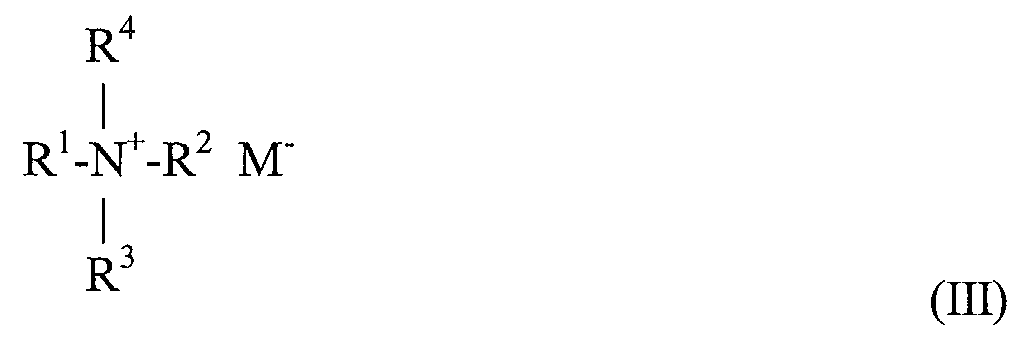
- The hydrocarbon group R3 and/or R4 may be a linear, branched or cyclic aliphatic group or the hydrocarbon group may comprise aromatic groups such as for example a benzyl group. R1 and/or R2 may represent a polyoxyalkylene group. Such a polyoxyalkylene group may be a homo-polyoxyalkylene such as polyoxyethylene or may be a copolyoxyalkylene such as a polyoxyalkylene group consisting of oxyethylene and oxypropylene units. Generally, the oxyalkylene groups of the polyoxyalkylene group will have 2, 3 or 4 carbon atoms and the number of oxyalkylene units in the polyoxyalkylene group will be between 1 and 15, preferably between 1 and 8 units. A single cationic surfactant according to formula (III) may be used as well a mixture of cationic surfactants according to formula (III) or a mixture with other cationic surfactants.
- Commercially available cationic surfactants that can be used include Arquad™ T-50, Arquad™ MCB-50, Ethoquad™ C-12 and Ethoquad™ 18-25 from Akzo-Nobel. Generally, the cationic surfactant will be used in an amount of 0.01% to 1%, preferably in an amount of 0.05 to 0.5% based on total weight of the aqueous composition.
- In addition to the fluorochemical compound, cationic surfactant and colloidal inorganic particles, the composition may contain further optional additives. For example, the composition may contain so-called extender compounds. Extenders are typically non-fluorinated compounds that improve the efficiency of the fluorochemical compound in the composition to provide the desired repellency properties such that either a lower amount of the fluorochemical compound can be used or improved repellency properties are obtained.
- Examples of extender compounds, include siloxanes, (meth)acrylate and substituted acrylate polymers and copolymers, N-methylolacrylamide-containing acrylate polymers, urethanes, blocked isocyanate-containing polymers and oligomers, condensates or precondensates of urea or melamine with formaldehyde, glyoxal resins, condensates of fatty acids with melamine or urea derivatives, condensates of fatty acids with polyamides and their epichlorohydrin adducts, waxes, polyethylene, chlorinated polyethylene, alkyl ketene dimers, esters, and amides. Blends of these fluorine-free extender compounds can also be used. When present, the extender compounds can be comprised in the composition in an amount of 0.1 to 10%, generally 0.5 to 5%.
- The composition of the invention will typically have a total amount of solids of 0.5 to 40% by weight. The fluorochemical compound generally comprises 25 % to 99 % of the solids. A composition ready for use in a treatment of a substrate will generally have between 0.25 and 10 % by weight of solids. Compositions having a higher amount of solids can be used as concentrates and are conveniently diluted with water prior to use in a treatment method.
- The composition of the invention can be used to treat a substrate, in particular a fibrous substrate to render it oil- and/or water repellent. Fibrous substrates that may be treated with the composition include textile, non-woven substrates and leather. The fibrous substrate may be based on synthetic fibers including for example polyester fibers, acrylic fibers and polyamide fibers as well as natural fibers such as cellulose fibers. The fibrous substrate may further comprise a mixture of different fibers including mixtures of synthetic and natural fibers as for example a mixture of polyester and cellulose fibers or mixtures of synthetic fibers such as a mixture of polyester and polyamide fibers.
- The composition is generally applied to a substrate in an amount effective to obtain a desired level of oil- and/or water repellency properties. Typically, the composition should be applied in an amount such that the amount of fluorochemical compound on the substrate is between 0.1 and 3% by weight based on the weight of the substrate, preferably between 0.2 and 1% by weight. The composition may be applied by any of the application techniques used to apply fluorochemical compositions to a substrate, in particular a fibrous substrate. The composition in accordance with the present invention is particularly suitable for use in an application method where the composition is applied to the substrate by contacting the substrate with the composition in a bath that contains the composition and wherein the substrate is guided over one or more rolls. Typically, such rolls are configured so as to squeeze excess treatment composition from the substrate.
- Following application of the composition to the substrate, the substrate will generally be dried. The substrate may be dried at ambient conditions by leaving the substrate exposed to air for a certain period of time. Alternatively, the substrate may be exposed to heat subsequent to the application of the composition to accelerate drying of the substrate and/or to cause curing of the applied composition if desired or necessary. When exposed to a heat temperature, the substrate may be guided through an oven and the temperature of heat treatment may be between 100 and 200°C, typically between 120 and 180°C.
- The invention is further illustrated with reference to the following examples without however the intention to limit the invention thereto.
- The spray rating of a treated substrate is a value indicative of the dynamic repellency of the treated substrate to water that impinges on the treated substrate. The repellency was measured by Test Method 22-1996, published in the 2001 Technical Manual of the American Association of Textile Chemists and Colorists (AATCC), and was expressed in terms of a 'spray rating' of the tested substrate. The spray rating was obtained by spraying 250 ml water on the substrate from a height of 15 cm. The wetting pattern was visually rated using a 0 to 100 scale, where 0 means complete wetting and 100 means no wetting at all.
- The oil repellency of a substrate was measured by the American Association of Textile Chemists and Colorists (AATCC) Standard Test Method No. 118-1983, which test was based on the resistance of a treated substrate to penetration by oils of varying surface tensions. Treated substrates resistant only to Nujol® mineral oil (the least penetrating of the test oils) were given a rating of 1, whereas treated substrates resistant to heptane (the most penetrating of the test liquids) were given a rating of 8. Other intermediate values were determined by use of other pure oils or mixtures of oils, as shown in the following table.
Standard Test Liquids AATCC Oil Repellency Rating Number Compositions 1 Nujol® 2 Nujol® /n-Hexadecane 65/35 3 n-Hexadecane 4 n-Tetradecane 5 n-Dodecane 6 n-Decane 7 n-Octane 8 n-Heptane - The impregnating effect of rain on treated substrates was determined using the Bundesmann Test Method (DIN 53888). In this test, the treated substrates were subjected to a simulated rainfall, while the back of the substrate was being rubbed. The appearance of the upper exposed surface was checked visually after 1, 5 and 10 minutes and was given a rating between 1 (complete surface wetting) and 5 (no water remains on the surface). Besides the observation of the wetting pattern, also the water absorption (% abs) was measured. Well-treated samples gave low absorption results.
- The water repellency (WR) of a substrate was measured using a series of water-isopropyl alcohol test liquids and was expressed in terms of the "WR" rating of the treated substrate. The WR rating corresponded to the most penetrating test liquid which did not penetrate or wet the substrate surface after 15 seconds exposure. Substrates which were penetrated by or were resistant only to 100% water (0% isopropyl alcohol), the least penetrating test liquid, were given a rating of 0, whereas substrates resistant to 100% isopropyl alcohol (0% water), the most penetrating test liquid, were given a rating of 10. Other intermediate ratings were calculated by dividing the percent isopropylalcohol in the test liquid by 10, e.g., a treated substrate resistant to a 70%/30% isopropyl alcohol/water blend, but not to an 80%/20% blend, would be given a rating of 7.
-
- Nalco™1056 : 35% colloidal silica dispersion in water (particle size 20 nm), with an Al2O3 shell, available from Nalco Chemical Co.
- Nalco™2329 : anionic colloidal silica (particle size 75 nm), available from Nalco Chemical Co.
- Disperal P2: Al2O3 powder with a primary particle size of 25 nm available from Sasol VCL2: vinylidene chloride
- ODMA: octadecylmethacrylate
- MGLY: methoxypolyethylene glycol 350 methacrylate
- FC-1: 30% solids aqueous dispersion comprising a fluorochemical acrylate having the following monomer composition C4F9SO2N(CH3)CH2CH2OCOC(CH3)=CH2 / VCL2 / ODMA/MGLY (weight ratio: 45/25/30/0.1) and an emulsifier system of 2% Arquad™ C-12 / 5.4% Tergitol™ TMN-6 and 2% Tergitol™ 15S30 based on fluorochemical acrylate solids.
- MIBK: methyl isobutyl ketone (4-methyl 2-pentanone)
- PES/CO (2681.4) : Grey polyester/cotton 65/35, style No. 2681.4, obtained from Utexbel N.V., Ronse, Belgium
- PAµ (7819.4) : Polyamide microfiber, style No. 7819.4, obtained from Sofinal, Belgium
- PES (0030.1) : polyester, style No. 0030.1, obtained from Sofinal, Belgium
- PESµ : polyester moss microfiber peach effect (sanded), available from San Laing Surface Fabric co.
- PA : polyamide taffeta (190 or 210 yam fiber) for apparel, available from Sunny Specific Mill
- Arquad™ C-12: cocobis(2-hydroxyethyl)methylammonium chloride surfactant from Akzo Nobel
- Tergitol™ TMN-6: polyethylene glycol trimethylnonyl ether surfactant from Rohm & Haas
- Tergitol™ 15S30: alcohol ethoxylate surfactant from Rohm & Haas
-
- To 90 g deionized water were added 10 g Disperal P2 Al2O3 powder. The mixture was stirred for 1 hr with a magnetic stirring bar. A slightly hazy 10% Al2O3 particle dispersion was obtained.
- 284 grams of Nalco™ 2329 (35.2% silica in water) was mixed with 3.75 grams of isooctyl trimethoxy silane. 500 grams of 1-methoxy-2-propanol was slowly added to this mixture while stirring. Finally, 3.0 grams of a 5% aqueous hydrofluoric acid solution was added slowly under vigorous stirring. This mixture was placed in a 250 ml bottle and sealed. The bottle was placed in a 90°C oven and allowed to react for 21 hours. The bottle was removed from the oven and the contents were pouring into a glass tray. The tray was placed in a 50°C oven for 4 hours. A dry white powder was obtained.
- 10 g iso-octyl modified silica particles (particle size:75 nm) were dissolved into 18.6 g MIBK at 75°C. This solution was added to a hot aqueous solution of 0.27g Ethoquad™ C-12, 0.30 g Tergitol™ 15S30 and 0.60g Tergitol™ TMN-6 in 25.8 g deionized water while stirring. This premix was subjected to ultra-sound for 2 minutes using a Branson 450 sonifier. MIBK was distilled of with a Büchi rotary evaporator to obtain a stable, milky dispersion.
- In example 1, a treatment bath was prepared by diluting 150 g FC-1 to 5 l with tap water. 2ml/l 60% acetic acid was added as well as 0.5g/l Nalco™1056. PA (taffeta) was run on a Butterworth padder via a continuous loop through the treatment bath. The bath stability and roll build up were observed during a 1 hour run (speed : 25 m/min ; pressure : 80 psi). No deposits on the rolls were observed after 1 hour run. Example 2 was made in the same way, but the colloidal silica was added to the concentrated FC-1 prior to the formulation of the treatment bath. No roll build up was observed.
In example 3, a treatment bath was prepared containing 30g/l FC-1, 2ml/l 60% acetic acid and 1g/l Nalco™1056. PESµ was treated in a Butterworth padder as described above. No roll build up was observed after 1 hour run.
In comparative example C-1, the same experiment was repeated for the treatment of PA taffeta, but without addition of colloidal silica to the treatment bath. Severe roll build up was observed after a one hour run. - In examples 4 to 6, polyester substrates were run on a Butterworth padder via a continuous loop through a bath containing 150 g FC-1, 4850 g tap water, 10 ml 60% acetic acid and various levels of Nalco™1056 as indicated in table 1. The substrates were run through the bath so as to obtain an add-on level of fluorochemical treating agent of 0.3% SOF (solids on fabric). Comparative example C-2 was made with a treatment bath without colloidal silica. The treated substrates were dried and cured at 160°C during 1.5 min. The oil and water repellency properties were measured and the results are given in table 1.
PES (0030.1) treated with cationic fluorochemical treating agent and Nalco™1056 Ex No % Nalco™ 1056* Initial Bundesmann OR WR SR 1' 5' 10' % abs 3 1.9 2 3 100 4 2 1 17.9 4 3.9 2 3 100 3 1 1 22.0 5 7.8 2 3 90 3 1 1 24.4 6 15.6 2 3 90 1.5 1 1 26.6 C-2 / 1 3 90 2.5 1 1 23.6 Note : % Nalco™1056* : based on 100% fluorochemical solids - As can be concluded from the results, the addition of cationic colloidal silica to the treatment bath comprising a cationic fluorochemical dispersion, did not influence the oil and water repellent properties of the substrates treated therewith.
- In examples 7 to 10, the same experiment was repeated with other substrates as indicated in table 2. Comparative example C-3 was made with a treatment bath without colloidal silica. The treated substrates were dried and cured at 160°C during 1.5 min. The oil and water repellency properties of the treated substrates are given in table 2.
oil and water repellent properties of PAµ Ex % Nalco™ 1056* PAµ (7819.5) PES/CO (2681.4) PA OR WR SR OR WR SR OR WR SR 7 1.9 2 3 75 2 3 90 0 2 80 8 3.9 2 3.5 75 2 3 80 0 2 75 9 7.8 2 3 70 2 3 80 0 2 75 10 15.6 2 3 75 2 3 80 0 2 75 C-3 / 3 4 80 2 3 100 1.5 2 80 Note : % Nalco™1056* : based on 100% fluorochemical solids - Also these experiments indicated that the addition of cationic colloidal silica to the cationic fluorochemical treatment bath did not influence the oil and water repellency properties of substrates treated therewith.
- In example 11, a treatment bath was prepared by diluting 150 g FC-1 to 5 l with tap water. 2ml/l 60% acetic acid was added as well as 7g/l Disperal P2 10% solids Al2O3 dispersion (25 nm; prepared as described above). PA (taffeta) was run on a Butterworth padder via a continuous loop through the treatment bath. The bath stability and roll build up were observed during a 1 hour run (speed : 25 m/min ; pressure : 80 psi). Only a few small deposit spots were observed after 1 hour run.
- Example 12 was made in the same way, but here a cationic iso-octyl modified silica dispersion (primary particle size 75 nm; prepared as described above) was used. No roll build up was observed.
Claims (13)
- A composition comprising an aqueous dispersion of a fluorochemical compound and a cationic surfactant wherein the composition further comprises colloidal inorganic particles.
- A composition according to claim 1 wherein said colloidal inorganic particles are cationic colloidal inorganic particles.
- A composition according to claim 1 or 2 wherein said colloidal inorganic particles have a particle size between 1 and 100 nm.
- A composition according to claim 2 or 3 wherein said cationic colloidal inorganic particles comprise cationic colloidal silica particles.
- A composition according to any of the previous claims wherein the amount of said colloidal inorganic particles is between 0.25 and 25 parts by weight per 100 parts by weight of said fluorochemical compound.
- A composition according to any of the previous claims wherein the total amount of solids in the composition is between 0.5 and 40% by weight.
- A composition according to any of the previous claims wherein said cationic surfactant comprises an ammonium surfactant.
- A composition according to any of the previous claims wherein said fluorochemical compound comprises a polymer of (a) one or more fluorinated monomers having a non-fluorinated ethylenically unsaturated group and optionally one or more non-fluorinated monomers.
- A composition according to any of the previous claims wherein said composition has a pH of less than 7.
- A method of treatment comprising applying a composition as defined in any of claims 1 to 9 to a fibrous substrate.
- A method according to claim 10 wherein said composition is contained in a bath through which said fibrous substrate is guided so as to apply the composition to said fibrous substrate and wherein said fibrous substrate is guided through one or more rolls.
- A method according to any of claims 10 or 11 wherein an effective amount of said fluorochemical compound is applied to said fibrous substrate so as to provide oil-and/or water repellency properties to said fibrous substrate.
- A method according to any of claims 11 to 12 wherein said fibrous substrate comprises textile or a non-woven fabric.
Priority Applications (6)
| Application Number | Priority Date | Filing Date | Title |
|---|---|---|---|
| EP03078694A EP1533356A1 (en) | 2003-11-24 | 2003-11-24 | Fluorochemical composition for rendering substrates oil and/or water repellent |
| KR1020067010001A KR20060115880A (en) | 2003-11-24 | 2004-10-21 | Fluorocompound composition for imparting oil repellency and / or water repellency to a substrate |
| JP2006541175A JP2007514017A (en) | 2003-11-24 | 2004-10-21 | Fluorochemical composition for making base material oil and / or water repellent |
| CNA2004800346466A CN1886481A (en) | 2003-11-24 | 2004-10-21 | Fluorochemical composition for rendering substrates oil and/or water repellent |
| PCT/US2004/034898 WO2005056711A1 (en) | 2003-11-24 | 2004-10-21 | Fluorochemical composition for rendering substrates oil and/or water repellent |
| US10/579,018 US20070221877A1 (en) | 2003-11-24 | 2004-10-21 | Fluorochemical Composition for Rendering Substrates Oil and/or Water Repellent |
Applications Claiming Priority (1)
| Application Number | Priority Date | Filing Date | Title |
|---|---|---|---|
| EP03078694A EP1533356A1 (en) | 2003-11-24 | 2003-11-24 | Fluorochemical composition for rendering substrates oil and/or water repellent |
Publications (1)
| Publication Number | Publication Date |
|---|---|
| EP1533356A1 true EP1533356A1 (en) | 2005-05-25 |
Family
ID=34429456
Family Applications (1)
| Application Number | Title | Priority Date | Filing Date |
|---|---|---|---|
| EP03078694A Withdrawn EP1533356A1 (en) | 2003-11-24 | 2003-11-24 | Fluorochemical composition for rendering substrates oil and/or water repellent |
Country Status (6)
| Country | Link |
|---|---|
| US (1) | US20070221877A1 (en) |
| EP (1) | EP1533356A1 (en) |
| JP (1) | JP2007514017A (en) |
| KR (1) | KR20060115880A (en) |
| CN (1) | CN1886481A (en) |
| WO (1) | WO2005056711A1 (en) |
Cited By (1)
| Publication number | Priority date | Publication date | Assignee | Title |
|---|---|---|---|---|
| US7879743B2 (en) | 2006-10-01 | 2011-02-01 | Bigsky Technologies Llc | Stain and soil resistant textile article |
Families Citing this family (16)
| Publication number | Priority date | Publication date | Assignee | Title |
|---|---|---|---|---|
| DE10306893A1 (en) * | 2003-02-18 | 2004-08-26 | Basf Ag | Process for finishing textile material to impart water and soil repellence to e.g. natural, modified and/or synthetic fibers, yarn (precursor), thread or fabric, uses organic polymer and particulate (in)organic solid in aqueous medium |
| CA2685760C (en) * | 2007-05-18 | 2014-05-13 | Invista Technologies S.A.R.L. | Method and composition for treating fibrous substrates |
| DE102007023555A1 (en) * | 2007-05-21 | 2008-11-27 | Siemens Ag | Hydrophobic surface coating for electronic and electrical components as well as uses for it |
| US20100009583A1 (en) * | 2007-09-21 | 2010-01-14 | Bigsky Technologies Llc | Flame retardant, stain and soil resistant textile article |
| JP5439743B2 (en) | 2007-10-11 | 2014-03-12 | ユニマテック株式会社 | Water and oil repellent |
| JP5388597B2 (en) * | 2009-01-19 | 2014-01-15 | ユニチカトレーディング株式会社 | Moisture permeable waterproof fabric and method for producing the same |
| WO2010144398A2 (en) * | 2009-06-10 | 2010-12-16 | 3M Innovative Properties Company | Method for treating hydrocarbon-bearing formations with polyfluoropolyether silanes |
| US8833449B2 (en) | 2009-07-09 | 2014-09-16 | 3M Innovative Properties Company | Methods for treating carbonate hydrocarbon-bearing formations with fluorinated amphoteric compounds |
| KR101768241B1 (en) * | 2009-11-09 | 2017-08-30 | 이 아이 듀폰 디 네모아 앤드 캄파니 | Fluoropolymer emulsions |
| CN102587128B (en) * | 2012-01-19 | 2013-10-09 | 苏州大学 | A kind of waterproof synergist and the method for textile waterproof finishing |
| US9657436B2 (en) * | 2012-01-31 | 2017-05-23 | Invista North America S.á.r.l. | Liquid and soil repellent compositions for fibers |
| US20140106165A1 (en) * | 2012-10-12 | 2014-04-17 | Georgia-Pacific Chemicals Llc | Paper with higher oil repellency |
| CN102965936A (en) * | 2012-11-02 | 2013-03-13 | 浙江莱美纺织印染科技有限公司 | Nano waterproof, oil-proof and antifouling finishing liquid |
| CN108642956A (en) * | 2018-05-21 | 2018-10-12 | 江苏佳饰家新材料有限公司 | Organic fluoride modified cyanurotriamide surface layer adhesive and preparation method thereof and melamine paper |
| KR102442478B1 (en) * | 2020-08-26 | 2022-09-13 | 조은경 | Coating composition for textile and coating method thereof |
| KR102519528B1 (en) * | 2020-11-27 | 2023-04-10 | 한국생산기술연구원 | Water and oil-repellent coating material having superomniphobic properties, and method for manufacturing the same |
Citations (3)
| Publication number | Priority date | Publication date | Assignee | Title |
|---|---|---|---|---|
| EP0550915A1 (en) * | 1992-01-10 | 1993-07-14 | Idemitsu Kosan Company Limited | Water-repellent emulsion composition and process for the production thereof |
| US5888290A (en) * | 1996-05-24 | 1999-03-30 | Minnesota Mining And Manufacturing Company | Composition and process for imparting durable repellency to substrates |
| EP0909802A1 (en) * | 1996-06-21 | 1999-04-21 | Daikin Industries, Limited | Aqueous dispersion type fluorinated water- and oil-repellent |
Family Cites Families (18)
| Publication number | Priority date | Publication date | Assignee | Title |
|---|---|---|---|---|
| US3660360A (en) * | 1970-06-24 | 1972-05-02 | Nat Starch Chem Corp | Water- and oil repellency agents |
| US3940359A (en) * | 1974-05-08 | 1976-02-24 | E. I. Du Pont De Nemours And Company | Soil-repellent coating compositions |
| JPS5350079A (en) * | 1976-10-19 | 1978-05-08 | Asahi Glass Co Ltd | Water and oil repellent composition with excellent stainproofing power |
| US4742140A (en) * | 1986-01-23 | 1988-05-03 | E. I. Du Pont De Nemours And Company | Oil- and water-repellent copolymers |
| DE3934543A1 (en) * | 1989-10-17 | 1991-04-18 | Bayer Ag | PERFLUORALKYL GROUPS CONTAINING COPOLYMERISATE / II |
| KR100231226B1 (en) * | 1991-07-10 | 1999-11-15 | 스프레이그 로버트 월터 | Fluorochemical composition for water and oil repellent treatment |
| US5350795A (en) * | 1991-07-10 | 1994-09-27 | Minnesota Mining And Manufacturing Company | Aqueous oil and water repellent compositions which cure at ambient temperature |
| JPH05279657A (en) * | 1992-01-10 | 1993-10-26 | Idemitsu Kosan Co Ltd | Water-repelling emulsion composition and its production |
| JP2704818B2 (en) * | 1992-11-27 | 1998-01-26 | 三菱石油株式会社 | Drip-proof agent |
| EP0837963A1 (en) * | 1995-06-23 | 1998-04-29 | Minnesota Mining And Manufacturing Company | Composition and process for imparting durable repellency to substrates |
| US5608003A (en) * | 1995-06-23 | 1997-03-04 | Minnesota Mining And Manufacturing Company | Aqueous fluorochemical compositions and abrasion-resistant coatings therefrom |
| US5908663A (en) * | 1996-02-01 | 1999-06-01 | Minnesota Mining And Manufacturing Company | Topical carpet treatment |
| CA2252902A1 (en) * | 1996-05-17 | 1997-11-27 | Minnesota Mining And Manufacturing Company | Fluorochemical polyurethanes, providing good laundry air-dry performance |
| US5760126A (en) * | 1996-12-20 | 1998-06-02 | Minnesota Mining And Manufacturing Company | Aqueous fluorochemical compositions and abrasion-resistant coatings therefrom |
| JP3624615B2 (en) * | 1997-02-28 | 2005-03-02 | ユニマテック株式会社 | Novel copolymer and water / oil repellent containing the same |
| US6121372A (en) * | 1998-03-06 | 2000-09-19 | Nippon Mektron Limited | Aqueous emulsion component for a water- and oil-repellant agent |
| US6525127B1 (en) * | 1999-05-11 | 2003-02-25 | 3M Innovative Properties Company | Alkylated fluorochemical oligomers and use thereof in the treatment of fibrous substrates |
| DE10306893A1 (en) * | 2003-02-18 | 2004-08-26 | Basf Ag | Process for finishing textile material to impart water and soil repellence to e.g. natural, modified and/or synthetic fibers, yarn (precursor), thread or fabric, uses organic polymer and particulate (in)organic solid in aqueous medium |
-
2003
- 2003-11-24 EP EP03078694A patent/EP1533356A1/en not_active Withdrawn
-
2004
- 2004-10-21 US US10/579,018 patent/US20070221877A1/en not_active Abandoned
- 2004-10-21 WO PCT/US2004/034898 patent/WO2005056711A1/en not_active Ceased
- 2004-10-21 KR KR1020067010001A patent/KR20060115880A/en not_active Withdrawn
- 2004-10-21 CN CNA2004800346466A patent/CN1886481A/en active Pending
- 2004-10-21 JP JP2006541175A patent/JP2007514017A/en active Pending
Patent Citations (3)
| Publication number | Priority date | Publication date | Assignee | Title |
|---|---|---|---|---|
| EP0550915A1 (en) * | 1992-01-10 | 1993-07-14 | Idemitsu Kosan Company Limited | Water-repellent emulsion composition and process for the production thereof |
| US5888290A (en) * | 1996-05-24 | 1999-03-30 | Minnesota Mining And Manufacturing Company | Composition and process for imparting durable repellency to substrates |
| EP0909802A1 (en) * | 1996-06-21 | 1999-04-21 | Daikin Industries, Limited | Aqueous dispersion type fluorinated water- and oil-repellent |
Cited By (1)
| Publication number | Priority date | Publication date | Assignee | Title |
|---|---|---|---|---|
| US7879743B2 (en) | 2006-10-01 | 2011-02-01 | Bigsky Technologies Llc | Stain and soil resistant textile article |
Also Published As
| Publication number | Publication date |
|---|---|
| WO2005056711A1 (en) | 2005-06-23 |
| KR20060115880A (en) | 2006-11-10 |
| US20070221877A1 (en) | 2007-09-27 |
| CN1886481A (en) | 2006-12-27 |
| JP2007514017A (en) | 2007-05-31 |
Similar Documents
| Publication | Publication Date | Title |
|---|---|---|
| US20070221877A1 (en) | Fluorochemical Composition for Rendering Substrates Oil and/or Water Repellent | |
| JP5654443B2 (en) | Carbodiimide compound and base oil / water repellency imparting composition | |
| US5817249A (en) | Carbodiimide compound and water repellent compositions | |
| JPH05271351A (en) | Fluorine-containing copolymers and aqueous dispersions produced therefrom | |
| TW201134932A (en) | Fluoropolymers and treatment agent | |
| AU2003213124A1 (en) | Repellent fluorochemical compositions | |
| JPH05279541A (en) | Fluorine-containing copolymers | |
| JP2020056031A (en) | Water-repellent and antifouling fluorine-free composition | |
| KR100214319B1 (en) | Fluorine-efficient oil and water repellent compositions | |
| EP2149591A1 (en) | Stain-proofing agent composition, method for producing the same and article processed with the same | |
| TW201132653A (en) | Fluoropolymers and surface treatment agent | |
| JPH04227614A (en) | Graft copolymer containing perfluoroalkyl group | |
| JP4991521B2 (en) | Fluorochemical composition and method for treating a substrate using the same | |
| KR20070016135A (en) | Fluorocompound composition and processing method of substrate using the same | |
| JPH02277887A (en) | Stain-resistant web | |
| CN105980427A (en) | Finishing agent with blocked polyisocyanates |
Legal Events
| Date | Code | Title | Description |
|---|---|---|---|
| PUAI | Public reference made under article 153(3) epc to a published international application that has entered the european phase |
Free format text: ORIGINAL CODE: 0009012 |
|
| AK | Designated contracting states |
Kind code of ref document: A1 Designated state(s): AT BE BG CH CY CZ DE DK EE ES FI FR GB GR HU IE IT LI LU MC NL PT RO SE SI SK TR |
|
| AX | Request for extension of the european patent |
Extension state: AL LT LV MK |
|
| AKX | Designation fees paid | ||
| 17P | Request for examination filed |
Effective date: 20051128 |
|
| RBV | Designated contracting states (corrected) |
Designated state(s): AT BE BG CH CY CZ DE DK EE ES FI FR GB GR HU IE IT LI LU MC NL PT RO SE SI SK TR |
|
| REG | Reference to a national code |
Ref country code: DE Ref legal event code: 8566 |
|
| STAA | Information on the status of an ep patent application or granted ep patent |
Free format text: STATUS: THE APPLICATION IS DEEMED TO BE WITHDRAWN |
|
| 18D | Application deemed to be withdrawn |
Effective date: 20080228 |