EP1533310A1 - Isonipecotamides for the treatment of integrin-mediated disorders - Google Patents
Isonipecotamides for the treatment of integrin-mediated disorders Download PDFInfo
- Publication number
- EP1533310A1 EP1533310A1 EP05075325A EP05075325A EP1533310A1 EP 1533310 A1 EP1533310 A1 EP 1533310A1 EP 05075325 A EP05075325 A EP 05075325A EP 05075325 A EP05075325 A EP 05075325A EP 1533310 A1 EP1533310 A1 EP 1533310A1
- Authority
- EP
- European Patent Office
- Prior art keywords
- alkyl
- amino
- group
- compound
- optionally substituted
- Prior art date
- Legal status (The legal status is an assumption and is not a legal conclusion. Google has not performed a legal analysis and makes no representation as to the accuracy of the status listed.)
- Withdrawn
Links
- 102000006495 integrins Human genes 0.000 title claims abstract description 53
- 108010044426 integrins Proteins 0.000 title claims abstract description 53
- 230000001404 mediated effect Effects 0.000 title claims abstract description 25
- 238000011282 treatment Methods 0.000 title claims description 13
- DPBWFNDFMCCGGJ-UHFFFAOYSA-N 4-Piperidine carboxamide Chemical class NC(=O)C1CCNCC1 DPBWFNDFMCCGGJ-UHFFFAOYSA-N 0.000 title abstract description 7
- -1 R3HN- Chemical group 0.000 claims description 158
- 150000001875 compounds Chemical class 0.000 claims description 149
- 125000002924 primary amino group Chemical group [H]N([H])* 0.000 claims description 97
- 125000001424 substituent group Chemical group 0.000 claims description 71
- 125000004178 (C1-C4) alkyl group Chemical group 0.000 claims description 62
- 125000002915 carbonyl group Chemical group [*:2]C([*:1])=O 0.000 claims description 59
- 208000037265 diseases, disorders, signs and symptoms Diseases 0.000 claims description 48
- 125000003118 aryl group Chemical group 0.000 claims description 46
- 208000035475 disorder Diseases 0.000 claims description 44
- 229910052739 hydrogen Inorganic materials 0.000 claims description 44
- 239000001257 hydrogen Substances 0.000 claims description 41
- 238000000034 method Methods 0.000 claims description 40
- 125000004209 (C1-C8) alkyl group Chemical group 0.000 claims description 32
- 125000001072 heteroaryl group Chemical group 0.000 claims description 30
- 102100025306 Integrin alpha-IIb Human genes 0.000 claims description 25
- 101710149643 Integrin alpha-IIb Proteins 0.000 claims description 25
- 239000005557 antagonist Substances 0.000 claims description 25
- 125000002887 hydroxy group Chemical group [H]O* 0.000 claims description 25
- 229940125904 compound 1 Drugs 0.000 claims description 22
- 150000003839 salts Chemical class 0.000 claims description 22
- UFHFLCQGNIYNRP-UHFFFAOYSA-N Hydrogen Chemical compound [H][H] UFHFLCQGNIYNRP-UHFFFAOYSA-N 0.000 claims description 18
- 125000000623 heterocyclic group Chemical group 0.000 claims description 18
- 229960003767 alanine Drugs 0.000 claims description 17
- OKTJSMMVPCPJKN-UHFFFAOYSA-N Carbon Chemical group [C] OKTJSMMVPCPJKN-UHFFFAOYSA-N 0.000 claims description 16
- 230000009977 dual effect Effects 0.000 claims description 16
- 229910052736 halogen Inorganic materials 0.000 claims description 16
- 150000002367 halogens Chemical group 0.000 claims description 16
- 125000002496 methyl group Chemical group [H]C([H])([H])* 0.000 claims description 16
- 229910052799 carbon Inorganic materials 0.000 claims description 15
- 229940125782 compound 2 Drugs 0.000 claims description 15
- 150000002148 esters Chemical class 0.000 claims description 15
- 239000008194 pharmaceutical composition Substances 0.000 claims description 15
- QNAYBMKLOCPYGJ-UHFFFAOYSA-N D-alpha-Ala Natural products CC([NH3+])C([O-])=O QNAYBMKLOCPYGJ-UHFFFAOYSA-N 0.000 claims description 13
- QNAYBMKLOCPYGJ-UWTATZPHSA-N L-Alanine Natural products C[C@@H](N)C(O)=O QNAYBMKLOCPYGJ-UWTATZPHSA-N 0.000 claims description 13
- 239000003937 drug carrier Substances 0.000 claims description 13
- 208000001132 Osteoporosis Diseases 0.000 claims description 12
- 125000003282 alkyl amino group Chemical group 0.000 claims description 11
- 125000001997 phenyl group Chemical group [H]C1=C([H])C([H])=C(*)C([H])=C1[H] 0.000 claims description 11
- 208000037803 restenosis Diseases 0.000 claims description 11
- 201000001320 Atherosclerosis Diseases 0.000 claims description 10
- 206010012689 Diabetic retinopathy Diseases 0.000 claims description 10
- 125000000217 alkyl group Chemical group 0.000 claims description 10
- 125000000753 cycloalkyl group Chemical group 0.000 claims description 10
- 206010002388 Angina unstable Diseases 0.000 claims description 9
- 208000002249 Diabetes Complications Diseases 0.000 claims description 9
- 206010012655 Diabetic complications Diseases 0.000 claims description 9
- 208000007814 Unstable Angina Diseases 0.000 claims description 9
- 150000001721 carbon Chemical group 0.000 claims description 9
- 201000004332 intermediate coronary syndrome Diseases 0.000 claims description 9
- 208000002780 macular degeneration Diseases 0.000 claims description 9
- 206010039073 rheumatoid arthritis Diseases 0.000 claims description 9
- 238000002560 therapeutic procedure Methods 0.000 claims description 9
- 125000000229 (C1-C4)alkoxy group Chemical group 0.000 claims description 8
- 206010003178 Arterial thrombosis Diseases 0.000 claims description 8
- 208000006386 Bone Resorption Diseases 0.000 claims description 8
- 208000012902 Nervous system disease Diseases 0.000 claims description 8
- 208000025966 Neurological disease Diseases 0.000 claims description 8
- 208000024248 Vascular System injury Diseases 0.000 claims description 8
- 208000012339 Vascular injury Diseases 0.000 claims description 8
- 206010047249 Venous thrombosis Diseases 0.000 claims description 8
- 125000004453 alkoxycarbonyl group Chemical group 0.000 claims description 8
- 230000033115 angiogenesis Effects 0.000 claims description 8
- 125000000732 arylene group Chemical group 0.000 claims description 8
- 208000006673 asthma Diseases 0.000 claims description 8
- 230000024279 bone resorption Effects 0.000 claims description 8
- 239000000460 chlorine Chemical group 0.000 claims description 8
- 229910052801 chlorine Inorganic materials 0.000 claims description 8
- 125000001495 ethyl group Chemical group [H]C([H])([H])C([H])([H])* 0.000 claims description 8
- 201000006417 multiple sclerosis Diseases 0.000 claims description 8
- 239000000651 prodrug Substances 0.000 claims description 8
- 229940002612 prodrug Drugs 0.000 claims description 8
- 230000009424 thromboembolic effect Effects 0.000 claims description 8
- 125000004105 2-pyridyl group Chemical group N1=C([*])C([H])=C([H])C([H])=C1[H] 0.000 claims description 7
- 206010061218 Inflammation Diseases 0.000 claims description 7
- 206010028980 Neoplasm Diseases 0.000 claims description 7
- 125000002947 alkylene group Chemical group 0.000 claims description 7
- 125000002344 aminooxy group Chemical group [H]N([H])O[*] 0.000 claims description 7
- 201000011510 cancer Diseases 0.000 claims description 7
- 239000003795 chemical substances by application Substances 0.000 claims description 7
- 230000004054 inflammatory process Effects 0.000 claims description 7
- 125000004454 (C1-C6) alkoxycarbonyl group Chemical group 0.000 claims description 6
- 206010000891 acute myocardial infarction Diseases 0.000 claims description 6
- 238000002399 angioplasty Methods 0.000 claims description 6
- 239000003146 anticoagulant agent Substances 0.000 claims description 6
- 125000000484 butyl group Chemical group [H]C([*])([H])C([H])([H])C([H])([H])C([H])([H])[H] 0.000 claims description 6
- 125000004076 pyridyl group Chemical group 0.000 claims description 6
- 230000002537 thrombolytic effect Effects 0.000 claims description 6
- 230000004614 tumor growth Effects 0.000 claims description 6
- 125000004174 2-benzimidazolyl group Chemical group [H]N1C(*)=NC2=C([H])C([H])=C([H])C([H])=C12 0.000 claims description 5
- 125000001797 benzyl group Chemical group [H]C1=C([H])C([H])=C(C([H])=C1[H])C([H])([H])* 0.000 claims description 5
- 125000001570 methylene group Chemical group [H]C([H])([*:1])[*:2] 0.000 claims description 5
- 238000002156 mixing Methods 0.000 claims description 5
- 125000004482 piperidin-4-yl group Chemical group N1CCC(CC1)* 0.000 claims description 5
- 230000008569 process Effects 0.000 claims description 5
- 125000006273 (C1-C3) alkyl group Chemical group 0.000 claims description 4
- 125000004169 (C1-C6) alkyl group Chemical group 0.000 claims description 4
- ZAMOUSCENKQFHK-UHFFFAOYSA-N Chlorine atom Chemical group [Cl] ZAMOUSCENKQFHK-UHFFFAOYSA-N 0.000 claims description 4
- PXGOKWXKJXAPGV-UHFFFAOYSA-N Fluorine Chemical group FF PXGOKWXKJXAPGV-UHFFFAOYSA-N 0.000 claims description 4
- 229940123038 Integrin antagonist Drugs 0.000 claims description 4
- 125000001309 chloro group Chemical group Cl* 0.000 claims description 4
- 229940126142 compound 16 Drugs 0.000 claims description 4
- 125000004093 cyano group Chemical group *C#N 0.000 claims description 4
- 239000011737 fluorine Chemical group 0.000 claims description 4
- 229910052731 fluorine Inorganic materials 0.000 claims description 4
- 125000002962 imidazol-1-yl group Chemical group [*]N1C([H])=NC([H])=C1[H] 0.000 claims description 4
- 125000000449 nitro group Chemical group [O-][N+](*)=O 0.000 claims description 4
- 125000002023 trifluoromethyl group Chemical group FC(F)(F)* 0.000 claims description 4
- 125000002252 acyl group Chemical group 0.000 claims description 3
- 125000004450 alkenylene group Chemical group 0.000 claims description 3
- 125000006274 (C1-C3)alkoxy group Chemical group 0.000 claims description 2
- 125000006656 (C2-C4) alkenyl group Chemical group 0.000 claims description 2
- VGGSQFUCUMXWEO-UHFFFAOYSA-N Ethene Chemical compound C=C VGGSQFUCUMXWEO-UHFFFAOYSA-N 0.000 claims description 2
- 239000005977 Ethylene Substances 0.000 claims description 2
- WFBHRSAKANVBKH-UHFFFAOYSA-N N-hydroxyguanidine Chemical class NC(=N)NO WFBHRSAKANVBKH-UHFFFAOYSA-N 0.000 claims description 2
- 125000004448 alkyl carbonyl group Chemical group 0.000 claims description 2
- 125000003236 benzoyl group Chemical group [H]C1=C([H])C([H])=C(C([H])=C1[H])C(*)=O 0.000 claims description 2
- FNIATMYXUPOJRW-UHFFFAOYSA-N cyclohexylidene Chemical group [C]1CCCCC1 FNIATMYXUPOJRW-UHFFFAOYSA-N 0.000 claims description 2
- 125000001301 ethoxy group Chemical group [H]C([H])([H])C([H])([H])O* 0.000 claims description 2
- KIIAVHWBIPNTGI-UHFFFAOYSA-N ethoxy-methoxy-propoxy-lambda3-bromane Chemical group COBr(OCCC)OCC KIIAVHWBIPNTGI-UHFFFAOYSA-N 0.000 claims description 2
- 125000004494 ethyl ester group Chemical group 0.000 claims description 2
- YSPVHAUJXLGZHP-UHFFFAOYSA-N ethyl piperidine-1-carboxylate Chemical compound CCOC(=O)N1CCCCC1 YSPVHAUJXLGZHP-UHFFFAOYSA-N 0.000 claims description 2
- 125000003037 imidazol-2-yl group Chemical group [H]N1C([*])=NC([H])=C1[H] 0.000 claims description 2
- QJQYPZZUKLQGGT-UHFFFAOYSA-N methyl hypobromite Chemical compound COBr QJQYPZZUKLQGGT-UHFFFAOYSA-N 0.000 claims description 2
- 125000003854 p-chlorophenyl group Chemical group [H]C1=C([H])C(*)=C([H])C([H])=C1Cl 0.000 claims description 2
- 125000001436 propyl group Chemical group [H]C([*])([H])C([H])([H])C([H])([H])[H] 0.000 claims description 2
- QQONPFPTGQHPMA-UHFFFAOYSA-N propylene Natural products CC=C QQONPFPTGQHPMA-UHFFFAOYSA-N 0.000 claims description 2
- 125000004805 propylene group Chemical group [H]C([H])([H])C([H])([*:1])C([H])([H])[*:2] 0.000 claims description 2
- MWWATHDPGQKSAR-UHFFFAOYSA-N propyne Chemical group CC#C MWWATHDPGQKSAR-UHFFFAOYSA-N 0.000 claims description 2
- 125000000246 pyrimidin-2-yl group Chemical group [H]C1=NC(*)=NC([H])=C1[H] 0.000 claims description 2
- 125000000391 vinyl group Chemical group [H]C([*])=C([H])[H] 0.000 claims description 2
- 150000002431 hydrogen Chemical class 0.000 claims 9
- 230000001668 ameliorated effect Effects 0.000 claims 2
- TZGYRLHKISDCOW-UHFFFAOYSA-N 3-(1,3-benzodioxol-5-yl)-3-[[1-[3-(4,5-dihydro-1h-imidazol-2-ylamino)oxypropanoyl]piperidine-4-carbonyl]amino]propanoic acid Chemical compound C=1C=C2OCOC2=CC=1C(CC(=O)O)NC(=O)C(CC1)CCN1C(=O)CCONC1=NCCN1 TZGYRLHKISDCOW-UHFFFAOYSA-N 0.000 claims 1
- WSKVJMQKJJLBGQ-UHFFFAOYSA-N 3-(1,3-benzodioxol-5-yl)-3-[[1-[4-(pyridin-2-ylamino)butanoyl]piperidine-4-carbonyl]amino]propanoic acid Chemical compound C=1C=C2OCOC2=CC=1C(CC(=O)O)NC(=O)C(CC1)CCN1C(=O)CCCNC1=CC=CC=N1 WSKVJMQKJJLBGQ-UHFFFAOYSA-N 0.000 claims 1
- OKKJLVBELUTLKV-UHFFFAOYSA-N methanol Natural products OC OKKJLVBELUTLKV-UHFFFAOYSA-N 0.000 description 29
- YMWUJEATGCHHMB-UHFFFAOYSA-N Dichloromethane Chemical compound ClCCl YMWUJEATGCHHMB-UHFFFAOYSA-N 0.000 description 26
- 239000000203 mixture Substances 0.000 description 26
- 239000000543 intermediate Substances 0.000 description 22
- 235000002639 sodium chloride Nutrition 0.000 description 20
- 238000002360 preparation method Methods 0.000 description 16
- 150000003335 secondary amines Chemical class 0.000 description 16
- 125000004435 hydrogen atom Chemical class [H]* 0.000 description 15
- WMFOQBRAJBCJND-UHFFFAOYSA-M Lithium hydroxide Chemical compound [Li+].[OH-] WMFOQBRAJBCJND-UHFFFAOYSA-M 0.000 description 13
- 239000003826 tablet Substances 0.000 description 13
- IAZDPXIOMUYVGZ-WFGJKAKNSA-N Dimethyl sulfoxide Chemical compound [2H]C([2H])([2H])S(=O)C([2H])([2H])[2H] IAZDPXIOMUYVGZ-WFGJKAKNSA-N 0.000 description 12
- VEXZGXHMUGYJMC-UHFFFAOYSA-N Hydrochloric acid Chemical compound Cl VEXZGXHMUGYJMC-UHFFFAOYSA-N 0.000 description 11
- DTQVDTLACAAQTR-UHFFFAOYSA-N Trifluoroacetic acid Chemical compound OC(=O)C(F)(F)F DTQVDTLACAAQTR-UHFFFAOYSA-N 0.000 description 11
- 239000011521 glass Substances 0.000 description 11
- XLYOFNOQVPJJNP-UHFFFAOYSA-N water Substances O XLYOFNOQVPJJNP-UHFFFAOYSA-N 0.000 description 11
- DYHSDKLCOJIUFX-UHFFFAOYSA-N Di-tert-butyl dicarbonate Substances CC(C)(C)OC(=O)OC(=O)OC(C)(C)C DYHSDKLCOJIUFX-UHFFFAOYSA-N 0.000 description 10
- LFQSCWFLJHTTHZ-UHFFFAOYSA-N Ethanol Chemical compound CCO LFQSCWFLJHTTHZ-UHFFFAOYSA-N 0.000 description 10
- 239000002253 acid Substances 0.000 description 10
- 238000006243 chemical reaction Methods 0.000 description 10
- 239000003153 chemical reaction reagent Substances 0.000 description 10
- 238000001819 mass spectrum Methods 0.000 description 10
- 239000000047 product Substances 0.000 description 10
- SJRJJKPEHAURKC-UHFFFAOYSA-N N-Methylmorpholine Chemical compound CN1CCOCC1 SJRJJKPEHAURKC-UHFFFAOYSA-N 0.000 description 9
- 108010031318 Vitronectin Proteins 0.000 description 9
- 102100035140 Vitronectin Human genes 0.000 description 9
- 239000002775 capsule Substances 0.000 description 9
- 239000003921 oil Substances 0.000 description 9
- 235000019198 oils Nutrition 0.000 description 9
- 150000003141 primary amines Chemical class 0.000 description 9
- KFZMGEQAYNKOFK-UHFFFAOYSA-N Isopropanol Chemical compound CC(C)O KFZMGEQAYNKOFK-UHFFFAOYSA-N 0.000 description 8
- WYURNTSHIVDZCO-UHFFFAOYSA-N Tetrahydrofuran Chemical compound C1CCOC1 WYURNTSHIVDZCO-UHFFFAOYSA-N 0.000 description 8
- 125000004432 carbon atom Chemical group C* 0.000 description 8
- 238000005160 1H NMR spectroscopy Methods 0.000 description 7
- 239000000872 buffer Substances 0.000 description 7
- 125000005842 heteroatom Chemical group 0.000 description 7
- 238000000159 protein binding assay Methods 0.000 description 7
- 239000007787 solid Substances 0.000 description 7
- 239000000243 solution Substances 0.000 description 7
- WEVYAHXRMPXWCK-UHFFFAOYSA-N Acetonitrile Chemical compound CC#N WEVYAHXRMPXWCK-UHFFFAOYSA-N 0.000 description 6
- IYMAXBFPHPZYIK-BQBZGAKWSA-N Arg-Gly-Asp Chemical compound NC(N)=NCCC[C@H](N)C(=O)NCC(=O)N[C@@H](CC(O)=O)C(O)=O IYMAXBFPHPZYIK-BQBZGAKWSA-N 0.000 description 6
- FAPWRFPIFSIZLT-UHFFFAOYSA-M Sodium chloride Chemical compound [Na+].[Cl-] FAPWRFPIFSIZLT-UHFFFAOYSA-M 0.000 description 6
- HEMHJVSKTPXQMS-UHFFFAOYSA-M Sodium hydroxide Chemical compound [OH-].[Na+] HEMHJVSKTPXQMS-UHFFFAOYSA-M 0.000 description 6
- 239000004480 active ingredient Substances 0.000 description 6
- 230000015572 biosynthetic process Effects 0.000 description 6
- 230000008878 coupling Effects 0.000 description 6
- 238000010168 coupling process Methods 0.000 description 6
- 238000005859 coupling reaction Methods 0.000 description 6
- 239000003814 drug Substances 0.000 description 6
- 239000007788 liquid Substances 0.000 description 6
- 239000007858 starting material Substances 0.000 description 6
- 239000000725 suspension Substances 0.000 description 6
- LENZDBCJOHFCAS-UHFFFAOYSA-N tris Chemical compound OCC(N)(CO)CO LENZDBCJOHFCAS-UHFFFAOYSA-N 0.000 description 6
- QTBSBXVTEAMEQO-UHFFFAOYSA-N Acetic acid Chemical compound CC(O)=O QTBSBXVTEAMEQO-UHFFFAOYSA-N 0.000 description 5
- IAZDPXIOMUYVGZ-UHFFFAOYSA-N Dimethylsulphoxide Chemical compound CS(C)=O IAZDPXIOMUYVGZ-UHFFFAOYSA-N 0.000 description 5
- 102000008946 Fibrinogen Human genes 0.000 description 5
- 108010049003 Fibrinogen Proteins 0.000 description 5
- ZMXDDKWLCZADIW-UHFFFAOYSA-N N,N-Dimethylformamide Chemical compound CN(C)C=O ZMXDDKWLCZADIW-UHFFFAOYSA-N 0.000 description 5
- 208000007536 Thrombosis Diseases 0.000 description 5
- ZMANZCXQSJIPKH-UHFFFAOYSA-N Triethylamine Chemical compound CCN(CC)CC ZMANZCXQSJIPKH-UHFFFAOYSA-N 0.000 description 5
- 150000001412 amines Chemical class 0.000 description 5
- 239000000969 carrier Substances 0.000 description 5
- 229940012952 fibrinogen Drugs 0.000 description 5
- 239000012458 free base Substances 0.000 description 5
- 238000000338 in vitro Methods 0.000 description 5
- 125000002950 monocyclic group Chemical group 0.000 description 5
- 239000006187 pill Substances 0.000 description 5
- 239000000843 powder Substances 0.000 description 5
- 238000007127 saponification reaction Methods 0.000 description 5
- 239000007790 solid phase Substances 0.000 description 5
- 238000003786 synthesis reaction Methods 0.000 description 5
- YQMILRBMBJNWBR-UHFFFAOYSA-N 4-(4,5-dihydro-1h-imidazol-2-yl)-3,5-dimethyl-1h-pyrazole;hydrobromide Chemical compound Br.CC1=NNC(C)=C1C1=NCCN1 YQMILRBMBJNWBR-UHFFFAOYSA-N 0.000 description 4
- VHYFNPMBLIVWCW-UHFFFAOYSA-N 4-Dimethylaminopyridine Chemical compound CN(C)C1=CC=NC=C1 VHYFNPMBLIVWCW-UHFFFAOYSA-N 0.000 description 4
- TWRXJAOTZQYOKJ-UHFFFAOYSA-L Magnesium chloride Chemical compound [Mg+2].[Cl-].[Cl-] TWRXJAOTZQYOKJ-UHFFFAOYSA-L 0.000 description 4
- JGFZNNIVVJXRND-UHFFFAOYSA-N N,N-Diisopropylethylamine (DIPEA) Chemical compound CCN(C(C)C)C(C)C JGFZNNIVVJXRND-UHFFFAOYSA-N 0.000 description 4
- 239000007832 Na2SO4 Substances 0.000 description 4
- CDBYLPFSWZWCQE-UHFFFAOYSA-L Sodium Carbonate Chemical compound [Na+].[Na+].[O-]C([O-])=O CDBYLPFSWZWCQE-UHFFFAOYSA-L 0.000 description 4
- PMZURENOXWZQFD-UHFFFAOYSA-L Sodium Sulfate Chemical compound [Na+].[Na+].[O-]S([O-])(=O)=O PMZURENOXWZQFD-UHFFFAOYSA-L 0.000 description 4
- 239000007983 Tris buffer Substances 0.000 description 4
- 239000011230 binding agent Substances 0.000 description 4
- 125000004122 cyclic group Chemical group 0.000 description 4
- 201000010099 disease Diseases 0.000 description 4
- 239000002552 dosage form Substances 0.000 description 4
- 229940079593 drug Drugs 0.000 description 4
- NPZTUJOABDZTLV-UHFFFAOYSA-N hydroxybenzotriazole Substances O=C1C=CC=C2NNN=C12 NPZTUJOABDZTLV-UHFFFAOYSA-N 0.000 description 4
- 239000004615 ingredient Substances 0.000 description 4
- 239000007924 injection Substances 0.000 description 4
- 238000002347 injection Methods 0.000 description 4
- 125000005647 linker group Chemical group 0.000 description 4
- HQKMJHAJHXVSDF-UHFFFAOYSA-L magnesium stearate Chemical compound [Mg+2].CCCCCCCCCCCCCCCCCC([O-])=O.CCCCCCCCCCCCCCCCCC([O-])=O HQKMJHAJHXVSDF-UHFFFAOYSA-L 0.000 description 4
- 239000000463 material Substances 0.000 description 4
- 239000012044 organic layer Substances 0.000 description 4
- 229910052760 oxygen Inorganic materials 0.000 description 4
- 125000006239 protecting group Chemical group 0.000 description 4
- 238000010992 reflux Methods 0.000 description 4
- 229920006395 saturated elastomer Polymers 0.000 description 4
- 238000010898 silica gel chromatography Methods 0.000 description 4
- 229910052938 sodium sulfate Inorganic materials 0.000 description 4
- 239000002904 solvent Substances 0.000 description 4
- 239000000126 substance Substances 0.000 description 4
- 239000000375 suspending agent Substances 0.000 description 4
- AOSZTAHDEDLTLQ-AZKQZHLXSA-N (1S,2S,4R,8S,9S,11S,12R,13S,19S)-6-[(3-chlorophenyl)methyl]-12,19-difluoro-11-hydroxy-8-(2-hydroxyacetyl)-9,13-dimethyl-6-azapentacyclo[10.8.0.02,9.04,8.013,18]icosa-14,17-dien-16-one Chemical compound C([C@@H]1C[C@H]2[C@H]3[C@]([C@]4(C=CC(=O)C=C4[C@@H](F)C3)C)(F)[C@@H](O)C[C@@]2([C@@]1(C1)C(=O)CO)C)N1CC1=CC=CC(Cl)=C1 AOSZTAHDEDLTLQ-AZKQZHLXSA-N 0.000 description 3
- SZUVGFMDDVSKSI-WIFOCOSTSA-N (1s,2s,3s,5r)-1-(carboxymethyl)-3,5-bis[(4-phenoxyphenyl)methyl-propylcarbamoyl]cyclopentane-1,2-dicarboxylic acid Chemical compound O=C([C@@H]1[C@@H]([C@](CC(O)=O)([C@H](C(=O)N(CCC)CC=2C=CC(OC=3C=CC=CC=3)=CC=2)C1)C(O)=O)C(O)=O)N(CCC)CC(C=C1)=CC=C1OC1=CC=CC=C1 SZUVGFMDDVSKSI-WIFOCOSTSA-N 0.000 description 3
- LMDZBCPBFSXMTL-UHFFFAOYSA-N 1-ethyl-3-(3-dimethylaminopropyl)carbodiimide Chemical compound CCN=C=NCCCN(C)C LMDZBCPBFSXMTL-UHFFFAOYSA-N 0.000 description 3
- JKMHFZQWWAIEOD-UHFFFAOYSA-N 2-[4-(2-hydroxyethyl)piperazin-1-yl]ethanesulfonic acid Chemical compound OCC[NH+]1CCN(CCS([O-])(=O)=O)CC1 JKMHFZQWWAIEOD-UHFFFAOYSA-N 0.000 description 3
- YEDUAINPPJYDJZ-UHFFFAOYSA-N 2-hydroxybenzothiazole Chemical compound C1=CC=C2SC(O)=NC2=C1 YEDUAINPPJYDJZ-UHFFFAOYSA-N 0.000 description 3
- HCCNBKFJYUWLEX-UHFFFAOYSA-N 7-(6-methoxypyridin-3-yl)-1-(2-propoxyethyl)-3-(pyrazin-2-ylmethylamino)pyrido[3,4-b]pyrazin-2-one Chemical compound O=C1N(CCOCCC)C2=CC(C=3C=NC(OC)=CC=3)=NC=C2N=C1NCC1=CN=CC=N1 HCCNBKFJYUWLEX-UHFFFAOYSA-N 0.000 description 3
- HBAQYPYDRFILMT-UHFFFAOYSA-N 8-[3-(1-cyclopropylpyrazol-4-yl)-1H-pyrazolo[4,3-d]pyrimidin-5-yl]-3-methyl-3,8-diazabicyclo[3.2.1]octan-2-one Chemical class C1(CC1)N1N=CC(=C1)C1=NNC2=C1N=C(N=C2)N1C2C(N(CC1CC2)C)=O HBAQYPYDRFILMT-UHFFFAOYSA-N 0.000 description 3
- OGSPWJRAVKPPFI-UHFFFAOYSA-N Alendronic Acid Chemical compound NCCCC(O)(P(O)(O)=O)P(O)(O)=O OGSPWJRAVKPPFI-UHFFFAOYSA-N 0.000 description 3
- NLXLAEXVIDQMFP-UHFFFAOYSA-N Ammonia chloride Chemical compound [NH4+].[Cl-] NLXLAEXVIDQMFP-UHFFFAOYSA-N 0.000 description 3
- 241000416162 Astragalus gummifer Species 0.000 description 3
- 229940126657 Compound 17 Drugs 0.000 description 3
- 108010037362 Extracellular Matrix Proteins Proteins 0.000 description 3
- 102000010834 Extracellular Matrix Proteins Human genes 0.000 description 3
- PEDCQBHIVMGVHV-UHFFFAOYSA-N Glycerine Chemical compound OCC(O)CO PEDCQBHIVMGVHV-UHFFFAOYSA-N 0.000 description 3
- 235000010643 Leucaena leucocephala Nutrition 0.000 description 3
- 240000007472 Leucaena leucocephala Species 0.000 description 3
- 229920002472 Starch Polymers 0.000 description 3
- 229920001615 Tragacanth Polymers 0.000 description 3
- 125000003545 alkoxy group Chemical group 0.000 description 3
- WPYMKLBDIGXBTP-UHFFFAOYSA-N benzoic acid group Chemical group C(C1=CC=CC=C1)(=O)O WPYMKLBDIGXBTP-UHFFFAOYSA-N 0.000 description 3
- 230000037396 body weight Effects 0.000 description 3
- 229940126543 compound 14 Drugs 0.000 description 3
- 229940126545 compound 53 Drugs 0.000 description 3
- 238000010511 deprotection reaction Methods 0.000 description 3
- 238000013461 design Methods 0.000 description 3
- 239000000839 emulsion Substances 0.000 description 3
- 235000019441 ethanol Nutrition 0.000 description 3
- 210000002744 extracellular matrix Anatomy 0.000 description 3
- 238000011534 incubation Methods 0.000 description 3
- 239000003446 ligand Substances 0.000 description 3
- 239000000314 lubricant Substances 0.000 description 3
- 229920000609 methyl cellulose Polymers 0.000 description 3
- 239000001923 methylcellulose Substances 0.000 description 3
- 235000010981 methylcellulose Nutrition 0.000 description 3
- UYWQUFXKFGHYNT-UHFFFAOYSA-N phenylmethyl ester of formic acid Natural products O=COCC1=CC=CC=C1 UYWQUFXKFGHYNT-UHFFFAOYSA-N 0.000 description 3
- 239000003755 preservative agent Substances 0.000 description 3
- 102000004196 processed proteins & peptides Human genes 0.000 description 3
- 108090000765 processed proteins & peptides Proteins 0.000 description 3
- 239000011780 sodium chloride Substances 0.000 description 3
- 238000010561 standard procedure Methods 0.000 description 3
- 235000019698 starch Nutrition 0.000 description 3
- 235000000346 sugar Nutrition 0.000 description 3
- 229910052717 sulfur Inorganic materials 0.000 description 3
- CZDYPVPMEAXLPK-UHFFFAOYSA-N tetramethylsilane Chemical compound C[Si](C)(C)C CZDYPVPMEAXLPK-UHFFFAOYSA-N 0.000 description 3
- 235000010487 tragacanth Nutrition 0.000 description 3
- 239000000196 tragacanth Substances 0.000 description 3
- 229940116362 tragacanth Drugs 0.000 description 3
- 230000005747 tumor angiogenesis Effects 0.000 description 3
- YBJHBAHKTGYVGT-ZKWXMUAHSA-N (+)-Biotin Chemical compound N1C(=O)N[C@@H]2[C@H](CCCCC(=O)O)SC[C@@H]21 YBJHBAHKTGYVGT-ZKWXMUAHSA-N 0.000 description 2
- GCTFTMWXZFLTRR-GFCCVEGCSA-N (2r)-2-amino-n-[3-(difluoromethoxy)-4-(1,3-oxazol-5-yl)phenyl]-4-methylpentanamide Chemical compound FC(F)OC1=CC(NC(=O)[C@H](N)CC(C)C)=CC=C1C1=CN=CO1 GCTFTMWXZFLTRR-GFCCVEGCSA-N 0.000 description 2
- QFLWZFQWSBQYPS-AWRAUJHKSA-N (3S)-3-[[(2S)-2-[[(2S)-2-[5-[(3aS,6aR)-2-oxo-1,3,3a,4,6,6a-hexahydrothieno[3,4-d]imidazol-4-yl]pentanoylamino]-3-methylbutanoyl]amino]-3-(4-hydroxyphenyl)propanoyl]amino]-4-[1-bis(4-chlorophenoxy)phosphorylbutylamino]-4-oxobutanoic acid Chemical compound CCCC(NC(=O)[C@H](CC(O)=O)NC(=O)[C@H](Cc1ccc(O)cc1)NC(=O)[C@@H](NC(=O)CCCCC1SC[C@@H]2NC(=O)N[C@H]12)C(C)C)P(=O)(Oc1ccc(Cl)cc1)Oc1ccc(Cl)cc1 QFLWZFQWSBQYPS-AWRAUJHKSA-N 0.000 description 2
- RYHBNJHYFVUHQT-UHFFFAOYSA-N 1,4-Dioxane Chemical compound C1COCCO1 RYHBNJHYFVUHQT-UHFFFAOYSA-N 0.000 description 2
- ONBQEOIKXPHGMB-VBSBHUPXSA-N 1-[2-[(2s,3r,4s,5r)-3,4-dihydroxy-5-(hydroxymethyl)oxolan-2-yl]oxy-4,6-dihydroxyphenyl]-3-(4-hydroxyphenyl)propan-1-one Chemical compound O[C@@H]1[C@H](O)[C@@H](CO)O[C@H]1OC1=CC(O)=CC(O)=C1C(=O)CCC1=CC=C(O)C=C1 ONBQEOIKXPHGMB-VBSBHUPXSA-N 0.000 description 2
- ICSNLGPSRYBMBD-UHFFFAOYSA-N 2-aminopyridine Chemical compound NC1=CC=CC=N1 ICSNLGPSRYBMBD-UHFFFAOYSA-N 0.000 description 2
- XMTQQYYKAHVGBJ-UHFFFAOYSA-N 3-(3,4-DICHLOROPHENYL)-1,1-DIMETHYLUREA Chemical compound CN(C)C(=O)NC1=CC=C(Cl)C(Cl)=C1 XMTQQYYKAHVGBJ-UHFFFAOYSA-N 0.000 description 2
- LRTRXDSAJLSRTG-UHFFFAOYSA-N 4-bromobutanoyl chloride Chemical compound ClC(=O)CCCBr LRTRXDSAJLSRTG-UHFFFAOYSA-N 0.000 description 2
- VHUUQVKOLVNVRT-UHFFFAOYSA-N Ammonium hydroxide Chemical compound [NH4+].[OH-] VHUUQVKOLVNVRT-UHFFFAOYSA-N 0.000 description 2
- IJGRMHOSHXDMSA-UHFFFAOYSA-N Atomic nitrogen Chemical compound N#N IJGRMHOSHXDMSA-UHFFFAOYSA-N 0.000 description 2
- 229940122361 Bisphosphonate Drugs 0.000 description 2
- 229940078581 Bone resorption inhibitor Drugs 0.000 description 2
- HEDRZPFGACZZDS-UHFFFAOYSA-N Chloroform Chemical compound ClC(Cl)Cl HEDRZPFGACZZDS-UHFFFAOYSA-N 0.000 description 2
- KCXVZYZYPLLWCC-UHFFFAOYSA-N EDTA Chemical compound OC(=O)CN(CC(O)=O)CCN(CC(O)=O)CC(O)=O KCXVZYZYPLLWCC-UHFFFAOYSA-N 0.000 description 2
- 108010010803 Gelatin Proteins 0.000 description 2
- 239000007995 HEPES buffer Substances 0.000 description 2
- AVXURJPOCDRRFD-UHFFFAOYSA-N Hydroxylamine Chemical compound ON AVXURJPOCDRRFD-UHFFFAOYSA-N 0.000 description 2
- GUBGYTABKSRVRQ-QKKXKWKRSA-N Lactose Natural products OC[C@H]1O[C@@H](O[C@H]2[C@H](O)[C@@H](O)C(O)O[C@@H]2CO)[C@H](O)[C@@H](O)[C@H]1O GUBGYTABKSRVRQ-QKKXKWKRSA-N 0.000 description 2
- FYYHWMGAXLPEAU-UHFFFAOYSA-N Magnesium Chemical compound [Mg] FYYHWMGAXLPEAU-UHFFFAOYSA-N 0.000 description 2
- 241001465754 Metazoa Species 0.000 description 2
- NQTADLQHYWFPDB-UHFFFAOYSA-N N-Hydroxysuccinimide Chemical compound ON1C(=O)CCC1=O NQTADLQHYWFPDB-UHFFFAOYSA-N 0.000 description 2
- 230000006181 N-acylation Effects 0.000 description 2
- MBBZMMPHUWSWHV-BDVNFPICSA-N N-methylglucamine Chemical compound CNC[C@H](O)[C@@H](O)[C@H](O)[C@H](O)CO MBBZMMPHUWSWHV-BDVNFPICSA-N 0.000 description 2
- 238000005481 NMR spectroscopy Methods 0.000 description 2
- 102000004264 Osteopontin Human genes 0.000 description 2
- 108010081689 Osteopontin Proteins 0.000 description 2
- 229920001213 Polysorbate 20 Polymers 0.000 description 2
- JUJWROOIHBZHMG-UHFFFAOYSA-N Pyridine Chemical compound C1=CC=NC=C1 JUJWROOIHBZHMG-UHFFFAOYSA-N 0.000 description 2
- WQDUMFSSJAZKTM-UHFFFAOYSA-N Sodium methoxide Chemical compound [Na+].[O-]C WQDUMFSSJAZKTM-UHFFFAOYSA-N 0.000 description 2
- 108010023197 Streptokinase Proteins 0.000 description 2
- 229960000583 acetic acid Drugs 0.000 description 2
- 239000000654 additive Substances 0.000 description 2
- 239000000853 adhesive Substances 0.000 description 2
- 230000001070 adhesive effect Effects 0.000 description 2
- 229940062527 alendronate Drugs 0.000 description 2
- 125000003342 alkenyl group Chemical group 0.000 description 2
- 125000000304 alkynyl group Chemical group 0.000 description 2
- 229940024606 amino acid Drugs 0.000 description 2
- RDOXTESZEPMUJZ-UHFFFAOYSA-N anisole Chemical compound COC1=CC=CC=C1 RDOXTESZEPMUJZ-UHFFFAOYSA-N 0.000 description 2
- 230000002785 anti-thrombosis Effects 0.000 description 2
- 229960004676 antithrombotic agent Drugs 0.000 description 2
- 239000007900 aqueous suspension Substances 0.000 description 2
- 206010003246 arthritis Diseases 0.000 description 2
- 125000003710 aryl alkyl group Chemical group 0.000 description 2
- 238000003556 assay Methods 0.000 description 2
- 125000001584 benzyloxycarbonyl group Chemical group C(=O)(OCC1=CC=CC=C1)* 0.000 description 2
- 150000001576 beta-amino acids Chemical class 0.000 description 2
- ACBQROXDOHKANW-UHFFFAOYSA-N bis(4-nitrophenyl) carbonate Chemical compound C1=CC([N+](=O)[O-])=CC=C1OC(=O)OC1=CC=C([N+]([O-])=O)C=C1 ACBQROXDOHKANW-UHFFFAOYSA-N 0.000 description 2
- 150000004663 bisphosphonates Chemical class 0.000 description 2
- 239000007894 caplet Substances 0.000 description 2
- HVYWMOMLDIMFJA-DPAQBDIFSA-N cholesterol Chemical compound C1C=C2C[C@@H](O)CC[C@]2(C)[C@@H]2[C@@H]1[C@@H]1CC[C@H]([C@H](C)CCCC(C)C)[C@@]1(C)CC2 HVYWMOMLDIMFJA-DPAQBDIFSA-N 0.000 description 2
- 238000000576 coating method Methods 0.000 description 2
- 239000003086 colorant Substances 0.000 description 2
- 229940125900 compound 59 Drugs 0.000 description 2
- 230000001419 dependent effect Effects 0.000 description 2
- 239000002270 dispersing agent Substances 0.000 description 2
- 238000007876 drug discovery Methods 0.000 description 2
- 238000005516 engineering process Methods 0.000 description 2
- 239000012055 enteric layer Substances 0.000 description 2
- 239000003527 fibrinolytic agent Substances 0.000 description 2
- 230000003480 fibrinolytic effect Effects 0.000 description 2
- 239000000706 filtrate Substances 0.000 description 2
- 235000003599 food sweetener Nutrition 0.000 description 2
- 239000008273 gelatin Substances 0.000 description 2
- 229920000159 gelatin Polymers 0.000 description 2
- 235000019322 gelatine Nutrition 0.000 description 2
- 235000011852 gelatine desserts Nutrition 0.000 description 2
- 239000008187 granular material Substances 0.000 description 2
- BXWNKGSJHAJOGX-UHFFFAOYSA-N hexadecan-1-ol Chemical compound CCCCCCCCCCCCCCCCO BXWNKGSJHAJOGX-UHFFFAOYSA-N 0.000 description 2
- 150000003840 hydrochlorides Chemical class 0.000 description 2
- 238000001727 in vivo Methods 0.000 description 2
- 150000007529 inorganic bases Chemical class 0.000 description 2
- 230000003993 interaction Effects 0.000 description 2
- 238000007918 intramuscular administration Methods 0.000 description 2
- 238000001990 intravenous administration Methods 0.000 description 2
- 239000008101 lactose Substances 0.000 description 2
- 239000010410 layer Substances 0.000 description 2
- 239000002502 liposome Substances 0.000 description 2
- 239000011777 magnesium Substances 0.000 description 2
- 229910052749 magnesium Inorganic materials 0.000 description 2
- 229910001629 magnesium chloride Inorganic materials 0.000 description 2
- 235000019359 magnesium stearate Nutrition 0.000 description 2
- 238000002844 melting Methods 0.000 description 2
- 230000008018 melting Effects 0.000 description 2
- 150000007522 mineralic acids Chemical class 0.000 description 2
- 229920001206 natural gum Polymers 0.000 description 2
- 231100000252 nontoxic Toxicity 0.000 description 2
- 230000003000 nontoxic effect Effects 0.000 description 2
- 150000007524 organic acids Chemical class 0.000 description 2
- 150000007530 organic bases Chemical class 0.000 description 2
- AICOOMRHRUFYCM-ZRRPKQBOSA-N oxazine, 1 Chemical compound C([C@@H]1[C@H](C(C[C@]2(C)[C@@H]([C@H](C)N(C)C)[C@H](O)C[C@]21C)=O)CC1=CC2)C[C@H]1[C@@]1(C)[C@H]2N=C(C(C)C)OC1 AICOOMRHRUFYCM-ZRRPKQBOSA-N 0.000 description 2
- 238000007911 parenteral administration Methods 0.000 description 2
- 229920000642 polymer Polymers 0.000 description 2
- 239000000256 polyoxyethylene sorbitan monolaurate Substances 0.000 description 2
- 235000010486 polyoxyethylene sorbitan monolaurate Nutrition 0.000 description 2
- 239000001267 polyvinylpyrrolidone Substances 0.000 description 2
- 235000013855 polyvinylpyrrolidone Nutrition 0.000 description 2
- 239000002244 precipitate Substances 0.000 description 2
- 102000004169 proteins and genes Human genes 0.000 description 2
- 108090000623 proteins and genes Proteins 0.000 description 2
- 238000000425 proton nuclear magnetic resonance spectrum Methods 0.000 description 2
- 238000004007 reversed phase HPLC Methods 0.000 description 2
- 229910000029 sodium carbonate Inorganic materials 0.000 description 2
- 239000012453 solvate Substances 0.000 description 2
- 239000008107 starch Substances 0.000 description 2
- 229960005202 streptokinase Drugs 0.000 description 2
- KDYFGRWQOYBRFD-UHFFFAOYSA-N succinic acid Chemical compound OC(=O)CCC(O)=O KDYFGRWQOYBRFD-UHFFFAOYSA-N 0.000 description 2
- 150000008163 sugars Chemical class 0.000 description 2
- 239000000829 suppository Substances 0.000 description 2
- 239000003765 sweetening agent Substances 0.000 description 2
- YLQBMQCUIZJEEH-UHFFFAOYSA-N tetrahydrofuran Natural products C=1C=COC=1 YLQBMQCUIZJEEH-UHFFFAOYSA-N 0.000 description 2
- UMGDCJDMYOKAJW-UHFFFAOYSA-N thiourea Chemical compound NC(N)=S UMGDCJDMYOKAJW-UHFFFAOYSA-N 0.000 description 2
- 239000002691 unilamellar liposome Substances 0.000 description 2
- XSQUKJJJFZCRTK-UHFFFAOYSA-N urea group Chemical group NC(=O)N XSQUKJJJFZCRTK-UHFFFAOYSA-N 0.000 description 2
- WOUNTSATDZJBLP-JGVFFNPUSA-N (1r,4s)-4-[(2-methylpropan-2-yl)oxycarbonylamino]cyclopent-2-ene-1-carboxylic acid Chemical compound CC(C)(C)OC(=O)N[C@H]1C[C@@H](C(O)=O)C=C1 WOUNTSATDZJBLP-JGVFFNPUSA-N 0.000 description 1
- WOUNTSATDZJBLP-SFYZADRCSA-N (1s,4r)-4-[(2-methylpropan-2-yl)oxycarbonylamino]cyclopent-2-ene-1-carboxylic acid Chemical compound CC(C)(C)OC(=O)N[C@@H]1C[C@H](C(O)=O)C=C1 WOUNTSATDZJBLP-SFYZADRCSA-N 0.000 description 1
- CMIBUZBMZCBCAT-HZPDHXFCSA-N (2r,3r)-2,3-bis[(4-methylbenzoyl)oxy]butanedioic acid Chemical compound C1=CC(C)=CC=C1C(=O)O[C@@H](C(O)=O)[C@H](C(O)=O)OC(=O)C1=CC=C(C)C=C1 CMIBUZBMZCBCAT-HZPDHXFCSA-N 0.000 description 1
- LNAZSHAWQACDHT-XIYTZBAFSA-N (2r,3r,4s,5r,6s)-4,5-dimethoxy-2-(methoxymethyl)-3-[(2s,3r,4s,5r,6r)-3,4,5-trimethoxy-6-(methoxymethyl)oxan-2-yl]oxy-6-[(2r,3r,4s,5r,6r)-4,5,6-trimethoxy-2-(methoxymethyl)oxan-3-yl]oxyoxane Chemical compound CO[C@@H]1[C@@H](OC)[C@H](OC)[C@@H](COC)O[C@H]1O[C@H]1[C@H](OC)[C@@H](OC)[C@H](O[C@H]2[C@@H]([C@@H](OC)[C@H](OC)O[C@@H]2COC)OC)O[C@@H]1COC LNAZSHAWQACDHT-XIYTZBAFSA-N 0.000 description 1
- FOXRXVSTFGNURG-VIFPVBQESA-N (2s)-3-amino-2-(phenylmethoxycarbonylamino)propanoic acid Chemical compound NC[C@@H](C(O)=O)NC(=O)OCC1=CC=CC=C1 FOXRXVSTFGNURG-VIFPVBQESA-N 0.000 description 1
- MPDDTAJMJCESGV-CTUHWIOQSA-M (3r,5r)-7-[2-(4-fluorophenyl)-5-[methyl-[(1r)-1-phenylethyl]carbamoyl]-4-propan-2-ylpyrazol-3-yl]-3,5-dihydroxyheptanoate Chemical compound C1([C@@H](C)N(C)C(=O)C2=NN(C(CC[C@@H](O)C[C@@H](O)CC([O-])=O)=C2C(C)C)C=2C=CC(F)=CC=2)=CC=CC=C1 MPDDTAJMJCESGV-CTUHWIOQSA-M 0.000 description 1
- 125000000008 (C1-C10) alkyl group Chemical group 0.000 description 1
- LEEANUDEDHYDTG-UHFFFAOYSA-N 1,2-dimethoxypropane Chemical compound COCC(C)OC LEEANUDEDHYDTG-UHFFFAOYSA-N 0.000 description 1
- GEYOCULIXLDCMW-UHFFFAOYSA-N 1,2-phenylenediamine Chemical compound NC1=CC=CC=C1N GEYOCULIXLDCMW-UHFFFAOYSA-N 0.000 description 1
- BDNKZNFMNDZQMI-UHFFFAOYSA-N 1,3-diisopropylcarbodiimide Chemical compound CC(C)N=C=NC(C)C BDNKZNFMNDZQMI-UHFFFAOYSA-N 0.000 description 1
- JWOHBPPVVDQMKB-UHFFFAOYSA-N 1-[(2-methylpropan-2-yl)oxycarbonyl]piperidine-4-carboxylic acid Chemical compound CC(C)(C)OC(=O)N1CCC(C(O)=O)CC1 JWOHBPPVVDQMKB-UHFFFAOYSA-N 0.000 description 1
- FROJECQNMYCAHW-UHFFFAOYSA-N 2-(3-amino-2-methylpropanoyl)-2-(4,5-dihydro-1h-imidazol-2-yl)-1-[(2-methylpropan-2-yl)oxycarbonyl]piperidine-4-carboxylic acid Chemical compound N=1CCNC=1C1(C(=O)C(CN)C)CC(C(O)=O)CCN1C(=O)OC(C)(C)C FROJECQNMYCAHW-UHFFFAOYSA-N 0.000 description 1
- FMKGJQHNYMWDFJ-CVEARBPZSA-N 2-[[4-(2,2-difluoropropoxy)pyrimidin-5-yl]methylamino]-4-[[(1R,4S)-4-hydroxy-3,3-dimethylcyclohexyl]amino]pyrimidine-5-carbonitrile Chemical compound FC(COC1=NC=NC=C1CNC1=NC=C(C(=N1)N[C@H]1CC([C@H](CC1)O)(C)C)C#N)(C)F FMKGJQHNYMWDFJ-CVEARBPZSA-N 0.000 description 1
- XRXJLKOPAQODFS-UHFFFAOYSA-N 2-bromo-N-pyrimidin-2-ylpyrimidin-4-amine Chemical compound N1=C(N=CC=C1)NC1=NC(=NC=C1)Br XRXJLKOPAQODFS-UHFFFAOYSA-N 0.000 description 1
- 125000000094 2-phenylethyl group Chemical group [H]C1=C([H])C([H])=C(C([H])=C1[H])C([H])([H])C([H])([H])* 0.000 description 1
- JMTMSDXUXJISAY-UHFFFAOYSA-N 2H-benzotriazol-4-ol Chemical group OC1=CC=CC2=C1N=NN2 JMTMSDXUXJISAY-UHFFFAOYSA-N 0.000 description 1
- DISXFZWKRTZTRI-UHFFFAOYSA-N 4,5-dihydro-1h-imidazol-2-amine Chemical compound NC1=NCCN1 DISXFZWKRTZTRI-UHFFFAOYSA-N 0.000 description 1
- 229960000549 4-dimethylaminophenol Drugs 0.000 description 1
- XFJBGINZIMNZBW-CRAIPNDOSA-N 5-chloro-2-[4-[(1r,2s)-2-[2-(5-methylsulfonylpyridin-2-yl)oxyethyl]cyclopropyl]piperidin-1-yl]pyrimidine Chemical compound N1=CC(S(=O)(=O)C)=CC=C1OCC[C@H]1[C@@H](C2CCN(CC2)C=2N=CC(Cl)=CN=2)C1 XFJBGINZIMNZBW-CRAIPNDOSA-N 0.000 description 1
- AFWWKZCPPRPDQK-UHFFFAOYSA-N 6-chloropyridine-3-carbaldehyde Chemical compound ClC1=CC=C(C=O)C=N1 AFWWKZCPPRPDQK-UHFFFAOYSA-N 0.000 description 1
- FHVDTGUDJYJELY-UHFFFAOYSA-N 6-{[2-carboxy-4,5-dihydroxy-6-(phosphanyloxy)oxan-3-yl]oxy}-4,5-dihydroxy-3-phosphanyloxane-2-carboxylic acid Chemical compound O1C(C(O)=O)C(P)C(O)C(O)C1OC1C(C(O)=O)OC(OP)C(O)C1O FHVDTGUDJYJELY-UHFFFAOYSA-N 0.000 description 1
- 229920001817 Agar Polymers 0.000 description 1
- GUBGYTABKSRVRQ-XLOQQCSPSA-N Alpha-Lactose Chemical compound O[C@@H]1[C@@H](O)[C@@H](O)[C@@H](CO)O[C@H]1O[C@@H]1[C@@H](CO)O[C@H](O)[C@H](O)[C@H]1O GUBGYTABKSRVRQ-XLOQQCSPSA-N 0.000 description 1
- 239000005711 Benzoic acid Substances 0.000 description 1
- GUBGYTABKSRVRQ-DCSYEGIMSA-N Beta-Lactose Chemical compound OC[C@H]1O[C@@H](O[C@H]2[C@H](O)[C@@H](O)[C@H](O)O[C@@H]2CO)[C@H](O)[C@@H](O)[C@H]1O GUBGYTABKSRVRQ-DCSYEGIMSA-N 0.000 description 1
- 108010017384 Blood Proteins Proteins 0.000 description 1
- 102000004506 Blood Proteins Human genes 0.000 description 1
- 108091003079 Bovine Serum Albumin Proteins 0.000 description 1
- COVZYZSDYWQREU-UHFFFAOYSA-N Busulfan Chemical compound CS(=O)(=O)OCCCCOS(C)(=O)=O COVZYZSDYWQREU-UHFFFAOYSA-N 0.000 description 1
- FERIUCNNQQJTOY-UHFFFAOYSA-N Butyric acid Natural products CCCC(O)=O FERIUCNNQQJTOY-UHFFFAOYSA-N 0.000 description 1
- OYPRJOBELJOOCE-UHFFFAOYSA-N Calcium Chemical compound [Ca] OYPRJOBELJOOCE-UHFFFAOYSA-N 0.000 description 1
- UXVMQQNJUSDDNG-UHFFFAOYSA-L Calcium chloride Chemical compound [Cl-].[Cl-].[Ca+2] UXVMQQNJUSDDNG-UHFFFAOYSA-L 0.000 description 1
- 102000000844 Cell Surface Receptors Human genes 0.000 description 1
- 108010001857 Cell Surface Receptors Proteins 0.000 description 1
- KRKNYBCHXYNGOX-UHFFFAOYSA-K Citrate Chemical compound [O-]C(=O)CC(O)(CC([O-])=O)C([O-])=O KRKNYBCHXYNGOX-UHFFFAOYSA-K 0.000 description 1
- 229920002261 Corn starch Polymers 0.000 description 1
- FBPFZTCFMRRESA-FSIIMWSLSA-N D-Glucitol Natural products OC[C@H](O)[C@H](O)[C@@H](O)[C@H](O)CO FBPFZTCFMRRESA-FSIIMWSLSA-N 0.000 description 1
- FBPFZTCFMRRESA-JGWLITMVSA-N D-glucitol Chemical compound OC[C@H](O)[C@@H](O)[C@H](O)[C@H](O)CO FBPFZTCFMRRESA-JGWLITMVSA-N 0.000 description 1
- 229920002307 Dextran Polymers 0.000 description 1
- 235000019739 Dicalciumphosphate Nutrition 0.000 description 1
- PIICEJLVQHRZGT-UHFFFAOYSA-N Ethylenediamine Chemical compound NCCN PIICEJLVQHRZGT-UHFFFAOYSA-N 0.000 description 1
- 108010067306 Fibronectins Proteins 0.000 description 1
- 102000016359 Fibronectins Human genes 0.000 description 1
- WQZGKKKJIJFFOK-GASJEMHNSA-N Glucose Natural products OC[C@H]1OC(O)[C@H](O)[C@@H](O)[C@@H]1O WQZGKKKJIJFFOK-GASJEMHNSA-N 0.000 description 1
- 108010001336 Horseradish Peroxidase Proteins 0.000 description 1
- DGAQECJNVWCQMB-PUAWFVPOSA-M Ilexoside XXIX Chemical compound C[C@@H]1CC[C@@]2(CC[C@@]3(C(=CC[C@H]4[C@]3(CC[C@@H]5[C@@]4(CC[C@@H](C5(C)C)OS(=O)(=O)[O-])C)C)[C@@H]2[C@]1(C)O)C)C(=O)O[C@H]6[C@@H]([C@H]([C@@H]([C@H](O6)CO)O)O)O.[Na+] DGAQECJNVWCQMB-PUAWFVPOSA-M 0.000 description 1
- WHXSMMKQMYFTQS-UHFFFAOYSA-N Lithium Chemical compound [Li] WHXSMMKQMYFTQS-UHFFFAOYSA-N 0.000 description 1
- 241000124008 Mammalia Species 0.000 description 1
- 229910021380 Manganese Chloride Inorganic materials 0.000 description 1
- GLFNIEUTAYBVOC-UHFFFAOYSA-L Manganese chloride Chemical compound Cl[Mn]Cl GLFNIEUTAYBVOC-UHFFFAOYSA-L 0.000 description 1
- 102000018697 Membrane Proteins Human genes 0.000 description 1
- 108010052285 Membrane Proteins Proteins 0.000 description 1
- 206010027476 Metastases Diseases 0.000 description 1
- REYJJPSVUYRZGE-UHFFFAOYSA-N Octadecylamine Chemical compound CCCCCCCCCCCCCCCCCCN REYJJPSVUYRZGE-UHFFFAOYSA-N 0.000 description 1
- 241000283973 Oryctolagus cuniculus Species 0.000 description 1
- 229910018828 PO3H2 Inorganic materials 0.000 description 1
- 235000019483 Peanut oil Nutrition 0.000 description 1
- 229920001710 Polyorthoester Polymers 0.000 description 1
- ZLMJMSJWJFRBEC-UHFFFAOYSA-N Potassium Chemical compound [K] ZLMJMSJWJFRBEC-UHFFFAOYSA-N 0.000 description 1
- XBDQKXXYIPTUBI-UHFFFAOYSA-M Propionate Chemical compound CCC([O-])=O XBDQKXXYIPTUBI-UHFFFAOYSA-M 0.000 description 1
- XBDQKXXYIPTUBI-UHFFFAOYSA-N Propionic acid Chemical compound CCC(O)=O XBDQKXXYIPTUBI-UHFFFAOYSA-N 0.000 description 1
- 229910006069 SO3H Inorganic materials 0.000 description 1
- 229920001800 Shellac Polymers 0.000 description 1
- VMHLLURERBWHNL-UHFFFAOYSA-M Sodium acetate Chemical compound [Na+].CC([O-])=O VMHLLURERBWHNL-UHFFFAOYSA-M 0.000 description 1
- BCKXLBQYZLBQEK-KVVVOXFISA-M Sodium oleate Chemical compound [Na+].CCCCCCCC\C=C/CCCCCCCC([O-])=O BCKXLBQYZLBQEK-KVVVOXFISA-M 0.000 description 1
- 235000021355 Stearic acid Nutrition 0.000 description 1
- CZMRCDWAGMRECN-UGDNZRGBSA-N Sucrose Chemical compound O[C@H]1[C@H](O)[C@@H](CO)O[C@@]1(CO)O[C@@H]1[C@H](O)[C@@H](O)[C@H](O)[C@@H](CO)O1 CZMRCDWAGMRECN-UGDNZRGBSA-N 0.000 description 1
- 229930006000 Sucrose Natural products 0.000 description 1
- QAOWNCQODCNURD-UHFFFAOYSA-N Sulfuric acid Chemical compound OS(O)(=O)=O QAOWNCQODCNURD-UHFFFAOYSA-N 0.000 description 1
- 102100023935 Transmembrane glycoprotein NMB Human genes 0.000 description 1
- 240000008042 Zea mays Species 0.000 description 1
- 235000005824 Zea mays ssp. parviglumis Nutrition 0.000 description 1
- 235000002017 Zea mays subsp mays Nutrition 0.000 description 1
- HCHKCACWOHOZIP-UHFFFAOYSA-N Zinc Chemical compound [Zn] HCHKCACWOHOZIP-UHFFFAOYSA-N 0.000 description 1
- 238000002835 absorbance Methods 0.000 description 1
- DPXJVFZANSGRMM-UHFFFAOYSA-N acetic acid;2,3,4,5,6-pentahydroxyhexanal;sodium Chemical compound [Na].CC(O)=O.OCC(O)C(O)C(O)C(O)C=O DPXJVFZANSGRMM-UHFFFAOYSA-N 0.000 description 1
- 229940081735 acetylcellulose Drugs 0.000 description 1
- 238000005903 acid hydrolysis reaction Methods 0.000 description 1
- 150000007513 acids Chemical class 0.000 description 1
- 230000009471 action Effects 0.000 description 1
- 230000006978 adaptation Effects 0.000 description 1
- 239000000443 aerosol Substances 0.000 description 1
- 239000008272 agar Substances 0.000 description 1
- 235000010419 agar Nutrition 0.000 description 1
- 150000001298 alcohols Chemical class 0.000 description 1
- 229940072056 alginate Drugs 0.000 description 1
- 235000010443 alginic acid Nutrition 0.000 description 1
- 229920000615 alginic acid Polymers 0.000 description 1
- 125000002723 alicyclic group Chemical group 0.000 description 1
- 150000001336 alkenes Chemical class 0.000 description 1
- 150000001345 alkine derivatives Chemical class 0.000 description 1
- 150000001347 alkyl bromides Chemical class 0.000 description 1
- 150000001350 alkyl halides Chemical class 0.000 description 1
- 125000004419 alkynylene group Chemical group 0.000 description 1
- 230000004075 alteration Effects 0.000 description 1
- XAGFODPZIPBFFR-UHFFFAOYSA-N aluminium Chemical compound [Al] XAGFODPZIPBFFR-UHFFFAOYSA-N 0.000 description 1
- 229910052782 aluminium Inorganic materials 0.000 description 1
- 150000001408 amides Chemical class 0.000 description 1
- 150000001413 amino acids Chemical class 0.000 description 1
- 229940067621 aminobutyrate Drugs 0.000 description 1
- 229940124277 aminobutyric acid Drugs 0.000 description 1
- 238000010171 animal model Methods 0.000 description 1
- 239000000427 antigen Substances 0.000 description 1
- 102000036639 antigens Human genes 0.000 description 1
- 108091007433 antigens Proteins 0.000 description 1
- 239000007864 aqueous solution Substances 0.000 description 1
- 108010072041 arginyl-glycyl-aspartic acid Proteins 0.000 description 1
- 150000003934 aromatic aldehydes Chemical class 0.000 description 1
- 125000002102 aryl alkyloxo group Chemical group 0.000 description 1
- 229940009098 aspartate Drugs 0.000 description 1
- 239000012131 assay buffer Substances 0.000 description 1
- 229940090047 auto-injector Drugs 0.000 description 1
- 230000008901 benefit Effects 0.000 description 1
- 239000000440 bentonite Substances 0.000 description 1
- 229910000278 bentonite Inorganic materials 0.000 description 1
- 235000012216 bentonite Nutrition 0.000 description 1
- SVPXDRXYRYOSEX-UHFFFAOYSA-N bentoquatam Chemical compound O.O=[Si]=O.O=[Al]O[Al]=O SVPXDRXYRYOSEX-UHFFFAOYSA-N 0.000 description 1
- JUHORIMYRDESRB-UHFFFAOYSA-N benzathine Chemical compound C=1C=CC=CC=1CNCCNCC1=CC=CC=C1 JUHORIMYRDESRB-UHFFFAOYSA-N 0.000 description 1
- 235000010233 benzoic acid Nutrition 0.000 description 1
- 125000000051 benzyloxy group Chemical group [H]C1=C([H])C([H])=C(C([H])=C1[H])C([H])([H])O* 0.000 description 1
- WQZGKKKJIJFFOK-VFUOTHLCSA-N beta-D-glucose Chemical compound OC[C@H]1O[C@@H](O)[C@H](O)[C@@H](O)[C@@H]1O WQZGKKKJIJFFOK-VFUOTHLCSA-N 0.000 description 1
- 125000002619 bicyclic group Chemical group 0.000 description 1
- 230000000975 bioactive effect Effects 0.000 description 1
- 229920002988 biodegradable polymer Polymers 0.000 description 1
- 239000004621 biodegradable polymer Substances 0.000 description 1
- 229960002685 biotin Drugs 0.000 description 1
- 235000020958 biotin Nutrition 0.000 description 1
- 239000011616 biotin Substances 0.000 description 1
- 229920001400 block copolymer Polymers 0.000 description 1
- 230000000903 blocking effect Effects 0.000 description 1
- 239000008280 blood Substances 0.000 description 1
- 210000004369 blood Anatomy 0.000 description 1
- 210000000988 bone and bone Anatomy 0.000 description 1
- 239000002617 bone density conservation agent Substances 0.000 description 1
- 229940098773 bovine serum albumin Drugs 0.000 description 1
- 239000011575 calcium Substances 0.000 description 1
- 229910052791 calcium Inorganic materials 0.000 description 1
- 239000001110 calcium chloride Substances 0.000 description 1
- 229910001628 calcium chloride Inorganic materials 0.000 description 1
- 239000001506 calcium phosphate Substances 0.000 description 1
- 125000003178 carboxy group Chemical group [H]OC(*)=O 0.000 description 1
- 239000001768 carboxy methyl cellulose Substances 0.000 description 1
- 125000002843 carboxylic acid group Chemical group 0.000 description 1
- 210000004027 cell Anatomy 0.000 description 1
- 230000017455 cell-cell adhesion Effects 0.000 description 1
- 230000035289 cell-matrix adhesion Effects 0.000 description 1
- 210000003570 cell-matrix junction Anatomy 0.000 description 1
- 229920002301 cellulose acetate Polymers 0.000 description 1
- 229960000541 cetyl alcohol Drugs 0.000 description 1
- 150000001793 charged compounds Chemical class 0.000 description 1
- 238000004296 chiral HPLC Methods 0.000 description 1
- VDANGULDQQJODZ-UHFFFAOYSA-N chloroprocaine Chemical compound CCN(CC)CCOC(=O)C1=CC=C(N)C=C1Cl VDANGULDQQJODZ-UHFFFAOYSA-N 0.000 description 1
- 229960002023 chloroprocaine Drugs 0.000 description 1
- 235000012000 cholesterol Nutrition 0.000 description 1
- OEYIOHPDSNJKLS-UHFFFAOYSA-N choline Chemical compound C[N+](C)(C)CCO OEYIOHPDSNJKLS-UHFFFAOYSA-N 0.000 description 1
- 229960001231 choline Drugs 0.000 description 1
- 238000013375 chromatographic separation Methods 0.000 description 1
- 238000004587 chromatography analysis Methods 0.000 description 1
- 239000007979 citrate buffer Substances 0.000 description 1
- 239000003240 coconut oil Substances 0.000 description 1
- 235000019864 coconut oil Nutrition 0.000 description 1
- 229940125773 compound 10 Drugs 0.000 description 1
- 229940126214 compound 3 Drugs 0.000 description 1
- 229940125898 compound 5 Drugs 0.000 description 1
- 229940127113 compound 57 Drugs 0.000 description 1
- 238000013329 compounding Methods 0.000 description 1
- 238000013270 controlled release Methods 0.000 description 1
- 238000007796 conventional method Methods 0.000 description 1
- 239000013256 coordination polymer Substances 0.000 description 1
- 229920001577 copolymer Polymers 0.000 description 1
- 235000005822 corn Nutrition 0.000 description 1
- 239000008120 corn starch Substances 0.000 description 1
- 235000012343 cottonseed oil Nutrition 0.000 description 1
- 239000002385 cottonseed oil Substances 0.000 description 1
- WZHCOOQXZCIUNC-UHFFFAOYSA-N cyclandelate Chemical compound C1C(C)(C)CC(C)CC1OC(=O)C(O)C1=CC=CC=C1 WZHCOOQXZCIUNC-UHFFFAOYSA-N 0.000 description 1
- HCAJEUSONLESMK-UHFFFAOYSA-N cyclohexylsulfamic acid Chemical compound OS(=O)(=O)NC1CCCCC1 HCAJEUSONLESMK-UHFFFAOYSA-N 0.000 description 1
- GHVNFZFCNZKVNT-UHFFFAOYSA-N decanoic acid Chemical class CCCCCCCCCC(O)=O GHVNFZFCNZKVNT-UHFFFAOYSA-N 0.000 description 1
- 239000003405 delayed action preparation Substances 0.000 description 1
- 230000003111 delayed effect Effects 0.000 description 1
- 239000007933 dermal patch Substances 0.000 description 1
- 238000004807 desolvation Methods 0.000 description 1
- 238000001514 detection method Methods 0.000 description 1
- 238000011161 development Methods 0.000 description 1
- 230000018109 developmental process Effects 0.000 description 1
- NEFBYIFKOOEVPA-UHFFFAOYSA-K dicalcium phosphate Chemical compound [Ca+2].[Ca+2].[O-]P([O-])([O-])=O NEFBYIFKOOEVPA-UHFFFAOYSA-K 0.000 description 1
- 229940038472 dicalcium phosphate Drugs 0.000 description 1
- 229910000390 dicalcium phosphate Inorganic materials 0.000 description 1
- 235000005911 diet Nutrition 0.000 description 1
- 230000037213 diet Effects 0.000 description 1
- ZBCBWPMODOFKDW-UHFFFAOYSA-N diethanolamine Chemical compound OCCNCCO ZBCBWPMODOFKDW-UHFFFAOYSA-N 0.000 description 1
- 229940043237 diethanolamine Drugs 0.000 description 1
- BGRWYRAHAFMIBJ-UHFFFAOYSA-N diisopropylcarbodiimide Natural products CC(C)NC(=O)NC(C)C BGRWYRAHAFMIBJ-UHFFFAOYSA-N 0.000 description 1
- 239000003085 diluting agent Substances 0.000 description 1
- 210000001198 duodenum Anatomy 0.000 description 1
- 239000000975 dye Substances 0.000 description 1
- 239000008157 edible vegetable oil Substances 0.000 description 1
- 238000000132 electrospray ionisation Methods 0.000 description 1
- 239000002702 enteric coating Substances 0.000 description 1
- PSLIMVZEAPALCD-UHFFFAOYSA-N ethanol;ethoxyethane Chemical compound CCO.CCOCC PSLIMVZEAPALCD-UHFFFAOYSA-N 0.000 description 1
- 229940012017 ethylenediamine Drugs 0.000 description 1
- 238000002474 experimental method Methods 0.000 description 1
- 239000000796 flavoring agent Substances 0.000 description 1
- 235000020375 flavoured syrup Nutrition 0.000 description 1
- 239000006260 foam Substances 0.000 description 1
- 235000013355 food flavoring agent Nutrition 0.000 description 1
- 238000009472 formulation Methods 0.000 description 1
- 229940001490 fosamax Drugs 0.000 description 1
- 238000001640 fractional crystallisation Methods 0.000 description 1
- 239000000499 gel Substances 0.000 description 1
- 239000007897 gelcap Substances 0.000 description 1
- 238000007429 general method Methods 0.000 description 1
- 239000012362 glacial acetic acid Substances 0.000 description 1
- 239000008103 glucose Substances 0.000 description 1
- 150000002334 glycols Chemical class 0.000 description 1
- 239000003979 granulating agent Substances 0.000 description 1
- 229940093915 gynecological organic acid Drugs 0.000 description 1
- 230000023597 hemostasis Effects 0.000 description 1
- 125000005549 heteroarylene group Chemical group 0.000 description 1
- 238000004128 high performance liquid chromatography Methods 0.000 description 1
- 239000008240 homogeneous mixture Substances 0.000 description 1
- 150000004677 hydrates Chemical class 0.000 description 1
- 239000000017 hydrogel Substances 0.000 description 1
- 230000007062 hydrolysis Effects 0.000 description 1
- 238000006460 hydrolysis reaction Methods 0.000 description 1
- 239000012729 immediate-release (IR) formulation Substances 0.000 description 1
- 230000003100 immobilizing effect Effects 0.000 description 1
- 239000003112 inhibitor Substances 0.000 description 1
- 230000002401 inhibitory effect Effects 0.000 description 1
- 239000013067 intermediate product Substances 0.000 description 1
- 238000010255 intramuscular injection Methods 0.000 description 1
- 239000007927 intramuscular injection Substances 0.000 description 1
- INQOMBQAUSQDDS-UHFFFAOYSA-N iodomethane Chemical compound IC INQOMBQAUSQDDS-UHFFFAOYSA-N 0.000 description 1
- 238000005342 ion exchange Methods 0.000 description 1
- FZWBNHMXJMCXLU-BLAUPYHCSA-N isomaltotriose Chemical compound O[C@@H]1[C@@H](O)[C@H](O)[C@@H](CO)O[C@@H]1OC[C@@H]1[C@@H](O)[C@H](O)[C@@H](O)[C@@H](OC[C@@H](O)[C@@H](O)[C@H](O)[C@@H](O)C=O)O1 FZWBNHMXJMCXLU-BLAUPYHCSA-N 0.000 description 1
- 238000010501 iterative synthesis reaction Methods 0.000 description 1
- ZLVXBBHTMQJRSX-VMGNSXQWSA-N jdtic Chemical compound C1([C@]2(C)CCN(C[C@@H]2C)C[C@H](C(C)C)NC(=O)[C@@H]2NCC3=CC(O)=CC=C3C2)=CC=CC(O)=C1 ZLVXBBHTMQJRSX-VMGNSXQWSA-N 0.000 description 1
- 229910052744 lithium Inorganic materials 0.000 description 1
- 229910003002 lithium salt Inorganic materials 0.000 description 1
- 159000000002 lithium salts Chemical class 0.000 description 1
- 210000004072 lung Anatomy 0.000 description 1
- 239000011565 manganese chloride Substances 0.000 description 1
- 229960003194 meglumine Drugs 0.000 description 1
- 230000009401 metastasis Effects 0.000 description 1
- UZKWTJUDCOPSNM-UHFFFAOYSA-N methoxybenzene Substances CCCCOC=C UZKWTJUDCOPSNM-UHFFFAOYSA-N 0.000 description 1
- 150000004702 methyl esters Chemical class 0.000 description 1
- 125000002816 methylsulfanyl group Chemical group [H]C([H])([H])S[*] 0.000 description 1
- 230000004048 modification Effects 0.000 description 1
- 238000012986 modification Methods 0.000 description 1
- 125000004108 n-butyl group Chemical group [H]C([H])([H])C([H])([H])C([H])([H])C([H])([H])* 0.000 description 1
- 125000001624 naphthyl group Chemical group 0.000 description 1
- 229910052757 nitrogen Inorganic materials 0.000 description 1
- QJGQUHMNIGDVPM-UHFFFAOYSA-N nitrogen group Chemical group [N] QJGQUHMNIGDVPM-UHFFFAOYSA-N 0.000 description 1
- QIQXTHQIDYTFRH-UHFFFAOYSA-N octadecanoic acid Chemical compound CCCCCCCCCCCCCCCCCC(O)=O QIQXTHQIDYTFRH-UHFFFAOYSA-N 0.000 description 1
- OQCDKBAXFALNLD-UHFFFAOYSA-N octadecanoic acid Natural products CCCCCCCC(C)CCCCCCCCC(O)=O OQCDKBAXFALNLD-UHFFFAOYSA-N 0.000 description 1
- 239000012053 oil suspension Substances 0.000 description 1
- 239000006186 oral dosage form Substances 0.000 description 1
- 235000005985 organic acids Nutrition 0.000 description 1
- 239000003960 organic solvent Substances 0.000 description 1
- 210000002997 osteoclast Anatomy 0.000 description 1
- 239000001301 oxygen Substances 0.000 description 1
- 125000001312 palmitoyl group Chemical group O=C([*])C([H])([H])C([H])([H])C([H])([H])C([H])([H])C([H])([H])C([H])([H])C([H])([H])C([H])([H])C([H])([H])C([H])([H])C([H])([H])C([H])([H])C([H])([H])C([H])([H])C([H])([H])[H] 0.000 description 1
- 239000003182 parenteral nutrition solution Substances 0.000 description 1
- 239000000312 peanut oil Substances 0.000 description 1
- 235000019371 penicillin G benzathine Nutrition 0.000 description 1
- 102000013415 peroxidase activity proteins Human genes 0.000 description 1
- 108040007629 peroxidase activity proteins Proteins 0.000 description 1
- 239000008177 pharmaceutical agent Substances 0.000 description 1
- 239000008024 pharmaceutical diluent Substances 0.000 description 1
- 239000000546 pharmaceutical excipient Substances 0.000 description 1
- 229940124531 pharmaceutical excipient Drugs 0.000 description 1
- DGTNSSLYPYDJGL-UHFFFAOYSA-N phenyl isocyanate Chemical compound O=C=NC1=CC=CC=C1 DGTNSSLYPYDJGL-UHFFFAOYSA-N 0.000 description 1
- 150000003904 phospholipids Chemical class 0.000 description 1
- 125000003386 piperidinyl group Chemical group 0.000 description 1
- 229920000747 poly(lactic acid) Polymers 0.000 description 1
- 229920001610 polycaprolactone Polymers 0.000 description 1
- 229920002721 polycyanoacrylate Polymers 0.000 description 1
- 239000004626 polylactic acid Substances 0.000 description 1
- 229920006324 polyoxymethylene Polymers 0.000 description 1
- 229920000036 polyvinylpyrrolidone Polymers 0.000 description 1
- 239000011591 potassium Substances 0.000 description 1
- 229910052700 potassium Inorganic materials 0.000 description 1
- 230000003389 potentiating effect Effects 0.000 description 1
- 238000004237 preparative chromatography Methods 0.000 description 1
- 238000004321 preservation Methods 0.000 description 1
- 230000002265 prevention Effects 0.000 description 1
- MFDFERRIHVXMIY-UHFFFAOYSA-N procaine Chemical compound CCN(CC)CCOC(=O)C1=CC=C(N)C=C1 MFDFERRIHVXMIY-UHFFFAOYSA-N 0.000 description 1
- 229960004919 procaine Drugs 0.000 description 1
- 230000002035 prolonged effect Effects 0.000 description 1
- 238000000746 purification Methods 0.000 description 1
- UMJSCPRVCHMLSP-UHFFFAOYSA-N pyridine Natural products COC1=CC=CN=C1 UMJSCPRVCHMLSP-UHFFFAOYSA-N 0.000 description 1
- ZZYXNRREDYWPLN-UHFFFAOYSA-N pyridine-2,3-diamine Chemical compound NC1=CC=CN=C1N ZZYXNRREDYWPLN-UHFFFAOYSA-N 0.000 description 1
- RYGIHSLRMNXWCN-UHFFFAOYSA-N quinoline-3-carbaldehyde Chemical compound C1=CC=CC2=CC(C=O)=CN=C21 RYGIHSLRMNXWCN-UHFFFAOYSA-N 0.000 description 1
- 150000003254 radicals Chemical class 0.000 description 1
- 102000005962 receptors Human genes 0.000 description 1
- 108020003175 receptors Proteins 0.000 description 1
- 230000008929 regeneration Effects 0.000 description 1
- 238000011069 regeneration method Methods 0.000 description 1
- 230000004044 response Effects 0.000 description 1
- 239000008159 sesame oil Substances 0.000 description 1
- 235000011803 sesame oil Nutrition 0.000 description 1
- 239000004208 shellac Substances 0.000 description 1
- ZLGIYFNHBLSMPS-ATJNOEHPSA-N shellac Chemical compound OCCCCCC(O)C(O)CCCCCCCC(O)=O.C1C23[C@H](C(O)=O)CCC2[C@](C)(CO)[C@@H]1C(C(O)=O)=C[C@@H]3O ZLGIYFNHBLSMPS-ATJNOEHPSA-N 0.000 description 1
- 229940113147 shellac Drugs 0.000 description 1
- 235000013874 shellac Nutrition 0.000 description 1
- 150000003384 small molecules Chemical class 0.000 description 1
- 235000015424 sodium Nutrition 0.000 description 1
- 239000011734 sodium Substances 0.000 description 1
- 229910052708 sodium Inorganic materials 0.000 description 1
- 239000001632 sodium acetate Substances 0.000 description 1
- 235000017281 sodium acetate Nutrition 0.000 description 1
- WXMKPNITSTVMEF-UHFFFAOYSA-M sodium benzoate Chemical compound [Na+].[O-]C(=O)C1=CC=CC=C1 WXMKPNITSTVMEF-UHFFFAOYSA-M 0.000 description 1
- 239000004299 sodium benzoate Substances 0.000 description 1
- 235000010234 sodium benzoate Nutrition 0.000 description 1
- 235000019812 sodium carboxymethyl cellulose Nutrition 0.000 description 1
- 229920001027 sodium carboxymethylcellulose Polymers 0.000 description 1
- RYYKJJJTJZKILX-UHFFFAOYSA-M sodium octadecanoate Chemical compound [Na+].CCCCCCCCCCCCCCCCCC([O-])=O RYYKJJJTJZKILX-UHFFFAOYSA-M 0.000 description 1
- 159000000000 sodium salts Chemical class 0.000 description 1
- 239000008247 solid mixture Substances 0.000 description 1
- 239000000600 sorbitol Substances 0.000 description 1
- 235000010356 sorbitol Nutrition 0.000 description 1
- 238000001228 spectrum Methods 0.000 description 1
- 208000010110 spontaneous platelet aggregation Diseases 0.000 description 1
- 239000007921 spray Substances 0.000 description 1
- 239000008117 stearic acid Substances 0.000 description 1
- 239000008174 sterile solution Substances 0.000 description 1
- 239000008223 sterile water Substances 0.000 description 1
- 210000002784 stomach Anatomy 0.000 description 1
- 238000007920 subcutaneous administration Methods 0.000 description 1
- 238000006467 substitution reaction Methods 0.000 description 1
- 239000001384 succinic acid Substances 0.000 description 1
- 239000005720 sucrose Substances 0.000 description 1
- 238000013268 sustained release Methods 0.000 description 1
- 239000012730 sustained-release form Substances 0.000 description 1
- 208000024891 symptom Diseases 0.000 description 1
- 238000010189 synthetic method Methods 0.000 description 1
- 239000006188 syrup Substances 0.000 description 1
- 235000020357 syrup Nutrition 0.000 description 1
- 239000000454 talc Substances 0.000 description 1
- 229910052623 talc Inorganic materials 0.000 description 1
- 235000012222 talc Nutrition 0.000 description 1
- 125000000999 tert-butyl group Chemical group [H]C([H])([H])C(*)(C([H])([H])[H])C([H])([H])[H] 0.000 description 1
- 238000012360 testing method Methods 0.000 description 1
- 230000001732 thrombotic effect Effects 0.000 description 1
- 210000001519 tissue Anatomy 0.000 description 1
- 230000000699 topical effect Effects 0.000 description 1
- 230000037317 transdermal delivery Effects 0.000 description 1
- 108091007466 transmembrane glycoproteins Proteins 0.000 description 1
- PQDJYEQOELDLCP-UHFFFAOYSA-N trimethylsilane Chemical compound C[SiH](C)C PQDJYEQOELDLCP-UHFFFAOYSA-N 0.000 description 1
- 229960000281 trometamol Drugs 0.000 description 1
- 210000004881 tumor cell Anatomy 0.000 description 1
- 208000019553 vascular disease Diseases 0.000 description 1
- 239000003981 vehicle Substances 0.000 description 1
- 239000000230 xanthan gum Substances 0.000 description 1
- 229920001285 xanthan gum Polymers 0.000 description 1
- 235000010493 xanthan gum Nutrition 0.000 description 1
- 229940082509 xanthan gum Drugs 0.000 description 1
- 229910052725 zinc Inorganic materials 0.000 description 1
- 239000011701 zinc Substances 0.000 description 1
- 229930195724 β-lactose Natural products 0.000 description 1
Classifications
-
- C—CHEMISTRY; METALLURGY
- C07—ORGANIC CHEMISTRY
- C07D—HETEROCYCLIC COMPOUNDS
- C07D401/00—Heterocyclic compounds containing two or more hetero rings, having nitrogen atoms as the only ring hetero atoms, at least one ring being a six-membered ring with only one nitrogen atom
- C07D401/02—Heterocyclic compounds containing two or more hetero rings, having nitrogen atoms as the only ring hetero atoms, at least one ring being a six-membered ring with only one nitrogen atom containing two hetero rings
- C07D401/04—Heterocyclic compounds containing two or more hetero rings, having nitrogen atoms as the only ring hetero atoms, at least one ring being a six-membered ring with only one nitrogen atom containing two hetero rings directly linked by a ring-member-to-ring-member bond
-
- A—HUMAN NECESSITIES
- A61—MEDICAL OR VETERINARY SCIENCE; HYGIENE
- A61P—SPECIFIC THERAPEUTIC ACTIVITY OF CHEMICAL COMPOUNDS OR MEDICINAL PREPARATIONS
- A61P7/00—Drugs for disorders of the blood or the extracellular fluid
- A61P7/02—Antithrombotic agents; Anticoagulants; Platelet aggregation inhibitors
-
- C—CHEMISTRY; METALLURGY
- C07—ORGANIC CHEMISTRY
- C07D—HETEROCYCLIC COMPOUNDS
- C07D211/00—Heterocyclic compounds containing hydrogenated pyridine rings, not condensed with other rings
- C07D211/04—Heterocyclic compounds containing hydrogenated pyridine rings, not condensed with other rings with only hydrogen or carbon atoms directly attached to the ring nitrogen atom
- C07D211/06—Heterocyclic compounds containing hydrogenated pyridine rings, not condensed with other rings with only hydrogen or carbon atoms directly attached to the ring nitrogen atom having no double bonds between ring members or between ring members and non-ring members
- C07D211/36—Heterocyclic compounds containing hydrogenated pyridine rings, not condensed with other rings with only hydrogen or carbon atoms directly attached to the ring nitrogen atom having no double bonds between ring members or between ring members and non-ring members with hetero atoms or with carbon atoms having three bonds to hetero atoms with at the most one bond to halogen, e.g. ester or nitrile radicals, directly attached to ring carbon atoms
- C07D211/60—Carbon atoms having three bonds to hetero atoms with at the most one bond to halogen, e.g. ester or nitrile radicals
- C07D211/62—Carbon atoms having three bonds to hetero atoms with at the most one bond to halogen, e.g. ester or nitrile radicals attached in position 4
-
- C—CHEMISTRY; METALLURGY
- C07—ORGANIC CHEMISTRY
- C07D—HETEROCYCLIC COMPOUNDS
- C07D401/00—Heterocyclic compounds containing two or more hetero rings, having nitrogen atoms as the only ring hetero atoms, at least one ring being a six-membered ring with only one nitrogen atom
- C07D401/02—Heterocyclic compounds containing two or more hetero rings, having nitrogen atoms as the only ring hetero atoms, at least one ring being a six-membered ring with only one nitrogen atom containing two hetero rings
- C07D401/06—Heterocyclic compounds containing two or more hetero rings, having nitrogen atoms as the only ring hetero atoms, at least one ring being a six-membered ring with only one nitrogen atom containing two hetero rings linked by a carbon chain containing only aliphatic carbon atoms
-
- C—CHEMISTRY; METALLURGY
- C07—ORGANIC CHEMISTRY
- C07D—HETEROCYCLIC COMPOUNDS
- C07D401/00—Heterocyclic compounds containing two or more hetero rings, having nitrogen atoms as the only ring hetero atoms, at least one ring being a six-membered ring with only one nitrogen atom
- C07D401/02—Heterocyclic compounds containing two or more hetero rings, having nitrogen atoms as the only ring hetero atoms, at least one ring being a six-membered ring with only one nitrogen atom containing two hetero rings
- C07D401/12—Heterocyclic compounds containing two or more hetero rings, having nitrogen atoms as the only ring hetero atoms, at least one ring being a six-membered ring with only one nitrogen atom containing two hetero rings linked by a chain containing hetero atoms as chain links
-
- C—CHEMISTRY; METALLURGY
- C07—ORGANIC CHEMISTRY
- C07D—HETEROCYCLIC COMPOUNDS
- C07D401/00—Heterocyclic compounds containing two or more hetero rings, having nitrogen atoms as the only ring hetero atoms, at least one ring being a six-membered ring with only one nitrogen atom
- C07D401/14—Heterocyclic compounds containing two or more hetero rings, having nitrogen atoms as the only ring hetero atoms, at least one ring being a six-membered ring with only one nitrogen atom containing three or more hetero rings
-
- C—CHEMISTRY; METALLURGY
- C07—ORGANIC CHEMISTRY
- C07D—HETEROCYCLIC COMPOUNDS
- C07D405/00—Heterocyclic compounds containing both one or more hetero rings having oxygen atoms as the only ring hetero atoms, and one or more rings having nitrogen as the only ring hetero atom
- C07D405/14—Heterocyclic compounds containing both one or more hetero rings having oxygen atoms as the only ring hetero atoms, and one or more rings having nitrogen as the only ring hetero atom containing three or more hetero rings
-
- C—CHEMISTRY; METALLURGY
- C07—ORGANIC CHEMISTRY
- C07D—HETEROCYCLIC COMPOUNDS
- C07D409/00—Heterocyclic compounds containing two or more hetero rings, at least one ring having sulfur atoms as the only ring hetero atoms
- C07D409/14—Heterocyclic compounds containing two or more hetero rings, at least one ring having sulfur atoms as the only ring hetero atoms containing three or more hetero rings
-
- C—CHEMISTRY; METALLURGY
- C07—ORGANIC CHEMISTRY
- C07D—HETEROCYCLIC COMPOUNDS
- C07D417/00—Heterocyclic compounds containing two or more hetero rings, at least one ring having nitrogen and sulfur atoms as the only ring hetero atoms, not provided for by group C07D415/00
- C07D417/02—Heterocyclic compounds containing two or more hetero rings, at least one ring having nitrogen and sulfur atoms as the only ring hetero atoms, not provided for by group C07D415/00 containing two hetero rings
- C07D417/12—Heterocyclic compounds containing two or more hetero rings, at least one ring having nitrogen and sulfur atoms as the only ring hetero atoms, not provided for by group C07D415/00 containing two hetero rings linked by a chain containing hetero atoms as chain links
Definitions
- This invention relates to certain novel compounds, their synthesis and methods for their use in treating integrin-mediated disorders. More particularly, this invention relates to isonipecotamide compounds that are ⁇ v ⁇ 3, ⁇ v ⁇ 5, GPIIb/IIIa, dual ⁇ v ⁇ 3/GPIIb/IIIa or dual ⁇ v ⁇ 3/ ⁇ v ⁇ 5 integrin antagonists and methods for their use in treating a variety of integrin-mediated disorders.
- Integrins are a widely expressed family of calcium- or magnesium-dependent ⁇ heterodimeric cell surface receptors which bind to extracellular matrix adhesive proteins such as fibrinogen, fibronectin, vitronectin, and osteopontin. These transmembrane glycoproteins (GP's), known for their large extracellular domains, are classified by at least 8 known p subunits and 14 ⁇ subunits (S. A. Mousa, et al., Emerging Theraupeutic Targets, 2000, 4 , (2), 143-153). For example, the ⁇ 1 subfamily, also known as the very late antigen (VLA) subfamily, has the largest number of integrins (S. A.
- the ⁇ v ⁇ 1 subfamily further associates with various ⁇ subunits: ⁇ 3, ⁇ 5, ⁇ 6, ⁇ 8 and ⁇ IIb ⁇ 3 (also referred to as GPIIb/IIIa) (S. A. Mousa, et al., Emerging Theraupeutic Targets, 2000, 4 , (2), 144, 147).
- Some of the disease states that have a strong ⁇ 3, ⁇ 5 and GPIIb/IIIa integrin component in their etiologies are unstable angina, thromboembolic disorders or atherosclerosis (GPIIb/IIIa); thrombosis or restenosis (GPIIb/IIIa or ⁇ v ⁇ 3); restenosis (dual ⁇ v ⁇ 3/GPIIb/IIIa); rheumatoid arthritis, vascular disorders or osteoporosis ( ⁇ v ⁇ 3); tumor angiogenesis, multiple sclerosis, neurological disorders, asthma, vascular injury or diabetic retinopathy ( ⁇ v ⁇ 3 or ⁇ v ⁇ 5): and, angiogenesis (dual ⁇ v ⁇ 3/ ⁇ v ⁇ 5) (S. A.
- GPIIb/IIIa and ⁇ v ⁇ 3 antagonists have typically been designed after the bioactive arginine-glycine-aspartate (RGD) conformations of peptides derived from their primary ligands, fibrinogen and vitronectin, respectively.
- RGD bioactive arginine-glycine-aspartate
- the RGD motif is the general cell attachment sequence of many extracellular matrix, blood, and cell surface proteins, as half of the ca. 20 known integrins bind the RGD-containing adhesion ligands.
- PCT Application WO98/25892 to Fisher, et al. describes a series of ⁇ -sulfonamido and ⁇ -sulfinamido carboxylic acid compounds of the formula: wherein Y is selected from the group consisting of -COOH, -PO 3 H 2 , -SO 3 H and -COOR 4 ; where R4 is selected from the group consisting of C 1-10 alkyl, C 1-8 alkylaryl, arylC 1-8 alkyl, C 1-8 alkyloxycarbonyloxyC 1-8 alkyl, aryloxycarbonyloxyC 1-8 alkyl, C 1-8 alkyloxycarbonyloxyaryl, C 1-10 alkylcarbonyloxyC 1-8 alkyl and C 1-8 alkylcarbonyloxyaryl; A is selected from the group consisting of C 6-12 alkyl, C 0-8 alkyl-NR 5 -CO-C 0-8 alkyl, C 0-8 alkyl-CO-
- integrin-mediated disorders including, but not limited to, unstable angina, thromboembolic disorders, atherosclerosis, arterial and/or venous thrombosis, restenosis, rheumatoid arthritis, vaso-occlusive disorders, osteoporosis, tumor angiogenesis, multiple sclerosis, neurological disorders, asthma, vascular injury, macular degeneration or diabetic complications including diabetic retinopathy.
- Illustrative of the invention is a pharmaceutical composition comprising a pharmaceutically acceptable carrier and any of the compounds described above.
- Illustrating the invention is a pharmaceutical composition made by mixing any of the compounds described above and a pharmaceutically acceptable carrier.
- An illustration of the invention is a process for making a pharmaceutical composition comprising mixing any of the compounds described above and a pharmaceutically acceptable carrier.
- An example of the invention is a method of treating integrin-mediated disorders in a subject in need thereof comprising administering to the subject a therapeutically effective amount of any of the compounds or pharmaceutical compositions described above.
- integrin-mediated disorders include, but are not limited to, unstable angina, thromboembolic disorders, atherosclerosis, arterial and/or venous thrombosis, restenosis, rheumatoid arthritis, vaso-occlusive disorders, osteoporosis, tumor angiogenesis, multiple sclerosis, neurological disorders, asthma, vascular injury, macular degeneration or diabetic complications, including diabetic retinopathy.
- the method of treating integrin-mediated disorders is the method of treating integrin-mediated disorders, wherein the therapeutically effective amount of the compound is from about 0.01 mg/kg/day to about 300 mg/kg/day.
- Also included in the invention is the use of a compound of Formula (I) for the preparation of a medicament for treating an integrin-mediated disorder in a subject in need thereof.
- the isonipecotamide compounds of the present invention are integrin antagonists; particularly, ⁇ v ⁇ 3, ⁇ v ⁇ 5, GPIIb/IIIa, dual ⁇ v ⁇ 3/GPIIbIIIa and dual ⁇ v ⁇ 3/ ⁇ v ⁇ 5 integrin antagonists.
- the instant compounds are useful in treating thrombotic disorders such as restenosis, arterial and venous thrombosis, acute myocardial infarction, re-occlusion following thrombolytic therapy and angioplasty, inflammation, unstable angina, atherosclerosis, angiogenesis and a variety of vaso-occlusive disorders. These compounds are also useful as antithrombotics used in conjunction with fibrinolytic therapy (e.g., t-PA or streptokinase). Additionally, the compounds are useful in treating and preventing osteoporosis, rheumatoid arthritis, bone resorption, cancer, macular degeneration, and diabetic complications including diabetic retinopathy.
- fibrinolytic therapy e.g
- Exemplifying the invention is a compound of Formula (I) selected from: and pharmaceutically acceptable salts thereof.
- Particularly preferred compounds of Formula (I) are selected from: Cpd Name 1 ⁇ -[[[1-[4-[(4,5-dihydro-1 H -imidazol-2-yl)amino]-1-oxobutyl]-4- piperidinyl]carbonyl]amino]-, ( ⁇ 3 S )- 3-quinolinepropanoic acid; 2 3-[[[1-[4-[(4,5-dihydro-1 H -imidazol-2-yl)amino]-1-oxobutyl]-4- piperidinyl]carbonyl]amino]- N - ⁇ (phenylmethoxy)carbonyl]- L-alanine; 6 ⁇ -[[[1-[1-oxo-4-(2-pyridinylamino)butyl]-4-piperidinyl]carbonyl]amino]-, ( ⁇ 3 S )- 3-quinolinepropanoic acid; 11 3-[[[1-[
- the compounds of the present invention may also be present in the form of pharmaceutically acceptable salts.
- the salts of the compounds of this invention refer to non-toxic "pharmaceutically acceptable salts.”
- Other salts may, however, be useful in the preparation of compounds according to this invention or of their pharmaceutically acceptable salts.
- the pharmaceutically acceptable salts generally take a form in which a basic nitrogen or nitrogens on the compound of the Formula (I) are protonated with an inorganic or organic acid.
- Representative inorganic or organic acids include, but are not limited to, hydrochloric, hydrobromic, hydriodic, perchloric, sulfuric, nitric, phosphoric, acetic, propionic, glycolic, lactic, succinic, maleic, fumaric, malic, tartaric, citric, benzoic, mandelic, methanesulfonic, hydroxyethanesulfonic, benezenesulfonic, oxalic, pamoic, 2-naphthalenesulfonic, p-toluenesulfonic, cyclohexanesulfamic, salicylic, saccharinic or trifluoroacetic acid.
- pharmaceutically acceptable salts also include compounds wherein a carboxylic acid group of the compound of the Formula (I) combines with a organic or inorganic base.
- inorganic or organic bases include, but are not limited to lithium, sodium, potassium, magnesium, calcium, aluminum, zinc, benzathine, chloroprocaine, choline, diethanolamine, ethylenediamine, meglumine (N-methyl glucamine), tromethamine (2-amino-2-(hydroxymethyl)-1,3-propanediol) or procaine (4-amino-[2-(diethylamino)ethyl ester] benzoic acid).
- alkyl and alkoxy when used alone include straight and branched chains having 1 to 8 carbon atoms, or any number within this range.
- alkenyl and alkynyl groups include straight and branched chain alkenes and alkynes having 2 to 8 carbon atoms, or any number within this range.
- alkylene, alkenylene and alkynylene refers to alkyl, alkenyl and alkynyl chains, respectively, that are further substituted and act as linking groups.
- Alkoxy radicals are oxygen ethers formed from the previously described straight or branched chain alkyl groups. Cycloalkyl groups contain 3 to 8 ring carbons; preferably, 5 to 8 ring carbons; and, more preferably, 5 to 7 ring carbons.
- heterocyclyl refers to an optionally substituted, stable, saturated 3 to 10 (preferably 4 to 8) membered monocyclic or bicyclic ring system which consists of carbon atoms and from one to three heteroatoms selected from N, O or S.
- heterocyclenyl refers to an optionally substituted, stable, unsaturated 3 to 10 (preferably 4 to 8) membered monocyclic or bicyclic ring system which consists of carbon atoms and from one to three heteroatoms selected from N, O or S.
- heterocyclyl or heterocyclenyl group may be attached at any heteroatom or carbon atom which results in the creation of a stable structure and, accordingly, may be further attached to, for example, alkyl or alkoxy chains.
- hetercyclylene and heterocyclenylene refers to hetercyclyl and heterocyclenyl groups, respectively, that are further substituted and act as linking groups; wherein, one or both rings may be optionally substituted with one to five substituents attached at any heteroatom or carbon atom which results in the creation of a stable structure.
- aryl refers to optionally substituted aromatic groups such as phenyl and naphthyl.
- arylene refers to aryl groups that are further substituted and act as linking groups; wherein, one or both rings may be optionally substituted with one to five substituents attached at any carbon atom which results in the creation of a stable structure.
- heteroaryl represents a stable five or six membered monocyclic aromatic ring system or a nine or ten membered benzo-fused heteroaromatic ring system which consists of carbon atoms and from one to three heteroatoms selected from N, O or S.
- the heteroaryl group may be attached or optionally substituted at any heteroatom or carbon atom which results in the creation of a stable structure.
- arylalkyl means an alkyl group substituted with an aryl group (e.g., benzyl, phenethyl).
- arylalkoxy indicates an alkoxy group substituted with an aryl group (e.g., benzyloxy).
- acyl as used herein means an organic radical having 2 to 6 carbon atoms (branched or straight chain) derived from an organinc acid by removal of the hydroxy group.
- alkyl or aryl or either of their prefix roots appear in a name of a substituent (e.g., aralkyl, alkylamino) it shall be interpreted as including those limitations given above for "alkyl” and "aryl.”
- designated numbers of carbon atoms e.g., C 1 -C 8 ) shall refer independently to the number of carbon atoms in a moiety or to the alkyl portion of a larger substituent in which alkyl appears as its prefix root.
- any of the foregoing cycloalkyl, heterocyclyl, heterocyclenyl, aryl and heteroaryl substituent groups and their corresponding heterocyclylene, heterocyclenylene, arylene and heteroarylene linking groups, as a monocyclic or bicyclic ring system may be further bridged at any heteroatom or carbon atom which results in the creation of a stable ring structure; wherein the monocyclic bridged ring system consists of 6 to 8 members and the bicyclic bridged ring system consists of 10 to 12 members.
- phenylC 1 -C 6 alkylamidoC 1 -C 6 alkyl refers to a group of the formula:
- the present invention includes within its scope prodrugs of the compounds of this invention.
- prodrugs will be functional derivatives of the compounds which are readily convertible in vivo into the required compound.
- examples of prodrugs include but are not limited to various esters, hydroxyamidines and hydroxyguanidines of compounds of the present invention.
- the term "administering" shall encompass the treatment of the various disorders described with the compound specifically disclosed or with a compound which may not be specifically disclosed, but which converts to the specified compound in vivo after administration to the patient. Conventional procedures for the selection and preparation of suitable prodrug derivatives are described, for example, in "Design of Prodrugs", ed. H. Bundgaard, Elsevier, 1985.
- the compounds according to this invention may accordingly exist as enantiomers. Where the compounds possess two or more chiral centers, they may additionally exist as diastereomers. It is to be understood that all such isomers and mixtures thereof are encompassed within the scope of the present invention. Furthermore, some of the crystalline forms for the compounds may exist as polymorphs and as such are intended to be included in the present invention. In addition, some of the compounds may form solvates with water (i.e., hydrates) or common organic solvents, and such solvates are also intended to be encompassed within the scope of this invention.
- subject refers to an animal, preferably a mammal, most preferably a human, who has been the object of treatment, observation or experiment.
- terapéuticaally effective amount means that amount of active compound or pharmaceutical agent that elicits the biological or medicinal response in a tissue system, animal or human, that is being sought by a researcher, veterinarian, medical doctor, or other clinician, which includes alleviation of the symptoms of the disease or disorder being treated.
- bone resorption refers to the process by which osteoclasts degrade bone.
- the present invention provides isonipecotamide compounds that are useful as ⁇ v ⁇ 3, ⁇ v ⁇ 5 and GPIIb/IIIa integrin antagonists.
- Compounds of Formula (I) that are particularly preferred as ⁇ v ⁇ 3 integrin antagonists are selected from Compound 1, 2, 3, 5, 6, 12, 14, 16, 18, 21, 24, 25, 28, 29, 31, 33, 34, 39, 40, 44, 47, 49, 54, 55, 58 or 60.
- Compounds of Formula (I) that are particularly preferred as GPIIb/IIIa integrin antagonists are selected from Compound 1, 2, 5, 11, 12, 14, 16, 17, 18, 19, 39, 47, 49, 50, 53, 54, 55 or 56.
- Compounds of Formula (I) that are particularly preferred as ⁇ v ⁇ 5 integrin antagonists are selected from Compound 1, 2, 16 , 45, 58 or 60.
- Compounds of Formula (I) that are particularly preferred as dual ⁇ a ⁇ 3/GPIIb/IIIa integrin antagonists are selected from Compound 2, 5, 12, 14, 16, 18, 39, 47, 49, 54 or 55 .
- Compounds of Formula (I) that are particularly preferred as dual ⁇ v ⁇ 3/ ⁇ v ⁇ 5 integrin antagonists are selected from Compound 1, 2, 16, 58 or 60.
- Compounds of Formula (I) that are more particularly preferred as ⁇ v ⁇ 3 integrin antagonists are selected from Compound 1, 2, 6, 28, 39 or 47 .
- Compounds of Formula (I) that are more particularly preferred as GPIIb/IIIa integrin antagonists are selected from Compound 2, 11, 14, 17, 50 or 53 .
- Compounds of Formula (I) that are more particularly preferred as ⁇ v ⁇ 5 integrin antagonists are selected from Compound 1, 2 or 16 .
- Compounds of Formula (I) that are more particularly preferred as dual ⁇ v ⁇ 3/GPIIb/IIIa integrin antagonists are Compound 2 .
- Compounds of Formula (I) that are more particularly preferred as dual ⁇ v ⁇ 3/ ⁇ v ⁇ 5 integrin antagonists are selected from Compound 1 or 2 .
- the compounds of Formula (I) inhibit the binding of adhesive proteins such as fibrinogen, vitronectin, and osteopontin to the integrin class of receptors. As demonstrated by the results of the biological studies described hereinafter, the compounds block vitronectin binding to isolated ⁇ v ⁇ 3 (IC 50 'S of ca. 1-300 nM), and inhibit fibrinogen binding to isolated GPIIb/IIIa as well.
- the compounds of this invention inhibit integrin-mediated cell-cell or cell-matrix adhesion, they may be useful against restenosis, thrombosis, inflammation, atherosclerosis, arthritis, angiogenesis, osteroporosis, bone resorption, tumor cell metastasis, tumor growth, macular degeneration, diabetic retinopathy, diseases of lung/airway resistance, etc. (D. Cox, Drug News & Perspectives 1995, 8, 197).
- the compounds of Formula (I) are also useful as antithrombotics in combination with fibrinolytic therapy (e.g., t-PA or streptokinase). Additionally, the compounds of Formula (I) are useful in combination with one or more agents useful in the prevention or treatment of osteoporosis and arthritis.
- the compounds of the instant invention may be effectively administered in combination with other agents used in the treatment of osteoporosis such as bisphosphonate bone resorption inhibitors; preferably, the bisphosphonate bone resorption inhibitor is alendronate, sold as FOSAMAX®.
- Preferred combinations are simultaneous or alternating treatments of an integrin antagonist of the present invention and alendronate.
- the individual components of the combination can be administered separately at different times during the course of therapy or concurrently in divided or single combination forms.
- the instant invention is therefore to be understood as embracing all such regimes of simultaneous or alternating treatment and the term "administering" is to be interpreted accordingly.
- composition is intended to encompass a product comprising the specified ingredients in the specified amounts, as well as any product which results, directly or indirectly, from combinations of the specified ingredients in the specified amounts.
- the utility of the compounds to treat integrin-mediated disorders can be determined according to the procedures herein.
- the present invention therefore provides a method of treating integrin-mediated disorders in a subject in need thereof which comprises administering any of the compounds as defined herein in a quantity effective to treat thrombotic disorders, osteoporosis, cancer, and diabetic complications.
- the compound may be administered to a patient by any conventional route of administration, including, but not limited to, intravenous, oral, subcutaneous, intramuscular, intradermal and parenteral.
- the present invention also provides pharmaceutical compositions comprising one or more compounds of this invention in association with a pharmaceutically acceptable carrier.
- compositions of this invention one or more compounds of Formula (I) or salt thereof of the invention as the active ingredient, is intimately admixed with a pharmaceutical carrier according to conventional pharmaceutical compounding techniques, which carrier may take a wide variety of forms depending of the form of preparation desired for administration, e.g., oral or parenteral such as intramuscular.
- a pharmaceutical carrier may take a wide variety of forms depending of the form of preparation desired for administration, e.g., oral or parenteral such as intramuscular.
- any of the usual pharmaceutical media may be employed.
- suitable carriers and additives include water, glycols, oils, alcohols, flavoring agents, preservatives, coloring agents and the like;
- suitable carriers and additives include starches, sugars, diluents, granulating agents, lubricants, binders, disintegrating agents and the like. Because of their ease in administration, tablets and capsules represent the most advantageous oral dosage unit form, in which case solid pharmaceutical carriers are obviously employed. If desired, tablets may be sugar coated or enteric coated by standard techniques.
- the carrier will usually comprise sterile water, through other ingredients, for example, for purposes such as aiding solubility or for preservation, may be included.
- injectable suspensions may also be prepared, in which case appropriate liquid carriers, suspending agents and the like may be employed.
- the pharmaceutical compositions herein will contain, per dosage unit, e.g., tablet, capsule, powder, injection, teaspoonful and the like, an amount of the active ingredient necessary to deliver an effective dose as described above.
- compositions herein will contain, per unit dosage unit, e.g., tablet, capsule, powder, injection, suppository, teaspoonful and the like, of from about 0.01 mg/kg to 100 mg/kg (preferably, from about 0.1 mg/kg to about 30 mg/kg) and may be given at a dosage of from about 0.01 mg/kg/day to about 300 mg/kg/day (preferably, from about 1 mg/kg/day to about 50 mg/kg/day).
- the dosages may be varied depending upon the requirement of the patients, the severity of the condition being treated and the compound being employed. The use of either daily administration or post-periodic dosing may be employed.
- compositions are in unit dosage forms from such as tablets, pills, capsules, powders, granules, sterile parenteral solutions or suspensions, metered aerosol or liquid sprays, drops, ampoules, autoinjector devices or suppositories; for oral parenteral, intranasal, sublingual or rectal administration, or for administration by inhalation or insufflation.
- the composition may be presented in a form suitable for once-weekly or once-monthly administration; for example, an insoluble salt of the active compound, such as the decanoate salt, may be adapted to provide a depot preparation for intramuscular injection.
- a pharmaceutical carrier e.g.
- a solid preformulation composition containing a homogeneous mixture of a compound of the present invention, or a pharmaceutically acceptable salt thereof.
- preformulation compositions as homogeneous, it is meant that the active ingredient is dispersed evenly throughout the composition so that the composition may be readily subdivided into equally effective dosage forms such as tablets, pills and capsules.
- This solid preformulation composition is then subdivided into unit dosage forms of the type described above containing from 0.1 to about 500 mg of the active ingredient of the present invention.
- the tablets or pills of the novel composition can be coated or otherwise compounded to provide a dosage form affording the advantage of prolonged action.
- the tablet or pill can comprise an inner dosage and an outer dosage component, the latter being in the form of an envelope over the former.
- the two components can be separated by an enteric layer which serves to resist disintegration in the stomach and permits the inner component to pass intact into the duodenum or to be delayed in release.
- enteric layers or coatings such materials including a number of polymeric acids with such materials as shellac, cetyl alcohol and cellulose acetate.
- liquid forms in which the novel compositions of the present invention may be incorporated for administration orally or by injection include, aqueous solutions, suitably flavoured syrups, aqueous or oil suspensions, and flavoured emulsions with edible oils such as cottonseed oil, sesame oil, coconut oil or peanut oil, as well as elixirs and similar pharmaceutical vehicles.
- Suitable dispersing or suspending agents for aqueous suspensions include synthetic and natural gums such as tragacanth, acacia, alginate, dextran, sodium carboxymethylcellulose, methylcellulose, polyvinyl-pyrrolidone or gelatin.
- the processes for the preparation of the compounds according to the invention give rise to mixture of stereoisomers
- these isomers may be separated by conventional techniques such as preparative chromatography.
- the compounds may be prepared in racemic form, or individual enantiomers may be prepared either by enantiospecific synthesis or by resolution.
- the compounds may, for example, be resolved into their components enantiomers by standard techniques, such as the formation of diastereomeric pairs by salt formation with an optically active acid, such as (-)-di-p-toluoyl-d-tartaric acid and/or (+)-di-p-toluoyl-l-tartaric acid followed by fractional crystallization and regeneration of the free base.
- the compounds may also be resolved by formation of diastereomeric esters or amides, followed by chromatographic separation and removal of the chiral auxiliary. Alternatively, the compounds may be resolved using a chiral HPLC column.
- any of the processes for preparation of the compounds of the present invention it may be necessary and/or desirable to protect sensitive or reactive groups on any of the molecules concerned. This may be achieved by means of conventional protecting groups, such as those described in Protective Groups in Organic Chemistry, ed. J.F.W. McOmie, Plenum Press, 1973; and T.W. Greene & P.G.M. Wuts, Protective Groups in Organic Synthesis; Third Edition, John Wiley & Sons, 1999.
- the protecting groups may be removed at a convenient subsequent stage using methods known from the art.
- the method of treating integrin-mediated disorders described in the present invention may also be carried out using a pharmaceutical composition comprising any of the compounds as defined herein and a pharmaceutically acceptable carrier.
- the pharmaceutical composition may contain between about 0.01 mg and 100 mg, preferably about 5 to 50 mg, of the compound, and may be constituted into any form suitable for the mode of administration selected.
- Carriers include necessary and inert pharmaceutical excipients, including, but not limited to, binders, suspending agents, lubricants, flavorings, sweeteners, preservatives, dyes, and coatings.
- compositions suitable for oral administration include solid forms, such as pills, tablets, caplets, capsules (each including immediate release, timed release and sustained release formulations), granules, and powders, and liquid forms, such as solutions, syrups, elixirs, emulsions, and suspensions.
- forms useful for parenteral administration include sterile solutions, emulsions and suspensions.
- compounds of the present invention may be administered in a single daily dose, or the total daily dosage may be administered in divided doses of two, three or four times daily.
- compounds for the present invention can be administered in intranasal form via topical use of suitable intranasal vehicles, or via transdermal skin patches well known to those of ordinary skill in that art.
- the dosage administration will, of course, be continuous rather than intermittent throughout the dosage regimen.
- the active drug component can be combined with an oral, non-toxic pharmaceutically acceptable inert carrier such as ethanol, glycerol, water and the like.
- suitable binders include, without limitation, starch, gelatin, natural sugars such as glucose or beta-lactose, corn sweeteners, natural and synthetic gums such as acacia, tragacanth or sodium oleate, sodium stearate, magnesium stearate, sodium benzoate, sodium acetate, sodium chloride and the like.
- Disintegrators include, without limitation, starch, methyl cellulose, agar, bentonite, xanthan gum and the like.
- the liquid forms in suitably flavored suspending or dispersing agents such as the synthetic and natural gums, for example, tragacanth, acacia, methylcellulose and the like.
- suspending or dispersing agents such as the synthetic and natural gums, for example, tragacanth, acacia, methylcellulose and the like.
- sterile suspensions and solutions are desired.
- Isotonic preparations which generally contain suitable preservatives are employed when intravenous administration is desired.
- the compound of the present invention can also be administered in the form of liposome delivery systems, such as small unilamellar vesicles, large unilamellar vesicles, and multilamellar vesicles.
- Liposomes can be formed from a variety of phospholipids, such as cholesterol, stearylamine or phophatidylcholines.
- Compounds of the present invention may also be delivered by the use of monoclonal antibodies as individual carriers to which the compound molecules are coupled.
- the compounds of the present invention may also be coupled with soluble polymers as targeted drug carriers.
- Such polymers can include polyvinylpyrrolidone, pyran copolymer, polyhydroxypropylmethacrylamidephenol, polyhydroxy-ethylaspartamidephenol, or polyethyl eneoxidepolylysine substituted with palmitoyl residue.
- the compounds of the present invention may be coupled to a class of biodegradable polymers useful in achieving controlled release of a drug, for example, polylactic acid, polyepsilon caprolactone, polyhydroxy butyeric acid, polyorthoesters, polyacetals, polydihydropyrans, polycyanoacrylates and cross-linked or amphipathic block copolymers of hydrogels.
- a drug for example, polylactic acid, polyepsilon caprolactone, polyhydroxy butyeric acid, polyorthoesters, polyacetals, polydihydropyrans, polycyanoacrylates and cross-linked or amphipathic block copolymers of hydrogels.
- Compounds of this invention may be administered in any of the foregoing compositions and according to dosage regimens established in the art whenever treatment of thrombotic disorders is required.
- the daily dosage of the products may be varied over a wide range from about 0.01 mg to about 21,000 mg per adult human per day.
- the compositions are preferably provided in the form of tablets containing, 0.01,0.05, 0.1, 0.5, 1.0, 2.5, 5.0, 10.0, 15.0, 25.0, 50.0, 100, 150, 200, 250 and 500 milligrams of the active ingredient for the symptomatic adjustment of the dosage to the patient to be treated.
- a therapeutically effective amount of the drug is ordinarily supplied at a dosage level of from about 0.01 mg/kg to about 300 mg/kg of body weight per day.
- the range is from about 0.01 mg/kg to about 100 mg/kg of body weight per day; and more preferably, the range is from about 0.01 mg/kg to about 50 mg/kg of body weight per day.
- the compounds may be administered on a regimen of 1 to 4 times per day.
- Optimal dosages to be administered may be readily determined by those skilled in the art, and will vary with the particular compound used, the mode of administration, the strength of the preparation, the mode of administration, and the advancement of the disease condition. In addition, factors associated with the particular patient being treated, including patient age, weight, diet and time of administration, will result in the need to adjust dosages.
- Schemes depict synthetic routes to specific compounds of Formula (I), they are intended to also represent general synthetic routes to other compounds of the present invention to those skilled in the art of synthetic organic chemistry.
- the synthetic route shown in Scheme AA used to prepare Compound 1 is also illustrative of a general method for the preparation of other instant compounds whereby other starting materials and appropriate reagents and solvents are used. Most of the reaction unless otherwise indicated were performed at room temperature.
- A is (4,5-dihydro-1 H -imidazol-2-yl)amino and its homologs may be prepared as shown below.
- the ⁇ -Aminoacid derivative AA5 was prepared as detailed in PCT International Application WO 97/41102 and as published (J. Rico, J. Org. Chem. 1993, 58, 7948). Such ⁇ -aminoacid derivatives can also be prepared by the methods described in WO 97/08145 and in U.S. Patent 6,100,423.
- the reagent AA3 was purchased from Maybridge Chemical Company.
- secondary amine AA1 was coupled with 4- N -Boc-aminobutyric acid in the presence, and the Boc group subsequently removed with trifluoroacetic acid to give primary amine AA2 as the TFA salt.
- This salt was acylated with reagent AA3, the 2-aminoimidazoline product was protected with di- tert -butyl dicarbonate, and the methyl ester was saponified with lithium hydroxide to afford AA4.
- intermediate AA4 was coupled with amino ester AA5 in the presence of HBTU, and the product was then de-protected with aqueous hydrochloric acid to give the target Compound 1.
- the Boc group of coupling product from AA4 and AA5 can be removed with a mixture of trifluoroacetic acid in dichloromethane (1:1) and the ester moiety subsequently saponified with aqueous LiOH in tetrahydrofuran to afford the lithium salt of Compound 1 . If the ester derivative is desired, then the saponification step is eliminated.
- the ⁇ -diaminoalkanoic acid derivatives of Formula (I), such as Compound 2 can be prepared from ester intermediates, such as the free base of AB2 (methyl N - ⁇ -(benzyloxycarbonyl)-L-2,3-diaminopropionate), to replace AA5 in Scheme AA.
- ester intermediates such as the free base of AB2 (methyl N - ⁇ -(benzyloxycarbonyl)-L-2,3-diaminopropionate)
- Cbz-protected acid AB1 purchasedd from BaChem
- the free base of AB2 was used to replace AA5 to produce Compound 2 .
- Compounds of Formula (I) wherein A is heteroaryl, heterocyclyl, (heteroaryl)amino or (heterocyclyl)amino, such as Compound 6 can be prepared by reacting the heteroaryl, heterocyclyl, (heteroaryl)amino or (heterocyclyl)amino starting material with the appropriate alkyl halide.
- Compound AC1 was acylated with 4-bromobutyryl chloride.
- the resulting alkyl bromide product was reacted with (pyridin-2-yl)amino at reflux to provide AC2 .
- the ester AC2 was saponified with lithium hydroxide and carried forward to replace AA4 in Scheme AA to give Compound 6.
- Other compounds of Formula (I), such as Compounds 30, 41 and 62, can be prepared using Scheme AC by varying the starting material used.
- Certain other (heterocyclyl)amino compounds may be prepared by reacting a 2-fluoroheterocyclyl compound with the appropriate aminoalkanoate (e.g., AA2 ) as reported by C. Senanayake in Tetrahedron Lett. 1999, 40 , 6875.
- 2-fluoroheterocyclyl compound e.g., AA2
- 2-bromopyrimidine may be reacted with the appropriate aminoalkanoate (e.g., AA2 ) as reported by G. Hartman in WO 95/32710.
- an appropriate alkyl dicarboxylic acid e.g., succinic acid
- 2,3-diaminopyridine may be reacted with 2,3-diaminopyridine as reported by R. Keenan in Bioorg. Med. Chem. Lett. 1998, 8 , 3171.
- Scheme AD provides an alternate method of synthesis for the ⁇ -diaminoalkanoic acid derivatives of Formula (I), such as Compound 2 , by changing the order of the coupling steps depicted in Scheme AA.
- the isonipecotamide intermediate AD2 used to further synthesize other ⁇ -diaminoalkanoic acid derivative compounds of the invention was prepared by the HBTU-mediated coupling of AD1 (purchased from Advanced Chemtech) and AB2 .
- the acid AD3 was prepared (as described by J. V. Greenhill, Chem. Soc., Perkin Trans. 2 1985 , ( 8 ), 1255-1264) and was reacted with di- tert -butyl dicarbonate in the presence of NaOH.
- the intermediate sodium salt was coupled with AD2 using HBTU to afford AD4.
- Deprotection of AD4 with 4 M HCl (aq.) yielded Compound 2.
- Boc-protection of AE6 produced AE7, followed by reaction of AE7 with AE3 to afford the protected (4,5-dihydro-1 H -imidazol-2-yl)aminooxy intermediate AE8.
- the secondary amine AA1 in Scheme AA was reacted with the protected (4,5-dihydro-1 H -imidazol-2-yl)aminooxy intermediate AE8 instead of 4- N -Boc-aminobutyric acid and carried forward as AA2.
- Compounds of Formula (I) wherein A includes a urea moiety may be prepared as depicted below.
- Deprotection of AF4 with TFA/DCM followed by reaction with phenyl isocyanate and hydrolysis of the resulting ester with 4 M HCl (aq.) yielded Compound 59.
- Compounds of the Formula (I) wherein A is (heterocyclyl)amino may be prepared by reacting certain activated methylthio derivatives with the appropriate amine.
- Compound 57 can be prepared by reacting AG1 (purchased from Aldrich) with amine AF4 followed by acid hydrolysis of the resulting ester.
- thiourea AG2 prepared as described in WO/0034255, is activated with methyl iodide followed by reaction with AG3 as described in WO/9708145 to provide AG4.
- AD2 was converted to AH4 by reaction with AH2 to produce AH4 .
- Reaction of AH4 with AH5 and saponification provided Compound 10 .
- Compounds of the Formula (I) wherein A is amino or R 3 H 2 N- can be prepared by coupling AA1 with the appropriate Boc-protected amino acid, such as Al1, followed by saponification to give Al2 as an intermediate.
- the intermediate Al2 was coupled with AB2, then treated with aqueous HCl to yield Compound 50 .
- Compound 56 was prepared by substituting 4- N -Boc-aminobutyric acid for Al1.
- N- ⁇ -Cbz-L-2,3-diaminopropionic acid was purchased from Fluka.
- Aromatic aldehydes were purchased from Aldrich Chemical Company, as were all other chemicals.
- High field 1 H NMR spectra were recorded on a Bruker AC-360 spectrometer at 360 MHz, and coupling constants are given in Hertz. Melting points were determined on a Mel-Temp II melting point apparatus and are uncorrected. Microanalyses were performed at Robertson Microlit Laboratories, Inc., Madison, New Jersey and are expressed in percentage by weight of each element per total molecular weight.
- the free base is obtained by methods known to those skilled in the art, e.g. by basic ion exchange purification.
- Nuclear magnetic resonance (NMR) spectra for hydrogen atoms were measured in the indicated solvent with tetramethylsilane (TMS) as the internal standard on a Bruker AM-360 (360 MHz) spectrometer. The values are expressed in parts per million down field from TMS.
- the mass spectra (MS) were determined on a Micromass Platform LC single quadrupole mass analyser fitted with an electrospray ionisation source coupled to a Hewlett Packard 1050 HPLC and a Jones Chromatography diverter valve in the loop injection mode.
- Positive mode electrospray was used eluting with acetonitrile/water/acetic acid (50:50: 1) flowing at 0.3 mL/min with a sprayer temperature of 120 °C and an inlet desolvation cone set to 40 kV.
- tan glass (0.09 g, 0.0023 mol) was dissolved in THF (5 mL), cooled to 5°C, treated with aqueous LiOH (0.11 g in 15 mL water), and stirred for 2 h. The solvents were evaporated to give AA4 as a pale yellow solid (1.0 g). This solid was slurried with MeCN (100 mL), AA5 (0.82 g, 1 eq, prepared starting from quinoline-3-carboxaldehyde as reported in M. Costanzo, et.
- 100 mg of the Compound 1 of Example 1 is formulated with sufficient finely divided lactose to provide a total amount of 580 to 590 mg to fill a size O hard gel capsule.
- the vitronectin/ ⁇ v ⁇ 3 binding assay methods were derived from Mehta et al. ( Biochem J. 1998 , 330 , 861). Human ⁇ v ⁇ 3 (Chemicon International Inc., Temecula, CA), at a concentration of 1 ⁇ g/ml dissolved in Tris buffer (20 mM Tris, 1 mM CaCl 2 , 1 mM MgCl 2 , 10 ⁇ M MnCl 2 , 150 mM NaCl), was immobilized on Immulon 96 well plates (Dynex Technologies, Chantilly, VA) overnight at 4 °C.
- Tris buffer 20 mM Tris, 1 mM CaCl 2 , 1 mM MgCl 2 , 10 ⁇ M MnCl 2 , 150 mM NaCl
- a 96 well Immulon-2 microtiter plate (Dynatech-Immulon) was coated with 50 ⁇ l/well of RGD-affinity purified GPIIb/IIIa (effective range 0.5-10 ⁇ g/mL) in 10 mM HEPES, 150 mM NaCl, 1 mM MgCl 2 at pH 7.4. The plate was covered and incubated overnight at 4 °C. The GPIIb/IIa solution was discarded and 150 ⁇ l of 5% BSA was added and incubated at RT for 1-3 h. The plate was washed extensively with modified Tyrodes buffer.
- Biotinylated fibrinogen (25 ⁇ l/well) at 2 x final concentration was added to the wells that contain the test compounds (25 ⁇ l/well). The plate was covered and incubated at RT for 2-4 h. Twenty minutes prior to incubation completion, one drop of Reagent A (VectaStain ABC Horse Radish Peroxidase kit, Vector Laboratories, Inc.) and one drop Reagent B were added with mixing to 5 mL modified Tyrodes buffer mix and let stand. The ligand solution was discarded and the plate washed (5 x 200 ⁇ l/well) with modified Tyrodes buffer.
- Reagent A VectaStain ABC Horse Radish Peroxidase kit, Vector Laboratories, Inc.
- Vecta Stain HRP-Biotin-Avidin reagent 50 ⁇ l/well, as prepared above was added and incubated at RT for 15 min. The Vecta Stain solution was discarded and the wells washed (5 x 200 ⁇ l/well) with modified Tyrodes buffer. Developing buffer (10 mL of 50 mM citrate/phosphate buffer @ pH 5.3, 6 mg o -phenylenediamine, 6 ⁇ l 30% H 2 O 2 ; 50 ⁇ l/well) was added and incubated at RT for 3-5 min, and then 2 N H 2 SO 4 (50 ⁇ l/well) was added. The absorbance was read at 490 nM. Table 1 shows the results of the in vitro solid phase purified GPIIb/IIIa binding assay for representative compounds of the present invention.
- vitronectin/ ⁇ v ⁇ 5 binding assay method was performed in the same manner as the vitronectin/ ⁇ v ⁇ 3 binding assay (EXAMPLE 64) immobilizing with 1 ⁇ g/ml of human purified ⁇ v ⁇ 5 (Chemicon International, Inc.) on to Immulon 96 well plates (Dynex Technologies) instead of ⁇ v ⁇ 3 . All other aspects of the assay including buffers, reagents, and incubation times remain unchanged. No.
- IC 50 (uM) IIb/IIIa IC 50 (uM) ⁇ v ⁇ 5 is IC 50 (uM) 1 0.0037 0.030 0.025 2 0.0058 0.0089 0.021 3 0.028 0.13 NT 4 0.15 1.70 NT 5 0.015 0.023 NT 6 0.0040 0.46 NT 7 0.49 7.9 NT 8 0.55 1.1 NT 9
- 30 0.30 NT 10 >50 0.95 NT 11 1.3 0.0026 NT 12 0.020 0.014 NT 13 10 29 NT 14 0.050 0.0092 NT 15 >5 17 NT 16 0.019 0.018 0.038 17 0.38 0.0054 NT 18 0.050 0.015 NT 19 0.32 0.071 NT 20 0.53 4.9 NT 21 0.023 0.41 NT 22 >0.5 38 NT 23 >0.5 7.3 NT 24 0.064 2.2 NT 25 0.032 2.9 NT 26 0.12 1.8 NT 27 >0.5 13 NT 28 0.0082 1.5
Landscapes
- Chemical & Material Sciences (AREA)
- Organic Chemistry (AREA)
- Health & Medical Sciences (AREA)
- Engineering & Computer Science (AREA)
- Bioinformatics & Cheminformatics (AREA)
- Diabetes (AREA)
- Hematology (AREA)
- Chemical Kinetics & Catalysis (AREA)
- General Chemical & Material Sciences (AREA)
- Medicinal Chemistry (AREA)
- Nuclear Medicine, Radiotherapy & Molecular Imaging (AREA)
- Pharmacology & Pharmacy (AREA)
- Life Sciences & Earth Sciences (AREA)
- Animal Behavior & Ethology (AREA)
- General Health & Medical Sciences (AREA)
- Public Health (AREA)
- Veterinary Medicine (AREA)
- Pharmaceuticals Containing Other Organic And Inorganic Compounds (AREA)
Abstract
Description
- This invention relates to certain novel compounds, their synthesis and methods for their use in treating integrin-mediated disorders. More particularly, this invention relates to isonipecotamide compounds that are αvβ3, αvβ5, GPIIb/IIIa, dual αvβ3/GPIIb/IIIa or dual αvβ3/αvβ5 integrin antagonists and methods for their use in treating a variety of integrin-mediated disorders.
- Integrins are a widely expressed family of calcium- or magnesium-dependent αβ heterodimeric cell surface receptors which bind to extracellular matrix adhesive proteins such as fibrinogen, fibronectin, vitronectin, and osteopontin. These transmembrane glycoproteins (GP's), known for their large extracellular domains, are classified by at least 8 known p subunits and 14 α subunits (S. A. Mousa, et al., Emerging Theraupeutic Targets, 2000, 4, (2), 143-153). For example, the β1 subfamily, also known as the very late antigen (VLA) subfamily, has the largest number of integrins (S. A. Mousa, et al., Emerging Theraupeutic Targets, 2000, 4, (2), 144). The αvβ1 subfamily further associates with various β subunits: β3, β5, β6, β8 and αIIbβ3 (also referred to as GPIIb/IIIa) (S. A. Mousa, et al., Emerging Theraupeutic Targets, 2000, 4, (2), 144, 147). Some of the disease states that have a strong β3, β5 and GPIIb/IIIa integrin component in their etiologies are unstable angina, thromboembolic disorders or atherosclerosis (GPIIb/IIIa); thrombosis or restenosis (GPIIb/IIIa or αvβ3); restenosis (dual αvβ3/GPIIb/IIIa); rheumatoid arthritis, vascular disorders or osteoporosis (αvβ3); tumor angiogenesis, multiple sclerosis, neurological disorders, asthma, vascular injury or diabetic retinopathy (αvβ3 or αvβ5): and, angiogenesis (dual αvβ3/αvβ5) (S. A. Mousa, et al., Emerging Theraupeutic Targets, 2000, 4, (2), 148-149; W. H. Miller, et al., Drug Discovery Today 2000, 5 (9), 397-407; and, S. A. Mousa, et al., Exp. Opin. Ther. Patents, 1999, 9 (9), 1237-1248). The β3 subunit has received significant attention in recent drug discovery efforts. (W. J. Hoekstra, Current Medicinal Chemistry 1998, 5, 195) and antibodies and/or low-molecular weight compound antagonists of αvβ3 have shown efficacy in animal models (J. Samanen, Current Pharmaceutical Design 1997, 3, 545).
- Furthermore, GPIIb/IIIa and αvβ3 antagonists have typically been designed after the bioactive arginine-glycine-aspartate (RGD) conformations of peptides derived from their primary ligands, fibrinogen and vitronectin, respectively. The RGD motif is the general cell attachment sequence of many extracellular matrix, blood, and cell surface proteins, as half of the ca. 20 known integrins bind the RGD-containing adhesion ligands. To discover RGD peptides with integrin selectivity, peptides with both restricted conformations and alterations of flanking residues have been studied. in particular, the structural requirements for interaction of the RGD sequence with GPIIb/IIIa and the inhibitory potential of a series of nonpeptidic mimetics on platelet aggregation and interactions with the extracellular matrix have been described (D. Varon, et al., Thromb. Haemostasis, 1993, 70(6), 1030-1036). Iterative synthesis of cyclic and alicyclic peptides and computer modelling have provided potent, selective agents as a platform for nonpeptide αv integrin antagonist design.
- For example, PCT Application WO98/25892 to Fisher, et al., describes a series of α-sulfonamido and α-sulfinamido carboxylic acid compounds of the formula:wherein

Y is selected from the group consisting of -COOH, -PO3H2, -SO3H and -COOR4; where R4 is selected from the group consisting of C1-10alkyl, C1-8alkylaryl, arylC1-8alkyl, C1-8alkyloxycarbonyloxyC1-8alkyl, aryloxycarbonyloxyC1-8alkyl, C1-8alkyloxycarbonyloxyaryl, C1-10alkylcarbonyloxyC1-8alkyl and C1-8alkylcarbonyloxyaryl; A is selected from the group consisting of C6-12alkyl, C0-8alkyl-NR5-CO-C0-8alkyl, C0-8alkyl-CO-NR5-C0-8alkyl, C0-8alkyl-O-C0-8alkyl, C0-8alkyl-NR5-CO-C1-8alkyl-NR5-CO-C0-8alkyl, C0-8alkyl-NR5-CO-C1-8alkyl-CO-NR5-C0-8alkyl, C0-8alkyl-CO-NR5 -C1-8alkyl-NR5-CO-C0-8alkyl, C0-8alkyl-CO-NR5-C0-8alkyl-CO-NR5-C0-8alkyl, C0-8alkyl-CO-C1-8alkyl-CO-NR5-C0-8alkyl, C0-8alkyl-CO-C0-5alkyl-NR5-CO-C0-8alkyl, C0-8alkyl-O-C2-8alkyl-NR5-CO-C0-8alkyl, C0-8alkyl-O-C0-8alkyl-CO-NR5-C0-8alkyl, C0-8alkyl-O-C2-8alkyl-O-C0-8alkyl-CO-NR5-C0-8alkyl, C0-8alkyl-S-C0-8alkyl, C0-8alkyl-S(On)-C0-8alkyl, C0-8alkyl-S-C2-8alkyl-NR5-CO-C0-8alkyl, C0-8alkyl-S(On)-C2-8alkyl-NR5-CO-C0-8alkyl, C0-8alkyl-S-C0-8alkyl-CO-NR5-C0-8alkyl, C0-8alkyl-S(On)-C1-8alkyl-CO-NR5-C0-8alkyl, C0-8alkyl-NR5-CO-C0-8alkyl-S-C0-8alkyl, C0-8alkyl-NR5-CO-C1-8alkyl-S(On)-C0-8alkyl, C0-8alkyl-CO-NR5-C2-8alkyl-S-C0-8alkyl, C0-8alkyl-CO-NR5-C2-8alkyl-S(On)-C0-8alkyl, C0-8alkyl-NR5-C0-8alkyl-CO2-C0-8alkyl, C0-8alkyl-NR5-C0-8alkyl-CS-O-C0-8alkyl, C0-8alkyl-NR5-C0-8alkyl-CO-NR5-C0-8alkyl, C0-8alkyl-NR5-C0-8alkyl-CS-NR5-C0-8alkyl, C0-8alkyl-O-C0-8alkyl-CO2-C0-8alkyl, C0-8alkyl-O-C0-8alkyl-CS-O-C0-8alkyl, C0-8alkyl-SiR7R8-C0-8alkyl, C0-8alkyl-SiR7R8-C0-8alkyl-NR6-CO-C0-8alkyl and C0-8alkyl-SiR7R8-C0-8alkyl-CO-NR6-C0-8alkyl; where R5, R6, R7and R8- are independently selected from the group consisting of H and C1-6alkyl; and where n=1 or 2; Z is selected from the group consisting of -NH-C(NR9R10)=R11 , -NH-C(R9)=R11, -C(NR9R10)=R11 and piperidinyl; where R9, R10 and R" are independently selected from the group consisting of H, C1-6alkyl, arylC1-3alkyl and aryl; or where two of the R9, R10 or R" substituents form a cyclic ring containing (CH2)p, where p=2-5; R, is H and R2 is selected from the group consisting of -SOm-aryl-, -SOm-C1-10alkyl-, -SOm-heteroaryl-, where m=1-2; R3 is selected from the group consisting of H, C1-8alkyl, aryl, C1-8alkylaryl and heteroaryl as inhibitors of RGD-dependent integrins for the treatment of thrombotic or restenotic disorders. - Accordingly, it is an object of the present invention to provide compounds that are antagonists of integrins. It is another object to provide isonipecotamide compounds that are αvβ3, αvβ5, GPIIb/IIIa, dual αvβ3/GPIIb/IIIa or dual αvβ3/αvβ5 integrin antagonists. It is a further object to provide methods for treating a variety of integrin-mediated disorders including, but not limited to, unstable angina, thromboembolic disorders, atherosclerosis, arterial and/or venous thrombosis, restenosis, rheumatoid arthritis, vaso-occlusive disorders, osteoporosis, tumor angiogenesis, multiple sclerosis, neurological disorders, asthma, vascular injury, macular degeneration or diabetic complications including diabetic retinopathy.
- The present invention is directed to compounds represented by the following general Formula (I):wherein

- M
- is selected from C1-C4 alkylene (optionally substituted within the carbon chain with one substituent selected from C1-C4 alkyl, C2-C4 alkenyl, cycloalkyl (wherein a ring carbon atom forms the point of attachment to the carbon chain) or aryl (optionally substituted with halogen) and substituted on the terminal carbon with one substituent selected from A), C2-C4 alkenylene (substituted with one substituent selected from A), heterocyclylene (optionally substituted with one substituent selected from A), heterocyclenylene (substituted with one substituent selected from A), arylene (substituted with one substituent selected from A), (C1-C4 alkylene)aryl (substituted on C1-C4 alkylene with one substituent selected from A) or arylene(C1-C4)alkyl (substituted on arylene with one substituent selected from A);
- A
- is optionally present and is selected from heteroaryl, heterocyclyl, R3HN-, (heteroaryl)amino, (heterocyclyl)amino, R3HNC(=NH)-, R3HNC(=NH)NH-, R3HNC(=O)NH-, R3C(=NH)NH-, (heterocyclyl)aminooxy, (heteroaryl)aminooxy, R3HNC(=NH)NHO-, R3C(=NH)NHO-, R3HNC(=NH)NHC(=O)- or R3C(=NH)NHC(=O)-; wherein heteroaryl and heterocyclyl are optionally substituted with one to five substituents independently selected from C1-C4 alkyl, C1-C4 alkoxy, heteroaryl (optionally substituted with C1-C4 alkyl), halogen, hydroxy, nitro, cyano, trihalo(C1-C4)alkyl, C1-C4 alkylcarbonyl, C1-C4 alkoxycarbonyl, aryl(C1-C4)alkoxycarbonyl, R3HN-, amino(C1-C4)alkyl, C1-C4 alkylamino(C1-C4)alkyl or di(C1-C4 alkyl)amino(C1-C4)alkyl;
- L
- is selected from -C(=O)-, -SO2-, -OC(=O)- or -HNC(=O)-;
- R1
- is selected from hydrogen, C1-C8 alkyl or cycloalkyl;
- R2
- is selected from hydrogen or C1-C8 alkyl;
- R3
- is selected from hydrogen, C1-C8 alkyl, aryl, aryl(C1-C8)alkyl, cycloalkyl, hydroxy, cyano or nitro;
- Q
- is selected from -CH2-, -CH(C1-C8alkyl)-, -CH(C2-C8alkenyl)-, -CH(C2-C8alkynyl)-, -CH(aryl)- (wherein aryl is optionally substituted with one to five substituents independently selected from C1-C4 alkyl, C1-C4 alkoxy, -O-(C1-C3 alkyl)-O-, halogen, hydroxy, trihalo(C1-C3)alkyl or trihalo(C1-C3)alkoxy), -CH(heteroaryl)- (wherein heteroaryl is optionally substituted with a substituent selected from halogen, hydroxy, C1-C4 alkyl, C1-C4 alkoxy, -O-(C1-C3 alkyl)-O-, amino, C1-C4 alkylamino or di(C1-C4)alkylamino) or -CH(aryl(C1-C8)alkyl)-;
- W
- is selected from hydrogen or N(R4)T;
- r
- is an integer selected from 0 or 1;
- R4
- is selected from hydrogen, C1-C8 alkyl or C2-C6 acyl;
- T
- is selected from R5C(=O)-, R5OC(=O)- or R5C(=N-CN)-;
- R5
- is selected from C1-C8 alkyl, aryl, aryl(C1-C8)alkyl or amino (wherein amino is optionally substituted with one to two substituents independently selected from C1-C8 alkyl);
- R6
- is selected from hydrogen, C1-C8 alkyl, aryl(C1-C8)alkyl, (R7)N(C1-C8)alkyl, (R6)(R7)N(C1-C8)alkyl or (R8)(R7)NC(=O)(C1-C8)alkyl; and,
- R7 and R8
- are independently selected from hydrogen, C1-C8 alkyl or cycloalkyl;
- Illustrative of the invention is a pharmaceutical composition comprising a pharmaceutically acceptable carrier and any of the compounds described above. Illustrating the invention is a pharmaceutical composition made by mixing any of the compounds described above and a pharmaceutically acceptable carrier. An illustration of the invention is a process for making a pharmaceutical composition comprising mixing any of the compounds described above and a pharmaceutically acceptable carrier.
- An example of the invention is a method of treating integrin-mediated disorders in a subject in need thereof comprising administering to the subject a therapeutically effective amount of any of the compounds or pharmaceutical compositions described above. Examples of integrin-mediated disorders include, but are not limited to, unstable angina, thromboembolic disorders, atherosclerosis, arterial and/or venous thrombosis, restenosis, rheumatoid arthritis, vaso-occlusive disorders, osteoporosis, tumor angiogenesis, multiple sclerosis, neurological disorders, asthma, vascular injury, macular degeneration or diabetic complications, including diabetic retinopathy.
- Further exemplifying the invention is the method of treating integrin-mediated disorders, wherein the therapeutically effective amount of the compound is from about 0.01 mg/kg/day to about 300 mg/kg/day.
- Also included in the invention is the use of a compound of Formula (I) for the preparation of a medicament for treating an integrin-mediated disorder in a subject in need thereof.
- The isonipecotamide compounds of the present invention are integrin antagonists; particularly, αvβ3, αvβ5, GPIIb/IIIa, dual αvβ3/GPIIbIIIa and dual αvβ3/αvβ5 integrin antagonists. The instant compounds are useful in treating thrombotic disorders such as restenosis, arterial and venous thrombosis, acute myocardial infarction, re-occlusion following thrombolytic therapy and angioplasty, inflammation, unstable angina, atherosclerosis, angiogenesis and a variety of vaso-occlusive disorders. These compounds are also useful as antithrombotics used in conjunction with fibrinolytic therapy (e.g., t-PA or streptokinase). Additionally, the compounds are useful in treating and preventing osteoporosis, rheumatoid arthritis, bone resorption, cancer, macular degeneration, and diabetic complications including diabetic retinopathy.
- Relative to the above generic description, certain compounds of Formula (I) are preferred.
- The preferred embodiments of the present invention are those compounds wherein, independently,
- M
- is selected from ethylene (optionally substituted within the carbon chain with methyl and substituted on the terminal carbon with one substituent selected from A), propylene (optionally substituted within the carbon chain with methyl, ethenyl, cyclohexylidene (wherein a ring carbon atom forms the point of attachment to the carbon chain) or 4-Cl-phenyl and substituted on the terminal carbon with one substituent selected from A), allylene (substituted with one substituent selected from A); piperidin-4-ylene (optionally substituted with one substituent selected from A), 1,4,5-dihydro-2-cyclopenten-1-ylene (substituted with one substituent selected from A) or 4-methylenephenyl (substituted on methylene with one substituent selected from A);
- A
- is optionally present and is selected from 1H-imidazol-1-yl, 1H-imidazol-2-yl, 4,5-dihydro-1H-imidazol-2-yl (optionally substituted with a substituent selected from C1-C4 alkoxycarbonyl or aryl(C1-C4)alkoxycarbonyl), pyridin-2-yl (optionally substituted with a substituent selected from C1-C4 alkyl, heteroaryl (optionally substituted with C1-C4 alkyl), halogen, hydroxy, nitro, cyano, amino, amino(C1-C4)alkyl, C1-C4 alkylamino(C1-C4)alkyl or di(C1-C4 alkyl)amino(C1-C4)alkyl), pyrimidin-2-yl, 1,4,5,6-tetrahydro-pyrimidin-2-yl (optionally substituted with one to two substituents independently selected from C1-C4 alkyl, hydroxy or amino), piperidin-4-yl, benzimidazol-2-yl, 1,2,3,4-tetrahydro-1,8-naphthyridin-7-yl, 3H-imidazo[4,5-b]pyridin-2-yl, amino, (C1-C6 alkyl)amino, (1H-imidazol-1-yl)amino, (1H-imidazol-2-yl)amino, (4,5-dihydro-1H-imidazol-2-yl)amino (optionally substituted on 4,5-dihydro-1H-imidazol-2-yl with a substituent selected from C1-C6 alkoxycarbonyl or aryl(C1-C6)alkoxycarbonyl), (pyridin-2-yl)amino (optionally substituted on pyridin-2-yl with a substituent selected from C1-C4 alkyl, heteroaryl [optionally substituted with C1-C4 alkyl], halogen, hydroxy, nitro, cyano, amino, amino(C1-C4)alkyl, C1-C4 alkylamino(C1-C4)alkyl or di(C1-C4 alkyl)amino(C1-C4)alkyl), (pyrimidin-2-yl)amino, (1,4,5,6-tetrahydro-pyrimidin-2-yl)amino (optionally substituted on 1,4,5,6-tetrahydro-pyrimidin-2-yl with one to two substituents independently selected from C1-C4 alkyl, hydroxy or amino), (4,5,6,7-tetrahydro-1H-1,3-diazepin-2-yl)amino, (thiazol-2-yl)amino, (benzimidazol-2-yl)amino, (3H-imidazo[4,5-b]pyridin-2-yl)amino, R3HNC(=NH)NH-, R3HNC(=O)NH-, (4,5,6,7-tetrahydry-1H-1,3-diazepin-2-yl)aminooxy, (4,5-dihydro-1H-imidazol-2-yl)aminooxy or R3HNC(=NH)NHO-;
- L
- is selected from -C(=O)-, -OC(=O)- or -HNC(=O)-;
- R1
- is selected from hydrogen or C1-C4 alkyl;
- R2
- is hydrogen;
- R3
- is selected from hydrogen, C1-C8 alkyl, aryl(C1-C8)alkyl or hydroxy;
- Q
- is selected from -CH2-, -CH(C1-C8alkyl)-, -CH(aryl)- (wherein aryl is optionally substituted with one to five substituents independently selected from C1-C4 alkyl, C1-C4 alkoxy, -O-(C1-C3 alkyl)-O-, halogen, hydroxy or trihalo(C1-C3)alkyl), -CH(heteroaryl)- (wherein heteroaryl is optionally substituted with a substituent selected from halogen) or -CH(aryl(C1-C8)alkyl)-;
- Exemplifying the invention is a compound of Formula (I) selected from:


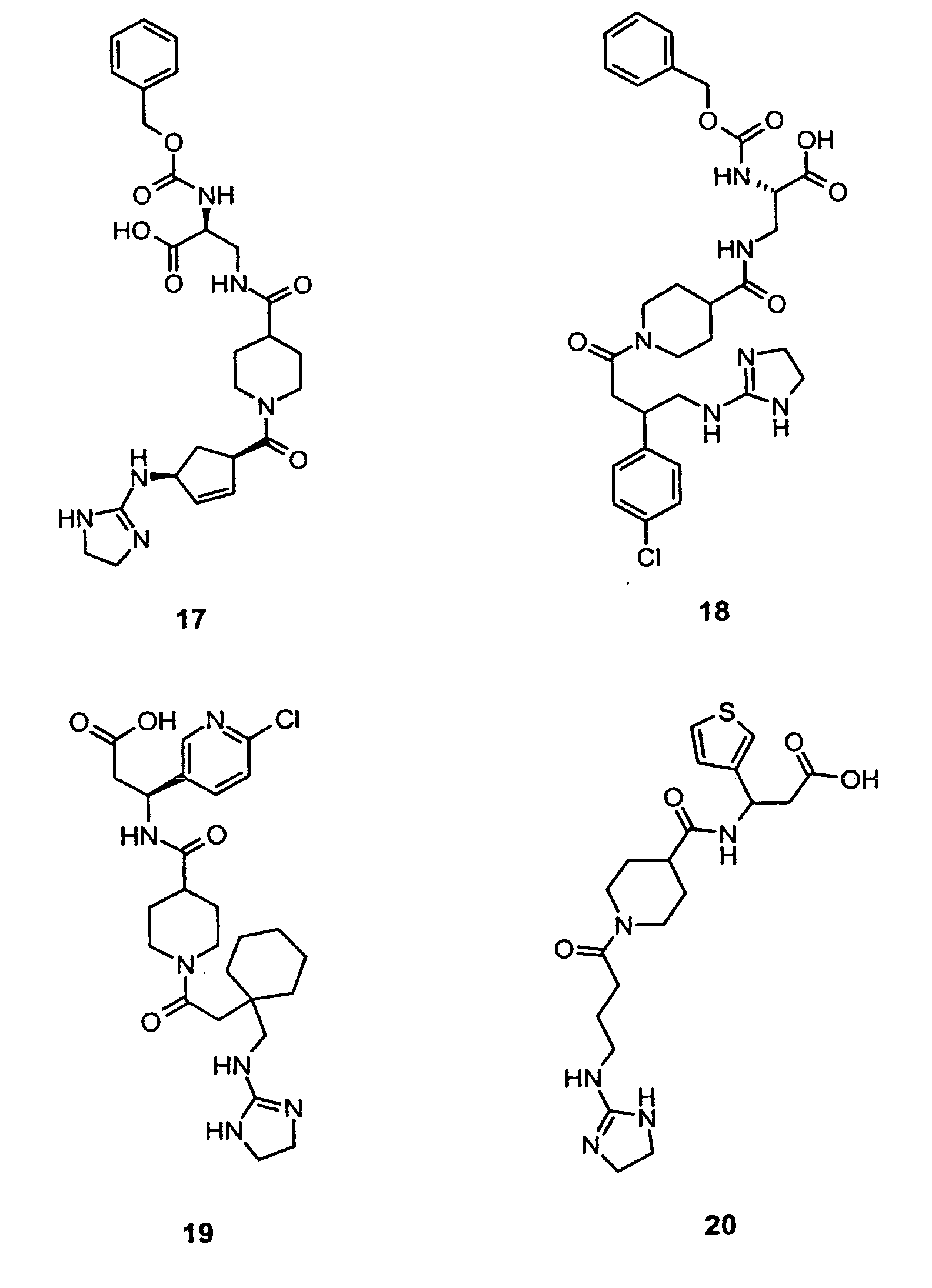


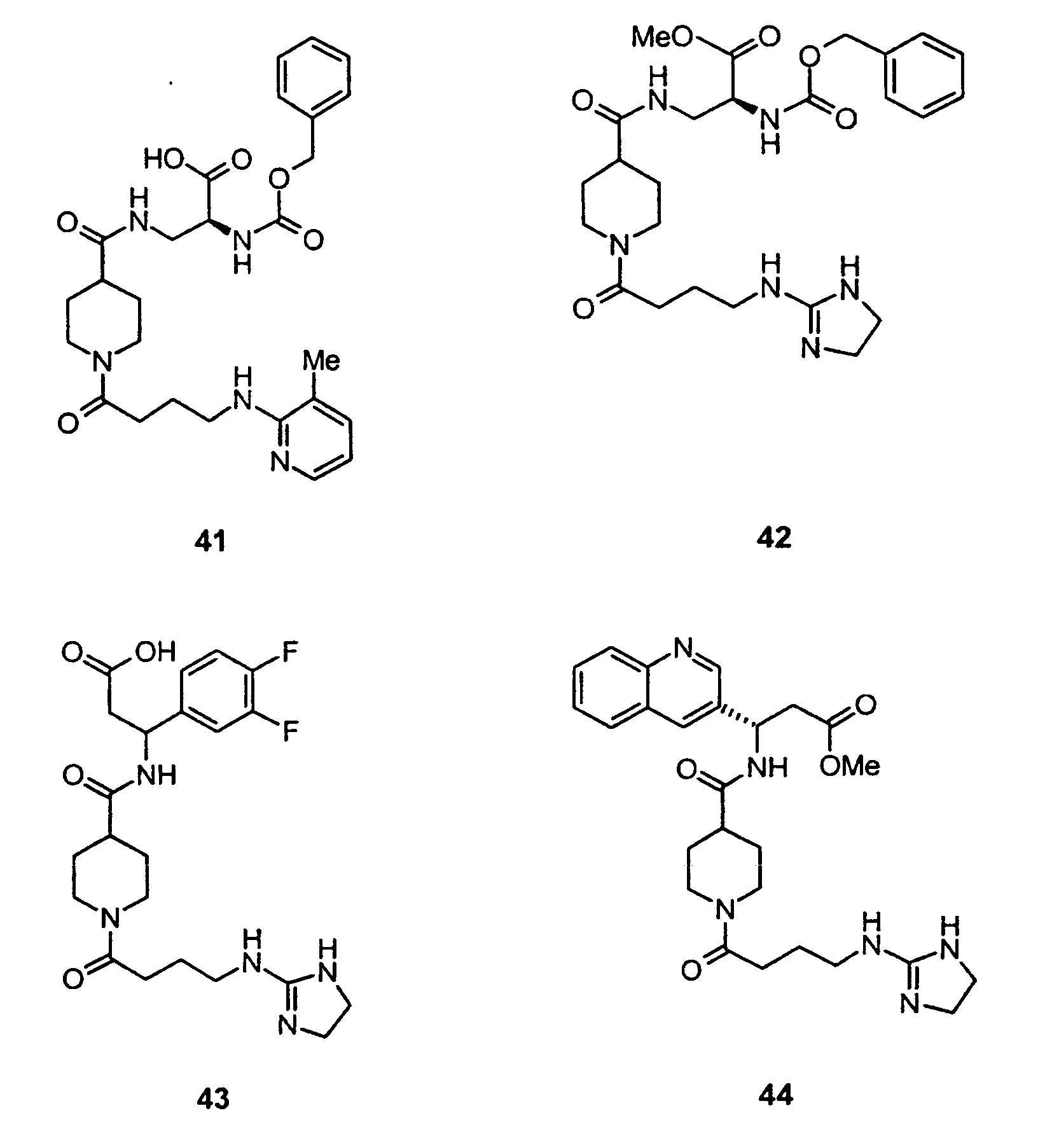


 and pharmaceutically acceptable salts thereof.
- Particularly preferred compounds of Formula (I) are selected from:
Cpd Name 1 β-[[[1-[4-[(4,5-dihydro-1H-imidazol-2-yl)amino]-1-oxobutyl]-4- piperidinyl]carbonyl]amino]-, (β3 S)- 3-quinolinepropanoic acid; 2 3-[[[1-[4-[(4,5-dihydro-1H-imidazol-2-yl)amino]-1-oxobutyl]-4- piperidinyl]carbonyl]amino]-N-{(phenylmethoxy)carbonyl]- L-alanine; 6 β-[[[1-[1-oxo-4-(2-pyridinylamino)butyl]-4-piperidinyl]carbonyl]amino]-, (β3 S)- 3-quinolinepropanoic acid; 11 3-[[[1-[[1-(4,5-dihydro-1H-imidazol-2-yl)-4-piperidinyl]carbonyl]-4- piperidinyl]carbonyl]amino)-N-[(phenylmethoxy)carbonyl]- L-alanine; 14 3-[[[1-[[(1S,4R)-4-[(4,5-dihydro-1H-imidazol-2-yl)amino]-2-cyclopenten- 1-yl]carbonyl]-4-piperidinyl]carbonyl]amino]-N- [(phenylmethoxy)carbonyl]- L-alanine; 16 3-[[[1-[3-[(4,5-dihydro-1H-imidazol-2-yl)amino]-2-methyl-1-oxopropyl]-4- piperidinyl]carbonyl]amino]-N-[(phenylmethoxy)carbonyl]- L-alanine; 17 3-[[[1-[[(1R,4S)-4-[(4,5-dihydro-1H-imidazol-2-yl)amino]-2-cyclopenten- 1-yl]carbonyl]-4-piperidinyl]carbonyl]amino]-N- [(phenylmethoxy)carbonyl]- L-alanine; 28 4-[[[(2S)-2-carboxy-2- [[(phenylmethoxy)carbonyl]amino]ethyl]amino]carbonyl]-, 2-[(4,5- dihydro-1H-imidazol-2-yl)amino]ethyl ester 1-piperidinecarboxylic acid; 39 β-[[[1-[[2-[(4,5-dihydro-1H-imidazol-2-yl)amino]ethoxy]carbonyl]-4- piperidinyl]carbonyl]amino]-, (β3 S)- 3-quinolinepropanoic acid; 47 3-[[[1-[4-[(4,5-dihydro-1H-imidazol-2-yl)amino]-2-methyl-1-oxobutyl]-4- piperidinyl]carbonyl]amino]-N-[(phenylmethoxy)carbonyl]- L-alanine; 50 3-[[[1-(4-amino-1-oxo-5-hexeny))-4-piperidinyl]carbonyl]amino]-N- [(phenylmethoxy)carbonyl]- L-alanine; 53 3-[[[1-[4-[[(4,5-dihydro-1H-imidazol-2-yl)amino]methyl]benzoyl]-4- piperidinyl]carbonyl]amino]-N-[(phenylmethoxy)carbonyl]-L-alanine; 61 β-[[[1-[3-[[(4,5-dihydro-1H-imidazol-2-yl)amino]oxy)-1-oxopropyl]-4- piperidinyl]carbonyl]amino]- 1,3-benzodioxole-5-propanoic acid; or, 62 β-[[[1-[1-oxo-4-(2-pyridiny)amino)butyl]-4-piperidinyl]carbonyl]amino]- 1,3-benzodioxole-5-propanoic acid; - Representative Chemical Abstracts Service (CAS) Index-like names for the compounds of the present invention were derived using the ACD/LABS SOFTWARE™ Index Name Pro Version 4.0 nomenclature software program provided by Advanced Chemistry Development, Inc., Toronto, Ontario, Canada.
- The compounds of the present invention may also be present in the form of pharmaceutically acceptable salts. For use in medicine, the salts of the compounds of this invention refer to non-toxic "pharmaceutically acceptable salts." Other salts may, however, be useful in the preparation of compounds according to this invention or of their pharmaceutically acceptable salts. The pharmaceutically acceptable salts generally take a form in which a basic nitrogen or nitrogens on the compound of the Formula (I) are protonated with an inorganic or organic acid. Representative inorganic or organic acids include, but are not limited to, hydrochloric, hydrobromic, hydriodic, perchloric, sulfuric, nitric, phosphoric, acetic, propionic, glycolic, lactic, succinic, maleic, fumaric, malic, tartaric, citric, benzoic, mandelic, methanesulfonic, hydroxyethanesulfonic, benezenesulfonic, oxalic, pamoic, 2-naphthalenesulfonic, p-toluenesulfonic, cyclohexanesulfamic, salicylic, saccharinic or trifluoroacetic acid. Similarly, pharmaceutically acceptable salts also include compounds wherein a carboxylic acid group of the compound of the Formula (I) combines with a organic or inorganic base. Representative inorganic or organic bases include, but are not limited to lithium, sodium, potassium, magnesium, calcium, aluminum, zinc, benzathine, chloroprocaine, choline, diethanolamine, ethylenediamine, meglumine (N-methyl glucamine), tromethamine (2-amino-2-(hydroxymethyl)-1,3-propanediol) or procaine (4-amino-[2-(diethylamino)ethyl ester] benzoic acid).
- As used herein, unless otherwise noted alkyl and alkoxy when used alone include straight and branched chains having 1 to 8 carbon atoms, or any number within this range. Similarly, alkenyl and alkynyl groups include straight and branched chain alkenes and alkynes having 2 to 8 carbon atoms, or any number within this range. The term alkylene, alkenylene and alkynylene refers to alkyl, alkenyl and alkynyl chains, respectively, that are further substituted and act as linking groups. Alkoxy radicals are oxygen ethers formed from the previously described straight or branched chain alkyl groups. Cycloalkyl groups contain 3 to 8 ring carbons; preferably, 5 to 8 ring carbons; and, more preferably, 5 to 7 ring carbons.
- The term "heterocyclyl" as used herein refers to an optionally substituted, stable, saturated 3 to 10 (preferably 4 to 8) membered monocyclic or bicyclic ring system which consists of carbon atoms and from one to three heteroatoms selected from N, O or S. The term "heterocyclenyl" as used herein refers to an optionally substituted, stable, unsaturated 3 to 10 (preferably 4 to 8) membered monocyclic or bicyclic ring system which consists of carbon atoms and from one to three heteroatoms selected from N, O or S. The heterocyclyl or heterocyclenyl group may be attached at any heteroatom or carbon atom which results in the creation of a stable structure and, accordingly, may be further attached to, for example, alkyl or alkoxy chains. The term hetercyclylene and heterocyclenylene refers to hetercyclyl and heterocyclenyl groups, respectively, that are further substituted and act as linking groups; wherein, one or both rings may be optionally substituted with one to five substituents attached at any heteroatom or carbon atom which results in the creation of a stable structure.
- The term "aryl", as used herein, refers to optionally substituted aromatic groups such as phenyl and naphthyl. The term arylene refers to aryl groups that are further substituted and act as linking groups; wherein, one or both rings may be optionally substituted with one to five substituents attached at any carbon atom which results in the creation of a stable structure.
- The term "heteroaryl" as used herein represents a stable five or six membered monocyclic aromatic ring system or a nine or ten membered benzo-fused heteroaromatic ring system which consists of carbon atoms and from one to three heteroatoms selected from N, O or S. The heteroaryl group may be attached or optionally substituted at any heteroatom or carbon atom which results in the creation of a stable structure.
- The term "arylalkyl" means an alkyl group substituted with an aryl group (e.g., benzyl, phenethyl). Similarly, the term "arylalkoxy" indicates an alkoxy group substituted with an aryl group (e.g., benzyloxy).
- The term "acyl" as used herein means an organic radical having 2 to 6 carbon atoms (branched or straight chain) derived from an organinc acid by removal of the hydroxy group.
- Whenever the term "alkyl" or "aryl" or either of their prefix roots appear in a name of a substituent (e.g., aralkyl, alkylamino) it shall be interpreted as including those limitations given above for "alkyl" and "aryl." When present, designated numbers of carbon atoms (e.g., C1-C8) shall refer independently to the number of carbon atoms in a moiety or to the alkyl portion of a larger substituent in which alkyl appears as its prefix root.
- Any of the foregoing cycloalkyl, heterocyclyl, heterocyclenyl, aryl and heteroaryl substituent groups and their corresponding heterocyclylene, heterocyclenylene, arylene and heteroarylene linking groups, as a monocyclic or bicyclic ring system may be further bridged at any heteroatom or carbon atom which results in the creation of a stable ring structure; wherein the monocyclic bridged ring system consists of 6 to 8 members and the bicyclic bridged ring system consists of 10 to 12 members.
- It is intended that the definition of any substituent or variable at a particular location in a molecule be independent of its definitions elsewhere in that molecule. It is understood that substituents and substitution patterns on the compounds of this invention can be selected by one of ordinary skill in the art to provide compounds that are chemically stable and that can be readily synthesized by techniques know in the art as well as those methods set forth herein.
- Under standard nomenclature used throughout this disclosure, the terminal portion of the designated side chain is described first, followed by the adjacent functionality toward the point of attachment. Thus, for example, a "phenylC1-C6 alkylamidoC1-C6alkyl" substituent refers to a group of the formula:

- The present invention includes within its scope prodrugs of the compounds of this invention. In general, such prodrugs will be functional derivatives of the compounds which are readily convertible in vivo into the required compound. Examples of prodrugs include but are not limited to various esters, hydroxyamidines and hydroxyguanidines of compounds of the present invention. Thus, in the methods of treatment of the present invention, the term "administering" shall encompass the treatment of the various disorders described with the compound specifically disclosed or with a compound which may not be specifically disclosed, but which converts to the specified compound in vivo after administration to the patient. Conventional procedures for the selection and preparation of suitable prodrug derivatives are described, for example, in "Design of Prodrugs", ed. H. Bundgaard, Elsevier, 1985.
- Where the compounds according to this invention have at least one chiral center, they may accordingly exist as enantiomers. Where the compounds possess two or more chiral centers, they may additionally exist as diastereomers. It is to be understood that all such isomers and mixtures thereof are encompassed within the scope of the present invention. Furthermore, some of the crystalline forms for the compounds may exist as polymorphs and as such are intended to be included in the present invention. In addition, some of the compounds may form solvates with water (i.e., hydrates) or common organic solvents, and such solvates are also intended to be encompassed within the scope of this invention.
- The term "subject" as used herein, refers to an animal, preferably a mammal, most preferably a human, who has been the object of treatment, observation or experiment.
- The term "therapeutically effective amount" as used herein, means that amount of active compound or pharmaceutical agent that elicits the biological or medicinal response in a tissue system, animal or human, that is being sought by a researcher, veterinarian, medical doctor, or other clinician, which includes alleviation of the symptoms of the disease or disorder being treated.
- The term "bone resorption," as used herein, refers to the process by which osteoclasts degrade bone.
- The present invention provides isonipecotamide compounds that are useful as αvβ3, αvβ5 and GPIIb/IIIa integrin antagonists. Compounds of Formula (I) that are particularly preferred as αvβ3 integrin antagonists are selected from Compound 1, 2, 3, 5, 6, 12, 14, 16, 18, 21, 24, 25, 28, 29, 31, 33, 34, 39, 40, 44, 47, 49, 54, 55, 58 or 60. Compounds of Formula (I) that are particularly preferred as GPIIb/IIIa integrin antagonists are selected from Compound 1, 2, 5, 11, 12, 14, 16, 17, 18, 19, 39, 47, 49, 50, 53, 54, 55 or 56. Compounds of Formula (I) that are particularly preferred as αvβ5 integrin antagonists are selected from Compound 1, 2, 16, 45, 58 or 60. Compounds of Formula (I) that are particularly preferred as dual αaβ3/GPIIb/IIIa integrin antagonists are selected from Compound 2, 5, 12, 14, 16, 18, 39, 47, 49, 54 or 55. Compounds of Formula (I) that are particularly preferred as dual αvβ3/αvβ5 integrin antagonists are selected from Compound 1, 2, 16, 58 or 60.
- Compounds of Formula (I) that are more particularly preferred as αvβ3 integrin antagonists are selected from Compound 1, 2, 6, 28, 39 or 47. Compounds of Formula (I) that are more particularly preferred as GPIIb/IIIa integrin antagonists are selected from Compound 2, 11, 14, 17, 50 or 53. Compounds of Formula (I) that are more particularly preferred as αvβ5 integrin antagonists are selected from Compound 1, 2 or 16. Compounds of Formula (I) that are more particularly preferred as dual αvβ3/GPIIb/IIIa integrin antagonists are Compound 2. Compounds of Formula (I) that are more particularly preferred as dual αvβ3/αvβ5 integrin antagonists are selected from Compound 1 or 2.
- The compounds of Formula (I) inhibit the binding of adhesive proteins such as fibrinogen, vitronectin, and osteopontin to the integrin class of receptors. As demonstrated by the results of the biological studies described hereinafter, the compounds block vitronectin binding to isolated αvβ3 (IC50'S of ca. 1-300 nM), and inhibit fibrinogen binding to isolated GPIIb/IIIa as well. Because the compounds of this invention inhibit integrin-mediated cell-cell or cell-matrix adhesion, they may be useful against restenosis, thrombosis, inflammation, atherosclerosis, arthritis, angiogenesis, osteroporosis, bone resorption, tumor cell metastasis, tumor growth, macular degeneration, diabetic retinopathy, diseases of lung/airway resistance, etc. (D. Cox, Drug News & Perspectives 1995, 8, 197).
- The compounds of Formula (I) are also useful as antithrombotics in combination with fibrinolytic therapy (e.g., t-PA or streptokinase). Additionally, the compounds of Formula (I) are useful in combination with one or more agents useful in the prevention or treatment of osteoporosis and arthritis. For example, the compounds of the instant invention may be effectively administered in combination with other agents used in the treatment of osteoporosis such as bisphosphonate bone resorption inhibitors; preferably, the bisphosphonate bone resorption inhibitor is alendronate, sold as FOSAMAX®. Preferred combinations are simultaneous or alternating treatments of an integrin antagonist of the present invention and alendronate.
- In accordance with the methods of the present invention, the individual components of the combination can be administered separately at different times during the course of therapy or concurrently in divided or single combination forms. The instant invention is therefore to be understood as embracing all such regimes of simultaneous or alternating treatment and the term "administering" is to be interpreted accordingly.
- As used herein, the term "composition" is intended to encompass a product comprising the specified ingredients in the specified amounts, as well as any product which results, directly or indirectly, from combinations of the specified ingredients in the specified amounts.
- The utility of the compounds to treat integrin-mediated disorders can be determined according to the procedures herein. The present invention therefore provides a method of treating integrin-mediated disorders in a subject in need thereof which comprises administering any of the compounds as defined herein in a quantity effective to treat thrombotic disorders, osteoporosis, cancer, and diabetic complications. The compound may be administered to a patient by any conventional route of administration, including, but not limited to, intravenous, oral, subcutaneous, intramuscular, intradermal and parenteral.
- The present invention also provides pharmaceutical compositions comprising one or more compounds of this invention in association with a pharmaceutically acceptable carrier.
- To prepare the pharmaceutical compositions of this invention, one or more compounds of Formula (I) or salt thereof of the invention as the active ingredient, is intimately admixed with a pharmaceutical carrier according to conventional pharmaceutical compounding techniques, which carrier may take a wide variety of forms depending of the form of preparation desired for administration, e.g., oral or parenteral such as intramuscular. In preparing the compositions in oral dosage form, any of the usual pharmaceutical media may be employed. Thus, for liquid oral preparations, such as for example, suspensions, elixirs and solutions, suitable carriers and additives include water, glycols, oils, alcohols, flavoring agents, preservatives, coloring agents and the like; for solid oral preparations such as, for example, powders, capsules, caplets, gelcaps and tablets, suitable carriers and additives include starches, sugars, diluents, granulating agents, lubricants, binders, disintegrating agents and the like. Because of their ease in administration, tablets and capsules represent the most advantageous oral dosage unit form, in which case solid pharmaceutical carriers are obviously employed. If desired, tablets may be sugar coated or enteric coated by standard techniques. For parenterals, the carrier will usually comprise sterile water, through other ingredients, for example, for purposes such as aiding solubility or for preservation, may be included. Injectable suspensions may also be prepared, in which case appropriate liquid carriers, suspending agents and the like may be employed. The pharmaceutical compositions herein will contain, per dosage unit, e.g., tablet, capsule, powder, injection, teaspoonful and the like, an amount of the active ingredient necessary to deliver an effective dose as described above. The pharmaceutical compositions herein will contain, per unit dosage unit, e.g., tablet, capsule, powder, injection, suppository, teaspoonful and the like, of from about 0.01 mg/kg to 100 mg/kg (preferably, from about 0.1 mg/kg to about 30 mg/kg) and may be given at a dosage of from about 0.01 mg/kg/day to about 300 mg/kg/day (preferably, from about 1 mg/kg/day to about 50 mg/kg/day). The dosages, however, may be varied depending upon the requirement of the patients, the severity of the condition being treated and the compound being employed. The use of either daily administration or post-periodic dosing may be employed.
- Preferably these compositions are in unit dosage forms from such as tablets, pills, capsules, powders, granules, sterile parenteral solutions or suspensions, metered aerosol or liquid sprays, drops, ampoules, autoinjector devices or suppositories; for oral parenteral, intranasal, sublingual or rectal administration, or for administration by inhalation or insufflation. Alternatively, the composition may be presented in a form suitable for once-weekly or once-monthly administration; for example, an insoluble salt of the active compound, such as the decanoate salt, may be adapted to provide a depot preparation for intramuscular injection. For preparing solid compositions such as tablets, the principal active ingredient is mixed with a pharmaceutical carrier, e.g. conventional tableting ingredients such as corn starch, lactose, sucrose, sorbitol, talc, stearic acid, magnesium stearate, dicalcium phosphate or gums, and other pharmaceutical diluents, e.g. water, to form a solid preformulation composition containing a homogeneous mixture of a compound of the present invention, or a pharmaceutically acceptable salt thereof. When referring to these preformulation compositions as homogeneous, it is meant that the active ingredient is dispersed evenly throughout the composition so that the composition may be readily subdivided into equally effective dosage forms such as tablets, pills and capsules. This solid preformulation composition is then subdivided into unit dosage forms of the type described above containing from 0.1 to about 500 mg of the active ingredient of the present invention. The tablets or pills of the novel composition can be coated or otherwise compounded to provide a dosage form affording the advantage of prolonged action. For example, the tablet or pill can comprise an inner dosage and an outer dosage component, the latter being in the form of an envelope over the former. The two components can be separated by an enteric layer which serves to resist disintegration in the stomach and permits the inner component to pass intact into the duodenum or to be delayed in release. A variety of material can be used for such enteric layers or coatings, such materials including a number of polymeric acids with such materials as shellac, cetyl alcohol and cellulose acetate.
- The liquid forms in which the novel compositions of the present invention may be incorporated for administration orally or by injection include, aqueous solutions, suitably flavoured syrups, aqueous or oil suspensions, and flavoured emulsions with edible oils such as cottonseed oil, sesame oil, coconut oil or peanut oil, as well as elixirs and similar pharmaceutical vehicles. Suitable dispersing or suspending agents for aqueous suspensions, include synthetic and natural gums such as tragacanth, acacia, alginate, dextran, sodium carboxymethylcellulose, methylcellulose, polyvinyl-pyrrolidone or gelatin.
- Where the processes for the preparation of the compounds according to the invention give rise to mixture of stereoisomers, these isomers may be separated by conventional techniques such as preparative chromatography. The compounds may be prepared in racemic form, or individual enantiomers may be prepared either by enantiospecific synthesis or by resolution. The compounds may, for example, be resolved into their components enantiomers by standard techniques, such as the formation of diastereomeric pairs by salt formation with an optically active acid, such as (-)-di-p-toluoyl-d-tartaric acid and/or (+)-di-p-toluoyl-l-tartaric acid followed by fractional crystallization and regeneration of the free base. The compounds may also be resolved by formation of diastereomeric esters or amides, followed by chromatographic separation and removal of the chiral auxiliary. Alternatively, the compounds may be resolved using a chiral HPLC column.
- During any of the processes for preparation of the compounds of the present invention, it may be necessary and/or desirable to protect sensitive or reactive groups on any of the molecules concerned. This may be achieved by means of conventional protecting groups, such as those described in Protective Groups in Organic Chemistry, ed. J.F.W. McOmie, Plenum Press, 1973; and T.W. Greene & P.G.M. Wuts, Protective Groups in Organic Synthesis; Third Edition, John Wiley & Sons, 1999. The protecting groups may be removed at a convenient subsequent stage using methods known from the art.
- The method of treating integrin-mediated disorders described in the present invention may also be carried out using a pharmaceutical composition comprising any of the compounds as defined herein and a pharmaceutically acceptable carrier. The pharmaceutical composition may contain between about 0.01 mg and 100 mg, preferably about 5 to 50 mg, of the compound, and may be constituted into any form suitable for the mode of administration selected. Carriers include necessary and inert pharmaceutical excipients, including, but not limited to, binders, suspending agents, lubricants, flavorings, sweeteners, preservatives, dyes, and coatings. Compositions suitable for oral administration include solid forms, such as pills, tablets, caplets, capsules (each including immediate release, timed release and sustained release formulations), granules, and powders, and liquid forms, such as solutions, syrups, elixirs, emulsions, and suspensions. Forms useful for parenteral administration include sterile solutions, emulsions and suspensions.
- Advantageously, compounds of the present invention may be administered in a single daily dose, or the total daily dosage may be administered in divided doses of two, three or four times daily. Furthermore, compounds for the present invention can be administered in intranasal form via topical use of suitable intranasal vehicles, or via transdermal skin patches well known to those of ordinary skill in that art. To be administered in the form of a transdermal delivery system, the dosage administration will, of course, be continuous rather than intermittent throughout the dosage regimen.
- For instance, for oral administration in the form of a tablet or capsule, the active drug component can be combined with an oral, non-toxic pharmaceutically acceptable inert carrier such as ethanol, glycerol, water and the like. Moreover, when desired or necessary, suitable binders; lubricants, disintegrating agents and coloring agents can also be incorporated into the mixture. Suitable binders include, without limitation, starch, gelatin, natural sugars such as glucose or beta-lactose, corn sweeteners, natural and synthetic gums such as acacia, tragacanth or sodium oleate, sodium stearate, magnesium stearate, sodium benzoate, sodium acetate, sodium chloride and the like. Disintegrators include, without limitation, starch, methyl cellulose, agar, bentonite, xanthan gum and the like.
- The liquid forms in suitably flavored suspending or dispersing agents such as the synthetic and natural gums, for example, tragacanth, acacia, methylcellulose and the like. For parenteral administration, sterile suspensions and solutions are desired. Isotonic preparations which generally contain suitable preservatives are employed when intravenous administration is desired.
- The compound of the present invention can also be administered in the form of liposome delivery systems, such as small unilamellar vesicles, large unilamellar vesicles, and multilamellar vesicles. Liposomes can be formed from a variety of phospholipids, such as cholesterol, stearylamine or phophatidylcholines.
- Compounds of the present invention may also be delivered by the use of monoclonal antibodies as individual carriers to which the compound molecules are coupled. The compounds of the present invention may also be coupled with soluble polymers as targeted drug carriers. Such polymers can include polyvinylpyrrolidone, pyran copolymer, polyhydroxypropylmethacrylamidephenol, polyhydroxy-ethylaspartamidephenol, or polyethyl eneoxidepolylysine substituted with palmitoyl residue. Furthermore, the compounds of the present invention may be coupled to a class of biodegradable polymers useful in achieving controlled release of a drug, for example, polylactic acid, polyepsilon caprolactone, polyhydroxy butyeric acid, polyorthoesters, polyacetals, polydihydropyrans, polycyanoacrylates and cross-linked or amphipathic block copolymers of hydrogels.
- Compounds of this invention may be administered in any of the foregoing compositions and according to dosage regimens established in the art whenever treatment of thrombotic disorders is required.
- The daily dosage of the products may be varied over a wide range from about 0.01 mg to about 21,000 mg per adult human per day. For oral administration, the compositions are preferably provided in the form of tablets containing, 0.01,0.05, 0.1, 0.5, 1.0, 2.5, 5.0, 10.0, 15.0, 25.0, 50.0, 100, 150, 200, 250 and 500 milligrams of the active ingredient for the symptomatic adjustment of the dosage to the patient to be treated. A therapeutically effective amount of the drug is ordinarily supplied at a dosage level of from about 0.01 mg/kg to about 300 mg/kg of body weight per day. Preferably, the range is from about 0.01 mg/kg to about 100 mg/kg of body weight per day; and more preferably, the range is from about 0.01 mg/kg to about 50 mg/kg of body weight per day. The compounds may be administered on a regimen of 1 to 4 times per day.
- Optimal dosages to be administered may be readily determined by those skilled in the art, and will vary with the particular compound used, the mode of administration, the strength of the preparation, the mode of administration, and the advancement of the disease condition. In addition, factors associated with the particular patient being treated, including patient age, weight, diet and time of administration, will result in the need to adjust dosages.
- Abbreviations used in the instant specification, particularly the Schemes and Examples, are as follows:
- Aq.
- = aqueous
- Bn or Bzl
- = benzyl
- Boc
- = tert-butoxycarbonyl
- Boc2O
- di-tert-butyl dicarbonate
- BSA
- = bovine serum albumin
- n-Bu
- = n-butyl
- Cbz
- = benzyloxycarbonyl
- CP or Cpd =
- Compound
- DCM
- = dichloromethane
- DIC
- = diisopropylcarbodiimide
- DIPEA
- = diisopropylethylamine
- DMAP
- = 4-dimethylaminopyridine
- DMF
- = N, N-dimethylformamide
- DMSO
- = dimethylsulfoxide
- EDC
- = ethyl dimethylaminopropyl-carbodiimide
- EDTA
- = ethylenediaminetetraacetic acid
- ES
- = electrospray
- Et
- = ethyl
- Et2O
- = diethyl ether
- EtOH
- = ethanol
- 1H NMR
- = proton nuclear magnetic resonance spectrum
- HBTU
- = 2-(1H-benzotriazole-1-yl)-1,1,3,3-tetramethyluronium hexafluorophosphate
- HEPES
- = 4-(2-hydroxyethyl)-1- piperazine-ethanesulfonic acid
- HOBT
- = hydroxybenzotriazole
- HBTU
- = 2-(1H-benzotriazole-1-yl)-1,1,3,3-tetramethyl-uronium hexafluorophosphate
- IPA
- = 2-propanol
- Me
- = methyl
- MeOH
- = methanol
- MH+
- = observed molecular ion
- MPK
- = milligrams per kilogram
- MS
- = mass spectrum
- NMM
- = N-methylmorpholine
- NT
- = not tested
- Ph
- = phenyl
- PPT
- = precipitate
- Pyr.
- = pyridine
- RP-HPLC
- = preparative reversed-phase high pressure liquid chromatography
- RT
- = room temperature
- Sch
- = Scheme
- TEA
- = triethylamine
- THF
- = tetrahydrofuran
- TFA
- = trifluoroacetic acid
- TMS
- = trimethylsilane
- Z
- = benzyloxycarbonyl
- Although the following Schemes depict synthetic routes to specific compounds of Formula (I), they are intended to also represent general synthetic routes to other compounds of the present invention to those skilled in the art of synthetic organic chemistry. By way of example, the synthetic route shown in Scheme AA used to prepare Compound 1 is also illustrative of a general method for the preparation of other instant compounds whereby other starting materials and appropriate reagents and solvents are used. Most of the reaction unless otherwise indicated were performed at room temperature.
- Compounds of the invention wherein A is (4,5-dihydro-1H-imidazol-2-yl)amino and its homologs may be prepared as shown below. The β-Aminoacid derivative AA5 was prepared as detailed in PCT International Application WO 97/41102 and as published (J. Rico, J. Org. Chem. 1993, 58, 7948). Such β-aminoacid derivatives can also be prepared by the methods described in WO 97/08145 and in U.S. Patent 6,100,423. The reagent AA3 was purchased from Maybridge Chemical Company.
- For the preparation of compounds exemplified by final target Compound 1, secondary amine AA1 was coupled with 4-N-Boc-aminobutyric acid in the presence, and the Boc group subsequently removed with trifluoroacetic acid to give primary amine AA2 as the TFA salt. This salt was acylated with reagent AA3, the 2-aminoimidazoline product was protected with di-tert-butyl dicarbonate, and the methyl ester was saponified with lithium hydroxide to afford AA4. intermediate AA4 was coupled with amino ester AA5 in the presence of HBTU, and the product was then de-protected with aqueous hydrochloric acid to give the target Compound 1. Similarly, the Boc group of coupling product from AA4 and AA5 can be removed with a mixture of trifluoroacetic acid in dichloromethane (1:1) and the ester moiety subsequently saponified with aqueous LiOH in tetrahydrofuran to afford the lithium salt of Compound 1. If the ester derivative is desired, then the saponification step is eliminated.
- For the preparation of α-diaminoalkanoic acid derivative compounds of Formula (I), such as those exemplified by the Compound 11, the secondary amine AA1 was reacted with (N-t-butyloxycarbonyl)isonipecotic acid (purchased from BaChem) instead of 4-N-Boc-aminobutyric acid and the product was carried forward to replace AA2 in Scheme AA, wherein AB2 was used to replace AA5 to produce the target Compound 11.
- Similarly, for the preparation of compounds of Formula (I), such as those exemplified by Compound 16, the secondary amine AA1 was reacted with commercially available N-Boc-(3-amino-2-methyl)proprionic acid instead of 4-N-Boc-aminobutyric acid and carried forward to replace AA2 in Scheme AA, wherein AB2 was used to replace AA5 to produce the target Compound 16.
- For the preparation of compounds of Formula (I) exemplified by Compound 53, the secondary amine AA1 was reacted with the commercially available N-Boc-(4-aminomethyl)benzoic acid instead of 4-N-Boc-aminobutyric acid and carried forward to replace AA2 in Scheme AA to produce the target Compound 53.
- For the preparation of compounds of Formula (I), such as those exemplified by Compound 14 and Compound 17, the secondary amine AA1 was reacted with commercially available (-)-(1R,4S)-N-Boc-1-aminocyclopent-2-ene-4-carboxylic acid (for Compound 14) or (+)-(1S,4R)-N-Boc-1-aminocyclopent-2-ene-4-carboxylic acid (for Compound 17) instead of 4-N-Boc-aminobutyric acid. The resulting product replaced AA2 in Scheme AA and was carried forward, with AB2 replacing AA5, to produce Compound 14 and Compound 17, respectively.

- The α-diaminoalkanoic acid derivatives of Formula (I), such as Compound 2, can be prepared from ester intermediates, such as the free base of AB2 (methyl N-α-(benzyloxycarbonyl)-L-2,3-diaminopropionate), to replace AA5 in Scheme AA. In this example, Cbz-protected acid AB1 (purchased from BaChem) was dissolved in methanol and treated with 4N HCl in 1,4-dioxane in the presence of 1,2-dimethoxypropane to afford the intermediate amino ester AB2. Using the method described in Scheme AA, the free base of AB2 was used to replace AA5 to produce Compound 2.


- Compounds of Formula (I) wherein A is heteroaryl, heterocyclyl, (heteroaryl)amino or (heterocyclyl)amino, such as Compound 6, can be prepared by reacting the heteroaryl, heterocyclyl, (heteroaryl)amino or (heterocyclyl)amino starting material with the appropriate alkyl halide. For example, Compound AC1 was acylated with 4-bromobutyryl chloride. The resulting alkyl bromide product was reacted with (pyridin-2-yl)amino at reflux to provide AC2. The ester AC2 was saponified with lithium hydroxide and carried forward to replace AA4 in Scheme AA to give Compound 6. Other compounds of Formula (I), such as Compounds 30, 41 and 62, can be prepared using Scheme AC by varying the starting material used.

- Another method used to prepare heterocyclyl compounds, such as benzimidazol-2-yl, was the N-acylation of starting materials using methodology analogous to that shown in Scheme AA. For example, the N-acylation of AC3 with AD2 followed by saponification and deprotection by removal of the Boc group afforded Compounds 8, 13 and 15.

- Certain other (heterocyclyl)amino compounds may be prepared by reacting a 2-fluoroheterocyclyl compound with the appropriate aminoalkanoate (e.g., AA2) as reported by C. Senanayake in Tetrahedron Lett. 1999, 40, 6875. For compounds where A is (tetrahydro-pyrimidin-2-yl)amino or (pyrimidin-2-yl)amino, 2-bromopyrimidine may be reacted with the appropriate aminoalkanoate (e.g., AA2) as reported by G. Hartman in WO 95/32710. For compounds where A is 1H-imidazo[4,5b]pyridin-2-yl, an appropriate alkyl dicarboxylic acid (e.g., succinic acid) may be reacted with 2,3-diaminopyridine as reported by R. Keenan in Bioorg. Med. Chem. Lett. 1998, 8, 3171.
- Scheme AD provides an alternate method of synthesis for the α-diaminoalkanoic acid derivatives of Formula (I), such as Compound 2, by changing the order of the coupling steps depicted in Scheme AA. For example, the isonipecotamide intermediate AD2 used to further synthesize other α-diaminoalkanoic acid derivative compounds of the invention was prepared by the HBTU-mediated coupling of AD1 (purchased from Advanced Chemtech) and AB2.

- The acid AD3 was prepared (as described by J. V. Greenhill, Chem. Soc., Perkin Trans. 2 1985, (8), 1255-1264) and was reacted with di-tert-butyl dicarbonate in the presence of NaOH. The intermediate sodium salt was coupled with AD2 using HBTU to afford AD4. Deprotection of AD4 with 4 M HCl (aq.) yielded Compound 2.

- Compounds of Formula (I) wherein A includes an aminooxy moiety can be prepared by the methods represented below. Boc-protected aminooxy intermediate AE5 (used to prepare Compound 58) and aminooxy intermediate AE8 (used to prepare Compounds 60 and 61) were synthesized according to the methods described by C. Gilon, et. al. in Tetrahedron 1967, 23, 441-4447 and B. J. Ludwig in J. Med. Chem. 1970, 13, 60-63. Commercially available β-propriolactone AE1 and N-hydroxysuccinimide AE2 were reacted to afford the corresponding oxyamino ester, which was hydrolyzed in a refluxing mixture of 6 M HCl (aq.) and glacial acetic acid. The resulting HCl salt was converted to the free base AE3 by treatment with NaOMe in 2-propanol. Guanylation of AE3 with commercially available AE4 followed by reaction with di-tert-butyl dicarbonate furnished the protected oxyguanidine intermediate AE5. To produce the target Compound 53, the secondary amine AA1 in Scheme AA was reacted with the protected oxyguanidine intermediate AE5 instead of 4-N-Boc-aminobutyric acid and carried forward as AA2.

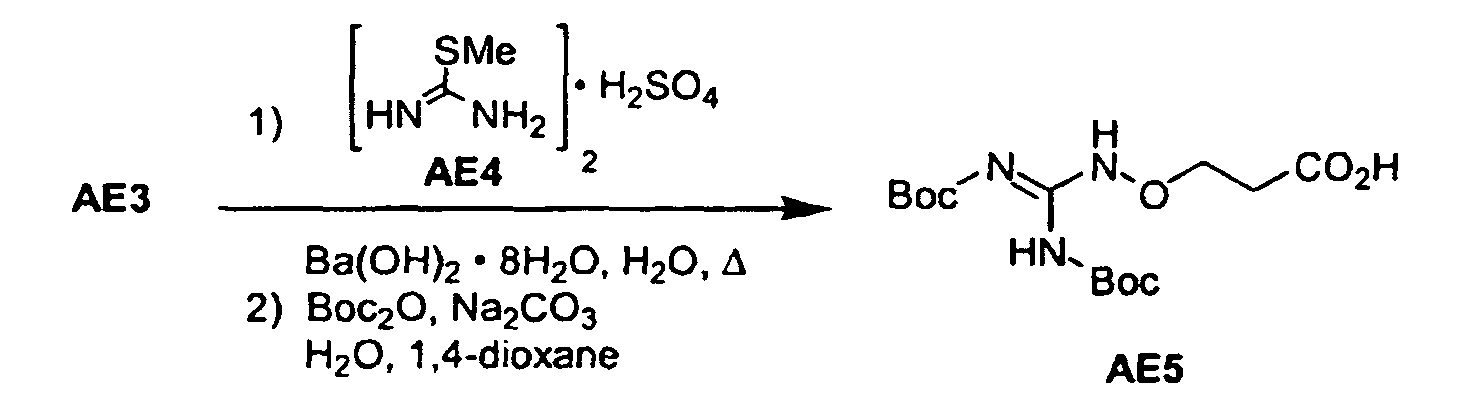
- Similarly, Boc-protection of AE6 (purchased from Aldrich) produced AE7, followed by reaction of AE7 with AE3 to afford the protected (4,5-dihydro-1H-imidazol-2-yl)aminooxy intermediate AE8. To produce the target Compounds 60 and 61, the secondary amine AA1 in Scheme AA was reacted with the protected (4,5-dihydro-1H-imidazol-2-yl)aminooxy intermediate AE8 instead of 4-N-Boc-aminobutyric acid and carried forward as AA2.

- Compounds of Formula (I) wherein A includes a urea moiety, such as Compound 59, may be prepared as depicted below. HBTU-mediated coupling of commercially available starting materials AF1 and AF2 and subsequent saponification of the intermediate ester furnished AF3, which was coupled with AB2 to give AF4. Deprotection of AF4 with TFA/DCM followed by reaction with phenyl isocyanate and hydrolysis of the resulting ester with 4 M HCl (aq.) yielded Compound 59.

- Compounds of the Formula (I) wherein A is (heterocyclyl)amino, may be prepared by reacting certain activated methylthio derivatives with the appropriate amine. For example, Compound 57 can be prepared by reacting AG1 (purchased from Aldrich) with amine AF4 followed by acid hydrolysis of the resulting ester.
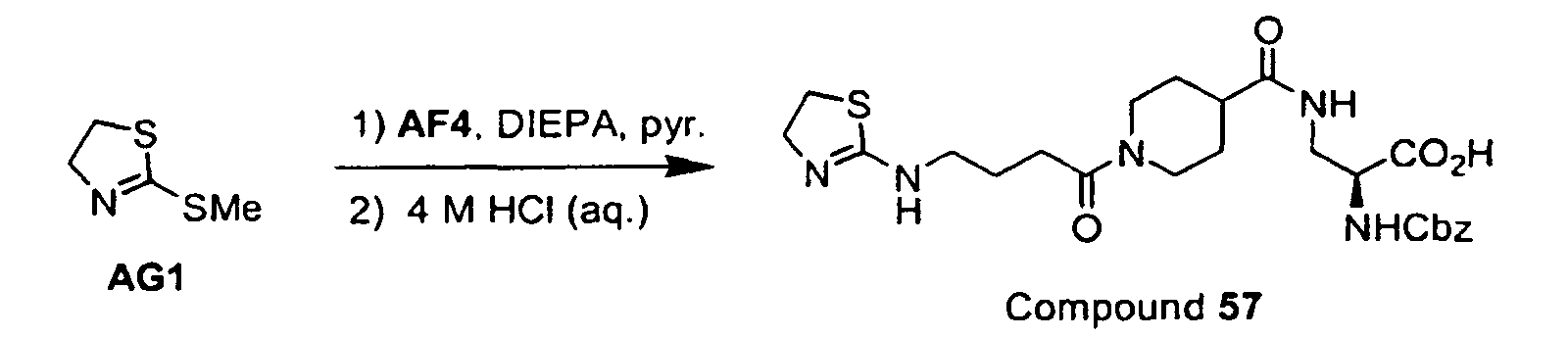
- Similarly, thiourea AG2, prepared as described in WO/0034255, is activated with methyl iodide followed by reaction with AG3 as described in WO/9708145 to provide AG4.
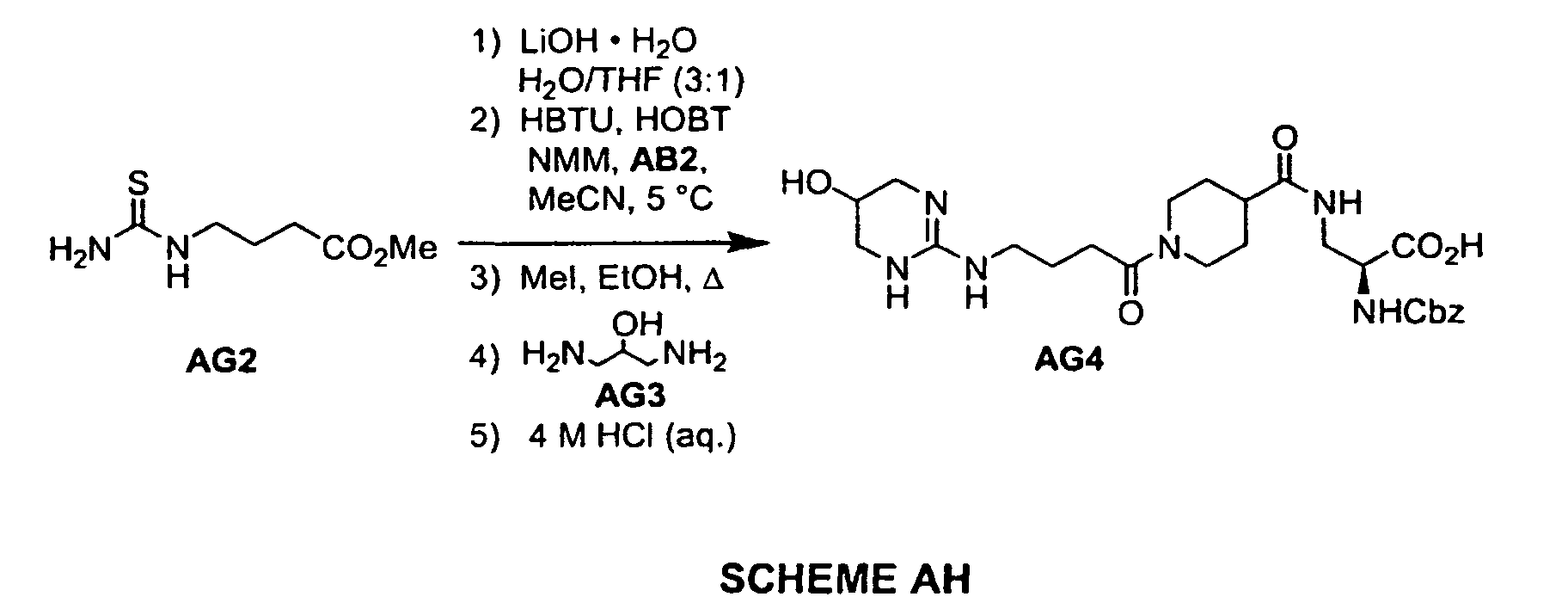
- Compounds of Formula (I) wherein L is -OC(=O)- or -HNC(=O)- can be prepared as outlined below. The protected aminoalcohol AH1 can be converted to a corresponding p-nitrophenylcarbonate intermediate by reaction with AH2. Reaction of the p-nitrophenylcarbonate intermediate product with AF1, followed by removal of the Boc group furnished an amine intermediate. The amine intermediate was subsequently reacted with reagent AA3 to give a corresponding (imidazolin-2-yl)amino intermediate. Boc protection of the (imidazolin-2-yl)amino intermediate followed by saponfication yielded AH3, which was used to replace intermediate AA4 in Scheme AA to produce Compounds 28, 29, 31, 35, 39 and 40.

- Similarly, AD2 was converted to AH4 by reaction with AH2 to produce AH4. Reaction of AH4 with AH5 and saponification provided Compound 10.

- Compounds of the Formula (I) wherein A is amino or R3H2N- can be prepared by coupling AA1 with the appropriate Boc-protected amino acid, such as Al1, followed by saponification to give Al2 as an intermediate. The intermediate Al2 was coupled with AB2, then treated with aqueous HCl to yield Compound 50. Similarly, Compound 56 was prepared by substituting 4-N-Boc-aminobutyric acid for Al1.
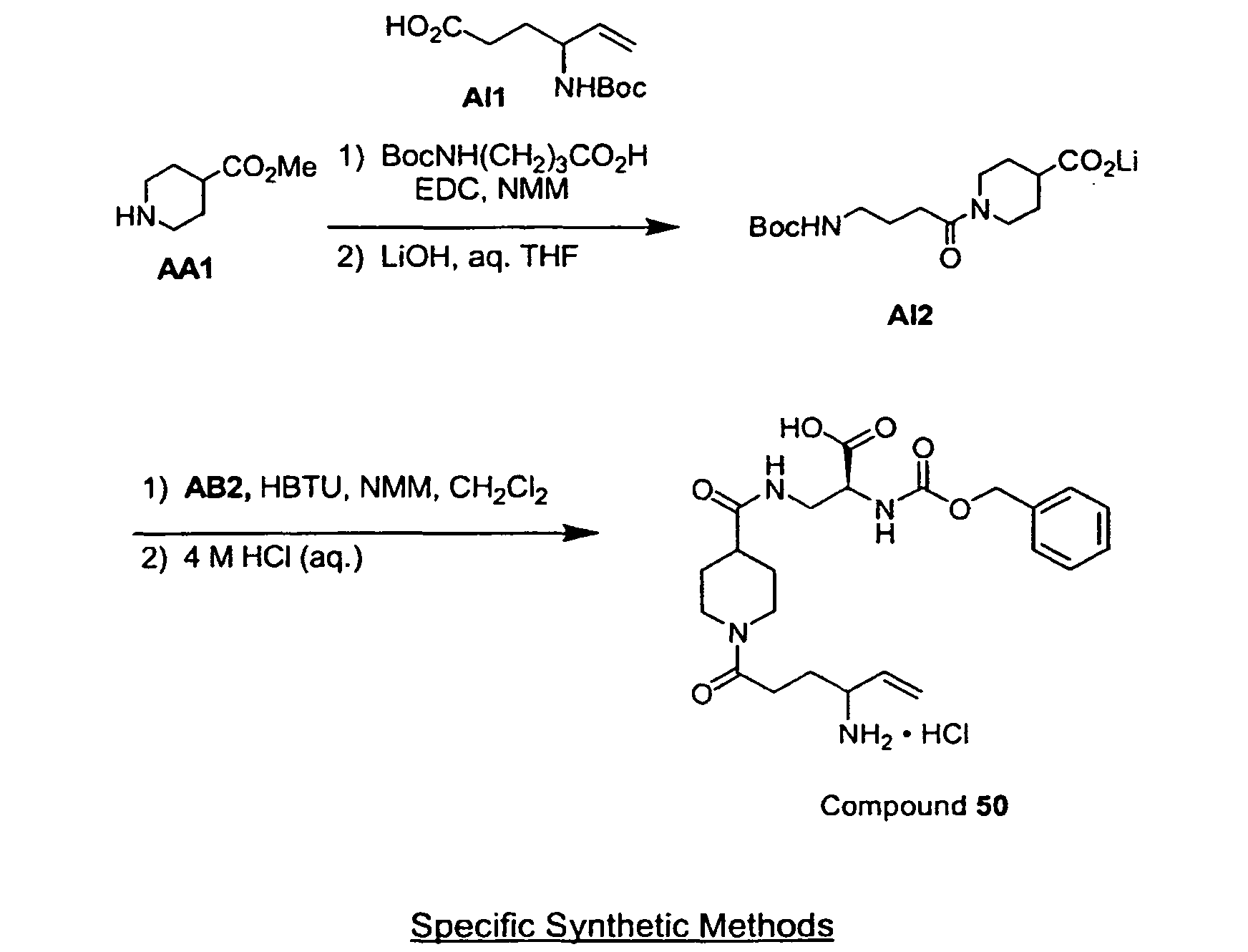
- The following Examples are set forth to aid in the understanding of the invention, and are not intended and should not be construed to limit in any way the invention set forth in the claims which follow thereafter.
- Protected amino acids were purchased from Bachem Bioscience Inc. N-α-Cbz-L-2,3-diaminopropionic acid was purchased from Fluka. Aromatic aldehydes were purchased from Aldrich Chemical Company, as were all other chemicals. High field 1H NMR spectra were recorded on a Bruker AC-360 spectrometer at 360 MHz, and coupling constants are given in Hertz. Melting points were determined on a Mel-Temp II melting point apparatus and are uncorrected. Microanalyses were performed at Robertson Microlit Laboratories, Inc., Madison, New Jersey and are expressed in percentage by weight of each element per total molecular weight. In those cases where the product is obtained as a salt, the free base is obtained by methods known to those skilled in the art, e.g. by basic ion exchange purification. Nuclear magnetic resonance (NMR) spectra for hydrogen atoms were measured in the indicated solvent with tetramethylsilane (TMS) as the internal standard on a Bruker AM-360 (360 MHz) spectrometer. The values are expressed in parts per million down field from TMS. The mass spectra (MS) were determined on a Micromass Platform LC single quadrupole mass analyser fitted with an electrospray ionisation source coupled to a Hewlett Packard 1050 HPLC and a Jones Chromatography diverter valve in the loop injection mode. Positive mode electrospray was used eluting with acetonitrile/water/acetic acid (50:50: 1) flowing at 0.3 mL/min with a sprayer temperature of 120 °C and an inlet desolvation cone set to 40 kV.
- Unless otherwise noted, the materials used in the examples were obtained from readily available commercial suppliers or synthesized by standard methods known to anyone skilled in the art of chemical synthesis. The substituent groups, which vary between examples, are hydrogen unless otherwise noted.
- A mixture of AA1 (2.0 g, HCl salt, 0.011 mol), CH2Cl2 (100 mL), 4-N-Boc-aminobutyric acid (2.3 g, 1 eq), NMM (2.4 mL, 2 eq), HOBT (10 mg), and EDC•HCl (3.2 g, 1.5 eq) was stirred at 5 °C for 1 h, the ice bath was removed, and stirred for 2 h. The reaction was diluted with saturated aqueous NH4Cl (50 mL) and the layers were separated. The organic layer was washed with NaOH (0.5 N, 15 mL), dried (Na2SO4), and evaporated to give a glass (3.6 g, 0.011 mol). This glass was dissolved in CH2Cl2 (15 mL) and anisole (1 mL), treated with TFA (15 mL), and stirred for 2 h. The solution was evaporated to give an oil (AA2, 3.8 g). AA2 was dissolved in dioxane (40 mL), treated with NMM (2.4 mL, 2 eq) and 2-(3,5-dimethylpyrazolyl)-4,5-dihydroimidazole-HBr AA3 (2.7 g, 1 eq) and heated at reflux for 2 h. This mixture was cooled to RT and filtered. The filtrate was treated with MeOH (80 mL), NMM (2.4 mL, 2 eq), di-tert-butyl dicarbonate (4.8 g, 2 eq), and sodium carbonate (2.4 g, 2 eq), and stirred for 3 days. The solvents were evaporated, and the residue was partitioned between CH2Cl2 (100 mL) and water (10 mL). The organic layer was dried (Na2SO4), evaporated, and the oil purified by silica gel chromatography (1% NH4OH/10% MeOH/CH2Cl2) to give a tan glass (1.8 g). The tan glass (0.09 g, 0.0023 mol) was dissolved in THF (5 mL), cooled to 5°C, treated with aqueous LiOH (0.11 g in 15 mL water), and stirred for 2 h. The solvents were evaporated to give AA4 as a pale yellow solid (1.0 g). This solid was slurried with MeCN (100 mL), AA5 (0.82 g, 1 eq, prepared starting from quinoline-3-carboxaldehyde as reported in M. Costanzo, et. al., WO 97/41102), HOBT (0.19 g, 0.5 eq), NMM (0.87 mL, 3 eq), and HBTU (1.2 g, 1.2 eq) at 5°C, stirred for 6 h, diluted with saturated aqueous NH4Cl (12 mL), and the MeCN evaporated. The residue was partitioned between CHCl3 (100 mL) and water (15 mL) and filtered. The filtrate layers were separated, and the organic layer was dried (Na2SO4), evaporated, and purified by silica gel chromatography (1% NH4OH/4% MeOH/7% EtOH/CH2Cl2) to give a clear glass (0.60 g). The glass was treated with water (12 mL) and HCl (conc., 10 mL), and stirred for 18 h. The aqueous HCl was evaporated, the resultant oil treated with MeCN (20 mL), and the precipitate collected and dried to afford Compound 1 as a white foam: 1H NMR (DMSO-d6) δ 1.3 (m, 2 H), 1.6 (m, 4 H), 2.3 (m, 2 H), 2.6 (m, 1 H), 2.8 (m, 1 H), 3.1 (m, 6 H), 3.4 (m, 1 H), 3.7 (m, 3 H), 3.8 (m, 1 H), 4.0 (m, 2 H), 4.2 (m, 1 H), 5.3 (m, 1 H), 7.7 (t, J = 4 Hz, 1 H), 7.9 (t, J = 4 Hz, 1 H), 8.2 (m, 2 H), 8.3 (m, 1 H), 8.6 (m, 2 H), 9.2 (s, 1 H), 10.9 (m, 1 H); MS m/e 481.4 (MH+); [α]25 D -42.1° (c 0.114, MeOH).
- Compound 2 was prepared as described for Compound 1 in Scheme AA using AA4 (0.10 g) and methyl N-α-Cbz-L-2,3-diaminopropionate·HCl AB2 to replace AA5 (0.09 g), and isolated as a tan glass: 1H NMR (DMSO-d6) δ 1.3 (m, 1 H), 1.4 (m, 1 H), 1.7 (m, 4 H), 2.4 (m, 3 H), 2.6 (m, 2 H), 2.8 (t, J = 4 Hz, 1 H), 3.0 (m, 1 H), 3.1 (m, 1 H), 3.3 (m, 2 H), 3.4 (m, 1 H), 3.8 (m, 2 H), 4.1 (t, J = 4 Hz, 1 H), 4.3 (m, 1 H), 5.0 (t, J = 7 Hz, 2 H), 7.3 (m, 5 H), 7.6 (m, 3 H), 8.0 (m, 3 H), 8.2 (m, 1 H); MS m/e 503.4 (MH+).
- Compound 3 was prepared as described for Compound 1 in Scheme AA using AA4 (0.15 g) and methyl (3S)-amino-3-(6-chloro-3-pyridyl)propionate·2HCl (0.11 g; prepared starting from 6-chloropyridine-3-carboxaldehyde as reported by M. Costanzo, et al. in WO 97/41102) for AA5, and isolated as a clear glass: 1H NMR (DMSO-d6) δ 1.2 (m, 4 H), 1.5 (m, 2 H), 2.2 (m, 3 H), 2.5 (m, 2 H), 2.7 (m, 2 H), 2.8 (m, 1 H), 3.1 (m, 1 H), 3.5 (m, 3 H), 3.8 (m, 1 H), 4.1 (m, 3 H), 4.3 (m, 1 H), 5.1 (m, 1 H), 7.4 (d, J = 5 Hz, 1 H), 7.7 (d, J = 5 Hz, 1 H), 8.1 (m, 3 H), 8.3 (s, 1 H), 8.5 (m, 1 H); MS m/e 464.9 (MH+).
- Compound 4 was prepared as described for Compound 1 in Scheme AA using AA4 (0.90 g) and tert-butyl (3R)-aminobutyrate (0.37 g, purchased from Oxford Asymmetry) for AA5, and isolated as a clear glass: 1H NMR (DMSO-d6) 5 1.0 (d, J = 5 Hz, 3 H), 1.3 (m, 2 H), 1.7 (m, 4 H), 2.3 (m, 6 H), 2.6 (m, 1 H), 3.0 (m, 1 H), 3.2 (m, 2 H), 3.6 (s, 4 H), 3.8 (m, 1 H), 4.0 (m, 1 H), 4.4 (m, 1 H), 7.8 (d, J = 7 Hz, 2 H), 8.2 (m, 2 H); MS m/e 368.4 (MH+).
- Compound 5 was prepared as described for Compound 1 in Scheme AA using N-Boc-imidazolin-2-yl-(3-aminoisobutyryl)-isonipecotic acid (0.10 g) for AA4 and AA5 (0.12 g), and isolated as glass: 1H NMR (DMSO-d6) δ 1.1 (d, J = 6 Hz, 3 H), 1.3 (m, 1 H), 1.4 (m, 1 H), 1.7 (m, 4 H), 2.3 (m, 2 H), 2.6 (m, 2 H), 2.8 (m, 1 H), 3.0 (m, 2 H), 3.1 (m, 1 H), 3.3 (m, 2 H), 3.4 (m, 1 H), 3.8 (m, 1 H), 4.1 (m, 1 H), 4.3 (m, 1 H), 5.0 (t, J = 7 Hz, 2 H), 7.3 (m, 5 H), 7.6 (m, 2 H), 8.0 (m, 3 H); MS m/e 503.4 (MH+).
- A mixture of AC1 (2.0 g, 0.011 mol), CH2Cl2 (70 mL), and NMM (2.4 mL, 2 eq) at 5 °C was treated with 4-bromobutyryl chloride (1.3 mL, 1 eq), stirred for 6 h, and diluted with saturated aqueous NH4Cl (15 mL). The organic layer was dried (Na2SO4), evaporated, and the resultant oil purified by silica gel chromatography (4% MeOH/ CH2Cl2) to give an oil (1.8 g). The oil was dissolved in MeOH (10 mL) and isopropanol (15 mL) and then treated with 2-aminopyridine (0.70 g, 1.2 eq) and sodium carbonate (2 mg). This mixture was heated at reflux in a sealed flask for 2 h, cooled to RT, and evaporated to an oil. The oil was purified by silica gel chromatography (2% MeOH/3% EtOH/CH2Cl2) to give AC2 as a glass (0.3 g) intermediate. The intermediate AC2 was then saponified with lithium hydroxide and carried forward to replace AA4 as exemplified in Scheme AA to produce Compound 6 as clear flakes: 1H NMR (DMSO-d6) δ 1.0-1.2 (m, 2 H), 1.7 (m, 4 H), 2.2 (m, 2 H), 3.0 (m, 3 H), 3.3 (m, 3 H), 3.5 (t, J = 4 Hz, 1 H), 3.9 (m, 2 H), 5.5 (t, J = 4 Hz, 1 H), 6.9 (m, 1 H), 7.1 (m, 1 H), 7.9 (m, 4 H), 8.0 (t, J = 4 Hz, 1), 8.2 (m, 2 H), 8.8 (m, 3 H), 9.2 (s, 1H), 10.9 (m, 1 H), 13.5 (m, 1 H); mp 87-90°C; MS m/e 490 (MH+).
- Using the procedures described in Examples 1-6 or outlined in Schemes AA-AH and the appropriate reagents and starting materials known to those skilled in the art, other compounds of the present invention may be prepared including, but not limited to:
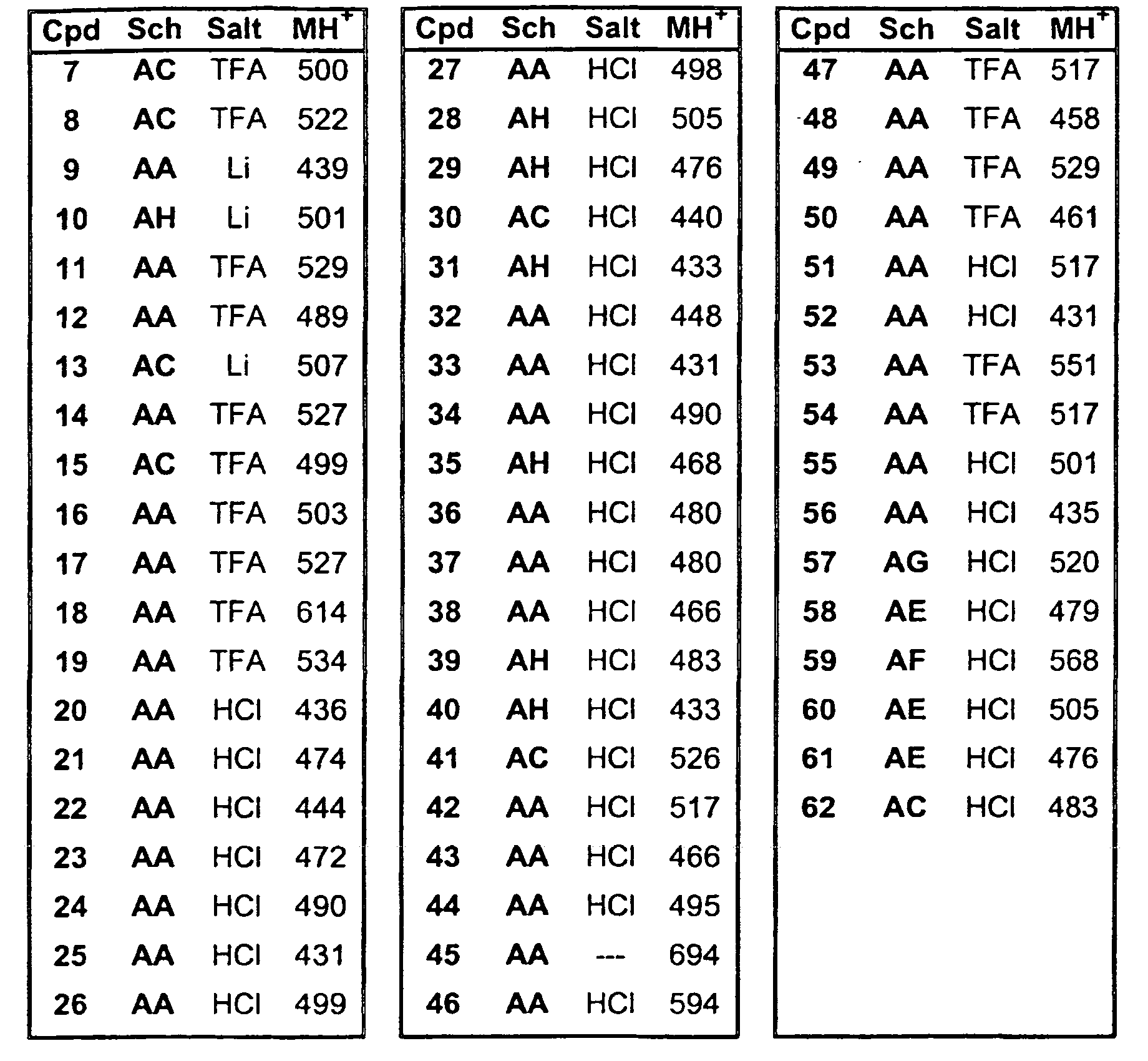
- As a specific embodiment of an oral composition, 100 mg of the Compound 1 of Example 1 is formulated with sufficient finely divided lactose to provide a total amount of 580 to 590 mg to fill a size O hard gel capsule.
- The vitronectin/αvβ3 binding assay methods were derived from Mehta et al. (Biochem J. 1998, 330, 861). Human αvβ3 (Chemicon International Inc., Temecula, CA), at a concentration of 1 µg/ml dissolved in Tris buffer (20 mM Tris, 1 mM CaCl2, 1 mM MgCl2, 10 µM MnCl2, 150 mM NaCl), was immobilized on Immulon 96 well plates (Dynex Technologies, Chantilly, VA) overnight at 4 °C. Plates were washed and treated with blocking buffer (3 % BSA in Tris buffer) for 2 h at 37 °C. Plates were then rinsed 2 times with Tris buffer containing 0.3% BSA and 0.2% Tween20 (polyoxyethylenesorbitan monolaurate). Five minutes prior to the addition of 5 nM vitronectin (Sigma, St. Louis, MO), synthesized compounds were added to wells in duplicate. Each plate included c-RGDfV as an internal control. Following a 3 hour incubation at 37 °C, plates were washed 5 times in assay buffer. An anti-human vitronectin IgG rabbit polyclonal antibody (Calbiochem, San Diego, CA) was added (1:2000) and plates were incubated for 1 hour at room temperature. VectaStain ABC peroxidase kit reagents (Vector Laboratories, Burlingame, CA) employing a biotin labeled anti-rabbit IgG, were utilized for detection of bound antibody. Plates were read at 490 nm on a Molecular Devices (Sunnyvale, CA) microplate reader. Table 1 shows the results of the in vitro solid phase purified αvβ3 binding assay for representative compounds of the present invention.
- A 96 well Immulon-2 microtiter plate (Dynatech-Immulon) was coated with 50 µl/well of RGD-affinity purified GPIIb/IIIa (effective range 0.5-10 µg/mL) in 10 mM HEPES, 150 mM NaCl, 1 mM MgCl2 at pH 7.4. The plate was covered and incubated overnight at 4 °C. The GPIIb/IIa solution was discarded and 150 µl of 5% BSA was added and incubated at RT for 1-3 h. The plate was washed extensively with modified Tyrodes buffer. Biotinylated fibrinogen (25 µl/well) at 2 x final concentration was added to the wells that contain the test compounds (25 µl/well). The plate was covered and incubated at RT for 2-4 h. Twenty minutes prior to incubation completion, one drop of Reagent A (VectaStain ABC Horse Radish Peroxidase kit, Vector Laboratories, Inc.) and one drop Reagent B were added with mixing to 5 mL modified Tyrodes buffer mix and let stand. The ligand solution was discarded and the plate washed (5 x 200 µl/well) with modified Tyrodes buffer. Vecta Stain HRP-Biotin-Avidin reagent (50 µl/well, as prepared above) was added and incubated at RT for 15 min. The Vecta Stain solution was discarded and the wells washed (5 x 200 µl/well) with modified Tyrodes buffer. Developing buffer (10 mL of 50 mM citrate/phosphate buffer @ pH 5.3, 6 mg o-phenylenediamine, 6 µl 30% H2O2; 50 µl/well) was added and incubated at RT for 3-5 min, and then 2 N H2SO4 (50 µl/well) was added. The absorbance was read at 490 nM. Table 1 shows the results of the in vitro solid phase purified GPIIb/IIIa binding assay for representative compounds of the present invention.
- The vitronectin/αvβ5 binding assay method was performed in the same manner as the vitronectin/αvβ3 binding assay (EXAMPLE 64) immobilizing with 1 µg/ml of human purified αvβ5 (Chemicon International, Inc.) on to Immulon 96 well plates (Dynex Technologies) instead of αvβ3. All other aspects of the assay including buffers, reagents, and incubation times remain unchanged.
No. αvβ3 IC50
(uM)IIb/IIIa IC50
(uM)αvβ5 is IC50
(uM)1 0.0037 0.030 0.025 2 0.0058 0.0089 0.021 3 0.028 0.13 NT 4 0.15 1.70 NT 5 0.015 0.023 NT 6 0.0040 0.46 NT 7 0.49 7.9 NT 8 0.55 1.1 NT 9 30 0.30 NT 10 >50 0.95 NT 11 1.3 0.0026 NT 12 0.020 0.014 NT 13 10 29 NT 14 0.050 0.0092 NT 15 >5 17 NT 16 0.019 0.018 0.038 17 0.38 0.0054 NT 18 0.050 0.015 NT 19 0.32 0.071 NT 20 0.53 4.9 NT 21 0.023 0.41 NT 22 >0.5 38 NT 23 >0.5 7.3 NT 24 0.064 2.2 NT 25 0.032 2.9 NT 26 0.12 1.8 NT 27 >0.5 13 NT 28 0.0082 1.5 NT 29 0.034 0.21 NT 30 0.14 56 NT 31 0.029 4.2 NT 32 0.12 3.6 NT 33 0.019 1.8 NT 34 0.029 1.5 >5.0 35 0.14 1.6 NT 36 >0.3 12 NT 37 0.29 1.7 NT 38 >0.3 3.3 NT 39 0.0023 0.036 NT 40 0.012 1.1 NT 41 >0.3 0.11 NT 42 0.17 0.14 NT 43 0.23 1.3 NT 44 0.028 0.36 2.9 45 3.7 14 40% 46 0.15 1.6 >5 47 0.0040 0.028 NT 48 0.51 1.1 NT 49 0.039 0.012 0.21 50 3.9 0.0074 38% 51 0.27 0.29 2 52 0.25 2.7 0.76 53 0.57 0.0015 NT 54 0.072 0.013 NT 55 0.012 0.026 0 56 >5 0.049 NT 57 0.35 0.13 NT 58 0.040 0.26 0.071 59 0.16 0.51 NT 60 0.027 0.19 0.086 61 0.18 2.7 NT 62 >0.50 0.38 NT - While the foregoing specification teaches the principles of the present invention, with examples provided for the purpose of illustration, it will be understood that the practice of the invention encompasses all of the usual variations, adaptations and/or modifications as come within the scope of the following claims and their equivalents.
most preferably, A is optionally present and is selected from 4,5-dihydro-1H -imidazol-2-yl, 1,2,3,4-tetrahydro-1,8-naphthyridin-7-yl, 3H-imidazo[4,5-b]pyridin-2-yl, amino, (4,5-dihydro-1H-imidazol-2-yl)amino, (pyridin-2-yl)amino, (3-methylpyridin-2-yl)amino, (thiazol-2-yl)amino, (3H-imidazo[4,5-b]pyridin-2-yl)amino, NH2C(=NH)NH-, R3HNC(=O)NH-, (4,5-dihydro-1H-imidazol-2-yl)aminoxy or NH2C(=NH)NHO-,
with the proviso that if A is H2NC(=NH)NH-, then, dependently, W is not hydrogen when Q is -CH2-;
most preferably, Q is selected from -CH2-, -CH(methyl)-, -CH(phenyl)- (wherein phenyl is optionally substituted with one to five substituents independently selected from methyl, methoxy, bromine, chlorine, fluorine, hydroxy or trifluoromethyl), -CH(naphthalen-1-yl)-, -CH(naphthalen-2-yl)-, -CH[(3,4-dioxymethylene)phenyl]-, -CH[(3,4-dioxyethylene)phenyl]-, -CH[(3-bromo-5-chloro-2-hydroxy)phenyl]-, -CH(thien-3-yl)-, -CH(quinolin-3-yl)-, -CH(pyridin-3-yl)- (wherein pyridinyl is optionally substituted with chlorine) or -CH(benzyl)-;
r is 1;
R4 is selected from hydrogen or C1-C4 alkyl;
more preferably, R4 is hydrogen;
T is selected from R5C(=O)- or R5OC(=O)-;
more preferably, T is selected from R5OC(=O)-;
R5 is selected from aryl or aryl(C1-C4)alkyl;
more preferably, R5 is selected from aryl(C1-C4)alkyl;
most preferably, R5 is benzyl;
R6 is selected from hydrogen, methyl or (R8)(R7)NC(=O)CH2;
more preferably, R6 is hydrogen;
R7 and R8 are independently selected from hydrogen, methyl or ethyl; and, more preferably, R7 and R8 are independently ethyl;
and pharmaceutically acceptable salts thereof.
Claims (34)
- A compound of the Formula (I):wherein

- M
- is selected from the group consisting of C1-C4 alkylene (optionally substituted within the carbon chain with one substituent selected from the group consisting of C1-C4 alkyl, C2-C4 alkenyl, cycloalkyl (wherein a ring carbon atom forms the point of attachment to the carbon chain) and aryl (optionally substituted with halogen) and substituted on the terminal carbon with one substituent selected from A), C2 C4 alkenylene (substituted with one substituent selected from A); heterocyclylene (optionally substituted with one substituent selected from A), heterocyclenylene (substituted with one substituent selected from A), arylene (substituted with one substituent selected from A), (C1-C4 alkylene)aryl (substituted on C1-C4 alkylene with one substituent selected from A) and arylene(C1-C4)alkyl (substituted on arylene with one substituent selected from A);
- A
- is optionally present and is selected from the group consisting of heteroaryl, heterocyclyl, R3HN-, (heteroaryl)amino, (heterocyclyl)amino, R3HNC(=NH)-, R3HNC(=NH)NH-, R3HNC(=O)NH-, R3C(=NH)NH-, (heterocyclyl)aminooxy, (heteroaryl)aminooxy, R3HNC(=NH)NHO-, R3C(=NH)NHO-, R3HNC(=NH)NHC(=O)- and R3C(=NH)NHC(=O)-; wherein heteroaryl and heterocyclyl are optionally substituted with one to five substituents independently selected from the group consisting of C1-C4 alkyl, C1-C4 alkoxy, heteroaryl (optionally substituted with C1-C4 alkyl), halogen, hydroxy, nitro, cyano, trihalo(C1-C4)alkyl, C1-C4 alkylcarbonyl, C1-C4 alkoxycarbonyl, aryl(C1-C4)alkoxycarbonyl, R3HN-, amino(C1-C4)alkyl, C1-C4 alkylamino(C1-C4)alkyl and di(C1-C4 alkyl)amino(C1-C4)alkyl;
- L
- is selected from the group consisting of -C(=O)-, -SO2-, -OC(=O)- and -HNC(=O)-;
- R1
- is selected from the group consisting of hydrogen, C1-C8 alkyl and cycloalkyl;
- R2
- is selected from the group consisting of hydrogen and C1-C8 alkyl;
- R3
- is selected from the group consisting of hydrogen, C1-C8 alkyl, aryl, aryl(C,-C8)alkyl, cycloalkyl, hydroxy, cyano and nitro;
- Q
- is selected from the group consisting of -CH2-, -CH(C1-C8alkyl)-, -CH(C2-C8alkenyl)-, -CH(C2-C8alkynyl)-, -CH(aryl)- (wherein aryl is optionally substituted with one to five substituents independently selected from the group consisting of C1-C4 alkyl, C1-C4 alkoxy, -O-(C1-C3 alkyl)-O-, halogen, hydroxy, trihalo(C1-C3)alkyl and trihalo(C1-C3)alkoxy), -CH(heteroaryl)-(wherein heteroaryl is optionally substituted with a substituent selected from the group consisting of halogen, hydroxy, C1-C4 alkyl, C1-C4 alkoxy, -O-(C1-C3 alkyl)-O-, amino, C1-C4 alkylamino and di(C1-C4)alkylamino) and -CH(aryl(C1-C8)alkyl)-;
- W
- is selected from the group consisting of hydrogen and N(R4)T;
- r
- is an integer selected from 0 or 1;
- R4
- is selected from the group consisting of hydrogen, C1-C8 alkyl and C2-C6 acyl;
- T
- is selected from the group consisting of R5C(=O)-, R5OC(=O)- and R5C(=N-CN)-;
- R5
- is selected from the group consisting of C1-C8 alkyl, aryl, ary)(C1-C8)alkyl and amino (wherein amino is optionally substituted with one to two substituents independently selected from C1-C8 alkyl);
- R6
- is selected from the group consisting of hydrogen, C1-C8 alkyl, aryl(C1-C8)alkyl, (R7)N(C1-C8)alkyl, (R8)(R7)N(C1-C8)alkyl and (R8)(R7)NC(=O)(C1-C8)alkyl; and,
- R7 and R8
- are independently selected from the group consisting of hydrogen, C1-C8 alkyl and cycloalkyl;
- The compound of Claim 1, wherein
- M
- is selected from the group consisting of ethylene (optionally substituted within the carbon chain with methyl and substituted on the terminal carbon with one substituent selected from A), propylene (optionally substituted within the carbon chain with a substituent selected from the group consisting of methyl, ethenyl, cyclohexylidene (wherein a ring carbon atom forms the point of attachment to the carbon chain) and 4-Cl-phenyl and substituted on the terminal carbon with one substituent selected from A), allylene (substituted with one substituent selected from A); piperidin-4-ylene (optionally substituted with one substituent selected from A), 1,4,5-dihydro-2-cyclopenten-1-yl (substituted with one substituent selected from A) and 4-methylphenylene (substituted on methylene with one substituent selected from A);
- A
- is optionally present and is selected from the group consisting of 1H-imidazol-1-yl, 1H-imidazol-2-yl, 4,5-dihydro-1H-imidazol-2-yl (optionally substituted with a substituent selected from the group consisting of C1-C4 alkoxycarbonyl and aryl(C1-C4)alkoxycarbonyl), pyridin-2-yl (optionally substituted with a substituent selected from the group consisting of C1-C4 alkyl, heteroaryl [optionally substituted with C1-C4 alkyl], halogen, hydroxy, nitro, cyano, amino, amino(C1-C4)alkyl, C1-C4 alkylamino(C1-C4)alkyl and di(C1-C4 alkyl)amino(C1-C4)alkyl), pyrimidin-2-yl, 1,4,5,6-tetrahydro-pyrimidin-2-yl (optionally substituted with one to two substituents independently selected from the group consisting of C1-C4 alkyl, hydroxy and amino), piperidin-4-yl, benzimidazol-2-yl, 1,2,3,4-tetrahydro-1,8-naphthyridin-7-yl, 3H-imidazo[4,5-b]pyridin-2-yl, amino, (C1-C6 alkyl)amino, (1H-imidazol-1-yl)amino, (1H-imidazol-2-yl)amino, (4,5-dihydro-1H-imidazol-2-yl)amino (optionally substituted on 4,5-dihydro-1H-imidazol-2-yl with a substituent selected from the group consisting of (C1-C6)alkoxycarbonyl and aryl(C1-C6)alkoxycarbonyl), (pyridin-2-yl)amino (optionally substituted on pyridin-2-yl with a substituent selected from the group consisting of C1-C4 alkyl, heteroaryl [optionally substituted with C1-C4 alkyl], halogen, hydroxy, nitro, cyano, amino, amino(C1-C4)alkyl, C1-C4 alkylamino(C1-C4)alkyl and di(C1-C4 alkyl)amino(C1-C4)alkyl), (pyrimidin-2-yl)amino, (1,4,5,6-tetrahydropyrimidin-2-yl)amino (optionally substituted on 1,4,5,6-tetrahydropyrimidin-2-yl with one to two substituents independently selected from the group consisting of C1-C4 alkyl, hydroxy and amino), (4,5,6,7-tetrahydro-1H-1,3-diazepin-2-yl)amino, (thiazol-2-yl)amino, (benzimidazol-2-yl)amino, (3H-imidazo[4,5-b]pyridin-2-yl)amino, R3HNC(=NH)NH-, R3HNC(=O)NH-, (4,5,6,7-tetrahydro-1H-1,3-diazepin-2-yl)aminooxy, (4,5-dihydro-1H-imidazol-2-yl)aminooxy and R3HNC(=NH)NHO-;
- L
- is selected from the group consisting of -C(=O)-, -OC(=O)- and -HNC(=O)-;
- R1
- is selected from the group consisting of hydrogen and C1-C4 alkyl;
- R2
- is hydrogen;
- R3
- is selected from the group consisting of hydrogen, C1-C8 alkyl, aryl(C1-C8)alkyl and hydroxy;
- Q
- is selected from the group consisting of -CH2-, -CH(C1-C8alkyl)-, -CH(aryl)-(wherein aryl is optionally substituted with one to five substituents independently selected from the group consisting of C1-C4 alkyl, C1-C4 alkoxy, -O-(C1-C3 alkyl)-O-, halogen, hydroxy and trihalo(C1-C3)alkyl), -CH(heteroaryl)- (wherein heteroaryl is optionally substituted with a substituent selected from halogen) and -CH(aryl(C1-C8)alkyl)-;
- r
- is 1;
- R4
- is selected from the group consisting of hydrogen and C1-C4 alkyl;
- T
- is selected from the group consisting of R5C(=O)- and R5OC(=O)-;
- R5
- is selected from the group consisting of aryl and aryl(C1-C4)alkyl;
- R6
- is selected from the group consisting of hydrogen, methyl and (R8)(R7)NC(=O)CH2; and,
- R7 and R8
- are independently selected from the group consisting of hydrogen, methyl and ethyl;
- The compound of Claim 2, wherein
- A
- is optionally present and is selected from the group consisting of 1H-imidazol-1-yl, 4,5-dihydro-1H-imidazol-2-yl, pyridin-2-yl (optionally substituted with a substituent selected from the group consisting of C1-C4 alkyl and heteroaryl [optionally substituted with C1-C4 alkyl]), piperidin-4-yl, benzimidazol-2-yl, 1,2,3,4-tetrahydro-1,8-naphthyridin-7-yl, 3H-imidazo[4,5-b]pyridin-2-yl, amino, (4,5-dihydro-1H-imidazol-2-yl)amino (optionally substituted on 4,5-dihydro-1H-imidazol-2-yl with C1-C6 alkoxycarbonyl), (pyridin-2-yl)amino (optionally substituted on pyridinyl with a substituent selected from the group consisting of C1-C4 alkyl and heteroaryl (optionally substituted with C1-C4 alkyl)), (1,4,5,6-tetrahydro-5-hydroxypyrimidin-2-yl)amino, (1,4,5,6-tetrahydro-5-methylpyrimidin-2-yl)amino, (1,4,5,6-tetrahydro-5,5-dimethylpyrimidin-2-yl)amino, (thiazol-2-yl)amino, (3H-imidazo[4,5-b]pyridin-2-yl)amino, R3HNC(=NH)NH-, R3HNC(=O)NH-, (4,5-dihydro-1H-imidazol-2-yl)aminooxy and R3HNC(=NH)NHO-;
- R1
- is hydrogen;
- R3
- is selected from the group consisting of hydrogen, butyl, benzyl and hydroxy;
- Q
- is selected from the group consisting of -CH2-, -CH(methyl)-, -CH(ethyl)-, -CH(phenyl)- (wherein phenyl is optionally substituted with one to five substituents independently selected from the group consisting of methyl, ethyl, propyl, methoxy, ethoxy, propoxy, bromine, chlorine, fluorine, iodine, hydroxy and trifluoromethyl), -CH(naphthalen-1-yl)-, -CH(naphthalen-2-yl)-, -CH((3,4-dioxymethylene)phenyl)-, -CH((3,4-dioxyethylene)phenyl)-, -CH((3-bromo-5-chloro-2-hydroxy)phenyl)-, -CH(thien-3-yl)-, -CH(quinolin-3-yl)-, -CH(pyridin-3-yl)- (wherein pyridinyl is optionally substituted with chlorine) and -CH(benzyl)-;
- R4
- is hydrogen;
- T
- is selected from R5OC(=O)-;
- R5
- is selected from aryl(C1-C4)alkyl;
- R6
- is hydrogen; and,
- R7 and R8
- are independently ethyl;
- The compound of Claim 3, wherein
- A
- is optionally present and is selected from the group consisting of 4,5-dihydro-1H-imidazol-2-yl, 1,2,3,4-tetrahydro-1,8-naphthyridin-7-yl, 3H-imidazo[4,5-b]pyridin-2-yl, amino, (4,5-dihydro-1H-imidazol-2-yl)amino, (pyridin-2-yl)amino, (3-methylpyridin-2-yl)amino, (thiazol-2-yl)amino, (3H-imidazo[4,5-b]pyridin-2-yl)amino, NH2C(=NH)NH-, R3HNC(=O)NH-, (4,5-dihydro-1H-imidazol-2-yl)aminoxy and NH2C(=NH)NHO-,
- Q
- is selected from the group consisting of -CH2-, -CH(methyl)-, -CH(phenyl)-(wherein phenyl is optionally substituted with one to five substituents independently selected from the group consisting of methyl, methoxy, bromine, chlorine, fluorine, hydroxy and trifluoromethyl), -CH(naphthalen-1-yl)-, -CH(naphthalen-2-yl)-, -CH((3,4-dioxymethylene)phenyl)-, -CH((3,4-dioxyethylene)phenyl)-, -CH((3-bromo-5-chloro-2-hydroxy)phenyl)-, -CH(thien-3-yl)-, -CH(quinolin-3-yl)-, -CH(pyridin-3-yl)- (wherein pyridinyl is optionally substituted with chlorine) and -CH(benzyl)-; and,
- R5
- is benzyl;
- The compound of Claim 1 selected from the group consisting of:and pharmaceutically acceptable salts thereof.β-[[[1-[4-[(4,5-dihydro-1H-imidazol-2-yl)amino)-1-oxobutyl]-4-piperidinyl]carbonyl]amino]-, (β3 S)- 3-quinolinepropanoic acid;3-[[[1-[4-[(4,5-dihydro-1H-imidazol-2-yl)amino]-1-oxobutyl]-4-piperidinyl]carbonyl]amino]-N-[(phenylmethoxy)carbonyl]- L-alanine;β-[[[1-[1-oxo-4-(2-pyridinylamino)butyl]-4-piperidinyl]carbonyl]amino]-, (β3S)- 3-quinolinepropanoic acid;3-[[[1-[[1-(4,5-dihydro-1H-imidazol-2-yl)-4-piperidinyl]carbonyl]-4-piperidinyl]carbonyl]amino]-N-[(phenylmethoxy)carbonyl]- L-alanine;3-[[[1-[[(1S,4R)-4-[(4,5-dihydro-1H-imidazol-2-yl)amino]-2-cyclopenten-1-yl]carbonyl]-4-piperidinyl]carbonyl]amino]-N-[(phenylmethoxy)carbonyl]- L-alanine;3-[[[1-[3-[(4,5-dihydro-1H-imidazol-2-yl)amino]-2-methyl-1-oxopropyl]-4-piperidinyl]carbonyl]amino]-N-[(phenylmethoxy)carbonyl)-L-alanine;3-[[[1-[[(1R,4S)-4-[(4,5-dihydro-1H-imidazol-2-yl)amino]-2-cyclopenten-1-yl]carbonyl]-4-piperidinyl]carbonyl]amino]-N-[(phenylmethoxy)carbonyl]-L-alanine;4-[[[(2S)-2-carboxy-2-([(phenylmethoxy)carbonyl]amino]ethyl]amino]carbonyl]-, 2-[(4,5-dihydro-1H-imidazo)-2-yl)amino]ethyl ester 1-piperidinecarboxylic acid;β-[[[1-[[2-[(4,5-dihydro-1H-imidazol-2-yl)amino]ethoxy]carbonyl]-4-piperidinyl]carbonyl]amino]-, (β3 S)- 3-quinolinepropanoic acid;3-[[[1-[4-[(4,5-dihydro-1H-imidazol-2-yl)amino]-2-methyl-1-oxobutyl]-4-piperidinyl]carbonyl]amino]-N-[(phenylmethoxy)carbonyl]-L-alanine;3-([[4-(4-amino-1-oxo-5-hexenyl)-4-piperidinyl]carbonyl]amino]-N-[(phenylmethoxy)carbonyl]- L-alanine;3-[[[1-[4-[[(4,5-dihydro-1H-imidazol-2-yl)amino]methyl]benzoyl]-4-piperidinyl]carbonyl]amino]-N-[(phenylmethoxy)carbonyl]- L-alanine;β-[[[1-[3-[[(4,5-dihydro-1H-imidazol-2-yl)amino]oxy]-1-oxopropyl]-4-piperidinyl]carbonyl]amino]- 1,3-benzodioxole-5-propanoic acid; and,β-[[[1-[1-oxo-4-(2-pyridinylamino)butyl]-4-piperidinyl]carbonyl]amino]- 1,3-benzodioxole-5-propanoic acid;
- The compound of Claim 1 which are effective integrin antagonists.
- The compound of Claim 6 which are effective αvβ3, αvβ5, GPIIb/IIIa, dual αvβ3/GPIIb/IIIa or dual αvβ3/αvβ5 integrin antagonists.
- The compound of Claim 7 which are effective αvβ3 integrin antagonists selected from the group consisting of Compound 1, 2, 3, 5, 6, 12, 14, 16, 18, 21, 24, 25, 28, 29, 31, 33, 34, 39, 40, 44, 47, 49, 54, 55, 58 and 60.
- The compound of claim 8 wherein the compound is selected from the group consisting of Compound 1, 2, 6, 28, 39 and 47.
- The compound of Claim 7 which are effective GPIIb/IIIa integrin antagonists selected from the group consisting of Compound 1, 2, 5, 11, 12, 14, 16, 17, 18, 19, 39, 47, 49, 50, 53, 54, 55 and 56.
- The compound of claim 10 wherein the compound is selected from the group consisting of Compound 2, 11, 14, 17, 50 and 53.
- The compound of Claim 7 which are effective αvβ5 integrin antagonists selected from the group consisting of Compound 1, 2, 16, 45, 58 and 60.
- The compound of claim 12 wherein the compound is selected from the group consisting of Compound 1, 2 and 16.
- The compound of Claim 7 which are effective dual αvβ3/GPIIb/IIIa integrin antagonists selected from the group consisting of Compound 2, 5, 12, 14, 16, 18, 39, 47, 49, 54 and 55.
- The compound of claim 14 wherein the compound is Compound 2.
- The compound of Claim 7 which are effective dual αvβ3/αvβ5 integrin antagonists selected from the group consisting of Compound 1, 2, 16, 58 and 60.
- The compound of claim 16 wherein the compound is selected from the group consisting of Compound 1 and 2.
- The compound of Claim 1 which are effective agents for the treatment of an integrin-mediated disorder ameliorated by administration of an integrin antagonist.
- The compound of Claim 18 wherein the integrin-mediated disorder is selected from the group consisting of restenosis, unstable angina, thromboembolic disorders, vascular injury, atherosclerosis, arterial thrombosis, venous thrombosis, vaso-occlusive disorders, acute myocardial infarction, re-occlusion following thrombolytic therapy, re-occlusion following angioplasty, inflammation, rheumatoid arthritis, osteoporosis, bone resorption disorders, cancer, tumor growth, angiogenesis, multiple sclerosis, neurological disorders, asthma, macular degeneration, diabetic complications and diabetic retinopathy.
- The compound of Claim 1 which are effective prodrugs selected from the group consisting of esters, hydroxyamidines and hydroxyguanidines of compounds of Claim 1.
- The compound of Claim 20 which are effective agents for the treatment of an integrin-mediated disorder ameliorated by administration of an integrin antagonist.
- The compound of Claim 21 wherein the integrin-mediated disorder is selected from the group consisting of restenosis, unstable angina, thromboembolic disorders, vascular injury, atherosclerosis, arterial thrombosis, venous thrombosis, vaso-occlusive disorders, acute myocardial infarction, re-occlusion following thrombolytic therapy, re-occlusion following angioplasty, inflammation, rheumatoid arthritis, osteoporosis, bone resorption disorders, cancer, tumor growth, angiogenesis, multiple sclerosis, neurological disorders, asthma, macular degeneration, diabetic complications and diabetic retinopathy.
- A pharmaceutical composition comprising a compound of Claim 1 and a pharmaceutically acceptable carrier.
- A pharmaceutical composition made by mixing a compound of Claim 1 and a pharmaceutically acceptable carrier.
- A process for making a pharmaceutical composition comprising mixing a compound of Claim 1 and a pharmaceutically acceptable carrier.
- A method of treating an integrin-mediated disorder in a subject in need thereof comprising administering to the subject a therapeutically effective amount of a compound of Claim 1.
- The method of Claim 26 wherein the integrin-mediated disorder is selected from the group consisting of restenosis, unstable angina, thromboembolic disorders, vascular injury, atherosclerosis, arterial thrombosis, venous thrombosis, vaso-occlusive disorders, acute myocardial infarction, re-occlusion following thrombolytic therapy, re-occlusion following angioplasty, inflammation, rheumatoid arthritis, osteoporosis, bone resorption disorders, cancer, tumor growth, angiogenesis, multiple sclerosis, neurological disorders, asthma, macular degeneration, diabetic complications and diabetic retinopathy.
- The method of Claim 26 wherein the therapeutically effective amount of the compound of Claim 1 is between about 0.01 mg/kg/day and about 300 mg/kg/day.
- A method of treating an integrin-mediated disorder in a subject in need thereof comprising administering to the subject a therapeutically effective amount of a prodrug of Claim 20.
- The method of Claim 29 wherein the integrin-mediated disorder is selected from the group consisting of restenosis, unstable angina, thromboembolic disorders, vascular injury, atherosclerosis, arterial thrombosis, venous thrombosis, vaso-occlusive disorders, acute myocardial infarction, re-occlusion following thrombolytic therapy, re-occlusion following angioplasty, inflammation, rheumatoid arthritis, osteoporosis, bone resorption disorders, cancer, tumor growth, angiogenesis, multiple sclerosis, neurological disorders, asthma, macular degeneration, diabetic complications and diabetic retinopathy.
- The method of Claim 29, wherein the therapeutically effective amount of the prodrug of Claim 20 is between about 0.01 mg/kg/day and about 300 mg/kg/day.
- A method of treating an integrin-mediated disorder in a subject in need thereof comprising administering to the subject a therapeutically effective amount of a pharmaceutical composition of Claim 23.
- The method of Claim 32 wherein the integrin-mediated disorder is selected from the group consisting of restenosis, unstable angina, thromboembolic disorders, vascular injury, atherosclerosis, arterial thrombosis, venous thrombosis, vaso-occlusive disorders, acute myocardial infarction, re-occlusion following thrombolytic therapy, re-occlusion following angioplasty, inflammation, rheumatoid arthritis, osteoporosis, bone resorption disorders, cancer, tumor growth, angiogenesis, multiple sclerosis, neurological disorders, asthma, macular degeneration, diabetic complications and diabetic retinopathy.
- The method of Claim 32, wherein the therapeutically effective amount of the pharmaceutical composition of Claim 23 is between about 0.01 mg/kg/day and about 300 mg/kg/day.
Applications Claiming Priority (5)
| Application Number | Priority Date | Filing Date | Title |
|---|---|---|---|
| US15661799P | 1999-09-29 | 1999-09-29 | |
| US156617P | 1999-09-29 | ||
| US66713400A | 2000-09-21 | 2000-09-21 | |
| US667134 | 2000-09-21 | ||
| EP00966823A EP1133489B9 (en) | 1999-09-29 | 2000-09-22 | Isonipecotamides for the treatment of integrin-mediated disorders |
Related Parent Applications (1)
| Application Number | Title | Priority Date | Filing Date |
|---|---|---|---|
| EP00966823A Division EP1133489B9 (en) | 1999-09-29 | 2000-09-22 | Isonipecotamides for the treatment of integrin-mediated disorders |
Publications (1)
| Publication Number | Publication Date |
|---|---|
| EP1533310A1 true EP1533310A1 (en) | 2005-05-25 |
Family
ID=34437514
Family Applications (1)
| Application Number | Title | Priority Date | Filing Date |
|---|---|---|---|
| EP05075325A Withdrawn EP1533310A1 (en) | 1999-09-29 | 2000-09-22 | Isonipecotamides for the treatment of integrin-mediated disorders |
Country Status (1)
| Country | Link |
|---|---|
| EP (1) | EP1533310A1 (en) |
Citations (4)
| Publication number | Priority date | Publication date | Assignee | Title |
|---|---|---|---|---|
| JPH04334357A (en) * | 1991-05-02 | 1992-11-20 | Fujirebio Inc | Acyl derivative having enzyme-inhibiting action |
| US5700801A (en) * | 1994-12-23 | 1997-12-23 | Karl Thomae, Gmbh | Piperazine derivatives, pharmaceutical compositions containing these compounds, their use and processes for preparing them |
| US5922717A (en) * | 1994-12-23 | 1999-07-13 | Dr. Karl Thomae Gmbh | Piperazine derivatives, medicaments comprising these compounds, their use and processes for their preparation |
| WO1999067230A1 (en) * | 1998-06-23 | 1999-12-29 | Pharmacia & Upjohn Company | INHIBITORS OF α4β1 MEDIATED CELL ADHESION |
-
2000
- 2000-09-22 EP EP05075325A patent/EP1533310A1/en not_active Withdrawn
Patent Citations (4)
| Publication number | Priority date | Publication date | Assignee | Title |
|---|---|---|---|---|
| JPH04334357A (en) * | 1991-05-02 | 1992-11-20 | Fujirebio Inc | Acyl derivative having enzyme-inhibiting action |
| US5700801A (en) * | 1994-12-23 | 1997-12-23 | Karl Thomae, Gmbh | Piperazine derivatives, pharmaceutical compositions containing these compounds, their use and processes for preparing them |
| US5922717A (en) * | 1994-12-23 | 1999-07-13 | Dr. Karl Thomae Gmbh | Piperazine derivatives, medicaments comprising these compounds, their use and processes for their preparation |
| WO1999067230A1 (en) * | 1998-06-23 | 1999-12-29 | Pharmacia & Upjohn Company | INHIBITORS OF α4β1 MEDIATED CELL ADHESION |
Non-Patent Citations (3)
| Title |
|---|
| CHEMICAL ABSTRACTS, vol. 118, no. 25, 21 June 1993, Columbus, Ohio, US; abstract no. 255342, HOSODA, AKIHIKO ET AL: "Preparation of N-(heterocyclylcarbonyl)amino acids and analogs as prolyl endopeptidase inhibitors" XP002159418 * |
| SU, TING ET AL: "Fibrinogen Receptor (GPIIb-IIIa) Antagonists Derived from 5,6-Bicyclic Templates. Amidinoindoles, Amidinoindazoles, and Amidinobenzofurans Containing the N-.alpha.-Sulfonamide Carboxylic Acid Function as Potent Platelet Aggregation Inhibitors", J. MED. CHEM. 40(26), 4308-4318, 1997, XP000915289 * |
| VARON, DAVID ET AL: "Inhibition of integrin -mediated platelet aggregation, fibrinogen-binding, and interactions with extracellular matrix by nonpeptidic mimetics of Arg-Gly-Asp", THROMB. HAEMOSTASIS , 70(6), 1030-6, 1993, XP000979521 * |
Similar Documents
| Publication | Publication Date | Title |
|---|---|---|
| US6069254A (en) | Carboxamide derivatives of piperidine for the treatment of thrombosis disorders | |
| WO2004080966A1 (en) | Nitrogen-containing heterocyclic derivatives and drugs containing the same as the active ingredient | |
| US20040054182A1 (en) | 1h-imidazopyridine derivatives | |
| US6303625B1 (en) | Triazolopyridines for the treatment of thrombosis disorders | |
| EP1133489B1 (en) | Isonipecotamides for the treatment of integrin-mediated disorders | |
| US6191145B1 (en) | Orally-active nipecotamide glycolamide esters for the treatment of thrombosis disorders | |
| HK1078862A (en) | Isonipecotamides for the treatment of integrin-mediated disorders | |
| MXPA01005347A (en) | Isonipecotamides for the treatment of integrinmediated disorders | |
| EP1184374A1 (en) | Carboxamide derivatives of pyrrolidine, piperidine and hexahydroazepine for the treatment of thrombosis disorders | |
| MXPA00004201A (en) | Orally-active nipecotamide glycolamide esters for the treatment of thrombosis disorders |
Legal Events
| Date | Code | Title | Description |
|---|---|---|---|
| PUAI | Public reference made under article 153(3) epc to a published international application that has entered the european phase |
Free format text: ORIGINAL CODE: 0009012 |
|
| AC | Divisional application: reference to earlier application |
Ref document number: 1133489 Country of ref document: EP Kind code of ref document: P |
|
| AK | Designated contracting states |
Kind code of ref document: A1 Designated state(s): AT BE CH CY DE DK ES FI FR GB GR IE IT LI LU MC NL PT SE |
|
| 17P | Request for examination filed |
Effective date: 20051125 |
|
| AKX | Designation fees paid |
Designated state(s): AT BE CH CY DE DK ES FI FR GB GR IE IT LI LU MC NL PT SE |
|
| REG | Reference to a national code |
Ref country code: HK Ref legal event code: DE Ref document number: 1078862 Country of ref document: HK |
|
| 17Q | First examination report despatched |
Effective date: 20060807 |
|
| STAA | Information on the status of an ep patent application or granted ep patent |
Free format text: STATUS: THE APPLICATION IS DEEMED TO BE WITHDRAWN |
|
| 18D | Application deemed to be withdrawn |
Effective date: 20070218 |
|
| REG | Reference to a national code |
Ref country code: HK Ref legal event code: WD Ref document number: 1078862 Country of ref document: HK |