EP1532971A1 - Compositions for oral cavity - Google Patents
Compositions for oral cavity Download PDFInfo
- Publication number
- EP1532971A1 EP1532971A1 EP02733375A EP02733375A EP1532971A1 EP 1532971 A1 EP1532971 A1 EP 1532971A1 EP 02733375 A EP02733375 A EP 02733375A EP 02733375 A EP02733375 A EP 02733375A EP 1532971 A1 EP1532971 A1 EP 1532971A1
- Authority
- EP
- European Patent Office
- Prior art keywords
- oral composition
- fatty acid
- composition according
- antimicrobial agent
- surface active
- Prior art date
- Legal status (The legal status is an assumption and is not a legal conclusion. Google has not performed a legal analysis and makes no representation as to the accuracy of the status listed.)
- Withdrawn
Links
Classifications
-
- A—HUMAN NECESSITIES
- A61—MEDICAL OR VETERINARY SCIENCE; HYGIENE
- A61K—PREPARATIONS FOR MEDICAL, DENTAL OR TOILETRY PURPOSES
- A61K8/00—Cosmetics or similar toiletry preparations
- A61K8/18—Cosmetics or similar toiletry preparations characterised by the composition
- A61K8/30—Cosmetics or similar toiletry preparations characterised by the composition containing organic compounds
- A61K8/40—Cosmetics or similar toiletry preparations characterised by the composition containing organic compounds containing nitrogen
- A61K8/44—Aminocarboxylic acids or derivatives thereof, e.g. aminocarboxylic acids containing sulfur; Salts; Esters or N-acylated derivatives thereof
- A61K8/442—Aminocarboxylic acids or derivatives thereof, e.g. aminocarboxylic acids containing sulfur; Salts; Esters or N-acylated derivatives thereof substituted by amido group(s)
-
- A—HUMAN NECESSITIES
- A61—MEDICAL OR VETERINARY SCIENCE; HYGIENE
- A61K—PREPARATIONS FOR MEDICAL, DENTAL OR TOILETRY PURPOSES
- A61K8/00—Cosmetics or similar toiletry preparations
- A61K8/18—Cosmetics or similar toiletry preparations characterised by the composition
- A61K8/72—Cosmetics or similar toiletry preparations characterised by the composition containing organic macromolecular compounds
- A61K8/73—Polysaccharides
-
- A—HUMAN NECESSITIES
- A61—MEDICAL OR VETERINARY SCIENCE; HYGIENE
- A61K—PREPARATIONS FOR MEDICAL, DENTAL OR TOILETRY PURPOSES
- A61K8/00—Cosmetics or similar toiletry preparations
- A61K8/18—Cosmetics or similar toiletry preparations characterised by the composition
- A61K8/30—Cosmetics or similar toiletry preparations characterised by the composition containing organic compounds
- A61K8/33—Cosmetics or similar toiletry preparations characterised by the composition containing organic compounds containing oxygen
- A61K8/37—Esters of carboxylic acids
-
- A—HUMAN NECESSITIES
- A61—MEDICAL OR VETERINARY SCIENCE; HYGIENE
- A61K—PREPARATIONS FOR MEDICAL, DENTAL OR TOILETRY PURPOSES
- A61K8/00—Cosmetics or similar toiletry preparations
- A61K8/18—Cosmetics or similar toiletry preparations characterised by the composition
- A61K8/30—Cosmetics or similar toiletry preparations characterised by the composition containing organic compounds
- A61K8/33—Cosmetics or similar toiletry preparations characterised by the composition containing organic compounds containing oxygen
- A61K8/39—Derivatives containing from 2 to 10 oxyalkylene groups
-
- A—HUMAN NECESSITIES
- A61—MEDICAL OR VETERINARY SCIENCE; HYGIENE
- A61K—PREPARATIONS FOR MEDICAL, DENTAL OR TOILETRY PURPOSES
- A61K8/00—Cosmetics or similar toiletry preparations
- A61K8/18—Cosmetics or similar toiletry preparations characterised by the composition
- A61K8/30—Cosmetics or similar toiletry preparations characterised by the composition containing organic compounds
- A61K8/40—Cosmetics or similar toiletry preparations characterised by the composition containing organic compounds containing nitrogen
- A61K8/41—Amines
- A61K8/416—Quaternary ammonium compounds
-
- A—HUMAN NECESSITIES
- A61—MEDICAL OR VETERINARY SCIENCE; HYGIENE
- A61K—PREPARATIONS FOR MEDICAL, DENTAL OR TOILETRY PURPOSES
- A61K8/00—Cosmetics or similar toiletry preparations
- A61K8/18—Cosmetics or similar toiletry preparations characterised by the composition
- A61K8/30—Cosmetics or similar toiletry preparations characterised by the composition containing organic compounds
- A61K8/40—Cosmetics or similar toiletry preparations characterised by the composition containing organic compounds containing nitrogen
- A61K8/43—Guanidines
-
- A—HUMAN NECESSITIES
- A61—MEDICAL OR VETERINARY SCIENCE; HYGIENE
- A61K—PREPARATIONS FOR MEDICAL, DENTAL OR TOILETRY PURPOSES
- A61K8/00—Cosmetics or similar toiletry preparations
- A61K8/18—Cosmetics or similar toiletry preparations characterised by the composition
- A61K8/30—Cosmetics or similar toiletry preparations characterised by the composition containing organic compounds
- A61K8/49—Cosmetics or similar toiletry preparations characterised by the composition containing organic compounds containing heterocyclic compounds
- A61K8/4906—Cosmetics or similar toiletry preparations characterised by the composition containing organic compounds containing heterocyclic compounds with one nitrogen as the only hetero atom
- A61K8/4926—Cosmetics or similar toiletry preparations characterised by the composition containing organic compounds containing heterocyclic compounds with one nitrogen as the only hetero atom having six membered rings
-
- A—HUMAN NECESSITIES
- A61—MEDICAL OR VETERINARY SCIENCE; HYGIENE
- A61K—PREPARATIONS FOR MEDICAL, DENTAL OR TOILETRY PURPOSES
- A61K8/00—Cosmetics or similar toiletry preparations
- A61K8/18—Cosmetics or similar toiletry preparations characterised by the composition
- A61K8/30—Cosmetics or similar toiletry preparations characterised by the composition containing organic compounds
- A61K8/60—Sugars; Derivatives thereof
-
- A—HUMAN NECESSITIES
- A61—MEDICAL OR VETERINARY SCIENCE; HYGIENE
- A61K—PREPARATIONS FOR MEDICAL, DENTAL OR TOILETRY PURPOSES
- A61K8/00—Cosmetics or similar toiletry preparations
- A61K8/18—Cosmetics or similar toiletry preparations characterised by the composition
- A61K8/30—Cosmetics or similar toiletry preparations characterised by the composition containing organic compounds
- A61K8/60—Sugars; Derivatives thereof
- A61K8/604—Alkylpolyglycosides; Derivatives thereof, e.g. esters
-
- A—HUMAN NECESSITIES
- A61—MEDICAL OR VETERINARY SCIENCE; HYGIENE
- A61K—PREPARATIONS FOR MEDICAL, DENTAL OR TOILETRY PURPOSES
- A61K8/00—Cosmetics or similar toiletry preparations
- A61K8/18—Cosmetics or similar toiletry preparations characterised by the composition
- A61K8/72—Cosmetics or similar toiletry preparations characterised by the composition containing organic macromolecular compounds
- A61K8/73—Polysaccharides
- A61K8/731—Cellulose; Quaternized cellulose derivatives
-
- A—HUMAN NECESSITIES
- A61—MEDICAL OR VETERINARY SCIENCE; HYGIENE
- A61K—PREPARATIONS FOR MEDICAL, DENTAL OR TOILETRY PURPOSES
- A61K8/00—Cosmetics or similar toiletry preparations
- A61K8/18—Cosmetics or similar toiletry preparations characterised by the composition
- A61K8/72—Cosmetics or similar toiletry preparations characterised by the composition containing organic macromolecular compounds
- A61K8/84—Cosmetics or similar toiletry preparations characterised by the composition containing organic macromolecular compounds obtained by reactions otherwise than those involving only carbon-carbon unsaturated bonds
- A61K8/85—Polyesters
-
- A—HUMAN NECESSITIES
- A61—MEDICAL OR VETERINARY SCIENCE; HYGIENE
- A61Q—SPECIFIC USE OF COSMETICS OR SIMILAR TOILETRY PREPARATIONS
- A61Q11/00—Preparations for care of the teeth, of the oral cavity or of dentures; Dentifrices, e.g. toothpastes; Mouth rinses
-
- A—HUMAN NECESSITIES
- A61—MEDICAL OR VETERINARY SCIENCE; HYGIENE
- A61K—PREPARATIONS FOR MEDICAL, DENTAL OR TOILETRY PURPOSES
- A61K2800/00—Properties of cosmetic compositions or active ingredients thereof or formulation aids used therein and process related aspects
- A61K2800/40—Chemical, physico-chemical or functional or structural properties of particular ingredients
- A61K2800/41—Particular ingredients further characterized by their size
- A61K2800/412—Microsized, i.e. having sizes between 0.1 and 100 microns
-
- A—HUMAN NECESSITIES
- A61—MEDICAL OR VETERINARY SCIENCE; HYGIENE
- A61K—PREPARATIONS FOR MEDICAL, DENTAL OR TOILETRY PURPOSES
- A61K2800/00—Properties of cosmetic compositions or active ingredients thereof or formulation aids used therein and process related aspects
- A61K2800/40—Chemical, physico-chemical or functional or structural properties of particular ingredients
- A61K2800/54—Polymers characterized by specific structures/properties
- A61K2800/542—Polymers characterized by specific structures/properties characterized by the charge
- A61K2800/5422—Polymers characterized by specific structures/properties characterized by the charge nonionic
Definitions
- a shape-holding ability and dispersibility in an oral cavity of an oral composition have been obtained by containing therein a thickening agent, which is generally and frequently used, such as carboxymethyl cellulose, methyl cellulose, hydroxyethyl cellulose, gum arabic, xanthan gum, carrageenan, sodium alginate, sodium polyacrylate and the like.
- a thickening agent such as carboxymethyl cellulose, methyl cellulose, hydroxyethyl cellulose, gum arabic, xanthan gum, carrageenan, sodium alginate, sodium polyacrylate and the like.
- an oral composition having better shape-holding ability and dispersibility in an oral cavity than those of prior art, which is prepared by containing therein finely-divided cellulose has been proposed in JPA 58861/1993.
- the oral composition has practical problems such as occurrence of solid-liquid separation during long term storage.
- sodium alkylsulfate is used as a surface active agent, which is known to change a taste of juice after teeth
- a cationic antimicrobial agent is contained in various oral compositions in order to prevent an oral cavity disease such as a periodontal disease, dental caries and the like, because it has an excellent ability to be adsorbed to an oral tissue, an enhanced antimicrobial activity and an enhanced plaque formation-suppressing effect.
- the cationic antimicrobial agent since the cationic antimicrobial agent has an electric charge, it forms an electrostatic complex with other anionic ingredients contained in the oral composition, and an antimicrobial activity per unit of the cationic antimicrobial agent is reduced.
- attempts have been conducted to prevent reduction of the activity per unit of the cationic antimicrobial agent, by containing a nonionic or amphoteric surface active agent or a nonionic thickening agent in the oral compositions, but sufficient effects have not been obtained yet.
- the cationic antimicrobial agent exhibits a transient antimicrobial effect in many cases, and it is contemplated that an activity of the cationic antimicrobial agent can be totally enhanced by improving an ability of the cationic antimicrobial agent to reside on a tooth surface.
- a first object of the present invention is to provide an oral composition which retains better shape-holding ability, is excellent in dispersibility in an oral cavity, does not change a taste of juice after teeth brushing, and does not cause solid-liquid separation during long term storage and, additionally, which has an improved ability of the cationic antimicrobial agent to reside on a tooth surface.
- a second object of the present invention is to provide an oral composition which can effectively prevent a periodontal disease and dental caries by enhancing the ability of a cationic antimicrobial agent to reside on a tooth surface to enhance a residence antimicrobial activity of the cationic antimicrobial agent.
- an oral composition which has an excellent shape-holding ability and dispersibility in an oral cavity, does not change a taste of juice after teeth brushing, and does not cause solid-liquid separation during long term storage, can be obtained by containing a combination of microcrystalline cellulose and a particular surface active agent, which resulted in completion of a first aspect of the present invention.
- the present inventors studied intensively, and found that the ability of the cationic antimicrobial agent to reside on a tooth surface is significantly enhanced by containing a specific combination of the cationic antimicrobial agent and microcrystalline cellulose, which resulted in completion of a second aspect of the present invention.
- the present invention provides:
- an oral composition which has an excellent shape-holding ability and dispersibility in an oral cavity, does not change a taste of juice after teeth brushing and, particularly, has excellent stability with time, or additionally has an enhanced ability of the cationic antimicrobial agent to reside on a tooth surface in addition to above characteristics.
- the present invention provides:
- an oral composition can be provided, which can significantly enhance the effect of the cationic antimicrobial agent to reside on the tooth surface and effectively prevent the oral cavity disease such as the periodontal disease, dental caries and the like.
- Microcrystalline cellulose used in the first aspect of the present invention is not particularly limited as far as it is commercially available, but microcrystalline cellulose having an average particle diameter of 10 micrometer or smaller is more preferable and microcrystalline cellulose having an average particle diameter of 2-6 micrometer is most preferable.
- an amount of microcrystalline cellulose to be contained is preferably 0.2-10 % by weight based on a total weight of the oral composition.
- the amount of microcrystalline cellulose is smaller than 0.2 % by weight, an adequate shape-holding ability of the oral composition can not be achieved, being is not preferable.
- the amount of microcrystalline cellulose is larger than 10 % by weight, a viscosity of the oral composition becomes too high, being not preferable.
- the surface active agent used in the first aspect of the present invention includes alkyl glucoside, polyglycerin fatty acid ester, sucrose fatty acid ester and betaine, and they may be used alone or in a combination of two or more.
- An amount of the surface active agent to be contained is preferably 0.5-5 % by weight based on a total weight of the oral composition.
- the amount of the surface active agent to be contained is smaller than 0.5 % by weight, a foaming ability of the oral composition is reduced, and a use feeling is deteriorated, being not preferable.
- the amount of the surface active agent to be contained is larger than 5 % by weight, a taste or a smell derived from the surface active agent becomes unnegligible, being not preferable.
- alkyl glucoside used in the present invention is not particularly limited, but an alkyl chain thereof is preferably C8-C16 in length.
- an alkyl chain is preferably C8-C16 in length.
- the alkyl chain is shorter than C8, a bitter taste is produced in the oral composition, being not preferable.
- the alkyl chain is longer than C16, the foaming ability of the oral composition is lowered and it becomes uncomfortable to use in some cases, being not preferable.
- Examples within such the chain length range include decyl glucoside, lauryl glucoside, myristyl glucoside and the like, and PLANTACARE 1200, PLANTACARE 2000 (Cognis), Oramix NS10, Oramix NS26 (SEPPIC) and the like are commercially available.
- polyglycerin fatty acid ester used in the first aspect of the present invention is not particularly limited, but an alkyl chain of a fatty acid portion thereof is preferably C8-C16 in length.
- an alkyl chain of a fatty acid portion thereof is preferably C8-C16 in length.
- a polymerization degree of a polyglycerin portion is preferably equal to or greater than 4.
- the polymerization degree is equal to or smaller than 3 there is a tendency that the foaming ability of the oral composition is lowered.
- polyglycerin fatty acid ester examples include decaglycerin monolauric acid ester, tetraglycerin monolauric acid ester, decaglycerin monomyristic acid ester, tetraglycerin monomyristic acid ester and the like, and NIKKOL Decaglyn 1-L, NIKKOL Tetraglyn 1-L, NIKKOL Decaglyn 1-M (Nikko Chemicals, Co., Ltd.), Sunsoft Q-12W, Sunsoft Q-12T, Sunsoft Q-14W (Taiyo Kagaku Co., Ltd.) and the like are commercially available.
- sucrose fatty acid ester used in the first aspect of the present invention is not particularly limited, but an alkyl chain of a fatty acid portion thereof is preferably C8-C16 in length.
- an alkyl chain of a fatty acid portion thereof is preferably C8-C16 in length.
- the alkyl chain is shorter than C8, a bitter taste is produced in the oral composition.
- the alkyl chain is longer than C16, the foaming ability of the oral composition is lowered and an oily taste is produced in some cases in the oral composition.
- sucrose fatty acid ester examples include sucrose lauric acid ester, sucrose palmitic acid ester and the like, and DK ester S series (Daiichi Kogyo Seiyaku Co., Ltd.), Ryoto sugar ester (Mitsubishi Kagaku Foods Co.) and the like are commercially available.
- fatty acid amide propyl betaine having such the chain length range include cocamidopropyl betaine, lauric acid amide propyl betaine, myristic acid amide propyl betaine and the like, and there are commercially available products such as SWANOL (Nikko Chemicals, Co., Ltd.), Obazolin (Toho Chemical Industry Co., Ltd.), RIKABION (New Japan Chemical Co., Ltd.), Tego-Betaine (Goldschmidt AG), Empigen (Albright & Wilson) and the like.
- SWANOL Nikko Chemicals, Co., Ltd.
- Obazolin Toho Chemical Industry Co., Ltd.
- RIKABION New Japan Chemical Co., Ltd.
- Tego-Betaine Goldschmidt AG
- Empigen Albright & Wilson
- a cationic antimicrobial agent used in the first aspect of the present invention is not particularly limited, but a quaternary ammonium salt and a biguanide antimicrobial agent are preferable, and examples thereof include, for example, the quaternary ammonium salt such as cetylpyridinium chloride, benzalkonium chloride, benzethonium chloride, distearyldimethyl ammonium chloride, stearyldimethylbenzyl ammonium chloride, stearyltrimethyl ammonium chloride, cetyltrimethyl ammonium chloride, lauryltrimethyl ammonium chloride, laurylpyridinium chloride and the like, and the biguanide antimicrobial agent such as chlorhexidine hydrochloride, chlorhexidine acetate, chlorhexidine gluconate, alexidin hydrochloride, alexidin acetate, alexidin gluconate and the like, and the like.
- the biguanide antimicrobial agent such
- cetylpyridinium chloride and benzalkonium chloride are more preferable, and cetylpyridinium chloride is particularly preferable.
- These cationic bacrtericides may be contained alone or in a combination of two or more.
- an mount of the cationic antimicrobial agent to be contained is preferably 0.001-10 % by weight, and more preferably 0.01-1 % by weight based on a total weight of the oral composition.
- an antimicrobial effect of the oral composition can not be expected.
- the amount of the cationic antimicrobial agent is larger than 10 % by weight, an irritation to an oral mucous membrane becomes strong, being not preferable in view of safety.
- the oral composition of the first aspect of the present invention can be prepared in a form of toothpaste, wet dentifrices, liquid dentifrices, oral paste, gels, sprays, foams and the like.
- Ingredients for example, active ingredients, foaming agents or detergents, polishing agents, thickening agents, humectants, preservatives, flavors, sweeteners, pH adjusting agents or the like may be properly contained in the oral composition of the first aspect of the present invention as far as they do not deteriorate the effects of the present invention, depending on a difference in the form of the oral composition.
- examples of the active ingredient include a nonionic antimicrobial agent such as triclosan, isopropyl methylphenol and the like, a fluoride such as sodium fluoride, potassium fluoride, ammonium fluoride, stannous fluoride, sodium monofluorophosphate and the like, an enzyme such as amylase, protease, lysozyme, dextranase and the like, a vitamin such as vitamins B, C and E and the like, a potassium salt and the like.
- a nonionic antimicrobial agent such as triclosan, isopropyl methylphenol and the like
- a fluoride such as sodium fluoride, potassium fluoride, ammonium fluoride, stannous fluoride, sodium monofluorophosphate and the like
- an enzyme such as amylase, protease, lysozyme, dextranase and the like
- a vitamin such as vitamins B, C and E and the like
- polishing agent examples include calcium hydrogenphosphate dihydrate or anhydrate, calcium phosphate, calcium tertiary phosphate, magnesium tertiary phosphate, calcium pyrophosphate, hydroxyapatite, insoluble sodium metaphosphate, silicic acid hydrate, silicic acid anhydrate, silica gel, precipitated silica, aluminum silicate, zirconium silicate, calcium silicate, calcium carbonate, magnesium carbonate, alumina, aluminum hydroxide, calcium sulfate, methyl polymethacrylate and the like.
- the thickening agent examples include an anionic thickening agent such as sodium carboxymethyl cellulose, sodium carboxymethyl hydroxyethyl cellulose and the like, a cellulose derivative such as hydroxyethyl cellulose, hydroxypropyl cellulose and the like, natural gum such as xanthan gum, tragacanth, gum karaya, gum arabic, carrageenan and the like, a cationic thickening agent such as O-[2-hydroxy-3-(trimethylammonio) propyl]hydroxyethyl cellulose chloride and the like, in addition to microcrystalline cellulose used in the present invention.
- an anionic thickening agent such as sodium carboxymethyl cellulose, sodium carboxymethyl hydroxyethyl cellulose and the like
- a cellulose derivative such as hydroxyethyl cellulose, hydroxypropyl cellulose and the like
- natural gum such as xanthan gum, tragacanth, gum karaya, gum arabic, carrageenan and the like
- humectant examples include glycerin, propylene glycol, 1,3-butylene glycol, sorbitol, polyethylene glycol, xylitol, polypropylene glycol and the like.
- preservative examples include paraoxybenzoic acid ester such as methyl paraben, propyl paraben and the like, benzoate, sodium benzoate and the like.
- Examples of the flavor include menthol, carvone, eugenol, methyl salicylate, methyl eugenol, thymol, anethole, limonene, ocimene, n-decyl alcohol, citronel, alpha-terpineol, methyl acetate, citronenyl acetate, cinneole, linalool, ethyl linalool, vanillin, thyme, nutmeg, spearmint oil, peppermint oil, lemon oil, orange oil, sage oil, rosemary oil, cinnamon oil, perilla oil, wintergreen oil, cloves oil, eucalyptus oil, piment oil, tea tree oil, Davana oil and the like.
- sweetener examples include saccharin sodium, acesulfame potassium, stevioside, neohesperidin dihydrochalcone, glycyrrhizin, perillartine, thaumatin, aspartyl phenylalanine methyl ester, methoxycinnamic aldehyde, xylit and the like.
- pH-adjusting agent examples include citric acid, phosphoric acid, malic acid, gluconic acid, maleic acid, aspartic acid, gluconic acid, succinic acid, glucuronic acid, fumaric acid, glutamic acid, adipic acid and salts thereof, hydrochloric acid, sodium hydroxide, potassium hydroxide, sodium silicate and the like.
- ingredients may be contained alone or in a combination of two or more in the oral composition of the first aspect of the present invention.
- the cationic antimicrobial agent used in the second aspect of the present invention is not particularly limited, but a quaternary ammonium salt and a biguanide antimicrobial agent are preferable, and examples thereof include, for example, the quaternary ammonium salt such as cetylpyridinium chloride, benzalkonium chloride, benzethonium chloride, distearyldimethyl ammonium chloride, stearyldimethylbenzyl ammonium chloride, stearyltrimethyl ammonium chloride, cetyltrimethyl ammonium chloride, lauryltrimethyl ammonium chloride, laurylpyridinium chloride and the like, and the biguanide antimicrobial agent such as chlorhexidine hydrochloride, chlorhexidine acetate, chlorhexidine gluconate, alexidin hydrochloride, alexidin acetate, alexidin gluconate and the like, and the like.
- the quaternary ammonium salt such as
- cationic antimicrobial agents may be contained alone or in a combination of two or more.
- an amount of the cationic antimicrobial agent to be contained is preferably 0.001-10 % by weight and more preferably 0.01-1 % by weight based on a total weight of the oral composition.
- an amount of the cationic antimicrobial agent is smaller than 0.001 % by weight, an expected antimicrobial effect is not exerted.
- the amount of the cationic antimicrobial agent is larger than 10 % by weight, an irritation to an oral mucous membrane becomes strong, being not preferable in view of safety.
- microcrystalline cellulose used in the second aspect of the present invention is not particularly limited as far as it is commercially available.
- An amount of microcrystalline cellulose to be contained is preferably 0.2-10 % by weight and more preferably 0.5-5 % by weight based on a total weight of the oral composition.
- the amount of microcrystalline cellulose is smaller than 0.2 % by weight, an effect for enhancing residence of the antimicrobial agent on a tooth surface is lowered.
- the amount of microcrystalline cellulose is larger than 10 % by weight, a viscosity of the oral composition becomes too high, being not preferable.
- an average particle diameter of microcrystalline cellulose is preferably equal to or smaller than 10 micrometer and more preferably 2-6 micrometer, in view of homogeneous dispersion in the oral composition.
- microcrystalline cellulose having an average particle diameter smaller than 0.1 micrometer is hard to obtain.
- the surface active agent used in the second aspect of the present invention is preferably a nonionic surface active agent, an amphoteric surface active agent or a cationic surface active agent.
- the anionic surface active agent is used in the oral composition of the present invention, stability of the cationic antimicrobial agent in a formulation may be deteriorated.
- the surface active agent is the nonionic and amphoteric surface active agents.
- nonionic surface active agent examples include, for example, sugar fatty acid ester such as alkyl glucoside, sucrose fatty acid ester, maltose fatty acid ester, lactose fatty acid ester and the like, polyoxyethylene alkyl ether, fatty acid alkanol amide, polyoxyethylene sorbitan fatty acid ester such as polyoxyethylene sorbitan monolaurate, polyoxyethylene sorbitan monostearate and the like, polyoxyethylene hydrogenated castor oil, sorbitan fatty acid ester, polyglycerin fatty acid ester such as decaglycerin monolauric acid ester, pentaglycerin distearic acid ester and the like, polyoxyethylene (polyoxypropylene) copolymer, and the like.
- sugar fatty acid ester such as alkyl glucoside, sucrose fatty acid ester, maltose fatty acid ester, lactose fatty acid ester and the like
- amphoteric surface active agent examples include, for example, N-alkyldiamino ethyl glycine such as N-lauryldiamino ethyl glycine, N-myristyl dimino ethyl glycine and the like, fatty acid amide propyl betaine, N-alkyl-N-carboxymethyl ammonium betaine, sodium 2-alkyl-1-hydroxyethyl imidazoline betaine and the like.
- N-alkyldiamino ethyl glycine such as N-lauryldiamino ethyl glycine, N-myristyl dimino ethyl glycine and the like
- fatty acid amide propyl betaine such as N-lauryldiamino ethyl glycine, N-myristyl dimino ethyl glycine and the like
- alkyl glucoside, sucrose fatty acid ester, polyoxyethylene hydrogenated caster oil, polyglycerin fatty acid ester, polyoxyethylene (polyoxypropylene) copolymer, N-alkyl diamino ethyl glycine and fatty acid amide propyl betaine are preferable.
- alkyl glucoside and fatty acid amide propyl betaine are particularly preferable.
- an alkyl chain of alkyl glucoside of C8-C16 in length is preferable, and an alkyl chain of alkyl glucoside of C10-C14 in length is particularly preferable.
- an alkyl chain of a fatty acid portion of fatty acid amide propyl betaine is preferably C10-C14 in length, and particularly C12-C14 in length.
- An amount of the surface active agent to be contained is preferably 0.5-5 % by weight based on a total weight of the oral composition.
- the oral composition of the second aspect of the present invention can be prepared in a form of toothpaste, wet dentifrices, liquid dentifrices, oral paste, gels and the like.
- Ingredients for example, active ingredients, polishing agents, thickening agents, humectants, preservatives, flavors, sweeteners, pH adjusting agents or the like may be properly contained in the oral composition of the second aspect of the present invention as far as they do not deteriorate the effects of the present invention, depending on a difference in the form of the oral composition.
- examples of the active ingredient include a nonionic antimicrobial agent such as triclosan, isopropyl methylphenol and the like, a fluoride such as sodium fluoride, potassium fluoride, ammonium fluoride, stannous fluoride, sodium monofluorophosphate and the like, an enzyme such as amylase, protease, lysozyme, dextranase and the like, a vitamin such as vitamins B, C and E and the like, an astringent such as potassium nitrate, aluminum lactate and the like, and the like, in addition to the cationic antimicrobial agent such as the quaternary ammonium salt and the biguanide antimicrobial agent as described above.
- a nonionic antimicrobial agent such as triclosan, isopropyl methylphenol and the like
- a fluoride such as sodium fluoride, potassium fluoride, ammonium fluoride, stannous fluoride, sodium monofluorophosphate and the like
- polishing agent examples include calcium hydrogenphosphate, dihydrate and anhydrate, calcium phosphate, calcium tertiary phosphate, magnesium tertiary phosphate, calcium pyrophosphate, hydroxyapatite, insoluble sodium metaphosphate, silicic acid hydrate, silicic acid anhydrate, silica gel, precipitated silica, aluminum silicate, zirconium silicate, calcium silicate, calcium carbonate, magnesium carbonate, alumina, aluminum hydroxide, calcium sulfate, methyl polymethacrylate and the like.
- calcium hydrogenphosphate, dihydrate and anhydrate, calcium phosphate, calcium tertiary phosphate, magnesium tertiary phosphate, calcium pyrophosphate, hydroxyapatite, calcium carbonate and magnesium carbonate are preferable.
- humectant examples include glycerin, ethylene glycol, propylene glycol, 1,3-butylene glycol, polyethylene glycol, polypropylene glycol, sorbit, xylit, maltit, lactit, palatinit and the like.
- preservative examples include paraoxybenzoic acid ester such as methyl paraben, propyl paraben and the like, benzoate, sodium benzoate and the like.
- Examples of the flavor include menthol, carvone, eugenol, methyl salicylate, methyl eugenol, thymol, anethole, limonene, ocimene, n-decyl alcohol, citronel, alpha-terpineol, methyl acetate, citronenyl acetate, cinneole, linalool, ethyl linalool, vanillin, thyme, nutmeg, spearmint oil, peppermint oil, lemon oil, orange oil, sage oil, rosemary oil, cinnamon oil, perilla oil, wintergreen oil, cloves oil, eucalyptus oil, piment oil, tea tree oil, Davana oil and the like.
- sweetener examples include saccharin sodium, acesulfame potassium, stevioside, neohesperidin dihydrochalcone, glycyrrhizin, perillartine, thaumatin, aspartyl phenylalanine methyl ester, methoxycinnamic aldehyde, xylit and the like.
- pH-adjusting agent examples include citric acid, phosphoric acid, malic acid, gluconic acid, maleic acid, aspartic acid, gluconic acid, succinic acid, glucuronic acid, fumaric acid, glutamic acid, adipic acid and salts thereof, hydrochloric acid, sodium hydroxide, potassium hydroxide, sodium silicate and the like.
- ingredients may be contained alone or in a combination of two or more in the oral composition of the second aspect of the present invention.
- Each oral composition of the present invention was prepared according to the formulation shown in Table 1 by conventional procedures. Each composition obtained was tested for stability with time at room temperature for one month. The results thereof are shown in Table 1.
- the oral compositions containing Pluronic F88 as the surface active agent caused solid-liquid separation even when an amount of hydroxyethyl cellulose was increased, or even when xanthan gum as another thickening agent was contained together.
- the oral composition caused solid-liquid separation even when HCO-60 was used as the surface active agent.
- the oral compositions containing lauryl glucoside, polyglycerin lauric acid ester, sucrose lauric acid ester or cocamidopropyl betaine as the surface active agent did not cause solid-liquid separation even after one month storage at room temperature, which had excellent stability with time.
- An oral composition (toothpaste) of the following formulation was prepared according to the conventional procedures: Ingredient Name Amount (%) Microcrystalline cellulose (average particle diameter 3.7 micrometer) 3.0 Decyl glucoside 2.0 Silica 30.0 Sodium carboxymethyl cellulose 2.0 Tocopherol acetate 0.05 Sodium fluoride 0.2 Flavor 1.0 Saccharin sodium 0.1 Titanium oxide 0.3 Sorbit solution 30.0 Purified water remainder
- the oral composition obtained had an excellent shape-holding ability and dispersibility in an oral cavity, did not change a taste of juice after teeth brushing and had excellent stability with time.
- An oral composition (toothpaste) of the following formulation was prepared according to the conventional procedures: Ingredient Name Amount (%) Microcrystalline cellulose (average particle diameter 3.7 micrometer) 3.0 Cocamidopropyl betaine 0.8 Calcium hydrogenphosphate 35.0 Cetylpyridinium chloride 0.1 Hydroxyethyl cellulose 2.0 Tocopherol acetate 0.05 Sodium monofluorophosphate 0.72 Flavor 1.0 Saccharin sodium 0.1 Titanium oxide 0.3 Concentrated glycerin 15.0 Purified water remainder
- the oral composition obtained had an excellent shape-holding ability and dispersibility in an oral cavity, did not change a taste of juice after teeth brushing and had excellent stability with time. In addition, the oral composition obtained had an enhanced effect of cetylpyridinium chloride to reside on a tooth surface.
- An oral composition (toothpaste) of the following formulation was prepared according to the conventional procedures: Ingredient Name Amount (%) Microcrystalline cellulose (average particle diameter 3.7 micrometer) 2.0 Sucrose lauric acid ester 2.0 Calcium pyrophosphate 35.0 Xanthan gum 0.5 Sodium monofluorophosphate 0.72 Flavor 1.0 Saccharin sodium 0.1 Titanium oxide 0.3 Concentrated glycerol 18.0 Polyethylene glycol 5.0 Purified water remainder
- the oral composition obtained had an excellent shape-holding ability and dispersibility in an oral cavity, did not change a taste of juice after teeth brushing and had excellent stability with time.
- An oral composition (toothpaste) of the following formulation was prepared according to the conventional procedures: Ingredient Name Amount (%) Microcrystalline cellulose (average particle diameter 3.7 micrometer) 2.0 Decaglycerin lauric acid ester 2.0 Calcium carbonate 25.0 Sodium carboxymethyl cellulose 1.0 1.0 Saccharin sodium 0.1 Titanium oxide 0.3 Concentrated glycerin 10.0 Xylitol 10.0 Purified water remainder
- the oral composition obtained had an excellent shape-holding ability and dispersibility in an oral cavity, did not change a taste of juice after teeth brushing and had excellent stability with time.
- composition (gel) of the following formulation was prepared according to the conventional procedures: Ingredient Name Amount (%) Microcrystalline cellulose (average particle diameter 3.7 micrometer) 4.0 Decyl glucoside 1.0 Sodium fluoride 0.2 Concentrated glycerin 40.0 Polyethylene glycol 5.0 Propylene glycol 8.0 Flavor 1.0 Saccharin sodium 0.1 Disodium hydrogenphophate 0.12 Sodium dihydrogenphosphate 0.01 Purified water remainder
- the oral composition obtained had an excellent shape-holding ability and dispersibility in an oral cavity, did not change a taste of juice after teeth brushing and had excellent stability with time.
- composition (gel) of the following formulation was prepared according to the conventional procedures: Ingredient Name Amount (%) Microcrystalline cellulose (average particle diameter 3.7 micrometer) 5.0 Myristic acid amide propyl betaine 0.5 Tetraglycerin lauric acid ester 1.0 Tocopherol acetate 0.1 Concentrated glycerin 30.0 Polyethylene glycol 4.0 1,3-Butylene glycol 2.0 Flavor 1.0 Saccharin sodium 0.1 Disodium hydrogencitrate 0.12 Sodium dihydrogencitrate 0.01 Purified water remainder
- the oral composition obtained had an excellent shape-holding ability and dispersibility in an oral cavity, did not change a taste of juice after teeth brushing and had excellent stability with time.
- An oral composition (toothpaste) of the following formulation was prepared according to the conventional procedures: Ingredient Name Amount (%) Microcrystalline cellulose (average particle diameter 5.8 micrometer) 0.5 Lauryl glucoside 2.5 Calcium hydrogenphosphate dihydrate 40.0 Hydroxyethyl cellulose 1.0 Flavor 1.0 Saccharin sodium 0.2 Sorbitol 25.0 Purified water remainder
- the oral composition obtained had an excellent shape-holding ability and dispersibility in an oral cavity, did not change a taste of juice after teeth brushing and had excellent stability with time.
- An oral composition (toothpaste) of the following formulation was prepared according to the conventional procedures: Ingredient Name Amount (%) Microcrystalline cellulose (average particle diameter 5.8 micrometer) 2.0 Decyl glucoside 1.5 Silicic acid hydrate 20.0 Carrageenan 1.0 Flavor 1.0 Saccharin sodium 0.1 Sorbitol 15.0 Concentrated glycerin 10.0 Purified water remainder
- the oral composition obtained had an excellent shape-holding ability and dispersibility in an oral cavity, did not change a taste of juice after teeth brushing and had excellent stability with time.
- An oral composition (toothpaste) of the following formulation was prepared according to the conventional procedures: Ingredient Name Amount (%) Microcrystalline cellulose (average particle diameter 8.6 micrometer) 1.0 Cocamidopropyl betaine 0.8 Silica 15.0 Aluminum hydroxide 5.0 Sodium polyacrylate 0.5 Flavor 1.0 Saccharin sodium 0.2 Polyethylene glycol 5.0 Concentrated glycerin 10.0 Purified water remainder
- the oral composition obtained had an excellent shape-holding ability and dispersibility in an oral cavity, did not change a taste of juice after teeth brushing and had excellent stability with time.
- hydroxyapatite DNA Grade Bio-Gel HTP; manufactured by BIO-RAD
- 2 ml of human saliva which had been sterilized with ultraviolet rays, at 37 centigrade for 15 hours to allow to form an artificial pellicle on a hydroxyapatite surface.
- a mixture of hydroxyapatite and human saliva was centrifuged (3000 rpm, 10 min) and a supernatant was discarded.
- the extraction solution was prepared by mixing a solution in which 2.88 g of sodium lauryl sulfate had been dissolved per 1 liter of 0.02 M citrate buffer, pH 3 with acetonitrile in a ratio of 1:3.
- An oral composition (toothpaste) of the following formulation was prepared according to the conventional procedures: Ingredient Name Amount (%) Benzethonium chloride 0.1 Microcrystalline cellulose (average particle diameter 3.7 micrometer) 2.0 Triclosan 0.1 Hydroxypropylmethyl cellulose 1.0 Lauryl glucoside 2.0 Calcium carbonate 40.0 Titanium oxide 0.2 Saccharin sodium 0.2 Sorbit solution 30.0 Flavor 1.0 Purified water remainder
- the oral composition obtained could increase an amount of the cationic antimicrobial agent residing on a tooth surface and could effectively prevent an oral cavity disease such as a periodontal disease, dental caries and the like.
- An oral composition (toothpaste) of the following formulation was prepared according to the conventional procedures: Ingredient Name Amount (%) Cetylpyridinium chloride 0.1 Microcrystalline cellulose (average particle diameter 3.7 micrometer) 3.0 Potassium nitrate 1.0 Hydroxyethyl cellulose 2.0 Cocamidopropyl betaine 1.0 Concentrated glycerin 10.0 Sorbit solution 10.0 Titanium oxide 0.3 Stevioside 0.2 Sodium benzoate 0.1 Xylitol 10.0 Flavor 0.8 Purified water remainder
- the oral composition obtained could increase an amount of the cationic antimicrobial agent residing on a tooth surface and could effectively prevent an oral cavity disease such as a periodontal disease, dental caries and the like.
- composition (gel) of the following formulation was prepared according to the conventional procedures: Ingredient Name Amount (%) Cetylpyridinium chloride 0.1 Microcrystalline cellulose (average particle diameter 3.7 micrometer) 4.0 Decyl glucoside 1.0 Concentrated glycerin 40.0 Polyethylene glycol 5.0 Propylene glycol 3.0 Flavor 1.0 Saccharin sodium 0.1 Disodium hydrogenphophate 0.12 Sodium dihydrogenphosphate 0.01 Purified water remainder
- the oral composition obtained could increase an amount of the cationic antimicrobial agent residing on a tooth surface and could effectively prevent an oral cavity disease such as a periodontal disease, dental caries and the like.
- composition (gel) of the following formulation was prepared according to the conventional procedures: Ingredient Name Amount (%) Chlorhexidine hydrochloride 0.2 Microcrystalline cellulose (average particle diameter 3.7 micrometer) 5.0 Myristic acid amide propyl betaine 0.5 Tetraglycerin lauric acid ester 1.0 Tocopherol acetate 0.1 Concentrated glycerin 30.0 Polyethylene glycol 4.0 1,3-Butylene glycol 2.0 Flavor 1.0 Saccharin sodium 0.1 Disodium hydrogencitrate 0.12 Sodium dihydrogencitrate 0.01 Purified water remainder
- the oral composition obtained could increase an amount of the cationic antimicrobial agent residing on a tooth surface and could effectively prevent an oral cavity disease such as a periodontal disease, dental caries and the like.
- An oral composition (toothpaste) of the following formulation was prepared according to the conventional procedures: Ingredient Name Amount (%) Benzalkonium chloride 0.05 Microcrystalline cellulose (average particle diameter 5.8 micrometer) 0.5 Sucrose myristic acid ester 4.0 Magnesium carbonate 5.0 Calcium carbonate 12.0 Guar gum 1.0 Flavor 1.0 Saccharin sodium 0.2 Concentrated glycerin 20.0 Purified water remainder
- the oral composition obtained could increase an amount of the cationic antimicrobial agent residing on a tooth surface and could effectively prevent an oral cavity disease such as a periodontal disease, dental caries and the like.
- composition of the following formulation was prepared according to the conventional procedures: Ingredient Name Amount (%) Chlorhexidine gluconate 0.2 Microcrystalline cellulose (average particle diameter 8.6 micrometer) 5.0 Myristyl glucoside 4.0 Hydroxypropylmethyl cellulose 1.0 Flavor 0.5 Saccharin sodium 0.2 Concentrated glycerin 20.0 Propylene glycol 3.0 Purified water remainder
- the oral composition obtained could increase an amount of the cationic antimicrobial agent residing on a tooth surface and could effectively prevent an oral cavity disease such as a periodontal disease, dental caries and the like.
- an oral composition which has an excellent shape-holding ability and dispersibility in an oral cavity, does not change a taste of juice after teeth brushing, and particularly, excellent stability with time, or which has an enhanced ability of a cationic antimicrobial agent to reside on a tooth surface.
- an oral composition can be provided, which can significantly increase an amount of a cationic antimicrobial agent residing on a tooth surface and effectively prevent an oral cavity disease such as a periodontal disease, dental caries and the like.
Landscapes
- Health & Medical Sciences (AREA)
- Life Sciences & Earth Sciences (AREA)
- Animal Behavior & Ethology (AREA)
- General Health & Medical Sciences (AREA)
- Public Health (AREA)
- Veterinary Medicine (AREA)
- Birds (AREA)
- Epidemiology (AREA)
- Oral & Maxillofacial Surgery (AREA)
- Emergency Medicine (AREA)
- Cosmetics (AREA)
Abstract
The present invention provides an oral composition comprising
microcrystalline cellulose, and one or more surface active agents selected
from the group consisting of alkyl glucoside, polyglycerin fatty acid ester,
sucrose fatty acid ester and betaine, which has an excellent
shape-holding ability and dispersibility in an oral cavity, does not change
a taste of juice after teeth brushing, in addition, has excellent stability
with time not causing solid-liquid separation. Moreover, the present
invention provides an oral composition comprising a cationic
antimicrobial agent and microcrystalline cellulose, which can effectively
prevent an oral cavity disease such as a periodontal disease, dental
caries and the like by enhancing an ability of the cationic antimicrobial
agent to reside on a tooth surface.
Description
The present invention relates to an oral composition which has
an excellent shape-holding ability and dispersibility, and does not change
a taste of juice after teeth brushing and, particularly, has excellent
stability with time. Moreover, the present invention relates to an oral
composition having an excellent ability of a cationic antimicrobial agent
to reside on a tooth surface.
Hitherto, a shape-holding ability and dispersibility in an oral
cavity of an oral composition have been obtained by containing therein a
thickening agent, which is generally and frequently used, such as
carboxymethyl cellulose, methyl cellulose, hydroxyethyl cellulose, gum
arabic, xanthan gum, carrageenan, sodium alginate, sodium polyacrylate
and the like. In addition, an oral composition having better
shape-holding ability and dispersibility in an oral cavity than those of
prior art, which is prepared by containing therein finely-divided cellulose,
has been proposed in JPA 58861/1993. However, such the oral
composition has practical problems such as occurrence of solid-liquid
separation during long term storage. In addition, in such the oral
composition, sodium alkylsulfate is used as a surface active agent, which
is known to change a taste of juice after teeth brushing.
On the other hand, a cationic antimicrobial agent is contained
in various oral compositions in order to prevent an oral cavity disease
such as a periodontal disease, dental caries and the like, because it has
an excellent ability to be adsorbed to an oral tissue, an enhanced
antimicrobial activity and an enhanced plaque formation-suppressing
effect.
However, there was a problem that, since the cationic
antimicrobial agent has an electric charge, it forms an electrostatic
complex with other anionic ingredients contained in the oral composition,
and an antimicrobial activity per unit of the cationic antimicrobial agent
is reduced. In response thereto, attempts have been conducted to
prevent reduction of the activity per unit of the cationic antimicrobial
agent, by containing a nonionic or amphoteric surface active agent or a
nonionic thickening agent in the oral compositions, but sufficient effects
have not been obtained yet.
On the other hand, even the cationic antimicrobial agent
exhibits a transient antimicrobial effect in many cases, and it is
contemplated that an activity of the cationic antimicrobial agent can be
totally enhanced by improving an ability of the cationic antimicrobial
agent to reside on a tooth surface.
A first object of the present invention is to provide an oral
composition which retains better shape-holding ability, is excellent in
dispersibility in an oral cavity, does not change a taste of juice after teeth
brushing, and does not cause solid-liquid separation during long term
storage and, additionally, which has an improved ability of the cationic
antimicrobial agent to reside on a tooth surface.
Moreover, a second object of the present invention is to provide
an oral composition which can effectively prevent a periodontal disease
and dental caries by enhancing the ability of a cationic antimicrobial
agent to reside on a tooth surface to enhance a residence antimicrobial
activity of the cationic antimicrobial agent.
In view of above former situations, the present inventors
studied intensively, and found that an oral composition which has an
excellent shape-holding ability and dispersibility in an oral cavity, does
not change a taste of juice after teeth brushing, and does not cause
solid-liquid separation during long term storage, can be obtained by
containing a combination of microcrystalline cellulose and a particular
surface active agent, which resulted in completion of a first aspect of the
present invention.
Moreover, in view of above latter situations, the present
inventors studied intensively, and found that the ability of the cationic
antimicrobial agent to reside on a tooth surface is significantly enhanced
by containing a specific combination of the cationic antimicrobial agent
and microcrystalline cellulose, which resulted in completion of a second
aspect of the present invention.
That is, in accordance with the first aspect, the present
invention provides:
According to the first aspect of the present invention, an oral
composition can be provided, which has an excellent shape-holding ability
and dispersibility in an oral cavity, does not change a taste of juice after
teeth brushing and, particularly, has excellent stability with time, or
additionally has an enhanced ability of the cationic antimicrobial agent to
reside on a tooth surface in addition to above characteristics.
Moreover, in accordance with the second aspect, the present
invention provides:
According to the second aspect of the present invention, an oral
composition can be provided, which can significantly enhance the effect of
the cationic antimicrobial agent to reside on the tooth surface and
effectively prevent the oral cavity disease such as the periodontal disease,
dental caries and the like.
The first and second aspects of the present invention are
sequentially illustrated below.
Microcrystalline cellulose used in the first aspect of the present
invention is not particularly limited as far as it is commercially available,
but microcrystalline cellulose having an average particle diameter of 10
micrometer or smaller is more preferable and microcrystalline cellulose
having an average particle diameter of 2-6 micrometer is most preferable.
When the average particle diameter of microcrystalline cellulose is larger
than 10 micrometer, dispersibility of the oral composition in the oral
cavity is deteriorated. In addition, an amount of microcrystalline
cellulose to be contained is preferably 0.2-10 % by weight based on a total
weight of the oral composition. When the amount of microcrystalline
cellulose is smaller than 0.2 % by weight, an adequate shape-holding
ability of the oral composition can not be achieved, being is not preferable.
On the other hand, when the amount of microcrystalline cellulose is
larger than 10 % by weight, a viscosity of the oral composition becomes
too high, being not preferable.
The surface active agent used in the first aspect of the present
invention includes alkyl glucoside, polyglycerin fatty acid ester, sucrose
fatty acid ester and betaine, and they may be used alone or in a
combination of two or more. An amount of the surface active agent to be
contained is preferably 0.5-5 % by weight based on a total weight of the
oral composition. When the amount of the surface active agent to be
contained is smaller than 0.5 % by weight, a foaming ability of the oral
composition is reduced, and a use feeling is deteriorated, being not
preferable. On the other hand, when the amount of the surface active
agent to be contained is larger than 5 % by weight, a taste or a smell
derived from the surface active agent becomes unnegligible, being not
preferable.
Among above surface active agents, alkyl glucoside used in the
present invention is not particularly limited, but an alkyl chain thereof is
preferably C8-C16 in length. When the alkyl chain is shorter than C8, a
bitter taste is produced in the oral composition, being not preferable. On
the other hand, when the alkyl chain is longer than C16, the foaming
ability of the oral composition is lowered and it becomes uncomfortable to
use in some cases, being not preferable. Examples within such the chain
length range include decyl glucoside, lauryl glucoside, myristyl glucoside
and the like, and PLANTACARE 1200, PLANTACARE 2000 (Cognis),
Oramix NS10, Oramix NS26 (SEPPIC) and the like are commercially
available.
In addition, polyglycerin fatty acid ester used in the first
aspect of the present invention is not particularly limited, but an alkyl
chain of a fatty acid portion thereof is preferably C8-C16 in length.
When the alkyl chain is shorter than C8, a bitter taste is produced in the
oral composition. On the other hand, when the alkyl chain is longer
than C16, there is a tendency that the foaming ability of the oral
composition is lowered. In addition, a polymerization degree of a
polyglycerin portion is preferably equal to or greater than 4. When the
polymerization degree is equal to or smaller than 3, there is a tendency
that the foaming ability of the oral composition is lowered. Examples of
such polyglycerin fatty acid ester include decaglycerin monolauric acid
ester, tetraglycerin monolauric acid ester, decaglycerin monomyristic acid
ester, tetraglycerin monomyristic acid ester and the like, and NIKKOL
Decaglyn 1-L, NIKKOL Tetraglyn 1-L, NIKKOL Decaglyn 1-M (Nikko
Chemicals, Co., Ltd.), Sunsoft Q-12W, Sunsoft Q-12T, Sunsoft Q-14W
(Taiyo Kagaku Co., Ltd.) and the like are commercially available.
In addition, sucrose fatty acid ester used in the first aspect of
the present invention is not particularly limited, but an alkyl chain of a
fatty acid portion thereof is preferably C8-C16 in length. When the alkyl
chain is shorter than C8, a bitter taste is produced in the oral
composition. On the other hand, when the alkyl chain is longer than
C16, the foaming ability of the oral composition is lowered and an oily
taste is produced in some cases in the oral composition. Examples of
such sucrose fatty acid ester include sucrose lauric acid ester, sucrose
palmitic acid ester and the like, and DK ester S series (Daiichi Kogyo
Seiyaku Co., Ltd.), Ryoto sugar ester (Mitsubishi Kagaku Foods Co.) and
the like are commercially available.
In addition, the betaine surface active agent used in the first
aspect of the present invention is not particularly limited, but examples
thereof include alkyl betaine, fatty acid amide propyl betaine, alkyl
sulfobetaine, imidazolinium betaine and the like. Among them, fatty
acid amide propyl betaine is preferable in view of its weak bitter taste.
In addition, an alkyl chain of a fatty acid portion of fatty acid amide
propyl betaine is preferably C8-C16 in length. When the alkyl chain is
shorter than C8, a bitter taste is produced in the oral composition. On
the other hand, when the alkyl chain is longer than C16, the foaming
ability of the oral composition is lowered and an oily taste is produced in
some cases in the oral composition. Examples of fatty acid amide propyl
betaine having such the chain length range include cocamidopropyl
betaine, lauric acid amide propyl betaine, myristic acid amide propyl
betaine and the like, and there are commercially available products such
as SWANOL (Nikko Chemicals, Co., Ltd.), Obazolin (Toho Chemical
Industry Co., Ltd.), RIKABION (New Japan Chemical Co., Ltd.),
Tego-Betaine (Goldschmidt AG), Empigen (Albright & Wilson) and the
like.
In addition, a cationic antimicrobial agent used in the first
aspect of the present invention is not particularly limited, but a
quaternary ammonium salt and a biguanide antimicrobial agent are
preferable, and examples thereof include, for example, the quaternary
ammonium salt such as cetylpyridinium chloride, benzalkonium chloride,
benzethonium chloride, distearyldimethyl ammonium chloride,
stearyldimethylbenzyl ammonium chloride, stearyltrimethyl ammonium
chloride, cetyltrimethyl ammonium chloride, lauryltrimethyl ammonium
chloride, laurylpyridinium chloride and the like, and the biguanide
antimicrobial agent such as chlorhexidine hydrochloride, chlorhexidine
acetate, chlorhexidine gluconate, alexidin hydrochloride, alexidin acetate,
alexidin gluconate and the like, and the like. Among them,
cetylpyridinium chloride and benzalkonium chloride are more preferable,
and cetylpyridinium chloride is particularly preferable. These cationic
bacrtericides may be contained alone or in a combination of two or more.
In addition, an mount of the cationic antimicrobial agent to be contained
is preferably 0.001-10 % by weight, and more preferably 0.01-1 % by
weight based on a total weight of the oral composition. When the
amount of the cationic antimicrobial agent is smaller than 0.001 % by
weight, an antimicrobial effect of the oral composition can not be
expected. On the other hand, when the amount of the cationic
antimicrobial agent is larger than 10 % by weight, an irritation to an oral
mucous membrane becomes strong, being not preferable in view of safety.
The oral composition of the first aspect of the present
invention can be prepared in a form of toothpaste, wet dentifrices, liquid
dentifrices, oral paste, gels, sprays, foams and the like. Ingredients, for
example, active ingredients, foaming agents or detergents, polishing
agents, thickening agents, humectants, preservatives, flavors, sweeteners,
pH adjusting agents or the like may be properly contained in the oral
composition of the first aspect of the present invention as far as they do
not deteriorate the effects of the present invention, depending on a
difference in the form of the oral composition.
Among them, examples of the active ingredient include a
nonionic antimicrobial agent such as triclosan, isopropyl methylphenol
and the like, a fluoride such as sodium fluoride, potassium fluoride,
ammonium fluoride, stannous fluoride, sodium monofluorophosphate and
the like, an enzyme such as amylase, protease, lysozyme, dextranase and
the like, a vitamin such as vitamins B, C and E and the like, a potassium
salt and the like.
Examples of the foaming agent or detergent include an anionic
surface active agent such as sodium N-acyl sarcosinate, N-acyl glutamate,
sodium N-methyl-N-acyltaurine, sodium N-methyl-N-acylalanine, sodium
alpha-olefin sulfonate and the like; a nonionic surface active agent such
as polyoxyethylene fatty acid ester such as polyoxyethylene sorbitan fatty
acid ester such as polyoxyethylene sorbitan monolaurate, or
polyoxyethylene hydrogenated castor oil, lauric acid monoethanol amide,
myristic acid monoethanol amide, polyoxyethylene higher alcohol-ether,
polyoxyethylene (polyoxypropylene) copolymer, polyoxyethylene
(polyoxypropylene) fatty acid ester and the like; an amphoteric surface
active agent such as N-alkyldiamino ethyl glycine and the like, in
addition to the surface active agents as described above. But, when the
oral composition of the first aspect of the present invention contains the
cationic antimicrobial agent, it is not preferable that it contains the
anionic surface active agent.
Examples of the polishing agent include calcium
hydrogenphosphate dihydrate or anhydrate, calcium phosphate, calcium
tertiary phosphate, magnesium tertiary phosphate, calcium
pyrophosphate, hydroxyapatite, insoluble sodium metaphosphate, silicic
acid hydrate, silicic acid anhydrate, silica gel, precipitated silica,
aluminum silicate, zirconium silicate, calcium silicate, calcium carbonate,
magnesium carbonate, alumina, aluminum hydroxide, calcium sulfate,
methyl polymethacrylate and the like.
Examples of the thickening agent include an anionic
thickening agent such as sodium carboxymethyl cellulose, sodium
carboxymethyl hydroxyethyl cellulose and the like, a cellulose derivative
such as hydroxyethyl cellulose, hydroxypropyl cellulose and the like,
natural gum such as xanthan gum, tragacanth, gum karaya, gum arabic,
carrageenan and the like, a cationic thickening agent such as
O-[2-hydroxy-3-(trimethylammonio)
propyl]hydroxyethyl cellulose chloride and the like, in addition to
microcrystalline cellulose used in the present invention. But, when the
oral composition of the first aspect of the present invention contains the
cationic antimicrobial agent, it is not preferable that it contains the
anionic thickening agent.
Examples of the humectant include glycerin, propylene glycol,
1,3-butylene glycol, sorbitol, polyethylene glycol, xylitol, polypropylene
glycol and the like.
Examples of the preservative include paraoxybenzoic acid
ester such as methyl paraben, propyl paraben and the like, benzoate,
sodium benzoate and the like.
Examples of the flavor include menthol, carvone, eugenol,
methyl salicylate, methyl eugenol, thymol, anethole, limonene, ocimene,
n-decyl alcohol, citronel, alpha-terpineol, methyl acetate, citronenyl
acetate, cinneole, linalool, ethyl linalool, vanillin, thyme, nutmeg,
spearmint oil, peppermint oil, lemon oil, orange oil, sage oil, rosemary oil,
cinnamon oil, perilla oil, wintergreen oil, cloves oil, eucalyptus oil, piment
oil, tea tree oil, Davana oil and the like.
Examples of the sweetener include saccharin sodium,
acesulfame potassium, stevioside, neohesperidin dihydrochalcone,
glycyrrhizin, perillartine, thaumatin, aspartyl phenylalanine methyl
ester, methoxycinnamic aldehyde, xylit and the like.
Examples of the pH-adjusting agent include citric acid,
phosphoric acid, malic acid, gluconic acid, maleic acid, aspartic acid,
gluconic acid, succinic acid, glucuronic acid, fumaric acid, glutamic acid,
adipic acid and salts thereof, hydrochloric acid, sodium hydroxide,
potassium hydroxide, sodium silicate and the like.
These ingredients may be contained alone or in a combination
of two or more in the oral composition of the first aspect of the present
invention.
Next, the cationic antimicrobial agent used in the second
aspect of the present invention is not particularly limited, but a
quaternary ammonium salt and a biguanide antimicrobial agent are
preferable, and examples thereof include, for example, the quaternary
ammonium salt such as cetylpyridinium chloride, benzalkonium chloride,
benzethonium chloride, distearyldimethyl ammonium chloride,
stearyldimethylbenzyl ammonium chloride, stearyltrimethyl ammonium
chloride, cetyltrimethyl ammonium chloride, lauryltrimethyl ammonium
chloride, laurylpyridinium chloride and the like, and the biguanide
antimicrobial agent such as chlorhexidine hydrochloride, chlorhexidine
acetate, chlorhexidine gluconate, alexidin hydrochloride, alexidin acetate,
alexidin gluconate and the like, and the like. These cationic
antimicrobial agents may be contained alone or in a combination of two
or more. In addition, an amount of the cationic antimicrobial agent to be
contained is preferably 0.001-10 % by weight and more preferably
0.01-1 % by weight based on a total weight of the oral composition.
When the amount of the cationic antimicrobial agent is smaller than
0.001 % by weight, an expected antimicrobial effect is not exerted. On
the other hand, when the amount of the cationic antimicrobial agent is
larger than 10 % by weight, an irritation to an oral mucous membrane
becomes strong, being not preferable in view of safety.
In addition, microcrystalline cellulose used in the second
aspect of the present invention is not particularly limited as far as it is
commercially available. An amount of microcrystalline cellulose to be
contained is preferably 0.2-10 % by weight and more preferably 0.5-5 %
by weight based on a total weight of the oral composition. When the
amount of microcrystalline cellulose is smaller than 0.2 % by weight, an
effect for enhancing residence of the antimicrobial agent on a tooth
surface is lowered. On the other hand, when the amount of
microcrystalline cellulose is larger than 10 % by weight, a viscosity of the
oral composition becomes too high, being not preferable. In addition, an
average particle diameter of microcrystalline cellulose is preferably equal
to or smaller than 10 micrometer and more preferably 2-6 micrometer, in
view of homogeneous dispersion in the oral composition. In addition, as
a matter of fact, microcrystalline cellulose having an average particle
diameter smaller than 0.1 micrometer is hard to obtain.
In addition, the surface active agent used in the second aspect
of the present invention is preferably a nonionic surface active agent, an
amphoteric surface active agent or a cationic surface active agent. When
the anionic surface active agent is used in the oral composition of the
present invention, stability of the cationic antimicrobial agent in a
formulation may be deteriorated. More preferably, the surface active
agent is the nonionic and amphoteric surface active agents. Examples of
the nonionic surface active agent include, for example, sugar fatty acid
ester such as alkyl glucoside, sucrose fatty acid ester, maltose fatty acid
ester, lactose fatty acid ester and the like, polyoxyethylene alkyl ether,
fatty acid alkanol amide, polyoxyethylene sorbitan fatty acid ester such
as polyoxyethylene sorbitan monolaurate, polyoxyethylene sorbitan
monostearate and the like, polyoxyethylene hydrogenated castor oil,
sorbitan fatty acid ester, polyglycerin fatty acid ester such as decaglycerin
monolauric acid ester, pentaglycerin distearic acid ester and the like,
polyoxyethylene (polyoxypropylene) copolymer, and the like. Examples
of the amphoteric surface active agent include, for example,
N-alkyldiamino ethyl glycine such as N-lauryldiamino ethyl glycine,
N-myristyl dimino ethyl glycine and the like, fatty acid amide propyl
betaine, N-alkyl-N-carboxymethyl ammonium betaine, sodium
2-alkyl-1-hydroxyethyl imidazoline betaine and the like. Among them,
alkyl glucoside, sucrose fatty acid ester, polyoxyethylene hydrogenated
caster oil, polyglycerin fatty acid ester, polyoxyethylene
(polyoxypropylene) copolymer, N-alkyl diamino ethyl glycine and fatty
acid amide propyl betaine are preferable. Among them, alkyl glucoside
and fatty acid amide propyl betaine are particularly preferable. In
addition, an alkyl chain of alkyl glucoside of C8-C16 in length is
preferable, and an alkyl chain of alkyl glucoside of C10-C14 in length is
particularly preferable. In addition, an alkyl chain of a fatty acid
portion of fatty acid amide propyl betaine is preferably C10-C14 in length,
and particularly C12-C14 in length. An amount of the surface active
agent to be contained is preferably 0.5-5 % by weight based on a total
weight of the oral composition.
The oral composition of the second aspect of the present
invention can be prepared in a form of toothpaste, wet dentifrices, liquid
dentifrices, oral paste, gels and the like. Ingredients, for example, active
ingredients, polishing agents, thickening agents, humectants,
preservatives, flavors, sweeteners, pH adjusting agents or the like may be
properly contained in the oral composition of the second aspect of the
present invention as far as they do not deteriorate the effects of the
present invention, depending on a difference in the form of the oral
composition.
Among them, examples of the active ingredient include a
nonionic antimicrobial agent such as triclosan, isopropyl methylphenol
and the like, a fluoride such as sodium fluoride, potassium fluoride,
ammonium fluoride, stannous fluoride, sodium monofluorophosphate and
the like, an enzyme such as amylase, protease, lysozyme, dextranase and
the like, a vitamin such as vitamins B, C and E and the like, an
astringent such as potassium nitrate, aluminum lactate and the like, and
the like, in addition to the cationic antimicrobial agent such as the
quaternary ammonium salt and the biguanide antimicrobial agent as
described above.
Examples of the polishing agent include calcium
hydrogenphosphate, dihydrate and anhydrate, calcium phosphate,
calcium tertiary phosphate, magnesium tertiary phosphate, calcium
pyrophosphate, hydroxyapatite, insoluble sodium metaphosphate, silicic
acid hydrate, silicic acid anhydrate, silica gel, precipitated silica,
aluminum silicate, zirconium silicate, calcium silicate, calcium carbonate,
magnesium carbonate, alumina, aluminum hydroxide, calcium sulfate,
methyl polymethacrylate and the like. Among them, calcium
hydrogenphosphate, dihydrate and anhydrate, calcium phosphate,
calcium tertiary phosphate, magnesium tertiary phosphate, calcium
pyrophosphate, hydroxyapatite, calcium carbonate and magnesium
carbonate are preferable.
Examples of the thickening agent include a cellulose derivative
such as hydroxyethyl cellulose, hydroxypropyl cellulose and the like, a
natural gum such as carrageenan, xanthan gum, tragacanth, gum karaya,
gum arabic, gellan gum and the like, a synthetic thickening agent such as
poly (vinylalcohol), sodium polyacrylate and the like, an inorganic
thickening agent such as viscosity-increasing silica, veegum and the like,
and the like, in addition to microcrystalline cellulose used in the oral
composition of the present invention.
Examples of the humectant include glycerin, ethylene glycol,
propylene glycol, 1,3-butylene glycol, polyethylene glycol, polypropylene
glycol, sorbit, xylit, maltit, lactit, palatinit and the like.
Examples of the preservative include paraoxybenzoic acid
ester such as methyl paraben, propyl paraben and the like, benzoate,
sodium benzoate and the like.
Examples of the flavor include menthol, carvone, eugenol,
methyl salicylate, methyl eugenol, thymol, anethole, limonene, ocimene,
n-decyl alcohol, citronel, alpha-terpineol, methyl acetate, citronenyl
acetate, cinneole, linalool, ethyl linalool, vanillin, thyme, nutmeg,
spearmint oil, peppermint oil, lemon oil, orange oil, sage oil, rosemary oil,
cinnamon oil, perilla oil, wintergreen oil, cloves oil, eucalyptus oil, piment
oil, tea tree oil, Davana oil and the like.
Examples of the sweetener include saccharin sodium,
acesulfame potassium, stevioside, neohesperidin dihydrochalcone,
glycyrrhizin, perillartine, thaumatin, aspartyl phenylalanine methyl
ester, methoxycinnamic aldehyde, xylit and the like.
Examples of the pH-adjusting agent include citric acid,
phosphoric acid, malic acid, gluconic acid, maleic acid, aspartic acid,
gluconic acid, succinic acid, glucuronic acid, fumaric acid, glutamic acid,
adipic acid and salts thereof, hydrochloric acid, sodium hydroxide,
potassium hydroxide, sodium silicate and the like.
These ingredients may be contained alone or in a combination
of two or more in the oral composition of the second aspect of the present
invention.
The first and second aspects of the present invention will be
further illustrated in detail by referring to the following Examples, but
the present invention is not limited to such the Examples. In the
Examples, the term "%" means "% by weight", unless otherwise indicated.
Each oral composition of the present invention was prepared
according to the formulation shown in Table 1 by conventional procedures.
Each composition obtained was tested for stability with time at room
temperature for one month. The results thereof are shown in Table 1.
Stability with time after one month storage at room temperature:
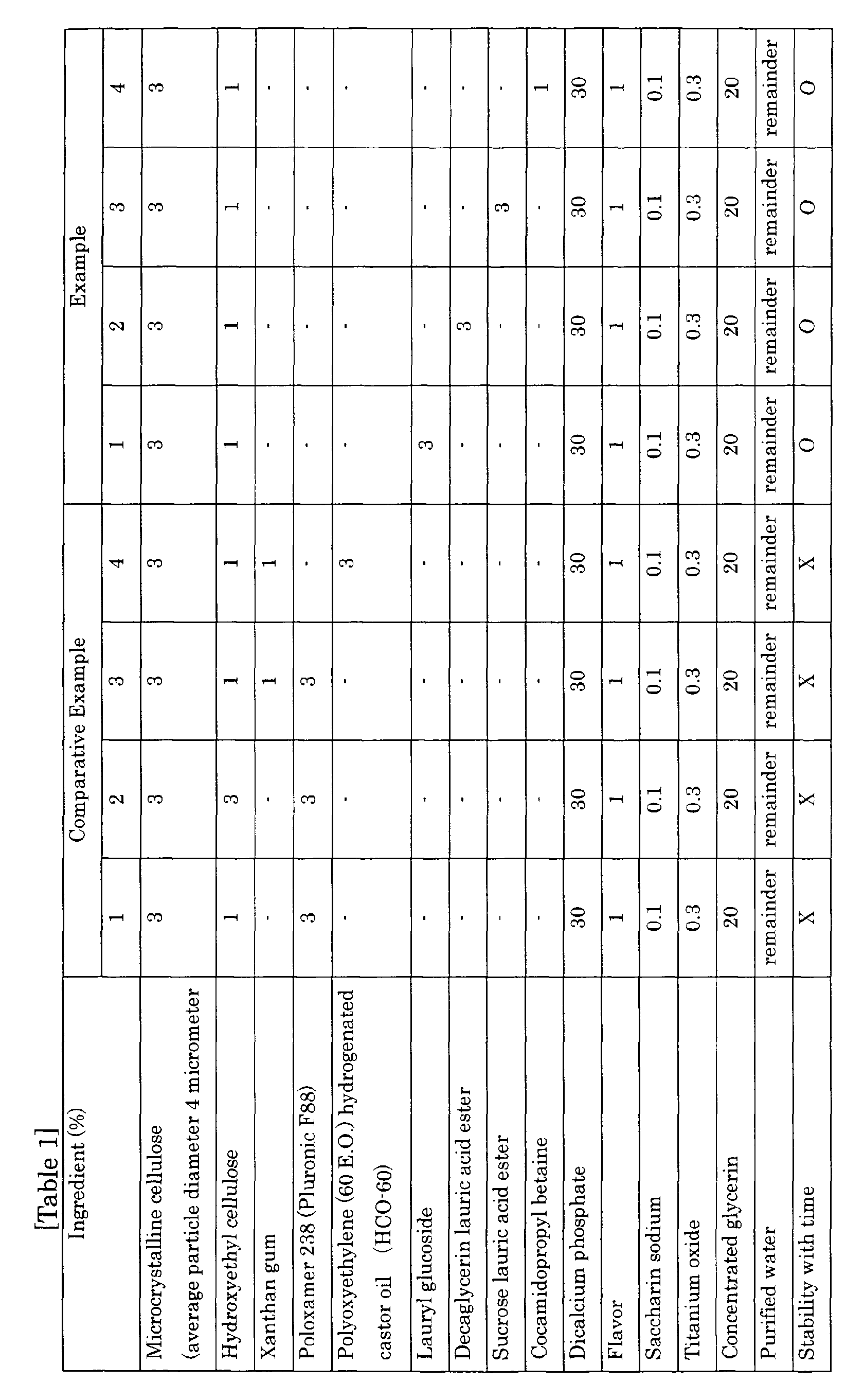
As shown in Table 1, in Comparative Examples 1-3, the oral
compositions containing Pluronic F88 as the surface active agent caused
solid-liquid separation even when an amount of hydroxyethyl cellulose
was increased, or even when xanthan gum as another thickening agent
was contained together. In addition, the oral composition caused
solid-liquid separation even when HCO-60 was used as the surface
active agent.
On the other hand, in Examples 1-4, the oral compositions
containing lauryl glucoside, polyglycerin lauric acid ester, sucrose lauric
acid ester or cocamidopropyl betaine as the surface active agent, did not
cause solid-liquid separation even after one month storage at room
temperature, which had excellent stability with time.
An oral composition (toothpaste) of the following formulation was
prepared according to the conventional procedures:
| Ingredient Name | Amount (%) |
| Microcrystalline cellulose (average particle diameter 3.7 micrometer) | 3.0 |
| Decyl glucoside | 2.0 |
| Silica | 30.0 |
| Sodium carboxymethyl cellulose | 2.0 |
| Tocopherol acetate | 0.05 |
| Sodium fluoride | 0.2 |
| Flavor | 1.0 |
| Saccharin sodium | 0.1 |
| Titanium oxide | 0.3 |
| Sorbit solution | 30.0 |
| Purified water | remainder |
The oral composition obtained had an excellent shape-holding ability
and dispersibility in an oral cavity, did not change a taste of juice after
teeth brushing and had excellent stability with time.
An oral composition (toothpaste) of the following formulation was
prepared according to the conventional procedures:
| Ingredient Name | Amount (%) |
| Microcrystalline cellulose (average particle diameter 3.7 micrometer) | 3.0 |
| Cocamidopropyl betaine | 0.8 |
| Calcium hydrogenphosphate | 35.0 |
| Cetylpyridinium chloride | 0.1 |
| Hydroxyethyl cellulose | 2.0 |
| Tocopherol acetate | 0.05 |
| Sodium monofluorophosphate | 0.72 |
| Flavor | 1.0 |
| Saccharin sodium | 0.1 |
| Titanium oxide | 0.3 |
| Concentrated glycerin | 15.0 |
| Purified water | remainder |
The oral composition obtained had an excellent shape-holding ability
and dispersibility in an oral cavity, did not change a taste of juice after
teeth brushing and had excellent stability with time. In addition, the
oral composition obtained had an enhanced effect of cetylpyridinium
chloride to reside on a tooth surface.
An oral composition (toothpaste) of the following formulation was
prepared according to the conventional procedures:
| Ingredient Name | Amount (%) |
| Microcrystalline cellulose (average particle diameter 3.7 micrometer) | 2.0 |
| Sucrose lauric acid ester | 2.0 |
| Calcium pyrophosphate | 35.0 |
| Xanthan gum | 0.5 |
| Sodium monofluorophosphate | 0.72 |
| Flavor | 1.0 |
| Saccharin sodium | 0.1 |
| Titanium oxide | 0.3 |
| Concentrated glycerol | 18.0 |
| Polyethylene glycol | 5.0 |
| Purified water | remainder |
The oral composition obtained had an excellent shape-holding ability
and dispersibility in an oral cavity, did not change a taste of juice after
teeth brushing and had excellent stability with time.
An oral composition (toothpaste) of the following formulation was
prepared according to the conventional procedures:
| Ingredient Name | Amount (%) |
| Microcrystalline cellulose (average particle diameter 3.7 micrometer) | 2.0 |
| Decaglycerin lauric acid ester | 2.0 |
| Calcium carbonate | 25.0 |
| Sodium carboxymethyl cellulose | 1.0 |
| 1.0 | |
| Saccharin sodium | 0.1 |
| Titanium oxide | 0.3 |
| Concentrated glycerin | 10.0 |
| Xylitol | 10.0 |
| Purified water | remainder |
The oral composition obtained had an excellent shape-holding ability
and dispersibility in an oral cavity, did not change a taste of juice after
teeth brushing and had excellent stability with time.
An oral composition (gel) of the following formulation was prepared
according to the conventional procedures:
| Ingredient Name | Amount (%) |
| Microcrystalline cellulose (average particle diameter 3.7 micrometer) | 4.0 |
| Decyl glucoside | 1.0 |
| Sodium fluoride | 0.2 |
| Concentrated glycerin | 40.0 |
| Polyethylene glycol | 5.0 |
| Propylene glycol | 8.0 |
| Flavor | 1.0 |
| Saccharin sodium | 0.1 |
| Disodium hydrogenphophate | 0.12 |
| Sodium dihydrogenphosphate | 0.01 |
| Purified water | remainder |
The oral composition obtained had an excellent shape-holding ability
and dispersibility in an oral cavity, did not change a taste of juice after
teeth brushing and had excellent stability with time.
An oral composition (gel) of the following formulation was prepared
according to the conventional procedures:
| Ingredient Name | Amount (%) |
| Microcrystalline cellulose (average particle diameter 3.7 micrometer) | 5.0 |
| Myristic acid amide propyl betaine | 0.5 |
| Tetraglycerin lauric acid ester | 1.0 |
| Tocopherol acetate | 0.1 |
| Concentrated glycerin | 30.0 |
| Polyethylene glycol | 4.0 |
| 1,3-Butylene glycol | 2.0 |
| Flavor | 1.0 |
| Saccharin sodium | 0.1 |
| Disodium hydrogencitrate | 0.12 |
| Sodium dihydrogencitrate | 0.01 |
| Purified water | remainder |
The oral composition obtained had an excellent shape-holding ability
and dispersibility in an oral cavity, did not change a taste of juice after
teeth brushing and had excellent stability with time.
An oral composition (toothpaste) of the following formulation was
prepared according to the conventional procedures:
| Ingredient Name | Amount (%) |
| Microcrystalline cellulose (average particle diameter 5.8 micrometer) | 0.5 |
| Lauryl glucoside | 2.5 |
| Calcium hydrogenphosphate dihydrate | 40.0 |
| Hydroxyethyl cellulose | 1.0 |
| Flavor | 1.0 |
| Saccharin sodium | 0.2 |
| Sorbitol | 25.0 |
| Purified water | remainder |
The oral composition obtained had an excellent shape-holding ability
and dispersibility in an oral cavity, did not change a taste of juice after
teeth brushing and had excellent stability with time.
An oral composition (toothpaste) of the following formulation was
prepared according to the conventional procedures:
| Ingredient Name | Amount (%) |
| Microcrystalline cellulose (average particle diameter 5.8 micrometer) | 2.0 |
| Decyl glucoside | 1.5 |
| Silicic acid hydrate | 20.0 |
| Carrageenan | 1.0 |
| Flavor | 1.0 |
| Saccharin sodium | 0.1 |
| Sorbitol | 15.0 |
| Concentrated glycerin | 10.0 |
| Purified water | remainder |
The oral composition obtained had an excellent shape-holding ability
and dispersibility in an oral cavity, did not change a taste of juice after
teeth brushing and had excellent stability with time.
An oral composition (toothpaste) of the following formulation was
prepared according to the conventional procedures:
| Ingredient Name | Amount (%) |
| Microcrystalline cellulose (average particle diameter 8.6 micrometer) | 1.0 |
| Cocamidopropyl betaine | 0.8 |
| Silica | 15.0 |
| Aluminum hydroxide | 5.0 |
| Sodium polyacrylate | 0.5 |
| Flavor | 1.0 |
| Saccharin sodium | 0.2 |
| Polyethylene glycol | 5.0 |
| Concentrated glycerin | 10.0 |
| Purified water | remainder |
The oral composition obtained had an excellent shape-holding ability
and dispersibility in an oral cavity, did not change a taste of juice after
teeth brushing and had excellent stability with time.
A 50 mg of hydroxyapatite (DNA Grade Bio-Gel HTP;
manufactured by BIO-RAD) was immersed in 2 ml of human saliva,
which had been sterilized with ultraviolet rays, at 37 centigrade for 15
hours to allow to form an artificial pellicle on a hydroxyapatite surface.
Thereafter, a mixture of hydroxyapatite and human saliva was
centrifuged (3000 rpm, 10 min) and a supernatant was discarded. Then,
residual hydroxyapatite was immersed at 37 centigrade for 15 minutes
in 2 ml of a supernatant of a four times-diluted slurry from each of the
oral compositions of Examples 14-18 and Comparative Examples 5-8, in
which 0.3 % by weight of cetylpyridinium chloride (CPC) and various
amounts and various kinds of thickening agents and surface active
agents had been contained. Then, a mixture was centrifuged (3000 rpm,
10 minutes), and a supernatant was discarded. Then, 2 ml of fresh
distilled water was added to the residue, the mixture was stirred and
centrifuged (3000 rpm, 10 min), and the supernatant was discarded.
Again, 2 ml of fresh distilled water was added to the residue, the
mixture was stirred and centrifuged (3000 rpm, 10 minutes), and the
supernatant was discarded. Next, cetylpyridinium chloride which had
adsorbed onto hydroxyapatite was extracted with an extraction solution
as described below, and an amount of cetylpyridinium chloride residing
on 50 mg of hydroxyapatite was quantitatively measured with high
performance liquid chromatography. The results thereof are shown in
Table 2.
The extraction solution was prepared by mixing a solution in
which 2.88 g of sodium lauryl sulfate had been dissolved per 1 liter of
0.02 M citrate buffer, pH 3 with acetonitrile in a ratio of 1:3.
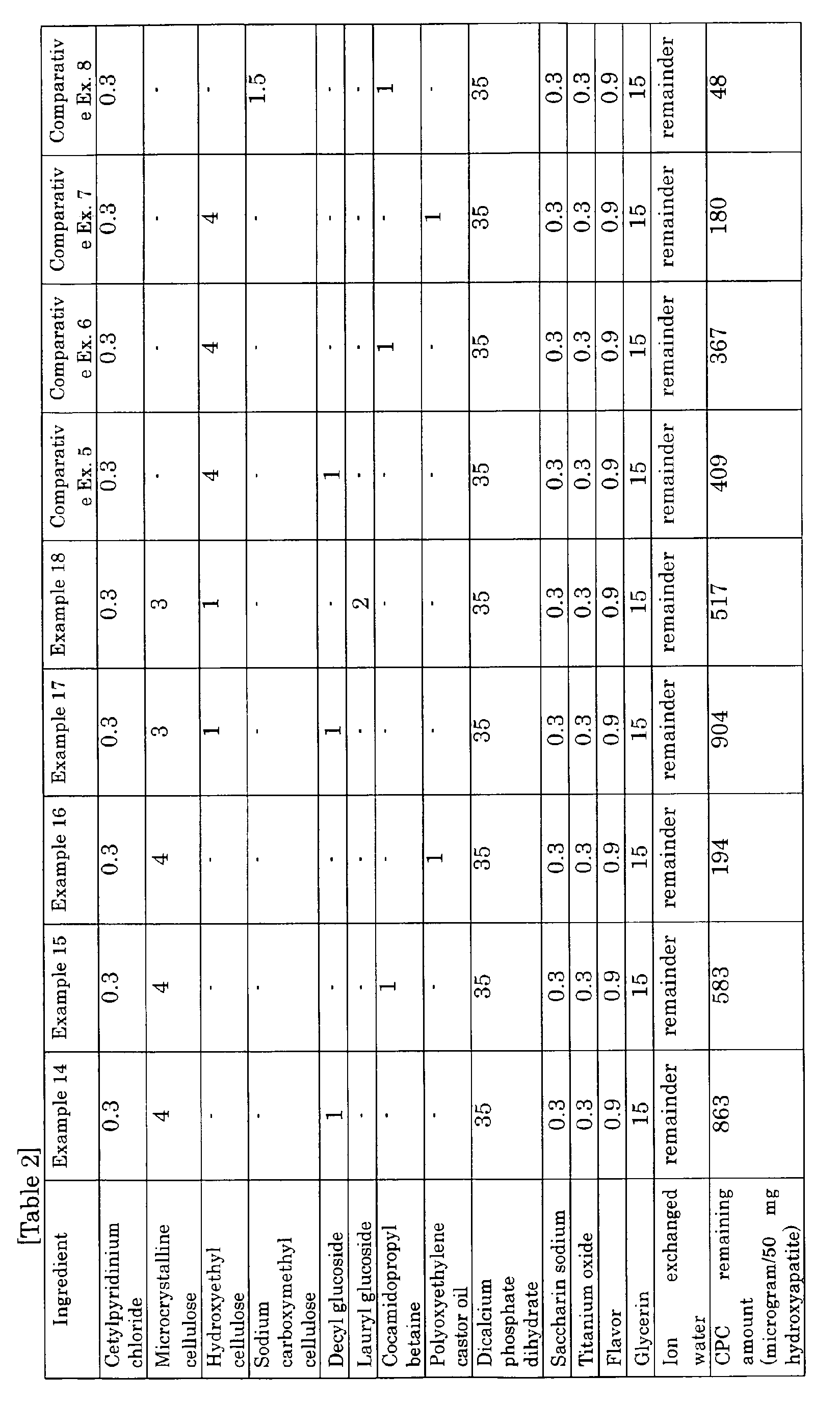
From the results in Table 2, it is found that an amount of
cetylpyridinium chloride residing on a tooth surface is significantly
increased with the oral compositions of Examples 14-18, in which
cetylpyridinium chloride and microcrystalline cellulose have been
specifically combined, as compared with those of Comparative Examples
5-8, in which the same amount of cetylpyridinium chloride and other
cellulose derivatives have been combined. Moreover, it is also found
that alkyl glucoside and betaine are preferable as the surface active
agent to be contained in addition to the above ingredients, because they
increase an amount of cetylpyridinium chloride residing on a tooth
surface, as compared with other surface active agents.
An oral composition (toothpaste) of the following formulation was
prepared according to the conventional procedures:
| Ingredient Name | Amount (%) |
| Benzethonium chloride | 0.1 |
| Microcrystalline cellulose (average particle diameter 3.7 micrometer) | 2.0 |
| Triclosan | 0.1 |
| Hydroxypropylmethyl cellulose | 1.0 |
| Lauryl glucoside | 2.0 |
| Calcium carbonate | 40.0 |
| Titanium oxide | 0.2 |
| Saccharin sodium | 0.2 |
| Sorbit solution | 30.0 |
| Flavor | 1.0 |
| Purified water | remainder |
The oral composition obtained could increase an amount of the cationic
antimicrobial agent residing on a tooth surface and could effectively
prevent an oral cavity disease such as a periodontal disease, dental
caries and the like.
An oral composition (toothpaste) of the following formulation was
prepared according to the conventional procedures:
| Ingredient Name | Amount (%) |
| Cetylpyridinium chloride | 0.1 |
| Microcrystalline cellulose (average particle diameter 3.7 micrometer) | 3.0 |
| Potassium nitrate | 1.0 |
| Hydroxyethyl cellulose | 2.0 |
| Cocamidopropyl betaine | 1.0 |
| Concentrated glycerin | 10.0 |
| Sorbit solution | 10.0 |
| Titanium oxide | 0.3 |
| Stevioside | 0.2 |
| Sodium benzoate | 0.1 |
| Xylitol | 10.0 |
| Flavor | 0.8 |
| Purified water | remainder |
The oral composition obtained could increase an amount of the cationic
antimicrobial agent residing on a tooth surface and could effectively
prevent an oral cavity disease such as a periodontal disease, dental
caries and the like.
An oral composition (gel) of the following formulation was prepared
according to the conventional procedures:
| Ingredient Name | Amount (%) |
| Cetylpyridinium chloride | 0.1 |
| Microcrystalline cellulose | |
| (average particle diameter 3.7 micrometer) | 4.0 |
| Decyl glucoside | 1.0 |
| Concentrated glycerin | 40.0 |
| Polyethylene glycol | 5.0 |
| Propylene glycol | 3.0 |
| Flavor | 1.0 |
| Saccharin sodium | 0.1 |
| Disodium hydrogenphophate | 0.12 |
| Sodium dihydrogenphosphate | 0.01 |
| Purified water | remainder |
The oral composition obtained could increase an amount of the cationic
antimicrobial agent residing on a tooth surface and could effectively
prevent an oral cavity disease such as a periodontal disease, dental
caries and the like.
An oral composition (gel) of the following formulation was prepared
according to the conventional procedures:
| Ingredient Name | Amount (%) |
| Chlorhexidine hydrochloride | 0.2 |
| Microcrystalline cellulose (average particle diameter 3.7 micrometer) | 5.0 |
| Myristic acid amide propyl betaine | 0.5 |
| Tetraglycerin lauric acid ester | 1.0 |
| Tocopherol acetate | 0.1 |
| Concentrated glycerin | 30.0 |
| Polyethylene glycol | 4.0 |
| 1,3-Butylene glycol | 2.0 |
| Flavor | 1.0 |
| Saccharin sodium | 0.1 |
| Disodium hydrogencitrate | 0.12 |
| Sodium dihydrogencitrate | 0.01 |
| Purified water | remainder |
The oral composition obtained could increase an amount of the cationic
antimicrobial agent residing on a tooth surface and could effectively
prevent an oral cavity disease such as a periodontal disease, dental
caries and the like.
An oral composition (toothpaste) of the following formulation was
prepared according to the conventional procedures:
| Ingredient Name | Amount (%) |
| Benzalkonium chloride | 0.05 |
| Microcrystalline cellulose (average particle diameter 5.8 micrometer) | 0.5 |
| Sucrose myristic acid ester | 4.0 |
| Magnesium carbonate | 5.0 |
| Calcium carbonate | 12.0 |
| Guar gum | 1.0 |
| Flavor | 1.0 |
| Saccharin sodium | 0.2 |
| Concentrated glycerin | 20.0 |
| Purified water | remainder |
The oral composition obtained could increase an amount of the cationic
antimicrobial agent residing on a tooth surface and could effectively
prevent an oral cavity disease such as a periodontal disease, dental
caries and the like.
An oral composition (gel) of the following formulation was prepared
according to the conventional procedures:
| Ingredient Name | Amount (%) |
| Chlorhexidine gluconate | 0.2 |
| Microcrystalline cellulose (average particle diameter 8.6 micrometer) | 5.0 |
| Myristyl glucoside | 4.0 |
| Hydroxypropylmethyl cellulose | 1.0 |
| Flavor | 0.5 |
| Saccharin sodium | 0.2 |
| Concentrated glycerin | 20.0 |
| Propylene glycol | 3.0 |
| Purified water | remainder |
The oral composition obtained could increase an amount of the cationic
antimicrobial agent residing on a tooth surface and could effectively
prevent an oral cavity disease such as a periodontal disease, dental
caries and the like.
According to the first aspect of the present invention, an oral
composition can be provided, which has an excellent shape-holding
ability and dispersibility in an oral cavity, does not change a taste of
juice after teeth brushing, and particularly, excellent stability with time,
or which has an enhanced ability of a cationic antimicrobial agent to
reside on a tooth surface.
Moreover, according to the second aspect of the present
invention, an oral composition can be provided, which can significantly
increase an amount of a cationic antimicrobial agent residing on a tooth
surface and effectively prevent an oral cavity disease such as a
periodontal disease, dental caries and the like.
Claims (19)
- An oral composition comprising microcrystalline cellulose, and one or more surface active agents selected from the group consisting of alkyl glucoside, polyglycerin fatty acid ester, sucrose fatty acid ester and betaine.
- The oral composition of according to claim 1, wherein the microcrystalline cellulose is contained at 0.2-10 % by weight.
- The oral composition according to claim 1 or 2, wherein the surface active agent is alkyl glucoside.
- The oral composition according to claim 3, wherein an alkyl chain of the alkyl glucoside is C8-C16 in length.
- The oral composition according to claim 1 or 2, wherein the surface active agent is polyglycerin fatty acid ester or sucrose fatty acid ester.
- The oral composition according to claim 5, wherein an alkyl chain of a fatty acid portion of the polyglycerin fatty acid ester or the sucrose fatty acid ester is C8-C16 in length.
- The oral composition according to claim 1 or 2, wherein the surface active agent is betaine.
- The oral composition according to claim 7, wherein the betaine is fatty acid amide propyl betaine.
- The oral composition according to claim 8, wherein an alkyl chain of a fatty acid portion of the fatty acid amide propyl betaine is C8-C16 in length.
- The oral composition according to any one of claims 1-9, further comprising a cationic antimicrobial agent.
- An oral composition comprising a cationic antimicrobial agent and microcrystalline cellulose.
- The oral composition according to claim 11, wherein the cationic antimicrobial agent is a quaternary ammonium salt.
- The oral composition according to claim 11, wherein the cationic antimicrobial agent is a biguanide antimicrobial agent.
- The oral composition according to claim 11, wherein the cationic antimicrobial agent is one or more selected from the group consisting of cetylpyridinium chloride, benzalkonium chloride, benzethonium chloride, chlorhexidine hydrochloride and chlorhexidine gluconate.
- The oral composition according to any one of claims 11-14, wherein the cationic antimicrobial agent is contained at 0.001-10 % by weight.
- The oral composition according to any one of claims 11-15, wherein the microcrystalline cellulose is contained at 0.2-10 % by weight.
- The oral composition according to any one of claims 11-16, further comprising one or more surface active agents selected from nonionic and amphoteric surface active agents.
- The oral composition according to claim 17, wherein the surface active agent is alkyl glucoside having an alkyl chain of C8-C16 in length.
- The oral composition according to claim 17, wherein the surface active agent is fatty acid amide propyl betaine having an alkyl chain of a fatty acid portion of C8-C16 in length.
Priority Applications (1)
| Application Number | Priority Date | Filing Date | Title |
|---|---|---|---|
| EP12158937.8A EP2510981B1 (en) | 2002-06-07 | 2002-06-07 | Composition for oral cavity |
Applications Claiming Priority (1)
| Application Number | Priority Date | Filing Date | Title |
|---|---|---|---|
| PCT/JP2002/005639 WO2003103618A1 (en) | 2002-06-07 | 2002-06-07 | Compositions for oral cavity |
Related Child Applications (1)
| Application Number | Title | Priority Date | Filing Date |
|---|---|---|---|
| EP12158937.8A Division EP2510981B1 (en) | 2002-06-07 | 2002-06-07 | Composition for oral cavity |
Publications (2)
| Publication Number | Publication Date |
|---|---|
| EP1532971A1 true EP1532971A1 (en) | 2005-05-25 |
| EP1532971A4 EP1532971A4 (en) | 2008-10-08 |
Family
ID=29727324
Family Applications (2)
| Application Number | Title | Priority Date | Filing Date |
|---|---|---|---|
| EP02733375A Withdrawn EP1532971A4 (en) | 2002-06-07 | 2002-06-07 | Compositions for oral cavity |
| EP12158937.8A Expired - Lifetime EP2510981B1 (en) | 2002-06-07 | 2002-06-07 | Composition for oral cavity |
Family Applications After (1)
| Application Number | Title | Priority Date | Filing Date |
|---|---|---|---|
| EP12158937.8A Expired - Lifetime EP2510981B1 (en) | 2002-06-07 | 2002-06-07 | Composition for oral cavity |
Country Status (7)
| Country | Link |
|---|---|
| US (1) | US20050244346A1 (en) |
| EP (2) | EP1532971A4 (en) |
| KR (1) | KR100874301B1 (en) |
| CN (2) | CN1304074C (en) |
| CA (1) | CA2488158C (en) |
| ES (1) | ES2657741T3 (en) |
| WO (1) | WO2003103618A1 (en) |
Cited By (7)
| Publication number | Priority date | Publication date | Assignee | Title |
|---|---|---|---|---|
| WO2008059881A1 (en) | 2006-11-14 | 2008-05-22 | Sunstar Inc. | Oral composition containing crystalline cellulose surface-treated with water-soluble substance |
| EP1539098A4 (en) * | 2002-09-20 | 2008-09-24 | Fmc Corp | COSMETIC COMPOSITION CONTAINING MICROCRYSTALLINE CELLULOSE |
| EP1806125B1 (en) * | 2004-10-20 | 2011-08-03 | Kao Corporation | Liquid compositions for oral cavity |
| RU2486891C2 (en) * | 2008-03-21 | 2013-07-10 | Колгейт-Палмолив Компани | Compositions including nonionic and zwitterionic surface-active substances |
| EP2347753A3 (en) * | 2009-12-16 | 2014-10-01 | Henkel AG & Co. KGaA | Oral and tooth care and cleaning agents with alkylpyridine salts II |
| WO2017158379A1 (en) * | 2016-03-18 | 2017-09-21 | Queen Mary University Of London | Chlorhexidine crystal forms and uses thereof in medicine |
| WO2019168193A1 (en) * | 2018-03-01 | 2019-09-06 | L'oreal | Sprayable composition |
Families Citing this family (16)
| Publication number | Priority date | Publication date | Assignee | Title |
|---|---|---|---|---|
| KR100659139B1 (en) * | 2006-01-11 | 2006-12-19 | (주)아모레퍼시픽 | Oral composition with excellent antimicrobial activity |
| WO2012158483A2 (en) | 2011-05-16 | 2012-11-22 | Avery Dennison Corporation | Adhesive containing microparticles |
| CN102224897B (en) * | 2011-05-24 | 2012-11-14 | 江南大学 | Highly water-dispersible stevioside product and preparation method thereof |
| CN102429832B (en) * | 2011-11-28 | 2013-07-03 | 广州立白企业集团有限公司 | Novel abrasive compound and toothpaste comprising same |
| BR112014013609B1 (en) * | 2011-12-06 | 2020-12-29 | Unilever Nv | antimicrobial composition comprising isopropyl-methylphenol, non-therapeutic method for disinfecting a surface and non-therapeutic use of a composition |
| WO2014059678A1 (en) | 2012-10-19 | 2014-04-24 | Colgate-Palmolive Company | Toothpaste composition |
| US8597618B1 (en) | 2012-12-06 | 2013-12-03 | Tom's Of Maine, Inc. | Dentifrice composition |
| KR102242908B1 (en) | 2013-02-07 | 2021-04-20 | 애버리 데니슨 코포레이션 | Antimicrobial adhesives having improved properties |
| US11213432B2 (en) | 2013-03-15 | 2022-01-04 | Avery Dennison Corporation | Transparent cover dressing application system and inclusion of label strip |
| WO2015188031A2 (en) | 2014-06-05 | 2015-12-10 | Avery Dennison Corporation | Articles with active agent concentrated at the substrate contacting surface and related methods |
| CN104095768B (en) * | 2014-07-16 | 2016-05-18 | 福建广和堂生物科技有限公司 | A kind of faintly acid antibacterial bath liquor containing aurantiin and preparation method thereof |
| WO2019126703A1 (en) | 2017-12-22 | 2019-06-27 | Ecolab Usa Inc. | Antimicrobial compositions with enhanced efficacy |
| CN108853023B (en) * | 2018-07-05 | 2021-11-30 | 广州立白企业集团有限公司 | Oral bacteriostatic composition and preparation method and application thereof |
| JP7134770B2 (en) * | 2018-07-30 | 2022-09-12 | サンスター株式会社 | oral composition |
| KR102209912B1 (en) * | 2019-01-23 | 2021-02-01 | 김인 | Mouthwash liquid composition containing matured crystal of hydroxy apatite |
| ES3062133T3 (en) | 2020-02-18 | 2026-04-08 | Sunstar Americas Inc | Oral care composition |
Family Cites Families (20)
| Publication number | Priority date | Publication date | Assignee | Title |
|---|---|---|---|---|
| US4327076A (en) * | 1980-11-17 | 1982-04-27 | Life Savers, Inc. | Compressed chewable antacid tablet and method for forming same |
| US4490353A (en) * | 1983-07-13 | 1984-12-25 | Colgate-Palmolive Company | Antiplaque dentifrice with improved fluoride stability |
| DE4113044A1 (en) * | 1990-10-09 | 1992-05-21 | Degussa | DENTAL CARE |
| JP3177527B2 (en) | 1991-09-04 | 2001-06-18 | 旭化成株式会社 | Toothpaste composition |
| US5296215A (en) * | 1993-06-16 | 1994-03-22 | Colgate-Palmolive Company | High foaming rheologically stable non-irritating oral composition |
| US5601803A (en) * | 1995-05-26 | 1997-02-11 | Masters; James G. | Silica abrasive dentifrice of reduced stringless and improved flavor |
| JPH09110663A (en) * | 1995-10-20 | 1997-04-28 | Lion Corp | Oil-soluble ingredient-containing gel capsule, method for producing the same, and oral composition |
| GB9611364D0 (en) * | 1996-05-31 | 1996-08-07 | Smithkline Beecham Plc | Composition |
| JPH1112168A (en) * | 1997-06-20 | 1999-01-19 | Lion Corp | Anti-endotoxin agent and oral composition |
| JPH11171750A (en) * | 1997-12-08 | 1999-06-29 | Lion Corp | Oral composition |
| JPH11171751A (en) * | 1997-12-08 | 1999-06-29 | Lion Corp | Oral composition |
| JPH11199455A (en) * | 1997-12-27 | 1999-07-27 | Lion Corp | Abrasive-containing dentifrice composition |
| JPH11199456A (en) * | 1998-01-06 | 1999-07-27 | Lion Corp | Oral composition |
| JPH11246377A (en) | 1998-02-27 | 1999-09-14 | Lion Corp | Dentifrice composition containing fluorine compound combined abrasive |
| GB9917547D0 (en) * | 1999-07-26 | 1999-09-29 | Orafresh Limited | Dentifrice compositions |
| JP2001039842A (en) * | 1999-07-30 | 2001-02-13 | Kao Corp | Oral composition |
| JP2001302474A (en) * | 2000-04-20 | 2001-10-31 | Lion Corp | Toothpaste composition |
| JP3814142B2 (en) * | 2000-12-08 | 2006-08-23 | サンスター株式会社 | Oral composition |
| JP3681108B2 (en) * | 2000-12-08 | 2005-08-10 | サンスター株式会社 | Composition for oral cavity containing cationic disinfectant |
| GB0211576D0 (en) * | 2002-05-21 | 2002-06-26 | Cheetham J K | A novel formula for modification of chemical compounds on flavour solubility and stability |
-
2002
- 2002-06-07 CN CNB028294149A patent/CN1304074C/en not_active Expired - Lifetime
- 2002-06-07 WO PCT/JP2002/005639 patent/WO2003103618A1/en not_active Ceased
- 2002-06-07 CA CA2488158A patent/CA2488158C/en not_active Expired - Lifetime
- 2002-06-07 EP EP02733375A patent/EP1532971A4/en not_active Withdrawn
- 2002-06-07 US US10/517,053 patent/US20050244346A1/en not_active Abandoned
- 2002-06-07 ES ES12158937.8T patent/ES2657741T3/en not_active Expired - Lifetime
- 2002-06-07 KR KR1020047019869A patent/KR100874301B1/en not_active Expired - Lifetime
- 2002-06-07 CN CN2007100016156A patent/CN1989935B/en not_active Expired - Lifetime
- 2002-06-07 EP EP12158937.8A patent/EP2510981B1/en not_active Expired - Lifetime
Cited By (11)
| Publication number | Priority date | Publication date | Assignee | Title |
|---|---|---|---|---|
| EP1539098A4 (en) * | 2002-09-20 | 2008-09-24 | Fmc Corp | COSMETIC COMPOSITION CONTAINING MICROCRYSTALLINE CELLULOSE |
| US7815924B2 (en) | 2002-09-20 | 2010-10-19 | Fmc Corporation | Cosmetic composition containing microcrystalline cellulose |
| EP1806125B1 (en) * | 2004-10-20 | 2011-08-03 | Kao Corporation | Liquid compositions for oral cavity |
| US8236286B2 (en) | 2004-10-20 | 2012-08-07 | Kao Corporation | Liquid compositions for the oral cavity |
| WO2008059881A1 (en) | 2006-11-14 | 2008-05-22 | Sunstar Inc. | Oral composition containing crystalline cellulose surface-treated with water-soluble substance |
| RU2486891C2 (en) * | 2008-03-21 | 2013-07-10 | Колгейт-Палмолив Компани | Compositions including nonionic and zwitterionic surface-active substances |
| EP2347753A3 (en) * | 2009-12-16 | 2014-10-01 | Henkel AG & Co. KGaA | Oral and tooth care and cleaning agents with alkylpyridine salts II |
| WO2017158379A1 (en) * | 2016-03-18 | 2017-09-21 | Queen Mary University Of London | Chlorhexidine crystal forms and uses thereof in medicine |
| US10640463B2 (en) | 2016-03-18 | 2020-05-05 | Queen Mary University Of London | Chlorhexidine crystal forms and uses thereof in medicine |
| US11578035B2 (en) | 2016-03-18 | 2023-02-14 | Queen Mary University Of London | Chlorhexidine crystal forms and uses thereof in medicine |
| WO2019168193A1 (en) * | 2018-03-01 | 2019-09-06 | L'oreal | Sprayable composition |
Also Published As
| Publication number | Publication date |
|---|---|
| ES2657741T3 (en) | 2018-03-06 |
| KR20050013204A (en) | 2005-02-03 |
| EP2510981B1 (en) | 2018-01-17 |
| CA2488158A1 (en) | 2003-12-18 |
| WO2003103618A1 (en) | 2003-12-18 |
| CN1646087A (en) | 2005-07-27 |
| EP1532971A4 (en) | 2008-10-08 |
| EP2510981A1 (en) | 2012-10-17 |
| CN1304074C (en) | 2007-03-14 |
| US20050244346A1 (en) | 2005-11-03 |
| CN1989935A (en) | 2007-07-04 |
| CN1989935B (en) | 2012-03-21 |
| CA2488158C (en) | 2011-12-06 |
| KR100874301B1 (en) | 2008-12-18 |
Similar Documents
| Publication | Publication Date | Title |
|---|---|---|
| EP2510981B1 (en) | Composition for oral cavity | |
| CN104822360B (en) | Surfactant system is used to contain Zn composition | |
| EP0579729B1 (en) | Quaternary ammonium antibacterial dentifrices with selected calcium abrasives | |
| JP3364219B2 (en) | Antibacterial toothpaste | |
| CN1373652A (en) | Oral composition containing tea polyphenols | |
| CA1262687A (en) | Antiplaque dentifrice having improved flavor | |
| CN101052372A (en) | Zinc-containing dentifrice composition with improved taste | |
| AU2014415225B2 (en) | Oral care products and methods of use and manufacture thereof | |
| EP0864315B1 (en) | Oral composition | |
| US20220401321A1 (en) | Oral Care Compositions | |
| JP3681108B2 (en) | Composition for oral cavity containing cationic disinfectant | |
| EP1459733B1 (en) | Oral care composition | |
| JP5721973B2 (en) | Oral composition | |
| JP2002234826A (en) | Composition for oral cavity application | |
| JP2627709B2 (en) | Oral composition | |
| JPH11322554A (en) | Composition for oral cavity | |
| JP3814142B2 (en) | Oral composition | |
| JP4158036B2 (en) | Dentifrice composition and method for producing the same | |
| US20040258633A1 (en) | Composition containing monoterpenes for topical oral administration | |
| JP3582571B2 (en) | Oral liquid preparation | |
| JP7539829B2 (en) | Oral Composition | |
| CN108685742B (en) | Low irritation oral compositions | |
| JP3821553B2 (en) | Liquid dentifrice | |
| JPH09241140A (en) | Composition for oral cavity | |
| JP2001322921A (en) | Liquid oral composition |
Legal Events
| Date | Code | Title | Description |
|---|---|---|---|
| PUAI | Public reference made under article 153(3) epc to a published international application that has entered the european phase |
Free format text: ORIGINAL CODE: 0009012 |
|
| 17P | Request for examination filed |
Effective date: 20041230 |
|
| AK | Designated contracting states |
Kind code of ref document: A1 Designated state(s): AT BE CH CY DE DK ES FI FR GB GR IE IT LI LU MC NL PT SE TR |
|
| A4 | Supplementary search report drawn up and despatched |
Effective date: 20080905 |
|
| 17Q | First examination report despatched |
Effective date: 20100305 |
|
| STAA | Information on the status of an ep patent application or granted ep patent |
Free format text: STATUS: THE APPLICATION IS DEEMED TO BE WITHDRAWN |
|
| 18D | Application deemed to be withdrawn |
Effective date: 20121123 |