EP1531695B1 - Schützendes schuhwerk - Google Patents
Schützendes schuhwerk Download PDFInfo
- Publication number
- EP1531695B1 EP1531695B1 EP03727766A EP03727766A EP1531695B1 EP 1531695 B1 EP1531695 B1 EP 1531695B1 EP 03727766 A EP03727766 A EP 03727766A EP 03727766 A EP03727766 A EP 03727766A EP 1531695 B1 EP1531695 B1 EP 1531695B1
- Authority
- EP
- European Patent Office
- Prior art keywords
- shock wave
- wave guide
- guide member
- sole
- footwear
- Prior art date
- Legal status (The legal status is an assumption and is not a legal conclusion. Google has not performed a legal analysis and makes no representation as to the accuracy of the status listed.)
- Expired - Lifetime
Links
Images

Classifications
-
- A—HUMAN NECESSITIES
- A43—FOOTWEAR
- A43B—CHARACTERISTIC FEATURES OF FOOTWEAR; PARTS OF FOOTWEAR
- A43B3/00—Footwear characterised by the shape or the use
- A43B3/0026—Footwear characterised by the shape or the use for use in minefields; protecting from landmine blast; preventing landmines from being triggered
Definitions
- This invention relates to protective footwear. It relates more specifically to an article of footwear for protecting a wearer against the effects of a landmine explosion, especially an anti-personnel landmine explosion.
- US Patent 3 243 898 discloses an underfoot attachment device having a V-shaped deflector or wedge of substantially un-deformable metal having an inverted apex extending centrally along a length of a footprint of a user.
- the deflector is contained along its bottom and outsides in a block of balsa wood, is internally filled with an acoustic filler, and is contained in a plastic hull.
- the deflector is intended to deflect the force of an exploding mine away from a foot and limb of a user.
- WO 01/18479A1 discloses an article of footwear including a lower matrix underneath a foot of a wearer, an outer hard shell around the foot, and an upper protective surround around a lower portion of a leg of the wearer.
- the matrix incorporates a substantially non-deformable deflector in the form of a metal sheet oriented obliquely upwardly to deflect an up-welling result of an exploding landmine obliquely laterally.
- the deflector is provided a layer of "DETSHEET", a detonation material adapted to detonate when subjected to shock and pressure waves of an exploding landmine, to dissipate the first shock and pressure waves and, to some extent, subsequent effects of the explosion.
- Layers of a frangible material are provided above the deflector and below the "DETSHEET".
- Laminated sheets of Kevlar impregnated fabric of wedge shape, and a plug of energy dissipating material, followed by an open honeycomb structure are provided in superimposed arrangement between the deflector and an inner sole of the article of footwear.
- a sock of soft foam material surrounds the foot and lower leg and acts as a soft lining underneath the hard outer shell and protective surround.
- shockwaves play an important role in the field of the invention and, in contra distinction to other inventors in the field, has focused efforts in understanding and dealing with the shock wave effect of a landmine explosion.
- Shock waves are in certain respect equivalent to acoustic waves, for example, progression of a shock wave through a material is not associated with transfer of mass or particles, it progresses as a wave.
- the speed of progression through a material is dependent on physical properties of the material, i.e. in the case of solid material, speed is proportional to the density and inversely proportional to the Young's modulus of the material.
- speed of progression through liquids differ, and is generally lower than that through "rigid" solids such as ceramics, metals, and the like, but generally higher than through gasses such as air.
- the role that temperature of a gas plays in respect of acousti speed is significant - e.g.
- the acoustic speed through air at 1000°C is more than twice the acoustic speed through air at normal ambient temperature. Still further, the acoustic speed is surprisingly low through "elastic" materials such as rubber, some synthetic polymeric materials, and the like.
- shock wave energy although only about 40% of energy associated with a landmine explosion is present as shock wave energy, dealing with, or managing, the shock wave energy, surprisingly, has an important influence or effect on the major portion (about 60%) of energy associated with blast effect created by a landmine explosion. This phenomenon is explained below.
- a method of protecting a foot of a human from effects of a landmine explosion underneath said foot including guiding a shock wave caused by the landmine explosion obliquely away from said foot by means of a correspondingly obliquely oriented shock wave guide member embedded in a sole volume of an article of footwear worn by the human, the shock wave guide member being of a material having an acoustic speed of at least more than 3000 m/sec; cracking the material of the shock wave guide member by means of said shock waves at a speed of crack progression lower than the acoustic speed of said material of the shock wave guide member, and spalling said material at a downstream end of the shock wave guide member to create a path of lesser resistance for a blast following the shock waves; causing said ensuing blast following the shock waves to follow said path of lesser resistance and removing said cracked material to render said path open deflecting any stray component of the shock waves back into the guide member and attenuating propagation of
- Guiding the shock wave may, advantageously, be obliquely laterally outwardly in accordance with an oblique outward orientation of the shock wave guide member.
- upstream and downstream will be used in relation of progression of a shock wave, in this specification.
- the shock wave guide member is selected to have a high acoustic speed, higher than 3000 m/sec., preferably in the region of 6000 m/sec, or more.
- the method may include absorbing heat energy by evaporating liquid contained in the sole volume.
- the liquid ideally, will have a high latent heat value and a low boiling point.
- Water, a mixture containing water, and the like are regarded as suitable.
- the liquid may be proximate the guide member. It may surround the guide member.
- the shock wave guide member may be a composite shock wave guide member comprising a plurality of shock wave guide elements, guiding then being effected by means of the plurality of guide elements.
- Each shock wave guide element may be in the form of a strip of rigid glass containing material, the strips being oriented transversely to allow bending of the article of footwear along transverse bend lines intermediate adjacent strips.
- the Applicant has observed, surprisingly, that the blast effect of a landmine explosion tends to follow the direction of the leader wave which is a shock wave.
- the Applicant has appreciated the significance that the shock wave leads the blast effect because of the generally higher progression rate of the shock wave than the progression rate of the blast.
- progression of a shock wave appropriately managed, causes spalling of material, more specifically spalling of an outer side of the composite sole of the article of footwear, in the context of this invention. In the event that such spalling causes a fragment loosened by spalling to be launched, the fragment causes an area or path of low pressure trailing the fragment. Thus, a path of lesser resistance is created by the shock wave.
- the guide elements may converge to concentrate the guided shock wave to ensure spalling.
- the shock wave guide member may be of a material selected to be easily pulverizable. It is expected that the shock wave will crack and pulverize the glass strips. It is important that speed of progression of the shock wave is far higher at about 6000 m/sec. than the speed of progression of cracking or pulverizing at roughly 1500 m/sec.
- the glass strips are fully effective to guide the shock wave, and are immediately thereafter pulverized to facilitate displacing of the glass dust by means of the blast, thus yet further promoting creation of the path of lesser resistance.
- the shock wave is guided obliquely laterally away from the body of the victim, not only does the victim have the advantage of encountering attenuated shock wave, or of encountering the shock wave to a lesser extent, it also has the advantage of encountering a lesser portion of the following blast.
- guiding the shock wave away from the body has the expected primary advantage, but it leads also to the above, surprising, secondary advantage in respect of the following blast.
- the Applicant proposes providing a medium or material of higher acoustic speed than the acoustic speed through the foot of the victim to promote transfer of or progression of shock waves through the interface into the downstream medium.
- the Applicant expects that this will greatly mitigate the destructive effect of shock waves which do find their way into the body (foot) of the victim.
- the Applicant believes that spalling would take place, but downstream of the material of higher acoustic speed at that material's interface with ambient air and that the resultant spalling would not have an undue effect on the foot of the victim.
- the Applicant also realizes that human bone has a higher acoustic speed than human flesh and that sound waves penetrating the victim's foot will have a tendency to progress along the bones of the victim in preference to flesh of the victim. This may result in the shock wave having a tendency to progress upwardly along the bones in the lower leg of the victim.
- the Applicant proposes extending the material of relatively high acoustic speed around the lower leg up to a relatively high level, preferably at least somewhat higher than the upper extremity of the boot.
- the method may then include containing the layer of soak-out material in association with a sock worn by the human.
- an article of protective footwear for a human having a composite sole including an outer sole along one extremity of the article of footwear, a spaced inner sole for seating a foot of a user, and a sole volume intermediate the outer and the inner soles, the composite sole including in said sole volume a shock wave guide member oriented to guide a shock wave caused by a landmine explosion obliquely away from said foot in use, the shock wave guide member being of a solid material which has an acoustic speed at least higher than 3000 m/sec; a layer of blocking material having a low acoustic speed between the shock wave guide member and the inner sole, wherein said solid material of the shock wave guide member, for example glass or a material containing glass or a ceramic material, is prone to being cracked and pulverized by shock waves at a speed of crack progression lower than its acoustic speed such that the pulverized material of the shock wave guide member is spalled at a downstream end of the
- the shock wave guide member may, preferably, extend from about the outer sole obliquely upwardly to a laterally outward extremity of the composite sole.
- the composite sole volume may contain a liquid proximate the shock wave guide member.
- the liquid may be in the form of a gel, viscous fluid, or the like.
- the liquid may be or may contain a mixture of water and alcohol, e.g. between about 50% and about 90% water, preferably about 70% water.
- the shock wave guide member may be of composite structure comprising a plurality of shock wave guide elements.
- Each shock wave guide element may be in the form of a strip of rigid glass or rigid glass containing material, the strips being oriented transversely and arranged adjacent one another to allow bending of the article of footwear along transverse bend lines intermediate adjacent strips.
- the strips may be of ceramic material.
- the composite sole may incorporate a shield covering the shock wave guide member when it will act also as a deflector deflecting shock waves generally laterally outwardly.
- the shield may be oriented obliquely in correspondence with the shock wave guide member.
- the shield may be of a robust sheet material, e.g. a synthetic material such as Kevlar, a metal such as a light metal alloy, e.g. titanium, aluminum or magnesium alloy, or the like.
- the shield may be integral with an anchor formation for anchoring it in the sole volume.
- the anchor formation may be generally decumbent below the inner sole.
- the article of footwear includes, between the shock wave guide member and the inner sole, a layer of blocking material having an acoustic speed lower than about 200 m/sec.
- the blocking material may be vermiculite, or a composite material containing vermiculite.
- the article of footwear may include a foot-surrounding upper defining a foot cavity above the inner sole, and a layer of soak-out material in fluid form and having an acoustic speed equal to or higher than the acoustic speed of flesh and arranged to be in close contact with skin at a surface of the foot opposite a sole of the foot in use.
- the soak-out material may have an acoustic speed higher than that of water.
- the soak-out material may be or may include glycerin.
- the soak-out material may be contained in a closed, flexible container such as a pad or sachet.
- the soak-out material may be provided in amongst granular or filamentary material having an acoustic speed higher than the acoustic speed of the soak-out material, e.g. a roving of glass fibers.
- the sachet or pad may be filled or stuffed with glass fibre roving, and glycerin may displace all air or other gas fully to fill the sachet or pad.
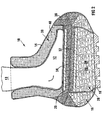
- an article of footwear in the form of a protective boot in accordance with the invention is generally indicated by reference numeral 10.
- the boot 10 is used by a human represented in the drawings by his foot 12.
- a composite shock wave guide member comprising a plurality of shock wave guide elements 28 is provided in a particular position and a particular orientation within the sole volume 26.
- the shock wave guide members 28 are of elongate shape, advantageously in the form of a plurality of narrow strips of glass.
- the strips are arranged in three (by way of example) oblique layers 28.1, 28.2 and 28.3.
- a plurality of strips is provided, one behind the other, in transverse orientation, and at small spacings. Between adjacent, rigid, strips, transverse bend lines are formed, allowing the sole to bend along said bend lines.
- the shock wave guide elements 28 are of glass, i.e. a material having a high acoustic speed, to promote progression of shock waves along the guide elements as opposed to transversely across the guide elements.
- the portion of the sole volume 26 occupied by the shock wave guide elements 28 also contains a liquid, gel, viscous liquid, or the like having high latent heat of evaporation and a low boiling point.
- the liquid is a mixture of water and alcohol (methanol) in a 70-30 mass proportion.
- the liquid may contain glycerin which has a relatively high acoustic speed.
- shock wave guide elements are thus surrounded by the liquid such that gas, e.g. air is displaced and is not present within that portion of the sole volume.
- the strips of glass may be about parallel to one another, say at about 30° to' the general plane of the outer sole.
- their downstream ends will be spaced over a larger area. This has the advantage that spalling takes place over a larger area and that a more effective path of lesser resistance for the blast is created.
- the portion of the sole volume containing the shock wave guide elements 28 and liquid 30 is covered by an oblique shield or deflector 32 extending generally from an inner lower extremity of the composite sole 16 toward an upper outer corner of the composite sole 16.
- the shield 32 is extended in integral manner into an anchor member 34 extending generally decumbently immediately underneath the inner sole 20.
- the shield 32 and anchor member 34 are conveniently in the form of bent plate material such as titanium, aluminum, aluminum alloy, or the like.
- the shield 32 may, however, preferably, be in the form of carbon fibre or Kevlar fibre embedded in epoxy resin defining the shape of the shield.
- the V-shaped spacing between the shield and the anchor member is advantageously webbed at intervals to enhance mechanical strength and rigidity.
Landscapes
- Footwear And Its Accessory, Manufacturing Method And Apparatuses (AREA)
- Electronic Switches (AREA)
Claims (25)
- Verfahren zum Schützen eines Fußes (12) eines Menschen vor Auswirkungen der Explosion einer Landmine unter dem Fuß, das einschließt:Leiten von Stoßwellen, die durch die Explosion der Landmine verursacht werden, schräg von dem Fuß weg mittels eines entsprechend schräg ausgerichteten Stoßwellen-Leitelementes (28.1, 28.2, 28.3), das in einen Sohlenraum (26) eines Fußbekleidungsgegenstandes (10) eingebettet ist, der von dem Menschen getragen wird, wobei das Stoßwellen-Leitelement aus einem Material besteht, das eine Schallgeschwindigkeit von wenigstens mehr als 3000 m/s hat;Aufreißen des Materials des Stoßwellen-Leitelementes mittels der Stoßwellen bei einer Geschwindigkeit der Rissausbreitung, die niedriger ist als die Schallgeschwindigkeit des Materials des Stoßwellen-Leitelementes, und Zertrümmern des Materials am stromab liegenden Ende des Stoßwellen-Leitelementes, um einen Weg geringeren Widerstandes für eine Detonation zu schaffen, die auf die Druckwellen folgt;Bewirken, dass die nachfolgende Detonation, die auf die Stoßwellen folgt, dem Weg geringeren Widerstandes folgt und das aufgerissene Material entfernt, um den Weg zu öffnen;Ableiten jeglicher Streukomponente der Stoßwellen zurück in das Leitelement und Dämpfen von Ausbreitung jeglicher Streukomponente der Druckwellen in einer Richtung auf den Fuß zu in dem Sohlenraum des Fußbekleidungsgegenstandes mittels einer Schicht (36) aus Material mit einer niedrigen Schallgeschwindigkeit von unter 200 m/s, die zwischen dem Stoßwellen-Leitelement und einer Innensohle (20) des Fußbekleidungsgegenstandes angeordnet ist.
- Verfahren nach Anspruch 1, dadurch gekennzeichnet, dass Leiten der Stoßwellen entsprechend einer Ausrichtung des Stoßwellen-Leitelementes schräg nach außen seitlich schräg nach außen stattfindet.
- Verfahren nach Anspruch 1 oder Anspruch 2, dadurch gekennzeichnet, dass das Stoßwellen-Leitelement so ausgewählt wird, dass es eine Schallgeschwindigkeit von über 3000 m/s, vorzugsweise bis ungefähr 6000 m/s oder mehr, hat.
- Verfahren nach einem der Ansprüche 1 bis einschließlich 3, gekennzeichnet durch Absorbieren von Wärmeenergie durch Verdampfen von Flüssigkeit, die in dem Sohlenraum (26) enthalten ist.
- Verfahren nach Anspruch 4, dadurch gekennzeichnet, dass sich die Flüssigkeit nahe an dem Leitelement (28.1, 28.2, 28.3) befindet.
- Verfahren nach einem der Ansprüche 1 bis einschließlich 5, dadurch gekennzeichnet, dass Leiten der Druckwellen, Reißen des Druckwellenmaterials und Schaffen eines Weges geringeren Widerstandes zusammen auf einer Vielzahl von Wegen nebeneinander mittels eines Verbund-Stoßwellen-Leitelementes (28.1, 28.2, 28.3) stattfinden, das eine Vielzahl von Stoßwellen-Leitelementen (28.1, 28.2, 28.3) nebeneinander hat.
- Verfahren nach Anspruch 6, dadurch gekennzeichnet, dass jedes Stoßwellen-Leitelement (28.1, 28.2, 28.3) die Form eines Streifens aus starrem glashaltigem Material hat, wobei die Streifen quer ausgerichtet sind, um Biegen des Fußbekleidungsgegenstandes an Quer-Biegelinien zwischen benachbarten Streifen zu ermöglichen.
- Verfahren nach einem der Ansprüche 1 bis einschließlich 7, dadurch gekennzeichnet, dass die Schicht aus Material (36), das eine niedrige Schallgeschwindigkeit hat, die Form von Vermiculit oder einem Verbundmaterial hat, das Vermiculite enthält.
- Verfahren nach einem der Ansprüche 1 bis einschließlich 8, gekennzeichnet durch Förderung von Stoßwellenausweitung stromab von dem Fuß (12) mittels einer Schicht aus Aussickermaterial (40), die in engem Kontakt mit Haut an einer Fußfläche gegenüber einer Sohle des Fußes ist, wobei die Schicht aus Material eine Schallgeschwindigkeit hat, die wenigstens der Schallgeschwindigkeit von Fleisch gleich ist.
- Verfahren nach Anspruch 9, dadurch gekennzeichnet, dass die Schallgeschwindigkeit des Aussickermaterials (40) höher ist als die Schallgeschwindigkeit von Wasser.
- Verfahren nach Anspruch 9 oder 10, dadurch gekennzeichnet, dass es die Schicht aus Aussickermaterial (40) in Verbindung mit einer von dem Menschen getragenen Socke enthält.
- Schützender Fußbekleidungsgegenstand (10) für einen Menschen mit einer Verbundsohle (16), die eine äußere Sohle (18) an einem äußeren Ende des Fußbekleidungsgegenstandes, eine beabstandete innere Sohle (20) zum Aufsetzen eines Fußes (12) eines Benutzers und einen Sohlenraum (26) zwischen der äußeren und der inneren Sohle enthält, wobei die zusammengesetzte Sohle in dem Sohlenraum enthält:ein Stoßwellen-Leitelement (28.1, 28.2, 28.3), das so ausgerichtet ist, dass es Stoßwellen, die durch eine Explosion einer Landmine verursacht werden, in Gebrauch schräg von dem Fuß wegleitet, wobei das Stoßwellen-Leitelement aus einem festen Material besteht, das eine Schallgeschwindigkeit von wenigstens über 3000 m/s hat;eine Schicht (36) aus Sperrmaterial, das eine niedrige Schallgeschwindigkeit hat, zwischen dem Stoßwellen-Leitelement und der inneren Sohle,dadurch gekennzeichnet, dass das feste Material des Stoßwellen-Leitelementes (28.1, 28.2, 28.3), beispielsweise Glas oder ein Material, das Glas oder ein keramisches Material enthält, dazu neigt, durch Stoßwellen bei einer Geschwindigkeit der Rissausbreitung zu reißen und pulverisiert zu werden, die niedriger ist als seine Schallgeschwindigkeit, so dass das pulverisierte Material des Stoßwellen-Leitelementes an einem stromab liegenden Ende des Stoßwellen-Leitelementes zertrümmert und verdrängt wird, um einen Weg geringeren Widerstandes für eine folgende Detonation zu schaffen; und
dadurch, dass die niedrige Schallgeschwindigkeit des Sperrmaterials (36) niedriger ist als 200 m/s. - Fußbekleidungsgegenstand nach Anspruch 12, dadurch gekennzeichnet, dass sich das Stoßwellen-Leitelement von einer seitlich innen liegenden Position nahe an der äußeren Sohle (18) schräg nach oben zu einem seitlich außen liegenden äußeren Ende der zusammengesetzten Sohle (16) erstreckt.
- Fußbekleidungsgegenstand nach Anspruch 12 oder Anspruch 13, dadurch gekennzeichnet, dass das Stoßwellen-Leitelement aus massivem Material mit einer Schallgeschwindigkeit von über 3000 m/s, vorzugsweise bis ungefähr 6000 m/s, besteht.
- Fußbekleidungsgegenstand nach Anspruch 14, dadurch gekennzeichnet, dass das Stoßwellen-Leitelement aus einem Material besteht, das aus Glas, einem Material, das Glas enthält, und einem keramischen Material ausgewählt wird, oder dieses enthält.
- Fußbekleidungsgegenstand nach einem der Ansprüche 12 bis einschließlich 15, dadurch gekennzeichnet, dass der Raum (26) der zusammengesetzten Sohle eine Flüssigkeit nahe an dem Stoßwellen-Leitelement enthält.
- Fußbekleidungsgegenstand nach einem der Ansprüche 12 bis einschließlich 16, dadurch gekennzeichnet, dass das Stoßwellen-Leitelement Verbundstruktur hat und eine Vielzahl von Stoßwellen-Leitelementen (28.1, 28.2, 28.3) umfasst, die sich nebeneinander erstrecken.
- Fußbekleidungsgegenstand nach Anspruch 17, dadurch gekennzeichnet, dass jedes Stoßwellen-Leitelement (28.1, 28.2, 28.3) die Form eines Streifens aus starrem Material hat, das aus Glas oder glashaltigem Material oder einem keramischen Material ausgewählt wird, wobei die Streifen quer ausgerichtet und nebeneinander angeordnet sind, um Biegen des Fußbekleidungsgegenstandes an Quer-Biegelinien zwischen benachbarten Streifen zu ermöglichen.
- Fußbekleidungsgegenstand nach einem der Ansprüche 12 bis einschließlich 18, dadurch gekennzeichnet, dass das Sperrmaterial (36) Vermiculit oder ein Verbundmaterial ist, das Vermiculit enthält.
- Fußbekleidungsgegenstand nach einem der Ansprüche 12 bis einschließlich 19, gekennzeichnet durch einen den Fuß umgebenden Schaft (14), der einen Fuß-Hohlraum (38) über der inneren Sohle (20) bildet, und eine Schicht aus Aussickermaterial (40) in flüssiger Form, das eine Schallgeschwindigkeit hat, die der Schallgeschwindigkeit von Fleisch gleich ist oder höher ist als diese, und das im Gebrauch in engem Kontakt mit Haut an einer Oberfläche des Fußes gegenüber einer Sohle des Fußes ist.
- Fußbekleidungsgegenstand nach Anspruch 20, dadurch gekennzeichnet, dass das Aussickermaterial eine Schallgeschwindigkeit hat, die höher ist als die von Wasser.
- Fußbekleidungsgegenstand nach Anspruch 21, dadurch gekennzeichnet, dass das Aussickermaterial Glycerin ist oder dieses enthält.
- Fußbekleidungsgegenstand nach Anspruch 20, Anspruch 21 oder Anspruch 22, dadurch gekennzeichnet, dass das Aussickermaterial in einem geschlossenen flexiblen Behälter, wie beispielsweise einem Kissen oder einem Beutel, enthalten ist.
- Fußbekleidungsgegenstand nach einem der Ansprüche 20 bis einschließlich 23, dadurch gekennzeichnet, dass das Aussickermaterial zwischen körnigem oder fadenartigem Material vorhanden ist, das eine Schallgeschwindigkeit hat, die höher ist als die Schallgeschwindigkeit des Aussickermaterials.
- Kombination aus einem Fußbekleidungsgegenstand nach einem der Ansprüche 20 bis einschließlich 24 und einer Socke, dadurch gekennzeichnet, dass das Aussickermaterial in der Socke enthalten ist.
Applications Claiming Priority (7)
| Application Number | Priority Date | Filing Date | Title |
|---|---|---|---|
| ZA200204368 | 2002-05-31 | ||
| ZA200204368 | 2002-05-31 | ||
| ZA200204480 | 2002-06-05 | ||
| ZA200204480 | 2002-06-05 | ||
| ZA200300684 | 2003-01-24 | ||
| ZA200300684 | 2003-01-24 | ||
| PCT/IB2003/002032 WO2003101234A2 (en) | 2002-05-31 | 2003-05-27 | Protective footwear |
Publications (2)
| Publication Number | Publication Date |
|---|---|
| EP1531695A2 EP1531695A2 (de) | 2005-05-25 |
| EP1531695B1 true EP1531695B1 (de) | 2007-01-24 |
Family
ID=29716165
Family Applications (1)
| Application Number | Title | Priority Date | Filing Date |
|---|---|---|---|
| EP03727766A Expired - Lifetime EP1531695B1 (de) | 2002-05-31 | 2003-05-27 | Schützendes schuhwerk |
Country Status (9)
| Country | Link |
|---|---|
| US (1) | US7530181B2 (de) |
| EP (1) | EP1531695B1 (de) |
| CN (1) | CN100486473C (de) |
| AT (1) | ATE352219T1 (de) |
| AU (1) | AU2003232967B2 (de) |
| CA (1) | CA2487435C (de) |
| DE (1) | DE60311472T2 (de) |
| ES (1) | ES2281643T3 (de) |
| WO (1) | WO2003101234A2 (de) |
Families Citing this family (8)
| Publication number | Priority date | Publication date | Assignee | Title |
|---|---|---|---|---|
| GB0327310D0 (en) | 2003-11-24 | 2003-12-24 | Oztech Pty Ltd | Pressure impulse mitigation |
| US7437986B2 (en) | 2005-08-25 | 2008-10-21 | Nanyang Technological University | Landmine avoidance and protection device |
| US8047117B1 (en) * | 2007-04-13 | 2011-11-01 | Wright Materials Research Company | Composite blast wave attenuators for boots |
| US20090090024A1 (en) * | 2007-10-03 | 2009-04-09 | Banpan Research Laboratory Co. Ltd. | Boots for minimizing injury from explosives |
| US8613149B2 (en) * | 2009-11-10 | 2013-12-24 | Nike, Inc. | Footwear incorporating a composite shell sole structure |
| US8881428B2 (en) * | 2010-09-02 | 2014-11-11 | Nike, Inc. | Sole assembly for article of footwear with plural cushioning members |
| CN104709129B (zh) * | 2013-12-13 | 2017-03-08 | 航宇救生装备有限公司 | 一种车辆防地雷乘员脚部和下肢保护装置 |
| US10571226B2 (en) * | 2016-02-16 | 2020-02-25 | The Boeing Company | Mine-Blast impact shield and methods for use thereof |
Family Cites Families (13)
| Publication number | Priority date | Publication date | Assignee | Title |
|---|---|---|---|---|
| US3516181A (en) * | 1959-05-05 | 1970-06-23 | Us Navy | Protective footgear |
| US3243898A (en) * | 1961-01-04 | 1966-04-05 | Jr Frederick J Lewis | Protective footgear |
| US3061951A (en) * | 1961-05-18 | 1962-11-06 | Edward R Barron | Blast attenuating footwear |
| US3318024A (en) * | 1966-05-31 | 1967-05-09 | Edwin S Fujinaka | Blast protective footwear |
| US3636895A (en) * | 1969-09-19 | 1972-01-25 | Aluminum Co Of America | Armor structure |
| ZA855677B (en) * | 1985-08-06 | 1986-07-17 | Shlomo Ringler | A device for reducing the danger of accidental detonation of land mines |
| GB8615454D0 (en) | 1986-06-09 | 1986-12-17 | Secr Defence | Protective footwear |
| US6505421B1 (en) * | 1995-03-01 | 2003-01-14 | Bfr Holdings Limited | Blast and fragment resistent polyurethane boot sole for safety footwear |
| CN2268916Y (zh) * | 1996-10-16 | 1997-11-26 | 廖元利 | 防雷靴 |
| CA2210868A1 (en) * | 1997-07-18 | 1999-01-18 | Med-Eng Systems, Inc. | Anti-personnel mine foot protection systems |
| AUPQ268799A0 (en) | 1999-09-07 | 1999-09-30 | Krstic, Alexander R | Landmine protection improvements |
| CN1091245C (zh) * | 2000-03-13 | 2002-09-18 | 中国人民解放军第三军医大学野战外科研究所 | 扫雷防爆靴 |
| US6751892B2 (en) * | 2002-03-18 | 2004-06-22 | Achidatex Nazareth Elite (1977) Ltd. | Minefield shoe and method for manufacture thereof |
-
2003
- 2003-05-27 CN CNB038155702A patent/CN100486473C/zh not_active Expired - Fee Related
- 2003-05-27 US US10/516,403 patent/US7530181B2/en not_active Expired - Fee Related
- 2003-05-27 DE DE60311472T patent/DE60311472T2/de not_active Expired - Lifetime
- 2003-05-27 AU AU2003232967A patent/AU2003232967B2/en not_active Ceased
- 2003-05-27 CA CA2487435A patent/CA2487435C/en not_active Expired - Fee Related
- 2003-05-27 ES ES03727766T patent/ES2281643T3/es not_active Expired - Lifetime
- 2003-05-27 EP EP03727766A patent/EP1531695B1/de not_active Expired - Lifetime
- 2003-05-27 WO PCT/IB2003/002032 patent/WO2003101234A2/en not_active Ceased
- 2003-05-27 AT AT03727766T patent/ATE352219T1/de not_active IP Right Cessation
Also Published As
| Publication number | Publication date |
|---|---|
| ES2281643T3 (es) | 2007-10-01 |
| CA2487435C (en) | 2011-12-20 |
| WO2003101234A2 (en) | 2003-12-11 |
| US20060000117A1 (en) | 2006-01-05 |
| CN100486473C (zh) | 2009-05-13 |
| AU2003232967B2 (en) | 2008-11-13 |
| CA2487435A1 (en) | 2003-12-11 |
| DE60311472T2 (de) | 2007-10-25 |
| US7530181B2 (en) | 2009-05-12 |
| ATE352219T1 (de) | 2007-02-15 |
| DE60311472D1 (de) | 2007-03-15 |
| AU2003232967A1 (en) | 2003-12-19 |
| WO2003101234A3 (en) | 2004-05-21 |
| EP1531695A2 (de) | 2005-05-25 |
| CN1665416A (zh) | 2005-09-07 |
Similar Documents
| Publication | Publication Date | Title |
|---|---|---|
| CA2487435C (en) | Protective footwear | |
| NL8601650A (nl) | Pantserplaat. | |
| US3243898A (en) | Protective footgear | |
| US6006646A (en) | Anti-personnel mine foot protection systems | |
| CA2401824A1 (en) | Material consisting of several layers for protecting parts of the body | |
| US6725572B1 (en) | Protective footwear against landmine | |
| US3318024A (en) | Blast protective footwear | |
| US9410772B2 (en) | Ballistic protection configuration | |
| Kamberoğlu et al. | Evaluation of foot protection effectiveness against AP mine blasts: effect of deflector geometry | |
| RU2072083C1 (ru) | Бронезащитный элемент | |
| US20080011153A1 (en) | Multi-layer armor having lateral shock transfer | |
| CN214103422U (zh) | 一种抗冲击防爆靴 | |
| CN112690532B (zh) | 一种抗冲击防爆靴 | |
| RU2855144C1 (ru) | Взрывозащитная обувь сапера | |
| RU2050806C1 (ru) | Защитная обувь | |
| RU240144U1 (ru) | Защитная обувь | |
| US12455148B2 (en) | Anti-mine pad “SafeStep” | |
| CN2268916Y (zh) | 防雷靴 | |
| AU758705B2 (en) | Protective footwear against landmine | |
| KR200286052Y1 (ko) | 수맥파 차단용 보조 깔창 | |
| RU9519U1 (ru) | Тонкая слоистая металлическая броня | |
| WO2018051054A1 (en) | Reduction of risk of injury from anti-personnel mines | |
| RU510U1 (ru) | Бронепанель для защиты тела человека от поражающих объектов | |
| WO2007066059A1 (en) | Improvements in armour | |
| Lawless | The cushioning role of interface and initial foot angle in impact loading and shock transmission. |
Legal Events
| Date | Code | Title | Description |
|---|---|---|---|
| PUAI | Public reference made under article 153(3) epc to a published international application that has entered the european phase |
Free format text: ORIGINAL CODE: 0009012 |
|
| 17P | Request for examination filed |
Effective date: 20041222 |
|
| AK | Designated contracting states |
Kind code of ref document: A2 Designated state(s): AT BE BG CH CY CZ DE DK EE ES FI FR GB GR HU IE IT LI LU MC NL PT RO SE SI SK TR |
|
| AX | Request for extension of the european patent |
Extension state: AL LT LV MK |
|
| DAX | Request for extension of the european patent (deleted) | ||
| GRAP | Despatch of communication of intention to grant a patent |
Free format text: ORIGINAL CODE: EPIDOSNIGR1 |
|
| GRAS | Grant fee paid |
Free format text: ORIGINAL CODE: EPIDOSNIGR3 |
|
| GRAA | (expected) grant |
Free format text: ORIGINAL CODE: 0009210 |
|
| AK | Designated contracting states |
Kind code of ref document: B1 Designated state(s): AT BE BG CH CY CZ DE DK EE ES FI FR GB GR HU IE IT LI LU MC NL PT RO SE SI SK TR |
|
| PG25 | Lapsed in a contracting state [announced via postgrant information from national office to epo] |
Ref country code: CH Free format text: LAPSE BECAUSE OF FAILURE TO SUBMIT A TRANSLATION OF THE DESCRIPTION OR TO PAY THE FEE WITHIN THE PRESCRIBED TIME-LIMIT Effective date: 20070124 Ref country code: DK Free format text: LAPSE BECAUSE OF FAILURE TO SUBMIT A TRANSLATION OF THE DESCRIPTION OR TO PAY THE FEE WITHIN THE PRESCRIBED TIME-LIMIT Effective date: 20070124 Ref country code: AT Free format text: LAPSE BECAUSE OF FAILURE TO SUBMIT A TRANSLATION OF THE DESCRIPTION OR TO PAY THE FEE WITHIN THE PRESCRIBED TIME-LIMIT Effective date: 20070124 Ref country code: LI Free format text: LAPSE BECAUSE OF FAILURE TO SUBMIT A TRANSLATION OF THE DESCRIPTION OR TO PAY THE FEE WITHIN THE PRESCRIBED TIME-LIMIT Effective date: 20070124 Ref country code: FI Free format text: LAPSE BECAUSE OF FAILURE TO SUBMIT A TRANSLATION OF THE DESCRIPTION OR TO PAY THE FEE WITHIN THE PRESCRIBED TIME-LIMIT Effective date: 20070124 Ref country code: SI Free format text: LAPSE BECAUSE OF FAILURE TO SUBMIT A TRANSLATION OF THE DESCRIPTION OR TO PAY THE FEE WITHIN THE PRESCRIBED TIME-LIMIT Effective date: 20070124 Ref country code: NL Free format text: LAPSE BECAUSE OF FAILURE TO SUBMIT A TRANSLATION OF THE DESCRIPTION OR TO PAY THE FEE WITHIN THE PRESCRIBED TIME-LIMIT Effective date: 20070124 |
|
| REG | Reference to a national code |
Ref country code: GB Ref legal event code: FG4D |
|
| REG | Reference to a national code |
Ref country code: CH Ref legal event code: EP |
|
| REG | Reference to a national code |
Ref country code: IE Ref legal event code: FG4D |
|
| REF | Corresponds to: |
Ref document number: 60311472 Country of ref document: DE Date of ref document: 20070315 Kind code of ref document: P |
|
| PG25 | Lapsed in a contracting state [announced via postgrant information from national office to epo] |
Ref country code: SE Free format text: LAPSE BECAUSE OF FAILURE TO SUBMIT A TRANSLATION OF THE DESCRIPTION OR TO PAY THE FEE WITHIN THE PRESCRIBED TIME-LIMIT Effective date: 20070424 |
|
| PG25 | Lapsed in a contracting state [announced via postgrant information from national office to epo] |
Ref country code: BG Free format text: LAPSE BECAUSE OF EXPIRATION OF PROTECTION Effective date: 20070425 |
|
| PG25 | Lapsed in a contracting state [announced via postgrant information from national office to epo] |
Ref country code: PT Free format text: LAPSE BECAUSE OF FAILURE TO SUBMIT A TRANSLATION OF THE DESCRIPTION OR TO PAY THE FEE WITHIN THE PRESCRIBED TIME-LIMIT Effective date: 20070625 |
|
| REG | Reference to a national code |
Ref country code: CH Ref legal event code: PL |
|
| NLV1 | Nl: lapsed or annulled due to failure to fulfill the requirements of art. 29p and 29m of the patents act | ||
| ET | Fr: translation filed | ||
| REG | Reference to a national code |
Ref country code: ES Ref legal event code: FG2A Ref document number: 2281643 Country of ref document: ES Kind code of ref document: T3 |
|
| PG25 | Lapsed in a contracting state [announced via postgrant information from national office to epo] |
Ref country code: SK Free format text: LAPSE BECAUSE OF FAILURE TO SUBMIT A TRANSLATION OF THE DESCRIPTION OR TO PAY THE FEE WITHIN THE PRESCRIBED TIME-LIMIT Effective date: 20070124 |
|
| PLBE | No opposition filed within time limit |
Free format text: ORIGINAL CODE: 0009261 |
|
| STAA | Information on the status of an ep patent application or granted ep patent |
Free format text: STATUS: NO OPPOSITION FILED WITHIN TIME LIMIT |
|
| 26N | No opposition filed |
Effective date: 20071025 |
|
| PG25 | Lapsed in a contracting state [announced via postgrant information from national office to epo] |
Ref country code: RO Free format text: LAPSE BECAUSE OF FAILURE TO SUBMIT A TRANSLATION OF THE DESCRIPTION OR TO PAY THE FEE WITHIN THE PRESCRIBED TIME-LIMIT Effective date: 20070124 Ref country code: BE Free format text: LAPSE BECAUSE OF FAILURE TO SUBMIT A TRANSLATION OF THE DESCRIPTION OR TO PAY THE FEE WITHIN THE PRESCRIBED TIME-LIMIT Effective date: 20070124 |
|
| PG25 | Lapsed in a contracting state [announced via postgrant information from national office to epo] |
Ref country code: MC Free format text: LAPSE BECAUSE OF NON-PAYMENT OF DUE FEES Effective date: 20070531 |
|
| PG25 | Lapsed in a contracting state [announced via postgrant information from national office to epo] |
Ref country code: GR Free format text: LAPSE BECAUSE OF FAILURE TO SUBMIT A TRANSLATION OF THE DESCRIPTION OR TO PAY THE FEE WITHIN THE PRESCRIBED TIME-LIMIT Effective date: 20070425 |
|
| PG25 | Lapsed in a contracting state [announced via postgrant information from national office to epo] |
Ref country code: IE Free format text: LAPSE BECAUSE OF NON-PAYMENT OF DUE FEES Effective date: 20070528 |
|
| PG25 | Lapsed in a contracting state [announced via postgrant information from national office to epo] |
Ref country code: EE Free format text: LAPSE BECAUSE OF FAILURE TO SUBMIT A TRANSLATION OF THE DESCRIPTION OR TO PAY THE FEE WITHIN THE PRESCRIBED TIME-LIMIT Effective date: 20070124 |
|
| PG25 | Lapsed in a contracting state [announced via postgrant information from national office to epo] |
Ref country code: CY Free format text: LAPSE BECAUSE OF FAILURE TO SUBMIT A TRANSLATION OF THE DESCRIPTION OR TO PAY THE FEE WITHIN THE PRESCRIBED TIME-LIMIT Effective date: 20070124 |
|
| PG25 | Lapsed in a contracting state [announced via postgrant information from national office to epo] |
Ref country code: LU Free format text: LAPSE BECAUSE OF NON-PAYMENT OF DUE FEES Effective date: 20070527 |
|
| PG25 | Lapsed in a contracting state [announced via postgrant information from national office to epo] |
Ref country code: HU Free format text: LAPSE BECAUSE OF FAILURE TO SUBMIT A TRANSLATION OF THE DESCRIPTION OR TO PAY THE FEE WITHIN THE PRESCRIBED TIME-LIMIT Effective date: 20070725 Ref country code: TR Free format text: LAPSE BECAUSE OF FAILURE TO SUBMIT A TRANSLATION OF THE DESCRIPTION OR TO PAY THE FEE WITHIN THE PRESCRIBED TIME-LIMIT Effective date: 20070124 |
|
| REG | Reference to a national code |
Ref country code: FR Ref legal event code: PLFP Year of fee payment: 14 |
|
| REG | Reference to a national code |
Ref country code: FR Ref legal event code: PLFP Year of fee payment: 15 |
|
| REG | Reference to a national code |
Ref country code: FR Ref legal event code: PLFP Year of fee payment: 16 |
|
| PGFP | Annual fee paid to national office [announced via postgrant information from national office to epo] |
Ref country code: ES Payment date: 20190603 Year of fee payment: 17 Ref country code: IT Payment date: 20190527 Year of fee payment: 17 Ref country code: CZ Payment date: 20190517 Year of fee payment: 17 Ref country code: DE Payment date: 20190514 Year of fee payment: 17 |
|
| PGFP | Annual fee paid to national office [announced via postgrant information from national office to epo] |
Ref country code: FR Payment date: 20190429 Year of fee payment: 17 |
|
| PGFP | Annual fee paid to national office [announced via postgrant information from national office to epo] |
Ref country code: GB Payment date: 20190522 Year of fee payment: 17 |
|
| REG | Reference to a national code |
Ref country code: DE Ref legal event code: R119 Ref document number: 60311472 Country of ref document: DE |
|
| PG25 | Lapsed in a contracting state [announced via postgrant information from national office to epo] |
Ref country code: CZ Free format text: LAPSE BECAUSE OF NON-PAYMENT OF DUE FEES Effective date: 20200527 |
|
| GBPC | Gb: european patent ceased through non-payment of renewal fee |
Effective date: 20200527 |
|
| PG25 | Lapsed in a contracting state [announced via postgrant information from national office to epo] |
Ref country code: FR Free format text: LAPSE BECAUSE OF NON-PAYMENT OF DUE FEES Effective date: 20200531 Ref country code: GB Free format text: LAPSE BECAUSE OF NON-PAYMENT OF DUE FEES Effective date: 20200527 |
|
| PG25 | Lapsed in a contracting state [announced via postgrant information from national office to epo] |
Ref country code: DE Free format text: LAPSE BECAUSE OF NON-PAYMENT OF DUE FEES Effective date: 20201201 |
|
| REG | Reference to a national code |
Ref country code: ES Ref legal event code: FD2A Effective date: 20211004 |
|
| PG25 | Lapsed in a contracting state [announced via postgrant information from national office to epo] |
Ref country code: IT Free format text: LAPSE BECAUSE OF NON-PAYMENT OF DUE FEES Effective date: 20200527 |
|
| PG25 | Lapsed in a contracting state [announced via postgrant information from national office to epo] |
Ref country code: ES Free format text: LAPSE BECAUSE OF NON-PAYMENT OF DUE FEES Effective date: 20200528 |