EP1530360A2 - Panoramic image formation - Google Patents
Panoramic image formation Download PDFInfo
- Publication number
- EP1530360A2 EP1530360A2 EP04256972A EP04256972A EP1530360A2 EP 1530360 A2 EP1530360 A2 EP 1530360A2 EP 04256972 A EP04256972 A EP 04256972A EP 04256972 A EP04256972 A EP 04256972A EP 1530360 A2 EP1530360 A2 EP 1530360A2
- Authority
- EP
- European Patent Office
- Prior art keywords
- image
- panoramic image
- panoramic
- resolution
- camera
- Prior art date
- Legal status (The legal status is an assumption and is not a legal conclusion. Google has not performed a legal analysis and makes no representation as to the accuracy of the status listed.)
- Withdrawn
Links
- 230000015572 biosynthetic process Effects 0.000 title 1
- 238000000034 method Methods 0.000 claims abstract description 36
- 230000004044 response Effects 0.000 claims description 4
- 230000000007 visual effect Effects 0.000 claims description 4
- 238000005070 sampling Methods 0.000 description 5
- 238000004091 panning Methods 0.000 description 4
- 230000003247 decreasing effect Effects 0.000 description 1
- 230000000994 depressogenic effect Effects 0.000 description 1
- 238000001514 detection method Methods 0.000 description 1
- 238000003825 pressing Methods 0.000 description 1
- 238000007670 refining Methods 0.000 description 1
- 230000002123 temporal effect Effects 0.000 description 1
Images


Classifications
-
- H—ELECTRICITY
- H04—ELECTRIC COMMUNICATION TECHNIQUE
- H04N—PICTORIAL COMMUNICATION, e.g. TELEVISION
- H04N5/00—Details of television systems
- H04N5/222—Studio circuitry; Studio devices; Studio equipment
- H04N5/262—Studio circuits, e.g. for mixing, switching-over, change of character of image, other special effects ; Cameras specially adapted for the electronic generation of special effects
-
- H—ELECTRICITY
- H04—ELECTRIC COMMUNICATION TECHNIQUE
- H04N—PICTORIAL COMMUNICATION, e.g. TELEVISION
- H04N1/00—Scanning, transmission or reproduction of documents or the like, e.g. facsimile transmission; Details thereof
- H04N1/21—Intermediate information storage
- H04N1/2104—Intermediate information storage for one or a few pictures
- H04N1/2112—Intermediate information storage for one or a few pictures using still video cameras
- H04N1/215—Recording a sequence of still pictures, e.g. burst mode
-
- H—ELECTRICITY
- H04—ELECTRIC COMMUNICATION TECHNIQUE
- H04N—PICTORIAL COMMUNICATION, e.g. TELEVISION
- H04N1/00—Scanning, transmission or reproduction of documents or the like, e.g. facsimile transmission; Details thereof
- H04N1/21—Intermediate information storage
- H04N1/2104—Intermediate information storage for one or a few pictures
- H04N1/2112—Intermediate information storage for one or a few pictures using still video cameras
-
- H—ELECTRICITY
- H04—ELECTRIC COMMUNICATION TECHNIQUE
- H04N—PICTORIAL COMMUNICATION, e.g. TELEVISION
- H04N1/00—Scanning, transmission or reproduction of documents or the like, e.g. facsimile transmission; Details thereof
- H04N1/387—Composing, repositioning or otherwise geometrically modifying originals
- H04N1/3876—Recombination of partial images to recreate the original image
-
- H—ELECTRICITY
- H04—ELECTRIC COMMUNICATION TECHNIQUE
- H04N—PICTORIAL COMMUNICATION, e.g. TELEVISION
- H04N23/00—Cameras or camera modules comprising electronic image sensors; Control thereof
- H04N23/60—Control of cameras or camera modules
- H04N23/698—Control of cameras or camera modules for achieving an enlarged field of view, e.g. panoramic image capture
-
- H—ELECTRICITY
- H04—ELECTRIC COMMUNICATION TECHNIQUE
- H04N—PICTORIAL COMMUNICATION, e.g. TELEVISION
- H04N13/00—Stereoscopic video systems; Multi-view video systems; Details thereof
- H04N2013/0074—Stereoscopic image analysis
- H04N2013/0088—Synthesising a monoscopic image signal from stereoscopic images, e.g. synthesising a panoramic or high resolution monoscopic image
Definitions
- a panoramic image may be defined as an image that has a substantially wider view than the photographs captured by conventional cameras.
- a panoramic image may have a width that encompasses many times the width of a conventional film camera or digital camera.
- a panoramic image may be obtained by equipping a conventional film or digital camera with a lens structure that is capable of photographing a wide panoramic view.
- a panoramic lens structure that is capable of photographing a wide panoramic view.
- the high cost of a panoramic lens structure may be out of reach of large numbers of users that desire to obtain panoramic photographs.
- a panoramic image may be obtained using a specialized camera having a mechanism for rotating a camera lens systematically through a wide panoramic view.
- specialized cameras may also be too expensive for large numbers of users that desire panoramic photographs.
- a panoramic image may be generated by using a digital camera to obtain multiple photographs of a desired scene and then using a computer to combine the obtained photographs into a panoramic photograph.
- this method requires the use of a computer and specialized software.
- a method for generating a panoramic image is disclosed that enables a user to obtain panoramic photographs with a digital camera without the aid of a computer system or specialized lenses.
- a digital camera according to the present techniques captures a series of image frames as a user pans the digital camera through a panoramic image scene and combines the captured image frames while the image frames are being captured.
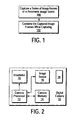
- Figure 1 shows a method of obtaining a panoramic image using a digital camera according to the present techniques.
- the digital camera perform steps 100-102 as a user pans the digital camera through a desired panoramic image scene.
- the digital camera captures a series of image frames each a sample of a portion of the desired panoramic image scene.
- the digital camera combines the captured image frames into a panoramic image while the series of image frames of the desired panoramic image scene continue to be captured.
- the digital camera may provide a feedback to a user that indicates the progress of the panoramic image while performing steps 100-102.
- visual or audio or other indicators may be used to indicate missing areas of a panoramic image being acquired or to indicate areas that need to be re-sampled.
- the digital camera may automatically perform steps 100-102 in response to user-defined boundaries of the desired panoramic image scene.
- the user may photograph edges of the desired panoramic image scene to define its boundaries for acquisition.
- FIG. 2 shows a digital camera 10 that incorporates the present teachings.
- the digital camera 10 includes an image sensor 16, an camera processor 12, and a camera memory 14.
- the digital camera 10 includes a capture mechanism 18, e.g. a lens, shutter, aperture control, zoom, etc. that applies light from an image scene onto the image sensor 16.
- the digital camera 10 includes a viewfinder 19, e.g. an LCD display.
- the digital camera 10 provides a panoramic image mode which is selectable by a user.
- the digital camera 10 may include a particular button which when depressed by a user places the digital camera 10 in the panoramic image mode.
- a user may place the digital camera 10 in a panoramic image mode by pressing and holding a shutter button which may be used to capture photographs in a non-panoramic mode.
- the camera processor 12 detects the user selection of the panoramic image mode and fixes a number of camera settings. For example, the exposure, zoom, and focus of the capture mechanism 18 may be fixed. While in the panoramic image mode the user sweeps the digital camera 10 through the desired panoramic image scene as the camera processor 12 samples the image sensor 16 and constructs a panoramic image.
- the image sensor 16 is capable of generating high-resolution image frames and low-resolution video image frames.
- the camera processor 12 may use both the high-resolution and video capabilities of the image sensor 16 to generate a panoramic image.
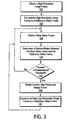
- Figure 3 shows a method of generating a panoramic image that employs the high-resolution and video capabilities of the image sensor 16.
- the user places the digital camera 10 into the panoramic image mode and the camera processor 12 uses the image sensor 16 to obtain a high-resolution image frame.
- the camera processor 12 stores the high-resolution image frame into the camera memory 14.
- the high-resolution image frame at step 120 may be obtained when a user points the digital camera 10 at the leftmost boundary of a desired panoramic image scene and selects the panoramic image mode.
- the camera processor 12 converts the high-resolution image frame from step 120 to a reference video frame.
- the camera processor 12 may down-sample the obtained high-resolution image frame from the full resolution of the image sensor 16 to a lower resolution video frame.
- Steps 124-132 are performed in a loop as the user pans the digital camera 10 across the desired panoramic image scene.
- the camera processor 12 uses the image sensor 16 to obtain a new video frame from the image sensor 16.
- the camera processor 12 determines a relative motion between the reference video frame and the new video frame from step 124.
- Step 126 A variety of known methods may be employed at step 126 for determining the relative motion between a reference video frame and a new video frame. It may be preferable to employ a motion estimation method that takes into account global pixel information contained in the reference and new video frames. Step 126 yields a motion estimate for the new video frame.
- step 128 if the motion estimate from step 126 exceeds a predetermined threshold value then the camera processor 12 proceeds to step 130.
- the camera processor 12 uses the image sensor 16 to obtain another high-resolution image frame and stores it into the camera memory 14 along with the motion estimate from step 126.
- the camera processor 12 converts the high-resolution image frame from step 130 to a reference video frame, e.g. by down-sampling, and it becomes a new reference video frame for another iteration back at step 124.
- step 1208 if the motion estimate from step 126 does not exceed a predetermined threshold value then the camera processor 12 proceeds back to step 124 to obtain a new video frame.
- the camera processor 12 stops acquiring image frames. For example, the user may release the shutter button to stop acquisition.
- the camera memory 14 stores a set of high-resolution image frames captured from the desired panoramic image scene.
- the camera memory 14 also holds the motion estimates that indicate the relative positions of the captured high-resolution image frames.
- the camera processor 12 uses this information to construct a panoramic image.
- a variety of known techniques may be employed to combine the high-resolution image frames obtained at steps 120 and 130 into a panoramic image. Examples include methods for constructing a mosaic by "stitching" together the high-resolution image frames. These methods may include detecting overlapping areas in adjacent high-resolution image frames. The motion estimates generated during the capturing process may serve as initial estimates of the relative positions of the obtained high-resolution image frames when creating a mosaic, thereby improving the quality of a resulting panoramic image when compared with the creation of a mosaic without the initial estimates.
- step 130 may include the sub-steps of refining the motion estimation from step 126 and stitching acquired image frames.
- Storage space in the camera memory 14 may be conserved by storing only portions of the acquired image frames.
- the camera processor 12 may use the motion estimates from step 126 to determine an overlap between the corresponding image frames.
- the camera processor 12 can retain the entire non-overlapping area and a small portion of the overlapping area of a stored image frame and discard the remainder of the image frame from the camera memory 14.
- the acquired image frames may not be stored. Instead, the camera processor 12 stitches together the image frames as they are acquired and then discards them. If the acquired image frames are not stored then the process of stitching them into a panoramic image occurs in the temporal order of image frame acquisition. On the other hand, if the acquired image frames are stored then they may be stitched into a panoramic image in any order.
- Figure 4a-4b illustrate a method for obtaining a panoramic image that takes advantage of the flexible addressing provided by, for example, a CMOS image sensor.
- the image sensor 16 enables the camera processor 12 to read an image strip 22 of a high-resolution image frame 20.
- the camera processor 12 is capable of reading the image strip 22 at a relatively high frame rate in comparison to the frame rate at which the high-resolution image frame 20 may be read due to the relative amounts of data involved.
- the high-resolution image frame 20 includes 3M pixel sensors arranged as 2000 pixels horizontally and 1500 pixel vertically.
- the image strip 22 is a strip that includes 205 pixels horizontally and 1500 pixel vertically.
- the camera processor 12 is capable of reading the image strip 22 at 30 frames/sec. This enables the camera processor 12 to sample an image scene using the image strip 22 at the rate of VGA video while yielding the full 1500 pixel vertical resolution of the image sensor 16.
- the relatively high sampling rate of the image strip 22 enables the camera processor 12 to acquire a set of image strips 30 as a user of the digital camera 10 pans through a desired panoramic image scene.
- the camera processor 12 may stitch together the image strips 30 as they are acquired or may store the image strips 30 and stitch them together in a subsequent step.
- the dimensions of the image strip 22 may be adapted to the rate at which the user moves the digital camera 10 when panning. For example, the width of the image strip 22 may be increased in response to a faster movement of the digital camera 10, thereby maintaining a sufficient overlap among the obtained image strips 30. Conversely, the width of the image strip 22 may be decreased in response to a slower movement of the digital camera 10.
- the above techniques obviate the need to employ a computer system to stitch together captured images into a panoramic image as in the prior art.
- prior techniques may require a user to take steps to ensure that sufficient overlap exists in the captured images.
- the present techniques enable a user to employ or more natural panning movement that is accommodated by the relatively fast frame rate and judicious use of full resolution images as set forth above.
- the present techniques enable a user to perform a single click of a camera button and then a smooth pan.
- Figure 5 shows a method for providing user feedback during acquisition of a panoramic image.
- the user places the digital camera 10 in the panorama image mode and pans through a desired panoramic image scene.
- the camera processor 12 while in the panorama image mode captures a series of image frames using the image sensor 16 and combines the acquired image frames into a mosaic. Each acquired image frame may be stitched by finding the best stitch given all of the previously acquired image frames or given the previous N image frames.
- the camera processor 12 renders the current mosaic onto a display to provide feedback to the user.
- the current mosaic indicates to the user the progress of the current panoramic image.
- the current mosaic may be rendered onto the viewfinder 19, e.g. by overlaying with the current view, or may be rendered on a separate display (not shown) of the digital camera 10.
- a scrolling mechanism may be employed that enables the user to scroll through the current mosaic if the viewfinder 19 or separate display is not capable of displaying a complete panoramic image.
- the camera processor 12 determines an uncertainty of each estimated pixel in the current mosaic and highlights the pixels whose uncertainty exceeds a predetermined threshold. The highlighted pixels prompt the user to revisit the indicated areas so that the camera processor 12 can capture additional data and complete those areas of the mosaic.
- the camera processor 12 may use the stored image frames in the camera memory 14 to detect the movement of the digital camera 10 back to an area that requires additional data and then samples those areas accordingly.
- the user of the digital camera 10 sets the horizontal and/or vertical limits of a desired panoramic image by aligning the viewfinder 19 at each limit and capturing a boundary image.
- the user then puts the digital camera 10 in the panoramic image mode and pans through the desired panoramic image scene as the camera processor 12 acquires and stitches together image frames.
- the camera processor 12 uses the boundary images to determine when to stop capturing image frames. For example, the camera processor 12 stops capturing image frames in a rightward pan when a captured image frame substantially matches the right boundary image initially captured by the user.
- the camera processor 12 may highlight un-captured areas of the current mosaic on a display to a user and then de-highlight those areas after capture as the user sweeps the areas.
- the exposure settings of the digital camera 10 may be fixed in its panoramic image mode. A fixed exposure may cause blurring in the captured images.
- the camera processor 12 may use motion estimation or a blur detection filter to detect when the user is moving the digital camera 10 too fast during panoramic image mode and signal the user, e.g. through a visual display or other mechanism.
- the digital camera 10 may include a motion sensor, e.g. a gyroscope, that may be used to detect when the user is moving the viewfinder too fast.
- the exposure of the camera 10 may be set as automatic in the panorama mode.
- the exposure adapts to lighting conditions which may vary substantially from shadow to brightly lit areas.
- the relative lighting changes between image strips may be relatively minor and correctable in the camera processor 10.
- the acquisition of image strips as taught herein enables a relaxation in exposure constraints that may be imposed in prior cameras.
- Figure 6 shows a method for generating a panoramic image that provides enhanced resolution of an object of interest.
- the user places the digital camera 10 in the panorama image mode and pans through a desired panoramic image scene.
- the camera processor 12 while in the panorama image mode captures a series of video image frames using the image sensor 16.
- the user stops panning and zooms in on an object of interest.
- the user may employ a zoom button on the digital camera 10 to zoom in on, for example, a persons face.
- the camera processor 12 may limit the zoom to a fixed zoom sequence.
- the camera processor 12 captures a high resolution image of the object of interest using the image sensor 16.
- the user zooms back out from the object of interest and continues to pan while the camera processor 12 obtains video image frames using the image sensor 16.
- the camera processor 12 records a set of metadata associated with the zoom sequence on the object of interest.
- the metadata may include the frame number/time stamp for the start of the zoom in, a frame number/time stamp for the stable high-resolution capture on the object of interest, and a frame number/time stamp for the zoom out.
- the meta data is used at step 310 to combine the high-resolution image from step 306 with the video frame samples of the remainder of the panoramic image.
- the stitching together of a mosaic at step 310 may include down-sampling of the high-resolution image obtained at step 306.
- the zoomed areas may be areas containing details of high interest.
- the acquired images may be up-sampled as they are acquired in the details of interest may be saved.
- the up-sampling may be performed using a variety of methods, e.g. bilinear scaling or methods based on image content.
Landscapes
- Engineering & Computer Science (AREA)
- Multimedia (AREA)
- Signal Processing (AREA)
- Studio Devices (AREA)
- Stereoscopic And Panoramic Photography (AREA)
- Television Signal Processing For Recording (AREA)
- Editing Of Facsimile Originals (AREA)
Abstract
Description
- A panoramic image may be defined as an image that has a substantially wider view than the photographs captured by conventional cameras. For example, a panoramic image may have a width that encompasses many times the width of a conventional film camera or digital camera.
- A panoramic image may be obtained by equipping a conventional film or digital camera with a lens structure that is capable of photographing a wide panoramic view. Unfortunately, the high cost of a panoramic lens structure may be out of reach of large numbers of users that desire to obtain panoramic photographs.
- A panoramic image may be obtained using a specialized camera having a mechanism for rotating a camera lens systematically through a wide panoramic view. Unfortunately, such specialized cameras may also be too expensive for large numbers of users that desire panoramic photographs.
- A panoramic image may be generated by using a digital camera to obtain multiple photographs of a desired scene and then using a computer to combine the obtained photographs into a panoramic photograph. Unfortunately, this method requires the use of a computer and specialized software.
- A method for generating a panoramic image is disclosed that enables a user to obtain panoramic photographs with a digital camera without the aid of a computer system or specialized lenses. A digital camera according to the present techniques captures a series of image frames as a user pans the digital camera through a panoramic image scene and combines the captured image frames while the image frames are being captured.
- Other features and advantages of the present invention will be apparent from the detailed description that follows.
- The present invention is described with respect to particular exemplary embodiments thereof and reference is accordingly made to the drawings in which:
- Figure 1 shows a method of obtaining a panoramic image using a digital camera according to the present techniques;
- Figure 2 shows a digital camera that incorporates the present teachings;
- Figure 3 shows a method of generating a panoramic image that employs the high-resolution and video capabilities of an image sensor;
- Figure 4a-4b illustrate a method for obtaining a panoramic image that takes advantage of the flexible addressing provided by an image sensor;
- Figure 5 shows a method for providing user feedback during acquisition of a panoramic image;
- Figure 6 shows a method for generating a panoramic image that provides enhanced resolution of an object of interest.
-
- Figure 1 shows a method of obtaining a panoramic image using a digital camera according to the present techniques. The digital camera perform steps 100-102 as a user pans the digital camera through a desired panoramic image scene.
- At
step 100, the digital camera captures a series of image frames each a sample of a portion of the desired panoramic image scene. Atstep 102, the digital camera combines the captured image frames into a panoramic image while the series of image frames of the desired panoramic image scene continue to be captured. - The digital camera may provide a feedback to a user that indicates the progress of the panoramic image while performing steps 100-102. For example, visual or audio or other indicators may be used to indicate missing areas of a panoramic image being acquired or to indicate areas that need to be re-sampled.
- The digital camera may automatically perform steps 100-102 in response to user-defined boundaries of the desired panoramic image scene. For example, the user may photograph edges of the desired panoramic image scene to define its boundaries for acquisition.
- Figure 2 shows a
digital camera 10 that incorporates the present teachings. Thedigital camera 10 includes animage sensor 16, ancamera processor 12, and acamera memory 14. Thedigital camera 10 includes acapture mechanism 18, e.g. a lens, shutter, aperture control, zoom, etc. that applies light from an image scene onto theimage sensor 16. Thedigital camera 10 includes aviewfinder 19, e.g. an LCD display. - The
digital camera 10 provides a panoramic image mode which is selectable by a user. For example, thedigital camera 10 may include a particular button which when depressed by a user places thedigital camera 10 in the panoramic image mode. In another example, a user may place thedigital camera 10 in a panoramic image mode by pressing and holding a shutter button which may be used to capture photographs in a non-panoramic mode. - The
camera processor 12 detects the user selection of the panoramic image mode and fixes a number of camera settings. For example, the exposure, zoom, and focus of thecapture mechanism 18 may be fixed. While in the panoramic image mode the user sweeps thedigital camera 10 through the desired panoramic image scene as thecamera processor 12 samples theimage sensor 16 and constructs a panoramic image. - In one embodiment, the
image sensor 16 is capable of generating high-resolution image frames and low-resolution video image frames. Thecamera processor 12 may use both the high-resolution and video capabilities of theimage sensor 16 to generate a panoramic image. - Figure 3 shows a method of generating a panoramic image that employs the high-resolution and video capabilities of the
image sensor 16. Atstep 120, the user places thedigital camera 10 into the panoramic image mode and thecamera processor 12 uses theimage sensor 16 to obtain a high-resolution image frame. Thecamera processor 12 stores the high-resolution image frame into thecamera memory 14. For example, the high-resolution image frame atstep 120 may be obtained when a user points thedigital camera 10 at the leftmost boundary of a desired panoramic image scene and selects the panoramic image mode. - At
step 122, thecamera processor 12 converts the high-resolution image frame fromstep 120 to a reference video frame. For example, thecamera processor 12 may down-sample the obtained high-resolution image frame from the full resolution of theimage sensor 16 to a lower resolution video frame. - Steps 124-132 are performed in a loop as the user pans the
digital camera 10 across the desired panoramic image scene. Atstep 124, thecamera processor 12 uses theimage sensor 16 to obtain a new video frame from theimage sensor 16. Atstep 126, thecamera processor 12 determines a relative motion between the reference video frame and the new video frame fromstep 124. - A variety of known methods may be employed at
step 126 for determining the relative motion between a reference video frame and a new video frame. It may be preferable to employ a motion estimation method that takes into account global pixel information contained in the reference and new video frames.Step 126 yields a motion estimate for the new video frame. - At
step 128, if the motion estimate fromstep 126 exceeds a predetermined threshold value then thecamera processor 12 proceeds tostep 130. Atstep 130, thecamera processor 12 uses theimage sensor 16 to obtain another high-resolution image frame and stores it into thecamera memory 14 along with the motion estimate fromstep 126. Then atstep 132, thecamera processor 12 converts the high-resolution image frame fromstep 130 to a reference video frame, e.g. by down-sampling, and it becomes a new reference video frame for another iteration back atstep 124. - At
step 128, if the motion estimate fromstep 126 does not exceed a predetermined threshold value then thecamera processor 12 proceeds back tostep 124 to obtain a new video frame. - After the user finishes panning the
digital camera 10 through the desired panoramic image scene thecamera processor 12 stops acquiring image frames. For example, the user may release the shutter button to stop acquisition. At that point, thecamera memory 14 stores a set of high-resolution image frames captured from the desired panoramic image scene. Thecamera memory 14 also holds the motion estimates that indicate the relative positions of the captured high-resolution image frames. Thecamera processor 12 uses this information to construct a panoramic image. - A variety of known techniques may be employed to combine the high-resolution image frames obtained at
steps - The steps of stitching together obtained image frames may be performed while additional image frames are being acquired. For example,
step 130 may include the sub-steps of refining the motion estimation fromstep 126 and stitching acquired image frames. - Storage space in the
camera memory 14 may be conserved by storing only portions of the acquired image frames. For example, thecamera processor 12 may use the motion estimates fromstep 126 to determine an overlap between the corresponding image frames. Thecamera processor 12 can retain the entire non-overlapping area and a small portion of the overlapping area of a stored image frame and discard the remainder of the image frame from thecamera memory 14. - In an embodiment in which the size of the
camera memory 14 is relatively small the acquired image frames may not be stored. Instead, thecamera processor 12 stitches together the image frames as they are acquired and then discards them. If the acquired image frames are not stored then the process of stitching them into a panoramic image occurs in the temporal order of image frame acquisition. On the other hand, if the acquired image frames are stored then they may be stitched into a panoramic image in any order. - Figure 4a-4b illustrate a method for obtaining a panoramic image that takes advantage of the flexible addressing provided by, for example, a CMOS image sensor. In this method, the
image sensor 16 enables thecamera processor 12 to read animage strip 22 of a high-resolution image frame 20. Thecamera processor 12 is capable of reading theimage strip 22 at a relatively high frame rate in comparison to the frame rate at which the high-resolution image frame 20 may be read due to the relative amounts of data involved. - In one embodiment, the high-
resolution image frame 20 includes 3M pixel sensors arranged as 2000 pixels horizontally and 1500 pixel vertically. Theimage strip 22 is a strip that includes 205 pixels horizontally and 1500 pixel vertically. Thecamera processor 12 is capable of reading theimage strip 22 at 30 frames/sec. This enables thecamera processor 12 to sample an image scene using theimage strip 22 at the rate of VGA video while yielding the full 1500 pixel vertical resolution of theimage sensor 16. - The relatively high sampling rate of the
image strip 22 enables thecamera processor 12 to acquire a set of image strips 30 as a user of thedigital camera 10 pans through a desired panoramic image scene. Thecamera processor 12 may stitch together the image strips 30 as they are acquired or may store the image strips 30 and stitch them together in a subsequent step. - Given that the image strips 30 are each obtained in 1/30 of a second it is likely that the relative motion between adjacent strips is relatively small. As a consequence, when combining adjacent image strips a translational motion model may be employed with no motion refinement. Only minimal warping may be needed to align adjacent strips because the changes to the adjacent strips are likely to be relatively small given the relatively high sampling rate. The non-overlapping portion of each new strip may be added to the current mosaic as the user pans the
digital camera 10. - The dimensions of the
image strip 22 may be adapted to the rate at which the user moves thedigital camera 10 when panning. For example, the width of theimage strip 22 may be increased in response to a faster movement of thedigital camera 10, thereby maintaining a sufficient overlap among the obtained image strips 30. Conversely, the width of theimage strip 22 may be decreased in response to a slower movement of thedigital camera 10. - The above techniques obviate the need to employ a computer system to stitch together captured images into a panoramic image as in the prior art. In addition, prior techniques may require a user to take steps to ensure that sufficient overlap exists in the captured images. In contrast, the present techniques enable a user to employ or more natural panning movement that is accommodated by the relatively fast frame rate and judicious use of full resolution images as set forth above. The present techniques enable a user to perform a single click of a camera button and then a smooth pan.
- Figure 5 shows a method for providing user feedback during acquisition of a panoramic image. At
step 200, the user places thedigital camera 10 in the panorama image mode and pans through a desired panoramic image scene. Atstep 202, thecamera processor 12 while in the panorama image mode captures a series of image frames using theimage sensor 16 and combines the acquired image frames into a mosaic. Each acquired image frame may be stitched by finding the best stitch given all of the previously acquired image frames or given the previous N image frames. - At
step 204, thecamera processor 12 renders the current mosaic onto a display to provide feedback to the user. The current mosaic indicates to the user the progress of the current panoramic image. The current mosaic may be rendered onto theviewfinder 19, e.g. by overlaying with the current view, or may be rendered on a separate display (not shown) of thedigital camera 10. A scrolling mechanism may be employed that enables the user to scroll through the current mosaic if theviewfinder 19 or separate display is not capable of displaying a complete panoramic image. - The
camera processor 12 in one embodiment determines an uncertainty of each estimated pixel in the current mosaic and highlights the pixels whose uncertainty exceeds a predetermined threshold. The highlighted pixels prompt the user to revisit the indicated areas so that thecamera processor 12 can capture additional data and complete those areas of the mosaic. Thecamera processor 12 may use the stored image frames in thecamera memory 14 to detect the movement of thedigital camera 10 back to an area that requires additional data and then samples those areas accordingly. - In one embodiment, the user of the
digital camera 10 sets the horizontal and/or vertical limits of a desired panoramic image by aligning theviewfinder 19 at each limit and capturing a boundary image. The user then puts thedigital camera 10 in the panoramic image mode and pans through the desired panoramic image scene as thecamera processor 12 acquires and stitches together image frames. Thecamera processor 12 uses the boundary images to determine when to stop capturing image frames. For example, thecamera processor 12 stops capturing image frames in a rightward pan when a captured image frame substantially matches the right boundary image initially captured by the user. Thecamera processor 12 may highlight un-captured areas of the current mosaic on a display to a user and then de-highlight those areas after capture as the user sweeps the areas. - The exposure settings of the
digital camera 10 may be fixed in its panoramic image mode. A fixed exposure may cause blurring in the captured images. Thecamera processor 12 may use motion estimation or a blur detection filter to detect when the user is moving thedigital camera 10 too fast during panoramic image mode and signal the user, e.g. through a visual display or other mechanism. In some embodiments, thedigital camera 10 may include a motion sensor, e.g. a gyroscope, that may be used to detect when the user is moving the viewfinder too fast. - Alternatively, the exposure of the
camera 10 may be set as automatic in the panorama mode. The exposure adapts to lighting conditions which may vary substantially from shadow to brightly lit areas. The relative lighting changes between image strips may be relatively minor and correctable in thecamera processor 10. The acquisition of image strips as taught herein enables a relaxation in exposure constraints that may be imposed in prior cameras. - Figure 6 shows a method for generating a panoramic image that provides enhanced resolution of an object of interest. At
step 300, the user places thedigital camera 10 in the panorama image mode and pans through a desired panoramic image scene. Atstep 302, thecamera processor 12 while in the panorama image mode captures a series of video image frames using theimage sensor 16. Atstep 304, the user stops panning and zooms in on an object of interest. For example, the user may employ a zoom button on thedigital camera 10 to zoom in on, for example, a persons face. In some embodiments, thecamera processor 12 may limit the zoom to a fixed zoom sequence. Atstep 306, thecamera processor 12 captures a high resolution image of the object of interest using theimage sensor 16. Atstep 308, the user zooms back out from the object of interest and continues to pan while thecamera processor 12 obtains video image frames using theimage sensor 16. - The
camera processor 12 records a set of metadata associated with the zoom sequence on the object of interest. The metadata may include the frame number/time stamp for the start of the zoom in, a frame number/time stamp for the stable high-resolution capture on the object of interest, and a frame number/time stamp for the zoom out. The meta data is used atstep 310 to combine the high-resolution image fromstep 306 with the video frame samples of the remainder of the panoramic image. The stitching together of a mosaic atstep 310 may include down-sampling of the high-resolution image obtained atstep 306. - The zoomed areas may be areas containing details of high interest. In such cases, the acquired images may be up-sampled as they are acquired in the details of interest may be saved. The up-sampling may be performed using a variety of methods, e.g. bilinear scaling or methods based on image content.
- The foregoing detailed description of the present invention is provided for the purposes of illustration and is not intended to be exhaustive or to limit the invention to the precise embodiment disclosed. Accordingly, the scope of the present invention is defined by the appended claims.
Claims (10)
- A method for generating a panoramic image, comprising the steps of:capturing a series of image frames each of a portion of a panoramic image scene;combining the image frames into a panoramic image while the series of image frames is being obtained.
- The method of claim 1, wherein the step of capturing comprises the steps of:capturing a first image frame having a resolution that corresponds to a resolution of the panoramic image;capturing a second image frame having a resolution that corresponds to the resolution of the panoramic image if a relative motion between the first and second image frames is detected.
- The method of claim 2, further comprising the step of determining the relative motion by capturing a series of image frames having a resolution that is lower than the resolution of the panoramic image.
- The method of claim 1, wherein the step of capturing comprises the step of capturing a series of image frames each of a strip of the panoramic image scene.
- The method of claim 1, further comprising the step of providing a visual feedback to a user that indicates the progress of the panoramic image.
- The method of claim 1, further comprising the steps of:performing a zoom in on an object of interest in the panoramic image;capturing an image frame that provides a sample of the object of interest such that the image frame of the object of interest has a higher resolution than the image frames obtained from a remainder of the panoramic image;recording a set of metadata pertaining to the zoom;combining the image frame of the object of interest with the remainder of the panoramic image in response to the metadata.
- A camera, comprising:image sensor (18) for capturing a series of image frames each of a portion of a panoramic image scene;processor (12) for combining the image frames into a panoramic image while the series of image frames is being obtained.
- The camera of claim 7, wherein the image frames include one or more image frames having a resolution that corresponds to a resolution of the panoramic image and one or more image frames having a resolution that is lower than the resolution of the panoramic image.
- The camera of claim 7, further comprising a motion sensor.
- The camera of claim 7, further comprising means for providing a visual feedback to a user that indicates the progress of the panoramic image.
Applications Claiming Priority (2)
| Application Number | Priority Date | Filing Date | Title |
|---|---|---|---|
| US10/705,188 US7746404B2 (en) | 2003-11-10 | 2003-11-10 | Digital camera with panoramic image capture |
| US705188 | 2003-11-10 |
Publications (2)
| Publication Number | Publication Date |
|---|---|
| EP1530360A2 true EP1530360A2 (en) | 2005-05-11 |
| EP1530360A3 EP1530360A3 (en) | 2005-06-08 |
Family
ID=34435604
Family Applications (1)
| Application Number | Title | Priority Date | Filing Date |
|---|---|---|---|
| EP04256972A Withdrawn EP1530360A3 (en) | 2003-11-10 | 2004-11-10 | Panoramic image formation |
Country Status (5)
| Country | Link |
|---|---|
| US (1) | US7746404B2 (en) |
| EP (1) | EP1530360A3 (en) |
| JP (1) | JP4118867B2 (en) |
| KR (1) | KR101150647B1 (en) |
| TW (1) | TWI347125B (en) |
Cited By (6)
| Publication number | Priority date | Publication date | Assignee | Title |
|---|---|---|---|---|
| WO2005093652A1 (en) * | 2004-03-27 | 2005-10-06 | Koninklijke Philips Electronics N.V. | Image capture device and related method |
| RU2319188C2 (en) * | 2005-12-14 | 2008-03-10 | Андрей Михайлович Зубец | Method and device for panoramic photography |
| EP2023596A3 (en) * | 2007-07-26 | 2009-12-23 | Morpho Inc. | Apparatus and program for producing as panoramic image |
| CN104104887A (en) * | 2013-04-04 | 2014-10-15 | 索尼公司 | A method and apparatus for applying a border to an image |
| WO2016113219A1 (en) * | 2015-01-16 | 2016-07-21 | Areva Np | Scene reconstruction by assembling images |
| EP3691246A4 (en) * | 2017-09-30 | 2021-04-28 | Boe Technology Group Co., Ltd. | METHOD FOR USE IN CAPTURING A PANORAMIC IMAGE ON A MOBILE DEVICE, MOBILE DEVICE, COMPUTER READABLE STORAGE MEDIA, AND COMPUTER PRODUCT |
Families Citing this family (85)
| Publication number | Priority date | Publication date | Assignee | Title |
|---|---|---|---|---|
| JP4614653B2 (en) * | 2003-12-12 | 2011-01-19 | ソニー株式会社 | Monitoring device |
| US20050168589A1 (en) * | 2004-01-30 | 2005-08-04 | D. Amnon Silverstein | Method and system for processing an image with an image-capturing device |
| CA2559726C (en) * | 2004-03-24 | 2015-10-20 | A9.Com, Inc. | System and method for displaying images in an online directory |
| US20050237631A1 (en) * | 2004-04-16 | 2005-10-27 | Hiroyuki Shioya | Image pickup apparatus and image pickup method |
| US20060190750A1 (en) * | 2005-02-22 | 2006-08-24 | Logitech Europe S.A. | System power management based on motion detection |
| US20070081081A1 (en) * | 2005-10-07 | 2007-04-12 | Cheng Brett A | Automated multi-frame image capture for panorama stitching using motion sensor |
| US20070147812A1 (en) * | 2005-12-22 | 2007-06-28 | Nokia Corporation | Digital panoramic camera |
| AU2006101096B4 (en) * | 2005-12-30 | 2010-07-08 | Apple Inc. | Portable electronic device with multi-touch input |
| KR100758632B1 (en) | 2006-03-29 | 2007-09-14 | 삼성전자주식회사 | Panoramic photography device and method |
| US7406860B2 (en) * | 2006-04-28 | 2008-08-05 | Seagate Technology Llc | Atomic force microscopy scanning and image processing |
| US8368720B2 (en) * | 2006-12-13 | 2013-02-05 | Adobe Systems Incorporated | Method and apparatus for layer-based panorama adjustment and editing |
| JP4345829B2 (en) * | 2007-03-09 | 2009-10-14 | ソニー株式会社 | Image display system, image display apparatus, image display method, and program |
| US8855856B2 (en) * | 2007-05-08 | 2014-10-07 | GM Global Technology Operations LLC | Vehicle roll control method using controllable friction force of MR dampers |
| JP4964054B2 (en) * | 2007-07-31 | 2012-06-27 | 三洋電機株式会社 | Digital camera |
| KR101354899B1 (en) * | 2007-08-29 | 2014-01-27 | 삼성전자주식회사 | Method for photographing panorama picture |
| US20090086021A1 (en) * | 2007-09-27 | 2009-04-02 | Rockwell Automation Technologies, Inc. | Dynamically generating real-time visualizations in industrial automation environment as a function of contect and state information |
| KR101409653B1 (en) * | 2007-12-18 | 2014-06-19 | 삼성전자주식회사 | Method for photographing panorama picture in automation |
| US9307165B2 (en) * | 2008-08-08 | 2016-04-05 | Qualcomm Technologies, Inc. | In-camera panorama image stitching assistance |
| JP5219690B2 (en) * | 2008-08-21 | 2013-06-26 | キヤノン株式会社 | Image processing apparatus, image processing apparatus control method, and program |
| US8554014B2 (en) * | 2008-08-28 | 2013-10-08 | Csr Technology Inc. | Robust fast panorama stitching in mobile phones or cameras |
| JP4623201B2 (en) * | 2008-10-27 | 2011-02-02 | ソニー株式会社 | Image processing apparatus, image processing method, and program |
| US8296860B2 (en) * | 2009-03-16 | 2012-10-23 | Seagate Technology Llc | Atomic force microscopy true shape measurement method |
| US8830339B2 (en) * | 2009-04-15 | 2014-09-09 | Qualcomm Incorporated | Auto-triggered fast frame rate digital video recording |
| JP5338498B2 (en) * | 2009-06-09 | 2013-11-13 | ソニー株式会社 | Control device, camera system and program used in surveillance camera system |
| US8947502B2 (en) | 2011-04-06 | 2015-02-03 | Qualcomm Technologies, Inc. | In camera implementation of selecting and stitching frames for panoramic imagery |
| JP5267396B2 (en) * | 2009-09-16 | 2013-08-21 | ソニー株式会社 | Image processing apparatus and method, and program |
| JP5378135B2 (en) * | 2009-09-29 | 2013-12-25 | 富士フイルム株式会社 | Image layout determining method, program thereof, and information processing apparatus |
| JP5347890B2 (en) * | 2009-10-09 | 2013-11-20 | ソニー株式会社 | Image processing apparatus and method, and program |
| US8294748B2 (en) * | 2009-12-11 | 2012-10-23 | DigitalOptics Corporation Europe Limited | Panorama imaging using a blending map |
| US10080006B2 (en) | 2009-12-11 | 2018-09-18 | Fotonation Limited | Stereoscopic (3D) panorama creation on handheld device |
| US20110141229A1 (en) * | 2009-12-11 | 2011-06-16 | Fotonation Ireland Limited | Panorama imaging using super-resolution |
| US20110141225A1 (en) * | 2009-12-11 | 2011-06-16 | Fotonation Ireland Limited | Panorama Imaging Based on Low-Res Images |
| US20110141224A1 (en) * | 2009-12-11 | 2011-06-16 | Fotonation Ireland Limited | Panorama Imaging Using Lo-Res Images |
| JP5590876B2 (en) * | 2009-12-18 | 2014-09-17 | キヤノン株式会社 | Information processing apparatus, control method therefor, and imaging apparatus |
| US8488040B2 (en) * | 2010-06-18 | 2013-07-16 | Microsoft Corporation | Mobile and server-side computational photography |
| JP5506589B2 (en) * | 2010-08-02 | 2014-05-28 | キヤノン株式会社 | Imaging apparatus, control method therefor, program, and recording medium |
| JP5696419B2 (en) * | 2010-09-30 | 2015-04-08 | カシオ計算機株式会社 | Image processing apparatus and method, and program |
| JP5547854B2 (en) | 2010-11-29 | 2014-07-16 | デジタルオプティックス・コーポレイション・ヨーロッパ・リミテッド | Portrait image synthesis from multiple images captured by a portable device |
| KR101723642B1 (en) | 2011-01-31 | 2017-04-19 | 삼성전자주식회사 | Photographing apparatus for photographing a panorama image and method thereof |
| US9547428B2 (en) | 2011-03-01 | 2017-01-17 | Apple Inc. | System and method for touchscreen knob control |
| JP5578442B2 (en) * | 2011-04-07 | 2014-08-27 | カシオ計算機株式会社 | Imaging apparatus, image composition method, and program |
| US9762794B2 (en) | 2011-05-17 | 2017-09-12 | Apple Inc. | Positional sensor-assisted perspective correction for panoramic photography |
| US8957944B2 (en) | 2011-05-17 | 2015-02-17 | Apple Inc. | Positional sensor-assisted motion filtering for panoramic photography |
| US20120293613A1 (en) * | 2011-05-17 | 2012-11-22 | Occipital, Inc. | System and method for capturing and editing panoramic images |
| US9088714B2 (en) | 2011-05-17 | 2015-07-21 | Apple Inc. | Intelligent image blending for panoramic photography |
| US8600194B2 (en) | 2011-05-17 | 2013-12-03 | Apple Inc. | Positional sensor-assisted image registration for panoramic photography |
| US9247133B2 (en) | 2011-06-01 | 2016-01-26 | Apple Inc. | Image registration using sliding registration windows |
| US9586817B2 (en) | 2011-07-28 | 2017-03-07 | Seagate Technology Llc | Semi-auto scanning probe microscopy scanning |
| US9256361B2 (en) | 2011-08-03 | 2016-02-09 | Ebay Inc. | Control of search results with multipoint pinch gestures |
| US8938257B2 (en) * | 2011-08-19 | 2015-01-20 | Qualcomm, Incorporated | Logo detection for indoor positioning |
| US9282242B2 (en) | 2011-08-24 | 2016-03-08 | Htc Corporation | Method and electric device for taking panoramic photograph |
| JP5412692B2 (en) * | 2011-10-04 | 2014-02-12 | 株式会社モルフォ | Image processing apparatus, image processing method, image processing program, and recording medium |
| WO2013105373A1 (en) | 2012-01-11 | 2013-07-18 | ソニー株式会社 | Information processing device, imaging control method, program, digital microscope system, display control device, display control method and program |
| US20130215221A1 (en) * | 2012-02-21 | 2013-08-22 | Sen Wang | Key video frame selection method |
| US8953024B2 (en) | 2012-02-21 | 2015-02-10 | Intellectual Ventures Fund 83 Llc | 3D scene model from collection of images |
| US20130215239A1 (en) * | 2012-02-21 | 2013-08-22 | Sen Wang | 3d scene model from video |
| KR101804205B1 (en) | 2012-03-15 | 2017-12-04 | 삼성전자주식회사 | Apparatus and method for image processing |
| US9135678B2 (en) | 2012-03-19 | 2015-09-15 | Adobe Systems Incorporated | Methods and apparatus for interfacing panoramic image stitching with post-processors |
| US20130286161A1 (en) * | 2012-04-25 | 2013-10-31 | Futurewei Technologies, Inc. | Three-dimensional face recognition for mobile devices |
| US9098922B2 (en) | 2012-06-06 | 2015-08-04 | Apple Inc. | Adaptive image blending operations |
| US10306140B2 (en) | 2012-06-06 | 2019-05-28 | Apple Inc. | Motion adaptive image slice selection |
| US8902335B2 (en) | 2012-06-06 | 2014-12-02 | Apple Inc. | Image blending operations |
| US10681304B2 (en) | 2012-06-08 | 2020-06-09 | Apple, Inc. | Capturing a panoramic image using a graphical user interface having a scan guidance indicator |
| US9071752B2 (en) | 2012-09-25 | 2015-06-30 | National Chiao Tung University | Scene imaging method using a portable two-camera omni-imaging device for human-reachable environments |
| US20140267618A1 (en) | 2013-03-15 | 2014-09-18 | Google Inc. | Capturing and Refocusing Imagery |
| DE102014104070B4 (en) * | 2013-03-26 | 2019-03-07 | Htc Corporation | Panoramic display method and image acquisition method |
| US10070048B2 (en) | 2013-03-26 | 2018-09-04 | Htc Corporation | Panorama photographing method, panorama displaying method, and image capturing method |
| EP2993884B1 (en) | 2013-04-30 | 2021-07-07 | Sony Corporation | Image processing device, image processing method and program |
| US9832378B2 (en) | 2013-06-06 | 2017-11-28 | Apple Inc. | Exposure mapping and dynamic thresholding for blending of multiple images using floating exposure |
| KR101839569B1 (en) | 2013-12-13 | 2018-03-16 | 후아웨이 디바이스 (둥관) 컴퍼니 리미티드 | Method and terminal for acquiring panoramic image |
| CN106029501B (en) * | 2014-12-23 | 2019-05-14 | 深圳市大疆灵眸科技有限公司 | UAV panoramic imaging |
| US10027887B1 (en) | 2015-01-30 | 2018-07-17 | Google Llc | Dynamic 3D panoramas |
| KR20160094655A (en) | 2015-02-02 | 2016-08-10 | 주식회사 일리시스 | The System and Method for Panoramic Video Surveillance with Multiple High-Resolution Video Cameras |
| US10582125B1 (en) * | 2015-06-01 | 2020-03-03 | Amazon Technologies, Inc. | Panoramic image generation from video |
| US10257417B2 (en) | 2016-05-24 | 2019-04-09 | Microsoft Technology Licensing, Llc | Method and apparatus for generating panoramic images |
| JP6653310B2 (en) * | 2017-12-07 | 2020-02-26 | 華為終端有限公司 | Method and terminal for acquiring panoramic image |
| KR102127276B1 (en) | 2018-12-11 | 2020-06-26 | 주식회사 인텔리빅스 | The System and Method for Panoramic Video Surveillance with Multiple High-Resolution Video Cameras |
| US12189738B2 (en) | 2019-09-09 | 2025-01-07 | Google Llc | Face authentication embedding migration and drift-compensation |
| CN113545028B (en) | 2019-09-25 | 2023-05-09 | 谷歌有限责任公司 | Gain control for facial authentication |
| US10984513B1 (en) | 2019-09-30 | 2021-04-20 | Google Llc | Automatic generation of all-in-focus images with a mobile camera |
| US11164337B2 (en) | 2019-10-04 | 2021-11-02 | Google Llc | Autocalibration for multiple cameras using near-infrared illuminators |
| DE112019007808T5 (en) | 2019-10-10 | 2022-08-04 | Google LLC | CAMERA SYNCHRONIZATION AND IMAGE TAGGING FOR FACE AUTHENTICATION |
| US12436599B1 (en) * | 2022-02-07 | 2025-10-07 | Meta Platforms Technologies, Llc | Systems for enabling quick interactions with a user's frequent contacts from within a watch-face user interface of a wrist-wearable device and methods of use thereof |
| US12413805B2 (en) | 2022-11-22 | 2025-09-09 | Mechanical Solutions Inc. | Systems and methods for high-rate composite video acquisition |
| CN118175434B (en) * | 2024-05-11 | 2024-07-09 | 成都索贝数码科技股份有限公司 | A distributed video real-time splicing method, device and system |
Citations (2)
| Publication number | Priority date | Publication date | Assignee | Title |
|---|---|---|---|---|
| EP0734155A1 (en) | 1995-03-20 | 1996-09-25 | SHARP Corporation | Frame-shift detecting device, apparatus for image pickup and video recording having a panoramic mode |
| EP0884897A1 (en) | 1997-06-11 | 1998-12-16 | Hitachi, Ltd. | Digital panorama camera |
Family Cites Families (13)
| Publication number | Priority date | Publication date | Assignee | Title |
|---|---|---|---|---|
| US2002A (en) * | 1841-03-12 | Tor and planter for plowing | ||
| DE3133314A1 (en) * | 1981-08-22 | 1983-03-10 | Hoechst Ag, 6000 Frankfurt | "DEVICE FOR DISPERGING A SECOND PHASE IN A FIRST PHASE" |
| DE3363619D1 (en) * | 1982-01-27 | 1986-07-03 | Britax Wingard Ltd | Ferrule attachment |
| JP2720974B2 (en) | 1988-03-31 | 1998-03-04 | キヤノン株式会社 | Image information processing device |
| US5321460A (en) * | 1991-10-04 | 1994-06-14 | Fuji Photo Optical Co., Ltd. | Autofocusing controlling apparatus for camera |
| JP3206139B2 (en) | 1992-10-08 | 2001-09-04 | キヤノン株式会社 | Image processing apparatus and method |
| US5682197A (en) * | 1995-05-12 | 1997-10-28 | Eastman Kodak Company | Electronic panoramic camera for use with an external processor |
| US6389179B1 (en) | 1996-05-28 | 2002-05-14 | Canon Kabushiki Kaisha | Image combining apparatus using a combining algorithm selected based on an image sensing condition corresponding to each stored image |
| US6532036B1 (en) | 1997-01-30 | 2003-03-11 | Yissum Research Development Company Of The Hebrew University Of Jerusalem | Generalized panoramic mosaic |
| US7064783B2 (en) * | 1999-12-31 | 2006-06-20 | Stmicroelectronics, Inc. | Still picture format for subsequent picture stitching for forming a panoramic image |
| US6717608B1 (en) * | 1999-12-31 | 2004-04-06 | Stmicroelectronics, Inc. | Motion estimation for panoramic digital camera |
| US20030128891A1 (en) * | 2001-03-14 | 2003-07-10 | Rex Hoover | Forensic microscopy system |
| US7053953B2 (en) * | 2001-12-21 | 2006-05-30 | Eastman Kodak Company | Method and camera system for blurring portions of a verification image to show out of focus areas in a captured archival image |
-
2003
- 2003-11-10 US US10/705,188 patent/US7746404B2/en active Active
-
2004
- 2004-07-19 TW TW093121484A patent/TWI347125B/en not_active IP Right Cessation
- 2004-11-09 KR KR1020040090645A patent/KR101150647B1/en not_active Expired - Fee Related
- 2004-11-10 JP JP2004327007A patent/JP4118867B2/en not_active Expired - Fee Related
- 2004-11-10 EP EP04256972A patent/EP1530360A3/en not_active Withdrawn
Patent Citations (2)
| Publication number | Priority date | Publication date | Assignee | Title |
|---|---|---|---|---|
| EP0734155A1 (en) | 1995-03-20 | 1996-09-25 | SHARP Corporation | Frame-shift detecting device, apparatus for image pickup and video recording having a panoramic mode |
| EP0884897A1 (en) | 1997-06-11 | 1998-12-16 | Hitachi, Ltd. | Digital panorama camera |
Cited By (12)
| Publication number | Priority date | Publication date | Assignee | Title |
|---|---|---|---|---|
| WO2005093652A1 (en) * | 2004-03-27 | 2005-10-06 | Koninklijke Philips Electronics N.V. | Image capture device and related method |
| RU2319188C2 (en) * | 2005-12-14 | 2008-03-10 | Андрей Михайлович Зубец | Method and device for panoramic photography |
| EP2023596A3 (en) * | 2007-07-26 | 2009-12-23 | Morpho Inc. | Apparatus and program for producing as panoramic image |
| US8588546B2 (en) | 2007-07-26 | 2013-11-19 | Morpho, Inc. | Apparatus and program for producing a panoramic image |
| CN104104887A (en) * | 2013-04-04 | 2014-10-15 | 索尼公司 | A method and apparatus for applying a border to an image |
| US9979900B2 (en) | 2013-04-04 | 2018-05-22 | Sony Corporation | Method and apparatus for applying a border to an image |
| WO2016113219A1 (en) * | 2015-01-16 | 2016-07-21 | Areva Np | Scene reconstruction by assembling images |
| FR3031859A1 (en) * | 2015-01-16 | 2016-07-22 | Areva | SCENE RECONSTITUTION BY ASSEMBLING IMAGES |
| CN107113378A (en) * | 2015-01-16 | 2017-08-29 | 阿海珐核能公司 | Pass through the scene rebuilding being combined to image |
| US10841489B2 (en) | 2015-01-16 | 2020-11-17 | Areva Np | Scene reconstruction by assembling images |
| EP3691246A4 (en) * | 2017-09-30 | 2021-04-28 | Boe Technology Group Co., Ltd. | METHOD FOR USE IN CAPTURING A PANORAMIC IMAGE ON A MOBILE DEVICE, MOBILE DEVICE, COMPUTER READABLE STORAGE MEDIA, AND COMPUTER PRODUCT |
| US11381738B2 (en) | 2017-09-30 | 2022-07-05 | Boe Technology Group Co., Ltd. | Method for a mobile device to photograph a panoramic image, mobile device, and computer readable storage medium and computer product |
Also Published As
| Publication number | Publication date |
|---|---|
| EP1530360A3 (en) | 2005-06-08 |
| US20050099494A1 (en) | 2005-05-12 |
| JP4118867B2 (en) | 2008-07-16 |
| KR20050045845A (en) | 2005-05-17 |
| US7746404B2 (en) | 2010-06-29 |
| TW200516979A (en) | 2005-05-16 |
| JP2005151563A (en) | 2005-06-09 |
| TWI347125B (en) | 2011-08-11 |
| KR101150647B1 (en) | 2012-05-25 |
Similar Documents
| Publication | Publication Date | Title |
|---|---|---|
| US7746404B2 (en) | Digital camera with panoramic image capture | |
| US7639897B2 (en) | Method and apparatus for composing a panoramic photograph | |
| CN102420938B9 (en) | Camera device and image display method | |
| US8208017B2 (en) | Imaging device, product package, and semiconductor integrated circuit | |
| CN101601279B (en) | Imaging device, imaging method, and program | |
| US7782362B2 (en) | Image pickup device for changing a resolution of frames and generating a static image based on information indicating the frames | |
| TW201103317A (en) | Response to detection of blur in an image | |
| CN101292513B (en) | Method and apparatus for reducing motion distortion in digital image-forming | |
| CN101076997B (en) | Camera and image processing method for camera | |
| JP2006067452A (en) | Video recording apparatus and electronic camera | |
| KR20120002834A (en) | Image pickup device for providing a reference image and a reference image providing method thereof | |
| JP4894708B2 (en) | Imaging device | |
| CN101336439A (en) | digital panoramic camera | |
| JP2019022026A (en) | Imaging device | |
| JP2003101862A (en) | Imaging device and imaging method | |
| EP2200275B1 (en) | Method and apparatus of displaying portrait on a display | |
| KR101589500B1 (en) | Photographing apparatus and photographing method | |
| US7659926B2 (en) | Imaging apparatus and imaging method | |
| US20050134722A1 (en) | System and method for indicating exposure information during image capture | |
| JP2015232620A (en) | Imaging device, control method and program | |
| JP5156565B2 (en) | Information recording / reproducing device | |
| JP4865631B2 (en) | Imaging device | |
| JP2020061760A (en) | Imaging device | |
| JP6362735B2 (en) | IMAGING DEVICE, IMAGING DEVICE CONTROL METHOD AND CONTROL PROGRAM | |
| JP2006253806A (en) | Imaging apparatus and imaging method |
Legal Events
| Date | Code | Title | Description |
|---|---|---|---|
| PUAI | Public reference made under article 153(3) epc to a published international application that has entered the european phase |
Free format text: ORIGINAL CODE: 0009012 |
|
| PUAL | Search report despatched |
Free format text: ORIGINAL CODE: 0009013 |
|
| AK | Designated contracting states |
Kind code of ref document: A2 Designated state(s): AT BE BG CH CY CZ DE DK EE ES FI FR GB GR HU IE IS IT LI LU MC NL PL PT RO SE SI SK TR |
|
| AX | Request for extension of the european patent |
Extension state: AL HR LT LV MK YU |
|
| AK | Designated contracting states |
Kind code of ref document: A3 Designated state(s): AT BE BG CH CY CZ DE DK EE ES FI FR GB GR HU IE IS IT LI LU MC NL PL PT RO SE SI SK TR |
|
| AX | Request for extension of the european patent |
Extension state: AL HR LT LV MK YU |
|
| 17P | Request for examination filed |
Effective date: 20051207 |
|
| AKX | Designation fees paid |
Designated state(s): DE FR GB |
|
| RAP1 | Party data changed (applicant data changed or rights of an application transferred) |
Owner name: APPLE INC. |
|
| STAA | Information on the status of an ep patent application or granted ep patent |
Free format text: STATUS: EXAMINATION IS IN PROGRESS |
|
| STAA | Information on the status of an ep patent application or granted ep patent |
Free format text: STATUS: THE APPLICATION IS DEEMED TO BE WITHDRAWN |
|
| 18D | Application deemed to be withdrawn |
Effective date: 20170425 |