EP1529854A1 - Cleaning gas mixture for an apparatus and cleaning method - Google Patents
Cleaning gas mixture for an apparatus and cleaning method Download PDFInfo
- Publication number
- EP1529854A1 EP1529854A1 EP04256591A EP04256591A EP1529854A1 EP 1529854 A1 EP1529854 A1 EP 1529854A1 EP 04256591 A EP04256591 A EP 04256591A EP 04256591 A EP04256591 A EP 04256591A EP 1529854 A1 EP1529854 A1 EP 1529854A1
- Authority
- EP
- European Patent Office
- Prior art keywords
- gas
- cleaning
- nitrogen
- gases
- addition
- Prior art date
- Legal status (The legal status is an assumption and is not a legal conclusion. Google has not performed a legal analysis and makes no representation as to the accuracy of the status listed.)
- Granted
Links
Images



Classifications
-
- C—CHEMISTRY; METALLURGY
- C23—COATING METALLIC MATERIAL; COATING MATERIAL WITH METALLIC MATERIAL; CHEMICAL SURFACE TREATMENT; DIFFUSION TREATMENT OF METALLIC MATERIAL; COATING BY VACUUM EVAPORATION, BY SPUTTERING, BY ION IMPLANTATION OR BY CHEMICAL VAPOUR DEPOSITION, IN GENERAL; INHIBITING CORROSION OF METALLIC MATERIAL OR INCRUSTATION IN GENERAL
- C23C—COATING METALLIC MATERIAL; COATING MATERIAL WITH METALLIC MATERIAL; SURFACE TREATMENT OF METALLIC MATERIAL BY DIFFUSION INTO THE SURFACE, BY CHEMICAL CONVERSION OR SUBSTITUTION; COATING BY VACUUM EVAPORATION, BY SPUTTERING, BY ION IMPLANTATION OR BY CHEMICAL VAPOUR DEPOSITION, IN GENERAL
- C23C16/00—Chemical coating by decomposition of gaseous compounds, without leaving reaction products of surface material in the coating, i.e. chemical vapour deposition [CVD] processes
- C23C16/44—Chemical coating by decomposition of gaseous compounds, without leaving reaction products of surface material in the coating, i.e. chemical vapour deposition [CVD] processes characterised by the method of coating
- C23C16/4401—Means for minimising impurities, e.g. dust, moisture or residual gas, in the reaction chamber
- C23C16/4405—Cleaning of reactor or parts inside the reactor by using reactive gases
-
- H—ELECTRICITY
- H10—SEMICONDUCTOR DEVICES; ELECTRIC SOLID-STATE DEVICES NOT OTHERWISE PROVIDED FOR
- H10P—GENERIC PROCESSES OR APPARATUS FOR THE MANUFACTURE OR TREATMENT OF DEVICES COVERED BY CLASS H10
- H10P52/00—Grinding, lapping or polishing of wafers, substrates or parts of devices
-
- C—CHEMISTRY; METALLURGY
- C09—DYES; PAINTS; POLISHES; NATURAL RESINS; ADHESIVES; COMPOSITIONS NOT OTHERWISE PROVIDED FOR; APPLICATIONS OF MATERIALS NOT OTHERWISE PROVIDED FOR
- C09K—MATERIALS FOR MISCELLANEOUS APPLICATIONS, NOT PROVIDED FOR ELSEWHERE
- C09K13/00—Etching, surface-brightening or pickling compositions
-
- C—CHEMISTRY; METALLURGY
- C11—ANIMAL OR VEGETABLE OILS, FATS, FATTY SUBSTANCES OR WAXES; FATTY ACIDS THEREFROM; DETERGENTS; CANDLES
- C11D—DETERGENT COMPOSITIONS; USE OF SINGLE SUBSTANCES AS DETERGENTS; SOAP OR SOAP-MAKING; RESIN SOAPS; RECOVERY OF GLYCEROL
- C11D7/00—Compositions of detergents based essentially on non-surface-active compounds
- C11D7/22—Organic compounds
- C11D7/28—Organic compounds containing halogen
-
- H—ELECTRICITY
- H10—SEMICONDUCTOR DEVICES; ELECTRIC SOLID-STATE DEVICES NOT OTHERWISE PROVIDED FOR
- H10P—GENERIC PROCESSES OR APPARATUS FOR THE MANUFACTURE OR TREATMENT OF DEVICES COVERED BY CLASS H10
- H10P50/00—Etching of wafers, substrates or parts of devices
- H10P50/20—Dry etching; Plasma etching; Reactive-ion etching
- H10P50/28—Dry etching; Plasma etching; Reactive-ion etching of insulating materials
- H10P50/282—Dry etching; Plasma etching; Reactive-ion etching of insulating materials of inorganic materials
- H10P50/283—Dry etching; Plasma etching; Reactive-ion etching of insulating materials of inorganic materials by chemical means
-
- Y—GENERAL TAGGING OF NEW TECHNOLOGICAL DEVELOPMENTS; GENERAL TAGGING OF CROSS-SECTIONAL TECHNOLOGIES SPANNING OVER SEVERAL SECTIONS OF THE IPC; TECHNICAL SUBJECTS COVERED BY FORMER USPC CROSS-REFERENCE ART COLLECTIONS [XRACs] AND DIGESTS
- Y02—TECHNOLOGIES OR APPLICATIONS FOR MITIGATION OR ADAPTATION AGAINST CLIMATE CHANGE
- Y02C—CAPTURE, STORAGE, SEQUESTRATION OR DISPOSAL OF GREENHOUSE GASES [GHG]
- Y02C20/00—Capture or disposal of greenhouse gases
- Y02C20/30—Capture or disposal of greenhouse gases of perfluorocarbons [PFC], hydrofluorocarbons [HFC] or sulfur hexafluoride [SF6]
-
- Y—GENERAL TAGGING OF NEW TECHNOLOGICAL DEVELOPMENTS; GENERAL TAGGING OF CROSS-SECTIONAL TECHNOLOGIES SPANNING OVER SEVERAL SECTIONS OF THE IPC; TECHNICAL SUBJECTS COVERED BY FORMER USPC CROSS-REFERENCE ART COLLECTIONS [XRACs] AND DIGESTS
- Y02—TECHNOLOGIES OR APPLICATIONS FOR MITIGATION OR ADAPTATION AGAINST CLIMATE CHANGE
- Y02P—CLIMATE CHANGE MITIGATION TECHNOLOGIES IN THE PRODUCTION OR PROCESSING OF GOODS
- Y02P70/00—Climate change mitigation technologies in the production process for final industrial or consumer products
- Y02P70/50—Manufacturing or production processes characterised by the final manufactured product
Definitions
- the present invention relates to a cleaning gas and to a cleaning method.
- the present invention relates to a cleaning gas composition for dry cleaning to remove deposits such as silicon oxide films which has formed inside a semiconductor film forming device such as an apparatus for producing semiconductor devices, an offline surface modifying device, and a thin film forming apparatus, and relates to a cleaning method using the cleaning gas.
- a dry cleaning method may be used to remove (etch off) deposits by introducing a cleaning gas including fluorocarbon gases into a processing chamber and generating plasma in the processing chamber to remove deposits, for example, silicon oxide accumulated inside the chamber inside a semiconductor film forming device such as an apparatus for producing semiconductor devices, an offline surface modifying device, and a thin film forming apparatus.
- the cleaning gas used in these steps may be fluorocarbon gas alone, but is usually fluorocarbon gas diluted with oxygen or rare gases 10 to 30 times (see for example Japanese Patent No. 2904723).
- fluorocarbon gases which are short-lived in the atmosphere are represented by C 2 F 4 , C 3 F 6 , and C 3 F 6 O, and these gases are obtainable without new methods of synthesis of gases for the semiconductor processes and these have advantages in energy efficiency since these are raw materials for producing fluorocarbon type resins such as TEFLON (trademark), and are used in significantly large amounts in the chemical industry.
- Objects of the present invention are to provide a cleaning gas including fluorocarbon gas which increases the speed of etching reactions and increases the cleaning efficiency, and a cleaning method using the cleaning gas.
- a cleaning gas of the present invention to achieve the object is a cleaning gas to remove deposits accumulated inside a semiconductor film forming device, and which includes a mixed gas containing a fluorocarbon gas, having at least one double bond per molecule, represented by the general formula CvHxFyOz wherein v is an integer from 1 to 5, x is selected from 0 and an integer from 1 to 3, y is an integer from 1 to 12, and z is selected from 0 and 1; oxygen; and at least one selected from the group of nitrogen trifluoride, fluorine, nitrous oxide, nitrogen, and rare gases up to 10 % by volume based on the total gas volume.
- a cleaning method of the present invention is a method to remove deposits accumulated inside a semiconductor film forming device, which includes a step of introducing a cleaning gas including a mixed gas containing a fluorocarbon gas represented by the general formula CvHxFyOz wherein v is an integer from 1 to 5, x is selected from 0 and an integer from 1 to 3, y is an integer from 1 to 12, and z is selected from 0 and 1; oxygen; and at least one selected from the group of nitrogen trifluoride, fluorine, nitrous oxide, nitrogen, and rare gases up to 10 % by volume based on the total gas volume in the semiconductor film forming device; and a step of plasma excitation of the cleaning gas by exposure to high frequency electromagnetic radiation.
- a cleaning gas including a mixed gas containing a fluorocarbon gas represented by the general formula CvHxFyOz wherein v is an integer from 1 to 5, x is selected from 0 and an integer from 1 to 3, y is an integer from 1 to 12, and z is selected
- the present invention increases the efficiency of use of the semiconductor film forming device since the present invention efficiently cleans off deposits such as silicon oxide accumulated inside the semiconductor film forming device such as an apparatus for producing semiconductor devices, an offline surface modifying device, and a thin film forming apparatus.
- a fluorocarbon gas used in the present invention is represented by the general formula CvHxFyOz, wherein v is an integer from 1 to 5, x is selected from 0 and an integer from 1 to 3, y is an integer from 1 to 12, and z is selected from 0 and 1.
- the value of y is determined by the values of v, x, and z, and the molecular structure.
- tetrafluoromethane (CF 4 ), hexafluoroethane (C 2 F 6 ), octafluoropropane (C 3 F 8 ), octafluorocyclobutane (C 4 F 8 ), hexafluoropropene (C 3 F 6 ), octafluorocyclopentene (C 5 F 8 ), hexafluorobutadiene (C 4 F 6 ), hexafluoropropene oxide (C 3 F 6 O), trifluoromethane (CHF 3 ), pentafluoroethane (C 2 HF 5 ) are exemplified as the fluorocarbon gas.
- hexafluoropropene which is a fluorocarbon gas having a double bond per molecule, hexafluoropropene oxide including an oxygen atom per molecule, etc., are preferable.
- Fluorocarbon gases having at least one double bond per molecule are considered to generally have a low etching rate; however, the etching rate can be increased by supplying radicals to the reaction environment which radicals react by addition reaction to the double bond per molecule.
- the double bond of the unsaturated fluorocarbon molecule has a high bond dissociation energy even though it has a low decomposition efficiency in plasma, and the chemical reactivity is high and reacts with various radicals at an extremely high rate. Applying these properties, the reaction environment which easily generates active species which contribute to the etching reaction can be obtained by adding gas having a reaction assist action to minimize the effect on the entire process. Furthermore, an effective plasma can be generated rapidly and the higher density active species can be produced by adding small quantities of gases of low breakdown voltage.
- mixed gases of these fluorocarbon gases and oxygen gas are added with small quantities of gases having an action to increase the cleaning rate (or the etching rate) (which is the reaction assist action).
- the mixing ratio of fluorocarbon gases and oxygen gas is optional and the mixing ratio can be set properly depending on the type of the fluorocarbon gas.
- the addition gases having a reaction assist action indicates gases which easily generate radicals in plasma and gases having low breakdown voltage
- the gases which easily generate radicals in plasma indicate gases which easily generate F radicals, O radicals, and N radicals contributing to the etching reaction, specifically nitrogen trifluoride, fluorine, nitrous oxide, and the specific examples of the gases having low breakdown voltage are nitrogen and rare gasses (helium, neon, argon, krypton, xenon, and radon).
- FIG. 1 is a graph showing the bond dissociation energy of hexafluoroethane and hexafluoropropene as a fluorocarbon gas, oxygen included in a cleaning gas, nitrogen trifluoride, fluorine, and nitrous oxide.
- the bond dissociation energy of nitrogen trifluoride, fluorine, and nitrous oxide which are higher dissociation gases in comparison to fluorocarbon gases and oxygen gas are substantially lower than those of the fluorocarbon gases, and radicals can be produced effectively.
- CvFy radicals are an essential active species to promote the etching reaction and the etching reaction considerably easier than that in the case without adding nitrogen trifluoride.
- the radical generation reaction can be said to be a generation reaction of precursors of F radicals which are the direct active species of etching of the silicone oxide film, and the radical generation reaction is a reaction which contributes to the etching reaction. Since the reaction producing hexafluorocyclopropene is a reaction which does not contribute to the etching reaction, the suppression of the reaction producing hexafluorocyclopropene is significantly important.
- adding small quantities of gases having the reaction assist action (which are the addition gases) is effective in lowering the spark-over voltage without significant change of the chemical composition of the entire reaction system, making the density of etching active species such as excited molecules or radicals higher and this might result in the progress of the etching reaction, that is the progress of the cleaning, easy.
- the addition amount of the addition gases having the reaction assist action is no more than 10% of the total gas amount when it is used as a cleaning gas. When a greater amount of addition gas was added to the cleaning gas, the chemical composition of the entire reaction system is changed significantly and this is not preferable.
- the etching reaction progresses when nitrogen trifluoride or fluorine are used alone as a cleaning gas; however, the higher increasing effect of the etching reaction rate is obtained in the concentration range of the mixed gases of said fluorocarbon gases with small quantities of nitrogen trifluoride or fluorine in comparison to the etching performance with use of these gases alone.
- the cleaning gas may be mixed by regulating the flow rate of each gas of addition gases, fluorocarbon gases, and oxygen gas by the mass flowmeter when the gas was introduced into the semiconductor equipment, and the cleaning gas which was mixed preliminarily and filled in the high-pressure gas bottle and so on may be used.
- the etching reaction progresses by the plasma excitation of the gas applying the high frequency electromagnetic radiation (e.g. 13.56 MHz) in the processing chamber in which the cleaning gas is introduced.
- the cleaning performance was evaluated by using various composition of gases.
- the cleaning performance was evaluated by measuring the etching rate of a silicon oxide film by using a parallel plate-type plasma device.
- the conditions of cleaning were:
- a mixed gas of nitrogen trifluoride and oxygen was used as a cleaning gas.
- the relationship of the measurement results between the concentration of nitrogen trifluoride and the etching rate is shown in FIG. 2. As is clear from the figure, the etching rate of the silicon oxide film tends to increase linearly in proportion to the concentration of nitrogen trifluoride.
- a mixed gas of each of hexafluoropropene, hexafluoroethane and hexafluoropropene oxide which are the fluorocarbon gases, and oxygen was used as a cleaning gas.
- the relationship of the measurement results between the concentration of each fluorocarbon gas and the etching rate is shown in FIG. 3.
- the etching rate of the silicon oxide film tends to maximize in the concentration from 15% to 20% in the case of hexafluoropropene.
- the etching rate of the silicon oxide film in the case of hexafluoroethane is almost double that in the case of hexafluoropropene, and that in the case of hexafluoropropene oxide is almost 1.7 times faster than that in the case of hexafluoropropene.
- the bond dissociation energies are almost the same and the number of F atoms per molecule is the same, and the difference of the etching rate may be said to be huge, and the difference of the etching rate occurs due to the difference of the reactive process in the plasma.
- the mixing ratio of hexafluoropropene and oxygen was based on 60 sccm: 340 sccm (the concentration of hexafluoropropene; 15%) and the amount of oxygen was reduced corresponding to the addition amount when nitrogen trifluoride was added.
- the relationship of the measurement results between the addition amount of nitrogen trifluoride and the etching rate is shown in FIG. 4.
- the etching rate of the silicon oxide film tends to increase according to the addition amount of nitrogen trifluoride. This tendency is remarkable in the range of small quantities addition amount under approximately 2.5 %. Comparing no addition of the addition gas and 2.5% addition, the etching rate is increased by 40%.
- the etching rate tends to increase linearly according to the concentration of nitrogen trifluoride, when a mixed cleaning gas of nitrogen trifluoride and oxygen is used without using hexafluoropropene, it can be determined that the acceleration action of the etching reaction has occurred in the system of hexafluoropropene + oxygen in the range of small quantities of the addition gas besides the etching action by nitrogen trifluoride alone.
- the etching promotion reaction of nitrogen trifluoride may be saturated between 2.5% and 8% and the etching rate may be increased by the action of a nitrogen trifluoride alone from 8% or above.
- the addition of 8% or more of nitrogen trifluoride is preferable and the addition of 2.5% or less of nitrogen trifluoride in the system of hexafluoropropene + oxygen is more preferable considering the utilization rate as an addition gas.
- the increasing tendency of the etching rate by nitrogen trifluoride is due to the action of F radicals generated by the plasma decomposition of nitrogen trifluoride on hexafluoropropene and the same effect of nitrogen trifluoride is obtained in the case of fluorine.
- the mixing ratios of gases were the same as Example 1.
- the relationship of the measurement result of the addition amount of nitrous oxide and the etching rate is shown in FIG. 5.
- the etching rate of the silicon oxide film tends to increase with the addition of nitrous oxide up to 10 %, above which it decreases. 10% or less of the addition amount of nitrous oxide is then preferable.
- the increasing tendency of the etching rate is remarkable under the approximately addition range of 7.5% nitrous oxide and comparing no addition and the 7.5% addition, the etching rate is increased by 33%. Since nitrous oxide alone has no etching action to the silicone oxide film, the etching reaction accelerating action to the system of hexafluoropropene + oxygen is occurred in the 10% or less range of small quantities addition of nitrous oxide.
- the etching rate of the silicon oxide film tends to increase by addition of nitrogen or argon or both.
- nitrogen the increasing is remarkable under the approximately 10% addition range and comparing no addition and the 10% addition, the etching rate is increased by 23%.
- argon the etching rate tends to increase gradually according to the addition amount and the 10% increase of the etching rate is observed at the 10% addition. This addition effect of argon resulted in the etching rate being lower than that of nitrogen.
- the spark-over voltage of nitrogen and argon is almost the same; however, due to the action of N 2 radical or N radical is provided when nitrogen is added, for example, the reaction-active double bond of hexafluoropropene molecule act with these radicals, the effect to assist the active species generation reaction is assumed to be added. Since the etching reaction rate is decreased when the addition gas amount is above 10%, it is preferable to be 10% or less of the addition amount of nitrogen or argon considering the gas consumption effect.
- a mixed gas of hexafluoroethane and oxygen, to which is added nitrogen, is used as a cleaning gas.
- the etching rate by this cleaning gas had the same tendency of that of the cleaning gas of Example 3 to which is added argon, and 10% increase of the etching rate at 10% addition. Since hexafluoroethane has no reaction-active double bond per molecule, the effect of N 2 radicals or N radicals cannot be obtained and it is interpreted that only the decreasing effect of the spark-over voltage appeared. In this case also, the etching reaction rate is decreased when above 10% of the addition gas amount and 10% or less addition of nitrogen is preferable considering the gas consumption effect.
- a mixed gas of hexafluoropropene and oxygen, to which is added nitrogen and nitrogen trifluoride, is used as a cleaning gas.
- the etching rate of the silicon oxide film is measured at 5% addition amount of nitrogen and nitrogen trifluoride each.
- the etching rate is increased by 40% when the addition gas is nitrogen only, and is increased by 10% when the addition gas is nitrogen trifluoride only, and it is assumed that the effect of each addition gas is at least additive.
- the etching rate of the silicon oxide film tends to increase with the addition of nitrogen up to 2.5%, above which it decreases.
- the increasing tendency of the etching rate was remarkable under the approximately 2.5% addition range of nitrogen addition amount, and comparing no addition and the 2.5% addition, the etching rate is increased by 6%.
Landscapes
- Chemical & Material Sciences (AREA)
- Engineering & Computer Science (AREA)
- Organic Chemistry (AREA)
- Chemical Kinetics & Catalysis (AREA)
- Materials Engineering (AREA)
- Mechanical Engineering (AREA)
- General Chemical & Material Sciences (AREA)
- Metallurgy (AREA)
- Oil, Petroleum & Natural Gas (AREA)
- Wood Science & Technology (AREA)
- Life Sciences & Earth Sciences (AREA)
- Drying Of Semiconductors (AREA)
- Plasma Technology (AREA)
- Chemical Vapour Deposition (AREA)
- Cleaning Or Drying Semiconductors (AREA)
Abstract
Description
- The present invention relates to a cleaning gas and to a cleaning method. In particular, the present invention relates to a cleaning gas composition for dry cleaning to remove deposits such as silicon oxide films which has formed inside a semiconductor film forming device such as an apparatus for producing semiconductor devices, an offline surface modifying device, and a thin film forming apparatus, and relates to a cleaning method using the cleaning gas.
- Priority is claimed on Japanese Patent Application No. 2003-374160, filed November 4, 2003, the content of which is incorporated herein by reference.
- A dry cleaning method may be used to remove (etch off) deposits by introducing a cleaning gas including fluorocarbon gases into a processing chamber and generating plasma in the processing chamber to remove deposits, for example, silicon oxide accumulated inside the chamber inside a semiconductor film forming device such as an apparatus for producing semiconductor devices, an offline surface modifying device, and a thin film forming apparatus. The cleaning gas used in these steps, may be fluorocarbon gas alone, but is usually fluorocarbon gas diluted with oxygen or
rare gases 10 to 30 times (see for example Japanese Patent No. 2904723). - Decreasing the quantity of fluorocarbon gases consumed, and decomposition and removal after use of fluorocarbon gases in processes are needed since many fluorocarbon gases have extremely high Global Warming Potential (GWP). Efficient ways of using fluorocarbon gases, which further decrease the quantity consumed, are needed which maintain process performance. On the other hand, it is known that the GWP of unsaturated fluorocarbon gas having double bond per molecule or a composition having an oxygen atom per molecule in a type of fluorocarbon gas becomes substantially less than that of saturated fluorocarbon gases since unsaturated fluorocarbon gases having at least one double bond per molecule or a composition having an oxygen per molecule are decomposed rapidly after release to the atmosphere.
- These fluorocarbon gases which are short-lived in the atmosphere are represented by C2F4, C3F6, and C3F6O, and these gases are obtainable without new methods of synthesis of gases for the semiconductor processes and these have advantages in energy efficiency since these are raw materials for producing fluorocarbon type resins such as TEFLON (trademark), and are used in significantly large amounts in the chemical industry.
- However, since these fluorocarbon gases which are short-lived in the atmosphere are easily polymerized, these gases cause a problem in that the etching rate generally decreases during cleaning of silicon oxide films, etc. Decreasing the etching rate causes problems in the removal times and in the removal efficiency of deposits inside the chamber in the cleaning process, and it is necessary to reduce the time so as to maintain the process efficiency.
- Objects of the present invention are to provide a cleaning gas including fluorocarbon gas which increases the speed of etching reactions and increases the cleaning efficiency, and a cleaning method using the cleaning gas.
- A cleaning gas of the present invention to achieve the object is a cleaning gas to remove deposits accumulated inside a semiconductor film forming device, and which includes a mixed gas containing a fluorocarbon gas, having at least one double bond per molecule, represented by the general formula
- A cleaning method of the present invention is a method to remove deposits accumulated inside a semiconductor film forming device, which includes a step of introducing a cleaning gas including a mixed gas containing a fluorocarbon gas represented by the general formula
- By the present invention, removal of the deposits such as silicon oxide film accumulated inside a semiconductor film forming device at a high rate while suppressing the release of the global warming substances is possible.
- The present invention increases the efficiency of use of the semiconductor film forming device since the present invention efficiently cleans off deposits such as silicon oxide accumulated inside the semiconductor film forming device such as an apparatus for producing semiconductor devices, an offline surface modifying device, and a thin film forming apparatus.
-
- FIG. 1 is a graph showing the bond dissociation energy of each gas;
- FIG. 2 is a graph showing the relationship between the concentration of nitrogen trifluoride and the etching rate in Comparative Example 1;
- FIG 3 is a graph showing the relationship between the concentration of fluorocarbon gas and the etching rate in Comparative Example 2;
- FIG. 4 is a graph showing the relationship between the addition amount of nitrogen trifluoride and the etching rate in Example 1;
- FIG. 5 is a graph showing the relationship between the addition amount of nitrous oxide and the etching rate in Example 2;
- FIG. 6 is a graph showing the relationship between the addition amount of nitrogen and argon, and the etching rate in Example 3;
- FIG. 7 is a graph showing collectively the increasing ratio of etching rate when each of the additive gases is added in amounts of 10% by volume respectively; and
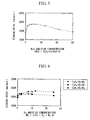
- FIG. 8 is a graph showing the relationship between the addition amount of nitrogen and the etching rate in Example 6.
-
- A fluorocarbon gas used in the present invention is represented by the general formula CvHxFyOz, wherein v is an integer from 1 to 5, x is selected from 0 and an integer from 1 to 3, y is an integer from 1 to 12, and z is selected from 0 and 1. The value of y is determined by the values of v, x, and z, and the molecular structure. Specifically, tetrafluoromethane (CF4), hexafluoroethane (C2F6), octafluoropropane (C3F8), octafluorocyclobutane (C4F8), hexafluoropropene (C3F6), octafluorocyclopentene (C5F8), hexafluorobutadiene (C4F6), hexafluoropropene oxide (C3F6O), trifluoromethane (CHF3), pentafluoroethane (C2HF5) are exemplified as the fluorocarbon gas. Among these compounds, hexafluoropropene which is a fluorocarbon gas having a double bond per molecule, hexafluoropropene oxide including an oxygen atom per molecule, etc., are preferable.
- Fluorocarbon gases having at least one double bond per molecule (unsaturated fluorocarbon gases) are considered to generally have a low etching rate; however, the etching rate can be increased by supplying radicals to the reaction environment which radicals react by addition reaction to the double bond per molecule. The double bond of the unsaturated fluorocarbon molecule has a high bond dissociation energy even though it has a low decomposition efficiency in plasma, and the chemical reactivity is high and reacts with various radicals at an extremely high rate. Applying these properties, the reaction environment which easily generates active species which contribute to the etching reaction can be obtained by adding gas having a reaction assist action to minimize the effect on the entire process. Furthermore, an effective plasma can be generated rapidly and the higher density active species can be produced by adding small quantities of gases of low breakdown voltage.
- When these kinds of fluorocarbon gases are used as cleaning gases, mixed gases of these fluorocarbon gases and oxygen gas are added with small quantities of gases having an action to increase the cleaning rate (or the etching rate) (which is the reaction assist action). The mixing ratio of fluorocarbon gases and oxygen gas is optional and the mixing ratio can be set properly depending on the type of the fluorocarbon gas.
- The addition gases having a reaction assist action indicates gases which easily generate radicals in plasma and gases having low breakdown voltage, and the gases which easily generate radicals in plasma indicate gases which easily generate F radicals, O radicals, and N radicals contributing to the etching reaction, specifically nitrogen trifluoride, fluorine, nitrous oxide, and the specific examples of the gases having low breakdown voltage are nitrogen and rare gasses (helium, neon, argon, krypton, xenon, and radon).
- FIG. 1 is a graph showing the bond dissociation energy of hexafluoroethane and hexafluoropropene as a fluorocarbon gas, oxygen included in a cleaning gas, nitrogen trifluoride, fluorine, and nitrous oxide. The bond dissociation energy of nitrogen trifluoride, fluorine, and nitrous oxide which are higher dissociation gases in comparison to fluorocarbon gases and oxygen gas are substantially lower than those of the fluorocarbon gases, and radicals can be produced effectively. For example, by adding small quantities of the high dissociation gas such as nitrogen trifluoride to hexafluoropropene, F radicals generated from nitrogen trifluoride in plasma reacted by addition reaction to the double bond of hexafluoropropene, and CvFy radicals are easily generated. CvFy radicals are an essential active species to promote the etching reaction and the etching reaction considerably easier than that in the case without adding nitrogen trifluoride.
- For example, when only hexafluoropropene is applied, two reactions which are the reaction generating radicals by the dissociation of the bonds of molecules and the reaction producing hexafluorocyclopropene by bond exchange reaction might compete and develop. The radical generation reaction can be said to be a generation reaction of precursors of F radicals which are the direct active species of etching of the silicone oxide film, and the radical generation reaction is a reaction which contributes to the etching reaction. Since the reaction producing hexafluorocyclopropene is a reaction which does not contribute to the etching reaction, the suppression of the reaction producing hexafluorocyclopropene is significantly important. By adding small quantities of nitrogen trifluoride, greater quantities of F radicals are supplied to the reaction environment, and instantly more quantities of C3F7 radicals which are the hexafluoropropene added by F radicals are generated, and then the effect that the generation reaction of hexafluorocyclopropene is substantively suppressed can be obtained.
- In the case of the other fluorocarbon gases, adding small quantities of gases having the reaction assist action (which are the addition gases) is effective in lowering the spark-over voltage without significant change of the chemical composition of the entire reaction system, making the density of etching active species such as excited molecules or radicals higher and this might result in the progress of the etching reaction, that is the progress of the cleaning, easy. The addition amount of the addition gases having the reaction assist action is no more than 10% of the total gas amount when it is used as a cleaning gas. When a greater amount of addition gas was added to the cleaning gas, the chemical composition of the entire reaction system is changed significantly and this is not preferable.
- The etching reaction progresses when nitrogen trifluoride or fluorine are used alone as a cleaning gas; however, the higher increasing effect of the etching reaction rate is obtained in the concentration range of the mixed gases of said fluorocarbon gases with small quantities of nitrogen trifluoride or fluorine in comparison to the etching performance with use of these gases alone.
- The cleaning gas may be mixed by regulating the flow rate of each gas of addition gases, fluorocarbon gases, and oxygen gas by the mass flowmeter when the gas was introduced into the semiconductor equipment, and the cleaning gas which was mixed preliminarily and filled in the high-pressure gas bottle and so on may be used. The etching reaction progresses by the plasma excitation of the gas applying the high frequency electromagnetic radiation (e.g. 13.56 MHz) in the processing chamber in which the cleaning gas is introduced.
- The cleaning performance was evaluated by using various composition of gases. The cleaning performance was evaluated by measuring the etching rate of a silicon oxide film by using a parallel plate-type plasma device. The conditions of cleaning were:
- thickness of silicon oxide film: 6000 Å (600 nm),
- high frequency power: 700 W,
- pressure in the chamber: 5.5 Torr (approximately 733 Pa),
- substrate temperature: 400°C, and
- total gas mass flow: 400 sccm.
-
- A mixed gas of nitrogen trifluoride and oxygen was used as a cleaning gas. The relationship of the measurement results between the concentration of nitrogen trifluoride and the etching rate is shown in FIG. 2. As is clear from the figure, the etching rate of the silicon oxide film tends to increase linearly in proportion to the concentration of nitrogen trifluoride.
- A mixed gas of each of hexafluoropropene, hexafluoroethane and hexafluoropropene oxide which are the fluorocarbon gases, and oxygen was used as a cleaning gas. The relationship of the measurement results between the concentration of each fluorocarbon gas and the etching rate is shown in FIG. 3.
- From FIG. 3, the etching rate of the silicon oxide film tends to maximize in the concentration from 15% to 20% in the case of hexafluoropropene. The etching rate of the silicon oxide film in the case of hexafluoroethane is almost double that in the case of hexafluoropropene, and that in the case of hexafluoropropene oxide is almost 1.7 times faster than that in the case of hexafluoropropene. Comparing the hexafluoropropene and hexafluoroethane, the bond dissociation energies are almost the same and the number of F atoms per molecule is the same, and the difference of the etching rate may be said to be huge, and the difference of the etching rate occurs due to the difference of the reactive process in the plasma.
- A mixed gas of hexafluoropropene and oxygen gas, to which is added nitrogen trifluoride, was used as a cleaning gas. The mixing ratio of hexafluoropropene and oxygen was based on 60 sccm: 340 sccm (the concentration of hexafluoropropene; 15%) and the amount of oxygen was reduced corresponding to the addition amount when nitrogen trifluoride was added. The relationship of the measurement results between the addition amount of nitrogen trifluoride and the etching rate is shown in FIG. 4.
- From FIG. 4, the etching rate of the silicon oxide film tends to increase according to the addition amount of nitrogen trifluoride. This tendency is remarkable in the range of small quantities addition amount under approximately 2.5 %. Comparing no addition of the addition gas and 2.5% addition, the etching rate is increased by 40%.
- Since the etching rate tends to increase linearly according to the concentration of nitrogen trifluoride, when a mixed cleaning gas of nitrogen trifluoride and oxygen is used without using hexafluoropropene, it can be determined that the acceleration action of the etching reaction has occurred in the system of hexafluoropropene + oxygen in the range of small quantities of the addition gas besides the etching action by nitrogen trifluoride alone.
- When more than 2.5% of nitrogen trifluoride is added, the increasing
tendency 5 of the etching rate declines up to 8%, above which it increases again. The etching promotion reaction of nitrogen trifluoride may be saturated between 2.5% and 8% and the etching rate may be increased by the action of a nitrogen trifluoride alone from 8% or above. - Accordingly, the addition of 8% or more of nitrogen trifluoride is preferable and the addition of 2.5% or less of nitrogen trifluoride in the system of hexafluoropropene + oxygen is more preferable considering the utilization rate as an addition gas. The increasing tendency of the etching rate by nitrogen trifluoride is due to the action of F radicals generated by the plasma decomposition of nitrogen trifluoride on hexafluoropropene and the same effect of nitrogen trifluoride is obtained in the case of fluorine.
- A mixed gas of hexafluoropropene and oxygen, to which is added nitrous oxide, was used as a cleaning gas. The mixing ratios of gases were the same as Example 1. The relationship of the measurement result of the addition amount of nitrous oxide and the etching rate is shown in FIG. 5.
- From FIG. 5, the etching rate of the silicon oxide film tends to increase with the addition of nitrous oxide up to 10 %, above which it decreases. 10% or less of the addition amount of nitrous oxide is then preferable.
- The increasing tendency of the etching rate is remarkable under the approximately addition range of 7.5% nitrous oxide and comparing no addition and the 7.5% addition, the etching rate is increased by 33%. Since nitrous oxide alone has no etching action to the silicone oxide film, the etching reaction accelerating action to the system of hexafluoropropene + oxygen is occurred in the 10% or less range of small quantities addition of nitrous oxide.
- Mixed gases of hexafluoropropene and oxygen, to which is added nitrogen or argon respectively, were used as cleaning gases. The relationship of the measurement result between each addition amounts of nitrogen and argon, and the etching rate is shown in FIG. 6.
- From FIG. 6, the etching rate of the silicon oxide film tends to increase by addition of nitrogen or argon or both. In the case of nitrogen, the increasing is remarkable under the approximately 10% addition range and comparing no addition and the 10% addition, the etching rate is increased by 23%. In the case of argon, the etching rate tends to increase gradually according to the addition amount and the 10% increase of the etching rate is observed at the 10% addition. This addition effect of argon resulted in the etching rate being lower than that of nitrogen. The spark-over voltage of nitrogen and argon is almost the same; however, due to the action of N2 radical or N radical is provided when nitrogen is added, for example, the reaction-active double bond of hexafluoropropene molecule act with these radicals, the effect to assist the active species generation reaction is assumed to be added. Since the etching reaction rate is decreased when the addition gas amount is above 10%, it is preferable to be 10% or less of the addition amount of nitrogen or argon considering the gas consumption effect.
- A mixed gas of hexafluoroethane and oxygen, to which is added nitrogen, is used as a cleaning gas. The etching rate by this cleaning gas had the same tendency of that of the cleaning gas of Example 3 to which is added argon, and 10% increase of the etching rate at 10% addition. Since hexafluoroethane has no reaction-active double bond per molecule, the effect of N2 radicals or N radicals cannot be obtained and it is interpreted that only the decreasing effect of the spark-over voltage appeared. In this case also, the etching reaction rate is decreased when above 10% of the addition gas amount and 10% or less addition of nitrogen is preferable considering the gas consumption effect.
- In both cases of Examples 3 and 4, since nitrogen alone or argon alone has no etching action to the silicon oxide film, it is supposed that the etching acceleration action in the system of hexafluoropropene + oxygen or the system of hexafluoroethane + oxygen in 10% or less addition of the small quantities of addition range occurred.
- The increasing ratios of the etching rate when 10% addition gases is added respectively in Examples 1 to 4 are shown collectively in FIG.7.
- A mixed gas of hexafluoropropene and oxygen, to which is added nitrogen and nitrogen trifluoride, is used as a cleaning gas. The etching rate of the silicon oxide film is measured at 5% addition amount of nitrogen and nitrogen trifluoride each. The etching rate is increased by 40% when the addition gas is nitrogen only, and is increased by 10% when the addition gas is nitrogen trifluoride only, and it is assumed that the effect of each addition gas is at least additive.
- A mixed gas of hexafluoropropene oxide and oxygen, to which is added nitrogen, was used as a cleaning gas. The relationship of the measurement result of the addition amount of nitrogen and the etching rate is indicated in FIG. 8.
- From FIG. 8, the etching rate of the silicon oxide film tends to increase with the addition of nitrogen up to 2.5%, above which it decreases. The increasing tendency of the etching rate was remarkable under the approximately 2.5% addition range of nitrogen addition amount, and comparing no addition and the 2.5% addition, the etching rate is increased by 6%.
- Since nitrogen alone has no etching action on silicon oxide film, it appears that the etching acceleration action to hexafluoropropene oxide + oxygen in the small quantities range of nitrogen addition occurred.
- While preferred embodiments of the invention have been described and illustrated above, it should be understood that these are exemplary of the invention and are not to be considered as limiting. Additions, omissions, substitutions, and other modifications can be made without departing from the spirit or scope of the present invention. Accordingly, the invention is not to be considered as being limited by the foregoing description, and is only limited by the scope of the appended claims.
Claims (3)
- A cleaning gas to remove deposits accumulated inside a semiconductor film forming device, comprising:a fluorocarbon gas represented by the general formula
oxygen, and
at least one selected from nitrogen trifluoride, fluorine, nitrous oxide, nitrogen, and rare gases up to 10% by volume based on a total gas volume. - The cleaning gas according to claim 1, which the fluorocarbon gas has at least one double bond per molecule.
- A cleaning method to remove deposits accumulated inside a semiconductor film forming device, comprising:a step of introducing at least one cleaning gas selected from a gas according to claim 1 and 2 into the semiconductor film forming device, anda step of plasma excitation of the cleaning gas by impressing high frequency electromagnetic radiation.
Applications Claiming Priority (2)
| Application Number | Priority Date | Filing Date | Title |
|---|---|---|---|
| JP2003374160 | 2003-11-04 | ||
| JP2003374160A JP2005142198A (en) | 2003-11-04 | 2003-11-04 | Cleaning gas and cleaning method |
Publications (2)
| Publication Number | Publication Date |
|---|---|
| EP1529854A1 true EP1529854A1 (en) | 2005-05-11 |
| EP1529854B1 EP1529854B1 (en) | 2008-12-24 |
Family
ID=34431252
Family Applications (1)
| Application Number | Title | Priority Date | Filing Date |
|---|---|---|---|
| EP04256591A Expired - Lifetime EP1529854B1 (en) | 2003-11-04 | 2004-10-26 | Cleaning gas mixture for an apparatus and cleaning method |
Country Status (7)
| Country | Link |
|---|---|
| US (1) | US20050096238A1 (en) |
| EP (1) | EP1529854B1 (en) |
| JP (1) | JP2005142198A (en) |
| KR (1) | KR20050043601A (en) |
| CN (1) | CN1614092A (en) |
| DE (1) | DE602004018595D1 (en) |
| TW (1) | TW200516138A (en) |
Cited By (1)
| Publication number | Priority date | Publication date | Assignee | Title |
|---|---|---|---|---|
| WO2015103003A1 (en) * | 2013-12-30 | 2015-07-09 | E. I. Du Pont De Nemours And Company | Chamber cleaning and semiconductor etching gases |
Families Citing this family (10)
| Publication number | Priority date | Publication date | Assignee | Title |
|---|---|---|---|---|
| US8317929B2 (en) * | 2005-09-16 | 2012-11-27 | Asml Netherlands B.V. | Lithographic apparatus comprising an electrical discharge generator and method for cleaning an element of a lithographic apparatus |
| US20080153040A1 (en) * | 2006-12-21 | 2008-06-26 | Elpida Memory, Inc. | Method for processing semiconductor wafer |
| JP2008235562A (en) * | 2007-03-20 | 2008-10-02 | Taiyo Nippon Sanso Corp | Cleaning method for plasma CVD film forming apparatus |
| JP5214316B2 (en) * | 2008-04-22 | 2013-06-19 | 大陽日酸株式会社 | Cleaning method of plasma film forming apparatus |
| CN101783296B (en) * | 2009-01-20 | 2011-09-14 | 中芯国际集成电路制造(上海)有限公司 | Forming method of grid electrode side wall layer |
| JP5442403B2 (en) | 2009-11-18 | 2014-03-12 | 東京エレクトロン株式会社 | Substrate processing apparatus, cleaning method therefor, and recording medium recording program |
| JP5691163B2 (en) * | 2009-12-01 | 2015-04-01 | セントラル硝子株式会社 | Cleaning gas |
| JP5953681B2 (en) | 2011-09-09 | 2016-07-20 | イビデン株式会社 | Method for manufacturing printed wiring board |
| JP2017050413A (en) * | 2015-09-02 | 2017-03-09 | 日本ゼオン株式会社 | Plasma etching method |
| US12628589B2 (en) | 2023-02-24 | 2026-05-12 | L'Air Liquide, Societé´ Anonyme pour l'Etude et l'Exploitation des Procédés Georges Claude | Etching method using oxygen-containing hydrofluorocarbon |
Citations (4)
| Publication number | Priority date | Publication date | Assignee | Title |
|---|---|---|---|---|
| EP0464696A1 (en) * | 1990-06-29 | 1992-01-08 | Applied Materials, Inc. | Two-step reactor chamber self cleaning process |
| EP0924282A1 (en) * | 1997-12-18 | 1999-06-23 | Central Glass Company, Limited | Gas for removing a deposit and its use |
| US6242359B1 (en) * | 1997-08-20 | 2001-06-05 | Air Liquide America Corporation | Plasma cleaning and etching methods using non-global-warming compounds |
| EP1318542A1 (en) * | 2000-09-11 | 2003-06-11 | Research Institute of Innovative Technology for the Earth | Cleaning gasses and etching gases |
Family Cites Families (15)
| Publication number | Priority date | Publication date | Assignee | Title |
|---|---|---|---|---|
| US5158644A (en) * | 1986-12-19 | 1992-10-27 | Applied Materials, Inc. | Reactor chamber self-cleaning process |
| US6047713A (en) * | 1994-02-03 | 2000-04-11 | Applied Materials, Inc. | Method for cleaning a throttle valve |
| US5741577A (en) * | 1994-11-10 | 1998-04-21 | Kao Corporation | Magnetic recording medium having a lubricant layer with a specified structure of a specified perfluoropolyether lubricant |
| US6060397A (en) * | 1995-07-14 | 2000-05-09 | Applied Materials, Inc. | Gas chemistry for improved in-situ cleaning of residue for a CVD apparatus |
| US5647953A (en) * | 1995-12-22 | 1997-07-15 | Lam Research Corporation | Plasma cleaning method for removing residues in a plasma process chamber |
| JPH1027781A (en) * | 1996-07-10 | 1998-01-27 | Daikin Ind Ltd | Etching gas and cleaning gas |
| US6401728B2 (en) * | 1999-03-01 | 2002-06-11 | United Microelectronics Corp. | Method for cleaning interior of etching chamber |
| TWI291201B (en) * | 2000-07-18 | 2007-12-11 | Showa Denko Kk | Cleaning gas for semiconductor production equipment |
| US6569257B1 (en) * | 2000-11-09 | 2003-05-27 | Applied Materials Inc. | Method for cleaning a process chamber |
| US6585830B2 (en) * | 2000-11-30 | 2003-07-01 | Agere Systems Inc. | Method for cleaning tungsten from deposition wall chambers |
| US6584987B1 (en) * | 2001-03-16 | 2003-07-01 | Taiwan Semiconductor Manufacturing Company | Method for improved cleaning in HDP-CVD process with reduced NF3 usage |
| JP2002359229A (en) * | 2001-06-01 | 2002-12-13 | Mitsubishi Electric Corp | Semiconductor device manufacturing method and semiconductor device manufacturing apparatus |
| US20020185067A1 (en) * | 2001-06-07 | 2002-12-12 | International Business Machines Corporation | Apparatus and method for in-situ cleaning of a throttle valve in a CVD system |
| US6846749B1 (en) * | 2001-06-25 | 2005-01-25 | Advanced Micro Devices, Inc. | N-containing plasma etch process with reduced resist poisoning |
| US6767836B2 (en) * | 2002-09-04 | 2004-07-27 | Asm Japan K.K. | Method of cleaning a CVD reaction chamber using an active oxygen species |
-
2003
- 2003-11-04 JP JP2003374160A patent/JP2005142198A/en active Pending
-
2004
- 2004-06-16 TW TW093117278A patent/TW200516138A/en unknown
- 2004-07-08 KR KR1020040052952A patent/KR20050043601A/en not_active Withdrawn
- 2004-08-11 CN CNA2004100584288A patent/CN1614092A/en active Pending
- 2004-10-22 US US10/969,990 patent/US20050096238A1/en not_active Abandoned
- 2004-10-26 DE DE602004018595T patent/DE602004018595D1/en not_active Expired - Fee Related
- 2004-10-26 EP EP04256591A patent/EP1529854B1/en not_active Expired - Lifetime
Patent Citations (4)
| Publication number | Priority date | Publication date | Assignee | Title |
|---|---|---|---|---|
| EP0464696A1 (en) * | 1990-06-29 | 1992-01-08 | Applied Materials, Inc. | Two-step reactor chamber self cleaning process |
| US6242359B1 (en) * | 1997-08-20 | 2001-06-05 | Air Liquide America Corporation | Plasma cleaning and etching methods using non-global-warming compounds |
| EP0924282A1 (en) * | 1997-12-18 | 1999-06-23 | Central Glass Company, Limited | Gas for removing a deposit and its use |
| EP1318542A1 (en) * | 2000-09-11 | 2003-06-11 | Research Institute of Innovative Technology for the Earth | Cleaning gasses and etching gases |
Non-Patent Citations (1)
| Title |
|---|
| OH C H ET AL: "Increase of cleaning rate and reduction in global warming effect during C4F8O/O2 remote plasma cleaning of silicon nitride by adding NO and N2O", THIN SOLID FILMS - PREPARATION AND CHARACTERIZATION, ELSEVIER SEQUOIA, NL, vol. 435, no. 1-2, 1 July 2003 (2003-07-01), pages 264 - 269, XP004431367, ISSN: 0040-6090 * |
Cited By (2)
| Publication number | Priority date | Publication date | Assignee | Title |
|---|---|---|---|---|
| WO2015103003A1 (en) * | 2013-12-30 | 2015-07-09 | E. I. Du Pont De Nemours And Company | Chamber cleaning and semiconductor etching gases |
| US10109496B2 (en) | 2013-12-30 | 2018-10-23 | The Chemours Company Fc, Llc | Chamber cleaning and semiconductor etching gases |
Also Published As
| Publication number | Publication date |
|---|---|
| DE602004018595D1 (en) | 2009-02-05 |
| KR20050043601A (en) | 2005-05-11 |
| EP1529854B1 (en) | 2008-12-24 |
| US20050096238A1 (en) | 2005-05-05 |
| CN1614092A (en) | 2005-05-11 |
| TW200516138A (en) | 2005-05-16 |
| JP2005142198A (en) | 2005-06-02 |
Similar Documents
| Publication | Publication Date | Title |
|---|---|---|
| US4465552A (en) | Method of selectively etching silicon dioxide with SF6 /nitriding component gas | |
| JP6788177B2 (en) | Dry etching method, dry etching agent and semiconductor device manufacturing method | |
| EP1529854B1 (en) | Cleaning gas mixture for an apparatus and cleaning method | |
| JP2009033202A (en) | Method for removing material having a high dielectric constant from a deposition chamber | |
| JP6544215B2 (en) | Dry etching method | |
| JP2024016143A (en) | Dry etching method, dry etching agent, and its storage container | |
| WO2020195559A1 (en) | Dry etching method and method for producing semiconductor device | |
| TWI291201B (en) | Cleaning gas for semiconductor production equipment | |
| JP5214316B2 (en) | Cleaning method of plasma film forming apparatus | |
| CN101163816A (en) | Remote chamber method for removing surface deposits | |
| JP2007531289A (en) | Remote chamber method for removing surface deposits | |
| EP3432346A1 (en) | Plasma etching method | |
| WO2003054247A2 (en) | Cleaning gas composition for semiconductor production equipment and cleaning method using the gas | |
| CN1154159C (en) | Method for ashing organic matter from a substrate | |
| Park et al. | An Alternative PECVD Chamber Cleaning Gas of COF2 for Low-GWP Consideration | |
| JP2008235562A (en) | Cleaning method for plasma CVD film forming apparatus | |
| Allgood | Fluorocarbon process gases in microelectronics | |
| US20060144819A1 (en) | Remote chamber methods for removing surface deposits | |
| Kaler | Etching of Silicon, Silicon Nitride, and Atomic Layer Etching of Silicon Dioxide using Inductively Coupled Plasma Beams | |
| WO2023074511A1 (en) | Etching gas and etching method using same | |
| JP2002198357A (en) | Cleaning gas and cleaning method for semiconductor manufacturing apparatus | |
| JP2006049585A (en) | Chamber cleaning method | |
| WO2025121309A1 (en) | Etching method | |
| JP2025135617A (en) | Etching gas | |
| HK1119209A (en) | Remote chamber methods for removing surface deposits |
Legal Events
| Date | Code | Title | Description |
|---|---|---|---|
| PUAI | Public reference made under article 153(3) epc to a published international application that has entered the european phase |
Free format text: ORIGINAL CODE: 0009012 |
|
| AK | Designated contracting states |
Kind code of ref document: A1 Designated state(s): AT BE BG CH CY CZ DE DK EE ES FI FR GB GR HU IE IT LI LU MC NL PL PT RO SE SI SK TR |
|
| AX | Request for extension of the european patent |
Extension state: AL HR LT LV MK |
|
| 17P | Request for examination filed |
Effective date: 20050801 |
|
| AKX | Designation fees paid |
Designated state(s): DE FR GB |
|
| GRAP | Despatch of communication of intention to grant a patent |
Free format text: ORIGINAL CODE: EPIDOSNIGR1 |
|
| GRAS | Grant fee paid |
Free format text: ORIGINAL CODE: EPIDOSNIGR3 |
|
| GRAA | (expected) grant |
Free format text: ORIGINAL CODE: 0009210 |
|
| AK | Designated contracting states |
Kind code of ref document: B1 Designated state(s): DE FR GB |
|
| REG | Reference to a national code |
Ref country code: GB Ref legal event code: FG4D |
|
| REF | Corresponds to: |
Ref document number: 602004018595 Country of ref document: DE Date of ref document: 20090205 Kind code of ref document: P |
|
| PLBE | No opposition filed within time limit |
Free format text: ORIGINAL CODE: 0009261 |
|
| STAA | Information on the status of an ep patent application or granted ep patent |
Free format text: STATUS: NO OPPOSITION FILED WITHIN TIME LIMIT |
|
| 26N | No opposition filed |
Effective date: 20090925 |
|
| REG | Reference to a national code |
Ref country code: FR Ref legal event code: ST Effective date: 20100630 |
|
| PG25 | Lapsed in a contracting state [announced via postgrant information from national office to epo] |
Ref country code: FR Free format text: LAPSE BECAUSE OF NON-PAYMENT OF DUE FEES Effective date: 20091102 Ref country code: DE Free format text: LAPSE BECAUSE OF NON-PAYMENT OF DUE FEES Effective date: 20100501 |
|
| PG25 | Lapsed in a contracting state [announced via postgrant information from national office to epo] |
Ref country code: GB Free format text: LAPSE BECAUSE OF NON-PAYMENT OF DUE FEES Effective date: 20091026 |