EP1528709A2 - Kommunikationsnetzelement und Verfahren zur Aktualisierung von Überwachungsfunktionen - Google Patents
Kommunikationsnetzelement und Verfahren zur Aktualisierung von Überwachungsfunktionen Download PDFInfo
- Publication number
- EP1528709A2 EP1528709A2 EP04105420A EP04105420A EP1528709A2 EP 1528709 A2 EP1528709 A2 EP 1528709A2 EP 04105420 A EP04105420 A EP 04105420A EP 04105420 A EP04105420 A EP 04105420A EP 1528709 A2 EP1528709 A2 EP 1528709A2
- Authority
- EP
- European Patent Office
- Prior art keywords
- functionality
- network
- circuitry
- monitoring
- measurement
- Prior art date
- Legal status (The legal status is an assumption and is not a legal conclusion. Google has not performed a legal analysis and makes no representation as to the accuracy of the status listed.)
- Withdrawn
Links
- 238000012544 monitoring process Methods 0.000 title claims abstract description 46
- 238000004891 communication Methods 0.000 title claims description 30
- 238000000034 method Methods 0.000 title claims description 20
- 238000003860 storage Methods 0.000 claims description 16
- 238000005259 measurement Methods 0.000 abstract description 95
- 230000006870 function Effects 0.000 abstract description 5
- 238000012545 processing Methods 0.000 description 21
- 230000015654 memory Effects 0.000 description 13
- 238000013461 design Methods 0.000 description 5
- 230000007246 mechanism Effects 0.000 description 5
- 238000013459 approach Methods 0.000 description 4
- 238000010586 diagram Methods 0.000 description 4
- 230000008569 process Effects 0.000 description 4
- 230000005540 biological transmission Effects 0.000 description 3
- 239000003795 chemical substances by application Substances 0.000 description 3
- 238000011161 development Methods 0.000 description 3
- 230000018109 developmental process Effects 0.000 description 3
- 238000001914 filtration Methods 0.000 description 3
- 239000000523 sample Substances 0.000 description 3
- 230000008901 benefit Effects 0.000 description 2
- 238000005516 engineering process Methods 0.000 description 2
- 230000017525 heat dissipation Effects 0.000 description 2
- 238000011065 in-situ storage Methods 0.000 description 2
- 230000003287 optical effect Effects 0.000 description 2
- 230000008672 reprogramming Effects 0.000 description 2
- 101150012579 ADSL gene Proteins 0.000 description 1
- 102100020775 Adenylosuccinate lyase Human genes 0.000 description 1
- 108700040193 Adenylosuccinate lyases Proteins 0.000 description 1
- 230000008859 change Effects 0.000 description 1
- 238000005314 correlation function Methods 0.000 description 1
- 238000011982 device technology Methods 0.000 description 1
- 239000012530 fluid Substances 0.000 description 1
- 239000012634 fragment Substances 0.000 description 1
- 230000003116 impacting effect Effects 0.000 description 1
- 238000010348 incorporation Methods 0.000 description 1
- 238000009434 installation Methods 0.000 description 1
- 238000012986 modification Methods 0.000 description 1
- 230000004048 modification Effects 0.000 description 1
- 238000012806 monitoring device Methods 0.000 description 1
- 230000006855 networking Effects 0.000 description 1
- 239000013307 optical fiber Substances 0.000 description 1
- 230000037361 pathway Effects 0.000 description 1
- 238000011160 research Methods 0.000 description 1
Images



Classifications
-
- H—ELECTRICITY
- H04—ELECTRIC COMMUNICATION TECHNIQUE
- H04L—TRANSMISSION OF DIGITAL INFORMATION, e.g. TELEGRAPHIC COMMUNICATION
- H04L43/00—Arrangements for monitoring or testing data switching networks
- H04L43/08—Monitoring or testing based on specific metrics, e.g. QoS, energy consumption or environmental parameters
- H04L43/0805—Monitoring or testing based on specific metrics, e.g. QoS, energy consumption or environmental parameters by checking availability
- H04L43/0817—Monitoring or testing based on specific metrics, e.g. QoS, energy consumption or environmental parameters by checking availability by checking functioning
-
- H—ELECTRICITY
- H04—ELECTRIC COMMUNICATION TECHNIQUE
- H04L—TRANSMISSION OF DIGITAL INFORMATION, e.g. TELEGRAPHIC COMMUNICATION
- H04L41/00—Arrangements for maintenance, administration or management of data switching networks, e.g. of packet switching networks
- H04L41/08—Configuration management of networks or network elements
- H04L41/0803—Configuration setting
- H04L41/0813—Configuration setting characterised by the conditions triggering a change of settings
- H04L41/082—Configuration setting characterised by the conditions triggering a change of settings the condition being updates or upgrades of network functionality
-
- H—ELECTRICITY
- H04—ELECTRIC COMMUNICATION TECHNIQUE
- H04L—TRANSMISSION OF DIGITAL INFORMATION, e.g. TELEGRAPHIC COMMUNICATION
- H04L43/00—Arrangements for monitoring or testing data switching networks
- H04L43/10—Active monitoring, e.g. heartbeat, ping or trace-route
Definitions
- This invention relates to communications network elements and methods of monitoring communications networks.
- Measurement solutions based primarily on software controlling commodity hardware, such as standard general-purpose personal computers (PCs), can provide a highly flexible design.
- Some form of filtering is performed (e.g. by dedicated programs that run at a low level within the operating system of the device) on network traffic captured via a network interface.
- the filtered data are passed to measurement software modules running at higher levels of the operating system.
- New protocols and measurements can easily be added through software upgrades. It is also possible to store large suites of measurements on the main storage (e.g. magnetic hard disk) of such a device.
- a dedicated hardware-only solution typically has sufficient performance to measure high-speed links, but generally lacks flexibility.
- Hardware-based solutions are very difficult to change after they have been manufactured. At the very least such hardware must generally be returned to the factory or a service outlet for upgrading and installation of new protocols or additional measurements.
- Hybrid approaches attempt to resolve this dilemma by selecting the most appropriate hardware and software components for the task at hand. However, these tend to be even more costly. A solution that contains the best software and hardware options is inherently less cost-effective. This hybrid approach also suffers the same constraints as predominantly software-based systems, i.e. power inefficiency, cost, heat dissipation and large physical size.
- a solution is highly desirable that delivers the optimum amount of measurement capability to perform the particular analysis the user desires, on the specific data the user wishes to analyze, just when the user requires it, without sacrificing functionality. Flexibility therefore continues to be of paramount importance.
- measurement systems will, by necessity, become more hardware oriented: recent massive increases in link speeds make this inevitable.
- Dedicated hardware offers the opportunity to re-design probes so that costs, scale, data rate and heat dissipation issues can be addressed.
- PBXs private branch exchanges
- Agilent Technologies, Inc. involves incorporating measurement functionality in a router's line cards - see European patent application EP 1 152 570.
- Embedding measurement functionality in network equipment has the added advantage that measurements can become pervasive: anywhere and at anytime. The associated devices have a small physical footprint, consume little power and could be relatively inexpensive. This presents a very powerful set of features that could make large-scale measurement of the operation of systems such as the Internet a realistic possibility.
- embedded devices are ideal for large-scale, cost-effective measurement solutions, such as described in EP 1 152 570.
- the embedding of measurement devices into routers is likely to be just a beginning; conceivably all network elements could eventually contain similar functionality.
- the utility of embedded devices will be severely limited without the ability to add new measurements, support new protocols and maximize the limited storage resources of those devices.
- a communications network element comprising:
- a method of monitoring operation of a communications network comprising:
- One embodiment of the invention takes the form of ahardware-based programmable device, using a Field Programmable Gate Array (FPGA) component or similar, that can be embedded within a network element such as a router.
- FPGA Field Programmable Gate Array
- the device has relatively low cost, low power consumption and small size, thus conforming to the requirements for use in a system such as that described in EP 1 152 570, but also provides a level of flexibility normally associated with software-based solutions.
- Such an embedded device may only have a limited amount of concurrent measurement ability, but being a predominantly hardware solution it is able to process incoming packets at line speed.
- the device is reprogrammable, it can offer a wide selection of measurements through downloading of different or new measurements on demand.
- the same programming mechanism enables deployed devices to be upgraded with the same ease as existing software-based solutions.
- Another embodiment of the invention takes the form of a software programmable device using a "network processor", that is a a software programmable processor with architectural features and/or special circuitry optimized for the particular application domain of packet processing.
- This device can be embedded within a network element such as a router.
- Network processors contain dedicated hardware, including for example processing engines with instruction sets dedicated to manipulating networking packets and optimized to run at line speed. As these processing engines are reprogrammable they can support a wide selection of measurements through downloading of different or new measurement algorithms on demand. Furthermore, the programming mechanism enables deployed devices to be upgraded with the same ease as existing software-based solutions.
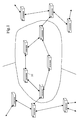
- a notional fragment of the Internet comprising multiple routers such as 10 interconnected to provide multiple (typically redundant) pathways for data packets traversing the network.
- Each data packet includes a header identifying an intermediate or final destination in the network for that packet.
- a router receives a packet it inspects the header and uses current knowledge of the adjacent network topology, acquired by means of network protocols cooperatively implemented by the routers, to determine which of the adjacent routers the packet should next be forwarded to towards its ultimate destination.
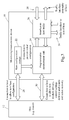
- the router 10 is shown in more detail in Figure 2 and contains a plurality of line or channel cards 12, each of which can handle transmission and reception of signals over several (e.g. four) data links implemented for example as optical fibre cables. To this end the line cards 12 have optical network connectors 14.
- the manner in which the router 10 provides its network operation functionality is conventional and need not be described further here.
- Each line card also has a monitor port 16, for exchanging data, including for example packet headers, with a monitoring and measurement data processing device 18.
- This device additionally has a separate communication port 20 (e.g. an Ethernet port) through which the device 18 can receive instructions and transmit monitoring and measurement data it has derived in respect of packets handled by the router 10. Further details of the implementation of the router 10, and of specific measurement and monitoring functionality that may be implemented in the monitoring/measurement device 18, are given in the above-mentioned EP 1 152 570.
- the device 18 contains a non-volatile memory 22, a programmable measurement unit 24 (such as an FPGA) that provides monitoring and/or measurement functionality, and an interface unit 26 coupled to the monitor ports 16 and the communication port 20.
- Software program instructions stored in the measurement unit FPGA 24 control processing circuits also provided therein to provide desired functionality to monitor and/or measure parameters of the network packet data provided to the FPGA via the monitor ports 16. Additional connections 28 and 30 between the FPGA 24 and the router 12 enable the program instructions defining the functionality of the FPGA 24 to be modified and updated as required.
- the base configuration for the FPGA 24 is stored in the non-volatile memory 22, and is thus always available in the event that, for example, a system restore is necessary. Complete upgrades can be applied by reprogramming this memory in situ using a dedicated cable or via a connection to a host controller.
- the initial base configuration stored in the memory 22 provides the main skeleton of functionality for the FPGA 24. For example, it contains code that allows new functionality modules to be downloaded and authenticated. In the example shown in Figure 3 the code also includes a download controller and a section of memory (transit site) that provides a temporary storage location for the measurement modules.
- the overall design of this unit is similar to that described in EP 1 152 570.
- the measurement unit 24 is connected to the host device's packet interface, for example the line card framer; it can inject active packets into the data stream leaving the host device 12 and it can also passively monitor arriving packet data.
- the measurement unit 24 could also be connected to the host device's shared backplane, for example a router's main packet bus. Connections can likewise be made to the host controller via the same backplane. In a router this controller would typically be a general-purpose processor that is used for the router's own configuration, command and control and for executing routing algorithms.
- a connection to the backplane also allows downloading of measurement modules and uploading of results for further processing and analysis.
- results can be extracted from the general-purpose processor by using existing standard mechanisms such as SNMP or via some form of inter-process communication such as CORBA, Java RMI or RPC.
- FPGA field-programmable gate array
- FPGAs that are now commercially available (such as the Virtex II series from Xilinx Inc.) support a process known as partial reconfiguration. This process allows pre-designated areas of the FPGA (sometimes known as modules) to be reprogrammed while the remainder of the chip is still actively functioning. Using this technique it is possible to load and unload different sections or blocks of program logic as required.
- the blocks of functionality can designed so that they can be changed 'on-the-fly' without impacting the rest of the FPGA's operation.
- the blocks of functionality can be subdivided into typical tasks performed by a measurement unit. These tasks include filtering, counting, timestamping or packet classification. At a more abstract level different blocks of functionality could be produced to support different protocols or classes of measurement.
- Simple configuration information can also be downloaded using the more traditional technique of setting predefined registers at known locations within the different measurement modules. Similarly results can be exported by setting and reading internal registers in a predefined area on the FPGA 24.
- the host 12 is, for example, a router
- re-use of much of the existing router infrastructure for measurement control and results storage can also be made. This would reduce the overall cost of the device 18 when compared to traditional instrument or probe approaches that require on-system processing to control hardware and store results.
- the measurement functionality implemented may be part of a suite of tools that are provided with each device.
- Each measurement function is defined as a binary data file in an appropriate FPGA format.
- the measurement functionality can be loaded into the device using known mobile software object techniques. Examples of this process used for on-the-fly loading of measurement code are given in "Efficient Network Monitoring using Mobile Agents", A. Liotta, G. Knight & G. Pavlou, Research Note RN/99/6, Department of Computer Science, University College London, London, Jan 1999 and in "Exploiting Code Mobility in Decentralized and Flexible Network Management", M. Baldi, S. Gai & G. P. Picco, First International Workshop on Mobile Agents 97 (MA '97), Berlin, Germany, Apr 1997, K.
- modules on site adjacent the router 10 may become possible to produce modules on site adjacent the router 10; this might be done, for example, using a high-level programming language or a graphical tool to provide a conveniently formatted measurement description that can be converted and compiled into the necessary binary data.
- Figure 4 shows the internal architecture of an exemplary implementation of the measurement unit FPGA 24.
- the FPGA can be initialized with the modules 32A to 32N either empty or with some or all containing a default set of measurement functionalities. Interfaces or connections 34 and 36 between these zones and the rest of the FPGA are also predefined.
- the connections include paths for outbound results, for inbound packet data intended for passive traffic monitoring, and for outbound packet data for active (intrusive) measurements. Results are stored in an intermediate memory 38 so that if the host's main processor is busy the limited storage within each measurement block or section is not exhausted and information is not lost before the results are forwarded.
- Program modules are stored on the host device's central general-purpose processor or on a centralized, possibly dedicated, control server.
- the measurement modules are downloaded to each measurement unit FPGA in binary format, wrapped within normal packets traveling through the network, or if local, through the host system's backplane or bus. A combination of local and network transmission can be used if an external server is being used to store the measurement modules.
- the FPGA's partial reprogramming mechanism is then used, under the control of a controller 40, to load the measurement module into a predefined transit area on the FPGA.
- the measurement module is hot-swapped into the appropriate receiving site 32A to 32D and executed, under the supervision of a second controller 42. Any existing code at that site is discarded once any remaining results generated by it have been retrieved.
- the new measurement functionality is now being executed and will start to place results into the intermediate results storage area 38.
- An alternative method of partial reconfiguration is to use a soft-core processor, i.e. standard general-purpose microprocessor functionality implemented using the FPGA's own logic.
- a soft-core processor requires software programming will typically run more slowly and consume more resources (FPGA gates) than dedicated logic.
- FPGA gates resources
- a hybrid approach may also be possible using the combination of a soft-core processor and more traditional programmed logic.
- FPGA device technology incorporates a built-in general-purpose processor as well as a block of normal FPGA logic gates. Such a device is likely to be more costly than standard FPGAs. However, it does offer an alternative path for programmable measurement devices, supporting a hybrid hardware and software approach to implementing highly flexible cost-effective embedded measurement systems.
- a system-on-a-chip solution might be applicable to network-edge network elements that do not have any existing support infrastructure like that typically found on a router. Command-and-control and result correlation functions will always be required and without access to any external infrastructure, an on-device CPU may in some circumstances be economically viable in the context of the host system.
- the programmable measurement unit 24 shown in Figure 3 can also be implemented using a network processor rather than an FPGA.
- a network processor is a hardware unit designed to be controlled by programmable software instructions, with an architecture optimized for packet processing at very high rates.
- Network processors typically have several separate processing elements, which have individual program store memories, and an overall general-purpose processor which acts as a system controller with its own program, providing management and control over the operation of the processing elements.
- the functionality required in the measurement device 18 can be subdivided into distinct individual tasks commonly performed by any network measurement unit. These tasks include filtering, counting, timestamping or packet classification. At a more abstract level different blocks or sections of functionality could be produced to support different protocols or classes of measurement.
- Simple configuration information can also be downloaded using the more traditional technique of setting predefined registers at known locations within memory accessible by the different processing elements acting as measurement modules. Similarly results can be exported by setting and reading memory locations in a predefined area of the memory.
- the measurement functionality implemented initially may be part of a suite of tools that are provided with each device.
- Each measurement function is defined as a binary data file in an appropriate network processor processing element format.
- the measurement functionality can be loaded into the device using known mobile software object techniques, as described in the references cited above.
- Figure 5 shows the internal architecture of an exemplary implementation of the measurement unit 24 using a network processor.
- the network processor can be initialized with the processing elements 44A to 44N either unallocated or with some or all allocated to a default set of measurement functionalities.
- Logical interfaces or connections 46 between the processing elements and the rest of the network processor are also predefined. The connections include paths for outbound results, for inbound packet data intended for passive traffic monitoring, and for outbound packet data for active (intrusive) measurements. Results are stored in a memory (RAM) 48 coupled to the network processor, so that if the host's main processor is busy the limited storage within each processing element is not exhausted and information is not lost before the results are forwarded.
- RAM memory
- Program modules are stored on the host device's central general-purpose processor or on a centralized, possibly dedicated, control server.
- the program modules are downloaded to each measurement unit processing element in binary format, wrapped within normal packets traveling through the network, or if local, through the host system's backplane or bus. A combination of local and network transmission can be used if an external server is being used to store the measurement modules.
- Logical control functionality 50 implemented by appropriate programming of the network processor's general-purpose processor, coordinates downloading of the new measurement module binary program files into a "transit" area in the logical controller memory space. Once the download is complete and the new measurement code has successfully passed security and authentication checks, each new measurement module is loaded into the appropriate processing element 44A to 44N and executed, under the supervision of the logical controller 50. Any existing code for that processing element is discarded once any remaining results generated by it have been retrieved. The new measurement functionality is now being executed and will start to place results into the intermediate results memory 48.
Landscapes
- Engineering & Computer Science (AREA)
- Environmental & Geological Engineering (AREA)
- Computer Networks & Wireless Communication (AREA)
- Signal Processing (AREA)
- Data Exchanges In Wide-Area Networks (AREA)
- Computer And Data Communications (AREA)
- Stored Programmes (AREA)
- Maintenance And Management Of Digital Transmission (AREA)
Applications Claiming Priority (2)
| Application Number | Priority Date | Filing Date | Title |
|---|---|---|---|
| GB0325307 | 2003-10-30 | ||
| GB0325307A GB2407730A (en) | 2003-10-30 | 2003-10-30 | Programmable network monitoring element |
Publications (2)
| Publication Number | Publication Date |
|---|---|
| EP1528709A2 true EP1528709A2 (de) | 2005-05-04 |
| EP1528709A3 EP1528709A3 (de) | 2005-05-11 |
Family
ID=29725612
Family Applications (1)
| Application Number | Title | Priority Date | Filing Date |
|---|---|---|---|
| EP04105420A Withdrawn EP1528709A3 (de) | 2003-10-30 | 2004-10-29 | Kommunikationsnetzelement und Verfahren zur Aktualisierung von Überwachungsfunktionen |
Country Status (4)
| Country | Link |
|---|---|
| US (1) | US8140662B2 (de) |
| EP (1) | EP1528709A3 (de) |
| CN (1) | CN1612535A (de) |
| GB (1) | GB2407730A (de) |
Cited By (4)
| Publication number | Priority date | Publication date | Assignee | Title |
|---|---|---|---|---|
| CN101291546B (zh) * | 2008-06-11 | 2011-09-14 | 清华大学 | 核心路由器交换结构协处理器 |
| US8855120B2 (en) | 2009-12-21 | 2014-10-07 | Cisco Technology, Inc. | Method and device for filtering media packets |
| EP2974140A4 (de) * | 2013-03-14 | 2016-09-21 | Exfo Inc | Durchgangstestvorrichtung |
| CN107632865A (zh) * | 2017-10-24 | 2018-01-26 | 新华三技术有限公司 | 一种fpga配置升级方法及装置 |
Families Citing this family (11)
| Publication number | Priority date | Publication date | Assignee | Title |
|---|---|---|---|---|
| US9148341B2 (en) * | 2012-03-26 | 2015-09-29 | Jds Uniphase Corporation | Upgrading a programmable logic gate array in an in-service pluggable transceiver |
| US9544273B2 (en) | 2012-07-31 | 2017-01-10 | Trend Micro Incorporated | Network traffic processing system |
| US10270709B2 (en) | 2015-06-26 | 2019-04-23 | Microsoft Technology Licensing, Llc | Allocating acceleration component functionality for supporting services |
| US10802723B1 (en) * | 2013-02-27 | 2020-10-13 | Altera Corporation | Apparatus and method for fast-path memory operations |
| US9792154B2 (en) | 2015-04-17 | 2017-10-17 | Microsoft Technology Licensing, Llc | Data processing system having a hardware acceleration plane and a software plane |
| US10511478B2 (en) | 2015-04-17 | 2019-12-17 | Microsoft Technology Licensing, Llc | Changing between different roles at acceleration components |
| US10198294B2 (en) | 2015-04-17 | 2019-02-05 | Microsoft Licensing Technology, LLC | Handling tenant requests in a system that uses hardware acceleration components |
| US10296392B2 (en) | 2015-04-17 | 2019-05-21 | Microsoft Technology Licensing, Llc | Implementing a multi-component service using plural hardware acceleration components |
| US10216555B2 (en) * | 2015-06-26 | 2019-02-26 | Microsoft Technology Licensing, Llc | Partially reconfiguring acceleration components |
| US9740809B2 (en) * | 2015-08-27 | 2017-08-22 | Altera Corporation | Efficient integrated circuits configuration data management |
| CN105515841B (zh) * | 2015-11-27 | 2018-07-10 | 浪潮创新科技股份有限公司 | 基于FPGA的Snmp信息采集系统及监控方法 |
Citations (1)
| Publication number | Priority date | Publication date | Assignee | Title |
|---|---|---|---|---|
| GB2354906A (en) * | 1999-08-30 | 2001-04-04 | Fujitsu Ltd | Line testing arrangement |
Family Cites Families (9)
| Publication number | Priority date | Publication date | Assignee | Title |
|---|---|---|---|---|
| EP0474932A1 (de) * | 1990-09-13 | 1992-03-18 | Hewlett-Packard Company | Fehleranalysator für Netzwerk |
| US5764076A (en) * | 1996-06-26 | 1998-06-09 | Xilinx, Inc. | Circuit for partially reprogramming an operational programmable logic device |
| US5907491A (en) * | 1996-08-23 | 1999-05-25 | Csi Technology, Inc. | Wireless machine monitoring and communication system |
| US5793753A (en) * | 1996-09-17 | 1998-08-11 | Coherent Communications Systems Corp. | Telecommunications network management observation and response system |
| US6167062A (en) * | 1998-02-02 | 2000-12-26 | Tellabs Operations, Inc. | System and associated method for the synchronization and control of multiplexed payloads over a telecommunications network |
| JP4603167B2 (ja) * | 1999-02-15 | 2010-12-22 | ヒューレット・パッカード・カンパニー | コンピューティング装置のモジュール間通信 |
| ATE309548T1 (de) * | 1999-05-07 | 2005-11-15 | Infineon Technologies Ag | System auf einem chip mit reprogrammierbarem testgerät, fehlerbeseitiger und busüberwachung |
| US6975617B2 (en) * | 2000-05-03 | 2005-12-13 | Agilent Technologies, Inc. | Network monitoring system with built-in monitoring data gathering |
| CN1120599C (zh) * | 2000-08-01 | 2003-09-03 | 华为技术有限公司 | 可平滑扩容的数据通信系统 |
-
2003
- 2003-10-30 GB GB0325307A patent/GB2407730A/en not_active Withdrawn
-
2004
- 2004-10-22 US US10/972,154 patent/US8140662B2/en active Active
- 2004-10-29 EP EP04105420A patent/EP1528709A3/de not_active Withdrawn
- 2004-11-01 CN CN200410087144.1A patent/CN1612535A/zh active Pending
Patent Citations (1)
| Publication number | Priority date | Publication date | Assignee | Title |
|---|---|---|---|---|
| GB2354906A (en) * | 1999-08-30 | 2001-04-04 | Fujitsu Ltd | Line testing arrangement |
Non-Patent Citations (1)
| Title |
|---|
| DATABASE INSPEC [online] THE INSTITUTION OF ELECTRICAL ENGINEERS, STEVENAGE, GB; 22 February 1996 (1996-02-22), LYSAGHT P. ET AL: "Configuration controller for dynamically reconfigurable systems", XP006510870, Database accession no. 5242731 * |
Cited By (5)
| Publication number | Priority date | Publication date | Assignee | Title |
|---|---|---|---|---|
| CN101291546B (zh) * | 2008-06-11 | 2011-09-14 | 清华大学 | 核心路由器交换结构协处理器 |
| US8855120B2 (en) | 2009-12-21 | 2014-10-07 | Cisco Technology, Inc. | Method and device for filtering media packets |
| US9807134B2 (en) | 2009-12-21 | 2017-10-31 | Cisco Technology, Inc. | Method and device for filtering media packets |
| EP2974140A4 (de) * | 2013-03-14 | 2016-09-21 | Exfo Inc | Durchgangstestvorrichtung |
| CN107632865A (zh) * | 2017-10-24 | 2018-01-26 | 新华三技术有限公司 | 一种fpga配置升级方法及装置 |
Also Published As
| Publication number | Publication date |
|---|---|
| US8140662B2 (en) | 2012-03-20 |
| CN1612535A (zh) | 2005-05-04 |
| GB0325307D0 (en) | 2003-12-03 |
| EP1528709A3 (de) | 2005-05-11 |
| US20050120110A1 (en) | 2005-06-02 |
| GB2407730A (en) | 2005-05-04 |
Similar Documents
| Publication | Publication Date | Title |
|---|---|---|
| US8140662B2 (en) | Communications network elements and methods of monitoring communications networks | |
| US7864707B2 (en) | Determination of network topology using flow-based traffic information | |
| US7440415B2 (en) | Virtual network addresses | |
| US8861397B2 (en) | Apparatus and method for analyzing a network | |
| US20110085443A1 (en) | Packet Analysis Apparatus | |
| EP2974140B1 (de) | Durchgangstestvorrichtung | |
| CN101442513A (zh) | 实现多种业务处理功能的方法和多核处理器设备 | |
| Ciordas et al. | A monitoring-aware network-on-chip design flow | |
| KR20120062174A (ko) | 다양한 특성의 패킷을 동적으로 처리하는 패킷 처리장치 및 방법 | |
| RU2346399C2 (ru) | Усовершенствованное устройство обработки сетевой статистики | |
| CN1812406B (zh) | 通信设备、通信方法、通信程序和记录媒体 | |
| CN120825469B (zh) | 网卡网络的配置方法和装置、存储介质及电子设备 | |
| US20100322087A1 (en) | Analysis and control of traffic based on identified packet control functions | |
| US10979247B2 (en) | Computing device and method for optimizing the tunneling of IP packets | |
| US20020040393A1 (en) | High performance distributed discovery system | |
| CN117499219B (zh) | 网络数据的处理方法及装置、存储介质及电子设备 | |
| Kovács | Evaluation of the aggregation capability of the MPT network layer multipath communication library and multipath TCP | |
| CN117424848A (zh) | 基于机器学习的节点调用优化方法、系统、设备及介质 | |
| US7613133B2 (en) | Method, system and computer program product for processing packets at forwarder interfaces | |
| JP7063185B2 (ja) | 通信システム及び通信方法 | |
| JP2004153810A (ja) | データ・ネットワーク試験装置におけるメモリ資源を管理するための方法 | |
| EP3767922B1 (de) | Verfahren zur kanalkartierung in einem industriellen prozesssteuerungssystem | |
| KR102901308B1 (ko) | 컨테이너 기반 자동화된 네트워크 보안 정책 생성 방법 및 장치 | |
| CN118132449B (zh) | 自动化测试系统、平台、方法、设备、集群、介质及产品 | |
| Nicolae et al. | Two ways of approaching sensor nodes design |
Legal Events
| Date | Code | Title | Description |
|---|---|---|---|
| PUAI | Public reference made under article 153(3) epc to a published international application that has entered the european phase |
Free format text: ORIGINAL CODE: 0009012 |
|
| PUAL | Search report despatched |
Free format text: ORIGINAL CODE: 0009013 |
|
| AK | Designated contracting states |
Kind code of ref document: A2 Designated state(s): AT BE BG CH CY CZ DE DK EE ES FI FR GB GR HU IE IT LI LU MC NL PL PT RO SE SI SK TR |
|
| AX | Request for extension of the european patent |
Extension state: AL HR LT LV MK |
|
| AK | Designated contracting states |
Kind code of ref document: A3 Designated state(s): AT BE BG CH CY CZ DE DK EE ES FI FR GB GR HU IE IT LI LU MC NL PL PT RO SE SI SK TR |
|
| AX | Request for extension of the european patent |
Extension state: AL HR LT LV MK |
|
| RIC1 | Information provided on ipc code assigned before grant |
Ipc: 7H 04L 12/26 A |
|
| 17P | Request for examination filed |
Effective date: 20051111 |
|
| AKX | Designation fees paid |
Designated state(s): DE FR GB |
|
| 17Q | First examination report despatched |
Effective date: 20051207 |
|
| RAP1 | Party data changed (applicant data changed or rights of an application transferred) |
Owner name: AGILENT TECHNOLOGIES, INC. |
|
| STAA | Information on the status of an ep patent application or granted ep patent |
Free format text: STATUS: THE APPLICATION IS DEEMED TO BE WITHDRAWN |
|
| 18D | Application deemed to be withdrawn |
Effective date: 20070217 |