EP1528470A1 - Data Backup And Recovery - Google Patents
Data Backup And Recovery Download PDFInfo
- Publication number
- EP1528470A1 EP1528470A1 EP04105132A EP04105132A EP1528470A1 EP 1528470 A1 EP1528470 A1 EP 1528470A1 EP 04105132 A EP04105132 A EP 04105132A EP 04105132 A EP04105132 A EP 04105132A EP 1528470 A1 EP1528470 A1 EP 1528470A1
- Authority
- EP
- European Patent Office
- Prior art keywords
- boot
- image data
- storage device
- data
- offset
- Prior art date
- Legal status (The legal status is an assumption and is not a legal conclusion. Google has not performed a legal analysis and makes no representation as to the accuracy of the status listed.)
- Withdrawn
Links
Images



Classifications
-
- G—PHYSICS
- G06—COMPUTING OR CALCULATING; COUNTING
- G06F—ELECTRIC DIGITAL DATA PROCESSING
- G06F9/00—Arrangements for program control, e.g. control units
- G06F9/06—Arrangements for program control, e.g. control units using stored programs, i.e. using an internal store of processing equipment to receive or retain programs
- G06F9/44—Arrangements for executing specific programs
- G06F9/4401—Bootstrapping
- G06F9/4406—Loading of operating system
- G06F9/441—Multiboot arrangements, i.e. selecting an operating system to be loaded
-
- G—PHYSICS
- G06—COMPUTING OR CALCULATING; COUNTING
- G06F—ELECTRIC DIGITAL DATA PROCESSING
- G06F11/00—Error detection; Error correction; Monitoring
- G06F11/07—Responding to the occurrence of a fault, e.g. fault tolerance
- G06F11/14—Error detection or correction of the data by redundancy in operations
- G06F11/1402—Saving, restoring, recovering or retrying
- G06F11/1415—Saving, restoring, recovering or retrying at system level
- G06F11/1417—Boot up procedures
-
- G—PHYSICS
- G06—COMPUTING OR CALCULATING; COUNTING
- G06F—ELECTRIC DIGITAL DATA PROCESSING
- G06F11/00—Error detection; Error correction; Monitoring
- G06F11/07—Responding to the occurrence of a fault, e.g. fault tolerance
- G06F11/14—Error detection or correction of the data by redundancy in operations
- G06F11/1446—Point-in-time backing up or restoration of persistent data
- G06F11/1458—Management of the backup or restore process
- G06F11/1464—Management of the backup or restore process for networked environments
Definitions
- the present invention relates to the field of data backup and recovery.
- Backup application software which executes on the computer system typically provides the functions for enabling such computer system data to be both backed-up to, and restored from, tape media, which is written to and read from by a tape drive.
- Well-known backup application software includes 'ReplicaTM' from Stac, 'ArcServeTM' from Computer Associates, 'BackupExecTM' from Veritas and Data ProtectorTM' from HP.
- Well-known tape drives include DDSTM and LTOTM compliant tape drives, both available from HP.
- a priority is to rebuild a working system as soon as possible. This requires the computer hardware to be restored to the same state as it was before the disaster, which can take hours or even days, even before the file system can be restored. Generally, a significant amount of human intervention is required to complete this process.
- a backup application software provides a so-called disaster recovery (DR) solution, which enables a computer system to be restored in an expedited manner to a state which existed before a disaster occurred.
- DR disaster recovery
- Such a scheme typically involves at least installing and configuring a minimal operating system, tape drivers and the backup application software (or the requisite parts thereof) itself.
- DR floppy disks may be used to boot the computer system, when it is not possible to boot from the hard disk drive, and execute application software for recovering a backed-up copy of the file system from tape media.
- the DR floppy disks typically load and execute a minimal version of the operating system along with components of application software comprising DR functionality, thus providing sufficient functionality, for example, for the computer to build new disk partitions, access a tape drive and restore the data from tape media.
- the DR operating system is required to reflect the exact hardware configuration of the computer system on which it is to be installed, otherwise it would not be possible to communicate with storage devices such as tape drives.
- DR floppy disks need to be regenerated by a user whenever the system hardware configuration changes, and particularly when a SCSI (Small Computer Systems Interface) configuration changes. For example, if a new SCSI Host Bus Adaptor (HBA) is added to a server, with a respective new device driver, this device driver needs to be added to the DR floppy disks so that the new SCSI HBA is recognised when rebuilding the computer system.
- HBA Host Bus Adaptor
- IPLD 'initial program load devices'
- BAIDS BIOS Aware Initial Program Load Devices
- an IPLD can be virtually any device that has the ability to load and execute a PC operating system.
- the 'El Torito' bootable CD-ROM Format Specification provides the ability to catalogue boot images and to selectively boot from any single image stored on a CD-ROM.
- a BIOS with multiple boot-image capability can access any one of a number of bootable disc images listed in the booting catalogue stored on the CD-ROM.
- the booting catalogue is a collection of 20 byte entries including a validation entry, an initial/default entry, a section entry, and section entry extension.
- the booting catalogue allows a computer system to pick a proper boot image and then to boot from the selected image.
- US 5,727,213 specifies that, to read boot record data from a CD-ROM, read commands directed to the floppy disk drive need to be re-directed to the CD-ROM drive during a read data part of the boot process.
- a modified SCSI driver of the PC needs to convert the 512 byte sectors conventionally used by hard disk and floppy disk into 2 Kbytes sectors conventionally used by a CD-ROM drive.
- WO00/08561 the entirety of which is herein incorporated by reference shows a tape drive configured to operate as a bootable device for a PC.
- the tape drive has two modes of operation: the first mode in which it operates as a normal tape drive and the second in which it emulates a bootable CD-ROM drive.
- Firmware provides both the normal mode of operation, in which the tape drive behaves as a tape drive, and the disaster recovery (DR) mode of operation, in which the tape drive is arranged to emulate a CD-ROM drive.
- the CD-ROM drive emulation is achieved in part by configuring the tape drive to identify itself to the PC as a CD-ROM drive.
- the tape drive can act as an 'initial program load device' (IPLD).
- Whether the tape drive operates in normal mode or DR mode is determined by user selection.
- the user selection of mode may be performed without the need for any additional tape drive hardware by using the tape drive eject button; when the tape drive is powered on the eject button held down, the DR mode of operation is selected, otherwise the normal mode is selected.
- DR mode can be selected by holding the eject button down for a long time period (such as 5 seconds), when the tape drive is already powered on, by the firmware which checks the length of the period the eject button is held down to determine whether the operation is an eject or the user selecting DR mode.
- the present invention provides a method of sequentially transferring boot-image data to a sequential secondary storage device.
- the method comprises tranferring the first boot-image data to the tape medium starting at a first offset and transferring the second boot-image data to the tape medium starting at a second offset, and storing first and second offset data in non-volatile memory. This way storage of multiple boot-images on a single tape medium is facilitated.
- the tape medium is a tape medium.
- a tape cartridge which is compliant with ULTRIUM LTO is utilised.
- Such tape cartridges are commercially available from Hewlett Packard ( www.hp.com/go/ultrium ).
- a LTO compliant tape cartridge has a non-volatile cartridge memory (LTO-CM) which is an intelligent memory chip embedded in the cartridge. It uses a radio frequency interface that eliminates the need for a physical power or signal connection between cartridge and tape drive.
- the LTO-CM is used for storing information which in other tape formats may be stored in the header at the beginning of the tape.
- the first and second offset data is stored on the tape itself.
- the first and second offset data is stored in a cartridge memory, such as a LTO-CM.
- an index for mapping boot image identifiers to respective offsets is stored in the non-volatile memory. This index facilitates provision of a booting catalogue for selection of one of the boot-images.
- Another aspect of the present invention is a method of providing boot-image data to a computer, such as for the purpose of disaster recovery. This is accomplished by reading the at least first and second offset data from the non-volatile memory and emulation of an optical storage device. The emulation provides booting catalogue data on the basis of the first and second offset data for selection of one of the bootable images.
- the emulation of the optical storage device is started in response to an external command.
- the external command may originate from a computer system coupled to the tape drive through a network or by means of a user input operation, such as operating a button on the tape drive.
- the emulation of the optical storage device is performed permanently.
- one port of the tape drive is coupled to the emulated optical storage device while another port is used for communicating with the tape drive in normal mode.
- Figure 1 shows tape drive 100 having tape mechanism 102, which loads and ejects tape media 104 and winds the tape media 104 forwards or backwards as required for reading and writing data.
- the read/write heads 106 are mounted on a helical scanning drum, which rotates to sweep the heads past the tape in a motion oblique to the direction of travel of the tape.
- Tape drive apparatus 100 has eject button 108 and RF interface 110 that serves to communicate with cartridge memory 112 of tape media 104.
- Firmware 116 comprises instructions 118 for providing the normal mode of operation in which the tape drive 100 behaves as a tape drive and instructions 120 for providing the disaster recovery mode of operation, in which the tape drive emulates a CD-ROM drive.
- Further processor 114 runs control program 122 which controls operation of tape drive 100.
- Tape drive 100 has port 124.
- port 124 is compliant with the fibre channel (FC) standard.
- Port 124 is coupled to storage area network (SAN) 126.
- SAN storage area network
- Client computers A, B,... are coupled to media server computer 128 through Ethernet network 130.
- Each one of the client computers has processor 132 for running a backup application program 134 in order to read data stored on local disk 136 and send the data over Ethernet network 130 to media server 128 for the purpose of performing the data backup operation.
- Media server 128 runs program 138 on its processor 132 for formatting data received from the client computers A, B, ... via Ethernet network 130.
- backup program 138 creates boot-images for the local disks 136 of client computers A, B, ... and transmits the corresponding boot-image data sets via storage area network 126 to tape drive 100.
- tape drive 100 is initially in the normal mode of operation, i.e. tape drive 100 behaves as a tape drive at port 124.
- tape drive 100 receives boot-image data of e.g. client computer A from media server 128 via storage area network 126 at its port 124 it performs an append operation in order to store the boot-image data on tape media 104.
- boot-image data of client computer A is stored on tape media 104 starting at a specific tape location (offset) that is identified by offset data.
- the offset data is stored on the tape itself or in cartridge memory 112 by means of RF interface 110. This process can be performed repeatedly for all client computers which are coupled to media server computer 128.
- the boot-image data is stored on tape media 104, and the offset data that identifies the tape location where the corresponding recording of the boot-image data starts is stored in non-volatile memory. This way multiple boot-image data can be stored on tape media 104. This has the advantage that more efficient use can be made of tape media 104.
- a replacement client computer A' is coupled to storage area network 126.
- Tape drive 100 is put into the disaster recovery mode. This can be done by pressing eject button 108 when tape drive 100 is powered-on or by pressing the eject button 108 for a long time period when the tape drive 100 is already powered on.
- a CD-ROM emulation is provided by instructions 120 such that tape drive 100 behaves like a CD-ROM drive at port 124.
- Instructions 120 read the offset data stored in non-volatile memory, i.e. cartridge memory 112 or the tape itself, in order to generate a booting catalogue.
- the BIOS of the replacement client computer A' can select the appropriate bootable disk image.
- the corresponding boot-image data is read from tape media 104 and transferred to client computer A' via storage area network 126.
- the emulation performed by instructions 120 is in compliance with the 'El Torito' bootable CD-ROM Format Specification.
- instructions 120 generate a multiple boot-image configuration on the basis of the offset data stored in cartridge memory 112 that has a format as specified in the 'El Torito' specification.
- Figure 2 illustrates an append operation of an additional boot-image received from one of the client computers. Without limitation of generality it is assumed that boot-image A of client computer A is received by the tape drive from the media server computer in step 200. In step 202 the tape drive performs an append operation and stores the boot-image A on the tape media starting at an offset O A . The corresponding offset data O A is indicative of the position where the recording of the boot-image A on the tape media starts.
- step 204 the tuple consisting of the identifier A of the boot-image A of client computer A and the offset data O A is entered into the index stored on the tape media itself or on the cartridge memory.
- steps 200 to 204 are performed again with respect to the additional boot image.
- Figure 3 schematically shows a resulting index which maps the boot image identifiers A, B, C, ... to respective offsets O A , O B , O C , ...
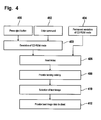
- Figure 4 shows a flow chart for performing a restore operation, such as for the purpose of disaster recovery or migration.
- First the tape drive needs to be put into a CD-ROM mode (step 403). This can be done by pressing the eject button of the tape drive when the tape drive is powered on (step 400).
- a command is sent from one of the client computer systems or from the media server computer to the tape drive in order to put the tape drive into the CD-ROM emulation mode.
- client computer A is replaced by client computer A' for the purpose of disaster recovery
- a command can be sent from client computer B or from the media server to the tape drive in order to start the CD-ROM emulation (step 402).
- the CD-ROM mode is permanently emulated by the tape drive.
- an extra physical port can be coupled to the permanent CD-ROM emulation or the CD-ROM emulation provides a logical unit (LUN) that is associated with a single physical port.
- LUN logical unit
- step 406 the index (cf. figure 3) is read from non-volatile memory, e.g. from the tape media itself or from the cartridge memory.
- a booting catalogue is provided in step 408.
- the booting catalogue is in compliance with the 'El Torito' Specification.
- step 410 the BIOS of the replacement computer, e.g. client computer A', selects one of the boot images from the booting catalogue, for example in accordance with the El Torito specification.
- the selected boot image is provided to the replacement client computer A' such that it can boot from the tape drive.
- Figure 5 shows a further preferred embodiment of a tape drive. Elements of figure 5 that correspond to elements of figure 1 are designated by the same reference numerals.
- tape drive 100 of figure 5 has firmware 140 that permanently provides the tape mode by executing instructions 118 and that permanently provides a CD-ROM emulation by execution of instructions 120.
- Tape drive 100 has additional fibre channel port 142. Port 142 is coupled to the permanent CD-ROM emulation provided by instructions 120 whereas port 124 serves for communication with tape drive 100 in the tape mode provided by instructions 118.
Landscapes
- Engineering & Computer Science (AREA)
- Theoretical Computer Science (AREA)
- Software Systems (AREA)
- Physics & Mathematics (AREA)
- General Engineering & Computer Science (AREA)
- General Physics & Mathematics (AREA)
- Quality & Reliability (AREA)
- Computer Security & Cryptography (AREA)
- Stored Programmes (AREA)
- Information Retrieval, Db Structures And Fs Structures Therefor (AREA)
- Retry When Errors Occur (AREA)
Abstract
A method of sequentially transferring boot-image data comprising:
- causing first boot-image data to be transferred to a tape medium starting at a first offset,
- causing second boot-image data to be transferred to the tape medium starting at a second offset,
- causing data relating to the first and second offsets to be transferred to a non-volatile memory.
Description
The present invention relates to the field of data backup and recovery.
It is known to backup data stored on primary storage, such as a hard disk, of a
computer system in order to protect against a disaster that might otherwise
irrecoverably destroy all or part of the data. Disasters for example may be fire,
flood, computer virus or simply accidental deletion of data. One of the main
reasons for using magnetic tape as the backup storage medium is that it
provides a stable, reliable and relatively cheap option for storing large volumes
of backed-up data.
Backup application software which executes on the computer system typically
provides the functions for enabling such computer system data to be both
backed-up to, and restored from, tape media, which is written to and read from
by a tape drive. Well-known backup application software includes 'Replica™'
from Stac, 'ArcServe™' from Computer Associates, 'BackupExec™' from Veritas
and Data Protector™' from HP. Well-known tape drives include DDS™ and
LTO™ compliant tape drives, both available from HP.
In the event of a disaster, such as hard disk failure or even system destruction,
typically, a priority is to rebuild a working system as soon as possible. This
requires the computer hardware to be restored to the same state as it was
before the disaster, which can take hours or even days, even before the file
system can be restored. Generally, a significant amount of human intervention
is required to complete this process.
In order to reduce the time and human intervention overhead of restoring a
computer system after a disaster a backup application software provides a so-called
disaster recovery (DR) solution, which enables a computer system to be
restored in an expedited manner to a state which existed before a disaster
occurred. Such a scheme typically involves at least installing and configuring a
minimal operating system, tape drivers and the backup application software (or
the requisite parts thereof) itself.
Known DR solutions typically require a user to generate a set of DR floppy
disks. The DR floppy disks may be used to boot the computer system, when it is
not possible to boot from the hard disk drive, and execute application software
for recovering a backed-up copy of the file system from tape media. The DR
floppy disks typically load and execute a minimal version of the operating
system along with components of application software comprising DR
functionality, thus providing sufficient functionality, for example, for the
computer to build new disk partitions, access a tape drive and restore the data
from tape media.
The DR operating system is required to reflect the exact hardware configuration
of the computer system on which it is to be installed, otherwise it would not be
possible to communicate with storage devices such as tape drives.
Typically, therefore, DR floppy disks need to be regenerated by a user
whenever the system hardware configuration changes, and particularly when a
SCSI (Small Computer Systems Interface) configuration changes. For example,
if a new SCSI Host Bus Adaptor (HBA) is added to a server, with a respective
new device driver, this device driver needs to be added to the DR floppy disks
so that the new SCSI HBA is recognised when rebuilding the computer system.
A reason why DR floppy disks are used is that a floppy disk drive is one of the
standard 'initial program load devices' (IPLD), which practically every PC is
configured to 'boot' from. Herein, 'standard' as applied to an IPLD, implies that
the PC is physically programmed to recognise the device for the purposes of
booting. Currently, other standard IPLDs, sometimes known as BAIDS (BIOS
Aware Initial Program Load Devices), include the first hard disk drive in a PC
and, more recently, the first CD-ROM drive in a PC. Generally, however, an
IPLD can be virtually any device that has the ability to load and execute a PC
operating system.
It is known to boot from a CD-ROM drive, as long as the CD-ROM complies
with the ISO 9660 CD-ROM standard, as extended by the 'El Torito' Bootable
CD-ROM Format Specification, Version 1.0, January 25, 1995, created jointly
by IBM Corporation and Phoenix Technologies Ltd.
The 'El Torito' bootable CD-ROM Format Specification provides the ability to
catalogue boot images and to selectively boot from any single image stored on
a CD-ROM. A BIOS with multiple boot-image capability can access any one of a
number of bootable disc images listed in the booting catalogue stored on the
CD-ROM. The booting catalogue is a collection of 20 byte entries including a
validation entry, an initial/default entry, a section entry, and section entry
extension. The booting catalogue allows a computer system to pick a proper
boot image and then to boot from the selected image.
Booting from CD-ROM in a similar manner is also considered in detail in US
5,727,213. As described, to boot from CD-ROM, a PC's BIOS (basic
input/output system) needs to specifically support reading boot record data from
a CD-ROM, typically, as well as from a floppy disk or hard disk. US 5,727,213
also proposes that tape media may also serve as a boot source, subject to the
PC BIOS being modified to detect and read boot record data from a tape media.
To date, however, PC BIOS standards do not support booting from tape media.
In a system which is bootable from a CD-ROM, US 5,727,213 specifies that, to
read boot record data from a CD-ROM, read commands directed to the floppy
disk drive need to be re-directed to the CD-ROM drive during a read data part of
the boot process. In addition, a modified SCSI driver of the PC needs to convert
the 512 byte sectors conventionally used by hard disk and floppy disk into 2
Kbytes sectors conventionally used by a CD-ROM drive.
In view of the possibility of booting from CD-ROM, it would obviously also be
possible to generate one or more DR CD-ROMs to replace the DR floppy disks.
However, there would be little advantage in adopting this approach, and a
significant cost increase. In particular, it would still be onerous for the user to
have to generate, maintain and keep safe the DR CD-ROMs.
WO00/08561 the entirety of which is herein incorporated by reference shows a
tape drive configured to operate as a bootable device for a PC. The tape drive
has two modes of operation: the first mode in which it operates as a normal
tape drive and the second in which it emulates a bootable CD-ROM drive.
Firmware provides both the normal mode of operation, in which the tape drive
behaves as a tape drive, and the disaster recovery (DR) mode of operation, in
which the tape drive is arranged to emulate a CD-ROM drive. The CD-ROM
drive emulation is achieved in part by configuring the tape drive to identify itself
to the PC as a CD-ROM drive. With the ability to emulate a CD-ROM drive, the
tape drive can act as an 'initial program load device' (IPLD).
Whether the tape drive operates in normal mode or DR mode is determined by
user selection. The user selection of mode may be performed without the need
for any additional tape drive hardware by using the tape drive eject button;
when the tape drive is powered on the eject button held down, the DR mode of
operation is selected, otherwise the normal mode is selected.
This selection function is achieved by the tape drive's firmware that checks the
status of the eject button during a power-on self-test sequence. Alternatively,
DR mode can be selected by holding the eject button down for a long time
period (such as 5 seconds), when the tape drive is already powered on, by the
firmware which checks the length of the period the eject button is held down to
determine whether the operation is an eject or the user selecting DR mode.
The present invention provides a method of sequentially transferring boot-image
data to a sequential secondary storage device. The method comprises
tranferring the first boot-image data to the tape medium starting at a first offset
and transferring the second boot-image data to the tape medium starting at a
second offset, and storing first and second offset data in non-volatile memory.
This way storage of multiple boot-images on a single tape medium is facilitated.
In accordance with a preferred embodiment of the invention the tape medium is
a tape medium. For example a tape cartridge which is compliant with ULTRIUM
LTO is utilised. Such tape cartridges are commercially available from Hewlett
Packard (www.hp.com/go/ultrium). A LTO compliant tape cartridge has a non-volatile
cartridge memory (LTO-CM) which is an intelligent memory chip
embedded in the cartridge. It uses a radio frequency interface that eliminates
the need for a physical power or signal connection between cartridge and tape
drive. The LTO-CM is used for storing information which in other tape formats
may be stored in the header at the beginning of the tape.
In accordance with a preferred embodiment of the invention the first and second
offset data is stored on the tape itself. Alternatively the first and second offset
data is stored in a cartridge memory, such as a LTO-CM.
In accordance with a further preferred embodiment of the invention an index for
mapping boot image identifiers to respective offsets is stored in the non-volatile
memory. This index facilitates provision of a booting catalogue for selection of
one of the boot-images.
Another aspect of the present invention is a method of providing boot-image
data to a computer, such as for the purpose of disaster recovery. This is
accomplished by reading the at least first and second offset data from the non-volatile
memory and emulation of an optical storage device. The emulation
provides booting catalogue data on the basis of the first and second offset data
for selection of one of the bootable images.
In accordance with a preferred embodiment of the invention the emulation of the
optical storage device is started in response to an external command. The
external command may originate from a computer system coupled to the tape
drive through a network or by means of a user input operation, such as
operating a button on the tape drive.
In accordance with a further preferred embodiment of the invention the
emulation of the optical storage device is performed permanently. Preferably
one port of the tape drive is coupled to the emulated optical storage device
while another port is used for communicating with the tape drive in normal
mode.
In the following various embodiments of the invention will be described, by way
of example only, and with reference to the drawings in which:
- Figure 1
- is a schematic block diagram showing a tape drive coupled to multiple computer systems,
- Figure 2
- is a flow diagram illustrating steps involved in storing a boot image on tape media,
- Figure 3
- is illustrative of an index that is stored on the tape media or on a cartridge memory,
- Figure 4
- is a flow diagram illustrating the steps involved in booting from the tape drive,
- Figure 5
- is a schematic block diagram of a tape drive apparatus having a dedicated port for permanent CD-ROM emulation.
Figure 1 shows tape drive 100 having tape mechanism 102, which loads and
ejects tape media 104 and winds the tape media 104 forwards or backwards as
required for reading and writing data. In a DDS (Digital Data Storage) tape
drive, the read/write heads 106 are mounted on a helical scanning drum, which
rotates to sweep the heads past the tape in a motion oblique to the direction of
travel of the tape. Tape drive apparatus 100 has eject button 108 and RF
interface 110 that serves to communicate with cartridge memory 112 of tape
media 104.
Client computers A, B,... are coupled to media server computer 128 through
Ethernet network 130. Each one of the client computers has processor 132 for
running a backup application program 134 in order to read data stored on local
disk 136 and send the data over Ethernet network 130 to media server 128 for
the purpose of performing the data backup operation. Media server 128 runs
program 138 on its processor 132 for formatting data received from the client
computers A, B, ... via Ethernet network 130. During backup program 138
creates boot-images for the local disks 136 of client computers A, B, ... and
transmits the corresponding boot-image data sets via storage area network 126
to tape drive 100.
In operation tape drive 100 is initially in the normal mode of operation, i.e. tape
drive 100 behaves as a tape drive at port 124. When tape drive 100 receives
boot-image data of e.g. client computer A from media server 128 via storage
area network 126 at its port 124 it performs an append operation in order to
store the boot-image data on tape media 104.
In other words the boot-image data of client computer A is stored on tape media
104 starting at a specific tape location (offset) that is identified by offset data.
The offset data is stored on the tape itself or in cartridge memory 112 by means
of RF interface 110. This process can be performed repeatedly for all client
computers which are coupled to media server computer 128.
Each time a new boot-image is received at port 124 an append operation is
performed, the boot-image data is stored on tape media 104, and the offset
data that identifies the tape location where the corresponding recording of the
boot-image data starts is stored in non-volatile memory. This way multiple boot-image
data can be stored on tape media 104. This has the advantage that more
efficient use can be made of tape media 104.
In order to perform a disaster recovery operation, such as for client computer A,
a replacement client computer A' is coupled to storage area network 126. Tape
drive 100 is put into the disaster recovery mode. This can be done by pressing
eject button 108 when tape drive 100 is powered-on or by pressing the eject
button 108 for a long time period when the tape drive 100 is already powered
on.
In the disaster recovery mode a CD-ROM emulation is provided by instructions
120 such that tape drive 100 behaves like a CD-ROM drive at port 124.
Instructions 120 read the offset data stored in non-volatile memory, i.e. cartridge
memory 112 or the tape itself, in order to generate a booting catalogue.
On the basis of the booting catalogue the BIOS of the replacement client
computer A' can select the appropriate bootable disk image. The corresponding
boot-image data is read from tape media 104 and transferred to client computer
A' via storage area network 126. Preferably the emulation performed by
instructions 120 is in compliance with the 'El Torito' bootable CD-ROM Format
Specification. In this instance instructions 120 generate a multiple boot-image
configuration on the basis of the offset data stored in cartridge memory 112 that
has a format as specified in the 'El Torito' specification.
Figure 2 illustrates an append operation of an additional boot-image received
from one of the client computers. Without limitation of generality it is assumed
that boot-image A of client computer A is received by the tape drive from the
media server computer in step 200. In step 202 the tape drive performs an
append operation and stores the boot-image A on the tape media starting at an
offset OA. The corresponding offset data OA is indicative of the position where
the recording of the boot-image A on the tape media starts.
In step 204 the tuple consisting of the identifier A of the boot-image A of client
computer A and the offset data OA is entered into the index stored on the tape
media itself or on the cartridge memory.
When the tape drive receives another boot image from another client computer
or the same client computer, steps 200 to 204 are performed again with respect
to the additional boot image.
Figure 3 schematically shows a resulting index which maps the boot image
identifiers A, B, C, ... to respective offsets OA, OB, OC, ...
Figure 4 shows a flow chart for performing a restore operation, such as for the
purpose of disaster recovery or migration. First the tape drive needs to be put
into a CD-ROM mode (step 403). This can be done by pressing the eject button
of the tape drive when the tape drive is powered on (step 400). Alternatively a
command is sent from one of the client computer systems or from the media
server computer to the tape drive in order to put the tape drive into the CD-ROM
emulation mode. For example if client computer A is replaced by client
computer A' for the purpose of disaster recovery a command can be sent from
client computer B or from the media server to the tape drive in order to start the
CD-ROM emulation (step 402).
Alternatively the CD-ROM mode is permanently emulated by the tape drive. In
this instance an extra physical port can be coupled to the permanent CD-ROM
emulation or the CD-ROM emulation provides a logical unit (LUN) that is
associated with a single physical port. A suitable embodiment of such a tape
drive will be explained in more detail below with reference to figure 5.
In step 406 the index (cf. figure 3) is read from non-volatile memory, e.g. from
the tape media itself or from the cartridge memory. On the basis of the boot-image
identifiers and respective offset data of the index a booting catalogue is
provided in step 408. Preferably the booting catalogue is in compliance with the
'El Torito' Specification.
In step 410 the BIOS of the replacement computer, e.g. client computer A',
selects one of the boot images from the booting catalogue, for example in
accordance with the El Torito specification. The selected boot image is provided
to the replacement client computer A' such that it can boot from the tape drive.
Figure 5 shows a further preferred embodiment of a tape drive. Elements of
figure 5 that correspond to elements of figure 1 are designated by the same
reference numerals.
In contrast to the embodiment of figure 1, tape drive 100 of figure 5 has
firmware 140 that permanently provides the tape mode by executing
instructions 118 and that permanently provides a CD-ROM emulation by
execution of instructions 120. Tape drive 100 has additional fibre channel port
142. Port 142 is coupled to the permanent CD-ROM emulation provided by
instructions 120 whereas port 124 serves for communication with tape drive 100
in the tape mode provided by instructions 118. As a consequence it is not
necessary to change the mode of operation of tape drive 100 when a disaster
recovery is to be performed as tape drive 100 permanently 'looks' like a CD-ROM
drive at its port 142 from where the replacement computer system can
boot.
- 100
- tape drive
- 102
- tape mechanism
- 104
- tape media
- 106
- heads
- 108
- eject button
- 110
- RF interface
- 112
- cartridge memory
- 114
- processor
- 116
- firmware
- 118
- instructions
- 120
- instructions
- 122
- program
- 124
- port
- 126
- storage area network
- 128
- media server computer
- 130
- Ethernet network
- 132
- processor
- 134
- backup application program
- 136
- local disk
- 138
- programme
- 140
- firmware
- 142
- port
Claims (30)
- A method of sequentially transferring boot-image data comprising:causing first boot-image data to be transferred to a tape medium (104) starting at a first offset,causing second boot-image data to be transferred to the tape medium starting at a second offset,causing data relating to the first and second offsets to be transferred to a non-volatile memory (104; 112).
- The method of claim 1, the tape medium being compliant with the ULTRIUM format.
- The method of claim 1 or 2, the non-volatile memory being the tape medium (104).
- The method of claim 1 or 2, the non-volatile memory being a cartridge memory (112) of the tape medium.
- The method of any one of claims 1 to 4, wherein the data transferred to non-volatile memory comprises first and second identifying data respectively associated with the first and second boot image data.
- A method of providing boot-image data to a computer for booting the computer, the method comprising:reading at least first and second offset data relative to respective first and second boot-image data from a non-volatile memory (104; 112), the first and second boot-image data being stored on a tape medium (104),emulating an optical storage device,using the first and second offset data for selecting of one of the first and second boot-image data, and outputting the selected one of the first and second boot-image data for booting the computer.
- The method of claim 6, further comprising providing booting catalogue data on the basis of the first and second offset data.
- The method of claim 6 or 7, further comprising receiving a command and starting the emulation of the optical storage device in response to the command.
- The method of claim 8, wherein the command is received from a second computer.
- The method of any one of claims 6 to 9, further comprising starting the emulation of the optical storage device in response to a user input operation.
- The method of claim 10, wherein the user input operation consists of operating an eject button.
- The method of any one of claims 6 to 11, wherein the emulation of the optical storage device is performed permanently.
- The method of any one of claims 6 to 12, wherein a dedicated port (142) is coupled to the emulation of the optical storage device.
- A computer program product for controlling a secondary sequential storage device (100), the computer program product comprising instructions (116) for causingtransfer of first boot-image data to a tape medium (104) starting at a first offset,transfer of second boot-image data to the tape medium starting at a second offset,transfer of first and second offset data to non-volatile memory (104; 112).
- The computer program product of claim 14, the instructions being adapted to store first and second identifiers of respective first and second boot-image data in a non-volatile memory (112) for creation of an index relating the first and second identifiers to respective first and second offset data.
- A computer program product for controlling a secondary sequential storage device (100), the computer program product comprising instructions (116) for:reading at least first and second offset data of respective first and second boot-image data from a non-volatile memory (104; 112), the first and second boot-image data being stored on a tape medium (104),emulating an optical storage device,using the first and second offset data for enabling selection of one of the first and second boot-image data, andoutputting the selected one of the first and second boot-image data for booting the computer.
- The computer program product of claim 16, the instructions being responsive to receiving an external command to start the emulation of the optical storage device.
- The computer program product of claim 16 or 17, the instructions being responsive to a user input operation to start the emulation of the optical storage device.
- The computer program product of claim 18, the user input operation comprising operating an eject button (108) of the sequential secondary storage device.
- The computer program product of any one of claims 16 to 19, the instructions being adapted to permanently emulate the optical storage device.
- A secondary storage device for storing boot-image data on a tape medium (104), the secondary storage device comprising:means (124) for receiving at least first and second boot-image data,means (118) for writing the first and second boot-image data starting at respective first and second offsets on the tape medium,means (118, 106; 110) for storing first and second offset data in non-volatile memory.
- The secondary storage device of claim 21, the means for storing the first and second offsets being adapted to store an index in the non-volatile memory for mapping respective first and second identifiers, respectively relating to the first and second boot-image data, to the respective first and second offset data.
- The secondary storage device of claim 21 or 22, further comprising a wireless interface (110) for storing the first and second offset data in the non-volatile memory.
- The secondary storage device of claim 21, 22 or 23, further comprising emulation means (120) for emulating an optical storage device.
- The secondary storage device of any one of claims 21 to 24 having a port (142) permanently assigned to the emulation means.
- The secondary storage device of any one of claims 21 to 25, comprising a tape drive (100).
- A non-volatile memory component comprising firmware for controlling a transfer device (100), the firmware comprising instructions (140) for:transferring first boot-image data to a tape medium (104) starting at a first offset,transferring second boot-image data to the tape medium starting at a second offset,transferring first and second offset data relating to the first and second offsets in non-volatile memory (104; 112).
- A non-volatile memory component comprising firmware for controlling a transfer device (100), the firmware comprising instructions (140) for:reading at least first and second offset data of respective first and second boot-image data from a non-volatile memory (104; 112), the first and second boot-image data stored on a tape medium (104),emulating an optical storage device,providing booting catalogue data on the basis of the first and second offset data for selecting of one of the first and second boot-image data, transferring of the selected one of the first and second boot-image data to the computer.
- A tape cartridge comprising a tape medium (104) having stored thereon at least first and second boot-image data.
- The tape cartridge of claim 29 having a non-volatile memory (104; 112) storing first and second offset data relating to the first and second offsets.
Applications Claiming Priority (2)
| Application Number | Priority Date | Filing Date | Title |
|---|---|---|---|
| GB0325448A GB2407659A (en) | 2003-10-31 | 2003-10-31 | Disaster recovery using multiple boot images held on a sequential storage device |
| GB3254489 | 2003-10-31 |
Publications (1)
| Publication Number | Publication Date |
|---|---|
| EP1528470A1 true EP1528470A1 (en) | 2005-05-04 |
Family
ID=29725716
Family Applications (1)
| Application Number | Title | Priority Date | Filing Date |
|---|---|---|---|
| EP04105132A Withdrawn EP1528470A1 (en) | 2003-10-31 | 2004-10-18 | Data Backup And Recovery |
Country Status (4)
| Country | Link |
|---|---|
| US (1) | US20050114387A1 (en) |
| EP (1) | EP1528470A1 (en) |
| JP (1) | JP2005135406A (en) |
| GB (1) | GB2407659A (en) |
Cited By (1)
| Publication number | Priority date | Publication date | Assignee | Title |
|---|---|---|---|---|
| GB2431748A (en) * | 2005-10-31 | 2007-05-02 | Hewlett Packard Development Co | Disaster recovery using a tape drive |
Families Citing this family (5)
| Publication number | Priority date | Publication date | Assignee | Title |
|---|---|---|---|---|
| US7440965B1 (en) | 2004-02-11 | 2008-10-21 | Network Appliance, Inc. | Method and system for generating and restoring a backup image |
| US7117302B2 (en) * | 2005-02-28 | 2006-10-03 | Hewlett-Packard Development Company, L.P. | Boot techniques involving tape media |
| US7890724B2 (en) * | 2006-12-29 | 2011-02-15 | Sandisk Corporation | System for code execution |
| US7890723B2 (en) * | 2006-12-29 | 2011-02-15 | Sandisk Corporation | Method for code execution |
| US8930666B1 (en) * | 2010-06-14 | 2015-01-06 | American Megatrends, Inc. | Virtual disk carousel |
Citations (4)
| Publication number | Priority date | Publication date | Assignee | Title |
|---|---|---|---|---|
| US5418918A (en) * | 1993-09-10 | 1995-05-23 | Compaq Computer Corp. | Scanning initial CD-ROM sectors for a boot record and executing said boot record to load and execute floppy disk image corresponding to the existing floppy drive |
| WO2000008561A1 (en) * | 1998-08-07 | 2000-02-17 | Hewlett-Packard Company | System backup and recovery |
| EP1109098A2 (en) * | 1999-12-15 | 2001-06-20 | Adaptec, Inc. | Bootable fixed packet re-writable optical media |
| EP1174795A1 (en) * | 2000-07-19 | 2002-01-23 | Hewlett-Packard Company, A Delaware Corporation | Multiplexing computing apparatus |
Family Cites Families (30)
| Publication number | Priority date | Publication date | Assignee | Title |
|---|---|---|---|---|
| US4796136A (en) * | 1985-03-18 | 1989-01-03 | Hewlett-Packard Company | Disc drive compatible cartridge tape |
| US4939507A (en) * | 1986-04-28 | 1990-07-03 | Xerox Corporation | Virtual and emulated objects for use in the user interface of a display screen of a display processor |
| US5455926A (en) * | 1988-04-05 | 1995-10-03 | Data/Ware Development, Inc. | Virtual addressing of optical storage media as magnetic tape equivalents |
| US5786967A (en) * | 1989-03-13 | 1998-07-28 | Imation Corp. | Tape cartridge including an indication device to distinguish between cartridges having different characteristics but nearly identical physical characteristics |
| JP2772103B2 (en) * | 1990-03-28 | 1998-07-02 | 株式会社東芝 | Computer system startup method |
| US5212772A (en) * | 1991-02-11 | 1993-05-18 | Gigatrend Incorporated | System for storing data in backup tape device |
| JP3318981B2 (en) * | 1992-10-09 | 2002-08-26 | 株式会社明電舎 | Pulse power |
| US5469573A (en) * | 1993-02-26 | 1995-11-21 | Sytron Corporation | Disk operating system backup and recovery system |
| US5521774A (en) * | 1994-03-18 | 1996-05-28 | Cartesian Data, Inc. | Memory storage module for storing and accessing |
| US5802363A (en) * | 1994-09-27 | 1998-09-01 | International Business Machines Corporation | Bios dynamic emulation of multiple diskettes from a single media |
| FI103440B (en) * | 1995-11-02 | 1999-06-30 | Nokia Telecommunications Oy | Authentication of data storage to cache tape drive e |
| US6578146B2 (en) * | 1996-11-19 | 2003-06-10 | R. Brent Johnson | System, method and article of manufacture to remotely configure and utilize an emulated device controller via an encrypted validation communication protocol |
| US6205527B1 (en) * | 1998-02-24 | 2001-03-20 | Adaptec, Inc. | Intelligent backup and restoring system and method for implementing the same |
| US5974547A (en) * | 1998-03-20 | 1999-10-26 | 3Com Corporation | Technique for reliable network booting of an operating system to a client computer |
| US6154852A (en) * | 1998-06-10 | 2000-11-28 | International Business Machines Corporation | Method and apparatus for data backup and recovery |
| US6430663B1 (en) * | 1998-07-06 | 2002-08-06 | Adaptec, Inc. | Methods for selecting a boot partition and hiding a non-selected partition |
| US6304965B1 (en) * | 1998-09-29 | 2001-10-16 | Phoenix Technologies Ltd. | Method and device for booting a CD-ROM from a single disk image having multiple emulations |
| US6308265B1 (en) * | 1998-09-30 | 2001-10-23 | Phoenix Technologies Ltd. | Protection of boot block code while allowing write accesses to the boot block |
| US6397307B2 (en) * | 1999-02-23 | 2002-05-28 | Legato Systems, Inc. | Method and system for mirroring and archiving mass storage |
| US6206313B1 (en) * | 1999-03-25 | 2001-03-27 | Tandberg Data Asa | Tape cartridge allowing concurrent reading/writing on multiple tapes |
| US6446175B1 (en) * | 1999-07-28 | 2002-09-03 | Storage Technology Corporation | Storing and retrieving data on tape backup system located at remote storage system site |
| US6336174B1 (en) * | 1999-08-09 | 2002-01-01 | Maxtor Corporation | Hardware assisted memory backup system and method |
| US6956833B1 (en) * | 2000-02-08 | 2005-10-18 | Sony Corporation | Method, system and devices for wireless data storage on a server and data retrieval |
| EP1195679A1 (en) * | 2000-10-06 | 2002-04-10 | Hewlett-Packard Company, A Delaware Corporation | Performing operating system recovery from external back-up media in a headless computer entity |
| DE20021132U1 (en) * | 2000-12-13 | 2001-04-19 | EMTEC Magnetics GmbH, 67059 Ludwigshafen | Transport securing element for data storage cartridges, stack of data storage cartridges with transport securing elements |
| JP2002197415A (en) * | 2000-12-27 | 2002-07-12 | Fujitsu Ltd | Data storage device |
| US20020163760A1 (en) * | 2001-05-07 | 2002-11-07 | Lindsey Alan M. | Disaster recovery tape drive |
| US6947237B2 (en) * | 2001-10-09 | 2005-09-20 | Hewlett-Packard Development Company, L.P. | WORM magnetic tape with cartridge memory system and method |
| GB2407175A (en) * | 2003-10-08 | 2005-04-20 | Hewlett Packard Development Co | A method of storing data on a secondary storage device |
| GB2407692A (en) * | 2003-10-30 | 2005-05-04 | Hewlett Packard Development Co | A tape drive apparatus with optical storage device emulation |
-
2003
- 2003-10-31 GB GB0325448A patent/GB2407659A/en not_active Withdrawn
-
2004
- 2004-10-15 US US10/965,201 patent/US20050114387A1/en not_active Abandoned
- 2004-10-18 EP EP04105132A patent/EP1528470A1/en not_active Withdrawn
- 2004-10-19 JP JP2004303996A patent/JP2005135406A/en active Pending
Patent Citations (4)
| Publication number | Priority date | Publication date | Assignee | Title |
|---|---|---|---|---|
| US5418918A (en) * | 1993-09-10 | 1995-05-23 | Compaq Computer Corp. | Scanning initial CD-ROM sectors for a boot record and executing said boot record to load and execute floppy disk image corresponding to the existing floppy drive |
| WO2000008561A1 (en) * | 1998-08-07 | 2000-02-17 | Hewlett-Packard Company | System backup and recovery |
| EP1109098A2 (en) * | 1999-12-15 | 2001-06-20 | Adaptec, Inc. | Bootable fixed packet re-writable optical media |
| EP1174795A1 (en) * | 2000-07-19 | 2002-01-23 | Hewlett-Packard Company, A Delaware Corporation | Multiplexing computing apparatus |
Non-Patent Citations (1)
| Title |
|---|
| STORAGE HEAVEN: "Linear Tape - Open Technology White Paper", INTERNET, April 1998 (1998-04-01), pages 1 - 9, XP002318689, Retrieved from the Internet <URL:http://www.storageheaven.com/downloads/ultrium.pdf> [retrieved on 20050217] * |
Cited By (3)
| Publication number | Priority date | Publication date | Assignee | Title |
|---|---|---|---|---|
| GB2431748A (en) * | 2005-10-31 | 2007-05-02 | Hewlett Packard Development Co | Disaster recovery using a tape drive |
| GB2431748B (en) * | 2005-10-31 | 2010-12-22 | Hewlett Packard Development Co | Data back-up and recovery |
| US8914665B2 (en) | 2005-10-31 | 2014-12-16 | Hewlett-Packard Development Company, L.P. | Reading or storing boot data in auxiliary memory of a tape cartridge |
Also Published As
| Publication number | Publication date |
|---|---|
| GB0325448D0 (en) | 2003-12-03 |
| US20050114387A1 (en) | 2005-05-26 |
| JP2005135406A (en) | 2005-05-26 |
| GB2407659A (en) | 2005-05-04 |
Similar Documents
| Publication | Publication Date | Title |
|---|---|---|
| EP1101164B1 (en) | System backup and recovery | |
| US20220197516A1 (en) | Tape library emulation with automatic configuration and data retention | |
| US7313718B2 (en) | System and method for the prevention of corruption of networked storage devices during backup data recovery | |
| US10168962B2 (en) | Tape emulating disk based storage system and method with automatically resized emulated tape capacity | |
| US5907679A (en) | Hard drive upgrade system | |
| US20080147962A1 (en) | Storage subsystem with multiple non-volatile memory arrays to protect against data losses | |
| EP1202159A2 (en) | Method and system utilizing data fragments for efficiently importing/exporting removable storage volumes | |
| US20060218434A1 (en) | Disk drive with integrated tape drive | |
| JP2005011317A (en) | Method and apparatus for initializing storage system | |
| JP2006164162A (en) | Copy control apparatus and method | |
| EP1528470A1 (en) | Data Backup And Recovery | |
| EP1564636B1 (en) | Tape drive apparatus for storing boot image data and for booting the system | |
| JP2001125815A (en) | Backup data management system | |
| EP1528469B1 (en) | Tape Drive Apparatus | |
| US8914665B2 (en) | Reading or storing boot data in auxiliary memory of a tape cartridge | |
| JP3951808B2 (en) | Hard disk drive subsystem | |
| US8037268B2 (en) | Storage system and operation method thereof | |
| EP1096381A2 (en) | Recovery system and method for computer operating systems | |
| CN103700388A (en) | File recording apparatus, file system management method, file recovery method, and changer drive | |
| JP2000305719A (en) | Data backup method in information processing system | |
| KR20040039679A (en) | Portable storage with emulator |
Legal Events
| Date | Code | Title | Description |
|---|---|---|---|
| PUAI | Public reference made under article 153(3) epc to a published international application that has entered the european phase |
Free format text: ORIGINAL CODE: 0009012 |
|
| AK | Designated contracting states |
Kind code of ref document: A1 Designated state(s): AT BE BG CH CY CZ DE DK EE ES FI FR GB GR HU IE IT LI LU MC NL PL PT RO SE SI SK TR |
|
| AX | Request for extension of the european patent |
Extension state: AL HR LT LV MK |
|
| 17P | Request for examination filed |
Effective date: 20050521 |
|
| AKX | Designation fees paid |
Designated state(s): DE FR GB |
|
| STAA | Information on the status of an ep patent application or granted ep patent |
Free format text: STATUS: THE APPLICATION IS DEEMED TO BE WITHDRAWN |
|
| 18D | Application deemed to be withdrawn |
Effective date: 20060328 |