EP1528459A2 - Verfahren und Vorrichtung zur automatischer Texteingabe in Digitalgeräten mit einer begrenzten Anzahl von Tasten - Google Patents
Verfahren und Vorrichtung zur automatischer Texteingabe in Digitalgeräten mit einer begrenzten Anzahl von Tasten Download PDFInfo
- Publication number
- EP1528459A2 EP1528459A2 EP03386027A EP03386027A EP1528459A2 EP 1528459 A2 EP1528459 A2 EP 1528459A2 EP 03386027 A EP03386027 A EP 03386027A EP 03386027 A EP03386027 A EP 03386027A EP 1528459 A2 EP1528459 A2 EP 1528459A2
- Authority
- EP
- European Patent Office
- Prior art keywords
- symbols
- key
- letter
- keys
- reordering
- Prior art date
- Legal status (The legal status is an assumption and is not a legal conclusion. Google has not performed a legal analysis and makes no representation as to the accuracy of the status listed.)
- Withdrawn
Links
Images



Classifications
-
- G—PHYSICS
- G06—COMPUTING OR CALCULATING; COUNTING
- G06F—ELECTRIC DIGITAL DATA PROCESSING
- G06F3/00—Input arrangements for transferring data to be processed into a form capable of being handled by the computer; Output arrangements for transferring data from processing unit to output unit, e.g. interface arrangements
- G06F3/01—Input arrangements or combined input and output arrangements for interaction between user and computer
- G06F3/02—Input arrangements using manually operated switches, e.g. using keyboards or dials
- G06F3/023—Arrangements for converting discrete items of information into a coded form, e.g. arrangements for interpreting keyboard generated codes as alphanumeric codes, operand codes or instruction codes
- G06F3/0233—Character input methods
- G06F3/0237—Character input methods using prediction or retrieval techniques
Definitions
- the proposed invention deals with the data entry usability issue in digital hardware where the number of available keys is smaller than the number of symbols (alphabet) of any given language. More specifically, the invention introduces a novel automatic text entry method in digital devices where the keyboard has two or more letters mapped onto each key.
- a device is, for example, a telephone handset (cellular or conventional phones), pocket calculators, palm and pocket pc's and remote controllers.
- STEM Standard Text Entry Method
- tapping the corresponding key as many times as needed to appear on screen for a letter to be entered.
- the basic disadvantage of multiple keystrokes is the slow rate of the inserted letters.
- this lack of speed influences positively the need for user confirmation. So, the user does not have to pay any attention to the mobile phone screen.
- the most common solution is the introduction of a time delay (timeout) between two taps of the same key, in order to verify that the user wants to type two letters from the same group or one letter by multiple taps.
- the user in order to bypass the timeout delay, the user can depict his/her intention to type two letters from the same key by selecting a certain timeout kill key which cancels the timeout delay. This obviously further deteriorates the message editing speed. Additionally to the poor task execution time provided by this method, extensive effort in terms of keystrokes is required from the user in order to complete typing a message. Task execution time is further increased in general with the introduction of the timeout delay time.
- Another, similar approach is the two-key input method, in which a user specifies a character by pressing two keys.
- the first key represents the group of letters (e.g key 2 for A, B or C) and the second disambiguates the letter by selecting its place in the group (e.g key 1 would select A).
- Studies (Silfverberg et. al, 2001) have depicted that although the two-key approach is very simple, it is not efficient for Roman characters, since there is great loss of speed by moving between the two keys. This result could be generalized in a manner that the ascertainment of the low efficiency of the method remains valid in alphabets other than Roman. That is probably the main reason why this method is not popular among users. Note however that it is very common for typing Katakana characters.
- T9 ⁇ developed by Tegic ⁇ .
- Tegic ⁇ the most popular is called T9 ⁇ , developed by Tegic ⁇ .
- the T9 is fully disclosured in patent US5818437. More specifically, the user presses the key in which the desired letter lies, only once. While we are pressing some letters or by the time a word is completed, which means that a space was entered, the system is trying to output the most probable word that corresponds to the key sequence that the user provided. If the guessed word is incorrect, then using a special key the system outputs a pool of other words that also correspond to the specific key sequence.
- T9 Another important drawback of T9 is the poor feedback to the user during the process of typing a word. There are times that letter disambiguation occurs at the latter characters of a word, so until then, the user may see a totally different set of characters, a phenomenon that obviously results in user confusion due to reduced sense of progress towards user's text entry goal.
- the aim of the presenting method and apparatus is to combine the strong points of the above mentioned methods (high leamability, predictable dialogue flow for the STEM process, increased efficiency for the T9 method) in a brand new novel approach, without the disadvantages they have (poor performance, confusing feedback to the user).
- the proposed invention contributes to the current state of the art, given the fact that is not characterized by the disadvantages of lexicon based methods, where the inputs to be given affect the result of previous given keystrokes. Additionally to this, it enables symbol selection with only a key press at a time, independently from the position they possess into the key where they are mapped to.
- the reorganizing information is prestored in the device and the framework to obtain it is based on a Bayesian Belief network (BBN) structure.
- BBN Bayesian Belief network
- This structure offers a machinery of estimating the user's desired letter given the letters that precede.
- BBN are used in the machine learning community as a means of effective reasoning under uncertainty, they are able to learn to predict the state of a variable given the states of all, or a subset of other variables from the available data.
- BBN appear to behave very successful in the proposed algorithm, due to the restrictions posed by this algorithm. Since the letters are usually grouped into classes of three or four letters (this number is related to the number of letters an alphabet has), a user desires to input one of them (and not one of the whole alphabet).
- the network is expected to estimate a letter from the limited candidate letters, given the letters that precede in the current word, this estimation is a very good approximation of the real case.
- the primary aims of this invention are:
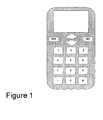
- Fig. 1 a schematic representation of a typical telephone apparatus is provided, along with the corresponding letter organization within the keypad keys.
- the device that incorporates the presented method does not differ externally from any other devices that can be found in the modem market.
- No letters are grouped within keys 1 and 0, while in the rest of the keys (2-9) three or four letters are grouped, regarding the considered alphabet.
- the two more letters (26 instead of 24) have to be mapped into two keys in groups of four.
- the goal of this invention is to dynamically reorder the letter layout of a given keypad, so that the required key presses are equal to the number of the letters of a text message. By default, this in not always possible. For example, regarding the editing of the word " ⁇ TI ⁇ MA” and the word “ ⁇ THPI ⁇ MA” in the third keystroke, a different letter is expected from key 4, so that in one of the two words, be more than one keystrokes would unavoidable be needed.
- the invention presents a method and an apparatus that achieves to significantly approximate the ideal case of one keystroke per letter. This method impels the letter layout of a key to be changed in any moment of the text input process, so that the expected keystrokes are minimized, and the apparatus operates, based on this method. In Fig.
- the way this device operates is depicted.
- the user selects the key in which the letter of his desire lies. (1).
- the device activates a method of dynamically modifying the letter layout, in order to better estimate the desired letter, given the letters than already precede in the text (2).
- This method is based on a machine learning method that learns from data, named as Bayesian Belief networks, presented in details in the following sections.
- the apparatus provides an optical or acoustic feedback by introducing the first letter that lies in the new letter layout that method made (3). The user observes this feedback (4). In case this is the desired letter, he continues the process of text editing by returning to step (1).
- Step (5) is repeated until the desired letter appears on the screen. Subsequently, a user continues the text editing process, returning to step (1).
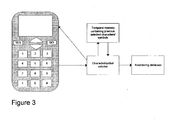
- Fig. 3 the basic functionalities of this device are presented.
- the insertion of letters is achieved through keys, such as those that conventional telephone devices incorporate.
- Signals from this key pad are transferred to a symbol layout selector that provides the layout of the symbols that are to be mapped in the key that was pressed. This is achieved, based on the key that has been pressed, the information the selector obtains from a temporal memory that contains the most recent keystrokes (the most recent symbols that appear on the screen) and the final feedback that is provided by the dynamic modification of the letter layout. The symbol then appears on screen, while the new, dynamic layout is stored in a temporal memory.
- the number of the most recent letters that can be used from the device can vary, however three preceding letters are considered to be the optimal number, taking the memory needs into consideration. Nevertheless, there are certain cases where a different number might be necessary.
- the selection of another letter could be achieved by multiple presses of the same key that contains this letter, such as in the STEM method.
- a time delay slot (timeout) between two subsequent presses of the same key is required in order to be certified that the user wishes to select an additional letter from the same group.
- the given symbol can be selected by continuously pressing the key that contains it, in case that a symbol reordering is not required. For that reason, the information regarding the new layout of the letters is maintained until the user presses another key. Then, a related signal is lead to the selector, along with the last symbol that is currently appearing on screen.
- the symbol selector is estimating the symbol that follows in the reordering layout and has been stored in the temporal memory. Subsequently, the selector submits the necessary signal in order to appear on the screen, by confuting the letter that previously appeared on the screen.
- the device may not necessarily incorporate a screen as a means of user feedback, but other means such as digital speech synthesis.
- the method that is being described in order to infer on the probability of a letter that lies within a group of letters and the most recent letter sequence is based on BBNs. The proposed method uses this a-priori probability of a letter to be the desired one.
- BBNs The principal idea of BBNs is that an inference problem can be considered as a domain where nodes are connected with arcs forming a directed acyclic graph, where the arcs define a kind of node relationships. Each node corresponds to a problem variable or to an unknown and uncertain quantity.
- the variables can take discrete, finite states.
- the degree of node relationships is determined by a probability distribution that is based on the foundations of Bayes' theorem.
- BBN presents significant advantages when compared to other machine learning algorithms, such as neural networks, decision trees, etc. given the fact that it is at least as efficient as the other methods and is based on a solid mathematical background (Stephenson, 2000).
- Bayesian Belief Network is a significant knowledge representation and reasoning tool, under conditions of uncertainty.
- D ⁇ X 1 , X 2 ...X N >, where each variable X i could take values from a set T(X i )
- a BBN describes the probability distribution over this set of variables.
- X,Y we use capital letters as X,Y to denote variables and lower case letters as x,y to denote values taken by these variables.
- a BBN is an annotated directed acyclic graph (DAG) that encodes a joint probability distribution.
- DAG directed acyclic graph
- the BBN In the process of efficiently detecting the optimal symbol reordering, concerning a given number of symbols entered, the BBN should be learned from training data (text corpus of the given language) provided. Learning a BBN unifies two processes: learning the graphical structure and learning the parameters ⁇ for that structure. In order to seek out the optimal parameters for a given corpus of complete data, we directly use the empirical conditional frequencies extracted from the data (Cooper and Herskovits, 1992). The selection of the variables that will constitute the data set is of great significance, since the number of possible networks that could describe these variables equals to 2 N ( N - 1) 2 , where N is the number of variables (the number of previous symbols entered taken into consideration).
- equations (1.4) and (1.5) we have an equation with all the terms known and computable. Therefore the creation of a function which calculates the optimal network structure and models the finding of the most likely letter given a certain amount of previous keystrokes is feasible.
- the level of complexity of BBN produced is increased depending on the number of previously entered letters that takes into consideration. Nevertheless, by reason of the restrictions of memory of a digital appliance, such as a mobile telephone, we do not examine the prefixes that are constituted of more than three letters. At the same time, as it resulted from certain measurements, the effectiveness of the method is improved slightly, if we take into consideration more than three symbols that have proceeded.
- the proposed interaction dialogue gives the possibility of a special key (the dash key - #) to be used by the user that can change the output to the second more likely letter and so on.
- the dash key - # the dash key
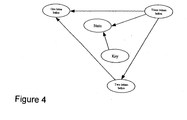
- Fig. 4 the BBN structure is depicted. The network is considering three preceding letters as well as the key that was pressed, in order to estimate the desired letter. The nodes 'three letters before', 'two letters before' ⁇ 'one letter before' correspond to the relative prefixes. Node Key corresponds to the key that was pressed and takes as states the values of two to nine. Finally, node State has tree discrete values, namely one, two and three that represent the position of the letter in a letter layout.
- the network embeds a conditional probability table that can be consulted in order to predict which is the most probable position of a letter (one two or three), by considering all the other nodes of the network or a subset of them. For example, suppose that a user wishes to enter the work "H ⁇ IKIA” (age). Suppose also that the system has already predicted the part "H ⁇ IK” correctly. In order to insert the letter "I”, the user presses key 4 where the letters "H”, " ⁇ ” and "I” are contained. The Bayesian network is about to predict the most probable letter, given the letter sequence of " ⁇ IK” and the key 4 that was pressed. The most probable letter is inferred.
- the system can change its prediction to the second or the third letter, according to the user desire.
- the evaluation of the effectiveness of the network was performed to a text corpus that was not used for training and was estimated to 95,5%.
- the novel methodology combines the increase of text input speed with the dialogue consistency, particularly for words not found in a lexicon.
- the proposed method demonstrates low memory needs (only 10Kbytes or less for each supported language), a significant advantage when confronting with T9, a method that incorporates a lexicon of approximately 5000 words. Indeed, for each language only the memory entry of a table with all the three preceding letter combinations is required.
- KLM Keystroke Level Model
- STEM standard text entry method
- KLM Keystroke Level Model
- T IPRETI X[T P + T PER ] + (X - 1)P CK T CK + X (P ERROR1 + P ERROR2 ) (T CK + T P ) where:
- Increase in task efficiency is 34,72% in terms of time required and average number of keystrokes required is 12,13 and 6,39 respectively, a difference of 47,35%.
- Modeling of T9 method does not give accurate results because of the inconsistent behaviour of the algorithm. More specifically, the keystrokes per letter required is reduced to one, except from the cases where the first proposed word is not the one that user wants to enter forcing him to choose across a list of proposed words. Secondly, if the word required is not in T9's dictionary, the user has to alter the text entry method to STEM thus further reducing efficiency of the task. Unfortunately, no published study exists concerning the proportion of desired words present in the dictionary -especially for the Greek language, and on how often a word other than the desired one appears. Therefore, no accurate dialogue modelling can take place.
- iPRETI is better than STEM throughout the whole editing process with an average keystroke number that approximates 1.06.
- STEM converges to a value of about 1.94 which agrees to our initial expectations. Performance measurements in terms of time required to complete text entry task could not be compared directly to the KLM model at the moment, because of the non negligible response time required by the system to find the appropriate probabilities due to early prototyping issues.
- Figure 5 depicts the ten SMS phrases selected from actual written and submitted messages.
- Figure 6 tabulates analytic results concerning the number of keystrokes needed from iPRETI and STEM and error rates of single errors and double errors (e.g. second and third keystroke required to access desired letter respectively).
Landscapes
- Engineering & Computer Science (AREA)
- General Engineering & Computer Science (AREA)
- Theoretical Computer Science (AREA)
- Human Computer Interaction (AREA)
- Physics & Mathematics (AREA)
- General Physics & Mathematics (AREA)
- Input From Keyboards Or The Like (AREA)
- Machine Translation (AREA)
Applications Claiming Priority (2)
| Application Number | Priority Date | Filing Date | Title |
|---|---|---|---|
| GR2003100441 | 2003-10-27 | ||
| GR20030100441A GR1004858B (el) | 2003-10-27 | 2003-10-27 | Συσκευη και μεθοδος αυτοματης συγγραφης κειμενου σε ψηφιακες συσκευες περιορισμενου αριθμου πληκτρων |
Publications (2)
| Publication Number | Publication Date |
|---|---|
| EP1528459A2 true EP1528459A2 (de) | 2005-05-04 |
| EP1528459A3 EP1528459A3 (de) | 2005-11-16 |
Family
ID=34401240
Family Applications (1)
| Application Number | Title | Priority Date | Filing Date |
|---|---|---|---|
| EP03386027A Withdrawn EP1528459A3 (de) | 2003-10-27 | 2003-11-12 | Verfahren und Vorrichtung zur automatischer Texteingabe in Digitalgeräten mit einer begrenzten Anzahl von Tasten |
Country Status (2)
| Country | Link |
|---|---|
| EP (1) | EP1528459A3 (de) |
| GR (1) | GR1004858B (de) |
Cited By (1)
| Publication number | Priority date | Publication date | Assignee | Title |
|---|---|---|---|---|
| GB2443652A (en) * | 2006-11-08 | 2008-05-14 | Samsung Electronics Co Ltd | Disambiguating text input using probability |
Family Cites Families (4)
| Publication number | Priority date | Publication date | Assignee | Title |
|---|---|---|---|---|
| US5659771A (en) * | 1995-05-19 | 1997-08-19 | Mitsubishi Electric Information Technology Center America, Inc. | System for spelling correction in which the context of a target word in a sentence is utilized to determine which of several possible words was intended |
| US5907839A (en) * | 1996-07-03 | 1999-05-25 | Yeda Reseach And Development, Co., Ltd. | Algorithm for context sensitive spelling correction |
| US6005495A (en) * | 1997-02-27 | 1999-12-21 | Ameritech Corporation | Method and system for intelligent text entry on a numeric keypad |
| FI974576A7 (fi) * | 1997-12-19 | 1999-06-20 | Nokia Mobile Phones Ltd | Menetelmä tekstin kirjoittamiseksi matkaviestimeen ja matkaviestin |
-
2003
- 2003-10-27 GR GR20030100441A patent/GR1004858B/el unknown
- 2003-11-12 EP EP03386027A patent/EP1528459A3/de not_active Withdrawn
Cited By (2)
| Publication number | Priority date | Publication date | Assignee | Title |
|---|---|---|---|---|
| GB2443652A (en) * | 2006-11-08 | 2008-05-14 | Samsung Electronics Co Ltd | Disambiguating text input using probability |
| GB2443652B (en) * | 2006-11-08 | 2009-06-17 | Samsung Electronics Co Ltd | Mobile communications |
Also Published As
| Publication number | Publication date |
|---|---|
| GR1004858B (el) | 2005-04-13 |
| EP1528459A3 (de) | 2005-11-16 |
Similar Documents
| Publication | Publication Date | Title |
|---|---|---|
| US6005495A (en) | Method and system for intelligent text entry on a numeric keypad | |
| RU2377664C2 (ru) | Способ ввода текста | |
| US10402493B2 (en) | System and method for inputting text into electronic devices | |
| CN1707409B (zh) | 用户字和用户操作的上下文预测 | |
| EP1480421B1 (de) | Automatische Einstellung der Betriebsartauswahl in Abhängigkeit von einer ankommenden Nachricht | |
| CN100361052C (zh) | 在电子装置的用户界面中输入单词的方法及装置 | |
| US8521927B2 (en) | System and method for text entry | |
| US20040153975A1 (en) | Text entry mechanism for small keypads | |
| EP2889729A1 (de) | System und Verfahren zur Texteingabe in elektronische Geräte | |
| EP1724692A2 (de) | Vorrichtung mit verbessertem Texteingabemechanismus mittels des Kontextes der Eingabe | |
| US6587132B1 (en) | Method and system for efficiently navigating a text entry cursor provided by a mobile device | |
| WO2006028438A1 (en) | System, method, and apparatus for continuous character recognition | |
| JP2005530272A (ja) | 曖昧なテキスト入力の明確な文字フィルタリング | |
| WO2008106729A1 (en) | Method system and apparatus for entering text on a computing device | |
| US7395512B2 (en) | Character input system and communication terminal | |
| CN101303628A (zh) | 一种利用数字键盘进行字词输入的方法和装置 | |
| US12248640B2 (en) | Artificial intelligence based hybrid system and method for generation of word predictions based on language modelling | |
| WO2022131954A1 (ru) | Способ управления диалогом и система понимания естественного языка в платформе виртуальных ассистентов | |
| Maragoudakis et al. | Improving SMS usability using Bayesian networks | |
| EP1528459A2 (de) | Verfahren und Vorrichtung zur automatischer Texteingabe in Digitalgeräten mit einer begrenzten Anzahl von Tasten | |
| Tselios et al. | Method and apparatus for automatic text input insertion in digital devices with a restricted number of keys | |
| US20060066583A1 (en) | Text entry method and system using a numeric or non-QWERTY keypad | |
| Nivasch et al. | Keyboard layout optimization and adaptation | |
| KR20000051881A (ko) | 전화기의 문자 입력 시스템 및 그 방법 | |
| Shahzadi et al. | Urdu word prediction system for mobile phones |
Legal Events
| Date | Code | Title | Description |
|---|---|---|---|
| PUAI | Public reference made under article 153(3) epc to a published international application that has entered the european phase |
Free format text: ORIGINAL CODE: 0009012 |
|
| AK | Designated contracting states |
Kind code of ref document: A2 Designated state(s): AT BE BG CH CY CZ DE DK EE ES FI FR GB GR HU IE IT LI LU MC NL PT RO SE SI SK TR |
|
| AX | Request for extension of the european patent |
Extension state: AL LT LV MK |
|
| PUAL | Search report despatched |
Free format text: ORIGINAL CODE: 0009013 |
|
| AK | Designated contracting states |
Kind code of ref document: A3 Designated state(s): AT BE BG CH CY CZ DE DK EE ES FI FR GB GR HU IE IT LI LU MC NL PT RO SE SI SK TR |
|
| AX | Request for extension of the european patent |
Extension state: AL LT LV MK |
|
| AKX | Designation fees paid | ||
| REG | Reference to a national code |
Ref country code: DE Ref legal event code: 8566 |
|
| STAA | Information on the status of an ep patent application or granted ep patent |
Free format text: STATUS: THE APPLICATION IS DEEMED TO BE WITHDRAWN |
|
| 18D | Application deemed to be withdrawn |
Effective date: 20060517 |