EP1528397B1 - Methode zur Beurteilung der Nikotinabhängigkeit - Google Patents
Methode zur Beurteilung der Nikotinabhängigkeit Download PDFInfo
- Publication number
- EP1528397B1 EP1528397B1 EP20040025416 EP04025416A EP1528397B1 EP 1528397 B1 EP1528397 B1 EP 1528397B1 EP 20040025416 EP20040025416 EP 20040025416 EP 04025416 A EP04025416 A EP 04025416A EP 1528397 B1 EP1528397 B1 EP 1528397B1
- Authority
- EP
- European Patent Office
- Prior art keywords
- platelet
- whole blood
- serotonin level
- serum
- rich plasma
- Prior art date
- Legal status (The legal status is an assumption and is not a legal conclusion. Google has not performed a legal analysis and makes no representation as to the accuracy of the status listed.)
- Expired - Lifetime
Links
Images


Classifications
-
- G—PHYSICS
- G01—MEASURING; TESTING
- G01N—INVESTIGATING OR ANALYSING MATERIALS BY DETERMINING THEIR CHEMICAL OR PHYSICAL PROPERTIES
- G01N33/00—Investigating or analysing materials by specific methods not covered by groups G01N1/00 - G01N31/00
- G01N33/48—Biological material, e.g. blood, urine; Haemocytometers
- G01N33/50—Chemical analysis of biological material, e.g. blood, urine; Testing involving biospecific ligand binding methods; Immunological testing
- G01N33/94—Chemical analysis of biological material, e.g. blood, urine; Testing involving biospecific ligand binding methods; Immunological testing involving narcotics or drugs or pharmaceuticals, neurotransmitters or associated receptors
- G01N33/9406—Neurotransmitters
- G01N33/942—Serotonin, i.e. 5-hydroxy-tryptamine
Definitions
- the present invention relates to a method for assessing nicotine dependence.
- the method of the present invention reveals whether to use nicotine replacements such as nicotine gum to quit smoking.
- Tobacco smoke contains carcinogens and mucosal irritants in large amounts. It is a well-known fact that habitual smoking is a risk factor for lung cancer and coronary diseases (G Howard et al., Cigarette smoking and progression of atherosclerosis. The atherosclerosis risk in community (ARIC) study., JAMA 279:119-124, 1998, and A Khackshaw, M R Law, N J Wald, The accumulated evidence on lung cancer and environmental tobacco smoke., BMJ 1997;315:980-988 (18 October)). Facts indicates that smokers can live more healthily if they quit smoking. Many hospitals run smoking cessation clinics for outpatients to help smokers quit smoking. Smoking cessation clinics firstly assess a smoker's dependence on nicotine and provide smoking cessation programs using nicotine gum or nicotine patches as stop smoking aids.
- Platelets are rich in serotonin, they cannot synthesize it, but they store the serotonin contained in plasma through active uptake. Most of the plasma serotonin is synthesized by enterochromaffin cells of the intestine. It is reported that the amount of serotonin synthesized by enterochromaffin cells increases with the stimulation of nicotine in tobacco smoke (K Racke, H Schworer, Nicotine and muscarinic modulation of 5-hydroxytryptamine (5-HT) release from porcine and canine small intestine. The Clinical Investigator, 70:190-200,1992).
- the average blood nicotine level during a certain period might correlate with blood serotonin level which reflects the damage to vascular endothelial cells.
- nicotine stimulates enterochromaffin cells, and the production of serotonin by the cells increases.
- the blood serotonin level fluctuates less sharply than the blood cotinine level, the blood serotonin level reflects the amount of smoking over a relatively long period, and that there is a correlation between the average blood nicotine level over a certain period and the blood serotonin level.
- the present invention provides a method for assessing nicotine dependence, which comprises measuring a whole blood, serum or platelet-rich plasma serotonin level and rating the whole blood, serum or platelet-rich plasma serotonin level on such a scale that the higher it is, the higher nicotine dependence is.
- the present invention also provides a method for assessing nicotine dependence, which comprises measuring a whole blood, serum or platelet-rich plasma serotonin level, calculating the whole blood, serum or platelet-rich plasma serotonin level per unit platelet count from the whole blood, serum or platelet-rich plasma serotonin level, or measuring a serotonin level per unit platelet count, and rating the calculated whole blood, serum or platelet-rich plasma serotonin level per unit platelet count or the measured serotonin level per unit platelet count on such a scale that the higher it is, the higher nicotine dependence is.
- the present invention further provides a method for assessing change in nicotine dependence with time, which comprises assessing nicotine dependence using blood samples collected from the same individual at different times by either of the above-mentioned methods and comparing the assessments of nicotine dependence.
- Blood contains hemocytes such as erythrocytes, leukocytes and platelets. Among them, platelets plentifully contain serotonin inside, while neither erythrocytes nor leukocytes contain it. Therefore, the total blood serotonin level is the sum of the serotonin present in the platelets and the plasma serotonin outside the platelets.
- the whole blood serotonin level may be measured using whole blood, which contains erythrocytes, leukocytes, platelets and plasma, as the sample. Serum may also be used as the sample, because platelets release serotonin into serum upon blood coagulation. Platelet-containing plasma obtained by centrifuging blood collected in blood collection tubes containing an anticoagulant at 450xg for about 5 minutes, called platelet-rich plasma, may also be used.
- the method of the present invention requires measurement of the serotonin level in whole blood, serum or platelet-rich plasma.
- the measurement may be done by any method without any particular restrictions, for example, by liquid chromatography or immunoassay.
- whole blood collected in a blood collection tube containing an anticoagulant is usually used as the sample after deproteinization.
- immunoassay a serum sample is used without pretreatment such as deproteinization. Measured values thus obtained have a good correlation with the nicotine dependence assessed by conventional methods based on scores of questionnaires such as the Fagerstrom tobacco dependence test, and a higher serotonin level in whole blood, serum or platelet-rich plasma is rated as higher nicotine dependence.
- a good correlation was found between the whole blood, serum or platelet-rich plasma serotonin level per unit platelet count calculated from the whole blood, serum or platelet-rich plasma serotonin level or the serotonin level per unit platelet count and the nicotine dependence assessed by conventional tests. Namely, a higher whole blood, serum or platelet-rich plasma serotonin level per unit platelet count or a higher serotonin level per unit platelet count is rated as higher nicotine dependence.
- the serotonin level per unit platelet count is calculated by measuring the serotonin level in a whole blood, serum or platelet-rich plasma sample and the serotonin level in plasma depleted of platelets (platelet-poor plasma) and dividing the difference between them by the separately measured platelet count. Because the serotonin level outside platelets is such a low level of 1% as compared with the platelet serotonin level, the whole blood, serum or platelet-rich plasma serotonin level per unit platelet count may be used instead of the serotonin level per unit platelet count. Therefore, in Examples, the whole blood serotonin level per unit platelet count obtained by dividing the whole blood serotonin level by the separately measured platelet count is discussed.
- the platelet count may be measured by any method, for example, by means of a commercial instrument, without particular restrictions.
- the whole blood, serum or platelet-rich plasma serotonin level, the serotonin level per unit platelet count and the whole blood, serum or platelet-rich plasma serotonin level per unit platelet count calculated from the whole blood, serum or platelet-rich plasma serotonin level tend to be higher in those with high nicotine dependence than in nonsmokers (with no nicotine dependence).
- the whole blood, serum or platelet-rich plasma serotonin level, the serotonin level per unit platelet count or the whole blood, serum or platelet-rich plasma serotonin level per unit platelet count were significantly lower in patients with treatment duration of 101 days or more than in new outpatients at a smoking cessation clinic. This indicates that the whole blood, serum or platelet-rich plasma serotonin level, the serotonin level per unit platelet count or the whole blood, serum or platelet-rich plasma serotonin level per unit platelet count reflects reduction in nicotine dependence with the progress of the treatment given at the smoking cessation clinic.
- the whole blood, serum or platelet-rich plasma serotonin level, the serotonin level per unit platelet count or the whole blood, serum or platelet-rich plasma serotonin level per unit platelet count in a patient at different times tends to decrease with the progress of treatment. Because the nicotine dependence of the patient decreases with the progress of treatment, it is possible to assess change in nicotine dependence with time by assessing nicotine dependence at different times based on the whole blood, serum or platelet-rich plasma serotonin level, the serotonin level per unit platelet count or the whole blood, serum or platelet-rich plasma serotonin level per unit platelet count and comparing the assessments of nicotine dependence.
- the present invention provides a novel index for assessment of nicotine dependence and enables to assess nicotine dependence from the whole blood, serum or platelet-rich plasma serotonin level, the serotonin level per unit platelet count or the whole blood, serum or platelet-rich plasma serotonin level per unit platelet count calculated from the whole blood, serum or platelet-rich plasma serotonin level. It is possible to give a more objective assessment of nicotine dependence without a patient's subjectivity unlike the conventional tests.
- the nicotine dependence, blood serotonin levels, plasma serotonin levels, the ratios of blood/plasma serotonin, the serotonin levels per 10 7 platelets, blood cotinine levels, oxidized LDL levels, triglyceride, cholesterol, HDL cholesterol, LDL cholesterol,and platelet counts were measured in 31 outpatients at a smoking cessation clinic.
- the nicotine dependence was assessed by the Fagerstrom tobacco dependence test, the whole blood serotonin and plasma serotonin were measured as disclosed in JP-A-2002-277461.
- the blood cotinine levels were measured by a gas chromatography mass spectrometer (GC/MS).
- the lipid analysis was done using the reagents manufactured by Kyowa Medex (HDL cholesterol; Determiner L HDL-C, LDL cholesterol; Determiner L LDL-C, cholesterol; Determiner TCII, triglyceride; Determiner TGII).
- Oxdized LDL was measured as disclosed in Itabe H. et al., J. Lipid Res., 37, 45-53 (1996).
- the platelet counts were measured with an automated hematology analyzer K-4000 (Sysmex Co.).
- Nicotine dependence correlated with the whole blood serotonin levels and the serotonin levels per 10 7 platelets, but did not correlate with the other items (with a significant difference, p ⁇ 0.1).
- the blood cotinine levels are shown for comparison.
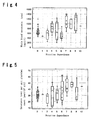
- the nicotine dependence of 36 outpatients at a smoking cessation clinic was assessed by the Fagerstrom smoking dependence test, and the whole blood serotonin levels in the patients were measured.
- the whole blood serotonin levels in healthy nonsmokers were measured.
- the nicotine dependence of the healthy nonsmokers was rated at 0.
- the results were analyzed to find a correlation between nicotine dependence and whole blood serotonin level.
- the results are shown in Fig. 4.
- the average whole blood serotonin levels were measured in 19 outpatients with treatment durations of 0 days,7 outpatients with treatment durations of from 1 to 50 days, 8 outpatients with treatment durations of from 51 to 100 days and 7 outpatients with treatment durations of 101 days or more at a smoking cessation clinic, and the correlation between the duration of treatment and whole blood serotonin level was investigated. Some of the patients had used stop smoking aids, and the others had not. The results are shown in Fig. 6. There was no difference between the patients with treatment durations of from 1 to 50 days and the patients with treatment durations of from 51 to 100 days, but the serotonin levels were significantly lower in the patients with treatment durations of over 100 days than in the patients with treatment durations of 0 days in Fig. 6. This indicates that not only the average blood nicotine level and nicotine dependence but also the whole blood serotonin level decreased with the progress of the treatment. This indicates that measurement of whole blood serotonin level is effective in assessing nicotine dependence during treatment.
- the average serotonin levels per 10 7 platelets were measured in 18 outpatients with treatment durations of 0 days, 6 outpatients with treatment durations of from 1 to 50 days, 8 outpatients with treatment durations of from 51 to 100 days and 6 patients with treatment durations of 101 days or more at the smoking cessation clinic, and the correlation between the duration of treatment and the average serotonin level per 10 7 platelets was investigated. The results are shown in Fig.. 7.
- the serotonin levels per unit platelet count showed a tendency to decrease with the duration of treatment and were significantly different in the patients with treatment durations of 0 days and in the patients with treatment durations of over 100 days in Fig. 7.
Landscapes
- Health & Medical Sciences (AREA)
- Life Sciences & Earth Sciences (AREA)
- Engineering & Computer Science (AREA)
- Molecular Biology (AREA)
- Immunology (AREA)
- Chemical & Material Sciences (AREA)
- Biomedical Technology (AREA)
- Urology & Nephrology (AREA)
- Hematology (AREA)
- Medicinal Chemistry (AREA)
- Pathology (AREA)
- Microbiology (AREA)
- Biotechnology (AREA)
- Pharmacology & Pharmacy (AREA)
- Food Science & Technology (AREA)
- Analytical Chemistry (AREA)
- Cell Biology (AREA)
- Bioinformatics & Cheminformatics (AREA)
- Biochemistry (AREA)
- General Health & Medical Sciences (AREA)
- General Physics & Mathematics (AREA)
- Physics & Mathematics (AREA)
- Investigating Or Analysing Biological Materials (AREA)
Claims (5)
- In vitro-Verfahren zur Beurteilung der Nikotinabhängigkeit, umfassend Messen des Serotoninspiegels in Vollblut, Serum oder plättchenreichem Plasma und Einstufen des Serotoninspiegels in Vollblut, Serum oder plättchenreichem Plasma auf einer solchen Skala, dass, je höher der Spiegel ist, desto höher ist die Nikotinabhängigkeit.
- In vitro-Verfahren zur Beurteilung der Nikotinabhängigkeit, umfassend Messen des Serotoninspiegels in Vollblut, Serum oder plättchenreichem Plasma, Berechnen des Serotoninspiegels pro Einheit Plättchenanzahl in Vollblut, Serum oder plättchenreichem Plasma aus dem Serotoninspiegel, in Vollblut, Serum oder plättchenreichem Plasma, oder Messen eines Serotoninspiegels pro Einheit Plättchenanzahl und Einstufen des berechneten Serotoninspiegels pro Einheit Plättchenanzahl in Vollblut, Serum oder plättchenreichem Plasma oder des gemessenen Serotoninspiegels pro Einheit Plättchenanzahl auf einer solchen Skala, dass, je höher der Spiegel ist, desto höher ist die Nikotinabhängigkeit.
- Verfahren nach Anspruch 1, wobei der Serotoninspiegel in Vollblut, Serum oder plättchenreichem Plasma bei einem Individuum mit dem Serotoninspiegel in Vollblut, Serum oder plättchenreichem Plasma bei einem Nichtraucher verglichen wird und der Serotoninspiegel in Vollblut, Serum oder plättchenreichem Plasma bei dem Individuum auf einer solchen Skala eingestuft wird, dass, je mehr er den Serotoninspiegel in Vollblut, Serum oder plättchenreichem Plasma des Nichtrauchers übersteigt, desto höher ist die Nikotinabhängigkeit.
- Verfahren nach Anspruch 2, umfassend:a) Messen des Serotoninspiegels in Vollblut, Serum oder plättchenreichem Plasma bei einem Individuum und daraus Berechnen des Serotoninspiegels pro Einheit Plättchenanzahl in Vollblut, Serum oder plättchenreichem Plasma, oder Messen des Serotoninspiegels pro Einheit Plättchenanzahl beim Individuum;b) Messen des Serotoninspiegels in Vollblut, Serum oder plättchenreichem Plasma bei einem Nichtraucher und daraus Berechnen des Serotoninspiegels pro Einheit Plättchenanzahl in Vollblut, Serum oder plättchenreichem Plasma, oder Messen des Serotoninspiegels pro Einheit Plättchenanzahl beim Nichtraucher; undc) Einstufen des Serotoninspiegels pro Einheit Plättchenanzahl in Vollblut, Serum oder plättchenreichem Plasma oder des in a) enthaltenen Serotoninspiegels pro Einheit Plättchenanzahl auf einer solchen Skala, dass, je mehr er den entsprechenden Serotoninspiegel pro Einheit Plättchenanzahl beim Nichtraucher, erhalten aus b), übersteigt, desto höher ist die Nikotinabhängigkeit
- Verfahren zur Beurteilung einer Änderung der Nikotinabhängigkeit mit der Zeit, umfassend die Beurteilung der Nikotinabhängigkeit unter Verwendung von Blutproben, die vom selben Individuum zu unterschiedlichen Zeiten gesammelt wurden, durch das Verfahren nach Anspruch 1 oder 2 und Vergleichen der Beurteilungen der Nikotinabhängigkeit.
Applications Claiming Priority (2)
| Application Number | Priority Date | Filing Date | Title |
|---|---|---|---|
| JP2003365818 | 2003-10-27 | ||
| JP2003365818 | 2003-10-27 |
Publications (2)
| Publication Number | Publication Date |
|---|---|
| EP1528397A1 EP1528397A1 (de) | 2005-05-04 |
| EP1528397B1 true EP1528397B1 (de) | 2007-03-28 |
Family
ID=34420097
Family Applications (1)
| Application Number | Title | Priority Date | Filing Date |
|---|---|---|---|
| EP20040025416 Expired - Lifetime EP1528397B1 (de) | 2003-10-27 | 2004-10-26 | Methode zur Beurteilung der Nikotinabhängigkeit |
Country Status (2)
| Country | Link |
|---|---|
| EP (1) | EP1528397B1 (de) |
| DE (1) | DE602004005551T2 (de) |
Family Cites Families (1)
| Publication number | Priority date | Publication date | Assignee | Title |
|---|---|---|---|---|
| US6485753B2 (en) * | 2000-08-18 | 2002-11-26 | Tosoh Corporation | Diagnostic marker for vascular endothelial injury |
-
2004
- 2004-10-26 DE DE602004005551T patent/DE602004005551T2/de not_active Expired - Lifetime
- 2004-10-26 EP EP20040025416 patent/EP1528397B1/de not_active Expired - Lifetime
Also Published As
| Publication number | Publication date |
|---|---|
| DE602004005551T2 (de) | 2008-01-31 |
| DE602004005551D1 (de) | 2007-05-10 |
| EP1528397A1 (de) | 2005-05-04 |
Similar Documents
| Publication | Publication Date | Title |
|---|---|---|
| US7262060B2 (en) | Method for assessing nicotine dependence | |
| Billimoria et al. | Effect of cigarette smoking on lipids, lipoproteins, blood coagulation, fibrinolysis and cellular components of human blood | |
| Abrams et al. | Saliva cotinine as a measure of smoking status in field settings. | |
| Paschal et al. | Exposure of the US population aged 6 years and older to cadmium: 1988–1994 | |
| Foss et al. | Serum thiocyanate and smoking: interpretation of serum thiocyanate levels observed in a large health study | |
| McMorrow et al. | Nicotine's role in smoking: an analysis of nicotine regulation. | |
| Cohen et al. | A comparison between carboxyhemoglobin and serum thiocyanate determinations as indicators of cigarette smoking. | |
| Kintz et al. | Evaluation of nicotine and cotinine in human hair | |
| World Health Organization | The scientific basis of tobacco product regulation: report of a WHO study group | |
| Budin et al. | The influence of smoking on nicotine exposure biomarkers and inflammatory profile among foster care teenagers, Romania | |
| Cheng et al. | Biomarkers of exposure among adult smokeless tobacco users in the Population Assessment of Tobacco and Health Study (Wave 1, 2013–2014) | |
| Gernun et al. | Cardiovascular functions and arterial stiffness after JUUL use | |
| EP1528397B1 (de) | Methode zur Beurteilung der Nikotinabhängigkeit | |
| Figueiredo et al. | Determinants of salivary cotinine level: a population-based study in Brazil | |
| Miura et al. | Pharmacokinetic analysis of nicotine when using non-combustion inhaler type of tobacco product in Japanese adult male smokers | |
| Charles et al. | A robust method for estimating human smoked cigarette yields from filter analysis data | |
| Ekberg et al. | Cigarette smoking and urinary albumin excretion in insulin‐treated diabetics without manifest nephropathy | |
| Jansson et al. | Assessment of environmental tobacco smoke exposure: urinary cotinine concentrations in children are strongly associated with the house dust concentrations of nicotine at home. | |
| Moldoveanu et al. | Determination of benzene and toluene in exhaled cigarette smoke | |
| Onat et al. | Obesity in Turkish adults: prevalence, validity as coronary risk factor, and interrelation with other risk factors | |
| Homoud et al. | Comparative assessment of respiratory, hematological and inflammatory profiles of long-term users of cigarettes, shisha, and e-cigarettes in Saudi Arabia | |
| Alhibrii et al. | Influence of chronic cigarette smoking on serum biochemical profile among Sudanese smokers | |
| McAdams et al. | Simple selected ion monitoring capillary gas chromatographic—mass spectrometric method for the determination of cotinine in serum, urine and oral samples | |
| US20040018484A1 (en) | Quantitative analysis of a biological sample of unknown quantity | |
| Vayá et al. | Hemorheological changes in children with familial hypercholesterolemia |
Legal Events
| Date | Code | Title | Description |
|---|---|---|---|
| PUAI | Public reference made under article 153(3) epc to a published international application that has entered the european phase |
Free format text: ORIGINAL CODE: 0009012 |
|
| AK | Designated contracting states |
Kind code of ref document: A1 Designated state(s): AT BE BG CH CY CZ DE DK EE ES FI FR GB GR HU IE IT LI LU MC NL PL PT RO SE SI SK TR |
|
| AX | Request for extension of the european patent |
Extension state: AL HR LT LV MK |
|
| 17P | Request for examination filed |
Effective date: 20050826 |
|
| AKX | Designation fees paid |
Designated state(s): DE FR GB |
|
| GRAP | Despatch of communication of intention to grant a patent |
Free format text: ORIGINAL CODE: EPIDOSNIGR1 |
|
| GRAS | Grant fee paid |
Free format text: ORIGINAL CODE: EPIDOSNIGR3 |
|
| GRAA | (expected) grant |
Free format text: ORIGINAL CODE: 0009210 |
|
| AK | Designated contracting states |
Kind code of ref document: B1 Designated state(s): DE FR GB |
|
| REG | Reference to a national code |
Ref country code: GB Ref legal event code: FG4D |
|
| REF | Corresponds to: |
Ref document number: 602004005551 Country of ref document: DE Date of ref document: 20070510 Kind code of ref document: P |
|
| ET | Fr: translation filed | ||
| PLBE | No opposition filed within time limit |
Free format text: ORIGINAL CODE: 0009261 |
|
| STAA | Information on the status of an ep patent application or granted ep patent |
Free format text: STATUS: NO OPPOSITION FILED WITHIN TIME LIMIT |
|
| 26N | No opposition filed |
Effective date: 20080102 |
|
| PGFP | Annual fee paid to national office [announced via postgrant information from national office to epo] |
Ref country code: FR Payment date: 20131009 Year of fee payment: 10 Ref country code: GB Payment date: 20131023 Year of fee payment: 10 Ref country code: DE Payment date: 20131023 Year of fee payment: 10 |
|
| REG | Reference to a national code |
Ref country code: DE Ref legal event code: R119 Ref document number: 602004005551 Country of ref document: DE |
|
| GBPC | Gb: european patent ceased through non-payment of renewal fee |
Effective date: 20141026 |
|
| PG25 | Lapsed in a contracting state [announced via postgrant information from national office to epo] |
Ref country code: GB Free format text: LAPSE BECAUSE OF NON-PAYMENT OF DUE FEES Effective date: 20141026 Ref country code: DE Free format text: LAPSE BECAUSE OF NON-PAYMENT OF DUE FEES Effective date: 20150501 |
|
| REG | Reference to a national code |
Ref country code: FR Ref legal event code: ST Effective date: 20150630 |
|
| PG25 | Lapsed in a contracting state [announced via postgrant information from national office to epo] |
Ref country code: FR Free format text: LAPSE BECAUSE OF NON-PAYMENT OF DUE FEES Effective date: 20141031 |
|
| P01 | Opt-out of the competence of the unified patent court (upc) registered |
Effective date: 20230523 |