EP1528117A1 - Diffusion coating process - Google Patents
Diffusion coating process Download PDFInfo
- Publication number
- EP1528117A1 EP1528117A1 EP04256632A EP04256632A EP1528117A1 EP 1528117 A1 EP1528117 A1 EP 1528117A1 EP 04256632 A EP04256632 A EP 04256632A EP 04256632 A EP04256632 A EP 04256632A EP 1528117 A1 EP1528117 A1 EP 1528117A1
- Authority
- EP
- European Patent Office
- Prior art keywords
- component
- coating
- diffusion
- process according
- activator
- Prior art date
- Legal status (The legal status is an assumption and is not a legal conclusion. Google has not performed a legal analysis and makes no representation as to the accuracy of the status listed.)
- Granted
Links
Images
Classifications
-
- C—CHEMISTRY; METALLURGY
- C23—COATING METALLIC MATERIAL; COATING MATERIAL WITH METALLIC MATERIAL; CHEMICAL SURFACE TREATMENT; DIFFUSION TREATMENT OF METALLIC MATERIAL; COATING BY VACUUM EVAPORATION, BY SPUTTERING, BY ION IMPLANTATION OR BY CHEMICAL VAPOUR DEPOSITION, IN GENERAL; INHIBITING CORROSION OF METALLIC MATERIAL OR INCRUSTATION IN GENERAL
- C23C—COATING METALLIC MATERIAL; COATING MATERIAL WITH METALLIC MATERIAL; SURFACE TREATMENT OF METALLIC MATERIAL BY DIFFUSION INTO THE SURFACE, BY CHEMICAL CONVERSION OR SUBSTITUTION; COATING BY VACUUM EVAPORATION, BY SPUTTERING, BY ION IMPLANTATION OR BY CHEMICAL VAPOUR DEPOSITION, IN GENERAL
- C23C10/00—Solid state diffusion of only metal elements or silicon into metallic material surfaces
- C23C10/28—Solid state diffusion of only metal elements or silicon into metallic material surfaces using solids, e.g. powders, pastes
- C23C10/30—Solid state diffusion of only metal elements or silicon into metallic material surfaces using solids, e.g. powders, pastes using a layer of powder or paste on the surface
Definitions
- the present invention relates to processes for forming diffusion coatings. More particularly, this invention relates to a process and material capable of locally producing a diffusion coating on limited surface regions of a substrate.
- Aluminide coatings are generally formed by a diffusion process such as pack cementation or vapor phase aluminizing (VPA) techniques, or by diffusing aluminum deposited by chemical vapor deposition (CVD) or slurry coating.
- Aluminide coatings contain MAI intermetallic (where M is the base material of the substrate, typically Ni, Co, or Fe), as well as other intermetallic phases formed by metals present in the substrate prior to aluminizing.
- Platinum aluminide (PtAl) diffusion coatings further contain platinum aluminide intermetallics and platinum in solution in the MAI phase as a result of plating platinum on the substrate prior to the aluminiding step.
- these aluminide coatings form a protective aluminum oxide (alumina) scale that inhibits further oxidation of the coating and the underlying substrate.
- Slurries used to form aluminide coatings contain an aluminum powder in an inorganic binder, and are directly applied to the surface to be aluminized. Aluminizing occurs as a result of heating the component in a non-oxidizing atmosphere or vacuum to a temperature that is maintained for a duration sufficient to melt the aluminum powder and diffuse the molten aluminum into the surface.
- slurry coatings may contain a carrier (activator), such as an alkali metal halide, which vaporizes and reacts with the aluminum powder to form a volatile aluminum halide, which then reacts at the component surface to form the aluminide coating.
- the amount of slurry applied must be very carefully controlled because the thickness of the resulting aluminide coating is proportional to the amount of slurry applied to the surface.
- the difficulty of consistently producing diffusion aluminide coatings of uniform thickness has discouraged the use of slurry processes on components that require a very uniform diffusion coating and/or have complicated geometries, such as turbine blades.
- pack cementation and VPA processes are widely used to coat broad surface regions of airfoils and other gas turbine engine components because of their ability to form coatings of uniform thickness. Both of these processes generally entail reacting the surface of a component with an aluminum halide gas formed by reacting an activator (e.g., an ammonium or alkali metal halide) with an aluminum-containing source (donor) material.
- an activator e.g., an ammonium or alkali metal halide
- the aluminum halide gas is produced by heating a powder mixture comprising the source material, activator, and an inert filler such as calcined alumina.
- the ingredients of the powder mixture are combined and then packed and pressed around the component to be treated, after which the component and powder mixture are heated to a temperature sufficient to vaporize the activator.
- the activator reacts with the source material to form the volatile aluminum halide, which then reacts at the component surface to form an aluminide coating.
- VPA processes are carried out with the source material (e.g., an aluminum alloy) placed out of contact with the surface to be aluminized.
- the present invention is a diffusion process capable of locally depositing a diffusion coating of uniform thickness.
- the process makes use of an adhesive mixture containing a binding agent that is consumed as part of the deposition process, so as not to negatively affect the quality and uniformity of the resulting coating.
- the invention is generally a cementation process that is particularly well suited for forming diffusion aluminide coatings, though other types of coatings can be produced by the process, such as chromide coatings.
- the process entails mixing a particulate donor material containing a coating element, a dissolved activator, and a particulate filler to form an adhesive mixture having a formable, malleable consistency.
- the adhesive mixture is applied to a surface of the component on which a diffusion coating is desired, and the component is heated to a temperature sufficient to vaporize and react the activator with the coating element of the donor material, thereby forming a reactive vapor of the coating element.
- the reactive vapor reacts at the surface of the component to form the desired diffusion coating containing the coating element.
- the adhesive mixture does not require or contain extraneous binding agents or other materials that are otherwise extrinsic to the coating process.
- the invention makes use of an activator that is capable of serving as a binder when dissolved, and is consumed (reacted) during the diffusion coating process so as not to interfere with the diffusion coating process.
- the adhesive mixture of dissolved activator and particulate materials is a paste-like material that, if dried, forms a solid pack exhibiting sufficient green strength to permit handling of the component prior to the diffusion process.
- the dissolved activator is capable of being the sole binding constituent within the adhesive mixture, and the adhesive mixture does not contain extraneous binding agents of the type that have previously led to inconsistencies in diffusion coating processes.
- the process of this invention is capable of consistently producing diffusion coatings of uniform thickness.
- the present invention also overcomes shortcomings of other diffusion coating techniques, such as conventional pack, CVD, and VPA processes, which are typically limited to forming diffusion coatings over large surface areas as a result of the difficulty of controlling the spatial extent of the coating reaction, even if advanced masking techniques are employed.
- the coating process of this invention is also an improvement over slurry processes which, though capable of forming coatings on localized surface regions, are ill-suited to provide uniform coatings on regions with complicated geometry, such as the area under an airfoil platform and the tip cavity of an airfoil.
- the invention is useful in circumstances where it is desirable to aluminize a surface of a component that has been repaired, as well as to deposit a diffusion coating on surface regions of a component that remain uncoated following a line-of-sight coating process, or are likely to be uncoated during a subsequent line-of-sight coating process.
- the present invention is particularly applicable to components that operate within thermally and chemically hostile environments, and are therefore subjected to oxidation, hot corrosion and thermal degradation.
- examples of such components include the high and low pressure turbine nozzles, blades and shrouds of gas turbine engines. While the advantages of this invention will be described with reference to gas turbine engine hardware, the teachings of the invention are generally applicable to any component on which a diffusion coating is desired to protect the component from its hostile operating environment.
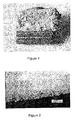
- Figure 1 is a scanned image showing an adhesive paste mixture applied to the underside surface of a platform of a high pressure turbine (HPT) blade (airfoil removed).
- the paste mixture contains a dissolved activator and one or more powders capable of being reacted with the surface to form a protective diffusion coating, preferably a diffusion aluminide coating.
- the paste mixture preferably has a malleable consistency that permits its application by hand or another method to a surface to be coated.
- the paste mixture can be selectively applied and adhered to localized surface regions of a component, e.g., the underside platform surface of the HPT blade shown in Figure 1, to form a diffusion aluminide coating on essentially only those surface regions to which the paste mixture was applied.
- the paste mixture can be applied directly to the component surface, or optionally can be applied over a coating on the component surface, such as an electrodeposited platinum layer (e.g., about 0.1 to about 0.3 mils (2.5 to about 7.5 micrometers) thick) to form a platinum aluminide (PtAl) diffusion coating.
- the activator is preferably an ammonium halide, more preferably ammonium chloride (NH 4 Cl), which is soluble in water and somewhat hygroscopic.
- NH 4 Cl ammonium chloride
- Other potentially suitable activators include ammonium bromide (NH 4 Br), ammonium iodide (NH 4 I), ammonium fluoride (NH 4 F) ammonium bifluoride (NH 4 HF 2 ), which are also soluble in water.
- the activator is preferably in granular form to promote the ease with which it is dissolved.
- the other constituents of the paste mixture include a particulate donor material for the diffusion coating and an inert filler material that prevents sintering of the donor material particles.
- Suitable compositions for the donor material will depend on the particular type of diffusion coating desired, with notable examples being CrAl, CoAl, FeAl, and TiAl alloys.
- Suitable inert fillers include alumina (Al 2 O 3 ), yttria (Y 2 O 3 ), zirconia (ZrO 2 ), silica (SiO 2 ), etc.
- the donor material and filler are preferably in a powder form, with suitable particle sizes being in a range of about 37 to about 250 micrometers, more preferably about 45 to about 150 micrometers.
- suitable paste mixtures can comprise, by weight percent, about 1 to about 10% of the activator powder, about 5 to about 30% of a donor material powder, about 30 to about 70% of an inert filler powder, and about 17 to about 37% water.
- a more preferred paste mixture comprises, by weight percent, about 2 to about 6% of the activator powder, about 8 to about 20% of a donor material powder, about 40 to about 60% of an inert filler powder, and about 22 to about 32% water.
- the paste mixture is preferably dried to evaporate the solvent (water) in the paste, leaving a solid cement-like pack that is well adhered to the component surface and has excellent green strength.
- a conventional oven heated to a temperature of about 80 to about 120°C is suitable.
- a diffusion aluminide coating is then formed in the component surface contacted by the pack by performing a diffusion heat treatment. Suitable treatments include temperatures of about 800 to about 1150°C held for durations of about 0.5 to about 6 hours in a non-oxidizing atmosphere, such as argon (inert), H 2 (reducing), etc.
- a significant feature of the invention is the use of an activator as the binding agent for the paste mixture.
- an activator as the binding agent for the paste mixture.
- extraneous binding agents are not necessary or desirable, particularly since such binding agents may interfere with the coating process or may be difficult to remove from the component surface at the end of the process.
- the activator-binder of this invention promotes the coating reaction, and is entirely consumed during the coating process so as not to subsequently pose a problem.
- the aluminum alloy powder (particle size: about 45 to about 150 micrometers) was a TiAl alloy containing about 60 weight percent titanium, about 35 weight percent aluminum, the balance carbon, nickel, iron, manganese, chromium, and other incidental impurities.
- the NH 4 Cl powder was dissolved in the distilled water, and the aluminum alloy powder was mixed with the two grades of Al 2 O 3 powders. The resulting powder mixture was then added to the NH 4 Cl aqueous solution, which the resulting mixture underwent thorough mixing until the paste could be easily worked with a spatula and fingers.
- the paste was then applied to the underside surface of a platform of an HPT blade formed of the nickel-base superalloy commercially known as René N5 (nominal composition of, by weight, about 7.5% Co, 7.0% Cr, 6.5% Ta, 6.2% Al, 5.0% W, 3.0%Re, 1.5% Mo, 0.15% Hf, 0.05% C, 0.004% B, 0.01% Y, the balance nickel and incidental impurities).
- René N5 nominal composition of, by weight, about 7.5% Co, 7.0% Cr, 6.5% Ta, 6.2% Al, 5.0% W, 3.0%Re, 1.5% Mo, 0.15% Hf, 0.05% C, 0.004% B, 0.01% Y, the balance nickel and incidental impurities.
- René N5 nominal composition of, by weight, about 7.5% Co, 7.0% Cr, 6.5% Ta, 6.2% Al, 5.0% W, 3.0%Re, 1.5% Mo, 0.15% Hf, 0.05% C, 0.004% B, 0.01% Y, the balance nickel and incidental impurities
- the paste was then applied with a spatula to an average thickness of about 0.5 to about 1 cm.
- the paste was then dried at about 82°C for about two hours and at about 120°C for an additional two hours, yielding a hard, adherent pack with good green strength.
- paste mixtures formed by mixing the powders with water easily crumbled after drying.
- the blade then underwent a diffusion heat treatment at about 1975°F (about 1080°C) for about six hours, after which the pack material was readily removable to expose in a diffusion aluminide coating in the surface on which the paste had been applied.
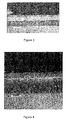
- a micrograph of the aluminide coating is shown in Figure 2 and evidences that a good quality coating of uniform thickness (about 57 micrometers) was produced, even though the paste was not applied to the surface to have a carefully controlled uniform thickness.
- the above mixture primarily differed from the previous mixture as a result of using a different aluminum donor material.
- the purpose of using the Cr-Al alloy (particle size: about 45 to about 150 micrometers) was to form a coating with higher aluminum content.
- the paste was prepared as described above in the first investigation and applied to an identical HPT blade. After drying the paste, the blade underwent a diffusion heat treatment as in the previous investigation, yielding the diffusion aluminide coating shown in Figure 3 and having a uniform thickness of about 67 micrometers.
- This paste differed from the previous paste as a result of having a small addition of a hectorite clay powder.
- the NH 4 Cl activator was first dissolved in the water.
- the 4% clay mix was made separately by dissolving about 4 grams of hectorite clay (commercially available as Bentone AD from Elementis Specialties) in a solution of about 95.5 cc of water H20 and about 0.5 g NH 4 OH. About 6.8 grams of this premix was then added to the NH 4 Cl aqueous solution.
- the solid powders of alumina and the aluminum donor alloy were premixed and then mixed thoroughly into the NH 4 Cl-clay-water mixture, resulting in a paste that was applied to another identical HPT blade and dried in essentially the same manner as before.
- the addition of the clay which was about 1% by weight based on dry materials, was observed to have increased the green strength of the resulting hard pack, thereby improving manufacturability.
- the blade was then diffusion treated as before, yielding the diffusion aluminide coating shown in Figure 4 as having a uniform thickness of about 67 micrometers.
- the clay decomposed during the diffusion heat treatment, making post-diffusion cleaning as easy as before.
- Paste mixtures of the type described in the third investigation were also successfully applied to tip cavities and platform undersides of a variety of other HPT blades formed of René N5, one of which had been pre-plated with platinum to yield a two-phase PtAl diffusion coating. Prior to the diffusion coating process of this invention, these blades had undergone line-of-sight coating processes to deposit NiAl overlay bond coats on their airfoils. The use of the paste of this invention did not have a detrimental effect on the pre-existing bond coats.
- the present invention is believed to be particularly well suited for use in combination with NiAl overlay bond coats and other coatings whose application is limited by their line-of-sight deposition techniques (e.g., EB-PVD, ion plasma, etc.).
- line-of-sight deposition techniques e.g., EB-PVD, ion plasma, etc.
- the cementation process of this invention provides a method by which a protective diffusion coating can be deposited on the non-line-of-sight regions that cannot easily be coated using PVD and other line-of-sight coating processes, which often do not provide good coating coverage to areas of complicated geometry and those that are shadowed.
- NH 4 Cl activator could be used in combination with other ammonium halide activators, e.g., NH 4 Br and/or NH 4 I, or such activators could be used in place of the preferred NH 4 Cl activator.
- Other known activators e.g., metal halide activators such as AIF 3 and CrCl 3 ) could also be used in combination with the ammonium halide activator(s).
Landscapes
- Chemical & Material Sciences (AREA)
- Chemical Kinetics & Catalysis (AREA)
- Engineering & Computer Science (AREA)
- Materials Engineering (AREA)
- Mechanical Engineering (AREA)
- Metallurgy (AREA)
- Organic Chemistry (AREA)
- Turbine Rotor Nozzle Sealing (AREA)
- Other Surface Treatments For Metallic Materials (AREA)
Abstract
Description
- The present invention relates to processes for forming diffusion coatings. More particularly, this invention relates to a process and material capable of locally producing a diffusion coating on limited surface regions of a substrate.
- The operating environment within a gas turbine engine is both thermally and chemically hostile. Significant advances in high temperature capabilities have been achieved through the development of iron, nickel and cobalt-base superalloys and through the use of oxidation-resistant environmental coatings. Aluminum-containing coatings, particularly diffusion aluminide coatings, have found widespread use as environmental coatings on the external and internal surfaces of gas turbine engine components. Aluminide coatings are generally formed by a diffusion process such as pack cementation or vapor phase aluminizing (VPA) techniques, or by diffusing aluminum deposited by chemical vapor deposition (CVD) or slurry coating. Aluminide coatings contain MAI intermetallic (where M is the base material of the substrate, typically Ni, Co, or Fe), as well as other intermetallic phases formed by metals present in the substrate prior to aluminizing. Platinum aluminide (PtAl) diffusion coatings further contain platinum aluminide intermetallics and platinum in solution in the MAI phase as a result of plating platinum on the substrate prior to the aluminiding step. During high temperature exposure in air, these aluminide coatings form a protective aluminum oxide (alumina) scale that inhibits further oxidation of the coating and the underlying substrate.
- Slurries used to form aluminide coatings contain an aluminum powder in an inorganic binder, and are directly applied to the surface to be aluminized. Aluminizing occurs as a result of heating the component in a non-oxidizing atmosphere or vacuum to a temperature that is maintained for a duration sufficient to melt the aluminum powder and diffuse the molten aluminum into the surface. As described in U.S. Patent No. 6,444,054, slurry coatings may contain a carrier (activator), such as an alkali metal halide, which vaporizes and reacts with the aluminum powder to form a volatile aluminum halide, which then reacts at the component surface to form the aluminide coating. The amount of slurry applied must be very carefully controlled because the thickness of the resulting aluminide coating is proportional to the amount of slurry applied to the surface. The difficulty of consistently producing diffusion aluminide coatings of uniform thickness has discouraged the use of slurry processes on components that require a very uniform diffusion coating and/or have complicated geometries, such as turbine blades.
- In contrast to slurry processes, pack cementation and VPA processes are widely used to coat broad surface regions of airfoils and other gas turbine engine components because of their ability to form coatings of uniform thickness. Both of these processes generally entail reacting the surface of a component with an aluminum halide gas formed by reacting an activator (e.g., an ammonium or alkali metal halide) with an aluminum-containing source (donor) material. In pack cementation processes, the aluminum halide gas is produced by heating a powder mixture comprising the source material, activator, and an inert filler such as calcined alumina. The ingredients of the powder mixture are combined and then packed and pressed around the component to be treated, after which the component and powder mixture are heated to a temperature sufficient to vaporize the activator. The activator reacts with the source material to form the volatile aluminum halide, which then reacts at the component surface to form an aluminide coating. In contrast to pack processes, VPA processes are carried out with the source material (e.g., an aluminum alloy) placed out of contact with the surface to be aluminized.
- There are occasions when only a localized region of a component requires coating. For example, if the tip of an airfoil has undergone repair (e.g., following return from service), only the repaired tip surface requires recoating. Another example is when one or more surface regions of a "new-make" airfoil (e.g., prior to installation and operation in an engine) remain uncoated following a line-of-sight coating process, such as physical vapor deposition (PVD). The above-noted processes for depositing diffusion coatings have limitations that make them less than ideal for producing localized diffusion coatings. For example, in order to coat local surface regions of a component using conventional vapor phase and pack cementation processes, extensive masking is required to prevent coating deposition on those surfaces that do not require coating. While the slurry process is capable of producing localized coatings without masking, the difficulty of controlling the thickness of the coating using slurries is a significant drawback, particularly if the coating is to be formed on surface areas with complex shapes.
- Approaches have been proposed for overcoming the above shortcomings, including the use of pack cementation tapes. However, such tapes often have very low green strength, with the result that the tapes tend to delaminate during processing to yield coatings of variable quality. U.S. Patent No. 6,110,262 to Kircher et al. proposes a localized cementation process that uses organic binders and solvents to contain the cementation powders against the part to be coated. However, the use of extraneous binding agents can lead to inconsistency in the coating process because the cohesion required of the binding agents to maintain the strength of the mixture may also create a barrier to the coating vapors. Other potential drawbacks include carbide formation or the introduction of other impurities into the coating during decomposition of an organic binder, and environmental issues if the organic binder contains a hazardous solvent, such as acetone, toluene, etc.
- In view of the above, there is an ongoing need for processes capable of depositing a diffusion coating of uniform thickness on localized surface regions of a component.
- The present invention is a diffusion process capable of locally depositing a diffusion coating of uniform thickness. The process makes use of an adhesive mixture containing a binding agent that is consumed as part of the deposition process, so as not to negatively affect the quality and uniformity of the resulting coating.
- The invention is generally a cementation process that is particularly well suited for forming diffusion aluminide coatings, though other types of coatings can be produced by the process, such as chromide coatings. The process entails mixing a particulate donor material containing a coating element, a dissolved activator, and a particulate filler to form an adhesive mixture having a formable, malleable consistency. The adhesive mixture is applied to a surface of the component on which a diffusion coating is desired, and the component is heated to a temperature sufficient to vaporize and react the activator with the coating element of the donor material, thereby forming a reactive vapor of the coating element. The reactive vapor reacts at the surface of the component to form the desired diffusion coating containing the coating element.
- According to a preferred aspect of the invention, the adhesive mixture does not require or contain extraneous binding agents or other materials that are otherwise extrinsic to the coating process. Instead, the invention makes use of an activator that is capable of serving as a binder when dissolved, and is consumed (reacted) during the diffusion coating process so as not to interfere with the diffusion coating process. The adhesive mixture of dissolved activator and particulate materials is a paste-like material that, if dried, forms a solid pack exhibiting sufficient green strength to permit handling of the component prior to the diffusion process. As such, the dissolved activator is capable of being the sole binding constituent within the adhesive mixture, and the adhesive mixture does not contain extraneous binding agents of the type that have previously led to inconsistencies in diffusion coating processes. As a result, the process of this invention is capable of consistently producing diffusion coatings of uniform thickness.
- In view of the above, the present invention also overcomes shortcomings of other diffusion coating techniques, such as conventional pack, CVD, and VPA processes, which are typically limited to forming diffusion coatings over large surface areas as a result of the difficulty of controlling the spatial extent of the coating reaction, even if advanced masking techniques are employed. The coating process of this invention is also an improvement over slurry processes which, though capable of forming coatings on localized surface regions, are ill-suited to provide uniform coatings on regions with complicated geometry, such as the area under an airfoil platform and the tip cavity of an airfoil. In view of these advantages, the invention is useful in circumstances where it is desirable to aluminize a surface of a component that has been repaired, as well as to deposit a diffusion coating on surface regions of a component that remain uncoated following a line-of-sight coating process, or are likely to be uncoated during a subsequent line-of-sight coating process.
- Embodiments of the invention will now be described, by way of example, with reference to the accompanying, drawings in which:
- Figure 1 is a scanned image of an adhesive paste mixture applied to a surface of a component for producing a diffusion coating in accordance with this invention.
- Figures 2, 3 and 4 are scanned micrograph images of coatings formed with adhesive paste mixtures of the type shown in Figure 1.
-
- The present invention is particularly applicable to components that operate within thermally and chemically hostile environments, and are therefore subjected to oxidation, hot corrosion and thermal degradation. Examples of such components include the high and low pressure turbine nozzles, blades and shrouds of gas turbine engines. While the advantages of this invention will be described with reference to gas turbine engine hardware, the teachings of the invention are generally applicable to any component on which a diffusion coating is desired to protect the component from its hostile operating environment.
- Figure 1 is a scanned image showing an adhesive paste mixture applied to the underside surface of a platform of a high pressure turbine (HPT) blade (airfoil removed). According to the invention, the paste mixture contains a dissolved activator and one or more powders capable of being reacted with the surface to form a protective diffusion coating, preferably a diffusion aluminide coating. The paste mixture preferably has a malleable consistency that permits its application by hand or another method to a surface to be coated. Because of its adhesive malleable consistency, the paste mixture can be selectively applied and adhered to localized surface regions of a component, e.g., the underside platform surface of the HPT blade shown in Figure 1, to form a diffusion aluminide coating on essentially only those surface regions to which the paste mixture was applied. The paste mixture can be applied directly to the component surface, or optionally can be applied over a coating on the component surface, such as an electrodeposited platinum layer (e.g., about 0.1 to about 0.3 mils (2.5 to about 7.5 micrometers) thick) to form a platinum aluminide (PtAl) diffusion coating.
- The activator is preferably an ammonium halide, more preferably ammonium chloride (NH4Cl), which is soluble in water and somewhat hygroscopic. The solubility of the activator in water avoids the need for a solvent that is potentially hazardous or detrimental to the coating process. Other potentially suitable activators include ammonium bromide (NH4Br), ammonium iodide (NH4I), ammonium fluoride (NH4F) ammonium bifluoride (NH4HF2), which are also soluble in water. The activator is preferably in granular form to promote the ease with which it is dissolved. The other constituents of the paste mixture include a particulate donor material for the diffusion coating and an inert filler material that prevents sintering of the donor material particles. Suitable compositions for the donor material will depend on the particular type of diffusion coating desired, with notable examples being CrAl, CoAl, FeAl, and TiAl alloys. Suitable inert fillers include alumina (Al2O3), yttria (Y2O3), zirconia (ZrO2), silica (SiO2), etc. The donor material and filler are preferably in a powder form, with suitable particle sizes being in a range of about 37 to about 250 micrometers, more preferably about 45 to about 150 micrometers. Generally, the amounts of the individual ingredients used and suitable particle sizes for the ingredients are influenced by the resultant coating thickness and green strength desired for the paste mixture. With this in mind, suitable paste mixtures can comprise, by weight percent, about 1 to about 10% of the activator powder, about 5 to about 30% of a donor material powder, about 30 to about 70% of an inert filler powder, and about 17 to about 37% water. A more preferred paste mixture comprises, by weight percent, about 2 to about 6% of the activator powder, about 8 to about 20% of a donor material powder, about 40 to about 60% of an inert filler powder, and about 22 to about 32% water.
- After application but prior to the diffusion coating process, the paste mixture is preferably dried to evaporate the solvent (water) in the paste, leaving a solid cement-like pack that is well adhered to the component surface and has excellent green strength. For this purpose, a conventional oven heated to a temperature of about 80 to about 120°C is suitable. A diffusion aluminide coating is then formed in the component surface contacted by the pack by performing a diffusion heat treatment. Suitable treatments include temperatures of about 800 to about 1150°C held for durations of about 0.5 to about 6 hours in a non-oxidizing atmosphere, such as argon (inert), H2 (reducing), etc.
- A significant feature of the invention is the use of an activator as the binding agent for the paste mixture. As a result, extraneous binding agents are not necessary or desirable, particularly since such binding agents may interfere with the coating process or may be difficult to remove from the component surface at the end of the process. In contrast, the activator-binder of this invention promotes the coating reaction, and is entirely consumed during the coating process so as not to subsequently pose a problem.
- During an investigation leading to this invention, a paste mixture was prepared with the following ingredients (amounts are approximate):
- 10 cc distilled H2O
- 1.6 g NH4Cl (granular)
- 5.4 g aluminum alloy powder
- 4 g fine Al2O3 powder (particle size: less than 45 micrometers)
- 15.6 g coarse Al2O3 powder (particle size: about 45 to about 150 micrometers)
-
- The aluminum alloy powder (particle size: about 45 to about 150 micrometers) was a TiAl alloy containing about 60 weight percent titanium, about 35 weight percent aluminum, the balance carbon, nickel, iron, manganese, chromium, and other incidental impurities.
- In the preparation of the paste mixture, the NH4Cl powder was dissolved in the distilled water, and the aluminum alloy powder was mixed with the two grades of Al2O3 powders. The resulting powder mixture was then added to the NH4Cl aqueous solution, which the resulting mixture underwent thorough mixing until the paste could be easily worked with a spatula and fingers. The paste was then applied to the underside surface of a platform of an HPT blade formed of the nickel-base superalloy commercially known as René N5 (nominal composition of, by weight, about 7.5% Co, 7.0% Cr, 6.5% Ta, 6.2% Al, 5.0% W, 3.0%Re, 1.5% Mo, 0.15% Hf, 0.05% C, 0.004% B, 0.01% Y, the balance nickel and incidental impurities). Prior to application of the paste mixture, the blade was degreased in isopropyl alcohol for a few minutes while subject to ultrasonic energy, and then dried. The area to be coated with the paste was first wet by spreading a thin film of the paste on the surface with a brush. The paste was then applied with a spatula to an average thickness of about 0.5 to about 1 cm. The paste was then dried at about 82°C for about two hours and at about 120°C for an additional two hours, yielding a hard, adherent pack with good green strength. Notably, in the absence of the NH4Cl binder, paste mixtures formed by mixing the powders with water easily crumbled after drying.
- The blade then underwent a diffusion heat treatment at about 1975°F (about 1080°C) for about six hours, after which the pack material was readily removable to expose in a diffusion aluminide coating in the surface on which the paste had been applied. A micrograph of the aluminide coating is shown in Figure 2 and evidences that a good quality coating of uniform thickness (about 57 micrometers) was produced, even though the paste was not applied to the surface to have a carefully controlled uniform thickness.
- During a second investigation, another paste mixture was prepared with the following ingredients (amounts are approximate):
- 10 cc distilled H2O
- 1.6 g NH4Cl (granular)
- 4 g aluminum alloy powder (56% Cr - 44% Al by weight)
- 4 g fine Al2O3 powder (particle size: less than 45 micrometers)
- 17 g coarse Al2O3 powder (particle size: about 45 to about 150 micrometers)
-
- The above mixture primarily differed from the previous mixture as a result of using a different aluminum donor material. The purpose of using the Cr-Al alloy (particle size: about 45 to about 150 micrometers) was to form a coating with higher aluminum content. The paste was prepared as described above in the first investigation and applied to an identical HPT blade. After drying the paste, the blade underwent a diffusion heat treatment as in the previous investigation, yielding the diffusion aluminide coating shown in Figure 3 and having a uniform thickness of about 67 micrometers.
- In a third investigation, a paste mixture was prepared with the following ingredients (amounts are approximate):
- 3.5 cc distilled H2O
- 1.6 g NH4Cl powder (granular)
- 6.8 g of 4% hectorite clay mix
- 4 g aluminum alloy powder (56% Cr - 44% Al by weight)
- 4 g fine Al2O3 powder (particle size: less than 45 micrometers)
- 17 g coarse Al2O3 powder (particle size: about 45 to about 150 micrometers)
-
- This paste differed from the previous paste as a result of having a small addition of a hectorite clay powder. As before, the NH4Cl activator was first dissolved in the water. The 4% clay mix was made separately by dissolving about 4 grams of hectorite clay (commercially available as Bentone AD from Elementis Specialties) in a solution of about 95.5 cc of water H20 and about 0.5 g NH4OH. About 6.8 grams of this premix was then added to the NH4Cl aqueous solution. The solid powders of alumina and the aluminum donor alloy (particle size: about 45 to about 150 micrometers) were premixed and then mixed thoroughly into the NH4Cl-clay-water mixture, resulting in a paste that was applied to another identical HPT blade and dried in essentially the same manner as before. The addition of the clay, which was about 1% by weight based on dry materials, was observed to have increased the green strength of the resulting hard pack, thereby improving manufacturability. The blade was then diffusion treated as before, yielding the diffusion aluminide coating shown in Figure 4 as having a uniform thickness of about 67 micrometers. In addition to volatilization of the NH4Cl activator, the clay decomposed during the diffusion heat treatment, making post-diffusion cleaning as easy as before.
- Paste mixtures of the type described in the third investigation were also successfully applied to tip cavities and platform undersides of a variety of other HPT blades formed of René N5, one of which had been pre-plated with platinum to yield a two-phase PtAl diffusion coating. Prior to the diffusion coating process of this invention, these blades had undergone line-of-sight coating processes to deposit NiAl overlay bond coats on their airfoils. The use of the paste of this invention did not have a detrimental effect on the pre-existing bond coats. Accordingly, the present invention is believed to be particularly well suited for use in combination with NiAl overlay bond coats and other coatings whose application is limited by their line-of-sight deposition techniques (e.g., EB-PVD, ion plasma, etc.). The cementation process of this invention provides a method by which a protective diffusion coating can be deposited on the non-line-of-sight regions that cannot easily be coated using PVD and other line-of-sight coating processes, which often do not provide good coating coverage to areas of complicated geometry and those that are shadowed.
- While the invention has been described in terms of a preferred embodiment, it is apparent that other forms could be adopted by one skilled in the art. For example, one could use different ingredient percentages, different sources of alloy powder (e.g., Al-Co alloys), and different types of inert powders than those described in the investigations. Furthermore, the preferred NH4Cl activator could be used in combination with other ammonium halide activators, e.g., NH4Br and/or NH4I, or such activators could be used in place of the preferred NH4Cl activator. Other known activators (e.g., metal halide activators such as AIF3 and CrCl3) could also be used in combination with the ammonium halide activator(s).
Claims (10)
- A process of forming a diffusion coating on a component, the process comprising the steps of:mixing a particulate donor material containing a coating element, an activator dissolved in a solvent, and a particulate filler to form an adhesive mixture having a formable, malleable consistency;applying the adhesive mixture to a surface of the component; and heating the component to a temperature sufficient to vaporize and react the activator with the coating element of the donor material to form a reactive vapor of the coating element, the reactive vapor reacting at the surface of the component to form a diffusion coating containing the coating element.
- A process according to claim 1, further comprising the step of drying the adhesive mixture after the applying step to remove the solvent from the adhesive mixture and thereby form a solid pack adhering to the surface of the component.
- A process according to claim 1, wherein the donor material comprises an aluminum alloy, the coating element is aluminum, and the diffusion coating is a diffusion aluminide coating.
- A process according to claim 1, wherein the activator is chosen from the group consisting of NH4Cl, NH4Br, NH4I, NH4F, and NH4HF2.
- A process according to claim 1, wherein the solvent is water.
- A process according to claim 1, wherein the adhesive mixture does not contain an extraneous binder, and the donor material and the filler within the adhesive mixture are cohered solely by the dissolved activator.
- A process according to claim 1, wherein the component is a gas turbine engine component formed of a superalloy.
- A process according to claim 1, wherein the surface of the component is a repaired surface region that constitutes a limited surface portion of the component.
- A process according to claim 1, wherein the component is a new-make component and the surface of the component constitutes a limited surface portion of the component.
- A process according to claim 1, wherein the adhesive mixture does not have a uniform thickness following the applying step.
Priority Applications (1)
| Application Number | Priority Date | Filing Date | Title |
|---|---|---|---|
| DE602004012039.1T DE602004012039T3 (en) | 2003-10-31 | 2004-10-27 | Diffusion coating process |
Applications Claiming Priority (2)
| Application Number | Priority Date | Filing Date | Title |
|---|---|---|---|
| US605858 | 1984-05-01 | ||
| US10/605,858 US7390534B2 (en) | 2003-10-31 | 2003-10-31 | Diffusion coating process |
Publications (3)
| Publication Number | Publication Date |
|---|---|
| EP1528117A1 true EP1528117A1 (en) | 2005-05-04 |
| EP1528117B1 EP1528117B1 (en) | 2008-02-27 |
| EP1528117B2 EP1528117B2 (en) | 2015-11-04 |
Family
ID=34421900
Family Applications (1)
| Application Number | Title | Priority Date | Filing Date |
|---|---|---|---|
| EP04256632.3A Expired - Lifetime EP1528117B2 (en) | 2003-10-31 | 2004-10-27 | Diffusion coating process |
Country Status (3)
| Country | Link |
|---|---|
| US (1) | US7390534B2 (en) |
| EP (1) | EP1528117B2 (en) |
| DE (1) | DE602004012039T3 (en) |
Cited By (7)
| Publication number | Priority date | Publication date | Assignee | Title |
|---|---|---|---|---|
| EP1936010A2 (en) | 2006-12-20 | 2008-06-25 | General Electric Company | Sprayable water-base platinum-group-containing paint and its application |
| EP2371986A1 (en) * | 2010-03-30 | 2011-10-05 | United Technologies Corporation | Metallic coating for non-line of sight areas |
| EP2886677A1 (en) * | 2013-12-19 | 2015-06-24 | General Electric Company | A slurry and a coating method |
| EP2960431A1 (en) * | 2014-05-09 | 2015-12-30 | United Technologies Corporation | Systems and methods for repairing a surface of damaged metal components |
| US9890642B2 (en) | 2012-04-03 | 2018-02-13 | Mtu Aero Engines Gmbh | Aluminide or chromide coatings of cavities |
| EP3382055A1 (en) * | 2017-03-28 | 2018-10-03 | United Technologies Corporation | Aluminum-chromium diffusion coating |
| EP3428308A1 (en) * | 2017-07-14 | 2019-01-16 | MTU Aero Engines GmbH | Method for coating a component for the hot gas channel of a turbomachine |
Families Citing this family (13)
| Publication number | Priority date | Publication date | Assignee | Title |
|---|---|---|---|---|
| US20120060721A1 (en) * | 2003-08-04 | 2012-03-15 | General Electric Company | Slurry chromizing compositions |
| DE10347363A1 (en) * | 2003-10-11 | 2005-05-12 | Mtu Aero Engines Gmbh | Method for locally alitating, silicating or chromating metallic components |
| US7553517B1 (en) * | 2005-09-15 | 2009-06-30 | The United States Of America As Represented By The United States Department Of Energy | Method of applying a cerium diffusion coating to a metallic alloy |
| DE102005055200A1 (en) * | 2005-11-19 | 2007-05-24 | Mtu Aero Engines Gmbh | Method for producing an inlet lining |
| DE102006028297A1 (en) * | 2006-06-20 | 2007-12-27 | Mtu Aero Engines Gmbh | Method of repairing inlet coverings |
| US20120094021A1 (en) * | 2010-10-13 | 2012-04-19 | Goodrich Corporation | Method of forming a diffusion aluminide coating on a surface of a turbine component and a homogeneous paste for coating such surfaces |
| DE102012010602A1 (en) * | 2012-05-30 | 2013-12-05 | Dechema-Forschungsinstitut | Process for coating a cobalt, nickel and / or iron containing substrate with a corrosion resistant layer |
| US8821988B2 (en) | 2012-10-01 | 2014-09-02 | Dayton T. Brown, Inc. | Method for modification of the surface and subsurface regions of metallic substrates |
| US20160230284A1 (en) * | 2015-02-10 | 2016-08-11 | Arcanum Alloy Design, Inc. | Methods and systems for slurry coating |
| WO2017156069A1 (en) * | 2016-03-08 | 2017-09-14 | Arcanum Alloys, Inc. | Methods for metal coating |
| WO2017201418A1 (en) * | 2016-05-20 | 2017-11-23 | Arcanum Alloys, Inc. | Methods and systems for coating a steel substrate |
| FR3084891B1 (en) * | 2018-08-07 | 2022-06-24 | Commissariat Energie Atomique | COATING FOR REFRACTORY ALLOY PARTS |
| CN112323066B (en) * | 2020-09-21 | 2023-01-17 | 中国航发沈阳黎明航空发动机有限责任公司 | A method for preparing a diffusion barrier layer suitable for large components |
Citations (14)
| Publication number | Priority date | Publication date | Assignee | Title |
|---|---|---|---|---|
| GB779972A (en) * | 1954-09-29 | 1957-07-24 | Gen Motors Corp | Improvements relating to the coating of metal articles with aluminium |
| GB1186924A (en) * | 1966-06-24 | 1970-04-08 | Onera (Off Nat Aerospatiale) | Process for Forming Surface Diffusion Alloys on Refractory Metal Members |
| FR2180667A1 (en) * | 1972-04-19 | 1973-11-30 | Cockerill Ougree Providence Es | Chrome plating - ferrous material esp steel strip/sheet by coating with a wash then drying and firing |
| US3804665A (en) * | 1971-04-21 | 1974-04-16 | R Chapman | Vapour deposition coating process |
| US3900613A (en) * | 1972-06-30 | 1975-08-19 | Onera (Off Nat Aerospatiale) | Production of surface diffusion alloys |
| GB1431355A (en) * | 1972-07-05 | 1976-04-07 | Cockerill | Diffusing metals into low-carbon steel sheet |
| JPS5332239B2 (en) * | 1971-09-07 | 1978-09-07 | ||
| GB1586501A (en) * | 1976-06-11 | 1981-03-18 | Alloy Surfaces Co Inc | Metal coating |
| US4617202A (en) * | 1970-11-18 | 1986-10-14 | Alloy Surfaces Company, Inc. | Diffusion coating mixtures |
| JPH04131365A (en) * | 1990-09-21 | 1992-05-06 | Shimadzu Corp | Method for reforming surface of molybdenum molded body |
| US5364659A (en) * | 1992-02-21 | 1994-11-15 | Ohio State University Research Foundation | Codeposition of chromium and silicon diffusion coatings in FE-base alloys using pack cementation |
| US5366765A (en) * | 1993-05-17 | 1994-11-22 | United Technologies Corporation | Aqueous slurry coating system for aluminide coatings |
| US5723535A (en) * | 1993-09-13 | 1998-03-03 | H.C. Starck Gmbh & Co., Kg | Pastes for the coating of substrates, methods for manufacturing them and their use |
| WO2003085162A1 (en) * | 2002-04-10 | 2003-10-16 | Siemens Aktiengesellschaft | Method for coating a component |
Family Cites Families (9)
| Publication number | Priority date | Publication date | Assignee | Title |
|---|---|---|---|---|
| US2855332A (en) † | 1954-09-07 | 1958-10-07 | Metal Diffusions Inc | Method of chromizing ferrous metal |
| US4208453A (en) * | 1969-06-30 | 1980-06-17 | Alloy Surfaces Company, Inc. | Modified diffusion coating of the interior of a steam boiler tube |
| BE789036A (en) † | 1971-09-24 | 1973-03-20 | Kempten Elektroschmelz Gmbh | BORING AGENT |
| US4260654A (en) * | 1974-02-27 | 1981-04-07 | Alloy Surfaces Company, Inc. | Smooth coating |
| JPS5332239A (en) | 1976-09-07 | 1978-03-27 | Nippon Denso Co Ltd | Speed regulator of centrifugal type for internal combustion engine |
| US5334417A (en) * | 1992-11-04 | 1994-08-02 | Kevin Rafferty | Method for forming a pack cementation coating on a metal surface by a coating tape |
| US5997604A (en) * | 1998-06-26 | 1999-12-07 | C. A. Patents, L.L.C. | Coating tape |
| US6110262A (en) * | 1998-08-31 | 2000-08-29 | Sermatech International, Inc. | Slurry compositions for diffusion coatings |
| US6730179B2 (en) * | 2001-08-31 | 2004-05-04 | Sermatech International Inc. | Method for producing local aluminide coating |
-
2003
- 2003-10-31 US US10/605,858 patent/US7390534B2/en not_active Expired - Lifetime
-
2004
- 2004-10-27 DE DE602004012039.1T patent/DE602004012039T3/en not_active Expired - Lifetime
- 2004-10-27 EP EP04256632.3A patent/EP1528117B2/en not_active Expired - Lifetime
Patent Citations (14)
| Publication number | Priority date | Publication date | Assignee | Title |
|---|---|---|---|---|
| GB779972A (en) * | 1954-09-29 | 1957-07-24 | Gen Motors Corp | Improvements relating to the coating of metal articles with aluminium |
| GB1186924A (en) * | 1966-06-24 | 1970-04-08 | Onera (Off Nat Aerospatiale) | Process for Forming Surface Diffusion Alloys on Refractory Metal Members |
| US4617202A (en) * | 1970-11-18 | 1986-10-14 | Alloy Surfaces Company, Inc. | Diffusion coating mixtures |
| US3804665A (en) * | 1971-04-21 | 1974-04-16 | R Chapman | Vapour deposition coating process |
| JPS5332239B2 (en) * | 1971-09-07 | 1978-09-07 | ||
| FR2180667A1 (en) * | 1972-04-19 | 1973-11-30 | Cockerill Ougree Providence Es | Chrome plating - ferrous material esp steel strip/sheet by coating with a wash then drying and firing |
| US3900613A (en) * | 1972-06-30 | 1975-08-19 | Onera (Off Nat Aerospatiale) | Production of surface diffusion alloys |
| GB1431355A (en) * | 1972-07-05 | 1976-04-07 | Cockerill | Diffusing metals into low-carbon steel sheet |
| GB1586501A (en) * | 1976-06-11 | 1981-03-18 | Alloy Surfaces Co Inc | Metal coating |
| JPH04131365A (en) * | 1990-09-21 | 1992-05-06 | Shimadzu Corp | Method for reforming surface of molybdenum molded body |
| US5364659A (en) * | 1992-02-21 | 1994-11-15 | Ohio State University Research Foundation | Codeposition of chromium and silicon diffusion coatings in FE-base alloys using pack cementation |
| US5366765A (en) * | 1993-05-17 | 1994-11-22 | United Technologies Corporation | Aqueous slurry coating system for aluminide coatings |
| US5723535A (en) * | 1993-09-13 | 1998-03-03 | H.C. Starck Gmbh & Co., Kg | Pastes for the coating of substrates, methods for manufacturing them and their use |
| WO2003085162A1 (en) * | 2002-04-10 | 2003-10-16 | Siemens Aktiengesellschaft | Method for coating a component |
Non-Patent Citations (2)
| Title |
|---|
| DATABASE WPI Section Ch Week 197840, Derwent World Patents Index; Class L03, AN 1978-71624A, XP002315988 * |
| PATENT ABSTRACTS OF JAPAN vol. 016, no. 400 (C - 0977) 25 August 1992 (1992-08-25) * |
Cited By (14)
| Publication number | Priority date | Publication date | Assignee | Title |
|---|---|---|---|---|
| EP1936010A3 (en) * | 2006-12-20 | 2008-07-23 | General Electric Company | Sprayable water-base platinum-group-containing paint and its application |
| US7749570B2 (en) | 2006-12-20 | 2010-07-06 | General Electric Company | Method for depositing a platinum-group-containing layer on a substrate |
| EP1936010A2 (en) | 2006-12-20 | 2008-06-25 | General Electric Company | Sprayable water-base platinum-group-containing paint and its application |
| EP2371986A1 (en) * | 2010-03-30 | 2011-10-05 | United Technologies Corporation | Metallic coating for non-line of sight areas |
| US9890642B2 (en) | 2012-04-03 | 2018-02-13 | Mtu Aero Engines Gmbh | Aluminide or chromide coatings of cavities |
| US9783880B2 (en) | 2013-12-19 | 2017-10-10 | General Electric Company | Slurry and a coating method |
| EP2886677A1 (en) * | 2013-12-19 | 2015-06-24 | General Electric Company | A slurry and a coating method |
| EP2960431B1 (en) | 2014-05-09 | 2017-03-08 | United Technologies Corporation | Systems and methods for repairing a surface of damaged metal components |
| EP2960431A1 (en) * | 2014-05-09 | 2015-12-30 | United Technologies Corporation | Systems and methods for repairing a surface of damaged metal components |
| EP3382055A1 (en) * | 2017-03-28 | 2018-10-03 | United Technologies Corporation | Aluminum-chromium diffusion coating |
| US11286550B2 (en) | 2017-03-28 | 2022-03-29 | Raytheon Technologies Corporation | Aluminum-chromium diffusion coating |
| US12344926B2 (en) | 2017-03-28 | 2025-07-01 | Rtx Corporation | Aluminum-chromium diffusion coating |
| EP3428308A1 (en) * | 2017-07-14 | 2019-01-16 | MTU Aero Engines GmbH | Method for coating a component for the hot gas channel of a turbomachine |
| US11359289B2 (en) | 2017-07-14 | 2022-06-14 | MTU Aero Engines AG | Method for coating a component for the hot gas duct of a turbomachine |
Also Published As
| Publication number | Publication date |
|---|---|
| DE602004012039T2 (en) | 2009-02-26 |
| DE602004012039D1 (en) | 2008-04-10 |
| DE602004012039T3 (en) | 2016-03-24 |
| EP1528117B2 (en) | 2015-11-04 |
| EP1528117B1 (en) | 2008-02-27 |
| US7390534B2 (en) | 2008-06-24 |
| US20050095358A1 (en) | 2005-05-05 |
Similar Documents
| Publication | Publication Date | Title |
|---|---|---|
| EP1528117B1 (en) | Diffusion coating process | |
| CN101435066B (en) | Slurry diffusion aluminide coating composition and process | |
| US8318251B2 (en) | Method for coating honeycomb seal using a slurry containing aluminum | |
| EP2612951B1 (en) | Method for making a honeycomb seal | |
| JP4549490B2 (en) | Method for simultaneously aluminizing nickel-base and cobalt-base superalloys | |
| EP1186680B1 (en) | Process for applying and aluminum-containing coating using an inorganic slurry mix | |
| EP1505176B1 (en) | Aluminizing slurry compositions free of hexavalent chromium, and related methods and articles | |
| CA2277404C (en) | Slurry compositions for diffusion coatings | |
| EP0837153A2 (en) | Low activity localized aluminide coating | |
| CN105899707A (en) | Methods of applying chromium diffusion coatings onto selective regions of a component | |
| EP1065293B1 (en) | Method of controlling thickness and aluminum content of a diffusion aluminide coating | |
| EP2886677B1 (en) | A slurry and a coating method | |
| US5441767A (en) | Pack coating process for articles containing small passageways | |
| EP1076109A1 (en) | Aluminiding of a metallic surface using an aluminum-modified maskant, and aluminum-modified maskant | |
| CN102027153B (en) | Method for forming a protective coating containing aluminium and zirconium on a metal part | |
| EP1936010B1 (en) | Sprayable water-base platinum-group-containing paint and its application | |
| US6863925B1 (en) | Method for vapor phase aluminiding including a modifying element | |
| US20020023696A1 (en) | Formation of an aluminide coating, incorporating a reactive element, on a metal substrate | |
| US20050265851A1 (en) | Active elements modified chromium diffusion patch coating |
Legal Events
| Date | Code | Title | Description |
|---|---|---|---|
| PUAI | Public reference made under article 153(3) epc to a published international application that has entered the european phase |
Free format text: ORIGINAL CODE: 0009012 |
|
| AK | Designated contracting states |
Kind code of ref document: A1 Designated state(s): AT BE BG CH CY CZ DE DK EE ES FI FR GB GR HU IE IT LI LU MC NL PL PT RO SE SI SK TR |
|
| AX | Request for extension of the european patent |
Extension state: AL HR LT LV MK |
|
| 17P | Request for examination filed |
Effective date: 20051104 |
|
| AKX | Designation fees paid |
Designated state(s): DE FR GB |
|
| GRAP | Despatch of communication of intention to grant a patent |
Free format text: ORIGINAL CODE: EPIDOSNIGR1 |
|
| GRAS | Grant fee paid |
Free format text: ORIGINAL CODE: EPIDOSNIGR3 |
|
| GRAA | (expected) grant |
Free format text: ORIGINAL CODE: 0009210 |
|
| AK | Designated contracting states |
Kind code of ref document: B1 Designated state(s): DE FR GB |
|
| REG | Reference to a national code |
Ref country code: GB Ref legal event code: FG4D |
|
| REF | Corresponds to: |
Ref document number: 602004012039 Country of ref document: DE Date of ref document: 20080410 Kind code of ref document: P |
|
| ET | Fr: translation filed | ||
| PLBI | Opposition filed |
Free format text: ORIGINAL CODE: 0009260 |
|
| 26 | Opposition filed |
Opponent name: SIEMENS AG Effective date: 20081013 |
|
| PLAX | Notice of opposition and request to file observation + time limit sent |
Free format text: ORIGINAL CODE: EPIDOSNOBS2 |
|
| PLAF | Information modified related to communication of a notice of opposition and request to file observations + time limit |
Free format text: ORIGINAL CODE: EPIDOSCOBS2 |
|
| PLBB | Reply of patent proprietor to notice(s) of opposition received |
Free format text: ORIGINAL CODE: EPIDOSNOBS3 |
|
| APAH | Appeal reference modified |
Free format text: ORIGINAL CODE: EPIDOSCREFNO |
|
| APBM | Appeal reference recorded |
Free format text: ORIGINAL CODE: EPIDOSNREFNO |
|
| APBP | Date of receipt of notice of appeal recorded |
Free format text: ORIGINAL CODE: EPIDOSNNOA2O |
|
| APBQ | Date of receipt of statement of grounds of appeal recorded |
Free format text: ORIGINAL CODE: EPIDOSNNOA3O |
|
| PLAB | Opposition data, opponent's data or that of the opponent's representative modified |
Free format text: ORIGINAL CODE: 0009299OPPO |
|
| R26 | Opposition filed (corrected) |
Opponent name: SIEMENS AKTIENGESELLSCHAFT Effective date: 20081013 |
|
| APBU | Appeal procedure closed |
Free format text: ORIGINAL CODE: EPIDOSNNOA9O |
|
| PLAB | Opposition data, opponent's data or that of the opponent's representative modified |
Free format text: ORIGINAL CODE: 0009299OPPO |
|
| R26 | Opposition filed (corrected) |
Opponent name: SIEMENS AKTIENGESELLSCHAFT Effective date: 20081013 |
|
| PUAH | Patent maintained in amended form |
Free format text: ORIGINAL CODE: 0009272 |
|
| STAA | Information on the status of an ep patent application or granted ep patent |
Free format text: STATUS: PATENT MAINTAINED AS AMENDED |
|
| REG | Reference to a national code |
Ref country code: FR Ref legal event code: PLFP Year of fee payment: 12 |
|
| 27A | Patent maintained in amended form |
Effective date: 20151104 |
|
| AK | Designated contracting states |
Kind code of ref document: B2 Designated state(s): DE FR GB |
|
| REG | Reference to a national code |
Ref country code: DE Ref legal event code: R102 Ref document number: 602004012039 Country of ref document: DE |
|
| REG | Reference to a national code |
Ref country code: FR Ref legal event code: PLFP Year of fee payment: 13 |
|
| REG | Reference to a national code |
Ref country code: FR Ref legal event code: PLFP Year of fee payment: 14 |
|
| REG | Reference to a national code |
Ref country code: FR Ref legal event code: PLFP Year of fee payment: 15 |
|
| P01 | Opt-out of the competence of the unified patent court (upc) registered |
Effective date: 20230414 |
|
| PGFP | Annual fee paid to national office [announced via postgrant information from national office to epo] |
Ref country code: GB Payment date: 20230920 Year of fee payment: 20 |
|
| PGFP | Annual fee paid to national office [announced via postgrant information from national office to epo] |
Ref country code: FR Payment date: 20230920 Year of fee payment: 20 |
|
| PGFP | Annual fee paid to national office [announced via postgrant information from national office to epo] |
Ref country code: DE Payment date: 20230920 Year of fee payment: 20 |
|
| REG | Reference to a national code |
Ref country code: DE Ref legal event code: R071 Ref document number: 602004012039 Country of ref document: DE |
|
| REG | Reference to a national code |
Ref country code: GB Ref legal event code: PE20 Expiry date: 20241026 |
|
| PG25 | Lapsed in a contracting state [announced via postgrant information from national office to epo] |
Ref country code: GB Free format text: LAPSE BECAUSE OF EXPIRATION OF PROTECTION Effective date: 20241026 |
|
| PG25 | Lapsed in a contracting state [announced via postgrant information from national office to epo] |
Ref country code: GB Free format text: LAPSE BECAUSE OF EXPIRATION OF PROTECTION Effective date: 20241026 |