EP1528070A1 - Optically active high-molecular compounds - Google Patents
Optically active high-molecular compounds Download PDFInfo
- Publication number
- EP1528070A1 EP1528070A1 EP03728039A EP03728039A EP1528070A1 EP 1528070 A1 EP1528070 A1 EP 1528070A1 EP 03728039 A EP03728039 A EP 03728039A EP 03728039 A EP03728039 A EP 03728039A EP 1528070 A1 EP1528070 A1 EP 1528070A1
- Authority
- EP
- European Patent Office
- Prior art keywords
- molecular
- optically active
- group
- weight compound
- weight
- Prior art date
- Legal status (The legal status is an assumption and is not a legal conclusion. Google has not performed a legal analysis and makes no representation as to the accuracy of the status listed.)
- Granted
Links
Images
Classifications
-
- C—CHEMISTRY; METALLURGY
- C08—ORGANIC MACROMOLECULAR COMPOUNDS; THEIR PREPARATION OR CHEMICAL WORKING-UP; COMPOSITIONS BASED THEREON
- C08F—MACROMOLECULAR COMPOUNDS OBTAINED BY REACTIONS ONLY INVOLVING CARBON-TO-CARBON UNSATURATED BONDS
- C08F28/00—Homopolymers and copolymers of compounds having one or more unsaturated aliphatic radicals, each having only one carbon-to-carbon double bond, and at least one being terminated by a bond to sulfur or by a heterocyclic ring containing sulfur
- C08F28/06—Homopolymers and copolymers of compounds having one or more unsaturated aliphatic radicals, each having only one carbon-to-carbon double bond, and at least one being terminated by a bond to sulfur or by a heterocyclic ring containing sulfur by a heterocyclic ring containing sulfur
-
- C—CHEMISTRY; METALLURGY
- C08—ORGANIC MACROMOLECULAR COMPOUNDS; THEIR PREPARATION OR CHEMICAL WORKING-UP; COMPOSITIONS BASED THEREON
- C08F—MACROMOLECULAR COMPOUNDS OBTAINED BY REACTIONS ONLY INVOLVING CARBON-TO-CARBON UNSATURATED BONDS
- C08F12/00—Homopolymers and copolymers of compounds having one or more unsaturated aliphatic radicals, each having only one carbon-to-carbon double bond, and at least one being terminated by an aromatic carbocyclic ring
- C08F12/02—Monomers containing only one unsaturated aliphatic radical
- C08F12/32—Monomers containing only one unsaturated aliphatic radical containing two or more rings
-
- C—CHEMISTRY; METALLURGY
- C08—ORGANIC MACROMOLECULAR COMPOUNDS; THEIR PREPARATION OR CHEMICAL WORKING-UP; COMPOSITIONS BASED THEREON
- C08F—MACROMOLECULAR COMPOUNDS OBTAINED BY REACTIONS ONLY INVOLVING CARBON-TO-CARBON UNSATURATED BONDS
- C08F24/00—Homopolymers and copolymers of compounds having one or more unsaturated aliphatic radicals, each having only one carbon-to-carbon double bond, and at least one being terminated by a heterocyclic ring containing oxygen
-
- C—CHEMISTRY; METALLURGY
- C08—ORGANIC MACROMOLECULAR COMPOUNDS; THEIR PREPARATION OR CHEMICAL WORKING-UP; COMPOSITIONS BASED THEREON
- C08F—MACROMOLECULAR COMPOUNDS OBTAINED BY REACTIONS ONLY INVOLVING CARBON-TO-CARBON UNSATURATED BONDS
- C08F26/00—Homopolymers and copolymers of compounds having one or more unsaturated aliphatic radicals, each having only one carbon-to-carbon double bond, and at least one being terminated by a single or double bond to nitrogen or by a heterocyclic ring containing nitrogen
- C08F26/06—Homopolymers and copolymers of compounds having one or more unsaturated aliphatic radicals, each having only one carbon-to-carbon double bond, and at least one being terminated by a single or double bond to nitrogen or by a heterocyclic ring containing nitrogen by a heterocyclic ring containing nitrogen
Definitions
- This invention relates to high-molecular-weight compounds which have aromatic groups such as fluorine residue in a side chain.
- it relates to high-molecular-weight compounds which exhibit optical activity by virtue of their stacking helical structure wherein the aromatic groups are aligned in a twisted arrangement, thus being useful as optically active stationary phase for HPLC or polarization absorption-light emitting materials, and a stationary phase material using the same.
- the inventor made a detailed study on giving an optical activity to polymers of the above-mentioned dibenzofulvene or similar compounds thereof which are excellent in solvent-resistance.
- dibenzofulvene or similar compounds thereof are polymerized by using an anionic polymerization initiator having an optically active alkyl group together with a chiral ligand, or when an optically active group-introduced dibenzofulvene or similar compounds thereof are polymerized by using an anion polymerization initiator, the obtained high-molecular-weight compounds show optical activity because main chains of them have a helical structure, which led to the present invention.
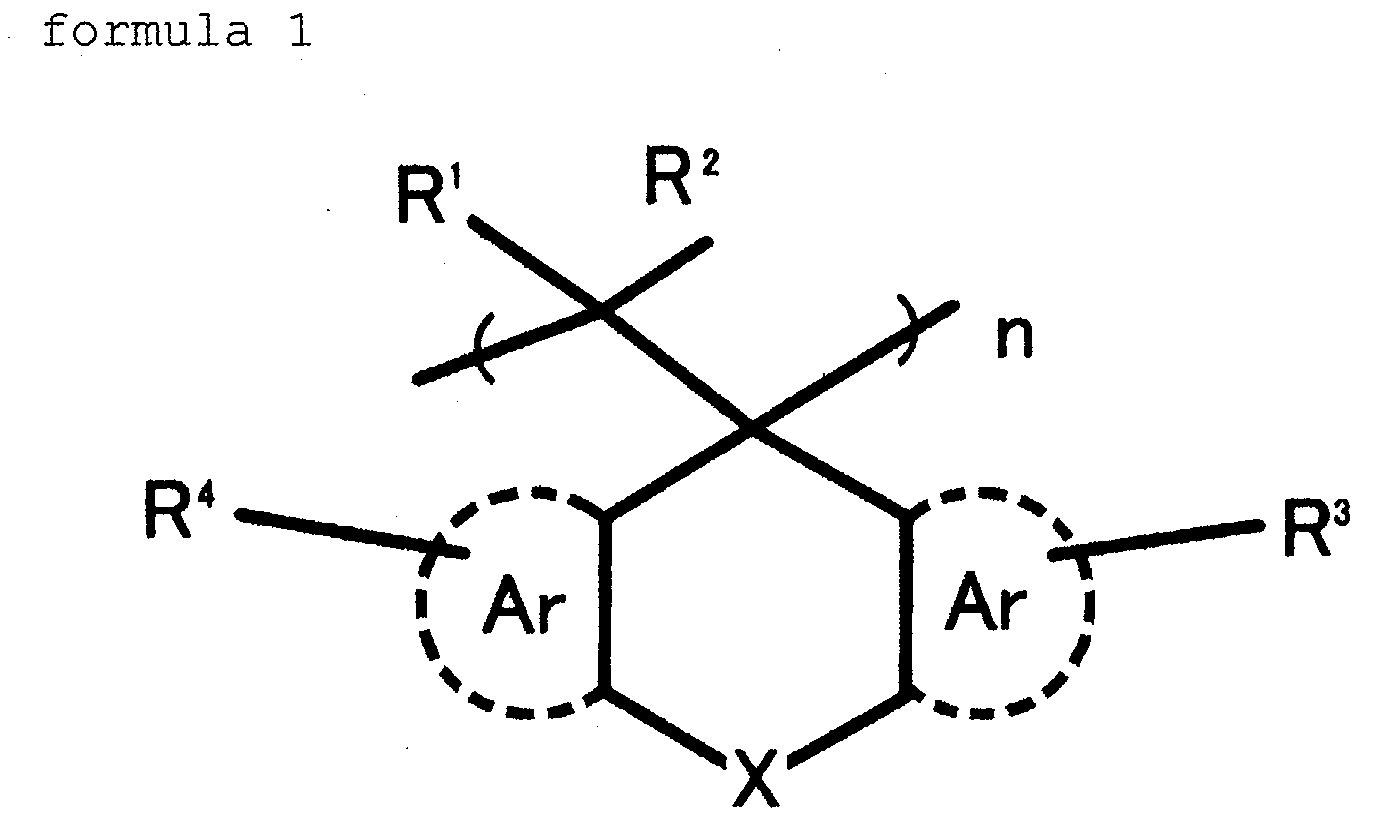
- optically active high-molecular-weight compounds represented by the following structural formula 1 When the high-molecular-weight compounds of this invention are used for an optically active stationary phase or the like, the high-molecular-weight compounds represented by the following structural formula 2 are preferable.
- Ar is an aromatic ring
- R 1 and R 2 are hydrogen atoms or organic groups, however, hydrogen atoms, alkyl groups, aromatic groups, -CN or ester groups are preferable.
- n is an integer of 2 or more, preferably 2-5,000 and 4-1,000 is most preferable.
- X is a group selected from among -(CH 2 ) m -, aromatic groups, vinyl groups, hetero atoms and functional groups containing hetero atoms.
- m is an integer of 0 or more.
- R 3 and R 4 may be introduced 2-4 times respectively. Each of R 3 and R 4 may be identical with or different from each other.
- R 3 and R 4 may be optically active functional groups.
- the optically active functional group is a functional group having an asymmetric carbon atom, or having neither a plane of symmetry nor S2 symmetry.
- n, R 1 and R 2 are the same as those of n, R 1 and R 2 in formula 1 and R 3 -R 10 are the same groups as R 3 and R 4 in formula 1.
- anionic polymerization is preferable, wherein anionic polymerization initiator having an optically active alkyl group or anionic polymerization initiator together with a chiral ligand is used.
- R 1 and R 2 are hydrogen atoms or organic groups.
- R 1 and R 2 are hydrogen atoms, alkyl groups, aromatic groups, -CN or ester groups, but hydrogen atoms, alkyl groups of C 1 -C 10 , phenyl groups and -CN are more preferable.
- n is an integer of 2 or more, but preferably 2-5,000 and more preferably 4-1,000. If n is less than 2, a stacking structure is not formed and if n is more than 5,000, the synthesis is difficult.
- X is a group selected from among -(CH 2 ) m -, an aromatic group, a vinyl group, a hetero atom or a group containing a hetero atom, and m is an integer larger than O.
- a hetero atom of X -O-, or -S- can be mentioned.
- the group containing a hetero atom -NR- or -C(O)- etc. can be mentioned.
- the hetero atom is N, S or O.
- an alkyl group having 1-20 carbon atoms, an aromatic group having 6-30 carbon atoms, a carboxyl group, an ester group having 2-30 carbon atoms, an ether group having 2-30 carbon atoms, a functional group of 2-30 carbon atoms having an urethane bond, F, Cl, Br, I, -NRR', -SR, -OR, -NO 2 , -CN or a functional groups represented below are preferable, wherein R and R' are hydrogen atoms, hetero atoms or organic groups.
- R'', R''' and R''' are hydrogen atoms or organic groups.
- R 3 and R 4 may be the optically active functional groups.
- the optically active functional group is a functional group having an asymmetric carbon atom, or having neither a plane of symmetry nor S2 symmetry.
- R 3 and R 4 may be introduced 2-4 times respectively.
- R 3 and R 4 may be identical with or different from each other.
- anionic polymerization initiators having an optically active alkyl group are shown in 1 and 2 below, and aforesaid anionic polymerization initiators together with a chiral ligand are shown in 3 below.
- anionic polymerization initiators may be used alone or in combination.
- R 3 or R 4 in the formula 1 or R 3 -R 10 in formula 2 are groups which do not have an optically active group, it is necessary to use these anionic polymerization initiators.
- a monomer of formula 1 having an optically active substituent which is introduced as R 3 or R 4 is used, a common anionic polymerization initiator which has no optical activity can be used, however, it is preferable to use the optically active anionic polymerization initiator. That is, even when polymerization initiators with no optical activity are used, a polymer having a stable optical activity is obtained, since a stacking structure of a side chain of the polymer is twisted because of an interaction between said optically active substituents.
- Molecular weight of the polymer of the present invention is preferably 500-1 million in terms of number average molecular weight. If the molecular weight is 500 or less, a solvent resistance is low. It is difficult to polymerize so that the molecular weight is 1 million or more.
- a variance degree of molecular weight is preferably 1-3, particularly, 1-2 is more preferable. When the polymer having the variance degree of more than 3 is used as a stationary phase of a HPLC (high performance liquid column chromatography), separation ability of HPLC is poor.
- the polymer of the present invention may be a copolymer obtained by polymerization with other polymerizable compound.
- Aforesaid other polymerizable compound is preferably a compound capable of anionic polymerization.
- the compound are acrylatea methacrylate, aminoalkyl acrylate such as N,N-dimethylaminoethyl acrylate, N,N-diethylaminoethyl acrylate and N,t-butylaminoethyl acrylate; (meth)acrylonitrile; butadiene; isoprene; a vinyl chloride; vinylidene chloride; vinyl acetate; vinyl ketone; N-vinylpyrrolidone; vinylpyridine; (meth)acrylamide; styrene compounds such as divinylbenzene; ⁇ -methylstyrene, vinyltoluene, chlorostyrene, t-butylstyrene and styrene;
- a polymerizable compound having two functional groups or more can be copolymerized.
- properties such as a solvent resistance can be improved.
- a polymerizable compound having a photo polymerizably functional group can be copolymerized to cross link each other by a radiation of light after the copolymerization.
- a stationary phase material described in claim 7 is a powder of the polymer compound itself of the present invention or a material obtained by coating the polymer compound of the present invention on a surface of a particle carrier. Examples of these materials are as follows;
- EXAMPLE 1 (polymerization of dibenzofulvene using menthoxy potassium).
- a part of the reaction mixture was diluted with CDCl 3 , then the 1 H-NMR was measured, and the monomer conversion ratio was determined (monomer conversion ratio: >99%) from the intensity ratio of the absorption peak of the solvent used as internal reference to that of the vinyl proton in the remaining monomer.
- the solvent was distilled off from the reaction mixture to obtain a crude product. From the crude product, THF insoluble fraction (285.8mg, 68%) and a THF soluble fraction were separated. Further, MeOH was added into the THF soluble fraction to reprecipitate and to obtain MeOH insoluble product (35.0mg, 8%).
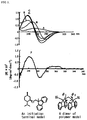
- Theoretical simulation 1 The most stable conformation of 9-menthoxy-9-methyl fluorene, as a model compound of initiation terminal, was obtained by Monte Carlo simulation using MMFF field. Macro Model manufactured by Schroedinger co.,ltd was used for the simulation. An expected C,D spectra for the conformation was calculated by the semiempirical molecular orbital method INDO/S (Fig. 1A). For the calculation, the program provided by Dr. J. Downing of Colorado University was used (G.
- C,D spectra of the polymer obtained in the Example were not caused by menthoxy group at terminal of the polymer but were derived from the torsions of a main-chain (helical structure) of the polymer. Further, as the spectrum of Fig. 1F coincides well to C,D spectra of Fig. 1, it is clarified that the torsion of main-chain has a dihedral angle of 170° -160°.
- Fluorene (169.2mg, 1.02mol) was dissolved into a dried toluene (4.0ml) in a flame-dried ample wherein an air had been replaced by nitrogen. A hexane solution of n-BuLi (1.6M, 0.64ml) was slowly added into the obtained solution. After 30 minutes from the addition at room temperature, (-)-sparteine (0.28ml) was introduced to the ample. After shaking and agitating, the mixture was kept still for 10 minutes. Thus obtained reaction mixture was used as a polymerization initiator.
- a dried hexane solution of 2,7-dipentyldibenzofulvene (0.97M, 1.05ml, 1.02mmol) was introduced into a flame-dried ample wherein an air had been replaced by nitrogen, then hexane was distilled off.
- a dried toluene (4.5ml) was added to dissolve the monomer, then the solution was cooled to -78°C and the initiator (0.2M, 0.25ml) already prepared was added to the solution, thereby a polymerization started.
- the polymerization reaction was carried out for 24 hours at -78°C. After that, methanol (0.2ml) was added to the reaction mixture while keeping at -78°C to stop the polymerization.
- the solvent was distilled off from the reaction solution to obtain a crude product. From the crude product, a THF insoluble fraction (90.5mg, 27%) and a THF soluble fraction were separated. Further, MeOH was added into the THF soluble fraction to reprecipitate, and to obtain MeOH insoluble fraction (104.1mg, 31%).
- 2,7-diisobutyldibenzofulvene (291.0mg 1.00mmol) was dissolved into a dried toluene (4.5ml) in a flame-dried ample wherein an air had been replaced by nitrogen.
- the solution was cooled to -78°C and a solution of the initiator prepared in Example 2 (0.2M, 0.25ml) was added, thereby a polymerization started.
- the polymerization reaction was carried out for 24 hours at -78°C. MeOH (0.2ml) was added to the reaction mixture while keeping at -78°C to stop the polymerization.
- a part of the reaction mixture was diluted with CDCl 3 , then the 1 H-NMR was measured, and the monomer conversion ratio was determined (monomer conversion ratio: 41%) from the intensity ratio of the absorption peak of the solvent used as internal reference to that of the vinyl proton in the remaining monomer.
- the solvent was distilled off from the reaction mixture to obtain a crude product. From the crude product, a THF insoluble fraction (19.3mg, 7%) and a THF soluble fraction were separated. Further, MeOH was added into the THF soluble fraction to reprecipitate and to obtain MeOH-insoluble fraction (120.1mg, 40%).
- a THF-insoluble product (10mg) of the polymer produced in Example 1 was crushed in a mortar and introduced in a glass tube with a screw cap. After an addition of ethanol solution (0.5mg/ml, 100 ⁇ l (solute: 0.05mg)) containing racemic body of trans-stilbene oxide, Tröger's base and flavanone, the glass tube was sealed and kept still at room temperature (23°C). 10ml of a solution part in the tube was analyzed by an HPLC having a chiral column (Chiral cell OD-H, Daicel chemical industries, ltd., eluent: hexane/2-propanol (95/5)). Then, an adsorption amount and an optical purity of the solution part were determined and separation factors ⁇ 1 and ⁇ 2 were calculated (table 1).
- the separation factors were calculated by the following expressions based on the two definitions.
- the polymer showed an asymmetric separation ability for each racemic body.
- 0.5m mol of dibenzofulvene was dried under vacuum for 30 minutes, then dissolved it in 3ml of THF which had been distilled to remove air.
- 0.025m mol of n-BuLi as a polymerization initiator was added and a reaction was carried out for 24 hours at -78°C. 2ml of methanol was added to the solution to stop the reaction, then a hexane-insoluble fraction was obtained by using a centrifugal separator.
- the high-molecular-weight compound having optical activity of the present invention has an excellent solvent resistance, therefore, it is suitable for an optically active stationary phase applicable to HPLC and for a polarization absorption-light emitting material.
Landscapes
- Chemical & Material Sciences (AREA)
- Health & Medical Sciences (AREA)
- Chemical Kinetics & Catalysis (AREA)
- Medicinal Chemistry (AREA)
- Polymers & Plastics (AREA)
- Organic Chemistry (AREA)
- Addition Polymer Or Copolymer, Post-Treatments, Or Chemical Modifications (AREA)
Abstract

Description




Theoretical simulation 1: The most stable conformation of 9-menthoxy-9-methyl fluorene, as a model compound of initiation terminal, was obtained by Monte Carlo simulation using MMFF field. Macro Model manufactured by Schroedinger co.,ltd was used for the simulation. An expected C,D spectra for the conformation was calculated by the semiempirical molecular orbital method INDO/S (Fig. 1A). For the calculation, the program provided by Dr. J. Downing of Colorado University was used (G. Bringmann etc, J. Am. Chem. Soc., 123,2703-2711). Subsequently, as the polymer model, a dimer model was simulated and an expected C,D spectra for each model having dihedral angles Φ1 and Φ2 of 175°, 170°, 160° or 150° was calculated by the semiempirical molecular orbital method INDO/S (Fig. 1B-E). The actual spectrum (Fig. 1F) completely differed from that of the initiation terminal model (Fig. 1A). Thus, it was found that C,D spectra of the polymer obtained in the Example were not caused by menthoxy group at terminal of the polymer but were derived from the torsions of a main-chain (helical structure) of the polymer. Further, as the spectrum of Fig. 1F coincides well to C,D spectra of Fig. 1, it is clarified that the torsion of main-chain has a dihedral angle of 170° -160°.
/ {(major antipode in the sample adsorbed (%))/(minor antipode in the sample adsorbed (%))}
= {(major antipode in the solution (%))/(minor antipode in the solution(%))}
/ {(50-major antipode in the solution (%))/(50-minor antipode in the solution(%))}
wherein
/ (minor antipode in the solution (%))
| An asymmetric separation ability of polymer obtained in Example 1 | ||||||
| Test | Racemic body | Adsorption period | Adsorption rate (%) | Optical purity of solute in the solution | Separation factor | |
| α1 | α2 | |||||
| 1 | Trans-stilbene oxide | 38 | 22.7 | 6.2 | 1.73 | 1.13 |
| 2 | tröger's base | 18 | 8.9 | 1.6 | 1.41 | 1.03 |
| 3 | flavanone | 18 | 37.1 | 7.2 | 1.47 | 1.15 |
Claims (8)
- Optically active high-molecular-weight compounds represented by the following structural formula 1;wherein, Ar in the formula is an aromatic ring, R1, and R2 are hydrogen atoms or organic groups, R3 and R4 are substituents, n is an integer of 2 or more, X is a group selected from among -(CH2)m-, an aromatic group, a vinyl group, a hetero atom and a group containing a hetero atom, and m is an integer of 0 or more. R3 and R4 may be introduced 2-4 times respectively, wherein these may be identical or different, and R is a hydrogen atom, a hetero atom or an organic group.
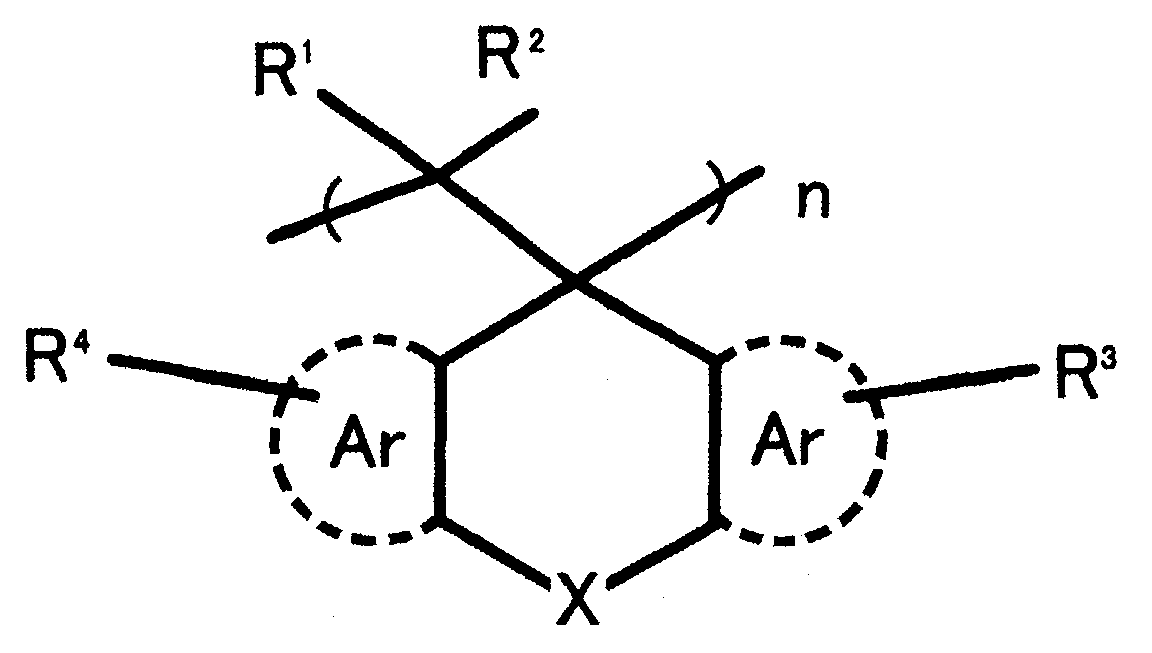
- Optically active high-molecular-weight compounds represented by the following structural formula 2;
wherein R1, R2 and n are the same as claim 1 and R3-R10 are the same as said R3 and R4 in claim 1.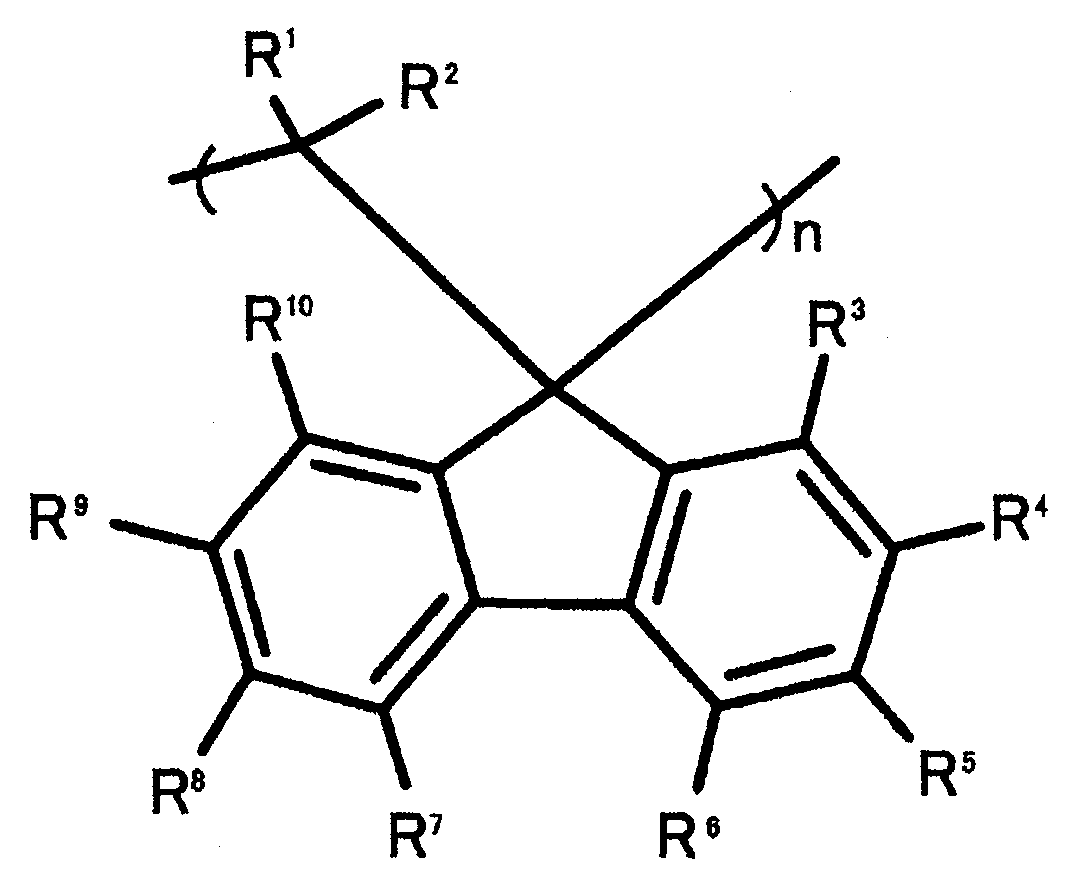
- An optically active high-molecular-weight compound described in Claim 1 or 2, wherein a number average molecular weight of said high-molecular-weight compound lies in the range of 500-1 million.
- An optically active high-molecular-weight compound described in Claim 1, wherein a variance degree of molecular weight is 1-3.
- An optically active high-molecular-weight compound described in Claim 1 or 2, wherein said high-molecular-weight compound is a copolymer obtained by polymerization reaction of compounds having two or more polymerizably functional groups.
- An optically active high-molecular-weight compound described in Claim 1 or 2, wherein said high-molecular-weight compound is a crosslinked polymer.
- A stationary phase material characterized that a high-molecular-weight compound described in claim 1 or 2 is used as said material.
- A stationary phase material described in claim 7, wherein said material is prepared by using a silica-gel, an alumina or polystyrene beads, on which a high-molecular-weight compound described in claim 1 or 2 is embedded or fixed through chemical bond.
Applications Claiming Priority (3)
| Application Number | Priority Date | Filing Date | Title |
|---|---|---|---|
| JP2002132599 | 2002-05-08 | ||
| JP2002132599 | 2002-05-08 | ||
| PCT/JP2003/005726 WO2003102039A1 (en) | 2002-05-08 | 2003-05-07 | Optically active high-molecular compounds |
Publications (3)
| Publication Number | Publication Date |
|---|---|
| EP1528070A1 true EP1528070A1 (en) | 2005-05-04 |
| EP1528070A4 EP1528070A4 (en) | 2005-08-24 |
| EP1528070B1 EP1528070B1 (en) | 2007-11-28 |
Family
ID=29696093
Family Applications (1)
| Application Number | Title | Priority Date | Filing Date |
|---|---|---|---|
| EP03728039A Expired - Lifetime EP1528070B1 (en) | 2002-05-08 | 2003-05-07 | Optically active high-molecular compounds |
Country Status (6)
| Country | Link |
|---|---|
| US (1) | US7585931B2 (en) |
| EP (1) | EP1528070B1 (en) |
| JP (1) | JP4524358B2 (en) |
| CA (1) | CA2485305C (en) |
| DE (1) | DE60317794T2 (en) |
| WO (1) | WO2003102039A1 (en) |
Families Citing this family (4)
| Publication number | Priority date | Publication date | Assignee | Title |
|---|---|---|---|---|
| JP5263478B2 (en) * | 2005-04-07 | 2013-08-14 | 国立大学法人 奈良先端科学技術大学院大学 | Optically active block copolymer, process for producing the same, and chromatographic filler using the block copolymer |
| JPWO2007034962A1 (en) * | 2005-09-26 | 2009-04-02 | 国立大学法人 奈良先端科学技術大学院大学 | Composition having asymmetric structure and process for producing the same |
| JP2008031223A (en) * | 2006-07-26 | 2008-02-14 | Japan Science & Technology Agency | Chiral polymer compound, chromatographic stationary phase using the same, and chromatographic packing material for separation of optical isomers |
| JP4900688B2 (en) * | 2006-10-19 | 2012-03-21 | 国立大学法人北海道大学 | Optically active polymer compound |
Family Cites Families (7)
| Publication number | Priority date | Publication date | Assignee | Title |
|---|---|---|---|---|
| US3536781A (en) | 1968-02-01 | 1970-10-27 | Union Carbide Corp | Charge-transfer polymer blends |
| US4012251A (en) * | 1975-05-22 | 1977-03-15 | Xerox Corporation | Multi-layered photoconductive member |
| US5047444A (en) * | 1989-05-31 | 1991-09-10 | Minnesota Mining And Manufacturing Company | Fluorescent degree of cure monitors |
| WO1995006274A1 (en) | 1993-08-20 | 1995-03-02 | Akzo Nobel N.V. | Charge transport polymer, a charge transport layer, and a photoconductive member comprising said charge transport polymer |
| JP3865406B2 (en) * | 1995-07-28 | 2007-01-10 | 住友化学株式会社 | 2,7-Aryl-9-substituted fluorene and 9-substituted fluorene oligomers and polymers |
| US5739229A (en) | 1995-11-07 | 1998-04-14 | Xerox Corporation | Polymerization processes |
| CA2453166C (en) * | 2001-04-27 | 2010-01-05 | Japan Science And Technology Agency | A polymer compound with special optical properties and polymerizing monomer used to synthesize this polymer |
-
2003
- 2003-05-07 US US10/513,658 patent/US7585931B2/en not_active Expired - Fee Related
- 2003-05-07 JP JP2004509727A patent/JP4524358B2/en not_active Expired - Fee Related
- 2003-05-07 WO PCT/JP2003/005726 patent/WO2003102039A1/en not_active Ceased
- 2003-05-07 CA CA2485305A patent/CA2485305C/en not_active Expired - Fee Related
- 2003-05-07 EP EP03728039A patent/EP1528070B1/en not_active Expired - Lifetime
- 2003-05-07 DE DE60317794T patent/DE60317794T2/en not_active Expired - Lifetime
Also Published As
| Publication number | Publication date |
|---|---|
| US20050234267A1 (en) | 2005-10-20 |
| DE60317794D1 (en) | 2008-01-10 |
| EP1528070B1 (en) | 2007-11-28 |
| EP1528070A4 (en) | 2005-08-24 |
| DE60317794T2 (en) | 2008-10-30 |
| CA2485305A1 (en) | 2003-12-11 |
| JP4524358B2 (en) | 2010-08-18 |
| WO2003102039A1 (en) | 2003-12-11 |
| JPWO2003102039A1 (en) | 2005-09-29 |
| CA2485305C (en) | 2011-02-08 |
| US7585931B2 (en) | 2009-09-08 |
Similar Documents
| Publication | Publication Date | Title |
|---|---|---|
| Ballard et al. | Controlled polymerization of methyl methacrylate using lithium aluminum alkyls | |
| De Brouwer et al. | Controlled radical copolymerization of styrene and maleic anhydride and the synthesis of novel polyolefin‐based block copolymers by reversible addition–fragmentation chain‐transfer (RAFT) polymerization | |
| Percec et al. | Designing functional aromatic multisulfonyl chloride initiators for complex organic synthesis by living radical polymerization | |
| Hardy et al. | Side‐chain ferrocene‐containing (meth) acrylate polymers: Synthesis and properties | |
| Fraser et al. | Metal complexes with polymeric ligands: Chelation and metalloinitiation approaches to metal tris (bipyridine)‐containing materials | |
| EP1528070B1 (en) | Optically active high-molecular compounds | |
| EP0095086B1 (en) | Polymerizable, optically active polymer and process for preparing polymerizable polymer | |
| Chen et al. | Phosphorus‐Containing Block Copolymers from the Sequential Living Anionic Copolymerization of a Phosphaalkene with Methyl Methacrylate | |
| Yashima et al. | Enantiomer-selective polymerization of racemic phenyl-2-pyridyl-o-tolylmethyl methacrylate controlled by a rigid helix | |
| Miura et al. | Syntheses of Functional Alkoxyamines and Application to Syntheses of Well‐Defined Star Polymers | |
| CN101090905B (en) | Organic bismuth compound, method for producing same, living radical polymerization initiator, method for producing polymer using same, and polymer | |
| Nuyken | Polymers of acrylic acid, methacrylic acid, maleic acid and their derivatives | |
| Takaki et al. | Preparation of (p-vinylbenzyl) poly (2-vinylpyridine) macromers | |
| JP4767552B2 (en) | Phenolic star polymer | |
| Cauët et al. | Kinetic investigation of the RAFT polymerization of p‐acetoxystyrene | |
| JP2008031223A (en) | Chiral polymer compound, chromatographic stationary phase using the same, and chromatographic packing material for separation of optical isomers | |
| Zhang et al. | Synthesis of bis (2, 2′: 6′, 2 ″-terpyridine)-terminated telechelic polymers by RAFT polymerization and ruthenium–polymer complexation thereof | |
| Miura et al. | Syntheses and characterization of 16‐arm star and star diblock copolymer and AB8 9‐miktoarm star copolymer via NMRP and ROP from dendritic multifunctional macroinitiators | |
| US6258905B1 (en) | Stabilized, unimolecular initiators for hydrocarbon polymerization | |
| Sun et al. | Synthesis of dendritic polystyrenes from an anionic inimer | |
| Se et al. | Introduction of azobenzenes or vinyl groups into ends of rodlike polymers | |
| Hua et al. | Synthesis of well‐defined multigraft copolymers by a two‐step living radical polymerization with nitroxyl‐functionalized poly (methyl methacrylate) | |
| JP5263478B2 (en) | Optically active block copolymer, process for producing the same, and chromatographic filler using the block copolymer | |
| Hu et al. | Asymmetric polymerization of N-vinylcarbazole with optically active anionic initiators | |
| JP4689216B2 (en) | Alkenylphenol star polymer |
Legal Events
| Date | Code | Title | Description |
|---|---|---|---|
| PUAI | Public reference made under article 153(3) epc to a published international application that has entered the european phase |
Free format text: ORIGINAL CODE: 0009012 |
|
| 17P | Request for examination filed |
Effective date: 20041109 |
|
| AK | Designated contracting states |
Kind code of ref document: A1 Designated state(s): AT BE BG CH CY CZ DE DK EE ES FI FR GB GR HU IE IT LI LU MC NL PT RO SE SI SK TR |
|
| A4 | Supplementary search report drawn up and despatched |
Effective date: 20050708 |
|
| 17Q | First examination report despatched |
Effective date: 20050912 |
|
| 17Q | First examination report despatched |
Effective date: 20050912 |
|
| RIN1 | Information on inventor provided before grant (corrected) |
Inventor name: NAKANO, TAMAKI |
|
| GRAP | Despatch of communication of intention to grant a patent |
Free format text: ORIGINAL CODE: EPIDOSNIGR1 |
|
| RBV | Designated contracting states (corrected) |
Designated state(s): CH DE FR GB LI SE |
|
| GRAS | Grant fee paid |
Free format text: ORIGINAL CODE: EPIDOSNIGR3 |
|
| GRAA | (expected) grant |
Free format text: ORIGINAL CODE: 0009210 |
|
| AK | Designated contracting states |
Kind code of ref document: B1 Designated state(s): CH DE FR GB LI SE |
|
| REG | Reference to a national code |
Ref country code: GB Ref legal event code: FG4D |
|
| REG | Reference to a national code |
Ref country code: CH Ref legal event code: EP |
|
| REF | Corresponds to: |
Ref document number: 60317794 Country of ref document: DE Date of ref document: 20080110 Kind code of ref document: P |
|
| REG | Reference to a national code |
Ref country code: SE Ref legal event code: TRGR |
|
| REG | Reference to a national code |
Ref country code: CH Ref legal event code: NV Representative=s name: KIRKER & CIE S.A. |
|
| ET | Fr: translation filed | ||
| PLBE | No opposition filed within time limit |
Free format text: ORIGINAL CODE: 0009261 |
|
| STAA | Information on the status of an ep patent application or granted ep patent |
Free format text: STATUS: NO OPPOSITION FILED WITHIN TIME LIMIT |
|
| 26N | No opposition filed |
Effective date: 20080829 |
|
| PGFP | Annual fee paid to national office [announced via postgrant information from national office to epo] |
Ref country code: FR Payment date: 20110607 Year of fee payment: 9 Ref country code: SE Payment date: 20110513 Year of fee payment: 9 Ref country code: CH Payment date: 20110524 Year of fee payment: 9 |
|
| PGFP | Annual fee paid to national office [announced via postgrant information from national office to epo] |
Ref country code: GB Payment date: 20110520 Year of fee payment: 9 |
|
| PGFP | Annual fee paid to national office [announced via postgrant information from national office to epo] |
Ref country code: DE Payment date: 20110520 Year of fee payment: 9 |
|
| REG | Reference to a national code |
Ref country code: CH Ref legal event code: PL |
|
| REG | Reference to a national code |
Ref country code: SE Ref legal event code: EUG |
|
| GBPC | Gb: european patent ceased through non-payment of renewal fee |
Effective date: 20120507 |
|
| PG25 | Lapsed in a contracting state [announced via postgrant information from national office to epo] |
Ref country code: CH Free format text: LAPSE BECAUSE OF NON-PAYMENT OF DUE FEES Effective date: 20120531 Ref country code: LI Free format text: LAPSE BECAUSE OF NON-PAYMENT OF DUE FEES Effective date: 20120531 |
|
| PG25 | Lapsed in a contracting state [announced via postgrant information from national office to epo] |
Ref country code: SE Free format text: LAPSE BECAUSE OF NON-PAYMENT OF DUE FEES Effective date: 20120508 |
|
| REG | Reference to a national code |
Ref country code: FR Ref legal event code: ST Effective date: 20130131 |
|
| REG | Reference to a national code |
Ref country code: DE Ref legal event code: R119 Ref document number: 60317794 Country of ref document: DE Effective date: 20121201 |
|
| PG25 | Lapsed in a contracting state [announced via postgrant information from national office to epo] |
Ref country code: GB Free format text: LAPSE BECAUSE OF NON-PAYMENT OF DUE FEES Effective date: 20120507 Ref country code: FR Free format text: LAPSE BECAUSE OF NON-PAYMENT OF DUE FEES Effective date: 20120531 |
|
| PG25 | Lapsed in a contracting state [announced via postgrant information from national office to epo] |
Ref country code: DE Free format text: LAPSE BECAUSE OF NON-PAYMENT OF DUE FEES Effective date: 20121201 |