EP1526391A1 - In-vehicle human body detecting method - Google Patents
In-vehicle human body detecting method Download PDFInfo
- Publication number
- EP1526391A1 EP1526391A1 EP03771312A EP03771312A EP1526391A1 EP 1526391 A1 EP1526391 A1 EP 1526391A1 EP 03771312 A EP03771312 A EP 03771312A EP 03771312 A EP03771312 A EP 03771312A EP 1526391 A1 EP1526391 A1 EP 1526391A1
- Authority
- EP
- European Patent Office
- Prior art keywords
- human body
- peak
- detected
- waveform
- larger
- Prior art date
- Legal status (The legal status is an assumption and is not a legal conclusion. Google has not performed a legal analysis and makes no representation as to the accuracy of the status listed.)
- Withdrawn
Links
Images




Classifications
-
- B—PERFORMING OPERATIONS; TRANSPORTING
- B60—VEHICLES IN GENERAL
- B60R—VEHICLES, VEHICLE FITTINGS, OR VEHICLE PARTS, NOT OTHERWISE PROVIDED FOR
- B60R21/00—Arrangements or fittings on vehicles for protecting or preventing injuries to occupants or pedestrians in case of accidents or other traffic risks
- B60R21/01—Electrical circuits for triggering passive safety arrangements, e.g. airbags, safety belt tighteners, in case of vehicle accidents or impending vehicle accidents
- B60R21/015—Electrical circuits for triggering passive safety arrangements, e.g. airbags, safety belt tighteners, in case of vehicle accidents or impending vehicle accidents including means for detecting the presence or position of passengers, passenger seats or child seats, and the related safety parameters therefor, e.g. speed or timing of airbag inflation in relation to occupant position or seat belt use
- B60R21/01512—Passenger detection systems
-
- B—PERFORMING OPERATIONS; TRANSPORTING
- B60—VEHICLES IN GENERAL
- B60R—VEHICLES, VEHICLE FITTINGS, OR VEHICLE PARTS, NOT OTHERWISE PROVIDED FOR
- B60R21/00—Arrangements or fittings on vehicles for protecting or preventing injuries to occupants or pedestrians in case of accidents or other traffic risks
- B60R21/01—Electrical circuits for triggering passive safety arrangements, e.g. airbags, safety belt tighteners, in case of vehicle accidents or impending vehicle accidents
- B60R21/015—Electrical circuits for triggering passive safety arrangements, e.g. airbags, safety belt tighteners, in case of vehicle accidents or impending vehicle accidents including means for detecting the presence or position of passengers, passenger seats or child seats, and the related safety parameters therefor, e.g. speed or timing of airbag inflation in relation to occupant position or seat belt use
- B60R21/01512—Passenger detection systems
- B60R21/01516—Passenger detection systems using force or pressure sensing means
- B60R21/0152—Passenger detection systems using force or pressure sensing means using strain gauges
-
- B—PERFORMING OPERATIONS; TRANSPORTING
- B60—VEHICLES IN GENERAL
- B60R—VEHICLES, VEHICLE FITTINGS, OR VEHICLE PARTS, NOT OTHERWISE PROVIDED FOR
- B60R21/00—Arrangements or fittings on vehicles for protecting or preventing injuries to occupants or pedestrians in case of accidents or other traffic risks
- B60R21/01—Electrical circuits for triggering passive safety arrangements, e.g. airbags, safety belt tighteners, in case of vehicle accidents or impending vehicle accidents
- B60R21/015—Electrical circuits for triggering passive safety arrangements, e.g. airbags, safety belt tighteners, in case of vehicle accidents or impending vehicle accidents including means for detecting the presence or position of passengers, passenger seats or child seats, and the related safety parameters therefor, e.g. speed or timing of airbag inflation in relation to occupant position or seat belt use
- B60R21/01512—Passenger detection systems
- B60R21/01516—Passenger detection systems using force or pressure sensing means
- B60R21/01526—Passenger detection systems using force or pressure sensing means using piezoelectric elements
-
- B—PERFORMING OPERATIONS; TRANSPORTING
- B60—VEHICLES IN GENERAL
- B60R—VEHICLES, VEHICLE FITTINGS, OR VEHICLE PARTS, NOT OTHERWISE PROVIDED FOR
- B60R21/00—Arrangements or fittings on vehicles for protecting or preventing injuries to occupants or pedestrians in case of accidents or other traffic risks
- B60R21/01—Electrical circuits for triggering passive safety arrangements, e.g. airbags, safety belt tighteners, in case of vehicle accidents or impending vehicle accidents
- B60R21/015—Electrical circuits for triggering passive safety arrangements, e.g. airbags, safety belt tighteners, in case of vehicle accidents or impending vehicle accidents including means for detecting the presence or position of passengers, passenger seats or child seats, and the related safety parameters therefor, e.g. speed or timing of airbag inflation in relation to occupant position or seat belt use
- B60R21/01512—Passenger detection systems
- B60R21/01552—Passenger detection systems detecting position of specific human body parts, e.g. face, eyes or hands
-
- G—PHYSICS
- G01—MEASURING; TESTING
- G01V—GEOPHYSICS; GRAVITATIONAL MEASUREMENTS; DETECTING MASSES OR OBJECTS; TAGS
- G01V3/00—Electric or magnetic prospecting or detecting; Measuring magnetic field characteristics of the earth, e.g. declination, deviation
- G01V3/12—Electric or magnetic prospecting or detecting; Measuring magnetic field characteristics of the earth, e.g. declination, deviation operating with electromagnetic waves
-
- G—PHYSICS
- G01—MEASURING; TESTING
- G01V—GEOPHYSICS; GRAVITATIONAL MEASUREMENTS; DETECTING MASSES OR OBJECTS; TAGS
- G01V9/00—Prospecting or detecting by methods not provided for in groups G01V1/00 - G01V8/00
Definitions
- the present invention relates to a method for detecting the presence of a human body and, more particularly, to a method for detecting the presence of a human body in a vehicle.
- Tokuhyouhei published Japanese translation of PCT application
- No. 8-507706 discloses an invention concerning an ultrasonic motion monitor for monitoring the breathing motions of a human being or other mammals.
- Japanese Unexamined Patent Publication No. 7-204166 and Japanese Patent No. 2827534 disclose that the presence of a human body is detected by detecting the breathing motions of a human by using a piezoelectric element.
- chest motion associated with breathing is detected to obtain a breathing motion signal representing the chest motion in the form of an electrical signal; then, based on the waveform of this signal, it is determined whether or not the detected motion is a human breathing motion and, if it is a human breathing motion, the presence of a human body is detected in the vehicle.
- the times at which specific points occur in the waveform of the breathing motion signal are detected and, when the time interval between the specific points is within a predetermined range, the presence of a human body is detected in the vehicle.
- the times (T(n)) at which peaks occur on the positive or negative side of the waveform of the breathing motion signal are detected to obtain a peak-to-peak time interval ( ⁇ T(n)), a difference ( ⁇ t(n)) between peak-to-peak time intervals is obtained from the peak-to-peak time interval ( ⁇ T(n)), the number of times that the difference ( ⁇ t(n)) between the peak-to-peak time intervals is smaller than a predetermined value (Tth) is counted by a counter, and when the number of times counted is larger than a predetermined number (Cth), the presence of a human body is detected in the vehicle.
- Tth predetermined value
- the times (Tu(n)) at which the waveform of the breathing motion signal rises or falls are detected to obtain a time interval ( ⁇ Tu(n)) between the rising or falling times, a difference ( ⁇ tu(n)) between time intervals is obtained from the time interval ( ⁇ Tu(n)), the number of times that the difference ( ⁇ tu(n)) between the time intervals is smaller than a predetermined value (Tuth) is counted by a counter, and when the number of times counted is larger than the predetermined number (Cth), the presence of a human body is detected in the vehicle.
- a waveform width time interval ( ⁇ Tud(n)) of the breathing motion signal is detected, a difference ( ⁇ tud(n)) between waveform width time intervals is obtained from the waveform width time interval ( ⁇ Tud(n)), the number of times that the difference ( ⁇ tud(n)) between the waveform width time intervals is smaller than a predetermined value (Tudth) is counted by a counter, and when the number of times counted is larger than the predetermined number (Cth), the presence of a human body is detected in the vehicle.
- the times at which positive and negative peaks occur in the waveform of the breathing motion signal are detected, the ratio of the time interval from the positive peak to the negative peak or from the negative peak to the positive peak to the time interval from the positive peak to the next positive peak is obtained, the number of times that the ratio is within a predetermined range is counted by a counter, and when the number of times counted is larger than the predetermined number (Cth), the presence of a human body is detected in the vehicle.
- the difference ( ⁇ t(n)) between the peak-to-peak intervals on the waveform of the breathing motion signal is obtained, and the presence of a human body is detected based on that difference. Accordingly, it can be correctly determined whether the detected motion is a human breathing motion or not, irrespective of variations in breathing cycle among people.
- the number of times that the difference ( ⁇ t(n)) between the peak-to-peak time intervals is smaller than the predetermined value (Tth) is counted by the counter and, when the number of times counted is larger than the predetermined number (Cth), it is determined that the detected motion is a human breathing motion, and the presence of a human body is thus detected. This ensures reliable detection of the presence of a human body.
- Vth1 a predetermined level
- the difference ( ⁇ tud(n)) between the width time intervals on the waveform of the breathing motion signal is obtained, and the presence of a human body is detected based on that difference. Accordingly, it can be correctly determined whether the detected motion is a human breathing motion or not, irrespective of variations in breathing cycle among people.
- the times at which positive and negative peaks occur in the waveform of the breathing motion signal are detected, the ratio of the time interval from the positive peak to the negative peak or from the negative peak to the positive peak to the time interval from the positive peak to the next positive peak is obtained, and the presence of a human body is detected based on that ratio. Accordingly, it can be correctly determined whether the detected motion is a human breathing motion or not, irrespective of variations in breathing cycle among people.
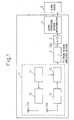
- FIG. 1 is a diagram showing one example of a human body detection apparatus for implementing a method for detecting a human body in a vehicle according to the present invention.
- Reference numeral 1 is a sensor section which includes an oscillator 11, a transmitter 12, a transmitting antenna TA, a receiving antenna RA, a receiver 13, and a mixer 14.
- An output of the oscillator 11 is fed to the transmitter 12 and radiated from the transmitting antenna TA toward a human body.
- the reflected wave from the chest of the breathing human body is received by the receiving antenna RA, and the received reflected wave is fed from the receiver 13 into the mixer 14 where the output of the receiver 13 is mixed with a portion of the output of the oscillator 11.
- the signal produced by mixing is fed to a filtering section 2, and a breathing motion signal Sbr output from it is fed to an A/D converter 3 and processed in a signal processing section 4 to detect the presence of the human body.
- the output of the signal processing section 4 is supplied to an alarm device 5 which, if required, issues an alarm when the presence of the human body is detected by the signal processing section 4.
- the configuration of the sensor section of the human body detection apparatus described above is only one example of the configuration for obtaining the breathing motion signal waveform, and other sensors such as an ultrasonic sensor or a piezoelectric element can be used to obtain the breathing motion signal.
- the breathing motion signal is processed and, when a prescribed condition or conditions are satisfied, it is determined that the presence of a human body has been detected.
- the breathing motion signal is processed by the signal processing circuit 4 shown in Figure 1, and detections, calculations, decisions, etc. described in the flowcharts illustrating the embodiments herein are performed in the signal processing section.
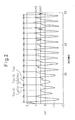
- FIG. 2 is a diagram showing the signal waveform of a human's breathing motion obtained by the human body detection apparatus.
- this signal waveform is the waveform of the output signal of the filtering section 2.
- the abscissa represents the time (seconds), and the ordinate represents the breathing motion expressed in volts (V).
- the times at which peaks occur in the signal waveform shown in Figure 2 are detected, and the time interval between each peak is calculated. Since, usually, a human breathing motion is substantially periodic, the difference ⁇ t between any two successive peak-to-peak time intervals ⁇ T is normally substantially constant. Therefore, in the present invention, when the difference ⁇ t between the peak-to-peak time intervals ⁇ T is smaller than a predetermined value, it is determined that the detected motion is a human breathing motion.
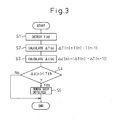
- FIG 3 is a diagram showing, in flowchart form, a human body detection method according to the present invention.
- first the times T(n) at which peaks occur in the breathing motion waveform are detected (S1).
- the difference ⁇ t(n) between peak-to-peak time intervals ⁇ T(n) is calculated (S3).
- ⁇ T T(n) - T(n-1)
- ⁇ T(n-1) T(n-1) - T(n-2)
- the period of human breathing is substantially constant, and the difference ⁇ t(n) between the peak-to-peak time intervals is extremely small. Accordingly, if this difference is smaller than a predetermined value, it can be determined that the detected motion is a human breathing motion.
- the presence of a human body is detected by detecting the times at which peaks occur on the positive side of the signal waveform, but the presence of a human body can also be detected by detecting the times at which peaks (bottoms) occur on the negative side of the signal waveform.
- Figure 4 is a diagram showing in flowchart form another human body detection method according to the present invention.
- ⁇ t(n) ⁇ Tth when it is detected that ⁇ t(n) ⁇ Tth, it is determined that the waveform represents a human breathing motion, and the presence of a human body is thus detected.
- the condition ⁇ t(n) ⁇ Tth when the condition ⁇ t(n) ⁇ Tth has been detected more than a predetermined number of times, it is determined that the waveform represents a human breathing motion, thus detecting the presence of a human body.
- CT is larger than the predetermined number Cth (S7) and, if the condition CT > Cth is satisfied (Yes), it is determined that the waveform represents a human breathing motion, and the presence of a human body is thus detected (S8); if the answer is No, the process is terminated thereupon.
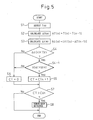
- Figure 5 is a modification of the flowchart shown in Figure 4. The difference from Figure 4 is that S4-1 is inserted after S4.
- S4-1 is inserted after S4.
- the reason that the counter is reset here is that if the peak level V(n) of the breathing motion signal waveform is smaller than the predetermined level Vth1 (No in S4-1), there is the possibility that the detected waveform may not be that of a breathing motion but may merely be that of noise.
- CT is larger than the predetermined number Cth (S7) and, if the condition CT > Cth is satisfied (Yes), it is determined that the waveform represents a human breathing motion, thus detecting the presence of a human body (S8).
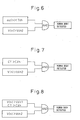
- FIG. 6 is a diagram illustrating a human body detection method according to the present invention by using an AND circuit.
- the AND circuit produces an output, thus detecting the presence of a human body.
- the condition is set that the signal level is larger than the predetermined level Vth2 that is larger than the level Vth1, in order to ensure that the detection is made only when the breathing motion signal occurs.
- Vth2 is set larger than Vth1.
- the values of Vth1 and Vth2 shown in Figure 2 are only examples, and can be changed as needed.
- Figure 7 shows a method in which, in the flowchart of Figure 4, if it is determined in S7 that CT > Cth (Yes), and if the peak level V(n) of the breathing motion signal waveform is larger than the predetermined level Vth2 (V(n) > Vth2), then it is determined that the presence of a human body has been detected. That is, when the condition CT > Cth and the condition V(n) > Vth2 are both satisfied, the AND circuit produces an output, thus detecting the presence of a human body.
- Figure 8 shows a method in which, in the flowchart of Figure 5, if the signal peak level is larger than Vth1 in S4-1, therefore not causing the counter value to be reset, and if it is determined in S7 that CT > Cth (Yes), then if the peak level V(n) of the breathing motion signal waveform is larger than the predetermined level Vth2 (V(n) > Vth2), it is determined that the presence of a human body has been detected. That is, when the signal peak level V(n) is larger than the predetermined level Vth1, therefore not causing the counter value to be reset, and when the condition CT > Cth and the condition V(n) > Vth2 are both satisfied, the AND circuit produces an output, thus detecting the presence of a human body.
- Figure 9 is a diagram illustrating a method for detecting the presence of a human body by combining the following conditions described with reference to the flowcharts of Figures 3 to 5.
- Figure 9 shows a method for detecting the presence of a human body based on the peaks on the positive side of the breathing motion signal waveform shown in Figure 2, while the lower half shows a method for detecting the presence of a human body based on the peaks on the negative side of the signal waveform.
- the human body detection method will be described below with reference to Figure 9.
- the presence of a human body is detected only when the two conditions hold for the AND circuit (S11), but alternatively, the presence of a human body may be detected when either one of the AND circuits (Sp9 or Sm9) has produced an output.
- ⁇ t(n) and V(n) are both absolute values.
- Figure 10 is a diagram showing in flowchart form a human body detection method according to the present invention; in this method, when the peak-to-peak time interval has been within a predetermined time interval range over a predetermined number of times, then it is determined that the signal represents a human breathing motion, and the presence of a human body is thus detected.
- the human body detection has been performed by detecting the times at which peaks occur in the breathing motion signal waveform
- the presence of a human body is detected by detecting the times at which the breathing motion signal waveform rises (or falls).
- Figure 11 is a diagram similar to Figure 2, showing the signal waveform of a human breathing motion.
- the abscissa represents the time (seconds), and the ordinate represents the breathing motion detected and expressed in volts (V).
- the difference from Figure 2 is that the times Tu(n) at which the signal waveform rises are detected.
- Figure 12 is a diagram showing in flowchart form the human detection method according to the second embodiment.
- the times Tu(n) at which the signal waveform rises are detected (S1).
- the difference ⁇ tu(n) between rise-to-rise time intervals is calculated (S3).
- a predetermined threshold value Tuth S4
- the times Tu(n), at which the signal rises, have been detected but, alternatively, the times Td(n) at which the signal falls may be detected.
- the waveform on the positive side of the signal has been used, but instead, the waveform on the negative side may be used.
- the human body detection has been performed in the first embodiment by detecting the times at which peaks occur in the breathing motion signal waveform, and in the second embodiment by detecting the times at which the breathing motion signal waveform rises (or falls); in contrast, in a third embodiment, the presence of a human body is detected by detecting the time width of the breathing motion signal waveform (the time interval between the rising and falling of the waveform).
- Figure 13 is a diagram similar to Figure 2, showing the signal waveform of a human breathing motion.
- the abscissa represents the time (seconds), and the ordinate represents the breathing motion detected and expressed in volts (V).
- the difference from Figure 2 is that the time width ⁇ Tud(n) of the signal waveform is detected.
- FIG 14 is a diagram showing in flowchart form the human detection method according to the third embodiment.
- the time Tu(n) at which the signal waveform rises is detected (S1).
- the time Td(n) at which the signal waveform falls is detected (S2).
- the time interval (hereinafter referred to as the "signal waveform width") ⁇ Tud(n) between the time Tu(n) at which the signal waveform rises and the time Td(n) at which the signal waveform falls is calculated as follows (S3).
- ⁇ Tud(n) Td(n) - Tu(n)
- the human body detection has been performed by detecting the times at which peaks occur in the breathing motion signal waveform
- the times at which positive and negative peaks occur in the breathing motion signal waveform are detected, and the time interval from the positive peak to the negative peak and the time interval from the negative peak to the positive peak are calculated; then, the ratio of the time interval from the positive peak to the negative peak to the time interval from the positive peak to the next positive peak is calculated, and the presence of a human body is detected based on this ratio.
- Figure 15 is a diagram similar to Figure 2, showing the signal waveform of a human breathing motion.
- the abscissa represents the time (seconds), and the ordinate represents the breathing motion detected and expressed in volts (V).
- the difference from Figure 2 is that the times at which positive and negative peaks occur in the signal waveform are detected.
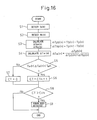
- Figure 16 is a diagram showing in flowchart form the human detection method according to the fourth embodiment.
- peak time Tp(n) on the positive side of the signal waveform is detected (S1)
- peak (bottom) time Tb(n) on the negative side is detected (S2).
- the time interval ⁇ Tpb(n) from the positive peak to the negative peak and the time interval ⁇ Tbp(n) from the negative peak to the positive peak are calculated as follows (S2).
- ⁇ Tpb(n) Tb(n) - Tp(n)
- ⁇ Tbp(n) Tp(n) - Tb(n)
- T ⁇ l ⁇ ⁇ T ⁇ (n) ⁇ T ⁇ h (T ⁇ l is the lower limit value of the ratio, and T ⁇ h is the upper limit value of the ratio)
- CT it is determined whether CT is larger than the predetermined number Cth (S8) and, if the condition CT > Cth is satisfied (Yes), it is determined that the waveform represents a human breathing motion, and the presence of a human body is thus detected (S9).
- the ratio of the time interval from the positive peak to the negative peak to the time interval between the positive peaks has been obtained, but instead, the ratio of the time interval from the negative peak to the positive peak to the time interval between the positive peaks may be obtained. Alternatively, the ratio of the time interval from the positive peak to the negative peak or the time interval from the negative peak to the positive peak to the time interval between the negative peaks may be obtained.
- Figure 17 shows a method in which, if it is determined that ⁇ t(n) ⁇ Tth (Yes) in S4 in the flowchart of Figure 3, and if the ratio ⁇ T ⁇ (n) in Figure 16 satisfies the condition T ⁇ l ⁇ ⁇ T ⁇ (n) ⁇ T ⁇ h, then it is determined that the presence of a human body has been detected. That is, when the condition ⁇ t(n) ⁇ Tth and the condition T ⁇ l ⁇ ⁇ T ⁇ (n) ⁇ T ⁇ h are both satisfied, the AND circuit produces an output, thus detecting the presence of a human body.
- Figure 18 shows a method in which if it is determined that CT ⁇ Cth (Yes) in S7 in the flowchart of Figure 4, and if the ratio ⁇ T ⁇ (n) in Figure 16 satisfies the condition T ⁇ l ⁇ ⁇ T ⁇ (n) ⁇ T ⁇ h, then it is determined that the presence of a human body has been detected. That is, when the condition ⁇ t(n) ⁇ Tth and the condition T ⁇ l ⁇ ⁇ T ⁇ (n) ⁇ T ⁇ h are both satisfied, the AND circuit produces an output, thus detecting the presence of a human body.
Landscapes
- Engineering & Computer Science (AREA)
- Mechanical Engineering (AREA)
- Physics & Mathematics (AREA)
- Life Sciences & Earth Sciences (AREA)
- Geophysics (AREA)
- General Physics & Mathematics (AREA)
- General Life Sciences & Earth Sciences (AREA)
- Remote Sensing (AREA)
- Electromagnetism (AREA)
- Environmental & Geological Engineering (AREA)
- Geology (AREA)
- Measurement Of The Respiration, Hearing Ability, Form, And Blood Characteristics Of Living Organisms (AREA)
- Geophysics And Detection Of Objects (AREA)
- Measuring And Recording Apparatus For Diagnosis (AREA)
- Measurement Of Length, Angles, Or The Like Using Electric Or Magnetic Means (AREA)
Abstract
Description
Claims (18)
- A human body detection method for detecting a human body in a vehicle, comprising: detecting chest motion associated with breathing and obtaining a breathing motion signal representing said chest motion in the form of an electrical signal; detecting times at which specific points occur in a waveform of said breathing motion signal; and detecting the presence of a human body in said vehicle when time interval between said specific points is within a predetermined range.
- A human body detection method as claimed in claim 1, wherein said specific points in the waveform of said breathing motion signal are peaks on a positive or negative side of the waveform of said breathing motion signal, and wherein the times (T(n)) at which said peaks occur are detected to obtain a peak-to-peak time interval (ΔT(n)), a difference (Δt(n)) between peak-to-peak time intervals is obtained from said peak-to-peak time interval (ΔT(n)), and the presence of a human body is detected in said vehicle when the difference (Δt(n)) between said peak-to-peak time intervals is smaller than a predetermined value (Tth).
- A human body detection method as claimed in claim 2, wherein the number of times that the difference (Δt(n)) between said peak-to-peak time intervals is smaller than said predetermined value (Tth) is counted by a counter and, when the number of times counted is larger than a predetermined number (Cth), the presence of a human body is detected in said vehicle.
- A human body detection method as claimed in claim 3, wherein said counter is reset when said peaks are not larger in magnitude than a predetermined level (Vth1).
- A human body detection method as claimed in claim 2 wherein, when the difference (Δt(n)) between said peak-to-peak time intervals is smaller than said predetermined value (Tth), and when said peaks are larger in magnitude than a predetermined level (Vth2), the presence of a human body is detected in said vehicle.
- A human body detection method as claimed in claim 3 wherein, when the number of times counted is larger than said predetermined number (Cth), and when said peaks are larger in magnitude than a predetermined level (Vth2), the presence of a human body is detected in said vehicle.
- A human body detection method as claimed in claim 4 wherein, when said counter is not reset, and the number of times counted is larger than said predetermined number (Cth), and when said peaks are larger in magnitude than a predetermined level (Vth2), the presence of a human body is detected in said vehicle.
- A human body detection method as claimed in claim 2 wherein, when two conditions, one being that the difference (Δt(n)) between said peak-to-peak time intervals is smaller than said predetermined value (Tth) and the other being that said peaks are larger in magnitude than a predetermined level (Vth1), are satisfied (CONDITION 1), and when the condition that said peaks are larger in magnitude than a predetermined level (Vth2) is satisfied (CONDITION 2), the presence of a human body is detected in said vehicle.
- A human body detection method as claimed in claim 2 wherein, when two conditions, one being that the difference (Δt(n)) between said peak-to-peak time intervals is smaller than said predetermined value (Tth) and the other being that said peaks are larger in magnitude than a predetermined level (Vth1), are satisfied on both the positive and negative sides of said waveform (CONDITION 1), and when the condition that said peaks are larger in magnitude than a predetermined level (Vth2) is satisfied (CONDITION 2), the presence of a human body is detected in said vehicle.
- A human body detection method as claimed in claim 8 or 9 wherein, when said CONDITION 1 and said CONDITION 2 are respectively satisfied a predetermined number of times, outputs thereof are held, and an AND circuit produces an output to detect the presence of a human body in said vehicle.
- A human body detection method as claimed in claim 9 wherein, when said CONDITION 1 and said CONDITION 2 are respectively satisfied a predetermined number of times, outputs thereof are held, and AND circuits produces outputs, which are held and are input to an AND circuit that follows said AND circuits, and when conditions for said AND circuit are satisfied on both said positive and negative sides, the presence of a human body is detected in said vehicle.
- A human body detection method as claimed in claim 2 wherein, when said peak-to-peak time interval (ΔT(n)) is within a predetermined time interval range, the presence of a human body is detected in said vehicle.
- A human body detection method as claimed in claim 1, wherein said specific points in the waveform of said breathing motion signal are rising or falling points of the waveform of said breathing motion signal, and wherein the times (Tu(n)) at which said rising or falling points occur are detected to obtain a time interval (ΔTu(n)) between said rising or falling points, a difference (Δtu(n)) between time intervals is obtained from said time interval (ΔTu(n)), the number of times that the difference (Δtu(n)) between said time intervals is smaller than a predetermined value (Tuth) is counted by a counter, and when the number of times counted is larger than a predetermined number (Cth), the presence of a human body is detected in said vehicle.
- A human body detection method as claimed in claim 1, wherein said specific points in the waveform of said breathing motion signal are points defining a waveform width of said breathing motion signal, and wherein time interval (ΔTud(n)) of said waveform width is detected, a difference (Δtud(n)) between waveform width time intervals is obtained from said waveform width time interval (ΔTud(n)), the number of times that the difference (Δtud(n)) between said waveform width time intervals is smaller than a predetermined value (Tudth) is counted by a counter, and when the number of times counted is larger than a predetermined number (Cth), the presence of a human body is detected in said vehicle.
- A human body detection method as claimed in claim 1, wherein said specific points in the waveform of said breathing motion signal are positive and negative peaks of the waveform of said breathing motion signal, and wherein the times at which said positive and negative peaks occur are detected, the ratio of the time interval from said positive peak to said negative peak or from said negative peak to said positive peak to the time interval from said positive peak to the next positive peak is obtained, the number of times that said ratio is within a predetermined range is counted by a counter, and when the number of times counted is larger than a predetermined number (Cth), the presence of a human body is detected in said vehicle.
- A human body detection method as claimed in claim 15, wherein the ratio of the time interval from said positive peak to said negative peak or from said negative peak to said positive peak to the time interval from said negative peak to the next negative peak is obtained, the number of times that said ratio is within said predetermined range is counted by said counter, and when the number of times counted is larger than said predetermined number (Cth), the presence of a human body is detected in said vehicle.
- A human body detection method as claimed in claim 15 or 16 wherein, when the number of times that said ratio is within said predetermined range, counted by said counter, is larger than said predetermined number (Cth), and when the number of times that the difference (Δt(n)) between said peak-to-peak time intervals in the waveform of said breathing motion signal is smaller than a predetermined value (Tth), counted by said counter, is larger than said predetermined number (Cth), the presence of a human body is detected in said vehicle.
- A human body detection method as claimed in claim 15 or 16 wherein, when the number of times that said ratio is within said predetermined range, counted by said counter, is larger than said predetermined number (Cth), and when the number of times that the difference (Δt(n)) between said peak-to-peak time intervals in the waveform of said breathing motion signal is smaller than said predetermined number (Tth), counted by said counter, is larger than said predetermined number (Cth), the presence of a human body is detected in said vehicle.
Applications Claiming Priority (3)
| Application Number | Priority Date | Filing Date | Title |
|---|---|---|---|
| JP2002220275 | 2002-07-29 | ||
| JP2002220275A JP4043309B2 (en) | 2002-07-29 | 2002-07-29 | In-vehicle human body detection method |
| PCT/JP2003/009403 WO2004011961A1 (en) | 2002-07-29 | 2003-07-24 | In-vehicle human body detecting method |
Publications (2)
| Publication Number | Publication Date |
|---|---|
| EP1526391A1 true EP1526391A1 (en) | 2005-04-27 |
| EP1526391A4 EP1526391A4 (en) | 2010-02-24 |
Family
ID=31184763
Family Applications (1)
| Application Number | Title | Priority Date | Filing Date |
|---|---|---|---|
| EP03771312A Withdrawn EP1526391A4 (en) | 2002-07-29 | 2003-07-24 | In-vehicle human body detecting method |
Country Status (6)
| Country | Link |
|---|---|
| US (1) | US7276030B2 (en) |
| EP (1) | EP1526391A4 (en) |
| JP (1) | JP4043309B2 (en) |
| KR (1) | KR100639622B1 (en) |
| CN (1) | CN1267752C (en) |
| WO (1) | WO2004011961A1 (en) |
Families Citing this family (14)
| Publication number | Priority date | Publication date | Assignee | Title |
|---|---|---|---|---|
| JP2007301003A (en) * | 2006-05-09 | 2007-11-22 | Hitachi Ltd | Motor function testing device and phase comparison method between motion waveforms |
| CN102079231B (en) * | 2006-08-09 | 2012-10-31 | 松下电器产业株式会社 | Ion generation system for vehicles |
| US8949070B1 (en) * | 2007-02-08 | 2015-02-03 | Dp Technologies, Inc. | Human activity monitoring device with activity identification |
| US9011347B2 (en) * | 2008-10-03 | 2015-04-21 | Nellcor Puritan Bennett Ireland | Methods and apparatus for determining breathing effort characteristics measures |
| JP5415110B2 (en) * | 2009-03-13 | 2014-02-12 | 株式会社デンソーアイティーラボラトリ | Occupant detection device |
| US8836491B2 (en) * | 2010-04-29 | 2014-09-16 | Ford Global Technologies, Llc | Occupant detection |
| US10465316B2 (en) | 2015-08-20 | 2019-11-05 | Glen Raven, Inc. | Outdoor fabric |
| JP6510378B2 (en) * | 2015-10-02 | 2019-05-08 | 株式会社Soken | Detection device |
| JP2017181225A (en) * | 2016-03-30 | 2017-10-05 | 本田技研工業株式会社 | Vehicle occupant detection device |
| KR101982605B1 (en) | 2018-10-16 | 2019-08-29 | 주식회사 젠다카디언 | Device for detecting a passenger in a vehicle |
| CN109849831A (en) * | 2018-12-12 | 2019-06-07 | 湖北文理学院 | Vehicle, safety warning system and method |
| KR102126580B1 (en) * | 2019-02-27 | 2020-06-24 | 주식회사 더유엠에스 | Microwave sensor module for protecting vehicle passenger |
| KR102645061B1 (en) * | 2019-06-20 | 2024-03-08 | 현대자동차주식회사 | Vehicle and automatic control method for emotional environment thereof |
| US12228641B2 (en) * | 2023-02-03 | 2025-02-18 | Semiconductor Components Industries, Llc | Ultrasonic breathing sensor and sensing method for vehicle occupant monitoring |
Family Cites Families (9)
| Publication number | Priority date | Publication date | Assignee | Title |
|---|---|---|---|---|
| US7467809B2 (en) * | 1992-05-05 | 2008-12-23 | Automotive Technologies International, Inc. | Vehicular occupant characteristic determination system and method |
| JP2827534B2 (en) | 1991-02-26 | 1998-11-25 | 松下電器産業株式会社 | Alarm device |
| EP0560351B1 (en) * | 1992-03-13 | 1997-12-29 | Matsushita Electric Industrial Co., Ltd. | Presence detecting and safety control apparatus |
| US5638824A (en) | 1993-02-25 | 1997-06-17 | Advanced Monitors Holdings Limited | Ultrasonic monitor |
| BR9407064A (en) * | 1993-06-22 | 1996-03-12 | Vos Verkehrs Optimierungs Syst | Device for detecting the presence of people on seats |
| JP2959376B2 (en) | 1994-01-26 | 1999-10-06 | 松下電器産業株式会社 | Monitoring device |
| SE9803344L (en) * | 1998-10-01 | 2000-04-02 | Biosys Ab | Method and apparatus for monitoring a seated person |
| US6768420B2 (en) * | 2000-11-16 | 2004-07-27 | Donnelly Corporation | Vehicle compartment occupancy detection system |
| JP2003066157A (en) | 2001-08-24 | 2003-03-05 | Fujitsu Ten Ltd | Method for detecting human body in vehicle |
-
2002
- 2002-07-29 JP JP2002220275A patent/JP4043309B2/en not_active Expired - Fee Related
-
2003
- 2003-07-24 CN CN03801131.XA patent/CN1267752C/en not_active Expired - Fee Related
- 2003-07-24 EP EP03771312A patent/EP1526391A4/en not_active Withdrawn
- 2003-07-24 WO PCT/JP2003/009403 patent/WO2004011961A1/en not_active Ceased
- 2003-07-24 US US10/490,501 patent/US7276030B2/en not_active Expired - Lifetime
- 2003-07-24 KR KR1020047004239A patent/KR100639622B1/en not_active Expired - Fee Related
Also Published As
| Publication number | Publication date |
|---|---|
| JP2004061308A (en) | 2004-02-26 |
| JP4043309B2 (en) | 2008-02-06 |
| US20050122222A1 (en) | 2005-06-09 |
| CN1267752C (en) | 2006-08-02 |
| US7276030B2 (en) | 2007-10-02 |
| WO2004011961A1 (en) | 2004-02-05 |
| EP1526391A4 (en) | 2010-02-24 |
| KR100639622B1 (en) | 2006-10-31 |
| CN1564950A (en) | 2005-01-12 |
| KR20040048898A (en) | 2004-06-10 |
Similar Documents
| Publication | Publication Date | Title |
|---|---|---|
| EP1526391A1 (en) | In-vehicle human body detecting method | |
| EP3119639B1 (en) | Method and system for unattended child detection | |
| EP4242689A3 (en) | Intra-vehicle situational awareness featuring child presence | |
| US7646283B2 (en) | Wireless activation system, method and device | |
| US9864057B2 (en) | Ultrasonic object detection device | |
| JP2003518635A (en) | Method and apparatus for detecting and evaluating objects in a surrounding area of a vehicle | |
| JP2004361154A (en) | Target object discriminating device | |
| JP2005181193A (en) | Pulse-wave radar apparatus | |
| CN107076841A (en) | Obstacle detection device | |
| EP1449726B1 (en) | On-vehicle intrusion detector | |
| US20020067304A1 (en) | Sensor array having a pulse echo radar | |
| JP2003167050A5 (en) | ||
| US4110730A (en) | Rate sensitive system for a seismic sensing range containment apparatus | |
| JP6416726B2 (en) | Ultrasonic object detection device | |
| JP2006255141A (en) | Sensor device | |
| CN111157999B (en) | Ultrasonic detection system, detection method and device | |
| JP2015025712A (en) | Ultrasonic sensor | |
| EP3007145A1 (en) | Intrusion detector and method for improved sensitivity | |
| KR101683652B1 (en) | Method and apparatus for detecting invasion in rarge vehicl | |
| JP2000142324A (en) | Vehicle intrusion detection device | |
| JP3171767B2 (en) | Collision prediction system | |
| JP3106949B2 (en) | Vehicle intrusion detection device | |
| JP4503000B2 (en) | In-vehicle intrusion detection device | |
| US10160422B2 (en) | Method for responding to movement in and around a locked vehicle | |
| JP4879597B2 (en) | Intrusion detection apparatus for vehicle, computer program used therefor, and recording medium recording the same |
Legal Events
| Date | Code | Title | Description |
|---|---|---|---|
| PUAI | Public reference made under article 153(3) epc to a published international application that has entered the european phase |
Free format text: ORIGINAL CODE: 0009012 |
|
| 17P | Request for examination filed |
Effective date: 20040317 |
|
| AK | Designated contracting states |
Kind code of ref document: A1 Designated state(s): AT BE BG CH CY CZ DE DK EE ES FI FR GB GR HU IE IT LI LU MC NL PT RO SE SI SK TR |
|
| RBV | Designated contracting states (corrected) |
Designated state(s): DE FR GB |
|
| A4 | Supplementary search report drawn up and despatched |
Effective date: 20100122 |
|
| RIC1 | Information provided on ipc code assigned before grant |
Ipc: G01V 3/12 20060101AFI20040214BHEP Ipc: B60N 2/00 20060101ALI20100118BHEP Ipc: A61B 5/08 20060101ALI20100118BHEP |
|
| 17Q | First examination report despatched |
Effective date: 20110523 |
|
| STAA | Information on the status of an ep patent application or granted ep patent |
Free format text: STATUS: THE APPLICATION IS DEEMED TO BE WITHDRAWN |
|
| 18D | Application deemed to be withdrawn |
Effective date: 20111005 |