EP1526369A1 - Stackable non-stick coverslip - Google Patents
Stackable non-stick coverslip Download PDFInfo
- Publication number
- EP1526369A1 EP1526369A1 EP04028367A EP04028367A EP1526369A1 EP 1526369 A1 EP1526369 A1 EP 1526369A1 EP 04028367 A EP04028367 A EP 04028367A EP 04028367 A EP04028367 A EP 04028367A EP 1526369 A1 EP1526369 A1 EP 1526369A1
- Authority
- EP
- European Patent Office
- Prior art keywords
- coverslip
- substantially planar
- top surface
- protuberance
- planar top
- Prior art date
- Legal status (The legal status is an assumption and is not a legal conclusion. Google has not performed a legal analysis and makes no representation as to the accuracy of the status listed.)
- Granted
Links
Images




Classifications
-
- G—PHYSICS
- G01—MEASURING; TESTING
- G01N—INVESTIGATING OR ANALYSING MATERIALS BY DETERMINING THEIR CHEMICAL OR PHYSICAL PROPERTIES
- G01N1/00—Sampling; Preparing specimens for investigation
- G01N1/28—Preparing specimens for investigation including physical details of (bio-)chemical methods covered elsewhere, e.g. G01N33/50, C12Q
- G01N1/30—Staining; Impregnating ; Fixation; Dehydration; Multistep processes for preparing samples of tissue, cell or nucleic acid material and the like for analysis
- G01N1/31—Apparatus therefor
- G01N1/312—Apparatus therefor for samples mounted on planar substrates
-
- G—PHYSICS
- G02—OPTICS
- G02B—OPTICAL ELEMENTS, SYSTEMS OR APPARATUS
- G02B21/00—Microscopes
- G02B21/34—Microscope slides, e.g. mounting specimens on microscope slides
-
- G—PHYSICS
- G01—MEASURING; TESTING
- G01N—INVESTIGATING OR ANALYSING MATERIALS BY DETERMINING THEIR CHEMICAL OR PHYSICAL PROPERTIES
- G01N35/00—Automatic analysis not limited to methods or materials provided for in any single one of groups G01N1/00 - G01N33/00; Handling materials therefor
- G01N35/00029—Automatic analysis not limited to methods or materials provided for in any single one of groups G01N1/00 - G01N33/00; Handling materials therefor provided with flat sample substrates, e.g. slides
- G01N2035/00079—Evaporation covers for slides
Definitions
- the present invention relates generally to new and improved coverslip and more particularly to a stackable non-stick coverslip for use, for example, in an automated coverslipper apparatus or system.
- a tissue specimen such as a human tissue specimen
- the glass slide carrying the tissue section under examination, is subjected to certain reagents and stained in accordance with an established protocol in order to facilitate characterization and diagnosis of the tissue sample.
- the glass slide is "covered” with a chemical coverslip or a glass coverslip to substantially avoid contamination and to permit long-term archiving of the slide.
- One presently available glass coverslip has the same configuration as a conventional glass slide, i.e., substantially rectangular. The length and thickness are, by comparison, significantly reduced to decrease production costs.
- Another available glass coverslip is substantially circular, having a diameter corresponding to the width of a conventional glass slide.
- Glass coverslips may be placed upon the tissue-carrying slide manually or by an automated coverslipper.
- an automated system is shown in U.S. Patent No. 3,833,449, and the teachings thereof are incorporated herein by reference.
- the glass coverslips are vertically stacked in a housing, and an individual coverslip is placed upon the glass slide by either a piston-like mechanism (which pushes the uppermost coverslip in the housing onto the glass slide) or a vacuum mechanism (which lifts the top coverslip for appropriate placement and release).
- Moisture between adjacent coverslips in the housing substantially interferes with the covering process and equipment. That is, condensation interposed adjacently stacked coverslips causes adherence, or "sticking," such that more than one coverslip is extracted by a single covering operation. The result is often one or more broken coverslips and a certain amount of "downtime" for maintenance of the system.
- Glues are typically used to permanently bond the coverslip to the glass slide, over the stained tissue sample. Such a glue is usually applied manually to either the coverslip or glass slide.
- the present invention is a stackable non-stick coverslip.
- the coverslip includes a glass plate and a protuberance on the upper, substantially planar surface thereof.
- the protuberance provides an elevational alternation that, in cooperation with the glass plate, defines a supporting plane for an adjacent coverslip.
- the supporting plane is acutely oriented to top surface of the glass plate.
- the coverslip includes an adhesive on the lower surface of the glass plate. Upon solvent activation, the adhesive secures, or affixes, the coverslip to a conventional glass slide, thereby covering and protecting the stained tissue sample.
- Another object of the present invention is a stackable coverslip for an automated coverslip applicator, wherein adherence or sticking of adjacently stacked coverslips is substantially avoided. Still another object is a pre-glued stackable coverslip such that the coverslip may be adhered to a glass slide, thereby protecting the analyzed tissue sample. Yet another object of the present invention is a readily and inexpensively manufactured, pre-glued, stackable and non-stick coverslip.
- a preferred embodiment of the present invention is shown as a glass coverslip 10 for use in an automated coverslipper, generally designated 12.
- the coverslipper 12 places the coverslip 10 upon a conventional glass slide 14, having a substantially rectangular configuration and carrying a tissue specimen 16.
- the coverslip 10 substantially avoids contamination and facilitates processing of the specimen 16.
- the coverslipper 12 includes a magazine 18, having an open dispensing end 20, adjacent and facing the glass slide 14.
- the magazine 18 defines a substantially rectangular chamber 22, wherein the coverslips 10 are stacked in a substantially vertical arrangement.
- a conventional transfer mechanism, generally designated 24, moves the top, or uppermost, coverslip 10 from the chamber 22, onto the awaiting glass slide 14.
- transfer mechanism 24 includes a piston 26, adapted to horizontally engage and "push" the top coverslip 10 in the magazine 18 onto the glass side 14. With each "push,” the stack of coverslips 10 advances upwardly in a conventional manner to properly align the next coverslip 10 with respect to the piston 26.
- the coverslip 10 includes a glass plate 28, having substantially planar top and bottom surfaces 30A, 30B, and a periphery 32.
- the glass plate 28 has a substantially rectangular configuration, with a length and a thickness slightly less than the conventional glass slide 14.
- the plate 28 defines opposed ends 34, 36, respectively, corresponding to the width of the glass slide 14.
- the glass coverslip 10 further includes at least one protuberance, generally designated 38, applied to, or mounted on, the top surface 30A, near the periphery 32.
- the protuberance 38 is a raised dot 40, centrally located adjacent the opposed end 34 of the glass plate 28.
- the protuberance 38 may be in the form of an "X" or a bar.
- the raised dot 40 provides an elevational alternation, generally designated 42, to the substantially planar top surface 30A of the glass plate 28.
- This alteration 42 defines a supporting plane 44 that is acutely oriented with respect to the planar top surface 30A.
- acutely oriented and obvious modifications thereof mean an angle of 0 to 3 degrees.
- the supporting plane 44 is further defined by the glass plate 28, or more particularly the opposed end 36 thereof, as the adjacent coverslip 10 rests upon the glass plate 28, at one end, and upon the raised dot 40, at the other end.
- protuberances 38 in the form of raised dots 40 -- one centrally located along the end 34 and two at the edges of the other end 36.
- the supporting plane 44 as defined by the three raised dots 40, is substantially parallel to the top surface 30A of the glass plate 28.
- the supporting plane 44 establishes a gap 46 between vertically adjacent coverslips 10 in the magazine 18.
- the upper coverslip 10 rests along the supporting plane 44, substantially reducing the surface contact between the adjacently stacked coverslips 10 and substantially reducing adherence or sticking therebetween.
- the gap 46 further increases airflow, thereby reducing the possibility of condensation.
- the gap 46 is tapered; in the preferred embodiment of FIGURES 3 and 4, adjacent coverslips 10 are substantially parallel, such that the gap 46 is not tapered.
- the protuberance 38 is preferably a curable compound, having a flowable state and a cured state.
- the dot 40 is a teflon paint which dries, or cures, in air. Once dried, the dot 40 has a substantially semi-circular shape, providing an elevational alteration 42 preferably in the range of 0.0005 to 0.005 inches. (In the FIGURES 1-4, the height of the protuberance 38 is exaggerated for clarity.)
- the various preferred embodiments of the coverslip 10 are readily packaged as a kit, generally designated 48.
- the kit 48 facilitates shipping and handling and readily drops into the magazine 18.
- the stackable non-stick coverslip 10 has an adhesive 52 applied to a central region, generally designated 54, of the bottom surface 30B.
- the adhesive 52 is preferably a liquid that dries, upon application to the coverslip 10, to a tackless or only slightly tacky state.
- the adhesive 52 is activated or partially dissolved by a solvent, prior to placement onto the glass slide 14 by the coverslipper 12.
- the coverslipper 12 includes a dispensing system, generally designated 56, to apply the solvent to the bottom surface 30B of the coverslip 10 as it is "pushed" out of the magazine 18 and onto the glass side 14.
- the dispensing system 56 may apply the solvent directly onto the glass slide 14.
- the solvent is applied manually.
- the coverslip 10 is affixed or bonded to the top surface 58 of the glass slide 12.
- the glass slide 12 can then stored for future analysis and study or as a permanent record of the analysis preformed.
- the adhesive 52 is preferably oil-based or water-insoluble, such that the solvent is nonaqueous, i.e., hydrophobic or lipophilic.
- Acrylic copolymers such as Acryloid® A-21, commercially available from Rohm and Haas, Philadelphia, Pa., are suitable.
- Other suitable adhesives include olefin-based materials, e.g., vinyl and acrylate based polymers; cellulose acetates; cyanoacrylates; silicone-containing materials including silane- and siloxane-terminated monomer based polymers; polytetrafluoroethylene based adhesives; and hydrocarbon based polymers.
- Suitable solvents to render the adhesive 52 tacky include aromatic hydrocarbons such as toluene, xylene, and benzene; silicones such as dimethicones, cyclomethicones and substituted siloxanes; aromatic and aliphatic hydrocarbons; alkyl esters; benzyl or alkyl benzoates; alkyl, alkoxyalkyl and glyceryl esters; and mixtures thereof. While an oil-based or water-insoluble solvent is preferred, a water-based solvent, such as Shur/Mount Liquid Mounting Medium (VWR Cat. No. 15148-062), may be utilized with certain stains.
- aromatic hydrocarbons such as toluene, xylene, and benzene
- silicones such as dimethicones, cyclomethicones and substituted siloxanes
- aromatic and aliphatic hydrocarbons alkyl esters
- benzyl or alkyl benzoates alkyl, alkoxyal
- the present invention substantially avoids the difficult task of maintaining an adhesive within the automated coverslipper 12. The equally difficult task of pumping an adhesive through the automated coverslipper 12 is also avoided.
- a coverslip comprising, in combination:
- said curable compound has a flowable state and a cured stated, said curable compound being deposited on the said substantially planar top surface in said flowable state and thereafter curing to said cured state.
- said curable compound is a paint, preferably a teflon paint.
- Said solvent-activated adhesive is preferably oil-based or water-insoluble.
- kit comprising, in combination:
- said protuberance is a raised dot of a compound deposited on said top surface in a substantially semi-circular configuration.
- said compound has a flowable state and a cured stated, said compound being deposited on the said top surface in said flowable state and thereafter hardening to said cured state.
- Said compound is preferably a paint, more preferably a teflon paint.
- Said solvent-activated adhesive is preferably oilbased or water-insoluble.
- a coverslip comprising, in combination:
- Said coverslip comprises preferably at least one protuberance on said substantially planar top surface, said protuberance providing an elevational alternation to said substantially planar top surface, said elevational alternation defining a supporting plane acutely oriented with respect to said substantially planar top surface.
- said solvent-activated adhesive is oil-based or water-insoluble.
- a coverslip comprising, in combination:
- said coverslip comprises further a solvent-activated adhesive on said substantially planar bottom surface, said solvent-activated adhesive being preferably oil-based or water-insoluble.
Landscapes
- Physics & Mathematics (AREA)
- Chemical & Material Sciences (AREA)
- Life Sciences & Earth Sciences (AREA)
- General Physics & Mathematics (AREA)
- Health & Medical Sciences (AREA)
- Analytical Chemistry (AREA)
- Biochemistry (AREA)
- Molecular Biology (AREA)
- Biomedical Technology (AREA)
- General Health & Medical Sciences (AREA)
- Engineering & Computer Science (AREA)
- Immunology (AREA)
- Pathology (AREA)
- Optics & Photonics (AREA)
- Sampling And Sample Adjustment (AREA)
- Microscoopes, Condenser (AREA)
Abstract
Description
- The benefit of U.S. Provisional Application Nos. 60/166,771, filed November 22, 1999, and 60/193,797, filed March 31, 2000, is hereby claimed.
- The present invention relates generally to new and improved coverslip and more particularly to a stackable non-stick coverslip for use, for example, in an automated coverslipper apparatus or system.
- As is well known in the medical art, a tissue specimen, such as a human tissue specimen, is mounted on a conventional glass slide for diagnostic purposes. The glass slide, carrying the tissue section under examination, is subjected to certain reagents and stained in accordance with an established protocol in order to facilitate characterization and diagnosis of the tissue sample. Often the glass slide is "covered" with a chemical coverslip or a glass coverslip to substantially avoid contamination and to permit long-term archiving of the slide.
- One presently available glass coverslip has the same configuration as a conventional glass slide, i.e., substantially rectangular. The length and thickness are, by comparison, significantly reduced to decrease production costs. Another available glass coverslip is substantially circular, having a diameter corresponding to the width of a conventional glass slide.
- Glass coverslips may be placed upon the tissue-carrying slide manually or by an automated coverslipper. One such automated system is shown in U.S. Patent No. 3,833,449, and the teachings thereof are incorporated herein by reference. Typically the glass coverslips are vertically stacked in a housing, and an individual coverslip is placed upon the glass slide by either a piston-like mechanism (which pushes the uppermost coverslip in the housing onto the glass slide) or a vacuum mechanism (which lifts the top coverslip for appropriate placement and release).
- Moisture between adjacent coverslips in the housing substantially interferes with the covering process and equipment. That is, condensation interposed adjacently stacked coverslips causes adherence, or "sticking," such that more than one coverslip is extracted by a single covering operation. The result is often one or more broken coverslips and a certain amount of "downtime" for maintenance of the system.
- For archiving, it is desirable to permanently affix the coverslip to the glass slide. This allows the analyzed specimen to be stored for future reference thereto. Glues are typically used to permanently bond the coverslip to the glass slide, over the stained tissue sample. Such a glue is usually applied manually to either the coverslip or glass slide.
- There is a continuing need for an improved coverslip that avoids or overcomes the foregoing deficiencies.
- In a principal aspect, the present invention is a stackable non-stick coverslip. In one aspect, the coverslip includes a glass plate and a protuberance on the upper, substantially planar surface thereof. The protuberance provides an elevational alternation that, in cooperation with the glass plate, defines a supporting plane for an adjacent coverslip. The supporting plane is acutely oriented to top surface of the glass plate. In a second aspect, the coverslip includes an adhesive on the lower surface of the glass plate. Upon solvent activation, the adhesive secures, or affixes, the coverslip to a conventional glass slide, thereby covering and protecting the stained tissue sample.
- It is thus an object of the present invention to provide a new and improved coverslip. Another object is a stackable coverslip for an automated coverslip applicator, wherein adherence or sticking of adjacently stacked coverslips is substantially avoided. Still another object is a pre-glued stackable coverslip such that the coverslip may be adhered to a glass slide, thereby protecting the analyzed tissue sample. Yet another object of the present invention is a readily and inexpensively manufactured, pre-glued, stackable and non-stick coverslip.
- These and other features, objects and advantages of the present invention are set forth or apparent in the following detailed description.
- Various preferred embodiments of the present invention are described herein with reference to the drawing herein:
- FIGURE 1 is a simplified, partial cut-away side view of a coverslipper apparatus for use with the present invention, and illustrating a first preferred embodiment thereof;
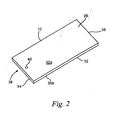
- FIGURE 2 is a perspective view of the glass coverslip shown in FIGURE 1;
- FIGURE 3 is a perspective view of a second preferred embodiment;
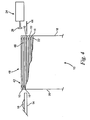
- FIGURE 4 illustrates the coverslipper apparatus of FIGURE 1 with the second preferred embodiment shown in FIGURE 3;
- FIGURES 5A and B are partial top views of a coverslip, illustrating additional protuberance configurations; and
- FIGURE 6 is a perspective bottom view of the coverslip shown in FIGURE 2.
-
- With reference to FIGURES 1 and 2, a preferred embodiment of the present invention is shown as a
glass coverslip 10 for use in an automated coverslipper, generally designated 12. Thecoverslipper 12 places thecoverslip 10 upon aconventional glass slide 14, having a substantially rectangular configuration and carrying atissue specimen 16. Thecoverslip 10 substantially avoids contamination and facilitates processing of thespecimen 16. - The
coverslipper 12 includes amagazine 18, having anopen dispensing end 20, adjacent and facing theglass slide 14. Themagazine 18 defines a substantiallyrectangular chamber 22, wherein thecoverslips 10 are stacked in a substantially vertical arrangement. A conventional transfer mechanism, generally designated 24, moves the top, or uppermost,coverslip 10 from thechamber 22, onto theawaiting glass slide 14. For purposes of illustration only,transfer mechanism 24 includes apiston 26, adapted to horizontally engage and "push" thetop coverslip 10 in themagazine 18 onto theglass side 14. With each "push," the stack ofcoverslips 10 advances upwardly in a conventional manner to properly align thenext coverslip 10 with respect to thepiston 26. - Referring now to FIGURES 1 and 2, the
coverslip 10 includes aglass plate 28, having substantially planar top and bottom surfaces 30A, 30B, and aperiphery 32. In this preferred embodiment, theglass plate 28 has a substantially rectangular configuration, with a length and a thickness slightly less than theconventional glass slide 14. Theplate 28 definesopposed ends glass slide 14. - The
glass coverslip 10 further includes at least one protuberance, generally designated 38, applied to, or mounted on, the top surface 30A, near theperiphery 32. In this preferred embodiment, theprotuberance 38 is a raiseddot 40, centrally located adjacent theopposed end 34 of theglass plate 28. As shown in FIGURES 5A and B, theprotuberance 38 may be in the form of an "X" or a bar. - Referring again to FIGURE 1, the raised
dot 40 provides an elevational alternation, generally designated 42, to the substantially planar top surface 30A of theglass plate 28. Thisalteration 42 defines a supportingplane 44 that is acutely oriented with respect to the planar top surface 30A. As used herein, the term "acutely oriented" and obvious modifications thereof mean an angle of 0 to 3 degrees. In this preferred embodiment, the supportingplane 44 is further defined by theglass plate 28, or more particularly theopposed end 36 thereof, as theadjacent coverslip 10 rests upon theglass plate 28, at one end, and upon the raiseddot 40, at the other end. - In the preferred embodiment shown in FIGURE 3, there are three
protuberances 38 in the form of raiseddots 40 -- one centrally located along theend 34 and two at the edges of theother end 36. The supportingplane 44, as defined by the three raiseddots 40, is substantially parallel to the top surface 30A of theglass plate 28. - The supporting
plane 44 establishes agap 46 between verticallyadjacent coverslips 10 in themagazine 18. Theupper coverslip 10 rests along the supportingplane 44, substantially reducing the surface contact between the adjacently stackedcoverslips 10 and substantially reducing adherence or sticking therebetween. Thegap 46 further increases airflow, thereby reducing the possibility of condensation. With respect to the preferred embodiment shown in of FIGURES 1 and 2, thegap 46 is tapered; in the preferred embodiment of FIGURES 3 and 4,adjacent coverslips 10 are substantially parallel, such that thegap 46 is not tapered. - The
protuberance 38, whether thedot 40 or an "X" or a bar, is preferably a curable compound, having a flowable state and a cured state. In one preferred embodiment, thedot 40 is a teflon paint which dries, or cures, in air. Once dried, thedot 40 has a substantially semi-circular shape, providing anelevational alteration 42 preferably in the range of 0.0005 to 0.005 inches. (In the FIGURES 1-4, the height of theprotuberance 38 is exaggerated for clarity.) - With reference again to FIGURE 1, alternating the pattern of the
glass coverslips 10 in themagazine 18, such that the singular raiseddot 40 of everyother coverslip 10 is at the dispensingend 20 thereof, substantially avoids skewing. That is, thestacked coverslips 10 maintain a substantially vertical profile. - The various preferred embodiments of the
coverslip 10 are readily packaged as a kit, generally designated 48. Thekit 48 facilitates shipping and handling and readily drops into themagazine 18. - With reference now to FIGURE 6, the stackable
non-stick coverslip 10 has an adhesive 52 applied to a central region, generally designated 54, of the bottom surface 30B. The adhesive 52 is preferably a liquid that dries, upon application to thecoverslip 10, to a tackless or only slightly tacky state. The adhesive 52 is activated or partially dissolved by a solvent, prior to placement onto theglass slide 14 by thecoverslipper 12. More particularly, thecoverslipper 12 includes a dispensing system, generally designated 56, to apply the solvent to the bottom surface 30B of thecoverslip 10 as it is "pushed" out of themagazine 18 and onto theglass side 14. Alternatively, the dispensingsystem 56 may apply the solvent directly onto theglass slide 14. In another embodiment, the solvent is applied manually. - As the activated adhesive 52 again dries, the
coverslip 10 is affixed or bonded to thetop surface 58 of theglass slide 12. Theglass slide 12 can then stored for future analysis and study or as a permanent record of the analysis preformed. - The adhesive 52 is preferably oil-based or water-insoluble, such that the solvent is nonaqueous, i.e., hydrophobic or lipophilic. Acrylic copolymers such as Acryloid® A-21, commercially available from Rohm and Haas, Philadelphia, Pa., are suitable. Other suitable adhesives include olefin-based materials, e.g., vinyl and acrylate based polymers; cellulose acetates; cyanoacrylates; silicone-containing materials including silane- and siloxane-terminated monomer based polymers; polytetrafluoroethylene based adhesives; and hydrocarbon based polymers. Suitable solvents to render the adhesive 52 tacky include aromatic hydrocarbons such as toluene, xylene, and benzene; silicones such as dimethicones, cyclomethicones and substituted siloxanes; aromatic and aliphatic hydrocarbons; alkyl esters; benzyl or alkyl benzoates; alkyl, alkoxyalkyl and glyceryl esters; and mixtures thereof. While an oil-based or water-insoluble solvent is preferred, a water-based solvent, such as Shur/Mount Liquid Mounting Medium (VWR Cat. No. 15148-062), may be utilized with certain stains.
- The present invention substantially avoids the difficult task of maintaining an adhesive within the
automated coverslipper 12. The equally difficult task of pumping an adhesive through theautomated coverslipper 12 is also avoided. - Various preferred embodiments of the present invention have been described herein. It is to be understood that modifications and changes can be made without departing from the true scope and spirit of the present invention, as defined by the following claims which are to be interpreted in view of the foregoing.
- In summary, according to the invention there is provided a coverslip comprising, in combination:
- a glass plate having a substantially planar top surface and a substantially planar bottom surface;
- at least one protuberance on said substantially planar top surface, said protuberance providing an elevational alternation to said substantially planar top surface, said elevational alternation defining a supporting plane acutely oriented with respect to said substantially planar top surface; and
- a solvent-activated adhesive on said substantially planar bottom surface, whereby said protuberance is preferably:
- a curable compound deposited on said substantial planar top surface;
- a paint; or
- a raised dot of a curable compound deposited on said substantially planar top surface in a substantially semi-circular configuration.
-
- Preferably said curable compound has a flowable state and a cured stated, said curable compound being deposited on the said substantially planar top surface in said flowable state and thereafter curing to said cured state. Further preferably said curable compound is a paint, preferably a teflon paint.
- Said solvent-activated adhesive is preferably oil-based or water-insoluble.
- Furthermore, according to the present invention there is provided a kit comprising, in combination:
- a plurality of coverslips stacked in an alternating pattern;
- each of said stacked coverslips including:
- a glass plate having top and bottom surfaces;
- at least one protuberance on said top surface, said protuberance providing an elevational alternation to said top surface, said elevational alternation defining a supporting plane, acutely oriented with respect to said top surface, for an immediately adjacent one of said stacked coverslips, said supporting plane substantially minimizing surface contact between said adjacently stacked coverslips to substantially avoid adherence therebetween; and
- a solvent-activated adhesive on said bottom surface.
-
- Preferably said protuberance is a raised dot of a compound deposited on said top surface in a substantially semi-circular configuration. Further preferably said compound has a flowable state and a cured stated, said compound being deposited on the said top surface in said flowable state and thereafter hardening to said cured state.
- Said compound is preferably a paint, more preferably a teflon paint.
- Said solvent-activated adhesive is preferably oilbased or water-insoluble.
- In addition according to the invention there is provided a coverslip comprising, in combination:
- a glass plate having a substantially planar top surface and a substantially planar bottom surface; and
- a solvent-activated adhesive on said substantially planar bottom surface.
-
- Said coverslip comprises preferably at least one protuberance on said substantially planar top surface, said protuberance providing an elevational alternation to said substantially planar top surface, said elevational alternation defining a supporting plane acutely oriented with respect to said substantially planar top surface.
- Preferably said solvent-activated adhesive is oil-based or water-insoluble.
- According to the invention there is further provided a coverslip comprising, in combination:
- a glass plate having a substantially planar top surface and a substantially planar bottom surface; and
- at least one protuberance on said substantially planar top surface, said protuberance providing an elevational alternation to said substantially planar top surface, said elevational alternation defining a supporting plane acutely oriented with respect to said substantially planar top surface.
-
- Preferably said coverslip comprises further a solvent-activated adhesive on said substantially planar bottom surface, said solvent-activated adhesive being preferably oil-based or water-insoluble.
Claims (9)
- A coverslip comprising, in combination:a glass plate having a substantially planar top surface and a substantially planar bottom surface;a solvent-activated adhesive on said substantially planar bottom surface.
- A coverslip as claimed in claim 1 further comprising at least one protuberance on said substantially planar top surface, said protuberance providing an elevational alternation to said substantially planar top surface, said elevational alternation defining a supporting plane acutely oriented with respect to said substantially planar top surface.
- A coverslip as claimed in claim 2 wherein said protuberance is a paint.
- A coverslip as claimed in claim 2 wherein said protuberance is a curable compound deposited on said substantially planar top surface.
- A coverslip as claimed in claim 4 wherein said protuberance is a raised dot of a curable compound deposited on said substantially planar top surface in a substantially semi-circular configuration.
- A coverslip as claimed in claim 4 or 5 wherein said curable compound has a flowable state and a cured stated, said curable compound being deposited on the said substantially planar top surface in said flowable state and thereafter curing to said cured state.
- A coverslip as claimed in anyone of claims 4 to 6 wherein said curable compound is a paint.
- A coverslip as claimed in claim 7 wherein said paint is a teflon paint.
- A coverslip as claimed in claim 1 to 8 wherein said solvent-activated adhesive is oil-based or water-insoluble.
Applications Claiming Priority (5)
| Application Number | Priority Date | Filing Date | Title |
|---|---|---|---|
| US16677199P | 1999-11-22 | 1999-11-22 | |
| US166771P | 1999-11-22 | ||
| US19379700P | 2000-03-31 | 2000-03-31 | |
| US193797P | 2000-03-31 | ||
| EP00980564A EP1242800B1 (en) | 1999-11-22 | 2000-11-20 | Stackable non-stick coverslip |
Related Parent Applications (1)
| Application Number | Title | Priority Date | Filing Date |
|---|---|---|---|
| EP00980564A Division EP1242800B1 (en) | 1999-11-22 | 2000-11-20 | Stackable non-stick coverslip |
Publications (2)
| Publication Number | Publication Date |
|---|---|
| EP1526369A1 true EP1526369A1 (en) | 2005-04-27 |
| EP1526369B1 EP1526369B1 (en) | 2006-06-14 |
Family
ID=34396745
Family Applications (1)
| Application Number | Title | Priority Date | Filing Date |
|---|---|---|---|
| EP04028367A Expired - Lifetime EP1526369B1 (en) | 1999-11-22 | 2000-11-20 | Coverslip and method for applying a coverslip to a glass slide |
Country Status (1)
| Country | Link |
|---|---|
| EP (1) | EP1526369B1 (en) |
Cited By (1)
| Publication number | Priority date | Publication date | Assignee | Title |
|---|---|---|---|---|
| CN113916633A (en) * | 2020-11-17 | 2022-01-11 | 福州艾迪康医学检验所有限公司 | Slide glass mounting device and slide glass mounting method |
Families Citing this family (1)
| Publication number | Priority date | Publication date | Assignee | Title |
|---|---|---|---|---|
| DE102007011329A1 (en) * | 2007-03-08 | 2008-09-11 | Medite Gmbh | Method for covering colored histological preparations, which are arranged on microscope slides, involves applying covering medium and fixing covering glass on microscope slides, which are arranged in microscope slides holder |
Citations (3)
| Publication number | Priority date | Publication date | Assignee | Title |
|---|---|---|---|---|
| US4146414A (en) * | 1977-05-09 | 1979-03-27 | Cytologiska Centrallaboratoriet Ab | Method for applying cover-slips to slides carrying specimens for microscopic examination |
| US5661029A (en) * | 1994-05-12 | 1997-08-26 | Biomed | Biological culture growth and observation device |
| US5939251A (en) * | 1996-07-12 | 1999-08-17 | Hu; Min | Apparatus and method for simplifying the processes in creating a sealed space on slides to conduct molecular biological reactions therein |
-
2000
- 2000-11-20 EP EP04028367A patent/EP1526369B1/en not_active Expired - Lifetime
Patent Citations (3)
| Publication number | Priority date | Publication date | Assignee | Title |
|---|---|---|---|---|
| US4146414A (en) * | 1977-05-09 | 1979-03-27 | Cytologiska Centrallaboratoriet Ab | Method for applying cover-slips to slides carrying specimens for microscopic examination |
| US5661029A (en) * | 1994-05-12 | 1997-08-26 | Biomed | Biological culture growth and observation device |
| US5939251A (en) * | 1996-07-12 | 1999-08-17 | Hu; Min | Apparatus and method for simplifying the processes in creating a sealed space on slides to conduct molecular biological reactions therein |
Cited By (2)
| Publication number | Priority date | Publication date | Assignee | Title |
|---|---|---|---|---|
| CN113916633A (en) * | 2020-11-17 | 2022-01-11 | 福州艾迪康医学检验所有限公司 | Slide glass mounting device and slide glass mounting method |
| CN113916633B (en) * | 2020-11-17 | 2024-01-12 | 福州艾迪康医学检验实验室有限公司 | Slide sealing device and slide sealing method |
Also Published As
| Publication number | Publication date |
|---|---|
| EP1526369B1 (en) | 2006-06-14 |
Similar Documents
| Publication | Publication Date | Title |
|---|---|---|
| US6759011B1 (en) | Stackable non-stick coverslip | |
| US20190258045A1 (en) | Automated coverslipper and methods of use | |
| US8765456B2 (en) | Microstructure for particle and cell separation, identification, sorting, and manipulation | |
| AU2015279191B2 (en) | Automated specimen processing systems and methods of detecting specimen-bearing microscope slides | |
| US7425311B2 (en) | Holding device | |
| CA2368753C (en) | Stackable non-stick coverslip | |
| US20080038836A1 (en) | Automated high volume slide staining system | |
| JP2004354393A (en) | Multi-well microfilter | |
| EP1526369B1 (en) | Coverslip and method for applying a coverslip to a glass slide | |
| US8910687B2 (en) | Device for placing histological and biological samples | |
| WO2006052492A1 (en) | Preglued coverglass with roughened glue surface | |
| CN221753359U (en) | A fixable electric pipette | |
| US20050030615A1 (en) | Measured array for slides | |
| EP3039117B1 (en) | Apparatus for spreading a fluid across a substrate |
Legal Events
| Date | Code | Title | Description |
|---|---|---|---|
| PUAI | Public reference made under article 153(3) epc to a published international application that has entered the european phase |
Free format text: ORIGINAL CODE: 0009012 |
|
| AC | Divisional application: reference to earlier application |
Ref document number: 1242800 Country of ref document: EP Kind code of ref document: P |
|
| AK | Designated contracting states |
Kind code of ref document: A1 Designated state(s): DE FR GB |
|
| 17P | Request for examination filed |
Effective date: 20050525 |
|
| GRAP | Despatch of communication of intention to grant a patent |
Free format text: ORIGINAL CODE: EPIDOSNIGR1 |
|
| AKX | Designation fees paid |
Designated state(s): DE FR GB |
|
| RTI1 | Title (correction) |
Free format text: COVERSLIP AND METHOD FOR APPLYING A COVERSLIP TO A GLASS SLIDE |
|
| GRAS | Grant fee paid |
Free format text: ORIGINAL CODE: EPIDOSNIGR3 |
|
| GRAA | (expected) grant |
Free format text: ORIGINAL CODE: 0009210 |
|
| AC | Divisional application: reference to earlier application |
Ref document number: 1242800 Country of ref document: EP Kind code of ref document: P |
|
| AK | Designated contracting states |
Kind code of ref document: B1 Designated state(s): DE FR GB |
|
| REG | Reference to a national code |
Ref country code: GB Ref legal event code: FG4D |
|
| REF | Corresponds to: |
Ref document number: 60028842 Country of ref document: DE Date of ref document: 20060727 Kind code of ref document: P |
|
| ET | Fr: translation filed | ||
| PLBE | No opposition filed within time limit |
Free format text: ORIGINAL CODE: 0009261 |
|
| STAA | Information on the status of an ep patent application or granted ep patent |
Free format text: STATUS: NO OPPOSITION FILED WITHIN TIME LIMIT |
|
| 26N | No opposition filed |
Effective date: 20070315 |
|
| REG | Reference to a national code |
Ref country code: FR Ref legal event code: CA |
|
| REG | Reference to a national code |
Ref country code: FR Ref legal event code: PLFP Year of fee payment: 16 |
|
| REG | Reference to a national code |
Ref country code: FR Ref legal event code: PLFP Year of fee payment: 17 |
|
| PGFP | Annual fee paid to national office [announced via postgrant information from national office to epo] |
Ref country code: DE Payment date: 20161130 Year of fee payment: 17 Ref country code: GB Payment date: 20161026 Year of fee payment: 17 Ref country code: FR Payment date: 20161017 Year of fee payment: 17 |
|
| REG | Reference to a national code |
Ref country code: DE Ref legal event code: R119 Ref document number: 60028842 Country of ref document: DE |
|
| GBPC | Gb: european patent ceased through non-payment of renewal fee |
Effective date: 20171120 |
|
| REG | Reference to a national code |
Ref country code: FR Ref legal event code: ST Effective date: 20180731 |
|
| PG25 | Lapsed in a contracting state [announced via postgrant information from national office to epo] |
Ref country code: FR Free format text: LAPSE BECAUSE OF NON-PAYMENT OF DUE FEES Effective date: 20171130 Ref country code: DE Free format text: LAPSE BECAUSE OF NON-PAYMENT OF DUE FEES Effective date: 20180602 |
|
| PG25 | Lapsed in a contracting state [announced via postgrant information from national office to epo] |
Ref country code: GB Free format text: LAPSE BECAUSE OF NON-PAYMENT OF DUE FEES Effective date: 20171120 |