EP1526125A1 - Process for producing a fatty acid ester - Google Patents
Process for producing a fatty acid ester Download PDFInfo
- Publication number
- EP1526125A1 EP1526125A1 EP04024270A EP04024270A EP1526125A1 EP 1526125 A1 EP1526125 A1 EP 1526125A1 EP 04024270 A EP04024270 A EP 04024270A EP 04024270 A EP04024270 A EP 04024270A EP 1526125 A1 EP1526125 A1 EP 1526125A1
- Authority
- EP
- European Patent Office
- Prior art keywords
- catalyst
- fatty acid
- raw material
- acid
- reaction
- Prior art date
- Legal status (The legal status is an assumption and is not a legal conclusion. Google has not performed a legal analysis and makes no representation as to the accuracy of the status listed.)
- Granted
Links
- 235000014113 dietary fatty acids Nutrition 0.000 title claims abstract description 71
- 239000000194 fatty acid Substances 0.000 title claims abstract description 71
- 229930195729 fatty acid Natural products 0.000 title claims abstract description 71
- 238000000034 method Methods 0.000 title claims abstract description 29
- -1 fatty acid ester Chemical class 0.000 title claims abstract description 23
- 239000003054 catalyst Substances 0.000 claims abstract description 101
- 239000002253 acid Substances 0.000 claims abstract description 67
- 239000002994 raw material Substances 0.000 claims abstract description 57
- 150000004665 fatty acids Chemical class 0.000 claims abstract description 54
- LFQSCWFLJHTTHZ-UHFFFAOYSA-N Ethanol Chemical compound CCO LFQSCWFLJHTTHZ-UHFFFAOYSA-N 0.000 claims abstract description 25
- 239000011949 solid catalyst Substances 0.000 claims abstract description 23
- 239000007858 starting material Substances 0.000 claims abstract description 3
- 238000006243 chemical reaction Methods 0.000 claims description 74
- 230000003247 decreasing effect Effects 0.000 claims description 8
- 238000005886 esterification reaction Methods 0.000 claims description 8
- 238000011144 upstream manufacturing Methods 0.000 claims description 4
- 230000032050 esterification Effects 0.000 claims description 2
- OKKJLVBELUTLKV-UHFFFAOYSA-N Methanol Chemical compound OC OKKJLVBELUTLKV-UHFFFAOYSA-N 0.000 description 45
- NBIIXXVUZAFLBC-UHFFFAOYSA-N Phosphoric acid Chemical compound OP(O)(O)=O NBIIXXVUZAFLBC-UHFFFAOYSA-N 0.000 description 24
- 239000007788 liquid Substances 0.000 description 22
- 229910052751 metal Inorganic materials 0.000 description 19
- 239000002184 metal Substances 0.000 description 19
- 239000000203 mixture Substances 0.000 description 17
- 239000000243 solution Substances 0.000 description 15
- POULHZVOKOAJMA-UHFFFAOYSA-N dodecanoic acid Chemical compound CCCCCCCCCCCC(O)=O POULHZVOKOAJMA-UHFFFAOYSA-N 0.000 description 12
- IPCSVZSSVZVIGE-UHFFFAOYSA-N hexadecanoic acid Chemical compound CCCCCCCCCCCCCCCC(O)=O IPCSVZSSVZVIGE-UHFFFAOYSA-N 0.000 description 12
- 235000011007 phosphoric acid Nutrition 0.000 description 12
- 239000007795 chemical reaction product Substances 0.000 description 11
- 230000000694 effects Effects 0.000 description 11
- 230000002378 acidificating effect Effects 0.000 description 9
- ILRRQNADMUWWFW-UHFFFAOYSA-K aluminium phosphate Chemical compound O1[Al]2OP1(=O)O2 ILRRQNADMUWWFW-UHFFFAOYSA-K 0.000 description 9
- 238000004519 manufacturing process Methods 0.000 description 9
- 125000004429 atom Chemical group 0.000 description 8
- 230000000052 comparative effect Effects 0.000 description 8
- 229910000147 aluminium phosphate Inorganic materials 0.000 description 7
- 150000002739 metals Chemical class 0.000 description 7
- 239000007787 solid Substances 0.000 description 7
- XLYOFNOQVPJJNP-UHFFFAOYSA-N water Substances O XLYOFNOQVPJJNP-UHFFFAOYSA-N 0.000 description 7
- 239000005639 Lauric acid Substances 0.000 description 6
- 235000021314 Palmitic acid Nutrition 0.000 description 6
- WQEPLUUGTLDZJY-UHFFFAOYSA-N n-Pentadecanoic acid Natural products CCCCCCCCCCCCCCC(O)=O WQEPLUUGTLDZJY-UHFFFAOYSA-N 0.000 description 6
- ABLZXFCXXLZCGV-UHFFFAOYSA-N Phosphorous acid Chemical class OP(O)=O ABLZXFCXXLZCGV-UHFFFAOYSA-N 0.000 description 5
- VYPSYNLAJGMNEJ-UHFFFAOYSA-N Silicium dioxide Chemical compound O=[Si]=O VYPSYNLAJGMNEJ-UHFFFAOYSA-N 0.000 description 5
- MCMNRKCIXSYSNV-UHFFFAOYSA-N ZrO2 Inorganic materials O=[Zr]=O MCMNRKCIXSYSNV-UHFFFAOYSA-N 0.000 description 5
- 150000007513 acids Chemical class 0.000 description 5
- 229910052782 aluminium Inorganic materials 0.000 description 5
- XAGFODPZIPBFFR-UHFFFAOYSA-N aluminium Chemical compound [Al] XAGFODPZIPBFFR-UHFFFAOYSA-N 0.000 description 5
- PNEYBMLMFCGWSK-UHFFFAOYSA-N aluminium oxide Inorganic materials [O-2].[O-2].[O-2].[Al+3].[Al+3] PNEYBMLMFCGWSK-UHFFFAOYSA-N 0.000 description 5
- 239000003925 fat Substances 0.000 description 5
- 239000000463 material Substances 0.000 description 5
- 229910044991 metal oxide Inorganic materials 0.000 description 5
- 150000004706 metal oxides Chemical class 0.000 description 5
- 238000012856 packing Methods 0.000 description 5
- XEEYBQQBJWHFJM-UHFFFAOYSA-N Iron Chemical compound [Fe] XEEYBQQBJWHFJM-UHFFFAOYSA-N 0.000 description 4
- GWEVSGVZZGPLCZ-UHFFFAOYSA-N Titan oxide Chemical compound O=[Ti]=O GWEVSGVZZGPLCZ-UHFFFAOYSA-N 0.000 description 4
- 150000001298 alcohols Chemical class 0.000 description 4
- 150000001875 compounds Chemical class 0.000 description 4
- GATNOFPXSDHULC-UHFFFAOYSA-N ethylphosphonic acid Chemical compound CCP(O)(O)=O GATNOFPXSDHULC-UHFFFAOYSA-N 0.000 description 4
- 239000002244 precipitate Substances 0.000 description 4
- 239000000047 product Substances 0.000 description 4
- 239000011973 solid acid Substances 0.000 description 4
- VHUUQVKOLVNVRT-UHFFFAOYSA-N Ammonium hydroxide Chemical compound [NH4+].[OH-] VHUUQVKOLVNVRT-UHFFFAOYSA-N 0.000 description 3
- OKTJSMMVPCPJKN-UHFFFAOYSA-N Carbon Chemical compound [C] OKTJSMMVPCPJKN-UHFFFAOYSA-N 0.000 description 3
- 229910021536 Zeolite Inorganic materials 0.000 description 3
- 125000000217 alkyl group Chemical group 0.000 description 3
- QGZKDVFQNNGYKY-UHFFFAOYSA-N ammonia Natural products N QGZKDVFQNNGYKY-UHFFFAOYSA-N 0.000 description 3
- 235000011114 ammonium hydroxide Nutrition 0.000 description 3
- 239000003729 cation exchange resin Substances 0.000 description 3
- 238000010790 dilution Methods 0.000 description 3
- 239000012895 dilution Substances 0.000 description 3
- HNPSIPDUKPIQMN-UHFFFAOYSA-N dioxosilane;oxo(oxoalumanyloxy)alumane Chemical compound O=[Si]=O.O=[Al]O[Al]=O HNPSIPDUKPIQMN-UHFFFAOYSA-N 0.000 description 3
- 238000004090 dissolution Methods 0.000 description 3
- 238000004821 distillation Methods 0.000 description 3
- 235000019197 fats Nutrition 0.000 description 3
- 239000011259 mixed solution Substances 0.000 description 3
- 239000010457 zeolite Substances 0.000 description 3
- BNGXYYYYKUGPPF-UHFFFAOYSA-M (3-methylphenyl)methyl-triphenylphosphanium;chloride Chemical compound [Cl-].CC1=CC=CC(C[P+](C=2C=CC=CC=2)(C=2C=CC=CC=2)C=2C=CC=CC=2)=C1 BNGXYYYYKUGPPF-UHFFFAOYSA-M 0.000 description 2
- NWUYHJFMYQTDRP-UHFFFAOYSA-N 1,2-bis(ethenyl)benzene;1-ethenyl-2-ethylbenzene;styrene Chemical compound C=CC1=CC=CC=C1.CCC1=CC=CC=C1C=C.C=CC1=CC=CC=C1C=C NWUYHJFMYQTDRP-UHFFFAOYSA-N 0.000 description 2
- GYHNNYVSQQEPJS-UHFFFAOYSA-N Gallium Chemical compound [Ga] GYHNNYVSQQEPJS-UHFFFAOYSA-N 0.000 description 2
- FLIACVVOZYBSBS-UHFFFAOYSA-N Methyl palmitate Chemical compound CCCCCCCCCCCCCCCC(=O)OC FLIACVVOZYBSBS-UHFFFAOYSA-N 0.000 description 2
- 229910019142 PO4 Inorganic materials 0.000 description 2
- QAOWNCQODCNURD-UHFFFAOYSA-N Sulfuric acid Chemical compound OS(O)(=O)=O QAOWNCQODCNURD-UHFFFAOYSA-N 0.000 description 2
- 239000010775 animal oil Substances 0.000 description 2
- 239000007864 aqueous solution Substances 0.000 description 2
- 238000009835 boiling Methods 0.000 description 2
- 239000006227 byproduct Substances 0.000 description 2
- 125000004432 carbon atom Chemical group C* 0.000 description 2
- 229940023913 cation exchange resins Drugs 0.000 description 2
- 238000011156 evaluation Methods 0.000 description 2
- 235000019387 fatty acid methyl ester Nutrition 0.000 description 2
- 229910052733 gallium Inorganic materials 0.000 description 2
- 125000004435 hydrogen atom Chemical group [H]* 0.000 description 2
- 125000002887 hydroxy group Chemical group [H]O* 0.000 description 2
- 229910052500 inorganic mineral Inorganic materials 0.000 description 2
- 239000003456 ion exchange resin Substances 0.000 description 2
- 229920003303 ion-exchange polymer Polymers 0.000 description 2
- 229910052742 iron Inorganic materials 0.000 description 2
- 229910001463 metal phosphate Inorganic materials 0.000 description 2
- UQDUPQYQJKYHQI-UHFFFAOYSA-N methyl laurate Chemical compound CCCCCCCCCCCC(=O)OC UQDUPQYQJKYHQI-UHFFFAOYSA-N 0.000 description 2
- 239000011707 mineral Substances 0.000 description 2
- 229910000069 nitrogen hydride Inorganic materials 0.000 description 2
- 150000007524 organic acids Chemical class 0.000 description 2
- NBIIXXVUZAFLBC-UHFFFAOYSA-K phosphate Chemical compound [O-]P([O-])([O-])=O NBIIXXVUZAFLBC-UHFFFAOYSA-K 0.000 description 2
- 239000010452 phosphate Substances 0.000 description 2
- 235000021317 phosphate Nutrition 0.000 description 2
- 239000011148 porous material Substances 0.000 description 2
- 238000001556 precipitation Methods 0.000 description 2
- 239000000377 silicon dioxide Substances 0.000 description 2
- 239000000126 substance Substances 0.000 description 2
- 150000003467 sulfuric acid derivatives Chemical class 0.000 description 2
- 235000015112 vegetable and seed oil Nutrition 0.000 description 2
- 235000019871 vegetable fat Nutrition 0.000 description 2
- 239000008158 vegetable oil Substances 0.000 description 2
- 239000005995 Aluminium silicate Substances 0.000 description 1
- NLXLAEXVIDQMFP-UHFFFAOYSA-N Ammonium chloride Substances [NH4+].[Cl-] NLXLAEXVIDQMFP-UHFFFAOYSA-N 0.000 description 1
- SNRUBQQJIBEYMU-UHFFFAOYSA-N Dodecane Natural products CCCCCCCCCCCC SNRUBQQJIBEYMU-UHFFFAOYSA-N 0.000 description 1
- 239000005909 Kieselgur Substances 0.000 description 1
- 235000019482 Palm oil Nutrition 0.000 description 1
- 235000019484 Rapeseed oil Nutrition 0.000 description 1
- 125000003545 alkoxy group Chemical group 0.000 description 1
- 125000004453 alkoxycarbonyl group Chemical group 0.000 description 1
- 235000012211 aluminium silicate Nutrition 0.000 description 1
- SWCIQHXIXUMHKA-UHFFFAOYSA-N aluminum;trinitrate;nonahydrate Chemical compound O.O.O.O.O.O.O.O.O.[Al+3].[O-][N+]([O-])=O.[O-][N+]([O-])=O.[O-][N+]([O-])=O SWCIQHXIXUMHKA-UHFFFAOYSA-N 0.000 description 1
- 125000003277 amino group Chemical group 0.000 description 1
- 125000003118 aryl group Chemical group 0.000 description 1
- 235000015278 beef Nutrition 0.000 description 1
- 125000002915 carbonyl group Chemical group [*:2]C([*:1])=O 0.000 description 1
- 125000002843 carboxylic acid group Chemical group 0.000 description 1
- 150000001735 carboxylic acids Chemical class 0.000 description 1
- 230000003197 catalytic effect Effects 0.000 description 1
- 150000001768 cations Chemical class 0.000 description 1
- 239000000919 ceramic Substances 0.000 description 1
- 125000001309 chloro group Chemical group Cl* 0.000 description 1
- 239000004927 clay Substances 0.000 description 1
- 239000003240 coconut oil Substances 0.000 description 1
- 235000019864 coconut oil Nutrition 0.000 description 1
- 229910052593 corundum Inorganic materials 0.000 description 1
- DRNJFFYTADAYNB-UHFFFAOYSA-H dialuminum;dioxido-oxo-phenyl-$l^{5}-phosphane Chemical compound [Al+3].[Al+3].[O-]P([O-])(=O)C1=CC=CC=C1.[O-]P([O-])(=O)C1=CC=CC=C1.[O-]P([O-])(=O)C1=CC=CC=C1 DRNJFFYTADAYNB-UHFFFAOYSA-H 0.000 description 1
- GUJOJGAPFQRJSV-UHFFFAOYSA-N dialuminum;dioxosilane;oxygen(2-);hydrate Chemical compound O.[O-2].[O-2].[O-2].[Al+3].[Al+3].O=[Si]=O.O=[Si]=O.O=[Si]=O.O=[Si]=O GUJOJGAPFQRJSV-UHFFFAOYSA-N 0.000 description 1
- 150000001991 dicarboxylic acids Chemical class 0.000 description 1
- ZJIPHXXDPROMEF-UHFFFAOYSA-N dihydroxyphosphanyl dihydrogen phosphite Chemical compound OP(O)OP(O)O ZJIPHXXDPROMEF-UHFFFAOYSA-N 0.000 description 1
- 239000001177 diphosphate Substances 0.000 description 1
- XPPKVPWEQAFLFU-UHFFFAOYSA-J diphosphate(4-) Chemical compound [O-]P([O-])(=O)OP([O-])([O-])=O XPPKVPWEQAFLFU-UHFFFAOYSA-J 0.000 description 1
- 235000011180 diphosphates Nutrition 0.000 description 1
- XPPKVPWEQAFLFU-UHFFFAOYSA-N diphosphoric acid Chemical compound OP(O)(=O)OP(O)(O)=O XPPKVPWEQAFLFU-UHFFFAOYSA-N 0.000 description 1
- 125000003438 dodecyl group Chemical group [H]C([H])([H])C([H])([H])C([H])([H])C([H])([H])C([H])([H])C([H])([H])C([H])([H])C([H])([H])C([H])([H])C([H])([H])C([H])([H])C([H])([H])* 0.000 description 1
- 150000002148 esters Chemical class 0.000 description 1
- 235000019441 ethanol Nutrition 0.000 description 1
- 125000001495 ethyl group Chemical group [H]C([H])([H])C([H])([H])* 0.000 description 1
- 229940013317 fish oils Drugs 0.000 description 1
- 239000007789 gas Substances 0.000 description 1
- 239000010439 graphite Substances 0.000 description 1
- 229910002804 graphite Inorganic materials 0.000 description 1
- 125000005843 halogen group Chemical group 0.000 description 1
- BHEPBYXIRTUNPN-UHFFFAOYSA-N hydridophosphorus(.) (triplet) Chemical compound [PH] BHEPBYXIRTUNPN-UHFFFAOYSA-N 0.000 description 1
- 230000007062 hydrolysis Effects 0.000 description 1
- 238000006460 hydrolysis reaction Methods 0.000 description 1
- XLYOFNOQVPJJNP-UHFFFAOYSA-M hydroxide Chemical compound [OH-] XLYOFNOQVPJJNP-UHFFFAOYSA-M 0.000 description 1
- WBJZTOZJJYAKHQ-UHFFFAOYSA-K iron(3+) phosphate Chemical compound [Fe+3].[O-]P([O-])([O-])=O WBJZTOZJJYAKHQ-UHFFFAOYSA-K 0.000 description 1
- 229910000399 iron(III) phosphate Inorganic materials 0.000 description 1
- 230000001788 irregular Effects 0.000 description 1
- 125000000959 isobutyl group Chemical group [H]C([H])([H])C([H])(C([H])([H])[H])C([H])([H])* 0.000 description 1
- 125000001449 isopropyl group Chemical group [H]C([H])([H])C([H])(*)C([H])([H])[H] 0.000 description 1
- NLYAJNPCOHFWQQ-UHFFFAOYSA-N kaolin Chemical compound O.O.O=[Al]O[Si](=O)O[Si](=O)O[Al]=O NLYAJNPCOHFWQQ-UHFFFAOYSA-N 0.000 description 1
- 125000000040 m-tolyl group Chemical group [H]C1=C([H])C(*)=C([H])C(=C1[H])C([H])([H])[H] 0.000 description 1
- 229910000000 metal hydroxide Chemical class 0.000 description 1
- 150000004692 metal hydroxides Chemical class 0.000 description 1
- 150000004702 methyl esters Chemical class 0.000 description 1
- 125000002496 methyl group Chemical group [H]C([H])([H])* 0.000 description 1
- 150000004712 monophosphates Chemical class 0.000 description 1
- 229910052901 montmorillonite Inorganic materials 0.000 description 1
- 125000004108 n-butyl group Chemical group [H]C([H])([H])C([H])([H])C([H])([H])C([H])([H])* 0.000 description 1
- 125000001280 n-hexyl group Chemical group C(CCCCC)* 0.000 description 1
- 125000004123 n-propyl group Chemical group [H]C([H])([H])C([H])([H])C([H])([H])* 0.000 description 1
- 125000002347 octyl group Chemical group [H]C([*])([H])C([H])([H])C([H])([H])C([H])([H])C([H])([H])C([H])([H])C([H])([H])C([H])([H])[H] 0.000 description 1
- 239000003921 oil Substances 0.000 description 1
- 235000019198 oils Nutrition 0.000 description 1
- 235000005985 organic acids Nutrition 0.000 description 1
- 125000000962 organic group Chemical group 0.000 description 1
- 239000003346 palm kernel oil Substances 0.000 description 1
- 235000019865 palm kernel oil Nutrition 0.000 description 1
- 239000002540 palm oil Substances 0.000 description 1
- 125000001997 phenyl group Chemical group [H]C1=C([H])C([H])=C(*)C([H])=C1[H] 0.000 description 1
- ACVYVLVWPXVTIT-UHFFFAOYSA-N phosphinic acid Chemical compound O[PH2]=O ACVYVLVWPXVTIT-UHFFFAOYSA-N 0.000 description 1
- 150000003016 phosphoric acids Chemical class 0.000 description 1
- 230000002250 progressing effect Effects 0.000 description 1
- BDERNNFJNOPAEC-UHFFFAOYSA-N propan-1-ol Chemical compound CCCO BDERNNFJNOPAEC-UHFFFAOYSA-N 0.000 description 1
- 229940005657 pyrophosphoric acid Drugs 0.000 description 1
- 239000011541 reaction mixture Substances 0.000 description 1
- 230000036632 reaction speed Effects 0.000 description 1
- 230000009257 reactivity Effects 0.000 description 1
- 238000011084 recovery Methods 0.000 description 1
- 239000011347 resin Substances 0.000 description 1
- 229920005989 resin Polymers 0.000 description 1
- 230000002441 reversible effect Effects 0.000 description 1
- 229920006395 saturated elastomer Polymers 0.000 description 1
- 235000003441 saturated fatty acids Nutrition 0.000 description 1
- 150000004671 saturated fatty acids Chemical class 0.000 description 1
- 238000002336 sorption--desorption measurement Methods 0.000 description 1
- 239000003549 soybean oil Substances 0.000 description 1
- 235000012424 soybean oil Nutrition 0.000 description 1
- 125000004079 stearyl group Chemical group [H]C([*])([H])C([H])([H])C([H])([H])C([H])([H])C([H])([H])C([H])([H])C([H])([H])C([H])([H])C([H])([H])C([H])([H])C([H])([H])C([H])([H])C([H])([H])C([H])([H])C([H])([H])C([H])([H])C([H])([H])C([H])([H])[H] 0.000 description 1
- 238000003756 stirring Methods 0.000 description 1
- 125000000542 sulfonic acid group Chemical group 0.000 description 1
- 239000003760 tallow Substances 0.000 description 1
- 125000000999 tert-butyl group Chemical group [H]C([H])([H])C(*)(C([H])([H])[H])C([H])([H])[H] 0.000 description 1
- UFTFJSFQGQCHQW-UHFFFAOYSA-N triformin Chemical compound O=COCC(OC=O)COC=O UFTFJSFQGQCHQW-UHFFFAOYSA-N 0.000 description 1
- 150000004670 unsaturated fatty acids Chemical class 0.000 description 1
- 235000021122 unsaturated fatty acids Nutrition 0.000 description 1
- 229910001845 yogo sapphire Inorganic materials 0.000 description 1
Images
Classifications
-
- C—CHEMISTRY; METALLURGY
- C11—ANIMAL OR VEGETABLE OILS, FATS, FATTY SUBSTANCES OR WAXES; FATTY ACIDS THEREFROM; DETERGENTS; CANDLES
- C11C—FATTY ACIDS FROM FATS, OILS OR WAXES; CANDLES; FATS, OILS OR FATTY ACIDS BY CHEMICAL MODIFICATION OF FATS, OILS, OR FATTY ACIDS OBTAINED THEREFROM
- C11C3/00—Fats, oils, or fatty acids by chemical modification of fats, oils, or fatty acids obtained therefrom
- C11C3/003—Fats, oils, or fatty acids by chemical modification of fats, oils, or fatty acids obtained therefrom by esterification of fatty acids with alcohols
-
- C—CHEMISTRY; METALLURGY
- C07—ORGANIC CHEMISTRY
- C07C—ACYCLIC OR CARBOCYCLIC COMPOUNDS
- C07C67/00—Preparation of carboxylic acid esters
- C07C67/08—Preparation of carboxylic acid esters by reacting carboxylic acids or symmetrical anhydrides with the hydroxy or O-metal group of organic compounds
Definitions
- the present invention relates to a process for producing a fatty acid ester.
- Fatty acid esters are important materials as raw materials for producing higher alcohols and oil and fat chemical products such as ester sulfonates and alkanolamides. These fatty acid esters are generally obtained by a reaction between a triglyceride and a lower alcohol or a reaction between a fatty acid and a lower alcohol.
- Various solid catalysts have been developed for esterification reactions between fatty acids and lower alcohols. Examples of the solid catalyst include such as cation exchange resins, single or complex metal oxides, stabilized acids and synthesized zeolite. There is the method described in JP-A 3-115249 as an example in which such a solid acid catalyst is applied to the production of a fatty acid ester.
- JP-A 2002-346392 discloses a solid acid catalyst made of an improved cation exchange resin.
- the present invention relates to a process for producing a fatty acid ester by using a fatty acid and an alcohol as starting materials, including reducing the acid value of a raw material supplied to a catalyst layer to an acid value lower than the acid value of a raw material fatty acid in advance and then esterifying the raw materials in the presence of a solid catalyst.
- JP-A 3-115249 discloses a system in which a Fixed-bed reactor packed with a solid acid catalyst is used to circulate a fatty acid put in a liquid state and a lower alcohol in a gaseous state.
- a fatty acid supplied as the raw material is an organic acid
- the solid acid catalyst is partly dissolved in the fatty acid or is reduced in catalytic activity when used for a long period of time.
- the strength required for the solid catalyst is dropped by the dissolution of components constituting the catalyst in the fatty acid.
- JP-A 2002-346392 made various improvements of a solid catalyst as to a reduction in the ability of an esterifying catalyst. However, these improvements were still insufficient.
- the present invention relates to a process for producing a fatty acid ester efficiently from a fatty acid and an alcohol by suppressing the dissolution and falling of a catalyst component used in a reaction without decreasing the activity and strength of the catalyst.
- a fatty acid ester can be obtained efficiently by suppressing the dissolution and falling of a catalyst component used in a reaction and without decreasing the activity and strength of the catalyst.
- examples of the fatty acid include saturated or unsaturated fatty acids obtained by hydrolysis of natural vegetable oil and fats and animal oil and fats. These fatty acids may be those having a single alkyl chain length or a mixture of fatty acids having different alkyl chain lengths.
- examples of the vegetable oil and fats include coconut oil, palm oil, palm kernel oil, soybean oil and rape seed oil.
- examples of the animal oil and fats include beef tallow, lard and fish oils.
- examples of the fatty acid further include organic acids such as dicarboxylic acids and carboxylic acids. These fatty acids are preferably used in a liquid state.
- alcohol used in the present invention lower alcohols having 1 to 5 carbon atoms are desirable.
- Specific examples of the alcohol include such as methanol, ethanol and propanol.
- methanol is desirable in view of low cost and recovery easiness in the case of using it as an industrial raw material.
- the acid value of the raw material supplied to the catalyst layer means the acid value of all components excluding alcohols and water to be supplied to the catalyst layer.
- a method of decreasing the acid value of the raw material to be supplied to the catalyst layer in the present invention include such as (1) a method in which a fatty acid ester is added to the raw material fatty acid and (2) a method in which a fatty acid is reacted with an alcohol in the presence of no catalyst to esterify partially before an esterification reaction is run before an esterification reaction run in the presence of a catalyst (hereinafter referred to as a pre-reactor method). These methods may be combined.
- Any material may be used as the fatty acid ester to be added to the raw material fatty acid without any particular limitation in the method (1) insofar as it does not inhibit the esterification reaction in the reactor or does not deteriorate the catalyst activity.
- Commercially available fatty acid esters may be used and it is also a particularly preferable embodiment on an industrial level to add a fatty acid ester obtained in the production process of the present invention partly to the raw material fatty acid.
- the reaction may be run in a continuous system, batch system or semi-continuous system.
- a continuous system a packed column, a wetted wall column, a continuous stirring vessel type reactor (CSTR) or the like may be used.
- CSTR continuous stirring vessel type reactor
- the batch system or semi-continuous system for example, a reaction vessel with a stirrer is used. Also, these systems may be combined.
- the alcohol when the pre-reactor method is carried out in a Fixed-bed system, the alcohol may be put in a gas or liquid state and the fatty acid may be used in a liquid state.
- reaction raw materials may be used in any of the reaction systems including a gas-liquid co-current system and a gas-liquid counter current system.
- a contact system in the case of a liquid-liquid system may be either co-current downflow or co-current upflow.
- the packing in the case of the Fixed-bed system any material may be used insofar as it is a material which is not corroded by the raw material fatty acid. Examples of the packing to be used include SUS balls, ceramic balls and Raschig ring. These packings may be regular packings or irregular packings.
- the reaction temperature in the pre-reactor method is usually 100 to 300°C and more preferably 150 to 220°C from the viewpoint of progressing the reaction sufficiently and suppressing the generation of byproducts.
- the liquid space velocity (LHSV) based on the fatty acid in the case of using a Fixed-bed reactor is usually preferably 0.02 to 5.0/hr and more preferably 0.5 to 3.0/hr from the viewpoint of suppressing a reduction in productivity, obtaining a sufficient reaction rate and dropping the acid value to a desired one.
- the molar ratio of the alcohol to the fatty acid is preferably 1.5 to 30 times, more preferably 1.5 to 10 times and even more preferably 1.5 to 5 times the stoichiometrically necessary amount from the viewpoint of raising the reaction rate and suppressing the amount of the alcohol to be recovered.
- the preferable acid value of the raw material supplied to the catalyst layer cannot be said in a wholesale manner because it is determined according to the type of fatty acid, the type of solid catalyst to be used and productivity
- the ratio of the acid value of the raw material supplied to the catalyst layer to that of the raw material fatty acid is designed to be preferably 90% or less, more preferably 80% or less, even more preferably 60% or less and even more preferably 40% or less from the viewpoint of restricting the concentration of the fatty acid supplied to the catalyst layer and preventing a reduction in the strength of the catalyst.
- a specific acid value of the raw material supplied to the catalyst layer is preferably 240 mg-KOH/g or less, more preferably 220 mg-KOH/g or less, even more preferably 200 mg-KOH/g or less and even more preferably 150 mg-KOH/g or less.
- the ratio of the acid value of the raw material supplied to the catalyst layer to that of the raw material fatty acid is designed to be preferably 2.5% or more, more preferably 10% or more and even more preferably 20% or more from the viewpoint of preventing an increase in the amount to be circulated and preventing a rise in the temperature necessary to run a reaction when using a pre-reactor.
- the specific acid value is preferably 10 mg-KOH/g or more, more preferably 30 mg-KOH/g or more and even more preferably 50 mg-KOH/g or more.
- the acid value of the raw material supplied to the catalyst layer is made to be preferably as low as possible.
- the acid value set to a lower one leads to a reduction in productivity and/or large-scaled equipment both in the case of adding an ester and in the case of reacting in a pre-reactor. It is therefore necessary to set a desired acid value taking this into account.
- the reaction system adopted when the raw material reduced in acid value is supplied to run an esterification reaction in the presence of a solid catalyst may be any system insofar as it runs a heterogeneous reaction.
- a system using a Fixed-bed reactor is preferable from the point that it is unnecessary to separate catalysts.
- the alcohol is gasified to run a reaction in a gas-liquid-solid three-phase in general.
- a liquid-liquid-solid reaction system in which the alcohol is supplied in a liquid state may be adopted.
- the contact system in the case of a gas-liquid-solid reaction may be any reaction system of gas-liquid co-current and gas-liquid counter current.
- the contact system in the case of a liquid-liquid-solid reaction may be any of a co-current downflow system and a co-current upflow system.
- a system in which Fixed-bed reactors packed with a solid catalyst are arranged in a multistage and a gas-liquid counter current operation and a gas-liquid co-current operation are combined may be adopted.
- a pseudo counter current operation may be carried out in which in a multistage co-current system, the fatty acid is supplied to a reactor on the upstream side and then fed to the downstream side stage, the gaseous alcohol is supplied to a reactor on the downstream side so as to allow a co-current downflow operation, the gaseous alcohol discharged from the outlet of the reactor is returned to the upstream side stage to repeat a co-current downflow operation in the Fixed-bed packed with a solid catalyst in each reactor.
- the system in which a pseudo counter current operation is carried out is preferable.
- the reaction is generally run under normal pressure or under pressure. However, the reaction may be run under reduced pressure. Under reduced pressure, a gas-liquid-solid reaction can be run at a temperature lower than the atmospheric boiling point of the alcohol to be used. Under pressure, a liquid-liquid-solid reaction can be run at a temperature more than the atmospheric boiling point.
- the reaction temperature is generally preferably 50 to 250°C, more preferably 60 to 220°C and even more preferably 80 to 200°C from the viewpoint of obtaining sufficient reactivity, raising reaction speed and suppressing the production of byproducts.
- the liquid space velocity (LHSV) based on the fatty acid in the case of using a Fixed-bed reactor is generally preferably 0.02 to 5.0/hr and more preferably 0.5 to 3.0/hr from the viewpoint of economy and also from the viewpoint of obtaining a sufficient reaction rate and raising the purity of a fatty acid ester to be produced.
- the molar ratio of the alcohol to the fatty acid is preferably 1.5 to 30 times, more preferably 1.5 to 10 times and even more preferably 1.5 to 5 times the stoichiometrically necessary amount from the viewpoint of raising the reaction rate and suppressing the amount of the alcohol to be recovered.
- esterification is carried out in the presence of a solid catalyst.
- the solid catalyst used in the present invention include such as single or complex metal oxides, metal sulfates, metal phosphates, metal phosphonates, stabilized acids which are supported on or fixed to a support, natural minerals and layer compounds, ultra-strong acids, synthetic zeolite and ion exchange resins.
- the single or complex metal oxides include niobic acid and SiO 2 -Al 2 O 3 and SiO 2 -ZrO 2 .
- the metal sulfates include Al 2 (SO 4 ) x ⁇ H 2 O.
- the metal phosphates include FePO 4 and AlPO 4 .
- Examples of the metal phosphonates include aluminum phenylphosphonate.
- Examples of the stabilized acids which are supported or fixed on a support include sulfuric acid ion-carrying ZrO 2 and TiO 2 .
- Examples of the natural minerals and layer compounds include acid clay, kaolin and montmorillonite.
- Examples of ultra-strong acids include sulfone fluoride resins (e.g., Naphyon manufactured by Du Pont K.K.).
- Examples of the synthetic zeolite include ZCP-50 manufactured by Shokubai Catalysts & Chemicals Industries Co., Ltd.
- Examples of the ion exchange resin include cation exchange resins such as High Porous Cation Resin RCP-160H.
- a weak-acidic solid catalyst as described below may be used.
- a preferable group of the weak acidic solid catalyst used in the present invention is those having a strong acidic point of 0.2 mmol/g-Cat or less, which point is defined below and a weak acidic point of 0.3 mmol/g-Cat or more, which point is defined below.
- Weak acidic point A point where NH 3 is dissociated at a temperature range from 100 to 250°C in TPD (ammonia-adsorption-desorption method).
- Strong acidic point A point where NH 3 is dissociated at a temperature higher than 250°C in TPD.
- Examples of a preferable group among these weak acidic solid catalysts include molded articles of weak acidic solid catalysts having the following structure (A) or (B) and metal atom (C).
- Structure (B) Structure obtained by eliminating a hydrogen atom from at least one OH group which an organic phosphoric acid represented by the formula (1) or (2) has.
- -R 1 and -R 2 are respectively selected from -R, -OR, -OH and -H, where at least one of -R 1 and -R 2 is -R or -OR, provided that -R is an organic group having 1 to 22 carbon atoms.
- Metal atom (C) One or more metal atoms selected from aluminum, gallium and iron.
- Examples of the inorganic phosphoric acid in the above structure (A) include condensed phosphoric acids such as orthophosphoric acid, methaphosphoric acid and pyrophosphoric acid. Orthophosphoric acid is preferable in view of performance.
- Examples of the organic phosphoric acid in the above structure (B) include phosphonic acid, monophosphonate, phosphinic acid, monophosphate, diphosphate, monophosphite and diphosphite. Mixtures of these compounds may be used and phosphonic acid is preferable.
- alkyl groups such as methyl, ethyl, n-propyl, iso-propyl, n-butyl, iso-butyl, tert-butyl, n-hexyl, 2-ethylhexyl, octyl, dodecyl and octadecyl and aryl groups such as phenyl and 3-methylphenyl .
- alkyl groups such as methyl, ethyl, n-propyl, iso-propyl, n-butyl, iso-butyl, tert-butyl, n-hexyl, 2-ethylhexyl, octyl, dodecyl and octadecyl and aryl groups such as phenyl and 3-methylphenyl .
- metal atom (C) aluminum is preferable in view of performance and/or cost.
- the metal atom (C) may contain a small amount of metal atoms other than aluminum, gallium and iron to improve selectivity and other abilities. All metal atoms (C) contained in the catalyst is not necessarily required to combine with the structure (A) or (B), but a part of the metal atom (C) may exist in the form of a metal oxide or a metal hydroxide.
- Examples of other groups preferable as the weak acidic solid catalyst in the present invention include molded articles of solid catalysts containing aluminum orthophosphate. Those having a pore diameter of 6 to 100 nm, a pore volume of 0.46 ml/g or more and an acid amount of 0.40 mmol/g are preferable.
- a precipitation method As a method of preparing the weak acidic solid catalyst in the present invention, a precipitation method, a method of impregnating a metal oxide or a hydroxide with an inorganic or organic phosphoric acid or a method of substituting an organic phosphoric acid group for an inorganic phosphoric acid group in an inorganic aluminum phosphate gel are used.
- the precipitation method is preferable.
- a carrier having a high surface area is made to exist to obtain a carrier catalyst.
- the carrier silica, alumina, silica alumina, titania, zirconia, diatomaceous earth, activated carbon or the like may be used. If the carrier is used in an excessive amount, the content of an active component is decreased, causing reduced activity and the proportion of the carrier in the catalyst is therefore preferably 90% by weight or less.
- Production Example 1 of a catalyst (aluminum phosphate catalyst)
- Aluminum nitrate and orthophosphoric acid were used to make an aqueous solution containing these components (mol ratio: 1 : 1) and aqueous ammonia was added dropwise to the solution at 40°C until the solution was adjusted to pH 7 to obtain a precipitate, which was then dried at 110°C and crushed. 10% by weight of alumina sol was added to the crushed catalyst.
- the crushed catalyst was then extrusion-molded under a load of about 2 MPa and then calcinated at 400°C for 3 hours to obtain a molded catalyst having a diameter of 1.7 mm ⁇ and a length of 4 to 6 mm.
- Production Example 2 of a catalyst (aluminum phosphate catalyst)
- Aluminum nitrate and orthophosphoric acid were used to make an aqueous solution containing these components (mol ratio: 1 : 1) and aqueous ammonia was added dropwise to the solution at 40°C until the solution was adjusted to pH 7 to obtain a precipitate, which was then dried at 110°C and crushed. 2% by weight of graphite was added to the crushed catalyst.
- the crushed catalyst was then tablet-molded under a load of about 25 MPa, then dried at 120°C for 3 hours and then calcinated at 400°C for 3 hours to obtain a molded catalyst having a cylindrical form, a diameter of 3.0 mm ⁇ and a height of 3.0 mm.
- a reactor having an inside diameter of 35.5 mm ⁇ and a length of 800 mm and provided with a multipoint temperature gage having an inside diameter of 4 mm ⁇ in the center thereof was packed with 300 ml of molded articles of aluminum phosphate obtained in Production Example 1 and having a diameter of 1.7 mm ⁇ as a catalyst such that the packed density was 0.456 g/ml.
- the reaction was run in the same manner as in Example 1 except that the reaction temperature was changed to 200°C. After the weight of the raw material to be flowed reached 1300 times the weight of the packed catalyst, the reaction solution was sampled. Methanol was removed by distillation from the resulting reaction solution and then, the concentration of metals dissolved in the reaction solution was measured, to observe no dilution of metals.
- the reaction condition and results are shown in Table 1.
- the concentrations of metals, namely, aluminum and phosphorous in the fatty acid mixture were respectively less than 1.0 mg/kg.
- the reaction solution was sampled. Methanol was removed by distillation from the resulting reaction solution and then, the concentration of metals dissolved in the reaction solution was measured, to observe a dilution of metals.
- the reaction condition and results are shown in Table 1.
- a reactor having an inside diameter of 13.0 mm ⁇ and a length of 833 mm and provided with a multipoint temperature gage having an outside diameter of 3.18 mm ⁇ in the center thereof was packed with 20 ml of molded articles of aluminum phosphate obtained in Production Example 2 and having a diameter of 3.0 mm ⁇ and a height of 3.0 mm as a catalyst such that the packed density was 0.570 g/ml.
- the strength of the catalyst prior to a reaction was 4.6 DaN measured by a Kiya type hardness meter.
- This mixture was supplied from the bottom of the reactor at a LHSV of 3.0/hr.
- Methanol was supplied from the bottom of the reactor in a mol ratio of 5 to the fatty acid mixture to carry out an upward gas-liquid co-current operation.
- the reaction pressure was adjusted to 1.0 MPa.
- the system was heated by an electric heater such that the reaction temperature was 200°C .
- Example 3 Comparative example 2 Acid value of the raw material supplied to the catalyst layer (mg-KOH/g 180 270 [(Acid value of the raw material supplied to the catalyst layer)/ (Acid value of the raw material fatty acid)] ⁇ 100 (%) 67 100 Catalyst Alminum phosphate Alminum phosphate Amount of the catalyst (ml) 20 20 LHSV (1/hr) 3.0 3.0 Methanol/Raw material fatty acid mixture (mol ratio) 5.0 5.0 5.0 Reaction temperature (°C) 200 200 Liquid throughput (g-raw material/g-catalyst) 540 540 Strength of the catalyst (DaN) 4.6 0.9 acid value of a reaction product (mg-KOH/g) 13.0 13.0
- a reactor having an inside diameter of 35.5 mm ⁇ and a length of 800 mm and provided with a multipoint temperature gage having an inside diameter of 4 mm ⁇ in the center thereof was packed with 240 ml of 1.7-mm ⁇ -diameter molded articles of aluminum phosphate to which ethylphosphonic acid was added and which was obtained in Production Example 3 as a catalyst such that the packed density was 0.534 g/ml.
- a fatty acid mixture (acid value 270 mg-KOH/g) of 75% of lauric acid and 25% of palmitic acid was supplied from the top of the reactor at a LHSV of 0.5/hr.
- Methanol was supplied from the top of the reactor in a mol ratio of 3 to the fatty acid mixture to carry out a gas-liquid co-current operation.
- the reaction pressure was adjusted to 1.0 MPa.
- the system was heated by an electric heater such that the reaction temperature was 180°C.
- the resulting reaction product was washed with 80°C warm water and methanol was removed from the reaction product.
- the acid value of the resulting product was 57 mg-KOH/g. After the weight of the raw material to be flowed reached 100 times the weight of the packed catalyst, the activity of the catalyst was measured and then the strength of the catalyst was measured when the weight of the raw material to be flowed reached 220 times the weight of the packed catalyst.
- the reaction condition and results are shown in Table 3.
- a pre-reactor having an inside diameter of 35.5 mm ⁇ and a length of 800 mm and provided with a multipoint temperature gage having an inside diameter of 4 mm ⁇ in the center thereof was packed with 670 ml of 3-mm ⁇ -SUS balls to run a non-catalyst reaction.
- a reactor having the same shape as that used in Comparative Example 3 and packed with the same catalyst that was used in Comparative Example 3 was connected to the pre-reactor such that the reaction product discharged from this pre-reactor was supplied to the reactor.
- the connected reactor was packed with 240 ml of the same catalyst that was used in Comparative Example 3 as a catalyst such that the packed density was 0.534 g/ml.
- the strength of the catalyst prior to a reaction was 0.9 DaN measured by a Kiya type hardness meter.
- Methanol was supplied from the top of the reactor in a mol ratio of 3 to the fatty acid mixture to carry out a gas-liquid co-current operation.
- the reaction pressure was adjusted to 1.0 MPa.
- the system was heated by an electric heater such that the reaction temperature was 180°C.
- the reaction product obtained from the reactor packed with SUS balls was washed with 80°C warm water and methanol was removed from the reaction product.
- the acid value of the resulting product was 133 mg-KOH/g.
- the reaction mixture was supplied directly to the reactor packed with catalysts in the same condition. After the weight of the raw material to be flowed reached 100 times the weight of the packed catalyst, the activity of the catalyst was measured and then the strength of the catalyst was measured when the weight of the raw material to be flowed reached 220 times the weight of the packed catalyst.
- the reaction condition and results are shown in Table 3.
- reaction product acid value The acid value (hereinafter referred to as reaction product acid value) of the resulting product was measured to calculate the activity of the catalyst according to the following equation.
- Catalyst activity In [(Acid value of raw material supplied to the catalyst layer - Equilibrium acid value)/(Acid value of the reaction product - Equilibrium acid value)]
- This reaction is a reversible reaction and therefore, an equilibrium value which the acid value will reach exists.
- the equilibrium acid value is a constant defined by a reaction condition and composition, and the equilibrium acid value used in this reaction is about 12 mg-KOH/g when, for example, the temperature is 200°C and the mol ratio of methanol is 3.
Landscapes
- Chemical & Material Sciences (AREA)
- Organic Chemistry (AREA)
- General Chemical & Material Sciences (AREA)
- Life Sciences & Earth Sciences (AREA)
- Engineering & Computer Science (AREA)
- Chemical Kinetics & Catalysis (AREA)
- Oil, Petroleum & Natural Gas (AREA)
- Wood Science & Technology (AREA)
- Organic Low-Molecular-Weight Compounds And Preparation Thereof (AREA)
- Low-Molecular Organic Synthesis Reactions Using Catalysts (AREA)
Abstract
Description
- The present invention relates to a process for producing a fatty acid ester.
- Fatty acid esters are important materials as raw materials for producing higher alcohols and oil and fat chemical products such as ester sulfonates and alkanolamides. These fatty acid esters are generally obtained by a reaction between a triglyceride and a lower alcohol or a reaction between a fatty acid and a lower alcohol. Various solid catalysts have been developed for esterification reactions between fatty acids and lower alcohols. Examples of the solid catalyst include such as cation exchange resins, single or complex metal oxides, stabilized acids and synthesized zeolite. There is the method described in JP-A 3-115249 as an example in which such a solid acid catalyst is applied to the production of a fatty acid ester.
- Further, the improvement and development of these solid catalysts are still ongoing. For example, JP-A 2002-346392 discloses a solid acid catalyst made of an improved cation exchange resin.
- The present invention relates to a process for producing a fatty acid ester by using a fatty acid and an alcohol as starting materials, including reducing the acid value of a raw material supplied to a catalyst layer to an acid value lower than the acid value of a raw material fatty acid in advance and then esterifying the raw materials in the presence of a solid catalyst.
-
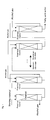
- Fig. 1 shows a reaction flow of an example of the invention.
-
- JP-A 3-115249 discloses a system in which a Fixed-bed reactor packed with a solid acid catalyst is used to circulate a fatty acid put in a liquid state and a lower alcohol in a gaseous state. However, there is the problem that since the fatty acid supplied as the raw material is an organic acid, the solid acid catalyst is partly dissolved in the fatty acid or is reduced in catalytic activity when used for a long period of time. There is also the problem that the strength required for the solid catalyst is dropped by the dissolution of components constituting the catalyst in the fatty acid.
- JP-A 2002-346392 made various improvements of a solid catalyst as to a reduction in the ability of an esterifying catalyst. However, these improvements were still insufficient.
- The present invention relates to a process for producing a fatty acid ester efficiently from a fatty acid and an alcohol by suppressing the dissolution and falling of a catalyst component used in a reaction without decreasing the activity and strength of the catalyst.
- According to the present invention, a fatty acid ester can be obtained efficiently by suppressing the dissolution and falling of a catalyst component used in a reaction and without decreasing the activity and strength of the catalyst.
- Though no particular limitation is imposed on the raw material fatty acid used in the present invention, examples of the fatty acid include saturated or unsaturated fatty acids obtained by hydrolysis of natural vegetable oil and fats and animal oil and fats. These fatty acids may be those having a single alkyl chain length or a mixture of fatty acids having different alkyl chain lengths. Examples of the vegetable oil and fats include coconut oil, palm oil, palm kernel oil, soybean oil and rape seed oil. Examples of the animal oil and fats include beef tallow, lard and fish oils. Examples of the fatty acid further include organic acids such as dicarboxylic acids and carboxylic acids. These fatty acids are preferably used in a liquid state.
- Although no particular limitation is imposed on the alcohol used in the present invention, lower alcohols having 1 to 5 carbon atoms are desirable. Specific examples of the alcohol include such as methanol, ethanol and propanol. Among these compounds, methanol is desirable in view of low cost and recovery easiness in the case of using it as an industrial raw material.
- In the present invention, the acid value of the raw material supplied to the catalyst layer means the acid value of all components excluding alcohols and water to be supplied to the catalyst layer. Examples of a method of decreasing the acid value of the raw material to be supplied to the catalyst layer in the present invention include such as (1) a method in which a fatty acid ester is added to the raw material fatty acid and (2) a method in which a fatty acid is reacted with an alcohol in the presence of no catalyst to esterify partially before an esterification reaction is run before an esterification reaction run in the presence of a catalyst (hereinafter referred to as a pre-reactor method). These methods may be combined.
- Any material may be used as the fatty acid ester to be added to the raw material fatty acid without any particular limitation in the method (1) insofar as it does not inhibit the esterification reaction in the reactor or does not deteriorate the catalyst activity. Commercially available fatty acid esters may be used and it is also a particularly preferable embodiment on an industrial level to add a fatty acid ester obtained in the production process of the present invention partly to the raw material fatty acid.
- As to a reaction system in the pre-reactor in the method (2), the reaction may be run in a continuous system, batch system or semi-continuous system. In the continuous system, a packed column, a wetted wall column, a continuous stirring vessel type reactor (CSTR) or the like may be used. In the batch system or semi-continuous system, for example, a reaction vessel with a stirrer is used. Also, these systems may be combined.
- As to a reaction system when the pre-reactor method is carried out in a Fixed-bed system, the alcohol may be put in a gas or liquid state and the fatty acid may be used in a liquid state. These reaction raw materials may be used in any of the reaction systems including a gas-liquid co-current system and a gas-liquid counter current system. A contact system in the case of a liquid-liquid system may be either co-current downflow or co-current upflow. As the packing in the case of the Fixed-bed system, any material may be used insofar as it is a material which is not corroded by the raw material fatty acid. Examples of the packing to be used include SUS balls, ceramic balls and Raschig ring. These packings may be regular packings or irregular packings.
- The reaction temperature in the pre-reactor method is usually 100 to 300°C and more preferably 150 to 220°C from the viewpoint of progressing the reaction sufficiently and suppressing the generation of byproducts. The liquid space velocity (LHSV) based on the fatty acid in the case of using a Fixed-bed reactor is usually preferably 0.02 to 5.0/hr and more preferably 0.5 to 3.0/hr from the viewpoint of suppressing a reduction in productivity, obtaining a sufficient reaction rate and dropping the acid value to a desired one. The molar ratio of the alcohol to the fatty acid is preferably 1.5 to 30 times, more preferably 1.5 to 10 times and even more preferably 1.5 to 5 times the stoichiometrically necessary amount from the viewpoint of raising the reaction rate and suppressing the amount of the alcohol to be recovered.
- These methods of reducing acid value may be carried out by properly combining them according to the need.
- Although in the present invention, the preferable acid value of the raw material supplied to the catalyst layer cannot be said in a wholesale manner because it is determined according to the type of fatty acid, the type of solid catalyst to be used and productivity, the ratio of the acid value of the raw material supplied to the catalyst layer to that of the raw material fatty acid is designed to be preferably 90% or less, more preferably 80% or less, even more preferably 60% or less and even more preferably 40% or less from the viewpoint of restricting the concentration of the fatty acid supplied to the catalyst layer and preventing a reduction in the strength of the catalyst. A specific acid value of the raw material supplied to the catalyst layer is preferably 240 mg-KOH/g or less, more preferably 220 mg-KOH/g or less, even more preferably 200 mg-KOH/g or less and even more preferably 150 mg-KOH/g or less. As to the lower limit of the acid value, the ratio of the acid value of the raw material supplied to the catalyst layer to that of the raw material fatty acid is designed to be preferably 2.5% or more, more preferably 10% or more and even more preferably 20% or more from the viewpoint of preventing an increase in the amount to be circulated and preventing a rise in the temperature necessary to run a reaction when using a pre-reactor. The specific acid value is preferably 10 mg-KOH/g or more, more preferably 30 mg-KOH/g or more and even more preferably 50 mg-KOH/g or more.
- The acid value of the raw material supplied to the catalyst layer is made to be preferably as low as possible. However, in the case of considering actual installment, the acid value set to a lower one, on the other hand, leads to a reduction in productivity and/or large-scaled equipment both in the case of adding an ester and in the case of reacting in a pre-reactor. It is therefore necessary to set a desired acid value taking this into account.
- In the present invention, the reaction system adopted when the raw material reduced in acid value is supplied to run an esterification reaction in the presence of a solid catalyst may be any system insofar as it runs a heterogeneous reaction. However, a system using a Fixed-bed reactor is preferable from the point that it is unnecessary to separate catalysts. In a reaction system using a Fixed-bed reactor, the alcohol is gasified to run a reaction in a gas-liquid-solid three-phase in general. However, a liquid-liquid-solid reaction system in which the alcohol is supplied in a liquid state may be adopted. The contact system in the case of a gas-liquid-solid reaction may be any reaction system of gas-liquid co-current and gas-liquid counter current. The contact system in the case of a liquid-liquid-solid reaction may be any of a co-current downflow system and a co-current upflow system. Also, in a gas-liquid-solid reaction, a system in which Fixed-bed reactors packed with a solid catalyst are arranged in a multistage and a gas-liquid counter current operation and a gas-liquid co-current operation are combined may be adopted. Also, a pseudo counter current operation may be carried out in which in a multistage co-current system, the fatty acid is supplied to a reactor on the upstream side and then fed to the downstream side stage, the gaseous alcohol is supplied to a reactor on the downstream side so as to allow a co-current downflow operation, the gaseous alcohol discharged from the outlet of the reactor is returned to the upstream side stage to repeat a co-current downflow operation in the Fixed-bed packed with a solid catalyst in each reactor. Among these reaction systems, the system in which a pseudo counter current operation is carried out is preferable.
- As to the reaction pressure, the reaction is generally run under normal pressure or under pressure. However, the reaction may be run under reduced pressure. Under reduced pressure, a gas-liquid-solid reaction can be run at a temperature lower than the atmospheric boiling point of the alcohol to be used. Under pressure, a liquid-liquid-solid reaction can be run at a temperature more than the atmospheric boiling point.
- The reaction temperature, though it depends on the catalyst to be used, is generally preferably 50 to 250°C, more preferably 60 to 220°C and even more preferably 80 to 200°C from the viewpoint of obtaining sufficient reactivity, raising reaction speed and suppressing the production of byproducts.
- The liquid space velocity (LHSV) based on the fatty acid in the case of using a Fixed-bed reactor is generally preferably 0.02 to 5.0/hr and more preferably 0.5 to 3.0/hr from the viewpoint of economy and also from the viewpoint of obtaining a sufficient reaction rate and raising the purity of a fatty acid ester to be produced.
- The molar ratio of the alcohol to the fatty acid is preferably 1.5 to 30 times, more preferably 1.5 to 10 times and even more preferably 1.5 to 5 times the stoichiometrically necessary amount from the viewpoint of raising the reaction rate and suppressing the amount of the alcohol to be recovered.
- In the present invention, esterification is carried out in the presence of a solid catalyst. Examples of the solid catalyst used in the present invention include such as single or complex metal oxides, metal sulfates, metal phosphates, metal phosphonates, stabilized acids which are supported on or fixed to a support, natural minerals and layer compounds, ultra-strong acids, synthetic zeolite and ion exchange resins. Examples of the single or complex metal oxides include niobic acid and SiO2-Al2O3 and SiO2-ZrO2. Examples of the metal sulfates include Al2(SO4)x· H2O. Examples of the metal phosphates include FePO4 and AlPO4 . Examples of the metal phosphonates include aluminum phenylphosphonate. Examples of the stabilized acids which are supported or fixed on a support include sulfuric acid ion-carrying ZrO2 and TiO2. Examples of the natural minerals and layer compounds include acid clay, kaolin and montmorillonite. Examples of ultra-strong acids include sulfone fluoride resins (e.g., Naphyon manufactured by Du Pont K.K.). Examples of the synthetic zeolite include ZCP-50 manufactured by Shokubai Catalysts & Chemicals Industries Co., Ltd. Examples of the ion exchange resin include cation exchange resins such as High Porous Cation Resin RCP-160H. Also, a weak-acidic solid catalyst as described below may be used.
- A preferable group of the weak acidic solid catalyst used in the present invention is those having a strong acidic point of 0.2 mmol/g-Cat or less, which point is defined below and a weak acidic point of 0.3 mmol/g-Cat or more, which point is defined below.
- Weak acidic point: A point where NH3 is dissociated at a temperature range from 100 to 250°C in TPD (ammonia-adsorption-desorption method).
- Strong acidic point: A point where NH3 is dissociated at a temperature higher than 250°C in TPD.
- Examples of a preferable group among these weak acidic solid catalysts include molded articles of weak acidic solid catalysts having the following structure (A) or (B) and metal atom (C).
- Structure (A): Structure obtained by eliminating a hydrogen atom from at least one OH group which an inorganic phosphoric acid has.
- Structure (B): Structure obtained by eliminating a hydrogen atom from at least one OH group which an organic phosphoric acid represented by the formula (1) or (2) has.
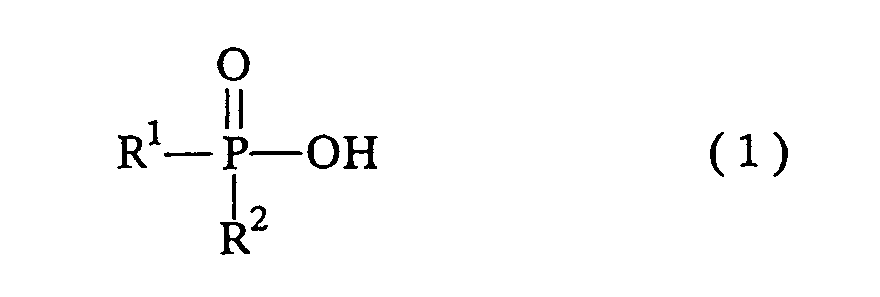
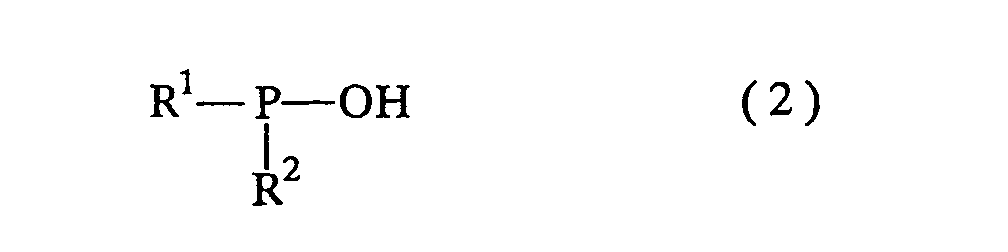
- In the formula, -R1 and -R2 are respectively selected from -R, -OR, -OH and -H, where at least one of -R1 and -R2 is -R or -OR, provided that -R is an organic group having 1 to 22 carbon atoms.
- Metal atom (C) : One or more metal atoms selected from aluminum, gallium and iron.
- Examples of the inorganic phosphoric acid in the above structure (A) include condensed phosphoric acids such as orthophosphoric acid, methaphosphoric acid and pyrophosphoric acid. Orthophosphoric acid is preferable in view of performance. Examples of the organic phosphoric acid in the above structure (B) include phosphonic acid, monophosphonate, phosphinic acid, monophosphate, diphosphate, monophosphite and diphosphite. Mixtures of these compounds may be used and phosphonic acid is preferable.
- As the organic group-R in the organic phosphoric acid, alkyl groups such as methyl, ethyl, n-propyl, iso-propyl, n-butyl, iso-butyl, tert-butyl, n-hexyl, 2-ethylhexyl, octyl, dodecyl and octadecyl and aryl groups such as phenyl and 3-methylphenyl . These groups with which an amino group, alkoxy group, carbonyl group, alkoxycarbonyl group, carboxylic acid group, halogen group such as a chloro group, phosphonic acid group or sulfonic acid group is bound are also used.
- As the metal atom (C) , aluminum is preferable in view of performance and/or cost. The metal atom (C) may contain a small amount of metal atoms other than aluminum, gallium and iron to improve selectivity and other abilities. All metal atoms (C) contained in the catalyst is not necessarily required to combine with the structure (A) or (B), but a part of the metal atom (C) may exist in the form of a metal oxide or a metal hydroxide.
- Examples of other groups preferable as the weak acidic solid catalyst in the present invention include molded articles of solid catalysts containing aluminum orthophosphate. Those having a pore diameter of 6 to 100 nm, a pore volume of 0.46 ml/g or more and an acid amount of 0.40 mmol/g are preferable.
- As a method of preparing the weak acidic solid catalyst in the present invention, a precipitation method, a method of impregnating a metal oxide or a hydroxide with an inorganic or organic phosphoric acid or a method of substituting an organic phosphoric acid group for an inorganic phosphoric acid group in an inorganic aluminum phosphate gel are used. The precipitation method is preferable.
- Also, when preparing the catalyst of the present invention, it is possible that a carrier having a high surface area is made to exist to obtain a carrier catalyst. As the carrier, silica, alumina, silica alumina, titania, zirconia, diatomaceous earth, activated carbon or the like may be used. If the carrier is used in an excessive amount, the content of an active component is decreased, causing reduced activity and the proportion of the carrier in the catalyst is therefore preferably 90% by weight or less.
- The following examples further describe and demonstrate embodiments of the present invention. The examples are given solely for the purpose of illustration and are not to be construed as limitations of the present invention.
- Production Example 1 of a catalyst (aluminum phosphate catalyst) Aluminum nitrate and orthophosphoric acid were used to make an aqueous solution containing these components (mol ratio: 1 : 1) and aqueous ammonia was added dropwise to the solution at 40°C until the solution was adjusted to pH 7 to obtain a precipitate, which was then dried at 110°C and crushed. 10% by weight of alumina sol was added to the crushed catalyst. The crushed catalyst was then extrusion-molded under a load of about 2 MPa and then calcinated at 400°C for 3 hours to obtain a molded catalyst having a diameter of 1.7 mm and a length of 4 to 6 mm.
- Production Example 2 of a catalyst (aluminum phosphate catalyst) Aluminum nitrate and orthophosphoric acid were used to make an aqueous solution containing these components (mol ratio: 1 : 1) and aqueous ammonia was added dropwise to the solution at 40°C until the solution was adjusted to pH 7 to obtain a precipitate, which was then dried at 110°C and crushed. 2% by weight of graphite was added to the crushed catalyst. The crushed catalyst was then tablet-molded under a load of about 25 MPa, then dried at 120°C for 3 hours and then calcinated at 400°C for 3 hours to obtain a molded catalyst having a cylindrical form, a diameter of 3.0 mm and a height of 3.0 mm.
- Production Example 3 of a catalyst (ethylphosphonic acid addition aluminum phosphate catalyst) Ethylphosphonic acid, 85% orthophosphoric acid and aluminum nitrate (nonahydrate) were dissolved in a mol ratio of 1 : 2.7 : 3.3 in 1000 g of water. An aqueous ammonia solution was added dropwise to the mixed solution at ambient temperature to raise the pH of the solution to 5. The generated gel-like white precipitate was filtered, washed with water and dried at 110°C for 15 hours. The precipitate was crushed into a size of 60 mesh or less and then, 10% by weight of alumina sol was added to the crushed catalyst. The crushed catalyst was then extrusion-molded under a load of about 2 MPa and then calcinated at 250°C for 3 hours to obtain a molded catalyst having a diameter of 1.7 mm and a length of 4 to 6 mm.
- A reactor having an inside diameter of 35.5 mm and a length of 800 mm and provided with a multipoint temperature gage having an inside diameter of 4 mm in the center thereof was packed with 300 ml of molded articles of aluminum phosphate obtained in Production Example 1 and having a diameter of 1.7 mm as a catalyst such that the packed density was 0.456 g/ml. A mixed solution (concentration of aluminum: less than 1 mg/kg) prepared by adding a methyl ester (mixed solution of 85% of methyl laurate and 15% of methyl palmitate) to a fatty acid mixture (acid value = 270 mg-KOH/g) of 75% of lauric acid and 25% of palmitic acid such that the acid value was 20 mg-KOH/g was supplied from the top of the reactor at a LHSV of 2.0/hr. Methanol was supplied from the top of the reactor in a mol ratio of 5 to the fatty acid mixture to carry out a gas-liquid co-current operation. The reaction pressure was adjusted to 0.5 MPa. The system was heated by an electric heater such that the reaction temperature was 150°C. After the weight of the raw material to be flowed reached 1500 times the weight of the packed catalyst, the reaction solution was sampled. Methanol was removed by distillation from the resulting reaction solution and then, the concentration of metals dissolved in the reaction solution was measured, to observe no dilution of metals. The reaction condition and results are shown in Table 1.
- The reaction was run in the same manner as in Example 1 except that the reaction temperature was changed to 200°C. After the weight of the raw material to be flowed reached 1300 times the weight of the packed catalyst, the reaction solution was sampled. Methanol was removed by distillation from the resulting reaction solution and then, the concentration of metals dissolved in the reaction solution was measured, to observe no dilution of metals. The reaction condition and results are shown in Table 1.
- The reaction was run in the same manner as in Example 1 except that the fatty acid mixture (acid value = 270 mg-KOH/g) of 75% of lauric acid and 25% of palmitic acid was used as it was without decreasing the acid value of the raw material. The concentrations of metals, namely, aluminum and phosphorous in the fatty acid mixture were respectively less than 1.0 mg/kg. After the weight of the raw material to be flowed reached 1600 times the weight of the packed catalyst, the reaction solution was sampled. Methanol was removed by distillation from the resulting reaction solution and then, the concentration of metals dissolved in the reaction solution was measured, to observe a dilution of metals. The reaction condition and results are shown in Table 1.

- A reactor having an inside diameter of 13.0 mm and a length of 833 mm and provided with a multipoint temperature gage having an outside diameter of 3.18 mm in the center thereof was packed with 20 ml of molded articles of aluminum phosphate obtained in Production Example 2 and having a diameter of 3.0 mm and a height of 3.0 mm as a catalyst such that the packed density was 0.570 g/ml. The strength of the catalyst prior to a reaction was 4.6 DaN measured by a Kiya type hardness meter. A fatty acid methyl ester obtained in a reaction was added to a fatty acid mixture (acid value = 270 mg-KOH/g) of 75% of lauric acid and 25% of palmitic acid to adjust the acid value to 180 mg-KOH/g. This mixture was supplied from the bottom of the reactor at a LHSV of 3.0/hr. Methanol was supplied from the bottom of the reactor in a mol ratio of 5 to the fatty acid mixture to carry out an upward gas-liquid co-current operation. The reaction pressure was adjusted to 1.0 MPa. The system was heated by an electric heater such that the reaction temperature was 200°C . After the weight of the raw material to be flowed reached 540 times the weight of the packed catalyst, the catalyst was withdrawn to measure the strength of the catalyst, to find that the strength of the catalyst was not changed, and a fatty acid methyl ester having an acid value of 13 mg-KOH/g was obtained. The reaction condition and results are shown in Table 2.
- The reaction was run in the same manner as in Example 3 except that the fatty acid mixture (acid value = 270 mg-KOH/g) of 75% of lauric acid and 25% of palmitic acid was used as it was without decreasing the acid value of the raw material. After the weight of the raw material to be flowed reached 540 times the weight of the packed catalyst, the catalyst was withdrawn to measure the strength of the catalyst. The reaction condition and results are shown in Table 2. Although the acid value of the reaction product was the same as in Example 3, a reduction in the strength of the catalyst was found.
Example 3 Comparative example 2 Acid value of the raw material supplied to the catalyst layer (mg-KOH/g 180 270 [(Acid value of the raw material supplied to the catalyst layer)/ (Acid value of the raw material fatty acid)] × 100 (%) 67 100 Catalyst Alminum phosphate Alminum phosphate Amount of the catalyst (ml) 20 20 LHSV (1/hr) 3.0 3.0 Methanol/Raw material fatty acid mixture (mol ratio) 5.0 5.0 Reaction temperature (°C) 200 200 Liquid throughput (g-raw material/g-catalyst) 540 540 Strength of the catalyst (DaN) 4.6 0.9 acid value of a reaction product (mg-KOH/g) 13.0 13.0 - A reactor having an inside diameter of 35.5 mm and a length of 800 mm and provided with a multipoint temperature gage having an inside diameter of 4 mm in the center thereof was packed with 240 ml of 1.7-mm-diameter molded articles of aluminum phosphate to which ethylphosphonic acid was added and which was obtained in Production Example 3 as a catalyst such that the packed density was 0.534 g/ml. A fatty acid mixture (acid value = 270 mg-KOH/g) of 75% of lauric acid and 25% of palmitic acid was supplied from the top of the reactor at a LHSV of 0.5/hr. Methanol was supplied from the top of the reactor in a mol ratio of 3 to the fatty acid mixture to carry out a gas-liquid co-current operation. The reaction pressure was adjusted to 1.0 MPa. The system was heated by an electric heater such that the reaction temperature was 180°C. The resulting reaction product was washed with 80°C warm water and methanol was removed from the reaction product. The acid value of the resulting product was 57 mg-KOH/g. After the weight of the raw material to be flowed reached 100 times the weight of the packed catalyst, the activity of the catalyst was measured and then the strength of the catalyst was measured when the weight of the raw material to be flowed reached 220 times the weight of the packed catalyst. The reaction condition and results are shown in Table 3.
- A pre-reactor having an inside diameter of 35.5 mm and a length of 800 mm and provided with a multipoint temperature gage having an inside diameter of 4 mm in the center thereof was packed with 670 ml of 3-mm-SUS balls to run a non-catalyst reaction. A reactor having the same shape as that used in Comparative Example 3 and packed with the same catalyst that was used in Comparative Example 3 was connected to the pre-reactor such that the reaction product discharged from this pre-reactor was supplied to the reactor. The connected reactor was packed with 240 ml of the same catalyst that was used in Comparative Example 3 as a catalyst such that the packed density was 0.534 g/ml. The strength of the catalyst prior to a reaction was 0.9 DaN measured by a Kiya type hardness meter. A fatty acid mixture (acid value = 270 mg-KOH/g) of 75% of lauric acid and 25% of palmitic acid was supplied from the top of the reactor packed with the SUS balls at a LHSV of 0.5/hr. Methanol was supplied from the top of the reactor in a mol ratio of 3 to the fatty acid mixture to carry out a gas-liquid co-current operation. The reaction pressure was adjusted to 1.0 MPa. The system was heated by an electric heater such that the reaction temperature was 180°C. The reaction product obtained from the reactor packed with SUS balls was washed with 80°C warm water and methanol was removed from the reaction product. The acid value of the resulting product was 133 mg-KOH/g. The reaction mixture was supplied directly to the reactor packed with catalysts in the same condition. After the weight of the raw material to be flowed reached 100 times the weight of the packed catalyst, the activity of the catalyst was measured and then the strength of the catalyst was measured when the weight of the raw material to be flowed reached 220 times the weight of the packed catalyst. The reaction condition and results are shown in Table 3.
- In Table 3, the evaluation of catalyst activity was made in the following method.
- After the liquid throughput (g-raw material/g-catalyst) had reached the fixed number, the reaction solution was sampled at the outlet of the reactor. The obtained reaction product was washed with 80°C warm water and methanol was removed from the reaction product. The acid value (hereinafter referred to as reaction product acid value) of the resulting product was measured to calculate the activity of the catalyst according to the following equation.
- Catalyst activity = In [(Acid value of raw material supplied to the catalyst layer - Equilibrium acid value)/(Acid value of the reaction product - Equilibrium acid value)]
- This reaction is a reversible reaction and therefore, an equilibrium value which the acid value will reach exists. The equilibrium acid value is a constant defined by a reaction condition and composition, and the equilibrium acid value used in this reaction is about 12 mg-KOH/g when, for example, the temperature is 200°C and the mol ratio of methanol is 3.
Comparative example 3 Example 4 Acid value of the raw material supplied to the catalyst layer (mg-KOH/g) 270 133 Catalyst Ethylphosphonic acid addition aluminum phosphate Ethylphosphonic acid addition aluminum phosphate Amount of the catalyst (ml) 240 240 LHSV (1/hr) 0.5 0.5 Methanol/Raw material fatty acid mixture (mol ratio) 3.0 3.0 Reaction temperature (°C) 180 180 Strength of the catalyst when liquid throughput (g-raw material/g-catalyst) is 220 times (DaN) 0.6 0.9 Activity of the catalyst when liquid throughput (graw material/g-catalyst) is 100 times 0.43 1.1
Claims (5)
- A process for producing a fatty acid ester by using a fatty acid and an alcohol as starting materials, comprising reducing the acid value of a raw material supplied to a catalyst layer to an acid value lower than the acid value of the raw material fatty acid in advance and then esterifying the raw materials in the presence of a solid catalyst.
- The process of Claim 1, comprising adding a fatty acid ester to the raw material fatty acid to decrease the acid value of the raw material supplied to the catalyst layer to an acid value lower than that of the raw material fatty acid in advance.
- The process of Claim 2, comprising returning part of the fatty acid ester obtained in the reaction to the raw material to circulating it for use, thereby decreasing the acid value of the raw material supplied to the catalyst layer to an acid value lower than that of the raw material fatty acid.
- The process of any one of Claims 1 to 3, comprising reacting the fatty acid with the alcohol in the presence of no catalyst for partial esterification before the esterification reaction in the presence of a catalyst, thereby decreasing the acid value of the raw material supplied to the catalyst layer to an acid value lower than that of the raw material fatty acid.
- The process of any one of Claims 1 to 4, in which Fixed-bed reactors packed with a solid catalyst are formed in a multistage, the fatty acid is supplied to a reactor on the upstream side and then fed to the downstream side stage, the gaseous alcohol is supplied to a reactor on the downstream side so as to allow a co-current downflow operation, the gaseous alcohol discharged from the outlet of the reactor is returned to the upstream side stage to repeat a co-current downflow operation in the Fixed-bed packed with a solid catalyst in each reactor.
Applications Claiming Priority (2)
| Application Number | Priority Date | Filing Date | Title |
|---|---|---|---|
| JP2003353225A JP4156486B2 (en) | 2003-10-14 | 2003-10-14 | Production method of fatty acid ester |
| JP2003353225 | 2003-10-14 |
Publications (2)
| Publication Number | Publication Date |
|---|---|
| EP1526125A1 true EP1526125A1 (en) | 2005-04-27 |
| EP1526125B1 EP1526125B1 (en) | 2007-12-12 |
Family
ID=34386445
Family Applications (1)
| Application Number | Title | Priority Date | Filing Date |
|---|---|---|---|
| EP04024270A Expired - Lifetime EP1526125B1 (en) | 2003-10-14 | 2004-10-12 | Process for producing a fatty acid ester |
Country Status (5)
| Country | Link |
|---|---|
| US (1) | US7271275B2 (en) |
| EP (1) | EP1526125B1 (en) |
| JP (1) | JP4156486B2 (en) |
| DE (1) | DE602004010596T2 (en) |
| MY (1) | MY137101A (en) |
Cited By (1)
| Publication number | Priority date | Publication date | Assignee | Title |
|---|---|---|---|---|
| EP1966360B1 (en) * | 2005-12-28 | 2016-07-20 | Kao Corporation | Process for producing alkyl fatty esters |
Families Citing this family (11)
| Publication number | Priority date | Publication date | Assignee | Title |
|---|---|---|---|---|
| US20060228734A1 (en) * | 2005-03-18 | 2006-10-12 | Applera Corporation | Fluid processing device with captured reagent beads |
| JP5154015B2 (en) * | 2005-12-20 | 2013-02-27 | 花王株式会社 | Process for producing fatty acid alkyl ester and glycerin |
| CN101067090B (en) * | 2007-06-08 | 2010-05-19 | 西北大学 | Preparation of Biodiesel by Solid Catalysis |
| EP2042588A1 (en) * | 2007-09-21 | 2009-04-01 | Universita'degli Studi Di Milano | Process for the esterification and transesterification of fats |
| DE102007052065A1 (en) * | 2007-10-30 | 2009-05-07 | Bayer Technology Services Gmbh | Continuous process for heterogeneously catalyzed esterification of fatty acids |
| EA201000583A1 (en) * | 2007-10-30 | 2010-10-29 | Байер Текнолоджи Сервисиз Гмбх | Method for fatty acid esterification by heterogeneous catalysis |
| US20100107474A1 (en) * | 2008-10-31 | 2010-05-06 | Mahesh Talwar | Apparatus and method for Rapid Biodiesel Fuel Production |
| DE102008060902A1 (en) * | 2008-12-09 | 2010-06-10 | Grace Gmbh & Co. Kg | Preparing fatty acid alkyl ester from feed stock containing e.g. free fatty acids and fatty acid triglycerides, comprises esterifying feedstock with alkyl alcohol in presence of catalyst and transesterifying the free fatty acid feedstock |
| CN102627557A (en) * | 2012-03-16 | 2012-08-08 | 西北师范大学 | Utilize NKC-9 macroporous dry hydrogen catalytic resin to catalyze the method for synthesizing ethyl hexanoate |
| CN102617346A (en) * | 2012-03-16 | 2012-08-01 | 西北师范大学 | Method of using macroporous strongly acidic type cation exchange resin to catalytically synthesize ethyl palmitate |
| US9328054B1 (en) | 2013-09-27 | 2016-05-03 | Travis Danner | Method of alcoholisis of fatty acids and fatty acid gyicerides |
Citations (3)
| Publication number | Priority date | Publication date | Assignee | Title |
|---|---|---|---|---|
| DE19600025A1 (en) * | 1996-01-03 | 1997-07-10 | Henkel Kgaa | Preparation of fatty acids with low acid values, useful as precursors for esterification reactions |
| US20020062035A1 (en) * | 2000-11-22 | 2002-05-23 | Nobuhiro Tatsumi | Process for producing lower alkyl fatty esters |
| EP1211236A1 (en) * | 2000-11-22 | 2002-06-05 | Kao Corporation | Process for producing lower alkyl fatty esters |
Family Cites Families (4)
| Publication number | Priority date | Publication date | Assignee | Title |
|---|---|---|---|---|
| DE3501761A1 (en) * | 1985-01-21 | 1986-07-24 | Henkel KGaA, 4000 Düsseldorf | METHOD FOR PRE-Esterification OF FREE FATTY ACIDS IN RAW FATS AND / OR OILS |
| JPH03115249A (en) | 1989-09-29 | 1991-05-16 | Ube Ind Ltd | Continuous production of organic acid ester |
| AT399336B (en) * | 1993-07-14 | 1995-04-25 | Martin Mag Dr Mittelbach | METHOD FOR PRODUCING FATTY ACID ALKYL ESTERS |
| JP4712223B2 (en) | 2001-05-22 | 2011-06-29 | オルガノ株式会社 | Solid acid catalyst |
-
2003
- 2003-10-14 JP JP2003353225A patent/JP4156486B2/en not_active Expired - Fee Related
-
2004
- 2004-10-12 MY MYPI20044175A patent/MY137101A/en unknown
- 2004-10-12 EP EP04024270A patent/EP1526125B1/en not_active Expired - Lifetime
- 2004-10-12 DE DE602004010596T patent/DE602004010596T2/en not_active Expired - Lifetime
- 2004-10-13 US US10/962,486 patent/US7271275B2/en not_active Expired - Lifetime
Patent Citations (3)
| Publication number | Priority date | Publication date | Assignee | Title |
|---|---|---|---|---|
| DE19600025A1 (en) * | 1996-01-03 | 1997-07-10 | Henkel Kgaa | Preparation of fatty acids with low acid values, useful as precursors for esterification reactions |
| US20020062035A1 (en) * | 2000-11-22 | 2002-05-23 | Nobuhiro Tatsumi | Process for producing lower alkyl fatty esters |
| EP1211236A1 (en) * | 2000-11-22 | 2002-06-05 | Kao Corporation | Process for producing lower alkyl fatty esters |
Cited By (1)
| Publication number | Priority date | Publication date | Assignee | Title |
|---|---|---|---|---|
| EP1966360B1 (en) * | 2005-12-28 | 2016-07-20 | Kao Corporation | Process for producing alkyl fatty esters |
Also Published As
| Publication number | Publication date |
|---|---|
| DE602004010596D1 (en) | 2008-01-24 |
| MY137101A (en) | 2008-12-31 |
| JP4156486B2 (en) | 2008-09-24 |
| US20050113589A1 (en) | 2005-05-26 |
| DE602004010596T2 (en) | 2008-11-27 |
| US7271275B2 (en) | 2007-09-18 |
| EP1526125B1 (en) | 2007-12-12 |
| JP2005119971A (en) | 2005-05-12 |
Similar Documents
| Publication | Publication Date | Title |
|---|---|---|
| EP1526125B1 (en) | Process for producing a fatty acid ester | |
| EP0454719B1 (en) | A continuous process for the production of carboxylic acid esters | |
| KR100284475B1 (en) | Process for preparing plasticizers and polyol esters | |
| EP1966360B1 (en) | Process for producing alkyl fatty esters | |
| EP1963471B1 (en) | Process for producing fatty acid alkyl esters and glycerin | |
| JP4204926B2 (en) | Method for producing fatty acid ester | |
| JP4255823B2 (en) | Method for producing fatty acid ester | |
| US6383970B1 (en) | Solid acid catalyst | |
| EP2371796B1 (en) | Method for manufacturing glycerin | |
| US6509487B2 (en) | Process for producing lower alkyl fatty esters | |
| EP1211236B1 (en) | Process for producing lower alkyl fatty esters | |
| US9770707B2 (en) | Heterogeneous catalyst for transesterification and method of preparing same | |
| JP2707063B2 (en) | Method for producing fatty acid lower alkyl ester | |
| KR20160006720A (en) | Process for continuously preparing di-c1-3-alkyl succinates | |
| JP6912681B1 (en) | Method for producing secondary alcohol alkoxylate | |
| KR20150123933A (en) | Use of sulphonic acid for recovering glycerol from a triglyceride transesterification reaction | |
| JP6916402B1 (en) | Method for producing secondary alcohol alkoxylate | |
| JP3942809B2 (en) | Solid acid catalyst | |
| JP2006241015A (en) | Method for producing fatty acid lower alkyl ester | |
| US8686170B2 (en) | Method of preparing alcohol esters from triglycerides and alcohols using heterogeneous catalysts based on nitrogen-containing metallophosphates | |
| US2587904A (en) | Esterification of monohydric ether alcohols | |
| JPWO2008133189A1 (en) | Process for producing fatty acid alkyl ester and / or glycerin from fats and oils |
Legal Events
| Date | Code | Title | Description |
|---|---|---|---|
| PUAI | Public reference made under article 153(3) epc to a published international application that has entered the european phase |
Free format text: ORIGINAL CODE: 0009012 |
|
| AK | Designated contracting states |
Kind code of ref document: A1 Designated state(s): AT BE BG CH CY CZ DE DK EE ES FI FR GB GR HU IE IT LI LU MC NL PL PT RO SE SI SK TR |
|
| AX | Request for extension of the european patent |
Extension state: AL HR LT LV MK |
|
| 17P | Request for examination filed |
Effective date: 20050720 |
|
| AKX | Designation fees paid |
Designated state(s): BE DE FR |
|
| GRAP | Despatch of communication of intention to grant a patent |
Free format text: ORIGINAL CODE: EPIDOSNIGR1 |
|
| GRAS | Grant fee paid |
Free format text: ORIGINAL CODE: EPIDOSNIGR3 |
|
| GRAA | (expected) grant |
Free format text: ORIGINAL CODE: 0009210 |
|
| AK | Designated contracting states |
Kind code of ref document: B1 Designated state(s): BE DE FR |
|
| REF | Corresponds to: |
Ref document number: 602004010596 Country of ref document: DE Date of ref document: 20080124 Kind code of ref document: P |
|
| ET | Fr: translation filed | ||
| PLBE | No opposition filed within time limit |
Free format text: ORIGINAL CODE: 0009261 |
|
| STAA | Information on the status of an ep patent application or granted ep patent |
Free format text: STATUS: NO OPPOSITION FILED WITHIN TIME LIMIT |
|
| 26N | No opposition filed |
Effective date: 20080915 |
|
| REG | Reference to a national code |
Ref country code: FR Ref legal event code: PLFP Year of fee payment: 12 |
|
| REG | Reference to a national code |
Ref country code: FR Ref legal event code: PLFP Year of fee payment: 13 |
|
| REG | Reference to a national code |
Ref country code: FR Ref legal event code: PLFP Year of fee payment: 14 |
|
| REG | Reference to a national code |
Ref country code: FR Ref legal event code: PLFP Year of fee payment: 15 |
|
| PGFP | Annual fee paid to national office [announced via postgrant information from national office to epo] |
Ref country code: FR Payment date: 20220908 Year of fee payment: 19 Ref country code: BE Payment date: 20220916 Year of fee payment: 19 |
|
| PGFP | Annual fee paid to national office [announced via postgrant information from national office to epo] |
Ref country code: DE Payment date: 20220621 Year of fee payment: 19 |
|
| P01 | Opt-out of the competence of the unified patent court (upc) registered |
Effective date: 20230522 |
|
| REG | Reference to a national code |
Ref country code: DE Ref legal event code: R119 Ref document number: 602004010596 Country of ref document: DE |
|
| REG | Reference to a national code |
Ref country code: BE Ref legal event code: MM Effective date: 20231031 |
|
| PG25 | Lapsed in a contracting state [announced via postgrant information from national office to epo] |
Ref country code: FR Free format text: LAPSE BECAUSE OF NON-PAYMENT OF DUE FEES Effective date: 20231031 Ref country code: DE Free format text: LAPSE BECAUSE OF NON-PAYMENT OF DUE FEES Effective date: 20240501 |
|
| PG25 | Lapsed in a contracting state [announced via postgrant information from national office to epo] |
Ref country code: BE Free format text: LAPSE BECAUSE OF NON-PAYMENT OF DUE FEES Effective date: 20231031 |