EP1524528A2 - Digital angular velocity detection device - Google Patents
Digital angular velocity detection device Download PDFInfo
- Publication number
- EP1524528A2 EP1524528A2 EP04256315A EP04256315A EP1524528A2 EP 1524528 A2 EP1524528 A2 EP 1524528A2 EP 04256315 A EP04256315 A EP 04256315A EP 04256315 A EP04256315 A EP 04256315A EP 1524528 A2 EP1524528 A2 EP 1524528A2
- Authority
- EP
- European Patent Office
- Prior art keywords
- electrodes
- angular velocity
- detection device
- rotor
- velocity detection
- Prior art date
- Legal status (The legal status is an assumption and is not a legal conclusion. Google has not performed a legal analysis and makes no representation as to the accuracy of the status listed.)
- Withdrawn
Links
Images


Classifications
-
- G—PHYSICS
- G01—MEASURING; TESTING
- G01C—MEASURING DISTANCES, LEVELS OR BEARINGS; SURVEYING; NAVIGATION; GYROSCOPIC INSTRUMENTS; PHOTOGRAMMETRY OR VIDEOGRAMMETRY
- G01C19/00—Gyroscopes; Turn-sensitive devices using vibrating masses; Turn-sensitive devices without moving masses; Measuring angular rate using gyroscopic effects
- G01C19/02—Rotary gyroscopes
-
- G—PHYSICS
- G01—MEASURING; TESTING
- G01C—MEASURING DISTANCES, LEVELS OR BEARINGS; SURVEYING; NAVIGATION; GYROSCOPIC INSTRUMENTS; PHOTOGRAMMETRY OR VIDEOGRAMMETRY
- G01C19/00—Gyroscopes; Turn-sensitive devices using vibrating masses; Turn-sensitive devices without moving masses; Measuring angular rate using gyroscopic effects
- G01C19/56—Turn-sensitive devices using vibrating masses, e.g. vibratory angular rate sensors based on Coriolis forces
- G01C19/5705—Turn-sensitive devices using vibrating masses, e.g. vibratory angular rate sensors based on Coriolis forces using masses driven in reciprocating rotary motion about an axis
- G01C19/5712—Turn-sensitive devices using vibrating masses, e.g. vibratory angular rate sensors based on Coriolis forces using masses driven in reciprocating rotary motion about an axis the devices involving a micromechanical structure
-
- G—PHYSICS
- G01—MEASURING; TESTING
- G01P—MEASURING LINEAR OR ANGULAR SPEED, ACCELERATION, DECELERATION, OR SHOCK; INDICATING PRESENCE, ABSENCE, OR DIRECTION, OF MOVEMENT
- G01P15/00—Measuring acceleration; Measuring deceleration; Measuring shock, i.e. sudden change of acceleration
- G01P15/02—Measuring acceleration; Measuring deceleration; Measuring shock, i.e. sudden change of acceleration by making use of inertia forces using solid seismic masses
- G01P15/08—Measuring acceleration; Measuring deceleration; Measuring shock, i.e. sudden change of acceleration by making use of inertia forces using solid seismic masses with conversion into electric or magnetic values
- G01P15/0888—Measuring acceleration; Measuring deceleration; Measuring shock, i.e. sudden change of acceleration by making use of inertia forces using solid seismic masses with conversion into electric or magnetic values for indicating angular acceleration
Definitions
- the present disclosure relates to a digital angular velocity detection device that uses a micro electro mechanical system (MEMS).
- MEMS micro electro mechanical system
- a general digital angular velocity detection device such as a gyroscope measures rotation angle with respect to a rotation direction of an object, and is usually used in the navigation devices in a ship or an aircraft.
- the gyroscope measures the angular velocity based on a principle that a Coriolis force is applied vertically to the rotation direction.
- semiconductor technology is developed, the gyroscope has been produced using MEMS technology.
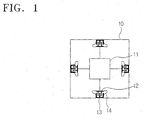
- FIG. 1 explains the operation principle of a micro gyroscope using the general MEMS technology.
- the micro gyroscope is constituted by a vibratory mass 11, and a movable electrode 12 connected to the mass 11, This causes variations in the electrostatic capacitance with a fixed electrode 13 as a rotation force is applied to the mass 11 in a vertical direction to the vibration thereof.
- An elastic member 14 is connected between the movable electrode 12 and the fixed electrode 13.
- a housing 10 supports the fixed electrode 13.
- the Coriolis force is given in a vertical direction to the rotation force.
- a distance between the movable electrode 12 and the fixed electrode 13 decreases. This reduction in distance generates a variation of the electrostatic capacitance there between.
- the micro gyroscope measures variation of the angular velocity by converting the electrostatic capacitance variation to a voltage variation.
- the above-structured micro gyroscope needs to keep the mass 11 vibrating continually for the measurement of the angular velocity variation. Therefore, if the rotation force is not applied from the outside, the vibration of the mass 11 itself can cause a measurement error. Further, in order to generate and measure the capacitance variations between the movable electrode 12 and the fixed electrode 13, the distance between the-movable electrode 12 and the fixed electrode 13 needs to be as short as possible. On the other hand, a contact area therebewteen should be large. Such a requirement complicates the structure of the three-dimensional electrode and the fixed electrode.
- FIG. 2 shows a related art structure of the electrodes constituting the micro gyroscope of FIG. 1.
- the distance between the movable electrode 12 and the fixed electrode 13 is very short to guarantee sufficient capacitance between them. Further, the movable electrode 12 and the fixed electrode 13 are disposed very high from a semiconductor substrate. The manufacturing process to make such a three-dimensional structure using semiconductor technology is very complex. Moreover, it is hard to keep the distances between the movable electrode 12 and the fixed electrode 13 regular.
- a digital angular velocity detection device comprising:
- the invention provides a micro gyroscope having a simple structure and an improved accuracy.
- the disclosed teachings provide a digital angular velocity detection device, comprising a stator formed on a substrate.
- a rotor operable to rotate in response to an inertial force is provided.
- the rotor has a plurality of electrodes formed at regular intervals on a curve at a predetermined radius away from a center of the rotor.
- a detector having detection electrodes facing the plurality of electrodes is provided.
- the detection electrodes are operable to detect a rotation angle of the rotor based on a number of electrostatic capacitance variations generated between the plurality of electrodes and the detection electrodes.
- the device further includes a ring-shaped first coil through which a pulse is applied from outside, and a second coil facing the first coil that has an induced pulse generated by an electromagnetic induction.
- the plurality of electrodes are connected to each other by a conducting wire and the plurality of electrodes connected by the conducting wire is operable to generate the induced pulse on the second coil.
- stator the stator, the rotor, and the detector are formed on a semiconductor substrate.
- a digital angular velocity detection device comprising:
- the light beam projection device is disposed on a line linking parts of the curve, and has a plurality of light beam projectors for projecting the beam.
- the light beam projectors are disposed at predetermined intervals on the line.
- FIGS. 3A and 3B explain a basic concept of a digital gyroscope embodying aspects of the disclosed teachings.
- a plurality of electrodes 100a to 100n which are electrically connected, are disposed at certain intervals on a copper wire which rotates in response to a rotation force applied from the outside.
- a detector 110 is provided opposite to the electrodes 100a to 100n.
- the electrodes 100a to 100n are formed toward the detector 110 having a saw teeth part to generate variations of the electrostatic capacitance when the electrodes 100a to 100n neighbors the detector 110.
- the digital gyroscope may comprise an angular velocity calculation circuit that calculates the angular velocity by converting the detected rotation angle to a rotation angle per a certain time unit.
- FIG. 3B shows an exemplary embodiment of the digital gyroscope according to the basic concept of FIG. 3A.
- the illustrated digital gyroscope comprises a rotor and a stator 150.
- the stator 150 comprises a first coil 151 for sending a pulse applied from the outside.
- the rotor comprises a second coil 101 facing the first coil 151.
- a conducting wire 100 connects the electrodes 100a to 100n and the second coil 101.
- the pulse sent to the first coil 151 induces a pulse at the second coil 101 of the rotor by an electromagnetic induction.
- the pulse induced to the rotor is applied to the respective electrodes 100a to 100n that are connected through the conducting wire 100. Therefore, the rotor does not need a separate structure to apply a pulse from the outside. Accordingly, the structure is simplified, thereby increasing the reliability increases.
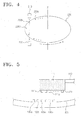
- FIG. 4 shows another exemplary embodiment of the disclosed digital gyroscope.
- the digital gyroscope in FIG. 4 detects the rotation angle using a photo detection method. It comprising a rotation board 200 with holes 200a to 200c formed at certain intervals in the exterior of the rotation board 200.
- a light beam projection device 210 projects a beam to the holes 200a to 200c.
- a detector 220 detects the light beam projected from the light beam projection device 210 to any one of the holes 200a to 200c.
- the rotation board 200 rotates in a direction "A"
- the light beam projected from the light beam projection device 210 penetrates some of the holes 200a to 200c.
- the detector 220 detects the rotation angle of the rotation board 200 based on the level of brightness changes occurring due to the rotation of the rotation board 200.
- the detector 220 may be a photo detector such as a phototransistor or a photodiode, which is capable of detecting the beam.
- FIG. 5 is a detailed view of the structure of the digital gyroscope of FIG. 3A.
- electrodes 100a to 100n are disposed on a portion at a predetermined radius away from a center axis Z of the rotor.
- the electrodes 100a to 100n are electrically connected.
- a detector 110 is formed at an upper part of the rotor.
- a head 111 is formed at an end of the detector 110, and has a plurality of detection electrodes 111a to 111n to face one of the electrodes 200a to 200c. Distances between the respective detection electrodes 111a to 111n are more than distances between the respective electrodes 100a to 100n. As a result, the detection electrodes 111a to 111n are not aligned with the electrodes 100a to 100n altogether when the rotor rotates in the direction "A".
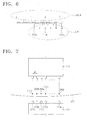
- FIG. 6 explains a principle for calculating a rotation angle of the rotor 100 by detection electrodes 111a to 111n formed at a detector 110 of FIG. 5.
- Main scale is illustrated on an upper part in FIG. 6, and sub scale is on a lower part.
- Numbers 1, 2, and 3 respectively represent 10, 20, 30nm.
- the marks of the main scale are at 1nm intervals.
- Setting 20nm of the main scale as a unit, the sub scale is 19nm in length. This is based on a Vernier Calipers' principle for measuring length of an object, wherein resolution varies according to the number of the marks on the sub scale with respect to the unit length of the main scale.
- a 0-mark on the sub scale is between 12nm and 13nm on the main scale, and 4-mark on the sub scale is lined up with the 2-mark on the main scale. To read this according to the Vernier Calipers' principle, 12.4nm is obtained.
- the measuring method of the digital gyroscope of FIG. 5 is described as follows.
- the detection electrode 111a formed on the head 111 faces the electrode 100c.
- the electrostatic capacitance changes between the electrode 100c and the fixed electrode 111a.
- the electrodes 100a to 100n of the digital gyroscope in FIG. 5 function as the marks on the main scale shown in FIG. 6, and the fixed electrodes 111a to 111n function as the marks on the sub scale.
- FIG. 7 shows a detailed structure of the digital gyroscope of FIG. 4.
- the digital gyroscope of FIG. 7 comprises a light beam projection device 210.
- a rotation board 200 rotates corresponding to the rotation force from the outside, and has holes 200a to 200n.
- a detector 220 detects the beam penetrated through the holes 200a to 200n.
- Light beam projectors 1 to n are provided at the light beam projection device 210, and detectors 220a to 220n are disposed to face each other. That is, when the beam penetrates through the holes 200a to 200n, one of the detectors 220a to 220n corresponding to the penetrated location reacts to the beam.
- a distance between the light beam projectors 1 to n formed at the light beam projection device 210, and a distance between the grooves 200a to 200n per unit length formed at the rotation board 200 are calculated using the equation below.
- the holes 200a to 200n of the digital gyroscope function as the marks on the main scale of FIG. 6, and the detectors 220a to 220n function as the marks on the sub scale.
- the number of the holes in the digital gyroscope dose not have to correspond to the resolution of the rotation board 200 to enhance the resolution for the detection of the rotation angle.
- Superior resolution can be obtained by increasing the number of the light beam projectors 1 to n, and the number of the detectors 220a to 220n which detect the light beam projected from the light beam projectors 1 to n toward the rotation board 200.
- the micro gyroscope using a MEMS technology does not require a complex structure for superior resolution, therefore improving reliability of the structure and the resolution.
- the angular velocity detection device of the above structure can be used for measuring angular velocity as well as for detecting rotation angle.
Landscapes
- Physics & Mathematics (AREA)
- General Physics & Mathematics (AREA)
- Engineering & Computer Science (AREA)
- Radar, Positioning & Navigation (AREA)
- Remote Sensing (AREA)
- Gyroscopes (AREA)
- Transmission And Conversion Of Sensor Element Output (AREA)
Abstract
Description
- The present disclosure relates to a digital angular velocity detection device that uses a micro electro mechanical system (MEMS).
- A general digital angular velocity detection device such as a gyroscope measures rotation angle with respect to a rotation direction of an object, and is usually used in the navigation devices in a ship or an aircraft. The gyroscope measures the angular velocity based on a principle that a Coriolis force is applied vertically to the rotation direction. Nowadays, as semiconductor technology is developed, the gyroscope has been produced using MEMS technology.
- FIG. 1 explains the operation principle of a micro gyroscope using the general MEMS technology.
- As shown in FIG. 1, the micro gyroscope is constituted by a
vibratory mass 11, and amovable electrode 12 connected to themass 11, This causes variations in the electrostatic capacitance with afixed electrode 13 as a rotation force is applied to themass 11 in a vertical direction to the vibration thereof. Anelastic member 14 is connected between themovable electrode 12 and thefixed electrode 13. Ahousing 10 supports thefixed electrode 13. - If the rotation force is applied from the outside when the
mass 11 vibrates, the Coriolis force is given in a vertical direction to the rotation force. When the Coriolis force is given in a direction "F", a distance between themovable electrode 12 and thefixed electrode 13 decreases. This reduction in distance generates a variation of the electrostatic capacitance there between. The micro gyroscope measures variation of the angular velocity by converting the electrostatic capacitance variation to a voltage variation. - However, the above-structured micro gyroscope needs to keep the
mass 11 vibrating continually for the measurement of the angular velocity variation. Therefore, if the rotation force is not applied from the outside, the vibration of themass 11 itself can cause a measurement error. Further, in order to generate and measure the capacitance variations between themovable electrode 12 and thefixed electrode 13, the distance between the-movable electrode 12 and thefixed electrode 13 needs to be as short as possible. On the other hand, a contact area therebewteen should be large. Such a requirement complicates the structure of the three-dimensional electrode and the fixed electrode. - FIG. 2 shows a related art structure of the electrodes constituting the micro gyroscope of FIG. 1.
- As shown in FIG. 2, in the conventional micro gyroscope, the distance between the
movable electrode 12 and thefixed electrode 13 is very short to guarantee sufficient capacitance between them. Further, themovable electrode 12 and thefixed electrode 13 are disposed very high from a semiconductor substrate. The manufacturing process to make such a three-dimensional structure using semiconductor technology is very complex. Moreover, it is hard to keep the distances between themovable electrode 12 and thefixed electrode 13 regular. - According to the invention, there is provided a digital angular velocity detection device, comprising:
- a stator formed on a substrate;
- a rotor operable to rotate in response to an inertial force, the rotor having a plurality of electrodes formed at regular intervals on a curve at a predetermined radius away from a center of the rotor; and
- a detector having detection electrodes facing the plurality of electrodes, the detection electrodes operable to detect a rotation angle of the rotor based on a number of electrostatic capacitance variations generated between the plurality of electrodes and the detection electrodes.
-
- The invention provides a micro gyroscope having a simple structure and an improved accuracy.
- The disclosed teachings provide a digital angular velocity detection device, comprising a stator formed on a substrate. A rotor operable to rotate in response to an inertial force is provided. The rotor has a plurality of electrodes formed at regular intervals on a curve at a predetermined radius away from a center of the rotor. A detector having detection electrodes facing the plurality of electrodes is provided. The detection electrodes are operable to detect a rotation angle of the rotor based on a number of electrostatic capacitance variations generated between the plurality of electrodes and the detection electrodes.
- In a specific enhancement, the device further includes a ring-shaped first coil through which a pulse is applied from outside, and a second coil facing the first coil that has an induced pulse generated by an electromagnetic induction.
- In another enhancement, a distance between the detection-electrodes follows the following equation:
- In another specific enhancement, the plurality of electrodes are connected to each other by a conducting wire and the plurality of electrodes connected by the conducting wire is operable to generate the induced pulse on the second coil.
- In yet another specific enhancement, the stator, the rotor, and the detector are formed on a semiconductor substrate.
- According to a second aspect of the invention, there is provided a digital angular velocity detection device comprising:
- a rotation board rotatably mounted at a predetermined distance above a semiconductor substrate, and having a plurality of holes located at regular intervals on a curve;
- a light beam projection device for projecting a beam of light to the plurality of holes; and
- a detector operable to detect a rotation angle of the rotation board based on a level of brightness changes occurring due to the rotation of the rotation board.
-
- In a specific enhancement the light beam projection device is disposed on a line linking parts of the curve, and has a plurality of light beam projectors for projecting the beam.
- In another specific enhancement, the light beam projectors are disposed at predetermined intervals on the line.
- More specifically, the interval follows the following equation:
- These and other features, aspects, and advantages of the disclosed teachings will become better understood with regard to the following description, appended claims, and accompanying drawings where:
- FIG. 1 explains the operation principle of a micro gyroscope in the related art.
- FIG. 2 shows electrodes constituting the micro gyroscope of FIG. 1.
- FIGS. 3A and 3B explain a basic concept of a digital gyroscope embodying aspects of the disclosed teachings.
- FIG. 4 shows another exemplary embodiment, embodying some aspects of the disclosed teachings.
- FIG. 5 shows a detailed structure of the digital gyroscope of FIG. 3A;
- FIG. 6 explains a principle for calculating a rotation angle of a rotor by detection electrodes formed at a detector of FIG. 5; and
- FIG. 7 shows a detailed structure of the exemplary digital gyroscope of FIG. 4.
-
- Hereinafter, the disclosed teachings will be described in detail with reference to the accompanying drawings.
- FIGS. 3A and 3B explain a basic concept of a digital gyroscope embodying aspects of the disclosed teachings.
- Referring to FIG. 3A, a plurality of
electrodes 100a to 100n, which are electrically connected, are disposed at certain intervals on a copper wire which rotates in response to a rotation force applied from the outside. Adetector 110 is provided opposite to theelectrodes 100a to 100n. Theelectrodes 100a to 100n are formed toward thedetector 110 having a saw teeth part to generate variations of the electrostatic capacitance when theelectrodes 100a to 100n neighbors thedetector 110. - Every time the-
electrodes 100a to 100n rotate and pass by thedetector 110, the electrostatic capacitance variation occurs between thedetector 110 and any one of theelectrodes 100a to 100n. Thedetector 110 detects the rotation angle by counting the number of the variations. Although not shown, the digital gyroscope may comprise an angular velocity calculation circuit that calculates the angular velocity by converting the detected rotation angle to a rotation angle per a certain time unit. - FIG. 3B shows an exemplary embodiment of the digital gyroscope according to the basic concept of FIG. 3A.
- The illustrated digital gyroscope comprises a rotor and a
stator 150. Thestator 150 comprises afirst coil 151 for sending a pulse applied from the outside. The rotor comprises asecond coil 101 facing thefirst coil 151. Aconducting wire 100 connects theelectrodes 100a to 100n and thesecond coil 101. - The pulse sent to the
first coil 151 induces a pulse at thesecond coil 101 of the rotor by an electromagnetic induction. The pulse induced to the rotor is applied to therespective electrodes 100a to 100n that are connected through theconducting wire 100. Therefore, the rotor does not need a separate structure to apply a pulse from the outside. Accordingly, the structure is simplified, thereby increasing the reliability increases. - FIG. 4 shows another exemplary embodiment of the disclosed digital gyroscope.
- The digital gyroscope in FIG. 4 detects the rotation angle using a photo detection method. It comprising a
rotation board 200 withholes 200a to 200c formed at certain intervals in the exterior of therotation board 200. A lightbeam projection device 210 projects a beam to theholes 200a to 200c. Adetector 220 detects the light beam projected from the lightbeam projection device 210 to any one of theholes 200a to 200c. - As illustrated in FIG. 4, when the
rotation board 200 rotates in a direction "A", the light beam projected from the lightbeam projection device 210 penetrates some of theholes 200a to 200c. Thedetector 220 detects the rotation angle of therotation board 200 based on the level of brightness changes occurring due to the rotation of therotation board 200. Thedetector 220 may be a photo detector such as a phototransistor or a photodiode, which is capable of detecting the beam. - FIG. 5 is a detailed view of the structure of the digital gyroscope of FIG. 3A.
- As shown in FIG. 5,
electrodes 100a to 100n are disposed on a portion at a predetermined radius away from a center axis Z of the rotor. Theelectrodes 100a to 100n are electrically connected. Adetector 110 is formed at an upper part of the rotor. Ahead 111 is formed at an end of thedetector 110, and has a plurality ofdetection electrodes 111a to 111n to face one of theelectrodes 200a to 200c. Distances between therespective detection electrodes 111a to 111n are more than distances between therespective electrodes 100a to 100n. As a result, thedetection electrodes 111a to 111n are not aligned with theelectrodes 100a to 100n altogether when the rotor rotates in the direction "A". - FIG. 6 explains a principle for calculating a rotation angle of the
rotor 100 bydetection electrodes 111a to 111n formed at adetector 110 of FIG. 5. - Main scale is illustrated on an upper part in FIG. 6, and sub scale is on a lower part.
Numbers - Based on the
Equation 1, the measuring method of the digital gyroscope of FIG. 5 is described as follows. - When the rotor rotates in the direction "A", the
detection electrode 111a formed on thehead 111 faces theelectrode 100c. The electrostatic capacitance changes between theelectrode 100c and the fixedelectrode 111a. Here, if the number of theelectrodes 100a to 100n per unit length is greater than the number of the fixedelectrodes 111a to 111n, only one electrode such as 100e of the fixedelectrodes 100a to 100n faces the fixedelectrode 111c. By applying the above toequation 1, the rotation angle of the rotor is calculated according to the equation below. - That is, the
electrodes 100a to 100n of the digital gyroscope in FIG. 5 function as the marks on the main scale shown in FIG. 6, and the fixedelectrodes 111a to 111n function as the marks on the sub scale. - FIG. 7 shows a detailed structure of the digital gyroscope of FIG. 4.
- The digital gyroscope of FIG. 7 comprises a light
beam projection device 210. Arotation board 200 rotates corresponding to the rotation force from the outside, and hasholes 200a to 200n. Adetector 220 detects the beam penetrated through theholes 200a to 200n.Light beam projectors 1 to n are provided at the lightbeam projection device 210, anddetectors 220a to 220n are disposed to face each other. That is, when the beam penetrates through theholes 200a to 200n, one of thedetectors 220a to 220n corresponding to the penetrated location reacts to the beam. Here, a distance between thelight beam projectors 1 to n formed at the lightbeam projection device 210, and a distance between thegrooves 200a to 200n per unit length formed at therotation board 200 are calculated using the equation below. - According to
equation 3, theholes 200a to 200n of the digital gyroscope function as the marks on the main scale of FIG. 6, and thedetectors 220a to 220n function as the marks on the sub scale. - Therefore, the number of the holes in the digital gyroscope dose not have to correspond to the resolution of the
rotation board 200 to enhance the resolution for the detection of the rotation angle. Superior resolution can be obtained by increasing the number of thelight beam projectors 1 to n, and the number of thedetectors 220a to 220n which detect the light beam projected from thelight beam projectors 1 to n toward therotation board 200. - As described above, the micro gyroscope using a MEMS technology does not require a complex structure for superior resolution, therefore improving reliability of the structure and the resolution. The angular velocity detection device of the above structure can be used for measuring angular velocity as well as for detecting rotation angle.
- While the invention has been shown and described with reference to certain exemplary embodiments thereof, it will be understood by those skilled in the art that various changes in form and details may be made therein without departing from the scope of the invention as defined by the appended claims.
Claims (9)
- A digital angular velocity detection device, comprising:a stator formed on a substrate;a rotor operable to rotate in response to an inertial force, the rotor having a plurality of electrodes formed at regular intervals on a curve at a predetermined radius away from a center of the rotor; anda detector having detection electrodes facing the plurality of electrodes, the detection electrodes operable to detect a rotation angle of the rotor based on a number of electrostatic capacitance variations generated between the plurality of electrodes and the detection electrodes.
- The digital angular velocity detection device of rotation-type of claim 1, wherein a distance between the detection-electrodes follows the following equation:
- The angular velocity detection device of claim 1 or 2, further having a ring-shaped first coil through which a pulse is applied from outside, and a second coil facing the first coil that has an induced pulse generated by an electromagnetic induction.
- The digital angular velocity detection device of claim 3, wherein the plurality of electrodes are connected to each other by a conducting wire and the plurality of electrodes connected by the conducting wire is operable to generate the induced pulse on the second coil.
- The digital angular velocity detection device of any preceding claim, wherein the stator, the rotor, and the detector are formed on a semiconductor substrate.
- A digital angular velocity detection device comprising:a rotation board rotatably mounted at a predetermined distance above a semiconductor substrate, and having a plurality of holes located at regular intervals on a curve;a light beam projection device for projecting a beam of light to the plurality of holes; anda detector operable to detect a rotation angle of the rotation board based on a level of brightness changes occurring due to the rotation of the rotation board.
- The digital angular velocity detection device of claim 6, wherein the light beam projection device is disposed on a line linking parts of the curve, and has a plurality of light beam projectors for projecting the beam.
- The digital angular velocity detection device of claim 7, wherein the light beam projectors are disposed at predetermined intervals on the line.
- The digital angular velocity detection device of claim 8, wherein the interval follows the following equation:
Applications Claiming Priority (2)
| Application Number | Priority Date | Filing Date | Title |
|---|---|---|---|
| KR2003071066 | 2003-10-13 | ||
| KR1020030071066A KR100693347B1 (en) | 2003-10-13 | 2003-10-13 | Digital Rotary Angular Velocity Detection Device |
Publications (2)
| Publication Number | Publication Date |
|---|---|
| EP1524528A2 true EP1524528A2 (en) | 2005-04-20 |
| EP1524528A3 EP1524528A3 (en) | 2006-11-15 |
Family
ID=34374263
Family Applications (1)
| Application Number | Title | Priority Date | Filing Date |
|---|---|---|---|
| EP04256315A Withdrawn EP1524528A3 (en) | 2003-10-13 | 2004-10-13 | Digital angular velocity detection device |
Country Status (4)
| Country | Link |
|---|---|
| US (1) | US7328616B2 (en) |
| EP (1) | EP1524528A3 (en) |
| JP (1) | JP2005121658A (en) |
| KR (1) | KR100693347B1 (en) |
Families Citing this family (27)
| Publication number | Priority date | Publication date | Assignee | Title |
|---|---|---|---|---|
| US20090310039A1 (en) * | 2008-06-17 | 2009-12-17 | Searete Llc, A Limited Liability Corporation Of The State Of Delaware | Methods and systems for user parameter responsive projection |
| US20100066689A1 (en) * | 2008-06-17 | 2010-03-18 | Jung Edward K Y | Devices related to projection input surfaces |
| US8602564B2 (en) * | 2008-06-17 | 2013-12-10 | The Invention Science Fund I, Llc | Methods and systems for projecting in response to position |
| US8262236B2 (en) * | 2008-06-17 | 2012-09-11 | The Invention Science Fund I, Llc | Systems and methods for transmitting information associated with change of a projection surface |
| US20090312854A1 (en) * | 2008-06-17 | 2009-12-17 | Searete Llc, A Limited Liability Corporation Of The State Of Delaware | Methods and systems for transmitting information associated with the coordinated use of two or more user responsive projectors |
| US20090309826A1 (en) * | 2008-06-17 | 2009-12-17 | Searete Llc, A Limited Liability Corporation Of The State Of Delaware | Systems and devices |
| US20090309828A1 (en) * | 2008-06-17 | 2009-12-17 | Searete Llc, A Limited Liability Corporation Of The State Of Delaware | Methods and systems for transmitting instructions associated with user parameter responsive projection |
| US20110176119A1 (en) * | 2008-06-17 | 2011-07-21 | Searete Llc, A Limited Liability Corporation Of The State Of Delaware | Methods and systems for projecting in response to conformation |
| US8384005B2 (en) * | 2008-06-17 | 2013-02-26 | The Invention Science Fund I, Llc | Systems and methods for selectively projecting information in response to at least one specified motion associated with pressure applied to at least one projection surface |
| US8944608B2 (en) * | 2008-06-17 | 2015-02-03 | The Invention Science Fund I, Llc | Systems and methods associated with projecting in response to conformation |
| US8955984B2 (en) * | 2008-06-17 | 2015-02-17 | The Invention Science Fund I, Llc | Projection associated methods and systems |
| US8308304B2 (en) * | 2008-06-17 | 2012-11-13 | The Invention Science Fund I, Llc | Systems associated with receiving and transmitting information related to projection |
| US8376558B2 (en) * | 2008-06-17 | 2013-02-19 | The Invention Science Fund I, Llc | Systems and methods for projecting in response to position change of a projection surface |
| US20100066983A1 (en) * | 2008-06-17 | 2010-03-18 | Jun Edward K Y | Methods and systems related to a projection surface |
| US8608321B2 (en) * | 2008-06-17 | 2013-12-17 | The Invention Science Fund I, Llc | Systems and methods for projecting in response to conformation |
| US20090310098A1 (en) * | 2008-06-17 | 2009-12-17 | Searete Llc, A Limited Liability Corporation Of The State Of Delaware | Methods and systems for projecting in response to conformation |
| US8936367B2 (en) * | 2008-06-17 | 2015-01-20 | The Invention Science Fund I, Llc | Systems and methods associated with projecting in response to conformation |
| US20090313150A1 (en) * | 2008-06-17 | 2009-12-17 | Searete Llc, A Limited Liability Corporation Of The State Of Delaware | Methods associated with projection billing |
| US8641203B2 (en) * | 2008-06-17 | 2014-02-04 | The Invention Science Fund I, Llc | Methods and systems for receiving and transmitting signals between server and projector apparatuses |
| US20090313151A1 (en) * | 2008-06-17 | 2009-12-17 | Searete Llc, A Limited Liability Corporation Of The State Of Delaware | Methods associated with projection system billing |
| US8723787B2 (en) * | 2008-06-17 | 2014-05-13 | The Invention Science Fund I, Llc | Methods and systems related to an image capture projection surface |
| US8733952B2 (en) * | 2008-06-17 | 2014-05-27 | The Invention Science Fund I, Llc | Methods and systems for coordinated use of two or more user responsive projectors |
| US20090310103A1 (en) * | 2008-06-17 | 2009-12-17 | Searete Llc, A Limited Liability Corporation Of The State Of Delaware | Methods and systems for receiving information associated with the coordinated use of two or more user responsive projectors |
| US8267526B2 (en) * | 2008-06-17 | 2012-09-18 | The Invention Science Fund I, Llc | Methods associated with receiving and transmitting information related to projection |
| WO2010000861A1 (en) * | 2008-07-04 | 2010-01-07 | Ident Technology Ag | Capacitive sensor device |
| US20100033181A1 (en) * | 2008-08-07 | 2010-02-11 | Villanova University | Levitating MEMS Resonator for Magnetic Resonance Force Microscopy |
| CN104985529A (en) * | 2015-07-28 | 2015-10-21 | 安徽工程大学 | Silicon wafer grinding force dynamic signal detection device |
Citations (4)
| Publication number | Priority date | Publication date | Assignee | Title |
|---|---|---|---|---|
| GB1302609A (en) * | 1970-05-15 | 1973-01-10 | ||
| EP0270440A1 (en) * | 1986-11-21 | 1988-06-08 | Thomson-Csf | Angular or linear high precision capacitive position sensors |
| DE3834200A1 (en) * | 1988-10-07 | 1990-04-12 | Rexroth Mannesmann Gmbh | Capacitive distance pick-up |
| US6507016B1 (en) * | 2000-04-18 | 2003-01-14 | Trw Inc. | Apparatus and method for sensing a vehicle rollover condition |
Family Cites Families (15)
| Publication number | Priority date | Publication date | Assignee | Title |
|---|---|---|---|---|
| US3629624A (en) * | 1970-03-23 | 1971-12-21 | Juergen H Staudte | Electrostatic motor |
| JPS5739367U (en) * | 1980-08-19 | 1982-03-03 | ||
| JPS5852566A (en) * | 1981-09-22 | 1983-03-28 | Agency Of Ind Science & Technol | Frequency modulation system angular velocity and angular displacement detector |
| US4839646A (en) * | 1986-02-28 | 1989-06-13 | Royal Melbourne Institute Of Technology Limited | Movement parameter sensor |
| US4862752A (en) * | 1986-05-21 | 1989-09-05 | Ferrotec, Inc. | D.C. excited capacitive shaft rotation transducer |
| JPH0214311A (en) | 1988-07-01 | 1990-01-18 | Nec Eng Ltd | Semiconductor storage device |
| KR960009860B1 (en) * | 1992-01-31 | 1996-07-24 | 다니이 아끼오 | Synchronous rotating apparatus for rotating a plurality of shafts |
| FR2727583B1 (en) * | 1994-11-29 | 1996-12-20 | Commissariat Energie Atomique | ELECTROSTATIC MOTOR AND ITS MANUFACTURING METHOD |
| JPH08226826A (en) | 1995-02-22 | 1996-09-03 | Mikuni Corp | Magnetic position sensor |
| JPH0933210A (en) | 1995-07-25 | 1997-02-07 | Sefuto Kenkyusho:Kk | Position measuring apparatus |
| US5955800A (en) * | 1995-04-06 | 1999-09-21 | University Of Sheffield | Levitation systems |
| JP4011626B2 (en) * | 1996-07-10 | 2007-11-21 | 株式会社ワコー | Angular velocity sensor |
| JP2003509670A (en) * | 1999-09-17 | 2003-03-11 | キオニックス インク | Electrically separated micromechanical gyroscope |
| JP4583538B2 (en) * | 2000-02-23 | 2010-11-17 | 東京計器株式会社 | Gyro device |
| KR100431004B1 (en) | 2002-02-08 | 2004-05-12 | 삼성전자주식회사 | Rotation type MEMS gyroscpoe of a decoupled structure |
-
2003
- 2003-10-13 KR KR1020030071066A patent/KR100693347B1/en not_active Expired - Fee Related
-
2004
- 2004-10-13 EP EP04256315A patent/EP1524528A3/en not_active Withdrawn
- 2004-10-13 JP JP2004298968A patent/JP2005121658A/en active Pending
- 2004-10-13 US US10/962,562 patent/US7328616B2/en not_active Expired - Fee Related
Patent Citations (4)
| Publication number | Priority date | Publication date | Assignee | Title |
|---|---|---|---|---|
| GB1302609A (en) * | 1970-05-15 | 1973-01-10 | ||
| EP0270440A1 (en) * | 1986-11-21 | 1988-06-08 | Thomson-Csf | Angular or linear high precision capacitive position sensors |
| DE3834200A1 (en) * | 1988-10-07 | 1990-04-12 | Rexroth Mannesmann Gmbh | Capacitive distance pick-up |
| US6507016B1 (en) * | 2000-04-18 | 2003-01-14 | Trw Inc. | Apparatus and method for sensing a vehicle rollover condition |
Also Published As
| Publication number | Publication date |
|---|---|
| EP1524528A3 (en) | 2006-11-15 |
| US20050076712A1 (en) | 2005-04-14 |
| KR100693347B1 (en) | 2007-03-09 |
| JP2005121658A (en) | 2005-05-12 |
| US7328616B2 (en) | 2008-02-12 |
| KR20050035406A (en) | 2005-04-18 |
Similar Documents
| Publication | Publication Date | Title |
|---|---|---|
| EP1524528A2 (en) | Digital angular velocity detection device | |
| US9863781B2 (en) | Self-test for yaw rate sensors | |
| KR102160688B1 (en) | Vibration resistant yaw rate sensor | |
| US20110316531A1 (en) | Device for measuring the direction and/or strength of a magnetic field | |
| US9227840B2 (en) | Micro-electro mechanical apparatus with PN-junction | |
| EP2600104A3 (en) | Inertial micro-sensor of rotational movements | |
| US12578572B2 (en) | Method for measuring deflection angle of galvanometer scanner, and laser radar using method | |
| JPH08178700A (en) | Incremental encoder | |
| JP3606969B2 (en) | Pen-type input device | |
| CN105324634B (en) | Speed sensor for rotational speed detection with substrate with main extension plane | |
| JP2008281508A (en) | Measuring device of angle of gradient | |
| EP0518373A1 (en) | Movement detector | |
| KR20150141912A (en) | Micromechanical acceleration sensor | |
| JPH11248737A (en) | Capacitive multi-axis acceleration sensor | |
| KR100556754B1 (en) | Vibration Analysis Method of Rotating Body | |
| JP2006023287A (en) | Measuring method of jerk (jerk) using piezoelectric material | |
| JP2001013160A (en) | Acceleration responding element and acceleration sensor | |
| JP3818399B2 (en) | Ultra-small acceleration sensor | |
| JP2009068936A (en) | Physical quantity detecting apparatus | |
| JP4352892B2 (en) | Micro tilt detector | |
| JP2006145505A (en) | Tilt-measuring sensor | |
| JPS6189511A (en) | Zero-point correcting apparatus of pendulum-type clinometer-sensor | |
| US9449891B1 (en) | Proximity switch fabrication method using angled deposition | |
| KR20140088398A (en) | Scannng micro mirror | |
| RU2524687C2 (en) | Space incremental velocity gauge |
Legal Events
| Date | Code | Title | Description |
|---|---|---|---|
| PUAI | Public reference made under article 153(3) epc to a published international application that has entered the european phase |
Free format text: ORIGINAL CODE: 0009012 |
|
| AK | Designated contracting states |
Kind code of ref document: A2 Designated state(s): AT BE BG CH CY CZ DE DK EE ES FI FR GB GR HU IE IT LI LU MC NL PL PT RO SE SI SK TR |
|
| AX | Request for extension of the european patent |
Extension state: AL HR LT LV MK |
|
| RIN1 | Information on inventor provided before grant (corrected) |
Inventor name: YURI, TIKHOV Inventor name: WON, JONG-HWA |
|
| PUAL | Search report despatched |
Free format text: ORIGINAL CODE: 0009013 |
|
| AK | Designated contracting states |
Kind code of ref document: A3 Designated state(s): AT BE BG CH CY CZ DE DK EE ES FI FR GB GR HU IE IT LI LU MC NL PL PT RO SE SI SK TR |
|
| AX | Request for extension of the european patent |
Extension state: AL HR LT LV MK |
|
| 17P | Request for examination filed |
Effective date: 20070404 |
|
| 17Q | First examination report despatched |
Effective date: 20070606 |
|
| AKX | Designation fees paid |
Designated state(s): DE FI FR GB SE |
|
| STAA | Information on the status of an ep patent application or granted ep patent |
Free format text: STATUS: THE APPLICATION IS DEEMED TO BE WITHDRAWN |
|
| 18D | Application deemed to be withdrawn |
Effective date: 20100504 |