EP1524307A1 - Thermosetting adhesive for optical use, optical isolator element made with the adhesive, and optical isolator - Google Patents
Thermosetting adhesive for optical use, optical isolator element made with the adhesive, and optical isolator Download PDFInfo
- Publication number
- EP1524307A1 EP1524307A1 EP02788806A EP02788806A EP1524307A1 EP 1524307 A1 EP1524307 A1 EP 1524307A1 EP 02788806 A EP02788806 A EP 02788806A EP 02788806 A EP02788806 A EP 02788806A EP 1524307 A1 EP1524307 A1 EP 1524307A1
- Authority
- EP
- European Patent Office
- Prior art keywords
- optical
- adhesive
- optical isolator
- thermoset
- agent
- Prior art date
- Legal status (The legal status is an assumption and is not a legal conclusion. Google has not performed a legal analysis and makes no representation as to the accuracy of the status listed.)
- Granted
Links
Images

Classifications
-
- C—CHEMISTRY; METALLURGY
- C09—DYES; PAINTS; POLISHES; NATURAL RESINS; ADHESIVES; COMPOSITIONS NOT OTHERWISE PROVIDED FOR; APPLICATIONS OF MATERIALS NOT OTHERWISE PROVIDED FOR
- C09J—ADHESIVES; NON-MECHANICAL ASPECTS OF ADHESIVE PROCESSES IN GENERAL; ADHESIVE PROCESSES NOT PROVIDED FOR ELSEWHERE; USE OF MATERIALS AS ADHESIVES
- C09J201/00—Adhesives based on unspecified macromolecular compounds
-
- C—CHEMISTRY; METALLURGY
- C09—DYES; PAINTS; POLISHES; NATURAL RESINS; ADHESIVES; COMPOSITIONS NOT OTHERWISE PROVIDED FOR; APPLICATIONS OF MATERIALS NOT OTHERWISE PROVIDED FOR
- C09D—COATING COMPOSITIONS, e.g. PAINTS, VARNISHES OR LACQUERS; FILLING PASTES; CHEMICAL PAINT OR INK REMOVERS; INKS; CORRECTING FLUIDS; WOODSTAINS; PASTES OR SOLIDS FOR COLOURING OR PRINTING; USE OF MATERIALS THEREFOR
- C09D163/00—Coating compositions based on epoxy resins; Coating compositions based on derivatives of epoxy resins
-
- C—CHEMISTRY; METALLURGY
- C08—ORGANIC MACROMOLECULAR COMPOUNDS; THEIR PREPARATION OR CHEMICAL WORKING-UP; COMPOSITIONS BASED THEREON
- C08G—MACROMOLECULAR COMPOUNDS OBTAINED OTHERWISE THAN BY REACTIONS ONLY INVOLVING UNSATURATED CARBON-TO-CARBON BONDS
- C08G59/00—Polycondensates containing more than one epoxy group per molecule; Macromolecules obtained by polymerising compounds containing more than one epoxy group per molecule using curing agents or catalysts which react with the epoxy groups
- C08G59/18—Macromolecules obtained by polymerising compounds containing more than one epoxy group per molecule using curing agents or catalysts which react with the epoxy groups ; e.g. general methods of curing
- C08G59/20—Macromolecules obtained by polymerising compounds containing more than one epoxy group per molecule using curing agents or catalysts which react with the epoxy groups ; e.g. general methods of curing characterised by the epoxy compounds used
- C08G59/22—Di-epoxy compounds
- C08G59/30—Di-epoxy compounds containing atoms other than carbon, hydrogen, oxygen and nitrogen
- C08G59/306—Di-epoxy compounds containing atoms other than carbon, hydrogen, oxygen and nitrogen containing silicon
-
- C—CHEMISTRY; METALLURGY
- C08—ORGANIC MACROMOLECULAR COMPOUNDS; THEIR PREPARATION OR CHEMICAL WORKING-UP; COMPOSITIONS BASED THEREON
- C08G—MACROMOLECULAR COMPOUNDS OBTAINED OTHERWISE THAN BY REACTIONS ONLY INVOLVING UNSATURATED CARBON-TO-CARBON BONDS
- C08G59/00—Polycondensates containing more than one epoxy group per molecule; Macromolecules obtained by polymerising compounds containing more than one epoxy group per molecule using curing agents or catalysts which react with the epoxy groups
- C08G59/18—Macromolecules obtained by polymerising compounds containing more than one epoxy group per molecule using curing agents or catalysts which react with the epoxy groups ; e.g. general methods of curing
- C08G59/20—Macromolecules obtained by polymerising compounds containing more than one epoxy group per molecule using curing agents or catalysts which react with the epoxy groups ; e.g. general methods of curing characterised by the epoxy compounds used
- C08G59/32—Epoxy compounds containing three or more epoxy groups
- C08G59/3254—Epoxy compounds containing three or more epoxy groups containing atoms other than carbon, hydrogen, oxygen or nitrogen
-
- C—CHEMISTRY; METALLURGY
- C09—DYES; PAINTS; POLISHES; NATURAL RESINS; ADHESIVES; COMPOSITIONS NOT OTHERWISE PROVIDED FOR; APPLICATIONS OF MATERIALS NOT OTHERWISE PROVIDED FOR
- C09J—ADHESIVES; NON-MECHANICAL ASPECTS OF ADHESIVE PROCESSES IN GENERAL; ADHESIVE PROCESSES NOT PROVIDED FOR ELSEWHERE; USE OF MATERIALS AS ADHESIVES
- C09J11/00—Features of adhesives not provided for in group C09J9/00, e.g. additives
- C09J11/02—Non-macromolecular additives
- C09J11/06—Non-macromolecular additives organic
-
- C—CHEMISTRY; METALLURGY
- C09—DYES; PAINTS; POLISHES; NATURAL RESINS; ADHESIVES; COMPOSITIONS NOT OTHERWISE PROVIDED FOR; APPLICATIONS OF MATERIALS NOT OTHERWISE PROVIDED FOR
- C09J—ADHESIVES; NON-MECHANICAL ASPECTS OF ADHESIVE PROCESSES IN GENERAL; ADHESIVE PROCESSES NOT PROVIDED FOR ELSEWHERE; USE OF MATERIALS AS ADHESIVES
- C09J163/00—Adhesives based on epoxy resins; Adhesives based on derivatives of epoxy resins
-
- G—PHYSICS
- G02—OPTICS
- G02B—OPTICAL ELEMENTS, SYSTEMS OR APPARATUS
- G02B1/00—Optical elements characterised by the material of which they are made; Optical coatings for optical elements
- G02B1/10—Optical coatings produced by application to, or surface treatment of, optical elements
- G02B1/18—Coatings for keeping optical surfaces clean, e.g. hydrophobic or photo-catalytic films
Definitions
- thermoset optical-purpose adhesive of a mixed type composed mainly of a primary agent epoxy resin or the like and a curing agent amine type compound or the like. More particularly, this invention relates to a thermoset optical-purpose adhesive having a superior resistance to heat and moisture and also a high transparency, and an optical isolator element and an optical isolator to both of which this adhesive has been applied.
- optical communication and so forth among light emitted from a semiconductor laser, the light reflected from an optical fiber or the like returns to the semiconductor laser again.
- This light having returned upon reflection may cause mode hopping of the semiconductor laser to come greatly causative of a noise which makes unstable the light lased from the laser. Accordingly, in order to control such reflection return light, an optical isolator is used which utilizes the Faraday effect.
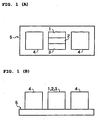
- this optical isolator is mainly constituted of a first polarizer 1 which is disposed along the optical axis and the plane of polarization of which is in non-phase-shift in the plane of polarization of incident light, a Faraday rotator 2 which is disposed on the rear of the light emergent side of this first polarizer 1 and rotates the plane of polarization of incident light by 45 degrees, and a second polarizer 3 which is disposed on the rear of the light emergent side of this Faraday rotator 2 and has the plane of polarization standing inclined by 45 degrees in respect to the first polarizer 1.
- the Faraday rotator 2, the first polarizer 1 and the second polarizer 3 are joined with an optical-purpose adhesive at their interfaces to make up an optical isolator element, and also this optical isolator element, and permanent magnets 4 which bring into saturation magnetization the Faraday rotator 2 of this optical isolator element, are fastened by bonding to a holder 5 via the optical-purpose adhesive to make up an optical isolator.
- the conventional optical-purpose adhesives of this kind have a disadvantage that cured products tend to cause discoloration and deterioration which are due to temperature and humidity after curing.
- There have been problems such that, in a thermo-hygrostat test at 85°C/85%RH for 2,000 hours which is conducted using the optical isolator, the optical isolator element and the permanent magnets may come separate from the holder, and optical deterioration may arise because of peeling of the Faraday rotator and polarizers.
- thermoset optical-purpose adhesive having a superior resistance to heat and moisture and a high transparency
- optical isolator element and an optical isolator to both of which this adhesive has been applied.
- the cause of the discoloration and deterioration which are due to temperature and humidity after curing is concerned with the compounding proportion of the amine type curing agent to the primary agent epoxy resin, and resides in that the amine type curing agent is compounded in a proportion of more than 45 parts by weight based on 100 parts by weight of the epoxy resin.
- a method may be contemplated in which the amine type curing agent is compounded in a small proportion, but this may cause another problem that the heat curing takes place insufficiently, and hence it has been difficult in practice to set its proportion to 45 parts by weight or less.
- active-radical moieties such as a hydroxyl radical are also present in addition to the epoxy radical, and it is difficult to attach the silane coupling agent only to the epoxy radical. Hence, it has been difficult in practice to solve the problem.
- the silane coupling agent can be made to react selectively on the epoxy radical of the epoxy resin when a metallic soap is made present together in carrying out the silane modification treatment, and that this also enables reduction of the compounding proportion of the curing agent to 45 parts by weight or less.
- the present invention has been accomplished on the basis of such a technical discovery.
- thermoset optical-purpose adhesive is a mixed adhesive which is mainly composed of a primary agent and a curing agent, and is characterized by having a visible-ray transmittance of 90% or more after heat curing under conditions of a layer thickness that is enough for the adhesive to function as an adhesive.
- the primary agent usable is one in which its main component is constituted of a silane modified epoxy resin whose active-radical moieties other than epoxy radicals have been inactivated in part or in entirety by the aid of a metallic soap and to at least one epoxy radical of which a silane coupling agent has been attached.
- the curing agent usable is one in which its main component is constituted of an amine type compound or an amide type compound.
- the amine type compound or amide type compound constituting the main component of the curing agent desirable is one which has been made into a latent amine addition product upon reaction with the epoxy resin.
- the compounding proportion of the curing agent to the primary agent epoxy resin may be so set that the curing agent is in the range of from 20 parts by weight to 45 parts by weight based on 100 parts by weight of the epoxy resin.
- the optical isolator element according to the present invention is mainly constituted of a Faraday rotator, and a first polarizer and a second polarizer which are respectively disposed on both sides of the Faraday rotator, and is characterized in that the Faraday rotator, the first polarizer and the second polarizer are joined at their interfaces by means of the above thermoset optical-purpose adhesive according to the present invention.
- the optical isolator according to the present invention is an optical isolator comprising an optical isolator element and a permanent magnet which brings into saturation magnetization a Faraday rotator of this optical isolator element; the optical isolator element and the permanent magnet being fastened to a holder; and is characterized in that the optical isolator element and the permanent magnet are fastened by bonding to the holder by means of the above thermoset optical-purpose adhesive according to the present invention.
- thermoset optical-purpose adhesive is, as mentioned above, a mixed adhesive which is mainly composed of a primary agent and a curing agent, and is characterized by having a visible-ray transmittance of 90% or more after heat curing under conditions of a layer thickness that is enough for the adhesive to function as an adhesive.
- the conditions of a layer thickness that is enough for the adhesive to function as an adhesive refers to conditions in which a layer of the adhesive has a layer thickness within the range of from 2.0 ⁇ m to 3.5 mm as measured with an optical measure microscope (e.g., a microscope manufactured by Olympus Optical Co., Ltd.) capable of making measurement in the depth direction. If the layer thickness is less than 2.0 ⁇ m, the adhesive may have a poor resistance to heat and moisture. If it is more than 3.5 mm, the visible-ray transmittance may come lower than the above numerical conditions.
- the primary agent may include a silane modified epoxy resin whose active-radical moieties other than epoxy radicals have been inactivated in part or in entirety by the aid of a metallic soap and to at least one epoxy radical of which a silane coupling agent has been attached.
- the epoxy resin usable in the present invention is an epoxy resin having more than one epoxy radical in one molecule, and may be exemplified by bisphenol A, bisphenol AD, bisphenol F and hydrogenated bisphenol A; polyglycidyl ethers obtained by allowing polyhydric phenols such as catechol and resorcin to react with epichlorohydrin; glycidyl ether esters obtained by allowing hydroxycarboxylic acids such as p-hydroxybenzoic acid and ⁇ -hydroxynaphthoic acid to react with epichlorohydrin; polyglycidyl esters obtained from polycarboxylic acids such as phthalic acid and terephthalic acid; and also novolak type epoxy, and epoxidized polyolefins.
- the epoxy resin used in the present invention is by no means limited to liquids. Solid epoxy resins may also be used when used in combination with a diluent. Any of these may appropriately be used alone or in the form of a mixture of two or more. Where the following silane coupling agent is previously allowed to react with the above epoxy resin to make up the silane modified epoxy resin, joint strength can be improved and storage stability at normal temperature can be made higher.
- a small amount of pure water and a trace amount of a diluted organic acid such as acetic acid may be used, and these may be stirred with heating, followed by removal of any surplus components under reduced pressure, whereby an oligomer achievable of stable activity can be obtained through dehydration condensation reaction.
- a metallic soap may be made present together when the silane coupling agent is allowed to reacted with the epoxy resin. This enables selective reaction of the silane coupling agent on the epoxy radical of the epoxy resin.
- the silane coupling agent usable in the present invention is an organosilicon compound represented by the following general formula (1).
- X represents a vinyl group, an aminoalkyl group, an epoxyalkyl group, a methacrylalkyl group or the like, and R's each represent an alkoxyl group such as a methoxy group, an ethoxy group or a methoxyethoxy group.
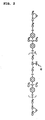
- the silane modified epoxy resin may include a silane modified epoxy resin to part of the epoxy resin molecular structure of which a metallic soap has previously been attached by thermo-chemical reaction with the epoxy resin, i.e., the silane modified epoxy resin whose active-radical moieties other than epoxy radicals (as exemplified by the hydroxyl radical shown by an arrow ⁇ in Fig. 2) have been inactivated in part or in entirety by the aid of a metallic soap.
- the metallic soap may include organic acid salts formed by combination of, in addition to sodium and potassium, divalent or higher metals as exemplified by alkaline earth metals and heavy metals, such as aluminum, calcium, manganese, lead, tin and zinc, with organic acids such as octylic acid, nonylic acid, stearic acid and naphthenic acid. Any of these may be used alone or in the form of a mixture of two or more.
- the curing agent usable are aliphatic polyamines, polyoxyalkylenediamines, and mixtures of aliphatic polyamines and polyoxyalkylenediamines or the like.
- the curing agent is by no means limited to these. Curing agents of an amine type such as aromatic amines or aliphatic amines and of an amide type may also be used as long as the resistance to heat and moisture and transparency of cured products can be satisfied.
- curing agents other than those of the amine type or amide type e.g., those of an acid anhydride type such as tetrahydrophthalic anhydride are not preferable because they may produce a liberation acid in a heat and moisture resistance test conducted after curing, a BF 3 cationic-polymerized type may anxiously liberate a Lewis acid, and further an imidazole compound type may cause coloring of cured products, and a dicyanediamide type may cause voids due to decomposed gas.
- an acid anhydride type such as tetrahydrophthalic anhydride
- the amine type compound or amide type compound as the curing agent may preferably be made into a latent amine addition product upon reaction with the epoxy resin. More specifically, part of active hydrogen at the terminal amino radical in the amine type compound or amide type compound may beforehand be allowed to react with the epoxy compound to effect modification (i.e., make it into a latent amine addition product). This brings advantages that storage stability and lower curing temperature can be achieved in virtue of optimization of molecular weight and further that joint strength can be made stable.
- Such a modified compound may be obtained by allowing an epoxy resin equivalent weight or more of the curing agent is allowed to react at room temperature in an aqueous solution of an organic acid such as formic acid or acetic acid, and bringing the reaction mixture into contact with dilute ammonia gas or the like to effect neutralization, followed by washing with alcohol and water and then drying under reduced pressure.
- an organic acid such as formic acid or acetic acid
- the compounding proportion of the curing agent to the primary agent epoxy resin may be so set that the curing agent is in the range of from 20 parts by weight to 45 parts by weight based on 100 parts by weight of the epoxy resin.
- the diluent which is not an especially essential component, it must be handled with care when it is necessary to maintain suitable operability, because, if added in excess, it may make the heat resistance of cured products deteriorate to cause voids (empty spaces), separation and bleed-out at the time of curing.
- the type of the diluent one giving a high dilution efficiency, having a superior compatibility and having neither moisture absorption nor toxicity is desirable, where, when added, there is no restriction on its amount, which depends on purposes for which the adhesive is used.
- acrylic resin, polyester resin, polyamide resin, butyral resin, phenol resin or the like may also optionally be added so that transparency and coefficient of thermal expansion can be controlled and stress relaxation properties can be added. Utilization of additives is by no means barred. What is called adjuvants such as an ultraviolet absorber, a surface-active agent, a compatibilizer, a coloring preventive agent and so forth may also be added.
- thermoset optical-purpose adhesive is used in, e.g., producing the optical isolator element and the optical isolator which are shown in Fig. 1.
- the primary agent (resin) and the curing agent may be stirred and mixed in the stated proportion, and thereafter the mixture obtained may be applied by means of dispenser application, printing, stamping or the like, any of which may appropriately be utilized.
- epoxy resin bisphenol-A type "EPIKOTE 823", registered trademark; epoxy resin available from Shell Chemical Co.
- methanol and a trace amount of formic acid (or acetic acid) were added, and these were mixed and stirred. Thereafter, 0.5 part by weight of tin octylate was mixed which was dissolved in an organic solvent under a temperature condition of 20 ⁇ 5°C.
- the mixture was heated and stirred under a condition of about 60°C. Thereafter, this was returned to normal temperature, and pure water was added thereto, followed by removal of the alcohol (methanol), the water and the formic acid (or acetic acid) by vacuum stirring.
- MDA menthenediamine
- thermoset optical-purpose adhesive according to Example 1.
- Fig. 3 shows a transmission profile of the thermoset optical-purpose adhesive according to Example 1 in respect to rays of 200 to 2,600 nm in wavelength through a heat-cured film of 3 ⁇ 0.2 mm in layer thickness measured by a micrometer.
- thermoset optical-purpose adhesive according to Example 1 has a visible-ray transmittance of 90% or more.
- this adhesive has a transmittance of 90% or more in the wavelength range of visible rays, a transmittance of about 90% at a wavelength of 1,310 nm used in optical communication, and a transmittance of about 60% at a wavelength of 1,550 nm also used in optical communication.
- this adhesive had a transmittance of a little less than 90% at the wavelength of 1,310 nm used in optical communication, and also had a little lower transmittance of about 50% at the wavelength of 1,550 nm used in optical communication.
- the transmission profile was measured with a spectrophotometer U-4000, manufactured by Hitachi Ltd.
- thermoset optical-purpose adhesive according to Example 2 was obtained in the same way as in Example 1 except that the primary agent and the curing agent were in a weight proportion of 100:40.
- thermoset optical-purpose adhesive according to Example 3.
- thermoset optical-purpose adhesive according to Example 4 was obtained in the same way as in Example 1 except that, as the metallic soap, "tin octylate” was changed for "copper naphthenate”.
- thermoset optical-purpose adhesive according to Comparative Example 1 was obtained in the same way as in Example 1 except that the primary agent and the curing agent were in a weight proportion of 100:15.
- thermoset optical-purpose adhesive according to Comparative Example 2 was obtained in the same way as in Example 1 except that the primary agent and the curing agent were in a weight proportion of 100:55.
- thermoset optical-purpose adhesive according to Comparative Example 3 (i.e., a thermoset optical-purpose adhesive according to the prior art) was obtained by using epoxy resin (bisphendl-A type "EPIKOTE 823", registered trademark; epoxy resin available from Shell Chemical Co.) as the primary agent and also, as the curing agent, menthenediamine (MDA) not made into the latent amine addition product, and compounding the primary agent and the curing agent in a weight proportion of 100:55.
- epoxy resin bisphendl-A type "EPIKOTE 823", registered trademark; epoxy resin available from Shell Chemical Co.
- MDA menthenediamine
- thermoset optical-purpose adhesive according to Comparative Example 4 was obtained in the same way as in Example 1 except that the metallic soap tin octylate was not compounded.
- thermoset optical-purpose adhesive according to Example 1 was used, and also an evaluation sample was prepared in the same way as in Example 1 except that the layer thickness of an adhesive layer of the following evaluation sample for testing and evaluating optical properties and resistance to heat and moisture was "5.0 ⁇ 0.1 mm".
- thermoset optical-purpose adhesive according to Example 1 was used, and also an evaluation sample was prepared in the same way as in Example 1 except that the layer thickness of an adhesive layer of the following evaluation sample for testing and evaluating optical properties and resistance to heat and moisture was "1.0 ⁇ 0.5 ⁇ m".
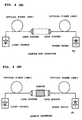
- the optical isolator element and the optical isolator which are shown in Fig. 1 were produced using the thermoset optical-purpose adhesive according to each Example and Comparative Example, and the insertion loss and isolation of the optical isolator produced using the thermoset optical-purpose adhesive according to each Example and Comparative Example were measured with an optical-properties measuring instrument shown in Fig. 4 (A), constituted mainly of a light source, an optical fiber (SMF), a light incident side lens system, a light emergent side lens system, an optical fiber (SMF) and a power meter.
- SMF optical fiber
- a sample an optical isolator element constituted mainly of the first polarizer 1, an adhesive layer of 0.5 ⁇ 0.1 mm in layer thickness, the Faraday rotator 2, an adhesive layer of 0.5 ⁇ 0.1 mm in layer thickness and the second polarizer 3
- the first polarizer 1 an adhesive layer of 0.5 ⁇ 0.1 mm in layer thickness
- the Faraday rotator 2 an adhesive layer of 0.5 ⁇ 0.1 mm in layer thickness
- the second polarizer 3 3
- evaluation criteria are as follows: Evaluation Criteria AA Excellent. A On the level that is feasible for practical use. C Infeasible for practical use.
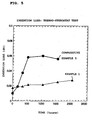
- thermoset optical-purpose adhesive according to Example 1 in respect of the thermoset optical-purpose adhesive according to Example 1 and the thermoset optical-purpose adhesive according to Comparative Example 3, optical characteristics (insertion loss) after application of a temperature-humidity history (temperature: 85°C; humidity: 85%) in the following heat and moisture resistance test, i.e., optical characteristics (insertion loss) in a thermo-hygrostat test were also measured. The results are shown in Fig. 5.
- a Faraday rotator chip (1.0 mm square, and 0.5 mm in thickness) was fastened by bonding, using the thermoset optical-purpose adhesive according to each Example and Comparative Example. This was left for 2 hours in an oven heated to 120°C, to effect heat curing to prepare an evaluation sample.
- the chip was pressed in the horizontal direction by means of a push-pull gauge, and its peel strength (N: newton) was measured.
- the primary agent and the curing agent were mixed at room temperature (25°C), and the time was measured by which the viscosity came twice that immediately after mixing. Evaluation Criteria AA 3 hours or more. A From 2 hours to less than 3 hours. B From 1 hour to less than 2 hours. C Less than 1 hour.
- thermoset optical-purpose adhesives according to Examples have superiority to the thermoset optical-purpose adhesives according to Comparative Examples in respect of the optical characteristics, the resistance to heat and moisture and the pot life evaluation.
- Comparative Example 1 is so set that "the primary agent and the curing agent were in a weight proportion of 100:15", where the curing agent is in a weight proportion of 20 parts by weight or less, and hence the adhesive has a difficulty in resistance to heat and moisture (evaluated as "B") compared with respective Examples.
- Comparative Example 2 is so set that "the primary agent and the curing agent were in a weight proportion of 100:55", where the curing agent is in a weight proportion of 45 parts by weight or more, and hence it affords a difficulty in optical characteristics (evaluated as "C”) compared with respective Examples, and the pot life is also evaluated to be no good (“C”).
- Comparative Example 3 is a thermoset optical-purpose adhesive according to the prior art and the curing agent is in a weight proportion of 45 parts by weight or more. Hence, it affords a difficulty in optical characteristics (evaluated as "C”), and also has a poor affinity for the inorganic optical device (Faraday rotator chip) to have a difficulty in resistance to heat and moisture (evaluated as "C”) compared with respective Examples.
- Comparative Example 4 is an adhesive in which the metallic soap tin octylate is not compounded, and hence the silane coupling agent ⁇ -glycidoxytrimethoxysilane has been attached not only to epoxy radicals but also to active moieties other than the epoxy radicals.
- the adhesive has a difficulty in resistance to heat and moisture (evaluated as "B") compared with respective Examples, and also affords optical characteristics inferior (“C”) to those of respective Examples.
- Comparative Examples 5 and 6 each make use of the thermoset optical-purpose adhesive according to Example 1, and hence, in the both, the pot life is evaluated like that in respective Examples ("AA").
- the layer thicknesses of their adhesive layers are "5.0 ⁇ 0.1 mm” in Comparative Example 5 and "1.0 ⁇ 0.5 ⁇ m” in Comparative Example 6, which do not satisfy the stated layer thickness condition.
- Comparative Example 5 the optical characteristics are inferior ("A") to that of respective Examples, and in Comparative Example 6 the resistance to heat and moisture is poor (“C").
- thermoset optical-purpose adhesive according to Example 1 in the case when the thermoset optical-purpose adhesive according to Example 1 is used, the optical characteristics (insertion loss) can not easily deteriorate even after application of the temperature-humidity history (temperature: 85°C; humidity: 85%), whereas, in the case when the thermoset optical-purpose adhesive according to Comparative Example 3 is used, the optical characteristics (insertion loss) has greatly deteriorated after application of the temperature-humidity history (temperature: 85°C; humidity: 85%).
- thermoset optical-purpose adhesive provides, after curing, the cured products with superior resistance to heat and moisture and superior transparency.
- this adhesive is used in optical isolator elements and optical isolators, it has the effect of making the optical isolator elements and permanent magnets not easily come separate from the holder because of deterioration of the adhesive and making optical deterioration not easily occur because of peeling of the Faraday rotator and polarizers. It also has the effect of enabling achievement of cost reduction in virtue of power saving in manufacturing steps. Therefore, it is suited to be uses as an optical-purpose adhesive used in producing, e.g., optical component parts such as optical isolator elements and optical isolators.
Landscapes
- Chemical & Material Sciences (AREA)
- Organic Chemistry (AREA)
- Chemical Kinetics & Catalysis (AREA)
- Polymers & Plastics (AREA)
- Physics & Mathematics (AREA)
- Health & Medical Sciences (AREA)
- Medicinal Chemistry (AREA)
- Optics & Photonics (AREA)
- General Physics & Mathematics (AREA)
- Life Sciences & Earth Sciences (AREA)
- Engineering & Computer Science (AREA)
- Materials Engineering (AREA)
- Wood Science & Technology (AREA)
- Adhesives Or Adhesive Processes (AREA)
- Compositions Of Macromolecular Compounds (AREA)
- Polarising Elements (AREA)
- Epoxy Resins (AREA)
Abstract
Description

| Evaluation Criteria | |
| AA | Excellent. |
| A | On the level that is feasible for practical use. |
| C | Infeasible for practical use. |
| Evaluation Criteria | |
| AA | A is 80% or more. |
| A | A is from 65% or more to less than 80%. |
| B | A is from 50% or more to less than 65%. |
| C | A is less than 50%. |
| | |
| AA | |
| 3 hours or more. | |
| A | From 2 hours to less than 3 hours. |
| B | From 1 hour to less than 2 hours. |
| C | Less than 1 hour. |


Claims (6)
- A thermoset optical-purpose adhesive comprising a mixed adhesive which is mainly composed of a primary agent and a curing agent, and is characterized by having a visible-ray transmittance of 90% or more after heat curing under conditions of a layer thickness that is enough for the adhesive to function as an adhesive.
- The thermoset optical-purpose adhesive according to claim 1, wherein;
said primary agent comprises a main component constituted of a silane modified epoxy resin whose active-radical moieties other than epoxy radicals have been inactivated in part or in entirety by the aid of a metallic soap and to at least one epoxy radical of which a silane coupling agent has been attached; and
said curing agent comprises a main component constituted of an amine type compound or an amide type compound. - The thermoset optical-purpose adhesive according to claim 2, wherein said amine type compound or amide type compound constituting the main component of said curing agent has been made into a latent amine addition product upon reaction with the epoxy resin.
- The thermoset optical-purpose adhesive according to claim 2 or 3, wherein the compounding proportion of said curing agent to 100 parts by weight of said primary agent epoxy resin is set within the range of from 20 parts by weight to 45 parts by weight.
- An optical isolator element constituted mainly of a Faraday rotator, and a first polarizer and a second polarizer which are respectively disposed on both sides of the Faraday rotator, wherein;
said Faraday rotator, said first polarizer and said second polarizer are joined at their interfaces by means of the thermoset optical-purpose adhesive according to any one of claims 1 to 4. - An optical isolator comprising an optical isolator element and a permanent magnet which brings into saturation magnetization a Faraday rotator of this optical isolator element; the optical isolator element and the permanent magnet being fastened to a holder; wherein;
said optical isolator element and said permanent magnet are fastened by bonding to the holder by means of the thermoset optical-purpose adhesive according to any one of claims 1 to 4.
Applications Claiming Priority (5)
| Application Number | Priority Date | Filing Date | Title |
|---|---|---|---|
| JP2002209754 | 2002-07-18 | ||
| JP2002209754 | 2002-07-18 | ||
| JP2002353752A JP4300790B2 (en) | 2002-07-18 | 2002-12-05 | Thermosetting optical adhesive, optical isolator element and optical isolator to which this adhesive is applied |
| JP2002353752 | 2002-12-05 | ||
| PCT/JP2002/012995 WO2004009722A1 (en) | 2002-07-18 | 2002-12-12 | Thermosetting adhesive for optical use, optical isolator element made with the adhesive, and optical isolator |
Publications (3)
| Publication Number | Publication Date |
|---|---|
| EP1524307A1 true EP1524307A1 (en) | 2005-04-20 |
| EP1524307A4 EP1524307A4 (en) | 2010-09-29 |
| EP1524307B1 EP1524307B1 (en) | 2012-08-01 |
Family
ID=30772211
Family Applications (1)
| Application Number | Title | Priority Date | Filing Date |
|---|---|---|---|
| EP02788806A Expired - Lifetime EP1524307B1 (en) | 2002-07-18 | 2002-12-12 | Thermosetting adhesive for optical use, optical isolator element made with the adhesive, and optical isolator |
Country Status (6)
| Country | Link |
|---|---|
| US (1) | US7162110B2 (en) |
| EP (1) | EP1524307B1 (en) |
| JP (1) | JP4300790B2 (en) |
| KR (1) | KR100894318B1 (en) |
| CN (1) | CN1305991C (en) |
| WO (1) | WO2004009722A1 (en) |
Cited By (1)
| Publication number | Priority date | Publication date | Assignee | Title |
|---|---|---|---|---|
| US7968667B2 (en) | 2004-09-02 | 2011-06-28 | The Yokohama Rubber Co., Ltd. | Adhesive compositions for optical fibers |
Families Citing this family (7)
| Publication number | Priority date | Publication date | Assignee | Title |
|---|---|---|---|---|
| JP3990693B2 (en) * | 2004-09-02 | 2007-10-17 | 横浜ゴム株式会社 | Adhesive composition and method for bonding optical fiber and ferrule |
| CA2610562C (en) * | 2005-06-06 | 2013-12-24 | Takeda Pharmaceutical Company Limited | An adhesive for injection needle, a method for bonding injection needle, a syringe front-assembly and a syringe |
| JP4831296B2 (en) * | 2005-07-05 | 2011-12-07 | 住友金属鉱山株式会社 | Manufacturing method of optical isolator integrated with optical fiber ferrule |
| JP2008129145A (en) * | 2006-11-17 | 2008-06-05 | Sumitomo Metal Mining Co Ltd | Optical isolator element, optical isolator, and manufacturing method thereof |
| WO2009117345A2 (en) * | 2008-03-17 | 2009-09-24 | Henkel Corporation | Adhesive compositions for use in die attach applications |
| US8698320B2 (en) * | 2009-12-07 | 2014-04-15 | Henkel IP & Holding GmbH | Curable resin compositions useful as underfill sealants for use with low-k dielectric-containing semiconductor devices |
| CN114381232A (en) | 2016-05-24 | 2022-04-22 | 积水化学工业株式会社 | Bonding composition, optical adhesive, and pressure sensor adhesive |
Family Cites Families (16)
| Publication number | Priority date | Publication date | Assignee | Title |
|---|---|---|---|---|
| JPS62290783A (en) | 1986-06-10 | 1987-12-17 | Mitsubishi Rayon Co Ltd | Adhesive for light transmitting fibers |
| JP3128314B2 (en) * | 1992-03-12 | 2001-01-29 | 旭化成工業株式会社 | Adhesive for optical fiber |
| JPH0673359A (en) * | 1992-08-26 | 1994-03-15 | Nippon Telegr & Teleph Corp <Ntt> | Refractive index matching precision adhesive |
| BR9709891A (en) * | 1996-05-06 | 1999-08-10 | Ameron Int Corp | Adhesive / adhesive systems modified by siloxane |
| US5700581A (en) * | 1996-06-26 | 1997-12-23 | International Business Machines Corporation | Solvent-free epoxy based adhesives for semiconductor chip attachment and process |
| JP4043608B2 (en) * | 1998-08-03 | 2008-02-06 | 横浜ゴム株式会社 | One-part epoxy resin adhesive composition |
| JP2000155289A (en) | 1998-09-18 | 2000-06-06 | Tokin Corp | Optical isolator |
| DE69906325T2 (en) * | 1998-09-18 | 2004-02-19 | Minnesota Mining & Manufacturing Company, St. Paul | OPTICAL ISOLATOR |
| JP4206158B2 (en) | 1998-11-12 | 2009-01-07 | 株式会社巴川製紙所 | Adhesive composition |
| JP2000249983A (en) | 1999-03-04 | 2000-09-14 | Tokin Corp | Manufacturing method of optical non-reciprocal element |
| JP2001021838A (en) | 1999-07-02 | 2001-01-26 | Shin Etsu Chem Co Ltd | Manufacturing method of optical isolator |
| JP2002201369A (en) * | 2001-01-09 | 2002-07-19 | Kanegafuchi Chem Ind Co Ltd | Curable composition |
| JP2003037368A (en) * | 2001-07-24 | 2003-02-07 | Taiyo Ink Mfg Ltd | Thermosetting epoxy resin composition for printed wiring board, multilayer printed wiring board manufactured using the same, and method of manufacturing the same |
| KR100628363B1 (en) * | 2002-11-01 | 2006-09-27 | 미쓰이 가가쿠 가부시키가이샤 | Sealant composition for liquid crystal and process for producing liquid crystal display panel with the same |
| CN100537688C (en) * | 2003-01-27 | 2009-09-09 | 大金工业株式会社 | Coating composition |
| KR101256783B1 (en) * | 2003-02-12 | 2013-04-25 | 니폰 가야꾸 가부시끼가이샤 | Silicon compound containing epoxy group and thermosetting resin composition |
-
2002
- 2002-12-05 JP JP2002353752A patent/JP4300790B2/en not_active Expired - Fee Related
- 2002-12-12 WO PCT/JP2002/012995 patent/WO2004009722A1/en not_active Ceased
- 2002-12-12 KR KR1020057000591A patent/KR100894318B1/en not_active Expired - Fee Related
- 2002-12-12 US US10/519,831 patent/US7162110B2/en not_active Expired - Fee Related
- 2002-12-12 CN CNB028292790A patent/CN1305991C/en not_active Expired - Fee Related
- 2002-12-12 EP EP02788806A patent/EP1524307B1/en not_active Expired - Lifetime
Cited By (1)
| Publication number | Priority date | Publication date | Assignee | Title |
|---|---|---|---|---|
| US7968667B2 (en) | 2004-09-02 | 2011-06-28 | The Yokohama Rubber Co., Ltd. | Adhesive compositions for optical fibers |
Also Published As
| Publication number | Publication date |
|---|---|
| EP1524307A4 (en) | 2010-09-29 |
| JP2004099863A (en) | 2004-04-02 |
| EP1524307B1 (en) | 2012-08-01 |
| US7162110B2 (en) | 2007-01-09 |
| WO2004009722A1 (en) | 2004-01-29 |
| CN1305991C (en) | 2007-03-21 |
| CN1639295A (en) | 2005-07-13 |
| JP4300790B2 (en) | 2009-07-22 |
| KR20050025353A (en) | 2005-03-14 |
| US20050249446A1 (en) | 2005-11-10 |
| KR100894318B1 (en) | 2009-04-24 |
Similar Documents
| Publication | Publication Date | Title |
|---|---|---|
| KR101252731B1 (en) | Epoxy Resin and Epoxy Resin Composition | |
| US7162110B2 (en) | Thermosetting adhesive for optical use, optical isolator element made with the adhesive, and optical isolator | |
| WO2003099912A1 (en) | Resin sheet and liquid-crystal cell substrate comprising the same | |
| US20130338363A1 (en) | Silane compound, production method thereof, and resin composition containing silane compound | |
| SG172173A1 (en) | Carboxylic acid compound and epoxy resin composition containing same | |
| JP2017101152A (en) | Modified polyimide resin composition and method for producing the same, and prepreg and laminate using the same | |
| JP2014156531A (en) | Epoxy resin composition, adhesive sheet and semiconductor element | |
| US6524717B1 (en) | Prepreg, metal-clad laminate, and printed circuit board obtained from these | |
| US20100190899A1 (en) | Hardenable epoxy resin composition | |
| TW421664B (en) | Epoxy resin composition for print circuit board and its laminate sheet | |
| US20030010962A1 (en) | Optical device-related adhesive and optical device | |
| KR101821574B1 (en) | Epoxy compound with nitrogen-containing ring | |
| JP2006307141A (en) | Epoxy resin composition | |
| JP4674112B2 (en) | Epoxy resin composition and optical electronic member using the same | |
| Hirano et al. | Enhancement of Epoxy Resin/Copper Heterojunction by Introduction of Sulfur‐Containing Polymers | |
| JP2003292924A (en) | Adhesive for optical device and optical device using the same | |
| US20060234159A1 (en) | Photosensitive epoxy resin adhesive composition and use thereof | |
| JP2001089638A (en) | Liquid sealing resin composition | |
| KR101734189B1 (en) | Method for producing epoxy compound having cyanuric acid skeleton | |
| JP4831296B2 (en) | Manufacturing method of optical isolator integrated with optical fiber ferrule | |
| JP2007187711A (en) | Optical receptacle with optical isolator | |
| JPH11181060A (en) | Resin composition and semiconductor encapsulant and laminate using the same | |
| JP2002275244A (en) | Epoxy resin composition | |
| WO2006121030A1 (en) | Epoxy resin, method for producing same and use thereof | |
| JP2002105292A (en) | Epoxy resin composition for interposer, prepreg, and copper-clad laminate using the same |
Legal Events
| Date | Code | Title | Description |
|---|---|---|---|
| PUAI | Public reference made under article 153(3) epc to a published international application that has entered the european phase |
Free format text: ORIGINAL CODE: 0009012 |
|
| 17P | Request for examination filed |
Effective date: 20041215 |
|
| AK | Designated contracting states |
Kind code of ref document: A1 Designated state(s): DE FR GB NL |
|
| A4 | Supplementary search report drawn up and despatched |
Effective date: 20100830 |
|
| RIC1 | Information provided on ipc code assigned before grant |
Ipc: C09D 163/00 20060101ALI20100820BHEP Ipc: C09J 163/00 20060101AFI20100820BHEP Ipc: C09J 201/00 20060101ALI20100820BHEP Ipc: G02B 27/28 20060101ALI20100820BHEP Ipc: G02B 7/00 20060101ALI20100820BHEP |
|
| 17Q | First examination report despatched |
Effective date: 20110217 |
|
| REG | Reference to a national code |
Ref country code: DE Ref legal event code: R079 Ref document number: 60243437 Country of ref document: DE Free format text: PREVIOUS MAIN CLASS: C09J0201000000 Ipc: C08G0059320000 |
|
| GRAP | Despatch of communication of intention to grant a patent |
Free format text: ORIGINAL CODE: EPIDOSNIGR1 |
|
| RIC1 | Information provided on ipc code assigned before grant |
Ipc: G02B 1/10 20060101ALI20120123BHEP Ipc: C08G 59/32 20060101AFI20120123BHEP Ipc: C09D 163/00 20060101ALI20120123BHEP Ipc: C08G 59/30 20060101ALI20120123BHEP |
|
| GRAS | Grant fee paid |
Free format text: ORIGINAL CODE: EPIDOSNIGR3 |
|
| GRAA | (expected) grant |
Free format text: ORIGINAL CODE: 0009210 |
|
| AK | Designated contracting states |
Kind code of ref document: B1 Designated state(s): DE FR GB NL |
|
| REG | Reference to a national code |
Ref country code: GB Ref legal event code: FG4D |
|
| REG | Reference to a national code |
Ref country code: DE Ref legal event code: R096 Ref document number: 60243437 Country of ref document: DE Effective date: 20120927 |
|
| REG | Reference to a national code |
Ref country code: NL Ref legal event code: T3 |
|
| PLBE | No opposition filed within time limit |
Free format text: ORIGINAL CODE: 0009261 |
|
| STAA | Information on the status of an ep patent application or granted ep patent |
Free format text: STATUS: NO OPPOSITION FILED WITHIN TIME LIMIT |
|
| 26N | No opposition filed |
Effective date: 20130503 |
|
| REG | Reference to a national code |
Ref country code: DE Ref legal event code: R097 Ref document number: 60243437 Country of ref document: DE Effective date: 20130503 |
|
| REG | Reference to a national code |
Ref country code: FR Ref legal event code: PLFP Year of fee payment: 14 |
|
| PGFP | Annual fee paid to national office [announced via postgrant information from national office to epo] |
Ref country code: DE Payment date: 20151208 Year of fee payment: 14 Ref country code: GB Payment date: 20151209 Year of fee payment: 14 |
|
| PGFP | Annual fee paid to national office [announced via postgrant information from national office to epo] |
Ref country code: FR Payment date: 20151110 Year of fee payment: 14 Ref country code: NL Payment date: 20151110 Year of fee payment: 14 |
|
| REG | Reference to a national code |
Ref country code: DE Ref legal event code: R119 Ref document number: 60243437 Country of ref document: DE |
|
| REG | Reference to a national code |
Ref country code: NL Ref legal event code: MM Effective date: 20170101 |
|
| GBPC | Gb: european patent ceased through non-payment of renewal fee |
Effective date: 20161212 |
|
| PG25 | Lapsed in a contracting state [announced via postgrant information from national office to epo] |
Ref country code: NL Free format text: LAPSE BECAUSE OF NON-PAYMENT OF DUE FEES Effective date: 20170101 |
|
| REG | Reference to a national code |
Ref country code: FR Ref legal event code: ST Effective date: 20170831 |
|
| PG25 | Lapsed in a contracting state [announced via postgrant information from national office to epo] |
Ref country code: FR Free format text: LAPSE BECAUSE OF NON-PAYMENT OF DUE FEES Effective date: 20170102 |
|
| PG25 | Lapsed in a contracting state [announced via postgrant information from national office to epo] |
Ref country code: DE Free format text: LAPSE BECAUSE OF NON-PAYMENT OF DUE FEES Effective date: 20170701 Ref country code: GB Free format text: LAPSE BECAUSE OF NON-PAYMENT OF DUE FEES Effective date: 20161212 |