EP1524292A1 - Procédé de réticulation d'un polymère greffé silane - Google Patents
Procédé de réticulation d'un polymère greffé silane Download PDFInfo
- Publication number
- EP1524292A1 EP1524292A1 EP04300597A EP04300597A EP1524292A1 EP 1524292 A1 EP1524292 A1 EP 1524292A1 EP 04300597 A EP04300597 A EP 04300597A EP 04300597 A EP04300597 A EP 04300597A EP 1524292 A1 EP1524292 A1 EP 1524292A1
- Authority
- EP
- European Patent Office
- Prior art keywords
- silane
- crosslinking
- process according
- polymer
- crosslinking process
- Prior art date
- Legal status (The legal status is an assumption and is not a legal conclusion. Google has not performed a legal analysis and makes no representation as to the accuracy of the status listed.)
- Withdrawn
Links
- 238000004132 cross linking Methods 0.000 title claims abstract description 44
- 238000000034 method Methods 0.000 title claims abstract description 39
- 229920000578 graft copolymer Polymers 0.000 title claims abstract description 20
- 125000003808 silyl group Chemical group [H][Si]([H])([H])[*] 0.000 title 1
- BLRPTPMANUNPDV-UHFFFAOYSA-N Silane Chemical compound [SiH4] BLRPTPMANUNPDV-UHFFFAOYSA-N 0.000 claims abstract description 27
- 229910000077 silane Inorganic materials 0.000 claims abstract description 27
- 239000003054 catalyst Substances 0.000 claims abstract description 21
- 229920000642 polymer Polymers 0.000 claims abstract description 20
- 230000005494 condensation Effects 0.000 claims abstract description 17
- 238000009833 condensation Methods 0.000 claims abstract description 17
- XLYOFNOQVPJJNP-UHFFFAOYSA-N water Substances O XLYOFNOQVPJJNP-UHFFFAOYSA-N 0.000 claims abstract description 9
- 150000001412 amines Chemical class 0.000 claims abstract description 8
- 150000001993 dienes Chemical class 0.000 claims abstract description 5
- 150000002978 peroxides Chemical class 0.000 claims abstract description 5
- 238000007342 radical addition reaction Methods 0.000 claims abstract description 4
- -1 poly [6 - [(1,1,3,3-tetramethylbutyl) amino] -1,3,5-triazine -2,4-diyl] - [(2,2,6,6-tetramethyl-4-piperidyl) imino] -hexamethylene - [(2,2,6,6-tetramethyl-4-piperidyl) imino] Polymers 0.000 claims description 4
- 229920001200 poly(ethylene-vinyl acetate) Polymers 0.000 claims description 3
- 150000003335 secondary amines Chemical class 0.000 claims description 3
- 229920002943 EPDM rubber Polymers 0.000 claims description 2
- 239000012736 aqueous medium Substances 0.000 claims description 2
- 229920006037 cross link polymer Polymers 0.000 claims description 2
- 239000002609 medium Substances 0.000 claims description 2
- 230000007935 neutral effect Effects 0.000 claims description 2
- 229920000098 polyolefin Polymers 0.000 claims description 2
- DQXBYHZEEUGOBF-UHFFFAOYSA-N but-3-enoic acid;ethene Chemical compound C=C.OC(=O)CC=C DQXBYHZEEUGOBF-UHFFFAOYSA-N 0.000 claims 1
- 239000005038 ethylene vinyl acetate Substances 0.000 claims 1
- 239000004020 conductor Substances 0.000 abstract 1
- 239000012212 insulator Substances 0.000 abstract 1
- 239000000203 mixture Substances 0.000 description 10
- 150000001875 compounds Chemical class 0.000 description 9
- UKLDJPRMSDWDSL-UHFFFAOYSA-L [dibutyl(dodecanoyloxy)stannyl] dodecanoate Chemical compound CCCCCCCCCCCC(=O)O[Sn](CCCC)(CCCC)OC(=O)CCCCCCCCCCC UKLDJPRMSDWDSL-UHFFFAOYSA-L 0.000 description 8
- 239000012975 dibutyltin dilaurate Substances 0.000 description 8
- ORECYURYFJYPKY-UHFFFAOYSA-N n,n'-bis(2,2,6,6-tetramethylpiperidin-4-yl)hexane-1,6-diamine;2,4,6-trichloro-1,3,5-triazine;2,4,4-trimethylpentan-2-amine Chemical compound CC(C)(C)CC(C)(C)N.ClC1=NC(Cl)=NC(Cl)=N1.C1C(C)(C)NC(C)(C)CC1NCCCCCCNC1CC(C)(C)NC(C)(C)C1 ORECYURYFJYPKY-UHFFFAOYSA-N 0.000 description 5
- 239000004594 Masterbatch (MB) Substances 0.000 description 3
- 239000004698 Polyethylene Substances 0.000 description 3
- ATJFFYVFTNAWJD-UHFFFAOYSA-N Tin Chemical class [Sn] ATJFFYVFTNAWJD-UHFFFAOYSA-N 0.000 description 3
- 230000008901 benefit Effects 0.000 description 3
- 239000000463 material Substances 0.000 description 3
- 229920000573 polyethylene Polymers 0.000 description 3
- RNFJDJUURJAICM-UHFFFAOYSA-N 2,2,4,4,6,6-hexaphenoxy-1,3,5-triaza-2$l^{5},4$l^{5},6$l^{5}-triphosphacyclohexa-1,3,5-triene Chemical compound N=1P(OC=2C=CC=CC=2)(OC=2C=CC=CC=2)=NP(OC=2C=CC=CC=2)(OC=2C=CC=CC=2)=NP=1(OC=1C=CC=CC=1)OC1=CC=CC=C1 RNFJDJUURJAICM-UHFFFAOYSA-N 0.000 description 2
- VEXZGXHMUGYJMC-UHFFFAOYSA-N Hydrochloric acid Chemical compound Cl VEXZGXHMUGYJMC-UHFFFAOYSA-N 0.000 description 2
- 229910021626 Tin(II) chloride Inorganic materials 0.000 description 2
- 239000002253 acid Substances 0.000 description 2
- 239000011243 crosslinked material Substances 0.000 description 2
- 239000003063 flame retardant Substances 0.000 description 2
- 125000001841 imino group Chemical group [H]N=* 0.000 description 2
- 238000010791 quenching Methods 0.000 description 2
- 230000000171 quenching effect Effects 0.000 description 2
- 229910002808 Si–O–Si Inorganic materials 0.000 description 1
- CDBYLPFSWZWCQE-UHFFFAOYSA-L Sodium Carbonate Chemical compound [Na+].[Na+].[O-]C([O-])=O CDBYLPFSWZWCQE-UHFFFAOYSA-L 0.000 description 1
- 230000002378 acidificating effect Effects 0.000 description 1
- 239000003963 antioxidant agent Substances 0.000 description 1
- 238000006555 catalytic reaction Methods 0.000 description 1
- 239000003795 chemical substances by application Substances 0.000 description 1
- 230000001143 conditioned effect Effects 0.000 description 1
- 239000000470 constituent Substances 0.000 description 1
- 229920001577 copolymer Polymers 0.000 description 1
- BRWZYZWZBMGMMG-UHFFFAOYSA-J dodecanoate tin(4+) Chemical compound [Sn+4].CCCCCCCCCCCC([O-])=O.CCCCCCCCCCCC([O-])=O.CCCCCCCCCCCC([O-])=O.CCCCCCCCCCCC([O-])=O BRWZYZWZBMGMMG-UHFFFAOYSA-J 0.000 description 1
- 239000000835 fiber Substances 0.000 description 1
- 238000009413 insulation Methods 0.000 description 1
- 238000009830 intercalation Methods 0.000 description 1
- 238000004519 manufacturing process Methods 0.000 description 1
- 238000005457 optimization Methods 0.000 description 1
- 150000003141 primary amines Chemical class 0.000 description 1
- 125000002924 primary amino group Chemical group [H]N([H])* 0.000 description 1
- 230000001681 protective effect Effects 0.000 description 1
- 239000011347 resin Substances 0.000 description 1
- 229920005989 resin Polymers 0.000 description 1
- 150000003839 salts Chemical class 0.000 description 1
- 239000000126 substance Substances 0.000 description 1
- 238000003878 thermal aging Methods 0.000 description 1
- 229920002554 vinyl polymer Polymers 0.000 description 1
Classifications
-
- H—ELECTRICITY
- H01—ELECTRIC ELEMENTS
- H01B—CABLES; CONDUCTORS; INSULATORS; SELECTION OF MATERIALS FOR THEIR CONDUCTIVE, INSULATING OR DIELECTRIC PROPERTIES
- H01B3/00—Insulators or insulating bodies characterised by the insulating materials; Selection of materials for their insulating or dielectric properties
- H01B3/18—Insulators or insulating bodies characterised by the insulating materials; Selection of materials for their insulating or dielectric properties mainly consisting of organic substances
- H01B3/30—Insulators or insulating bodies characterised by the insulating materials; Selection of materials for their insulating or dielectric properties mainly consisting of organic substances plastics; resins; waxes
- H01B3/44—Insulators or insulating bodies characterised by the insulating materials; Selection of materials for their insulating or dielectric properties mainly consisting of organic substances plastics; resins; waxes vinyl resins; acrylic resins
- H01B3/441—Insulators or insulating bodies characterised by the insulating materials; Selection of materials for their insulating or dielectric properties mainly consisting of organic substances plastics; resins; waxes vinyl resins; acrylic resins from alkenes
-
- C—CHEMISTRY; METALLURGY
- C08—ORGANIC MACROMOLECULAR COMPOUNDS; THEIR PREPARATION OR CHEMICAL WORKING-UP; COMPOSITIONS BASED THEREON
- C08K—Use of inorganic or non-macromolecular organic substances as compounding ingredients
- C08K5/00—Use of organic ingredients
- C08K5/16—Nitrogen-containing compounds
- C08K5/34—Heterocyclic compounds having nitrogen in the ring
- C08K5/3467—Heterocyclic compounds having nitrogen in the ring having more than two nitrogen atoms in the ring
- C08K5/3477—Six-membered rings
- C08K5/3492—Triazines
-
- H—ELECTRICITY
- H01—ELECTRIC ELEMENTS
- H01B—CABLES; CONDUCTORS; INSULATORS; SELECTION OF MATERIALS FOR THEIR CONDUCTIVE, INSULATING OR DIELECTRIC PROPERTIES
- H01B3/00—Insulators or insulating bodies characterised by the insulating materials; Selection of materials for their insulating or dielectric properties
- H01B3/18—Insulators or insulating bodies characterised by the insulating materials; Selection of materials for their insulating or dielectric properties mainly consisting of organic substances
- H01B3/28—Insulators or insulating bodies characterised by the insulating materials; Selection of materials for their insulating or dielectric properties mainly consisting of organic substances natural or synthetic rubbers
-
- H—ELECTRICITY
- H01—ELECTRIC ELEMENTS
- H01B—CABLES; CONDUCTORS; INSULATORS; SELECTION OF MATERIALS FOR THEIR CONDUCTIVE, INSULATING OR DIELECTRIC PROPERTIES
- H01B3/00—Insulators or insulating bodies characterised by the insulating materials; Selection of materials for their insulating or dielectric properties
- H01B3/18—Insulators or insulating bodies characterised by the insulating materials; Selection of materials for their insulating or dielectric properties mainly consisting of organic substances
- H01B3/30—Insulators or insulating bodies characterised by the insulating materials; Selection of materials for their insulating or dielectric properties mainly consisting of organic substances plastics; resins; waxes
- H01B3/44—Insulators or insulating bodies characterised by the insulating materials; Selection of materials for their insulating or dielectric properties mainly consisting of organic substances plastics; resins; waxes vinyl resins; acrylic resins
- H01B3/446—Insulators or insulating bodies characterised by the insulating materials; Selection of materials for their insulating or dielectric properties mainly consisting of organic substances plastics; resins; waxes vinyl resins; acrylic resins from vinylacetals
Definitions
- the present invention relates to a method for to crosslink a graft polymer silane, that is to say a polymer on which has been previously grafted a silane.
- the invention finds an application particularly advantageous, but not exclusive, in the field of energy cables and / or telecommunication, including fiber cables optics.
- silane crosslinking is today a perfectly known process which consists schematically to graft a polymer with a silane by radical addition using a peroxide, before to crosslink everything in the presence of water and a condensation catalyst.
- dibutyl laurate tin for catalyze the crosslinking of the graft polymer.
- This type of condensation catalyst commonly called DBTL, however, has the disadvantage of being tin salt base, that is to say a compound known for be particularly harmful, or even dangerous for the environment. In some countries, it is even already envisaged to prohibit the use of DBTL more or less short term, therefore excluding the use of the yet very efficient silane technique for crosslink polymers containing dienes.
- the technical problem to be solved by object of the present invention is to propose a process for crosslinking a silane-grafted polymer in presence of water and a condensation catalyst, which would avoid the problems of the state of the art by being substantially more ecological.
- the solution to the technical problem consists, according to the present invention, in that the catalyst of condensation consists of a hindered amine the molecular weight is greater than 2000g / mol.
- amine is clogged up means more precisely that the amine function is sterically encumbered by at least one other portion of the molecule constituting this compound.
- this feature advantageously allows to form unstable complexes that are likely to facilitate the creation of siloxane bridges, that is to say traditional Si-O-Si bonds of crosslinking silane.
- polymer must be understood in a broad sense, that is to say encompasses both pure polymers and copolymers, or any mixture of this type of compounds.
- the invention as thus defined presents the advantage of being able to use the technique of silane crosslinking, while dispensing with salts tin.
- the hindered amine constituting the Condensation catalyst is a secondary amine.
- a secondary amine indeed has the advantage of being intrinsically even more congested, hence an optimization of efficiency as a catalyst.
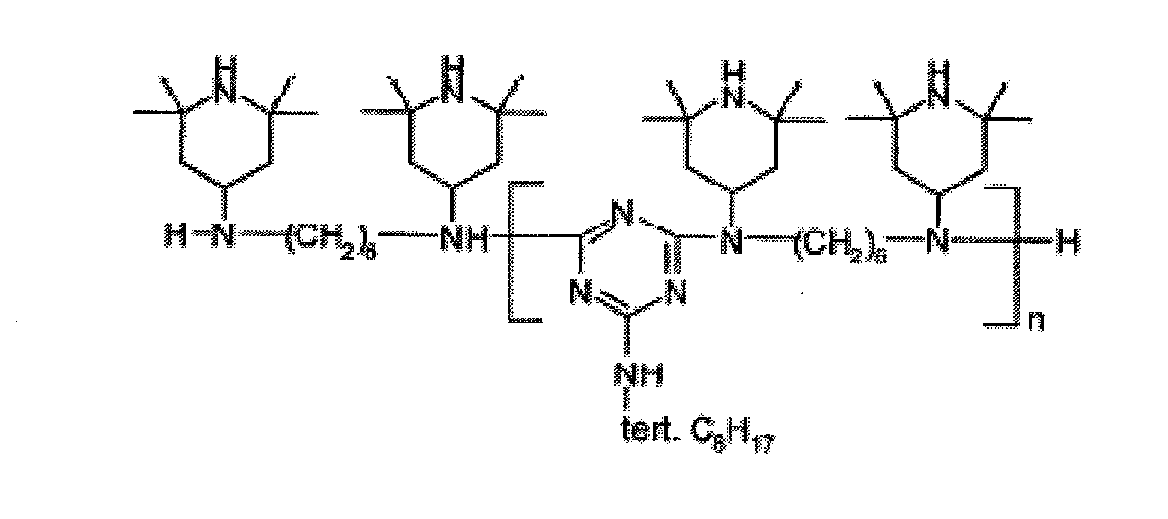
- the condensation catalyst is consisting of poly [6 - [(1,1,3,3-tetramethylbutyl) amino] -1,3,5-triazine-2,4-diyl] - [(2,2,6,6-tetramethyl) -4- piperidyl) imino] -hexamethylene - [(2,2,6,6-tetramethyl-4-piperidyl) imino].
- the 944 chimassorb is the origin a product that is usually used to protect polymers from light, and in particular ultraviolet light. Its use as condensation catalyst turns out to be no obvious, which reveals the particular character invention of the present invention.
- the graft polymer is based on a polyolefin, such as polyethylene (PE) for example.
- PE polyethylene
- the graft polymer is based on ethylene acetate vinyl.
- the graft polymer is based on EPDM.
- the method crosslinking is carried out in an aqueous medium.
- the crosslinking is conventionally performed in the pool, for a period of about 24 hours and with water at about 63 ° C.
- the crosslinking process can be implemented in a humid atmosphere. Concretely, the operation is done this time in sauna with water sprayed at a temperature of the order of 63 ° C, and for about 24 hours.
- the crosslinking process is carried out in the middle basic or neutral.
- the fact that cross-linking does not have place in acidic medium advantageously allows not to deactivate the amines present.
- crosslinking process previously described is applicable to any polymer silane graft, regardless of its origin, that is to say regardless of how it was got.
- the invention more generally relates to a method of silane crosslinking of a polymer containing dienes, of grafting the polymer with a silane by radical addition by means of a peroxide, and crosslink the silane graft polymer in the presence of water and a condensation catalyst.
- This method of silane crosslinking is remarkable in that the cross-linking of the graft polymer is carried out according to a crosslinking process as previously described.
- the silane crosslinking process is implemented using the sioplas technique schematically to proceed successively with grafting of the polymer, then to the crosslinking of the grafted polymer, possibly by intercalating an intermediate step of adding to the graft polymer at least one load, for example flame retardant.
- the method of silane crosslinking is likely to be implemented following the monosil technique which consists, so schematic, to proceed simultaneously with the grafting of the polymer and the crosslinking of the polymer thus grafted.
- the invention also relates to any cable having at least one conductive element extending the interior of at least one insulating element, in which at least one insulating element is composed of a polymer crosslinked by a silane crosslinking process such as previously described.
- insulating element also relates to any sheath whose function first is not to electrically isolate the element driver, but first and foremost to protect the insulating sheaths; it being understood that in the field energy and / or telecommunication cables, the materials components the protective sheaths have generally electrically insulating properties.
- the example in question concerns a compound that is intended to constitute, after crosslinking, a layer insulation of an energy or telecommunication cable.
- the purpose of this example is specifically to allow the comparison of material properties crosslinked respectively, in the presence of DBTL and in presence of a condensation catalyst according to the invention.
- Table 1 details the proportions of the various constituents of the compound to be crosslinked. Graft 100 pcr Flame retardant charge 160 to 180 pcr Implementing agents and antioxidants 4 to 7 pcr
- silane-grafted polymer results more precisely from the association of 100 phr of EVA and 1.5 phr of a silane mixture and peroxide.
- compositions based on this compound are then prepared to be crosslinked separately according to the same silane process. The latter will not be described further here because of the fact that it is perfectly conventional and therefore known.
- Composition 1 Composition 2 Compound (pcr) 100 100 Masterbatch based on Chimassorb 944 (pcr) 0.9 0 Masterbatch based on DBTL (pcr) 0 2 Total (pcr) 100.9 102
- each catalyst is conditioned in the form of a master mix to avoid having to handle too small quantities.
- the master mix chemisorb 944 actually contains 50% of this compound, while the masterbatch based on DBTL results from the combination of 100 phr of polymer-based PE and EVA with 0.36 phr of DBTL.
- compositions 1 and 2 are then crosslinked isolated from each other in the presence of water, preferentially in the pool for 24 hours and 63 ° C. Samples 1 and 2, in the form samples, are then taken from each material thus crosslinked; samples 1 and 2 resulting well obviously the crosslinking of the compositions respectively 1 and 2.
- Table 3 summarizes the main mechanical properties of the two types of samples, namely breaking strength, elongation at break and modulus at 50% elongation.
- Sample 1 Sample 2 Resistance to fracture (MPa) 9.6 11 Elongation at break (%) 219 190 50% elongation module (MPa) 6.5 7
- Table 4 focuses on the thermal aging capabilities of both types of samples. It groups in this respect the values of difference in breaking strength and difference in elongation at break, which are determined after a passage in an air oven for 240 hours at 120 ° C. Sample 1 Sample 2 Difference of tensile strength (%) 7 17 Difference of elongation at break (%) -18 -13
- Table 5 relates to the acid resistance of both types of samples. This test is carried out by simply quenching in hydrochloric acid for 28 days at 23 ° C. The difference in breaking strength and the difference in elongation at break for each sample 1 and 2 are then conventionally determined. Sample 1 Sample 2 Difference of tensile strength (%) -20 -28 Difference of elongation at break (%) 7 2
- the measured values are substantially comparable, so that it can be considered that the samples 1 and 2 have the same capabilities of acid resistance.
- Table 6 focuses on the basics of both types of samples. This test is also performed by simply quenching for 28 days at 23 ° C, but this time in a soda bath. Here again the difference in breaking strength and the difference in elongation at break for each sample 1 and 2 are determined. Sample 1 Sample 2 Difference of breaking strength -2 3 Difference of elongation at break 3 5
Landscapes
- Physics & Mathematics (AREA)
- Spectroscopy & Molecular Physics (AREA)
- Chemical & Material Sciences (AREA)
- Health & Medical Sciences (AREA)
- Chemical Kinetics & Catalysis (AREA)
- Medicinal Chemistry (AREA)
- Polymers & Plastics (AREA)
- Organic Chemistry (AREA)
- Processes Of Treating Macromolecular Substances (AREA)
- Organic Insulating Materials (AREA)
Abstract
Description
| Greffé | 100 pcr |
| Charge ignifugeante | 160 à 180 pcr |
| Agents de mise en oeuvre et antioxydants | 4 à 7 pcr |
| Composition 1 | Composition 2 | |
| Compound (pcr) | 100 | 100 |
| Mélange maítre à base de Chimassorb 944 (pcr) | 0,9 | 0 |
| Mélange maítre à base de DBTL (pcr) | 0 | 2 |
| Total (pcr) | 100,9 | 102 |
| Echantillon 1 | Echantillon 2 | |
| Résistance à la rupture (MPa) | 9.6 | 11 |
| Allongement à la rupture (%) | 219 | 190 |
| Module à 50% d'allongement (MPa) | 6.5 | 7 |
| Echantillon 1 | Echantillon 2 | |
| Différence de résistance à la rupture (%) | 7 | 17 |
| Différence d'allongement à la rupture (%) | -18 | -13 |
| Echantillon 1 | Echantillon 2 | |
| Différence de résistance à la rupture (%) | -20 | -28 |
| Différence d'allongement à la rupture (%) | 7 | 2 |
| Echantillon 1 | Echantillon 2 | |
| Différence de résistance à la rupture | -2 | 3 |
| Différence d'allongement à la rupture | 3 | 5 |
Claims (13)
- Procédé de réticulation d'un polymère greffé silane en présence d'eau et d'un catalyseur de condensation, caractérisé en ce que le catalyseur de condensation est constitué d'une amine encombrée dont le poids moléculaire est supérieur à 2000g/mol.
- Procédé de réticulation selon la revendication 1, caractérisé en ce que l'amine encombrée est une amine secondaire.
- Procédé de réticulation selon l'une des revendications 1 ou 2, caractérisé en ce que le catalyseur de condensation est constitué de poly[6-[(1,1,3,3-tétraméthylbutyl)amino]-1,3,5-triazine-2,4-diyl]-[(2,2,6,6-tétraméthyl-4-pipéridyl)imino]-hexaméthylène-[(2,2,6,6-tétraméthyl-4-pipéridyl)imino].
- Procédé de réticulation selon l'une quelconque des revendications 1 à 3, caractérisé en ce que le polymère greffé est à base d'une polyoléfine.
- Procédé de réticulation selon l'une quelconque des revendications 1 à 4, caractérisé en ce que le polymère greffé est à base d'éthylène vinyle acétate.
- Procédé de réticulation selon l'une quelconque des revendications 1 à 5, caractérisé en ce que le polymère greffé est à base d'EPDM.
- Procédé de réticulation selon l'une quelconque des revendications 1 à 6, caractérisé en ce qu'il est mis en oeuvre en milieu aqueux, à une température de l'ordre de 63°C pendant environ 24 heures.
- Procédé de réticulation selon l'une quelconque des revendications 1 à 6, caractérisé en ce que il est mis en oeuvre en atmosphère humide, à une température de l'ordre de 63°C pendant environ 24 heures.
- Procédé de réticulation selon l'une quelconque des revendications 1 à 8, caractérisé en ce qu'il est mis en oeuvre en milieu basique ou neutre.
- Procédé de réticulation silane d'un polymère contenant des diènes, consistant à greffer le polymère avec un silane par addition radicalaire à l'aide d'un peroxyde, et à réticuler le polymère greffé silane en présence d'eau et d'un catalyseur de condensation, caractérisé en ce que la réticulation du polymère greffé silane est réalisée suivant un procédé de réticulation conforme à l'une quelconque des revendications précédentes.
- Procédé de réticulation silane selon la revendication 10, caractérisé en ce qu'il est mis en oeuvre suivant la technique sioplas.
- Procédé de réticulation silane selon la revendication 10, caractérisé en ce qu'il est mis en oeuvre suivant la technique monosil.
- Câble comportant au moins un élément conducteur s'étendant à l'intérieur d'au moins un élément isolant, caractérisé en ce qu'au moins un élément isolant est composé d'un polymère réticulé suivant le procédé de réticulation silane conforme à l'une quelconque des revendications 10 à 12.
Applications Claiming Priority (2)
| Application Number | Priority Date | Filing Date | Title |
|---|---|---|---|
| FR0311806A FR2860797B1 (fr) | 2003-10-09 | 2003-10-09 | Procede de reticulation d'un polymere greffe silane |
| FR0311806 | 2003-10-09 |
Publications (1)
| Publication Number | Publication Date |
|---|---|
| EP1524292A1 true EP1524292A1 (fr) | 2005-04-20 |
Family
ID=34355344
Family Applications (1)
| Application Number | Title | Priority Date | Filing Date |
|---|---|---|---|
| EP04300597A Withdrawn EP1524292A1 (fr) | 2003-10-09 | 2004-09-14 | Procédé de réticulation d'un polymère greffé silane |
Country Status (2)
| Country | Link |
|---|---|
| EP (1) | EP1524292A1 (fr) |
| FR (1) | FR2860797B1 (fr) |
Cited By (2)
| Publication number | Priority date | Publication date | Assignee | Title |
|---|---|---|---|---|
| EP2562768A1 (fr) | 2011-08-26 | 2013-02-27 | Borealis AG | Câble comportant une composition de polymère réticulable au silane |
| US11180619B2 (en) | 2014-09-18 | 2021-11-23 | Borealis Ag | Film with moderate crosslinking |
Citations (3)
| Publication number | Priority date | Publication date | Assignee | Title |
|---|---|---|---|---|
| JPH0848888A (ja) * | 1994-08-04 | 1996-02-20 | Asahi Denka Kogyo Kk | 硬化性樹脂組成物 |
| WO1997024023A2 (fr) * | 1995-12-18 | 1997-07-10 | Jacques Schombourg | Melanges de silane, de generateur de radicaux libres et d'amine, pour la reticulation de polymeres olefiniques |
| US6337367B1 (en) * | 2000-07-11 | 2002-01-08 | Pirelli Cables And Systems, Llc | Non-shielded, track resistant, silane crosslinkable insulation, methods of making same and cables jacketed therewith |
-
2003
- 2003-10-09 FR FR0311806A patent/FR2860797B1/fr not_active Expired - Fee Related
-
2004
- 2004-09-14 EP EP04300597A patent/EP1524292A1/fr not_active Withdrawn
Patent Citations (3)
| Publication number | Priority date | Publication date | Assignee | Title |
|---|---|---|---|---|
| JPH0848888A (ja) * | 1994-08-04 | 1996-02-20 | Asahi Denka Kogyo Kk | 硬化性樹脂組成物 |
| WO1997024023A2 (fr) * | 1995-12-18 | 1997-07-10 | Jacques Schombourg | Melanges de silane, de generateur de radicaux libres et d'amine, pour la reticulation de polymeres olefiniques |
| US6337367B1 (en) * | 2000-07-11 | 2002-01-08 | Pirelli Cables And Systems, Llc | Non-shielded, track resistant, silane crosslinkable insulation, methods of making same and cables jacketed therewith |
Non-Patent Citations (1)
| Title |
|---|
| PATENT ABSTRACTS OF JAPAN vol. 1996, no. 06 28 June 1996 (1996-06-28) * |
Cited By (4)
| Publication number | Priority date | Publication date | Assignee | Title |
|---|---|---|---|---|
| EP2562768A1 (fr) | 2011-08-26 | 2013-02-27 | Borealis AG | Câble comportant une composition de polymère réticulable au silane |
| WO2013030125A1 (fr) | 2011-08-26 | 2013-03-07 | Borealis Ag | Câble comprenant une composition de polymère de silane réticulable |
| US11170908B2 (en) | 2011-08-26 | 2021-11-09 | Borealis Ag | Cable comprising a silane crosslinkable polymer composition |
| US11180619B2 (en) | 2014-09-18 | 2021-11-23 | Borealis Ag | Film with moderate crosslinking |
Also Published As
| Publication number | Publication date |
|---|---|
| FR2860797A1 (fr) | 2005-04-15 |
| FR2860797B1 (fr) | 2005-12-16 |
Similar Documents
| Publication | Publication Date | Title |
|---|---|---|
| FR2870543A1 (fr) | Cable resistant au feu | |
| FR3055629A1 (fr) | ||
| EP3172274B1 (fr) | Utilisation des mélanges des peroxydes monoperoxycarbonate pour la réticulation et composition de polymères réticulables | |
| WO2016046479A1 (fr) | Dispositif électrique comprenant une couche réticulée | |
| EP3642275A1 (fr) | Composition polymère comprenant un liquide diélectrique polaire | |
| FR3019368A1 (fr) | Dispositif electrique a moyenne ou haute tension | |
| FR2860797A1 (fr) | Procede de reticulation d'un polymere greffe silane | |
| EP2199310B1 (fr) | Composition réticulable comprenant un polymère greffé silane et un composé latent | |
| EP3178093B1 (fr) | Câble comprenant une couche réticulée | |
| EP1665291B1 (fr) | Composition electriquement isolante et thermiquement resistante | |
| FR2808527A1 (fr) | Composition a proprietes thermomecaniques ameliorees et procede pour sa reticulation | |
| WO2016128657A1 (fr) | Dispositif électrique comprenant une couche réticulée | |
| WO2018220330A1 (fr) | Câble résistant au feu | |
| CA1332086C (fr) | Materiau isolant electrique pour revetement de structure isolante | |
| EP1752490B1 (fr) | Composition résistante au feu notamment pour matériau de câble d'énergie et/ou de télécommunication | |
| WO2019115975A1 (fr) | Utilisation d'un mélange de peroxydes organiques pour la réticulation d'un élastomère de polyoléfine | |
| EP1806379A1 (fr) | Procédé de réticulation d'un polymère chargé et à base de polyéthylène | |
| FR2870542A1 (fr) | Composition polymerique chargee resistante au feu et revetement isolant de cable la contenant | |
| EP4040590A1 (fr) | Séparateur en polyoléfine réticulée, procédé de fabrication d'un séparateur en polyoléfine réticulée et dispositif électrochimique le comprenant | |
| WO2009004246A2 (fr) | Conducteur electrique isole | |
| EP2924694B1 (fr) | Cable comportant une couche isolante ou de protection exterieure a faible indice de degagement de fumee | |
| WO2018131506A1 (fr) | Composition de résine semi-électroconductrice, matériau composite et procédé de production de câble d'alimentation électrique | |
| FR2933228A1 (fr) | Couche tubante electriquement isolante pour cable electrique | |
| EP2160737B1 (fr) | Conducteur electrique isole | |
| EP3799079A1 (fr) | Couche réticulée pour câble |
Legal Events
| Date | Code | Title | Description |
|---|---|---|---|
| PUAI | Public reference made under article 153(3) epc to a published international application that has entered the european phase |
Free format text: ORIGINAL CODE: 0009012 |
|
| AK | Designated contracting states |
Kind code of ref document: A1 Designated state(s): AT BE BG CH CY CZ DE DK EE ES FI FR GB GR HU IE IT LI LU MC NL PL PT RO SE SI SK TR |
|
| AX | Request for extension of the european patent |
Extension state: AL HR LT LV MK |
|
| 17P | Request for examination filed |
Effective date: 20051020 |
|
| AKX | Designation fees paid |
Designated state(s): AT BE BG CH CY CZ DE DK EE ES FI FR GB GR HU IE IT LI LU MC NL PL PT RO SE SI SK TR |
|
| 17Q | First examination report despatched |
Effective date: 20100212 |
|
| RAP1 | Party data changed (applicant data changed or rights of an application transferred) |
Owner name: NEXANS |
|
| GRAP | Despatch of communication of intention to grant a patent |
Free format text: ORIGINAL CODE: EPIDOSNIGR1 |
|
| INTG | Intention to grant announced |
Effective date: 20150203 |
|
| STAA | Information on the status of an ep patent application or granted ep patent |
Free format text: STATUS: THE APPLICATION IS DEEMED TO BE WITHDRAWN |
|
| 18D | Application deemed to be withdrawn |
Effective date: 20150616 |