EP1523994A1 - Medicinal composition for regulating release and process for producing the same - Google Patents
Medicinal composition for regulating release and process for producing the same Download PDFInfo
- Publication number
- EP1523994A1 EP1523994A1 EP03768169A EP03768169A EP1523994A1 EP 1523994 A1 EP1523994 A1 EP 1523994A1 EP 03768169 A EP03768169 A EP 03768169A EP 03768169 A EP03768169 A EP 03768169A EP 1523994 A1 EP1523994 A1 EP 1523994A1
- Authority
- EP
- European Patent Office
- Prior art keywords
- polyethylene oxide
- sized product
- amount
- pharmaceutical composition
- controlled release
- Prior art date
- Legal status (The legal status is an assumption and is not a legal conclusion. Google has not performed a legal analysis and makes no representation as to the accuracy of the status listed.)
- Granted
Links
- 0 CCOc1c(*CCc(cc2S(N)(=O)=O)ccc2OC)cccc1 Chemical compound CCOc1c(*CCc(cc2S(N)(=O)=O)ccc2OC)cccc1 0.000 description 1
Classifications
-
- A—HUMAN NECESSITIES
- A61—MEDICAL OR VETERINARY SCIENCE; HYGIENE
- A61K—PREPARATIONS FOR MEDICAL, DENTAL OR TOILETRY PURPOSES
- A61K9/00—Medicinal preparations characterised by special physical form
- A61K9/14—Particulate form, e.g. powders, Processes for size reducing of pure drugs or the resulting products, Pure drug nanoparticles
- A61K9/16—Agglomerates; Granulates; Microbeadlets ; Microspheres; Pellets; Solid products obtained by spray drying, spray freeze drying, spray congealing,(multiple) emulsion solvent evaporation or extraction
-
- A—HUMAN NECESSITIES
- A61—MEDICAL OR VETERINARY SCIENCE; HYGIENE
- A61K—PREPARATIONS FOR MEDICAL, DENTAL OR TOILETRY PURPOSES
- A61K31/00—Medicinal preparations containing organic active ingredients
- A61K31/16—Amides, e.g. hydroxamic acids
- A61K31/18—Sulfonamides
-
- A—HUMAN NECESSITIES
- A61—MEDICAL OR VETERINARY SCIENCE; HYGIENE
- A61K—PREPARATIONS FOR MEDICAL, DENTAL OR TOILETRY PURPOSES
- A61K47/00—Medicinal preparations characterised by the non-active ingredients used, e.g. carriers or inert additives; Targeting or modifying agents chemically bound to the active ingredient
- A61K47/30—Macromolecular organic or inorganic compounds, e.g. inorganic polyphosphates
- A61K47/32—Macromolecular compounds obtained by reactions only involving carbon-to-carbon unsaturated bonds, e.g. carbomers, poly(meth)acrylates, or polyvinyl pyrrolidone
-
- A—HUMAN NECESSITIES
- A61—MEDICAL OR VETERINARY SCIENCE; HYGIENE
- A61K—PREPARATIONS FOR MEDICAL, DENTAL OR TOILETRY PURPOSES
- A61K47/00—Medicinal preparations characterised by the non-active ingredients used, e.g. carriers or inert additives; Targeting or modifying agents chemically bound to the active ingredient
- A61K47/30—Macromolecular organic or inorganic compounds, e.g. inorganic polyphosphates
- A61K47/34—Macromolecular compounds obtained otherwise than by reactions only involving carbon-to-carbon unsaturated bonds, e.g. polyesters, polyamino acids, polysiloxanes, polyphosphazines, copolymers of polyalkylene glycol or poloxamers
-
- A—HUMAN NECESSITIES
- A61—MEDICAL OR VETERINARY SCIENCE; HYGIENE
- A61K—PREPARATIONS FOR MEDICAL, DENTAL OR TOILETRY PURPOSES
- A61K47/00—Medicinal preparations characterised by the non-active ingredients used, e.g. carriers or inert additives; Targeting or modifying agents chemically bound to the active ingredient
- A61K47/30—Macromolecular organic or inorganic compounds, e.g. inorganic polyphosphates
- A61K47/36—Polysaccharides; Derivatives thereof, e.g. gums, starch, alginate, dextrin, hyaluronic acid, chitosan, inulin, agar or pectin
- A61K47/38—Cellulose; Derivatives thereof
-
- A—HUMAN NECESSITIES
- A61—MEDICAL OR VETERINARY SCIENCE; HYGIENE
- A61K—PREPARATIONS FOR MEDICAL, DENTAL OR TOILETRY PURPOSES
- A61K9/00—Medicinal preparations characterised by special physical form
- A61K9/14—Particulate form, e.g. powders, Processes for size reducing of pure drugs or the resulting products, Pure drug nanoparticles
- A61K9/16—Agglomerates; Granulates; Microbeadlets ; Microspheres; Pellets; Solid products obtained by spray drying, spray freeze drying, spray congealing,(multiple) emulsion solvent evaporation or extraction
- A61K9/1605—Excipients; Inactive ingredients
- A61K9/1629—Organic macromolecular compounds
- A61K9/1641—Organic macromolecular compounds obtained otherwise than by reactions only involving carbon-to-carbon unsaturated bonds, e.g. polyethylene glycol, poloxamers
-
- A—HUMAN NECESSITIES
- A61—MEDICAL OR VETERINARY SCIENCE; HYGIENE
- A61K—PREPARATIONS FOR MEDICAL, DENTAL OR TOILETRY PURPOSES
- A61K9/00—Medicinal preparations characterised by special physical form
- A61K9/20—Pills, tablets, discs, rods
-
- A—HUMAN NECESSITIES
- A61—MEDICAL OR VETERINARY SCIENCE; HYGIENE
- A61K—PREPARATIONS FOR MEDICAL, DENTAL OR TOILETRY PURPOSES
- A61K9/00—Medicinal preparations characterised by special physical form
- A61K9/20—Pills, tablets, discs, rods
- A61K9/2004—Excipients; Inactive ingredients
- A61K9/2022—Organic macromolecular compounds
- A61K9/2031—Organic macromolecular compounds obtained otherwise than by reactions only involving carbon-to-carbon unsaturated bonds, e.g. polyethylene glycol, polyethylene oxide, poloxamers
-
- A—HUMAN NECESSITIES
- A61—MEDICAL OR VETERINARY SCIENCE; HYGIENE
- A61P—SPECIFIC THERAPEUTIC ACTIVITY OF CHEMICAL COMPOUNDS OR MEDICINAL PREPARATIONS
- A61P13/00—Drugs for disorders of the urinary system
-
- A—HUMAN NECESSITIES
- A61—MEDICAL OR VETERINARY SCIENCE; HYGIENE
- A61P—SPECIFIC THERAPEUTIC ACTIVITY OF CHEMICAL COMPOUNDS OR MEDICINAL PREPARATIONS
- A61P13/00—Drugs for disorders of the urinary system
- A61P13/02—Drugs for disorders of the urinary system of urine or of the urinary tract, e.g. urine acidifiers
-
- A—HUMAN NECESSITIES
- A61—MEDICAL OR VETERINARY SCIENCE; HYGIENE
- A61P—SPECIFIC THERAPEUTIC ACTIVITY OF CHEMICAL COMPOUNDS OR MEDICINAL PREPARATIONS
- A61P13/00—Drugs for disorders of the urinary system
- A61P13/08—Drugs for disorders of the urinary system of the prostate
-
- A—HUMAN NECESSITIES
- A61—MEDICAL OR VETERINARY SCIENCE; HYGIENE
- A61P—SPECIFIC THERAPEUTIC ACTIVITY OF CHEMICAL COMPOUNDS OR MEDICINAL PREPARATIONS
- A61P13/00—Drugs for disorders of the urinary system
- A61P13/10—Drugs for disorders of the urinary system of the bladder
-
- A—HUMAN NECESSITIES
- A61—MEDICAL OR VETERINARY SCIENCE; HYGIENE
- A61P—SPECIFIC THERAPEUTIC ACTIVITY OF CHEMICAL COMPOUNDS OR MEDICINAL PREPARATIONS
- A61P43/00—Drugs for specific purposes, not provided for in groups A61P1/00-A61P41/00
Definitions
- the present invention pertains to a pharmaceutical composition for controlled release, which comprises a drug, polyethylene oxide with a molecular weight of 2,000,000 or higher, and a specific size controlling agent for the above-mentioned polyethylene oxide and wherein the above-mentioned drug and above-mentioned specific size controlling agent are uniformly dispersed in the above-mentioned polyethylene oxide.
- the present invention pertains to a method of manufacturing this controlled-release pharmaceutical composition as well as a controlled-release pharmaceutical preparation comprising particles of this controlled-release pharmaceutical composition.
- Sustained-release pharmaceutical preparations are developed for the purpose of improving compliance as a result of reducing the number of times they are administered or preventing adverse reaction by making the blood concentration fluctuations (peak/trough) smaller and thereby realizing stable therapeutic results, and various pharmaceutical preparations have been developed in recent years.
- Various sustained-release pharmaceutical preparations have been created by the present applicant as well.
- hydrogel sustained-release pharmaceutical preparations comprising a hydrophilic base (also gelation enhancer hereafter) and hydrogel-forming polymer can be easily manufactured because the composition and components are simple.
- This sustained-release pharmaceutical preparation can release a drug in the upper digestive tract, including the stomach and the small intestine, as well as the lower digestive tract, including the colon. In other words, the entire digestive tract can be used as the site of absorption. Therefore, it is highly practical and very useful as a pharmaceutical preparation with small inter-subject variation in terms of drug absorption in humans (for instance, refer to Patent Reference 1: International Publication Pamphlet No. 94/06414).
- polyethylene oxide is capable of imparting particularly good controlled-release performance to the pharmaceutical preparation and therefore, polyethylene oxide is usually selected as the polymer of first choice for the hydrogel-forming polymer.
- polyethylene oxide is a water-soluble thermoplastic resin in the form of a white powder or granules whose molecular weight reaches several 100,000 to several 1,000,000 that is obtained by polymerization of ethylene oxide, and polyethylene oxide with a molecular weight of 2,000,000 or higher becomes very sticky when exposed to moisture.
- polyethylene oxide when water is added to polyethylene oxide or polyethylene oxide is handled under high humidity, it shows a very high viscosity, and polyethylene oxide can therefore be perceived as a substance that is difficult to handle during each process of pulverization, granulation, tableting, and the like, particularly during granulation.
- Patent Reference 4 Specification of US Patent No. 4662880
- Patent Reference 5 Specification of US Patent No. 4810502 (corresponds to Japanese kokai Patent No. Hei 7-215869)).
- polyethylene oxide with a molecular weight of 2,000,000 or higher has a viscosity of 2,000 mPa ⁇ s or higher (millipascal second: aqueous 2% w/v solution, 25°C) and this viscosity is dramatically higher than the viscosity of polyethylene oxide with a molecular weight of 100,000 of 30 to 50 mPa ⁇ s (aqueous 5% w/v solution, 25°C).
- Patent Reference 1
- Patent Reference 2
- Patent Reference 3
- Patent Reference 4
- Patent Reference 5
- the present inventors knew that many problems are encountered and realistically, manufacture is difficult during manufacturing a powder for controlled-release by aqueous system by using polyethylene oxide particles when the wet granulation method using a conventional binder is employed. That is, for instance, a powder that is appropriate for tableting cannot be manufactured because various diverse problems are encountered.
- a binder that has binding force but shows poor plasticity such as PVP
- granulation proceeds too far and powder particles with a high specific volume and poor fluidity are obtained
- a saccharide that has viscosity increasing power and binding force but becomes thread-like during spray drying, such as sorbitol, or a surfactant that has plasticity but shows poor binding force, such as polysorbate is used, a powder with a small particle diameter is produced (the powder further breaks down into very fine particles) and becomes a powder that has a strong tendency toward being scattered and therefore, tableting is obstructed, and the like.
- the present inventors discovered that when a portion of the polyethylene glycol (also PEG hereafter) that is used as a gelation enhancer (hydrophilic base) of the components of the above-mentioned hydrogel-forming sustained release pharmaceutical preparation is added to a suspension of the drug and this suspension is sprayed on the polyethylene oxide, polyethylene oxide with a high viscosity does not become thread-like and can be sized into powder that has properties (specific volume, and the like) suitable for tableting.
- the inventors discovered that even if a suspension containing a low dose of the drug is sprayed, the controlled-release pharmaceutical preparation consisting of this spray-dried product is a pharmaceutical preparation with superior uniformity of content.
- powder particles with polyethylene oxide properties that are appropriate for tableting, and a controlled-release pharmaceutical preparation with excellent uniformity of content that is obtained by tableting these polyethylene oxide powder particles are obtained when hydroxypropylmethyl cellulose (also HPMC hereafter), hydroxypropyl cellulose (also HPC hereafter) or methyl cellulose (also MC hereafter) of a specific viscosity grade is used as with PEG.
- HPMC hydroxypropylmethyl cellulose
- HPC hydroxypropyl cellulose
- methyl cellulose also methyl cellulose
- the polyethylene oxide product itself is a powder that is an aggregate of very fine particles and when water is used, this is broken down into fine particles, or on the other hand, marked granulation will proceed.
- the polyethylene oxide powder of the present invention is also referred to hereafter as the polyethylene oxide sized product or simply the sized product.
- the present invention is based on this series of discoveries, presenting
- Said pamphlet also describes that wet-granulation by utilizing granulation in order to make granules obtained by granulation crushable as a granulation method for HPMC.
- the present invention is not a technology relating to method of wet-granulation, but discloses a method for re-sizing granulation by re-binding microscopic particles of polyethylenoxide which is broken up by spraying water, which becomes highly thread-like in appearance.
- the “sizing” in the present Specification is different from the unit operation of "granulation” that is normally conducted by persons in this field, and it is also different from the process whereby a portion of a specific size is extracted by a sifting operation, and the like.
- the "granulation” in the present Specification means a series of unit operations by which a granulated product of good uniformity is manufactured by binding particles to one another in order to improve adhesion and scattering of fine powder.
- the drug is separately pulverized by itself, or pulverized after mixing with some of the additives to make fine particles in order to guarantee uniformity of content.
- a granulation process is generally conducted using a fluidized bed granulator. Consequently, growth of the particles is promoted by "granulation” and therefore, a powder with a large particle diameter and large specific volume is manufactured.
- sizing is a series of unit procedures whereby water is sprayed onto the polyethylene oxide (Also PEO hereafter) powder with a high viscosity (commercial product) that is used in the present invention to manufacture powder particles (sized product) having a pre-determined particle diameter and a pre-determined specific volume.
- polyethylene oxide sized products Also PEO sized products hereafter
- the PEO powder is sized to the powder particle which shows specific range of particle size and specific range of specific volume as a result of keeping the PEO powder from breaking down into very fine particles and/or as a result of re-binding into spherical shape during drying, and the like, are contained.
- the "sizing" in the present specification means a series of single operations, not by which the PEO particles grow, but by which very fine particles of PEO that have been broken down by spraying with water re-bind during drying and re-form a powder of a size and specific volume appropriate for tableting.
- the "particle diameter” in the present specification is represented by the average particle diameter defined as the cumulative 50% average particle diameter of the powder ( ⁇ m) and the amount of fine powder (%) of 75 ⁇ m or smaller. Specific volume is represented by the volume per unit weight of the powder (ml/g).
- the drug used in the present invention is an active ingredient that is effective in terms of treatment or in terms of prevention.
- this drug are anti-inflammatory, antipyretics, anticonvulsants, or analgesics such as indomethacin, diclofenac, diclofenac sodium, codeine, ibuprofen, phenylbutazone, oxyphenbutazone, mepyrizole, aspirin, etenzamide, acetaminophen, aminopyrine, phenacetin, butyl bromide scopolamine, morphine, ethomidrin, pentazocin, fenoprofen calcium, naproxen, celecoxib, valdecoxib, and tramadol, anti-rheumatic drugs such as etodolac, anti-tuberculosis drugs such as isoniazide, and ethambutol hydrochloride, drugs for treatment of circulatory disorders such as is
- the drug can be used in free form or as a salt that is pharmaceutically acceptable. Moreover, one or a combination of two or more drugs can be used. Furthermore, even better results are obtained from the present invention when a very small amount of active ingredient that is effective in terms of treatment or prevention or a drug that is effective in low doses and is slightly water soluble is used as the drug in the present invention. Of the above-mentioned drugs, tamsulosin is particularly preferred as the drug.
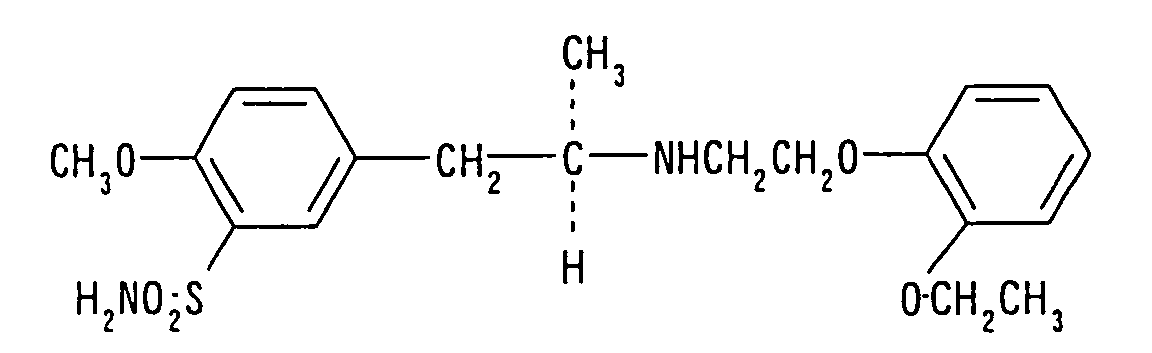
- tamsulosin (R)(-)-5-[2-[[2-(o-ethoxyphenoxy)ethyl]amino]propyl]-2-methoxybenzenesulfonamide and it is represented by the following structural formula. It was first disclosed together with its pharmaceutically acceptable salts in Japanese Kokai Patent No. Sho 56(1981)-110665.
- tamsulosin and its salts have adrenalin ⁇ 1A receptor-blocking activity, in other words, the same hydrochloride (tamsulosin hydrochloride) has the ability to block the ⁇ 1 receptor of the urethra and prostate and therefore is a popular drug for reducing pressure applied to the prostate along the pressure curvature inside the urethra and for improvement of the dysuria that accompanies prostatomegaly.
- Tamsulosin hydrochloride is also a drug that is clinically very useful in that it has been recognized as clinically effective for the treatment of lower urinary tract disorders.
- Tamsulosin and its pharmaceutically acceptable salts can be easily procured by the manufacturing method entered in Japanese Kokai Patents No. Sho 56-110665 and No. Sho 62-114952, or by manufacturing in accordance with this method.
- Tamsulosin can form a pharmaceutically acceptable acid or a base addition salt with a wide variety of inorganic and organic salts and bases. Such salts are also a part of the present invention. Examples are salts of inorganic acids, such as hydrochloric acid, sulfuric acid, and phosphoric acid, salts of organic acids, such as fumaric acid, malic acid, citric acid, and succinic acid, salts of alkali metals, such as sodium and potassium, and salts of alkali earth metals, such as calcium and magnesium. Hydrochlorides are most preferred in the present invention and these salts can be manufactured by conventional methods.
- inorganic acids such as hydrochloric acid, sulfuric acid, and phosphoric acid
- salts of organic acids such as fumaric acid, malic acid, citric acid, and succinic acid
- alkali metals such as sodium and potassium
- alkali earth metals such as calcium and magnesium.
- Hydrochlorides are most preferred in the present invention and these salts can be manufactured
- the amount of drug that is added is usually selected as needed and used as needed based on the type of drug and medical use (indications), and there are no special restrictions as long as it is the amount that is effective in terms of treatment or prevention.
- a drug that is effective in very small doses (low-dose drug) is particularly preferred because the desired effects of the present invention are even better.
- uniformity of content can even be accomplished with drugs that are effective in high doses (high-dose drugs), and therefore, there are no particular restrictions to the amount of drug that is added. This amount that is added is illustrated later using a hydrogel sustained-release pharmaceutical preparation.
- tamsulosin is preferably 85 wt% or less, more preferably 80 wt% or less, further preferably 50 wt%, and more further preferably 10 wt% or less, of the total pharmaceutical preparation. It is 1 wt% or less when the drug is tamsulosin.
- the dose of tamsulosin or its pharmaceutically acceptable salt is determined as needed in accordance with the individual case taking into consideration the route of administration, the symptoms of the illness, the age and sex of the administration subject, and the like.
- the dose of tamsulosin hydrochloride is normally approximately 0.1 mg to 1.6 mg/day of active ingredient to one adult by oral administration and this is administered orally once a day.
- polyethylene oxide Also PEO hereafter
- Also PEO polyethylene oxide
- POLYOX® WSR-303 viscosity-average molecular weight of 7,000,000, viscosity of 7,500 to 10,000 mPa ⁇ s (millipascal second: in an aqueous 1% W/V solution at 25°C
- POLYOX® WSR Coagulant viscosity-average molecular weight of 5,000,000, viscosity of 5,500 to 7,500 mPa ⁇ s (in an aqueous 1% W/V solution at 25°C)
- POLYOX® WSR-301 viscosity-average molecular weight of 4,000,000, viscosity of 1,650 to 5,500 mPa ⁇ s (in an aqueous 1% W/V solution at 25°C)
- POLYOX® WSR-303 viscosity-average molecular weight of 7,000,000, viscosity of 7,500 to 10,000 mPa ⁇ s (millipascal second: in an a
- PEO with a high viscosity at the time of gelling or with a high viscosity-average molecular weight is preferred.
- PEO with a viscosity of 2,000 mPa ⁇ s or higher in an aqueous 2% solution (25°C) or with a viscosity-average molecular weight of 2,000,000 to 10,000,000 is preferred.
- PEO with a viscosity-average molecular weight of 4,000,000 to 10,000,000 is further preferred and that with a viscosity-average molecular weight of 5,000,000 to 10,000,000 is more further preferred.
- PEO with a viscosity-average molecular weight of 7,000,000 (for instance, POLYOX® WSR-303) is optimal.
- One or a combination of two or more PEO of different molecular weights, grades, and the like can be used.
- the amount of polyethylene oxide added is preferably 70 mg or more, further preferably 100 mg or more, more further preferably 150 mg or more, per 1 unit of the pharmaceutical preparation. If the drug is tamsulosin hydrochloride, the amount of PEO added is preferably 100 mg to 300 mg, further preferably 150 mg to 250 mg, more further preferably 200 mg.
- a controlled-release pharmaceutical preparation that is manufactured using this amount of PEO with a viscosity-average molecular weight of 7,000,000 (for instance, PEO with the brand name POLYOX WSR-303) from among the above-mentioned types of PEO will provide marked effects as a controlled-release pharmaceutical preparation.
- the size controlling agent for polyethylene oxide that is used in the present invention as long as it is powder particles that are suitable for tableting PEO of a high viscosity with an aqueous system.
- This size controlling agent is a substance having the appropriate plasticity and binding ability. Solid polyethylene glycol (PEG hereafter), low viscosity grades of hydroxypropylmethyl cellulose (HPMC hereafter), hydroxypropyl cellulose (HPC hereafter), and methyl cellulose (MC hereafter), and the like are given as this size controlling agent.
- This size controlling agent can be used dissolved and/or suspended in water.
- PEG that is solid at ordinary temperature is preferred as the PEG.
- Macrogol 4000 Japanese Pharmacopoiea, molecular weight of 2,600 to 3,800, brand name: Macrogol 4000/Sanyo Chemical Industries, Ltd., NOF Corporation, Lion Corporation, and the like
- Macrogol 6000 Japanese Pharmaceopoiea, molecular weight of 7,300 to 9,300, brand name: Macrogol 6000/Sanyo Chemical Industries, Ltd., NOF Corporation, Lion Corporation, and the like
- Macrogol 20000 Japan Pharmacopoeia, molecular weight of 15,000 to 25,000, brand name: Macrogol 20000 (Sanyo Chemical Industries, Ltd., NOF Corporation, Lion Corporation, and the like)
- polyethylene glycol 8000 USP/NF, molecular weight of 7,000 to 9,000, brand name: Polyethylene glycol 8000/The Dow Chemical Company, and the like
- Low-viscosity grades of HPCM viscosity of 2 to 15 mPa ⁇ s, aqueous 2% W/V solution, 20 °C are preferred.
- the brand names of TC-5E viscosity of 3 mPa ⁇ s, aqueous 2% W/V solution, 20°C, Shin-Etsu Chemical Co., Ltd.
- TC-5R viscosity of 6 mPa ⁇ s, aqueous 2% W/V solution, 20°C, Shin-Etsu Chemical Co., Ltd.
- TC-5S viscosity of 15 mPa ⁇ s, aqueous 2% W/V solution, 20°C, Shin-Etsu Chemical Co., Ltd.
- Methocel E3 viscosity of 3 mPa ⁇ s, aqueous 2% W/V solution, 20°C, The Dow Chemical Company
- Methocel E5 viscosity of 5 mPa ⁇ s, aqueous 2% W/
- HPC-SSL viscosity of 3.0 to 5.9 mPa ⁇ s, aqueous 2%W/V solution, 20°C, Nippon Soda Co., Ltd.
- HPC-SL viscosity of 2.0 to 2.9 mPa ⁇ s, aqueous 2% W/V solutoin, 20°C, Nippon Soda Co., Ltd.
- HPC-L viscosity of 6.0 to 10.0 mPa ⁇ s, aqueous 2% W/V solution, 20°C, Nippon Soda Co., Ltd.
- Low viscosity grades (viscosity of 2 to 15 mPa ⁇ s, aqueous 2% W/V solution, 20°C) are preferred as the MC.
- the brand name of Methocel A15-LV (viscosity of 15 mPa ⁇ s, aqueous 2% W/V solution, 20°C, The Dow Chemical Company), Metolose SM4 (viscosity of 4 mPa ⁇ s, aqueous 2% W/V solution, 20°C, Shin-Etsu Chemical Co., Ltd.), Metolose SM15 (viscosity of 15 mPa ⁇ s, aqueous 2% W/V soluition, 20°C, Shin-Etsu Chemical Co., Ltd.), and the like are specifically given.
- PEG and/or HPMC are further preferred as the size controlling agent for polyethylene oxide, and PEG is the ideal size controlling agent of the present invention, even if added in powder form.
- PEG is the ideal size controlling agent of the present invention, even if added in powder form.
- One or a combination of two or more size controlling agents of the present invention can be used.
- the method whereby water or an aqueous solution containing a binder is sprayed after physical mixing, the method whereby an aqueous solution containing a size controlling agent is sprayed, and the like are given as the state in which the size controlling agent is used.
- the amount of size controlling agent for polyethylene oxide that is used as long as it is the amount that can size PEO with an aqueous system. It is usually 0.5 to 60 wt% per unit of pharmaceutical preparation.
- the amount is preferably 0.5 to 3 wt%, further preferably 1 to 2 wt%, per unit of pharmaceutical preparation.
- the amount is preferably 0.5 to 3 wt%, further preferably 1 to 2 wt%, per unit of pharmaceutical preparation.
- the amount is preferably 5 to 60 wt%, further preferably 10 to 30 wt%.
- the amount of substance other than PEG as the size controlling agent that is used in the form of an aqueous solution is small when compared to the amount that is usually used as a binder (3 to 5 wt%). If less than 0.5 wt% is used, there will be problems in that the desired sizing will not be performed and there will be a large amount of fine powder, there will be a reduction in uniformity of drug content, a powder of poor fluidity will further be produced, and the like.
- the amount is more than 3 wt%, granulation will proceed to too great an extent and as a result, fluidity of the powder will decrease, the powder will be too large, re-pulverizing after drying will be necessary, and the like and as a result, there is concern that problems will remain with uniformity of drug content.
- the controlled-release pharmaceutical composition of the present invention is a pharmaceutical composition, particularly a pharmaceutical preparation, with which release of the drug is controlled.
- the hydrogel sustained-release pharmaceutical preparation in International Publication Pamphlet No. 94/06414 is an example of this controlled-release pharmaceutical composition (particularly a controlled-release pharmaceutical preparation).
- the above-mentioned hydrogel sustained-release pharmaceutical preparation consists of a drug, a gelation enhancer with a specific solubility (hydrophilic base), and PEO of a specific molecular weight as the basic structural components.
- PEO is used as the controlled-release pharmaceutical preparation, yellow ferric oxide and/or red ferric oxide are added as PEO stabilizers, as entered in International Publication Pamphlet No.
- the mechanism of drug release is as entered in International Publication Pamphlet No. 94/06414 with any pharmaceutical preparation. That is, the controlled-release pharmaceutical preparation absorbs water during its stay in the upper digestive tract to undergo substantially complete gelation (70% or higher, preferably 80% or higher) and then it moves to the lower digestive tract as the surface of the pharmaceutical preparation is eroded and drug continues to be released with erosion. Therefore, good and continuous release and absorption of the drug are performed, even in the colon with a small water content.
- the controlled-release pharmaceutical composition or hydrogel sustained-release pharmaceutical preparation can also contain pharmaceutical fillers as needed.
- the controlled-release pharmaceutical preparation of the present invention further contains a hydrophilic base
- a hydrophilic base there are no special restrictions to the hydrophilic base (gelation enhancer) required in the present invention as long as it can be dissolved before the PEO that is required in the present invention gels.
- the amount of water needed to dissolve 1 g of this hydrophilic base is preferably 5 ml or less (20 ⁇ 5°C), further preferably 4 ml or less (same temperature).
- Hydrophilic polymers such as polyethylene glycol (for instance, Macrogol 400, Macrogol 1500, Macrogol 4000, Macrogol 6000, and Macrogol 20000 (all manufactured by NOF Corporation)) and polyvinyl pyrrolidone (for instance, PVP® K30 (BASF)), sugar alcohols such as D-sorbitol and xylitol, saccharides such as sucrose, maltose, lactulose, D-fructose, dextran (for instance, Dextran 40), and glucose, surfactants such as polyoxyethylene-hydrogenated castor oil (for instance, Cremophor® RH40 (BASF), HCO-40, HCO-60 (Nikko Chemicals), polyoxyethylene polyoxypropylene glycol (for instance, Pluronic® F68 (Asahi Denka Co., Ltd.) and polyoxyethylene sorbitan higher fatty acid esters (for instance, Tween 80 (Kanto Kagaku Co., Ltd.), salts
- Polyethylene glycol, sucrose, and polyvinyl pyrrolidone are preferred and polyethylene glycol (particularly Macrogol 6000 and Macrogol 8000) are further preferred.
- polyethylene glycol particularly Macrogol 6000 and Macrogol 8000
- One or a combination of two or more hydrophilic bases can be used in the present invention.
- the amount of hydrophilic base (gelation enhancer) that is used is preferably 5 to 80 wt% per total pharmaceutical preparation, further preferably 5 to 60 wt% per total pharmaceutical preparation. Furthermore, when the gelation enhancer serves as what is called a size controlling agent in the present invention, the amount of gelation enhancer is calculated as the combined amount.
- yellow ferric oxide and/or red ferric oxide is added as the PEO stabilizer to the controlled-release pharmaceutical preparation of the present invention (USPS No. 9,629,405 (refer to corresponding International Patent Publication Pamphlet No. 01/10466)).
- the amount of this stabilizer is preferably 1 to 20 wt%, further preferably 3 to 15 wt%, per total mount of pharmaceutical preparation when it is a physical mixture in a matrix.
- the amount of red ferric oxide is preferably 5 to 20 wt%, further preferably 10 to 15 wt%, per total amount of pharmaceutical preparation.
- the amount of yellow ferric oxide is preferably 1 to 20 wt%, further preferably 3 to 10 wt%.
- the amount When added with a film coating, the amount is preferably 0.3 to 2%, further preferably 0.5 to 1.5%, per tablet weight.
- the concentration of yellow ferric oxide or red ferric oxide that is present in the film in this case is preferably 5 to 50%, further preferably 10 to 20%.
- the "physical mixture in a matrix" used here is defined as a means with which, for instance, drug, polyethylene oxide and the above-mentioned ferric oxide are uniformly dispersed so that the drug and the above-mentioned ferric oxide are uniformly dispersed in the PEO that becomes the main base of the controlled-release pharmaceutical preparation.
- the "film coating" here is defined as for instance, dissolution or suspension of the above-mentioned ferric oxide in a water-soluble polymer solution such as hydroxypropyl methyl cellulose and coating tablets that have been separately prepared with this in the form of a thin film.
- the yellow ferric oxide and/or red ferric oxide of the present invention can usually be found anywhere in the pharmaceutical preparation.
- the yellow ferric oxide and/or red ferric oxide can be present in the film of film coating, in the granulation product of granulation, or in the matrix (for instance, near the polyethylene oxide).
- a variety of pharmaceutical fillers are further used as needed with the controlled-release pharmaceutical composition of the present invention to make a pharmaceutical preparation.
- these drug fillers There are no special restrictions to these drug fillers as long as they are pharmaceutically and pharmacologically acceptable.
- binders disintegrating agents, sour flavorings, foaming agents, artificial sweeteners, fragrances, lubricants, coloring agents, stabilizers, buffer agents, and antioxidants are used. Hydroxypropylmethyl cellulose, hydroxypropyl cellulose, polyvinyl alcohol, methyl cellulose, hydroxypropyl cellulose, polyvinyl alcohol, methyl cellulose, and gum arabic are examples of binders.
- Corn starch, starches, carmellose calcium, carmellose sodium, and hydroxypropyl cellulose with a low degree of substitution are examples of the disintegrating agent.
- Citric acid, tartaric acid, and malic acid are examples of the sour flavoring.
- Sodium bicarbonate is an example of the foaming agent.
- Saccharin sodium, dispotassium glycyrrhizinate, aspartame, stevia, and somatin are examples of artificial sweeteners.
- Lemon, lemon lime, orange, and menthol are examples of fragrances.
- Magnesium stearate, calcium stearate, sucrose fatty acid ester, polyethylene glycol, talc, and stearic acid are examples of lubricants.
- Yellow ferric oxide, red ferric oxide, yellow food colorings No. 4 and No. 5, red food colorings No. 3 and No. 102, and blue food coloring No. 3 are examples of coloring agents. It is confirmed that yellow ferric oxide and red ferric oxide have a particularly marked photostabilizing effect on tamsulosin hydrochloride when used in controlled-release pharmaceutical preparations to which tamsulosin hydrochloride have been added, and these coloring agents are also given as photostabilizers.
- the amount of coloring agent is usually a trace (a trace to 0.1 wt%).
- the amount when added as the stabilizer, there are no special restrictions to the amount as long as it usually provides stabilizing effects as a photostabilizer, but it is normally 0.1 to 2 wt%, preferably 0.5 to 1 wt%.
- Citric acid, succinic acid, fumaric acid, tartaric acid, ascorbic acid and their salts, glutamic acid, glutamine, glycine, aspartic acid, alanine, arginine, and their salts, magnesium oxide, zinc oxide, magnesium hydroxide, phosphoric acid, boric acid and their salts, and the like are given as buffer agents.
- Ascorbic acid, dibutyl hydroxytolueme and propyl gallate are given as examples of antioxidants.
- Appropriate amounts of one or a combinate of two or more pharmaceutical fillers can be added as needed
- a hammer mill, ball mill, jet pulverization device, and colloid mill are examples of the pulverization device. There are no special restrictions to the pulverization conditions as long as they are selected as needed. For instance, in the case of the hammer mill, punch diameter of the screen is usually 0.5 to 5 mm, preferably 0.8 to 2 mm. The powder feed speed is usually 50 to 500 g/minute, preferably 100 to 200 g/minute.
- a V-type mixer, ribbon mixer, container mixer, and high-shear agitating mixer are examples of the mixing device. There are no special restrictions to the mixing conditions as long as they are selected as needed.
- the rotating speed is usually 10 to 40 rpm, preferably 20 to 30 rpm. It is preferred that each component is pre-mixed using a sieve of, for instance, 42 mesh (opening of 355 ⁇ m) for pulverization pre-treatment of each component.
- the magnetic stirrer and propeller mixer are examples of the suspending (dissolving) device.
- concentration of the size controlling agent solution is usually 1 to 50% W/W, preferably 2 to 30% W/W.
- PEG it is 1 to 50% W/W, preferably 5 to 30% W/W.
- HPMC it is 1 to 20% W/W, preferably 2 to 10% W/W.
- HPC it is 1 to 20% W/W, preferably 2 to 10% W/W.
- MC it is 1 to 20% W/W, preferably 2 to 10% W/W.
- Examples of the spraying device are the high-shear agitation granulation method, crushing (pulverization) granulation method, fluidized bed granulation method, extrusion granulation method, tumbling granulation method, and spray granulation method, or device for by using its method thereof.
- the fluidized bed granulation method or device is preferred and the tumbling fluidized bed granulation or device is particularly preferred because it is possible to easily and uniformly mix a low-dose drug and hydrophilic base with PEO of a high viscosity.
- the sizing device examples include the fluidized bed granulator (for instance, the flow coater, Freund Industry Co., Ltd., the GPCG, Glatt Co., Ltd.), a granulation and coating device equipped with a horizontal rotating disc having a flat powder contact part (for instance, a centrifugal fluidization and granulator (for instance, the CF granulator of Freund Industry Co., Ltd.), and a granulation and coating device having an aeration part and wherein a rotating disk with a flat surface is placed at the bottom of the fluidized bed (for instance, the spiral flow or flow coater with rotor container, both made by Freund Industry Co., Ltd.).
- the fluidized bed granulator for instance, the flow coater, Freund Industry Co., Ltd., the GPCG, Glatt Co., Ltd.
- a granulation and coating device equipped with a horizontal rotating disc having a flat powder contact part for instance, a centrifugal fluidization and granulator (for instance,
- the temperature of the powder during sizing is 20°C to the melting point of PEO (62 to 67°C), preferably 20°C to 50°C, further preferably 20°C to 35°C, ideally 25°C to 30°C.
- the drying device are the fluidized bed granulator (for instance, the flow coater, Freund Industry Co., Ltd., the GPCG, Glatt Co., Ltd.), a granulation and coating device equipped with a horizontal rotating disc having a flat powder contact part (for instance, a centrifugal fluidization and granulator (for instance, the CF granulator of Freund Industry Co., Ltd.), and a granulation and coating device having an aeration part and wherein a rotating disk with a flat surface is placed at the bottom of the fluidized bed (for instance, the spiral flow or flow coater with rotor container, both made by Freund Industry Co., Ltd.).
- the fluidized bed granulator for instance, the flow coater, Freund Industry Co., Ltd., the GPCG, Glatt Co., Ltd.
- a granulation and coating device equipped with a horizontal rotating disc having a flat powder contact part for instance, a centrifugal fluidization and granulator (for instance, the CF
- drying conditions There are no special restrictions to the drying conditions as long as they are conditions under which a sized article will usually dry in the fluidized bed. For instance, when drying inlet temperature is set at 50° and drying is performed until the sized article temperature becomes 40°C, drying of the sized article is almost complete.
- the aeration drying method and reduced pressure drying method can also be used as the drying method.
- the powder particles (sized product) that are obtained can be evaluated by the following methods:
- the “average particle diameter” means the cumulative 50% average particle diameter.
- the average particle diameter can be determined with an automatic particle diameter distribution determination device (brand name: Robot Sifter, Seishin Enterprise Co., Ltd.), and the like. Usually it is approximately 50 to 500 ⁇ m, preferably approximately 60 to 300 ⁇ m, further preferably 80 to 200 ⁇ m.
- the “amount of very fine powder” means the amount of particles that are 75 ⁇ m or smaller.
- Particle size can be determined with an automatic particle diameter distribution determination device (brand name: Robot Sifter, Seishin Enterprise Co., Ltd.), and the like.
- the amount of particles that are 75 ⁇ m or smaller is preferably 20% or less, further preferably 15% or less.
- a specific amount of sample is placed on a 20 mesh sieve and continuously allowed to fall naturally through a funnel into a receptacle with an inner capacity of 100 ml while being vibrated. After the pile of sample is scraped off of the receptacle with a flat metal plate, the mass of the receptacle into which the sample has been introduced is weighed and specific volume is calculated. It is preferably 1.5 to 3.5 mL/g, further preferably 2.0 to 3.0 mL/g.
- the "angle of repose" is found by allowing a specific amount of sample to continuously fall onto a disc-shaped determination table as it is vibrated until the sample begins to spill from the edge of the table, forming a cone-shaped pile, and reading the angle of inclination of this pile with a protractor.
- the angle of repose is preferably 45° or smaller, further preferably 42° or smaller.
- a specific amount of sample is placed on a 20 mesh sieve and continuously allowed to fall naturally through a funnel into a receptacle with an inner capacity of 100 ml while being vibrated. After the pile of sample is scraped off of the receptacle with a flat metal plate, the mass of the receptacle into which the sample has been introduced is weighed and minimum apparent density is calculated. A top vessel is further attached and excess powder is added and tapped with a vibrator. The top vessel is removed and the pile of sample is scraped off of the receptacle with a flat metal plate.
- Examples of the tableting device are rotary tablet machine (for instance HT P-22, Hata Iron Works, Ltd.) and a single tablet machine (for instance, KM-2, Okada Seiko Co., Ltd.).
- Examples of the tableting conditions are 20 to 30 rpm as the number of rotations of the turn table and a tableting pressure of 200 to 600 kgf/punch.
- the sized product itself or tablets, fine particles, granules, capsules of sized product packed in, for instance, gelatin hard capsules, that are made by conventional methods, and the like are given as the pharmaceutical composition (pharmaceutical preparation).
- pharmaceutical composition pharmaceutical preparation
- the examples of the present invention include an example in which the composition does not comprise a drug
- this example is one where a very small dose of drug is used in the pharmaceutical preparation of the present invention, that is, a trace of drug (a trace dose that is effective in terms of treating or preventing disease) that is so small that it will not affect the properties of the PEO sized product is used in the pharmaceutical preparation of the present invention.
- the sized product of the present invention was obtained by the method in Example 1 using 2 parts of Macrogol 60000 and 38 parts of water.
- the sized product of the present invention was obtained by the same manufacturing method as in Example 1 with the PEG being changed to HPMC (6 mPa ⁇ s) as the binder.
- a comparative example sized product was obtained by the same method as in Example 1 using water (Comparative Example 1), PVP (Comparative Example 2), sorbitol (Comparative Example 3), and Tween 80 (Comparative Example 4) as the size controlling agent.
- the properties of the sized products are shown in Table 1.
- Example 1 Example 2 Example 3 Comparative Example 1 Comparative Example 2 Comparative Example 3 Comparative Example 4 Reference 1 Size controlling agent PEG PEG HPMC None (water) PVP Sorbitol Tween80 Commercial unsized product Weight ratio (%) to PEO 1.0 0.5 1.0 None 1.0 1.0 1.0 Liquid concentration (%) 10 5 10 10 10 10 10 10 Average particle diameter (%) 136 142 134 176 201 110 114 122 Amount of fine powder (%) ( ⁇ 75 ⁇ m) 13.3 11.2 14.6 2.8 0.2 37.7 26.6 21.0 Specific volume (mL/g) 2.72 2.92 2.75 3.42 3.19 2.42 2.26 2.27 Angle of repose (°) 40 39 37 40 42 39 38 39 Degree of compression (%) 8.0 12.5 10.6 20.2 15.2 7.0 10.5 11.4
- the amount of fine powder of 75 ⁇ m or smaller increased to 38% and 27% with aqueous sorbitol and aqueous polysorbate solutions, respectively. Particles that had been broken down into fine particles were observed in the electron micrographs (electron micrographs were not appended).
- Fine powder of the appropriate size that contained 13% and 15% of fine powder of 75 ⁇ m or smaller was granulated using aqueous solutions of PEG and HPMC, respectively, without increasing the average particle diameter. Fluidity was also improved over that of the original PEO particles with the degree of compression being 7.7% and 10.6%, respectively. A reduction in fine particles and the formation of particles with a smooth surface of 100 to 200 ⁇ m was observed in electron micrographs (electron micrographs were not appended).
- Granulation usually means a series of unit processes by which particle growth is promoted and decreases fine powder in order to eliminate the problems of adhesion to the punch and scattering of powder during tableting.
- Sorbitol and polysorbate have a high plasticity and poor binding force and therefore, when they are used as a PEO size controlling agent, it is thought that the PEO particles that have been broken down by spraying with an aqueous solution do not re-bind during drying and cannot be sized.
- PVP is used as the PEO size controlling agent, there is a reduction in fine powder, but a powder of high specific volume and poor fluidity is produced and there are problems in terms of the above-mentioned tableting osbstruction and weight uniformity. Therefore, PVP is undesirable.
- PVP has poor plasticity and strong binding force and therefore, when used as a PEO size controlling agent, it is thought the PEO particles that have been broken down into fine particles dry, and granulation to larger particles proceeds.
- PEG or HPMC is used as the PEO size controlling agent, there is a reduction in the amount of fine powder and a sized product of good fluidity is obtained.
- PEG and HPMC have the appropriate plasticity and binding force and therefore, it appears that when they are used as a PEO size controlling agent, it is possible that fine PEO particles that have been broken down re-bind and dry in a state of good fluidity and with a smooth surface.
- Blending uniformity of the drug in the sized product was good with drug content being 97.3% at a standard deviation of 1.2%.
- this mixture was made tableted at a tablet weight of 241.6 mg under a tableting pressure of 400 kgf/punch from a 9 mm ⁇ punch using a rotary tablet machine (HT P-22, Hata Iron Works, Ltd.) to obtain the controlled-release pharmaceutical preparation (tablets) of the present invention.
- the tablets that were obtained had few variations with standard deviation of weight being 0.2%.
- Blending uniformity of the drug in the sized product was good with drug content being 97.7% at a standard deviation of 0.7%.
- this mixture was made tableted at a tablet weight of 181.3 mg under a tableting pressure of 400 kgf/punch from a 7.5 mm ⁇ punch using a rotary tablet machine (HT P-22, Hata Iron Works, Ltd.) to obtain the controlled-release pharmaceutical preparation (tablets) of the present invention.
- the tablets that were obtained had few variations with standard deviation of weight being 0.4%.
- this mixture was made tableted at a tablet weight of 242.4 mg under a tableting pressure of 400 kgf/punch from a 9 mm ⁇ punch using a rotary tablet machine (HT P-22, Hata Iron Works, Ltd.) to obtain the controlled-release pharmaceutical preparation (tablets) of the present invention.
- the tablets that were obtained had few variations with standard deviation of weight being 0.6%, and uniformity of content was also good at a standard deviation of 1.0%.
- the tablets were further spray coated with a liquid in which 5.04 parts of hydroxypropylmethyl cellulose (TC-5R, Shin-Etsu Chemical Co., Ltd.), 0.95 part of Macrogol 6000, and 1.26 parts of yellow ferric oxide had been dissolved/dispersed at an inlet temperature of 60°C, pan rotating speed of 13 rpm, and coating liquid feed speed of 5 g/minute using an aeration-type coating device (Hi-Coater HCT-30, Freund Industry Co., Ltd.) until the coating component was 3% of the tablet weight to obtain the controlled-release pharmaceutical preparation (film-coated tablets) of the present invention.
- aeration-type coating device Hi-Coater HCT-30, Freund Industry Co., Ltd.
- tamsulosin hydrochloride 1.2 parts were dissolved in 148.8 parts of water to prepare the spraying liquid.
- 60 parts of Macrogol 6000 and 300 parts of PEO POLYOX®-WSR, The Dow Chemical Company
- sizing was performed by spraying the above-mentioned spraying liquid at an inlet temperature of 30°C, spraying speed of 5 g/minute and spray/dry cycle of 20 seconds/40 seconds.
- the sized product was dried for 30 minutes at an inlet temperature of 40°C to obtain the sized product of the present invention.
- the sized product had an average particle diameter of 108 ⁇ m, a specific volume of 2.66 mL/g, and angle of repose of 40°.
- this mixture was made tableted at a tablet weight of 121 mg under a tableting pressure of 400 kgf/punch from a 7.0 mm ⁇ punch using a rotary tablet machine (HT P-22, Hata Iron Works, Ltd.) to obtain the controlled-release pharmaceutical preparation (tablets) of the present invention.
- the tablets that were obtained had few variations with standard deviation of weight being 0.6%.
- the drug content of the tablets was 97.8% and uniformity of content was good at a standard deviation of 1.4%.
- hydroxypropylmethyl cellulose (6 mPa ⁇ s) were mixed and dissolved in 18.0 parts of water using a magnetic stirrer. Then 0.8 part of tamsulosin hydrochloride that had been pre-pulverized with a hammer mill (Sample Mill AP-S, using 1 mm screen, Hosokawa Micron Corporation) was suspended (partially dissolved) in this liquid while mixing with a magnetic stirrer to prepare the spraying liquid.
- this mixture was made tableted at a tablet weight of 242 mg under a tableting pressure of 400 kgf/punch from a 9 mm ⁇ punch using a rotary tablet machine (HT P-22, Hata Iron Works, Ltd.) to obtain the controlled-release pharmaceutical preparation (tablets) of the present invention.
- the tablets that were obtained had few variations with standard deviation of weight being 0.6%, and uniformity of content was also good at a standard deviation of 1.8%.
- the present invention presents a controlled-release pharmaceutical composition containing a sized product, which contains a drug, polyethylene oxide of high viscosity and specific PEO size controlling agent and wherein of these three components, at least the size controlling agent is uniformly dispersed in the polyethylene oxide.
- controlled-release pharmaceutical composition for oral use with good uniformity of content, particularly for low-dose drugs, and therefore, it can be used as useful pharmaceutical preparation technology that is extremely popular, particularly for controlled-release pharmaceutical compositions comprising polyethylene oxide of a high viscosity as the controlled-release base.
Landscapes
- Health & Medical Sciences (AREA)
- Chemical & Material Sciences (AREA)
- Life Sciences & Earth Sciences (AREA)
- Medicinal Chemistry (AREA)
- Public Health (AREA)
- Veterinary Medicine (AREA)
- Pharmacology & Pharmacy (AREA)
- Animal Behavior & Ethology (AREA)
- General Health & Medical Sciences (AREA)
- Epidemiology (AREA)
- Engineering & Computer Science (AREA)
- Bioinformatics & Cheminformatics (AREA)
- Inorganic Chemistry (AREA)
- General Chemical & Material Sciences (AREA)
- Organic Chemistry (AREA)
- Nuclear Medicine, Radiotherapy & Molecular Imaging (AREA)
- Chemical Kinetics & Catalysis (AREA)
- Urology & Nephrology (AREA)
- Proteomics, Peptides & Aminoacids (AREA)
- Medicinal Preparation (AREA)
- Pharmaceuticals Containing Other Organic And Inorganic Compounds (AREA)
- Acyclic And Carbocyclic Compounds In Medicinal Compositions (AREA)
Abstract
Description
- T:
- Tapped density
- M:
- Minimum density
| Example 1 | Example 2 | Example 3 | Comparative Example 1 | Comparative Example 2 | Comparative Example 3 | Comparative Example 4 | Reference 1 | |
| Size controlling agent | PEG | PEG | HPMC | None (water) | PVP | Sorbitol | Tween80 | Commercial unsized product |
| Weight ratio (%) to PEO | 1.0 | 0.5 | 1.0 | None | 1.0 | 1.0 | 1.0 | |
| Liquid concentration (%) | 10 | 5 | 10 | 10 | 10 | 10 | 10 | |
| Average particle diameter (%) | 136 | 142 | 134 | 176 | 201 | 110 | 114 | 122 |
| Amount of fine powder (%) (<75 µm) | 13.3 | 11.2 | 14.6 | 2.8 | 0.2 | 37.7 | 26.6 | 21.0 |
| Specific volume (mL/g) | 2.72 | 2.92 | 2.75 | 3.42 | 3.19 | 2.42 | 2.26 | 2.27 |
| Angle of repose (°) | 40 | 39 | 37 | 40 | 42 | 39 | 38 | 39 |
| Degree of compression (%) | 8.0 | 12.5 | 10.6 | 20.2 | 15.2 | 7.0 | 10.5 | 11.4 |
Claims (36)
- A pharmaceutical composition for controlled release comprising a sized product, which comprises (a) a drug, (b) polyethylene oxide with a viscosity-average molecular weight of 2,000,000 or more, and (c) a size controlling agent and wherein of said three components, at least size controlling agent (c) is uniformly dispersed in polyethylene oxide (b).
- A pharmaceutical composition for controlled release according to claim 1, wherein size controlling agent (c) is one or two or more selected from the group consisting of polyethylene glycol that is solid at ordinary temperature, hydroxypropylmethyl cellulose of 2 to 15 mPa·s (2% w/v), hydroxypropylmethyl cellulose of 2 to 10 mPa·s (2% w/v), and methyl cellulose of 2 to 15 mPa·s (2% w/v).
- A pharmaceutical composition for controlled release according to claim 1, wherein the amount of size controlling agent (c) is 0.5 to 60 wt% per polyethylene oxide (b).
- A pharmaceutical composition for controlled release according to claim 1, wherein when polyethylene glycol is selected as size controlling agent (c), the amount is 0.5 to 60 wt% per unit of the pharmaceutical preparation.
- A pharmaceutical composition for controlled release according to claim 1, wherein the amount of polyethylene oxide (b) is 10 to 95 wt% per unit of the pharmaceutical preparation.
- A pharmaceutical composition for controlled release according to claim 1, wherein the amount of polyethylene oxide (b) added is at least 70 mg per unit of the pharmaceutical preparation.
- A pharmaceutical composition for controlled release according to claim 1, wherein viscosity-average molecular weight of polyethylene oxide (b) is 5,000,000 or higher.
- A pharmaceutical composition for controlled release according to claim 1, which further comprises a hydrophilic base.
- A pharmaceutical composition for controlled release according to claim 8, wherein the amount of water required to dissolve 1 g of said base is 5 ml or less (20 ± 5°C).
- A pharmaceutical composition for controlled release according to claim 9, wherein the hydrophilic base is polyethylene glycol, sucrose, or polyvinyl pyrrolidone.
- A pharmaceutical composition for controlled release according to claim 8, wherein the amount of hydrophilic base is 5 to 80 wt% per unit of the pharmaceutical preparation.
- A pharmaceutical composition for controlled release according to claim 1 or 8, which further comprises yellow ferric oxide and/or red ferric oxide.
- A pharmaceutical composition for controlled release according to claim 12, wherein the amount of yellow ferric oxide and/or ferric oxide is 0.3 to 20 wt% per polyethylene oxide.
- A pharmaceutical composition for controlled release according to claim 1, wherein the amount of drug is 85 wt% or less per unit of the pharmaceutical preparation.
- A pharmaceutical composition for controlled release according to claim 14, wherein the amount of drug is 10 wt% or less per unit of the pharmaceutical preparation.
- A pharmaceutical composition for controlled release according to any one of claims 1 through 15, wherein the drug is tamsulosin hydrochloride.
- A pharmaceutical composition for controlled release according to claim 1, which comprises essentially no organic solvent.
- A polyethylene oxide-containing sized product for controlled release pharmaceutical compositions, which contains polyethylene oxide (b) with a viscosity-average molecular weight of 2,000,000 or more and a size controlling agent (c) and wherein at least size controlling agent (c) is uniformly dispersed in polyethylene oxide (b).
- A sized product according to claim 18, wherein (c) a size controlling agent for (b) polyethylene oxide is one or two or more selected from the group consisting of polyethylene glycol that is solid at ordinary temperature, hydroxypropylmethyl cellulose of 2 to 15 mPa·s (2% w/v), hydroxypropylmethyl cellulose of 2 to 10 mPa·s (2% w/v), and methyl cellulose of 2 to 15 mPa·s (2% w/v).
- A sized product according to claim 18, wherein the amount of (c) a size controlling agent for (b) polyethylene oxide is 0.5 to 60 wt% per polyethylene oxide (b).
- A sized product according to claim 18, wherein when polyethylene glycol is selected as (c) a size controlling agent for (b) polyethylene oxide, the amount is 0.5 to 60 wt% per unit of the pharmaceutical preparation.
- A sized product according to claim 18, wherein the amount of polyethylene oxide (b) is 10 to 95 wt% per unit of the pharmaceutical preparation.
- A sized product according to claim 18, wherein the amount of polyethylene oxide (b) added is at least 70 mg per unit of the pharmaceutical preparation.
- A sized product according to claim 18, wherein viscosity-average molecular weight of polyethylene oxide (b) is 5,000,000 or higher.
- A sized product according to claim 18, which further comprises a hydrophilic base.
- A sized product according to claim 25, wherein the amount of water required to dissolve 1 g of said base is 5 ml or less (20 ± 5°C).
- A sized product according to claim 26, wherein the hydrophilic base is polyethylene glycol, sucrose, or polyvinyl pyrrolidone.
- A sized product according to claim 25, wherein the amount of hydrophilic base is 5 to 80 wt% per unit of the pharmaceutical preparation.
- A sized product according to any one of claims 18 to 25, which further comprises yellow ferric oxide and/or red ferric oxide.
- A sized product according to claim 29, wherein the amount of yellow ferric oxide and/or ferric oxide is 0.3 to 20 wt% per polyethylene oxide.
- A sized product according to claim 18, which further comprises a drug.
- A sized product according to claim 18 or 31, wherein the amount of drug is 85 wt% or less per unit of the pharmaceutical preparation.
- A sized product according to claim 32, wherein the amount of drug is 10 wt% or less per unit of the pharmaceutical preparation.
- A sized product according to any one of claims 18 through 33, wherein the drug is tamsulosin hydrochloride.
- A sized product according to claim 18, which comprises essentially no organic solvent.
- A use of a sized product according to any one of claims 18 through 35 as a base for controlled-release preparation.
Applications Claiming Priority (3)
| Application Number | Priority Date | Filing Date | Title |
|---|---|---|---|
| US45304603P | 2003-03-06 | 2003-03-06 | |
| US453046P | 2003-03-06 | ||
| PCT/JP2003/016581 WO2004078212A1 (en) | 2003-03-06 | 2003-12-24 | Medicinal composition for regulating release and process for producing the same |
Publications (3)
| Publication Number | Publication Date |
|---|---|
| EP1523994A1 true EP1523994A1 (en) | 2005-04-20 |
| EP1523994A4 EP1523994A4 (en) | 2011-03-30 |
| EP1523994B1 EP1523994B1 (en) | 2013-10-09 |
Family
ID=32772091
Family Applications (1)
| Application Number | Title | Priority Date | Filing Date |
|---|---|---|---|
| EP03768169.9A Expired - Lifetime EP1523994B1 (en) | 2003-03-06 | 2003-12-24 | Medicinal composition for regulating release and process for producing the same |
Country Status (21)
| Country | Link |
|---|---|
| US (2) | US7442387B2 (en) |
| EP (1) | EP1523994B1 (en) |
| JP (2) | JP3755532B2 (en) |
| KR (1) | KR101061394B1 (en) |
| CN (1) | CN1691965B (en) |
| AR (1) | AR043239A1 (en) |
| AU (1) | AU2003292756B2 (en) |
| BR (1) | BR0311908A (en) |
| CA (1) | CA2490299C (en) |
| CZ (1) | CZ14386U1 (en) |
| DE (1) | DE202004003404U1 (en) |
| ES (1) | ES2432354T3 (en) |
| GB (1) | GB2402063B (en) |
| MX (1) | MXPA04012974A (en) |
| PL (1) | PL209908B1 (en) |
| PT (1) | PT1523994E (en) |
| RU (1) | RU2291711C2 (en) |
| SK (1) | SK4070U (en) |
| TW (1) | TWI307632B (en) |
| WO (1) | WO2004078212A1 (en) |
| ZA (1) | ZA200410386B (en) |
Cited By (31)
| Publication number | Priority date | Publication date | Assignee | Title |
|---|---|---|---|---|
| EP1529526A1 (en) | 2003-11-10 | 2005-05-11 | Yamanouchi Pharmaceutical Co. Ltd. | Sustained-release pharmaceutical compositon |
| EP1568361A2 (en) | 2003-11-10 | 2005-08-31 | Yamanouchi Pharmaceutical Co. Ltd. | Sustained-release pharmaceutical composition containing tamsulosin |
| EP2255793A1 (en) | 2009-05-28 | 2010-12-01 | Krka Tovarna Zdravil, D.D., Novo Mesto | Pharmaceutical composition comprising tamsulosin |
| WO2010136193A1 (en) * | 2009-05-28 | 2010-12-02 | Krka, Tovarna Zdravil, D.D., Novo Mesto | Pharmaceutical composition comprising tamsulosin |
| US8106100B2 (en) | 2005-12-06 | 2012-01-31 | Asahi Kasei Chemicals Corporation | Process for producing tablet by high-speed direct compression |
| EP2394648A4 (en) * | 2009-02-04 | 2012-08-29 | Astellas Pharma Inc | PHARMACEUTICAL COMPOSITION FOR ORAL ADMINISTRATION |
| US9321791B2 (en) | 2002-08-21 | 2016-04-26 | Boehringer Ingelheim International Gmbh | 8-[3-amino-piperidin-1-yl]-xanthines, the preparation thereof and their use as pharmaceutical compositions |
| US9415016B2 (en) | 2008-04-03 | 2016-08-16 | Boehringer Ingelheim International Gmbh | DPP-IV inhibitor combined with a further antidiabetic agent, tablets comprising such formulations, their use and process for their preparation |
| US9457029B2 (en) | 2009-11-27 | 2016-10-04 | Boehringer Ingelheim International Gmbh | Treatment of genotyped diabetic patients with DPP-IV inhibitors such as linagliptin |
| US9486526B2 (en) | 2008-08-06 | 2016-11-08 | Boehringer Ingelheim International Gmbh | Treatment for diabetes in patients inappropriate for metformin therapy |
| US9493462B2 (en) | 2006-05-04 | 2016-11-15 | Boehringer Ingelheim International Gmbh | Polymorphs |
| US9499546B2 (en) | 2004-11-05 | 2016-11-22 | Boehringer Ingelheim International Gmbh | Process for the preparation of chiral 8-(3-aminopiperidin-1-yl)-xanthines |
| US9526728B2 (en) | 2014-02-28 | 2016-12-27 | Boehringer Ingelheim International Gmbh | Medical use of a DPP-4 inhibitor |
| US9526730B2 (en) | 2012-05-14 | 2016-12-27 | Boehringer Ingelheim International Gmbh | Use of a DPP-4 inhibitor in podocytes related disorders and/or nephrotic syndrome |
| US9555001B2 (en) | 2012-03-07 | 2017-01-31 | Boehringer Ingelheim International Gmbh | Pharmaceutical composition and uses thereof |
| US9603851B2 (en) | 2010-05-05 | 2017-03-28 | Boehringer Ingelheim International Gmbh | Combination therapy |
| US9713618B2 (en) | 2012-05-24 | 2017-07-25 | Boehringer Ingelheim International Gmbh | Method for modifying food intake and regulating food preference with a DPP-4 inhibitor |
| US9907789B2 (en) | 2011-10-21 | 2018-03-06 | Takeda Pharmaceutical Company Limited | Sustained-release preparation |
| US20180185291A1 (en) | 2011-03-07 | 2018-07-05 | Boehringer Ingelheim International Gmbh | Pharmaceutical compositions |
| US10080754B2 (en) | 2006-05-04 | 2018-09-25 | Boehringer Ingelheim International Gmbh | Uses of DPP IV inhibitors |
| EP3228331A4 (en) * | 2014-09-18 | 2018-10-17 | Endoclot Plus (Suzhou) Co., Ltd. | Biocompatible hemostatic product and preparation method thereof |
| US10155000B2 (en) | 2016-06-10 | 2018-12-18 | Boehringer Ingelheim International Gmbh | Medical use of pharmaceutical combination or composition |
| US10406172B2 (en) | 2009-02-13 | 2019-09-10 | Boehringer Ingelheim International Gmbh | Pharmaceutical composition, methods for treating and uses thereof |
| US11033552B2 (en) | 2006-05-04 | 2021-06-15 | Boehringer Ingelheim International Gmbh | DPP IV inhibitor formulations |
| US11213615B2 (en) | 2017-02-28 | 2022-01-04 | EndoClot Plus Co.. Ltd | Composition for submucosal injection, reagent combination, and applications thereof |
| WO2022117594A1 (en) | 2020-12-01 | 2022-06-09 | Adamed Pharma S.A. | Orally-administered preparation containing solifenacin and tamsulosin |
| EP3697392B1 (en) | 2017-10-17 | 2023-11-15 | Synthon B.V. | Tablets comprising tamsulosin and solifenacin |
| US11911388B2 (en) | 2008-10-16 | 2024-02-27 | Boehringer Ingelheim International Gmbh | Treatment for diabetes in patients with insufficient glycemic control despite therapy with an oral or non-oral antidiabetic drug |
| US11911387B2 (en) | 2010-11-15 | 2024-02-27 | Boehringer Ingelheim International Gmbh | Vasoprotective and cardioprotective antidiabetic therapy |
| US11998653B2 (en) | 2018-01-12 | 2024-06-04 | Beijing Universal Likang Technology Co., Ltd. | Method for treating active bleeding by sequentially applying a biocompatible hemostatic composition and a sealant composition |
| US12312352B2 (en) | 2012-05-14 | 2025-05-27 | Boehringer Ingelheim International Gmbh | Use of a DPP-4 inhibitor in SIRS and/or sepsis |
Families Citing this family (58)
| Publication number | Priority date | Publication date | Assignee | Title |
|---|---|---|---|---|
| EP2295043A1 (en) | 1999-10-29 | 2011-03-16 | Euro-Celtique S.A. | Controlled release hydrocodone formulations |
| AU2002227383B2 (en) | 2000-10-30 | 2004-07-08 | Euro-Celtique S.A. | Controlled release hydrocodone formulations |
| US7776314B2 (en) | 2002-06-17 | 2010-08-17 | Grunenthal Gmbh | Abuse-proofed dosage system |
| GB0217306D0 (en) * | 2002-07-25 | 2002-09-04 | Novartis Ag | Compositions comprising organic compounds |
| US7442387B2 (en) * | 2003-03-06 | 2008-10-28 | Astellas Pharma Inc. | Pharmaceutical composition for controlled release of active substances and manufacturing method thereof |
| US20060226234A1 (en) * | 2003-06-11 | 2006-10-12 | Kettinger Frederick R | Pharmaceutical dosage forms having overt and covert markings for identification and authentification |
| US20070048228A1 (en) | 2003-08-06 | 2007-03-01 | Elisabeth Arkenau-Maric | Abuse-proofed dosage form |
| DE102005005446A1 (en) | 2005-02-04 | 2006-08-10 | Grünenthal GmbH | Break-resistant dosage forms with sustained release |
| DE10336400A1 (en) | 2003-08-06 | 2005-03-24 | Grünenthal GmbH | Anti-abuse dosage form |
| DE10361596A1 (en) | 2003-12-24 | 2005-09-29 | Grünenthal GmbH | Process for producing an anti-abuse dosage form |
| DE102004032049A1 (en) | 2004-07-01 | 2006-01-19 | Grünenthal GmbH | Anti-abuse, oral dosage form |
| DE102005005449A1 (en) | 2005-02-04 | 2006-08-10 | Grünenthal GmbH | Process for producing an anti-abuse dosage form |
| WO2007131804A1 (en) | 2006-05-17 | 2007-11-22 | Synthon B.V. | Tablet composition with a prolonged release of tamsulosin |
| CN102813635A (en) * | 2006-08-10 | 2012-12-12 | 武田药品工业株式会社 | Pharmaceutical composition |
| DE102007011485A1 (en) | 2007-03-07 | 2008-09-11 | Grünenthal GmbH | Dosage form with more difficult abuse |
| EP2042169A1 (en) * | 2007-09-26 | 2009-04-01 | LEK Pharmaceuticals D.D. | Controlled release tamsulosin hydrochloride tablets and a process of making them |
| TWI454288B (en) | 2008-01-25 | 2014-10-01 | Gruenenthal Chemie | Pharmaceutical dosage form |
| ES2599031T3 (en) | 2008-05-09 | 2017-01-31 | Grünenthal GmbH | Process for the preparation of an intermediate powder formulation and a final solid dosage form using a spray freezing step |
| TWI478712B (en) * | 2008-09-30 | 2015-04-01 | Astellas Pharma Inc | Pharmaceutical composition for modified release |
| US8465770B2 (en) | 2008-12-24 | 2013-06-18 | Synthon Bv | Low dose controlled release tablet |
| BR112012001466A2 (en) | 2009-07-22 | 2020-08-11 | Grünenthal GmbH | counterfeit-resistant dosage form for oxidation-sensitive opioids, their manufacturing process, and packaging |
| ES2534908T3 (en) | 2009-07-22 | 2015-04-30 | Grünenthal GmbH | Hot melt extruded controlled release dosage form |
| CN102106841B (en) * | 2009-12-24 | 2013-01-09 | 杭州康恩贝制药有限公司 | Tamsulosin hydrochloride preparation and preparation method thereof |
| TW201130428A (en) | 2010-01-25 | 2011-09-16 | Japan Tobacco Inc | Method for making flavoring pellets |
| US9579285B2 (en) | 2010-02-03 | 2017-02-28 | Gruenenthal Gmbh | Preparation of a powdery pharmaceutical composition by means of an extruder |
| JP5849946B2 (en) * | 2010-03-29 | 2016-02-03 | アステラス製薬株式会社 | Controlled release pharmaceutical composition |
| ES2665467T3 (en) | 2010-03-29 | 2018-04-25 | Astellas Pharma Inc. | Modified Release Pharmaceutical Composition |
| KR101220829B1 (en) * | 2010-07-16 | 2013-01-10 | 안국약품 주식회사 | Sustained-release tablet containing trimebutine |
| CA2808219C (en) | 2010-09-02 | 2019-05-14 | Gruenenthal Gmbh | Tamper resistant dosage form comprising inorganic salt |
| WO2012028318A1 (en) | 2010-09-02 | 2012-03-08 | Grünenthal GmbH | Tamper resistant dosage form comprising an anionic polymer |
| PL2826467T3 (en) | 2010-12-22 | 2018-01-31 | Purdue Pharma Lp | CLOSED, HANDLING-PROTECTED DOSING FORMS WITH CONTROLLED RELEASE |
| KR102027912B1 (en) | 2011-02-15 | 2019-10-02 | 지엘팜텍주식회사 | An oral sustained-release triple layer tablet comprising tamsulosin or pharmaceutically acceptable salts thereof |
| KR101310099B1 (en) * | 2011-04-13 | 2013-09-23 | 안국약품 주식회사 | Controlled-release tablet containing aceclofenac |
| JP6063462B2 (en) | 2011-07-29 | 2017-01-18 | グリュネンタール・ゲゼルシャフト・ミト・ベシュレンクテル・ハフツング | Tamper-resistant tablets that provide immediate drug release |
| BR112014002022A2 (en) | 2011-07-29 | 2017-02-21 | Gruenenthal Gmbh | tamper-resistant tablet providing immediate drug release |
| BR112014019988A8 (en) | 2012-02-28 | 2017-07-11 | Gruenenthal Gmbh | BREAK-RESISTANT DOSAGE FORM COMPRISING A PHARMACOLOGICALLY ACTIVE COMPOUND AND AN ANIONIC POLYMER |
| LT2838512T (en) | 2012-04-18 | 2018-11-12 | GrĆ¼nenthal GmbH | Tamper resistant and dose-dumping resistant pharmaceutical dosage form |
| US10064945B2 (en) | 2012-05-11 | 2018-09-04 | Gruenenthal Gmbh | Thermoformed, tamper-resistant pharmaceutical dosage form containing zinc |
| CN103565769B (en) * | 2012-07-18 | 2017-08-01 | 石药集团中奇制药技术(石家庄)有限公司 | A kind of Nifedipine controlled-release composition and preparation method thereof |
| CN103565774B (en) * | 2012-08-10 | 2017-11-03 | 石药集团中奇制药技术(石家庄)有限公司 | A kind of Glipizide controlled release composition and preparation method thereof |
| MX2015016254A (en) | 2013-05-29 | 2016-04-20 | Gruenenthal Gmbh | Tamper resistant dosage form with bimodal release profile. |
| AU2014273227B2 (en) | 2013-05-29 | 2019-08-15 | Grunenthal Gmbh | Tamper-resistant dosage form containing one or more particles |
| JP6243642B2 (en) * | 2013-07-02 | 2017-12-06 | 三菱瓦斯化学株式会社 | Dispersion containing pyrroloquinoline quinones |
| AU2014289187B2 (en) | 2013-07-12 | 2019-07-11 | Grunenthal Gmbh | Tamper-resistant dosage form containing ethylene-vinyl acetate polymer |
| HK1224189A1 (en) | 2013-11-26 | 2017-08-18 | Grünenthal GmbH | Preparation of a powdery pharmaceutical composition by means of cryo-milling |
| WO2015173195A1 (en) | 2014-05-12 | 2015-11-19 | Grünenthal GmbH | Tamper resistant immediate release capsule formulation comprising tapentadol |
| US9872835B2 (en) | 2014-05-26 | 2018-01-23 | Grünenthal GmbH | Multiparticles safeguarded against ethanolic dose-dumping |
| US10335374B2 (en) * | 2014-12-04 | 2019-07-02 | University System of Georgia, Valdosta State University | Tablet composition for anti-tuberculosis antibiotics |
| WO2016170097A1 (en) | 2015-04-24 | 2016-10-27 | Grünenthal GmbH | Tamper-resistant dosage form with immediate release and resistance against solvent extraction |
| TWI722988B (en) | 2015-06-05 | 2021-04-01 | 瑩碩生技醫藥股份有限公司 | Slow-release pharmaceutical composition and preparation method thereof |
| CA2998259A1 (en) | 2015-09-10 | 2017-03-16 | Grunenthal Gmbh | Protecting oral overdose with abuse deterrent immediate release formulations |
| KR101937713B1 (en) | 2017-07-14 | 2019-01-14 | 주식회사 대웅제약 | Pharmaceutical formulation and preparation method for the same |
| WO2019013583A2 (en) * | 2017-07-14 | 2019-01-17 | 주식회사 대웅제약 | Pharmaceutical preparation and preparation method therefor |
| WO2021069944A1 (en) * | 2019-10-09 | 2021-04-15 | Alvogen Korea Co., Ltd. | Pharmaceutical composition comprising mirabegron and process for manufacturing the same |
| WO2023145867A1 (en) * | 2022-01-31 | 2023-08-03 | 住友精化株式会社 | Polyalkylene oxide granules for pharmaceutical preparation, composition for pharmaceutical use, pharmaceutical preparation composition, and pharmaceutical preparation |
| CN116509811A (en) * | 2022-10-18 | 2023-08-01 | 燃点(南京)生物医药科技有限公司 | Milobulin besylate sustained release tablet and preparation method thereof |
| WO2024225348A1 (en) * | 2023-04-27 | 2024-10-31 | 住友精化株式会社 | Granulated material and method for producing same, granulated composition, and composition for preparations |
| US12097189B1 (en) | 2024-02-09 | 2024-09-24 | Astellas Pharma Inc. | Pharmaceutical composition for modified release |
Family Cites Families (32)
| Publication number | Priority date | Publication date | Assignee | Title |
|---|---|---|---|---|
| CA1146866A (en) * | 1979-07-05 | 1983-05-24 | Yamanouchi Pharmaceutical Co. Ltd. | Process for the production of sustained release pharmaceutical composition of solid medical material |
| IE52911B1 (en) * | 1981-04-29 | 1988-04-13 | Richardson Vicks Inc | Denture adhesive composition |
| NL8303905A (en) * | 1983-11-15 | 1985-06-03 | Philips Nv | METHOD FOR MANUFACTURING A GEODETIC COMPONENT AND INTEGRATED OPTICAL DEVICE CONTAINING THIS COMPONENT |
| US4629621A (en) * | 1984-07-23 | 1986-12-16 | Zetachron, Inc. | Erodible matrix for sustained release bioactive composition |
| US4662880A (en) * | 1986-03-14 | 1987-05-05 | Alza Corporation | Pseudoephedrine, brompheniramine therapy |
| US4810502A (en) | 1987-02-27 | 1989-03-07 | Alza Corporation | Pseudoephedrine brompheniramine therapy |
| US5004601A (en) * | 1988-10-14 | 1991-04-02 | Zetachron, Inc. | Low-melting moldable pharmaceutical excipient and dosage forms prepared therewith |
| US5273758A (en) * | 1991-03-18 | 1993-12-28 | Sandoz Ltd. | Directly compressible polyethylene oxide vehicle for preparing therapeutic dosage forms |
| ES2124794T3 (en) | 1992-10-09 | 1999-02-16 | Kanegafuchi Chemical Ind | PROCEDURE TO PRODUCE FINE GRANULATES. |
| US5914131A (en) * | 1994-07-07 | 1999-06-22 | Alza Corporation | Hydromorphone therapy |
| US5945125A (en) * | 1995-02-28 | 1999-08-31 | Temple University | Controlled release tablet |
| ATE214596T1 (en) * | 1995-04-14 | 2002-04-15 | Pharma Pass | SOLID COMPOSITIONS CONTAINING A NON-AMORPHOUS ACTIVE SUBSTANCE AND POLYETHYLENE OXIDE |
| US6117453A (en) * | 1995-04-14 | 2000-09-12 | Pharma Pass | Solid compositions containing polyethylene oxide and an active ingredient |
| US6348469B1 (en) * | 1995-04-14 | 2002-02-19 | Pharma Pass Llc | Solid compositions containing glipizide and polyethylene oxide |
| US6048547A (en) * | 1996-04-15 | 2000-04-11 | Seth; Pawan | Process for manufacturing solid compositions containing polyethylene oxide and an active ingredient |
| GB9609432D0 (en) * | 1996-05-04 | 1996-07-10 | Howgate Ian R M | Improved hockey stick |
| PT1014941E (en) * | 1996-06-26 | 2009-07-08 | Univ Texas | Hot-melt extrudable pharmaceutical formulation |
| ATE212550T1 (en) * | 1997-08-01 | 2002-02-15 | Elan Corp Plc | MEDICINAL PREPARATIONS CONTAINING TIAGABINE WITH CONTROLLED ADMINISTRATION OF ACTIVE INGREDIENTS |
| JPH11193230A (en) | 1997-12-26 | 1999-07-21 | Takeda Chem Ind Ltd | Controlled-release preparation |
| JPH11335268A (en) | 1998-05-20 | 1999-12-07 | Kowa Co | Dry coated tablets |
| AU1238500A (en) * | 1998-11-02 | 2000-05-22 | Alza Corporation | Controlled delivery of active agents |
| US6423719B1 (en) * | 1999-02-16 | 2002-07-23 | Upsher-Smith Laboratories, Inc. | Method for treating benign prostate hyperplasia |
| ES2262528T3 (en) * | 1999-08-04 | 2006-12-01 | Astellas Pharma Inc. | STABLE MEDICINAL COMPOSITIONS FOR ORAL ADMINISTRATION THAT USE IRON OXIDES. |
| US6562375B1 (en) * | 1999-08-04 | 2003-05-13 | Yamanouchi Pharmaceuticals, Co., Ltd. | Stable pharmaceutical composition for oral use |
| US6730320B2 (en) * | 2000-02-24 | 2004-05-04 | Advancis Pharmaceutical Corp. | Tetracycline antibiotic product, use and formulation thereof |
| US20020028240A1 (en) * | 2000-04-17 | 2002-03-07 | Toyohiro Sawada | Timed-release compression-coated solid composition for oral administration |
| US6419954B1 (en) * | 2000-05-19 | 2002-07-16 | Yamanouchi Pharmaceutical Co., Ltd. | Tablets and methods for modified release of hydrophilic and other active agents |
| US6488962B1 (en) * | 2000-06-20 | 2002-12-03 | Depomed, Inc. | Tablet shapes to enhance gastric retention of swellable controlled-release oral dosage forms |
| KR100863146B1 (en) * | 2000-07-17 | 2008-10-14 | 아스텔라스세이야쿠 가부시키가이샤 | Oral Absorption Improvement Pharmaceutical Composition |
| AR034517A1 (en) * | 2001-06-21 | 2004-02-25 | Astrazeneca Ab | PHARMACEUTICAL FORMULATION |
| CN100355419C (en) * | 2002-06-07 | 2007-12-19 | 安斯泰来制药有限公司 | Drugs to treat overactive bladder |
| US7442387B2 (en) * | 2003-03-06 | 2008-10-28 | Astellas Pharma Inc. | Pharmaceutical composition for controlled release of active substances and manufacturing method thereof |
-
2003
- 2003-12-23 US US10/746,562 patent/US7442387B2/en not_active Expired - Fee Related
- 2003-12-24 ES ES03768169T patent/ES2432354T3/en not_active Expired - Lifetime
- 2003-12-24 PT PT37681699T patent/PT1523994E/en unknown
- 2003-12-24 MX MXPA04012974A patent/MXPA04012974A/en active IP Right Grant
- 2003-12-24 KR KR1020047019905A patent/KR101061394B1/en not_active Expired - Lifetime
- 2003-12-24 RU RU2004137118/15A patent/RU2291711C2/en not_active IP Right Cessation
- 2003-12-24 GB GB0416309A patent/GB2402063B/en not_active Expired - Lifetime
- 2003-12-24 EP EP03768169.9A patent/EP1523994B1/en not_active Expired - Lifetime
- 2003-12-24 PL PL375153A patent/PL209908B1/en unknown
- 2003-12-24 WO PCT/JP2003/016581 patent/WO2004078212A1/en not_active Ceased
- 2003-12-24 JP JP2004569118A patent/JP3755532B2/en not_active Expired - Lifetime
- 2003-12-24 BR BR0311908-4A patent/BR0311908A/en not_active Application Discontinuation
- 2003-12-24 CA CA002490299A patent/CA2490299C/en not_active Expired - Lifetime
- 2003-12-24 AU AU2003292756A patent/AU2003292756B2/en not_active Ceased
- 2003-12-24 CN CN2003801006908A patent/CN1691965B/en not_active Expired - Fee Related
- 2003-12-30 TW TW092137503A patent/TWI307632B/en not_active IP Right Cessation
-
2004
- 2004-02-20 AR ARP040100527A patent/AR043239A1/en not_active Application Discontinuation
- 2004-02-25 CZ CZ200415118U patent/CZ14386U1/en not_active IP Right Cessation
- 2004-02-27 SK SK45-2004U patent/SK4070U/en unknown
- 2004-03-04 DE DE202004003404U patent/DE202004003404U1/en not_active Expired - Lifetime
- 2004-12-23 ZA ZA200410386A patent/ZA200410386B/en unknown
-
2005
- 2005-03-28 JP JP2005090437A patent/JP4626357B2/en not_active Expired - Lifetime
-
2008
- 2008-10-02 US US12/244,719 patent/US20090035372A1/en not_active Abandoned
Cited By (62)
| Publication number | Priority date | Publication date | Assignee | Title |
|---|---|---|---|---|
| US9556175B2 (en) | 2002-08-21 | 2017-01-31 | Boehringer Ingelheim International Gmbh | 8-[3-amino-piperidin-1-yl]-xanthines, the preparation thereof and thier use as pharmaceutical compositions |
| US10023574B2 (en) | 2002-08-21 | 2018-07-17 | Boehringer Ingelheim International Gmbh | 8-[3-amino-piperidin-1-yl]-xanthines, the preparation thereof and their use as pharmaceutical compositions |
| US10202383B2 (en) | 2002-08-21 | 2019-02-12 | Boehringer Ingelheim International Gmbh | 8-[3-amino-piperidin-1-yl]-xanthines, the preparation thereof and their use as pharmaceutical compositions |
| US9321791B2 (en) | 2002-08-21 | 2016-04-26 | Boehringer Ingelheim International Gmbh | 8-[3-amino-piperidin-1-yl]-xanthines, the preparation thereof and their use as pharmaceutical compositions |
| US8128958B2 (en) | 2003-11-10 | 2012-03-06 | Astellas Pharma Inc. | Sustained release pharmaceutical composition |
| US8197846B2 (en) | 2003-11-10 | 2012-06-12 | Astellas Pharma Inc. | Sustained release pharmaceutical composition |
| EP1529526A1 (en) | 2003-11-10 | 2005-05-11 | Yamanouchi Pharmaceutical Co. Ltd. | Sustained-release pharmaceutical compositon |
| EP1568361A2 (en) | 2003-11-10 | 2005-08-31 | Yamanouchi Pharmaceutical Co. Ltd. | Sustained-release pharmaceutical composition containing tamsulosin |
| US9751855B2 (en) | 2004-11-05 | 2017-09-05 | Boehringer Ingelheim International Gmbh | Process for the preparation of chiral 8-(3-aminopiperidin-1-yl)-xanthines |
| US9499546B2 (en) | 2004-11-05 | 2016-11-22 | Boehringer Ingelheim International Gmbh | Process for the preparation of chiral 8-(3-aminopiperidin-1-yl)-xanthines |
| US8106100B2 (en) | 2005-12-06 | 2012-01-31 | Asahi Kasei Chemicals Corporation | Process for producing tablet by high-speed direct compression |
| US12178819B2 (en) | 2006-05-04 | 2024-12-31 | Boehringer Ingelheim International Gmbh | DPP IV inhibitor formulations |
| US10301313B2 (en) | 2006-05-04 | 2019-05-28 | Boehringer Ingelheim International Gmbh | Polymorphs |
| US12171767B2 (en) | 2006-05-04 | 2024-12-24 | Boehringer Ingelheim International Gmbh | Uses of DPP IV inhibitors |
| US10080754B2 (en) | 2006-05-04 | 2018-09-25 | Boehringer Ingelheim International Gmbh | Uses of DPP IV inhibitors |
| US11033552B2 (en) | 2006-05-04 | 2021-06-15 | Boehringer Ingelheim International Gmbh | DPP IV inhibitor formulations |
| US11084819B2 (en) | 2006-05-04 | 2021-08-10 | Boehringer Ingelheim International Gmbh | Polymorphs |
| US9493462B2 (en) | 2006-05-04 | 2016-11-15 | Boehringer Ingelheim International Gmbh | Polymorphs |
| US11291668B2 (en) | 2006-05-04 | 2022-04-05 | Boehringer Ingelheim International Gmbh | Uses of DPP IV inhibitors |
| US9815837B2 (en) | 2006-05-04 | 2017-11-14 | Boehringer Ingelheim International Gmbh | Polymorphs |
| US11919903B2 (en) | 2006-05-04 | 2024-03-05 | Boehringer Ingelheim International Gmbh | Polymorphs |
| US10022379B2 (en) | 2008-04-03 | 2018-07-17 | Boehringer Ingelheim International Gmbh | DPP-IV inhibitor combined with a further antidiabetic agent, tablets comprising such formulations, their use and process for their preparation |
| US10973827B2 (en) | 2008-04-03 | 2021-04-13 | Boehringer Ingelheim International Gmbh | DPP-IV inhibitor combined with a further antidiabetic agent, tablets comprising such formulations, their use and process for their preparation |
| US9415016B2 (en) | 2008-04-03 | 2016-08-16 | Boehringer Ingelheim International Gmbh | DPP-IV inhibitor combined with a further antidiabetic agent, tablets comprising such formulations, their use and process for their preparation |
| US10034877B2 (en) | 2008-08-06 | 2018-07-31 | Boehringer Ingelheim International Gmbh | Treatment for diabetes in patients inappropriate for metformin therapy |
| US9486526B2 (en) | 2008-08-06 | 2016-11-08 | Boehringer Ingelheim International Gmbh | Treatment for diabetes in patients inappropriate for metformin therapy |
| US11911388B2 (en) | 2008-10-16 | 2024-02-27 | Boehringer Ingelheim International Gmbh | Treatment for diabetes in patients with insufficient glycemic control despite therapy with an oral or non-oral antidiabetic drug |
| EP2394648B1 (en) | 2009-02-04 | 2016-08-31 | Astellas Pharma Inc. | Pharmaceutical composition for oral administration |
| US9198904B2 (en) | 2009-02-04 | 2015-12-01 | Astellas Pharma Inc. | Pharmaceutical composition for oral administration |
| EP2394648A4 (en) * | 2009-02-04 | 2012-08-29 | Astellas Pharma Inc | PHARMACEUTICAL COMPOSITION FOR ORAL ADMINISTRATION |
| AU2010211725C1 (en) * | 2009-02-04 | 2014-10-16 | Astellas Pharma Inc. | Pharmaceutical composition for oral administration |
| AU2010211725B2 (en) * | 2009-02-04 | 2014-04-10 | Astellas Pharma Inc. | Pharmaceutical composition for oral administration |
| US12115179B2 (en) | 2009-02-13 | 2024-10-15 | Boehringer Ingelheim International Gmbh | Pharmaceutical composition, methods for treating and uses thereof |
| US10406172B2 (en) | 2009-02-13 | 2019-09-10 | Boehringer Ingelheim International Gmbh | Pharmaceutical composition, methods for treating and uses thereof |
| EA024365B1 (en) * | 2009-05-28 | 2016-09-30 | Крка, Товарна Здравил, Д.Д., Ново Место | Pharmaceutical composition comprising tamsulosin and process for preparing the same |
| WO2010136193A1 (en) * | 2009-05-28 | 2010-12-02 | Krka, Tovarna Zdravil, D.D., Novo Mesto | Pharmaceutical composition comprising tamsulosin |
| EP2255793A1 (en) | 2009-05-28 | 2010-12-01 | Krka Tovarna Zdravil, D.D., Novo Mesto | Pharmaceutical composition comprising tamsulosin |
| US10092571B2 (en) | 2009-11-27 | 2018-10-09 | Boehringer Ingelheim International Gmbh | Treatment of genotyped diabetic patients with DPP-IV inhibitors such as linagliptin |
| US9457029B2 (en) | 2009-11-27 | 2016-10-04 | Boehringer Ingelheim International Gmbh | Treatment of genotyped diabetic patients with DPP-IV inhibitors such as linagliptin |
| US10004747B2 (en) | 2010-05-05 | 2018-06-26 | Boehringer Ingelheim International Gmbh | Combination therapy |
| US9603851B2 (en) | 2010-05-05 | 2017-03-28 | Boehringer Ingelheim International Gmbh | Combination therapy |
| US11911387B2 (en) | 2010-11-15 | 2024-02-27 | Boehringer Ingelheim International Gmbh | Vasoprotective and cardioprotective antidiabetic therapy |
| US20180185291A1 (en) | 2011-03-07 | 2018-07-05 | Boehringer Ingelheim International Gmbh | Pharmaceutical compositions |
| US10596120B2 (en) | 2011-03-07 | 2020-03-24 | Boehringer Ingelheim International Gmbh | Pharmaceutical compositions |
| US11564886B2 (en) | 2011-03-07 | 2023-01-31 | Boehringer Ingelheim International Gmbh | Pharmaceutical compositions |
| US9907789B2 (en) | 2011-10-21 | 2018-03-06 | Takeda Pharmaceutical Company Limited | Sustained-release preparation |
| US9555001B2 (en) | 2012-03-07 | 2017-01-31 | Boehringer Ingelheim International Gmbh | Pharmaceutical composition and uses thereof |
| US12312352B2 (en) | 2012-05-14 | 2025-05-27 | Boehringer Ingelheim International Gmbh | Use of a DPP-4 inhibitor in SIRS and/or sepsis |
| US10195203B2 (en) | 2012-05-14 | 2019-02-05 | Boehringr Ingelheim International GmbH | Use of a DPP-4 inhibitor in podocytes related disorders and/or nephrotic syndrome |
| US9526730B2 (en) | 2012-05-14 | 2016-12-27 | Boehringer Ingelheim International Gmbh | Use of a DPP-4 inhibitor in podocytes related disorders and/or nephrotic syndrome |
| US9713618B2 (en) | 2012-05-24 | 2017-07-25 | Boehringer Ingelheim International Gmbh | Method for modifying food intake and regulating food preference with a DPP-4 inhibitor |
| US9526728B2 (en) | 2014-02-28 | 2016-12-27 | Boehringer Ingelheim International Gmbh | Medical use of a DPP-4 inhibitor |
| EP3228331A4 (en) * | 2014-09-18 | 2018-10-17 | Endoclot Plus (Suzhou) Co., Ltd. | Biocompatible hemostatic product and preparation method thereof |
| US10314937B2 (en) | 2014-09-18 | 2019-06-11 | Endoclot Plus Co., Ltd. | Biocompatible hemostatic product and preparation method thereof |
| US10155000B2 (en) | 2016-06-10 | 2018-12-18 | Boehringer Ingelheim International Gmbh | Medical use of pharmaceutical combination or composition |
| US12364700B2 (en) | 2016-06-10 | 2025-07-22 | Boehringer Ingelheim International Gmbh | Medical use of pharmaceutical combination or composition |
| US11213615B2 (en) | 2017-02-28 | 2022-01-04 | EndoClot Plus Co.. Ltd | Composition for submucosal injection, reagent combination, and applications thereof |
| EP3697392B1 (en) | 2017-10-17 | 2023-11-15 | Synthon B.V. | Tablets comprising tamsulosin and solifenacin |
| US11998653B2 (en) | 2018-01-12 | 2024-06-04 | Beijing Universal Likang Technology Co., Ltd. | Method for treating active bleeding by sequentially applying a biocompatible hemostatic composition and a sealant composition |
| US12622997B2 (en) | 2018-01-12 | 2026-05-12 | Starch Medical, Inc. | Method for treating active bleeding using biocompatible hemostatic and sealant compositions |
| WO2022117594A1 (en) | 2020-12-01 | 2022-06-09 | Adamed Pharma S.A. | Orally-administered preparation containing solifenacin and tamsulosin |
| EP4512392A2 (en) | 2020-12-01 | 2025-02-26 | Adalvo Limited | Orally-administered preparation containing solifenacin and tamsulosin |
Also Published As
Similar Documents
| Publication | Publication Date | Title |
|---|---|---|
| EP1523994B1 (en) | Medicinal composition for regulating release and process for producing the same | |
| JP7471675B2 (en) | Porous silica particle composition | |
| JP4277904B2 (en) | Timed release particulate pharmaceutical composition for oral administration and intraoral quick disintegrating tablet containing the composition | |
| US6419954B1 (en) | Tablets and methods for modified release of hydrophilic and other active agents | |
| JP6092936B2 (en) | Method for producing orally disintegrating tablets | |
| JPWO1994006414A1 (en) | Hydrogel sustained-release formulation | |
| NO312811B1 (en) | Extended release hydrogel type preparation | |
| CN103402497A (en) | Rapidly dispersing granules, orally disintegrating tablets and methods | |
| US20070269514A1 (en) | Tablet composition with a prolonged release of tamsulosin | |
| CN102933204A (en) | Coated particle and method for producing coated particle | |
| CA2547939A1 (en) | Pharmaceutical composition for controlled release of active substances and the manufacturing method thereof | |
| JP2025090538A (en) | Method for producing granulated material and tablet containing said granulated material | |
| JP2013087056A (en) | Method for producing glossy coated tablet |
Legal Events
| Date | Code | Title | Description |
|---|---|---|---|
| PUAI | Public reference made under article 153(3) epc to a published international application that has entered the european phase |
Free format text: ORIGINAL CODE: 0009012 |
|
| 17P | Request for examination filed |
Effective date: 20040720 |
|
| AK | Designated contracting states |
Kind code of ref document: A1 Designated state(s): AT BE BG CH CY CZ DE DK EE ES FI FR GB GR HU IE IT LI LU MC NL PT RO SE SI SK TR |
|
| AX | Request for extension of the european patent |
Extension state: AL LT LV MK |
|
| RAP1 | Party data changed (applicant data changed or rights of an application transferred) |
Owner name: ASTELLAS PHARMA INC. |
|
| RAX | Requested extension states of the european patent have changed |
Extension state: AL Payment date: 20051005 Extension state: LT Payment date: 20051005 Extension state: LV Payment date: 20051005 Extension state: MK Payment date: 20051005 |
|
| RAP1 | Party data changed (applicant data changed or rights of an application transferred) |
Owner name: ASTELLAS PHARMA INC. |
|
| RAX | Requested extension states of the european patent have changed |
Extension state: LT Payment date: 20051005 Extension state: LV Payment date: 20051005 Extension state: AL Payment date: 20051005 |
|
| A4 | Supplementary search report drawn up and despatched |
Effective date: 20110224 |
|
| 17Q | First examination report despatched |
Effective date: 20110608 |
|
| GRAP | Despatch of communication of intention to grant a patent |
Free format text: ORIGINAL CODE: EPIDOSNIGR1 |
|
| INTG | Intention to grant announced |
Effective date: 20130412 |
|
| GRAS | Grant fee paid |
Free format text: ORIGINAL CODE: EPIDOSNIGR3 |
|
| GRAA | (expected) grant |
Free format text: ORIGINAL CODE: 0009210 |
|
| AK | Designated contracting states |
Kind code of ref document: B1 Designated state(s): AT BE BG CH CY CZ DE DK EE ES FI FR GB GR HU IE IT LI LU MC NL PT RO SE SI SK TR |
|
| AX | Request for extension of the european patent |
Extension state: AL LT LV |
|
| REG | Reference to a national code |
Ref country code: GB Ref legal event code: FG4D |
|
| REG | Reference to a national code |
Ref country code: CH Ref legal event code: NV Representative=s name: BOVARD AG, CH Ref country code: AT Ref legal event code: REF Ref document number: 635278 Country of ref document: AT Kind code of ref document: T Effective date: 20131015 Ref country code: CH Ref legal event code: EP |
|
| REG | Reference to a national code |
Ref country code: IE Ref legal event code: FG4D |
|
| REG | Reference to a national code |
Ref country code: DE Ref legal event code: R096 Ref document number: 60345062 Country of ref document: DE Effective date: 20131128 |
|
| REG | Reference to a national code |
Ref country code: ES Ref legal event code: FG2A Ref document number: 2432354 Country of ref document: ES Kind code of ref document: T3 Effective date: 20131202 |
|
| REG | Reference to a national code |
Ref country code: PT Ref legal event code: SC4A Free format text: AVAILABILITY OF NATIONAL TRANSLATION Effective date: 20131212 |
|
| REG | Reference to a national code |
Ref country code: AT Ref legal event code: MK05 Ref document number: 635278 Country of ref document: AT Kind code of ref document: T Effective date: 20131009 |
|
| REG | Reference to a national code |
Ref country code: NL Ref legal event code: VDEP Effective date: 20131009 |
|
| REG | Reference to a national code |
Ref country code: GR Ref legal event code: EP Ref document number: 20130402414 Country of ref document: GR Effective date: 20140102 |
|
| PG25 | Lapsed in a contracting state [announced via postgrant information from national office to epo] |
Ref country code: SI Free format text: LAPSE BECAUSE OF FAILURE TO SUBMIT A TRANSLATION OF THE DESCRIPTION OR TO PAY THE FEE WITHIN THE PRESCRIBED TIME-LIMIT Effective date: 20131009 |
|
| REG | Reference to a national code |
Ref country code: LT Ref legal event code: MG9D |
|
| PG25 | Lapsed in a contracting state [announced via postgrant information from national office to epo] |
Ref country code: NL Free format text: LAPSE BECAUSE OF FAILURE TO SUBMIT A TRANSLATION OF THE DESCRIPTION OR TO PAY THE FEE WITHIN THE PRESCRIBED TIME-LIMIT Effective date: 20131009 Ref country code: BE Free format text: LAPSE BECAUSE OF FAILURE TO SUBMIT A TRANSLATION OF THE DESCRIPTION OR TO PAY THE FEE WITHIN THE PRESCRIBED TIME-LIMIT Effective date: 20131009 Ref country code: FI Free format text: LAPSE BECAUSE OF FAILURE TO SUBMIT A TRANSLATION OF THE DESCRIPTION OR TO PAY THE FEE WITHIN THE PRESCRIBED TIME-LIMIT Effective date: 20131009 Ref country code: SE Free format text: LAPSE BECAUSE OF FAILURE TO SUBMIT A TRANSLATION OF THE DESCRIPTION OR TO PAY THE FEE WITHIN THE PRESCRIBED TIME-LIMIT Effective date: 20131009 |
|
| PG25 | Lapsed in a contracting state [announced via postgrant information from national office to epo] |
Ref country code: CY Free format text: LAPSE BECAUSE OF FAILURE TO SUBMIT A TRANSLATION OF THE DESCRIPTION OR TO PAY THE FEE WITHIN THE PRESCRIBED TIME-LIMIT Effective date: 20131009 Ref country code: AT Free format text: LAPSE BECAUSE OF FAILURE TO SUBMIT A TRANSLATION OF THE DESCRIPTION OR TO PAY THE FEE WITHIN THE PRESCRIBED TIME-LIMIT Effective date: 20131009 |
|
| REG | Reference to a national code |
Ref country code: DE Ref legal event code: R097 Ref document number: 60345062 Country of ref document: DE |
|
| PG25 | Lapsed in a contracting state [announced via postgrant information from national office to epo] |
Ref country code: EE Free format text: LAPSE BECAUSE OF FAILURE TO SUBMIT A TRANSLATION OF THE DESCRIPTION OR TO PAY THE FEE WITHIN THE PRESCRIBED TIME-LIMIT Effective date: 20131009 |
|
| PLBE | No opposition filed within time limit |
Free format text: ORIGINAL CODE: 0009261 |
|
| STAA | Information on the status of an ep patent application or granted ep patent |
Free format text: STATUS: NO OPPOSITION FILED WITHIN TIME LIMIT |
|
| PG25 | Lapsed in a contracting state [announced via postgrant information from national office to epo] |
Ref country code: LU Free format text: LAPSE BECAUSE OF FAILURE TO SUBMIT A TRANSLATION OF THE DESCRIPTION OR TO PAY THE FEE WITHIN THE PRESCRIBED TIME-LIMIT Effective date: 20131224 Ref country code: RO Free format text: LAPSE BECAUSE OF FAILURE TO SUBMIT A TRANSLATION OF THE DESCRIPTION OR TO PAY THE FEE WITHIN THE PRESCRIBED TIME-LIMIT Effective date: 20131009 Ref country code: CZ Free format text: LAPSE BECAUSE OF FAILURE TO SUBMIT A TRANSLATION OF THE DESCRIPTION OR TO PAY THE FEE WITHIN THE PRESCRIBED TIME-LIMIT Effective date: 20131009 Ref country code: SK Free format text: LAPSE BECAUSE OF FAILURE TO SUBMIT A TRANSLATION OF THE DESCRIPTION OR TO PAY THE FEE WITHIN THE PRESCRIBED TIME-LIMIT Effective date: 20131009 Ref country code: IT Free format text: LAPSE BECAUSE OF FAILURE TO SUBMIT A TRANSLATION OF THE DESCRIPTION OR TO PAY THE FEE WITHIN THE PRESCRIBED TIME-LIMIT Effective date: 20131009 Ref country code: MC Free format text: LAPSE BECAUSE OF FAILURE TO SUBMIT A TRANSLATION OF THE DESCRIPTION OR TO PAY THE FEE WITHIN THE PRESCRIBED TIME-LIMIT Effective date: 20131009 |
|
| 26N | No opposition filed |
Effective date: 20140710 |
|
| GBPC | Gb: european patent ceased through non-payment of renewal fee |
Effective date: 20140109 |
|
| REG | Reference to a national code |
Ref country code: IE Ref legal event code: MM4A |
|
| PG25 | Lapsed in a contracting state [announced via postgrant information from national office to epo] |
Ref country code: DK Free format text: LAPSE BECAUSE OF FAILURE TO SUBMIT A TRANSLATION OF THE DESCRIPTION OR TO PAY THE FEE WITHIN THE PRESCRIBED TIME-LIMIT Effective date: 20131009 |
|
| REG | Reference to a national code |
Ref country code: DE Ref legal event code: R097 Ref document number: 60345062 Country of ref document: DE Effective date: 20140710 |
|
| PG25 | Lapsed in a contracting state [announced via postgrant information from national office to epo] |
Ref country code: IE Free format text: LAPSE BECAUSE OF NON-PAYMENT OF DUE FEES Effective date: 20131224 |
|
| PG25 | Lapsed in a contracting state [announced via postgrant information from national office to epo] |
Ref country code: GB Free format text: LAPSE BECAUSE OF NON-PAYMENT OF DUE FEES Effective date: 20140109 |
|
| PG25 | Lapsed in a contracting state [announced via postgrant information from national office to epo] |
Ref country code: HU Free format text: LAPSE BECAUSE OF FAILURE TO SUBMIT A TRANSLATION OF THE DESCRIPTION OR TO PAY THE FEE WITHIN THE PRESCRIBED TIME-LIMIT; INVALID AB INITIO Effective date: 20031224 Ref country code: BG Free format text: LAPSE BECAUSE OF FAILURE TO SUBMIT A TRANSLATION OF THE DESCRIPTION OR TO PAY THE FEE WITHIN THE PRESCRIBED TIME-LIMIT Effective date: 20131009 |
|
| REG | Reference to a national code |
Ref country code: FR Ref legal event code: PLFP Year of fee payment: 13 |
|
| REG | Reference to a national code |
Ref country code: FR Ref legal event code: PLFP Year of fee payment: 14 |
|
| REG | Reference to a national code |
Ref country code: FR Ref legal event code: PLFP Year of fee payment: 15 |
|
| PGFP | Annual fee paid to national office [announced via postgrant information from national office to epo] |
Ref country code: FR Payment date: 20221110 Year of fee payment: 20 Ref country code: DE Payment date: 20220622 Year of fee payment: 20 |
|
| PGFP | Annual fee paid to national office [announced via postgrant information from national office to epo] |
Ref country code: PT Payment date: 20221223 Year of fee payment: 20 Ref country code: GR Payment date: 20221114 Year of fee payment: 20 |
|
| PGFP | Annual fee paid to national office [announced via postgrant information from national office to epo] |
Ref country code: TR Payment date: 20221223 Year of fee payment: 20 Ref country code: ES Payment date: 20230109 Year of fee payment: 20 Ref country code: CH Payment date: 20230101 Year of fee payment: 20 |
|
| REG | Reference to a national code |
Ref country code: DE Ref legal event code: R071 Ref document number: 60345062 Country of ref document: DE |
|
| REG | Reference to a national code |
Ref country code: CH Ref legal event code: PL |
|
| REG | Reference to a national code |
Ref country code: ES Ref legal event code: FD2A Effective date: 20240102 |
|
| PG25 | Lapsed in a contracting state [announced via postgrant information from national office to epo] |
Ref country code: ES Free format text: LAPSE BECAUSE OF EXPIRATION OF PROTECTION Effective date: 20231225 |
|
| PG25 | Lapsed in a contracting state [announced via postgrant information from national office to epo] |
Ref country code: ES Free format text: LAPSE BECAUSE OF EXPIRATION OF PROTECTION Effective date: 20231225 |
|
| PG25 | Lapsed in a contracting state [announced via postgrant information from national office to epo] |
Ref country code: PT Free format text: LAPSE BECAUSE OF EXPIRATION OF PROTECTION Effective date: 20240105 |