EP1523572B1 - Pathogene determinanten als zielmoleküle zur entwicklung von mitteln welche bakterielle infektionen und/oder systemische verbreitung verhindern und kontrollieren können - Google Patents
Pathogene determinanten als zielmoleküle zur entwicklung von mitteln welche bakterielle infektionen und/oder systemische verbreitung verhindern und kontrollieren können Download PDFInfo
- Publication number
- EP1523572B1 EP1523572B1 EP03762684A EP03762684A EP1523572B1 EP 1523572 B1 EP1523572 B1 EP 1523572B1 EP 03762684 A EP03762684 A EP 03762684A EP 03762684 A EP03762684 A EP 03762684A EP 1523572 B1 EP1523572 B1 EP 1523572B1
- Authority
- EP
- European Patent Office
- Prior art keywords
- virulence
- bacteria
- serum
- peptides
- expression products
- Prior art date
- Legal status (The legal status is an assumption and is not a legal conclusion. Google has not performed a legal analysis and makes no representation as to the accuracy of the status listed.)
- Expired - Lifetime
Links
- 230000007918 pathogenicity Effects 0.000 title description 6
- 230000009885 systemic effect Effects 0.000 title description 6
- 208000035143 Bacterial infection Diseases 0.000 title description 4
- 208000022362 bacterial infectious disease Diseases 0.000 title description 4
- 108090000623 proteins and genes Proteins 0.000 claims abstract description 55
- 210000002966 serum Anatomy 0.000 claims abstract description 46
- 230000001018 virulence Effects 0.000 claims abstract description 34
- 230000000694 effects Effects 0.000 claims abstract description 26
- 150000001875 compounds Chemical class 0.000 claims abstract description 23
- 238000000034 method Methods 0.000 claims abstract description 22
- 208000015181 infectious disease Diseases 0.000 claims abstract description 16
- 238000000338 in vitro Methods 0.000 claims abstract description 14
- 230000003816 axenic effect Effects 0.000 claims abstract description 12
- 238000001727 in vivo Methods 0.000 claims abstract description 7
- 230000002779 inactivation Effects 0.000 claims abstract description 6
- 238000010172 mouse model Methods 0.000 claims abstract description 6
- 230000035755 proliferation Effects 0.000 claims abstract description 6
- 238000012216 screening Methods 0.000 claims abstract description 6
- 241000588724 Escherichia coli Species 0.000 claims description 48
- 241000894006 Bacteria Species 0.000 claims description 44
- 108090000765 processed proteins & peptides Proteins 0.000 claims description 34
- 102000004196 processed proteins & peptides Human genes 0.000 claims description 28
- 230000014509 gene expression Effects 0.000 claims description 20
- 102000039446 nucleic acids Human genes 0.000 claims description 14
- 108020004707 nucleic acids Proteins 0.000 claims description 14
- 150000007523 nucleic acids Chemical class 0.000 claims description 14
- 244000052616 bacterial pathogen Species 0.000 claims description 11
- 238000012360 testing method Methods 0.000 claims description 9
- 210000004369 blood Anatomy 0.000 claims description 8
- 239000008280 blood Substances 0.000 claims description 8
- 239000003112 inhibitor Substances 0.000 claims description 8
- 108090000790 Enzymes Proteins 0.000 claims description 7
- 102000004190 Enzymes Human genes 0.000 claims description 7
- 239000000304 virulence factor Substances 0.000 claims description 7
- 230000000844 anti-bacterial effect Effects 0.000 claims description 6
- 230000002401 inhibitory effect Effects 0.000 claims description 6
- 230000035772 mutation Effects 0.000 claims description 5
- 230000008569 process Effects 0.000 claims description 5
- 230000007923 virulence factor Effects 0.000 claims description 5
- 244000052769 pathogen Species 0.000 claims description 4
- 241000588652 Neisseria gonorrhoeae Species 0.000 claims description 3
- 241000607479 Yersinia pestis Species 0.000 claims description 3
- 241000606124 Bacteroides fragilis Species 0.000 claims description 2
- 241001136175 Burkholderia pseudomallei Species 0.000 claims description 2
- 241000589875 Campylobacter jejuni Species 0.000 claims description 2
- 241000606768 Haemophilus influenzae Species 0.000 claims description 2
- 241000590002 Helicobacter pylori Species 0.000 claims description 2
- 241000588747 Klebsiella pneumoniae Species 0.000 claims description 2
- 241000588655 Moraxella catarrhalis Species 0.000 claims description 2
- 241000588650 Neisseria meningitidis Species 0.000 claims description 2
- 241000606856 Pasteurella multocida Species 0.000 claims description 2
- 241000589517 Pseudomonas aeruginosa Species 0.000 claims description 2
- 241000293869 Salmonella enterica subsp. enterica serovar Typhimurium Species 0.000 claims description 2
- 241000607715 Serratia marcescens Species 0.000 claims description 2
- 241000607626 Vibrio cholerae Species 0.000 claims description 2
- 229940047650 haemophilus influenzae Drugs 0.000 claims description 2
- 229940037467 helicobacter pylori Drugs 0.000 claims description 2
- 239000000203 mixture Substances 0.000 claims description 2
- 229940051027 pasteurella multocida Drugs 0.000 claims description 2
- 230000008685 targeting Effects 0.000 claims description 2
- 230000035899 viability Effects 0.000 claims description 2
- 229940118696 vibrio cholerae Drugs 0.000 claims description 2
- 244000000010 microbial pathogen Species 0.000 abstract description 5
- 230000005764 inhibitory process Effects 0.000 abstract description 2
- 108700003860 Bacterial Genes Proteins 0.000 abstract 1
- 241000699670 Mus sp. Species 0.000 description 14
- 230000001580 bacterial effect Effects 0.000 description 14
- 102000004169 proteins and genes Human genes 0.000 description 14
- 231100000111 LD50 Toxicity 0.000 description 10
- 239000013612 plasmid Substances 0.000 description 10
- 241000699666 Mus <mouse, genus> Species 0.000 description 8
- 230000012010 growth Effects 0.000 description 8
- 239000002054 inoculum Substances 0.000 description 8
- 239000002609 medium Substances 0.000 description 8
- 230000035945 sensitivity Effects 0.000 description 8
- 230000000295 complement effect Effects 0.000 description 7
- 241000193985 Streptococcus agalactiae Species 0.000 description 6
- 230000003115 biocidal effect Effects 0.000 description 6
- 210000003608 fece Anatomy 0.000 description 6
- 230000000968 intestinal effect Effects 0.000 description 6
- 239000006142 Luria-Bertani Agar Substances 0.000 description 5
- 229960000723 ampicillin Drugs 0.000 description 5
- AVKUERGKIZMTKX-NJBDSQKTSA-N ampicillin Chemical compound C1([C@@H](N)C(=O)N[C@H]2[C@H]3SC([C@@H](N3C2=O)C(O)=O)(C)C)=CC=CC=C1 AVKUERGKIZMTKX-NJBDSQKTSA-N 0.000 description 5
- 238000010790 dilution Methods 0.000 description 5
- 239000012895 dilution Substances 0.000 description 5
- 239000002158 endotoxin Substances 0.000 description 5
- 210000000936 intestine Anatomy 0.000 description 5
- 229920006008 lipopolysaccharide Polymers 0.000 description 5
- 229920001184 polypeptide Polymers 0.000 description 5
- 239000003242 anti bacterial agent Substances 0.000 description 4
- 229940088710 antibiotic agent Drugs 0.000 description 4
- 239000000427 antigen Substances 0.000 description 4
- 102000036639 antigens Human genes 0.000 description 4
- 108091007433 antigens Proteins 0.000 description 4
- 229960005091 chloramphenicol Drugs 0.000 description 4
- WIIZWVCIJKGZOK-RKDXNWHRSA-N chloramphenicol Chemical compound ClC(Cl)C(=O)N[C@H](CO)[C@H](O)C1=CC=C([N+]([O-])=O)C=C1 WIIZWVCIJKGZOK-RKDXNWHRSA-N 0.000 description 4
- 238000002474 experimental method Methods 0.000 description 4
- 230000006798 recombination Effects 0.000 description 4
- 238000005215 recombination Methods 0.000 description 4
- 108010035563 Chloramphenicol O-acetyltransferase Proteins 0.000 description 3
- 241001465754 Metazoa Species 0.000 description 3
- 241000193990 Streptococcus sp. 'group B' Species 0.000 description 3
- 238000010171 animal model Methods 0.000 description 3
- 239000002775 capsule Substances 0.000 description 3
- 238000004520 electroporation Methods 0.000 description 3
- 239000012634 fragment Substances 0.000 description 3
- 210000001035 gastrointestinal tract Anatomy 0.000 description 3
- 238000011081 inoculation Methods 0.000 description 3
- 230000002147 killing effect Effects 0.000 description 3
- 239000002504 physiological saline solution Substances 0.000 description 3
- 239000000243 solution Substances 0.000 description 3
- 238000011282 treatment Methods 0.000 description 3
- 102000016550 Complement Factor H Human genes 0.000 description 2
- 108010053085 Complement Factor H Proteins 0.000 description 2
- 241000305071 Enterobacterales Species 0.000 description 2
- 241000617590 Escherichia coli K1 Species 0.000 description 2
- 206010040047 Sepsis Diseases 0.000 description 2
- 230000015572 biosynthetic process Effects 0.000 description 2
- 210000004027 cell Anatomy 0.000 description 2
- 238000010367 cloning Methods 0.000 description 2
- 238000012258 culturing Methods 0.000 description 2
- 101150075463 dltD gene Proteins 0.000 description 2
- 238000003780 insertion Methods 0.000 description 2
- 230000037431 insertion Effects 0.000 description 2
- 239000007788 liquid Substances 0.000 description 2
- 238000007747 plating Methods 0.000 description 2
- 238000002360 preparation method Methods 0.000 description 2
- 239000006152 selective media Substances 0.000 description 2
- 241000894007 species Species 0.000 description 2
- 238000003786 synthesis reaction Methods 0.000 description 2
- 101150084750 1 gene Proteins 0.000 description 1
- 241000589291 Acinetobacter Species 0.000 description 1
- 102000014133 Antimicrobial Cationic Peptides Human genes 0.000 description 1
- 108010050820 Antimicrobial Cationic Peptides Proteins 0.000 description 1
- 208000031729 Bacteremia Diseases 0.000 description 1
- 208000035473 Communicable disease Diseases 0.000 description 1
- 125000000030 D-alanine group Chemical group [H]N([H])[C@](C([H])([H])[H])(C(=O)[*])[H] 0.000 description 1
- 102000000541 Defensins Human genes 0.000 description 1
- 108010002069 Defensins Proteins 0.000 description 1
- 108050002483 DltD Proteins 0.000 description 1
- 241000194033 Enterococcus Species 0.000 description 1
- 241000192125 Firmicutes Species 0.000 description 1
- 206010022678 Intestinal infections Diseases 0.000 description 1
- SRBFZHDQGSBBOR-HWQSCIPKSA-N L-arabinopyranose Chemical compound O[C@H]1COC(O)[C@H](O)[C@H]1O SRBFZHDQGSBBOR-HWQSCIPKSA-N 0.000 description 1
- 101710085938 Matrix protein Proteins 0.000 description 1
- 102000018697 Membrane Proteins Human genes 0.000 description 1
- 108010052285 Membrane Proteins Proteins 0.000 description 1
- 101710127721 Membrane protein Proteins 0.000 description 1
- 241000588621 Moraxella Species 0.000 description 1
- 241000588653 Neisseria Species 0.000 description 1
- 241000589516 Pseudomonas Species 0.000 description 1
- 102000007056 Recombinant Fusion Proteins Human genes 0.000 description 1
- 108010008281 Recombinant Fusion Proteins Proteins 0.000 description 1
- 239000006146 Roswell Park Memorial Institute medium Substances 0.000 description 1
- 241000191940 Staphylococcus Species 0.000 description 1
- 241000194017 Streptococcus Species 0.000 description 1
- 241001540742 Streptococcus agalactiae NEM316 Species 0.000 description 1
- 241000193996 Streptococcus pyogenes Species 0.000 description 1
- 239000002253 acid Substances 0.000 description 1
- 150000007513 acids Chemical class 0.000 description 1
- 125000003275 alpha amino acid group Chemical group 0.000 description 1
- 230000003698 anagen phase Effects 0.000 description 1
- 238000004458 analytical method Methods 0.000 description 1
- 230000002924 anti-infective effect Effects 0.000 description 1
- 230000002238 attenuated effect Effects 0.000 description 1
- 230000004888 barrier function Effects 0.000 description 1
- SRBFZHDQGSBBOR-UHFFFAOYSA-N beta-D-Pyranose-Lyxose Natural products OC1COC(O)C(O)C1O SRBFZHDQGSBBOR-UHFFFAOYSA-N 0.000 description 1
- 230000006037 cell lysis Effects 0.000 description 1
- 210000002421 cell wall Anatomy 0.000 description 1
- 238000012512 characterization method Methods 0.000 description 1
- 238000006243 chemical reaction Methods 0.000 description 1
- 238000003776 cleavage reaction Methods 0.000 description 1
- 230000001332 colony forming effect Effects 0.000 description 1
- 230000013368 commensalism Effects 0.000 description 1
- 230000024203 complement activation Effects 0.000 description 1
- 239000000470 constituent Substances 0.000 description 1
- 238000011161 development Methods 0.000 description 1
- 230000018109 developmental process Effects 0.000 description 1
- 230000008030 elimination Effects 0.000 description 1
- 238000003379 elimination reaction Methods 0.000 description 1
- 239000013604 expression vector Substances 0.000 description 1
- 150000004676 glycans Chemical class 0.000 description 1
- 238000000227 grinding Methods 0.000 description 1
- HNDVDQJCIGZPNO-UHFFFAOYSA-N histidine Natural products OC(=O)C(N)CC1=CN=CN1 HNDVDQJCIGZPNO-UHFFFAOYSA-N 0.000 description 1
- 230000001771 impaired effect Effects 0.000 description 1
- 230000000415 inactivating effect Effects 0.000 description 1
- 238000010348 incorporation Methods 0.000 description 1
- 239000012678 infectious agent Substances 0.000 description 1
- 239000007928 intraperitoneal injection Substances 0.000 description 1
- 238000002955 isolation Methods 0.000 description 1
- BPHPUYQFMNQIOC-NXRLNHOXSA-N isopropyl beta-D-thiogalactopyranoside Chemical compound CC(C)S[C@@H]1O[C@H](CO)[C@H](O)[C@H](O)[C@H]1O BPHPUYQFMNQIOC-NXRLNHOXSA-N 0.000 description 1
- 230000000670 limiting effect Effects 0.000 description 1
- 230000002101 lytic effect Effects 0.000 description 1
- 239000011159 matrix material Substances 0.000 description 1
- 230000007246 mechanism Effects 0.000 description 1
- 239000012528 membrane Substances 0.000 description 1
- 230000004060 metabolic process Effects 0.000 description 1
- 238000002703 mutagenesis Methods 0.000 description 1
- 231100000350 mutagenesis Toxicity 0.000 description 1
- 210000000056 organ Anatomy 0.000 description 1
- 230000001717 pathogenic effect Effects 0.000 description 1
- 230000002688 persistence Effects 0.000 description 1
- 210000001539 phagocyte Anatomy 0.000 description 1
- 229920001282 polysaccharide Polymers 0.000 description 1
- 239000005017 polysaccharide Substances 0.000 description 1
- 230000009465 prokaryotic expression Effects 0.000 description 1
- 238000011552 rat model Methods 0.000 description 1
- 230000010076 replication Effects 0.000 description 1
- 239000007320 rich medium Substances 0.000 description 1
- 230000007017 scission Effects 0.000 description 1
- 208000013223 septicemia Diseases 0.000 description 1
- 125000005629 sialic acid group Chemical group 0.000 description 1
- 230000004083 survival effect Effects 0.000 description 1
- 230000009897 systematic effect Effects 0.000 description 1
- 238000012546 transfer Methods 0.000 description 1
- 238000011144 upstream manufacturing Methods 0.000 description 1
- 238000012795 verification Methods 0.000 description 1
- XLYOFNOQVPJJNP-UHFFFAOYSA-N water Substances O XLYOFNOQVPJJNP-UHFFFAOYSA-N 0.000 description 1
Images

Classifications
-
- C—CHEMISTRY; METALLURGY
- C12—BIOCHEMISTRY; BEER; SPIRITS; WINE; VINEGAR; MICROBIOLOGY; ENZYMOLOGY; MUTATION OR GENETIC ENGINEERING
- C12Q—MEASURING OR TESTING PROCESSES INVOLVING ENZYMES, NUCLEIC ACIDS OR MICROORGANISMS; COMPOSITIONS OR TEST PAPERS THEREFOR; PROCESSES OF PREPARING SUCH COMPOSITIONS; CONDITION-RESPONSIVE CONTROL IN MICROBIOLOGICAL OR ENZYMOLOGICAL PROCESSES
- C12Q1/00—Measuring or testing processes involving enzymes, nucleic acids or microorganisms; Compositions therefor; Processes of preparing such compositions
- C12Q1/02—Measuring or testing processes involving enzymes, nucleic acids or microorganisms; Compositions therefor; Processes of preparing such compositions involving viable microorganisms
- C12Q1/18—Testing for antimicrobial activity of a material
-
- A—HUMAN NECESSITIES
- A61—MEDICAL OR VETERINARY SCIENCE; HYGIENE
- A61P—SPECIFIC THERAPEUTIC ACTIVITY OF CHEMICAL COMPOUNDS OR MEDICINAL PREPARATIONS
- A61P31/00—Antiinfectives, i.e. antibiotics, antiseptics, chemotherapeutics
- A61P31/04—Antibacterial agents
-
- A—HUMAN NECESSITIES
- A61—MEDICAL OR VETERINARY SCIENCE; HYGIENE
- A61P—SPECIFIC THERAPEUTIC ACTIVITY OF CHEMICAL COMPOUNDS OR MEDICINAL PREPARATIONS
- A61P43/00—Drugs for specific purposes, not provided for in groups A61P1/00-A61P41/00
-
- C—CHEMISTRY; METALLURGY
- C12—BIOCHEMISTRY; BEER; SPIRITS; WINE; VINEGAR; MICROBIOLOGY; ENZYMOLOGY; MUTATION OR GENETIC ENGINEERING
- C12Q—MEASURING OR TESTING PROCESSES INVOLVING ENZYMES, NUCLEIC ACIDS OR MICROORGANISMS; COMPOSITIONS OR TEST PAPERS THEREFOR; PROCESSES OF PREPARING SUCH COMPOSITIONS; CONDITION-RESPONSIVE CONTROL IN MICROBIOLOGICAL OR ENZYMOLOGICAL PROCESSES
- C12Q1/00—Measuring or testing processes involving enzymes, nucleic acids or microorganisms; Compositions therefor; Processes of preparing such compositions
- C12Q1/02—Measuring or testing processes involving enzymes, nucleic acids or microorganisms; Compositions therefor; Processes of preparing such compositions involving viable microorganisms
Definitions
- the invention relates to pathogenicity determinants which can be used as targets for developing means for preventing and controlling bacterial infections and/or systemic dissemination.
- the invention provides a novel strategy, the aim of which is to specifically target pathogenic bacteria without significantly altering their growth at their portal of entry into the host organism, where they are in a situation of commensalism.
- pathogens are in particular the bacteria responsible for serious systemic infections, such as E.coli, in general Enterobacteria, Pseudomonas, Acinetobacter, Moraxella and Neisseria and, for the gram positives, the bacteria of the genus Staphylococcus, Enterococcus and Streptococcus.
- the ability of bacteria to grow in human serum is due to different pathogenicity/virulence factors.
- the physical barrier represented by the capsule, for access of complement to the bacterial membrane, the sialic acids of the capsule or of the O antigen which promote binding of factor H to c3b, and particular surface proteins such as PorA (Neisseria gonorrhoeae), YadA (Yersinia pestis) or protein M (Streptococcus pyogenes), which bind factor H, all these factors preventing complement activation.
- the lipopolysaccharide (LPS) of gram-negative bacteria is known to be a virulence factor, but the role of its various constituents on the resistance to serum has not been established for all bacterial species.
- the O antigen is considered to be determinant ( Burns S.M. Hull S.I. Infect Immun, 1998, Sept 66 (9) :4244-53 ) ; in other studies, the O antigen is thought to be less determinant than the capsular antigens for resistance to serum ( Russo T. et al., Infect Immun, 1995, Apr. 63(4):1263-9 ).
- the importance of these factors on intestinal colonization is unknown.
- the inventors have carried out a systematic analysis of mutants for inactivation of the genes required for surface polysaccharide synthesis, and have demonstrated, in Escherichia coli strains responsible for extra-intestinal infections, EXPEC, which genes are essential for the resistance to serum and the dissemination in the blood. These results are based on the study of the effect of mutations on virulence and intestinal colonization in an animal model.
- the invention is therefore directed towards a novel methodology for defining the targets required for virulence, and not essential in vitro, and thus providing novel anti-infectious agents specific for pathogenic bacteria, in particular for extra-intestinal E.coli , responsible for severe infections, as well as Gram positive strains, such as Streptococcus agalactiae. It is also directed towards the products of the genes required for resistance in the serum and virulence in vivo.
- the invention also relates to a method such as above defined, comprising the step of assessing the viability of the mutant bacteria in vitro and its ability to resist and proliferate in presence of complemented serum.
- the pathogenic microorganism is in particular an EXPEC strain of E.coli.
- the invention also relates to an in vitro process for inhibiting the virulence of pathogenic bacteria, comprising targeting with an inhibitor a nucleic acid of SEQ ID N°16, 20, 27 or 28 or a peptide of SEQ ID N°1, 5, 12 or 13, to increase the serum sensibility of the bacteria and attenuate their virulence.
- the invention is also directed towards an in vitro such as above defined wherein the nucleic acids, expression products thereof or peptides, which are necessary for the dissemination via the blood, but do not significantly affect the intestinal or mucosal colonization of pathogenic bacteria such as E.coli, Salmonella typhimurium, Klebsiella pneumoniae, Yersinia pestis, Serratia marcescens, Haemophilus influenzae, Pasteurella multocida, Vibrio cholerae, Pseudomonas aeruginosa , Acetinobacter, Moraxella catarrhalis, Burkholderia pseudomallei, Neisseria meningitidis, Neisseria gonorrhoeae, Campylobacter jejuni, Helicobacter pylori, Bacteroides fragilis.
- pathogenic bacteria such as E.coli, Salmonella typhimurium, Klebsiella pneumoniae, Yersinia pestis, Serratia marcescen
- said nucleic acids, expression products or peptides are E.coli nucleic acids, expression products or peptides, respectively.
- Pathogenicity or virulence targets encoded by isolated or purified nucleic acids having sequences SEQ ID Nos 16-30 have been obtained.
- Pathogenicity or virulence factors corresponding to isolated or purified polypeptides or peptides having one of the amino acid sequences SEQ ID Nos 1-15 have been obtained.
- nucleic acids and peptides or polypeptides constitute targets for identifying compounds with a specific inhibitory effect on the systemic dissemination of a bacterial infection, and not on mucosal colonization or, for enterobacteria, on intestinal colonization, which makes it possible to preserve the commensal flora and to avoid the selection of resistance to the compounds.
- the invention is thus directed towards a method for screening inhibitors of the expression products or peptides of pathogenic bacteria, comprising bringing into contact an isolated or purified nucleic acid of SEQ ID N°16, 20, 27 or 28 or the expression products thereof, or an isolated or purified peptide of SEQ ID N°1, 5, 12 or 13 with the test compound, detecting the possible effect of the compound on the expression products or peptides activity, and selecting the compounds having an inhibitory activity on virulence.
- Said method for screening inhibitors of the biochemical and/or enzyme activity of the expression products or peptides used comprising bringing into contact said expression products or peptides with the test compound, detecting the possible effect of the compound on the peptides activity on virulence, and selecting the active compounds.
- It is also directed to a method for use in the composition of an antibacterial product preventing dissemination of the infection in the host via the blood comprising bringing into contact the peptides used of SEQ ID N°1 1, 5, 12 or 13 with the candidate compound, detecting the possible effect of the compound on the expression products or peptides activity on virulence, and selecting the active compound.
- the invention also relates to the use of SEQ ID N° 1, 5, 12 or 13 in a method to inhibit virulence of bacteria comprising,
- the invention thus provides a novel strategy and novel means for preventing or treating systemic bacterial dissemination, bacteraemia and septicaemia.
- the general strategy based on a recombination system, consists in interrupting a gene, by allelic recombination, with a gene for selection (a gene for resistance to antibiotic in the present case) carried by a linear DNA fragment.
- a plasmid is introduced into the bacterium (for example E.coli), so as to introduce, in trans, the proteins which will induce the recombination.
- the plasmid carrying an ampicillin resistance gene is thermosensitive (30°C), which will make it possible to easily eliminate it after use in the bacterium.
- the plasmid is introduced into the bacterium by electroporation. After electroporation, the ampicillin-resistant bacteria will be those which have integrated the plasmid, and will be selected. This step is entirely carried out at 30°C, the permissive temperature for the plasmid.
- a PCR is carried out, on a matrix plasmid carrying the selection gene (chloramphenicol resistance), using primers pg23P1 and pg23P2 of sequences SEQ ID No 31 and SEQ ID No 32, respectively, made up of two parts:
- a DNA fragment consisting of the selection gene (CAT: Chloramphenicol Acetyl Transferase) flanked by the regions homologous to the target gene H1 and H2 is thus obtained.
- the bacterium containing the plasmid is cultured in LB medium at 30°C with shaking, in the presence of 100 mM ampicillin and of 1 mM L-arabinose so as to induce the recombination system.
- the PCR product specific for the target gene ( pg23) is introduced into the bacterium by electroporation.
- the bacteria are then cultured in a non-selective rich medium (SOC medium) at 37°C with shaking for 2 hours, and then plated out onto selective LB agar medium. After 18 hours at 37°C, only the bacteria which have integrated the gene for resistance to the antibiotic will have grown.
- SOC medium non-selective rich medium
- PCR reactions are carried out directly using colonies.
- Three pairs of primers are used: a pair in which the primers FR1 and FR2 frame the target gene, and two pairs using a primer located inside the resistance cassette, the other primer being located either upstream or downstream of the target gene.
- the colonies thus verified by PCR are successively re-isolated on selected medium, twice on non-selective medium and a final time on selective medium at 37°C. Finally, the selected bacteria are tested for sensitivity to ampicillin, which reflects the absence of the plasmid. Three clones are thus chosen for each type of mutant.
- the serum used is of human origin.
- growth was also effected for the wild-type strain (S26, clinical isolate of E.coli particularly resistant to serum and virulent in mice) and a strain, ECOR4, lacking a capsule and lipopolysaccharide (LPS).
- the growths were effected in triplicate and in two different sera.
- the growths were effected in parallel in complemented and decomplemented (30 min at 56°C) serum in order to verify that the effect observed was due only to the lytic action of complement.
- the mutant ⁇ pg23 exhibits considerable sensitivity to the serum: a difference from the wild-type strain of more than 2 log at 1 hour and of more than 4 log at 4 hours is in fact observed.
- the results obtained in decomplemented serum and with the strain ECOR4 in serum indicate that the effect observed is indeed due to the bactericidal action of complement.
- the wild-type mutated bacteria are isolated from the strain, stored at -80°C, on an LB agar dish with or without antibiotic, and incubated at 37°C for 18 hours.
- a preculture is prepared in liquid medium.
- the culture is regrown at 37°C with shaking for 2 hours.
- the OD 600nm is measured and various dilutions are prepared in physiological saline, so as to obtain the desired inoculum.
- the LD 50 corresponds to an inoculum of 5 ⁇ 10 5 cfu/mouse and the LD 100 corresponds to an inoculum of 1 ⁇ 10 6 cfu/mouse.
- mice (6-week-old Balb/c) are given an intraperitoneal injection and the bacterial solution injected represents a volume of 100 ⁇ l. Five mice are used per dose. For S26 ⁇ pg23, 4 inoculums were tested and the survival rate was measured after 24 and 48 hours post-infection. In each experiment, the study was carried out in parallel with the wild-type strain, the LD 50 of which is 5 ⁇ 10 5 cfu/mouse.
- the mutant S26 ⁇ pg23 injected at a dose equal to 10 times the LD 100 , causes no mortality, the mutation of the pg23 gene in the E.coli strain K1 S26 is therefore responsible for a considerable decrease in the virulence.
- the entire experiment is carried out in a sterile environment, with sterile instruments, in an isolator, and the mice are given sterile food.
- the wild-type and mutated bacteria are isolated from the strain, stored at -80°C, on an LB agar dish with or without antibiotic, and incubated at 37°C for 18 hours. After culturing the strain in liquid medium, various dilutions are prepared in physiological saline, so as to obtain an inoculum of 10 7 cfu/ml.
- the bacterial inoculation is carried out orally. During the 24 hours preceding inoculation, the mice are deprived of water. They are then given a bacterial solution at 10 7 cfu/ml to drink for 4 hours. The volume of drink is measured at 0 and 4 hours, and, on average, a mouse absorbs 5 ml of this bacterial solution. The faeces are then sampled at various times, and a bacterial count is performed, taking the faeces up in physiological saline and plating out various dilutions on an LB agar dish with and without antibiotic. The results are given in table 1 herein below.
- colonization in the intestine was stably established. No difference is observed between the wild-type strain and the mutant ⁇ pg23. The colonization is confirmed on the final day by removing the intestine and counting the bacteria after grinding of this organ.
- the nucleic acid encoding the polypeptide is cloned into a prokaryotic expression vector such as pET-14b with an N-terminal poly-his tag, according to conventional cloning methods.
- the recombinant plasmid is then used to transform the E.coli strain BL21.
- the transformed cells are selected in the presence of ampicillin and the colonies are isolated. They are then cultured in the presence of IPTG in order to induce expression of the protein.
- the clones producing the protein are cultured and the total proteins are extracted by cell lysis.
- the recombinant protein is purified with a histidine tag affinity column, according to the manufacturer's protocol.
- the protein thus obtained is purified and used in vitro to measure its enzyme activity.
- Said mutants were also compared to the wild type S26 E.coli strain for LD 50 determination in the mice model of infection. As presented in Table 2 below, the number of colony forming unit (cfu) counted after culture for four hours in serum was higher in the wild type (wt) S26 strain than in mutants indicating that mutants were sensitive to serum killing. All the different mutants were either much less virulent in mice than the wild type strain as shown by the increase in LD 50 (lethal dose 50), or completely avirulent as no dose killing 50% of mice could be reach with the mutants. Table 2 Serum sensitivity and virulence attenuation for E.
- the bacteria colonizing the intestine of axenic mice after eight days were characterized to verify that they correspond to the mutant strains that were inoculated orally.
- the present invention relates to novel mutant strain of Group B Streptococcus (GBS) (Streptococcus agalactiae ).
- GBS Group B Streptococcus
- the identified targets correspond to gene sequence number 29 encoding a protein sequence number 14 involved in incorporation of D-alanine residues into the cell wall-associated lipoteichoic acids (LTAs) in Gram + bacteria.
- LTAs cell wall-associated lipoteichoic acids
- the gene sequence number 29 is homologous to the dltD gene found in other gram positive bacteria and is the last gene of the dlt operon.
- the Gram + bacterial model used is the pathogenic strain S . agalactiae NEM316.
- S. agalactiae is a bacterium commonly found in the human flora and is phylogeneticaly close to Gram + bacteria responsible for nosocomial septicemia.
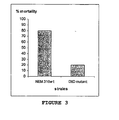
- the virulence of GBS mutants in the dlt operon is strongly impaired in mouse and newborn rat models.
- the loss of virulence is presumably due to an increased sensitivity to antimicrobial cationic peptides, such as defensins, which are produced by numerous cells types in particular phagocytes.
- mutant of S . agalactiae in which the dltD gene have been inactivated, demonstrates that the product of that gene is a good target for the development of inhibitors of virulence of S . agalactiae as well as against other Gram + pathogens.
Landscapes
- Chemical & Material Sciences (AREA)
- Health & Medical Sciences (AREA)
- Organic Chemistry (AREA)
- Life Sciences & Earth Sciences (AREA)
- Engineering & Computer Science (AREA)
- Proteomics, Peptides & Aminoacids (AREA)
- Zoology (AREA)
- Wood Science & Technology (AREA)
- General Health & Medical Sciences (AREA)
- Bioinformatics & Cheminformatics (AREA)
- Immunology (AREA)
- Molecular Biology (AREA)
- Microbiology (AREA)
- Physics & Mathematics (AREA)
- Biotechnology (AREA)
- Biochemistry (AREA)
- Biophysics (AREA)
- General Engineering & Computer Science (AREA)
- Analytical Chemistry (AREA)
- Genetics & Genomics (AREA)
- Medicinal Chemistry (AREA)
- Chemical Kinetics & Catalysis (AREA)
- General Chemical & Material Sciences (AREA)
- Toxicology (AREA)
- Nuclear Medicine, Radiotherapy & Molecular Imaging (AREA)
- Pharmacology & Pharmacy (AREA)
- Animal Behavior & Ethology (AREA)
- Public Health (AREA)
- Veterinary Medicine (AREA)
- Communicable Diseases (AREA)
- Oncology (AREA)
- Measuring Or Testing Involving Enzymes Or Micro-Organisms (AREA)
- Micro-Organisms Or Cultivation Processes Thereof (AREA)
- Agricultural Chemicals And Associated Chemicals (AREA)
- Acyclic And Carbocyclic Compounds In Medicinal Compositions (AREA)
- Medicines That Contain Protein Lipid Enzymes And Other Medicines (AREA)
- Peptides Or Proteins (AREA)
Claims (10)
- Verfahren zum Identifizieren und Selektieren von Virulenz-Gen-Targets in pathogenen Bakterien, das die folgenden Schritte umfasst:- Verwenden eines Stamms der pathogenen Bakterien;- Erzeugen von mutanten Stämmen für die Inaktivierung von Genen, die Virulenzfaktoren codieren;- Bestimmen der Virulenz der mutierten Bakterien an einem experimentellen Modell der Infektion und ihrer Wirkung auf die Darmbesiedlung in einem axenischen Mausmodell; und- Identifizieren und Selektieren der Bakterien, die eine Mutation in Genen aufweisen, von denen sich erweist, dass sie alle der folgenden Merkmale haben: Gene, die für die Proliferation in vitro nicht wesentlich und für die kommensale Besiedlung nicht wesentlich sind, aber für die Resistenz gegen Serum in vitro wesentlich sind und im Wirt für die Verbreitung im Blut wesentlich sind.
- Verfahren gemäß Anspruch 1, das den Schritt des Bewertens der Lebensfähigkeit der mutanten Bakterien in vitro und deren Fähigkeit, in Gegenwart von komplementiertem Serum resistent zu sein und sich zu vermehren, umfasst.
- Verfahren gemäß Anspruch 1 oder 2, wobei die pathogenen Bakterien EXPEC-E. -coli-Stämme sind.
- In-vitro-Verfahren zur Hemmung der Virulenz von pathogenen Bakterien, das die Zielsteuerung mit einem Inhibitor einer Nucleinsäure von SEQ ID Nr. 16, 20, 27 oder 28 oder eines Peptids von SEQ ID Nr. 1, 5, 12 oder 13 umfasst, um die Serumempfindlichkeit der Bakterien zu erhöhen und ihre Virulenz abzuschwächen.
- Verfahren gemäß Anspruch 4, wobei die Nucleinsäuren, Expressionsprodukte davon oder Peptide denjenigen von pathogenen Organismen entsprechen, die Escherichia coli, Salmonella typhimurium, Klebsiella pneumoniae, Yersinia pestis, Serratia marcescens, Haemophilus influenzae, Pasteurella multocida, Vibrio cholerae, Pseudomonas aeruginosa, Acetinobacter, Moraxella catarrhalis, Burkholderia pseudomallei, Neisseria meningitidis, Neisseria gonorrhoeae, Campylobacter jejuni, Helicobacter pylori, Bacteroides fragilis umfassen.
- Verfahren gemäß Anspruch 5, wobei die Nucleinsäuren, Expressionsprodukte oder Peptide E.-coli-Nucleinsäuren, -Expressionsprodukte bzw. -Peptide sind.
- Verfahren zur Suche nach Inhibitoren der Expressionsprodukte oder Peptide von pathogenen Bakterien, umfassend das In-Kontakt-Bringen einer isolierten oder gereinigten Nucleinsäure von SEQ ID Nr. 16, 20, 27 oder 28 oder ihrer Expressionsprodukte oder eines isolierten oder gereinigten Peptids von SEQ ID Nr. 1, 5, 12 oder 13 mit der Testverbindung, Nachweisen der möglichen Wirkung der Verbindung auf die Aktivität der Expressionsprodukte oder Peptide und Auswählen der Verbindungen, die eine inhibitorische Aktivität auf die Virulenz aufweisen.
- Verfahren zur Suche nach Inhibitoren der biochemischen und/oder Enzymaktivität der gemäß Anspruch 4 verwendeten Expressionsprodukte oder Peptide, umfassend das In-Kontakt-Bringen der Expressionsprodukte oder Peptide mit der Testverbindung, Nachweisen der möglichen Wirkung der Verbindung auf die Aktivität, die die Peptide auf die Virulenz haben, und Auswählen der aktiven Verbindungen.
- Verfahren zum Identifizieren einer Verbindung, die für die Verwendung in der Zusammensetzung eines antibakteriellen Produkts zur Verhinderung der Ausbreitung der Infektion im Wirt über das Blut in Frage kommt, umfassend das In-Kontakt-Bringen der gemäß Anspruch 4 verwendeten Peptide mit der in Frage kommenden Verbindung, Nachweisen der möglichen Wirkung der Verbindung auf die Aktivität, die die Expressionsprodukte oder Peptide auf die Virulenz haben, und Auswählen der aktiven Verbindung.
- Verwendung von SEQ ID Nr. 1, 5, 12 oder 13 in einem Verfahren zur Hemmung der Virulenz von Bakterien, umfassend:- Messen der Enzymaktivität auf das Peptid;- Testen der Vermehrung der Bakterien in Gegenwart von Serum und dekomplementiertem Serum;- Bestimmen der Virulenz und Proliferation von Bakterien in einem in-vivo-Modell der Infektion und Bestimmen der Wirkung auf die Darmbesiedlung in einem axenischen in-vivo-Mausmodell.
Applications Claiming Priority (3)
| Application Number | Priority Date | Filing Date | Title |
|---|---|---|---|
| FR0208636A FR2842210B1 (fr) | 2002-07-09 | 2002-07-09 | Determinants de pathogenicite utilisables comme cibles pour l'elaboration de moyens de prevention et de controle d'infections bacteriennes et/ou de la dissemination systemique |
| FR0208636 | 2002-07-09 | ||
| PCT/EP2003/008209 WO2004005535A2 (en) | 2002-07-09 | 2003-07-09 | Pathogenicity proteins which can be used as targets for developing means for preventing and controlling bacterial infections |
Publications (2)
| Publication Number | Publication Date |
|---|---|
| EP1523572A2 EP1523572A2 (de) | 2005-04-20 |
| EP1523572B1 true EP1523572B1 (de) | 2008-05-07 |
Family
ID=29763685
Family Applications (1)
| Application Number | Title | Priority Date | Filing Date |
|---|---|---|---|
| EP03762684A Expired - Lifetime EP1523572B1 (de) | 2002-07-09 | 2003-07-09 | Pathogene determinanten als zielmoleküle zur entwicklung von mitteln welche bakterielle infektionen und/oder systemische verbreitung verhindern und kontrollieren können |
Country Status (11)
| Country | Link |
|---|---|
| US (3) | US20060003393A1 (de) |
| EP (1) | EP1523572B1 (de) |
| JP (1) | JP2006515155A (de) |
| AT (1) | ATE394503T1 (de) |
| AU (2) | AU2003266246A1 (de) |
| CA (1) | CA2491847A1 (de) |
| DE (1) | DE60320797D1 (de) |
| DK (1) | DK1523572T3 (de) |
| ES (1) | ES2306891T3 (de) |
| FR (1) | FR2842210B1 (de) |
| WO (1) | WO2004005535A2 (de) |
Families Citing this family (12)
| Publication number | Priority date | Publication date | Assignee | Title |
|---|---|---|---|---|
| FR2842210B1 (fr) * | 2002-07-09 | 2012-12-14 | Mutabilis | Determinants de pathogenicite utilisables comme cibles pour l'elaboration de moyens de prevention et de controle d'infections bacteriennes et/ou de la dissemination systemique |
| AU2003298770A1 (en) * | 2002-12-02 | 2004-06-23 | Biosynexus Inc | Wall teichoic acid as a target for anti-staphylococcal therapies and vaccines |
| SG160329A1 (en) * | 2005-02-18 | 2010-04-29 | Novartis Vaccines & Diagnostic | Proteins and nucleic acids from meningitis/sepsis-associated escherichia coli |
| DK1858919T3 (da) | 2005-02-18 | 2012-07-16 | Novartis Vaccines & Diagnostic | Immunogener fra uropathogen Escherichia coli |
| EP1973467B1 (de) * | 2006-01-20 | 2013-10-16 | The General Hospital Corporation | Systeme und Verfahren zur Bereitstellung von Speckle-Reduktion über eine Wellenfront -Modulation zur optischen Kohärenzentomographie |
| EP2064230A2 (de) | 2006-08-16 | 2009-06-03 | Novartis AG | Immungene aus uropathogenen escherichia coli |
| HRP20141270T1 (xx) | 2009-07-16 | 2015-03-13 | Novartis Ag | Detoksificirani imunogeni escherichie coli |
| CA3021760A1 (en) * | 2016-04-25 | 2017-11-02 | Aperture Bio, LLC | Systems, devices and methods for sequential analysis of complex matrix samples for high confidence bacterial detection and drug susceptibility prediction using a flow cytometer |
| JP7515092B2 (ja) * | 2017-10-18 | 2024-07-12 | 北海道公立大学法人 札幌医科大学 | 抗菌剤のスクリーニング方法 |
| ES2960952T3 (es) | 2018-08-09 | 2024-03-07 | Antabio Sas | Diazabiciclooctanonas como inhibidores de serina beta-lactamasas |
| US11905286B2 (en) | 2018-08-09 | 2024-02-20 | Antabio Sas | Diazabicyclooctanones as inhibitors of serine beta-lactamases |
| CN115725607B (zh) * | 2022-07-14 | 2023-11-28 | 山东第一医科大学附属省立医院(山东省立医院) | 一种鼻疽诺卡菌的致病靶基因及其应用 |
Family Cites Families (5)
| Publication number | Priority date | Publication date | Assignee | Title |
|---|---|---|---|---|
| US6020121A (en) * | 1995-09-29 | 2000-02-01 | Microcide Pharmaceuticals, Inc. | Inhibitors of regulatory pathways |
| CA2330544A1 (en) * | 1998-06-12 | 1999-12-23 | University Of Guelph | A novel gene and method of treating a gram negative bacterial infection |
| US6846667B1 (en) * | 1998-11-09 | 2005-01-25 | Microscience, Ltd. | Virulence genes and proteins, and their use |
| AU3584500A (en) * | 1999-01-27 | 2000-08-18 | Elitra Pharmaceuticals, Inc. | Genes identified as required for proliferation in escherichia coli |
| FR2842210B1 (fr) * | 2002-07-09 | 2012-12-14 | Mutabilis | Determinants de pathogenicite utilisables comme cibles pour l'elaboration de moyens de prevention et de controle d'infections bacteriennes et/ou de la dissemination systemique |
-
2002
- 2002-07-09 FR FR0208636A patent/FR2842210B1/fr not_active Expired - Lifetime
-
2003
- 2003-07-09 WO PCT/EP2003/008209 patent/WO2004005535A2/en not_active Ceased
- 2003-07-09 ES ES03762684T patent/ES2306891T3/es not_active Expired - Lifetime
- 2003-07-09 AU AU2003266246A patent/AU2003266246A1/en not_active Abandoned
- 2003-07-09 AT AT03762684T patent/ATE394503T1/de active
- 2003-07-09 DE DE60320797T patent/DE60320797D1/de not_active Expired - Lifetime
- 2003-07-09 DK DK03762684T patent/DK1523572T3/da active
- 2003-07-09 CA CA002491847A patent/CA2491847A1/en not_active Abandoned
- 2003-07-09 US US10/520,820 patent/US20060003393A1/en not_active Abandoned
- 2003-07-09 EP EP03762684A patent/EP1523572B1/de not_active Expired - Lifetime
- 2003-07-09 JP JP2004518773A patent/JP2006515155A/ja active Pending
-
2006
- 2006-08-21 US US11/506,821 patent/US20070111229A1/en not_active Abandoned
-
2009
- 2009-04-30 AU AU2009201727A patent/AU2009201727A1/en not_active Abandoned
-
2010
- 2010-03-23 US US12/729,630 patent/US20110236886A1/en not_active Abandoned
Non-Patent Citations (2)
| Title |
|---|
| JOHNSON AND RUSSO: "Extraintestinal pathogenic Escherichia coli: "The other bad E. coli"", J LAB CLIN MED, vol. 139, no. 3, March 2002 (2002-03-01), pages 155 - 162 * |
| RUSSO T. A. AND JOHNSON J. R.: "Proposal for a new inclusive designation for extraintestinal pathogenic isolates of Escherichia coli: ExPEC", THE JOURNAL OF INFECTIOUS DISEASES, vol. 181, May 2000 (2000-05-01), US, pages 1753 - 1754, XP001058435, DOI: doi:10.1086/315418 * |
Also Published As
| Publication number | Publication date |
|---|---|
| JP2006515155A (ja) | 2006-05-25 |
| AU2009201727A1 (en) | 2009-05-21 |
| EP1523572A2 (de) | 2005-04-20 |
| WO2004005535A3 (en) | 2004-11-18 |
| US20070111229A1 (en) | 2007-05-17 |
| HK1078902A1 (en) | 2006-03-24 |
| AU2003266246A1 (en) | 2004-01-23 |
| DE60320797D1 (de) | 2008-06-19 |
| US20060003393A1 (en) | 2006-01-05 |
| ES2306891T3 (es) | 2008-11-16 |
| CA2491847A1 (en) | 2004-01-15 |
| FR2842210B1 (fr) | 2012-12-14 |
| DK1523572T3 (da) | 2008-09-08 |
| ATE394503T1 (de) | 2008-05-15 |
| US20110236886A1 (en) | 2011-09-29 |
| WO2004005535A2 (en) | 2004-01-15 |
| FR2842210A1 (fr) | 2004-01-16 |
Similar Documents
| Publication | Publication Date | Title |
|---|---|---|
| US20110236886A1 (en) | Pathogenicity determinants which can be used as targets for developing means for preventing and controlling bacterial infections and/or systemic dissemination | |
| Keo et al. | Campylobacter capsule and lipooligosaccharide confer resistance to serum and cationic antimicrobials | |
| Mills et al. | Identification and characterization of two Klebsiella pneumoniae lpxL lipid A late acyltransferases and their role in virulence | |
| Kim et al. | Flagellar basal body flg operon as a virulence determinant of Vibrio vulnificus | |
| US6355254B1 (en) | Pathogenic Escherichia coli associated protein EspA | |
| JP2010534063A (ja) | ランチビオティックス及びこれらの使用 | |
| Fox et al. | Novel lipopolysaccharide biosynthetic genes containing tetranucleotide repeats in Haemophilus influenzae, identification of a gene for adding O‐acetyl groups | |
| Cao et al. | Functional definition of LuxS, an autoinducer-2 (AI-2) synthase and its role in full virulence of Streptococcus suis serotype 2 | |
| CN103717744B (zh) | 细菌形成的小菌素s,一种有效抵抗致病微生物如肠出血性大肠杆菌(ehec)的新抗微生物肽 | |
| WO1999045136A1 (en) | Methods for assaying type iii secretion inhibitors | |
| Khan et al. | Shiga toxin producing Escherichia coli infection: current progress & future challenges | |
| Arvidson et al. | Neisseria gonorrhoeae mutants altered in toxicity to human fallopian tubes and molecular characterization of the genetic locus involved | |
| HK1078902B (en) | Pathogenicity determinants which can be used as targets for developing means for preventing and controlling bacterial infections and/or systemic dissemination | |
| Abdullah et al. | Isolation and molecular characterization of Escherichia coli from goat of apparently healthy and clinical cases | |
| US20050032093A1 (en) | Novel genes involved in the escherichia coli biofilm formation and uses thereof | |
| Oliver | Hypermutation in natural bacterial populations: consequences for medical microbiology | |
| Sichangi | Genetic events responsible for cell shape evolution in multicellular longitudinally dividing (MuLDi) oral cavity Neisseriaceae | |
| Schulz et al. | Characterization of the growth behavior ofListeria monocytogenesinListeriasynthetic media | |
| Bai et al. | Escherichia coli O157: H7 | |
| Ghareeb | Molecular study of the mechanisms controlling the induction of the hexonate/hexuronate-utilization genes of Salmonella enterica (serotype Enteritidis) upon exposure to egg white | |
| Sastalla | The role of two-component regulatory systems of Streptococcus pyogenes in virulence | |
| Lathem | Identification and characterization of a secreted protease from Escherichia coli O157: H7 | |
| Chatzidaki | Relationship of the Vibrio vulnificus group 1-like capsular polysaccharide operon to phase variation | |
| Vivo | efa1/Citrobacter rodentium lifA | |
| Hashim | Identification of genes involved in acid tolerance, antimicrobial resistance and virulence of Enterococcus faecium |
Legal Events
| Date | Code | Title | Description |
|---|---|---|---|
| PUAI | Public reference made under article 153(3) epc to a published international application that has entered the european phase |
Free format text: ORIGINAL CODE: 0009012 |
|
| 17P | Request for examination filed |
Effective date: 20050114 |
|
| AK | Designated contracting states |
Kind code of ref document: A2 Designated state(s): AT BE BG CH CY CZ DE DK EE ES FI FR GB GR HU IE IT LI LU MC NL PT RO SE SI SK TR |
|
| AX | Request for extension of the european patent |
Extension state: AL LT LV MK |
|
| DAX | Request for extension of the european patent (deleted) | ||
| REG | Reference to a national code |
Ref country code: HK Ref legal event code: DE Ref document number: 1078902 Country of ref document: HK |
|
| RTI1 | Title (correction) |
Free format text: PATHOGENICITY DETERMINANTS WHICH CAN BE USED AS TARGETS FOR DEVELOPING MEANS FOR PREVENTING AND CONTROLLING BACTERIAL INFECTIONS AND/OR SYSTEMIC DISSEMINATION |
|
| 17Q | First examination report despatched |
Effective date: 20051107 |
|
| 17Q | First examination report despatched |
Effective date: 20051107 |
|
| GRAP | Despatch of communication of intention to grant a patent |
Free format text: ORIGINAL CODE: EPIDOSNIGR1 |
|
| GRAS | Grant fee paid |
Free format text: ORIGINAL CODE: EPIDOSNIGR3 |
|
| GRAA | (expected) grant |
Free format text: ORIGINAL CODE: 0009210 |
|
| AK | Designated contracting states |
Kind code of ref document: B1 Designated state(s): AT BE BG CH CY CZ DE DK EE ES FI FR GB GR HU IE IT LI LU MC NL PT RO SE SI SK TR |
|
| REG | Reference to a national code |
Ref country code: GB Ref legal event code: FG4D |
|
| REG | Reference to a national code |
Ref country code: CH Ref legal event code: EP |
|
| REG | Reference to a national code |
Ref country code: IE Ref legal event code: FG4D Free format text: LANGUAGE OF EP DOCUMENT: FRENCH |
|
| REF | Corresponds to: |
Ref document number: 60320797 Country of ref document: DE Date of ref document: 20080619 Kind code of ref document: P |
|
| REG | Reference to a national code |
Ref country code: SE Ref legal event code: TRGR |
|
| REG | Reference to a national code |
Ref country code: HK Ref legal event code: GR Ref document number: 1078902 Country of ref document: HK |
|
| REG | Reference to a national code |
Ref country code: CH Ref legal event code: NV Representative=s name: ISLER & PEDRAZZINI AG |
|
| PG25 | Lapsed in a contracting state [announced via postgrant information from national office to epo] |
Ref country code: FI Free format text: LAPSE BECAUSE OF FAILURE TO SUBMIT A TRANSLATION OF THE DESCRIPTION OR TO PAY THE FEE WITHIN THE PRESCRIBED TIME-LIMIT Effective date: 20080507 |
|
| REG | Reference to a national code |
Ref country code: ES Ref legal event code: FG2A Ref document number: 2306891 Country of ref document: ES Kind code of ref document: T3 |
|
| PG25 | Lapsed in a contracting state [announced via postgrant information from national office to epo] |
Ref country code: PT Free format text: LAPSE BECAUSE OF FAILURE TO SUBMIT A TRANSLATION OF THE DESCRIPTION OR TO PAY THE FEE WITHIN THE PRESCRIBED TIME-LIMIT Effective date: 20081007 Ref country code: CZ Free format text: LAPSE BECAUSE OF FAILURE TO SUBMIT A TRANSLATION OF THE DESCRIPTION OR TO PAY THE FEE WITHIN THE PRESCRIBED TIME-LIMIT Effective date: 20080507 |
|
| PG25 | Lapsed in a contracting state [announced via postgrant information from national office to epo] |
Ref country code: RO Free format text: LAPSE BECAUSE OF FAILURE TO SUBMIT A TRANSLATION OF THE DESCRIPTION OR TO PAY THE FEE WITHIN THE PRESCRIBED TIME-LIMIT Effective date: 20080507 Ref country code: SK Free format text: LAPSE BECAUSE OF FAILURE TO SUBMIT A TRANSLATION OF THE DESCRIPTION OR TO PAY THE FEE WITHIN THE PRESCRIBED TIME-LIMIT Effective date: 20080507 |
|
| PLBE | No opposition filed within time limit |
Free format text: ORIGINAL CODE: 0009261 |
|
| STAA | Information on the status of an ep patent application or granted ep patent |
Free format text: STATUS: NO OPPOSITION FILED WITHIN TIME LIMIT |
|
| PG25 | Lapsed in a contracting state [announced via postgrant information from national office to epo] |
Ref country code: MC Free format text: LAPSE BECAUSE OF NON-PAYMENT OF DUE FEES Effective date: 20080731 |
|
| 26N | No opposition filed |
Effective date: 20090210 |
|
| PG25 | Lapsed in a contracting state [announced via postgrant information from national office to epo] |
Ref country code: BG Free format text: LAPSE BECAUSE OF FAILURE TO SUBMIT A TRANSLATION OF THE DESCRIPTION OR TO PAY THE FEE WITHIN THE PRESCRIBED TIME-LIMIT Effective date: 20080807 Ref country code: EE Free format text: LAPSE BECAUSE OF FAILURE TO SUBMIT A TRANSLATION OF THE DESCRIPTION OR TO PAY THE FEE WITHIN THE PRESCRIBED TIME-LIMIT Effective date: 20080507 |
|
| PG25 | Lapsed in a contracting state [announced via postgrant information from national office to epo] |
Ref country code: HU Free format text: LAPSE BECAUSE OF FAILURE TO SUBMIT A TRANSLATION OF THE DESCRIPTION OR TO PAY THE FEE WITHIN THE PRESCRIBED TIME-LIMIT Effective date: 20081108 Ref country code: CY Free format text: LAPSE BECAUSE OF FAILURE TO SUBMIT A TRANSLATION OF THE DESCRIPTION OR TO PAY THE FEE WITHIN THE PRESCRIBED TIME-LIMIT Effective date: 20080507 Ref country code: LU Free format text: LAPSE BECAUSE OF NON-PAYMENT OF DUE FEES Effective date: 20080709 |
|
| PG25 | Lapsed in a contracting state [announced via postgrant information from national office to epo] |
Ref country code: TR Free format text: LAPSE BECAUSE OF FAILURE TO SUBMIT A TRANSLATION OF THE DESCRIPTION OR TO PAY THE FEE WITHIN THE PRESCRIBED TIME-LIMIT Effective date: 20080507 |
|
| REG | Reference to a national code |
Ref country code: CH Ref legal event code: PUE Owner name: LABORATOIRE BIODIM Free format text: MUTABILIS#102 AVENUE GASTON ROUSSEL - BATIMENT PASTEUR#93230 ROMAINVILLE (FR) -TRANSFER TO- LABORATOIRE BIODIM#84 RUE DE GRENELLE#75007 PARIS (FR) Ref country code: CH Ref legal event code: PFA Owner name: MUTABILIS Free format text: MUTABILIS#156, AVENUE VAUGIRARD#75730 PARIS CEDEX 15 (FR) -TRANSFER TO- MUTABILIS#102 AVENUE GASTON ROUSSEL - BATIMENT PASTEUR#93230 ROMAINVILLE (FR) |
|
| REG | Reference to a national code |
Ref country code: NL Ref legal event code: SD Effective date: 20100929 |
|
| PG25 | Lapsed in a contracting state [announced via postgrant information from national office to epo] |
Ref country code: GR Free format text: LAPSE BECAUSE OF FAILURE TO SUBMIT A TRANSLATION OF THE DESCRIPTION OR TO PAY THE FEE WITHIN THE PRESCRIBED TIME-LIMIT Effective date: 20080808 |
|
| REG | Reference to a national code |
Ref country code: FR Ref legal event code: TP |
|
| BECA | Be: change of holder's address |
Owner name: LABORATOIRE BIODIM84, RUE DE GRENELLE, F-75007 PAR Effective date: 20101012 |
|
| REG | Reference to a national code |
Ref country code: GB Ref legal event code: 732E Free format text: REGISTERED BETWEEN 20101104 AND 20101110 |
|
| REG | Reference to a national code |
Ref country code: ES Ref legal event code: PC2A Owner name: LABORATOIRE BIODIM Effective date: 20110303 |
|
| PG25 | Lapsed in a contracting state [announced via postgrant information from national office to epo] |
Ref country code: IT Free format text: LAPSE BECAUSE OF NON-PAYMENT OF DUE FEES Effective date: 20090709 |
|
| PG25 | Lapsed in a contracting state [announced via postgrant information from national office to epo] |
Ref country code: SI Free format text: LAPSE BECAUSE OF NON-PAYMENT OF DUE FEES Effective date: 20080507 |
|
| PGFP | Annual fee paid to national office [announced via postgrant information from national office to epo] |
Ref country code: IE Payment date: 20110429 Year of fee payment: 9 |
|
| PGRI | Patent reinstated in contracting state [announced from national office to epo] |
Ref country code: IT Effective date: 20110616 |
|
| PGFP | Annual fee paid to national office [announced via postgrant information from national office to epo] |
Ref country code: DK Payment date: 20110720 Year of fee payment: 9 Ref country code: CH Payment date: 20110725 Year of fee payment: 9 |
|
| PGFP | Annual fee paid to national office [announced via postgrant information from national office to epo] |
Ref country code: AT Payment date: 20110714 Year of fee payment: 9 Ref country code: SE Payment date: 20110722 Year of fee payment: 9 |
|
| PGFP | Annual fee paid to national office [announced via postgrant information from national office to epo] |
Ref country code: BE Payment date: 20110713 Year of fee payment: 9 Ref country code: NL Payment date: 20110726 Year of fee payment: 9 |
|
| BERE | Be: lapsed |
Owner name: LABORATOIRE BIODIM Effective date: 20120731 |
|
| REG | Reference to a national code |
Ref country code: NL Ref legal event code: V1 Effective date: 20130201 |
|
| REG | Reference to a national code |
Ref country code: CH Ref legal event code: PL |
|
| REG | Reference to a national code |
Ref country code: SE Ref legal event code: EUG |
|
| REG | Reference to a national code |
Ref country code: AT Ref legal event code: MM01 Ref document number: 394503 Country of ref document: AT Kind code of ref document: T Effective date: 20120709 |
|
| REG | Reference to a national code |
Ref country code: DK Ref legal event code: EBP |
|
| PG25 | Lapsed in a contracting state [announced via postgrant information from national office to epo] |
Ref country code: CH Free format text: LAPSE BECAUSE OF NON-PAYMENT OF DUE FEES Effective date: 20120731 Ref country code: LI Free format text: LAPSE BECAUSE OF NON-PAYMENT OF DUE FEES Effective date: 20120731 Ref country code: NL Free format text: LAPSE BECAUSE OF NON-PAYMENT OF DUE FEES Effective date: 20130201 Ref country code: SE Free format text: LAPSE BECAUSE OF NON-PAYMENT OF DUE FEES Effective date: 20120710 |
|
| REG | Reference to a national code |
Ref country code: IE Ref legal event code: MM4A |
|
| PG25 | Lapsed in a contracting state [announced via postgrant information from national office to epo] |
Ref country code: BE Free format text: LAPSE BECAUSE OF NON-PAYMENT OF DUE FEES Effective date: 20120731 |
|
| PG25 | Lapsed in a contracting state [announced via postgrant information from national office to epo] |
Ref country code: AT Free format text: LAPSE BECAUSE OF NON-PAYMENT OF DUE FEES Effective date: 20120709 |
|
| PG25 | Lapsed in a contracting state [announced via postgrant information from national office to epo] |
Ref country code: IE Free format text: LAPSE BECAUSE OF NON-PAYMENT OF DUE FEES Effective date: 20120709 Ref country code: DK Free format text: LAPSE BECAUSE OF NON-PAYMENT OF DUE FEES Effective date: 20120731 |
|
| REG | Reference to a national code |
Ref country code: FR Ref legal event code: PLFP Year of fee payment: 13 |
|
| REG | Reference to a national code |
Ref country code: DE Ref legal event code: R082 Ref document number: 60320797 Country of ref document: DE Representative=s name: VON KREISLER SELTING WERNER - PARTNERSCHAFT VO, DE Ref country code: DE Ref legal event code: R081 Ref document number: 60320797 Country of ref document: DE Owner name: MUTABILIS, FR Free format text: FORMER OWNER: LABORATOIRE BIODIM, PARIS, FR Ref country code: DE Ref legal event code: R082 Ref document number: 60320797 Country of ref document: DE Representative=s name: DOMPATENT VON KREISLER SELTING WERNER - PARTNE, DE |
|
| REG | Reference to a national code |
Ref country code: GB Ref legal event code: 732E Free format text: REGISTERED BETWEEN 20160310 AND 20160316 |
|
| REG | Reference to a national code |
Ref country code: FR Ref legal event code: TP Owner name: MUTABILIS, FR Effective date: 20160406 |
|
| REG | Reference to a national code |
Ref country code: FR Ref legal event code: PLFP Year of fee payment: 14 |
|
| REG | Reference to a national code |
Ref country code: ES Ref legal event code: PC2A Owner name: MUTABILIS Effective date: 20161020 |
|
| REG | Reference to a national code |
Ref country code: FR Ref legal event code: PLFP Year of fee payment: 15 |
|
| PGFP | Annual fee paid to national office [announced via postgrant information from national office to epo] |
Ref country code: FR Payment date: 20170720 Year of fee payment: 15 Ref country code: GB Payment date: 20170704 Year of fee payment: 15 Ref country code: IT Payment date: 20170726 Year of fee payment: 15 Ref country code: DE Payment date: 20170724 Year of fee payment: 15 Ref country code: ES Payment date: 20170801 Year of fee payment: 15 |
|
| REG | Reference to a national code |
Ref country code: DE Ref legal event code: R119 Ref document number: 60320797 Country of ref document: DE |
|
| GBPC | Gb: european patent ceased through non-payment of renewal fee |
Effective date: 20180709 |
|
| PG25 | Lapsed in a contracting state [announced via postgrant information from national office to epo] |
Ref country code: DE Free format text: LAPSE BECAUSE OF NON-PAYMENT OF DUE FEES Effective date: 20190201 Ref country code: GB Free format text: LAPSE BECAUSE OF NON-PAYMENT OF DUE FEES Effective date: 20180709 Ref country code: FR Free format text: LAPSE BECAUSE OF NON-PAYMENT OF DUE FEES Effective date: 20180731 |
|
| PG25 | Lapsed in a contracting state [announced via postgrant information from national office to epo] |
Ref country code: IT Free format text: LAPSE BECAUSE OF NON-PAYMENT OF DUE FEES Effective date: 20180709 |
|
| REG | Reference to a national code |
Ref country code: ES Ref legal event code: FD2A Effective date: 20190917 |
|
| PG25 | Lapsed in a contracting state [announced via postgrant information from national office to epo] |
Ref country code: ES Free format text: LAPSE BECAUSE OF NON-PAYMENT OF DUE FEES Effective date: 20180710 |