EP1523193A1 - Digitalkameraschnittstelle - Google Patents
Digitalkameraschnittstelle Download PDFInfo
- Publication number
- EP1523193A1 EP1523193A1 EP04077609A EP04077609A EP1523193A1 EP 1523193 A1 EP1523193 A1 EP 1523193A1 EP 04077609 A EP04077609 A EP 04077609A EP 04077609 A EP04077609 A EP 04077609A EP 1523193 A1 EP1523193 A1 EP 1523193A1
- Authority
- EP
- European Patent Office
- Prior art keywords
- camera
- host processor
- video data
- interface
- link layer
- Prior art date
- Legal status (The legal status is an assumption and is not a legal conclusion. Google has not performed a legal analysis and makes no representation as to the accuracy of the status listed.)
- Withdrawn
Links
- 230000008878 coupling Effects 0.000 claims abstract description 4
- 238000010168 coupling process Methods 0.000 claims abstract description 4
- 238000005859 coupling reaction Methods 0.000 claims abstract description 4
- 230000009977 dual effect Effects 0.000 claims description 9
- 238000004891 communication Methods 0.000 claims description 8
- 238000010200 validation analysis Methods 0.000 claims description 8
- 230000011664 signaling Effects 0.000 claims description 7
- 238000000034 method Methods 0.000 claims description 4
- 238000012544 monitoring process Methods 0.000 claims description 3
- 238000006243 chemical reaction Methods 0.000 description 7
- 238000010586 diagram Methods 0.000 description 6
- 230000003287 optical effect Effects 0.000 description 4
- 238000012545 processing Methods 0.000 description 4
- 238000012546 transfer Methods 0.000 description 4
- 238000005516 engineering process Methods 0.000 description 3
- 239000004065 semiconductor Substances 0.000 description 3
- 239000000835 fiber Substances 0.000 description 1
- 238000012986 modification Methods 0.000 description 1
- 230000004048 modification Effects 0.000 description 1
- 230000001360 synchronised effect Effects 0.000 description 1
Images



Classifications
-
- H—ELECTRICITY
- H04—ELECTRIC COMMUNICATION TECHNIQUE
- H04N—PICTORIAL COMMUNICATION, e.g. TELEVISION
- H04N7/00—Television systems
- H04N7/01—Conversion of standards, e.g. involving analogue television standards or digital television standards processed at pixel level
Definitions
- the present invention is generally directed to an interface and, more specifically, to a digital camera interface.
- a digital camera may be separated from an electronic control unit (ECU), which includes an imbedded processor and/or a digital signal processor (DSP), that implements vision processing and decision making algorithms.
- ECU electronice control unit
- DSP digital signal processor
- Captured images may be transferred from a camera to a host processor in various formats. For example, captured images may be transferred from a camera to a host processor as analog video, transmitted through an inexpensive coaxial cable.
- Interfaces implementing a universal serial bus (USB) 2.0/on-the-go (OTG) protocol may also be used to serially transmit digital data from a digital camera to a host processor.
- an IEEE 1394 (Firewire) interface may be utilized to transmit digital data from a digital camera to a host processor for further processing.
- MOST and camera link are two other interfaces that may also be utilized to transmit data from a camera to a host processor for further processing. It should be appreciated that transferring the data via an analog video signal is generally not desirable when the data is provided from a camera in a digital format.
- technologies, such as USB and IEEE 1394 are generally either not suitable or are too expensive for automotive applications. Additionally, technologies such as MOST are generally too slow and camera link tends to be relatively expensive.
- a host processor to camera interface includes a camera side interface, a host processor side interface and a cable for coupling a camera side transmitter to a host processor side receiver.
- a camera side link layer is coupled to a camera, which provides video data that the camera side link layer converts to a desired video data format.
- a serializer that is coupled to the camera side link layer, serializes the video data in the desired video data format and a camera side transmitter, which is coupled to the serializer, transmits the serialized video data in the desired video data format.
- the host processor side receiver receives the serialized video data and a deserializer that is coupled to the host processor side receiver deserializes the video data.
- a host processor side link layer that is coupled between the deserializer and a host processor is adapted to convert the deserialized video data into a format compatible with the host processor, when required.
- the cable includes wires for carrying power and couples the camera side transmitter to the host processor side receiver.
- the camera side link layer is configured to convert a plurality of camera video data formats into the desired video data format.
- the camera video data formats include a single 8-bit data format, a dual 8-bit data format, a single 16-bit data format, a single 24-bit data format and a single 12-bit data format.
- At least one of the camera video data formats provides a frame valid (FVAL) signal and a line valid (LVAL) signal that are combined by the camera side link layer into a single validation (XVAL) signal that is provided to the host processor side link layer.
- FVAL frame valid
- LVAL line valid
- XVAL single validation
- the XVAL signal corresponds to the LVAL signal with an added end-of-frame (EOF) signal.
- a low-voltage differential signaling (LVDS) receiver which provides for serial-to-camera (SERTC) channel communications
- the inputs of the LVDS receiver are coupled to outputs of the camera side transmitter and an output of the LVDS receiver is coupled to the camera side link layer.
- an LVDS transmitter which provides for SERTC channel communications, is located within the host processor side interface.
- the SERTC channel is provided for reconfiguring the camera and an input of the LVDS transmitter is coupled to the host processor side link layer and outputs of the LVDS transmitter are coupled to inputs of the host processor side receiver.
- the cable includes a first pair of signal wires for carrying the video data, which is in the form of a low-voltage differential signaling (LVDS) data stream.
- LVDS low-voltage differential signaling
- the camera side link layer and the host processor side link layer are configured to share the first pair of signal wires to communicate the video data in the desired video signal format and configuration signals for the SERTC channel.
- the host processor to camera interface includes a camera side interface that is coupled by a cable to a host processor side interface.
- the camera side interface includes a camera side link layer coupled to a camera, with the camera providing video data and the camera side link layer converting the video data to a desired video data format.
- the camera side interface also includes a serializer coupled to the camera side link layer for serializing the video data in the desired video data format.
- a camera side transmitter that is coupled to the serializer transmits the serialized video data to the host processor side interface, via the cable.
- the host processor side interface includes a host processor side receiver, a deserializer and a host processor side link layer.
- the host processor side receiver receives serialized video data and is coupled to the deserializer, which deserializes the video data.
- the host processor side link layer is coupled to the deserializer and the host processor and is adapted to convert the deserialized video data into a format compatible with the host processor, when required.
- the cable includes wires for carrying power and couples the camera side transmitter to the host processor side receiver.
- the camera side link layer is configured to convert a plurality of camera video data formats into a desired video data format.
- the video data formats may include a variety of formats, e.g., a single 8-bit data format, a dual 8-bit data format, a single 16-bit data format, a single 24-bit data format and/or a single 12-bit format, among other data formats.
- the cable When the video data is in electronic form, i.e., not optical, the cable includes at least one pair of wires for transmitting the data stream and two wires for power and ground. It should be appreciated that existing USB2.0/OTG cables or an IEEE 1394 cable can generally provide adequate data and power carrying capability.
- the data stream is in an optical format, it should be appreciated that a fiber optic cable carries the video data signal.
- the host processor side interface includes circuitry for converting the optical signal to an electronic signal.
- the camera side link layer and the host processor side link layer may be implemented with a variety of devices, e.g., an inexpensive field programmable gate array (FPGA), an electrically programmable logic device (EPLD) or a low cost microcontroller.
- FPGA field programmable gate array
- EPLD electrically programmable logic device
- the serializer for the camera side interface and the deserializer for the host processor side interface, as well as the SERTC transceiver may be off-the-shelf components.
- the deserializer may be a DS92LV1212A manufactured and made commercially available by National Semiconductor; the serializer may be a DS92LV1021A manufactured and made commercially available by National Semiconductor; and the transceiver may be a DS90LV019 driver/receiver manufactured and made commercially available by National Semiconductor.
- the serializer, deserializer and SERTC transceiver may be implemented using USB or IEEE 1394 technologies.
- a single or dual camera system may provide a digital video data stream to the camera side link layer at a pixel clock rate of CM-MCLK.
- the video data or camera pixel data may have different data formats corresponding to a specific imager manufacturer.
- the camera side link layer provides a set of digital logics that convert different types of camera pixel data into a desired video data format. It should be appreciated that the desired video data format may vary based upon a format required by an implemented serializer, which performs real-time parallel-to-serial conversion.
- a serializer that converts 10-bit parallel data into a serial output would generally use 8-bits of pixel data, D0-D7, a validation (XVAL) signal, which is required to synchronize the frames and lines of the images, and may include an additional bit for flexible purposes, such as to read out camera parameters in real-time.
- XVAL validation
- FIGs. 1A and 1B depict a host processor to camera interface 100 that is designed to transfer stereo camera pixel data from a pair of cameras 102A and 102B.
- a camera side interface 114 includes a camera side link layer 104, a serializer 106 and a driver/receiver 112.
- the camera side link layer 104 receives a number of signals from cameras 102A and 102B and may provide various configuration signals to the cameras 102A and 102B.
- Data received by the camera side link layer 104 may be converted from two 8-bit pixel streams, Data1[0:7] and Data2[0:7], into a single data stream D[0:7] with one validation (XVAL) signal.
- the serializer 106 converts the 10-bits of information and utilizes a transmitter 108 (located within the serializer 106) to transfer the data via cable 150, which may be a low voltage differential signal (LVDS) cable, to a host processor side interface 134.
- LVDS low voltage differential signal
- the host processor side interface 134 includes a deserializer 126 (that includes a receiver 128), a driver/receiver 122 and a host processor side link layer 124.
- the deserializer 126 converts the data received from the serializer 106 into parallel data, including 8-bits of pixel data D[0:7], a validation (XVAL) signal and an additional bit SerTFG for flexible purposes, such as to read out camera parameters in real-time.
- the host processor side link layer 124 converts the data, if required, to be compatible with host processor 10. The conversion may include converting the 8-bits of data D[0:7] to 16-bits of data Data[0:15], which represents the two 8-bit serial streams provided by the cameras 102A and 102B.
- the host processor 10 may provide a reset (RST) signal to the host processor side link layer 124, which in turn provides the RST signal to the cameras 102A and 102B, via the driver/receiver 122, driver/receiver 112 and the camera side link layer 104.
- RST reset
- the functions performed by the host processor side link layer 124 may essentially be performed by the host processor 10.
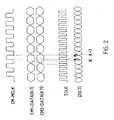
- CM-MCLK clock signal is a pixel clock rate signal that is synchronized with camera pixel data CM1-Data[0:7] and CM2-Data[0:7] provided by the cameras 102A and 102B.
- a signal TCLK which is provided by the camera side link layer 104, is twice the rate of the camera signal CM-MCLK clock signal.
- a signal D[0:7] is the 8-bit data string provided by the conversion of the camera pixel data CM1-Data[0:7] and CM2-Data[0:7].
- a validation (XVAL) signal is utilized to represent both the FVAL and LVAL signals using only one data bit. It should be appreciated that there are a number of ways to combine the FVAL and LVAL signals to provide the XVAL signal.
- a timing diagram illustrates the embedding of an end-of-frame (EOF) pulse with the LVAL signal to create the XVAL signal.
- the EOF pulse width may be much smaller than the LVAL pulse width.
- the deserializer 126 in the host processor side interface 134 recovers the serial data as well as the imbedded clock (RCLK) to provide the parallel pixel data that was input into the serializer 106.
- RCLK imbedded clock
- the host processor side link layer 124 is not required to convert the data or, alternatively, can be merged with related electronics. However, if data conversion is needed, the host processor side link layer 124 may be employed to further recover or convert the video data into a desired format.
- a remotely mounted camera or cameras can provide video data in real-time with minimized delay and essentially zero data loss, similar to a camera that is directly coupled to a host processor.
- a serial-to-camera (SERTC) channel in systems that need a camera that requires reconfiguration, may be provided.
- the SERTC channel can share the same wire pair utilized to transfer camera pixel data or, alternatively, another wire pair may be provided, if desired.
- the link layers of both the transmitter and receiver side may follow a simple protocol of sharing the serial bus. In any event, the protocol defines when and how to enable or disable the serializer or the SERTC channel transmitter in an appropriate manner.
- a host processor side link layer may send a trigger pulse (SERTC-Request) to the transmitter through the power line (VBUS).
- the camera side link layer responds to the SERTC-Request signal by disabling the serializer and enabling the SERTC channel receiver.
- the bus is free and ready to be released to the SERTC channel.
- the processor side link layer 124 may then detect the bus status by monitoring the deserializer 126 outputs. When a free bus is detected, the host processor side link layer 124 enables the SERTC channel transmitter 122 and the bus is released to the SERTC channel to establish a serial communication interface (SCI) between the cameras 102A and 102B and the host processor 10.
- SCI serial communication interface
- the serial bus may be released to provide a video data stream from the camera to the host processor in a number of ways.
- an SERTC-Request trigger pulse may be generated.
- the SCI to camera connection may be utilized.
- the host processor may send a reset byte to the host processor side link layer 124 or, alternatively, reset the host processor side link layer 124 using a reset (RST) pin.
- RST reset
- the host processor side link layer 124 is programmed such that on detecting a reset message, it disables the SERTC channel transmitter 122 and enables the deserializer 126.
- the camera side link layer 104 detects the bus release and consequently disables the SERTC channel receiver 112 and enables the serializer 106.
- a camera can be reset through a number of techniques, e.g., by switching off the power to the camera or by sending an SERTC-Request pulse train, i.e., more than one pulse, to the camera side link layer 104.
- An outside trigger signal may also be used to initiate capturing of new frames by the camera. This may be achieved by imbedding a trigger camera pulse on the power line VBUS.
- the host processor 10 may send a trigger camera message to the camera side link layer 104.
- the camera side link layer 104 decodes the message and sends a trigger pulse to the cameras 102A and 102B.
- Utilizing an interface configured according to the present invention allows for data transfer at a rate of up to about 400 megabits per second, which provides for about 65 frames per second for dual 8-bit mono VGA camera applications.
- host processor to camera interface described herein may be utilized in a number of applications, such as interior looking cameras that utilize single or dual 8-bit mono VGA and outside looking cameras, such as single 16-bit cameras.
- Embodiments of the present invention provide a unique way of sending real-time digital camera data without the need for expensive serial data bus link layer electronics.
- Such a host processor to camera interface may be particularly useful in applications, such as eye gaze monitoring, lane tracking, pre-crash sensing, among other applications.
Landscapes
- Engineering & Computer Science (AREA)
- Multimedia (AREA)
- Signal Processing (AREA)
- Studio Devices (AREA)
Applications Claiming Priority (2)
| Application Number | Priority Date | Filing Date | Title |
|---|---|---|---|
| US679727 | 2003-10-06 | ||
| US10/679,727 US20050073586A1 (en) | 2003-10-06 | 2003-10-06 | Digital camera interface |
Publications (1)
| Publication Number | Publication Date |
|---|---|
| EP1523193A1 true EP1523193A1 (de) | 2005-04-13 |
Family
ID=34314089
Family Applications (1)
| Application Number | Title | Priority Date | Filing Date |
|---|---|---|---|
| EP04077609A Withdrawn EP1523193A1 (de) | 2003-10-06 | 2004-09-20 | Digitalkameraschnittstelle |
Country Status (2)
| Country | Link |
|---|---|
| US (1) | US20050073586A1 (de) |
| EP (1) | EP1523193A1 (de) |
Cited By (1)
| Publication number | Priority date | Publication date | Assignee | Title |
|---|---|---|---|---|
| DE102019205104A1 (de) * | 2019-04-10 | 2020-10-15 | Zf Friedrichshafen Ag | Konverter zum Konvertieren von Signalen eines ersten Protokolls in ein zweites Protokoll |
Families Citing this family (12)
| Publication number | Priority date | Publication date | Assignee | Title |
|---|---|---|---|---|
| US7606253B2 (en) * | 2004-01-12 | 2009-10-20 | Hewlett-Packard Development Company, L.P. | Successful transactions |
| US7672222B2 (en) * | 2004-01-12 | 2010-03-02 | Hewlett-Packard Development Company, L.P. | Link failures |
| US7613958B2 (en) | 2004-01-12 | 2009-11-03 | Hewlett-Packard Development Company, L.P. | Error detection in a system having coupled channels |
| US7436777B2 (en) * | 2004-01-12 | 2008-10-14 | Hewlett-Packard Development Company, L.P. | Failed link training |
| US20050160328A1 (en) * | 2004-01-12 | 2005-07-21 | Lesartre Gregg B. | Corrupt data |
| US7721159B2 (en) * | 2005-02-11 | 2010-05-18 | Hewlett-Packard Development Company, L.P. | Passing debug information |
| US7624213B2 (en) * | 2005-02-11 | 2009-11-24 | Hewlett-Packard Development Company, L.P. | Passing identification information |
| US8818295B2 (en) | 2011-01-31 | 2014-08-26 | Raytheon Company | High and low speed serial interface multiplexing circuit |
| TWI482484B (zh) * | 2011-06-17 | 2015-04-21 | Wistron Corp | 立體顯示系統及其方法 |
| US8816885B2 (en) * | 2012-06-29 | 2014-08-26 | Intel Corporation | Data interface alignment |
| US9568985B2 (en) * | 2012-11-23 | 2017-02-14 | Mediatek Inc. | Data processing apparatus with adaptive compression algorithm selection based on visibility of compression artifacts for data communication over camera interface and related data processing method |
| CN107426551B (zh) * | 2016-05-24 | 2021-05-14 | 中国科学院长春光学精密机械与物理研究所 | 一种基于FPGA的全模式Cameralink数字图像光端机接收端及发射端 |
Citations (3)
| Publication number | Priority date | Publication date | Assignee | Title |
|---|---|---|---|---|
| US6515271B1 (en) * | 1999-05-21 | 2003-02-04 | Olympus Optical Co., Ltd. | CMOS image sensor unit with serial transmitting function |
| US6549239B1 (en) * | 1996-05-06 | 2003-04-15 | Cimatrix | Smart progressive-scan charge-coupled device camera |
| US20030103141A1 (en) * | 1997-12-31 | 2003-06-05 | Bechtel Jon H. | Vehicle vision system |
Family Cites Families (5)
| Publication number | Priority date | Publication date | Assignee | Title |
|---|---|---|---|---|
| GB1455261A (en) * | 1973-05-30 | 1976-11-10 | Micro Consultants Ltd | Video signal assignment system |
| US5990469A (en) * | 1997-04-02 | 1999-11-23 | Gentex Corporation | Control circuit for image array sensors |
| US6522357B2 (en) * | 1997-09-30 | 2003-02-18 | Intel Corporation | Method and apparatus for increasing retention time in image sensors having an electronic shutter |
| US6449318B1 (en) * | 2000-08-28 | 2002-09-10 | Telenetwork, Inc. | Variable low frequency offset, differential, OOK, high-speed twisted pair communication |
| MXPA05001880A (es) * | 2002-08-21 | 2005-06-03 | Gentex Corp | Metodos de adquisicion y procesamiento de imagen para control automatico de iluminacion exterior vehicular. |
-
2003
- 2003-10-06 US US10/679,727 patent/US20050073586A1/en not_active Abandoned
-
2004
- 2004-09-20 EP EP04077609A patent/EP1523193A1/de not_active Withdrawn
Patent Citations (3)
| Publication number | Priority date | Publication date | Assignee | Title |
|---|---|---|---|---|
| US6549239B1 (en) * | 1996-05-06 | 2003-04-15 | Cimatrix | Smart progressive-scan charge-coupled device camera |
| US20030103141A1 (en) * | 1997-12-31 | 2003-06-05 | Bechtel Jon H. | Vehicle vision system |
| US6515271B1 (en) * | 1999-05-21 | 2003-02-04 | Olympus Optical Co., Ltd. | CMOS image sensor unit with serial transmitting function |
Non-Patent Citations (8)
| Title |
|---|
| "AViiVA M2 CL", April 2003, XP002314720 * |
| "Camera Link - Specifications of the Camera Link Interface Standard for Digital Cameras and Frame Grabbers", October 2000, XP002314721 * |
| "DS90LV019 3.3V or 5V LVDS Driver/Receiver", August 2000, XP002314724 * |
| "DS92LV090A 9 Channel Bus LVDS Transceiver", February 2001, XP002314719 * |
| "DS92LV1021A 16-40 MHz 10 Bit Bus LVDS Serializer", January 2003, XP002314722 * |
| "DS92LV1212A 16-40 MHz 10-Bit Bus LVDS Random Lock Deserializer with Embedded Clock Recovery", November 2000, XP002314723 * |
| TEXAS INSTRUMENTS: "TSB11LV01 3-V 1-PORT IEEE 1394-1995 CABLE TRANSCEIVER/ARBITER", May 1997, XP002314718 * |
| TEXAS INSTRUMENTS: "TSB12LV31 IEEE 1394-1995 General-Purpose Link Layer Controller", September 1998, XP002167311 * |
Cited By (1)
| Publication number | Priority date | Publication date | Assignee | Title |
|---|---|---|---|---|
| DE102019205104A1 (de) * | 2019-04-10 | 2020-10-15 | Zf Friedrichshafen Ag | Konverter zum Konvertieren von Signalen eines ersten Protokolls in ein zweites Protokoll |
Also Published As
| Publication number | Publication date |
|---|---|
| US20050073586A1 (en) | 2005-04-07 |
Similar Documents
| Publication | Publication Date | Title |
|---|---|---|
| EP1523193A1 (de) | Digitalkameraschnittstelle | |
| EP1533708A2 (de) | Signalübertragungsvorrichtung und -verfahren | |
| CN102848977B (zh) | 基于以太网的车辆用电子系统及车辆中的网络联动方法 | |
| US20020049879A1 (en) | Cable and connection with integrated DVI and IEEE 1394 capabilities | |
| US11818494B2 (en) | Automobile camera comprising raw image signal interface | |
| JP2025094075A (ja) | システムおよびプログラム等 | |
| CN209731245U (zh) | 中继器及信号传输系统 | |
| CN215944529U (zh) | 座舱系统和车辆 | |
| US10343606B2 (en) | Using parallel data lines for GPIO purposes | |
| CN112685355B (zh) | 一种加串器 | |
| CN217546051U (zh) | 中继器及图像传输系统 | |
| CN201467372U (zh) | 一种数字高清光端机 | |
| CN209748734U (zh) | 图像传输系统 | |
| CN216833523U (zh) | 传感器网关以及自动驾驶车辆 | |
| US20240256481A1 (en) | Deserializer | |
| WO2022114285A1 (ko) | 무선 데이터 전송을 위한 전자 장치 및 방법 | |
| CN208971681U (zh) | Dvi-arinc818单路信号收发装置 | |
| CN216673046U (zh) | 一种数据传输装置 | |
| KR101359579B1 (ko) | 풀 디지털 멀티 디브이알 인터폰 | |
| CN217825143U (zh) | 一种多路数据采集卡 | |
| CN116192267A (zh) | 一种基于光纤的数据传输装置 | |
| CN210518603U (zh) | 一种检测高清视频图像传输状态系统 | |
| WO2015133702A1 (ko) | 복수 이미지의 동기화 합성 시스템 및 동기화 합성 방법 | |
| CN206042233U (zh) | 基于fpd‑link技术的数字口腔观察仪 | |
| CN114422612B (zh) | 一种数据传输装置 |
Legal Events
| Date | Code | Title | Description |
|---|---|---|---|
| PUAI | Public reference made under article 153(3) epc to a published international application that has entered the european phase |
Free format text: ORIGINAL CODE: 0009012 |
|
| AK | Designated contracting states |
Kind code of ref document: A1 Designated state(s): AT BE BG CH CY CZ DE DK EE ES FI FR GB GR HU IE IT LI LU MC NL PL PT RO SE SI SK TR |
|
| AX | Request for extension of the european patent |
Extension state: AL HR LT LV MK |
|
| 17P | Request for examination filed |
Effective date: 20051013 |
|
| AKX | Designation fees paid |
Designated state(s): AT BE BG CH CY CZ DE DK EE ES FI FR GB GR HU IE IT LI LU MC NL PL PT RO SE SI SK TR |
|
| 17Q | First examination report despatched |
Effective date: 20080902 |
|
| STAA | Information on the status of an ep patent application or granted ep patent |
Free format text: STATUS: THE APPLICATION IS DEEMED TO BE WITHDRAWN |
|
| 18D | Application deemed to be withdrawn |
Effective date: 20090113 |