EP1523154A1 - System und Verfahren zur Realisierung von Push-Diensten für mobile Teilnehmer mit Hilfe eines Push-Proxies, der den Zustand des mobilen Teilnehmergerätes überwacht - Google Patents
System und Verfahren zur Realisierung von Push-Diensten für mobile Teilnehmer mit Hilfe eines Push-Proxies, der den Zustand des mobilen Teilnehmergerätes überwacht Download PDFInfo
- Publication number
- EP1523154A1 EP1523154A1 EP03292490A EP03292490A EP1523154A1 EP 1523154 A1 EP1523154 A1 EP 1523154A1 EP 03292490 A EP03292490 A EP 03292490A EP 03292490 A EP03292490 A EP 03292490A EP 1523154 A1 EP1523154 A1 EP 1523154A1
- Authority
- EP
- European Patent Office
- Prior art keywords
- user equipment
- mobile user
- mobile
- indication
- service
- Prior art date
- Legal status (The legal status is an assumption and is not a legal conclusion. Google has not performed a legal analysis and makes no representation as to the accuracy of the status listed.)
- Withdrawn
Links
- 238000000034 method Methods 0.000 title claims description 18
- 238000004891 communication Methods 0.000 claims abstract description 72
- 238000011156 evaluation Methods 0.000 claims description 19
- 230000008859 change Effects 0.000 claims description 12
- 230000000694 effects Effects 0.000 claims description 5
- 230000004044 response Effects 0.000 claims description 4
- 238000004590 computer program Methods 0.000 claims description 3
- 238000012544 monitoring process Methods 0.000 claims description 2
- 230000000977 initiatory effect Effects 0.000 abstract description 2
- 238000007726 management method Methods 0.000 description 17
- 239000003795 chemical substances by application Substances 0.000 description 15
- 238000010586 diagram Methods 0.000 description 15
- 230000008569 process Effects 0.000 description 4
- 230000005540 biological transmission Effects 0.000 description 2
- 238000007906 compression Methods 0.000 description 2
- 230000006835 compression Effects 0.000 description 2
- 230000005236 sound signal Effects 0.000 description 2
- HRANPRDGABOKNQ-ORGXEYTDSA-N (1r,3r,3as,3br,7ar,8as,8bs,8cs,10as)-1-acetyl-5-chloro-3-hydroxy-8b,10a-dimethyl-7-oxo-1,2,3,3a,3b,7,7a,8,8a,8b,8c,9,10,10a-tetradecahydrocyclopenta[a]cyclopropa[g]phenanthren-1-yl acetate Chemical group C1=C(Cl)C2=CC(=O)[C@@H]3C[C@@H]3[C@]2(C)[C@@H]2[C@@H]1[C@@H]1[C@H](O)C[C@@](C(C)=O)(OC(=O)C)[C@@]1(C)CC2 HRANPRDGABOKNQ-ORGXEYTDSA-N 0.000 description 1
- 238000013144 data compression Methods 0.000 description 1
- 238000011161 development Methods 0.000 description 1
- 230000002349 favourable effect Effects 0.000 description 1
- 239000003999 initiator Substances 0.000 description 1
- 238000012986 modification Methods 0.000 description 1
- 230000004048 modification Effects 0.000 description 1
Images



Classifications
-
- H—ELECTRICITY
- H04—ELECTRIC COMMUNICATION TECHNIQUE
- H04L—TRANSMISSION OF DIGITAL INFORMATION, e.g. TELEGRAPHIC COMMUNICATION
- H04L67/00—Network arrangements or protocols for supporting network services or applications
- H04L67/2866—Architectures; Arrangements
- H04L67/30—Profiles
- H04L67/306—User profiles
-
- H—ELECTRICITY
- H04—ELECTRIC COMMUNICATION TECHNIQUE
- H04L—TRANSMISSION OF DIGITAL INFORMATION, e.g. TELEGRAPHIC COMMUNICATION
- H04L12/00—Data switching networks
- H04L12/54—Store-and-forward switching systems
- H04L12/56—Packet switching systems
- H04L12/5691—Access to open networks; Ingress point selection, e.g. ISP selection
- H04L12/5692—Selection among different networks
-
- H—ELECTRICITY
- H04—ELECTRIC COMMUNICATION TECHNIQUE
- H04L—TRANSMISSION OF DIGITAL INFORMATION, e.g. TELEGRAPHIC COMMUNICATION
- H04L67/00—Network arrangements or protocols for supporting network services or applications
- H04L67/01—Protocols
- H04L67/04—Protocols specially adapted for terminals or networks with limited capabilities; specially adapted for terminal portability
-
- H—ELECTRICITY
- H04—ELECTRIC COMMUNICATION TECHNIQUE
- H04L—TRANSMISSION OF DIGITAL INFORMATION, e.g. TELEGRAPHIC COMMUNICATION
- H04L67/00—Network arrangements or protocols for supporting network services or applications
- H04L67/50—Network services
- H04L67/55—Push-based network services
-
- H—ELECTRICITY
- H04—ELECTRIC COMMUNICATION TECHNIQUE
- H04L—TRANSMISSION OF DIGITAL INFORMATION, e.g. TELEGRAPHIC COMMUNICATION
- H04L67/00—Network arrangements or protocols for supporting network services or applications
- H04L67/50—Network services
- H04L67/56—Provisioning of proxy services
-
- H—ELECTRICITY
- H04—ELECTRIC COMMUNICATION TECHNIQUE
- H04L—TRANSMISSION OF DIGITAL INFORMATION, e.g. TELEGRAPHIC COMMUNICATION
- H04L67/00—Network arrangements or protocols for supporting network services or applications
- H04L67/50—Network services
- H04L67/56—Provisioning of proxy services
- H04L67/564—Enhancement of application control based on intercepted application data
-
- H—ELECTRICITY
- H04—ELECTRIC COMMUNICATION TECHNIQUE
- H04L—TRANSMISSION OF DIGITAL INFORMATION, e.g. TELEGRAPHIC COMMUNICATION
- H04L67/00—Network arrangements or protocols for supporting network services or applications
- H04L67/50—Network services
- H04L67/56—Provisioning of proxy services
- H04L67/565—Conversion or adaptation of application format or content
- H04L67/5651—Reducing the amount or size of exchanged application data
-
- H—ELECTRICITY
- H04—ELECTRIC COMMUNICATION TECHNIQUE
- H04L—TRANSMISSION OF DIGITAL INFORMATION, e.g. TELEGRAPHIC COMMUNICATION
- H04L67/00—Network arrangements or protocols for supporting network services or applications
- H04L67/50—Network services
- H04L67/60—Scheduling or organising the servicing of application requests, e.g. requests for application data transmissions using the analysis and optimisation of the required network resources
- H04L67/61—Scheduling or organising the servicing of application requests, e.g. requests for application data transmissions using the analysis and optimisation of the required network resources taking into account QoS or priority requirements
-
- H—ELECTRICITY
- H04—ELECTRIC COMMUNICATION TECHNIQUE
- H04W—WIRELESS COMMUNICATION NETWORKS
- H04W80/00—Wireless network protocols or protocol adaptations to wireless operation
- H04W80/04—Network layer protocols, e.g. mobile IP [Internet Protocol]
Definitions
- the present invention relates to systems and methods for pushing content information to mobile user equipment.
- a push service as described for example, in 3GPP TR 23.875 V5.1.0 (2002-03) "Support of Push Service (Release 5)" provides a facility for communicating data to a mobile user equipment even though the mobile has not made an explicit request for the data.
- a push transaction is initiated by, for example, a content provider without there being an explicit request from the mobile user equipment before the content provider (the push initiator) initiates a communication of content data to the mobile user equipment.
- the term "push” is used in the context of providing data to a mobile user equipment without there being a previous initiation for a communication from the mobile.
- the user of the mobile equipment subscribes to a push service because for example the user wishes to receive current affairs information such as sporting event results or current business information.
- Another example of a push service is where a user wishes to receive video clips relating to current or future releases of films or television programmes.
- IP Internet Protocol
- the push service system includes a subscription database containing subscriber profile information for mobile subscribers and a push server for retrieving proximity related information based on the subscriber profile information.
- the proximity related information provides a geographical location of the mobile.
- a wireless network is capable of data transmission for pushing the proximity related information to the mobile subscribers based upon the subscriber profile information, the wireless network establishing a continuous connection between the push server and the mobile subscribers.
- the proximity related information is provided to the mobile, after the mobile informs the push server of its location using for example a Global Positioning System receiver.
- the mobile may receive proximity related information, by arranging for the wireless network to include a plurality of broadcast antennas each of which provides a facility for radio communications within a particular geographical location. By transmitting information, which is related to the particular geographical location served by a broadcast antenna, proximity related information is provided to the mobile.
- a push service is provided to mobile devices.
- Push service providers prepare data for transmission to a wireless mobile user equipment using a first IP address, which identifies the mobile equipment.
- the data is transmitted to the push proxy, which is routed using the address.
- the push proxy obtains a network identifier that is permanently associated with the mobile user equipment using the first address.
- the network identifier is then used by the push proxy to obtain a second IP address that is temporarily associated with the mobile equipment. Using this second IP address the data from the push proxy is addressed and transmitted to the wireless mobile equipment via a tunnel created through the wireless network using the second IP address.
- a system for pushing content information to mobile user equipment comprising an applications server operable to provide data representative of the content information for communication to the mobile user equipment and a push proxy.
- the push proxy is operable to monitor a currently available quality-of-service for communicating the content data to the mobile user equipment.
- the push proxy is operable in combination with the applications server to arrange for the content data to be communicated to the mobile user equipment in accordance with the currently available quality-of-service.
- the present invention seeks to provide improvements in systems for pushing content information to mobile user equipment and in particular with respect to an efficiency with which content information is pushed to the mobile user equipment.
- the conditions for communicating data to mobile user equipment may vary in dependence upon the location of the mobile equipment. This is because the mobile equipment's location will determine which of a plurality of access networks is available to the mobile user equipment for communicating data.
- the Universal Terrestrial Access Network (UTRAN) provides a facility for changing the quality-of-service in accordance with currently experienced radio communication conditions. Accordingly, for a mobile user equipment, the quality-of-service for communicating data is likely to vary, for example in accordance with current radio communication conditions, or the type of access network currently available to the mobile user equipment.
- Embodiments of the present invention seek to push content data to the mobile user equipment in accordance with a currently available quality-of-service.
- the quality-of-service available may be determined for example by the type of access network which is available to the mobile equipment, which thereby determines a communications bandwidth which is available for communicating data representing the content information in accordance with the communications interface operated by the access network.
- the applications server may adapt the representation of the content data or the form in which the content data is to be communicated so that the content data can be communicated to the mobile user equipment using the available communications bandwidth.
- the push proxy provides an indication that a predetermined quality-of-service, which can support a predetermined communications bandwidth, is currently supportable.
- the applications server is operable to communicate the content data to the user equipment in a form, which can be supported by the predetermined communications bandwidth.
- the applications service in combination with the push proxy may therefore wait until such time that a sufficient quality-of-service is available before communicating the content data to the mobile equipment.
- the push proxy determines a currently available quality-of-service, the current quality-of-service providing a communications bandwidth for communicating data to the mobile user equipment.
- the applications server may be operable to adapt the representation of the content data in accordance with the currently available communications bandwidth, and to arrange for the adapted representation of the content data to be communicated to the mobile equipment.
- the applications server does not wait for a quality-of-service required for communicating the content data in a given form to become available, but adapts the form of the content data to match a communications bandwidth which is supportable using the available quality-of-service.
- the form of the data may change from an audio/video service to an audio representation only service, if the current bandwidth can only support an audio representation.
- the applications server may be operable to adapt the representation of the content data by changing the amount of data, which is required to represent the content. This may be effected, for example, by adapting an amount of data compression, which is applied to the representation of the content.
- a system for pushing content information to a mobile user equipment via at least one access network communication with the mobile user equipment via the access network being effected using the internet protocol.
- the system comprises an applications server operable to provide data representing the content information for communication to the mobile user equipment, and a push proxy.
- the push proxy is operable to maintain a current internet protocol address of the mobile user equipment, the push proxy being operable to provide an indication of the location of the mobile user equipment based upon the current internet protocol address of the mobile user equipment.
- Embodiments of the present invention utilise a push proxy which is operable to provide a relative location of mobile user equipment using a current IP address of the mobile user equipment.
- the applications server may be responsive to the location information to communicate selectively content data items to the mobile user equipment in accordance with the location of the mobile.
- the content data may be selected in accordance with the location.
- the location information may indicate that the mobile equipment is in the vacinity of a shopping area, public building or public transport terminal.
- the content data can be selected to include information, which is pertinent to the location of the mobile terminal.
- the content data may include information relating to advertisements and discounts for particular stores when the mobile equipment is in the vicinity of a shopping area. If the mobile equipment is in the vicinity of a public building, the content data may include information relating to opening times, or for a public transport facility information relating to time tables for transport.
- the push proxy may include a home agent operable to maintain a current mobile internet protocol address of the mobile user equipment, the location indication being based on the mobile internet protocol address of the mobile user equipment.
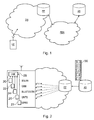
- Figure 1 provides an example block diagram illustrating a system for pushing content information to mobile user equipment.
- a form of the content information is adapted in accordance with a current quality-of-service which is available for pushing data to the mobile user equipment.
- the location of the mobile user equipment may be determined from a current internet protocol address for the mobile user equipment. The location indication is used to select the content of the information which to be pushed to the mobile.
- an applications server AS is connected to a push proxy PP via a packet data network PDN that may include an internet and/or intranet operating in accordance with the Internet Protocol (IP).
- IP Internet Protocol
- the applications server AS may also communicate with the push proxy PP in accordance with IP.
- the push proxy PP can behave as an HTTP, as an e-mail or a WAP based push proxy.
- the push proxy PP resides within an operator network and performs an interface function between a delivery network DN and the applications server AS.
- the delivery network DN comprises a plurality of wireless access networks which may be operable in accordance with different wireless access interfaces, which can provide a different quality-of-service to the mobile user equipment.
- the mobile user equipment UE is therefore provided with different bearer services using the delivery network DN from which data representing the content information can be pushed to the UE using these bearer services.
- the delivery network may also communicate data to the UE using the IP, one example of which is Ipv6.
- the delivery network DN is comprised of a plurality of access networks each of which is operable in accordance with a different wireless interface standard.
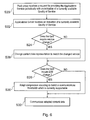
- Figure 2 provides a more detailed illustration of parts in Figure 1 which are associated with pushing the content data to the mobile user equipment UE from the applications server AS through the push proxy PP via one of a plurality of wireless access networks to the mobile user equipment UE.
- the mobile user equipment UE is provided with five wireless access devices 20, 22, 24, 26, 27 which respectively operate in accordance with a Wireless Local Area Network interface WLAN, a GSM interface, a Bluetooth interface, Universal Mobile Telecommunications System (UMTS) interface and a General Packet Radio Service (GPRS) interface.
- WLAN Wireless Local Area Network interface
- GSM Global System
- Bluetooth Universal Mobile Telecommunications System
- UMTS Universal Mobile Telecommunications System
- GPRS General Packet Radio Service
- Each of the wireless access devices 20, 22, 24, 26, 27 provides a facility for communicating data to and/or from the mobile user equipment.
- the wireless access devices utilise different wireless access interfaces which may be available at different locations as the mobile user equipment roams through a geographical area served by the delivery network DN.
- a Wireless-LAN WLAN may only be available within an office environment, within a building.
- the GSM network may be more prevalent and form an umbrella for communications with the mobile user equipment over a wide geographical area.
- the Bluetooth access device forms a wireless access interface for short range communications
- the UMTS access device provides a facility for communicating via the Universal Terrestrial Radio Access Network (UTRAN) interface.
- the UMTS access device provides a third generation-type communication facility for communicating using variable bit rates in accordance with current radio communication conditions.
- the system illustrated in Figures 1 and 2 provides a contextual push service to mobile subscribers based upon either the location of the mobile user equipment or the quality-of-service available for communicating data using the mobile user equipment.
- data is communicated with the mobile user equipment using Mobile IPv6 Internet Protocol, although it will be appreciated that this is only one example technique for communicating data to the mobile user equipment in accordance with a push service.
- the push proxy PP is provided with mobility enhancement to the effect that the push proxy PP can receive information pertaining to current quality-of-service parameters of access networks available to the mobile user equipment.
- the push proxy PP may also determine a current relative location of the mobile user equipment.
- the push proxy provides an indication of a current quality-of-service available to the mobile user equipment.
- the applications server can then adapt the form of the content data for pushing to the mobile user equipment in accordance with the currently experienced quality-of-service.
- Figure 3 provides an example block diagram of a push proxy according to an example embodiment of the present invention.
- the push proxy provides mobility-enhanced information to the effect that it monitors both a current quality-of-service available to mobile user equipment and mobility information pertaining to the location of a particular mobile user equipment.
- the quality-of-service and the location of the mobile user equipment are monitored by utilising mobile IPv6 although it will be appreciated that in other embodiments other means will be used for monitoring the quality-of-service and the location of the mobile.
- the push proxy PP comprises a push engine 30, a subscriber management database 32, a home agent 34 and a firewall 36.
- the push engine is operable to receive push messages from the applications server AS requesting the push engine 30 to push data to the mobile user equipment.
- the push engine 30 has a data store 38 for storing push content for forwarding to the mobile user equipment.
- the push engine interrogates the subscriber management database 32 to ascertain whether it is currently possible to communicate the content to the mobile user equipment. If it is possible to send the content data to the mobile user equipment then the content data is communicated to the mobile user equipment by the push engine 30.
- the subscriber management database 32 manages push subscriptions for users.
- the subscriber management database 32 stores a "push profile".
- the push profile for example provides for each user information appertaining to services for which the user has registered.
- the information may include a type of billing tariff selected and optionally an indication of current capabilities of a mobile user equipment to receive content data.
- the subscriber management database 32 also stores a number of characteristics for each of the wireless access interfaces that are provided within the delivery network DN for delivering content to the mobile user equipment in accordance with a contextual push.
- the subscriber management database 32 may, in some embodiments, include an indication of a location of the user equipment. This location indication is received from the home agent 34.
- the firewall 36 is provided as an edge router for the delivery network DN and interfaces with the packet data network PDN and provides security control for pushing content that passes through the push proxy PP.
- the push proxy of Figure 3 monitors a quality-of-service which is currently available to communicate data to the mobile user equipment.
- the subscriber management database 32 exchanges access network evaluation messages 39 with the mobile user equipment UE.
- the mobile user equipment UE includes an Access Network Evaluation (ANE) application 28 which sends access network evaluation (ANE) messages 39 to the push proxy PP.
- ANE Access Network Evaluation
- the ANE messages may be sent periodically to the push proxy, although in other examples an ANE message may be sent once on demand from the push proxy.
- the ANE messages 39 include information pertaining to a network quality-of-service which can be supported, for example an available bandwidth for communicating content data, an amount of delay, a timing jitter or packet loss or other characteristics for data communications which are available via any of the wireless access interfaces 20, 22, 24, 26, 27 shown in Figure 2.
- the ANE messages 39 can be sent in a destination option part of the IPv6 header and can relate to all network interfaces, which are active on the mobile user equipment UE.
- the ANE application 28 in the user equipment UE is employed to monitor a signal level, a bit error rate, an available bandwidth or other characteristics which pertain to a quality-of-service of any of the access networks available to the user equipment.
- Periodically information is generated by the ANE application 28 which provides a report on a current quality-of-service which is available via each of the access networks. This report information is sent to the push proxy PP.
- the reports are collated by the subscriber management database 32.
- the subscriber management database collates the quality-of-service reports from the mobile user equipment to provide an indication of for example a best available quality-of-service for that mobile user equipment for communicating content data as part of a contextual push service. Accordingly, the subscriber management database assimilates the access network evaluation messages 39 provided by the ANE application 28 to provide a current indication of a quality-of-service which is available to support a push of content data to the mobile user equipment.
- the push proxy may form an indication of a least expensive quality-of-service available for communicating the content data, and as will be appreciated other criteria could be defined for reporting the available quality-of-service.
- the subscriber management database 32 receives a message from the applications server AS indicating a minimum quality-of-service which must be provided in order to deliver the content.
- the content may be delivered in a specific form using a specific service such as for example a video service.
- a specific service such as for example a video service.
- a relatively high bandwidth would be required. Accordingly, if for example the mobile user equipment is provided with a Wireless LAN access device and a GSM network access device, then the video content could not be pushed to the mobile until the quality-of-service reports indicate that the Wireless LAN network was available for pushing the content.
- a push service to which a user has subscribed may generate content which is time sensitive. Accordingly, unless the content is pushed to the mobile within a predetermined time period then the relevance of the content will be lost. Examples of such time relevant content are sports results or current affairs information.
- the subscriber management database 32 may periodically communicate with the applications server AS by sending messages to the applications server AS via the firewall 36 of a currently available quality-of-service for communicating data to the mobile user equipment.
- the applications server AS may be operable to adapt the form of the content in accordance with an available quality-of-service. This may for example include adapting a compression ratio of the data to be communicated or may result in a change in the service, which is used to push the content to the mobile unit.
- the content data may be adapted by the applications server AS to be represented in the form of an audio signal only.
- the applications server may adapt the content data to be represented in the form of a video and/or audio signal for pushing to the mobile user equipment UE.
- Figure 5 provides a flow diagram which illustrates one way in which the applications server registers a predetermined quality-of-service for pushing content to the mobile user equipment with the subscriber management database.
- Figure 5 is summarised as follows:
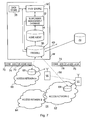
- FIG 7 provides an illustrative block diagram of the push proxy PP shown in Figure 3 operating in accordance with a further example embodiment of the present invention.
- mobility information which is provided in accordance with the operation of the mobile IPv6 protocol is utilised by the push proxy in order to provide an indication of the location of the mobile.
- Mobile IPv6 is a protocol that provides a facility for an IP client (in this case a mobile user equipment) to roam from one network to another whilst still maintaining a service for a user.
- mobile IPv6 utilises the Internet Protocol to allow internet packets to be communicated from the user equipment via a foreign network after the mobile user equipment has roamed from a home network.
- the mobile user equipment UE may communicate data to and from the push proxy PP via a plurality of networks which form part of the delivery network DN shown in Figure 1.
- Each of the networks 60, 62, 64 may be served by an IP router 66, 68.
- this network could be the mobile's home network.
- the home address of the user equipment would be known to the home network and internet packets will be routed to the home network to/from the user equipment using the user equipment's home address in a destination/source address field.
- the internet packet 70 illustrates a packet being sent from the mobile user equipment UE when attached to network A, with the source field 72 containing the home address of the mobile and the destination address field 70 containing the address of a correspondent node.
- the mobile user equipment UE After the user equipment has roamed to a foreign network, for example network C shown in Figure 7, then the mobile user equipment UE is provided with a care-of-address in order to allow for internet packets to be routed to network C rather than network A.
- a foreign network for example network C shown in Figure 7
- the user equipment UE After the user equipment UE has roamed to network C 68, then in accordance with the mobile IPv6 protocol the user equipment sends a binding up-date to the home agent 34 in the push proxy PP.
- the binding up-date informs the home agent that the future address to be used for the user equipment is the care-of-address.
- the push proxy will act as a home agent for the user equipment and will store the care-of-address in association with the home address.
- the home agent IP address is also registered with the user equipment. Therefore internet packets sent from/to the mobile user equipment will include a care-of-address in a source/destination address field. As shown in Figure 7, the internet packets 74 being sent to the mobile user equipment UE include the mobile's care-of-address in the destination address field 76, and a correspondent node's address in the source address field 78.
- the home agent Since the care-of-address is acquired from the address of the router 68 serving the access network C 62, the home agent is provided with a relative geographical location of the user equipment within the delivery network DN. This is because the care-of-address provides an indication of the access network being used by the user equipment. A process from which the mobile user equipment acquires the care-of-address will now be briefly explained, although it will be appreciated that this forms part of the IPv6 protocol.
- Auto-configuration can be stateless or stateful.
- a stateful auto-configuration is based on the use of a stateful address configuration protocol such as Dynamic Host Configuration Protocol for IPv6 (DHCPv6) to obtain addresses and other configuration options. More information concerning stateful auto-configuration is provided in IETF RFC 3315 - DHCPv6 (Stateful Auto-Configuration).
- a stateless configuration is based on the receipt of Router Advertisement messages. More information concerning a stateless auto-configuration can be found in IETF RFC 2462 - IPv6 Stateless Address Auto-Configuration. The following explanation of an example of an acquisition of a care-of-address is provided for a stateless configuration.
- each router in an IPv6 network transmits router advertisements to all other routers and servers within the network.
- the router advertisements are sent out either periodically or in response to the receipt of a router solicitation message.
- the router advertisement contains information which is required by the user equipment in order to determine link prefixes and other information, whether or not to use an address auto configuration routine and the duration for which addresses created through auto configuration are both valid and preferred.
- This message provides information required by the user equipment to determine the type of neighbour advertisement message, the link layer address of the sender and the sender's role in the network. Accordingly, the user equipment can determine the addresses of routers and other configuration parameters additional addresses and on-link prefixes, which are required in order to communicate via the foreign network.
- the on-link prefix represents the geographical context of the location of the network and is used to auto configure the user equipment.
- a binding up-date is sent from the user equipment to the home agent within the push proxy PP providing the newly acquired care-of-address.
- the home agent replies with a binding acknowledgement and stores the association between the original home address of the mobile user equipment and the care-of-address.
- An access network may be uniquely associated with a particular location such as a shopping precinct, a public building or a transport building. If a mobile roams into an area which is served by an access network which is locally associated within a particular geographical area then the mobile user equipment will receive the router advertisements and perform an auto configuration as described above. Thus, following the binding up-date the care-of-address is provided to the home agent within the push proxy, the care-of-address providing an indication of the access network being used. Accordingly, the push proxy is provided with an indication of the geographical location of the mobile user equipment, which can therefore be used to push content data relevant to the location of the mobile. For example, if the mobile user equipment enters an area, which is associated with a particular store, then the content data might include advertisements and discount information relating to that store.
- FIG. 8 A flow diagram illustrating the operation of the push proxy to the effect of identifying the location of the mobile user equipment and pushing content data which is selected in accordance with that location is provided in Figure 8.
- the operation illustrated by Figure 8 is summarised as follows:
- aspects of the present invention include a system for pushing content information to mobile user equipment.
- the system comprises an applications server operable to provide data representative of the content information for communication to the mobile user equipment and a push proxy.
- the push proxy is operable to monitor a currently available quality-of-service for communicating the content data to the mobile user equipment.
- At least one of the applications server and the push proxy is operable to arrange for the content data to be communicated to the mobile user equipment in accordance with the currently available quality-of-service.
- the push proxy may communicate the content data, whereas in other embodiments the data may be communicated by the applications server, and in others by a combination of the push proxy and the applications server.
- the currently available quality-of-service provides an indication of a communications bandwidth for communicating data to the mobile user equipment, the push proxy being operable to provide an indication of the current communications bandwidth which is available.
- One of the applications server and the push proxy is operable to adapt the representation of the content data in accordance with the currently available communications bandwidth, the content data being communicated to the mobile user equipment in the adapted form.
- the applications server may be operable to adapt the representation of the content data by changing the amount of data which is required to represent the content with the effect that the bandwidth of the content data is adapted in accordance with the currently available communications bandwidth.
- the amount of data required to represent the content data may be adapted by changing a form of the content data in accordance with a service, which is supportable using the currently available communications bandwidth.
- the services may include video/audio communication of the content information, audio communication of the content information and text data communication of the content information.
- the content data may be communicated to the mobile user equipment by first communicating the content data to the push proxy, the push proxy being operable to store and forward the content data to the mobile user equipment.
- an applications server which is operable to adapt the content data in accordance with a currently available communications bandwidth.
- a mobile user equipment including a plurality of access devices, each of the access devices providing a facility for receiving data from an access network.
- An access network evaluation application is operable to determine, for at least one of the plurality of access networks, a current quality of service which is available via the access network from which the access device is arranged to receive data, and to generate an access network evaluation message.
- the access network evaluation message is arranged to provide information pertaining to the current quality of service determined for the access network.
- the application is operable to communicate the access network evaluation message to a push proxy.
- the access network evaluation message may be formed as an Internet Packet and communicated to the push proxy using an Internet Protocol.
Landscapes
- Engineering & Computer Science (AREA)
- Computer Networks & Wireless Communication (AREA)
- Signal Processing (AREA)
- Mobile Radio Communication Systems (AREA)
Priority Applications (1)
| Application Number | Priority Date | Filing Date | Title |
|---|---|---|---|
| EP03292490A EP1523154A1 (de) | 2003-10-08 | 2003-10-08 | System und Verfahren zur Realisierung von Push-Diensten für mobile Teilnehmer mit Hilfe eines Push-Proxies, der den Zustand des mobilen Teilnehmergerätes überwacht |
Applications Claiming Priority (1)
| Application Number | Priority Date | Filing Date | Title |
|---|---|---|---|
| EP03292490A EP1523154A1 (de) | 2003-10-08 | 2003-10-08 | System und Verfahren zur Realisierung von Push-Diensten für mobile Teilnehmer mit Hilfe eines Push-Proxies, der den Zustand des mobilen Teilnehmergerätes überwacht |
Publications (1)
| Publication Number | Publication Date |
|---|---|
| EP1523154A1 true EP1523154A1 (de) | 2005-04-13 |
Family
ID=34307031
Family Applications (1)
| Application Number | Title | Priority Date | Filing Date |
|---|---|---|---|
| EP03292490A Withdrawn EP1523154A1 (de) | 2003-10-08 | 2003-10-08 | System und Verfahren zur Realisierung von Push-Diensten für mobile Teilnehmer mit Hilfe eines Push-Proxies, der den Zustand des mobilen Teilnehmergerätes überwacht |
Country Status (1)
| Country | Link |
|---|---|
| EP (1) | EP1523154A1 (de) |
Cited By (14)
| Publication number | Priority date | Publication date | Assignee | Title |
|---|---|---|---|---|
| FR2884379A1 (fr) * | 2005-04-06 | 2006-10-13 | Alcatel Sa | Dispositif de gestion de service de transmission automatique de donnees d'information par un reseau de communication mobile |
| EP1777881A1 (de) * | 2005-10-24 | 2007-04-25 | Robert Bosch Gmbh | Verfahren zur selektiven Bereitstellung eines Dienstes innerhalb eines Reichweitebereichs einer Basisstation sowie Dienstbereitstellungseinheit mit einer Basisstation |
| EP1933503A4 (de) * | 2005-09-07 | 2008-09-17 | Huawei Tech Co Ltd | Verfahren zum erhalten der heimatagentinformationen des mobilknotens und system dafür |
| EP2026274A1 (de) * | 2007-08-09 | 2009-02-18 | Deutsche Telekom AG | Kommerzielles neues E-Papiersystem |
| WO2009100539A1 (en) * | 2008-02-15 | 2009-08-20 | Chalk Media Service Corp. | A system and method for delivering push content to a mobile device |
| CN1937629B (zh) * | 2005-09-24 | 2010-05-26 | 国际商业机器公司 | 用于确定带宽容量的动态带宽管理器和方法 |
| WO2010080165A1 (en) * | 2009-01-09 | 2010-07-15 | Qualcomm Incorporated | Multimedia content cache |
| US20100205148A1 (en) * | 2007-05-04 | 2010-08-12 | Chalk Media Service Corp. | Method and system for pushing content to mobile devices |
| WO2012167055A1 (en) * | 2011-06-03 | 2012-12-06 | Apple Inc. | System and method for dynamic routing for push notifications |
| EP2274942A4 (de) * | 2008-05-07 | 2013-04-10 | Research In Motion Ltd | Verfahren zur bandbreitenverwaltung für mobile inhaltsbereitstellung |
| EP2897408A4 (de) * | 2012-10-09 | 2015-09-02 | Huawei Tech Co Ltd | Datenübertragungsverfahren, -vorrichtung und system |
| GB2551674A (en) * | 2013-07-12 | 2017-12-27 | Canon Kk | Adaptive data streaming method with push messages control |
| US10104190B2 (en) | 2013-07-12 | 2018-10-16 | Canon Kabushiki Kaisha | Adaptive data streaming method with push messages control |
| US11665066B2 (en) | 2020-04-30 | 2023-05-30 | Elbit Systems C4I and Cyber Ltd. | Systems and methods for managing collaboration between network devices over a communications nework |
Citations (8)
| Publication number | Priority date | Publication date | Assignee | Title |
|---|---|---|---|---|
| EP0961490A2 (de) * | 1998-05-28 | 1999-12-01 | International Business Machines Corporation | Internet Convolution Audio/Videoserver |
| EP1021021A2 (de) * | 1999-01-13 | 2000-07-19 | International Business Machines Corporation | Verfahren und Vorrichtung zur Bereitstellung einer aufmerksamkeitsgesteuerten Push-Operation |
| EP1037434A1 (de) * | 1998-10-29 | 2000-09-20 | Mitsubishi Materials Silicon Corporation | Funkkommunikationssystem für pushinformationslieferung |
| WO2001035585A1 (en) * | 1999-11-12 | 2001-05-17 | Telefonaktiebolaget Lm Ericsson (Publ) | Method and apparatus for selective network access |
| WO2001095592A1 (en) * | 2000-06-08 | 2001-12-13 | Motorola, Inc. | Mobile ip push service |
| US20030065571A1 (en) * | 1999-10-14 | 2003-04-03 | Rabindranath Dutta | System, method, and program for determining the jurisdiction of a product delivery location by using the ip address of the client while selling items via electronic commerce over the internet |
| US20030095540A1 (en) * | 2001-11-20 | 2003-05-22 | Nokia Corporation | Web services push gateway |
| EP1326378A2 (de) * | 2002-01-04 | 2003-07-09 | Motorola, Inc. | Verfahren zum Ermöglichen einer Datenübertragung in einem drahtlosen Kommunikationsnetz |
-
2003
- 2003-10-08 EP EP03292490A patent/EP1523154A1/de not_active Withdrawn
Patent Citations (8)
| Publication number | Priority date | Publication date | Assignee | Title |
|---|---|---|---|---|
| EP0961490A2 (de) * | 1998-05-28 | 1999-12-01 | International Business Machines Corporation | Internet Convolution Audio/Videoserver |
| EP1037434A1 (de) * | 1998-10-29 | 2000-09-20 | Mitsubishi Materials Silicon Corporation | Funkkommunikationssystem für pushinformationslieferung |
| EP1021021A2 (de) * | 1999-01-13 | 2000-07-19 | International Business Machines Corporation | Verfahren und Vorrichtung zur Bereitstellung einer aufmerksamkeitsgesteuerten Push-Operation |
| US20030065571A1 (en) * | 1999-10-14 | 2003-04-03 | Rabindranath Dutta | System, method, and program for determining the jurisdiction of a product delivery location by using the ip address of the client while selling items via electronic commerce over the internet |
| WO2001035585A1 (en) * | 1999-11-12 | 2001-05-17 | Telefonaktiebolaget Lm Ericsson (Publ) | Method and apparatus for selective network access |
| WO2001095592A1 (en) * | 2000-06-08 | 2001-12-13 | Motorola, Inc. | Mobile ip push service |
| US20030095540A1 (en) * | 2001-11-20 | 2003-05-22 | Nokia Corporation | Web services push gateway |
| EP1326378A2 (de) * | 2002-01-04 | 2003-07-09 | Motorola, Inc. | Verfahren zum Ermöglichen einer Datenübertragung in einem drahtlosen Kommunikationsnetz |
Cited By (24)
| Publication number | Priority date | Publication date | Assignee | Title |
|---|---|---|---|---|
| FR2884379A1 (fr) * | 2005-04-06 | 2006-10-13 | Alcatel Sa | Dispositif de gestion de service de transmission automatique de donnees d'information par un reseau de communication mobile |
| EP1933503A4 (de) * | 2005-09-07 | 2008-09-17 | Huawei Tech Co Ltd | Verfahren zum erhalten der heimatagentinformationen des mobilknotens und system dafür |
| US8213369B2 (en) | 2005-09-07 | 2012-07-03 | Huawei Technologies Co., Ltd. | Method and system for obtaining home agent information of a mobile node |
| US8559460B2 (en) | 2005-09-24 | 2013-10-15 | International Business Machines Corporation | Dynamic bandwidth manager |
| CN1937629B (zh) * | 2005-09-24 | 2010-05-26 | 国际商业机器公司 | 用于确定带宽容量的动态带宽管理器和方法 |
| US8270296B2 (en) | 2005-09-24 | 2012-09-18 | International Business Machines Corporation | Dynamic bandwidth manager |
| EP1777881A1 (de) * | 2005-10-24 | 2007-04-25 | Robert Bosch Gmbh | Verfahren zur selektiven Bereitstellung eines Dienstes innerhalb eines Reichweitebereichs einer Basisstation sowie Dienstbereitstellungseinheit mit einer Basisstation |
| US8996489B2 (en) * | 2007-05-04 | 2015-03-31 | Blackberry Limited | Method and system for pushing content to mobile devices |
| US20100205148A1 (en) * | 2007-05-04 | 2010-08-12 | Chalk Media Service Corp. | Method and system for pushing content to mobile devices |
| EP2026274A1 (de) * | 2007-08-09 | 2009-02-18 | Deutsche Telekom AG | Kommerzielles neues E-Papiersystem |
| US9549033B2 (en) | 2008-02-15 | 2017-01-17 | Blackberry Limited | System and method for delivering push content to a mobile device |
| US9178954B2 (en) | 2008-02-15 | 2015-11-03 | Blackberry Limited | System and method for delivering push content to a mobile device |
| WO2009100539A1 (en) * | 2008-02-15 | 2009-08-20 | Chalk Media Service Corp. | A system and method for delivering push content to a mobile device |
| US8843597B2 (en) | 2008-05-07 | 2014-09-23 | Blackberry Limited | Method for enabling bandwidth management for mobile content delivery |
| EP2274942A4 (de) * | 2008-05-07 | 2013-04-10 | Research In Motion Ltd | Verfahren zur bandbreitenverwaltung für mobile inhaltsbereitstellung |
| WO2010080165A1 (en) * | 2009-01-09 | 2010-07-15 | Qualcomm Incorporated | Multimedia content cache |
| US8942115B2 (en) | 2011-06-03 | 2015-01-27 | Apple Inc. | System and method for dynamic routing for push notifications |
| WO2012167055A1 (en) * | 2011-06-03 | 2012-12-06 | Apple Inc. | System and method for dynamic routing for push notifications |
| EP2897408A4 (de) * | 2012-10-09 | 2015-09-02 | Huawei Tech Co Ltd | Datenübertragungsverfahren, -vorrichtung und system |
| US9838492B2 (en) | 2012-10-09 | 2017-12-05 | Huawei Technologies Co., Ltd. | Data pushing method, apparatus, and system |
| GB2551674A (en) * | 2013-07-12 | 2017-12-27 | Canon Kk | Adaptive data streaming method with push messages control |
| GB2551674B (en) * | 2013-07-12 | 2018-04-11 | Canon Kk | Adaptive data streaming method with push messages control |
| US10104190B2 (en) | 2013-07-12 | 2018-10-16 | Canon Kabushiki Kaisha | Adaptive data streaming method with push messages control |
| US11665066B2 (en) | 2020-04-30 | 2023-05-30 | Elbit Systems C4I and Cyber Ltd. | Systems and methods for managing collaboration between network devices over a communications nework |
Similar Documents
| Publication | Publication Date | Title |
|---|---|---|
| KR100797167B1 (ko) | 위치 의존 서비스 | |
| JP4739412B2 (ja) | ローミング加入者用のマルチメディアブロードキャスト/マルチキャストサービス(MBMS)のプロビジョン(provision) | |
| US9210224B2 (en) | Service provisioning in a communication system | |
| US7031706B2 (en) | Internet protocol (IP) multimedia subsystem (IMS) availability detection | |
| US9325720B2 (en) | System and method of controlling application level access of subscriber to a network | |
| US20070243821A1 (en) | Destributed Caching and Redistribution System and Method in a Wireless Data Network | |
| US8769123B2 (en) | Apparatus, and associated method, for facilitating QoS and bearer setup in an IP-based communication system | |
| EP2016507B1 (de) | Verfahren und system zur bereitstellung von präsenzinformationen | |
| EP1523154A1 (de) | System und Verfahren zur Realisierung von Push-Diensten für mobile Teilnehmer mit Hilfe eines Push-Proxies, der den Zustand des mobilen Teilnehmergerätes überwacht | |
| KR101015642B1 (ko) | 헤테로지니어스 네트워크를 통한 데이터 푸쉬 서비스시스템 및 방법 | |
| EP1911298A2 (de) | Verfahren und system zum berichten einer kurznachrichtenfunktion über ein ip-multimedia-untersystem | |
| EP1829413B1 (de) | Standard-teilnehmerprofil für ein roaming-endgerät in einem mobilen kommunikationsnetz auf paketdatenbasis | |
| US7733824B2 (en) | Fixed access point for a terminal device | |
| US20100082796A1 (en) | Mobile communication management system and mobile communication management method | |
| US20050033860A1 (en) | Method, network device, and terminal device for controlling context activation | |
| US7388855B2 (en) | Method for discovering a broadcast multicast services (BCMCS) controller in a packet data network | |
| WO2001093523A2 (en) | System and method of controlling application level access of a subscriber to a network | |
| WO2004086789A1 (en) | Service provisioning in a communication system | |
| EP1367772B1 (de) | Anschluss von Benutzergeräten Selektivezugangschnittstelle von einem ISP-router | |
| EP1913784B1 (de) | Verfahren und vorrichtungen zum erheben von gebühren von einem in einem mobilkommunikationsnetz roamenden teilnehmer |
Legal Events
| Date | Code | Title | Description |
|---|---|---|---|
| PUAI | Public reference made under article 153(3) epc to a published international application that has entered the european phase |
Free format text: ORIGINAL CODE: 0009012 |
|
| AK | Designated contracting states |
Kind code of ref document: A1 Designated state(s): AT BE BG CH CY CZ DE DK EE ES FI FR GB GR HU IE IT LI LU MC NL PT RO SE SI SK TR |
|
| AX | Request for extension of the european patent |
Extension state: AL LT LV MK |
|
| 17P | Request for examination filed |
Effective date: 20050922 |
|
| AKX | Designation fees paid |
Designated state(s): AT BE BG CH CY CZ DE DK EE ES FI FR GB GR HU IE IT LI LU MC NL PT RO SE SI SK TR |
|
| 17Q | First examination report despatched |
Effective date: 20051024 |
|
| 17Q | First examination report despatched |
Effective date: 20051024 |
|
| GRAP | Despatch of communication of intention to grant a patent |
Free format text: ORIGINAL CODE: EPIDOSNIGR1 |
|
| GRAJ | Information related to disapproval of communication of intention to grant by the applicant or resumption of examination proceedings by the epo deleted |
Free format text: ORIGINAL CODE: EPIDOSDIGR1 |
|
| APBK | Appeal reference recorded |
Free format text: ORIGINAL CODE: EPIDOSNREFNE |
|
| APBN | Date of receipt of notice of appeal recorded |
Free format text: ORIGINAL CODE: EPIDOSNNOA2E |
|
| APBR | Date of receipt of statement of grounds of appeal recorded |
Free format text: ORIGINAL CODE: EPIDOSNNOA3E |
|
| APBD | Information on interlocutory revision deleted |
Free format text: ORIGINAL CODE: EPIDOSDIRAPE |
|
| APBV | Interlocutory revision of appeal recorded |
Free format text: ORIGINAL CODE: EPIDOSNIRAPE |
|
| GRAP | Despatch of communication of intention to grant a patent |
Free format text: ORIGINAL CODE: EPIDOSNIGR1 |
|
| STAA | Information on the status of an ep patent application or granted ep patent |
Free format text: STATUS: THE APPLICATION IS DEEMED TO BE WITHDRAWN |
|
| 18D | Application deemed to be withdrawn |
Effective date: 20100504 |