EP1522951A1 - Bestimmung von textbeschreibenden Eigenschaften in Digitalbildern - Google Patents
Bestimmung von textbeschreibenden Eigenschaften in Digitalbildern Download PDFInfo
- Publication number
- EP1522951A1 EP1522951A1 EP04077715A EP04077715A EP1522951A1 EP 1522951 A1 EP1522951 A1 EP 1522951A1 EP 04077715 A EP04077715 A EP 04077715A EP 04077715 A EP04077715 A EP 04077715A EP 1522951 A1 EP1522951 A1 EP 1522951A1
- Authority
- EP
- European Patent Office
- Prior art keywords
- pixel
- pixels
- text
- gradients
- image
- Prior art date
- Legal status (The legal status is an assumption and is not a legal conclusion. Google has not performed a legal analysis and makes no representation as to the accuracy of the status listed.)
- Withdrawn
Links
Images



Classifications
-
- H—ELECTRICITY
- H04—ELECTRIC COMMUNICATION TECHNIQUE
- H04N—PICTORIAL COMMUNICATION, e.g. TELEVISION
- H04N1/00—Scanning, transmission or reproduction of documents or the like, e.g. facsimile transmission; Details thereof
- H04N1/40—Picture signal circuits
- H04N1/40062—Discrimination between different image types, e.g. two-tone, continuous tone
-
- G—PHYSICS
- G06—COMPUTING OR CALCULATING; COUNTING
- G06V—IMAGE OR VIDEO RECOGNITION OR UNDERSTANDING
- G06V20/00—Scenes; Scene-specific elements
- G06V20/60—Type of objects
- G06V20/62—Text, e.g. of license plates, overlay texts or captions on TV images
-
- G—PHYSICS
- G06—COMPUTING OR CALCULATING; COUNTING
- G06V—IMAGE OR VIDEO RECOGNITION OR UNDERSTANDING
- G06V30/00—Character recognition; Recognising digital ink; Document-oriented image-based pattern recognition
- G06V30/10—Character recognition
Definitions
- the present invention relates to the determination of textual features of pixels for discriminate text pixels and no pixels text to detect textual information in images or in sequences of images forming video sequences.
- the character recognition phase is carried out generally by a system of optical character recognition OCR (Optical Character Recognition).
- OCR Optical Character Recognition
- the textual information contained in images are of two types, "scene text” or "text
- the "artificial text” is a text that has been added to an original image, for example a subtitles.
- the "scene text” is the text contained in the original image, for example text an advertisement or a t-shirt.
- First detection algorithms textual information included a segmentation of characters, before grouping the characters to form words and lines.
- the purpose of segmentation is to split an image original in several distinct areas.
- Information detection algorithms texts are based on a classification of pixels an image in "text” and "no text" made line by line. Thus a colorimetric grouping of pixels of each line is made in order to determine the pixels belonging to a zone of "text”. Histograms of line segments uniform color are determined and compared between them to form rectangles including text of the image.
- gradients of light intensity of each line are evaluated and the lines are cut into segments with a gray level similar. Adjacent lines are merged according to a statistical criterion of similarity.
- a treatment hierarchical connected components of the image is used to determine the text boxes.
- the neural network classifies each pixel of an image according to a density of contours, a variance of a histogram, etc.
- the classification of pixels according to textual features is usually performed by neural networks or machines SVM vector carriers (Support Vector Machines). These classification means take into account the classification of previous pixels to classify following pixels, and so "learn" to classify.
- Recent textual acts act directly on the form compressed images or video sequences, by example on images in compression formats MPEG 1, MPEG 2, etc.
- Text pixels and non-text pixels can not be discriminated against by considering only local textual features pixels of an image.
- the main textual features of a text are extracted of its geometry and result in the presence of a baseline and by the possibility of isolating the text delineating an area around it.
- the baseline of a text refers to the alignment of the text characters.
- the texture textual features are over in addition uncertain when the text to be treated is more and more short.
- the present invention aims to to overcome the aforementioned drawbacks by determining textual characteristics of the pixels of a more complex picture on which is based the detecting textual information in the image so improve the efficiency and accuracy of detection of textual information.
- Textual features of the pixels other than "fashion" heights and widths previously determined are determined for each pixel to discriminate text and non-text pixels text also according to differences and average accumulated gradients determined for the pairs of pixel edges.
- the determination of a couple of edges for each current pixel can be function of a maximization of a variable depending on the width between the two edges, accumulated gradients minimum and maximum in the predetermined range, the height between the maximum value of the gradients accumulated and the average accumulated gradients, and of the average gradients accumulated between the two edges, for different values of both edges respectively included in the two halves of the predetermined interval
- Another textual characteristic serving to discriminate between text pixels and non-text pixels can be a sum representative of the presence of a baseline of text and resulting from a summation of the differences of Weak width for neighboring pairs of pixels on along a window oriented following the first direction and predetermined width.
- the quantified gradient angle of each pixel current is preferably smoothed according to a maximization of sums of pixel gradients neighbors of the current pixel, weighted and oriented respectively according to the guidelines predetermined.
- a sum of gradients for a respective predetermined orientation of the coefficients gradient weighting for the current pixel for immediately adjacent pixels following the first and second directions and for pixels neighbors following diagonal directions to first and second directions are preferably decreasing.
- a computer system as a means of data processing implementing the method to determine textual characteristics according to the invention mainly comprises a module feature determination software of the pixels of the MD image represented by figure 1.
- the computer system is installed in a terminal T of the personal computer type.
- the computer system received and registered at less a digital image or sequences of images digital signals forming a video sequence.
- Each image I is processed one after the other by the system computer science.
- An image I is supposed to contain at minus a text, a text being a part of the image I having textual characters.
- a method of detecting information textual consists essentially of two phases principal, a first phase of determination of vectors of textual features of the pixels of image and a second phase of classification of pixels of the image during which pixels of text and non-text pixels are determined in function of textual feature vectors determined.
- the objective of the first phase is to determine textual characteristics of pixels sufficiently discriminating images for classify pixels as "text” and "non-text" when of the second phase.
- a pixel classified in "text” is a pixel considered to belong to a character textual and is called “text pixel", unlike to a "non-text pixel”.
- the result of this first phase is a vector of features textual determined for each pixel of the image.
- the objective of the second phase is to classify each pixel according to the vectors of textual characteristics determined using a algorithm, such as one of the algorithms implemented in SVM support vector machines (Support Vector Machine).
- the horizontal direction is a first direction X considered parallel to the lines (rows) of pixels of a rectangular image and parallel to the large sides of the image
- the vertical direction is a second direction Y considered parallel to the pixel columns of the image and parallel to the small sides of the image.
- the first property is modeled by a textual characteristic value by accumulating horizontal gradients in a window around each pixel.
- a first rough detection is performed in determining a baseline of a text from image I as ends of a high density surface in the picture.
- the high density surface is the surface of the rectangle containing a text of the image, that is to say, substantially circumscribed to the text.
- Detect a baseline directly in using for example the Hough transform, is very difficult because of the irregularity of rectangles containing text and eventual presence of a short text.
- borders between text and non-text areas can be blurred, especially when the direction of the text does not does not coincide with the direction of the directional filter of gradient. For example, a text with a orientation of fifteen degrees compared to the horizontal is not as well detected with a horizontal gradient filter. Direct detection lines and outlines is thus a problem complex.
- the invention determines the height of a possible rectangle of text associated with a current pixel, and compares the differences in these heights between neighboring pixels at the current pixel. In text boxes, the heights of the rectangles determined must remain approximately constant.
- the algorithm of the mode estimation method mainly includes steps A1 to A6 shown in FIG. 3 according to the first preferred embodiment of the invention.
- the invention uses the known principle of the accumulation of light intensity gradients based on the fact that a text pixel of the image has a gradient of which the amplitude is high.
- An accumulated horizontal gradient of a current pixel p of x and y coordinates in image I is the sum of horizontal elementary gradients of a light intensity, for example pixel luminance, for consecutive pairs of pixels on the d-line. 1x image to which pixel p belongs and located near it.
- the module for determining the characteristics MD thus determines an accumulated horizontal gradient G H for each pixel of the image I by summing the horizontal elementary gradients by means of an accumulation filter of horizontal elementary gradients whose response G H is: where FH denotes the size of the window of the horizontal elementary gradients which are added, for example equal to 13, and I denotes the luminous intensity in the image I.
- the value of the parameter FH depends on the size of the characters of the text to be detected and the contrast of the image.
- the height of the rectangle containing the text of image I is determined from a profile Vertical gradient filter response horizontal, that is to say for each pixel on the long axis of the rectangle p, a vertical interval TV of N pixels, centered on the pixel p is considered.
- the objective of the next A2 step is to estimate in the TV interval a mode for the pixel p at center of the TV interval.
- FIG. 4 shows an example of an original image in which the height of the rectangle containing text is estimated at the position of a current pixel p indicated by an intersection of horizontal lines 1x and vertical ly and included in the rectangle containing the text.
- Fig. 5 shows a plot of the accumulated horizontal gradients G Hi of the pixels of the original image, along the vertical line ly, and particularly in the vertical interval TV, with a visible peak PG of horizontal gradients accumulated in the interval TV centered on the pixel p.
- the short dashed line represents the pixel mode estimate p.
- the estimated mode is essentially dependent on the peak PG in the TV interval and gradient values G Ha and G Hb at the terminals a and b of an interval (a, b) defining the width of the mode.
- the orientation of the text influences the form of the estimation of the mode on the vertical interval TV, i.e. the shape of the peak PG.
- a horizontal text With a filter of horizontal gradient, a horizontal text generates a mode estimate on the vertical TV interval of substantially rectangular shape, whereas a text Slightly oblique generates a fashion estimate on the TV trapezoidal vertical interval and of smaller maximum amplitude.
- the mode estimate is undefined.
- the pixel p is close to non-text pixels, horizontal gradients accumulated at the terminals of vertical TV interval are close to zero.
- the terminals a and b of the mode interval are called the edges of the estimated mode.
- the rectangle containing the text is textured or has rectangles containing text in its neighborhood, other peaks of accumulated horizontal gradients are present in the vertical TV interval.
- the values a and b of the mode edges for the pixel to be estimated lie between the terminals to be estimated of the TV interval and are different from the central value N / 2 corresponding to the pixel p. These values a and b are determined so that a peak PG of accumulated horizontal gradients is included in the interval (a, b) and the values of the accumulated horizontal gradients G Ha and G Hb at the edges of the interval (a, b ) are weak.
- the module for determining the MD characteristics in step A2 some characteristics already determined during steps A1 and A2 are extracted for each pixel and others are determined by the MD module in step A3, in order to to determine overall characteristics following for each pixel: the width of the mode, the height of the mode, the average of the mode, the standard deviation of fashion, etc.
- the MD module also determines as a textual characteristic a mode height difference
- the determination module MD features also extract characteristics over an extended spatial area.
- the feature determination module MD verifies the variability of the mode width along neighboring pixels which are aligned in one of several predetermined directions, for example a horizontal direction, and which are included in a horizontal window of predetermined width S W at step A4. For this verification, the module MD determines the difference of the mode widths for each pair of neighboring pixels and accumulates, that is to say sum the differences for all the pairs of the window S W and provides a difference in mode width. accumulated ⁇ W (x, y) representative of the presence of a baseline in the horizontal direction and defined by: where S w denotes the width of the horizontal window, depending on the size of the characters of the text, and W (x, y) represents the width of the mode at the pixel of coordinates x and y.
- W mode widths are approximately uniforms for pixels in text boxes following the direction determined. More difference accumulated ⁇ W is small, the more it will indicate with precision than the predetermined direction, for example horizontal, according to which pairs of pixels are aligned, is parallel to the baseline of the searched text.
- Figure 6B shows an image of the gradients accumulated horizontals for pixels in the image original.
- FIG. 6C represents an image of the widths W mode for the pixels of the original image. More the mode width is small, the bigger the picture is dark and corresponds to a text box.
- Figure 6D shows an image of the heights HM mode for the pixels of the original image. More the height of fashion is great, the bigger the picture is dark and corresponds to a text box.
- Figure 6E shows an image of the differences in height of mode
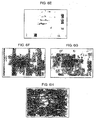
- FIG. 6F represents an image of the mode means ⁇ (G i ) for the pixels of the original image. The higher the mode average, the darker the image is and the more text area.
- Figure 6G shows an image of deviations mode type for pixels in the original image. The lower the standard deviation, the darker the image and corresponds to a text box.
- FIG. 6H represents a presence image of baseline pixels of the original image. More a baseline is present, the bigger the picture is clear and corresponds to a text box.
- the textual feature vectors of the pixels of image I have been determined in particular for enable a classification software module to pixels MC to classify each pixel in one of two classes text or non-text at a step E6, and to discriminate text pixels and non-text pixels in the image.
- the MC module is included in the terminal T as shown in Figure 1.
- the module classification is a vector machine of SVM support (Vector Support Machine).
- the samples are in the present invention pixels.
- the learning phase consists of manually determine the class of a few pixels of an image so that the carrier vector machine SVM generalizes its learning to classify automatically the pixels according to their vectors of textual features.
- the phase of learning is based on the known approach "Bootstrapping".
- Bootstrapping In order to estimate an error of generalization, cross-validation with N partitions of each of the two classes of text pixels and not previously determined text with the algorithm of bootstrapping is performed.
- the algorithm of the process for determining the textual features for the pixels of the image is based, according to the second embodiment preferred, on a corner detection of characters textual features of the image and mainly includes steps E1 to E9 shown in FIG.
- Characteristics determination module MD detects extreme points of characters from picture I, also called corners of characters. The corners of the characters are located on the outline of the rectangle containing the characters textual of image I.
- the module for determining the characteristics MD determines the accumulation of the horizontal gradients of each pixel of the image I in the step E1, thanks to the horizontal gradient filter described previously in the step A1, in order to associate the accumulated horizontal gradient G H (x, y) as a textual characteristic, at the current pixel p.
- a vertical gradient of the current pixel in the image I is the sum of vertical elementary gradients of light intensity for consecutive pairs of pixels on the image column ly to which the pixel p belongs and located in proximity thereto.
- the application of the principle of the accumulation of vertical gradients to the pixels of the image I is carried out by an accumulation filter of vertical elementary gradients whose response G V is :
- the present invention does not use corner detectors known because of their answers non-linear thresholding principle.
- C H represents the directional corner response in the horizontal direction and contributes to the subsequent detection of end points of vertical lines
- C V represents the directional corner response in the vertical direction Y and contributes to the subsequent detection of extreme points of horizontal lines
- C R and C L represent directional corner responses in diagonal R and L directions and contribute to the subsequent detection of extreme points along the diagonal directions.
- the directional corner responses C H , C V , C R and C L have the advantage of easy application of the thresholding principle.
- the module for determining the characteristics MD initializes the directional responses of each pixel C H , C V , C R and C L from the zero image to step E2.
- the feature determination module MD determines the directional corner responses C H , C V , C R and C L in step E3.
- the textual corner features are propagated to all the pixels of the image within the rectangle containing the text to scatter the corner directional response images in the direction of the gradients of the pixels of the image within. of the rectangle containing the text.
- step E4 the module for determining the characteristics MD determines angles ⁇ of the gradients of the pixels of the image I defined by: where ⁇ I (x, y) represents the gradient for a pixel p of coordinates x, y, r, l having a module:
- gradient angle quantified of each pixel p is smoothed using the gradients values of the eight neighboring pixels to step E5.
- the neighboring pixels of the current pixel p are designated by px1 and px2 next the direction X, py1 and py2 in the direction Y, pr1 and pr2 following the direction R and pl1 and pl2 along the direction L.
- a histogram of the quantized gradient angles according to the four discrete orientations counts the number of pixels for each orientation ( ⁇ ) ⁇ ⁇ ) in the vicinity of each pixel p in order to sum weighted gradients of the neighboring pixels oriented according to each orientation.
- the smoothed gradient angle ⁇ results from a maximization of sums of the weighted gradients as follows:
- the weighting coefficient W i is 4.
- the weighting coefficients W i for the pixels px1, px2, py1 and py2 immediately adjacent in the X and Y directions are equal to 2.
- the weighting coefficients W i for the other four neighboring pixels pr1, pr2, pl1 and pl2 along the diagonal directions to the directions X and Y are equal to 1 and therefore lower than the weighting coefficients for the immediately adjacent pixels since the latter are farther from the current pixel and are less preponderant statistically following usual directions of writing in images.
- ⁇ I i ⁇ represents the modulus of the gradient of one of the nine pixels px1 to p12.
- An internal memory of the feature determination module MD stores the corner directional responses associated respectively with the pixels of the picture I at the step E6.
- the directional corner responses associated with the pixels are propagated along the directions of the orientations respectively assigned to the gradient angles of the pixels along a predetermined path in the rectangle containing the text.
- the predetermined path depends on the maximum font size of the characters of the text of the image I.
- the maximum font size of the characters is estimated beforehand according to the nature of the image I to be processed.
- the characteristic determination module MD selects the largest value C max of the corner directional responses associated with the current pixel p and the pixel preceding it, according to the predetermined path when these two responses are associated with the same direction, at the same direction. step E7.
- the directional corner responses attributed to the neighboring pixels according to step E7 are accumulated according to at least the direction of text assumed in an accumulated response C a , in step E8.
- the accumulated response C a has two components C aH , C aV according to the horizontal orientations H and vertical V.
- the response C aH accumulates in the direction of text assumed here X
- the textual characteristics of the current pixel are thus the four components G H , G V , C aH and C aV .
- the characteristics of the pixels are determined for two levels of a Gaussian pyramid, ie for two rectangles of different sizes, in order to consider the large variability of the font size of the characters of the text in video, to step E9.
- Each pixel in a level of the pyramid is classified by taking into account the information extracted from the vicinity of the two immediately adjacent pixels px1 and px2, py1 and py2 of the current pixel along the horizontal directions H and vertical V of the pixel.
- this vector for a pyramid level is indicated in the table below: Number of values Feature 3 Gradients accumulated horizontally G H for p, px1, px2 3 Gradients accumulated vertically G V for p, py1, py2 3 Horizontally accumulated corner responses C aH for p, px1, px2 3 Vertically accumulated corner response C aV for p, py1, py2
- the pixel classification module MC discriminates text pixels and non-pixels text according to feature vectors textual terms determined above.
Landscapes
- Engineering & Computer Science (AREA)
- Multimedia (AREA)
- Signal Processing (AREA)
- Physics & Mathematics (AREA)
- General Physics & Mathematics (AREA)
- Theoretical Computer Science (AREA)
- Image Analysis (AREA)
- Character Input (AREA)
Applications Claiming Priority (2)
| Application Number | Priority Date | Filing Date | Title |
|---|---|---|---|
| FR0311918 | 2003-10-10 | ||
| FR0311918A FR2860902B1 (fr) | 2003-10-10 | 2003-10-10 | Determination de caracteristiques textuelles de pixels |
Publications (1)
| Publication Number | Publication Date |
|---|---|
| EP1522951A1 true EP1522951A1 (de) | 2005-04-13 |
Family
ID=34307532
Family Applications (1)
| Application Number | Title | Priority Date | Filing Date |
|---|---|---|---|
| EP04077715A Withdrawn EP1522951A1 (de) | 2003-10-10 | 2004-09-17 | Bestimmung von textbeschreibenden Eigenschaften in Digitalbildern |
Country Status (3)
| Country | Link |
|---|---|
| US (1) | US7616814B2 (de) |
| EP (1) | EP1522951A1 (de) |
| FR (1) | FR2860902B1 (de) |
Cited By (2)
| Publication number | Priority date | Publication date | Assignee | Title |
|---|---|---|---|---|
| CN110751200A (zh) * | 2019-10-15 | 2020-02-04 | 辽宁师范大学 | 一种基于多元高斯的鞋印身高估计方法 |
| CN114140798A (zh) * | 2021-12-03 | 2022-03-04 | 北京奇艺世纪科技有限公司 | 文本区域的分割方法、装置、电子设备和存储介质 |
Families Citing this family (9)
| Publication number | Priority date | Publication date | Assignee | Title |
|---|---|---|---|---|
| JP4952627B2 (ja) * | 2008-03-21 | 2012-06-13 | 富士通株式会社 | 画像処理装置、画像処理方法および画像処理プログラム |
| US8538171B2 (en) * | 2008-03-28 | 2013-09-17 | Honeywell International Inc. | Method and system for object detection in images utilizing adaptive scanning |
| US9152875B2 (en) * | 2009-06-11 | 2015-10-06 | Texas Instruments Incorporated | Preserving text quality in video encoding |
| US20110026816A1 (en) * | 2009-07-29 | 2011-02-03 | Vaughn Robert L | Rapid image categorization |
| US8867828B2 (en) | 2011-03-04 | 2014-10-21 | Qualcomm Incorporated | Text region detection system and method |
| US9418310B1 (en) * | 2012-06-21 | 2016-08-16 | Amazon Technologies, Inc. | Assessing legibility of images |
| US11122237B2 (en) | 2018-06-05 | 2021-09-14 | Axon Enterprise, Inc. | Systems and methods for redaction of screens |
| EP4242988B1 (de) | 2022-03-11 | 2026-01-21 | Tata Consultancy Services Limited | Verfahren und system zur erkennung eines textes aus in einer szene aufgenommenen multimedia-inhalten |
| CN117315281B (zh) * | 2023-09-28 | 2025-08-12 | 恒玄科技(北京)有限公司 | 一种图像的角点检测方法、装置和介质 |
Citations (1)
| Publication number | Priority date | Publication date | Assignee | Title |
|---|---|---|---|---|
| FR2825173A1 (fr) * | 2001-05-23 | 2002-11-29 | France Telecom | Procede de detection de zones de texte dans une image video |
Family Cites Families (7)
| Publication number | Priority date | Publication date | Assignee | Title |
|---|---|---|---|---|
| US5872864A (en) * | 1992-09-25 | 1999-02-16 | Olympus Optical Co., Ltd. | Image processing apparatus for performing adaptive data processing in accordance with kind of image |
| US5450531A (en) * | 1992-11-30 | 1995-09-12 | Eastman Kodak Company | Resolution enhancement system for combined binary and gray scale halftone images |
| US5852678A (en) * | 1996-05-30 | 1998-12-22 | Xerox Corporation | Detection and rendering of text in tinted areas |
| US6366699B1 (en) * | 1997-12-04 | 2002-04-02 | Nippon Telegraph And Telephone Corporation | Scheme for extractions and recognitions of telop characters from video data |
| US6633670B1 (en) * | 2000-03-31 | 2003-10-14 | Sharp Laboratories Of America, Inc. | Mask generation for multi-layer image decomposition |
| US7043080B1 (en) * | 2000-11-21 | 2006-05-09 | Sharp Laboratories Of America, Inc. | Methods and systems for text detection in mixed-context documents using local geometric signatures |
| AU2002337455A1 (en) * | 2001-10-11 | 2003-04-28 | Koninklijke Philips Electronics N.V. | Method and apparatus for discriminating between different regions of an image |
-
2003
- 2003-10-10 FR FR0311918A patent/FR2860902B1/fr not_active Expired - Fee Related
-
2004
- 2004-09-17 EP EP04077715A patent/EP1522951A1/de not_active Withdrawn
- 2004-10-12 US US10/961,403 patent/US7616814B2/en not_active Expired - Fee Related
Patent Citations (1)
| Publication number | Priority date | Publication date | Assignee | Title |
|---|---|---|---|---|
| FR2825173A1 (fr) * | 2001-05-23 | 2002-11-29 | France Telecom | Procede de detection de zones de texte dans une image video |
Non-Patent Citations (3)
| Title |
|---|
| DUONG J ET AL: "Extraction of text areas in printed document images", NEW YORK, NY, USA, ACM, USA, November 2001 (2001-11-01), pages 157 - 164, XP002284340, ISBN: 1-58113-432-0 * |
| JUNG K ET AL: "SUPPORT VECTOR MACHINES FOR TEXT LOCATION IN NEWS VIDEO IMAGES", PROCEEDINGS OF IEEE TENCON 2000. IEEE REGION 10 CONFERENCE. KUALA LUMPUR, SEPT. 24 - 27, 2000, IEEE REGION 10 ANNUAL CONFERENCE, NEW YORK, NY : IEEE, US, vol. VOL. 2 OF 3, 24 September 2000 (2000-09-24), pages 176 - 180, XP000987972, ISBN: 0-7803-6356-6 * |
| LEBOURGEOIS F ED - INSTITUTE OF ELECTRICAL AND ELECTRONICS ENGINEERS: "Robust multifont OCR system from gray level images", PROCEEDINGS OF THE 4TH INTERNATIONAL CONFERENCE ON DOCUMENT ANALYSIS AND RECOGNITION. (ICDAR). ULM, GERMANY, AUG. 18 - 20, 1997, PROCEEDINGS OF THE ICDAR, LOS ALAMITOS, IEEE COMP. SOC, US, vol. VOL. II, 18 August 1997 (1997-08-18), pages 1 - 5, XP010244672, ISBN: 0-8186-7898-4 * |
Cited By (3)
| Publication number | Priority date | Publication date | Assignee | Title |
|---|---|---|---|---|
| CN110751200A (zh) * | 2019-10-15 | 2020-02-04 | 辽宁师范大学 | 一种基于多元高斯的鞋印身高估计方法 |
| CN110751200B (zh) * | 2019-10-15 | 2023-09-29 | 辽宁师范大学 | 一种基于多元高斯的鞋印身高估计方法 |
| CN114140798A (zh) * | 2021-12-03 | 2022-03-04 | 北京奇艺世纪科技有限公司 | 文本区域的分割方法、装置、电子设备和存储介质 |
Also Published As
| Publication number | Publication date |
|---|---|
| FR2860902B1 (fr) | 2005-12-09 |
| US20050123198A1 (en) | 2005-06-09 |
| FR2860902A1 (fr) | 2005-04-15 |
| US7616814B2 (en) | 2009-11-10 |
Similar Documents
| Publication | Publication Date | Title |
|---|---|---|
| EP3707676B1 (de) | Verfahren zur schätzung der installation einer kamera im referenzrahmen einer dreidimensionalen szene, vorrichtung, system mit erweiterter realität und zugehöriges computerprogramm | |
| Nishiyama et al. | Facial deblur inference using subspace analysis for recognition of blurred faces | |
| Giannoukos et al. | Operator context scanning to support high segmentation rates for real time license plate recognition | |
| EP3572976A1 (de) | Verarbeitungsverfahren eines videobilddatenflusses | |
| US10785452B2 (en) | Identifying consumer products in images | |
| WO2009141378A1 (fr) | Procede et systeme d'indexation et de recherche de documents video | |
| CN104318537B (zh) | 大雨场景视频数据中雨滴的检测和去除方法及系统 | |
| Shah et al. | OCR-based chassis-number recognition using artificial neural networks | |
| CN112686247A (zh) | 一种身份证号码检测方法、装置、可读存储介质和终端 | |
| EP3570213A1 (de) | Verfahren zur erkennung von schriftzeichen | |
| FR2860902A1 (fr) | Determination de caracteristiques textuelles de pixels | |
| US9858481B2 (en) | Identifying consumer products in images | |
| FR3109831A1 (fr) | Procédé pour la vérification d’un code-barre. | |
| FR3083352A1 (fr) | Procede et dispositif de detection rapide de structures repetitives dans l'image d'une scene routiere | |
| CN113239738B (zh) | 一种图像的模糊检测方法及模糊检测装置 | |
| EP4091098A1 (de) | Verfahren zur verarbeitung eines kandidatenbildes | |
| EP1390905B1 (de) | Verfahren zum bestimmen von textfeldern in einem videobild | |
| EP1525553A2 (de) | Verfahren und system zur automatischen lokalisierung von textgebieten in einem bild | |
| WO2017005930A1 (fr) | Détection d'objets par traitement d'images | |
| EP3908968A1 (de) | Verfahren zur verarbeitung von digitalen bildern | |
| EP2769360B1 (de) | Verfahren zum finden von objekten durch auflösung in einem dreidimensionalen raum einer szene | |
| Satish et al. | Edge assisted fast binarization scheme for improved vehicle license plate recognition | |
| FR3166238A1 (fr) | Procédé d’analyse d’image d’une structure formant support pour le stockage de produits | |
| Ferreira et al. | Multiresolution Analysis on searching for people in gigapixel images | |
| WO2018142054A1 (fr) | Procede de verification de l'authenticite d'un produit sensible. |
Legal Events
| Date | Code | Title | Description |
|---|---|---|---|
| PUAI | Public reference made under article 153(3) epc to a published international application that has entered the european phase |
Free format text: ORIGINAL CODE: 0009012 |
|
| AK | Designated contracting states |
Kind code of ref document: A1 Designated state(s): AT BE BG CH CY CZ DE DK EE ES FI FR GB GR HU IE IT LI LU MC NL PL PT RO SE SI SK TR |
|
| AX | Request for extension of the european patent |
Extension state: AL HR LT LV MK |
|
| 17P | Request for examination filed |
Effective date: 20050919 |
|
| AKX | Designation fees paid |
Designated state(s): AT BE BG CH CY CZ DE DK EE ES FI FR GB GR HU IE IT LI LU MC NL PL PT RO SE SI SK TR |
|
| 17Q | First examination report despatched |
Effective date: 20080425 |
|
| RAP1 | Party data changed (applicant data changed or rights of an application transferred) |
Owner name: ORANGE |
|
| GRAP | Despatch of communication of intention to grant a patent |
Free format text: ORIGINAL CODE: EPIDOSNIGR1 |
|
| INTG | Intention to grant announced |
Effective date: 20160909 |
|
| STAA | Information on the status of an ep patent application or granted ep patent |
Free format text: STATUS: THE APPLICATION IS DEEMED TO BE WITHDRAWN |
|
| 18D | Application deemed to be withdrawn |
Effective date: 20170120 |