EP1522528A1 - Disintegration of anaerobically digested sewage sludge - Google Patents
Disintegration of anaerobically digested sewage sludge Download PDFInfo
- Publication number
- EP1522528A1 EP1522528A1 EP03022434A EP03022434A EP1522528A1 EP 1522528 A1 EP1522528 A1 EP 1522528A1 EP 03022434 A EP03022434 A EP 03022434A EP 03022434 A EP03022434 A EP 03022434A EP 1522528 A1 EP1522528 A1 EP 1522528A1
- Authority
- EP
- European Patent Office
- Prior art keywords
- stage
- waste
- sludge
- disintegrated
- digesting
- Prior art date
- Legal status (The legal status is an assumption and is not a legal conclusion. Google has not performed a legal analysis and makes no representation as to the accuracy of the status listed.)
- Granted
Links
Images
Classifications
-
- C—CHEMISTRY; METALLURGY
- C02—TREATMENT OF WATER, WASTE WATER, SEWAGE, OR SLUDGE
- C02F—TREATMENT OF WATER, WASTE WATER, SEWAGE, OR SLUDGE
- C02F11/00—Treatment of sludge; Devices therefor
- C02F11/02—Biological treatment
- C02F11/04—Anaerobic treatment; Production of methane by such processes
-
- C—CHEMISTRY; METALLURGY
- C02—TREATMENT OF WATER, WASTE WATER, SEWAGE, OR SLUDGE
- C02F—TREATMENT OF WATER, WASTE WATER, SEWAGE, OR SLUDGE
- C02F3/00—Biological treatment of water, waste water, or sewage
- C02F3/02—Aerobic processes
- C02F3/12—Activated sludge processes
- C02F3/1205—Particular type of activated sludge processes
- C02F3/1221—Particular type of activated sludge processes comprising treatment of the recirculated sludge
-
- C—CHEMISTRY; METALLURGY
- C02—TREATMENT OF WATER, WASTE WATER, SEWAGE, OR SLUDGE
- C02F—TREATMENT OF WATER, WASTE WATER, SEWAGE, OR SLUDGE
- C02F1/00—Treatment of water, waste water, or sewage
- C02F1/72—Treatment of water, waste water, or sewage by oxidation
- C02F1/78—Treatment of water, waste water, or sewage by oxidation with ozone
-
- C—CHEMISTRY; METALLURGY
- C02—TREATMENT OF WATER, WASTE WATER, SEWAGE, OR SLUDGE
- C02F—TREATMENT OF WATER, WASTE WATER, SEWAGE, OR SLUDGE
- C02F2301/00—General aspects of water treatment
- C02F2301/08—Multistage treatments, e.g. repetition of the same process step under different conditions
-
- C—CHEMISTRY; METALLURGY
- C02—TREATMENT OF WATER, WASTE WATER, SEWAGE, OR SLUDGE
- C02F—TREATMENT OF WATER, WASTE WATER, SEWAGE, OR SLUDGE
- C02F2303/00—Specific treatment goals
- C02F2303/06—Sludge reduction, e.g. by lysis
-
- Y—GENERAL TAGGING OF NEW TECHNOLOGICAL DEVELOPMENTS; GENERAL TAGGING OF CROSS-SECTIONAL TECHNOLOGIES SPANNING OVER SEVERAL SECTIONS OF THE IPC; TECHNICAL SUBJECTS COVERED BY FORMER USPC CROSS-REFERENCE ART COLLECTIONS [XRACs] AND DIGESTS
- Y02—TECHNOLOGIES OR APPLICATIONS FOR MITIGATION OR ADAPTATION AGAINST CLIMATE CHANGE
- Y02W—CLIMATE CHANGE MITIGATION TECHNOLOGIES RELATED TO WASTEWATER TREATMENT OR WASTE MANAGEMENT
- Y02W10/00—Technologies for wastewater treatment
- Y02W10/10—Biological treatment of water, waste water, or sewage
Definitions
- the present invention relates to a method for treatment of aqueous organic waste according to the introduction of claim 1 and to a corresponding apparatus according to the introduction of claim 6.
- Japanese published patent application JP 09-085299 suggests first anaerobically digesting the waste, then either disintegrating the digested waste, leading the disintegrated waste to a second anaerobical digesting stage followed by a solid/liquid sparation (Fig. 1) or after digesting the waste, separating solids and liquids of the digested waste, then disintegrating the digested waste, leading the separated solid waste to a second anaerobical digesting stage (Fig. 2).
- One object of the present invention is to further improve the residual sludge quality.
- the object is achieved by a process according to claim 1.
- a respective apparatus for treatment of aqueous organic waste is presented in claim 6.
- sludge that has been disintegrated e.g. by ozone treatment
- anaerobically digested sludge is considered unsettlable.
- solid/liquid separation is more effective and the amount of feed sludge into the second digestion stage is reduced.
- the sludge treatment time in the second digestion stage can be increased compared to the first digestion stage (assuming that both digestion stages have the same volume), which in turn leads to a better sludge quality since the sludge is more stable.
- disintegration unit refers mainly to disintegration technology using ozone, but the present invention is not restricted to ozonization, which is only described as example. Any other disintegration method (such as ultrasound or cavitation etc.), capable of cell destruction, could be employed as disintegration unit as well.
- ozone in the disintegration stage has the following advantages: in comparison to mechanical or thermal disintegration technologies, the oxidation processes have one main common advantage. Refractory COD (complex organic structures) is oxidized and converted to BOD (biodegradable low-molecular compounds, e.g. formic acid or acidic acid). Conversely, as opposed to other oxidation processes (such as wet-oxidation), ozonization does not demand an additional chemical dosage. As a result, effluent posttreatment, such as neutralization etc., is not required downstream of the process. The only by-product of the ozonization process is molecular oxygen, which can be positively reused for aerobic biological degradation processes.
- ozone is a highly reactive oxidation agent and therefore, only small amounts of gas have to be injected, in order to carry out sludge disintegration.
- the ozonization unit has a small footprint.
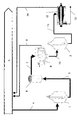
- the present invention shall be described by an example according to the schematic figure, which shows a wastewater and sludge treatment system with a combination of anaerobic sludge stabilization with sludge disintegration using ozone according to the invention.
- the plant includes sludge treatment in a two-stage anaerobic digestion process.
- the liquid content of raw sludge 4 from the wastewater treatment plant 3 is reduced by a pre-thickening facility (not shown). Then the raw sludge 4 is fed into a first anaerobic digestion reaction tank (digester) 1. Partly digested sludge 5, which is withdrawn from digester 1, having approximately 48-52% VSS is disintegrated with ozone 03 in a disintegration unit 6. The applied ozone dose (0.06 g 03/g DS) is capable to disrupt the microbial cells in the sludge, thereby destroying and fragmenting the cell walls and releasing the cell content. The disintegrated sludge 7 is fed to an intermediate thickening facility 8, where a liquid-solid phase separation in is employed. The intermediate thickening facility 8 is a standard thickening facility, e.g. gravity settling, flotation or centrifugation.
- the intermediate thickening facility 8 is a standard thickening facility, e.g. gravity settling, flotation or centrifugation.
- the liquid phase (sludgewater) 9 contains dissolved organic compounds (such as amino acids, nucleic acids and fatty acids), which are released with the cytoplasm. Sludgewater 9 is recycled to the wastewater treatment process, where it may be utilized as a carbon source to balance the additional carbon demand in the denitrification process during periods of high nitrogen loading rates. As a consequence the sludge volume of thickened sludge 10 to be treated in digester 2 (assuming that it has the same volume as digester 1) is reduced by the amount of sludgewater that is withdrawn. Thus the resulting sludge retention time in digester 2 is extended. Under these conditions the achievable degree of sludge stabilization is markedly improved.
- the solid phase contains cell fragments (biosolids), which also represent a good substrate for biodegradation, as the refractory COD was converted into BOD.
- biosolids cell fragments
- the treatment of disrupted and disintegrated biosolids in the anaerobic digester 2 has a number of attractive aspects.
- the anaerobic digestion of disintegrated biosolids enables advanced sludge stabilization due to the enhanced reduction of organic matter.
- the quantity of digested sludge 11 can be slashed by another 20-30%.
- Digested sludge 11 is further dewatered in a standard device 12, e.g. decanter centrifuge, which yields a residual sludge 13 of approximately 30-35% VSS and sludgewater 14 which is recycled to the wastewater treatment process 3.
- the resulting DS content of dewatered residual sludge 13 will be remarkable higher as compared to conventionally digested sludge.
- the sludge volume requiring disposal is reduced by another 10-20%.
- the rate-limiting step in the conventional anaerobic digestion process is the initial hydrolysis phase.
- sludge disintegration is employed, this reaction is accelerated.
- the sludge retention time in anaerobic digestion can be cut.
- the total digester volume of both reaction tanks can be reduced, which leads to savings in investment and operating costs.
- the operating costs are influenced in two respects: (a) lower demand on reactor heating and (b) the conversion of refractory COD to BOD, providing higher biogas yields and hence increased electricity generation from biogas.
- the process can be applied to all wastewater treatment systems, where residual organic sludges are generated.
- These include mechanical pretreatment, biological purification processes (such as single-stage-, two-stage activated sludge-, Sequencing Batch Reactor (SBR) process etc.) and chemically enhanced primary treatment (CEPT) processes.
- the organic waste to be treated can comprise primary sludge from a primary sedimentation stage and/or activated sludge from a biological purification stage.
- the design of the main structures of a sludge treatment plant for a conventional wastewater treatment plant with a capacity of 20,000m 3 /day would be as follows:
Landscapes
- Life Sciences & Earth Sciences (AREA)
- Engineering & Computer Science (AREA)
- Chemical & Material Sciences (AREA)
- Environmental & Geological Engineering (AREA)
- Hydrology & Water Resources (AREA)
- Water Supply & Treatment (AREA)
- Organic Chemistry (AREA)
- Oil, Petroleum & Natural Gas (AREA)
- Health & Medical Sciences (AREA)
- General Chemical & Material Sciences (AREA)
- Molecular Biology (AREA)
- Chemical Kinetics & Catalysis (AREA)
- Biodiversity & Conservation Biology (AREA)
- Microbiology (AREA)
- Treatment Of Sludge (AREA)
Abstract
Description
| Sludge Retention Time, tR | 10 [days] |
| Volumetric Loading | 3 - 5 [kg/m3day] |
| Digester Volume | 1,500 [m3] |
| Disintegration Unit: | |
| Reaction Time | approx. 30 [min] |
| Reaction Tank Volume | 3 - 5 [m3] |
| Specific Ozone Demand | 0.1 - 0.15 [kg O3/kg SS] |
| Capacity of Ozone Generator | 20 [kg O3/h] |
| Anaerobic digester 2: | |
| Sludge Retention Time, tR | 10 [days] |
| Volumetric Loading | 3 - 5 [kg/m3day] |
| Digester Volume | 1,500 [m3] |
- 1
- First anaerobic digestion reaction tank (digester)
- 2
- Second anaerobic digestion reaction tank (digester)
- 3
- Wastewater treatment plant
- 4
- Raw sludge
- 5
- Partly digested sludge
- 6
- Disintegration unit (e.g. ozone plant)
- 7
- Disintegrated sludge
- 8
- Intermediate-thickening facility
- 9
- Sludgewater
- 10
- Thickened sludge
- 11
- Digested sludge
- 12
- Dehydration device
- 13
- Residual sludge
- 14
- Sludgewater
Claims (7)
- Method for treatment of aqueous organic waste, especially sewage sludge, comprising the stages ofanaerobically digesting the waste in a first stage,disintegrating digested waste from the first stage by cell wall destruction andanaerobically digesting disintegrated waste in a second stage different from the first stage, characterized in that after disintegrating digested waste and before digesting disintegrated waste in the second stage the disintegrated waste undergoes a liquid-solid-separation in a thickening stage.
- Method according to claim 1, characterized in that ozonization, ultrasound or cavitation is employed in the disintegration stage.
- Method according to claim 1 or 2, characterized in that the organic waste comprises primary sludge from a primary sedimentation stage and/or activated sludge from a biological purification stage.
- Method according to one of the claims 1 to 3, characterized in that part of the liquid phase separated in the thickening stage is fed back to a wastewater purification stage.
- Apparatus for treatment of aqueous organic waste, especially sludge, comprisingcharacterized in that the means (6) for disintegrating digested waste (5) is connected to a thickening device (8) for liquid-solid-separation which device (8) is connected to the means (2) for digesting the disintegrated waste in a second stage, so that before digesting the disintegrated waste (7) in the second stage the disintegrated waste undergoes a liquid-solid-separation in the thickening device (8).means (1) for anaerobically digesting the waste in a first stage,means (6) for disintegrating digested waste from the first stage by cell wall destructionmeans (2) for digesting disintegrated waste in a second stage different from the first stage,
- Apparatus according to claim 5, characterized in that the means (6) for disintegrating is a means employing ozonization (03), ultrasound or cavitation.
- Apparatus according to one of the claims 5 or 6, characterized in that the means (8) for thickening the waste comprise means for feeding the separated liquid phase (9) back to a wastewater purification unit (3).
Priority Applications (3)
| Application Number | Priority Date | Filing Date | Title |
|---|---|---|---|
| EP20030022434 EP1522528B1 (en) | 2003-10-07 | 2003-10-07 | Disintegration of anaerobically digested sewage sludge |
| CNB2004100835727A CN1323960C (en) | 2003-10-07 | 2004-10-08 | Method and apparatus for treating aqueous organic waste and sewage sludge |
| HK05105944.1A HK1073294B (en) | 2003-10-07 | 2005-07-12 | Method and apparatus for treatment of the aqueous organic waste and sewage sludge |
Applications Claiming Priority (1)
| Application Number | Priority Date | Filing Date | Title |
|---|---|---|---|
| EP20030022434 EP1522528B1 (en) | 2003-10-07 | 2003-10-07 | Disintegration of anaerobically digested sewage sludge |
Publications (2)
| Publication Number | Publication Date |
|---|---|
| EP1522528A1 true EP1522528A1 (en) | 2005-04-13 |
| EP1522528B1 EP1522528B1 (en) | 2015-05-20 |
Family
ID=34306850
Family Applications (1)
| Application Number | Title | Priority Date | Filing Date |
|---|---|---|---|
| EP20030022434 Expired - Lifetime EP1522528B1 (en) | 2003-10-07 | 2003-10-07 | Disintegration of anaerobically digested sewage sludge |
Country Status (2)
| Country | Link |
|---|---|
| EP (1) | EP1522528B1 (en) |
| CN (1) | CN1323960C (en) |
Families Citing this family (5)
| Publication number | Priority date | Publication date | Assignee | Title |
|---|---|---|---|---|
| CN101659505B (en) * | 2009-09-15 | 2011-10-19 | 深圳市蓝凤凰环保科技有限公司 | System and method for automatically separating solid from liquid by self-thermal high-temperature aerobic digestion of mud |
| CN102775037A (en) * | 2012-07-13 | 2012-11-14 | 同济大学 | Three-step two-stage method for producing marsh gas from municipal sludge by anaerobic fermentation |
| CN108623205B (en) * | 2017-03-18 | 2021-03-16 | 北京丰乐宝科技有限公司 | Method for improving homogeneity of cement grinding aid |
| CN107500488A (en) * | 2017-10-11 | 2017-12-22 | 佛山市宝粤美科技有限公司 | Sewage-treatment plant |
| CN107879583A (en) * | 2017-12-23 | 2018-04-06 | 北京达源环保科技有限公司 | Sludge pyrohydrolysis and anaerobic digestion integrated treatment process system |
Citations (4)
| Publication number | Priority date | Publication date | Assignee | Title |
|---|---|---|---|---|
| JPS5996000A (en) * | 1982-11-22 | 1984-06-02 | Mitsubishi Heavy Ind Ltd | Dehydrating method of sludge |
| DE4030668A1 (en) * | 1990-09-28 | 1992-04-02 | Peter Prof Dr Kunz | Appts. for redn. of vol. of biological sludge - has cell structure of sludge is broken down by mechanicaldisintegrator and resulting material is subjected to further biological treatment |
| JPH0985299A (en) * | 1995-09-22 | 1997-03-31 | Ebara Corp | How to reduce organic sludge |
| JPH10118695A (en) * | 1996-10-24 | 1998-05-12 | Ohbayashi Corp | Sewage treatment equipment |
Family Cites Families (2)
| Publication number | Priority date | Publication date | Assignee | Title |
|---|---|---|---|---|
| US6555002B2 (en) * | 2000-10-06 | 2003-04-29 | Premier Wastwater International, Llc | Apparatus and method for wastewater treatment with enhanced solids reduction (ESR) |
| EP1254865A1 (en) * | 2001-04-27 | 2002-11-06 | VA TECH WABAG GmbH | Disintegration of Anaerobically digested sewage sludge |
-
2003
- 2003-10-07 EP EP20030022434 patent/EP1522528B1/en not_active Expired - Lifetime
-
2004
- 2004-10-08 CN CNB2004100835727A patent/CN1323960C/en not_active Expired - Fee Related
Patent Citations (4)
| Publication number | Priority date | Publication date | Assignee | Title |
|---|---|---|---|---|
| JPS5996000A (en) * | 1982-11-22 | 1984-06-02 | Mitsubishi Heavy Ind Ltd | Dehydrating method of sludge |
| DE4030668A1 (en) * | 1990-09-28 | 1992-04-02 | Peter Prof Dr Kunz | Appts. for redn. of vol. of biological sludge - has cell structure of sludge is broken down by mechanicaldisintegrator and resulting material is subjected to further biological treatment |
| JPH0985299A (en) * | 1995-09-22 | 1997-03-31 | Ebara Corp | How to reduce organic sludge |
| JPH10118695A (en) * | 1996-10-24 | 1998-05-12 | Ohbayashi Corp | Sewage treatment equipment |
Non-Patent Citations (4)
| Title |
|---|
| EDER B ET AL: "KLAERSCHLAMMMINIMIERUNG DURCH ZELLAUFSCHLUSS MIT ULTRASCHALL MINIMISATION OF SEWAGE SLUDGE BY ULTRASONIC CELL DIGESTION", KA - ABWASSER, ABFALL, GFA, HENNEF, DE, vol. 50, no. 3, March 2003 (2003-03-01), pages 333 - 342, XP001145071, ISSN: 1616-430X * |
| PATENT ABSTRACTS OF JAPAN vol. 008, no. 205 (C - 243) 19 September 1984 (1984-09-19) * |
| PATENT ABSTRACTS OF JAPAN vol. 1997, no. 07 31 July 1997 (1997-07-31) * |
| PATENT ABSTRACTS OF JAPAN vol. 1998, no. 10 31 August 1998 (1998-08-31) * |
Also Published As
| Publication number | Publication date |
|---|---|
| EP1522528B1 (en) | 2015-05-20 |
| CN1323960C (en) | 2007-07-04 |
| HK1073294A1 (en) | 2005-09-30 |
| CN1605573A (en) | 2005-04-13 |
Similar Documents
| Publication | Publication Date | Title |
|---|---|---|
| US5492624A (en) | Waste treatment process employing oxidation | |
| US4915840A (en) | Process for sludge reduction in an aerobic sludge generating waste treatment system | |
| US9845260B2 (en) | Treatment of municipal wastewater with anaerobic digestion | |
| CA2267690C (en) | Process for reducing production of biomass during activated sludge treatment of pulp and paper mill effluents | |
| US6337020B1 (en) | Method and device for purifying waste water comprising an additional sludge treatment by ozonation | |
| US5141646A (en) | Process for sludge and/or organic waste reduction | |
| US6391202B1 (en) | Process and apparatus for treating wastewater from oil plant processing and cereal processing | |
| US20030178364A1 (en) | Process for sludge treatment using sludge pretreatment and membrane bioreactor | |
| WO2002012134A1 (en) | Method for treating organic waste water | |
| EP1522528B1 (en) | Disintegration of anaerobically digested sewage sludge | |
| EP1381574B1 (en) | Disintegration of anaerobically digested sewage sludge | |
| KR100274534B1 (en) | Nitrogen and phosphorus removal method using fermentation waste | |
| JP3351034B2 (en) | Method and apparatus for treating wastewater containing organic solids | |
| JP2000246280A (en) | Treatment apparatus of organic waste water | |
| KR100962215B1 (en) | Method for treating waste water and waste materials | |
| JP3272614B2 (en) | Sewage treatment equipment | |
| JP2006075730A (en) | Anaerobic treatment equipment | |
| EP1559688A1 (en) | A method for the degradation of organic sludge | |
| KR20020075635A (en) | Process and apparatus for treating sewage or waste water without emitting excess sludge | |
| JP3969144B2 (en) | Biological treatment method and biological treatment apparatus | |
| JPH0788495A (en) | Aerobic treatment of organic wastewater | |
| JP4200601B2 (en) | Anaerobic digestion treatment method of organic sludge | |
| HK1073294B (en) | Method and apparatus for treatment of the aqueous organic waste and sewage sludge | |
| JPH10249376A (en) | Treatment of organic wastewater such as sewage | |
| JP2000167586A (en) | Anaerobic treatment method and apparatus |
Legal Events
| Date | Code | Title | Description |
|---|---|---|---|
| PUAI | Public reference made under article 153(3) epc to a published international application that has entered the european phase |
Free format text: ORIGINAL CODE: 0009012 |
|
| AK | Designated contracting states |
Kind code of ref document: A1 Designated state(s): AT BE BG CH CY CZ DE DK EE ES FI FR GB GR HU IE IT LI LU MC NL PT RO SE SI SK TR |
|
| AX | Request for extension of the european patent |
Extension state: AL LT LV MK |
|
| 17P | Request for examination filed |
Effective date: 20050502 |
|
| AKX | Designation fees paid |
Designated state(s): AT BE BG CH CY CZ DE DK EE ES FI FR GB GR HU IE IT LI LU MC NL PT RO SE SI SK TR |
|
| 17Q | First examination report despatched |
Effective date: 20110609 |
|
| GRAP | Despatch of communication of intention to grant a patent |
Free format text: ORIGINAL CODE: EPIDOSNIGR1 |
|
| INTG | Intention to grant announced |
Effective date: 20141208 |
|
| GRAS | Grant fee paid |
Free format text: ORIGINAL CODE: EPIDOSNIGR3 |
|
| GRAA | (expected) grant |
Free format text: ORIGINAL CODE: 0009210 |
|
| RAP1 | Party data changed (applicant data changed or rights of an application transferred) |
Owner name: VA TECH WABAG GMBH |
|
| AK | Designated contracting states |
Kind code of ref document: B1 Designated state(s): AT BE BG CH CY CZ DE DK EE ES FI FR GB GR HU IE IT LI LU MC NL PT RO SE SI SK TR |
|
| REG | Reference to a national code |
Ref country code: GB Ref legal event code: FG4D |
|
| REG | Reference to a national code |
Ref country code: CH Ref legal event code: EP |
|
| REG | Reference to a national code |
Ref country code: AT Ref legal event code: REF Ref document number: 727667 Country of ref document: AT Kind code of ref document: T Effective date: 20150615 |
|
| REG | Reference to a national code |
Ref country code: IE Ref legal event code: FG4D |
|
| REG | Reference to a national code |
Ref country code: DE Ref legal event code: R096 Ref document number: 60347631 Country of ref document: DE |
|
| REG | Reference to a national code |
Ref country code: RO Ref legal event code: EPE |
|
| REG | Reference to a national code |
Ref country code: CH Ref legal event code: NV Representative=s name: PATENTANWAELTE SCHAAD, BALASS, MENZL AND PARTN, CH |
|
| REG | Reference to a national code |
Ref country code: FR Ref legal event code: PLFP Year of fee payment: 13 |
|
| REG | Reference to a national code |
Ref country code: NL Ref legal event code: MP Effective date: 20150520 |
|
| PG25 | Lapsed in a contracting state [announced via postgrant information from national office to epo] |
Ref country code: ES Free format text: LAPSE BECAUSE OF FAILURE TO SUBMIT A TRANSLATION OF THE DESCRIPTION OR TO PAY THE FEE WITHIN THE PRESCRIBED TIME-LIMIT Effective date: 20150520 Ref country code: PT Free format text: LAPSE BECAUSE OF FAILURE TO SUBMIT A TRANSLATION OF THE DESCRIPTION OR TO PAY THE FEE WITHIN THE PRESCRIBED TIME-LIMIT Effective date: 20150921 Ref country code: FI Free format text: LAPSE BECAUSE OF FAILURE TO SUBMIT A TRANSLATION OF THE DESCRIPTION OR TO PAY THE FEE WITHIN THE PRESCRIBED TIME-LIMIT Effective date: 20150520 |
|
| PG25 | Lapsed in a contracting state [announced via postgrant information from national office to epo] |
Ref country code: BG Free format text: LAPSE BECAUSE OF FAILURE TO SUBMIT A TRANSLATION OF THE DESCRIPTION OR TO PAY THE FEE WITHIN THE PRESCRIBED TIME-LIMIT Effective date: 20150820 Ref country code: GR Free format text: LAPSE BECAUSE OF FAILURE TO SUBMIT A TRANSLATION OF THE DESCRIPTION OR TO PAY THE FEE WITHIN THE PRESCRIBED TIME-LIMIT Effective date: 20150821 |
|
| PG25 | Lapsed in a contracting state [announced via postgrant information from national office to epo] |
Ref country code: EE Free format text: LAPSE BECAUSE OF FAILURE TO SUBMIT A TRANSLATION OF THE DESCRIPTION OR TO PAY THE FEE WITHIN THE PRESCRIBED TIME-LIMIT Effective date: 20150520 Ref country code: DK Free format text: LAPSE BECAUSE OF FAILURE TO SUBMIT A TRANSLATION OF THE DESCRIPTION OR TO PAY THE FEE WITHIN THE PRESCRIBED TIME-LIMIT Effective date: 20150520 |
|
| REG | Reference to a national code |
Ref country code: DE Ref legal event code: R097 Ref document number: 60347631 Country of ref document: DE |
|
| PG25 | Lapsed in a contracting state [announced via postgrant information from national office to epo] |
Ref country code: SK Free format text: LAPSE BECAUSE OF FAILURE TO SUBMIT A TRANSLATION OF THE DESCRIPTION OR TO PAY THE FEE WITHIN THE PRESCRIBED TIME-LIMIT Effective date: 20150520 |
|
| REG | Reference to a national code |
Ref country code: AT Ref legal event code: UEP Ref document number: 727667 Country of ref document: AT Kind code of ref document: T Effective date: 20150520 |
|
| PLBE | No opposition filed within time limit |
Free format text: ORIGINAL CODE: 0009261 |
|
| STAA | Information on the status of an ep patent application or granted ep patent |
Free format text: STATUS: NO OPPOSITION FILED WITHIN TIME LIMIT |
|
| 26N | No opposition filed |
Effective date: 20160223 |
|
| PG25 | Lapsed in a contracting state [announced via postgrant information from national office to epo] |
Ref country code: IT Free format text: LAPSE BECAUSE OF FAILURE TO SUBMIT A TRANSLATION OF THE DESCRIPTION OR TO PAY THE FEE WITHIN THE PRESCRIBED TIME-LIMIT Effective date: 20150520 |
|
| PG25 | Lapsed in a contracting state [announced via postgrant information from national office to epo] |
Ref country code: SI Free format text: LAPSE BECAUSE OF FAILURE TO SUBMIT A TRANSLATION OF THE DESCRIPTION OR TO PAY THE FEE WITHIN THE PRESCRIBED TIME-LIMIT Effective date: 20150520 Ref country code: LU Free format text: LAPSE BECAUSE OF FAILURE TO SUBMIT A TRANSLATION OF THE DESCRIPTION OR TO PAY THE FEE WITHIN THE PRESCRIBED TIME-LIMIT Effective date: 20151007 |
|
| GBPC | Gb: european patent ceased through non-payment of renewal fee |
Effective date: 20151007 |
|
| PG25 | Lapsed in a contracting state [announced via postgrant information from national office to epo] |
Ref country code: MC Free format text: LAPSE BECAUSE OF FAILURE TO SUBMIT A TRANSLATION OF THE DESCRIPTION OR TO PAY THE FEE WITHIN THE PRESCRIBED TIME-LIMIT Effective date: 20150520 |
|
| REG | Reference to a national code |
Ref country code: IE Ref legal event code: MM4A |
|
| PG25 | Lapsed in a contracting state [announced via postgrant information from national office to epo] |
Ref country code: GB Free format text: LAPSE BECAUSE OF NON-PAYMENT OF DUE FEES Effective date: 20151007 |
|
| PG25 | Lapsed in a contracting state [announced via postgrant information from national office to epo] |
Ref country code: BE Free format text: LAPSE BECAUSE OF FAILURE TO SUBMIT A TRANSLATION OF THE DESCRIPTION OR TO PAY THE FEE WITHIN THE PRESCRIBED TIME-LIMIT Effective date: 20150520 |
|
| REG | Reference to a national code |
Ref country code: FR Ref legal event code: PLFP Year of fee payment: 14 |
|
| PG25 | Lapsed in a contracting state [announced via postgrant information from national office to epo] |
Ref country code: IE Free format text: LAPSE BECAUSE OF NON-PAYMENT OF DUE FEES Effective date: 20151007 |
|
| PG25 | Lapsed in a contracting state [announced via postgrant information from national office to epo] |
Ref country code: HU Free format text: LAPSE BECAUSE OF FAILURE TO SUBMIT A TRANSLATION OF THE DESCRIPTION OR TO PAY THE FEE WITHIN THE PRESCRIBED TIME-LIMIT; INVALID AB INITIO Effective date: 20031007 |
|
| PG25 | Lapsed in a contracting state [announced via postgrant information from national office to epo] |
Ref country code: NL Free format text: LAPSE BECAUSE OF FAILURE TO SUBMIT A TRANSLATION OF THE DESCRIPTION OR TO PAY THE FEE WITHIN THE PRESCRIBED TIME-LIMIT Effective date: 20150520 Ref country code: SE Free format text: LAPSE BECAUSE OF FAILURE TO SUBMIT A TRANSLATION OF THE DESCRIPTION OR TO PAY THE FEE WITHIN THE PRESCRIBED TIME-LIMIT Effective date: 20150520 Ref country code: CY Free format text: LAPSE BECAUSE OF FAILURE TO SUBMIT A TRANSLATION OF THE DESCRIPTION OR TO PAY THE FEE WITHIN THE PRESCRIBED TIME-LIMIT Effective date: 20150520 |
|
| REG | Reference to a national code |
Ref country code: FR Ref legal event code: PLFP Year of fee payment: 15 |
|
| REG | Reference to a national code |
Ref country code: FR Ref legal event code: PLFP Year of fee payment: 16 |
|
| PGFP | Annual fee paid to national office [announced via postgrant information from national office to epo] |
Ref country code: DE Payment date: 20181026 Year of fee payment: 16 Ref country code: CZ Payment date: 20181004 Year of fee payment: 16 Ref country code: RO Payment date: 20181005 Year of fee payment: 16 Ref country code: AT Payment date: 20181025 Year of fee payment: 16 |
|
| PGFP | Annual fee paid to national office [announced via postgrant information from national office to epo] |
Ref country code: TR Payment date: 20181003 Year of fee payment: 16 Ref country code: FR Payment date: 20181010 Year of fee payment: 16 Ref country code: CH Payment date: 20181009 Year of fee payment: 16 |
|
| REG | Reference to a national code |
Ref country code: DE Ref legal event code: R119 Ref document number: 60347631 Country of ref document: DE |
|
| REG | Reference to a national code |
Ref country code: CH Ref legal event code: PL |
|
| PG25 | Lapsed in a contracting state [announced via postgrant information from national office to epo] |
Ref country code: CH Free format text: LAPSE BECAUSE OF NON-PAYMENT OF DUE FEES Effective date: 20191031 Ref country code: CZ Free format text: LAPSE BECAUSE OF NON-PAYMENT OF DUE FEES Effective date: 20191007 Ref country code: LI Free format text: LAPSE BECAUSE OF NON-PAYMENT OF DUE FEES Effective date: 20191031 Ref country code: RO Free format text: LAPSE BECAUSE OF NON-PAYMENT OF DUE FEES Effective date: 20191007 Ref country code: DE Free format text: LAPSE BECAUSE OF NON-PAYMENT OF DUE FEES Effective date: 20200501 |
|
| REG | Reference to a national code |
Ref country code: AT Ref legal event code: MM01 Ref document number: 727667 Country of ref document: AT Kind code of ref document: T Effective date: 20191007 |
|
| PG25 | Lapsed in a contracting state [announced via postgrant information from national office to epo] |
Ref country code: FR Free format text: LAPSE BECAUSE OF NON-PAYMENT OF DUE FEES Effective date: 20191031 |
|
| PG25 | Lapsed in a contracting state [announced via postgrant information from national office to epo] |
Ref country code: AT Free format text: LAPSE BECAUSE OF NON-PAYMENT OF DUE FEES Effective date: 20191007 |
|
| PG25 | Lapsed in a contracting state [announced via postgrant information from national office to epo] |
Ref country code: TR Free format text: LAPSE BECAUSE OF NON-PAYMENT OF DUE FEES Effective date: 20191007 |