EP1522149B1 - Verbessertes verfahren zur verlustlosen datenkomprimierung mit der verwendung einer gierigen sequentiellen kontextabhängigen grammatiktransformation - Google Patents
Verbessertes verfahren zur verlustlosen datenkomprimierung mit der verwendung einer gierigen sequentiellen kontextabhängigen grammatiktransformation Download PDFInfo
- Publication number
- EP1522149B1 EP1522149B1 EP03763542A EP03763542A EP1522149B1 EP 1522149 B1 EP1522149 B1 EP 1522149B1 EP 03763542 A EP03763542 A EP 03763542A EP 03763542 A EP03763542 A EP 03763542A EP 1522149 B1 EP1522149 B1 EP 1522149B1
- Authority
- EP
- European Patent Office
- Prior art keywords
- context
- dependent
- dependent grammar
- grammar
- sequence
- Prior art date
- Legal status (The legal status is an assumption and is not a legal conclusion. Google has not performed a legal analysis and makes no representation as to the accuracy of the status listed.)
- Expired - Lifetime
Links
- 230000001419 dependent effect Effects 0.000 title claims abstract description 142
- 238000000034 method Methods 0.000 title claims abstract description 84
- 238000013144 data compression Methods 0.000 title claims abstract description 20
- 230000003044 adaptive effect Effects 0.000 claims abstract description 4
- 238000004519 manufacturing process Methods 0.000 claims description 49
- 230000009467 reduction Effects 0.000 claims description 31
- 230000001143 conditioned effect Effects 0.000 claims description 4
- 238000013507 mapping Methods 0.000 claims description 4
- 230000001131 transforming effect Effects 0.000 claims description 3
- 238000011946 reduction process Methods 0.000 claims description 2
- 230000008569 process Effects 0.000 description 9
- 238000007906 compression Methods 0.000 description 7
- 230000006835 compression Effects 0.000 description 7
- 238000005192 partition Methods 0.000 description 6
- 230000006870 function Effects 0.000 description 5
- 238000013179 statistical model Methods 0.000 description 4
- 238000013459 approach Methods 0.000 description 3
- 230000003190 augmentative effect Effects 0.000 description 2
- 230000008901 benefit Effects 0.000 description 2
- 230000005540 biological transmission Effects 0.000 description 2
- 230000015654 memory Effects 0.000 description 2
- 230000009466 transformation Effects 0.000 description 2
- 238000003491 array Methods 0.000 description 1
- 230000008859 change Effects 0.000 description 1
- 238000007796 conventional method Methods 0.000 description 1
- 238000010586 diagram Methods 0.000 description 1
- 238000009826 distribution Methods 0.000 description 1
- 230000007246 mechanism Effects 0.000 description 1
- 230000003287 optical effect Effects 0.000 description 1
- 238000006467 substitution reaction Methods 0.000 description 1
Images







Classifications
-
- H—ELECTRICITY
- H03—ELECTRONIC CIRCUITRY
- H03M—CODING; DECODING; CODE CONVERSION IN GENERAL
- H03M7/00—Conversion of a code where information is represented by a given sequence or number of digits to a code where the same, similar or subset of information is represented by a different sequence or number of digits
- H03M7/30—Compression; Expansion; Suppression of unnecessary data, e.g. redundancy reduction
- H03M7/40—Conversion to or from variable length codes, e.g. Shannon-Fano code, Huffman code, Morse code
- H03M7/4006—Conversion to or from arithmetic code
-
- H—ELECTRICITY
- H03—ELECTRONIC CIRCUITRY
- H03M—CODING; DECODING; CODE CONVERSION IN GENERAL
- H03M7/00—Conversion of a code where information is represented by a given sequence or number of digits to a code where the same, similar or subset of information is represented by a different sequence or number of digits
- H03M7/30—Compression; Expansion; Suppression of unnecessary data, e.g. redundancy reduction
- H03M7/3084—Compression; Expansion; Suppression of unnecessary data, e.g. redundancy reduction using adaptive string matching, e.g. the Lempel-Ziv method
Definitions
- the invention relates generally to the field of data compression and more particularly to the use of a sequential grammar transform and encoding methods to compress data with a known context.
- Universal data compression methods can be divided into two subdivisions: universal lossless data compression and universal lossy data compression.
- Conventional universal lossless data compression methods typically employ arithmetic coding algorithms, Lempel-Ziv algorithms, and their variants.
- Arithmetic coding algorithms are based on statistical models of the data to be compressed.
- a statistical model is either built dynamically during the encoding process, or assumed to exist in advance.
- Several approaches exist to build a statistical model dynamically including prediction by partial match algorithm; dynamic Markov modeling; context gathering algorithm; and context-tree weighting. Each of these methods predicts the next symbol in the data sequence using the proper context and encodes the symbols using their corresponding, estimated conditional probabilities.
- arithmetic coding algorithms and their variants are universal only with respect to the class of Markov sources with a Markov order less than some designed parameter value. Furthermore, arithmetic coding algorithms encode the data sequence letter by letter.
- Lempel-Ziv algorithms and their variants do not use statistical models.
- Lempel-Ziv algorithms parse the original data sequence into non-overlapping, variable length phrases according to a string matching mechanism, and then encode them phrase by phrase.
- Lempel-Ziv algorithms are universal with respect to a broader class of sources than the class of Markov sources of bounded order, that being the class of stationary, ergodic sources.
- a universal lossless data compression method employs source coding to construct on-line, tuneable, context-dependent compression rules. Unlike alternative methods previously used that compress the individual objects, this method compresses the numerical set of rules. To achieve on-line compression of web-based data for example, the method receives the data, constructs the rules dynamically, and then encodes the rules. Because the set of rules is dynamic, when the structure of web text data changes, the corresponding rules are updated; similarly, when the content of web objects is updated, the corresponding rules are updated accordingly. This approach is particularly efficient for encoding web pages, because the content of a web page can change often, while the underlying structure of a web page remains approximately constant. The relative consistency of the underlying structure provides the predictable context for the data as it is compressed.
- the invention provides a method of sequentially transforming an original data sequence into an irreducible context-dependent grammar according to claim 1.
- Optional features are disclosed in the dependent claims.
- the invention provides a method of encoding an original data sequence, comprising a plurality of symbols ; according to claim 7.
- FIG. 1 is a flow chart illustrating a sequence of operations for a context-dependent grammar transform in accordance with an embodiment of the present invention.
- FIG. 2 is a flow chart illustrating a sequence of operations for parsing a substring of an input string under a known context in accordance with an embodiment of the present invention.
- FIG. 3 is a flow chart illustrating a sequence of operations for updating an irreducible context-dependent grammar in accordance with an embodiment of the present invention.
- FIG. 4 is a flow chart illustrating a sequence of operations for the application of a set of reduction rules for the sequential compression of an input string with a known context and a previously know context-dependent grammar in accordance with an embodiment of the present invention.
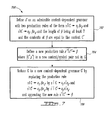
- FIGs. 5 , 6 , 7 , 8 and 9 are flow charts illustrating sequences of operations for reduction rules used to compress an input string with a known context and a previously know context-dependent grammar in accordance with an embodiment of the present invention.
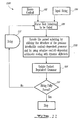
- FIG. 10 is a flow chart illustrating a hierarchical method of encoding a generated sequence in accordance with an embodiment of the present invention.
- FIG. 11 is a flow chart illustrating the encoding of an input string with a known context using one embodiment of a sequential context-dependent method.
- FIG. 12 is a block diagram of illustrating an apparatus for data compression using a context-dependent grammar transform method in accordance with an embodiment of the present invention.
- A will be used to refer to a source alphabet with cardinality greater than or equal to 2.
- a * will be used to refer to the set of all finite strings drawn from A , including the empty string ⁇ , and A + will be used to refer to the set of all finite strings of positive length from A.
- stands for the cardinality of A , and for any x ⁇ A *,
- a n denotes the set of all sequences of length n from A .
- a sequence from A can also be called an A -sequence.
- x ⁇ A + will be used to represent the sequence to be compressed.
- the source alphabet A is application-dependent.
- C will be used to define an arbitrary set of contexts.
- the set C may be finite or infinite.
- x x 1 x 2 ...x n drawn from alphabet A
- C a context sequence
- C 1 C 2 ... C n a context sequence
- each C i will represent the context for x i .
- C i can be determined from all history x 1 x 2 ... x i-1 , and C 1 in some manner.
- G will be used to represent a context-dependent grammar mapping from a subset of C ⁇ S ( j ) to ( S ( j ) ⁇ A ) + for some j ⁇ 1.
- the set S (j) will be referred to as the variable set of G and, the elements of S (j) will be referred to as G -variables.
- the domain of G can then be represented as ⁇ G ( K i , j i ) ⁇ C ⁇ S (j), where K is the number of distinct contexts in the domain.
- One approach to describing the mapping between a variable, its context, and the context-dependent grammar is to define, for each pair ( C k , s i ) ⁇ ⁇ G ( K i , j i ) , the relationship ( s i
- the context-dependent grammar G can then be completely described by a set of production rules given by ⁇ s i
- a method 100 may be used to implement data compression in accordance with the present invention.
- the method 100 has as inputs a known context 102 and an input string 104.
- a parser receives the context 102 and input string 104 and parses the input string 104 into a set of non-overlapping substrings (STEP 106).
- the parsing step (STEP 202) is further illustrated in FIG. 2 by a method 200.
- the parsing step (STEP 202) comprises determining the context of the current substring (STEP 202), and determining if the current substring can be represented under the current context (STEP 204).
- the parser transmits the substrings to a context-dependent grammar updating device, which then updates a context-dependent grammar G (STEP 108).
- the updating step (STEP 108) is further illustrated in FIG. 3 by a method 300.
- One possible example of a context-dependent grammar G with a variable set ⁇ S 0 ,S 1 ,S 2 ⁇ and an initial pair of (0, s 0 ) is: s 0
- G can be defined with a variable set S ( j ) and an initial pair of ( C 1 , s 0 ).
- Example 1 a sequence can be obtained from A by applying the following process. Start with s 0
- C k ) in the entire replacement process. Therefore, in this example, s 0 under the context 0 (or G ) represents the sequence x 0010111010001101010.
- Each of the other G- variables represents one or more substrings of x : s 1 represents 001 under the context 0 and 01 under the context 1, and s 2 represents 101 under the context 1.
- s 1 represents 001 under the context 0 and 01 under the context 1
- s 2 represents 101 under the context 1.
- the substring "01" appears twice in the range of the context-dependent grammar G .
- An admissible context-dependent grammar G can be defined as irreducible if the following conditions are satisfied:
- a grammar transform is a transformation that converts any data sequence x ⁇ A + into an admissible context-dependent grammar G x that represents x .
- a grammar transform is said to be irreducible if G x is irreducible for all x ⁇ A + .
- a set of reduction rules can be repeatedly applied to generate another admissible context-dependent grammar G ' that represents the same x and satisfies the following properties:
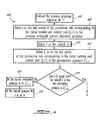
- FIG. 4 illustrates an exemplary method 400 of the application of a set of reduction rules that can sequentially construct a sequence of irreducible context-dependent grammars from which the original data sequence can be recovered incrementally.
- Extract the previous grammar reduction bit I (STEP 402).
- ⁇ as the last symbol of the production rule corresponding to the initial variable and the context pair s 0
- C as the context of ⁇ (STEP 410).
- FIG. 5 illustrates a method 500 for the application of reduction rule 1.
- s as a variable of an admissible context-dependent grammar G that appears only once under some context C in the range of G (STEP 502).
- the resulting context-dependent grammar G ' represents the same sequence as does G (STEP 508).
- FIG. 6 illustrates a method 600 for the application of reduction rule 2.
- G a context-dependent admissible grammar possessing a production rule of form s
- C ' a new production rule s '
- the resulting grammar G ' includes a new pair of context and variable ( C', s' ) and represents the same sequence x as does G (STEP 608).
- FIG. 7 illustrates a method 700 for the application of reduction rule 3.
- G as an admissible context-dependent grammar possessing two distinct production rules of form s
- FIG. 8 illustrates a method 800 for the application of reduction rule 4.
- G an admissible context-dependent grammar possessing two production rules of the form s
- Reduce G to the context-dependent grammar G ' obtained by replacing said production rule s
- FIG. 9 illustrates a method 900 for the application of reduction rule 5.
- G as an admissible context-dependent grammar in which two variables s and s ' under a given context C represent the same substring of an A -sequence represented by G (STEP 902).
- Reduce G to a new context-dependent grammar G ' by replacing each appearance of s ' whenever the underlying context of s ' is equal to C in the range of G by s and deleting the production rule corresponding to ( C , s ') (STEP 904).
- the grammar G ' may not be admissible because some G '-variables may not be involved in the serial replacement process of G '. If this is true, a further reduction of G 'to the context-dependent grammar G " can be achieved by deleting all production rules corresponding to variables of G'that were not involved in the serial reduction process (STEP 908), else parse the next string (STEP 910).
- the first substring x 1 and the corresponding irreducible context-dependent grammar G 1 consists of only one production rule s 0
- x 1 , x 2 ... x n 2 ,..., x n i -1 +1 ...x n i have been parsed and the corresponding irreducible context-dependent grammar G i for x 1 ... x n i has been built.
- C n i +1 be the context for x n i +1 generated by the countable context model.
- the next substring x n i +1 ... x n i +1 is the longest prefix of x n i +1 ... x n that can be represented by some s j ⁇ ⁇ s : ( C n i +1 , s ) ⁇ ⁇ G ( K i , j i ) ⁇ under the context C n i +1 if such a prefix exists.
- the resulting context-dependent grammar is admissible, but not necessarily irreducible.
- G 6 is given by ⁇ s 0
- G ' 6 is given by s 0
- G ' 7 is not irreducible because there is a non-overlapping repeated pattern 01 under the same context 0 in the range of G ' 6 .
- G ' 13 Appending the symbol s 1 to the end of G 13 ( s 0
- reduction rule 2 results in an irreducible context-dependent grammar G " 13 given by: s 0
- the variable s 2 appears only once, under the context 0 in the range of G " 13 therefore applying reduction rule 1 once results in an irreducible context-dependent grammar G 14 given by: s 0
- the irreducible context-dependent grammar transform parses x into: ⁇ 0,0,1,0,0,1,1,1,0,0,0,01,1,1,1,0,01,1,1,1 ⁇
- FIG. 10 Another aspect of the invention, referred to as 1000, is illustrated in FIG. 10 , and referred to herein as the "hierarchical context-dependent method.”
- This method comprises a greedy irreducible context-dependent transform followed by the context-dependent arithmetic coding of the final irreducible context-dependent grammar G t .
- a data sequence is first transformed into an irreducible context-dependent grammar (STEP 1002), then converted into its sorted form (STEP 1004).
- a generated sequence is constructed from the sorted grammar (STEP 1006) and encoded using an adaptive context-dependent arithmetic code with dynamic alphabets (STEP 1008).
- G 1 the final irreducible context-dependent grammar representing ⁇ furnished by our irreducible context-dependent grammar transform.
- a context-dependent arithmetic code with a dynamic alphabet is used to encode G 1 (or its equivalent form).
- the decoder After receiving the binary codeword, the decoder recovers G 1 (or its equivalent form) and then performs the serial replacement procedure illustrated in Example 1 to get ⁇ .
- One embodiment illustrates first how an admissible context-dependent grammar G induces a partition of the sequence ⁇ ⁇ A n , and then further describes the concept of sorted context-dependent grammars.
- ⁇ G denote a dynamically changing subset of ⁇ G (K, j ); initially, ⁇ G is empty.
- u (0) G ( s 0
- C 1 ); where u (0) is a sequence from ( S ( j ) ⁇ A ). If j 1, or equivalently if there is no variable in u (0) , then u (0) itself refers to the partition sequence induced by G .
- C ), where C is the context for s determined by the context model, the resulting sequence being denoted by u ( i +1) ; Step 3: Update ⁇ G by inserting the pair ( C, s ) into ⁇ G ; Step 4: Repeat Steps 2 and 3 for i 0,1,...,
- -1) is called the partition sequence induced by G .
- a context-dependent grammar G is said to be of sorted form if in the above procedure, the dynamic set ⁇ G is augmented in such a way that for every context C appearing in ⁇ G ( K, j ) , ( C , s i ) appears before ( C , s i +1 ) for any meaningful i > 0.
- the partition sequence u (4) parses the sequence x into 0, 0, 0, 1, 0, 01, 1, 1, 1, 0, 0001, 1110, 01, 111.
- the concatenation of the above substrings reproduces the original sequence x.
- the dynamic set ⁇ G is augmented in the order of (0, s 2 ), (0, s 1 ) (1, s 1 ), and (1, s 2 ). Therefore, in this example, G 22 is not sorted forum.
- the hierarchical context-dependent method can now be used to encode the sequence, and is illustrated using Example 2.
- the final irreducible context-dependent grammar G 22 is not of sorted form. Convert G 22 into its sorted form G 22 s given by s 0
- Step 2 [ G (s
- C )] is substituted for the first variable s and its context C which are not in ⁇ G as a pair, and the corresponding sequences are denote by ( i ) , i 0,...,
- G 22 s and the sequence x can be recovered from the sequence ⁇ (4) generated from G 22 s .
- the number of legitimate pairs of brackets [and] in ⁇ (4) is equal to the number of pairs of variable and contexts in the domain of G 22 s except ( C 1 , s 0 ); the content inside the ith legitimate pair of brackets [and] under a context C gives rise to the production rule corresponding to s i
- a context-dependent arithmetic code with dynamic alphabets is used to encode the sequence generated from G 22 s .
- both the encoder and the decoder know the associated countable-context model.
- Each pair ( C , ⁇ ) ⁇ ( C ⁇ S ) ⁇ ( C ⁇ ( A ⁇ ⁇ [,] ⁇ )) is associated with a counter c ( C , ⁇ ), which is set to 1 if ( C , ⁇ ) ⁇ C ⁇ ( A ⁇ ⁇ [,] ⁇ ) and set to 0 otherwise.
- Step 2 Increase c ( C , ⁇ ) by 1.
- Step 4 Determine the next context C for the next phrase in the generated sequence. Repeat the above procedure until the entire generated sequence is encoded.
- the product of the probabilities used in the arithmetic coding process is 1 4 ⁇ 1 5 ⁇ 2 6 ⁇ 2 7 ⁇ 3 8 ⁇ 1 9 ⁇ 1 4 ⁇ 2 5 ⁇ 1 6 ⁇ 1 12 ⁇ 1 7 ⁇ 2 8 ⁇ 1 9 ⁇ 2 10 ⁇ 3 11 ⁇ 3 12 ⁇ 2 14 ⁇ 1 13 ⁇ 1 14 ⁇ 1 16 ⁇ 2 15 ⁇ 1 17 .
- the final irreducible CDG G 1 it is first converted into its sorted form then the sequence generated from G 1 , is constructed, and finally a context-dependent arithmetic code with dynamic alphabets is used to encode the generated sequence.
- FIG. 11 illustrates yet another aspect of the invention, a method 1100, referred to herein as the "sequential context-dependent method," comprising using a context-dependent arithmetic code with dynamic alphabets to encode the sequence of parsed phrases x 1 , x 2 ... x n 2 ,..., x n i -1 +1 .... x n 1 .
- the known context 102 and input string 104 serve as input and parsed into non-overlapping strings (STEP 106).
- Each parsed substring is encoded using the structure of the previous irreducible context-dependent grammar and by using adaptive context-dependent arithmetic coding with dynamic alphabets (STEP 1101).
- a context-dependent grammar is generated and updated (STEP 108) until the string is fully parsed (STEP 110).
- each pair ( C , ⁇ ) ⁇ ( C ⁇ S ) ⁇ ( C ⁇ A ) is associated with a counter c ( C , ⁇ ), which is set initially to 1 if ( C, ⁇ ) ⁇ C ⁇ A and to 0 otherwise.
- Each phrase is encoded conditionally given its context. Assume that x 1 , x 2 ... x n 2 ,..., x n i -1 +1 ... x n i have been encoded and all corresponding counters have been updated. Assume further that G i is the corresponding irreducible context-dependent grammar for x 1 ,....
- Step 1 Determine the context C for ⁇ .
- Step 2 Encode ⁇ conditionally given the context C by using the probability c C ⁇ / ⁇ ⁇ c C ⁇ where the summation is taken over all symbols ⁇ ⁇ S ( j i ) ⁇ A such that c ( C , ⁇ ) ⁇ 0.
- Step 3 Increase c ( C , ⁇ ) by 1.
- Step 4 Get G i +1 from the appended G i .
- Step 5 If G i +1 , introduces a new production rule corresponding to a new pair ( C ',s), increase the counter c ( C ', s ) from 0 to 1. Repeat the above procedure for all parsed phrases until the entire sequence is processed and encoded.
- the counters c(C, ⁇ ), (C, ⁇ ) ⁇ C ⁇ ( S ⁇ A ) define counters c I (0,0), c I (0,1), c I (1,0), c I (1,1) and ⁇ ( C, ⁇ ).
- the first three parsed phrases x 1 , x 2 , and x 3 are encoded as in the sequential context-dependent method. Also, because I (1), I (2) and I (3) are all 0, there is no need to encode them. Starting with the fourth phrase, I ( i + 1) is encoded first, and then used with the structure of G i as additional context information to encode the ( i + 1) th parsed phrase.
- Step 1 Encode 1( i + 1) using the probability c I ( I ( i ), I ( i + 1))/( c I ( I ( i ),0) + c I ( I ( i ),1))
- Step 2 Increase c I ( I ( i ), I ( i +1)) by 1
- Step 3 Determine the context C ⁇ for ⁇ .
- ⁇ ) contains only one element and the decoder knows what ⁇ is.
- ⁇ ) comprises all symbols ⁇ ⁇ S ( ji ) ⁇ A having the following properties:
- Example 3 Applying the improved sequential context-dependent method described above to compress the sequence x from Example 2 where the sequence was parsed into ⁇ 0,0,0,1,0,0,1,1,1,1,0,0,0.01,1,1,1,0,01,1,1,1 ⁇ , the corresponding sequence ⁇ I ( i ) ⁇ is ⁇ 0000001000001101110011 ⁇ .
- the product of the probabilities used to encode the parsed phrases is 1 2 ⁇ 2 3 ⁇ 3 4 ⁇ 1 1 ⁇ 1 2 ⁇ 4 6 ⁇ 1 2 ⁇ 1 1 ⁇ 2 4 ⁇ 3 5 ⁇ 2 2 ⁇ 5 7 ⁇ 1 2 ⁇ 4 4 ⁇ 1 2 ⁇ 1 9 ⁇ 5 8 ⁇ 2 3 .
- the program may be written in any one of a number of high level languages such as FORTRAN, PASCAL, JAVA, C, C++, C # , or BASIC.
- the software could be implemented in an assembly language directed to the microprocessor resident on the target computer, for example, the software could be implemented in Intel 80x86 assembly language if it were configured to run on an IBM PC or PC clone.
- the software may be embodied on an article of manufacture including, but not limited to, a floppy disk, a hard disk, an optical disk, a magnetic tape, a PROM, an EPROM, EEPROM, field-programmable gate array, or CD-ROM.
- the software may be configured to run on any personal-type computer or workstation such as a PC or PC-compatible machine, an Apple Macintosh, a Sun workstation, etc.
- any device could be used as long as it is able to perform all of the functions and capabilities described herein.
- the particular type of computer or workstation is not central to the invention.
- FIG. 12 illustrates one embodiment in which the invention is provided as an apparatus 1200 for performing the methods described above.
- the apparatus 1200 consists of a parser 1206, a context-dependent grammar updating device, 1210, and a context-dependent grammar coder, 1214.
- the parser 1206 accepts as input an input string 1204 and a known context 1202 and parses the input string 1204 into a series of non-overlapping substrings, 1208.
- the parser causes the transmission of the substrings 1208 to the context-dependent grammar updating device 1210, which in turn produces an updated context-dependent grammar G.
- the context-dependent grammar updating device 1210 transmits the updated grammar G to the context-dependent grammar coder 1214 which then encodes the grammar G into a compressed binary codeword 1216.
- the apparatus 1200 may be provided as one or more application specific integrated circuits (ASIC), field programmable gate arrays (FPGA), electrically erasable programmable read-only memories (EEPROM), programmable read-only memories(PROM), programmable logic devices (PLD), or read-only memory devices (ROM).
- ASIC application specific integrated circuits
- FPGA field programmable gate arrays
- EEPROM electrically erasable programmable read-only memories
- PROM programmable read-only memories
- PLD programmable logic devices
- ROM read-only memory devices
- the apparatus 1200 may be implemented using one or more microprocessors such as the Pentium family or chips manufactured by Intel Corporation of Santa Clara, California or the PowerPC family of chips manufactured by Motorola Corporation of Schaumburg, Illinois.
Landscapes
- Engineering & Computer Science (AREA)
- Theoretical Computer Science (AREA)
- Machine Translation (AREA)
- Compression, Expansion, Code Conversion, And Decoders (AREA)
- Image Processing (AREA)
Claims (10)
- Verfahren zum sequentiellen Umwandeln einer ursprünglichen Datensequenz x = x1x2...xn für eine verlustfreie Datenkompression, aufweisend eine Vielzahl von Symbolen von einem Alphabet, A, mit einer Kardinalität größer oder gleich 2, und zugehörig zu einem bekannten Kontextmodell, repräsentiert durch Ci+1= f(x1.... xi, C), i=1, 2,..., wobei jedes Ci von C den Kontext für xi repräsentieren wird, wobei C1 ein anfänglicher fester Kontext ist und f eine Abbildung ist, in eine irreduzible Kontext-abhängige Grammatik, aus der die ursprünglichen Daten vollständig wiedergewonnen werden können, wobei die irreduzible Kontext-abhängige Grammatik definiert wird durch eine Menge von Produktionsregeln, die unter Verwendung einer Menge von Paaren von Variablen und Kontexten gebildet werden, die nicht-überlappende wiederholte Muster und Kontexte in der Datensequenz repräsentieren, wobei die Kontext-abhängige Grammatik, G, durch eine Menge von Produktionsregeln beschrieben wird, gegeben durch {si| Ck→G(Si|Ck): (Ck, Si) ∈ ΩG(Ki, ji), 0≤i<j, 0<k<∞}, wobei die Domäne von G repräsentiert wird als ΩG(Ki, ji) ⊂ C x S(j), wobei K die Anzahl von verschiedenen Kontexten in der Domäne ist, und wobei die Menge S(j) der Variablen-Menge von G ist, und wobei die irreduzible Kontext-abhängige Grammatik die folgenden Bedingungen erfüllt:für jeden Kontext C, jede G-Variable s derart, dass (C, s) ∈ ΩG(K, j)\{(C1, s0)} zumindest zweimal unter C in dem Bereich von G erscheint;in dem Kontext-abhängigen Sinn gibt es kein nicht-überlappendes wiederholtes Muster einer Länge größer oder gleich 2 in dem Bereich von G;unter demselben Kontext C repräsentiert jede eindeutige G-Variable s ∈ {s: (C, s) ∈ ΩG(K, j)}eine eindeutige A-Sequenz,wobei das Verfahren durch eine Computervorrichtung implementiert wird, die einen Parser und eine "Kontext-abhängige Grammatik"-Aktualisierungsvorrichtung hat, wobei das Verfahren auf jedes abzählbare Kontextmodell anwendbar ist und die Schritte aufweist:(a) Parsen, durch einen Parser, eines Teil-Strings der Sequenz, wobei der Teil-String das längste Präfix eines Strings von vorher nicht-geparsten Symbolen der Sequenz ist, die repräsentiert werden kann, unter dem Kontext des aktuellen Zeitpunkts, durch eine Variable in der Menge von Variablen einer vorherigen irreduziblen Kontext-abhängigen Grammatik, verschieden von der anfänglichen Variablen in dem anfänglichen Paar der Menge von Paaren von Variablen und Kontexten, wenn ein derartiges Präfix existiert, und ansonsten ein erstes Symbol des Strings der vorher nicht-geparsten Symbole in der Sequenz;(b) Erzeugen, durch die "Kontext-abhängige Grammatik"-Aktualisierungsvorrichtung, einer zulässigen Kontext-abhängigen Grammatik basierend auf dem Teil-String, dem aktuellen Kontext und der vorherigen irreduziblen Kontext-abhängigen Grammatik;(c) Anwenden, durch die "Kontext-abhängige Grammatik"-Aktualisierungsvorrichtung, zumindest einer Menge von Reduktionsregeln auf die zulässige Kontext-abhängige Grammatik, um eine neue irreduzible Kontext-abhängige Grammatik zu erzeugen;(d) Wiederholen der Schritte (a) bis (c), bis alle Symbole der Sequenz durch die endgültige Kontext-abhängige Grammatik repräsentiert werden.
- Verfahren gemäß Anspruch 1, wobei der Schritt des Anwendens weiter aufweist den Schritt eines Implementierens einer Reduktionsregel der zumindest einen Menge, das die Schritte aufweist:(a) Definieren von s als eine Variable der zulässigen Kontext-abhängigen Grammatik G, die nur einmal erscheint unter einem Kontext C in dem Bereich von G;(b) Definieren einer Produktionsregel s'|C' →αsβ, wobei s rechts unter dem Kontext C erscheint;(c) Definieren einer Produktionsregel s|C→γ, die dem Paar (C, s) entspricht; und(d) Reduzieren von G auf eine zulässige Kontext-abhängige Grammatik G' durch Entfernen der Produktionsregel s|C→ γ von G und Ersetzen der Produktionsregel s'|C' →αsβ mit der Produktionsregel s'|C' →αγß, wobei die resultierende zulässige Kontext-abhängige Grammatik G' und G eine äquivalente Datensequenz repräsentieren.
- Verfahren gemäß Anspruch 1, wobei der Schritt des Anwendens weiter aufweist den Schritt eines Implementierens einer Reduktionsregel der zumindest einen Menge, das die Schritte aufweist:(a) Definieren von G als die zulässige Kontext-abhängige Grammatik, die eine Produktionsregel der Form s|C→α1βα2βα3 besitzt, wobei die Länge von β zumindest 2 ist, und die zugrundeliegenden Kontexte von β an diesen zwei Positionen gleich sind zu dem selben Kontext, C';(b) Definieren einer neuen Produktionsregel s'|C' →β, wobei (C', s') ein neues Paar von Kontext und Variable ist, das nicht in der Domäne von G ist; und(c) Reduzieren von G auf die neue Kontext-abhängige Grammatik G' durch Ersetzen der Produktionsregel s|C→α1βα2βα3 von G mit s|C→ α1s'α2s'α3, und durch Hinzufügen der Produktionsregel s'|C' →β, wobei die resultierende Grammatik G' ein neues Paar von Kontext und Variable (C', s') hat und eine äquivalente Datensequenz x repräsentiert, wie G.
- Verfahren gemäß Anspruch 1, wobei der Schritt des Anwendens weiter aufweist den Schritt eines Implementierens einer Reduktionsregel der zumindest einen Menge, das die Schritte aufweist:(a) Definieren von G als die zulässige Kontext-abhängige Grammatik, die zwei eindeutige Produktionsregeln der Form s|C→ α1βa2 und s'|C' → α3βα4 besitzt, wobei die Länge von β zumindest 2 ist, wobei die zugrundeliegenden Kontexte von β an diesen zwei Positionen gleich sind zu demselben Kontext, C", einer von α1 und α2 nicht leer ist und einer von α3 und α4 nicht leer ist;(b) Definieren einer neuen Produktionsregel s"|C"→β, wobei (C", s") ein neues Paar von Kontext und Variable ist, das nicht in der Domäne von G ist; und(c) Reduzieren von G auf eine neue Kontext-abhängige Grammatik G' durch Ersetzen der Produktionsregel s|C→ α1βa2 durch s|C→α1s"α2, und durch Ersetzen der Produktionsregel s' |C' → α3βα4 durch s'|C' →α3s"α4, und durch Hinzufügen der neuen Regel s"|C"→β.
- Verfahren gemäß Anspruch 1, wobei der Schritt des Anwendens weiter aufweist den Schritt eines Implementierens einer Reduktionsregel der zumindest einen Menge, das die Schritte aufweist:(a) Definieren von G als die zulässige Kontext-abhängige Grammatik, die zwei Produktionsregeln der Form s|C→α1βα2 und s' |C'→β besitzt, wobei die Länge von β zumindest 2 ist, wobei der zugrundeliegende Kontext von β in s|C→ α1βα2 ebenfalls gleich zu C' ist, und einer von α1 und α2 nicht leer ist;(b) Reduzieren von G auf die Kontext-abhängige Grammatik G', erlangt durch Ersetzen der Produktionsregel s|C→α1βα2 mit einer neuen Produktionsregel s|C→ α1s'α2.
- Verfahren gemäß Anspruch 1, wobei der Schritt des Anwendens weiter aufweist den Schritt eines Implementierens einer Reduktionsregel der zumindest einen Menge, das die Schritte aufweist:(a) Definieren von G als die zulässige Kontext-abhängige Grammatik, in der zwei Variablen s und s' unter einem gegebenen Kontext C denselben Teil-String einer A-Sequenz repräsentieren, repräsentiert durch G; und(b) Reduzieren von G auf eine neue Kontext-abhängige Grammatik G' durch Ersetzen jeder Erscheinung von s', immer wenn der zugrundeliegende Kontext von s' gleich C in dem Bereich von G mal s ist, und Löschen der Produktionsregel entsprechend (C, s'), wobei der Schritt des Reduzierens weiter den Schritt aufweist eines weiteren Reduzierens von G' auf die zulässige Kontext-abhängige Grammatik G", erlangt durch Löschen aller Produktionsregeln, die Variablen von G' entsprechen, die nicht an dem seriellen Reduktionsprozess von G' beteiligt sind, wenn die Grammatik G' nicht zulässig ist.
- Verfahren zum Codieren einer ursprünglichen Datensequenz, die eine Vielzahl von Symbolen aufweist und zu einem bekannten Kontextmodell gehört, gegeben durch einen abzählbaren Kontextsatz C und eine nächster Kontext-Funktion f, wobei das Verfahren die Schritte aufweist:(a) unter Verwendung des Verfahrens gemäß einem der Ansprüche 1 bis 6, Transformieren der Datensequenz in eine irreduzible Kontext-abhängige Grammatik, aus der die ursprüngliche Datensequenz vollständig wiedergewonnen werden kann;(b) Umwandeln der irreduziblen Kontext-abhängigen Grammatik in ihre sortierte Form, was eine sortierte irreduzible Kontext-abhängige Grammatik liefert;(c) Konstruieren einer erzeugten Sequenz aus der sortierten irreduziblen Kontext-abhängigen Grammatik; und(d) Codieren der erzeugten Sequenz unter Verwendung eines adaptiven Kontext-abhängigen arithmetischen Codes mit dynamischen Alphabeten.
- Verfahren gemäß Anspruch 7, wobei die irreduzible Kontext-abhängige Grammatik als sortierte Form gilt, wenn für jeden legitimen Kontext C der Ersatz von (C, si) immer stattfindet vor dem von (C, si+1) für jedes aussagefähiges i>0 in dem folgenden rekursiven Austauschverfahren:(1) ΩG soll einen sich dynamisch ändernden Teilsatz von ΩG (K, j) bezeichnen;
anfangs ist ΩG leer;(2) Setzen u(0) = G(s0|C1) und i = 0;(3) für i≥0, Lesen u(i) von links nach rechts; Ersetzen des ersten Paares (C, s), das nicht in ΩG ist, durch G(s|C), wobei C der Kontext für s ist, bestimmt durch das Kontextmodell;(4) Aktualisieren von ΩG durch Einfügen des Paares (C, s) in ΩG;(5) Wiederholen der Schritte (3) und (4) für i=0, 1,... | ΩG (K, j) |-1, so dass jedes Paar (C, s) ∈ ΩG (K, j) verschieden von (C1, s0) genau einmal durch G(s|C) ersetzt wird; undder Schritt des Umwandelns (b) weiter aufweist den Schritt eines Umbenennens, unter jedem legitimen Kontext C, von Variablen si, so dass für umbenannte Variablen der Ersatz von (C, si) immer stattfindet vor dem von (C, si+1) für jedes aussagefähige i>0 in dem rekursiven Austauschverfahren. - Verfahren gemäß Anspruch 7, wobei der Schritt des Konstruierens (c) weiter die Schritte aufweist:(1) Definieren der sortierten irreduziblen Kontext-abhängigen Grammatik G;(2) Initialisieren von ΩG als eine leere Menge;(3) Setzen u(0) = G(s0|C1) und i = 0;(4) für i≥0, Lesen u(i) von links nach rechts und Ersetzen des ersten Paares (C, s), das nicht in ΩG ist, durch [G(s| C)], wobei C der Kontext für s ist, bestimmt durch das Kontextmodell;(5) Aktualisieren von ΩG durch Einfügen des Paares (C, s) in ΩG;(6) Wiederholen der Schritte (4) und (5) für i=0, 1,... |ΩG (K, j) |-1, so dass jedes Paar (C, s) ∈ ΩG (K, j) verschieden von (C1, s0) genau einmal durch [G(s|C)] ersetzt wird, wobei die endgültige Sequenz u(|Ω G (K,j)|-1) die erzeugte Sequenz aus G ist.
- Verfahren gemäß Anspruch 7, wobei der Schritt des Codierens (d) weiter die Schritte aufweist:(1) Erweitern der nächster Kontext-Funktion f, um C=f(C, [) und C=f(C, ]) für jeden Kontext C zu umfassen;(2) Zuordnen jedes Paares (C, α) zu einem Zähler c(C, α), wobei C ein Kontext ist und α ein Symbol, Variable oder Klammer ([oder]) ist;(3) Initialisieren von c(C, α) auf 1, wenn α ein Symbol in der ursprünglichen Datensequenz oder Klammer ([oder]) ist, und ansonsten auf 0;(4) Codieren jedes Symbols β der erzeugten Sequenz, konditioniert auf seinen Kontext C und basierend auf dem Zähler c(C, β) geteilt durch die Summe aller Zähler c(C, α) über alle α, die c(C, α) ≠ 0 erfüllen;(5) Erhöhen von c(C, β) um 1;(6) Erhöhen von c(C', si) von 0 zu 1, wenn β gleich der Klammer ] ist und das legitime Klammerpaar, das β entspricht, das i-te Klammerpaar unter dem Kontext C' ist, gezählt von links der erzeugten Sequenz, wobei C' der Kontext für die linke Klammer [ dieses Klammerpaares ist;(7) Bestimmen des Kontexts für das nächste Symbol in der erzeugten Sequenz; und(8) Wiederholen der Schritte (4) bis (7), bis alle Symbole in der erzeugten Sequenz codiert sind.
Priority Applications (1)
| Application Number | Priority Date | Filing Date | Title |
|---|---|---|---|
| EP11157500.7A EP2369747B1 (de) | 2002-07-12 | 2003-07-11 | Komprimierungsverfahren unter Verwendung irreduzibler kontextabhängiger Grammatik und kontextabhängiger arithmetischen Kodierung |
Applications Claiming Priority (5)
| Application Number | Priority Date | Filing Date | Title |
|---|---|---|---|
| US39548102P | 2002-07-12 | 2002-07-12 | |
| US395481P | 2002-07-12 | ||
| US438357 | 2003-05-14 | ||
| US10/438,357 US6801141B2 (en) | 2002-07-12 | 2003-05-14 | Method for lossless data compression using greedy sequential context-dependent grammar transform |
| PCT/CA2003/001058 WO2004008644A1 (en) | 2002-07-12 | 2003-07-11 | Improved method for lossless data compression using greedy sequential context-dependent grammar transform |
Related Child Applications (2)
| Application Number | Title | Priority Date | Filing Date |
|---|---|---|---|
| EP11157500.7A Division EP2369747B1 (de) | 2002-07-12 | 2003-07-11 | Komprimierungsverfahren unter Verwendung irreduzibler kontextabhängiger Grammatik und kontextabhängiger arithmetischen Kodierung |
| EP11157500.7 Division-Into | 2011-03-09 |
Publications (2)
| Publication Number | Publication Date |
|---|---|
| EP1522149A1 EP1522149A1 (de) | 2005-04-13 |
| EP1522149B1 true EP1522149B1 (de) | 2011-04-20 |
Family
ID=30118514
Family Applications (2)
| Application Number | Title | Priority Date | Filing Date |
|---|---|---|---|
| EP03763542A Expired - Lifetime EP1522149B1 (de) | 2002-07-12 | 2003-07-11 | Verbessertes verfahren zur verlustlosen datenkomprimierung mit der verwendung einer gierigen sequentiellen kontextabhängigen grammatiktransformation |
| EP11157500.7A Expired - Lifetime EP2369747B1 (de) | 2002-07-12 | 2003-07-11 | Komprimierungsverfahren unter Verwendung irreduzibler kontextabhängiger Grammatik und kontextabhängiger arithmetischen Kodierung |
Family Applications After (1)
| Application Number | Title | Priority Date | Filing Date |
|---|---|---|---|
| EP11157500.7A Expired - Lifetime EP2369747B1 (de) | 2002-07-12 | 2003-07-11 | Komprimierungsverfahren unter Verwendung irreduzibler kontextabhängiger Grammatik und kontextabhängiger arithmetischen Kodierung |
Country Status (7)
| Country | Link |
|---|---|
| US (1) | US6801141B2 (de) |
| EP (2) | EP1522149B1 (de) |
| CN (1) | CN100488056C (de) |
| AT (1) | ATE506755T1 (de) |
| AU (1) | AU2003249800A1 (de) |
| DE (1) | DE60336815D1 (de) |
| WO (1) | WO2004008644A1 (de) |
Families Citing this family (21)
| Publication number | Priority date | Publication date | Assignee | Title |
|---|---|---|---|---|
| US7424409B2 (en) * | 2001-02-20 | 2008-09-09 | Context-Based 4 Casting (C-B4) Ltd. | Stochastic modeling of time distributed sequences |
| US7081839B2 (en) * | 2003-09-11 | 2006-07-25 | Lucent Technologies Inc. | Method and apparatus for compressing an input string to provide an equivalent decompressed output string |
| DE102006047465A1 (de) * | 2006-10-07 | 2008-04-10 | Deutsche Telekom Ag | Verfahren und Vorrichtung zur Kompression und Dekompression digitaler Daten auf elektronischem Wege unter Verwendung einer Kontextgrammatik |
| WO2008144936A1 (en) * | 2007-06-01 | 2008-12-04 | Research In Motion Limited | Synchronization of side information caches |
| WO2008144929A1 (en) * | 2007-06-01 | 2008-12-04 | Research In Motion Limited | Method and apparatus for communicating compression state information for interactive compression |
| US7612695B2 (en) * | 2007-06-01 | 2009-11-03 | Research In Motion Limited | Determination of compression state information for use in interactive compression |
| WO2008144876A1 (en) | 2007-06-01 | 2008-12-04 | Slipstream Data Inc. | Method and apparatus for management of common side information |
| CA2693923C (en) * | 2007-07-19 | 2013-01-29 | Research In Motion Limited | Method and system for reducing contexts for context based compression systems |
| US8572287B2 (en) * | 2008-02-14 | 2013-10-29 | Blackberry Limited | Method and apparatus for communicating compression state information for interactive compression |
| ATE465588T1 (de) | 2008-02-14 | 2010-05-15 | Research In Motion Ltd | Verfahren und vorrichtung zur kommunikation von kompressionsstatusinformationen für interaktive kompression |
| EP2224598B1 (de) | 2009-02-27 | 2013-07-10 | Research In Motion Limited | Verfahren und Vorrichtung zur Erzeugung von Seiteninformation aus Daten zur Verwendung in der interaktiven Komprimierung |
| US8942493B2 (en) | 2009-11-02 | 2015-01-27 | Panasonic Intellectual Property Corporation Of America | Image coding method, image decoding method, image coding apparatus, and image decoding apparatus |
| CN101977061B (zh) * | 2010-10-19 | 2012-12-26 | 广西师范大学 | 一种通用信息的无损压缩与解压缩方法 |
| CN102831020A (zh) * | 2012-07-26 | 2012-12-19 | 中国科学院信息工程研究所 | 日志检测方法及系统 |
| US9843341B1 (en) | 2016-08-02 | 2017-12-12 | Multicom Technologies Inc. | Methods and devices for sparse data compression through dimension coding |
| CN110096693B (zh) * | 2018-01-29 | 2024-05-28 | 北京搜狗科技发展有限公司 | 一种数据处理方法、装置和用于数据处理的装置 |
| CN108768403B (zh) * | 2018-05-30 | 2021-08-20 | 中国人民解放军战略支援部队信息工程大学 | 基于lzw的无损数据压缩、解压方法及lzw编码器、解码器 |
| US20200314217A1 (en) * | 2019-04-01 | 2020-10-01 | GM Global Technology Operations LLC | It cloud assisted universal lossless data compression |
| CN111309690B (zh) * | 2020-02-05 | 2022-10-21 | 吉林大学 | 一种数控机床g代码数据无损压缩方法 |
| CN113470763B (zh) * | 2021-07-14 | 2023-03-14 | 中国航发贵阳发动机设计研究所 | 一种碳氢燃料燃烧热离解燃气成分测算系统 |
| CN118118033B (zh) * | 2024-01-22 | 2024-08-16 | 北京邮电大学 | 基于语义信源的算术编译码方法及相关设备 |
Family Cites Families (5)
| Publication number | Priority date | Publication date | Assignee | Title |
|---|---|---|---|---|
| US5355493A (en) * | 1991-11-20 | 1994-10-11 | International Business Machines Corporation | System for encoding units of entity/relationship data to include prefixes with codes for length, action, and unit identifier |
| US5678052A (en) * | 1995-01-19 | 1997-10-14 | International Business Machines Corporation | Methods and system for converting a text-based grammar to a compressed syntax diagram |
| US5818368A (en) * | 1997-04-18 | 1998-10-06 | Premier Research, Llc | Method and apparatus for lossless digital data compression |
| JP3913004B2 (ja) * | 2001-05-28 | 2007-05-09 | キヤノン株式会社 | データ圧縮方法及び装置及びコンピュータプログラム及び記憶媒体 |
| US6492917B1 (en) * | 2001-10-31 | 2002-12-10 | Hughes Electronics Corporation | System and method for implementation of the YK lossless data compression algorithm using a modular computational architecture |
-
2003
- 2003-05-14 US US10/438,357 patent/US6801141B2/en not_active Expired - Lifetime
- 2003-07-11 EP EP03763542A patent/EP1522149B1/de not_active Expired - Lifetime
- 2003-07-11 WO PCT/CA2003/001058 patent/WO2004008644A1/en not_active Ceased
- 2003-07-11 AT AT03763542T patent/ATE506755T1/de not_active IP Right Cessation
- 2003-07-11 CN CNB038217244A patent/CN100488056C/zh not_active Expired - Lifetime
- 2003-07-11 DE DE60336815T patent/DE60336815D1/de not_active Expired - Lifetime
- 2003-07-11 AU AU2003249800A patent/AU2003249800A1/en not_active Abandoned
- 2003-07-11 EP EP11157500.7A patent/EP2369747B1/de not_active Expired - Lifetime
Also Published As
| Publication number | Publication date |
|---|---|
| CN100488056C (zh) | 2009-05-13 |
| ATE506755T1 (de) | 2011-05-15 |
| CN1682448A (zh) | 2005-10-12 |
| EP1522149A1 (de) | 2005-04-13 |
| US20040008130A1 (en) | 2004-01-15 |
| WO2004008644A1 (en) | 2004-01-22 |
| EP2369747A9 (de) | 2011-11-23 |
| EP2369747B1 (de) | 2018-09-05 |
| DE60336815D1 (de) | 2011-06-01 |
| EP2369747A1 (de) | 2011-09-28 |
| US6801141B2 (en) | 2004-10-05 |
| AU2003249800A1 (en) | 2004-02-02 |
Similar Documents
| Publication | Publication Date | Title |
|---|---|---|
| EP1522149B1 (de) | Verbessertes verfahren zur verlustlosen datenkomprimierung mit der verwendung einer gierigen sequentiellen kontextabhängigen grammatiktransformation | |
| Nelson et al. | The data compression book 2nd edition | |
| Kosaraju et al. | Compression of low entropy strings with Lempel--Ziv algorithms | |
| JP3009727B2 (ja) | 改良形データ圧縮装置 | |
| Nevill-Manning et al. | Compression by induction of hierarchical grammars | |
| Tabus et al. | DNA sequence compression using the normalized maximum likelihood model for discrete regression | |
| Cherniavsky et al. | Grammar-based compression of DNA sequences | |
| Hsu et al. | Automatic synthesis of compression techniques for heterogeneous files | |
| US6762699B1 (en) | Method for lossless data compression using greedy sequential grammar transform and sequential encoding | |
| Gańczorz | Entropy bounds for grammar compression | |
| Yang et al. | Efficient universal lossless data compression algorithms based on a greedy sequential grammar transform. 2. With context models | |
| Granados et al. | Discovering data set nature through algorithmic clustering based on string compression | |
| Robert et al. | Simple lossless preprocessing algorithms for text compression | |
| BULUŞ et al. | A new word-based compression model allowing compressed pattern matching | |
| Conrad et al. | Grammatical Ziv-Lempel Compression: Achieving PPM-Class Text Compression Ratios with LZ-Class Decompression Speed. | |
| Sinha et al. | Local decodability of the burrows-wheeler transform | |
| Avrunin et al. | Combining Forward Compression with PPM: R. Mustakis Avrunin | |
| Kieffer et al. | Survey of grammar-based data structure compression | |
| Ghuge | Map and Trie based Compression Algorithm for Data Transmission | |
| Naganuma et al. | Grammar compression with probabilistic context-free grammar | |
| Langiu | Optimal Parsing for dictionary text compression | |
| Yang et al. | Universal source coding theory based on grammar transforms | |
| Angelo et al. | Grammar Compression With Support to Fast Substring Extraction | |
| Nakazato et al. | Implementation and Comparison of Semi-Non-Prefix Huffman Coding in Text Compression | |
| Šesták et al. | Compression of concatenated web pages using XBW |
Legal Events
| Date | Code | Title | Description |
|---|---|---|---|
| PUAI | Public reference made under article 153(3) epc to a published international application that has entered the european phase |
Free format text: ORIGINAL CODE: 0009012 |
|
| 17P | Request for examination filed |
Effective date: 20050207 |
|
| AK | Designated contracting states |
Kind code of ref document: A1 Designated state(s): AT BE BG CH CY CZ DE DK EE ES FI FR GB GR HU IE IT LI LU MC NL PT RO SE SI SK TR |
|
| AX | Request for extension of the european patent |
Extension state: AL LT LV MK |
|
| DAX | Request for extension of the european patent (deleted) | ||
| RIN1 | Information on inventor provided before grant (corrected) |
Inventor name: YANG, EN-HUI Inventor name: HE, DA-KE |
|
| RAP1 | Party data changed (applicant data changed or rights of an application transferred) |
Owner name: RESEARCH IN MOTION LIMITED |
|
| 17Q | First examination report despatched |
Effective date: 20090821 |
|
| RIN1 | Information on inventor provided before grant (corrected) |
Inventor name: HE, DAKE Inventor name: YANG, EN-HUI |
|
| GRAP | Despatch of communication of intention to grant a patent |
Free format text: ORIGINAL CODE: EPIDOSNIGR1 |
|
| GRAS | Grant fee paid |
Free format text: ORIGINAL CODE: EPIDOSNIGR3 |
|
| GRAA | (expected) grant |
Free format text: ORIGINAL CODE: 0009210 |
|
| AK | Designated contracting states |
Kind code of ref document: B1 Designated state(s): AT BE BG CH CY CZ DE DK EE ES FI FR GB GR HU IE IT LI LU MC NL PT RO SE SI SK TR |
|
| REG | Reference to a national code |
Ref country code: GB Ref legal event code: FG4D |
|
| REG | Reference to a national code |
Ref country code: CH Ref legal event code: EP |
|
| REG | Reference to a national code |
Ref country code: IE Ref legal event code: FG4D |
|
| REF | Corresponds to: |
Ref document number: 60336815 Country of ref document: DE Date of ref document: 20110601 Kind code of ref document: P |
|
| REG | Reference to a national code |
Ref country code: DE Ref legal event code: R096 Ref document number: 60336815 Country of ref document: DE Effective date: 20110601 |
|
| REG | Reference to a national code |
Ref country code: NL Ref legal event code: VDEP Effective date: 20110420 |
|
| PG25 | Lapsed in a contracting state [announced via postgrant information from national office to epo] |
Ref country code: PT Free format text: LAPSE BECAUSE OF FAILURE TO SUBMIT A TRANSLATION OF THE DESCRIPTION OR TO PAY THE FEE WITHIN THE PRESCRIBED TIME-LIMIT Effective date: 20110822 Ref country code: SE Free format text: LAPSE BECAUSE OF FAILURE TO SUBMIT A TRANSLATION OF THE DESCRIPTION OR TO PAY THE FEE WITHIN THE PRESCRIBED TIME-LIMIT Effective date: 20110420 |
|
| PG25 | Lapsed in a contracting state [announced via postgrant information from national office to epo] |
Ref country code: BE Free format text: LAPSE BECAUSE OF FAILURE TO SUBMIT A TRANSLATION OF THE DESCRIPTION OR TO PAY THE FEE WITHIN THE PRESCRIBED TIME-LIMIT Effective date: 20110420 Ref country code: ES Free format text: LAPSE BECAUSE OF FAILURE TO SUBMIT A TRANSLATION OF THE DESCRIPTION OR TO PAY THE FEE WITHIN THE PRESCRIBED TIME-LIMIT Effective date: 20110731 Ref country code: CY Free format text: LAPSE BECAUSE OF FAILURE TO SUBMIT A TRANSLATION OF THE DESCRIPTION OR TO PAY THE FEE WITHIN THE PRESCRIBED TIME-LIMIT Effective date: 20110420 Ref country code: GR Free format text: LAPSE BECAUSE OF FAILURE TO SUBMIT A TRANSLATION OF THE DESCRIPTION OR TO PAY THE FEE WITHIN THE PRESCRIBED TIME-LIMIT Effective date: 20110721 Ref country code: AT Free format text: LAPSE BECAUSE OF FAILURE TO SUBMIT A TRANSLATION OF THE DESCRIPTION OR TO PAY THE FEE WITHIN THE PRESCRIBED TIME-LIMIT Effective date: 20110420 Ref country code: FI Free format text: LAPSE BECAUSE OF FAILURE TO SUBMIT A TRANSLATION OF THE DESCRIPTION OR TO PAY THE FEE WITHIN THE PRESCRIBED TIME-LIMIT Effective date: 20110420 Ref country code: SI Free format text: LAPSE BECAUSE OF FAILURE TO SUBMIT A TRANSLATION OF THE DESCRIPTION OR TO PAY THE FEE WITHIN THE PRESCRIBED TIME-LIMIT Effective date: 20110420 |
|
| PG25 | Lapsed in a contracting state [announced via postgrant information from national office to epo] |
Ref country code: NL Free format text: LAPSE BECAUSE OF FAILURE TO SUBMIT A TRANSLATION OF THE DESCRIPTION OR TO PAY THE FEE WITHIN THE PRESCRIBED TIME-LIMIT Effective date: 20110420 |
|
| PG25 | Lapsed in a contracting state [announced via postgrant information from national office to epo] |
Ref country code: EE Free format text: LAPSE BECAUSE OF FAILURE TO SUBMIT A TRANSLATION OF THE DESCRIPTION OR TO PAY THE FEE WITHIN THE PRESCRIBED TIME-LIMIT Effective date: 20110420 Ref country code: CZ Free format text: LAPSE BECAUSE OF FAILURE TO SUBMIT A TRANSLATION OF THE DESCRIPTION OR TO PAY THE FEE WITHIN THE PRESCRIBED TIME-LIMIT Effective date: 20110420 |
|
| PLBE | No opposition filed within time limit |
Free format text: ORIGINAL CODE: 0009261 |
|
| STAA | Information on the status of an ep patent application or granted ep patent |
Free format text: STATUS: NO OPPOSITION FILED WITHIN TIME LIMIT |
|
| PG25 | Lapsed in a contracting state [announced via postgrant information from national office to epo] |
Ref country code: MC Free format text: LAPSE BECAUSE OF NON-PAYMENT OF DUE FEES Effective date: 20110731 Ref country code: RO Free format text: LAPSE BECAUSE OF FAILURE TO SUBMIT A TRANSLATION OF THE DESCRIPTION OR TO PAY THE FEE WITHIN THE PRESCRIBED TIME-LIMIT Effective date: 20110420 Ref country code: SK Free format text: LAPSE BECAUSE OF FAILURE TO SUBMIT A TRANSLATION OF THE DESCRIPTION OR TO PAY THE FEE WITHIN THE PRESCRIBED TIME-LIMIT Effective date: 20110420 Ref country code: DK Free format text: LAPSE BECAUSE OF FAILURE TO SUBMIT A TRANSLATION OF THE DESCRIPTION OR TO PAY THE FEE WITHIN THE PRESCRIBED TIME-LIMIT Effective date: 20110420 |
|
| REG | Reference to a national code |
Ref country code: CH Ref legal event code: PL |
|
| 26N | No opposition filed |
Effective date: 20120123 |
|
| REG | Reference to a national code |
Ref country code: IE Ref legal event code: MM4A |
|
| PG25 | Lapsed in a contracting state [announced via postgrant information from national office to epo] |
Ref country code: LI Free format text: LAPSE BECAUSE OF NON-PAYMENT OF DUE FEES Effective date: 20110731 Ref country code: CH Free format text: LAPSE BECAUSE OF NON-PAYMENT OF DUE FEES Effective date: 20110731 |
|
| REG | Reference to a national code |
Ref country code: DE Ref legal event code: R097 Ref document number: 60336815 Country of ref document: DE Effective date: 20120123 |
|
| PG25 | Lapsed in a contracting state [announced via postgrant information from national office to epo] |
Ref country code: IT Free format text: LAPSE BECAUSE OF FAILURE TO SUBMIT A TRANSLATION OF THE DESCRIPTION OR TO PAY THE FEE WITHIN THE PRESCRIBED TIME-LIMIT Effective date: 20110420 |
|
| PG25 | Lapsed in a contracting state [announced via postgrant information from national office to epo] |
Ref country code: IE Free format text: LAPSE BECAUSE OF NON-PAYMENT OF DUE FEES Effective date: 20110711 |
|
| PG25 | Lapsed in a contracting state [announced via postgrant information from national office to epo] |
Ref country code: LU Free format text: LAPSE BECAUSE OF NON-PAYMENT OF DUE FEES Effective date: 20110711 |
|
| PG25 | Lapsed in a contracting state [announced via postgrant information from national office to epo] |
Ref country code: BG Free format text: LAPSE BECAUSE OF FAILURE TO SUBMIT A TRANSLATION OF THE DESCRIPTION OR TO PAY THE FEE WITHIN THE PRESCRIBED TIME-LIMIT Effective date: 20110720 |
|
| PG25 | Lapsed in a contracting state [announced via postgrant information from national office to epo] |
Ref country code: TR Free format text: LAPSE BECAUSE OF FAILURE TO SUBMIT A TRANSLATION OF THE DESCRIPTION OR TO PAY THE FEE WITHIN THE PRESCRIBED TIME-LIMIT Effective date: 20110420 |
|
| PG25 | Lapsed in a contracting state [announced via postgrant information from national office to epo] |
Ref country code: HU Free format text: LAPSE BECAUSE OF FAILURE TO SUBMIT A TRANSLATION OF THE DESCRIPTION OR TO PAY THE FEE WITHIN THE PRESCRIBED TIME-LIMIT Effective date: 20110420 |
|
| REG | Reference to a national code |
Ref country code: DE Ref legal event code: R082 Ref document number: 60336815 Country of ref document: DE Representative=s name: MERH-IP MATIAS ERNY REICHL HOFFMANN, DE |
|
| REG | Reference to a national code |
Ref country code: DE Ref legal event code: R082 Ref document number: 60336815 Country of ref document: DE Representative=s name: MERH-IP MATIAS ERNY REICHL HOFFMANN, DE Effective date: 20140925 Ref country code: DE Ref legal event code: R081 Ref document number: 60336815 Country of ref document: DE Owner name: BLACKBERRY LIMITED, WATERLOO, CA Free format text: FORMER OWNER: RESEARCH IN MOTION LIMITED, WATERLOO, ONTARIO, CA Effective date: 20140925 Ref country code: DE Ref legal event code: R081 Ref document number: 60336815 Country of ref document: DE Owner name: BLACKBERRY LIMITED, WATERLOO, CA Free format text: FORMER OWNER: SLIPSTREAM DATA, INC., WATERLOO, ONTARIO, CA Effective date: 20110324 Ref country code: DE Ref legal event code: R082 Ref document number: 60336815 Country of ref document: DE Representative=s name: MERH-IP MATIAS ERNY REICHL HOFFMANN PATENTANWA, DE Effective date: 20140925 |
|
| REG | Reference to a national code |
Ref country code: FR Ref legal event code: PLFP Year of fee payment: 14 |
|
| REG | Reference to a national code |
Ref country code: FR Ref legal event code: PLFP Year of fee payment: 15 |
|
| REG | Reference to a national code |
Ref country code: FR Ref legal event code: PLFP Year of fee payment: 16 |
|
| PGFP | Annual fee paid to national office [announced via postgrant information from national office to epo] |
Ref country code: GB Payment date: 20220727 Year of fee payment: 20 Ref country code: DE Payment date: 20220727 Year of fee payment: 20 |
|
| PGFP | Annual fee paid to national office [announced via postgrant information from national office to epo] |
Ref country code: FR Payment date: 20220725 Year of fee payment: 20 |
|
| REG | Reference to a national code |
Ref country code: DE Ref legal event code: R071 Ref document number: 60336815 Country of ref document: DE |
|
| REG | Reference to a national code |
Ref country code: GB Ref legal event code: PE20 Expiry date: 20230710 |
|
| PG25 | Lapsed in a contracting state [announced via postgrant information from national office to epo] |
Ref country code: GB Free format text: LAPSE BECAUSE OF EXPIRATION OF PROTECTION Effective date: 20230710 |