EP1521238B1 - Sprachaktivitätsdetektion - Google Patents
Sprachaktivitätsdetektion Download PDFInfo
- Publication number
- EP1521238B1 EP1521238B1 EP04104685A EP04104685A EP1521238B1 EP 1521238 B1 EP1521238 B1 EP 1521238B1 EP 04104685 A EP04104685 A EP 04104685A EP 04104685 A EP04104685 A EP 04104685A EP 1521238 B1 EP1521238 B1 EP 1521238B1
- Authority
- EP
- European Patent Office
- Prior art keywords
- correlation
- determining
- cross
- variance
- frame
- Prior art date
- Legal status (The legal status is an assumption and is not a legal conclusion. Google has not performed a legal analysis and makes no representation as to the accuracy of the status listed.)
- Expired - Lifetime
Links
- 230000000694 effects Effects 0.000 title claims description 23
- 238000001514 detection method Methods 0.000 title description 10
- 238000000034 method Methods 0.000 claims description 26
- 238000001228 spectrum Methods 0.000 description 6
- 238000010586 diagram Methods 0.000 description 4
- 230000000737 periodic effect Effects 0.000 description 4
- 230000006835 compression Effects 0.000 description 3
- 238000007906 compression Methods 0.000 description 3
- 230000005540 biological transmission Effects 0.000 description 2
- 230000002596 correlated effect Effects 0.000 description 2
- 230000007774 longterm Effects 0.000 description 2
- 239000000523 sample Substances 0.000 description 2
- 230000003595 spectral effect Effects 0.000 description 2
- 206010019133 Hangover Diseases 0.000 description 1
- 230000003044 adaptive effect Effects 0.000 description 1
- 238000005311 autocorrelation function Methods 0.000 description 1
- 230000001413 cellular effect Effects 0.000 description 1
- 230000001419 dependent effect Effects 0.000 description 1
- 238000009499 grossing Methods 0.000 description 1
- 238000005192 partition Methods 0.000 description 1
- 230000004043 responsiveness Effects 0.000 description 1
- 238000005070 sampling Methods 0.000 description 1
Images





Classifications
-
- G—PHYSICS
- G10—MUSICAL INSTRUMENTS; ACOUSTICS
- G10L—SPEECH ANALYSIS TECHNIQUES OR SPEECH SYNTHESIS; SPEECH RECOGNITION; SPEECH OR VOICE PROCESSING TECHNIQUES; SPEECH OR AUDIO CODING OR DECODING
- G10L25/00—Speech or voice analysis techniques not restricted to a single one of groups G10L15/00 - G10L21/00
- G10L25/78—Detection of presence or absence of voice signals
Definitions
- the present invention relates to a voice activity detector, and a process for detecting a voice signal.
- Voice activity detection generally finds applications in speech compression algorithms, karaoke systems and speech enhancement systems. Voice activity detection processes typically dynamically adjust the noise level detected in the signals to facilitate detection of the voice components of the signal.
- VAD voice activity detector
- ETSI European Telecommunication Standards Institute
- the basic function of the ETSI VAD is to indicate whether each 20 ms frame of an input signal sampled at 16kHz contains data that should be transmitted, i.e. speech, music or information tones.
- the ETSI VAD sets a flag to indicate that the frame contains data that should be transmitted.
- a flow diagram of the processing steps of the ETSI VAD is shown in Figure 1.
- the ETSI VAD uses parameters of the speech encoder to compute the flag.
- the input signal is initially pre-emphasized and windowed into frames of 320 samples. Each windowed frame is then transformed into the frequency domain using a Discrete Time Fourier Transform (DTFT).
- DTFT Discrete Time Fourier Transform
- the channel energy estimate for the current sub-frame is then calculated based on the following:
- the channel Signal to Noise Ratio (SNR) vector is used to compute the voice metrics of the input signal.
- the instantaneous frame SNR and the long-term peak SNR are used to calibrate the responsiveness of the ETSI VAD decision.
- the quantized SNR is used to determine the respective voice metric threshold, hangover count and burst count threshold parameters.
- the ETSI VAD decision can then be made according to the following process:
- a bias factor may be used to increase the threshold on which the ETSI VAD decision is based.
- This bias factor is typically derived from an estimate of the variability of the background noise estimate.
- the variability estimate is further based on negative values of the instantaneous SNR. It is presumed that a negative SNR can only occur as a result of fluctuating background noise, and not from the presence of voice. Therefore, the bias factor is derived by first calculating the variability factor.
- the spectral deviation estimator is used as a safeguard against erroneous updates of the background noise estimate. If the spectral deviation of the input signal is too high, then the background noise estimate update may not be permitted.
- the ETSI VAD needs at least 4 frames to give a reliable average speech energy with which the speech energy of the current data frame can be compared.
- ETSI VAD ⁇ 2. ⁇ O L + O M . log 2 M + 4. ⁇ O N c ⁇ operations where Nc is the number of combined channels; L is the subframe length; and M is the DFT length.
- the Discrete Time Fourier Transform has an order of O( M.log 2 ( M )).
- the channel energy estimator, Channel SNR estimator, voice metric calculator and Long-term Peak SNT calculator each have complexity of the order of O( N c ).
- VADs are typically not efficient for applications that require low-delay signal dependant estimation of voice / silence regions of speech.
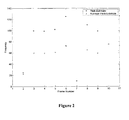
- Such applications include pitch detection of speech signals for karaoke. If a noisy signal is determined to be a speech track, the pitch detection algorithm may return an erroneous estimate of the pitch of the signal. As a result, most of the pitch estimates will be lower than expected, as shown in Figure 2.
- the ETSI VAD supports a low-delay VAD estimate based on prefixed noise thresholds, however, these thresholds are not signal dependent.
- An object of the present invention is to overcome or ameliorate one or more of the above mentioned difficulties, or at least provide a useful alternative.
- a method for determining whether a data frame of a coded speech signal corresponds to voice or to noise including the steps of:
- the present invention also provides a method for determining whether a data frame of a coded speech signal corresponds to voice or to noise, including the steps of:
- the present invention also provides a voice activity detector for determining whether a data frame of a coded speech signal corresponds to voice or to noise, including:
- a voice activity detector (VAD) 10 receives coded speech input signals, partitions the input signals into data frames and determines, for each frame, whether the data relates to voice or noise.
- the VAD 10 operates in the time domain and takes into account the inherent characteristics of speech and coloured noise to provide improved distinction between speech and silenced sections of speech.
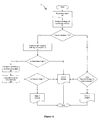
- the VAD 10 preferably executes a VAD process 12, as shown in Figure 4.
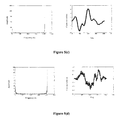
- Figure 5 shows the frequency spectrum and cross-correlation of speech and coloured noise signals, where the cross-correlation is computed by varying the lag from 0 to 2048 samples.
- speech is highly correlated due to the higher number of harmonics in the spectrum.
- the correlation is also highly periodic.
- the VAD 10 takes into account the above-described statistical parameters to improve the estimate of the initial frames.
- the cross-correlation of the signal is determined to obtain a VAD estimate in the initial frames of the input.
- Speech samples are highly correlated and the correlation is periodic in nature due to harmonics in the signal.
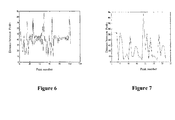
- Figure 6 shows the distance between adjacent peaks in speech cross-correlation.
- Figure 7 shows the distance between adjacent peaks in brown noise cross-correlation.
- the estimates of the periodicity of the peaks in the speech samples are more stable than those of pink and brown noise.
- a variance estimation method is described below that successfully differentiates between speech and noise.
- the energy threshold estimator After a certain number of frames, the energy threshold estimator also helps to improve the distinction between the voiced and silenced sections of the speech signal.
- the short-term energy signal is determined to adaptively improve the voiced/silence detection across a large number of frames.
- the VAD 10 receives, at step 20 of the process shown in Figure 4, Pulse Code Modulated (PCM) signals as input.
- the input signal is sampled at 12,000 samples per second.
- the sampled PCM signals are divided into data frames, each frame containing 2048 samples.
- Each input frame is further partitioned into two sub-frames of 1024 samples each.
- Each pair of sub-frames is used to determine cross-correlation.
- the VAD 10 determines, at step 22, the amount of short-term energy in the input signal.
- the short-term energy is higher for voiced than un-voiced speech and should be zero for silent regions in speech.
- the energy in the l th analysis frame of size N is E l .
- the VAD 10 compares, at step 23, the energy of the current frame with the average speech energy E a s to determine whether it contains speech or noise.
- Input signals with cross-correlation lower than 0.4 are considered as noise. This test therefore detects the presence of either white or pink noise in the data frame under consideration. Further tests are conducted to determine whether the current data frame is speech or brown noise.
- the cross-correlation of speech samples is highly periodic.
- the periodicity of the cross-correlation of the current data frame is determined, at step 26, to segregate speech and noisy signals.
- the periodicity of the cross-correlation can be measured, with reference to Figure 6, by determining the:
- the peaks can be identified by using: Y ⁇ ⁇ - 1 ⁇ Y ⁇ > Y ⁇ ⁇ + 1 for maxima and Y ⁇ ⁇ - 1 > Y ⁇ ⁇ Y ⁇ ⁇ + 1 for minima.
- the process is extended to cover five lags on either side of a trial peak lag. In doing so, makes the peak detection criteria is stringent and entails the risk of leaving out genuine peaks in the cross correlation.
- the variance of periodicity is determined at step 28.
- the estimate is normalised by L as the number of peaks in the correlation of speech and noisy samples will be different.
- L the number of peaks in the correlation of speech and noisy samples will be different.
- Equation 5 varies according to 0 ⁇ ⁇ 1.
- the variance of the periodicity of the cross-correlation of speech signals is therefore lower than that of noise.
- the content of the relevant data frame may be considered to be voice if ⁇ ⁇ 0.2, for example.
- the VAD 10 experiences a delay of one data frame, ie the time taken for the first 2048 bits of sampled input signal to fill the first data frame. With a sampling frequency of 12 kHz., the VAD 10 will experience a lag of 0.17 seconds. The computation of the cross-correlation values for different lags takes minimal time. The VAD 10 may reduce the lag by reducing the frame size to 1024 samples. However, the reduced lag comes at the expense of increasing the error margin in the computation of the variance of the periodicity of the cross-correlation. This error can be reduced by overlapping the sub-frames used for the correlation.
- Figure 8 shows the effect of the VAD 10 when used for pitch detection in a karaoke application. The average pitch estimate has improved in comparison with the pitch estimation shown in Figure 2 obtained using a known VAD that gradually adapts the energy thresholds over a number of frames.
- the number of computations required for the computation of the correlation values initially reduce with higher number of frames, which dynamically adapt to the SNR of the input signal.
- the initial order of computational complexity is: O N + O N 2 / 2 + 5. ⁇ O K where N is the number of samples in a frame; and K is the number of peaks detected in the auto-correlation function.
- the VAD 10 may alternatively execute a VAD process 50, as shown in Figure 9.
- the VAD 10 receives, at step 52, Pulse Code Modulated (PCM) signals as input.
- the input signal is sampled at 12,000 samples per second.
- the sampled PCM signals are divided into data frames, each frame containing 2048 samples.
- Each input frame is further partitioned into two sub-frames of 1024 samples each. Each pair of sub-frames is used to determine cross-correlation.
- the VAD 10 determines, at step 54, the cross-correlation, Y( ⁇ ) , of the first and second sub frames of the data frame under consideration using Equation (3) Input signals with cross-correlation lower than 0.4 are considered as noise. This test therefore detects the presence of either white or pink noise in the data frame under consideration. Further tests are conducted to determine whether the current data frame is speech or brown noise.
- the cross-correlation of speech samples is highly periodic.
- the periodicity of the cross-correlation of the current data frame is determined, at step 56, to segregate speech and noisy signals.
- the periodicity of the cross-correlation can be measured in the above-described manner with reference to Figure 6.
- the variance of periodicity is determined at step 58 in the above-described manner.
- the estimate is normalised by L as the number of peaks in the correlation of speech and noisy samples will be different.
- a linear combination of the variances of the Diff xx is taken.
- the VAD 10 sets a flag indicating whether the contents of the relevant data frame is voice.
Landscapes
- Engineering & Computer Science (AREA)
- Computational Linguistics (AREA)
- Signal Processing (AREA)
- Health & Medical Sciences (AREA)
- Audiology, Speech & Language Pathology (AREA)
- Human Computer Interaction (AREA)
- Physics & Mathematics (AREA)
- Acoustics & Sound (AREA)
- Multimedia (AREA)
- Compression, Expansion, Code Conversion, And Decoders (AREA)
Claims (19)
- Verfahren zum Bestimmen, ob ein Datenrahmen eines codierten Sprachsignals Sprache oder Rauschen entspricht, das die Schritte aufweist:Bestimmen der Kreuzkorrelation der Daten des Datenrahmens;Bestimmen der Periodizität der Kreuzkorrelation;Bestimmen der Varianz der Periodizität;Bestimmen, dass der Datenrahmen Rauschen entspricht, wenn die Kreuzkorrelation niedriger als ein vorbestimmter Kreuzkorrelationswert ist; undBestimmen, dass die Daten Sprache entsprechen, wenn die Varianz kleiner als ein vorbestimmter Varianzwert ist.
- Verfahren nach Anspruch 1, wobei die Kreuzkorrelation Y(τ) in Übereinstimmung mit dem Folgenden berechnet wird:

wobeiτ der Abstand zwischen den Sequenzen x1(n) und x2(n) ist;x1 (n) die erste Hälfte eines Datenrahmens ist;x2(n) die zweite Hälfte des Datenrahmens ist; undN die Größe des Rahmens ist. - Verfahren nach Anspruch 1 oder Anspruch 2, wobei der vorbestimmte Kreuzkorrelationswert dem von weissen oder rosa Rauschen entspricht.
- Verfahren nach einem der Ansprüche 1 bis 3, wobei der vorbestimmte Korrelationswert 0,4 ist.
- Verfahren nach einem der Ansprüche 2 bis 4, wobei die Periodizität bestimmt wird durch Messen:(a) eines Abstands zwischen positiven Spitzen: Diffpp;(b) eines Abstands zwischen negativen Spritzen: Diffnn;(c) eines Abstands zwischen aufeinanderfolgenden positiven und negativen Spritzen: Diffpn; und(d) eines Abstands zwischen aufeinanderfolgenden negativen und positiven Spritzen: Diffnpwobei die Spitzen definiert sind durch Verwenden von:


- Verfahren nach Anspruch 5, wobei die Varianz σ2 wie folgt berechnet wird:

wobeix die Sequenz ist, deren Varianz gemessen wird;µ der Mittelwert einer Sequenz x ist; undL die Anzahl von Abtastwerten in der Sequenz ist. - Verfahren nach Anspruch 6, wobei die Varianz im Wesentlichen wie folgt durch µ2 normalisiert wird:

- Verfahren nach Anspruch 7, wobei der vorbestimmte Varianzwert 0,2 ist.
- Verfahren zum Bestimmen, ob ein Datenrahmen eines codierten Sprachsignals Sprache oder Rauschen entspricht, das die Schritte aufweist:Bestimmen einer Energie des Rahmens;Bestimmen einer mittleren Sprachenergie des codierten Sprachsignals;Durchführen des in einem der Ansprüche 1 bis 8 beanspruchten Verfahrens, wenn der Datenrahmen einer einer vorbestimmten Anzahl von Anfangsdatenrahmen des codierten Sprachsignals ist; undansonsten Vergleichen der Energie des Rahmens mit einer mittleren Sprachenergie und wobei der Rahmen Sprache entspricht, wenn die mittlere Sprachenergie gleich oder kleiner als die Energie des Rahmens ist.
- Verfahren nach Anspruch 9, wobei die Energie des Rahmens bestimmt wird durch Bestimmen:

wobei
die Energie in dem Rahmen einer Größe N einer I-ten Analyse El ist. - Verfahren nach Anspruch 10, wobei die mittlere Sprachenergie bestimmt über k Datenrahmen wie folgt ist:

- Sprachaktivitäts-Erfassungsvorrichtung zum Bestimmen, ob ein Datenrahmen eines codierten Sprachsignals Sprache oder Rauschen entspricht, die beinhaltet:eine Einrichtung zum Bestimmen der Kreuzkorrelation der Daten des Datenrahmens;eine Einrichtung zum Bestimmen der Periodizität der Kreuzkorrelation;eine Einrichtung zum Bestimmen der Varianz der Periodizität;eine Einrichtung zum Bestimmen, dass der Datenrahmen Rauschen entspricht, wenn die Kreuzkorrelation niedriger als ein vorbestimmter Kreuzkorrelationswert ist; undeine Einrichtung zum Bestimmen, dass die Daten Sprache entsprechen, wenn die Varianz kleiner als ein vorbestimmter Varianzwert ist.
- Sprachaktivitäts-Erfassungsvorrichtung nach Anspruch 12, wobei die Kreuzkorrelation Y(τ) in Übereinstimmung mit dem Folgenden berechnet wird:

wobeiτ die Verzögerung zwischen den Sequenzen x1(n) und x2(n) ist;x1 (n) die erste Hälfte eines Datenrahmens ist;x2(n) die zweite Hälfte des Datenrahmens ist; undN die Größe des Rahmens ist. - Sprachaktivitäts-Erfassungsvorrichtung nach Anspruch 12 oder Anspruch 13, wobei der vorbestimmte Kreuzkorrelationswert dem von weissen oder rosa Rauschen entspricht.
- Sprachaktivitäts-Erfassungsvorrichtung nach einem der Ansprüche 12 bis 14, wobei der vorbestimmte Korrelationswert 0,4 ist.
- Sprachaktivitäts-Erfassungsvorrichtung nach einem der Ansprüche 14 bis 15, wobei die Periodizität bestimmt wird durch Messen:(a) eines Abstands zwischen positiven Spitzen: Diffpp;(b) eines Abstands zwischen negativen Spritzen: Diffnn;(c) eines Abstands zwischen aufeinanderfolgenden positiven und negativen Spritzen: Diffpn; und(d) eines Abstands zwischen aufeinanderfolgenden negativen und positiven Spritzen: Diffnpwobei die Spitzen definiert sind durch Verwenden von:


- Sprachaktivitäts-Erfassungsvorrichtung nach Anspruch 16, wobei die Varianz σ2 wie folgt berechnet wird:
 x die Sequenz ist, deren Varianz gemessen wird;µ der Mittelwert einer Sequenz x ist; undL die Anzahl von Abtastwerten in der Sequenz ist.
 - Sprachaktivitäts-Erfassungsvorrichtung nach Anspruch 17, wobei die Varianz im Wesentlichen wie folgt durch µ 2normalisiert wird:

- Sprachaktivitäts-Erfassungsvorrichtung nach Anspruch 18, wobei der vorbestimmte Varianzwert 0,2 ist.
Applications Claiming Priority (2)
| Application Number | Priority Date | Filing Date | Title |
|---|---|---|---|
| SG200305524A SG119199A1 (en) | 2003-09-30 | 2003-09-30 | Voice activity detector |
| SG200305524 | 2003-09-30 |
Publications (2)
| Publication Number | Publication Date |
|---|---|
| EP1521238A1 EP1521238A1 (de) | 2005-04-06 |
| EP1521238B1 true EP1521238B1 (de) | 2007-01-10 |
Family
ID=34311436
Family Applications (1)
| Application Number | Title | Priority Date | Filing Date |
|---|---|---|---|
| EP04104685A Expired - Lifetime EP1521238B1 (de) | 2003-09-30 | 2004-09-27 | Sprachaktivitätsdetektion |
Country Status (4)
| Country | Link |
|---|---|
| US (1) | US7653537B2 (de) |
| EP (1) | EP1521238B1 (de) |
| DE (1) | DE602004004225D1 (de) |
| SG (1) | SG119199A1 (de) |
Families Citing this family (36)
| Publication number | Priority date | Publication date | Assignee | Title |
|---|---|---|---|---|
| US8280072B2 (en) | 2003-03-27 | 2012-10-02 | Aliphcom, Inc. | Microphone array with rear venting |
| US8019091B2 (en) | 2000-07-19 | 2011-09-13 | Aliphcom, Inc. | Voice activity detector (VAD) -based multiple-microphone acoustic noise suppression |
| US8452023B2 (en) | 2007-05-25 | 2013-05-28 | Aliphcom | Wind suppression/replacement component for use with electronic systems |
| US9066186B2 (en) | 2003-01-30 | 2015-06-23 | Aliphcom | Light-based detection for acoustic applications |
| US9099094B2 (en) | 2003-03-27 | 2015-08-04 | Aliphcom | Microphone array with rear venting |
| JP4490090B2 (ja) * | 2003-12-25 | 2010-06-23 | 株式会社エヌ・ティ・ティ・ドコモ | 有音無音判定装置および有音無音判定方法 |
| JP4601970B2 (ja) * | 2004-01-28 | 2010-12-22 | 株式会社エヌ・ティ・ティ・ドコモ | 有音無音判定装置および有音無音判定方法 |
| KR101116363B1 (ko) * | 2005-08-11 | 2012-03-09 | 삼성전자주식회사 | 음성신호 분류방법 및 장치, 및 이를 이용한 음성신호부호화방법 및 장치 |
| JP5530720B2 (ja) * | 2007-02-26 | 2014-06-25 | ドルビー ラボラトリーズ ライセンシング コーポレイション | エンターテイメントオーディオにおける音声強調方法、装置、およびコンピュータ読取り可能な記録媒体 |
| US11217237B2 (en) | 2008-04-14 | 2022-01-04 | Staton Techiya, Llc | Method and device for voice operated control |
| US8503686B2 (en) * | 2007-05-25 | 2013-08-06 | Aliphcom | Vibration sensor and acoustic voice activity detection system (VADS) for use with electronic systems |
| CN101320559B (zh) * | 2007-06-07 | 2011-05-18 | 华为技术有限公司 | 一种声音激活检测装置及方法 |
| JP5395066B2 (ja) * | 2007-06-22 | 2014-01-22 | ヴォイスエイジ・コーポレーション | 音声区間検出および音声信号分類ための方法および装置 |
| US10009677B2 (en) | 2007-07-09 | 2018-06-26 | Staton Techiya, Llc | Methods and mechanisms for inflation |
| US8954324B2 (en) * | 2007-09-28 | 2015-02-10 | Qualcomm Incorporated | Multiple microphone voice activity detector |
| US8175871B2 (en) * | 2007-09-28 | 2012-05-08 | Qualcomm Incorporated | Apparatus and method of noise and echo reduction in multiple microphone audio systems |
| US20090150144A1 (en) * | 2007-12-10 | 2009-06-11 | Qnx Software Systems (Wavemakers), Inc. | Robust voice detector for receive-side automatic gain control |
| US8223988B2 (en) * | 2008-01-29 | 2012-07-17 | Qualcomm Incorporated | Enhanced blind source separation algorithm for highly correlated mixtures |
| US9129291B2 (en) | 2008-09-22 | 2015-09-08 | Personics Holdings, Llc | Personalized sound management and method |
| US8576837B1 (en) * | 2009-01-20 | 2013-11-05 | Marvell International Ltd. | Voice packet redundancy based on voice activity |
| JP5580405B2 (ja) * | 2009-05-14 | 2014-08-27 | コーニンクレッカ フィリップス エヌ ヴェ | Dvb−t/h通信の堅牢な検出 |
| WO2011049514A1 (en) * | 2009-10-19 | 2011-04-28 | Telefonaktiebolaget Lm Ericsson (Publ) | Method and background estimator for voice activity detection |
| JP5870476B2 (ja) * | 2010-08-04 | 2016-03-01 | 富士通株式会社 | 雑音推定装置、雑音推定方法および雑音推定プログラム |
| EP3252771B1 (de) | 2010-12-24 | 2019-05-01 | Huawei Technologies Co., Ltd. | Verfahren und vorrichtung zur durchführung von sprachaktivitätserkennung |
| EP2619753B1 (de) | 2010-12-24 | 2014-05-21 | Huawei Technologies Co., Ltd. | Verfahren und vorrichtung zur adaptiven erkennung von sprachaktivität bei einem audioeingangssignal |
| US12349097B2 (en) | 2010-12-30 | 2025-07-01 | St Famtech, Llc | Information processing using a population of data acquisition devices |
| US20130090926A1 (en) * | 2011-09-16 | 2013-04-11 | Qualcomm Incorporated | Mobile device context information using speech detection |
| CN104019885A (zh) | 2013-02-28 | 2014-09-03 | 杜比实验室特许公司 | 声场分析系统 |
| EP2974253B1 (de) | 2013-03-15 | 2019-05-08 | Dolby Laboratories Licensing Corporation | Normalisierung von schallfeldausrichtungen auf basis von auditorischer szenenanalyse |
| US9167082B2 (en) | 2013-09-22 | 2015-10-20 | Steven Wayne Goldstein | Methods and systems for voice augmented caller ID / ring tone alias |
| JP6724290B2 (ja) * | 2015-03-31 | 2020-07-15 | ソニー株式会社 | 音響処理装置、音響処理方法、及び、プログラム |
| JP6501259B2 (ja) * | 2015-08-04 | 2019-04-17 | 本田技研工業株式会社 | 音声処理装置及び音声処理方法 |
| US10269375B2 (en) * | 2016-04-22 | 2019-04-23 | Conduent Business Services, Llc | Methods and systems for classifying audio segments of an audio signal |
| CN107564512B (zh) * | 2016-06-30 | 2020-12-25 | 展讯通信(上海)有限公司 | 语音活动侦测方法及装置 |
| CN112447166B (zh) * | 2019-08-16 | 2024-09-10 | 阿里巴巴集团控股有限公司 | 一种针对目标频谱矩阵的处理方法及装置 |
| CN115831145B (zh) * | 2023-02-16 | 2023-06-27 | 之江实验室 | 一种双麦克风语音增强方法和系统 |
Family Cites Families (14)
| Publication number | Priority date | Publication date | Assignee | Title |
|---|---|---|---|---|
| IN184794B (de) * | 1993-09-14 | 2000-09-30 | British Telecomm | |
| US5485522A (en) * | 1993-09-29 | 1996-01-16 | Ericsson Ge Mobile Communications, Inc. | System for adaptively reducing noise in speech signals |
| US5699477A (en) * | 1994-11-09 | 1997-12-16 | Texas Instruments Incorporated | Mixed excitation linear prediction with fractional pitch |
| CN1225736A (zh) * | 1996-07-03 | 1999-08-11 | 英国电讯有限公司 | 语音活动检测器 |
| US6049766A (en) * | 1996-11-07 | 2000-04-11 | Creative Technology Ltd. | Time-domain time/pitch scaling of speech or audio signals with transient handling |
| US6116080A (en) * | 1998-04-17 | 2000-09-12 | Lorex Industries, Inc. | Apparatus and methods for performing acoustical measurements |
| US6453285B1 (en) * | 1998-08-21 | 2002-09-17 | Polycom, Inc. | Speech activity detector for use in noise reduction system, and methods therefor |
| US6188981B1 (en) * | 1998-09-18 | 2001-02-13 | Conexant Systems, Inc. | Method and apparatus for detecting voice activity in a speech signal |
| US6691092B1 (en) * | 1999-04-05 | 2004-02-10 | Hughes Electronics Corporation | Voicing measure as an estimate of signal periodicity for a frequency domain interpolative speech codec system |
| US6124544A (en) * | 1999-07-30 | 2000-09-26 | Lyrrus Inc. | Electronic music system for detecting pitch |
| US6332143B1 (en) * | 1999-08-11 | 2001-12-18 | Roedy Black Publishing Inc. | System for connotative analysis of discourse |
| US20030110029A1 (en) * | 2001-12-07 | 2003-06-12 | Masoud Ahmadi | Noise detection and cancellation in communications systems |
| US7054367B2 (en) * | 2001-12-31 | 2006-05-30 | Emc Corporation | Edge detection based on variable-length codes of block coded video |
| US20040064314A1 (en) * | 2002-09-27 | 2004-04-01 | Aubert Nicolas De Saint | Methods and apparatus for speech end-point detection |
-
2003
- 2003-09-30 SG SG200305524A patent/SG119199A1/en unknown
-
2004
- 2004-09-27 EP EP04104685A patent/EP1521238B1/de not_active Expired - Lifetime
- 2004-09-27 DE DE602004004225T patent/DE602004004225D1/de not_active Expired - Lifetime
- 2004-09-28 US US10/951,545 patent/US7653537B2/en active Active
Also Published As
| Publication number | Publication date |
|---|---|
| SG119199A1 (en) | 2006-02-28 |
| US20050182620A1 (en) | 2005-08-18 |
| US7653537B2 (en) | 2010-01-26 |
| EP1521238A1 (de) | 2005-04-06 |
| DE602004004225D1 (de) | 2007-02-22 |
Similar Documents
| Publication | Publication Date | Title |
|---|---|---|
| EP1521238B1 (de) | Sprachaktivitätsdetektion | |
| KR100330230B1 (ko) | 잡음 억제 방법 및 장치 | |
| EP0335521B1 (de) | Detektion für die Anwesenheit eines Sprachsignals | |
| KR100388387B1 (ko) | 여기파라미터의결정을위한디지탈화된음성신호의분석방법및시스템 | |
| EP2159788B1 (de) | Sprachaktivitätsdetektionseinrichtung und verfahren | |
| KR102012325B1 (ko) | 오디오 신호의 배경 잡음 추정 | |
| EP2656341B1 (de) | Vorrichtung zur durchführung von sprachaktivitätserkennung | |
| KR100770839B1 (ko) | 음성 신호의 하모닉 정보 및 스펙트럼 포락선 정보,유성음화 비율 추정 방법 및 장치 | |
| CN101010722A (zh) | 音频信号中话音活动的检测 | |
| US5943645A (en) | Method and apparatus for computing measures of echo | |
| US5696873A (en) | Vocoder system and method for performing pitch estimation using an adaptive correlation sample window | |
| US20120265526A1 (en) | Apparatus and method for voice activity detection | |
| US7233894B2 (en) | Low-frequency band noise detection | |
| Ozaydin | Design of a Voice Activity Detection Algorithm based on Logarithmic Signal Energy | |
| KR100355384B1 (ko) | 음성 신호에서의 유성화 확률 결정 장치 및 그 방법 | |
| US6385570B1 (en) | Apparatus and method for detecting transitional part of speech and method of synthesizing transitional parts of speech | |
| US20240013803A1 (en) | Method enabling the detection of the speech signal activity regions | |
| KR20120072099A (ko) | 보간법을 이용하는 시간-주파수 혼합영역의 피치 추정 시스템 | |
| EP4648049A1 (de) | Vorrichtung und verfahren zur verarbeitung eines vorverarbeiteten audioeingangssignals zur gewinnung eines aktivitätsausgangssignals | |
| KR100312334B1 (ko) | 에너지와 lsp 파라메타를 이용한 음성신호처리부호화기에서의 음성 활동 검출 방법 | |
| Zhang et al. | An endpoint detection algorithm based on MFCC and spectral entropy using BP NN | |
| KR19990070595A (ko) | 평탄화된 스펙트럼에서 유성-무성구간 분류방법 | |
| JPS63237100A (ja) | 音声検出器 | |
| Rabiner et al. | Tandem connections of wideband and narrowband speech communication systems part 2–wideband-to-narrowband link | |
| Deshmukh et al. | A novel method for computation of periodicity, aperiodicity and pitch of speech signals |
Legal Events
| Date | Code | Title | Description |
|---|---|---|---|
| PUAI | Public reference made under article 153(3) epc to a published international application that has entered the european phase |
Free format text: ORIGINAL CODE: 0009012 |
|
| AK | Designated contracting states |
Kind code of ref document: A1 Designated state(s): AT BE BG CH CY CZ DE DK EE ES FI FR GB GR HU IE IT LI LU MC NL PL PT RO SE SI SK TR |
|
| AX | Request for extension of the european patent |
Extension state: AL HR LT LV MK |
|
| RIN1 | Information on inventor provided before grant (corrected) |
Inventor name: KABI, PRAKASH PADHI Inventor name: GEORGE, SAPNA |
|
| 17P | Request for examination filed |
Effective date: 20051005 |
|
| AKX | Designation fees paid |
Designated state(s): DE FR GB IT |
|
| GRAP | Despatch of communication of intention to grant a patent |
Free format text: ORIGINAL CODE: EPIDOSNIGR1 |
|
| GRAS | Grant fee paid |
Free format text: ORIGINAL CODE: EPIDOSNIGR3 |
|
| GRAA | (expected) grant |
Free format text: ORIGINAL CODE: 0009210 |
|
| AK | Designated contracting states |
Kind code of ref document: B1 Designated state(s): DE FR GB IT |
|
| REG | Reference to a national code |
Ref country code: GB Ref legal event code: FG4D |
|
| REF | Corresponds to: |
Ref document number: 602004004225 Country of ref document: DE Date of ref document: 20070222 Kind code of ref document: P |
|
| RIN2 | Information on inventor provided after grant (corrected) |
Inventor name: KABI, PRAKASH PADHI Inventor name: GEORGE, SAPNA |
|
| ET | Fr: translation filed | ||
| PLBE | No opposition filed within time limit |
Free format text: ORIGINAL CODE: 0009261 |
|
| STAA | Information on the status of an ep patent application or granted ep patent |
Free format text: STATUS: NO OPPOSITION FILED WITHIN TIME LIMIT |
|
| 26N | No opposition filed |
Effective date: 20071011 |
|
| PG25 | Lapsed in a contracting state [announced via postgrant information from national office to epo] |
Ref country code: DE Free format text: LAPSE BECAUSE OF FAILURE TO SUBMIT A TRANSLATION OF THE DESCRIPTION OR TO PAY THE FEE WITHIN THE PRESCRIBED TIME-LIMIT Effective date: 20070411 |
|
| REG | Reference to a national code |
Ref country code: FR Ref legal event code: PLFP Year of fee payment: 13 |
|
| REG | Reference to a national code |
Ref country code: FR Ref legal event code: PLFP Year of fee payment: 14 |
|
| REG | Reference to a national code |
Ref country code: FR Ref legal event code: PLFP Year of fee payment: 15 |
|
| PGFP | Annual fee paid to national office [announced via postgrant information from national office to epo] |
Ref country code: FR Payment date: 20180822 Year of fee payment: 15 Ref country code: IT Payment date: 20180828 Year of fee payment: 15 |
|
| PGFP | Annual fee paid to national office [announced via postgrant information from national office to epo] |
Ref country code: GB Payment date: 20180823 Year of fee payment: 15 |
|
| PG25 | Lapsed in a contracting state [announced via postgrant information from national office to epo] |
Ref country code: IT Free format text: LAPSE BECAUSE OF NON-PAYMENT OF DUE FEES Effective date: 20190927 |
|
| GBPC | Gb: european patent ceased through non-payment of renewal fee |
Effective date: 20190927 |
|
| PG25 | Lapsed in a contracting state [announced via postgrant information from national office to epo] |
Ref country code: GB Free format text: LAPSE BECAUSE OF NON-PAYMENT OF DUE FEES Effective date: 20190927 Ref country code: FR Free format text: LAPSE BECAUSE OF NON-PAYMENT OF DUE FEES Effective date: 20190930 |