EP1520864A1 - Higher alpha-olefin copolymers and process for preparation thereof - Google Patents

Higher alpha-olefin copolymers and process for preparation thereof Download PDF

Info

Publication number
EP1520864A1
EP1520864A1 EP04104076A EP04104076A EP1520864A1 EP 1520864 A1 EP1520864 A1 EP 1520864A1 EP 04104076 A EP04104076 A EP 04104076A EP 04104076 A EP04104076 A EP 04104076A EP 1520864 A1 EP1520864 A1 EP 1520864A1
Authority
EP
European Patent Office
Prior art keywords
group
carbon atoms
olefin
dimethylsilylene
zirconium dichloride
Prior art date
Legal status (The legal status is an assumption and is not a legal conclusion. Google has not performed a legal analysis and makes no representation as to the accuracy of the status listed.)
Granted
Application number
EP04104076A
Other languages
German (de)
French (fr)
Other versions
EP1520864B1 (en
Inventor
Yutaka Minami
Takenori Fujimura
Masanori Sera
Tomoaki Takebe
Current Assignee (The listed assignees may be inaccurate. Google has not performed a legal analysis and makes no representation or warranty as to the accuracy of the list.)
Idemitsu Kosan Co Ltd
Original Assignee
Idemitsu Kosan Co Ltd
Priority date (The priority date is an assumption and is not a legal conclusion. Google has not performed a legal analysis and makes no representation as to the accuracy of the date listed.)
Filing date
Publication date
Application filed by Idemitsu Kosan Co Ltd filed Critical Idemitsu Kosan Co Ltd
Publication of EP1520864A1 publication Critical patent/EP1520864A1/en
Application granted granted Critical
Publication of EP1520864B1 publication Critical patent/EP1520864B1/en
Anticipated expiration legal-status Critical
Expired - Lifetime legal-status Critical Current

Links

Classifications

    • CCHEMISTRY; METALLURGY
    • C08ORGANIC MACROMOLECULAR COMPOUNDS; THEIR PREPARATION OR CHEMICAL WORKING-UP; COMPOSITIONS BASED THEREON
    • C08FMACROMOLECULAR COMPOUNDS OBTAINED BY REACTIONS ONLY INVOLVING CARBON-TO-CARBON UNSATURATED BONDS
    • C08F210/00Copolymers of unsaturated aliphatic hydrocarbons having only one carbon-to-carbon double bond
    • C08F210/14Monomers containing five or more carbon atoms
    • CCHEMISTRY; METALLURGY
    • C08ORGANIC MACROMOLECULAR COMPOUNDS; THEIR PREPARATION OR CHEMICAL WORKING-UP; COMPOSITIONS BASED THEREON
    • C08FMACROMOLECULAR COMPOUNDS OBTAINED BY REACTIONS ONLY INVOLVING CARBON-TO-CARBON UNSATURATED BONDS
    • C08F4/00Polymerisation catalysts
    • C08F4/42Metals; Metal hydrides; Metallo-organic compounds; Use thereof as catalyst precursors
    • C08F4/44Metals; Metal hydrides; Metallo-organic compounds; Use thereof as catalyst precursors selected from light metals, zinc, cadmium, mercury, copper, silver, gold, boron, gallium, indium, thallium, rare earths or actinides
    • C08F4/60Metals; Metal hydrides; Metallo-organic compounds; Use thereof as catalyst precursors selected from light metals, zinc, cadmium, mercury, copper, silver, gold, boron, gallium, indium, thallium, rare earths or actinides together with refractory metals, iron group metals, platinum group metals, manganese, rhenium technetium or compounds thereof
    • C08F4/62Refractory metals or compounds thereof
    • C08F4/64Titanium, zirconium, hafnium or compounds thereof
    • C08F4/659Component covered by group C08F4/64 containing a transition metal-carbon bond
    • C08F4/65908Component covered by group C08F4/64 containing a transition metal-carbon bond in combination with an ionising compound other than alumoxane, e.g. (C6F5)4B-X+
    • CCHEMISTRY; METALLURGY
    • C08ORGANIC MACROMOLECULAR COMPOUNDS; THEIR PREPARATION OR CHEMICAL WORKING-UP; COMPOSITIONS BASED THEREON
    • C08FMACROMOLECULAR COMPOUNDS OBTAINED BY REACTIONS ONLY INVOLVING CARBON-TO-CARBON UNSATURATED BONDS
    • C08F4/00Polymerisation catalysts
    • C08F4/42Metals; Metal hydrides; Metallo-organic compounds; Use thereof as catalyst precursors
    • C08F4/44Metals; Metal hydrides; Metallo-organic compounds; Use thereof as catalyst precursors selected from light metals, zinc, cadmium, mercury, copper, silver, gold, boron, gallium, indium, thallium, rare earths or actinides
    • C08F4/60Metals; Metal hydrides; Metallo-organic compounds; Use thereof as catalyst precursors selected from light metals, zinc, cadmium, mercury, copper, silver, gold, boron, gallium, indium, thallium, rare earths or actinides together with refractory metals, iron group metals, platinum group metals, manganese, rhenium technetium or compounds thereof
    • C08F4/62Refractory metals or compounds thereof
    • C08F4/64Titanium, zirconium, hafnium or compounds thereof
    • C08F4/659Component covered by group C08F4/64 containing a transition metal-carbon bond
    • C08F4/65912Component covered by group C08F4/64 containing a transition metal-carbon bond in combination with an organoaluminium compound

Definitions

  • the present invention relates to crystalline higher ⁇ -olefin copolymers obtained by copolymerization of at least two higher ⁇ -olefins having 10 or more carbon atoms or of at least one higher ⁇ -olefin having 10 or more carbon atoms with at least one other olefin, which are useful as a modifying agent for resins, a tackifying agent, an adhesive, a lubricant, an organic-inorganic composite material, a heat storage material, a modifying agent for fuel oils such as light oil, a modifying agent for asphalt, and a high-performance wax, and to a process for preparation thereof.
  • higher ⁇ -olefin polymers can be obtained by using homogeneous catalysts called metallocene catalysts (For example, Macromol. Sci. Pure Appl. Chem., A35, 473 (1998), J. Polym. Sci. A, 38, 233 (2000), Macromol. Mater. Eng., 286, 350 (2001) and Macromol. Mater. Eng., 286, 480 (2001)).
  • metallocene catalysts for example, Macromol. Sci. Pure Appl. Chem., A35, 473 (1998), J. Polym. Sci. A, 38, 233 (2000), Macromol. Mater. Eng., 286, 350 (2001) and Macromol. Mater. Eng., 286, 480 (2001)).
  • the above-mentioned polymers do not have sufficiently high molecular weights and appear to be inhomogeneous such that the melting point is high owing to high regularity and also that two melting points appear in one polymer material, being similar to the polymers obtained by using heterogeneous catalysts.
  • Presence of a plurality of melting points appearing in one polymer material represents inhomogeneity in the size of crystals or the like, possibly causing tackiness.
  • a material for the use as a heat storage material, it is preferred for a material to have rapid heat dissipation and absorption resulting from rapid melting or crystallization at a specific temperature with regard to efficiency improvement, and thus it is difficult to use an inhomogeneous resin for the purpose.
  • An object of the present invention is to provide crystalline high ⁇ -olefin copolymers which have excellent compatibility with thermoplastic resins, especially polyolefins, and compatibility with lubricant oils, fuel oils or waxes, excellent miscibility with inorganic fillers and secondary processability, and which have narrow temperature ranges for melting and crystallization, and to provide a process for preparation thereof.
  • the inventors have conducted extensive studies in order to solve the above-mentioned problems, and have found that the problems can be solved by crystalline higher ⁇ -olefin copolymers obtained by copolymerization of at least two higher ⁇ -olefins having 10 or more carbon atoms or of at least one higher ⁇ -olefin having 10 or more carbon atoms with at least one other olefin, and that it is possible to produce efficiently such copolymers using specific metallocene catalysts, thus completing the present invention.
  • the present invention is to provide the following:
  • Each of E 1 and E 2 represents a ligand selected from a substituted cyclopentadienyl group, an indenyl group, a substituted indenyl group, a heterocyclopentadienyl group, a substituted heterocyclopentadienyl group, an amido group, a phosphido group, a hydrocarbon group or a silicon-containing group, they form a crosslinked structure via A 1 and A 2 , and they may be the same or different from each other;
  • X represents a ⁇ -bonding ligand, and a plurality of X, if any, may be the same or different from each other, and may be crosslinked with other X, E 1 , E 2 or Y;
  • Y represents a Lewis base, and a plurality of Y, if any, may be the same or different from each other, and may be crosslinked with other Y, E 1 , E 2 or X;
  • Each of A 1 and A 2 is a
  • the crystalline higher ⁇ -olefin copolymers of the present invention are obtained by copolymerizing at least two higher ⁇ -olefins having 10 or more carbon atoms or at least one higher ⁇ -olefin having 10 or more carbon atoms with at least one other olefin.
  • an olefin having 2 to 30 carbon atoms can be used, the preferred being an ⁇ -olefin.
  • ⁇ -olefin examples include ethylene, propylene, 1-pentene, 4-methylpentene-1, 1-hexene, 1-octene, 1-decene, 1-undecene, 1-dodecene, 1-tridecene, 1-tetradecene, 1-pentadecene, 1-hexadecene, 1-heptadecene, 1-octadecene, 1-nonadecene, 1-eicosene or the like.
  • one or two or more ⁇ -olefins may be used.
  • an ⁇ -olefin having 10 to 35 carbon atoms may be used, including, for example, 1-decene, 1-undecene, 1-dodecene, 1-tridecene, 1-tetradecene, 1-pentadecene, 1-hexadecene, 1-heptadecene, 1-octadecene, 1-nonadecene, 1-eicosene or the like.
  • one or two or more ⁇ -olefins can be used.
  • the higher ⁇ -olefin copolymer obtained by copolymerization thereof has high crystallinity and improved strength without tackiness.
  • the higher ⁇ -olefin copolymer obtained by copolymerization thereof comprises less unreacted monomers and has a homogeneous composition with a narrow temperature range for melting and crystallization.
  • the content of a higher ⁇ -olefin unit having 10 or more carbon atoms in the crystalline higher ⁇ -olefin copolymer of the present invention is 50 mol% or more, preferably 70 to 100 mol%, and more preferably 85 to 100 mol%.
  • a copolymer consisting only of higher ⁇ -olefins having 10 or more carbon atoms is preferred.
  • a crystalline copolymer When the content of a higher ⁇ -olefin unit having 10 or more carbon atoms is 50 mol% or more, a crystalline copolymer is obtained, and due to its low melting point, the polymer has improved compatibility with various materials such as solvents, oils, asphalt, lubricants and the like.
  • the crystalline higher ⁇ -olefin copolymer of the present invention is obtained by copolymerizing at least two higher ⁇ -olefins having 10 or more carbon atoms or by copolymerizing at least one higher ⁇ -olefin having 10 or more carbon atoms with at least one other olefin, and is a copolymer satisfying the following requirements (1) to (3), preferably satisfying the following requirements 2 to 4:
  • the melting point (Tm) of the crystalline higher ⁇ -olefin copolymer of the present invention is in the range of 20 to 100°C, preferably 25 to 100°C, and more preferably 25 to 80°C.
  • the crystalline higher ⁇ -olefin copolymer of the present invention having a melting point in such ranges hardly causes generation of tackiness at room temperature, has excellent storability and secondary processability, and can be dissolved uniformly at low temperatures, thus showing excellent processability.
  • the crystalline higher ⁇ -olefin copolymer of the present invention exhibits a single peak X1 resulting from the crystallization of side chains, which is observed at 15 deg ⁇ 2 ⁇ ⁇ 30 deg in the intensity distribution of wide-angle X-ray scattering.
  • the peak resulting from side chain crystallization is not single, the crystalline portion of the copolymer becomes wide and causes tackiness and lowered strength.
  • the shape of the melting peak does not become sharp, it leads to a decrease in the storability and the secondary processability.
  • anticathodic rotor flex RU-200 manufactured by Rigaku Denki K.K.
  • WAXS wide-angle X-ray scattering
  • the crystalline higher ⁇ -olefin copolymer of the present invention has a weight-average molecular weight (Mw) measured by gel permeation chromatography (GPC) with respect to polystyrene in the range of 1,000 to 10,000,000, and more preferably in the range of 10,000 to 10,000,000.
  • Mw weight-average molecular weight measured by gel permeation chromatography
  • Mw molecular weight
  • the crystalline higher ⁇ -olefin copolymer of the present invention preferably has a molecular weight distribution (Mw/Mn) measured by GPC of 5.0 or less, more preferably of 1.5 to 3.5, and particularly preferably of 1.5 to 3.0.
  • Mw/Mn molecular weight distribution
  • the crystalline higher ⁇ -olefin copolymer has narrow composition distribution, good surface properties and improved strength without tackiness.
  • Mw/Mn is a value calculated from the weight-average molecular weight Mw and the number-average molecular weight Mn, both measured by the following apparatus under the following conditions with respect to polystyrene:
  • the crystalline higher ⁇ -olefin copolymer of the present invention has an isotactic structure, and the stereoregularity index M2 derived from the linkages of higher ⁇ -olefin units having 10 or more carbon atoms, is preferably greater than or equal to 50 mol%.
  • the index is more preferably in the range of 50 to 90 mol%, particularly preferably 55 to 85 mol%, and more preferably 55 to 75 mol%.
  • the copolymer attains an isotactic structure, with the crystallinity of the copolymer being improved, and the copolymer has good surface properties and improved strength, without tackiness.
  • the object of the present invention may be achieved.
  • This stereoregularity index M2 was measured according to the method reported in T.Asakura, M. Demura, Y. Nishiyama, "Macromolecules, 24, 2334 (1991)".
  • M2 can be obtained by using the observation that the 13 C-NMR spectra of the CH 2 carbon atom at the ⁇ -position of a side chain present in a higher ⁇ -olefin are split reflecting the difference in stereoregularity.
  • a larger value of M2 indicates higher isotacticity, which leads to an enhancement in heat resistance and strength.
  • the crystalline higher ⁇ -olefin copolymer of the present invention preferably has a half-width (Wm) measured from the melting endothermic curve obtained using a differential scanning calorimeter (DSC), of 10°C or less, more preferably 6°C or less, and particularly preferably 2 to 4°C.
  • Wm half-width measured from the melting endothermic curve obtained using a differential scanning calorimeter
  • the half-width (Wm) means the width at 50% of the height of an absorption peak obtained during the measurement of the melting point (Tm) with DSC, and a smaller value of this half-width indicates formation of homogeneous crystals and thus homogeneity of the material.
  • the half-width of a crystalline higher ⁇ -olefin copolymer being less than or equal to 10°C implies rapid melting behavior.
  • the temperature range for the adhesive-to-non-adhesive switching becomes narrower, and the adhesive force can correspond to abrupt temperature changes. This is preferred as it leads to an enhancement of temperature-sensitivity.
  • the crystalline higher ⁇ -olefin copolymer of the present invention can be prepared by using metallocene catalysts described below, and inter alia, it is preferred to use transition metal compounds with C 2 -symmetry and C 1 -symmetry which are capable of synthesis of isotactic polymers.
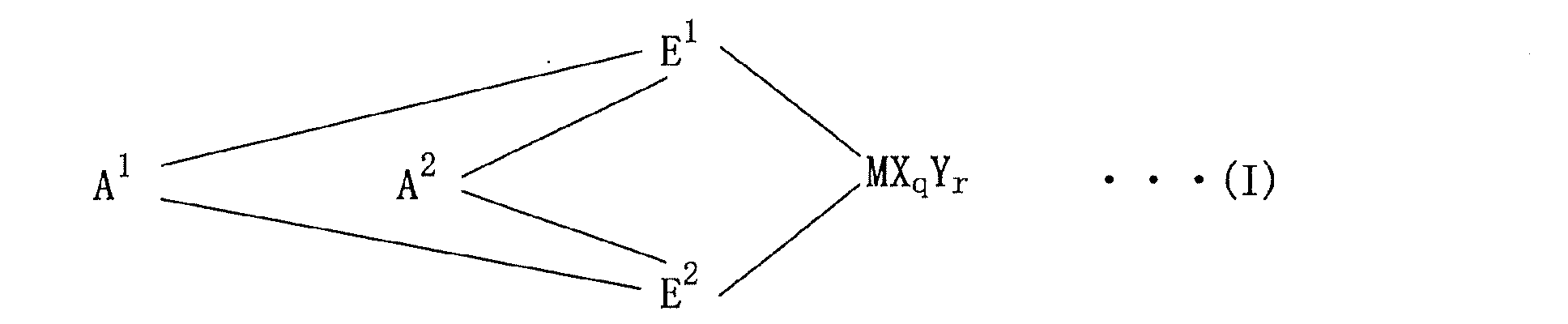
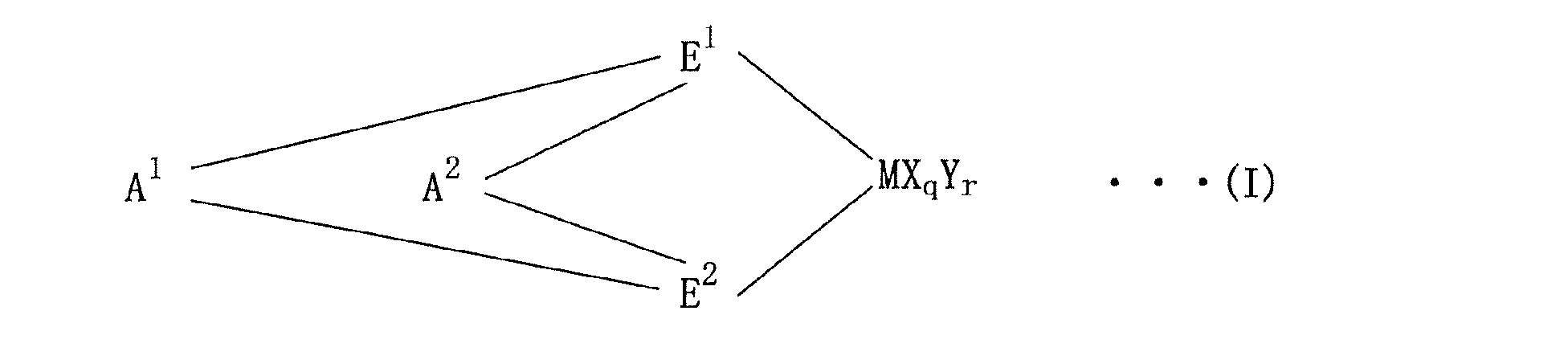
  • the present invention provides a process of copolymerizing at least two higher ⁇ -olefins having 10 or more carbon atoms, or copolymerizing at least one higher ⁇ -olefin having 10 or more carbon atoms with at least one other olefin, in the presence of a polymerization catalyst containing (A) a transition metal compound represented by the following formula (I), and (B) a compound capable of forming an ionic complex by reacting with the transition metal compound of the component (A) or its derivative (B-1) and at least one component selected from aluminoxanes (B-2): (wherein M represents a metallic element of Groups 3 to 10 of the Periodic Table or the lanthanoid series;
  • Each of E 1 and E 2 represents a ligand selected from a substituted cyclopentadienyl group, an indenyl group, a substituted indenyl group, a heterocyclopentadienyl group, a substituted heterocyclopentadienyl group, an amido group, a phosphido group, a hydrocarbon group or a silicon-containing group, they form a crosslinked structure via A 1 and A 2 , and they may be the same or different from each other;
  • X represents a ⁇ -bonding ligand, and a plurality of X, if any, may be the same or different from each other, and may be crosslinked with other X, E 1 , E 2 or Y;
  • Y represents a Lewis base, and a plurality of Y, if any, may be the same or different from each other, and may be crosslinked with other Y, E 1 , E 2 or X;
  • Each of A 1 and A 2 is a divalent crosslinking group via which the two ligands are bonded to each other and represents a hydrocarbon group having 1 to 20 carbon atoms, a halogen-containing hydrocarbon group having 1 to 20 carbon atoms, a silicon-containing group, a germanium-containing group, a tin-containing group, -O-, -CO-, -S-, -SO 2 -, -Se-, -NR 1 -, -PR 1 -, -P(O)R 1 -, -BR 1 - or -AlR 1 - wherein R 1 represents a hydrogen atom, a halogen atom, a hydrocarbon group having 1 to 20 carbon atoms, or a halogen-containing hydrocarbon group having 1 to 20 carbon atoms, and they may be the same or different from each other; q is an integer of from 1 to 5 and represents [(valency of M)-2]; and r represents an integer of from 0
  • M represents a metallic element of Groups 3 to 10 of the Periodic Table or lanthanoid series, and specific examples thereof include titanium, zirconium, hafnium, yttrium, vanadium, chromium, manganese, nickel, cobalt, palladium and lanthanoid metals. Among these, titanium, zirconium and hafnium are preferred from the perspective of the activity for olefin copolymerization.
  • Each of E 1 and E 2 represents a ligand selected from a substituted cyclopentadienyl group, an indenyl group, a substituted indenyl group, a heterocyclopentadienyl group, a substituted heterocyclopentadienyl group, an amido group (-N ⁇ ), a phosphido group (-P ⁇ ), hydrocarbon group [>CR-, >C ⁇ ] or a silicon-containing group [>SiR-, >Si ⁇ ], provided that R is a hydrogen atom, a hydrocarbon group having 1 to 20 carbon atoms, or a hetero atom-containing group, and they form a crosslinked structure via A 1 and A 2 .
  • E 1 and E 2 may be the same or different from each other.
  • E 1 and E 2 preferred are a substituted cyclopentadienyl group, an indenyl group and a substituted indenyl group.
  • X represents a ⁇ -bonding ligand, and a plurality of X, if any, may be the same or different from each other, and may be crosslinked with other X, E 1 , E 2 or Y;
  • X include a halogen atom, a hydrocarbon group having 1 to 20 carbon atoms, an alkoxy group having 1 to 20 carbon atoms, an aryloxy group having 6 to 20 carbon atoms, an amido group having 1 to 20 carbon atoms, a silicon-containing group having 1 to 20 carbon atoms, a phosphido group having 1 to 20 carbon atoms, a sulfido group having 1 to 20 carbon atoms and an acyl group having 1 to 20 carbon atoms.
  • Y represents a Lewis base, and a plurality of Y, if any, may be the same or different from each other, and may be crosslinked with other Y, E 1 , E 2 or X.
  • Lewis base of Y examples include amines, ethers, phosphines, and thioethers.
  • each of A 1 and A 2 is a divalent crosslinking group via which the two ligands are bonded to each other and represents a hydrocarbon group having 1 to 20 carbon atoms, a halogen-containing hydrocarbon group having 1 to 20 carbon atoms, a silicon-containing group, a germanium-containing group, a tin-containing group, -O-, -CO-, -S-, -SO 2 -, -Se-, -NR 1 -, -PR 1 -, -P (O) R 1 -, -BR 1 - or -AlR 1 - wherein R 1 represents a hydrogen atom, a halogen atom, a hydrocarbon group having 1 to 20 carbon atoms, or a halogen-containing hydrocarbon group having 1 to 20 carbon atoms, and they may be the same or different from each other;
  • Such a crosslinking group includes, for example, of a group represented by the following formula: wherein D is carbon, silicon or tin; each of R 2 and R 3 represents a hydrogen atom, or a hydrocarbon group having 1 to 20 carbon atoms, and these may be the same or different from each other, or may be bonded to each other to form a cyclic structure; and e represents an integer of 1 to 4.
  • ethylene group an isopropylidene group, and a dimethylsilylene group.
  • q is an integer of 1 to 5 and represents [(valency of M)-2], and r represents an integer of 0 to 3.
  • transition metal compounds represented by the formula (I) preferred is a transition metal compound having as a ligand a double-crosslinked biscyclopentadienyl derivative represented by the following formula (II):
  • X 1 represents a ⁇ -bonding ligand, and a plurality of X 1 , if any, may be the same or different and may be crosslinked to other X 1 or Y 1 .
  • X 1 include the same as those exemplified for X in the formula (I).
  • Y 1 represents a Lewis base, and a plurality of Y 1 , if any, may be the same or different and may be crosslinked to other Y 1 or X 1 .
  • Y 1 include the same as those exemplified for Y in the formula (I).
  • Each of R 4 to R 9 represents a hydrogen atom, a halogen atom, a hydrocarbon group having 1 to 20 carbon atoms, a halogen-containing hydrocarbon group having 1 to 20 carbon atoms, a silicon-containing group or a heteroatom-containing group, with the proviso that at least one of R 4 to R 9 is required to be other than hydrogen.
  • R 4 to R 9 may be the same or different from each other, and may be the same or different, and adjacent groups may be bonded to each other to form a ring.
  • R 6 and R 7 as well as R 8 and R 9 are preferably bonded to each other to form a ring each.
  • Each of R 4 and R 5 is preferably a group containing a hetero atom such as oxygen, halogen and silicon, because the copolymerization activity is enhanced.
  • a crosslinking group via which the ligands are bonded to each other preferably comprises a silicon-containing group.
  • transition metal compounds of the formula (I) include (1,2'-ethylene)(2,1'-ethylene)-bis(indenyl)zirconium dichloride, (1,2'-methylene)(2,1'-methylene)-bis(indenyl)zirconium dichloride, (1,2'-isopropylidene)(2,1'-isopropylidene)-bis(indenyl)zirconium dichloride, (1,2'-ethylene)(2,1'-ethylene)-bis(3-methylindenyl)zirconium dichloride, (1,2'-ethylene)(2,1'-ethylene)-bis(4,5-benzoindenyl)zirconium dichloride, (1,2'-ethylene)(2,1'-ethylene)-bis(4-isopropylindenyl)zirconium dichloride, (1,2'-ethylene)(2,1'-ethylene)-bis(5,6-dimethylindenyl)zirconium dichloride, (1
  • (1,1'-)(2,2'-) may be (1,2'-)(2,1'-) and (1,2'-) (2,1'-) may be (1,1'-) (2,2'-).
  • component (B-1) of component (B) any of those compounds capable of forming an ionic complex by reacting with the transition metal compound of the component (A) may be used, and those represented by the following formulas (III) and (IV) can be very appropriately used: ( [L 1 - R 10 ] k+ ) a ( [Z] - ) b ( [L 2 ] k+ ) a ( [Z] - ) b (here L 2 is M 2 , R 11 R 12 M 3 , R 13 3 C or R 14 M 3 .)
  • L 1 is a Lewis base; [Z] - is non-coordinated anions [Z 1 ] - and [Z 2 ] - , wherein [Z 1 ] - is an anion having a plurality of groups bonded to an element, i.e., [M 1 G 1 G 2 ⁇ ⁇ ⁇ G f ] - , (wherein M 1 represents an element of Groups 5 to 15 of the Periodic Table of Elements, preferably an element of Groups 13 to 15 of the Periodic Table, each of G 1 to G f represents a hydrogen atom, a halogen atom, an alkyl group having 1 to 20 carbon atoms, a dialkylamino group having 2 to 40 carbon atoms, an alkoxy group having 1 to 20 carbon atoms, an aryl group having 6-20 carbon atoms, an aryloxy group having 6 to 20 carbon atoms, an alkylaryl group having 7 to 40 carbon atoms,
  • L 1 examples include amines such as ammonia, methylamine, aniline, dimethylamine, diethylamine, N-methylaniline, diphenylamine, N,N-dimethylaniline, trimethylamine, triethylamine, tri-n-butylamine, methyldiphenylamine, pyridine, p-bromo-N,N-dimethylaniline and p-nitro-N,N-dimethylaniline, phosphines such as triethylphosphine, triphenylphosphine and diphenylphosphine, thioethers such as tetrahydrothiophene, esters such as ethyl benzoate and nitriles such as acetonitrile and benzonitrile.
  • amines such as ammonia, methylamine, aniline, dimethylamine, diethylamine, N-methylaniline, diphenylamine, N,N-dimethylaniline, tri
  • R 10 include hydrogen, methyl, ethyl, benzyl and triethyl and specific examples of R 11 and R 12 include cyclopentadienyl, methylcyclopentadienyl, ethylcyclopentadienyl and pentamethylcyclopentadienyl.
  • R 13 examples include phenyl, p-tolyl and p-methoxyphenyl and specific examples of R 14 include tetraphenylporphyrin, phthalocyanine, allyl and methallyl.
  • M 2 examples include Li, Na, K, Ag, Cu, Br, I and I 3 and specific examples of M 3 include Mn, Fe, Co, Ni and Zn.
  • [M 1 G 1 G 2 ... G f ] specific examples of M 1 include B, Al, Si, P, As and Sb, and B and Al are preferred.
  • G 1 , and G 2 to G f include a dialkylamino group such as dimethylamino and diethylamino; an alkoxy group or aryloxy group such as methoxy, ethoxy, n-butoxy and phenoxy; a hydrocarbon group such as methyl, ethyl, n-propyl, isopropyl, n-butyl, isobutyl, n-octyl, n-eicosyl, phenyl, p-tolyl, benzyl, 4-t-butylphenyl and 3,5-dimethylphenyl; a halogen atom such as fluorine, chlorine, bromine and iodine; a hetero atom-containing hydrocarbon group such as p-fluorophenyl, 3,5-difluorophenyl, pentachlorophenyl, 3,4,5-trifluorophenyl, pentafluorophenyl, 3,5
  • a non-coordinating anion that is, the Brensted acid alone in which pKa is -10 or less or a conjugate base [Z 2 ] - obtained by combining a Brensted acid with a Lewis acid
  • a trifluoromethanesulfonic acid anion CF 3 SO 3 ) -
  • bis(trifluoromethanesulfonyl)methyl anion bis(trifluoromethanesulfonyl)benzyl anion, bis(trifluoromethanesulfonyl)amide
  • perchlorate anion (ClO 4 ) - trifluoroacetic acid anion (CF 3 CO 2 ) - , hexafluoroantimony anion (SbF 6 ) -
  • fluorosulfonic acid anion FSO 3 ) -
  • chlorosulfonic acid anion ClSO 3 ) -
  • the ionic compound which is reacted with the transition metal compound of the component (A) described above to form an ionic complex that is, the (B-1) component compound
  • the (B-1) component compound include triethylammonium tetraphenylborate, tri-n-butylammonium tetraphenylborate, trimethylammonium tetraphenylborate, tetraethylammonium tetraphenylborate, methyl(tri-n-butyl)ammonium tetraphenylborate, benzyl(tri-n-butyl)ammonium tetraphenylborate, dimethyldiphenylammonium tetraphenylborate, triphenyl(methyl)ammonium tetraphenylborate, trimethylanilinium tetraphenylborate, methylpyridinium tetraphenylborate, benzylpyridinium t
  • the (B-1) component may be used alone or in combination of two or more kinds thereof.
  • the aluminoxanes of the (B-2) component include chain aluminoxanes represented by the formula (V): (wherein R 15 represents a hydrocarbon group, such as an alkyl, alkenyl, aryl or arylalkyl group having 1 to 20, preferably 1 to 12 carbon atoms, or represents a halogen atom; w represents a mean degree of polymerization of the compound and is generally an integer of 2 to 50, preferably to 40; and each R 15 may be the same or different from each other) and cyclic aluminoxanes represented by the formula (VI): (wherein R 15 and w have the same meanings as in the formula (V).)
  • a process in which an alkylaluminum is brought into contact with a condensation agent such as water can be conducted.
  • a condensation agent such as water
  • the process is not particularly limited and any conventional process may be conducted.
  • Examples of the process include (a) a process in which an organoaluminum compound is dissolved in an organic solvent and the solution is brought into contact with water, (b) a process in which an organoaluminum compound is added into a mixture for polymerization in advance and water is added to the mixture thereafter, (c) a process in which crystal water contained in a metal salt or water adsorbed to an inorganic substance or an organic substance is brought into reaction with an organoaluminum compound and (d) a process in which a tetraalkyldialuminoxane is reacted with a trialkylaluminum and the product is further reacted with water.
  • an aluminoxane insoluble in toluene may be used.
  • aluminoxanes may be used alone or in combination of two or more kinds.
  • the ratio of catalyst component (A) and catalyst component (B) for the use in the present invention if compound (B-1) is used as catalyst component (B), the molar ratio is preferably in the range of 10:1 to 1 : 100, and more preferably 2:1 to 1:10. Within these ranges, the catalyst cost per unit mass of polymer is not high and thus is practicable.
  • the molar ratio is preferably in the range of 1:1 to 1:1,000,000, and more preferably 1:10 to 1:10,000.
  • the catalyst cost per unit mass of polymer is not high and thus is practicable.
  • catalyst component (B) (B-1) and (B-2) may be used alone or in combination of two or more kinds.
  • an organoaluminum compound can be used as component (C), in addition to component (A) and component (B).
  • organoaluminum compound of component (C) used is a compound represented by the following formula (VII) : R 16 v AlJ 3-v (wherein R 16 represents an alkyl group having 1 to 10 carbon atoms, J represents a hydrogen atom, an alkoxy group having 1 to 20 carbon atoms, an aryl group having 6 to 20 carbon atoms or a halogen atom, and v represents an integer of 1 to 3.)
  • the compounds of the above formula (VII) include trimethylaluminium, triethylaluminium, triisopropylaluminium, triisobutylaluminium, dimethylaluminium chloride, diethylaluminium chloride, methylaluminium dichloride, ethylaluminium dichloride, dimethylaluminium fluoride, diisobutylaluminium hydride, diethylaluminium hydride, and ethylaluminium sesquichloride.
  • organoaluminium compounds may be used alone or in combination of two or more kinds.
  • the molar ratio is preferably in the range of 1:1 to 1:10,000, more preferably 1:5 to 1:2,000, and even more preferably 1:10 to 1:1,000.
  • the activity for copolymerization per transition metal unit can be improved by using the catalyst component (C).
  • an excessive use of the component (C) makes the organoaluminum compound wasteful and also leaves the component (C) in large quantities in the copolymer, thus not preferable.
  • At least one catalyst component can be used as supported on a suitable carrier.
  • Such carrier is not particularly limited, and any of inorganic oxide carriers, other inorganic carriers and organic carriers can be used, but particularly preferred are inorganic oxide carriers and other inorganic carriers.
  • the method of polymerization is not particularly limited, and any of methods such as slurry polymerization, vapor-phase polymerization, bulk polymerization, solution polymerization, and suspension polymerization may be used. Among these, slurry polymerization and vapor-phase polymerization methods are particularly preferred.
  • the copolymerization temperature is generally in the range of -100 to 250°C, preferably -50 to 200°C, and more preferably 0 to 130°C.
  • the time for copolymerization is typically 5 minutes to 10 hours, and the reaction pressure is preferably in the range of normal pressure to 20 MPa (gauge), more preferably normal pressure to 10 MPa (gauge).
  • its pressure is typically in the range of normal pressure to 5 MPa (gauge), preferably normal pressure to 3 MPa (gauge), and more preferably normal pressure to 2 MPa (gauge).
  • an aromatic hydrocarbon such as benzene, toluene, xylene and ethylbenzene
  • an alicyclic hydrocarbon such as cyclopentane, cyclohexane and methylcyclohexane
  • an aliphatic hydrocarbon such as pentane, hexane, heptane and octane or a halogenated hydrocarbon such as chloroform and dichloromethane
  • a halogenated hydrocarbon such as chloroform and dichloromethane
  • These solvents may be used alone or in combination of two or more kinds.
  • a monomer such as ⁇ -olefin may be used as the solvent.
  • copolymerization may be conducted without using any solvents depending on the method of the copolymerization.
  • a preliminary polymerization may be conducted using the above polymerization catalyst.
  • the preliminary polymerization can be conducted, for example, by bringing a small amount of an olefin into contact with a solid component of the catalyst.
  • the process of the preliminary polymerization is not particularly limited and a conventional process can be used.
  • the olefin used for the preliminary polymerization is not particularly limited and those exemplified in the above, for example, ethylene, an olefin having 3 to 20 carbon atoms or a mixture of these olefins may be used. It is advantageous to use the same olefin as the higher ⁇ -olefin or the olefin used for the copolymerization.
  • the temperature of the preliminary polymerization is, in general, in the range of -20 to 200°C, preferably in the range of -10 to 130°C and more preferably in the range of 0 to 80°C.
  • aliphatic hydrocarbons aromatic hydrocarbons, monomers, etc. may be used as the solvent.
  • aliphatic hydrocarbons are particularly preferable.
  • the preliminary polymerization may be conducted without any solvents.
  • the condition of the polymerization is adjusted so that the product of the preliminary polymerization has an intrinsic viscosity [ ⁇ ] (as measured in decaline at 135°C) of 0.1 dl/g or greater and the amount of the product of the preliminary polymerization is in the range of 1 to 10,000 g and more preferably in the range of 10 to 1,000 g per 1 mmol of the transition metal component of the catalyst.
  • the molecular weight of the polymer can be adjusted by suitably selecting the type and the amount of the catalyst components and the temperature of copolymerization.
  • the molecular weight can further be adjusted by conducting the copolymerization in the presence of hydrogen.
  • An inert gas such as nitrogen gas may be present during the copolymerization.
  • the solvent was distilled off, and by drying the solid thus obtained, after washing with 20 ml of hexane, under reduced pressure a lithium salt was obtained as a white solid in a quantitative yield.
  • the solvent was distilled off, 50 ml of ether was added, and the mixture was washed with a saturated solution of ammonium chloride.
  • reaction product was precipitated in acetone, heated and dried under reduced pressure to yield 1.5 kg of a higher ⁇ -olefin copolymer.
  • reaction product was precipitated in acetone, heated and dried under reduced pressure to yield 32 g of a higher ⁇ -olefin copolymer.
  • reaction product was precipitated in acetone, heated and dried under reduced pressure to yield 17.6 g of a higher ⁇ -olefin copolymer.
  • reaction product was precipitated in acetone, heated and dried under reduced pressure to yield 24.0 g of a higher ⁇ -olefin copolymer.
  • reaction product was precipitated in acetone, heated and dried under reduced pressure to yield 92 g of a higher ⁇ -olefin copolymer.
  • a three-necked flask with an inner volume of 0.5 liter equipped with a stirrer was purged with nitrogen gas, and then 80 ml of dehydrated heptane and 4.0 g (35 ml) of diethoxymagnesium were added.
  • This solution was maintained at 80°C, and 116 ml (1.06 mol) of titanium tetrachloride was added, and then the mixture was stirred at an inner temperature of 110°C for 2 hours to carry out the carrying operation.
  • reaction product was precipitated in acetone, heated and dried under reduced pressure to yield 14 g of a higher ⁇ -olefin copolymer.
  • the crystalline higher ⁇ -olefin copolymers of the present invention which are obtained by copolymerizing at least two higher ⁇ -olefins having 10 or more carbon atoms or at least one higher ⁇ -olefin having 10 or more carbon atoms with at least one other olefin, allow easy control of the melting point and crystallinity compared to homopolymers, and thus exhibit improved secondary processability and solubility in solvents.
  • the crystalline higher ⁇ -olefin copolymers of the present invention can be used appropriately as an adhesive, a modifying agent for oils and resins, in particular as a wax and a modifying agent for wax.

Landscapes

  • Chemical & Material Sciences (AREA)
  • Health & Medical Sciences (AREA)
  • Chemical Kinetics & Catalysis (AREA)
  • Medicinal Chemistry (AREA)
  • Polymers & Plastics (AREA)
  • Organic Chemistry (AREA)
  • Addition Polymer Or Copolymer, Post-Treatments, Or Chemical Modifications (AREA)
  • Transition And Organic Metals Composition Catalysts For Addition Polymerization (AREA)

Abstract

An object of the present invention is to provide crystalline high alpha -olefin copolymers which have excellent compatibility with thermoplastic resins, especially polyolefins, and compatibility with lubricant oils, fuel oils or waxes, excellent miscibility with inorganic fillers and secondary processability, and which have narrow temperature ranges for melting and crystallization, and to provide a process for preparation thereof. <??>The present invention provides a crystalline higher alpha -olefin copolymer obtained by copolymerizing at least two higher alpha -olefins having 10 or more carbon atoms or at least one higher alpha -olefin having 10 or more carbon atoms with at least one other olefin, wherein it satisfies the following (1) to (3) : (1): the content of higher alpha -olefin units is 50 mol% or greater, (2): the melting point (Tm) which is measured, by using a differential scanning calorimeter (DSC), from the melting endothermic curve obtained by maintaining the copolymer at 190 DEG C for 5 minutes under a nitrogen atmosphere, cooling it to -10 DEG C at a rate of 5 DEG C/min, maintaining it at -10 DEG C for 5 minutes, and then elevating its temperature to 190 DEG C at 10 DEG C/min is in the range of 20 to 100 DEG C, and (3): in the intensity distribution of wide-angle X-ray scattering, a single peak X1 resulting from crystallization of side chains is observed at 15 deg < 2θ < 30 deg.

Description

TECHNICAL FIELD
The present invention relates to crystalline higher α-olefin copolymers obtained by copolymerization of at least two higher α-olefins having 10 or more carbon atoms or of at least one higher α-olefin having 10 or more carbon atoms with at least one other olefin, which are useful as a modifying agent for resins, a tackifying agent, an adhesive, a lubricant, an organic-inorganic composite material, a heat storage material, a modifying agent for fuel oils such as light oil, a modifying agent for asphalt, and a high-performance wax, and to a process for preparation thereof.
BACKGROUND ART
Studies on polymerization of higher α-olefins having 10 or more carbon atoms predominantly using Ziegler-Natta catalysts have already been conducted (for example, Japanese Unexamined Patent Application Publication No. 7-145205, Polymer J., 10, 619 (1978), Macromol. Chem., 190, 2683 (1989) and Makromol. Chem., Rapid Comm., 13, 447 (1992)).
However, these higher α-olefin polymers disclosed by the above documents are observed to be inhomogeneous such that the molecular weight is low, the melting point is high owing to high regularity, or two melting points appear in one polymer material.
Furthermore, it is also disclosed that higher α-olefin polymers can be obtained by using homogeneous catalysts called metallocene catalysts (For example, Macromol. Sci. Pure Appl. Chem., A35, 473 (1998), J. Polym. Sci. A, 38, 233 (2000), Macromol. Mater. Eng., 286, 350 (2001) and Macromol. Mater. Eng., 286, 480 (2001)).
However, the above-mentioned polymers do not have sufficiently high molecular weights and appear to be inhomogeneous such that the melting point is high owing to high regularity and also that two melting points appear in one polymer material, being similar to the polymers obtained by using heterogeneous catalysts.
Presence of a plurality of melting points appearing in one polymer material represents inhomogeneity in the size of crystals or the like, possibly causing tackiness.
When such a polymer is mixed with other materials to be used as a modifying agent, homogeneous blending may not be carried out, and desired modified properties may not be obtained.
Further, for the use as a heat storage material, it is preferred for a material to have rapid heat dissipation and absorption resulting from rapid melting or crystallization at a specific temperature with regard to efficiency improvement, and thus it is difficult to use an inhomogeneous resin for the purpose.
DISCLOSURE OF THE INVENTION
An object of the present invention is to provide crystalline high α-olefin copolymers which have excellent compatibility with thermoplastic resins, especially polyolefins, and compatibility with lubricant oils, fuel oils or waxes, excellent miscibility with inorganic fillers and secondary processability, and which have narrow temperature ranges for melting and crystallization, and to provide a process for preparation thereof.
The inventors have conducted extensive studies in order to solve the above-mentioned problems, and have found that the problems can be solved by crystalline higher α-olefin copolymers obtained by copolymerization of at least two higher α-olefins having 10 or more carbon atoms or of at least one higher α-olefin having 10 or more carbon atoms with at least one other olefin, and that it is possible to produce efficiently such copolymers using specific metallocene catalysts, thus completing the present invention.
Therefore, the present invention is to provide the following:
  • 1. A crystalline higher α-olefin copolymer obtained by copolymerizing at least two higher α-olefins having 10 or more carbon atoms or at least one higher α-olefin having 10 or more carbon atoms with at least one other olefin, wherein it satisfies the following (1) to (3):
  • (1): the content of higher α-olefin units is 50 mol% or greater,
  • (2): the melting point (Tm) which is measured, by using a differential scanning calorimeter (DSC), from the melting endothermic curve obtained by maintaining the copolymer at 190°C for 5 minutes under a nitrogen atmosphere, cooling it to -10°C at a rate of 5°C/min, maintaining it at -10°C for 5 minutes, and then elevating its temperature to 190°C at 10°C/min is in the range of 20 to 100°C, and
  • (3): in the intensity distribution of wide-angle X-ray scattering, a single peak X1 resulting from crystallization of side chains is observed at 15 deg < 2 < 30 deg.
  • 2. The crystalline higher α-olefin copolymer according to the above 1, wherein the weight-average molecular weight (Mw) measured by gel permeation chromatography (GPC) with respect to polystyrene is in the range of 1,000 to 10,000,000, and the molecular weight distribution (Mw/Mn) is 5.0 or less.
  • 3. The crystalline higher α-olefin copolymer according to the above 1 or 2, wherein the stereoregularity index M2 derived from the linkages of higher α-olefins having 10 or more carbon atoms is 50 mol% or more.
  • 4. The crystalline higher α-olefin copolymer according to any one of the above 1 to 3, wherein the half-width (Wm) which is measured from the melting endothermic curve obtained by using a differential scanning calorimeter is 10°C or less.
  • 5. A process for preparation of the crystalline higher α-olefin copolymer according to the above 1, comprising copolymerizing at least two higher α-olefins having 10 or more carbon atoms or at least one higher α-olefin having 10 or more carbon atoms with at least one other olefin, in the presence of a polymerization catalyst containing (A) a transition metal compound represented by the following formula (I) , and (B) a compound capable of forming an ionic complex by reacting with the transition metal compound of the component (A) or its derivative (B-1) and at least one component selected from aluminoxanes (B-2):
    Figure 00050001
    (wherein M represents a metallic element of Groups 3 to 10 of the Periodic Table or the lanthanoid series;
  • Each of E1 and E2 represents a ligand selected from a substituted cyclopentadienyl group, an indenyl group, a substituted indenyl group, a heterocyclopentadienyl group, a substituted heterocyclopentadienyl group, an amido group, a phosphido group, a hydrocarbon group or a silicon-containing group, they form a crosslinked structure via A1 and A2, and they may be the same or different from each other;
       X represents a σ-bonding ligand, and a plurality of X, if any, may be the same or different from each other, and may be crosslinked with other X, E1, E2 or Y;
       Y represents a Lewis base, and a plurality of Y, if any, may be the same or different from each other, and may be crosslinked with other Y, E1, E2 or X;
       Each of A1 and A2 is a divalent crosslinking group via which the two ligands are bonded to each other and represent a hydrocarbon group having 1 to 20 carbon atoms, a halogen-containing hydrocarbon group having 1 to 20 carbon atoms, a silicon-containing group, a germanium-containing group, a tin-containing group, -O-, -CO-, -S-, -SO2-, -Se-, -NR1-, -PR1-, -P(O)R1-, -BR1- or -AlR1- wherein R1 represents a hydrogen atom, a halogen atom, a hydrocarbon group having 1 to 20 carbon atoms, or a halogen-containing hydrocarbon group having 1 to 20 carbon atoms, and they may be the same or different from each other;
       q is an integer of 1 to 5 and represents [(valency of M)-2]; and
       r represents an integer of 0 to 3).
    THE MOST PREFERRED EMBODIMENT TO CARRY OUT THE INVENTION
    The present invention is described in detail below.
    First, the crystalline higher α-olefin copolymers of the present invention are obtained by copolymerizing at least two higher α-olefins having 10 or more carbon atoms or at least one higher α-olefin having 10 or more carbon atoms with at least one other olefin.
    For the other olefin, an olefin having 2 to 30 carbon atoms can be used, the preferred being an α-olefin.
    Examples of the α-olefin include ethylene, propylene, 1-pentene, 4-methylpentene-1, 1-hexene, 1-octene, 1-decene, 1-undecene, 1-dodecene, 1-tridecene, 1-tetradecene, 1-pentadecene, 1-hexadecene, 1-heptadecene, 1-octadecene, 1-nonadecene, 1-eicosene or the like. Among these, one or two or more α-olefins may be used.
    Further, as a higher α-olefin having 10 or more carbon atoms, an α-olefin having 10 to 35 carbon atoms may be used, including, for example, 1-decene, 1-undecene, 1-dodecene, 1-tridecene, 1-tetradecene, 1-pentadecene, 1-hexadecene, 1-heptadecene, 1-octadecene, 1-nonadecene, 1-eicosene or the like. Among these, one or two or more α-olefins can be used.
    When the α-olefins used in copolymerization have 10 or more carbon atoms, the higher α-olefin copolymer obtained by copolymerization thereof has high crystallinity and improved strength without tackiness.
    Further, when the α-olefins used in copolymerization have 35 or less carbon atoms, the higher α-olefin copolymer obtained by copolymerization thereof comprises less unreacted monomers and has a homogeneous composition with a narrow temperature range for melting and crystallization.
    The content of a higher α-olefin unit having 10 or more carbon atoms in the crystalline higher α-olefin copolymer of the present invention is 50 mol% or more, preferably 70 to 100 mol%, and more preferably 85 to 100 mol%.
    In particular, a copolymer consisting only of higher α-olefins having 10 or more carbon atoms is preferred.
    When the content of a higher α-olefin unit having 10 or more carbon atoms is 50 mol% or more, a crystalline copolymer is obtained, and due to its low melting point, the polymer has improved compatibility with various materials such as solvents, oils, asphalt, lubricants and the like.
    Meanwhile, for a homopolymer of higher α-olefin having 10 or more carbon atoms, it has been difficult to control the melting point and crystallinity of the polymer. However, by copolymerizing two or more higher α-olefins having 10 or more carbon atoms, or by copolymerizing one or more higher α-olefins having 10 or more carbon atoms with one or more other olefins, the control of the melting point (heat resistance and secondary processability) and crystallinity (solubility and modifying effect) of the copolymer became easy, and the secondary processability and solubility in solvents were improved.
    The crystalline higher α-olefin copolymer of the present invention is obtained by copolymerizing at least two higher α-olefins having 10 or more carbon atoms or by copolymerizing at least one higher α-olefin having 10 or more carbon atoms with at least one other olefin, and is a copolymer satisfying the following requirements (1) to (3), preferably satisfying the following requirements 2 to 4:
  • (1): the content of higher α-olefin units is 50 mol% or greater,
  • (2): the melting point (Tm) which is measured, by using a differential scanning calorimeter (DSC), from the melting endothermic curve obtained by maintaining the copolymer at 190°C for 5 minutes under a nitrogen atmosphere, cooling it to -10°C at a rate of 5°C/min, maintaining it at -10°C for 5 minutes, and then elevating its temperature to 190°C at 10°C/min is in the range of 20 to 100°C, and
  • (3): in the intensity distribution of wide-angle X-ray scattering, a single peak X1 resulting from crystallization of side chains is observed at 15 deg < 2 < 30 deg.
    • 2. The weight-average molecular weight (Mw) measured by gel permeation chromatography (GPC) with respect to polystyrene is in the range of 1,000 to 10,000,000,and the molecular weight distribution (Mw/Mn) is 5.0 or less.
    • 3. The stereoregularity index M2 derived from the linkages of higher α-olefins having 10 or more carbon atoms is 50 mol% or more.
    • 4. The half-width (Wm) which is measured from the melting endothermic curve obtained by using a differential scanning calorimeter is 10°C or less.
    The melting point (Tm) of the crystalline higher α-olefin copolymer of the present invention is in the range of 20 to 100°C, preferably 25 to 100°C, and more preferably 25 to 80°C.
    The crystalline higher α-olefin copolymer of the present invention having a melting point in such ranges hardly causes generation of tackiness at room temperature, has excellent storability and secondary processability, and can be dissolved uniformly at low temperatures, thus showing excellent processability.
    The crystalline higher α-olefin copolymer of the present invention exhibits a single peak X1 resulting from the crystallization of side chains, which is observed at 15 deg < 2 < 30 deg in the intensity distribution of wide-angle X-ray scattering.
    In the intensity distribution of wide-angle X-ray scattering, when a peak resulting from side chain crystallization is not observed, there is tackiness, and in addition strength is greatly lowered.
    Furthermore, if the peak resulting from side chain crystallization is not single, the crystalline portion of the copolymer becomes wide and causes tackiness and lowered strength. In particular, as the shape of the melting peak does not become sharp, it leads to a decrease in the storability and the secondary processability.
    (Method of measuring the intensity distribution of wide-angle X-ray scattering)
    Using an anticathodic rotor flex RU-200 manufactured by Rigaku Denki K.K., a monochromatic light of CuKα ray (wavelength = 1.54 Å) with an output power of 30 kV and 100 mA was collimated through a pinhole with a diameter of 1.5 mm, and the intensity distribution of wide-angle X-ray scattering (WAXS) was measured for 1 minute of light exposure by means of a position-sensitive proportional counter.
    The crystalline higher α-olefin copolymer of the present invention has a weight-average molecular weight (Mw) measured by gel permeation chromatography (GPC) with respect to polystyrene in the range of 1,000 to 10,000,000, and more preferably in the range of 10,000 to 10,000,000.
    When the molecular weight (Mw) is more than 1,000, the crystalline higher α-olefin copolymer improves strength; and when Mw is less than 10,000,000, processing and kneading become easier.
    Further, the crystalline higher α-olefin copolymer of the present invention preferably has a molecular weight distribution (Mw/Mn) measured by GPC of 5.0 or less, more preferably of 1.5 to 3.5, and particularly preferably of 1.5 to 3.0.
    When the molecular weight distribution (Mw/Mn) is less than or equal to 5.0, the crystalline higher α-olefin copolymer has narrow composition distribution, good surface properties and improved strength without tackiness.
    Furthermore, the above-mentioned molecular weight distribution (Mw/Mn) is a value calculated from the weight-average molecular weight Mw and the number-average molecular weight Mn, both measured by the following apparatus under the following conditions with respect to polystyrene:
  • Apparatus for GPC measurement
       Column: TOSO GMHHR-H (S) HT
       Detector: RI Detector for liquid chromatography, WATERS 150C
  • Measuring Conditions
       Solvent: 1,2,4-trichlorobenzene
       Temperature of measurement: 145°C
       Flow rate: 1.0 ml/min
       Concentration of sample: 2.2 mg/ml
       Amount of injection: 160 µl
       Calibration curve: Universal Calibration
       Analytic program: HT-GPC (Ver. 1.0)
  • The crystalline higher α-olefin copolymer of the present invention has an isotactic structure, and the stereoregularity index M2 derived from the linkages of higher α-olefin units having 10 or more carbon atoms, is preferably greater than or equal to 50 mol%.
    The index is more preferably in the range of 50 to 90 mol%, particularly preferably 55 to 85 mol%, and more preferably 55 to 75 mol%.
    When the stereoregularity index M2 is 50 mol% or greater, the copolymer attains an isotactic structure, with the crystallinity of the copolymer being improved, and the copolymer has good surface properties and improved strength, without tackiness.
    As such, by controlling the stereoregularity to a moderate extent or better, more preferably to a moderate extent, the object of the present invention may be achieved.
    This stereoregularity index M2 was measured according to the method reported in T.Asakura, M. Demura, Y. Nishiyama, "Macromolecules, 24, 2334 (1991)".
    That is, M2 can be obtained by using the observation that the 13C-NMR spectra of the CH2 carbon atom at the α-position of a side chain present in a higher α-olefin are split reflecting the difference in stereoregularity.
    A larger value of M2 indicates higher isotacticity, which leads to an enhancement in heat resistance and strength.
    Meanwhile, the measurement of 13C -NMR is carried out using the following apparatus under the following conditions:
  • Apparatus: EX-400 manufactured by JEOL, Ltd.
  • Measuring temperature: 130°C
  • Pulse width: 45°
  • Number of accumulations: 1000 times
  • Solvent: a 90 : 10 (volume ratio) mixture of 1,2,4-trichlorobenzene and deuterated benzene
  • Furthermore, the stereoregularity index M2 is calculated as follows:
  • Six large absorption peaks due to the solvent mixture appear in the range of 127 to 135 ppm.
  • Among these peaks, the fourth peak from the low magnetic field side is taken to be 131.1 ppm, set as the reference for the chemical shift.
  • Here, an absorption peak due to the CH2 carbon at the α-position of a side chain is observed in the vicinity of 34 to 37 ppm.
  • Here, M2 (mol%) is calculated using the following equation: M2 = [(integrated intensity at 36.2 to 35.3 ppm)/(integrated intensity at 36.2 to 34.5 ppm)] × 100
  • The crystalline higher α-olefin copolymer of the present invention preferably has a half-width (Wm) measured from the melting endothermic curve obtained using a differential scanning calorimeter (DSC), of 10°C or less, more preferably 6°C or less, and particularly preferably 2 to 4°C.
    The half-width (Wm) means the width at 50% of the height of an absorption peak obtained during the measurement of the melting point (Tm) with DSC, and a smaller value of this half-width indicates formation of homogeneous crystals and thus homogeneity of the material.
    The half-width of a crystalline higher α-olefin copolymer being less than or equal to 10°C implies rapid melting behavior.
    For instance, when a crystalline higher α-olefin copolymer is used as a main component for a temperature-sensitive adhesive, the temperature range for the adhesive-to-non-adhesive switching becomes narrower, and the adhesive force can correspond to abrupt temperature changes. This is preferred as it leads to an enhancement of temperature-sensitivity.
    The crystalline higher α-olefin copolymer of the present invention can be prepared by using metallocene catalysts described below, and inter alia, it is preferred to use transition metal compounds with C2-symmetry and C1-symmetry which are capable of synthesis of isotactic polymers.
    That is, the present invention provides a process of copolymerizing at least two higher α-olefins having 10 or more carbon atoms, or copolymerizing at least one higher α-olefin having 10 or more carbon atoms with at least one other olefin, in the presence of a polymerization catalyst containing (A) a transition metal compound represented by the following formula (I), and (B) a compound capable of forming an ionic complex by reacting with the transition metal compound of the component (A) or its derivative (B-1) and at least one component selected from aluminoxanes (B-2):
    Figure 00160001
       (wherein M represents a metallic element of Groups 3 to 10 of the Periodic Table or the lanthanoid series;
    Each of E1 and E2 represents a ligand selected from a substituted cyclopentadienyl group, an indenyl group, a substituted indenyl group, a heterocyclopentadienyl group, a substituted heterocyclopentadienyl group, an amido group, a phosphido group, a hydrocarbon group or a silicon-containing group, they form a crosslinked structure via A1 and A2, and they may be the same or different from each other;
       X represents a σ-bonding ligand, and a plurality of X, if any, may be the same or different from each other, and may be crosslinked with other X, E1, E2 or Y;
       Y represents a Lewis base, and a plurality of Y, if any, may be the same or different from each other, and may be crosslinked with other Y, E1, E2 or X;
    Each of A1 and A2 is a divalent crosslinking group via which the two ligands are bonded to each other and represents a hydrocarbon group having 1 to 20 carbon atoms, a halogen-containing hydrocarbon group having 1 to 20 carbon atoms, a silicon-containing group, a germanium-containing group, a tin-containing group, -O-, -CO-, -S-, -SO2-, -Se-, -NR1-, -PR1-, -P(O)R1-, -BR1- or -AlR1- wherein R1 represents a hydrogen atom, a halogen atom, a hydrocarbon group having 1 to 20 carbon atoms, or a halogen-containing hydrocarbon group having 1 to 20 carbon atoms, and they may be the same or different from each other;
       q is an integer of from 1 to 5 and represents [(valency of M)-2]; and
       r represents an integer of from 0 to 3.)
    In the above formula (I), M represents a metallic element of Groups 3 to 10 of the Periodic Table or lanthanoid series, and specific examples thereof include titanium, zirconium, hafnium, yttrium, vanadium, chromium, manganese, nickel, cobalt, palladium and lanthanoid metals. Among these, titanium, zirconium and hafnium are preferred from the perspective of the activity for olefin copolymerization.
    Each of E1 and E2 represents a ligand selected from a substituted cyclopentadienyl group, an indenyl group, a substituted indenyl group, a heterocyclopentadienyl group, a substituted heterocyclopentadienyl group, an amido group (-N<), a phosphido group (-P<), hydrocarbon group [>CR-, >C<] or a silicon-containing group [>SiR-, >Si<], provided that R is a hydrogen atom, a hydrocarbon group having 1 to 20 carbon atoms, or a hetero atom-containing group, and they form a crosslinked structure via A1 and A2.
    Further, E1 and E2 may be the same or different from each other.
    For E1 and E2, preferred are a substituted cyclopentadienyl group, an indenyl group and a substituted indenyl group.
    Furthermore, X represents a σ-bonding ligand, and a plurality of X, if any, may be the same or different from each other, and may be crosslinked with other X, E1, E2 or Y;
    Specific examples of X include a halogen atom, a hydrocarbon group having 1 to 20 carbon atoms, an alkoxy group having 1 to 20 carbon atoms, an aryloxy group having 6 to 20 carbon atoms, an amido group having 1 to 20 carbon atoms, a silicon-containing group having 1 to 20 carbon atoms, a phosphido group having 1 to 20 carbon atoms, a sulfido group having 1 to 20 carbon atoms and an acyl group having 1 to 20 carbon atoms.
    Meanwhile, Y represents a Lewis base, and a plurality of Y, if any, may be the same or different from each other, and may be crosslinked with other Y, E1, E2 or X.
    Specific examples of the Lewis base of Y include amines, ethers, phosphines, and thioethers.
    Next, each of A1 and A2 is a divalent crosslinking group via which the two ligands are bonded to each other and represents a hydrocarbon group having 1 to 20 carbon atoms, a halogen-containing hydrocarbon group having 1 to 20 carbon atoms, a silicon-containing group, a germanium-containing group, a tin-containing group, -O-, -CO-, -S-, -SO2-, -Se-, -NR1-, -PR1-, -P (O) R1-, -BR1- or -AlR1- wherein R1 represents a hydrogen atom, a halogen atom, a hydrocarbon group having 1 to 20 carbon atoms, or a halogen-containing hydrocarbon group having 1 to 20 carbon atoms, and they may be the same or different from each other;
    Such a crosslinking group includes, for example, of a group represented by the following formula:
    Figure 00200001
       wherein D is carbon, silicon or tin; each of R2 and R3 represents a hydrogen atom, or a hydrocarbon group having 1 to 20 carbon atoms, and these may be the same or different from each other, or may be bonded to each other to form a cyclic structure; and e represents an integer of 1 to 4. Specific examples of the crosslinking group include a methylene group, an ethylene group, an ethylidene group, a propylidene group, an isopropylidene group, a cyclohexylidene group, a 1,2-cylcohexylene group, a vinylidene group (CH2=C=), a dimethylsilylene group, a diphenylsilylene group, a methylphenylsilylene group, a dimethylgermylene group, a dimethylstannylene group, a tetramethyldisilylene group and a diphenyldisilylene group.
    Of these, preferred are an ethylene group, an isopropylidene group, and a dimethylsilylene group.
    q is an integer of 1 to 5 and represents [(valency of M)-2], and r represents an integer of 0 to 3.
    Among the transition metal compounds represented by the formula (I), preferred is a transition metal compound having as a ligand a double-crosslinked biscyclopentadienyl derivative represented by the following formula (II):
    Figure 00210001
    In the formula (II), M, A1, A2, q and r have the same meaning as in the formula (I).
    X1 represents a σ-bonding ligand, and a plurality of X1, if any, may be the same or different and may be crosslinked to other X1 or Y1.
    Specific examples of X1 include the same as those exemplified for X in the formula (I).
    Y1 represents a Lewis base, and a plurality of Y1, if any, may be the same or different and may be crosslinked to other Y1 or X1.
    Specific examples of Y1 include the same as those exemplified for Y in the formula (I).
    Each of R4 to R9 represents a hydrogen atom, a halogen atom, a hydrocarbon group having 1 to 20 carbon atoms, a halogen-containing hydrocarbon group having 1 to 20 carbon atoms, a silicon-containing group or a heteroatom-containing group, with the proviso that at least one of R4 to R9 is required to be other than hydrogen.
    Further, R4 to R9 may be the same or different from each other, and may be the same or different, and adjacent groups may be bonded to each other to form a ring.
    In particular, R6 and R7 as well as R8 and R9 are preferably bonded to each other to form a ring each.
    Each of R4 and R5 is preferably a group containing a hetero atom such as oxygen, halogen and silicon, because the copolymerization activity is enhanced.
    In the transition metal compounds having such a double-crosslinked biscyclopentadienyl derivative as the ligand, a crosslinking group via which the ligands are bonded to each other, preferably comprises a silicon-containing group.
    Specific examples of the transition metal compounds of the formula (I) include (1,2'-ethylene)(2,1'-ethylene)-bis(indenyl)zirconium dichloride, (1,2'-methylene)(2,1'-methylene)-bis(indenyl)zirconium dichloride, (1,2'-isopropylidene)(2,1'-isopropylidene)-bis(indenyl)zirconium dichloride, (1,2'-ethylene)(2,1'-ethylene)-bis(3-methylindenyl)zirconium dichloride, (1,2'-ethylene)(2,1'-ethylene)-bis(4,5-benzoindenyl)zirconium dichloride, (1,2'-ethylene)(2,1'-ethylene)-bis(4-isopropylindenyl)zirconium dichloride, (1,2'-ethylene)(2,1'-ethylene)-bis(5,6-dimethylindenyl)zirconium dichloride, (1,2'-ethylene)(2,1'-ethylene)-bis(4,7-diisopropylindenyl)zirconium dichloride, (1,2'-ethylene)(2,1'-ethylene)-bis(4-phenylindenyl)zirconium dichloride, (1,2'-ethylene)(2,1'-ethylene)-bis(3-methyl-4-isopropylindenyl)zirconium dichloride, (1,2'-ethylene)(2,1'-ethylene)-bis(5,6-benzoindenyl)zirconium dichloride, (1,2'-ethylene)(2,1'-isopropylidene)-bis(indenyl)zirconium dichloride, (1,2'-methylene)(2,1'-ethylene)-bis(indenyl)zirconium dichloride, (1,2'-methylene) (2,1'-isopropylidene)-bis(indenyl)zirconium dichloride, (1,2'-dimethylsilylene)(2,1'-dimethylsilylene)-bis(indenyl)zirconium dichloride, (1,2'-dimethylsilylene)(2,1'-dimethylsilylene)-bis(3-methylindenyl)zirconium dichloride, (1,2'-dimethylsilylene)(2,1'-dimethylsilylene)-bis(3-n-butylindenyl)zirconium dichloride, (1,2'-dimethylsilylene)(2,1'-dimethylsilylene)-bis(3-i-propylindenyl)zirconium dichloride, (1,2'-dimethylsilylene)(2,1'-dimethylsilylene)-bis(3-trimethylsilylmethylindenyl)zirconium dichloride, (1,2'-dimethylsilylene)(2,1'-dimethylsilylene)-bis(3-phenylindenyl)zirconium dichloride, (1,2'-dimethylsilylene)(2,1'-dimethylsilylene)-bis(4,5-benzoindenyl)zirconium dichloride, (1,2'-dimethylsilylene)(2,1'-dimethylsilylene)-bis(4-isopropylindenyl)zirconium dichloride, (1,2'-dimethylsilylene)(2,1'-dimethylsilylene)-bis(5,6-dimethylindenyl)zirconium dichloride, (1,2'-dimethylsilylene)(2,1'-dimethylsilylene)-bis(4,7-di-i-propylindenyl)zirconium dichloride, (1,2'-dimethylsilylene)(2,1'-dimethylsilylene)-bis(4-phenylindenyl)zirconium dichloride, (1,2'-dimethylsilylene)(2,1'-dimethylsilylene)-bis(3-methyl-4-i-propylindenyl)zirconium dichloride, (1,2'-dimethylsilylene)(2,1'-dimethylsilylene)-bis(5,6-benzoindenyl)zirconium dichloride, (1,2'-dimethylsilylene)(2,1'-isopropylidene)-bis(indenyl)zirconium dichloride, (1,2'-dimethylsilylene)(2,1'-isopropylidene)-bis(3-methylindenyl)zirconium dichloride, (1,2'-dimethylsilylene)(2,1'-isopropylidene)-bis(3-i-propylindenyl)zirconium dichloride, (1,2'-dimethylsilylene)(2,1'-isopropylidene)-bis(3-n-butylindenyl)zirconium dichloride, (1,2'-dimethylsilylene)(2,1'-isopropylidene)-bis(3-trimethylsilylmethylindenyl)zirconium dichloride, (1,2'-dimethylsilylene)(2,1'-isopropylidene)-bis(3-trimethylsilylindenyl)zirconium dichloride, (1,2'-dimethylsilylene)(2,1'-isopropylidene)-bis(3-phenylindenyl)zirconium dichloride, (1,2'-dimethylsilylene)(2,1'-methylene)-bis(indenyl)zirconium dichloride, (1,2'-dimethylsilylene)(2,1'-methylene)-bis(3-methylindenyl)zirconium dichloride, (1,2'-dimethylsilylene)(2,1'-methylene)-bis(3-i-propylindenyl)zirconium dichloride, (1,2'-dimethylsilylene) (2,1'-methylene)-bis(3-n-butylindenyl)zirconium dichloride, (1,2'-dimethylsilylene)(2,1'-methylene)-bis(3-trimethylsilylmethylindenyl)zirconium dichloride, (1,2'-dimethylsilylene)(2,1'-methylene)-bis(3-trimethylsilylindenyl)zirconium dichloride, (1,2'-diphenylsilylene) (2,1'-methylene)-bis(indenyl)zirconium dichloride, (1,2'-diphenylsilylene)(2,1'-methylene)-bis(3-methylindenyl)zirconium dichloride, (1,2'-diphenylsilylene)(2,1'-methylene)-bis(3-i-propylindenyl)zirconium dichloride, (1,2'-diphenylsilylene)(2,1'-methylene)-bis(3-n-butylindenyl)zirconium dichloride, (1,2'-diphenylsilylene)(2,1'-methylene)-bis(3-trimethylsilylmethylindenyl)zirconium dichloride, (1,2'-diphenylsilylene)(2,1'-methylene)-bis(3-trimethylsilylindenyl)zirconium dichloride, (1,2'-dimethylsilylene)(2,1'-dimethylsilylene)(3-methylcyclopentadienyl)(3'-methylcyclopentadienyl)zirconium dichloride, (1,2',-dimethylsilylene)(2,1'-isopropylidene)(3-methylcyclopentadienyl)(3'-methylcyclopentadienyl)zirconium dichloride, (1,2'-dimethylsilylene)(2,1'-ethylene)(3-methylcyclopentadienyl)(3'-methylcyclopentadienyl)zirconium dichloride, (1,2'-ethylene)(2,1'-methylene)(3-methylcyclopentadienyl)(3'-methylcyclopentadienyl)zirconium dichloride, (1,2'-ethylene)(2,1'-isopropylidene)(3-methylcyclopentadienyl)(3'-methylcyclopentadienyl)zirconium dichloride, (1,2'-methylene)(2,1'-methylene)(3-methylcyclopentadienyl) (3'-methylcyclopentadienyl)zirconium dichloride, (1,2'-methylene)(2,1'-isopropylidene)(3-methylcyclopentadienyl)(3'-methylcyclopentadienyl)zirconium dichloride, (1,2'-isopropylidene)(2,1'-isopropylidene)(3-methylcyclopentadienyl)(3'-methylcyclopentadienyl)zirconium dichloride, (1,2'-dimethylsilylene)(2,1'-dimethylsilylene)(3,4-dimethylcyclopentadienyl)(3',4'-dimethylcyclopentadienyl)zirconium dichloride, (1,2'-dimethylsilylene)(2,1'-isopropylidene)(3,4-dimethylcyclopentadienyl)(3',4'-dimethylcyclopentadienyl)zirconium dichloride, (1,2'-dimethylsilylene)(2,1'-ethylene)(3,4-dimethylcyclopentadienyl)(3',4'-dimethylcyclopentadienyl)zirconium dichloride, (1,2'-ethylene)(2,1'-methylene)(3,4-dimethylcyclopentadienyl)(3',4'-dimethylcyclopentadienyl)zirconium dichloride, (1,2'-ethylene)(2,1'-isopropylidene)(3,4-dimethylcyclopentadienyl)(3',4'-dimethylcyclopentadienyl)zirconium dichloride, (1,2'-methylene)(2,1'-methylene)(3,4-dimethylcyclopentadienyl)(3',4'-dimethylcyclopentadienyl)zirconium dichloride, (1,2'-methylene)(2,1'-isopropylidene)(3,4-dimethylcyclopentadienyl)(3',4'-dimethylcyclopentadienyl)zirconium dichloride, (1,2'-isopropylidene)(2,1'-isopropylidene)(3,4-dimethylcyclopentadienyl)(3',4'-dimethylcyclopentadienyl)zirconium dichloride, (1,2'-dimethylsilylene)(2,1'-dimethylsilylene)(3-methyl-5-ethylcyclopentadienyl)(3'-methyl-5'-ethylcyclopentadienyl)zirconium dichloride, (1,2'-dimethylsilylene)(2,1'-dimethylsilylene)(3-methyl-5-ethylcyclopentadienyl)(3'-methyl-5'-ethylcyclopentadienyl)zirconium dichloride, (1,2'-dimethylsilylene)(2,1'-dimethylsilylene)(3-methyl-5-isopropylcyclopentadienyl)(3'-methyl-5'-isopropylcyclopentadienyl)zirconium dichloride, (1,2'-dimethylsilylene)(2,1'-dimethylsilylene)(3-methyl-5-n-butylcyclopentadienyl)(3'-methyl-5'-n-butylcyclopentadienyl)zirconium dichloride, (1,2'-dimethylsilylene)(2,1'-dimethylsilylene)(3-methyl-5-phenylcyclopentadienyl)(3'-methyl-5'-phenylcyclopentadienyl)zirconium dichloride, (1,2'-dimethylsilylene)(2,1'-isopropylidene)(3-methyl-5-ethylcyclopentadienyl)(3'-methyl-5'-ethylcyclopentadienyl)zirconium dichloride, (1,2'-dimethylsilylene)(2,1'-isopropylidene)(3-methyl-5-i-propylcyclopentadienyl)(3'-methyl-5'-i-propylcyclopentadienyl)zirconium dichloride, (1,2'-dimethylsilylene)(2,1'-isopropylidene)(3-methyl-5-n-butylcyclopentadienyl)(3'-methyl-5'-n-butylcyclopentadienyl)zirconium dichloride, (1,2'-dimethylsilylene)(2,1'-isopropylidene)(3-methyl-5-phenylcyclopentadienyl)(3'-methyl-5'-phenylcyclopentadienyl)zirconium dichloride, (1,2'-dimethylsilylene)(2,1'-ethylene)(3-methyl-5-ethylcyclopentadienyl)(3'-methyl-5'-ethylcyclopentadienyl)zirconium dichloride, (1,2'-dimethylsilylene)(2,1'-ethylene)(3-methyl-5-i-propylcyclopentadienyl)(3'-methyl-5'-i-propylcyclopentadienyl)zirconium dichloride, (1,2'-dimethylsilylene)(2,1'-ethylene)(3-methyl-5-n-butylcyclopentadienyl)(3'-methyl-5'-n-butylcyclopentadienyl)zirconium dichloride, (1,2'-dimethylsilylene)(2,1'-ethylene)(3-methyl-5-phenylcyclopentadienyl)(3'-methyl-5'-phenylcyclopentadienyl)zirconium dichloride, (1,2'-dimethylsilylene)(2,1'-methylene)(3-methyl-5-ethylcyclopentadienyl)(3'-methyl-5'-ethylcyclopentadienyl)zirconium dichloride, (1,2'-dimethylsilylene)(2,1'-methylene)(3-methyl-5-i-propylcyclopentadienyl)(3'-methyl-5'-i-propylcyclopentadienyl)zirconium dichloride, (1,2'-dimethylsilylene)(2,1'-methylene)(3-methyl-5-n-butylcyclopentadienyl)(3'-methyl-5'-n-butylcyclopentadienyl)zirconium dichloride, (1,2'-dimethylsilylene)(2,1'-methylene)(3-methyl-5-phenylcyclopentadienyl)(3'-methyl-5'-phenylcyclopentadienyl)zirconium dichloride, (1,2'-ethylene)(2,1'-methylene)(3-methyl-5-i-propylcyclopentadienyl)(3'-methyl-5'-i-propylcyclopentadienyl)zirconium dichloride, (1,2'-ethylene)(2,1'-isopropylidene)(3-methyl-5-i-propylcyclopentadienyl)(3'-methyl-5'-i-propylcyclopentadienyl)zirconium dichloride, (1,2'-methylene)(2,1'-methylene)(3-methyl-5-i-propylcyclopentadienyl)(3'-methyl-5'-i-propylcyclopentadienyl)zirconium dichloride, (1,2'-methylene)(2,1'-isopropylidene)(3-methyl-5-i-propylcyclopentadienyl)(3'-methyl-5'-i-propylcyclopentadienyl)zirconium dichloride, (1,1'-dimethylsilylene)(2,2'-dimethylsilylene)bisindenylzirconium dichloride, (1,1'-diphenylsilylene)(2,2'-dimethylsilylene)bisindenylzirconium dichloride, (1,1'-dimethylsilylene)(2,2'-dimethylsilylene)bisindenylzirconium dichloride, (1,1'-diisopropylsilylene)(2,2'-dimethylsilylene)bisindenylzirconium dichloride, (1,1'-dimethylsilylene)(2,2'-diisopropylsilylene)bisindenylzirconium dichloride, (1,1'-dimethylsilyleneindenyl)(2,2'-dimethylsilylene-3-trimethylsilylindenyl)zirconium dichloride (1,1'-diphenylsilyleneindenyl)(2,2'-diphenylsilylene-3-trimethylsilylindenyl)zirconium dichloride (1,1'-diphenylsilyleneindenyl)(2,2'-dimethylsilylene-3-trimethylsilylindenyl)zirconium dichloride, (1,1'-dimethylsilylene)(2,2'-dimethylsilylene)(indenyl)(3-trimethylsilylindenyl)zirconium dichloride, (1,1'-diphenylsilylene)(2,2'-diphenylsilylene)(indenyl)(3-trimethylsilylindenyl)zirconium dichloride, (1,1'-diphenylsilylene)(2,2'-dimethylsilylene)(indenyl)(3-trimethylsilylindenyl)zirconium dichloride, (1,1'-dimethylsilylene)(2,2'-diphenylsilylene)(indenyl)(3-trimethylsilylindenyl)zirconium dichloride, (1,1'-diisopropylsilylene)(2,2'-dimethylsilylene)(indenyl)(3-trimethylsilylindenyl)zirconium dichloride, (1,1'-dimethylsilylene)(2,2'-diisopropylsilylene)(indenyl)(3-trimethylsilylindenyl)zirconium dichloride, (1,1'-diisopropylsilylene)(2,2'-diisopropylsilylene)(indenyl)(3-trimethylsilylindenyl)zirconium dichloride, (1,1'-dimethylsilylene)(2,2' -dimethylsilylene)(indenyl)(3-trimethylsilylmethylindenyl)zirconium dichloride, (1,1'-diphenylsilylene)(2,2'-diphenylsilylene)(indenyl)(3-trimethylsilylmethylindenyl)zirconium dichloride, (1,1'-diphenylsilylene)(2,2'-dimethylsilylene)(indenyl)(3-trimethylsilylmethylindenyl)zirconium dichloride, (1,1'-dimethylsilylene)(2,2'-diphenylsilylene)(indenyl)(3-trimethylsilylmethylindenyl)zirconium dichloride, (1,1'-diisopropylsilylene)(2,2'-dimethylsilylene)(indenyl)(3-trimethylsilylmethylindenyl)zirconium dichloride, (1,1'-dimethylsilylene)(2,2'-diisopropylsilylene)(indenyl)(3-trimethylsilylmethylindenyl)zirconium dichloride, (1,1'-diisopropylsilylene)(2,2'-diisopropylsilylene)(indenyl)(3-trimethylsilylmethylindenyl)zirconium dichloride, etc. and compounds obtained by substituting zirconium contained in these compounds with titanium or hafnium.
    It is a matter of course that the examples shall not be limited to these compounds.
    In addition, it may be similar compounds of metallic elements of other Groups and lanthanoid series.
    In addition, in the compound, (1,1'-)(2,2'-) may be (1,2'-)(2,1'-) and (1,2'-) (2,1'-) may be (1,1'-) (2,2'-).
    Next, as component (B-1) of component (B), any of those compounds capable of forming an ionic complex by reacting with the transition metal compound of the component (A) may be used, and those represented by the following formulas (III) and (IV) can be very appropriately used: ( [L1 - R10]k+)a( [Z]- )b ( [L2]k+)a( [Z]- )b (here L2 is M2, R11R12M3, R13 3C or R14M3.)
    (In formulas (III) and (IV) , L1 is a Lewis base; [Z]- is non-coordinated anions [Z1]- and [Z2]-, wherein [Z1]- is an anion having a plurality of groups bonded to an element, i.e., [M1G1G2· · · Gf]-, (wherein M1 represents an element of Groups 5 to 15 of the Periodic Table of Elements, preferably an element of Groups 13 to 15 of the Periodic Table, each of G1 to Gf represents a hydrogen atom, a halogen atom, an alkyl group having 1 to 20 carbon atoms, a dialkylamino group having 2 to 40 carbon atoms, an alkoxy group having 1 to 20 carbon atoms, an aryl group having 6-20 carbon atoms, an aryloxy group having 6 to 20 carbon atoms, an alkylaryl group having 7 to 40 carbon atoms, an arylalkyl group having 7 to 40 carbon atoms, a halogen-substituted hydrocarbon group having 1 to 20 carbon atoms, an acyloxy group having 1 to 20 carbon atoms, an organic metalloid group, or a heteroatom-containing hydrocarbon group having 2 to 20 carbon atoms, two or more of G1 to Gf may form a cyclic structure, and f represents an integer of [(valency of the central metal M1) + 1]) and [Z2] - represents a single Brensted acid having a logarithmic value of the reciprocal of acid-dissociation constant (pKa) of -10 or less, or a conjugated base of combined Brensted acid and Lewis acid, i.e., a conjugated base for an acid generally defined as a super acid, or may be coordinated by a Lewis base; R10 represents a hydrogen atom, an alkyl group having 1 to 20 carbon atoms, an aryl group having 6 to 20 carbon atoms, an alkylaryl group or an arylalkyl group; each of R11 and R12 represents a cyclopentadienyl group, a substituted cyclopentadienyl group or an indenyl group or a fluorenyl group; R13 represents an alkyl group having 1 to 20 carbon atoms, an aryl group, an alkylaryl group or an arylalkyl group; R14 represents a macrocyclic ligand such tetraphenylporphyrin or phthalocyanine; k is the ionization value of [L1-R10] or [L2] and is an integer of 1 to 3; a is an integer of 1 or more; b = (kxa); M2 comprises an element of Groups 1 to 3, 11 to 13 and 17 of the Periodic Table; and M3 represents an element of Groups 7 to 12 of the Periodic Table.)
    Herein, specific examples of L1 include amines such as ammonia, methylamine, aniline, dimethylamine, diethylamine, N-methylaniline, diphenylamine, N,N-dimethylaniline, trimethylamine, triethylamine, tri-n-butylamine, methyldiphenylamine, pyridine, p-bromo-N,N-dimethylaniline and p-nitro-N,N-dimethylaniline, phosphines such as triethylphosphine, triphenylphosphine and diphenylphosphine, thioethers such as tetrahydrothiophene, esters such as ethyl benzoate and nitriles such as acetonitrile and benzonitrile.
    Specific examples of R10 include hydrogen, methyl, ethyl, benzyl and triethyl and specific examples of R11 and R12 include cyclopentadienyl, methylcyclopentadienyl, ethylcyclopentadienyl and pentamethylcyclopentadienyl.
    Specific examples of R13 include phenyl, p-tolyl and p-methoxyphenyl and specific examples of R14 include tetraphenylporphyrin, phthalocyanine, allyl and methallyl.
    In addition, specific examples of M2 include Li, Na, K, Ag, Cu, Br, I and I3 and specific examples of M3 include Mn, Fe, Co, Ni and Zn.
    Further, in [Z1]- , that is, [M1 G1 G2 ... Gf] , specific examples of M1 include B, Al, Si, P, As and Sb, and B and Al are preferred.
    Further, specific examples of G1, and G2 to Gf include a dialkylamino group such as dimethylamino and diethylamino; an alkoxy group or aryloxy group such as methoxy, ethoxy, n-butoxy and phenoxy; a hydrocarbon group such as methyl, ethyl, n-propyl, isopropyl, n-butyl, isobutyl, n-octyl, n-eicosyl, phenyl, p-tolyl, benzyl, 4-t-butylphenyl and 3,5-dimethylphenyl; a halogen atom such as fluorine, chlorine, bromine and iodine; a hetero atom-containing hydrocarbon group such as p-fluorophenyl, 3,5-difluorophenyl, pentachlorophenyl, 3,4,5-trifluorophenyl, pentafluorophenyl, 3,5-bis(trifluoromethyl)phenyl and bis(trimethylsilyl)methyl; and an organic metalloid group such as pentamethylantimony, trimethylsilyl, trimethylgermyl, diphenylarsine, dicyclohexyantimony and diphenylboron.
    In addition, specific examples of a non-coordinating anion, that is, the Brensted acid alone in which pKa is -10 or less or a conjugate base [Z2]- obtained by combining a Brensted acid with a Lewis acid are a trifluoromethanesulfonic acid anion (CF3SO3)-, bis(trifluoromethanesulfonyl)methyl anion, bis(trifluoromethanesulfonyl)benzyl anion, bis(trifluoromethanesulfonyl)amide, perchlorate anion (ClO4)-, trifluoroacetic acid anion (CF3CO2)-, hexafluoroantimony anion (SbF6)-, fluorosulfonic acid anion (FSO3)-, chlorosulfonic acid anion (ClSO3)-, fluorosulfonic acid anion/antimony pentafluoride (FSO3/SbF5)-, fluorosulfonic acid anion/arsenic pentafluoride (FSO3/AsF5)- and trifluoromethanesulfonic acid anion/antimony pentafluoride (CF3SO3/SbF5) -.
    Specific examples of the ionic compound which is reacted with the transition metal compound of the component (A) described above to form an ionic complex, that is, the (B-1) component compound include triethylammonium tetraphenylborate, tri-n-butylammonium tetraphenylborate, trimethylammonium tetraphenylborate, tetraethylammonium tetraphenylborate, methyl(tri-n-butyl)ammonium tetraphenylborate, benzyl(tri-n-butyl)ammonium tetraphenylborate, dimethyldiphenylammonium tetraphenylborate, triphenyl(methyl)ammonium tetraphenylborate, trimethylanilinium tetraphenylborate, methylpyridinium tetraphenylborate, benzylpyridinium tetraphenylborate, methyl(2-cyanopyridinium) tetraphenylborate, triethylammonium tetrakis(pentafluorophenyl)borate, tri-n-butylammonium tetrakis(pentafluorophenyl)borate, triphenylammonium tetrakis(pentafluorophenyl)borate, tetra-n-butylammonium tetrakis(pentafluorophenyl)borate, tetraethylammonium tetrakis(pentafluorophenyl)borate, benzyl(tri-n-butyl)ammonium tetrakis(pentafluorophenyl)borate, methyldiphenylammonium tetrakis(pentafluorophenyl)borate, triphenyl(methyl)ammonium tetrakis(pentafluorophenyl)borate, methylanilinium tetrakis(pentafluorophenyl)borate, dimethylanilinium tetrakis(pentafluorophenyl)borate, trimethylanilinium tetrakis(pentafluorophenyl)borate, methylpyridinium tetrakis(pentafluorophenyl)borate, benzylpyridinium tetrakis(pentafluorophenyl)borate, methyl(2-cyanopyridinium) tetrakis(pentafluorophenyl)borate, benzyl(2-cyanopyridinium) tetrakis(pentafluorophenyl)borate, methyl(4-cyanopyridinium) tetrakis(pentafluorophenyl)borate, triphenylphosphonium tetrakis(pentafluorophenyl)borate, dimethylanilinium tetrakis[bis(3,5-ditrifluoromethyl)phenyl]borate, ferrocenium tetraphenylborate, silver tetraphenylborate, trityl tetraphenylborate, tetraphenylporphyrin-manganese tetraphenylborate, ferrocenium tetrakis (pentafluorophenyl)borate, (1,1'-dimethylferrocenium) tetrakis (pentafluorophenyl)borate, decamethylferrocenium tetrakis(pentafluorophenyl)borate, silver tetrakis(pentafluorophenyl)borate, trityl tetrakis(pentafluorophenyl)borate, lithium tetrakis(pentafluorophenyl)borate, sodium tetrakis(pentafluorophenyl)borate, tetraphenylporphyrin-manganese tetrakis(pentafluorophenyl)borate, silver tetrafluoroborate, silver hexafluorophosphate, silver hexafluoroarsenate, silver perchlorate, silver trifluoroacetate, and silver trifluoromethanesulfonate.
    The (B-1) component may be used alone or in combination of two or more kinds thereof.
    On the other hand, the aluminoxanes of the (B-2) component include chain aluminoxanes represented by the formula (V):
    Figure 00380001
       (wherein R15 represents a hydrocarbon group, such as an alkyl, alkenyl, aryl or arylalkyl group having 1 to 20, preferably 1 to 12 carbon atoms, or represents a halogen atom; w represents a mean degree of polymerization of the compound and is generally an integer of 2 to 50, preferably to 40; and each R15 may be the same or different from each other) and cyclic aluminoxanes represented by the formula (VI):
    Figure 00380002
       (wherein R15 and w have the same meanings as in the formula (V).)
    As the process for producing the above aluminoxane, a process in which an alkylaluminum is brought into contact with a condensation agent such as water can be conducted. However, the process is not particularly limited and any conventional process may be conducted.
    Examples of the process include (a) a process in which an organoaluminum compound is dissolved in an organic solvent and the solution is brought into contact with water, (b) a process in which an organoaluminum compound is added into a mixture for polymerization in advance and water is added to the mixture thereafter, (c) a process in which crystal water contained in a metal salt or water adsorbed to an inorganic substance or an organic substance is brought into reaction with an organoaluminum compound and (d) a process in which a tetraalkyldialuminoxane is reacted with a trialkylaluminum and the product is further reacted with water.
    Further, an aluminoxane insoluble in toluene may be used.
    These aluminoxanes may be used alone or in combination of two or more kinds.
    For the ratio of catalyst component (A) and catalyst component (B) for the use in the present invention, if compound (B-1) is used as catalyst component (B), the molar ratio is preferably in the range of 10:1 to 1 : 100, and more preferably 2:1 to 1:10. Within these ranges, the catalyst cost per unit mass of polymer is not high and thus is practicable.
    Furthermore, if compound (B-2) is used, the molar ratio is preferably in the range of 1:1 to 1:1,000,000, and more preferably 1:10 to 1:10,000.
    Within these ranges, the catalyst cost per unit mass of polymer is not high and thus is practicable.
    Further, for catalyst component (B), (B-1) and (B-2) may be used alone or in combination of two or more kinds.
    Further, as the catalyst for polymerization used in preparation of the crystalline higher α-olefin copolymer of the present invention, an organoaluminum compound can be used as component (C), in addition to component (A) and component (B).
    Here, as the organoaluminum compound of component (C), used is a compound represented by the following formula (VII) : R16vAlJ3-v    (wherein R16 represents an alkyl group having 1 to 10 carbon atoms, J represents a hydrogen atom, an alkoxy group having 1 to 20 carbon atoms, an aryl group having 6 to 20 carbon atoms or a halogen atom, and v represents an integer of 1 to 3.)
    Specific examples of the compounds of the above formula (VII) include trimethylaluminium, triethylaluminium, triisopropylaluminium, triisobutylaluminium, dimethylaluminium chloride, diethylaluminium chloride, methylaluminium dichloride, ethylaluminium dichloride, dimethylaluminium fluoride, diisobutylaluminium hydride, diethylaluminium hydride, and ethylaluminium sesquichloride.
    These organoaluminium compounds may be used alone or in combination of two or more kinds.
    For the ratio of catalyst component (A) and catalyst component (C) for the use in the present invention, the molar ratio is preferably in the range of 1:1 to 1:10,000, more preferably 1:5 to 1:2,000, and even more preferably 1:10 to 1:1,000.
    The activity for copolymerization per transition metal unit can be improved by using the catalyst component (C). However, an excessive use of the component (C) makes the organoaluminum compound wasteful and also leaves the component (C) in large quantities in the copolymer, thus not preferable.
    In the process for preparation of crystalline higher α-olefin copolymer of the present invention, at least one catalyst component can be used as supported on a suitable carrier.
    The type of such carrier is not particularly limited, and any of inorganic oxide carriers, other inorganic carriers and organic carriers can be used, but particularly preferred are inorganic oxide carriers and other inorganic carriers.
    For the crystalline higher α-olefin copolymer of the present invention, the method of polymerization is not particularly limited, and any of methods such as slurry polymerization, vapor-phase polymerization, bulk polymerization, solution polymerization, and suspension polymerization may be used. Among these, slurry polymerization and vapor-phase polymerization methods are particularly preferred.
    For the conditions for copolymerization, the copolymerization temperature is generally in the range of -100 to 250°C, preferably -50 to 200°C, and more preferably 0 to 130°C.
    The time for copolymerization is typically 5 minutes to 10 hours, and the reaction pressure is preferably in the range of normal pressure to 20 MPa (gauge), more preferably normal pressure to 10 MPa (gauge).
    In the process for the preparation of the crystalline higher α-olefin copolymer of the present invention, it is preferable that hydrogen is added since the activity for the copolymerization is enhanced.
    When hydrogen is used, its pressure is typically in the range of normal pressure to 5 MPa (gauge), preferably normal pressure to 3 MPa (gauge), and more preferably normal pressure to 2 MPa (gauge).
    When a solvent is used for the copolymerization, an aromatic hydrocarbon such as benzene, toluene, xylene and ethylbenzene, an alicyclic hydrocarbon such as cyclopentane, cyclohexane and methylcyclohexane, an aliphatic hydrocarbon such as pentane, hexane, heptane and octane or a halogenated hydrocarbon such as chloroform and dichloromethane can be used as the solvent.
    These solvents may be used alone or in combination of two or more kinds.
    In addition, a monomer such as α-olefin may be used as the solvent.
    Further, the copolymerization may be conducted without using any solvents depending on the method of the copolymerization.
    In the copolymerization, a preliminary polymerization may be conducted using the above polymerization catalyst.
    The preliminary polymerization can be conducted, for example, by bringing a small amount of an olefin into contact with a solid component of the catalyst. The process of the preliminary polymerization is not particularly limited and a conventional process can be used. The olefin used for the preliminary polymerization is not particularly limited and those exemplified in the above, for example, ethylene, an olefin having 3 to 20 carbon atoms or a mixture of these olefins may be used. It is advantageous to use the same olefin as the higher α-olefin or the olefin used for the copolymerization.
    The temperature of the preliminary polymerization is, in general, in the range of -20 to 200°C, preferably in the range of -10 to 130°C and more preferably in the range of 0 to 80°C.
    In the preliminary polymerization, aliphatic hydrocarbons, aromatic hydrocarbons, monomers, etc. may be used as the solvent.
    Among these solvents, aliphatic hydrocarbons are particularly preferable.
    Further, the preliminary polymerization may be conducted without any solvents.
    In the preliminary polymerization, it is preferable that the condition of the polymerization is adjusted so that the product of the preliminary polymerization has an intrinsic viscosity [η] (as measured in decaline at 135°C) of 0.1 dl/g or greater and the amount of the product of the preliminary polymerization is in the range of 1 to 10,000 g and more preferably in the range of 10 to 1,000 g per 1 mmol of the transition metal component of the catalyst.
    In addition, the molecular weight of the polymer can be adjusted by suitably selecting the type and the amount of the catalyst components and the temperature of copolymerization. The molecular weight can further be adjusted by conducting the copolymerization in the presence of hydrogen.
    An inert gas such as nitrogen gas may be present during the copolymerization.
    As such, it is possible to obtain a crystalline higher α-olefin copolymer efficiently by the process of the present invention, and it is possible to obtain a crystalline higher α-olefin copolymer which has excellent low temperature properties, stiffness, heat resistance, compatibility with lubricants, miscibility with inorganic fillers, and secondary processability.
    (Examples)
    Next, the present invention will be described in more detail by the following Examples, but the present invention is by no means limited by these Examples.
    First, the methods of evaluation for the physical properties of the crystalline higher α-olefin copolymers of the present invention will be explained.
    (1) DSC measurement
    Using a differential scanning calorimeter (manufactured by Perkin-Elmer, DSC-7), ten milligrams of a sample was maintained at 190°C for 5 minutes under a nitrogen atmosphere, the sample was cooled to -10°C at 5°C/min and maintained at -10°C for 5 minutes, the temperature of the sample was elevated to 190°C at 10°C/min to obtain the melting endothermic (ΔH) curve of the sample, and then the melting point (Tm) of the peaktop of a peak observed in the melting endothermic curve was measured.
    (2) Distribution of wide-angle X-ray scattering intensity
    It was measured by the procedure described in the detailed description of the present invention.
    (3) Weight-average molecular weight (Mw) and molecular weight distribution (Mw/Mn)
    It was measured by the procedure described in the detailed description of the present invention.
    (4) Stereoregularity index M2
    It was measured by the procedure described in the detailed description of the present invention.
    (5) Half-width (Wm)
    It was measured by the procedure described in the detailed description of the present invention.
    Preparative Example 1 for catalyst (a) Preparation of (1,2'-dimethylsilylene)(2,1'-dimethylsilylene)-bis(3-trimethylsilylmethylindenyl)dizirconium chloride
    Into a 200 ml-Schlenk bottle, 2.5 g (7.2 mmol) of (1,2'-dimethylsilylene)(2,1'-dimethylsilylene)-bis(indene) and 100 ml of ether were added under a nitrogen stream.
    The mixture was cooled to -78°C, 9.0 ml (14.8 mmol) of a solution of n-butyllithium (n-BuLi) in hexane (1.6 mol/liter) was added, and then the mixture was stirred at room temperature for 12 hours.
    The solvent was distilled off, and by drying the solid thus obtained, after washing with 20 ml of hexane, under reduced pressure a lithium salt was obtained as a white solid in a quantitative yield.
    In a Schlenk bottle, the lithium salt of (1,2'-dimethylsilylene)(2,1'-dimethylsilylene)-bis(indene) (6.97 mmol) was dissolved in 50 ml of tetrahydrofuran (THF), 2.1 ml (14.2 mmol) of iodomethyltrimethylsilane was slowly added dropwise to the solution at room temperature, and the mixture was stirred for 12 hours.
    The solvent was distilled off, 50 ml of ether was added, and the mixture was washed with a saturated solution of ammonium chloride.
    After separation of the mixture, the organic phase was dried to remove the solvent, and 3.04 g (5.9 mmol) of (1,2'-dimethylsilylene)(2,1'-dimethylsilylene)-bis(3-trimethylsilylmethylindene) was obtained (yield: 84%).
    Then, into a Schlenk bottle, 3.04 g (5.9 mmol) of the above obtained (1,2'-dimethylsilylene)(2,1'-dimethylsilylene)-bis(3-trimethylsilylmethylindene) and 50 ml of ether were added under a nitrogen stream.
    The mixture was cooled to -78°C, 7.4 ml (11.8 mmol) of a solution of n-butyllithium (n-BuLi) in hexane (1.6 mol/liter) was added, and then the mixture was stirred at room temperature for 12 hours.
    The solvent was distilled off, the solid thus obtained was washed with 40 ml of hexane, and 3.06 g of a lithium salt was obtained as an ether adduct.
    The product was subjected to 1H-NMR to give the following results:
       1H-NMR (90 MHz, THF-d8) : δ 0.04 (s, -SiMe3, 18H), 0.48 (s, -Me2Si-, 12H), 1.10 (t, -CH3, 6H), 2.59 (s, -CH2-, 4H), 3.38 (q, -CH2-, 4H), 6.2-7.7 (m, Ar-H, 8H).
    Under a nitrogen stream, 3.06 g of the lithium salt obtained above was suspended in 50 ml of toluene.
    The suspension was cooled to -78°C, and to this, a suspension of 1.2 g (5.1 mmol) of zirconium tetrachloride in toluene (20 ml) previously cooled to -78°C was added dropwise.
    After the addition, the mixture was stirred at room temperature for 6 hours.
    The solvent of the reaction solution was distilled off, and the obtained residue was recrystallized from dichloromethane to yield 0.9 g (1.33 mmol) of (1,2'-dimethylsilylene)(2,1'-dimethylsilylene)-bis(3-trimethylsilylmethylindenyl)zirconium dichloride as a fine yellowish crystal (yield: 26%).
    The product was subjected to 1H-NMR to give the following results:
       1H-NMR (90 MHz, CDCl3): δ 0.0 (s, -SiMe3-, 18H), 1.02, 1.12 (s, -Me2Si-, 12H), 2.51 (dd, -CH2-, 4H), 7.1-7.6 (m, Ar-H, 8H).
    Example 1
    In a 10-liter autoclave which was dried by heating, 2.8 kg of "Linearen 2024" (a mixture of predominantly α-olefins having 20, 22 and 24 carbon atoms), a product of Idemitsu Petrochemical Co., Ltd., and 4 liters of heptane were charged, the mixture was heated to the copolymerization temperature 60°C, subsequently 5 mmol of triisobutylaluminum, 20 µmol of (1,2'-dimethylsilylene)(2,1'-dimethylsilylene)-bis(3-trimethylsilylmethylindenyl)zirconium chloride and 40 µmol of dimethylanilinium tetrakis(pentafluorophenyl)borate were added, and copolymerization was carried out for 8 hours, with introducing 0.1 MPa of hydrogen.
    After the completion of copolymerization reaction, the reaction product was precipitated in acetone, heated and dried under reduced pressure to yield 1.5 kg of a higher α-olefin copolymer.
    The results of measured physical properties of the copolymer thus obtained are shown in Table 1.
    Example 2
    Into a 1-liter autoclave which was dried by heating, 200 ml of 1-octadecene (C18) and 200 ml of heptane were added, the mixture was heated to the copolymerization temperature of 60°C, subsequently 0.5 mmol of triisobutylaluminum, 2 µmol of (1,2'-dimethylsilylene)(2,1'-dimethylsilylene)-bis(3-trimethylsilylmethylindenyl)zirconium dichloride and 10 µmol of dimethylanilinium tetrakis(pentafluorophenyl)borate were added, and copolymerization was carried out for 8 hours, by further introducing 0.1 MPa of hydrogen and 0.03 MPa of ethylene.
    After the completion of copolymerization reaction, the reaction product was precipitated in acetone, heated and dried under reduced pressure to yield 32 g of a higher α-olefin copolymer.
    The results of measured physical properties of the copolymer thus obtained are shown in Table 1.
    Example 3
    In a 1-liter autoclave which was dried by heating, 400 ml of a heptane solution containing 140 g of "Linearen 2024" (a mixture of predominantly α-olefins having 20, 22 and 24 carbon atoms), a product of Idemitsu Petrochemical Co., Ltd., 40 ml of 1-butene were charged, 0.1 MPa of hydrogen was introduced, and the mixture was heated under pressure at the copolymerization temperature of 60°C.
    Then, 5 mmol of triisobutylaluminum, 5 µmol of (1,2'-dimethylsilylene)(2,1'-dimethylsilylene)-bis(3-trimethylsilylmethylindenyl)zirconium dichloride and 25 µmol of dimethylanilinium tetrakis(pentafluorophenyl)borate were added, and copolymerization was carried out for 120 minutes.
    After the completion of copolymerization reaction, the reaction product was precipitated in acetone, heated and dried under reduced pressure to yield 17.6 g of a higher α-olefin copolymer.
    The results of measured physical properties of the copolymer thus obtained are shown in Table 1.
    Example 4
    In a 1-liter autoclave which was dried by heating, 400 ml of a heptane solution containing 140 g of "Linearen 2024" (a mixture of predominantly α-olefins having 20, 22 and 24 carbon atoms), a product of Idemitsu Petrochemical Co., Ltd., 20 ml of 1-butene were charged, 0.1 MPa of hydrogen was introduced, and the mixture was heated under pressure at the copolymerization temperature of 60°C.
    Then, 5 mmol of triisobutylaluminum, 5 µmol of (1,2'-dimethylsilylene)(2,1'-dimethylsilylene)-bis(3-trimethylsilylmethylindenyl)zirconium dichloride and 25 µmol of dimethylanilinium tetrakis(pentafluorophenyl)borate were added, and copolymerization was carried out for 120 minutes.
    After completion of the copolymerization reaction, the reaction product was precipitated in acetone, heated and dried under reduced pressure to yield 24.0 g of a higher α-olefin copolymer.
    The results of measured physical properties of the copolymer thus obtained are shown in Table 1.
    Example 5
    Into a 1-liter autoclave which was dried by heating, 100 ml of 1-hexadecene (C16), 100 ml of 1-octadecene (C18) and 200 ml of heptane were added, the mixture was heated to the copolymerization temperature of 60°C, subsequently 4.0 mmol of triisobutylaluminum, 4 µmol of (1,2'-dimethylsilylene)(2,1'-dimethylsilylene)-bis(3-trimethylsilylmethylindenyl)zirconium dichloride and 4 µmol of methylaluminoxane were added, and copolymerization was carried out for 2 hours, by further introducing 0.05 MPa of hydrogen.
    After the completion of copolymerization reaction, the reaction product was precipitated in acetone, heated and dried under reduced pressure to yield 92 g of a higher α-olefin copolymer.
    The results of measured physical properties of the copolymer thus obtained are shown in Table 1.
    Comparative Example 1 for catalyst preparation (a) Preparation of a solid catalyst component
    A three-necked flask with an inner volume of 0.5 liter equipped with a stirrer was purged with nitrogen gas, and then 80 ml of dehydrated heptane and 4.0 g (35 ml) of diethoxymagnesium were added.
    Subsequently, the mixture was heated to 80°C, and then 13.2 mmol of n-dibutyl phthalate was added.
    This solution was maintained at 80°C, and 116 ml (1.06 mol) of titanium tetrachloride was added, and then the mixture was stirred at an inner temperature of 110°C for 2 hours to carry out the carrying operation.
    Next, the above mixture was sufficiently washed with dehydrated heptane.
    Further, 116 ml (1.06 mol) of titanium tetrachloride was added, and the mixture was heated to an inner temperature of 110°C while stirring for 2 hours to carry out the second carrying operation.
    Then, the mixture was washed sufficiently with dehydrated heptane to obtain a solid catalyst component (titanium amount carried: 1.21 % by mass).
    Comparative Example 1
    In a 1-liter autoclave which was dried by heating, 400 ml of a heptane solution containing 140 g of "Linearen 2024" (a mixture of predominantly α-olefins having 20, 22 and 24 carbon atoms), a product of Idemitsu Petrochemical Co., Ltd., 0.8 mmol of triisobutylaluminum, 40 µmol of dicyclopentyldimethoxysilane and 8 µmol of the solid catalyst component in terms of titanium metal were charged, and the mixture was heated to the copolymerization temperature of 80°C, and copolymerization was carried out for 120 minutes, by further introducing 0.05 MPa of hydrogen.
    After the completion of copolymerization reaction, the reaction product was precipitated in acetone, heated and dried under reduced pressure to yield 14 g of a higher α-olefin copolymer.
    The results of measured physical properties of the copolymer thus obtained are shown in Table 1.
    Ex. Comp. Ex.
    1 2 3 4 5 1
    α-olefin Copolymer C20-24 C18/C2 C20-24/C4 C20-24/C4 C18/C16 C20-24
    Higher α-olefin unit (mol%) 100 92.2 60.2 75.9 100 100
    Tm (°C) 48.6 40.0 39.2 42.9 32.2 41.8
    67.7
    ΔH (J / g) 81.8 87.7 57.4 62.3 67.1 90
    Wm (°C) 2.3 2.8 5.4 5.1 3.5 14.1
    Mw 4.8E4 1.1E5 9.2E4 8.4E4 1.1E5 1.0E6
    Mw / Mn 1.6 1.9 1.8 1.8 1.8 5.1
    M2 (mol%) 56.9 64.5 40.1 43.9 68.4 86.3
    X1 (°) 21.3 21.2 21.4 21.4 21.0 20.7
    23.3
    X1 intensity ratio (%) 100 100 100 100 100 91.6
    8.4
    (C20-24: A mixture α-olefins having 20, 22 and 24 carbon atoms)
    INDUSTRIAL APPLICABILITY
    The crystalline higher α-olefin copolymers of the present invention which are obtained by copolymerizing at least two higher α-olefins having 10 or more carbon atoms or at least one higher α-olefin having 10 or more carbon atoms with at least one other olefin, allow easy control of the melting point and crystallinity compared to homopolymers, and thus exhibit improved secondary processability and solubility in solvents.
    Therefore, the crystalline higher α-olefin copolymers of the present invention can be used appropriately as an adhesive, a modifying agent for oils and resins, in particular as a wax and a modifying agent for wax.

    Claims (5)

    1. A crystalline higher α-olefin copolymer obtained by copolymerizing at least two higher α-olefins having 10 or more carbon atoms or at least one higher α-olefin having 10 or more carbon atoms with at least one other olefin, wherein it satisfies the following (1) to (3):
      (1): the content of higher α-olefin units is 50 mol% or greater,
      (2): the melting point (Tm) which is measured, by using a differential scanning calorimeter (DSC), from the melting endothermic curve obtained by maintaining the copolymer at 190°C for 5 minutes under a nitrogen atmosphere, cooling it to -10°C at a rate of 5°C/min, maintaining it at -10°C for 5 minutes, and then elevating its temperature to 190°C at 10°C/min is in the range of 20 to 100°C, and
      (3): in the intensity distribution of wide-angle X-ray scattering, a single peak X1 resulting from crystallization of side chains is observed at 15 deg < 2 < 30 deg.
    2. The crystalline higher α-olefin copolymer according to claim 1, wherein the weight-average molecular weight (Mw) measured by gel permeation chromatography (GPC) with respect to polystyrene is in the range of 1,000 to 10,000,000,and the molecular weight distribution (Mw/Mn) is 5.0 or less.
    3. The crystalline higher α-olefin copolymer according to claim 1 or 2, wherein the stereoregularity index M2 derived from the linkages of the higher α-olefins having 10 or more carbon atoms is 50 mol% or more.
    4. The crystalline higher α-olefin copolymer according to any one of claims 1 to 3, wherein the half-width (Wm) which is measured from the melting endothermic curve obtained by using a differential scanning calorimeter is 10°C or less.
    5. A process for preparation of the crystalline higher α-olefin copolymer according to claim 1, comprising copolymerizing at least two higher α-olefins having 10 or more carbon atoms or at least one higher α-olefin having 10 or more carbon atoms with at least one other olefin, in the presence of a polymerization catalyst containing (A) a transition metal compound represented by the general formula (I) shown below , and (B) a compound capable forming an ionic complex by reacting with the transition metal compound of the component (A) or its derivative (B-1) and at least one component selected from aluminoxanes (B-2):
      Figure 00570001
      (wherein M represents a metallic element of Groups 3 to 10 of the Periodic Table or the lanthanoid series;
         Each of E1 and E2 represents a ligand selected from a substituted cyclopentadienyl group, an indenyl group, a substituted indenyl group, a heterocyclopentadienyl group, a substituted heterocyclopentadienyl group, an amido group, a phosphido group, a hydrocarbon group or a silicon-containing group, they form a crosslinked structure via A1 and A2, and they may be the same or different from each other;
         X represents a σ-bonding ligand, and a plurality of X, if any, may be the same or different from each other, and may be crosslinked with other X, E1, E2 or Y;
         Y represents a Lewis base, and a plurality of Y, if any, may be the same or different from each other, and may be crosslinked with other Y, E1, E2 or X;
         Each of A1 and A2 is a divalent crosslinking group via which the two ligands are bonded to each other and represents a hydrocarbon group having 1 to 20 carbon atoms, a halogen-containing hydrocarbon group having 1 to 20 carbon atoms, a silicon-containing group, a germanium-containing group, a tin-containing group, -O-, -CO-, -S-, -SO2-, -Se-, -NR1-, -PR1-, -P(O)R1-, -BR1- or -AlR1- wherein R1 represents a hydrogen atom, a halogen atom, a hydrocarbon group having 1 to 20 carbon atoms, or a halogen-containing hydrocarbon group having 1 to 20 carbon atoms, and they may be the same or different from each other;
         q is an integer of from 1 to 5 and represents [(valency of M)-2]; and
         r represents an integer of from 0 to 3.)
    EP04104076A 2003-08-29 2004-08-25 Higher alpha-olefin copolymers and process for preparation thereof Expired - Lifetime EP1520864B1 (en)

    Applications Claiming Priority (2)

    Application Number Priority Date Filing Date Title
    JP2003307164A JP2005075908A (en) 2003-08-29 2003-08-29 Higher α-olefin copolymer and process for producing the same
    JP2003307164 2003-08-29

    Publications (2)

    Publication Number Publication Date
    EP1520864A1 true EP1520864A1 (en) 2005-04-06
    EP1520864B1 EP1520864B1 (en) 2006-06-14

    Family

    ID=34214120

    Family Applications (1)

    Application Number Title Priority Date Filing Date
    EP04104076A Expired - Lifetime EP1520864B1 (en) 2003-08-29 2004-08-25 Higher alpha-olefin copolymers and process for preparation thereof

    Country Status (5)

    Country Link
    US (2) US7019091B2 (en)
    EP (1) EP1520864B1 (en)
    JP (1) JP2005075908A (en)
    AT (1) ATE329944T1 (en)
    DE (1) DE602004001192T2 (en)

    Cited By (1)

    * Cited by examiner, † Cited by third party
    Publication number Priority date Publication date Assignee Title
    CN102388072A (en) * 2009-04-10 2012-03-21 出光兴产株式会社 Alpha olefin oligomer and its production method

    Families Citing this family (26)

    * Cited by examiner, † Cited by third party
    Publication number Priority date Publication date Assignee Title
    WO2005040300A1 (en) * 2003-10-29 2005-05-06 Idemitsu Kosan Co., Ltd. Heat-storage material composition
    JP2005200447A (en) * 2004-01-13 2005-07-28 Mitsui Chemicals Inc Lubricating oil additive and lubricating oil composition
    DE112006001814T5 (en) * 2005-07-06 2008-05-08 Idemitsu Kosan Co., Ltd. A water-dispersible resin composition and a water-dispersible polyolefin resin composition
    WO2007011462A1 (en) 2005-07-19 2007-01-25 Exxonmobil Chemical Patents Inc. Lubricants from mixed alpha-olefin feeds
    US8445618B2 (en) 2005-11-30 2013-05-21 Idemitsu Kosan Co., Ltd. Highly crystalline higher α-olefin polymer and process for production thereof
    JP2007182495A (en) * 2006-01-06 2007-07-19 Idemitsu Kosan Co Ltd Polyolefin production method and catalyst components used in the production
    JPWO2008047878A1 (en) * 2006-10-20 2010-02-25 三井化学株式会社 Copolymer, lubricating oil viscosity modifier and lubricating oil composition
    JP5285218B2 (en) * 2006-12-28 2013-09-11 出光興産株式会社 Lubricating oil composition for metal working
    JP5129540B2 (en) * 2007-01-23 2013-01-30 出光興産株式会社 α-olefin polymer and process for producing the same
    EP2113521B1 (en) * 2007-02-19 2013-04-10 Idemitsu Kosan Co., Ltd. Alpha-olefin polymer and process for production thereof
    CA2693908C (en) * 2007-08-07 2012-05-29 Exxonmobil Chemical Patents Inc. Plasticized polyolefin compositions
    JP2009040715A (en) * 2007-08-08 2009-02-26 Kose Corp Cosmetic for eyelashes
    US9023960B2 (en) 2008-12-26 2015-05-05 Idemitsu Kosan Co., Ltd. Process for producing α-olefin polymer, α-olefin polymer, and lubricating oil composition
    CN102666806B (en) 2009-12-24 2015-09-16 埃克森美孚化学专利公司 Process for producing novel synthetic base stocks
    JP5674536B2 (en) * 2010-04-12 2015-02-25 サンキョー化成株式会社 Plant-based resin pellet, method for producing the same, and injection molding apparatus using plant-based resin material
    FR2971513B1 (en) * 2011-02-14 2014-05-16 Ceca Sa USE OF POLYMER DISPERSIONS AS THERMAL EXCHANGE FLUIDS
    WO2013031779A1 (en) * 2011-09-01 2013-03-07 出光興産株式会社 Method for producing α-olefin polymer
    EP3235836B1 (en) 2014-12-15 2020-10-21 Sumitomo Chemical Company, Limited Polymer
    JP6604721B2 (en) * 2014-12-26 2019-11-13 永大産業株式会社 Thermal storage material impregnated with latent heat storage material with excellent heat resistance
    US10059898B2 (en) 2015-08-21 2018-08-28 Exxonmobil Chemical Patents Inc. High-viscosity metallocene polyalpha-olefins with high electrohydrodynamic performance
    US10731096B2 (en) 2015-08-21 2020-08-04 Exxonmobil Chemical Patents Inc. Lubricant base stock blends
    US10611980B2 (en) 2015-10-15 2020-04-07 Exxonmobil Chemical Patents Inc. Lubricant containing high-viscosity metallocene polyalpha-olefins
    US11015060B2 (en) 2016-06-15 2021-05-25 Sumitomo Chemical Company, Limited Polymer, molded body, foam, resin composition, and production method for polymer
    US10351488B2 (en) 2016-08-02 2019-07-16 Exxonmobil Chemical Patents Inc. Unsaturated polyalpha-olefin materials
    US11306162B2 (en) 2019-04-17 2022-04-19 Exxonmobil Chemical Patents Inc. Metallocenes with two -Si-Si- bridges
    CN114867765B (en) 2020-04-15 2024-04-16 三菱化学株式会社 Copolymer polycarbonate resin, heat storage material and heat storage molded body containing the same

    Citations (3)

    * Cited by examiner, † Cited by third party
    Publication number Priority date Publication date Assignee Title
    JP2003096212A (en) * 2001-09-19 2003-04-03 Idemitsu Petrochem Co Ltd Shrink film
    JP2003165878A (en) * 2001-09-19 2003-06-10 Idemitsu Petrochem Co Ltd Wrapping film
    EP1428855A1 (en) * 2001-09-19 2004-06-16 Idemitsu Petrochemical Co., Ltd. Wrapping film and shrink film each comprising butene polymer

    Family Cites Families (3)

    * Cited by examiner, † Cited by third party
    Publication number Priority date Publication date Assignee Title
    US4990424A (en) * 1988-08-12 1991-02-05 Xerox Corporation Toner and developer compositions with semicrystalline polyolefin resin blends
    US5187250A (en) * 1989-06-05 1993-02-16 Mitsui Toatsu Chemicals, Incorporated Poly-α-olefins
    US6930160B2 (en) * 2000-08-22 2005-08-16 Idemitsu Petrochemical Co. Ltd. 1-Butene polymer and molded product consisting of the polymer

    Patent Citations (3)

    * Cited by examiner, † Cited by third party
    Publication number Priority date Publication date Assignee Title
    JP2003096212A (en) * 2001-09-19 2003-04-03 Idemitsu Petrochem Co Ltd Shrink film
    JP2003165878A (en) * 2001-09-19 2003-06-10 Idemitsu Petrochem Co Ltd Wrapping film
    EP1428855A1 (en) * 2001-09-19 2004-06-16 Idemitsu Petrochemical Co., Ltd. Wrapping film and shrink film each comprising butene polymer

    Non-Patent Citations (2)

    * Cited by examiner, † Cited by third party
    Title
    PATENT ABSTRACTS OF JAPAN vol. 2003, no. 08 6 August 2003 (2003-08-06) *
    PATENT ABSTRACTS OF JAPAN vol. 2003, no. 10 8 October 2003 (2003-10-08) *

    Cited By (1)

    * Cited by examiner, † Cited by third party
    Publication number Priority date Publication date Assignee Title
    CN102388072A (en) * 2009-04-10 2012-03-21 出光兴产株式会社 Alpha olefin oligomer and its production method

    Also Published As

    Publication number Publication date
    ATE329944T1 (en) 2006-07-15
    DE602004001192T2 (en) 2006-10-05
    US7019091B2 (en) 2006-03-28
    DE602004001192D1 (en) 2006-07-27
    US20060111526A1 (en) 2006-05-25
    US7109283B2 (en) 2006-09-19
    US20050049373A1 (en) 2005-03-03
    EP1520864B1 (en) 2006-06-14
    JP2005075908A (en) 2005-03-24

    Similar Documents

    Publication Publication Date Title
    EP1520864B1 (en) Higher alpha-olefin copolymers and process for preparation thereof
    JP3955573B2 (en) Crystalline higher α-olefin polymer and process for producing the same
    JP5379677B2 (en) α-olefin polymer and process for producing the same
    US6800706B1 (en) Propylene polymer, molded object thereof, and process for producing propylene polymer
    JP5064662B2 (en) Modified α-olefin polymer and method for producing crosslinked product thereof
    US6316561B1 (en) Process for producing olefin polymers
    JP5231947B2 (en) Higher α-olefin copolymer and process for producing the same
    JP2000095808A (en) Production of propylene-based polymer
    JP5043518B2 (en) Asphalt modifier and asphalt composition
    JP2003238750A (en) Resin composite material
    JP4902099B2 (en) Polar group-containing higher olefin polymer and process for producing the same
    US20090018288A1 (en) Crosslinked olefin polymers and process for production thereof
    JP5290959B2 (en) Oxidation-modified α-olefin polymer and process for producing the same
    JP2006111848A (en) Thermally conductive resin composition
    JP5337401B2 (en) Cross-linked olefin polymer and process for producing the same
    JPH07102013A (en) Method for producing ethylene-based polymer
    JPH10338705A (en) Production of propylene homopolymer
    JP2022129821A (en) Ethylenic copolymer and method for producing the same
    JP3880390B2 (en) Polypropylene resin composition
    JP2004196848A (en) Butene block copolymer and method for producing the same
    JP2003026731A (en) HIGHER alpha-OLEFIN-BASED RESIN AND METHOD OF MANUFACTURING THE SAME

    Legal Events

    Date Code Title Description
    PUAI Public reference made under article 153(3) epc to a published international application that has entered the european phase

    Free format text: ORIGINAL CODE: 0009012

    AK Designated contracting states

    Kind code of ref document: A1

    Designated state(s): AT BE BG CH CY CZ DE DK EE ES FI FR GB GR HU IE IT LI LU MC NL PL PT RO SE SI SK TR

    AX Request for extension of the european patent

    Extension state: AL HR LT LV MK

    17P Request for examination filed

    Effective date: 20050429

    17Q First examination report despatched

    Effective date: 20050531

    AKX Designation fees paid

    Designated state(s): AT BE BG CH CY CZ DE DK EE ES FI FR GB GR HU IE IT LI LU MC NL PL PT RO SE SI SK TR

    GRAP Despatch of communication of intention to grant a patent

    Free format text: ORIGINAL CODE: EPIDOSNIGR1

    GRAS Grant fee paid

    Free format text: ORIGINAL CODE: EPIDOSNIGR3

    GRAA (expected) grant

    Free format text: ORIGINAL CODE: 0009210

    AK Designated contracting states

    Kind code of ref document: B1

    Designated state(s): AT BE BG CH CY CZ DE DK EE ES FI FR GB GR HU IE IT LI LU MC NL PL PT RO SE SI SK TR

    PG25 Lapsed in a contracting state [announced via postgrant information from national office to epo]

    Ref country code: IT

    Free format text: LAPSE BECAUSE OF FAILURE TO SUBMIT A TRANSLATION OF THE DESCRIPTION OR TO PAY THE FEE WITHIN THE PRESCRIBED TIME-LIMIT;WARNING: LAPSES OF ITALIAN PATENTS WITH EFFECTIVE DATE BEFORE 2007 MAY HAVE OCCURRED AT ANY TIME BEFORE 2007. THE CORRECT EFFECTIVE DATE MAY BE DIFFERENT FROM THE ONE RECORDED.

    Effective date: 20060614

    Ref country code: RO

    Free format text: LAPSE BECAUSE OF FAILURE TO SUBMIT A TRANSLATION OF THE DESCRIPTION OR TO PAY THE FEE WITHIN THE PRESCRIBED TIME-LIMIT

    Effective date: 20060614

    Ref country code: PL

    Free format text: LAPSE BECAUSE OF FAILURE TO SUBMIT A TRANSLATION OF THE DESCRIPTION OR TO PAY THE FEE WITHIN THE PRESCRIBED TIME-LIMIT

    Effective date: 20060614

    Ref country code: NL

    Free format text: LAPSE BECAUSE OF FAILURE TO SUBMIT A TRANSLATION OF THE DESCRIPTION OR TO PAY THE FEE WITHIN THE PRESCRIBED TIME-LIMIT

    Effective date: 20060614

    Ref country code: CH

    Free format text: LAPSE BECAUSE OF FAILURE TO SUBMIT A TRANSLATION OF THE DESCRIPTION OR TO PAY THE FEE WITHIN THE PRESCRIBED TIME-LIMIT

    Effective date: 20060614

    Ref country code: LI

    Free format text: LAPSE BECAUSE OF FAILURE TO SUBMIT A TRANSLATION OF THE DESCRIPTION OR TO PAY THE FEE WITHIN THE PRESCRIBED TIME-LIMIT

    Effective date: 20060614

    Ref country code: SI

    Free format text: LAPSE BECAUSE OF FAILURE TO SUBMIT A TRANSLATION OF THE DESCRIPTION OR TO PAY THE FEE WITHIN THE PRESCRIBED TIME-LIMIT

    Effective date: 20060614

    Ref country code: CZ

    Free format text: LAPSE BECAUSE OF FAILURE TO SUBMIT A TRANSLATION OF THE DESCRIPTION OR TO PAY THE FEE WITHIN THE PRESCRIBED TIME-LIMIT

    Effective date: 20060614

    Ref country code: SK

    Free format text: LAPSE BECAUSE OF FAILURE TO SUBMIT A TRANSLATION OF THE DESCRIPTION OR TO PAY THE FEE WITHIN THE PRESCRIBED TIME-LIMIT

    Effective date: 20060614

    Ref country code: AT

    Free format text: LAPSE BECAUSE OF FAILURE TO SUBMIT A TRANSLATION OF THE DESCRIPTION OR TO PAY THE FEE WITHIN THE PRESCRIBED TIME-LIMIT

    Effective date: 20060614

    Ref country code: FI

    Free format text: LAPSE BECAUSE OF FAILURE TO SUBMIT A TRANSLATION OF THE DESCRIPTION OR TO PAY THE FEE WITHIN THE PRESCRIBED TIME-LIMIT

    Effective date: 20060614

    REG Reference to a national code

    Ref country code: GB

    Ref legal event code: FG4D

    REG Reference to a national code

    Ref country code: CH

    Ref legal event code: EP

    REG Reference to a national code

    Ref country code: IE

    Ref legal event code: FG4D

    REF Corresponds to:

    Ref document number: 602004001192

    Country of ref document: DE

    Date of ref document: 20060727

    Kind code of ref document: P

    PG25 Lapsed in a contracting state [announced via postgrant information from national office to epo]

    Ref country code: IE

    Free format text: LAPSE BECAUSE OF NON-PAYMENT OF DUE FEES

    Effective date: 20060825

    PG25 Lapsed in a contracting state [announced via postgrant information from national office to epo]

    Ref country code: MC

    Free format text: LAPSE BECAUSE OF NON-PAYMENT OF DUE FEES

    Effective date: 20060831

    PG25 Lapsed in a contracting state [announced via postgrant information from national office to epo]

    Ref country code: SE

    Free format text: LAPSE BECAUSE OF FAILURE TO SUBMIT A TRANSLATION OF THE DESCRIPTION OR TO PAY THE FEE WITHIN THE PRESCRIBED TIME-LIMIT

    Effective date: 20060914

    Ref country code: DK

    Free format text: LAPSE BECAUSE OF FAILURE TO SUBMIT A TRANSLATION OF THE DESCRIPTION OR TO PAY THE FEE WITHIN THE PRESCRIBED TIME-LIMIT

    Effective date: 20060914

    PG25 Lapsed in a contracting state [announced via postgrant information from national office to epo]

    Ref country code: ES

    Free format text: LAPSE BECAUSE OF FAILURE TO SUBMIT A TRANSLATION OF THE DESCRIPTION OR TO PAY THE FEE WITHIN THE PRESCRIBED TIME-LIMIT

    Effective date: 20060925

    PG25 Lapsed in a contracting state [announced via postgrant information from national office to epo]

    Ref country code: PT

    Free format text: LAPSE BECAUSE OF FAILURE TO SUBMIT A TRANSLATION OF THE DESCRIPTION OR TO PAY THE FEE WITHIN THE PRESCRIBED TIME-LIMIT

    Effective date: 20061114

    NLV1 Nl: lapsed or annulled due to failure to fulfill the requirements of art. 29p and 29m of the patents act
    REG Reference to a national code

    Ref country code: CH

    Ref legal event code: PL

    PLBE No opposition filed within time limit

    Free format text: ORIGINAL CODE: 0009261

    STAA Information on the status of an ep patent application or granted ep patent

    Free format text: STATUS: NO OPPOSITION FILED WITHIN TIME LIMIT

    EN Fr: translation not filed
    26N No opposition filed

    Effective date: 20070315

    PG25 Lapsed in a contracting state [announced via postgrant information from national office to epo]

    Ref country code: GR

    Free format text: LAPSE BECAUSE OF FAILURE TO SUBMIT A TRANSLATION OF THE DESCRIPTION OR TO PAY THE FEE WITHIN THE PRESCRIBED TIME-LIMIT

    Effective date: 20060915

    Ref country code: FR

    Free format text: LAPSE BECAUSE OF FAILURE TO SUBMIT A TRANSLATION OF THE DESCRIPTION OR TO PAY THE FEE WITHIN THE PRESCRIBED TIME-LIMIT

    Effective date: 20070309

    PG25 Lapsed in a contracting state [announced via postgrant information from national office to epo]

    Ref country code: BG

    Free format text: LAPSE BECAUSE OF FAILURE TO SUBMIT A TRANSLATION OF THE DESCRIPTION OR TO PAY THE FEE WITHIN THE PRESCRIBED TIME-LIMIT

    Effective date: 20060914

    Ref country code: EE

    Free format text: LAPSE BECAUSE OF FAILURE TO SUBMIT A TRANSLATION OF THE DESCRIPTION OR TO PAY THE FEE WITHIN THE PRESCRIBED TIME-LIMIT

    Effective date: 20060614

    PG25 Lapsed in a contracting state [announced via postgrant information from national office to epo]

    Ref country code: TR

    Free format text: LAPSE BECAUSE OF FAILURE TO SUBMIT A TRANSLATION OF THE DESCRIPTION OR TO PAY THE FEE WITHIN THE PRESCRIBED TIME-LIMIT

    Effective date: 20060614

    Ref country code: HU

    Free format text: LAPSE BECAUSE OF FAILURE TO SUBMIT A TRANSLATION OF THE DESCRIPTION OR TO PAY THE FEE WITHIN THE PRESCRIBED TIME-LIMIT

    Effective date: 20061215

    Ref country code: LU

    Free format text: LAPSE BECAUSE OF NON-PAYMENT OF DUE FEES

    Effective date: 20060825

    PG25 Lapsed in a contracting state [announced via postgrant information from national office to epo]

    Ref country code: FR

    Free format text: LAPSE BECAUSE OF FAILURE TO SUBMIT A TRANSLATION OF THE DESCRIPTION OR TO PAY THE FEE WITHIN THE PRESCRIBED TIME-LIMIT

    Effective date: 20060614

    Ref country code: CY

    Free format text: LAPSE BECAUSE OF FAILURE TO SUBMIT A TRANSLATION OF THE DESCRIPTION OR TO PAY THE FEE WITHIN THE PRESCRIBED TIME-LIMIT

    Effective date: 20060614

    PGFP Annual fee paid to national office [announced via postgrant information from national office to epo]

    Ref country code: BE

    Payment date: 20090805

    Year of fee payment: 6

    BERE Be: lapsed

    Owner name: *IDEMITSU KOSAN CY LTD

    Effective date: 20100831

    PG25 Lapsed in a contracting state [announced via postgrant information from national office to epo]

    Ref country code: BE

    Free format text: LAPSE BECAUSE OF NON-PAYMENT OF DUE FEES

    Effective date: 20100831

    PGFP Annual fee paid to national office [announced via postgrant information from national office to epo]

    Ref country code: DE

    Payment date: 20130821

    Year of fee payment: 10

    PGFP Annual fee paid to national office [announced via postgrant information from national office to epo]

    Ref country code: GB

    Payment date: 20130821

    Year of fee payment: 10

    REG Reference to a national code

    Ref country code: DE

    Ref legal event code: R119

    Ref document number: 602004001192

    Country of ref document: DE

    GBPC Gb: european patent ceased through non-payment of renewal fee

    Effective date: 20140825

    REG Reference to a national code

    Ref country code: DE

    Ref legal event code: R119

    Ref document number: 602004001192

    Country of ref document: DE

    Effective date: 20150303

    PG25 Lapsed in a contracting state [announced via postgrant information from national office to epo]

    Ref country code: DE

    Free format text: LAPSE BECAUSE OF NON-PAYMENT OF DUE FEES

    Effective date: 20150303

    Ref country code: GB

    Free format text: LAPSE BECAUSE OF NON-PAYMENT OF DUE FEES

    Effective date: 20140825