EP1520732B1 - Fillers for Elastomers - Google Patents
Fillers for Elastomers Download PDFInfo
- Publication number
- EP1520732B1 EP1520732B1 EP20040102858 EP04102858A EP1520732B1 EP 1520732 B1 EP1520732 B1 EP 1520732B1 EP 20040102858 EP20040102858 EP 20040102858 EP 04102858 A EP04102858 A EP 04102858A EP 1520732 B1 EP1520732 B1 EP 1520732B1
- Authority
- EP
- European Patent Office
- Prior art keywords
- microgel
- rubber
- groups
- active substance
- emulsifier
- Prior art date
- Legal status (The legal status is an assumption and is not a legal conclusion. Google has not performed a legal analysis and makes no representation as to the accuracy of the status listed.)
- Expired - Lifetime
Links
- 229920001971 elastomer Polymers 0.000 title claims description 47
- 239000000945 filler Substances 0.000 title claims description 33
- 239000000806 elastomer Substances 0.000 title claims description 4
- 239000005060 rubber Substances 0.000 claims description 43
- 239000002245 particle Substances 0.000 claims description 24
- 239000000203 mixture Substances 0.000 claims description 23
- 125000002887 hydroxy group Chemical group [H]O* 0.000 claims description 22
- 239000003995 emulsifying agent Substances 0.000 claims description 19
- -1 saccharide ester Chemical class 0.000 claims description 14
- 239000004094 surface-active agent Substances 0.000 claims description 14
- RTZKZFJDLAIYFH-UHFFFAOYSA-N Diethyl ether Chemical compound CCOCC RTZKZFJDLAIYFH-UHFFFAOYSA-N 0.000 claims description 12
- 238000000034 method Methods 0.000 claims description 10
- 229920001202 Inulin Polymers 0.000 claims description 6
- 229940029339 inulin Drugs 0.000 claims description 6
- 238000004519 manufacturing process Methods 0.000 claims description 6
- 230000004048 modification Effects 0.000 claims description 6
- 238000012986 modification Methods 0.000 claims description 6
- 230000008569 process Effects 0.000 claims description 6
- 229920003244 diene elastomer Polymers 0.000 claims description 5
- 238000007720 emulsion polymerization reaction Methods 0.000 claims description 5
- 125000000524 functional group Chemical group 0.000 claims description 5
- 238000010557 suspension polymerization reaction Methods 0.000 claims description 5
- 238000004132 cross linking Methods 0.000 claims description 4
- JYJIGFIDKWBXDU-MNNPPOADSA-N inulin Chemical compound O[C@H]1[C@H](O)[C@@H](CO)O[C@@]1(CO)OC[C@]1(OC[C@]2(OC[C@]3(OC[C@]4(OC[C@]5(OC[C@]6(OC[C@]7(OC[C@]8(OC[C@]9(OC[C@]%10(OC[C@]%11(OC[C@]%12(OC[C@]%13(OC[C@]%14(OC[C@]%15(OC[C@]%16(OC[C@]%17(OC[C@]%18(OC[C@]%19(OC[C@]%20(OC[C@]%21(OC[C@]%22(OC[C@]%23(OC[C@]%24(OC[C@]%25(OC[C@]%26(OC[C@]%27(OC[C@]%28(OC[C@]%29(OC[C@]%30(OC[C@]%31(OC[C@]%32(OC[C@]%33(OC[C@]%34(OC[C@]%35(OC[C@]%36(O[C@@H]%37[C@@H]([C@@H](O)[C@H](O)[C@@H](CO)O%37)O)[C@H]([C@H](O)[C@@H](CO)O%36)O)[C@H]([C@H](O)[C@@H](CO)O%35)O)[C@H]([C@H](O)[C@@H](CO)O%34)O)[C@H]([C@H](O)[C@@H](CO)O%33)O)[C@H]([C@H](O)[C@@H](CO)O%32)O)[C@H]([C@H](O)[C@@H](CO)O%31)O)[C@H]([C@H](O)[C@@H](CO)O%30)O)[C@H]([C@H](O)[C@@H](CO)O%29)O)[C@H]([C@H](O)[C@@H](CO)O%28)O)[C@H]([C@H](O)[C@@H](CO)O%27)O)[C@H]([C@H](O)[C@@H](CO)O%26)O)[C@H]([C@H](O)[C@@H](CO)O%25)O)[C@H]([C@H](O)[C@@H](CO)O%24)O)[C@H]([C@H](O)[C@@H](CO)O%23)O)[C@H]([C@H](O)[C@@H](CO)O%22)O)[C@H]([C@H](O)[C@@H](CO)O%21)O)[C@H]([C@H](O)[C@@H](CO)O%20)O)[C@H]([C@H](O)[C@@H](CO)O%19)O)[C@H]([C@H](O)[C@@H](CO)O%18)O)[C@H]([C@H](O)[C@@H](CO)O%17)O)[C@H]([C@H](O)[C@@H](CO)O%16)O)[C@H]([C@H](O)[C@@H](CO)O%15)O)[C@H]([C@H](O)[C@@H](CO)O%14)O)[C@H]([C@H](O)[C@@H](CO)O%13)O)[C@H]([C@H](O)[C@@H](CO)O%12)O)[C@H]([C@H](O)[C@@H](CO)O%11)O)[C@H]([C@H](O)[C@@H](CO)O%10)O)[C@H]([C@H](O)[C@@H](CO)O9)O)[C@H]([C@H](O)[C@@H](CO)O8)O)[C@H]([C@H](O)[C@@H](CO)O7)O)[C@H]([C@H](O)[C@@H](CO)O6)O)[C@H]([C@H](O)[C@@H](CO)O5)O)[C@H]([C@H](O)[C@@H](CO)O4)O)[C@H]([C@H](O)[C@@H](CO)O3)O)[C@H]([C@H](O)[C@@H](CO)O2)O)[C@@H](O)[C@H](O)[C@@H](CO)O1 JYJIGFIDKWBXDU-MNNPPOADSA-N 0.000 claims description 3
- 239000008346 aqueous phase Substances 0.000 claims description 2
- 239000007864 aqueous solution Substances 0.000 claims description 2
- 230000002209 hydrophobic effect Effects 0.000 claims description 2
- 238000013040 rubber vulcanization Methods 0.000 claims description 2
- 150000001720 carbohydrates Chemical class 0.000 claims 1
- 239000000499 gel Substances 0.000 description 21
- VYPSYNLAJGMNEJ-UHFFFAOYSA-N Silicium dioxide Chemical compound O=[Si]=O VYPSYNLAJGMNEJ-UHFFFAOYSA-N 0.000 description 15
- YXFVVABEGXRONW-UHFFFAOYSA-N Toluene Chemical compound CC1=CC=CC=C1 YXFVVABEGXRONW-UHFFFAOYSA-N 0.000 description 15
- 244000043261 Hevea brasiliensis Species 0.000 description 9
- 229920003052 natural elastomer Polymers 0.000 description 9
- 229920001194 natural rubber Polymers 0.000 description 9
- 239000003153 chemical reaction reagent Substances 0.000 description 8
- 239000005062 Polybutadiene Substances 0.000 description 7
- 239000000377 silicon dioxide Substances 0.000 description 7
- 125000000217 alkyl group Chemical group 0.000 description 6
- 239000000047 product Substances 0.000 description 6
- 239000000243 solution Substances 0.000 description 6
- 238000012360 testing method Methods 0.000 description 6
- 238000004073 vulcanization Methods 0.000 description 6
- 239000004594 Masterbatch (MB) Substances 0.000 description 5
- 229920001542 oligosaccharide Polymers 0.000 description 5
- 229960002920 sorbitol Drugs 0.000 description 5
- 229920000459 Nitrile rubber Polymers 0.000 description 4
- NINIDFKCEFEMDL-UHFFFAOYSA-N Sulfur Chemical compound [S] NINIDFKCEFEMDL-UHFFFAOYSA-N 0.000 description 4
- 150000001408 amides Chemical class 0.000 description 4
- MTAZNLWOLGHBHU-UHFFFAOYSA-N butadiene-styrene rubber Chemical compound C=CC=C.C=CC1=CC=CC=C1 MTAZNLWOLGHBHU-UHFFFAOYSA-N 0.000 description 4
- 230000000052 comparative effect Effects 0.000 description 4
- 150000001875 compounds Chemical class 0.000 description 4
- 229920002857 polybutadiene Polymers 0.000 description 4
- 238000003756 stirring Methods 0.000 description 4
- 239000000126 substance Substances 0.000 description 4
- 229910052717 sulfur Inorganic materials 0.000 description 4
- 239000011593 sulfur Substances 0.000 description 4
- 238000005299 abrasion Methods 0.000 description 3
- 230000000694 effects Effects 0.000 description 3
- 238000002156 mixing Methods 0.000 description 3
- 150000002772 monosaccharides Chemical class 0.000 description 3
- 150000002482 oligosaccharides Chemical class 0.000 description 3
- 239000000843 powder Substances 0.000 description 3
- 238000002360 preparation method Methods 0.000 description 3
- 229920003048 styrene butadiene rubber Polymers 0.000 description 3
- 238000009864 tensile test Methods 0.000 description 3
- 125000000391 vinyl group Chemical group [H]C([*])=C([H])[H] 0.000 description 3
- NLHHRLWOUZZQLW-UHFFFAOYSA-N Acrylonitrile Chemical compound C=CC#N NLHHRLWOUZZQLW-UHFFFAOYSA-N 0.000 description 2
- KAKZBPTYRLMSJV-UHFFFAOYSA-N Butadiene Chemical compound C=CC=C KAKZBPTYRLMSJV-UHFFFAOYSA-N 0.000 description 2
- 235000021355 Stearic acid Nutrition 0.000 description 2
- PPBRXRYQALVLMV-UHFFFAOYSA-N Styrene Chemical compound C=CC1=CC=CC=C1 PPBRXRYQALVLMV-UHFFFAOYSA-N 0.000 description 2
- 150000001412 amines Chemical class 0.000 description 2
- 238000004458 analytical method Methods 0.000 description 2
- 238000009835 boiling Methods 0.000 description 2
- 229920005549 butyl rubber Polymers 0.000 description 2
- 239000006229 carbon black Substances 0.000 description 2
- 230000006835 compression Effects 0.000 description 2
- 238000007906 compression Methods 0.000 description 2
- 239000000839 emulsion Substances 0.000 description 2
- 238000011049 filling Methods 0.000 description 2
- 239000000463 material Substances 0.000 description 2
- 239000011159 matrix material Substances 0.000 description 2
- 238000005259 measurement Methods 0.000 description 2
- QIQXTHQIDYTFRH-UHFFFAOYSA-N octadecanoic acid Chemical compound CCCCCCCCCCCCCCCCCC(O)=O QIQXTHQIDYTFRH-UHFFFAOYSA-N 0.000 description 2
- OQCDKBAXFALNLD-UHFFFAOYSA-N octadecanoic acid Natural products CCCCCCCC(C)CCCCCCCCC(O)=O OQCDKBAXFALNLD-UHFFFAOYSA-N 0.000 description 2
- 239000002244 precipitate Substances 0.000 description 2
- 150000003254 radicals Chemical class 0.000 description 2
- 239000012763 reinforcing filler Substances 0.000 description 2
- 238000005096 rolling process Methods 0.000 description 2
- 239000002904 solvent Substances 0.000 description 2
- 239000008117 stearic acid Substances 0.000 description 2
- 239000000725 suspension Substances 0.000 description 2
- 230000008961 swelling Effects 0.000 description 2
- 238000010998 test method Methods 0.000 description 2
- 229940035024 thioglycerol Drugs 0.000 description 2
- 150000003672 ureas Chemical class 0.000 description 2
- XLYOFNOQVPJJNP-UHFFFAOYSA-N water Substances O XLYOFNOQVPJJNP-UHFFFAOYSA-N 0.000 description 2
- OWRCNXZUPFZXOS-UHFFFAOYSA-N 1,3-diphenylguanidine Chemical compound C=1C=CC=CC=1NC(=N)NC1=CC=CC=C1 OWRCNXZUPFZXOS-UHFFFAOYSA-N 0.000 description 1
- ZZMVLMVFYMGSMY-UHFFFAOYSA-N 4-n-(4-methylpentan-2-yl)-1-n-phenylbenzene-1,4-diamine Chemical compound C1=CC(NC(C)CC(C)C)=CC=C1NC1=CC=CC=C1 ZZMVLMVFYMGSMY-UHFFFAOYSA-N 0.000 description 1
- 239000004604 Blowing Agent Substances 0.000 description 1
- 239000004971 Cross linker Substances 0.000 description 1
- RFSUNEUAIZKAJO-VRPWFDPXSA-N D-fructofuranose Chemical group OC[C@H]1OC(O)(CO)[C@@H](O)[C@@H]1O RFSUNEUAIZKAJO-VRPWFDPXSA-N 0.000 description 1
- 239000004606 Fillers/Extenders Substances 0.000 description 1
- WQZGKKKJIJFFOK-GASJEMHNSA-N Glucose Natural products OC[C@H]1OC(O)[C@H](O)[C@@H](O)[C@@H]1O WQZGKKKJIJFFOK-GASJEMHNSA-N 0.000 description 1
- 239000006057 Non-nutritive feed additive Substances 0.000 description 1
- 239000002174 Styrene-butadiene Substances 0.000 description 1
- 150000001252 acrylic acid derivatives Chemical class 0.000 description 1
- 230000009471 action Effects 0.000 description 1
- 239000000654 additive Substances 0.000 description 1
- 125000005250 alkyl acrylate group Chemical group 0.000 description 1
- 125000002947 alkylene group Chemical group 0.000 description 1
- 125000003550 alpha-D-galactosyl group Chemical group C1([C@H](O)[C@@H](O)[C@@H](O)[C@H](O1)CO)* 0.000 description 1
- 230000003712 anti-aging effect Effects 0.000 description 1
- 125000001488 beta-D-galactosyl group Chemical group C1([C@H](O)[C@@H](O)[C@@H](O)[C@H](O1)CO)* 0.000 description 1
- CDQSJQSWAWPGKG-UHFFFAOYSA-N butane-1,1-diol Chemical compound CCCC(O)O CDQSJQSWAWPGKG-UHFFFAOYSA-N 0.000 description 1
- 125000004432 carbon atom Chemical group C* 0.000 description 1
- 150000004649 carbonic acid derivatives Chemical class 0.000 description 1
- 150000001735 carboxylic acids Chemical class 0.000 description 1
- 230000008859 change Effects 0.000 description 1
- 238000006243 chemical reaction Methods 0.000 description 1
- 239000003795 chemical substances by application Substances 0.000 description 1
- 238000000975 co-precipitation Methods 0.000 description 1
- 230000008878 coupling Effects 0.000 description 1
- 238000010168 coupling process Methods 0.000 description 1
- 238000005859 coupling reaction Methods 0.000 description 1
- 238000001212 derivatisation Methods 0.000 description 1
- 150000002016 disaccharides Chemical class 0.000 description 1
- 239000000975 dye Substances 0.000 description 1
- 238000005516 engineering process Methods 0.000 description 1
- AZHSSKPUVBVXLK-UHFFFAOYSA-N ethane-1,1-diol Chemical compound CC(O)O AZHSSKPUVBVXLK-UHFFFAOYSA-N 0.000 description 1
- 239000000835 fiber Substances 0.000 description 1
- 239000012467 final product Substances 0.000 description 1
- 239000000446 fuel Substances 0.000 description 1
- 229910021485 fumed silica Inorganic materials 0.000 description 1
- 239000011521 glass Substances 0.000 description 1
- 239000008103 glucose Substances 0.000 description 1
- 239000012760 heat stabilizer Substances 0.000 description 1
- 150000004679 hydroxides Chemical class 0.000 description 1
- CBOIHMRHGLHBPB-UHFFFAOYSA-N hydroxymethyl Chemical group O[CH2] CBOIHMRHGLHBPB-UHFFFAOYSA-N 0.000 description 1
- 230000003993 interaction Effects 0.000 description 1
- 238000002955 isolation Methods 0.000 description 1
- 150000002734 metacrylic acid derivatives Chemical class 0.000 description 1
- 229910044991 metal oxide Inorganic materials 0.000 description 1
- 150000004706 metal oxides Chemical class 0.000 description 1
- CERQOIWHTDAKMF-UHFFFAOYSA-M methacrylate group Chemical group C(C(=C)C)(=O)[O-] CERQOIWHTDAKMF-UHFFFAOYSA-M 0.000 description 1
- PJUIMOJAAPLTRJ-UHFFFAOYSA-N monothioglycerol Chemical compound OCC(O)CS PJUIMOJAAPLTRJ-UHFFFAOYSA-N 0.000 description 1
- DEQZTKGFXNUBJL-UHFFFAOYSA-N n-(1,3-benzothiazol-2-ylsulfanyl)cyclohexanamine Chemical compound C1CCCCC1NSC1=NC2=CC=CC=C2S1 DEQZTKGFXNUBJL-UHFFFAOYSA-N 0.000 description 1
- 229920006173 natural rubber latex Polymers 0.000 description 1
- 239000004014 plasticizer Substances 0.000 description 1
- 229920001084 poly(chloroprene) Polymers 0.000 description 1
- ULWHHBHJGPPBCO-UHFFFAOYSA-N propane-1,1-diol Chemical compound CCC(O)O ULWHHBHJGPPBCO-UHFFFAOYSA-N 0.000 description 1
- 230000001698 pyrogenic effect Effects 0.000 description 1
- 238000006268 reductive amination reaction Methods 0.000 description 1
- 230000003014 reinforcing effect Effects 0.000 description 1
- 229920006395 saturated elastomer Polymers 0.000 description 1
- 150000004760 silicates Chemical class 0.000 description 1
- 239000004071 soot Substances 0.000 description 1
- 150000003467 sulfuric acid derivatives Chemical class 0.000 description 1
- 229920001169 thermoplastic Polymers 0.000 description 1
- 239000004416 thermosoftening plastic Substances 0.000 description 1
- VTHOKNTVYKTUPI-UHFFFAOYSA-N triethoxy-[3-(3-triethoxysilylpropyltetrasulfanyl)propyl]silane Chemical group CCO[Si](OCC)(OCC)CCCSSSSCCC[Si](OCC)(OCC)OCC VTHOKNTVYKTUPI-UHFFFAOYSA-N 0.000 description 1
- 238000005199 ultracentrifugation Methods 0.000 description 1
- 229920002554 vinyl polymer Polymers 0.000 description 1
Images


Classifications
-
- B—PERFORMING OPERATIONS; TRANSPORTING
- B60—VEHICLES IN GENERAL
- B60C—VEHICLE TYRES; TYRE INFLATION; TYRE CHANGING; CONNECTING VALVES TO INFLATABLE ELASTIC BODIES IN GENERAL; DEVICES OR ARRANGEMENTS RELATED TO TYRES
- B60C1/00—Tyres characterised by the chemical composition or the physical arrangement or mixture of the composition
- B60C1/0016—Compositions of the tread
-
- B—PERFORMING OPERATIONS; TRANSPORTING
- B60—VEHICLES IN GENERAL
- B60C—VEHICLE TYRES; TYRE INFLATION; TYRE CHANGING; CONNECTING VALVES TO INFLATABLE ELASTIC BODIES IN GENERAL; DEVICES OR ARRANGEMENTS RELATED TO TYRES
- B60C1/00—Tyres characterised by the chemical composition or the physical arrangement or mixture of the composition
-
- C—CHEMISTRY; METALLURGY
- C08—ORGANIC MACROMOLECULAR COMPOUNDS; THEIR PREPARATION OR CHEMICAL WORKING-UP; COMPOSITIONS BASED THEREON
- C08L—COMPOSITIONS OF MACROMOLECULAR COMPOUNDS
- C08L21/00—Compositions of unspecified rubbers
-
- C—CHEMISTRY; METALLURGY
- C08—ORGANIC MACROMOLECULAR COMPOUNDS; THEIR PREPARATION OR CHEMICAL WORKING-UP; COMPOSITIONS BASED THEREON
- C08L—COMPOSITIONS OF MACROMOLECULAR COMPOUNDS
- C08L19/00—Compositions of rubbers not provided for in groups C08L7/00 - C08L17/00
- C08L19/006—Rubber characterised by functional groups, e.g. telechelic diene polymers
Definitions
- the invention relates to a filler for elastomers which is particularly suitable for rubber vulcanizates used in the tire industry.
- the invention further relates to a process for the preparation of this filler, a rubber mixture containing the filler and a vulcanization product prepared therefrom, in particular a vehicle tire.
- Fillers are used in rubber compounds, on the one hand to reduce the price of the final product and, on the other hand, to influence the physico-mechanical properties of the rubber in a targeted manner.
- the activity of a filler depends on the particle size of the filler particles, their specific surface area, the geometric shape of the particles and the chemical composition.
- fillers are referred to as active (reinforcing fillers), which exhibit a property optimum as a function of their concentration, so that the relevant rubber property is "actively" influenced.
- active fillers resistor fillers
- inactive fillers As soot or silica counted.
- inactive fillers show an almost constant change in the property profile with the degree of filling.
- an inactive filler is used in rubber mixtures z. B. chalk used.
- the reinforcing effect is based essentially on physical and / or chemical interactions at the interface between filler and rubber matrix. Therefore, in particular the surface properties of the fillers play an essential role. Many known fillers can be modified on the surface in order to produce a good bond to the rubber matrix and thus positively influence the properties of the vulcanizate.
- Microgels are polymeric fillers based on rubber gels, which generally consist of particles of peroxide-crosslinked diene rubbers (BR, SBR, IR, etc.).
- the microgel particles are often prepared by emulsion polymerization or suspension polymerization , which can be adjusted particle sizes between about 5 and 1000 nm.
- the microgels are used in replacement of silica or carbon black, with full or partial replacement provided. Due to the microgels a lower density is achieved, so the vulcanizates are lighter overall. Vulcanizates with rubber gels based on CR, SBR and NBR microgels, for example, have high rebound resilience at 70 ° C. and thus low rolling resistance. Low rolling resistance is desirable for reducing fuel consumption. At 23 ° C, the same microgel-filled rubbers have low rebound resilience and thus high wet skid resistance. The difference in rebound resilience is characteristic of microgels. For use in technical rubber articles and tire components, however, the mechanical properties of the microgelgel Vulkanisate would have to be improved, the u. a. Influence the safety and durability of the products. In particular, the tensile elongation, the elongation at break and the abrasion resistance should be improved.
- microgels are from the WO 02/12389 and those cited herein US 5,124,408 . US 5,395,891 . DE 197 67 29 and DE 197 01 487 known.
- the WO 02/12389 also mentions chemically modified microgels, in particular hydroxyl-modified microgels, the acrylates and methacrylates of hydroxyethanol, hydroxypropanol and hydroxybutanol being used for the modification.
- the property improvements achieved by modification are still insufficient.
- the object of the invention was therefore to avoid the disadvantages in the prior art and to improve the dynamic mechanical properties, in particular the viscoelastic properties, in a microgel-filled rubber while substantially preserving the properties achieved with non-modified microgels, including the wet skid behavior ,
- a filler for elastomers in particular for use in rubber-elastic products, which contains a microgel consisting of crosslinked diene rubber particles which are OH group-modified exclusively on their surface, wherein the OH groups are functional groups of a surface-active substance wherein surfactant molecules are covalently bonded to the surface of the microgel particles, and wherein the surfactant bound to the microgel particles is an OH-containing commercial emulsifier, the commercial emulsifier being a sugar-derived surfactant, in particular a saccharide ester, amide or ether, an inulin ester, amide or ether, or other sugar derivative.
- microgels which are modified within the scope of the teaching of this invention, it is possible in principle to use all microgels known in the prior art and also currently used or proposed as fillers.
- Diene rubbers are understood here to mean all such rubbers which are referred to as R rubbers according to DIN / ISO 1629. These include natural rubber (NR), styrene / butadiene rubber (SBR), polybutadiene rubber (BR), nitrile rubber (NBR), butyl rubber (IIR), hydrogenated nitrile rubber (HNBR) styrene / butadiene / acrylonitrile rubber (SNBR), polychloroprene (CR) , carboxylated styrene / butadiene rubber (see page 3a) (XSBR), carboxylated butadiene / acrylonitrile rubber (XNBR), epoxidized natural rubber (ENR), epoxidized styrene / butadiene rubber (ESBR).
- NR natural rubber
- SBR styrene / butadiene rubber
- BR polybutadiene rubber
- NBR nitrile rubber
- M rubbers for the microgels, which have double bonds in side chains in addition to a saturated main chain.
- the microgels have a particle diameter d 50 of about 5 to 1000 nm, preferably 20 to 600 nm, in particular of about 60 nm (DVN according to DIN 53206, measured with ultracentrifugation).
- the microgel particles are insoluble in common solvents, but swellable. To quantify its swelling behavior, a swelling index (QI) in toluene is often given.
- filler according to the invention can be used in admixture with other fillers, for.
- other fillers for.
- the OH group modification on the surface of the microgel particles can be introduced in various ways. Generally, this can be done by chemically reacting an OH group-containing reagent with the diene rubber of the microgel, using known methods of modifying rubbers.
- the reagent can? -Thioglycerine or one of the OH group-containing reagents, as in DE OS 100 60 519 for the modification of rubber mixtures or in the Dissertation by J. Schadebrodt, University of Mainz, 1999 , described.
- the OH groups are functional groups of a surface-active substance, wherein molecules of the surface-active substance, preferably at their hydrophobic end, are covalently bonded to the surface of the microgel particles.
- the density of the OH groups on the surface of the microgel particles, due to the hydroxyfunctionalization with? -Thioglycerol or an emulsifier is achieved, is preferably 2 to 12 OH groups per nm 2 , preferably about 4 OH groups per nm 2 .
- the surface-active substance is an OH-containing commercial emulsifier, preferably a sugar-containing surface-active substance, in particular a saccharide ester, amide, ether, or amine, an inulin ester, amide, or ether or another sugar derivative, for example a Urea derivative (see examples).
- a sugar-containing surface-active substance in particular a saccharide ester, amide, ether, or amine, an inulin ester, amide, or ether or another sugar derivative, for example a Urea derivative (see examples).
- sugar derivatives are suitable.
- a (sugar) derivative is understood as meaning a compound in which the basic skeleton (in this case sugar) carries the chemist as such known functional groups or side chains, in particular in replacement of -H or -alkyl.
- the derivative can only be one such compound in which the original backbone would continue to be regarded as a basic molecule, in which therefore the derivatization does not result in the total molecule falling into a different class of compounds or not having the properties of the parent molecule essential to the invention ,
- emulsifiers are, for example, inulin derivatives which are of the type described in EP 0 792 888 . EP 0 792 889 . EP 0 638 589 or EP 0 618 216 (corresponding DE 4310032 ), wherein the emulsifiers are modified as necessary so that they can be chemically bonded to a rubber or a microgel during vulcanization.
- the filler according to the invention can be prepared by modifying the microgel by means of an OH group-containing reagent or emulsifier in the course of crosslinking the microgel particles.
- the OH-group-containing reagent in the case of non-radical crosslinking can contain a double bond or a functional group which is able to bind to the gel.
- the attachment can also take place via alkyl radicals.
- the microgel particles can be obtained with an emulsion or suspension polymerization in aqueous solution.
- the OH group-containing reagent, and preferably the OH group-containing emulsifier can be added to the aqueous phase, wherein the OH group-containing emulsifier serves as an emulsifier for the emulsion or suspension polymerization.
- the OH group modification can also take place after the gel isolation in a separate step.
- the gel is i. A. swollen in solvent (eg DMF) and then modified with the respective reagent (eg thioglycerol), d. H. implemented.
- solvent eg DMF
- reagent eg thioglycerol
- the invention also includes a rubber composition containing the filler according to the invention and described in detail in its various possible embodiments, alone or in admixture with other fillers.
- rubber auxiliaries which are known to the person skilled in the art may be added to the rubber mixtures.
- Such rubber auxiliaries include, inter alia, crosslinkers, reaction accelerators, anti-aging agents, heat stabilizers, light and UV protectants, antiozonants, processing aids, plasticizers, blowing agents, dyes, extenders, etc.
- additives and auxiliaries are for example: J. Schnetger, Encyclopedia of Rubber Technology, 2nd edition, Wegrs, light and UV protectants, antiozonants, processing aids, plasticizers, blowing agents, dyes, extenders, etc.
- Such additives and auxiliaries are for example: J. Schnetger, Encyclopedia of Rubber Technology, 2nd edition, Hüthig book publishing house, Heidelberg, 1991, etc. pp. 42 - 48 known.
- the vulcanization of the rubber mixtures with at least partial inventive microgel filling is carried out according to the usual, well-known in the art regulations, often carried out in the presence of sulfur or sulfur donors.
- the associated vulcanizates are suitable for the production of technical rubber products, in particular for vehicle tires and especially the treads of pneumatic vehicle tires.
- the invention therefore also comprises a rubber vulcanization product, in particular in the form of a technical rubber product or a vehicle tire, which at least in part with a rubber mixture containing the filler according to the invention was prepared.
- Example 1 Use of microgels according to the invention in powder form
- ref. 1 and ref. 2 are reference examples (without microgel) of silica-filled natural rubber with a proportion of oil-drawn or unstretched solution SBR. (LSBR, Buna ® VSL 5025 types)
- the rubber according to Ref. 4 contains an unmodified microgel of SBR rubber (styrene-butadiene rubber) from Bayer.
- SBR rubber styrene-butadiene rubber
- the microgel is mixed in powder form, as usual for fillers.
- Ref. 5 contains the unmodified microgel metered as a masterbatch, consisting of 50 parts of natural rubber and 50 parts by weight of microgel, prepared by mixing natural rubber latex and microgellatex and co-precipitation (described in US Pat EP 0 854 171 A1 , Example 1).
- the BUNA ® VSL 5025-0 is dissolved in toluene in the amount shown in the table. This is done with stirring, generally at least 12 hours.
- the microgel is dispersed in toluene with stirring for at least 12 hours.
- the solution and the suspension are combined and stirred for at least several hours. It is then precipitated by pouring the mixture into boiling water. The precipitate is washed and dried.
- the BUNA ® VSL 5025-0 is dissolved in toluene in the amount shown in the table. This is done with stirring, generally at least 12 hours.
- the microgel is dispersed in a mixture of toluene and DMF with stirring for at least 12 hours. The solution and the suspension are combined and stirred for at least several hours. It is then precipitated by pouring the mixture into boiling water. The precipitate is washed and dried.
Landscapes
- Engineering & Computer Science (AREA)
- Mechanical Engineering (AREA)
- Chemical & Material Sciences (AREA)
- Health & Medical Sciences (AREA)
- Chemical Kinetics & Catalysis (AREA)
- Medicinal Chemistry (AREA)
- Polymers & Plastics (AREA)
- Organic Chemistry (AREA)
- Compositions Of Macromolecular Compounds (AREA)
Description
Die Erfindung betrifft einen Füllstoff für Elastomere, der insbesondere für Kautschukvulkanisate, die in der Reifenindustrie verwendet werden, geeignet ist. Die Erfindung betrifft weiter ein Verfahren zur Herstellung dieses Füllstoffs, eine den Füllstoff enthaltende Kautschukmischung und ein daraus hergestelltes Vulkanisationsprodukt, insbesondere einen Fahrzeugreifen.The invention relates to a filler for elastomers which is particularly suitable for rubber vulcanizates used in the tire industry. The invention further relates to a process for the preparation of this filler, a rubber mixture containing the filler and a vulcanization product prepared therefrom, in particular a vehicle tire.
Füllstoffe werden in Kautschukmischungen genutzt, um einerseits das Endprodukt zu verbilligen und andererseits die physikalisch-mechanischen Kautschukeigenschaften gezielt zu beeinflussen. In der Kautschukindustrie unterscheidet man die Füllstoffe nach der Ausgeprägtheit ihrer Wirkung (Aktivität). Die Aktivität eines Füllstoffes ist abhängig von der Teilchengröße der Füllstoffpartikel, deren spezifischer Oberfläche, der geometrischen Gestalt der Partikel und der chemischen Zusammensetzung. So bezeichnet man Füllstoffe als aktiv (verstärkende Füllstoffe), bei denen ein Eigenschaftsoptimum in Abhängigkeit ihrer Konzentration verzeichnet wird, so dass die betreffende Kautschukeigenschaft "aktiv" beeinflusst wird. Zu diesen Füllstoffen wird z. B. Ruß oder Kieselsäure gezählt. Im Gegensatz zu den verstärkenden Füllstoffen ist bei den inaktiven (nur über den Volumenanteil verstärkenden) Füllstoffen eine fast durchweg stetige Veränderung des Eigenschaftsbildes mit dem Grad der Füllung zu beobachten. Als inaktiver Füllstoff wird in Kautschukmischungen z. B. Kreide verwendet.Fillers are used in rubber compounds, on the one hand to reduce the price of the final product and, on the other hand, to influence the physico-mechanical properties of the rubber in a targeted manner. In the rubber industry one distinguishes the fillers according to the expressiveness of their effect (activity). The activity of a filler depends on the particle size of the filler particles, their specific surface area, the geometric shape of the particles and the chemical composition. For example, fillers are referred to as active (reinforcing fillers), which exhibit a property optimum as a function of their concentration, so that the relevant rubber property is "actively" influenced. For these fillers z. As soot or silica counted. In contrast to the reinforcing fillers, inactive fillers (only increasing the volume fraction) show an almost constant change in the property profile with the degree of filling. As an inactive filler is used in rubber mixtures z. B. chalk used.
Die Verstärkungswirkung beruht im Wesentlichen auf physikalischen und/oder chemischen Wechselwirkungen an der Grenzfläche zwischen Füllstoff und Kautschukmatrix. Deshalb spielen insbesondere die Oberflächeneigenschaften der Füllstoffe eine wesentliche Rolle. Viele bekannte Füllstoffe können an der Oberfläche modifiziert werden, um eine gute Anbindung an die Kautschukmatrix herzustellen und damit die Eigenschaften des Vulkanisates positiv zu beeinflussen.The reinforcing effect is based essentially on physical and / or chemical interactions at the interface between filler and rubber matrix. Therefore, in particular the surface properties of the fillers play an essential role. Many known fillers can be modified on the surface in order to produce a good bond to the rubber matrix and thus positively influence the properties of the vulcanizate.
Seit einiger Zeit werden auch sogenannte "Mikrogele" als Füllstoffe für Kautschuke verwendet. Unter Mikrogelen versteht man polymere Füllstoffe auf der Basis von Kautschukgelen, die im Allgemeinen aus Partikeln von peroxidvernetzten Dienkautschuken (BR, SBR, IR usw.) bestehen. Die Mikrogel-Partikel werden häufig durch Emulsions-Polymerisation bzw. Suspensions-Polymerisation hergestellt, wodurch sich Partikelgrößen zwischen ca. 5 und 1000 nm einstellen lassen.For some time, so-called "microgels" are used as fillers for rubbers. Microgels are polymeric fillers based on rubber gels, which generally consist of particles of peroxide-crosslinked diene rubbers (BR, SBR, IR, etc.). The microgel particles are often prepared by emulsion polymerization or suspension polymerization , which can be adjusted particle sizes between about 5 and 1000 nm.
Die Mikrogele werden in Ersatz für Silika oder Ruß verwendet, wobei ein vollständiger oder teilweiser Ersatz vorgesehen sein kann. Durch die Mikrogele wird eine geringere Dichte erzielt, die Vulkanisate werden also insgesamt leichter. Vulkanisate mit Kautschukgelen auf der Basis von CR-, SBR- und von NBR-Mikrogelen beispielsweise weisen bei 70 °C hohe Rückprallelastizitäten und damit einen niedrigen Rollwiderstand auf. Ein geringer Rollwiderstand ist zur Verringerung des Kraftstoffverbrauchs erwünscht. Bei 23 °C weisen die gleichen Mikrogel-gefüllten Kautschuke eine niedrige Rückprallelastizität und damit eine hohe Nassrutschfestigkeit auf. Die Differenz der Rückprallelastizitäten ist charakteristisch für Mikrogele. Für den Einsatz in technischen Gummiartikeln und Reifenbauteilen müssten jedoch die mechanischen Eigenschaften der mikrogelhaltigen Vulkanisate verbessert werden, die u. a. Einfluss auf die Sicherheit und Haltbarkeit der Produkte nehmen. Insbesondere sollten die Zugdehnung, die Bruchdehnung und der Abriebwiderstand verbessert werden.The microgels are used in replacement of silica or carbon black, with full or partial replacement provided. Due to the microgels a lower density is achieved, so the vulcanizates are lighter overall. Vulcanizates with rubber gels based on CR, SBR and NBR microgels, for example, have high rebound resilience at 70 ° C. and thus low rolling resistance. Low rolling resistance is desirable for reducing fuel consumption. At 23 ° C, the same microgel-filled rubbers have low rebound resilience and thus high wet skid resistance. The difference in rebound resilience is characteristic of microgels. For use in technical rubber articles and tire components, however, the mechanical properties of the microgelgel Vulkanisate would have to be improved, the u. a. Influence the safety and durability of the products. In particular, the tensile elongation, the elongation at break and the abrasion resistance should be improved.
Zur Verbesserung der physikalischen/mechanischen Eigenschaften wurden auch bereits chemisch modifizierte Mikrogele eingesetzt. Mikrogele sind beispielsweise aus der
Die Aufgabe der Erfindung bestand daher darin, die Nachteile im Stand der Technik zu vermeiden und die dynamisch-mechanischen Eigenschaften, insbesondere die viskoelastischen Eigenschaften, bei einem Mikrogel-gefüllten Kautschuk unter weitgehendem Erhalt der mit nicht-modifizierten Mikrogelen erzielbarten Eigenschaften einschließlich des Nassrutschverhaltens zu verbessern.The object of the invention was therefore to avoid the disadvantages in the prior art and to improve the dynamic mechanical properties, in particular the viscoelastic properties, in a microgel-filled rubber while substantially preserving the properties achieved with non-modified microgels, including the wet skid behavior ,
Die Aufgabe wird gelöst durch einen Füllstoff für Elastomere, insbesondere zur Verwendung in gummielastischen Produkten, der ein Mikrogel enthält, das aus vernetzten Dienkautschukpartikeln besteht, die ausschließlich an ihrer Oberfläche OH-Gruppen-modifiziert sind, wobei die OH-Gruppen funktionelle Gruppen einer oberflächenaktiven Substanz sind, wobei Moleküle der oberflächenaktiven Substanz kovalent an die Oberfläche der Mikrogel-Partikel gebunden sindund wobei die an die Mikrogel-Partikel gebundene oberflächenaktive Substanz ein OH-Gruppen-haltiger handelsüblicher Emulgator ist, wobei der handelsübliche Emulgator eine zuckerstämmige oberflächenaktive Substanz, insbesondere ein Saccharidester, -amid oder -ether, ein Innulinester, -amid oder -ether, oder ein sonstiges Zuckerderivat ist. The object is achieved by a filler for elastomers, in particular for use in rubber-elastic products, which contains a microgel consisting of crosslinked diene rubber particles which are OH group-modified exclusively on their surface, wherein the OH groups are functional groups of a surface-active substance wherein surfactant molecules are covalently bonded to the surface of the microgel particles, and wherein the surfactant bound to the microgel particles is an OH-containing commercial emulsifier, the commercial emulsifier being a sugar-derived surfactant, in particular a saccharide ester, amide or ether, an inulin ester, amide or ether, or other sugar derivative.
Als Basis-Mikrogele, die im Rahmen der Lehre dieser Erfindung modifiziert werden, können grundsätzlich alle im Stand der Technik bekannten und auch derzeit schon als Füllstoffe verwendeten bzw. vorgeschlagenen Mikrogele verwendet werden. Insbesondere wird Bezug genommen auf die in der
Unter Dienkautschuken werden hier alle solche Kautschuke verstanden, die nach DIN/ISO 1629 als R-Kautschuke bezeichnet werden. Hierzu zählen u.a. Naturkautschuk (NR), Styrol/Butadienkautschuk (SBR), Polybutadienkautschuk (BR), Nitrilkautschuk (NBR), Butylkautschuk (IIR), Hydrierter Nitrilkautschuk (HNBR) Styrol/Butadien/Acrylnitril-Kautschuk (SNBR), Polychloropren (CR), carboxylierter Styrol/Butadien-Kautschuk (s. S. 3a) (XSBR), carboxylierter Butadien/Acrylnitril-Kautschuk (XNBR), epoxydierter Naturkautschuk (ENR), epoxydierter Styrol/Butadien-Kautschuk (ESBR).Diene rubbers are understood here to mean all such rubbers which are referred to as R rubbers according to DIN / ISO 1629. These include natural rubber (NR), styrene / butadiene rubber (SBR), polybutadiene rubber (BR), nitrile rubber (NBR), butyl rubber (IIR), hydrogenated nitrile rubber (HNBR) styrene / butadiene / acrylonitrile rubber (SNBR), polychloroprene (CR) , carboxylated styrene / butadiene rubber (see page 3a) (XSBR), carboxylated butadiene / acrylonitrile rubber (XNBR), epoxidized natural rubber (ENR), epoxidized styrene / butadiene rubber (ESBR).
Für die Mikrogele können außerdem auch sogenannte M-Kautschuke eingesetzt werden, die neben einer gesättigten Hauptkette Doppelbindungen in Seitenketten aufweisen.In addition, it is also possible to use so-called M rubbers for the microgels, which have double bonds in side chains in addition to a saturated main chain.
Die Mikrogele besitzen Teilchendurchmesser dso von ca. 5 bis 1000 nm, bevorzugt 20 bis 600 nm, insbesondere von ca. 60 nm (DVN nach DIN53206, gemessen mit Ultrazentrifugation). Die Mikrogel-Partikel sind in gängigen Lösungsmitteln unlöslich, jedoch quellbar. Zur Quantifizierung ihres Quellverhaltens wird häufig ein Quellungsindex (QI) in Toluol angegeben.The microgels have a particle diameter d 50 of about 5 to 1000 nm, preferably 20 to 600 nm, in particular of about 60 nm (DVN according to DIN 53206, measured with ultracentrifugation). The microgel particles are insoluble in common solvents, but swellable. To quantify its swelling behavior, a swelling index (QI) in toluene is often given.
Für den Einsatz in Kautschukmischungen kann der erfindungsgemäße Füllstoff im Gemisch mit weiteren Füllstoffen eingesetzt werden, z. B. im Gemisch mit Ruß, hochdisperser gefällter oder pyrogener Kieselsäure, natürlichen oder synthetischen Silikaten, Metalloxiden, -carbonaten, -sulfaten und -hydroxiden, Thermoplasten und/oder Glaspartikeln oder -fasern.For use in rubber mixtures of the filler according to the invention can be used in admixture with other fillers, for. As mixed with carbon black, fumed or pyrogenic fumed silica, natural or synthetic silicates, metal oxides, carbonates, sulfates and hydroxides, thermoplastics and / or glass particles or fibers.
Die OH-Gruppen-Modifizierung an der Oberfläche der Mikrogel-Partikel kann auf verschiedene Weise eingeführt werden. Allgemein kann dies durch chemische Umsetzung eines OH-Gruppen-haltigen Reagenzes mit dem Dienkautschuk des Mikrogels erfolgen, wobei bekannte Verfahren zur Modifizierung von Kautschuken angewendet werden könnten. Das Reagenz kann ? -Thioglyzerin sein oder eines der OH-Gruppen-haltigen Reagenzien, wie in
Erfindungsgemäß sind die OH-Gruppen funktionelle Gruppen einer oberflächenaktiven Substanz, wobei Moleküle der oberflächenaktiven Substanz, vorzugsweise an ihrem hydrophoben Ende, kovalent an die Oberfläche der Mikrogel-Partikel gebunden sind.According to the invention, the OH groups are functional groups of a surface-active substance, wherein molecules of the surface-active substance, preferably at their hydrophobic end, are covalently bonded to the surface of the microgel particles.
Die Dichte der OH-Gruppen an der Oberfläche der Mikrogel-Partikel, die durch die Hydroxyfunktionalisierung mit ? -Thioglycerin oder einem Emulgator erreicht wird, beträgt vorzugsweise 2 bis 12 OH-Gruppen pro nm2, vorzugsweise etwa 4 OH-Gruppen pro nm2.The density of the OH groups on the surface of the microgel particles, due to the hydroxyfunctionalization with? -Thioglycerol or an emulsifier is achieved, is preferably 2 to 12 OH groups per nm 2 , preferably about 4 OH groups per nm 2 .
Die oberflächenaktive Substanz ist erfindungsgemäß ein OH-Gruppen-haltiger handelsüblicher Emulgator, vorzugsweise eine zuckerstämmige oberflächenaktive Substanz, insbesondere ein Saccharidester, -amid, -ether, oder -amin, ein Innulinester, - amid, oder -ether oder ein sonstiges Zuckerderivat, beispielsweise ein Harnstoffderivat (siehe Beispiele).According to the invention, the surface-active substance is an OH-containing commercial emulsifier, preferably a sugar-containing surface-active substance, in particular a saccharide ester, amide, ether, or amine, an inulin ester, amide, or ether or another sugar derivative, for example a Urea derivative (see examples).
Als Emulgatoren sind beispielsweise Zuckerderivate geeignet.As emulsifiers, for example, sugar derivatives are suitable.
Unter einem (Zucker)Derivat wird eine Verbindung verstanden, bei der das Grundgerüst (hier Zucker) dem Chemiker als solches bekannte funktionelle Gruppen oder Seitenketten trägt, insbesondere in Ersatz von -H oder -Alkyl. Das Derivat kann jedoch nur eine solche Verbindung sein, bei der das ursprüngliche Grundgerüst weiterhin als Grundmolekül anzusehen wäre, bei dem also die Derivatisierung nicht dazu führt, dass das Gesamtmolekül in eine andere Verbindungsklasse fiele oder die für die Erfindung wesentlichen Eigenschaften des Grundmoleküls nicht mehr aufwiese.A (sugar) derivative is understood as meaning a compound in which the basic skeleton (in this case sugar) carries the chemist as such known functional groups or side chains, in particular in replacement of -H or -alkyl. However, the derivative can only be one such compound in which the original backbone would continue to be regarded as a basic molecule, in which therefore the derivatization does not result in the total molecule falling into a different class of compounds or not having the properties of the parent molecule essential to the invention ,
Geeignete obeflächenaktive Zuckerderivate sind beispielsweise aus der
- 1-N-n-Dodecylamino-1-desoxy-6-O-(α-D-glucopyranosyl)-D-sorbit
- N-n-Dodecyl-isomaltamin-1
- 1-N-n Dodecylamino-1-desoxy-3-O-(α-D-glucopyranosyl)-D-glyceroamin
- N-n-Dodecyl-3-glycopyranosyl-glyceroamin-1
- 1-N-n-Dodecylamino-1-desoxy-4-O-(4-O-(α-D-glucopyranosyl)-α-D-glucopyranosyl)-D-sorbit
- N-n-Dodecyl-maltotrioamin
- 1--N-n-Dodecylamino-1-desoxy-4-O-(α-D-glucopyranosyl)-D-sorbit
- N-n-Dodecyl-maltamin
- 1-N-n-Butylamino-1-desoxy-3-O-(α-D-glucopyranosyl)-D-glycerin
- N-n-Butyl-3-glucopyranosyl-glyceroamin-1
- 1-N-n-Dodecylamino-1-desoxy-4-O-(β-D-galactopyranosyl)-D-sorbit
- N-n-Dodecyl-lactamin
- 1-N-n-Dodecylamino-1-desoxy-6-O-(α-D-galactopyranosyl)-D-sorbit
- N-n-Dodecyl-melibiamin
- 1-N-n-Dodecylamin-1-desoxy-4-O-(β-D-glucopyranosyl)-D-sorbit
- N-n-Dodecyl-cellobiamin;
- 1-Nn-dodecylamino-1-deoxy-6-O- (α-D-glucopyranosyl) -D-glucitol
- Nn-dodecyl-1 isomaltamin
- 1-Nn dodecylamino-1-deoxy-3-O- (α-D-glucopyranosyl) -D-glyceroamine
- Nn-dodecyl-3-glycopyranosyl glyceroamin-1
- 1-Nn-dodecylamino-1-deoxy-4-O- (4-O- (α-D-glucopyranosyl) -α-D-glucopyranosyl) -D-glucitol
- Nn-dodecyl-maltotrioamin
- 1 - Nn-dodecylamino-1-deoxy-4-O- (α-D-glucopyranosyl) -D-glucitol
- Nn-dodecyl-painted amine
- 1-Nn-butylamino-1-deoxy-3-O- (α-D-glucopyranosyl) -D-glycerol
- Nn-Butyl-3-glucopyranosyl-1-glyceroamin
- 1-Nn-dodecylamino-1-deoxy-4-O- (β-D-galactopyranosyl) -D-glucitol
- Nn-dodecyl-lactamine
- 1-Nn-dodecylamino-1-deoxy-6-O- (α-D-galactopyranosyl) -D-glucitol
- Nn-dodecyl-melibiamin
- 1-Nn-dodecyl-1-deoxy-4-O- (β-D-glucopyranosyl) -D-glucitol
- Nn-dodecyl-cellobiamin;
Allgemein können Alkylaminosaccharide der Formel R1-O-CH2-(CHOH)4-CH2-NH-R2, mit R1 = H, Mono- oder Oligosaccharid und R2 = Alkyl, Alkylen, verwendet werden.In general, alkylaminosaccharides of the formula R 1 -O-CH 2 - (CHOH) 4 -CH 2 -NH-R 2 , with R 1 = H, mono- or oligosaccharide and R 2 = alkyl, alkylene, can be used.
Als Emulgatoren sind weiterhin beispielsweise Inulinderivate geeignet, die von den in
Geeignete Inulin-Emulgatoren sind beispielsweise Substanzen der Formel I

- mit R = CH2OH, -CHOH-(CH2)m-CH=CH2,
- m eine ganze
Zahl von 0 bis 9, - n im Mittel
ein Zahl von 10 bis 50 und vorzugsweise von > 15, - a und b
eine Zahl von 0 bis 3, wobei a + b = 3 ist, - G eine Glucosepyranosegruppe und
- F eine Fructofuranosegruppe ist, wobei die OH-Gruppen teilweise carbonsäureverestert sein können.
- with R =CH 2 OH, -CHOH- (CH 2 ) m -CH =CH 2 ,
- m is an integer from 0 to 9,
- n is on average a number from 10 to 50 and preferably from> 15,
- a and b are a number from 0 to 3, where a + b = 3,
- G is a glucose pyranose group and
- F is a fructofuranose group, where the OH groups may be partially carboxylic acid esterified.
Geeignete oberflächenaktive, an die Mikrogele anpolymerisierbare Harnstoffderivate sind beispielsweise solche der Formel II oder III
(II) R1-O-CH2-CH(OH)-CH(OR2)-CH(OH)-CH(OH)-CH2-NR3(CO)-NHR4
(III) R1-O-CH2-CH(OH)-CH(OR2)-CH(OH)-CHX-CH2OH;
mit x = NR3-(CO)-NHR4
worin bedeuten:
- R1 = H oder ein Mono- oder Oligosaccharid,
- R2 = H oder ein Mono- oder Oligosaccharid,
- R3 = Alkyl oder Alkyl, linear oder verzweigt,
mit 4 bis 21 C-Atomen, sowie - R4 = Alkylmethacrylat-Gruppe, -Alkylacrylat-Gruppe oder -Vinyl-Gruppe.
(II) R 1 -O-CH 2 -CH (OH) -CH (OR 2 ) -CH (OH) -CH (OH) -CH 2 -NR 3 (CO) -NHR 4
(III) R 1 -O-CH 2 -CH (OH) -CH (OR 2 ) -CH (OH) -CHX-CH 2 OH;
with x = NR 3 - (CO) -NHR 4
in which mean:
- R 1 = H or a mono- or oligosaccharide,
- R 2 = H or a mono- or oligosaccharide,
- R 3 = alkyl or alkyl, linear or branched, having 4 to 21 carbon atoms, and
- R 4 = alkyl methacrylate group, alkyl acrylate group or vinyl group.
Der erfindungsgemäße Füllstoff kann hergestellt werden, indem die Modifizierung des Mikrogels mit Hilfe eines OH-Gruppen-haltigen Reagenzes oder Emulgators im Zuge der Vernetzung der Mikrogelpartikel erfolgt. Hierfür kann das OH-Gruppen-haltige Reagenz bei nicht-radikalischer Vernetzung eine Doppelbindung bzw. eine funktionelle Gruppe enthalten, die in der Lage ist, an das Gel zu binden. Bei radikaler Vernetzung kann die Anbindung auch über Alkylreste erfolgen. Die Herstellung der Mikrogel-Partikel selbst ist u. a. in den oben genannten Schriften zum Stand der Technik beschrieben, z. B. in
Wie im Stand der Technik für Mikrogele bekannt, können die Mikrogel-Partikel mit einer Emulsions- oder Suspensionspolymerisation in wässriger Lösung erhalten werden. Das OH-Gruppen-haltige Reagenz, und vorzugsweise der OH-Gruppen-haltige Emulgator kann der wässrigen Phase zugesetzt werden, wobei der OH-Gruppen-haltige Emulgator als Emulgator für die Emulsions- oder Suspensionspolymerisation dient.As known in the art for microgels, the microgel particles can be obtained with an emulsion or suspension polymerization in aqueous solution. The OH group-containing reagent, and preferably the OH group-containing emulsifier can be added to the aqueous phase, wherein the OH group-containing emulsifier serves as an emulsifier for the emulsion or suspension polymerization.
Alternativ kann die OH-Gruppen-Modifikation auch nach der Gelisolation in einem gesonderten Schritt erfolgen. Das Gel wird i. A. in Lösungsmittel gequollen (z. B. DMF) und dann mit dem jeweiligen Reagenz (z. B. Thioglycerin) modifiziert, d. h. umgesetzt.Alternatively, the OH group modification can also take place after the gel isolation in a separate step. The gel is i. A. swollen in solvent (eg DMF) and then modified with the respective reagent (eg thioglycerol), d. H. implemented.
Die Erfindung umfasst auch eine Kautschukmischung, die den erfindungsgemäßen und vorstehend in seinen verschiedenen möglichen Ausführungsformen ausführlich beschriebenen Füllstoff alleine oder in Mischungen mit anderen Füllstoffen enthält.The invention also includes a rubber composition containing the filler according to the invention and described in detail in its various possible embodiments, alone or in admixture with other fillers.
Den Kautschukmischungen können weitere Kautschukhilfsmittel zugesetzt sein, die dem Fachmann bekannt sind. Zu derartigen Kautschukhilfsmitteln zählen u. a. Vernetzer, Reaktionsbeschleuniger, Alterungsschutzmittel, Wärmestabilisatoren, Licht- und UV-Schutzmittel, Ozonschutzmittel, Verarbeitungshilfsmittel, Weichmacher, Treibmittel, Farbstoffe, Streckmittel usw. Derartige Zusätze und Hilfsmittel sind beispielsweise aus:
Die Vulkanisation der Kautschukmischungen mit wenigstens teilweiser erfindungsgemäßer Mikrogel-Füllung wird entsprechend der üblichen, im Stand der Technik allgemein bekannten Vorschriften durchgeführt, häufig in Anwesenheit von Schwefel oder Schwefelspendern durchgeführt.The vulcanization of the rubber mixtures with at least partial inventive microgel filling is carried out according to the usual, well-known in the art regulations, often carried out in the presence of sulfur or sulfur donors.
Die zugehörigen Vulkanisate sind für die Herstellung technischer Gummiprodukte, insbesondere für Fahrzeugreifen sowie speziell die Laufstreifen von Fahrzeugluftreifen geeignet. Die Erfindung umfasst daher ebenso ein Kautschukvulkanisationsprodukt, insbesondere in Form eines technischen Gummiprodukts oder eines Fahrzeugreifens, das wenigstens in Teilen mit einer Kautschukmischung, die den erfindungsgemäßen Füllstoff enthält, hergestellt wurde.The associated vulcanizates are suitable for the production of technical rubber products, in particular for vehicle tires and especially the treads of pneumatic vehicle tires. The invention therefore also comprises a rubber vulcanization product, in particular in the form of a technical rubber product or a vehicle tire, which at least in part with a rubber mixture containing the filler according to the invention was prepared.
Im Folgenden wird die Erfindung anhand von Beispielen näher beschrieben.In the following the invention will be described in more detail by means of examples.
Bei sämtlichen in den Tabellen angegebenen Mischungsbeispielen sind die Mengenangaben Gewichtsteile, die auf 100 Gewichtsteile Gesamtkautschuk bezogen sind (phr). Die Mischungsverhältnisse für die verschiedenen Beispiele sind nachfolgend in Tabellenform angegeben.For all mixing examples given in the tables, the quantities are parts by weight based on 100 parts by weight of total rubber (phr). The mixing ratios for the various examples are given below in tabular form.
Die als Ref. 1 und Ref. 2 bezeichneten Beispiele sind Referenzbeispiele (ohne Mikrogel) aus Silika-gefülltem Naturkautschuk mit einem Anteil an ölverstrecktem oder nichtverstrecktem Lösungs-SBR. (LSBR, BUNA® VSL 5025-Typen)The examples referred to as ref. 1 and ref. 2 are reference examples (without microgel) of silica-filled natural rubber with a proportion of oil-drawn or unstretched solution SBR. (LSBR, Buna ® VSL 5025 types)
Der Kautschuk nach Ref. 4 enthält ein nichtmodifiziertes Mikrogel aus SBR-Kautschuk (Styrol-Butadien-Kautschuk) der Fa. Bayer. Das Mikrogel wird pulverförmig eingemischt, wie für Füllstoffe üblich.The rubber according to Ref. 4 contains an unmodified microgel of SBR rubber (styrene-butadiene rubber) from Bayer. The microgel is mixed in powder form, as usual for fillers.
Ref. 5 enthält das nichtmodifizierte Mikrogel dosiert als Masterbatch, bestehend aus 50 Teilen Naturkautschuk und 50 Gewichtsteilen Mikrogel, hergestellt durch Vermischung von Naturkautschuklatex und Mikrogellatex und gemeinsamer Präzipitation (beschrieben in
In den Mischungen OH-Gel 1.1, OH-Gel 1.2 und OH-Gel 2.1 wird das Mikrogel pulverförmig eingemischt. Alle Mischungen werden, wie üblich und dem Fachmann bekannt, im Innenmischer hergestellt.
2 Buna® VSL = L-SBR-Lösungs-Styrol-Butadien-Kautschuk; VSL 5025-1 = BUNA VSL 5025-1 = LSBR mit 25 % Styrol, 50 % (g/100 g) Vinyl-BR, 25 % cis-BR mit 37,5 phr Öl verstreckt
3 VSL 5025-0 = wie VSL 5025-1, nicht ölverstreckt
4 Si-69® = TESPT = bis-(-Triethoxysilylpropyl)tetrasulfid / Kupplungsreagens
5 6-PPD = DMBPPD = N-(1,3-Dimethylbutyl)-N'-phenyl-p-phenylendiamin
6 CBS = Benzothiazyl-2-cyclohexylsulfenamid /Beschleuniger
7 DPG = N,N'-Diphenylguanidin
2 Buna® VSL = L-SBR solution styrene-butadiene rubber; VSL 5025-1 = BUNA VSL 5025-1 = LSBR with 25% styrene, 50% (g / 100 g) vinyl BR, 25% cis BR stretched with 37.5 phr of oil
3 VSL 5025-0 = as VSL 5025-1, not oiled
4 Si 69 ® = TESPT = bis - (- triethoxysilylpropyl) tetrasulfide / coupling reagent
5 6-PPD = DMBPPD = N- (1,3-dimethylbutyl) -N'-phenyl-p-phenylenediamine
6 CBS = benzothiazyl-2-cyclohexylsulfenamide / accelerator
7 DPG = N, N'-diphenylguanidine
Durch 20-minütige Vulkanisation bei 150 °C unter Druck wurden aus den verschiedenen Mischungen Prüfkörper hergestellt.By 20-minute vulcanization at 150 ° C under pressure test specimens were prepared from the various mixtures.
Mit diesen Prüfkörpern wurden für die Kautschukindustrie typische Materialeigenschaften bestimmt. Für die Tests an Prüfkörpern wurden folgende Testverfahren angewandt:
- Zugfestigkeit bei Raumtemperatur gemäß DIN 53 504
- Reißdehnung bei Raumtemperatur gemäß DIN 53 504
Spannungswerte bei 50, 100, 200 und 300 % Dehnung bei Raumtemperatur gemäß DIN 53 504- Shore-A-Härte bei Raumtemperatur und 70 °C gemäß DIN 53 505
- Rückprallelastizität bei Raumtemperatur und 70 °C gemäß DIN 53 512
- Verlustfaktor tan δ bei 0 °C und 60 °C gemäß DIN 53 513 aus Messung mit
konstanter Verformungsamplitude von Kompression mit 10 Hz dynamischer Verformungsfrequenz - Abrieb gemäß DIN 53 516
- Die Bruch-Energie wird berechnet aus den Daten des Zugversuchs nach DIN 53504
- Tensile strength at room temperature according to DIN 53 504
- Elongation at room temperature according to DIN 53 504
- Tension values at 50, 100, 200 and 300% elongation at room temperature according to DIN 53 504
- Shore A hardness at room temperature and 70 ° C according to DIN 53 505
- Rebound resilience at room temperature and 70 ° C according to DIN 53 512
- Dissipation factor tan δ at 0 ° C and 60 ° C according to DIN 53 513 from measurement with constant deformation amplitude of 0.2% at 10% pre-deformation in compression with 10 Hz dynamic deformation frequency
- Abrasion according to DIN 53 516
- The fracture energy is calculated from the data of the tensile test according to DIN 53504
Eine Übersicht der wichtigsten Eigenschaften für die Beispiele ist in Tabelle 2 wiedergegeben.
2 RPE = Rückprallelastizität (bei Raumtemperatur (RT) oder 70 °C gemessen)
2 RPE = rebound resilience (measured at room temperature (RT) or 70 ° C)
Das BUNA® VSL 5025-0 wird in der Menge gemäß Tabelle in Toluol gelöst. Dies geschieht unter Rühren, im Allgemeinen wenigstens 12 Stunden. Das Mikrogel wird in Toluol unter mindestens 12-stündigem Rühren dispergiert. Die Lösung und die Suspension werden vereinigt und wenigstens einige Stunden weitergerührt. Anschließend wird durch Eingießen der Mischung in kochendes Wasser gefällt. Der Niederschlag wird gewaschen und getrocknet.The BUNA ® VSL 5025-0 is dissolved in toluene in the amount shown in the table. This is done with stirring, generally at least 12 hours. The microgel is dispersed in toluene with stirring for at least 12 hours. The solution and the suspension are combined and stirred for at least several hours. It is then precipitated by pouring the mixture into boiling water. The precipitate is washed and dried.
Das BUNA® VSL 5025-0 wird in der Menge gemäß Tabelle in Toluol gelöst. Dies geschieht unter Rühren, im Allgemein wenigstens 12 Stunden. Das Mikrogel wird in einer Mischung von Toluol und DMF unter mindestens 12-stündigem Rühren dispergiert. Die Lösung und die Suspension werden vereinigt und wenigstens einige Stunden weitergerührt. Anschließend wird durch Eingießen der Mischung in kochendes Wasser gefällt. Der Niederschlag wird gewaschen und getrocknet.The BUNA ® VSL 5025-0 is dissolved in toluene in the amount shown in the table. This is done with stirring, generally at least 12 hours. The microgel is dispersed in a mixture of toluene and DMF with stirring for at least 12 hours. The solution and the suspension are combined and stirred for at least several hours. It is then precipitated by pouring the mixture into boiling water. The precipitate is washed and dried.
Die Mischungen wurden, wie üblich und dem Fachmann bekannt, im Innenmischer hergestellt.
Mikrogel-MB - Zusammensetzung. 100 phr NR, 100 phr unmodifiziertes Mikrogel
Gel MB-C - Zusammensetzung: 100 phr VSL 5025-0, 125 phr unmodifiziertes Mikrogel
OH-Gel MB-C - Zusammensetzung: 100 phr VSL 5025-0, 125 phr OH-modifiziertes Mikrogel mit 4.4 OH/qnm
Microgel MB - Composition. 100 phr NR, 100 phr unmodified microgel
Gel MB-C - Composition: 100 phr VSL 5025-0, 125 phr unmodified microgel
OH-Gel MB-C - Composition: 100 phr VSL 5025-0, 125 phr OH-modified microgel with 4.4 OH / qnm
Durch 20-minütige Vulkanisation bei 150 °C unter Druck wurden aus den verschiedenen Mischungen Prüfkörper hergestellt.By 20-minute vulcanization at 150 ° C under pressure test specimens were prepared from the various mixtures.
Mit diesen Prüfkörpern wurden für die Kautschukindustrie typische Materialeigenschaften bestimmt. Für die Tests an Prüfkörpern wurden folgende Testverfahren angewandt:
- Zugfestigkeit bei Raumtemperatur gemäß DIN 53 504
- Reißdehnung bei Raumtemperatur gemäß DIN 53 504
Spannungswerte bei 50, 100, 200 und 300 % Dehnung bei Raumtemperatur gemäß DIN 53 504- Shore-A-Härte bei Raumtemperatur und 70 °C gemäß DIN 53 505
- Rückprallelastizität bei Raumtemperatur und 70 °C gemäß DIN 53 512
- Verlustfaktor tan δ bei 0 °C und 60 °C gemäß DIN 53 513 aus Messung mit
konstanter Verformungsamplitude von Kompression mit 10 Hz dynamischer Verformungsfrequenz - Abrieb gemäß DIN 53 516
- Die Bruch-Energie wird berechnet aus den Daten des Zugversuchs nach DIN 53504
- Tensile strength at room temperature according to DIN 53 504
- Elongation at room temperature according to DIN 53 504
- Tension values at 50, 100, 200 and 300% elongation at room temperature according to DIN 53 504
- Shore A hardness at room temperature and 70 ° C according to DIN 53 505
- Rebound resilience at room temperature and 70 ° C according to DIN 53 512
- Dissipation factor tan δ at 0 ° C and 60 ° C according to DIN 53 513 from measurement with constant deformation amplitude of 0.2% at 10% before deformation in compression with 10 Hz dynamic deformation frequency
- Abrasion according to DIN 53 516
- The fracture energy is calculated from the data of the tensile test according to DIN 53504
Eine Übersicht der wichtigsten Eigenschaften für die Beispiele ist in Tabelle 4 wiedergegeben.
RT = Raumtemperatur
RT = room temperature
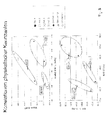
Einige der Eigenschaften der Prüfkörper sind im Vergleich mit den Eigenschaften Silika- und Mikrogel(unmodifiziert)-gefüllter Kautschuke in den Abbildungen 1 bis 3 visualisiert.Some of the properties of the specimens are visualized in Figures 1 to 3 in comparison with the properties of silica and microgel (unmodified) filled rubbers.
Es zeigen:
- Fig. 1:
- Dynamisch-mechanische Analyse:
tan δ-Werte zu verschiedenen Beispielen; - Fig. 2:
- Vergleich des dynamisch-mechanischen Reifen-Verhaltens über eine RR-ABS-Auftragung, d. h. anhand mechanischer Kennzahlen
- Fig. 3:
- Korrelationen physikalischer Kennzahlen:
Auftragungen zu Shore A-Härte bei Raumtemperatur über dem Spannungs-Modul einerseits und Raumtemperatur über 70 °C- Rückprallelastizitäten andererseits.
- Fig. 1:
- Dynamic-mechanical analysis:
Tan δ values for various examples; - Fig. 2:
- Comparison of the dynamic-mechanical tire behavior via a RR-ABS plot, ie based on mechanical characteristics
- 3:
- Correlations of physical metrics:
Plots of Shore A hardness at room temperature above the stress modulus on the one hand and room temperature above 70 ° C resilience on the other.
Die Abbildungen zeigen, das die Eigenschaften der mit dem erfindungsgemäßen Mikrogel gefüllten Kautschuke den vorteilhaften Eigenschaften der Silika-gefüllten Mischungen näher kommen als dies mit unmodifizierten Mikrogel-Füllstoffen möglich wäre.The figures show that the properties of the rubbers filled with the microgel according to the invention come closer to the advantageous properties of the silica-filled mixtures than would be possible with unmodified microgel fillers.
Claims (8)
- Filler for elastomers, in particular for use in elastomeric products, characterized in that it comprises a microgel which is composed of crosslinked diene rubber particles modified by OH groups exclusively at their surface, where the OH groups are functional groups of a surface-active substance, where molecules of the surface-active substance have covalent bonding to the surface of the microgel particles, and where the surface-active substance bonded to the microgel particles is a commercially available emulsifier containing OH groups, where the commercially available emulsifier is a sugar-derived surface-active substance, in particular a saccharide ester, saccharide amide or saccharide ether, an inulin ester, inulin amide or inulin ether, or any other sugar derivative.
- Filler according to Claim 1, characterized in that the molecules of the surface-active substance have covalent bonding at their hydrophobic end to the surface of the microgel particles.
- Filler according to Claim 1 or 2, characterized in that the density of the OH groups bonded at the surface is from 2 to 12, preferably about 4, OH groups per nm2.
- Process for the production of a filler according to any of Claims 1 to 3, characterized in that the modification of the microgel is achieved with the aid of an emulsifier containing OH groups during the course of the crosslinking of the microgel particles.
- Process for the production of a filler according to Claim 4, characterized in that the emulsifier has at least one free double bond.
- Process according to Claim 4 or 5, characterized in that the microgel particles are produced in aqueous solution by an emulsion polymerization or suspension polymerization process, where the emulsifier containing OH groups is added to the aqueous phase and is used as emulsifier for the emulsion polymerization or suspension polymerization process.
- Rubber mixture, in particular for the production of a part of a tyre, comprising the filler according to any of Claims 1 to 3.
- Rubber vulcanization product, in particular tyre, produced at least in parts with a rubber mixture according to Claim 7.
Applications Claiming Priority (2)
| Application Number | Priority Date | Filing Date | Title |
|---|---|---|---|
| DE10344729 | 2003-09-26 | ||
| DE2003144729 DE10344729A1 (en) | 2003-09-26 | 2003-09-26 | Filler for elastomers |
Publications (2)
| Publication Number | Publication Date |
|---|---|
| EP1520732A1 EP1520732A1 (en) | 2005-04-06 |
| EP1520732B1 true EP1520732B1 (en) | 2015-03-11 |
Family
ID=34306086
Family Applications (1)
| Application Number | Title | Priority Date | Filing Date |
|---|---|---|---|
| EP20040102858 Expired - Lifetime EP1520732B1 (en) | 2003-09-26 | 2004-06-22 | Fillers for Elastomers |
Country Status (2)
| Country | Link |
|---|---|
| EP (1) | EP1520732B1 (en) |
| DE (1) | DE10344729A1 (en) |
Families Citing this family (8)
| Publication number | Priority date | Publication date | Assignee | Title |
|---|---|---|---|---|
| US7947782B2 (en) | 2005-05-16 | 2011-05-24 | Rhein Chemie Rheinau Gmbh | Microgel-containing vulcanisable composition |
| DE102005023213A1 (en) * | 2005-05-16 | 2006-11-23 | Rhein Chemie Rheinau Gmbh | Microgel-containing vulcanizable composition |
| DE102007020451A1 (en) * | 2007-04-27 | 2008-10-30 | Lanxess Deutschland Gmbh | Process for the preparation of rubber compounds |
| DE102008052116A1 (en) * | 2008-10-20 | 2010-04-22 | Lanxess Deutschland Gmbh | Rubber blends with functionalized diene rubbers and microgels, a process for their preparation and their use |
| DE102008056975A1 (en) | 2008-11-13 | 2010-05-20 | Lanxess Deutschland Gmbh | Storage-stable, hydroxyl-modified microgellatices |
| ATE538948T1 (en) | 2009-04-03 | 2012-01-15 | Continental Reifen Deutschland | METHOD FOR PRODUCING A RUBBER MIXTURE |
| EP2311907A1 (en) * | 2009-10-19 | 2011-04-20 | LANXESS Deutschland GmbH | New rubber mixtures |
| DE102012110121A1 (en) * | 2012-10-24 | 2014-04-24 | Continental Reifen Deutschland Gmbh | Rubber compound and pneumatic vehicle tires |
Family Cites Families (10)
| Publication number | Priority date | Publication date | Assignee | Title |
|---|---|---|---|---|
| DE1976729U (en) | 1967-05-23 | 1968-01-11 | Verkst S A B Lindqvist | HANGER HANGING DEVICE. |
| US5013795A (en) * | 1989-04-10 | 1991-05-07 | Minnesota Mining And Manufacturing Company | Azlactone graft copolymers |
| DE3920745A1 (en) | 1989-06-24 | 1991-01-03 | Bayer Ag | RUBBER COMPOSITIONS CONTAINING SULFUR MODIFIED POLYCHLOROPRENE GEL |
| DE4220563A1 (en) | 1992-06-24 | 1994-01-13 | Bayer Ag | Rubber mixtures containing polybutadiene gel |
| DE19701487A1 (en) | 1997-01-17 | 1998-07-23 | Bayer Ag | Rubber composition consisting of a acrylonitrile]-butadiene] rubber and |
| DE19701489A1 (en) | 1997-01-17 | 1998-07-23 | Bayer Ag | Rubber mixtures containing modified rubber gels |
| DE19834802A1 (en) * | 1998-08-01 | 2000-02-03 | Continental Ag | Rubber compound |
| DE19962862A1 (en) * | 1999-12-24 | 2001-06-28 | Bayer Ag | Rubber mixtures based on uncrosslinked rubbers and crosslinked rubber particles as well as multifunctional isocyanates |
| DE10060519A1 (en) * | 2000-08-07 | 2002-02-28 | Continental Ag | The rubber mixture, for a vehicle pneumatic tire, where at least one rubber in the mixture is modified by covalent bonding using a modifying reagent |
| DE10038488A1 (en) * | 2000-08-08 | 2002-02-21 | Bayer Ag | Rubber mixtures containing isocyanatosilane and microgel |
-
2003
- 2003-09-26 DE DE2003144729 patent/DE10344729A1/en not_active Withdrawn
-
2004
- 2004-06-22 EP EP20040102858 patent/EP1520732B1/en not_active Expired - Lifetime
Also Published As
| Publication number | Publication date |
|---|---|
| DE10344729A1 (en) | 2005-04-14 |
| EP1520732A1 (en) | 2005-04-06 |
Similar Documents
| Publication | Publication Date | Title |
|---|---|---|
| EP2288653B1 (en) | Rubber mixture with improved abrasion | |
| EP1529806B1 (en) | Rubber composition and tyres | |
| EP2152791B1 (en) | Methods for producing rubber mixtures | |
| EP2092013B1 (en) | Rubber mixture and tires | |
| EP1270657A1 (en) | Rubber composition for tire tread | |
| EP2725059B1 (en) | Rubber composition and pneumatic tyre for a vehicle | |
| DE102008008105A1 (en) | Rubber compound and tires made therefrom | |
| EP2311907A1 (en) | New rubber mixtures | |
| EP1928949B1 (en) | Rubber compound and tyres | |
| DE102013105193B4 (en) | rubber compound and use thereof in vehicle tires | |
| DE102013108937A1 (en) | Sulfur crosslinkable rubber compound | |
| EP2026981B1 (en) | Rubber mixture and tires | |
| EP1234852A1 (en) | Rubber composition for tyre tread | |
| EP2886566B1 (en) | Rubber composition and vehicle tyre | |
| EP1520732A1 (en) | Fillers for Elastomers | |
| EP2241592B1 (en) | Rubber compound | |
| DE102009003720B4 (en) | Rubber mixture and its use | |
| EP1777260B1 (en) | Rubber composition and tire comprising thereof | |
| DE102008037593A1 (en) | Crosslinkable rubber mixture, useful in tread strip, tire and rubber article, comprises diene rubber, polar filler, mercaptosilane, and modified 2-mercapto-benzothiazole sulfenamide having alkyl or alkoxy group on the benzene ring | |
| EP1837370A1 (en) | Rubber composition and tyres | |
| EP2298523B1 (en) | Rubber compound | |
| DE102009003736A1 (en) | rubber compound | |
| DE102014202748B4 (en) | Vulcanized composition based on a sulfur-crosslinkable rubber mixture, its use and vehicle tires containing the composition | |
| EP1253167B1 (en) | Rubber composition for tire tread | |
| EP2236314B1 (en) | Method for producing a rubber mixture |
Legal Events
| Date | Code | Title | Description |
|---|---|---|---|
| PUAI | Public reference made under article 153(3) epc to a published international application that has entered the european phase |
Free format text: ORIGINAL CODE: 0009012 |
|
| AK | Designated contracting states |
Kind code of ref document: A1 Designated state(s): AT BE BG CH CY CZ DE DK EE ES FI FR GB GR HU IE IT LI LU MC NL PL PT RO SE SI SK TR |
|
| AX | Request for extension of the european patent |
Extension state: AL HR LT LV MK |
|
| 17P | Request for examination filed |
Effective date: 20051006 |
|
| AKX | Designation fees paid |
Designated state(s): DE FR GB IT |
|
| 17Q | First examination report despatched |
Effective date: 20080618 |
|
| RAP1 | Party data changed (applicant data changed or rights of an application transferred) |
Owner name: CONTINENTAL REIFEN DEUTSCHLAND GMBH |
|
| GRAP | Despatch of communication of intention to grant a patent |
Free format text: ORIGINAL CODE: EPIDOSNIGR1 |
|
| INTG | Intention to grant announced |
Effective date: 20141125 |
|
| RIN1 | Information on inventor provided before grant (corrected) |
Inventor name: RECKER, CARLA |
|
| GRAS | Grant fee paid |
Free format text: ORIGINAL CODE: EPIDOSNIGR3 |
|
| GRAA | (expected) grant |
Free format text: ORIGINAL CODE: 0009210 |
|
| AK | Designated contracting states |
Kind code of ref document: B1 Designated state(s): DE FR GB IT |
|
| REG | Reference to a national code |
Ref country code: GB Ref legal event code: FG4D Free format text: NOT ENGLISH |
|
| REG | Reference to a national code |
Ref country code: DE Ref legal event code: R096 Ref document number: 502004014852 Country of ref document: DE Effective date: 20150423 |
|
| REG | Reference to a national code |
Ref country code: FR Ref legal event code: PLFP Year of fee payment: 12 |
|
| REG | Reference to a national code |
Ref country code: DE Ref legal event code: R097 Ref document number: 502004014852 Country of ref document: DE |
|
| PG25 | Lapsed in a contracting state [announced via postgrant information from national office to epo] |
Ref country code: IT Free format text: LAPSE BECAUSE OF FAILURE TO SUBMIT A TRANSLATION OF THE DESCRIPTION OR TO PAY THE FEE WITHIN THE PRESCRIBED TIME-LIMIT Effective date: 20150311 |
|
| PLBE | No opposition filed within time limit |
Free format text: ORIGINAL CODE: 0009261 |
|
| STAA | Information on the status of an ep patent application or granted ep patent |
Free format text: STATUS: NO OPPOSITION FILED WITHIN TIME LIMIT |
|
| 26N | No opposition filed |
Effective date: 20151214 |
|
| GBPC | Gb: european patent ceased through non-payment of renewal fee |
Effective date: 20150622 |
|
| PG25 | Lapsed in a contracting state [announced via postgrant information from national office to epo] |
Ref country code: GB Free format text: LAPSE BECAUSE OF NON-PAYMENT OF DUE FEES Effective date: 20150622 |
|
| REG | Reference to a national code |
Ref country code: FR Ref legal event code: PLFP Year of fee payment: 13 |
|
| REG | Reference to a national code |
Ref country code: FR Ref legal event code: PLFP Year of fee payment: 14 |
|
| REG | Reference to a national code |
Ref country code: FR Ref legal event code: PLFP Year of fee payment: 15 |
|
| PGFP | Annual fee paid to national office [announced via postgrant information from national office to epo] |
Ref country code: FR Payment date: 20200619 Year of fee payment: 17 |
|
| PGFP | Annual fee paid to national office [announced via postgrant information from national office to epo] |
Ref country code: DE Payment date: 20200630 Year of fee payment: 17 |
|
| REG | Reference to a national code |
Ref country code: DE Ref legal event code: R119 Ref document number: 502004014852 Country of ref document: DE |
|
| PG25 | Lapsed in a contracting state [announced via postgrant information from national office to epo] |
Ref country code: DE Free format text: LAPSE BECAUSE OF NON-PAYMENT OF DUE FEES Effective date: 20220101 |
|
| PG25 | Lapsed in a contracting state [announced via postgrant information from national office to epo] |
Ref country code: FR Free format text: LAPSE BECAUSE OF NON-PAYMENT OF DUE FEES Effective date: 20210630 |