EP1520437B1 - Method for changing the content of a message exchanged between two telephones - Google Patents
Method for changing the content of a message exchanged between two telephones Download PDFInfo
- Publication number
- EP1520437B1 EP1520437B1 EP03715188A EP03715188A EP1520437B1 EP 1520437 B1 EP1520437 B1 EP 1520437B1 EP 03715188 A EP03715188 A EP 03715188A EP 03715188 A EP03715188 A EP 03715188A EP 1520437 B1 EP1520437 B1 EP 1520437B1
- Authority
- EP
- European Patent Office
- Prior art keywords
- message
- content
- text
- original
- size
- Prior art date
- Legal status (The legal status is an assumption and is not a legal conclusion. Google has not performed a legal analysis and makes no representation as to the accuracy of the status listed.)
- Expired - Lifetime
Links
Images



Classifications
-
- H—ELECTRICITY
- H04—ELECTRIC COMMUNICATION TECHNIQUE
- H04L—TRANSMISSION OF DIGITAL INFORMATION, e.g. TELEGRAPHIC COMMUNICATION
- H04L51/00—User-to-user messaging in packet-switching networks, transmitted according to store-and-forward or real-time protocols, e.g. e-mail
- H04L51/06—Message adaptation to terminal or network requirements
- H04L51/063—Content adaptation, e.g. replacement of unsuitable content
-
- G—PHYSICS
- G06—COMPUTING OR CALCULATING; COUNTING
- G06Q—INFORMATION AND COMMUNICATION TECHNOLOGY [ICT] SPECIALLY ADAPTED FOR ADMINISTRATIVE, COMMERCIAL, FINANCIAL, MANAGERIAL OR SUPERVISORY PURPOSES; SYSTEMS OR METHODS SPECIALLY ADAPTED FOR ADMINISTRATIVE, COMMERCIAL, FINANCIAL, MANAGERIAL OR SUPERVISORY PURPOSES, NOT OTHERWISE PROVIDED FOR
- G06Q10/00—Administration; Management
- G06Q10/10—Office automation; Time management
- G06Q10/107—Computer-aided management of electronic mailing [e-mailing]
-
- G—PHYSICS
- G06—COMPUTING OR CALCULATING; COUNTING
- G06Q—INFORMATION AND COMMUNICATION TECHNOLOGY [ICT] SPECIALLY ADAPTED FOR ADMINISTRATIVE, COMMERCIAL, FINANCIAL, MANAGERIAL OR SUPERVISORY PURPOSES; SYSTEMS OR METHODS SPECIALLY ADAPTED FOR ADMINISTRATIVE, COMMERCIAL, FINANCIAL, MANAGERIAL OR SUPERVISORY PURPOSES, NOT OTHERWISE PROVIDED FOR
- G06Q30/00—Commerce
- G06Q30/02—Marketing; Price estimation or determination; Fundraising
-
- H—ELECTRICITY
- H04—ELECTRIC COMMUNICATION TECHNIQUE
- H04L—TRANSMISSION OF DIGITAL INFORMATION, e.g. TELEGRAPHIC COMMUNICATION
- H04L51/00—User-to-user messaging in packet-switching networks, transmitted according to store-and-forward or real-time protocols, e.g. e-mail
- H04L51/58—Message adaptation for wireless communication
-
- H—ELECTRICITY
- H04—ELECTRIC COMMUNICATION TECHNIQUE
- H04M—TELEPHONIC COMMUNICATION
- H04M3/00—Automatic or semi-automatic exchanges
- H04M3/42—Systems providing special services or facilities to subscribers
- H04M3/42382—Text-based messaging services in telephone networks such as PSTN/ISDN, e.g. User-to-User Signalling or Short Message Service for fixed networks
-
- H—ELECTRICITY
- H04—ELECTRIC COMMUNICATION TECHNIQUE
- H04M—TELEPHONIC COMMUNICATION
- H04M3/00—Automatic or semi-automatic exchanges
- H04M3/42—Systems providing special services or facilities to subscribers
- H04M3/487—Arrangements for providing information services, e.g. recorded voice services or time announcements
- H04M3/4872—Non-interactive information services
- H04M3/4878—Advertisement messages
Definitions
- the present invention relates to the field of radio communication and in particular it relates to a method for changing the content of a message exchanged between two telephones.
- the invention relates also to an apparatus that carries out this method.
- a cellular telephone allows an user to communicate by the voice, or by messages, with another person, for example while travelling by car, or by bus, while walking downtown, or while checking-in at the airport.
- radio communication networks which use standards adopted nationally and internationally, such as GSM (Global System for Movable communication), CDMA (Code Division Multiple Access), TDMA (Time Division Multiple Access), PCS (Personal Communication Service), GPRS (General Packed Radio Service), W-CDMA (Wideband Code Division Multiple Access), EDGE (Enhanced Data rates for Global Evolution), UMTS (Universal Movable Telecommunication System).
- GSM Global System for Movable communication
- CDMA Code Division Multiple Access
- TDMA Time Division Multiple Access
- PCS Personal Communication Service
- GPRS General Packed Radio Service
- W-CDMA Wideband Code Division Multiple Access
- EDGE Enhanced Data rates for Global Evolution
- UMTS Universal Movable Telecommunication System
- the message services are the SMS (Short Message Service), the EMS (Enhanced Message Service), the SMART MESSAGING, (Flash Message) and the MMS (Multimedia Messaging Service).
- SMS Short Message Service
- EMS Enhanced Message Service
- SMART MESSAGING Flash Message
- MMS Multimedia Messaging Service
- the SMS is a universal standard that allows the users of cellular or cable telephones, which support it, to send and receive messages with a text content that can comprise a predetermined maximum number of alphanumerical characters.
- SMS short message
- EMS for incorporating in a SMS text message some graphics, images, animations and sounds.
- SMART MESSAGE is used, a standard developed by Nokia and universally recognized, which allows to add graphical, audio and video content to normal SMS text messages.
- Both the SMART MESSAGE and the EMS standards are made linking several SMS to one another.
- the Flash Message also called SMS of class 0 is a special text message, improved from the SMS message. Its content is displayed directly on the display of the mobile phone.
- the MMS Multimedia Messaging Service is a universal standard that allows the users of mobile phones that support it to send and receive messages with content of text, images, graphics, sounds, audio clips and video clips.
- the structure of the MMS consists of one or more pages or "slides", each containing two regions, one for the text and one for the images.
- the pages, furthermore, can be timed, as well as to them sounds can be appended, and they can be displayed.
- Each page, or slide has the same layout.
- the MMS are then an extension of the concept of SMS, are also called multimedia messages.
- the cost of the messages is independent from the length of the text as sent, which only seldom achieves the maximum allowed, therefore, the user spends the same cost for a single word and for a long text within the limits.
- the wide variety of communication systems capable of satisfying the requests of the users, has determined a quick diffusion and a boom in the sales of mobile phones.
- WO0158178 describes equipment for supplementing and forwarding short text messages transmitted using a mobile telephone, where a supplementary text message containing advertising is added to a primary text message. With this system, it is not sure whether the supplementary text message is actually received by the addressee, this depending on a remaining residual space in the primary message with respect to a maximum admitted length.
- the content can comprise a text with alphanumerical characters (SMS), or it can be of multimedia type, with audio, video, images, etc. and can also be a combination of such types of content. Therefore, the succession of steps above described can be easily implemented according to the type of content to modify.
- SMS text with alphanumerical characters
- multimedia type with audio, video, images, etc. and can also be a combination of such types of content. Therefore, the succession of steps above described can be easily implemented according to the type of content to modify.
- the content of the message comprises a text formed by a determined number of alphanumerical characters (SMS), starting from this original text the following steps are carried out:
- the method for changing a message, sent from a first telephone to a second telephone calculates the number of characters that make up a message, exploiting the principle according to which a text is nothing else than a string of characters arranged according to a precise order.
- the sent message comprises, in particular, an advertisement string of length l_ad formed by a minimum number of characters, whereby being l_max the allowed maximum length for the message, the user knows that an original text is available, in order to save money, as a string of characters l_in of maximum length less than l_max- l _ ad .
- the maximum length l_max is set by the SMS standard.
- the step of creating the modified text provides the following steps:
- the method for changing a message, sent from a first telephone to a second telephone intervenes only on the text of the messages with length less than l_max-l_ad. If the user authorizes the change of all the messages, in the messages wherein l_ad+l_in>l_max, the original text is truncated at a length l_max-l_ad at the achievement of the maximum length.
- a generic index i can be used for calculating the number of characters that make up the original text and the advertisement string and for determining the position of each character in the message.
- a value of index i is given to each character incrementing it of one at each step and scanning the message from left to right.
- the final text is computed character by character until the cycle has ended the characters.
- the original text is inserted, and at the same time, with a process similar to that already described, the calculus is carried out of the number of characters that make up the modified message, comprising the advertisement text associated to the original text.
- the maximum length possible for an original message is preliminarily determined and communicated to the user, in order to avoid the drawback of sending a not complete message or for which the user cannot save money.
- the user will pay only a part of the cost of the sent message, leaving the remainder of the cost to the advertising company, that on the other hand contacts this way a wider number of users.
- the user has to be aware of saving money only if its message is shorter than the value l_max-l_ad, or can choose of saving on all the messages, being aware that if the text of the message is longer than l_max-l_ad it will automatically be truncated at the achievement of this value.
- the modified message provides a minimum size for the advertisement additional content having size Slogan_size and an overall maximum size Max_Message_size, whereby the content of the original sent message, having size Message_size, cannot exceed a predetermined length ( Max_Message _ size -Slogan_size).
- MMS multimedia type
- Max_Message_size a predetermined length
- the generation of the modified content provides the following steps:
- a first possible embodiment is diagrammatically shown of the method for changing the content of a message sent from a first telephone 1 to a second telephone 2, for example two cellular telephones. It comprises a step of reception by a "converting device" 10 of a message 3 sent by an individual 11 from a first telephone 1.
- Message 3 if the content is a text (SMS) as in figure 1, comprises a portion of alphanumerical characters 4, which make up the text of the actual message 3, and a portion of blank characters 5.
- the "converting device” 10 decodes message 3.
- both the fields that relate to the length and the original text of the message are decoded.
- the decoding step allows to determine the original text 4 of message 3 and then to change it through the process shown diagrammatically hereinafter.
- the "converting device" 10 associates to the original text 4 of message 3, of known length, an added text 6, for example an advertisement text, having a predetermined length.
- the final text 7, obtained by the association of the original text 4 and of the added text 6, is then coded, with the same attributes of message 3, which then becomes a modified message 3', which is sent to telephone 2 as originally addressed.
- the user 12 that receives message 3' will then read, on the display of telephone 2, a text 7 comprising the added message 6 and the original text 4.
- the length of the original text 4 should not exceed a predetermined value to prevent the original text from being truncated.
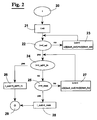
- Figure 2 shows the flow-sheet that describes diagrammatically the process through which the original message 3 is modified in the final message 3'.
- an advertisement string text_ad is added, formed by a number of characters l_ad, being l_max the maximum length of the final message.
- the starting text of the message is indicated as text_in
- the added text is indicated as text_ad
- the final text is indicated as text out.
- the step of creating the modified message provides the following steps:
- the length values are shown by a number of characters and indexed with i.
- index i starting from zero, is incremented of one in succession, scanning the string of characters from left to right, in order to give to each character of the string a corresponding value of the index i.
- the method of changing the original message into a final message is carried out only for messages whose text is less or equal to l_max-l_ad.
- first message 3 (figure 3), sent by the first telephone 1, is represented as a railway wagon 4 pulled by a locomotive 4'.
- locomotive 4' represents the part of the message known as SMS Header, where the data relative to the sender are contained, such as telephone number, sending date and time, and the addressee number.
- the "converting device" 10 selects an advertisement string 6 to insert, among a variety of advertisement strings having different length l_ad.
- the modified message 3' consisting of an advertisement string 6 and in string 4 of the original message 3, is then sent to the addressee 12, using always the same SMS Header 4' (figure 3C).
- the result is achieved of allowing, at the choice of the user, the addition of advertisement messages addressed to a large number of users.
- the "converting device” 10 can be arranged, for example, in an exchange site (or in one of exchange sites) where the calls and all the messages are put through. Of course, the "converting device” 10 can also be located in a desired point of a telephone network.
- the message may have other multimedia content, i.e. audio, video or images (MMS).
- multimedia content i.e. audio, video or images (MMS).
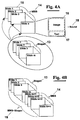
- FIGS 4A, 4B and 5 the process is diagrammatically shown through which an original message 14 comprising a content of multimedia type (MMS) is modified in the final message 19, which is also of the same type.
- MMS multimedia type
- the process is diagrammatically shown of changing a multimedia MMS message 14 into another multimedia message 19 consisting of an advertisement 13 plus the original message 14.
- the original MMS sent by the user consists of one or more pages or "slides" 15, each of which consists of a portion for image 16, a portion for text 17, and to which an audio content 18 can be associated.
- the multimedia messages MMS are similar to e-mails, and for this reason to the message a video can be appended.
- the advertisement can be a video clip.
- the size of the multimedia message for example expressed in bytes, is indicated as Message_size
- the size in bytes of the advertisement content 13 which can be images, text, audio, video, etc.
- Slogan_size the size in bytes of the advertisement content 13 which can be images, text, audio, video, etc.
- Max_Message_size the maximum limit in bytes of the original MMS message
- the parameter Max_Message_size is set by the telephone company or is delimited by the maximum memory of the telephone. If the size in bytes of the original MMS (sent by the user) is less than the above described maximum size minus the size in bytes of the advertisement content, step 30, to the MMS message an advertisement content is added, steps 31 and 32. More in detail, the advertisement content 13, or Slogan _ content, i.e. the file containing the advertisement in the final message 19, is added in a field MMS_content_location of the MMS given for the content of the multimedia message, step 31.
- the body of the advertisement content 13 is inserted, i.e. the Slogan_Body, written according to the language typical for MMS, step 32.
- Slogan_Body is at the head or the tail of the Message_Body.
Landscapes
- Engineering & Computer Science (AREA)
- Business, Economics & Management (AREA)
- Strategic Management (AREA)
- Signal Processing (AREA)
- Computer Networks & Wireless Communication (AREA)
- Marketing (AREA)
- Human Resources & Organizations (AREA)
- Entrepreneurship & Innovation (AREA)
- General Physics & Mathematics (AREA)
- Accounting & Taxation (AREA)
- Finance (AREA)
- Economics (AREA)
- Physics & Mathematics (AREA)
- General Business, Economics & Management (AREA)
- Development Economics (AREA)
- Theoretical Computer Science (AREA)
- Computer Hardware Design (AREA)
- Game Theory and Decision Science (AREA)
- Data Mining & Analysis (AREA)
- Operations Research (AREA)
- Quality & Reliability (AREA)
- Tourism & Hospitality (AREA)
- Telephonic Communication Services (AREA)
- Information Transfer Between Computers (AREA)
- Communication Control (AREA)
- Mobile Radio Communication Systems (AREA)
- Crystals, And After-Treatments Of Crystals (AREA)
- Meter Arrangements (AREA)
Abstract
Description
- The present invention relates to the field of radio communication and in particular it relates to a method for changing the content of a message exchanged between two telephones.
- The invention relates also to an apparatus that carries out this method.
- The advent of radio communication systems has revolutioned the telecommunication industry. In particular, the cellular telephones, which connect users practically everywhere, have changed sensibly the personal relationships both in the work and in private life.
- A cellular telephone allows an user to communicate by the voice, or by messages, with another person, for example while travelling by car, or by bus, while walking downtown, or while checking-in at the airport.
- In particular, the possibility of sending messages by a mobile telephone to another represents a way for communicating with a person even if that cannot be momentarily available. This opportunity is presently offered also by the cable telephone network that permits sending and receiving messages by means of enabled telephones.
- The transmission of such messages is carried out by radio communication networks, which use standards adopted nationally and internationally, such as GSM (Global System for Movable communication), CDMA (Code Division Multiple Access), TDMA (Time Division Multiple Access), PCS (Personal Communication Service), GPRS (General Packed Radio Service), W-CDMA (Wideband Code Division Multiple Access), EDGE (Enhanced Data rates for Global Evolution), UMTS (Universal Movable Telecommunication System).
- The message services are the SMS (Short Message Service), the EMS (Enhanced Message Service), the SMART MESSAGING, (Flash Message) and the MMS (Multimedia Messaging Service).
- In particular, the SMS is a universal standard that allows the users of cellular or cable telephones, which support it, to send and receive messages with a text content that can comprise a predetermined maximum number of alphanumerical characters.
- In the alphabetical coding system of the European standard GSM the maximum number of characters is 160, in the Cyrillic it is 140 and with UCS2 (Turkish, Greek, Arab, Chinese, Thai, etc.) it is 70 characters. Presently, the SMS is the most common messaging system.
- The evolution of SMS has led to EMS, for incorporating in a SMS text message some graphics, images, animations and sounds.
- In this context also SMART MESSAGE is used, a standard developed by Nokia and universally recognized, which allows to add graphical, audio and video content to normal SMS text messages.
- Both the SMART MESSAGE and the EMS standards are made linking several SMS to one another.
- The Flash Message, also called SMS of
class 0, is a special text message, improved from the SMS message. Its content is displayed directly on the display of the mobile phone. - The MMS Multimedia Messaging Service is a universal standard that allows the users of mobile phones that support it to send and receive messages with content of text, images, graphics, sounds, audio clips and video clips. The structure of the MMS consists of one or more pages or "slides", each containing two regions, one for the text and one for the images. The pages, furthermore, can be timed, as well as to them sounds can be appended, and they can be displayed. Each page, or slide, has the same layout. The MMS are then an extension of the concept of SMS, are also called multimedia messages.
- Concerning SMS, the cost of the messages is independent from the length of the text as sent, which only seldom achieves the maximum allowed, therefore, the user spends the same cost for a single word and for a long text within the limits.
- The same occurs for other types of the above cited messages, EMS, SMART MESSAGE and MMS, where the cost of the sent message is fixed, or calculated for blocks of fixed length, or calculated as packages of delivered data; therefore, except from rare cases, a residual space not exploited by the user is always present.
- The wide variety of communication systems, capable of satisfying the requests of the users, has determined a quick diffusion and a boom in the sales of mobile phones.
- In addition, the access to this service also through the more traditional cable telephone network, has given still new opportunities to the market. Such a wide population of users, for example, could be reached by advertisements through messages so that the industry can rely on a much higher number of potential customers.
- WO0158178 describes equipment for supplementing and forwarding short text messages transmitted using a mobile telephone, where a supplementary text message containing advertising is added to a primary text message. With this system, it is not sure whether the supplementary text message is actually received by the addressee, this depending on a remaining residual space in the primary message with respect to a maximum admitted length.
- It is an object of the present invention to provide a method for changing the content of a message sent from a first telephone to a second telephone that allows an user to save a part or the whole value of an unused portion of a message.
- It is also object of the present invention to provide a method for exploiting an unused portion of a message for sending advertisement messages from authorised companies.
- These and other objects are achieved by the method for changing the content of a message according to the present invention, whose main feature is that it comprises the steps of:
- sending a message, consisting of an original content, from a first telephone and addressed to a second telephone;
- decoding the sent message, for extracting an object or a list of objects making up the original content;
- creating a final content formed by an advertisement additional content to which the original content extracted from the sent message is associated;
- coding the final content;
- introducing the final content in the sent - message, at the location of the original content;
- sending the modified message to the second telephone.
- According to the invention, the content can comprise a text with alphanumerical characters (SMS), or it can be of multimedia type, with audio, video, images, etc. and can also be a combination of such types of content. Therefore, the succession of steps above described can be easily implemented according to the type of content to modify.
- In particular, if the content of the message comprises a text formed by a determined number of alphanumerical characters (SMS), starting from this original text the following steps are carried out:
- sending a message, containing a determined number of alphanumerical characters, called original text, from a first telephone and addressed to a second telephone;
- decoding the sent message, for extracting the alphanumerical characters that make up the original text, and said number of characters;
- creating a final text formed by a string of advertisement text and by the original text extracted from the sent message;
- coding the final text;
- introducing the final text in the sent message, at the location of the original text;
- sending the sent message, modified and coded, to the second telephone.
- In this case, the method for changing a message, sent from a first telephone to a second telephone, according to the invention, calculates the number of characters that make up a message, exploiting the principle according to which a text is nothing else than a string of characters arranged according to a precise order.
- The sent message comprises, in particular, an advertisement string of length l_ad formed by a minimum number of characters, whereby being l_max the allowed maximum length for the message, the user knows that an original text is available, in order to save money, as a string of characters l_in of maximum length less than l_max-l_ad. The maximum length l_max is set by the SMS standard.
- Therefore, the step of creating the modified text provides the following steps:
- opening a string of text at first blank, in which the final text is inserted;
- introducing, in the blank text string, an advertisement string of length l_ad;
- adding the original text extracted from the sent message for a length l_in.
- The method for changing a message, sent from a first telephone to a second telephone intervenes only on the text of the messages with length less than l_max-l_ad. If the user authorizes the change of all the messages, in the messages wherein l_ad+l_in>l_max, the original text is truncated at a length l_max-l_ad at the achievement of the maximum length.
- In particular, for calculating the number of characters that make up the original text and the advertisement string and for determining the position of each character in the message, a generic index i can be used. Starting from a value of index i equal to zero, a value of index i is given to each character incrementing it of one at each step and scanning the message from left to right.
- Starting from the text inserted as advertisement string, the final text is computed character by character until the cycle has ended the characters.
- This way the number of characters that make up the advertisement text to be associated to the original text can be determined.
- Then, at the tail of the string of advertisement text the original text is inserted, and at the same time, with a process similar to that already described, the calculus is carried out of the number of characters that make up the modified message, comprising the advertisement text associated to the original text.
- Advantageously, the maximum length possible for an original message is preliminarily determined and communicated to the user, in order to avoid the drawback of sending a not complete message or for which the user cannot save money.
- Therefore, the user will pay only a part of the cost of the sent message, leaving the remainder of the cost to the advertising company, that on the other hand contacts this way a wider number of users.
- Then, the user has to be aware of saving money only if its message is shorter than the value l_max-l_ad, or can choose of saving on all the messages, being aware that if the text of the message is longer than l_max-l_ad it will automatically be truncated at the achievement of this value.
- Alternatively, if the message is of multimedia type (MMS), i.e. the content of the message comprises audio, video, text, images, the modified message provides a minimum size for the advertisement additional content having size Slogan_size and an overall maximum size Max_Message_size, whereby the content of the original sent message, having size Message_size, cannot exceed a predetermined length (Max_Message_size-Slogan_size).
- In particular, in a method for changing the content of a message, the generation of the modified content provides the following steps:
- introducing, in a field where the content of the original message is present, in particular called MMS_content_location, said advertisement additional content, called in particular Slogan_content, having a predetermined size, called in particular Slogan_size;
- adding to the body of the original message, or Message_Body, the body of the advertisement additional content, or Slogan_Body.
- Further characteristics and the advantages of the method for changing the content of a message sent from a first telephone to a second telephone will be made clearer with the following description of an embodiment thereof, exemplifying but not limitative, with reference to the attached drawings, wherein:
- figure 1 shows a diagrammatical view of the method for changing the content, in particular the text, of a message sent from a first telephone to a second telephone, according to a first embodiment of the invention;
- figure 2 shows a flow-sheet of the process that achieves the method of figure 1;
- figure 3 shows the method of figure 2, using a diagrammatic representation;
- figures 4A and 4B show diagrammatically the process of changing the content of a message of multimedia type sent from a first telephone to a second telephone, according to an embodiment alternative to that of figure 1;
- figure 5 shows diagrammatically in a flow-sheet the process through which an original message is modified into a final message according to an embodiment of figures 4A and 4B.
- In figure 1 a first possible embodiment is diagrammatically shown of the method for changing the content of a message sent from a
first telephone 1 to asecond telephone 2, for example two cellular telephones. It comprises a step of reception by a "converting device" 10 of amessage 3 sent by an individual 11 from afirst telephone 1. -
Message 3, if the content is a text (SMS) as in figure 1, comprises a portion ofalphanumerical characters 4, which make up the text of theactual message 3, and a portion ofblank characters 5. - The "converting device" 10 decodes
message 3. In particular, both the fields that relate to the length and the original text of the message are decoded. In other words, the decoding step allows to determine theoriginal text 4 ofmessage 3 and then to change it through the process shown diagrammatically hereinafter. - In particular, the "converting device" 10 associates to the
original text 4 ofmessage 3, of known length, an addedtext 6, for example an advertisement text, having a predetermined length. - The final text 7, obtained by the association of the
original text 4 and of the addedtext 6, is then coded, with the same attributes ofmessage 3, which then becomes a modified message 3', which is sent totelephone 2 as originally addressed. - The
user 12 that receives message 3' will then read, on the display oftelephone 2, a text 7 comprising the addedmessage 6 and theoriginal text 4. According to a contract between the user of the telephone and the telecommunications company, the length of theoriginal text 4 should not exceed a predetermined value to prevent the original text from being truncated. - Figure 2 shows the flow-sheet that describes diagrammatically the process through which the
original message 3 is modified in the final message 3'. - In particular, to the original text text_in of length l_in an advertisement string text_ad is added, formed by a number of characters l_ad, being l_max the maximum length of the final message.
- In figure 2, furthermore, the starting text of the message is indicated as text_in, the added text is indicated as text_ad and the final text is indicated as text out.
- The step of creating the modified message provides the following steps:
- starting the procedure (step 20) and giving the
value 0 to index i (step 21); - opening a second text string of blank characters, i.e. said final text, text_out, and introducing in it an advertisement string, text_ad, of length l_ad, steps 22 and 23, causing each ith character of text_out to correspond to each ith character of text_ad;
- adding for a length l_in the string of original text text_in extracted from the sent message, steps 24, 25 and 27, causing each subsequent ith character of text_out to correspond to each ith character of text in;
- outputting the final message of length l_out, steps 26 and 29.
- The length values are shown by a number of characters and indexed with i.
- The value of index i, starting from zero, is incremented of one in succession, scanning the string of characters from left to right, in order to give to each character of the string a corresponding value of the index i.
- The method of changing the original message into a final message is carried out only for messages whose text is less or equal to l_max-l_ad.
- The change of all the messages sent by an user and then also of those with text long more than l_max-l_ad characters is made under the authorisation of the sender of the message, which approves that the messages sent with text longer than l_max-l_ad will be truncated at the achievement of this value. Then, in case that l_ad+l_in>l_max, i.e. l_max is exceeded, the original text is truncated at the achievement of the maximum length (step 28).
- Notwithstanding in figure 2 the added text is inserted before the original text, it is not excluded that it is inserted in an intermediate position or at the end of the message.
- In figures from 3A to 3C the process is diagrammatically shown of changing a
first message 3 into a second message 3' by a "converting device" 10. - According to this figure, first message 3 (figure 3), sent by the
first telephone 1, is represented as arailway wagon 4 pulled by a locomotive 4'. In the symbolism used locomotive 4' represents the part of the message known as SMS Header, where the data relative to the sender are contained, such as telephone number, sending date and time, and the addressee number. -
Message 3 comes then in the station (figure 3A), representing the "converting device" 10, to be analysed. - Then, the "converting device" 10 selects an
advertisement string 6 to insert, among a variety of advertisement strings having different length l_ad. - The modified message 3', consisting of an
advertisement string 6 and instring 4 of theoriginal message 3, is then sent to the addressee 12, using always the same SMS Header 4' (figure 3C). - Owing to this technical solution, according to the invention, the result is achieved of allowing, at the choice of the user, the addition of advertisement messages addressed to a large number of users.
- The "converting device" 10 can be arranged, for example, in an exchange site (or in one of exchange sites) where the calls and all the messages are put through. Of course, the "converting device" 10 can also be located in a desired point of a telephone network.
- Alternatively or in addition to the text, the message may have other multimedia content, i.e. audio, video or images (MMS). In figures 4A, 4B and 5 the process is diagrammatically shown through which an
original message 14 comprising a content of multimedia type (MMS) is modified in thefinal message 19, which is also of the same type. - In particular, in figures 4A and 4B the process is diagrammatically shown of changing a
multimedia MMS message 14 into anothermultimedia message 19 consisting of anadvertisement 13 plus theoriginal message 14. More in detail, the original MMS sent by the user consists of one or more pages or "slides" 15, each of which consists of a portion forimage 16, a portion fortext 17, and to which anaudio content 18 can be associated. The multimedia messages MMS are similar to e-mails, and for this reason to the message a video can be appended. To this purpose also the advertisement can be a video clip. - In the block diagram of figure 5 the size of the multimedia message, for example expressed in bytes, is indicated as Message_size, the size in bytes of the
advertisement content 13, which can be images, text, audio, video, etc., is indicated as Slogan_size and finally the maximum limit in bytes of the original MMS message is indicated as Max_Message_size. - Normally, the parameter Max_Message_size is set by the telephone company or is delimited by the maximum memory of the telephone. If the size in bytes of the original MMS (sent by the user) is less than the above described maximum size minus the size in bytes of the advertisement content,
step 30, to the MMS message an advertisement content is added, steps 31 and 32. More in detail, theadvertisement content 13, or Slogan_content, i.e. the file containing the advertisement in thefinal message 19, is added in a field MMS_content_location of the MMS given for the content of the multimedia message,step 31. - Finally in the Message_Body, i.e. the body of the original MMS message, which is written in a language typical for MMS, the body of the
advertisement content 13 is inserted, i.e. the Slogan_Body, written according to the language typical for MMS,step 32. - The position where the "body" or Slogan_Body is inserted in the Message_Body is independent from the content of the message same, normally the Slogan_Body is at the head or the tail of the Message_Body.
- The foregoing description of a specific embodiment will so fully reveal the invention according to the conceptual point of view, so that others, by applying current knowledge, will be able to modify and/or adapt for various applications such an embodiment without further research and without parting from the invention, and it is therefore to be understood that such adaptations and modifications will have to be considered as equivalent to the specific embodiment. The means and the materials to realise the different functions described herein could have a different nature without, for this reason, departing from the field of the invention. It is to be understood that the phraseology or terminology employed herein is for the purpose of description and not of limitation.
Claims (8)
- Method for changing the content of a message comprising the steps of :- sending a message (3), consisting of an original content (4, 14) having a certain size, from a first telephone (1) and addressed to a second telephone (2); and characterised in that it comprises the steps of:- decoding the sent message (3) and extracting an object or a list of objects making up said original content (4, 14);- creating a final content (3', 19) formed by an advertisement additional content (6, 13) having a predetermined size, to which the original content (4, 14) is associated as extracted from said sent message (3);- coding said final content (3', 19) ;- introducing said final content (3', 19) in said sent message (3), at the location of said original content;- sending said sent message (3', 19), modified and coded, to said second telephone.- wherein said sent message (3) provides a minimum size (l_ad ; Slogan_size) for an advertisement content (6, 13) and a maximum size (l_max; Max_Message_size), whereby the content of the first message (4, 14), having a predetermined size (l_in, Message_size) cannot exceed a maximum size (l_max-l_ad; Max_Message_size-Slogan_size), and- whereby said advertisement content (l-ad; Slogan_size) is introduced with said sent message (l-in, Message_size) so that said sent message (3', 19), modified and coded, does not exceed said maximum size (l_max; Max_Message_size).
- Method according to claim 1, wherein said content to change is text, having a determined number of alphanumerical characters, called original text
characterised in that:- said step of decoding the sent message (3) provides the extraction of alphanumerical characters that make up said original text (4) and the number of said characters;- said step of creating a final content (3', 19) provides creating a final text (7) formed by a string of advertisement text (6), to which the original text (4) extracted from said sent message (3) is associated;- said step of coding said final content (3', 19) provides coding said final text (7);- said step of introducing said final content (19) in said sent message (3) provides introducing said final text (3') in said sent message, at the location of said original text (4);- sending said sent message (3', 19), modified and coded, to said second telephone. - Method for changing the content of a message, according to claim 2, wherein said step of creating said modified text (3') provides the following steps:- opening a string of text, at first blank, wherein said final text (7) has to be inserted;- introducing, in the blank text string, said advertisement string (6) of length l_ad;- adding the original text (4), as extracted from the sent message, up to a length l_in.
- Method for changing the content of a message according to claim 3, wherein the original text (4) of the message is modified by introducing an advertisement string (6) only if l_in <= l_max-l_ad, or it is truncated at the achievement of this value.
- Method for changing the content of a message according to claim 4, wherein if l_ad+l_in>l_max said original text (4) is truncated at a length l_max-l_ad at the achievement of said maximum length.
- Method for changing the content of a message according to claim5, wherein for calculating the number of characters that make up said original text (4) and said advertisement string (6), and for determining the position of each character in the message, a generic index i is used, starting from a value equal to zero, and a value is given to said index i for each character incrementing it of one at each step, scanning the message from left to right.
- Method for changing the content of a message, according to claim 1, wherein said step of creating said modified content (3', 19) provides the following steps:- introducing, in a field of the original content (4, 14), in particular called MMS_content_location, said advertisement additional content (6, 13), in particular called Slogan_content, having a predetermined size, in particular Slogan_size;- adding to the body of the original message (3), in particular Message_Body, the body of the advertisement additional content (6, 13), in particular Slogan_Body.
- Method for changing the content of a message according to claim 1, wherein said content comprises at least one image and/or at least one text and/or at least one audio and/or at least one video.
Applications Claiming Priority (3)
| Application Number | Priority Date | Filing Date | Title |
|---|---|---|---|
| ITPI20020025 | 2002-04-18 | ||
| IT2002PI000025A ITPI20020025A1 (en) | 2002-04-18 | 2002-04-18 | METHOD TO MODIFY THE TEXT OF A MESSAGE SENT BETWEEN TWO TELEPHONE TERMINALS |
| PCT/IB2003/001476 WO2003088690A1 (en) | 2002-04-18 | 2003-04-18 | Method for changing the content of a message exchanged between two telephones |
Publications (2)
| Publication Number | Publication Date |
|---|---|
| EP1520437A1 EP1520437A1 (en) | 2005-04-06 |
| EP1520437B1 true EP1520437B1 (en) | 2007-06-06 |
Family
ID=29227564
Family Applications (1)
| Application Number | Title | Priority Date | Filing Date |
|---|---|---|---|
| EP03715188A Expired - Lifetime EP1520437B1 (en) | 2002-04-18 | 2003-04-18 | Method for changing the content of a message exchanged between two telephones |
Country Status (7)
| Country | Link |
|---|---|
| EP (1) | EP1520437B1 (en) |
| AT (1) | ATE364300T1 (en) |
| AU (1) | AU2003219378A1 (en) |
| DE (1) | DE60314251T2 (en) |
| ES (1) | ES2288603T3 (en) |
| IT (1) | ITPI20020025A1 (en) |
| WO (1) | WO2003088690A1 (en) |
Families Citing this family (31)
| Publication number | Priority date | Publication date | Assignee | Title |
|---|---|---|---|---|
| GB0011747D0 (en) | 2000-05-17 | 2000-07-05 | Butterworth Martyn | Improvements related to telecoms |
| PL1625716T3 (en) | 2003-05-06 | 2008-05-30 | Apple Inc | Method of modifying a message, store-and-forward network system and data messaging system |
| GB2406996B (en) * | 2003-05-06 | 2006-12-20 | Massone Mobile Advertising Sys | Messaging system and service |
| NL1023423C2 (en) | 2003-05-14 | 2004-11-16 | Nicolaas Theunis Rudie Van As | System and method for interrupting and linking a message to all forms of digital message traffic (such as SMS and MMS), with the consent of the sender. |
| US20050130685A1 (en) * | 2003-12-12 | 2005-06-16 | Mark Jenkin | Method and apparatus for inserting information into an unused portion of a text message |
| FI20045077A7 (en) * | 2004-03-16 | 2005-09-17 | Nokia Corp | Method and apparatus for indicating message size limit |
| KR100661288B1 (en) | 2005-07-12 | 2006-12-26 | (주)필링크 | Method and system for inserting data into SMS / MS message fields |
| GB2435565B (en) | 2006-08-09 | 2008-02-20 | Cvon Services Oy | Messaging system |
| US8199892B2 (en) | 2006-10-26 | 2012-06-12 | Tekelec | Methods, systems, and computer program products for providing a call attempt triggered messaging service in a communications network |
| US8204057B2 (en) | 2006-10-26 | 2012-06-19 | Tekelec Global, Inc. | Methods, systems, and computer program products for providing an enriched messaging service in a communications network |
| GB2435730B (en) | 2006-11-02 | 2008-02-20 | Cvon Innovations Ltd | Interactive communications system |
| GB2436412A (en) | 2006-11-27 | 2007-09-26 | Cvon Innovations Ltd | Authentication of network usage for use with message modifying apparatus |
| US8935718B2 (en) | 2007-05-22 | 2015-01-13 | Apple Inc. | Advertising management method and system |
| GB2450144A (en) | 2007-06-14 | 2008-12-17 | Cvon Innovations Ltd | System for managing the delivery of messages |
| GB2436993B (en) | 2007-06-25 | 2008-07-16 | Cvon Innovations Ltd | Messaging system for managing |
| GB2445438B (en) | 2007-07-10 | 2009-03-18 | Cvon Innovations Ltd | Messaging system and service |
| GB2453810A (en) * | 2007-10-15 | 2009-04-22 | Cvon Innovations Ltd | System, Method and Computer Program for Modifying Communications by Insertion of a Targeted Media Content or Advertisement |
| GB2455763A (en) | 2007-12-21 | 2009-06-24 | Blyk Services Oy | Method and arrangement for adding targeted advertising data to messages |
| US8315178B2 (en) | 2008-02-08 | 2012-11-20 | Unomobi, Inc. | Method and system for wireless message-based advertising |
| US8606252B2 (en) | 2008-04-17 | 2013-12-10 | Microsoft Corporation | Advertising with mobile messaging |
| RU2355043C1 (en) | 2008-05-21 | 2009-05-10 | Юрий Анатольевич Ткачев | Method of advertising and system to this end |
| US20100145676A1 (en) * | 2008-12-09 | 2010-06-10 | Qualcomm Incorporated | Method and apparatus for adjusting the length of text strings to fit display sizes |
| US20100235911A1 (en) | 2009-03-11 | 2010-09-16 | Eloy Johan Lambertus Nooren | Systems, methods, and computer readable media for detecting and mitigating address spoofing in messaging service transactions |
| WO2010105043A2 (en) | 2009-03-11 | 2010-09-16 | Tekelec | Methods, systems, and computer readable media for short message service (sms) forwarding |
| WO2011017100A2 (en) | 2009-07-27 | 2011-02-10 | Tekelec | Methods, systems, and computer readable media for providing mobile network operator controlled content to mobile subscribers using social networking messages |
| US8898217B2 (en) | 2010-05-06 | 2014-11-25 | Apple Inc. | Content delivery based on user terminal events |
| US9367847B2 (en) | 2010-05-28 | 2016-06-14 | Apple Inc. | Presenting content packages based on audience retargeting |
| US8983978B2 (en) | 2010-08-31 | 2015-03-17 | Apple Inc. | Location-intention context for content delivery |
| US8510309B2 (en) | 2010-08-31 | 2013-08-13 | Apple Inc. | Selection and delivery of invitational content based on prediction of user interest |
| US9141504B2 (en) | 2012-06-28 | 2015-09-22 | Apple Inc. | Presenting status data received from multiple devices |
| US10516636B2 (en) | 2014-01-01 | 2019-12-24 | SlamAd.com, Inc. | Real-time messaging platform with enhanced privacy |
Family Cites Families (3)
| Publication number | Priority date | Publication date | Assignee | Title |
|---|---|---|---|---|
| JP3501991B2 (en) * | 1999-01-22 | 2004-03-02 | 株式会社ソニー・コンピュータエンタテインメント | E-mail advertising system and interactive real-time communication advertising system |
| WO2001058178A2 (en) * | 2000-02-07 | 2001-08-09 | Csaky Zsigmond | Set of equipment for the supplementation and forwarding of text messages |
| HUP0001207A2 (en) * | 2000-03-23 | 2002-03-28 | Zsigmond Csáky | Method of sending text message from sender to adressee |
-
2002
- 2002-04-18 IT IT2002PI000025A patent/ITPI20020025A1/en unknown
-
2003
- 2003-04-18 AT AT03715188T patent/ATE364300T1/en not_active IP Right Cessation
- 2003-04-18 DE DE60314251T patent/DE60314251T2/en not_active Expired - Lifetime
- 2003-04-18 AU AU2003219378A patent/AU2003219378A1/en not_active Abandoned
- 2003-04-18 WO PCT/IB2003/001476 patent/WO2003088690A1/en not_active Ceased
- 2003-04-18 EP EP03715188A patent/EP1520437B1/en not_active Expired - Lifetime
- 2003-04-18 ES ES03715188T patent/ES2288603T3/en not_active Expired - Lifetime
Non-Patent Citations (1)
| Title |
|---|
| None * |
Also Published As
| Publication number | Publication date |
|---|---|
| WO2003088690A1 (en) | 2003-10-23 |
| EP1520437A1 (en) | 2005-04-06 |
| DE60314251D1 (en) | 2007-07-19 |
| AU2003219378A1 (en) | 2003-10-27 |
| DE60314251T2 (en) | 2008-02-07 |
| ITPI20020025A1 (en) | 2003-10-20 |
| ATE364300T1 (en) | 2007-06-15 |
| ES2288603T3 (en) | 2008-01-16 |
Similar Documents
| Publication | Publication Date | Title |
|---|---|---|
| EP1520437B1 (en) | Method for changing the content of a message exchanged between two telephones | |
| EP1261224B1 (en) | System and protocol for extending the functionality of wireless communication messaging | |
| CN101854602B (en) | Method for transmitting and receiving multimedia information and terminal | |
| US6519234B1 (en) | Method and arrangement for transferring information using an existing message based service in a digital network | |
| KR101264437B1 (en) | Apparatus, method and system of sending and receiving for supporting application based mms | |
| US20130097267A1 (en) | Method and Radio Communication Device for the Transmission Efficient Editing Of Multimedia Messages | |
| US20020111177A1 (en) | Method and a data structure for managing animation of icons defined in a message, and a mobile terminal for executing said message | |
| US7054667B2 (en) | Transmitting information based on location data onto display of mobile station | |
| MXPA01009803A (en) | System and method for integrating audio and visual messaging. | |
| JP2005513887A (en) | Method and apparatus for processing messages in a mobile communication environment | |
| ES2261596T3 (en) | METHOD AND SYSTEM TO TRANSMIT MESSAGES IN A TELECOMMUNICATION SYSTEM. | |
| WO2000057617A1 (en) | Communication terminal handling messages including graphics | |
| WO2001072062A1 (en) | Method and system for delivering information services | |
| WO1998015142A3 (en) | Method for indicating that a text message is available in a central messaging module of a mobile radiotelephone network | |
| CN101313599B (en) | Interactive message service system and its method | |
| GB2377532A (en) | Communications device selects appropriate character code set to minimize memory use per character | |
| KR100369019B1 (en) | A method of furnishing an advertisement and a coupon to user through a cellular phone | |
| US7151920B2 (en) | System for protecting pictures used in wireless communication messages | |
| EP1605595A1 (en) | Method for compressing a short message | |
| KR100878349B1 (en) | Mobile terminal for displaying text messages with special effects | |
| KR20040089235A (en) | method for editing short message | |
| KR100831948B1 (en) | How to send / receive SMS message in domestic mobile communication network environment | |
| KR20040061725A (en) | Method of Multi-Transmitting Editted Short Message | |
| KR20020068717A (en) | system and method for transmitting and receiving e-mail attaching document file through mobile station | |
| KR100587770B1 (en) | Message communication device and method in mobile communication system |
Legal Events
| Date | Code | Title | Description |
|---|---|---|---|
| PUAI | Public reference made under article 153(3) epc to a published international application that has entered the european phase |
Free format text: ORIGINAL CODE: 0009012 |
|
| 17P | Request for examination filed |
Effective date: 20041115 |
|
| AK | Designated contracting states |
Kind code of ref document: A1 Designated state(s): AT BE BG CH CY CZ DE DK EE ES FI FR GB GR HU IE IT LI LU MC NL PT RO SE SI SK TR |
|
| AX | Request for extension of the european patent |
Extension state: AL LT LV MK |
|
| 17Q | First examination report despatched |
Effective date: 20050322 |
|
| GRAP | Despatch of communication of intention to grant a patent |
Free format text: ORIGINAL CODE: EPIDOSNIGR1 |
|
| GRAS | Grant fee paid |
Free format text: ORIGINAL CODE: EPIDOSNIGR3 |
|
| GRAA | (expected) grant |
Free format text: ORIGINAL CODE: 0009210 |
|
| AK | Designated contracting states |
Kind code of ref document: B1 Designated state(s): AT BE BG CH CY CZ DE DK EE ES FI FR GB GR HU IE IT LI LU MC NL PT RO SE SI SK TR |
|
| PG25 | Lapsed in a contracting state [announced via postgrant information from national office to epo] |
Ref country code: FI Free format text: LAPSE BECAUSE OF FAILURE TO SUBMIT A TRANSLATION OF THE DESCRIPTION OR TO PAY THE FEE WITHIN THE PRESCRIBED TIME-LIMIT Effective date: 20070606 Ref country code: LI Free format text: LAPSE BECAUSE OF FAILURE TO SUBMIT A TRANSLATION OF THE DESCRIPTION OR TO PAY THE FEE WITHIN THE PRESCRIBED TIME-LIMIT Effective date: 20070606 Ref country code: CH Free format text: LAPSE BECAUSE OF FAILURE TO SUBMIT A TRANSLATION OF THE DESCRIPTION OR TO PAY THE FEE WITHIN THE PRESCRIBED TIME-LIMIT Effective date: 20070606 |
|
| REG | Reference to a national code |
Ref country code: GB Ref legal event code: FG4D |
|
| REG | Reference to a national code |
Ref country code: CH Ref legal event code: EP |
|
| REG | Reference to a national code |
Ref country code: IE Ref legal event code: FG4D |
|
| REF | Corresponds to: |
Ref document number: 60314251 Country of ref document: DE Date of ref document: 20070719 Kind code of ref document: P |
|
| PG25 | Lapsed in a contracting state [announced via postgrant information from national office to epo] |
Ref country code: SE Free format text: LAPSE BECAUSE OF FAILURE TO SUBMIT A TRANSLATION OF THE DESCRIPTION OR TO PAY THE FEE WITHIN THE PRESCRIBED TIME-LIMIT Effective date: 20070906 |
|
| ET | Fr: translation filed | ||
| PG25 | Lapsed in a contracting state [announced via postgrant information from national office to epo] |
Ref country code: AT Free format text: LAPSE BECAUSE OF FAILURE TO SUBMIT A TRANSLATION OF THE DESCRIPTION OR TO PAY THE FEE WITHIN THE PRESCRIBED TIME-LIMIT Effective date: 20070606 |
|
| NLV1 | Nl: lapsed or annulled due to failure to fulfill the requirements of art. 29p and 29m of the patents act | ||
| REG | Reference to a national code |
Ref country code: CH Ref legal event code: PL |
|
| REG | Reference to a national code |
Ref country code: ES Ref legal event code: FG2A Ref document number: 2288603 Country of ref document: ES Kind code of ref document: T3 |
|
| PG25 | Lapsed in a contracting state [announced via postgrant information from national office to epo] |
Ref country code: BG Free format text: LAPSE BECAUSE OF FAILURE TO SUBMIT A TRANSLATION OF THE DESCRIPTION OR TO PAY THE FEE WITHIN THE PRESCRIBED TIME-LIMIT Effective date: 20070906 Ref country code: NL Free format text: LAPSE BECAUSE OF FAILURE TO SUBMIT A TRANSLATION OF THE DESCRIPTION OR TO PAY THE FEE WITHIN THE PRESCRIBED TIME-LIMIT Effective date: 20070606 Ref country code: PT Free format text: LAPSE BECAUSE OF FAILURE TO SUBMIT A TRANSLATION OF THE DESCRIPTION OR TO PAY THE FEE WITHIN THE PRESCRIBED TIME-LIMIT Effective date: 20071106 Ref country code: SI Free format text: LAPSE BECAUSE OF FAILURE TO SUBMIT A TRANSLATION OF THE DESCRIPTION OR TO PAY THE FEE WITHIN THE PRESCRIBED TIME-LIMIT Effective date: 20070606 Ref country code: CZ Free format text: LAPSE BECAUSE OF FAILURE TO SUBMIT A TRANSLATION OF THE DESCRIPTION OR TO PAY THE FEE WITHIN THE PRESCRIBED TIME-LIMIT Effective date: 20070606 |
|
| PG25 | Lapsed in a contracting state [announced via postgrant information from national office to epo] |
Ref country code: SK Free format text: LAPSE BECAUSE OF FAILURE TO SUBMIT A TRANSLATION OF THE DESCRIPTION OR TO PAY THE FEE WITHIN THE PRESCRIBED TIME-LIMIT Effective date: 20070606 |
|
| PLBE | No opposition filed within time limit |
Free format text: ORIGINAL CODE: 0009261 |
|
| STAA | Information on the status of an ep patent application or granted ep patent |
Free format text: STATUS: NO OPPOSITION FILED WITHIN TIME LIMIT |
|
| PG25 | Lapsed in a contracting state [announced via postgrant information from national office to epo] |
Ref country code: GR Free format text: LAPSE BECAUSE OF FAILURE TO SUBMIT A TRANSLATION OF THE DESCRIPTION OR TO PAY THE FEE WITHIN THE PRESCRIBED TIME-LIMIT Effective date: 20070907 Ref country code: DK Free format text: LAPSE BECAUSE OF FAILURE TO SUBMIT A TRANSLATION OF THE DESCRIPTION OR TO PAY THE FEE WITHIN THE PRESCRIBED TIME-LIMIT Effective date: 20070606 |
|
| 26N | No opposition filed |
Effective date: 20080307 |
|
| PG25 | Lapsed in a contracting state [announced via postgrant information from national office to epo] |
Ref country code: RO Free format text: LAPSE BECAUSE OF FAILURE TO SUBMIT A TRANSLATION OF THE DESCRIPTION OR TO PAY THE FEE WITHIN THE PRESCRIBED TIME-LIMIT Effective date: 20070606 |
|
| PG25 | Lapsed in a contracting state [announced via postgrant information from national office to epo] |
Ref country code: MC Free format text: LAPSE BECAUSE OF NON-PAYMENT OF DUE FEES Effective date: 20080430 |
|
| PG25 | Lapsed in a contracting state [announced via postgrant information from national office to epo] |
Ref country code: EE Free format text: LAPSE BECAUSE OF FAILURE TO SUBMIT A TRANSLATION OF THE DESCRIPTION OR TO PAY THE FEE WITHIN THE PRESCRIBED TIME-LIMIT Effective date: 20070606 |
|
| PG25 | Lapsed in a contracting state [announced via postgrant information from national office to epo] |
Ref country code: IE Free format text: LAPSE BECAUSE OF NON-PAYMENT OF DUE FEES Effective date: 20080418 |
|
| PG25 | Lapsed in a contracting state [announced via postgrant information from national office to epo] |
Ref country code: CY Free format text: LAPSE BECAUSE OF FAILURE TO SUBMIT A TRANSLATION OF THE DESCRIPTION OR TO PAY THE FEE WITHIN THE PRESCRIBED TIME-LIMIT Effective date: 20070606 |
|
| PG25 | Lapsed in a contracting state [announced via postgrant information from national office to epo] |
Ref country code: HU Free format text: LAPSE BECAUSE OF FAILURE TO SUBMIT A TRANSLATION OF THE DESCRIPTION OR TO PAY THE FEE WITHIN THE PRESCRIBED TIME-LIMIT Effective date: 20071207 Ref country code: LU Free format text: LAPSE BECAUSE OF NON-PAYMENT OF DUE FEES Effective date: 20080418 |
|
| PG25 | Lapsed in a contracting state [announced via postgrant information from national office to epo] |
Ref country code: TR Free format text: LAPSE BECAUSE OF FAILURE TO SUBMIT A TRANSLATION OF THE DESCRIPTION OR TO PAY THE FEE WITHIN THE PRESCRIBED TIME-LIMIT Effective date: 20070606 |
|
| PGFP | Annual fee paid to national office [announced via postgrant information from national office to epo] |
Ref country code: BE Payment date: 20120430 Year of fee payment: 10 |
|
| PGFP | Annual fee paid to national office [announced via postgrant information from national office to epo] |
Ref country code: IT Payment date: 20120428 Year of fee payment: 10 |
|
| PGFP | Annual fee paid to national office [announced via postgrant information from national office to epo] |
Ref country code: ES Payment date: 20120427 Year of fee payment: 10 |
|
| REG | Reference to a national code |
Ref country code: GB Ref legal event code: 732E Free format text: REGISTERED BETWEEN 20130221 AND 20130227 |
|
| REG | Reference to a national code |
Ref country code: DE Ref legal event code: R082 Ref document number: 60314251 Country of ref document: DE Representative=s name: MUELLER-BORE & PARTNER PATENTANWAELTE, EUROPEA, DE Effective date: 20130225 Ref country code: DE Ref legal event code: R081 Ref document number: 60314251 Country of ref document: DE Owner name: HAHNTRIG TRANSFER LLC, US Free format text: FORMER OWNER: NORTH EUROPEAN PATENTS AND INVESTMENTS H.S.A., LUXEMBURG/LUXEMBOURG, LU Effective date: 20130225 Ref country code: DE Ref legal event code: R082 Ref document number: 60314251 Country of ref document: DE Representative=s name: MUELLER-BORE & PARTNER PATENTANWAELTE PARTG MB, DE Effective date: 20130225 Ref country code: DE Ref legal event code: R081 Ref document number: 60314251 Country of ref document: DE Owner name: HAHNTRIG TRANSFER LLC, DOVER, US Free format text: FORMER OWNER: NORTH EUROPEAN PATENTS AND INVESTMENTS H.S.A., LUXEMBURG/LUXEMBOURG, LU Effective date: 20130225 |
|
| REG | Reference to a national code |
Ref country code: FR Ref legal event code: TP Owner name: HAHNTRIG TRANSFER LLC, US Effective date: 20130516 |
|
| BERE | Be: lapsed |
Owner name: NORTH EUROPEAN PATENTS AND INVESTMENTS H.S.A. Effective date: 20130430 |
|
| PG25 | Lapsed in a contracting state [announced via postgrant information from national office to epo] |
Ref country code: BE Free format text: LAPSE BECAUSE OF NON-PAYMENT OF DUE FEES Effective date: 20130430 |
|
| PG25 | Lapsed in a contracting state [announced via postgrant information from national office to epo] |
Ref country code: IT Free format text: LAPSE BECAUSE OF NON-PAYMENT OF DUE FEES Effective date: 20130418 |
|
| REG | Reference to a national code |
Ref country code: ES Ref legal event code: FD2A Effective date: 20140606 |
|
| PG25 | Lapsed in a contracting state [announced via postgrant information from national office to epo] |
Ref country code: ES Free format text: LAPSE BECAUSE OF NON-PAYMENT OF DUE FEES Effective date: 20130419 |
|
| REG | Reference to a national code |
Ref country code: FR Ref legal event code: PLFP Year of fee payment: 14 |
|
| REG | Reference to a national code |
Ref country code: FR Ref legal event code: PLFP Year of fee payment: 15 |
|
| REG | Reference to a national code |
Ref country code: FR Ref legal event code: PLFP Year of fee payment: 16 |
|
| PGFP | Annual fee paid to national office [announced via postgrant information from national office to epo] |
Ref country code: FR Payment date: 20210324 Year of fee payment: 19 |
|
| PGFP | Annual fee paid to national office [announced via postgrant information from national office to epo] |
Ref country code: GB Payment date: 20210331 Year of fee payment: 19 |
|
| PGFP | Annual fee paid to national office [announced via postgrant information from national office to epo] |
Ref country code: DE Payment date: 20210318 Year of fee payment: 19 |
|
| REG | Reference to a national code |
Ref country code: DE Ref legal event code: R119 Ref document number: 60314251 Country of ref document: DE |
|
| GBPC | Gb: european patent ceased through non-payment of renewal fee |
Effective date: 20220418 |
|
| PG25 | Lapsed in a contracting state [announced via postgrant information from national office to epo] |
Ref country code: GB Free format text: LAPSE BECAUSE OF NON-PAYMENT OF DUE FEES Effective date: 20220418 Ref country code: FR Free format text: LAPSE BECAUSE OF NON-PAYMENT OF DUE FEES Effective date: 20220430 Ref country code: DE Free format text: LAPSE BECAUSE OF NON-PAYMENT OF DUE FEES Effective date: 20221103 |