EP1518370B1 - Vorrichtung und verfahren zur betriebsmittelzuteilung - Google Patents
Vorrichtung und verfahren zur betriebsmittelzuteilung Download PDFInfo
- Publication number
- EP1518370B1 EP1518370B1 EP02746244A EP02746244A EP1518370B1 EP 1518370 B1 EP1518370 B1 EP 1518370B1 EP 02746244 A EP02746244 A EP 02746244A EP 02746244 A EP02746244 A EP 02746244A EP 1518370 B1 EP1518370 B1 EP 1518370B1
- Authority
- EP
- European Patent Office
- Prior art keywords
- link
- congestion
- resource allocation
- buffer
- allocation according
- Prior art date
- Legal status (The legal status is an assumption and is not a legal conclusion. Google has not performed a legal analysis and makes no representation as to the accuracy of the status listed.)
- Expired - Lifetime
Links
Images

Classifications
-
- H—ELECTRICITY
- H04—ELECTRIC COMMUNICATION TECHNIQUE
- H04W—WIRELESS COMMUNICATION NETWORKS
- H04W28/00—Network traffic management; Network resource management
- H04W28/16—Central resource management; Negotiation of resources or communication parameters, e.g. negotiating bandwidth or QoS [Quality of Service]
- H04W28/18—Negotiating wireless communication parameters
-
- H—ELECTRICITY
- H04—ELECTRIC COMMUNICATION TECHNIQUE
- H04L—TRANSMISSION OF DIGITAL INFORMATION, e.g. TELEGRAPHIC COMMUNICATION
- H04L47/00—Traffic control in data switching networks
- H04L47/10—Flow control; Congestion control
-
- H—ELECTRICITY
- H04—ELECTRIC COMMUNICATION TECHNIQUE
- H04L—TRANSMISSION OF DIGITAL INFORMATION, e.g. TELEGRAPHIC COMMUNICATION
- H04L47/00—Traffic control in data switching networks
- H04L47/10—Flow control; Congestion control
- H04L47/15—Flow control; Congestion control in relation to multipoint traffic
-
- H—ELECTRICITY
- H04—ELECTRIC COMMUNICATION TECHNIQUE
- H04L—TRANSMISSION OF DIGITAL INFORMATION, e.g. TELEGRAPHIC COMMUNICATION
- H04L47/00—Traffic control in data switching networks
- H04L47/10—Flow control; Congestion control
- H04L47/19—Flow control; Congestion control at layers above the network layer
- H04L47/193—Flow control; Congestion control at layers above the network layer at the transport layer, e.g. TCP related
-
- H—ELECTRICITY
- H04—ELECTRIC COMMUNICATION TECHNIQUE
- H04L—TRANSMISSION OF DIGITAL INFORMATION, e.g. TELEGRAPHIC COMMUNICATION
- H04L47/00—Traffic control in data switching networks
- H04L47/10—Flow control; Congestion control
- H04L47/29—Flow control; Congestion control using a combination of thresholds
-
- H—ELECTRICITY
- H04—ELECTRIC COMMUNICATION TECHNIQUE
- H04L—TRANSMISSION OF DIGITAL INFORMATION, e.g. TELEGRAPHIC COMMUNICATION
- H04L47/00—Traffic control in data switching networks
- H04L47/10—Flow control; Congestion control
- H04L47/32—Flow control; Congestion control by discarding or delaying data units, e.g. packets or frames
-
- H—ELECTRICITY
- H04—ELECTRIC COMMUNICATION TECHNIQUE
- H04L—TRANSMISSION OF DIGITAL INFORMATION, e.g. TELEGRAPHIC COMMUNICATION
- H04L47/00—Traffic control in data switching networks
- H04L47/70—Admission control; Resource allocation
-
- H—ELECTRICITY
- H04—ELECTRIC COMMUNICATION TECHNIQUE
- H04L—TRANSMISSION OF DIGITAL INFORMATION, e.g. TELEGRAPHIC COMMUNICATION
- H04L47/00—Traffic control in data switching networks
- H04L47/70—Admission control; Resource allocation
- H04L47/82—Miscellaneous aspects
- H04L47/822—Collecting or measuring resource availability data
-
- H—ELECTRICITY
- H04—ELECTRIC COMMUNICATION TECHNIQUE
- H04L—TRANSMISSION OF DIGITAL INFORMATION, e.g. TELEGRAPHIC COMMUNICATION
- H04L47/00—Traffic control in data switching networks
- H04L47/70—Admission control; Resource allocation
- H04L47/82—Miscellaneous aspects
- H04L47/824—Applicable to portable or mobile terminals
-
- H—ELECTRICITY
- H04—ELECTRIC COMMUNICATION TECHNIQUE
- H04L—TRANSMISSION OF DIGITAL INFORMATION, e.g. TELEGRAPHIC COMMUNICATION
- H04L47/00—Traffic control in data switching networks
- H04L47/70—Admission control; Resource allocation
- H04L47/83—Admission control; Resource allocation based on usage prediction
-
- H—ELECTRICITY
- H04—ELECTRIC COMMUNICATION TECHNIQUE
- H04W—WIRELESS COMMUNICATION NETWORKS
- H04W28/00—Network traffic management; Network resource management
- H04W28/02—Traffic management, e.g. flow control or congestion control
-
- H—ELECTRICITY
- H04—ELECTRIC COMMUNICATION TECHNIQUE
- H04W—WIRELESS COMMUNICATION NETWORKS
- H04W8/00—Network data management
- H04W8/02—Processing of mobility data, e.g. registration information at HLR [Home Location Register] or VLR [Visitor Location Register]; Transfer of mobility data, e.g. between HLR, VLR or external networks
- H04W8/04—Registration at HLR or HSS [Home Subscriber Server]
-
- H—ELECTRICITY
- H04—ELECTRIC COMMUNICATION TECHNIQUE
- H04W—WIRELESS COMMUNICATION NETWORKS
- H04W24/00—Supervisory, monitoring or testing arrangements
-
- H—ELECTRICITY
- H04—ELECTRIC COMMUNICATION TECHNIQUE
- H04W—WIRELESS COMMUNICATION NETWORKS
- H04W72/00—Local resource management
- H04W72/04—Wireless resource allocation
Definitions
- the present invention relates to the handling of link and cell congestion in packet transmission networks and more particularly to the early detection of congestion and the implementation of mechanisms for obviating the consequences of congestion.
- variable bit rates occur. It is therefore known to provide queue buffers at various points in the network to accommodate for sudden bursts in the load.
- a phenomenon that is known in packet transmission networks is that of link congestion.
- Link congestion implies a state in which it is not possible to readily handle the number of data packets that are required to be transported over that connection or link.
- the number of data packets in a queue buffer associated with said link will increase and buffer overload will occur.
- a data packet dropping mechanism referred to as "drop-on-full”.
- a queue length related parameter such as the actual queue length or the average queue length, is compared to a predetermined threshold. If the predetermined threshold is exceeded, then a data packet is dropped. The threshold indicates the "full" state of the queue.
- TCP Transmission Control Protocol
- SCP Transmission Control Protocol
- wireless links are equipped with a rather limited capacity. This is why it can be expected that the wireless link will often be the bottleneck of an end-to-end connection. This means that excessive load of a TCP connection will eventually build up in the buffer prior to the congested link. Since the buffer contributes to the end-to-end delay, it is desirable to keep the buffer as small as possible since large delays cause sluggishness to interactive traffic. At the same time, however, the buffer should be large enough to smooth out load variations, in order to utilise the capacity allocated for the link.
- TCP time tolive
- Consecutive segment losses are likely to put the connection into TCP slow start, which is particularly bad for high-latency links, such as wireless links.
- Active Queue Management may be used.
- the principle of Active Queue Management is to detect congestion at an early stage, before the buffer overflows. When congestion or near congestion is detected, it is alleviated by e.g. discarding packets or signalling congestion using Explicit Congestion Notification (ECN) according to some given Active Queue Management algorithm. Typically, an algorithm is used for indicating congestion, without discarding all incoming packets.
- ECN Explicit Congestion Notification
- Random Early Detection see e.g. Floyd, S. and Jacobson, V. "Random Early Detection Gateways for Congestion Avoidance", IEEE/ACM Transactions on Networking, 1(4), August 1993 - is an Active Queue Management method that has found wide acceptance within Internet Routing.
- the RED principle is that an incoming packet is accepted if the queue level is less than a low fixed queue threshold, but discarded if the queue level is greater than a high fixed queue threshold. For intermediate queue fill levels, incoming packets are discarded with a certain probability.
- congestion may also occur in a larger concept than in the individual link and some sort of resource management may therefore be employed. This is especially the case in mobile networks.
- a mobile network includes among other things a set of base stations or node Bs, each serving a given cell or a number of cells.
- a mobile station or user equipment may connect to one or more base stations to make or receive a call. If the mobile station moves from one cell to another during a call, handover may occur, meaning that the mobile station now communicates with another cell and possibly another base station. Different types of handover exist.
- a link is in this context a service provided for transmission of data packets between a mobile network and a mobile station or user equipment.
- Communication from the mobile network to the mobile station or user equipment is referred to as a downlink, while communication from the mobile station or user equipment to the mobile network is referred to as an uplink.
- CDMA code division multiple access
- the receiver will still be able to distinguish a particular user's signal, provided that each user has a unique code and the cross-correlation between codes is sufficiently low.
- the cross-correlation should be zero, i.e., the codes should be orthogonal in the code space. Correlating a received signal with a code signal from a particular user will result in the despreading of the information signal from that particular user, while signals from other users will remain spread out over the channel bandwidth.
- each cell has a limited number of orthogonal channelization codes that are assigned different physical channels.
- the number of orthogonal channelization codes is dependent upon their spreading factor, which is related to the physical channel bitrates. This gives rise to the well-known downlink channelization code limitation inherent in CDMA.
- Radio Resource Management In radio resource management, congestion may occur e.g. on cell level.
- RRM Radio Resource Management
- WCDMA Wideband Code Division Multiple Access
- admission control is to ensure that there are free radio resources for an intended call with required signal-to-interference ratio and bit rate or equivalent.
- load control is to maintain the use of radio resources of the network within given limits.
- Admission control is normally performed when a mobile station initiates communications in a new cell, either through a new call or handover. Furthermore, admission control is performed when a new service is added during an active call. In general, the admission control procedure ensures that there exist a free code to use for a new call and that the interference created after adding a new call does not exceed a prespecified threshold. Further, the admission control should also check that there is enough base station transmission power for the new call. Admission control should be done separately for uplink and downlink. This is especially important if the traffic is highly asymmetric. Typical criteria for admission control are call blocking and call dropping. Call blocking occurs when a new user is denied access to the system. Call dropping means that a call of an existing user is terminated.
- load control is a continuous process where e.g. the interference is monitored.
- Load control measures the load factor of the cell, and, if the predefined load factor is exceeded, i.e. the cell is congested, then the network may e.g. reduce the bit rate of certain users, delay the transmission for certain users or drop low priority calls. If there is an underload, load control may increase the bit rates of those users who can handle higher bit rates.
- ChSw channel switching
- rate switching rate switching
- a variant of channel switching is described in WO99/66748 .
- the buffer fill level can be used; if the queue length in the buffer is long this is a sign that more capacity is needed and vice versa.
- Two fixed thresholds in the buffer may be used to indicate when switching should take place, in order to create a hysteresis to avoid frequent switchings.
- WO99/66748 further describes the case when there besides the previously mentioned buffer also exists a packet router buffer in a packet router. In this case it is described a second embodiment with a "back pressure" signal is transmitted from the buffer to the packet router if the queue length in the buffer becomes too long, whereupon temporarily buffering takes place in the packet router buffer rather than in the buffer.
- WO99/66748 these two embodiments can be combined and it can also be checked if the buffer is full because the connection is temporarily broken instead of because of increasing traffic.
- traffic measures can be used, instead or as a complement, e.g. packet arrival time, packet arrival rate, packet density, connection's bit rate(s), current number of idle devices or current number of idle spreading codes.
- Radio Resource Management adapts the link bit rate after the load, while - given a certain link bit rate - Active Queue Management adapts the load to the link bit rate.
- a problem is that the Radio Resource Management and Active Queue Management may have conflicts in the objectives for the buffer fill-level: Active Queue Management tries to maintain a 'low' buffer fill-level to improve interactivity over the link.
- a small buffer makes it difficult for Radio Resource Management to use the buffer fill-level as a measurement for prediction of future capacity needs of a link.
- the object with the invention is to design a system with a well behaving interplay between TCP congestion control, Active Queue Management and Radio Resource Management.
- the Radio Resource Management and the Active Queue Management may have conflicts in the objectives for the buffer fill-level: Active Queue Management tries to maintain a ⁇ low' buffer fill-level to improve interactivity over the link.
- a small buffer makes it difficult for Radio Resource Management to use the buffer fill-level as a measurement for prediction of future capacity needs of a link.
- the solution according to the present invention is for upswitch:
- An advantage with this method is that it can be ensured that Active Queue Management has not asked TCP to reduce its load at the same time as Radio Resource Management is providing more resources. The risk of conflicting actions is removed. As a consequence, the allocated capacity is better utilized, because the TCP load is not reduced prior to the up-switch of the capacity.
- the queue fill-state may not be a good measurement for Radio Resource Management, unless Active Queue Management and Radio Resource Management are integrated, as in the proposed method.
- the main measurement for the Radio Resource Management decision is the up-switch request by Active Queue Management.
- Other measurements like user activity statistics may be used to support the Radio Resource Management decision.
- An advantage is because Active Queue Management is informed of the rate reduction in advance, it can start to reduce the source rate before the down-switch, thereby avoiding excessive buffering delays or buffer overflow.
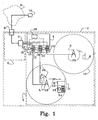
- FIG. 1 illustrates schematically, according to the invention, a Universal Mobile Telecommunications system (UMTS) network 1 using Wideband Code Division Multiple Access (WCDMA).
- the UMTS network 1 includes a core network 2 and a UMTS Terrestrial Radio Access Network (UTRAN) 3.
- the UTRAN 3 includes a number of Radio Network Controllers (RNC) 4 - of which only one is drawn for the sake of clarity.
- RNC Radio Network Controllers
- Each of the Radio Network Controllers 4 is coupled to a set of neighbouring base stations, normally called Node Bs 5.
- Each Node B 5 is responsible for a given cell 11 and the controlling Radio Network Controller 4 is responsible for routing user and signalling data between that Node B 5 and the core network 2.
- FIG. 1 also illustrates mobile terminals or User Equipments (UE) 6, a Serving GPRS Support Node (SGSN) 7 and a GPRS Gateway Support Node (GGSN) 8.
- the Serving GPRS Support Node 7 and the Gateway GPRS Support Node 8 may e.g. provide packet switched data services to the User Equipment 6 via the UTRAN with the Gateway GPRS Support Node being coupled to e.g. the Internet 9, whereupon the User Equipment 6 may communicate with a node 10 connected to the Internet 9.
- Radio Link Control entity 12 User data received at a Radio Network Controller 4 from the core network 2 is stored at a Radio Link Control (RLC) entity 12 in one or more buffers 13.
- RLC Radio Link Control
- User data generated at a User Equipment 6 is stored in buffers 14 of a peer Radio Link Control entity 15 at the User Equipment 6.
- User data (extracted from the buffers) and signalling data is carried between a Radio Network Controller 4 and a User Equipment 6 using Radio Bearers.
- Radio Bearers typically, a User Equipment is allocated one or more Radio Bearers each of which is capable of carrying a flow of user or signalling data.
- Radio Bearers are mapped onto respective logical channels.
- MAC Media Access Control
- MAC Media Access Control
- MAC Media Access Control
- Several transport channels are in turn mapped at the physical layer onto one or more physical channels - which thus may include one or more links 19 - for transmission over the air interface between a Node B 5 and a User Equipment 6.
- Each link is thus supported by one buffer in the Radio Network Controller 4 and one buffer in the User Equipment 6.
- Each of the buffers 13, 14 is controlled by Active Queue Management (AQM) 16, 17 operating separately on each buffer 13, 14 to avoid link congestion.
- QAM Active Queue Management
- each Radio Network Controller 4 is included a Radio Resource Management 18, which controls the allocation of radio resources to channels and tries to avoid cell congestion.
- a buffer may work for more than one incoming and/or outgoing link. This may e.g. be the case in an Internet router. Further, Active Queue Management may work on more than one buffer simultaneously. In particular, an alternative would be to have a general Active Queue Management working to control the average traffic in a whole cell. Finally, of course, Active Queue Management needs not be performed on all buffers.
- Radio Resource Management and Active Queue Management are co-ordinated.
- An overview of a process for upswitching is seen in Fig 2 .
- link congestion is detected, block 21.
- link congestion may be detected by setting a congestion threshold Th in the buffer.
- Th When the queue length is longer then the congestion threshold Th, then link congestion is presumed to be near.
- the natural action would then be, according to prior art, to use Active Queue Management to take action. However, it might happen that the congestion is local and that it would be possible to allocate more bandwidth.
- Radio Resource Management uses the same congestion threshold as an indication on a need for higher bit rate and determines if it is possible to allocate more bandwidth.
- the user using the congested link is using a common channel that he is sharing with other users, then it might be possible to instead allocate a dedicated channel just for him. Alternatively, the user might e.g. be given a higher bit rate within the same common or dedicated channel.
- Such criteria may be traffic intensity, packet arrival times, time between packets etc.
- Radio Resource Management When Radio Resource Management has determined if it is possible to allocate more bandwidth or not, this should be reported to Active Queue Management. This can be done by signalling from Radio Resource Management to Active Queue Management. Alternatively, a timer can be introduced on the congestion threshold for the Active Queue Management. Thus, if the congestion threshold has been exceeded for a certain amount of time, then it can be presumed that Radio Resource Management has no further bandwidth to allocate and that the Active Queue Management needs to take action.
- the Active Queue Management finds out that more bandwidth is allocated, it takes no action. However, if the Active Queue Management finds out that more bandwidth is not allocated, then it may alleviate link congestion. This may be done by dropping or marking packets according to some predefined algorithm, preferably avoiding to drop subsequent packets by intent, in order to avoid causing TCP slow start in systems where TCP or similar is used. Marking of packets may be done e.g. by setting an explicit congestion (ECN) flag in the header of a packet.
- ECN explicit congestion
- the congestion threshold may be fixed, but preferably it is movable. It can then be moved according to different primary criteria such as link characteristics i.e. e.g. round trip time (RTT) of the link and data rate or bit rate of the link.
- the link characteristics may then be used to calculate link capacity and thereby to set the congestion threshold.
- RTT round trip time
- Th RRM on the placement of the congestion threshold. It can be said e.g. that if the bit rate is high, then it can be permitted to have a longer queue length in the buffer and vice versa, considering that the buffer will be emptied quicker when using a higher bit rate.
- secondary criteria may also be used to move the congestion threshold, in order to give a more detailed placement of the congestion threshold.
- ⁇ Th AQM is an adjustment calculated according to the secondary criteria according to Active Queue Management. This adjustment may e.g. be calculated by analysing whether a packet has been dropped or not. If a packet has been dropped, then ⁇ Th AQM is increased with a positive constant ⁇ , unless the congestion threshold Th has reached a maximum Active Queue Management threshold Th AQMmax .
- ⁇ Th AQM is decreased with a positive constant ⁇ unless the congestion threshold Th has reached a minimum Active Queue Management threshold Th AQMmin . If none of these conditions are met, then ⁇ Th AQM is left unchanged.
- An alternative to analysing whether a packet has been dropped or not is e.g. to look at the buffering delay of each packet. Since the buffering delay is independent of bandwidth it may alternatively also be used as the only means for calculating the congestion threshold.
- An alternative to using a probabilistic approach when the queue fill level lies between the maximum Active Queue Management threshold Th AQMmax and the minimum Active Queue Management threshold Th AQMmin is to use a counter to allow only one in every (n+1)th packet to be dropped.
- Downswitching may be done by Radio Resource Management primarily for two reasons. A first reason is that less capacity is needed because e.g. a user is needing less bandwidth or goes passive. A second reason is because of resource shortage in the cell due to e.g. many new users or handovers, new services per user, users moving from the cell centre to the cell periphery (thus requiring a higher power, thus causing interference to others) etc
- a hysteresis threshold in the buffer may indicate a low usage.
- the same threshold as the congestion threshold may of course be used, but it is better to use a hysteresis threshold at a shorter queue length than the congestion threshold, to avoid unnecessary frequent channel switchings.
- the hysteresis threshold may be fixed, but preferably it is on a fixed distance to the congestion threshold, thus moving when the congestion threshold is moving.
- the user of a dedicated channel may now instead be switched to a common channel, which may be sufficient for his needs.
- criteria may be used alternatively to a hysteresis threshold or in combination therewith to take the decision to switch channel.
- Such criteria may be traffic intensity, packet arrival times, time between packets etc.
- the Radio Resource Management should inform the Active Queue Managements for all links or for the affected links of the intention of a forced downswitch. This is preferably done by some type of signalling. Said Active Queue Managements can then take appropriate actions to avoid buffer overflow, such as dropping or marking packets.
- the present invention is applicable to any wireless system for packet-data transfer equipped with a resource management function, not only WCDMA. In fact the system need not even be wireless. However, considering that wireless systems have the greatest problems with allocating resources, wireless systems will have the greatest advantages with the present invention
- the present invention is applicable independently of the choice of Active Queue Management algorithm.
- Requirements for the present invention are a method for link congestion detection and a packet dropping/marking policy or other way of alleviating link congestion.
- the present invention is applicable to any type of packet-data traffic - not only using TCP - which traffic is equipped with an end-to-end load control mechanism.
- TCP Transmission Control
- TFRC TCP Friendly Rate Control
- the invention is also applicable to non-responsive flows, such as UDP.
- the congestion alleviation procedure in the link buffer may then follow a different pattern, in case the source rate is not reduced as a consequence of packet losses.
Landscapes
- Engineering & Computer Science (AREA)
- Computer Networks & Wireless Communication (AREA)
- Signal Processing (AREA)
- Quality & Reliability (AREA)
- Databases & Information Systems (AREA)
- Data Exchanges In Wide-Area Networks (AREA)
- Mobile Radio Communication Systems (AREA)
- Branching, Merging, And Special Transfer Between Conveyors (AREA)
Claims (25)
- Verfahren zur Betriebsmittelzuteilung in einem Paketübertragungsnetz, mindestens einen Link (19) umfassend, gekennzeichnet durch folgende Schritte:- Ermitteln des Link-Betriebsmittelstatus;- falls Linküberlastung ermittelt ist, dann(a) Ermitteln, ob es möglich ist, mehr Linkkapazität zuzuteilen;(b) Zuteilen von mehr Linkkapazität, wenn es möglich ist, mehr Linkkapazität zuzuteilen;(c) Vermindern der Linküberlastung unter Verwendung von aktiver Warteschlangenverwaltung, wenn es nicht möglich ist, mehr Linkkapazität zuzuteilen.
- Verfahren zur Betriebsmittelzuteilung nach Anspruch 1, gekennzeichnet durch- in einem Puffer (13, 14) für diesen mindestens einen Link (19) eine Überlastungsschwelle (Th) für Paket-Warteschlangengröße im Puffer (13, 14) definieren; und- Verwendung der Überlastungsschwelle (Th) zum Detektieren einer Linküberlastung, wenn die Paket-Warteschlangengröße die Überlastungsschwelle (Th) übersteigt.
- Verfahren zur Betriebsmittelzuteilung nach Anspruch 2, gekennzeichnet durch- Einstellen der Überlastungsschwelle (Th) je nach der Linkkapazität.
- Verfahren zur Betriebsmittelzuteilung nach Anspruch 2 oder 3, gekennzeichnet durch- Einstellen der Überlastungsschwelle (Th) je nachdem, ob ein Paket fallengelassen/markiert wird oder nicht.
- Verfahren zur Betriebsmittelzuteilung nach einem der Ansprüche 2-4, gekennzeichnet durch- Einstellen der Überlastungsschwelle je nach der Pufferverzögerung für ein Paket in der Warteschlange.
- Verfahren zur Betriebsmittelzuteilung nach einem der Ansprüche 2-5, gekennzeichnet durch- im Puffer (13, 14) eine maximale Schwelle (ThAQMmax) und eine minimale Schwelle (ThAQMmin) für Paket-Warteschlangengröße im Puffer (13, 14) definieren.
- Verfahren zur Betriebsmittelzuteilung nach einem der Ansprüche 1-6, gekennzeichnet durch- Zuteilen von Linkkapazität durch Wechseln von einem Gleichkanal auf einen dedizierten Kanal.
- Verfahren zur Betriebsmittelzuteilung nach einem der Ansprüche 1-6, gekennzeichnet durch- Zuteilen von Linkkapazität durch Wechseln von einem Kanal mit einer niedrigen Bitrate auf einen Kanal mit einer höheren Bitrate.
- Verfahren zur Betriebsmittelzuteilung nach Anspruch 1, gekennzeichnet durch die folgenden Schritte- Ermitteln des Zellen-Betriebsmittelstatus;- falls Zellenüberlastung detektiert wird, dann(a) bestimmen, dass es notwendig ist, die Bitrate oder -raten in mindestens einem Link (19) herunterzuschalten;(b) Vermindern der Linküberlastung unter Verwendung der aktiven Warteschlangenverwaltung (16, 17);(c) Herunterschalten der Bitrate oder -raten.
- Verfahren zur Betriebsmittelzuteilung nach Anspruch 9, gekennzeichnet durch- Vermindern der Linküberlastung für alle Links (19).
- Verfahren zur Betriebsmittelzuteilung nach Anspruch 9, gekennzeichnet durch- Vermindern der Linküberlastung nur für die Links (19), bei denen Linküberlastung wahrscheinlich vorkommen wird.
- Verfahren nach Anspruch 1, gekennzeichnet durch die folgenden Schritte- falls geringe Nutzung eines Links (19) detektiert wird, dann(a) Ermitteln, ob es möglich ist, die Linkkapazität problemlos zu reduzieren;(b) Zuteilen von weniger Linkkapazität, wenn möglich.
- Verfahren nach einem der Ansprüche 1-12, gekennzeichnet durch- Vermindern der Linküberlastung durch Fallenlassen oder Markieren von Paketen.
- Verfahren nach einem der Ansprüche 2-13, gekennzeichnet durch- für jeden Puffer (13, 14) getrenntes Verwenden von aktiver Warteschlangenverwaltung.
- Verfahren nach einem der Ansprüche 2-13, gekennzeichnet durch- für eine Anzahl von Puffern (13, 14) getrenntes Verwenden einer aktiven Warteschlangenverwaltung; und- Steuern des Durchschnittsverkehrs in den mit den Puffern (13, 14) assoziierten Links.
- Anordnung zur Betriebsmittelzuteilung in einem Paketübertragungsnetz, mindestens einen Link (1) enthaltend, dadurch gekennzeichnet, dass die Anordnung eine Betriebsmittelverwaltung (18) enthält, die dazu angeordnet ist, den Link-Betriebsmittelstatus zu ermitteln, und dazu angeordnet ist, falls ein Linküberlastungsstatus ermittelt wird, zu ermitteln, ob es möglich ist, mehr Linkkapazität zuzuteilen; mehr Linkkapazität zuzuteilen, wenn es möglich ist, mehr Linkkapazität zuzuteilen, und zu ermöglichen, Linküberlastung unter Verwendung von aktiver Warteschlangenverwaltung (16, 17) zu vermindern, wenn es nicht möglich ist, mehr Linkkapazität zuzuteilen.
- Anordnung zur Betriebsmittelzuteilung nach Anspruch 16, dadurch gekennzeichnet, dass die Anordnung einen Puffer (13, 14) für den mindestens einen Link (19) enthält, wobei der Puffer (13, 14) eine Überlastungsschwelle (Th) für Paket-Warteschlangengröße im Puffer (13, 14) enthält, und dass die Überlastungsschwelle (Th) dazu angeordnet ist, Linküberlastung zu detektieren, wenn die Paket-Warteschlangengröße die Überlastungsschwelle (Th) übersteigt.
- Anordnung zur Betriebsmittelzuteilung nach Anspruch 17, dadurch gekennzeichnet, dass die Überlastungsschwelle (Th) dazu angeordnet ist, je nach der Linkkapazität eingestellt zu werden.
- Anordnung zur Betriebsmittelzuteilung nach Anspruch 17 oder 18, dadurch gekennzeichnet, dass die Überlastungsschwelle (Th) dazu angeordnet ist, eingestellt zu werden je nachdem, ob ein Paket fallengelassen/markiert wird oder nicht.
- Anordnung zur Betriebsmittelzuteilung nach einem der Ansprüche 17 bis 19, dadurch gekennzeichnet, dass die Überlastungsschwelle (Th) dazu angeordnet ist, je nach der Pufferverzögerung für ein Paket in der Warteschlange eingestellt zu werden.
- Anordnung zur Betriebsmittelzuteilung nach Anspruch 17 bis 20, dadurch gekennzeichnet, dass der Puffer (13, 14) eine maximale Schwelle (ThAQMmax) und eine minimale Schwelle (ThAQMmin) für Paket-Warteschlangengröße im Puffer (13, 14) enthält.
- Anordnung zur Betriebsmittelzuteilung nach Anspruch 16, dadurch gekennzeichnet, dass die Betriebsmittelverwaltung (18) dazu angeordnet ist, den Zellen-Betriebsmittelstatus zu bestimmen, und dazu angeordnet ist, falls Zellenüberlastung detektiert wird, zu bestimmen, dass es notwendig ist, die Bitrate oder- raten in mindestens einem Link (19) herunterzuschalten, um zu ermöglichen, dass die Linküberlastung unter Verwendung der aktiven Warteschlangenverwaltung (16, 17) vermindert wird und die Bitrate oder- raten heruntergeschaltet werden.
- Anordnung zur Betriebsmittelzuteilung nach Anspruch 16, dadurch gekennzeichnet, dass die Betriebsmittelverwaltung (18) dazu angeordnet ist, falls geringe Nutzung eines Links (19) detektiert wird, zu ermitteln, ob es möglich ist, die Linkkapazität problemlos zu reduzieren, und wenn möglich weniger Linkkapazität zuzuteilen.
- Anordnung zur Betriebsmittelzuteilung nach einem der Ansprüche 17-23, dadurch gekennzeichnet, dass die aktive Warteschlangenverwaltung dazu angeordnet ist, für jeden Puffer (13, 14) getrennt zu arbeiten.
- Anordnung zur Betriebsmittelzuteilung nach einem der Ansprüche 17-23, dadurch gekennzeichnet, dass die aktive Warteschlangenverwaltung dazu angeordnet ist, für eine Anzahl von Puffern (13, 14) zu arbeiten und den Durchschnittsverkehr in den mit den Puffern (13, 14) assoziierten Links (19) zu steuern.
Applications Claiming Priority (1)
| Application Number | Priority Date | Filing Date | Title |
|---|---|---|---|
| PCT/SE2002/001237 WO2004002085A1 (en) | 2002-06-20 | 2002-06-20 | Apparatus and method for resource allocation |
Publications (2)
| Publication Number | Publication Date |
|---|---|
| EP1518370A1 EP1518370A1 (de) | 2005-03-30 |
| EP1518370B1 true EP1518370B1 (de) | 2008-06-25 |
Family
ID=29997658
Family Applications (1)
| Application Number | Title | Priority Date | Filing Date |
|---|---|---|---|
| EP02746244A Expired - Lifetime EP1518370B1 (de) | 2002-06-20 | 2002-06-20 | Vorrichtung und verfahren zur betriebsmittelzuteilung |
Country Status (6)
| Country | Link |
|---|---|
| US (1) | US20050262266A1 (de) |
| EP (1) | EP1518370B1 (de) |
| AT (1) | ATE399418T1 (de) |
| AU (1) | AU2002315983A1 (de) |
| DE (1) | DE60227291D1 (de) |
| WO (1) | WO2004002085A1 (de) |
Families Citing this family (49)
| Publication number | Priority date | Publication date | Assignee | Title |
|---|---|---|---|---|
| US7190673B2 (en) * | 2002-06-26 | 2007-03-13 | Interdigital Technology Corporation | Method and system that improves interoperability of a radio network controller and a base station in cellular system with downlink congestion control |
| US7477604B2 (en) * | 2003-05-14 | 2009-01-13 | Ntt Docomo, Inc. | Packet communications system |
| GB2416088B (en) * | 2004-06-24 | 2007-03-14 | Siemens Ag | Telecommunication system |
| JP4655619B2 (ja) * | 2004-12-15 | 2011-03-23 | 日本電気株式会社 | 無線基地局装置およびそのレート制御方法 |
| US20060140193A1 (en) * | 2004-12-29 | 2006-06-29 | Nokia Corporation | Optimization of a TCP connection |
| US20060187828A1 (en) * | 2005-02-18 | 2006-08-24 | Broadcom Corporation | Packet identifier for use in a network device |
| US8494539B1 (en) * | 2005-06-30 | 2013-07-23 | Alcatel Lucent | Congestion management in radio access networks |
| US7634617B2 (en) * | 2006-01-03 | 2009-12-15 | Emc Corporation | Methods, systems, and computer program products for optimized copying of logical units (LUNs) in a redundant array of inexpensive disks (RAID) environment using buffers that are larger than LUN delta map chunks |
| US7634618B2 (en) * | 2006-01-03 | 2009-12-15 | Emc Corporation | Methods, systems, and computer program products for optimized copying of logical units (LUNs) in a redundant array of inexpensive disks (RAID) environment using buffers that are smaller than LUN delta map chunks |
| CN101411230B (zh) * | 2006-03-28 | 2010-09-22 | 日本电气株式会社 | 基站控制装置和域接入管制方法 |
| US7966419B2 (en) * | 2006-07-03 | 2011-06-21 | Palo Alto Research Center Incorporated | Congestion management in an ad-hoc network based upon a predicted information utility |
| US20080008160A1 (en) * | 2006-07-06 | 2008-01-10 | Uhler Stephen A | Bandwidth management for internet telephony |
| US20080228459A1 (en) * | 2006-10-12 | 2008-09-18 | Nec Laboratories America, Inc. | Method and Apparatus for Performing Capacity Planning and Resource Optimization in a Distributed System |
| US7929466B2 (en) * | 2006-10-20 | 2011-04-19 | The Boeing Company | Prioritized channel assignment for wireless links |
| US8948046B2 (en) | 2007-04-27 | 2015-02-03 | Aerohive Networks, Inc. | Routing method and system for a wireless network |
| WO2009008817A1 (en) * | 2007-07-06 | 2009-01-15 | Telefonaktiebolaget L M Ericsson (Publ) | Congestion control in a transmission node |
| JP2009044328A (ja) | 2007-08-07 | 2009-02-26 | Seiko Epson Corp | 会議システム、サーバ、画像表示方法、コンピュータプログラム及び記録媒体 |
| US20090257377A1 (en) * | 2008-04-09 | 2009-10-15 | Texas Instruments Incorporated | Reducing buffer size for repeat transmission protocols |
| US8218502B1 (en) | 2008-05-14 | 2012-07-10 | Aerohive Networks | Predictive and nomadic roaming of wireless clients across different network subnets |
| US9674892B1 (en) | 2008-11-04 | 2017-06-06 | Aerohive Networks, Inc. | Exclusive preshared key authentication |
| EP2359544A1 (de) * | 2008-11-11 | 2011-08-24 | Telefonaktiebolaget L M Ericsson (publ) | Verfahren und einrichtung zur ermöglichung der anzeige von stau in einem telekommunikationsnetz |
| US8483194B1 (en) | 2009-01-21 | 2013-07-09 | Aerohive Networks, Inc. | Airtime-based scheduling |
| US9900251B1 (en) * | 2009-07-10 | 2018-02-20 | Aerohive Networks, Inc. | Bandwidth sentinel |
| US11115857B2 (en) | 2009-07-10 | 2021-09-07 | Extreme Networks, Inc. | Bandwidth sentinel |
| JP5718948B2 (ja) | 2010-03-05 | 2015-05-13 | エヌイーシー ヨーロッパ リミテッドNec Europe Ltd. | ワイヤレスネットワークの動作方法およびワイヤレスネットワーク |
| US8488461B2 (en) * | 2010-05-12 | 2013-07-16 | The Chinese University Of Hong Kong | Adaptive scheduling of data transfer in P2P applications over asymmetric networks |
| US8671187B1 (en) | 2010-07-27 | 2014-03-11 | Aerohive Networks, Inc. | Client-independent network supervision application |
| US9002277B2 (en) | 2010-09-07 | 2015-04-07 | Aerohive Networks, Inc. | Distributed channel selection for wireless networks |
| US8787159B2 (en) * | 2011-04-14 | 2014-07-22 | Alcatel Lucent | Mechanism for wireless access networks to throttle traffic during congestion |
| US10091065B1 (en) | 2011-10-31 | 2018-10-02 | Aerohive Networks, Inc. | Zero configuration networking on a subnetted network |
| EP2777317B1 (de) * | 2011-11-09 | 2018-06-27 | Telefonaktiebolaget LM Ericsson (publ) | Überlastungsregelung für datenkommunikation mit mehreren strömen |
| CN102595483B (zh) * | 2012-03-09 | 2014-12-24 | 新邮通信设备有限公司 | 一种资源状态报告方法和基站 |
| US9386128B2 (en) * | 2012-03-23 | 2016-07-05 | Qualcomm Incorporated | Delay based active queue management for uplink traffic in user equipment |
| EP2667554B1 (de) * | 2012-05-24 | 2020-08-26 | Gilat Satellite Networks Ltd. | Maximale hierarchische Informationsratendurchsetzung |
| EP2862301B1 (de) | 2012-06-14 | 2020-12-02 | Extreme Networks, Inc. | Multicast-unicast-umwandlungsverfahren |
| EP2685757B1 (de) * | 2012-07-10 | 2014-12-17 | Telefonaktiebolaget L M Ericsson (PUBL) | Technik zur Handhabung von Überlastungssteuerung |
| EP2962433B1 (de) | 2013-03-01 | 2017-09-27 | Telefonaktiebolaget LM Ericsson (publ) | Verfahren und knoten zur handhabung von überlastung in backhaul-netzwerken |
| US10389650B2 (en) | 2013-03-15 | 2019-08-20 | Aerohive Networks, Inc. | Building and maintaining a network |
| US9413772B2 (en) | 2013-03-15 | 2016-08-09 | Aerohive Networks, Inc. | Managing rogue devices through a network backhaul |
| EP3222014B1 (de) * | 2014-11-17 | 2019-07-24 | Telefonaktiebolaget LM Ericsson (publ) | Aktive warteschlangenverwaltung für ein drahtloskommunikationsnetzwerk |
| JP6451249B2 (ja) * | 2014-11-18 | 2019-01-16 | 富士通株式会社 | 管理装置、通信システム及び通信制御方法 |
| CN106464567B (zh) * | 2015-04-30 | 2020-04-28 | 华为技术有限公司 | 一种流量动态控制方法、设备及网关、融合接入汇聚点 |
| WO2016192011A1 (zh) * | 2015-06-01 | 2016-12-08 | 华为技术有限公司 | 一种拥塞控制的方法及网元设备 |
| US10412634B2 (en) * | 2015-08-13 | 2019-09-10 | Telefonaktiebolaget Lm Ericsson (Publ) | Predictive adaptive queue management |
| CN108370327A (zh) | 2015-09-25 | 2018-08-03 | Fsa技术股份有限公司 | 多干线数据流调节系统和方法 |
| US9877227B2 (en) * | 2015-10-21 | 2018-01-23 | T-Mobile Usa, Inc. | Coordinated RAN and transport network utilization |
| US10904157B2 (en) * | 2019-04-05 | 2021-01-26 | Cisco Technology, Inc. | Telemetry for cloud switches queuing excursion |
| US11438791B1 (en) | 2020-02-05 | 2022-09-06 | T-Mobile Innovations Llc | Mitigating packet loss at a cell site router |
| CN112448895A (zh) * | 2020-11-03 | 2021-03-05 | 广州杰赛科技股份有限公司 | 一种网联车流量的分配方法、装置及存储介质 |
Family Cites Families (10)
| Publication number | Priority date | Publication date | Assignee | Title |
|---|---|---|---|---|
| US5313454A (en) * | 1992-04-01 | 1994-05-17 | Stratacom, Inc. | Congestion control for cell networks |
| US5748901A (en) * | 1996-05-21 | 1998-05-05 | Ramot University Authority Ltd. | Flow control algorithm for high speed networks |
| US6556578B1 (en) * | 1999-04-14 | 2003-04-29 | Lucent Technologies Inc. | Early fair drop buffer management method |
| US6917585B1 (en) * | 1999-06-02 | 2005-07-12 | Nortel Networks Limited | Method and apparatus for queue management |
| US6480911B1 (en) * | 1999-09-23 | 2002-11-12 | At&T Corp. | Grouping class sensitive queues |
| CN1158815C (zh) * | 1999-11-17 | 2004-07-21 | 艾利森电话股份有限公司 | 移动电信中与加速度相关的信道转换 |
| CA2291835A1 (en) * | 1999-12-06 | 2001-06-06 | Nortel Networks Corporation | Load adaptive buffer management in packet networks |
| US6701389B2 (en) * | 2001-06-07 | 2004-03-02 | International Business Machines Corporation | Bandwidth allocation in accordance with shared queue output limit |
| US7193966B2 (en) * | 2001-06-25 | 2007-03-20 | Telefonakitebolaget Lm Ericsson (Publ) | Triggered packet data rate change in a communication system |
| US7382793B1 (en) * | 2002-01-17 | 2008-06-03 | Juniper Networks, Inc. | Systems and methods for determining the bandwidth used by a queue |
-
2002
- 2002-06-20 EP EP02746244A patent/EP1518370B1/de not_active Expired - Lifetime
- 2002-06-20 US US10/518,208 patent/US20050262266A1/en not_active Abandoned
- 2002-06-20 WO PCT/SE2002/001237 patent/WO2004002085A1/en not_active Ceased
- 2002-06-20 DE DE60227291T patent/DE60227291D1/de not_active Expired - Fee Related
- 2002-06-20 AU AU2002315983A patent/AU2002315983A1/en not_active Abandoned
- 2002-06-20 AT AT02746244T patent/ATE399418T1/de not_active IP Right Cessation
Also Published As
| Publication number | Publication date |
|---|---|
| AU2002315983A1 (en) | 2004-01-06 |
| ATE399418T1 (de) | 2008-07-15 |
| US20050262266A1 (en) | 2005-11-24 |
| DE60227291D1 (de) | 2008-08-07 |
| WO2004002085A1 (en) | 2003-12-31 |
| EP1518370A1 (de) | 2005-03-30 |
Similar Documents
| Publication | Publication Date | Title |
|---|---|---|
| EP1518370B1 (de) | Vorrichtung und verfahren zur betriebsmittelzuteilung | |
| EP3826274B1 (de) | Flusssteuerungsverfahren und -vorrichtung | |
| EP1787436B1 (de) | Verfahren und system zur verwaltung von funkbetriebsmitteln in mobilkommunikationsnetzen, diesbezügliches netz und computerprogrammprodukt dafür | |
| EP2080326B1 (de) | System und verfahren zur lastabhängigen ratenkontrolle | |
| US7804798B2 (en) | Method, system and computer program product for managing the transmission of information packets in a telecommunication network | |
| US7626989B2 (en) | Capacity allocation for packet data bearers | |
| US6697378B1 (en) | Method and apparatus for class based transmission control of data connections based on real-time external feedback estimates obtained using messaging from a wireless network | |
| JP3927027B2 (ja) | リソース制御システム、リソース制御方法、及びこれらに用いて好適な基地局 | |
| US7099622B2 (en) | Controlling channel switching in a UMTS network | |
| EP3720181A1 (de) | Netzwerkschichtverarbeitungsverfahren und zugangsnetzwerk-netzwerkelement | |
| US7031254B2 (en) | Rate control system and method for a link within a wireless communications system | |
| CN101340358B (zh) | 一种流量控制方法、系统及流量控制实体 | |
| US8902739B2 (en) | Backhaul congestion control for wireless communication networks | |
| US20080248807A1 (en) | Method and apparatus for controlling a call in a communication system | |
| US20120188957A1 (en) | Flow control in umts using information in ubs field | |
| US8000249B2 (en) | Method for improved congestion detection and control in a wireless telecommunications systems | |
| EP1770918A1 (de) | Datenflusssteuerung für Schnittstellen eines Funkzugangsnetzes | |
| EP1331767A1 (de) | Verfahren und Einrichtung zur wahlfreien Zugriffspaketübertragung durch Ausführung einer Laststeuerungsfunktionalität | |
| EP1652342B1 (de) | Verfahren, zugangspunkt und programmprodukt zur bereitstellung von bandbreiten- und funkzeit-fairness in drahtlosen netzwerken | |
| EP1133202A1 (de) | Funkkommunikationssystem mit verbesserter Ausnutzung der Funkschnittstelle | |
| WO2003077582A1 (en) | Admission control for data connections | |
| GB2420254A (en) | A method of controlling transmission rate in a mobile terminal in soft handover | |
| HK40032548A (en) | Network slice processing method and access network network element | |
| HK1106355B (en) | Congestion control within a radio access network | |
| HK1106355A1 (en) | Congestion control within a radio access network |
Legal Events
| Date | Code | Title | Description |
|---|---|---|---|
| PUAI | Public reference made under article 153(3) epc to a published international application that has entered the european phase |
Free format text: ORIGINAL CODE: 0009012 |
|
| 17P | Request for examination filed |
Effective date: 20050120 |
|
| AK | Designated contracting states |
Kind code of ref document: A1 Designated state(s): AT BE CH CY DE DK ES FI FR GB GR IE IT LI LU MC NL PT SE TR |
|
| AX | Request for extension of the european patent |
Extension state: AL LT LV MK RO SI |
|
| DAX | Request for extension of the european patent (deleted) | ||
| GRAP | Despatch of communication of intention to grant a patent |
Free format text: ORIGINAL CODE: EPIDOSNIGR1 |
|
| GRAS | Grant fee paid |
Free format text: ORIGINAL CODE: EPIDOSNIGR3 |
|
| GRAA | (expected) grant |
Free format text: ORIGINAL CODE: 0009210 |
|
| AK | Designated contracting states |
Kind code of ref document: B1 Designated state(s): AT BE CH CY DE DK ES FI FR GB GR IE IT LI LU MC NL PT SE TR |
|
| REG | Reference to a national code |
Ref country code: GB Ref legal event code: FG4D |
|
| REG | Reference to a national code |
Ref country code: CH Ref legal event code: EP |
|
| REF | Corresponds to: |
Ref document number: 60227291 Country of ref document: DE Date of ref document: 20080807 Kind code of ref document: P |
|
| REG | Reference to a national code |
Ref country code: IE Ref legal event code: FG4D |
|
| PG25 | Lapsed in a contracting state [announced via postgrant information from national office to epo] |
Ref country code: FI Free format text: LAPSE BECAUSE OF FAILURE TO SUBMIT A TRANSLATION OF THE DESCRIPTION OR TO PAY THE FEE WITHIN THE PRESCRIBED TIME-LIMIT Effective date: 20080625 |
|
| PG25 | Lapsed in a contracting state [announced via postgrant information from national office to epo] |
Ref country code: NL Free format text: LAPSE BECAUSE OF FAILURE TO SUBMIT A TRANSLATION OF THE DESCRIPTION OR TO PAY THE FEE WITHIN THE PRESCRIBED TIME-LIMIT Effective date: 20080625 Ref country code: AT Free format text: LAPSE BECAUSE OF FAILURE TO SUBMIT A TRANSLATION OF THE DESCRIPTION OR TO PAY THE FEE WITHIN THE PRESCRIBED TIME-LIMIT Effective date: 20080625 |
|
| NLV1 | Nl: lapsed or annulled due to failure to fulfill the requirements of art. 29p and 29m of the patents act | ||
| PG25 | Lapsed in a contracting state [announced via postgrant information from national office to epo] |
Ref country code: SE Free format text: LAPSE BECAUSE OF FAILURE TO SUBMIT A TRANSLATION OF THE DESCRIPTION OR TO PAY THE FEE WITHIN THE PRESCRIBED TIME-LIMIT Effective date: 20080925 Ref country code: ES Free format text: LAPSE BECAUSE OF FAILURE TO SUBMIT A TRANSLATION OF THE DESCRIPTION OR TO PAY THE FEE WITHIN THE PRESCRIBED TIME-LIMIT Effective date: 20081006 Ref country code: PT Free format text: LAPSE BECAUSE OF FAILURE TO SUBMIT A TRANSLATION OF THE DESCRIPTION OR TO PAY THE FEE WITHIN THE PRESCRIBED TIME-LIMIT Effective date: 20081125 |
|
| PG25 | Lapsed in a contracting state [announced via postgrant information from national office to epo] |
Ref country code: BE Free format text: LAPSE BECAUSE OF FAILURE TO SUBMIT A TRANSLATION OF THE DESCRIPTION OR TO PAY THE FEE WITHIN THE PRESCRIBED TIME-LIMIT Effective date: 20080625 |
|
| PG25 | Lapsed in a contracting state [announced via postgrant information from national office to epo] |
Ref country code: DK Free format text: LAPSE BECAUSE OF FAILURE TO SUBMIT A TRANSLATION OF THE DESCRIPTION OR TO PAY THE FEE WITHIN THE PRESCRIBED TIME-LIMIT Effective date: 20080625 |
|
| PLBE | No opposition filed within time limit |
Free format text: ORIGINAL CODE: 0009261 |
|
| STAA | Information on the status of an ep patent application or granted ep patent |
Free format text: STATUS: NO OPPOSITION FILED WITHIN TIME LIMIT |
|
| 26N | No opposition filed |
Effective date: 20090326 |
|
| PG25 | Lapsed in a contracting state [announced via postgrant information from national office to epo] |
Ref country code: IT Free format text: LAPSE BECAUSE OF FAILURE TO SUBMIT A TRANSLATION OF THE DESCRIPTION OR TO PAY THE FEE WITHIN THE PRESCRIBED TIME-LIMIT Effective date: 20080625 |
|
| PG25 | Lapsed in a contracting state [announced via postgrant information from national office to epo] |
Ref country code: MC Free format text: LAPSE BECAUSE OF NON-PAYMENT OF DUE FEES Effective date: 20090630 |
|
| REG | Reference to a national code |
Ref country code: CH Ref legal event code: PL |
|
| REG | Reference to a national code |
Ref country code: FR Ref legal event code: ST Effective date: 20100226 |
|
| PG25 | Lapsed in a contracting state [announced via postgrant information from national office to epo] |
Ref country code: FR Free format text: LAPSE BECAUSE OF NON-PAYMENT OF DUE FEES Effective date: 20090630 Ref country code: IE Free format text: LAPSE BECAUSE OF NON-PAYMENT OF DUE FEES Effective date: 20090620 Ref country code: LI Free format text: LAPSE BECAUSE OF NON-PAYMENT OF DUE FEES Effective date: 20090630 Ref country code: CH Free format text: LAPSE BECAUSE OF NON-PAYMENT OF DUE FEES Effective date: 20090630 |
|
| PG25 | Lapsed in a contracting state [announced via postgrant information from national office to epo] |
Ref country code: DE Free format text: LAPSE BECAUSE OF NON-PAYMENT OF DUE FEES Effective date: 20100101 |
|
| PG25 | Lapsed in a contracting state [announced via postgrant information from national office to epo] |
Ref country code: GR Free format text: LAPSE BECAUSE OF FAILURE TO SUBMIT A TRANSLATION OF THE DESCRIPTION OR TO PAY THE FEE WITHIN THE PRESCRIBED TIME-LIMIT Effective date: 20080926 |
|
| PG25 | Lapsed in a contracting state [announced via postgrant information from national office to epo] |
Ref country code: LU Free format text: LAPSE BECAUSE OF NON-PAYMENT OF DUE FEES Effective date: 20090620 |
|
| PG25 | Lapsed in a contracting state [announced via postgrant information from national office to epo] |
Ref country code: TR Free format text: LAPSE BECAUSE OF FAILURE TO SUBMIT A TRANSLATION OF THE DESCRIPTION OR TO PAY THE FEE WITHIN THE PRESCRIBED TIME-LIMIT Effective date: 20080625 |
|
| PG25 | Lapsed in a contracting state [announced via postgrant information from national office to epo] |
Ref country code: CY Free format text: LAPSE BECAUSE OF FAILURE TO SUBMIT A TRANSLATION OF THE DESCRIPTION OR TO PAY THE FEE WITHIN THE PRESCRIBED TIME-LIMIT Effective date: 20080625 |
|
| PGFP | Annual fee paid to national office [announced via postgrant information from national office to epo] |
Ref country code: GB Payment date: 20150629 Year of fee payment: 14 |
|
| GBPC | Gb: european patent ceased through non-payment of renewal fee |
Effective date: 20160620 |
|
| PG25 | Lapsed in a contracting state [announced via postgrant information from national office to epo] |
Ref country code: GB Free format text: LAPSE BECAUSE OF NON-PAYMENT OF DUE FEES Effective date: 20160620 |