EP1518284B1 - Carbon-coated li-containing powders and process for production thereof - Google Patents
Carbon-coated li-containing powders and process for production thereof Download PDFInfo
- Publication number
- EP1518284B1 EP1518284B1 EP03760688A EP03760688A EP1518284B1 EP 1518284 B1 EP1518284 B1 EP 1518284B1 EP 03760688 A EP03760688 A EP 03760688A EP 03760688 A EP03760688 A EP 03760688A EP 1518284 B1 EP1518284 B1 EP 1518284B1
- Authority
- EP
- European Patent Office
- Prior art keywords
- carbon
- coated
- lifepo
- water
- nasicon
- Prior art date
- Legal status (The legal status is an assumption and is not a legal conclusion. Google has not performed a legal analysis and makes no representation as to the accuracy of the status listed.)
- Expired - Lifetime
Links
Images


Classifications
-
- H—ELECTRICITY
- H01—ELECTRIC ELEMENTS
- H01M—PROCESSES OR MEANS, e.g. BATTERIES, FOR THE DIRECT CONVERSION OF CHEMICAL ENERGY INTO ELECTRICAL ENERGY
- H01M4/00—Electrodes
- H01M4/02—Electrodes composed of, or comprising, active material
- H01M4/36—Selection of substances as active materials, active masses, active liquids
- H01M4/58—Selection of substances as active materials, active masses, active liquids of inorganic compounds other than oxides or hydroxides, e.g. sulfides, selenides, tellurides, halogenides or LiCoFy; of polyanionic structures, e.g. phosphates, silicates or borates
- H01M4/5825—Oxygenated metallic salts or polyanionic structures, e.g. borates, phosphates, silicates, olivines
-
- H—ELECTRICITY
- H01—ELECTRIC ELEMENTS
- H01M—PROCESSES OR MEANS, e.g. BATTERIES, FOR THE DIRECT CONVERSION OF CHEMICAL ENERGY INTO ELECTRICAL ENERGY
- H01M4/00—Electrodes
- H01M4/02—Electrodes composed of, or comprising, active material
- H01M4/04—Processes of manufacture in general
-
- C—CHEMISTRY; METALLURGY
- C01—INORGANIC CHEMISTRY
- C01B—NON-METALLIC ELEMENTS; COMPOUNDS THEREOF; METALLOIDS OR COMPOUNDS THEREOF NOT COVERED BY SUBCLASS C01C
- C01B25/00—Phosphorus; Compounds thereof
- C01B25/16—Oxyacids of phosphorus; Salts thereof
- C01B25/26—Phosphates
- C01B25/37—Phosphates of heavy metals
-
- C—CHEMISTRY; METALLURGY
- C01—INORGANIC CHEMISTRY
- C01B—NON-METALLIC ELEMENTS; COMPOUNDS THEREOF; METALLOIDS OR COMPOUNDS THEREOF NOT COVERED BY SUBCLASS C01C
- C01B25/00—Phosphorus; Compounds thereof
- C01B25/16—Oxyacids of phosphorus; Salts thereof
- C01B25/26—Phosphates
- C01B25/37—Phosphates of heavy metals
- C01B25/375—Phosphates of heavy metals of iron
-
- C—CHEMISTRY; METALLURGY
- C01—INORGANIC CHEMISTRY
- C01B—NON-METALLIC ELEMENTS; COMPOUNDS THEREOF; METALLOIDS OR COMPOUNDS THEREOF NOT COVERED BY SUBCLASS C01C
- C01B25/00—Phosphorus; Compounds thereof
- C01B25/16—Oxyacids of phosphorus; Salts thereof
- C01B25/26—Phosphates
- C01B25/45—Phosphates containing plural metal, or metal and ammonium
-
- H—ELECTRICITY
- H01—ELECTRIC ELEMENTS
- H01M—PROCESSES OR MEANS, e.g. BATTERIES, FOR THE DIRECT CONVERSION OF CHEMICAL ENERGY INTO ELECTRICAL ENERGY
- H01M10/00—Secondary cells; Manufacture thereof
- H01M10/05—Accumulators with non-aqueous electrolyte
- H01M10/052—Li-accumulators
-
- H—ELECTRICITY
- H01—ELECTRIC ELEMENTS
- H01M—PROCESSES OR MEANS, e.g. BATTERIES, FOR THE DIRECT CONVERSION OF CHEMICAL ENERGY INTO ELECTRICAL ENERGY
- H01M10/00—Secondary cells; Manufacture thereof
- H01M10/05—Accumulators with non-aqueous electrolyte
- H01M10/052—Li-accumulators
- H01M10/0525—Rocking-chair batteries, i.e. batteries with lithium insertion or intercalation in both electrodes; Lithium-ion batteries
-
- H—ELECTRICITY
- H01—ELECTRIC ELEMENTS
- H01M—PROCESSES OR MEANS, e.g. BATTERIES, FOR THE DIRECT CONVERSION OF CHEMICAL ENERGY INTO ELECTRICAL ENERGY
- H01M10/00—Secondary cells; Manufacture thereof
- H01M10/05—Accumulators with non-aqueous electrolyte
- H01M10/056—Accumulators with non-aqueous electrolyte characterised by the materials used as electrolytes, e.g. mixed inorganic/organic electrolytes
- H01M10/0561—Accumulators with non-aqueous electrolyte characterised by the materials used as electrolytes, e.g. mixed inorganic/organic electrolytes the electrolyte being constituted of inorganic materials only
- H01M10/0562—Solid materials
-
- H—ELECTRICITY
- H01—ELECTRIC ELEMENTS
- H01M—PROCESSES OR MEANS, e.g. BATTERIES, FOR THE DIRECT CONVERSION OF CHEMICAL ENERGY INTO ELECTRICAL ENERGY
- H01M4/00—Electrodes
- H01M4/02—Electrodes composed of, or comprising, active material
- H01M4/13—Electrodes for accumulators with non-aqueous electrolyte, e.g. for lithium-accumulators; Processes of manufacture thereof
- H01M4/131—Electrodes based on mixed oxides or hydroxides, or on mixtures of oxides or hydroxides, e.g. LiCoOx
-
- H—ELECTRICITY
- H01—ELECTRIC ELEMENTS
- H01M—PROCESSES OR MEANS, e.g. BATTERIES, FOR THE DIRECT CONVERSION OF CHEMICAL ENERGY INTO ELECTRICAL ENERGY
- H01M4/00—Electrodes
- H01M4/02—Electrodes composed of, or comprising, active material
- H01M4/13—Electrodes for accumulators with non-aqueous electrolyte, e.g. for lithium-accumulators; Processes of manufacture thereof
- H01M4/139—Processes of manufacture
- H01M4/1391—Processes of manufacture of electrodes based on mixed oxides or hydroxides, or on mixtures of oxides or hydroxides, e.g. LiCoOx
-
- H—ELECTRICITY
- H01—ELECTRIC ELEMENTS
- H01M—PROCESSES OR MEANS, e.g. BATTERIES, FOR THE DIRECT CONVERSION OF CHEMICAL ENERGY INTO ELECTRICAL ENERGY
- H01M4/00—Electrodes
- H01M4/02—Electrodes composed of, or comprising, active material
- H01M4/36—Selection of substances as active materials, active masses, active liquids
-
- H—ELECTRICITY
- H01—ELECTRIC ELEMENTS
- H01M—PROCESSES OR MEANS, e.g. BATTERIES, FOR THE DIRECT CONVERSION OF CHEMICAL ENERGY INTO ELECTRICAL ENERGY
- H01M4/00—Electrodes
- H01M4/02—Electrodes composed of, or comprising, active material
- H01M4/36—Selection of substances as active materials, active masses, active liquids
- H01M4/362—Composites
- H01M4/366—Composites as layered products
-
- H—ELECTRICITY
- H01—ELECTRIC ELEMENTS
- H01M—PROCESSES OR MEANS, e.g. BATTERIES, FOR THE DIRECT CONVERSION OF CHEMICAL ENERGY INTO ELECTRICAL ENERGY
- H01M4/00—Electrodes
- H01M4/02—Electrodes composed of, or comprising, active material
- H01M4/36—Selection of substances as active materials, active masses, active liquids
- H01M4/58—Selection of substances as active materials, active masses, active liquids of inorganic compounds other than oxides or hydroxides, e.g. sulfides, selenides, tellurides, halogenides or LiCoFy; of polyanionic structures, e.g. phosphates, silicates or borates
-
- H—ELECTRICITY
- H01—ELECTRIC ELEMENTS
- H01M—PROCESSES OR MEANS, e.g. BATTERIES, FOR THE DIRECT CONVERSION OF CHEMICAL ENERGY INTO ELECTRICAL ENERGY
- H01M4/00—Electrodes
- H01M4/02—Electrodes composed of, or comprising, active material
- H01M4/62—Selection of inactive substances as ingredients for active masses, e.g. binders, fillers
-
- H—ELECTRICITY
- H01—ELECTRIC ELEMENTS
- H01M—PROCESSES OR MEANS, e.g. BATTERIES, FOR THE DIRECT CONVERSION OF CHEMICAL ENERGY INTO ELECTRICAL ENERGY
- H01M4/00—Electrodes
- H01M4/02—Electrodes composed of, or comprising, active material
- H01M4/62—Selection of inactive substances as ingredients for active masses, e.g. binders, fillers
- H01M4/624—Electric conductive fillers
- H01M4/625—Carbon or graphite
-
- H—ELECTRICITY
- H01—ELECTRIC ELEMENTS
- H01M—PROCESSES OR MEANS, e.g. BATTERIES, FOR THE DIRECT CONVERSION OF CHEMICAL ENERGY INTO ELECTRICAL ENERGY
- H01M6/00—Primary cells; Manufacture thereof
- H01M6/14—Cells with non-aqueous electrolyte
- H01M6/18—Cells with non-aqueous electrolyte with solid electrolyte
- H01M6/185—Cells with non-aqueous electrolyte with solid electrolyte with oxides, hydroxides or oxysalts as solid electrolytes
-
- H—ELECTRICITY
- H01—ELECTRIC ELEMENTS
- H01M—PROCESSES OR MEANS, e.g. BATTERIES, FOR THE DIRECT CONVERSION OF CHEMICAL ENERGY INTO ELECTRICAL ENERGY
- H01M4/00—Electrodes
- H01M4/02—Electrodes composed of, or comprising, active material
- H01M2004/021—Physical characteristics, e.g. porosity, surface area
-
- H—ELECTRICITY
- H01—ELECTRIC ELEMENTS
- H01M—PROCESSES OR MEANS, e.g. BATTERIES, FOR THE DIRECT CONVERSION OF CHEMICAL ENERGY INTO ELECTRICAL ENERGY
- H01M4/00—Electrodes
- H01M4/02—Electrodes composed of, or comprising, active material
- H01M2004/026—Electrodes composed of, or comprising, active material characterised by the polarity
- H01M2004/028—Positive electrodes
-
- H—ELECTRICITY
- H01—ELECTRIC ELEMENTS
- H01M—PROCESSES OR MEANS, e.g. BATTERIES, FOR THE DIRECT CONVERSION OF CHEMICAL ENERGY INTO ELECTRICAL ENERGY
- H01M4/00—Electrodes
- H01M4/02—Electrodes composed of, or comprising, active material
- H01M4/62—Selection of inactive substances as ingredients for active masses, e.g. binders, fillers
- H01M4/624—Electric conductive fillers
-
- Y—GENERAL TAGGING OF NEW TECHNOLOGICAL DEVELOPMENTS; GENERAL TAGGING OF CROSS-SECTIONAL TECHNOLOGIES SPANNING OVER SEVERAL SECTIONS OF THE IPC; TECHNICAL SUBJECTS COVERED BY FORMER USPC CROSS-REFERENCE ART COLLECTIONS [XRACs] AND DIGESTS
- Y02—TECHNOLOGIES OR APPLICATIONS FOR MITIGATION OR ADAPTATION AGAINST CLIMATE CHANGE
- Y02E—REDUCTION OF GREENHOUSE GAS [GHG] EMISSIONS, RELATED TO ENERGY GENERATION, TRANSMISSION OR DISTRIBUTION
- Y02E60/00—Enabling technologies; Technologies with a potential or indirect contribution to GHG emissions mitigation
- Y02E60/10—Energy storage using batteries
Definitions
- the present invention relates to the field of rechargeable lithium batteries and to positive electrode materials operating at voltages greater than 2.8 V vs. Li + Li in non-aqueous electrochemical cells.
- This invention relates in particular to the use of phosphates or sulphates of transition metals as positive electrodes and allows the manufacturing of powdered Li-containing olivine-like and NASICON-like material, with the particles efficiently coated with a controlled amount of conductive carbon.
- Lithium secondary batteries are now widely used in consumer electronics. They benefit from the light weight of Li and from its strong reducing character, thus providing the highest power and energy density among known rechargeable battery systems.
- Lithium secondary batteries are of various configurations depending on the nature of the electrode materials and of the electrolyte used.
- the commercialised Li-ion system for instance, uses LiCoO 2 and Carbon graphite as positive and negative electrodes, respectively with LiPF 6 in EC/DEC/PC as a liquid electrolyte.
- the operating voltage of the battery is related to the difference between thermodynamic free energies within the negative and positive electrodes.
- Solid oxidants are therefore required at the positive electrode, the materials of choice, up to now, being either the layered LiMO 2 oxides (with M is Co or Ni) or the 3-dimensional spinel structure of Li[Mn 2 ]O 4 . Extraction of Li from each of these three oxides gives access to M 4+ / M 3+ redox couples located between 3.5 to 5 V vs. Li + / Li.
- LiFePO 4 and Li 3 Fe 2 (PO 4 ) 3 are the most promising Fe-containing materials that can work at attractive potentials vs. Li + / Li (3.5 V and 2.8 V respectively). Both compounds operate on the Fe 3+ / Fe 2+ redox couple which take advantage from the inductive effect of the XO 4 n- groups that diminishes the strength of the Fe-O bond compared to a simple oxide.
- the poor electronic conductivity of the product can be improved by coating the particles with conductive carbon. This has been done by ball milling LiFePO 4 and carbon ( Huang et al., Electrochem. Solid-State Lett., 4, A170 (2001 )) or by adding a carbon containing compound to already made LiFePO 4 and proceeding to a subsequent calcination at about 700 °C ( CA 2,270,771 ). Carbon, and preferably amorphous carbon, can also be introduced in the LiFePO 4 synthesis process, being mixed with the solid synthesis precursors before calcination ( EP 1184920 A2 ).
- the ionic conduction problem can be solved by producing very fine-grained particles.
- Using a solution route synthesis has been found to be advantageous compared to the classic solid synthesis route.
- This solution route has been described in EP1261050 .
- This route provides for a very finely divided, homogeneous precursor which needs only moderate conditions of temperature and time to react to the desired crystalline structures. Thanks to the moderate conditions, grain growth, leading to unwanted coarse particles, is avoided.
- such a powder has to be ball-milled with a relatively large quantity of conductive carbon, typically amounting to 17 wt.%.
- This invention provides for an improved solution route, ensuring the production of fine grained particles efficiently covered with a conductive carbon layer. Compared to prior art powders, the obtained powders deliver exceptional performances when used in Li-ion batteries.
- the invention provides for a powder that needs much less total carbon in the electrode for a similar electrode capacity and discharge rate. Similarly, the invention provides for a powder that provides higher capacity and discharge rate when using the same amount of total carbon in the electrode.
- a new process is presented for preparing a carbon-coated Li-containing olivine or NASICON powder, comprising the steps of
- LiMPO4 such as in LiFePO 4 , LiNiPO 4 , LiMnPO 4
- LiM 2 (PO 4 ) 3 such as in LiTi 2 (PO 4 ) 3 , LiFeNb(PO 4 ) 3
- LbM 2 (PO 4 ) 3 such as in Li 2 FeTi(PO 4 ) 3
- Li 3 M 2 (PO 4 ) 3 such as in Li 3 Ti 2 (PO 4 ) 3 , Li 3 Sc 2 (PO 4 ) 3 , Li 3 Cr 2 (PO 4 ) 3 , Li 3 In 2 (PO 4 ) 3 , Li 3 Fe 2 (PO 4 ) 3 , Li 3 FeV(PO 4 ) 3 .
- the invented process is especially suitable for the preparation of coated LiFePO 4 .
- the precipitation of Li-containing olivine or NASICON precursor compounds and the polymerisation of the monomers can be performed by evaporating water from the water-based solution.
- the carbon-bearing monomer compounds can be a polyhydric alcohol and a polycarboxylic acid, such as, respectively, ethylene glycol and citric acid.
- Li, Fe and phosphate such as LiH 2 PO 4 and Fe(NO 3 ) 3
- water is then evaporated at a temperature between 60 and 100°C, and a heat-treatment is performed at a temperature between 600 and 800 °C, preferably between 650 and 750 °C.
- the object of the invention also concerns a carbon-coated LiFePO 4 powder for use in Li insertion-type electrodes, as disclosed in claim 9.
- a "Li-containing olivine or NASICON precursor compound” is to be understood as a metal-bearing compound such as a salt, oxide or hydroxide of one ore more metals susceptible to be converted to, or to react to, the desired final compound. Typically, the conversion or reaction is performed by applying a thermal treatment.
- a "carbon-bearing monomer compound” is to be understood as an organic compound susceptible to polymerise with itself (to form a homopolymer) or together with other monomers (to form a copolymer).
- a "reducing environment” can be obtained by using a reducing gas, or by relying on reducing properties of solids, such as carbon, present in the bulk of the material.
- Electrode capacity expressed as a fraction of the theoretical capacity is the ratio of the capacity of the active product contained in the electrode, to the theoretical capacity of the active product.
- a specific theoretical capacity of 170 mA / g is assumed.
- the general principle of the invention can be applied whenever a high quality carbon coating is needed on a metal-bearing powder.
- Olivine and NASICON phases when used in rechargeable Li-ion batteries, are known to be rather poor electronic conductors. As such, they particularly benefit from a carbon coating which is rendered conductive by a suitable heat treatment.
- the metal bearing precursors such as Li, metal and phosphate or sulphate ions
- the metal bearing precursors are trapped homogeneously on the atomic scale throughout the chelating polymer matrix.
- Such a structure eliminates the needs for long range diffusion during the subsequent formation of the crystalline phase. Therefore, at relatively low temperature, the precursors can form a homogeneous single phase of precise stoichiometry, intimately coated by a conductive carbonaceous network.
- Solvent evaporation conducting to an homogeneous mix of solid precursor compounds and the polymerisation of the monomers are performed in one single step. This requires the polymerisation to occur simultaneously with the solidification of at least part of the precursor.
- the Fe source in the precursor compound can be Fe II or Fe III : the reducing conditions needed to avoid the burning of the carbon coating during the step of heat treatment ensures the conversion of any Fe III to the required Fe II state.
- the preferred water evaporation temperature range is 60 to 100 °C. This ensures that the precipitation of the precursor compound and the polymerisation reaction occur at least partly simultaneously.
- the conductivity of the carbon residue is enhanced when the heat treatment is performed at 600 °C or higher. However, a temperature of more than 800 °C may degrade the quality of the product because of grain-growth or because of excessive reduction by carbon. A heath treatment at 650 to 750°C is preferred.
- the positive electrode of the electrochemical cell is made of optimised LiFePO 4 particles intimately mixed with an electronically conducting carbon species made as described below.
- the active material / coated-carbon ratio can be adjust in the synthesis of LiFePO 4 between 1 and 25 wt.% of carbon. It is preferred to minimise the relative amount of carbon, whether present as coating material or as carbon added during the manufacture of the electrode. Indeed, carbon does not participate in the redox reactions and therefore represents inert mass reducing the specific capacity of the electrode. Nevertheless, it is desired to have at least 2 wt.% of coated carbon to exploit the invention fully.
- the invention is illustrated by the preparation of optimised LiMPO 4 particles, coated with (electronic) conductive carbon through low-temperature chemical routes.
- an aqueous solution containing Fe, Li and phosphate is prepared using e.g. Fe(NO 3 ) 3 .9H 2 O and LiH 2 PO 4 .
- the solution is added under stirring in air to an aqueous solution of citric acid.
- Ethylene glycol is then added to the solution for an ethylene glycol / citric acid molar ratio of 1 / 1.
- the precursor to carbon ratio in the solution will determine the relative amount of carbon in the coating. Key to this process are the fact that both the LiFePO 4 precursors and the monomers are to be water-soluble.
- the water is slowly evaporated at 80 °C under air.
- the solution turns to a gel due to the polymerisation between citric acid and ethylene glycol.
- the gel is dried by maintaining it at 80 °C.
- monomers are chosen which have a lower partial pressure than water at the drying temperature. Premature evaporation of the monomers is thus avoided.
- the homogeneous mixture is progressively heat-treated under a reducing atmosphere (N 2 / / H 2 , 10 % H 2 ) to yield, at a temperature of about 500 °C, a crystalline LiFePO 4 phase coated with a controlled amounts coated carbon.
- a reducing atmosphere N 2 / / H 2 , 10 % H 2
- the coated carbon is partly insulating.
- a treatment between 600 °C and 800 °C is thus preferred as it yields conductive carbon. Thanks to the presence of carbon, the surrounding environment of LiFePO 4 is strongly reducing. This is useful to reduce remaining traces of Fe III precursors to Fe II , but can lead to unwanted results when the percentage of carbon is high.
- the obtained optimised powder may still contain a small amount of Fe III (less than 3 M%), an amount which is in fact inferior to that obtained in the synthesis of pure LiFePO 4 without carbon.
- the result of the heat treatment can easily be monitored and optimised by e.g. X-ray diffraction or by Mossbauer spectroscopy, to ensure that Fe III is nearly completely reduced to Fe II and that no significant amount of Fe II is reduced to Fe 0 .
- LiFePO 4 / C composites were produced according to the process described above.
- Aqueous solutions containing 0.4 M / 1Fe, Li and phosphate and 0.1 to 1 M / l ethylene glycol and citric acid were prepared using Fe(NO 3 ) 3 .9H 2 O and LiH 2 PO 4 .
- the solutions were dried for 12 h at 80 °C.
- the dry residues were then heat treated for 10 h at 700 °C under a N 2 / H 2 atmosphere with 10 % H 2 .
- FIG. 1 to 5 illustrate the invention.
- FIGs 1 to 5 are now discussed in more details.
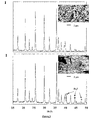
- the X-ray diffractograms and the S.E.M. photographs of two LiFePO 4 powders coated with 3.6 and 24 % of carbon are given in Figure 1 .
- the photographs are representative for the overall powder.
- the network formed by the coated particles is very well spaced and regular.
- the particles are sufficiently fine (around 1 ⁇ m) to alleviate the penalising displacement length of the interface between LiFePO 4 and FePO 4 , while enough space is left for species to migrate.
- the carbon matrix itself can be observed.
- the carbon network surrounds the LiFePO 4 particles whose size is even smaller than in the former case.
- the LiFePO 4 phase appears to be pure when 3.6 % of carbon is coated. When 24 % is coated, some LiFePO 4 is reduced to Fe 2 P after 10 h at 700 °C. This demonstrates that the higher the carbon percentage, the more efficient the reduction.
- Figure 3 illustrates the stability of the LiFePO 4 composite produced according to the invention using 3.6 % of coated carbon. This material was cycled at C / 5 at 25 and at 55 °C. The resulting specific capacity is superior to that obtained with uncoated material prepared according to the prior art solution route and ball-milled with 17 % of conductive carbon. If we compare the specific capacities of the total electrodes, the superiority of the invented process becomes even more apparent thanks to the much lower amount of total carbon.
- LiFePO 4 composite obtained by the process according to the invention with 3.6 and 24 % of coated carbon
- commercial LiCoO 2 commercial LiCoO 2 .
- the 3.6 % carbon-coated LiFePO 4 performs better than any other at low discharge rates. At higher rates, it is outperformed by LiCoO 2 (a much more expensive product), and, as expected, by 24 % carbon-coated LiFePO 4 . Indeed, the higher amount of coated carbon tends to improve the high current performance. Whatever the conditions, however, the products which are carbon-coated according to the invention remain superior to the prior art product.
Landscapes
- Chemical & Material Sciences (AREA)
- Chemical Kinetics & Catalysis (AREA)
- Electrochemistry (AREA)
- General Chemical & Material Sciences (AREA)
- Engineering & Computer Science (AREA)
- Organic Chemistry (AREA)
- Inorganic Chemistry (AREA)
- Manufacturing & Machinery (AREA)
- Materials Engineering (AREA)
- Composite Materials (AREA)
- General Physics & Mathematics (AREA)
- Condensed Matter Physics & Semiconductors (AREA)
- Physics & Mathematics (AREA)
- Crystallography & Structural Chemistry (AREA)
- Battery Electrode And Active Subsutance (AREA)
- Carbon And Carbon Compounds (AREA)
- Glanulating (AREA)
- Secondary Cells (AREA)
- Pharmaceuticals Containing Other Organic And Inorganic Compounds (AREA)
- Medicinal Preparation (AREA)
Abstract
Description
- The present invention relates to the field of rechargeable lithium batteries and to positive electrode materials operating at voltages greater than 2.8 V vs. Li+ Li in non-aqueous electrochemical cells. This invention relates in particular to the use of phosphates or sulphates of transition metals as positive electrodes and allows the manufacturing of powdered Li-containing olivine-like and NASICON-like material, with the particles efficiently coated with a controlled amount of conductive carbon.
- Lithium secondary batteries are now widely used in consumer electronics. They benefit from the light weight of Li and from its strong reducing character, thus providing the highest power and energy density among known rechargeable battery systems. Lithium secondary batteries are of various configurations depending on the nature of the electrode materials and of the electrolyte used. The commercialised Li-ion system, for instance, uses LiCoO2 and Carbon graphite as positive and negative electrodes, respectively with LiPF6 in EC/DEC/PC as a liquid electrolyte. The operating voltage of the battery is related to the difference between thermodynamic free energies within the negative and positive electrodes. Solid oxidants are therefore required at the positive electrode, the materials of choice, up to now, being either the layered LiMO2 oxides (with M is Co or Ni) or the 3-dimensional spinel structure of Li[Mn2]O4. Extraction of Li from each of these three oxides gives access to M4+/ M3+ redox couples located between 3.5 to 5 V vs. Li+/ Li.
- Three-dimensional framework structures using (XO4)n- polyanions have been proposed recently (
US 5,910,382 ) as viable alternatives to the LiMxOy oxides. LiFePO4 and Li3Fe2(PO4)3 in particular are the most promising Fe-containing materials that can work at attractive potentials vs. Li+/ Li (3.5 V and 2.8 V respectively). Both compounds operate on the Fe3+ / Fe2+ redox couple which take advantage from the inductive effect of the XO4 n- groups that diminishes the strength of the Fe-O bond compared to a simple oxide. - Pioneering work by Padhi (Padhi et al., J. Elec. Soc. 144(4)) demonstrated the reversible extraction of Li from the olivine-structured LiFePO4 prepared by solid state reaction at 800 °C under Ar atmosphere, starting from Li2CO3 or LiOH.H2O, Fe(CH3COO)2 and NH4H2PO4.H2O. Unfortunately, probably due to kinetic limitations of the displacement of the LiFePO4/ FePO4 interface, only 60-70 % of the theoretical capacity of 170 mAh / g of active material, was achieved, whatever the charge or discharge rate applied. Indeed, the use of high synthesis temperatures leads to the formation of large particles in which ionic and electronic conductivity is the limiting factor. Several research groups recently reported improvements in the effective reversible capacity of LiFePO4 by decreasing the particle size. This can be done by using highly reactive FeII precursors (
JP 2000-294238 A2 WO 02 / 27824 A1 - The poor electronic conductivity of the product can be improved by coating the particles with conductive carbon. This has been done by ball milling LiFePO4 and carbon (Huang et al., Electrochem. Solid-State Lett., 4, A170 (2001)) or by adding a carbon containing compound to already made LiFePO4 and proceeding to a subsequent calcination at about 700 °C (
CA 2,270,771 ). Carbon, and preferably amorphous carbon, can also be introduced in the LiFePO4 synthesis process, being mixed with the solid synthesis precursors before calcination (EP 1184920 A2 ). - The main problems that may jeopardise the effective use in a positive electrode for Li batteries of Li-containing olivine or NASICON powders such as LiFePO4 or other components mentioned by Goodenough et al. in
US5,910,382 , arises from their low electronic conductivity and from the fact that both end-members of the de-intercalation process (e.g. LiFePO4 and FePO4) are poor ionic conductors. - As described above, adding carbon, thereby coating the particles with a conductive layer, alleviates the electronic conductivity problem. However, high amounts of carbon are needed. Whereas carbon does not participate in the redox reactions useful for the operation of the battery, a strong penalty for the overall specific capacity of the composite positive electrode is paid. This is illustrated in
JP 2000-294238 A2 - The ionic conduction problem can be solved by producing very fine-grained particles. Using a solution route synthesis has been found to be advantageous compared to the classic solid synthesis route. This solution route has been described in
EP1261050 . This route provides for a very finely divided, homogeneous precursor which needs only moderate conditions of temperature and time to react to the desired crystalline structures. Thanks to the moderate conditions, grain growth, leading to unwanted coarse particles, is avoided. After synthesis, such a powder has to be ball-milled with a relatively large quantity of conductive carbon, typically amounting to 17 wt.%. - This invention provides for an improved solution route, ensuring the production of fine grained particles efficiently covered with a conductive carbon layer. Compared to prior art powders, the obtained powders deliver exceptional performances when used in Li-ion batteries. The invention provides for a powder that needs much less total carbon in the electrode for a similar electrode capacity and discharge rate. Similarly, the invention provides for a powder that provides higher capacity and discharge rate when using the same amount of total carbon in the electrode.
- A new process is presented for preparing a carbon-coated Li-containing olivine or NASICON powder, comprising the steps of
- preparing a water-based solution comprising, as solutes, one or more Li-containing olivine or NASICON precursor compounds and one or more carbon-bearing monomer compounds,
- precipitating a Li-containing olivine or NASICON precursor compounds and polymerising the monomer compounds in a single step,
- heat treating the obtained precipitate in a neutral or reducing environment so as to form a Li-containing olivine or NASICON crystalline phase and decompose the polymer carbon.
- The process is specially suitable for the preparation of LiuMv(XO4)w with u = 1, 2 or 3, v = 1 or 2, w = 1 or 3, M is TiaVbCrcMndFeeCofNigSchNbi with a+b+c+d+e+f+g+h+i = 1 and X is Px-1Sx with 0 ≤ x ≤ 1.
- It is clear that the individual 'a' to 'i' parameters have values going from 0 to 1. Obviously, their particular values should allow for electroneutrality of the crystalline phase when combined with a proper set 'u', 'v' and 'w' parameters. Examples are: LiMPO4 such as in LiFePO4, LiNiPO4, LiMnPO4; LiM2(PO4)3 such as in LiTi2(PO4)3, LiFeNb(PO4)3; LbM2(PO4)3 such as in Li2FeTi(PO4)3; Li3M2(PO4)3 such as in Li3Ti2(PO4)3, Li3Sc2(PO4)3, Li3Cr2(PO4)3, Li3In2(PO4)3, Li3Fe2(PO4)3, Li3FeV(PO4)3.
- The invented process is especially suitable for the preparation of coated LiFePO4.
- The precipitation of Li-containing olivine or NASICON precursor compounds and the polymerisation of the monomers can be performed by evaporating water from the water-based solution. The carbon-bearing monomer compounds can be a polyhydric alcohol and a polycarboxylic acid, such as, respectively, ethylene glycol and citric acid.
- When the synthesis of coated LiFePO4, is envisaged, equimolar amounts of Li, Fe and phosphate, such as LiH2PO4 and Fe(NO3)3, are dissolved in water together with a polyhydric alcohol and a polycarboxylic acid, the water is then evaporated at a temperature between 60 and 100°C, and a heat-treatment is performed at a temperature between 600 and 800 °C, preferably between 650 and 750 °C.
- The object of the invention also concerns a carbon-coated LiFePO4 powder for use in Li insertion-type electrodes, as disclosed in claim 9.
- Other objects of the invention are: an electrode mix containing the above-mentioned carbon-coated LiFePO4 and batteries containing the latter electrode mix.
- For a proper understanding of the invention as described herein, the following definitions are to be considered.
- A "Li-containing olivine or NASICON precursor compound" is to be understood as a metal-bearing compound such as a salt, oxide or hydroxide of one ore more metals susceptible to be converted to, or to react to, the desired final compound. Typically, the conversion or reaction is performed by applying a thermal treatment.
- A "carbon-bearing monomer compound" is to be understood as an organic compound susceptible to polymerise with itself (to form a homopolymer) or together with other monomers (to form a copolymer).
- A "reducing environment" can be obtained by using a reducing gas, or by relying on reducing properties of solids, such as carbon, present in the bulk of the material.
- The "electrode capacity expressed as a fraction of the theoretical capacity" is the ratio of the capacity of the active product contained in the electrode, to the theoretical capacity of the active product. For FeLiPO4, a specific theoretical capacity of 170 mA / g is assumed.
- When the charge or discharge rate is expressed as C / x, this means that one Li per LiFePO4 is exchanged in 'x' hour.
- The general principle of the invention can be applied whenever a high quality carbon coating is needed on a metal-bearing powder. Olivine and NASICON phases, when used in rechargeable Li-ion batteries, are known to be rather poor electronic conductors. As such, they particularly benefit from a carbon coating which is rendered conductive by a suitable heat treatment.
- It is assumed that the metal bearing precursors, such as Li, metal and phosphate or sulphate ions, are trapped homogeneously on the atomic scale throughout the chelating polymer matrix. Such a structure eliminates the needs for long range diffusion during the subsequent formation of the crystalline phase. Therefore, at relatively low temperature, the precursors can form a homogeneous single phase of precise stoichiometry, intimately coated by a conductive carbonaceous network.
- Solvent evaporation conducting to an homogeneous mix of solid precursor compounds and the polymerisation of the monomers are performed in one single step. This requires the polymerisation to occur simultaneously with the solidification of at least part of the precursor.
- Different means can be employed to form the homogeneous mix of precursor (e.g. change in pH, temperature) and to trigger the polymerisation (e.g. addition of catalyst, UV). However, when the polymerisation reaction produces water as a condensate, both the precipitation of the precursor and the polymerisation are triggered by identical means, i.e. by removal of water from the reaction vessel. This results in a particularly simple and efficient process.
- It has been found that the presence of heteroatoms (i.e. atoms other than C, O and H) in the monomers may degrade the performance of the obtained carbon coating, in particular its electrical conductivity. It is therefore preferred to use monomer compounds containing only C, O and H atoms.
- When the production of LiFePO4 is envisaged, the Fe source in the precursor compound can be FeII or FeIII: the reducing conditions needed to avoid the burning of the carbon coating during the step of heat treatment ensures the conversion of any FeIII to the required FeII state.
- The preferred water evaporation temperature range is 60 to 100 °C. This ensures that the precipitation of the precursor compound and the polymerisation reaction occur at least partly simultaneously.
- The conductivity of the carbon residue is enhanced when the heat treatment is performed at 600 °C or higher. However, a temperature of more than 800 °C may degrade the quality of the product because of grain-growth or because of excessive reduction by carbon. A heath treatment at 650 to 750°C is preferred.
- The positive electrode of the electrochemical cell is made of optimised LiFePO4 particles intimately mixed with an electronically conducting carbon species made as described below. The active material / coated-carbon ratio can be adjust in the synthesis of LiFePO4 between 1 and 25 wt.% of carbon. It is preferred to minimise the relative amount of carbon, whether present as coating material or as carbon added during the manufacture of the electrode. Indeed, carbon does not participate in the redox reactions and therefore represents inert mass reducing the specific capacity of the electrode. Nevertheless, it is desired to have at least 2 wt.% of coated carbon to exploit the invention fully.
- The invention is illustrated by the preparation of optimised LiMPO4 particles, coated with (electronic) conductive carbon through low-temperature chemical routes.
- For the preparation of a LiFePO4/ C composite, an aqueous solution containing Fe, Li and phosphate is prepared using e.g. Fe(NO3)3.9H2O and LiH2PO4. The solution is added under stirring in air to an aqueous solution of citric acid. Ethylene glycol is then added to the solution for an ethylene glycol / citric acid molar ratio of 1 / 1. The precursor to carbon ratio in the solution will determine the relative amount of carbon in the coating. Key to this process are the fact that both the LiFePO4 precursors and the monomers are to be water-soluble.
- In a second step, the water is slowly evaporated at 80 °C under air. When nearly dry, the solution turns to a gel due to the polymerisation between citric acid and ethylene glycol. The gel is dried by maintaining it at 80 °C. A very homogeneous mixture, containing Li, Fe and phosphate in the stoichiometric proportions of LiFePO4 together with the carbon bearing polymer, is then produced. Advantageously, monomers are chosen which have a lower partial pressure than water at the drying temperature. Premature evaporation of the monomers is thus avoided.
- In a third step, the homogeneous mixture is progressively heat-treated under a reducing atmosphere (N2/ / H2, 10 % H2) to yield, at a temperature of about 500 °C, a crystalline LiFePO4 phase coated with a controlled amounts coated carbon. However, at 500 °C, the coated carbon is partly insulating. A treatment between 600 °C and 800 °C is thus preferred as it yields conductive carbon. Thanks to the presence of carbon, the surrounding environment of LiFePO4 is strongly reducing. This is useful to reduce remaining traces of FeIII precursors to FeII, but can lead to unwanted results when the percentage of carbon is high. Indeed, high carbon contents (more than 15 %) combined with prolonged treatment (more than 5 hours) at 700 to 800 °C partly reduces FeII in LiFePO4 to Fe0. This leads to the formation of impurities such as Fe2P. As determined by electrochemical titration, the obtained optimised powder may still contain a small amount of FeIII (less than 3 M%), an amount which is in fact inferior to that obtained in the synthesis of pure LiFePO4 without carbon. The result of the heat treatment can easily be monitored and optimised by e.g. X-ray diffraction or by Mossbauer spectroscopy, to ensure that FeIII is nearly completely reduced to FeII and that no significant amount of FeII is reduced to Fe0.
- The invention is illustrated by the following examples. Four LiFePO4 / C composites were produced according to the process described above. Aqueous solutions containing 0.4 M / 1Fe, Li and phosphate and 0.1 to 1 M / l ethylene glycol and citric acid were prepared using Fe(NO3)3.9H2O and LiH2PO4. The solutions were dried for 12 h at 80 °C. The dry residues were then heat treated for 10 h at 700 °C under a N2/ H2 atmosphere with 10 % H2.
- The results, presented in Table 1, show the influence of the monomer concentrations in the solution on the amount of carbon coated on the LiFePO4 particles. The apparent loss of carbon, which is rather high compared to the theoretical amount expected, comes probably from the reduction of FeIII to FeII during the heat treatment. The polymerisation needs not be complete.
Table 1: Theoretical vs. observed amount of carbon in the coating as a function of the monomer concentration in the solute (for 0.1 M / l of Fe, Li and phosphate in the solute) Citric acid (M / 1) Ethylene glycol (M / 1) Theoretical C (wt.%) Observed C (wt.%) 0.1 0.1 13.2 0.33 0.2 0.2 23.3 3.6 0.4 0.4 37.8 8.6 1 1 60.3 24 -
Figures 1 to 5 illustrate the invention. -
Fig. 1 : X-ray diffractograms (CuKα) and the S.E.M. photographs of two LiFePO4 powders coated with 3.6 (top) and 24 % (bottom) carbon -
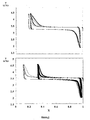
Fig. 2 : Electrochemical response of a Li / LiPF6 EC:DMC / LiFePO4 electrochemical cell (swagelok type) cycled at C / 5 and 25 °C, using LiFePO4 with 3.6 (top) and 24 % (bottom) of coated carbon -
Fig. 3 : Results obtained with Li / LiPF6 EC : DMC / LiFePO4 electrochemical coin cells embedded in a plastic film. LiFePO4 with 3.6 % of coated carbon cycled at C / 5 and 25 °C (A) or 55 °C (B); LiFePO4 prepared according to the prior art solution route and ball-milled with 17 % of conductive carbon cycled at C / 10 and 55 °C (C) -
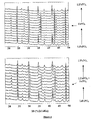
Fig. 4 : In situ XRD patterns of LiFePO4 in a Li / LiPF6 EC : DMC / LiFePO4 electrochemical cell cycled at C / 5 and 25 °C; LiFePO4 prepared according to the invention (top) and according to the prior art solution route and ball-milled with 17 % of conductive carbon (bottom) -
Fig. 5 : Evolution of the specific active material capacity achieved in a Li / LiPF6 EC : DMC / LiFePO4 prepared according to the invention with 3.6 (B) and 24 % (C) of coated carbon; LiFePO4 prepared according to the prior the art solution route and ball-milled with 17 % of conductive carbon (D); commercial LiCoO2 are shown for comparison (A) -
Figures 1 to 5 are now discussed in more details. The X-ray diffractograms and the S.E.M. photographs of two LiFePO4 powders coated with 3.6 and 24 % of carbon are given inFigure 1 . The photographs are representative for the overall powder. For LiFePO4 with 3.6 % of coated carbon, the network formed by the coated particles is very well spaced and regular. The particles are sufficiently fine (around 1 µm) to alleviate the penalising displacement length of the interface between LiFePO4 and FePO4, while enough space is left for species to migrate. For 24 % of coated carbon, the carbon matrix itself can be observed. The carbon network surrounds the LiFePO4 particles whose size is even smaller than in the former case. The LiFePO4 phase appears to be pure when 3.6 % of carbon is coated. When 24 % is coated, some LiFePO4 is reduced to Fe2P after 10 h at 700 °C. This demonstrates that the higher the carbon percentage, the more efficient the reduction. - These powders give the electrochemical response shown in
Figure 2 . The electrochemical cells were built in Swagelok configuration with Li metal pasted on a Ni foil as the negative electrode, and LiPF6 in EC : DMC as the electrolyte. The positive electrode is the powder obtained directly from the described process. The signature ofFigure 2 (voltage as a function of x in LixFePO4) was obtained at 25 °C for an equivalent charge / discharge rate of C / 5, i.e. 1 Li extracted or inserted in 5 h. - About 85 % of the theoretical capacity of the active material can be achieved when using 24 % of coated carbon. The performance of the total electrode is however rather penalised by the large quantity of carbon. The amount of carbon can be dramatically decreased. When using 3.6 % of coated carbon, 78 % of the capacity is still achieved. In each case, the irreversible capacity at first cycle is very small.
-
Figure 3 illustrates the stability of the LiFePO4 composite produced according to the invention using 3.6 % of coated carbon. This material was cycled at C / 5 at 25 and at 55 °C. The resulting specific capacity is superior to that obtained with uncoated material prepared according to the prior art solution route and ball-milled with 17 % of conductive carbon. If we compare the specific capacities of the total electrodes, the superiority of the invented process becomes even more apparent thanks to the much lower amount of total carbon. - In
Figure 4 , in situ X-ray diffraction patterns are shown for a full charge / discharge cycle. With the powder coated according to the invention, at the end of the charge cycle, all the diffraction peaks of LiFePO4 disappear at the benefit of triphylite-FePO4 peaks. The biphasic phenomenon is thus complete. However, with powder prepared according to the prior art solution route, this is not the case. - In
Figure 5 , the specific capacity of several active materials is reported in function of the cycling rate. Materials tested are: LiFePO4 composite obtained by the process according to the invention with 3.6 and 24 % of coated carbon, LiFePO4 prepared according to the prior art solution route and ball-milled with 17 % of conductive carbon, and commercial LiCoO2. The 3.6 % carbon-coated LiFePO4 performs better than any other at low discharge rates. At higher rates, it is outperformed by LiCoO2 (a much more expensive product), and, as expected, by 24 % carbon-coated LiFePO4. Indeed, the higher amount of coated carbon tends to improve the high current performance. Whatever the conditions, however, the products which are carbon-coated according to the invention remain superior to the prior art product.
Claims (11)
- Process for preparing a carbon-coated, Li-containing olivine or NASICON powder, comprising the steps of- preparing a water-based solution comprising, as solutes, one or more Li-containing olivine or NASICON precursor compounds and one or more carbon-bearing monomer compounds,- precipitating the Li-containing olivine or NASICON precursor compounds and polymerising the monomer compounds in a single step- heat treating the obtained precipitate in a neutral or reducing environment so as to form a Li-containing olivine or NASICON crystalline phase and decompose the polymer to carbon.
- Process according to claim 1, whereby the crystalline phase is LiuMv(XO4)w with u = 1, 2 or 3, v = 1 or 2, w = 1 or 3, M is TiaVbCrcMndFeeCofNigSchNbi with a+b+c+d+e+f+g+h+i = 1 and X is Px-1Sx with 0 ≤ x ≤ 1
- Process according to claim 2, whereby the crystalline phase is LiFePO4
- Process according to claim 1, whereby the precipitation of Li-containing olivine or NASICON compounds and the polymerisation of the monomers is performed by evaporating water from the water-based solution
- Process according to claim 4, whereby the carbon-bearing monomer compounds are a polyhydric alcohol and a polycarboxylic acid
- Process according to claim 5, whereby the polyhydric alcohol is ethylene glycol and the polycarboxylic acid is citric acid
- Process for the production of carbon-coated LiFePO4 according to claim 5, whereby- the water-based solution contains equimolar amounts of Li, Fe and phosphate,- the evaporation of water from the solution is performed at a temperature between 60 and 100 °C,- the heat-treatment is performed at a temperature between 600 and 800 °C, preferably between 650 and 750 °C
- Process according to claim 7 whereby the water-based solution is prepared using LiH2PO4 and Fe(NO3)3.aq
- A carbon-coated LiFePO4 powder for use in Li insertion-type electrodes, characterised by a reversible electrode capacity expressed as a fraction of the theoretical capacity and a total carbon content of
at least 75 % capacity and less than 4 wt.% carbon, or,
at least 80 % capacity and less than 8 wt.% carbon;
the capacity being determined when the carbon-coated LiFePO4 powder is used as an active component in a cathode cycled between 2.0 and 4.5 V against a Li anode at a discharge rate of C/5 at 25 °C. - Electrode mix containing carbon-coated LiFePO4 according to claim 9
- A battery containing an electrode mix according to claims 10
Priority Applications (1)
| Application Number | Priority Date | Filing Date | Title |
|---|---|---|---|
| EP03760688A EP1518284B1 (en) | 2002-06-21 | 2003-06-19 | Carbon-coated li-containing powders and process for production thereof |
Applications Claiming Priority (6)
| Application Number | Priority Date | Filing Date | Title |
|---|---|---|---|
| EP02291562 | 2002-06-21 | ||
| EP02291562 | 2002-06-21 | ||
| US39297802P | 2002-07-02 | 2002-07-02 | |
| US392978P | 2002-07-02 | ||
| PCT/EP2003/006628 WO2004001881A2 (en) | 2002-06-21 | 2003-06-19 | Carbon-coated li-containing powders and process for production thereof |
| EP03760688A EP1518284B1 (en) | 2002-06-21 | 2003-06-19 | Carbon-coated li-containing powders and process for production thereof |
Publications (2)
| Publication Number | Publication Date |
|---|---|
| EP1518284A2 EP1518284A2 (en) | 2005-03-30 |
| EP1518284B1 true EP1518284B1 (en) | 2010-08-25 |
Family
ID=37275171
Family Applications (1)
| Application Number | Title | Priority Date | Filing Date |
|---|---|---|---|
| EP03760688A Expired - Lifetime EP1518284B1 (en) | 2002-06-21 | 2003-06-19 | Carbon-coated li-containing powders and process for production thereof |
Country Status (10)
| Country | Link |
|---|---|
| US (3) | US7618747B2 (en) |
| EP (1) | EP1518284B1 (en) |
| JP (1) | JP4654686B2 (en) |
| KR (5) | KR20120123585A (en) |
| CN (1) | CN100379062C (en) |
| AT (1) | ATE479207T1 (en) |
| AU (1) | AU2003250847A1 (en) |
| CA (1) | CA2490091C (en) |
| DE (1) | DE60333921D1 (en) |
| WO (1) | WO2004001881A2 (en) |
Families Citing this family (87)
| Publication number | Priority date | Publication date | Assignee | Title |
|---|---|---|---|---|
| CA2270771A1 (en) * | 1999-04-30 | 2000-10-30 | Hydro-Quebec | New electrode materials with high surface conductivity |
| ZA200307530B (en) * | 2002-10-28 | 2004-07-01 | Weir Envirotech Pty Ltd | Liquid flinger for a pump. |
| DE602004007154T2 (en) * | 2003-09-29 | 2008-02-21 | Umicore | METHOD AND DEVICE FOR OBTAINING NON-STEEL METALS FROM ZINC RESIDUES |
| US7008726B2 (en) | 2004-01-22 | 2006-03-07 | Valence Technology, Inc. | Secondary battery electrode active materials and methods for making the same |
| FR2865576B1 (en) * | 2004-01-28 | 2006-04-28 | Commissariat Energie Atomique | PROCESS FOR THE PREPARATION OF COMPOSITE MATERIALS COMPRISING AN ELECTRODE ACTIVE COMPOUND AND AN ELECTRONIC CONDUCTING COMPOUND SUCH AS CARBON PARTICULARLY FOR LITHIUM ACCUMULATORS |
| US7348101B2 (en) * | 2004-02-06 | 2008-03-25 | A123 Systems, Inc. | Lithium secondary cell with high charge and discharge rate capability |
| US8617745B2 (en) | 2004-02-06 | 2013-12-31 | A123 Systems Llc | Lithium secondary cell with high charge and discharge rate capability and low impedance growth |
| CN100440593C (en) * | 2004-09-24 | 2008-12-03 | 中国电子科技集团公司第十八研究所 | A kind of manufacturing method of lithium iron phosphate material for lithium ion battery |
| CN100399608C (en) * | 2005-06-28 | 2008-07-02 | 中国科学院物理研究所 | A kind of olivine carbon pompom composite material and its application |
| US9954227B2 (en) * | 2005-06-29 | 2018-04-24 | Umicore | Crystalline nanometric LiFePO4 |
| JP5098146B2 (en) * | 2005-10-14 | 2012-12-12 | 株式会社Gsユアサ | Method for producing positive electrode material for non-aqueous electrolyte secondary battery and non-aqueous electrolyte secondary battery comprising the same |
| KR20070096063A (en) * | 2005-11-21 | 2007-10-02 | 김재국 | Electrode material using polyol process and its synthesis method |
| CN100420076C (en) * | 2005-12-19 | 2008-09-17 | 南开大学 | Sol-gel method for synthesizing lithium ion battery anode material lithium vanadium phosphate |
| KR101334050B1 (en) * | 2006-02-14 | 2013-12-05 | 토요타 찌도샤 카부시끼카이샤 | Lithium Manganese Phosphate Positive Material for Lithium Secondary Battery |
| FR2898885B1 (en) * | 2006-03-27 | 2008-05-30 | Commissariat Energie Atomique | COMPOUND BASED ON TITANIUM AND CARBON DISPHOSPHATE, PROCESS FOR THE PREPARATION AND USE AS ACTIVE MATERIAL OF ELECTRODE FOR LITHIUM ACCUMULATOR |
| KR101331457B1 (en) | 2006-04-06 | 2013-11-21 | 토요타 찌도샤 카부시끼카이샤 | Synthesis Of Nano-particles of Lithium Metal Phosphate Positive Material for Lithium Secondary Battery |
| EP1843426A1 (en) | 2006-04-07 | 2007-10-10 | High Power Lithium S.A. | Lithium rechargeable electrochemical cell |
| US20090176162A1 (en) | 2006-04-07 | 2009-07-09 | Ivan Exnar | Lithium rechargeable electrochemical cell |
| CN100563047C (en) * | 2006-04-25 | 2009-11-25 | 立凯电能科技股份有限公司 | Composite material suitable for manufacturing anode of secondary battery and battery manufactured by composite material |
| KR100940979B1 (en) * | 2006-05-08 | 2010-02-05 | 주식회사 엘지화학 | Manufacturing Method of LIFFFEP04 |
| EP1901388A1 (en) | 2006-09-14 | 2008-03-19 | High Power Lithium S.A. | Overcharge and overdischarge protection in lithium-ion batteries |
| CN100491239C (en) * | 2006-11-24 | 2009-05-27 | 横店集团东磁股份有限公司 | Preparation method of lithium iron phosphate as lithium ion battery anode material and product thereof |
| CA2569991A1 (en) | 2006-12-07 | 2008-06-07 | Michel Gauthier | C-treated nanoparticles and agglomerate and composite thereof as transition metal polyanion cathode materials and process for making |
| EP2032504B1 (en) | 2006-12-22 | 2012-08-01 | Umicore | SYNTHESIS OF ELECTROACTIVE CRYSTALLINE NANOMETRIC LiMnPO4 POWDER |
| EP2094605B1 (en) | 2006-12-22 | 2012-09-05 | Umicore | SYNTHESIS OF CRYSTALLINE NANOMETRIC LiFeMPO4 |
| CN101610977B (en) * | 2006-12-22 | 2012-12-19 | 尤米科尔公司 | Synthesis of Electroactive Crystalline Nano LiMnPO4 Powder |
| US8771877B2 (en) * | 2006-12-28 | 2014-07-08 | Gs Yuasa International Ltd. | Positive electrode material for nonaqueous electrolyte secondary battery, nonaqueous electrolyte secondary battery including the same, and method for producing the same |
| US7824802B2 (en) * | 2007-01-17 | 2010-11-02 | The United States Of America As Represented By The Secretary Of The Army | Method of preparing a composite cathode active material for rechargeable electrochemical cell |
| TWI481100B (en) * | 2007-01-18 | 2015-04-11 | Lg Chemical Ltd | Cathode active material and secondary battery comprising the same |
| CN101578724A (en) * | 2007-01-24 | 2009-11-11 | 株式会社Lg化学 | Battery with improved safety |
| EP1968141A1 (en) * | 2007-02-24 | 2008-09-10 | Ngk Insulators, Ltd. | Secondary battery |
| JP5293926B2 (en) * | 2007-02-24 | 2013-09-18 | 国立大学法人九州大学 | Secondary battery |
| KR101502184B1 (en) * | 2007-03-19 | 2015-03-12 | 유미코르 | Single-phase single-phase Li insertion / extraction substance for use in Li-based batteries |
| JP5211527B2 (en) * | 2007-03-29 | 2013-06-12 | Tdk株式会社 | All-solid lithium ion secondary battery and method for producing the same |
| JP5157216B2 (en) * | 2007-03-29 | 2013-03-06 | Tdk株式会社 | Method for producing active material and active material |
| JP5211526B2 (en) | 2007-03-29 | 2013-06-12 | Tdk株式会社 | All-solid lithium ion secondary battery and method for producing the same |
| KR100821832B1 (en) * | 2007-04-20 | 2008-04-14 | 정성윤 | Method for preparing nanoparticle powder of lithium transition metal phosphate |
| US8480987B2 (en) * | 2007-04-20 | 2013-07-09 | Sung Yoon Chung | Method of preparing nanoparticles of lithium transition metal phosphates, lithium transition metal phosphates, and method of preparing the same |
| KR100834054B1 (en) * | 2007-05-11 | 2008-06-02 | 한양대학교 산학협력단 | Olivine-type positive electrode active material for lithium batteries, a manufacturing method thereof, and a lithium battery comprising the same |
| US20080303004A1 (en) * | 2007-06-08 | 2008-12-11 | Conocophillips Company | Method for producing lithium transition metal polyanion powders for batteries |
| EP2015382A1 (en) * | 2007-07-13 | 2009-01-14 | High Power Lithium S.A. | Carbon coated lithium manganese phosphate cathode material |
| EP2098483A1 (en) | 2008-03-05 | 2009-09-09 | High Power Lithium S.A. | Synthesis of lithium metal phosphate/carbon nanocomposites with phytic acid |
| JP2010034006A (en) * | 2008-07-31 | 2010-02-12 | Idemitsu Kosan Co Ltd | Solid lithium battery |
| JP5196555B2 (en) * | 2008-08-06 | 2013-05-15 | 独立行政法人産業技術総合研究所 | Method for producing electrode material precursor and method for producing electrode material using the obtained electrode material precursor |
| JP5574143B2 (en) * | 2009-02-18 | 2014-08-20 | トヨタ自動車株式会社 | Method for producing positive electrode active material |
| JP5396942B2 (en) * | 2009-03-16 | 2014-01-22 | Tdk株式会社 | Manufacturing method of active material, active material, electrode using the active material, and lithium ion secondary battery including the electrode |
| CN102422467B (en) * | 2009-05-04 | 2014-09-10 | 觅科科技公司 | Electrode active composite material and preparation method thereof |
| JP5131246B2 (en) * | 2009-05-26 | 2013-01-30 | Tdk株式会社 | Composite particles for electrodes and electrochemical devices |
| CN101635352A (en) * | 2009-07-20 | 2010-01-27 | 万向电动汽车有限公司 | Method for preparing anode material of carbon-coated lithium ion battery |
| JP5382474B2 (en) * | 2009-07-31 | 2014-01-08 | トヨタ自動車株式会社 | Positive electrode active material and manufacturing method thereof |
| EP2461399A4 (en) * | 2009-07-31 | 2014-07-30 | Toda Kogyo Corp | ACTIVE MATERIAL FOR POSITIVE NON-AQUEOUS ELECTROLYTE SECONDARY BATTERY ELECTRODE AND NONAQUEOUS ELECTROLYTE SECONDARY BATTERY |
| US20130017447A1 (en) | 2009-09-24 | 2013-01-17 | Tessier Cecile | Positive Electrode Material |
| US9362554B2 (en) | 2009-10-02 | 2016-06-07 | Toyota Jidosha Kabushiki Kaisha | Method of manufacturing a positive electrode with a condensation reaction initiated by heating and reduced pressure |
| CN102549812B (en) | 2009-10-02 | 2016-05-18 | 丰田自动车株式会社 | Lithium secondary battery and this positive electrode for battery |
| WO2011091521A1 (en) * | 2010-01-28 | 2011-08-04 | Phostech Lithium Inc. | Method for reducing activation of lithium secondary battery and lithium secondary battery having reduced activation |
| JP5651377B2 (en) * | 2010-06-02 | 2015-01-14 | シャープ株式会社 | Method for producing lithium-containing composite oxide |
| JP5695842B2 (en) * | 2010-06-02 | 2015-04-08 | シャープ株式会社 | Method for producing lithium-containing composite oxide |
| EP2603946A4 (en) * | 2010-08-12 | 2016-12-07 | Res Inst Ind Science & Tech | METHOD FOR PREPARING OLIVINE CATHODE MATERIALS FOR LITHIUM SECONDARY BATTERY. |
| CN101964411B (en) * | 2010-08-25 | 2013-02-20 | 宁波金和新材料股份有限公司 | LiFePO4 composite type positive pole material preparation method |
| KR101173868B1 (en) | 2010-12-03 | 2012-08-14 | 삼성에스디아이 주식회사 | Positive active material for rechargeable lithium battery and rechargeable lithium battery |
| US20120212941A1 (en) * | 2011-02-22 | 2012-08-23 | Jomar Reschreiter | Cordless, portable, rechargeable food heating lamp |
| US20120225354A1 (en) * | 2011-03-02 | 2012-09-06 | Samsung Sdi Co., Ltd. | Positive electrode active material for lithium secondary battery, method of preparing same and lithium secondary battery including same |
| JP6122841B2 (en) * | 2011-05-12 | 2017-04-26 | アプライド マテリアルズ インコーポレイテッドApplied Materials,Incorporated | Precursor formulations for battery active material synthesis |
| KR101959096B1 (en) | 2011-06-29 | 2019-03-15 | 닛토덴코 가부시키가이샤 | Nonaqueous electrolyte secondary battery and cathode sheet therefor |
| US20130029227A1 (en) | 2011-07-26 | 2013-01-31 | Toyota Motor Engineering & Manufacturing North America, Inc. | Polyanion active materials and method of forming the same |
| KR101265195B1 (en) * | 2011-07-28 | 2013-05-27 | 삼성에스디아이 주식회사 | Positive electrode for rechargeable lithium battery, method of preparing the same, and rechargeable lithium battery including the same |
| JP2014221690A (en) * | 2011-09-05 | 2014-11-27 | 国立大学法人 東京大学 | Method for producing lithium-containing acid salt compound |
| WO2014144034A1 (en) * | 2013-03-15 | 2014-09-18 | Wildcat Discovery Technologies, Inc. | Cathode for a battery |
| JP6247211B2 (en) * | 2011-09-13 | 2017-12-13 | ワイルドキャット・ディスカバリー・テクノロジーズ・インコーポレイテッドWildcat Discovery Technologies, Inc. | Battery positive electrode |
| US9099735B2 (en) * | 2011-09-13 | 2015-08-04 | Wildcat Discovery Technologies, Inc. | Cathode for a battery |
| JP5862172B2 (en) * | 2011-09-30 | 2016-02-16 | 株式会社Gsユアサ | Secondary battery active material, secondary battery active material electrode, and secondary battery using the same |
| US20130108920A1 (en) | 2011-11-01 | 2013-05-02 | Isalah O. Oladeji | Composite electrodes for lithium ion battery and method of making |
| KR101561374B1 (en) | 2013-01-10 | 2015-10-19 | 주식회사 엘지화학 | Method for preparing lithium iron phosphate nanopowder |
| KR101561378B1 (en) | 2013-01-10 | 2015-10-20 | 주식회사 엘지화학 | Method for preparing lithium iron phospate nanopowder coated with carbon |
| KR101561376B1 (en) | 2013-01-10 | 2015-10-19 | 주식회사 엘지화학 | Method for preparing lithium iron phosphate nanopowder |
| KR101580030B1 (en) * | 2013-07-09 | 2015-12-23 | 주식회사 엘지화학 | Method for manufacturing lithium iron phosphate nanopowder coated with carbon |
| US20160240856A1 (en) * | 2013-10-02 | 2016-08-18 | Umicore | Carbon Coated Electrochemically Active Powder |
| US9577250B2 (en) | 2014-02-11 | 2017-02-21 | Battelle Memorial Institute | Thick electrodes including nanoparticles having electroactive materials and methods of making same |
| US20170331092A1 (en) | 2016-05-13 | 2017-11-16 | Quantumscape Corporation | Solid electrolyte separator bonding agent |
| JP2018088380A (en) * | 2016-11-30 | 2018-06-07 | 国立大学法人九州大学 | Electrode active material for lithium ion secondary battery and lithium ion secondary battery using the same |
| TWI821195B (en) * | 2017-07-19 | 2023-11-11 | 加拿大商納諾萬麥帝瑞爾公司 | Method for synthesizing olivine-type lithium phosphate metal cathode material |
| US12046712B2 (en) | 2018-06-06 | 2024-07-23 | Quantumscape Battery, Inc. | Solid-state battery |
| CN108987687B (en) * | 2018-06-22 | 2021-04-27 | 中南大学 | Low-temperature lithium ion battery graphite negative electrode material and preparation method thereof |
| US11056717B2 (en) | 2019-01-31 | 2021-07-06 | University Of Maryland, College Park | Lithium phosphate derivative compounds as Li super-ionic conductor, solid electrolyte and coating layer for lithium metal battery and lithium-ion battery |
| CN113735090B (en) * | 2021-07-22 | 2023-03-14 | 佛山市德方纳米科技有限公司 | Modified lithium iron phosphate material and preparation method thereof |
| CN117800314B (en) * | 2024-01-03 | 2025-09-19 | 蜂巢能源科技股份有限公司 | Positive electrode composite material, preparation method, battery and electricity utilization device |
| CN119725504B (en) * | 2025-02-27 | 2025-04-29 | 超威电源集团有限公司 | Low temperature carbon coated gamma-MnO2Is prepared from zinc ion battery and water system |
Family Cites Families (11)
| Publication number | Priority date | Publication date | Assignee | Title |
|---|---|---|---|---|
| US3330697A (en) * | 1963-08-26 | 1967-07-11 | Sprague Electric Co | Method of preparing lead and alkaline earth titanates and niobates and coating method using the same to form a capacitor |
| US5910382A (en) * | 1996-04-23 | 1999-06-08 | Board Of Regents, University Of Texas Systems | Cathode materials for secondary (rechargeable) lithium batteries |
| JP3323468B2 (en) * | 1999-02-17 | 2002-09-09 | 三洋化成工業株式会社 | Gelling agent for alkaline batteries and alkaline batteries |
| JP4949543B2 (en) | 1999-04-06 | 2012-06-13 | ソニー株式会社 | Method for synthesizing LiFePO4 and method for producing nonaqueous electrolyte battery |
| CA2270771A1 (en) | 1999-04-30 | 2000-10-30 | Hydro-Quebec | New electrode materials with high surface conductivity |
| JP4151210B2 (en) * | 2000-08-30 | 2008-09-17 | ソニー株式会社 | Positive electrode active material and method for producing the same, non-aqueous electrolyte battery and method for producing the same |
| CA2320661A1 (en) | 2000-09-26 | 2002-03-26 | Hydro-Quebec | New process for synthesizing limpo4 materials with olivine structure |
| JP4742413B2 (en) * | 2000-09-29 | 2011-08-10 | ソニー株式会社 | Method for producing positive electrode active material and method for producing non-aqueous electrolyte battery |
| DE10059280A1 (en) * | 2000-11-29 | 2002-06-20 | Forschungszentrum Juelich Gmbh | Ceramic material and its manufacture |
| DE10117904B4 (en) | 2001-04-10 | 2012-11-15 | Zentrum für Sonnenenergie- und Wasserstoff-Forschung Baden-Württemberg Gemeinnützige Stiftung | Binary, ternary and quaternary lithium iron phosphates, process for their preparation and their use |
| EP1261050A1 (en) * | 2001-05-23 | 2002-11-27 | n.v. Umicore s.a. | Lithium transition-metal phosphate powder for rechargeable batteries |
-
2003
- 2003-06-19 KR KR1020127025123A patent/KR20120123585A/en not_active Ceased
- 2003-06-19 EP EP03760688A patent/EP1518284B1/en not_active Expired - Lifetime
- 2003-06-19 CA CA2490091A patent/CA2490091C/en not_active Expired - Lifetime
- 2003-06-19 KR KR1020137005923A patent/KR20130038952A/en not_active Ceased
- 2003-06-19 WO PCT/EP2003/006628 patent/WO2004001881A2/en not_active Ceased
- 2003-06-19 KR KR1020137034378A patent/KR101452679B1/en not_active Expired - Lifetime
- 2003-06-19 KR KR1020047020756A patent/KR20050094346A/en not_active Ceased
- 2003-06-19 DE DE60333921T patent/DE60333921D1/en not_active Expired - Lifetime
- 2003-06-19 US US10/518,560 patent/US7618747B2/en not_active Expired - Fee Related
- 2003-06-19 JP JP2004530900A patent/JP4654686B2/en not_active Expired - Lifetime
- 2003-06-19 CN CNB038145634A patent/CN100379062C/en not_active Expired - Lifetime
- 2003-06-19 KR KR1020147016846A patent/KR101502294B1/en not_active Expired - Lifetime
- 2003-06-19 AU AU2003250847A patent/AU2003250847A1/en not_active Abandoned
- 2003-06-19 AT AT03760688T patent/ATE479207T1/en not_active IP Right Cessation
-
2008
- 2008-11-14 US US12/270,969 patent/US7923154B2/en not_active Expired - Lifetime
-
2011
- 2011-03-08 US US13/042,653 patent/US8236453B2/en not_active Expired - Fee Related
Also Published As
| Publication number | Publication date |
|---|---|
| ATE479207T1 (en) | 2010-09-15 |
| US20060035150A1 (en) | 2006-02-16 |
| KR101452679B1 (en) | 2014-10-22 |
| US8236453B2 (en) | 2012-08-07 |
| KR20120123585A (en) | 2012-11-08 |
| CA2490091C (en) | 2012-10-30 |
| US20110212365A1 (en) | 2011-09-01 |
| KR20050094346A (en) | 2005-09-27 |
| AU2003250847A8 (en) | 2004-01-06 |
| DE60333921D1 (en) | 2010-10-07 |
| WO2004001881A2 (en) | 2003-12-31 |
| JP2005530676A (en) | 2005-10-13 |
| US7618747B2 (en) | 2009-11-17 |
| KR20140091761A (en) | 2014-07-22 |
| US7923154B2 (en) | 2011-04-12 |
| CN100379062C (en) | 2008-04-02 |
| AU2003250847A1 (en) | 2004-01-06 |
| KR101502294B1 (en) | 2015-03-12 |
| KR20130038952A (en) | 2013-04-18 |
| WO2004001881A3 (en) | 2004-12-29 |
| US20090072203A1 (en) | 2009-03-19 |
| KR20140008466A (en) | 2014-01-21 |
| JP4654686B2 (en) | 2011-03-23 |
| CA2490091A1 (en) | 2003-12-31 |
| EP1518284A2 (en) | 2005-03-30 |
| CN1663064A (en) | 2005-08-31 |
Similar Documents
| Publication | Publication Date | Title |
|---|---|---|
| US7923154B2 (en) | Carbon-coated Li-containing powders and process for production thereof | |
| KR100951516B1 (en) | Lithium Transition-Metal Phosphate Powder for Rechargeable Batteries | |
| CN1833328B (en) | Positive electrode material for secondary battery, process for producing the same and secondary battery | |
| JP5268134B2 (en) | Method for producing positive electrode active material and non-aqueous electrolyte battery using the same | |
| US7457018B2 (en) | Synthesis method for carbon material based on LiMPO4 | |
| JP2007115709A (en) | Manufacturing method of lithium metal-containing material, product, composition and battery | |
| CN101411008A (en) | Compound based on titanium diphosphate and carbon, preparation process, and use as an active material of an electrode for a lithium storage battery | |
| JP4926607B2 (en) | Electrode material manufacturing method, positive electrode material, and battery | |
| JP5765780B2 (en) | Lithium silicate compound, positive electrode active material for lithium ion secondary battery, and lithium ion secondary battery using the same | |
| Lee et al. | Improved Cycle Performance of Sulfur-Doped LiFePO 4 Material at High Temperatures | |
| KR100805910B1 (en) | Olivine-type positive electrode active material for lithium batteries, a manufacturing method thereof, and a lithium battery comprising the same | |
| CN102791624B (en) | For the LiMPO of high-performance lithium cell cathode 4base composition of matter |
Legal Events
| Date | Code | Title | Description |
|---|---|---|---|
| PUAI | Public reference made under article 153(3) epc to a published international application that has entered the european phase |
Free format text: ORIGINAL CODE: 0009012 |
|
| AK | Designated contracting states |
Kind code of ref document: A2 Designated state(s): AT BE BG CH CY CZ DE DK EE ES FI FR GB GR HU IE IT LI LU MC NL PT RO SE SI SK TR |
|
| AX | Request for extension of the european patent |
Extension state: AL LT LV MK |
|
| RIN1 | Information on inventor provided before grant (corrected) |
Inventor name: GWIZDALA, SYLVAIN Inventor name: WURM, CALIN Inventor name: AUDEMER, ALBANE Inventor name: MASQUELIER, CHRISTIAN Inventor name: MORCRETTE, MATHIEU |
|
| RIN1 | Information on inventor provided before grant (corrected) |
Inventor name: GWIZDALA, SYLVAIN Inventor name: WURM, CALIN Inventor name: AUDEMER, ALBANE Inventor name: MASQUELIER, CHRISTIAN Inventor name: MORCRETTE, MATHIEU |
|
| 17P | Request for examination filed |
Effective date: 20050629 |
|
| RBV | Designated contracting states (corrected) |
Designated state(s): AT BE BG CH CY CZ DE DK EE ES FI FR GB GR HU IE IT LI LU MC NL PT RO SE SI SK TR |
|
| DAX | Request for extension of the european patent (deleted) | ||
| 17Q | First examination report despatched |
Effective date: 20081120 |
|
| GRAP | Despatch of communication of intention to grant a patent |
Free format text: ORIGINAL CODE: EPIDOSNIGR1 |
|
| RAP1 | Party data changed (applicant data changed or rights of an application transferred) |
Owner name: LE CENTRE NATIONAL DE LA RECHERCHE SCIENTIFIQUE (C Owner name: UMICORE |
|
| RIN1 | Information on inventor provided before grant (corrected) |
Inventor name: MASQUELIER, CHRISTIAN Inventor name: GWIZDALA, SYLVAIN Inventor name: MORCRETTE, MATHIEU Inventor name: AUDEMER, ALBANE Inventor name: WURM, CALIN |
|
| GRAS | Grant fee paid |
Free format text: ORIGINAL CODE: EPIDOSNIGR3 |
|
| GRAA | (expected) grant |
Free format text: ORIGINAL CODE: 0009210 |
|
| AK | Designated contracting states |
Kind code of ref document: B1 Designated state(s): AT BE BG CH CY CZ DE DK EE ES FI FR GB GR HU IE IT LI LU MC NL PT RO SE SI SK TR |
|
| REG | Reference to a national code |
Ref country code: GB Ref legal event code: FG4D |
|
| REG | Reference to a national code |
Ref country code: CH Ref legal event code: EP |
|
| REG | Reference to a national code |
Ref country code: IE Ref legal event code: FG4D |
|
| REF | Corresponds to: |
Ref document number: 60333921 Country of ref document: DE Date of ref document: 20101007 Kind code of ref document: P |
|
| REG | Reference to a national code |
Ref country code: NL Ref legal event code: VDEP Effective date: 20100825 |
|
| PG25 | Lapsed in a contracting state [announced via postgrant information from national office to epo] |
Ref country code: FI Free format text: LAPSE BECAUSE OF FAILURE TO SUBMIT A TRANSLATION OF THE DESCRIPTION OR TO PAY THE FEE WITHIN THE PRESCRIBED TIME-LIMIT Effective date: 20100825 Ref country code: AT Free format text: LAPSE BECAUSE OF FAILURE TO SUBMIT A TRANSLATION OF THE DESCRIPTION OR TO PAY THE FEE WITHIN THE PRESCRIBED TIME-LIMIT Effective date: 20100825 |
|
| PG25 | Lapsed in a contracting state [announced via postgrant information from national office to epo] |
Ref country code: BG Free format text: LAPSE BECAUSE OF FAILURE TO SUBMIT A TRANSLATION OF THE DESCRIPTION OR TO PAY THE FEE WITHIN THE PRESCRIBED TIME-LIMIT Effective date: 20101125 Ref country code: CY Free format text: LAPSE BECAUSE OF FAILURE TO SUBMIT A TRANSLATION OF THE DESCRIPTION OR TO PAY THE FEE WITHIN THE PRESCRIBED TIME-LIMIT Effective date: 20100825 Ref country code: PT Free format text: LAPSE BECAUSE OF FAILURE TO SUBMIT A TRANSLATION OF THE DESCRIPTION OR TO PAY THE FEE WITHIN THE PRESCRIBED TIME-LIMIT Effective date: 20101227 Ref country code: SI Free format text: LAPSE BECAUSE OF FAILURE TO SUBMIT A TRANSLATION OF THE DESCRIPTION OR TO PAY THE FEE WITHIN THE PRESCRIBED TIME-LIMIT Effective date: 20100825 |
|
| PG25 | Lapsed in a contracting state [announced via postgrant information from national office to epo] |
Ref country code: SE Free format text: LAPSE BECAUSE OF FAILURE TO SUBMIT A TRANSLATION OF THE DESCRIPTION OR TO PAY THE FEE WITHIN THE PRESCRIBED TIME-LIMIT Effective date: 20100825 Ref country code: NL Free format text: LAPSE BECAUSE OF FAILURE TO SUBMIT A TRANSLATION OF THE DESCRIPTION OR TO PAY THE FEE WITHIN THE PRESCRIBED TIME-LIMIT Effective date: 20100825 Ref country code: GR Free format text: LAPSE BECAUSE OF FAILURE TO SUBMIT A TRANSLATION OF THE DESCRIPTION OR TO PAY THE FEE WITHIN THE PRESCRIBED TIME-LIMIT Effective date: 20101126 |
|
| PG25 | Lapsed in a contracting state [announced via postgrant information from national office to epo] |
Ref country code: DK Free format text: LAPSE BECAUSE OF FAILURE TO SUBMIT A TRANSLATION OF THE DESCRIPTION OR TO PAY THE FEE WITHIN THE PRESCRIBED TIME-LIMIT Effective date: 20100825 |
|
| PG25 | Lapsed in a contracting state [announced via postgrant information from national office to epo] |
Ref country code: RO Free format text: LAPSE BECAUSE OF FAILURE TO SUBMIT A TRANSLATION OF THE DESCRIPTION OR TO PAY THE FEE WITHIN THE PRESCRIBED TIME-LIMIT Effective date: 20100825 Ref country code: IT Free format text: LAPSE BECAUSE OF FAILURE TO SUBMIT A TRANSLATION OF THE DESCRIPTION OR TO PAY THE FEE WITHIN THE PRESCRIBED TIME-LIMIT Effective date: 20100825 Ref country code: CZ Free format text: LAPSE BECAUSE OF FAILURE TO SUBMIT A TRANSLATION OF THE DESCRIPTION OR TO PAY THE FEE WITHIN THE PRESCRIBED TIME-LIMIT Effective date: 20100825 Ref country code: EE Free format text: LAPSE BECAUSE OF FAILURE TO SUBMIT A TRANSLATION OF THE DESCRIPTION OR TO PAY THE FEE WITHIN THE PRESCRIBED TIME-LIMIT Effective date: 20100825 Ref country code: SK Free format text: LAPSE BECAUSE OF FAILURE TO SUBMIT A TRANSLATION OF THE DESCRIPTION OR TO PAY THE FEE WITHIN THE PRESCRIBED TIME-LIMIT Effective date: 20100825 |
|
| PLBI | Opposition filed |
Free format text: ORIGINAL CODE: 0009260 |
|
| PLAX | Notice of opposition and request to file observation + time limit sent |
Free format text: ORIGINAL CODE: EPIDOSNOBS2 |
|
| PG25 | Lapsed in a contracting state [announced via postgrant information from national office to epo] |
Ref country code: ES Free format text: LAPSE BECAUSE OF FAILURE TO SUBMIT A TRANSLATION OF THE DESCRIPTION OR TO PAY THE FEE WITHIN THE PRESCRIBED TIME-LIMIT Effective date: 20101206 |
|
| 26 | Opposition filed |
Opponent name: SUED-CHEMIE AG Effective date: 20110525 |
|
| REG | Reference to a national code |
Ref country code: DE Ref legal event code: R026 Ref document number: 60333921 Country of ref document: DE Effective date: 20110525 |
|
| PLAF | Information modified related to communication of a notice of opposition and request to file observations + time limit |
Free format text: ORIGINAL CODE: EPIDOSCOBS2 |
|
| PLBB | Reply of patent proprietor to notice(s) of opposition received |
Free format text: ORIGINAL CODE: EPIDOSNOBS3 |
|
| REG | Reference to a national code |
Ref country code: CH Ref legal event code: PL |
|
| REG | Reference to a national code |
Ref country code: IE Ref legal event code: MM4A |
|
| PG25 | Lapsed in a contracting state [announced via postgrant information from national office to epo] |
Ref country code: CH Free format text: LAPSE BECAUSE OF NON-PAYMENT OF DUE FEES Effective date: 20110630 Ref country code: LI Free format text: LAPSE BECAUSE OF NON-PAYMENT OF DUE FEES Effective date: 20110630 Ref country code: IE Free format text: LAPSE BECAUSE OF NON-PAYMENT OF DUE FEES Effective date: 20110619 |
|
| PG25 | Lapsed in a contracting state [announced via postgrant information from national office to epo] |
Ref country code: MC Free format text: LAPSE BECAUSE OF NON-PAYMENT OF DUE FEES Effective date: 20110630 |
|
| PG25 | Lapsed in a contracting state [announced via postgrant information from national office to epo] |
Ref country code: LU Free format text: LAPSE BECAUSE OF NON-PAYMENT OF DUE FEES Effective date: 20110619 |
|
| PG25 | Lapsed in a contracting state [announced via postgrant information from national office to epo] |
Ref country code: TR Free format text: LAPSE BECAUSE OF FAILURE TO SUBMIT A TRANSLATION OF THE DESCRIPTION OR TO PAY THE FEE WITHIN THE PRESCRIBED TIME-LIMIT Effective date: 20100825 |
|
| PG25 | Lapsed in a contracting state [announced via postgrant information from national office to epo] |
Ref country code: HU Free format text: LAPSE BECAUSE OF FAILURE TO SUBMIT A TRANSLATION OF THE DESCRIPTION OR TO PAY THE FEE WITHIN THE PRESCRIBED TIME-LIMIT Effective date: 20100825 |
|
| PLAB | Opposition data, opponent's data or that of the opponent's representative modified |
Free format text: ORIGINAL CODE: 0009299OPPO |
|
| R26 | Opposition filed (corrected) |
Opponent name: CLARIANT PRODUKTE (DEUTSCHLAND) GMBH Effective date: 20110525 |
|
| PGFP | Annual fee paid to national office [announced via postgrant information from national office to epo] |
Ref country code: GB Payment date: 20140618 Year of fee payment: 12 |
|
| PGFP | Annual fee paid to national office [announced via postgrant information from national office to epo] |
Ref country code: BE Payment date: 20140612 Year of fee payment: 12 |
|
| APAH | Appeal reference modified |
Free format text: ORIGINAL CODE: EPIDOSCREFNO |
|
| APBM | Appeal reference recorded |
Free format text: ORIGINAL CODE: EPIDOSNREFNO |
|
| APBP | Date of receipt of notice of appeal recorded |
Free format text: ORIGINAL CODE: EPIDOSNNOA2O |
|
| APBM | Appeal reference recorded |
Free format text: ORIGINAL CODE: EPIDOSNREFNO |
|
| APBP | Date of receipt of notice of appeal recorded |
Free format text: ORIGINAL CODE: EPIDOSNNOA2O |
|
| PLAB | Opposition data, opponent's data or that of the opponent's representative modified |
Free format text: ORIGINAL CODE: 0009299OPPO |
|
| APBQ | Date of receipt of statement of grounds of appeal recorded |
Free format text: ORIGINAL CODE: EPIDOSNNOA3O |
|
| R26 | Opposition filed (corrected) |
Opponent name: JOHNSON MATTHEY PUBLIC LIMITED COMPANY Effective date: 20110525 |
|
| GBPC | Gb: european patent ceased through non-payment of renewal fee |
Effective date: 20150619 |
|
| PG25 | Lapsed in a contracting state [announced via postgrant information from national office to epo] |
Ref country code: GB Free format text: LAPSE BECAUSE OF NON-PAYMENT OF DUE FEES Effective date: 20150619 |
|
| REG | Reference to a national code |
Ref country code: FR Ref legal event code: PLFP Year of fee payment: 14 |
|
| REG | Reference to a national code |
Ref country code: FR Ref legal event code: PLFP Year of fee payment: 15 |
|
| PLAB | Opposition data, opponent's data or that of the opponent's representative modified |
Free format text: ORIGINAL CODE: 0009299OPPO |
|
| PG25 | Lapsed in a contracting state [announced via postgrant information from national office to epo] |
Ref country code: BE Free format text: LAPSE BECAUSE OF NON-PAYMENT OF DUE FEES Effective date: 20150630 |
|
| REG | Reference to a national code |
Ref country code: DE Ref legal event code: R100 Ref document number: 60333921 Country of ref document: DE |
|
| APBU | Appeal procedure closed |
Free format text: ORIGINAL CODE: EPIDOSNNOA9O |
|
| R26 | Opposition filed (corrected) |
Opponent name: JOHNSON MATTHEY PUBLIC LIMITED COMPANY Effective date: 20110525 |
|
| PLCK | Communication despatched that opposition was rejected |
Free format text: ORIGINAL CODE: EPIDOSNREJ1 |
|
| PLBN | Opposition rejected |
Free format text: ORIGINAL CODE: 0009273 |
|
| 27O | Opposition rejected |
Effective date: 20170802 |
|
| REG | Reference to a national code |
Ref country code: FR Ref legal event code: PLFP Year of fee payment: 16 |
|
| PGFP | Annual fee paid to national office [announced via postgrant information from national office to epo] |
Ref country code: FR Payment date: 20220408 Year of fee payment: 20 Ref country code: DE Payment date: 20220427 Year of fee payment: 20 |
|
| REG | Reference to a national code |
Ref country code: DE Ref legal event code: R071 Ref document number: 60333921 Country of ref document: DE |